
A wedding guest winery outing is an optional group visit to a vineyard or tasting room during a destination wedding weekend, and it works only when a guest who never lifts a glass is treated as a full participant. This guide gives you a one-page access and transport briefing, a way to price and book the winery outing fairly, and a plan for the people who will not drink.
Treat the winery outing as a scenic, food-and-grounds experience that happens to include tasting, not as a tasting that happens to include scenery. Before you book, ask the property four things: what a non-taster pays, what a non-taster is served, how guests get there and back, and where a person can sit out. Write the answers into a one-page briefing that goes to every invited guest. Then confirm that the same ride plan covers the person who has had three tastings and the person who has had none.
Wine country is a natural pick for a wedding weekend, and a winery outing is an easy item to add. The scenery is good, the schedule is easy to fill, and a long lunch among vines feels like a gift to guests who traveled far. The trouble starts in the details. A flat per-person tasting fee, a tasting room with one bar and no seating, a van that leaves at a fixed hour, a host who asks why someone is not drinking: each of these quietly tells a nondrinking guest that the day was not built for them.
This article is about fixing that at the planning stage. You do not need to turn a vineyard into a juice bar. You need to know what the property will do, what you will have to arrange yourself, and how to say it plainly in the invitation. The goal is a winery outing where nobody has to explain themselves at the door.
A note on scope. This is general planning information, not legal, tax, medical or financial advice. Alcohol rules, drinking ages, driving limits, permits and entry requirements differ by country and region and change over time, so confirm current rules with the property, the transport company and the relevant official agency.
What a wedding guest winery outing has to decide first
Before you contact a single property, decide what kind of day this is. Most problems later come from skipping this step, because the venue will happily sell you whatever it already sells.
There are three common shapes. The first is a tasting-led visit: guests stand at a bar or sit at a flight table and taste a set number of pours with a host. The second is a meal-led visit: a long lunch or picnic on the grounds, with wine available but not the point. The third is a grounds-led visit: a walk through the vines, a cellar or production tour, perhaps a cooking or harvest activity, with tasting as one optional stop.
For a mixed group, the second and third shapes are usually easier to make fair. Food and a walkable place give every guest something to do with their hands and their attention. The first shape can still work, but only if the property offers a real alternative at the bar, which we cover later.
Write one sentence that states the purpose of your winery outing, and keep it at the top of your notes. For example: “A relaxed Friday afternoon at a family-run property, with lunch outdoors, a short cellar tour and optional tasting, finishing by five.” That sentence will guide every later decision, including which properties to rule out. If a property can only offer a standing bar and a fixed flight, it fails your sentence, however pretty the photos.
The three questions that shape the rest
Decide these before you collect quotes.
Who is invited? All wedding guests, only the wedding party and parents, or the people who said yes on the RSVP card? An open invitation changes group size, transport and price. A smaller private visit is easier to run and easier to make nonalcoholic-friendly, because you can brief everyone.
What does the couple want from it? Some couples care about the wine itself. Others simply want a pleasant afternoon with relatives who have not met. Be honest. A couple who does not drink much should not plan a tasting-led day out of obligation, and a couple who loves wine should say so, because that affects the property choice and the tone of the briefing.
Is it optional? Almost always yes. The same principle applies to every optional excursion on a destination weekend: guests should be able to skip the winery outing without penalty and without a long explanation. Make the opt-out as easy as the opt-in.
Why this is a design problem, not a guest problem
When a guest declines to taste, there is a habit of treating it as that guest’s issue to manage. They can have water, they can sit in the car, they can just come for the view. That is a design failure. If you invite twenty-four people and the product assumes all twenty-four will drink, you have built a day with a hole in it.
Many people have a reason to skip alcohol at a winery outing, and it is rarely your business. Some are pregnant or trying to be. Some are in recovery. Some take medication that interacts with alcohol. Some do not drink for religious or cultural reasons, some are driving, some are under the legal drinking age at the destination, and some simply do not enjoy it. You do not need to know which reason applies. You need a winery outing plan that works for all of them without asking.
If your wedding itself also has a bar, the thinking in our wedding bar service planning guide applies to the vineyard too. There is also a practical benefit for the drinkers. A winery outing with good food, shade, seating and a clear ride home is better for people who taste too. Moderate pours, a long lunch and a predictable ride all reduce the chance that someone has a bad afternoon. Designing for the nondrinker is mostly designing for everyone.
Who steps out of the tasting room, and what each of them needs
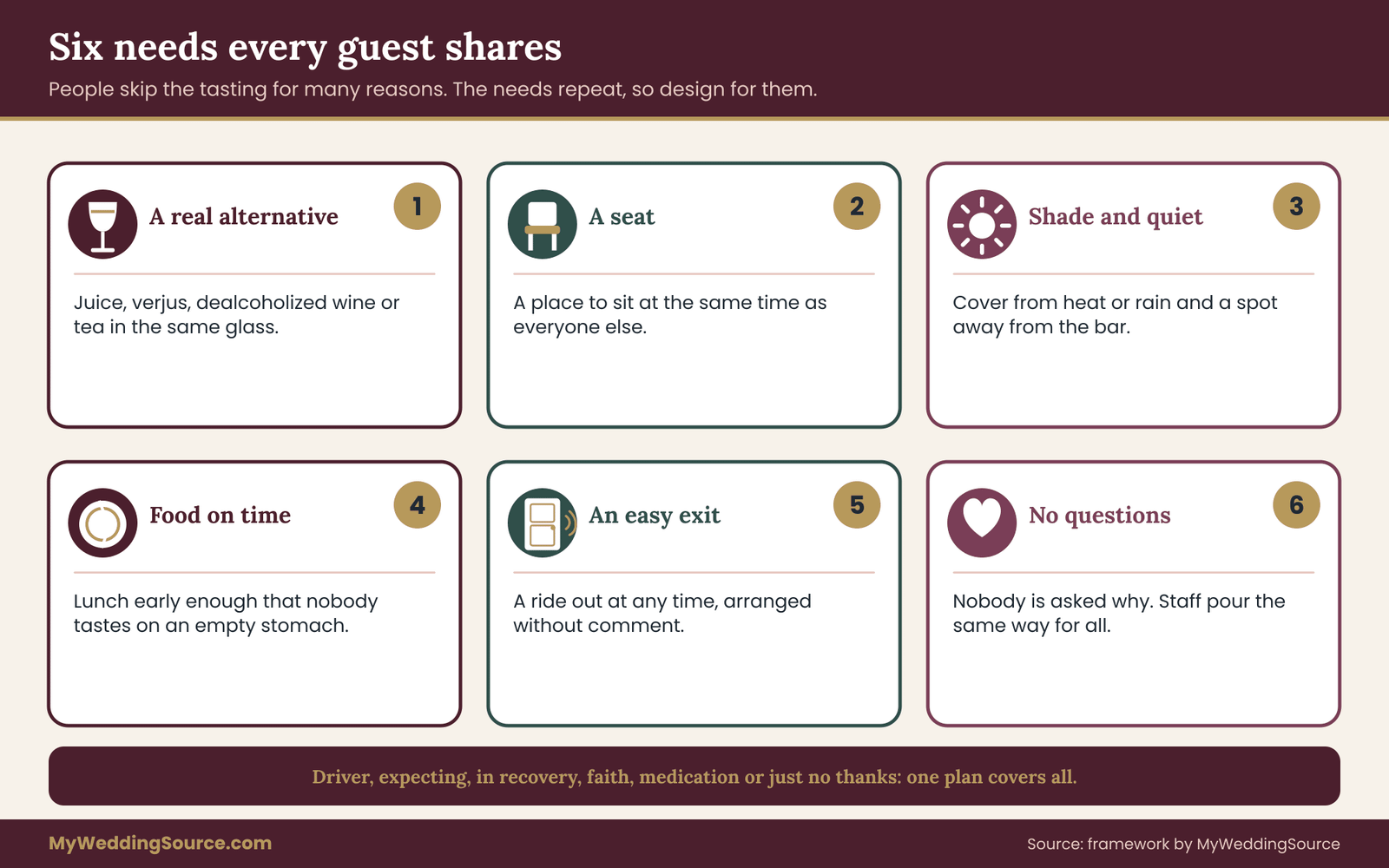
It helps to picture the guests individually, because a generic “nondrinker” does not exist. Different people need different things from the same afternoon, and a briefing that covers only one of them will miss the rest.
The driver. Someone has to drive a rental car, or the group is using a shuttle and a few people prefer to drive themselves. This guest needs to know that tasting portions are small but not zero, that spit buckets exist at most tasting bars, and that a sober choice will not be questioned. They also need parking details and an exit time.
The expecting guest. A pregnant guest may not have told anyone. She needs the same menu, the same table and the same attention as everyone else, without being asked to announce why. A good nonalcoholic option and a quiet way to order it matter more than a special mention.
The guest in recovery. This person may need the property to be calm about alcohol and may need an easy way to leave early. Being seated at a bar with an open bottle in front of them for forty minutes is the kind of thing that makes the winery outing miserable. A grounds-led plan with plenty of space helps a great deal.
The guest who avoids alcohol for faith or culture. This guest may also avoid some foods or may want to know in advance how the day is organized. Knowing that the lunch is not cooked with wine, and that tasting is separate from the meal, can decide whether they attend at all.
The guest on medication, or with a health reason. They may not drink at all, and may also need regular meals, shade, a place to sit or access to water. Their requirements overlap strongly with the older-guest and mobility checks in the next sections.
The younger guest and the children. Many properties set age limits for tasting, and some for entry. Teenagers and children may be welcome on the grounds, or may not. This matters when family groups are invited, and our guide on wedding guest care for children and older relatives covers the broader supervision questions.
The guest who just does not want to. No reason needed. They deserve an honest, good drink and a seat at the table.
Notice that the needs repeat: a real alternative drink, a seat, shade, food on time, an exit, and no one asking why. Those six things are the spine of the briefing in the next section, and they apply to any winery outing. If a property can deliver all six, you can run the winery outing with confidence. If it can deliver two of them, you must provide the rest yourself or choose a different property.
What guests should not be asked to do
Some patterns come up often enough to name. Do not ask guests to pre-register whether they drink, unless the venue needs a headcount for a paid flight, and in that case ask the question as a price choice (“tasting included” or “food and grounds only”) and not as a personal question. Do not seat nondrinkers separately. Do not hand them a different color wristband. Do not let a host say “you’re not drinking?” in front of the group. You can brief the staff on this before the winery outing, and the property will usually be glad to be told.
If you hear that a property insists everyone in the group pays the same tasting fee whether or not they taste, that is a pricing structure, not a rule of nature. It can often be negotiated, and the section on booking explains how.
The access and transport briefing for a winery outing
The core of this article is a single page that you write once and send to every guest invited. We will call it the access and transport briefing. It is short on purpose. It answers the questions guests are too polite to ask, and it forces you to get real answers from the property before you commit.
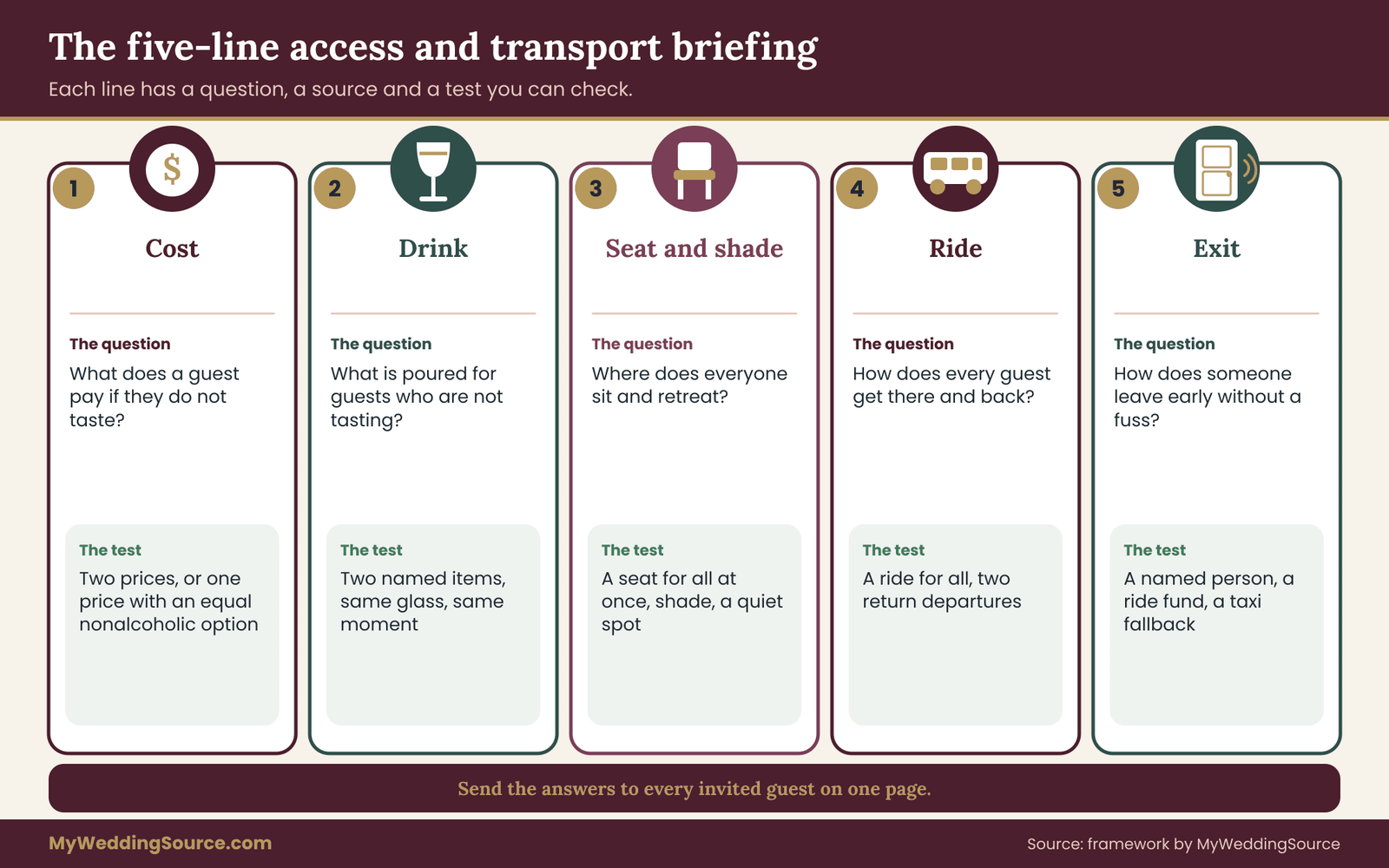
The briefing for any winery outing has five lines. Each line has a question you must be able to answer, a source for the answer, and a test that proves it.
Line one: cost. What does a guest pay, and does it change if they do not taste? The source is the property’s written quote. The test is that you can state two prices, one for tasting and one for food and grounds only, or one price that is the same and clearly includes a nonalcoholic option of equal value.
Line two: drink. What will a nondrinking guest be served, and is it served as part of the main offer? The source is the menu or the host’s written description. The test is that you can name at least two specific nonalcoholic items, and that they are served in the same glassware and at the same moment as the wine.
Line three: seat and shade. Where does a guest sit, stand or walk, and where can they retreat? The source is a site photo or a walk-through. The test is a seat for every guest at the same time, a shaded or indoor option, and a place away from the tasting bar.
Line four: ride. How does each guest get there and back, and who is the driver? The source is the transport contract or the rental plan. The test is that every guest, whatever they drank, has a return option that does not depend on a sober friend, and that you know the pickup time and the last departure.
Line five: exit. How does a guest leave early without a fuss? The source is the transport schedule. The test is that there is at least one departure before the main group leaves, or a taxi or rideshare fallback you have checked works at that location.
Why one page and not a long email
A long email about a winery outing gets skimmed. A one-page briefing with five labeled lines gets read, and more importantly it gets forwarded. Guests share it with partners and parents who will help them decide. It also gives you a clean record of what you promised, which matters if a vendor changes something later. Keep the tone plain and warm, and avoid language that sorts guests into types. Do not write “for non-drinkers”. Write “food and grounds option”.
Here is a sample line two, written for guests: “Every guest is welcome at the lunch table. Tasting is optional and priced separately. The property serves house-made juices, a dealcoholized wine option and sparkling water in the same glasses as the wine.”
That last sentence only goes in the briefing if the property has confirmed it. Do not describe a menu you have not seen.
Getting honest answers from the property
Properties vary widely in how much they have thought about this. A family-run vineyard may say yes to everything in a friendly email and forget by the day. A large estate may have a clear group policy and a coordinator who handles it. Neither is wrong, but you need to push for written confirmation either way.
Ask in writing. Phone calls are fine for rapport, but follow up by email and ask the host to reply with a yes or no to each line. A short reply such as “Confirmed: group of twenty-four, tasting optional at the per-person fee, food-only option at the lunch price” is far better than a general reassurance.
If the property will not state a food-only price, ask why. Sometimes the fee covers the whole experience for a reason that is reasonable, such as a minimum spend or a prepaid food package. Then your job is to find out what that package contains and decide whether it suits your nondrinkers. Often it can be adapted, but you need to ask before you sign.
What to do when the answer is not what you hoped
Say a property insists on a single fee per person for a fixed flight of five wines, and offers water to anyone who does not drink. You have three honest choices.
First, negotiate. Offer a different structure: a smaller fee for tasting, a lunch package for everyone, or a lower group rate for those who do not taste. The worst answer is no, and you lose nothing by asking.
Second, absorb it. If the fee is small relative to the whole weekend, you might choose to cover the difference yourself so that every guest pays the same and has a fair option. This is a budget decision, not a moral one, and our wedding budget guide can help you weigh it against other costs.
Third, walk away. If a property cannot offer a fair nonalcoholic option and you cannot work around it, pick another. There are many vineyards and many ways to spend an afternoon.
Planning the winery outing around the whole group, not the average guest
Most invitation lists are mixed in age, ability and habit, so a winery outing has to work for all of them. A winery outing built for the average guest quietly fails the ones at the edges. The edges are often the people you most want to include: grandparents, a friend in recovery, a cousin who is pregnant, the aunt who uses a cane.
Think of the group for your winery outing as a set of constraints rather than a crowd. Each constraint is a small test the winery outing has to pass.
Mobility. Vineyards are rarely flat. Gravel paths, uneven rows, steps down to cellars and long distances between parking and a tasting room are normal. Ask for a route with no steps, the actual distance from where the vehicle stops to the first seat, and whether there is a step-free restroom. For general accessibility rules in the United States, the Americans with Disabilities Act pages are the right place to start, though a destination abroad follows local law. Our guide to coordinating guest hotels across budgets and mobility needs covers the lodging side of the same planning.
Heat and weather. A summer afternoon in a vineyard can be hot, with little shade between the vines. Ask where shade is, whether indoor space is available, and what happens in rain. A plan B at the property is more valuable than a scenic photo.
Food timing. People who are not drinking, and people who are, both do better with food early. If the program has a tasting at two and lunch at three, move lunch up or add a snack at arrival. Medication schedules, pregnancy and age all push the same way.
Noise and crowding. Tasting rooms on a busy weekend are loud. A guest with sensory sensitivities or a hearing aid will not enjoy it. A private room or an outdoor table helps, as does arriving at a quieter hour.
Time. Older guests tire. Younger ones get restless. A visit of two to three hours, with a defined start and end, usually works better than an open afternoon. You can always extend informally if people want.
Making the opt-in clear in the invitation
The way you invite guests sets the mood. A message like “Join us at the vineyard on Friday for lunch, a cellar walk and, for those who like, tasting” tells everyone what is on offer and lets them choose. A message like “Wine tasting Friday, RSVP by May” tells the nondrinker the day is not for them.
Pair the invitation with a short RSVP choice that avoids asking about drinking. Options such as “Lunch and grounds”, “Lunch, grounds and tasting” and “Not joining” are enough. Your rules for collecting these responses are the same as for any event, and our guide to RSVP etiquette covers wording and deadlines.
Never make the winery outing the only daytime event of the weekend. If it is the only thing happening on the Friday, skipping it means a guest spends a day alone, which pressures them to attend. Offer a second, quieter option, or leave the winery outing free.
Choosing the property for your winery outing: questions that separate good from merely pretty
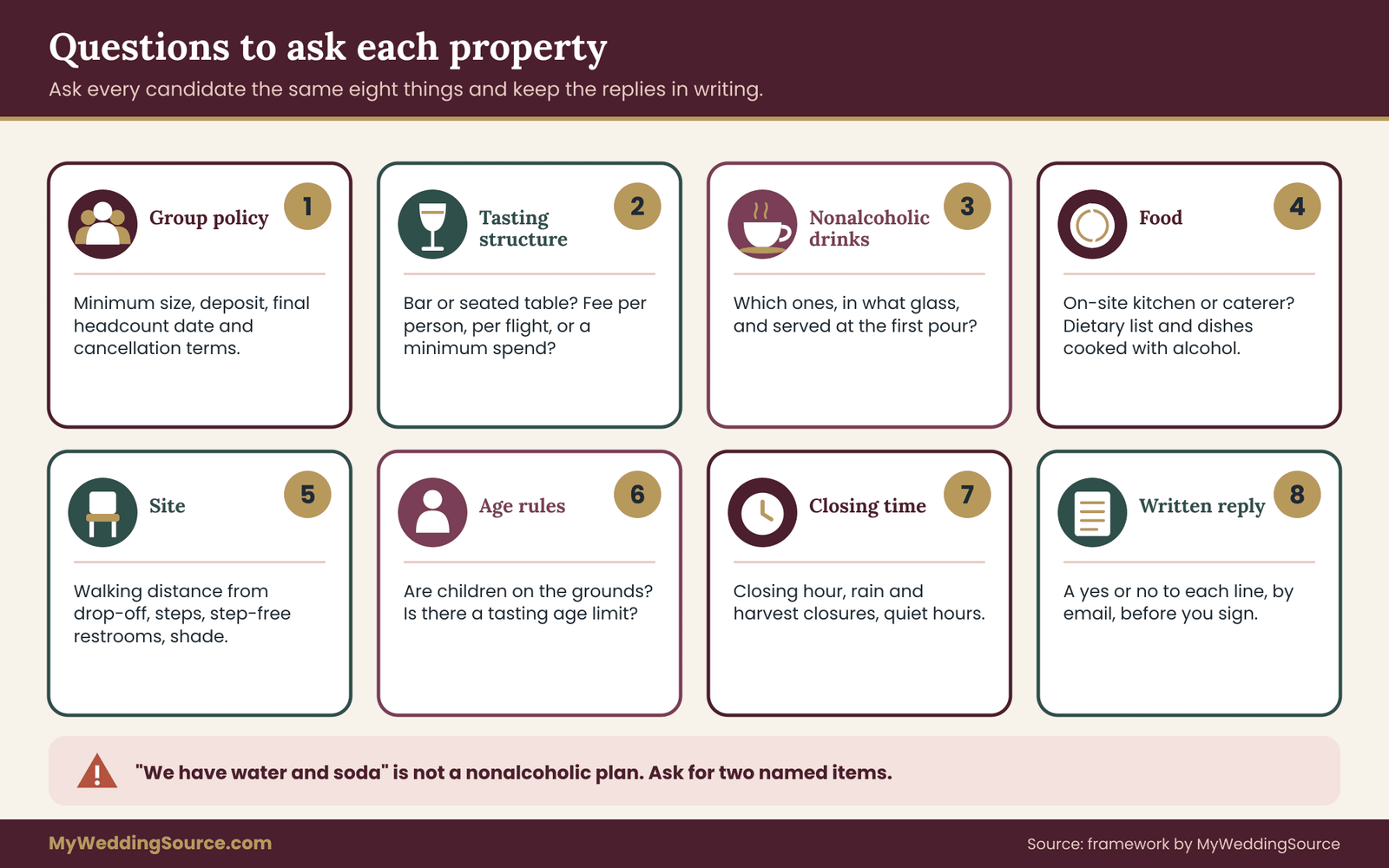
A winery outing property can look wonderful in photos and still be a poor fit for a mixed group. The decision is easier if you ask the same questions of every candidate and compare answers side by side. Keep notes in a simple document: one column of questions, one answer per property, and a note on how each answer was given (website, email, phone).
Start with the group policy. Many properties have a group booking process with minimum numbers, deposits and a set menu. Find out what the minimum group size is, whether you pay a deposit, and what happens if the count drops. A guest list that shrinks by four after an RSVP deadline should not cost you the booking.
Next, ask about tasting structure. Is tasting at a bar, at tables, or in a guided seated session? Is there a fee per person, a fee per flight, or a minimum spend? Is the fee waived with a purchase, and does that rule push nondrinkers to buy bottles they do not want? Seated tastings are usually easier on mixed groups than a crowded bar.
Ask about nonalcoholic offerings directly. Some properties make grape juice from their own fruit, some serve verjus, and some offer dealcoholized wine, sparkling tea or house-made sodas. A good answer is specific. A weak answer is “we have water and soda”. You are not asking for perfection, only for evidence that the staff have thought about a guest who is not tasting.
Ask about food. Is lunch cooked on site, brought in, or catered by a partner? Can the kitchen handle allergies and religious or cultural restrictions? Is there a menu in advance? Are meals included in the tasting fee or separate? If the property has no kitchen, ask which caterer they use and whether you can see their menu.
Ask about the site itself, because a winery outing depends on it. Where do vehicles stop, and how far is the walk to the first seat? Are there steps? Are restrooms step-free? Is there shade, indoor space, a quiet corner? Does the property have a policy on strollers, mobility devices or service animals? Request photos if you cannot visit.
Ask about the rules for age. Some properties allow children on the grounds but not in the tasting room. Others admit no one under twenty-one at all, which may or may not match local law. Know this before you invite family groups.
Finally, ask about the practical limits: closing time, capacity, noise rules, quiet hours, and what permits or reservations apply to group visits. Seasonal closures are common, especially around harvest, and weather can affect outdoor plans.
Reading the answers about a winery outing
Not every answer will be good, and you do not need a perfect score. Look for the pattern. A property that answers quickly, specifically and in writing is likely to deliver. A property that is vague, defers every question to the winery outing, or pushes back when you ask about nonalcoholic options is telling you something about how the day will feel.
Pay particular attention to the tone around guests who do not drink. If a host says “oh, they can just sit in the garden”, that is not a plan. If a host says “we do a shrub flight alongside the wine, and the kitchen can plate lunch for everyone together”, that is the answer you want.
Ask whether the property has hosted a mixed group before. Past experience is the best predictor. You can also ask for a reference from a previous wedding group, though privacy may limit what they can share.
A short script for the first call
If you prefer to start by phone, this is a reasonable opening. “We are planning an optional Friday visit for about twenty-four wedding guests. Some of them will taste and some will not, and we want everyone to have a good afternoon. Could you tell us what you offer for guests who are not tasting, how your group pricing works, and whether we could get a written summary?”
That wording does not apologize and does not pry. It also makes the property’s response easy to compare. Follow up the same day by email, repeating the five briefing lines and asking for written confirmation.
Nonalcoholic options that make the winery outing feel complete
The drink on offer is the most visible sign at a winery outing of whether a property has designed for everyone. Nondrinkers should not be handed a glass of tap water while others receive a flight. The aim is an alternative that feels like part of the experience.
There are several types of option, and each has a place.
Grape-based drinks. Many wineries make or can source juice from their own grapes, often in several styles. It connects the nondrinker to the place directly. Ask whether it is fresh, whether it is offered in the same glass, and whether guests can pair it with the same food. Juice is sweet, so a small pour and a glass of water alongside is kinder than a large glass.
Verjus. This is the tart juice of unripe grapes, used in cooking and sometimes served as a drink or mixed with sparkling water. It can be a sophisticated alternative where it is available, and some properties offer it alongside wine tastings.
Dealcoholized wine. Wine that has had the alcohol removed is now common, and some properties offer it. Labeling and alcohol-content rules vary by country, and some products still contain a small amount of alcohol. For guests who avoid alcohol entirely, for recovery, health or faith reasons, ask for the actual alcohol content on the label and let guests read it. The Alcohol and Tobacco Tax and Trade Bureau publishes labeling rules for the United States, but a property abroad follows local law.
Sparkling and tea-based drinks. Sparkling water with fruit or herbs, iced tea, kombucha and house-made sodas are widely available, and they are often easy for a kitchen to add. A tea pairing that mirrors a wine flight can be a pleasant surprise.
Coffee and hot drinks. Easy to forget, easy to provide. In cooler months or after lunch, an espresso or a pot of tea is a legitimate alternative and fits the schedule.
Water, always. Make sure water is on every table without being requested. Hydration helps drinkers too.
A fair serving rule
Set a simple rule for the winery outing: every guest receives the same number of servings at the same times, whether alcoholic or not. If the tasting is five pours, the nonalcoholic option is five small servings, or three servings and a plated course. This avoids the awkward feeling of getting less. It is also easy to explain to staff, who then know exactly what to pour.
Ask the property to avoid any phrase like “mocktail for the designated driver”. It sorts guests into categories. Use simple words like “alongside” or “also available”.
Pairing without alcohol
If lunch is part of the winery outing, ask the kitchen to suggest a nonalcoholic pairing for each course. Chefs who cook with wine in mind often have a good eye for acidity, sweetness and texture, and can suggest a shrub, a tea or a juice that fits. This costs little and turns a polite alternative into something guests talk about.
Check that the dishes themselves are not cooked with wine, unless that is clearly stated. Many sauces are. A guest who avoids alcohol entirely, for any reason, needs to know. Ask the kitchen to list any dishes containing wine, spirits or beer, and share that list in the briefing.
What to bring if the property cannot help
If a property offers little, you can supplement the winery outing yourself. Bring a small cooler of sparkling water, cans or bottles of nonalcoholic drinks, and a few tasting-sized glasses. Check first that the property allows outside drinks, because many do not and some charge corkage-style fees. You may be able to arrange for the property to serve what you bring. If it will not allow this, treat that as information about the property.
Never place the burden on the guest. A nondrinker should not be asked to bring their own drink to a vineyard visit organized by the couple.
Transport for a winery outing: rides, timing and who is responsible
Transport for a winery outing is the half of the briefing that people most often leave vague, and it carries the most real risk. A group that has tasted wine in the afternoon, in an unfamiliar place, often with narrow roads and no public transit, needs a ride plan that does not depend on anyone’s judgment at the moment. The plan should be made before the winery outing and be the same for everyone.
The principle is simple: no guest should have to decide, in the moment, whether they are fit to drive. Remove the decision by arranging transport that makes driving unnecessary, and by making that option the default and the cheapest one.
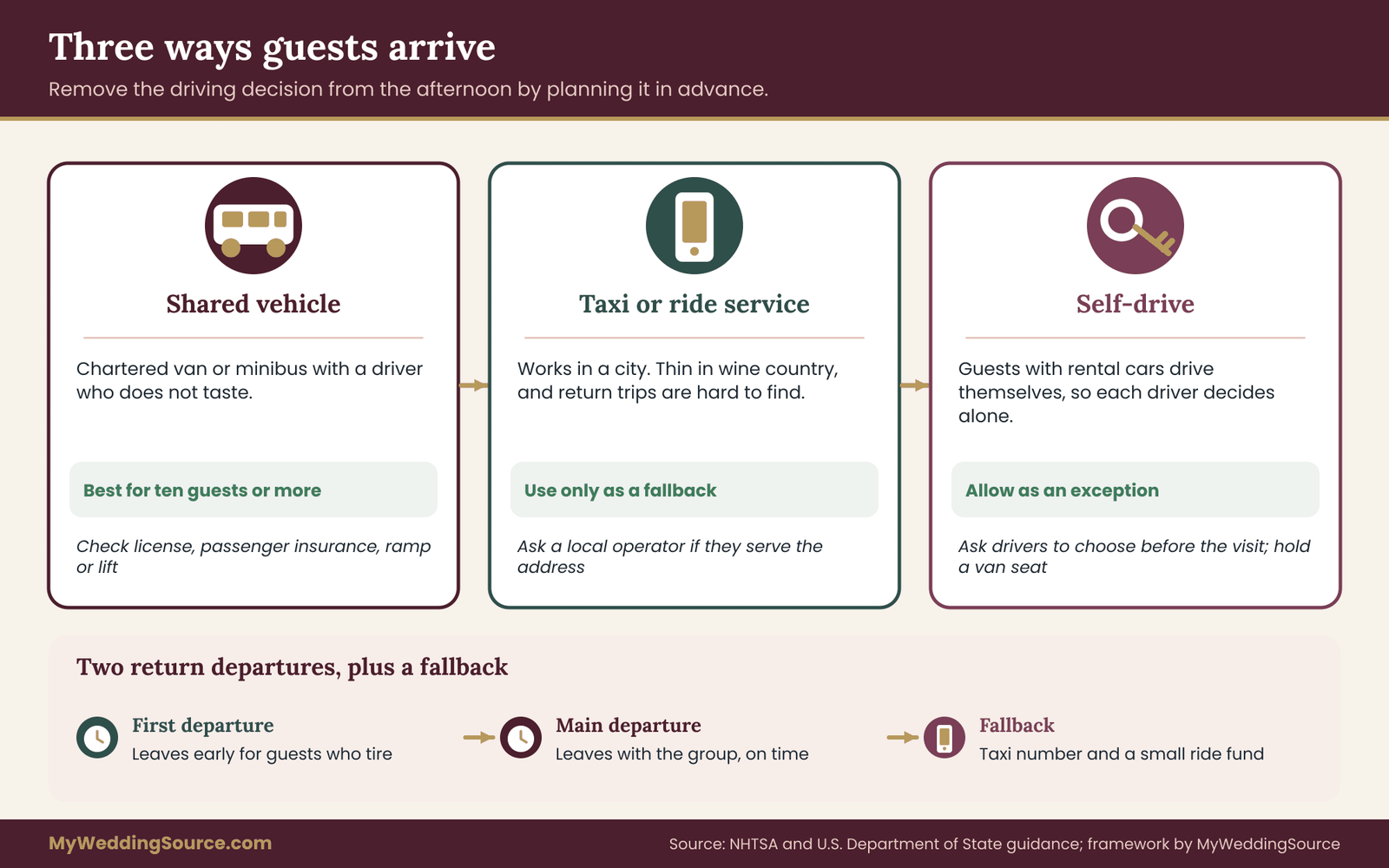
The three ways guests arrive
A shared vehicle you arrange. A chartered van, minibus or coach, with a driver who does not taste. This is the most reliable option for a group of around ten or more. It keeps the group together, it makes timing predictable, and it frees everyone to taste or not. The cost is shared, and you decide who pays it.
Taxis or ride services. Fine in a city with plenty of cars, much weaker in wine country, where service can be thin and return trips are hard to find. Do not assume a rideshare will be available at five on a Friday afternoon at a remote estate. Check the property’s advice, and ask local operators how long return pickups take.
Self-drive. Guests with rental cars drive themselves. This gives freedom, but it puts responsibility on each driver. If you allow it, set the expectation that the designated driver does not taste, or that the person does not drive afterward, and provide a fallback.
For most mixed winery outing groups, a chartered shared vehicle is the cleanest choice, with self-drive as an exception for those who prefer it and a fallback ride for anyone who changes their mind.
What to ask a transport company
Treat the transport provider like any vendor, and use the same discipline you would for a venue or caterer. Our wedding vendor due diligence checklist covers the general checks. For a winery outing, add these.
Is the company licensed to carry passengers in that area, and can it show proof? Rules differ widely, and your destination may have its own permit regime. Ask for the operator’s license number and the insurance cover for passengers, and verify with the local authority if you can.
What is the vehicle’s capacity, and does it have room for a mobility device? Ask whether there is a lift or ramp, or whether guests must climb steps.
How long is each leg, in minutes, at the time of day you will travel? Ask for the driver’s own estimate, not a map app’s estimate, and add a buffer.
What is the waiting policy? Some companies charge by the hour, some by the trip. A winery outing in which the van waits at the property costs more than one that drops and returns. Ask what happens if the group runs late.
What is the cancellation and weather policy? A deposit that is lost if the weather turns could be costly.
Will the driver be present throughout, and will they avoid alcohol at the winery outing? Ask directly, in writing.
Working out the timing of the winery outing
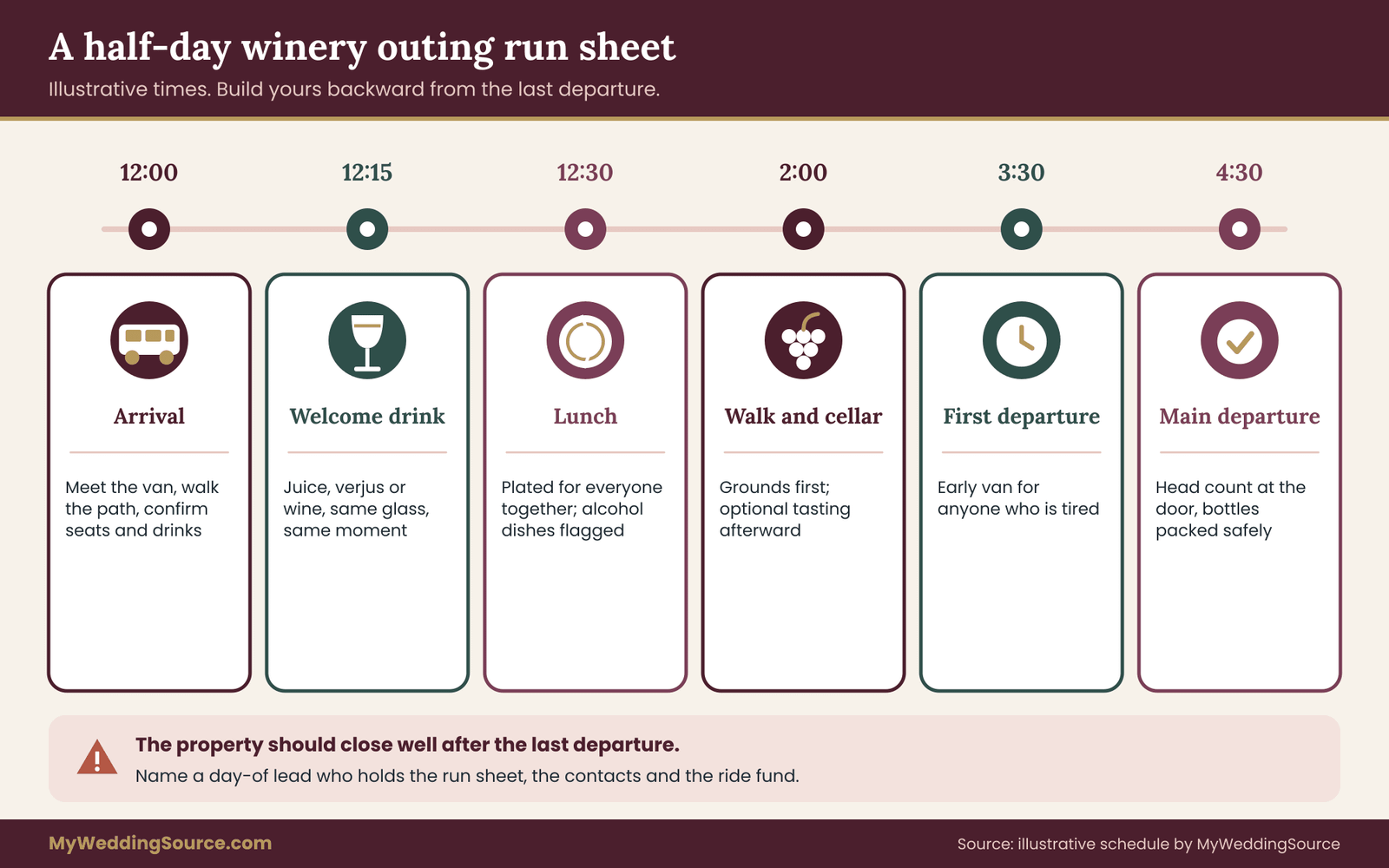
Build the schedule backward from the last departure. If the final van leaves at five, and the drive back takes forty minutes, guests arrive at the hotel around a quarter to six. Add the time for boarding, which is always longer than you think with older guests or a group that lingers.
A workable pattern for a half-day visit is arrival at noon, a welcome drink at twelve fifteen, lunch from half past twelve, tasting or a cellar walk from two, and a first departure at three thirty with a main departure at four thirty. Adjust to your own site. The key idea is two departures, one earlier and one later, so that guests who want to leave have a way to do it without waiting for the whole group.
Test the timing, if you can. A scouting trip, a call with the driver, or even a drive-through on a map with the stated speed limits gives you a more honest estimate than the brochure.
A fallback for the guest who changes plans
Someone will feel unwell, tired or overwhelmed. Someone will get a call and need to leave. Someone will realize they should not drive. Your plan needs a fallback for each.
Keep the contact for a local taxi service on the briefing page, and check that it actually serves the property’s address. Keep a number for the coordinator on the day. Decide in advance who pays for an unplanned ride, because that question gets awkward on the spot. Many couples set a small ride fund so that no guest hesitates to ask for help.
Make it normal to use it. The line “Any guest can leave at any time and we will cover the ride” removes the quiet pressure to stay until the van leaves.
Driving rules and the sober-driver arrangement
If guests will drive themselves, you are not the legal authority, but you can set the expectation. Driving limits and penalties vary by country and region, and some places have a very low or zero limit. For United States rules and safety guidance, the National Highway Traffic Safety Administration is the right place to start. For a destination abroad, the U.S. Department of State’s country pages and the local transport authority give current information about local road conditions, and the property or operator should know the local alcohol limit.
Avoid assigning one friend as the sober driver for the whole group. It places a heavy burden on one person and it turns an optional outing into a job. If self-drive is needed, rotate: a different guest drives each leg, or hire a driver.
Arriving in a foreign country
If your destination is abroad, add a few checks. Confirm that guests know the local rules on carrying ID and on the legal age for alcohol, which may differ from home. Check whether an international driving permit is needed for those who want to drive; the State Department’s travel pages explain how to find current entry and driving guidance for each country. Make sure the transport company can communicate with guests in a shared language.
The same advice applies to guests with limited experience of the country. A first-time visitor to a vineyard region may not know that distances are long and that evening roads may be unlit. A short note in the briefing about typical drive times and conditions gives guests a realistic picture and helps them choose.
Booking the winery outing without penalizing the people who do not drink
Money shapes how welcome a guest feels at a winery outing. When the price assumes everyone drinks, those who do not drink either pay for something they do not use or are shown a different price that makes the difference visible. Neither is comfortable. The goal is a price structure that is clear and fair and that does not require a guest to explain.
Who pays, and for what
You have several choices about who covers what.
You can cover the whole winery outing as part of the wedding hospitality. This is simplest, and it ensures no guest pays for what they cannot or choose not to use. It is also the most expensive.
You can cover the shared costs, such as transport and lunch, and let guests pay for their own tasting. This keeps tasting optional and prices fair.
You can ask guests to cover their own costs. This is common for optional excursions, but it should come with a clear price and a clear alternative for nondrinkers.
Whichever model you choose, say so in the invitation. Our guide on wedding budgets can help you place the cost within the whole weekend, and note that the cost of transport is easy to underestimate.
Two price lines, one table
If the property offers a tasting fee and a food-only fee, present both in the briefing with no commentary. For example: “Lunch and grounds: one price. Lunch, grounds and tasting: a higher price.” Do not label either as the normal choice.
If the property insists on a single fee, ask whether the fee can include a nonalcoholic pairing of equal value. If so, say so. If not, consider negotiating, absorbing the difference or choosing another property, as discussed earlier.
Watch for minimum spends. Some properties set a minimum for the group, to be met by tasting, food or bottle purchases. If the minimum is high and most guests do not drink, you may fall short. Ask for the minimum in writing, and ask whether lunch and nonalcoholic drinks count toward it.
Reading the contract
For a group booking, ask for a written agreement. The general advice in our guide to wedding vendor contracts applies. Check these items in particular.
The final headcount date and what happens if the number falls. Some properties allow a reduction of a few guests without penalty; others charge for the original count.
The deposit and the refund terms. Know what is refundable and when.
The rain and closure policy. If the vineyard is closed for harvest, weather or a private event, what do you get back?
The inclusions. Does the fee include water, nonalcoholic drinks, lunch, a guide and gratuities? Are service charges added?
The rule on outside food, drinks and decorations, if you plan to bring anything.
The cancellation terms of any transport booked through the property.
Keep a copy of every message with the property and confirm any change in writing. A vineyard may rely on seasonal staff, and the person who made a promise may not be the person at the door.
Tips and gratuities
Customs differ by country. In some places a service charge is automatically added, and in others tipping is expected, and in others it is unusual. Ask the property and the transport company what is typical and whether a gratuity is included, and tell guests if they are expected to bring cash. A brief line in the briefing avoids a stressful moment at the end.
A worked example of a winery outing for twenty-four guests
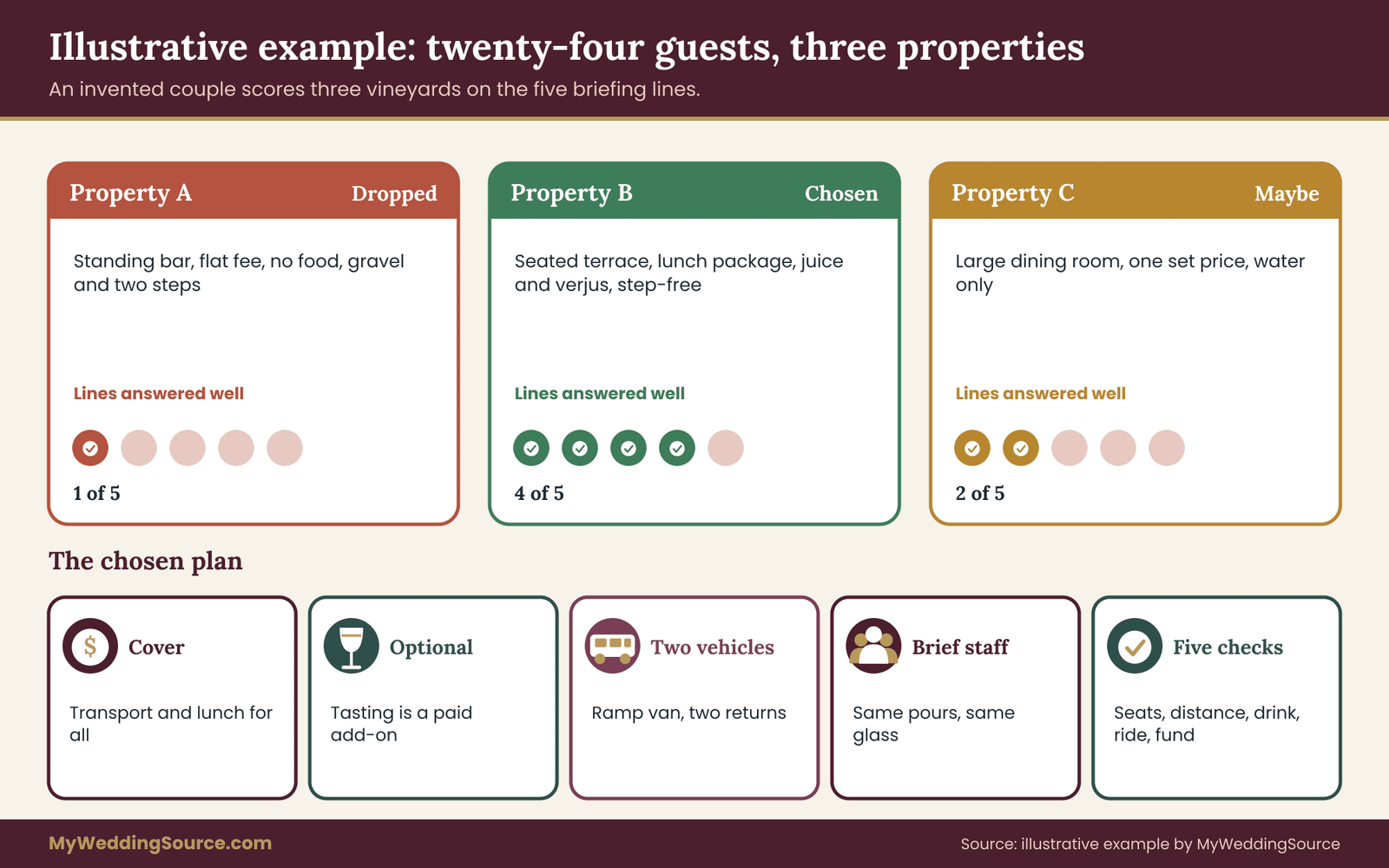
Abstract advice is easy to nod at and hard to apply, so here is one invented winery outing scenario, worked through. It is not a case study of real people and the numbers are illustrative, chosen to show the method, not to suggest typical results.
The couple, Dana and Marcus, are marrying on a Saturday at a coastal resort. Of their guests, twenty-four have said they would like an optional Friday afternoon activity. They are a mixed group: two grandparents, one of whom uses a walker, five people in their twenties, three couples with a toddler or a teenager, a pregnant cousin, a friend who has been sober for several years, and a few who simply prefer not to drink. The couple do enjoy wine.
Step one: write the purpose sentence
They write: “A relaxed Friday afternoon at a family-run vineyard, with a seated lunch, a short walk and optional tasting, finishing by half past five.” This rules out two properties that only offer standing bars.
Step two: collect answers from three properties
They send the five-line briefing questions to three vineyards. The answers, summarized:
Property A has a standing tasting bar, a flat per-person fee and no food. It offers water and soda for guests who do not taste. The path to the bar is gravel with two steps. The answer on all five lines is weak, so it is dropped.
Property B has a seated tasting in a covered terrace, a lunch package from a partner caterer, a separate price for lunch-only, a house-made grape juice and a verjus spritz. The terrace is step-free from a drop-off point about forty meters from the first seat. Children are welcome on the grounds but not in the tasting. The answers are strong, but the property closes at five.
Property C has a large dining room and a garden, a set menu priced the same for everyone, and no nonalcoholic option beyond water. The property says it will “look into it”. It can host groups until seven. The answers are mixed.
They choose Property B and ask for the closing time to be extended to half past five, which the host agrees to in writing.
Step three: set the structure and price
The couple decide to cover transport and lunch for all invited guests as part of the weekend, and to let tasting be an optional add-on that guests pay at the property. The tasting price is stated in the briefing along with a nonalcoholic flight, offered at a lower price, of juice and verjus with a small plate. Each guest chooses at the RSVP: lunch and grounds, lunch, grounds and tasting, or not joining.
Step four: arrange transport
Twenty-four guests need two vehicles, so the couple book a chartered minibus for twenty plus a smaller van. The operator confirms a license and passenger insurance and gives a drive time of about forty minutes each way. One vehicle has a ramp for the walker. The couple set two return departures: one at half past three and one at half past five, with a local taxi number on the briefing as a third option, and a small ride fund for anyone who needs to leave unexpectedly.
Self-drive is allowed only for two guests who prefer it, and the briefing asks them to choose between tasting and driving, with a van seat held for them either way.
Step five: brief the property staff
A week before the winery outing, Dana emails the host. The email lists the headcount, the three RSVP categories without names, and asks that all guests be served the same number of pours, that nonalcoholic items be poured in the same glassware, and that staff avoid commenting on who is not tasting. It asks the kitchen to flag any dish containing alcohol and to plate lunch for everyone at the same time. The host confirms by return email.
Step six: set measurable checks
The couple write five checks they can verify:
Every guest has a seat at the same time. They confirm twenty-four seats on the terrace.
The nonalcoholic option is available at the first pour, not after. The host confirms it is served at arrival.
The walking distance from drop-off to seat is under fifty meters, which suits the walker.
The first return departure leaves with room for at least ten guests, so early leavers do not wait.
The ride fund is announced in the briefing and available at the property.
None of these are fancy. Each can be answered yes or no, and each protects a specific guest.
What the example shows about a winery outing
Notice what the couple did not do. They did not ask who was pregnant or in recovery. They did not give anyone a special wristband. They did not label an option for nondrinkers. They designed a day where each of those guests could choose the same lunch, the same seat and the same ride as everyone else, with a drink to match. The briefing did the work.
Notice also what was left unresolved. The property closes at half past five and the late van leaves at the same time, so there is little slack. The couple accept this and note in the plan that if the group runs late, the taxi fallback is the plan. A good plan names its weak points.
Comparing alternatives to a tasting-room winery outing
A winery outing is only one of several ways to spend an optional afternoon at a destination. Sometimes it is not the best choice for your group. The list below is not a ranking; it is a way to match the day to the people.
Consider the options by what they offer a mixed group.
A seated lunch at a vineyard. The most flexible shape. Everyone eats, drinking is optional and incidental, and the setting is the draw. It works for nearly every guest type, provided the kitchen handles dietary needs. It costs more per person than a basic tasting but usually less stress.
A cellar or production tour. A guide shows the grounds and the process. It is educational and low on alcohol, and it fits curious guests of any age. It may involve stairs, cool cellars and standing, so check mobility. Tasting often comes at the end, which makes it easy to skip.
A cooking or harvest activity. Hands-on and social, with a clear task for each guest. It helps strangers talk and makes alcohol secondary. It requires a longer time commitment and a strong allergy plan. Ask the property how it handles allergies and cross-contact before you book.
A picnic in the vines. Informal and scenic. It suits younger groups, but the ground is uneven, food safety in heat matters, and a rain plan is essential.
A tasting-led visit. The traditional format. It is best for groups where most guests like wine and want it to be the focus. It can still work for a mixed group with seated tables and a strong alternative drink.
An alternative to a vineyard altogether. A farm, a food market, a distillery, a garden, a boat trip, a local artisan workshop or a scenic walk can serve the same purpose. A group that does not much like wine may enjoy any of these more.
A simple way to choose
Score each candidate on the same five briefing lines, with one point for each line the property can answer well, from zero to five. Use the score only as a conversation starter. A five is a property you can book with confidence, and a two is one you can book only if you plan to fill the gaps yourself.
Then weigh the shape. If at least a third of your likely attendees will not taste, favor a meal-led or grounds-led shape. If nearly everyone loves wine, a tasting-led format is fine, provided the alternative is good. If the group includes several guests with mobility limits, prefer a property with a single level and a short path.
There is no virtue in forcing a winery outing on a group that would prefer something else. A destination weekend often has room for more than one option, and a couple who offers a vineyard lunch, a beach walk and a free afternoon gives guests what they actually want.
Edge cases that change the plan for a winery outing
Most winery outing plans run into a few awkward situations. Naming them in advance means you can respond calmly. None of these needs a long policy. Each needs a sentence in your planning notes and a person who knows what to do.
A guest who is pregnant and has not told anyone
You will not know, and you should not guess. The same plan that works for other guests works here: a nonalcoholic drink served in the same glass, a seat, early food, shade, and an easy ride. If the guest tells you, thank them and ask what else would help, which is often a bathroom nearby and a plain meal. Do not mention it to others.
Be careful with food. Some soft cheeses, cured meats and raw items appear on vineyard lunch boards, and guidance on what to avoid in pregnancy comes from health authorities and the guest’s own clinician. You do not give medical advice, but you can ask the kitchen to label what is on each plate. A clear menu in advance solves most of this quietly.
A guest in recovery
For a person avoiding alcohol for recovery, a tasting room can be a hard place. The plan helps if the main experience is food and grounds, if the property does not pour at the table without asking, and if the guest has an easy way to leave early. Ask the property not to leave open bottles on the guest’s table, and not to offer top-ups without asking.
Do not ask the guest what they need in front of others. A private message such as “We want this to be easy for you. Is there anything that would help?” gives them room to answer or not.
If a family member or close friend is helping, they can quietly arrange a seat at the end of the table with a view of the exit. That kind of detail matters more than any statement.
A guest who avoids alcohol for religious or cultural reasons
Beyond drinks, check the food. Ask whether wine is used in sauces or marinades, and whether any dishes use vinegar or flavorings that contain alcohol, because practice varies by tradition and by person. Ask the guest what matters to them rather than assuming. Where the vineyard is the setting for a religious or cultural question your guests care about, it may be better to hold the meal in a separate room and keep the tasting elsewhere. Our guide to wedding etiquette covers the general principle of asking without prying.
A guest on medication, or with a health condition
Some medicines interact with alcohol, and some conditions require regular meals or hydration. Your role is not to ask. It is to make the winery outing easy: early food, plenty of water, a place to rest, and an option to leave. If a guest writes to you privately, listen, and do what is reasonable.
The designated driver who wants to taste a little
Small tastes add up, and a person who intended to drive may be tempted to try a pour. This is a reason for shared transport, and for the briefing to say plainly that guests who taste should use the vans. If a guest still insists on driving, ask them to choose before the winery outing and to let the host know that they are skipping pours. Do not argue in the moment.
Guests under the legal age
Check the property’s rules and the local law. Some properties allow minors only on certain parts of the grounds. Offer a clear alternative for teenagers, such as juice, a kids’ lunch and an activity. Make sure each child has a responsible adult present, as the wedding’s broader approach to guest care already requires.
The guest who wants to taste a lot
This is the other side of the same coin for any winery outing. A guest who drinks heavily at the vineyard is a safety issue for themselves and others. You cannot police adults, but you can limit exposure: set the number of pours, serve with food, avoid an open bar at the property, and keep the return ride organized. If someone becomes unwell, the coordinator on site knows who to call. Make sure the property’s staff have the right to stop serving, and that you will support that decision.
A group that splits
Sometimes half the group wants to keep tasting and half wants to leave. Two departures solve most of this. A third option, a taxi, handles the rest. Do not hold the whole group for a few people. A short rule such as “the vans leave on time” is clear and kind.
Weather, closures and permits
Seasonal closures, harvest activity, wildfire smoke, heat advisories and local rules can change plans at short notice. Ask the property for its closure policy and monitor local conditions in the week before. Build in an alternate: an indoor space, a different day or a different venue. If the destination is abroad, check the official travel advisory for the country, because conditions and warnings change.
Language and communication
If the staff do not share a language with your guests, ask for the menu and nonalcoholic items in writing in both languages. Guests who rely on translation apps in a loud tasting room may miss things. A printed card with the nonalcoholic list is a kindness, and a simple phrase card with words like “no alcohol, please” for guests who need it is a small addition that prevents misunderstandings.
When the property says no
Sometimes a property cannot do what you ask. It might be a small place that cannot manage a separate price, or an old estate that has no step-free route. Respect the answer. Say thank you, record the limits and either adapt or choose another. A property that says no clearly is better than one that says yes and fails.
Running the winery outing on the day
The briefing and the booking do the heavy planning for a winery outing. On the day, your job is to keep the plan visible and to deal with small surprises calmly. A one-page run sheet helps, with times, contacts and decisions already made.
Assign a day-of lead for the winery outing
Name one person who is not a member of the couple to run the winery outing. This could be a planner, a sibling or a trusted friend. They carry the run sheet, the contact numbers, the ride fund and the authority to make small decisions. The couple should be free to enjoy the afternoon.
The lead should be a person who is not tasting, or who tastes lightly, because the job requires attention. If you have no one suitable, a local event operator can supply a coordinator for a modest fee, and a destination wedding planner may already include this.
The run sheet
A good run sheet for a half-day winery outing includes the departure time and pickup point, the driver’s name and number, the property’s contact, the lunch and tasting times, the departure times for each return, and the phone numbers for a local taxi and for emergency services. It also lists the nonalcoholic items agreed with the property and the names of any guests needing assistance, if guests have chosen to share that.
Print copies and keep one on a phone. Share the guest-facing parts, the times and the contacts, with every guest ahead of time.
Arrival
Meet the van or the first guests at the drop-off. Greet the host, confirm the headcount and confirm that the nonalcoholic items and seats are ready. Walk the path from drop-off to the seat, and check for steps, wet ground or anything that has changed since your scouting.
Introduce yourself to the staff who will be pouring, not just the manager. Repeat the three requests: the same number of servings for everyone, the same glassware, and no comments about who is tasting. A friendly reminder at the door is more effective than an email read a week ago.
During the winery outing
Watch the pace. Lunch should start early enough that nobody is tasting on an empty stomach. If the tasting starts before the food, ask the host to pass a snack. Check that water is on the tables. Watch for anyone who looks tired, hot or uncomfortable and offer a seat in the shade.
Keep an eye on the clock. A visit that drifts past the planned departure is one of the most common failure points. Announce the earlier departure at lunch, and remind guests of the final one, so no one is surprised.
If a guest asks to leave, arrange it without commentary. Say “of course” and take care of the ride.
Departure from the winery outing
Count heads at each departure. Confirm that every guest has a seat and that no one is left at the property. Check that wine purchased by guests is packed safely, because glass in a van is a hazard. Thank the host and settle any final bill. If a ride fund was used, note it for the budget.
After the winery outing
Within a day or two, send a short thank-you to the host and the transport company, with notes on what worked. Gather quick feedback from the guests, in an easy form, about the nonalcoholic options and the ride. That feedback is useful if the couple or other guests plan similar visits.
Measurable checks before you send the briefing
A winery outing briefing is only as good as the facts behind it. Before you send it, run a short set of checks that each have a clear yes or no. These are your own working standards, not legal requirements, and you can adjust the numbers to fit your group.
Seat check. The number of seats at the property, at one time, is at least the number of guests attending, plus two spare. If the property cannot seat everyone together, ask about staggering, and tell guests.
Distance check. The walk from the drop-off point to the first seat is measured in meters or steps, not described as “short”. If a guest uses a mobility device, the path is step-free and the surface is firm. Ask the property for the distance or measure it on a scouting visit.
Drink check. Two named nonalcoholic items are confirmed in writing, and one is served at arrival. If the property offers dealcoholized wine, its alcohol content as shown on the label is confirmed.
Food check. Lunch is served within an hour of arrival, and the kitchen has the dietary list in advance. Any dish containing wine, spirits or beer is identified.
Ride check. Every guest has a seat on a vehicle both ways, or a stated alternative. There are at least two return departures, and a taxi or rideshare fallback has been tested at that address, for example by asking a local operator whether they serve the location.
Time check. The final departure leaves at least thirty minutes before the property closes, and at least an hour before dusk if the road is unlit.
Cost check. The guest-facing prices are stated, and the cost of a guest who does not taste is not higher than the cost of one who does.
Exit check. There is a named person who can arrange a ride for any guest at any time, and the ride fund covers it.
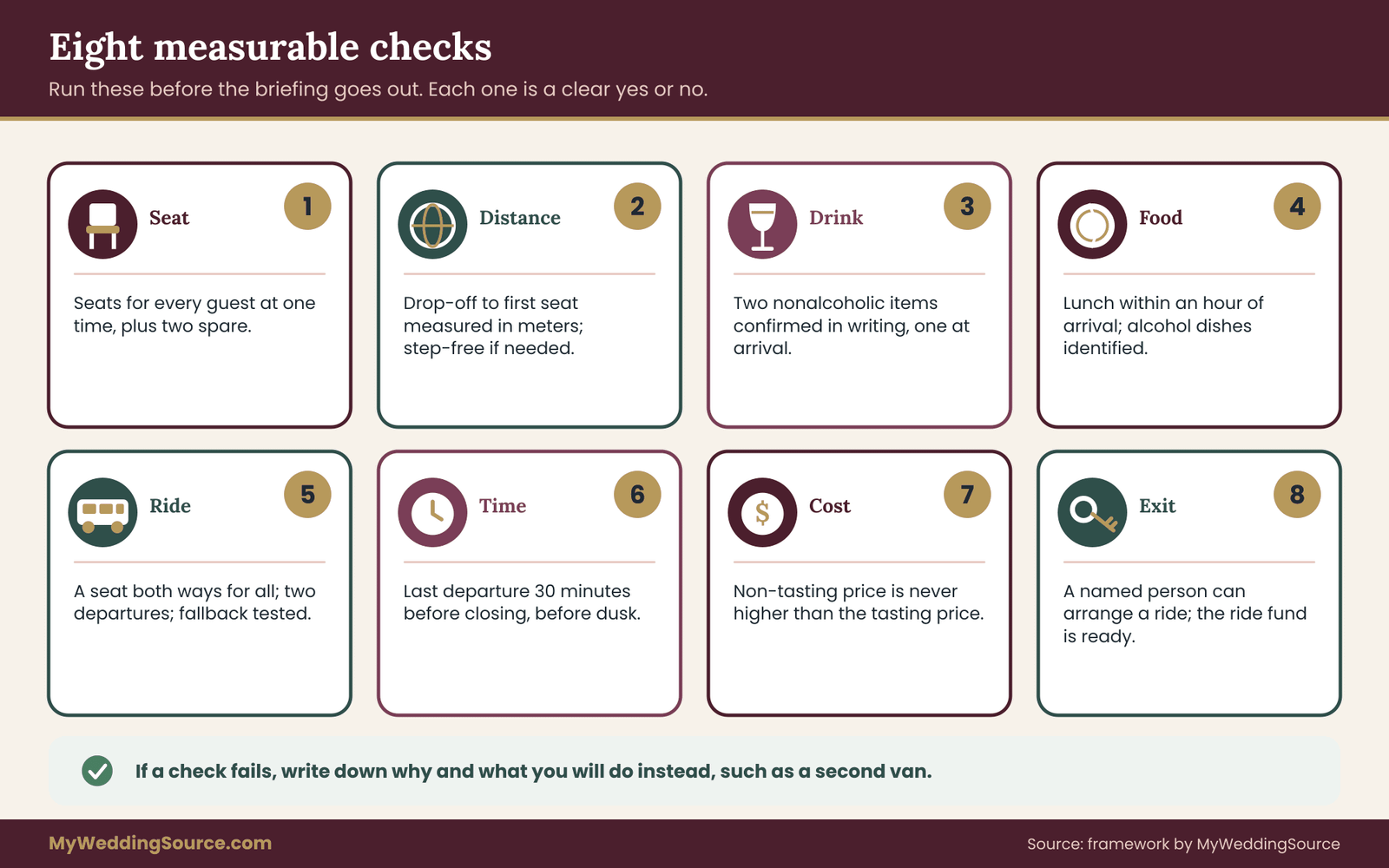
Write the results next to each check, with the source: a name, a date and a medium. If a check cannot be satisfied, record why and what you will do instead. An honest “not met, so we will provide a second van” is more useful than a vague note.
Vendor questions gathered in one list
When you are ready to contact the property and the transport company, the questions below pull together everything above. Send them in a single message so you can compare answers later.
For the property: Do you take group bookings of this size, and what are the minimum, deposit and cancellation terms? What is the price for a guest who tastes, and for a guest who does not? Which nonalcoholic drinks do you serve, and in what glass? Where do guests sit and where is the shade?
For the same property: how far is the path from drop-off to seating, and are there steps? What is on the lunch menu, and which dishes contain alcohol? What is your policy on children? When do you close, and what is the rain and closure policy? May we bring any nonalcoholic drinks, and is there a fee?
For the transport company: Are you licensed and insured to carry passengers here? What is the capacity, and is there a ramp? What are the drive times, including a buffer? What is your waiting policy and your cancellation policy? Will the driver avoid alcohol during the winery outing? Can you provide a second departure?
For the planner or day-of lead, if you have one: Who holds the run sheet, who holds the ride fund, and who makes the call if the schedule slips?
If you would like a more general method for screening suppliers, our wedding vendor due diligence checklist is a good companion, and the broader rules on holding deposits and written terms are the same.
Scripts for common moments
Short scripts help the winery outing-of lead and the couple respond kindly without thinking.
To a guest who declines a pour: “Of course. We have the verjus spritz or the juice, whichever you like.” No question, no comment.
To a host who asks about a guest not tasting: “Everyone is welcome to taste or not. Please serve the same way for all.”
To a guest who asks whether they must taste: “Not at all. Lunch and the walk are the main event.”
To a guest who wants to drive: “We would love you to ride with us so you can enjoy the afternoon. If you do prefer to drive, please let us know and we will keep a seat for you in case you change your mind.”
To a guest who needs to leave: “Of course, let me arrange a ride right now.” Then do it.
To a guest who is overwhelmed by the noise: “Shall we sit outside for a while?”
Common mistakes
A few errors repeat across every winery outing, whatever its size.
Describing the day as a tasting, which tells nondrinkers it is not for them. Asking a guest to explain why they are not drinking. Relying on a single sober driver. Assuming rideshare will be available. Not checking the closing time against the return schedule. Paying a flat fee for a tasting that half the group does not use. Forgetting food until late in the afternoon. Not telling guests the walking distance. Scheduling the winery outing as the only event of the day. Leaving transport to guests who have been drinking.
Each of these is a one-line fix if you catch it in the planning stage.
Your next steps
Work through these in order, over a few evenings, and your winery outing plan will hold together.
First, write the one-sentence purpose of your winery outing and decide whether it is tasting-led, meal-led or grounds-led. Second, list the guests, noting mobility, ages and any needs they have already shared with you, without guessing at the rest. Third, send the five-line briefing questions to two or three properties and compare the answers. Fourth, choose the property, then get the price, inclusions, closing time and nonalcoholic items in writing.
Fifth, book transport with two return departures and a fallback, and set a ride fund. Sixth, draft the one-page briefing and the RSVP choices, then send them with the invitation. Seventh, brief the property staff a week ahead. Eighth, name a day-of lead and prepare the run sheet. Finally, review the plan against the measurable checks the day before.
If the winery outing sits inside a longer weekend, the broader questions about food, drink and guest support at the wedding itself are covered in our wedding bar service planning guide, and the lodging and mobility side of the trip in the guide on guest hotels across budgets and mobility needs.
FAQ
Do we have to offer nonalcoholic options at a wedding guest winery outing?
You do not have to, but you should. Many guests will not taste for reasons you may never know, and a good alternative costs little. Ask the property for two specific nonalcoholic items, served in the same glassware and at the same time as the wine. If the property cannot, bring your own after checking the property permits it, or choose a different venue.
Should we charge a different price for guests who do not taste?
Offer two clear prices, one for food and grounds and one that includes tasting, or one price that includes a nonalcoholic option of equal value. Avoid making either seem like the standard. If the property insists on a flat tasting fee, try to negotiate, cover the difference yourself, or consider another property.
How do we ask guests about drinking without being intrusive?
Do not ask about drinking at all. Offer RSVP choices that describe the experience, such as lunch and grounds, lunch and grounds with tasting, or not joining. Guests choose what suits them and nobody has to explain. The property needs only the headcount for each option, not names or reasons.
What is the safest way to arrange transport for a winery outing?
A chartered shared vehicle with a driver who does not taste is the most reliable choice for a group. Check the operator’s license and passenger insurance, confirm drive times, and plan two return departures plus a taxi fallback. Avoid relying on one sober friend or on rideshare in a rural area. Confirm local rules with the operator and the relevant authority.
What if the winery outing property will not give a food-only price?
Ask why. Some properties bundle food and tasting into one package for a reason, such as a minimum spend. See what the package includes and whether a nonalcoholic pairing can be substituted. You can negotiate, cover the difference, or look at other properties. A written answer is better than a verbal promise.
Can children and teenagers join a winery outing?
It depends on the property and local law. Some allow children on the grounds but not in the tasting area, and some set an age limit for entry. Ask before you invite families, and offer an alternative drink, a kids’ lunch and an activity. Every child should have a responsible adult present throughout the winery outing.
How do we support a guest who is pregnant or in recovery without asking?
Design the winery outing so the same plan works for them: the same seat, the same food, a good nonalcoholic drink, shade and an easy exit. Ask the property to avoid pushing refills and leaving open bottles at tables. If the guest shares a need, listen and respond privately. Do not discuss it with others.
What if weather or a closure disrupts the winery outing?
Ask the property for its closure and rain policy before you book, and agree an alternate: an indoor space, a different time or a different venue. Check local conditions in the days before. Tell guests early through your usual channel. Keep deposits and refund terms in writing, and confirm what transport costs if the winery outing is cancelled.
Sources
- U.S. Department of State, Travel.State.Gov
- National Highway Traffic Safety Administration
- National Institute on Alcohol Abuse and Alcoholism
- Centers for Disease Control and Prevention, Alcohol and Public Health
- Alcohol and Tobacco Tax and Trade Bureau
- ADA.gov, Americans with Disabilities Act
- U.S. Food and Drug Administration
- Substance Abuse and Mental Health Services Administration
- Federal Trade Commission, Consumer Advice
- Centers for Disease Control and Prevention, Travelers’ Health