
Family readings are the poems, passages, letters and short blessings that relatives and close friends read aloud during a wedding ceremony. This guide shows how to decide who should speak, where each reading belongs, and how to give every volunteer a one-page brief and a short rehearsal path so the moment feels calm instead of improvised.
Choose family readings in three passes. First decide what job each reading does (welcome, meaning, blessing or transition). Then match each job to a person who can carry it comfortably. Then make that person ready with a nine-line written brief and a rehearsal timeline that starts about eight weeks before the wedding. Keep the total reading time short, give every reader a backup, and ask each volunteer in a way that makes a polite “no” easy.
Most couples start with the passage. They search for the right poem, then try to find someone to read it. That order tends to produce the same awkward results: an aunt who is thrilled to be asked but dreads the microphone, a cousin who reads too fast, a grandfather whose passage is printed in type he cannot see, and a ceremony that runs six minutes longer than anyone planned. The words matter, but the delivery usually decides whether the moment lands.
This guide flips the order. It treats each reading as a small job with a person, a place in the ceremony, a length, a cue and a backup. That is what a volunteer speaker brief is for, and it is the central tool here. If you are building a full ceremony timeline, the wider picture lives in our wedding ceremony cue sheet guide, and this article goes deeper on one part of it: the people who speak.
A note on scope. This is general planning information, not legal, religious or financial advice. Officiants, venues and faith communities set their own rules about who may speak and what may be read, so confirm those details with them directly.
What family readings do in a ceremony
Before you pick anyone, it helps to be honest about why you want family readings at all. A reading is not decoration. It does one of a few things, and knowing which one tells you who should read it and where it should go.
It welcomes. A short opening reading can settle a room. Guests arrive talking, finding seats, handling babies and phones. A calm, brief reading from a relative tells them the ceremony has started and that this is a family event, not a performance by professionals.
It gives meaning. Some readings explain what the couple believes about marriage, commitment or gratitude. These tend to be a few paragraphs of a poem, a passage of prose or a letter. The reader here is less important for acting skill than for credibility: a person the guests know, speaking about love, carries weight.
It blesses. A blessing is addressed to the couple, not to the room. Parents, grandparents and mentors often fit best, because the blessing carries the authority of someone who has watched the couple grow.
It transitions. Sometimes a reading exists to cover a ritual that needs a few seconds of quiet, such as a candle lighting, a hand-fasting or a signing. These family readings are the most flexible and the easiest to give to nervous volunteers, because they are short and the guests are looking at the ritual, not the reader.
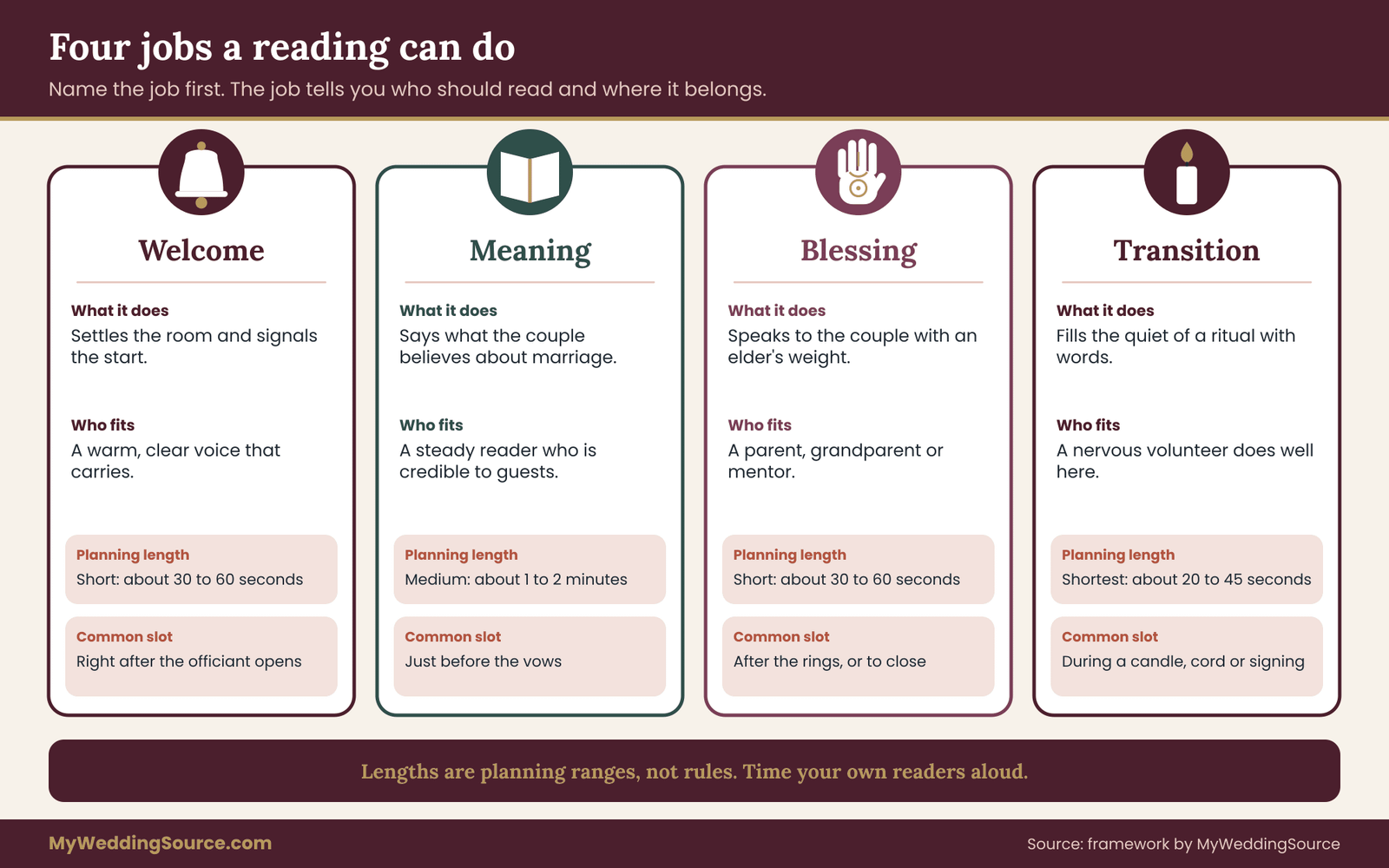
Naming the job first prevents a common mismatch. A long, reflective piece belongs with someone comfortable speaking slowly to a quiet room. A short welcome belongs with someone warm who can project. If you hand a three-minute meditation to a shy teenager because “it would mean a lot to them,” you have chosen for the relationship and not for the reading.
How many family readings is the right number
There is no correct count, but there is a useful way to think about it. Guests listen well for about the first ten minutes of a ceremony and then start to drift. Each additional reader also adds a physical movement: standing, walking, adjusting a microphone, sitting. Those movements add time that the words themselves do not.
For a ceremony of about twenty to thirty minutes, many couples find that two or three family readings, with a combined speaking time of three to five minutes, keeps the pacing steady. That is a planning range, not a rule. A longer ceremony with several rituals can hold more, and a short civil ceremony may hold one or none. Your wedding ceremony step-by-step outline is the place to see where the minutes actually go before you commit to a count.
One practical test: write the total reading time next to the total ceremony time. If readings take up more than about a quarter of the ceremony, either the passages are long or you have too many readers, and something should be trimmed. The test is simple and it catches overbuilt ceremonies early.
Treat family readings as a small, defined part of the program. Couples who think of them that way tend to make better choices about length, placement and people. Family readings work best when they are brief, prepared and given to someone who wants the job. Family readings that are long, unrehearsed or assigned out of obligation are the ones guests remember for the wrong reasons.
What the readings are not
Family readings are not the toasts. Toasts happen at the reception, usually with a drink in hand and a more casual tone. They are also not the vows, which are the couple’s own promises, and they are not the officiant’s remarks. Keeping those four things separate helps when you brief volunteers, because a person who has been asked to “say a few words” may assume they have license for stories and jokes.
A reading is a prepared text, read as written, for a set length. If you want something looser, such as a story from a parent, say so, and treat it as a different job with its own brief.
The rest of this guide follows one thread. Each of your family readings gets a job, a person, a place, a length, a cue and a backup. When all six are written down, the ceremony is easy to run, and when one is missing, you know exactly where the risk sits. Planning family readings this way also makes the conversations with relatives easier, because you are discussing a specific task and not a general favor.
Casting family readings: the Role, Reader, Ready test
Casting is the part couples avoid because it touches feelings. Who gets asked, who does not, and who is asked to do the smaller job all say something about the family, whether you intend it or not. A simple, repeatable test keeps the decision fair and keeps you from choosing on guilt or on the loudest request.
The test has three parts, and each reading goes through all three.
Role. What job does this reading do? Pick one of the four jobs above. If you cannot name the job in one word, the reading may not belong in the ceremony yet, or it may need to be cut down.
Reader. Who could carry that job? List two or three candidates, not one. A single name creates pressure, because if that person declines or becomes unavailable you have no one in mind. For each candidate, ask three quiet questions. Does this person speak comfortably in front of groups, even small ones? Will their voice carry in the space you have chosen? Would being asked feel like an honor to them, or like an assignment they cannot refuse?
Ready. Can this person be made ready? Readiness is not a trait, it is a result of preparation. A nervous reader who has a large-print copy, two rehearsals, a clear cue and a backup is often more reliable than a confident one who skips the rehearsal. So the question becomes: can this person attend at least one rehearsal, and will they accept a brief? If the answer is no, the reading may fit better elsewhere, such as the printed program or the officiant.
Putting the test to work
Take a concrete case. Suppose a couple wants a short welcome reading and a longer reading about commitment. For the welcome, the candidates are the bride’s brother, a college friend and the groom’s mother. The brother is outgoing and loud, which suits the job. The friend is composed but travels from overseas and cannot attend rehearsal. The mother is warm but nervous. The Role is welcome, the best Reader is the brother, and the Ready step is easy because he lives nearby.
For the longer reading, the Role is meaning. The candidates are the groom’s grandfather, an aunt who teaches high school and the best man. The grandfather has a lovely voice but his eyesight is poor and he would struggle with a small page. The aunt speaks to rooms of teenagers every day and handles a microphone without thinking about it.
The best man is already doing a toast at the reception. The aunt wins on Reader, and the Ready step shows the grandfather a place for a shorter blessing in large print, which keeps him included in a way that suits him.
Notice what happened. Nobody was ranked against anyone else on love or importance. Each person was matched to a job they could do well. That framing is also what you say, kindly, if someone asks why they were not chosen for the longer reading.
Casting family readings is partly a matter of reading people. Pay attention to how someone talks about speaking in public before you ask. Family readings suit people who volunteer with ease, and they can suit reluctant people too if the piece is short enough and the support is strong. The aim is a good experience for the volunteer, since nervous family readings are heard by the whole room.
Signs that a candidate should read something shorter
Some signals suggest a candidate would do better with a shorter piece or a different role. They say they get nervous speaking in front of people. They hesitate before answering the invitation. They are in the middle of something heavy, such as an illness, a recent loss or a difficult travel schedule.
They read slowly or with difficulty and have never asked for help. None of these is a reason to exclude someone. They are reasons to offer fewer words, larger type, a seat close to the lectern or a shared reading with a partner.
The goal is that every volunteer finishes the moment feeling proud, not relieved that it is over. A person who is asked to do something slightly smaller than they hoped usually forgives it quickly. A person who is asked to do something larger than they can manage may remember it for years.
Several family readings across both sides of the family need not be identical in length. A fair mix of voices, ages and relationships matters more to guests than equal word counts. When you plan family readings, look at the whole list at once and ask whether the room will hear a range of people, including at least one older voice and, if it suits the ceremony, one younger voice.
Balancing the two sides of the family
Couples often feel an unspoken duty to keep the families even: one reader from each side, equal word counts, equal time. That instinct is understandable and it is usually worth following loosely, not strictly. What guests notice is not arithmetic but warmth and fairness. If one family has several eager readers and the other has a single quiet candidate, matching them reading for reading would force someone into a role they do not want.
A better approach is to balance across the whole ceremony, not only the family readings. Perhaps one side’s parent leads the welcome and the other side’s grandparent gives the blessing. Perhaps a sibling on one side walks a family member down the aisle while a sibling on the other side reads.
The wedding decision-making guide explains how to share input with relatives without giving up the final call, which is the same principle at work here: you can say thank you generously and still decide the roster yourselves.
Hard cases in casting family readings, and kind alternatives
Every family has a few situations that make casting harder than the three-part test suggests. They are not rare. Planning for them in advance keeps you from improvising a difficult conversation two weeks before the wedding.
The relative who expects to be asked
Some relatives assume they will read, often because a sibling or cousin of the same generation did at an earlier family wedding.
If you do not want to give them a reading, say so early, and offer something real instead. Real means a named job with a place in the day, not a vague “we will find something for you.” A relative who is asked to hand out programs, to light a unity candle, to escort a grandparent or to say a blessing at the rehearsal dinner is usually satisfied, as long as the offer comes before they start to wonder.
A short script helps. “We have kept the ceremony readings to three people, and we picked by who could be at the rehearsal. We would love you to do the welcome at the rehearsal dinner instead, and we would like to ask you to sit with your mother during the ceremony.” You are not apologizing and you are not debating. You are offering something specific and moving on.
Every one of these situations comes down to the same principle: family readings are a shared gift, and the couple holds the final call. Say yes to the person and be honest about the passage. Family readings that come from the reader’s own taste can be lovely, as long as they fit the job and the clock.
The reader who wants to choose the passage
A volunteer will sometimes arrive with their own favorite passage, which can be wonderful or a problem. The test is simple. Does it do the job you assigned? Is it the right length? Does it fit the tone of the ceremony and the beliefs of the couple? Is it something the guests will hear as welcoming and not as pointed? If the answer to all four is yes, accept it graciously and send it through the same brief as any other reading.
If the answer is no, you have a choice about how to say so. Do not critique the passage. Return to the job. “We need something about two minutes long that speaks to the room as a whole. Could we look together at a few that might do that?” Offering a short list of alternatives, each already vetted, keeps the volunteer involved while keeping the ceremony on track.
Whether a passage may be printed in a program or shown in a video is a separate question about who owns it, so check the source before you commit.
The reader with a different belief or background
A ceremony may include family members with different religious beliefs, or none. A reader from one tradition may be asked to read a passage from another, and the result can feel meaningful or strained depending on the setup. Ask the reader directly, in private, whether they are comfortable with the text.
Do not assume. If a passage is religious, check it with the officiant and, where relevant, with the faith community. Our guide to planning an interfaith wedding ceremony covers who owns which ritual, and the same ownership thinking applies to readings.
Where a passage is not comfortable for the reader, there are easy swaps. A secular passage of similar length can replace a sacred one. A shorter blessing can replace a long scriptural reading. Or the officiant can read the sensitive passage while the family member does something else. The point is not to force harmony. It is to make sure nobody is asked to say words they do not believe in front of everyone they know.
Alternatives to a single live reader
A solo live reader is one option among several, and the others solve real problems. Think of them as a ladder from most exposed to least.
A solo reader at a lectern is the classic format. It carries the most presence and the most risk, and it suits confident speakers and short to medium passages.
Two readers sharing one passage halves the burden. Each person reads half, or they alternate stanzas. It works well for siblings, for a parent and child or for a couple of friends. The cost is a little more coordination, because the handoff has to be rehearsed.
A group reading has several people read a line each, or the whole row read a response together. It is warm and low-pressure, but it needs printed text in the program and a clear leader, so it tends to suit smaller ceremonies.
An officiant-read passage removes the volunteer entirely. The officiant is a trained speaker, and the family member can be named in the ceremony as the person who chose it. This is a good fit when a relative wants to contribute but would not be at ease speaking.
A printed reading appears in the program without being spoken. It lets a person be included by name, with a short dedication, at no performance risk. It is especially good for relatives who cannot travel.
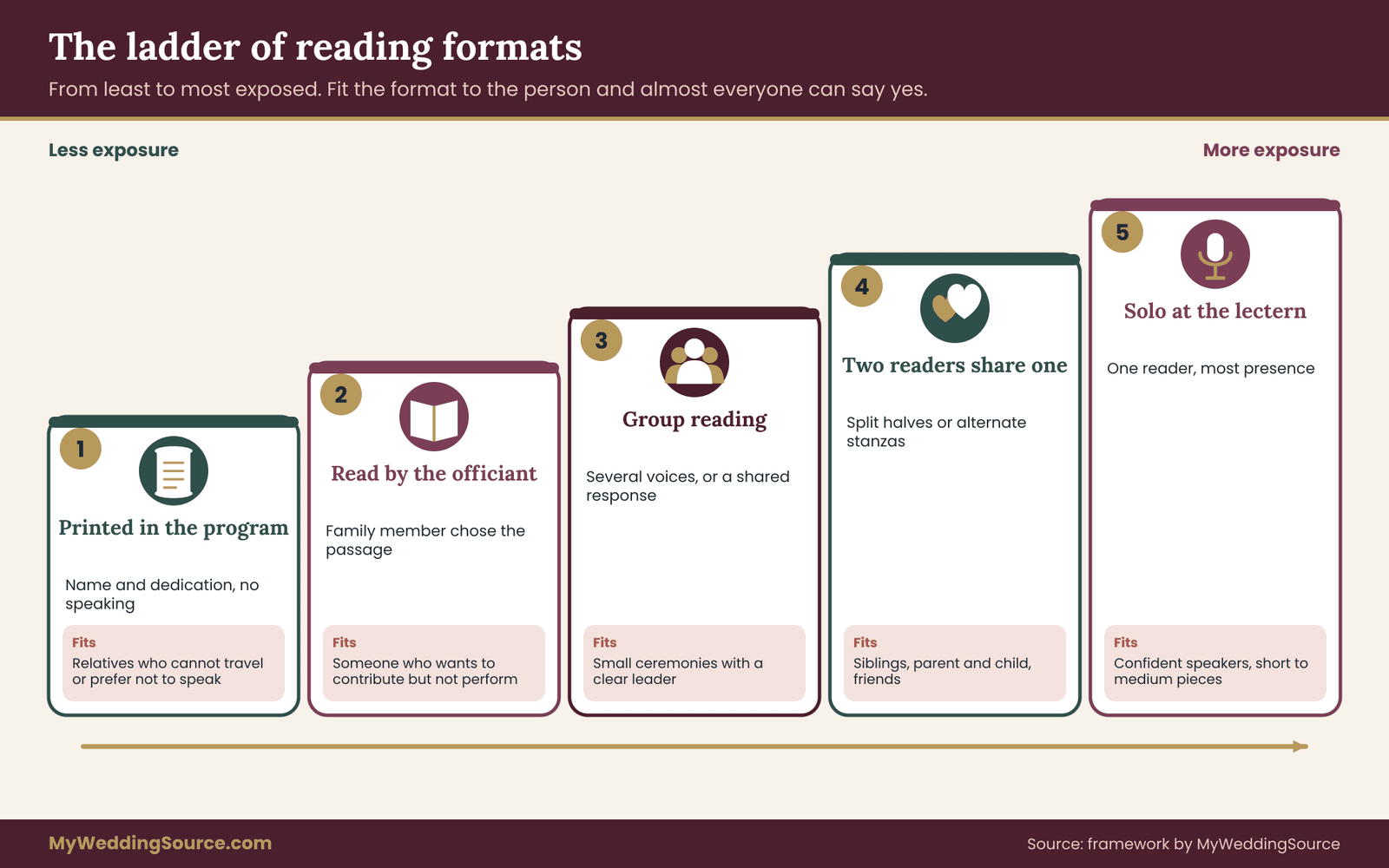
The ladder is useful because it lets you say yes to almost everyone. A person who cannot speak aloud can still have a printed reading. A person who is nervous but eager can share a passage. A person who is confident can take the solo slot. You are fitting the format to the person, and nobody has to be turned away empty-handed.
Accommodation is not a special track. Family readings that include a grandparent with low vision, a teenager who is anxious or a guest who uses a wheelchair are simply family readings with a few extra lines in the brief. Plan for these needs from the first draft of the roster and the work is small, and treat them as afterthoughts and the work becomes a scramble.
Readers who need accommodations
Some volunteers have needs that deserve a plain, respectful plan. A grandparent with low vision needs large, high-contrast type and a lectern with a light. A person with a speech difference may prefer a very short passage, or a partner to read alongside. A reader who uses a wheelchair needs a lectern or mic stand at a usable height and a clear path with no steps. A reader who is hard of hearing may want to follow a printed cue instead of listening for one.
The Americans with Disabilities Act is the federal civil rights law that covers access to many public spaces, and the ADA website explains the broad principles. For a specific venue, the venue manager is the person who knows what is physically possible, so ask them before the rehearsal, not on the day.
A reasonable question is, “One of our readers uses a wheelchair. Where does the lectern sit, and is there a ramp or a level route?” You are asking for information, not making a complaint.
When each reading goes: placing family readings in the ceremony
Placement is where a good roster either shines or stumbles. A reading in the wrong spot can feel abrupt, and two family readings next to each other can feel like a meeting. The ceremony has natural seams, and family readings fit best at those seams.
Where you place family readings depends on the style of ceremony, so the officiant’s usual order comes first and your preferences second. In a short civil ceremony, family readings may be a single moment before the vows. In a longer religious ceremony, family readings may be woven between rituals and prayers. Ask what is usual, then adjust within what the officiant allows.
A typical ceremony arc
Most ceremonies, across many traditions, follow a rough arc. Guests are seated, the processional happens, the officiant welcomes everyone and states the purpose of the gathering. There may be a reading or two, a brief address, the vows, the ring exchange, any cultural or religious rituals, the declaration and the recessional.
Your officiant or faith leader will have a standard order, and the one they use is the one you should plan around. The wedding officiant requirements page covers what officiants commonly need from couples, and it is worth reading before you finalize the order.
Within this arc, family readings usually sit in one of four seams.
Right after the welcome. This is the strongest slot for a short, warm reading. The room has just been called to attention and is ready to listen. It is also the safest slot for a nervous reader, because the first reading sets the tone and is easy to rehearse.
Before the vows. A reading about commitment or love often fits here, because it prepares the ground. The risk is that the vows are the emotional peak, so a reading that runs long or lands flat can leave the room restless just before the moment that matters most. Keep it short.
During a ritual. A reading over a candle lighting or a hand-fasting does two jobs at once. It fills a pause that could otherwise feel awkward, and it gives the ritual words. These family readings are usually the shortest.
After the ring exchange or the declaration. A final blessing can close the ceremony on a family voice, which many couples find moving. Because the recessional follows quickly, make sure the blessing ends cleanly and the officiant has a clear cue to take over.
The rhythm of family readings is as important as their wording. Short family readings separated by music or ritual keep the ceremony moving, and a long run of them makes it feel like a program of speeches. If you have more readers than slots, consider whether a shared reading or a printed one serves the extra people better than squeezing in another solo turn.
Spacing and pacing
Do not stack readings back to back. A good rule of thumb is to put at least one non-reading element between any two family readings: a piece of music, a ritual, the officiant’s remarks, the vows. That keeps the room from feeling like it is listening to a series of speeches, and it gives each reader a moment of their own.
Keep the reading order consistent with how people will see it. A reading that talks about “the day we met” should come before one that talks about “the years ahead.” A reading that mentions a deceased relative is often better placed early or late than in the middle, where it can pull the room down at the wrong moment. These are judgment calls, and your officiant is a good person to ask.
Movement is time
Each reader takes time to stand, walk, adjust the microphone, read, walk back and sit. In a small ceremony with a lectern near the front pew this might be fifteen seconds. In a large venue with a long aisle it can be forty. Count it. A reading that takes ninety seconds to say and forty seconds to deliver is a two-minute slot, and a ceremony with three of them has a six-minute budget you did not plan for.
The way to shorten movement is to seat readers close. Reserve the first few seats for them on the aisle, tell them the path in the brief and give them a visible cue. Ask the venue where the lectern and microphone will be, and place the readers’ seats accordingly. A cue sheet that lists each reader, their seat, their slot and their entry cue is the cleanest way to hold all this.
The volunteer speaker brief for family readings, line by line
The brief is a single page, one per reader, that answers every question a volunteer will otherwise ask you in a text at eleven at night. Nobody enjoys writing it, and nearly everyone is relieved to receive it. It lowers anxiety because it turns an open-ended favor into a defined task, and it protects you from the quiet failures that spoil family readings: the wrong passage version, the missed cue, the reader who did not know where to stand.
The brief has nine lines. Keep each line to one or two sentences. If a line needs a paragraph, the plan is not settled yet.
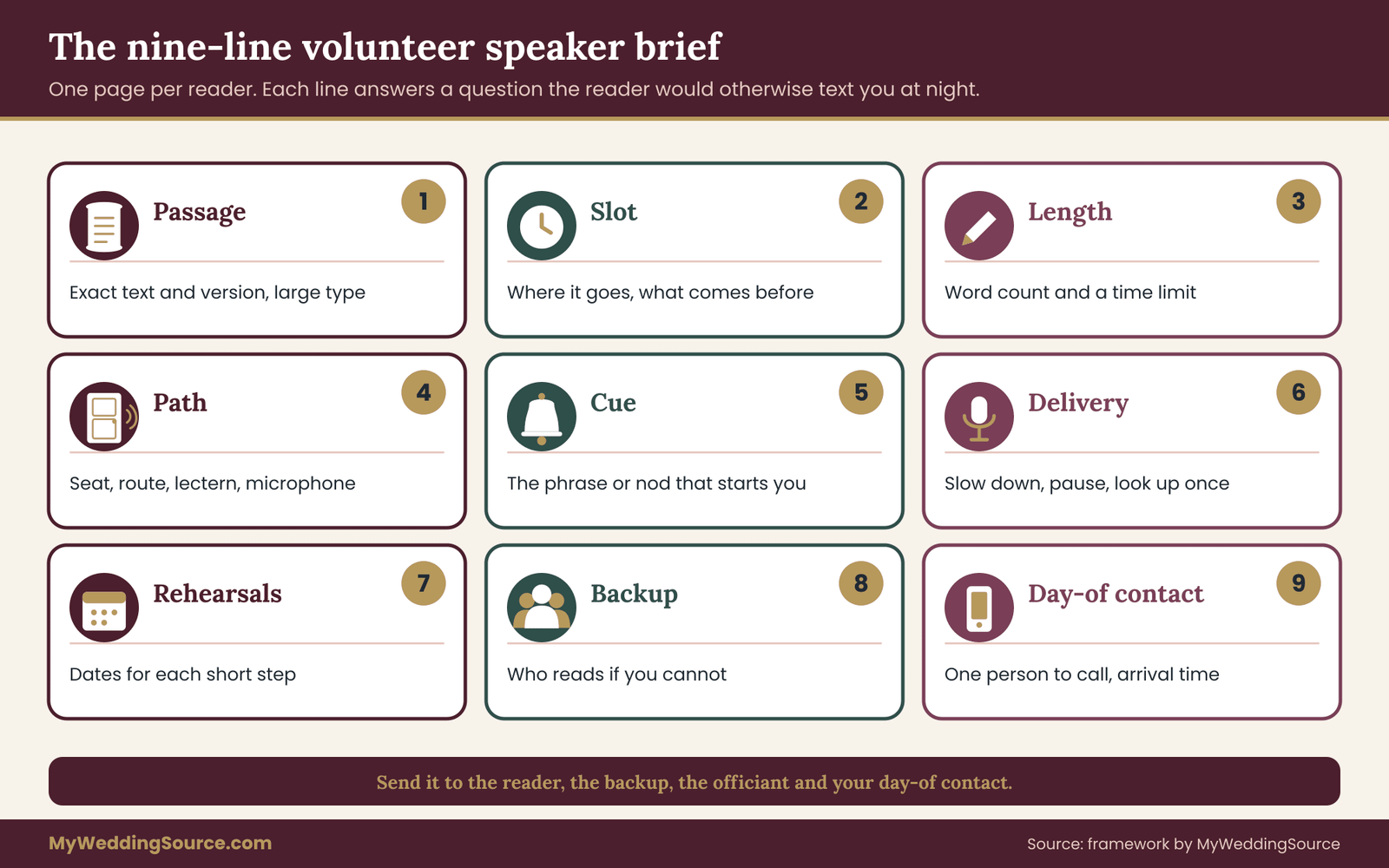
A reader who holds the wrong page is the most avoidable failure among family readings, so line one comes first. Send the text in the same file you give the printer for the program, and keep the version the reader receives and the version in print identical. Whenever the text of any of your family readings changes, resend the page and tell the reader what changed.
Line one: the passage and its exact text
State the title, the author or source and the exact version to be read. Attach the text itself, printed in large type, and say plainly that this is the version to use. Translations, abridgments and edited versions of the same passage differ, and a reader who has a favorite copy on their phone may read a different version than the one in your program.
If you have trimmed the passage, say where, and mark the trim on the page so the reader does not restore it by habit.
Line two: the slot
Say where in the ceremony the reading goes, in plain terms. “After the officiant’s welcome and before the vows” is better than “the second reading.” Add the position in the order: first, second or third. A reader who knows what comes right before them also knows what to listen for as a cue.
Line three: the length
Give the length in two forms, a word count and a target time. A reading of about 140 words is a reasonable example of a short passage, and a reader should be able to say it in roughly a minute at a calm pace. The exact figure depends on the reader, so the real number comes from the rehearsal timing, described later. The brief states the target and the limit, for example “about one minute, please do not go past ninety seconds.”
Line four: the path and the place
Describe, in three or four sentences, where the reader sits, how they get to the lectern and where they stand. Include whether there is a microphone, whether it is on a stand or handheld and where to hold the page. If there are steps, say how many. If the ground is grass, say so, because it affects shoes and walkers. This line is where accommodations are named, with the reader’s agreement, such as a seat on the aisle or a stool beside the lectern.
Line five: the cue
The cue is the signal that tells the reader to stand and start. A good cue is a spoken phrase from the officiant, such as “Now, Dana will read for us,” or a musical change that ends. A poor cue is “when it feels right.” State the cue in the brief, name the person who will give a nod if the cue is visual and give a fallback.
“If you have not heard the phrase by the time the music ends, look at the officiant and wait for the nod.”
Line six: how to read it
This line sets expectations about delivery without scripting it. A few useful instructions are available. Read a little slower than feels natural, because nerves speed everyone up. Pause at the line breaks of a poem. Look up at the couple at least once. Hold the page in both hands to reduce shaking. Wait for the officiant’s thank-you before going back to your seat. None of this is acting direction, and it should read as friendly, not bossy.
Line seven: the rehearsal dates
List the dates of the rehearsals the reader is expected to attend, with times. Include the in-person rehearsal at the venue, if there is one, and one phone or video check-in a few weeks earlier. Be upfront that the first rehearsal is short, about ten minutes, so volunteers do not think they are signing up for an evening.
Line eight: the backup
Name who reads if this person cannot. A backup is not an insult, it is insurance. Choose someone who is at the rehearsal, tell them quietly they are the backup and give them a copy of the text. The brief tells the reader who the backup is, and where a spare copy of the passage sits on the day, usually with the officiant or a friend at the front.
Line nine: the day-of contact and arrival time
Give the name of one person other than the couple who is the contact on the day, plus the time the reader should arrive and where to sit. The couple will not be reachable on the morning of the wedding in any real sense, and a reader who is lost in a parking lot needs a person to call. A friend, a coordinator or a family member who is not reading can serve.
The nine lines are the same for every reader, even though the details differ. Use one template for all your family readings so that the officiant and coordinator learn one format and can scan any brief in seconds. A consistent template across family readings also makes it obvious when a line is missing.
A sample brief
Here is an invented example so the shape is clear. Names and details are illustrative.
Reading brief for Dana, aunt of the groom. 1. Passage: “Welcome blessing,” about 120 words, printed copy attached. Please read this exact version. 2. Slot: second item, after the officiant’s welcome and before the vows. 3. Length: about one minute. Please stay under ninety seconds. 4. Path: you will sit on the aisle in row one. Walk to the lectern on the left of the arch, three steps, no ramp needed. The lectern has a fixed microphone and a small light. 5. Cue: the officiant will say your name. If the music has finished and you have not heard it, wait for her nod. 6.
Delivery: slow down, pause at the line breaks, look up once at the couple, wait for her thank-you before sitting. 7. Rehearsals: a ten-minute phone check on the first Sunday of the month, and the venue run-through the evening before. 8. Backup: Jordan, a cousin, has the same text and will read if you cannot. 9. Day of: please arrive by 3:15 and sit in row one. If anything goes wrong, call Sam, our friend at the front desk.
That brief is about 250 words. It takes ten minutes to write and about two minutes to read. It also gives the officiant, the coordinator and the backup reader something to hold, which is one of its hidden benefits.
Who gets a copy
Send the brief to the reader, the officiant, the backup reader and whoever is running the ceremony on the day, whether that is a coordinator, a venue manager or a trusted friend. Print one copy for the day and keep it in the same folder as the cue sheet. If you also share a digital version, share it as a simple document rather than a group chat message that will get buried.
Treat the brief as a living page until about two weeks before the wedding. Family readings sometimes change when a venue shifts the lectern, when a passage is trimmed or when a reader’s availability changes. Update the brief, date it and resend it. Nothing erodes trust in family readings faster than two versions of the plan in circulation.
Keeping the brief honest
A brief that grows into three pages stops being read. The discipline of nine lines forces you to decide. If you cannot decide the slot, you are not ready to brief the reader. If you cannot name the backup, the plan has a gap. Writing the brief is a test of the ceremony order itself, and many couples find it exposes small problems early, such as two family readings with the same cue or a lectern nobody has measured.
Invitations to take part in family readings carry more feeling than most wedding requests, because the person is being asked to speak in front of everyone they love. Give the reader enough information to make a real choice. Tell them the length, the slot and the support available. Family readings are easier to say yes to when the job is clear.
Writing the invitation to read
How you ask a family member to read shapes how they feel about it. The goal is a clear request, a short description of the job, and an easy way to say no. People who are cornered into volunteering tend to arrive nervous, and people who are asked with room to decline tend to arrive glad.
The ask in person or by phone
Make the ask in person, by phone or on a video call, and not in a group message. A reading is personal, and the person is giving you something. Say what you are asking, why them, how long it is and when you need an answer. Keep it brief, then stop and let them respond.
“We would love you to read a short blessing at our ceremony, about a minute long, right after the welcome. We thought of you because you read so warmly at your sister’s wedding. There is no pressure at all. If it sounds stressful, tell us honestly, and we have other ways to include you. Could you let us know by the end of the month?”
Notice what that wording does. It names the job, gives the reason, offers an exit and sets a deadline. It does not promise the reader that they will love it, and it does not pressure them with how much it would mean. The exit is real, and the alternatives, such as a printed reading or a shared reading, are ready.
When someone says yes with hesitation
Listen for the tone of the yes. A quick “Of course!” and a long “Um, sure, I guess” are different answers. If you hear hesitation, offer the shorter or shared version before they have to ask. “Would it help if you read it with Priya? Some people find it easier.” This costs nothing and often turns a reluctant yes into a confident one.
When someone says no
Thank them warmly and move on. A no is not a rejection, and a person who declines a reading should not lose standing in the day. If you have an alternative role, offer it once. If they decline that too, leave it. Do not ask a second time, and do not ask a third person to persuade them. A graceful no strengthens the relationship, and a pressured yes weakens the ceremony.
Putting the ask in writing afterward
After the conversation, send a short written follow-up that confirms the yes, the slot and the date of the first rehearsal, with the brief attached or promised. This is not stiff, it is useful. It gives the reader something to refer back to and it gives you a record of who agreed to what, which is handy when memories blur over eight weeks.
The rehearsal timeline for family readings, from eight weeks out
A rehearsal timeline is the second half of the system. The brief says what is expected, and the timeline says when each step happens. Most ceremony readings that go wrong do so because the first time the reader says the passage aloud with the real microphone, in the real room, with real people watching, is the ceremony itself. The timeline moves that first attempt weeks earlier and several rungs lower in pressure.
The schedule below is a planning pattern, not a rule. Compress it for a short engagement and stretch it for a destination wedding. The order matters more than the exact dates.
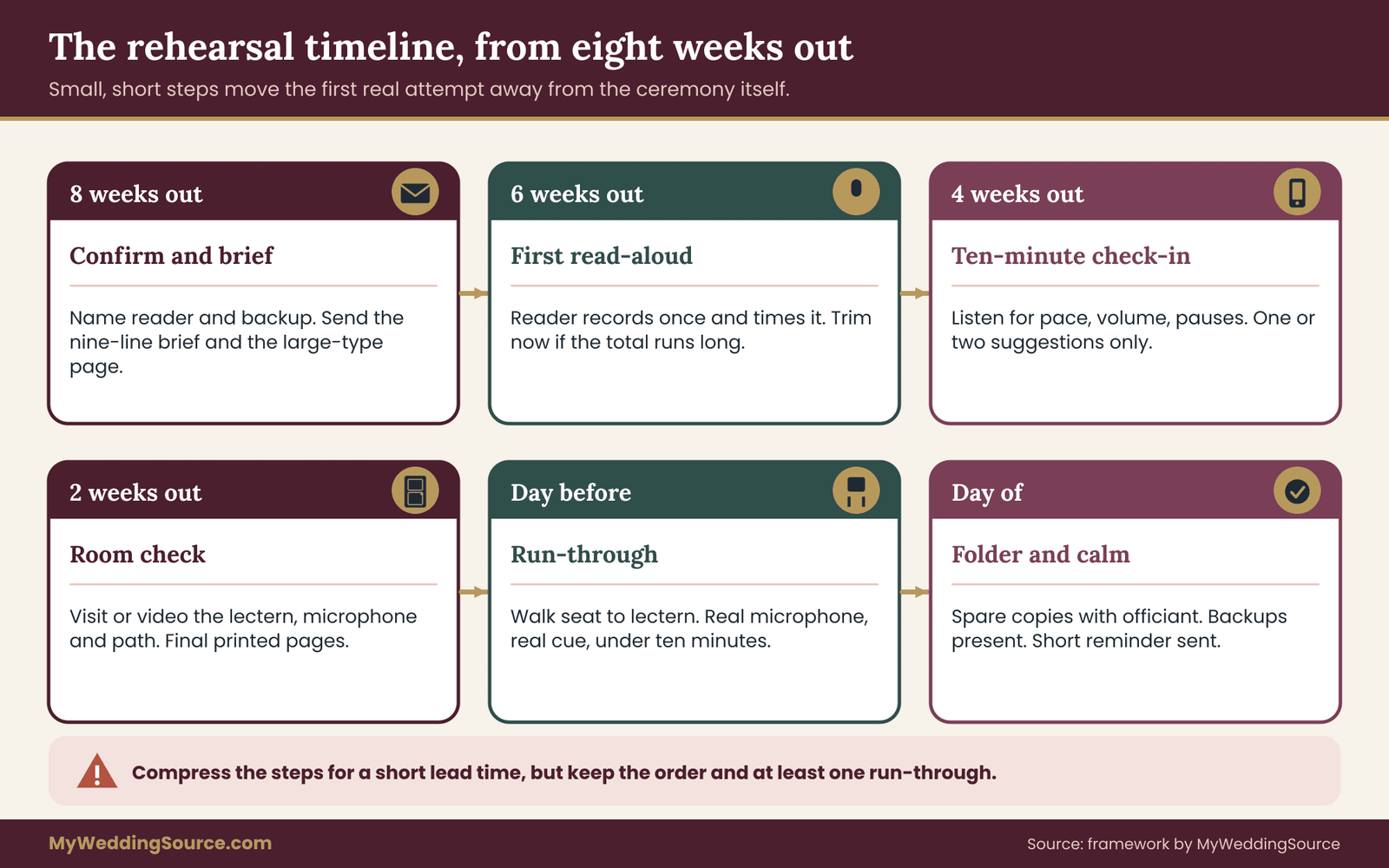
Eight weeks is a comfortable runway for family readings, because it leaves time to swap a passage, find a backup and let a nervous reader warm up. If you are starting later, protect the order of the steps and shrink the gaps. Even a two-week plan for family readings should include a read-aloud, a check-in and a run-through.
Eight weeks out: confirm the roster and send the briefs
By about eight weeks before the wedding, every reading should have a named reader, a named backup and a final text. Send each reader their brief, the printed passage in large type and the date of the first check-in. Keep the message short and friendly. At this point you are also confirming the slot order with your officiant, because the order feeds line two of every brief.
If the ceremony date is closer than eight weeks, do the same steps faster. The point is that nobody should receive a brief for the first time in the last week.
Six weeks out: the first read-aloud
Ask each reader to record themselves reading the passage once on a phone and to time it. They do not need to send the recording unless they want feedback. The goal is to learn their own pace and notice words they trip over. A reader who finds they stumble on a name or a rarely used word has time to ask about the pronunciation, or to swap the passage for one that is easier on the tongue.
This is also when you measure length. Add up the actual times and compare them with the target in the brief. If the three family readings together run over, trim now, not on the wedding morning. Trimming a poem is easy when you have six weeks, and painful when you have six minutes.
Four weeks out: the check-in
Hold a ten-minute phone or video check-in with each reader, one at a time. Ask them to read the passage while you listen. You are listening for three things: pace, volume and pauses. Give one or two specific suggestions, such as “pause a little longer after the second line,” and nothing more. Over-coaching is the main way a rehearsal makes things worse, because readers start to monitor themselves and lose their natural warmth.
Use this call to confirm accommodations. Ask whether the print size is right, whether the reader would like to sit near the aisle and whether they have questions about the path or the cue. Confirm the backup reader has the text and knows they are the backup.
Two weeks out: the venue visit or the room check
If the venue allows, bring readers to the room, or at least send photos and a short description of the lectern, the microphone and the path. If a reader cannot visit, a short video walk-through from you is a reasonable substitute. Ask the venue manager about the microphone setup: is it fixed or handheld, who controls the volume and can the sound person test with a real voice?
At this point the printed copies are final. Print each reader’s passage in large, dark type on a single page, with generous margins and the title at the top. A clear page with no folding is easier to hold than a booklet. Bring two spares, one for the backup and one for the officiant.
The week of: the run-through
The run-through is the main rehearsal. It is usually held the day before the wedding or the evening of a rehearsal dinner, and it is short. Walk the sequence from seat to lectern to seat. Stand at the lectern and read the first two lines into the real microphone. Check that the light is on, that the stand is at a good height and that the page sits where the reader can see it without bending.
Practice the cue. Have the officiant say it and watch the reader respond. If a reader is slow to stand, the cue needs to be earlier or more obvious. This is the most useful part of the whole rehearsal, because it is where timing becomes real.
Keep it under ten minutes per reader if you can. Long rehearsals tire people and make them nervous. The point is familiarity, not perfection.
The day before: the quiet reminder
Send each reader a short message the day before. It should say what time to arrive, where to sit, who the contact is, and that you are glad they are doing this. Do not send new instructions. A calm, short note is a surprisingly strong tool, because it lets the reader know the plan is under control.
The morning of: spare copies and a last look
On the day, put a spare copy of every reading in a folder with the officiant or the coordinator. Check that the lectern light works. Confirm that the backup readers are present and know where to sit. These checks take five minutes and prevent the failures that nobody can fix once the music starts.
Seen as a whole, the schedule is a way to spread the work of family readings across many small steps so no single moment carries all the pressure. Each short call is cheap for you and calming for the reader. Couples who run this schedule for their family readings often find that the volunteers become allies, and the ceremony feels less like a test.
What the timeline is for
A timeline is not a way to control relatives. It is a way to take uncertainty out of the day so that the reader can concentrate on the words. Each step has a purpose: the first read finds the pace, the check-in finds the problems, the room check fixes the logistics, the run-through builds the cue, and the reminder steadies the nerves.
If a reader is already experienced, you can skip the middle steps. If a reader is nervous, add one more short check-in rather than a longer one.
Day-of handling for family readings: cues, microphones and the quiet backup
The ceremony itself is a fast event, and the reader’s part is a small slice of it. What the reader does in the minutes before and after the reading matters as much as the reading, because that is when nerves, small mistakes and surprises happen. A few habits make that stretch calmer.
Before the ceremony
Readers should arrive early enough to sit down, breathe and find the lectern without rushing. Fifteen to twenty minutes before the start is typical. Give them water and a place to put their coat or bag. If they are in a wedding party, they may be doing other things before the ceremony, such as photos or getting ready, so the arrival time in the brief must account for that.
The backup reader should also arrive on time and sit within sight of the primary reader. They do not need to stand, but they should know the cue and be ready to stand and walk. If you have a coordinator, ask them to check in with each reader before the processional starts and to confirm that the passage is in the reader’s hand.
Sound is the quietest threat to family readings, because a reader can do everything right and still not be heard. Test the microphone with the same voices who will read, since an older reader or a child can sound very different from the person running the sound check. Family readings should be heard in the last row without strain, and the test for that is simple.
The microphone
Microphones cause more small failures than anything else in a ceremony. A reader leans too far from a fixed mic and disappears. A reader holds a handheld mic at their chest and the sound is muddy. A reader taps the mic to test it and startles the front row. The way to avoid these is to rehearse with the real microphone, give a simple instruction in the brief and have someone responsible for the sound.
For a fixed microphone, the instruction is to stand a hand’s width back and speak toward it, without moving. For a handheld one, hold it about a hand’s width from the chin, aimed at the mouth. For a lavalier clipped to a collar, do not touch the cable and speak normally. For an outdoor ceremony with wind, ask the sound person or venue about a windscreen. Your sound provider or venue manager can answer these questions in a two-minute conversation, so ask them directly.
The cue in practice
On the day, the cue should work even if nobody is paying close attention. The officiant says the reader’s name or a phrase, and the reader stands. If the reader has a hearing difficulty, the officiant looks at them and gives a clear nod. If the cue is music, the coordinator or officiant stays alert to what the music is doing and signals clearly.
A common slip is that the reader hears their name, stands and begins to speak before the walk is finished. The brief should say, “walk to the lectern, put your page down, look at the couple and then begin.” That single sentence cures most early starts.
Guests rarely judge family readings by perfection. They judge them by sincerity, and a short pause for emotion is part of that. What they do notice is whether the people running the ceremony stay calm. If the officiant, the backup and the coordinator all know the plan for stalled family readings, a stumble becomes a small human moment.
If a reader freezes or cannot continue
It happens occasionally. A reader loses their place, chokes up or simply stops. Plan a response in advance. The officiant should know to step in gently, perhaps by repeating the last line, offering the reader a moment and a smile or offering to read the rest together. The backup reader should know that their job is to stand only if the officiant signals.
Guests are forgiving. A short pause for emotion is often the part of the ceremony they remember most warmly, and nobody has ever left a wedding thinking a reader was too moved.
If a reader is missing
If a reader is not in the room when the cue comes, the backup stands without drama. The officiant says, “Jordan will read for us,” and carries on. Resolve the absence quietly afterward. Do not announce what happened to the room. If the missing reader arrives late, they can be offered a smaller moment later, such as a blessing at the reception.
Phones and pages
Readers should read from paper, not from a phone, for three reasons. Paper cannot run out of battery, receive a notification or lock itself. A phone also puts the reader’s face toward a screen and away from the room. And a phone in the hand can read as casual in a way that undermines the moment.
If a reader insists, set the phone to airplane mode and print a paper backup. A printed page tucked inside a folder or on a small card holder is the simplest kit.
After the reading
Tell readers what to do after they finish: wait for the officiant’s thank-you, step back from the microphone, walk calmly to the seat and sit. Tell them they have done their part. A reader who bounces back to their seat and starts fidgeting can distract the room from the next moment, and a reader who stays composed lets the ceremony keep its rhythm.
A worked example: four people, three slots, one ceremony
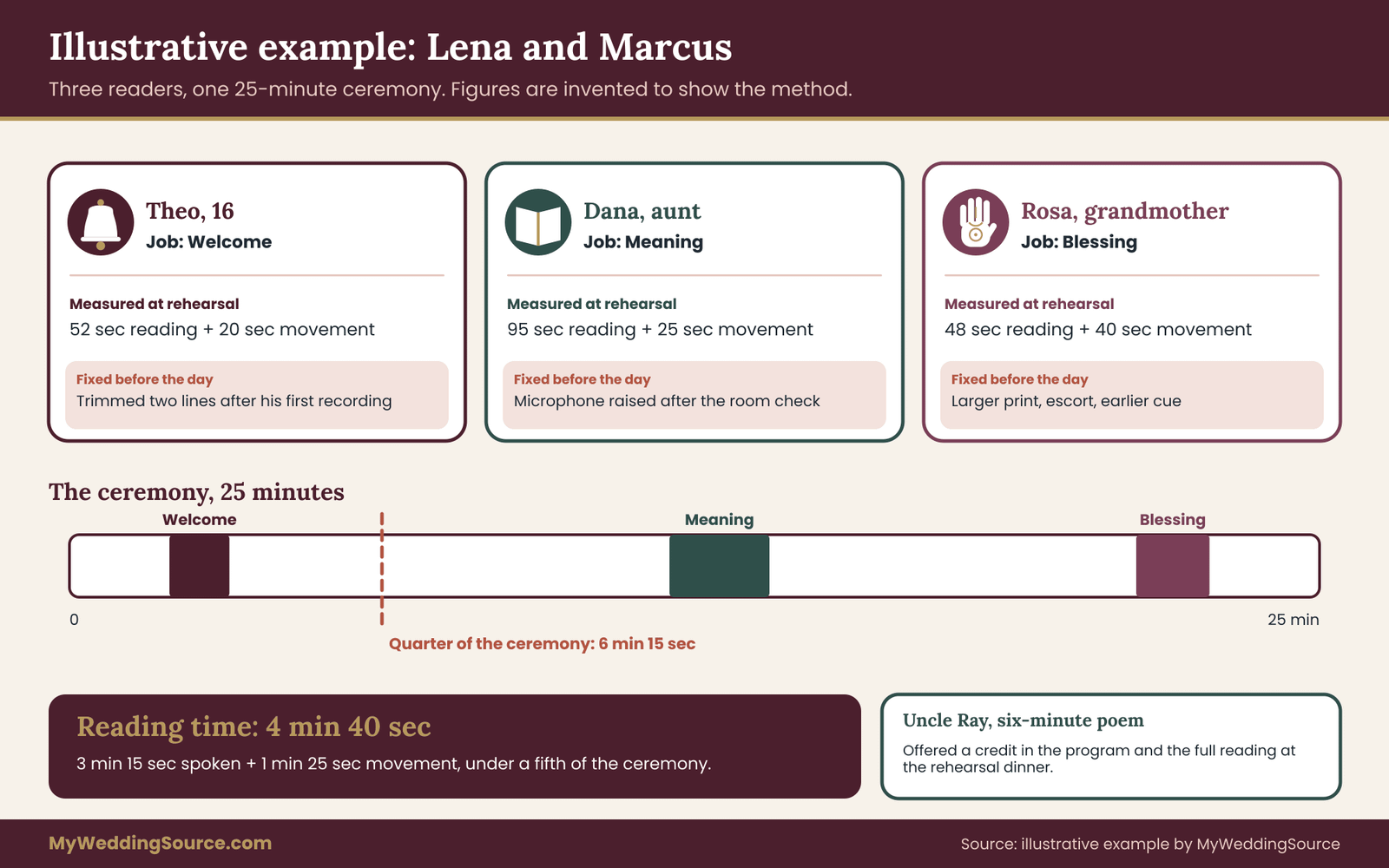
An invented example shows how the pieces fit. The couple, Lena and Marcus, are planning a ceremony of about twenty-five minutes at a garden venue. The figures below are illustrative, chosen to show the method, and they are not data from any real wedding.
The starting list
Lena and Marcus begin with four relatives who have said they would like to read. Lena’s grandmother Rosa is in her eighties and has low vision. Marcus’s cousin Theo is sixteen and nervous about public speaking. Marcus’s aunt Dana teaches high school and speaks to groups every day. Marcus’s uncle Ray has offered a favorite poem that he reads aloud at every family holiday.
They also have three jobs to fill: a short welcome, a reading about commitment before the vows and a closing blessing.
Casting with the three-part test
Role first. The welcome is a short, warm job. The commitment reading is a meaning job that needs a steady voice. The closing blessing is a blessing, and it needs the authority of an elder.
Reader next. Theo is nervous, but he has a clear, young voice and the welcome is the shortest piece, so with preparation it suits him. Dana is the obvious match for the meaning reading, because she can handle a microphone and a room without thinking about it. Rosa is a natural fit for the closing blessing, since the family has watched her bless every important occasion for decades.
Ready last. Theo lives forty minutes away and can attend two check-ins. Dana will be at the rehearsal. Rosa will attend with her daughter Carmen, who agrees to escort her and to serve as backup. All three pass.
That leaves Ray. His poem runs about six minutes when he reads it, far over the budget, and it is a passage with strong feeling that would shift the tone of the ceremony. Lena and Marcus do not say no to Ray. They offer him two things instead: a place in the printed program, with a short line crediting his reading tradition, and a spot to read the full poem at the rehearsal dinner, where length is not a constraint.
Ray accepts both. Because the offer was made early and was specific, there is no sting.
The briefs
Each reader receives a nine-line brief. For Rosa, the passage is a seventy-word blessing printed in very large, dark type on one page. Her slot is after the ring exchange, the cue is the officiant saying her name and a nod, and Carmen walks beside her to the lectern, which has a light and a stool. Her backup is Carmen, who has a copy.
For Theo, the passage is a ninety-word welcome. His slot is right after the officiant opens the ceremony. The brief tells him to count a slow breath before starting and to look up once. His backup is his older sister Mia.
For Dana, the passage is a hundred and eighty words about commitment, placed just before the vows. Her backup is Marcus’s friend Jordan.
The timeline in motion
Eight weeks out, the briefs go out and each reader confirms. Six weeks out, Theo records himself reading the welcome and finds that it takes seventy seconds, longer than the target. Lena asks him to cut two lines, and the trimmed version comes in under a minute. Four weeks out, the check-in calls happen. On Rosa’s call, Carmen mentions that the first printout was still too small, so Lena reprints at a larger size and adds more space between lines.
Two weeks out, Lena visits the venue with Dana and discovers that the lectern microphone sits low for someone of Dana’s height. She asks the venue manager to raise it and confirms that the sound person can adjust it quickly. At the run-through, Rosa is slow to stand when she hears her name. The officiant agrees to say the name slightly earlier and to wait for Carmen to be ready. Without the run-through, that delay would have happened in front of everyone.
Adding up the time
The measured numbers from rehearsal are as follows, and they are illustrative. Theo’s welcome takes fifty-two seconds. Dana’s reading takes ninety-five seconds. Rosa’s blessing takes forty-eight seconds. Together that is three minutes and fifteen seconds of spoken words. The movement adds roughly twenty seconds for Theo, twenty-five for Dana and forty for Rosa, who walks with Carmen, for a total of eighty-five seconds.
The combined reading time is four minutes and forty seconds, which is under a fifth of a twenty-five minute ceremony. That sits well inside the quarter-of-the-ceremony test from earlier.
If the total had been nine minutes, the couple would have returned to the casting step and shortened a passage, merged two family readings or moved one to the program. The numbers make that decision easy because they remove the feeling and leave the arithmetic.
The example is deliberately modest. Three readers, four minutes and forty seconds, one reader redirected kindly. Most couples can run family readings at this scale, and it is often the right scale. The same method stretches to more readers or to a longer ceremony, and the numbers simply grow. The point of the worked example is to show family readings as a plan and not a hope.
What the example shows
Three things stand out. The couple never asked “who loves us most.” They asked what each job needed and who could do it. Every volunteer received something real, including the one who did not get a ceremony slot. And every problem that appeared, such as the long welcome, the small print, the low microphone and the slow cue, appeared at a rehearsal and not at the altar. That is the whole benefit of the timeline.
Edge cases: nerves, language, loss and last-minute changes
The standard method handles most situations. A few edge cases need their own thinking. None of these is likely to arise in every wedding, but any one of them can appear.
Anxiety about speaking is common enough that every set of family readings should assume at least one reader has some of it. Quiet planning helps more than reassurance. Offering shorter family readings, shared ones or printed ones to nervous volunteers is not a lowered standard. It is how you keep family readings enjoyable for the reader and comfortable for the guests.
A reader with strong stage fright
Some people experience real anxiety when speaking to a group, and being asked to read at a family wedding can be a source of dread. The National Institute of Mental Health describes social anxiety as a common condition, and it is not a character flaw. If a reader tells you honestly that they are anxious, take it at face value.
Offer a shared reading, a shorter passage or a printed alternative. If they still want to read, give them every advantage: large type, a seat close to the lectern, a rehearsal in the real room and permission to take a slow breath before starting. Do not tell them to relax. It does not help.
A reading in a second language
If a reader will speak in a language other than English, check three things. Is the passage the right translation? Will the guests understand it, or does it need a printed English version? And is the reader comfortable with the version you have chosen? Many families have a poem or blessing that exists in several forms, and the one the reader grew up with may differ from the written text you found.
Give the reader the final say on the wording in their language, with a trusted third person to review if there is doubt. Print both versions in the program, side by side where space allows, and mention the language in the cue so the officiant introduces it clearly.
A deaf or hard-of-hearing guest or reader
If a reader or guest is deaf or hard of hearing, there are several practical steps. For a reader, a visual cue and a printed backup of the cue words remove the need to hear the officiant. For guests, a printed program with the full text of each reading is a helpful baseline. If an interpreter will sign the ceremony, share the passages with the interpreter well ahead of time, because they need time to prepare, and ask where they should stand so that both they and the readers are in view.
The Registry of Interpreters for the Deaf and the National Association of the Deaf publish guidance on working with interpreters, and the Hearing Loss Association of America gives practical advice on hearing access.
A child reader
Children can read beautifully, and they can also lose their place, go silent or giggle. Keep the passage very short, ideally under a minute. Print it in large type with generous spacing. Rehearse in the real room and give the child a small card to hold if they like. Seat a trusted adult next to them, and have a backup who is not the parent, because a parent in the front row may be too emotional to step in.
Let the child decide whether they want a microphone lowered, and check that they can see the page and the room.
Reading on behalf of someone who has died
A reading from or about a loved one who has died can be one of the most moving parts of a ceremony. It can also be heavy for the reader. If a relative offers to read a letter or passage that belonged to the person who died, talk with them about how they feel. Ask whether they would like a backup ready. Keep the passage short.
Place it where it will not stall the pacing, often just after the welcome or near the close, and give the officiant a line to follow if the reader needs a moment. Be careful that the reading does not overshadow the couple, and be careful to include only what the couple and the family are comfortable having heard by everyone.
Relatives who do not get along
In some families, two people who are asked to read have a history. They may be divorced, estranged or simply avoiding each other. The brief protects both, because it is written, specific and requires no conversation between them. Seat them apart, and place their readings so they do not appear back to back.
Do not ask one to introduce or thank the other. The rehearsal can be scheduled at different times if necessary. The rule of thumb is to remove the need for contact, not to attempt a reconciliation at your own ceremony.
A reader who adds extra words
Some volunteers cannot resist adding a line, a story or a joke. The brief addresses this gently, with line three on length and line six on delivery. If a reader tells you in advance that they would like to add a few remarks, decide whether the ceremony has room.
If it does, give them a defined slot and a length, and treat it as a separate job with its own brief. If it does not, say so kindly and offer the reception, where a toast fits better.
Swaps are the reason the backup line exists in the brief. Couples who plan family readings with a named backup for each reader rarely panic when something changes. They tell one person, hand over one page and carry on. Couples who did not plan a backup tend to ask the nearest relative to read cold, which is far harder on everyone.
A last-minute swap
A reader falls ill, a flight is canceled or a car breaks down. This is why the backup exists. When a swap is needed, tell the backup immediately, give them the printed text and the cue, and tell the officiant. Do not inform the whole room. If the original reader is still present, they may be pleased to be a quiet presence in the front row and to be thanked later.
If they are not, send them a note after the ceremony and share the recording, if there is one, so they can see their passage was read.
Questions to ask your officiant, venue and vendors about family readings
Several people other than the readers touch the moment, and each of them can remove a small risk if you ask the right question early. Ask in writing where possible, so the answers are easy to find later and easy to pass to the coordinator.
Whatever the officiant tells you about family readings becomes a design constraint, so ask early and write the answers down. A limit of three family readings or a rule about religious texts changes the roster, not just the schedule. Share the final answers with each reader through the brief, so nobody hears a rule for the first time at the rehearsal.
The officiant
The officiant controls the order and the cues, so their answers shape everything. Ask these questions.
- What is your standard order, and where do you usually place readings?
- Do you have a limit on the number of readers or the total time?
- Are there any passages or topics you cannot include, or that you would want to review?
- Will you introduce each reader by name, and what phrase will you use as the cue?
- If a reader freezes or goes long, how will you step in?
- Can you hold the spare copies of each passage at the front?
For religious ceremonies, add a question about who may read, since some traditions reserve certain texts for ordained or designated people. A faith leader will tell you what is open to family and what is not, and it is far easier to hear that at the planning stage than at the rehearsal. Ask for their list of other requirements at the same time, so one conversation covers everything.
The venue
The venue manager knows the physical facts: the lectern, the microphone, the lighting, the path and the rules about sound. Ask these.
- Is there a lectern, and can its height be adjusted?
- Is there a fixed microphone, and who runs it?
- Is there a light at the lectern, or can we bring a small one?
- How many steps lead to the lectern, and is there a level route for someone who cannot manage steps?
- Is the space covered if the weather turns, and what happens to the sound in that case?
- Where can readers wait or sit before the ceremony, and is there water?
If the venue is outdoors, ask about wind and sun. A reader facing the sun cannot see a page, and a reader in a breeze may have pages fluttering. A weighted folder or a lectern with a page clip solves most of this.
The sound provider or DJ
If someone other than the venue handles audio, ask about microphone type, battery checks and whether a sound check with a real voice is possible before guests arrive. Ask who raises or lowers the volume and what signal they follow. A sound provider who has seen the cue sheet and the order of readers is better prepared than one who learns the order on the day.
If there is music before or after a reading, ask them to confirm how it ends, since a reader’s cue often depends on it.
Cameras change how people behave during family readings. A reader who knows where the photographer will stand is less likely to be startled, and a photographer who knows the cue is more likely to catch the best moment without blocking the lectern. Ask both what they need to see, and tell readers whether family readings will be recorded.
The photographer and videographer
Readers are often in view of the camera, and the photographer needs to know when they will stand and where. Share the cue sheet and ask where they plan to stand, so they do not walk across the readers’ path or block the lectern. If you plan to share any video of the ceremony, ask whether you need to tell readers, since some people are uneasy about recordings. The wedding photography consent guide is useful here for setting boundaries around guest images and sharing.
The printer or program designer
If readers’ names and passages appear in a printed program, ask the printer for a proof and check every name for spelling, every title for accuracy and every credit line for correctness. A misspelled name in a program is a small hurt that is easy to avoid. If the passage is under copyright or comes from a modern work, confirm that you may print it, and note that the U.S. Copyright Office explains the basics of how copyright works.
The coordinator or day-of contact
If you have a coordinator, give them the briefs and the cue sheet and ask them to confirm that each reader has a page in hand, a seat and a backup. If you do not have a coordinator, name a friend with a calm temperament for this job, and make sure the friend knows where the folder of spare copies sits. The coordinator is also the person readers call if something goes wrong, so their number goes on line nine of the brief.
Checks matter because feelings about family readings are unreliable in both directions. A confident couple may overlook a long passage, and an anxious couple may worry about a reading that is perfectly sound. A short list of measurable checks for family readings gives you a calm, shared standard, so you and your partner are not guessing or arguing from instinct.
Measurable checks that show family readings are ready
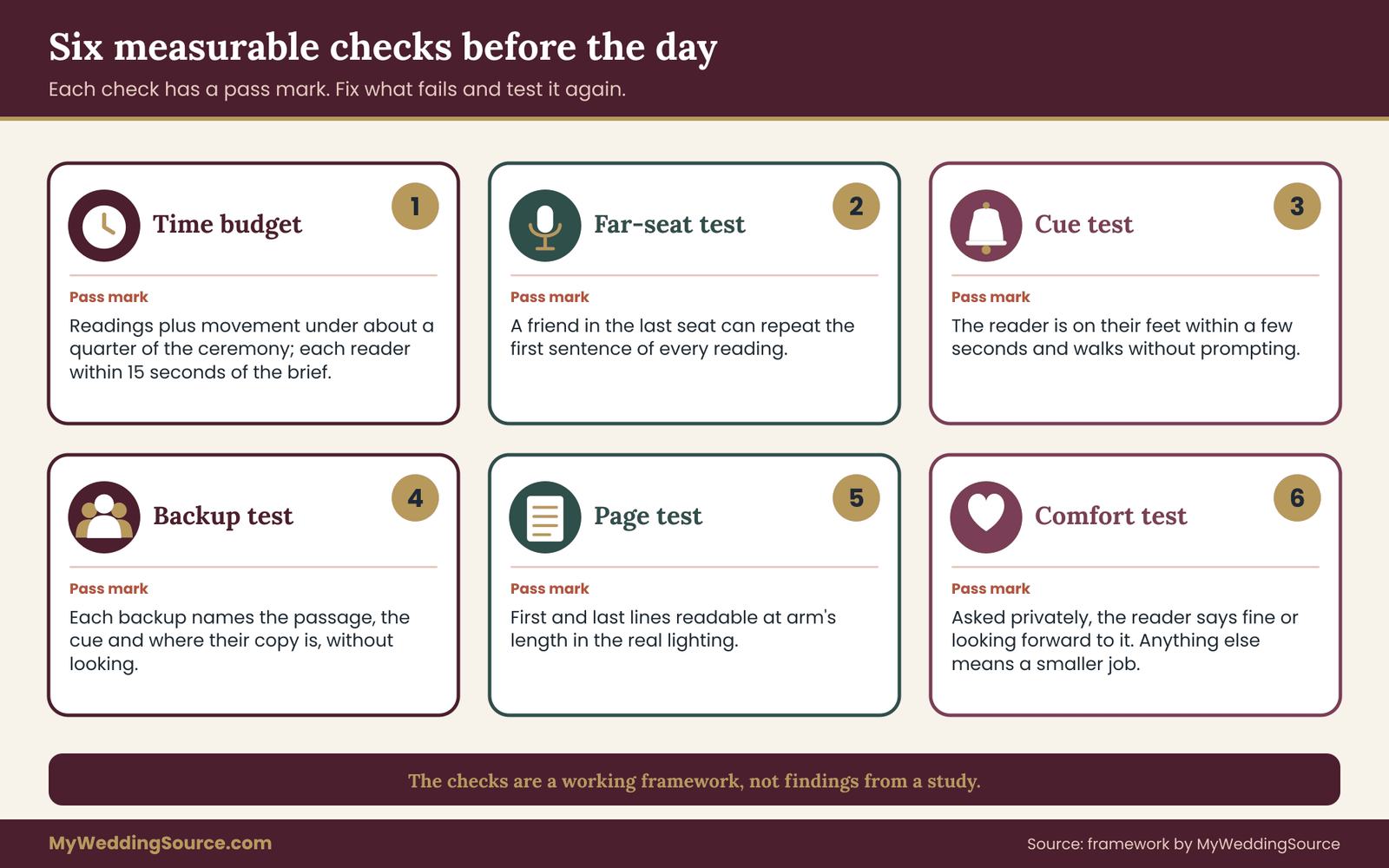
A plan is easy to feel good about and hard to verify. Measurable checks let you test it. The following checks are simple, they are a working framework suggested here, not findings from a study, and each one has a pass mark that you can apply.
Check one: the time budget
Add up the timed reading, the movement and the cue gaps for every reader. Pass mark: the combined time is under about one quarter of the ceremony, and every reader is within fifteen seconds of the length in their brief. If a reader is over, trim the passage, not the person.
Check two: the far-seat test
During the run-through, ask a friend to sit in the farthest seat and to raise a hand if they cannot hear a word. Pass mark: the friend can repeat the first sentence of each reading. If not, adjust the microphone, ask the reader to slow down or move the reader closer to the front.
Check three: the cue test
Have the officiant give each cue as they will on the day, and time how long the reader takes to stand. Pass mark: the reader is on their feet within a few seconds of the cue and walks to the lectern without prompting. If not, move the seat, make the cue clearer or add an escort.
Check four: the backup test
Ask each backup to name the passage they would read, the cue and where their copy is. Pass mark: all three answers, without looking. A backup who cannot answer is not yet a backup.
Check five: the page test
Hand each reader their printed page in the lighting they will have on the day. Pass mark: they can read the first and last lines at arm’s length without squinting. If they hesitate, raise the type size or improve the lighting.
Check six: the comfort test
Ask every reader, privately and kindly, “How are you feeling about it?” Pass mark: an answer that is some version of “fine” or “looking forward to it.” Anything else means you offer a shorter passage, a shared reading or a way out. This is the one measure that cannot be scored by a stopwatch, and it is probably the most important.
How to use the checks
Do the checks in order at the run-through. They take about ten minutes per reader if you are organized, and they replace the vague sense that things are probably fine with specific evidence. When a check fails, fix it and test again. Do not carry a failed check into the ceremony and hope for the best.
If a check keeps failing for the same reader, treat it as information about the match and not about the reader. A person who cannot get the length down or cannot be heard may be better suited to a printed reading or a shared one. That change is not a demotion. It is the casting step done again with better evidence.
None of these pitfalls is unusual. They show up in family readings of every size because they come from ordinary human habits: choosing with the heart, rehearsing once and trusting the day to work out. Reading the list now, before you start, is the cheapest way to avoid them in your own family readings.
Common pitfalls
A few mistakes appear often enough to name.
Choosing the passage first. The temptation to fall in love with a text and then find someone to read it is strong. The fix is to do the Role step first and let the job narrow the field.
Skipping the backup. Couples assume that nothing will go wrong, and then a flu or a delay arrives. The fix is to name a backup for every reader.
Rehearsing only once. One rehearsal fixes some problems and creates false confidence. The fix is a read-aloud, a check-in and a run-through, each short.
Over-coaching. Too many instructions make readers stiff. The fix is to give one or two suggestions per session and trust the person.
Printing small. A page that looks fine on a laptop can be unreadable on a lectern in dim light. The fix is large, dark type and a test in the real light.
Ignoring the movement time. Readers need time to stand, walk and sit. The fix is to measure it.
Letting guilt choose the roster. Asking someone because you feel you must tends to produce tension on both sides. The fix is the three-part test and an alternative role for everyone who is not cast.
A decision rule for contested rosters
When two relatives both want the same slot, the pull is to split the difference or to flip a coin. A better rule is to go back to the job and ask which person can be made ready more easily. If both can, the tiebreaker is the quieter relationship, because the louder one will usually be fine with an alternative.
If you cannot decide, ask the officiant, who can serve as a neutral voice. Whichever route you take, tell the person who did not get the slot yourself and tell them what they will do instead. A family member hears a no better from the couple than from a third party.
When the checks do not fit
For a very small ceremony with one reader and a dozen guests, most of these checks collapse into a quick read-through the night before. For a large ceremony with a stage and a sound team, they expand into a proper technical rehearsal. The point is the habit: measure what you can measure, and ask about what you cannot. The cue sheet guide is the right place to record the results so that everyone responsible for the day is working from the same page.
Your next steps
You can set the whole system up in a few short sittings. Here is a sensible order for the next two weeks.
- List the jobs. Write down how many readings the ceremony has room for and name the job of each: welcome, meaning, blessing or transition. Add the time budget, about a quarter of the ceremony at most.
- Cast with the three-part test. For each job, list two or three possible readers and run Role, Reader and Ready. Choose a backup for each.
- Settle the order with your officiant. Confirm the slots, the cue phrases and any limits. Update your ceremony step-by-step outline so the family readings sit at real seams.
- Ask each person kindly. Use the short ask, offer an easy way to decline and have an alternative role ready for anyone you cannot cast.
- Write the nine-line briefs. One page per reader, with the exact text in large type. Send them about eight weeks out.
- Book the rehearsal steps. A read-aloud, a check-in, a room check and a short run-through. Put the dates in the briefs.
- Run the six checks. Time budget, far seat, cue, backup, page and comfort. Fix anything that fails and test it again.
- Hand the folder to your day-of contact. Spare copies, the cue sheet and the briefs, in one place.
If you are also building the surrounding ceremony, our non-religious ceremony script and the Christian ceremony script both show where readings commonly appear in two different styles of ceremony, and the guide to caring for children and older relatives helps with seating and access for the grandparents and young readers who often volunteer.
FAQ
How many family readings should a wedding ceremony have?
Most ceremonies of about twenty to thirty minutes have room for two or three family readings, with a combined speaking and walking time of around five minutes. A useful test is to keep total reading time under about a quarter of the ceremony. Shorter ceremonies may hold one reading or none, and longer ones with several rituals can hold more.
Who should be chosen to read at a wedding ceremony?
Choose by the job and the person, not by rank in the family. Decide what the reading does, such as welcoming, giving meaning or blessing. Then pick someone who speaks comfortably, can be heard in the space and can attend at least one rehearsal. Always name a backup who has a copy of the text and knows the cue.
How long should a family reading be?
Most work well at about one to two minutes, which is roughly seventy to two hundred words at a calm pace. Time each reader aloud, because pace varies a great deal. A nervous reader may rush, and an older reader may read slowly. Add the walking time to and from the lectern, which can be fifteen to forty seconds depending on the venue.
Where in the ceremony do family readings usually go?
Common spots are right after the officiant’s welcome, just before the vows, during a ritual such as a candle lighting, and after the ring exchange as a closing blessing. Avoid placing two family readings back to back. Put music, a ritual or the officiant’s remarks between them, and ask your officiant where they normally place readings.
What should a volunteer speaker brief include?
A good brief has nine short lines: the exact passage, the slot, the length, the path and the place, the cue, delivery tips, the rehearsal dates, the backup and the day-of contact with an arrival time. Keep it to one page, attach the passage in large type and send it to the reader, the backup and the officiant.
What if a relative wants to read but would be nervous or unsuitable?
Offer a smaller role that fits. A shared reading with a partner, a shorter passage, a reading printed in the program or a role at the rehearsal dinner can all give the person a real part without the risk. Make the offer early and specifically, and do not debate it. Most relatives accept a real alternative gladly.
How do I handle a reader who freezes or cannot attend?
Have the officiant ready to step in by repeating the last line, offering a pause or reading with the person. Keep a backup reader seated nearby with a printed copy. If the reader cannot attend, the backup stands on the cue without any announcement. Afterward, thank the original reader and share the moment later, such as through a recording.
When should I start rehearsing family readings?
Plan to send the briefs about eight weeks before the wedding. Add a recorded read-aloud at six weeks, a ten-minute check-in at four weeks, a room check at two weeks and a short run-through the day before. A compressed version works for shorter lead times, as long as each reader gets at least one real run-through with the actual microphone.
Sources
- U.S. Copyright Office: how copyright works and how to find out who owns a text before printing or recording it.
- Library of Congress: public collections and guidance for locating the source and publication history of a passage.
- Project Gutenberg: a library of public domain texts, useful for checking older poems and passages.
- ADA.gov, U.S. Department of Justice: federal civil rights guidance on access for people with disabilities.
- U.S. Access Board: accessibility standards for buildings and facilities, including routes and ramps.
- National Institute of Mental Health: information on social anxiety and public speaking fears.
- National Institute on Deafness and Other Communication Disorders: information on hearing, voice and speech.
- Hearing Loss Association of America: practical advice on hearing access and assistive listening.
- Registry of Interpreters for the Deaf: guidance on working with sign language interpreters.
- National Association of the Deaf: resources on communication access and interpreters.