
A weekday ceremony followed by a weekend reception splits one wedding into two events with two sets of rules: the legal marriage happens on one date, and the party happens on another. This guide gives you a two-clock timeline, one for the license and the legal steps and one for vendors and guests, so neither date slips while you are busy with the other.
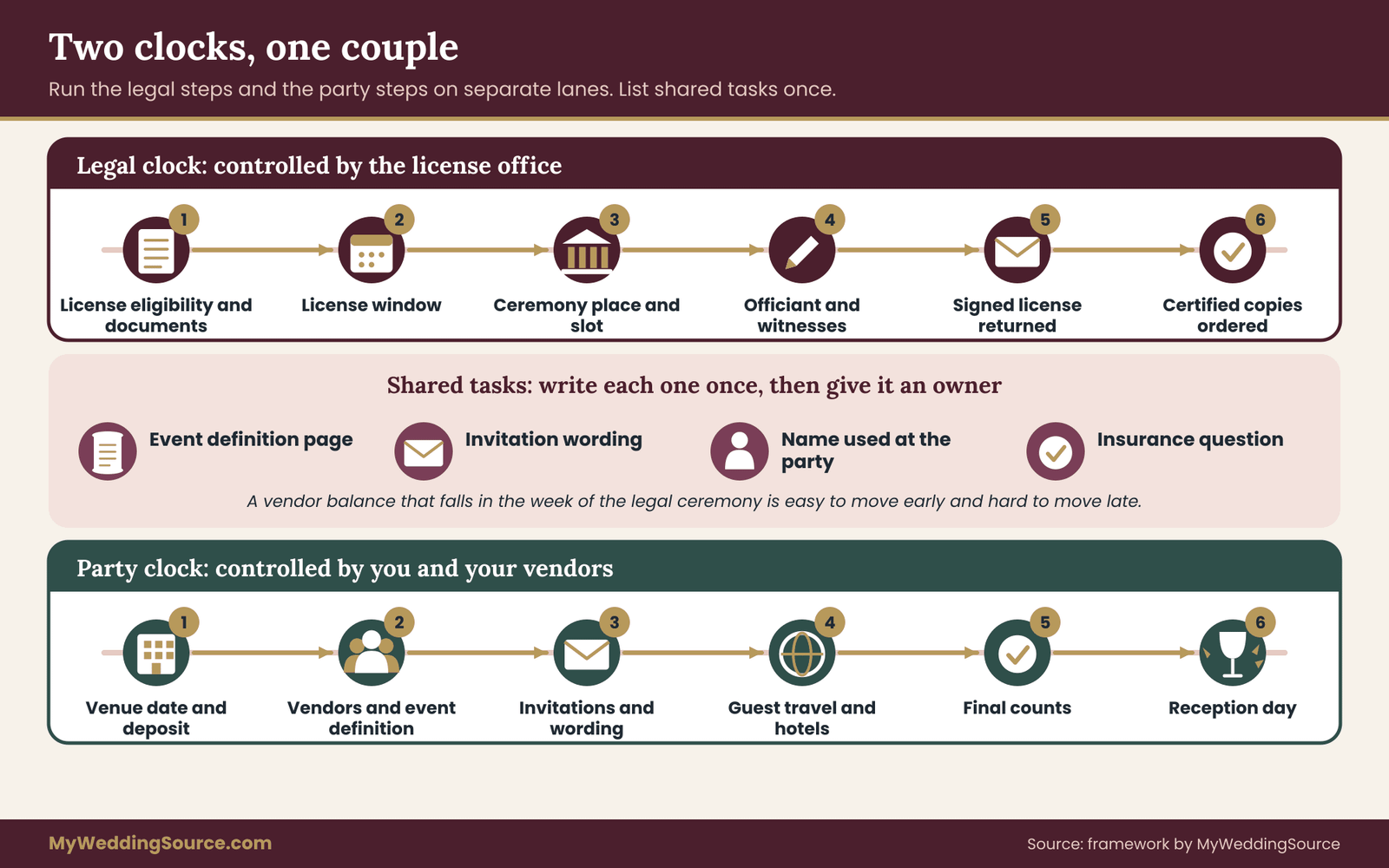
Treat a weekday ceremony and a weekend reception as two projects that share one couple. Run a legal clock (license, appointment, officiant, witnesses, return of the signed license, certified copies) and a party clock (venue, vendors, invitations, guest travel, final counts). Decide the gap between the two dates first, because the gap decides what you book twice, what you book once, and how you word every invitation. Confirm local license rules with the issuing office, and put every vendor’s definition of “the event date” in writing.
Plenty of couples end up here for sensible reasons. The courthouse is open on Tuesday and closed on Saturday. A grandparent can travel for a small ceremony but not for a large party. A venue is available on a weekend in spring, but one partner has to be somewhere else in the week before. A visa, a deployment, a medical schedule or an insurance change makes the legal date matter more than the party date. Whatever the reason, the plan is the same: pick the dates deliberately, then build two timelines that do not trip over each other.
This is where most advice on split celebrations stops being useful. It tells you that a weekday ceremony is “intimate” and a weekend reception is “relaxed”, and leaves the real work, such as who signs what, who is booked for which day, and what the invitation says, to guesswork. This article handles that real work. It covers the legal clock, the party clock, how long the gap should be, which vendors need two contracts, how to word invitations honestly, how to photograph two days without repeating yourself, how to run a reception when the ceremony is already behind you, and where the money and the paperwork can go wrong.
A note on scope. This is general planning information, not legal, tax or financial advice. License rules, waiting periods, ceremony hours and fees differ by state and by county, and they change. Where a rule matters, the article points you to the office or agency that issues it so you can confirm the current version.
What a weekday ceremony and a weekend reception actually mean
The phrase sounds simple, but it covers several different setups. Before you plan anything, pin down which one you are building, because the setups behave differently.
A courthouse or clerk’s office ceremony, then a party. The legal ceremony happens at a government office on a weekday, often with an assigned time slot and a short script. The reception happens later at a venue you have booked on a weekend. This is the most common version of a weekday ceremony.
A small private ceremony, then a larger celebration. The ceremony takes place at a home, a garden, a place of worship or a rented room on a weekday, with a handful of people. The weekend event is bigger and looser. Here you have more control over the ceremony, but you also have two sets of vendors to line up.
A back-to-back pair in the same weekend. The ceremony is on a Friday and the reception is on Saturday, sometimes with a rehearsal-style dinner folded into one of them. The gap is a single night, so guests who travel can attend both, and the two timelines overlap heavily.
A long gap. The ceremony is on a weekday months before the reception, perhaps because of a move, a work deadline, a deployment, or a venue that books out a year ahead. The legal clock finishes early, and the party clock runs on its own for a long time.
Each of these has the same skeleton. There is one legal event and one social event. The legal event has a fixed set of steps controlled by a government office. The social event has a flexible set of steps controlled by you and your vendors. If you keep those two apart in your head, almost every decision gets easier.
The weekday ceremony is the legal date
In most cases the date of the weekday ceremony is the date on your marriage record. That is the date agencies, employers, insurers and tax authorities will see. It is not a matter of preference or of which day feels more romantic. If you sign the license and complete the ceremony on a Tuesday, your marriage date is that Tuesday, even if the people you love most are not in the room and even if the party is five months away.
That has practical consequences. Your name-change paperwork, your health coverage change, your tax filing status for the year and any immigration or benefits paperwork will follow the legal date. Your anniversary can be whichever day you like, but forms use the date on the record. Couples who plan the party as if it were the wedding and treat the weekday ceremony as a formality sometimes discover this late, when a form asks for a date and the two do not match.
The weekend reception is a celebration, not a second marriage
The reception is a party held to celebrate a marriage that already exists. That sounds obvious, but it changes how you word things. If the weekday ceremony has already happened, you cannot truthfully invite guests to “watch us get married” on the weekend. You can invite them to celebrate, to hear vows, to share a toast, or to witness a blessing or a symbolic exchange, as long as you describe it honestly. Later in the article there is a section on wording, with examples that are clear without being awkward.
It also changes how vendors should be briefed. A venue, a photographer and a band can all work a reception without a legal ceremony, but they need to know that the ceremony block in your usual timeline has been replaced by something else. The “something else” might be a short vow ceremony, a welcome and a toast, a processional with no officiant, or nothing at all. Whichever you choose, it should be written down, so the person running the room knows what happens at the start.
When a weekday ceremony makes sense, and when it does not
A weekday ceremony is a good fit in some situations and a poor fit in others. The point of this section is to help you decide with open eyes, rather than to push you either way. Other guides on this site cover how to choose a single wedding date in general, including how to weigh guest availability, vendor capacity and travel disruption. The guide to choosing a wedding date is the right place to start if you have not settled the overall date question. This article assumes you are already considering two dates, and it focuses on running them.
Reasons that tend to hold up
Four reasons come up repeatedly, and each one affects how you should plan.
The legal date matters on its own. Some couples need a legal marriage by a particular date for reasons unrelated to the party. It may be a coverage change, a relocation, a visa timeline, or the simple wish to be married before a big move. When the legal date is driven by outside deadlines, the weekday ceremony is the anchor and the reception date is chosen around it.
The venue or the guests only work on a weekend. A reception venue that fits your budget may only have a weekend date available, while the courthouse is closest to you on a weekday. Splitting the two lets each date be the best option for its own purpose.
A smaller group at the weekday ceremony lowers pressure. Some couples find that a legal ceremony with two witnesses and a photographer, followed by a big party, takes the weight off the ceremony itself. They do not have to perform for a crowd at the moment of the vows, and they can enjoy the reception because the paperwork is finished.
Family logistics are easier in two steps. A couple with relatives in different places may invite only the closest circle to the weekday ceremony and everyone else to the reception, with a long enough gap for travel to be arranged.
Reasons to pause
Four other situations deserve a second look.
You expect guests to feel they missed the real wedding. If your family expects a ceremony with the whole group present, a weekday ceremony with a handful of people may land badly, even if you explain it well. That is not a reason to skip it, but it is a reason to start the conversation early and to build something meaningful into the reception.
You have a tight budget and are counting on a reduced weekday rate. Weekday pricing from venues and vendors can vary, and a lower rate is not always a lower total. If the saving is the main reason, price the weekday ceremony and the weekend reception together. Adding a second booking for a photographer, an officiant or a rented space can cancel out what you saved. The wedding cash-flow planning guide explains how to lay out deposits and final balances so a two-date plan does not create a surprise in the month before the party.
Legal rules at your courthouse are strict. Some offices require appointments, limit the number of guests, cap the ceremony length, or restrict photography. If your idea of the weekday ceremony needs a photographer, a family group and fifteen minutes of vows, confirm that the office allows it before you commit.
One partner has a deadline that could move. If the legal date is tied to something that could shift, such as a visa decision or a job start date, avoid committing to nonrefundable party dates before the legal date is secure. The split is flexible in one direction: a party can move more easily than a license.
A quick test before you go further
Answer these five questions in a notes file, together, before you book anything.
- Which date matters more to us, the legal date or the party date, and why?
- What is the longest gap between the two that we would accept?
- Who must be physically present at the weekday ceremony, and who would be hurt to be left out?
- What do we want the weekend reception to feel like if we are already married?
- Which of our vendors would need to work both days?
If you cannot answer the first two, hold off on bookings. If you can answer all five, you have the inputs for the two-clock timeline in the next section.
The legal clock for a weekday ceremony
The legal clock is the short list of steps that turn a plan into a recognized marriage. It is controlled by a government office, not by you, so your job is to find out its rules early and work backward from the date you want. The wedding planning checklist on this site covers the broader to-do list. This section covers only the pieces that matter when the ceremony stands apart from the party.
Start with one phone call or website visit: the office that issues marriage licenses where you plan to marry, usually a county clerk, a probate court or a similar local office. The Centers for Disease Control and Prevention keeps a directory of state marriage requirements and links to the state offices, which is a useful way to find the right one. Ask the same set of questions every time, and write down the answers with the date you asked.
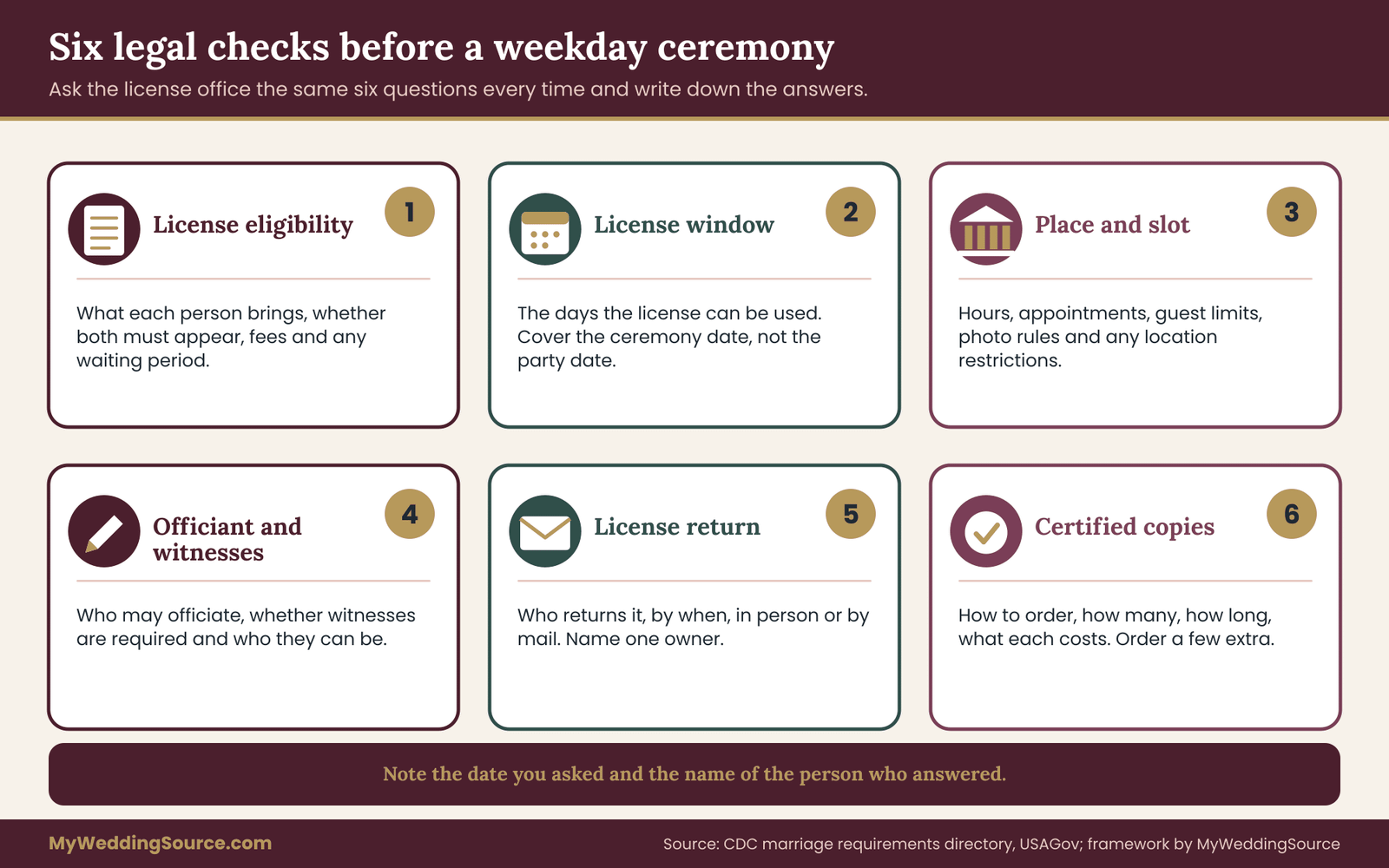
Six legal checks, in order
One: license eligibility and documents. Ask what each person must bring. Typical items are government identification, details about previous marriages, and a fee, but the list differs by place. Ask whether both partners must appear in person, whether you can apply ahead of time, and whether any waiting period applies between getting the license and holding the ceremony.
Two: the license window. Many places set a period during which a license can be used. It may start after a waiting period and end after a set number of days. This window matters more than it seems, because it decides how far ahead you can get the license for the weekday ceremony. If you are marrying months before the reception, you only need the license to cover the ceremony date, not the reception date. The reception does not need a license at all.
Three: where and when the ceremony can happen. Courthouses and clerk offices set hours and often take appointments. Some hold ceremonies only on certain days or at certain times, and some limit the number of guests in the room. If you plan to hold the weekday ceremony somewhere else, such as a home, a garden or a place of worship, ask the issuing office whether any location rules apply and who is allowed to perform the ceremony.
Four: who can officiate and who must witness. The rules about officiants differ by state. Some states recognize ordained or authorized officiants through specific steps, some allow judges or clerks, and a few have other options. Some states require witnesses and some do not. The wedding officiant requirements guide explains how to check an officiant’s authority. For a weekday ceremony, confirm the officiant’s availability and credentials before you set the date, because a courthouse officiant and a friend who was ordained online have different limits.
Five: signing and returning the license. After the ceremony the signed license must be returned to the issuing office, and the office records the marriage. Find out who is responsible for returning it, how long they have, and whether it can be returned by mail or only in person. This step is easy to lose when the ceremony is a quiet weekday morning and everyone is thinking about lunch. Assign it to one named person and put a date beside it.
Six: certified copies. A certified copy of the marriage certificate is the document most agencies want. Ask how to order copies, how many you can get at once, how long processing takes, and what each one costs. Order a few more than you think you need, since you may be asked to submit them in several places.
What changes when the ceremony is separate from the party
When the ceremony and reception share a day, the legal steps are folded into the event. Everyone is present, the officiant is already booked, and the signing happens before dinner. With a weekday ceremony, the steps become a mini-project of their own. Three things behave differently.
First, the license has to be in hand before the weekday ceremony, not before the party. That means the license application is the first real deadline in your plan, and it may fall weeks before the reception even starts to feel close.
Second, the signed license return sits in the middle of everything else. Between the ceremony and the weekend reception you may be traveling, hosting relatives or finishing vendor tasks. Write the return step into your calendar as an event with a name and a date, such as “Priya takes signed license to the clerk, Thursday”. Vague plans to “send it in sometime” cause delays.
Third, your certified copies may arrive before or after the reception. That timing matters if a family member needs one, if you are changing your name, or if you plan to add a spouse to insurance, so check the processing time early.
Paperwork that follows the legal date
Several routine tasks hang from the legal date, not the party date. They are not all urgent, but you should know where they start.
- Name changes. If either of you plans to change a name, the Social Security Administration explains which documents it needs, and the order matters, since other agencies check your name against Social Security records. The U.S. Department of State publishes separate instructions for passports, and the right form depends on when the passport was issued.
- Health coverage. Marriage is generally a qualifying life event for health coverage. HealthCare.gov describes a special enrollment period after certain events, and the window runs from the event date, which for you is the weekday ceremony. If one of you is on an employer plan, ask the benefits office what documents it wants and how long you have to enroll a spouse.
- Taxes. The Internal Revenue Service explains that your marital status on the last day of the tax year generally governs your filing status for that year. A weekday ceremony in late December and a reception in January would put you in different tax years than a single January wedding would. Ask a tax professional about your own situation, since this is not a topic for guesswork.
- Immigration and benefits. If either of you has an immigration case or a benefits case that depends on marital status, the legal date and the documents showing it may be what a decision turns on. Check the agency’s own instructions, such as those on the U.S. Citizenship and Immigration Services site, and ask a qualified attorney before you finalize the date.
The point is not to alarm you. It is to make sure the weekday ceremony is chosen with these consequences in mind, and not discovered afterward.
Choosing the gap between the ceremony and the reception
The gap is the number of days between the two events, and it is the single most useful variable in the plan. A one-night gap behaves nothing like a six-month gap. Decide on a range before you pick specific dates, and test each range against the things that matter to you.
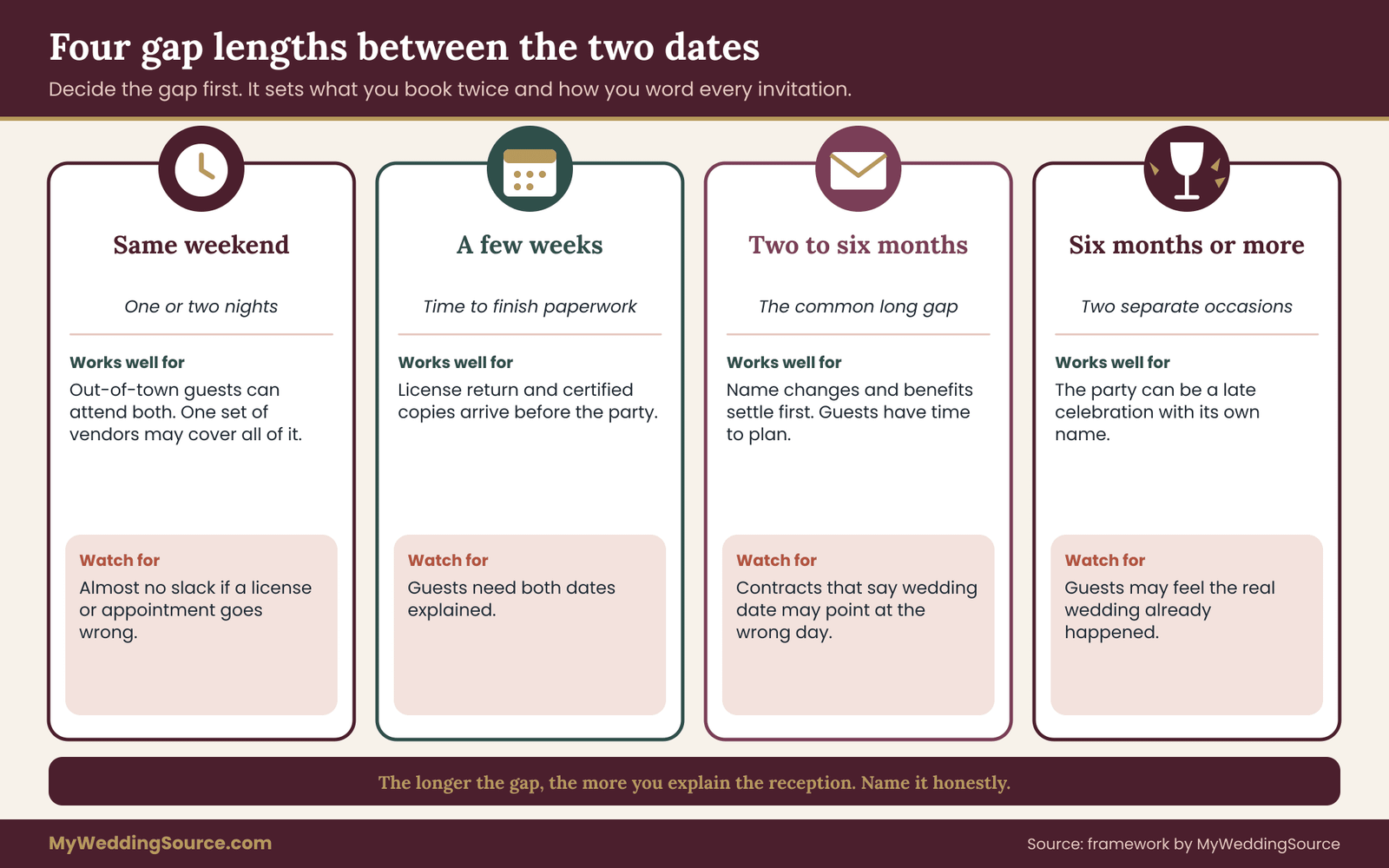
Four gap lengths and what each one does
The same weekend: one night or two. A Friday ceremony and Saturday reception is the tightest version. Out-of-town guests can attend both, the two timelines overlap, and a single group of vendors can often cover everything. The downside is that the weekday ceremony is squeezed into a pre-party day, and anything that goes wrong with the license has almost no room for repair. If the clerk’s office is closed, a missing document can derail the whole weekend.
A few weeks. A gap of a few weeks lets you complete the license return, receive certified copies and begin the paperwork before the party. It also gives you a clean break between the quiet ceremony and the larger celebration. The cost is that guests who travel will have to be told about both dates. You may also be asked why they were not invited to the first one.
Two to six months. A longer gap is common when the reception venue requires a long lead time, or when one partner is relocating. The legal clock is finished early, and the party clock runs alone. This gap gives you time to finish name changes, adjust insurance and settle into married life before the party. It also gives guests the most time to prepare. The risks are a mix-up about what the party is, and a long stretch in which vendor contracts, deposits and policies refer to a “wedding date” that no longer matches your marriage date.
Six months or more. When the gap is this long, the weekday ceremony is effectively a private event and the reception is a separate occasion. Couples in this situation often treat the reception as a first anniversary celebration or a late wedding party. It can work well, but you need to decide what the reception is called and which date appears on printed items.
Decision rules for the gap
Use these rules as a starting point and adjust them for your situation.
If the legal date is driven by a deadline, set it first and choose a reception date at least as far out as you need to plan well. A short gap can only work if the party is already booked.
If you want out-of-town guests at both events, keep the gap to one night or to a weekend pair, or give them the ceremony date as a “come if you can” option well in advance.
If you want name changes and benefits completed before the party, aim for a gap of at least a few weeks, so certified copies have time to arrive.
If you are worried about attendance at the reception, avoid a gap long enough for guests to feel the “real wedding” already happened without them. Another way to think about it: the longer the gap, the more you have to explain the reception.
If you expect to change vendors or the reception venue, a longer gap leaves room for that. A very short gap does not.
The date that appears on printed items
When the gap is more than a few days, you have to decide which date appears on napkins, signage, programs, a guest book and any custom items. There are three honest options. You can print the legal date, since it is the marriage date. You can print the reception date with wording that makes clear it is a celebration. Or you can print both. Printing only the reception date is possible, but it can confuse anyone who later compares it with a certificate. The invitation printing guide explains how to proof printed pieces, and a two-date plan is a good reason to proof every line twice.
Whatever you choose, write the decision in your planning notes so every vendor works from the same sentence. A line such as “Our marriage date is the weekday ceremony date; our reception is a celebration of that marriage” does a surprising amount of work.
The party clock: vendors, guests and counts
The party clock is everything the weekend reception needs: the venue, caterer, music, photographer, florist, rentals, invitations, guest travel and final counts. It follows the usual rhythm of any reception, but a weekday ceremony changes three things about it. The ceremony block may disappear or shrink. Some of your photography and attire needs move to a different day. And vendors need a clear explanation of what the reception now is.
The wedding vendor timeline on this site explains the normal order of booking and handoffs. Use it as the baseline, then adjust it using the points below.
Start with a one-page event definition
Before you send a single inquiry, write a short definition that every vendor will see. It should be one page at most, and it should answer these questions.
- What is the legal marriage date, and has the ceremony already happened or will it happen before the reception?
- What is the reception date, start time and end time?
- What happens at the start of the reception: a welcome and toast, a short vow ceremony, a processional, or nothing formal?
- Who will be in the room, and roughly how many?
- Which activities are the same as a standard wedding reception, such as dinner, dancing, cake and toasts?
- Which parts are different, such as no aisle, no officiant, no ceremony seating or a different entrance?
This page prevents the most common mistake in a split plan, which is that each vendor fills in the blanks differently. A venue coordinator may hold a ceremony slot you do not need. A DJ may plan a processional you are not doing. A photographer may expect a ceremony and a first look that already happened last week. Misread assumptions cost money and time, and a clear page fixes most of them.
Time the party clock backward from the reception
Work backward from the reception date the way you would for any event, but add two checkpoints that are particular to a split plan.
Checkpoint one is the legal date. Whatever the gap, nothing on the party clock should depend on the legal steps going perfectly. If the license has to be signed before a vendor can finalize a contract, or before a venue will release a hold, ask whether that dependency is real. Most of the time it is not, but some venues attach conditions to a “wedding” booking that they do not attach to a “private event” booking.
Checkpoint two is the first public mention. The moment you tell guests about the plan, you have committed to a story. Decide the story before the first message goes out, and make sure every vendor, family member and friend who might repeat it hears the same version.
Then use the usual order. Lock the venue and the date, book the main vendors, send save-the-dates, collect addresses, send invitations, track responses, finalize counts and send the final schedule. The difference is that, with a weekday ceremony in the middle, you will probably also send a smaller set of messages: a note to the people invited to the weekday ceremony, and a note to everyone else announcing that the weekday ceremony will take place before the party.
What to book twice and what to book once
A weekday ceremony multiplies some vendor needs and removes others. A simple rule keeps costs in check: book a vendor twice only if the second day needs a skill, a place or a permit that the first day does not already provide.

Vendors that usually appear twice
The photographer or photo coverage. The weekday ceremony is a milestone you will want pictures of, even if it takes ten minutes. A professional can cover it as a short session, a friend can take photos if the office allows photography, or a courthouse may have its own photo rules. The weekend reception is a separate booking with a different timeline. If the same photographer covers both, ask for a written description of what each day includes, and whether the second day’s rate changes because you already have portraits.
The officiant. If the weekday ceremony is a legal ceremony, the officiant is booked for that day. If the reception includes a vow exchange, a blessing or a ceremony of any kind, you may want the same person or a different one. Either way, the weekend role should be described separately, since it is not a legal act.
Hair and makeup, and attire. If you plan to wear something different on each day, that is two sets of fittings, two preparation timelines and two sets of backup items. Many couples choose a simple outfit for the weekday ceremony and a full outfit for the party. Either way, plan travel, steaming or pressing, and storage between the two days. The wedding dress fit and alterations guide on this site explains how fitting schedules work, and a split plan simply adds another date to them.
Transportation. If you are driving to a courthouse on a weekday and to a venue on a weekend, you may not need the same arrangements on both days. A rideshare or a friend’s car may be enough for the ceremony.
Vendors that usually appear once
The venue, caterer, bar service, music, florist and rentals. These are reception services, and you only need them for the weekend event. Make sure their contracts refer to a reception, not a ceremony, if no ceremony will be held there. If you do plan a short vow moment at the venue, ask whether any extra setup is needed and who handles it.
The cake or dessert vendor. The cake belongs to the reception. If you want a small cake or a treat at the weekday ceremony, buy a small one separately or have a friend bring something. A courthouse may not allow food in the room, so ask first.
The day-of coordinator. A coordinator is most useful on the party day, though a short phone call before the weekday ceremony to review the plan can help. If the coordinator’s package includes a ceremony rehearsal, ask whether it is needed.
Vendors that depend on your choices
Livestream or recorded video. If many guests cannot attend the weekday ceremony, a livestream or a recording could let them see it. Check the courthouse rules first, since many offices limit recording, and ask guests before you stream anything that includes their faces. If the stream matters to you, make a backup plan for a failed connection.
A florist or decorator for the ceremony. A small bouquet and a boutonniere may be all you need for a courthouse. Some couples add a modest arrangement and bring it to the reception afterward. That works only if the flowers are timed well and kept cool between events.
Guest lodging. If the weekday ceremony brings a few guests from out of town, they may need their own hotel booking, separate from the block you set up for the reception. The guide to coordinating guest hotels explains how to build a block that suits different budgets and mobility needs, and you can use the same approach on a smaller scale for the ceremony group.
How to ask each vendor for a split-date quote
When you contact vendors, use the same message and the same facts. A good inquiry says that the weekday ceremony will happen on a weekday on a stated date, that the reception will be on a stated weekend date, and that you want a quote for the reception only, or for both. Ask for the following in writing.
- What services are included on each date, and what is not?
- Does the rate change if the reception is held after the weekday ceremony?
- Does the contract refer to the legal date, the reception date or both, and are the two named separately?
- What happens if the reception date must move? Is the deposit transferable?
- If we hire you for both dates, are they billed as two events or one package?
Keep the replies in a shared folder, so either of you can find them in a minute. The wedding vendor contract guide covers what to look for in a contract, and a split plan is a good reason to read every clause that mentions “the wedding” or “the event” with the two dates in mind.
A common trap: the word “wedding” in contracts
Many vendor contracts use the term “wedding date” without defining it. For a venue, that may mean the day of the event. For a photographer, it may mean the day coverage begins. For an insurance policy, it may mean the day the covered event happens. If your legal ceremony and your reception are on different days, the word can point at either one, or at both.
Ask each vendor to define it in the contract. If the contract says “wedding date” and you intend the reception date, say so in a sentence in the contract, for example, “Event date: Saturday, [date], reception only.” The extra line costs nothing, and it prevents a disagreement over which date triggers a deadline, a payment or a cancellation fee.
Guests, invitations and wording
The guest side of a split plan is where feelings get involved. People tend to care less about the legal logistics than about whether they were included, informed and respected. A calm, early and consistent message goes a long way.
Decide who attends the weekday ceremony
You have three common choices, and each has costs.
Only the two of you and the required witnesses. This is the simplest and often the most private. It also avoids a guest-list argument, since nobody else is there. You may still want to tell close family in advance so they do not hear about it afterward.
Immediate family and a few close friends. A small group can make the weekday ceremony warm without turning it into a second wedding. Keep the list to the number the venue allows, and keep it stable. If you start adding people, the weekend reception is harder to defend as the main celebration.
Anyone who wants to come, with a livestream for the rest. This works for some couples, but only if the legal office, the officiant and the vendors can handle it. Be ready for guests who cannot take a weekday off to feel left out, even when no one means that.
Whichever you choose, apply the rule evenly. Tell guests how you made the decision, if they ask, with a sentence like “We are keeping the weekday ceremony very small and holding the celebration on the weekend, so everyone can be there.” That is truthful, and it does not invite a debate. The wedding guest list guide on this site covers how to set categories and hold to them.
Three audiences, three messages
A split plan creates three groups of people, and each needs different information.
The witnesses and ceremony guests. They need the date, the time, the exact address, parking and entry rules, whether children and photography are allowed, and what happens afterward. Send this message once the license and appointment are confirmed, not before. Keep it short. A single paragraph and a map link is enough.
The reception guests. They need the reception date, time, address, dress code, meal and travel information, and a plain statement that the weekday ceremony has taken place or will take place on an earlier date. The wording of that statement is the delicate part, covered below.
Close family who will not attend the ceremony. This group deserves a personal call or message before the general announcement. Parents, grandparents and siblings usually do not want to learn about the legal date from a group post. A short, warm call that explains the plan and says how they will be part of the weekend can prevent months of awkwardness.

Wording that is honest and clear
The central rule is to describe the event that will actually happen. If the weekday ceremony has already taken place, the invitation should not read as if the marriage will happen at the party. Here are patterns that work, listed in rough order from formal to relaxed.
- “Please join us for a celebration of the marriage of Marisol Vega and Theo Brandt.” This works whether or not the legal date has passed.
- “Marisol and Theo were married on [legal date]. Please join them for a reception in their honor on [reception date].”
- “We made it official on a quiet Tuesday. Come celebrate with us on Saturday, [date].”
- “Join us for a vow celebration and dinner.” Use this only if the party includes vows and you describe them as a celebration or a renewal of the commitment, not as the legal act.
Avoid phrases that suggest the legal marriage will happen at the party, such as “will be married” or “will exchange rings”, unless that is accurate. If you will exchange rings at the reception because you did not exchange them at the courthouse, you can say “will exchange rings” truthfully, as long as the invitation does not say the marriage itself will occur then.
The wedding invitation etiquette guide covers the structure of invitation wording, and the main adjustment in a split plan is a line that states the legal date or the fact that it has already happened. If you use a website for details, put a short “our story” or “about the dates” note there, and keep the printed piece clean.
When to tell guests
For a weekday ceremony you control the timing. The reception is the date guests plan around, so send the reception save-the-date at the normal lead time. Tell people about the weekday ceremony in one of two ways.
If it will happen before the save-the-dates go out, include it in the save-the-date itself, in a single line. That way nobody learns of it later and wonders what else they were not told.
If it will happen close to the reception, send a short note a week or two ahead to the people it affects. Do not hold the information until the reception invitation arrives. Surprise reads as secrecy.
Handling the question “why not just have one day?”
You will be asked, kindly or not. A calm answer protects the plan and your relationships. Pick a reason that is true, say it once, and stop. For example: “The courthouse could only fit us on a weekday, and the venue we wanted had a weekend available, so we are doing both.” Or: “We wanted the legal part to be small and private, and the party to be big.” You do not owe anyone a debate. If a relative insists the arrangement is wrong, repeat the answer in the same words. Write your short script down once and keep it consistent, so both of you give the same answer.
Travel, hotels and weekday time off
The weekday ceremony affects guest travel in two ways.
Guests invited to the ceremony. People who must take a weekday off need notice. Give them the date as early as you can, and tell them the ceremony will be short, so they can decide whether the trip is worth it. If they would need a hotel, tell them which nights and whether you can suggest a rate.
Guests attending the reception only. For them the weekend is the plan, and the usual travel advice applies: a hotel block or a list of options, a plain explanation of how to get to the venue, and a clear time when the formal part ends.
Avoid creating a three-night problem. If the weekday ceremony and the weekend reception are only a few days apart, some guests may be tempted to stay the whole stretch. Be specific about which nights you are hosting and which are optional, and mention the actual dates, so no one has to guess.
Photography, attire and the two-day look
Two days of photos can feel like a gift or a chore, depending on how you plan them. The simplest plan assigns each day a clear job.
Give each day a different photographic job
The weekday ceremony captures the legal moment. It is a short event with a few people. Plan for the signing, the vows, a few portraits with the witnesses, and the place where it happened. Courthouses often have limited space and strict rules. Ask whether tripods, flash, a second photographer, video or a certain number of guests are allowed.
The weekend reception captures the celebration. It has a longer timeline, more people and a different mood. Plan for arrival, portraits, family photographs, toasts, dancing and details. The wedding family photo list guide explains how to organize the group portraits, which matter more when relatives did not attend the ceremony.
If you use one photographer for both, ask what the second day costs and whether the editing style stays consistent. If you use two, make sure both know what the other one covered, so you do not end up with fourteen versions of the same portrait or no photo of an important person.
Photo consent and image use across two events
A courthouse may restrict photography for privacy reasons, and a venue may have its own rules. Guests at the reception may also have views about being photographed or posted online. The wedding photography consent guide explains how to set boundaries and share image-use expectations. In a split plan, a short written note to the photographer for each day, listing the shots you need and any boundaries, keeps both days clear.
The attire question
Decide early whether you will wear the same outfit twice, or two different outfits. There is no right answer, but each choice has a practical effect.
One outfit, worn on both days. This saves money, but the outfit must survive a day of wear, travel and storage, and a gap of several weeks. If it is a formal garment, ask a cleaner or tailor about care between wearings. If you plan to wear a veil only at the reception, bring it separately and keep it protected.
Two outfits. A simple, comfortable look for the weekday ceremony and a formal outfit for the party is common. It lets you photograph the legal moment without worrying about a train or a hairpiece, and it gives the reception its own visual identity. The tradeoff is cost, fittings and one more thing to pack.
A hybrid. You might wear the main outfit to the ceremony and add a layer, accessory or change of shoes for the reception. This reduces cost but may mean the reception look is not entirely fresh to photographs.
Whichever you pick, put the outfit plan in the same planning document as the timeline, since alterations, steaming and cleaning all have deadlines that stack up around the two dates.
A simple rule for the first-look question
Couples often wonder whether the weekday ceremony replaces the first look or the portrait session. A reasonable approach is to take a short set of couple portraits after the legal ceremony, when you are relaxed and the light is good, and then keep the reception-day portraits shorter. That lets you spend more of the party with your guests. If you do portraits at both events, make a short list so the second set adds something different, such as a new location, different clothes or a different group.
Running the reception after a weekday ceremony
When the weekday ceremony is already behind you, the reception needs its own opening. Without one, guests arrive, stand around and wonder when something starts. A good opening takes five to fifteen minutes and gives everyone a sense of arrival. It does not need to imitate a ceremony.
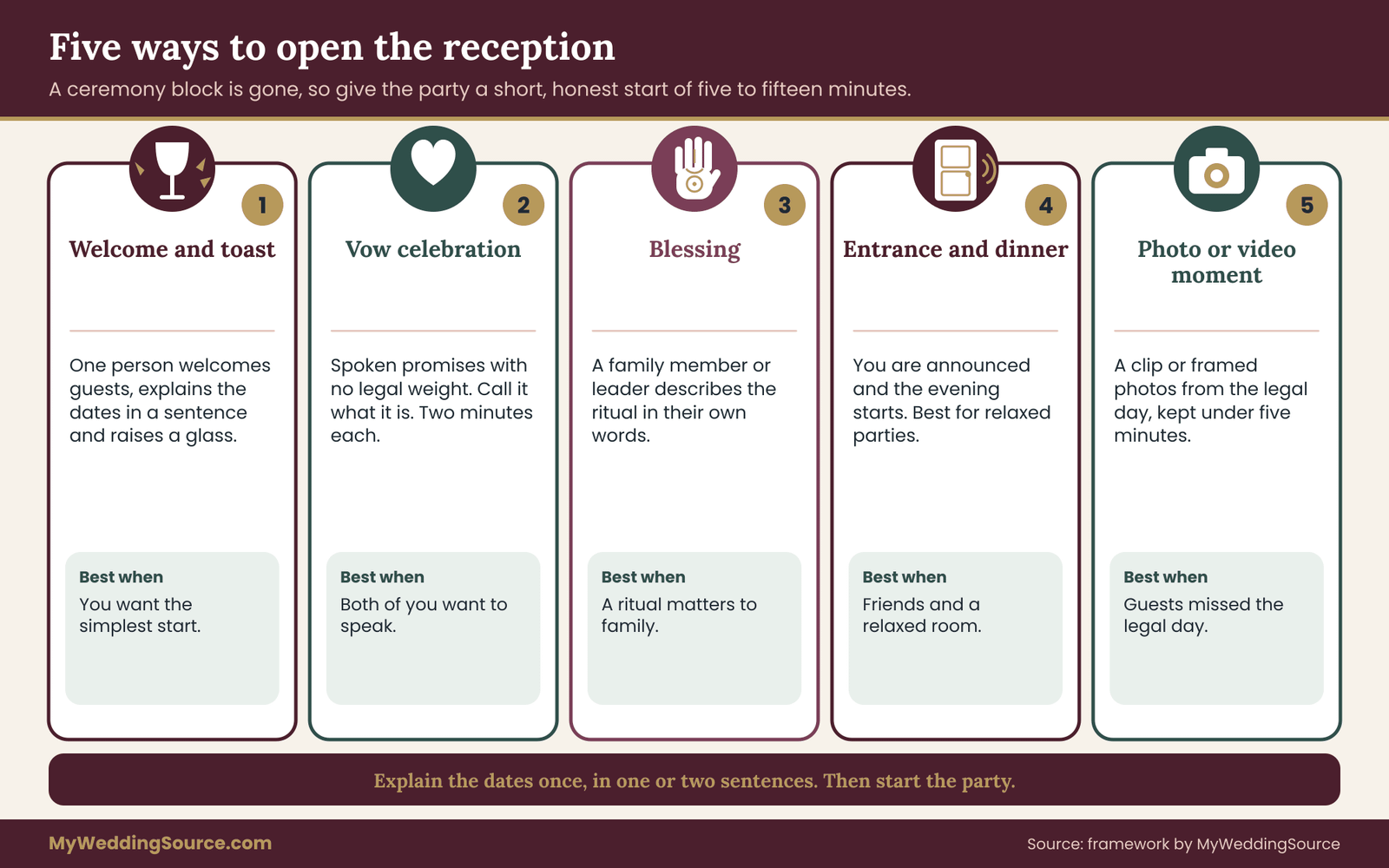
The main work is deciding what replaces the ceremony block in your run of show. Five options cover most couples.
Five ways to open a reception after a weekday ceremony
A welcome and toast. One person, often a parent, a close friend or one of you, welcomes everyone, explains in a sentence or two that the legal ceremony took place earlier, and raises a glass. This is the lowest-effort option and it works in almost any venue.
A vow celebration. You say words to each other in front of your guests, with no legal weight. It can be a short statement of what you promise, a reading, or an exchange of rings if you have not done that yet. Call it what it is. A phrase such as “a celebration of our vows” is accurate and warm.
A blessing from a family member, friend or faith leader. Some couples want a religious or cultural ritual at the party, because the weekday ceremony was purely legal. This is a good fit when you need a particular tradition to be part of the day. Invite the leader or elder to describe the ritual in their own words, so no one is confused about what is happening.
A walk-in entrance with no ceremony. You arrive, are announced, and the evening starts with cocktails or dinner. This works for relaxed receptions where the emphasis is on the meal and the dancing.
A video or photo moment from the weekday ceremony. You play a short clip or slideshow from the legal day, or put framed photos on a table. This brings absent guests into the story without making them watch the full recording. Keep it under five minutes, and check the audio before the event.
How to choose among them
Pick the option that matches the feeling you want, the size of the room and the people you have available. If you feel shy about speaking, a welcome and toast from someone else may suit you better than a vow celebration. If your families expect a ritual, a blessing may matter more than anything else on the schedule. If your guests are mostly friends who just want a great party, an entrance and dinner may be best.
If you choose a vow celebration, write the words and read them aloud once at home. A short, specific promise beats a long, generic one. Two minutes each is plenty. Ask your officiant or a trusted friend to keep time, so neither of you has to watch the clock.
A sample run of show without a ceremony block
Here is a plain sample for a five-hour reception. Adjust every number to your own venue and vendor contracts.
- Guests arrive and cocktail hour begins. Music at low volume, drinks and a few bites, with the guest book or a photo table nearby.
- A short welcome (five to ten minutes). One person speaks, explains the dates in a sentence, and leads a toast. Photographers get a clean moment of everyone with a glass up.
- Couple entrance and first dance, or dinner service. Choose the order that fits the room. If the room is small, start dinner and do the first dance later.
- Dinner and toasts. Plan toasts around service so that food does not go cold. Limit the number of speakers.
- Cake or dessert, then dancing. Keep the cake cutting near the start of the dance block so that guests who want to leave early do not miss it.
- Last dance and send-off. Close with a clear final moment, so guests know when to say goodbye.
The key difference from a standard reception is the absence of a separate ceremony space, a seating plan for the aisle and a break between ceremony and cocktail hour. That saves time and often saves money, because venues and rental companies charge for ceremony setup and the turnover of the space.
Explaining the dates in the room
A single, brief explanation, said once, is enough. For example: “We were married on a Tuesday at the courthouse, with two friends and a lot of nerves. Today is the party.” People enjoy the short story, and it answers the question before anyone asks it. Avoid long histories, legal details or apologies. A reception is not the place to justify the plan, and you do not need to.
If you want an object that carries the story, display a framed copy of the license or a photo from the legal day. Do not display a certified copy of the marriage certificate, since it is an official document you may need to submit later. Keep the original safe. Store certified copies with your other important papers, and let a plain photocopy or a printed photo serve the table.
Rings, names and the cake topper
A few small things are easier when planned in advance.
Rings. If you exchanged rings at the weekday ceremony, you can wear them to the reception and skip any ring moment, or you can do a symbolic re-exchange. If you did not exchange rings at the courthouse, the reception may be the first time. Tell the person who runs the moment, and tell the photographer.
Names. If one of you will change a name and the paperwork is not complete by the reception, decide how you will be introduced. Many couples use the name each person currently uses, and update later. Tell the DJ or host, and tell anyone printing signs.
Cake toppers and printed items. If your cake topper or sign says “Mr. and Mrs.” or similar, check that it matches what you want to say, and whether it reflects the legal date. This is a minor point, but proofing it takes a minute.
Accessibility and comfort at the party
A reception with no ceremony still needs the basics. Check that the entrance is accessible, that seating is available for older guests during the welcome and that the sound system can carry a short announcement across the room. If you are doing a toast or a vow celebration, ask the venue about a wireless microphone and test it before guests arrive. Guests who cannot hear the welcome will miss the explanation of why the event is shaped the way it is.
Money, contracts and insurance across two dates
A split plan does not have to cost more, but it can, and the extra cost tends to hide in places you do not look. Plan the money by date, not only by category.
Build two budgets and one total
Create a budget for the weekday ceremony and one for the reception. The legal budget is usually small: license fee, certified copies, officiant fee if any, a courthouse ceremony fee if any, small flowers, a few photographs, transportation, a meal for the people who attend and attire. The reception budget carries almost everything else. Add them together into one total, so you can see the whole cost, and keep the two lists separate so you can see where money moves.
The wedding cash-flow planning guide explains how to schedule deposits and final balances. In a split plan, add one more line to the schedule: the date each payment is due and which event it belongs to. A balance due “ten days before the wedding” may mean ten days before the weekday ceremony or ten days before the reception, depending on the contract. Ask each vendor to state the actual calendar date.
What a weekday rate can and cannot tell you
Weekday pricing is a common reason to split. Some venues and vendors charge less on weekdays, and some do not. A published weekday rate may also come with limits on the hours, the number of guests or the services included. Do not rely on an average from an article or a friend. Ask for a written quote for the exact date and compare it with a quote for a comparable weekend date.
If a vendor offers a lower weekday rate for the weekday ceremony and a standard weekend rate for the reception, make sure the totals still make sense once you add travel, a second set of staff and any minimums. A saving of a few hundred dollars can disappear if a vendor charges a minimum fee or a travel fee for the second day.
Insurance and the “wedding date” problem again
If you buy event or wedding insurance, the policy likely names a covered event date or a covered date range. A split plan means you should ask the insurer which date or dates are covered, and whether a legal ceremony on one day and a reception on another counts as one event or two. Do not assume. Ask in writing, and keep the reply.
Venues often require proof of insurance from vendors and sometimes from the couple, so check the venue’s rules for the reception date. The wedding vendor contract guide explains what to check in contracts, and it is worth rereading the sections on cancellation and date changes before you sign anything that refers to “the wedding.”
Payment method and records
Pay deposits and balances in a way that leaves a record, and keep one folder for each date. If you pay by credit card, the Consumer Financial Protection Bureau explains how billing disputes work, including the time limits. If a vendor fails to deliver, a clear record of what you paid for which date will make the conversation shorter. Keep each vendor’s confirmation message, which should state the date, the time, the address and the services, and file it under the correct event.
A budget caution for the legal date
Do not let the weekday ceremony become a hidden second wedding in the budget. Courthouse ceremonies are often modest, but if you add an officiant, a photographer, flowers, a lunch, outfits and travel, the cost can reach a meaningful amount. That is fine if you chose it. It is a problem if it was never counted. Add every item to the legal budget, even small ones, and look at the total before you commit to the guest list for that day.
A worked example: Marisol and Theo
The example below is invented to show how the two clocks fit together. The names, dates and local rules are illustrative, and your own license office, venue and vendors will have their own terms. Treat it as a pattern, not as a template to copy.
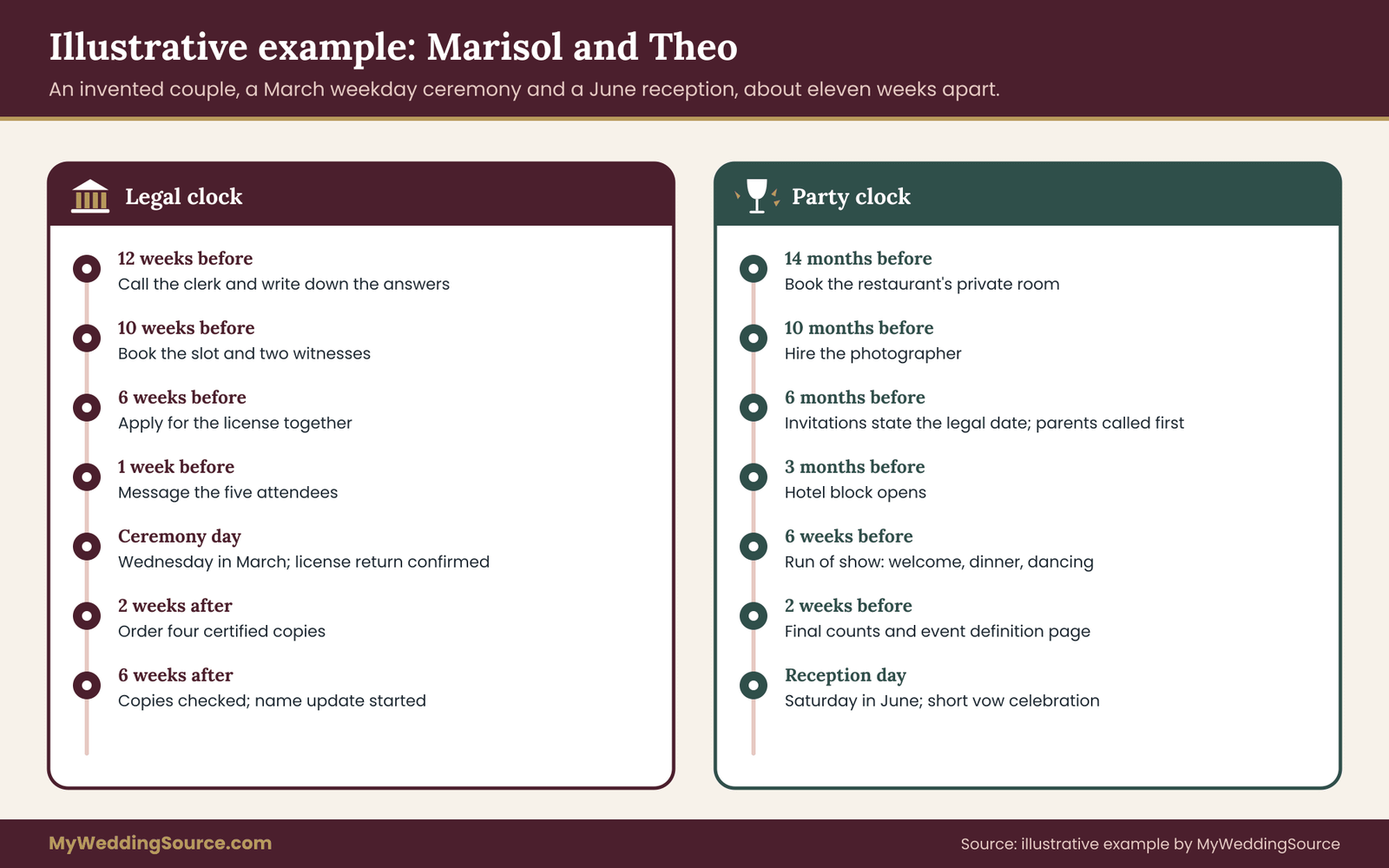
Marisol Vega and Theo Brandt live in one county and want to be married legally in March, with a party in June. Theo’s employer has an open-enrollment change window that they want to use, and Marisol’s parents are traveling from abroad and can only come in June. They choose a weekday ceremony at the county clerk’s office on a Wednesday in March and a Saturday reception in June, a gap of about eleven weeks.
The two clocks, side by side
Legal clock, working backward from the Wednesday ceremony.
- Twelve weeks before: they call the clerk’s office and write down the answers. Both must appear in person to apply for the license, they need identification, the license is valid for a window that begins after a short waiting period and ends well after their date, and two witnesses are needed. The office hands out a short ceremony slot by appointment.
- Ten weeks before: they book the ceremony appointment and ask a friend to serve as a second witness. They decide the office’s room has space for five people, so they invite both witnesses, Marisol’s sister and Theo’s father.
- Six weeks before: they apply for the license together on a lunch break and confirm the date it can first be used.
- One week before: they send a short message to the five attendees with the time, the address, the parking note and the fact that the office restricts photography to the hallway and the room, with no tripods.
- Ceremony day: the clerk completes the ceremony, both witnesses sign, and the couple asks who returns the license. The office handles the return for them, so they write down the date and the name of the clerk.
- Two weeks after: they order four certified copies and confirm that processing takes a few weeks. They calendar the benefits deadline Theo’s employer gave them.
- Six weeks after: copies arrive, they check each detail, and begin the Social Security update for Marisol, who plans to take Theo’s surname. They leave the passport change for after the reception, so her travel documents match her ticket.
Party clock, working backward from the Saturday reception.
- Fourteen months before: they book the venue, a restaurant’s private room that is open on weekends and charges a minimum spend, and they ask the manager to describe the booking as a “private reception”.
- Ten months before: they hire a photographer for the reception and ask for a quote for a short courthouse session as an add-on.
- Six months before: they order invitations that read, “Marisol and Theo were married on Wednesday, March 11. Please join them for a reception in their honor on Saturday, June 20.” They also tell Marisol’s parents by phone, before the card goes out.
- Three months before: they send the courthouse group a short thank-you and a “see you in June” note, and they open a hotel block for out-of-town guests.
- Six weeks before: they confirm the reception timeline. It begins with a ten-minute welcome and toast from Marisol’s sister, followed by dinner, a first dance and dessert, and it has no ceremony block.
- Two weeks before: final counts go to the restaurant, along with a one-page event definition. The page states that the legal marriage took place in March, that no officiant is needed and that a short photo slideshow will play during cocktail hour.
- Day of: the photographer covers arrival, portraits, family photos and the dance. The couple’s friend reads a short vow celebration that they wrote together.
What this example shows
Three things stand out. First, the legal steps are tiny and early, and they finish well before the party clock gets busy. Second, the weekday ceremony needed one contract change: the photographer’s quote for a short session. Everything else was a reception booking with a clear label. Third, the couple spent most of their effort on the story, meaning the invitation wording, the call to the parents and the welcome toast. The paperwork was a few phone calls. The people were the real work.
It also shows what they decided not to do. They did not plan a second ceremony. They did not print “wedding day” on every item. They did not ask the restaurant to hold a ceremony slot. Every choice reduced the number of moving parts.
Where the example could have gone wrong
Imagine two small changes. If the clerk’s office had changed its appointment rules in the weeks before the ceremony, and the couple had not confirmed the slot a week ahead, the whole weekday ceremony would have slipped, and Theo’s benefits deadline might have passed. If the restaurant had written “wedding date: June 20” in the contract and the couple had not corrected it, a later question about a cancellation or insurance claim could have referred to a date that was not their marriage date. Both problems are easy to prevent, and both are easy to miss.
Risks, edge cases and fixes
Every plan has weak points. The ones in a split-date plan are predictable, which means you can check them in advance. The list below covers the most common and gives a practical fix for each.
The license is not returned or recorded on time
What happens. The signed license is left in a bag, mailed to the wrong office or returned late. The marriage record is delayed, and certified copies cannot be ordered.
Fix. Name one person responsible for the return, write the due date in the calendar and confirm with the office that the record is complete. After a few weeks, ask when you can order copies, and check the first copy for errors. The wedding planning checklist has a place to log this step.
The ceremony date slips, and the reception is already booked
What happens. A courthouse closes, a witness gets sick or an appointment is canceled. The legal date moves, and the reception date does not.
Fix. Keep one backup weekday and one backup witness. Since the reception does not depend on the legal date, a delay does not threaten the party, but it may affect benefits, name changes and any deadlines that were tied to the original date. Check each of those deadlines, and if one is tight, ask the agency or employer whether an alternative path exists.
The reception date moves, and the weekday ceremony is already done
What happens. A venue closes, a vendor cancels or weather forces a change. The legal marriage is unaffected, but the invitation and vendor contracts need updating.
Fix. Ask each vendor about date-change rules before you sign, and keep a list of every printed item that carries the reception date. If you move the date, send a short message to guests the same day, and update the website and any hotel block. The fact that the legal date is settled actually makes this kind of change easier to handle.
Guests feel excluded from the weekday ceremony
What happens. A relative hears about the weekday ceremony from someone else and feels hurt, even though the party is open to everyone.
Fix. Call the people most likely to be hurt before the announcement, say what the weekday ceremony is and what it is not, and tell them what part they have at the party. A small gesture, such as inviting that person to give the welcome toast or to read a short passage, shows that the weekend is not a consolation prize.
Vendors treat the reception as a full wedding
What happens. A venue charges for a ceremony site you do not use, a band plans a processional you did not ask for, or a florist builds an arch no one will stand under.
Fix. Send the one-page event definition to every vendor, and ask each to confirm the services in writing. Review the final timeline with the venue contact and the lead vendor a week before the event. Line items for a ceremony you are not holding should be removed from the contract.
The pair is only one night apart
What happens. With a Friday ceremony and a Saturday reception, there is no slack. A missing document, a late witness or a delayed appointment lands on top of the party.
Fix. Get the license early and double-check the ceremony slot a few days ahead. Pack a folder with the license, identification and a printed confirmation. Keep the Friday short, and avoid scheduling hair, makeup or vendor deliveries so tightly that a delay at the courthouse knocks everything over. If a guest group arrives Friday, give them a plain schedule for the evening.
The ceremony falls near the end of a tax year
What happens. A weekday ceremony in late December and a reception in the new year put the legal date in a different tax year from the party. Filing status, withholding and benefits may all change.
Fix. Read the Internal Revenue Service guidance on marital status, and talk to a tax professional about your own case. Do not choose a date for tax reasons alone, but know the consequence before you pick it.
Immigration, military or benefits deadlines drive the date
What happens. An outside deadline sets the legal date, and the reception is planned around it. The legal date may need to be moved with short notice, or documented with extra care.
Fix. Ask the relevant agency or a qualified professional what evidence of the marriage is required and when, and keep every document that shows the date and place. Do not sign nonrefundable party contracts until the legal date is secure.
Name changes are not finished by the reception
What happens. Guests and vendors use a name that no agency has yet recorded, and some forms mismatch.
Fix. Pick one name to use at the party, tell the host and the vendors, and update the paperwork afterward in the order the Social Security Administration and the State Department describe. A mismatch on a travel booking can matter more than one on a party sign, so keep travel documents consistent.
A guest asks to attend the ceremony after the list is closed
What happens. A relative who heard about the weekday ceremony asks to come. Saying yes opens the door for others, and saying no feels harsh.
Fix. Decide in advance whether the list is closed. If it is, answer with a short, kind sentence and an invitation to the reception role you have in mind. If space is truly the limit, say so, because it is a fact and not an excuse.
Putting both clocks on one page
A single page can keep the plan honest. Make two columns in a shared document, one for the legal clock and one for the party clock, and list every task with a date and an owner. Add a third short list for tasks that touch both, such as the invitation wording, the photographer’s brief, the name used at the party and the insurance question. Review the page every two weeks, and again the week before each event.
For the legal column, include the license appointment, the license window, the ceremony slot, the officiant, the witnesses, the return of the signed license and the certified copy order. For the party column, include the venue deposit, vendor deposits, invitation proof, mailing date, response deadline, final counts, final payments and the day-of timeline. For the shared list, include the event definition page, the guest message for each audience and the budget lines for each date.
The act of writing it down tends to expose conflicts early. A common example is a vendor balance that comes due the same week as the weekday ceremony, a clash that is easy to fix with a phone call and hard to fix with a week to go.
What to verify, and with whom
Many details in a split plan can only be confirmed by the people who set the rules. A short list of who to ask keeps you from relying on an article, including this one.
- The license office: eligibility, waiting period, license window, location rules, witness and officiant requirements, how the license is returned and how to order certified copies.
- The ceremony location: hours, appointment rules, guest limits, photography and recording rules, and any fee.
- Every vendor: the definition of the event date, what is included on each date, what happens if a date moves, and the cancellation and refund terms.
- Your insurer, if you buy a policy: which date or dates are covered and what counts as the covered event.
- Your employer or health plan: how to add a spouse, what documents are needed and when the window closes.
- The agencies you deal with: the Social Security Administration, the State Department, the Internal Revenue Service and, if relevant, U.S. Citizenship and Immigration Services.
Date, local events and lead times change, and venues test their own rules from season to season. Visit the ceremony site and the reception venue in person, and drive both routes at the times of day your guests will drive them, before you commit to a date.
Limits of this guide
This guide cannot tell you what your county requires, what your vendors will agree to or how an agency will treat your case. It describes a way to organize the work, and it relies on you to confirm the rules that apply to you. Rules and fees change, so use the sources at the end as a starting point, and check the current versions directly. If a decision involves money, immigration, taxes or insurance coverage in a serious way, ask a qualified professional who can look at your documents.
Your next steps
Pick one evening this week and do three things. First, call the license office and write down the answers to the six legal checks, with the date you asked. Second, write the one-page event definition and decide what opens the reception, so you can send it to the first vendor you contact. Third, choose a gap range and write down the reason, so the next ten decisions have something to rest on.
Then build the two-column page and work through it a step at a time. If you are still deciding on a date at all, read the guide on choosing a wedding date first, and return here once the dates are set. For the money, the wedding budget guide will help you lay out the two budgets. After a few weeks, the weekday ceremony becomes a short, quiet errand and the weekend reception becomes the party you planned.
FAQ
Can we have a legal ceremony on a weekday and a larger ceremony at the reception?
You can hold a ceremony of any kind at the reception, but only the weekday ceremony creates the marriage. A vow celebration, a blessing or a ring exchange at the party is symbolic, and invitations should describe it that way. Confirm with your license office what counts as the legal ceremony, and make sure the signed license is returned and recorded.
Which date is our official wedding date?
The date on your marriage record is the date of the weekday ceremony, which is the weekday ceremony in this plan. Agencies, employers and insurers will use it. You are free to celebrate an anniversary on the reception date, or on both, but forms and legal paperwork follow the recorded date. Ask the issuing office if you are unsure how your record will read.
How long should the gap between the two events be?
It depends on your reasons. A one-night gap suits couples who want guests at both events. A few weeks leaves time for certified copies and paperwork. Several months works when a venue or relocation forces it. Longer gaps need clearer wording, since guests may feel the real wedding has already happened. Decide the gap before you pick the dates.
Do vendors charge more for a split-date wedding?
Not necessarily, but they may. A vendor you hire for both dates may bill two events, and some charge minimums or travel fees. A weekday rate is not always lower. Ask each vendor for a written quote for each date, ask how they define the event date in the contract, and compare totals, not rates.
What should the invitation say if we are already married?
Say what is true. You can write that you were married on a stated date and invite guests to a reception in your honor, or invite them to a celebration of your marriage. Avoid wording that suggests the legal marriage will happen at the party. A single clear line about the legal date avoids confusion and protects your relationships.
Do we need a license for the weekend reception?
No. The license is tied to the weekday ceremony, not to the party. A reception is a celebration of a marriage that already exists, so it does not need one. If you hold a symbolic vow moment, it has no legal effect. Check your state and county for the rules that apply to the weekday ceremony itself.
Who can attend the weekday ceremony?
That depends on the office or place where it is held and on your own choices. Some courthouses limit the number of guests or restrict photography. You usually need an officiant and, in some places, witnesses. Ask the office for its rules, then decide who is closest to you and who must be there.
What if the weekday ceremony date changes after the reception is booked?
The reception can usually stay as planned, since it does not depend on the legal date. Check any deadlines tied to the original legal date, such as benefits enrollment, name changes or tax status, and ask the agency or employer about alternatives. Update the invitation wording if it names the legal date, and tell the people attending the ceremony right away.
Sources
- How to get a copy of a marriage certificate or a marriage license, USAGov
- Marriage and divorce, Centers for Disease Control and Prevention, National Center for Health Statistics
- Marriage means making changes before next filing season, Internal Revenue Service
- How do I change or correct my name on my Social Security number card?, Social Security Administration
- Change or correct a passport, U.S. Department of State
- Special enrollment period, HealthCare.gov
- How do I dispute a charge on my credit card bill?, Consumer Financial Protection Bureau
- Consumer advice, Federal Trade Commission
- U.S. Citizenship and Immigration Services