
Wedding trivia works when every table can score and no family wins by default. This guide gives you an original question audit and a scorekeeping plan, so a wedding trivia round at your reception feels fair to both families, to guests who barely know either one, and to the couple who has to live with the memory of it.
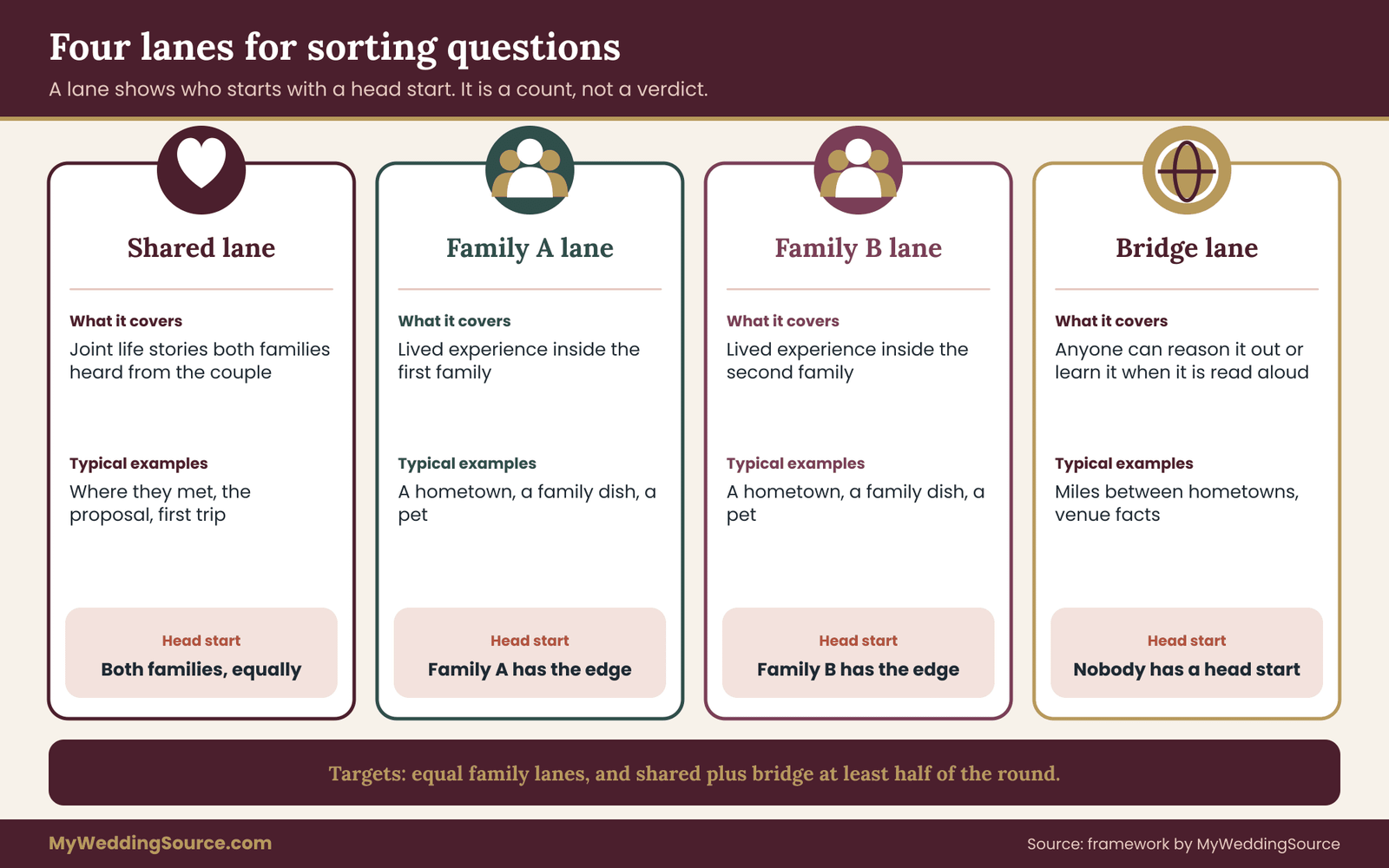
Sort every question into one of four lanes: shared, Family A, Family B and bridge. Keep the two family lanes equal in number and in points, and make at least half the wedding trivia questions answerable by anyone. Run each draft question through six checks (insider, privacy, language, access, tone and time). Mix the families at every table, score one flat point per question, settle disputes with a written ruling card, and test the whole round with four volunteers before the wedding.
Most couples add wedding trivia because it is a gentle way to get two sets of relatives talking. The goal is good. The usual execution has a flaw that nobody sees until the wedding trivia game is running: the questions get written by the couple and their closest friends, who know one family far better than the other. Within three questions, one half of the room is laughing and the other half is staring at a card.
Unfairness in wedding trivia is rarely malicious. It comes from the writer’s own knowledge map. The partner who grew up with a big, noisy, story-telling family has twenty anecdotes ready. The partner from a quieter family has four. If you write what comes to mind, the first family gets twenty questions and the second gets four.
This guide fixes that with a method, not with good intentions. You will learn how to tag questions, count them, test them and score them so the result is balanced by design. It also covers wording, access, children, blended and strained families, vendors and a pilot test you can run in one evening.
A note on scope. This is general planning information, not legal advice. Accessibility duties for venues and vendors depend on the facts and the place, so where a rule matters, the guide points you to the agency that publishes it.
What wedding trivia is for, and where fairness breaks
Before building anything, decide what job the game does. A wedding trivia round can do four different jobs, and each one changes the questions you write.
Mixing. The wedding trivia game puts relatives who have never met at the same table and gives them something to do together. This is the most common goal, and it means team design matters as much as question design.
Storytelling. The questions teach the room about the couple: how they met, a funny misunderstanding, a place that matters. This works when the answers are interesting even to people who get them wrong.
Warm-up. A ten-minute round during dinner service or a cocktail hour keeps guests occupied between moments on the schedule. Here, short and low-stakes beats clever.
Tribute. Some couples want the game to honor family history, such as a grandparent’s hometown. This is the riskiest job, because honoring one family’s history in a contest quietly ranks it.
Pick one main job. A round that tries to do all four tends to become a long quiz with uneven questions. If you are still shaping the evening as a whole, the reception flow guide shows how a short game fits among the other moments guests move through.
Where fairness actually breaks
Fairness fails at specific points, and it helps to name them before you write a single question.
The first is who wrote it. A single author means a single knowledge map. Even a careful author reaches for what they know best.
The second is who can answer without help. A question about a nickname that only one cousin group uses is not a hard question. It is a locked door for everyone else.
The third is who is seated where. If the families sit on opposite sides of the room and the teams are table-based, the wedding trivia game becomes a contest between families, which is the opposite of mixing.
The fourth is how points are counted. A bonus round worth triple points at the end turns a pleasant game into a comeback story for whoever happened to know that one answer.
The fifth is how the result is announced. Naming a last-place table in front of a hundred people can sting more than any wrong answer did.
Each of these gets a concrete fix later in the guide. For now, the useful point is that fairness is a property of the whole round, not just the wedding trivia questions.
What “fair to both families” means here
Fair does not mean identical. Two families can differ in size, language, age range and comfort with attention, and a rule that treats them the same on paper can still favor one. In this guide, fair means three things.
First, equal opportunity: each family has the same number of questions where its members have a natural advantage, and the same total points attached to them.
Second, a shared floor: most questions can be answered by someone who knows neither family, by reasoning, by guessing from options or by learning something just read aloud.
Third, equal dignity: no question exposes a person, mocks a trait or asks a guest to perform knowledge they may not have for good reasons, such as estrangement, loss or recent arrival in the country.
Keep those three in mind. Every tool below serves one of them.
The two-family fairness audit in one page
The wedding trivia audit is a short, repeatable process. You can run it on a draft of twenty questions or sixty. It has four steps, and each step produces something you can count.
Step one: collect without judging. Ask the couple, both sets of parents and a few close friends from each side to send questions. Aim for roughly the same number from each side, and ask each person to send questions they believe the other family would also enjoy. Do not edit during collection. You want the raw pile.
Step two: tag each question with a lane. The lanes are shared, Family A, Family B and bridge. The next section defines them in detail. The tag answers one plain question: who has the head start on this one?
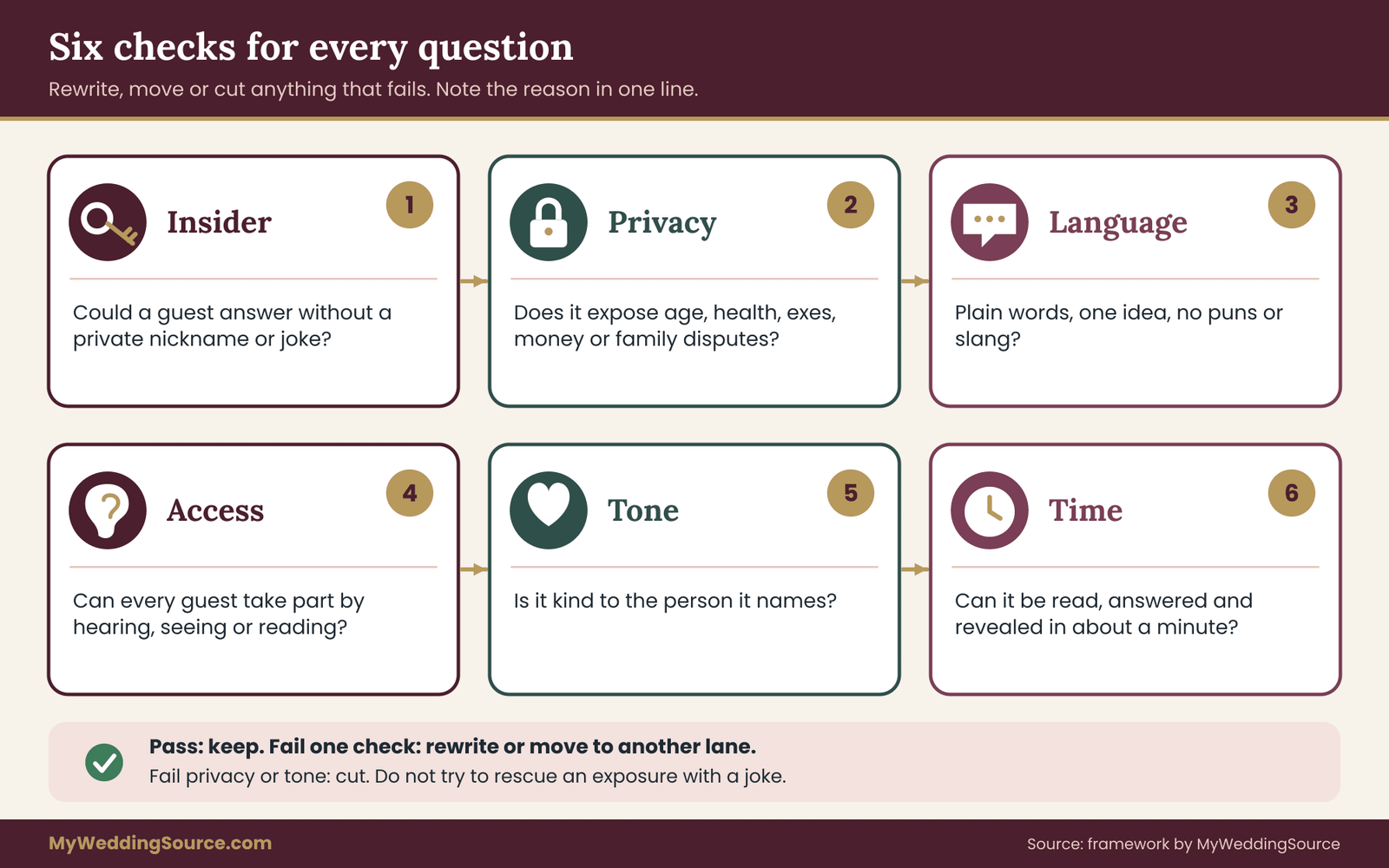
Step three: run the six checks. Every question passes through the same six tests: insider, privacy, language, access, tone and time. A question that fails a check is rewritten, moved to another lane or cut.
Step four: count and balance. Add up the lanes, compare the two family lanes and confirm that shared plus bridge make up at least half of the wedding trivia round. Fix the gaps by writing more questions in the thin lanes, not by lowering standards on the full ones.
The count is what makes the audit useful. A feeling that “it seems balanced” is easy to hold and hard to check. A tally of ten, six, six and fourteen can be checked by anyone, including a parent who worries that their side is being left out.
Why a count beats a good feeling
Consider what happens without a tally. The couple reads the list and, because they know every story, every question feels easy and every family feels represented. They are not neutral readers. A guest who has met one of the families twice is the real test, and that guest is not in the room while you draft.
A count is a way of borrowing that guest’s point of view before the wedding. It forces the question “who benefits?” onto each line, and it does so in a form that a skeptical relative can verify. When a parent asks why a favorite story did not make the cut, you can show the lane count and explain that the Family A lane was already full. That is a calmer conversation than defending taste.
What you will need
The wedding trivia audit needs very little. A shared document or a sheet of paper with a column for the question, a column for the lane and a column for the six checks. A pencil. Two or three honest readers who are not the couple. And an hour for the first pass, plus a second sitting for the wedding trivia pilot test described near the end of this guide.
You do not need software, an app or a paid template. If you later choose a wedding trivia game platform or a hired host, the audit still applies, because it is a way of judging the questions, not of delivering them.
Sorting wedding trivia questions into four lanes
A lane describes who starts with an advantage on a question. It is not a judgment of the question’s quality. A good question can sit in any lane. The wedding trivia audit only asks that the lanes be counted and balanced.
The shared lane. These are questions about the couple’s joint life that both families have heard about through the couple themselves. Where they first met, which city they lived in together, what they ordered on their first dinner date, how the proposal happened. Both families received roughly the same version of this story, so neither holds a head start. Shared questions are the backbone of wedding trivia because they are about the people everyone came to celebrate.
The Family A lane. Questions where members of the first family can answer from lived experience. A childhood pet, the town a parent grew up in, a family recipe that appears at every holiday. Guests from the other family can still guess, but the first family has the edge.
The Family B lane. The same type of question, for the second family. The rule is symmetry, and it needs to be real symmetry: if Family A’s lane has a question about a grandparent’s hometown, Family B’s lane should have something of similar weight, not a question about a nickname.
The bridge lane. Questions that give no one a head start. They can be answered by reasoning (“Roughly how many miles apart are the two hometowns?” with options), by general knowledge related to the venue, the season or the date, or by learning something the host reads out. A good bridge question makes the whole room lean in at once.
Why four lanes and not two
A simple split into “bride’s side” and “groom’s side” fails for three reasons. Not every couple is a bride and a groom. Not every guest belongs to one side, because friends, colleagues and neighbors belong to neither. And it hides the most useful category, the wedding trivia questions nobody has a head start on.
Four lanes also make it easier to notice when a question quietly belongs somewhere else. A question the writer thought of as shared often turns out to be a Family A question. For example, “What is the name of the couple’s first apartment building?” feels shared, but if only one partner’s relatives ever visited, that detail did not travel to the other side. Tagging forces the question: where did this fact come from, and who heard it?
The lane test in one question
For each question, ask: if I handed this card to a guest who has met only one of the two families, who could answer it?
If the answer is “that guest could not, but a member of the other family could,” the question is in a family lane, and it belongs to whichever family holds the fact. If the answer is “anyone with the couple’s story could,” it is shared. If the answer is “anyone could reason their way there,” it is bridge.
A second quick test catches many errors. Read the question aloud and watch where your own eyes go in an imagined room. If you picture one table lighting up and another table looking down, the question is in a family lane, even if you tagged it shared.
Target ratios for the lanes
Ratios keep the wedding trivia round balanced without making it feel mechanical. These are planning targets, not rules from any standard, and you can adjust them to your guest list.
Common ground at least half. Shared plus bridge should be at least half of all questions. That is the shared floor described earlier, and it protects guests who know neither family well.
Family lanes equal. The two family lanes should match in number and in total points. If Family A has six questions, Family B has six.
No lane over about a third by itself. If shared grows past a third of the round, check that you are not making the wedding trivia game a wedding trivia quiz about the couple alone. If either family lane passes a third, trim it.
A small floor for each family. Even in a short round of twelve questions, give each family lane at least two. Anything less and the lane is a token, which is a different kind of unfairness.
For a wedding trivia round of thirty-six questions, one balanced shape is ten shared, six Family A, six Family B and fourteen bridge. For a round of twelve, it might be three shared, two Family A, two Family B and five bridge. The numbers matter less than the shape: more common ground than family-specific questions, and symmetry between the family lanes.
What to do when the families are very different in size
A common worry: one family has a hundred relatives at the wedding and the other has twelve. Equal lane counts can look unfair to the larger family, and the smaller family may feel exposed when its few relatives each carry a whole lane.
The practical answer is to keep the lanes equal in count and points, and to solve the size difference through seating and team design, which later sections cover. A small family’s lane should draw on a topic that the family itself is comfortable sharing, and the family should approve each question. Larger families should know the lane is equal on purpose, so that nobody reads symmetry as a slight. Say it plainly when you brief them: each family gets the same share of the questions, and the rest belongs to everyone.
The six checks every wedding trivia question must pass
Lanes tell you who has an advantage. Checks tell you whether the question should exist at all. Every question gets the same six checks, in the same order, and you note a pass, a rewrite or a cut.
Check one: the insider check. Could a reasonable guest answer this without knowing a private detail, a nickname, a family joke or a name that only one group uses? If not, the question is a family-lane question at best. If the answer depends on a joke nobody else heard, cut it or rewrite it so the setup is read aloud first.
Check two: the privacy check. Does the question reveal something the person it concerns may not want shared? Ages, weight, income, health, past relationships, immigration history, family disputes and religious practice are all off the table. A question about the groom’s former girlfriend is not trivia, it is an exposure. A question that asks a guest to confirm a personal detail in public is also a privacy problem.
Check three: the language check. Is the wording plain, short and free of idioms that depend on one culture or one generation? Can a guest who speaks English as a second language read it once and understand it? The plain language guidance published by the federal government is a useful reference for short sentences and common words.
Check four: the access check. Can a guest answer regardless of hearing, vision, mobility or reading speed? If the question depends on seeing a photo, hearing an audio clip or writing quickly, does the wedding trivia round offer another way to take part? Later sections return to this check in more detail.
Check five: the tone check. Is the question kind? A question that makes fun of someone, even affectionately, can land badly with the people who were not asked in advance. A question that celebrates something about a person is almost always safer than one that teases them.
Check six: the time check. Can it be read, answered and revealed in under about a minute? Slow questions sap the room. A question that takes a table five minutes to argue about will cost you the rest of the round.
Running the checks fast
You do not need to run all six checks as a formal ritual on every line. In practice, three of them (insider, privacy, tone) produce most of the cuts, and you will quickly notice that the same kinds of questions fail again and again.
A useful habit is to mark each failed question with the check number and a one-line reason, then decide: rewrite, move or cut. Over a pass of forty questions, you will learn which kinds of writing produce problems for your particular families. The notes also help when a parent asks why a favorite question was removed.
Examples of a question failing and being repaired
A failed question, with its repair, teaches faster than a rule. Here are three, all invented for illustration.
Draft: “What did Uncle Joe call the groom when he was little?” This fails the insider check. Only people who heard the nickname can answer. Repair: Read the nickname aloud, then ask a multiple-choice question: “Which story belongs to this nickname?” with three options. Now it is a short story, and guests learn something.
Draft: “How many years has the bride been working at her job?” This fails the privacy check in some workplaces and is dull anyway. Repair: Replace it with something the couple chose to make public, such as the first trip they took together, with three options.
Draft: “Which of these two is more likely to get lost on a road trip?” This fails the tone check for the person named and invites teasing. Repair: Ask about the road trip itself: “On their first road trip, which snack did they run out of first?” with options. The answer is a harmless detail, not a verdict on a person.
Notice that none of the repairs removes the fun. They move the question from exposure to story, and from private knowledge to knowledge the host can supply. That is the pattern behind most good repairs in wedding trivia.
Wording rules that protect guests in wedding trivia
Wording does as much work as content. A fair question can still be unfair if it is phrased for one kind of reader. These rules keep the language open.
Put the question first, then the options. Read the question, pause, then read the choices. Guests who process speech slowly, or who are translating in their heads, get time to catch up.
Use one idea per question. “Where did they meet, and what year was it?” is two questions. Split it or choose one.
Avoid references that depend on age or place. A question about a television show from one decade or a regional sports team assumes a shared background that a mixed room does not have. If you want a pop-culture question, make it about the couple’s own tastes, with options that explain themselves.
Avoid wordplay and idioms. A pun can be charming to a fluent reader and opaque to a guest reading in a second language. If a question depends on a pun, it belongs in the host’s patter, not on the card.
Give names their full form once. If the question mentions “Auntie Lu,” say who she is the first time: “the groom’s aunt, Lu.” Guests from the other family should not have to guess whether Lu is a relative, a pet or a friend.
Offer options for any fact that a guest might not know. Multiple choice turns many “gotcha” facts into reasoning problems, and it lets guests guess without the discomfort of being wrong out loud.
Culture, faith and family history
Questions about culture and faith can be warm, and they can also turn a wedding trivia game into a ranking of traditions. Three habits help.
First, ask about the couple’s own choices, not about a culture in general. “Which dish will be served at the family-style course?” is about the menu. “Which country is famous for this dish?” is a geography quiz that may mark someone as the exotic one.
Second, never ask a guest to represent a faith or culture. A question that begins “As a member of the family from…” puts a person on the spot.
Third, if a question honors a custom, have a family member read it. The same fact reads differently when a grandmother delivers it than when a stranger does. The guide to wedding etiquette covers the wider habit of consulting family before featuring a tradition.
Memory, loss and sensitive topics
Many weddings include guests who are grieving, estranged or carrying a difficult history with someone in the family. Wedding trivia that touches the past can reopen things. Cut questions about deceased relatives unless the family asks for them, and in that case place them as a tribute moment, not as a scored question. Do not ask about divorces, previous marriages, who paid for what, or who was not invited.
If a parent suggests a question that touches a sensitive topic, answer with a simple script: “We are keeping the wedding trivia round to things everyone can enjoy, so we saved this one for a toast instead.” That respects the idea without losing the room.
A scorekeeping plan for wedding trivia
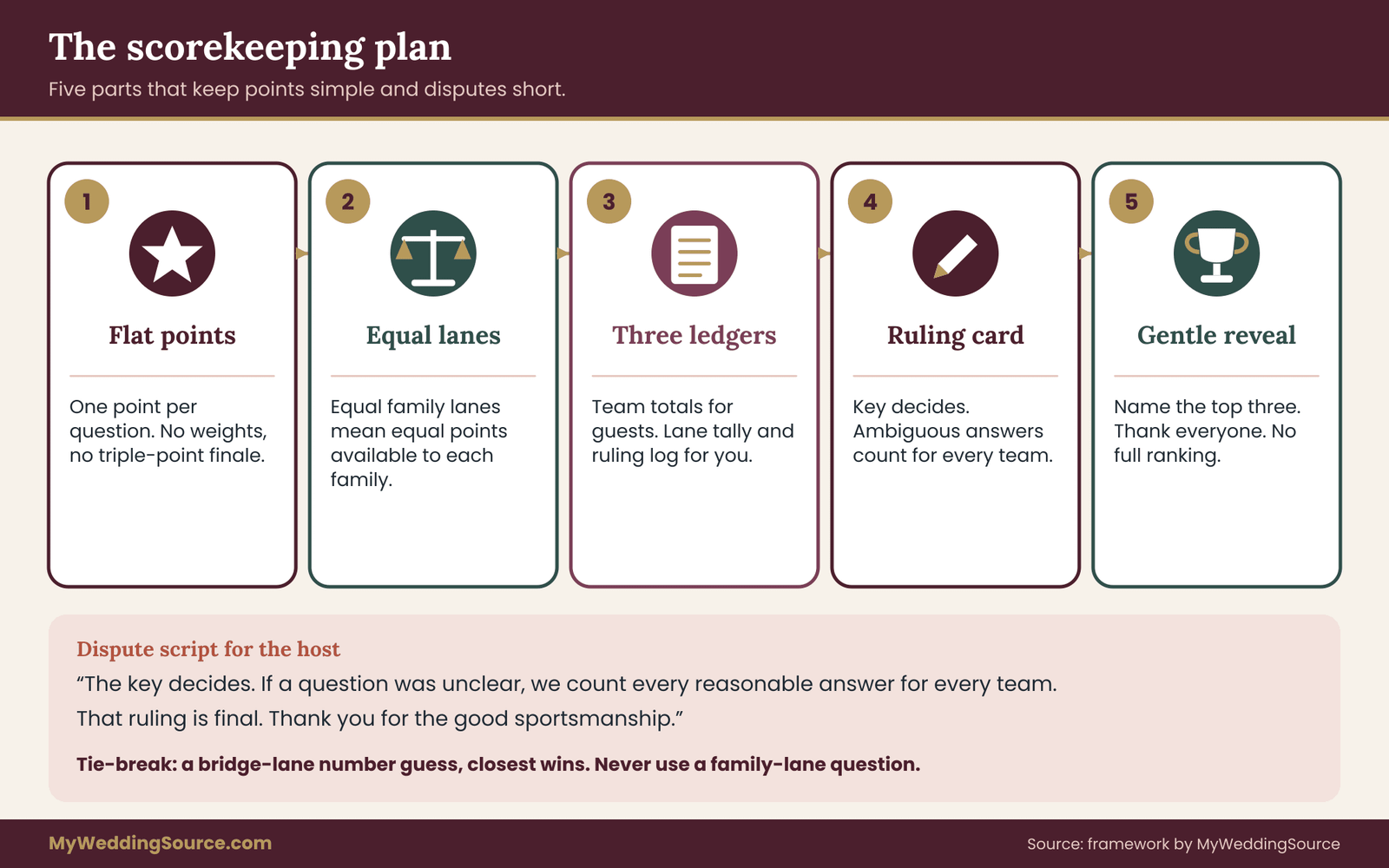
Question fairness gets the attention in wedding trivia, but scorekeeping is where many rounds fall apart. A confusing system, a slow tally or a disputed answer can erase the goodwill that good questions built. The plan below has five parts.
Part one: one flat point per question. Every question is worth one point. The simplicity is deliberate. A wedding trivia round with weighted questions invites arguments about weights, and weights are a quiet way to favor whoever knows the heavy questions. If you want some questions to feel bigger, make them bigger in storytelling, not in points.
Part two: equal total points per family lane. Because each question is worth one point and the family lanes have equal counts, the two families have equal available points. Common ground carries the rest. You can check this in thirty seconds by adding the lane counts.
Part three: three ledgers. Keep three simple records. The team ledger is what guests see: each team’s total. The lane ledger is private: for each question, how many teams answered correctly, so you can see after the wedding trivia pilot whether a lane was lopsided. The ruling log is a short written list of disputes and what was decided.
Part four: no bonus round that changes the standings. If you want a closing flourish, make it unscored: a final question for the whole room that everyone answers together.
Part five: a gentle reveal. Announce the top three teams by name, give each a small prize, and thank everyone. Do not read the full ranking. Offer separate fun awards, such as most creative team name or most improved guess, so that teams outside the top three still get applause.
Who keeps score
Choose the wedding trivia scorekeeper early, and choose someone with no stake in the result. A neutral friend, a coordinator or a hired host is better than a parent. If a family member is the only available option, pair them with a second scorer from the other family and have them check each other.
Give the scorekeeper a one-page answer key with each answer and, where useful, the source: “From the couple’s own account of the trip.” If a guest disputes an answer, the scorekeeper can point to the key without arguing from memory.
Self-marking versus collected sheets
There are two common ways to count. In self-marking, each team keeps its own sheet, the host reads the answer, and the team marks itself. It is fast, light on volunteers and friendly, and it relies on honesty. In collected sheets, a runner picks up each team’s answers at the end of a block and the scorekeeper marks them while the host moves on.
Self-marking suits a short, warm round of fifteen to twenty minutes. Collected sheets suit a longer round or one with prizes that matter. You can also use a hybrid: self-mark during the wedding trivia game and have the scorekeeper confirm the top three sheets before the announcement. That keeps the pace and catches slips where it counts.
The ruling card
Disputes will happen. A guest will say that their answer was also correct, or that the question was unclear. Decide the rule in advance and print it on a small card for the scorekeeper.
A workable rule has four lines. First, the answer key decides. Second, if a question was genuinely ambiguous, accept every reasonable answer for that question for every team, not just the one that complained. Third, the host’s decision is final and is announced once, without debate. Fourth, the scorekeeper notes the ruling in the log so the question can be rewritten next time.
The second line matters most. Accepting a good alternative answer for everyone is fair, and it also takes the heat out of the moment, because nobody is being singled out. A calm “we will count both” ends most arguments.
Ties
Plan for a tie before it happens. The simplest fix is to share the prize: two teams tied for first both win. If only one prize exists, use a bridge-lane tie-break question that no one has a head start on, such as a numeric guess where the closest answer wins, with the same answer sheet for both teams. Never use a family-lane question as a tie-break, since that hands the win to the team with more members of one family.
Late arrivals and absent teams
Guests drift in and out of a reception, so wedding trivia must allow it. Decide in advance that a team can join between question blocks and starts from zero, with no penalty. A team that leaves is simply removed from the standings, and nobody comments. Small rules like these prevent the awkward moment when the host has to explain why a table with an empty chair is behind.
What a fair score announcement sounds like
Words at the end of wedding trivia matter. A short script that works: “Thank you all. Every table taught us something about the two families tonight. Our top three are the Quiet Quizzers, the Cake Crew and Table Six. Everyone who played gets a round of applause.” It names winners, thanks everyone and does not rank the rest.
Skip jokes at the expense of low scorers, even gentle ones. The wedding is the couple’s moment, and the game’s job is to leave guests feeling warmer, not sorted. This is the part of wedding trivia where a host’s tone does more than any rule on paper.
Teams, seating and formats for wedding trivia compared
Fair questions and fair scoring in wedding trivia still depend on who sits with whom and how the wedding trivia game is delivered. This section compares the main choices, with plain trade-offs and no ranking, because the best format depends on your room, your timeline and your guests.
Building teams that mix the families
The most reliable way to prevent a family-versus-family contest is to avoid letting families form teams. Three approaches work.
Seat the mix first. If tables are teams, build the seating chart so each table holds at least two or three people from each family and a few friends who belong to neither. The seating chart guide covers the wider logic of grouping guests, and trivia is a good reason to put some cross-family tables on the plan on purpose.
Draw teams at the start. If tables are already set by family or by life stage, hand out team cards on arrival or at the cocktail hour: colored dots, numbers or small cards at each place setting. Guests then form teams across tables. This works well when the room is flexible, and less well when many guests are seated with small children or limited mobility.
Let tables stay as seated, and add a mixing rule. If neither seating nor drawing is practical, keep the tables as they are and add a rule: each table must send one person to answer each block, and every person can answer only once. That spreads participation and gives quieter guests a chance.
Whichever route you choose for your wedding trivia teams, check the mix against the lane counts. If one table holds nearly everyone from Family A, that table has a built-in edge in the Family A lane, and the wedding trivia audit should prompt a change in seating, not in questions.
Team size and roles
For wedding trivia, a team of six to eight is workable at a wedding trivia round table. Larger teams make some members spectators. Give each team a simple set of roles: a reader who reads each question to the table, a writer who records the answer and a timekeeper who calls the ten-second mark if the table is slow. Rotate the roles each block so that older relatives, teenagers and shy guests each hold one.
Roles solve a hidden fairness problem. In unstructured team play, the loudest voice answers every question and everyone else watches. A role gives each person a reason to speak and a bounded task.
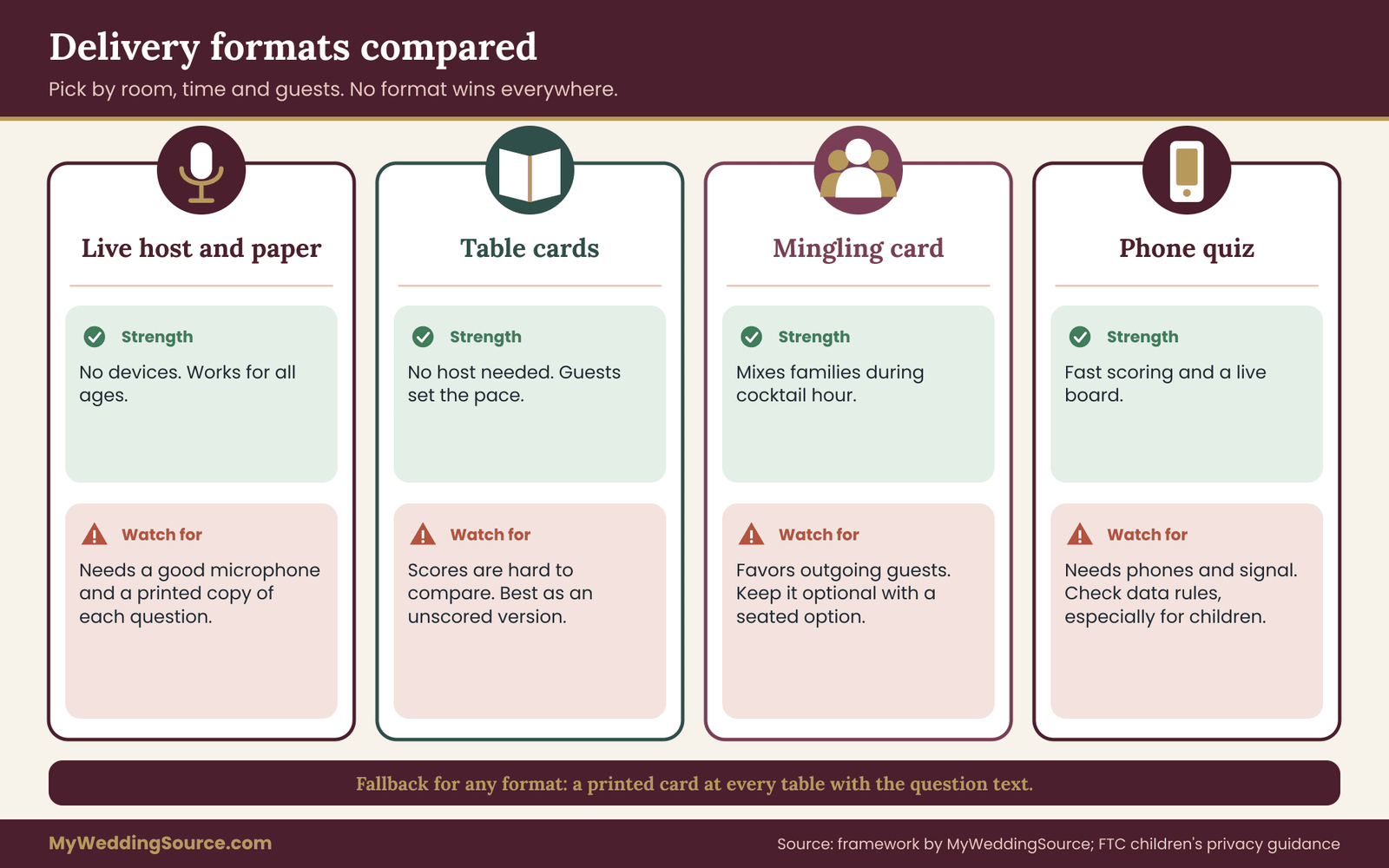
Delivery formats compared
Here are the formats couples most often consider, with plain strengths and limits.
Live host with paper answer sheets. A host, an emcee or a trusted friend reads questions aloud, and teams write answers. Strengths: it needs no devices, works for all ages and keeps the room’s eyes up. Limits: reading questions aloud depends on a good microphone and a quiet room, and guests with hearing difficulty need another way to see the question. A card at each table with the text helps.
Question cards at each table. Each table gets a printed set, with answers in a sealed envelope or revealed later. Strengths: no host needed, guests play at their own speed and it works during dinner. Limits: tables move at different speeds, scoring is harder to compare and answer envelopes get opened early. This format suits a casual, unscored version.
Cocktail-hour mingling card. Each guest receives a card with a few questions and a goal such as finding someone from the other family who knows an answer. Strengths: it drives conversation and mixes families naturally. Limits: it favors outgoing guests, and some will find the forced interaction uncomfortable. It works best as an opt-in activity with a clear alternative. The cocktail hour guide discusses how long guests tend to stay in the space and how to pace things there.
Phone-based quiz platform. Guests scan a code and answer on a screen, and the platform tallies scores. Strengths: fast scoring and a live leaderboard. Limits: it assumes every guest has a charged phone and good signal, it can exclude guests who are less comfortable with technology, and it raises data questions, especially if children use it. The Federal Trade Commission publishes guidance on children’s online privacy that is worth reading before you let kids join an app-based game.
Photo or video round on a screen. Questions appear on a screen, maybe with a photo clue. Strengths: visually fun, easy to read from a distance. Limits: guests with low vision may not see the screen, glare can ruin the clue, and the room needs an operator. Always read the clue aloud as well.
Table-by-table spotlight round. The host asks each table one question in turn. Strengths: short and controlled, with no scoring system. Limits: it puts individual tables on the spot, and a slow answer is public. Use it only when everyone has agreed to be a good sport and the wedding trivia questions are easy.
Choosing a format with a simple decision rule
A decision rule can save an evening of debate. Work through these in order and stop at the first that decides it.
First, if many guests are older, have hearing limits or speak English as a second language, favor printed cards at each table plus a host who reads slowly. Avoid app-based formats as the main method.
Second, if the room is loud or the sound system is weak, favor table cards or a cocktail-hour card, since a spoken round will lose the back tables.
Third, if time is tight, choose a short live round of twelve questions, or an unscored card set that guests can play at their own speed.
Fourth, if you want a clear mixer for two families that barely know each other, choose the mingling card, with drawn teams for the live round.
Fifth, if you are unsure, run the live round with paper answer sheets and table cards as a backup. It is the most forgiving.
Length and placement in the evening
Trivia rounds that run too long lose people. A good target for a live round is about fifteen to twenty minutes of play, including answers and the announcement. Anything beyond that is a different event.
Placement matters as much as length. Dinner service is hard: servers need clear paths and guests are eating, so a spoken quiz during courses competes with plates. The practical point is this: put the wedding trivia round in a gap that already exists, such as the stretch between dinner and the first dance, or in a cocktail hour while the room resets. If the evening already carries toasts, a cake cutting and a first dance, wedding trivia may be one item too many, and a mingling card is the lighter fit.
Mixing wedding trivia with other activities
Some couples run trivia alongside other guest activities. That can work if the game does not demand attention the other activities need. Do not run a quiz while the band is warming up, while a photographer is organizing family portraits or while the dance floor is open. The advice in the guest flow guide to give each moment its own space holds here as well.
A short comparison of the alternatives to trivia
Wedding trivia is not the only way to mix two families. If the audit shows that your question pool is thin in one lane, a different activity may suit you better. A story-sharing table card, where guests write a short memory or a wish for the couple, requires no knowledge and no scoring.
A mixed-table scavenger card asks guests to find something in common with someone from another table, such as a shared hometown or the same number of siblings. A guessing jar, where guests estimate a number such as the miles between two hometowns, is a one-question bridge game that anyone can play.
These alternatives are not better or worse. They trade the satisfaction of a scored game for lower pressure and lower prep. If your two families are shy, a guessing jar might outperform a full round. If they love competition, a scored round may be exactly right.
What happens when one family wants to compete
Sometimes the problem is not too little enthusiasm but too much. One side of the room is determined to win, and the other has no interest. The mixed team design tames this, and so does a framing line from the host: “The only prize tonight is bragging rights for the table.” Keep the stakes low, keep the prizes small and shared across the table, and keep the tone light. When the stakes are low, the competition is a pleasure instead of a pressure.
A worked example: one invented couple and thirty-six questions
The example below is invented for illustration. The couple, the families and the numbers do not come from a real wedding or a real study. They show how the wedding trivia audit changes a draft, step by step.
Mei and Callum are planning a reception for about one hundred twenty guests. Mei’s family, the Lins, are the larger group, with many relatives traveling from out of town, and several older guests prefer to speak another language at home. Callum’s family, the Brennans, are smaller and local, with a lot of cousins who grew up together. The couple wants a fifteen-minute round of wedding trivia after dinner, with mixed tables and a small prize for the top three.
The first draft, and what it revealed
Callum and his sister wrote most of the first draft in one evening, because their stories came easily. The draft had thirty-six questions. When Mei tagged them by lane, the tally looked like this: eight shared, four Lin, sixteen Brennan and eight bridge.
Nobody had meant to tilt the wedding trivia toward Callum’s family. The Brennan cousins simply had more material at hand, and the first lane count made it visible in ten seconds. Sixteen Brennan questions against four Lin questions would have given the local cousins a field day and left Mei’s relatives, many of them traveling, watching from the sidelines.
The count also showed a second problem: common ground, shared plus bridge, was sixteen of thirty-six, under half. The room’s shared floor was too thin.
Running the six checks
Mei and her sister read the Brennan questions with the six checks in hand. Ten of the sixteen did not pass as written.
Four failed the insider check. One asked for a nickname used only by the cousins. One asked about a prank at a family camping trip that nobody outside the cousin group had heard of. One required knowing a local sports team’s season record. One asked what a particular relative always says at holidays, a catchphrase only that branch knew.
One failed the privacy check: a question about Callum’s college girlfriend. It was cut.
One failed the tone check: a joke about an uncle’s age. It was cut.
One failed the language check: it used a regional slang phrase that Mei’s older relatives would not know. It was rewritten in plain words.
Three more were fine as questions but belonged in a different lane once the writers looked closely. They were repaired by adding options and a short read-aloud setup, which turned them into bridge questions anyone could reason through.
One was moved to the shared lane because the story had actually reached Mei’s family through the couple’s own retelling.
Rebalancing the lanes
After the cuts and moves, the Brennan lane held six questions. That left room to build the Lin lane up from four to six. Mei asked her mother and an aunt for two more questions, and she asked them to confirm that each was something the Lin family was happy to share in public.
Her mother suggested a question about the town where Mei’s grandmother grew up, with three options, and a question about a dish that appears at every family celebration, again with options and a short description read aloud. Both passed all six checks. The aunt added a question about the first language Mei learned at home, which Mei declined because it touched family history in a way some relatives might find sensitive.
Then the couple wrote new shared and bridge questions to rebuild common ground: one more shared question about their own travel, and three new bridge questions, such as the number of miles between the two hometowns, the month the couple got engaged with options, and a short question about the venue’s building that the host would answer by reading a plaque aloud.
The final wedding trivia list had thirty-six questions: ten shared, six Lin, six Brennan and fourteen bridge. Common ground was twenty-four of thirty-six, two thirds of the wedding trivia round. Each family lane carried six points of the thirty-six available.

What one card looks like
Here is a sample bridge question as it appeared on the cards. The format is plain text, as printed.
Question 14, bridge lane. “About how many miles apart are the two hometowns?” Options: a) under two hundred, b) between two hundred and five hundred, c) over five hundred. The answer line reads: “From the couple’s own map, shown on the table card.” The host line reads: “This one is for everybody.”
Note what the card does. It tells the host which lane the question belongs to, it gives the answer a source and it includes a line the host can read to set the tone. A guest who has never met either family can reason their way to an answer.

The scoring plan in the example
Mei and Callum chose a live wedding trivia format with paper answer sheets, drawn teams and self-marking, with the scorekeeper confirming the top three sheets. Each question was one point. Prizes were small boxes of local chocolates for the top three teams, plus a silly award for the most creative team name.
They printed a ruling card for the scorekeeper with four lines: the answer key decides, count all reasonable answers for ambiguous questions, the host’s decision is final, and note the ruling for next time. They asked a friend from neither family to keep score.
For ties, they wrote a single bridge tie-break: “How many guests are at this wedding?” Closest answer wins. It is a bridge question because no one has a head start, and the host knows the number.
Pilot results, illustrative
Before the wedding, Mei and Callum asked four volunteers to run a mock round at a kitchen table: a cousin from each family and two friends who knew only one of the partners. The volunteers’ results below are illustrative, to show how the numbers are read.
Reading time was timed on every question. Three questions took longer than ten seconds to read and understand, so the couple shortened them. One question was answered correctly by all four volunteers, which marked it too easy, and it moved to a warm-up slot. One question was missed by all four, which prompted a check of the answer key, where a typo turned up.
The lane ledger was the most useful result. The two Lin volunteers and the two Brennan volunteers did about equally well on shared and bridge questions, and each pair scored a little higher in its own family lane. That is exactly what the lanes should show: a modest advantage in your own lane, and parity elsewhere. If one pair had won every lane by a wide margin, the couple would have looked for a hidden insider question.
What the couple changed after the pilot
Four small changes came out of the wedding trivia pilot. They moved two questions to different slots so that family-lane questions were spread through the round instead of clustered. They added a larger-print table card that repeats each question for guests who prefer to read. They added one practice question at the start, so that teams could test their answer sheets without pressure. And they agreed that the host would say the lane out loud only for the bridge lane (“This one is for everybody”) and not for the family lanes, to avoid pointing at a family.
None of those changes needed money. All of them came from running the process once with real people.
Reading the example honestly
The example is neat on purpose. Real drafts are messier, and real families may not accept every cut. A parent may push back on a favorite story, a cousin may be offended that a question was removed and the host may stumble on a name. The method does not remove those moments. It makes them easier to handle, because you can explain a decision using a tally and a rule, not a preference.
Notice also what this wedding trivia example did not do. It did not shrink the Brennan family’s presence in the wedding trivia game. Their lane has six real questions, written with care. It did not turn the Lin family into a cultural spotlight. Their lane draws on topics the family itself chose. The balance came from counting, asking and testing, not from mechanical symmetry.
Access, children and consent in wedding trivia
Fairness in wedding trivia is not only about families. It is also about guests who may find a standard quiz hard to join: people with hearing or vision loss, people who read slowly, guests who use wheelchairs, children, and people who simply prefer not to perform in public. A fair round plans for them in advance and does so quietly.
The access check, in practice
The access check from earlier asks whether any guest is blocked from playing. Here is what it looks like with concrete choices.
Hearing. Many reception rooms are loud, and a spoken question is easy to miss. The National Institute on Deafness and Other Communication Disorders explains that background noise makes understanding speech harder for people with hearing loss. The simple fix is to give every table a printed card with each question’s text, or to show the question on a screen and read it aloud as well. If you hire a host, ask whether the microphone and speakers reach every table.
Vision. Large print on table cards, high contrast between text and paper and a clear reading of every visual clue aloud help guests with low vision. Avoid a wedding trivia round that depends on seeing a small photo from across the room.
Mobility. Do not make a wedding trivia game depend on moving around the room unless there is an easy alternative. A mingling card that asks guests to cross the dance floor excludes some guests. Offer a version that guests can play from their seats.
Reading and processing speed. Short sentences, one idea per question and a calm pace help. Do not penalize slow answers. If a table needs more time, give it. The federal plain language guidance listed in the Sources is a good reference for writing short cards.
Cognitive and neurodivergent needs. Some guests find unpredictable social games stressful. Tell guests in advance what the wedding trivia game is and how long it lasts, make taking part optional and offer a quiet seat that is not in the middle of the action.
What the law says, and what it does not
The Americans with Disabilities Act is a federal civil rights law. The Department of Justice explains on its ADA site that businesses open to the public, which can include venues, caterers and other vendors, generally have duties around effective communication and equal access. The details depend on the facts, and a wedding hosted privately by a couple is not the same as a business serving the public.
For a couple, the practical meaning is modest. If a venue or a hired host manages your game, ask what accommodations they already offer. If a guest tells you they need something, such as large-print cards or a written copy of the wedding trivia questions, treat it as an ordinary request and say yes where you can. The ADA site is the place to read current requirements. Do not treat this guide as legal advice, and do not assume that any particular accommodation is or is not required in your situation.
Making participation optional
Consent is easy to forget in a party game, and wedding trivia is no exception. A guest who does not want to play should be able to say no without explaining. Three habits protect that.
Say it is optional. The host or the invitation page can state: “There is a short wedding trivia round after dinner. Join a team or enjoy the show.” That one line lowers the pressure.
Give a non-playing role. A guest can be a scribe, an audience member or a cheerleader. Some people enjoy a game most from the edge.
Never call on a person by name to answer. Cold-calling is the fastest route to a flush of embarrassment. Let teams answer as teams.
For a longer view on how to treat guests’ choices about attention and cameras, the guide on photography consent gives a useful parallel: ask first, offer opt-outs and make the easy path the respectful one. Photos of a trivia round, with guests concentrating and sometimes frowning, are another reason to tell guests that the camera will be near.
Children and teenagers
Children can be a delight in a wedding trivia round, and they can also be the unwitting source of unfairness. Three points help.
Use child-friendly questions in the bridge lane. A few questions that a ten-year-old can answer from common sense (such as the color of the venue’s door or the number of tiers on the cake) bring younger guests into the game without turning it into a children’s quiz.
Do not ask children to answer for their family. Putting a child on the spot to recall a relative’s story is a recipe for tears or pride in the wrong places.
Be careful with apps. If a phone-based platform asks for names, ages or email addresses, think about who is entering that data. The Federal Trade Commission publishes guidance on the Children’s Online Privacy Protection Rule, which covers online services directed to children and those that knowingly collect personal information from children under thirteen. For a one-night family game, paper is usually simpler and avoids the question altogether.
The guide to guest care planning covers the wider set of needs, such as childcare, quiet space and food, that make a reception comfortable for a mixed group, and trivia fits inside that plan, not outside it.
Questions that name guests
A final consent point: avoid naming individual guests in questions unless you have asked them. “Which guest traveled farthest?” may delight one person and embarrass another. If you want a guest to be a part of a question, ask first, and let them say no. A short message on the day before, such as “We would love to mention your story in tonight’s game, and it is fine to say no,” makes that easy.
Edge cases when families are not simple
Real families do not match a template, and wedding trivia has to bend around them. These situations come up often enough to plan for. For each, the question is the same: what does fairness look like here?
Blended families. When one or both partners have stepparents, half-siblings or several households, “Family A” and “Family B” are rough labels. Count by the people who will be in the room and who will be glad to see a question about them. Ask the blended family which stories belong to the whole family and which belong to one branch. Keep the lane for the household that raised the partner and stay away from questions that rank one household above another.
Divorced or strained parents. If a partner’s parents are divorced, a question about “our family” can hit a nerve. Avoid questions that assume a single, unified household, and avoid any that would put the two parents in a head-to-head contest. Bridge and shared lanes carry more of the load in this case.
Estranged or absent relatives. Never write a question that depends on a person who is not invited or not present. Also avoid asking guests to recall events when a relative’s absence is a sore point. If a parent wants to include a story about someone absent, offer a toast or a memory table instead of a scored question.
Loss and memorial. If a family member has died recently, ask the family how they feel before writing any question near that subject. Some families want a moment of remembrance, and a wedding trivia quiz is not the place for it. The wedding’s memorial moments can sit elsewhere in the evening.
A one-sided guest list. If eighty percent of the room belongs to one family, the lane counts remain equal, and the seating plan carries the job of mixing. Consider adding extra bridge questions so that the smaller family’s friends and relatives are not outnumbered at every table.
Many languages in the room. If a family speaks another language at home, offer the question cards in both languages or in plain English with a translated version for key cards. Where possible, have a bilingual relative read questions aloud. Remember that translating puns and idioms rarely works, so use plain, factual questions.
Guests who barely know either family. Wedding trivia can leave them out first. Colleagues, neighbors and friends of the couple are often at a table with other guests they do not know. Bridge and shared questions are their entry point. If your game leans too hard on family lanes, these guests become observers. Keep the common ground large.
A very competitive or very reluctant room. Competitive rooms benefit from low stakes and a good-humored host. Reluctant rooms benefit from short rounds, optional participation and unscored formats. In both cases, the question lanes still matter, since a lopsided pool is the easiest way to turn a mild competition into a sour one.
When a question goes wrong live. Sometimes a question lands badly in the room. A relative frowns, or a guest bristles. Have a line ready: “Let’s skip that one and move on,” and then move on. Do not explain or apologize at length. Mark it afterward in the ruling log, and tell the couple privately if it matters. Recovery is a matter of speed and calm.
Vendors, supplies and what to ask for wedding trivia
Many couples run trivia themselves with a friend and a printer. Others hire a host, a DJ or a platform. Either way, a few questions up front prevent problems on the day.
If a DJ or emcee hosts
Ask whether they have run an audience game before and whether they will follow your lane tags and ruling card. A host who improvises new questions on the spot can undo your audit in one sentence. Give them the final question list, the answer key and a one-page script, and ask them to stay with it. The guide to reception music planning explains how to brief a DJ about the evening’s flow, and the same brief can include the trivia slot.
Ask these questions, in writing where you can.
Will you read the wedding trivia questions exactly as written? Paraphrasing changes the fairness.
How will guests with hearing or vision needs follow along? The answer should include printed text or a screen, not only speech.
What is your microphone setup for the back tables? If the answer is vague, plan for table cards.
Do you charge extra for a wedding trivia game segment, and what is included? Get the time, the equipment and the cost in the contract or the written confirmation. Do not rely on a verbal quote.
What happens if the timeline slips? Agree in advance on what gets cut, and make it the wedding trivia game, not a speech.
If a platform or app runs the quiz
Ask who owns the data, what personal information the platform collects, whether it works without an account and what happens to the data after the event. If children will play, ask whether the platform is built for that and how it handles their information. Ask how it works if the venue’s wireless is weak, and have a paper fallback.
Read the platform’s terms before you pay or share a guest list, and keep a copy of the terms in your records. If a vendor makes promises, such as “works in any venue,” ask for them in writing.
If the venue is involved
Ask the venue whether it has rules about amplified sound, screens, projectors and signage, and whether there is an operator fee for a projector or microphone. Ask about the time limit for the room and whether the setup of the game affects service. Servers need paths between tables, and a clipboard-heavy game can crowd them. The vendor timeline explains when to confirm these details with each vendor, so that the game does not surprise anyone on the day.
Printing and supplies
A paper round needs very little: answer sheets, pencils, table cards, a sealed answer key, a ruling card and small prizes. Order a few more sheets than you have guests, because pencils break and sheets get spilled on.
Fonts and print size. Use a clear typeface at a comfortable size on a plain background. Avoid text over photos, which can reduce legibility for many readers.
Pencils, not pens, for self-marking. Teams can fix mistakes cleanly.
Colored team cards. If you draw teams, colored dots or cards at each place setting are quick and cheap.
A clock or timer. A kitchen timer or a phone placed face down helps the host keep time without checking a device in front of guests.
Prizes. Keep them small, shareable and not tied to alcohol or an unusual diet. A box of local sweets can be passed around the table, so everyone on the team shares.
Questions and content: a short note on sources
Facts about your own life are yours to use. When you borrow general-knowledge questions from a book, a website or another quiz, remember that facts themselves are generally not protected by copyright, but the way a published collection is selected and worded may be. The U.S. Copyright Office explains fair use and what copyright covers on its site. The safest habit is to write your own questions, and to avoid pasting in long runs of someone else’s quiz. If a question quotes lyrics or film lines, keep any quotation brief and check the rules that apply to your use.
What to put in writing
For any paid vendor involved, ask for written confirmation of the date and time of the game slot, the equipment provided, the cost, the number of staff, the cancellation terms and who is responsible for each part of the wedding trivia game. A short email confirming these points is enough. Keep it with your other wedding records so that you can find it if there is a question later.
A pilot test and measurable checks for wedding trivia
An audit on paper catches many problems. A pilot catches the rest. The wedding trivia pilot is a short, informal run with a few people, and it is the best use of an evening you can make before the wedding.
Who to invite
Choose four to six volunteers. Include at least one person from each family, at least one friend who knows only one partner and, if you can, one person who knows neither. Include an older guest if one is willing, and one person who will read the cards critically. Tell them honestly that the goal is to find problems, not to win.
How to run it
Run the wedding trivia round at a table, with the same cards, answer sheets and timing you plan to use. Read each question aloud at the pace the host will use. Time each question from the moment it is read to the moment the last volunteer has written an answer. Afterward, ask each volunteer the same four questions: Which question confused you? Which question felt like it was meant for someone else? Was any question uncomfortable? What would you cut?
The measurable checks
Here are the checks to apply to the pilot results. The thresholds are suggestions for planning, not standards, and you can adjust them.
Reading and answering time. Most questions should be readable and answerable in about a minute at most. If a question takes much longer, shorten it or cut it.
Lane parity. Compare the volunteers’ scores by lane. Each pair should do modestly better in its own family lane and about equally well in shared and bridge. A large gap in a shared or bridge lane signals a hidden insider question.
Hit rate by question. If everyone gets a question right, it is too easy for a scored slot. If no one gets it right, check the answer key before blaming the players.
Discomfort flags. Count how many volunteers marked a question as uncomfortable. One flag is enough to review it. Two flags mean it is probably out.
Total length. Add up the timed questions and the host’s patter. If the total passes twenty minutes, trim questions from the bridge lane first, since it has the most room.
Common ground share. Recount the lanes after edits. Shared plus bridge should still be at least half of the round.

What to record
Write down the date of the pilot, the version of the wedding trivia question list you tested, the changes you made and the final lane counts. Keep the note with your wedding documents. If a parent or host asks why a question was changed, you will have a short, factual answer, and next year’s anniversary party can reuse the questions that worked.
Updating the plan close to the day
Check the guest list one more time a week before the wedding. If a relative can no longer attend, a question may need to change. If a new guest or a new seating arrangement shifts the mix of tables, run the lane count against the seating plan again. A short final read of the cards by someone who was not in the pilot is worth ten minutes.
Your next steps
Start with one sitting of about an hour. Ask the couple, both sets of parents and a few close friends from each side to send questions, then tag every one with a lane and run the six checks. Count the lanes, then write the missing questions until the family lanes match and common ground is at least half. Choose your format with the decision rule, plan the mixed teams and print the ruling card.
Then run the wedding trivia pilot with four volunteers, make the changes it suggests and send the final cards to your host or printer. If you want one more layer of confidence, ask a friend who is not in either family to read the final set cold and tell you where they stumbled. The aim of wedding trivia is simple: a room of people who came for the couple leaves a little more connected than it arrived.
FAQ
How many questions should a wedding trivia round have?
For a live round of about fifteen to twenty minutes, twelve to thirty-six questions is a practical range, depending on how fast your host reads and how long teams take to answer. Shorter rounds suit a busy timeline. Use the pilot test to time the real pace, and cut from the bridge lane first if you run long, so the family lanes stay equal.
Should the two family lanes always be exactly equal?
Aim for equal counts and equal total points, because that is the easiest rule to explain and check. Small gaps are not a disaster if you can explain them, but a large gap usually reflects the writers’ own knowledge map. Fix it by writing more questions for the thin lane and approving them with that family, not by trimming the full lane to match.
What if one family is much larger than the other?
Keep the lanes equal and solve the size difference through seating and team design. Mix the families at every table so that the larger family does not form its own teams. Add extra bridge questions so friends and colleagues are not outnumbered, and let the smaller family approve every question in its lane so that it feels like a gift, not a spotlight.
Can we use wedding trivia if many guests do not speak English well?
Yes, with plain wording. Use short sentences, one idea per question, multiple choice and no idioms or puns. Provide printed cards, and if possible a translated version of key cards or a bilingual relative to read aloud. Questions about the couple’s travel, the venue or numbers translate more cleanly than questions about slang or television.
Is it fair to include questions about the couple only?
Yes, if both families heard the story through the couple, those questions sit in the shared lane and give neither side a head start. The risk is a wedding trivia round that is only about the couple, which can leave other guests as spectators. Mix in bridge questions that anyone can reason through, and keep shared questions to about a third of the wedding trivia round.
How do we handle a guest who disputes an answer?
Use a ruling card decided in advance: the answer key decides, ambiguous questions accept every reasonable answer for every team, the host’s decision is final and the scorekeeper notes the ruling. Accepting a good alternative for everyone, not just the person who complained, usually ends the matter calmly. Rewrite the question afterward so the ambiguity does not return.
Do we need to worry about accessibility rules for a private wedding?
The Americans with Disabilities Act applies to businesses open to the public, so a venue or vendor may have duties even when your own party is private. Rules depend on the facts, so check the ADA site or ask your venue. In practice, printed cards, readable fonts, optional participation and a seat-based version of any moving game make the round open to more guests.
Should children play wedding trivia?
They can, if the questions are suitable. Include a few bridge questions a ten-year-old could answer by looking around or reasoning, and do not ask children to recall family stories on their own. Avoid apps that ask for names or contact details, since children’s online privacy has special rules. Paper cards are simpler and keep the game low-pressure for younger guests.
Sources
- Americans with Disabilities Act, U.S. Department of Justice
- Effective communication, ADA.gov, U.S. Department of Justice
- Children’s online privacy, Federal Trade Commission
- Fair use, U.S. Copyright Office
- Plain language guidelines, PlainLanguage.gov
- Accessibility fundamentals, W3C Web Accessibility Initiative
- Hearing and communication disorders, National Institute on Deafness and Other Communication Disorders
- Accessibility guidance, Section508.gov, U.S. General Services Administration
- Disability resources, USA.gov