
Vacation rental gifts are the welcome items you leave for wedding guests who are staying in a house, condo or cabin instead of a hotel, and they work only if the door, the delivery and the placement are planned before the gift is chosen. This guide gives you a five-checkpoint plan for property access and package drop-off, then shows how to choose, send and verify vacation rental gifts for guests who sleep in rentals.
A hotel has a front desk that signs for packages and hands over a bag at check-in. A rental usually has none of that. So settle five things in order: how a helper gets in (door), where a parcel may land (drop), who holds it until the guest arrives (hold), where the gift is placed inside (place), and how you confirm it happened (proof). Pick light, sealed, non-perishable vacation rental gifts, put a printed card in each one, and send nothing to an address until the host or manager has said yes in writing.
A wedding weekend in a rented house looks relaxed from the outside. Eight cousins share a kitchen, a couple of grandparents take the downstairs bedroom, and the group chat is full of grocery lists. Then the vacation rental gifts arrive, and the relaxed picture falls apart. A courier leaves a box on a porch in the rain. A smart lock code expires before the volunteer arrives. A host who never agreed to receive parcels finds six boxes with strangers’ names on them. Nobody did anything unreasonable, but nobody planned the handoff either.
Hotels solve this problem with staff, a mailroom and a standard process. A private rental solves it with whatever the owner or property manager happens to allow, and that varies a great deal from one listing to the next. That is why vacation rental gifts need their own plan. The gift itself is the easy part. Getting it to the right person, inside the right door, in a condition worth giving is the part that decides whether the gesture lands.
This guide focuses on that second half. It covers how to find out what the property allows, how to compare ways of getting vacation rental gifts there, how to choose items that survive a long drive or a warm porch, and how to confirm that every rental got what it was supposed to get. It also covers edge cases such as late arrivals, shared houses with several households, hosts who forbid deliveries, and vacation rental gifts that would be a problem for a guest with an allergy or a young child.
A note on scope. This is general information, not legal, tax or financial advice. Rental rules, carrier terms and product labeling vary by property, company and state, and they change. Where a rule matters, the guide points you to the issuing agency or the company’s current policy so you can confirm the version in force when you plan.
What vacation rental gifts have to do differently
If you have already read about hotel welcome bags, you know the basic idea: a small bag of useful things, delivered to each room before guests arrive or handed over at check-in. The guide to wedding guest hotels across budgets and mobility needs covers the hotel side of lodging. A rental is a different kind of building, and four differences matter for vacation rental gifts.
There is no front desk. In a hotel, someone is on duty to accept a package, log it and bring it to a room. In a rental, the “desk” might be a property management company with office hours, an owner who lives three states away, a lockbox, or nothing at all. If nobody is authorized to receive a parcel, it goes where the carrier decides.
Access is private and often automated. Many rentals use keypads, smart locks or lockboxes with codes that are created for a single stay and switch on at check-in time. A helper who wants to place vacation rental gifts before guests arrive may find the code does not work yet, or that the host has rules about who may enter an unoccupied or occupied unit.
Guests arrive in groups, not one by one. A house sleeps eight to twelve people across several households. One gift per room is not the right unit, and neither is one per guest. The sensible unit is usually one per household or one shared set in the kitchen, and that choice changes the budget, the packaging and the card.
The building is somebody’s property. The host or manager may have rules about deliveries, decorations, open flames, food left in the kitchen and what may be attached to walls. A hotel expects amenities. A rental expects guests to leave things as they found them.
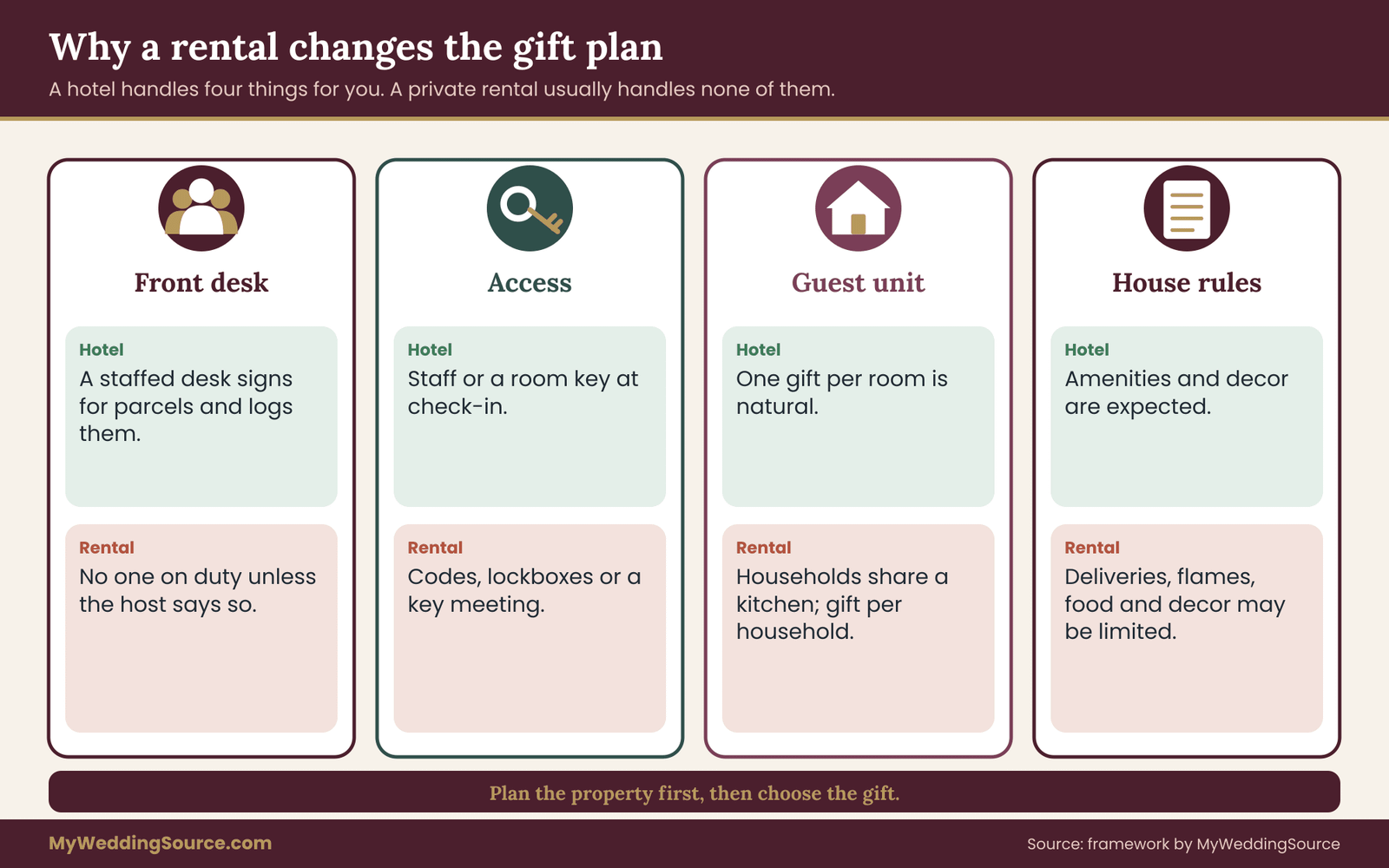
None of this means vacation rental gifts are a bad idea. It means the plan has to start with the property, not with the shopping list. A couple who orders forty tote bags first and asks the host about deliveries afterward is solving the problem in the wrong order.
Who this guide is for
This guide fits three situations. In the first, you are a couple hosting a wedding at a venue and have asked guests to stay in nearby short-term rentals, either by suggestion or because hotel space ran out. In the second, you are hosting the wedding at a large rental house or estate, so most of the wedding party and close family sleep on site.
In the third, you are a family member or friend who has volunteered to put the vacation rental gifts together and wants a process that does not depend on guessing.
It is less useful for guests who book their own rentals in different towns with no coordination. In that case a single card and a digital note may be all that is reasonable, and the later sections on lightweight options will help you decide.
Vacation rental gifts also suit couples who are not hosting a large weekend at all. If only four or five guests are staying in rentals, the same questions apply with fewer rows on the page. A small number of guests does not remove the need to ask the host first, and it does not change the order of the plan.
What a welcome gift is for
Before choosing anything, name the job. A welcome gift in a rental has a few legitimate jobs: to tell guests they were expected, to cover small needs that a guest would otherwise solve with a store run, and to point them toward the schedule. It does not need to be generous in dollars. Guests who traveled for your wedding are mostly looking for a sign that someone thought about their first hour in an unfamiliar kitchen.
Seen that way, the most useful vacation rental gifts are often modest. Bottled water, a few shelf-stable snacks, a coffee option for the first morning, a printed schedule with addresses and shuttle times, and a short note do more work than a decorated box of keepsakes. Items that fit the actual building, such as an extra phone charger for a house with few outlets or a small first-aid pouch for a hiking cabin, show more thought than items chosen for looks alone.
Hosting courtesy in general is covered in the wedding etiquette guide, and this guide stays on the rental handoff.
Keep the budget in view as you read. Vacation rental gifts do not need to be costly to be remembered, and a lean set that arrives on time beats a lavish set that arrives late. The sections on costs and checks show where money tends to leak.
The cost of getting the handoff wrong
It helps to be concrete about what failure looks like, because the failures are what the rest of this plan prevents. None of these are statistics. They are patterns that follow from how rentals and carriers work, and you can check each against the host’s rules and the carrier’s own published terms.
A parcel left outside is exposed to weather, animals and passersby. Sealed snacks can survive a day outdoors in mild weather, but chocolate, anything with a cream or cheese component, and anything in a paper bag cannot. A parcel left at a gated community’s entrance may never reach the unit. A parcel sent to a property manager’s office may be held for a business day or more, and the person who could release it may not know it is coming.
A helper who enters without clear permission can create a different problem. Some hosts treat entry by anyone not on the booking as a violation of the rental terms, and some listings state that outside visitors are not allowed. Even when the host is relaxed about it, guests who have already arrived may not expect a stranger walking through the kitchen with a box.
A gift that arrives after the guests do is not ruined, but it loses its main job. The welcome note that says “your schedule is inside” is not very useful on the second night. And a gift that contains something a guest cannot eat, such as nuts in a house with a severe allergy, is worse than no gift. These risks are manageable, and the plan in the next sections handles each one with a specific step.
Seen from the guest’s side, vacation rental gifts are judged in the first ten minutes inside the door. If the counter holds water, a snack and a clear schedule, the rest of the weekend starts calmly. If the counter is empty and the porch holds a soaked box, the same budget has bought the opposite feeling.
How much planning is proportionate
You do not need a spreadsheet for a two-bedroom rental holding four guests. A short message to the host and one backup plan may be enough. You do need a real plan for three or more rentals, for any rental with more than eight guests, or for any weekend where vacation rental gifts have to arrive before the people do.
The scale test is simple: if one failed delivery would leave a household without something they were told to expect, plan it. If it would only mean a missing extra, keep it light.
The rest of this guide is organized so you can stop reading when you have what you need. Early sections cover the property questions and the logic of choosing vacation rental gifts. Middle sections compare ways to get vacation rental gifts into the building and give the five-checkpoint plan. Later sections work through an example and the edge cases, then cover costs, checks and mistakes.
Start with the property before you plan vacation rental gifts
Every rental has an access model and a delivery model, and the two are not always the same thing. Find both out before spending money. The fastest way is to read the listing’s house rules, then send one short, specific question to the host or manager. Do this even when the guests, not you, hold the booking, because the guest can forward your question or add you to the thread.
The five access models
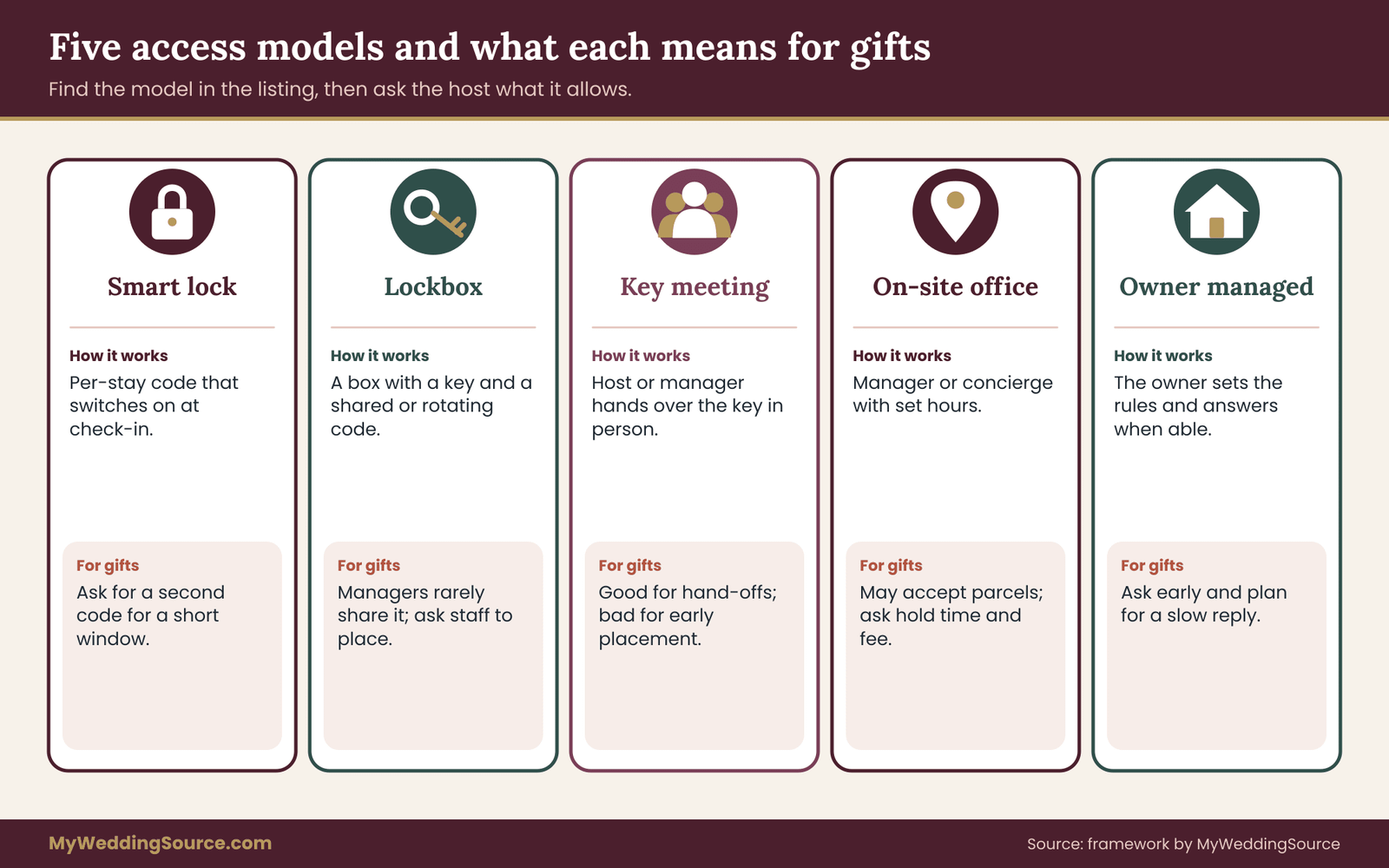
Most rentals fall into one of five access models. Knowing which one applies tells you who can place a gift and when.
Smart lock or keypad with a per-stay code. The code is often created by the booking platform or the manager and becomes active at check-in time, then expires at check-out. A helper cannot use a guest’s code without the guest sharing it, and sharing a code may or may not be allowed under the rental terms. Ask whether a second code can be created for a short delivery window.
Lockbox with a shared or rotating code. The box holds a physical key. The code may stay the same for a season or change per booking. Some managers will give a delivery person the code; many will not, and prefer to send their own staff.
Key exchange in person. A host or manager meets the guest and hands over a key. This model is good for vacation rental gifts because the person at the door can also hand over a bag. It is bad for early placement because nobody will let a stranger in alone.
On-site manager or concierge. Larger condos and resort-style rentals often have a front office. If so, the property behaves more like a small hotel and the plan can borrow from it. The manager may accept parcels for a fee or at no charge, and may have an hour limit on how long items are held.
Self-managed by the owner. The owner answers messages in their own time and makes their own rules. Responses can be quick and generous or slow and strict. Ask early, and plan for both.
What the host needs to know about gifts
A host cannot give permission for something they do not understand. When you write, name the following plainly: how many parcels or bags, from whom, with what approximate size and weight, on what dates, and whether any contain food or drink. State whether you want to deliver vacation rental gifts yourself, have a courier bring them, or have the guest pick them up elsewhere. Mention whether you want anything left in the unit before the guest arrives, and say that you will remove anything the host objects to.
Hosts say yes more often to a clear, bounded request than to a vague one. “We would like to leave a small welcome basket on the counter before our guests arrive on Thursday afternoon” is a request a host can approve in a line. “Can we send some stuff?” invites a longer reply, or silence.
“Hi, our friends are staying at your place from Thursday to Sunday for a wedding nearby. We would like to leave one welcome bag on the kitchen counter before they arrive, about the size of a grocery bag and sealed snacks only. Could you tell us whether a courier may deliver it to the property, whether your staff can place it inside, or whether you would rather we hand it to the guests when they check in?”
That message covers quantity, type, timing and three possible routes. The host chooses one, and the reply becomes your record. If the host does not answer, assume the answer is not yet yes, and use the fallback options later in this guide.
Reading the listing rules for hidden limits
Before writing to the host, scan the listing for lines that affect vacation rental gifts. Look for statements about visitors and outside guests, about quiet hours and check-in windows, about food left in the unit, about candles or open flames, and about packages. Some listings say outright that deliveries are not accepted or that the host is not responsible for items left. Some say a property has no mailing address of its own, or that the street address cannot receive carrier parcels, which is common in remote or gated areas.
If the listing says nothing, that is not permission. It only means the question was never asked. Treat silence as a reason to ask, not as a green light.
Also note the check-in and check-out times. Many rentals have a window in the afternoon, and cleaners usually work between guests. A gift left in the unit during the cleaning window can be moved, thrown out by mistake or treated as lost property. If your plan includes placing items before arrival, ask which hours the unit is empty and clean.
Hosts also differ in how they treat vacation rental gifts that come from a third party. Some see a thoughtful gesture toward their guests. Others see a stranger leaving objects in their property. Neither view is wrong, which is why the first message should always come from, or be copied to, the booking guest.
Who holds the booking
The booking holder is the person with standing to ask the host for anything. If the couple did not book the rental, they cannot assume the host will take their message seriously. The easy fix is to ask the guest who booked to start the thread or to add the couple’s helper to it. Most booking platforms allow a message from the guest to the host, and the host can usually reply to everyone in the booking.
Guests often welcome the help. A guest who booked a house for the whole family does not want to chase a courier for a gift they did not ask for. Offering to handle every detail, and asking only for a one-line introduction to the host, keeps the burden off them.
A single page for each rental
When several people help with vacation rental gifts, the record page is the shared memory. A helper who picks up the work on Thursday should be able to read the page and know what was agreed, with no need to scroll through old messages.
Create a one-page record for each rental before any vacation rental gifts leave your hands. It does not have to be fancy. Write the address, the host or manager name and contact method, the check-in and check-out times, the access model, the delivery rule the host stated, the guests’ names and household count, any dietary or accessibility notes the guests shared, and the date and time you expect each gift to be in place. Include the sentence the host used to approve the plan, copied word for word, with the date.
This page is the single document that holds the whole plan together. The later sections refer to it by the five checkpoints. For a weekend with several rentals, it also shows you at a glance which house is still waiting for an answer.
A point worth stating about privacy. Guests booked these rentals for their own families. A helper who learns the door code, the Wi-Fi password or the floor plan has been trusted with something. Keep the codes out of group chats, and delete them from your notes after the weekend. If you need to share a code with a delivery person, share it in a private message and ask the host to rotate it afterward.
When the answer is no
A refusal about vacation rental gifts is not a refusal of the guests. Hosts who limit deliveries are protecting their property and their own responsibilities, and a polite thank-you for the quick answer keeps the relationship intact for the rest of the weekend.
A host may say that deliveries are not accepted and nobody may enter. That is a reasonable answer, and the plan still works. It simply moves the handoff to a different place: a hotel front desk near the venue, the welcome table at the rehearsal event, a trunk or a hallway in your own lodging, or the guests themselves picking up a bag when they arrive in town.
The comparison section later in this guide sets these side by side. What matters now is to ask early, so a “no” arrives in time to change the plan.
The same logic applies if the host says yes with conditions. A host who permits a courier but not a visit, or a bag on the porch but not inside, has given you a workable rule. Write it on the record page and design the gift to fit it, with sealed, weather-tolerant items if the porch is the drop point.
Choosing vacation rental gifts that survive the trip
Every choice below rests on the same idea. Vacation rental gifts should be easy to carry, easy to leave and easy to use without instructions, because nobody will be standing there to explain.
With the property rules known, you can choose what to give. The test for every item is the same: will it survive transport, a possible wait outdoors, a shared kitchen and a guest who has not met you? Items that pass all four are the safe core. Items that fail one need a plan or a different choice.
The four survival tests
Transport. Gifts may ride in a car trunk, a checked suitcase or a courier van. Choose items that tolerate vibration and temperature swings. Glass bottles, taper candles and anything with a thin lid will not. Soft goods, sealed bags, cans and boxes do.
Waiting. Assume at least some vacation rental gifts will wait outside for a few hours. Sealed shelf-stable items are fine in mild weather. Chocolate, gum and lip balm soften in heat. Fresh fruit and baked goods turn quickly. Anything that needs a fridge belongs in a plan with a person present, not in a drop.
Shared kitchen. The unit is not yours. A gift that creates cleanup, such as loose confetti, glitter or an open basket of crumbly snacks, creates work for the guest and possibly a fee from the host. Choose items that leave no mess and need no dishes.
Stranger-proof. Guests may not know each other or you well. Pick items whose use is obvious and whose label explains what they are. A bag of something unlabeled that looks like a tea blend is a risk if the guest has an allergy.
What tends to be useful in a rental
A rental guest has a specific set of first-hour needs. They have just arrived, often after a long drive or a flight, and they may have no idea where the nearest store is or what the kitchen holds. Useful vacation rental gifts answer the questions that guest is quietly asking.
Hydration and a snack come first. Bottled water, or a reusable bottle if the host’s filtered tap is safe to drink, and a few sealed snacks, answer “what do I do before I find a store.” A first-morning coffee or tea option solves the next one. Check the listing, because many rentals already provide basic coffee supplies. A duplicate is not a disaster, but a gift that repeats what is on the counter shows that nobody looked.
Then come small practical items. A phone charging cable and a plug, if you can spare them, help in houses with few outlets. A pack of travel-size pain relievers, adhesive bandages and blister pads, in a sealed pouch, covers common small complaints. Sunscreen or insect repellent can matter in some locations.
A small pouch of laundry detergent or stain remover can rescue a shirt before a ceremony. Keep each of these to a few pieces rather than a full kit, and check labels for age restrictions before giving medicine-type products to a household that includes children.
Finally, put the information on paper. A printed one-page schedule with addresses, times, shuttle pickup points, the dress code and a phone number for one named helper is the most valuable item in a rental welcome gift. Guests in a rental have no concierge to ask. A page that answers where, when and who to call saves more stress than any physical item.
Food and drink: where care matters most
Food needs the most care because it creates the highest risk. Guests may have allergies, religious dietary rules or medical conditions you do not know about. The U.S. Food and Drug Administration explains that packaged foods sold in the United States must declare the major food allergens, which include milk, eggs, fish, shellfish, tree nuts, peanuts, wheat, soy and sesame. A store-bought sealed snack with a clear label puts that information in the guest’s hands. A homemade treat or a bakery item with no label does not.
For this reason, favor commercially packaged items with ingredient lists, and avoid unlabeled homemade goods unless the guests have asked for them. If you give a snack that contains a major allergen, say so on the card. Better still, offer a mix in which each item is sealed and labeled, so guests can pick what suits them.
Ask the guests directly where you can. A short message to each household, asking about allergies and dietary needs, is a normal courtesy and is easier than guessing. If you cannot ask, build the gift without nuts, with sealed packaging and with a card that lists what is inside. The same approach applies to drinks.
Alcohol is a special case: laws on shipping alcohol vary, carriers have their own restrictions, and some hosts forbid it, so deliver it by hand if at all and check the host’s rules and the guests’ preferences first. Many couples skip it, and nobody minds.
Anything perishable needs a person and a cold space. If you want to give a cheese plate or fresh pastries, plan it as a hand delivery at a known time with someone present to put it in the fridge. Do not leave it in a drop. The federal food safety guidance published at foodsafety.gov explains why perishable food should not sit in warm conditions for long. The simple conclusion for your plan is that perishable vacation rental gifts need a handoff, not a drop.
Guests who will fly home should also be considered. Vacation rental gifts that are meant to be taken along must be allowed in carry-on or checked bags, and liquids and gels are limited in carry-on luggage. The Transportation Security Administration publishes the current rules, so check tsa.gov before giving anything that a flying guest will want to pack.
Fragrance, candles and things that can annoy
Skip strongly scented items. A scented candle is a common gift and a poor choice in a rental. Open flames are often banned by house rules, and fragrance bothers guests with sensitivities or headaches. Diffusers and sprays share the second problem. Choose unscented items, or give a small non-scented option such as a hand soap pump only if the host’s rules and the household’s preferences allow it.
The same caution applies to anything that might damage the property. Adhesive hooks, tape, balloons, confetti and decorations that need to be fixed to walls can cause charges. Items that can be left on a surface and removed without a trace are safe.
Gifts for children
A rental with children needs a different set. Give age-appropriate items and avoid small parts for young children, because small objects can be a choking hazard. The U.S. Consumer Product Safety Commission publishes safety guidance and recalls for children’s products, and it is the right place to check a product before you give it to a family. Activity books, crayons or a small card game that fit the weekend’s quiet moments are reasonable choices. Sugary snacks are a matter for the parents, so ask first or leave the candy out.
Sizing the gift to the unit
Sizing is also a way to control cost. Fewer, better-matched vacation rental gifts cost less than a bag for every person, and they reduce waste when guests leave unused items behind in a rental.
Think about the household, not the head count. A house with three bedrooms and three couples is three households. A house with one family of six is one household. Decide whether the gift is per household or shared. A shared welcome basket on the kitchen counter is natural for a house with one extended family. Separate bags suit a house of unrelated guests who each paid for a room.
The unit of the gift also drives your delivery plan. Three bags are easier to carry and place than eight. One shared basket with a card for each room costs less and is easier to verify. Settle this early, and use it to size boxes, count items and estimate the budget. The worked example later in this guide shows how this counts out for three rentals.
Package drop-off options compared for vacation rental gifts
There are six common ways to get vacation rental gifts to the guests. Each has a different mix of cost, control, risk and effort. None is best in every case. The right choice depends on the access model, the host’s answer and how many rentals you have.
Option one: hand delivery by a helper
Hand delivery is the route most hosts expect for vacation rental gifts, because it involves a person they can contact. Its weakness is the helper’s calendar, so name a backup before the weekend begins.
A friend or family member carries the vacation rental gifts to each rental and places them or hands them over. This has the most control and the lowest risk of loss. It requires someone’s time and, for placement before arrival, the host’s permission to enter. It works well for a small number of nearby rentals and for any perishable item. It works poorly if the rentals are spread across a wide area or if the helper cannot be at each one near check-in.
Option two: courier or carrier delivery to the rental
Couriers carry vacation rental gifts well when the address is a normal street address and someone is home. They carry them badly to private roads, gated communities and cabins without a number.
You ship the vacation rental gifts to the property address and a carrier delivers them. This saves your time but gives you the least control. Carrier delivery often means a parcel on a porch or at a building entrance with no one to receive it. Carriers publish their own options, such as signature requirements, delivery instructions and holding a parcel at a location for pickup, and these vary by carrier and by address.
Check the current terms at USPS, UPS or FedEx before choosing, because options and fees change. Use this route only when the host has agreed in writing, the address can receive parcels and a person will be present on the delivery day.
Option three: delivery to the host or property manager
The host or manager accepts the parcel and places it in the unit or hands it to the guest. This works only with explicit consent. It can be the best option for a manager with an office and set hours. Ask how long they hold items, whether they charge a fee and whether they will place a bag inside before arrival. Confirm the arrival date with them, and ask for a message when it lands.
Option four: pickup at a central point
Guests collect their bag from one place, such as a welcome table at the rehearsal gathering, the front desk of a nearby hotel, a coordinator’s car or the venue lobby. This keeps the rental out of the plan altogether. It suits cases where hosts say no and where guests are scattered. The downside is that guests must remember to collect it and may arrive after the pickup time. A pickup plan needs a clear time window and a backup for guests who miss it.
Option five: guests carry it themselves
Some guests are traveling by car and can bring a gift with them if you send it ahead to one of their own group. This is rarely a good primary plan. It adds a task to a guest and depends on one person’s reliability. It can work as a patch, for example when a household’s bag misses the delivery window and a friend driving the same direction can bring it.
Option six: a digital welcome and a pickup voucher
Instead of a physical item, send a message with the schedule, a short note and a promise of a small gift at the welcome event. A digital welcome skips every delivery risk and costs almost nothing. It is the right choice when the rentals are unpredictable or the budget is tight. It gives up the pleasure of walking in to something on the counter. Many couples combine it with a single physical gift at the first event.

Choosing between the six
If you are unsure which route fits, send the host a message that offers two. Hosts tend to answer a choice between two clear options faster than an open question, and the answer fixes the route for your vacation rental gifts without a long exchange.
Rank the options by how much control you need. If the gift includes anything perishable, only hand delivery or a managed placement works. If the host has said no to deliveries, choose pickup or the digital welcome. If the host agreed to a courier and a person will be present, courier delivery is reasonable. If you have one nearby rental with a cooperative host, hand delivery or managed placement will feel the most thoughtful.
A mixed plan is normal. One house may get a hand-placed bag because the host agreed, another may get a pickup bag at the welcome table, and a third may get only a card because the host does not allow anything. The five-checkpoint plan in the next section works with any mix, because each rental has its own record page and its own route.
The five-checkpoint plan for vacation rental gifts
The plan has five checkpoints: door, drop, hold, place and proof. Each one answers a single question and produces a single piece of evidence. Run the checkpoints for every rental, in order, and write the result on that rental’s record page. If any checkpoint has no answer, the gift for that rental does not ship yet.
The order matters. Door comes first because access decides everything else. Drop comes second because a parcel that cannot land anywhere safe should not be sent. Hold, place and proof follow the gift from arrival to the guest’s hands.
Checkpoint one: door
The door checkpoint is the one that protects the host’s trust, so treat it seriously whenever vacation rental gifts require someone to enter.
Question: who may open this door, and when?
Write down the access model from the host’s reply and the hours when entry is allowed. If a helper will enter, record the person’s name and the time window. If the host’s staff will enter, record the manager’s contact and the time they agreed to. If nobody may enter, write “no entry” and move the placement to a pickup point.
The evidence for this checkpoint is the host’s written reply. A message that says “yes, a friend may drop a bag in the kitchen on Thursday between noon and two” is enough. “Probably fine” is not. If the reply is vague, ask a follow-up that has only one possible answer, such as “May our friend enter on Thursday between noon and two, yes or no?”
A door check also covers the guests. Some guests prefer that no one enters while they are away or after they have arrived. If the household includes someone who is private about their space, such as a person with a medical device or a small child napping, ask whether early placement is welcome or whether they would rather meet the helper at the door. A short question to the booking guest handles it.
Checkpoint two: drop
A drop is a risk you accept on purpose. Keep vacation rental gifts that wait outside sealed, light and unspoiled by weather, and never let a drop be the only plan for anything valuable or fragile.
Question: if a parcel arrives, where will it land, and is that safe?
This checkpoint applies to any gift that travels by carrier or sits outside for any time. Look at the property: is there a covered porch, a locked package room, a gated entrance, a bank of shared mailboxes, or an open step on a street? Ask the host where carriers usually leave things, and whether the address can receive carrier parcels at all, because some rural and gated addresses cannot.
Then decide the drop rule. A drop is acceptable if the location is covered and out of sight, the delivery day is within a short, known window, the contents tolerate waiting and someone will be on site soon after. A drop is not acceptable for perishable items, for anything valuable, for addresses the host says are unreliable or for a window when no one will be home for a long stretch.
Many carriers offer ways to reduce the risk, such as requiring a signature, giving delivery instructions or holding a parcel at a pickup location. Their availability and terms change, so read the carrier’s current options when you plan, and do not assume a feature exists. If a signature is required, someone has to be there to sign, which feeds directly into checkpoint three.
Decide a cutoff for the drop as well. A rule of thumb that is easy to apply: no parcel should arrive more than a day before the guests, and no parcel should arrive after they have checked in. Too early and the parcel sits exposed or gets mixed with the previous guests’ mail. Too late and it misses its purpose. Choose the delivery day with this window in mind, and leave a buffer in case the carrier is late.
Checkpoint three: hold
The hold checkpoint is where most failed vacation rental gifts go wrong, because it is the one nobody thinks to assign. A parcel with no holder is nobody’s job.
Question: who is responsible for the gift between arrival and the guest’s hands?
Every gift needs a named holder. It might be the host, the property manager, a helper waiting on site, a friend who will collect it from the porch, or the guest themselves. The holder is the person who will notice if the parcel has not come and who knows what to do next. A gift with no named holder is a gift nobody is watching.
Give the holder three things. First, the record page, so they know what to expect and where it goes. Second, a plain statement of what to do if the parcel is late, damaged or opened. Third, a way to reach you or the lead helper. The holder should not have to guess whether to wait, call or improvise.
If the holder is the host or manager, ask them to confirm the arrival in a message. If it is a helper, ask for a photo of the parcel at the door when it arrives. A photo is cheap evidence that also lets you see the condition and the placement.
The hold checkpoint is also where perishables get a plan. If anything needs refrigeration, name the person who will put it away and the time they will do it. If you cannot name that person, change the item.
Checkpoint four: place
Good placement makes vacation rental gifts feel intentional. A bag on the counter with a card says someone expected the guests. A bag shoved behind a door says the opposite.
Question: where inside the rental does the gift go, and what does it say?
Placement is the last step before the guest sees the gift. Choose a spot that is obvious and out of the way: the kitchen counter, the dining table or the entry bench. Avoid bedrooms unless the host and guests have agreed, because a private room is the most personal part of a rental. Avoid anywhere that blocks a path, a stove or a door.
Put a card in or on every gift. The card should state who it is from, a one-line welcome and a short list of what is inside, with allergen notes if there are any. Add the schedule page and the helper’s phone number. If there are several households in one house, label each bag with a household name or a room, and keep the label simple enough that a guest who has just arrived can match it without asking.
The placement should leave no trace. Do not use tape on walls, loose decorations or anything that must be cleaned up. Take away packaging, boxes and bags that held the gift, because a rental’s trash and recycling rules may be strict, and the host may not want extra waste in their bins. Ask the host where to put recycling if there is any.
The placement checkpoint also covers the order of arrival. If the guests arrive in waves, such as one household in the afternoon and another at night, place a single shared gift first and the individual items later, or label every item so the second household finds theirs without confusion.
Checkpoint five: proof
Proof turns vacation rental gifts from a hope into a fact. Even a single photo and a one-line message from the guest is enough to close the loop on a rental.
Question: how do we know it worked?
Proof is the checkpoint most plans skip, and the one that lets you fix problems before they matter. For every rental, decide what evidence you will collect and when. A simple, workable set of proofs is a photo of the gift in place, a message from the host or helper confirming the placement and a short check-in message to the guest after arrival.
The guest check-in is worth doing. A one-line text such as the one below confirms delivery, invites a correction and takes ten seconds.
“Welcome in. There should be a bag on the kitchen counter with water, snacks and the weekend schedule. If you do not see it, text me and I will sort it out right away.”
Set a time limit for proof. If a rental has not confirmed by a set hour, say two hours after check-in, move to the fallback: a hand delivery, a pickup at the welcome event or a replacement left at the next stop. Without a time limit, “waiting to hear” can go on until the weekend is over.
After the weekend, close the loop. Record any problems on the page: late parcels, host fees, items that were not used and any complaints. Next time, or for another wedding in your family, the notes are the most useful part of the whole exercise. This is also where you remove codes and private details from your notes.

Where the plan sits in the wider wedding schedule
Written down, the five checkpoints fit on a single sheet. That sheet is the working tool for vacation rental gifts across every house, so keep it where the lead helper can find it on the day.
The five checkpoints are a small part of the weekend, but they connect to other jobs. The helper who places vacation rental gifts is often the same person managing arrival times, shuttles and the welcome event. The guide to wedding vendor purchase order checklists shows a similar way to track orders, delivery dates and who is accountable for each, and the same habit helps here. If a vendor is supplying the bags or the snacks, confirm their delivery date and the terms for late or damaged goods before you rely on them.
Give the plan an owner and a deadline. Choose one person as the lead, tell the helpers who they report to, and set a date, about two weeks before the wedding, by which every rental’s door and drop checkpoints are answered. The later checkpoints run in the days around arrival. An owner with a deadline is what turns a list of good ideas into something that actually happens.
A worked example of vacation rental gifts across three houses
The example below is invented. The names, places and numbers are illustrative, chosen to show how the checkpoints work, and they are not data about any real property or price. Treat them as a pattern to adapt.
Imagine a couple, Ines and Tomas, marrying on a Saturday afternoon at a lakeside venue. Hotel rooms near the venue sold out, so three groups of guests booked short-term rentals within twenty minutes of the venue. The couple’s sister Paloma volunteers to run the vacation rental gifts. She builds a record page for each rental and starts by writing to each host.
The three rentals
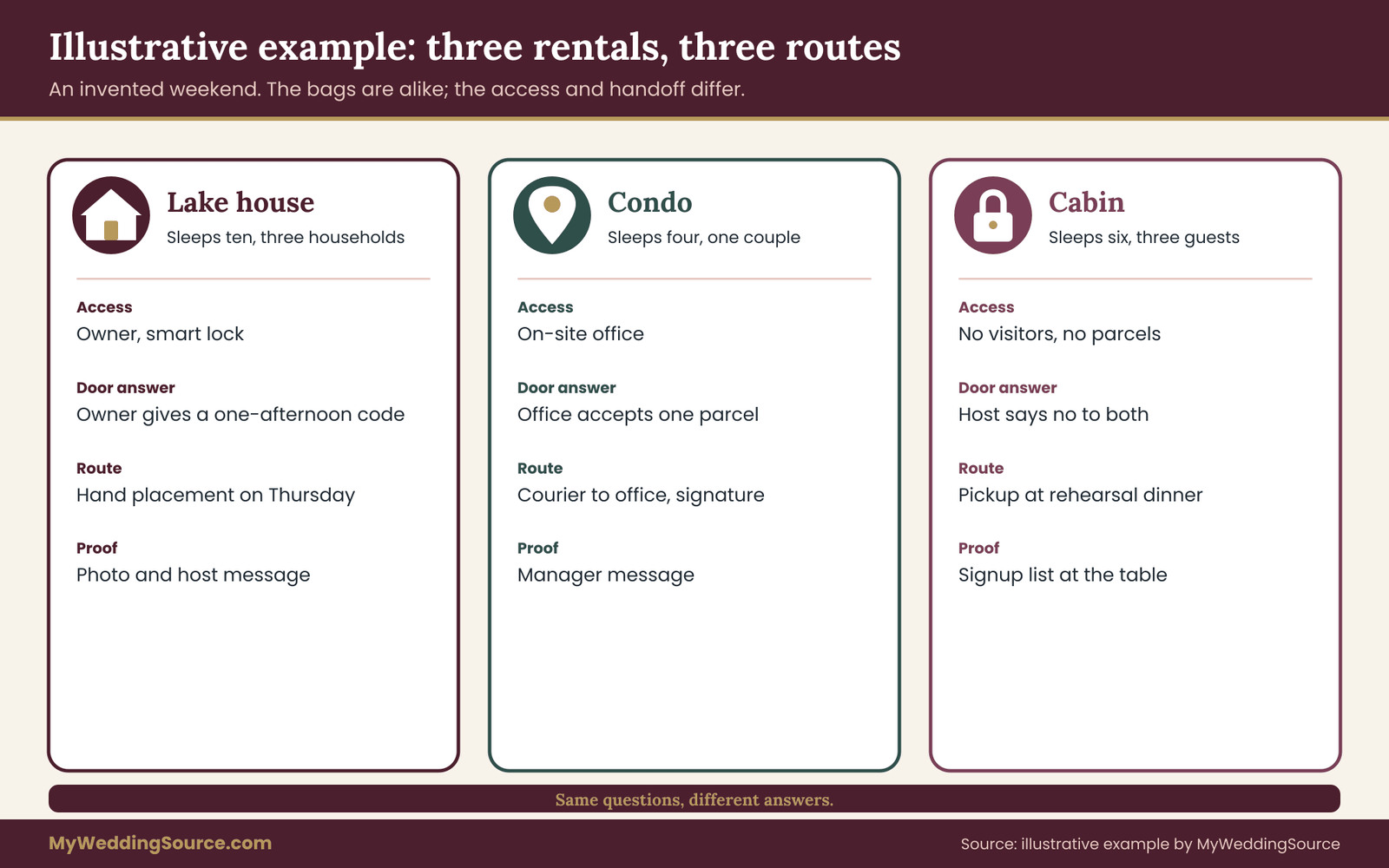
The lake house sleeps ten. Three households are staying: Tomas’s parents, his aunt and uncle with two teenagers, and two of his college friends. It is self-managed by an owner who lives out of state, with a smart lock and a per-stay code. The listing says nothing about packages.
The condo sleeps four. One couple is staying, Ines’s cousin and her partner. A property management office on site is open on weekdays and Saturday mornings, and the listing says staff can accept parcels for guests.
The cabin sleeps six. Ines’s two aunts and one family friend are staying. The listing states that no outside visitors are permitted and that parcels cannot be accepted because the road is private and the cabin has no street address that carriers serve.
Running the checkpoints
Lake house, door. Paloma writes to the owner using the same plain structure as in the earlier script: one bag per household, sealed snacks and water only, placement on the kitchen counter on Thursday afternoon, no courier. The owner replies that Paloma may enter between one and four on Thursday if the unit is empty, and offers to create a second code that works only that afternoon. Paloma records the reply and the code’s time window.
Lake house, drop. There is no courier here. Paloma will carry the bags in her car, so the drop checkpoint reads “none, hand carried.” That removes the weather and theft risks for this house.
Lake house, hold. Paloma is the holder. She will place the bags herself, so the hold lasts from the car to the counter.
Lake house, place. She places three bags on the island, one for each household, each with a card and the weekend schedule. The aunt’s household includes a guest with a tree nut allergy, which she learned from a short message to the booking guest, so every bag is nut free and labeled. She removes all the packing material, and she asks the owner where to put the empty boxes and gets an answer.
Lake house, proof. Paloma takes a photo of the counter, messages the owner that she is done and asks the booking guest to text once they arrive.
Condo, door. The manager’s office agrees to accept one parcel and to place it inside the unit before arrival. This is the strongest option for this rental because the office will handle entry and the cleaners’ schedule. The manager asks for the delivery to arrive by Friday noon.
Condo, drop. The parcel goes by courier to the office, not to the unit’s door. Paloma checks the carrier’s current options and chooses a delivery with a signature requirement, which the office can meet because staff are on site on Friday. She gives the carrier the office’s name and the guest’s name.
Condo, hold. The holder is the office. Paloma asks the manager to message her when the parcel lands and to confirm placement.
Condo, place. The manager places the bag on the table. A card inside carries the schedule. Paloma has sent only sealed, non-perishable items because she will not be present.
Condo, proof. A message from the manager is the proof. Paloma also asks the guests to confirm.
Cabin, door. No entry and no parcels. Paloma writes the answer on the record page as “no entry, no delivery.” That ends the door and drop checkpoints for this rental.
Cabin, hold, place and proof. The three guests will meet at the rehearsal dinner on Friday evening. Paloma plans a pickup: three bags on a welcome table, each labeled with the guest’s name, with a signup card so she knows who collected them. She sends the cabin guests a message on Wednesday explaining that their bags will be at the dinner. The proof is the checked list.
What the example shows
The example also shows why vacation rental gifts should be treated as logistics first and presents second. Paloma spent most of her effort on messages and routes, and very little on what went into the bags.
Three rentals produced three different routes, and none of them was exotic. The lake house had a cooperative owner and a person ready to travel, so hand placement worked. The condo had a staffed office, so a managed delivery worked. The cabin had a rule that ruled out every delivery, so a pickup worked. The record page and the five checkpoints gave Paloma the same questions to ask in each case, which is the point of the plan.
The example also shows how little rested on goods. The bags were nearly identical: water, sealed snacks, a schedule and a card. The differences were all in access and handoff. This is why the guide puts access before the shopping list. Once the routes are settled, the contents are easy.
Illustrative budget logic
When you compare routes for vacation rental gifts, include your own time as a cost, even if you are not paying for it. A route that needs three trips across town may be cheap in cash and expensive in a helper’s goodwill.
Cost can be reasoned through without any invented price list. Suppose a bag has a materials cost you call B, and a delivery or travel cost you call D, and you have H households. The total is H multiplied by the sum of B and D, plus any one-time costs such as printing the schedule.
Delivery cost varies a lot by route. Hand delivery by a helper has a travel cost, usually fuel and time. A courier has a shipping charge, possibly a signature fee. A pickup at a welcome table has almost no delivery cost but may need a table, a sign and a volunteer.
In the example, the lake house route costs three bags and the helper’s drive. The condo costs one bag plus shipping to the office. The cabin costs three bags plus a table sign. The route with the highest cost per bag is usually the courier route, and the lowest is the pickup. If a quote from a supplier or a carrier surprises you, ask what drives it, and compare it with the next option before deciding. Check actual prices when you plan, because they change.
This is also the place to be honest about how much you are spending relative to what guests value. A bag that costs more but arrives late or in poor condition is worth less than a bag that costs little and arrives on time. A sensible total is the one that fits your budget and pays for working delivery first, and the rest of the money can go to the items themselves.
The wedding budget guide helps set a guest-experience line, and the vacation rental gifts should sit inside it, not on top of it.
Edge cases that change the plan
Edge cases are where vacation rental gifts most often fall short, and each one has a short fix. Skim the headings and read the ones that match your weekend.
The three-house example covers common situations. Real weekends add complications. Each of the following has a simple answer if you recognize it early.
The guest arrives before the helper
If a household arrives early and the gift is not in place, do not rush to enter. Message the guest to say the gift will meet them later, and give a time. A gift that arrives an hour after check-in still serves its purpose. A gift placed in a rush, through a door someone else’s code has opened, may cause trouble.
The host offers to place gifts but is unreliable
Some hosts say yes and then forget. If a host has said yes but not confirmed on the day, send a short reminder the morning before. Ask for a photo of the placement. If the host cannot confirm by a set hour, activate the fallback, usually pickup at the welcome event.
A household with a severe allergy
Ask for details, and build the gift around them. A household with a severe food allergy may prefer no food at all. A card, a printed schedule and a non-food item such as a small first-aid pouch can be a complete gift. If the household prefers to supply their own food, respect that. The allergy information is private, so use it only to choose items and do not repeat it on a card or in a group message.
Guests with limited mobility
A rental may have stairs, a steep driveway or a long path from the parking area. Place vacation rental gifts where a guest with limited mobility will find them without extra steps, usually on the main floor near the entrance or kitchen, not in an upstairs bedroom. Keep the bag light enough to lift with one hand, and avoid heavy bottles in favor of cans or pouches.
The planning notes in the guide to childcare and older-guest support cover broader comfort needs for older relatives, and a short printed note with the nearest accessible parking and entrance is a gift of its own.
Late-night arrivals
Late-night arrivals are a good test of a plan for vacation rental gifts, because nobody is awake to explain anything. The card and the placement have to do all the talking.
Guests who land late may reach the rental after the host’s staff have gone home. In that case a bag placed in advance is the only gift they will see on the first night. Make sure the card carries the information they will need in the morning: where coffee is, what time the first event starts and how to reach a person who is awake. If your plan depends on a person to meet them, confirm the time before the guests leave home.
A house split between two groups
A large house might hold guests from both partners’ families who barely know each other. A single shared basket can feel awkward, and two baskets can feel like a competition. A neutral solution is one shared basket for the kitchen, with a short card signed by both of you, and one small personal item per household. Keep the contents equal, and keep the card friendly, not instructive.
Hosts with cameras
Some rentals have exterior cameras at doors and driveways. They are usually disclosed in the listing. If a helper will enter the property, tell the host who the helper is and when they will arrive, so the person is not mistaken for a stranger. Keep the helper’s visit short and avoid photographing the interior beyond the gift itself. The guests’ belongings, mail and personal items in view should stay out of any photo you send around.
The booking changes
Changes in bookings are a normal hazard for vacation rental gifts. Build in a day of slack, and keep the record pages updated as soon as a guest tells you about a move.
Guests change plans. A household may move to a different rental, cancel or add a night. Keep the record pages current, and ask the booking guests to tell you about changes as soon as they happen. The most common casualty is a parcel already on its way to an address that is no longer needed. Ask the carrier about redirecting or holding a package, and check the terms they publish, since options and fees vary. If a parcel cannot be redirected, collect it and bring it to the new location by hand.
Pets in the rental
Some rentals allow pets, and a household may travel with a dog. A gift left within reach of a dog is a risk if it contains chocolate or certain sweeteners. Keep food items off the floor, and place them where a pet cannot get to them. If you know a pet is coming, the card can note that the snacks are for people, which is a simple way to avoid a medical scare for the animal.
Guests who stay in hotels and guests who stay in rentals
Fairness here is about the thought behind vacation rental gifts, not about identical objects. Guests understand that a hotel bag and a rental counter basket travel by different routes.
If some guests are in hotels and some are in rentals, the question of fairness will come up, usually quietly. Hotel guests may receive a bag at check-in, and rental guests may receive something different on the counter. The simplest way to keep this fair is to make the contents the same and let the route differ.
The couple’s general approach to being even-handed with guests is covered in the guide to etiquette for wedding hosts. A short line on the schedule that explains the pickup point or the bag location is enough, with no need to apologize for the difference in route.
Gifts that arrive damaged or opened
If a parcel arrives damaged or opened, do not give the contents to guests. Replace anything that has been compromised, especially food. Photograph the damage, keep the packaging and report it to the carrier within the time the carrier allows, which you should check in their current terms. A seller’s own policy may also cover replacement. The Federal Trade Commission publishes consumer guidance on buying online, including the shipping rules that apply to sellers, so ftc.gov is the place to check your rights if a supplier misses a promised delivery.
Questions to ask about vacation rental gifts before you commit
Short questions get fast answers. Keep each message about vacation rental gifts to a few lines, and ask only what you need for the next decision.
A good question is specific, answerable in a line and tied to a decision. The lists below are written to be sent as they are or trimmed. Each group fits a different recipient. Save the answers on the record page, along with the date.
Questions for the host or property manager
- May we leave a small welcome gift in the unit before check-in, and who may place it?
- What are the hours when the unit is empty and clean?
- Can a carrier deliver to this address? If so, where do carriers usually leave parcels?
- Do you accept parcels on behalf of guests, and for how long do you hold them?
- Is there a fee for accepting or holding a parcel?
- Are there any items you would rather we not leave, such as food, candles, balloons or decorations?
- Where should packaging and recycling go?
- Can you send a message when a parcel arrives and when it is placed?
- If a second access code is needed for a short window, can you create one, and will you rotate it afterward?
Questions for the booking guest
- Is it all right if we leave a small gift before you arrive, or would you rather meet someone?
- Are there any allergies or dietary needs we should know about, and are there children or pets in the household?
- When do you expect to arrive, and will someone be there the whole time?
- Would you rather have a shared basket for the house or one bag per household?
- Is there anything in the rental that already covers the basics, such as coffee or toiletries?
A message to the guest should always be optional in tone. Guests are often glad to answer, but nobody wants a quiz before a wedding. Two or three questions, with the rest left to the host’s page, is enough.
Questions for a courier or carrier
Carriers publish their rules, and a call or a look at their website will answer most of these. Ask what delivery options exist for the address, whether a signature can be required and what the cost is, how long a parcel can be held at a pickup location, what the process is for a damaged or lost parcel and what the time limit is for reporting it.
Ask whether the address is one the carrier serves, because some private roads and gated areas are not. The carriers’ own sites at usps.com, ups.com and fedex.com are the primary sources for terms, and those terms change, so confirm them close to your ship date.
Questions for a supplier of bags or snacks
If you buy ready-made bags or bulk items, ask the supplier for the information that affects a guest. Ask what the ingredient lists and allergen statements look like on each item, whether the packaging is sealed and tamper evident, what the lead time is and how it changes near holidays, what the policy is for late or damaged orders and whether they will ship to more than one address. Ask for the shipping terms in writing before you pay.
Supplier claims need care. A supplier who calls a product “natural,” “organic” or “handmade” is making a claim, and some claims have specific legal meanings while others do not. The FTC publishes guidance on advertising claims and endorsements, and it is a fair reference when a label sounds more impressive than it is.
You do not need to audit every word. You do need to rely on the ingredient list and allergen statement rather than the marketing line, and you should not repeat a supplier’s claim on your card unless you can support it.
If you are using a vendor to assemble or deliver the vacation rental gifts, the guide on checking a wedding vendor before you pay lists the basics, such as confirming the business exists, reading the terms and keeping the paperwork. Use the same habits here, even for a small order.
Questions to ask yourself
Honest answers to these questions are the cheapest insurance for vacation rental gifts that you can buy. If an answer is uncertain, treat it as a no and add a step.
Before sending anything, ask a few things of the plan. If the host said no, does a route still exist? If a parcel is late, who will notice, and what happens? If a guest has an allergy, have we checked every item? If the weather turns, does anything in the drop spoil? If the person holding the gift is delayed, is there a second person? A plan that survives these five questions will usually survive the weekend.
A short message for each situation
Here are three messages you can adapt. The first goes to a host who has not yet answered, the second to a manager who has agreed to hold a parcel and the third to a guest whose rental allows no deliveries.
“Following up on my note from Monday. We would like to leave a single welcome bag on your kitchen counter on Thursday afternoon. If that does not work, could you tell us whether a courier may deliver it, or whether we should hand it to the guests ourselves?”
“Thank you for agreeing to hold our parcel. It should arrive on Friday before noon, addressed to the guest’s name at your office. Could you send a short message when it comes in and let us know when it has been placed in the unit?”
“Your rental does not allow deliveries, so we will have a welcome bag waiting for you at the rehearsal dinner on Friday. It has water, snacks and the weekend schedule. If you would rather pick it up on Saturday morning at the hotel lobby, tell me and I will arrange it.”
Each of these names a time, a place and a fallback, and none of them ask anyone to do more than a single step. That is the quality to look for in any message you send, whether to a host, a guest or a courier.
Costs, timing and measurable checks for vacation rental gifts
A plan is easier to trust when it can be checked. This section turns the five checkpoints into a short schedule and a set of checks you can answer with yes or no. None of them depends on a price list or a statistic, so they stay useful whatever things cost when you plan.
A countdown schedule
Four to six weeks out. Find out which guests are staying in rentals, and ask the booking guests for the listing link and a contact for the host. Decide the unit of the gift: shared, per household or digital only. Draft the record page for each rental.
Three to four weeks out. Send the host messages. Ask the guests for allergy and dietary notes. If you need a supplier, order samples or confirm lead times, since busy periods can stretch them.
The wedding vendor timeline shows where deliveries and vendor deadlines usually fall in the final weeks, which helps you fit these dates around other orders.
Two weeks out. Close the door and drop checkpoints. Every rental should have a recorded answer, even if the answer is no. Choose the route for each rental and name the holder.
One week out. Finalize the contents, print the cards and schedules and assemble or confirm the order. Check that packaging is sealed and labeled. Send the carrier or supplier a final confirmation of dates and addresses.
Two to three days out. Remind hosts and managers of the plan. Check carrier tracking if anything is in transit. Confirm with the holders and helpers.
Arrival day. Place the vacation rental gifts, take the photos and send the guest check-in messages. Watch for the proof time limit, and run the fallback if a rental has not confirmed.
After the weekend. Remove codes from your notes, record problems and thank the hosts and helpers. A one-line thank-you to a host who said yes is good manners and good for the next time.
Ten yes-or-no checks
Use these before you ship or leave anything. Each is answerable in a second, and each maps to a checkpoint. Treat the checks as a gate. Vacation rental gifts that fail one check wait until it is fixed, and a rental with several failures moves to a lighter route.
- Has the host or manager answered in writing for this rental?
- Does the route fit the access model, including any hours?
- If a parcel will travel by carrier, does the address accept carrier parcels?
- Is there a named holder who knows what to expect?
- Is every item sealed, labeled and free of perishable content, unless a person will refrigerate it?
- Have allergies and dietary needs been asked about, and does the bag respect them?
- Is there a card with the sender, the contents and the schedule?
- Will the placement leave no trace, and is there a plan for packaging?
- Is the proof defined, with a time limit and a fallback?
- Are codes and private details held only in a place you will clear afterward?
If the answer to any is no, fix it first. If you cannot fix it in time, drop to a lighter route, such as pickup or a digital welcome, and do not leave the gap open.

Where the money goes
The three buckets apply to every set of vacation rental gifts, whatever the size. Writing each one down on the record page keeps the total honest.
Spending on vacation rental gifts splits into three buckets: the goods, the delivery and the paper. Goods are the water, snacks and small items. Delivery is fuel, shipping and any fees a host or manager charges. Paper is the card, the schedule and any printing. For most couples the paper bucket is small and the delivery bucket is the one that surprises them, particularly when a courier route needs a signature or when a manager charges a handling fee.
A useful discipline is to price each route before choosing it, and to compare routes on the cost per household delivered, not on the cost of the goods alone. A cheaper bag that needs an extra trip is not cheaper. A more expensive bag that arrives in a single, verified handoff may cost less overall. When the numbers are close, choose the route with the least risk of a failed delivery, because a failed delivery costs both money and the point of the gift.
Keep a short line in your budget for the unexpected, such as a replacement bag or a host fee. A small reserve is easier than a scramble on Thursday afternoon. If you already track the wedding finances in a budget, the wedding budget guide shows how to hold a reserve without losing track of it.
Disclosure and honesty in what you buy
If you are working with a seller who offers you a discount, a free sample or a commission for mentioning them, say so wherever you recommend them. The Federal Trade Commission’s guidance on endorsements asks people to disclose material connections, and a plain sentence is enough. For a private couple buying vacation rental gifts for guests this rarely comes up. It matters if you publish a post or a list of recommended items for others to buy, because readers deserve to know when a recommendation has money behind it.
Separate facts from estimates in the same way. If you tell guests that a snack is nut free, it should be because the label says so and you have read it, not because the seller’s page implied it. If you are not sure, say so, and choose a different item.
Common mistakes with vacation rental gifts and how to fix them
The same few errors account for most of the trouble with vacation rental gifts, which is good news, because they are easy to avoid once named.
Most problems repeat. Here are the ones that appear most often, with the fix for each.
Shopping first and asking later. The couple buys forty bags and learns the host forbids deliveries. Fix: ask the host before buying, and let the answer shape the unit and the route.
Treating a rental like a hotel. The plan assumes a desk that does not exist. Fix: write down the access model and the holder for every rental, and expect no one to be on duty unless the host says so.
Sending perishables to a porch. Cheese, pastries or chocolate arrive in warm weather with nobody home. Fix: perishables travel only by hand, to a person, with a cold place waiting.
Leaving the proof out. Nobody checks, and the gift is missing for two days. Fix: set a proof time and a fallback, and ask for a photo or a message.
Using a code that was not offered. A helper uses a guest’s code or a code from an old booking. Fix: ask the host for a delivery code, or let staff place the gift, and respect the answer.
Overloading the bag. A heavy box of keepsakes that guests cannot pack home. Fix: small, light, mostly consumable items, and one printed page that matters more than any object.
Forgetting the household with a different need. A bag with nuts goes to a guest who cannot have them. Fix: ask in advance, read every label and have a spare non-food gift on hand.
Packing out nothing. Boxes and wrapping are left behind in a rental that has strict trash rules. Fix: carry packaging away or ask the host where it goes.
Skipping the thank-you. A host who helped hears nothing afterward. Fix: send a short note, and mention the host’s help in a review if the listing allows reviews.
None of these takes much effort to avoid, and most come down to asking a question one step earlier than feels necessary.
Your next steps
Keep the effort proportionate. Vacation rental gifts take a few messages and a few hours, and the five checkpoints keep those hours focused.
Start with three actions this week. Make a list of the rentals your guests are using, with the host or manager for each, and open a record page for each one. Send the host message from the earlier section to every rental that does not yet have an answer. Decide the unit of the gift, shared or per household, so you can size the order.
Next, choose the route for each rental from the six options, and name the holder. Then choose the contents using the four survival tests, and read every label. Finally, set the proof time and the fallback, and put the countdown dates on a calendar. If you want a wider view of how lodging fits into the weekend, the guide to coordinating wedding guest hotels is a good companion, and it takes the same approach of asking each property what it allows before deciding.
FAQ
Should I send vacation rental gifts directly to the property address?
Only if the host or manager has agreed in writing and the address accepts carrier parcels. Couriers handle vacation rental gifts well at ordinary street addresses. Some rentals have no street delivery, and some hosts do not want parcels. If anyone will be present on the delivery day, a courier route can work. Otherwise choose hand delivery, a pickup point at a wedding event or a digital welcome instead.
What if the host says guests may not receive deliveries?
Treat it as a normal rule and change the route for your vacation rental gifts. Use a pickup at the rehearsal dinner or welcome table, hand the bag to guests at check-in if the host allows a meeting, or send a card and schedule by message. Do not ship anyway and hope. A refused or lost parcel helps nobody, and may affect the guest’s relationship with the host.
Can a helper enter the rental before guests arrive?
Only with the host’s explicit permission and in the hours the host names. Many rentals restrict entry to registered guests, and a code from a booking should not be shared unless the rules allow it. Ask for a one-time code or ask the manager’s staff to place the gift. If the answer is no, place the gift elsewhere.
Which vacation rental gifts are safest to leave in a rental?
The safest vacation rental gifts are sealed, labeled, non-perishable items with no strong scent: bottled water, packaged snacks with ingredient lists, a printed schedule and small practical items such as a charging cable. Avoid candles, open food, anything that needs refrigeration and anything that makes a mess. Check allergens, and ask the guests about needs where you can.
How do I handle a guest with a food allergy?
Ask the household what they need, then build the gift around the answer. Choose sealed products with clear allergen labels, or skip food and give a non-food item and the printed schedule. The U.S. Food and Drug Administration explains how packaged foods declare major allergens. Keep the guest’s information private and use it only to choose items.
Who should hold vacation rental gifts at the rental?
The host, the manager, a helper on site or the guest, but one named person, not a vague group. The holder should know what is coming, where it goes and whom to call if it is late or damaged. If you cannot name a holder, change the route to one with a person present, such as hand delivery or pickup.
How early should vacation rental gifts arrive?
Vacation rental gifts should land within a day before the guests, and never after they check in. Earlier than that and the parcel may sit exposed or be mistaken for the previous guest’s. Later and the gift loses its welcome function. Pick the delivery date from the check-in time, leave a buffer for carrier delays and decide a fallback in advance.
Are vacation rental gifts worth the trouble if rentals are this complicated?
Yes, if you keep them proportionate. Vacation rental gifts can be as small as a note, water and a schedule. A printed schedule, a bottle of water and a short note, delivered by a route the host approved, is a complete and appreciated gift. If the logistics are too uncertain, a digital welcome with a small pickup gift at the first event is a sound choice. The plan scales up or down.
Sources
- Federal Trade Commission, consumer and business guidance on advertising, endorsements and online shopping
- U.S. Food and Drug Administration, food allergen labeling information
- FoodSafety.gov, federal food safety guidance
- U.S. Consumer Product Safety Commission, children’s product safety and recalls
- United States Postal Service, shipping and delivery options
- UPS, shipping and delivery terms
- FedEx, shipping and delivery terms
- Airbnb Help Center, hosting and guest policies
- Vrbo, traveler and host policies
- Transportation Security Administration, what can be carried on a flight