

A wedding photography timeline has two halves, a planning schedule that runs from booking to final gallery and a wedding-day schedule that protects portraits, family photos and sunset, and this guide gives you both in copy-ready form.
You have a date, maybe a photographer, and two questions that feel like one. When do I need to do things, and how do we fit getting ready, portraits, family formals, a ceremony and a reception into a day that already has a caterer, a venue curfew and a sunset that does not negotiate? Most couples meet the first question months out and the second one in the week before the wedding, which is a bad moment to discover that a 30-minute family list was really 55 minutes of relatives and a missing aunt. The fix is to treat the photography plan as a schedule with two layers, one that runs on calendar months and one that runs on clock minutes, and to build both before the details start moving.
This article lays out the planning layer first: when to book by season, what the engagement session is for, which deadlines belong to you and which to the photographer, and what typical delivery windows look like for sneak peeks, galleries and albums. Then it builds the wedding-day layer with sample schedules for 6, 8 and 10 hours of coverage, a first-look versus no-first-look comparison, buffer and travel rules, sunset data for four U.S. seasons and five locations, weather backups and the usual reasons a timeline slips. Every lead time and delivery window below is labeled as typical, because photographers set their own calendars and contracts, and every sample schedule is an illustration you adapt, not a quote or a rule.
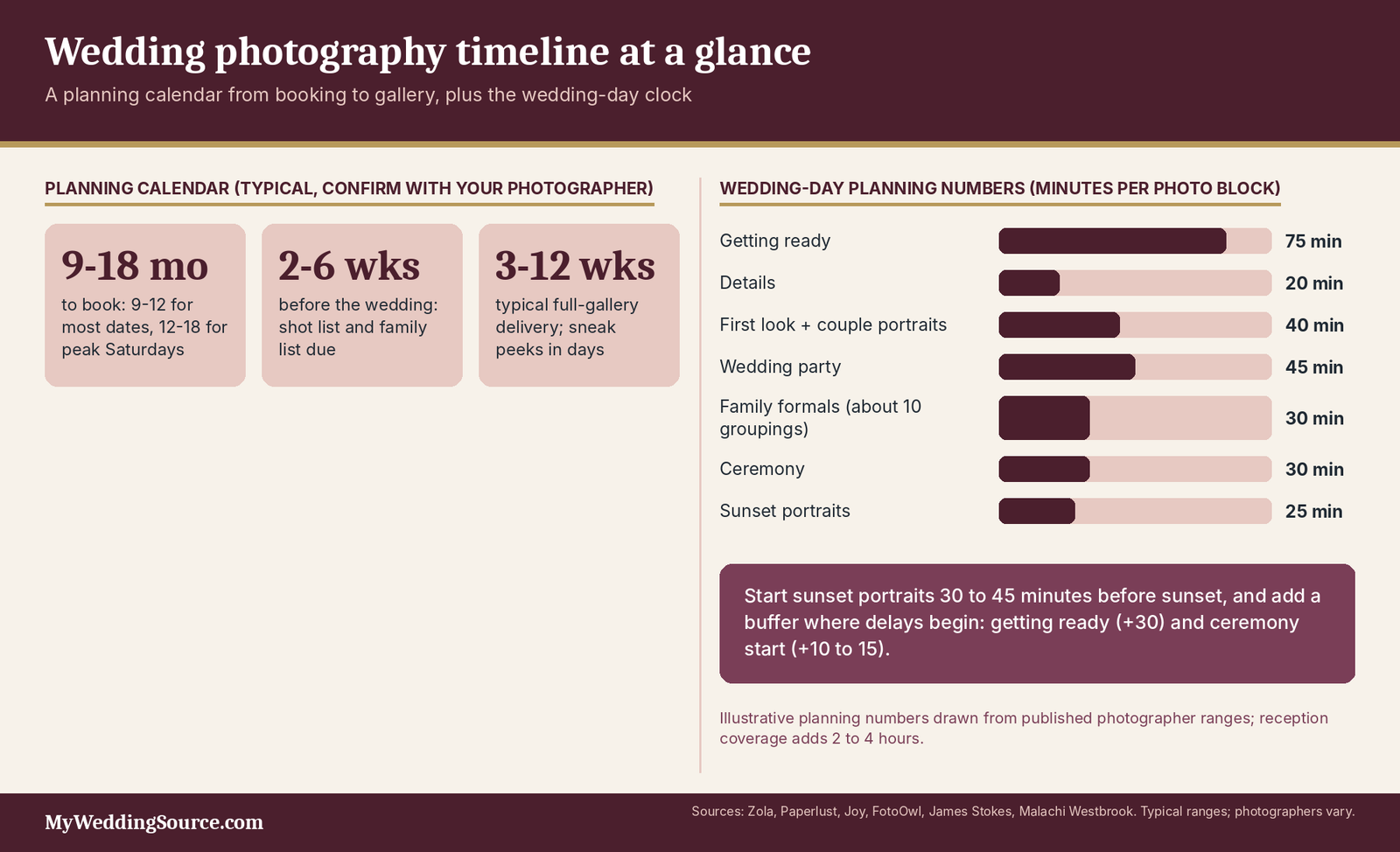
Two timelines, one photo plan: what each one answers
The planning timeline: months, deadlines and handoffs
What it covers, from first inquiry to final gallery
The planning timeline starts when you send your first inquiry and ends when you have downloaded, backed up and (if you want one) designed your album. In between sit about a dozen moments that need a decision or a document: the date check, the contract and retainer, the engagement session, the shot list, the family list, the final headcount, the final timeline, the final payment, the wedding day itself, the preview, the gallery and any prints. None of these is hard on its own. The trouble is that they are spread across 12 to 18 months and handled by different people, so each one tends to arrive as a surprise unless it sits on a shared calendar.
Why the photographer’s deadlines drive yours
Photographers work backward from their own calendars. A common pattern is a planning worksheet sent about six weeks before the wedding, a review call in the final month and a request for your lists two to four weeks out, and one photographer’s published guidance puts the worksheet at about six weeks before the wedding with the family-groupings section as the part that matters most. Another photography publication advises giving the shot list to your photographer two to four weeks before the wedding and holding a call during the month of the wedding. Those are individual practices rather than industry rules, so your contract or welcome packet is the authority, but they show the shape: your inputs are due weeks before the day, not the week of.
The wedding-day timeline: minutes, light and buffers
What it covers, and who owns it
The wedding-day layer is the minute-by-minute schedule that decides how much time each photo block gets and in what order. It covers getting ready, details, a first look or a private moment, couple portraits, the wedding party, family formals, the ceremony, cocktail hour, reception events, sunset portraits and the exit. Several people touch it: you, your photographer, the planner or day-of coordinator, the venue and the caterer. The photographer owns the photo blocks, but the clock itself belongs to whoever has authority to move other vendors, which is usually the planner or coordinator.
How this guide differs from broader timeline pages
Wedding timelines come in several flavors, and it helps to know which one you are holding. Our guide to wedding day timeline failure points covers the whole day across every vendor, including parking, vendor loading, power, guest flow and the decision-maker problem. This guide stays inside the photography lane: how many minutes each photo block needs, how sunset changes the order of the day, and how the booking-to-delivery calendar works. If you are planning a cold-weather date, pair this with our winter wedding photography guide, which goes deeper on short days, indoor backup spaces and artificial light.
The planning timeline: booking to final gallery
When to book your photographer
The typical booking window
Lead times vary by market, season and photographer, and no single number is authoritative. Zola’s wedding checklist puts booking and the engagement session at 12 to 10 months out and notes that photographers and caterers tend to fill first, with a stated range of 9 to 12 months ahead. Two 2026 pricing guides push the window further for busy dates: Paperlust suggests ideally 12 to 18 months before the wedding for peak-season Saturdays, and Joy says to book 12 to 18 months ahead because top photographers fill their calendars that far out. Treat those as typical ranges for sought-after photographers on popular dates, not a deadline after which nobody is available.
The practical reading is this. If your date is a Saturday in June, September or October, start inquiring the week you have a venue and a date, because those are the weekends photographers fill first. If your date is a Friday, a Sunday or a month outside the busy stretch, 9 to 12 months is a comfortable window. Either way, a verbal “we’ll pencil you in” does not hold a date, since most photographers reserve it only after a signed contract and retainer.
Peak season versus off-season
The Knot’s analysis of its Real Weddings Study says that peak season runs May through October and accounts for 76% of weddings, with fall the most popular season at 35% and summer next at 33%. October and June each account for 16% of weddings, September for 13%, and December for just 1%. The page also advises couples to start researching and booking earlier than a standard checklist suggests during peak season, because they are competing for the same vendors, and to leave room for rate increases.
| Date type | Typical start-looking window | Why | Source basis |
|---|---|---|---|
| Peak-season Saturday (June, Sept., Oct.) | 12 to 18 months out | Most-requested weekends fill first | Paperlust and Joy 2026 guides |
| Other Saturday, May to Oct. | 10 to 12 months out | Still inside the 76% peak share | Zola checklist; The Knot season data |
| Off-peak Saturday (Nov. to Apr.) | 9 to 12 months out | More open dates, but favorites still book | Zola checklist range |
| Friday, Sunday or weekday | 6 to 9 months out (editorial estimate) | Lower demand for the same photographer | Editorial judgment; ask each photographer |
| Under 6 months out | Inquire this week | Fewer photographers available | Editorial judgment |
If your engagement is short
Plenty of couples marry within six months of getting engaged, and plenty of excellent photographers have open dates on short notice, especially on off-peak weekends. The approach is to widen your net rather than lower your standards. Send the same inquiry to six to eight photographers at once, say plainly that your date is under six months away and ask whether it is open before you spend time on portfolios. Consider an associate photographer or a studio with several shooters, since multi-shooter studios often have more capacity than a solo photographer, and check that the contract names who will actually shoot.
Contract, payment and preparation milestones
The contract and payment schedule
Once you choose a photographer, the contract and a retainer reserve your date. One contract-clause guide from a photography software company describes a 50% deposit to book, 25% due 30 days before the event and 25% on delivery as a suggested schedule, and it says retainers are typically non-refundable. That is one example from one vendor-side source, so your own schedule may be a smaller retainer with a balance due weeks before the wedding. The point is not the exact percentages but that the dates and refund terms are in writing, because payment dates are some of the few deadlines in the planning timeline that have money attached.
This section is general education, not legal advice, and contract terms and state laws vary. Before you sign, read the cancellation, postponement, substitution and overtime language, and compare it with our wedding photographer portfolio and contract checklist. If anything is unclear, ask the photographer to clarify it in writing, and consider having a licensed attorney in your state review a contract that involves a large deposit or unusual terms.
The engagement session and other early handoffs
An engagement session does three jobs. It gives you images for a wedding website, save-the-dates and social media, as the Zola checklist notes. It lets you see how the photographer directs people and whether you feel comfortable in front of the lens, which is useful data before the wedding day. And it gives the photographer a read on how the two of you move, which makes portraits faster later. Pricing varies widely: a Joy guide updated in January 2024 describes a range from about $200 to more than $3,000 depending on market and photographer, with some wedding packages including a session, so ask whether yours does.
Final preparation: lists, headcount and handoffs
The shot list and family list deadlines
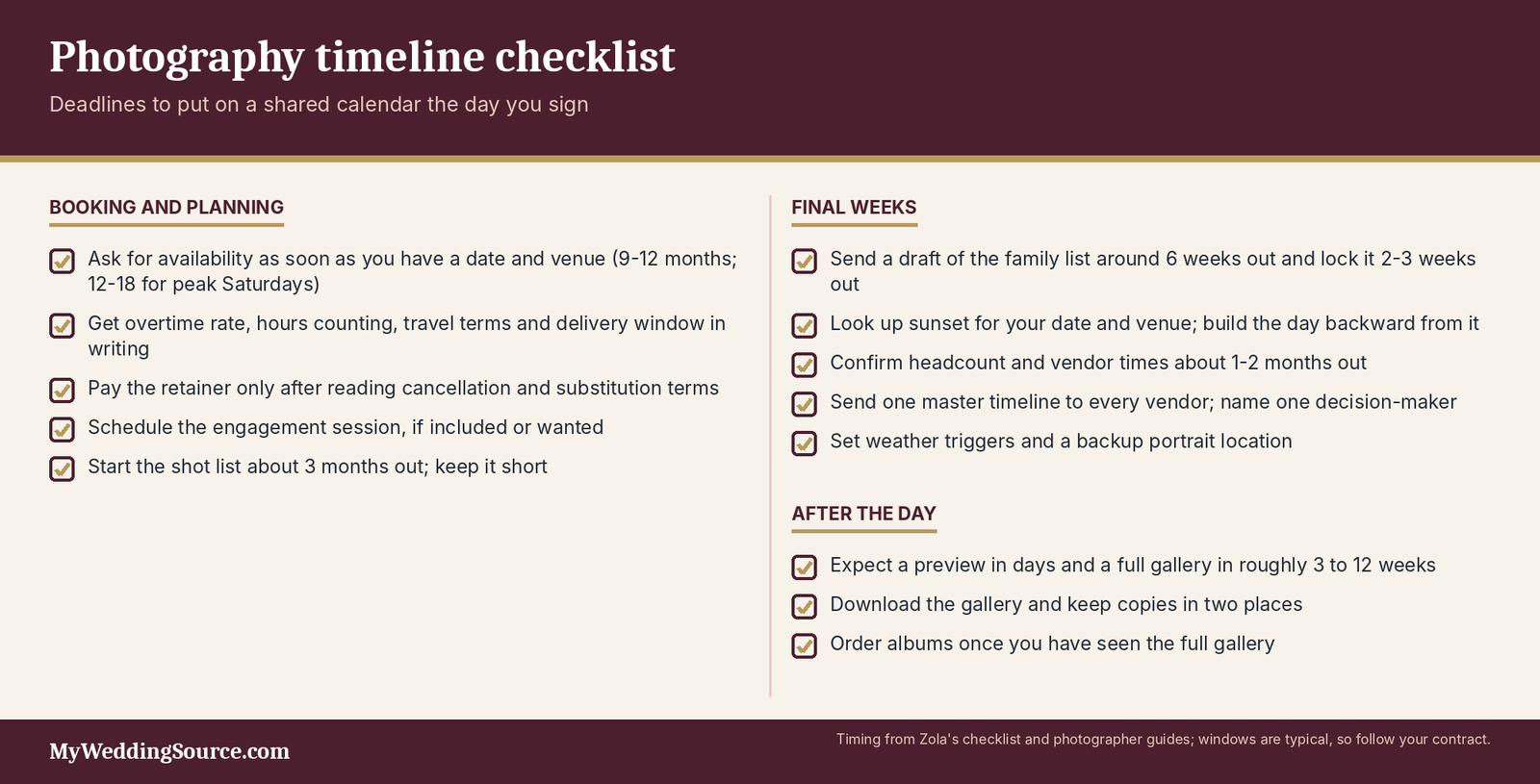
Planning sources disagree slightly on when to start the lists, which is useful because it tells you the range. The Zola checklist places the start of the shot list about three months out, with the final list confirmed with the photographer about one month out. The photography publication quoted above asks for it two to four weeks out, and the photographer who sends a worksheet six weeks out is asking for the family section at roughly the same time. A safe plan is to start three months out, send a first draft six weeks out and lock the final version two to three weeks before the wedding.
Keep the shot list short and specific. Our wedding photographer shot list guide covers how to prioritize, and the short version is that a handful of people-and-moment requests beats a list of 80 poses. The family list is different: it needs names, relationships and the sensitive-situation notes in advance, and it should be settled with both sets of parents before it is sent.
Final headcount, vendor confirmations and the master timeline
Headcount affects photography more than most couples expect. A larger wedding party, a bigger extended family and a longer processional all stretch the portrait blocks, and the final guest count shapes dinner service and therefore the length of the reception. The Zola checklist places RSVP follow-up and the final headcount about one month out, vendor confirmations about two months out, final payments about one month out and a delivery-and-location confirmation the day before.
Use that month to produce one master timeline and send the same version to every vendor. Version drift is a quiet cause of delays: the florist works from the version that says the ceremony is at 4:30, the photographer from one that says 4:00. Ask each vendor to reply that they have received and agree to the current version, and name one person with authority to make decisions if the schedule moves.
After the wedding: previews, galleries and albums
Sneak peeks and full galleries
Delivery windows are the most variable part of the whole timeline, so confirm yours in the contract. One contract guide gives quick previews within 48 to 72 hours and final edits in three to six weeks as an example, while Paperlust’s 2026 guide says many photographers send 20 to 30 preview images in the first week and a full edited gallery in 6 to 12 weeks. Our contract guide cites four to twelve weeks for finals. Peak-season photographers with back-to-back weekends commonly sit at the slower end, because editing a full wedding takes many hours and several weddings can land in the same fortnight.
| Deliverable | Typical window | What to confirm in writing |
|---|---|---|
| Sneak peek | 48 to 72 hours, or within the first week (20 to 30 images) | Number of images, sharing rights, whether it is guaranteed |
| Full edited gallery | 3 to 6 weeks (one contract example); 4 to 12 weeks (our contract guide); 6 to 12 weeks (Paperlust) | A delivery date or window, plus a remedy if it is missed |
| Rush delivery | Often an add-on, commonly $200 to $500 | Cost, new turnaround time, whether peak season changes it |
| Album or prints | Ordered after the gallery; many couples order 6 to 12 months later | Design process, revision rounds, production time, price |
Albums, prints and keeping your files safe
Printed albums are usually a separate purchase. Zola’s pricing guide shows albums as typically not included in basic packages, often an add-on in standard packages and usually included in premium ones, and Paperlust puts separately ordered albums at roughly $500 to $2,000 or more, with many couples ordering them six to twelve months after the wedding. Waiting is reasonable, because you get to see the full gallery before choosing images, and the album design process is a project of its own. What to ask is whether the album price is locked in your contract, since some photographers raise prices over time.
Your most important task after delivery is to download the full gallery and keep copies in at least two places, such as an external drive and a cloud service, because online galleries often expire and photographers are not obliged to store files forever. Ask how long the gallery stays hosted and whether the photographer archives your files, and check the contract’s usage terms. By default, the photographer who takes the picture owns the copyright, as the U.S. Copyright Office’s photographer guidance explains, so what you receive is usually a license to print and share rather than ownership of the files.
Choosing coverage hours: what 6, 8 and 10 hours actually buy
What a coverage package includes
Typical package lengths and what they usually mean
Coverage is the number of hours your photographer is working on the wedding day, and it is the single biggest lever on both price and schedule. Zola’s pricing guide, last updated in February 2026, describes basic packages at 6 to 8 hours with one photographer, standard packages at 8 to 10 hours with one or two photographers, and premium packages at 10 or more hours with two or more, adding that eight hours is the most common offering. Joy’s 2026 guide lines up similarly, with 6 to 8 hours typical, 4 to 6 hours at budget tiers, and 8 to 10 or more for premium and luxury packages. Thumbtack notes that the average agreement it sees runs eight to ten hours or more.
Those hours are a rough menu, not a prescription. A 100-guest wedding with a ceremony and reception at the same venue can fit comfortably in 6 hours, while the same guest count with a hotel getting-ready suite, a 20-minute drive and a sparkler send-off may want 10. Guest count nudges the number too: Joy suggests 6 to 8 hours for 50 to 100 guests and 8 to 10 for 100 to 200, which makes sense because larger guest lists mean larger family groups, longer processions and longer dinner service.
When the clock starts and stops
Before comparing quotes, ask exactly what the hours measure. Some contracts count from the moment the photographer arrives, others from a stated start time, and some include travel between locations while others do not. Ask whether coverage ends at a clock time or after a fixed number of hours from the first photograph, because that decides who absorbs a late start. If hair and makeup run 40 minutes behind and coverage is a clock-time window, the lost time comes out of your portraits; if it is a fixed number of hours from the first shutter click, it comes out of your reception.
Matching hours to the schedule you want
What fits in each tier
The cleanest way to choose hours is to start with the blocks you want photographed and add up their lengths, then add buffers, then compare with the packages. A reception-only or ceremony-plus-portraits day is a 4 to 6 hour job. A day that includes final getting-ready, a first look, wedding party, family, ceremony, cocktail hour, dinner, sunset portraits and a couple of hours of dancing lands around 8 hours. Add a full getting-ready session on both sides, a longer reception or a send-off, and you are at 10.
| Coverage | Typically fits | Usually trimmed | Best suited to |
|---|---|---|---|
| 6 hours | Details, first look, party and family portraits, ceremony, cocktail hour, dinner and toasts, sunset portraits, first dances | Full getting-ready, long dance floor, send-off | One venue, 100 guests or fewer, tight budget |
| 8 hours | The above plus an hour of getting-ready and 60 to 90 minutes of open dancing | Two-sided getting-ready, a staged exit | Most single-venue weddings, 100 to 150 guests |
| 10 hours | Two-sided getting-ready, longer portraits, full reception and a send-off | Little, if a second shooter is present | Multi-location days, large parties, long receptions |
Add hours or trim the list
There are two honest ways to fix a schedule that does not fit, which are buying more time or asking for less, and the overtime math appears in the cost section below. Asking for less is free and often the better trade, because a shorter list of priorities gets more attention per item. A second photographer changes the equation without changing the clock. With two shooters, getting-ready can happen on both sides at once, a ceremony gets two angles, and family formals move faster because one person can wrangle while the other shoots. A second shooter does not add hours to the schedule, but it does let the same hours cover more ground, and our guide to second photographer and videographer costs explains what that add-on usually costs and what it does not replace.
How long each photo block really takes
Benchmarks from working photographers
Getting ready and details
Photographers who publish sample timelines are remarkably consistent about getting ready: budget 60 to 90 minutes. One photographer’s sample timeline recommends 90 minutes minimum, adding 30 minutes for more than four attendants or complicated hair and makeup, and warns that “hair and makeup almost always runs long.” A photographer’s time-budget post recommends 60 to 90 minutes for getting ready that includes details, candids and breathing room. The details portion, meaning rings, invitation suite, shoes, florals and the empty reception room, runs 20 to 30 minutes in the first source.
Couple portraits and the wedding party
A first look plus couple portraits typically runs 30 to 45 minutes. A photographer writing about first looks describes about 45 minutes of uninterrupted time with no guests and no timeline pressure, and a time-budget post from another studio puts first look plus couple portraits at 30 to 45 minutes. Wedding party portraits come next, at about 45 minutes in that post and 45 to 60 minutes for a party of 12 or fewer in the James Stokes sample, plus 15 minutes for each four additional people.
Family formals
Family formals are the block most likely to blow up, because the number of groupings is up to you and the time per grouping is not. The planning rule from published sources is about three minutes per grouping for small groups and four to five minutes for groups of more than four people, which one photographer’s guide puts at 20 to 30 minutes for immediate-family lists and up to an hour for long extended-family lists. Another photographer’s sample timeline recommends keeping the list to 10 groupings or fewer and adding three to five minutes per extra grouping.
Ceremony, golden hour and the reception
The ceremony block runs 20 to 45 minutes in the Stokes sample and about 30 minutes in the time-budget post, but allow for the processional, the walk from the ceremony site to the next location and the receiving line if you have one. Golden-hour portraits are shorter than most couples expect: 15 minutes in one source and 20 to 25 minutes in another, the latter advising that the couple be excused from cocktail hour in time to be outside about 30 to 45 minutes before sunset. Because sunset moves with the season, this is the one block whose clock time you cannot choose, which is why the sunset section below comes before the buffer rules.
Reception coverage runs 2 to 4 hours in the time-budget post and three hours in the Stokes sample, with two as a floor when coverage has to be cut. The length depends on the events you include: an entrance, first dance, toasts, parent dances, cake cutting, a bouquet or garter moment and open dancing. A grand exit adds 20 to 30 minutes, and it needs both the right light and a venue that allows it.
Turning benchmarks into your own numbers
One table, three kinds of range
The sources above agree more than they disagree, but they are written by photographers with different styles and different clients, so the safe approach is to treat each benchmark as a range and choose a planning number near the upper end if your party is large, your family is large or your venue is spread out. The table below puts the ranges side by side with a planning number for a typical 100- to 150-guest wedding. Treat the planning number as a starting point that your photographer can raise or lower once they see your venue and family.
| Photo block | Published range | Planning number | Adjust up when |
|---|---|---|---|
| Getting ready | 60 to 90 minutes | 75 minutes | More than four attendants, complex hair or makeup |
| Details | 20 to 30 minutes | 20 minutes | Many heirloom or custom items |
| First look plus couple portraits | 30 to 45 minutes | 40 minutes | Second location, walking, a large dress or train |
| Wedding party | 45 to 60 minutes | 45 minutes | More than 12 people (add 15 minutes per four) |
| Family formals | 20 to 30 minutes | 30 minutes | More than 10 groupings (add 3 to 5 minutes each) |
| Ceremony | 20 to 45 minutes | 30 minutes | Religious or cultural rituals, long readings |
| Sunset portraits | 15 to 25 minutes | 25 minutes | Dress or terrain that slows movement |
| Reception coverage | 2 to 4 hours | 3 hours | Many planned events, a send-off |
A quick formula for your own day
Add up your numbers, then add the buffers from the buffer table later in this guide, then add travel time between locations. For a typical single-venue wedding with a first look, the arithmetic looks like this: 75 minutes of getting ready, 20 of details, 40 of couple portraits, 45 of party, 30 of family, 30 of ceremony, 25 of sunset portraits and 180 of reception comes to 445 minutes, or about 7 hours 25 minutes. Add 30 to 45 minutes for buffers and a 20-minute meal break, and you are at roughly 8 hours, which is why that package length is so common.
Sample wedding-day photography schedules for 6, 8 and 10 hours
How to read and adapt the samples
The assumptions behind all three
The three schedules below are illustrations, not quotes, and they share a few assumptions so you can compare them: a Saturday in mid-June, a single venue (or two sites within a short walk), a sunset at 8:15 p.m. and a first look. For reference, the U.S. Naval Observatory data in the sunset section shows mid-June sunsets between roughly 8:15 and 8:30 p.m. in Miami and Chicago, so the numbers are realistic for much of the country in that month but not for your date. Replace the sunset time with your own, and shift the sunset-portrait row first, because that is the one row the sun controls.
Which sample to start from
Start from the length that matches the day you have already imagined. If your reception is a two-hour dinner party with a short dance floor, the 6-hour sample is probably enough. If the reception is a long party and you want getting-ready photographs, the 8- or 10-hour sample is a better fit. If you are still comparing packages, work out which sample’s blocks you would choose in your own wedding, and that tells you which package to price. If your photographer sends their own sample timeline, compare it to these rather than starting from scratch, since a professional’s version already reflects how they work.
The 6-hour schedule
Who it fits and what it leaves out
Six hours suits a wedding where everyone is in one place and the getting-ready is not a priority. The schedule below starts with details, uses a first look to bank couple portraits before the ceremony and folds family formals into the half hour before and after the ceremony. It leaves out a full getting-ready session and a long dance floor, and it relies on a tight list: no more than eight family groupings and a wedding party of eight or fewer.
The schedule
| Time | Photo block | Length | Notes |
|---|---|---|---|
| 3:30 p.m. | Details and empty venue | 20 min | Rings, invitations, florals, room before guests arrive |
| 3:50 p.m. | First look and couple portraits | 40 min | Private spot near the ceremony site |
| 4:30 p.m. | Wedding party portraits | 30 min | Eight people or fewer |
| 5:00 p.m. | Immediate-family formals | 20 min | Six to eight groupings from the agreed list |
| 5:20 p.m. | Buffer, guests seated | 10 min | Absorbs a late start |
| 5:30 p.m. | Ceremony | 30 min | Processional through recessional |
| 6:00 p.m. | Extended-family groups | 15 min | Cut first if the schedule is behind |
| 6:15 p.m. | Cocktail hour candids | 30 min | Guests, room details, couple joins guests |
| 6:45 p.m. | Entrance and first dance | 15 min | Confirm DJ or band cues |
| 7:00 p.m. | Dinner and toasts | 40 min | Photographer meal break about 20 minutes |
| 7:40 p.m. | Sunset portraits | 20 min | Starts 35 minutes before sunset |
| 8:00 p.m. | Cake cutting and parent dances | 20 min | Ask the DJ to hold the toasts before this |
| 8:20 p.m. | Open dancing and candids | 70 min | Coverage ends 9:30 p.m. |
The 8-hour schedule
Who it fits and what it adds
Eight hours is the workhorse. It adds an hour of final getting-ready, a longer cocktail hour and wedding party time that does not feel rushed, and it leaves about an hour of open dancing after the sunset portraits. This is where most single-venue weddings land, and it is the length at which a first look stops feeling like a luxury and starts feeling like insurance, because there is room to use the extra portrait time.
The schedule
| Time | Photo block | Length | Notes |
|---|---|---|---|
| 1:30 p.m. | Final getting ready | 60 min | Dressing, letters, parents, candids |
| 2:30 p.m. | Details and venue | 20 min | Before guests and florals are moved |
| 2:50 p.m. | Transfer and buffer | 10 min | Hair touch-ups, drive or walk |
| 3:00 p.m. | First look and couple portraits | 40 min | Hold a 10-minute reserve at the end |
| 3:40 p.m. | Wedding party portraits | 45 min | Up to 12 people |
| 4:25 p.m. | Family formals | 25 min | Ten groupings or fewer |
| 4:50 p.m. | Buffer, line-up | 10 min | Absorbs a late start |
| 5:00 p.m. | Ceremony | 30 min | Photographer positions 15 minutes early |
| 5:30 p.m. | Cocktail hour and extended family | 60 min | Couple takes 15 minutes alone first |
| 6:30 p.m. | Entrance and first dance | 15 min | |
| 6:45 p.m. | Dinner and toasts | 55 min | Meal break while guests eat |
| 7:40 p.m. | Sunset portraits | 25 min | Starts 35 minutes before sunset |
| 8:05 p.m. | Cake cutting and parent dances | 20 min | |
| 8:25 p.m. | Open dancing | 65 min | Coverage ends 9:30 p.m. |
The 10-hour schedule
Who it fits and what it adds
Ten hours is the right length when the day has more than one setting, a large party or a long reception that you want photographed from start to finish. It allows two-sided getting-ready coverage, which usually calls for a second photographer, a full hour for the wedding party and a send-off or late-night dance floor. It also adds slack, which is the most underrated product a longer package sells.
The schedule
| Time | Photo block | Length | Notes |
|---|---|---|---|
| 12:30 p.m. | Getting ready, both sides | 90 min | Two photographers shoot in parallel |
| 2:00 p.m. | Details and attire portraits | 30 min | Suits, dress, jewelry, florals |
| 2:30 p.m. | First look and couple portraits | 45 min | Allow for a second portrait location |
| 3:15 p.m. | Wedding party portraits | 60 min | Up to 16 people |
| 4:15 p.m. | Family formals | 30 min | Ten groupings or fewer |
| 4:45 p.m. | Private moment and buffer | 15 min | Reserve for late arrivals |
| 5:00 p.m. | Ceremony | 30 min | Second shooter on guest reactions |
| 5:30 p.m. | Cocktail hour and extended family | 60 min | Couple portraits in the venue’s second spot |
| 6:30 p.m. | Entrance and first dance | 15 min | |
| 6:45 p.m. | Dinner and toasts | 55 min | Staggered meal breaks for two shooters |
| 7:40 p.m. | Sunset portraits | 25 min | Starts 35 minutes before sunset |
| 8:05 p.m. | Cake cutting and parent dances | 20 min | |
| 8:25 p.m. | Open dancing | 95 min | After dark, flash and venue lighting |
| 10:00 p.m. | Send-off | 30 min | Needs lighting plan and venue approval |
First look or no first look: what changes on the clock
What each choice does to your schedule
What a first look buys
A first look is a private moment, typically an hour or two before the ceremony, when the two of you see each other before guests arrive and the photographer captures it. From a scheduling standpoint it moves couple portraits ahead of the ceremony, where there is no cocktail hour to miss, no guest pressure and plenty of daylight. One photographer describes the result as about 45 minutes of uninterrupted time with the photographer, and says that by the ceremony the portrait work is largely done. The same piece cites Zola’s 2025 First Look Report as finding that 56% of couples include a first look; we could not open that report directly, so treat the figure as reported secondhand.
What skipping it costs, and what it gives
Without a first look, all portraits happen between the ceremony and the reception. The same photographer notes that this gap is typically 30 to 45 minutes, and that after travel and about five minutes of congratulations, only 20 to 30 minutes remain for couple portraits, wedding party and family combined. That is workable for a short list but it is where schedules break, because family formals alone can take 30 minutes. The usual compromise is to spend part of the cocktail hour on portraits, which means you miss it.
Middle paths and how to decide
Options between the two
Several hybrids keep some of the ceremony moment while buying time. A “first touch” or “first look through a door” has you standing back to back or on either side of a wall, holding hands and talking without seeing each other, which gives you a private moment before the aisle. Our winter wedding photography guide discusses first touch as a compromise. You can also photograph each partner with their own wedding party and parents before the ceremony, separately, and save only couple portraits and joint party shots for afterward, which cuts the post-ceremony list roughly in half.
Another variation is a first look with a parent or a friend rather than a partner, which Zola’s 2026 report lists among the trends it sees, noting first looks that include friends and family are on the rise. Those moments can be photographed in the same window as getting ready, so they cost little time. If you like the idea but not the extra minutes, ask your photographer to fold it into the getting-ready block rather than add a new row.
A decision table
If you cannot decide, answer these questions in order and let the first firm answer settle it. The table compares how each option behaves on the clock across the priorities that tend to matter. It is a planning aid, not a rule, since a great photographer can produce excellent portraits on either schedule.
| Priority | With a first look | Without a first look |
|---|---|---|
| Couple portrait time | About 40 to 45 minutes before the ceremony | About 20 to 30 minutes after the ceremony (more if you give up cocktail hour) |
| Daylight use | Portraits in afternoon light | Portraits at ceremony end; later in winter |
| Cocktail hour | You attend most of it | You may miss 15 to 30 minutes |
| Family formals | Before or right after the ceremony | After the ceremony, competing with portraits |
| Delay tolerance | High: a buffer exists before the ceremony | Low: delays push into the reception |
| Aisle moment | Shared privately beforehand | Saved for the ceremony |
Sunset, golden hour and season: how light moves your schedule
How to find the sunset time for your date and place
Three free tools and how to use them
The U.S. Naval Observatory’s Sun and Moon data for one day gives sunrise, sunset and civil twilight for any date from 1700 to 2100. You enter the date as year-month-day, a location as a U.S. city and state or as latitude and longitude, your time zone as an offset from UTC (for example -5 for U.S. Eastern Standard Time), and whether daylight saving time applies. The service does not check whether manually entered coordinates observe daylight saving time, so double-check that toggle, and note that it outputs times in a 24-hour format, so 20:15 means 8:15 p.m.
If you prefer a visual table, timeanddate.com’s sun pages list a month of sunrise, sunset, day length and twilight times for a city, adjusted for daylight saving time where it applies. The NOAA Solar Calculator takes a latitude and longitude or a map pin, a time zone and a date, but NOAA states that it is no longer actively supported, that the automatic time zone detection may be wrong for past or future dates and that you should check it manually. Pick one tool, write down the result and confirm it with a second tool for the actual date.
What golden hour means and how to plan around it
Golden hour has no official definition. The term describes the period shortly after sunrise or before sunset when light is redder and softer, and as the Wikipedia entry) notes, “hour” is figurative because the effect has no clearly defined duration. The sun’s altitude is what matters. Near the equator the sun climbs or drops through the flattering range in less than an hour, while farther from the equator it takes longer, and in some seasons at high latitudes the sun never gets high enough to leave it.
Wedding photographers turn that into a practical rule. One sample timeline calls the light 30 to 45 minutes before sunset where “great wedding photography happens,” and recommends excusing the couple from cocktail hour 20 to 25 minutes before sunset to take advantage. The Naval Observatory defines sunset as the moment the Sun’s upper edge disappears at a level horizon, and the end of civil twilight as the point the Sun’s center is 6 degrees below it, after which artificial light is normally needed. For planning, the useful window is roughly from 45 minutes before sunset to the end of civil twilight, which is when portraits shift from golden to blue.
How season and latitude change the picture
Sunset times for four U.S. dates
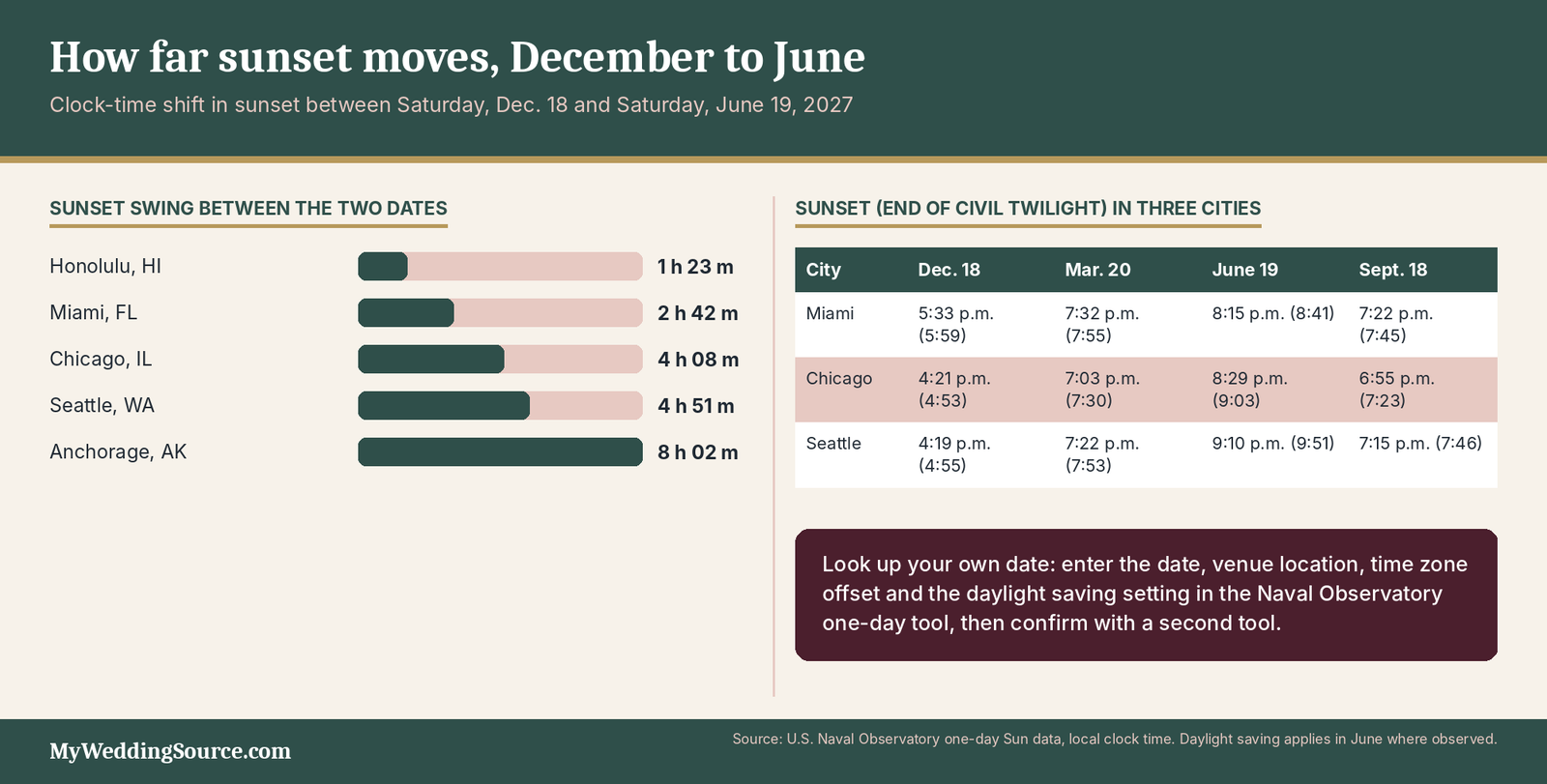
The table below uses the Naval Observatory’s one-day service to show sunset and the end of civil twilight for three cities on four Saturdays in 2027, in local clock time, with daylight saving time applied on the March, June and September dates (2027 daylight saving time starts March 14 and ends November 7). The dates are representative, not predictions for your day; use them to see the pattern, then look up your own. Read each cell as sunset first, with the end of civil twilight in parentheses, so you can see how long usable blue light lasts after the sun is gone.
| City (coordinates used) | Dec. 18 | Mar. 20 | June 19 | Sept. 18 |
|---|---|---|---|---|
| Miami, FL (25.76, -80.19) | 5:33 p.m. (5:59) | 7:32 p.m. (7:55) | 8:15 p.m. (8:41) | 7:22 p.m. (7:45) |
| Chicago, IL (41.88, -87.63) | 4:21 p.m. (4:53) | 7:03 p.m. (7:30) | 8:29 p.m. (9:03) | 6:55 p.m. (7:23) |
| Seattle, WA (47.61, -122.33) | 4:19 p.m. (4:55) | 7:22 p.m. (7:53) | 9:10 p.m. (9:51) | 7:15 p.m. (7:46) |
Reading the table, and the extremes
The swing between December and June is 2 hours 42 minutes in Miami, 4 hours 8 minutes in Chicago and 4 hours 51 minutes in Seattle, and those figures include the clock shift for daylight saving time. A Chicago couple marrying on December 18 has daylight from 7:13 a.m. to 4:21 p.m., about 9 hours, against about 15 hours on June 19. That is why a 5:00 p.m. ceremony is a daylight wedding in June and a night wedding in December, and why the right schedule for one season is wrong for the other. Our winter guide suggests starting a ceremony roughly 90 minutes to two hours before sunset when you want portraits in daylight, which is a useful rule of thumb in any season.
Latitude stretches the pattern. On the same two dates, Honolulu sunsets at 5:53 p.m. in December and 7:16 p.m. in June, a swing of 1 hour 23 minutes, with daylight of about 10 hours 50 minutes and 13 hours 26 minutes. Anchorage sunsets at 3:40 p.m. in December, with about 5 hours 28 minutes of daylight between sunrise and sunset, and at 11:42 p.m. on June 19, when the Observatory reports the sun continuously above the civil-twilight limit, so there is no end-of-twilight time to plan around. Hawaii does not observe daylight saving time, so its numbers do not shift with the clock.
Daylight saving time and the date trap
Daylight saving time begins on the second Sunday of March and ends on the first Sunday of November, according to the National Institute of Standards and Technology, and Hawaii, American Samoa, Guam, Puerto Rico, the U.S. Virgin Islands and most of Arizona do not observe it. For a wedding near a changeover weekend, check the sunset time on both the wedding date and the days around it, because the clock shifts an hour while the sunset moves only a minute or so per day. The first weekend of November is the sharp case: sunset jumps about an hour earlier on the clock overnight, and a schedule built the week before can be an hour off.
Low-light and indoor venues
Indoor ceremonies and dark reception rooms
Not every wedding has daylight to plan around. Cathedrals, ballrooms, barns with small windows and restaurants with dark wood and dim bulbs all limit what a photographer can do without flash, and many officiants and venues restrict flash during the ceremony. The questions worth asking are practical: Is flash allowed during the ceremony? How high and what color is the ceiling, since bounce flash needs a light, neutral ceiling? What are the room’s uplights and dimmers set to, and can the lights be raised for toasts and cake cutting? Our 30 questions to ask a wedding photographer includes how they handle low-light ceremonies.
After sunset, blue hour and the exit
Light does not stop at sunset. The stretch between sunset and the end of civil twilight has a soft blue-lit sky that works well for portraits with venue lights in the background, and the table above shows how long it lasts in each place: from about 23 to 41 minutes after sunset in the three cities listed. Some photographers book a short second portrait session during this window, which pairs well with a venue exterior or string lights.
A grand exit with sparklers or lanterns needs darkness to show, and it also needs the venue’s permission, so it often runs late in the evening. Check fire rules with the venue, tell the photographer where the exit will be so they can light it, and rehearse the route so guests are lined up before you walk out. If a night exit is on your list, make sure the coverage hours extend to that time rather than ending at the last dance.
Buffers, travel, weather and what makes the schedule slip
Buffer and travel rules
Where to put buffers, and how much
A buffer only works if it sits at the right place in the day. Photographers who publish sample timelines tend to say the same thing: put buffers before the events that cannot start without you and after the events that always run long. Hair and makeup almost always runs long, so one photographer adds 30 minutes to getting ready, and late starts to the ceremony are nearly universal, so the same source builds in a 15-minute buffer there.
| Where | Suggested buffer | Why | Basis |
|---|---|---|---|
| Getting ready | +30 minutes | Hair and makeup commonly runs long | Published photographer timeline |
| Before the ceremony | +10 to 15 minutes | Late starts are common | Published photographer timeline |
| Between locations | Drive time + 10 to 15 minutes | Loading, parking, walking, regrouping | Time-budget post; winter guide (15 minutes) |
| Family formals | +5 minutes per added request | Extra requests accumulate | Editorial judgment |
| Sunset portraits | Start 30 to 45 minutes before sunset | Light changes quickly | Published photographer timeline |
| End of coverage | 15 minutes of slack | Absorbs overtime without triggering charges | Editorial judgment |
Travel between locations
Travel buffers go beyond drive time. A photographer’s time-budget post says to include loading up, parking, walking and regrouping, not just the drive shown on a map, and to allow realistic buffers especially with a wedding party. Our winter wedding guide recommends adding at least 15 minutes to each winter drive, and the same logic applies to any season with heavy traffic, construction or weather. A 12-minute drive with a car full of dresses, boutonnieres and a 14-person party is not a 12-minute event.
Weather backups
Rain, heat and storms
Decide your weather triggers before the day and write them on the timeline. For storms, the National Weather Service’s rule is plain: when thunder roars, go indoors, because hearing thunder means you are likely within striking distance and no outdoor place is safe while thunderstorms are nearby. For heat, the NWS notes that everyone can be vulnerable to heat, with young children, older adults, people with chronic medical conditions and pregnant women at greater risk. In practice, that means shaded waiting areas, water for the wedding party during outdoor portraits and a plan to take family formals indoors if the afternoon is brutal.
Who decides, and by when
Weather backups fail at the decision point more than at the plan. Choose a deadline, such as two hours before the first outdoor block, and a person who makes the call, usually the planner or coordinator, and tell the photographer. Without a named decision-maker, the photographer waits for a verdict from a couple who are busy getting ready and a coordinator who is waiting on the couple. The cost of that loop is the first-look block, which is the one most dependent on dry ground.
What makes the schedule slip
The usual suspects
Timeline slips rarely come from one big failure. They come from small ones that compound: a late hair-and-makeup finish eats the first-look buffer, which pushes party portraits into family time, which pushes the ceremony, which shortens cocktail hour and the sunset window. Our wedding day timeline failure points guide describes this chain across every vendor, and its core point applies here: buffers that look generous on paper disappear as soon as the step before them runs behind.
The photography-specific causes are a short list. Family lists that grow on the day, relatives who cannot be found, party members who are late, locations that turn out to be farther apart than they looked, guests stepping into the aisle with their phones, and a ceremony that runs longer than rehearsed all consume portrait time. The table below pairs each with the block that pays and the fix.
| Cause | Block that pays | Fix |
|---|---|---|
| Hair and makeup run long | First look and couple portraits | Add 30 minutes or start 30 minutes earlier |
| Late ceremony start | Cocktail hour and sunset | Build a 10 to 15 minute buffer; assign a cue person |
| Family list grows on the day | Couple portraits | Freeze the list; one person says no to additions |
| Missing family members | Family formals | Name a wrangler; share the call time in advance |
| Long drive or parking problem | Portrait locations | Test the route at the same time of day |
| Guests with phones in the aisle | Recessional and ceremony | Ask for an unplugged ceremony or an officiant request |
| Toasts or dinner run long | Sunset portraits | Hold toasts until after the golden-hour window |
How to triage when you are behind
When the clock slips, the rule is to cut what is most replaceable and protect what is hardest to recreate. A reasonable order is extended-family groups first, then cocktail-hour candids, then secondary wedding-party combinations, and last the sunset portraits and the immediate-family formals. The time to decide this order is weeks before, with the photographer, so that on the day nobody has to negotiate it while hungry and in a dress.
What this actually costs: hours, overtime, second shooters and travel
The price layers behind a coverage package
Sticker price and the extras that surround it
Photography pricing is complicated, and that is not because photographers are hiding something; it is because the package is a bundle of hours, people, editing time and deliverables, and each can be priced separately. The Knot’s 2026 Real Weddings Study, based on 10,474 U.S. couples who married in 2025, puts the average photographer cost at $3,000, with a lower quartile of $1,500, a median of $2,800 and an upper quartile of $4,700. Regional averages in the same article range from $2,600 in the Southwest to $3,800 in the Mid-Atlantic. Zola’s Wedding Cost Index, which draws on Zola’s own data and does not state a sample, puts the national average at $4,400, so a gap between sources is normal. Neither figure is a quote for your market.
Overtime, second shooter, travel and delivery extras
Overtime ranges widely. Joy’s 2026 guide puts an added hour at about $200 to $500, with entry-level photographers at roughly $150 to $200 per hour and established ones around $400 to $600. Paperlust’s 2026 guide gives $150 to $300 per hour, and one Thumbtack package example lists an extra hour at $100. The spread reflects the market, the photographer’s hourly equivalent and whether overtime is billed per hour or in 15-minute increments. Ask for the exact rate in the contract rather than relying on a guide.
Second shooters are priced as add-ons from about $300 to $1,500 across sources: our second photographer and videographer cost guide puts the add-on at $300 to $900, Joy at $500 to $1,500 and Paperlust at $300 to $700, with about a third of photographers including one in the base price. Travel varies even more. Paperlust cites $0.50 to $1.00 per mile or a flat fee, with many photographers covering travel within 50 to 100 miles, and Joy puts destination travel, lodging and per diem at $1,000 to $3,000. The Knot adds that a travel fee usually covers transportation, food and accommodations and that you should ask whether your venue triggers one.
| Layer | Typical range | Source basis | What to ask |
|---|---|---|---|
| Average package | $3,000 (median $2,800) | The Knot 2026 study, 2025 weddings | What hours and deliverables does it include? |
| Zola index average | $4,400 | Zola 2026 article | Is the figure for a similar market? |
| Extra hour | $150 to $500 | Paperlust, Joy 2026 | Is it hourly or in increments? Who approves it? |
| Second shooter | $300 to $1,500 | Our guide, Joy, Paperlust | Is one included? Will the same person shoot? |
| Travel | $0.50 to $1.00 per mile; $1,000 to $3,000 destination | Paperlust, Joy 2026 | Where does the free radius end? |
| Rush delivery | $200 to $500 | Paperlust, Joy 2026 | New turnaround, and is it available in peak season? |
| Album | $500 to $2,000+ | Paperlust, Joy 2026 | Is the price locked and how many revisions? |
Making the tradeoff
Hours versus priorities: an illustrative example
Consider an illustrative couple, not a real one. They have a $3,000 eight-hour package, a 5:00 p.m. ceremony and a 10:00 p.m. reception end, and they would like a photographer to stay through the last dance. Two extra hours at an illustrative $300 per hour adds $600, and if the venue sits 60 miles beyond the photographer’s included radius, mileage at an illustrative $0.75 per mile for the 120-mile round trip adds $90. That brings the total to $3,690 before tip, about 23% above the sticker price. A second shooter at an illustrative $700 would add another $700 without extending the day and would push the total to $4,390, about 46% above the sticker price, which is within the ordinary range of add-ons but is the kind of surprise that is easy to avoid by asking.
Contract language that decides the final bill
Contracts differ, so read yours rather than assuming. Look at how overtime is triggered (by the clock, by the last photograph, or by the photographer’s discretion), whether it is billed per hour or per 15 minutes, whether it requires your approval in the moment and whether travel time counts toward coverage. Check what happens if a vendor delay, such as hair and makeup running late or a venue holding guests outside, pushes the schedule, and whether coverage is a fixed number of hours or a fixed window. Our photographer contract guide, linked earlier, covers cancellation, substitution, usage rights and backup equipment, and the Professional Photographers of America lists contracts as a member resource for photographers.
This section is general education, not legal or financial advice, and contract terms and state laws vary, so read your contract fully and get any ambiguous term clarified in writing before you pay a deposit. If the amount is large or the terms are unusual, a licensed attorney in your state can review it.
FAQ: wedding photography timeline questions
Booking and planning questions
How early should I book a wedding photographer?
For most dates, planning sources suggest 9 to 12 months ahead, and for popular Saturdays in June, September and October they suggest 12 to 18 months. Those are typical windows, and photographers fill calendars on their own schedule, so the only reliable answer is to ask for availability as soon as you have a date and a venue. If your wedding is closer than six months, contact several photographers at once and say so in the first message. A date is held only when the contract and retainer are in place.
When should I send my shot list and family list?
Start the lists about three months out, send a draft around six weeks before and lock the final version two to three weeks before the wedding. Individual photographers vary: some send a planning worksheet six weeks out, and others ask for the shot list two to four weeks out, so follow your own photographer’s instructions. The family list matters most, because it needs names, relationships and any sensitive situations settled with both families in advance.
How long does it take to get wedding photos back?
It varies by photographer and season. Examples in published guides include previews within 48 to 72 hours or the first week, full galleries in 3 to 6 weeks in one contract example and 6 to 12 weeks in another, and albums ordered months later. Get a delivery window and a remedy for missing it written into the contract, and ask whether peak-season weddings take longer.
Wedding-day questions
How many hours of coverage do I need?
Work backward from the blocks you want photographed. A single-venue wedding with a first look, family formals, a ceremony, dinner, sunset portraits and an hour or two of dancing usually lands near 8 hours, which Zola reports is the most common package length. Add getting-ready on both sides, a long reception or a send-off, and you are closer to 10. If your time sums to 6 hours or less, a shorter package may be enough.
How much time should I plan for family photos?
Published photographer guidance puts a basic family list at about 30 minutes, at roughly three minutes per grouping for small groups and four to five minutes for groups of more than four people. Keep the list to about ten groupings if time is tight, settle it with both families beforehand and name one person to bring relatives to the photo spot. Each unplanned request on the day costs time you will take from portraits or cocktail hour.
Do I need a first look to get golden-hour photos?
No, but it makes them easier. With a first look, couple portraits are done before the ceremony, so the sunset window can be a short, relaxed session. Without one, you can still step away for 20 to 25 minutes before sunset, provided the ceremony and dinner timing leave room, which is a good reason to look up your sunset time before choosing a ceremony start. In winter or at high latitudes, where the sun sets early, plan the ceremony earlier or add a first look.
Your next steps
This week
Look up your sunset time and draft your blocks
Use the Naval Observatory tool or timeanddate.com to find sunset for your wedding date and venue, then write it at the top of a one-page timeline. Build the schedule backward from it: sunset portraits 30 to 45 minutes before, ceremony and cocktail hour before that, and portraits and getting ready before the ceremony. Add the buffers from this guide and see how many hours the day needs.
Ask for availability and a sample timeline
Send an inquiry to your top photographers with your date, venue, guest count and the rough hours you expect to need, and ask for their typical delivery window, overtime rate and a sample timeline for a day like yours. Compare answers apples-to-apples using the questions in our guide to what to ask a wedding photographer.
Before you pay a deposit
Confirm hours, overtime and delivery in writing
Check that the contract states the coverage hours and how they are counted, the overtime rate and who approves it, the travel terms, the delivery window for previews and the gallery, how long the gallery stays online and what happens if the photographer is unable to attend. This is general education rather than legal advice, and terms and state laws vary, so ask for clarification in writing and consider an attorney’s review for large or unusual terms.
Calendar every deadline
Put the payment dates, the shot list and family list deadlines, the final headcount, the timeline-sharing date and the expected delivery dates on a shared calendar with your partner and your planner. Ask your photographer when their planning worksheet arrives and hold yourself to the same dates. A schedule that lives in calendars is much harder to lose than one that lives in an email thread.
Sources & methodology
- The Knot: Average cost of a wedding photographer — $3,000 average, quartiles, regional averages and travel-fee note from the 2026 Real Weddings Study (10,474 U.S. couples married in 2025).
- The Knot: Is there an off-season for weddings? — peak-season share (76%, May through October), seasonal and monthly shares.
- Zola: How much does a wedding photographer cost? — $4,400 index average, package tiers and typical hours of coverage.
- Zola: Wedding planning checklist — booking, engagement photo, shot list, headcount and vendor-confirmation timing.
- Paperlust: Wedding photographer cost (2026) — overtime, second shooter, travel, album, delivery and lead-time ranges.
- Joy: Wedding photographer cost (2026) — coverage hours by guest count, overtime, second shooter, travel, album and rush ranges.
- Thumbtack: Wedding photographer prices — hourly and package examples, high-season booking note.
- FotoOwl: Photography contract clauses (2026) — example deposit schedule and preview and final delivery windows.
- James Stokes Photography: Wedding photography timeline — sample 10-hour timeline, buffers and golden-hour guidance.
- Malachi Westbrook: Time needed for wedding photos — time budgets per photo block and buffer advice.
- Genevieve Nisly: Family photos and Susan Stripling: Family photos — grouping time, list preparation and worksheet timing.
- Maroo: First look versus no first look — portrait time with and without a first look; the cited Zola 2025 figure is secondhand.
- U.S. Naval Observatory: Sun and Moon data for one day and definitions of rise, set and twilight — sunset and civil-twilight data and definitions.
- NOAA Solar Calculator and timeanddate.com — alternative sunset lookup tools and their stated limits.
- NIST: Daylight saving time — U.S. daylight saving time rule and places that do not observe it.
- Wikipedia: Golden hour (photography) — definition and variation with latitude.
- National Weather Service: Lightning safety and Heat safety — storm and heat guidance for outdoor portraits.
- U.S. Copyright Office: Photographers — default copyright ownership in photographs.
Methodology: Sunset and civil-twilight times are verified data from the U.S. Naval Observatory service, queried in October 2026 for the listed 2027 Saturdays and rounded to the minute, and daylight-saving-time dates follow the NIST rule. Prices, booking windows and delivery windows are survey findings or industry guide ranges from the sources above, labeled as typical and not as quotes. The sample schedules, buffer rules, planning numbers and the cost example are editorial illustrations built from published photographer guidance.
Freshness note: Recheck The Knot and Zola cost figures when the next Real Weddings Study and Zola index publish (typically early each year), recheck lead and delivery windows with each photographer at the time of booking, and recompute sunset and daylight-saving dates for your own wedding date and venue before you finalize any timeline.