Marriage License vs Marriage Certificate: What Couples Need to Verify
Couples ask about marriage license vs marriage certificate more often than almost any other legal question in wedding planning, and the confusion is understandable. The two words get used interchangeably in casual conversation, on wedding blogs, and sometimes even by vendors who should know better. They are not the same document, they do not serve the same purpose, and mixing them up can genuinely delay a wedding or a name change afterward.
This guide is built as a verification framework, not a nationwide rulebook. Marriage law in the United States is set state by state, and often county by county within a state. A specific fee, waiting period, or filing rule that is accurate in one place can be wrong just across a state line. Rather than presenting invented numbers as fact, this article explains the concepts that hold true everywhere. It shows real examples of how much the details differ, and gives you the exact questions to bring to your own local issuing office. This is general information, not legal advice. Every specific rule mentioned here should be confirmed directly with your state, county, or city authority before you rely on it.

Marriage License vs Marriage Certificate: The Core Difference
Get this distinction right and almost everything else in this guide falls into place.
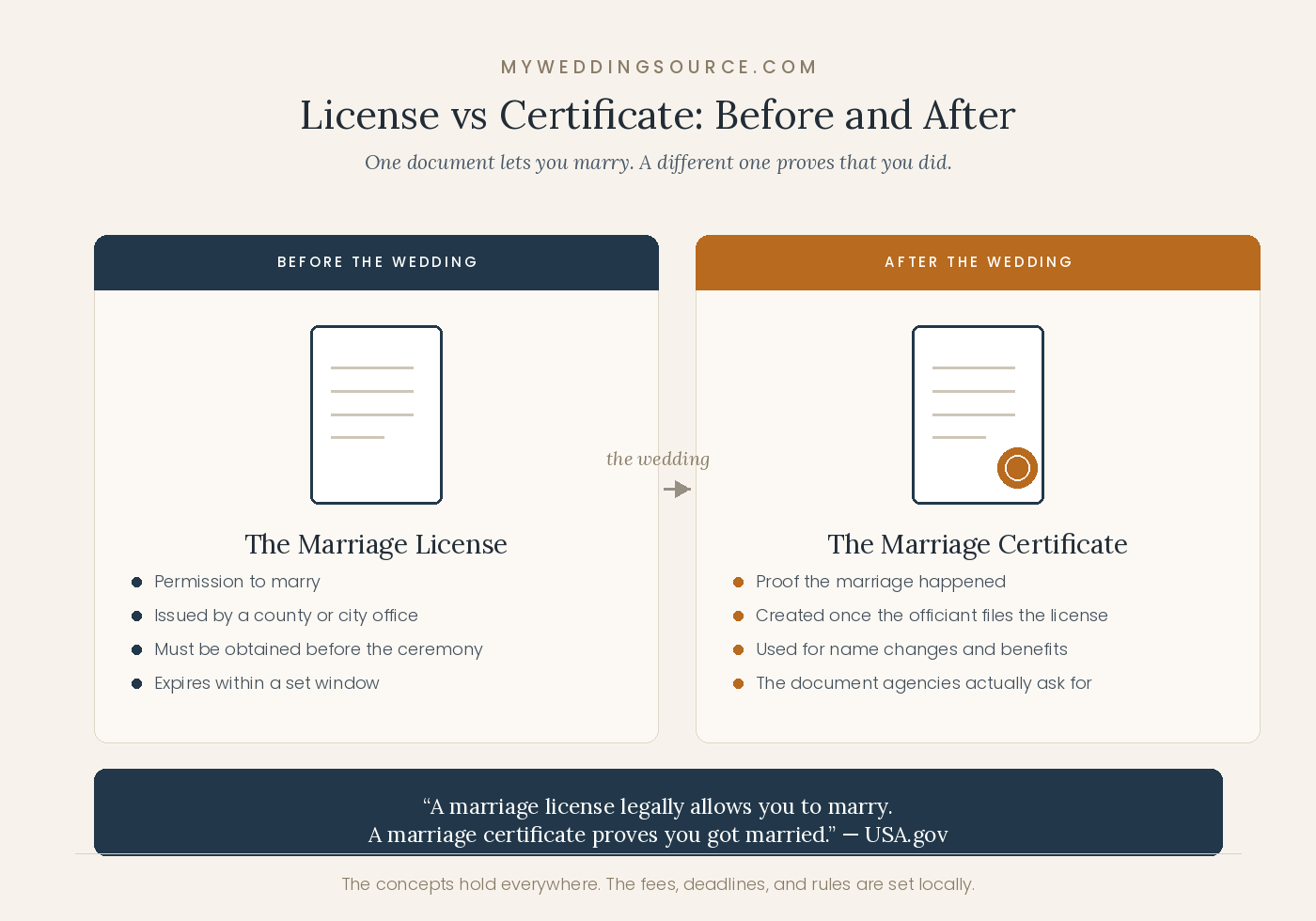
A marriage license, defined
A marriage license is permission, issued before your wedding, that allows you to legally marry. You apply for it from a local government office, typically a county clerk, city or town clerk, or in some states a state-level office. You generally cannot get married without one already in hand. A license by itself does not mean you are married. It only means you are authorized to hold a ceremony.
A marriage certificate, defined
A marriage certificate is proof that a wedding actually happened. It exists only after your ceremony, once your officiant returns the completed, signed license to the issuing office and that office files it as an official record. The certificate is what you show later to change your name, add a spouse to insurance, or satisfy an immigration, tax, or benefits requirement.
The U.S. government’s own consumer guidance puts the distinction plainly: a marriage license legally allows you to marry, while a marriage certificate proves you got married. That single sentence is the cleanest summary available, and it holds true in every state even though the paperwork around it does not.
Why the sequence matters
License comes first. Ceremony comes second. Certificate comes last, and only after the office receives the properly completed and signed license back from whoever performed your ceremony. Skip or delay any step, and the next one cannot happen. This is the single most common source of wedding-day paperwork panic, and it is entirely avoidable once you understand the order.
Marriage Law Is a State Matter, Not a Federal One
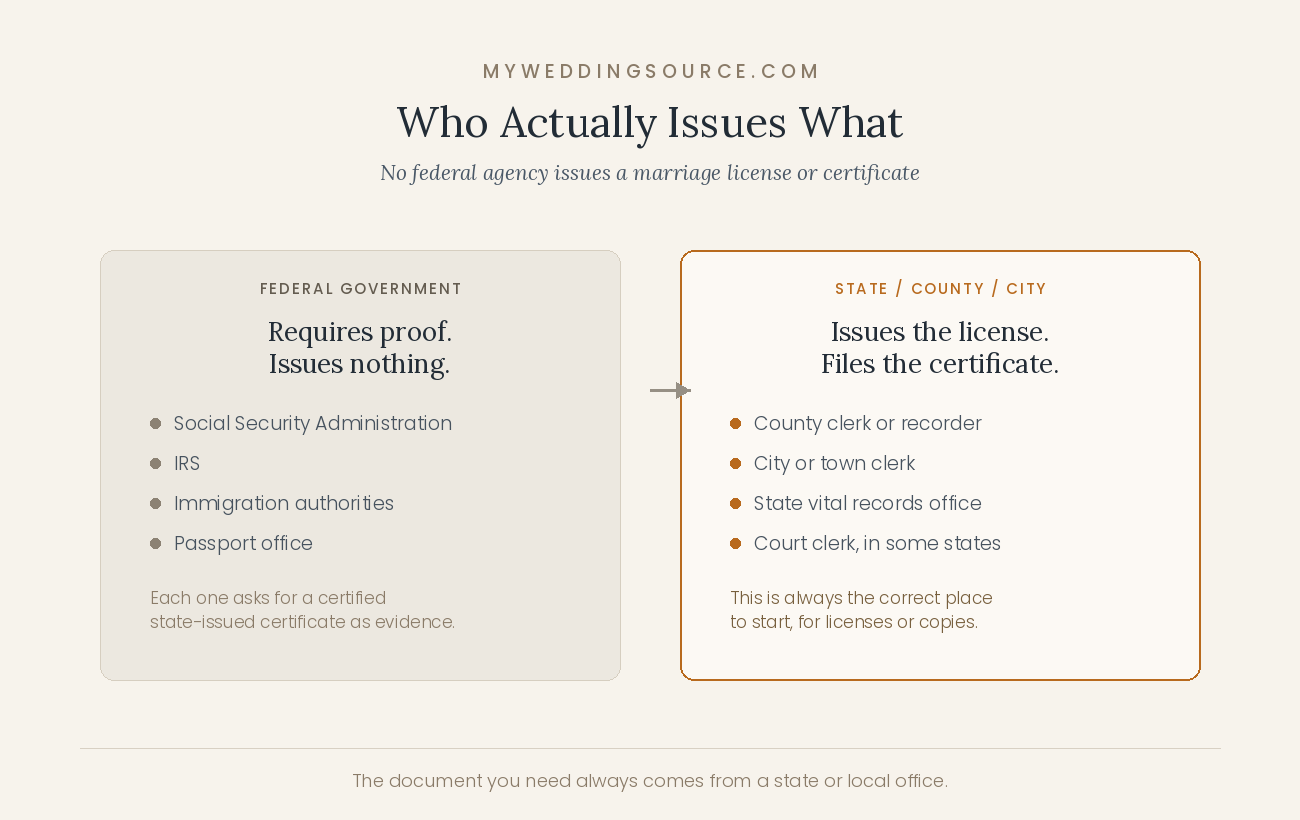
No federal agency issues a marriage license or a marriage certificate. The federal government recognizes marriages that states perform, but it does not perform the actual licensing itself.
What the federal government does and does not do
Federal agencies care very much that you are married. The Social Security Administration wants proof before it updates your name. The IRS wants proof before you file jointly. Immigration authorities require it as evidence in family-based petitions. Every one of these agencies asks for a certified copy of a state-issued marriage certificate, because none of them issue one themselves. The document you need for federal purposes still comes from a state or local office, not from Washington.
Why “the rule in my cousin’s state” does not apply to you
Fifty states, the District of Columbia, and several U.S. territories each set their own marriage laws independently. Some require a waiting period between application and ceremony. Others do not. Some set a license validity window of thirty days. Others allow up to a year. Even within a single state, individual counties can run their own application systems, fee schedules, and office hours. A friend’s experience in another state is interesting context, and it is not a reliable source for your own paperwork.
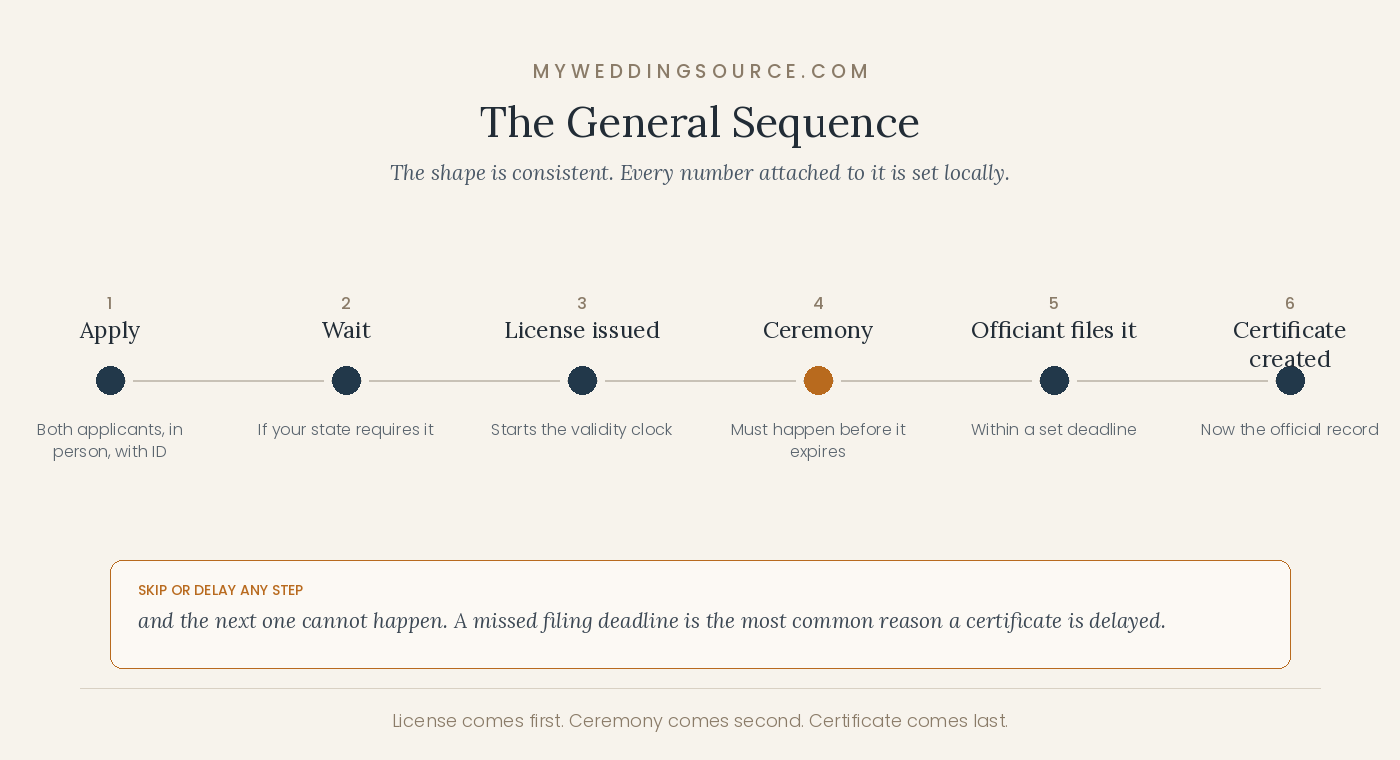
The General Sequence, and Why Every Step Varies Locally
The overall shape of the process looks similar almost everywhere. The specific numbers attached to each step are where local law takes over.
Applying for the license
Both people applying typically need to appear together, in person, at the issuing office, though a small number of jurisdictions allow exceptions for absent applicants under specific conditions. You will need government-issued identification. Depending on the state, you may also need proof of age, proof of any prior divorce or the death of a former spouse, and payment of an application fee.
Waiting periods, where they exist
Some states require a set number of days to pass between applying and marrying. Others allow same-day licensing. This is one of the most frequently misunderstood rules in the entire process, precisely because it splits so unevenly across the country. It is not something to assume either way without checking.
The license’s expiration window
Most marriage licenses expire within thirty days to a year, depending on the issuing state, according to federal consumer guidance. If your ceremony happens after the license expires, the license is no longer valid and you will need to reapply, sometimes paying the fee a second time. Confirm your specific expiration date the day you receive the license, and mark it somewhere you will actually see it.
The ceremony and who may perform it
States set their own rules for who qualifies as an authorized officiant. These rules vary more than most couples expect, including how they treat religious officiants, judges, notaries, and friends ordained through online ministries. Confirm your specific officiant qualifies under your state’s rule before the ceremony, not after, since an improperly performed ceremony can create real problems with the certificate later.
Returning and filing the license
After the ceremony, your officiant is typically responsible for signing the license and returning it to the issuing office within a set number of days. Some states also require signatures from a set number of witnesses. Miss this filing step, and no certificate gets created no matter how real your wedding was.
When the certificate becomes available
Processing time after filing ranges from same-day in some offices to several weeks in others. Ask this specific question at the time you apply for your license, so you know what to expect rather than guessing during a stressful post-wedding stretch of paperwork.

Real Examples of How Much This Varies
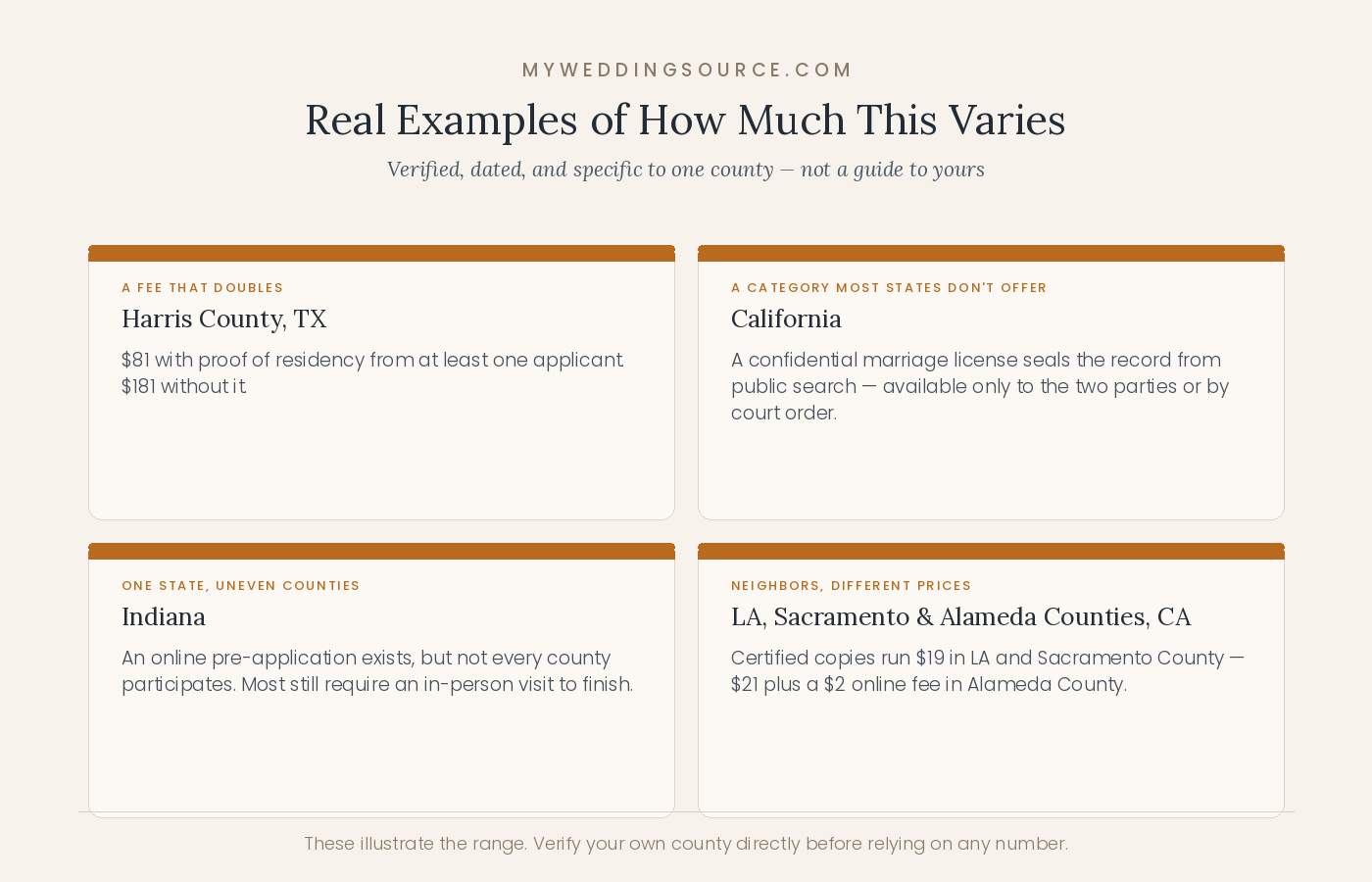
These are genuine, sourced examples from specific counties, verified as of August 2026. They illustrate how much detail can differ. They are not a guide to your own location, even if you happen to live nearby.
A fee that changes based on residency
In Harris County, Texas, the marriage license application fee is $81 with proof of state residency from at least one applicant. Without it, the fee is $181, according to the county clerk’s office. A couple who assumes one flat statewide fee, without checking residency documentation requirements, can be surprised by more than double the cost at the counter.
A state-specific legal category most couples don’t know exists
California offers something most other states do not: a confidential marriage license, a legally distinct category from a standard public marriage license. A confidential marriage record is sealed from public search. It can generally only be obtained by the two parties to the marriage or by court order, unlike a standard public record that other authorized parties can access. Couples who want extra privacy around their marriage record have a real choice to make, if they meet the state’s eligibility rules for this option. Most other states never offer it at all.
County-level variation within a single state
Indiana offers an online marriage license pre-application system, but participation is not universal. Not every Indiana county participates in the online process, and completing the online form does not itself issue the license or collect the fee. Couples still finish the process in person at a participating county office. Assuming any state-level system applies uniformly to every county inside that state is a mistake this example illustrates clearly.
Certificate copy fees vary even between neighboring counties
Within California alone, certified marriage certificate copy fees differ by county. Los Angeles County and Sacramento County both charge $19 per certified copy. Alameda County charges $21 per copy plus a separate $2 online convenience fee. None of these numbers apply outside their specific county, and they can change without much public notice. That is exactly why this guide does not attempt a comprehensive fee table.
Why the Office You Need Might Have an Unexpected Name
Searching “marriage license vs marriage certificate office near me” sends some couples to the wrong department entirely. The name of the correct office is not consistent nationwide.
Common names for the same function
Most states use a county clerk or county recorder. Some use a city or town clerk instead, particularly in New England. A handful of states route marriage records through a Register of Deeds, a Prothonotary, or an Orphans’ Court, terms that sound unrelated to marriage at all. Search your state’s official government website directly rather than guessing from a generic search result, since the wrong office wastes a trip.
State-level vital records offices serve a different purpose
A state vital records office usually handles certified copies of already-filed certificates. It rarely issues the original license. Know which office does which job before you show up, so you are not sent back and forth between two departments on the same day.
If One of You Is Not a U.S. Citizen, or You Married Abroad
Marrying in the United States as a non-citizen does not require a special marriage visa. The state licensing process works the same way for citizens and non-citizens applying together.
What changes for identification and documentation
Non-citizen applicants typically need a valid passport and may need additional identity documents, depending on the state. Confirm accepted forms of ID with your specific issuing office in advance, since requirements here vary as much as everywhere else in this process.
If your wedding happens outside the U.S.
A marriage performed abroad follows that country’s laws, not U.S. state law. To use that marriage for U.S. purposes afterward, you generally need a certified copy of the foreign marriage document, sometimes with a certified translation. The U.S. Department of State, not a state vital records office, handles questions about foreign marriage documentation and any related certification needs.
How to read your state’s official website correctly
Government sites are not always organized the way a couple expects. Marriage license information sometimes sits under “Vital Records,” sometimes under “County Clerk Services,” and sometimes under a court system’s own site entirely separate from the county government’s main page. Look for a .gov domain specifically. Many commercial sites rank highly for marriage license vs marriage certificate searches without being official sources at all. Some charge processing fees far above what the actual government office charges for the same document.
Watch for lookalike commercial sites
Several private companies build websites that look official and offer to “process” your marriage certificate request for a service fee on top of the government’s own price. These are not illegal, and some genuinely save people a trip. They are also not the same as the government office itself, and the price difference can be substantial. If a site does not end in .gov and does not clearly disclose that it is a private intermediary, verify the actual government fee separately before paying anything.
A religious ceremony alone does not create a legal marriage
Many couples assume that a religious ceremony, on its own, makes a marriage legally official. In the United States, it does not. The legal marriage happens through the state’s licensing and filing process, regardless of whether a ceremony is religious, civil, or a blend of both. A religious ceremony performed without an underlying valid marriage license does not create a legal marriage in the eyes of the state. That holds even if the license is never properly filed afterward, and even if the ceremony is deeply meaningful to the couple and their community.
Some couples hold two ceremonies on purpose
It is entirely common, and entirely legal, to have a small civil ceremony to satisfy the legal requirement on one date. A larger religious or cultural ceremony can follow on another date, carrying the emotional and community significance instead. Confirm with your officiant and your issuing office how this affects your license timing if you are considering this route. The legal ceremony still needs to happen within your license’s specific validity window.
Documents to Verify Before You Apply
Confirm this list directly with your specific issuing office, since requirements differ by state and sometimes by county.
- Government-issued photo identification for both applicants, and confirm which forms are accepted.
- Proof of age, if either applicant is close to the state’s minimum marriage age.
- Divorce decree or death certificate, if either applicant was previously married, and confirm how recent the document needs to be.
- Social Security number, required by many states on the application, though not always by the document itself.
- Proof of residency, which some offices use to set the application fee, as the Harris County example above shows directly.
- Payment method accepted, since many government offices do not accept all card types or personal checks.
A Practical Timeline
| When | Action |
|---|---|
| 2–3 months before | Contact your issuing office directly. Confirm fee, required documents, waiting period, and license validity window. |
| 4–8 weeks before | Gather documents. Confirm your officiant is authorized under your state’s specific rules. |
| Within the license’s validity window | Apply in person if required. Note the exact expiration date. |
| Wedding day | Bring the physical license. Confirm officiant and witnesses sign correctly, on the spot. |
| Within days after | Confirm your officiant has filed the license with the issuing office by the deadline. |
| Weeks after | Order certified copies of your certificate once the office confirms it is on file. |
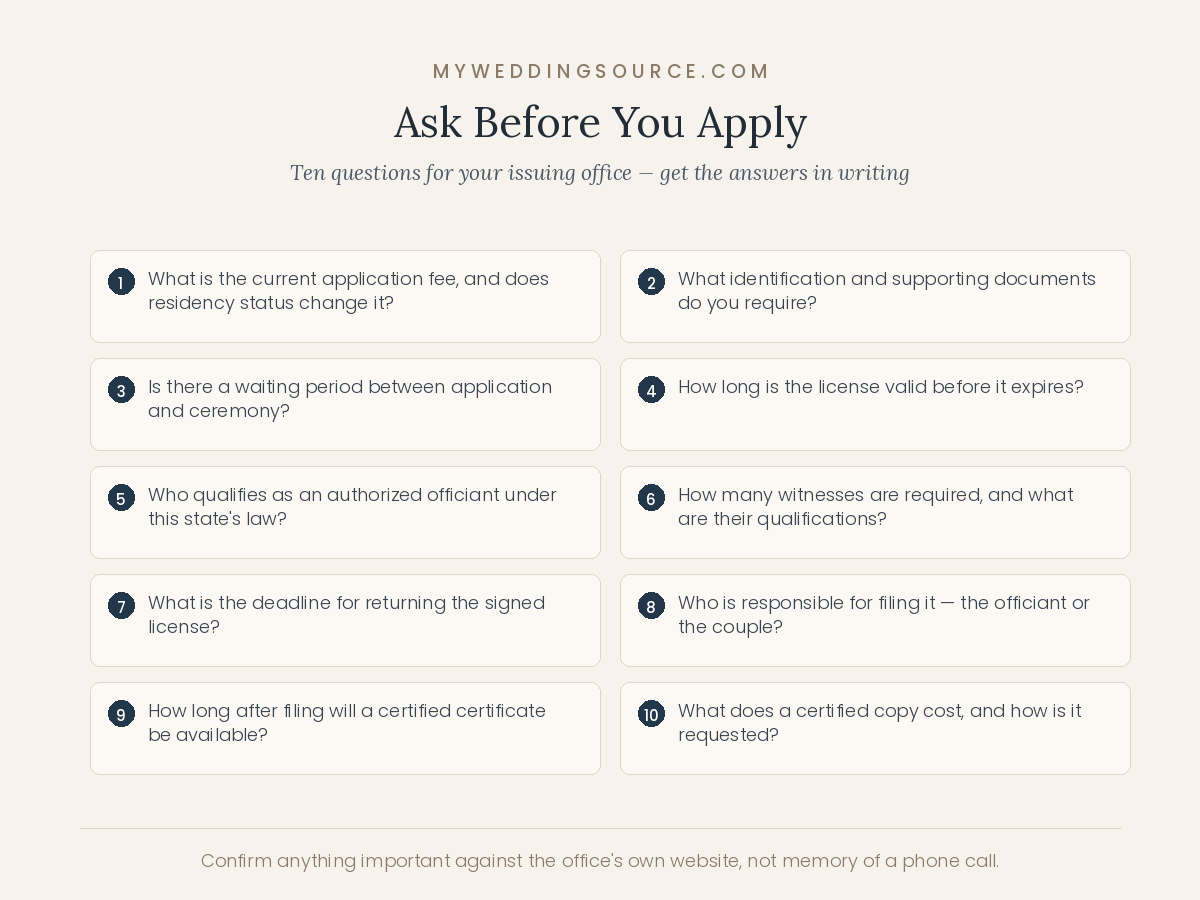
Questions to Ask the Issuing Authority
- What is the current application fee, and does residency status change it?
- What identification and supporting documents do you require?
- Is there a waiting period between application and ceremony?
- How long is the license valid before it expires?
- Who qualifies as an authorized officiant under this state’s law?
- How many witnesses are required, if any, and what are their qualifications?
- What is the deadline for returning the signed license after the ceremony?
- Who is responsible for filing it — the officiant, the couple, or either?
- How long after filing will a certified certificate be available?
- What does a certified copy cost, and how can it be requested?
Get it in writing where you can
Phone answers are useful for a first check. Written confirmation from an official government website or a printed office handout protects you, though, if a detail turns out to have been wrong. Screenshot or print anything you are relying on, with the date you checked it.
Marriage equality and application paperwork
Same-sex couples have the same legal right to marry nationwide, and the license and certificate process works identically regardless of the couple’s gender composition. One practical wrinkle still shows up occasionally: some older application forms use “bride” and “groom” fields rather than neutral language. This does not change your legal rights. If a form only offers outdated fields, ask the office how to complete it accurately, since most have a standard workaround already in place.
Using Your Certificate for a Name Change
Once you have certified copies in hand, most name changes follow a fairly predictable order.
- ☐ Social Security Administration, typically first — most other updates depend on this one
- ☐ State driver’s license or ID card
- ☐ U.S. passport, if you hold one
- ☐ Bank accounts and credit cards
- ☐ Employer records and payroll
- ☐ Insurance policies, including health, auto, and life
- ☐ Voter registration
Confirm whether each institution needs an original certified copy or accepts a photocopy, since policies differ. This is exactly why ordering more than one certified copy at the outset saves real time later.
Marriage license vs marriage certificate: which one do agencies actually ask for?
Almost every institution listed above wants the certificate, not the license. The license did its job the day you got married. From that point forward, the certificate is the document that proves your marital status to anyone who asks. Keep this distinction in mind when an office says “bring your marriage paperwork” without specifying which document, since asking them to clarify saves a wasted trip.
After the Wedding: Getting Your Certified Certificate
Where to request a copy
Contact the vital records office in the state, or the specific county office, where your license was issued and filed. Federal consumer guidance confirms this directly. For a marriage that took place in the U.S., the vital records office in the state of marriage is the correct place to start. That office can tell you the cost, what information it needs, and whether copies are available online, by mail, or in person.
How many copies to order
Order at least two certified copies at the outset. Name changes at the Social Security Administration, the DMV, a passport office, banks, and employers often each want to see an original certified document. Mailing your only copy to one agency can stall every other errand on your list until it comes back.
Certified versus informational copies
Many offices issue two versions of a certificate. A certified copy is usable for legal identity purposes such as a name change. An informational copy shows the same details but is explicitly marked as not valid for establishing identity. Confirm you are ordering the certified version if you need it for legal purposes, since the cheaper informational copy will not work for most of them.
Keep a simple paperwork record for yourselves
Write down the county or state office name, the date you applied, and the license number if one was given. Note the date it was filed after your ceremony too. Store this alongside your certified copies. Decades later, a certificate can get misplaced, or an institution asks for details you no longer remember. This small record saves a genuinely frustrating search through old boxes and email accounts.
Common Mistakes
Assuming a friend’s state rules apply to you
Waiting periods, fees, witness rules, and license validity windows all vary by state. What your cousin experienced two states over tells you nothing reliable about your own paperwork.
Letting the license expire before the ceremony
Most licenses expire somewhere between thirty days and a year after issue. Mark the exact date, and apply with enough runway before your wedding date rather than right up against a deadline.
Assuming any officiant qualifies
Officiant rules differ by state, and an improperly performed ceremony can create real problems when it comes time to file for a certificate. Confirm your specific officiant’s status before the wedding.
Not confirming who files the license afterward
Someone has to physically return the signed license to the issuing office within a set window. Confirm in advance whether that responsibility falls to your officiant or to you, so it does not fall through the cracks.
Ordering only one certified copy
Multiple institutions will each want to see an original. Order at least two certified copies to avoid a bottleneck during your name-change process.
Confusing an informational copy with a certified one
An informational copy typically cannot be used to prove identity or complete a legal name change, even though it shows the same information as a certified copy.
Treating a phone call as a final answer
Staff can make mistakes or give outdated information. Confirm anything important against the office’s official website or a printed handout, and keep a record of what you were told and when.
Assuming “common-law marriage” removes the need for a license
A small number of states recognize common-law marriage, a legal marriage formed without a license or ceremony, under specific and fairly strict conditions. Most states do not recognize it at all. Even in states that do, the requirements are more demanding than most people assume. Simply living together for a long time is rarely enough on its own. Do not assume this applies to you without confirming your specific state’s rule directly. Acting on a mistaken assumption here can create real complications with benefits, taxes, or property later.
Frequently Asked Questions

What is the actual difference between a marriage license vs marriage certificate?
A marriage license is permission to marry, issued before your ceremony by a state or local government office. A marriage certificate is proof that the marriage happened, created only after your officiant returns the signed license and the office files it. You need the license before the wedding and the certificate after it, and confusing the two is the most common paperwork mistake couples make.
Does the federal government issue marriage licenses?
No. Marriage licensing is handled at the state and local level in the United States, typically through a county or city clerk’s office. Federal agencies such as the Social Security Administration, the IRS, and immigration authorities all require proof of marriage for their own purposes. None of them issue the license or the certificate themselves. That document always comes from a state or local source.
How long is a marriage license valid?
It depends entirely on your state. Federal consumer guidance notes that most licenses expire somewhere between thirty days and a year after issue, but the exact window is set individually by each state. Confirm your specific expiration date directly with your issuing office at the time you apply, and mark it clearly so your ceremony date falls safely inside that window.
Is there a waiting period between applying and getting married?
In some states, yes; in others, no. This is one of the details that varies most sharply across the country, and there is no reliable national rule to fall back on. Confirm directly with your issuing office whether a waiting period applies in your state, and factor it into your timeline if it does.
Who is responsible for filing the marriage license after the wedding?
In most places, the officiant who performed the ceremony is responsible for signing the license and returning it to the issuing office within a set deadline. The exact responsibility and timeframe still vary by state. Confirm this specific detail with your officiant and your issuing office before the wedding, since a missed filing deadline can delay or complicate getting a certificate afterward.
How soon after the wedding can we get a certified copy of our marriage certificate?
Processing time varies by office, ranging from same-day availability in some places to several weeks in others. Ask this question directly when you apply for your license. Follow up with the issuing office after your wedding to confirm the license has been filed before you attempt to order a certified copy.
Can anyone qualify to officiate our wedding?
No, and this is one of the more commonly misunderstood rules. States set their own qualifications for who may legally perform a marriage ceremony. These rules vary in how they treat religious officiants, judges, notaries, and people ordained through online ministries. Confirm your specific officiant’s eligibility with your issuing office before the wedding, not after.
Do we need witnesses at our ceremony?
Some states require a specific number of witness signatures on the marriage license; others do not require any. Confirm this directly with your issuing office, and if witnesses are required, make sure they meet any age or relationship qualifications your state sets before the ceremony begins.
What is a confidential marriage license, and do we need one?
A small number of states, including California, offer a confidential marriage license as a legally distinct option from a standard public license. It seals the record from public search and is generally accessible only to the two parties or by court order. Most couples do not need this option. It is worth knowing it exists, though, if privacy around your marriage record matters to you. Confirm with your specific state whether it is offered and what eligibility it requires.
What should we do if we lose our marriage certificate?
Contact the vital records office in the state where you were married, or the specific county office if your state handles records at that level. They can tell you the cost and process for a replacement certified copy. Keep a note of which office and county issued your original license, since you may need that information to request a replacement years later.
What if we need proof of a previous divorce to apply?
Many states ask whether either applicant has been previously married. Some require a copy of the final divorce decree or the former spouse’s death certificate as part of the application. Requirements around how recent that document needs to be, and whether a certified copy is required, vary by state. Confirm this specific requirement with your issuing office well before your planned application date. Requesting an old divorce decree from a different state’s court system can take longer than expected, and starting early gives you room if the document turns out to be harder to track down than you assumed.
Can we apply for our marriage license online?
Some counties offer an online pre-application, but this rarely replaces the entire process. As the Indiana example in this guide shows, completing an online form often still requires an in-person visit to finish the application, pay the fee, and receive the physical license. Confirm directly with your specific county whether online pre-application is available, and exactly what still requires an in-person appointment.
Finding your specific state’s vital records office
The CDC’s National Center for Health Statistics maintains a public tool called “Where to Write for Vital Records,” listing the official vital records office for every state and territory. It is a reliable starting point when a general search turns up too many unofficial results. From there, most state pages link directly to the specific county or city offices that actually issue licenses and process applications, which is the level of detail this entire guide has been pointing you toward from the start.
What happens if our officiant forgets to file the license?
Contact the issuing office as soon as you realize the deadline has passed. Some offices allow a late filing with an explanation or a small fee, while others may require additional steps to establish that the marriage occurred. This is exactly why confirming, in advance, who is responsible for filing and by when matters so much. A quick check with your officiant a day or two after the wedding, rather than assuming it has been handled, catches this problem while it is still easy to fix.
Verify With Your Own Issuing Authority Before You Act
The concepts behind marriage license vs marriage certificate hold true everywhere: a license grants permission before your wedding, and a certificate proves it happened afterward. Almost every specific number attached to that process is set locally — fees, waiting periods, expiration windows, witness rules, officiant qualifications. Each one genuinely varies from one state, and sometimes one county, to the next.
Use the framework in this guide to know exactly what to ask. Bring those questions directly to your state or county issuing office, rather than relying on a friend’s experience, a generic checklist, or a number that happened to be true somewhere else. Confirm each answer in writing where you can, and reconfirm anything time-sensitive close to your actual wedding date, since rules and fees do change.
Treat this article the way it is intended: a map of the questions worth asking, not a substitute for the answers only your local office can give. The couples who avoid paperwork stress are rarely the ones who found a perfect universal rule online. They are the ones who called their own courthouse early, wrote down what they were told, and built their wedding timeline around real, current, local information.
Your next step
Find your state or county issuing office’s official website today. Confirm three things directly from that source: the current fee, whether a waiting period applies, and how long your license will remain valid once issued. Those three answers set the entire rest of your paperwork timeline.