

Wedding food donation means moving properly handled, never-served food from your caterer to a local receiver that agreed to take it before the wedding day. This guide gives you a four-gate check, a one-page hand-off card and a worked example, so the plan still works at ten o’clock on a Saturday night.
Treat wedding food donation as four gates that must all be open: the food itself (never served, held at a safe temperature, packed and labeled), the caterer (willing, equipped and staffed to pack it), the receiver (accepts prepared food, is open when you finish, can say yes in writing) and the clock (a short, driven route from kitchen to receiver). If any gate is closed, do not improvise. Switch to a smaller wedding food donation or a different plan before the wedding, and give the caterer and the receiver the same one-page hand-off card.
Almost every couple who cares about waste says the same thing about the food: “We will donate whatever is left.” It is a kind thought and a poor plan. Wedding food donation succeeds when it is arranged weeks ahead, with named people, and fails when it depends on goodwill at the end of a long night. The food is real, the need is real, and the barriers are practical: temperature rules, container supply, staff hours, a receiver whose doors are locked and a driver who is not available.
This guide is about those practical barriers. It does not argue that you should donate, and it does not promise that you can. It helps you find out, in an organized way, whether a wedding food donation is possible at all, what your caterer and a local receiver must confirm before you count on it, and what to do when the honest answer is “not this time.” The worked example later in the guide uses an invented couple, and every number in it is an assumption for illustration, not a statistic.
A note on scope. This is general information, not legal, tax or financial advice, and food-safety rules differ by state, county and receiver, so the final word always belongs to your local health department and the organization taking the food.
Why wedding food donation fails without a plan
A restaurant that donates surplus food does it as routine, on a Tuesday, with the same staff, the same containers and the same pickup driver every week. A wedding is the opposite. It happens once, ends late, involves a caterer who may be working in a kitchen they have never used, and leaves the hosts exhausted. Almost everything that makes routine food recovery easy is missing.
Look at what the evening actually looks like. The kitchen finishes service around the time the dancing starts. The leftover trays are still warm, then cooling, and the clock on their safe time is running. The receiver, if it is a pantry or a meal program, closed hours ago. The caterer’s team is breaking down equipment and wants to go home. The couple is somewhere between the dance floor and the car. The venue wants the space cleared. In that setting, even people with the best intentions will throw the food away, because nobody owns the job.
So the first principle of wedding food donation is that it needs an owner who is not the couple. That can be the caterer’s event manager, a coordinator, a friend with a clear assignment or a family member who is not in the wedding party. The person needs a written plan, a phone number for the receiver and permission from the caterer to be in the kitchen at the right time. The hand-off card described later in this guide is built for exactly this person.
The second principle is that some of the barriers cannot be negotiated away. Prepared food that sits at room temperature for too long is a food-safety problem no matter how generous the reason for saving it. Receivers know this, and many of them have rules that look strict from the outside. Those rules protect the people who eat the food. A good plan works inside them instead of arguing with them.
The third principle is honesty about scale. Wedding food donation is one step in a longer ladder. The U.S. Environmental Protection Agency describes a food recovery hierarchy that begins with reducing the surplus in the first place, then feeding people, then feeding animals, then industrial uses, then composting, and only last disposal. A wedding food donation that happens because the caterer overproduced is better than a landfill, but it is not as good as a menu and headcount that leave less surplus to begin with.
If you have not yet looked at that upstream work, the wedding waste reduction plan on this site walks through the whole audit from catering to cleanup, and the wedding menu planning guide covers portion and headcount decisions. This article starts after those decisions, when you already know you will have a surplus and want it to go somewhere useful.
What counts as success
Before you plan anything, define what “done” looks like, because it changes how much work you take on. There are three honest outcomes.
The first is a full wedding food donation: a substantial amount of prepared food, packed during service, driven to a receiver that was waiting for it. This is the hardest and the most visible, and it requires all four gates.
The second is a partial wedding food donation: a smaller, safer slice of the food, such as unopened packaged items, bread, whole fruit, wrapped desserts or a single hotel pan that the kitchen held aside from the start. This is much easier and often more realistic.
The third is a documented no-go: you checked, you learned that your caterer, venue or local receivers cannot take prepared food on your date, and you chose another path, such as a smaller menu overage, a staff meal policy or a compost arrangement. A documented no-go is not a failure. It is the result of a plan that worked, because it found the barrier before the wedding instead of at midnight.
Where this guide stops
Several nearby topics belong elsewhere. How to reduce food waste through portion sizing is a menu question. How to separate compost, recycling and trash at the venue is a waste-stream question. Whether a vendor contract lets you take leftovers home is a contract question, and the wedding vendor contract guide covers what to read before you sign. What remains here is the narrow job of making a wedding food donation safe, possible and written down.
The four-gate check for wedding food donation
Every wedding food donation depends on four things being true at once. Think of them as gates in a row. The food has to pass all four to reach a person who can eat it. If a gate is shut, the food stops there, and nothing downstream matters.
Gate one is the food. Is the food the kind a wedding food donation can include, and has it been handled in a way that keeps it that way? The answer depends on whether it was ever served, how it has been held, how it is packed and whether it is labeled for the people who will receive it.
Gate two is the caterer. Will your caterer actually pack the food, with their own staff, on their own time, in containers that meet the receiver’s needs? Have they done it before? Do they have a policy, an insurance position or a fee that affects the plan?
Gate three is the receiver. Does a local organization accept prepared food from events, is it open when you finish, can it handle the volume and has someone there agreed in writing, by text or email, to take it on your date?
Gate four is the clock and the route. Can the food go from kitchen to receiver inside the safe time window, with a named driver, a vehicle that keeps hot food hot and cold food cold and a backup if the first plan falls through?

How to score each gate
For every gate, use three simple states. Green means confirmed: a named person said yes, and you have it in writing. Amber means likely but unconfirmed, or confirmed with a condition you still need to meet. Red means no, or unknown after you asked. The rule is deliberately plain.
All four green: you have a Go. Plan the day around it.
Any amber: you have a Conditional. Write down the single action that would turn it green, who does it and by when. If the action does not happen by the deadline, the amber becomes red.
Any red: you have a No-go for the full plan. Do not try to carry the food through a closed gate on the day. Move to the partial wedding food donation or the alternative plan described later.
The scoring is useful because it prevents the most common failure, which is a wedding plan with three green gates and one that everybody quietly assumes will work out. A wedding food donation plan that has a hole in it feels almost complete, and that feeling is what leads to a trunk full of warm pans on the way to a locked door.
The order matters
Work the gates in a particular order. Start with the receiver, not the food, because the receiver’s rules define what is possible. If the nearest pantry takes only packaged goods, then the effort you might have spent arranging hot-food holding is wasted, and you should know that on day one. Then move to the caterer, because the caterer can tell you what is realistic in their kitchen. Then check the clock, which depends on both. Finally, confirm the food list for the actual menu, because that list can only be settled once the menu is.
This order is the opposite of how most couples think about it. The instinct is to start with the leftovers and ask who will take them. The better question is who can take food, on what terms, and what does that mean for the menu and the kitchen. The rest of this guide follows the gates in the order that makes your work easiest: food first for understanding, then the caterer, receiver and clock for the actual confirmations, then the hand-off card that ties them together.
Gate one: which food qualifies for wedding food donation
The first gate decides what could ever be part of a wedding food donation. It sounds like a simple sorting job, and in practice it is the part where most plans quietly shrink. A couple imagines forty pounds of chicken and pasta. The receiver’s rules, the caterer’s handling and the clock turn that into a few pans, some bread and a box of wrapped desserts. Knowing the likely outcome early is a favor to everyone, including you.
The never-served rule for wedding food donation
The single most useful rule in wedding food donation is this: food that was never served has a chance, and food that was served almost never does. “Served” is broader than people expect. It covers food on a buffet line, food on a station, food in a basket placed on a guest table, food that was passed on trays during cocktail hour and then came back, and anything on a plate. All of it has been exposed to hands, breath, room temperature and time, and receivers generally refuse it for that reason.
Food that never left the kitchen is different. A pan of roasted vegetables that stayed in a warming cabinet, a tray of rice still under foil, a cold salad that remained in a walk-in cooler: these were under the caterer’s control from preparation to packing. That is the category receivers can usually evaluate, because the caterer can say how it was cooked, how it was held and when.
This rule has an awkward consequence for buffets. A buffet is built to put lots of food in front of guests, and the pans on the line are exactly the ones that count as served. What helps is a two-tier setup. The kitchen holds back a defined number of pans, at proper temperature, and refills the line from them as needed.
Whatever remains in the back at the end of service is the wedding food donation candidate, while whatever remains on the line is not. That arrangement has to be agreed with the caterer before the wedding, because it changes how they cook and how they refill. The buffet-style flow described in the reception guest flow guide shows how lines and refills are normally timed, which helps you picture where the held-back pans fit.
Some receivers will consider buffet food that has been held with time and temperature logs, and some local health departments allow it under conditions. Others will not touch it under any condition. Do not assume. Ask the receiver and write down the answer. The safe default is no.
Three bins: likely, ask first and no
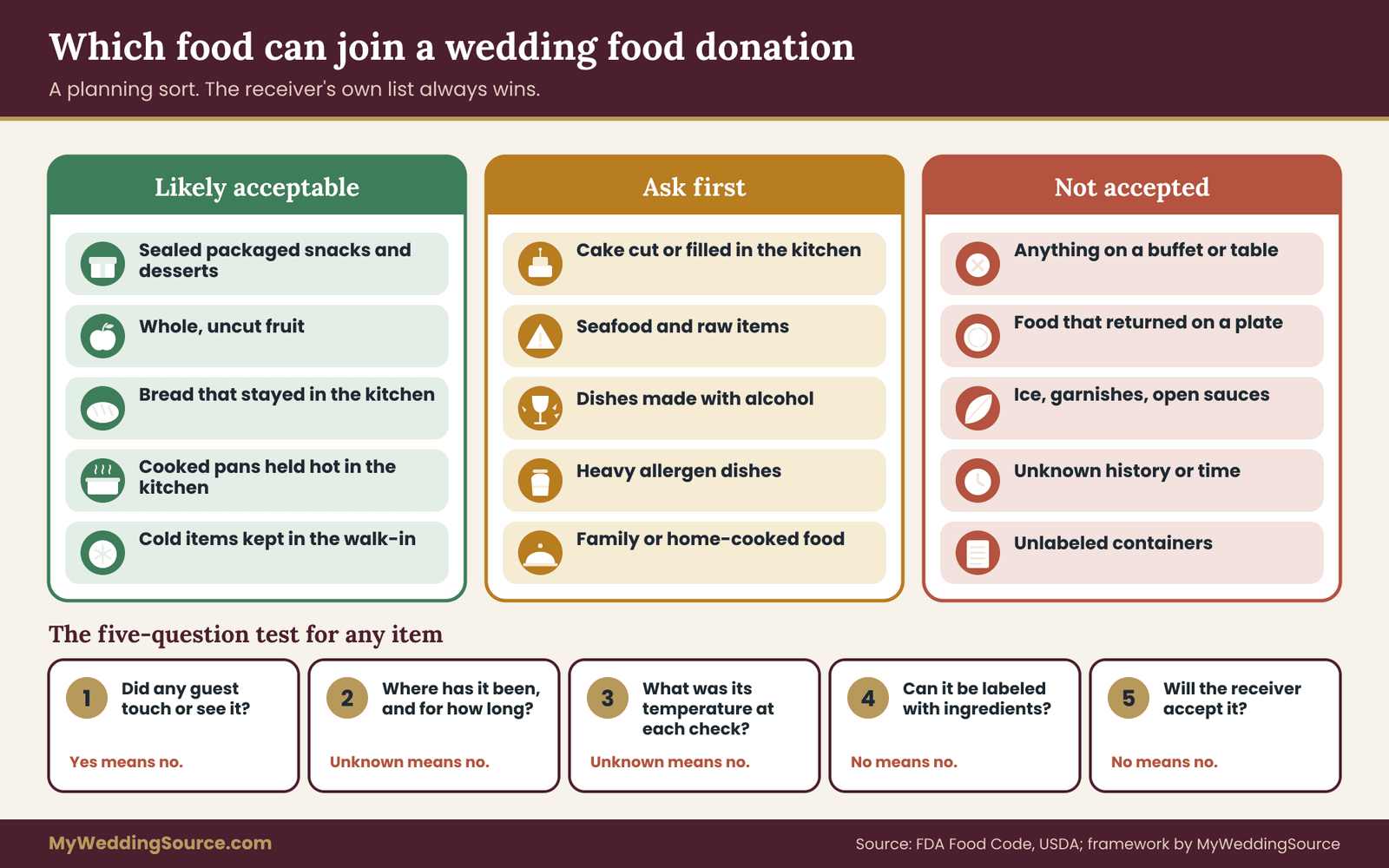
A practical way to sort food is into three bins. The bins are not rules of law. They are a planning tool, and the receiver’s own list always overrides yours.
Likely acceptable, if the receiver takes prepared food at all. Sealed packaged items such as crackers, snacks, bottled water and wrapped desserts. Whole, uncut fruit. Bread and rolls that stayed in the kitchen. Cooked entrees, starches and vegetables that were held in the kitchen at safe temperatures or cooled correctly, then packed in clean containers. Cold items that stayed in the walk-in cooler, such as salads without dressing mixed in, deli-style trays that were never put out or sealed dairy items.
Ask first. Cake and pastries cut or decorated in the kitchen, especially anything with cream, custard or fresh fruit filling. Items with raw or lightly cooked ingredients, such as raw bar items, sushi or dishes with eggs that are not fully cooked. Seafood in general, because it is both perishable and a major allergen. Dishes with several of the major allergens. Anything cooked with alcohol. Items that came back from a kitchen that was not the caterer’s own, such as a family member’s contribution.
No. Anything guests touched or took from. Food from tables, stations, buffet lines or plates. Garnishes and ice. Open condiments and sauces that were set out. Anything with an unknown history. Anything held outside the safe temperature range for longer than the time window allows. Anything that cannot be labeled with its contents.
Why home-cooked dishes usually do not make the cut
Weddings often include food made by relatives: a grandmother’s pastries, an aunt’s rice dish, a family’s traditional sweets. These dishes can be the heart of the meal, and it is natural to want any extras to go to a good cause. Most receivers will not accept them.
Home kitchens are not inspected the way commercial kitchens are, ingredient lists and allergen information are often incomplete, and the receiver cannot verify the handling. If food from a family kitchen is part of your wedding, plan for the leftovers to go home with family, and keep the wedding food donation plan focused on the professionally prepared food.
The wedding cake question
Cake is where couples most often hit an unexpected wall. The display cake that guests cut from has been out, handled and cut in public, so it falls in the “served” group. A sheet cake that the caterer or baker kept in the kitchen for cutting and plating is a different matter, and a few receivers will accept it as a baked good, particularly if it is plain and fully covered.
Cakes with buttercream usually travel better than cakes with whipped cream or custard, which need refrigeration. The top tier saved for an anniversary is a personal keepsake and usually not a wedding food donation question at all.
If cake in your wedding food donation matters to you, ask the baker and the caterer who handles the kitchen cake, whether it can be boxed whole, and whether a list of ingredients is available. Then ask the receiver whether it takes baked goods and how it wants them packed.
Temperature rules behind wedding food donation
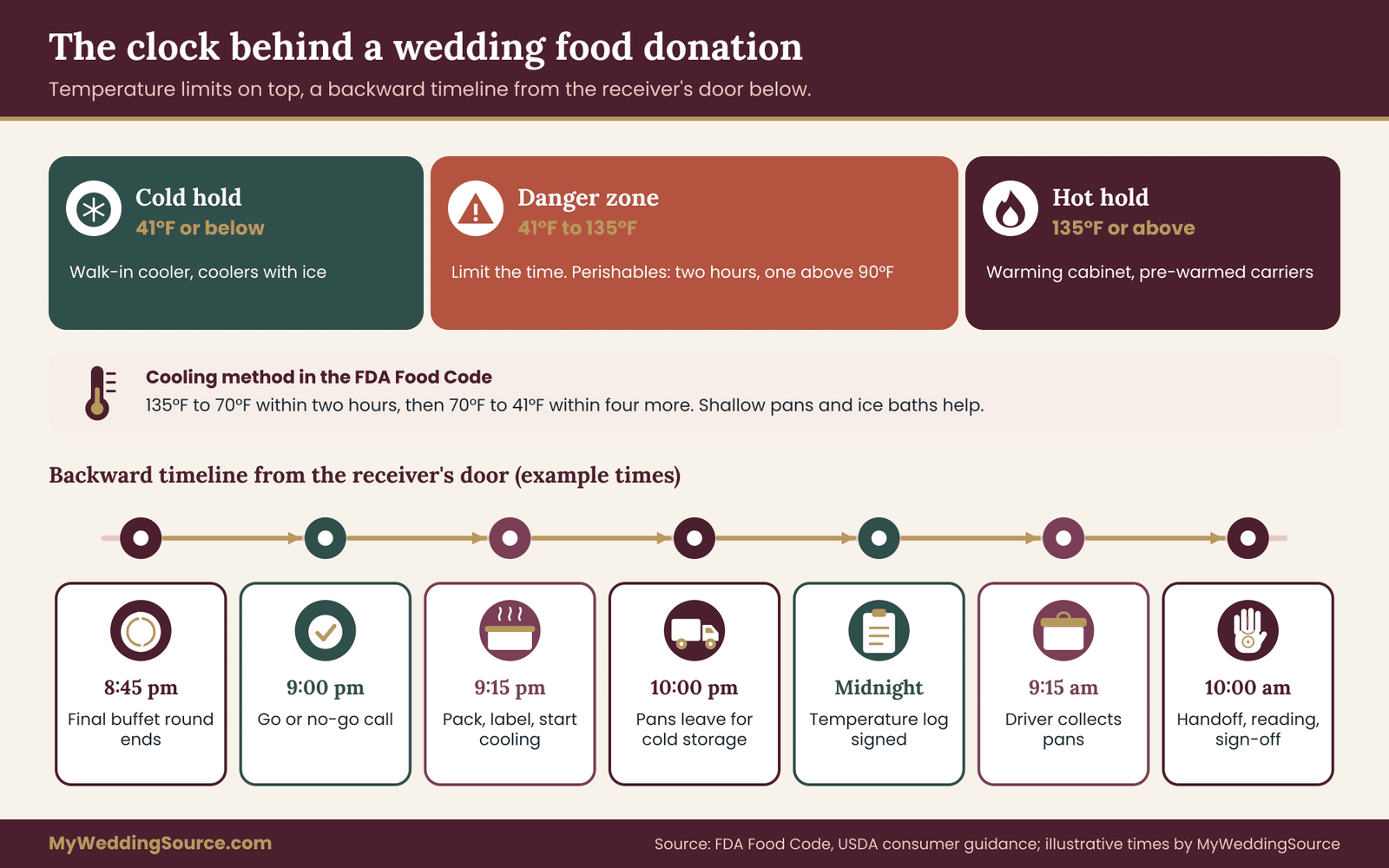
Receivers think about food in terms of temperature and time, and you should too. Two published baselines are worth knowing. The FDA Food Code, which many state and local health departments use as the basis for their rules, sets cold holding at 41°F or below and hot holding at 135°F or above for foods that need time and temperature control.
The USDA’s consumer guidance describes a “danger zone” from 40°F to 140°F and advises that perishable food should not sit out for more than two hours, or one hour when the surrounding temperature is above 90°F. The numbers are close but not identical. Many receivers pick the stricter figures, and some set their own.
For you, the point is not to memorize the numbers. It is to agree with the caterer and the receiver on which numbers apply, to make sure someone has a working probe thermometer, and to record readings. A simple log works: item, time, temperature and initials, taken when the food is pulled from service and again when it is packed. If a receiver asks “what was it when you packed it?” and the answer is “we think it was fine,” that is a red flag, not a plan.
Cooling matters just as much as holding. Food that is not going to be donated hot has to be cooled, and it has to be cooled quickly. The Food Code’s published cooling method asks for food to go from 135°F to 70°F within two hours and then from 70°F to 41°F within another four.
Large pans of dense food, like pasta or rice, cool slowly because the middle stays hot. Shallow pans, smaller portions and ice baths help, and a caterer who cooks for events will have a method. Ask what it is. A deep stockpot of rice placed in the walk-in cooler at midnight is not cooling fast enough, no matter how cold the cooler is.
Reheating is usually the receiver’s job, and many food-safety guides ask for leftovers to be reheated to 165°F. You do not need to manage it. You do need to label what you hand over so the receiver knows what was cooked, when and at what temperature it was packed.
Packing and labeling for wedding food donation
Containers for a wedding food donation should be clean, food-grade, shallow enough for quick cooling and covered. Disposable aluminum hotel pans with lids are common, as are lidded plastic deli containers for smaller items. Plastic wrap alone is not enough, because it slips in transport. Ask the receiver whether it wants specific sizes or has strict rules about reusable versus disposable containers.
Each container should carry a label with the name of the dish, the date and time it was packed, the caterer’s name, whether it should be kept hot or cold and a list of ingredients. The major food allergens in the United States are milk, eggs, fish, shellfish, tree nuts, peanuts, wheat, soy and sesame, and any container with one of them should say so plainly.
A label does not need to be elegant. Masking tape and a marker are fine if the information is complete and legible. A container with no label is, in most receivers’ eyes, a container they cannot accept.
A five-question test for any item
When you are not sure whether an item belongs in the wedding food donation plan, ask five questions about it. Did any guest touch, see or take from it? Where has it been, and for how long? What was its temperature each time someone checked? Can it be labeled with its ingredients and allergens?
Will the receiver accept this kind of item? A “no” to the first question, an unknown answer to the second or third, or a “no” to the last two means the item stays out. The rule is blunt on purpose, because any unknown in food safety is treated as a hazard.
Try it on four items from a hypothetical menu. Roasted chicken thighs that stayed in a warming cabinet in the kitchen: no guest touched it, the caterer can name the holding temperature, and it can be labeled, so it passes if the receiver takes prepared meat.
A green salad in a large bowl on the buffet: guests touched it, so it fails the first question. Dinner rolls in baskets on the tables: served, so they fail. A box of individually wrapped lemon bars that never left the kitchen: sealed, unserved and easy to label, so they pass for most receivers that accept baked goods.
Deciding the wedding food donation portion in advance
The last piece of gate one is a number. Decide with the caterer how many pans or portions will be held back for the wedding food donation, and when that decision is final. Caterers are understandably cautious about this. Their reputation depends on not running out of food, and a buffet that looks thin in the last hour is a worse outcome for them than a pan of surplus.
A fair compromise is to define the wedding food donation portion as what remains in the kitchen after the last table has been served, rather than a fixed share that is held back from the start. That keeps the guests’ meal safe and still creates a pool of food that never reached a table.
Put the agreement in plain words and in writing: “After the final buffet round, any pans that remain in the kitchen, held at the agreed temperature, will be packed for donation.” That sentence does more work than a general promise to “try to donate leftovers,” because it names what counts, when it counts and who decides.
Gate two: what your caterer must confirm for wedding food donation
Your caterer is the center of the plan. The caterer controls the food, owns or rents the equipment that keeps it hot and cold, employs the people who can pack it and decides when those people go home. A receiver can be enthusiastic and a venue can be flexible, but if the caterer is not on board, wedding food donation does not happen.
The good news is that many caterers already handle food donation and have a routine. The less good news is that a caterer who has never done it for a wedding may agree in principle and not realize how much work it adds to the end of the night.
Know which kind of caterer you have
The right questions depend on the kind of food service you hired, because the same request means very different things.
A full-service caterer brings a kitchen team, equipment and servers, and usually stays until the main service is finished. This is the easiest case, because the people who handled the food are the people who can pack it.
A venue’s in-house catering team or a hotel banquet department often works under corporate policies. Some hotels have standing arrangements with food rescue organizations and will happily include your wedding. Others forbid taking food off the premises for reasons the banquet manager may not be able to change. Ask for the policy by name, and ask who has the authority to approve an exception.
A drop-off caterer delivers food in pans and leaves. There is no one on site to hold, pack or log the food after delivery, so a wedding food donation would depend on your own people doing it, with your own containers and thermometers. That is possible for packaged or shelf-stable items. It is a poor fit for hot or cold prepared food.
A food truck or restaurant serving off-site may have its own surplus routine at its home location. Ask whether leftovers go back to their kitchen, because that can be a better path than packing them at the venue.
A family-style or self-catered meal is outside what most receivers will take. See the earlier note on home kitchens.
The eight confirmations for wedding food donation
Whatever kind of caterer you have, eight points need a clear answer. Treat them as one conversation, ideally in person or on a call, followed by a short email that records what was said.
One: policy. Does the caterer donate surplus food as a normal practice? If yes, which organization do they work with, and is that organization open to taking food from your date? A caterer’s existing receiver is often the best option, because the intake routine already exists. If the caterer has never donated, ask whether they are willing to try and whether there is a company policy or an insurer’s rule that prevents it.
Two: the hold-back method. How will unserved food be held until packing, at what temperature, in what equipment and who will check? You are not auditing the kitchen. You want to hear a specific answer, such as “hot items stay in the warming cabinet at 140°F, cold items stay in the walk-in, and our lead checks every thirty minutes,” not a vague assurance.
Three: packing. Who packs the wedding food donation, at what point in the evening and in what containers? Packing takes real time, often thirty to forty-five minutes for a modest amount of food, and it competes with breakdown tasks. Make sure packing falls inside the hours your contract already covers, or ask what extra staff time costs.
Four: containers and labels. Who supplies lidded, food-grade containers and labels, and are there enough? Some caterers have supplies on hand. Others expect you to buy them. Either is workable if you know in advance. Ask whether the receiver has container preferences and pass them along.
Five: records. Will the caterer provide a temperature and time log and an ingredient and allergen sheet for each donated item? Many already have recipe sheets for allergen compliance. A log can be as simple as a page on a clipboard.
Six: liability and insurance. Does the caterer’s insurance policy or company policy affect wedding food donation, and does the caterer want anything in writing from the receiver or from you? The federal Bill Emerson Good Samaritan Food Donation Act limits civil and criminal liability for donors and nonprofit recipients who act in good faith, and it names caterers among the covered donors, with an exception for gross negligence and intentional misconduct.
It does not replace safe handling, and state laws add their own details. A caterer who says “our insurance carrier asked us not to” has given you a real answer. A caterer who says “we are not allowed” without explaining may only be unsure. Ask kindly for the reason and who decides.
Seven: transport and handoff. Will the caterer deliver to the receiver, or will a driver you arrange collect from the kitchen, loading area or truck? Where exactly does the handoff happen, who signs for it and what vehicle and carriers keep the food at temperature? This point connects directly to the fourth gate.
Eight: fallbacks. What happens if the menu changes, if the headcount drops, if there is very little surplus or if the receiver cancels the night before? A caterer who has thought about this will have an answer. A caterer who has not will at least understand why you are asking.
Costs and who pays
Wedding food donation is usually described as free, and it is not. There are small costs in containers, labels, thermometers, packing labor, transport and sometimes an administrative fee. A caterer who donates routinely may absorb these. A caterer who does not may bill them, or may decline. Ask plainly: “Is there a charge for packing donation food, and what would it include?” Then write down the figure, so it appears in your budget alongside other line items. The wedding budget guide explains how to keep those small items from getting lost.
Tax treatment is a separate question and depends on the caterer’s business structure and records. Do not promise anyone a deduction, and do not ask your caterer to produce a receipt that is bigger than the truth. If the topic comes up, point the caterer to their own accountant.
Put the wedding food donation agreement in writing
Verbal promises about wedding food donation have a short life. The person you spoke to may not be the one working your event, and the end of the night is not a good time to discover what was agreed. Ask for a short written addendum to the catering contract, or at minimum a confirming email.
The addendum should name the wedding food donation arrangement, the kind of food covered, the hold-back method, who packs and when, who supplies containers, the cost and the handoff plan. If you want to read more about what belongs in a catering agreement, the catering contract guide walks through the clauses worth checking, and the vendor due diligence checklist covers how to verify that a caterer’s licensing and insurance are current.
A simple model for the clause is one sentence: “After the final service round, the caterer will pack surplus food that was never served, held at the agreed temperatures, into labeled containers and make it available at the venue loading area at the agreed time for pickup by the named receiver.” Adapt it, have your caterer edit it and keep it short. A clause that nobody can follow at midnight is no better than silence.
Venue rules that sit behind the caterer
The venue is the invisible partner in this gate. Some venues restrict what leaves the building, set a hard cutoff for vendors to exit or require that all food-related items be removed from the kitchen by a certain hour. Others have only a small shared refrigerator, or no after-hours access for a driver.
Ask the venue three questions. Can food be packed and taken out of the building by a receiver’s driver, and where should the driver park or meet your team? Is there cold storage that can hold wedding food donation items overnight if the receiver opens in the morning? What time does the building lock?
If the venue has an exclusive caterer, the venue’s catering manager is often the person who decides. In that case, treat the venue’s catering manager as the caterer for this gate.
What to say: a short script
Many couples find these requests awkward, so here is a plain way to put it. In the first call, something like: “We would like to donate surplus food that was never served, as long as it can be done safely. Do you have a donation process, and if not, what would it take?” After the call, in writing: “Thank you for talking this through.
To confirm, you will hold back the pans listed in the menu in the warming cabinet, record temperatures, pack them into labeled containers after the final buffet round and make them available at the loading entrance by ten fifteen for pickup. The cost is as quoted. Please correct anything I have wrong.”
Notice what these scripts do not do. They do not ask the caterer to do something that creates risk for them, and they do not assume a yes. They ask for a process and then write it down.
Reading the answer
A few answers deserve a closer look. “We take care of leftovers” with no detail means the gate is amber at best. “We never donate, it’s a liability issue” means you should ask whether a smaller version, such as sealed packaged items, is acceptable, and then respect the answer.
“We donate to a local organization we have used for years” is a good sign, and your next step is to call that organization and confirm your date. “Our staff takes it home” is common and fine, but it is not wedding food donation, and you should know the difference when you describe your wedding later.
A caterer who says no has not failed you. Many have sound reasons, from insurance conditions to health inspector guidance to a bad past experience. The respectful move is to thank them, ask if any part of the plan is possible and move on to the alternatives later in this guide. Pushing a reluctant caterer to donate is how food safety corners get cut.
Gate three: what a local receiver must confirm for wedding food donation
The third gate is the one couples most often skip, because it feels presumptuous to call an organization and ask whether it wants your leftovers. It helps to flip that around. A receiver that runs on volunteers, limited storage and a tight schedule cannot use a surprise.
What it can use is a clear, early, specific offer from someone who understands its rules. A call that says “here is what we may have, here is when, and here is how it will be packed” is a gift. A van that shows up at the back door at eleven o’clock with twenty warm pans is a problem.
Not every receiver handles wedding food donation the same way
Local organizations that receive food are not interchangeable, and the differences decide what you can offer. The following descriptions are typical patterns, not rules. Each organization sets its own policy, and your local health department sets the limits, so treat the list as a way to ask better questions.
Food banks are usually warehouse-based and supply other agencies. Many take packaged goods and produce at scale, and some have refrigerated storage and trucks. Prepared food from a single event is often outside their normal intake, and their hours tend to be weekday business hours.
Food pantries hand out groceries directly to households. Many have limited cold storage and take mostly packaged or shelf-stable items. Prepared food is uncommon, though some pantries partner with a kitchen or a rescue group.
Meal programs and community kitchens serve prepared meals on a schedule. They are often the most natural home for cooked food from an event, because they already handle hot food and have people to serve it. The timing, though, has to fit their meal service, and they may need to know exactly what the food is and how it was held.
Shelters with kitchens may accept prepared food from licensed caterers, depending on their policies and the rules their licensing places on them. Some use food only from approved sources.
Food rescue organizations and matching services connect donors with nearby receivers and sometimes supply volunteer drivers. Coverage varies a great deal by city. In some places an evening pickup is routine. In others the service runs only for restaurants and grocery stores on weekdays.
Community fridges and similar public programs exist in some cities. They are often unsupervised, so organizers may not want large amounts of prepared food from events. Some have posted rules on what may and may not be left. Ask before assuming they are a good fit.
Faith-based programs, senior meal sites and school programs sometimes take donated food, and sometimes cannot because of their licensing. The only way to know is to ask.

How to find candidates
Start with your caterer, who may already have a relationship. Then use local resources. Dialing 211 connects many callers to a local information and referral service that can point to pantries and meal programs near you. Your county or city health department can tell you which wedding food donation rules apply and sometimes keeps a list of organizations that accept event food.
The U.S. Department of Agriculture and the Environmental Protection Agency both publish material on food recovery for donors, and your state may have a food recovery or hunger-relief coalition with a donor guide. Faith communities and neighborhood associations often know which programs are active and which are not.
Aim for three names. You will probably talk to all three, because the first may not take prepared food, the second may be closed on your date and the third may be the one that works. Then choose a primary and a backup.
Questions to ask a receiver
These are the questions that decide whether Gate Three is green. Ask them in a call, then confirm the answers in a text or email.
Do you accept prepared food from events? If the answer is no, ask whether you can offer packaged items, bread or whole produce instead, and stop there for the prepared foods.
Which categories can you take? Cooked meat, dairy, cooked rice and pasta, salads, baked goods, desserts and cold items may each have different rules. Ask about any category in your menu that carries higher risk.
What temperature rules apply at intake? Some programs check temperature with a probe at the door and refuse food outside range. Others ask for how long ago it was cooked. Ask what the number is and who measures it.
When can you receive food on my date? Be exact. If your wedding is on Saturday, find out whether anyone is available on Saturday night or on Sunday morning, and whether overnight cold storage by the donor is acceptable to them.
Do you pick up, or do we deliver? If they pick up, find out from where, with what kind of vehicle and with what notice. If you deliver, find the entrance, the contact person and the hours.
How much can you handle? Both a minimum and a maximum matter. A small program with a small refrigerator may be able to take four pans and no more. A larger program may not bother with less than ten.
How do you want it packed and labeled? Ask about container type and size, labeling and whether you may leave the containers or must take them back.
What paperwork do you need? Some receivers ask for a record of the wedding food donation, the caterer’s license or permit number, an ingredient and allergen list or a signed handoff sheet. Some give receipts. Ask what they provide and what they require.
Who is the contact on the day, and who is the backup? A name, a mobile number and a second name. A voicemail is not a confirmation.
What happens to food you cannot use? It is a fair question and it tells you how careful they are. It also tells you what to expect if a pan does not pass their temperature check.
What is the cutoff for canceling? If something goes wrong, when is the last time you can call and say “not tonight,” and how do you do it?
Are you a registered nonprofit, and do you hold the food-safety certifications your area requires? The federal Good Samaritan protection applies to donations made to a nonprofit organization that distributes food to people in need, so the receiver’s status matters. Many have this information on their website, and a direct question is normal.
Pay attention to how they answer
A good receiver will answer specifically and may have a form. They may say no to prepared food, and that is useful. They may say they need to talk to their program director, and a follow-up call a week later is reasonable. A vague “sure, bring it by” is a soft yes that has to be firmed up before it counts. The warning sign is an answer that cannot say what time, where or who.
It is also fair to confirm that you are talking to the actual organization. Look up the phone number on its official website instead of relying only on a number you were given in a message, and make sure that whoever is going to receive the food on the night is the person you spoke to.
Be a good partner in wedding food donation
The receiver is doing a job, and the way you approach it affects whether the program is willing to work with future donors. A few habits help. Give notice, early, and reconfirm at two weeks and two days before the wedding. Share the realistic quantity, not the optimistic one, and update it if the headcount changes. Tell them the categories, the packing method and the arrival time as a range.
If you cannot deliver, say so early. And do not make your wedding food donation a photo opportunity. Many programs protect the privacy and dignity of the people they serve and prefer not to be featured. If you would like to mention the receiver on your wedding website or in a thank-you note, ask first, and ask what wording they prefer.
After the event, send a thank-you and tell them honestly how it went, including what went wrong. A receiver that learns the food arrived thirty minutes later than planned can adjust. A receiver that hears “all fine” and then finds the pans warm will remember it.
Weekend timing, the hardest problem in wedding food donation
The most common reason wedding food donation breaks down is a calendar mismatch. Most weddings are on Friday and Saturday evenings. Many receivers keep weekday hours, are closed on Sunday or have limited weekend capacity. Four patterns help.
The first is to look for a meal program or a rescue service that operates on weekend evenings. These exist in many cities, but not everywhere.
The second is an overnight hold. If the food is cooled quickly after service, held at or below cold-holding temperature in the caterer’s cooler or the venue’s refrigerator and delivered the next morning, some receivers will take it. Others will not accept food that has been cooled and held overnight, or will take it only for reheating and service on the same day. The rules differ by receiver and by jurisdiction, so ask directly.
The third is to shift the wedding food donation to the most stable items. A wedding that cannot find an evening receiver may still be able to give sealed packaged food and whole produce on Monday morning to a pantry.
The fourth is to pick a different type of day. For a Friday wedding, a Saturday-morning delivery to a program with weekend hours may be possible. If you are still choosing the date, the wedding food donation window is a minor factor, but it is one more reason a weekday or Friday event can be easier than a late Saturday.
Two receivers, always
Name a backup before you need one. The primary may cancel because a volunteer fell ill, a freezer broke or the program changed its schedule. The backup does not have to be able to take everything. It has to be someone who can take something, on short notice, with a phone number that works. If both fall through, the plan you wrote earlier for a no-go takes over, and it should be a calm decision rather than a scramble.
Get it in writing
When the conversation is over, send a short message that repeats the details. A usable confirmation names the date, the delivery or pickup window, the address and entrance, the categories and a realistic quantity, the packing requirements, the contact names and numbers, and the cancellation cutoff. Ask the receiver to reply “confirmed” or to correct anything. That reply is what turns Gate Three green. A friendly conversation without a written reply is amber, however warm it felt.
Gate four: the clock, the route and the handoff in wedding food donation
Food safety is mostly arithmetic about time. A pan that was cooked at five and held correctly is fine at nine. The same pan, sitting out while three people look for lids, is a different story at nine fifteen. Gate four is where you turn the earlier gates into a timeline and prove that the food can travel from the caterer’s hold to the receiver’s door without leaving its safe temperature range for longer than the rules allow.
Plan backward from the receiver’s door
Most people plan wedding food donation forward: dinner ends, we pack, we go. That order hides the problem. Plan backward instead, starting with the receiver’s latest acceptable arrival time and subtracting each step.
Imagine a receiver that accepts deliveries until ten thirty at night. The drive takes twenty minutes. Loading the vehicle, checking temperatures and signing the handoff sheet takes fifteen. Packing and labeling a modest amount of food takes thirty-five. Add a ten-minute cushion. That means packing has to start by about nine thirty, which means the final buffet round has to be finished and the held-back pans confirmed by then.
If the wedding schedule puts the final round at ten fifteen, the plan does not work as written. You find that out on paper, six weeks early, and either shift the dinner schedule, choose a receiver with later hours or reduce the plan to items that travel safely overnight.
Write the backward timeline as a short list with clock times and a name beside each. The wedding vendor timeline guide shows how to place tasks like these inside the broader vendor schedule, so the wedding food donation does not collide with breakdown, load-out or a venue curfew.
Three routes for wedding food donation and their trade-offs
There are three ways to get surplus prepared food from the kitchen to a receiver. Which one is available depends on the receiver’s rules.
Route A: keep it hot and deliver the same night. The food stays at or above hot-holding temperature in the kitchen, goes into pre-warmed insulated carriers and is delivered within the receiver’s window. This works well for a receiver that serves a prepared meal soon after arrival, and it requires the carriers, a short drive and a probe reading at the door. The risk is that any delay erodes the margin, and hot food that dips below the line cannot be reheated and delivered later without the receiver agreeing.
Route B: cool it properly and deliver cold the same night. The food is cooled using the shallow-pan or ice-bath method, brought to cold-holding temperature, packed in coolers and delivered. The receiver reheats it later. This route is more forgiving of travel time because the food is at a lower temperature, but cooling takes time and attention, and not every receiver accepts food that has been cooled and will need reheating.
Route C: cool, hold overnight and deliver in the morning. The caterer or venue holds the food in cold storage overnight and a driver brings it to a receiver that opens the next day. It solves the late-night closed-door problem, but it requires overnight cold storage, a clear owner who will do the morning run and a receiver that accepts food that has been through a cooling cycle. Some will not.
Pick one route for each category of food and write it down. A single event can use two. Hot entrees may go on Route A to a meal program that is open, while sealed desserts go on Route C to a pantry on Monday.
Equipment you will need
You do not need much, and most of it is cheap. A working probe thermometer, preferably two so that one can be calibrated against the other. Insulated food carriers if you are doing Route A, or coolers with ice packs for Route B. Shallow, lidded containers. Labels and a marker. A clipboard with the log. Disposable gloves for the people packing. A towel or liner to keep pans from sliding. If the caterer already uses insulated carriers, ask to borrow them and agree on how they come back.
Do not rely on a car trunk to keep hot food hot. A heated vehicle cabin helps in winter and hurts in summer. Think about where the pans will sit, how they will be secured and whether anything can tip. Spilled food from a wedding food donation is not just waste, it can ruin the labeling and the temperature.
Who drives
The driver is a more important choice than it looks. The driver should be someone who is sober, rested and willing to leave a party early, which excludes most of the wedding party and many guests. Good options are a caterer’s own delivery person, a friend or relative who is not drinking and has agreed in advance, a volunteer driver from the receiver, a rescue organization’s driver or a paid courier.
The driver needs a printed copy of the hand-off card, a phone with the receiver’s contact and a vehicle that can carry the load. Do not ask the couple to take food to the receiver, even if they want to. On a wedding night they have enough to carry.
The handoff itself
The moment the food crosses from the kitchen to the receiver is the one that most deserves a clear routine. Four steps keep it clean.
First, the caterer’s lead checks the temperature of each container at the moment of packing and records it on the log. Second, the driver checks it again at loading, particularly for hot food, and confirms the labels match the contents. Third, at the receiver’s door, the receiver’s staff member takes their own reading if that is their practice and signs the handoff sheet with the time and the quantity accepted. Fourth, the driver photographs the signed sheet or texts the lead for the wedding food donation to say it is done.
If the receiver rejects an item, the driver should not argue and should not take it to another receiver on impulse. A rejected item is a food-safety decision made by the people responsible for it. The driver calls the donation lead, notes what was rejected and why and follows the plan for food that cannot be donated. That plan usually means disposal or composting where available. A short note on the sheet is enough.
The day-of decision point
Every plan needs a moment when someone decides whether it is going ahead. Put a fixed go or no-go time on the hand-off card. For the backward timeline above, it might be nine thirty. At that time the lead for the wedding food donation asks three questions. Are the pans in the kitchen at the right temperature?
Is the packing crew in place with containers and labels? Is the driver present and is the receiver’s confirmation still good? If the answer to any is no, call it. Pass to the backup receiver or to the partial wedding food donation. A decision made at nine thirty is calm. A decision made at ten fifty is a hazard.
Also set one earlier checkpoint on the morning of the wedding. A quick call or text to the receiver and the caterer, confirming that the plan still stands, catches cancelled volunteer shifts and menu changes while there is still time to adjust.
The hand-off card: one page for everyone on the night
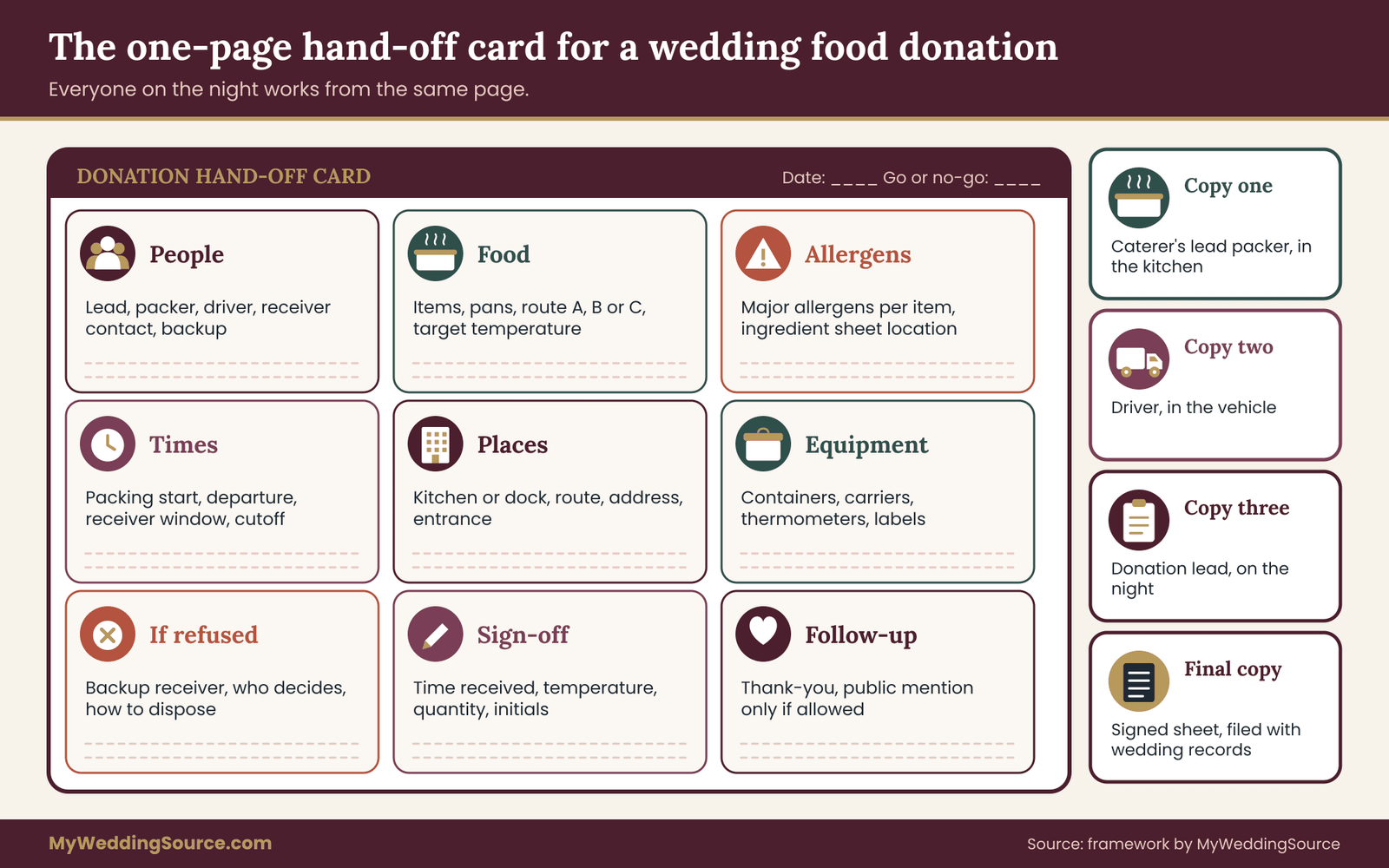
The hand-off card is the working tool at the center of any wedding food donation. It is a single page with everything the people on the night need to know, so that no one has to read a contract, scroll through emails or call the couple. It also forces the plan to be specific enough that gaps show up.
A useful hand-off card holds the following, in this order.
- People. The donation lead, the caterer’s lead packer, the driver, the receiver’s contact and the backup, each with a mobile number.
- Food. A list of items with an expected number of pans or portions, the route (A, B or C) and the target temperature for each.
- Allergens and ingredients. The major allergens present in each item, with a note on where the full ingredient sheet is kept.
- Times. The go or no-go time, the packing start, the pickup or departure time and the receiver’s window and cutoff.
- Places. The kitchen or loading area where the food will be, the route, the receiver’s address and the entrance to use.
- Equipment. Containers, carriers, thermometers, labels and who is bringing each.
- If refused or delayed. The plan for rejected food, the backup receiver and who makes the call.
- Sign-off. Lines for the time received, temperature reading, quantity accepted and the receiver’s initials.
- Follow-up. Whether the receiver may be thanked or named publicly, and who sends the thank-you.
Make three copies and a text version. The caterer’s lead keeps one in the kitchen, the driver carries one and the donation lead holds the third. Seal one more with the final signed sheet in an envelope and add it to your wedding files afterward.
The card is deliberately dull. It is the kind of document that keeps a good intention from turning into a scramble. It also gives you something to hand to the caterer and the receiver early, so that each can read the whole plan and flag what they cannot do. A receiver who sees the card three weeks out can say “we cannot take the cooked rice,” and you can change the card instead of the dinner.
Add the wedding food donation to your planning checklist
The wedding food donation plan should live inside the rest of your planning, not beside it. Add the receiver call, the caterer addendum, the container order, the driver assignment and the two reconfirmation calls to your main task list, with dates. The wedding planning checklist is a good model for how to place these tasks across the months before the event, and the wedding food donation steps mostly fall in the last two months.
If you pass the plan to a coordinator or day-of manager, give them the card and ask them to own the go or no-go decision. Coordinators are used to managing handoffs between vendors, and a wedding food donation is one more vendor handoff.
A worked example of wedding food donation: one Saturday night buffet
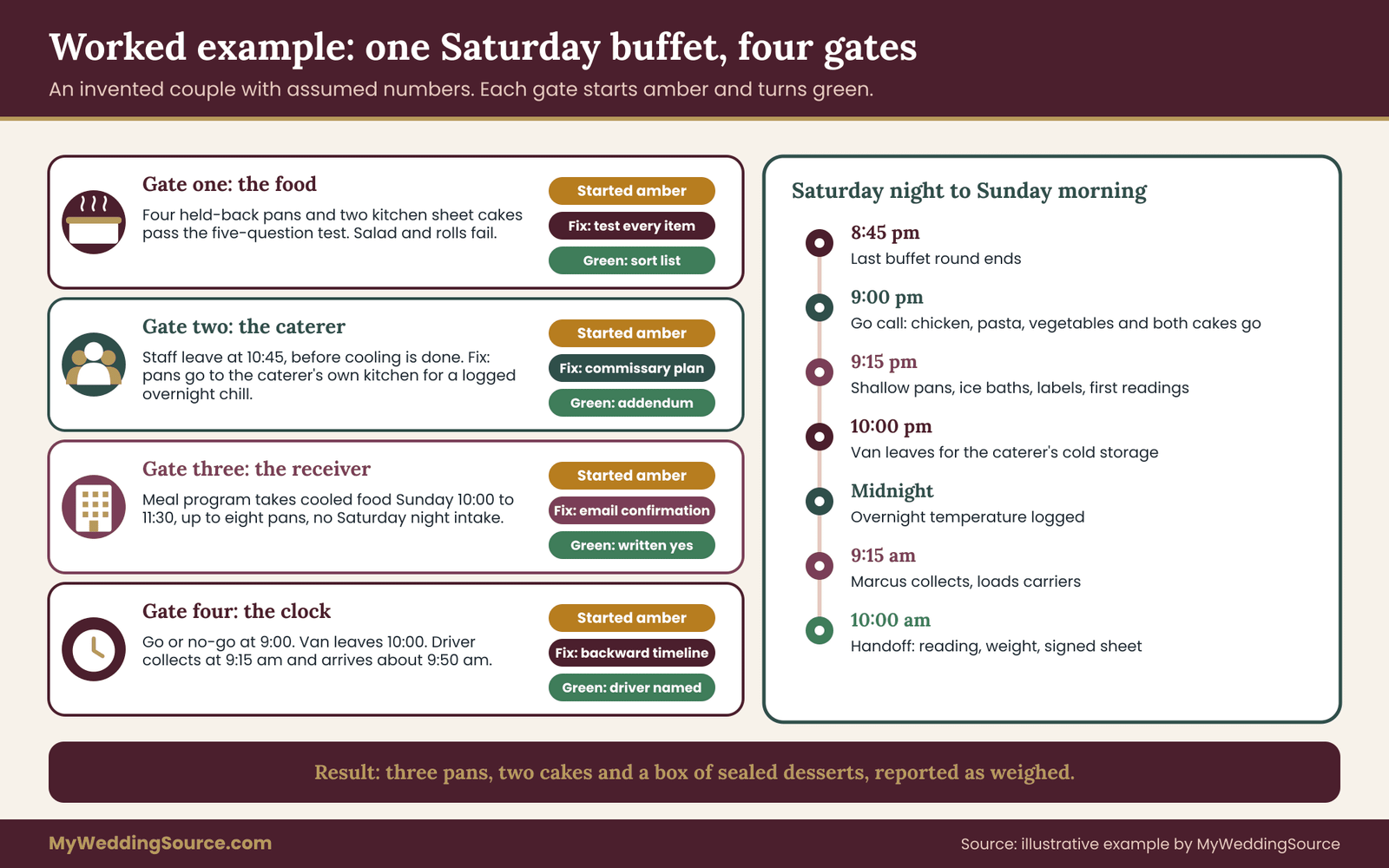
The best way to see the four-gate check at work is to follow one plan from first call to final sign-off. The couple, the caterer, the venue and the receiver below are invented, and every number is an assumption chosen to make the arithmetic clear. None of it is a statistic or a recommendation of what your own plan should hold.
The setup. Priya and Tom are hosting 140 guests on a Saturday. Dinner is a buffet starting at six thirty. The full-service caterer works out of the venue’s commercial kitchen, which has a warming cabinet and a walk-in cooler. The caterer’s team is scheduled to leave at ten forty-five, and the building locks at eleven thirty. The menu is roasted chicken thighs, vegetable pasta, rice pilaf, roasted vegetables, a green salad, dinner rolls and cake. There is a decorated display cake and two uncut quarter-sheet cakes in the kitchen for service.
Priya and Tom want any surplus food to go to people who can use it. Their planner suggests the four-gate check, and a friend named Marcus, who is not in the wedding party, agrees to be the lead for their wedding food donation.
Step one: call the receivers first
Marcus starts with the receiver, six weeks out, as the guide recommends. He calls three organizations, and the answers show why the order matters.
The first is a food bank. It takes packaged and shelf-stable goods and produce on weekdays and does not take prepared food from events. The second is a community meal program that serves lunch on Sundays at noon. Its coordinator says the program can take prepared food from a licensed caterer if the food has been cooled correctly, kept cold overnight and delivered between ten and eleven thirty on Sunday morning with a temperature record.
It cannot receive anything on Saturday night, it has refrigerator space for about eight pans and it prefers not to take seafood. The third is a rescue organization with volunteer drivers. Its evening pickups run only on weekdays.
The program is the only realistic home for cooked food. The food bank is a possible home for sealed items on Monday. The rescue service is out for this date. Marcus asks the program coordinator to confirm in writing and also confirms that the program accepts baked goods, which it does if they are fully wrapped.
Gate three starts amber. It turns green when the coordinator replies by email with the delivery window, the eight-pan maximum, the temperature requirement and the name and phone number of a second person who will be at the door.
Step two: the caterer conversation
Marcus and Priya meet the caterer’s event manager. The manager says the company donates occasionally to a program on the other side of town, but has not donated from this venue. She is willing. She proposes holding back four hotel pans, one each of the chicken, the pasta, the rice and the roasted vegetables, in the warming cabinet, with the line refilled from the other pans. After the final buffet round, any pans left in the back will be packed.
Marcus asks the second round of questions. How will the food be cooled? Who will check the temperature after the team leaves? The manager pauses and then says what turns out to be the key point: cooling large pans of pasta and rice to the required temperature takes hours under the published cooling method, and her team will be gone at ten forty-five. If packing starts at nine and the food is cooled in the venue’s walk-in, nobody will be there to verify the final temperature.
This is the kind of hidden problem the gates exist to expose. Gate two is amber. The manager proposes a fix: the team will portion the food into shallow two-inch pans, use ice baths to bring it down quickly, then load the pans into the caterer’s van and take them to the caterer’s own commissary kitchen, where a manager can verify that the food reaches cold-holding temperature and leave it in the walk-in cooler overnight. Marcus will pick the pans up at nine fifteen on Sunday morning and drive them to the program, which is fifteen minutes from the commissary.
The change creates new facts. The route is now Route C, cooled and held overnight. The commissary becomes part of the handoff, and the caterer’s manager will sign a temperature log at midnight. The caterer says packing and cooling labor will take two staff members about forty-five minutes. The caterer will supply eight lidded foil pans, the couple will buy labels and a second thermometer and the caterer will charge for the labor at the quoted hourly rate. The manager also agrees to write the arrangement in a short addendum.
Gate two turns green when the addendum arrives.
Step three: sort the food
Marcus applies the five-question test to each item.
The four held-back pans pass: no guest touched them, the caterer can state the holding temperature and the ingredients and allergens can be labeled. The rice pilaf is the item most likely to be rejected, since the program coordinator mentioned limited space, so Marcus ranks it fourth in priority.
The salad and the rolls fail. The salad is on the buffet and the rolls are in baskets on tables. The display cake was cut by the couple and guests, so it is out. The two quarter-sheet cakes stayed in the kitchen, wrapped, and the baker confirms the ingredients: wheat, eggs, milk and soy. They pass if the program takes baked goods, which it does. A box of sealed individual desserts is set aside for the food bank on Monday.
Gate one is green with a clear list of what is in and what is out.
Step four: build the clock
Marcus builds the backward timeline with Priya’s planner.
- The program’s delivery window opens at ten on Sunday and closes at eleven thirty.
- The commissary-to-program drive is fifteen minutes, with ten minutes to load and ten to sign the handoff. Marcus plans to arrive at the commissary at nine fifteen and leave by nine thirty.
- The caterer’s manager logs final overnight temperatures at the commissary at midnight and again at eight thirty on Sunday morning.
- The final buffet round ends around eight forty-five on Saturday night. The go or no-go point is nine, the packing start. Cooling begins in the venue’s kitchen at nine fifteen and the pans leave for the commissary at ten.
- The caterer’s team is scheduled to leave at ten forty-five. The drive to the commissary is twenty minutes, so the van needs to depart no later than ten thirty to give the manager time to log the first reading.
Gate four is green after the caterer’s manager confirms the commissary arrangement and Marcus confirms he is available on Sunday morning with a vehicle and two insulated carriers.
The night itself
Everything goes mostly as planned. Marcus holds the go or no-go call at nine, and the caterer’s lead reports that the chicken pan was partly used when the line ran short, the pasta and vegetable pans are untouched and the rice pan was pulled to the line for a refill and sat there. Marcus decides that the chicken, pasta and vegetable pans and both sheet cakes are the donation, and the manager logs the first temperature readings. The rice pan counts as served, so the caterer disposes of it under its own rules.
On Sunday morning, the commissary log shows the pans at the right temperature, Marcus loads them into carriers and arrives at the program at nine fifty. The coordinator’s backup person is at the door because the coordinator is out sick. She has the hand-off card, takes a reading, accepts the three pans and the two cakes, signs the sheet and weighs the food on the program’s scale. Marcus records the weight, photographs the signed sheet and texts Priya. The sealed desserts go to the food bank on Monday.
What the example shows about wedding food donation
Several lessons come out of this invented case. Starting with the receiver changed the whole route, because the receiver’s rules forced overnight cooling. The gate check found the staff-schedule problem at the planning stage, not at midnight. The plan was smaller than the couple first imagined: three pans, two cakes and a box of desserts, not a trunk full. The couple reported what was actually weighed, not what they had hoped for. And a backup contact at the receiver saved the day because the card made the plan work without the primary person.
The cost of wedding food donation and who pays
The cost is small compared with most wedding line items, but it is real, and it is easier to handle when you list it. Four buckets cover most of it.
Supplies. Lidded foil pans or food-grade containers, labels, marker pens, gloves and ice packs. A second probe thermometer costs a few dollars and a good one costs a bit more. These are one-time, small costs, and the caterer may supply some of them.
Labor. Packing, cooling, logging and loading take staff time, and that time belongs to the caterer. A simple way to estimate it: number of staff multiplied by hours multiplied by the caterer’s quoted rate. If two staff spend three quarters of an hour at a rate of thirty dollars an hour, the labor is forty-five dollars. That rate is an assumption for illustration, not a market figure, and your caterer’s quote is the number that counts.
Transport. A friend with a car costs a tank of gas. A courier or a rescue service driver may be free or may charge. If you ask a caterer to deliver, ask about mileage or a delivery fee.
Venue and storage. Some venues charge for extended access, overnight storage or an extra hour of staff time. If the wedding food donation requires the kitchen or the building a little longer, ask whether that has a price.
Adding up the example, eight containers at an assumed two dollars each come to sixteen dollars, labor is forty-five dollars, labels and a thermometer perhaps another fifteen, and the driver is a friend. The total is under a hundred dollars in this invented case. In your plan it might be more or less, and the only honest way to know is to ask.
Who pays for wedding food donation
Typically, the couple pays, as part of the catering budget, and the cost is small enough that it rarely needs to be negotiated. A caterer who handles wedding food donation routinely may absorb it. The receiver should not be asked to pay for containers, labor or transport. If your budget is tight, the cheaper choices are fewer pans, simpler containers and a friend as driver. Put the figure in the budget as its own small line, so it does not disappear into catering extras.
Tax questions
Do not assume a wedding food donation produces a tax benefit for you. Whether a caterer, a business or an individual can claim a deduction depends on the facts and the tax rules for each, and valuation is a technical subject. Ask the caterer to check with their accountant if it matters to them, and ask your own tax professional about your situation. Do not ask any party to inflate a receipt.
Is it worth the effort?
A decision rule helps when the plan feels heavy. Compare what you can realistically give with what the receiver can realistically take. If the caterer expects fewer pans than the receiver’s minimum, a prepared-food wedding food donation is probably not worth the complexity, and a sealed-items donation or a no-go is the cleaner choice.
If the surplus is large, the receiver is open and the caterer is willing, the effort is modest compared with the benefit. In between, choose the version that you can finish without cutting a corner. A small wedding food donation done right beats a large one done carelessly.
Plan B: when a gate is closed, other uses for wedding food
Sometimes the honest result of the four-gate check is a no. The receiver does not take prepared food on your date, the caterer cannot pack, the route is too long or the food does not pass the sorting test. When that happens, the useful question is not “how do we force it” but “what is the next best use.” The EPA’s food recovery hierarchy gives a sensible order, and you can use it as a ladder.
Step one: shrink the surplus. The best result is less food to place. Revisit the final headcount, the number of buffet items and the portions with your caterer. Portion and headcount decisions are part of menu planning, and a smaller overage costs less than any wedding food donation plan.
Step two: donate what you can. A partial wedding food donation is still a donation. Sealed packaged items, bread that never reached a table, whole fruit and wrapped desserts need fewer gates than cooked food, and many receivers take them on weekdays.
Step three: use it with the people who are already there. Caterers often feed their own staff, and that is a fair use of food that stayed in the kitchen at safe temperatures. Guests can take home boxed portions from the line, as long as everyone understands the two-hour guidance and that the food needs refrigeration soon. A late-night snack that uses surplus planned ahead is another use. None of these are a wedding food donation, and it is worth being clear about that in how you describe them.
Step four: send what is unfit for people to the next stream. Depending on your area, food scraps can go to a compost service or an anaerobic digestion facility. Some regions have programs that send suitable scraps to animal feed, with rules that are tighter than most people assume. Ask the caterer and the venue what is available.
Step five: dispose of the rest. This is the last rung. It is where food that failed the safety check belongs, and there is no shame in using it. Food that is unsafe to eat should not be pushed through a wedding food donation channel to avoid waste.

If you are planning the whole waste picture, the full wedding waste audit shows how food fits alongside paper, flowers, rentals and packaging, and how to count what leaves the venue in each stream.
Special situations that change wedding food donation
The four gates apply to every wedding, but certain setups shift how they work.
Hotel and resort weddings. The hotel’s banquet department controls the kitchen, the policy and the schedule. Ask for the hotel’s policy on wedding food donation or leftovers early. Some hotels partner with a local food rescue organization and have a routine, and others have strict rules. In either case you are working with the hotel’s process, not designing your own.
Tents and outdoor sites. Without a venue kitchen, the caterer’s temporary setup is the only hold. Ask how they will keep the held-back pans hot or cold, whether they will have a van with refrigeration and how far the food is from a receiver. In hot weather, the time window shrinks, so outdoor summer weddings are the likeliest to move to sealed items or a no-go.
Religious and cultural menus. Dishes prepared under particular dietary laws or traditions are meaningful, and some receivers will not be able to serve them in the way they were prepared. Others will be glad to. Label clearly, ask whether the receiver has needs you can match and do not assume that every program can handle a certified or religiously specific item. If you are cooking with a community kitchen or a family, plan for the surplus to stay in the community.
Multi-day celebrations. A rehearsal dinner, a welcome event and a day-after brunch each produce their own surplus. Run the check separately for each event, because the caterer, the venue and the timing may differ. Do not assume the Saturday arrangement covers Friday.
Small and home weddings. A backyard wedding with a food truck or a small caterer has little leftover, and no commercial kitchen to cool it. Wedding food donation here is usually about sealed or packaged items, or about a single event meal that a nearby program can use immediately. If the food is cooked by family, keep it in the family.
Weddings with an open bar. Alcohol is never part of a wedding food donation. Cooked dishes made with wine or liquor are an ask-first item, because the receiver may serve children or people in recovery.
Honest reporting and the limits of wedding food donation
A wedding food donation can feel like a clean win, and it is easy to say more about it than you know. A few habits keep the story accurate.
Report what was weighed or counted. If the receiver’s scale read a number, share that number. If nobody weighed it, say “three pans and two cakes” and not “enough to feed fifty people.” Meal-equivalent conversions depend on assumptions about portion size that you cannot verify, and they have a habit of growing in the retelling.
Do not claim the donation offsets the rest. A wedding food donation reduces what goes to disposal. It does not undo the resources used to grow, transport and cook food that nobody needed to cook in the first place. The honest summary of a good plan is that it reduced waste on the margin, which is worth doing and worth describing modestly.
Be careful with environmental claims. The environmental benefit of food recovery depends on whether the food is actually eaten, how far it travels and what the alternative would have been. The EPA’s sustainable materials management work is a good place to see how food recovery fits into the wider picture. If a vendor or a venue advertises “zero waste” or “100 percent donated,” ask how they measure it. The Federal Trade Commission’s Green Guides describe how environmental marketing claims should avoid misleading people, and the same instinct applies to a couple’s wedding website.
Do not promise guests more than you can deliver. A line like “We will donate all leftover food” invites a promise you may not be able to keep. “We are working with our caterer and a local program to donate surplus food where safety rules allow” is accurate and leaves room for a no-go.
Remember the limits of this guide. Wedding food donation law and food-safety rules vary by state, county and organization. The temperatures, times and categories above are general baselines from federal sources, and your local health department or the receiver may be stricter. Nothing here is a guarantee that a particular food is safe, and nothing replaces the judgment of the people who handle it.
Common mistakes in wedding food donation
Most failures follow a few patterns.
- Starting with the food instead of the receiver. The result is a hot-food plan for a receiver that takes only packaged goods. Fix it by calling receivers first.
- Assuming a verbal yes is a yes. Fix it with a written confirmation from both the caterer and the receiver.
- Counting buffet food as donatable. Fix it with a hold-back arrangement that keeps pans in the kitchen.
- Ignoring the cooling time. A late-night plan that ends with warm pans in a cooler is not safe. Fix it by planning a cooling method and a person to check it.
- Leaving the couple in charge. Fix it with a lead for the wedding food donation and a driver who are not part of the wedding party.
- Forgetting the venue. Fix it by asking about access, storage and curfew before you commit.
- Choosing a single receiver. Fix it with a primary and a backup.
- Skipping labels. An unlabeled container is not acceptable to most receivers. Fix it with a label kit and a person who owns it.
- Overstating the result. Fix it by reporting weighed or counted amounts.
Checking the rules with the people who set them
Rules in this area change, and they are local. Before you rely on any piece of this guide, check it with the people who decide.
Your local health department can tell you what applies to wedding food donation in your jurisdiction, including whether food that has been served can ever be donated and what holding times are acceptable. Ask whether the caterer’s permit covers the arrangement.
The receiver can tell you its own limits, and they are the ones that matter on the day. Ask for them in writing and ask when they were last updated.
Your caterer can show you their license, their insurance position and their handling procedures. Ask to see current documents if you have not verified those yet.
Federal sources explain the baselines. The FDA Food Code, USDA food safety guidance, FoodSafety.gov, the EPA’s food recovery pages and the text of the Bill Emerson Good Samaritan Food Donation Act are listed in the sources at the end of this article. Federal law has been updated since it was first passed, so read the current version and your state’s counterpart, and ask a qualified professional if you need legal advice for a specific situation.
Plan on a quick review each time you use this for a new event. Receivers change hours, caterers change policies and local rules get updated, so a plan that worked last year is a starting point, not a guarantee.
FAQ
Is it legal to donate leftover wedding food?
In general, yes. The federal Bill Emerson Good Samaritan Food Donation Act limits liability for donors and nonprofit recipients who act in good faith, with exceptions for gross negligence or intentional misconduct, and states have their own laws. It does not remove the duty to handle food safely. Check with your local health department and the receiver, and ask a lawyer if you need advice on your own situation.
Can food that guests have already been served be donated?
Usually not. Most receivers will not accept food from buffet lines, tables, stations or plates, because it has been exposed to hands, air and room temperature. Food that stayed in the kitchen, was held at safe temperatures and can be labeled is a different case. The safe default in wedding food donation is that served food is not donated, and any exception has to come from the receiver and local rules.
What temperatures matter for wedding food donation?
The FDA Food Code sets cold holding at 41°F or below and hot holding at 135°F or above for foods that need time and temperature control. USDA consumer guidance describes a danger zone from 40°F to 140°F and recommends not leaving perishables out for more than two hours. Receivers may be stricter, so ask which numbers they use and who measures them.
What if the caterer says no?
Accept the answer and ask whether a smaller version is possible, such as sealed packaged items, bread that stayed in the kitchen or whole fruit. Caterers often have good reasons, including insurance conditions and local rules. If nothing is possible, move to the alternatives in this guide, such as a smaller overage, a staff meal policy or composting, and record the decision.
Who should deliver the food to the receiver?
Someone who is sober, rested and not part of the wedding party. A caterer’s delivery person, a friend who agreed in advance, a volunteer driver from the receiver or a courier all work. Give the driver the hand-off card, insulated carriers and a phone number for the receiver. The couple should not carry food on the wedding night.
Can we donate the wedding cake?
Sometimes. A display cake that guests cut is served food and is generally not accepted. A sheet cake that stayed in the kitchen, fully wrapped, with a known ingredient list, may be accepted by a receiver that takes baked goods. Cakes with cream or custard need refrigeration and more caution. Ask the baker, the caterer and the receiver before the wedding.
What if nobody can take the food on Saturday night?
Look for a receiver with weekend evening hours, or use an overnight hold: cool the food quickly, keep it cold in the caterer’s or venue’s cooler and deliver it the next morning to a program that accepts it. Some receivers will not take cooled and held food. If neither works, donate sealed items on a weekday or choose a different plan.
Can we get a tax deduction?
Do not count on one. Whether a wedding food donation is deductible depends on who gives it, how it is valued and the tax rules that apply to that person or business. Ask a qualified tax professional, and ask your caterer to check with their own accountant. Do not ask anyone to write a receipt for more than the food was worth.
Your next steps
Start with three phone calls this week or the next. Call two or three local receivers and ask the questions in this guide, starting with whether they accept prepared food from events and when they can receive it on your date. Then talk to your caterer using the eight confirmations. Write down what each person says and ask for a written reply.
Once the answers are in, score the four gates as green, amber or red. If all four are green, build the hand-off card, assign a lead for the wedding food donation and a driver and put the reconfirmation calls in your calendar. If something is amber, write the one action that fixes it and a date.
If something is red, choose the partial wedding food donation or the alternative plan and move on without guilt. The point of a good wedding food donation plan is not that every wedding gives away food. It is that the food that can be shared reaches someone who wants it, safely, and the plan is honest about the rest.
Sources
- Sustainable Management of Food, U.S. Environmental Protection Agency
- Food Recovery Hierarchy, U.S. Environmental Protection Agency
- Sustainable Management of Materials, U.S. Environmental Protection Agency
- Food Loss and Waste, U.S. Department of Agriculture
- Food Safety and Inspection Service, U.S. Department of Agriculture
- FDA Food Code, U.S. Food and Drug Administration
- FoodSafety.gov, U.S. Department of Health and Human Services
- Food Safety, Centers for Disease Control and Prevention
- United States Code, Bill Emerson Good Samaritan Food Donation Act, Office of the Law Revision Counsel
- Green Guides and environmental marketing claims, Federal Trade Commission