
A wedding nursing room is a private, comfortable space where a guest, a member of the wedding party or a vendor can breastfeed, pump or give a bottle without an audience. This guide shows how to decide whether you need one, how to lay it out, what privacy it has to provide, which supplies make it usable, and how to tell your guests about it without making anyone feel watched.
Offer a wedding nursing room whenever infants are on the guest list, the wedding party or the vendor team. Test it with a seven-link privacy chain: a short accessible route, a door that closes, no sightlines, a supportive chair, a surface and an outlet, basic supplies, and a signal that tells staff the wedding nursing room is in use. Put it near the main space but away from speakers, kitchens and restrooms. Make it optional, since many parents will feed wherever they are sitting. Confirm access, locks and refrigerator use with the venue in writing.
Most couples who think about feeding at their wedding think about it for one reason: a sister, a best friend or a cousin has a three-month-old, and the question comes up in a text thread. Someone says the venue must have a spare room. Someone else says it will be fine. A week before the wedding the promised space turns out to be the caterer’s staging area, or the bridal suite is locked, or the only free space is a hallway beside the loudest speaker in the building.
A wedding nursing room is a small project, and it is easy to do well once you know what it needs. The need is simple. A feeding parent wants somewhere quiet to sit for twenty or thirty minutes, with a door, a decent chair and a little help if something goes wrong. The planning is mostly about the details that make that real: who holds the key, where the outlet is, whether the chair has arms, whether a photographer will wander in, and how a parent hears the toast they would otherwise miss.
A note on scope. This guide is general information, not legal advice, and it does not replace the rules of your venue, your city or your state. Where a rule matters, it points to the agency that publishes it so you can read the current version yourself.
The guide sits inside a wider topic. The broader plan for babies, children and older relatives is covered in the wedding guest care guide, including how to ask families what they need and how to assign a day-of care lead. This article goes deeper on one piece of that plan, the feeding space itself.
What a wedding nursing room is, and what it is not
The phrase covers more than one activity, and the wedding nursing room should work for all of them. A guest may be nursing at the breast. Another may be pumping, which needs an outlet, a flat surface and a place to sit for longer. A third may be giving a bottle of expressed milk or formula.
A fourth may be feeding an older infant a pouch of food or a tube feeding for a medical reason. A good wedding nursing room does not ask which of these is happening. It offers privacy, a seat and a surface, and lets the parent use them.
Because of that, many couples label the space a feeding room on the signs and keep nursing room in their own planning notes. Either word is fine. What matters is that a parent who bottle-feeds, or a father who is feeding the baby while the mother dances, feels equally welcome. A sign that says “Nursing Mothers Only” excludes a lot of people the room was built to help.
What the room is not
A wedding nursing room is not a childcare room. Nobody is supervising other families’ children there, and nobody should have to explain themselves to enter. If you plan to hire sitters or run a children’s area, that is a separate arrangement with its own staffing questions, and the guest care guide covers how those pieces fit together.
It is also not a sleep room, although the two sometimes share a space. A feeding setup is built around an adult in a comfortable chair. A sleep space is built around a flat, firm surface for the baby with nothing soft on it. If your venue has only one spare room and you want it to serve both purposes, plan the two zones separately inside it and keep the sleep surface away from the feeding chair.
Safe-sleep guidance from federal agencies is specific about what a baby’s sleep surface should look like, and a recliner is not it.
Finally, it is not a replacement for a guest’s right to feed wherever they are sitting. Most states have laws protecting a mother’s right to breastfeed in places she is otherwise allowed to be, and the details vary. The National Conference of State Legislatures keeps a summary of those laws. A private venue sets its own house rules in other respects, but a couple can make their own position plain: any guest may feed at their seat, and a room is there for anyone who would rather have one.
That framing is both kinder and safer than implying the wedding nursing room is the only acceptable place.
Who actually uses the room
Think beyond the guests. At a typical wedding the people who might use a feeding space include:
Guests with infants. The obvious group. They may arrive with a diaper bag, a stroller, a pump and a plan, or with none of those.
The wedding party. A bridesmaid, a groomsman, a parent of the couple or the couple themselves may be breastfeeding or pumping. These are the people with the least free time on the day, because they are in photographs and on a schedule.
Vendors and staff. A photographer, a caterer, a florist or a venue coordinator may be feeding an infant or pumping during a long shift. For employees, federal law requires employers to provide a place other than a bathroom for pumping, and the Department of Labor describes it as shielded from view and free from intrusion. Independent contractors may not be covered the same way, but offering the room is simply decent and costs you nothing.
Officiants, musicians and readers. People who arrive early and stay through the ceremony often have the same need and rarely mention it.
The takeaway is that the wedding nursing room has more potential users than the infant count on your RSVP list suggests, and the busiest users are often the ones who cannot leave the program for long.
Do you need a wedding nursing room? A simple decision rule
Some weddings do not need a dedicated room. A two-hour backyard ceremony with eight guests and no infants is one. Most others benefit from at least a quiet corner, and the cost of offering is low. Use the rule below to decide how much to build.
Step one: count the people who might feed. From your RSVPs and personal conversations, count infants under about a year old among guests, the wedding party and the vendor team. Count older toddlers who still nurse or take bottles. Add anyone you know to be pumping. If the number is zero and nobody has mentioned it, you can stop here and keep a fallback in your pocket: a single sentence to your venue contact asking where a guest could go if someone asked.
Step two: look at the length of the day. A wedding that runs under three hours between the first arrival and the last dance puts most infants through one feeding window. A wedding that starts at noon and ends at ten, or includes a long gap between ceremony and reception, spans several. Each extra window raises the odds that a parent needs a place, and it raises the stakes for a room that is comfortable instead of merely private.
Step three: look at the venue. A hotel ballroom has spare meeting rooms, suites and corridors. A barn, a garden or a park pavilion may have none of those. In the second kind of venue you will need to bring the room with you, in the form of a tent, a rented screen enclosure or a nearby vehicle, which changes the budget and the permit conversation.
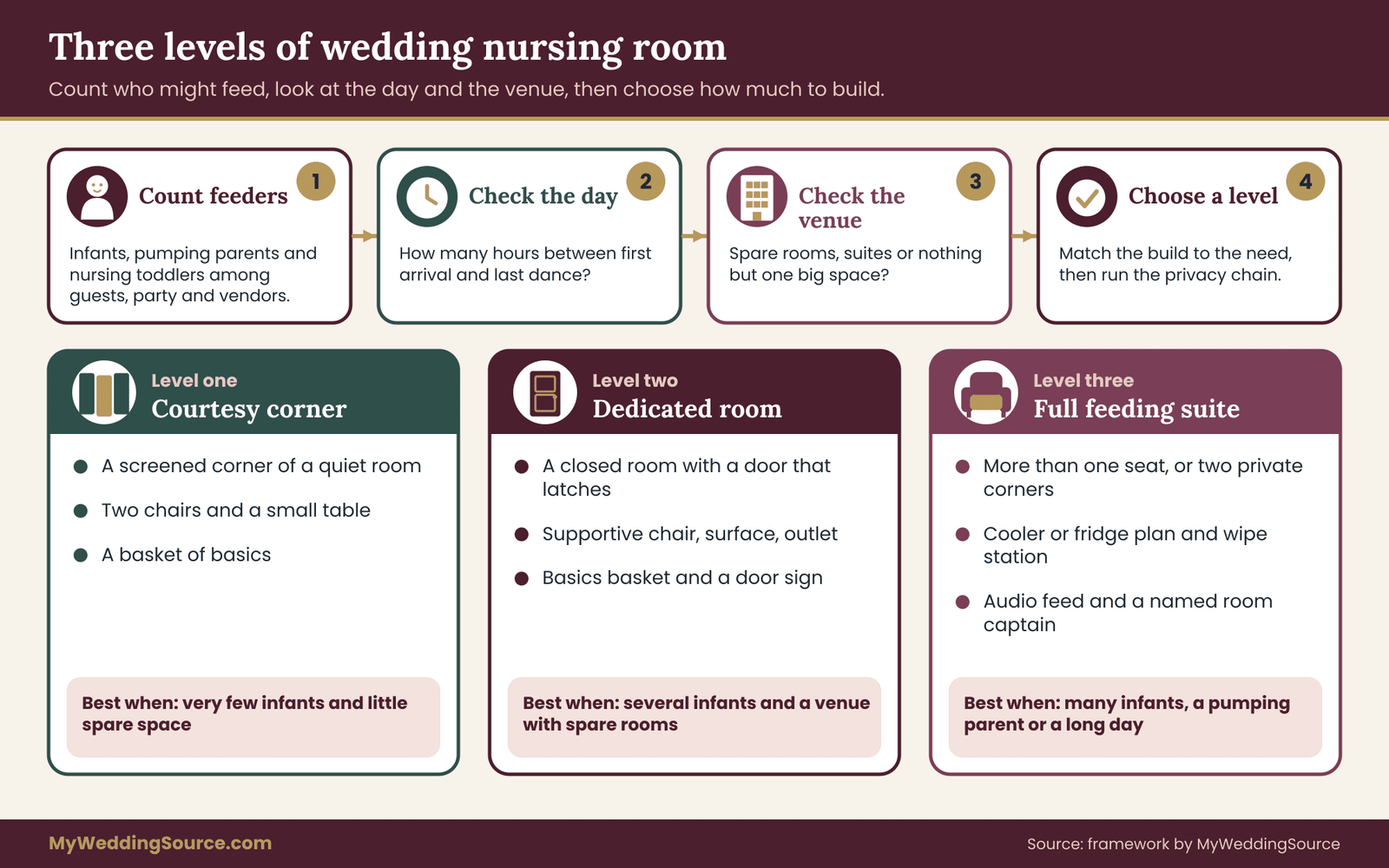
Step four: decide the level. Three levels cover almost every wedding.
Level one: a courtesy corner. A screened corner of a quiet room, with two chairs and a small table, for weddings with very few infants and a venue with limited space.
Level two: a dedicated room. A closed room with a door, a comfortable chair, a surface, an outlet and a basic supply basket. This is the right answer for most weddings with several infants.
Level three: a full feeding suite. A larger room or suite with more than one seat, a refrigerator or cooler arrangement, a sink or wipe station, an audio feed from the main space, and a named person who checks it through the day. Use it when the guest list has many infants, when the wedding party includes a pumping parent, or when the day is long.
Sizing the room
Sizing is the part couples guess at and then regret. A planning rule that works: provide one seat for every infant you expect to be at the event, plus one spare, up to the point where the wedding nursing room would be crowded, and then add a second space instead of cramming more chairs into the first. The rule is a planning aid, not a statistic. Infants do not all feed at once, but feedings cluster around the same moments, such as just before the ceremony, during cocktail hour and when dinner service begins.
Think about privacy per person, not just per room. Two parents who have never met may be perfectly comfortable sharing a room, and plenty prefer it. Others will want the room to themselves. If you have only one space and several infants, a folding screen or a pair of hanging panels that create two private corners solves more problems than an extra chair does.
When the answer is a second space
If your guest list includes a nursing parent who also needs to pump on a fixed schedule, such as someone in the wedding party who cannot take long breaks, a second small space can be worth having. Pumping needs more time, more power and more equipment than feeding a baby does.
Putting both activities in the same room can leave a pumping guest feeling rushed and a feeding guest feeling like part of someone else’s routine. A bridal suite or a vendor green room that is free during the reception often works as the second space.
If your venue offers only one room, that is fine. Plan it well, label it for anyone’s use, and give people a way to ask for more time or privacy. The sections that follow explain how to build a room that earns that trust.
The seven-link privacy chain for a wedding nursing room
A feeding space fails in predictable ways. The wedding nursing room is private, but nobody can find it. The room is easy to find, but the door will not close. The door closes, but a window faces the parking lot. Each fix is cheap when you know about the problem in advance and awkward on the day.
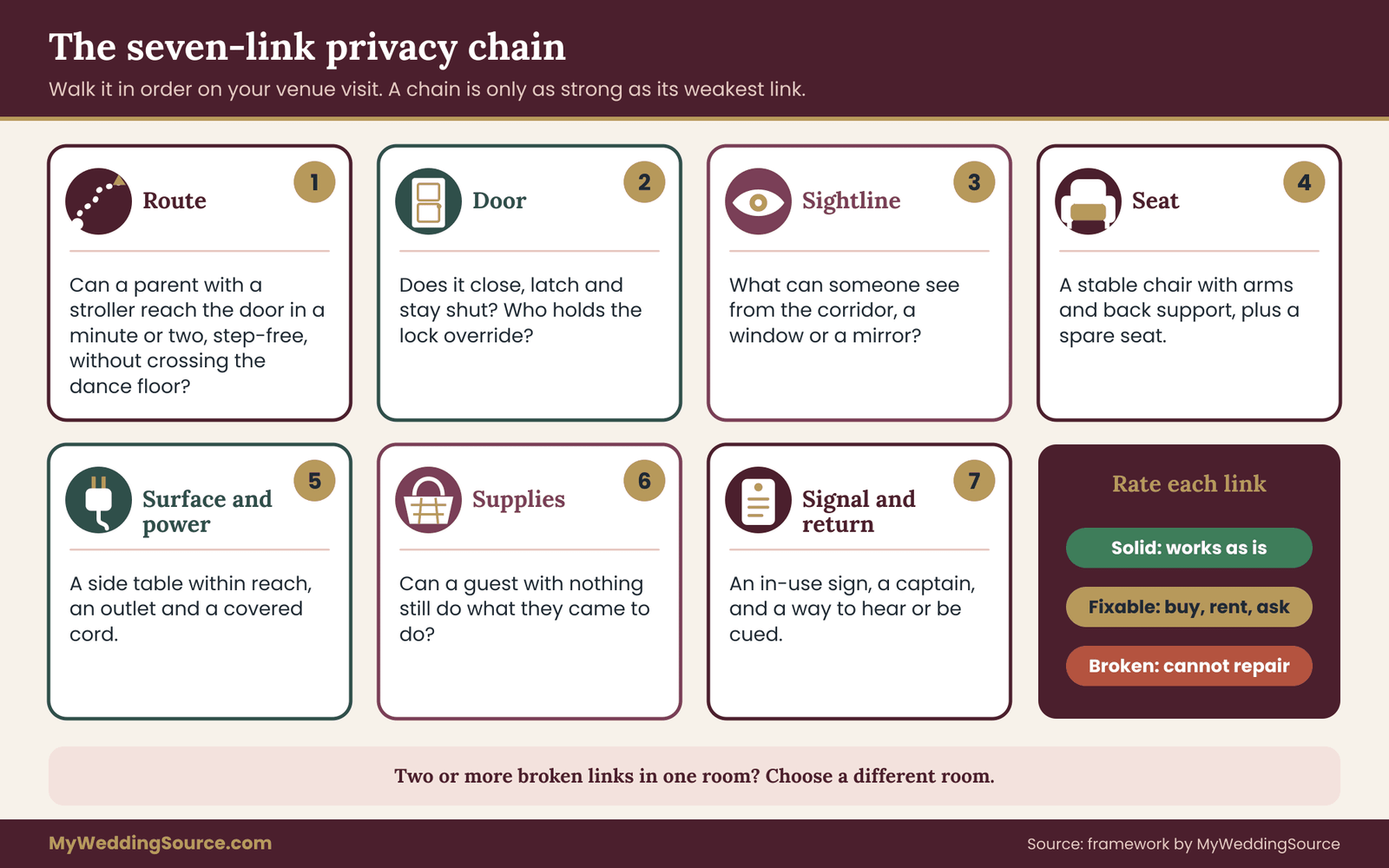
To catch them early, treat the wedding nursing room as a chain of seven links that a parent passes through, from the moment they stand up at their table to the moment they sit back down. A chain is only as strong as its weakest link, so check all seven in order.
The links are route, door, sightline, seat, surface and power, supplies, and signal and return. Each one gets a short test below. Run the whole chain on your venue walkthrough, with a tape measure and a phone, and write the result next to each link.
Link one: the route
The route runs from the main space to the wedding nursing room. It has to be short, obvious and step-free. Walk it as a parent would: carrying an infant on one arm, a diaper bag on the other shoulder, and perhaps pushing a stroller. Count the doors, the stairs, the ramps, the turns and the distance. A route that takes more than a couple of minutes to walk starts to eat the very window the parent is trying to use, and it makes the room harder for anyone with a mobility device.
Look at what the route passes. A corridor that runs beside the kitchen is noisy and crowded with service carts. A route that crosses the dance floor puts the parent on display. A route through the lobby of a hotel mixes your guests with strangers. None of these are fatal, but each one is a reason to prefer a different room or to staff the route.
The test for link one is plain: can a parent with a stroller get from the main space to the wedding nursing room’s door in a minute or two without stairs, without crossing the dance floor and without asking a stranger for directions? If you would answer “not quite,” plan signage and a greeter, which the signage planning guide explains in detail.
Link two: the door
The door is the heart of the room. It needs to close fully, latch quietly and stay shut without being propped. If it is a double door or a pocket door, test that it seats properly. A door that swings open every time someone brushes it defeats the purpose.
Think about the lock. Many parents want to know no one will walk in. Many venues, for good reason, do not allow a room to be locked from the inside without a way for staff to open it from outside. Ask the venue how it handles this. A common arrangement is a door that can be locked from within with an outside override held by the venue contact or the room captain.
Another is a door that does not lock at all, backed by a clear sign and a person nearby who turns visitors away. Whichever you choose, do not improvise a lock, a wedge or a chair under the handle. Fire codes govern exits, and the rules are enforced for a reason. The National Fire Protection Association and your local fire marshal are the places to ask.
Door width matters as well. The 2010 ADA Standards for Accessible Design generally call for a clear opening of at least 32 inches for a doorway on an accessible route. Venues that serve the public are expected to meet the standards in their permanent spaces. For a temporary room you create inside a larger building, ask the venue whether the wedding nursing room’s door and the route to it meet the same standard, and measure it yourself during the walkthrough.
Link three: the sightline
Walk into the room and turn slowly. Ask what a person standing in the doorway can see. Then ask what a person on the other side of every window can see. Glass doors, sidelights, transoms and low windows are the common culprits. So is a mirror positioned so that it reflects the seat to the doorway.
The fix is usually fabric or furniture. A folding screen, a garment rack with a cloth hung over it, a lightweight curtain on a tension rod or a tall plant can break a sightline in seconds. For a window, blinds or a layer of sheer paper film may be possible if the venue agrees. Do not hang anything with tape that damages paint or drill into a wall without permission.
A second sightline problem is easy to miss: the one that comes from inside the wedding nursing room. A parent seated in the chair should not be able to see directly into the corridor, and anyone entering the room should meet a screen or a corner before they see the seat. Think of the wedding nursing room as a small entryway and a small interior. The seat belongs in the interior.
Link four: the seat
The chair is where most feeding rooms fall short. A parent may sit in it for twenty to forty minutes, holding an infant, and then sit down again an hour or two later. The chair should have a stable seat, a supportive back and arms or something equivalent to rest elbows on. It should not wobble or tip. Armless banquet chairs, decorative cross-back chairs and folding chairs with thin seats are the usual substitutes, and they are a poor deal for anyone holding a baby.
Rental companies stock glider chairs, upholstered armchairs and low lounge chairs for this reason, and the rental planning checklist covers how to order them without surprises. A footstool or a small ottoman helps, because many parents like to raise their knees slightly. A pillow or a rolled blanket for the lower back is useful and costs almost nothing.
A second seat is worth having even for one infant. A partner, a friend or a parent may come along, and it is awkward when the only chair is taken. A plain chair beside the main one doubles the usefulness of the wedding nursing room.
Link five: surface and power
Every feeding setup needs a surface within reach of the seat: for a water glass, a burp cloth, a bottle, a phone or a pump. A small side table or a sturdy stool works. A card table is too high, and a coffee table is too low.
Power matters for pumps and for charging phones. Locate the outlets in the room and check which ones work. Standard electric pumps need an outlet, although many people now use battery or wearable pumps. A power strip, preferably one with a built-in surge protector and a cord long enough to reach the seat without crossing the walkway, solves most problems. Tape down or cover any cord that crosses a path, and do not run extension cords under rugs. Ask the venue whether it allows power strips, because some do not.
A final item in this link is light. A dimmable lamp is kinder than overhead lights, and a lamp with a warm bulb also gives a parent enough light to see what they are doing. Avoid candles, string lights with exposed plugs and anything that creates a heat risk near fabric.
Link six: supplies
Supplies are the difference between a quiet room and a useful one. The supply list in a later section is detailed. For the chain test, ask a simpler question: if a guest walks in with nothing, can they do what they came to do? A basket of burp cloths, wipes, tissues, hand sanitizer, a small trash bin with a lid and a bottle of water meets that test. A room that has a chair and nothing else does not.
Link seven: signal and return
The last link is about information. A signal tells people the wedding nursing room is occupied, so no one walks in. A return path tells the parent how to rejoin the day without friction: where to go next, how to find their seat, and whether anything happened while they were away.
For the signal, a simple double-sided sign on the door works well, with “In use” on one side and “Open” on the other. A person stationed near the door during peak times, usually the room captain described later, is better. For the return, a parent should be able to hear the program from the room or get a text when a key moment is about to begin.
Couples who add an audio feed from the main space, or a quiet text from a friend before the toast, find that parents use the wedding nursing room more and miss less.
Running the chain on a real venue
The chain is a tool for decisions, so use it as a scoring pass. During the walkthrough, rate each link with one of three words: solid, fixable or broken. Solid means it works as is. Fixable means it needs a purchase, a rental, a sign or a conversation. Broken means it cannot be repaired within your budget or the venue’s rules, and you should use a different room.
Two or more broken links in one room is a sign to look elsewhere. A single broken link that you can bypass, such as a door that will not latch but a room that sits at the end of a quiet corridor with a staffed sign, may be acceptable. Be honest with yourself. A room with a broken door and a broken sightline is not a private room, even if it is quiet.
Here is how the scoring looks in practice. A hotel meeting room has a solid route, a solid door, a fixable sightline because of a glass panel in the door, a broken seat because it holds only banquet chairs, a fixable surface, a fixable set of supplies and a fixable signal. That is a good room: the only changes are a paper film on the door glass, a pair of rented armchairs, a side table, a power strip, a basket and a sign.
A converted storage closet may score solid on the door and sightline but broken on the route and the seat, because there is no space for a chair that anyone can sit in comfortably.
Write the chain down
Put the seven ratings in a one-page document with the venue contact’s name, the room name and the fixes you plan. Share it with your planner or day-of coordinator and with the person who will check the room on the day. When the chain is written down, nothing depends on one person’s memory on a busy morning.
Keep the chain short
If you are tempted to add more links, such as decor, music or a welcome gift, resist it. The chain is about function. Extra touches are fine, but they come after the seven links hold. Flowers do not fix a door that will not close, and a room with a solid chain and a plain wall is a good room.
Choosing a space for your wedding nursing room
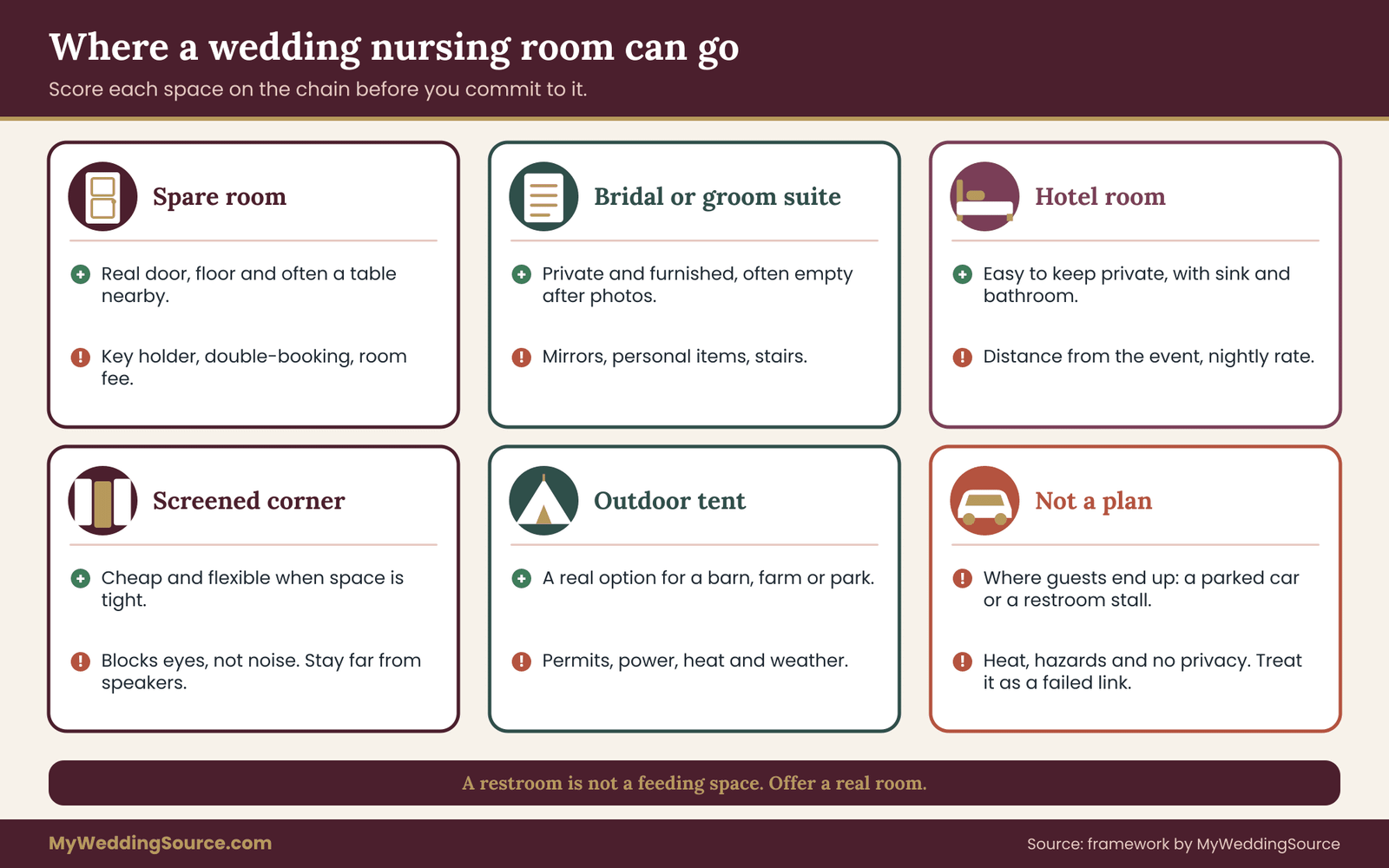
Once the chain is clear, the next question is which room to put it in. Venues offer very different options, and the best choice depends on what the building has. Below are the usual candidates, with the trade-offs of each. None of them is correct everywhere. A good choice is the one that scores well on the chain, not the one that sounds best on a floor plan.
A dedicated spare room
A meeting room, a library, a lounge, a green room or an unused office is the most reliable answer. It has a real door, usually a good floor, often a table and chairs, and sometimes a sink nearby. The trade-offs are practical. Someone else may hold the key. The wedding nursing room may be booked for another purpose in the same hour. It may carry a rental fee or a staff charge. Ask early and ask for the room by name, with a date and a time window, so it does not get reassigned.
The bridal or groom suite
Most venues that host weddings have a getting-ready suite. It is private, furnished, often has a bathroom and mirrors, and usually sits near the main space. After the photographs, it often sits empty. That makes it a strong candidate for a wedding nursing room during the reception. The catches are that the wedding nursing room may hold personal items, that mirrors and a vanity can create sightlines, and that the room may need to be locked up or cleared before the end of the night.
If your own party will be using it, set a clear handoff time, and move valuables out before guests arrive.
A hotel room
If the event is at a hotel or the guests are staying there, a standing hotel room can serve as a feeding space. It has a door, a bed or chairs, a bathroom and a sink, and it is easy to keep private. The wedding nursing room costs a night’s rate, but for a long day with several infants, it may be worth it.
It is also a good answer when the venue has no spare room. The weakness is distance. If the hotel is a drive away, the hotel room is not a feeding room, it is a retreat that takes a lot of time to reach.
A screened corner of a quiet room
Where space is tight, a partition can create a private corner inside a larger room. Folding screens, a pipe-and-drape section, a pair of tall plants and a rented room divider can form a three-sided enclosure with a chair inside it. The big advantage is that it is flexible and cheap.
The risks are sound and sight. Fabric screens block eyes, not noise, and a parent who sits behind a screen in the same room as the band is not getting a quiet break. Use this option only in a part of the building that is already away from the speakers.
A tent or enclosure outdoors
For a barn, a farm, a garden or a park, a small enclosed tent with a floor, a chair and a fan or heater can serve as a wedding nursing room. It needs power, a stable floor and a door flap that closes. It also needs a permit conversation, because many parks and some municipalities regulate temporary structures. Weather matters too. A tent that works at sixty-five degrees can be unbearable at ninety-five. Treat this as a Level two or three room that happens to be outdoors, and budget accordingly.
A parked car
A car is not a plan. Some guests use one because it is the only private place they can find, and that tells you the venue’s setup has failed them. A shaded car with the engine off in summer is unsafe, and a running car in a garage raises other hazards. Offer a real room so no guest has to choose between feeding in a hot vehicle and feeding in public when they would prefer otherwise.
Restrooms are not an answer
A restroom is not a feeding room. Nobody wants to prepare food or feed an infant in a bathroom, and the Department of Labor’s description of employer lactation space states that the space must be something other than a bathroom. A restroom lounge with a seating area is a possibility if it is truly separate from the stalls, but even then ask whether the area is quiet, clean and private. If a venue offers only a restroom, treat that as a broken link and move the room elsewhere.
Questions to ask the venue about your wedding nursing room
Whichever room you choose, a short conversation with the venue contact should settle the rest. Write the answers down, or better, ask for them in an email so you have a record. The questions below cover the essentials.
Which room can we use, and for which hours? Ask for a name, a floor and a time window. Check whether another event will share the building.
Who holds the key, and how does the door lock? Ask whether the wedding nursing room can be locked from inside, who has an override and who will be on site.
Is the route accessible? Ask about steps, ramps, elevators, door widths and the distance from the main space. If the venue lists accessibility information, compare it with what you see. Ask for a walkthrough with a tape measure, and use the accessibility red flags guide if something looks off.
What furniture is already there? Ask what the venue supplies and what you may bring. Ask whether the venue charges for moving furniture.
Are there outlets, and may we use a power strip? Some buildings limit extension cords. Ask what is allowed.
Where is the nearest restroom, sink and trash? A feeding parent will want to wash hands and dispose of wipes without crossing the whole building.
May we use a refrigerator or bring a cooler? Ask whether there is any space in a kitchen refrigerator, whether the venue allows outside food storage, and where a cooler may sit. Many commercial kitchens do not allow personal items in their coolers for food-safety reasons, and a venue may be restricted by local health rules.
Is there a fee for the room or for staff? Some venues charge for the wedding nursing room, for cleanup or for a staff member to stay nearby. Ask now so it does not appear on the final invoice.
Can we put up signs and screens? Ask what the venue allows on doors and walls, and whether you must use their materials.
What are your policies about children, strollers and outside providers? This matters if a sitter will come along, and it matters for a stroller parking spot near the room.
A good venue contact will answer these quickly. If a contact seems puzzled by the request, it is not a bad sign, only a sign that the question is new. Be patient and specific. A short summary email that restates what you agreed is a courtesy and a record.
Put it in writing
When the venue agrees to the wedding nursing room, the hours and any fees, add them to your contract or to the day-of schedule. The vendor contract guide explains why an agreement that sits only in a phone call is easy to lose. If the venue will not put it in writing, send an email that says, “Confirming that the room named below will be available for guest use between these times.” Keep the reply.
Laying out the wedding nursing room
Layout is the part that people enjoy, and it takes about twenty minutes. A good layout makes the chain real. It uses the space to separate the door from the seat, to give the parent a clear view of the door without a view of the corridor, and to put every needed item within reach.
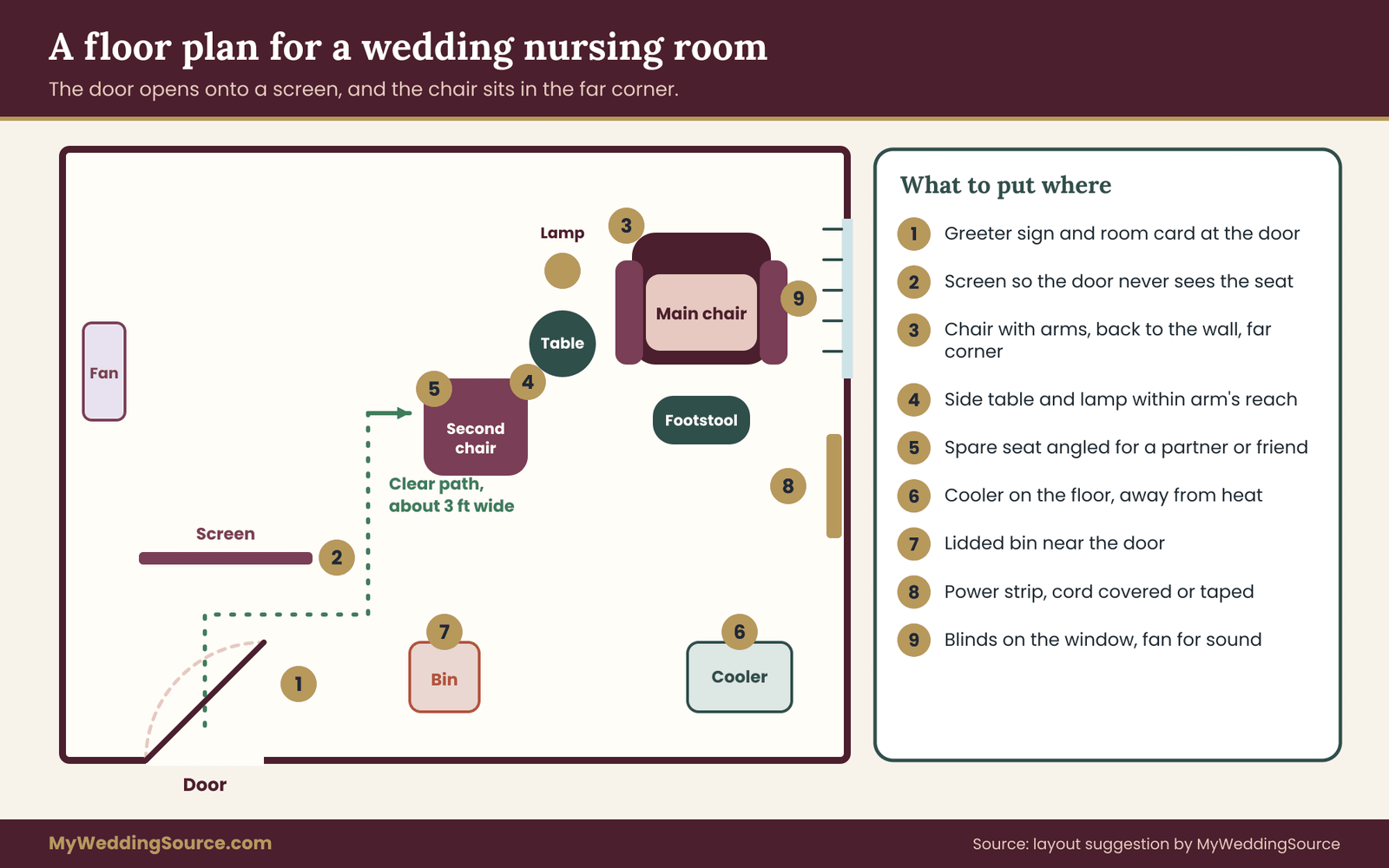
Start with the door. Stand in the doorway and identify the corner farthest from the door and out of the line of sight. That corner is where the main chair goes. The seat should face a wall or a screen, so a visitor who opens the door sees a back or a screen, not a person. Put a floor lamp or table lamp beside the chair, not behind it.
Place the side table within arm’s reach of the chair, on the side the parent is likeliest to want it. If you are unsure, put one on each side, or choose a table that slides under or around the chair. Set the footstool in front. The second chair goes at an angle to the first, with room to stand between them.
The supply basket belongs on the side table or on a shelf within reach, with items arranged so that a parent can find what they need without digging. A lidded trash bin sits near the door or by the table. A cooler or a small refrigerator, if you have one, sits on the floor or a stable stand, not near the heater, and the room card should say where it is.
Leave a clear path. Parents carry diaper bags and sometimes strollers. A walkway of about three feet from the door to the chair is a comfortable minimum, and federal accessibility standards generally call for an accessible route of at least 36 inches wide, with a turning space of about 60 inches across for a wheelchair. These figures come from the 2010 ADA Standards, and you should confirm them with the venue or the Access Board. If the room is too small to meet them, remove furniture first, not people.
Finally, check temperature and noise. A room that is too hot for an adult holding a baby is not a good room. Check the thermostat or ask whether a fan is available. Listen for noise from the dance floor, the kitchen or the elevator. A white noise machine or a small fan covers some of it. A room that thumps with bass every minute of the evening needs a different location.
A short test of the layout
Before the event, run a three-minute test. Sit in the chair and imagine feeding a baby. Reach for a burp cloth. Reach for the water. Plug in a phone. Look up at the door as it opens. Stand up with an imaginary infant and move to the exit. If any step feels awkward, you have found a layout problem while there is still time to fix it.
Privacy requirements for a wedding nursing room
Privacy is the reason the wedding nursing room exists, so it deserves a written list. The list below sorts requirements into three tiers. Required items are the ones where a failure makes the wedding nursing room unusable. Strongly preferred items make the room good. Nice items make it generous. If you can meet every required item and most of the strongly preferred ones, you have a room that guests will thank you for.
Required. A door that closes and latches, with no gaps at the sides or bottom large enough to see through. No direct sightline from the corridor, a window or a mirror to the seat. A route that does not cross a crowded space. A sign or a person that stops uninvited entry. A firm rule that no cameras, phones or recording devices are used in the wedding nursing room by anyone other than the parent. A room that is not a bathroom.
Strongly preferred. A lock or a staffed door. A screen or a partition inside the room. A second seat. A way to hear the program without video. A power outlet and a surface. A quiet location away from speakers and kitchens.
Nice. A sink nearby. A small refrigerator. A white noise machine. A mirror placed where it cannot reflect the seat to the door. A dimmable lamp. A bowl of snacks and a pitcher of water.
Put these in your own notes in a form you can scan, and use them as a pass-or-fail check on the venue walkthrough. The venue technical walkthrough guide explains how to measure and record a space so that the notes are useful later.
Cameras, phones and your photographers
The most common privacy breach at a wedding is not a stranger. It is a friendly photographer or a guest with a phone who walks in because the door was open. Photographers and videographers work from a shot list, and if the wedding nursing room is near the action, they may drift toward it for ambience, to catch a quiet moment or to photograph the decor. A parent who is feeding does not want to be a candid shot.
Solve this before the day. Tell your photographer and videographer, in writing, that the room is off limits for photography and video, including the doorway while someone is inside. Add the wedding nursing room to the list of places that stay private along with the restrooms and the changing area. If you want a photo of the room’s decor, take it yourself before anyone enters.
For guests, the sign on the door can carry a one-line request. “Private space for feeding. No photos or video, please.” is plain and short. If a relative or a close friend wanders in with a phone, a calm, direct sentence works better than a hint: “We keep this room private, so no photos, please.” The photography consent guide covers the broader topic of guest boundaries and image use, including how to word requests so they sound like kindness and not policing.
Do not live-stream, record or relay video from the wedding nursing room. If you add an audio feed from the main space to the room, make it one-way. Sound goes in, and nothing goes out. The parent should never wonder whether a microphone in the wedding nursing room is live.
Staff, vendors and relatives who walk in
Venue staff may need to enter for cleaning, to check on supplies or to fetch something stored in the room. Ask the venue to avoid entering while the wedding nursing room is in use, and to knock and wait. Tell the cleaning crew and the caterer by name. If the room was previously used as a storage space, move the items before guests arrive. A parent mid-feed does not want a server walking in for a case of napkins.
Relatives are a different problem. A well-meaning aunt may feel free to wander in to coo at the baby. A father-in-law may want to help. A friend may want to chat. The kindest way to protect the wedding nursing room is to give it a gatekeeper. The room captain, described later, can politely stop visitors at the door, and a small sign saying “Please knock and wait” gives everyone permission to say no.
If a guest asks to be left alone, they should be left alone without explanation. A line the captain can use: “Of course. I will let people know the room is taken.” That is all.
Sound privacy and the audio feed
Sound is part of privacy. Thin walls carry voices, and a parent on a video call or pumping near a thin wall may not want to be heard. Ask yourself what a person standing outside the door would hear. Place the seat at the far end of the wedding nursing room from the door, and add a white noise machine or a fan if the walls are thin.
The audio feed solves a different problem: the parent who would otherwise miss the toast or the first dance. Ask your sound vendor or your DJ whether a simple audio line can be run to a small speaker in the room. If the venue has a house system with zones, ask for the wedding nursing room to be included.
Keep the volume low, and place the speaker so that it can be turned down or off by the parent. Some parents like the feed. Others find it intrusive when a baby is falling asleep. Give the option and let them decide.
Where a feed is not possible, a text message works. Give the captain a list of cues, and have them send a message to a short list of parents when a toast, the cake cutting or the bouquet toss is about to begin. Set up the text list on more than one device, in case one phone loses signal.
Guest information and children’s data
A couple who plans for infants usually collects some information: how many babies, whether a crib is needed, whether a parent will need the wedding nursing room. Collect only what you need. A number of infants and a yes or no on the room are enough. You do not need birth dates, medical details or photographs of children. If a guest volunteers more, keep it private, store it in one place and delete it after the event.
Do not post a list of infants, feeding schedules or parent names on a public website, and do not leave a guest list with notes about who is nursing on a table at the venue. A private conversation or a private message is better than a public note. If you use a shared planning document with vendors, limit the section about infants to what each vendor needs to do their job.
Comfort, access and different needs in the wedding nursing room
A well-planned wedding nursing room welcomes more than one kind of parent. The setup that works for one guest may not work for another, and a little thought makes the wedding nursing room usable for people you might not have expected.
Parents with disabilities
A parent who uses a wheelchair or a walker needs a route and a room that fit the device, with a clear turning space and a chair or surface that works for them. Some may prefer to stay in their own wheelchair and need open floor, not a bulky armchair. Others may need a chair with a firm seat and sturdy arms to stand up from. A parent with low vision may want a well-lit room with clear signs.
A parent who is deaf or hard of hearing may want a visual cue in place of an announcement. Ask each person what they need in a private, simple way, and let them say. Do not assume. The U.S. Access Board publishes the technical details of the ADA Standards, and ADA.gov explains what venues owe the public.
Medical and special feeding needs
Some infants are fed by tube, by specialized formula or on a strict schedule. Some parents are managing supply issues, medical equipment or pain. These needs are private and may require more time, more space, a flat surface or access to clean water. The room that works for a quick feed may not work for a longer routine, so ask the parent what they would find helpful, and do not press for details. A second seat and a table with room for equipment cover most cases.
Fathers, partners and non-birthing parents
Any parent may be feeding the baby. A father or a same-sex partner who is bottle-feeding while the other parent dances needs the wedding nursing room too. A sign that says “Nursing Mothers” suggests they do not. Use neutral wording such as “Feeding room” or “Family feeding space” and invite anyone who wants a private spot to use it.
Temperature, scent and sensory comfort
Rooms packed with flowers, candles and strong scents may cause headaches or irritate an infant. Keep fragrance light or absent. Keep the temperature comfortable, because adults holding babies get warm. Dim lights help a baby settle. If a guest or a baby is sensitive to noise, a quiet room away from the music is the point. Do not put loud decorations, sound-making toys or strong air fresheners in the room.
What the parent wears
Clothing is a quiet planning question. A guest who is nursing has often chosen an outfit with feeding in mind, and a bridesmaid who is nursing may need a dress with an accessible neckline or a wrap, which affects alterations and timelines. If someone in the wedding party is feeding or pumping, bring it up early with the person doing the fittings, so the alterations calendar can take it into account.
Keep a spare cover, a shawl or a light jacket in the wedding nursing room for anyone who wants one, but do not suggest anyone must use it.
A reminder about tone
The room is a service. It is not a statement about what feeding parents should do. Everything the couple writes, signs and says should make clear that guests are welcome to feed wherever they are comfortable, and that the wedding nursing room is a quiet alternative. That tone costs nothing, and it keeps the day kind.
Supplies for a wedding nursing room
A room with a chair and a door is private. A room with the right small items is useful. The goal is a kit that handles the common needs without turning the space into a store. Think in three tiers: the basics every room needs, the extras that make a longer stay comfortable, and the cold-storage items for milk and formula. Start with the basics. Add the rest only if your guest list and the length of the day justify them.

The basics
These items cost little, fit in one basket and cover most visits.
Burp cloths and soft towels. Plain white or neutral cloths in a small stack. Parents will have their own, but a spare is welcome, and they double as a cover.
Tissues and unscented wipes. For hands, faces and spills. Unscented is the safer choice for babies and for people sensitive to fragrance.
Hand sanitizer and, if there is a sink, soap. Hands come first in any feeding routine, and not every parent will want to walk to a restroom.
A lidded trash bin with a liner. Diapers do not belong in this room, but wipes, tissues and wrappers do. A lid keeps the room pleasant.
Water. A pitcher with cups or a few sealed bottles. Feeding parents are often thirsty, and a glass of water is a kind gesture.
A phone charger or a power strip. A charger with a few common cable types saves a surprising number of problems.
A small sign or card. A card that names the room captain, with a way to reach them, lets a parent ask for something without leaving. Leave the wedding nursing room’s rules on a second card, in plain words.
The comfort extras
These extras matter when the room is used often or for longer visits.
A footstool or ottoman. It raises the knees and helps the lower back.
A small pillow or a rolled blanket. For back or arm support. Avoid placing pillows or blankets in any sleep space. Safe-sleep guidance from federal agencies calls for a flat, firm surface without soft items, and a feeding pillow is not a sleep aid.
A fan or a white noise machine. It covers sound and keeps the wedding nursing room cool.
A mirror positioned away from the door. Some parents like a mirror. Others want none. A small hand mirror in the basket is a safe middle.
Snacks. A few plain, non-messy snacks, such as crackers, fruit or granola bars, with a note about common allergens. Feeding is hungry work.
A spare cover or shawl. Optional. Offer, never require.
A few baby items. A pacifier or two in sealed packaging, a small pack of diapers and a travel pack of wipes. Guests forget things, and the cost is low. Skip anything that requires you to track sizes, brands or ingredients.
A small sewing kit or safety pins. A quiet help for a wardrobe problem.
Pumping extras
If someone in the wedding party or a vendor team is pumping, the room should handle it in a way that respects the time and the equipment. Ask them in advance what they need, because setups differ. In general, plan for:
An outlet and a cord that reaches the seat. Many pumps need power. A power strip with a surge protector is the safe choice, and a cord that crosses a walkway should be covered or taped down.
A flat, clean surface. A table with a wipe-clean top and enough room for a pump, bottles and a bag.
A place to wash or wipe parts. The Centers for Disease Control and Prevention publishes guidance on cleaning pump parts after each use. At a wedding, a bottle of warm water, soap and a clean towel in a basin may be the easiest solution, and some parents prefer pre-moistened cleaning wipes made for pump parts. Ask what they use.
A door that is truly private. A pumping parent often has more equipment on display than a nursing parent, and they may be seated for twenty minutes or more.
A safe place for the milk. The next section covers cold storage, which is the part that causes the most anxiety.
Milk, formula and cold storage in a wedding nursing room
Storage questions arrive late and make people nervous, so settle them early. The principle is simple: parents know their own routines, so give them options and make sure the wedding nursing room does not pressure them to use anything. Where food-safety details matter, point to the Centers for Disease Control and Prevention and the formula’s own label, and encourage guests to follow the instructions they already use.
Expressed breast milk
The CDC publishes storage guidance for breast milk, including how long freshly expressed milk is considered safe at room temperature and in a refrigerator. Agencies update these figures, so read the current page and do not rely on a number remembered from a friend or an old pamphlet. For a day-long event, the standard approach is an insulated cooler with frozen ice packs, which keeps milk cold for a stretch of time.
A parent who plans to pump during the wedding typically brings their own cooler bag, so the room only has to offer a place to set it.
If you offer to store milk in a refrigerator, ask the venue. Many commercial kitchens and catering refrigerators are off limits to personal items, and local health rules may be the reason. A small, separate refrigerator in the wedding nursing room, borrowed from a friend or rented, is simpler. If you use one, label it clearly, keep it clean and remember that you need an outlet, a place for it to stand and a plan to remove it at the end of the night.
Because milk may be a high priority to the parent, a plain “milk shelf” with labeled space is better than a crowded refrigerator with no organization. Ask each parent to label their containers with their name and the time, and keep the refrigerator closed. The room captain should not handle anyone’s milk unless asked.
Formula and bottles
Parents who use formula will typically bring a supply, either ready-to-feed bottles or powder. Ready-to-feed formula is the easiest at an event, because it needs no water and no mixing. Powdered formula needs safe water and careful measuring, and the label and the CDC both explain how long a prepared bottle can sit before it should be discarded. Those limits are strict, so parents know them. The room’s job is to provide a clean surface and, if possible, access to safe water, either bottled or from a tap that the parent trusts.
Warming is a place where well-meant help can go wrong. The CDC advises against microwaving breast milk or formula, because uneven heating can create hot spots that scald a baby. If a parent wants a bottle warmed, a bowl of warm water from a tap or an electric kettle in a safe location is the usual approach, and many babies drink a bottle at room temperature without trouble. Do not take on the job of warming anyone’s bottle on a kitchen stove or microwave unless the parent asks and you can do it safely.
Solid foods, pouches and older babies
Older infants and toddlers may eat purees, pouches or soft snacks. A room with a wipe-clean table and a bin takes care of most of it. If a guest brings a high chair, make sure the route and the wedding nursing room can handle it. If you plan to supply high chairs in the main space, check the dinner arrangements, because it is easier to feed a baby at the table than to carry them to another room mid-meal.
Allergies and cross-contact
A baby who has an allergy may react to a snack left on a table. Keep any snacks you provide separate from the feeding area, label them, and do not offer food to an infant. The parent is the only person who should decide what an infant eats.
What a wedding nursing room costs, and where to save
A wedding nursing room does not have to be expensive. The largest costs tend to come from rentals, from staff time and from any fee the venue sets for the wedding nursing room. The rest is a basket of cheap items that you probably already know how to buy. Because prices vary by region and by season, use the logic below to decide where to spend, and use local quotes for the figures.
Group the items by how you will get them.
Borrow. Chairs, side tables, lamps, a fan, a screen, a small refrigerator or a cooler can all come from friends and family. Borrowing works well for a wedding with a close community, and it saves rental fees and delivery charges. The risk is damage and return logistics, so write down who lent what and arrange pickup.
Rent. Glider chairs, upholstered armchairs, ottomans, folding screens and lounge furniture are common rental items. Check whether the rental company can deliver to the room, and whether delivery charges and setup fees apply. If you are already renting furniture for the reception, add the feeding room items to the same order to save on delivery. Ask each company to confirm delivery windows in writing.
Buy. Burp cloths, wipes, tissues, a trash bin, a power strip, a basket, a sign and a small selection of snacks are inexpensive, and the leftovers are usable afterward. Buying makes sense for items you will reuse.
Ask the venue. Some venues include furniture, power strips, screens or even a dedicated room at no cost. Ask before you buy or rent.
Where to spend and where to save
Spend on the chair, the door and the sightline. Those three links decide whether the wedding nursing room works. A glider or an armchair is the single most useful purchase or rental in the room. Spend on a person: a friend or a staff member who looks after the wedding nursing room during peak times is worth more than extra decor.
Save on decorations, on snacks that are not needed and on products that duplicate what parents bring. A guest who nurses will have a cloth or a cover. A guest who pumps will have their own pump. The room does not need to compete with their bag. It needs to give them a private place to use it.
Check the contract for fees
A final cost question is whether the venue’s contract has a fee for the wedding nursing room, a clean-up charge or a minimum. Ask early, and see whether the cost is flat or based on hours. Treat the room as part of the larger guest care budget, and keep the numbers in the same place as your other estimates.
Telling guests about the wedding nursing room
A room that nobody knows about is wasted. The way you announce it matters as much as the wedding nursing room itself, because tone decides whether a guest sees a thoughtful offer or a quiet rule about hiding. Keep the message short, neutral and practical, and put it where parents will actually look.
On the wedding website. A line in the guest information or travel section works well. Something like: “A private feeding room will be available near the reception space. Any guest who would like to use it is welcome, and guests are equally welcome to feed anywhere they are comfortable.” It names the room, says who it is for and removes any suggestion of obligation.
On the RSVP. If you collect special requests, add a general line such as “Is there anything that would help you or someone in your party feel comfortable on the day?” This lets a guest mention a baby or a pump without being asked a pointed question. Keep the wording clear and free of prying. A direct question, such as “Will you need the feeding room?”, is fine when you know the guest and have asked before.
In a personal message. For a close friend or a relative with an infant, a short text is warmer than a website line. Here is a script you can adapt:
We are so glad you and the baby are coming. We have set aside a quiet room near the reception for anyone who wants a private spot to feed or pump, and it has a comfortable chair and an outlet. Use it however you like, or not at all. Tell us if there is anything else that would help.
On the day. A small printed sign at the reception entrance, the program or the welcome table can point to the wedding nursing room. A greeter or host who knows where it is and can answer questions quietly is better than a sign alone. Place a clear, short sign in the corridor and on the door. Keep the wording identical on every sign.
Wording for signs
Short, plain and neutral. Three examples that work:
- “Feeding room. Open to all guests. Please knock and wait.”
- “Family feeding space. Private. No photos, please.”
- “In use. Please come back later.”
Avoid cute names, puns and anything that points at a person’s body. A sign that calls attention to who is inside is not private.
What not to say
Do not suggest that guests must use the room. A line such as “Nursing mothers are asked to use the feeding room” implies that feeding elsewhere is a problem. Do not ask for details about a guest’s feeding plans. Do not post the wedding nursing room’s location on social media. Do not make announcements during the reception about the room’s existence or use.
A feeding-window timeline around the program
Infants do not follow the wedding schedule. They feed when they are hungry, and the wedding’s biggest moments seldom match the baby’s. The most useful thing you can do is build a rough picture of the day’s windows and align the wedding nursing room’s staffing with them.
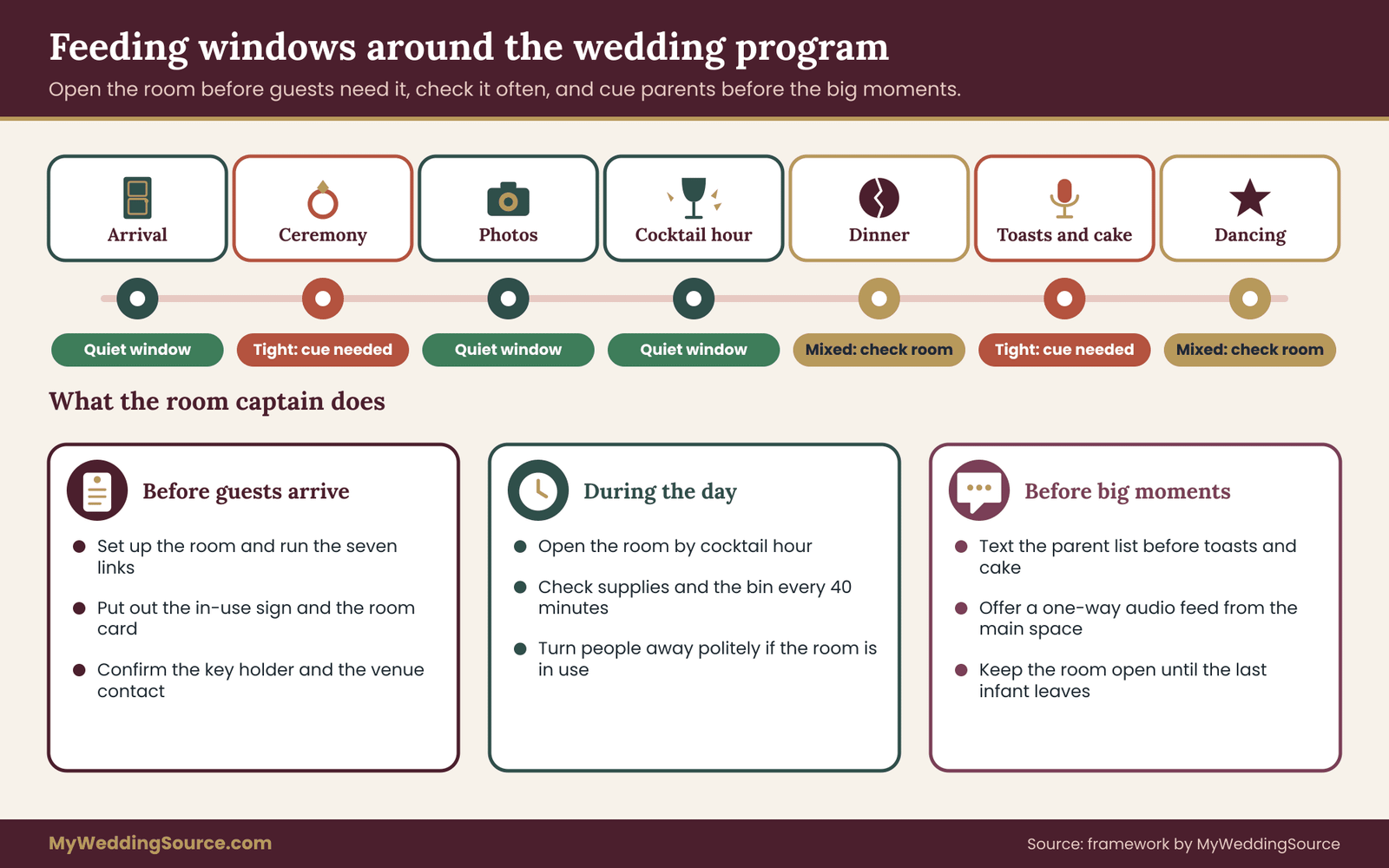
Start with the program. List the ceremony start, the ceremony length, the photographs, cocktail hour, dinner service, toasts, the cake cutting and the first dance. Put clock times beside each. Then mark the moments when a parent is least free: the ceremony itself, the processional and recessional, the toasts and the first dance. These are the times when a feed is most likely to conflict with the program.
Next, mark the quiet windows. These are usually the time just before the ceremony, the gap during photographs, cocktail hour and the early part of dinner, when the program is slower. A parent can slip out without missing much. You do not have to design the schedule around infants, but small adjustments can help. Put a toast after the main course, not during it. Avoid scheduling two major moments back to back. Leave ten or fifteen minutes between them so someone who steps out can return.
The ceremony
Ceremonies are short, but they are the hardest moment for a feeding parent. A baby who is hungry in the middle of the vows has no great options. Seat families with infants on an aisle near an exit, so they can leave and return without crossing the aisle. Tell them this is fine. If the ceremony is long, consider a short printed note in the program that says the room is open during the ceremony and that guests with infants are welcome to come and go.
Put a host at the door to guide them quietly. You do not need a new rule. Let people leave and return.
Cocktail hour and dinner
These are the busiest feeding windows. The wedding nursing room should be open, stocked and staffed by cocktail hour. During dinner, check on the room once, so the supplies are fresh and the trash is empty. Seat families with infants near the exit or near the wedding nursing room’s corridor, so they can reach it without crossing the whole space. The reception guest flow guide explains how to arrange tables and routes so that people who need to move can do so easily.
Toasts, cake and dancing
Cue the room captain before the toasts and the cake cutting, so they can text parents. Offer an audio feed, if you have one. During dancing, expect more traffic as the evening goes on. Evening feedings may be longer, and an infant may need a quiet place to settle. Keep the wedding nursing room open until the last guest with an infant leaves.
When the person feeding is in the wedding party or a vendor
A common planning mistake is to think of the room as a guest amenity only. The people with the least flexibility are the ones in the wedding party, the officiant, the photographers and the caterers. Plan for them with extra care.
The couple or the wedding party
A bride, a groom or a bridesmaid may be breastfeeding, pumping or in the early months of feeding an infant. Ask them privately, and ask early. Do not assume, and do not raise it in a group. If someone says yes, build their feeding or pumping into the schedule, not around it. Put a block of time into the timeline for the photographs, and add a buffer. A bridal party that disappears for twenty minutes without warning is a problem. A bridal party that has a twenty-minute window written into the schedule is not.
Make the wedding nursing room available to the wedding party during getting-ready hours, and keep it near the place where they dress. If the person is pumping, make sure the room is private, has an outlet and has a place for the milk. Tell the photographer that the time is protected. Ask the person who will do the hair or makeup to schedule around the window.
Vendors and staff
Photographers, caterers, bartenders, DJs and coordinators may need to feed an infant or pump. Federal law requires many employers to provide time and a private place for pumping to employees, and the Department of Labor describes what the law covers. Independent contractors and some small employers fall outside the rules, but the offer is simple and generous.
Put a line in your vendor communications: “A private room is available for anyone on your team who needs it. Please ask the coordinator.” It signals that the request is welcome, and it spares the vendor from having to raise it.
A vendor who is pumping may need to step out at a specific time. Build it into the schedule. Many vendors will tell you the time they need, and adjust their own shot lists or service plans to fit. A photographer who knows the wedding nursing room is available will make a plan. One who does not may skip a break and be exhausted by the end of the night.
Other people with fixed schedules
Officiants, readers and musicians may have needs too. A quick message to each of them is enough. The point is not to ask for details. It is to make the offer so nobody has to ask.
The room captain and day-of checks
A wedding nursing room runs best when a named person looks after it. Call that person the room captain. The role is small. It can be a friend, a family member, a day-of coordinator or a venue staff member who is already nearby. They do not need to stay in the room. They need to know where it is, keep it stocked and be reachable.
The captain’s tasks are short:
- Before guests arrive, set up the wedding nursing room, check the chain’s seven links and put out the sign.
- At the start of cocktail hour, open the room, check supplies and the trash, and turn on the lamp and any fan.
- During the event, check the wedding nursing room every thirty to forty-five minutes, restock and empty the bin.
- Before the toasts and the cake cutting, text parents on the list.
- Greet visitors politely and guide them to the room. Stop uninvited visitors at the door.
- At the end of the night, remove any items left behind, return borrowed furniture and clear the wedding nursing room.
Give the captain a one-page card with the room’s location, the key holder’s name and number, the venue contact, the list of parents who asked for a text and the sign’s wording. If something goes wrong, the captain should know who to call: the venue contact for a locked door, the coordinator for supplies and the couple’s designated family member for anything else. Keep the number list short.
A good captain is calm, quiet and friendly. They do not comment on feeding, and they do not ask questions. They make the wedding nursing room work.
A worked example of a wedding nursing room
The following example is invented, and the numbers are chosen to show the method, not to describe any real event. Maya and Dev are planning a 120-guest wedding in a restored town hall. Their RSVPs show five infants: three under six months and two near the end of their first year. Maya’s sister, a bridesmaid, is nursing a four-month-old and expects to pump once during the evening. The photographer has mentioned she has a young baby at home but has not said whether she will need anything.
Step one: choose the level
Maya and Dev apply the decision rule. They count five infants, a nursing bridesmaid and a possible vendor need. The day runs from a four o’clock ceremony to a ten-thirty finish, so most infants will pass through two feeding windows. The venue has spare rooms. They choose Level two, a dedicated room with a pumping extra, and decide they do not need a full suite.
Step two: pick the room and run the chain
The town hall offers a ground-floor library, a bridal suite upstairs and the main hall’s coat room. The suite is up a flight of stairs and has no elevator, so it fails the route link. The coat room has no seat space. The library is next to the main hall, a short level walk.
They run the chain on the walkthrough, with the venue’s event manager beside them.
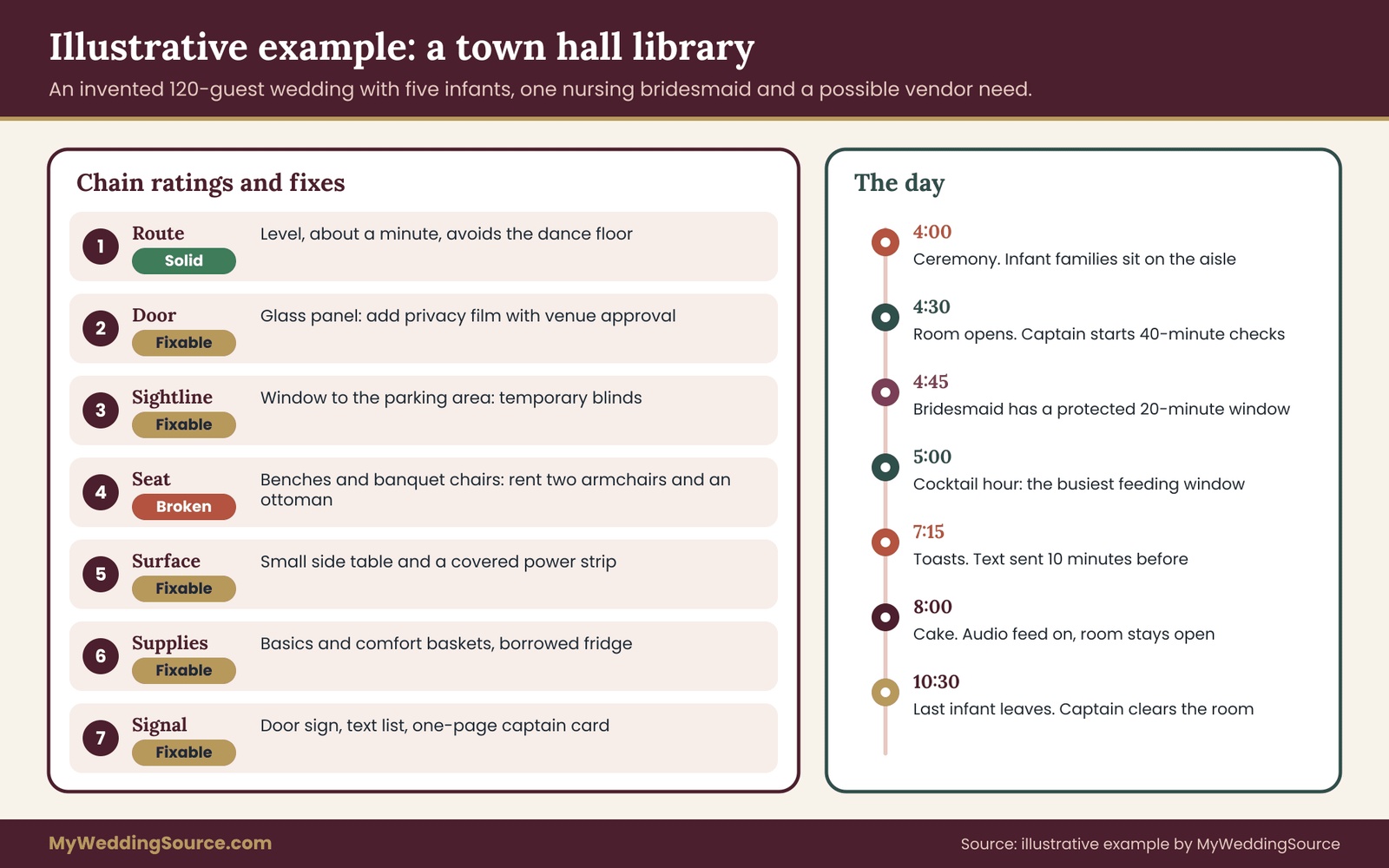
Route. Level, about a minute at an easy pace, and it avoids the dance floor. Solid.
Door. A wooden door with a glass panel near the top. It closes and latches. The glass shows the seat from the corridor. Fixable with privacy film, which the venue approves in writing.
Sightline. A tall window faces the parking area. The venue allows temporary blinds on the interior. Fixable.
Seat. The library holds long wooden benches and banquet chairs. Broken as it stands. They rent two armchairs and an ottoman and ask the venue to remove two benches.
Surface and power. A reading table, which is too tall, and an outlet behind a bookcase. They add a small side table and a power strip. The venue permits the strip as long as the cord is covered. Fixable.
Supplies. They assemble the basket in the basics and comfort tiers. Fixable.
Signal and return. A double-sided door sign, and a text list for the room captain. Fixable.
Nothing is broken that cannot be fixed. They keep the library.
Step three: settle the refrigerator question
The caterer’s kitchen does not allow personal items in its refrigerators. A relative lends a small refrigerator, and the venue allows it in the library with a power strip on a separate outlet. The sister brings a cooler bag, and the refrigerator is a backup. A label on the shelf asks everyone to write their name and the time on any container.
Step four: layout and staffing
The main armchair faces the far wall in the corner behind a folding screen, so a person opening the door sees a screen. The second armchair sits at an angle. A side table, a lamp and the basket are within reach of the main chair. A white noise machine covers the sound of the reception. The sister’s pumping equipment goes on the side table.
Maya’s cousin is the room captain. She receives a one-page card with the venue contact’s number, the list of three parents who asked for a text, the room’s hours and the sign wording. The venue manager keeps the override key.
Step five: the timeline
The couple marks the program. The ceremony runs from four to four-thirty. Photographs follow until five. Cocktail hour runs from five to six. Dinner starts at six-fifteen, with toasts after the main course at about seven-fifteen. Cake is at eight, and dancing runs until ten-thirty.
They give the sister a protected twenty-minute window during photographs, written into the schedule. They tell the photographer the wedding nursing room is available to her team, and she thanks them and says she will use it in the early evening. The room opens at four-thirty, in time for guests arriving at the end of the ceremony, and the captain checks it every forty minutes. She sends a text to the three parents ten minutes before the toasts and the cake.
What the example shows
The couple did not spend much. They rented two armchairs and an ottoman, bought a power strip, a side table, privacy film and a basket of basics, and borrowed a refrigerator. Their largest investment was an hour at the walkthrough and an email to the venue. The wedding nursing room did not require any of them to be present during the wedding, only the captain, and nobody was asked to explain why they used it. Some guests fed at their tables, and that was fine, since the website had said so from the start.
Limits of a wedding nursing room, and what to verify
A guide like this can only go so far. Venues, cities and states have their own rules, and some things must be confirmed locally.
Venue rules. Hours, locks, furniture, signs, cords and the use of refrigerators are the venue’s decisions. Get them in writing.
Fire and building codes. Exits, locks, occupancy, extension cords, tents and heaters fall under local codes. The local fire marshal or the venue’s safety contact can answer questions, and the National Fire Protection Association publishes the model codes many jurisdictions adopt.
Accessibility. The ADA applies to places of public accommodation, and the 2010 ADA Standards set technical requirements for new construction and alterations. A temporary arrangement at a private event does not turn the couple into the building’s owner, but the venue’s obligations may still apply. Ask the venue what its accessibility features are and measure the route yourself.
Health and food-safety rules. Local health departments govern commercial kitchens. Milk and formula guidance for families comes from the CDC and the Food and Drug Administration, and a parent’s pediatrician is the right person to ask about a specific baby.
Employment law. The rules for employers on break time and space for pumping apply to employees, and details differ by state. A vendor with questions should ask their employer or the Department of Labor.
Breastfeeding laws. State laws on feeding in public vary. If a guest or a venue disputes a guest’s right to feed, the National Conference of State Legislatures is a place to find your state’s statute, and a local attorney can advise on a specific case.
Medical advice. This guide does not tell any parent how to feed or store anything. It only describes the setup of a room.
Freshness
Rules, fees and guidance change. Read the agency pages in the Sources list shortly before your wedding, and ask the venue to confirm its policies again a month out.
Common mistakes with a wedding nursing room
The same errors appear again and again. Most are easy to avoid once they are named.
Choosing a room by looks, not function. A pretty room with no chair is a bad room. Run the chain first.
Using a restroom or a closet. A bathroom is not a feeding space, and a closet is not a room.
Forgetting the sightline. A glass door, a window or a mirror ruins the privacy of a good room.
Offering banquet chairs. An armless chair is a poor choice for holding a baby. Rent a proper chair.
Not telling anyone. The room needs a line on the website, a sign on the door and a person who knows where it is.
Making it mandatory. A room is an option. Guests may feed where they sit.
Skipping the photographers’ briefing. Tell them the wedding nursing room is off limits, in writing.
Ignoring the wedding party and vendors. The people with the least free time need the wedding nursing room the most.
Leaving the room unattended. Without a captain, supplies run out, the door is propped and visitors wander in.
Forgetting the cleanup. Return borrowed items, empty the bin and check for left-behind belongings.
Your next steps
Pick one afternoon and do four things. First, count infants and pumping parents across your guests, wedding party and vendors, and choose a level. Second, walk the venue with the seven-link chain in hand, rate each link and write down the fixes. Third, send the venue a short email that confirms the wedding nursing room, the hours, the lock, any fees and what you may bring. Fourth, name a room captain and give them a one-page card.
Then add a line to your website, a sign for the door and a note to your photographer. If you have not read it yet, the guide to caring for babies, children and older relatives ties the feeding space to the rest of your plan, and the wedding planning checklist shows where this task fits among the others. A little preparation here gives every feeding parent a quiet place, a comfortable chair and the sense that the day was planned with them in mind.
FAQ
Do we really need a wedding nursing room if guests can feed anywhere?
Guests can feed at their seats in most places, but a room gives a choice. Some parents want quiet or privacy, and some are pumping or bottle-feeding with equipment. Offering a simple room costs little and removes pressure. Say on your website that guests may feed anywhere they are comfortable and that the room is there for anyone who wants it.
How many chairs should a wedding nursing room have?
A useful planning rule is one seat for each infant you expect, plus a spare, until the wedding nursing room feels crowded. Then add a second space or a screen to make two private corners. The main chair should have arms and good back support, and a second plain chair helps when a partner comes along.
Can the room be a bathroom or a hallway?
A bathroom is not a feeding space, and the Department of Labor’s lactation-space description for employees excludes bathrooms. A hallway offers no privacy. Use a spare room, a bridal suite, a hotel room or a screened corner away from speakers. If the venue offers only a restroom lounge, check whether it is separate from the stalls, quiet and clean.
Should the room lock?
Many parents want a lock, but venues must follow fire codes, and some do not allow rooms to lock from the inside. Ask the venue what it permits. A common compromise is a lock with an outside override held by a staff member, or an unlocked door with a clear sign and a room captain nearby. Do not improvise a lock or block a door.
Where can we keep expressed milk during the wedding?
Ask the venue first, because many commercial kitchens do not allow personal items in their refrigerators. Parents often bring an insulated cooler bag with ice packs, and the room can offer a place to set it. A borrowed small refrigerator is another option. Follow the CDC’s current storage guidance, and let each parent manage their own milk.
What supplies should we stock?
Start with burp cloths, unscented wipes, tissues, hand sanitizer, a lidded trash bin, water, a phone charger or power strip and a card with the room captain’s contact. Add a footstool, a fan or white noise machine and a few plain snacks if the day is long. Skip anything that requires you to track brands or sizes.
How do we keep photographers out?
Tell your photographer and videographer in writing that the room, and its doorway while it is in use, is off limits for photos and video. Put a sign on the door asking for no photos. Brief the room captain so they can stop a wandering guest politely. If you add an audio feed, keep it sound only.
What if a vendor or a bridesmaid needs to pump during the event?
Ask early and privately, then build a protected window into the timeline. Provide a private room with an outlet, a clean surface and a place for milk. Tell the photographer, the hair and makeup artist and the coordinator about the window. For employees, federal law already requires many employers to provide time and space, but offering is kind either way.
Sources
- Break Time for Nursing Mothers, U.S. Department of Labor, Wage and Hour Division
- Americans with Disabilities Act, ADA.gov, U.S. Department of Justice
- ADA Standards, U.S. Access Board
- Infant and Toddler Nutrition, Centers for Disease Control and Prevention
- Breastfeeding, Office on Women’s Health, U.S. Department of Health and Human Services
- Safe to Sleep, Eunice Kennedy Shriver National Institute of Child Health and Human Development
- U.S. Consumer Product Safety Commission
- National Conference of State Legislatures
- U.S. Food and Drug Administration
- National Fire Protection Association