
A wedding crest is a small piece of custom artwork, usually built from your initials, a few meaningful symbols and a frame, that can appear on invitations, signs, stationery and keepsakes. This guide gives you a commissioning brief to hand to an artist and a rights checklist to settle before you pay, so the wedding crest you order is one you can actually reuse.
Write a one-page brief before you contact anyone: what the wedding crest is for, which symbols it carries and why, the style, the places it will appear, the files you need and the rights you need. Choose a creator by asking for original work and a written license or assignment.
Get the final files in vector and flat formats, with one-color and small-size versions. Then keep the signed terms with your invoice, because every printer, sign maker and baker who reproduces the crest will want proof that you may use it.
Couples who commission a wedding crest tend to focus on the picture. Does the lion look right? Should the shield be round? Those questions matter, but they are the second half of the job. The first half is deciding what you are buying. A drawing and the right to use that drawing are two different things, and a wedding crest that looks lovely on a screen can still fail at the printer, at the engraver or at the bakery if the files or the permissions are wrong.
This article is about that first half. It treats the wedding crest as a small design commission with a deliverable, a deadline, a license and a set of tests, and it gives you the documents to run it calmly. It does not try to teach illustration or heraldry. It focuses on the decisions that couples usually discover too late: who owns the artwork, what the artist may do with it afterward, which file formats you need, and how to check the finished crest before the whole stationery suite depends on it.
A note on scope. This is general information, not legal advice, and it is not a substitute for a lawyer reading your actual contract. Copyright and trademark rules are set by law and by agencies, and details differ by country, so use the official sources listed at the end to confirm the current rules for your situation.
What a wedding crest is, and what it is not
The word crest gets used loosely. In traditional heraldry, a wedding crest is only one part of a coat of arms: the figure that sits on top of the helmet. The shield, the motto and the supporters are separate parts. Most couples who ask for a wedding crest are not asking for any of that. They want a compact emblem that feels formal and personal, and they use the word because it sounds familiar.
For planning purposes, a wedding crest is a custom emblem made for one couple’s event. It usually combines a few elements: a frame such as a shield, circle, arch or wreath; initials or a short name; one to three symbols with a personal meaning; and sometimes a date, a place name or a short phrase. It is related to a monogram, but it carries more imagery. A monogram is mostly letters. A crest is mostly a composed picture with letters inside it.
It also helps to separate the wedding crest from other things it gets confused with.
A family coat of arms. In some countries arms are formally granted to a person and passed down under rules set by a heraldic authority. In England that authority is the College of Arms, and in Scotland it is the Court of the Lord Lyon. The United States has no national heraldic authority, which is why so many products claim to show “your family crest” for a surname.
Those images are generally decorative and not proof of any right to arms. A wedding crest made for your event does not claim to be a coat of arms and does not need to.
A logo. A logo identifies a business. A wedding crest identifies a celebration. The legal and practical difference matters later: logos are sometimes registered as trademarks, and a wedding crest made for a one-day event almost never needs to be. The same artwork can still raise logo-like questions if you plan to sell anything with it.
A seal. A seal stamps or presses something, often a wax seal on an envelope. A wedding crest can be turned into a seal, but a seal has additional production limits: it has to be simple enough to survive a small, deep impression.
A stock graphic. A template from a design marketplace or a clip-art library is not custom, even if you change the initials. You may be allowed to use it, but the license is the marketplace’s, not yours, and many licenses limit printed volume or forbid reselling.
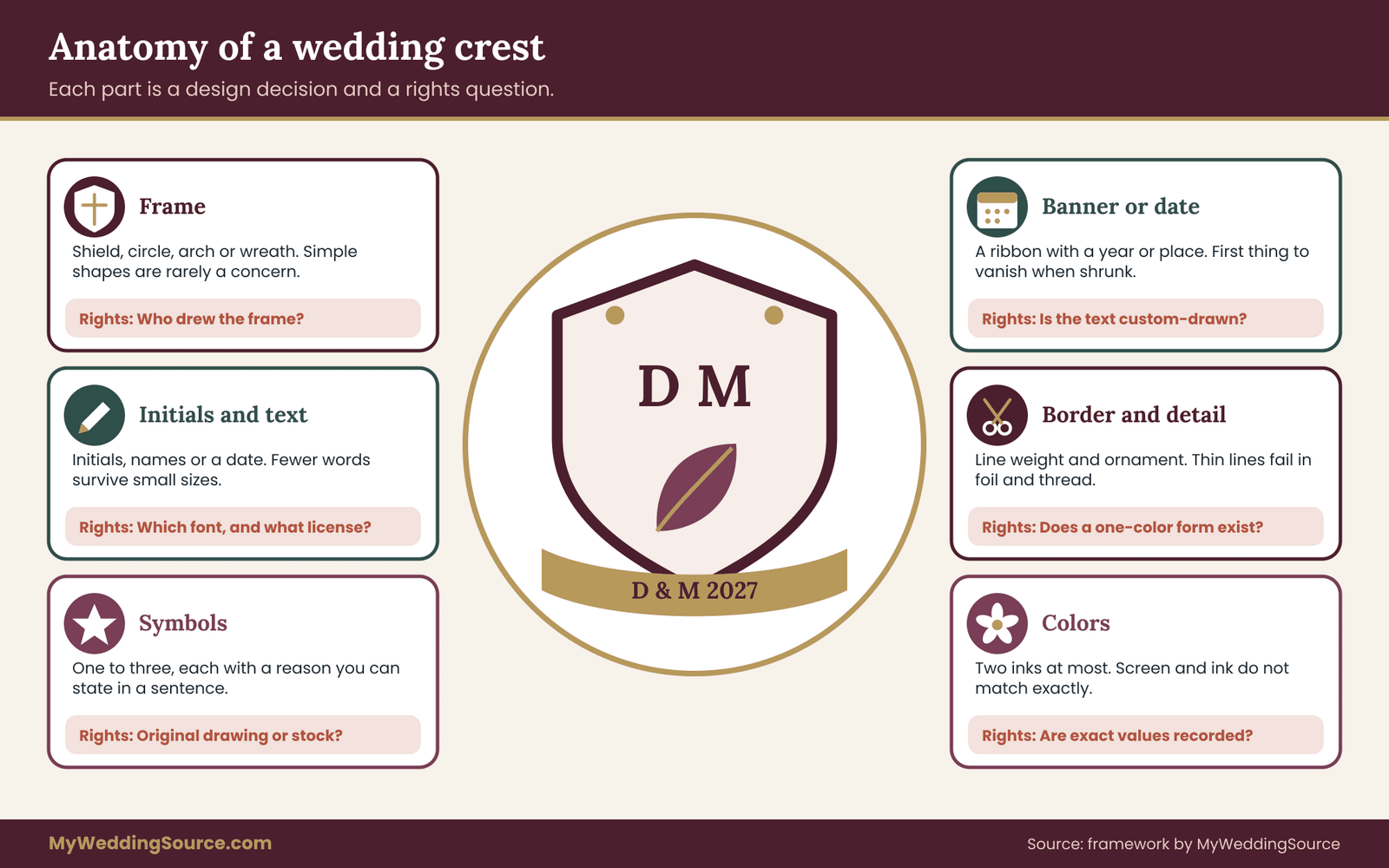
The illustration above breaks a typical wedding crest into its parts. Each part is a separate decision in the brief, and each part can create a separate rights question. The frame might be a standard shape that nobody owns. The letters might be set in a licensed font. The central symbol might be an original drawing, a modified public-domain engraving or something the artist pulled from a stock library. The more you know about the source of each part, the easier it is to say with confidence that you can reuse the whole.
Why a wedding crest needs a written brief
A brief is a short document that tells the artist what to make, what to avoid and what you will do with the result. Without one, you get what most informal commissions produce: a first round of sketches that reflects the artist’s guesses, a second round that reflects your reactions, and a third round that reflects the compromise between the two. Each round costs time, and many artists charge for revisions beyond a set number.
A brief turns that cycle around. It lets the artist estimate honestly. It lets you compare quotes from different people on the same footing. And it creates a record of what was asked, which is useful if the finished work does not match. A quote that says “wedding crest, one color, vector files, exclusive rights, two revision rounds” can be compared with another quote that says the same thing. Two quotes that each say “custom wedding crest” cannot.
The brief also protects the other direction. Artists are often asked for work that is underspecified, then blamed when it does not fit an unstated need. If you tell them at the start that the crest will be embroidered on napkins and cut into a wooden sign, they can design with thick lines and few small details. If you tell them after delivery, they may charge for a redesign, and they will usually be right to.
Think of the brief as having two audiences. The first is the creator, who needs enough detail to start. The second is a future vendor, such as a printer or a sign shop, who may never talk to the creator but will receive the files. A good brief is written so that either reader could understand what the wedding crest is for.
Keep it short. One page is enough for most couples. A brief that runs to six pages usually means the couple has not yet decided what they want, and the creator will spend the first meeting helping them decide. That can be valuable, but it is a design service, and it should be priced that way.
The brief connects naturally to color. If you have already chosen your palette, include the exact color values in the brief. The guide to choosing a wedding color palette walks through how to settle those colors before any artwork starts, and having them fixed in advance prevents a common problem: a wedding crest drawn on screen in colors that cannot be matched in print.
When a wedding crest is the right choice, and when it is not
A custom wedding crest is a sensible choice when the couple wants a recurring emblem across many items, when they like formal or traditional styling, or when their story has a few clear symbols. It is a poor fit when the wedding is minimal and informal, when the budget is tight and a clean monogram would do the same job, or when two families disagree about what the symbols should be and the crest would become a negotiation.
Here is a rough decision rule. Count the places the emblem will appear. If it will appear in only one or two, such as the invitation and a sign, a hand-lettered monogram or a well-chosen illustration may be enough, and a full crest is more design than the event needs. If it will appear in five or more places, a wedding crest begins to earn its cost, because you are paying once for artwork that works across many surfaces.
The cost of the artwork is spread across the uses, but so is the risk: a flaw in the artwork repeats everywhere.
Time also matters. A custom crest usually takes several weeks from first contact to final files, longer if the creator is booked. The invitation timeline is the real constraint, because the wedding crest has to be final before the invitation can be proofed and printed. Work back from the printing date, not forward from the day you start looking for an artist. The section on timing below gives a worked schedule.
Finally, think about who will live with it. A wedding crest often ends up on thank-you cards, a framed print and anniversary gifts. If one partner is lukewarm about it, a long commission is not the moment to find out. Agree on the purpose first, then agree on the symbols, then contact anyone.
The seven-part wedding crest commissioning brief
The brief below has seven sections. Each answers one question the creator needs answered before drawing anything. You can write the whole thing in an evening, and you can copy it into an email or a shared document. The point is not to impress anyone. The point is to make every later decision cheaper.
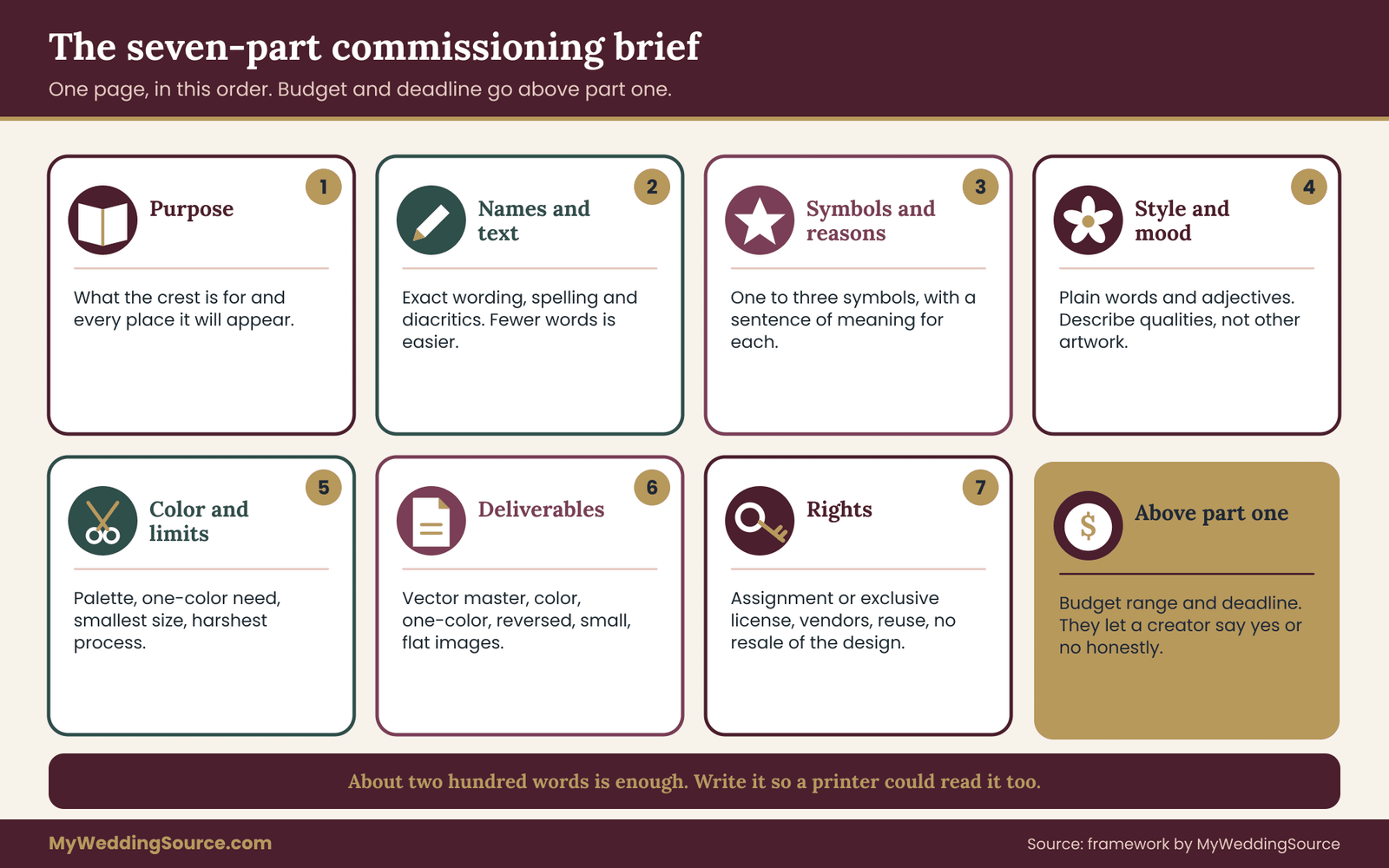
Part one: purpose. One or two sentences on what the wedding crest is for. “A formal emblem for the invitation suite, ceremony programs, welcome signs and a wax seal, plus a framed print for our parents.” This sentence sets the scope. It tells the creator how many surfaces to test the design on and how much flexibility the files need.
Part two: names and text. The exact text that may appear, spelled the way you want it, including diacritics. Decide in advance whether the wedding crest carries initials, first names, a surname, a date or a place. Fewer words are easier to reproduce. A date in tiny letters inside a border is the first thing to disappear when the wedding crest is shrunk to a napkin.
Part three: symbols and their reasons. Choose one to three symbols and write one line about why each one matters. “A heron, because we met on a river trail.” “A sprig of rosemary, for the garden at my grandmother’s house.” The reasons help the artist make decisions you did not specify, and they help you spot symbols that sound good but mean nothing to either of you. The next section covers this in detail.
Part four: style and mood. Describe, in plain words, the look you want: engraved and formal, hand-drawn and loose, flat and modern, ornate and vintage. Add two or three adjectives and one or two things to avoid. Do not attach other people’s finished artwork and say “make it like this.” That invites copying, and it can create exactly the rights problem this guide is trying to prevent. Instead, point to qualities: line weight, amount of detail, symmetrical or not, how much empty space.
Part five: color and reproduction limits. Give your palette, and say whether the crest must work in one color. State the smallest size at which it must stay readable and the harshest process it must survive, such as embroidery, laser engraving, blind embossing or a small wax seal. If you do not yet know where it will be used, say that, and ask the creator to deliver a flexible kit.
Part six: deliverables. List the files, the formats and the versions. The next sections spell this out, but the brief should name them: vector master, full-color version, one-color version, reversed version for dark backgrounds, small-size version, and a flat image for web and email.
Part seven: rights. State what you need to be able to do. Print it yourself, send it to any vendor, use it on gifts and signs, post it online, keep using it after the wedding, and have the artist agree not to sell or license the same design to anyone else. Rights are the part most often left out of a brief, and they are the part that is hardest to fix afterward.
Put the budget and the deadline at the top of the document, above the seven parts. A creator who knows the range can say honestly whether the job fits it, and a creator who knows the deadline can say honestly whether they are free.
Choosing symbols that carry meaning and hold up in print
Symbols are where most wedding crest commissions drift. Couples collect ideas from many places and end up with eight symbols that would fit a coat of arms for a small country. A reader at the venue entrance will never decode eight symbols. Three is a practical limit, and one or two is often better.
Use a simple meaning test. For each proposed symbol, answer three questions in writing. What does it refer to in our actual lives? Would a guest who knows us recognize it, or would it need an explanation? Will it still be recognizable when it is one inch tall and one color? A symbol that fails the first question is decoration.
A symbol that fails the second is fine if you are comfortable explaining it in the program, which is a nice use of space. A symbol that fails the third is a production problem, and it is better to find that out now.
Some practical notes on common choices.
Animals and plants. They work well because they are easy to simplify. A heron, a fox, an oak leaf or a sprig of rosemary can each be reduced to a clear silhouette. The artist should draw them from their own knowledge or from reference photos they have the right to use, and should not trace another artist’s illustration.
Places. A skyline, a bridge or a lighthouse can be charming, but real landmarks sometimes come with their own restrictions. Some buildings and sculptures are protected by copyright or by usage rules that apply to commercial products, and a wedding crest on keepsakes you give away is usually a very low-risk use. If you plan to sell anything with the wedding crest, ask the artist whether the landmark is drawn from an original sketch or from someone else’s photograph, and keep the answer in writing.
Initials. Letters are the safest and most readable part of any crest. The only question is the font. Some fonts are free for personal use but not for printing on products, and some require a separate license for each use. The terms of each font license decide this, so read them before the letters go into the design. For a wedding crest, the best answer is often to have the artist draw custom letters, which also removes the font question entirely.
Cultural and religious symbols. If a symbol carries meaning from your family’s tradition, ask a family elder or the officiant whether it is used correctly, and consider how it will sit beside other symbols. A symbol from one tradition placed beside a symbol from another can send an unintended message. This is the moment to talk, not after the invitations are printed.
Family arms. If a relative has real, documented arms granted by a heraldic authority, ask them before using any part of them. In many traditions those arms belong to specific people and descendants, and using them casually can offend family members even where the law is silent. Arms found on a mass-market “surname crest” site carry no such meaning, but you also have no assurance they are free of copyright. Original artwork avoids both problems.
Brand and team marks. Avoid anything that resembles a university seal, a sports team logo, a corporate mark or a character from a film or game. These are often protected by trademark and by copyright, and an artist who copies them, even loosely, puts you in a position you do not want to defend.
Some couples worry that a wedding crest made from ordinary symbols could accidentally resemble someone else’s. That can happen, and it is not a crisis. Two emblems that both show an oak leaf inside a circle are not copies of each other. The risk grows when the details match: the same proportions, the same unusual line treatment, the same arrangement. A short similarity check, described later, catches most of these.
Writing the brief for different budgets
A brief is not only for expensive commissions. The same seven parts work at three common levels, and the main difference is how much of the work you do yourself.
A low-cost brief. You may be working from a template, a marketplace file or a customizable design. The brief here is mostly a list of questions to the seller: what does the license allow, can I use it commercially, can I print as many copies as I need, which files are included, can the text be changed, and can I get the one-color version. You are not commissioning art. You are buying a license, and the rights checklist is the most important part of your brief.
A mid-range brief. A freelance illustrator or designer builds the wedding crest from your brief. This is the typical case and the one this guide is mostly written for. The brief shapes the quote, the quote shapes the contract, and the contract settles the rights.
A full-service brief. A designer or studio is handling your entire visual identity, and the crest is one part. In that case the wedding crest brief should be consistent with the larger identity, including type, color and layout rules. If you are working this way, make sure the contract for the whole identity assigns or licenses the wedding crest explicitly, because bundled contracts often cover “deliverables” without saying who owns the underlying drawings.
Whatever the level, the brief gives you one sentence worth keeping in mind: you are not asking for a nice picture, you are asking for a set of files you can use, with permission, in the places you named.
A short example of a brief
Here is an invented example, written the way a couple might send it. The couple, Dana and Marcus, are planning an autumn wedding at a garden venue with around one hundred guests.
Their purpose line reads: “A formal emblem for invitations, ceremony programs, two welcome signs, a wax seal on the envelope flap, and a framed print for each set of parents.” Their text is “D and M” with the date inside a small ribbon. Their symbols are a heron, for the river trail where they met, and a sprig of rosemary, for Dana’s grandmother’s garden. Their style note asks for an engraved, formal look with fine line work, symmetrical, with plenty of space around the shapes, and says to avoid cartoon proportions and heavy shadows.
Their color line gives two inks, a deep plum and a muted gold, and asks that the wedding crest also work in plum alone and in a single dark color for the wax seal. They want the smallest version to stay readable at three-quarters of an inch wide. They list deliverables: vector master, color, one-color, reversed, small and flat image versions.
Under rights they write: “Exclusive use for our wedding and personal reuse afterward. Any printer or sign maker we hire may reproduce the files. The artist does not resell the design. We would like the right to use the crest on thank-you cards and anniversary gifts.”
That is under two hundred words, and it prepares the creator to answer almost every question they would otherwise ask in the first meeting. It also gives the couple something to measure the finished work against, which is the subject of a later section.
Choosing who makes your wedding crest
Once the brief exists, you can compare ways to get the work done. There are five realistic paths, and each one suits a different budget, timeline and tolerance for risk. None of them is wrong. What differs is what you receive, what you can do with it and who stands behind it.
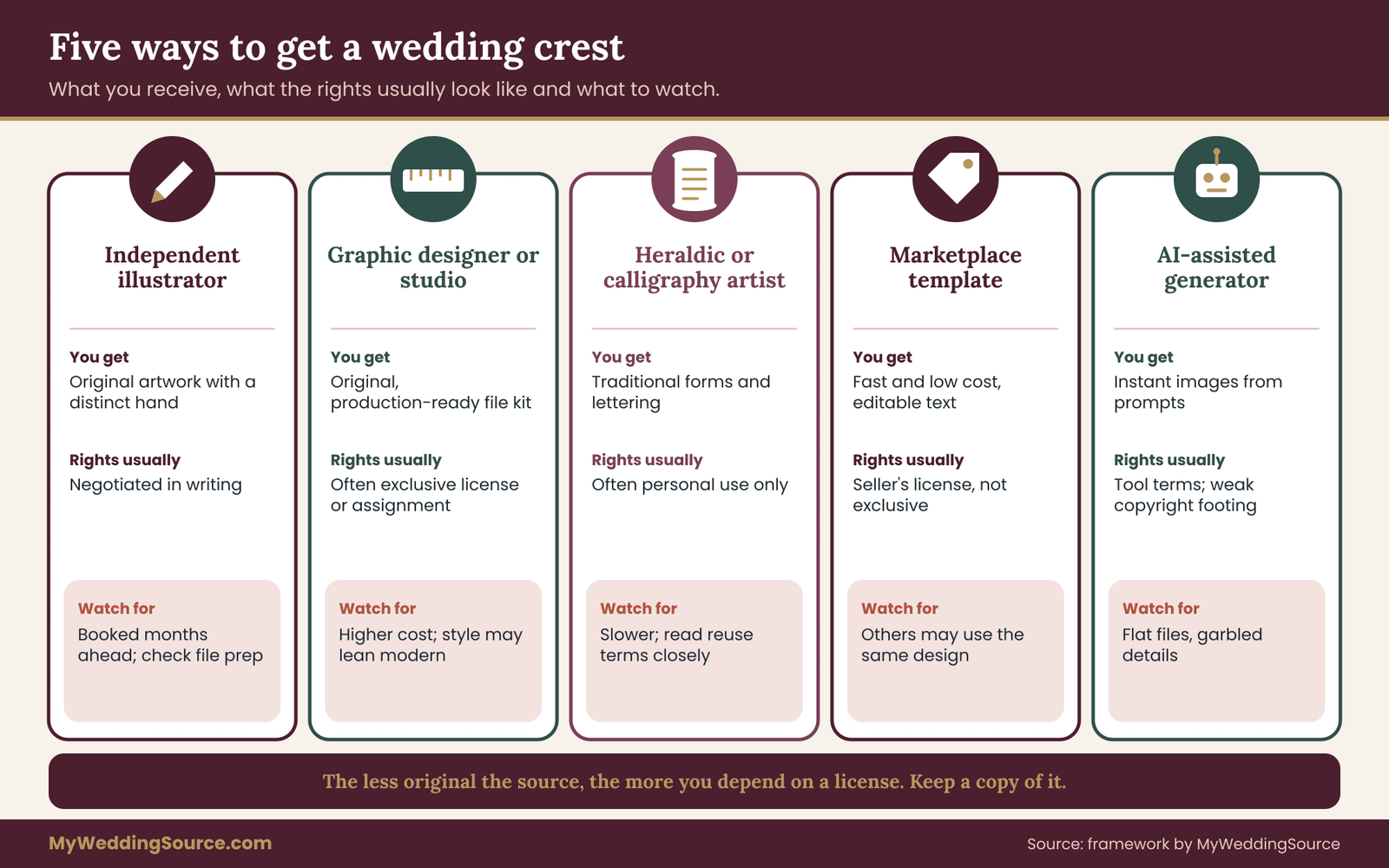
An independent illustrator. This is a person who draws original artwork, often in a distinct style. You get a unique result and a conversation about it. The risks are availability, since popular illustrators book months ahead, and file preparation, since not every illustrator delivers production-ready vector files. Ask to see work that was actually reproduced in print, not only screen portfolios.
A graphic designer or small studio. Designers think in systems: type, color, layout, reproduction. A designer is more likely to deliver the file kit in the brief and to anticipate how a wedding crest behaves on foil, on a sign or in a small size. The cost is usually higher than an illustrator’s, and the style may lean toward clean and modern unless you specify otherwise.
A heraldic or calligraphic artist. If you want a traditional look, with proper shield shapes, mantling and lettering, a specialist can build something that respects the conventions. This path also gives you someone who can tell you honestly where a design drifts from tradition. Specialists may be slower and may price by the hour, and their usual contracts may be written for private commissions rather than for broad commercial reuse, so read the rights terms carefully.
A marketplace template. Template sellers offer ready-made crest designs with editable text. The cost is low and the delivery is fast. The tradeoff is that the design is not exclusive, other couples may use it, and the license is whatever the marketplace and the seller say it is. This path can be a good fit for a casual wedding if you read the license before buying and keep a copy of it.
An automated or AI-assisted generator. Tools that generate images from prompts can produce a convincing crest in minutes. They raise two separate problems. The first is practical: the output is often a flat image that is hard to convert into clean vector shapes, and it may contain malformed details, garbled letters or inconsistent line weight. The second is legal. The U.S. Copyright Office has published guidance saying that copyright protects human authorship and that material generated by AI without sufficient human creative control is not protected in the same way.
That does not make the image illegal to use. It means you may have little or no ability to stop others from using something similar, and the tool’s own terms govern what you may do. Read those terms, and see the official guidance listed in the sources.
A simple rule: the less original the source, the more you rely on the seller’s license, and the more important it is to keep that license on file.
How to compare quotes on equal footing
Different creators describe their work in different words. To compare fairly, translate every quote into the same six lines.
First, the scope: how many concepts, how many revisions, how many finished crest versions. Second, the deliverables: which file formats and variants are included and which cost extra. Third, the rights: assignment, exclusive license or non-exclusive license, and for what uses. Fourth, the schedule: when the first sketches arrive, when each revision is due and when final files arrive.
Fifth, the price: total, deposit, balance and what triggers each payment. Sixth, the extras: what happens if you want changes after approval, whether the artist offers matching items such as monogram variants, and whether they charge more for commercial use.
When you fill in the six lines, you will often find that the cheapest quote is not the cheapest. A low price with one revision, a raster file and a non-exclusive license may cost more by the time you have paid for vector conversion, extra rounds and a license upgrade. A higher price with exclusive rights, a full file kit and two revision rounds can be the better value even though it looks like more.
Be wary of a quote that does not mention rights at all. That is not necessarily bad faith. Many creators simply have not thought about it, and they will give you a clear answer if you ask. But silence on rights does not mean you own everything. As later sections explain, silence generally leaves the creator holding the copyright.
Questions to ask before you hire
You can ask these in an email. A professional will answer them without fuss, and the answers tell you as much about how they work as the portfolio does.
Is the artwork entirely original? Ask whether any element comes from stock libraries, templates, previous client work or generated images. If they use stock elements, ask which license applies and whether it permits printed products and reproduction by third parties.
Which fonts are used? If the wedding crest includes live text set in a font, you need to know the font and its license. If the lettering is custom-drawn, say so in the contract.
What rights do I receive? Ask the question plainly. Do I own the copyright, or do I receive a license? If a license, is it exclusive? Is it limited to certain uses, certain volumes or a certain time? Can I transfer it to a vendor who needs to reproduce the work?
Will you use this design for anyone else? An exclusive license or an assignment means the answer is no. Some artists keep the right to show the work in a portfolio, which is common and reasonable. Others reserve the right to reuse elements, which you may or may not accept.
What files will I receive? Name the formats and variants from your brief and ask for confirmation. Ask whether the vector files are editable, and whether outlines are converted so you do not need the original fonts.
What happens if the work does not match the brief? Ask about the revision process, the point at which work is considered approved and what happens to deposits if the project stops.
Can you provide proof of originality? A designer may be able to share sketches, working files or reference sources. You are not accusing anyone by asking. Some clients need this for their own records, and a professional will understand.
Do you carry any kind of coverage or indemnity? Most independent artists do not, and the answer is not a deal-breaker. It tells you who bears the risk if a claim arises. The broader guide to wedding vendor due diligence covers how to check any vendor’s identity, terms and track record before you pay a deposit.
Reading a portfolio for reproduction quality
A portfolio can tell you whether the creator’s work will survive production, but only if you look at the right things. Ignore how impressive the large images look. Look for these instead.
Look for small-size examples. A crest that appears only at poster size tells you nothing about how it holds up on a place card. Ask whether they have shown the same artwork at several sizes.
Look for one-color versions. If every example is full color with soft gradients, ask what happens when the design is reduced to a single ink. Good emblem work usually has a clean one-color form hiding inside the colorful one.
Look for physical proof. A photograph of a finished letterpress card, a wax seal, an embroidered patch or a laser-cut sign is better evidence than a mockup. Mockups show what a design could look like. Photographs of real objects show what happened.
Look for consistency of line. Uneven line weight, tiny details that clump together and thin lines that fade in reproduction are signs that the artwork was designed for screens only.
Look for how they handle letters. Lettering is one of the first places amateur work shows. Letters that are unevenly spaced, awkwardly shaped or squeezed into a border without adjustment suggest the creator has not worked much with type.
Finally, read what past clients say, but weigh it with care. A review that mentions clear communication and on-time delivery is useful. A review that only says “beautiful” is a compliment about the picture, not about the process.
What to do if you want to adapt existing artwork
Some couples already have a drawing, perhaps made by a friend or relative, and they want to turn it into a wedding crest. This is a common and lovely idea, and it has one complication: the person who drew it owns the copyright unless they have transferred it. A friend who sketches the family farmhouse on a napkin has not agreed to have it printed on three hundred invitations unless they say so.
The fix is simple and kind. Ask permission in writing, say what you plan to do with the drawing, and offer a short signed note in which the artist agrees. If the drawing will be redrawn by a professional, say that too, because the artist may have opinions about how it is changed. A friend who is delighted to contribute will usually sign without fuss, and the note protects both of you. Keep it with your other files.
The same logic applies to a photograph. If a symbol is based on a photograph that a friend took, ask the photographer, not only the person who appears in it. And if you plan to reproduce a vintage engraving or an old illustration, check whether it is in the public domain, which depends on its date and origin, and ask the artist to confirm the source of any older image they use. The Library of Congress and the Copyright Office both publish plain-language guidance on how to think about public-domain status.
Who owns a wedding crest you pay for
This is the question that surprises people. In the United States, copyright generally begins with the person who creates a work, from the moment it is fixed in a tangible form such as a drawing or a digital file. Paying for the work does not, by itself, move that copyright to you. If an independent illustrator draws your wedding crest and the contract is silent about ownership, the illustrator generally holds the copyright and you hold, at best, permission to use the finished work in the ways both sides expected when you paid.
There is a legal category called work made for hire, under which an employer or commissioning party can be treated as the author. For a commissioned work from an independent creator, it applies only to certain listed categories of work and only if both sides sign a written agreement saying so. A custom emblem does not clearly fit those categories, and couples should not assume it does just because a contract uses the phrase. If a contract says “work made for hire,” treat that as a reason to ask a lawyer what it actually accomplishes.
The Copyright Office publishes plain-language explanations of ownership, transfers and licensing at copyright.gov, and the text of the law is available through the same site. Use those pages to confirm anything in this article before you rely on it.
So the practical question is what paper you need. There are three common arrangements.
An assignment. The creator transfers the copyright, or a defined part of it, to you. In U.S. law a transfer of copyright ownership generally has to be in writing and signed by the owner of the rights being transferred. After an assignment, you are the owner. You can reuse the wedding crest, license it and stop others from copying it, and the creator may need your permission to show or reuse it. An assignment is the cleanest outcome and often costs more.
An exclusive license. The creator keeps the copyright but promises that only you may use the design for the stated purposes. This can be nearly as good as an assignment for a wedding, provided the license is broad, long-lasting and covers the uses you listed. The details are in the wording: which uses, which territory, for how long, and whether you can pass the right to vendors.
A non-exclusive license. You may use the crest, but the creator may license or sell the same design to others. This is common for templates and marketplace artwork, and it is acceptable for casual use. It is a poor fit for a wedding crest that is supposed to feel like yours alone.
If nothing is written, the law may still treat you as having an implied permission to use the artwork for the purpose you obviously commissioned it. That implied permission is fuzzy, it can be argued about, and it is narrow. It is a very weak foundation for printing hundreds of items, hiring a sign maker or putting the wedding crest on gifts a year later.
The wedding crest rights checklist
This is the original checklist that goes with the brief. Each item is a yes or no that you can answer from the contract. If an answer is no or unclear, either ask for a change or accept the limitation knowingly.
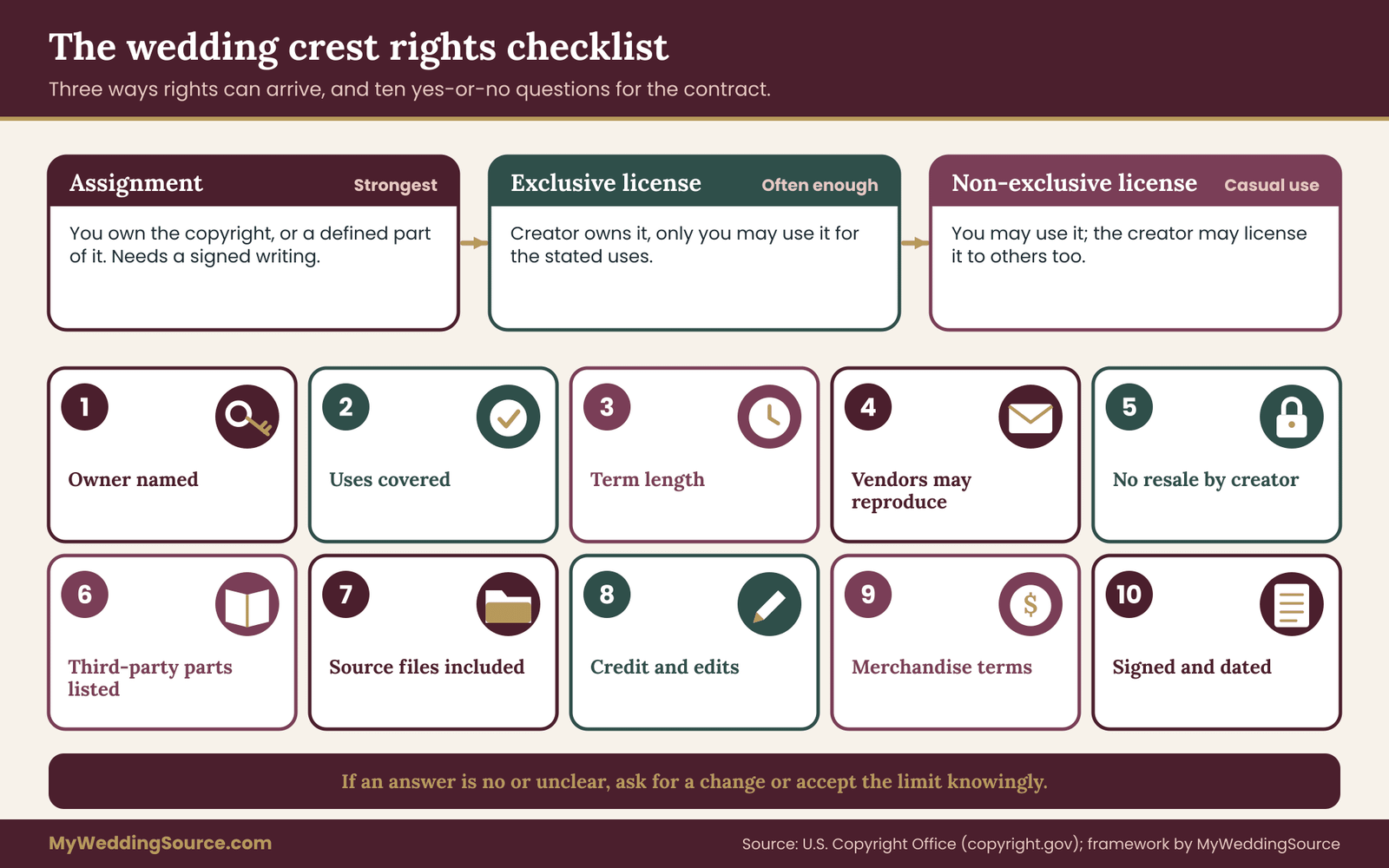
One: who is named as owner? The contract should say whether you receive an assignment, an exclusive license or a non-exclusive license. If it says only “you may use the artwork,” ask what that includes.
Two: what uses are covered? List every use from your brief, including print, signs, engraving, embroidery, cakes, websites, social posts and keepsakes. If the contract names fewer uses than you plan, add them. The phrase “personal and wedding-related use” is useful, but spell out the main ones.
Three: for how long? A license with an end date or a “one event only” limit is a problem if you want the wedding crest on anniversary gifts or a framed print. Ask for perpetual use, or at least a term that covers the years you care about.
Four: can vendors reproduce it? Printers, engravers, bakers and sign makers will need the files. The contract should say you may give copies to any vendor for the purpose of making your items, and that those vendors do not acquire any rights beyond that.
Five: is the creator allowed to reuse it? Many creators keep a right to show finished work in a portfolio, and that is usually reasonable. What matters is that the contract says they will not license or sell the same artwork or recognizable parts of it to others.
Six: what third-party elements are inside? The contract should say whether the artwork includes stock images, templates, fonts or other people’s work, and which license covers each. If the answer is “none, it is all original,” the creator should be willing to say so in writing.
Seven: are the source files included? You may not need the original working files, but you should receive vector masters and outlined text so that a future designer can edit the crest without recreating it.
Eight: what about moral and credit questions? Some creators want a credit line or want to approve changes. Neither is unreasonable. Decide whether you accept a small credit, and whether you want the right to make modest edits, such as adding a year or adjusting for a new use, without asking.
Nine: what about resale or merchandise? If you plan to sell anything, for example to raise money for a charity or to include the wedding crest on products for sale, ask directly. Commercial reuse may need a different license from personal use.
Ten: is the agreement signed and dated by both sides? An email thread can work as an agreement, but a short signed contract is clearer. Keep a copy in the same file as your invoice and your final deliverables.
Ten yes-or-no questions is the whole checklist, and a creator who has thought about their business can usually settle them in a single exchange.
Wording that makes the rights clear
You do not need a lawyer to understand the shape of a good clause, though a lawyer is worth hiring if the commission is large or if you plan to sell products. Here is plain-language wording to ask for. It is not legal advice and not a substitute for a contract reviewed by a professional, but it shows what a clear grant looks like.
For an assignment: the creator assigns all rights in the final approved wedding crest artwork to the couple, effective on full payment, and keeps the right to show the work in a portfolio. For an exclusive license: the creator grants the couple an exclusive, perpetual license to reproduce and display the final approved artwork for personal, wedding and non-commercial uses, including reproduction by vendors engaged by the couple, and agrees not to license the artwork or any substantially similar version to others.
Notice the phrases that do the work: final approved artwork, effective on full payment, perpetual, vendors engaged by the couple, substantially similar. Each one closes a gap. “Final approved” avoids a dispute over rejected drafts. “Effective on full payment” is fair to the creator and protects you from ambiguity about when rights begin. “Vendors engaged by the couple” settles the printer question. “Substantially similar” stops the creator from reselling a lightly altered copy.
The wider guide on wedding vendor contracts explains how to read deposits, cancellation terms and liability clauses, and those terms apply to a design commission as much as to a florist or a venue.
How payment and rights interact
A common arrangement is a deposit to begin, a payment at concept approval and a final payment on delivery of files. Rights usually transfer or take effect at the final payment. That is reasonable, and it has a consequence worth remembering: before you pay in full, you may not yet have the right to use the final crest in any real way. Do not send files to a printer until the last payment clears and the rights are in effect, however tempting it is to move early.
If the project is cancelled partway through, ask what happens to the sketches. In many commissions, the creator keeps the rights to unused concepts, and you keep nothing. That is fair, because you paid for a service, and you should not use the abandoned concepts without permission.
Keep the money records in order. A proof of payment shows that you paid the amount on the contract, and a printer or sign shop may ask for that proof if there is a question about authorization. The guide on organizing wedding records after the event gives a retention approach that fits a design file along with contracts and receipts.
What the Copyright Office does and does not protect
It helps to know the edges of what copyright covers, because they affect what you can ask for. Copyright protects original expression, such as the particular drawing of a heron, not the idea of putting a heron on a wedding crest. Anyone can draw a heron. They cannot copy your artist’s specific drawing of one.
Names, titles and short phrases are generally not protected by copyright, and neither are familiar symbols or simple shapes such as a plain circle or a shield outline. That is why a shield frame is not a rights problem on its own, while a detailed, distinctive illustration inside the shield is.
Registration is not required for copyright to exist. Registering with the Copyright Office offers certain legal advantages, mostly relevant if someone copies the work and you want to enforce your rights. For a wedding crest, most couples will not register anything. If your artist or you plan to sell products, a conversation with a lawyer about registration and trademarks is a sensible step. The Copyright Office’s registration pages explain the process and current fees, which change, so check them at the source.
A separate question is trademark. Trademark law protects marks used to identify the source of goods or services. A crest on a wedding invitation is not usually a trademark use. If you later start a business, such as a photography studio or a stationery shop, and use the wedding crest as its mark, the analysis changes. The U.S. Patent and Trademark Office explains the basics. Do not assume that an emblem is free to use as a business mark simply because you paid for it as a wedding emblem.
The file kit your wedding crest should arrive in
A finished wedding crest is not one file. It is a small set of files, and each one answers a different practical need. If you name them in the brief, the creator will deliver them as part of the job. If you do not, you may be asked to pay for them one at a time, usually at the worst moment, such as the week a printer rejects your artwork.
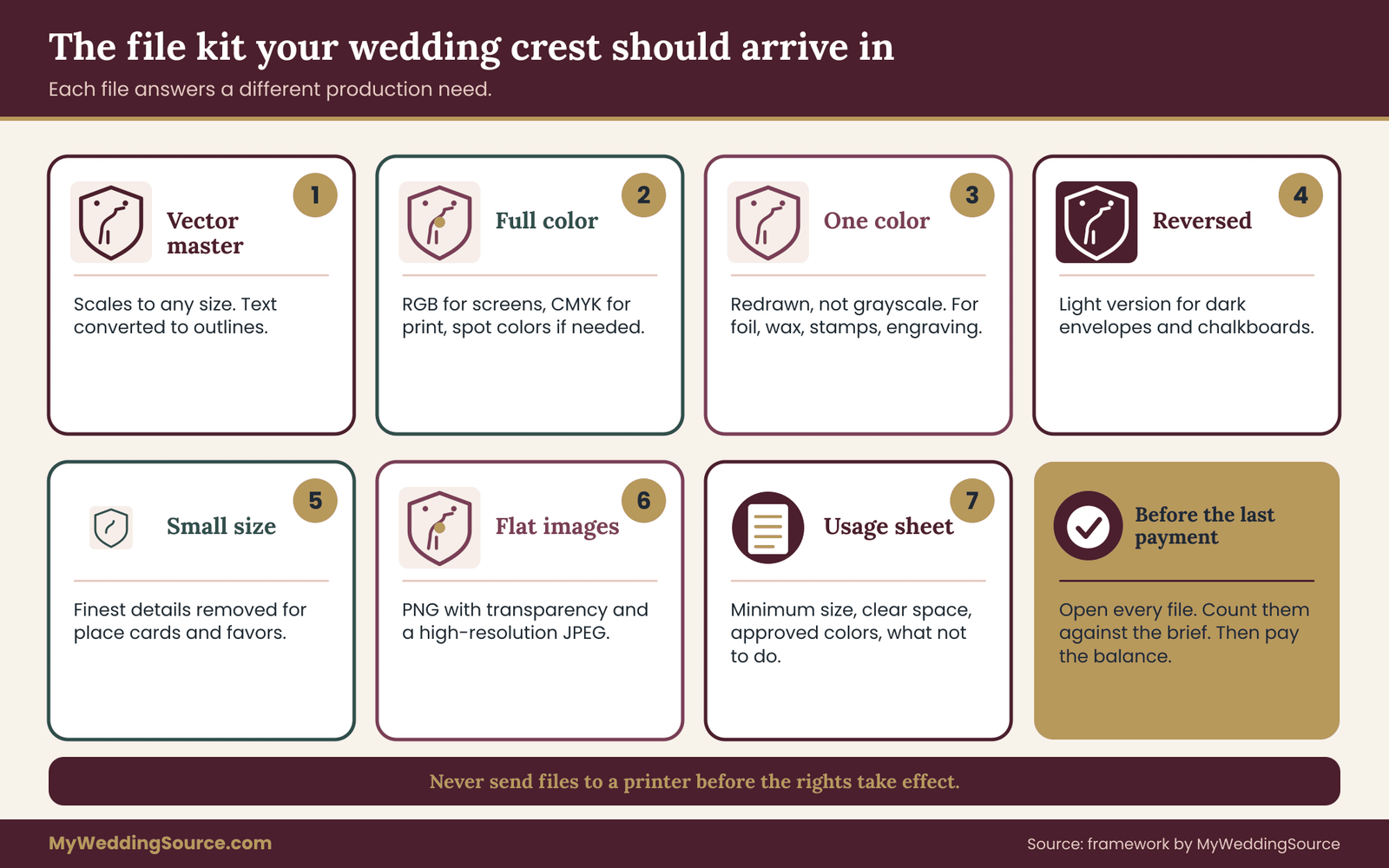
The vector master. This is the file from which everything else is made. Vector artwork is built from shapes and lines rather than pixels, so it can be scaled from a stamp to a banner without getting blurry. Common formats are SVG, PDF and EPS, and a designer will typically work in Adobe Illustrator or similar software.
Ask for the master with all text converted to outlines, so that nobody needs to own the original fonts to open it. Ask also for an editable version if you may want a future designer to change the date or the initials.
The full-color version. This is the crest in your palette. Ask for it in the color spaces your vendors need: RGB for screens and CMYK for ordinary printing, plus exact spot-color references if you plan to use foil or a specific ink. Colors on a screen are not the same as colors in ink, and a good creator will tell you where the difference will show.
The one-color version. This one matters more than people expect. Foil stamping, embossing, engraving, wax seals, laser etching, stamps and embroidery usually work in a single color or a single depth. A one-color version is not the full-color design in grayscale. It is redrawn so that every part survives without color to separate it.
The reversed version. This is a light version of the wedding crest for dark backgrounds, such as a navy envelope liner or a chalkboard sign. A reversed crest is also redrawn, not just inverted.
The small-size version. At a very small size, thin lines and tiny details disappear. A small-size version removes or simplifies the finest elements so the wedding crest stays clear on a place card, a drink stirrer or a favor tag.
The flat image files. PNG with a transparent background and a high-resolution JPEG cover most everyday needs, such as a website header, an email signature or a social post. These are made from the vector master and are not substitutes for it.
A short usage sheet. A one-page document showing the minimum size, the clear space around the wedding crest, the approved colors and what not to do, such as stretching or recoloring. It is a small courtesy that saves a lot of confusion when other people handle the files.
Ask for the files in a shared folder and confirm that you can open each one before you approve the final payment. Opening them is the only reliable test that they are what the contract says they are.
Testing the wedding crest before everything depends on it
Before the invitation suite is designed around a crest, test the wedding crest alone. The tests below are measurable. You are not trying to decide whether it is beautiful. You are checking whether it will behave.
The size test. Print the wedding crest at the smallest size your plan calls for, using an ordinary office printer. Hold it at arm’s length and then at reading distance. Can you tell what each symbol is? Can you read the letters? If you need a magnifying glass, the design is too detailed for that use, and you should ask for a small-size version or accept that the wedding crest will not appear at that size.
The one-color test. Print the one-color version on plain paper, and then copy it on a photocopier or scan it in black and white. Check that no shapes merge into each other and that no meaningful detail has vanished.
The contrast test. Look at the crest on each background it will appear on: ivory paper, a dark envelope, a wood sign, a fabric napkin. Does it have enough contrast against each? If the wedding crest is a pale gold, it may vanish on cream. A quick way to check is to view the wedding crest in grayscale and see whether it still stands out.
The distance test. For signs, tape a printout to a wall and walk away. Signs are read from several feet away, and a wedding crest that looks refined on a screen can become a dark blob at that distance. The guide to wedding signage systems explains how to judge readability and placement for the signs themselves.
The spelling test. Read every letter and number in the crest aloud, and ask someone else to do the same. Spelling errors in a wedding crest get repeated on every piece of printed material.
The process test. If you plan to use a special process, such as foil, embossing or embroidery, ask the vendor for a small test or a proof before approving the full run. A test that costs a little can save a large reprint.
The tracing test. Ask the creator to confirm that the artwork was drawn from scratch or from material they have rights to use. If something looks familiar, a quick image search can show whether a close match exists. This is not detective work. It is the same sanity check a designer would do for a logo.
Record the results in a few lines: test, date, result, action. If a test fails, give the creator specific feedback, such as “the date inside the ribbon is not readable at three-quarters of an inch,” rather than “make it clearer.” Specific feedback is cheaper to act on and usually faster.
How different reproduction methods change the design
The brief asks for a wedding crest that works across methods, but each method has its own limits. Knowing them lets you decide which uses to include and which to skip.
Digital and offset printing. These handle fine detail and color well. They are forgiving, which is why most crests look best here. Even so, very thin lines can fill in and very small text can blur, especially on textured paper.
Letterpress. The plate presses the design into soft paper, producing a physical impression. Fine details and very thin lines may not hold, and large solid areas can print unevenly. Printers can tell you the minimum line weight they trust. Ask for it in points or millimeters and give it to the creator.
Foil stamping. Foil is applied with heat and pressure through a metal die. It suits bold shapes and clear spacing and is poor at very fine lines and tiny gaps. Because it uses one color of foil, you need the one-color version.
Embossing and debossing. The design is raised or pressed into the paper without ink. Simple shapes work best. Detailed illustrations can look muddy, and very small elements may not register.
Engraving. Traditional engraving cuts the design into a plate and gives very crisp lines. It is a specialist process, and requirements for artwork can be strict. Check what the engraver requires before the wedding crest is finalized.
Wax seals. A seal stamp makes a small, deep impression into soft wax. The crest has to be simple, and the stamp itself is typically a small circle. A complex crest has to be simplified into a seal version, with few details and wide gaps. Many couples order a custom seal stamp from the one-color artwork.
Laser cutting and engraving. Used for signs, favors and wooden items. Lines must be thick enough to be cut or burned cleanly, and enclosed shapes such as the inside of an “O” need bridges or they fall out in cutting. A creator who knows this can add small connecting pieces.
Embroidery and fabric printing. Thread has a minimum thickness, so thin lines and small text do not work well. Embroidery usually needs a simplified version and a limited number of colors.
Cake and food decoration. A baker may transfer the crest with an edible printed sheet, a stencil or hand piping. Each method simplifies the design in a different way. Share the one-color version and ask what the baker can reproduce, rather than assuming a detailed crest will transfer.
Digital use. Web and social use are generally easy, but the design should still be tested at the small sizes of an avatar, an email signature and a browser tab.
The pattern is the same for all of these. Detail is a luxury that few processes can afford, and the simpler the wedding crest, the more places it can go. If your list of uses includes more than three of the methods above, ask the creator to design for the hardest one and adapt upward, rather than designing for the easiest and hoping the rest will follow.
The guide to wedding invitation printing goes deeper on proofing and printer handoffs, which is where a wedding crest first meets a real production process. Bring the file kit and the usage sheet to that conversation.
Handing the wedding crest to vendors and securing reuse
The commission ends when you have the files and the rights. The wedding crest then begins a second life in other people’s hands. Printers, sign makers, bakers, stamp makers and embroiderers will each ask where the artwork came from. Most will not ask for a law degree. They will ask for one of three things: a statement that the artwork is yours or licensed to you, the files in a usable format, and sometimes a signed note confirming permission.
Prepare a single “permission sheet” and keep it with the files. It is half a page. At the top, the title of the artwork and the date of completion. Below it, the name of the creator and a line stating whether you hold an assignment or a license, and which type. Below that, a short statement of what the license allows, quoted or summarized from the contract. At the bottom, your names and the date. You are not creating a legal document. You are giving the vendor a reliable answer to an ordinary question.
Many vendors have their own rules. Some print shops refuse artwork that appears to be a recognizable brand or character. Some bakeries will not reproduce a design without confirming the right to use it. Some engravers ask for a signed statement. When a vendor asks, you give the sheet, and the conversation ends in a minute. When you cannot give it, the same conversation can stall a project for days.
Send the right file to the right vendor. The printer receives the full-color vector and the CMYK or spot-color reference. The foil stamper receives the one-color version. The wax seal maker receives the simplified one-color seal version. The baker receives a flat image of the one-color version plus the size. The sign maker receives the vector master and the dimensions. Sending the whole folder to everyone is how the wrong version ends up on the wrong item.
Ask each vendor to confirm what they received. A short message, such as “Please confirm you are using the one-color vector file named crest-one-color, and that the height will be two inches,” is enough. It prevents a vendor from redrawing the wedding crest from a screenshot, which happens more often than you would expect, and which can break line weights and spacing.
Do not let vendors redraw the artwork. A vendor who retraces a crest may change it slightly, and a retraced version raises a new question about who made it. If a vendor says the file is unusable, go back to the creator, not to a freelancer who will redraw it.
Keep a log of who has the files. A simple list is enough: vendor, which files, date, purpose. It helps when you want to ask a vendor to delete the files afterward, or when a vendor changes hands and you wonder who still has your artwork.
Reusing the wedding crest after the wedding
The crest does not have to disappear when the cake is cut. Couples reuse it for thank-you cards, anniversary gifts, a framed print, stationery for their new household and holiday cards. The rights checklist covered the permissions you need for those uses, and the practical side is to store the files properly.
Store the vector master, the one-color version, the usage sheet and the signed agreement together, in at least two places. A shared cloud folder and an external drive are enough. Name the files clearly, with the version and the date, so that someone who finds them later can tell which is which. Add a plain text note listing the artist, the license type and the date of the agreement.
If you later want a modification, such as a new year, an added child’s initial or a new color, check the contract before you ask a designer to alter the artwork. An assignment generally lets you modify the work. A license may limit modifications or require the creator’s approval. If the creator is open to it, a short email with the agreed change is a fair record. If the creator is no longer available, an assignment or a license that allows edits will save you from rebuilding the wedding crest from scratch.
Think also about what happens if the wedding crest becomes more than a wedding emblem. A couple who starts a joint business, a small shop or a family newsletter may want to use the wedding crest as a mark. Because this changes the use from personal to commercial, ask the creator in advance, ideally during the original commission, and say so in the brief. An extra clause at the start costs little. A new license after the fact costs more, and the creator may decline.
A realistic schedule and cost logic for a wedding crest
A wedding crest has many dependents. The invitation cannot be proofed until the crest is final, signs cannot be ordered until the file kit exists, and a wax seal stamp may take weeks to make. Work backward from the dates that cannot move.
Here is a sample backward schedule for a wedding with invitations mailed about eight weeks before the date. It uses invented lead times, so replace them with the actual numbers from your vendors.
Start with the invitation mailing date. Subtract the printer’s production time, which includes proofs and corrections. Subtract the time you need to design the invitation around the wedding crest. Subtract the time to finalize the wedding crest, test it and settle the rights. Subtract the creator’s stated schedule, including revision rounds. Subtract the time to find and hire the creator.
The date you end up with is the latest day to begin. If it is already past, you have two options: choose a simpler path, such as a template with a clear license, or simplify the wedding crest so that fewer revisions are needed.
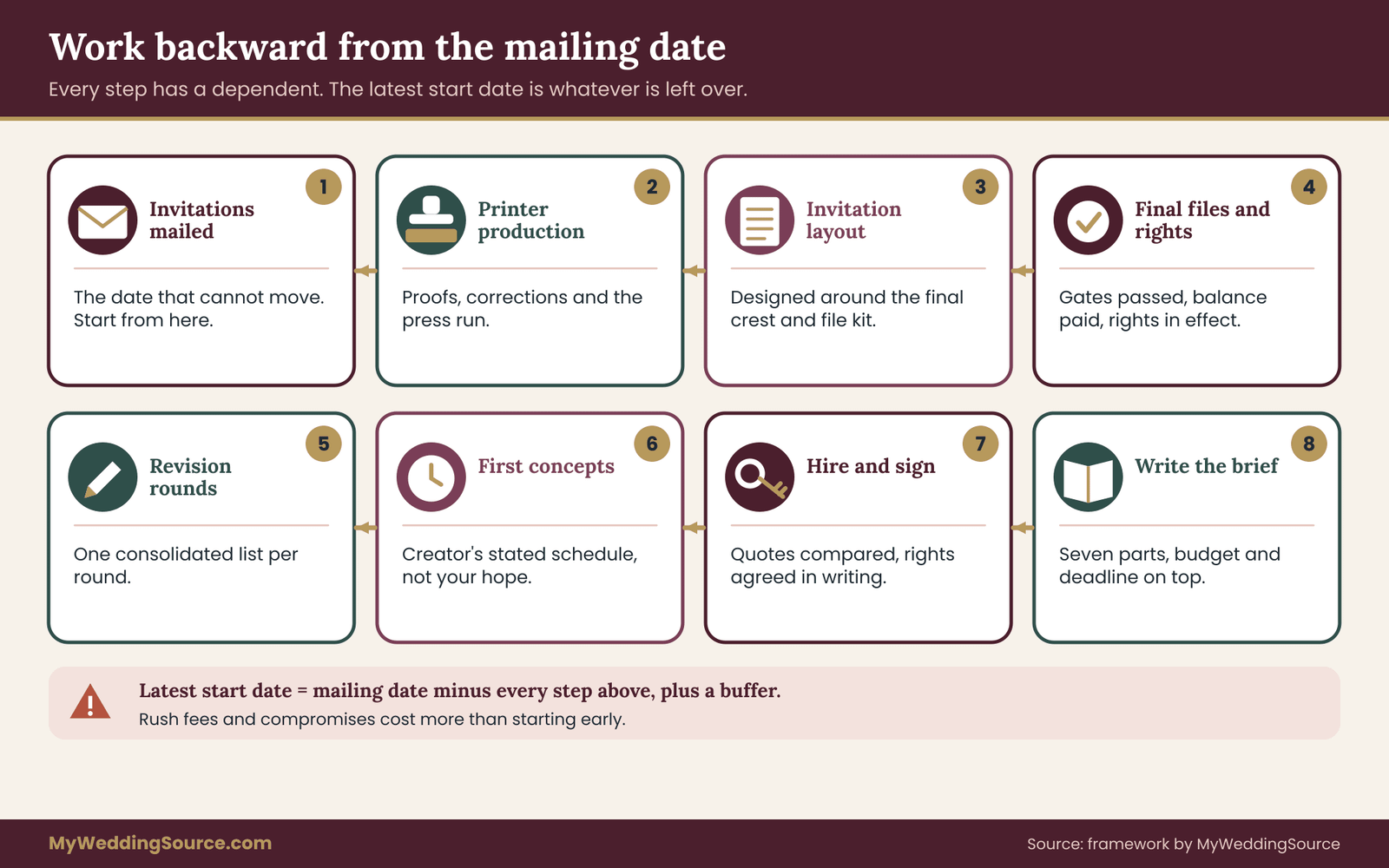
Build a margin into every step. Creators fall ill, printers find a problem in a file and a proof can take an extra week. A crest finished several weeks before the printing deadline is much cheaper than one finished on the last day, because rush fees, expedited shipping and compromises all cost money.
Cost logic without invented numbers. Prices vary widely by creator, region and scope, and a figure quoted in an article is a guess about your situation. Instead of a price list, use a cost frame. A crest has a creation cost, a rights cost, a file preparation cost and a reproduction cost. The creation cost is the artist’s time on concept, drawing and revision.
The rights cost is the premium for exclusivity or assignment, which some creators include and others price separately. The file preparation cost covers the variants in the kit. The reproduction cost is what each vendor charges to turn the crest into a physical item, and it can be larger than the artwork itself.
Ask creators to price the rights separately from the drawing, so you can see what exclusivity costs. Ask whether file variants are included. Then list the reproduction methods you plan to use, because a design that needs foil, a custom die and a seal stamp has set-up costs even before a single item is made. The wedding budget guide helps you decide where an emblem sits among your other priorities, and a short written line item for “crest artwork and rights” keeps it visible.
A useful decision rule: if the quotes for the wedding crest and its rights approach the price of the entire stationery suite, step back and ask whether a monogram or a simpler illustration would do the same job. A crest is a pleasure, not an obligation.
Edge cases that come up in practice
A few situations come up often enough to plan for.
Two families, two sets of symbols. If both families want their own symbols included, the wedding crest can become a compromise that satisfies no one. A workable approach is to give each family one symbol and give the couple the frame and initials. Put the reasoning in the brief so the creator can design with balance.
A same-name conflict. You might discover that a business or a school uses a very similar emblem. Similar is not identical, and a personal wedding emblem used on invitations is a different thing from a business mark. Still, if the similarity is close, ask the creator to adjust the design. It costs less than defending a complaint.
A creator who disappears. Cases occur where a creator stops answering after the deposit, or after delivery. The remedy is paper. If you have a signed agreement, proof of payment and the files, you can use the wedding crest as permitted. If you do not, you may have to start again. This is another reason to keep the full record in one place.
Artwork drawn by a guest or relative. The earlier suggestion applies: ask for a short signed permission, and clarify whether you may adapt the drawing. A relative who is delighted to help will usually sign without hesitation.
Collaboration between the creator and a printer. Sometimes a printer offers to “tidy up” the artwork. Ask first, and ask the creator, not the printer, to approve any change.
A change of name or date. If the date changes, the crest may need an edit. Check the contract for how changes are priced and whether they are included in the rights.
Late discoveries. If after delivery you find a third-party element you did not know about, a stock image or a licensed font, raise it with the creator promptly and in writing. A professional will want to fix it as much as you do, and fixing it before the invitation is printed is far easier than afterward.
Taken together, these cases share a pattern. Problems about crests are rarely mysteries. They are gaps in the paperwork, and the paperwork is cheap to complete while everyone is still friendly and the deadline is still far away.
A worked example: one wedding crest from brief to approved files
This invented example follows Dana and Marcus, the couple from the sample brief, through the whole process. The numbers are illustrative lead times, not averages, and no real vendor is described.
They begin about nine months before the wedding. In the first week they write the brief and agree on two symbols, a heron and a sprig of rosemary. They also settle on the palette, plum and muted gold, which they chose earlier. In the second week they send the brief to three creators: a freelance illustrator, a small design studio and a heraldic artist. They ask each one to quote on the same six lines described earlier.
The three quotes come back in different shapes. The illustrator offers a lower price, two concepts, one revision round and a non-exclusive license, with extra variants priced separately. The studio offers a higher price, a full file kit, two revision rounds and an exclusive license, with the artist keeping portfolio rights. The heraldic artist offers a distinctive traditional design, an hourly rate and a license limited to personal use, with a strong preference for the wedding crest not to appear on anything sold.
Dana and Marcus do not choose by price. They line up the quotes against their brief. They plan to use the wedding crest in six places, including a wax seal and a framed print, so they need the one-color and small versions. They want exclusivity because the wedding crest is supposed to feel like theirs.
They do not plan to sell anything. The studio’s quote matches the brief best, and its higher price turns out to be close to the illustrator’s total once variants and a license upgrade are added. They also like that the studio listed fonts and confirmed the lettering would be custom drawn.
Before signing, they ask the seven questions from the earlier section. The studio confirms that the artwork is original, that no stock elements are included, that the lettering is custom, and that the license is exclusive, perpetual and covers vendor reproduction. It asks for a credit line on the studio’s own portfolio page, which they agree to, since the credit does not appear on any printed item. They sign a short agreement, pay the deposit and mark the dates on a shared calendar.
Three gates before the final payment
The couple uses a simple process of their own, and it is worth copying. Every commission passes three gates, and the final payment is released only after the third.
The first gate is the concept gate. Does the concept match the brief? They check each section of the brief against the sketches: the symbols, the style, the text and the color. They note two things to change and send them in a single list. One list per round keeps the revision count under control.
The second gate is the test gate. When the near-final artwork arrives, they run the tests from the earlier section: size, one-color, contrast, distance, spelling and tracing. The date inside the ribbon fails at three-quarters of an inch, so they ask the studio to create a small-size version without the date. They record the failure and the fix in a note.
The third gate is the paper gate. They check the files against the list in the brief, open every file, read the contract against the rights checklist and compare the invoice with the quote. Only then do they pay the final balance and ask for confirmation that the rights are effective.
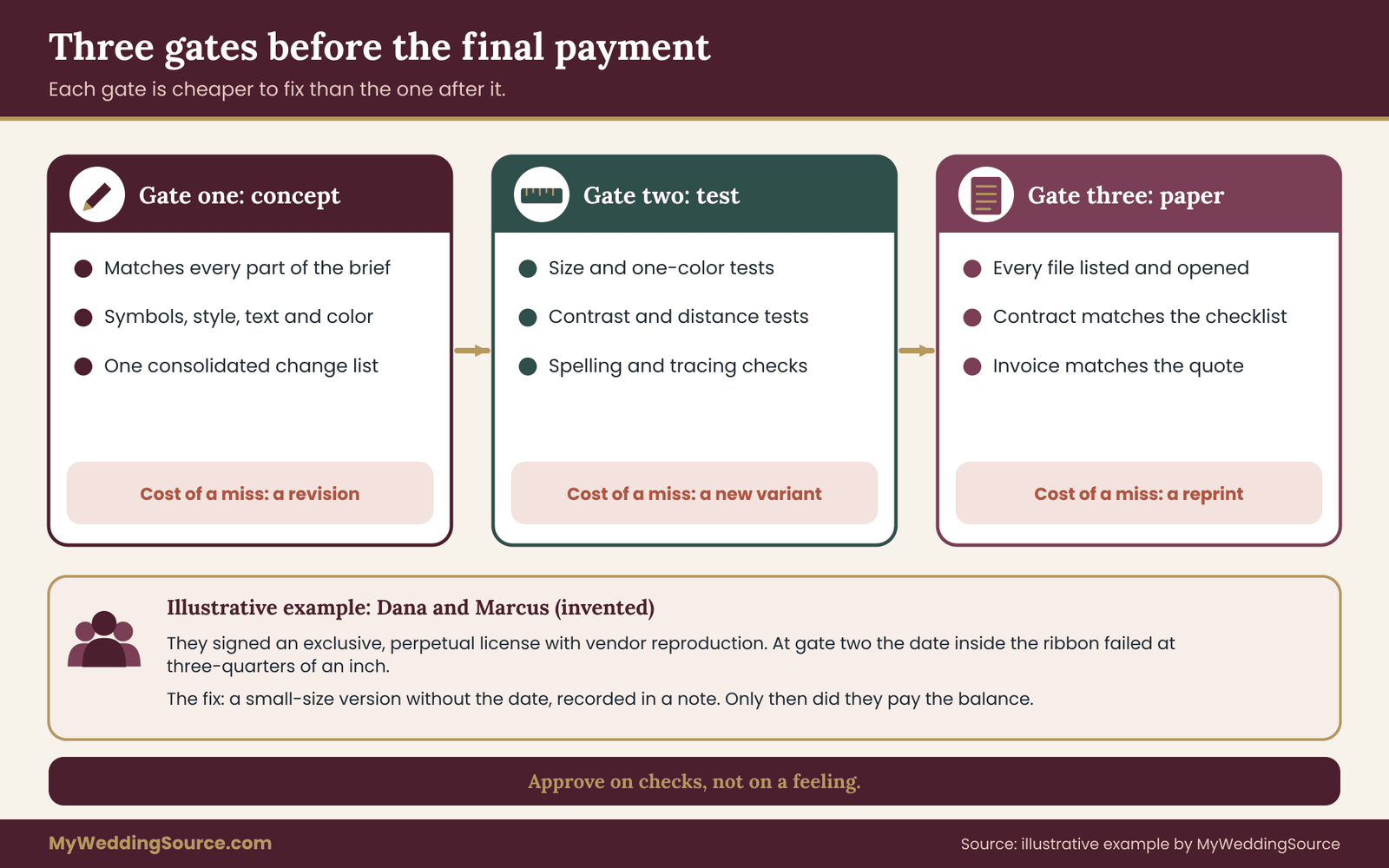
The sequence matters because each gate is cheaper to fix than the one after it. A concept problem costs a revision. A test problem costs a variant. A paper problem, found after the invitations are printed, can cost a reprint.
Acceptance checks you can measure
The idea behind the gates is that approval should be based on checks, not on a feeling. These checks make the call easy.
Can you read every letter at the smallest planned size from arm’s length? Yes or no. Does the one-color version keep all of its symbols distinct? Yes or no. Do you have every file listed in the brief, and does each one open? Count them. Does the contract name the owner or license type, the uses, the term and the vendor permission? Count the four items. Does every third-party element have a stated source? List them. Is the final payment due only after you have confirmed all of the above? Yes or no.
If any answer is no, you are not ready to approve. That is not a failure. It is the reason the checks exist, and a creator who has done this before will treat the list as ordinary professional practice.
Scripts for the three conversations
Nothing here needs to be formal. Short, calm messages work best.
To a creator, when asking about rights: “Before we sign, could you confirm whether we would receive an assignment or an exclusive license, which uses it covers, and whether our printers and sign makers may reproduce the files?” This is clear and polite, and it gets a direct answer.
To a printer, when sending the crest: “Attached is the one-color vector file for our wedding crest, plus a short permission sheet from the artist. Please confirm that you will use this file without redrawing it, and tell us the minimum line weight your process can hold.” This sets expectations and invites a technical answer.
To a relative who drew a sketch: “We love your drawing and would like to turn it into the emblem for our invitations. Would you be willing to sign a short note saying we may use it for the wedding and afterward for keepsakes? We would also like a designer to redraw it cleanly, if that is all right with you.” This honors their work and settles the permission.
Your next steps
Work through these in order, and stop wherever you have the information you need.
First, decide whether a wedding crest is the right choice by counting the places it will appear and agreeing on its purpose with your partner. Second, choose one to three symbols and write a sentence of meaning for each. Third, write the seven-part brief, with the budget and deadline at the top. Fourth, collect two or three quotes and translate each into the six comparison lines. Fifth, ask the rights questions in writing and choose an assignment or an exclusive license if the wedding crest is meant to be yours alone.
Sixth, sign a short agreement and keep proof of every payment. Seventh, run the three gates: concept, test and paper. Eighth, build the permission sheet and send the right files to the right vendors. Ninth, store the master files, the usage sheet and the agreement in two places.
If you are still choosing colors, begin with the wedding color palette so that the brief carries exact values. Keep the contract, the invoices and the permission sheet together with your other wedding paperwork, and review the folder when the wedding is over.
FAQ
Do I own a wedding crest if I pay an artist to make it?
Not automatically. In the United States, copyright generally starts with the creator, and paying for the work does not by itself transfer it. You receive ownership only if there is a signed written assignment, or you receive permission through a license. Ask the creator which one you are getting, and put the answer in a short signed agreement.
What is the difference between an assignment and an exclusive license?
An assignment moves the copyright, or a defined part of it, to you, so you become the owner. An exclusive license leaves the copyright with the creator but gives only you the right to use the design for the stated purposes. For a wedding crest, a broad, perpetual, exclusive license is often enough, and an assignment is cleaner.
Can a printer or sign maker reproduce my crest?
Yes, if your agreement allows it. Ask for wording that permits vendors you engage to reproduce the files for your items, and that gives them no other rights. Keep a short permission sheet and give it to any vendor who asks where the artwork came from. Most vendors accept that without a long conversation.
Can I use a template or a stock crest from a design marketplace?
Often yes, but the license belongs to the seller, not to you. Check whether it allows printed products, how many copies, commercial use and reproduction by third parties. The design is usually not exclusive, so other couples may have the same one. Save a copy of the license with your receipt.
Is an AI-generated crest safe to use?
You may be able to use it, but two cautions apply. The tool’s terms decide what you may do with the output, so read them. And the Copyright Office has said that copyright protects human authorship, so output with little human creative control may not be protected, meaning you may not be able to stop others from using something similar. Check the agency’s current guidance.
Can I base my crest on my family’s coat of arms?
Only with care. Real arms are tied to specific people and descendants under rules set by a heraldic authority, and a relative who holds them may need to agree. Images on mass-market “surname crest” sites are generally decorative and give you no special right. Original artwork avoids both the family question and the copyright question.
What files should I ask for?
Ask for a vector master with outlined text, a full-color version, a one-color version, a reversed version for dark backgrounds, a small-size version, and flat PNG and JPEG images for screens. Add a one-page usage sheet. Confirm that you can open each file before you pay the final balance.
Can I put my wedding crest on items I sell later?
Not automatically. Selling products or using the crest as a business mark is commercial use, and many licenses cover only personal and wedding use. Ask the creator in advance, and say so in the brief. If you start a business, consider speaking with a lawyer about trademarks and the license you need.
Sources
- U.S. Copyright Office
- U.S. Copyright Office: Copyright and Artificial Intelligence
- U.S. Copyright Office: Copyright Law of the United States (Title 17)
- U.S. Copyright Office: Registration
- U.S. Patent and Trademark Office: Trademarks
- Library of Congress
- World Intellectual Property Organization: Copyright
- College of Arms
- Court of the Lord Lyon