
Name correction after wedding invitations are printed is the work of deciding, calmly and in writing, which misspelled, outdated or wrong names to fix, how to fix them, and when a fix is big enough to justify a reprint. This guide gives you an approval log and a reprint threshold worksheet so that every name correction is a decision rather than a family argument.
Do not handle name correction one email at a time. Write each reported error in a single approval log, classify it by severity, count how many printed pieces carry it, and score it on a short worksheet that also weighs the relationship and the days left before mailing. Low scores get a quiet name correction in the guest data or the envelope. Middle scores get a hand correction or a small replacement piece. Only high scores, usually errors in the couple’s names, the hosts’ names or a guest’s name on a piece you cannot fix by hand, justify a partial reprint. Tell the person affected warmly, once.
Almost every couple who orders a printed suite finds a name problem somewhere between the proof and the mailbox. Sometimes it is a letter. A guest who has spelled her surname one way for forty years turns out to be on the list another way. A cousin has married and now uses a new name.
An accent mark is missing from a grandparent’s name, and the grandparent’s daughter noticed before you did. The error is rarely dramatic. What makes it painful is the choice that follows: absorb it, patch it, or pay to print again, while a parent has an opinion and the mailing date is moving closer.
This guide is about that choice, and only that choice. For the full production process, including the printer brief, quantities and proof sign-off, see our wedding invitation printing guide. Here the invitations already exist, or the proof is already signed, and a name is wrong or has changed. The goal of name correction in this situation is not perfection, and a successful name correction is one the guest barely notices. It is a proportionate response that protects the people involved and your budget.
A note on scope. This article offers general information on stationery practice and mail handling, not legal, tax or financial advice. Printers, post offices and local rules differ, so where a rule matters, the article points to the organization that issues it so you can confirm the current version yourself.
What name correction means once invitations are printed
Before printing, a name fix is free. You change a cell in a spreadsheet or a line in a file, and the proof updates. After printing, the same fix has a price in money, time, or goodwill, and the price depends on where the name sits and how many copies carry it. That is why name correction after printing needs its own method and should not be treated as an extension of proofing.
Three things change at the moment of printing.
First, the error becomes physical. A wrong letter in a spreadsheet can be deleted. A wrong letter in ink on 120 pieces of cotton paper has to be covered, cut off, reprinted or accepted.
Second, the error acquires an audience. Before printing, only you and the printer know about it. Once the pieces exist, relatives handle them, someone photographs the box, and the mistake may be noticed by the person whose name is wrong. That changes the emotional weight of every option, and the weight is sometimes larger than the error deserves.
Third, time starts to count against you. Printers schedule runs, calligraphers have queues, and the mail date is usually fixed by the response deadline and the travel needs of your guests. A fix that is easy in week one can be impossible in week five.
Good name correction therefore has three parts: a clear record of what is wrong, a repeatable way to decide how much to spend fixing it, and a kind way to tell the people affected. The rest of this guide builds those three parts in order.
What this guide is not
It is not a proofing guide. The proofing passes that should have caught the error, such as reading every name aloud and checking each against its source, live in the printing guide, and a short prevention section near the end of this one shows how to tighten them. Think of it as a guide to name correction as an operation, with its own records and decision rules.
How to list hosts, how to word a name line for a blended family and how to address a household belong to wedding invitation etiquette. This guide takes the wording as settled and asks what to do when a name on the printed or addressed piece is not the name it should be.
It is also not a rule for how guests ought to feel. Some guests will not care that a letter is missing. Others will care a great deal, particularly when the error touches a name that carries meaning: a name restored after a divorce, a name in a script the printer rendered badly, a name that was shortened without asking. Your process should be built to handle the second kind without assuming that everyone is the first.
Where a name lives on a printed suite
The first step in any name correction is a map. People say “the invitation has a typo” as if there were one place a name could appear. In practice a suite carries names in at least six places, and each place has a different fix.
The couple’s names. These appear on the invitation, often on the details card, the reply card header, the program and the website. An error here is the most visible of all and affects every copy.
The host line. If parents or other hosts are named (“together with their families”, or a line naming one or both sets of parents), those names are on every invitation. They are also the names most likely to carry opinions about spelling, order, titles and who is included.
Named lines on the reply card. Many reply cards print a line beginning with “M” or a space for guests to write their names. Some couples print the guest names directly on the card to prevent unnamed additions. A wrong name here is an error on one piece rather than all pieces.
The outer envelope. The address block, with a name line and a delivery line, is usually the most individual piece. It may be handwritten, printed by merge, or applied by a calligrapher. This is where most name errors in practice occur.
The inner envelope, if used. An inner envelope often carries a less formal name, such as “Aunt Maria and Uncle Tom” or just first names. It is easy to forget because it is not seen until the guest opens the outer envelope.
The guest data. The spreadsheet or database that feeds the addressing and later the seating chart, place cards and thank-you notes. An error that began here has probably spread to several printed items.
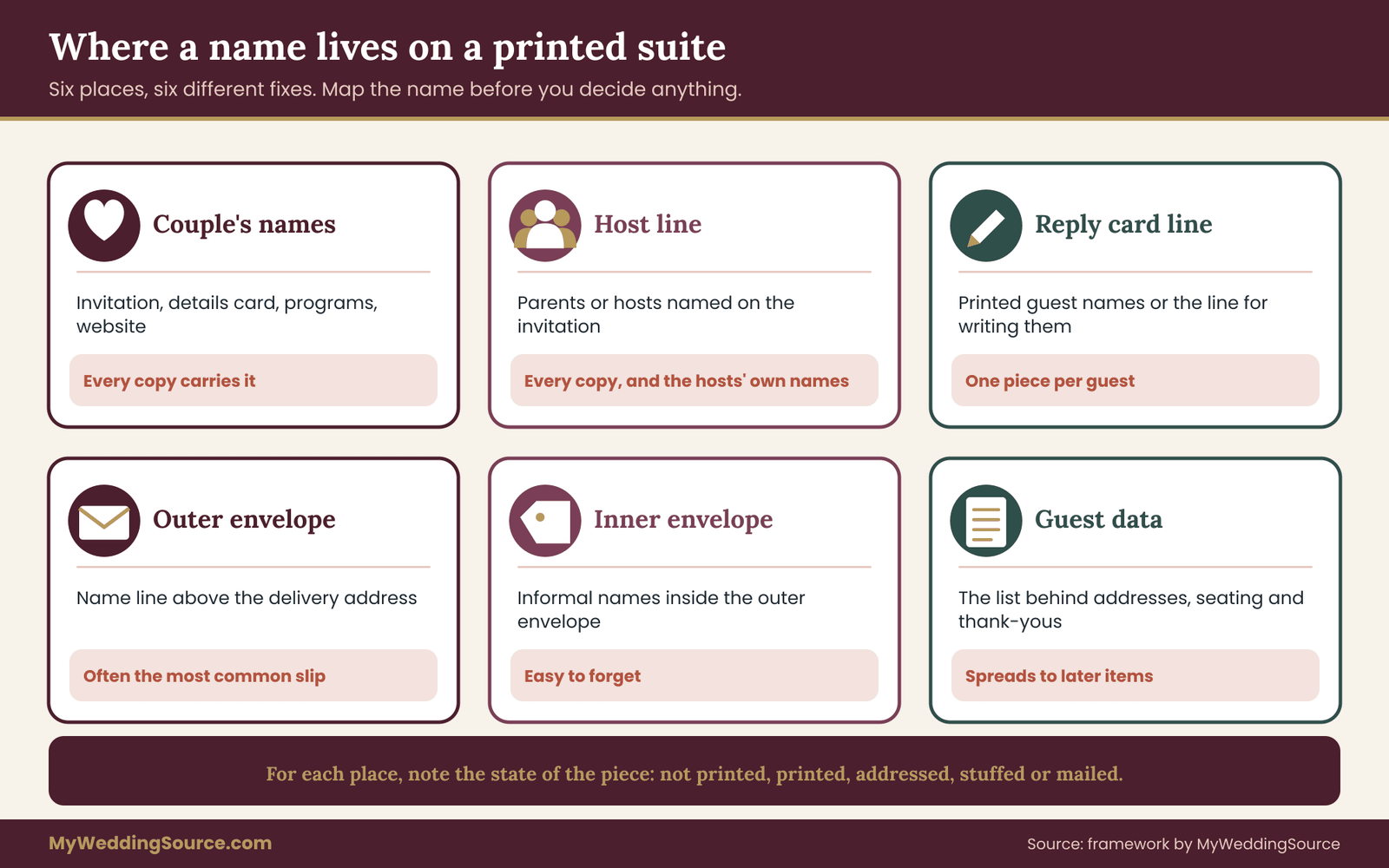
The map matters because the same misspelling can be trivial in one place and costly in another. A wrong letter on an outer envelope can be handled by a replacement envelope for the price of one envelope and an hour of addressing. The same wrong letter on the host line costs the entire run. Always start by writing down where the name appears, and for each place note whether the piece is already printed, already addressed, already stuffed, already mailed, or not yet touched. Those five states, more than the nature of the error, determine your options.
Counting the affected pieces
For every error, count the pieces that carry it. If one guest’s name is wrong on the outer envelope and on the printed reply card, that is two pieces for one guest. If a host’s name is wrong on the invitation, that is every invitation. If a name is wrong in the guest data and the data has not yet gone to the printer or calligrapher, that is zero printed pieces, and the name correction is free.
Write the count beside the entry in your log. The number does most of the arguing for you. A name that is wrong on two pieces is a small problem even when it feels huge, and a name that is wrong on every invitation is a large problem even if only one parent has noticed.
The five kinds of name error
Not every error deserves the same response, and the first place to sort them is by kind. Most real cases fall into five classes. Naming the class takes the heat out of the conversation, because the class suggests a default response that you can then adjust.
Class A: a spelling or formatting slip with no change in meaning. A missing period after a title, “Mc” where the family uses “Mac,” a hyphen, a capital letter. The name is clearly the right person’s name and anyone reading it would recognize it. These are the errors most often worth leaving alone or fixing in the data only.
Class B: a misspelled name. A letter swapped or missing, a diacritic dropped, a name spelled the common way instead of the family’s way. Readers can still tell who is meant, but the person whose name it is will notice. The default response is a name correction that shows care, scaled to how visible the piece is.
Class C: the wrong form of the right name. The legal first name instead of the one the person uses, a nickname where a full name belongs, an old surname where a new one is in use, a title the person does not use, “Mrs. and Mr.” order issues, or a missing suffix. The spelling is fine, but the choice is wrong. These need a quick conversation first, because the person may have a strong view, and the name correction depends on that view.
Class D: the wrong person or the wrong relationship. A deceased relative listed as a host, a divorced parent paired with a former spouse, a partner left off, a plus-one name that belongs to someone else, or a household combined that should be separate. These errors can hurt, and they can have family history behind them. They justify a prompt, personal conversation and often a replacement piece.
Class E: an error in the couple’s own names, or in a name carrying cultural or religious meaning. The couple’s names are the identity of the document. A name in a non-Latin script that printed wrongly, a name with a diacritic that changes meaning, or a transliteration that the family does not use falls here too. These errors almost always point toward correcting the affected pieces, and sometimes toward a reprint.
Keep the five classes of name correction written at the top of your approval log. When a relative messages “Grandpa’s name is wrong!”, your first reply can be a question: which class is this? Is it a missing letter, the wrong form of his name, or someone else entirely? Often the answer alone changes the temperature of the conversation.
Why class is not the same as score
A class is a starting point, not a verdict. Class B errors on an outer envelope for a distant acquaintance and class B errors on an outer envelope for the groom’s grandmother both belong to the same class, but they will not receive the same response. The worksheet later in this guide adds the other factors: how many pieces, how close the relationship is, and how much time remains. Class gives a default, the worksheet adjusts it, and the log records both so that you can explain a decision to anyone who asks later.
The name-correction approval log
The approval log is the center of the method. It is a single document, kept by one person, with one line for each reported error. Its job is to stop three things: decisions made in side conversations, name corrections made twice, and name corrections made without anyone who matters having agreed. A log also makes the whole project visible in one place, which tends to reduce the feeling that a name correction is a crisis.
You do not need software. A shared spreadsheet or a single page in a notes app works. What matters is that the fields are the same for every entry, and that only one person edits the status.

The fields
Each entry in the log carries the following fields, and the order is deliberate, because filling them top to bottom walks you through the decision.
Entry number and date reported. A running number lets you refer to “entry 4” in messages without repeating a name. The date matters later when you reconstruct who knew what and when.
Who reported it. The guest, a relative, the printer, a vendor, or one of you. This is not about blame. It tells you who to answer and whether the reporter is the person affected.
The name as printed, and the name as it should be. Copy both exactly, including accents and punctuation, from the piece itself and from the source. Never retype a name from memory into this field. The act of copying often reveals that the “correct” version is not as certain as it seemed.
Source of the correct form. Where did you confirm the right spelling? A message from the person, a card they wrote, a passport name they shared, a family member who speaks for them. A name correction should not replace one unverified spelling with another. If the only source is a relative’s recollection, the log says so, and the next step is to ask the person directly.
Class (A through E). From the previous section.
Where it appears. Outer envelope, inner envelope, reply card, invitation text, details card, program, website, guest data. Tick each place.
State of each piece. Not printed, printed, addressed, stuffed, mailed. One entry may have different states in different places.
Piece count. The number of pieces that carry the error.
Worksheet score. Filled in using the reprint threshold worksheet described in the next section.
Proposed fix. Leave, correct in data, hand correction, label, replacement piece, partial reprint, full reprint.
Approver and date approved. The name of the person who agreed to the proposed fix, and when. See the next subsection on who approves.
Cost and time. The expected out-of-pocket cost and the working days needed.
Who tells the guest, and when. A named person and a date, because an unsent message is the most common reason a name correction turns into a grudge.
Status. Open, approved, in production, done, verified. Verified means someone looked at the finished piece, not at the order confirmation.
Those fourteen fields might look like a lot for a misspelled name. For a single error, filling them takes a few minutes. For ten errors, it saves hours of messages. And for the one error that turns out to matter, the log is the record that shows you acted carefully.
Intake: how errors reach the log
Name errors arrive in awkward ways: a text at night, a remark at a family dinner, a printer’s query, a guest who mentions it casually while RSVPing. Set one rule at the start. Every error that someone reports goes to one person, and that person adds it to the log before anything else happens. Tell your parents, wedding party and any helpful relatives who handles name correction requests. A sentence is enough: “If you spot a name problem, tell Dana, and she will add it to our list so nothing gets lost.”
Then give the intake person a standard first reply, so that no one has to improvise under stress.
“Thank you for catching that. We have added it to our list and will confirm the right spelling and decide the name correction this week. We will let you know what we do.”
That reply makes three promises: that you noticed, that you will verify, and that you will report back. It makes no promise about reprinting, which keeps every option open.
Who approves what
The log has an approver field because the biggest source of awkwardness in name correction is not the error, but the unclear authority. Who gets to say “yes, reprint”? Three levels work for most couples.
The log keeper can approve data-only fixes and anything that costs nothing. If a guest’s name is misspelled in the spreadsheet and the pieces are not printed or addressed yet, the keeper corrects the data and notes it.
The couple together approves anything that spends money or changes a printed piece. Both partners agree on hand corrections, labels, replacement envelopes and reprints. One partner’s approval is not enough when it costs money that belongs to both, and two approvals avoid the later complaint that one of you was not asked.
The hosts approve any change that touches their names or their guests’ names on the host line. If parents are paying, or are named as hosts, their names are theirs to approve. This is not about control. A host who sees a corrected name before it is printed again will not have a second surprise.
If your families share the cost of the stationery, agree in advance who covers a reprint caused by a printer’s error, and who covers one caused by wrong information that came from a family member. That conversation is easier before anyone is upset. Our guide to wedding decision rights covers how to settle who decides before the pressure arrives.
Keeping the log honest
Three habits keep the log from becoming a place where problems are buried.
Review the open name correction entries on a fixed day each week. Ten minutes, with the other partner, from top to bottom. Anything open for more than two weeks without a next step is either not a real problem or a decision you are avoiding.
Close an entry only after verification. If you ordered a replacement envelope, the entry closes when the envelope arrives and someone has compared it with the source spelling. People often close a ticket when they pay, and then discover the new piece has a new error.
Do not delete entries. If a decision changes, add a line. The log’s value is partly in showing how a decision was made, and a record that has been edited to look neat loses that.
Verifying the correct name before you spend anything
A name correction that fixes the wrong thing is worse than none. Before approving any fix, confirm the right form directly with the person whose name it is, or with someone authorized to speak for them. This sounds obvious. In practice it is skipped constantly, because asking feels awkward and a relative offers the answer helpfully.
Treat sources in this order of reliability.
- The person themselves, in writing, in their own hand or message. A signed note or an email in which they write their name is the best source.
- A document the person has chosen to share, such as a card they sent you, or a form they filled in for your guest list.
- A close relative who speaks for them, when the person cannot be asked, such as a young child, someone who has died, or someone who is unwell.
- A database or social media profile. Treat these as hints and confirm before using.
- Your own memory or an older document. Treat it as unverified.
The question to ask is short and carries no suggestion of a mistake: “We are checking every name before our mailing goes out. How do you like your name written on the envelope?” Asking in the framing of a general check lets the guest answer without feeling that you have found them in error. If the guest’s answer differs from your record, the log gains a verified entry and the name correction has a source.
Names that cannot be checked
Sometimes the person cannot be asked. A guest may be abroad and out of reach, may not use email, or may be someone whose relationship you manage through a family member. In those cases, use the next best source and write that down. If you are unsure of a spelling and cannot confirm it in time, a hand-written envelope using the most common spelling is a reasonable fallback, and the log records the uncertainty so that you can ask at the next chance. It is better to be honest about a gap than to pretend a verified status.
A short script for the person affected
Not every name correction needs a script, but a few do. If you need to confirm a name that you already printed and are not sure is right, this wording has worked for many couples because it is plain and takes the guest’s side.
“We are finishing our invitation list and want to be sure we spell everyone’s name the way they do. Could you send us yours exactly as you would like it written?”
If the guest then notices that the printed version was different, they will say so, and the conversation moves from a mistake you made to a preference you are honoring. That is the tone a good name correction conversation should have.
Who should never be the one to find the error
A last point on authority, before the worksheet. Try to be careful about who tells the affected person. The worst way for a guest to learn that their name was misprinted is from a third party, in a group chat, or at the rehearsal dinner. The best way is from you, in a short private message, together with what you are doing about it.
Your log field “who tells the guest, and when” exists for this reason. A name correction made quietly but never mentioned can still become a story if the guest later notices that the piece was replaced. A name correction announced kindly rarely does.
The reprint threshold worksheet for name correction
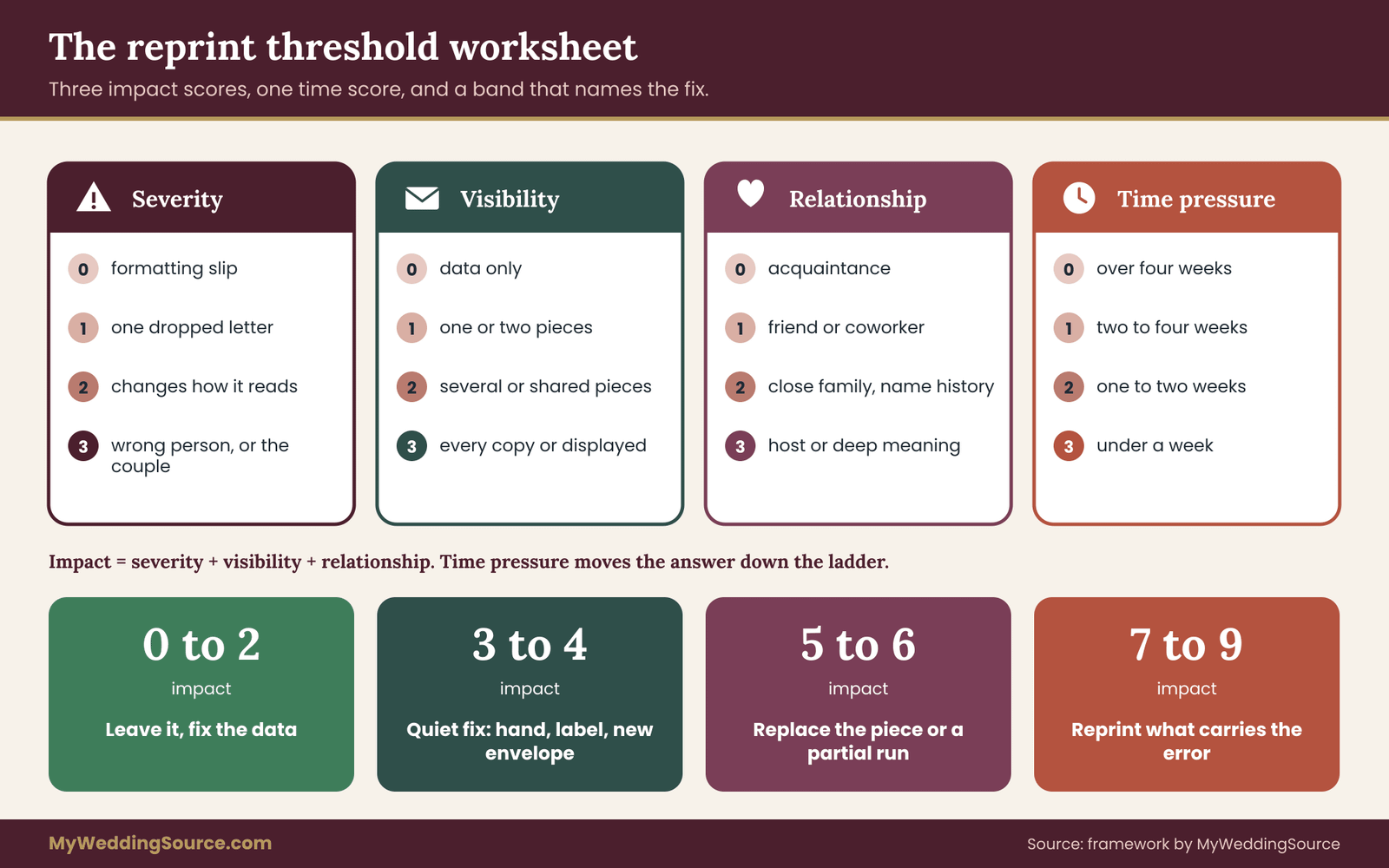
The approval log records what is wrong. The worksheet decides how much to do about it. Its purpose is to replace the question “should we reprint?”, which invites feelings, with four smaller questions that each have an answer. You add the answers, compare the total with the threshold, and write the result in the log.
The worksheet is a judgment aid, not a formula to follow blindly. Its numbers are yours to adjust. What matters is that you decide them before the first error arrives, so that you are not changing the rules to fit the argument of the day.
The four scores
Score one: severity (0 to 3). This comes from the class of error.
- 0: Class A. A formatting slip that changes nothing about who is named.
- 1: Class B on a name that remains fully recognizable, such as one dropped letter.
- 2: Class B where the misspelling changes how the name reads, or Class C where a person’s preferred form was not used.
- 3: Class D or Class E. Wrong person, wrong relationship, the couple’s names, or a name in a script or with diacritics that changes meaning.
Score two: visibility (0 to 3). This comes from how many pieces carry the error and who sees them.
- 0: the error is only in data that has not yet been printed or addressed.
- 1: one or two pieces carry it, and only the recipient sees them.
- 2: several pieces carry it, or a piece that other guests may see, such as a program or a seating display.
- 3: every copy of a piece carries it, or the error is on a piece that will be displayed or photographed.
Score three: relationship weight (0 to 3). This is the most personal score, and it is the one couples most often leave out. It asks how much the error will matter to the person it affects, and to the people close to them.
- 0: an acquaintance or a guest unlikely to notice, with no history of sensitivity about the name.
- 1: a friend or colleague who would notice and be gracious.
- 2: close family or a guest whose name has a history, such as a restored name after a divorce.
- 3: a host, a grandparent, a person for whom the name carries cultural, religious or family meaning, or anyone for whom a previous mistake has already caused hurt.
Be honest here. A score of 3 for relationship weight is not a prediction that someone will be angry. It is a decision to spend extra care because the cost of being wrong is higher.
Score four: time pressure (0 to 3, subtracted). This is how little time remains. Count the working days until the piece must be mailed or used.
- 0: more than four weeks. Everything is possible.
- 1: two to four weeks. Most fixes are possible but replacement production has to start now.
- 2: one to two weeks. Reprints are risky, and hand fixes become more attractive.
- 3: less than a week. Only fixes you can do yourself, today, are real options.
Time pressure is subtracted from the reprint total because short time does not make an error smaller, it makes reprinting less realistic. A high-severity error with high time pressure does not become acceptable. It moves the response from a reprint to the best hand-made fix available, and possibly an in-person conversation.
The threshold
Add severity, visibility and relationship weight. Call that the impact total, from 0 to 9. Then compare the impact total with the time score.
- Impact 0 to 2: Leave the printed piece alone. Correct the guest data so that later items are right. Optionally mention it to the guest if they noticed.
- Impact 3 to 4: Make the name correction quietly. Use a hand correction, a replacement envelope or a corrected label, depending on the piece. No reprint.
- Impact 5 to 6: Replace the affected piece or pieces. For individual envelopes and reply cards, order only those. For shared pieces, ask the printer for a quote for a partial run.
- Impact 7 to 9: Reprint the affected piece for all copies unless time makes it impossible. Tell the people most affected before the new pieces are in the mail.
Then apply the time rule. If time pressure is 2, move one step down the ladder to a fix you can complete in time. If it is 3, move two steps down and plan a personal conversation with whoever is most affected.
The threshold numbers are only a starting point. A couple who is very relaxed about names might raise every band by one. A couple with a large family and a history of sensitivity might lower them. Write your adjusted numbers into the log before the first entry.
Why the worksheet helps with other people
The worksheet is also a way to say no kindly. If a relative insists that a missing hyphen on an outer envelope requires a reprint, you can say, “We scored it the way we score everything, and it came out as a quiet name correction. If you think we weighed it wrong, tell us which of the four scores you would change.” That invites a discussion of facts. It tends to end the argument within a few exchanges, because the person usually finds that no score deserves to move more than a point.
A short worked scoring
Two entries show how it runs. Entry one: a guest’s surname is missing one letter on the outer envelope. She is a coworker. Severity 1, visibility 1, relationship 1, total 3. Time pressure is 1. The decision is a quiet name correction, which means a fresh envelope addressed correctly. Entry two: the groom’s mother’s name is printed in the host line with a former surname.
Severity 3, visibility 3, relationship 3, total 9. Time pressure is 2. The decision is a reprint of the invitation, adjusted by one step for time, which means asking the printer today for a rush quote and meeting with the host before anything else.
Notice what the worksheet did not do. It did not decide the wording of the message to the groom’s mother, and it did not decide who pays. Those belong to the next sections.
The cost logic of reprinting names
Whether a reprint is worth it for a name correction is not only a matter of score. It is also a matter of money, and the money behaves in ways that surprise people who have not reprinted before. You can estimate the cost without knowing any prices by walking through the same questions with the printer.
Is there a setup charge? Many printing methods have per-job costs that do not depend on how many pieces you order, such as plates, dies, foil dies, press setup and color matching. A reprint of 20 pieces can cost nearly as much as a reprint of 120 pieces if the setup dominates, which is why name correction budgets should start with the printer’s quote rather than with a guess. Ask the printer to separate setup from per-piece costs on the quote.
Is there a minimum order? Some printers set a minimum quantity per piece. If the minimum is higher than the number you need, the effective cost per piece is higher, and it may be cheaper to reprint an entire piece than a part of it.
Is the paper still available? Paper comes in lots. A reprint from a different lot can differ slightly in color or texture, and an out-of-stock paper may mean a substitute. Ask for a sample if the replacement pieces will sit beside the originals in the same envelope.
Is the envelope the cheaper fix? Envelopes for a standard size are generally less costly than a custom printed card, and a replacement outer envelope with the correct name needs addressing again. Compare the price of a new envelope plus the addressing time with a label or a hand correction.
What about shipping and time? A reprint has production time, shipping time and your own time to restuff. Add them all. If the cost of rush production is a large share of the total, a smaller fix might be wiser.
Who pays? Check the proof you signed. If the error was in the file you approved, the printer is generally not responsible for a reprint, because the printed result matched the approved proof. If the error was a difference between the approved proof and the printed result, many printers will correct it, but the terms differ.
Read the printer’s written terms and the wedding vendor contract basics before you argue about it, and keep the signed proof in the log folder. Keeping signed proofs, order confirmations and a purchase order, as described in our wedding vendor purchase order checklist, makes this conversation shorter.
A reprint formula you can reuse
You can use this plain comparison without any prices from this article. Write down the cost of the cheapest fix that would satisfy the worksheet (a replacement envelope, a hand correction, a label). Write down the cost of the reprint, including setup, shipping, rush fees and any restuffing time that you would otherwise pay someone for. Write down the cost to you of not fixing it, which is not a number but a sentence: who would be hurt, how, and for how long.
If the reprint costs more than the cheapest satisfying fix and the sentence is short, take the cheap fix. If the sentence is long and involves a host or a person for whom the name matters, the reprint cost is the price of the relationship rather than of the paper.
Hidden costs people forget
A few costs that tend to be missing from a first estimate: postage on a second batch if the first has been mailed, cost of the original pieces you already paid for and now discard, extra calligraphy fees for rewriting an envelope, and the time spent by a helper who has to unstuff and restuff. None of these is large for one error. Together they can double a reprint, so list them in the log under “cost and time”.
The case for not reprinting
Reprinting has a cost that is easy to overlook: the second print run has its own chance of error. Every time a file is reopened and sent again, a new mistake can enter. If you do reprint, treat the reprint proof with more care than the first, limit the changes to the specific name correction, and have two people, one of whom did not read the first proof, check the new file. A reprint that fixes one name and introduces another is the cruelest outcome of all.
The remedy ladder: seven ways to complete a name correction
The worksheet gives a band. The ladder gives the actual job. There are seven rungs, from doing nothing to reprinting, and the most useful habit is to start at the bottom of the ladder, ask whether it is enough, and climb only when the answer is no.

Rung one: leave it. The printed piece stays as it is. This is right for Class A errors and for Class B errors on pieces nobody will keep. It is not right if the error is noticed and the person affected would prefer a name correction. Leaving something alone is a decision, so log it as one, and fix the guest data so the error does not repeat on later pieces such as place cards and thank-you notes.
Rung two: fix the data only. The printed piece is unchanged, but the spreadsheet, the website guest list, the seating chart and the thank-you list carry the right name. This is the cheapest and one of the most valuable rungs, because a wrong name in data keeps producing errors for months.
Rung three: correct by hand. For a single piece, a careful hand correction can be both honest and attractive, particularly on a casual or rustic suite. A calligrapher or someone with excellent handwriting rewrites the name line on an envelope, or adds a missing accent mark to a printed name. Hand name corrections work on unprinted envelopes, on addressing lines, and on cards with a blank space for a name. They do not work well on a printed formal host line, where a visible patch tends to draw attention to the error rather than hide it.
Rung four: cover or relabel. A label or small overlay can correct a name line on an envelope or a reply card. Used well, with a matching paper or a clean white label printed in the same font as the rest, it can pass as part of the design. Used badly, it looks like a patch. Test one on a spare piece first. Whatever you use, apply the mail checks in the next section, because a label near the delivery address can affect how the mail is read.
Rung five: replace one piece. Print or address a new envelope, reply card or insert for the affected guest, and discard the old one. The cost is small when the piece is a standard item, and the effect on the guest is almost always positive, because they receive a correct piece and never see the wrong one. This is the most common fix for envelope-level errors, and it is the best choice when the pieces have not been mailed.
Rung six: partial reprint. A reprint of a single piece type, such as the reply cards, or of a limited number of pieces, such as the 30 invitations for the host’s side. Whether this is cheaper than a full reprint depends on setup charges and minimums, as the cost logic above explained. It is right for medium-impact errors that appear on a limited set of pieces.
Rung seven: full reprint. Everything affected is printed again. Use it for errors in the couple’s names, for host-line errors that affect the people named, and for any error in a name that cannot be fixed on the page. It is also sometimes the right decision for several medium errors that, together, affect too many pieces to patch.
Choosing between rungs three, four and five
Many name corrections come down to these three, and the choice is easy to get wrong because they look similar.
Choose a hand correction when the piece is hand-addressed already, when your handwriting or your calligrapher’s matches the rest, and when the piece is personal to the guest. The name correction looks like part of the original work.
Choose a label when the name is printed, the piece is an envelope or a card with spare space, and you can match the font and paper reasonably well. Labels are useful when a merge printed many envelopes and only a few have errors.
Choose a replacement when a hand correction would look like a repair, when the mailing label would be a concern, or when the guest is someone for whom you want everything to look right. A new envelope costs little relative to the discomfort of a patch.
When the piece is already mailed
An error discovered after mailing needs a different approach, because you cannot retrieve the piece and should not try. The usual options are to leave it, to send a short, warm note, or to correct it in person. For a Class A or Class B error on an outer envelope, the envelope is thrown away anyway, and leaving it is often the kind choice. The inner card matters more than the envelope.
For an error on the invitation itself, in a name the guest has received, the name correction is a small card or an email: “We noticed that your name was spelled incorrectly on our invitation, and we are so sorry. We have corrected it in our records.” Keep the tone of the name correction matter-of-fact and brief. A long apology increases the weight of the error. A short one lowers it.
Never ask a guest to return the wrong piece. It places a task on them for your mistake and rarely succeeds.
Mail checks before a corrected piece goes out
A name correction changes what is written on a piece that the postal service will handle. Most name corrections have no effect on delivery, because mail is sorted and delivered primarily by the address lines rather than the name, but a few changes can have consequences. This section covers what to check. Confirm the current details with the organization that issues them, because standards are updated.
The United States Postal Service publishes its mailing standards in the Domestic Mail Manual, and its addressing standards in Publication 28. These documents describe how an address block is formatted, which lines the machines read, and what space around the block must be kept clear. Read them, or ask your post office, instead of relying on a printer’s rule of thumb. The root of the Domestic Mail Manual is listed in the sources of this guide.
What to check for each name correction
Is the delivery address still clean? A label or overlay should sit on the name line only, with no part reaching the delivery address line or the city, state and ZIP line. If a label covers part of the address block, the sorting machines or the carrier may misread it. Keep a margin of clear space around the address and test one on a sample.
Is the surface readable? Metallic ink, dark paper, heavy texture, a glossy label or a transparent overlay can reduce how well an address reads. If your name correction adds any of these, it adds risk. A plain, matte, light label printed in dark ink is safest.
Does the weight or thickness change? A new insert or a label adds almost nothing, but a replacement of a heavier piece can change the total. If your suite is close to a postage threshold, weigh a complete corrected suite before mailing, not just the original. Postage rules depend on size, shape, weight and rigidity, and the rules change, so confirm the current ones with the post office.
Does the name affect delivery at all? A name line helps the carrier when several people share an address, such as an apartment building or a household with a different surname. A wrong name in a multi-unit building can delay delivery or send a piece to the wrong resident. A correct name on a piece with a perfectly accurate address, to a single-family house, is generally less sensitive.
Where the household is complex, such as a person who has changed names or lives with a roommate who shares no name, include both names or the household name that the carrier will recognize.
Is the address itself verified? While you are correcting a name, check the address too. The Postal Service offers a ZIP Code lookup tool for confirming the standard form of an address, and it is a quick way to catch a wrong unit number or a missing suite while a piece is already on your desk. An envelope with the correct name and a wrong apartment number is a second error that you have just paid to create.
Keeping a sample record
Before you mail a batch containing corrected pieces, photograph one of each type of name correction, front and back, and file the photos with the log. If anything is returned, you can see at once whether the name correction was involved. It also lets you copy a successful solution for the next piece.
A word on return mail
Returned invitations are a separate matter that depends on the address more than the name, and it has its own handling steps in the printing guide. Here it is enough to say: if a piece returns, check both the address and the name line against the guest data before assuming the cause. A name correction that was made correctly may have been defeated by an address problem, and the reverse is also possible.
Telling people about a name correction without awkwardness
Most of the discomfort around a name error is social rather than practical. People worry that a guest will feel slighted, that a parent will feel blamed, or that the name correction will draw more attention than the mistake did. A few habits and a few scripts remove most of that.

Four principles
Say it once, early and briefly. A short message sent promptly reads as care. A long message sent late reads as panic. Aim for three sentences: what you noticed, what you are doing, and a warm closing.
Own the error without assigning it. Say “we spelled your name incorrectly” or “your name was printed wrongly,” not “the printer made a mistake” or “someone gave us the wrong spelling.” Even when the cause is clear, explaining it can sound like an excuse. If the guest asks how it happened, answer plainly and without blame.
Lead with the right name, not the wrong one. Repeating the wrong spelling in your message makes the guest read it. Write the correct form, and if you must mention the error, describe it without repeating it.
Offer the name correction, do not ask permission for it. “We are sending you a corrected card” is better than “would you like a corrected card?” The second question gives the guest a decision about your mistake. If the guest wants nothing sent, they will say so.
Scripts for common situations
To a guest whose name was misspelled on a piece they received.
“We noticed our invitation spelled your name wrongly, and we are sorry. We have fixed it in our list and will send you a corrected card this week. We are so glad you will be there.”
To a guest whose name was misspelled and you have not mailed yet. Usually nothing needs to be said. Fix the piece and mail it. If you are checking their name in advance, use the general check message from earlier.
To a host whose name appears wrongly on the invitation. This is a conversation rather than a message, ideally a call or a visit, and it works best when the couple, not a printer or a planner, makes it.
“We found a mistake in how your name appears on the invitation, and we wanted you to hear it from us first. Here is what we plan to do. We would like to correct it before anything goes out. Does that sound right to you?”
Notice the order: the error, the plan, and an invitation to weigh in. A host who is asked to approve the name correction is much less likely to feel embarrassed.
To the printer, asking for a quote. Be specific and keep it short.
“We approved proof version 3 on [date]. We have found a spelling error in the host line, shown in the attached photo. Could you quote a reprint of the invitation only, including setup, shipping and the earliest delivery date? Please also tell us whether the corrected file will come back to us for a new proof before it prints.”
The photo and the file version let the printer find the job and avoid a back-and-forth about what is wrong. The last sentence protects you from a second error.
To a helpful relative who reported an error that your worksheet scored low.
“Thank you for catching that. We looked at it carefully and decided to correct it in our records rather than reprint, since only that one envelope is affected. We really appreciate how closely you read everything.”
The tone is thankful, not defensive. It also leaves them feeling that their eye was valued, which is the thing they wanted.
To your partner, when you disagree about the name correction. Use the worksheet, with each of you scoring the four lines separately and then comparing. Disagreements usually sit in the relationship-weight score, because each of you knows your own family better. It is reasonable to let the partner whose relative is affected set that score, as long as it is written in the log.
What not to do
Do not post a name correction in a group chat or on a public wedding page. A name correction is a private matter between you and the person affected. Do not ask a mutual friend to carry the message. Do not give a guest a long explanation about the printing process. Do not blame an individual, a family member or the printer in front of the guest. Do not turn a minor name correction into a ceremony with flowers and cards; an oversized apology tells the guest the error was serious.
Also do not promise a perfect outcome. If a hand correction will be visible, say nothing that suggests it will be invisible. Guests who receive a clearly corrected piece with a kind note almost always accept it, while those who are promised perfection and then see a patch feel misled.
Special cases that change the answer
Some name problems are not mistakes in the usual sense. They are decisions about what a name should be, and the process needs a little more care.
Names with accents, diacritics and non-Latin scripts
A name with an accent or a mark that the printer’s font did not render can look like a small typo and still be a real error. In some languages a missing mark changes the pronunciation or even the meaning of the name. Treat any such name correction as Class C at the least, and Class E if the name belongs to the couple, to a host, or to someone for whom the form carries cultural weight.
Ask a reader of the language to check the corrected piece, and ask the printer to confirm in writing that their font and software handle the characters before they print again. A corrected piece with a different dropped character is a second error. If you cannot check a script yourself, ask someone who reads it.
Names that changed after the invitation list was made
Guests marry, divorce, transition, restore earlier names and adopt new ones. If a guest has changed their name, the right name is the one they use now, written the way they ask. This is the one category where being slightly late can be a kindness, because someone who has recently changed a name may not have told every acquaintance.
If you learn of a change after printing, the usual remedy is a replacement envelope or a corrected label. Do not mention the earlier name in your message, and do not ask for an explanation. A short “we want to be sure we have your name right” suffices.
Nicknames, formal names and titles
Some people are known by a nickname in daily life and are addressed by their full name on formal paper. Others dislike a formal name intensely. The right choice is theirs. If a guest corrects “Katherine” to “Kate,” or the reverse, accept it and treat it as a quick name correction without comment. Titles follow the same rule. A guest who uses “Dr.,” “Ms.,” “Mx.” or no title should see what they use. If you have mixed up titles, treat it as Class C and fix it quietly.
Couples and households
An envelope for a couple with different surnames, or for a household with several adults, is easy to get wrong. When you correct one, confirm the whole name line, not only the name that was noticed. The error may be the missing partner, the wrong surname order, or a child left off. Our wedding guest list guide explains how households and plus-ones can be recorded, and RSVP etiquette covers what happens when a reply card names someone you did not invite.
Names on the reply card
If you printed guest names on the reply card and one is wrong, the card is the piece where a mistake can have practical effects. A guest may write a reply for the name printed, even though that person is not the one attending. Replace the card, not just correct it by hand, and check the reply count against the guest data when it returns.
Deceased relatives and former spouses
A name that should not appear, or that should appear differently, is the most sensitive name correction of all. If a host line names a person who has died, or a former spouse, or omits a stepparent the family expected to see, treat it as Class D. Speak to the people involved personally, listen first, and let their wishes guide the name correction. The worksheet will almost always point toward a replacement or a reprint, and the conversation matters more than the paper.
When the couple’s own name is wrong
Your own names are Class E by definition. If either of your names is misprinted on the invitation, the right course is almost always to reprint the invitation, because it is the document that will be photographed, kept and perhaps framed. If it cannot be reprinted in time, a hand correction in matching ink and a short personal note to guests, along the lines of “a small typographical slip we decided to leave as a keepsake,” is an honest alternative.
Use it only if you are comfortable with it, and not as a way to avoid a cost you can afford.
Handling guest data safely during name correction
A name correction is also a data event. To fix a name, someone has to read the guest list, send some of it to a printer or calligrapher, and often collect new information from the guest. Guests did not agree to be in a spreadsheet, so a few habits protect them and protect you.
Share the minimum. A printer or calligrapher who is reissuing an envelope needs the corrected name and the mailing address. They do not need phone numbers, email addresses, dietary notes, relationships or reply status. Send a new file with only the rows that changed, not the full list. The Federal Trade Commission’s guidance for businesses on protecting personal information puts the idea in plain terms: know what you have, keep only what you need, protect it and dispose of it properly. The same approach scales down to a wedding.
Use one master list. Errors multiply when there are several versions of the guest list. Choose one file as the master. Every name correction is made there first, with the date and the log entry number, and any copy sent to a vendor is exported from the master. A file named “guests_final_v2_real” is a warning sign.
Record what changed, not the old value. The log needs to show that a name was corrected. It does not need to keep a former name that the guest has chosen to leave behind. For guests who have changed names, write “name updated per guest” and keep the previous form out of the log.
Ask permission for sensitive details. If a name correction involves a name change tied to a divorce, a transition or a religious practice, only collect what is needed to write the name correctly. Do not store why. If you are given a reason, keep it out of shared documents.
Send data through channels you trust. An unencrypted spreadsheet in a public message thread is easy to forward. A password-protected file or a shared document with access limited to named people is safer, and removing access afterward is simple. If a vendor asks for the data in a specific way, follow their process.
Delete when the job is done. After the final pieces have been mailed and the thank-you notes are written, ask the printer and the calligrapher to delete the files you sent, and delete your own working copies of vendor exports. Keep the master list as long as you need it for thank-you notes and records. Our guide on organizing wedding records after the event covers how long to keep each kind of record.
If your guests include people who live in a state with its own privacy law, or in another country, the rules for vendors that handle their data may differ. Wedding lists are small, and a private individual’s personal list is generally treated differently from a business’s database. Still, the practices above are sensible everywhere, and a vendor who handles a lot of personal data may have its own privacy policy that you can read.
Written consent is rarely needed, but a clear ask is
You do not need a form for a guest to tell you how to spell their name. You do need to be clear about what you will do with it. A sentence in your message, such as “We will use this only for the invitation, the seating and our thank-you note,” is enough and also lowers the guest’s worry. It takes ten seconds to write and avoids a common unease about wedding data.
Downstream effects: where else the corrected name must change
A name correction that is made only on the printed piece leaves the same error in places guests will see later. The corrected name needs to follow the guest through the whole wedding.
The seating chart and place cards. A name that was wrong on an envelope is often wrong on the place card, because both come from the same list. Correct the master and regenerate the seating items. Our wedding seating chart guide covers how to build the chart, and the key point here is that the chart is a second chance to make a name error visible to every guest at a table.
The program and the day-of signage. Any printed program that lists parents, wedding party members or people honored in a reading will repeat names. Check these against the corrected master before they go to print. If a program lists a person whose name you corrected on the invitation, do a quick search across all files for the old spelling.
The wedding website and online RSVP. If the website lets guests search for their names, a corrected spelling may fail to match what the guest types. Add both forms if the system allows it, so that someone who types the earlier version still finds their record.
Vendor lists. Your caterer, venue and photographer may hold the guest names or the names of key family members. If a name was corrected, tell the people who use it, such as the photographer who needs the correct names for the family portrait list, and the DJ or officiant who announces them.
Thank-you cards. After the wedding, the corrected name should be the one on the envelope. Writing a thank-you note with the same error that has already been fixed on the invitation would repeat the original hurt.
A short search routine helps every name correction stick. For each corrected name, search every file in your project folder for the old spelling: the guest list, the seating chart, the program, the place cards, the signs and the website export. A single search that finds nothing is more reassuring than any memory of having changed it.
A worked example: Alvarez and Whitfield
The following example is invented to show the method. The names and numbers are illustrative only.
Priya Alvarez and Sam Whitfield ordered 110 invitation suites with printed reply cards, and a calligrapher addressed the outer envelopes. Five weeks before the mailing date, while checking the guest data against a family message, Priya noticed that her own aunt’s name had been entered with the wrong spelling. By the time the week was over, four entries sat in the approval log.
Entry one. Priya’s aunt, Marisol, has a surname with an accent that was dropped on the outer envelope. The envelope was addressed but not mailed. The aunt was asked directly how she wrote her name and replied with the accented form. Class B. Severity 2, because the accent changes how the surname reads. Visibility 1, one piece. Relationship weight 2, because she is close family. Impact 5. Time pressure 0, because five weeks remain. The decision at that band: replace the piece. The calligrapher rewrote one envelope, and the data was fixed in the master list.
Entry two. A coworker of Sam’s, Devon, had a letter missing from his surname on the outer envelope and the printed reply card. Class B. Severity 1, visibility 2, because two pieces carried it, relationship weight 1. Impact 4. Time pressure 0. The decision: a quiet name correction, which means a new envelope and a replacement card from a small batch. Sam sent no message, since the pieces had not been mailed.
Entry three. The reply card for one older guest printed the title “Mr.” for a guest who uses “Dr.” Class C. Severity 2, visibility 1, relationship weight 2, because the guest is a family friend of long standing. Impact 5. Time pressure 0. The decision: replace the card and the envelope. Priya called the guest, thanked him for confirming how he likes to be addressed, and the call lasted two minutes.
Entry four. A reader at a family dinner said that the groom’s grandmother’s name in the host line, where she was listed as a host, had a formal first name and that she goes by a shorter one. Class C on the host line, which is on every invitation. Severity 2. Visibility 3. Relationship weight 3. Impact 8.
Time pressure 0. Here the worksheet pointed to reprinting all 110 invitations. Before deciding, Sam asked his grandmother how she wanted it written. She said she preferred the formal form, which had been printed. The log recorded the source and the grandmother’s wish. The decision became: leave it, with a note, and the reprint was not needed.
That last entry is the reason name correction starts with a verification step. Without it, the couple would have paid for a reprint to change a name that the grandmother preferred as printed.
What the example shows
The total outcome was one replacement envelope, a replacement set of one envelope and one card for Devon, a replacement for Dr. and the envelope, and no reprint. The three out-of-pocket items were small. The unspent amount was the cost of reprinting the invitation, and the value was that no relative felt that their view had been ignored.
The example also shows the order of operations that makes name correction manageable: ask the person, score it, decide, tell the person, fix the data, then fix the piece, then verify. When the order is shuffled, such as paying for production before asking, or telling the guest before deciding, the cost goes up.
A variation under time pressure
Suppose the same grandmother’s name had been wrong and the mailing date was six days away. Time pressure 3 would move the decision two steps down the ladder, from a full reprint to a partial fix. The couple would first ask the printer whether a rush reprint of the invitation alone could arrive in time. If the answer was no, they would use a hand correction on the invitation only if the host line allowed one in a matching ink, and they would speak with the grandmother before mailing.
If neither option worked, the log would record the decision to mail as printed, with a note that a conversation had taken place and the family had agreed. A decision made under pressure still has a record.
Preventing the next name correction
Some name errors cannot be avoided, and each one will need a name correction. Many can be avoided. If you are still before the mailing date, a few changes to how you proof names will cut the number of name corrections you need to log. These are additions to the proofing passes in the printing guide, not substitutes for them.
Create a name source sheet. For every person whose name appears on any printed piece, record the form they use, where you got it, and the date. Keep it separate from the address list. When a question comes up, you open one sheet and see the evidence.
Proof from the source, not from the proof. Reading a proof against itself finds layout errors but misses name errors, because the proof matches the file. Read each name on the proof against the name source sheet, aloud, one letter at a time for unusual names.
Use two readers who did not write the list. The person who typed a name sees what they meant to type. A second reader sees what is on the page. For hosts and couples, the people named should read their own names, since nobody else can check them better.
Sample the longest and the strangest. If addresses are produced by a data merge, ask the printer for proofs of the longest names, the names with accents, the hyphenated names and the households with several people. These are where line breaks, fonts and truncation cause errors.
Run a name check message early. A short message to guests, sent before the list is final, asking how they like their name written, catches most Class C errors before any money is spent. It also gives guests a way to say “please use my new name” without having to bring it up at a family party.
Freeze the list on a date. After the freeze, changes go through the log and the worksheet. Before it, the master list is open. The printing guide describes this freeze among its stages, and this guide shows what happens to changes that arrive after it.

A timeline that spreads the work
A name correction costs the least when it is found early, and the timeline below shows where each check belongs. A rough order of operations, counted back from the mailing date, helps decide when to run each check.
Eight weeks before mailing: send the name check message, build the name source sheet and begin the master list.
Six weeks before: freeze the wording for the couple’s names and the host line, and have each named host read their own name.
Four weeks before: freeze the guest list names. Send the addressing data to the calligrapher or printer.
Three weeks before: read the first addressed envelopes against the source sheet. Open every box on delivery and sample at least a tenth of the pieces.
Two weeks before: log and score any remaining errors. Order replacements.
One week before: confirm replacements have arrived and compare each with its source. Stuff the suites, weigh a complete sample and check postage.
After mailing: keep the log open for returned mail, late reports and thank-you data. Move any further name corrections into the data rather than into new printing.
Adjust the dates to your own schedule. The principle is that the cost of name correction rises with each step, so the checks belong as early as possible.
Common mistakes in name correction
A few patterns account for most of the trouble.
Correcting without verifying. The new spelling comes from a relative or an old document and is wrong, so the name correction creates a second error. Always get the form from the person or from a source you trust, and write the source in the log.
Reprinting by reflex. A single wrong letter on one envelope prompts a reprint of the entire invitation. The worksheet exists to stop this, and so does the question of how many pieces carry the error.
Never reprinting. The opposite mistake is a refusal to spend anything when the error is in a host’s name or the couple’s own names. A principle of proportion works in both directions.
Telling the wrong person first. A guest hears from a cousin. A host hears from the printer. The log’s “who tells” field avoids it.
Forgetting the data. A beautiful replacement envelope is addressed from a spreadsheet that still has the wrong name, so the error returns at the place cards, the thank-you notes and the program.
Closing a name correction entry without looking at the piece. The order was placed, the log was closed, and no one compared the new piece with the source. Always inspect the finished item.
Letting several people instruct the printer. When three relatives send name corrections to the printer, the shop follows the most recent, and it might be the wrong one. Route every instruction through one contact, as the printing guide advises.
Taking the error personally. A name error says very little about how much you care about a guest. It says that a process had a gap. Fixing the gap is the work, and a calm tone does the rest. The wider topic of wedding etiquette is a reminder that guests generally judge their welcome by warmth, not by perfect stationery.
What to confirm with the issuing organization
Several parts of a name correction depend on rules that belong to other organizations, and those rules change. Check these directly before you rely on them.
Postal rules. The United States Postal Service sets the standards for address formatting, labels, size, shape, weight and postage. Confirm your corrected piece with the Domestic Mail Manual or at a post office counter.
Printer terms. Your signed proof, order confirmation and the printer’s written terms decide who pays for a reprint. Read them rather than relying on how the conversation felt.
Legal names. If a name correction concerns a name on a legal document, such as a marriage license, a passport or a Social Security record, an invitation is not the place to settle it. The Social Security Administration and the Department of State publish their own current procedures for name changes, and they are listed in the sources. Our guide on wedding invitation printing is for the stationery side only, and the stationery should follow the name a person uses, not become the record of it.
Privacy rules. If you handle guest data for people in different places, check the privacy policy of any vendor who receives it, and ask them how they store and delete files.
This article offers general information only. Where a decision involves money, law or a dispute with a vendor, confirm the facts with the organization that issues the rule.
FAQ
Should we reprint wedding invitations because of one misspelled guest name?
Usually not. If the name appears on one envelope or one reply card, a replacement piece or a careful hand correction is far cheaper and just as respectful. Reprinting makes sense when the error is in the couple’s names, in the host line, or on every copy of a piece. Score it on the worksheet, and confirm the correct spelling with the guest before spending anything.
How do we tell a guest their name was misspelled?
Write or call privately, once, soon. Name the correct spelling, say that you are sorry, and say what you are doing: sending a corrected card, or fixing it in your records. Keep it to three sentences. Do not explain how the mistake happened unless asked, and do not post about it where others can see.
Can we fix a name on printed invitations by hand?
Often yes, for a single piece. A neat hand correction in matching ink works well on envelopes and on reply cards with space, and it can look intentional on a casual suite. It works poorly on a formal printed host line. Test it on a spare piece first, and check that nothing touches the address block before mailing.
Is it safe to put a label over a name on an envelope?
It can be, if the label covers only the name line and keeps clear space around the delivery address and ZIP line. Dark, glossy or transparent materials can make addresses harder to read. Test one, and check the Postal Service’s mailing standards or ask your post office, because the rules are theirs to set and they change.
Who pays for a reprint caused by a name error?
It depends on the cause and the printer’s terms. If the printed piece matches the proof you signed, the printer is generally not responsible, even if the proof held a mistake. If the printed piece differs from the signed proof, many printers will correct it at their cost. Read your order confirmation and keep the signed proof.
What if the guest’s name is spelled differently by family members?
Ask the guest. Their own preferred form, in writing, outranks everyone else’s recollection. If you cannot reach them, use the form on the most recent document they wrote themselves and note the uncertainty in your log. Avoid choosing between relatives, because the choice can become the story.
What if a guest changed their name after we printed their envelope?
Use the name they use now, and replace the envelope if it has not been mailed. Do not ask for an explanation or mention the earlier name. A short message such as “we want to be sure we have your name right” is enough. Update the guest list, the seating chart and the place cards at the same time.
Does a misspelled name on an envelope stop it from being delivered?
Rarely. Mail is sorted and delivered mainly by the address lines, so a small name error on a correct address usually still arrives. The name matters more in multi-unit buildings and shared households, where the carrier uses it to find the right resident. Check the address while you correct the name, and ask your post office about any doubt.
Your next steps
Start with an hour of name correction setup. Create the approval log with the fields from this guide, write your own threshold numbers at the top, and name the one person who receives every name report. Then build the name source sheet and send a short message to guests asking how they like their names written. Enter every error you already know about, and score each on the worksheet before you pay for any fix.
After that, work through the ladder from the bottom. Fix data first, replace single pieces next, and reserve reprints for the cases where the couple’s names or a host’s name are wrong. Tell each affected person once and kindly, then verify the finished piece against its source. A calm, written name correction process will protect your budget, and it protects the people who are reading their own names on your invitation.
Sources
- Domestic Mail Manual, U.S. Postal Service Postal Explorer
- Publication 28, Postal Addressing Standards, U.S. Postal Service
- Look up a ZIP Code, U.S. Postal Service
- Postal Explorer, U.S. Postal Service
- Protecting Personal Information: A Guide for Business, Federal Trade Commission
- Social Security Administration
- Change or correct a passport, U.S. Department of State
- How do I dispute a charge on my credit card bill?, Consumer Financial Protection Bureau
- Federal Trade Commission