
Language access at a wedding means every guest can follow the moments that matter in a language they understand, without the couple quietly assigning that job to a cousin or a grandchild. This guide gives you a coverage schedule, a guest autonomy checklist and a worked case, so the work is shared on purpose instead of falling on whoever happens to be bilingual.
Treat language access as a schedule, not a favor. List the moments of the day where understanding matters (ceremony, toasts, meal announcements, safety notices), then cover each one with one of four layers: print, people who volunteered, a paid professional, or technology as a backup. Ask guests what they need before you decide for them. Give anyone who helps a defined shift, a break and a way to say no. Hire a professional for the high-stakes moments and keep relatives in the role of guests.
Picture the usual version of this problem. A couple has a grandmother who speaks Portuguese, an uncle who speaks Vietnamese, or a set of in-laws who speak Korean. Nobody wants them to sit through a three-hour wedding understanding one word in ten.
So the couple turns to the one fluent relative and says, “Could you just help out a little?” By the cocktail hour that relative has translated a welcome, a blessing, two toasts and a seating question, and has not eaten or danced. Good language access starts by refusing that default.
Nothing here is malicious. It is simply the cheapest option in the moment, and it works until it does not. The helper tires, the translation drifts, a joke lands flat, a prayer gets summarized when it should have been rendered closely, and the person being translated for starts to feel like a burden. A calmer approach is to decide ahead of time who covers what, and to pay for the parts that deserve a trained person. Planned language access spreads that load across layers and across the day.
A note on scope. This is general planning information, not legal advice, and no law of which this language access guide is aware requires a private couple to translate their own wedding for guests. Disability-related obligations, such as effective communication for deaf or hard-of-hearing guests, can apply to venues and some vendors, so confirm current rules with the venue and with the agencies listed in the sources.
What language access means at a wedding
In public services, language access is a formal term. It describes the steps an organization takes so people who speak limited English can reach its programs and information. A wedding is not a government office, and nobody is auditing you. Still, the idea transfers well, because it asks the right question: can this person take part in what is happening, or are they only physically present?
For a wedding, language access has three parts. The first is understanding, meaning a guest can follow what is said and what is expected of them. The second is participation, meaning a guest can answer an RSVP question, order a meal, ask where the restroom is, and join a toast without needing someone to speak on their behalf. The third is dignity, meaning the way help is offered does not single the guest out or turn them into a project.
It is worth separating this from related topics that have their own guides on this site. Choosing between simultaneous and consecutive interpreting, and how to hire for each, is a staffing question. Translating invitations, signs and programs is a print and design question. This guide sits above both. Its job is to decide which moments need coverage, which layer covers each one, and how to make sure no single person carries the day.
The most common mistake is to define language access as “someone translates.” That is one tool among several. A bilingual printed order of events, a host who greets guests in their language and walks them to the right table, a captioned screen during the toasts and a short written summary of the ceremony can each remove a need for live translation entirely. Seen this way, language access is a set of small choices made well.
Another mistake is to assume the need is the same for everyone who speaks another language at home. A guest may read English well and struggle to follow fast speech. Another may speak fluent conversational English but want the vows in their first language because the vows carry emotional weight. A third may be a child who is the strongest English speaker in the family. Needs vary by person, which is why this guide starts with asking.
Finally, language is not the only communication need at a wedding. Some guests are deaf or hard of hearing, some have low vision, and some have cognitive or sensory needs that change how announcements should be delivered. The schedule below is built so that a hearing-access layer can be added without redesigning it. For toasts specifically, the site has a separate walkthrough on arranging sign language access, and the ADA information in the sources explains effective communication in plain terms.
Why relatives become the default interpreters, and what it costs them
Relatives get drafted for a simple reason: they are free, trusted and already in the room. They know the family, the vocabulary of the family’s religion or region, and the grandmother’s accent. For a casual introduction, that is genuinely useful. The trouble starts when a casual favor quietly becomes a role that runs for eight hours. Treating language access as a job for family alone hides that cost.
Consider the load. Interpreting is not the same as being bilingual. A person can speak two languages comfortably and still find it very hard to listen in one language while speaking in another, in real time, in a room with music and clinking glasses. Professionals train for this and work in rotation on longer assignments because the mental effort is high. A relative has none of that training and is usually expected to do it in a formal outfit, in a receiving line, while also being a family member.
There is also the matter of position. A cousin translating a toast about the groom’s old roommate may soften a joke because it would be awkward to repeat. A niece translating a religious blessing may paraphrase it because she does not know the right terms. An adult child interpreting for a parent at the buffet may end up deciding what the parent is told. Each of these is a small distortion, and none of them is the relative’s fault. They were put in a role that has no safeguards.
Children deserve a separate mention. Asking a child to translate between adults places them in a position of responsibility that is hard to leave. If a child is the only bridge, they will miss the games, the dancing and the cake, and they may be asked to relay things they should not have to hear. Most families would not choose this if it were framed plainly, so the language access schedule below keeps children out of the interpreter role entirely.
Then there is the cost to the guest being helped. When a relative translates beside them all day, the guest cannot talk freely, cannot ask their own questions and cannot sit with new acquaintances. They are accompanied rather than included. Some guests will say they do not mind, and some truly do not. Others will say it because refusing feels rude. The guest autonomy checklist later in this language access guide is built to catch exactly that gap.
None of this means relatives should never help. Many love to, and a warm, optional role can be a gift to both sides. The problem is the default, the lack of an end time and the absence of any backup. A relative who has agreed to introduce the Portuguese-speaking guests at the cocktail hour, then eat dinner and dance, is a volunteer host. A relative who is simply never excused is an unpaid interpreter, and that is a different job.
There is a practical argument too. Couples often discover on the day that the person they were counting on is delayed, unwell, in the wedding party or simply in the bathroom when the speech begins. A plan that depends on one named relative has a single point of failure. A plan built on layers survives a missing person, and the failure conditions section near the end of this guide lists what to do when one layer drops out. A layered approach to language access survives a no-show.
The rest of the article builds the replacement. First, the four layers of language access and how they fit together. Then how to learn what guests need. Then each layer in detail, with scripts you can use word for word. After that comes a way to put it all on a one-page schedule, the autonomy checklist, a worked case with an invented couple, and a short list of ways the whole thing can go wrong.
If you are still deciding who is on the guest list and how many guests may need support, the wedding guest list guide helps you gather the headcount first. If you are about to send invitations, the wedding invitation etiquette page covers wording and timing, and that is the right place to add one line asking guests about language access needs.
The four layers of wedding language access
Think of coverage as four layers stacked from cheapest and quietest to most intensive. Each moment of the wedding gets the lightest layer that does the job, and the heavier layers are saved for moments where a misunderstanding would actually hurt. That is the whole logic of language access at a wedding.
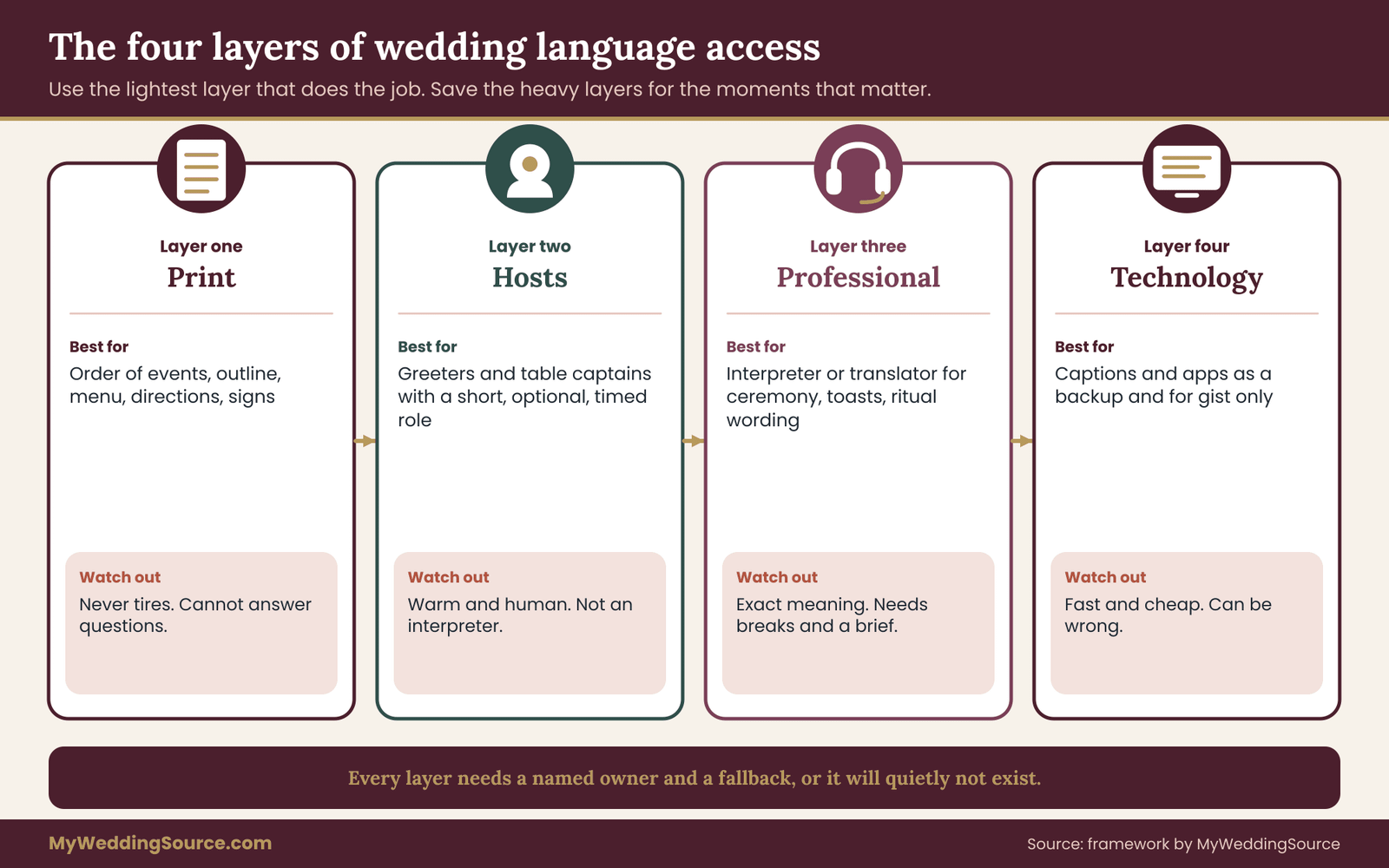
Layer one: print. Anything that can be written down ahead of time should be. That includes the order of events, the menu, directions to the venue, the ceremony outline, the names of the wedding party and a short note explaining customs that might puzzle a guest. Print does not tire, does not drift and does not need a break. Its weakness is that it cannot answer a follow-up question and it assumes the guest reads comfortably in the language provided.
Layer two: people who volunteered. These are hosts, table captains and greeters who speak the guest’s language and have been given a short, defined, optional role. They are not interpreters. They welcome, orient, point and introduce. Think of them as the friendly face at the door of a foreign train station. Their shift has a start, an end and a replacement.
Layer three: a paid professional. For the ceremony, formal toasts, religious or legal language and any moment where exact meaning matters, a trained interpreter or translator is the safer choice. This layer carries the high-stakes moments and nothing else, so you pay for the hours that count. The hiring details, including simultaneous and consecutive modes and how long a person can work, are covered in the guide on hiring interpreters.
Layer four: technology. Live captions, a shared document and a translation app can fill gaps and serve as a backup when a person is late. They are a supplement, not a substitute. Machine output can mishandle names, idioms, religious terms and anything spoken quickly over music, and it should never be presented as an authoritative rendering of vows or a blessing. Treat it as a way to follow the gist, and have a person confirm anything ceremonial.
The layers combine. A typical moment might use two at once: a printed ceremony outline in two languages (layer one), plus a professional interpreting the officiant’s words (layer three) for the guests who asked for it. A cocktail hour might need only a volunteer host (layer two). A late-night shuttle announcement might need only a bilingual sign (layer one). Most weddings end up with a mix of two or three layers, and that mix is their language access plan.
The reason to name layers is that it changes the conversation. Instead of asking “who can translate?”, which always lands on the same person, you ask “what is the lightest layer that works here?” The answer is often print or a short host role, and that alone removes most of the load from relatives.
There is one more principle. Every layer needs a named owner and a fallback. Print has a person who proofreads it. A volunteer host has a second host. The interpreter has a contact person who handles logistics such as where to stand and when the next break is. Technology has a human who checks that the screen is working. If a layer has no owner, it will quietly not exist on the day.
A related principle concerns quality. Prefer a smaller promise that is kept over a larger one that is not. A couple who offers a bilingual printed program and one interpreted ceremony has delivered real language access. A couple who promises “translation throughout” and then relies on one tired relative has not, even though the promise sounded more generous. Quality is what makes language access real for the guest.
Finally, sequence the decisions. You cannot pick layers before you know who needs help, and you cannot know that without asking. So the first real task is a gentle intake, described next. It takes a few conversations and a short line on your invitation or website, and it is the step that most often gets skipped.
Find out what each guest needs before you decide
Assumptions are the weakest part of most wedding language access plans. Couples assume that an older relative needs everything translated, that a younger relative needs nothing, and that anyone who speaks English at work will follow a fast ceremony. All three guesses are frequently wrong, and acting on them can feel patronizing to the guest. Guessing is the main way language access goes wrong.
The guest autonomy approach reverses the order. You ask, you offer options, the guest chooses, and you record the choice. It is a short, polite process, and it takes the pressure off everyone, because the guest is deciding for themselves instead of being decided for.
Start with the sources of information you already have. The household who is hosting a particular guest often knows. A parent can usually tell you which relatives are comfortable in English and which are not, but treat that as a lead, not a verdict. Then confirm directly with the guest, in their language where you can, or through the household member they prefer. Intake is the first step of any language access plan.
A good intake question has four traits. It is optional, it is phrased as an offer of support and not as a statement about the guest, it offers several kinds of help, and it does not require the guest to explain themselves.
For example, on a response card or website form you might include a line like: “Would any of these make your day easier? A printed program in another language, a seat near an interpreter, a host who speaks your language, captions, or something else. Tell us what helps.” Then provide a field for the language and a field for anything else.
For guests who may not read the response form, such as an older relative who does not use the website, make a short, warm phone call, or ask the family member they trust to raise it. A sample script: “We want your grandmother to enjoy the day. We are arranging a few kinds of language access, and she can pick whatever suits her, including none. Which would she like us to offer?” The last phrase matters, because it makes declining easy.
Capture the answers in one shared sheet with a small number of columns in your own notes: the guest’s name, the household, the language, the written-language preference, the kinds of help they chose, the moments they want covered, and any people they prefer or do not prefer as helpers. Keep it private. A list of who needs language access help is personal information, and it should reach only the people who need it to do their job, such as the interpreter’s contact and the host captain.
Ask about reading as well as speaking. A guest may understand spoken English well and prefer a printed program in another language, or the reverse. Some languages have more than one writing system, and some communities prefer one over another. Ask which script or variety the guest uses, and do not guess from the country of origin. A guest from one region may read a different standard than the one a translation vendor defaults to.
Ask about dialect and register too. A professional interpreter who speaks the standard form of a language may be slow to follow a regional dialect, and a formal register may sound stiff to a relative who speaks informally. This is not a reason to avoid professionals. It is a reason to tell the interpreter about the guests in advance, so they can prepare vocabulary and ask the right questions. Tell the professional early so the language access you offer fits the actual guests.
Do not forget guests who need no help at all. If a guest says they are fine, believe them. It is easy to over-serve people who did not ask for anything, and over-serving can feel intrusive. You can always add a small safety net, such as a bilingual sign or a greeter, without asking them to use it.
Timing matters. Ask early enough that you can still hire and print. Many couples collect this information along with RSVPs and meal choices, which is around six to ten weeks before the wedding, depending on how fast you can book an interpreter and print materials. If you have a larger or more formal wedding, start the first conversations sooner, because professional interpreters and translators can book up on popular weekends. Late intake limits the language access you can still arrange.
For help wording these questions on the card itself, see the notes on RSVP etiquette, which cover what a response card can reasonably ask. Keep the language question short. The follow-up conversation is where the detail belongs.
{{INFOGRAPHIC:2}} ## Print: the layer of language access that never gets tired
Print is the best first investment because it does the most work for the least strain on people. A guest holding a clear, accurate program in a language they read can follow the day at their own pace, glance at it during a long speech and pass it to a friend. For language access, print is also the layer that treats every guest the same, because everyone gets a program and nobody has to ask for one. Print also anchors every other part of your language access plan.
Start with the order of events. A one-page outline listing each part of the day, its start time and a one-line description does more for a guest who cannot follow the spoken words than almost anything else. If the ceremony is followed by photos, a cocktail hour and a seated dinner, say so, and say where each takes place. Guests who understand the structure of the day can relax, because they can predict what is coming. This single page is the cheapest language access you can offer.
Next, the ceremony outline. Do not attempt to translate the full text of vows or a blessing in the program unless you have a qualified person doing it. A safer pattern is to print the structure and the plain meaning of each part: “The officiant welcomes the guests. A family member reads a poem.
The couple exchange rings.” That is an orientation, not a translation of ceremonial language, and it does not claim an authority it lacks. If you do want the actual words in a second language, use a professional translator and have a second reader check it. Machine translation should not be the source for a text people will treasure.
Then practical information. Directions, parking, the shuttle schedule, the dress code, what to do if it rains and who to call if a guest is lost are the details guests worry about quietly.
Put them in the languages your guests read, on the website and on a card in the welcome bag or at the hotel front desk. For travel-heavy weddings, the same information helps guests who arrive tired after a long trip and have already used up their patience for guessing. Practical details are a quiet form of language access.
Menus and allergens deserve attention. A guest who cannot read the menu cannot avoid an ingredient. Where there are allergen labels, provide them in the same languages as the rest of the print. Label dishes clearly and plainly and say who to ask. Do not rely on a server to improvise a translation of an allergen list, because that is the place where a small error can be serious. The caterer can supply an accurate ingredient list, and a professional translator can render it.
Signs are print too, and they follow their own rules about size, contrast and placement. The system view of wayfinding, readability and venue permissions is covered in the wedding signage system guide, and the same logic applies when a sign carries two languages: keep the text short, give both languages equal weight and avoid shrinking one to a footnote. Where space is tight, use icons for restrooms, bar, gifts and exits, and keep the words for the things icons cannot say.
Who translates the print? Decide this before you pay for design. A bilingual friend can check a translation, which is a valuable second pair of eyes, but a friend is not a replacement for a translator when the document is long or formal.
The practical rule is that short, low-stakes text such as an order of events can be done by a careful bilingual friend and then read by a second person. Longer or more formal text, such as ceremony wording, legal wording or a religious text, should go to a professional translator who works in that language and subject.
Whoever does it, ask for a read-back. Have a native reader who did not do the translation read the final printed proof and mark anything that sounds stiff, wrong or oddly literal. This is the same proofreading discipline you use for English text, applied to a language you may not read. It catches the common errors: names broken into the wrong characters, dates written in the wrong order, formal words used where a friendly word belongs.
Names are a special case. A guest’s name should appear the way they spell it and in the script they use. Do not translate names or auto-correct them. If you are printing place cards or a seating chart, confirm spellings with each household. The wedding seating chart guide covers the layout side, and name accuracy is the part that language access adds.
Keep a master file with versions. When you correct the English program, the other language versions must be corrected too, and it is easy to update one and forget the others. Give each version a date and a short version note, and print all versions from the same final approval. A guest who holds a program that disagrees with the one on the next table will not know which is right. Version control keeps your language access materials consistent.
There is a design question worth settling early: one bilingual document or separate versions. A single bilingual page works well for short texts, such as the order of events, because everyone sees both languages and nobody is labeled. Separate versions work better for long texts, such as a multi-page ceremony booklet, because two languages on one page can crowd the layout. Either choice is fine if the guest can find their version without asking.
Finally, put digital copies on the website and offer them as a downloadable file, so a guest can read them on a phone, enlarge the text and use a device translator for a single word. Digital copies also help guests who prefer to read the day ahead of time. The ideas in the site’s guidance on the wedding invitation etiquette cover how to point guests to the website without overloading the invitation itself.
The people layer: hosts and table captains, not unpaid interpreters
Print cannot greet anyone. For warmth, orientation and the small questions that come up all day, you need people. The people layer is where relatives and friends can genuinely help and enjoy it, as long as the role is shaped to be small, optional and finite. The people layer is where language access feels human.
Call these helpers hosts, not translators. The word matters, because it sets the expectation. A host welcomes a guest in their language, introduces them to a few people, shows them to their table, points out the restrooms and the bar, explains what is happening next and checks in a couple of times. A host does not interpret speeches, relay arguments with the venue or sit beside the guest for the whole evening. Naming the role correctly protects language access for everyone.
Give each host a one-page brief. It should name the guests they are hosting, the timeline of the day, the three or four things to cover at arrival, the person to contact for any problem, and the moments they are not responsible for. A short brief protects the host, because it makes clear that the ceremony and toasts belong to another layer. When helpers know what is not theirs, they relax.
Offer the role as a choice. A script that works well: “We would love your help welcoming the guests who speak Portuguese, if you have the time and want to. It would mean meeting them at the door, walking them to their table and checking in during dinner. You would not need to translate the ceremony or the speeches, because we have someone for that. You can say no, or you can do half of it.” Notice that it names the limit, the exit and the reduced version.
Pair hosts so nobody is alone. Two people sharing a group of guests can trade off, take breaks and cover for each other. Where the group is small, one host and one backup is enough. The backup does not need to do anything unless the host is missing, and they should know that is their role. Pairing keeps language access steady when one person tires.
Assign table captains at larger weddings. If several guests who share a language sit together, a table captain who speaks that language and sits at the table is a natural fit. Seating guests who share a language together also reduces the need for support, because they can talk with each other.
Balance this against mixing: some guests will want to meet new people, and the seating plan should not isolate them. The seating chart guide linked above covers how to balance groups, and the intake answers tell you which guests prefer to sit together.
Be careful with the wedding party. Bridesmaids, groomsmen and parents have a full schedule of their own, and an interpreting task on top of it will break either the task or the person. Choose helpers from guests who are not in the processional, not giving a toast and not responsible for a vendor. A guest who is free from other duties can enjoy being a host.
Set shifts and breaks. Decide that host A covers arrival through the cocktail hour and host B covers dinner and dancing, or that two hosts alternate every hour. Tell them when they are officially off duty, and tell them to eat. The most generous thing you can do for a helper is say, in writing, “From the first dance onward, you are a guest.”
Treat minors as off limits. A teenager may offer, and the offer may be sincere, but the role puts them in the middle of adult conversations and asks them to carry information they may not understand. Thank them and give them a different task, such as handing out programs. Do not rely on a child as the only link between a guest and the rest of the room.
Compensation, where it fits, is simple. A host who gives hours to your wedding may appreciate a thank-you gift, a meal during their break or a note. If a friend is giving a professional skill, such as editing a translated program, ask what they would like, and offer to pay if they would rather. Not everyone wants to be thanked in the same way, and asking is better than guessing.
Because layer two is made of people, give it a fallback. Make a short list of two or three backup hosts, and tell them early that they are on call. If a host gets sick, the backup steps in without anyone having to improvise. The reception layout and guest movement guide, designing reception flow, shows where hosts are most useful: at the entrance, at the bar line and at the moment dinner is called.
{{INFOGRAPHIC:3}} ## When to hire a professional for language access, and what to do if you cannot
The professional layer exists for the moments where exact meaning matters or where the helper would otherwise be stuck working through the whole event. In a wedding that usually means the ceremony, formal toasts, any religious or legal wording, and a few speeches from people the guests cannot hear clearly. Everything else can often be handled by print and hosts. Paying for these few moments is the most efficient language access spending.
Use a simple test for each moment. Ask three questions. Would a misunderstanding here hurt a person, a relationship or the meaning of the ceremony? Is the language specialized, such as religious, legal or poetic? Will the moment last long enough that an untrained helper would be exhausted? If the answer to any is yes, the moment belongs to a trained person. If all three are no, a lighter layer is enough.
The ceremony is the clearest case. Guests listening to vows, readings and a blessing in a language they do not follow are missing the center of the day. A professional interpreter can render the officiant’s words so the guests who requested it can follow along. If the interpreting is consecutive, the officiant pauses after each phrase.
If it is simultaneous, an interpreter speaks quietly into a headset system or whispers to a small group. Each mode changes the pace and the equipment, and the sibling guide on interpreter modes and staffing explains the tradeoffs in detail. It is where language access matters most.
Formal toasts are the next candidate. A short toast of a minute or two can be handled by an interpreter or a bilingual speaker who alternates sentences. A long toast gains a lot from advance preparation: if the speaker shares the text with the interpreter ahead of time, the result is smoother and quicker. Ask toast givers to send their remarks a few days ahead, and ask them to keep the text short, so the interpreted version does not double the length of the speech.
Another option for a few moments is a professional translator, rather than an interpreter. A translator works on written text. For a printed ceremony booklet, a translated website page or a bilingual sign set, you want a translator. For speech, you want an interpreter. The two professions overlap but are not the same, and a good vendor will tell you which they do. Ask for a person with experience in the language pair and the subject, and ask what they need from you in advance.
When you contact a professional, share a short brief: the date, the venue, the languages, the number of guests who want support, the moments you want covered and the approximate length of each. Ask about their availability, their method, their equipment needs, how they handle breaks and what they need from the venue, such as a place to stand or a quiet corner.
Do not ask for a price in a vague message. Give the schedule and ask for a quote based on it. Prices vary widely by language, city and assignment length, and no figure in this language access guide is a quote.
On longer assignments many professionals work in a pair and trade off, because interpreting is mentally demanding. For a ceremony of half an hour, one interpreter may be enough, and for a long program with several speeches the professional will tell you what they recommend. Take that advice seriously, because a worn-out interpreter makes more mistakes, and the error will land on your guests.
Build the break into the language access schedule. Interpreters need water, a short rest and a place to eat, and they should not be sitting in a corner with no seat. Tell the caterer to include them in the meal count if the day is long, and give them a quiet place to prepare.
Look at whether the contract or booking confirmation covers cancellation, overtime and what happens if the schedule runs long. The general advice in the wedding vendor contract guide applies to an interpreter as much as to a photographer.
What if the budget is small? There are honest alternatives, and each one reduces the problem without hiding it. Smaller budgets can still deliver honest language access.
Limit the interpreted moments. Cover only the ceremony professionally and let print and hosts handle the rest. Even a short interpreted ceremony gives the guests who asked for it the most meaningful moment of the day.
Use a shorter ceremony. A ceremony with fewer readings and a brief officiant script costs less to interpret and is easier to follow. If a lot of the wording is ceremonial and fixed, a printed guide to what each part means can substitute for the live words.
Use a bilingual officiant or reader. Some officiants speak both languages, and some couples ask one reader to read a passage in the other language. This is a design choice, not a cost-cutting trick, and it often feels warmer than an interpreter in the corner. Make sure the person is qualified to speak the ceremonial language, and give them the text in advance.
Ask a community organization. Local cultural centers, religious communities and language associations sometimes know qualified people. Check credentials and ask for references. A community connection is a good way to find someone, and it does not replace asking about their experience with live events.
Split the cost with the families. If a set of guests belong to one side of the family, that family may want to contribute toward interpreting. Frame it as an offer, not a requirement, and do not make the guest’s access depend on a family’s decision.
Be honest in the invitation. If you can only cover part of the day, say which parts. “We will have an interpreter for the ceremony and printed programs throughout” is an honest sentence. It lets guests decide what else they need, and it avoids the disappointment of an unkept promise.
For the ceremony’s timing and who stands where, the ceremony cue sheet guide shows how to give an interpreter a precise cue sheet, including when the officiant pauses and where the interpreter stands.
Technology as the fourth layer of language access
Technology is tempting because it is cheap and always available. A phone can translate a sentence in seconds, and live captioning can turn speech into text on a screen. Used well, these tools fill gaps. Used as the main plan, they cause the exact problems this guide is trying to prevent. Treat technology as the last layer of language access, not the first.
Start with what machine translation does well. It can help a guest read a menu line, a sign or a short message. It can help a host and a guest who have no shared language exchange a few simple words. It can give a rough sense of a paragraph. For a guest who has no other support in a given moment, such as asking where to find a restroom, it is a quick, private option.
Now the limits. Automated translation can get names wrong, mangle idioms, flatten jokes, miss tone and mistranslate religious or ceremonial terms. In noisy rooms, speech recognition gets worse, and a toast delivered over music may come out as nonsense. Accuracy varies by language, and some languages are served much worse than others.
Because of this, never present machine output as the authoritative version of vows, a blessing or a legal statement. If a text matters, a qualified person must produce or review it. Reliable language access cannot rest on a phone alone.
Live captioning is a different tool and deserves its own consideration. Captions in the speaker’s language access help guests who are deaf or hard of hearing, and they help guests who read a second language better than they follow it by ear. Captions in a translated language add another step and more room for error.
If you use them, test them with the actual microphone and room, and have a person who knows the language watch for obvious failures. For anything involving a hearing-access need, use trained captioners or interpreters in the correct language, and read the ADA guidance on effective communication so you understand what is expected of a venue.
Think about the equipment. Wireless headset systems for simultaneous interpreting need transmitters, receivers, charged batteries and a person who checks they work. Shared screens need a good view from every seat and a reliable connection. A venue with weak cell service may make a phone app useless at the moment you need it. The wedding day digital contingency plan guide, digital contingency planning, describes how to check connectivity and prepare backups, and the same checks apply here.
Privacy needs attention. If you collect language information from guests, store it where only the right people can see it. If a translation app records audio or sends text to an online service, tell guests who might use it, and let them choose. A guest should not be recorded by a device they did not agree to. Keep the setup simple enough that nobody needs to hand a private conversation to a tool.
A good use of technology is as a safety net. If the interpreter is delayed, a host can open a prepared bilingual outline on a phone and a captioning screen can carry the gist of the opening remarks. If a guest needs to ask a quick question and the host is away, a translation app is better than silence. Write these backup uses into the language access schedule so everyone knows what to reach for, and so nobody mistakes the backup for the language access plan.
Another good use is preparation. A translation tool can help you draft a first version of a note to a guest, which a human then checks. It can help you understand an email from a guest who wrote in another language. It can help you prepare questions for an interpreter. In each case, the tool speeds up your own work and a person does the final judgment. Preparation like this improves language access without adding risk.
Finally, test everything once. Run the captions with the room’s microphone, try the headset system in the real room, and have a person who knows the language read what the screen shows. Record what went wrong and fix it before the day. A tool that was never tested is a tool you are hoping works, and hope is not a layer.
{{INFOGRAPHIC:4}} ## Build the language access coverage schedule, one moment at a time
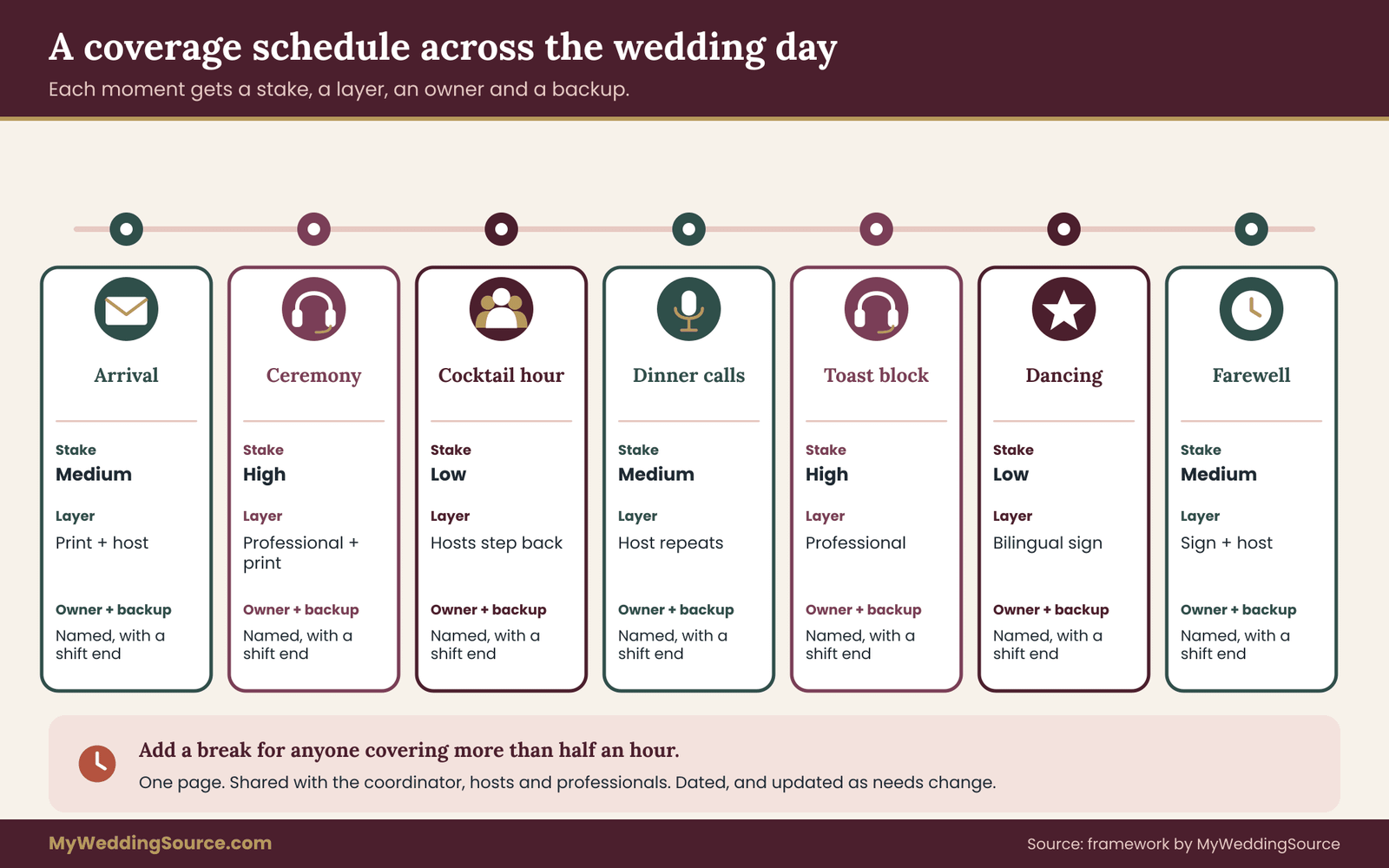
The language access coverage schedule is the center of this language access guide. It is a one-page document that lists every moment of the wedding where language access matters and assigns each one a layer, an owner, a backup and a time limit. It is easy to build, easy to hand to a helper and easy to check on the day.
Start by listing the moments in the order they happen. For a typical wedding that might include guest arrival, the welcome and seating, the ceremony, the receiving line or photos, the cocktail hour, dinner announcements, the meal service, toasts, the first dance and other formal moments, cake or dessert, open dancing and the farewell and transport. Add anything particular to your day, such as a tea ceremony, a blessing over the meal or a procession.
For each moment, write down five items. The first is the stake, which is how much a misunderstanding would matter. The second is the duration, which is how long the moment lasts. The third is the layer chosen, one or two of the four. The fourth is the owner, a named person. The fifth is the backup, another named person or a fallback tool.
Rate the stake with three words: low, medium or high. A low stake moment is one where a guest who misses something loses little, such as the order of the dessert table. A medium stake moment is one where confusion costs comfort, such as not knowing when dinner is served or where the shuttle leaves.
A high stake moment is one where meaning is central, such as vows, a blessing or a toast from a grandparent. The rating is a judgment, and you can change it after talking with the guests concerned. Honest ratings keep language access proportionate.
Now apply a rule of thumb for choosing layers. Low stake moments get print or nothing. Medium stake moments get print plus a host. High stake moments get a professional, with print for orientation and technology as a backup. If a high stake moment is longer than about half an hour, plan for a pair of professionals or a break. This rule is a starting point, not a law, and a guest’s own preference can override it.
Consider the arrival. It is usually a medium stake moment because guests are tired, a little anxious and unsure where to go. Print gives directions, signs point the way, and a host greets guests at the door. That is two layers and no professional. The same applies to the transition to dinner, where a host announces in the guest’s language where to sit and when the meal begins.
The ceremony is a high stake moment, so it gets a professional interpreter or a bilingual officiant for the guests who requested it, a printed outline for everyone and a host who seats those guests near the interpreter. A seat near the front or near the interpreter is a courtesy, and the schedule should say who arranges it and who confirms the guests know where to sit. This is the heart of language access at the wedding.
The cocktail hour is mostly social. A host introduces guests who share a language, and nobody is interpreting. This is the place for volunteers to shine, because the role is light and the setting is relaxed. Plan for a break afterward so that the host can eat and mingle.
Toasts are the tricky one. Each toast is its own high stake moment but short. A practical approach is to group the toasts into a single block, ask each speaker to send their text, and have the professional interpret the block.
If you do not have a professional, ask speakers to alternate languages, pause after each sentence or two, or provide a short printed summary. Make sure the order of toasts is on the language access schedule so the interpreter knows when to stand by. A ceremony cue sheet is a good model for the format, and the same structure works for the toast block.
Dancing and the late evening usually need only a bilingual sign for the shuttle and a host who can answer one or two questions. Farewell logistics are medium stake: guests need to know how to get home, and a sign or a host at the door covers it.
Add a column, in your own notes, for the break. For any moment lasting more than half an hour, note when the person covering it is relieved. For the professional, note the break in their contract or booking confirmation. For hosts, note the shift change. For the schedule as a whole, add a lunch or meal for everyone who works.
Add a line for the unexpected. List what happens if the owner is absent: the backup. List what happens if the backup is absent: a tool or a sign. List who decides if something goes wrong, usually one coordinator or the planner, and make sure that person is not the couple. The couple should not be the troubleshooters on their wedding day.
Share the language access schedule with everyone who has a role, and give it to your coordinator, if you have one, as part of the run of show. A document that only the couple has seen is not much use on the day. Keep it to one page. If it grows past a page, the plan is probably too complicated, and you should look for moments to simplify.
Review the schedule with a guest who needs support, if they are willing. A grandmother who has seen the language access plan can tell you whether the front-row seat suits her or whether she would prefer the back row near the exit. This single conversation often changes the plan in useful ways. It is also a small act of respect, because the guest sees that the language access plan was made with them in mind.
The guest autonomy checklist for wedding language access
A schedule can be perfect and still feel wrong to the guest. The autonomy checklist is the second tool, and it exists to make sure the help you offer is help the guest wants, delivered in a way that respects them. Use it as a final review before you finalize the language access schedule, and again a week before the wedding. Language access that ignores choice is only half done.
Each item is a question you can answer yes or no. If any answer is no, fix the plan before the day.
One: Did we ask? Every guest who might need support was asked directly or through a trusted household member, and nobody was assigned help based on a guess.
Two: Did they have a choice? The guest could pick among several kinds of help, including no help, and their choice is recorded.
Three: Is the help optional on the day? A guest can accept or decline any layer in the moment. A guest who said yes to an interpreter can still choose not to use the headset.
Four: Is the person helping the guest the right person? Nobody is asked to help a guest they would find uncomfortable to serve, and no guest is paired with a helper they would rather avoid. Ask who they prefer.
Five: Are children and the wedding party out of the interpreter role? No minor is relied on to bridge adult conversations, and nobody with a major day-of role is also the main language access helper.
Six: Does every helper have an end time? Every volunteer has a shift, a break and a clear point where they become a guest.
Seven: Is private information protected? The list of guests who requested support is shared only with people who need it, and nobody announces a guest’s needs to the room.
Eight: Is quality checked? Printed materials were read by a second person who knows the language, and ceremonial text was handled by a qualified person.
Nine: Do we have a fallback for each high stake moment? If the interpreter is late or the host is missing, a person or a tool can cover the gap.
Ten: Can a guest raise a problem? Someone is named as the contact for questions or complaints, and the guests know who they are.
Notice what is not on the list. There is no item requiring that every guest accept help, no item that measures how many guests used the support, and no item that judges a guest’s language ability. The language access checklist is about the quality of the offer, not about outcomes you cannot control. Language access is measured by the quality of the offer.
A few of these items deserve extra thought. On item three, it is easy to forget that choice does not end at the RSVP. A guest who said yes may change their mind at the ceremony, and the language access plan should make that easy. The interpreter’s equipment should be passed to a guest quietly, without a ceremony, and a guest who removes it should not be questioned.
On item four, the question of who helps is delicate. A guest may not want a particular relative to help them, because of a past argument, a difference in dialect or simple preference. Ask the guest privately and respect the answer without requiring an explanation. If you learn a conflict exists, route around it with another host or a professional.
On item seven, privacy matters because needing language access can be mistaken for a lack of ability, which it is not. Keep language access needs out of public seating lists and group messages. Use the minimum necessary labels in documents the vendor sees. A seating chart with a note such as “seat near interpreter” is enough, and it does not need to say why.
Finally, treat the language access checklist as a living document. You will probably discover new needs as the wedding approaches: a guest who changes their mind, a relative who becomes available, an interpreter who suggests a better position. Update the schedule and the checklist together, and date each version.
{{INFOGRAPHIC:6}} ## A worked case: Lucía and Grant cover a mixed-language wedding without drafting relatives
The following example is invented to show how the tools fit together. The couple, the numbers and the choices are illustrative, not a record of a real event, and your own wedding will differ.
Lucía and Grant are planning a Saturday afternoon wedding for about one hundred and forty guests. Lucía’s family speaks Spanish at home, and about twenty-two of her relatives are more comfortable in Spanish than English, including her grandmother and several older aunts and uncles. Grant’s family speaks English, with one exception: his step-grandmother, who speaks mostly Korean, will be attending with her daughter. They want language access that works for everyone.
Their first instinct is the familiar one. Lucía’s cousin Marta is bilingual and cheerful, and Lucía says, “Marta can just translate for everyone.” Grant’s step-grandmother’s daughter says she can handle her mother. On the surface that is cost-free. Lucía’s planner, who has seen this go sideways, asks the couple to try the language access layers first and to write the language access schedule before assigning anyone.
Step one: intake. Lucía calls her grandmother and her two aunts who coordinate the older relatives. She does not ask, “Do you need translation?” She says, “We are arranging several kinds of language access help for the day, and you can pick whatever suits you, including none. Which would you like?” She learns that her grandmother wants the ceremony in Spanish, wants a seat near the front and does not want anyone sitting beside her whispering.
Two aunts say they follow English reasonably well but would like the program in Spanish. Several uncles say they are fine. Grant’s step-grandmother’s daughter explains that her mother reads Korean and would like the order of events in Korean, but is comfortable without live interpreting if someone is nearby to say hello.
The sheet now has three different profiles instead of one assumption. Seven guests want a Spanish ceremony interpreter, eleven want a printed Spanish program, about four want only a friendly host, and one wants a Korean order of events and a greeter. The rest want nothing, and the couple writes that down as a valid answer.
Step two: rate the moments. The planner walks through the day. Arrival is medium stake. The ceremony is high stake. The cocktail hour is low. Dinner announcements are medium. There are five toasts, which the couple groups into one high stake block. Dancing is low, and the farewell shuttle is medium.
Step three: choose layers. For arrival, they print a bilingual order of events and a bilingual sign for the parking area, and two volunteer hosts greet guests at the door, one in Spanish and one backup. For the ceremony, they book a professional interpreter for Spanish, with the interpreting delivered quietly through a small headset system for the seven guests who asked, and they print a bilingual ceremony outline for everyone.
The seven guests sit in the front rows, near the interpreter. For the Korean-speaking step-grandmother, they print the order of events in Korean, produced by a professional translator and checked by a second Korean reader, and they ask one guest who knows her to greet her at arrival.
For toasts, they ask each speaker to send the text five days ahead and keep it to about two minutes. The interpreter receives the texts and prepares. For the cocktail hour, hosts introduce Spanish-speaking guests to other guests and then step back. For dinner announcements, the DJ gives each announcement in English and a host repeats it briefly in Spanish at the relevant tables. For the shuttle, the farewell sign is bilingual and a host stands at the door.
Step four: assign owners and backups. Marta, the cousin the couple first thought of, is asked whether she would like to be the lead host for the cocktail hour and dinner. She says yes to the cocktail hour, and asks to be off duty at dinner because she is in the wedding party. They agree. Another cousin, who is not in the party, takes dinner hosting with a friend as backup. The interpreter’s contact is the coordinator, who also holds the printed copies and the headset equipment.
Step five: run the autonomy checklist. They go through the ten questions. They find two gaps. First, they had assumed Lucía’s grandmother would wear the headset, but she prefers to listen without it and read the printed outline.
They record that she will not use the equipment and that her seat should still be at the front. Second, one aunt did not want to be seated near a relative she is not on speaking terms with, so the seating chart is adjusted. Neither of these would have surfaced if they had only assigned a translator.
Step six: handle the money logic. The couple does not get a quote on the first email. They send the interpreter a short brief with the date, the venue, the languages, the ceremony length, the toast block and the number of guests who requested support, and ask what they recommend. The interpreter suggests covering only the ceremony and the toast block, and advises a pair for the toasts only if the block runs long.
The couple concludes that paying for those two blocks is more sensible than paying for an entire afternoon, and the printed programs and volunteer hosts handle everything else. They do not guess a number, and they ask the professional to confirm breaks and overtime in writing. Language access budgets follow the schedule, not the other way around.
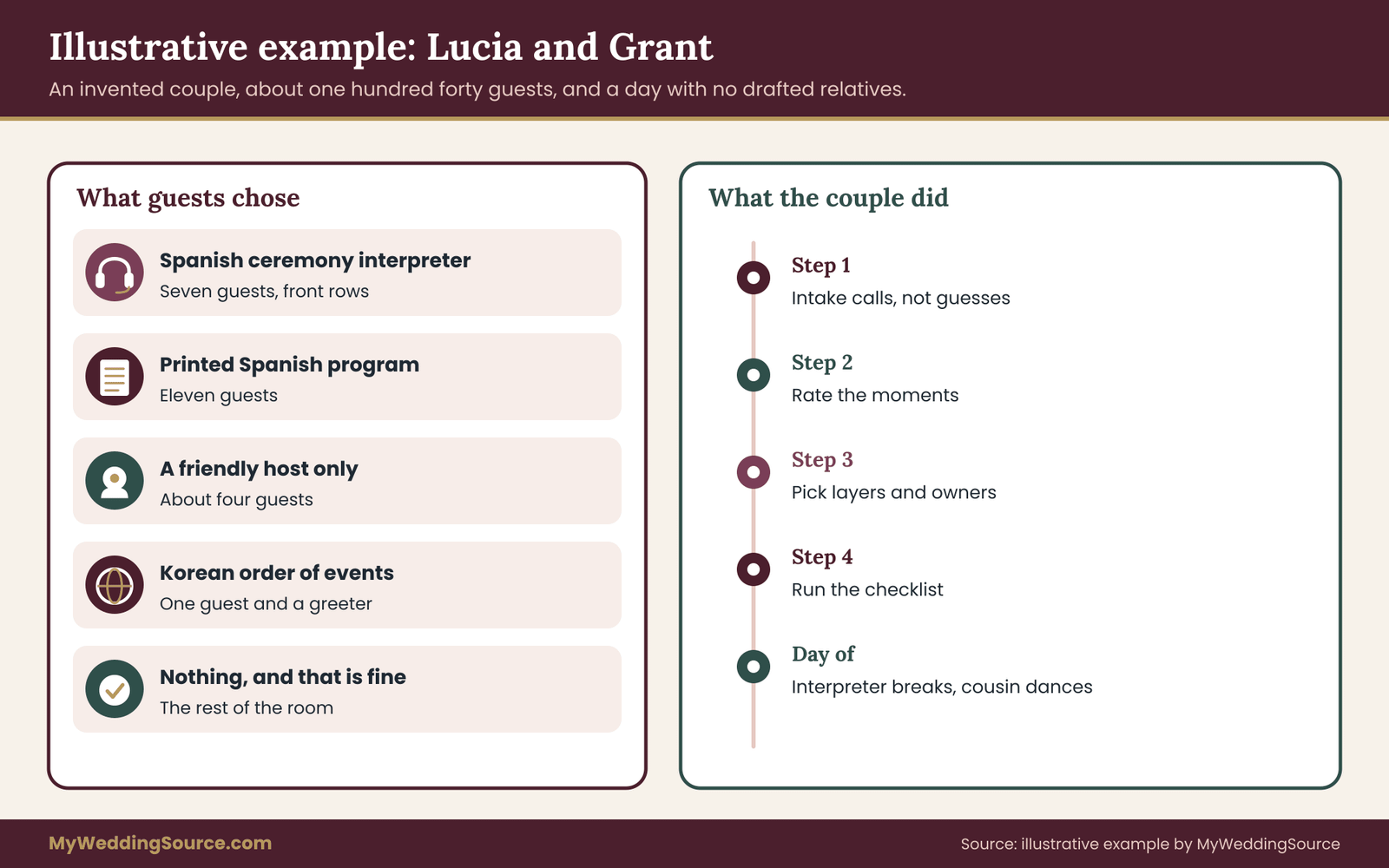
What happened on the day, as an illustration. The interpreter arrives early, tests the headset with the venue’s sound person and meets the officiant to agree on pauses. During the ceremony the seven guests follow in Spanish, and the others read the bilingual outline.
At the toast block, one speaker runs long and forgets to pause. The interpreter signals, the coordinator steps in and a host quietly sets a printed summary on the front tables. After the toasts the interpreter takes a break and eats. Marta spends the cocktail hour introducing people, and then she dances.
At the end of the night, Lucía’s grandmother tells her she followed the vows and liked that no one had to sit beside her. That sentence is invented, but it shows the point of the exercise. The goal is not a perfect translation of every word. It is that the guest felt present and nobody was burdened.
What the example teaches. The couple did not buy full-day interpreting. They covered high stake moments with a professional, used print and hosts for the rest, and used the intake to avoid wrong guesses. They gave their cousin a role she enjoyed and an exit. They kept the Korean-speaking guest’s needs separate from the Spanish ones, because needs are individual. They wrote the schedule on one page, shared it with everyone involved and updated it twice. It is a small, repeatable model of language access.
What could have gone wrong. If the interpreter had cancelled the week before, the plan would still hold in part. The bilingual outline covers orientation, the host covers the cocktail hour and a captioning app on a phone can carry the gist as a backup. They would also have asked their community contacts for a replacement and told the seven guests the situation honestly. The failure conditions section next gives a fuller list of ways coverage can break and what to do in each case.
What you can borrow. You do not need the same numbers. Take the order of operations: ask first, rate the moments, choose the lightest layer, assign an owner and a backup, run the language access checklist, and review it with a guest if they are willing. That sequence works for two languages or four, for fifty guests or three hundred.
One more point from the example is about proportion. Of one hundred and forty guests, a small group asked for live interpreting. The couple still wrote the language access plan for everyone, because print and hosts help guests beyond the ones who asked. A bilingual order of events turns out to be useful for guests who speak English too, since it tells them what is happening and when. Good language access often improves the day for the whole room.
A final detail from the example concerns timing. The couple started the intake about three months before the wedding, booked the interpreter in the first week after learning who needed what and sent the translated materials to a second reader a month ahead. That left room for corrections. If you start later, compress the same steps, and expect fewer choices of professionals on short notice. ## Failure conditions and edge cases: how language access plans break
Every plan has weak points. The useful habit is to name them in advance, so when one fails you already know the response. The conditions below are the ones most likely to come up, with the sign that tells you it is happening and a calm way to respond. Language access plans fail in predictable ways.
The interpreter is late or ill. The sign is an empty chair twenty minutes before the ceremony. The response is to move to the fallback written in the language access schedule: the printed outline, a host seated beside the guests who asked if they agree to it, and a captioning or translation tool for the gist. Tell the guests plainly what is happening. If the ceremony can wait a short while, wait. If you have a community contact, call them. Do not quietly assign the nearest relative without asking.
The interpreter and the officiant are out of sync. The sign is that the officiant keeps speaking and the interpreter falls behind. The response is a pre-agreed signal, such as a raised hand, and an officiant who has been briefed to pause at sentence ends. A short rehearsal of the first two minutes with the interpreter fixes most of this. If it happens on the day, the coordinator can cue the officiant.
A toast runs long and unplanned. The sign is a speaker who goes past the allotted time without pauses. The response is a printed summary on the tables, a host who gives a quick recap and a note on the schedule to put a time limit in the introduction of each speaker. Better still, ask speakers to send their texts early, which also makes the interpreter’s job easier.
A guest declines help you arranged. The sign is a guest who removes the headset or says they are fine. The response is to accept it. Nothing is wrong. Offer the option again later if it seems helpful, and do not make a point of it. The checklist exists for this exact case.
A guest wants more help than you planned. The sign is a guest who asks for interpreting during a moment you rated low. The response is to look for the lightest available layer: a nearby host, a printed note, a tool. Do not promise what you cannot deliver. A modest, honest answer such as “We can have a host sit with you for dinner announcements” is better than a vague yes.
The helper is overloaded. The sign is a volunteer who has not eaten, has been called away repeatedly or looks tired. The response is to enforce the shift change in the language access schedule. The coordinator or a backup host should step in without asking permission. Part of the couple’s job is to say beforehand that helpers are allowed to stop.
Print has an error. The sign is a guest pointing to a line that does not match the English, or a wrong date or time. The response is to correct it where you can, announce the correction through a host and apply the fix to the digital copy. This is why a second reader and a version log matter. It is also why you keep a few clean copies in reserve.
The technology fails. The sign is a dead headset, a frozen screen or a phone with no signal. The response is the written fallback: a host, a printed text or a simple verbal summary. Test the equipment the day before, carry spare batteries and assign one person to watch it. The idea behind the digital contingency guide on this site is that every digital piece needs a human backup, and that applies here. Language access should never hinge on one device.
A guest feels singled out. The sign is a guest who looks uncomfortable at being seated apart or addressed by a host in front of others. The response is to lower the profile of the help: discreet seating, quiet greetings and no announcements about who needs what. Apologize if the guest expresses discomfort and adjust. A small note of regret goes a long way.
Languages and dialects do not match. The sign is a professional or host who speaks the language but not the variety your guest uses. The response is to ask the guest, to bring in another person if possible and to simplify the wording. Prevent it by telling the professional about the guests in advance.
Cost runs over. The sign is a quote larger than your budget allows. The response is to cut the scope, not the quality. Cover fewer moments with the professional, rely more on print, shorten the ceremony or ask for a split of the cost from the families who wish to contribute. Resist the temptation to drop the plan and fall back on a single relative.
Add one last failure condition, which is the quiet one: nothing visibly goes wrong but guests were still left out. The way to find out is to ask a few of them afterward, kindly and in their language, what worked and what did not. Their answers will improve the next family event, whether that is a wedding, a baptism or a holiday dinner.
Edge cases: ceremonies, courthouses, destinations and more than two languages
Not every wedding fits the standard pattern. A few situations change how you apply the schedule.
Religious ceremonies in a liturgical language. Some ceremonies use an ancient or ceremonial language that most guests do not speak, even in the family that practices it. In that case the point is not necessarily to translate every word. Many couples choose to keep the original words, and offer a printed explanation of the meaning, so guests understand without altering the ritual.
Ask the officiant or religious leader what they consider appropriate before you add any interpreting. For a ceremony that combines traditions, the guide on interfaith wedding ceremonies helps you decide who owns each part, and the same decision applies to who explains it.
Courthouse and civil ceremonies. A civil ceremony may be short, and the officiant may not be able to pause for interpreting. Ask the clerk’s office in advance what is permitted, including whether guests may bring an interpreter or whether the court provides one. Rules differ by place, and the office that issues your license can confirm them. If live interpreting is not possible, print the structure of the ceremony and plan a celebration afterward where guests can talk freely.
Destination weddings. When the wedding is in a place where a guest group does not speak the local language either, you now have more than one set of needs: guests who do not speak the local language, guests who do not speak the couple’s language, and local vendors who speak neither. Add the local vendors’ language to the language access schedule and ask the venue what it offers. Provide travel information in the languages your guests read, and plan extra hosting at arrival, when guests are in an unfamiliar place.
More than two languages. If guests speak three or four languages, you cannot cover everything live in all of them. Prioritize. Pick the high stake moments and the languages with the most guests who asked for support, and cover the others with print and hosts. Be honest about the limit. A clear message such as “We will interpret the ceremony into two languages and provide printed programs in four” is better than overpromising.
Deaf and hard-of-hearing guests. Language access and hearing access overlap but they are not identical. A deaf guest may use a signed language such as American Sign Language, which is a language in its own right, or may rely on captions.
Ask the guest what they use, arrange qualified interpreters or captioners in advance and seat the guest where they can see the interpreter and the officiant. The ADA pages in the sources describe effective communication, and the Registry of Interpreters for the Deaf is a place to learn about qualified interpreters.
Small weddings with no budget. If you have only a handful of guests and no money for a professional, use print, a short ceremony and a host who agrees to a limited role. Choose a person who is not in the wedding party and who has time. If a guest still needs more, tell them honestly what you can offer, and ask what would help most. A modest plan that is honest is better than a bigger plan that fails.
Guests who prefer to manage on their own. Some guests will want no help at all, and may feel uneasy if they notice a plan around them. Offer the lightest layer, such as a printed order of events on the table, and leave the rest alone. The goal is access, not oversight.
Remote guests. If you stream the ceremony for guests who cannot attend, language access needs can follow them. Consider whether captions or an audio channel in another language is worth it, and be honest about what you can deliver. Remote guests deserve the same clarity about what is and is not offered.
Guests with limited reading ability in any language. Some guests do not read comfortably in any language. For them, icons, spoken announcements, a friendly host and visual cues work better than printed text. Ask the guest or the household what suits them, and make sure the language access plan does not rely on print alone.
Your next steps
Pick one evening this week and do four things. First, write the list of moments in your wedding day, in order. Second, rate each moment low, medium or high. Third, add a line to your website or response card inviting guests to tell you what would make their day easier. Fourth, make a short list of the people you might ask to be hosts, and decide who is out of the running because they are in the wedding party. Small steps now make language access easier later.
Next, over the following weeks, make the calls. Talk to the guests who might need support, using the scripts above. Choose layers. Contact a translator for the print and an interpreter for the ceremony and toasts, sharing your schedule and asking for their advice. Build the one-page schedule, run the ten-question checklist and share the schedule with your coordinator, hosts and professionals.
A week before the wedding, test the equipment, check the printed proofs with a second reader, confirm the shift times and tell every helper when they are off duty. On the day, let the coordinator run the plan. Your only job is to be a guest at your own wedding, and the point of building language access ahead of time is that your relatives get to do the same. Final checks protect your language access plan.
FAQ
Do we have to provide interpreting for guests who speak another language?
No law of which this guide is aware requires a private couple to do so, and obligations for deaf or hard-of-hearing guests can fall on venues and vendors in some settings. It is a hospitality choice. Many couples decide to cover the ceremony and key announcements, and use print and hosts for everything else. Check current rules with the venue and the agencies in the sources.
Is it wrong to ask a bilingual relative to help?
Not at all, as long as the role is small, optional and has an end. Ask them as a host, not an interpreter, tell them what is not their job, give them a shift and a break and offer a backup. A relative who chooses a limited role and then goes to dinner is helping. A relative who is never excused is working.
When should we hire a professional interpreter?
Hire one for moments where exact meaning matters or the work would exhaust an untrained helper: the ceremony, formal toasts, religious or legal wording and long speeches. Use print and volunteer hosts for the rest. Share your schedule and ask the professional what they recommend, including breaks, equipment and whether a second interpreter is sensible for longer blocks.
Can we rely on a translation app?
Use it as a backup, not as the main plan. Apps can get names, idioms, jokes and religious or ceremonial terms wrong, and they struggle with noise and fast speech. They are handy for a menu line or a quick question. Never present machine output as the authoritative version of vows or a blessing. Have a qualified person produce or check any text that matters.
How do we ask guests what they need without being awkward?
Make the question optional and phrase it as an offer: tell guests you are arranging a few kinds of support and they can choose any, including none. Offer examples such as a printed program, a seat near an interpreter, a host or captions. For older guests, a short phone call or a trusted family member works better than a form.
Should children ever translate for relatives?
Avoid it. Interpreting is demanding, and a child may end up relaying adult conversations and missing the celebration. A child may offer sincerely, so thank them and give a different job, such as handing out programs. Plan so that a professional, a print piece or an adult host is always the main link for any guest.
What should we do if the interpreter cancels at the last minute?
Move to the fallback in your schedule: a bilingual printed outline, a willing host beside the guests who asked, and a captioning or translation tool for the gist. Tell guests plainly what changed and ask community contacts for a replacement. Do not quietly assign a relative. Note the cancellation terms in the booking so you know your options.
How much does language access cost?
It varies a great deal by language, city, assignment length and equipment, so no single figure applies. Print and hosts cost little. Professionals are the main expense. Reduce cost by covering only the highest stake moments, shortening the ceremony or sharing the cost with willing families. Send the interpreter your schedule and ask for a quote based on it.
Sources
- Americans with Disabilities Act, U.S. Department of Justice
- Effective communication, ADA.gov, U.S. Department of Justice
- Limited English Proficiency, LEP.gov, Federal Interagency Working Group on Limited English Proficiency
- Language use in the United States, U.S. Census Bureau
- American Translators Association
- Registry of Interpreters for the Deaf
- National Association of Judiciary Interpreters and Translators
- National Council on Interpreting in Health Care
- Web Accessibility Initiative, World Wide Web Consortium (W3C)
- International Association of Conference Interpreters