
This engagement ring buying guide walks you through the whole life of the purchase: deciding what to buy, reading a diamond grading report, verifying the stone and the appraisal, choosing a setting and metal, paying safely, insuring the ring and caring for it for decades. It is written for the person buying, and it assumes you have never done this before.
Decide who will wear a ring chosen with this engagement ring buying guide, how they live and what you can pay before you look at a single stone. Insist on a grading report from a respected laboratory and check that its number matches the inscription on the diamond. Treat an appraisal as a separate document written for insurance, not as proof of quality. Pick a setting for the wearer’s daily life, not only for looks. Read the return policy, the payment terms and the insurance terms in writing before you pay, and schedule a jeweler’s inspection every year after.
An engagement ring is one of the few purchases where emotion, money, jargon and permanence all arrive at once. The stone is small, the paperwork is technical, the salesperson is friendly, and the price tag is often one of the largest you will pay before the wedding itself. Most of the mistakes people make here are not about taste. They come from not knowing which questions to ask, in which order, and what a good answer sounds like.
This engagement ring buying guide gives you a decision order. You settle the people questions first (who wears it, what they do with their hands, what the budget is). Then you settle the stone type. Then you learn what each line of a grading report means and how to check that the report belongs to the stone in front of you. Only after that do you choose metal and setting, compare sellers, and sort out payment, returns, insurance and care. Each step narrows the next one, so skipping ahead tends to cost money.
A note on scope. This engagement ring buying guide is general consumer information, not legal, tax, insurance or financial advice. Prices, return rules, laboratory practices and insurance policy terms change and differ by seller and by state, so confirm current details with the seller, the laboratory, your insurer and the agency named in the sources at the end.
What this engagement ring buying guide covers
A complete purchase has five phases, and each one has its own risks. It helps to see them as separate jobs rather than one big shopping trip.
Phase one: decide. Who is the ring for, what will it go through every day, and what is the real budget, including the extras that come after the sticker price? This phase costs nothing and prevents the most regret.
Phase two: understand the stone. Natural diamond, laboratory-grown diamond, moissanite, sapphire or another gem. Each has a different price logic, a different durability and a different way of being verified. You also learn the four quality factors and how they translate into what you see.
Phase three: verify. A grading report is only useful if it belongs to the stone you are buying. An appraisal is only useful if it was written by someone independent for the purpose you need. This is the phase most buyers skip, and it is where this engagement ring buying guide spends the most space.
Phase four: build and buy. Metal, setting, ring size, the seller, the contract, the payment method and the return window.
Phase five: own. Insurance, an appraisal schedule, daily care, inspections, repairs and what to do if a stone is lost or the plans change.
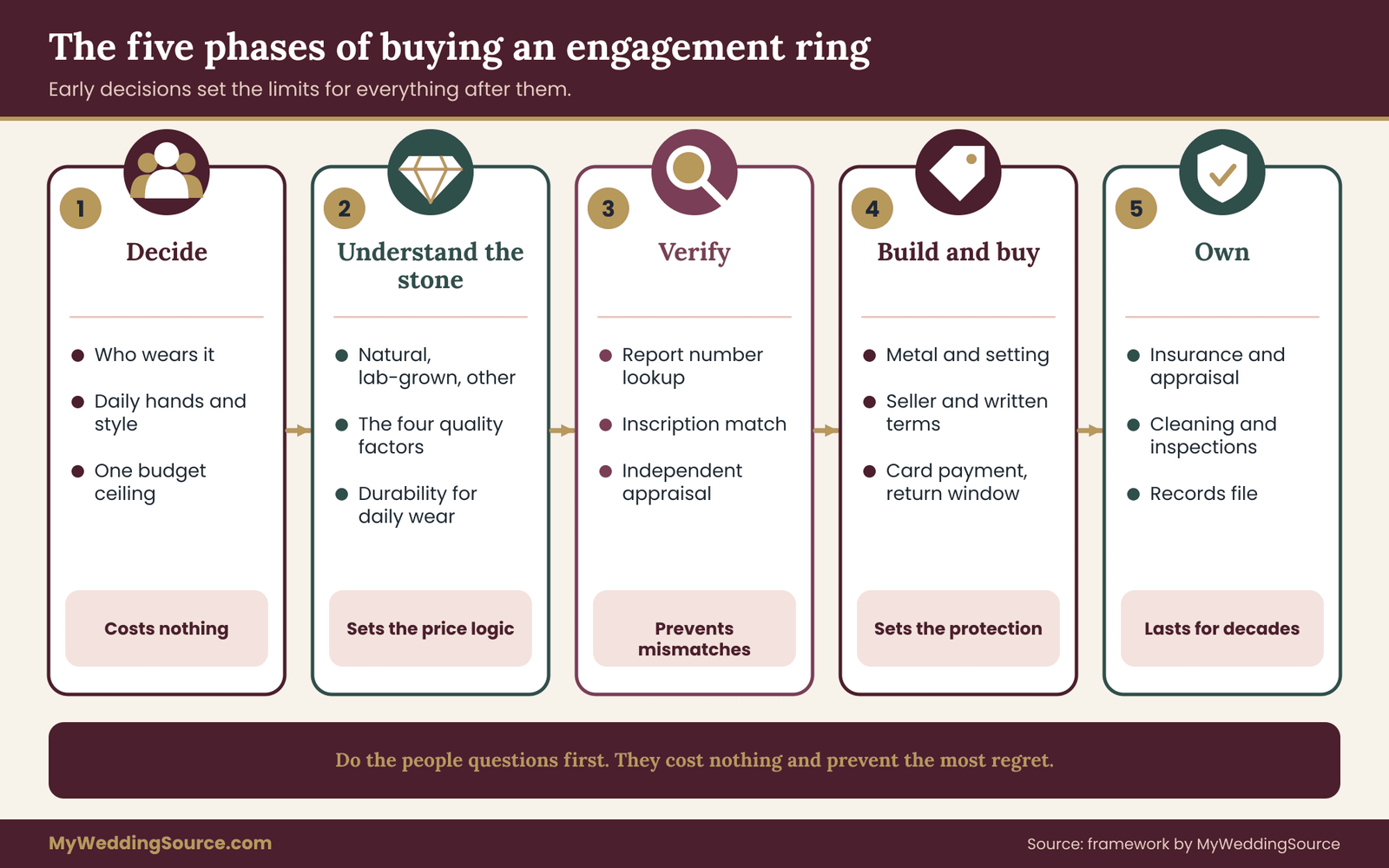
The route above shows how the phases connect. The decisions you make early, such as the budget and the stone type, set the limits for everything that comes after.
What the engagement ring buying guide does not cover
Wedding bands and the exchange of rings during the ceremony are a separate topic. If you are planning the ceremony itself, this engagement ring buying guide to wedding day accessories planning covers how rings and other small items are packed, handed off and backed up on the day. This engagement ring buying guide stays with the engagement ring itself: the purchase, the paperwork and the long-term ownership.
It also does not tell you what to spend or what kind of ring to like. You will not find a rule such as “spend a certain number of months of salary” here. That idea was popularized by advertising, not by any financial standard, and it ignores your rent, your debts and your plans. The budget section below shows a more honest way to set a number.
How to use the sections that follow
If you are early in the process, read this engagement ring buying guide in order. If you already have a ring in mind or a quote in hand, jump to the verification and insurance sections, because those are the places where a purchase in progress can still be corrected. If you already own the ring in your engagement ring buying guide notes, the care, inspection and records sections are the ones that apply to you.
Decide first: the wearer, the lifestyle and the real budget
The most useful shopping happens before any shopping. Three short conversations, with yourself or with the person who will wear the ring, settle most of what follows.
The wearer’s daily hands
A ring that looks perfect in a display case may be a poor fit for the hand that wears it. Think concretely about what the hands do. A nurse who washes her hands thirty times a shift, a carpenter, a climber, a pianist, a parent of a toddler, a software developer who types all day and a chef each have different needs. A tall, high-set stone catches on sweaters, gloves and hair. A very thin band bends under repeated pressure. A pavé band, with many tiny stones set into the metal, can lose a stone if it takes a knock.
You do not need to ban a style because of a job. You need to know the tradeoff. A person who works with their hands can still wear a high-set ring on weekends and a plain band at work, as long as they have a safe place to put it. The question to settle is whether this will be a ring worn every hour, or a ring worn on selected days.
Style signals you can collect without asking
If you want the proposal to be a surprise, you can still gather evidence. Look at the jewelry the person already wears every day. Yellow, white or rose metal? Delicate chains or heavy pieces? Large earrings or tiny studs? Vintage shapes or clean modern lines? Look at what they photograph and save. A trusted friend or sibling can also be a quiet source, and many jewelers will let you bring photos and talk through options without committing to anything.
A useful habit is to write a one-paragraph brief before you shop. For example: “Daily wear, works in a lab, prefers white metal, dislikes anything that catches on knit sweaters, likes older shapes, no sizing information yet.” You can hand that paragraph to a jeweler and the conversation becomes far more efficient.
Ring size when it has to be a surprise
Size is the most common practical problem. Fingers change size across the day, with temperature, after exercise, during illness and over the years. A few approaches reduce the risk. You can borrow a ring the person already wears on the correct finger and have a jeweler measure its inner diameter. You can press it into a bar of soap or trace it on paper, though a jeweler’s measurement is more reliable. You can ask a close friend. If you cannot find out, buy a ring that can be resized easily, and ask the seller in writing about the cost and the time of the first resizing.
Not every ring can be resized without trouble. Bands that are completely set with stones around the circle, and some unusual metals, can be difficult or impossible to change by more than a small amount. If your size is uncertain, an uncomplicated plain band under the stone is the safer choice. The metals and settings section returns to this.
Setting the budget honestly
Set one total number that you can pay without borrowing at a cost that will hurt, and treat it as the number for the whole ring, not just the stone. The total should cover the stone, the mounting, any sales tax or shipping, the first appraisal, the first year of insurance and a reserve for the first resizing or repair. Those extras are not large next to a ring chosen with this engagement ring buying guide, but forgetting them can push a purchase over its limit.
Two cautions apply to money. First, store credit offers. Many jewelry stores promote financing, and some promotional plans charge interest back to the original purchase date if the balance is not fully paid by the end of the promotion. The Consumer Financial Protection Bureau explains deferred-interest credit cards and how they work, and it is worth reading before signing anything at a counter.
Second, the wedding budget is a different pot. The wedding budget guide on this site explains how to set categories for the wedding itself, and it helps to decide early whether the ring comes from a separate fund or from the same savings as everything else.
The budget advice in this engagement ring buying guide comes down to one rule: write the budget down as a ceiling, shop for the best ring under the ceiling, and walk away from any quote that needs a number higher than the ceiling. Sellers are used to this. A calm “my total is fixed” ends most pressure.
Who else needs to know about the budget
Some couples shop together and some do not. Both approaches work. What does not work is a hidden purchase that quietly takes money earmarked for something shared. If you share finances, or if you are paying from a joint account, decide whether the ring in your engagement ring buying guide notes counts as a shared expense. It is easier to agree before the purchase than after a statement arrives. The same logic appears in the engagement ring buying guide to wedding cash-flow planning, where timing of payments matters as much as totals.
Questions to ask yourself before you visit a seller
Before you walk into any store or open any website, you should be able to answer six things. What is the ceiling price? Which metal colors are acceptable? Which stone type is open for consideration? What is the likely size, and how sure is it? How much do you care about the origin of the stone? And how long do you have before the proposal? A short timeline is a reason to look at in-stock rings. A long timeline gives room to commission something custom or to wait for the right stone.
Write the answers on one page. You will use that page again when you compare quotes.
Natural diamonds, laboratory-grown diamonds and other stones
The stone category you choose determines how the price behaves, how you verify the ring and what the seller is legally required to tell you. It deserves its own decision.
Natural diamond
A natural diamond formed in the earth over a very long time. It is carbon, in a crystal structure that makes it the hardest common gem. Natural diamonds are graded by independent laboratories on color, clarity, cut and carat weight, and the best known grading system for them is the one published by the Gemological Institute of America, usually shortened to GIA. A natural diamond’s price depends on the combination of those four factors, plus shape and the seller’s markup.
Laboratory-grown diamond
A laboratory-grown diamond has the same chemical composition and the same crystal structure as a natural diamond. It is made in a controlled setting, using high pressure and high temperature or a vapor deposition process. It is a real diamond in the physical sense, but it is not a natural one, and the Federal Trade Commission’s Jewelry Guides call for clear disclosure of that fact in sales. Sellers can use terms such as “laboratory-grown” or “laboratory-created,” and the guides discourage vague or misleading wording.
For a buyer, three points matter. The same grading scales are used for laboratory-grown stones by major laboratories, so a report can look similar to a natural diamond’s report, with a clear statement of the growth process. The price relationship to natural stones is a market question that has moved considerably and is better checked with live quotes than with any number in a guide. And resale behaves differently, which the next paragraph addresses.
Resale expectations
Nobody should buy an engagement ring as an investment. Retail prices include the seller’s costs and margin, and resale buyers pay far less than retail for most jewelry. That is true of natural diamonds, laboratory-grown diamonds and gemstones alike. If you want to understand your own situation, ask a few jewelers what they would offer for a similar stone and compare it with the retail price. It is a useful reality check, and a seller who promises you will be able to recover the price is making a claim that is hard to support.
Moissanite, sapphire and other gemstones
Moissanite is a silicon carbide gem, usually made in a laboratory, that is very hard and very bright, and it is much less expensive than a diamond of the same size. It has a different kind of sparkle, with more colored flashes, and some people love it and others find it too lively. Sapphire and ruby are both corundum, and they are very hard and durable. Emerald, morganite, aquamarine, opal, and pearl are softer or more fragile, and they need more care in daily wear. Many emeralds are treated with oils or resins to improve their clarity, and those treatments affect cleaning and repair.
If the ring you are weighing in this engagement ring buying guide will be worn daily for decades, durability matters. A common way to compare gems is the Mohs scale of hardness, where diamond is the top at ten, corundum is nine and many popular colored stones are lower. Hardness is not the same as toughness. Diamonds can still chip if hit at the wrong angle, because they cleave along certain planes. Ask the jeweler about both the hardness and the toughness of any stone you consider.
Antique and estate stones
Older diamonds were cut in different styles, and many of them are not graded on the same scales as modern round brilliants. An old European cut or an old mine cut may have a beautiful, softer look, and a grading report may still list color and clarity but will not give a modern cut grade. These stones can be a good choice if you value character over maximum brilliance. They also need more careful inspection, because older settings and older stones may have damage that is not obvious at first glance.
A simple decision for stone type
Use this order. If origin matters to you, decide first whether you want natural or laboratory-grown, and write down why. If durability is the top priority, a diamond, a moissanite or a sapphire fits better than a softer gem. If size is the top priority and the budget is fixed, ask for quotes on several types, because the same money buys very different sizes across types. And if none of these is a hard rule, look at stones in person and let the eye decide among those that fit the budget.
The point of this engagement ring buying guide is not to find a correct answer. It is to choose with your eyes open and to know what to ask. The next section turns the quality factors of a diamond into buying decisions.
Engagement ring buying guide to the four Cs: what each one changes
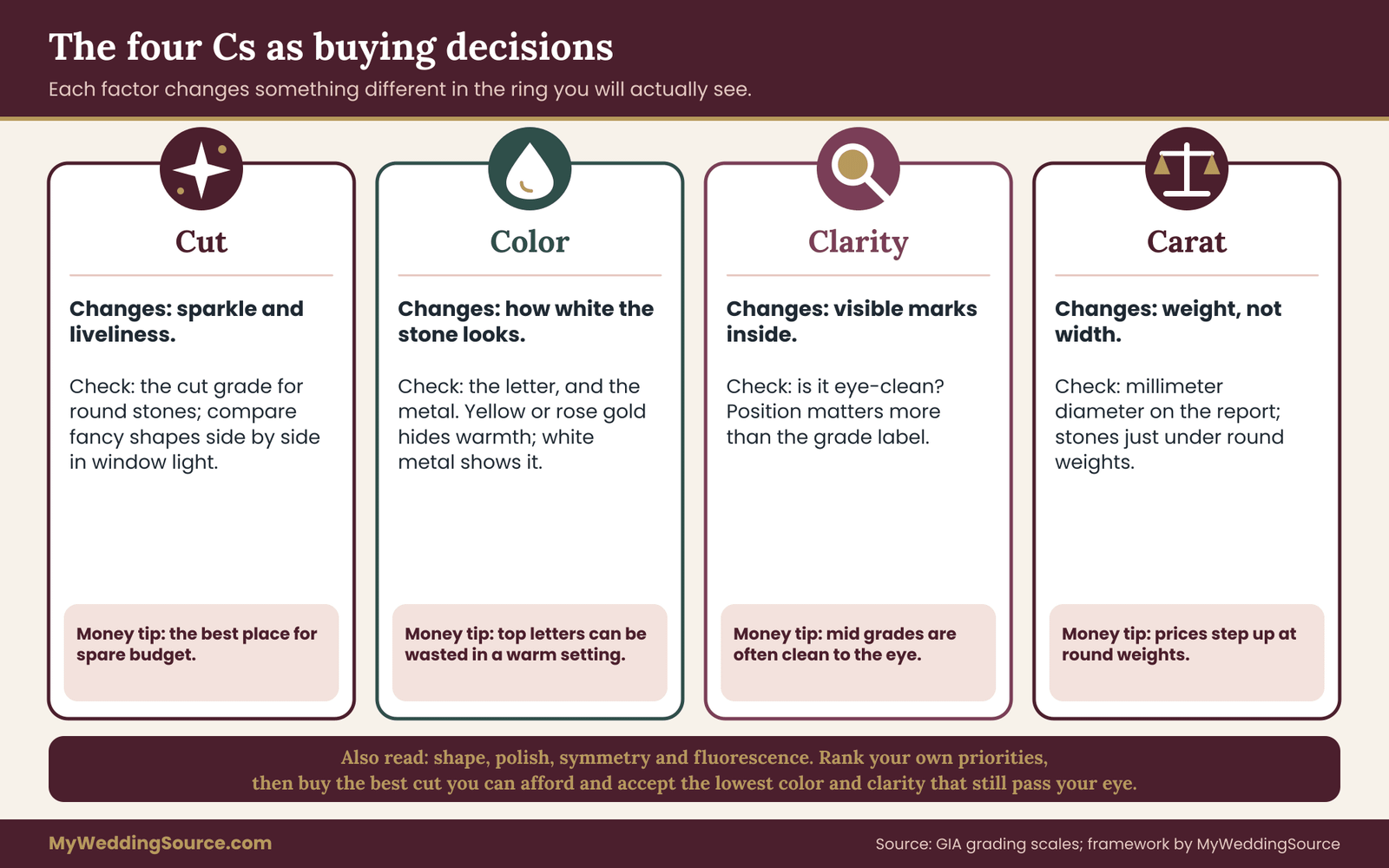
Diamond quality is summarized by four factors that begin with the letter C: cut, color, clarity and carat weight. The names are familiar, but the useful question is not “which grade is best.” It is “what does each factor change in a ring chosen with this engagement ring buying guide I will actually see, and what does each step cost?” A useful engagement ring buying guide treats the four as budget levers, not as scores to maximize.
Cut: the factor that controls sparkle
Cut is not the shape of the stone. It describes how well the facets and proportions return light to the eye. A well-cut diamond looks lively and bright. A poorly cut one can look dull or glassy even if its color and clarity grades are excellent, because light leaks out of the sides or the bottom instead of coming back through the top.
For standard round brilliant diamonds, GIA reports give an overall cut grade on a scale that runs from Excellent through Very Good, Good and Fair down to Poor. For other shapes, such as ovals, pears, emerald cuts and cushions, GIA reports do not give an overall cut grade. They give grades for polish and symmetry, plus the measurements, and you judge the cutting by eye and by comparison. The American Gem Society publishes its own cut grading system, and other laboratories use their own scales, so the same word on two different reports does not always mean the same thing.
Cut is usually the best place to put money you cannot decide how to spend, because it affects what a stranger notices across a room. If you are comparing two stones that look similar on paper, look at both in the same light, side by side, and let the one that looks livelier win. Bring the stones to a window as well as under shop lights, since spotlights flatter almost everything.
Color: smaller differences than the letters suggest
For white diamonds, the GIA scale runs from D, which is colorless, down to Z, which has visible light yellow or brown. The letters are grouped informally: D to F as colorless, G to J as near colorless, K to M as faint, and so on. The differences between adjacent letters are small and are hard for most people to see once the stone is mounted.
Color shows up differently depending on the metal. In a yellow gold or rose gold setting, warm tints in a diamond are less noticeable because they blend with the metal. In platinum or white gold, which are cool and neutral, a warm tint is easier to see. That means a lower color grade can look perfectly white in yellow gold and a little warm in white metal. It also means that paying for the top color letters while choosing a yellow setting can be money that the eye does not register.
Fancy colored diamonds, such as pink, blue or deep yellow stones, use a separate system and are a different market. They are beyond the scope of this engagement ring buying guide.
Clarity: eye-clean is the real target
Clarity describes the internal features and surface marks that every natural diamond has to some degree. The scale from GIA runs from Flawless and Internally Flawless through two grades of very, very slightly included, two grades of very slightly included, two grades of slightly included, and then three grades of included. Most buyers never need to see the top of the scale.
The practical goal is an eye-clean stone, meaning no inclusions visible to the naked eye at a normal viewing distance. Many stones with mid-range grades are eye-clean, and some stones with a higher grade have a feature that is easy to see because of where it sits. A small dark crystal right under the table, in the center of the stone, matters more than a larger pale feather near the edge hidden by a prong.
The grade is a range. Two stones with the same clarity grade can look different. That is why a report on its own is not enough, and why you should ask to see the stone itself, or a high-quality magnified video, before buying anything in the lower clarity grades where individual stones vary more.
Carat weight: weight, not size
A carat is a unit of weight equal to two hundred milligrams, and it is divided into one hundred points. A stone of fifty points is half a carat. Weight is not the same as the size you see from the top. Two stones of equal weight can have different diameters, because one can be cut deep, with much of its weight below the girdle where nobody sees it, and the other can be cut with more spread.
Look at the millimeter measurements on the report and compare them. For a round stone, the diameter is what you will notice on the hand. Another well-known pricing feature is that prices tend to rise sharply at round weights, such as just below and just at a full carat. A stone slightly under a round number can look nearly identical and cost noticeably less per carat. That pattern is a feature of how the market prices stones, not a rule of optics, so ask sellers about stones just below the common thresholds.
Shape: the factor that is not in the four Cs
Shape is the outline: round, oval, cushion, emerald, pear, marquise, radiant, princess, Asscher, heart. It strongly affects price per carat, size appearance and how the stone behaves. Round brilliants are typically priced higher per carat than fancy shapes, in part because more rough diamond is lost in cutting them. An elongated stone such as an oval, a pear or a marquise can look larger for its weight than a round stone because the surface area is stretched.
Elongated shapes can also show a bow-tie, which is a darker band across the middle of the stone. Every stone in those shapes has some degree of it, and the question is whether the bow-tie is distracting to your eye. It is easy to judge in person and almost impossible to judge from a single photograph. Step-cut stones such as emerald and Asscher cuts show clarity and color more plainly, since the large open facets act like windows, so they benefit from higher clarity and color choices than a brilliant cut would.
Polish, symmetry and fluorescence
These three entries appear on most reports and are easy to over-read. Polish and symmetry describe the finish of the surface and the alignment of the facets. Most stones sold for engagement rings have grades of Good to Excellent. Very Good or better is a reasonable floor, and you can ask the seller what they accept.
Fluorescence describes how the stone responds to ultraviolet light, with grades such as None, Faint, Medium, Strong and Very Strong. Under normal indoor light it is usually invisible. In rare cases, strong fluorescence in a stone of high color grade can give a slightly hazy or milky look, and in other stones it can make a slightly yellow stone look whiter under sunlight. Because it is stone-specific, the right approach is to look at the actual stone, not to rule it in or out by label.
A priority ladder you can write down
The most useful exercise in an engagement ring buying guide is to rank what matters most to you and the wearer, from first to last. For many people the order is: a good cut, then a size that looks right on the hand, then an eye-clean stone, then enough color that it looks white in the chosen metal. Put your own order on paper. Then buy the best cut you can afford, spend moderately on size, and accept the lowest grades in color and clarity that still pass your eye in the actual setting.
If you have a different priority, the order changes. Someone who wants the largest possible stone for the money will push weight to the top and accept a lower clarity grade, as long as the stone is eye-clean. Someone who wants a very white stone will push color higher and give up some size. There is no universal answer. There is only an order you chose on purpose.
Comparing two stones: a worked reasoning example
Imagine two round stones quoted at similar prices.
Stone A weighs a little under a full carat, with an Excellent cut grade, a near-colorless color letter and a slightly included clarity grade. Stone B is a full carat with a Good cut grade, the same color letter and the same clarity grade, and it costs about the same. On paper they look equal, and the full carat sounds better. The reasoning should go the other way. Stone B’s weight is paid for, but its cut is weaker, so it may look less bright, and it may have been cut deeper to preserve weight, so the diameter may be no larger than Stone A’s.
Ask for the measurements on both. If Stone A’s diameter is close to Stone B’s, and the cut grade is higher, Stone A is probably the better ring, even though it is smaller on paper. That is the kind of decision a report can support, and it is why the next section goes through the report field by field.
A field decoder for the grading report in this engagement ring buying guide
A grading report, sometimes called a certificate, is a document from a laboratory that describes a diamond’s characteristics at the time it was examined. It is not a valuation and it is not a warranty. It does not say what the stone is worth, and it does not say that the stone is a good purchase. It is a description, and its usefulness depends on whether you can confirm that it describes the stone in front of you.
Which kinds of reports exist
GIA issues several documents for diamonds. A full Diamond Grading Report covers stones in the normal color range and includes the proportion diagram and the clarity plot. A shorter Diamond Dossier covers smaller stones and gives the grades and a short set of details, with the report number inscribed on the stone. A laboratory-grown diamond report states the growth process and uses the same grading scales. Other laboratories, including the American Gem Society Laboratories and IGI, issue their own reports with their own formats and standards.
Laboratories are not interchangeable. Their grading practices differ, and the same stone can receive a different grade at two laboratories. For that reason, many buyers prefer GIA reports and AGS reports for natural diamonds, and they treat reports from unfamiliar laboratories with caution. The grades on a report are only as meaningful as the laboratory’s consistency and independence. Ask the seller which laboratory graded the stone, and whether the seller graded it themselves, which is common and is not the same as independent grading.
The fields, one at a time
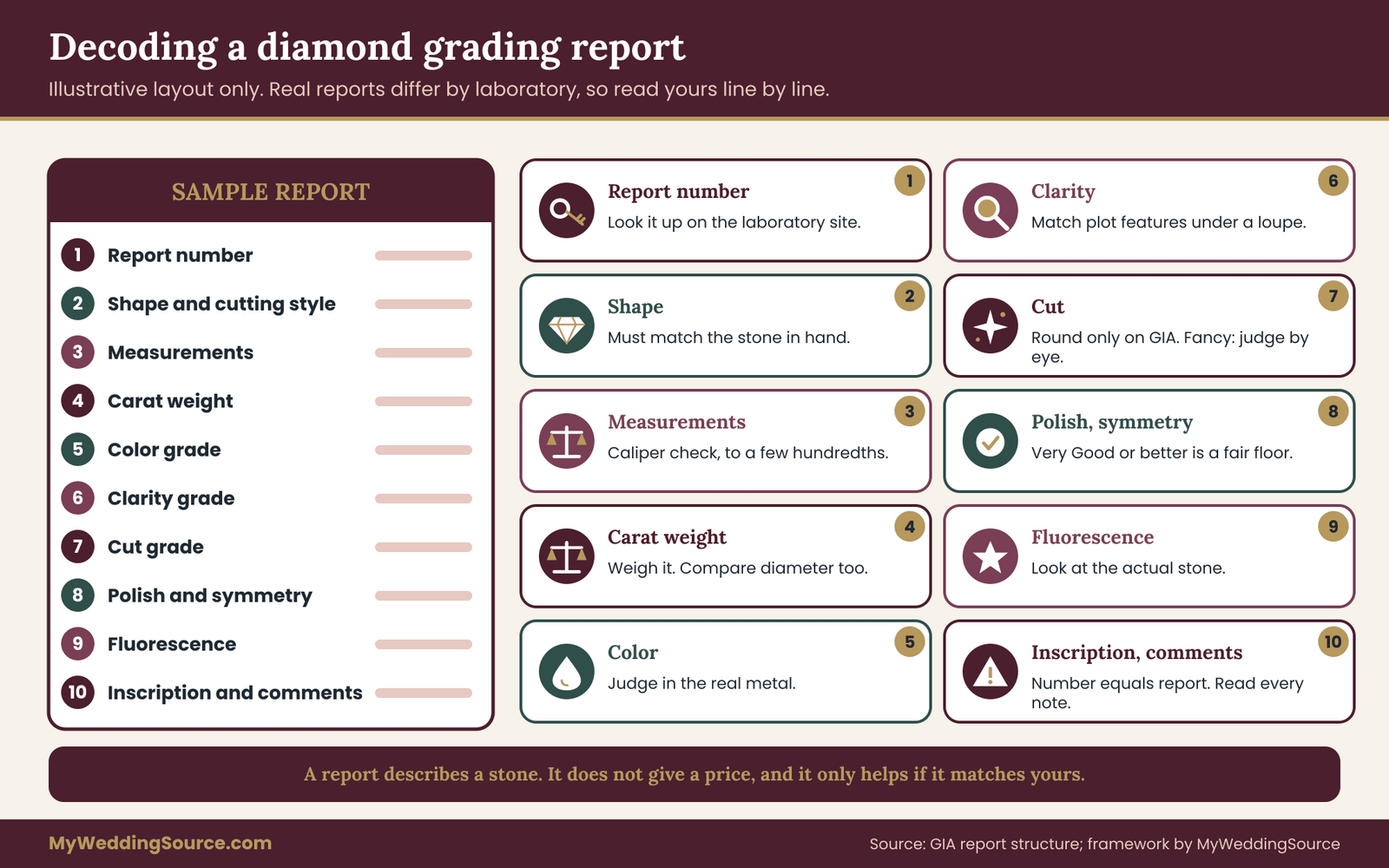
The sample on the infographic is an illustrative layout, not a real report. Real reports differ by laboratory and change over time, so use the structure in this engagement ring buying guide as a reading order and read your own report line by line.
Report number and date. The number identifies the report in the laboratory’s database. The date is the date of grading. A very old report is not invalid, but a stone that has been recut, chipped or reset since may no longer match it.
Shape and cutting style. This line names the outline and the facet arrangement, for example round brilliant. If the line does not match the shape you are looking at, stop.
Measurements. For a round stone, you will see a minimum and maximum diameter and a depth in millimeters. These tell you the real footprint of the stone. A large difference between minimum and maximum diameter means the stone is not perfectly round.
Carat weight. Given to the hundredth of a carat. You can verify it with a scale.
Color grade. A letter, from D downward.
Clarity grade. One of the clarity labels from the scale.
Cut grade. Present for round brilliants only on GIA reports. It is a summary of the proportion and finish.
Polish and symmetry. Two separate grades.
Fluorescence. The strength of the reaction to ultraviolet light, and sometimes the color.
Inscription. A line stating whether the report number is laser-inscribed on the girdle, the thin edge of the diamond. This is how a stone is matched to its report.
Comments. A short note that can matter a great deal. It might say that a clarity grade is based on clouds that are not shown on the plot. It might identify a treatment. Read the comments line every time.
The proportions and clarity diagrams
Full reports include a proportion diagram with percentages and angles: table size, crown angle, pavilion angle, total depth, girdle thickness and culet size. You do not need to memorize ideal numbers. Use the diagram for comparison between two stones, and ask the seller to explain any entry that falls outside the range they usually sell.
The clarity plot is a drawing of the inclusions, using symbols from a key printed on the report. Red marks generally indicate internal features, and green marks indicate surface features. Compare the plot with what you see under magnification. If the plot shows a large feature in the center of the table and you see nothing at all, something is wrong, and if you find a feature that the plot does not show, ask the seller to explain it. Minor differences are normal, because the plot is a representation, and the laboratory does not map every tiny feature.
Treatments, enhancements and what a report may not say
Some diamonds are treated to improve their appearance. Common treatments include laser drilling to reach and remove dark inclusions, fracture filling to make cracks less visible, and high-pressure, high-temperature processing to change color. Each of these is permitted if disclosed, and each can affect value, durability and repair options. A fracture-filled stone, for example, can be damaged by the heat of a jeweler’s torch or by certain cleaning methods.
Laboratories handle treated stones differently. A report may state a treatment, may decline to grade a stone with certain treatments, or may use a note in the comments. If the seller tells you a stone is untreated and the report has a comment about enhancement, you have found a conflict to resolve in writing before you pay. The Federal Trade Commission’s Jewelry Guides address the disclosure of treatments, and the agency’s pages are listed in the sources.
A report also does not tell you three things that buyers often assume. It does not tell you whether the stone is a good value, because it contains no price. It does not describe the setting, the metal or the ring in your engagement ring buying guide notes. And it does not follow the stone forever: a report describes the stone on the day of grading, and chips, repairs and recutting after that date may change it.
Warning signs on a report or around it
None of the following proves a problem, and each is a reason to slow down and ask questions.
The report is a photocopy or a scan with no way to check it online. The laboratory is one you cannot find or whose website you cannot verify. The seller calls the report an “appraisal” or uses the two words interchangeably. The stated grades are unusually generous compared with what you see. The inscription line says “none” while the seller says the stone is inscribed, or the seller says the inscription is too small to see. The seller does not want you to take the stone to another jeweler for a look. The paperwork lists one weight and the seller’s invoice lists another.
If you notice two of these at once, you are not obliged to explain yourself. You can simply say that you need to verify the report before continuing and then go through the next section.
Verifying the stone and the paperwork: an engagement ring buying guide to the steps
Verification is the part of this engagement ring buying guide that separates a confident purchase from a hopeful one. It takes less than an hour, it costs little or nothing, and it can be done before you pay. The steps below are written for a loose stone or a ring with the stone mounted, and they work for a purchase in a store or an online order after delivery, as long as you still have a return window.
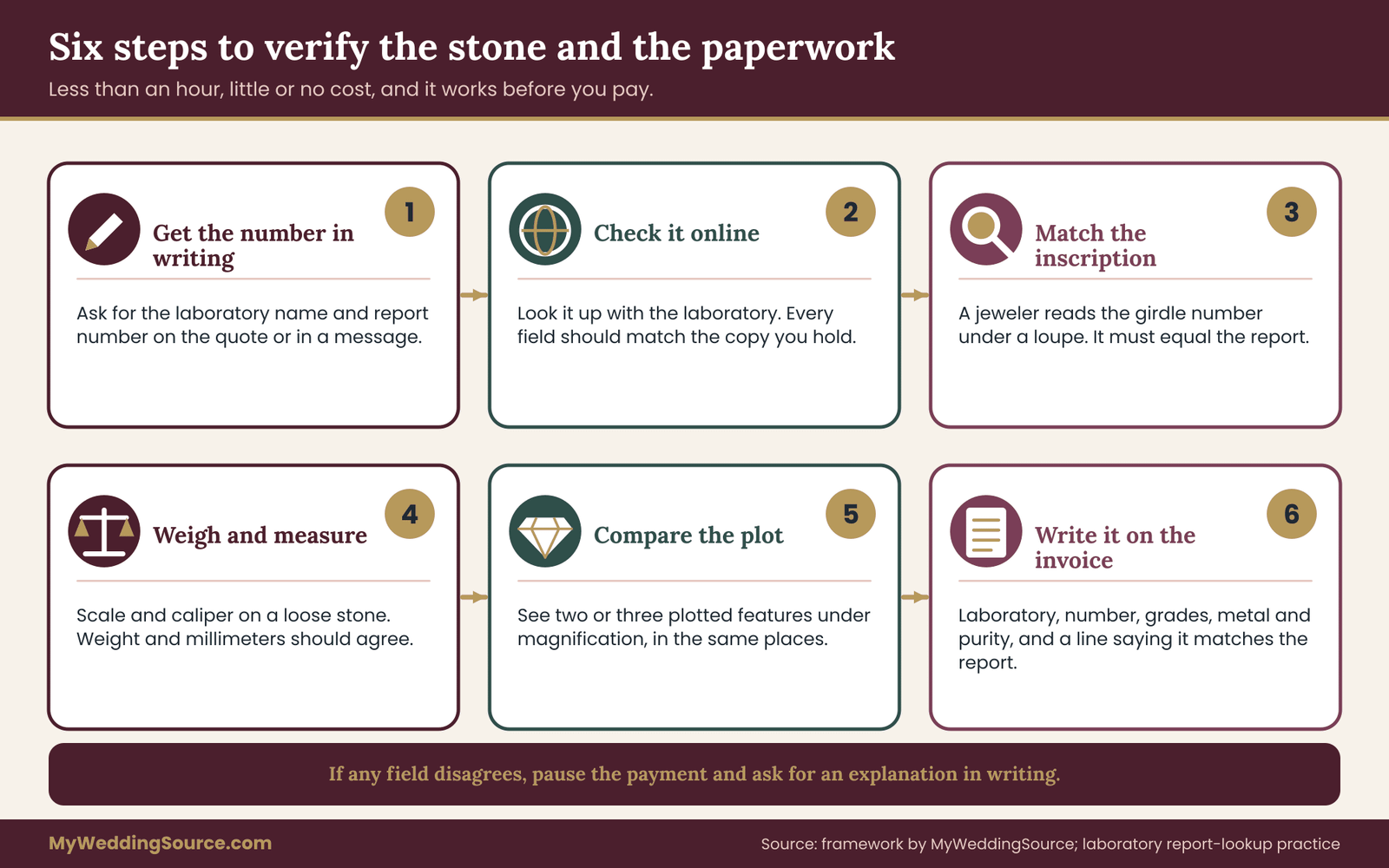
Step one: get the report number in writing
Before any money changes hands, ask the seller to give you the laboratory name and the report number in writing, either on the quote or in a message. If the seller says the report will be provided later, ask for the number now. A seller with a graded stone knows the number. If the stone has not been graded by an independent laboratory, the seller should say so plainly, and you should treat every grade as the seller’s opinion.
Step two: check the number with the laboratory
Major laboratories let you look up a report number on their website. GIA calls its tool Report Check, and it shows the stored details for a report number, often including the digital copy of the report. Compare the online details with the paper or the PDF the seller gave you. Every field should match. Minor formatting differences are normal. Differences in weight, color, clarity or measurements are not.
If you cannot find the report online, ask the seller to explain why. Some laboratories do not provide an online lookup. In that case, ask whether you can contact the laboratory directly to confirm the report, and weigh the answer carefully.
Step three: match the inscription to the stone
Many stones carry a tiny laser-inscribed number on the girdle. It is not visible without magnification. A jeweler’s loupe with ten-times magnification is usually enough to read it in good light, and a jeweler or gemologist can show you where to look. The inscription number should match the report number exactly. This is the link between the document and the diamond, and without it, a report is just a piece of paper that happens to describe a stone like yours.
If the stone is in a setting, prongs or a bezel may cover the girdle, and it may be hard or impossible to read the inscription without removing the stone. Ask the seller beforehand whether the stone can be inspected out of the mounting, or whether they will allow an independent jeweler to do so. Many reputable sellers will do this for a loose stone before setting it. Once a stone is set, verification is harder, so do the match before the stone goes into the mounting.
Step four: confirm weight and measurements
A jeweler can weigh a loose stone on a scale and measure it with a caliper in a minute or two. The weight should match the report to within the small tolerance created by rounding. Measurements should match to within a few hundredths of a millimeter. For a mounted stone, the jeweler can still measure the visible dimensions, though the weight must be estimated from them and the estimate is less exact. If the numbers are far off, the report is not describing this stone.
Step five: compare the clarity plot with the stone
Ask the jeweler to show you the stone under magnification and to point out two or three of the features on the plot. You do not need to become a gemologist. You need to see that the major features on the diagram are present in the stone, in roughly the same positions. A matching inscription and a matching plot together make it very unlikely that the report belongs to another stone.
Step six: put the facts into the sales document
The quote or invoice should list the laboratory, the report number, the shape, the carat weight, the color grade and the clarity grade, the cut grade if there is one, and the metal and its purity. If the invoice says only “one carat diamond ring,” it protects the seller more than it protects you. Ask for the details in writing, ask that the stone be described as matching the named report, and keep both documents together. The engagement ring buying guide to wedding vendor contracts explains why specific written descriptions matter, and the same principle applies to jewelry.
A short script for the counter
“Before I decide, could you write the laboratory and report number on the quote? I would also like a jeweler to confirm the inscription and weight before it is set.”
Most reputable sellers say yes. If a seller hesitates, you have learned something useful.
What a handheld tester can and cannot tell you
Some sellers and some buyers use a handheld diamond tester. These small tools measure thermal or electrical conductivity and are good at telling diamonds from many imitations such as cubic zirconia. They are not good at telling natural from laboratory-grown diamonds, because the two share the same physical properties, and some testers can be fooled by moissanite. A tester is a quick screening tool and not a replacement for a laboratory report. If the identity of the material matters to your purchase, which it does, rely on the report and the inscription.
Appraisals: what they are, what they are not and how to verify one
People often use the words report and appraisal as if they meant the same thing. They do not. A grading report describes the characteristics of a stone and is issued by a laboratory. An appraisal estimates a monetary value for a stated purpose and is issued by an appraiser or a jeweler. The first document is about the stone. The second is about the number.
Three kinds of value in the same ring
An appraisal should state which kind of value it estimates, because the numbers differ.
Retail replacement value is the estimated cost to replace the ring with an item of like kind and quality from a retail seller. This is the figure most insurers want, and it is usually the highest.
Fair market value is the price at which a willing buyer and willing seller would trade, neither under pressure. It is often used for estates, divorces and donations.
Liquidation value is what a ring might bring when it has to be sold quickly, for example to a dealer. It is usually the lowest.
If an appraisal does not say which value it states, ask the appraiser to add it. An appraisal written for insurance and later used to judge resale will mislead you.
What a good appraisal contains
A good appraisal is a detailed description. It should include the date, the name and credentials of the appraiser, the purpose and the type of value, and a full description of a ring chosen with this engagement ring buying guide: metal and its purity, the weight of the metal, the stone’s shape, measurements, estimated or graded weight, color, clarity and cut, and a list of any smaller stones. It should refer to the grading report by laboratory and number where one exists. It should include photographs, and it should state the method and any limitations, such as whether the stone was examined out of the mounting.
A vague line such as “diamond ring, nice quality” is not enough for an insurer to replace the ring this engagement ring buying guide describes with an equivalent one, and it is not enough for you to prove what you owned if the ring in this engagement ring buying guide is lost.
How to check the appraiser
Appraiser credentials vary, and there is no single license that covers every jeweler in every state. Several professional organizations train and credential appraisers, including the American Society of Appraisers and the International Society of Appraisers, and some appraisers hold gemology credentials from GIA. Ask what training the appraiser has, whether they follow the Uniform Standards of Professional Appraisal Practice, and whether they are a member of a professional organization whose directory you can search.
The most important question is about independence. An appraiser who is paid a percentage of the appraised value has a reason to inflate the number. An appraiser who also sells the ring in your engagement ring buying guide notes has a reason to inflate the number for the sale and to push you toward insurance with that seller’s replacement program. Ask how the fee is set. A flat fee or an hourly fee is better than a fee tied to the value.
Why a free appraisal from the seller is not worthless but is not independent
Many jewelry stores include an appraisal with a purchase, and these are often accepted by insurers. They are useful for a first policy. They are also written by the seller, who knows what the ring covered by this engagement ring buying guide sold for and has no reason to be conservative about replacement cost. If you want an independent view, pay for an appraisal from an appraiser who does not sell jewelry, and treat the seller’s document as one data point.
The practical sequence in this engagement ring buying guide is simple. Verify the report. Receive the seller’s appraisal and use it to start insurance. Then, within the first few months, consider an independent appraisal if the ring in this engagement ring buying guide is expensive, if the stone is unusual or if the seller’s document is vague. The insurance section later in this engagement ring buying guide explains how often to refresh it.
A short script for the appraiser
“Could you tell me what type of value this appraisal will state, how your fee is set, and whether you will examine the stone out of the mounting?”
A professional answer is short and clear. If it is not, find another appraiser.
Metals, settings and sizing: building a ring chosen with this engagement ring buying guide around daily life
The stone gets the attention, but the mounting does most of the daily work. It holds the diamond, touches the skin, absorbs knocks and decides how much maintenance the ring in this engagement ring buying guide needs. Two rings with identical stones can behave very differently depending on how they are built.
Choosing a metal
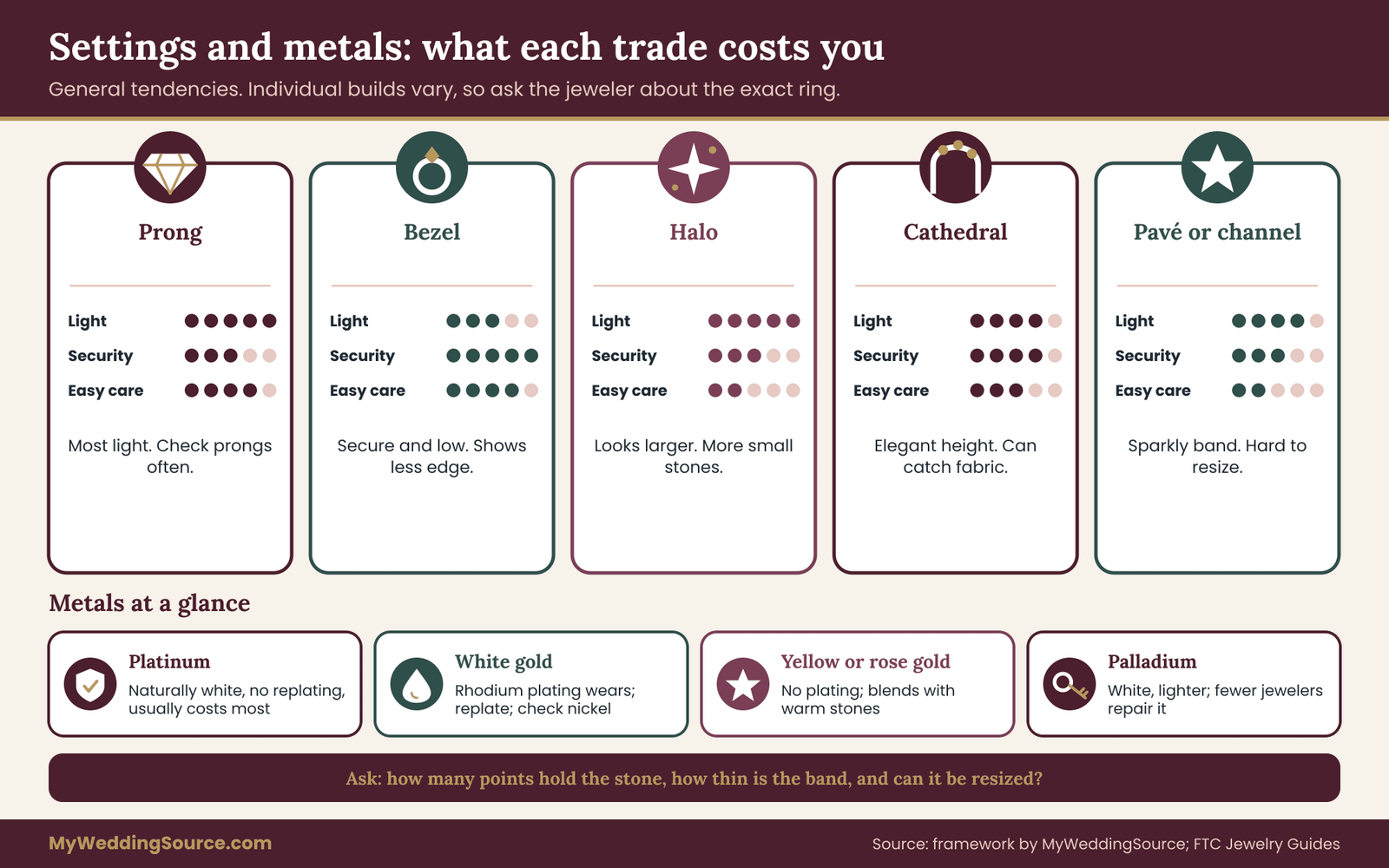
Platinum is dense, naturally white and durable. It does not need replating to stay white, and when scratched it displaces metal instead of losing it, which creates a soft, worn finish called patina. It is usually the most expensive option for a given design because of the metal itself and the labor to work it. Under the Federal Trade Commission’s Jewelry Guides, a piece marketed as platinum should meet the stated purity levels, and a stamp such as 950 refers to parts per thousand of pure platinum.
Gold is sold by karat. Pure gold is twenty-four karat and is too soft for a ring that will be worn daily. Fourteen-karat gold is a little over fifty-eight percent gold, and eighteen-karat gold is seventy-five percent. The rest is other metals that set the color and the hardness. Eighteen-karat gold is richer in color and a little softer. Fourteen-karat is harder and usually more affordable. Both are common for engagement rings. A hallmark such as 14K or 585 should appear inside the band, and the FTC guides address how karat quality is marked and described.
White gold is gold alloyed to look pale and usually plated with rhodium, a bright white metal of the platinum family, to look whiter. The plating wears away over time, often in a few years depending on wear, and a jeweler can replate it. Without replating, the ring you are weighing in this engagement ring buying guide can show a faint yellow-gray tone. Some white gold alloys contain nickel, which can cause skin reactions in people who are allergic, and others use palladium instead.
Yellow gold and rose gold do not need plating. The color comes from the alloy. Rose gold has more copper, which gives it a warm tone and also makes it somewhat harder.
Palladium is a white metal related to platinum. It is lighter than platinum and does not need plating, and it is less common, so fewer jewelers have experience repairing it.
Titanium, tungsten and similar metals are common in men’s bands and are sometimes proposed for engagement rings. Some of them cannot be resized, and some can crack when cut off in an emergency. Ask the seller how the ring in your engagement ring buying guide notes would be removed if the finger swelled in an injury, and what the policy is for resizing.
A practical metal decision
In this engagement ring buying guide the metal rule is simple: start with the wearer’s skin and habits. If there is a known nickel allergy, ask for nickel-free alloys or for platinum, palladium or yellow gold with a stated composition. If the wearer dislikes maintenance, platinum or yellow gold avoids replating. If budget is the main limit, fourteen-karat gold gives the most choice. If the stone is slightly warm in color, consider a yellow or rose setting that blends with it. If you want a cool, white look, plan for either platinum or white gold with periodic replating.
Settings: how the stone is held
The setting is the structure that holds the stone. Each style trades security, light, maintenance and cost.
Prong settings hold the stone with small metal claws, usually four or six. They let a lot of light in and show off the stone. The prongs are the part that wears, and they need regular checking. A six-prong setting holds the stone with a little more redundancy, since one worn prong does not release it, while four prongs show more of the stone.
Bezel settings surround the stone with a thin metal rim. They are secure and low-profile and good for people with active hands. They cover part of the stone’s edge and show slightly less of it.
Halo settings surround the center stone with a ring of small stones. They make the center stone look larger and add sparkle. They also add more small stones that can loosen, and they make the ring wider and a little harder to clean.
Cathedral settings use arches of metal that rise to support the stone. They add height and elegance, and they can add a place where hair or fabric catches.
Pavé and channel settings put small stones along the band. Pavé uses tiny beads of metal to hold small stones close together. Channel setting holds a row of stones between two walls of metal, which is more protected. Pavé bands are harder to resize, and small stones can come loose.
Tension settings hold the stone by pressure from the band. They look dramatic and require precise work, and they are harder to resize and repair. Ask about warranties and repair options before choosing one.
What to ask about a setting
The setting questions in this engagement ring buying guide apply to any seller, so ask them and write the answers down. How many points of contact hold the stone, and how thick are the prongs? Will the stone sit low or high? What is the thickness of the band at its thinnest point, since a thin band bends or wears through over decades? Can a ring chosen with this engagement ring buying guide be resized, by how much, and at what cost? Does the warranty cover prong retipping, stone loss or rhodium plating? What does the jeweler recommend for the wearer’s job and hobbies?
The band: small details that matter for decades
The band is easy to overlook, and it is the part of the ring that touches the finger all day. A comfort-fit band has a slightly rounded inside and is more comfortable than a flat one, especially for larger sizes. A band that is very thin where it meets the setting can wear through at that point. A solid band, as opposed to a hollow one, costs more, and it holds its shape under pressure.
If the wearer will later add a wedding band, the engagement ring should be built so that the two sit comfortably together. A high-set stone or a wide cathedral setting can prevent a straight band from lying flat against it. Many jewelers can build a ring with a small notch or a gap, and some wearers choose a contoured wedding band that curves around the stone. Ask about this during the original purchase, since it is cheaper to plan than to rebuild.
Ring size and resizing
Ask your jeweler to measure the finger with a set of sizing rings that include half sizes, and to measure at the end of a normal day and not right after a cold walk or a workout. Wider bands feel tighter than narrow ones of the same size, so a wide band may need a half size more. Knuckles larger than the finger base call for a ring that can slide over the knuckle, and sometimes a sizing bead or a hinged shank helps.
Fingers change size with weather, pregnancy, medication and weight changes. A ring that fits well in winter can feel tight in summer. A jeweler can add a small sizing bar or sizing beads to a ring that tends to spin. Ask the seller what the policy is for the first resizing, because some include it, and others charge for it.
Engraving, custom work and lead times
Engraving is a pleasant personal touch, and it usually makes a ring harder to return, since the seller cannot resell a personalized item. Ask whether engraving can be done after the return window closes. Custom rings take weeks and sometimes months from design to delivery. A quote for a custom design should state the lead time, the deposit, what happens if the design needs changes, and whether the deposit is refundable if the design is not approved. Check the timeline against your proposal date and build in a buffer for corrections.
Metal and stone together: color and light
The metal changes how a stone looks. A diamond of near-colorless grade in a white metal looks cool and bright. The same diamond in yellow gold takes on a warm background. Colored gemstones respond to the metal in the same way, and a blue sapphire next to white metal looks crisp while next to yellow metal looks richer and warmer. Ask the jeweler to place the stone against samples of different metals, under the same light, before deciding.
Look at the ring in your engagement ring buying guide notes from the side and from above. A ring is mostly seen from the top by the wearer and from the side by everyone else. If the profile is awkward, the ring this engagement ring buying guide describes will bother the wearer more than any grade ever will.
Comparing sellers: an engagement ring buying guide to questions and red flags
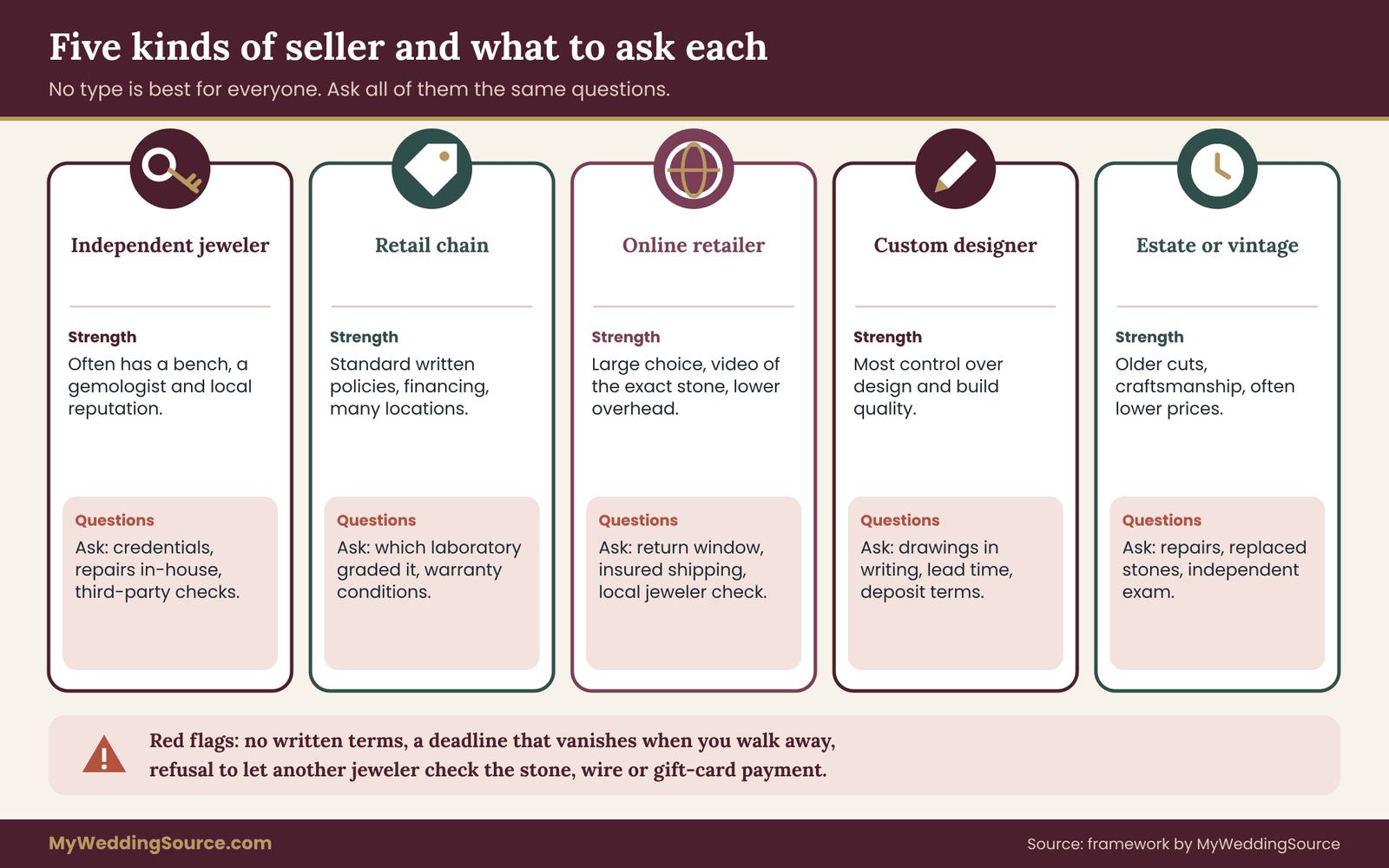
Where you buy changes what you can verify, what happens if something goes wrong and how much you pay for the same stone. No single type of seller is best for everyone, and this engagement ring buying guide does not rank them. The useful approach is to know what each type does well, and then to ask each one the same questions.
Independent jewelers
A local independent jeweler often has a bench on site, a gemologist on staff and a relationship with local customers that depends on reputation. Many can show loose stones, offer custom work, resize and repair in-house, and let you take a stone to another appraiser. Their selection of stones may be smaller than an online catalog, and their pricing may be higher or lower depending on their sourcing. Ask about their credentials, how long the business has existed and what happens if you return later for service.
Large retail chains
Chains offer convenience, financing, standardized policies and many locations. They often sell their own branded collections and may use their own grading statements, so check which laboratory graded each stone. Their return and trade-up policies are usually written down, which is a plus, and they may include warranties that require regular inspections. Read the conditions closely. A lifetime warranty with required annual checks can be void if you miss one.
Online retailers
Online sellers can offer a very large inventory, detailed photos and magnified videos of individual stones, and lower overhead. The tradeoff is that you cannot hold the stone before buying. Look for sellers that provide independent grading reports with online lookup, high-resolution video of the exact stone, a clear return window, insured shipping and the ability to have a local jeweler examine the stone during that window. Some online sellers arrange for you to view a stone at a partner jeweler before purchase.
Custom designers and workshops
A custom designer makes a ring to your specification, often working from a loose stone you choose or they supply. This gives you the most control over the design and the build quality. It also means the ring in this engagement ring buying guide is made to order, which can limit returns. Ask to see examples of finished work, get the design approved in writing with drawings or renderings and confirm what happens if the finished ring does not match them.
Estate, vintage and secondhand sellers
Older rings can offer unusual cuts and craftsmanship and often a lower price than new. They also carry risks. The stone may have been chipped or recut, the metal may be worn, and a ring chosen with this engagement ring buying guide may have been repaired. Ask for the grading report if any exists, an independent examination and a written statement of any repairs or replacement stones. For inherited or family rings, an appraisal and inspection before wearing are sensible even if nothing seems wrong.
Questions to ask every seller
Use the same list with every seller so that the answers are comparable.
- Which laboratory graded this stone, and what is the report number?
- Is the stone natural or laboratory-grown, and is it treated in any way?
- Is the stone inscribed, and may an independent jeweler check it before I pay?
- What are the return and exchange terms, in writing, and does the clock start at purchase or at delivery?
- Are there fees for returns, restocking or resizing?
- What does the warranty cover and what voids it?
- What is the metal and its purity, and is it hallmarked?
- How is the ring shipped and insured, and who is responsible for a loss in transit?
- Do you offer an appraisal, who writes it and what kind of value does it state?
- Where did the stone come from, and can you provide supplier documentation?
Number ten deserves a note.
Claims about “conflict-free” or “ethically sourced” stones are common and hard to verify. The Kimberley Process is a certification scheme for rough diamonds, and it addresses a specific kind of conflict financing, but it does not certify what happens after the rough is cut and polished, and it does not address labor or environmental conditions. The FTC’s guides discourage unsupported claims about origin or ethics.
If sourcing matters to you, ask what the seller can document, ask whether the stone has an origin report from a laboratory, and keep the answer with your records. Also, United States sanctions restrict imports of certain diamonds of Russian origin, so ask the seller how they comply and see the Treasury Department’s pages for the current rules.
Red flags in pressure and pricing
Deadlines that disappear when you walk away are tactics. An offer that is “only good today” can almost always be repeated tomorrow. Prices that start at a large markup and then drop by an exact percentage are a form of theater. A “retail value” printed on a tag that is much higher than the selling price tells you only what the seller wants you to compare against.
Other red flags include a seller who will not give written terms, who refuses to let a third party examine the stone, who speaks only in grades without showing the report or who asks for payment methods that offer no protection. Wire transfers, gift cards and payment apps for goods are examples of payments that are difficult to reverse. A reputable seller can accept a credit card, and credit card payment adds a layer of dispute protection that other methods lack.
Comparing quotes fairly
Put the quotes next to each other in a single list, using the fields from this engagement ring buying guide, and compare the same fields: laboratory, report number, shape, weight, color, clarity, cut, polish, symmetry, fluorescence, measurements, metal, setting and warranty terms. Price per carat is a quick comparison for loose stones of similar quality, and it is misleading across different qualities. The total cost to own matters too. A cheaper ring with a short return window, fees for resizing and no warranty may cost more over time than a slightly pricier one with clear terms.
If two sellers offer stones with the same report grades, look at the stones, because the grade is a range and the same grade can look different. A difference in cut quality, which is not captured by the same color and clarity labels, can explain a price difference that looks strange on paper.
Paying, returns and paperwork: protecting the purchase
Payment and paperwork are the unglamorous part of any engagement ring buying guide. They are also the part where you have the most leverage, because you hold the money until you pay.
Choose a payment method with protection
A credit card is usually the best option for a large purchase, because federal law gives cardholders rights to dispute certain billing errors. The Consumer Financial Protection Bureau explains that disputes generally have to be raised in writing within sixty days after the statement that shows the error was mailed, and it describes how to do this. A card dispute is not a substitute for a clear contract, but it provides a backup if a seller does not deliver what was promised.
Debit cards, bank transfers and cash offer less protection, and some sellers offer a discount for them. Before you take such a discount, weigh it against the protection you give up. For a purchase of this size, a modest discount seldom justifies losing the right to dispute a charge.
Understand deposits and financing
Custom work and special orders often require a deposit, and many are non-refundable once work starts. Ask in writing when the deposit becomes non-refundable, what the seller must deliver for the deposit and what the timeline is. For financing, remember the deferred-interest caution from the budgeting section. Read the terms, calculate whether you will pay off the balance within the promotional period and decide before you sign.
Return windows: no general right to cancel
Many people assume that there is a federal right to return a purchase within a few days. In general there is not, for ordinary purchases made in a store. The Federal Trade Commission’s Cooling-Off Rule covers certain sales made at a buyer’s home or away from the seller’s usual place of business, and it does not apply to ordinary retail store purchases. Return rights for jewelry come mostly from the seller’s own policy and from state law, so the policy you get in writing is the policy that counts.
Online purchases are covered by rules on timely shipping, and they do not create a general right to return. Look for the return window, the condition required for return, who pays return shipping, whether the stone must come back with its original packaging and report and whether a restocking fee applies. Personalized or custom items are often excluded.
Shipping and delivery
For online orders, check that the seller insures the shipment, requires a signature and tells you what to do on delivery. Open the package in a calm place, preferably on camera, photographing the packaging and the ring in your engagement ring buying guide notes. Confirm that the item matches the invoice and the report within the return window. If a package is damaged or the contents are wrong, contact the seller and the carrier immediately and keep the packaging.
If you plan to take a purchase on a flight, the Transportation Security Administration allows jewelry in carry-on bags, and many travelers keep valuables with them. If you buy abroad, U.S. Customs and Border Protection has rules on declaring items and duties, so check its guidance before you travel and keep your receipts.
The paperwork file
Assemble a single file for the ring as soon as you buy it. Keep the invoice, the payment record, the grading report, the appraisal, the warranty, the return policy as it stood on the day of purchase, the care instructions, photographs of the ring covered by this engagement ring buying guide from several angles and a close-up of the stone and the hallmarks. Store a digital copy somewhere other than the device that took the photos. The engagement ring buying guide to organizing wedding records after the event describes how to build a retention map and access levels, and a ring chosen with this engagement ring buying guide file fits neatly into that system.
A worked example: three rings, one decision
Here is an invented example that applies this engagement ring buying guide from start to finish. A buyer named Jordan has a firm ceiling and a partner, Sam, who works as a veterinary technician, washes their hands constantly and dislikes anything that snags on gloves. Sam prefers white metal and older shapes.
Jordan gets three quotes. The first is a chain store ring, a six-prong white gold solitaire with a laboratory report from a respected laboratory, a thirty-day return window and a warranty that requires yearly inspections. The second is an online ring with a loose stone chosen from video, a lower price for the same grades, free shipping and a fourteen-day return window. The third is a ring from an independent jeweler, a low-set bezel in platinum with a slightly smaller stone, an included first resizing and an appraisal from an independent appraiser for a flat fee.
Jordan writes out the same fields for each and notes the differences. The bezel fits Sam’s work better. The platinum avoids replating. The independent jeweler allows an independent check of the inscription at no charge. The online ring is cheapest, and a shorter return window leaves less time to verify. The chain store ring has the strongest financing, and Jordan wants to avoid deferred interest.
Jordan chooses the bezel, pays by credit card, gets the report number and the inscription match on the invoice, and files the paperwork the same day. The choice was not about the lowest price. It was about the fit of the ring, the verification Jordan could complete and the terms that protected the purchase.
Insuring the ring in your engagement ring buying guide notes: coverage options, terms and claims
An engagement ring is small, valuable and easy to lose. It can slip off in a pool, go down a drain or be taken from a hotel room. Every engagement ring buying guide ends up at insurance for this reason: it turns a possible large loss into a manageable one, and the details of the policy matter more than the label on it.
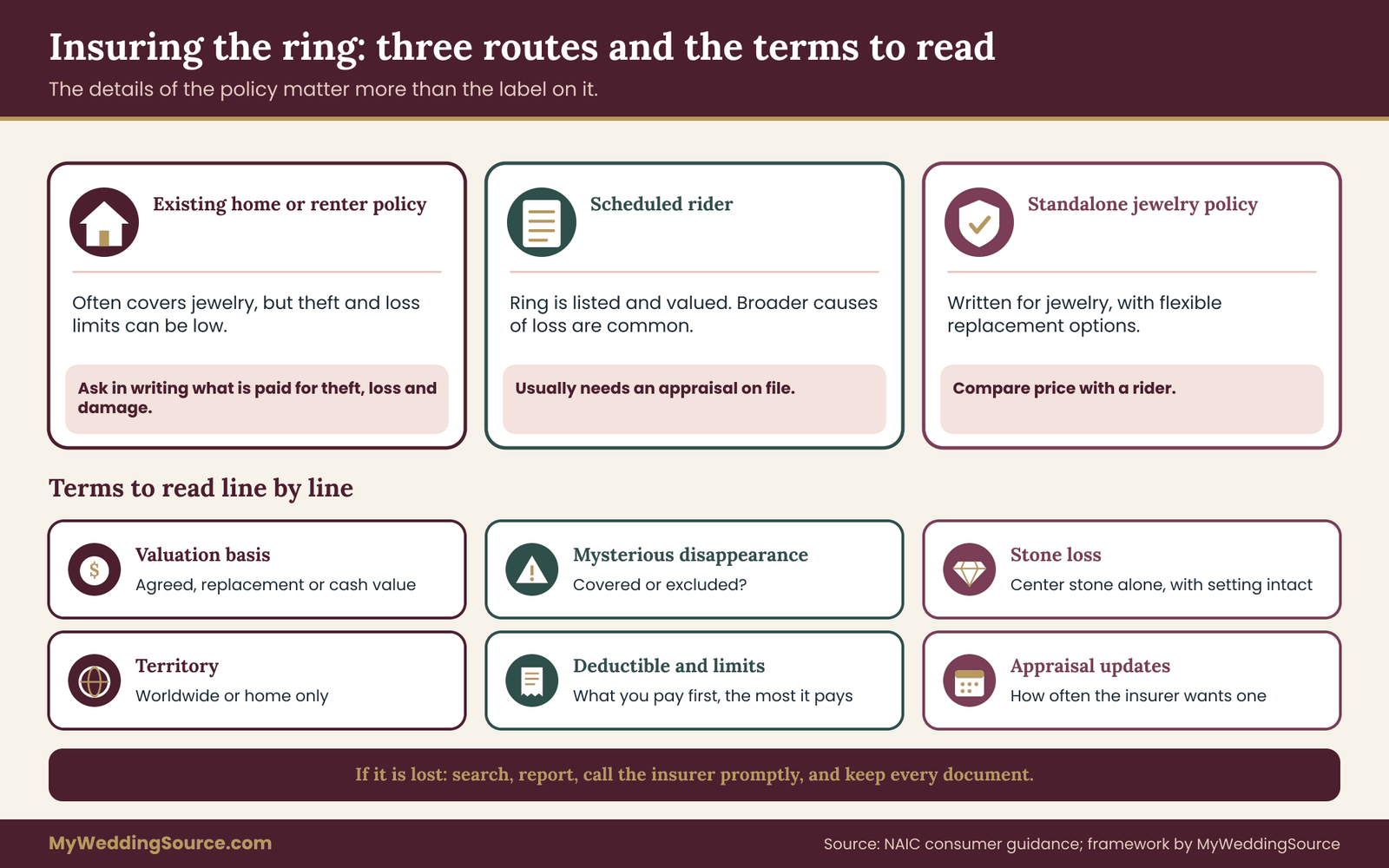
Three common ways to cover a ring
Existing homeowner or renter coverage. Many standard policies cover personal property, including jewelry, but often with a low limit for theft of jewelry and sometimes with limits or exclusions for other kinds of loss. A ring chosen with this engagement ring buying guide might be covered for a fire and only partly covered for theft or for loss. Read the sections on jewelry limits and on what kinds of loss are covered, and ask your agent in writing what would be paid if the ring were stolen or lost.
A scheduled rider or endorsement. You can add the ring in your engagement ring buying guide notes to your existing policy as a listed item, which usually means it is described and valued in the policy and covered against a wider range of losses, sometimes including accidental loss. This often costs less than a separate policy and keeps everything with one insurer. The ring you are weighing in this engagement ring buying guide is usually covered under a deductible, which may be low or none.
A standalone jewelry policy. Some insurers specialize in jewelry and offer policies written for it. They can have broader coverage, flexible replacement options and a straightforward claims process. They may also charge more or lack the discount that comes from bundling.
The National Association of Insurance Commissioners offers consumer information on insurance, and your state insurance department can answer questions about licensing and complaints. Those are better places to check a company than an advertisement.
Terms worth reading line by line
Valuation basis. Agreed value means the insurer and you accept a stated amount in advance. Replacement cost means the insurer pays what it costs to replace the ring with a similar one. Actual cash value means the replacement cost minus depreciation, which can be much lower. Ask which one applies, and whether the insurer will pay in cash or only replace a ring chosen with this engagement ring buying guide through its own supplier.
Covered causes of loss. Look for coverage of theft, damage, loss and what insurers call mysterious disappearance, meaning the ring vanishes and you cannot explain how. Some policies exclude it. Others cover it. This is a frequent source of disputes, so check the wording.
Stone loss. Ask whether the loss of the center stone alone is covered if the setting stays on the finger. Some policies cover it, and some require evidence of a specific event.
Territory. Does the policy apply worldwide, or only at home? A ring worn on a honeymoon abroad is more exposed than one in a drawer.
Deductible and limits. Know what you pay before the policy responds, and the highest amount it will pay.
Appraisal requirements. Ask what documents the insurer needs at the start and when it requires an updated appraisal. Many insurers ask for a new appraisal every few years, or let the value adjust, because the cost of metals and stones changes.
Replacement process. Ask whether you can choose your own jeweler or must use the insurer’s network, and what happens if an identical stone is not available.
How the appraisal ties to the policy
The insurer will usually ask for a document describing the ring in enough detail to replace it. The appraisal described earlier is that document. An appraisal that is too low leaves you underinsured, and one that is too high may cost you more in premium and does not mean a higher payout in every case. A vague description makes claims slower and more contested. Keep the grading report with the appraisal, because it gives a laboratory-level description of the stone, and keep photographs.
Gaps that surprise people
Coverage can lapse if you move and forget to update the address. A ring added to a policy when you were living with parents may not carry over to a new rental. Policies sometimes require that jewelry be worn or stored in certain ways, and a claim after a loss from an unlocked car may be denied. Cleaning, repair and resizing are normal wear and are typically not covered. A policy may also exclude loss from certain activities. Ask what the insurer expects the wearer to do, and keep to it.
If the ring in this engagement ring buying guide is lost or stolen
Act quickly, and keep notes. Search the place where it was last seen. If you believe it was stolen, file a police report and keep a copy. Contact the insurer promptly, as policies often require notice within a stated period. Gather the appraisal, the report, the photographs and the purchase records. Do not repair or dispose of anything related to the loss until the insurer says you may. If a jeweler is to examine a damaged ring, ask the insurer first. Expect to be asked for a written statement of the circumstances, so write down what you remember while it is fresh.
How often to review the policy
Set a reminder once a year, at the same time as the jeweler inspection, to confirm three things: the appraisal date and value are still appropriate, the address and policy details are correct, and the coverage still fits how the ring this engagement ring buying guide describes is worn. Use the same reminder to confirm that the paperwork file is complete and backed up.
Daily care, inspection and repair: keeping the ring safe for decades
A well-made ring lasts for generations, and the main enemy is not time. It is small, uncorrected wear. Prongs thin out, plating fades, the band bends, dirt builds up behind the stone. A regular routine prevents most of those problems from becoming losses, and this part of the engagement ring buying guide is the one you will use for the longest time.
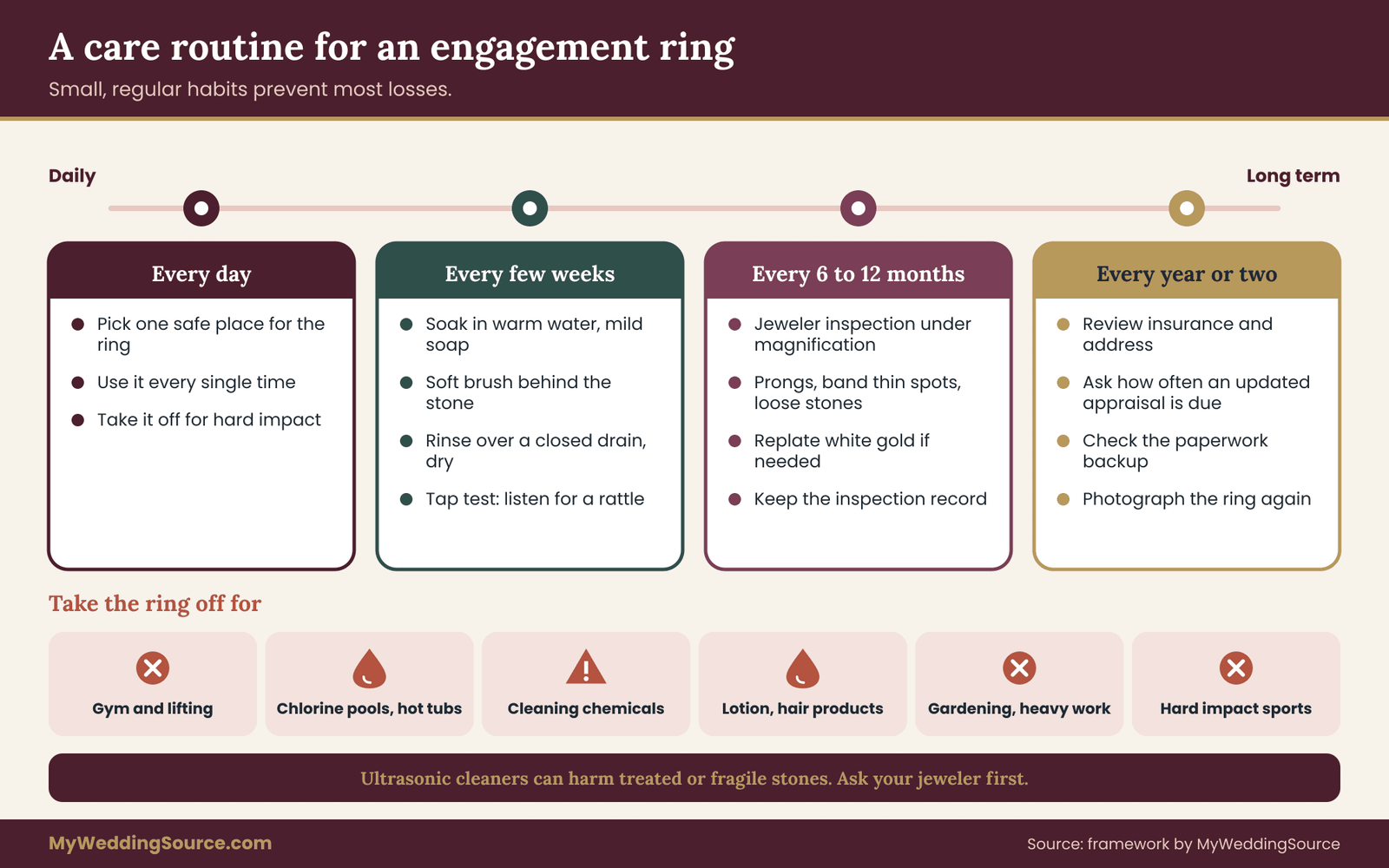
Daily habits that protect the stone
Take the ring off before activities that bang, soak or grind. That list includes lifting weights, gardening, cleaning with strong chemicals, swimming in chlorinated pools and hot tubs, and applying lotions or hair products. Chlorine and some household chemicals can damage the metal, especially gold alloys, and can leave a film on stones that dulls their sparkle. A diamond can chip when hit at the wrong angle, so take the ring off for work that involves hard impact, and put it on after you finish.
Choose one safe place for the ring and use it every time. A small dish by the sink, a pocket in a bag zipped shut or a ring box in a drawer. Many rings are lost at a sink or in a locker room where they were set down for a moment. A habit is better than good intentions.
Cleaning at home
For most diamond rings, the safest routine is soaking in warm water with a few drops of mild dish soap for a short time, brushing gently with a very soft brush, especially behind the stone where oils collect, rinsing in a bowl and not under a running faucet, and drying with a lint-free cloth. Do this over a bowl with the drain closed.
Ultrasonic cleaners and steam cleaners can be effective, and they are not safe for every ring. They can loosen stones that are already slightly loose, and they can damage fracture-filled diamonds, emeralds and other treated or fragile gems. Ask your jeweler whether your ring is a safe candidate. Avoid homemade cleaning mixes, bleach and abrasive pastes, because they can harm the metal or the setting.
The yearly inspection
Take the ring to a jeweler once a year, or every six months if the wearer is hard on their hands or the ring covered by this engagement ring buying guide has many small stones. The jeweler checks for worn or bent prongs, loose stones, thin spots in the band, wear on the setting and anything else that might lead to a loss. Many jewelers do this for free or at a low cost and will clean the ring while you wait. Ask them to tell you what they see and to show you under magnification.
A simple self-check between visits takes ten seconds. Hold the ring near your ear and tap it lightly. A rattle suggests a loose stone. Look at each prong from the side, and see whether it still touches the stone and has not been worn flat. Look for snags with a fingertip. Check that the stone does not move when you press on it gently with a toothpick. If you find any of these, stop wearing the ring until it is checked.
Common repairs and what to expect
Retipping or rebuilding prongs. Prongs wear down, and a jeweler can rebuild the tips with new metal or replace the entire head. This is routine maintenance, and it is typically much cheaper than replacing a lost stone.
Rhodium replating. White gold rings need new plating from time to time to keep a bright white color. A jeweler can do it in a short appointment.
Resizing. A jeweler can usually adjust a plain band by a size or two. Rings with stones set around the band, unusual metals or complicated designs are harder.
Reshanking. When a band has worn thin, the jeweler can replace it and keep the head. It is better to do it before the band breaks.
Stone replacement. If a stone is chipped or lost, a jeweler may suggest replacement. Ask about matching the laboratory report and update the appraisal and insurance. If the stone has been replaced, the old report no longer describes the ring.
Warranties and care plans
Many sellers offer care plans or warranties. Read what they cover. Typical elements are free cleaning and inspection, prong repair, stone replacement under certain conditions and resizing. Typical conditions are annual inspections at the seller’s location, written proof of those inspections and a limit on who may repair the ring. A warranty is only useful if you can follow its conditions, and the records belong in the ring file.
Storing the ring when it is not worn
Keep the ring in a soft pouch or a lined box, apart from other jewelry so that harder stones do not scratch softer metals or stones. A diamond can scratch other diamonds and other jewelry. For long trips, a small travel case that stays with you is better than a checked bag. At home, a locked drawer or a small safe is better than an open dish, and the location should be known to the wearer and one trusted person.
Edge cases: when the situation is not simple
Most purchases go smoothly. Some situations in this engagement ring buying guide call for a little more thought, and it is better to read about them before they arise.
The engagement ends
In many places, an engagement ring is treated as a conditional gift given in contemplation of marriage. If the marriage does not happen, courts in different states have reached different results about who keeps the ring, and some consider who ended the engagement while others do not. The answer depends on your state and on the facts. If this question arises, a family law attorney in your state is the right source of advice, and the paperwork file helps by documenting what was bought and when.
Rings and property in a marriage
How a ring is treated in a divorce, an estate or a prenuptial agreement depends on state law and on the agreements you sign. This engagement ring buying guide does not give legal advice, and the point here is only to raise the question. If you are making a prenuptial agreement, mention the ring and any family heirlooms to the attorney. Keep the appraisal current, because it is evidence of value.
An heirloom ring or a stone from family
Inherited rings come with sentiment and with unknowns. Get the ring examined by an independent jeweler before resizing or reworking it. Ask about the age and condition of the setting and the stone, whether any repairs were done and whether the stone has been graded. Take photographs before any work. If the plan is to reset an older stone, ask the jeweler how an older cut can be mounted safely, since older stones may be thinner at the girdle and more fragile. Consider an appraisal for insurance even if the ring in this engagement ring buying guide has no purchase price.
A ring bought abroad
Buying while traveling can offer unusual designs and sometimes lower prices, and it adds paperwork. Check U.S. Customs and Border Protection guidance on declaring purchases and duties before you leave, and keep receipts, reports and appraisals together. Verify the laboratory report online before you pay, since you may not be able to return an item once you are home. Confirm the metal hallmarks and the return and warranty policy in writing, and ask how repairs would be handled in the United States.
A ring that must be replaced after a loss
If the insurer pays for a replacement, you may have choices. Some insurers offer cash and some replace through their suppliers. A replacement of the same description should come with its own report, appraisal and warranty, and the paperwork file should be updated. If the original stone is recovered later, ask the insurer how it handles recovered property, since ownership may have passed to the insurer.
A proposal ring that is a placeholder
Some couples choose a simpler stand-in ring and upgrade later, or choose the final ring together after the proposal. This is a sensible option when size is unknown or when the partner has strong taste. Ask the seller whether an exchange or trade-in is allowed, within what period and at what value, and put the answer in writing before buying the placeholder. Trade-in values are usually lower than the purchase price, so treat the first purchase as spending and not as a deposit.
Your next steps
To put this engagement ring buying guide to work, start with the people questions. This week, write a one-paragraph brief describing the wearer’s daily hands, style signals, likely size and your fixed budget ceiling, and decide whether natural, laboratory-grown or another stone suits you. Nothing else you do will save as much money.
Next, gather two or three quotes and put them in one list using the same fields: laboratory, report number, shape, weight, color, clarity, cut, metal, setting, warranty and return window. Ask every seller the ten questions from the sellers section, and keep the answers. Ask a jeweler to confirm the inscription, weight and measurements of any loose stone before it is set. If you need a longer vendor-screening routine for a custom order, the vendor due diligence checklist is a useful companion, and the broader plan a wedding hub shows where the ring fits among your other decisions.
Pay by credit card, get the details written on the invoice and open a paperwork file the same day. Then book the first jeweler inspection for a year out, set a yearly reminder for the insurance review and decide who besides you knows where the ring you are weighing in this engagement ring buying guide is stored. When the ring is bought, place the file in your wedding records archive and revisit your wedding budget so that the real cost is recorded beside the plan. The engagement ring buying guide comes down to a calm head and a clear paper trail, and a ring bought that way is much easier to enjoy.
FAQ
What should an engagement ring buying guide tell me to check first?
Check the people questions first: who will wear it, what their hands do all day, and the fixed budget including insurance, appraisal and resizing. Then choose the stone type. Only after that should you compare grades and prices. Buyers who start with the stone often overspend on a factor the wearer would never notice, then discover the setting does not suit daily life.
Is a grading report the same as an appraisal?
No. A grading report from a laboratory describes a stone’s characteristics, such as color, clarity, cut and weight, and carries no price. An appraisal estimates a monetary value for a stated purpose, such as insurance replacement, and is written by an appraiser or jeweler. You usually need both: the report to verify the stone and the appraisal to insure the ring.
How do I know a grading report belongs to my diamond?
Match three things. Look up the report number on the laboratory’s website and compare every field. Have a jeweler read the laser inscription on the girdle under magnification and confirm it equals the report number. Then have the weight and measurements checked. A matching number, inscription and measurements make it very unlikely that the report describes a different stone.
Are laboratory-grown diamonds real diamonds?
They have the same chemical makeup and crystal structure as natural diamonds, so they are diamonds in the physical sense, but they are not natural. The Federal Trade Commission’s Jewelry Guides call for clear disclosure that a stone is laboratory-grown. They are graded on the same scales, and reports state the growth process. Resale values tend to be modest, so confirm with live quotes.
Should I buy a ring that is already set or a loose stone?
A loose stone is easier to verify, because the inscription, weight and measurements can be checked before it is mounted, and you can choose the setting separately. A pre-set ring is faster and sometimes simpler. If you buy a set ring, ask in writing whether a jeweler may examine the stone out of the mounting during the return window.
How much should I spend on an engagement ring?
There is no rule that fits everyone, and the idea of spending a set number of months of salary came from advertising, not from financial guidance. Set a ceiling you can pay without hardship, include appraisal, insurance, tax and a repair reserve in it, and shop under it. Be careful with store financing that charges deferred interest.
Does homeowner or renter insurance cover an engagement ring?
Often only partly. Many standard policies cap theft of jewelry at a low amount and may exclude loss or mysterious disappearance. Ask your agent in writing what would be paid for theft, accidental damage, loss and loss of the stone alone. A scheduled rider or a standalone jewelry policy usually offers broader coverage, with an appraisal on file.
How often should an engagement ring be inspected and appraised?
Many jewelers recommend an inspection once a year, or twice if the wearer is hard on their hands or the ring has many small stones. Appraisal refresh schedules vary by insurer and by market changes in metal and stone prices, so ask your insurer how often it wants an update and set a yearly reminder to review the policy.
Sources
- Gemological Institute of America, diamond grading reports, Report Check and the grading scales
- American Gem Society, cut grading and consumer information
- Federal Trade Commission, Jewelry, Precious Metals and Pewter Guides and consumer advice
- Electronic Code of Federal Regulations, Title 16, Part 23, Guides for Jewelry, Precious Metals and Pewter Industries
- Consumer Financial Protection Bureau, credit card disputes and deferred-interest promotions
- National Association of Insurance Commissioners, consumer insurance information
- U.S. Customs and Border Protection, declaring purchases and duties when traveling
- Transportation Security Administration, traveling with jewelry and valuables
- Kimberley Process Certification Scheme, rough diamond certification
- U.S. Department of the Treasury, sanctions and diamond import restrictions