
International wedding gifts raise a question that a local wedding never does: how does a gift, and the thank-you for it, travel between two countries without getting lost, taxed, delayed or misunderstood? This guide gives you a plain method for sorting every gift into a route, recording it, and sending a thank-you that arrives on time and reads the way you meant it.
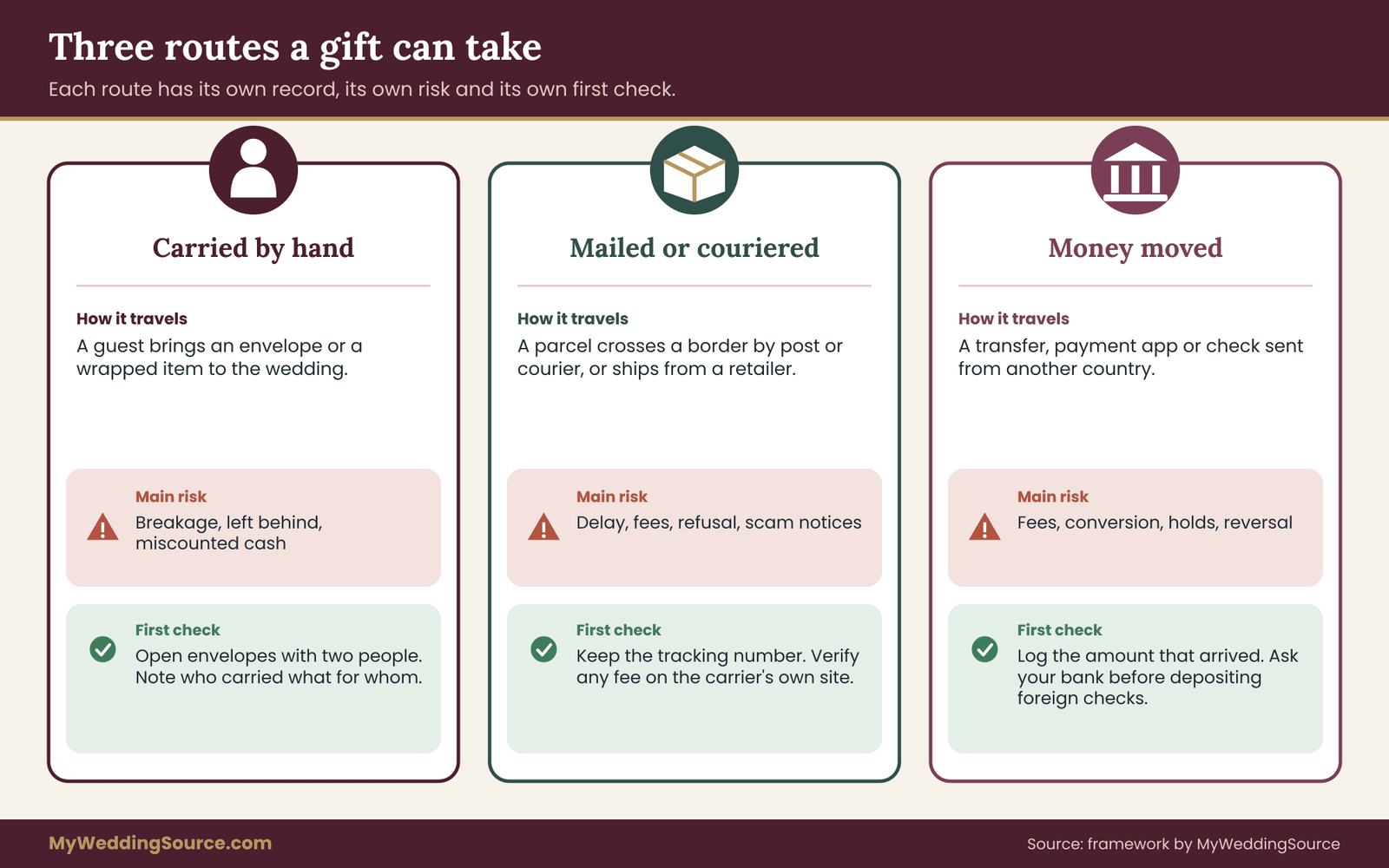
Treat international wedding gifts as three separate routes: gifts carried in by hand, gifts that cross a border by mail or courier, and money that moves between accounts. Give each gift one route, one record line and one thank-you channel. Send the note by ordinary letter mail, because letters rarely need customs paperwork, and keep parcels, food, plants and alcohol out of any package going abroad. Ask the carrier or the national postal service for current rules before you ship anything, since duty limits and prohibited items change.
A wedding with guests in several countries creates a quiet logistics problem that most etiquette advice about international wedding gifts skips. The advice assumes everyone lives within a short drive, that a gift is a box on a table, and that a thank-you is a card in the mail. When a grandmother lives in another hemisphere, a college friend has moved to a different continent, and a cousin sends money through an app you have never used, each of those assumptions breaks.
None of this is hard. It is just a set of small decisions that are easier to make once, in advance, than one gift at a time at the kitchen table three weeks after the wedding. The goal of this article is a single decision process for international wedding gifts that you can run in an evening: sort, record, thank, and handle exceptions.
A note on scope. This is general information, not legal, tax or financial advice, and customs, postal and banking rules differ by country and change often, so confirm anything that matters with the agency or carrier that issues it.
What international wedding gifts change about the thank-you
At a local wedding, a gift and its thank-you live in the same place; with international wedding gifts they rarely do. The gift arrives at your home or at the reception, you open it, you write the note, and you drop it in a mailbox. The whole loop takes a few days of effort and almost no risk.
International wedding gifts stretch that loop in four ways, and it helps to name them separately because each one needs a different fix.
Distance in time. A parcel that crosses a border can take weeks, and it can sit at customs for days longer. A guest may send a gift early and you will not know it exists until a delivery notice appears. A guest may also send a gift late, after a long trip home, and the thank-you you owe arrives on a different calendar than the one you planned.
Distance in money. A gift can be cash, a check drawn on a foreign bank, a transfer in another currency, or a gift card that only works in one country. Each form carries different fees, different delays and different records. A gift worth a certain amount in the sender’s currency may be worth a different amount by the time it clears.
Distance in rules. Customs authorities, postal services and carriers set their own rules about what can cross a border, how it must be declared and what it costs. A harmless wedding favor in one country can be restricted in another. The couple, the guest and the carrier can all be unsure who is responsible for a fee.
Distance in expectation. People in different countries, and different families within the same country, hold different views about what a wedding gift should be, who should give it, how it should be presented and how it should be acknowledged. Some expect a handwritten note. Some expect a phone call. Some treat a money envelope as the most natural gift in the world, and some find it awkward. You cannot guess these from a passport.
Two directions, not one
When couples think about international wedding gifts they usually picture only the inbound direction: guests send things to them. There is a second direction that is easy to forget. The thank-you travels outward, and so do any return gifts, favors or photo prints you decide to send to guests who could not come. Outbound items face the destination country’s import rules, and those are rules you do not control and may not know.
This guide covers both directions, with a lean toward the outbound side, because the inbound side usually solves itself when a courier delivers a parcel to your door, and the outbound side is where couples make avoidable mistakes. A thank-you gift that is stopped at a border, or a food item that is refused, helps nobody.
What this article does not try to cover
The broader question of who to invite, and how to decide how many international guests a wedding can support, belongs to the wedding guest list guide. Visa letters, passports and travel documents have their own coverage on the site. General etiquette on registries, showers and thank-yous at a local wedding is in the wedding etiquette guide. Here the focus is narrower: the loop of international wedding gifts and thank-yous when the giver or the receiver lives in a different country from the couple.
The Gift Path Sort: one decision process for every gift
The most useful thing you can do before the wedding is to decide how you will handle each kind of gift, because international wedding gifts rarely arrive in a tidy order. The method below is a short sort you run on every gift as it arrives. It uses four questions, in a fixed order, and ends with a route, a record line and a thank-you channel.
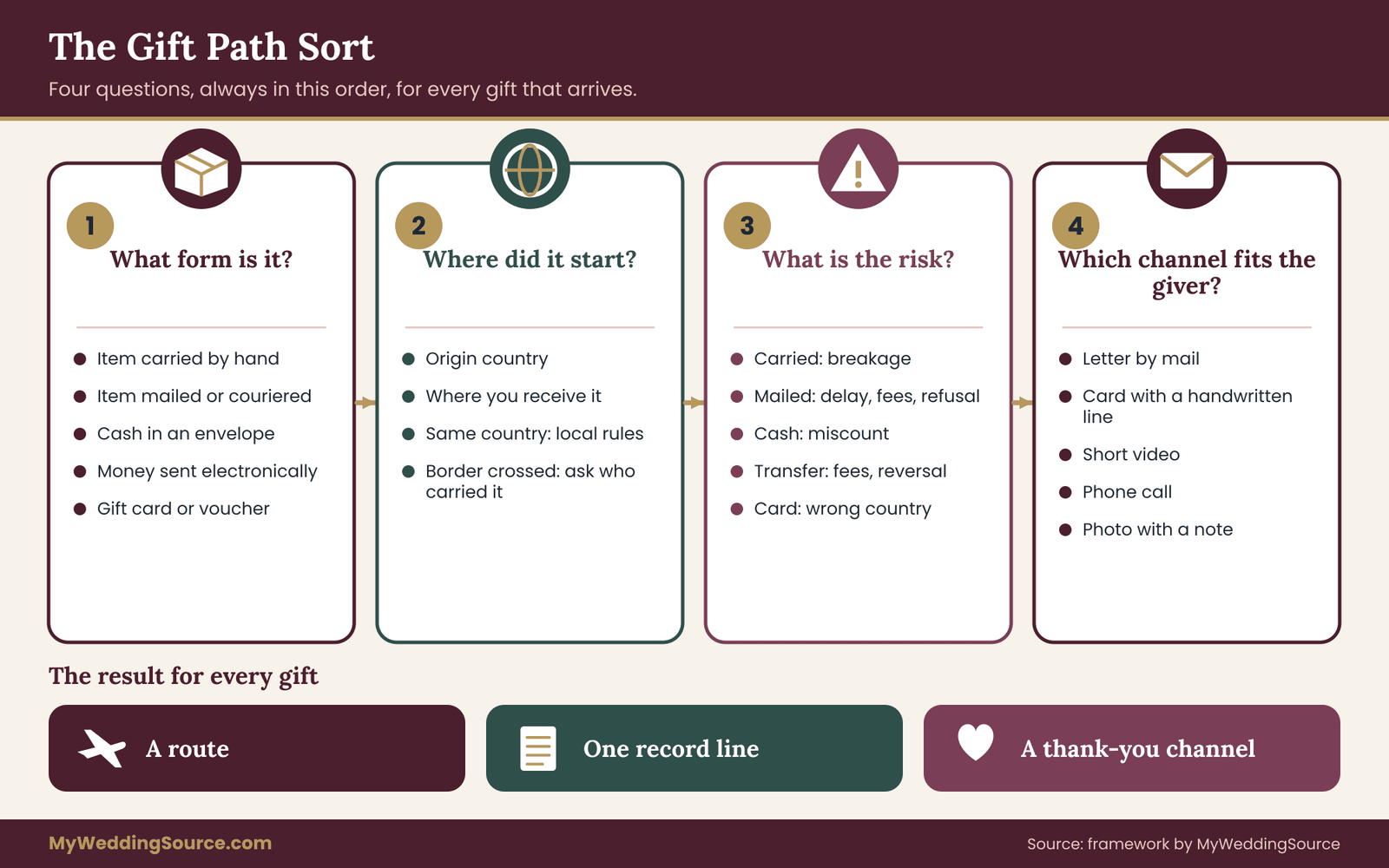
Question one: What form is the gift? Put the gift into one of five forms. A physical item carried by hand. A physical item shipped by mail or courier. Cash in an envelope. Money moved electronically, such as a bank transfer or a payment app. A gift card, voucher or registry credit. Every one of your international wedding gifts fits one of these forms, and the form decides most of what happens next.
Question two: Where does it start and where does it end? Note the country the gift comes from and the country where you will receive and use it. If it started and ended in the same country as the couple, it is a local gift and the usual rules apply. If it crossed a border, or will cross one, it moves to the next question.
A gift that started in another country and was handed to you at the wedding by a traveling guest is a hand-carried item and still counts as international for the purposes of thanks, because the giver is not in your country.
Question three: What is the risk on this route? Each route has one main risk. A hand-carried item can break or be left behind. A shipped parcel can be delayed, taxed or refused. Cash can be lost or miscounted. A transfer can carry fees or be reversed. A gift card can be unusable where you live. Name the main risk, because it tells you what to record and what to check.
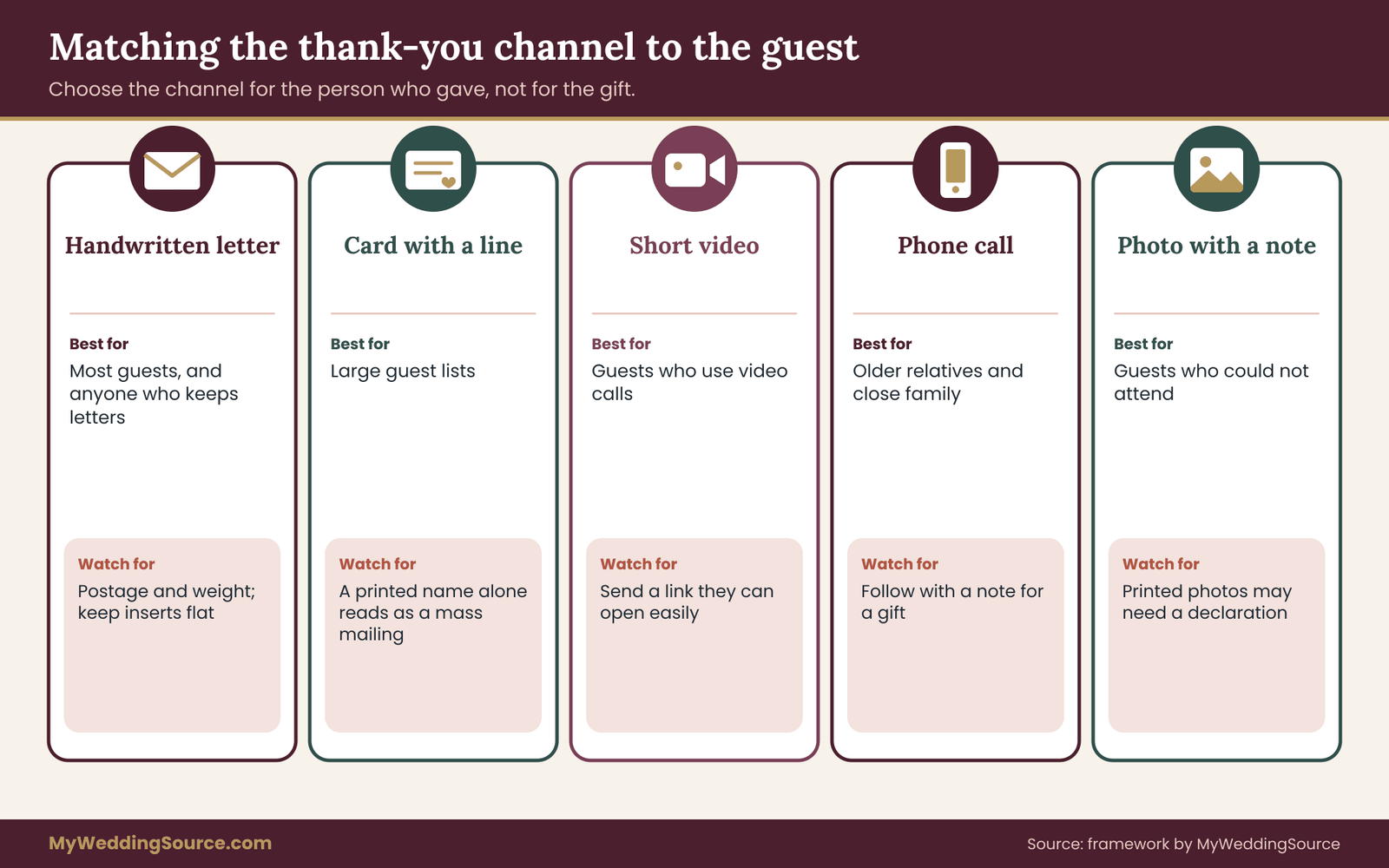
Question four: Which thank-you channel fits the giver? Choose the channel and the timing based on the giver, not on the gift. A handwritten note by letter mail suits most people. A short video message suits a giver who will enjoy hearing and seeing you. A phone call suits an older relative who might not check email. A message in a shared family chat suits some families and not others. The rest of this guide helps you choose.
Why the order matters
The order of the four questions is deliberate. Form comes first because it is observable and costs nothing to decide. Origin and destination come second because they tell you whether border rules apply. Risk comes third because it is the reason to keep a record. Channel comes last because it should respond to the person, and you cannot choose it well until you know how the gift arrived and what it cost them to send it.
If you sort in a different order, you tend to choose the thank-you first, and that gets you a generic note that ignores the effort a faraway guest made. A grandmother who paid a courier for a large parcel and waited weeks for confirmation deserves a thank-you that mentions the parcel. The sort makes that detail visible.
The record line
At the end of the sort, write one line in a gift log for each of your international wedding gifts. It should hold the giver’s name, the country, the form of the gift, the date it arrived, the amount or description, any fees or duties paid by you, the thank-you channel, and the date the thank-you was sent.
A simple spreadsheet is enough for international wedding gifts. If you already follow the habits described in the guide to wedding records after the event, add the international fields as extra columns rather than starting a second log for international wedding gifts.
The log is also your protection against two common failures. The first is the forgotten thank-you: with guests in several time zones and parcels that arrive in a different order than they were sent, it is very easy to lose track of who you have already thanked. The second is the unmatched gift: a parcel arrives with no card, and the log lets you check which guest is missing a delivery.
A short example of the sort in use
A cousin in another country sends a bank transfer with the note “for your new home”. Run the sort. The form is electronic money. The origin is abroad and the destination is your account. The risk is fees, conversion and a possible reversal, so you record the amount that actually arrived rather than the amount that was sent.
The thank-you channel is a short video message, because the cousin rarely writes and the family chat is active. Total time: about five minutes, and you now have a record line you can trust.
Carried international wedding gifts: cash, envelopes and items brought to the wedding
The simplest route for international wedding gifts is the one where the guest carries the gift in person. A traveling guest hands you an envelope at the welcome dinner, or leaves a wrapped box on the gift table, and the border is crossed by the guest and not by the gift. This route has the fewest delays and the fewest fees, but it has its own small traps.
Cash and envelopes from abroad
A guest who flies in often brings cash, and cash is among the most common international wedding gifts. That cash may be in their home currency, in US dollars, or in a mix of both. A few practical points will save you trouble.
Count and record it at once. Open envelopes in front of a second person, preferably the partner, and write down the amount and the currency before the envelopes are mixed with anything else. If a guest brought a different currency, record the currency and the amount in that currency, and note the date. Do not convert it in your head and write only the converted number, because you will not be able to reconstruct the original later.
Keep one person in charge of the box. At a wedding with many guests, envelopes pile up. Choose a trusted person, not a wedding party member who has duties on the day, to hold the card box and take it to a secure place at the end of the night. A card box on a table in a rented hall is a risk for any wedding, and it is a larger risk when the envelopes contain foreign currency that is harder to replace and harder to trace.
Decide how foreign cash will be exchanged. A bank or credit union may exchange foreign banknotes, but not every branch does, and the rate and fee vary. Some banks do not accept coins at all. Ask your own bank before you assume it will work, and ask what documentation it wants. If a gift in foreign cash is small, you may decide to keep it as a keepsake instead of exchanging it, and that is a fine choice. Write it in the log either way.
Do not carry large cash across the border yourself without checking the rules. If you are a couple traveling after the wedding with a pile of cash gifts from guests, the reporting rules for carrying currency across a border apply to you as they do to anyone. U.S. Customs and Border Protection publishes the current requirements for travelers entering or leaving the country with large amounts of currency, and other countries have similar rules. The simplest approach is to deposit gifts before you travel.
What to say about foreign-currency gifts
A thank-you for cash from a faraway relative has a small trap. It is tempting to mention the amount, and it is better not to. Mention what the money will do instead: “It will go toward the sofa we have been saving for.” The guest knows what they gave, and naming the sum can read as accounting. This is not a rule specific to international wedding gifts, but it matters more when the gift was a currency the guest may have had to buy at a cost.
Gifts carried by a guest in a suitcase
Sometimes a traveling guest brings one of the international wedding gifts in a suitcase, a physical gift from home: a handmade item, a family heirloom, or a small item from a local craft tradition. These carry emotional weight, and they also carry some practical risks.
Fragile items. A glass or ceramic piece may have survived a long flight, and it may not survive the trip from the venue to your car. Ask a family member to transport it home on the same day, in the original packaging if there is any, and photograph it unwrapped so you have a record of its condition.
Items you cannot display or use. Some gifts have a cultural meaning that is not obvious to you. A textile may be meant to be worn, hung or stored, and the custom for using it may differ among families. A short, warm question in the thank-you note, such as “How is this traditionally displayed in your family?”, is both polite and informative. It also gives the guest a reason to write back.
Heirlooms. If a gift is an heirloom, a close relative may care a great deal about where it ends up. If you are unsure whether it is a gift or a loan, ask. Do not assume. A single clear sentence at the time of the gift prevents a long misunderstanding.
The traveling guest as courier
Guests who cannot attend sometimes ask a friend or relative who is attending to carry one of their international wedding gifts for them. This is a common arrangement and a good one, but it creates a record problem: the person who hands you the gift is not the person who gave it.
Write the name of the giver in the log, and note the courier too. Send the thank-you to the giver, not to the courier, and include a short separate thank-you for the person who carried it. People who carry gifts across borders are doing a favor that is easy to overlook.
If the courier is carrying a gift across a border on behalf of another person, the traveler is responsible for what is in their luggage when they pass customs. A guest who is unsure should check the rules for the destination before they agree to take sealed items for someone else.
Gifts that cross a border by mail or courier
The second route is the one that causes the most surprise: a parcel sent from another country to your home. Of all international wedding gifts, parcels are the ones that cross the most hands. International wedding gifts sent this way pass through postal services, customs authorities and sometimes a courier’s broker, and each step can add time or cost.
What the couple needs to know about inbound parcels
Duties and taxes can fall on the recipient. Depending on the countries involved, the declared value of the item and the carrier, a parcel can arrive with a bill for duties, taxes or a handling fee. In some arrangements the sender pays everything in advance. In others the recipient pays on delivery.
The guest may not know which applies. If a courier asks you to pay a fee before releasing a wedding gift, do not ignore it and do not pay in a hurry; first confirm that the message is real, as described below.
Customs rules for international wedding gifts exist but have limits. Many countries, including the United States, allow a limited exemption for bona fide gifts sent from abroad, but the exemption has conditions: a cap on value, limits on how often the same recipient can receive such gifts, and exclusions for items such as alcohol and tobacco. CBP publishes the current rules and they have changed in recent years, so rely on the agency page and not on a friend’s memory of what happened to a package in the past.
Some items are restricted entirely. Food, plants, seeds, certain animal products and some wooden items face agricultural and wildlife restrictions in many countries, and those restrictions apply to gifts as they do to commercial goods. A guest who sends homemade sweets from another country may find that the parcel was held or destroyed. If you know a guest is likely to send something edible, a gentle note before the wedding saying that you would love a card instead can spare them the disappointment.
Customs forms describe the contents. A parcel crossing a border carries a declaration of what it contains and what it is worth. A vague or inaccurate declaration can slow the parcel. If a guest tells you they are sending something, you can ask them, politely, to describe it fully on the form and to mark it as a gift.
Scams that borrow the wedding
Fraud finds weddings, and international wedding gifts give scammers plausible cover. The common patterns are worth a paragraph because international wedding gifts create plausible cover for them.
A message that looks like a courier notice asks you to pay a fee through a link to release a wedding gift. A “guest” sends a check for more than they owe, and asks you to wire back the difference. A text claims that a parcel is waiting and asks for personal details. The Federal Trade Commission publishes consumer guidance on each of these patterns.
The safe habits are the same everywhere: do not click a link in an unexpected message, go to the carrier’s official site and enter the tracking number yourself, and never refund an overpayment from a check before the funds have cleared and the check is confirmed as genuine.
If you are not sure that a delivery message is real, ask the guest who supposedly sent the gift. A one-line text to the guest is a better check than any link.
A tracking habit that helps
When a guest says that a parcel is on the way, ask for the tracking number, or ask them to forward the shipping confirmation. Add the tracking number to the log. A single line in the log with a tracking number lets you follow a delayed parcel without writing to the guest more than once.
If a parcel does not arrive after a reasonable time, tell the guest without blame. International shipping delays are common and are not the fault of the giver. The guest may be able to file a claim with the carrier, and the carrier will often ask the sender, not the recipient, to start it. Offer to help by sending any information they need.
When a gift arrives damaged or unwanted
A damaged parcel is a delicate moment with any of the international wedding gifts. Photograph the packaging and the item before you do anything else, and keep the packaging until the claim is resolved. Tell the guest quickly, and tell them gently, because they may feel responsible. If the item came from a retailer rather than from the guest, contact the retailer first, since the retailer is usually the party who can replace it.
An unwanted or duplicate gift among your international wedding gifts is harder than a local one, because returning it can be costly. Before you consider a return, check the return policy and who pays for return shipping. For a local gift you can often take the item to a store. For an international gift you may be unable to return it at all.
If a return is not practical for these international wedding gifts, keep the item, donate it, or exchange it within the retailer’s system if there is one. Do not tell the guest that the gift is going back; thank them for the thought and for the gift itself, and handle the practical matter privately.
Registries and gifts that ship from a retailer
Many international wedding gifts never cross a border as a parcel from the guest at all. They are ordered from an online retailer by a guest who lives elsewhere, and the retailer ships to your address. That changes the risk. The retailer handles the customs paperwork in some cases and not in others, and many retailers do not ship across borders at all. The next section covers registries in detail, including how to set up your registry so that overseas guests can use it without surprises.
Registry choices for international wedding gifts
A registry is the quiet engine of most American wedding gifts, and it is also where international wedding gifts most often go wrong. A guest in another country opens your registry link, picks an item, and discovers at checkout that the retailer will not ship to their address, will not accept their card, or will add fees that double the price.
Many guests will give up on their international wedding gifts and send nothing, or send something you did not ask for. A few decisions made before the invitations go out can prevent this.
Check what the registry platform actually does for overseas guests
Before you rely on a registry for international wedding gifts, test it. Open the registry in a private browser window, choose a country other than the one where you live if the site allows that, and walk through checkout up to the payment step without paying. Look for these things.
Does the site ship to the recipient’s address? The guest is buying for you, so the destination is your home, in your country. The real question is whether the guest can place the order and pay from abroad. Some retailers let a buyer in another country use a foreign card and a foreign billing address. Others do not, and the guest hits an error.
Does the guest see the full cost before paying? Taxes, shipping and any conversion should appear clearly. Surprises at the last step are what make people abandon a purchase.
What happens to gift cards and cash funds? A cash fund on a registry platform may not be available in every country, and the platform may take a fee. Some platforms deliver the fund to you by transfer, some by check, and some only to a bank account in one country. Read the terms for a fund you plan to promote to overseas guests.
If you do this test and find that the platform is awkward for guests abroad, you have two choices: add a second, simpler way to give, or choose a platform that handles foreign payments better. Both are better than discovering the problem when a grandmother calls in tears.
A two-door approach
Many couples find that a “two-door” approach works well. The first door is the main registry for domestic guests, with items and funds, aimed at guests who live in the same country. The second door is a plain, short note on the wedding website for guests abroad that says what you would welcome and how to give it.
The second door might say that a card is a gift in itself, that a contribution to a fund is welcome if it is easy, and that the guest should not ship anything bulky.
The wording should be warm and brief. It should not suggest that anyone owes you a gift, and it should not rank guests by where they live. A line such as “If you are traveling to celebrate with us, you are already giving us a great gift. If you would like to send something, a card or a contribution to our fund is lovely, and please do not worry about shipping anything” does the work.
If your site follows the structure in the guide to wedding registry ideas, place this note near the registry link, not at the bottom of a long page.
Gift cards and vouchers across borders
A gift card is one of the more convenient international wedding gifts, since it can be delivered by email. But it may be tied to one country. A card issued by a retailer in the guest’s country may not work in yours. If a guest asks what to send, steer them to a card from a retailer that operates in your country, or to a card that can be redeemed online.
If a gift card arrives that you cannot use, do not mention the problem in the thank-you. Handle it quietly, through the retailer’s customer service or through a swap with someone who can use it.
Experience gifts and charitable gifts
Some couples prefer that international wedding gifts take the form of an experience, a donation or a contribution to a shared fund instead of a physical item. These can be sent without a parcel, which removes the customs problem entirely. If you promote them, make sure the details are right: a donation to a charity should be to a charity that can receive it from abroad and give a receipt, and an experience voucher should be usable on a date and in a place that fits your plans.
A short check of the provider’s terms saves a later headache.
Duplicates and returns
When many guests shop from a registry that is open to the whole world, international wedding gifts can overlap and duplicates can appear, especially if a guest buys outside the registry’s tracking system. Decide ahead of time what you will do. Many retailers allow an exchange within their own system.
Gifts bought through a registry usually have clear exchange terms, while a gift bought from a different retailer in another country may not. Write the policy next to the log line, so that you know where each gift can be exchanged and by when.
Money gifts across currencies: records, fees and thank-yous
Money is a common wedding gift worldwide, and international wedding gifts often take that form because money is easy to send, does not break, and does not need a customs form. But money across borders has its own costs, and the thank-you for it needs care.
The forms of a money gift
A guest abroad may send money in several ways, and each way shapes how you log international wedding gifts, each with a different record and a different risk.
A bank transfer. The money arrives in your account, perhaps after conversion, perhaps with a fee deducted along the way. The amount that arrives may be lower than the amount the guest sent. Record the amount that arrived, not the amount the guest mentions.
A payment app. Some apps work across borders and some do not. Some charge the sender, some the receiver. A payment can be flagged, held or reversed, and the app may ask you to confirm it. Log the date and the app, and watch for any hold.
A check. A check drawn on a foreign bank can be slow to clear and can carry fees when you deposit it. Your bank may hold the funds for a long period, or may send the check for collection, which can take weeks. Ask your bank before you deposit, and do not spend the money until the deposit has fully cleared.
Cash in the mail. Mailing cash is risky, and many postal services warn against it or restrict it. If a guest tells you they plan to send cash, you can thank them for the thought and gently suggest a card with a check or a transfer instead.
Recording the amount you actually received
The log for money among your international wedding gifts needs a few more columns than the log for physical items. At a minimum, record the guest’s name, the form, the date it was sent, the date it cleared, the amount the guest said they sent, and the amount that arrived in your account.
If there is a gap, note the reason, whether a fee, a conversion or a rounding. You do not need the gap for the thank-you, but you will want it if you ever need to explain the figure.
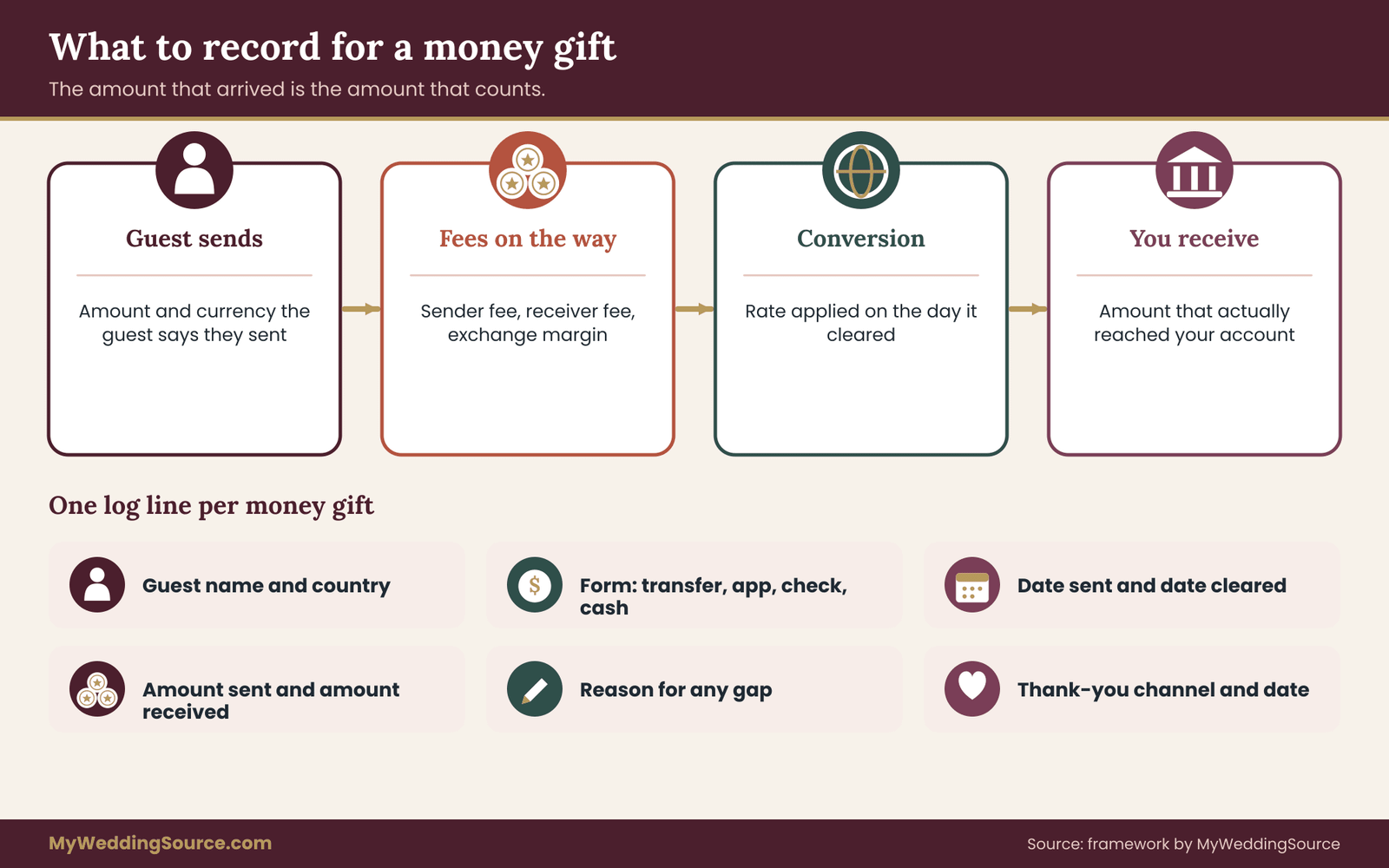
This log of international wedding gifts has a second use. If a transfer is flagged or reversed, or if a check bounces, your record shows the history. It also supports the habits in the wedding cash-flow planning guide, because international wedding gifts that arrive in a different currency, after the wedding, changes when you can count on the money.
Fees and who pays them
International transfers, a common route for international wedding gifts, often have a fee at the sending end, a fee at the receiving end, and a margin in the exchange rate. The guest may not know the total. A guest who sends a certain amount may be surprised to learn that you received less, and may feel embarrassed.
Never raise the shortfall with the guest. If a fee is significant, you can look for a cheaper way to receive money in the future, for example by giving overseas guests a link that works better, but do not turn a gift into an accounting conversation.
The Consumer Financial Protection Bureau publishes guidance on sending money abroad and on how fees and exchange rates are disclosed. That guidance is aimed at senders in the United States, but it gives you a sense of what to ask when a transfer involves your account.
Tax and reporting, in plain terms
Most couples will receive international wedding gifts without any tax question. The Internal Revenue Service explains that gift tax rules generally fall on the giver, not the recipient, and that most gifts are not taxable. There are separate reporting rules for U.S. persons who receive very large gifts from foreign individuals, and those rules have a high threshold that most wedding gifts do not approach.
If a single gift from abroad is unusually large, or if you are unsure about your situation, speak to a qualified tax professional and check the IRS pages. Do not guess, and do not make this part of the thank-you.
Thanking for money without naming the sum
The thank-you note for a money gift among international wedding gifts has a simple structure. Begin with thanks for the gift itself and for the person. Say what you plan to do with the money, in a sentence. Add one personal detail about the guest or the wedding. Close with warmth.
Here is a short sample: “Dear Aunt Lucia, thank you for your generous gift and for the card that came with it. We are putting it toward the table we have been looking for since we moved, and every time we sit at it we will think of you. We wish you could have been there, and we hope to see you soon.”
The note does not name the sum, does not mention the currency, and does not describe the transfer. It does the one thing that matters, which is to make the guest feel seen.
A caution about reciprocity
In some families and communities, a money gift at a wedding, including international wedding gifts, is noted by both sides and is expected to be matched when the giver’s family has a celebration. If you are part of such a community, or if you marry into one, the log is more than a courtesy: it is the memory that the family may use later. Keep it accurate, and keep it private. If you are unsure what is expected, ask a trusted relative, quietly, before the wedding and not afterward.
Thank-you notes that fit different languages and customs
Once you have recorded a gift, the thank-you is where international wedding gifts become personal. A note is not a receipt. It is the one piece of writing a guest in another country will read about your wedding, and it may be kept for years. A few choices make a large difference.
Choose the language on purpose
If a guest speaks another language at home, decide how you will write to them. There are three honest options, and any of them can work.
Write in your own language, plainly. If the guest reads English comfortably, a short, clear note is usually the best choice. Avoid idioms, wordplay and slang that translate badly, and avoid long sentences with several clauses.
Write in the guest’s language, with help. If the guest is more comfortable in another language and you or a relative can write it well, a note in that language is a real gesture. If your skills are limited, ask a family member or a professional to check the note before you send it. A badly translated note can come across as careless, while a simple note with one correct, well-chosen sentence in the guest’s language can be touching.
Write in both. A short note with a line in each language is often the kindest choice for older relatives who read one language more comfortably and younger ones who read the other. Keep each version short, and do not make the guest hunt for the thanks.
Do not rely on an automatic translation tool for the final text of a note that matters, least of all one that thanks international wedding gifts. Such tools are fine for understanding a message, and risky for tone. If you use one for a first draft, have a fluent reader review it.
Names, titles and forms of address
International wedding gifts often come from relatives whose names and titles follow different conventions. Some cultures place the family name first. Some use a title as part of normal address. Some people use a name at home that differs from the one on a passport. Before you print a stack of envelopes, check the exact spelling and order of each name with someone who knows the family, and ask how the person prefers to be addressed.
If you have already collected these in a household address sheet, use it. A name spelled wrongly is a small insult that is easy to avoid.
If you are in doubt, the guest’s own invitation reply or the way they sign their cards is a good clue. Match what they used.
The shape of a good note
A thank-you note is short. Three to six sentences are enough. The structure that works in most languages and most families is the same.
Say thank you for the specific gift. Name it, or describe what it will do. “Thank you for the beautiful linen” is better than “Thank you for your gift”.
Say something about the person. A line that shows you were thinking of them: a memory, a wish that they had been there, a mention of the trip they took to come.
Say what you will do with it. Where the gift will sit, what you will cook with it, or how you will use it. This is the part that makes a guest feel that the gift landed.
Close with warmth and, if it fits, an invitation. “We hope to visit you next year” is a promise only if you mean it, so use it only if you do.
If the gift was money, follow the pattern in the previous section and leave out the amount.
Cultural customs: ask, do not assume
Gift customs differ widely, and international wedding gifts expose those differences. In some communities, money in an envelope is the traditional and expected gift. In others, a physical gift from the registry is normal, and cash is considered impolite. In some cultures, certain numbers, colors or objects carry meanings that make them unwelcome as gifts, or at least worth thinking about.
A pair of items may be preferred to a single one. A gift might be offered with both hands. A guest might decline a gift at first as a matter of politeness, then accept it when it is offered again.
You cannot learn all of these about international wedding gifts from a general article, and attempts to generalize about “a culture” go wrong quickly, because customs vary by region, religion, generation and family. The better approach is to ask the people who know. Choose one trusted relative per family or community and ask a plain question: “Is there anything we should know about how to acknowledge gifts from this side of the family?” Most people are glad to be asked, and the answer is often more specific than any general rule.
There is a further point about timing. Some families expect a thank-you in person or by phone, and a card by post may seem cold. Others consider a call a little forward and a card the right choice. Again, ask.
Matching the channel to the giver
The channel you choose for thanking international wedding gifts should fit the person. This is the fourth question of the sort, and it is worth a longer look.
A handwritten note by letter mail. The default for most guests, and the one that can be kept in a drawer. It travels well, needs no special customs treatment, and says that you took the time.
A printed card with a handwritten line. If you have many notes to write, a printed card with a personal line is a reasonable choice. The personal line is what matters. A card with only a printed name and no handwriting reads as a mass mailing.
A short video message. A thirty-second video recorded on a phone can be a lovely thank-you for a guest who could not attend. It lets them see your faces and hear your voices. It works best when the guest is comfortable with video, and it should be sent by a method they can open easily. Do not send a large file by an unfamiliar service to someone who is not used to it.
A phone or video call. A call is a strong choice for older relatives and for close family. It does not replace a note for a gift, but it can come first, and the note can follow.
A photo with a message. A good photo from the wedding, with a few lines on the back, is a keepsake. If you send prints abroad, remember that a printed photo is merchandise in some customs systems and may need a declaration. A digital photo by email avoids this.
The thank-you for a guest who could not come
A guest who did not attend and sent one of the international wedding gifts deserves the same note, and a little more. Say that they were missed. Include a photo or a short description of the day. If you plan to send a small keepsake, check the rules before you do. A note that says “we have set aside a slice of the day for you” and then sends nothing physical is fine.
The thank-you for a guest who traveled
A guest who traveled a long way gave more than a gift. They spent time and money to be there. A thank-you for the gift alone can feel thin. Mention the journey: “Thank you for coming so far, and for the gift.” If you can, say something specific about a moment you shared at the wedding, since that is the part they will remember. The guidance in the wedding etiquette guide on thanking guests applies here too, with the added weight of the distance.
Mailing thank-yous and return gifts to other countries
A note can usually be mailed without any fuss, unlike many international wedding gifts. A gift is a different matter. This section covers the practical rules for the outbound direction.
Letters and cards
A card in an envelope, with nothing else inside, is the simplest item you can mail abroad. In the United States, the Postal Service sells stamps for international letters and publishes the rates and weight limits. Postage for an international letter is different from postage for a domestic one, and a letter that is too thick, too heavy or an unusual shape can cost more.
If you designed a card with a thick insert, a pop-up or a keepsake, weigh it and ask for current postage, as you would for the pieces covered in the wedding invitation etiquette guide.
Write the destination country on the address in capital letters, on the last line of the address, in English or in the form the destination country uses. Include a return address. Use the address format the guest gave you, since postal addressing varies widely, and do not “correct” it to look like a U.S. address.
What not to put in the envelope
Keep envelopes for international wedding gifts and thank-yous simple. Do not add cash. Do not add anything that could be treated as merchandise, such as a pressed flower or a small piece of jewelry, unless you have checked that it is allowed. Seeds, dried plants and food are restricted in many countries and can cause the mail to be held. A pressed flower in a card may look harmless, and it may still be a problem at an agricultural inspection.
Parcels and keepsakes
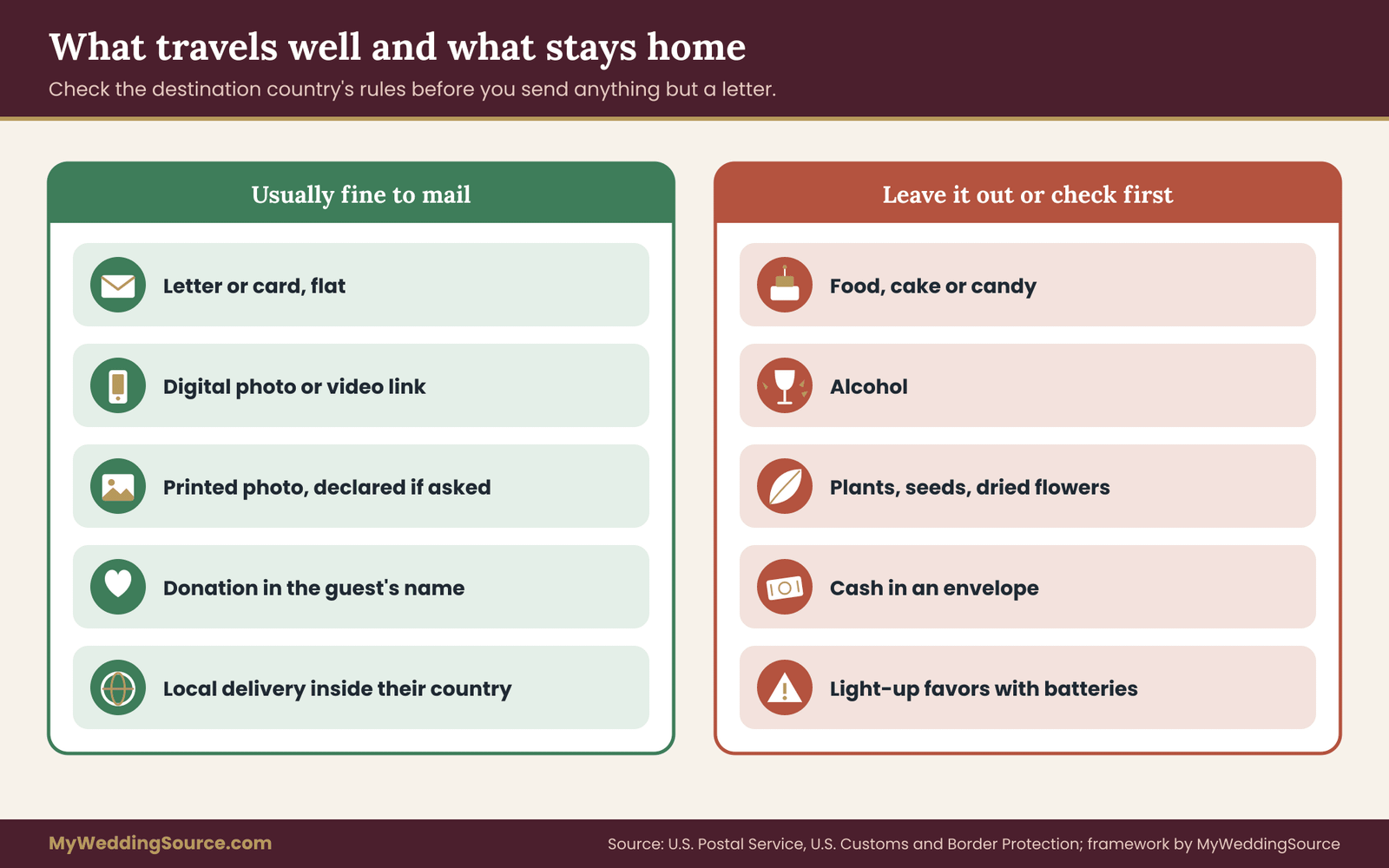
If you plan to send a keepsake, such as a framed photo, a small favor or a printed album, treat it as a parcel. You will need to fill in a customs declaration with a description and a value. The Postal Service’s International Mail Manual lists, country by country, what can be sent, what is prohibited and what documentation is required. Courier companies publish similar information. Check the destination country before you buy or make the item, not after it is wrapped.
Some things to avoid in a wedding keepsake parcel:
- Food, including cake, candy and chocolate, unless you have confirmed that the destination allows it.
- Alcohol, which is restricted or prohibited in many places and almost always cannot be mailed.
- Plants, seeds and dried flowers.
- Items with batteries, such as light-up favors, which carry shipping restrictions.
- Anything that looks like a commercial shipment of many identical items.
Who pays duties on a parcel you send
A parcel you send to a guest, the mirror image of international wedding gifts, may be subject to duties or taxes in the destination country, and the recipient may be asked to pay before it is released. That is the opposite of a gift. If you want to avoid it, ask the carrier whether you can prepay duties, or choose a gift that is not physical.
If you are not able to prepay, tell the guest the parcel is coming and why, so that a customs bill does not arrive as a surprise.
For a gift with low value and a small, unremarkable item, the cost is often small or zero, and many countries have thresholds below which no duty is charged. These thresholds differ widely and change. Check the destination country’s customs authority and the carrier’s published guidance, and do not rely on a number someone remembers from a prior shipment.
Timing and tracking
International mail has a long and uneven timeline. A letter that takes a few days in one direction can take several weeks in another. If the thank-you is time-sensitive, for example a note for a guest who has been unwell, send it by a tracked service or add a short digital message first. For a parcel, use a service with tracking, keep the receipt, and send the guest the tracking number so that they can watch for it.
A final point about international wedding gifts and their thanks: ask yourself whether a physical item is needed at all. A note and a photo can carry the message. The question is whether the extra cost, risk and delay of a parcel buys anything the guest would value more than a thoughtful letter.
A worked case: one invented couple, six guests, six countries
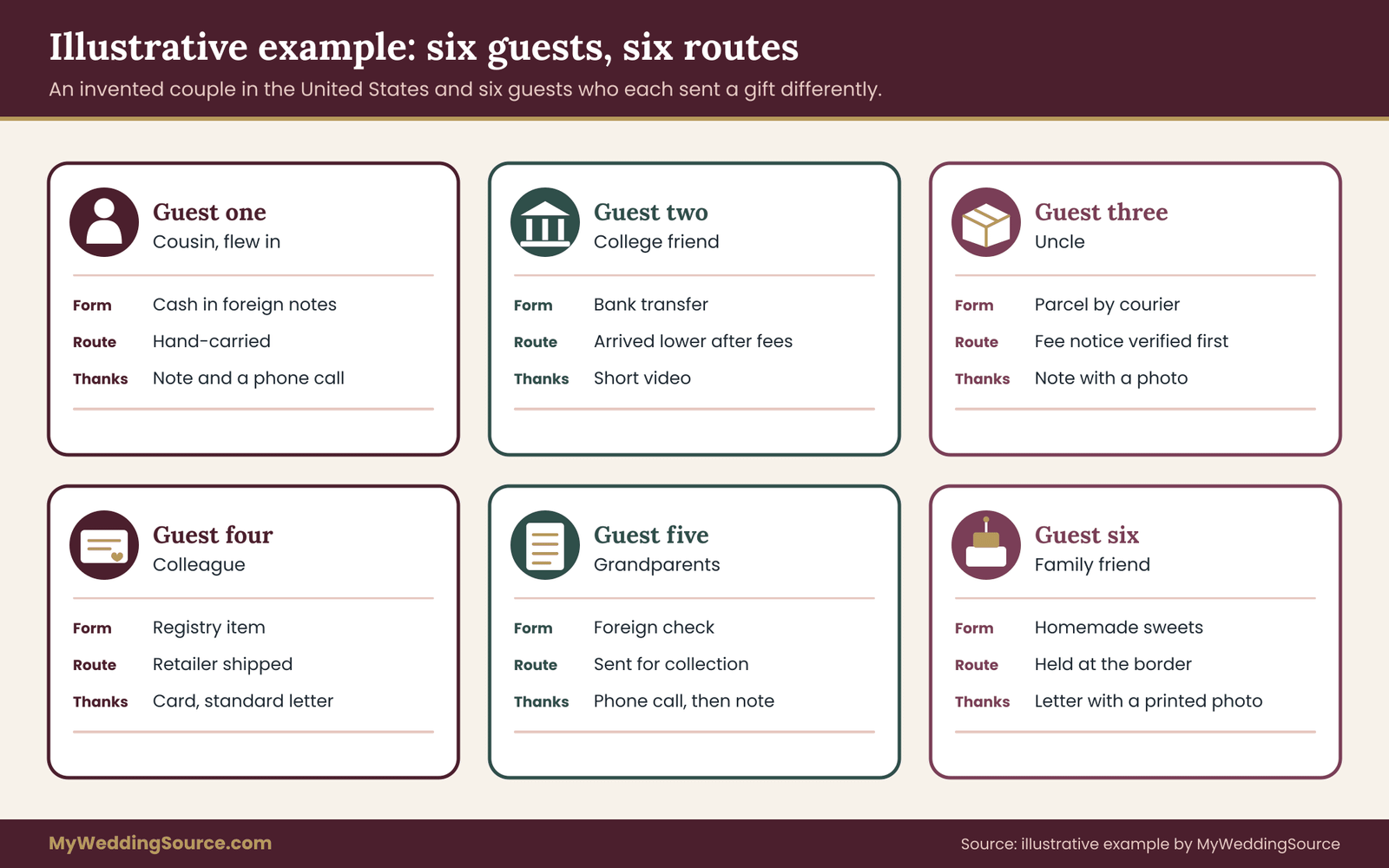
A method is easier to judge when you can watch it run. The case below is invented for illustration. It is not a real couple, a real guest list or a test of any carrier, and the amounts are round numbers chosen only to show the logic. Its purpose is to show how the four questions of the sort, the record line and the thank-you channel work together on international wedding gifts that arrive in very different ways.
The setup. Imani and Daniel live in the United States and marry there. About ninety guests come. Six guests are in a different situation from the rest, and each lives in a different country. They had agreed before the wedding to log all international wedding gifts in one file, with the usual columns with the usual columns plus country, form, route, fees, tracking number and thank-you channel.
They also agreed to send every thank-you within about three months of the wedding, a common timeframe in etiquette guidance, and to start the international ones first because they take longest to arrive.
Guest one: the cousin who flew in with an envelope
Imani’s cousin traveled from another country and handed over an envelope at the welcome dinner. Inside were banknotes in the cousin’s home currency, plus a card.
Form: cash. Route: hand-carried. Risk: miscounting and later difficulty exchanging foreign notes.
They opened the envelope with both partners present that night and wrote down the currency and the amount in that currency. A week later they asked their bank whether it exchanges those notes, and learned that it did, for a modest fee. They decided to exchange most of it and keep one note in the keepsake box.
Thank-you channel: a handwritten note and a phone call, because the cousin had traveled and would be reachable. The note said that the money was going toward the dining table, and it did not name the amount.
Guest two: the friend who sent a transfer
A college friend in another country could not attend and sent a bank transfer with a short message. The transfer arrived a few days later, slightly lower than the friend had written in the message, because of a fee and a conversion.
Form: electronic money. Route: bank transfer. Risk: fees, conversion and a possible reversal.
They recorded the amount that arrived, noted the gap with the reason, and did not mention the gap to the friend. A transfer that has cleared is a finished gift.
Thank-you channel: a short video message, because the friend rarely wrote letters and used video calls often. They also sent a photo from the ceremony by email. The video lasted under a minute and named the friend’s role in an old story, which got a reply within an hour.
Guest three: the relative who shipped a parcel
Daniel’s uncle, who lives abroad, sent a wrapped parcel by courier. It arrived two weeks after the wedding, with a notice that a handling fee was due.
Form: physical item. Route: courier parcel. Risk: delay, fees and a possible scam.
Before paying, Daniel texted his uncle, who confirmed that he had sent a parcel and gave the tracking number. Daniel then entered the number on the carrier’s own website, not through the link in the notice, and found that the fee was genuine. They paid it, recorded the fee in the log, and thanked the uncle without mentioning it. Another family might have asked the uncle to cover it, and that would be fine too, but this uncle had already spent a good deal.
Thank-you channel: a handwritten note, plus a photo of the gift in use in their kitchen.
Guest four: the colleague who used the registry
A colleague of Imani’s, now living in another country, bought an item from the registry. The retailer accepted her foreign card and shipped the item to the couple in the United States.
Form: physical item. Route: retailer shipment. Risk: low, aside from the usual damage risk.
The registry had been tested in advance, and it did allow foreign payment. The item arrived as expected. A duplicate with another guest was handled through the retailer’s exchange process.
Thank-you channel: a card, with a line about the shared project they had worked on, mailed as a standard international letter.
Guest five: the grandparents who sent money by check
Daniel’s grandparents, living in another country, sent a check drawn on a foreign bank, in the foreign currency.
Form: check. Route: international mail. Risk: slow clearing, fees and holds.
They did not deposit it immediately. They asked their bank how it handles foreign checks and learned that it would be sent for collection, which would take several weeks and incur a fee. They decided to proceed, because the gift mattered to the grandparents, and they did not spend the money until the funds had cleared and the bank confirmed it.
Thank-you channel: a phone call first, because the grandparents preferred talking, and a handwritten note that followed. The call happened the week the check was mailed, so the grandparents knew it had been received.
Guest six: the family friend who sent homemade sweets
A longtime family friend abroad mailed homemade sweets. The parcel was held at the border and later released with the contents removed.
Form: physical item. Route: international parcel. Risk: restricted goods.
The couple never saw the sweets. They learned about it from the friend, who was upset. They did not complain about the loss or the customs decision. They wrote a warm note thanking the friend for the thought and the effort, and added that the sweets sounded wonderful and that they hoped to taste a batch the next time they visited. They did not suggest that the friend had done anything wrong, and they added a line about the wedding photos that the friend had asked to see.
Thank-you channel: a letter with a printed photo, sent as a flat envelope.
What the case shows
Three lessons about international wedding gifts stand out. First, the same method produced six different handlings, because the form and the route differed. The log did not make the guests uniform; it made the couple consistent about what to check. Second, the thank-you channel was chosen last, and it matched the person each time. Third, the cases with the most risk, the check and the parcel with a fee, were handled by pausing before acting, asking the giver, and verifying through an official channel.
The plan in one page
Taken together, the case gives you a one-page plan that you can adapt.
- Before the wedding: set up the plan for international wedding gifts. Test the registry from outside your country. Add a short, warm note on the website for guests abroad. Set up the log with international columns. Pick one person to hold the card box.
- At the wedding: open envelopes in front of two people, record currencies, and note who carried gifts for whom. Photograph physical gifts and any damage.
- In the first week: deposit what you can, record transfers at the amount that arrived, and ask your bank about foreign checks before depositing them.
- In the first month: send international thank-yous first. Phone the older relatives. Verify any fee notice through the carrier’s own site.
- By three months: every guest has been thanked in a way that fits them, and the log shows a thank-you date on every line.
Why the example uses a mix
A real list of international wedding gifts will not include six such stories. It may include twenty gifts with the same route and one outlier. The point of the example is that the plan for international wedding gifts holds up under variation. If it works when the route differs every time, it will work when most routes are the same.
What the example leaves out on purpose
The case leaves out specific fees, exchange rates, carrier prices and duty thresholds, because those figures change and differ by country. If you run the plan yourself, replace each general statement with the current figure from the issuing agency or the carrier at the time you act. The worked case is a model of the decisions about international wedding gifts, not a source of numbers.
When the plan fails: failure conditions and what to do
No plan for international wedding gifts survives every situation. The useful question is not whether something will go wrong, but how you will notice and what you will do. The conditions below are the ones that appear most often. For each, the section gives the signal, the likely cause and a calm response.
An international wedding gift you cannot match to a giver
Signal: A parcel arrives with no card, a transfer shows only an unfamiliar name, or an envelope turns up with no note.
Cause: Gifts get separated from their cards, a guest uses a spouse’s or a company’s name, or the sender’s account name differs from the name you know.
Response: Do not guess aloud. Compare the arrival date and the origin against your guest list and the countries your guests live in. Check the packaging for a sender’s name. If you still cannot tell, post one general note of thanks on the wedding website or in the family chat, and ask the giver to let you know, in a friendly tone. Never write a specific thank-you to a person you are not sure about, because a wrong guess is worse than a short delay.
A parcel stuck at customs
Signal: Tracking shows the parcel is held, or the carrier asks for documents.
Cause: An incomplete or unclear declaration, a restricted item, or a fee that has not been paid.
Response: Read the notice carefully and contact the carrier through the contact details on its official site. Ask the sender for a copy of the invoice or the declaration. If the item is restricted, accept that it may not be released. A thank-you for the thought, not the item, is the right response. Resist the urge to blame anyone.
A fee that the guest did not expect to leave to you
Signal: A courier asks you to pay a duty or a handling fee for a gift.
Cause: The sender chose a service in which the recipient pays, or the destination country charges a fee on the item.
Response: Decide whether to pay. If the fee is small and the gift is important, pay and move on. If it is large, ask the guest before paying, since they may be able to correct it, and since you want to be sure the notice is real. Do not tell a guest that their gift cost you money. Record the fee in the log, and consider it part of the gift’s real cost to you.
A check or transfer that does not clear
Signal: A deposit is returned, held or reversed.
Cause: Insufficient funds, a mismatch in details, a fraud flag, or a foreign check that the bank cannot process.
Response: Contact your bank and ask what happened. Do not announce it to the guest until you know the facts. If the problem is on the guest’s side, tell them gently and offer a simple alternative, such as a transfer. Do not spend money you have not confirmed. If a check is for more than expected and the sender asks you to send back the difference, stop: that is a known fraud pattern, and the Federal Trade Commission explains it on its consumer pages.
A thank-you that never arrives
Signal: A guest writes to ask whether their gift was received, or you notice that a note was sent but returned.
Cause: International mail is slow and sometimes lost. Addresses are sometimes wrong. A letter may have been delivered but not noticed.
Response: Send a short, warm message by another channel right away. Do not defend the original. “Our note may have gone astray, and we wanted you to know that we love the gift” is enough. Then resend the note, or send a digital version. Record the date of both.
A thank-you that lands badly
Signal: A guest responds coolly, or a relative tells you that a note offended someone.
Cause: A difference in expectation: a printed card where a handwritten letter was expected, a thank-you by message where a call was expected, a mention of money where silence was expected.
Response: Ask the relative what would have been better and do it. A quick call and a second, personal note usually repairs the matter. Treat the mistake as information for the next ones in the log, not as a verdict.
Running out of time
Signal: Three months have passed and a quarter of the notes remain.
Cause: Too many gifts, too little time, or a plan that started late.
Response: Work in batches. Start with the international notes, since they take longest to arrive. A late thank-you is much better than none, and a short, sincere note is better than a long one that never gets written. Etiquette guidance generally treats a late thank-you as acceptable, and an apology of a single line is enough.
When the cost of international wedding gifts and thanks grows larger than the benefit
Signal: Postage, fees and time spent on sending physical items abroad are higher than expected.
Cause: Sending parcels, favors or prints to many guests in many countries.
Response: Switch to digital thank-yous for most of the guests who sent international wedding gifts, and keep physical items for a short list of people for whom they matter most. The wedding budget guide is a good place to put a line for postage and thank-you costs, so that this decision is made in advance and not under pressure.
Alternatives to a physical thank-you gift
A thank-you does not have to be a gift. For international wedding gifts, in particular, a non-physical response avoids customs, cost and delay, and it can be warmer. Here are alternatives, with notes on when each fits.
A photo and a letter
A good photograph, a handwritten letter and perhaps a single printed item that is light and flat. This is the closest to a traditional thank-you, it is easy to mail, and it can be framed. If you send prints, check whether the destination counts them as merchandise.
A video message
A short video with both of you speaking directly to the guest. It is personal, it costs nothing to send and it can include the people the guest knows. Keep it short, speak plainly, and share it through a link or a file the guest can open without trouble. A guest who is not at ease with technology may prefer a phone call.
A digital album or a shared photo link
A private album of wedding photos shared with guests who were not able to attend is a natural thank-you for a gift. It lets them see the day. If you take this route, think about privacy: share by a private link, not a public page, and respect any wishes from guests about their images. The wedding photography consent guide lays out how to handle those boundaries.
A donation in the guest’s name
Some couples donate to a charity in honor of a guest, especially when the guest has asked for no gift. Make sure the charity is one the guest would appreciate, and that it can accept a gift made from your country. A note that says so is a complete thank-you.
A gift to a local business in the guest’s country
An online gift that is delivered locally, such as flowers or a small food item from a business in the guest’s own country, avoids customs entirely, because the item never crosses a border. It does require care: the business should be reputable, the delivery date and the guest’s availability should be confirmed, and the item should be something the guest would welcome. If you are unsure of the guest’s preferences, a note is safer.
A promise of a visit or a call
For close relatives, a scheduled call or a planned visit can be the best thank-you, since time is what they would value most. Put it in the log, and keep it.
Choosing among alternatives
When thanking international wedding gifts, match the alternative to three things: the giver’s age and comfort with technology, the cost of the gift they gave, and the rules of the destination country. A guest who sent a considerable gift and is comfortable with video would enjoy a video and a letter. A guest who sent a small gift and lives in a country with strict import rules would be well served by a note and a digital photo. Use the sort to decide, and write the choice in the log.
A timeline for international wedding gifts, from invitation to thank-you
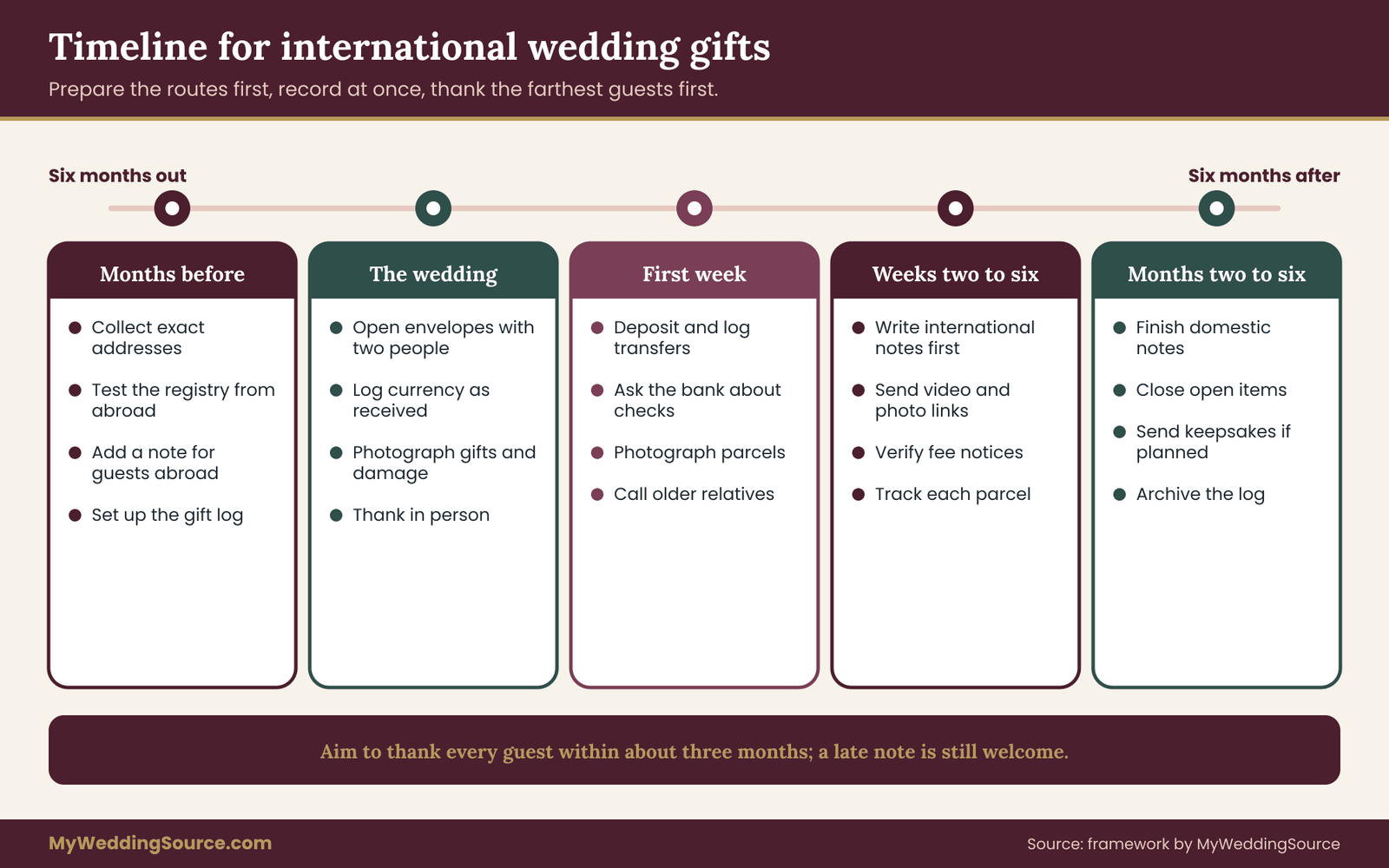
The method is easier to follow with dates attached. The timeline below runs from the months before the wedding to about six months after it. Adjust the spacing for international wedding gifts to your own wedding, since the key point is the order: prepare the routes first, record at once, and send the farthest thank-yous first.
Six to three months before the wedding
Collect accurate addresses. When you gather mailing details for invitations, ask guests abroad for the address exactly as they would write it, including the postal code and the country. Store it in your household address sheet and keep a note of how the person prefers to be addressed. Collect only what you need, and keep the sheet private, as covered in the wedding guest list guide.
Test the registry from outside your country. Walk through checkout as a guest abroad would. Fix what you can, and decide on your second door for guests who cannot use the registry easily.
Write the website note for guests abroad. Keep it short and warm. Say what you would welcome, and say plainly that traveling is already a great gift and that nobody should ship anything bulky.
Set up the gift log for international wedding gifts. Add the international columns: country, form, route, amount received, fees, tracking number, thank-you channel and date sent. Share the file with your partner and, if it fits, with one trusted person.
The month before the wedding
Choose the card box keeper. Name a trusted person who will take the box and the physical gifts away at the end of the night and keep them secure. Give that person a short list of what to do with foreign currency and with unlabelled parcels.
Ask your bank two questions. Does it exchange foreign banknotes, and how does it handle checks drawn on foreign banks? Write down the answers. They save a long wait later.
Decide your thank-you stationery. Order notes and postage early, including international stamps. Weigh a sample note with its envelope so you know the postage before you buy the whole batch.
The wedding weekend
Record international wedding gifts at the point of receipt. When envelopes are opened, record the currency and the amount in that currency, in front of two people. Note who carried which gift for whom. Photograph physical gifts as they are unwrapped, and photograph any damage.
Thank in person. The best thank-you for a guest who traveled is the one you say to their face. A short, warm sentence at the welcome gathering and again at the farewell is worth more than a paragraph later. Then write it down in the log so that you remember what you said.
Keep a short list of “who carried what.” If a friend carried a gift for someone else, write both names. The thank-you will go to the giver, and a second one to the courier.
The first week after
Deposit and record. Deposit what you can. Log each transfer at the amount that arrived. Hold foreign checks until you have talked to your bank.
Check for parcels among your international wedding gifts. Parcels may begin to arrive. Photograph each parcel before opening it, and record any fee. Check the tracking against the guest’s message.
Send the first calls. Phone the older relatives who will not be reading messages. It is a quick call, and it lets the family know that the gift arrived safely.
Weeks two to six
Write the international notes first. A note posted from another country can take several weeks to arrive, so start with those. Write in batches of five or ten, in the language you have chosen for each guest. Send them by a service that suits the rules of the destination and your budget.
Send digital thank-yous. Video messages and photo links can go in this window. Keep a copy of each message in the log.
Handle fee notices carefully. If a notice about a parcel arrives, verify it through the carrier’s official site before acting. Record the outcome.
Months two to three
Finish the domestic notes. With the farthest ones gone, the rest are quick. Aim to have every guest thanked within about three months, a timeframe commonly suggested in etiquette guidance. A late note is still welcome.
Reconcile the log. Every line should have a thank-you date. Any blank line is a guest who has not been thanked. Fix the blanks first.
Resolve any open items. Parcels in dispute, checks still clearing, unmatched gifts. Write one line on each in the log, with the next action and a date.
Months three to six
Send keepsakes and prints, if you plan to. If you decided to send photos or small keepsakes, do it now, after you have checked the destination rules. Digital sharing can happen earlier.
Close the log. Save a final copy with your wedding records. The habits in the guide to wedding records after the event cover how long to keep it and where. Remove addresses you no longer need.
Write down what you learned. Two or three sentences on what worked and what did not. If a friend marries next year, you will have something useful to say.
A note on partners and parents
Many international wedding gifts to a couple come through parents or other relatives, who may have their own idea of how the thank-you should go. If a parent insists on writing to their own friends abroad, agree on it early, and record it in the log. A thank-you written by a parent on your behalf can be warm, but it should not replace a note from you to the giver.
The same goes for a parent who wants to open or deposit a gift for you: agree on who records what, and keep one master log.
A sanity check on effort
It is easy to treat international wedding gifts as a source of constant worry. They are not. A guest abroad sends a gift out of affection, and the main job is to acknowledge it with sincerity. The plan above exists so that the logistics do not get in the way of that. If you keep the log, ask before you pay, verify before you click and write notes that sound like you, most gifts will go through without a hitch, and the few that do not will be handled calmly.
Your next steps
Choose one evening in the next week and do three things. First, make the gift log for international wedding gifts, with columns for country, form, route, amount received, fees, tracking number, thank-you channel and date sent. Second, test your registry the way a guest abroad would, and write a short note for the wedding website that gives overseas guests an easy way to give or to simply celebrate.
Third, ask two relatives, one from each side, what they would want you to know about how to acknowledge gifts from their families.
After that, work through the timeline one stage at a time. Record at the point of receipt, thank the farthest guests first, and keep your thanks personal. By the end, each of your international wedding gifts will have a route, a record line and a thank-you that fits the person who sent it.
FAQ
How do I thank a guest for international wedding gifts if I do not speak their language?
Write a short note in simple English, add one line in their language that a fluent speaker has checked, or write in both languages. Avoid idioms and avoid relying on an automatic translation for the final text. A relative, a friend or a professional can review it. A short, correct note is better than a long, awkward one.
How long do I have to send a thank-you for international wedding gifts?
Etiquette guidance commonly suggests about three months after the wedding, and sooner for gifts that arrive before it. For guests abroad, start earlier, because international mail can take weeks. A late thank-you is still welcome, so do not skip it. Send the farthest notes first and use a short message by another channel if a letter will be slow.
Should I mention the amount of cash among international wedding gifts in the thank-you?
Usually not. Thank the guest for the gift, say what you plan to do with it and add something personal. Naming the amount can feel like accounting, and for a foreign-currency gift it can also expose a fee or a conversion that the guest did not know about. Keep the exact figure in your log instead.
Who pays customs duties on international wedding gifts mailed to me?
It depends on the countries, the service the sender chose and the value and type of the item. Sometimes the sender prepays and sometimes the recipient pays on delivery. Check your customs agency’s current gift rules and the carrier’s notice, and verify any fee request through the carrier’s official site before you pay.
Can I mail food or favors to guests who sent international wedding gifts?
Often not. Food, plants, seeds, alcohol and some other items are restricted or prohibited in many countries, and a parcel can be held or destroyed. Check the destination’s rules through your postal service or carrier before you send anything. A card, a photo or a digital message avoids the problem and is usually just as welcome.
What should I do with a check drawn on a foreign bank?
Ask your bank how it handles it before depositing. It may send the check for collection, which can take weeks and cost a fee. Do not spend the money until the deposit has cleared fully. If a sender asks you to return an overpayment from a check, stop, because that is a known fraud pattern.
How do I handle a delivery notice asking me to pay a fee for a wedding gift?
Do not click the link. Ask the guest to confirm that they sent a parcel and to share the tracking number. Then enter the number directly on the carrier’s own website. If the fee is real and the gift matters to you, pay and record it. If you are unsure, contact the carrier through its published contact details.
Is a video message a proper thank-you for international wedding gifts?
Yes, for a guest who is comfortable with video, and it can be warmer than a card. Keep it short, speak to the person by name and mention the gift. For older relatives or for large gifts, send a handwritten note as well, or call first. Share the video by a method the guest can open easily.
Sources
- Gifts and customs information for travelers and importers, U.S. Customs and Border Protection
- International mail and shipping rates and services, United States Postal Service
- International Mail Manual: country listings, prohibitions and restrictions, United States Postal Service
- Gift tax and reporting information for individuals, Internal Revenue Service
- Sending money abroad and consumer protections, Consumer Financial Protection Bureau
- Scams involving fake checks, overpayments and delivery notices, Federal Trade Commission
- Plant and animal product import restrictions, U.S. Department of Agriculture, Animal and Plant Health Inspection Service
- International travel and entry information, U.S. Department of State
- International shipping and customs guidance, United Parcel Service
- Bringing goods into the United Kingdom, GOV.UK