
Vendor photo sharing is what happens when the people you hired for your wedding want to show your pictures to someone else: other vendors, their followers, a magazine, a competition judge. This guide gives you a plain permission form, a way to handle credit and tags, and the opt-out terms that keep your boundaries intact while still letting good vendors do their work.
Treat vendor photo sharing as a permission you grant in writing, not a default you discover on Instagram. Decide which images, which channels, which names and details, how credit appears, when posting may start, and how you can opt out later. Put those six choices on a one-page form, attach it to the contract, and give every vendor the same version. Credit is a fair thing to offer, and a reasonable vendor will accept clear limits in exchange for a good photo set and a good review.
A florist finishes the arch at six in the morning and takes a photo of it empty. A planner snaps the sweetheart table. The photographer sends a preview of twenty images two days later. By the end of the week, five different businesses have pictures from your wedding, and every one of them has an account, a website or a portfolio that works better with fresh images.
Vendor photo sharing is not sinister. It is ordinary business. The trouble is that it often happens before anyone has said what is acceptable.
This guide is for couples who want to sort that out calmly. Some of you will be asking a vendor to share photos with you or with another vendor, so that the florist can see how her flowers looked in the final frame. Some of you will be answering a vendor who asked to post your wedding.
Both situations call for the same tool: a short written permission with clear terms for credit, scope and opt-out. It also belongs in the same place as your other wedding records, because the signed copy is the thing you will want when a question comes up a year later.
A note on scope. This is general information about how couples and vendors usually handle images, not legal advice. Copyright, privacy and publicity rules differ by state and by contract, and they change, so confirm anything that matters with the vendor’s written terms and, for legal questions, a licensed attorney.
What vendor photo sharing actually covers
People use one phrase for several different things, and mixing them up is how couples end up agreeing to more than they meant to. In practice vendor photo sharing falls into five flows, and each one deserves its own yes or no.
Photographer to other vendors. Your photographer sends images to the florist, the venue, the baker, the stylist or the planner so they can use them. This is the most common request in wedding work, and it is usually a courtesy between professionals.
A vendor to its own audience. The florist, planner or band posts photos on its website, social accounts, newsletter or printed brochure to attract future clients.
A vendor to the wider public. A feature on a wedding blog, a magazine submission, a styled-shoot gallery, an industry award, a directory listing that stays online for years.
A vendor to a partner business. A venue passes your images to a rental company, or a photographer shares a gallery with a second shooter who then keeps a copy.
You to your vendors. You ask a vendor to send you the photos they took, or you tell a photographer you are happy for others to have the images, or you offer credit and a review in return.
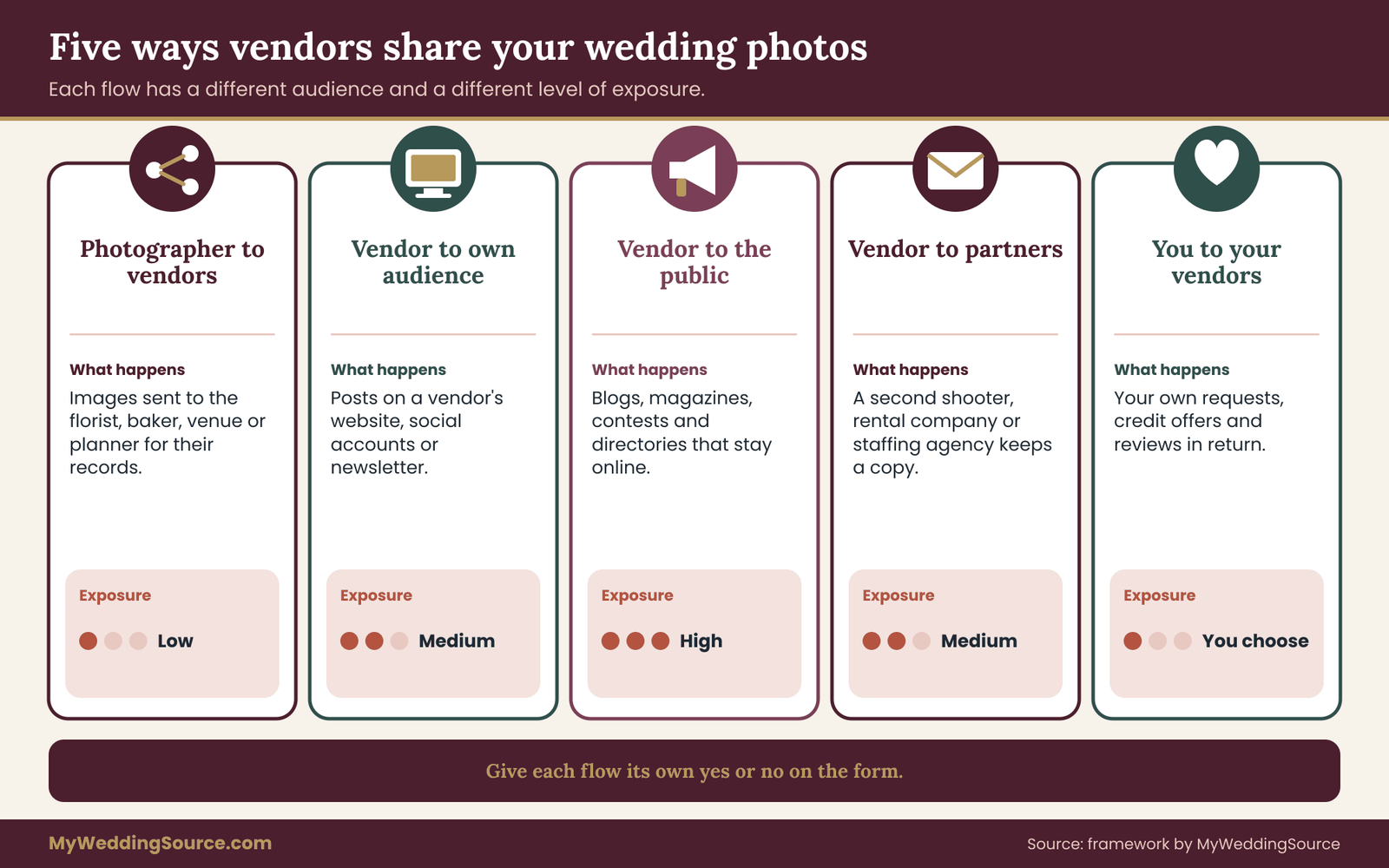
The five flows carry different risks. Sharing with another vendor is a small, contained act between people who already know the details of your day. Posting to the public is a different act altogether, because it attaches your faces, your date and sometimes your venue to a page that search engines and strangers can read. A form that says “images may be shared” without saying who, where and for how long covers all five at once, and that is exactly the sentence worth replacing.
Why the photographer is not the only vendor with pictures
Couples tend to think of the photographer as the person holding the images. In fact nearly everyone on your vendor list takes photos for their own records: a florist photographs arrangements for the order file, a baker records the cake before it leaves the kitchen, a stylist documents a tablescape before guests arrive. Those pictures often show no guests at all, and many couples are happy to have them used.
But they can also include your name on a place card, your monogram, the invitation suite, the venue’s address on a sign. Before you grant or refuse anything, it helps to know that vendor photo sharing starts at the order desk, long before the first guest arrives.
Credit, permission and boundaries are three separate questions
The title of this guide names three things on purpose. Credit is about being named: whether a tag, a link or a caption identifies the vendor who contributed to the picture. Permission is about being allowed: whether a vendor may use the image at all, in which place and for which purpose. Boundaries are about limits: what stays out of any shared image, such as children, house numbers, guest names or private moments.
A vendor can get credit without having permission, and have permission without any boundaries. The rest of this guide treats the three parts of vendor photo sharing separately and then ties them together on one page.
Who owns your wedding photos, and why permission still matters
Most of the confusion about vendor photo sharing comes from one misunderstanding: that because you paid for the photographs, you control every use of them. The reality is usually split in two.
Under U.S. copyright law, the person who takes a photograph is generally the author and holds the copyright, unless the work was made as part of an employee’s job or the rights were transferred in a signed writing. The U.S. Copyright Office explains this in its basic guidance, and its pages on transfers describe the writing requirement.
For a wedding, that means a freelance photographer usually owns the copyright in your images even though you paid for the session. What you receive is typically a license, often called a print release or personal-use license, that lets you print the images, share them with family and post them on your own accounts.
That license usually does not give you the right to hand the files to a third party for that party’s business use, and it does not take the photographer’s own marketing rights away. Many photography contracts include a sentence along the lines of “photographer may use images for portfolio and promotion.” If that sentence is in your signed agreement, you have already agreed to some vendor photo sharing without a form.
Reading it is the first step. The vendor contract guide on this site explains how to read a vendor agreement clause by clause, and the image-use sentence is one to find before you sign, not after.
The part that is still yours: your likeness and your details
Copyright covers the picture as a creative work. It does not decide whether your face, your name and your wedding date appear in a promotional post. Rules on commercial use of a person’s likeness vary by state, and the practical lever for couples is not a lawsuit but the contract: you can limit what the vendor may do with your image and your information by agreeing to terms in writing.
That is why the form in this guide focuses on terms rather than on ownership. A photographer can keep the copyright and still agree not to post anything that shows your child or names your venue.
What a vendor can reasonably ask for
Vendors who ask to share images are usually asking for one of three things. They want portfolio rights, meaning the right to show your wedding to prospective clients. They want publication rights, meaning permission to submit images to a blog, magazine or contest. Or they want a social post with a tag. Each of these has a legitimate business purpose, and a reasonable couple can say yes to some and no to others.
The better question than “should we allow this?” is “which of these do we want to allow, under what terms?” The vendor photo sharing form in the next sections is built around that question.
Why couples care about vendor photo sharing
If images are going to be shared anyway, why write terms at all? Because the reasons couples care are specific, and a generic “may use images” does not protect any of them.
Privacy of people who are not you. Your guests did not sign a contract. A vendor post that shows a guest’s face next to your venue and date can reach people the guest has chosen to avoid. The wedding photography consent guide covers how to plan guest boundaries and image use at the event itself; the vendor photo sharing form here handles what vendors do afterward.
Children. Many families have a rule about posting children publicly. A vendor does not know your rule unless you write it down.
Location and timing. Posting a wedding photo with the venue tagged while the couple is on a honeymoon says a house may be empty. Posting before you have shared the news with grandparents, or before an announcement, can spoil something that mattered to you. A delay clause costs the vendor nothing and solves both problems.
Your own plans for the images. Some couples want to submit their wedding to a publication or sell a feature. Exclusivity matters then, and a vendor who has already posted everything may have spoiled it.
Consistency. If one vendor posts your wedding and another does not, the story that appears online is partial and accidental. A single agreed rule is easier for you to remember and easier for vendors to follow.
None of these reasons requires suspicion, only a clear approach to vendor photo sharing. They require sentences on a page, written before the images exist, so that nobody has to renegotiate while a picture is already live.
The credit question in vendor photo sharing
Credit is where goodwill is easiest to win or lose. For a small wedding business, a named tag on a good photograph is a form of payment. A florist who spent four hours on a ceremony installation gets very little from a post that says “beautiful wedding” with no name attached, and she will notice. At the same time, a couple who has asked for privacy should not be pressured to accept a public tag because it is “the industry norm.”
The practical way through vendor photo sharing is to separate credit from exposure. Credit can be given in ways that do not expose you: a vendor list in a private gallery, a line on the photographer’s website that names vendors without naming you, a credit in a post that shows only an empty arch. Exposure, meaning your names, faces, date and venue, is a separate setting you control.
Three levels of credit you can offer
Think of credit as a ladder with three rungs, and decide how high you are willing to go.
Quiet credit. The vendor is named in a private or limited context. You send the photographer a vendor list so that each business is credited properly when the photographer shares or publishes anything. Nothing about you is public.
Business credit. The vendor may tag or name their own business in any post they make, and you may tag them in yours. Your names stay out of the caption unless you agree.
Open credit. Everyone may tag everyone, including your names and the venue. This is the most generous setting, and it is also the one that is hardest to take back, because tagged posts are copied and linked by other people.
Most couples are comfortable with the middle rung for most vendors. The point of naming the rungs is to let you answer a vendor with a specific sentence instead of a vague yes.

What credit is worth to the vendor, and what it is not
It helps to be fair about the trade. Credit gives a vendor visibility, but visibility is not a payment you owe. If your contract does not mention image use, the vendor has no right to your photos and you owe no credit beyond a thank-you.
If the contract offers a discount in exchange for posting rights, then credit is part of the bargain, and you should honor it as written. Where credit and money are mixed together, the topic of disclosure arises, and that is covered later in this guide.
Be careful about the opposite error as well. A vendor who posts your wedding without asking and then says “we gave you credit” has not made the post acceptable. Credit does not replace permission. A tag does not turn an unapproved post into an approved one.
The request couples make most often is the simplest: “Could you send some of the images to our florist and our baker?” Photographers hear it all the time, and a clear request gets a quick answer. A vague one turns into three weeks of emails.
Start by deciding why you want the other vendors to have photos. There are four ordinary reasons. You want to thank them. You want them to see the finished work, which helps them and often earns you a warmer response next time you call.
You want them to include you in their portfolio. Or you simply want them to have a record for their order file. The reason shapes the request. A thank-you gift of three images is a different ask from a request for full gallery access.
What to ask for, in order of how much you are asking
Ask for the smallest thing that meets your purpose. A short list helps.
- A few detail photos of that vendor’s own work, such as the bouquet, the cake or the tables.
- A short set of edited preview images chosen by the photographer, sent as a private download link.
- Images that include the vendor’s work in context, such as the ceremony arch with guests seated.
- Full-resolution files for the vendor’s own marketing.
Each step up gives the vendor more and gives you less control, so move up only when you have a reason. Full-resolution files for marketing is a request the photographer may price separately, because it effectively licenses the images to another business.
A script for the request
You do not need to write an essay. A short message that names the images, the purpose and the limits is enough.
“We would love to thank our florist and baker with a few photos of their work. Could you send them three to five detail images each, for their records and their own portfolio, with your credit attached? Please leave out any guest faces and anything that shows names or the venue address.”
That message does five things. It names the vendors. It names the number of images. It states the purpose. It promises the photographer credit, which is the thing the photographer cares about. And it sets two boundaries at once. A professional will usually reply with a yes and a small adjustment, such as sending images through a gallery link rather than as attachments.
Photographer credit is not optional
If the photographer’s name is not attached when another vendor posts the picture, expect friction. Most photographers include credit expectations in their terms: vendors who use the images must credit the photographer by name or handle. When you pass images along, pass that expectation along too.
A good habit is to include a line in your thank-you message to the other vendor that says “please credit the photographer as shown in the file name or gallery.” It protects the photographer, and it protects your relationship with both.
Timing and delivery
Ask when the photographer expects to send images to other vendors. Many photographers wait until the full gallery is delivered, others send a quick preview within days. If you have a reason to hold back, such as a delayed announcement, say so before the wedding, not after the photographs are already circulating. A line such as “please hold images from other vendors until we confirm in writing” is clear, and it is fair, because it gives the photographer a specific instruction rather than a feeling.
What vendors may ask you in return
Sharing goes both ways. A florist who receives a photo may want to post it, and she will probably ask you whether that is all right. A planner may ask for a review. A band may ask for a clip from the dance floor. These requests are usually friendly, and they are an opportunity to apply your vendor photo sharing form rather than answer from memory.
Keep your answers consistent. If you tell one vendor “yes, tag us” and another “please do not post anything,” you will forget which is which within a month. A single vendor photo sharing policy, applied to every vendor, is far easier to maintain than a series of favors. The sections that follow show how to turn that policy into one page that every vendor sees in the same words.
Reviews and vendor photo sharing are different requests
Vendors often ask for a review and a photo in the same breath. Keep them apart. A review is your honest opinion, written in your words. A photo release is a permission. Agreeing to one does not commit you to the other, and a vendor who offers a discount for a review should say so plainly.
Reviews written in exchange for a benefit raise a disclosure question that the Federal Trade Commission addresses in its endorsement guidance, and that question appears again later in this guide. For now, the rule is simple: answer the photo question and the review question separately, and in writing.
Interview questions that reveal a vendor’s approach to vendor photo sharing
You can learn a great deal about a vendor’s habits before you sign anything. The topic of vendor photo sharing comes up naturally in an interview if you ask it as an ordinary business question rather than a challenge. Five questions are enough, and none of them takes more than a minute to answer.
First, “Do you post your clients’ weddings, and how do you decide which ones?” A vendor who has a routine, such as posting only with permission, will describe it. One who says “we post everything” has told you the default. Second, “Do you share images with other vendors, and who sends them?” This reveals whether the photographer or each vendor handles it. Third, “How do you credit the other businesses on a wedding?” Good vendors have a habit here, and it tells you how they treat colleagues.
Fourth, “What do you do when a client asks you to remove something?” The best answer is specific and quick. Fifth, “Can we add a one-page image addendum to your contract?” A professional will say yes or ask to see it.
Write down the answers in the same notes where you keep prices and dates. When you compare vendors later, the photo answers belong in the comparison alongside price and availability. A vendor who is relaxed and precise about vendor photo sharing is usually relaxed and precise about the rest of the job.
A short rule for deciding between two close vendors
If two vendors are close on price and style, let the image terms break the tie. Choose the one whose standard terms already match your defaults, or who agreed to your addendum without argument. Terms you would have to fight for before the wedding are terms you may have to fight for after it, when the stakes are higher and your leverage is lower.
This is a modest rule, and it works because the cost of a clear answer to a simple question is nearly zero.
A vendor photo sharing permission form, field by field
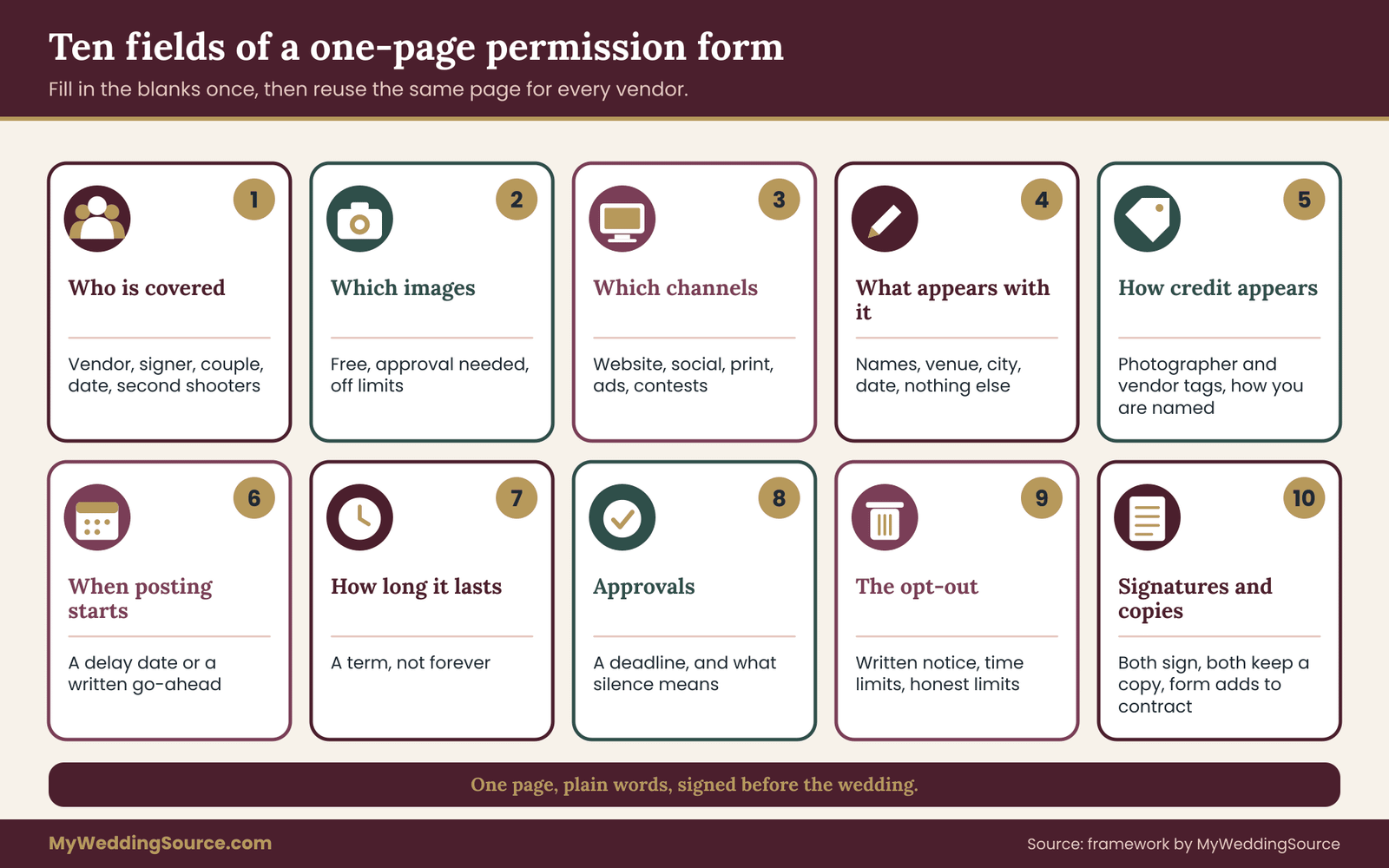
This is the core of the guide. A permission form for vendor photo sharing does not need to be long or legal-sounding. One page is enough if it answers ten questions in plain words. The questions are the same for every vendor, which is the point: you fill in the blanks once, adjust a line or two for each vendor, and keep a copy of every signed version in the same folder.
The ten fields below move from the broad to the specific. Read them in order the first time. After that, the vendor photo sharing form works as a checklist you can hand to a vendor, or attach to the contract as an addendum.
Field one: who is covered
Name the vendor business and the person who signs for it, and name yourselves. Add the wedding date and the contract it relates to. This looks like a formality, but it prevents a common problem: a permission given to “the photographer” that is later claimed by a second shooter, an assistant or a partner business that never signed anything. If a second shooter takes images, the vendor photo sharing form should say whether their images are covered by the same terms.
Field two: which images
Say which images the permission covers. The most useful wording is a three-way split. Some images may be shared freely, such as empty-room details and decor. Some may be shared only after you approve them, such as portraits of you both. And some are off limits, such as images that show children, guests who asked for privacy, or private moments like getting ready. A photographer who knows the list in advance can mark those frames in the gallery and avoid the question later.
Field three: which channels for vendor photo sharing
List the places the vendor may use the images, and tick only the ones you accept. Common channels are the vendor’s website, the vendor’s social accounts, a printed portfolio, an email newsletter, a blog or magazine submission, a contest entry, a paid advertisement, and a third-party directory. Paid advertising deserves its own line, because a photo that appears in an ad is used differently from a photo in a portfolio. Many couples accept portfolio and social use and refuse paid advertising.
Field four: what may appear with the image
Decide what information may be attached. Your first names, last names, the venue, the city, the date, the guest count, the budget and the names of family members are all separate choices. A caption that says “A garden wedding in early June” shares a lot less than one that gives your full names and the address. Write the allowed details as a short list, and say “nothing else” so that the default is silence.
Field five: how credit appears
State how the vendor and any other credited businesses are named. For the photographer, this is usually a name or handle on every use. For other vendors, it can be a business tag or a list. This is where you set the credit ladder from the previous section: quiet, business or open. Also state whether you may be tagged, and whether you may untag yourselves.
Field six: when posting may start
Add a posting date, or a trigger. Some couples say “no public posting until thirty days after the wedding.” Others say “after we confirm in writing that our announcements are done.” A delay protects honeymoon privacy, family announcements and any plans for a publication. It also gives you time to review the gallery before the vendor chooses favorites.
Field seven: how long the permission lasts
Open-ended permission is the hardest to manage. Set a term, such as two years for social posts and until you ask for portfolio images, or choose “until withdrawn in writing.” The vendor photo sharing form should say whether posts already published stay up after the term ends, and whether the vendor will remove them on request. Vendors often agree to stop new use but not to delete everything already printed, and that is a reasonable line to hold.
Field eight: approvals
If you want to approve images before they go public, say how. A workable rule is that the vendor sends a private link with the proposed images, you reply within five business days, and silence means the vendor may proceed with the images already marked free. Without a deadline, approval requests stall; without a default, they can block the vendor forever. A fair deadline protects both sides.
Field nine: the opt-out
Every form needs a clear way out. State that you may withdraw any permission at any time by written message to a named address, that the vendor will stop new use within a stated number of days, and that the vendor will remove images from channels it controls within a stated period. The next section explains opt-out terms in detail, because a vague opt-out is the most frequent weakness in forms of this kind.
Field ten: signatures and copies
Both sides sign and date, and each keeps a copy. Add a line that this vendor photo sharing form adds to the contract and does not replace it. Where the contract and the vendor photo sharing form disagree, say which one wins. Couples who keep a good paper trail will want to file the signed form with the vendor’s contract.
The guide to organizing wedding records shows where permissions fit in a post-wedding archive, and it explains why the signed version, not the draft, is the one to keep.
A worked pass through the form
Abstract fields are easier to judge with a concrete case. Suppose a couple, whom we will call Dana and Marcus, are marrying in a garden and have hired a photographer, a florist and a cake baker. They are happy to be comfortable with vendor photo sharing for decor images, but they have a nephew who should not appear online and a venue they would rather not name.
On the vendor photo sharing form for the florist, Dana ticks “empty-room decor images” under free use, leaves portraits unticked, and lists the florist’s website and social account as channels. Under details she allows “first names only, no venue, no city.” Credit is business-level: the florist may tag the photographer, and the photographer’s name must appear.
Posting starts thirty days after the wedding. The term is two years, and the opt-out is a written message to the address listed. For the photographer she keeps the same structure but adds an approval step for any portrait, and she writes in that the nephew’s images are not to be shared at all.
Notice what happened. The two forms are nearly identical, so Dana can fill the second in ten minutes. The differences are the ones that matter: the photographer holds portraits, the florist holds decor. Everything is on one page, in plain words, signed before the wedding.
Writing the vendor photo sharing form in your own words
Couples sometimes worry they need a lawyer to draft this. For a vendor photo sharing form that sits next to a contract, plain language usually works better than legal language, because both sides understand it and will follow it. A few habits keep it clear.
Use short sentences with a single subject. “The vendor may post images marked free” is better than a clause that stacks three conditions. Say “must” and “may” deliberately: “must” for what the vendor is required to do, “may” for what is allowed. Put numbers in for days and months rather than words like “promptly.” And avoid words like “reasonable efforts” where a date would do.
If your vendor sends its own release, you can still use your vendor photo sharing form. Hand it over with a note: “Here is our one-page addendum for image use. Please sign it alongside your agreement.” Vendors who value repeat business and good reviews tend to agree, particularly when the addendum is short and specific.
If a vendor refuses any limits at all, you have learned something about how they treat clients, and the vendor due diligence checklist is a good place to weigh that against everything else you know about them.
What to do when a vendor wants its own form
Some vendors will not sign yours because their contract already contains an image clause. In that case, edit theirs rather than replacing it. Strike the broad wording, write your limits in the margin, and have both sides initial the change. A tracked edit or an initialed line is as good as a new form. The goal is the same either way: the final signed document says in plain words what may be shared, where, and for how long.
Opt-out terms that actually work for vendor photo sharing
An opt-out is the part of the vendor photo sharing form people skim and later wish they had read. A sentence such as “client may request removal at any time” sounds generous, but it leaves every important question open: how to ask, how fast the vendor must act, what removal covers, and what cannot be undone. Good opt-out terms answer those four questions in advance.
Four questions every opt-out should answer
How do we ask? Name the channel. A written message to a stated email or portal is better than a phone call, because a message leaves a record. Write the address on the vendor photo sharing form itself. You do not need to repeat it in the article, and it should be one the vendor monitors, not a general inbox that nobody reads.
How fast must the vendor act? Pick a number of days for stopping new use and a separate number for removal. New use can stop immediately or within a few days, since the vendor simply does not post again. Removal takes longer, especially if the vendor has to find images on several accounts, so a longer window, perhaps two weeks, is fair.
What does removal cover? List the places the vendor controls: its website, its social accounts, its portfolio, and any gallery or blog it manages. Tagged posts on other people’s accounts are outside the vendor’s control, and the vendor photo sharing form should say the vendor will make a reasonable request to those accounts rather than promise something it cannot deliver.
What cannot be undone? Be honest about limits. Printed brochures that have already been distributed cannot be recalled. Images that a magazine has published stay published. A form that admits this up front is more credible than one that pretends everything can be erased, and it spares both sides a fight later.

Opt-out versus opt-in in vendor photo sharing
Many contracts use an opt-out structure: the vendor may share unless you object. A better structure for couples who care about privacy is opt-in: the vendor may share only what you have approved. The difference is the default. Under opt-out, silence means yes. Under opt-in, silence means no.
You can combine the two. Make the free-use list opt-out, because those images are low risk and you want to keep the vendor happy. Make everything else opt-in. That way a vendor can post an empty-room photo of the arch without waiting for you, but cannot post a close portrait of you both without an approval. It is a reasonable compromise that rarely meets resistance.
The three lines of an opt-out clause
You do not need pages. Three lines carry most of the weight, and you can adapt them to your own wording.
“The client may withdraw permission at any time by written notice to the address on this vendor photo sharing form. The vendor will stop new use within five days. The vendor will remove images from channels it controls within fourteen days, except printed material already distributed.”
That example contains a channel, two time limits and an honest exception. It is short enough that a vendor can read it in half a minute and sign without calling a lawyer. If a vendor wants a longer notice period, negotiate a number rather than abandoning the clause.
What to do if you change your mind later
Couples change their minds for ordinary reasons: a family dispute, a job change, a new rule about children, a stalker, a divorce. Use the opt-out in the same plain tone you would use for any other request. Send a short written message that names the images or the posts, cites the form, and sets the date you want the removal to finish.
You rarely need to give a reason, and you do not owe a vendor an explanation of private circumstances. If safety is the reason, say so briefly, and expect most vendors to move quickly.
“Under the vendor photo sharing permission we signed, we are withdrawing consent for the posts listed below. Please remove them from your site and social accounts within fourteen days and confirm by reply.”
Keep the confirmation. It belongs in the same folder as the signed form, and the records guide explains how to store it alongside the rest of your post-wedding paperwork.
Attribution wording that protects everyone
Attribution is a short phrase that carries a lot of weight, because it decides how people find the vendors and how they find you. Poor attribution wording creates two kinds of trouble: vendors who feel unrecognized, and couples who find their names in places they did not intend. The fix is to write the exact wording you accept.
Attribution for the photographer
A photographer’s standard request is “Photography by” followed by a business name or handle. Accept it, and write it into the vendor photo sharing form so that every vendor who uses the image carries the same credit. If the photographer asks that credit stay attached to every share, write that in as well. This is simple and fair, and it addresses the most common complaint photographers have about vendor photo sharing: images that travel without their name.
Attribution for other vendors
For florists, bakers, planners and stylists, the usual form is a tag or a short list: “Flowers by … Cake by …” Offer to tag them on your own posts only if you are comfortable with it, and tell them which accounts to use. Do not promise a tag on a platform where you do not have an account.
And remember that accepting a vendor’s tag in your own post, or reposting a vendor’s image, is a separate act: your repost is your own use, governed by your license, not the vendor’s.
Attribution for you
State how you are named. Options include “a recent wedding,” first names only, initials, or full names. Whichever you choose, say it in the form, and add whether the vendor may tag your accounts. Tagging connects a post to your profile and often notifies your followers, so it is a bigger step than naming. Many couples allow first names and refuse tags. Some platforms let you review tags before they appear on your profile, and the help pages of the platforms you use explain how.
Wording to avoid
A few phrases create more problems than they solve. “For promotional purposes” is broad enough to include advertising. “In perpetuity” attaches no end date to the permission. “Any media now known or later developed” covers uses nobody can predict. If a vendor’s text contains these, ask for narrower wording: name the channels, set a term, and list the media. Specific words give you control. Vague words give it away.
A checklist you can read in two minutes
Before signing any permission, run through these questions out loud, with your partner. Which images, exactly? Which channels, exactly? What details may appear next to them? How is each business credited, and how are we named? When can posting start? How long does the permission last?
Who approves what, and by when? How do we opt out, and how fast must the vendor act? Where is the signed copy? If any answer is “we are not sure,” the vendor photo sharing form is not ready. Fill that blank first.
This habit sounds simple, and it is. The value of a short written permission is not the paper. It is that two or three conversations, held calmly before the wedding, replace a stressful conversation held after a picture is already public.
Reading a vendor’s existing image clause
Before you write anything new, find what the vendor has already written. Most contracts contain one or two sentences about images, and those sentences set the starting point for any vendor photo sharing conversation. Read them slowly, once for meaning and once for what is missing.
Look first for the grant. Does the clause say the vendor “may” use images, or that it “owns” them? Does it name the purposes, such as portfolio, website and social media, or does it say “any purpose”? Next, look for limits. Is there a time limit, a list of channels, a requirement to credit, a way to withdraw?
Then look for the exceptions: a clause that excludes minors, or one that requires the vendor to ask before using an image with names. Finally, look for what the clause does not say. Silence on timing, on removal and on third parties is where most disagreements begin.
Marking up the clause
A plain approach works well. Print or copy the clause. Underline every phrase that is broad: “any,” “all,” “perpetual,” “irrevocable,” “worldwide.” Beside each underlined phrase, write the narrower version you would accept. Then bring those edits to the vendor as a short list rather than a rewrite.
Most vendors respond better to “could we change these four phrases” than to a counter-contract. If the vendor declines every change, you have a clear picture of how much room there is, and you can decide whether the price and the work are worth it.
Boundaries: guests, children, venues and private moments
A permission form for vendor photo sharing handles what you can control: your own images and your own contracts. The harder boundaries involve people who are not parties to the contract. Guests, children, relatives and the venue each need a different approach, and a good vendor photo sharing policy deals with them directly instead of hoping the photographer will guess.
Guests who asked not to appear
Some guests tell you in advance that they do not want to appear online. The reasons vary and you do not need to ask. What you need is a way to carry that instruction from your guest to the vendor. A simple approach is a short list given to the photographer before the day: names, and where possible a description or a seating location, with the instruction “do not share images showing these people.” The photographer can then mark those frames in the gallery.
The same list should reach any other vendor who photographs the event. The consent guide explains how to collect and record such requests, and this guide picks up where it leaves off: once the gallery exists, what may a vendor do with it.
Be realistic about how well this works. A photographer shooting hundreds of frames in low light will not catch every background guest. Ask for a best effort, state the instruction plainly, and ask that any image a vendor is unsure about be left out. A form that says “when in doubt, leave it out” gives the vendor a simple rule that does not depend on perfect identification.
Children
Children are the boundary couples most often want to draw firmly. Some families allow no public images of minors; others allow them without faces or names. Decide your rule, write it into the form, and tell the vendors in the same words. A clean rule is “no identifiable images of anyone under eighteen in any public channel without the parent’s written approval.” If you are the parent of a child in your own wedding party, the rule is yours to waive.
If the child belongs to a guest, the approval has to come from that guest, and a vendor cannot assume it.
This matters more for vendors who will post to public accounts than for a photographer delivering a private gallery. Sharing a family portrait with a grandmother in a private link is not the same as a public post. When you read your vendor’s standard terms, look for any wording that gives the vendor blanket rights to images of minors, and strike it.
The venue and the address
Venues sometimes have their own image terms. A venue may keep a portfolio, may require credit when its name appears, or may prohibit certain commercial photography on its grounds. The venue guide explains how to read venue policies, and image rules are one of the items worth asking about during the tour.
If your contract with the venue allows it to post, you can still add a line to your vendor photo sharing form that no post may identify the street address or give directions. Naming the venue and publishing its address are different levels of exposure.
Timing matters here as well. If the wedding happens at a private home or a small estate, a location tag combined with a date tells viewers where you are and when. For couples who want to keep a private residence private, the safest wording is “no location tags and no address.”
Private moments
Getting ready, the first look, vows said quietly, a parent’s tears, an elderly relative being helped to a seat. Some of these moments belong to the couple alone, even when they have been photographed. A photographer may find them beautiful and want to include them in a portfolio.
It is fair for you to say no, and it is fair for the photographer to ask. A short list of “private moments” on the form, with the words “not to be shared without our approval,” keeps the conversation specific.
When sharing is part of the price: discounts, trades and disclosure
Some vendors offer a lower price in exchange for image rights, a review or a tagged post. These offers are common, and they can be a fair deal. They also change what vendor photo sharing means, because the sharing is no longer a courtesy. It is part of the payment.
Read the trade as a contract term
If a vendor offers a discount for the right to post your wedding, put the trade in writing. State the discount, the rights you are granting and the channels. Say what happens if you opt out later: does the discount stay, shrink or reverse? A vendor who gives a discount and then loses the right to post has a legitimate question to ask, and it is better answered in advance than argued afterward.
A fair clause might say the discount is for portfolio use only, and that withdrawing social-media permission does not change the price.
Disclosure when you post or review
If you receive a discount, a free product or any benefit in return for a post or review, the Federal Trade Commission’s endorsement guidance says that a connection between you and the business that would not be obvious to readers should be disclosed. The FTC publishes plain-language material on this for people who post online, and its guides say the disclosure should be clear and placed where readers will see it.
This matters to couples because a post that says “so grateful to our florist” reads differently once readers know the florist gave a discount for it.
For a couple, the practical rule is simple. If you were paid, discounted or given something of value to post or review, say so in the post. If you were not, you have nothing to disclose. Vendors have their own obligations when they post testimonials and endorsements, and the same agency’s guidance applies to them. A vendor who asks you to hide a connection is asking you to do something the agency’s guidance advises against, and you can decline.

Review swaps and pressure
A related situation is the vendor who ties the final gallery or the final payment to a review. A condition like that makes your review less honest and puts you in an awkward position. If you notice it in the contract, strike it. Reviews should be voluntary, and a photo release should not depend on whether you praise the vendor. A request such as “we would be grateful for a review if you are happy” is fine. A requirement is not.
Second shooters, assistants and partner businesses in vendor photo sharing
A frequent gap in vendor photo sharing is the person who is not named in your contract. A second shooter often has their own portfolio rights. An assistant may photograph on a phone. A venue may hire an outside videographer. A caterer may share your event with a rental company or a staffing agency. Each of these people has access to images and each could share them.
Ask one simple question: “Does anyone besides you receive images from our wedding?” If the answer is yes, ask for the names or types of business, and ask that your vendor photo sharing form bind them too. A well-written clause says “the vendor is responsible for ensuring that anyone it shares images with follows these terms.” That sentence puts the burden on the person you hired, who is in a position to manage it, instead of on you.
Stock, licensing and resale
Occasionally a contract allows a vendor to license images to third parties, such as stock agencies or advertisers. This is unusual for weddings but it does occur, particularly with styled sessions. Your form should say that no image may be sold or licensed to a third party without your written approval. If a vendor insists on stock rights, treat it as a price conversation: you are being asked to grant something of commercial value, and you can ask for payment or decline.
Video
Everything above applies to video, and video carries a few extra risks. Sound captures names, vows and private conversations. A clip posted online can be copied and shared in ways that a still photo rarely is. Add the word “video” to every field of your vendor photo sharing form, and consider a separate line for audio. Many couples allow a short highlight clip with music but not the full ceremony with vows, which they prefer to keep private.
A full worked example of vendor photo sharing
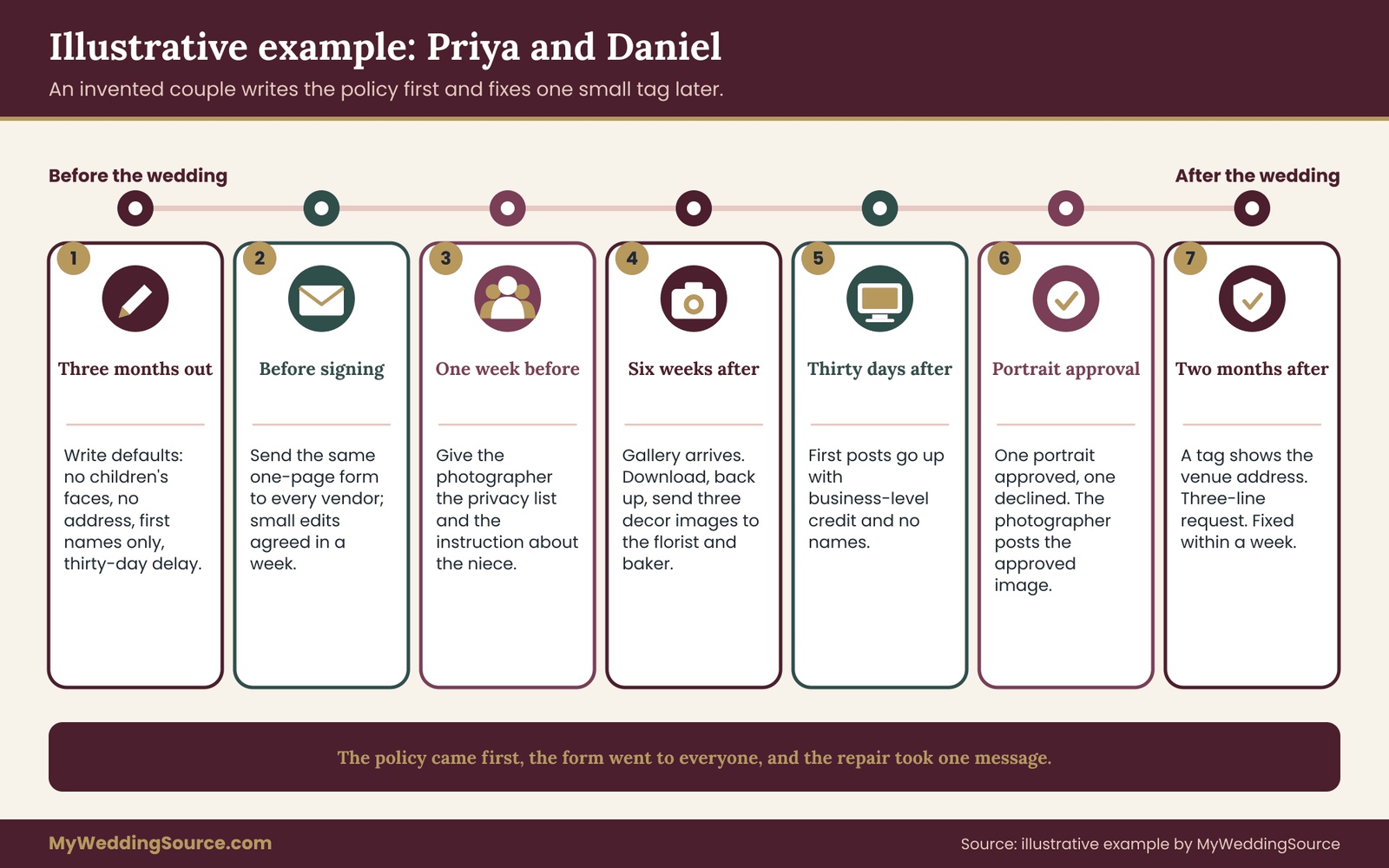
Here is an invented couple, Priya and Daniel, to show how the pieces fit together over a single wedding. They are not real people, and the numbers are made up to keep the example simple. The point is the order of events, not the details.
Priya and Daniel are marrying in October at a mid-sized venue, with a photographer, a florist, a baker and a planner. They have a niece in the wedding party and an aunt who has asked not to appear online. Three months before the wedding, they sit down for an evening and write their policy on one page.
Step one: they decide their defaults. No children’s faces in public channels. No street address. First names only. Posting may start thirty days after the wedding. Paid advertising is not allowed. Portfolio and social use are allowed for the photographer and the florist. The baker and planner may post decor and cake images only.
Step two: they build the form. They fill in the ten fields from earlier, using the same text for every vendor. They add a line that images of the niece and the aunt are never shared publicly. They write their opt-out in three lines.
Step three: they send it before signing. Each vendor receives the vendor photo sharing form with the contract. The florist signs it as is. The baker asks to add a sentence about cake design credit and Priya agrees. The photographer asks to keep the right to submit to a magazine and Daniel allows it with an approval step.
The planner sends back a version with “perpetuity” in it, and Priya replaces the word with a two-year term. The whole exchange takes about a week of ordinary emails.
Step four: they pass the privacy list. One week before the wedding, they send the photographer a short list of guests who should not be shared and the instruction about the niece. The photographer marks the frames during editing.
Step five: the gallery arrives. Six weeks after the wedding, the final gallery is delivered. Priya and Daniel download it, back it up, and send the photographer a note naming three decor images that the florist and baker may use, with the photographer’s credit attached.
Step six: the first post. Thirty days after the wedding, the florist posts an image of the ceremony arch with business-level credit and no names. The planner posts nothing, as agreed. The photographer sends a portrait for approval, they say yes to one and no to another, and the photographer posts the approved image.
Step seven: a small repair. Two months later, a vendor tags Priya’s account on a post that shows the venue’s address. Priya sends the three-line request from the form, the vendor removes the tag within a week, and nobody is upset. The vendor photo sharing form did its job: it turned an uncomfortable surprise into a quick, polite correction.
What the example shows about vendor photo sharing
Three features make this work. The policy is written before the wedding, when everyone is friendly and nothing has happened yet. The same one-page form goes to every vendor, so nobody feels singled out and the couple can remember the rules. And the opt-out is specific, so that when something goes wrong, the fix is a reply rather than an argument. None of these steps depends on anyone’s temperament. They depend on writing things down.
Verifying vendor photo sharing terms with vendors and official sources
A form is only as useful as the facts behind it. Before you rely on any statement in this guide, or any statement a vendor makes about image rights, verify it from the primary source. The order below is a reasonable way to do it.
Start with the vendor’s own written terms. Read the contract, the website terms, the questionnaire and any release the vendor sent. What the vendor has actually agreed to is on the page, not in the sales call. If the sales call promised something that the paper does not say, ask for the paper to be changed.
Ask the vendor to confirm the practical details. Which accounts do they post on? Do they share with any partner? How long do they keep galleries? Do they use a scheduling tool that posts automatically? A vendor who answers specifically is easier to trust than one who answers in general terms.
Check the federal sources for the legal background. The U.S. Copyright Office publishes plain explanations of who owns a photograph and how rights are transferred. The Federal Trade Commission publishes guidance on endorsements, reviews and disclosures. These are the issuing agencies for those topics, and their current pages are the right place to confirm any rule. Rules on the use of a person’s name and likeness for commercial purposes are state law, so search for your state’s rules or ask a licensed attorney.
Check the platform’s own rules. Each social platform has its own settings for tagging, mentions and removal requests. They change often. Open the help pages for the platforms you use and note how to review tags, how to report an image and how to request removal. A vendor’s compliance with your opt-out is easier when you know how the platform handles takedowns.
Check professional norms when in doubt. Professional photography associations publish sample contracts and copyright education for their members, which helps you understand what a photographer expects. Treat these as background, not as your own contract.
What not to rely on
Do not rely on a vendor’s memory of what was said, on a forum post about “how it always works,” or on a statement that a clause is “standard.” Standard is not a legal category. If a rule affects you, ask where it is written. And do not treat this guide as a substitute for a licensed adviser if a real dispute arises: a letter from an attorney is a different tool from a polite reminder, and you should know which one you need.
When a vendor posts without asking
Despite good forms, it will sometimes happen. A vendor posts a portrait you did not approve, tags your account, or includes your venue. A calm, specific response works better than an angry one and resolves most situations in a day or two.
A four-step repair
Capture the post. Take a screenshot with the date and the account name visible, and save the link. If the post disappears later, you will still know what it showed.
Check your paperwork. Open the signed form. Did the vendor break a term, or did you actually allow it? If the vendor photo sharing form permits the post, you have no complaint, and the better move is to ask politely for a change. If the vendor photo sharing form forbids it, you have a clear basis for the request.
Send a short written request. Name the post, name the term, and ask for a specific action by a specific date. Keep the tone neutral, and keep it short.
“Thank you for sharing our photos. The post linked below shows our venue’s address, which our vendor photo sharing permission asked you to leave out. Could you edit the caption or remove the post by Friday and let us know when it is done?”
Escalate only if needed. If the vendor does not respond, send a second message and then use the platform’s reporting tool for privacy or image concerns. If the post involves a child’s safety or personal information that puts someone at risk, act quickly and do not wait for a reply. For a persistent breach of a signed contract, consider whether a licensed attorney’s letter is warranted. Most vendors, who depend on reviews and referrals, will fix the matter after the first message.
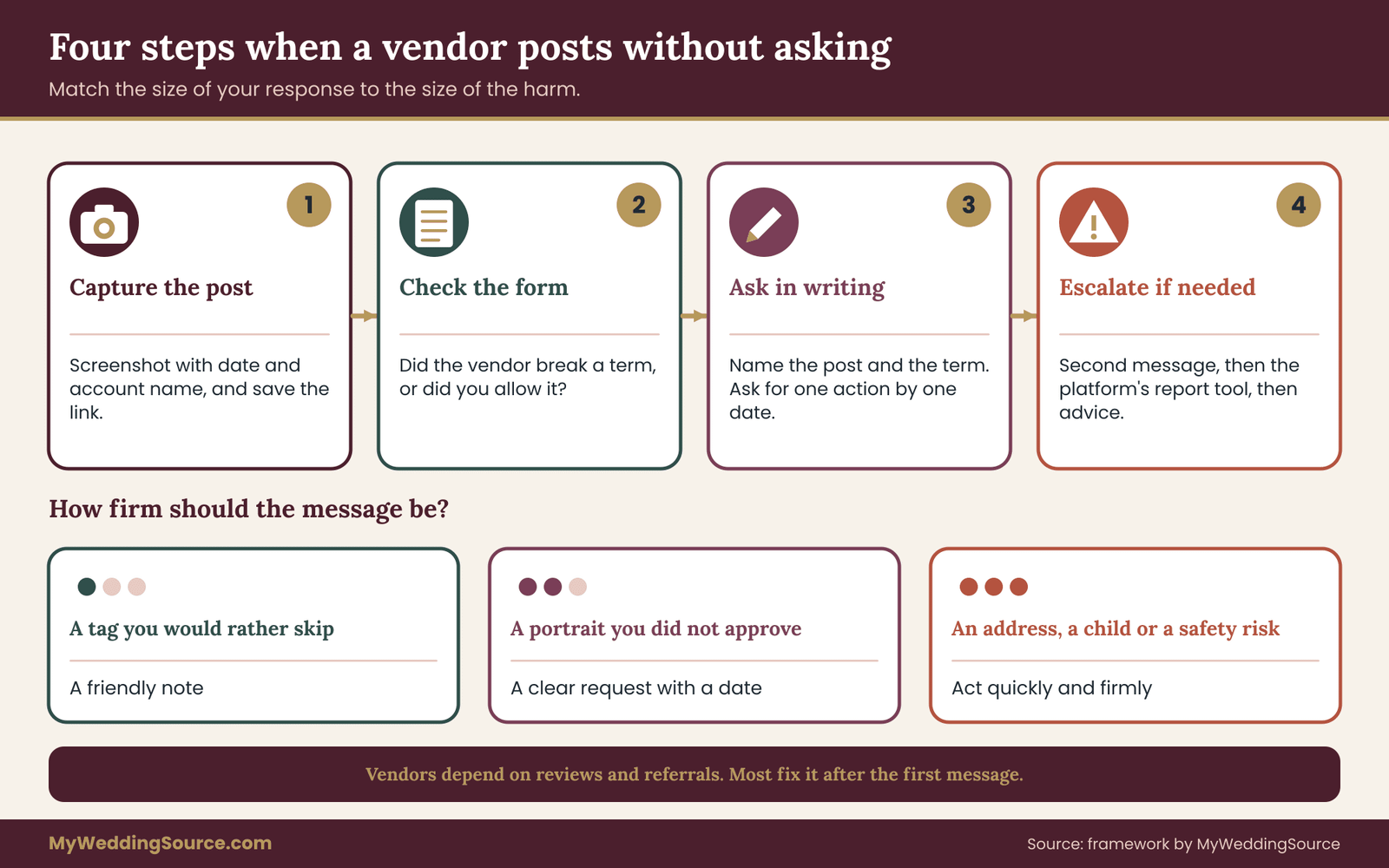
Keeping your response to vendor photo sharing mistakes proportionate
Not every post deserves a formal letter. A tag you would have preferred without, on an image that is otherwise fine, may only need a friendly note. A post that exposes an address deserves a faster and firmer message. Matching your response to the harm keeps relationships intact and keeps you from burning goodwill on small things when you may need it for a large one. The more specific your vendor photo sharing form, the easier it is to tell the difference.
Limits and edge cases in vendor photo sharing
No form covers everything, and it is better to know where yours stops. These are the situations that most often fall outside a simple permission, with a way to think about each one.
Images that are already out there
A form signed after the wedding cannot reach back to posts that already exist. If a vendor has already posted, the vendor photo sharing form becomes a record of what you want from that day on, and the request process from the previous section handles the rest. Sign before the wedding if you can. If you are reading this after, send a short addendum anyway: even a late agreement is better than silence, because it sets terms for everything the vendor has not yet shared.
A vendor who sells or closes the business
Small businesses change hands, merge or close. Your permission was given to a named business, and your vendor photo sharing form should say it does not transfer to a new owner without your approval. If a vendor closes, the images may sit on a dormant website or a social account nobody manages. Keep the vendor’s contact details, and if the business shuts down, send a removal request to the last known address. Platforms also have processes for accounts that have been abandoned.
Tools that process images
Vendors increasingly use online galleries, editing software, scheduling tools and cloud storage. Each of these may copy the images to a service you have never heard of. You cannot audit every tool, but you can ask a simple question: “Which services store or process our images, and do any of them use images for anything other than delivering your work?” A vendor who has a clear answer is a good sign.
A form can add a line that images may not be used to train or improve software without your written approval, which is a reasonable thing to ask even where it is not yet common.
Destination weddings and vendors abroad
If your vendors are in another country, local copyright and privacy law applies to them, and the U.S. rules in this guide are only part of the picture. The practical step is the same: write the permission, keep it simple and ask the vendor to confirm it in their own words. For legal questions, a licensed adviser in the relevant place is the right source, not a general article.
Public figures, safety and sensitive situations
Some couples have jobs or family circumstances that make any public image a risk: a public-facing role, a protective order, a custody dispute, a history of harassment. If this describes you, tighten every field. No public posting at all, private galleries only, no location, no names, and a stated right to remove anything on request. Tell vendors only what they need to know to comply. A good vendor will take this seriously and will not ask for a reason.
Divorce, separation and shared decisions
Permissions are given by two people, and either one may later want to withdraw them. Your form should say whether one partner’s written request is enough, and that is a decision to make together before signing. Many couples allow either partner to withdraw consent alone, which is the safer rule for privacy. If a relationship ends, the same opt-out process is available, and the form’s three lines are the tool.
What vendor photo sharing forms cannot do
A vendor photo sharing form binds the people who sign it. It does not bind a guest who posts on their own account, a venue that never signed, or a stranger who copies a public image. It cannot make an online post vanish from the copies other people have made.
And it cannot replace judgment. What it can do is make the vendors you chose behave predictably and give you a clear, fair basis to ask for a correction. That is a smaller promise than total control, and it is the one worth making.
A note on fees and policies
Some vendors charge for extended image rights, for files given to another vendor, or for removing images from a portfolio. Others include these in the base price. Fees and policies vary by vendor and change over time, and nothing in this guide can state what your vendor charges. Ask for current terms in writing, and confirm any fee before you agree. If a rule or price matters to your decision, check it with the vendor or the issuing agency as of the date you sign.
Where vendor photo sharing fits in your wedding paperwork
The vendor photo sharing permission form is a small document with a long shelf life. File it with the vendor’s contract, record the date and the channels, and add any later withdrawals or confirmations. Your future self, and possibly your next anniversary, will thank you when a vendor posts something unexpected and you can find the answer in thirty seconds.
The guide to organizing wedding paperwork after the event explains where to keep the signed copy so it is easy to find years from now, and it is the natural home for every document in this guide.
If you are still choosing vendors, add one question to your interviews: “How do you handle vendor photo sharing and credit?” The answer tells you as much about a vendor’s professionalism as its portfolio does. A vendor with a clear policy, a calm tone and no objection to a written addendum is easier to work with in every other way.
When you assemble your registry, thank-you list and guest messaging, the same attitude applies: say what you would like, say it early and keep it kind. The registry ideas guide is a good example of how a short, plain request can set expectations without friction.
Etiquette and vendor photo sharing, briefly
Good manners support the vendor photo sharing form but do not replace it. Thank the vendors publicly if you are comfortable doing so. Credit the photographer whenever you post. Do not crop watermarks or edit images in ways the license does not allow. Answer vendor requests promptly, even when the answer is no. The wedding etiquette guide covers the broader courtesies, and the family photo list guide is a useful companion when you decide which formal portraits should ever leave a private gallery.
Your next steps
Pick one evening this week to sort out vendor photo sharing. First, find the image-use clause in each signed vendor contract and note what it already allows. Second, write your defaults on a single page: which images, which channels, what details, how credit appears, when posting may start and how to opt out. Third, send the vendor photo sharing form to each vendor with a short, friendly message, and file the signed copies. Fourth, give your photographer the privacy list and the instructions about children.
Then leave it alone. A good form is quiet once it is signed. When a vendor asks to share a photo, you already know the answer. When a post goes up that you did not expect, you already know the fix. And when you see your florist’s beautiful arch in a vendor’s portfolio with her name and the photographer’s attached, exactly as you agreed, you will know the system did what it was meant to do.
FAQ
Can a wedding vendor post my photos without asking me?
It depends on your contract. Many vendor agreements include a sentence allowing portfolio and promotional use, so a vendor may already have your permission in writing. If your contract is silent, the vendor should ask first. Read the image-use clause in your vendor contracts before you sign, and ask for narrower wording if it says “any purpose” or “in perpetuity.”
Do I own the photos my photographer took?
Usually the photographer owns the copyright, and you receive a license for personal use such as printing and sharing with family. The U.S. Copyright Office explains that ownership transfers only in a signed writing. If you want broader rights, ask for them in the contract and expect the price to reflect that.
Is it rude to refuse a vendor’s request to post our wedding?
No. Vendors expect a range of answers, and a polite, specific reply is easy to respect. You can say yes to some images and no to others. Offering an alternative, such as decor-only images or a delay of thirty days, usually keeps goodwill, and most vendors would rather have a clear answer than a vague one.
Should I give vendors credit when I post their work?
It is a courtesy and, for most vendors, the main reward for good work. Credit the photographer whenever you share their images, and tag other vendors if you are comfortable with it. If you received a discount or another benefit in return for posting, the Federal Trade Commission’s endorsement guidance advises disclosing that connection clearly.
What should an opt-out clause say?
It should name how to ask, how quickly the vendor must stop new use, how quickly it must remove images from channels it controls, and what cannot be undone, such as printed material already distributed. Three or four plain sentences are enough. Keep the vendor’s written confirmation with your other wedding records.
Can I limit images of children and guests?
Yes. You can write a rule into the vendor photo sharing form that no identifiable images of children or of named guests may be shared publicly without written approval. Give the photographer a short privacy list before the wedding. Expect a best effort rather than perfection, and ask the vendor to leave out any image it is unsure about.
What if the vendor offers a discount for posting rights?
Treat it as part of the price and put it in writing. State the discount, the rights you grant and what happens to the price if you later withdraw. If you post or review in return for a benefit, disclose that connection. A vendor who ties your final gallery to a favorable review is asking for too much.
Do I need a lawyer to use a photo permission form?
For an ordinary wedding, a clear one-page addendum in plain language is usually enough, and many couples handle it themselves. If a vendor refuses reasonable limits, a dispute arises, or a safety concern is involved, a licensed attorney can advise you on your state’s rules and your contract’s terms.
Sources
- Copyright basics, U.S. Copyright Office
- Copyright in general: frequently asked questions, U.S. Copyright Office
- Endorsements, influencers, and reviews, Federal Trade Commission
- Disclosures 101 for social media influencers, Federal Trade Commission
- Federal Trade Commission, consumer and business guidance
- How to get a copy of a marriage certificate, USAGov
- Personal archiving: preserving your digital memories, Library of Congress
- Back up business data, Cybersecurity and Infrastructure Security Agency
- Instagram Help Center, Meta
- Professional Photographers of America