

Vendor exclusivity is the venue policy that tells you which caterer, bar service, florist, photographer or rental company you may use on the property, and which ones you may not. This guide shows how to find every vendor exclusivity rule in your paperwork, price it honestly, and ask for an exception when the policy blocks something you truly need.
Treat each venue’s vendor exclusivity rules as a document to be tested, not a verdict to be accepted. Build a one-page evidence register for each venue: the exact clause, the category it covers, the reason the venue gives, the full cost of following it, and the written route to an exception.
Compare venues on those registers rather than on the headline rental fee. If a rule blocks a vendor you need, send a short, specific exception request with proof of insurance and a plan for load-in, and keep the answer in writing.
Couples usually meet vendor exclusivity at the worst possible moment: after they have fallen for a room, paid a deposit and begun imagining the day. A coordinator mentions that the catering must come from the venue’s list, or the contract quietly names an in-house bar, or a photographer you already booked turns out to need a “vendor access fee.”
None of this is unusual, and much of it is reasonable. The trouble is that the vendor exclusivity rule rarely sits in one place, rarely uses the same words twice, and almost never comes with a price tag attached.
This article is about the decision, not the drama. It explains what the different kinds of vendor exclusivity actually are, where the rules hide, how to read them, what they cost, and how to write an exception request that a busy venue manager can say yes to. It does not tell you to avoid venues with restrictions. Some of the smoothest weddings happen at places with tight vendor lists, and some of the most stressful happen at places with none.
A note on scope. This is general information, not legal advice, and contract and consumer rules differ by state and by situation. Where a point depends on local law or on the exact wording of your agreement, the guide points you to the agency that explains it or to a licensed professional who can read your contract.
If you are still comparing venues, the wedding venues guide covers the wider search. If you already have a signed agreement and want to understand the rest of it, the guide to the wedding vendor contract goes through the clauses that sit around the ones discussed here.
What vendor exclusivity means, and why venues use it
The phrase “vendor exclusivity” covers several different arrangements that are easy to confuse. Venues rarely use the same label for the same thing, so it helps to separate the arrangements by what they actually do to your choices.
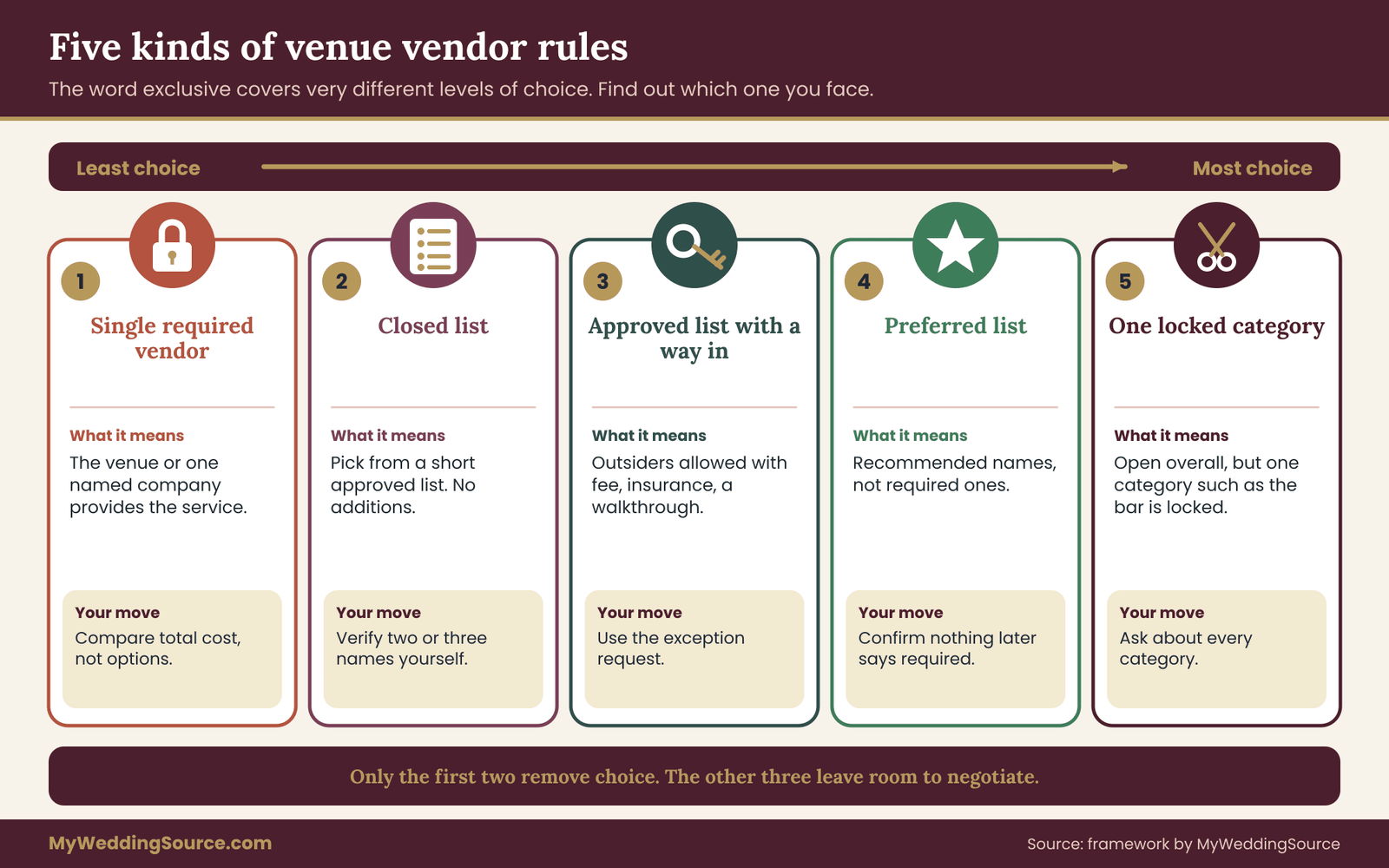
Five arrangements that all get called “exclusive”
A single required vendor. The venue provides the service itself or names exactly one company. Catering is the common case, and it is often paired with the bar. You cannot hire anyone else for that category, and there is nothing to compare.
A closed list. The venue publishes a short list of approved companies, usually three to ten, and you must choose from it. Your choice is real but bounded. You cannot add a name, however good, unless the venue agrees to change its list.
An approved list with a way in. Similar to the closed list, but the contract describes a process for adding an outside vendor: an application, proof of insurance, a fee, sometimes a walkthrough. This is the arrangement where an exception request is built into the vendor exclusivity rules.
A preferred list. The venue recommends vendors and may offer smoother logistics or a small perk for using them, but does not require them. This is the friendliest form, and also the one most often mislabeled in sales conversations as a requirement.
A category-specific rule. The venue is open on most things but locks one or two categories, for example the bar, the rentals or the cleanup. Couples sometimes read “we have an open policy” and miss the carve-out for the one category that carries the most money.
Notice that only the first two remove choice entirely. The other three leave room to negotiate, and the register described later in this guide is mainly a way to tell them apart before you commit.
Why venues set vendor exclusivity rules
Venues are not always motivated by profit, although revenue is part of it, and an honest reading of the rules starts with understanding the reasons. They fall into four groups.
Liability and insurance. A venue carries risk for everything that happens on its property. If an outside caterer’s guest gets sick, an unlicensed bartender overserves, or a lighting rig damages a historic ceiling, the venue may be pulled in. Requiring vendors to hold a particular type of insurance, and to name the venue on the certificate, is the reasonable form of this concern. Limiting the field to a short list of companies the venue already knows is the blunt form.
Access and logistics. Old buildings, shared corridors, a single loading dock, a freight elevator with a booking calendar: all of these constrain who can work there and when. A vendor who has loaded in a hundred times knows where the power is and where the trash goes. A first-timer may not. Some exclusivity rules are really load-in rules in disguise, and those can sometimes be satisfied another way.
Regulation. Alcohol service is the clearest example. Many venues hold the license that covers the bar, or rely on a licensed catering partner, and the law in many states restricts who may serve or sell alcohol at an event. Food service can also fall under local health rules. In these cases the venue may have little discretion, and the right question is what the law allows and what the venue merely prefers.
Revenue and control. Some venues earn a meaningful share of their income from food, drinks and rentals, and an in-house requirement protects that income. Others keep a list because vendors on it pay a referral fee or a listing fee. This is a legitimate business model, and you can still ask about it directly. You simply have a right to know that the vendor exclusivity rule is partly commercial, because that changes how you negotiate.
“Is the catering requirement driven by licensing, insurance or the venue’s own policy? We want to understand which parts can flex.”
Asking that question in a friendly tone often gets a more candid answer than any website page ever will.
Where vendor exclusivity sits on the spectrum of venue types
Different kinds of venues lean on vendor exclusivity rules in predictable ways. All-inclusive properties, covered in the guide to all-inclusive wedding venues, usually bundle food, drink, rentals and coordination into one price, so exclusivity is the product rather than a restriction on it. Hotels and country clubs tend to require in-house catering and bar because their kitchens and licenses are the business.
Historic homes, museums and public buildings often have approved lists for insurance and preservation reasons. Event barns and open-format rental spaces are more likely to be flexible on catering but strict on hours, noise or alcohol.
None of these patterns is a promise. Treat them as a reason to ask early, not as a prediction of the answer.
The honest trade: convenience against choice
Vendor exclusivity is a trade, and it helps to name both sides. What you give up is price comparison, stylistic fit and the chance to use someone you already trust. What you gain can be real: a vendor who knows the building, a single point of accountability, fewer load-in surprises and less coordination work for you. A couple who dreads logistics may rationally prefer the closed list. A couple with a family caterer and a firm budget may not.
The mistake is not choosing the restricted venue. The mistake is choosing it without knowing what the restriction covers and what it costs. The next sections give you a way to find out before the deposit is paid, while you can still change your mind at no cost.
Think of vendor exclusivity as a price you pay for something, and the question becomes what you receive in return. Sometimes it is a smoother day. Sometimes it is only a larger bill. A couple who can say which one applies to their venue has already done the hardest part of the comparison.
Where vendor exclusivity rules hide in your paperwork
The first problem with vendor exclusivity is not the rule itself, it is where the vendor exclusivity rule lives. It is that the rule is scattered. A venue may state it plainly on a website page, soften it in a sales call, repeat it differently in the proposal and bury the enforceable version in a rider on page eleven. If you collect only one of those, you are working with a partial picture.
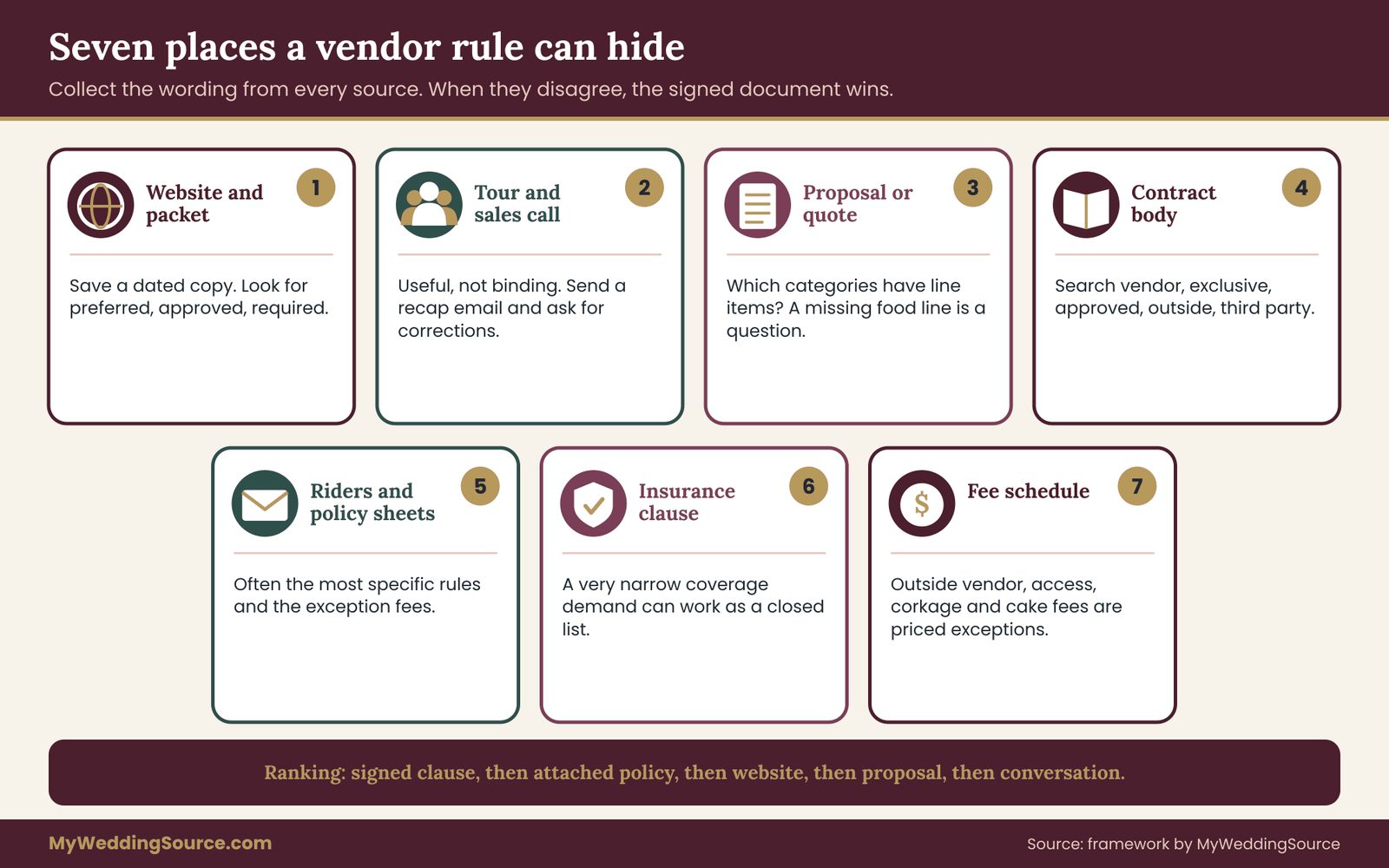
The seven places to look
The website and the information packet. Look for words like “preferred,” “approved,” “required,” “recommended,” “in-house,” “exclusive,” “partner,” “outside vendors” and “vendor fee.” Save a dated copy of the page, because websites change without notice and you may want to show what was promised when you booked.
The tour and the sales conversation. What you are told in person is useful and weak. It is useful because people say more over coffee than they put in print. It is weak because it binds no one. After every tour, send a two-line email summarizing what you understood about vendor requirements and ask the coordinator to correct anything that is wrong. A reply is worth more than a memory.
The proposal or quote. Check which categories appear as line items and which do not. A proposal that includes catering, bar and rentals as lines is telling you those are likely in-house. A proposal that lists only the room fee, with no food line at all, may be silent about a catering requirement that appears later.
The contract body. Search the full text for “vendor,” “exclusive,” “approved,” “outside,” “third party,” “caterer,” “preferred” and “list.” Read around every hit, not just the sentence that contains it.
Addenda, riders and policy sheets. Many venues attach a facility policy document, a vendor guidelines sheet or a “rules and regulations” exhibit. These often contain the most specific vendor exclusivity rules, along with the fee schedule for exceptions. The main contract may incorporate them by reference in a single line, such as “Client agrees to comply with the Facility Rules attached hereto,” which is easy to skim past.
The insurance clause. Vendor insurance requirements double as a gatekeeping tool. A clause that demands a very specific coverage type, from a carrier with a specific rating, that few small vendors hold, can function as a closed list even if it never says so.
The fee schedule. Look for lines such as “outside caterer fee,” “vendor access fee,” “corkage,” “cake cutting,” “rental fee for outside equipment,” “security deposit for third-party vendors” and “cleaning surcharge.” A fee for using outside vendors is a polite way of writing an exception price.
Reading vendor exclusivity rules in order of strength
Not every sentence carries the same weight. When you find two statements that disagree, rank them. A signed contract clause outranks an attached policy sheet that the contract incorporates, which outranks a website page, which outranks a proposal’s cover note, which outranks a sentence said on a tour. If the website says outside caterers are welcome and the signed rider says they are prohibited, the rider is the vendor exclusivity rule you will be held to, whatever the website says.
If the reverse is true, ask the venue to confirm the friendlier wording in writing before you pay anything, because you want the stronger document to say what the weaker one promised.
Gather every vendor exclusivity statement from all seven places before you compare venues. A venue whose website, proposal and contract all say the same thing about vendor exclusivity is easier to plan around than one whose documents disagree, and the disagreement itself is worth noting in the register.
What “silence” means
If a contract says nothing about vendors in a category, do not assume freedom. Ask. Silence may mean the venue has no rule, or it may mean the vendor exclusivity rule lives in a policy sheet you have not seen, or in a practice the venue follows but never wrote down. In a dispute, a written clause usually matters more than an unwritten habit, and an unwritten habit matters less than you might fear. Either way, the right move is to turn the silence into a sentence you can keep.
Matching the rule to the promise
Venues sometimes present vendor exclusivity as a benefit: “Our caterer is included in your package.” That is true when the package price covers the service at a fair level. It is less true when the included caterer has a food and beverage minimum that your guest count cannot meet, or when upgrades cost far more than the base.
Minimums deserve their own look, because a food and beverage minimum that your guest count cannot reach turns into a charge for food nobody eats. Keep the two questions apart: what the vendor exclusivity rule requires, and what the required service costs once it is delivered the way you want it.
The evidence register: one page for every venue
Here is the method this guide proposes. For every venue you are seriously considering, you fill out one page called the exclusivity evidence register. It has a fixed set of fields, so that two venues can be compared by looking at two pages side by side instead of by remembering two tours.
The register does three things. It forces you to find the actual wording. It separates what is required from what is merely suggested. And it attaches a cost and an exit to every rule, so that no restriction stays vague.
The seven fields
1. Category. The single service the rule covers: catering, bar, rentals, florals, photography, music, coordination, cake, transportation, lighting, cleanup. One row per category, because a venue can be strict on one and relaxed on another.
2. Arrangement type. One of the five arrangements from the previous section: single required vendor, closed list, approved list with a way in, preferred list, or category-specific rule. If you cannot tell, write “unclear” and put it on your question list.
3. Source and exact words. Where you found it, with the page, section or date, and the sentence copied word for word. If it comes from a conversation, write the person’s name and the date, and mark it “verbal.”
4. Stated reason. What the venue says the vendor exclusivity rule is for: insurance, access, licensing, quality, revenue. If the venue has not said, ask. The reason determines how an exception request should be framed.
5. Full cost of compliance. The price of following the rule for your guest count and your style, including minimums, service charges, taxes and the upgrades you would actually want. Not the starting price on a brochure.
6. Exception route. Whether an exception exists, who decides, what it costs, what proof is needed and how long it takes. “None” is a valid entry, and it is useful to know.
7. Evidence grade. A simple mark for how solid your information is: “written and signed,” “written but unsigned,” “verbal confirmed by email,” or “verbal only.” Only the first is something you can lean on if there is a disagreement.

Each vendor exclusivity rule gets its own row, even when two rules appear in the same sentence. If a clause locks both catering and bar, write two rows. The cost, the reason and the exception route are often different for each, and merging them hides the detail you will need when you negotiate.
Why a register beats a list of questions
A question list is useful before a tour. A register is useful afterward, because it records answers instead of intentions. Two things happen once you fill it in. First, gaps appear. You discover you have the catering rule but not the bar rule, or that you know the fee for an outside photographer but not whether the photographer needs insurance. Second, the venues become comparable. A hall with a lower rental fee and a closed catering list may cost more overall than a pricier hall with an open policy, and the register makes that visible.
Keep each page to one sheet. If a page spills onto two, you are probably recording opinions, not evidence. The point is a document you can read in two minutes.
How to fill it in without annoying the venue
Venue staff answer vendor questions many times a week, and most are glad when a couple is organized. Send your questions in a single email rather than a drip of texts, number them, and say what you are trying to learn: “We are comparing a few venues and want to understand the vendor requirements for each category.”
Offer to talk by phone if that is easier, and then follow the call with a short email recap. The tone you want is thorough and friendly, not adversarial. You are not building a case against the venue. You are building a record that protects both sides.
The same habit of keeping a written trail runs through the guide to vendor due diligence, which covers how to vet the companies themselves once you know which ones you are allowed to use.
Once the register tells you which companies you are allowed to hire, the next job is turning each choice into a clear scope and a clean handoff. The guide to wedding vendor purchase orders picks up from that point and follows each vendor from the signed scope to final acceptance, which is where many of the promises made during venue negotiations either get delivered or quietly disappear.
Reading the clause: phrases that change your options
Contracts about vendor exclusivity use a small vocabulary, and a few words do most of the work. Learning to read them is faster than it sounds. Below are the phrases that most often change what you can do, with a plain reading of each. These are general readings of common wording, not legal interpretations of your agreement. If a clause matters to a large amount of money, have a licensed professional read the actual text.
Words that narrow your choices
“Exclusive” or “sole provider.” Only the named company may provide that service. Check whether the clause covers the whole category or only certain items. An exclusive caterer does not necessarily mean an exclusive dessert provider or an exclusive coffee service, though some venues will say it does.
“Must be selected from the approved list.” A closed list. Ask how often it is updated, who maintains it, and whether any listed vendor pays to be there. The last question is fair, and a direct answer is a good sign.
“Subject to venue approval.” This sounds like a path to an exception, and it might be, but it may also mean the venue can refuse for any reason. Ask what criteria the venue uses and how long a decision takes. A clause with a decision deadline is worth far more than one without.
“Required to use the venue’s in-house services for…” A direct requirement. Look at which categories follow, and whether the clause says anything about substitutions, such as an outside cake from a licensed bakery or a special-diet meal prepared elsewhere.
“Venue reserves the right.” This phrase appears in front of many rules. It signals discretion. It is not a prohibition, but it is an invitation to ask what the venue’s practice actually is.
Words that open a way in
“Outside vendors permitted with…” What follows the word “with” is the price of admission: a fee, insurance, a license, a walkthrough, a damage deposit. Write each condition into the register.
“Preferred” or “recommended.” Usually advisory. Confirm that nothing later in the document converts “preferred” into “required,” which sometimes happens in the vendor exclusivity rules exhibit.
“Vendor access fee” or “outside vendor fee.” A priced exception. Ask whether it is per vendor, per category or per event, and whether it is refundable if the vendor is rejected.
“Corkage” and “cake cutting.” Fees for serving alcohol or a cake that the venue did not supply. They are small examples of the same principle: the venue accepts an outside item for a price.
Words that shift risk onto you
“Client shall be responsible for the acts of its vendors.” Common and generally reasonable, but it means that if an outside vendor damages the property, the bill is yours. It is a reason to ask outside vendors for proper insurance and to read their own contracts.
“Indemnify and hold harmless.” A promise to cover the venue’s costs in certain situations. The scope varies enormously. This is one clause where a licensed review is worth the money.
“Additional insured.” The venue, and sometimes its owner or lender, must be named on the vendor’s liability policy. Ordinary for large venues, and something a vendor can usually arrange through their insurer in a short time, though it may cost them a fee they pass to you.
Three red-flag patterns
A few patterns are worth noting rather than rejecting on sight.
A vendor exclusivity requirement with no price. The contract says you must use the venue’s caterer, but no menu, price list or per-person range appears anywhere. You would be committing to a service whose cost you cannot see. Ask for the current price list in writing before signing.
A vendor list that cannot be checked. The approved list names companies, but several have no working website, no reviews and no portfolio. The list may be old or the vendors may be thin. Verify two or three of the names yourself.
A rule that changes after you pay. The contract allows the venue to amend its vendor policies by notice. You want a sentence saying that changes cannot reduce your rights or raise your costs for an event already booked.
A reading routine that takes twenty minutes
Print or open the full contract and every attachment. With a highlighter, mark every sentence that mentions a vendor, a category of service, insurance, a fee or an approval. Then, for each marked sentence, ask four questions: Who does this restrict? What does it permit? What does it cost? What happens if I do not comply? Transfer the answers into the register. If a sentence cannot be answered, put it on the question list and send it to the venue in writing.
Most people skip the last question. “What happens if I do not comply” is where the real price of vendor exclusivity sits. Some venues turn away the vendor at the door. Some charge a penalty. Some keep part of the deposit. Some simply add the in-house price to your bill anyway. If the contract does not say, the consequence is unknown, and unknown consequences should be a weight on the scale.
A vendor exclusivity clause that looks clear on first reading often has a second layer. Read it again for what it leaves out: the price, the deadline for an answer, the penalty for breaking it. The missing parts of a vendor exclusivity clause usually matter more than the stated parts.
Reading the same clause two ways
Consider this invented sentence: “Catering must be provided by the Venue’s approved caterers, and any outside food service is subject to prior written approval and an administrative fee.” A hurried reader sees a closed list. A careful reader sees three separate facts. There is a list. There is an approval route. There is a fee. The register records all three, and the question list gains two lines: what is the fee, and what do approvals depend on?
Another invented sentence: “Client may bring its own vendors, provided vendors are insured and licensed.” A hurried reader sees freedom. A careful reader asks: insured for how much, in what form, and who verifies it? Licensed by whom? Does an outside bar count as a vendor for this purpose, given that alcohol service often follows separate rules? The sentence is open on its face and narrow once those questions are answered.
Where an exclusivity clause meets a payment clause
Vendor exclusivity rarely lives alone. It interacts with payment terms. A venue that requires its caterer may also require that the caterer’s deposits be paid to the venue, on the venue’s schedule, with the venue’s cancellation terms. If you cancel the venue, the catering deposit may follow it. Compare that with an outside vendor you hire directly, whose deposit sits under a separate agreement.
When you are thinking about cash timing across several vendors, the guide to wedding cash-flow planning shows how deposit and balance dates stack up, and the register should include the payment dates for every required service so the stack is visible.
The three-gate test for any single rule
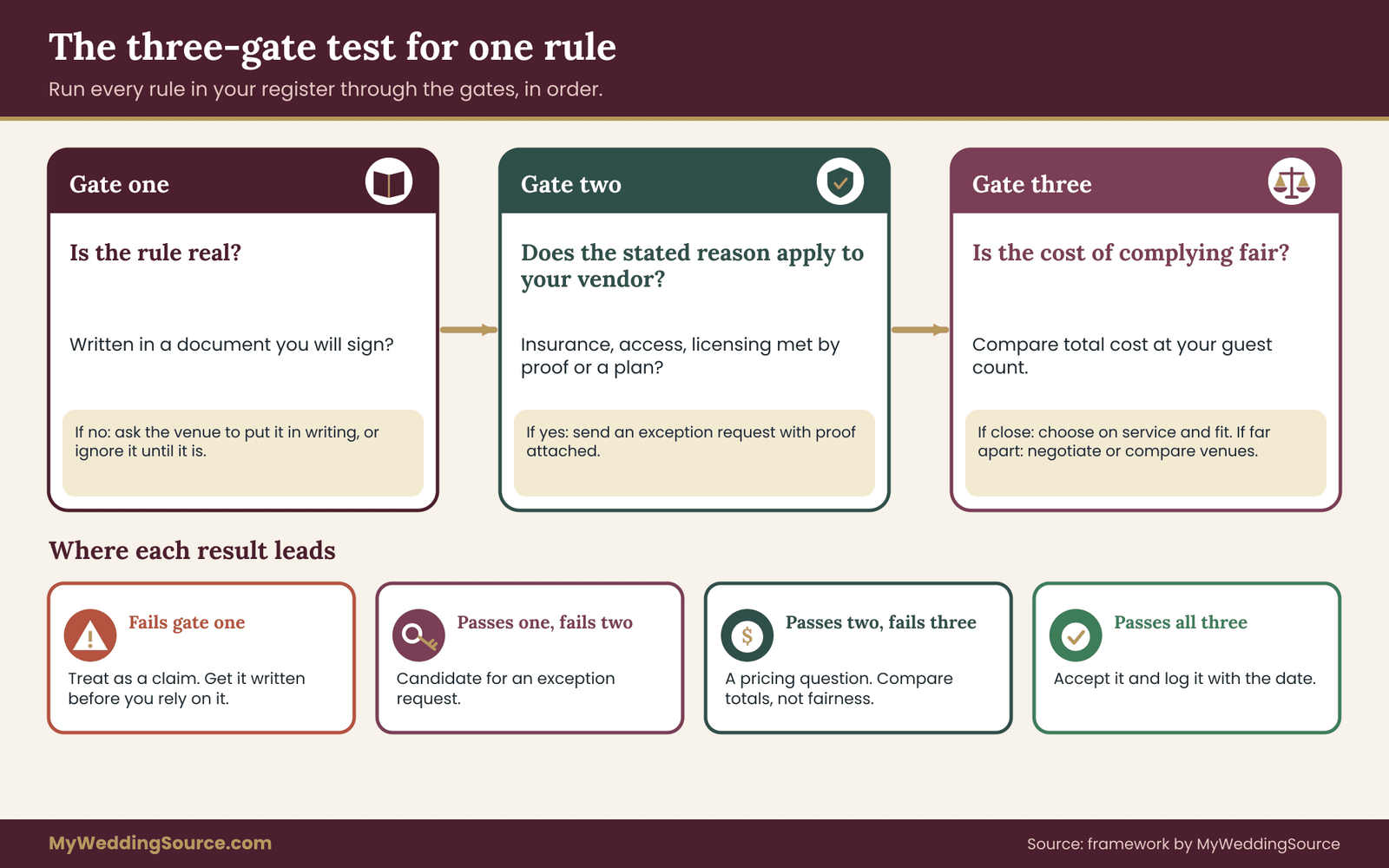
Once a clause is in the register, run it through three gates. The result tells you whether to accept it, question it or build an exception request around it.
Gate one: is the rule real? Is it written in a document you will sign, or is it a habit described in conversation? A written, signed vendor exclusivity rule is real. A verbal one is a claim to be confirmed. If it is on the website only, ask whether the contract will say the same thing.
Gate two: does the stated reason apply to the vendor you want? If the reason is insurance, then a vendor with the right coverage meets the reason. If the reason is access, then a vendor who walks the loading route and follows the schedule meets it. If the reason is licensing, a vendor with the required license meets it.
If the reason is revenue, no outside vendor can meet it, and you are in a negotiation about price rather than about safety. Knowing which of these you are facing is the single most useful thing the register tells you.
Gate three: is the cost of compliance reasonable for what you get? Compare the full cost of following the vendor exclusivity rule with the cost of the exception route. Include your time. If a venue charges a modest fee for an outside photographer who needs to submit a certificate of insurance, the exception is cheap. If it charges a large per-guest fee on an outside caterer, the exception may cost more than the in-house service, and the rule is working as a price floor.
Run the gates in order. A vendor exclusivity rule that fails gate one can be ignored until it is written. A vendor exclusivity rule that passes gate one but fails gate two is a candidate for an exception request. A vendor exclusivity rule that passes the first two but fails the third is a pricing question, and the right response is a comparison of total cost, not a debate about fairness.
When a vendor exclusivity rule is really a bundle
Some rules combine several services into one requirement. “In-house catering” may quietly include the bar, the tableware, the linens, the staffing, the cleanup and the cake plating. When you try to split off one piece, such as hiring a separate dessert maker, the venue may point to the whole bundle as a single required product.
Ask for a price on each component. An itemized in-house price lets you see which pieces are good value and which are pricey, and it gives you grounds for a precise exception request: “We would like the venue’s caterer for dinner and an outside bakery for dessert.”
A bundle is not a problem in itself. It becomes one when it is not itemized and cannot be priced piece by piece. If the venue refuses to itemize, record that in the register under cost and flag it as a reason to compare more closely with venues that do.
A quick sanity check on the whole contract
When the vendor exclusivity clauses are logged, read the contract once more from the top, asking only one question: “If everything in this document were enforced to the letter, what would I be unable to do?” Write the answer in a sentence. A couple at an in-house-catering venue might write: “We could not bring a family member’s cooking, could not use our own alcohol, and could not hire an outside pastry chef without a fee.”
If that sentence makes you uneasy, you have found the clause to negotiate, or the venue to reconsider, while the cost of changing your mind is still low.
What vendor exclusivity really costs
The price of a venue is rarely the number on the first page of the proposal. When vendor exclusivity applies, the real price is the room fee plus everything the vendor exclusivity rule forces you to buy, minus whatever you would have spent anyway. Getting this arithmetic right is the difference between a venue that looks cheap and one that is cheap.
All the figures below are invented to show the method. They are not typical prices, and you should replace them with quotes from your own venue and your own market.
Step one: price the required services at your actual guest count
Start with the venue’s price list for each category it controls. Then adjust for your real situation rather than the brochure’s example. Ask four things for each service.
What is the per-person or per-unit price at your expected guest count, including the tier you would really choose? A starter package may be fine on paper and unappealing on a plate.
What service charge, administrative fee, gratuity or tax is added on top, and is it on the food alone or on the bar, rentals and staffing as well? A percentage added to a large base grows fast.
Is there a minimum, such as a food and beverage minimum, and what happens if you fall short of it? Some minimums become a charge for the shortfall, and some do not carry forward if the guest count drops after the final count date.
What is excluded? Ask about linens, glassware, cake cutting, coffee service, vendor meals, staffing for a late finish and cleanup. Each can be a separate line.
The cost of vendor exclusivity is not fixed. It changes with your guest count, your menu and your negotiating position, which is why the number you want comes from your own quote and not from a general estimate.
Step two: price the alternative honestly
If you are weighing an exception, get a real quote from the outside vendor you want, on the same basis: the same guest count, the same service style, the same hours, and the same inclusions. Then add everything the outside route adds.
An outside caterer often needs rentals the venue’s kitchen would otherwise supply. They may need a licensed bartender, extra staff or a venue fee for kitchen use. The venue may charge an outside vendor fee. Your outside vendor may charge a premium for a venue they do not know. Include each one.
Many couples compare the in-house package price against the outside vendor’s base quote and conclude the outside choice saves a lot. After the rentals, the fees and the staffing are added, the gap often narrows or reverses. It can also widen in the other direction, because some in-house packages carry a significant markup on drinks or add-ons. The only way to know is to compare the same list of inclusions side by side.
Step three: compare the whole event, not the line item
Build a simple comparison, venue by venue, with two columns of thought: “follow the rule” and “request the exception.” Walk down the same categories each time and write a total for each approach.
Here is an invented illustration for a hundred guests, using round numbers to keep the logic visible. Suppose the in-house package comes to a certain amount per guest, plus a service charge and a tax on top. Suppose an outside caterer’s base quote is lower per guest, but the outside route adds an outside vendor fee, a rental order for plates and glassware, a bartender license fee and a kitchen use fee.
If the in-house total and the outside total end up within a few percent of each other, the exception request is not worth pursuing for money. It might still be worth pursuing for food style, dietary needs or cultural fit, and those reasons belong in the register under a separate heading so the money and the preference are not confused.
If instead the outside total is clearly lower, the savings fund the effort. If the outside total is clearly higher, the in-house requirement is doing you a small favor, and you can stop arguing with it.

The costs that do not appear on a quote
Some costs attach to vendor exclusivity without a price tag.
Time. Chasing quotes, certificates of insurance and approvals takes hours. If you have a demanding schedule, the convenience of a single required provider has real value, and it is rational to pay for it.
Flexibility. A closed list limits last-minute swaps. If a listed vendor cancels or the venue’s contract with them ends, you may have to choose again from a short remaining list.
Quality variance. A required vendor has little reason to compete for your business, and an outside vendor you chose has every reason to. This is not a rule, only a pattern to examine: read independent reviews of the required vendor, and ask the venue for a tasting or a portfolio before you commit.
Risk of the unknown. An outside vendor unfamiliar with the building can lose time on load-in, and the venue may charge overtime if the schedule slips. A required vendor who knows the building often avoids this. When you are weighing the risk, the guide to the venue technical walkthrough shows how a walkthrough with measurements and access routes lets an outside vendor plan properly.
A decision rule for the premium
After the comparison, you will see a gap between following the vendor exclusivity rule and taking the exception. Call it the premium. A useful rule of thumb, which is a framework and not a statistic, goes like this.
If the premium is small compared with your total vendor budget, and the exception brings no clear benefit, follow the rule and spend your energy elsewhere.
If the premium is small but the exception serves a need the in-house option cannot meet, such as a dietary requirement, a cultural menu or a family tradition, request the exception on that basis and be ready to pay the fee.
If the premium is large, ask whether the venue will negotiate the in-house price. A venue that knows you are comparing sometimes finds flexibility it did not mention before. If it will not, compare other venues on the same terms, because a large premium repeated across categories adds up to a different venue price entirely.
Reading the room fee in light of the vendor exclusivity rules
Room fees and vendor exclusivity trade against each other. A venue with a low room fee and strict in-house requirements may earn its money in food and beverage. A venue with a high room fee and an open vendor policy has already collected its revenue up front. Neither model is more honest. Both are fine if you understand which one you are in. The register’s cost field makes the point: write the full cost of the venue at your guest count in one number, and compare that number rather than the rental fee.
Guest count sensitivity
Vendor exclusivity amplifies the effect of guest count, because per-person pricing and minimums are tied to it. Run the comparison at three counts: the number you expect, a number noticeably lower, and a number noticeably higher. If the in-house route has a minimum, look at what happens at the low end.
If the outside route has a per-person price, look at the high end. A venue that looks fine at your expected count may look quite different if twenty guests decline. Ask the venue when the final count is due and whether the minimum adjusts with it.
For a wider view of how guest numbers drive many costs at once, think of a clear budget that sets category limits before you commit to a venue whose rules set the price for you.
When the rule moves money between categories
A last point that surprises many couples: an in-house requirement can shift money out of categories you wanted to prioritize. If catering and bar are locked at a high level, the remaining budget for photography, music and flowers shrinks, and you may end up with a lavish meal and a thin visual record.
Decide your priorities before the register is complete. Then check, venue by venue, whether the required spend leaves enough for the categories you care about most. If it does not, that is the cost of the vendor exclusivity rule, and it belongs at the top of the register page, not in a footnote.
Vendor exclusivity rules by category
Venues rarely treat every category alike. A hall may be strict about food, relaxed about flowers, and indifferent to photography as long as the photographer is polite. Reading vendor exclusivity category by category prevents two common errors: assuming the strictest rule applies everywhere, and assuming the friendliest one does. For each category below you will find the usual reason the rule exists, the questions that matter, and what an exception tends to involve.
Because vendor exclusivity rules differ so much by category, read them one service at a time. The patterns below are general; your venue’s wording governs.
Catering
Catering is the category most likely to be exclusive, because it is the largest revenue source and the largest operational footprint. A venue may own a kitchen, hold the permits for it and employ the staff who run it. Outside caterers need space, power, water, waste handling and sometimes a permit of their own.
Ask whether the requirement covers the main meal only or also appetizers, late-night food, desserts and coffee. Ask whether special-diet meals may come from elsewhere, because a guest with a severe allergy sometimes needs a meal prepared in a controlled kitchen. Ask whether a family member or a food truck may serve at a separate time, such as a rehearsal dinner or a morning-after brunch held on the property.
Where an exception exists, it usually asks for the caterer’s license and insurance, proof of food-safety practices, a kitchen walkthrough and a fee. Food safety rules are set locally. The federal government’s food safety portal explains the general principles of safe handling, and your local health department sets the specific requirements for food service at events. Do not rely on a caterer saying “we are always compliant.” Ask for the permit.
Bar and alcohol
Alcohol rules are the most legally tangled. In many states, the law limits who may sell or serve alcohol at an event, and a venue’s liquor license or its relationship with a licensed caterer may be what allows the bar at all. In some places, guests may bring their own, in others the host may, and in others no one outside a licensed provider may pour a drop.
The federal Alcohol and Tobacco Tax and Trade Bureau regulates alcohol at the national level, and each state sets its own rules for service and consumption. Check with the state’s alcohol control agency, or ask the venue what the law allows and what is merely the venue’s preference.
Useful questions include: is a licensed bartender required, and from whom? Is outside alcohol allowed, and is there a corkage fee? Who is responsible if a guest is overserved? What are the last-call and cut-off times? The answer shapes both your cost and your insurance situation.
An exception, where one is possible, tends to involve a licensed and insured bartending company, sometimes a one-day permit, and a fee. If the venue says the law forbids the exception, ask it to name the vendor exclusivity rule so you can confirm it with the state agency.
Rentals: tables, chairs, linens, glassware
A venue may require its own rentals because the furniture is already there, because outside deliveries burden the loading dock, or because the venue earns income from them. Ask what is included in the room fee, what is available at an extra cost and what you must bring.
If the venue’s included chairs are plain and you want something else, the question is not whether outside rentals are allowed, but whether the venue will let a rental company deliver, set up and remove items during a window that does not clash with other events. Quantities, delivery windows and breakage terms belong in the same written exchange.
Florals and decor
Floral and decor rules are usually about what may be attached to walls, ceilings or trees, whether open flame is allowed, and when installation may begin. Some venues require their own florist for these reasons. Others allow any florist who follows the decor rules. Ask for the rules as a document, not a conversation, since decor restrictions tend to be specific: no nails, no confetti, no candles without covers, no glitter, no rice.
Fire safety rules often affect candles and heated equipment. The National Fire Protection Association publishes the model codes that many local authorities adopt, and your venue may point to them or to a local fire marshal’s requirements. If a florist plans a candle installation, ask whether the venue has approved it in writing.
Photography and video
Photography is the category where exclusivity is least common and where the real rules tend to be about access, not exclusion. A venue may require an outside photographer to carry insurance, to share a shot list, or to avoid certain rooms, balconies or times. Some venues also restrict drones. A few maintain a preferred photographer list and mention it often, which does not make it a requirement.
Ask whether there are restrictions on flash during the ceremony, on where a photographer may stand, and on the use of the venue’s grounds for portraits outside the event time. If you have already hired a photographer, tell the venue early and ask whether anything else is needed from them. Guest photo rules and image use are a separate topic, and worth settling in writing too.
Music, DJ and entertainment
Venues may require a specific DJ or band for sound-limit reasons or because their sound system is tied to a particular operator. More often they set rules about volume limits, equipment placement, power use and end times. Ask for the sound ordinance, if any, and whether the venue’s own system may be used by an outside DJ.
If the venue’s approved list exists for noise reasons, an outside entertainer who agrees in writing to the same limits is often accepted.
Coordination and day-of management
Many venues require their own coordinator, or at least a day-of manager, to be present. Sometimes this is separate from a coordinator you hire. Ask what the venue’s coordinator actually does, because some are limited to the venue’s own logistics and will not manage your timeline, vendors or family. If you want your own coordinator, ask whether the venue permits it alongside theirs.
Cake and desserts
Cake rules often take the form of a cake cutting fee. This is a service charge for cutting and plating a cake the venue did not provide, and it is one of the most common and least controversial exceptions. Ask whether the fee is per slice or flat. If the bakery is outside the approved list, ask whether it needs a license or insurance certificate on file.
Transportation, parking and valet
Transportation companies sometimes appear on a preferred list because of access to the property, parking limits or neighborhood rules. Ask whether buses and shuttles can reach the entrance, where they may wait and whether the venue manages parking or a separate valet operator is required.
Lighting, audio-visual and staging
Venues with built-in lighting or sound systems may require their own technicians, or may allow outside crews who provide proof of insurance and a rigging plan. Ask about power capacity, ceiling restrictions, hang points and where equipment may be stored.
Cleanup and waste
Cleanup is sometimes bundled into a mandatory fee and is sometimes the couple’s responsibility, which surprises many people. Ask who removes waste, what happens to rented items, and whether there is a separate fee for cleaning an outdoor space after a catered event.
Reading across categories
When the register is complete, look down the “arrangement type” column. A venue with a closed list in two categories and open policies elsewhere is a different proposition from a venue that is closed in six. Then look down the “evidence grade” column. A venue whose rules are mostly written and signed is easier to plan around than one where most answers are verbal. Both columns matter when you decide how much risk each venue carries for you.
The exception request: how to ask for an outside vendor
Most venue managers have received many exception requests, and most of them are poor. They arrive as “we really want our friend to cater, is that okay?” with no detail and no proof, which forces the venue to say no or to do your homework for you. A good request does the opposite. It answers the venue’s questions before the venue asks them, and it makes yes the easy answer.
What the venue is really deciding
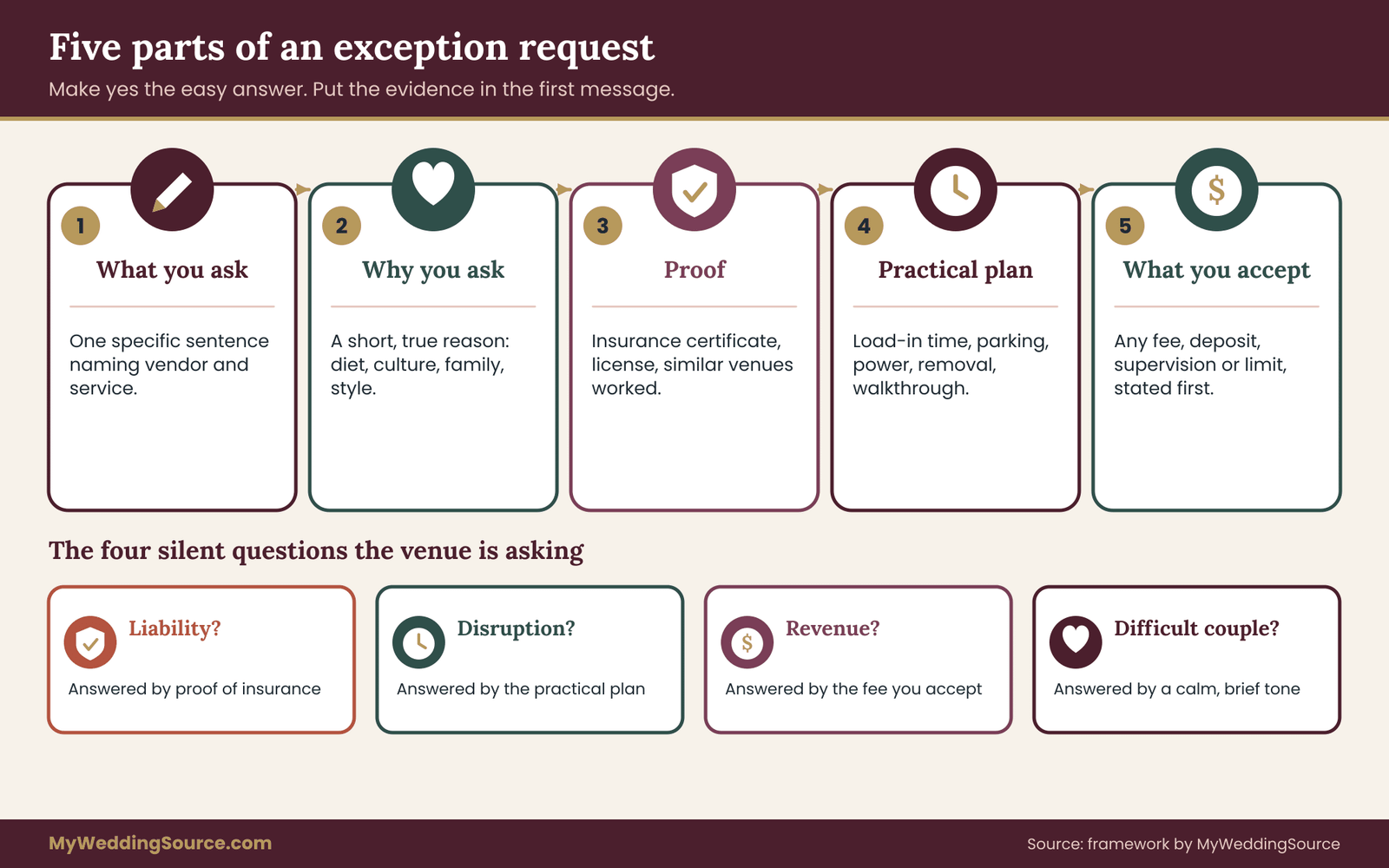
A venue manager reading your request is asking four silent questions. Will this vendor create liability for us? Will this vendor disrupt our operations? Will this vendor undermine a commercial arrangement we depend on? And will this couple be difficult? The request should answer the first two with evidence, address the third honestly, and answer the fourth with its tone.
This is why the stated reason in your register matters so much. If the vendor exclusivity rule exists for insurance, lead with insurance. If it exists for access, lead with a load-in plan. If it exists for revenue, say plainly what you will pay, because no certificate will satisfy that concern.
Most venues that enforce vendor exclusivity rules will still listen to a well-prepared request. They simply need it to answer their concerns in the order they think about them.
The five parts of an exception request
1. What you are asking for. One sentence, specific. “We would like to hire an outside bakery to supply our dessert, in addition to the venue’s catering for dinner.” Not “we want some flexibility on vendors.”
2. Why you are asking. A short, true reason. Dietary need, cultural importance, a family connection, a style the in-house menu cannot offer. Keep it honest and brief. A reason does not need to be dramatic; it needs to be real.
3. Proof that the vendor meets the venue’s reason. The vendor’s certificate of insurance listing the venue as additional insured if required, a copy of the relevant license or permit, a description of their experience at similar venues, and the names of a couple of venues where they have worked. Attach these to the first message. Do not wait to be asked.
4. A plan for the practical parts. Load-in and load-out times, where the vendor will park and set up, what power or water they need, what they will bring, what they will take away and who from your side will be present. Offer a walkthrough before the event if the venue wants one.
5. What you accept in return. Any fee, any deposit, any supervision, any restriction. Say it before they do: “We understand there may be an outside vendor fee and are happy to pay it.” Accepting the cost upfront turns the conversation from yes-or-no into a simple price.
A sample request
The text below is an invented example. Adapt the facts to your own situation and keep the sentences short.
“Hello, and thank you for the venue policy sheet. We would like to ask about an exception for our dessert course. We would like to use [bakery name], a licensed bakery that has supplied weddings at similar venues, for a dessert table and a cutting cake, while using your caterer for the meal. Attached are their current certificate of insurance, with space to add the venue as additional insured, and their business license.
They would deliver at [time] through the loading entrance and would remove all packaging and equipment before the guests arrive. We understand there may be an outside vendor or cake cutting fee and are glad to pay it. Could you let us know what else you would need from them, and by what date a decision is usually made?”
Notice what the message leaves out. It does not argue about fairness, it does not criticize the venue’s list and it does not claim that the venue is obliged to say yes. It asks, shows its work and asks for a date.
Timing and channels
Send the request early, well before the vendor needs a decision, and ideally before you sign. After you sign, your leverage drops. Before you sign, a reasonable exception can be written into the contract itself, which is the strongest form of yes. Use email, so the answer is written. If a phone call happens first, send a recap: “Thanks for the call today. To confirm, you said that outside bakeries are allowed with an insurance certificate and a flat fee, and that decisions are made within a week. Please correct anything I have wrong.”
What a good yes looks like
A useful yes is specific and in writing. It names the vendor, the category, the conditions, the fee and the deadline for paperwork. It says what happens if the vendor’s paperwork is incomplete. Ideally it is attached to or referenced in your contract as an amendment, so that the person who answered the email being on holiday on your wedding day does not undo it.
Ask for these elements to be confirmed:
The exact vendor and service covered. The fee, and when it is due. The paperwork the vendor must provide and the date it is due. Any restrictions on timing, space or equipment. A named contact at the venue for the vendor’s questions. A statement that the exception is part of your agreement.
If the venue prefers to confirm by email rather than by amendment, save the email in the vendor file with the contract, and note it in the register under evidence grade as “verbal confirmed by email” or “written, unsigned.”
Handling a no
A no is information. Ask politely what part of the request caused it, and whether a changed version could work. A venue may refuse a full outside caterer but accept an outside dessert, or refuse an outside bartender but allow outside beer and wine with a corkage fee. A short response, such as “Thank you for considering it. Would the venue consider a smaller version, such as only the dessert course?”, sometimes opens the door that the first request did not.
If the answer is a firm no and the category matters, you have a decision to make. The register shows the cost and the reasons, and you can choose whether to accept the rule, adjust your plans, or consider another venue.
Negotiating without bargaining in bad faith
Vendor exclusivity can become a negotiating chip in both directions. A venue may waive an outside vendor fee in exchange for a larger food and beverage commitment, or may offer a perk, such as a discount on the room fee or an extra hour, if you use their list. You may offer a longer booking window, a weekday date or a better final count in exchange for an exception.
These trades are normal. What you should avoid is pretending to have another venue offer you do not have, or hiding a vendor you have already booked. Both damage trust, and trust is what you need on the day.
Use the register as your negotiating memory. When a venue concedes something, write it down with the date, the person and the form of the concession, and ask for it to be added to the agreement.
Keep the whole exchange friendly. A venue that grants a vendor exclusivity exception is doing you a favor, and a polite thank-you note after the answer, yes or no, costs nothing and often helps the next request go smoothly.
When the vendor is the one who hesitates
Occasionally the obstacle is the outside vendor, not the venue. A vendor may be unwilling to buy additional insurance, pay a venue’s access fee or accept a restrictive load-in window. Treat that as a signal, not as an inconvenience. A vendor who will not meet reasonable requirements at one venue is telling you something about how they will handle the day. Ask them what they need and why, and decide whether they are the right choice for this particular site.
If you hire any outside vendor under an exception, make sure your agreement with the vendor mentions the venue’s conditions. If the venue requires insurance and the vendor’s contract is silent, you carry the gap. Guidance on vetting vendors, collecting certificates and checking licenses appears in the vendor due diligence checklist, and the same documents will serve the venue’s requirements.
Worked example: the Ortiz and Bennett register
The couple below is invented, as are the venues and every number. The purpose is to show how the register changes a decision, not to suggest prices.
Priya Ortiz and Sam Bennett are comparing two venues for a Saturday in autumn with about a hundred guests. They love the first, Harbor Mill, a converted warehouse with a view of the water. They like the second, Linden Hall, a more conventional rented hall. Harbor Mill has the lower room fee. After touring both, they build a register for each.
Harbor Mill
Catering. The contract says “catering must be provided by the Venue’s approved caterers.” The website lists six. Arrangement type: closed list. Source: contract section four, copied word for word. Stated reason, when asked by email: kitchen access and insurance. Cost of compliance: a mid-range menu at their guest count, plus a service charge and tax, plus a food and beverage minimum that they would meet only at a certain guest count.
Exception route: an outside caterer “may be considered” with a fee and proof of insurance, decision within ten business days. Evidence grade: written and signed.
Bar. The venue requires its own licensed bar service. Arrangement type: single required vendor. Reason: liquor license. Cost: per-guest package with an hourly bartender charge. Exception route: none stated; the venue says the license covers the bar. Evidence grade: written and signed. Priya asks the venue to name the vendor exclusivity rule, and the manager points to the venue’s license conditions. The couple notes they can confirm this with the state agency if it ever matters.
Rentals. In the room fee: tables and basic chairs. Extra items from the venue’s rental partner. Arrangement type: preferred list. Outside rentals allowed with a delivery window. Evidence grade: verbal confirmed by email.
Photography. Open, with a certificate of insurance required. Evidence grade: written and signed.
Cake. Outside bakery allowed with a flat cutting fee. Evidence grade: written, unsigned, in the policy sheet.
Linden Hall
Catering. “Preferred caterers” listed, none required, outside caterers allowed with an outside vendor fee and a kitchen use fee. Arrangement type: preferred list. Reason: insurance and cleanliness. Exception route: built in, no approval needed beyond paperwork. Evidence grade: written and signed.
Bar. Outside bar allowed through a licensed bartending company only. Arrangement type: category-specific rule. Evidence grade: written and signed.
Rentals, photography, cake. Open, with insurance certificates.
The comparison
When the couple turns each register into a single total at their expected guest count, Harbor Mill’s lower room fee is offset by its food and beverage minimum and per-guest bar package. In this invented example, the two venues land within a few percent of each other. The difference the register reveals is not price. It is choice. Harbor Mill offers a view, a single accountable caterer and a lighter workload for the couple. Linden Hall offers the freedom to hire Sam’s aunt’s catering company for the rehearsal dinner and to choose among several bakeries.
Priya and Sam decide what matters. Sam’s family has a strong tradition of a specific regional menu that none of the Harbor Mill caterers offer. They send an exception request for the caterer to Harbor Mill, using the five parts from the previous section, and ask for a decision before the deposit date.

What the venue said, and what the couple did
Harbor Mill replies in six business days. The manager declines a full outside caterer but offers an alternative: an outside caterer may prepare the regional dishes for a cocktail hour served alongside the in-house dinner, subject to an outside vendor fee and a kitchen walkthrough. The couple asks that the offer be confirmed in an amendment, and the venue agrees.
The result is neither the all-outside menu they wanted nor the all-inside menu they feared. It also costs a little more than either alone, which the couple records in the register under cost, with the date of the amendment. They choose Harbor Mill, knowing exactly which rules apply, where the exception is documented and what it costs. If the venue had refused, the register would have pushed them to Linden Hall without regret, because the comparison had already been done.
Three things stand out. The couple found the rules before paying a deposit. They asked for an exception in a form the venue could answer. And they treated the answer as one more row in the register, not as a win or a loss.
When the answer is no, and the limits of this method
A register and a polite request will not turn every restrictive venue into a flexible one. Some rules are fixed by law, some by a venue’s contracts with other parties, and some by a business model that depends on in-house services. When you reach a real wall, you have four honest options.
Accept the vendor exclusivity rule and optimize inside it. If the venue is the right one and the rule is bearable, concentrate on the categories where you still have a choice. Spend time on the in-house menu, ask about tastings, and request any customization the kitchen will do. Many in-house teams can adapt a dish if asked early.
Narrow the request. Ask for a smaller exception, such as a single course, a single dietary meal, a cake only or a wine-and-beer-only outside bar. Smaller requests are easier to approve.
Change the category plan. If the bar is locked, shift your effort and money toward categories that are not. A modest drinks menu with a splendid photographer may serve you better than the reverse.
Choose a different venue. If the register shows that a venue’s vendor exclusivity rules cost more or limit more than you can accept, say thank you and move on. This is easier before you pay a deposit. After you pay, read the cancellation and refund terms carefully, and ask how a deposit is treated if you withdraw. The wider wedding vendor contract guide explains how deposits and cancellation clauses usually work.
Spotting problems that are more than a restriction
Vendor exclusivity is legal and common. Some related practices are not acceptable, and a few deserve attention.
Undisclosed fees. Charges for using outside vendors that are not in the contract or policy sheet and appear only at the final bill. Ask for a written fee schedule before you sign.
Misleading statements. A venue that says a vendor is “required” when the contract says “preferred,” or that says an exception is “impossible” when the policy sheet describes one, is a venue you should treat with caution. Keep your copies.
Pressure around deposits. Being told that a date will be lost within hours unless you pay, before you have seen the vendor rules, is a pressure tactic. A reasonable venue will let you read the full agreement first.
Hidden commissions. If a listed vendor pays the venue for placement, you are entitled to know that before choosing from the list. Ask directly. A venue that answers openly is easier to trust.
If you believe a venue or vendor has treated you unfairly, the Federal Trade Commission and your state attorney general’s consumer protection office are the places to learn about your options and to file complaints. The FTC’s consumer site explains common scams and how to report them. Remedies, deadlines and insurance terms differ by state, and a licensed attorney can tell you what applies to your contract.
In short, vendor exclusivity is a fact of many venues and a negotiable one at some. The register does not make the rules softer. It makes them visible, so that you decide with your eyes open and not after the deposit has cleared.
What this guide cannot tell you
The method here is a framework for gathering and comparing evidence. It does not replace reading your own contract, and it cannot tell you what your state’s alcohol, food or consumer laws require. Venue policies change, so confirm everything in writing close to the date you sign and again as your event approaches. Fees and rules quoted by a venue today may be different next season. If a decision involves a large amount of money, an unusual clause or a dispute, ask a licensed professional to review the agreement.
One more limit: a register measures cost and risk, not taste. Some couples will happily pay a premium to stand in a particular room, and that is a legitimate choice. The register only makes sure the premium is a decision and not a surprise.
Whatever you decide, write down the final vendor exclusivity terms in one place. If you choose the restricted venue, note what you accepted. If you choose the flexible one, note what you were allowed to do. Both entries protect you when memories fade and staff change.
Keeping the register alive after you sign
Your register does not stop being useful once a venue is chosen. Move the winning page into your vendor folder, and update it whenever the venue changes a rule or confirms an exception. Add the names of the vendors you hired in each category and the dates their certificates of insurance were received. Send the venue a short confirmation before the event: “We have the following vendors arriving at the following times, with certificates attached.
Please tell us if anything else is needed.” A confirmed list reduces the chance of an argument at the loading dock on the day. The same record also makes the final accounting simpler, because you can match each venue fee to the clause that created it, and each vendor invoice to the exception that allowed it.
If you have followed the purchase-order approach in the guide on moving from scope agreement to final acceptance, the register slots into it as the first page of every vendor file.
Your next steps
Start with one venue, not all of them, and treat its vendor exclusivity rules as the first page of the file. Pick the one you like best and gather every document it has given you. Highlight each sentence about vendors, insurance, fees and approvals, and fill in one register page, category by category. Send a single email with the questions you could not answer, and ask for the fee schedule and any policy sheets.
Then repeat for your second venue and compare totals at your expected guest count. If vendor exclusivity blocks a vendor you need, write an exception request using the five parts and send it before you sign. Save every reply in the vendor file. A calm, written record is the best protection you have, and it takes less time than the worry it replaces.
FAQ
Is vendor exclusivity legal for wedding venues?
In general, yes. Venues are usually free to set conditions for the use of their property, and many tie them to insurance, licensing and access. The details depend on your state and on the wording of your agreement. Hidden fees or misleading statements are a separate matter. If a rule or fee seems unfair, ask a licensed attorney or your state attorney general’s consumer office what applies where you live.
What is the difference between a preferred vendor list and an exclusive list?
A preferred list recommends companies but lets you hire others. An exclusive or closed list requires you to choose from the named companies or from the venue itself. Venues sometimes use the words loosely, so read the contract and any attached policy sheet. If the website says preferred and the signed document says required, the signed document is the one that governs what you can do.
Can I ask a venue for an exception to vendor exclusivity?
Yes, and many venues have a process for it. Send a written request that says exactly what you want, why, and what proof the vendor can provide, such as insurance and licenses. Offer to pay any outside vendor fee. Ask before you sign, when the venue is most willing to put an agreement in the contract, and keep the answer in writing.
Why do venues require outside vendors to have insurance?
Because the venue may be responsible if something goes wrong on its property. Insurance gives it a way to recover costs for damage or injury caused by a vendor. Many venues ask to be named as an additional insured on the vendor’s policy. A vendor can usually request this certificate from an insurer. Ask the venue for its exact requirements early, since coverage amounts differ.
Is an outside vendor fee worth paying under vendor exclusivity rules?
It depends on the full comparison. Add the outside vendor’s quote, the fee, any rentals, staffing and license costs, then set the total beside the in-house price for the same inclusions. If the totals are close, choose on service, style and dietary fit. If the outside total is clearly lower, the fee is worth paying. If it is clearly higher, follow the venue’s rule.
What if the venue says the law requires its bar service?
Ask the manager to name the vendor exclusivity rule or license condition, and confirm it with your state’s alcohol control agency. In many places, the venue’s license or its licensed caterer really does control who may pour. In others, the requirement is the venue’s own preference. Knowing which one applies tells you whether an exception is possible, or whether to plan within the rule.
Should I sign before I know the vendor exclusivity rules?
It is better not to. Ask for the full contract, every attachment and the fee schedule before you pay a deposit, and fill in the register. Once a deposit is paid, your options and leverage shrink, and cancellation terms may cost you money. If the venue pressures you to sign before you have read the vendor rules, treat that as information about the venue.
What if the venue changes its vendor exclusivity rules after I book?
Compare the new rule with your signed agreement. If the contract allows the venue to amend policies by notice, read what limits that right. Write to the venue, point to the original wording and ask for confirmation that your agreement stands. If the change raises your costs or removes something you relied on, ask a licensed attorney to review your options.
Sources
- Federal Trade Commission
- Consumer advice, Federal Trade Commission
- Consumer Financial Protection Bureau
- Contact your state consumer protection office, USAGov
- National Association of Attorneys General
- Alcohol and Tobacco Tax and Trade Bureau
- Food safety information, FoodSafety.gov
- National Fire Protection Association
- National Association of Insurance Commissioners
- Better Business Bureau