

A sibling wedding role does not have to mean a place in the wedding party. You can invite a brother or sister warmly, give them a real part in the day and still keep your lineup the way you want it, as long as you have the conversation early, in the right order, and with a specific alternative in hand.
Decide the sibling wedding role before you decide the wedding party. First ask five relationship questions (closeness, expectation, capacity, spotlight comfort, history). Then pick a rung on the sibling wedding role ladder, from honored guest up to a named task, using four tests: choice, capacity, fit and fairness. Tell your sibling yourself, in person or by voice, before the lineup is public and before a parent mentions it. Say the decision once, plainly, and offer the alternative as a real invitation rather than a consolation prize.
Most couples who leave a sibling out of the wedding party are not trying to hurt anyone. They have a small lineup, a tight budget, a sibling who hates being photographed, or a family history that makes a front-row job feel wrong. The trouble starts afterward. The sibling hears about it from an aunt, or sees the lineup on the wedding website, or assumed the role was theirs all along. A decision that was sensible on paper becomes a family story that gets retold for decades.
This guide is about that single decision and the conversation that carries it. It covers how to read what your sibling expects, how to choose a sibling wedding role that is not a wedding party spot, what to say and in what order, and what to do when the answer is hurt silence instead of a polite thank-you. It does not repeat the full question of who gets a say in a wedding. For that wider topic, the wedding decision rights guide covers how couples and families share input without losing control, and this article stays on the sibling question.
A note on scope. This is general information, not legal, tax or financial advice, and it does not replace a counselor or mediator when a family conflict is serious. The scripts here are optional starting points in plain words. Change them until they sound like you, and skip any that do not fit your family.
What a wedding party spot asks of a sibling, and what a sibling wedding role can ask instead
Before you can decide whether to offer a sibling wedding role at all, it helps to be honest about what a wedding party spot is. Many couples treat it as an honor and nothing else, and they forget that a sibling wedding role can be lighter. The person receiving it often experiences it as an honor attached to a job, and the job has a cost.
A typical wedding party role asks for money, time and visibility. Money covers attire, hair and makeup, travel and lodging, a shower gift, a pre-wedding event and sometimes a share of a group gift. Time covers fittings, planning calls, the rehearsal, getting ready on the morning, formal photos before the ceremony, and being present and cheerful for most of a long day. Visibility means standing at the front of the room, walking down an aisle, and being in the center of a lot of photographs.
That list is useful in two ways. First, it shows that declining to put a sibling in the lineup is not automatically a rejection. For some siblings it is a relief, and you will not know which kind of sibling you have until you think it through. Second, it gives you a way to describe the alternative honestly. A sibling wedding role that skips the expenses and the fittings but keeps a meaningful place in the day is a different offer, not a smaller one.
Why siblings are a special case
Friends and cousins come and go from wedding parties without much commentary. Siblings are different because the relationship is permanent and shared. Your parents care about it. Your sibling’s spouse and children are affected by it. Everyone in the family has a mental ledger of who has done what for whom, and a wedding party is one of the places where that ledger gets read aloud in public.
There is also an asymmetry in the sibling wedding role question that couples rarely say out loud. Your sibling has known you longer than almost anyone in your wedding. If you choose a college friend over them, they will read that as a statement about the relationship, whether you meant one or not. If you choose a partner’s sibling and not your own, the comparison is sitting right there in the photographs.
None of this means you must include every sibling. It means the decision carries more weight than a friend’s would, so the delivery matters more than the outcome. A sibling who is told early, kindly and directly, and who is given a real sibling wedding role in the day, will usually accept a no. A sibling who learns it indirectly often will not, even when the lineup itself is entirely reasonable.
The three honest reasons couples leave a sibling out
Most decisions to keep a sibling out of the wedding party fall into three groups, and each calls for a slightly different conversation.
The first is structure. The wedding party is limited by the venue, the budget or the symmetry you want, so some people, siblings included, are not in it. This is the easiest reason to explain, because it is not about the sibling at all.
The second is fit. The sibling would not enjoy the role, could not afford it, lives too far away, has health or care demands, or dislikes being on stage. Here the kindest move is often to say so and ask, rather than to decide for them and hope.
The third is history. The relationship is strained, distant or painful, and you do not want the wedding to become a test of it. This is the hardest reason to talk about, and it is the one where scripts matter most and where some situations need more than a script. A later section covers estrangement and safety directly.
Knowing which of the three you are in is the first piece of the framework. The rest of the guide builds on it.

What the rest of this guide gives you for choosing a sibling wedding role
The framework has five steps, and the sections that follow take them in order. Step one is to read the relationship with five questions. Step two is to choose a sibling wedding role from a ladder of rungs. Step three is to test the choice against four criteria. Step four is the conversation itself, with timing and wording. Step five is follow-through, which includes the invitation, the seating, the photographs and any repair that is needed.
Each step toward a sibling wedding role can be done in an evening. The order matters more than the speed, because most of the damage in these situations comes from skipping straight to the announcement without doing the thinking that makes the announcement kind.
You will also find a worked example with an invented couple, a section on special situations, and a plain list of mistakes that turn up again and again. If you are short on time, the quick answer above and the next-steps section at the end give you the shortest route through.
Start with the relationship: five questions before any sibling wedding role
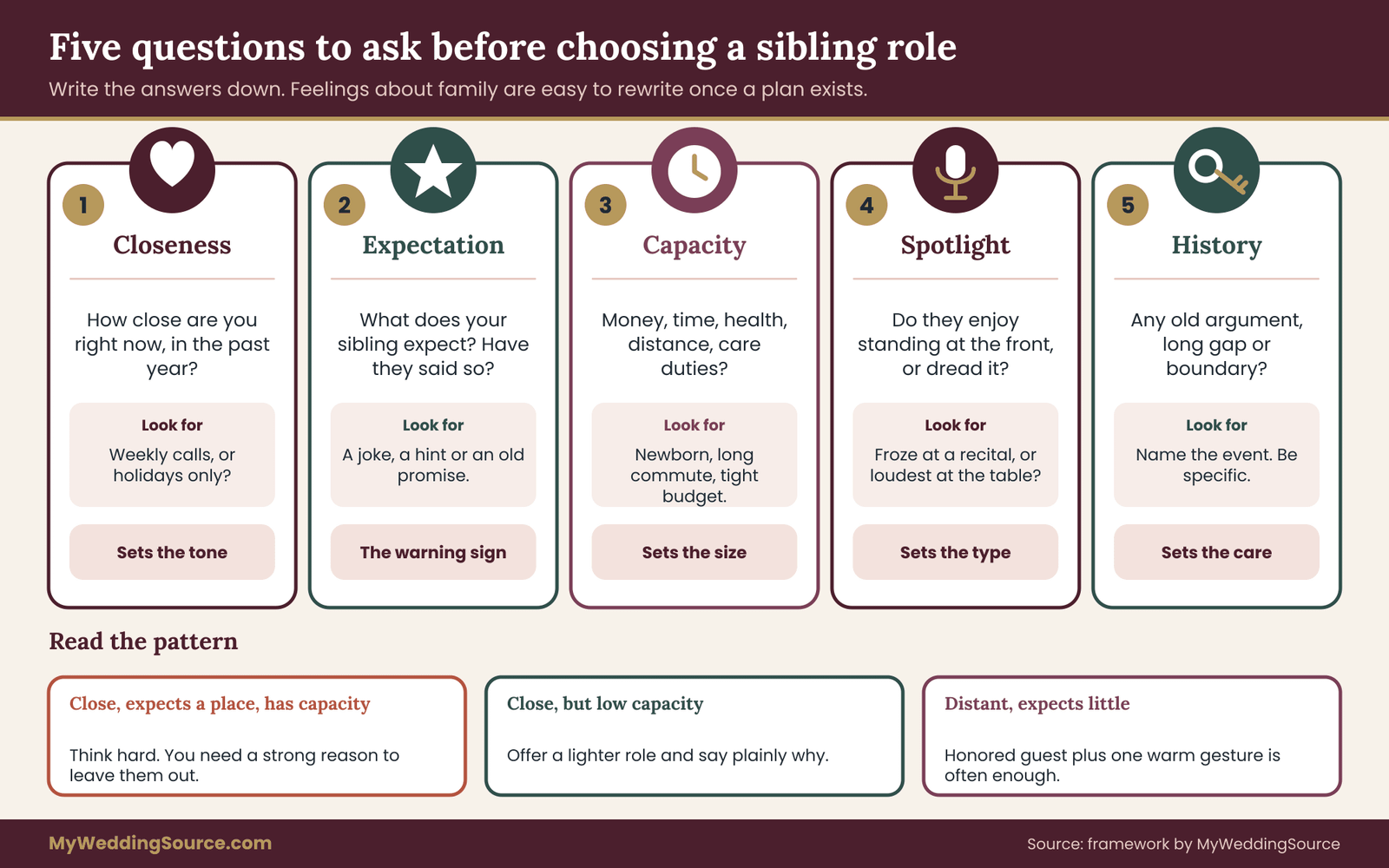
The temptation is to open with the lineup. Resist it for one evening and open with the relationship. A sibling wedding role works when it matches the person, and you cannot match it until you have asked a few questions honestly. Write the answers down, because feelings about family are easy to rewrite in your head once you have a plan.
Question one: how close are you right now? Not how close you were as children, and not how close your parents wish you were. Right now, in the past year, how often do you talk, and what do you talk about? A sibling you speak with weekly and a sibling you see at holidays are in different positions even if they share a last name. Closeness does not decide the answer, but it decides the tone.
Question two: what does your sibling expect? This is the question most couples skip. Some siblings assume they will be in the wedding party and have said so, sometimes years ago. Some assume they will not and are comfortable with it. Some have never thought about it. Expectation is separate from closeness. A distant sibling can expect a place because of tradition, and a close sibling can hope not to be asked because they dislike the spotlight.
Question three: what is their capacity? Capacity means money, time, health, distance and care responsibilities. A sibling with a newborn, a long commute, a chronic illness, a demanding job or a tight budget may find a wedding party spot difficult even if they would love to say yes. Asking for capacity first lets you offer a sibling wedding role that fits, and it can turn a hard conversation into a considerate one.
Question four: how do they feel about the spotlight? Some people love standing at the front. Others dread it. A sibling who froze at a school recital may not want to give a reading, and a sibling who is always the loudest person at the table may be hurt by a quiet behind-the-scenes job. This question is about temperament, and you usually already know the answer.
Question five: what is the history? Be specific. Is there an unresolved argument, a long gap, a boundary you set, a loan, a past wedding where someone was left out? History is not a reason to exclude a sibling, but it is a reason to be careful about timing and wording, and sometimes a reason to bring in a neutral person.
How to use the answers to shape a sibling wedding role
Put the five answers side by side and look for the pattern. If closeness is high, expectation is high and capacity is fine, leaving a sibling out of the lineup needs a very strong reason, and you should think hard about whether you have one. If closeness is high but capacity is low, the right move may be to offer a lighter sibling wedding role and say plainly why. If closeness is low and expectation is low, an honored-guest place with a small, warm gesture is often enough.
A mismatch between expectation and your plan is the warning sign for any sibling wedding role. If your sibling expects a role and you are not planning one, you are about to disappoint someone, so slow down, plan the conversation, and choose the alternative sibling wedding role with extra care. If your sibling expects nothing and you were about to give them a visible role as a gesture, ask whether that is truly a gift to them or a gift to your own sense of fairness.
A quick way to test your reading
If you are unsure about question two, there is a low-stakes way to learn. Bring up the wedding party in an ordinary conversation, without making any decision, and listen. Ask how they pictured the day, or whether they have thoughts about the size of the lineup. Do not hint at an offer and do not promise anything. People tend to reveal what they hope for within a minute or two.
If you cannot ask directly, ask a person you trust who knows your sibling well. Choose someone discreet, and do not use a parent as your messenger. A parent often carries the question back with their own opinion attached, and the family hears about your plan before your sibling hears it from you.
The ladder: choosing a sibling wedding role below the wedding party
Once you know the relationship, you need something to offer. “Everyone else is in the lineup but you” is a statement. “Here is what I would love you to do” is an invitation. The difference is a menu, and the menu is a ladder of sibling wedding role options from the lightest to the heaviest. The wedding party sits near the top of it. Several rungs below it are meaningful, visible and much less costly.
Think of the ladder as seven rungs. You are not choosing the highest rung you can afford. You are choosing the rung that matches the answers from the last section.
Rung one: honored guest. The sibling is invited, seated in the family section, mentioned in the program or the welcome as family, and included in the family photographs. This is the baseline. It is a full and respectable place, and for a sibling who dislikes attention it may be the best one. It only works as a sibling wedding role if the honor is real: the seat is close, the invitation is early, and a plus-one is included where you would give one to any family member.
Rung two: a named moment in the day. The sibling does something small and specific. They walk a parent to a seat, hand out programs at the door, light a unity candle, or sign as a witness if your state allows it. These tasks are visible, take under ten minutes and cost nothing. A short ceremony sibling wedding role fits a sibling who wants to be seen but not to carry a full day of obligations.
Rung three: a reading or a short speech. The sibling reads a passage during the ceremony or gives a short toast at the reception. This is a bigger offer. It needs a comfortable public speaker, a clear time limit and a script or reading that you both approve. The ceremony cue sheet guide explains how readers and cues fit into the run of the ceremony, which helps you judge how much space a reading can take.
Rung four: a behind-the-scenes job. The sibling takes a job that matters but is rarely seen. They might greet older relatives, manage the guest book table, keep an eye on the gift table, coordinate a family arrival, or act as the person your parents can ask when they have a question. The risk is that it sounds like unpaid labor, so use this rung only with a sibling who likes being useful, and make clear that the job is optional.
Rung five: a pre-wedding role. The sibling hosts a family dinner, organizes an informal send-off, writes a letter that you open the morning of the wedding, or spends a morning with you before the day starts. This rung suits a close sibling who would rather have private time than a public sibling wedding role. It is also the easiest way to give an adult sibling real closeness without adding them to the group photograph.
Rung six: a special title with no lineup. Some couples create a sibling wedding role that is not a wedding party spot but has a name, such as a family honoree or a personal witness. The title can feel warm or hollow depending on the follow-through. Use it only if the sibling wedding role has a real function, such as escorting a parent, standing for a family blessing or being the first person you see before the ceremony.
Rung seven: the wedding party itself. Full attendant status, with all its costs and obligations. You are not trying to avoid this rung because it is bad. You are asking whether it is the right rung for this sibling. The answer may be no even if you love them.

Why a ladder of sibling wedding role options beats a list of ideas
A list of ideas invites you to pick something that sounds nice. A ladder asks you to pick a level of commitment first and then fill it. That order protects you from a common mistake: offering a sibling wedding role that is bigger than their capacity or smaller than their expectation.
Suppose your sibling expected the wedding party and you offer rung four, a behind-the-scenes job. Whatever you call that sibling wedding role, they will hear a demotion. Suppose your sibling expected nothing and you offer rung three, a toast. They may feel put on the spot. The ladder helps you aim at the gap between what they expect and what you can give, and it makes the next step, the four criteria, easier to apply.
When the sibling wedding role turns out to be the wedding party after all
Sometimes the exercise changes your mind. You work through the questions, find that your sibling is close, expects a place and has the capacity, and realize that you were leaving them out for a reason that does not hold up, such as an even number of attendants or a vague wish for symmetry. That is a useful result, not a failure of the plan.
If you reach it, resist the urge to patch the lineup quietly. Ask yourself whether the structure that excluded your sibling is worth keeping. A lineup can be uneven. Attendants can stand on one side, or on neither, or you can have no formal sides at all. The wedding etiquette guide covers how modern lineups handle uneven numbers and mixed groups, and you may find that the constraint you worried about is not a constraint.
Four criteria for an alternate sibling wedding role
The ladder gives you options. The four criteria help you choose one without second-guessing it for months. Apply each test to your sibling and to the rung you are considering, and write the answer as yes, no or unsure.
Choice. Does your sibling get to say yes or no? Any sibling wedding role you offer should be optional, and the offer should say so. A sibling wedding role that cannot be declined is an assignment. The test is simple: if your sibling said “I would rather not,” would you be fine with that? If the honest answer is no, you are not offering a role, you are issuing an instruction, and the conversation will go badly.
Capacity. Can they do it without strain? Count the actual costs: money, travel, hours, health, childcare, emotional load. Then ask whether the sibling wedding role stays inside the capacity you identified in the relationship questions. A sibling wedding role that requires three trips and an outfit may be fine for one person and impossible for another. When you do not know, ask a neutral question first, such as whether they would prefer something simple or something involved.
Fit. Does the sibling wedding role match who they are? A shy sibling in a public reading is a poor fit. An organized sibling in a vague honorary title is a poor fit. A sibling who loves hosting in a one-line announcement is a poor fit. Fit is about temperament and skills, and it is the criterion couples overlook when they are excited about a clever idea.
Fairness. Does the arrangement hold up when everyone compares notes? Siblings compare. If you have three siblings and give one a toast, one a candle and one nothing, someone will notice. Fairness does not mean identical treatment. It means a pattern you can explain without embarrassment, and that your siblings and their families would call reasonable if they saw the whole picture. When you give your partner’s siblings a different sibling wedding role from your own, be ready to explain why.

Scoring the options without turning it into a spreadsheet
You do not need numbers. Look for a rung where all four answers are yes, or where a single unsure can be resolved with one question. If no rung passes all four, drop down to the one that passes the most and ask your sibling directly. A sibling who is invited to shape their own sibling wedding role is much less likely to feel handed a consolation prize.
If you cannot find any rung that passes the choice test, you are probably trying to make a role do work it should not do, such as soothing a relationship or answering a parent’s complaint. Return to rung one and make it genuinely warm. An invitation sent early, a seat close to the front, a plus-one, and a short personal note will serve a sibling better than a title that does not suit them.
A worked check of the four criteria for a sibling wedding role
Imagine a sister who lives two time zones away and has a toddler. Choice: unknown, so ask. Capacity: low for travel and fittings, but fine for a short reading since she can rehearse at home. Fit: she is comfortable with public speaking. Fairness: she is one of two siblings, and the other will also receive a sibling wedding role.
Rung three, a reading, passes all four once the question about choice is answered. Rung seven fails capacity. Rung one passes everything but may feel too small if she expects more. The decision is easy: offer the reading, make it optional, and tell her the alternative is a seat in the front row if she would rather simply enjoy the day.
Notice that the method does not tell you what the outcome should be. It tells you which questions to ask before you speak, so that the offer you make is considered rather than improvised. That consideration is what the sibling will feel, whatever they decide.
Putting the sibling wedding role on paper
Write a short note about the sibling wedding role to yourself with four lines: the rung, the reason, the one question still open, and the date by which you will talk. It sounds fussy, but it prevents two common failures. One is changing the plan after a parent’s reaction, and the other is putting the conversation off until the lineup is announced. The note takes two minutes and gives you something to return to when a relative pushes back.
The conversation: when, where and how to offer a sibling wedding role
You have done the thinking. Now comes the part that most people dread, and that most of the damage hinges on. The sibling wedding role conversation has four variables: timing, order, channel and wording. Get those four right and an awkward message lands gently. Get them wrong and a good decision turns into a grievance.
Timing a sibling wedding role conversation before the lineup is public
The best time to talk is after you have made the decision and before anyone else knows it. That window is narrower than it looks. Once you tell a parent, a friend or a partner’s family, you should assume your sibling will hear within days. Once the wedding party is named in a group chat, on a website or in a save-the-date photo, the window is closed.
Pick a date a few weeks ahead of the first public mention and put it on your calendar. If you are still deciding, tell your sibling that you are still deciding and when you expect to know. “We are working out the wedding party and I wanted to talk to you before anything is final” is honest and buys time without promising anything.
Avoid three bad moments. Do not tell your sibling in the middle of a family event, where reactions are public. Do not tell them right before their own major deadline, trip or loss. And do not wait until the invitation arrives, which treats the news as paperwork. A sibling who learns it from the envelope has been given no chance to react privately.
Order: you first, then the family
Tell your sibling before you tell your parents about the specific decision. Parents often have views, and they often share them with the sibling in question. If your mother hears first, she may call your sibling to soften the news before you have said a word, and the news arrives in the wrong voice.
If your parents are paying or deeply involved, a short heads-up is reasonable, but keep it neutral: “We are talking with each sibling about their part in the day this month.” Do not name your sibling or the sibling wedding role. The aim is to avoid surprising anyone, not to ask permission. The decision rights material elsewhere on this site gives language for separating input from veto, which is useful when a parent wants a say in the lineup.
Channel: voice beats text
A sibling wedding role conversation is best held in person, and the invitation to the conversation should be short. If that is not possible, use a phone or video call. A text message is a poor channel for a sibling who may be disappointed, because it removes your tone and gives them nothing to respond to but words on a screen.
Texts have a place. Use one to set up the call: “Do you have twenty minutes this week? I want to talk about the wedding. It is good news, no emergency.” The last phrase matters. Many people read an unexplained request to talk as bad news, and a nervous sibling reaches the call already braced.
Choose a quiet place with no audience. Do not bring your partner unless your sibling prefers it, and do not conduct the conversation on speakerphone with others in the room. If your relationship is tense, a neutral location such as a walk or a coffee shop can lower the temperature. If you suspect the response will be strong, make the call early in the day, so that you can follow up that evening or the next day.
Wording a sibling wedding role offer: five moves in a fixed order
Whatever the situation, a sibling wedding role conversation tends to work best in five moves.
Move one: warm opening. Say why you wanted to talk and name something real about the relationship. Keep it short and specific.
Move two: the decision, once and clearly. Do not hide it in the middle of a long preamble or soften it with so many qualifiers that the sibling must guess. One plain sentence is enough.
Move three: the reason, briefly. Give the true reason in a few words. If the reason is structure, say so. If it is fit or capacity, say so with care. If the reason is history, you do not have to give a long explanation, but do not invent a different one.
Move four: the offer. Name the alternative sibling wedding role by its real name, say that it is optional, and say what it involves.
Move five: the room. Ask what they think and then stop talking. This is the move people skip, and it is the one that tells your sibling the offer is a conversation rather than a verdict.

A basic script for a close sibling and a sibling wedding role
This is a starting point for the case where you are close and the reason is structure. Rephrase it freely.
“I wanted to tell you something before anyone else hears it. We are keeping the wedding party very small, and we decided it would only include friends from our college group. You are not in it, and I wanted you to hear that from me. What I would really like is for you to give the reading at the ceremony, if you want to. There is no outfit and no extra events. You can say no, and I will not be upset. What do you think?”
The script names the decision, gives a reason that is about the structure rather than about the sibling, and offers something real. It also makes refusal easy. If your sibling does want the wedding party, they will tell you in the next minute, and you will have the conversation you needed.
Notice what the script leaves out. It does not say “you know how much you mean to me” before the news. It does not use the words “unfortunately” or “I hope you will understand,” which presume a reaction. And it does not apologize for a decision you made carefully. A decision can be kind without being apologetic.
What to do in the next ten minutes
Expect one of four reactions: acceptance, a question, silence, or anger. Acceptance is easy. A question deserves a direct answer, kept short. Silence is common, and it is not a verdict. Let it sit for a few seconds, then say, “You do not have to answer now. I would rather you think about it.” Anger is covered in its own section later, and the rule of thumb is to listen, not defend, and end the conversation if it becomes abusive.
Whichever reaction you get, end with a clear next step. “I will send you the invitation next month, and let me know about the reading by the end of the week” is better than “we will talk again soon.” The follow-up on the sibling wedding role should be on a calendar, and it should be yours to make.
Scripts for a sibling wedding role conversation, by sibling and reason
The basic script covers one sibling wedding role case. Real families need variations, so this section gives short versions for the situations that come up most. Treat them as raw material for your own sibling wedding role offer. They are not a script to read out.
A younger sibling who looks up to you
A younger sibling may expect a sibling wedding role and may not have the language to say so. Keep the tone warm and the offer concrete. Avoid using their age as the reason.
“I want you at the wedding, and I want you to have a part in it that is actually fun. The wedding party is a lot of rehearsals and a long morning, and I did not want to put that on you. Would you do the grand entrance with me when we walk back up the aisle? Or tell me what sounds good to you.”
If the younger sibling is still a teenager, involve a parent in the practical side of the offer, such as transport, and keep the emotional side between the two of you.
An older sibling who might expect to be first
Older siblings sometimes assume seniority. Respect it in the offer without promising the lineup.
“You are the first person I wanted to tell about the wedding party, because you have known me longest. We are keeping it to a small group of friends, and I am not asking you to be in it. I would like you to stand with our parents for the family blessing. I want you in that spot because it is yours.”
The sentence “it is yours” carries weight. It tells your sibling that the sibling wedding role is chosen for them, and not left over from a list.
A sibling you are not close to
When the relationship is distant, honesty works better than warmth you do not feel. Keep it short, polite and open.
“We are sending invitations soon, and you are on the list. The wedding party will be friends only. I would be glad if you came, and I would like to find a way to include you that suits you. Would you rather have something simple like a seat with the family, or a small job in the day?”
Do not use this conversation to repair the whole relationship. A wedding is a poor time to settle old accounts, and the invitation is a gesture that can stand alone.
One of several siblings
In a family with three or more siblings, fairness is the main concern. Tell each sibling separately, but decide the pattern first so that they will find the same logic if they compare notes.
“We are not including any siblings in the wedding party, mine or my partner’s. We wanted the roles in the day to feel the same for everyone in the family. Each of you will have something to do, and I would like to talk about what suits you.”
If you are making different offers to different siblings, make sure each offer reflects something true about that person, not a ranking of who you like most.
A sibling who has said they do not want a role
Take them at their word. Say thank you for being direct, confirm what they would rather do, and do not push. You may offer a short, optional, low-pressure sibling wedding role later, but treat the first answer as the answer.
“Thanks for telling me. That makes it easy. You are on the guest list with a seat near the front, and I will not put you on a list or ask you to do anything. If you ever feel like doing something small on the day, tell me and I will make room.”
When your sibling reacts badly to a sibling wedding role: a rule for each reaction
You can do everything right and still get a hard reaction. Disappointment is not evidence that you chose wrongly. It is often the honest response of someone who hoped for a different answer. What matters is what you do in the next hour and the next month.
The sibling wedding role framework here separates four reactions and gives a rule for each. The point is to avoid two common errors. One is giving in to a sibling wedding role you did not want to offer. The other is treating every upset as an attack and hardening your position.
Hurt
Hurt sounds like quiet, short answers, a wobbly voice, or “I thought it would be me.” The right response is to acknowledge it without taking the decision back.
“I can hear that this hurts, and I am sorry it does. I thought about it a lot, and I still think this is the right call for the wedding. I do want you there, and I want to find a role you would actually like.”
Stay for a few minutes. Do not fill silence with explanations. If your sibling needs to end the call, let them, and agree on when you will talk next. A message the same evening that says “thank you for listening, I know it was not what you hoped for” does a lot of repair work in few words.
Negotiation
Negotiation sounds like “what if I only did the ceremony part?” or “what if you added one more groomsman?” Sometimes it is a reasonable suggestion, and you can change your mind. Often it is a bid to reopen a decision that has been made for good reasons.
The rule is to separate the request from the pressure. If the new idea honestly resolves your original reason, think about it, and take a day. If it does not, say so kindly: “I can see why that would work for you, and it does not solve the reason we chose a small group. I would rather give you a role that is clear than one that bends.” Do not agree in the room just to end the discomfort. A concession made under pressure often brings resentment from you, and an uneasy sibling wedding role is worse than a clear one.
Anger
Anger sounds like raised voices, accusations about the past, or threats to skip the wedding. The rule is to stay calm, avoid answering accusations point by point, and end the conversation if it turns abusive.
“I can tell you are upset, and I want to keep talking, but not like this. Let us stop now and try again tomorrow.”
Anger often cools within a day or two. Use that gap. Send a short message that is not a defense: “I know that was hard. I am still here, and I would like to talk when you are ready.” If the anger stays and begins to affect the rest of the family, a neutral third party can help. A family mediator, a counselor or a trusted relative who both of you respect can hold a conversation that the two of you cannot. The Association for Conflict Resolution is one place to learn how mediation works and to find practitioners.
If any part of the reaction involves threats, intimidation or fear for your safety, treat that as a safety matter and not an etiquette matter. Skip the scripts, step away and contact the appropriate support. The special situations section covers where to turn.
Silence
Silence sounds like no reply. It is the hardest reaction, because you do not know whether it means “I need time” or “I am finished with you.”
Give it a week. Then send one short message that does not demand anything: “Thinking of you. The invitation will be on its way, and the reading offer is open until the end of the month.” After that, leave the door open and avoid repeated contact that could feel like pressure. If your sibling still does not reply by the RSVP date, contact them once more, in a different channel, to confirm attendance. It is fine to ask for a yes or no, and it is fine to accept a no.
When to reverse a sibling wedding role decision
Occasionally the reaction reveals something you missed. Perhaps your sibling tells you about a promise made years ago, a reason that matters, or a fact about their capacity. If the new information changes the answer to the five questions, you can change your decision. The key is to change it because of what you learned and not because of how loudly it was said.
If you reverse, do it cleanly. Tell your sibling directly, and tell the people affected by the change, such as the attendant who will now be one of an even number. Avoid blaming anyone: “I learned something I did not know when I made the decision, and I want to correct it” is accurate and kind to everyone.

Repair after a hard sibling wedding role conversation
Whether or not you changed your plans, the next month decides whether the conversation becomes a story about you or about the wedding. A few small actions help. Send the invitation on time. Use the sibling wedding role you offered, or whichever one you agreed on, without rewording it. Include your sibling in the early family plans the same way you would have otherwise. And do not talk about the decision with anyone who is likely to carry it back, including cousins and friends in the family group chat.
If an apology is appropriate, make it specific and short. Apologize for the way you handled something, such as the timing of the news, if you handled it badly. Do not apologize for a decision that was reasonable. A decision is not a wrong, and presenting it as one gives your sibling something to negotiate with.
Parents, partners and the group chat
A sibling wedding role conversation is rarely only between two people. Parents have views, your partner has a sibling of their own, and the family messaging thread is a permanent record of anything you say there. Three sets of third parties need a plan.
Parents
Parents often care more about the wedding party than the couple does, and they usually care about it as a statement about the family. A parent may ask why one child is in and another is not, or may offer to talk to the sibling for you. Treat both offers with thanks and without acceptance. A parent who helps with the sibling wedding role message usually adds a second voice, and that is rarely what a sibling needs.
A useful line is: “We have decided, and we are talking to each person ourselves. It would help if you let us do that.” If a parent is contributing money, you can add: “We appreciate the support, and the wedding party is one of the decisions we are making ourselves.” This does not need to be cold. Many parents are relieved to be told what their role is.
If your parents are likely to reopen the issue repeatedly, give them one thing to do. A parent who is asked to host the rehearsal dinner or welcome the sibling’s family at the airport tends to stop lobbying. The decision-making guide offers a way to describe categories of decisions, so that you can agree with your parents on which ones belong to the couple.
Your partner and your partner’s family
Your partner has an equal voice in the lineup, and your partner’s siblings are part of the pattern. If their brother is in the wedding party and your sister is not, the comparison is built in. Talk it through together before you talk to anyone else.
There are three common patterns. You can include siblings on both sides, include neither, or include some for stated reasons. Each can be defended. The thing to avoid is a pattern that exists only because one side asked more loudly. If a decision is likely to look uneven, settle on the explanation you will both give, and have both partners be the one to tell their own sibling. That keeps the news in a familiar voice and avoids putting your partner in the position of speaking for your family.
The group chat and social media
Treat the family chat as a public record. Do not post the lineup there before your sibling knows. Do not use the chat to say “we are keeping the wedding party small” as a general message when one sibling has been told individually and the others have not.
If a relative asks in the thread why someone is not included, do not argue in public. Move it out: “Happy to talk about that by phone.” If your sibling posts about the decision, resist the urge to reply. A short private message later does more good than a public clarification now.
What to say when someone asks, “why isn’t your sister in it?”
Guests, relatives and vendors may ask, sometimes innocently. Prepare a sentence that is true and gives away nothing private. “We kept the wedding party small, and she has a special part in the day” works for almost everyone. If you need to go further, you can say “we decided it together” and change the subject.
Do not use your sibling’s private circumstances as an explanation. Capacity, health, money and history are theirs to share. Even if you are trying to be kind, “she cannot afford it” or “they are not getting along with our mother” tells the room something your sibling did not choose to say. Keep the reason inside the conversation where it belongs.
Keeping the news consistent
One practical risk is that different people hear different versions. Write down the one sentence you will use, and give it to your partner, so you both say the same thing. If you have told your sibling that the reason is structure, you cannot tell a parent that the reason is fit. Siblings compare notes, and inconsistent explanations read as dishonesty even when each version was meant kindly.
Special situations that change the answer
The framework works for most families. A handful of situations call for different handling, and a few call for help that no etiquette guide can give. Each one below states what changes and what stays the same.
Estrangement and strained relationships
If you have not spoken in years, the sibling wedding role question is really a question about whether to invite them at all. Start there. An invitation is a way of saying “the door is open.” It is not a demand for reconciliation, and it does not oblige you to give a visible role.
A reasonable approach is to send a short, personal note before the formal invitation, with no pressure attached, and to offer rung one: a seat, a warm welcome and no expectations. If they reply and want to talk, take it slowly. If they do not reply, you have still done the thing you can control. Do not hold a spot in the lineup or a sibling wedding role open as a gesture of hope. It puts a burden on both of you.
Estrangement sometimes has a protective reason behind it. If a sibling has hurt you, harassed you or made you feel unsafe, you do not owe them an invitation, a conversation or a role, and a wedding is not a duty to reconcile. In that case, put your safety first, plan who will know about the guest list and how the venue will handle an unwanted arrival, and consider talking to a counselor. The National Domestic Violence Hotline provides confidential support for people who are worried about abuse, and it is a better starting point than a script.
A sibling in recovery or with a health condition
Some siblings avoid alcohol, crowds or late nights because of recovery, anxiety, a chronic illness or medication. A conversation about a sibling wedding role should not turn into a conversation about their health unless they bring it up.
Offer choices that fit a range of needs without naming one. A daytime role, a quiet seat near an exit, a plan for a break, and an alcohol-free table or a non-alcoholic drink option can all be offered to any guest. If the sibling is in early recovery, ask what would help. Some want to be seated away from the bar, and others prefer not to be treated differently. The Substance Abuse and Mental Health Services Administration publishes information on recovery and on finding support, which may help you understand what a sibling is dealing with, but the best source is the sibling themselves.
If you are worried about a sibling’s safety, take it seriously. In the United States, the 988 Suicide and Crisis Lifeline offers call and text support at any time, both for people in distress and for family members who are concerned about someone.
A sibling wedding role when there are access needs
Access needs shape the sibling wedding role more than they shape the invitation. Ask the sibling what would make the day easier. Do not assume that a physical or sensory difference rules out a visible role, and do not assume it makes one a good idea.
Check the venue before you promise anything. A ceremony sibling wedding role that involves stairs, a long aisle or a stage needs an accessible route. Ask the venue about step-free access, seating, restrooms, parking and any rules for mobility devices, and put the answers in writing. The U.S. Department of Justice explains how the Americans with Disabilities Act applies to places that are open to the public, and a venue can tell you how it handles it. For the broader checklist, a written accessibility checklist from the venue is worth requesting before you sign.
Half, step and in-law siblings and the sibling wedding role
Families are not always built from one set of parents, and etiquette does not rank siblings by biology. The question is the relationship, and the five questions work the same way. A step-sibling you grew up with and a half-sibling you met last year are different cases, and they should be treated according to who they are to you.
Be cautious about patterns that create two classes of siblings. If a half-sibling is invited as a guest and a full sibling has a role, the half-sibling will notice. If you must make a different sibling wedding role offer to each, make each of them warm, and be ready to explain without ranking.
A sibling with a partner and children
Siblings rarely arrive alone. A sibling with a spouse, a partner or children has a household, and a role for one person can affect everyone. Decide in advance whether the partner is invited, whether the children are, and how the household will get to and from the day. If you are inviting partners for everyone else in the family, do not exclude one sibling’s partner without a reason you can say aloud.
If your sibling has young children and you want them to take part, ask the parent first and make the sibling wedding role small and safe. The wedding guest care guide covers how to plan for children and older relatives on the day, including supervision and quiet space.
Distance, cost and the sibling wedding role
A sibling who lives far away may be glad to be a guest and unable to be an attendant. Offer a sibling wedding role that can be done remotely or briefly: a recorded message, a letter, a reading that is rehearsed by video, or a place in the family photograph on the day. Do not assume the cost is the only barrier. Travel time, leave from work and childcare often matter more than the airfare.
If you want a distant sibling to attend and money is the barrier, you can offer help. Do it privately and kindly, and do not link it to the sibling wedding role. A sibling who feels bought will not feel honored.
A sibling who also hopes to be officiant, planner or vendor
Siblings sometimes volunteer to officiate, photograph, cater or coordinate. A professional task and a family relationship do not always mix well. If your sibling is qualified and you want them in the role, treat it like any hiring decision: a clear scope, a written understanding, and an easy way out for both of you. If you do not want them in the role, say so before they invest time, and offer a different place in the day.
If a sibling offers to officiate, the rules on who may officiate differ by state. Check the current rules with the office that issues marriage licenses where you plan to marry.
Several siblings and one sibling wedding role pattern
Large families can produce an impossible arithmetic problem. Five siblings, a wedding party of six and two partners do not fit. The only stable solutions are all in or all out, or a clear rule such as “siblings of the couple stand in the family blessing and no one stands in the lineup.” Pick a pattern you can describe in a single sentence and apply it evenly. Exceptions are possible, but each exception needs a reason that can survive a family dinner.
A worked example: Priya and Tom decide about Arjun
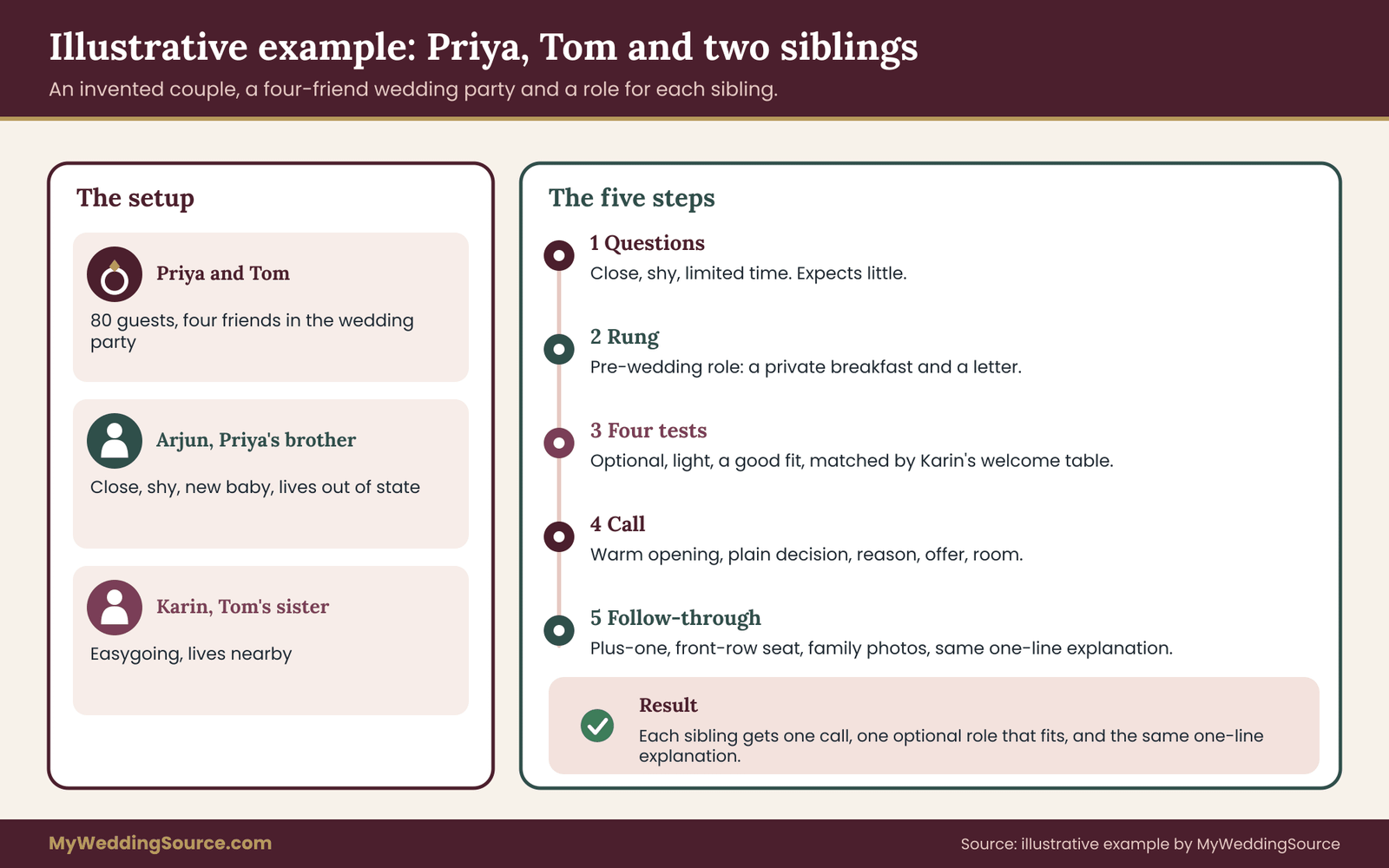
The following example is invented to show a sibling wedding role process from start to finish. It is not a real couple.
Priya Nair and Tom Lindqvist are planning a wedding of about eighty guests. They have decided on a wedding party of four: two close friends each. Priya has a brother, Arjun, who is thirty-one and lives in another state. Tom has a sister, Karin, who is twenty-six and lives nearby. Both siblings are invited. Neither is in the lineup.
Step one: five questions about Arjun. Priya and Arjun talk every couple of weeks. They are close but not daily friends. Arjun has never said what he expects, though he joked a year ago that he would be Priya’s “best man.” His capacity is mixed: he has a flexible job, a mortgage and a new baby. He is shy in public. History is calm, with one old argument about the family home that has been settled.
Step two: choose a rung for the sibling wedding role. Priya thinks about the ladder. Rung seven would be the wedding party, and it fails on capacity and fit. Rung three, a toast, fails on fit. Rung one, honored guest, passes everything but may feel small given the joke. Rung five, a pre-wedding role, is a good match: Arjun is warm one-on-one and dislikes crowds.
Step three: the four criteria. Choice: yes, if offered as optional. Capacity: yes, since it only needs a morning. Fit: yes. Fairness: Tom’s sister Karin will receive a different but equal offer, a place hosting the welcome table with her parents. The couple writes down their explanation: no siblings are in the lineup on either side.
Step four: the conversation. Priya calls Arjun on a Sunday after saying it is good news. She tells him warmly that the wedding party is four friends, that he is not in it, and that she wanted him to hear it from her. She offers a private breakfast with him on the morning of the wedding, with a letter she will give him, and a place in the family photographs. She says it is optional and asks what he thinks.
Arjun is quiet for a moment, then admits he had half expected it and half hoped not. He says the breakfast sounds good, and he asks if his wife and the baby can be at the ceremony front row. Priya says yes.
Step five: follow-through on the sibling wedding role. Priya mentions the arrangement to her parents in one sentence and does not name the details. Tom calls Karin separately and offers the welcome table. The couple use the same explanation for both. The invitations go out on time, with a plus-one for Arjun’s wife and a note about seating near the aisle for the baby’s comfort.
What the example shows about a sibling wedding role
Three features of the example carry over to other families. First, the couple did the thinking before the call, so the call was short. Second, each sibling received a sibling wedding role matched to who they are, and the explanation was the same for both. Third, the decision was made once. Arjun was offered something and given room to respond, and the conversation ended with a plan, not an argument.
The example also has limits. Arjun happens to be calm and Karin happens to be easygoing. A harder case, such as a sibling with a bruised relationship or a sibling who expected the best-man role, would use the same steps but would take longer and might involve a second conversation. The framework does not guarantee a happy outcome. It gives you a fair process to follow, so that whatever your sibling decides, you will know you handled it well.
Making the sibling wedding role real: invitation, seating, photos and the day itself
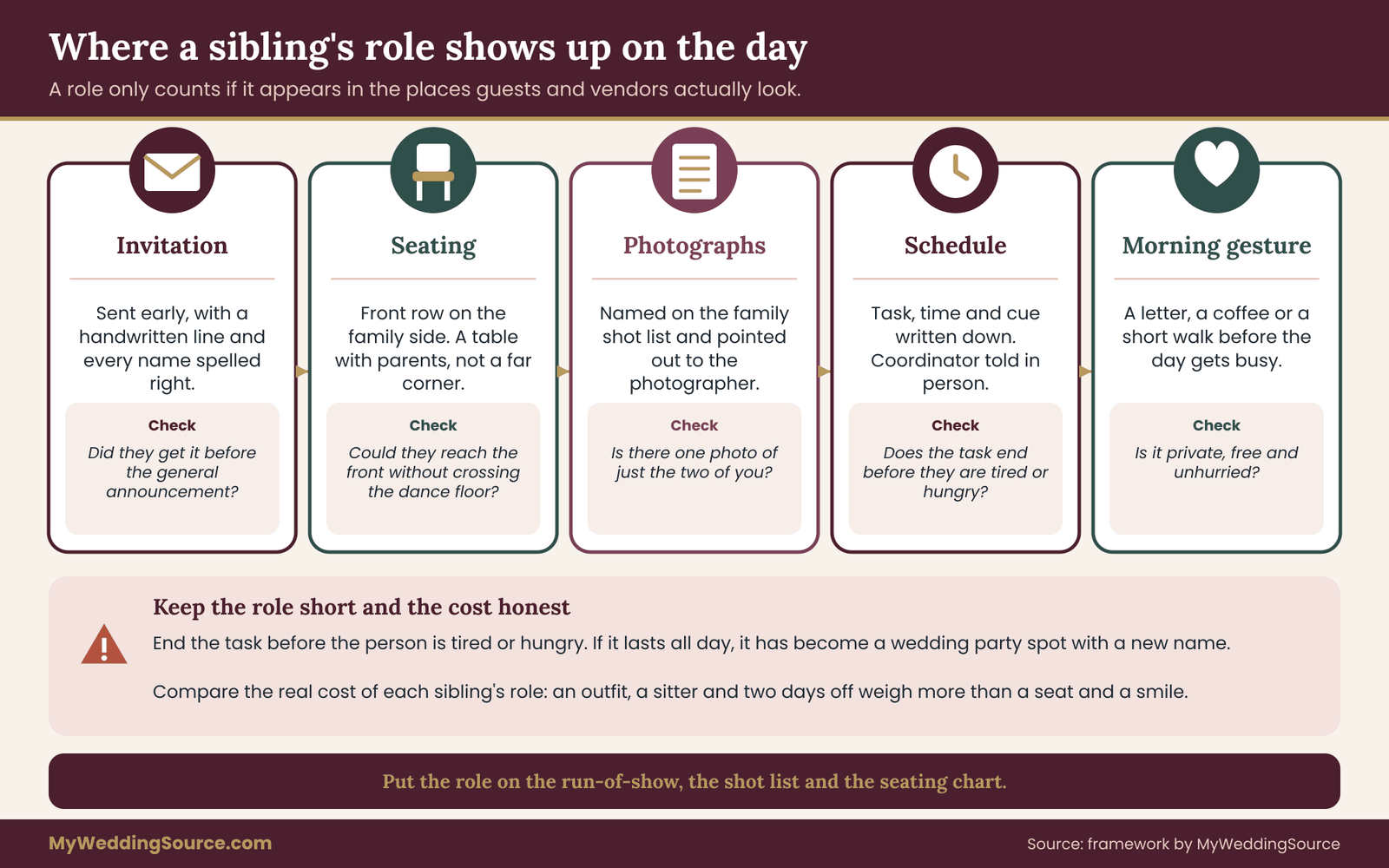
A role that is promised in a phone call and forgotten in the planning does more harm than no role at all. The follow-through is where a sibling decides whether the offer was sincere. This section turns the conversation into a list of concrete places where your sibling should be able to see that they matter.
The invitation and the response card
Send your sibling the invitation at the same time as the closest family, or slightly earlier. If you are mailing printed invitations, hand-deliver or send theirs first, or ahead of the main batch, and add a short handwritten line. If you are using a wedding website, make sure they get the link before the general announcement.
Address the envelope to the household the way you would for any close relative, and include their partner and children by name if they are invited. The invitation etiquette guide covers the wording and addressing details, including how to handle names, plus-ones and household invitations. A small detail goes a long way here: a sibling whose partner’s name is spelled correctly feels expected.
Set an early reply date for a sibling who has a role, and tell them why. “We would like to confirm the readings by the end of next month so that the program can be printed” is a practical reason, and it lets them back out gracefully if circumstances change.
Seating that matches the intention
If the sibling wedding role is an honored guest, the seat has to show it. At the ceremony, that usually means the first row on the family side, close to the parents. At the reception, it usually means a table near the couple, or a family table that includes parents and grandparents.
Do not put the sibling at a table of acquaintances on the far side of the room, and do not seat them with the group of people they find difficult. The wedding seating chart guide explains how to build tables around relationships rather than fill gaps, which is a better method for a family table than moving names around until it fits.
If you are giving your sibling a reading or a toast, seat them where they can reach the front without crossing the dance floor, and confirm where the microphone will be. Speakers feel more confident when they know the route.
Family photographs
Photographs are where an unexpected gap shows up. If your sibling is not in the wedding party, they may not be in the photographs unless you plan for it, since the shot list is often built around the lineup.
Put your sibling in the family formal list explicitly, in every grouping that suits them: couple with parents, couple with siblings, couple with extended family. A sibling wedding role that skips the group photograph feels like a footnote. If you are using the sibling’s role to remove the wedding party from the picture, as with a quiet reading, add a photograph of you and them together at some point in the day. The family photo list guide covers how to build a list that photographers can follow, and it is worth sharing with the person who will call out names.
Tell the photographer who the sibling is. A photographer who knows that the person in the green jacket is your brother, and that he is doing the reading, will make sure to capture it.
The day itself
A role only works if somebody remembers it on the day. Write the sibling’s task, time and cue onto whatever document the planner or coordinator is using, and tell the coordinator in person. If there is no planner, give the schedule to a trusted friend or relative who is not in the wedding party.
For a ceremony role, run through the logistics once before the day: where to stand, when to move, what to hold, who gives the signal. For a toast, confirm the time limit and whether you want to see the text beforehand. For a behind-the-scenes job, tell your sibling when it starts and when it ends, so that they do not feel on duty all evening.
A good rule is that a sibling wedding role should end before the person is tired or hungry. If the job is at the welcome table, set a time to hand it off. If the task is a reading, let them sit down and enjoy dinner. A role that stretches across the whole day is a wedding party spot with a different name.
The morning-of gesture
A small private moment on the morning of the wedding often matters more than anything in the program. A letter, a short walk, a coffee, a photograph of the two of you before the day gets busy. These cost nothing and require no performance.
They suit a sibling who did not receive a visible role, and they suit a sibling who did. The point is to let your brother or sister know, privately and without an audience, that they are one of the people you were thinking of that morning. If you have only time for one thing, do this.
Thanking your sibling afterward
A thank-you after the wedding closes the loop. Write a short note that names what they did or what they gave you, whether it was the reading, the welcome table or simply being there. Do not copy the language you used for guests in general. Siblings tend to remember when the note was written by hand, with specific details, and when it came in the first few weeks and not the last.
If the sibling declined the role you offered, thank them anyway, and mention something you noticed about their day. If they chose to attend as a guest only and enjoyed it, say so. It tells them that their choice was a fine one.
Budget implications of the alternative
Most alternative roles cost less than a wedding party place, and some cost nothing. That does not mean they are free. If you ask a sibling to travel, pay attention to costs that you can reasonably take on, such as a printed program, a boutonniere or corsage, a meal, or a small contribution to lodging. If you have decided not to cover any travel for guests, apply the same rule to every sibling.
The point of the cost review is to prevent a quiet unfairness. If one sibling’s role needs them to buy an outfit, hire a sitter and take two days off, and the other sibling’s role needs a seat and a smile, you have created a difference in burden that may look like a difference in affection. Count the costs of each role honestly, and adjust either the role or the support, so the offers can be set side by side without embarrassment.
If the sibling cancels or changes their mind
People get ill, flights are cancelled, and children need care. If your sibling drops out of the role late, keep it simple. Thank them for telling you, ask if there is anything that would help, and give the task to someone else in a low-key way, such as a cousin or close friend. Do not make the sibling feel responsible for the gap.
If the cancellation is a sign of a deeper problem, treat it as a separate matter from the role. A sibling who is struggling may need a conversation or a call more than a replacement plan. Where the situation involves health, grief or safety, a conversation with the person comes first and the program second.
Common mistakes, and how to avoid them
The same few errors turn up in family after family. Most are small, and all are avoidable once you can see them.
Announcing before telling. The lineup goes into a group chat, a website or a conversation with a parent before the sibling has heard it. The fix is to tell the sibling first, and to hold the news until you have.
Using a text message for a hard conversation. A sibling who reads a decision on a screen cannot hear your tone and has no chance to respond. Use a call, and use a text only to arrange it.
Leading with an apology. Opening with “I am so sorry, I hope you will not be upset” tells the sibling to expect bad news and makes the decision sound like a wrong. Start with warmth, state the decision plainly, and save the apology for anything you actually did badly.
Offering a consolation prize. A role invented to make up for a lineup spot, without a real function, is easy to spot. If the offer is a title with no task, it will feel like one. Choose a sibling wedding role that has a purpose in the day, or give a warm rung-one welcome and be honest that it is a place of honor.
Making the offer mandatory. A role that cannot be declined is a job. State that it is optional, and mean it.
Choosing by guilt. A decision made to avoid a parent’s disappointment tends to be reversed, resented or applied unevenly. Make the choice from the five questions and the four criteria, and then manage the guilt separately.
Treating siblings unevenly without a reason. Different offers are fine. Offers that cannot be explained are not. Test each pattern by saying it aloud to a friend who does not know the family.
Explaining the decision to everyone but the sibling. Relatives, friends and vendors may hear a rationale before the sibling does. The sibling should be the first to hear it and the first to hear it in full.
Skipping the follow-through. The sibling who was promised a reading but not told the date, or promised a seat but placed at the back, learns that the offer was only a way to end a conversation. Put the role on the run-of-show, the shot list and the seating chart.
Reopening the decision for every complaint. Some negotiation is healthy. A decision that changes after each objection teaches the family that persistence works. Keep a short list of what would change your mind, such as new information about capacity, and nothing else.
Treating a serious problem as an etiquette problem. Scripts help with awkwardness. They do not help with abuse, threats, active addiction or a mental health crisis. Those need other support, covered next.
When a script is not enough
Most of this guide assumes a family that is ordinary in its tensions. Some situations are different, and it is worth knowing where the line is.
If you feel unsafe around a sibling, or you have experienced harassment, intimidation or abuse from them, put your safety first. You are not required to invite them, give them a role or have a conversation. Support organizations can help you plan, and the National Domestic Violence Hotline is one starting point in the United States. A counselor can help you work through the decision, and the venue and your wedding team can help you plan the practical side.
If a sibling is in crisis, or you are worried that they may harm themselves, contact emergency services or the 988 Suicide and Crisis Lifeline. The wedding schedule is not the priority.
If the conflict is not dangerous but is entrenched, mediation may help. A family mediator, a licensed therapist or a trusted elder with no stake in the outcome can hold a conversation that the two of you cannot. The Association for Conflict Resolution is a reasonable place to learn what mediation involves. The American Psychological Association publishes consumer information about family relationships and about finding a psychologist, which can help if you are looking for professional support.
None of this is a reason to avoid the conversation. It is a reason to know in advance what you will do if the conversation goes somewhere that you did not plan for.
Your next steps
Pick one evening this week and do three things. First, write the five relationship answers for each sibling: closeness, expectation, capacity, spotlight comfort and history. Second, choose a rung on the ladder for each of them and test the choice against the four criteria. Third, write the one sentence you and your partner will use if anyone asks.
Then set a date for each conversation, and put it a few weeks ahead of the first public mention of the lineup. Make the call, use the five moves, and let the sibling respond. After that, put the sibling wedding role on the run-of-show, the shot list and the seating plan, so that the offer you made shows up on the day. If you are working through other family questions as well, the wedding decision-making guide is a good next stop.
FAQ
Is it rude not to have my sibling in the wedding party?
Not by itself. Etiquette sources, including the Emily Post Institute, treat the wedding party as the couple’s choice. What can be rude is how the news is delivered. Tell your sibling yourself, early and privately, say the decision plainly, and offer a real alternative. A sibling who is treated with care often accepts a no more easily than one who is told indirectly.
How do I tell my sibling they are not in the wedding party?
Call or meet in person before anyone else knows. Open warmly, state the decision once, give a brief honest reason, offer a specific optional alternative and then ask what they think. Avoid texting the news. Pick a quiet time, and follow up the next day if the response is cool. A short note afterward helps.
What can my sibling do instead of being in the wedding party?
Options range from honored guest in the front row, to walking a parent to a seat, giving a reading, hosting the welcome table, a private morning visit or a letter. Choose the one that matches your sibling’s comfort, money and time, and make clear that it is optional. The role should have a real function and be written into the day’s schedule.
What if my sibling expected to be in the wedding party?
Acknowledge the disappointment without taking the decision back, and do not argue about the past. Explain the reason briefly, offer something that fits them, and give them time. If the reaction reveals new information, such as a promise you had forgotten, you can reconsider. Change your mind because of what you learn, not because the pressure was loud.
Should I include both my siblings and my partner’s siblings?
Aim for a pattern you can state in one sentence, such as all siblings, no siblings or siblings who stand for a family blessing. Uneven patterns can work when there are real reasons, but they are easy to misread. Talk it through with your partner first, and have each of you tell your own sibling.
Can my parents tell my sibling for me?
It is better if you do. A parent may add their own opinion, soften the news in a way you did not intend or deliver it at an awkward moment. You can thank parents for their offer and give them another task, such as hosting a dinner. Keep them informed in general terms, and let the news come from you.
What if my sibling and I are estranged?
An invitation can be a quiet way of leaving the door open, without any obligation to give a role. Send a short note, offer a seat and set no expectations. If the estrangement involves harm or fear, you do not owe an invitation, and your safety comes first. A counselor can help you decide.
What if my sibling says no to the role I offer?
Accept it and thank them for being direct. Confirm what they would prefer, such as attending as a guest, and do not push. You can say the offer stays open if they change their mind, but avoid repeating it. A sibling who feels respected tends to enjoy the day more than one who is persuaded.
Sources
- Wedding party and family etiquette, Emily Post Institute
- Family relationships and finding a psychologist, American Psychological Association
- Mediation and conflict resolution resources, Association for Conflict Resolution
- 988 Suicide and Crisis Lifeline
- Support for people concerned about abuse, National Domestic Violence Hotline
- Americans with Disabilities Act information, U.S. Department of Justice
- Recovery and behavioral health resources, Substance Abuse and Mental Health Services Administration
- Mental health information, National Institute of Mental Health