
Wedding anniversary grief is the ache that can arrive on the day you mark your marriage, because someone who mattered to the wedding is no longer here to mark it with you. This guide gives you a way to plan for that day without turning it into a performance: a small set of rituals, each one optional, each one with clear boundaries about who helps and who does not.
Treat wedding anniversary grief as something to prepare for, not something to fix. Write down which dates carry weight, then sort every possible ritual behind one of three doors: quiet (just you), shared (named people, set time) or open (visible to others). Every ritual is opt-in, and each person can answer “yes,” “not this year” or “no” without explaining. Decide six weeks ahead, confirm two weeks ahead, and keep a morning-of override so the day can change when you do.
The first anniversary of a wedding tends to be pictured as light: a dinner, a photo album, a toast to the year behind you. For some couples it is also the first time the empty place becomes visible. A parent who walked a child down the aisle has since died.
A grandmother who sat in the front row did not live to see the year out. A sibling, a friend, a former mentor, or a child the couple lost may be missing from the story in a way that nobody planned for on the day of the wedding itself.
This article is about the specific problem that follows. It is not about how to include a loved one in a ceremony, which the site already covers elsewhere. It starts after the wedding and asks a narrower question: when the anniversary comes around and the grief comes with it, how do you plan rituals that help if you want them and cost nothing if you do not? Wedding anniversary grief is easier to carry when these choices are made early.
The word “optional” is doing real work in the title. Many memorial plans fail because they are built as obligations. Someone proposes a candle, a toast, a visit to a grave, a donation, a social media post. Then everyone feels they must take part, including people who would rather not, and the anniversary becomes one more event to get through.
A plan built on opt-in choices avoids that. Nothing happens unless the person it affects says yes. Few couples regret keeping wedding anniversary grief simple.
A note on scope. This is general planning information, not legal, tax, medical or financial advice, and it is not a substitute for a grief counselor, a clergy member or your own doctor. Where a point depends on your faith, family or local rules, the article says so and points you to the right person to ask. Decided ahead of time, wedding anniversary grief has less room to catch you off guard.
What wedding anniversary grief can mean
People use the phrase to describe quite different situations, and the right plan depends on which one you are in. It helps to name yours before you build anything.
An absence that began before the wedding. Someone died in the months or years before the wedding, and the wedding itself was shaped around that loss. The first anniversary then returns the question: how did we hold them in the day, and do we want to hold them again? Wedding anniversary grief changes from year to year, so revisit the choice.
A death that happened since the wedding. A parent, grandparent or friend was at the ceremony and has died in the year since. Photographs from the wedding now carry a different weight, and the anniversary can feel like looking at the last good picture. That is a fair standard for handling wedding anniversary grief.
A death anniversary that sits close to the wedding date. The two dates may fall in the same week or the same month. The calendar then asks you to hold a celebration and a remembrance almost together, and many couples are unsure which one gets priority. Most of the work with wedding anniversary grief is done before the day arrives.
A loss that is not a death. A pregnancy loss, an estrangement, a falling-out that ended a long friendship, or a relative who is living but no longer present in the couple’s life. These absences are real and often get less room than a death does, so couples sometimes have no script for them at all. A calm answer now saves a hard conversation about wedding anniversary grief later.
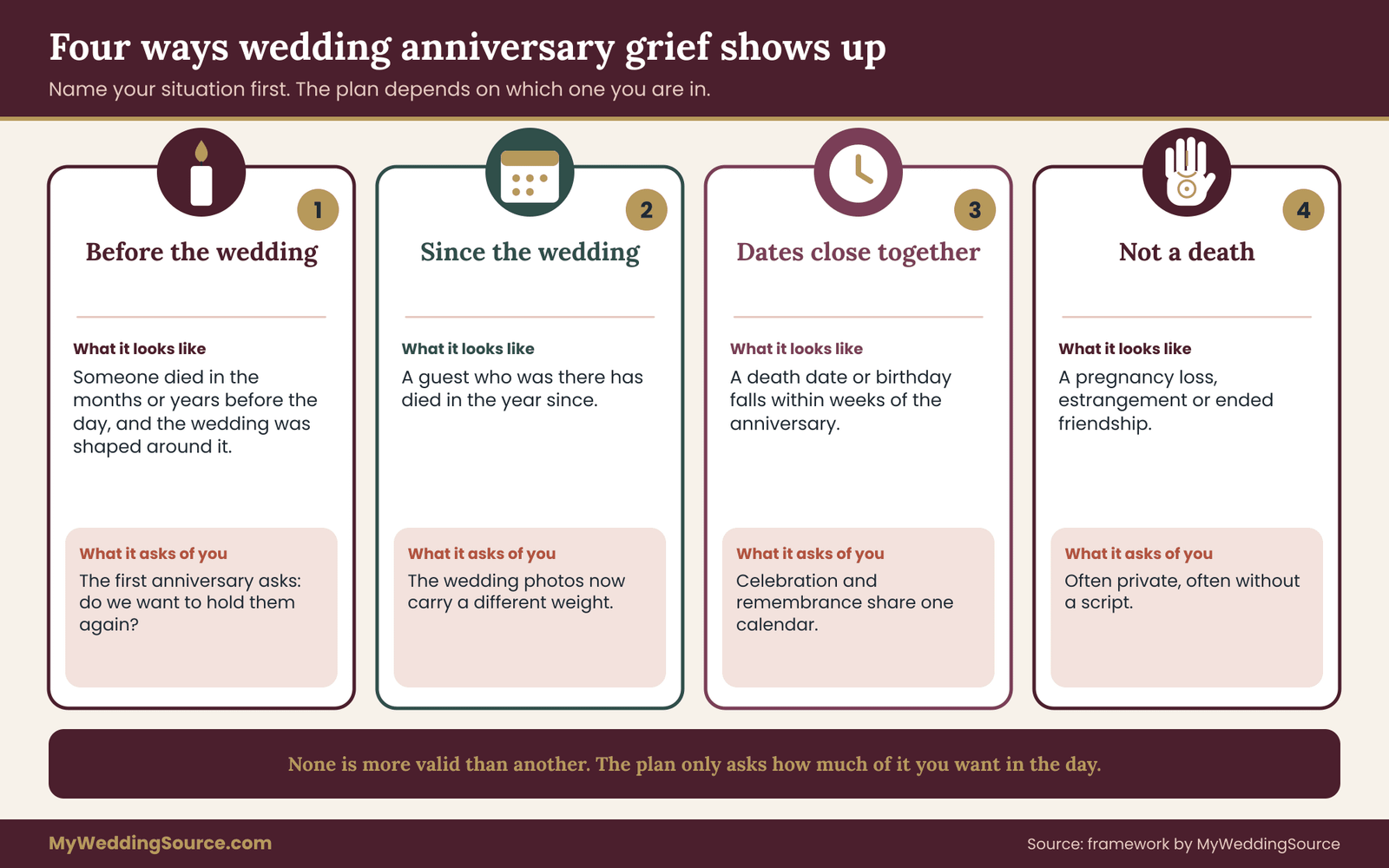
None of these is more legitimate than the others. The wedding anniversary grief plan below works for all four, because it does not ask you to justify the grief. It only asks you to decide how much of it, if any, you want to bring into the day, and in front of whom.
It also helps to say what this guide is not. It does not tell you how grief should feel, how long it lasts or what a healthy response looks like. People grieve in different ways, and the same person can respond differently from one year to the next. The Hospice Foundation of America, which the sources list points to, is one place to read about the range of normal responses. Here the focus is practical: dates, choices, conversations, boundaries.
Finally, grief is not always the only feeling on an anniversary. Joy, gratitude, irritation at well-meaning relatives and plain tiredness can all show up in the same hour. A good wedding anniversary grief plan leaves room for all of them. If the day turns out lighter than you feared, you should be able to enjoy it without feeling you skipped something.
The design rule: every ritual is opt-in
The single rule that holds the rest of this guide together is that a ritual only happens if the people it involves have actually said yes. That sounds obvious, but it is routinely broken in kind ways. A relative announces a toast to the person who died, with the glasses already raised. A partner books a table for a “remembrance dinner” as a surprise. A parent posts a tribute photo and tags the couple. Each of these comes from love. Each one removes the choice.
Opt-in design replaces assumptions with three standing answers that anyone can give at any time, with no explanation:
Yes. I want to take part in this ritual as described.
Not this year. I do not want to take part now, and I may in the future. Please do not read this as a no for good.
No. I do not want this ritual, now or later, and I would like to stop being asked about it.
Three answers is enough. More options invite negotiation, and fewer force people into a yes or a no they do not mean. “Not this year” matters most, because grief changes. A ritual that is unbearable in the first year may be welcome in the fifth, and the reverse is also true.
Couples who treat “not this year” as a normal, respectable answer tend to avoid the argument where one partner feels pressed and the other feels rejected. Wedding anniversary grief does not need a grand gesture, only a clear one.
The rule applies in two directions. It applies to you and your partner: neither of you has to accept a ritual the other proposes, and neither of you has to propose one you do not feel. It also applies to everyone else, including parents, siblings, the bridal party and guests, who may have lost the same person and have their own idea of how to mark the day. Writing it down is enough; wedding anniversary grief does not need a formal document.
There is one more reason to build around opt-in choices. Grief is uneven inside a couple. One partner may have lost a parent while the other has not lost anyone close, or the two may have lost different people. The partner who is not grieving can feel unsure how much to say. The partner who is grieving can feel watched. A plan with clear, low-pressure answers lets both of them speak plainly without it becoming a referendum on how much each one cares.
For the wider rules about asking and answering questions in a family setting, the site’s wedding etiquette guide covers the general principles of courtesy that this plan builds on, and the wedding ceremony step-by-step guide shows where a ceremony-time tribute would sit if you decide to repeat one at a vow renewal later.
Two practical consequences follow from the opt-in rule. First, every ritual in your plan needs a plain description of what it involves, so that “yes” means something specific. “We light a candle at the dinner” is a ritual. “We remember Dad on the anniversary” is a feeling, and it is not something a person can agree to or decline.
Second, every ritual needs an exit. If you say yes and then wake up on the day and cannot do it, nobody should be offended. The plan treats that as an expected outcome and not as a failure.
Finally, the rule covers silence. A couple may decide that the right ritual is none at all, and that the anniversary is simply an ordinary celebration. That is a valid plan. The framework in the next section works equally well for a couple who end up using only the quietest option, or no option, and that outcome is built into it rather than treated as something to be talked out of.
The three doors plan for wedding anniversary grief
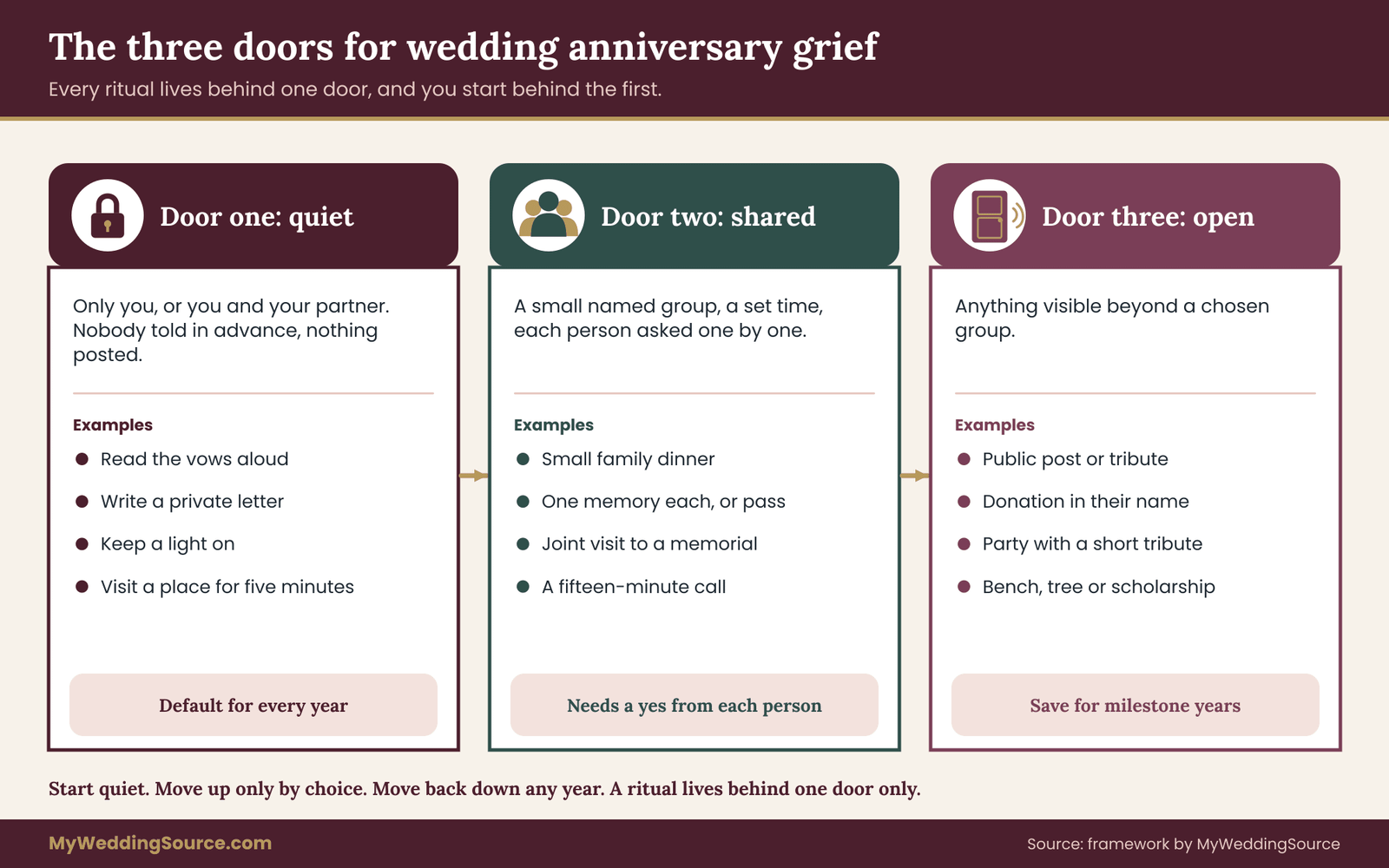
The working tool in this guide is a simple sort. Every ritual you might consider for your wedding anniversary grief goes behind exactly one of three doors, depending on who can see it or take part.
Door one: quiet. Only you, or only you and your partner. Nobody else is told in advance, nobody else is asked to take part, and nothing is posted or photographed for others. Examples include a private walk, reading the vows you wrote, lighting a candle at home, listening to a song, or writing a short letter you keep. Both partners should be able to read this and agree, even when wedding anniversary grief feels different to each of them.
Door two: shared. A small, named group, at a set time and place, with a clear purpose. The group is chosen by the couple, and each person is asked individually. Examples include a dinner with the two families, a phone call among siblings, a short visit to a memorial site with a parent, or a coffee with the one friend who knew the person best.
Door three: open. Anything visible beyond a chosen group. A public post, a gathering open to guests, a donation page, a printed tribute in an anniversary card sent to many people, or a toast at a larger party. Door three is the one where other people’s reactions, and their own grief, enter the picture most directly. Wedding anniversary grief is personal, so adapt this to your own household.
Three rules govern how the doors work together.
Start behind door one. By default, every anniversary begins quiet. Moving to door two or three is a choice you make on purpose, with the people involved, and not something that happens because it seemed the done thing. This protects against the most common mistake, which is that the visible option becomes the default and the private option feels like a lesser version of it.
Doors open in either direction. You can go up a door one year and back down the next. A couple who held a family dinner in year one can choose a private evening in year two without it meaning the dinner failed. Moving back down is not a retreat. It is your wedding anniversary grief plan working.
A ritual lives behind one door only. If you light a candle at home, that is a door one ritual. If you want to light the same candle at a dinner with relatives, it becomes a different ritual, with different people involved, and it needs its own yes. Keeping them separate prevents a private act from quietly turning into a public one. If it does not fit your family, leave it out; wedding anniversary grief has no single script.
The reason for sorting before choosing is that it changes what you ask. Rather than “what should we do to remember Dad on our anniversary,” the question becomes “what do we want behind each door, if anything?” That reframing takes the pressure out of the first conversation. You are not choosing one ritual. You are building a short menu and leaving most of it unused.
How many rituals should a plan hold? For most couples, two or three is plenty: one quiet ritual that costs nothing, one shared option that can be skipped, and possibly one open option that is only used in a milestone year. More than that tends to turn the anniversary into a schedule, which is the opposite of what the plan is for. If you are looking at a longer list, cut the ones you would only do out of obligation.
A short plan card keeps this concrete. The card is a single page, kept by both partners, with a few fields. The date and the occasion. The default door. The rituals you have chosen, each with a one-line description. The people invited to any shared ritual, and the people explicitly not asked this year. The decision date and the override rule. Nothing else. If the card grows into a document, it is probably doing the work that a conversation should do.
One more point about the doors. They describe visibility, not importance. A quiet ritual can be the deepest part of the anniversary. A couple who choose to keep everything behind door one are not doing less. They are choosing privacy, which is a perfectly good reason, and often the most common one. Some people find that grief is easiest to carry when it is not also being witnessed. This is where wedding anniversary grief planning tends to go right or wrong.
For a decision involving several family members who may each want a different door, the site’s guide to family decision-making around the wedding lays out ways to settle disagreements without a winner and loser, and many of those methods apply here. The difference is that in a grief setting, the cost of pushing is higher, so the default should lean toward letting the quieter preference stand.
Mapping the dates that carry weight
Before choosing rituals, list the dates. This is a short exercise and it often surprises people, because the wedding anniversary is rarely the only date that matters. A practical map has four kinds of entries. Take your time with this part of wedding anniversary grief planning.
The wedding anniversary itself. The date you married. For couples who held a civil ceremony on one day and a larger celebration on another, you will have two candidate dates, and you can choose which one counts as the anniversary. Either choice is fine, as long as you say it out loud.
The death anniversary. The date the person died. Some families observe it by the calendar date, and some traditions observe it by a different calendar altogether. If your family follows a religious or cultural calendar for remembrance, ask the relevant elder, officiant or community leader which date applies, because it may not match the one on the civil record. Wedding anniversary grief works the same way for a first anniversary and a tenth.
The birthday. Many people find the birthday of someone they have lost harder than the date of the death. It can also be an easier day to build a ritual around, because it is about their life and not the loss.
The in-between dates. The date of the funeral or memorial, the date of the diagnosis if there was an illness, the date of the last visit. These matter to some people and not to others. Include them only if they are real to you. Wedding anniversary grief often feels lighter once the choices are on paper.
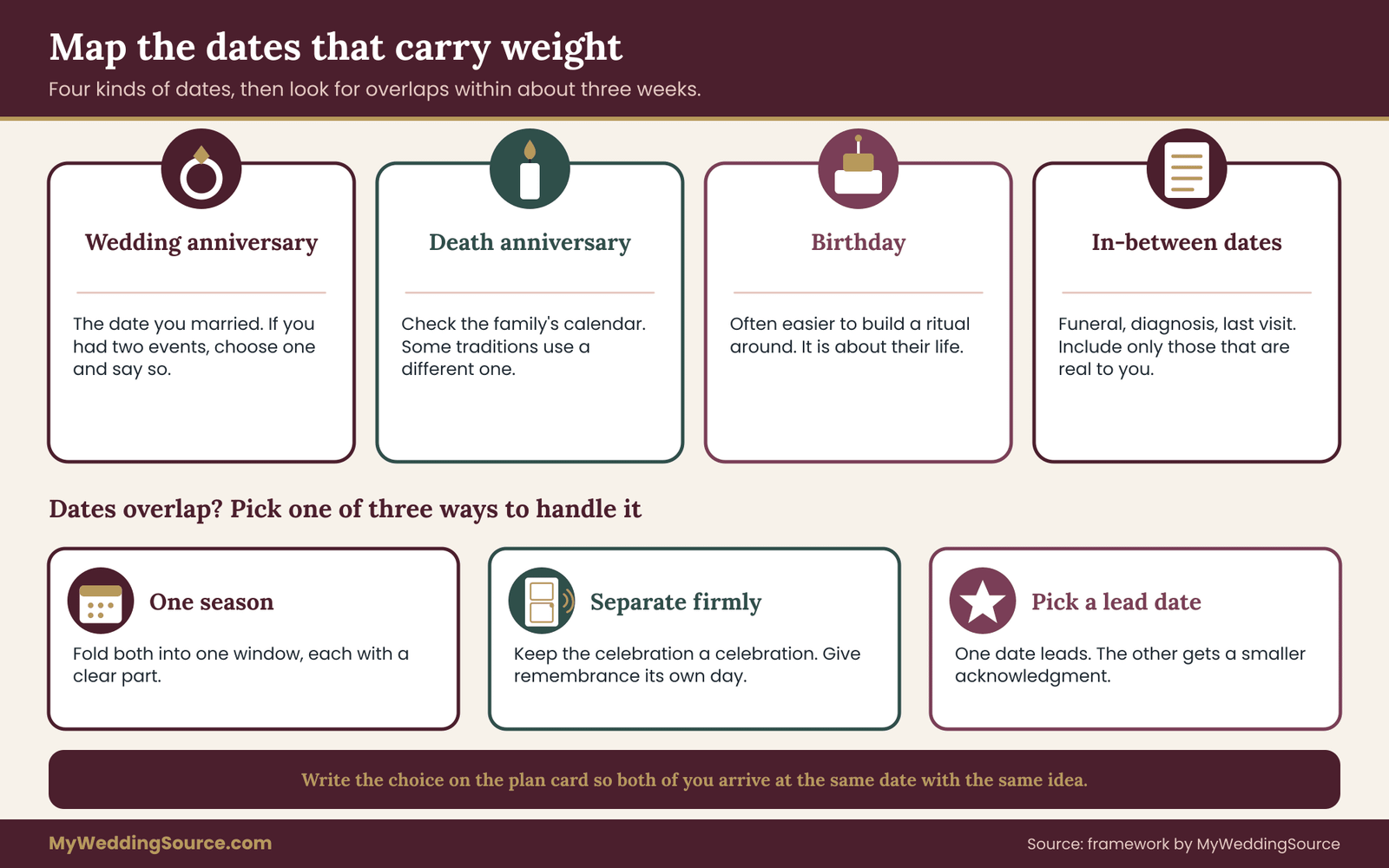
Once you have the dates, put them on one calendar and look for overlaps. An overlap is any two dates within about three weeks of each other. Overlaps are where couples most often feel crowded: a wedding anniversary that falls ten days before a death anniversary, or a birthday that follows the wedding by a few days. Three outcomes are common, and none is wrong.
Treat them as one season. You choose a single window, such as a long weekend, and fold the celebration and the remembrance into it, giving each a clear part. This works when the dates are close and the people involved are the same. Notice what you feel as you read this, because wedding anniversary grief shows up differently in each person.
Separate them firmly. You give each date its own character and keep them apart. The wedding anniversary stays a celebration, and the remembrance gets its own day, even if that day is nearby. This works when mixing the two would flatten both.
Pick a lead date. One of the two dates leads, and the other is acknowledged in a smaller way. In a year when the loss is recent, the death anniversary may lead. In a later year, the wedding anniversary may take over. The goal is a day you can get through, with wedding anniversary grief given the room it needs and no more.
Whichever you choose, write it on the plan card. Nothing causes more friction than two people arriving at the same date with two different unspoken assumptions about what the day is for.
A few edge cases are worth planning for. If the date is a weekday, check whether a quiet ritual can happen in the evening, when work is finished and nobody is watching the clock. If one of you travels for work, decide whether a ritual can be done remotely or moved by a day. If the anniversary falls during a season that is already hard, such as a holiday period, you may want a shorter plan, not a longer one.
It also helps to look one year ahead and one year behind. A death that occurred last spring means this year’s anniversary may be the first. A wedding that was held three years ago may now sit alongside several remembrance dates. Seeing the whole span helps you avoid building a plan around a single year that will not hold up in the next.
The calendar step is also the point where it becomes clear that some dates need no ritual at all. An overlap may seem heavy on paper and feel ordinary in practice, or the reverse. Write the dates down anyway. The act of listing them gives you a map, and the map is what lets you say “not this year” to a specific date without feeling you have set aside everything.
If you want a way to keep this tidy, a single reminder six weeks before each date, titled something neutral such as “check the plan card,” is enough. The reminder is for the conversation, not for the ritual. Its job is to start the decision early enough that nobody has to make it on the day.
A ritual menu is a short list of options, sorted by door, that you write once and reuse. The goal is not to find the perfect gesture. It is to have two or three small ones ready, so that on a hard morning nobody has to invent something under pressure. It costs little, and it spares wedding anniversary grief an extra layer of stress.
Good rituals for wedding anniversary grief share four traits. They are small enough to do on a tired day. They need no audience. They cost little or nothing. And they can be skipped without anyone noticing. A ritual that needs a reservation, a large group or a significant budget is a project, not a ritual, and projects tend to become obligations.
Door one: quiet rituals. These are the backbone of most plans, because they ask the least of anyone.
Read something aloud. This might be a paragraph from the vows, a poem the person liked, or a short note they once wrote. Reading it to yourself or to your partner takes five minutes and needs nothing else.
Write a short letter. Some people address it to the person who died, and some write to themselves a year ahead. The letter is private, and it can be kept, burned safely, or thrown away. Nobody else needs to see it.
Make something they would have liked. A recipe from a family kitchen, a song played on the drive, a walk on a path they loved. The ritual is the doing, and it can be as ordinary as setting out a favorite mug. Plenty of families find this the easiest step in handling wedding anniversary grief.
Keep a light on. A candle, a lamp, a string of lights in a window. If you use a real flame, the usual household fire cautions apply, and many people prefer a battery candle for exactly that reason.
Visit a place. A grave, a memorial bench, a garden, a spot where the person lived. A visit can be five minutes. If the place is far away, a photograph on a shelf can stand in for it.
Door two: shared rituals. These involve a named group and need agreement from each person.
A small dinner. Two families, or the couple and a few close relatives, with an agreed moment during the meal when the person is named. The moment can be as short as a sentence, and it can be skipped by anyone who prefers to eat in peace. Say this wedding anniversary grief plan before the dinner begins, not at the table.
A family story round. Each person shares one short memory, or passes. Set a time limit of a few minutes in total and agree that “pass” is an acceptable answer. Without that, the round can stretch and press on people who do not want to speak. Wedding anniversary grief rewards small, specific decisions.
A joint visit. A parent and the couple go to a memorial site together, with no photographs unless everyone agrees. Plan what happens afterward, such as a meal or a walk, so the visit does not end abruptly.
A shared call. Siblings or cousins who live in different places agree on a time to talk for fifteen minutes. This works well when the people closest to the loss are spread across time zones.
A cooked meal. A recipe from the person, prepared by someone who knew them, and eaten by a small group. The food does the remembering, and conversation can follow or not.
Door three: open rituals. These involve people beyond a chosen group, and they carry the most variables.
A donation. A gift to a cause or organization the person cared about, made in their name. If you share the donation link, keep the wording short and let recipients decide whether to give. Do not attach a request to a thank-you note or an anniversary message. There is no right amount of wedding anniversary grief to show.
A public post. A photograph and a few words. Decide before posting whether comments will be open, who might be tagged, and whether anyone in the photo has agreed to be shown. Posting carries the risk of unexpected replies on a day you may already be tender, so many people prefer to schedule a post for later in the day or skip it.
An anniversary gathering that includes remembrance. This is a bigger event, such as a party with a tribute moment. If you hold one, keep the tribute brief and place it at a predictable time, so those who want to step out of the room know when.
A tradition for the years ahead. A bench, a tree or a scholarship takes planning, money and permission from whoever owns the site or runs the program. Treat it as a long project, and do not rush it in a hard month. Wedding anniversary grief can sit beside joy on the same day, and this keeps room for both.
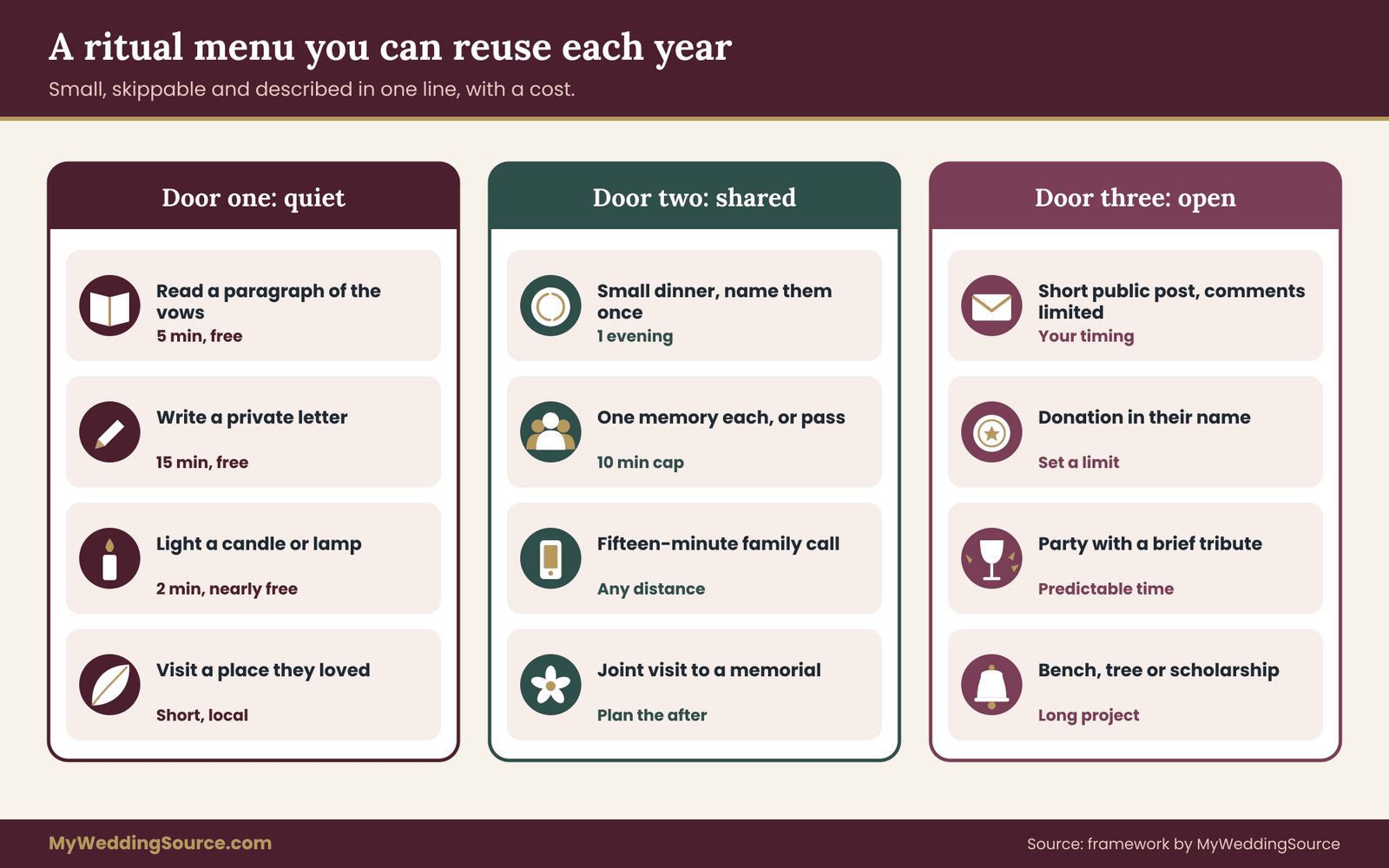
Every entry on the menu needs a one-line description and a cost. A ritual described as “something at dinner” is too vague to agree to. A ritual described as “name him once during the meal, then move on to dessert” is clear, short and skippable. Cost matters even for free rituals: a ritual that takes an evening costs an evening, and that deserves a line on the card.
A few cautions apply to the menu as a whole.
Avoid anything that depends on another person’s participation without asking them. A ritual that needs a parent to speak, a sibling to attend or a guest to bring a photograph is a ritual that needs a yes from that person first.
Avoid anything that puts a relative on the spot. Asking a grieving parent to say a few words at a dinner may feel like an honor to you and a trap to them. If you want to offer the option, offer it privately and in advance, with an easy way to decline. Keep a copy where both of you can find it, since wedding anniversary grief can make memory unreliable.
Avoid ritual inflation. If you do a large gesture in the first year, the second year can feel like a smaller version of it. Starting small and letting the plan grow only if you want it to avoids that pressure.
Avoid rituals tied to expectations about how you will feel. “We’ll light the candle and feel peaceful” sets a target that grief rarely meets. A better framing is “we’ll light the candle, and whatever we feel is fine.”
Avoid copying a ritual from someone else’s life without checking it fits yours. A practice that comforts one family can feel strange or heavy to another. When a relative recommends a tradition, you can say thank you and ask what it means to them, without taking it up. That keeps wedding anniversary grief from turning into a family negotiation.
Be careful with religious and cultural elements. If the person who died followed a particular faith or tradition, ask a family elder, clergy member or officiant what is customary, and what the family wants, before including a prayer, text or object. The site’s non-religious ceremony script guide shows how secular language can stand beside a faith tradition without replacing it, which can help when a family includes people of different beliefs.
When you have the menu, choose the default. Most couples find that one quiet ritual is enough for a normal year, with a shared option available if either of you asks for it. Write the default on the plan card, and let everything else stay on the menu unused until someone chooses it.
Finally, remember that not using the menu is a legitimate way to use it. A menu is there to be consulted, and a year in which the answer is “none of these, thank you” is a year in which the wedding anniversary grief plan did exactly what it was meant to do. The couples who benefit most from this kind of planning are often the ones who decide on a small ritual, find on the day that they do not want it, and let it go without discussion.
That is not a plan that failed. It is a plan that gave you room to change your mind.
Choosing a door for wedding anniversary grief: five questions
When a ritual is on the table and you are unsure which door it belongs behind, five questions settle most cases. Ask them in order, and stop at the first one that gives a clear answer. It is worth a few minutes, because wedding anniversary grief is harder to plan on the day itself.
Question one: who has to be there for this to work? If the answer is “nobody but us,” the ritual belongs behind door one. If it needs a specific person, it moves to door two, and that person must be asked first. If it needs an audience, it is door three. This question alone sorts the majority of wedding anniversary grief rituals.
Question two: what happens if someone says no? A ritual that falls apart when one person declines is too fragile for a hard day. Rewrite it so that it still makes sense with fewer people, or move it down a door. A candle lit by two people can also be lit by one.
Question three: what would the worst reaction be? Picture the least comfortable plausible outcome: a relative who cries openly, a guest who changes the subject too quickly, a comment under a post. If you can live with it, proceed. If the thought makes your stomach tighten, that is information about which door you actually want.
Question four: can it be undone? A private reading can be stopped halfway. A public post can be deleted but not unseen. A bench with a plaque cannot be quickly reversed. The less reversible a ritual is, the more time and agreement it needs, and the less suited it is to a year when feelings are raw. Even a short note on this helps when wedding anniversary grief is near.
Question five: does it still fit if we feel nothing? Some years the day arrives and the feeling does not. A ritual built on the expectation of strong emotion can feel hollow in such a year. The good ones hold up either way: lighting a candle works whether you cry or not, and so does a walk.
Write the answers beside each ritual on your menu, in a few words. A line such as “door one, no one needed, easy to stop, fine if we feel nothing” tells you at a glance that the ritual is safe for a hard year. A line such as “door three, needs relatives, hard to undo” tells you to save it for later, if at all.
The questions also help when someone else proposes a ritual. If a relative suggests a toast, you can run it through the five questions in your head and decide in a minute whether to accept, redirect it to door two or decline. Most proposals survive the first two questions and run into trouble at the third or fourth, which is exactly where a small change, such as a private toast before the guests arrive, can rescue them.
Support boundaries: who helps, with what, and when
Rituals are only half of a good plan. The other half is deciding what kind of support you want around them. Well-meaning people tend to offer the same help in the same way: a call, a visit, a casserole, advice. On a hard anniversary, some of that is welcome and some of it is exhausting. A support boundary is a plain statement of what you want from whom, and what you do not. Wedding anniversary grief is not a problem to solve, only a day to prepare for.
Boundaries are not walls. They are instructions, written kindly, so that people who love you can be useful instead of guessing. Most people would rather be told what helps than get it wrong.
A support boundary card has four short parts.
Who. The people you would welcome around the day, in order of closeness. This may be two names or six. It is fine if the list is shorter than people expect.
What. The specific help you would accept. A short message in the morning. A call that does not need to be answered. A meal left at the door. Someone to take the dog out. Be concrete, because “let me know if you need anything” rarely produces an answer, while “could you send a text at noon” does.
What not. The things you would rather not receive. Advice about how to grieve, comparisons to another person’s loss, questions about whether you are “doing better,” unplanned visits, and tributes posted without asking. Writing these down seems awkward at first and turns out to be the part people use most. Be as specific as you can; vague plans are the ones wedding anniversary grief tends to unsettle.
When and how to reach you. The window in which you are open to contact, and the way you would like it to arrive. Some people prefer a text to a call, and some prefer nothing until the next day.
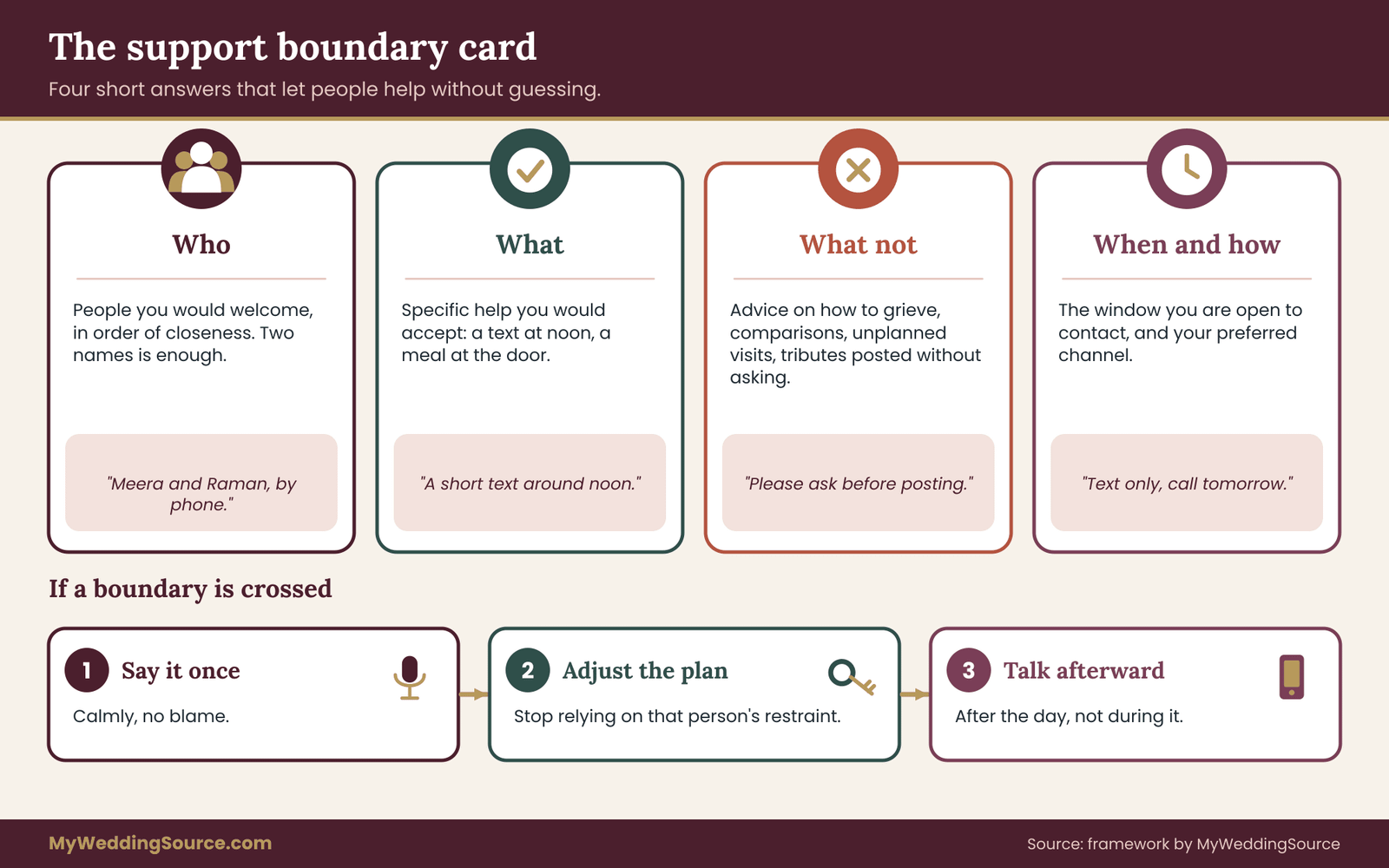
Having the card does not mean you have to hand it out. Many couples keep it private and use it to prepare for the conversations they expect to have. It is simply a way of thinking through the answers before someone asks. The couples who use it most often read it aloud to each other once, adjust two or three lines, and leave it at that. Revisit it after the anniversary and adjust, because wedding anniversary grief is not fixed.
There are some patterns in how support goes wrong, and knowing them helps you set boundaries early.
The first is the helpful relative who fills the silence. Someone calls on the morning of the anniversary, wants to talk for an hour and leaves you more drained than before. A boundary here is a short script: “Thank you for calling. We’re keeping the day quiet, and we’ll reach out tomorrow.”
The second is the relative who needs support themselves. A parent who lost a spouse, or a sibling who lost a parent, may lean on the couple on the anniversary. This is understandable, and it can also be heavy. A boundary here is not a refusal to help. It is an agreement about how much you can give on this particular day, and a suggestion for where else they might turn, such as another relative, a faith community or a counselor.
The third is the friend who wants to organize something. A surprise dinner, a group message, a shared tribute. The boundary is a request: “Please ask us before planning anything that involves us.”
The fourth is unspoken pressure between partners. One partner may feel they must be the strong one, or must plan the day, or must watch the other closely. A boundary here is an agreement to check in at a set time, such as the evening before and the evening after, and to say honestly if the plan is too much. Nobody else has to approve your choices about wedding anniversary grief.
Some boundaries concern professionals. If either of you works with a grief counselor, therapist or clergy member, the anniversary is a good time to book a session before or after.
Not as a sign that something is wrong, but because many people find the days around a hard date easier with a place to talk. The 988 Suicide and Crisis Lifeline, reachable by call or text at 988 in the United States, exists for anyone in distress, and the sources list includes its official site along with other organizations that provide information on bereavement.
If a day feels unsafe in any way, use those services, and do not wait for your wedding anniversary grief plan to resolve it.
It is worth saying something about children and older relatives in this context. Children may have questions about the day, and they may grieve in short bursts and then run off to play.
Older relatives may want to observe the date in a formal way that the couple does not share. A boundary can be generous to both: the children are told in simple, truthful language what the day is and are free to take part or not, and the older relative is welcomed into a shared ritual that respects their tradition without taking over the rest of the day.
The site’s guide to guest care planning discusses supporting older and younger guests at events, and parts of it translate to family gatherings after the wedding.
When a boundary is crossed, repeat it once, calmly and without blame. “We said we’d keep today quiet. Thank you for understanding.” If it is crossed a second time, adjust the plan so it does not rely on that person’s cooperation, and speak to them after the day. A boundary is not a test of the relationship. It is a way of making a hard day workable.
Conversations and scripts that keep everything optional
Most of what goes wrong with anniversary rituals goes wrong in conversation. Someone assumes, someone is unsure, someone is hurt, and the quiet plan becomes a family disagreement. Short, plain scripts help, because they take away the effort of finding words when you are already tender. Here are several, grouped by situation. Change them freely so they sound like you. Share it only with people who need it; wedding anniversary grief is yours to describe.
Asking your partner. Start with the dates, not the rituals. “I’ve been looking at the calendar. Our anniversary is close to Mom’s birthday this year. How do you want to handle that? You can say you don’t know yet.” Then offer the three answers: “Whatever you want is fine, including nothing.” Ask what each of you would like behind door one before anyone proposes a door two or three.
When the two of you disagree. One partner wants a ritual and the other does not. The plan’s default settles it without a winner: the quieter option stands, and the other partner can do their own door one ritual separately. “I’d like to light a candle for Dad.
You don’t have to do it with me. Could I do it while you’re in the other room, or would you rather I do it earlier in the day?” The point is that one person’s wish does not require the other’s participation.
Inviting someone to a shared ritual. Make the invitation specific and skippable. “We’re having a small dinner on the 14th and we’d like to name Grandpa once during the meal. We’d love you there, and there’s no pressure to say anything. If it’s too much this year, we’ll understand.” Put the date, the format and the exit in the same message. It is a small structure, and wedding anniversary grief usually needs a small structure.
Declining an invitation. For when someone else proposes a ritual you do not want. “Thank you for thinking of us. We’re keeping this one quiet. We’d love to talk about it another time.” You do not need to explain why. If they push, repeat the sentence.
Responding to a surprise. Someone has already planned a toast or a post. “I can see how much you care. I’m not ready for this to be public. Could we hold off, and I’ll tell you if that changes?” If the tribute has already happened, a short, kind acknowledgment is enough: “Thank you. That meant something to us, and next time we’d like to be asked first.” Treat this as a draft you can change as wedding anniversary grief changes.
Telling the wedding party or close friends. “Our anniversary falls close to a hard date for us. We’ll be keeping things low-key, and if there’s something you’d like to do, please check with us first. A short message that day would be lovely.”
Speaking to a relative who grieves differently. A relative may want large gestures when you want small ones. “I can tell this day matters to you. We’re going to do something quiet at our place, and we’d be glad to hear what you’re planning, too. Would you like us to join you for part of it, or would it work better to talk afterward?” Wedding anniversary grief is easier to talk about with a plain sentence ready.
Telling a counselor or clergy member. “We’re planning for our wedding anniversary grief. We’d like to talk through some rituals that are optional and not obligatory. Do you have thoughts on what has helped other families?” Note that a professional may offer ideas, but the plan card still belongs to you.
Three habits make all of these easier. Use first-person language (“I’d like,” “we’re planning”) instead of “you should.” Put the exit in the same sentence as the invitation. And write down what you agreed, even in two lines, so there is no confusion later about who said what.
There are also phrases that are worth dropping. “It’s what he would have wanted” puts the dead person’s imagined wishes ahead of the living people in the room. “You should be over it by now” and “At least you had him that long” are comments no plan card can soften. If you hear them from someone close to you, a short response is enough: “I know you mean well. That’s not helping today.” That is enough for most households dealing with wedding anniversary grief.
Finally, give the conversation a place and a time. A hard topic raised in the car or at the end of a long day tends to go badly. A calm half hour on a weekend, with tea and no screen, is more likely to produce answers that hold. If the conversation turns tearful or tense, pause it. The six-week lead time exists precisely so a talk can be stopped and resumed without any deadline pressing in.
The anniversary often brings out the wedding album. For couples dealing with wedding anniversary grief, the photos can be a comfort and a wound at once. A picture of a parent dancing at the reception is a gift. It is also the last time that parent danced. Handling images deliberately, instead of leaving it to chance, is part of this wedding anniversary grief plan.
Decide who may look at what, and when. Some people want the album out on the anniversary. Some want it put away for the week. Both are reasonable. Agree with your partner before the day whether the album, the video or the gallery will be opened, and by whom. If one of you wants to look and the other does not, the door framework helps: the one who wants to look does so as a door one ritual, at a time that suits them.
Choose a single photo or none. A day with one chosen image, such as a favorite photograph of the person at the wedding, is easier to manage than a day with a full slideshow. A slideshow can turn into a long, emotional sitting that people feel unable to leave.
If you want to share images with a small group, pick a handful, set a time limit, and say so before you begin. The family photo list guide describes the family portraits that couples commonly plan, which can help you recall which photographs of the person already exist.
Check consent before sharing anyone else’s image. Photographs of people who are living, such as a grieving parent captured in a quiet moment, belong to that person’s privacy as well as yours. Ask before posting. Photographs of people who have died raise the same question in a different form: some relatives welcome seeing the image online, and others find it painful or private. A quick message to the closest family members before you post a photograph is a simple courtesy.
Think through the post. If you decide on a public tribute, which is a door three ritual, a few choices make it easier on everyone.
Choose the timing. Posting early in the day can bring a wave of responses while you are most tender. Scheduling it for the evening, or the following day, gives you control.
Choose the comment setting. You can limit comments, turn them off or review them before they appear, depending on the platform. Limiting comments is not unkind. It protects you from a stranger’s careless reply.
Choose the wording. Short is fine. A date, a name and a sentence are enough. You do not need to explain the loss, the illness or the circumstances, and you do not owe the public any detail. Wedding anniversary grief is easier to carry when these choices are made early.
Choose who is tagged. Tagging a relative puts the post on their page and in their notifications, which they may not want. Ask first, or leave tags off.
Choose whether to post at all. Many people find that the day is easier without a post. It is perfectly all right to share a tribute privately and skip public sharing completely.
Protect what you keep. The anniversary is also a good time to check where your wedding photographs and videos actually live. A single copy on a phone is a fragile record of someone who is no longer here. The Library of Congress publishes personal digital archiving guidance, listed in the sources, that covers the basics of keeping copies in more than one place.
It is a gentle task to do on a quiet anniversary, and it turns an uneasy day into a small act of care. Label files clearly with names and dates, so that someone else could understand them years from now.
Think about voice and video. A recording of a loved one’s voice, such as a wedding toast, a voicemail or a toast from the ceremony, can be powerful and hard to hear. Decide in advance whether you want to listen on the anniversary. If you do, listen alone first, at a time of your choosing, before you share it.
If you do not, keep the file safe and leave it until you are ready. Neither choice is wrong. Few couples regret keeping wedding anniversary grief simple.
Plan for the guest-contributed material. Wedding guests sometimes take photographs and videos that include the person you have lost. If you want those, a brief, kind message can invite guests to send them, with no deadline. Do not send a request on the anniversary itself, because it may land on someone else’s hard day. A better time is a week or two before, or well after. Decided ahead of time, wedding anniversary grief has less room to catch you off guard.
Photographs and recordings are where grief and privacy meet. A short rule helps: nothing is shared that has not been agreed to by the people in it or the people who loved them. That one sentence covers most of the ground. Wedding anniversary grief changes from year to year, so revisit the choice.
A worked case: one couple, one calendar, one quiet year
The following example is invented, and it is not drawn from any real couple. It is here to show how the plan works in a situation with several competing wishes. Names and details are made up. That is a fair standard for handling wedding anniversary grief.
Priya and Tom married in the spring. Priya’s mother, Anika, died about eleven weeks before the wedding after a long illness. The wedding went ahead, with a small photograph displayed at the family table and a brief mention in the ceremony that Priya had chosen herself. By the time the first anniversary approaches, the couple has several things to consider. Most of the work with wedding anniversary grief is done before the day arrives.
The dates. The wedding anniversary is in late spring. Anika’s birthday falls nine days after it. The anniversary of Anika’s death is in midwinter, roughly four months before the wedding anniversary. So the calendar shows two dates near each other, the anniversary and the birthday, and one date well apart. A calm answer now saves a hard conversation about wedding anniversary grief later.
The people. Priya’s father, Raman, lives in another city and has said he would like the family together. Priya’s sister, Meera, is organized and wants to plan something. Tom’s parents are unsure what to do and have asked whether they should send flowers. Tom himself is not sure how much to say, because he never wants to press Priya. Wedding anniversary grief does not need a grand gesture, only a clear one.
The first conversation. Six weeks ahead, Tom asks Priya to look at the calendar with him. He opens with the dates and the three answers, not with a suggestion. Priya says she is not ready for a gathering, but she would like something small on the birthday, not on the wedding anniversary. She wants the wedding anniversary to be only theirs. Writing it down is enough; wedding anniversary grief does not need a formal document.
The plan card. The couple writes a short card. Wedding anniversary: door one only, a quiet dinner at home, no mention of Anika unless Priya raises it. Anika’s birthday, nine days later: a door one ritual, a favorite recipe cooked by Priya, with Tom joining if she wants him. A door two option, a phone call with Raman and Meera that evening, marked “optional, Priya decides on the day.” Nothing in door three this year.
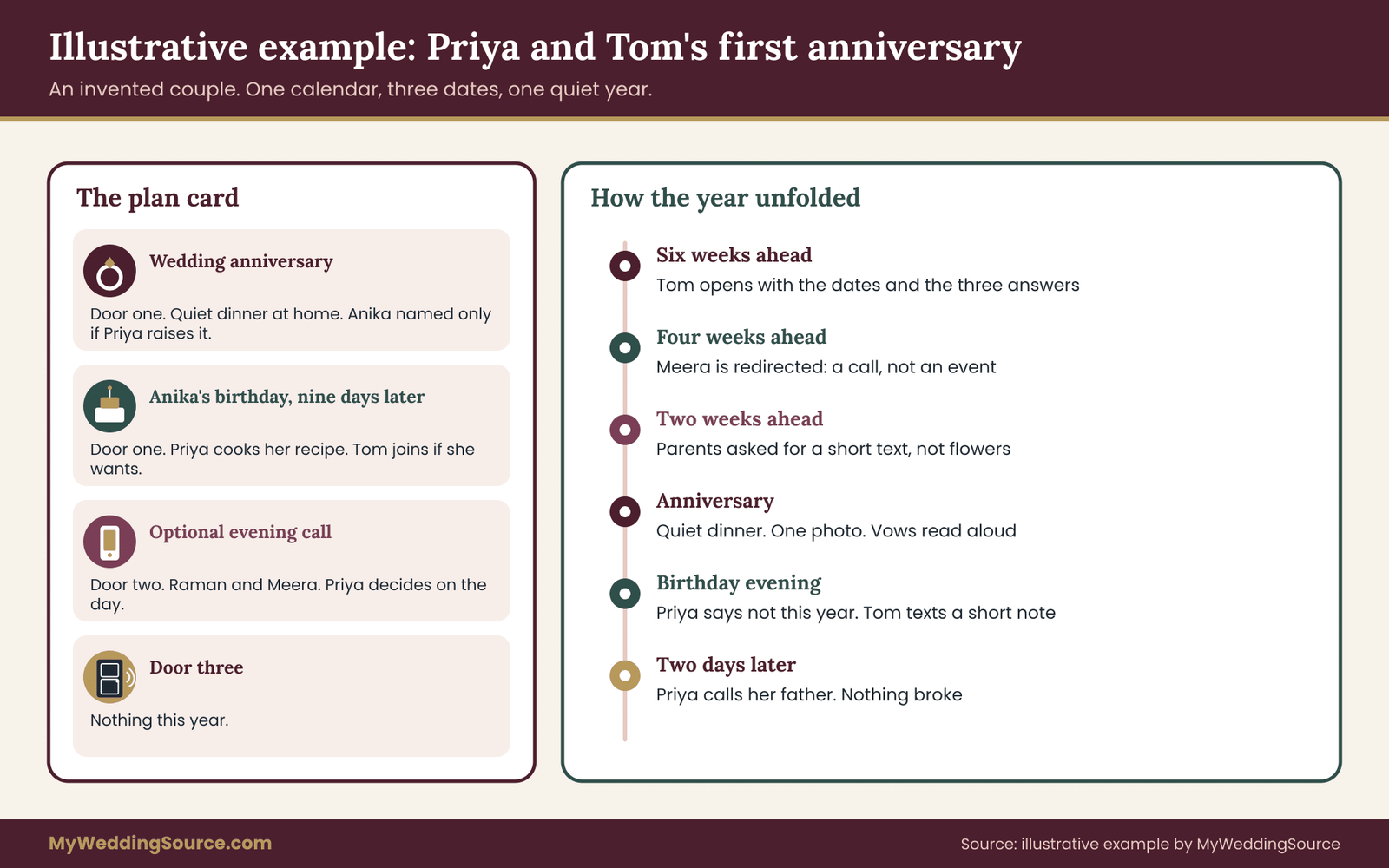
The support boundaries. Priya asks Meera not to organize a family event this year. She offers her instead a task she can say yes to: a call on the birthday evening. Tom tells his parents that flowers are kind, but that the couple would prefer a short message that week, and he asks them to send it by text. Raman is told about the call plan and asked if he would like to join.
The morning of the anniversary. Priya wakes up lighter than she expected. They cook the dinner, look at one photograph from the wedding, and Priya reads a paragraph from the vows aloud. Tom does not mention Anika, as agreed, and Priya does it herself near the end of the meal, briefly. No candle, no toast. The day is quiet and warm.
The birthday. Priya cooks the recipe. Midway through, she finds she cannot finish. She says “not this year” for the call, and Tom texts Meera and Raman a short note: “Priya’s taking the evening quietly. She’ll call tomorrow.” Nobody objects. Priya calls her father two days later. The morning-of override has worked as intended.
What the example shows is not that the couple did everything right. It shows that the structure absorbed an unplanned change without fuss. A shared call was available, then it was set aside, and nothing broke. Tom’s parents had a clear way to help. Meera’s wish to organize was redirected into something Priya could accept. The anniversary and the birthday kept their own character, and the quiet dinner stayed a celebration.
It also shows what the wedding anniversary grief plan does not do. It does not remove the sadness on the birthday, and it does not make Priya’s choice easier. It only makes sure the choice is hers. In the following year the couple might choose differently, and the card can be rewritten in an hour.
Alternatives and edge cases when the standard plan does not fit
The three doors fit many situations, and there are several where they need adjusting. These are the cases that come up most often, with the changes that usually help.
The couple grieve differently. One partner may be deeply affected by wedding anniversary grief while the other feels little or is dealing with something different. This is common and it is not a sign that anyone cares less. Let each person have their own door one ritual, and keep any shared ritual to what both can honestly accept.
The partner who feels less should resist the urge to match the other’s feelings out of politeness, because that tends to ring false. Showing up, listening and not hurrying the day does more than a performed sadness.
Both partners lost someone, in different ways. Two losses can sit on the same calendar. Give each loss its own entry on the plan card and its own default door, and avoid combining them into one ritual unless both of you ask for it. A combined ritual can leave one loss feeling like an afterthought. Both partners should be able to read this and agree, even when wedding anniversary grief feels different to each of them.
The loss is not a death. For a pregnancy loss, an estrangement or a broken friendship, there may be no established ritual, and other people may not know the loss exists. The doors still work. Most such rituals sit behind door one, because the loss may be private or unknown to others. If you want to share it, door two lets you choose one or two trusted people. Nobody needs to explain a private loss, and nobody needs to justify the grief to be allowed to hold it.
The person is living but absent. A parent who did not attend because of a rift, or who chose not to come, can cast a shadow on an anniversary as surely as a death can. Here the ritual is often not remembrance but acknowledgment: letting the feeling be there without trying to fix the relationship on that day. If you are weighing contact, the day itself is rarely the best time. Decide separately, on a calmer date, what you want to do about the relationship.
A cultural or religious calendar applies. Many families observe remembrance through traditions with set dates, prayers and customs. If so, the traditional observance is the main event, and the plan card should support it and not compete with it. Ask the relevant elder, clergy member or officiant what is expected and what is flexible. A couple can follow a family observance in its customary form and still keep their own anniversary evening private. The two do not conflict unless someone insists that they must be the same event.
Blended families and second marriages. The absent person might be a parent of one partner, a former spouse of a parent, or a stepparent. Several people may have claims on the remembrance, and they may disagree about how to mark it. In a case like this, door one is a refuge, and door two should include only people who have each been asked. If an anniversary has to hold more than one family milestone, give each milestone its own line on the plan card.
Destination weddings and trips. If you married far from home, you may want to mark the anniversary by returning. A trip can be a good ritual, though it adds cost, travel stress and the risk that a heavy day happens in an unfamiliar place. A lighter option is to mark the date at home and plan the trip for a different week, when it can be a pleasure and not a pilgrimage. Wedding anniversary grief is personal, so adapt this to your own household.
Children in the picture. Children who knew the person may have their own feelings on the day, and children who did not may have questions. Tell them simply what the day is. Give them a small, optional part, such as drawing a picture, choosing a photograph or helping set the table. Do not require them to feel anything in particular. If a child is distressed, a trusted adult can take them for a walk or a snack, and the ritual can carry on.
Large anniversaries. Milestone years can feel different. A tenth or twenty-fifth anniversary may bring a party, a vow renewal or a trip, and with it the question of how to include or acknowledge the absent person. The same doors apply, with the added consideration that a larger event often means more guests, and therefore more variables. Keep the remembrance short and predictable, and tell invited relatives in advance if a tribute will be part of the day.
If a vow renewal is part of the day, the ceremony order guide shows where a short tribute can sit without stretching the program. If it does not fit your family, leave it out; wedding anniversary grief has no single script.
No ritual at all. Some couples find that no ritual is the right ritual. They treat the anniversary as an ordinary celebration and carry their grief in their own way. That is a complete plan. The test is whether it works for the two of you, not whether it matches a template. This is where wedding anniversary grief planning tends to go right or wrong.
Rituals that cost money. A donation, a bench or a gathering all have costs, and they may be unwelcome in a tight year. Rituals that cost nothing are not lesser. A letter, a walk or a shared story can do as much as a purchase. If you do commit money, set a limit in advance and stay within it, since grief can make spending feel like love and then feel like regret. Take your time with this part of wedding anniversary grief planning.
Disagreement that does not resolve. Sometimes the couple, or the family, cannot agree. In that case, return to the default: door one for the day, and let each person do what they wish privately. Decisions about larger shared rituals can wait for a later date, when emotions are less raw. The aim is not agreement on everything. It is making sure nobody is forced to take part in something they cannot bear.
If the disagreement keeps returning every year, a neutral third person, such as a counselor or a clergy member, may help. The questions in the site’s wedding guest list guide about who is included, and who is not, overlap with deciding who is invited to a shared ritual.
Whichever of these applies to you, notice how many of them resolve in the same direction: toward smaller, clearer, more private choices, with room to grow. That is by design. The plan is built to be easy to follow and easy to change, because grief is rarely constant from one year to the next. Wedding anniversary grief works the same way for a first anniversary and a tenth.
Failure conditions: when your wedding anniversary grief plan has stopped helping
Every plan can fail. Naming how this one fails, in advance, is part of making it trustworthy. These are signs that the plan, or the way you are using it, needs to change. They are practical signals, not diagnoses. Wedding anniversary grief often feels lighter once the choices are on paper.
The ritual has become an obligation. If you feel you must do it, whatever you feel, and you dread it more than the day it marks, it is no longer optional. The fix is to move it down a door, shorten it, or set it aside this year. A ritual that you can no longer decline has stopped serving you. Notice what you feel as you read this, because wedding anniversary grief shows up differently in each person.
Someone is performing for someone else. If one partner is acting calm to protect the other, and the other is acting calm in return, this wedding anniversary grief plan is being used to hide feelings and not to hold them. The fix is a direct conversation, ideally before the day: “I think we’re both pretending. Can we say what we actually want?”
People are being pulled in without asking. If a relative arrives who was not invited, a post goes up that was not agreed, or a guest is put on the spot, a boundary has failed. The fix is a repeat of the boundary, a calm word afterward and a change to the plan so it does not rely on that person’s restraint. The goal is a day you can get through, with wedding anniversary grief given the room it needs and no more.
The plan card keeps growing. If you keep adding rituals, the wedding anniversary grief plan is turning into a schedule. The fix is to cut back to the one or two that you actually want.
One partner feels relief while the other feels guilt. When a ritual is skipped and one of you is relieved while the other feels they failed the person, the difference is worth talking about, kindly and without blame. The fix is not to enforce the ritual. It is to understand what the skipped ritual meant to each of you.
The anniversary stays heavy for a long time afterward. A hard day, and a hard week around it, can be part of grief. If low mood, sleeplessness, loss of interest in daily life or difficulty functioning continues for weeks and seems to be getting worse, or if the grief has become overwhelming, that is a reason to talk to a doctor, counselor or other qualified professional.
The National Institute of Mental Health and the Substance Abuse and Mental Health Services Administration, both in the sources, provide information on finding care. If you or someone you know is thinking about suicide or is in crisis, call or text 988 in the United States, or contact local emergency services.
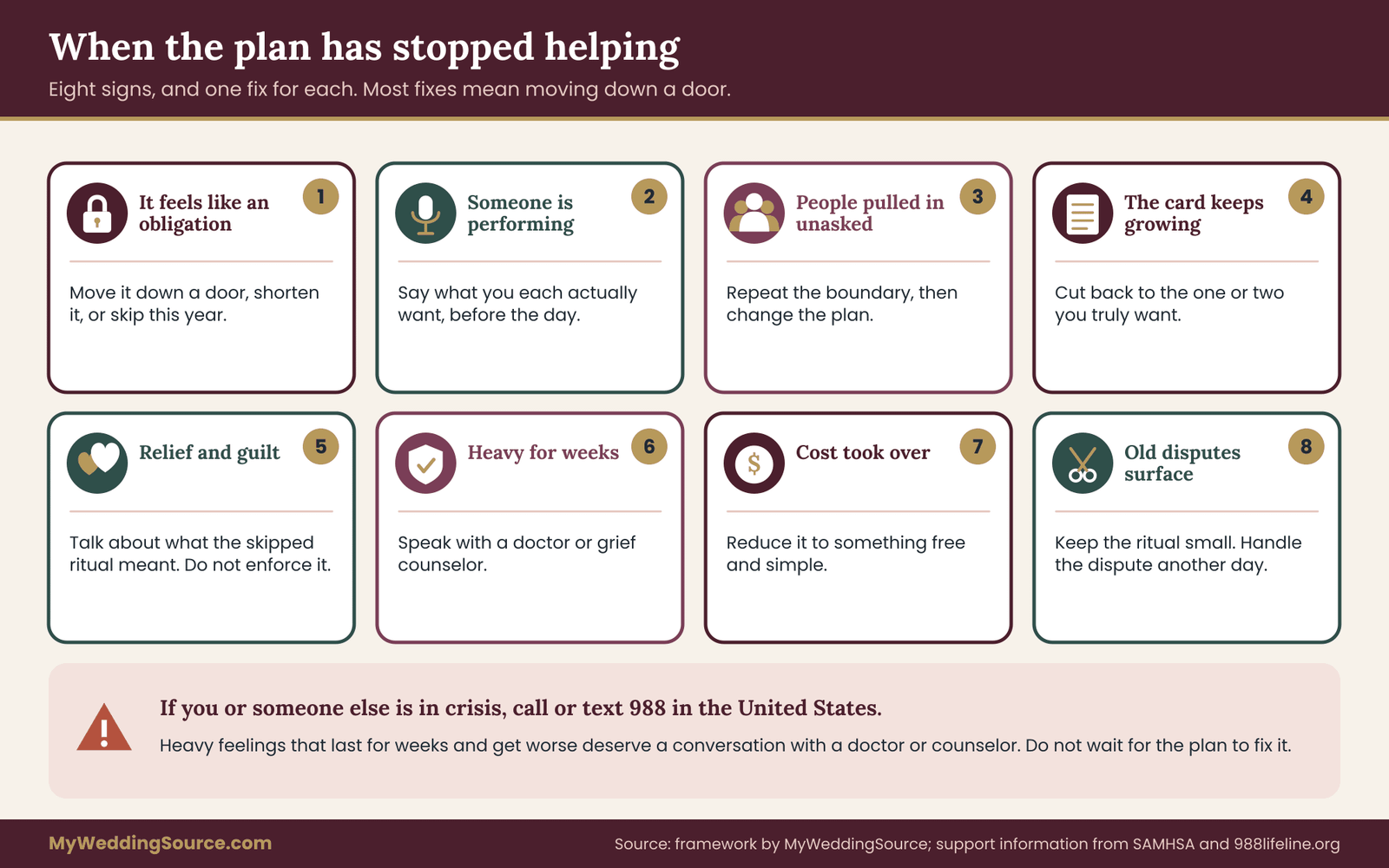
Money or logistics have taken over. If the ritual has become a source of conflict over cost, travel or schedules, it has stopped being about the person it honors. The fix is to reduce it to something that does not depend on money or planning.
The day is used to settle other disputes. An anniversary can become a stage for old family tensions. If the ritual is turning into a negotiation about unrelated grievances, it is time to separate the two. Keep the ritual small and handle the dispute at another time.
Each of these failures has the same general remedy: move down a door, reduce the scope and talk. None of them calls for guilt. They are expected, and the plan’s design makes them cheap to correct.
It helps to schedule a short review. A few days after each anniversary, once the feelings have settled, sit down for twenty minutes and ask three questions. What worked? What would we change? What do we want next year’s card to say? Write two sentences in answer, and file them with the card. Over a few years, these notes form a quiet record of how your wedding anniversary grief has changed, which many couples find reassuring in its own right.
If it has not changed, and the notes show the same pain unchanged year after year, that is also information, and a good reason to look for more support.
Your next steps
You do not need to finish everything in one sitting. A reasonable order is below, and each step is small.
- Name your situation. Decide which of the four meanings of wedding anniversary grief fits you best: an absence before the wedding, a death since, a death date near the anniversary, or a loss that is not a death.
- List the dates. Write the wedding anniversary, the death anniversary, the birthday and any in-between dates on one calendar, and mark any overlap within about three weeks.
- Sort rituals behind three doors. Choose one quiet ritual, one optional shared ritual and, if you wish, one open option for a milestone year. Describe each in one line, with its cost.
- Write the support card. Who you would welcome, what help you would accept, what you would rather not receive, and when you are reachable.
- Set the decision dates. Six weeks ahead for the first talk, two weeks ahead to confirm, and a morning-of override that lets either of you change the plan without explaining.
- Hold the conversation. Use the scripts above, offer the three answers, and keep the quiet option as the default.
- Review after the day. A few days later, spend twenty minutes on three questions and file two sentences with the card.
If any step feels like too much, skip it and do the next one. The plan is a tool, and it should never weigh more than the day it is meant to support. For general guidance on handling family conversations with courtesy, the site’s etiquette basics page is a good companion.
FAQ
Is it normal to feel sad on a wedding anniversary after someone has died?
Yes, many people do. An anniversary is a natural point for memory, and an absence can feel sharper when you expect a happy day. Feeling joy and sadness together is common too. If the feelings are intense, last for weeks or interfere with daily life, consider speaking with a doctor or grief counselor. You do not need a reason beyond wanting support.
Should we skip the anniversary celebration if we are grieving?
You do not have to skip it or hold it in a particular way. Some couples celebrate as usual, some keep it small and some set it aside for a year. Choose the version that is easiest to carry, and give each partner a say. The quiet default in the three doors approach lets you change your mind on the day.
How do we mention the person who died without making the day sad?
Keep the mention short and optional. A single sentence at dinner, a photograph on a shelf or a quiet reading before bed are enough. Agree beforehand who will say what, and let anyone pass. The aim is acknowledgment, not a tribute, so the rest of the day can stay as light as you want it.
What if my partner wants a ritual and I do not?
Use the three answers: yes, not this year, or no. The partner who wants the ritual can do a private version while you do something else. Settle on the quieter option for anything shared. Revisit the question next year, because wishes change. A short, kind conversation usually works better than trying to reach a perfect compromise.
What if relatives plan a tribute we did not ask for?
Thank them for caring, then state your preference briefly: “We’re keeping this quiet this year, and we’d like to be asked before anything is planned.” If the tribute has already happened, acknowledge it kindly and ask for advance notice next time. Adjust the plan so it does not depend on their restraint.
Is it appropriate to post a tribute on social media?
It is a personal choice. If you do post, consider the timing, limit comments, keep the words short and ask any relatives you plan to tag. Many people share privately instead, with a few chosen people. A tribute is optional, and posting nothing does not mean you cared less about the person.
When should we ask a professional for help?
Consider it if low mood, sleeplessness, or trouble with daily tasks continues for weeks and seems to be worsening, if grief feels overwhelming, or if a family disagreement cannot be resolved. Grief counselors, therapists and clergy can help. In the United States, call or text 988 if you or someone else is in crisis.
How long does wedding anniversary grief last?
There is no fixed timeline. It can ease, return on certain dates and change shape across the years. Some couples find the first anniversary hardest, while others find a later one harder. Keeping a short note after each anniversary shows how it has changed for you. If it feels stuck or heavier, a counselor can help.
Sources
- Hospice Foundation of America
- 988 Suicide and Crisis Lifeline
- Substance Abuse and Mental Health Services Administration
- National Institute of Mental Health
- National Institute on Aging
- MedlinePlus, National Library of Medicine
- American Psychological Association
- Centers for Disease Control and Prevention
- Personal archiving: preserving your digital memories, Library of Congress