
Wedding remembrance does not have to come with an announcement, a speech or an explanation. This guide shows how to honor someone who has died, on your own terms and at the visibility level you choose, using a short written tribute brief, a four-step disclosure ladder and a few calm sentences for the moment a guest asks what something means.
Decide three things before you pick any idea. First, who the wedding remembrance is for: you two only, a small circle you tell in advance, or the room. Second, what signal carries it: an object, a gesture, a sound, a place or a date. Third, the one sentence you will say if someone asks. Write them in a half-page brief, share it with the two or three people who will carry it out, and agree on the conditions under which you would quietly drop the idea on the day.
Some couples want their grief at the wedding to be visible and shared. Plenty do not. Maybe the death is recent and still raw. Maybe the family tells the story differently depending on who is asked. Maybe the person died in a way that relatives prefer not to discuss, or the loss is one only one of you carries, or you simply do not want two hundred people looking at you with sympathy while you cut a cake. None of those are wrong reasons. They are reasons to design a quieter version.
The usual advice on remembering someone at a wedding assumes you will say something: a line in the program, a toast, a memory table with a framed photo and a card. Those are good options, and this site covers several of them elsewhere. This guide is for the narrower job. It asks how to include someone so that you feel their presence, without handing your guests a story you are not ready to tell or turning your ceremony into a funeral.
If you are still shaping the order of the ceremony itself, the step-by-step ceremony guide shows where each moment sits, which helps when you decide where a quiet gesture can fit without becoming a feature.
The approach has a name in this article: the quiet tribute brief. It is a decision tool, not a ritual. You will use it to compare ideas, to brief the few people who need to know, to decide what happens if something goes wrong, and to stop if the day asks you to.
A note on scope. This is general planning information, not legal, tax, financial or counseling advice. Grief is personal, and nothing here is a claim about how anyone should feel or what will help. If the loss is recent and heavy, a bereavement counselor, a hospice grief program or a spiritual adviser you trust can help you decide how much to include. Where a fact matters, such as candle safety or crisis support, the article points to the agency that publishes it.
What a private wedding remembrance is, and what it is not
A private wedding remembrance is any act, object or arrangement that includes a person who has died, where the meaning is not announced to the guests. Guests may see it, or they may not. What defines it is that nobody is asked to understand it, react to it or comfort you because of it.
That is different from three things people often confuse it with.
It is not secrecy for its own sake. You are not hiding a death. Close family usually knows, and some guests will connect the dots on their own. The difference is that you are not making the explanation part of the program.
It is not avoidance. Avoidance means leaving the person out entirely because including them feels unmanageable. A quiet wedding remembrance still includes them. It just chooses the form.
It is not a lesser wedding remembrance. A folded handkerchief in a pocket, a seat that is simply left in the second row, or a song that plays during the walk to the car can carry as much meaning as a framed photograph with a printed card. Meaning does not depend on how many people are told about it.
Who tends to choose the quiet version
Reasons for choosing a private wedding remembrance fall into a few patterns. Seeing which one fits your wedding remembrance may help you describe it to family.
Timing. The death happened within the last year or two, and speaking about it in public would cost too much on a day you also need to enjoy. Some couples would rather mark the loss on a quiet morning and keep the ceremony light.
Family disagreement. One side wants a photo on display and the other side does not want the death mentioned. A quiet wedding remembrance can sit between the two positions, but only if you are honest with yourselves that it is a compromise and not a win. The guide to decision rights between couples and families is useful when this is the case; it covers shared input in general rather than grief specifically.
Circumstances of the death. Some deaths are surrounded by stigma, legal questions or old family pain. Naming the circumstances is not required to honor the person, and a wedding is a poor place to correct anyone’s version of events.
One partner’s loss. The person who died may have been a parent of only one partner, or someone the other partner never met. The partner who grieves may not want the other’s family to feel obliged to perform sympathy.
Personality. Some people simply do not display emotion in public, and the wedding is already the most watched day of their year. This is a perfectly sound reason.
Mixed audiences. Work friends, distant cousins and a groom’s college roommates may not know the family history. Not everyone in the room needs to learn it from a program.
What a quiet approach cannot do
It cannot guarantee that nobody will ask. At a wedding, relatives notice who is missing, and an aunt may mention it in the receiving line before you can stop her. It cannot protect you from your own feelings, which may arrive at moments the brief did not predict. And it cannot settle a family conflict; it only gives you a way to carry the conflict without staging it.
Because of these limits, the brief includes a section on what to do when the plan meets the room. That section comes later, and it matters as much as the ideas.
The quiet tribute brief: six fields on half a page
Most disappointments with wedding remembrance come from decisions made in the wrong order. A couple falls for an idea, such as a locket pinned inside a bouquet, and only afterward asks who will handle it, who will see it, and what happens if their mother cries on seeing it. The brief reverses the order. It asks the same six questions about every wedding remembrance idea before you commit, and you can answer them in a few lines each.

Field one: the person and the intention. Write the name, your relationship, and one sentence on what you want the wedding remembrance to do. The intention is the field people skip, and it settles most later arguments. “I want to feel that my father is nearby during the vows” points toward a private object. “I want my grandmother’s sisters to see that she is included” points toward something visible. Those are different jobs, and the same wedding remembrance idea will not serve both.
Field two: the audience tier. Choose one of four levels, described in the next section: private to you, known to a small circle, visible but unlabeled, or labeled. Choose one. Couples who choose two tiers for a single idea usually end up with a half-explained gesture that confuses everyone.
Field three: the signal. What physical or sensory thing carries the remembrance? An object, a flower, a scent, a piece of music, a seat, a place, a time or an action. The signal of your wedding remembrance should be something you can describe in under ten words.
Field four: the carrier. Who will actually do the thing on the day? A florist who tucks a sprig into a bouquet, an usher who keeps a seat clear, a sibling who carries a small item. Name the person, not the role. If the carrier is you, say so, and plan what happens if you are overwhelmed.
Field five: the one-sentence answer. If someone asks what it means, what will you say? Write it now. A later section gives a ladder of answers, from a warm deflection to a short true statement.
Field six: the stop condition. What would make you drop or change the plan on the day? A relative who objects an hour before the ceremony, a weather change, your own mood, a vendor who cannot do what they promised. Writing the condition for your wedding remembrance in advance spares you from deciding while upset.
Why the brief is short
You might be tempted to expand it into a long document with timelines, budgets and mood boards. Resist that for now. A half page about your wedding remembrance can be read by a grieving parent, a florist and a photographer in two minutes. A long document becomes one more thing to manage, and it turns a quiet gesture into a project. If a field needs more than three lines, the idea is probably too complicated for a wedding remembrance you want to stay quiet.
Keep the wedding remembrance brief somewhere both of you and the carriers can reach it, and date it. You will revise it once or twice, and you will want to know which version was the last one everyone agreed on.
A first pass: three questions before anything else
Before you fill in the brief, answer three questions out loud, to each other, preferably on a walk and not at the planning table.
First: if nothing about this person appeared at the wedding at all, how would you feel the next morning? Relieved, sad, guilty or empty? The answer tells you whether you need a wedding remembrance at all, or whether a private act on another day fits better. There is no right answer, and sitting out the question is allowed.
Second: whose feelings are you protecting with the quiet version? If it is your own, good. If it is mostly someone else’s, such as a parent who cannot bear a mention, ask whether the arrangement is one you can live with, or whether it will feel like erasure by the time the photos arrive.
Third: is there a person who would be hurt to find out about the quiet wedding remembrance only afterward? A grandparent who lost a child, a sibling of the person who died. If so, put them in the circle in advance, even if the rest of the room never knows. A later section covers how.
The disclosure ladder: four levels of wedding remembrance
The audience tier is the field that does the most work in the brief, so it deserves its own explanation. Think of a ladder with four rungs. Each rung is defined by who knows what the gesture means, not by how large or small the gesture is. A tiny object can sit on the top rung, and a large arrangement can sit on the bottom one.
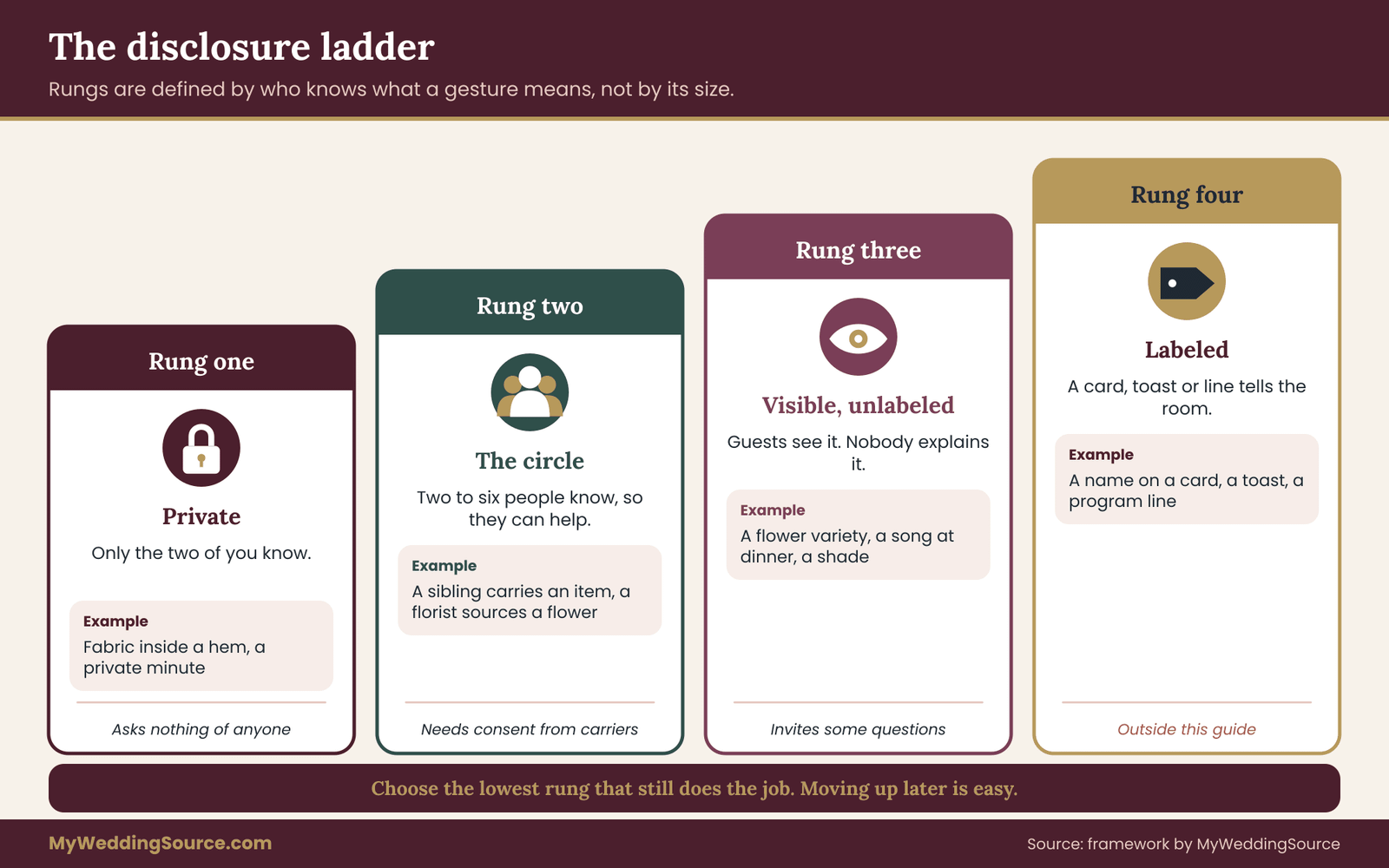
Rung one: private. Only the two of you know. The object, act or moment is not described to anyone, and nobody is asked to carry it. It may be invisible to every guest or hidden in plain sight. Its purpose is your own sense that the person is with you. A wedding remembrance at this level asks nothing of anyone, which is exactly why it suits couples who feel crowded by the day.
Rung two: the circle. Two to six people know, because they need to or because they would want to. Typically that means parents or siblings, the officiant, a florist or a best friend. The room does not know. This is the right rung when the wedding remembrance involves another person’s labor, or when leaving a close relative out would hurt them.
Rung three: visible but unlabeled. Guests can see the gesture, whether it is an empty seat, a flower, a song or a dish. Nothing says what it means. A few guests will understand, most will see a pleasant detail, and nobody is told to feel anything.
Rung four: labeled. A card, a program line, a toast or an officiant’s sentence tells the room who is being remembered. This rung is outside the scope of this guide, because it is the opposite of not explaining. If you later decide you want one, a short acknowledgment can usually be added to the ceremony script, and the cue sheet for officiant, music and readers shows where a line like that sits. The same wedding remembrance idea can usually be moved up a rung without being rebuilt.
Choosing a rung with one rule
Use this rule when you are unsure: choose the lowest rung that still does the job named in field one of the brief. If the job is “I want to feel close to my father during the vows,” rung one does it, and anything higher adds exposure without adding purpose. If the job is “I want my mother to see that her sister is included,” rung one fails, because the mother must see something. Rung two or three is the minimum.
With any wedding remembrance, moving up is easy and moving down is hard. You can always tell more people later, or add a card after the fact. You cannot easily un-tell a room. This is why the lowest-rung rule is a safer default, especially when feelings are still changing.
Rungs are per idea, not per wedding
You do not have to pick one rung for the whole day. A couple might hold one private act on the morning of the wedding (rung one), ask a sister to carry a small item (rung two), and play a favorite song at dinner without comment (rung three). Each idea gets its own brief and its own rung.
The risk is stacking too many. Three quiet gestures across a day is a pattern a guest may notice and begin to ask about. Seven is a theme, and a theme invites the question you were trying to avoid. Keep the total small, and be honest about whether you are building a wedding remembrance or avoiding a conversation.
Private and circle-level wedding remembrance ideas
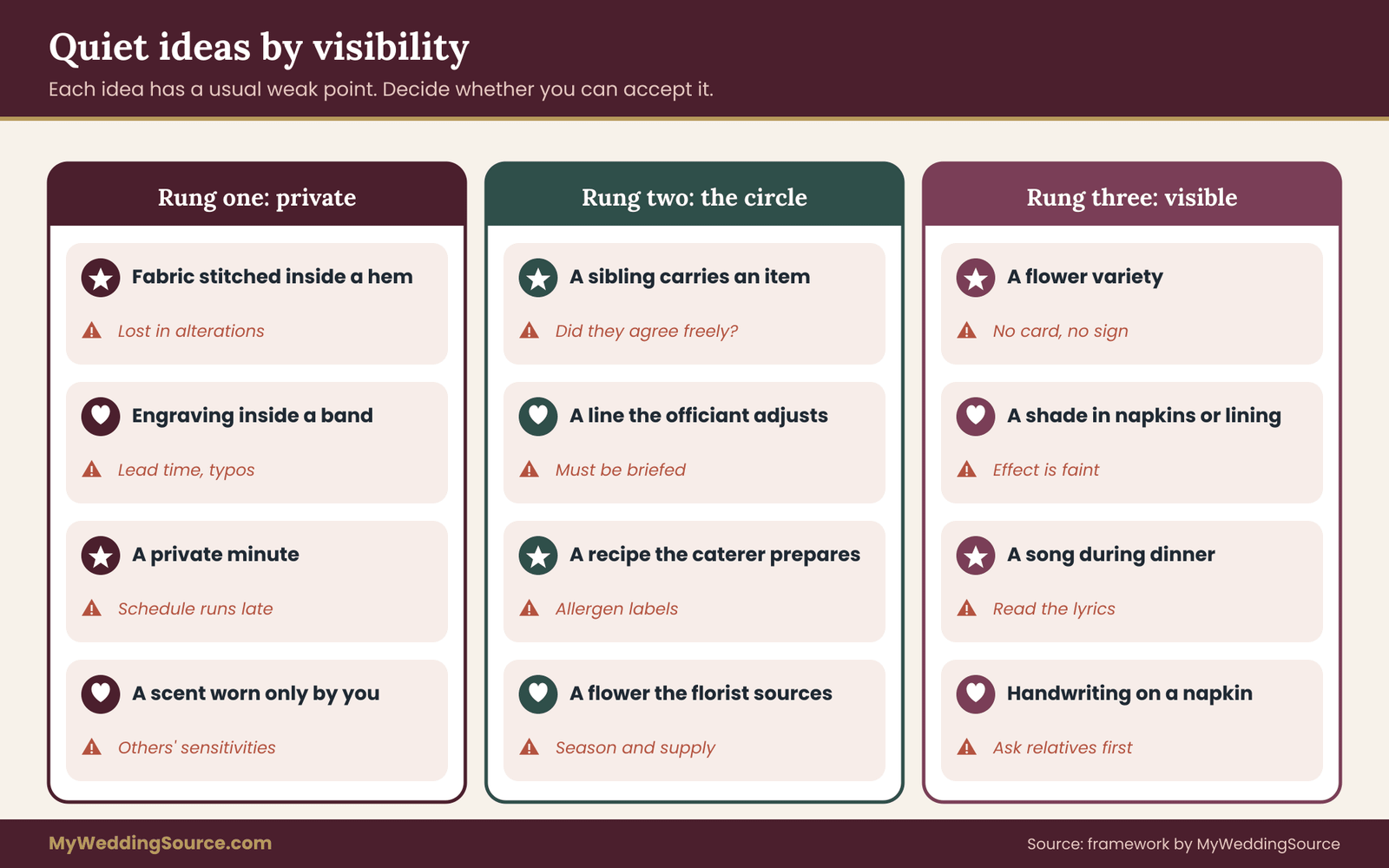
The ideas in this section sit on rungs one and two. They are arranged by the kind of signal they use, and each one comes with its usual weak point, because every idea has one. The point of listing weak points is not to discourage you but to let you decide whether the risk is acceptable.
Objects that travel with you
A small item in a pocket or sewn into a lining. A fabric label from a favorite shirt, a button, a swatch, a strip of ribbon. A tailor or seamstress can stitch a pocket or a label in a few minutes, and it will be invisible to everyone. The weak point is loss. An item sewn into a garment goes through alterations, steaming and cleaning. Tell whoever handles the garment, and ask whether the item survives each of those steps, or use a copy of something irreplaceable instead of the original.
Something blue, old or borrowed that is secretly the wedding remembrance. A handkerchief, a pin or a piece of jewelry with a history. The tradition provides cover, since nobody asks why you wear something old. The weak point is handling. Jewelry worn once in an emotional moment is easy to lose, so decide who holds it during the reception and where it goes at the end of the night.
A photograph on a card behind a boutonniere or inside a compact. Small enough to disappear. The weak point is condensation and wind outdoors, and photographs can curl or fade in warm pockets. Print a copy and keep the original at home.
An engraving or a hidden mark. Initials or a date inside a ring band, on the underside of a cufflink, on the back of a locket. Nobody sees it, and you will know it is there every day afterward. The weak point is lead time. Engraving takes longer than most couples expect, and a wrong date is hard to undo, so check the spelling and the numerals with someone else before approving.
Moments that happen before or around the ceremony
A private minute before the day begins. Ten minutes alone in the getting-ready room, a short walk to a place that mattered to the person, a phone call to a sibling, a letter read in silence. No guest ever sees it, and no vendor needs to know. The weak point is the schedule. Weddings run behind, and a private minute is the first thing to go. Put it in the timeline as a named block and tell the person managing the schedule, without explaining why.
A visit before the wedding. Some couples choose a day in the week before, at a grave, a favorite spot or a family home, and do not bring a photographer. It moves the remembrance out of the wedding schedule altogether. The weak point is that it can feel less connected to the day. If so, pair it with a small object that you carry on the wedding day.
A moment of silence you take on your own. Standing at the back of the aisle before the processional begins, you take three slow breaths and think of the person. Nobody else is aware. This costs nothing and needs no carrier. The weak point is nerves, since a nervous walk to the aisle is not a calm place for reflection. Practice it once at the rehearsal.
A signal to one person. You and a sibling agree that a glance or a touch on the arm during the ceremony means “I’m thinking of Dad.” This is a rung-two idea, since it needs the sibling. It is lightweight and costs nothing. The weak point is that it puts the sibling in a role they did not choose, so ask in advance and let them say no.
Scent, taste and sound
A scent they wore. Perfume, aftershave, a soap, a hand cream. Applied lightly, it travels with you and nobody around you knows why you smell familiar to yourself. The weak point is other people. Guests, vendors and wedding party members may have fragrance sensitivities, and a heavy scent in an enclosed room is a problem for them. Use a tiny amount on yourself and nowhere else, and keep it off flowers, programs and fabrics that other people will handle.
A recipe served without a label. A family dish, a dessert or a drink on the menu with no story attached. The caterer needs to know the recipe, the ingredients and the allergens, and the menu planner needs to place it. The weak point is allergen labeling. A family recipe made at home by a relative cannot be served at most venues, and a caterer needs to prepare it under their own rules. Ask the caterer early whether they can reproduce it, and ask them to supply the ingredient list for guests who need it.
A song that plays for you. Add a piece of music to the walk out, to cocktail hour, or to the quiet before the first dance. Without an announcement, it will sound like part of the playlist. The weak point is lyrics. A song that seems gentle can include a line that lands badly in a room that includes the bereaved. Read the lyrics in full before you add the song, and consider asking your DJ for an instrumental version.
The test for any circle-level idea
Before you ask anyone to help, run a short test. Would the person asked be glad to be included, or would they feel burdened? Do they know enough to carry it without asking you a hard question on the day? And could they decline without damaging anything? If any answer is no, move the idea down to rung one and carry it yourself.
Visible wedding remembrance ideas that do not ask guests to decode them
Rung three is where most couples end up for at least one wedding remembrance gesture, because something visible is easier for family to see and appreciate. The challenge is making it clearly intentional without making it look like a puzzle. Guests should be able to enjoy it as a pleasing detail even if they never learn what it means.
The rule of plausible ordinary
A good unlabeled gesture passes a simple test: would a guest who knows nothing assume it was an ordinary wedding choice? A particular flower in the bouquet passes. A sign reading “reserved” with no name passes less well, because it prompts the question you are avoiding. An empty chair in a row of full ones may pass or fail depending on the room’s size and how many people are standing.
The more a wedding remembrance gesture breaks the pattern of the room, the more it asks to be explained. Aim for gestures that blend in. Aim for the quality of a well-chosen detail, not a symbol with a hidden key.
Ideas that usually pass the test
A flower or plant with a history. A variety your grandmother grew, a sprig of rosemary, a bloom that grew by their porch. In a bouquet, on a boutonniere or in table arrangements, it looks like a floral choice. The weak point is season and supply. Ask the florist early whether it is available on your date and what a substitute would look like. Keep a note about whether the flower is edible, toxic or a common allergen if it ends up on a table near food.
A color or fabric. A shade they loved in the napkins, a lining in a suit jacket, ribbon around a bouquet stem. Colors do not read as tribute, so they never invite questions. The weak point is that the effect is faint. If you want to feel something when you see it, the color may be too subtle, and you may prefer an object.
A piece of their handwriting. A recipe card, a signature, a line from a note, printed small on a napkin, a menu corner or the back of a program. Guests see handwriting, not a memorial. The weak point is consent. Handwriting is personal, and family members may feel strongly about its use. Ask the closest relatives before you reproduce it, and keep a clear scan with the original at home.
A dish or drink. A cocktail they made, a dessert they brought to every family event, a coffee brand. The weak point is naming. The menu listing needs to be plain, and if the dish has a name tied to the person, drop it. A dish named after someone becomes a story; a dish called “orange cake” is only a dessert.
A song in the background. A piece of music during dinner or the walk to the cake. Short, soft and without commentary. If you want it to feel like a moment, put it right before something big, such as the first dance, and avoid making it the main event.
A bench, a tree or a spot on the grounds. At an outdoor venue, a place where you take a photograph or stop for a minute. Guests who wander by will see a nice place. The weak point is venue rules. Many venues limit plaques, plantings and objects left on the grounds, so ask what is allowed in writing before you commit.
A reserved seat without a sign. An empty chair in the ceremony, with a flower on it or nothing on it. A seat with no label is the most likely of these to be questioned, and in a small ceremony it is conspicuous. Consider an unlabeled seat only if the ceremony is large and the rows are loosely filled, or if a family member has asked for it.
The point at which a gesture becomes a label
Gestures slide up the ladder by accident. A photograph with a first name written on it is labeled. A song announced by the DJ is labeled. A flower arrangement with a small card is labeled. A line in the program that says “In our hearts” with no name is a label too, even though it is vague. If you want to stay at rung three, check each printed word, each announcement and each caption. The easiest rule: nothing printed, nothing spoken.
Vendors need to hear this rule, because kind people add labels on their own. A florist who knows the story may suggest a small card. A DJ may say a word to be warm. A photographer may caption a picture in the gallery. Tell each of them what the wedding remembrance is and what you are not saying, in one calm sentence. A short script for that conversation appears later in this guide.
When a gesture is too visible for the idea you chose
Couples sometimes choose rung three and discover the wedding remembrance is louder than they meant. Here are four signs that a visible gesture is pushing you up the ladder against your wishes.
It needs a carrier on stage. If someone has to walk up and place the object in front of people, it will draw attention. A gesture that works out of sight, such as a flower already in a bouquet, is quieter than one that needs an entrance.
It takes a fixed place in the schedule. A moment at the ceremony with a pause or a cue is announced by its shape, even without words. Guests sense the pause and look around for the reason.
It changes the physical layout. A table, a stand, a sign or a screen in a visible spot becomes a destination. Guests walk over to it, linger, and begin to talk about it.
It lives in photographs. A wedding remembrance that a photographer is asked to photograph will appear in the gallery, where guests, relatives and anyone with the link will see it. If you want rung two or three, ask the photographer not to feature it, and read the guide to wedding photography consent for ways to set boundaries on images.
If a wedding remembrance has any of these four signs and you want to stay quiet, move it down a rung, or choose a smaller version.
Scaling a visible idea down
You can often keep the wedding remembrance idea and shrink its footprint. A table of photographs becomes one photograph in a pocket. A song during the ceremony becomes a song in the car. A chair with a bouquet becomes a bouquet in your own hand. A printed wedding remembrance becomes a handwritten note kept in the getting-ready room. The meaning does not change, and the public footprint shrinks.
Scaling down is also a good test of whether the wedding remembrance matters to you or to a picture in your head. If the small version feels hollow, the larger version may be what you want after all, and a rung-four option is worth exploring with an officiant. If the small version feels right, you have your answer.
Ideas to avoid when the aim is not explaining
Not every wedding remembrance idea suits a quiet approach. Some create more questions than they answer, and a few carry real risk. Be cautious with the following.
Anything involving ashes. Scattering, wearing or displaying cremated remains at a venue brings legal, venue and guest-comfort issues. Venues and public places have rules, and some guests will find it distressing without warning. If it is part of your family’s way of remembering, discuss it with the venue manager and an officiant in advance and treat it as rung two at most.
Open flame. Candles seem like an obvious quiet wedding remembrance, but venues often restrict them, and drafts, fabric, florals and hairspray raise real fire risk. The U.S. Consumer Product Safety Commission and the National Fire Protection Association both publish candle safety guidance, and your venue’s policy comes first. Battery-operated candles are a safe alternative and do not change the look much in photographs.
A “moment of silence” that is announced. It is a label, and it puts the room in the position of mourning on cue. If you want silence, take it on your own.
Releases of balloons, lanterns or butterflies. Environmental rules, venue rules and animal welfare issues apply, and the gesture is a public one by nature. Skip it.
Surprising a relative. A wedding remembrance that a family member does not expect, such as a reading from a bereaved parent’s husband or wife, can go wrong in the moment. If someone else is directly affected, ask first, always.
An idea that makes a stranger carry grief. A child asked to hand over a keepsake, a vendor asked to hold an urn, a guest given a card with a name. Anyone who is part of the gesture should know what it is and be glad to do it.
Telling the circle: who needs to know, when, and in what words
Rung two depends on a handful of people knowing what is going on, so a wedding remembrance at this level is partly a communication task. Done well, the conversation is short and kind. Done badly, it becomes a family meeting about grief at a time when everyone is already stretched. The aim is to give the minimum useful information, to the minimum number of people, at a time they can absorb it.
Deciding who is in the circle
Start with people whose help you need, then add people who would be hurt to be left out. Your list will rarely be longer than six.
People who carry something out. A sibling who holds an item, a florist who places a flower, an officiant who adjusts a line, a caterer who prepares a dish, a DJ who plays a song. They need to know what to do for the wedding remembrance and, in most cases, only that. They do not need the story.
People who share the loss most closely. A surviving parent, a sibling of the person who died, a grandparent. Their feelings about the wedding remembrance matter, and a surprise could land hard. They do not need a vote, but they should hear about the plan from you.
People who might say something by accident. A talkative aunt, a relative who tends to over-share at dinner. If you cannot trust them to keep a quiet gesture quiet, you may choose not to tell them, or tell them only the version you are comfortable with. Keep this call to yourselves and make it carefully; if you leave a close relative out, tell them kindly later.
It helps to write the circle into the brief next to field four, so you remember who has been told and what they were told.
Timing the conversations
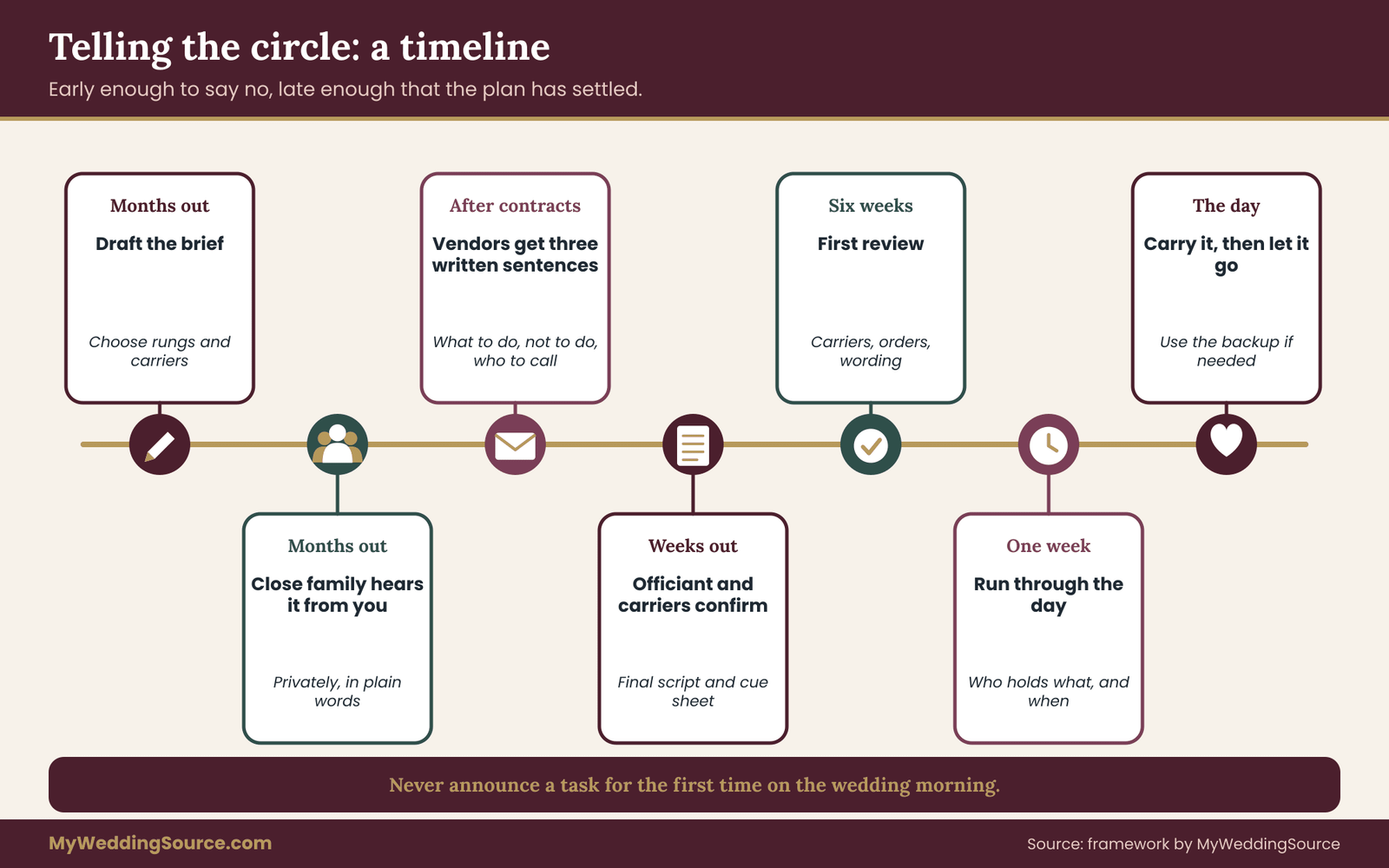
Tell the carriers early enough that they can say no without stress, and late enough that the plan has settled. A common pattern is to speak with close family when the brief is drafted, usually a few months out, and with vendors after contracts are signed and their roles are set. The officiant gets the information when you are finalizing the ceremony script, which is typically several weeks before the date.
Avoid announcing on the wedding morning. A wedding remembrance that is described for the first time on the day cannot be declined, and the person told has no time to think. Equally, avoid long gaps. A relative told a year in advance may forget, or be told by someone else in a distorted form.
For anything that requires a vendor, such as a recipe, a flower or a song, send a short written note as well as speaking. Written details survive staff changes. A clean list of what happens when, given to the officiant, readers and musicians, can carry a quiet wedding remembrance as one more line.
What to say, and what to leave out
Here are scripts in plain language. Adapt them to your voice, and treat them as starting points, not requirements.
To a surviving parent or close relative. “We’re planning a small way to include Dad that nobody else will really notice. I wanted you to know before the day, and tell me if anything about it doesn’t feel right to you.” Then stop and listen. You are not asking for permission to grieve. You are making space for their feelings about the plan. If they respond with a different idea, say you will think about it, and mean it.
To a sibling who will carry something. “Would you be willing to carry this for me during the ceremony? It’s small. Nobody will ask you about it. You can say no and I will understand.” The last two sentences matter. They reassure the sibling that they will not be put on the spot, and that declining has no cost.
To an officiant. “We’d like to include a quiet remembrance without naming anyone. Can you make sure nothing in the ceremony or the introductions points to it? If someone asks you at the rehearsal, please say we’ve kept it private.” Most officiants have handled this and will appreciate the clarity. If you are still choosing someone, the guide to officiant requirements covers what to ask, and a bereavement-aware officiant is worth looking for if you have a choice.
To a florist or caterer. “We’re using this flower for a personal reason. Please don’t put a card or sign with it, and please don’t mention it to guests.” Be firm about the second half. Vendors are often warm people, and warmth is how labels get added.
To a photographer. “There is a small detail we’d like left out of the gallery and out of any social posts. I’ll point it out at the start of the day.” Then point it out, once, and do not rely on their memory three hours later.
To a DJ or band. “We’d like this song played at this time without an announcement. Please don’t mention the song or its history.” Provide the time and the title in writing.
When the person you tell reacts badly
Sometimes a relative objects: they think the plan is too quiet, or that it hides the death, or that it ignores the family. Sometimes they react with a grief of their own that you did not expect. This is not a failure of the plan. It is information.
Listen to the objection without defending the plan. Ask what they would need to see for the wedding remembrance to feel respectful to them. Often the answer is small, such as a mention to one relative or a second private act on the same day. If the objection is large, such as a demand for a public announcement, you are facing a decision about decision rights, not a design problem. The decision-rights guide mentioned earlier addresses that conflict directly.
You are allowed to hold the line. A wedding remembrance is a gift, not an obligation, and the couple’s right to choose its form is a legitimate one. You are also allowed to change your mind if the conversation shows you something you had not considered. Keep the two things separate: holding a line you chose, versus giving way because the discussion has become unpleasant.
The one-sentence answer: what to say when someone asks
Even a thoughtful wedding remembrance will meet a question. A guest sees a flower and asks about it. A cousin notices a missing person and asks where they are. A vendor’s assistant says something kind. You can prepare for all of these with a single prepared sentence, plus a ladder of responses depending on who is asking and how much you want to say.
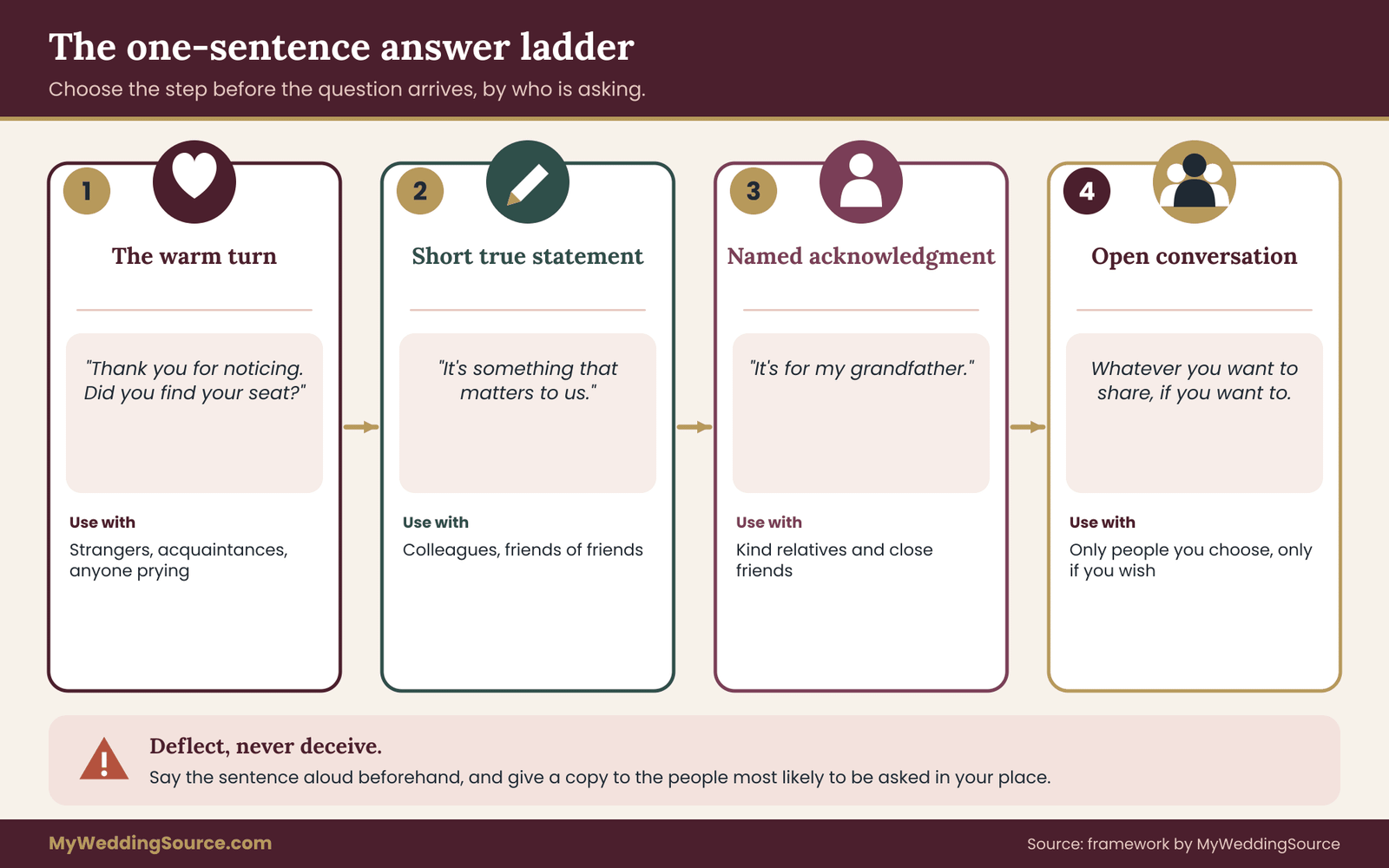
The ladder has four steps. Choose the step before the question arrives, by person if possible, and say the words aloud a few times beforehand.
Step one: the warm turn. You acknowledge the question without answering it, and turn the conversation toward the person. Examples: “Thank you for noticing. How is the family?” or “It’s a small thing we like. Did you try the cake?” This step uses no information. It is fine for strangers, acquaintances and anyone who gives you the feeling of prying.
Step two: the short true statement. A single sentence that is accurate but does not open the topic. “It’s something that matters to us.” “It reminds me of someone.” These do not invite follow-up if said calmly and followed by a smile or a subject change.
Step three: the named acknowledgment. For relatives and close friends, you may say the name and nothing else: “It’s for my grandfather.” Most people respond with a gentle word, and the conversation moves on. Use this step when the questioner is clearly kind and you do not mind them knowing.
Step four: the open conversation. You tell the person more, because you want to. This step is entirely optional on the day, and nothing in the brief assumes you will use it.
Making the sentence yours
The one-sentence answer works only if it sounds like you. Avoid phrases that sound rehearsed, such as “we preferred to keep it private,” which can sound like a door slamming. Short and plain tends to work better: “It’s personal, but thank you for asking.” That sentence is true, polite and complete.
Write the sentence in field five of the brief, and give a copy to the people most likely to be asked in your place: a parent, a sibling, a member of the wedding party. They will be asked more often than you, because guests think they are safer targets. Tell them what they may say, which is the same steps one and two, and give them permission to say “you would have to ask them” and walk away.
What the answer should never do
It should not lie. Saying “that’s just a flower” when it is a wedding remembrance is a small untruth, and it may come back when a relative later learns what it was. Deflecting is different from deceiving, and the first is usually enough. It should not blame the asker either. Most people ask out of warmth. And it should not require you to say more than you intended. If you notice yourself explaining past the sentence you planned, you can pause, say “I think I’ll leave it there,” and move on without apology.
Carrying the wedding remembrance on the day: roles, timing and handoffs
A quiet wedding remembrance is easy to design and easy to forget on the day. The schedule is crowded, the carriers are also guests, and emotions come in waves. The fix is to treat each wedding remembrance gesture as a small task with an owner, a time and a backup, exactly as a vendor delivery would be treated. That may sound clinical for something tender, but it is the reason a loved one is not left out by a missed handoff.
Give each gesture an owner and a time
For every idea in the brief, write three lines on a single page that the day-of coordinator or a trusted friend can hold.
What happens. “Katie places the folded handkerchief in the groom’s inside pocket at the start of getting dressed.” The line should describe an action, not a feeling.
When it happens. A clock time or a cue, such as “after photos, before the processional line-up.” A cue is more reliable than a clock, since weddings run late.
What to do if it does not happen. “If the handkerchief is lost, nothing replaces it, and the groom skips this one.” Having a plain fallback removes pressure. Some wedding remembrance ideas simply have no backup, and that is acceptable if it is decided in advance and not on the spot.
The guide to wedding ceremony cue sheets shows how to fold items like these into the existing run of show, and a quiet remembrance belongs on the same sheet as the readings and the music. It does not need its own page, a different font or a special heading. Plain wording such as “personal item, groom, pocket, 3:15” tells the coordinator what to check without telling anyone else what it means.
The coordinator and the brief
If you have a coordinator, give them the brief in advance and one sentence of context. They will run the day with more confidence if they know which small things matter more than they look. Ask them to treat any question from a guest about the wedding remembrance as one for you, and to use step one of the answer ladder if you are unavailable.
If you have no coordinator, choose a friend with a calm temperament and no other job on the day. This person should not be a parent or a member of the wedding party. They should have the brief, a phone with the vendors’ numbers and permission to make small decisions without asking you.
A brief for each vendor, three sentences long
Keep vendor briefs short enough that they will be read. Each one should state what to do, what not to do, and who to call. For example, for a florist: “Please include this variety in the bouquet and the groom’s boutonniere. Please do not add a card or mention it to guests. Call the coordinator if the flower cannot be sourced.” For a caterer: “Please serve this dessert as listed. Please leave it unlabeled on the menu. Call us if the recipe cannot be reproduced.”
Put the brief in writing and attach it to the contract or the final planning email. Verbal agreements fade, and a new employee on the day will not have heard them. The guide to wedding vendor contracts explains how to keep changes on record, and the habit that matters here is to keep the written instruction next to the order it modifies.
Backups for objects that could go missing
If a wedding remembrance depends on one physical object, ask what happens if it is lost, dropped or damaged. The answer can be a copy, a photograph of the object, or a decision to go without. For irreplaceable items, such as an heirloom ring, a letter or a piece of a garment, consider carrying a copy for the day and keeping the original at home. Anything you leave in a getting-ready room, a car or a coat check should be assigned to a person, not to a place.
Keep track of where things are at the end of the night. A sentimental item left in a jacket pocket and sent to a venue lost-and-found is a common way for a small wedding remembrance to end badly. Assign the end-of-night retrieval to the same carrier who started the day with it.
Safety and comfort checks for quiet wedding remembrance ideas
Even a tiny gesture can touch safety, health or comfort. A short check before the wedding avoids most surprises.
Flame. If any idea uses fire, ask the venue first and follow its written policy. Battery candles are a close visual substitute. Federal and fire-safety agencies publish candle guidance, and the venue’s insurance may be stricter than the guidance.
Scent and allergens. Perfumes, scented candles, strong flowers and family recipes can affect guests with sensitivities. Use scent only on yourself, in small amounts, and ask the caterer to supply ingredient lists for any dish with a family story.
Weather and handling. Paper, photographs and fabric do poorly in rain, wind and heat. Keep delicate items in a pocket or a closed case, and have a plan for the end of the night.
Children and animals. A child asked to carry something important may drop it or give it away. Anything that matters should be carried by an adult, and any item within a child’s reach should be harmless if swallowed or lost.
Accessibility. If a gesture involves a seat, a walkway or a place on the grounds, make sure it works for people using mobility devices. A bench on a gravel path is not available to everyone.
Emotional safety for the carriers. A sibling carrying an item may be more affected than they expected. Tell them they may hand it to someone else without a word, and name a back-up person in the brief.
Photos, video and social media: keeping a wedding remembrance quiet
The easiest way for a quiet wedding remembrance to become a public one is through the gallery. A photographer notices a small detail, frames it beautifully and includes it in a highlight reel. A guest posts the image with a caption that explains it. Within a few weeks, the family story is on the internet. You can prevent most of this with a few instructions.
What to tell the photographer and videographer
Be clear on three points. First, which details you do not want featured: a particular object, a seat, a place. Second, which moments to leave without coverage, such as a private minute before the ceremony. Third, how you want any related image treated: kept in the full gallery but not in the highlights, kept off your social media, or deleted.
Say it once in writing and once in person at the start of the day. A photographer who knows nothing of the story will naturally gravitate to the most meaningful details, because they photograph well. Ask them to confirm what they have understood.
If you would like one image of the detail for yourselves only, ask for it, and ask the photographer to store it outside the shared gallery. The photography consent guide mentioned earlier also covers how to ask for photo boundaries in general.
Guests and their phones
If you have asked for an unplugged ceremony, the wording can include a line asking guests not to post photos before you do. That covers the ceremony but not the reception, where guests take photos freely. You cannot control what someone captures, but you can reduce the odds that a quiet detail gets a caption. Placing the detail where it will not be in the background of a typical snapshot helps more than any announcement. A flower sewn into a lining appears in no one’s photo; a chair in the second row might.
The gallery after the event
Look through the full gallery before you share it with family. If a detail appears that you wanted private, decide whether to ask for removal, to share only a selected set, or to accept it. Some couples decide at this point that the wedding remembrance is fine to share, and move it up a rung afterward. That is your choice, and the brief should say who can see which pictures.
What a quiet wedding remembrance costs in money and effort
Most private wedding remembrances cost very little. The real cost is attention. Here is a plain way to think about it, without invented prices.
Money. Items such as ribbon, a pocket stitched in a jacket, an engraving or a flower variety are small line items in a wedding budget. Check prices with each vendor, because they differ by region and supplier, and ask whether a request changes a package price. A reproduced recipe might incur a catering fee for a custom item. Always ask for the cost before agreeing, and keep the answer in writing.
Time. Each idea requires a conversation or two, a written note, a check before the day and a handoff on the day. Three ideas will occupy several hours across the months before the wedding. If your calendar is already tight, choose one idea and do it well.
Emotional energy. Planning a wedding remembrance puts you in touch with the loss on a schedule that is not of your choosing. Many people find the planning more affecting than the day. Give yourselves permission to pause, to hand tasks to someone else, and to talk to a counselor or a trusted friend if the planning feels heavy.
Lead time. Engraving, tailoring, custom printing and flower sourcing take time. Start these early, and set a decision date after which the idea is dropped. A wedding remembrance rushed in the last week tends to cost more and satisfy less.
If the budget is tight, the quietest ideas are also the cheapest. A private minute, a signal to a sibling and a song at dinner cost almost nothing, and they do not depend on a vendor’s timing.
A worked example: Nora and Elias fill in the brief
The following wedding remembrance case is invented. It is an illustration of how the brief works, not a report of a real couple, and any resemblance to real people is accidental. It was built to show the decisions in order, including one that goes wrong.
Nora and Elias are planning a wedding of about one hundred and twenty guests in a rented hall. Nora’s father died fourteen months before the date. Her mother prefers that the death not be mentioned at the wedding, because she finds public sympathy exhausting. Her father’s sister, Aunt Mira, expects some visible acknowledgment and has offered to bring a framed photograph.
Elias’s family never met Nora’s father. Nora does not want a eulogy, does not want to cry in front of coworkers, and does want her father to be part of the day in some form, so she asks for a private wedding remembrance.
Step one: the intention, in a sentence
Nora writes: “I want to feel that Dad is near me at the ceremony, and I want Mom and Aunt Mira both to feel their feelings were respected.” Elias adds: “I want to protect Nora from having to explain anything.” The intention has two parts, one private and one for the family, and the pair realize they are really planning two ideas, not one.
That is the first useful result of the exercise. A single wedding remembrance was trying to do two jobs. Splitting it gives each job a clear rung.
Step two: choose the rung for each job
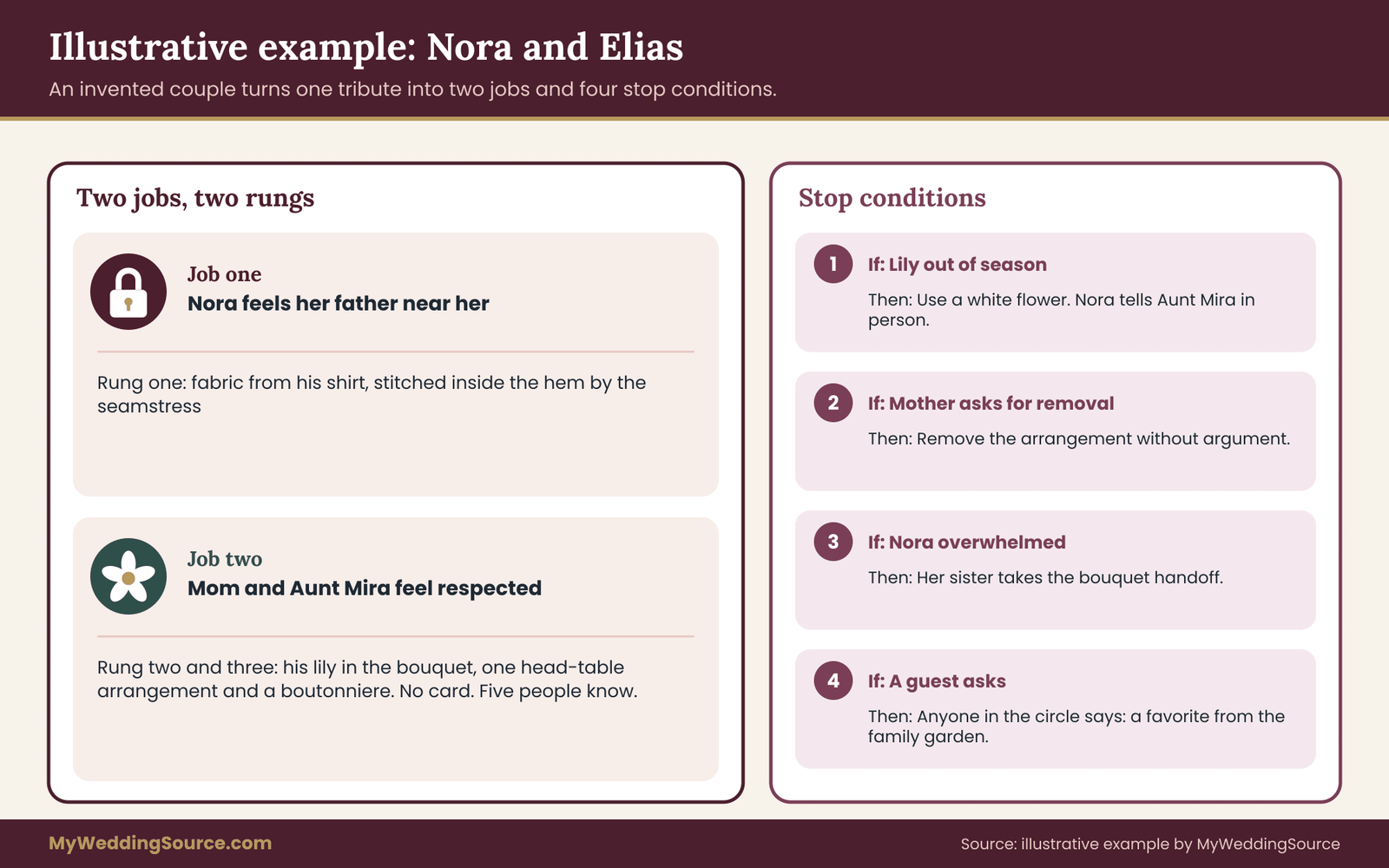
Job one: Nora feels her father near her. Lowest rung that does the job: rung one. Nothing needs to be seen by anyone. Nora chooses a small piece of fabric cut from one of her father’s shirts, stitched by her seamstress into the hem inside the dress, where nobody will see it. That is the signal.
The carrier is the seamstress, who is told that it is a personal item and that nothing should be said about it. The one-sentence answer is not needed, since nobody will see anything, but Nora writes one anyway for the seamstress to use with colleagues: “It’s a private detail for the bride.”
Job two: Mom and Aunt Mira both feel respected. This one needs rung two or three, because both women must see something. Nora talks with each of them separately. Her mother agrees to a flower without a card. Aunt Mira, once she hears her sister-in-law’s reasons and Nora’s plan, agrees to a quieter form than a framed photograph, provided that she is told in advance what Nora will do.
They settle on a variety of lily that Nora’s father grew in the garden. It goes in Nora’s bouquet and in one small arrangement on the head table, and in the boutonniere her brother wears. No card, no sign, no mention. Aunt Mira, Nora’s mother and her brother know. The florist knows that it is a personal choice and has been told not to explain it. That makes the circle five people, plus the seamstress.
Step three: the stop conditions
Nora and Elias write these into the brief:
- If the lily cannot be sourced within three weeks of the date, they use white roses and tell nobody, and Aunt Mira is told by Nora in person.
- If Nora’s mother changes her mind and asks for the arrangement to be removed, they remove it without argument and keep the bouquet and boutonniere.
- If Nora is too upset on the morning to carry the plan out, her sister takes over the bouquet handoff and nobody mentions it.
- If a guest asks about the flower and Nora is not nearby, anyone in the circle uses step two of the answer ladder: “It was a favorite in the family garden.”
These are short and plain, and they remove most of the decisions Nora would otherwise have to make while distracted.
Step four: what actually happens (a possible version)
Three weeks before the wedding, the florist reports that the lily is out of season in good quality. This is the first stop condition. Nora decides to use a similar white flower and tells Aunt Mira on the phone. Aunt Mira is disappointed, because she remembered the specific variety, and says so. Nora listens, does not argue, and offers a small alternative: a stem of the original lily, in dried form from her father’s garden, which Aunt Mira keeps in her own purse during the ceremony.
Aunt Mira accepts, and the plan changes from a flower to a flower plus a small private object in the circle.
On the day, a cousin of Elias asks Nora about the white flower at the head table. Nora is standing next to her mother. She uses step one: “Thank you, it’s a favorite. Did you find your seat all right?” The cousin moves on. Later, an old family friend, who knew Nora’s father, says something kind and quiet about the arrangement. Nora uses step three: “It’s for Dad.” The friend squeezes her hand and says nothing more.
During the reception, a coworker of Nora’s asks where her father is. Nora has a plan for this too, written in field five: “He passed away last year. I’m glad you’re here.” It is the short true statement, and the coworker replies with sympathy and the conversation continues. Nora was not required to give details, and she did not.
What the example shows about wedding remembrance
Three things stand out. First, the brief changed the plan before the wedding. The decision to split one wedding remembrance into two jobs came from field one, and the stop conditions came from field six. Second, the plan survived a supplier problem because a fallback had been named. Third, the answers to questions were short, and they matched the person asking. None of this required an announcement, a card or a toast.
It also shows what the approach does not do. Aunt Mira’s disappointment was real, and the quiet version cost something. A quiet wedding remembrance does not remove every tension; it lets you carry them without staging them. Nora and Elias accepted that cost and decided it was lower than the alternative.
Reviewing the brief at six weeks and at one week
Return to the wedding remembrance brief twice before the wedding. At about six weeks, confirm each carrier is still willing, each vendor has their written line and each object has been ordered or made. At about one week, run through the day on paper, with the coordinator if there is one: who holds what, at what time, with what backup. Read the one-sentence answers aloud and change any that sound stiff.
At both reviews, ask the question from the start of the process again: does each idea still do the job named in field one? Feelings change in the months before a wedding. An idea that felt right in spring may feel too exposed or too hidden by autumn. Moving an idea up or down a rung at the review costs very little, and it is better done then than on the morning.
Keeping a short log
A simple log helps during the weeks around the wedding: who was told, on what date, what they said and what they agreed to do. Two lines per person is enough. The log is useful when a relative remembers a conversation differently, and it keeps you from telling the same person twice or forgetting someone altogether. It also holds the final version of the brief, so the person who steps in for you if you are unwell has a single place to look.
Failure conditions: when to change or drop a quiet wedding remembrance
The sixth field of the brief, the stop condition, is where most couples write one vague line and move on. It deserves more thought, because a quiet wedding remembrance fails in specific and predictable ways. Naming them lets you notice early and respond without drama.
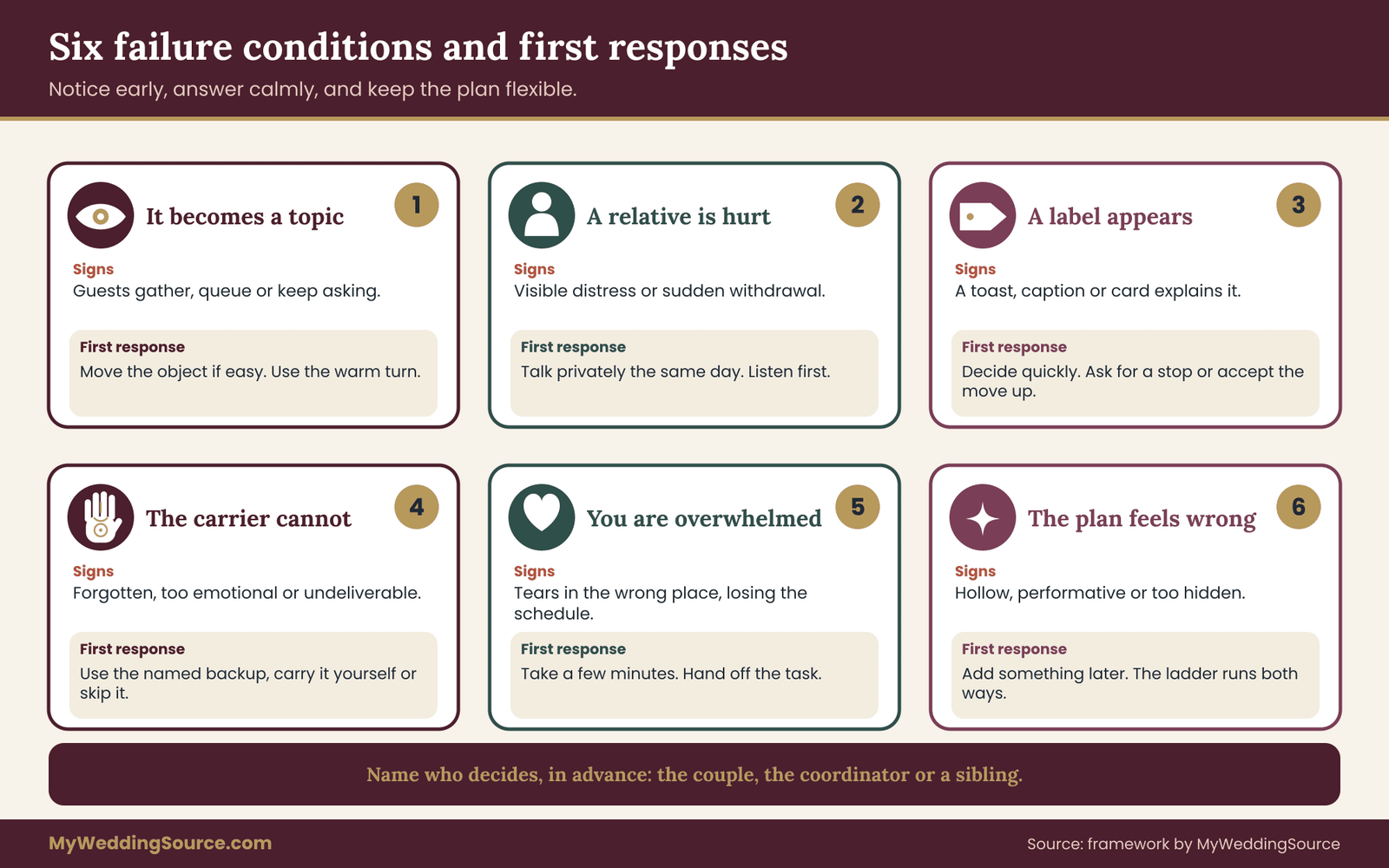
Failure one: the wedding remembrance becomes a topic
Signs: guests gather around it, ask the same question repeatedly, or begin to discuss it with each other. A seat, a table or a flower that draws a queue has stopped being quiet. Response: quietly remove or move the physical element, if it is easy to do, and fall back on the warm turn when anyone asks. If removal is not possible, accept the attention and use step two or three of the answer ladder consistently.
Failure two: a relative is hurt
Signs: a parent or sibling reacts with visible distress, withdraws or says something that suggests they felt excluded or ambushed. Response: speak to them privately as soon as you can, ideally the same day, and listen. Do not defend the plan in the middle of the reception. Ask what would help, offer to add them to the circle for a related gesture, and follow up the next week. The injury is usually about being surprised or left out, not about the gesture itself.
Failure three: a label appears
Signs: a vendor, a speaker or a guest explains the gesture to the room. A toast that names the person, a caption on a post, a card at a table. Response: decide quickly whether to let it stand. If the label is gentle and the relatives are comfortable, you may decide to accept it and treat it as a move up the ladder. If not, ask the person to stop, thank them for their intention, and move on. Do not make a scene. A calm sentence to a coordinator is often enough.
Failure four: the carrier cannot or will not
Signs: a sibling is too emotional to carry the item, an usher forgets, a vendor cannot deliver. Response: use the backup named in the brief. If no backup was named, either carry the item yourself or skip the gesture. Skipping is allowed. A wedding remembrance that is missed once does not invalidate the intention, and you can mark the person’s memory in a private moment the next day.
Failure five: you are overwhelmed
Signs: you find yourself crying in the wrong place, losing track of the schedule or avoiding a part of the day. Response: take a few minutes. A quiet corner, a glass of water, a hand from your partner. The brief should not become another thing to perform. If a gesture has become a burden, drop it, and tell your partner and coordinator so they can adjust.
Grief at a wedding is normal and does not mean something has gone wrong. If you or someone close to you is in serious distress, the 988 Suicide and Crisis Lifeline in the United States offers free, confidential support by call or text, and the Hospice Foundation of America and similar organizations publish grief resources and referrals. A counselor with grief experience can help far beyond the wedding.
Failure six: the plan was wrong for you
Signs: the idea that seemed right in the brief feels hollow, performative or hidden. Perhaps the quiet version is not what you wanted after all. Response: at the next opportunity, add something. A private act after the wedding, a letter to the person, a visit, a more visible wedding remembrance at an anniversary. The ladder runs in both directions, and moving up later is easy. You have not lost anything by starting quiet.
A way to rehearse the stop conditions
At the one-week review, read the failure list with your partner and the coordinator, and for each one, name who decides and what they do. The aim is not to expect trouble. It is to ensure that if something small goes wrong, nobody has to improvise in the middle of a toast. Decision rights should be specific: “If Aunt Mira objects, Nora speaks to her. If a vendor adds a label, the coordinator asks them to stop. If Nora is overwhelmed, her sister steps in.”
When a private approach is the wrong choice, and what to do instead
A quiet wedding remembrance is not the answer for every couple or every loss, and a good wedding remembrance plan allows for that. Here are the circumstances in which another approach may serve you better, along with the alternatives.
When silence would feel like erasure to the family. If a surviving parent, a sibling or a child of the person who died would experience the absence of any visible acknowledgment as painful, rung four may be the right place to start, and a short, plain line from an officiant might do it. The wedding ceremony order shows where such a line fits, and briefing the person who will read it takes a minute. A single sentence is not a eulogy.
When the quiet version is a way to avoid a difficult family conversation. Sometimes a private wedding remembrance is chosen because talking to a relative is too hard, and it quietly deepens the conflict. If that is true, address the conversation first. A plan built on avoiding someone tends to break at the worst moment.
When the person was important to the whole community. A grandmother who raised half the guest list, a beloved mentor, a teacher who officiated the first wedding in the family. Guests may want to acknowledge the loss together, and a purely private wedding remembrance can feel like a closed door. A short, labeled acknowledgment, kept to a sentence or two, may serve the room better.
When the grief is too fresh. If the loss was only weeks ago, a wedding plan that includes the person in any form may be too much, and a postponement or a smaller event may be worth considering. That is a personal decision and not a failure.
When you want the wedding remembrance to be shared later. Some couples decide to keep the wedding quiet and mark the loss at a first anniversary, a dinner with the family or a memorial gathering on another date. That separates the grief from the celebration, and it lets you choose a form without the pressure of a crowd.
Alternatives outside the wedding itself
If the wedding does not feel like the right setting, there are other ways to honor someone that do not depend on it.
A letter. Write a letter to the person before the wedding, read it on your own and keep it. Some couples place it in a box with a few other keepsakes and open it on an anniversary. It is private by nature and takes an evening.
A donation or a small act of service. Give to a cause the person cared about, or spend a morning on something they enjoyed. This can happen before or after the wedding, and it does not need to be mentioned to guests.
A private gathering with the closest relatives. A dinner the night before, a visit to a family home, a shared meal on the first morning after. It gives the family a space to remember together, out of the schedule of the wedding.
A keepsake for afterward. A framed photograph at home, a recipe card on your kitchen wall, a plant in the garden. It lives in your life, not the day’s program.
A quiet moment on each anniversary. One of the simplest, and the longest lasting. You choose the form each year, and it needs no vendor.
Combining approaches
Most couples do more than one thing around a wedding remembrance. A small private object on the day, a letter beforehand, and a dinner with family afterward is a modest set that does not crowd the schedule. The brief is a tool for the wedding portion, and you can use the same six fields for the others. What matters is that each gesture has a clear purpose and that you are honest about who it is for.
Being kind to yourselves about the choice
Whichever path you take, someone may disagree. A relative may think you did too little, and another may think you did too much. Both reactions are about their grief, not your design. If you chose carefully, with the person and the family in mind, and you stayed within what you could carry, the choice is sound. You do not need to defend it, and you may change it later.
Your next steps
Here is a short sequence for your wedding remembrance that you can complete over a few evenings.
- Take the walk and answer the three first-pass questions together: how you would feel if nothing appeared, whose feelings you are protecting, and who would be hurt to be left out.
- Write field one of the brief for each person you wish to remember, and choose the lowest rung that does the job.
- Pick one or two ideas, not five. Fill in all six fields for each, including the one-sentence answer and the stop condition.
- Make the circle list and decide who hears what, and when. Start with the people who would be most affected.
- Brief your carriers and vendors in writing, three sentences each, and ask each to confirm.
- Add a private line to the day’s schedule and ask your coordinator to hold the brief.
- Review the brief at six weeks and again at one week, and move any idea up or down a rung if your feelings have changed.
- After the wedding, check the gallery, return objects to their place and decide whether to add something that fits a different moment.
If you are working on the wider ceremony, the ceremony order and the cue sheet show where a quiet wedding remembrance fits without changing the rest of the program.
FAQ
Can we honor a family member at the wedding without anyone knowing why?
Yes. A private object, a flower variety, a song or a quiet minute before the ceremony can include someone without any explanation. The key is to choose the lowest level of visibility that does the job you want it to do. Tell only the few people who must help, give vendors written instructions not to add labels, and prepare one plain sentence in case someone asks.
What if a guest asks about a flower or an empty seat?
Use a short, kind answer that matches who is asking. For a stranger, turn the conversation warmly toward them. For a friend, a single true sentence is enough, such as “It’s something that matters to us.” For a close relative, you may say the person’s name. You are never required to explain further, and you can end the topic politely.
Should we tell our parents before the wedding?
If a parent shares the loss, such as a surviving parent or a sibling of the person who died, tell them in advance, privately, and in plain words. Surprise is the main cause of hurt with quiet wedding remembrances. You do not have to ask permission, but you should listen to their reaction and consider small changes that respect their feelings.
Is a private wedding remembrance disrespectful to the person who died?
Not in itself. In a wedding remembrance, respect comes from the care and intention behind a gesture, not from how many people see it. A folded handkerchief, a song or a recipe can carry deep meaning without an audience. If someone in the family feels that more visibility is needed, listen to them, and consider moving one idea up to a more visible level.
Can the photographer capture the detail but keep it out of the gallery?
Often, yes. Ask in writing before the wedding and again on the day. Specify whether the image should be kept for you only, left out of highlights and social posts, or not taken at all. Photographers vary in their policies, so confirm what they will do and ask them to repeat it back to you.
How many private gestures are too many?
Keep the number small. One to three ideas across the whole day is usually enough. Beyond that, guests may begin to notice a pattern and ask about it, which is the outcome you were trying to avoid. If you feel the need for more, consider whether a short labeled acknowledgment or a separate gathering would serve you better.
What if our families disagree about how visible the tribute should be?
Treat a disagreement over the wedding remembrance as a decision about who has a say, not a design problem. Listen to each person’s reasons, find what is essential to each, and look for a form that gives everyone something they can accept. A quiet wedding remembrance for the couple plus a visible but unlabeled gesture for the family is a common compromise. You may hold your choice if it is considered.
Is it all right to skip a tribute entirely?
Yes. Some people feel better marking the loss at another time, in another way, or not at all on the wedding day. A wedding is a long day with many demands. If a wedding remembrance would add pressure and not comfort, leaving it out is a legitimate choice, and you can always honor the person later in a way that suits you.
Sources
- Hospice Foundation of America: grief and bereavement information and referrals for individuals and families.
- 988 Suicide and Crisis Lifeline: free, confidential crisis support in the United States by call, text or chat.
- National Institute on Aging: general guidance on grief and coping after the loss of a loved one.
- National Institute of Mental Health: information on mental health and when to seek professional help.
- Substance Abuse and Mental Health Services Administration: national helpline and treatment locator information.
- U.S. Centers for Disease Control and Prevention: public health information on coping with stress and loss.
- American Psychological Association: public resources on grief and finding a licensed professional.
- U.S. Consumer Product Safety Commission: consumer safety guidance, including candle safety.
- National Fire Protection Association: fire and candle safety education.