

Destination vow renewal packages bundle a ceremony, a setting and a few extras into one price, and the useful question is never how pretty the brochure looks but what the bundle includes, what it leaves out and what it costs you to back out. This guide gives you a plain comparison grid for reading those packages, a worked example and the conditions that should make you walk away.
A renewal of vows is a ceremony, not a legal event, so the package is a product to compare, not a legal service to qualify for. Line up every offer on five lines: what the ceremony includes, who and what is excluded, what paperwork is involved, how the money moves, and how you exit. Ask for each answer in writing before paying a deposit. Choose the package whose cancellation and change terms you could live with on your worst day, not the one with the longest list of extras.
A couple who has been married for ten or twenty years and wants to say their vows again on a beach, in a garden or on a hotel terrace abroad will quickly meet a wall of resort pages. Each of these vow renewal packages offers a “romantic renewal,” a “sunset celebration” or a “vow renewal escape,” and each one describes the setting beautifully and the terms vaguely. Destination vow renewal packages are written to sell a feeling. The contract behind them is written to protect the resort.
That gap is the subject of this article. It does not try to tell you where to go, which is a matter of taste and budget, and it does not repeat the general steps of planning a renewal at any location. It focuses on one decision: how to compare destination vow renewal packages against each other, and against the other ways of marking the same moment, so that you pay for what you will actually use and know the exits before you commit.
A note on scope. This is general information, not legal, tax or financial advice, and the rules of each country, resort and card issuer differ, so confirm anything that affects your trip with the people who set the rule.
What destination vow renewal packages are, and what they are not
Start with the product itself. Destination vow renewal packages are fixed bundles sold by resorts, hotels, cruise lines and local wedding businesses for couples who are already married and want a ceremony at a travel destination. They usually come as a menu of named tiers, often with names that suggest a size or a mood, and each tier adds items to the one below it.
Most vow renewal packages draw from the same short list of components. There is a ceremony space, such as a beach, a gazebo, a lawn or a terrace. There is a time slot, often at sunset or in the morning when the heat is lower. There is a person to lead the ceremony, which might be an officiant, a celebrant or a staff member who reads a script.
There may be decor, such as an arch, a bouquet, a boutonniere or petals. There may be music, a photographer for a set number of minutes, a toast or a small cake, and a dinner for two or for a group. Some bundles add a spa treatment or a room upgrade, which are really hotel services dressed as ceremony extras.
What they are not matters just as much. They are not marriage services. A renewal does not create a new marriage, does not produce a new marriage license and does not change your legal status. They are also not standard across the industry. Two vow renewal packages with the same name can differ in what they include by a wide margin, and the same line, “photographer included,” can mean ten minutes of snapshots or two hours of coverage.
And they are not a single regulated product with consistent consumer rules. The terms are whatever the seller wrote into its booking conditions.
Who sells them, and why that changes the terms
The seller shapes the terms more than the destination does, so it helps to know the four common types.
An all-inclusive resort sells a renewal as an add-on to a room booking. The ceremony is usually a small part of a larger stay, the price of the ceremony is often modest, and the real commitment is the room reservation, which carries its own cancellation rules. If you are weighing a resort, the guide to all-inclusive wedding venues explains how the room, food and event portions of an inclusive property are normally priced and separated.
A hotel with an events team sells the package through a coordinator, and the ceremony may be arranged around the hotel’s calendar, which means a conference or a private wedding can take priority over your time slot.
A local planner or celebrant sells a ceremony without lodging. Here the package is the whole product, so the terms of the planner matter more than the resort’s, and you book rooms elsewhere.
A cruise line or a tour operator sells a ceremony as part of a trip. Here the cancellation terms are often the trip’s cancellation terms, not a separate set for the ceremony.
Knowing which seller you are dealing with tells you which document governs your money. For a resort, it is the hotel booking conditions plus an event addendum. For a planner, it is the planner’s contract. For a cruise, it is the travel booking agreement. Ask which one applies before you compare prices, because two packages with the same headline price can sit under completely different exit rules.
Legal symbolism: what a renewal does and does not change
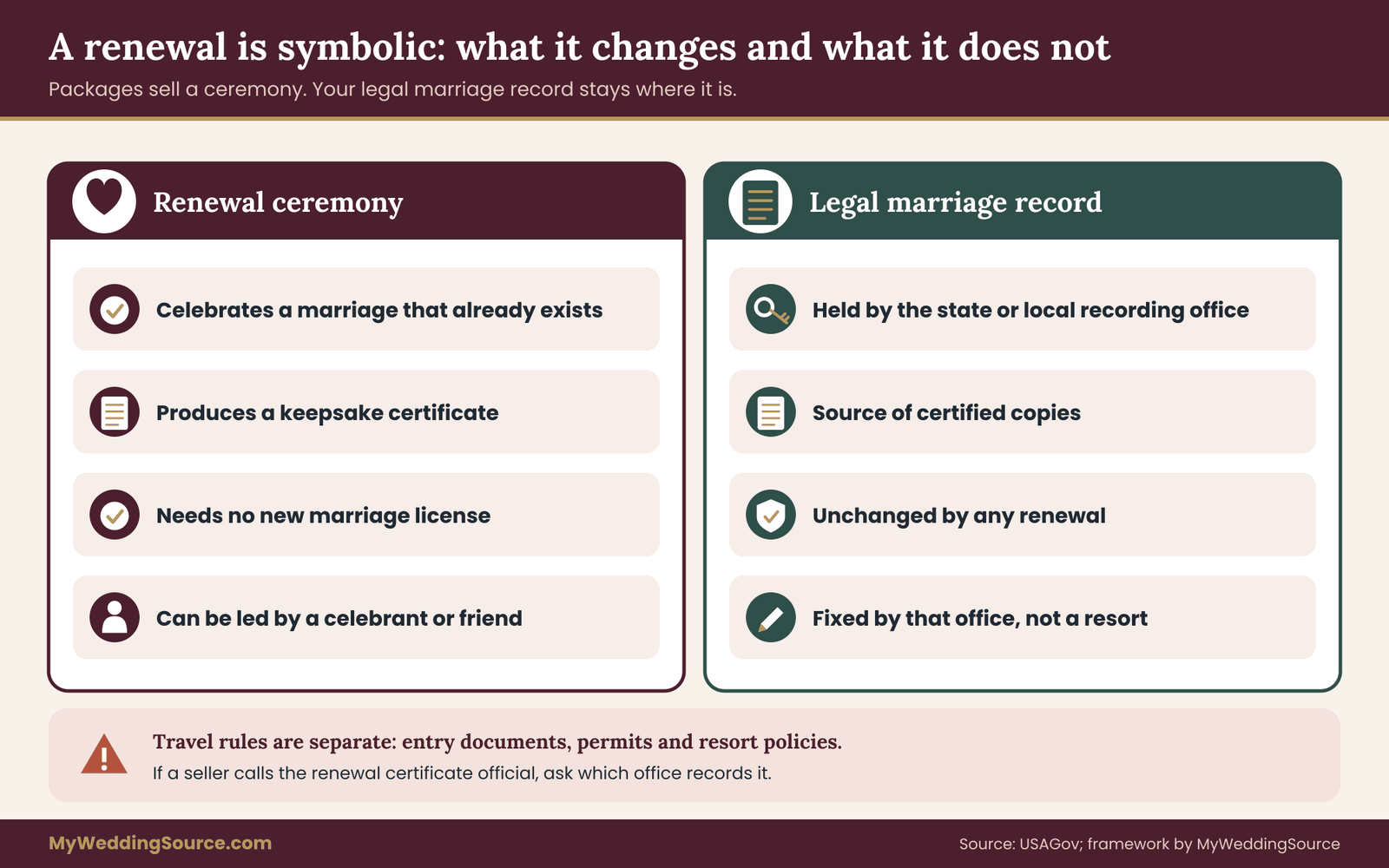
Marketing language around vow renewal packages sometimes blurs a line that matters, so it is worth stating plainly. A renewal ceremony is symbolic. You are already married, and nothing said at a renewal changes that.
In the United States, a marriage is created by obtaining a license and having the marriage solemnized and recorded under the rules of a state. The federal government’s guide to getting a copy of a marriage certificate, published through USAGov, explains that certificates come from the state or local office that recorded the marriage. That is the record of your marriage. A renewal does not add a new entry to it.
Some practical consequences follow.
First, you do not need a marriage license to hold a renewal. You may bring a copy of your existing certificate if a resort or a government office asks to see it, which some do for their own reasons, but the renewal itself does not generate a new legal document.
Second, any “certificate of renewal” that comes with a package is a keepsake. It might be printed on nice paper and signed by the person who led the ceremony, and it may be a lovely thing to frame. It is not a legal record and no agency will treat it as one. If a package describes a renewal certificate as “official,” read that as marketing and ask what office, if any, receives or records it. In most cases the honest answer is none.
Third, in most vow renewal packages the person leading the ceremony does not need the same legal authority as someone solemnizing a marriage, because nothing legal is being created. That does not make the choice of leader unimportant. A good one writes and reads a ceremony that fits you, paces it and handles the room. It only means the legal test of “who is allowed to officiate” does not apply in the same way.
If you want a deeper look at what officiants must satisfy when a marriage is actually being created, the guide to wedding officiant requirements covers it, and it is useful mainly as a contrast with the lighter requirements of a renewal.
Fourth, a destination can add legal-looking steps that have nothing to do with your marriage. A resort might ask for passports to confirm names for a guest list, a country might require entry documents of every traveler, and a local government might require a permit to use a public beach for an organized event. Those are real requirements, but they come from travel rules and venue rules, not from marriage law.
The one exception to check: a legal marriage ceremony in disguise
A small number of couples want a ceremony that is both a renewal and a legal act. For example, a couple who married in a civil office without ceremony may call a later event a renewal when what they are doing is staging the wedding they never had. That is fine, and many couples do it, but if there is any chance you want the ceremony to carry legal weight, such as a marriage that was never recorded or a record that has an error, do not ask the resort.
Ask the office that holds your record, and then ask the destination’s authorities what a legal ceremony would require there. Destination marriage rules are a different subject from destination vow renewal packages and need their own research.
For nearly every couple reading this, the situation is simple: you are married, the record is in order, and the ceremony is a celebration. That makes vow renewal packages consumer products, and consumer products are compared on terms.
Why a comparison grid beats a price comparison
Most couples compare destination vow renewal packages by price and by photos. Both are weak signals. Price hides exclusions, so a lower sticker can end up costing more once the missing items are bought separately. Photos show the best day at the best angle and rarely show what the package does when it rains, when the ceremony space is double-booked or when you want to move the date.
A comparison grid fixes this by forcing every one of the vow renewal packages to answer the same questions in the same order. You are not looking for the best of all vow renewal packages in the abstract. You are looking for the best fit to your group size, your travel dates, your tolerance for risk and your budget, and you can only see that when the answers are side by side.
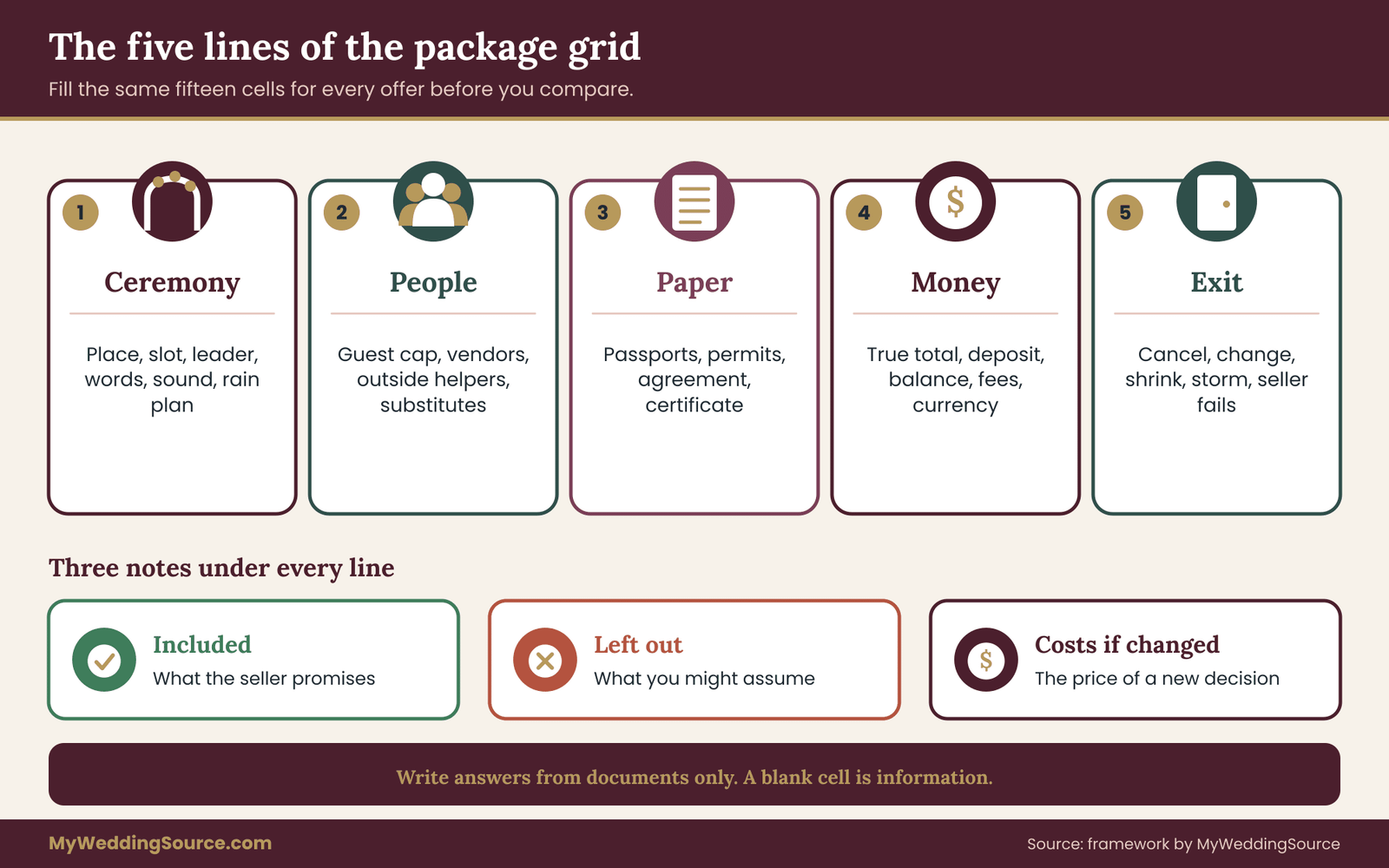
The grid in this guide has five lines and three columns. The lines are the five areas where packages differ most and where surprises appear later. The columns are what the package says it includes, what it leaves out and what it costs you if plans change. The next section builds it step by step. After that, each line gets its own section, with the questions to ask, the wording to watch for and the red flags worth stopping on.
The five-line grid for comparing vow renewal packages
The grid is simple enough to draw on a sheet of paper. Write the names of two to four vow renewal packages across the top. Down the side, write five lines: Ceremony, People, Paper, Money and Exit. Under each of the vow renewal packages, for each line, write three short notes: what is included, what is left out, and what it costs you if something changes. That is fifteen small answers for each of the vow renewal packages.
Here is what each line is meant to catch.
Ceremony. The thing you came for. Where it happens, how long it lasts, who leads it, what happens if the weather turns and what is physically provided, such as chairs, an arch, a sound system or flowers.
People. Everyone who touches the day or attends it. The leader of the ceremony, the coordinator, the photographer, the musician, the guests and the limits on each. This line also covers the number of guests the package allows, because group size is where many vow renewal packages quietly change price.
Paper. Anything with a signature, a stamp or an ID check. Passports, entry rules, permits, the booking agreement, the ceremony certificate and any proof of your existing marriage the resort wants.
Money. The total, the deposit, the balance, the due dates, taxes, service charges, resort fees, currency and payment method.
Exit. What happens if you cancel, change the date, reduce the guest count, lose a flight or face a storm. This line gets the most weight in the guide because it is the one the brochure never shows.
How to fill in the grid without fooling yourself
Three habits keep the grid honest.
First, write answers only from documents. If a coordinator tells you something on the phone, ask for it in an email and paste the email’s words into the grid. A spoken promise that a deposit is “basically refundable” is not a term. A written line that reads “deposit refundable until sixty days before the event, less a small processing fee” is. Keep the written text beside the grid so you can quote it later.
Second, mark unknowns as unknowns. A blank cell is information. If vow renewal packages never mention what happens in bad weather, write “not stated” and ask. Do not fill the cell with a hopeful guess. After you have asked, if the answer is still vague, treat it as a risk.
Third, score the grid at the end, not as you go. Early scoring makes you favor whichever of the vow renewal packages you liked first. Fill every cell for every offer, then read down each line and mark the one with the clearest answer. The winner on the Exit line is often not the winner on the Ceremony line, and that tension is the real decision.
What the three columns teach you
The three notes under each line matter because they separate three different things that brochures blend together.
“Included” is what the seller promises to deliver. “Left out” is what a reasonable couple might assume is included but is not. And “costs if changed” is the price of a different decision later. Vow renewal packages that include a great deal but charge heavily to change anything can be a worse choice than plainer ones with flexible terms, especially for couples whose dates depend on a work schedule, on a relative’s health or on weather in the season.
Couples who treat the left-out column seriously tend to find the gaps early. Typical gaps are chairs for guests, a sound system loud enough to carry over surf, a rain location, the photographer’s travel fee, a service charge on the food and a marriage proof the resort wants but does not mention in the brochure.
Each gap is small. Together they can change the cost of vow renewal packages by a surprising amount, and no one has to be dishonest for that to happen. The brochure simply describes the best case, and your grid describes yours.
The ceremony line: what vow renewal packages actually deliver
The first line is the one couples read most carefully and still misread most often, because words like “private,” “sunset” and “personalized” are doing a lot of work.
Place and time slot
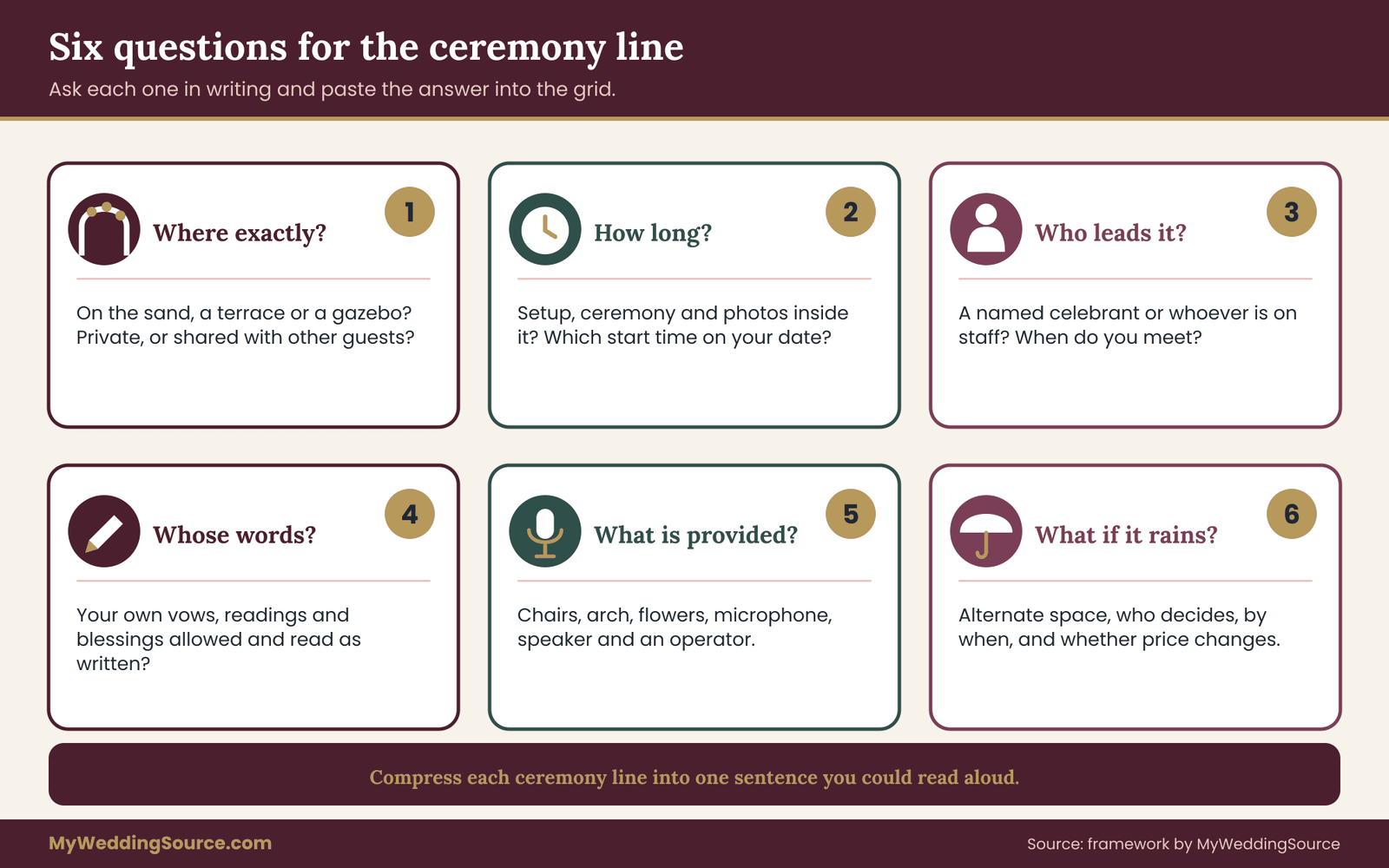
Ask for the exact ceremony location in the exact terms the resort uses. “Oceanfront” can mean on the sand, on a terrace above the sand or at a gazebo a short walk from the water. Ask whether the space is reserved for you alone for the whole slot or shared with other guests who can walk through. A “private ceremony” at a resort beach is sometimes private in the sense that no one else is holding a ceremony at that moment, not in the sense that other guests are kept away.
Then ask how long the slot is. A slot of thirty minutes that includes setup, the ceremony and photos is very different from a slot of ninety minutes that begins after setup. If a sunset time is advertised, ask what time you would actually be booked. Sunset slots are scarce and many resorts schedule several ceremonies close together, which can mean you are asked to begin earlier than the light you pictured.
Sunset time also changes through the year, so a slot that works in one month may be too late or too early in another, and a slot that sounds ideal may end after dark where the resort has no lighting.
Ask what happens if the weather is poor. A good answer names a specific alternate space, says who decides to move, says by what time that decision is made and states whether the move changes the price. A weak answer is “we will find a solution.” The ceremony line should include one sentence about the rain plan for every one of the vow renewal packages, and if there is none, that blank belongs in the Exit line too.
The planning questions in the guide to wedding ceremony steps are useful here, since a renewal borrows the same skeleton of arrival, words, a ritual and an exit, only on a smaller scale.
The person leading the ceremony
Ask who the person is and how they are chosen. Some vow renewal packages name an experienced celebrant. Others assign whoever is on staff that day, which means you meet the person at the ceremony or an hour before. Neither is wrong, but you should know which one you are buying.
Then ask how much of the ceremony is yours. Many vow renewal packages offer a standard script with a spot for a few personal lines. Some will let you provide your own words, including vows you write, a reading by a guest, a short story about your marriage or a blessing from your faith.
Ask in writing whether you may bring your own text and whether the leader will read it as written. If a spiritual or religious element is important to you, ask directly whether the leader can include it, and if the answer is uncertain, consider a separate blessing from your own tradition on another day.
Ask how long they will speak. A ceremony that fits in fifteen minutes needs a short script. A ceremony that includes two readings, a ring exchange and a song may need thirty. The time slot should match the script, not the other way around.
Decor, sound and what is physically there
List the physical items the vow renewal packages provide and compare them to what you would otherwise rent. An arch, a table, a few chairs for older guests, a sound system and a microphone are the usual basics. Flowers deserve a clear description. “Bouquet” in some packages means a small hand-tied bundle of local flowers. In others it means a custom arrangement. Ask whether flowers are included, whether substitutions are allowed if a bloom is not in season and who decides.
Sound is the item most often missing and most often regretted. Over surf, wind or other guests, a quiet voice disappears. Ask whether a microphone is included, whether a speaker is provided for music and whether someone will operate it. If the package leaves the question open, you can bring a small portable speaker, but ask whether that is permitted at the site.
Write the Ceremony line for each package
When you have the answers, compress the ceremony line of each of the vow renewal packages into one sentence you could read aloud. For example: “Ninety-minute sunset slot on a shared beach, celebrant assigned that week, your own vows allowed, no rain location, microphone not included.” A sentence like that makes the comparison obvious. Put it in the grid and move on to the next line, because vow renewal packages are easiest to judge when every line has been written the same way.
The people line: guests, vendors and the limits that change the price
Where the ceremony line is about the event, the people line is about headcount and hands. This is where vow renewal packages most often change price without anyone announcing it, because many vow renewal packages are built around two people and a small number of guests, and every extra person is a variable.
Guest counts and what they trigger
Look for the guest number inside each of the vow renewal packages, and then for what happens at the next number. Vow renewal packages may say “for two,” “up to ten guests” or “up to twenty.” Ask whether the limit is a hard cap, a point where the price steps up or a point where the resort asks you to switch to a larger package.
Ask whether the count includes you and whether it includes children and infants. A baby in arms might not count to a resort but might count to a fire marshal, so ask for the resort’s rule, not your own reading.
Ask also how guests are priced. In some bundles, additional guests are charged per person for the ceremony space only. In others, they are charged for a dinner, a toast or a reception whether they eat or not. If your plan is a short ceremony followed by a casual dinner in the resort restaurant, you may not need a bundled dinner at all, and the right comparison is the ceremony alone against the ceremony plus whatever the guests would buy anyway.
If guests are traveling from several places, decide who attends before you request quotes, since the answer shifts which of the vow renewal packages fits. A small renewal with just the two of you needs a different kind of bundle than a group of fifteen, including relatives with different budgets and mobility. The guide to coordinating wedding guest hotels across budgets and mobility needs is built around that mix, and its questions about rooms near the ceremony and step-free routes apply almost word for word to a renewal at a resort.
Who else is counted in the bundle
List every vendor that vow renewal packages claim to include, then ask the same four questions of each.
Who is it? A named person, a company or “a local professional”? Some bundles use a roster of freelancers and assign whoever is free.
How long are they there? A photographer can mean a fixed block, such as thirty minutes during the ceremony, or a longer period. Ask what is delivered afterward, in what format, in what time and under what usage terms. If the photographer keeps the files and sells prints, that is a different product from one that hands over the files.
What are their travel and overtime rules? If your ceremony is at a location outside the vendor’s base, a travel fee may be extra. If the ceremony runs over, an overtime rate may start.
What happens if they cannot attend? Ask what the substitute process is. A good answer says that the resort or the planner supplies an equivalent vendor and tells you in advance. A weak answer says nothing.
For the vendor questions and the paperwork behind them, the guide on wedding vendor contracts is a reasonable companion, because vow renewal packages are vendor contracts with prettier packaging, and the same clauses are worth reading: scope, substitutions, deposits, cancellation, liability and who owns the work.
Your own people
The people line also covers the people you are bringing. If you want a friend or a family member to read something or lead part of the ceremony, ask whether outsiders may take part. If you want your own photographer, ask whether the resort allows outside vendors, charges an access fee or requires insurance.
Some venues insist on in-house vendors and prohibit others on the grounds. Others allow outside vendors for a fee. The answer can decide whether vow renewal packages fit you, since a ceremony without the photographer you trust may not feel worth the money.
Finally, name your own planner. Even for a small ceremony, one person should hold the grid, send the questions and keep the replies. Without that, the work scatters across two inboxes, and a detail confirmed by one partner is lost to the other.
The paper line: travel documents, permits and the keepsake certificate
The paper line has a reputation for being dull and is one of the most valuable to check, because paper mistakes at a destination are expensive to fix and impossible to fix from home on short notice.
Travel documents come first
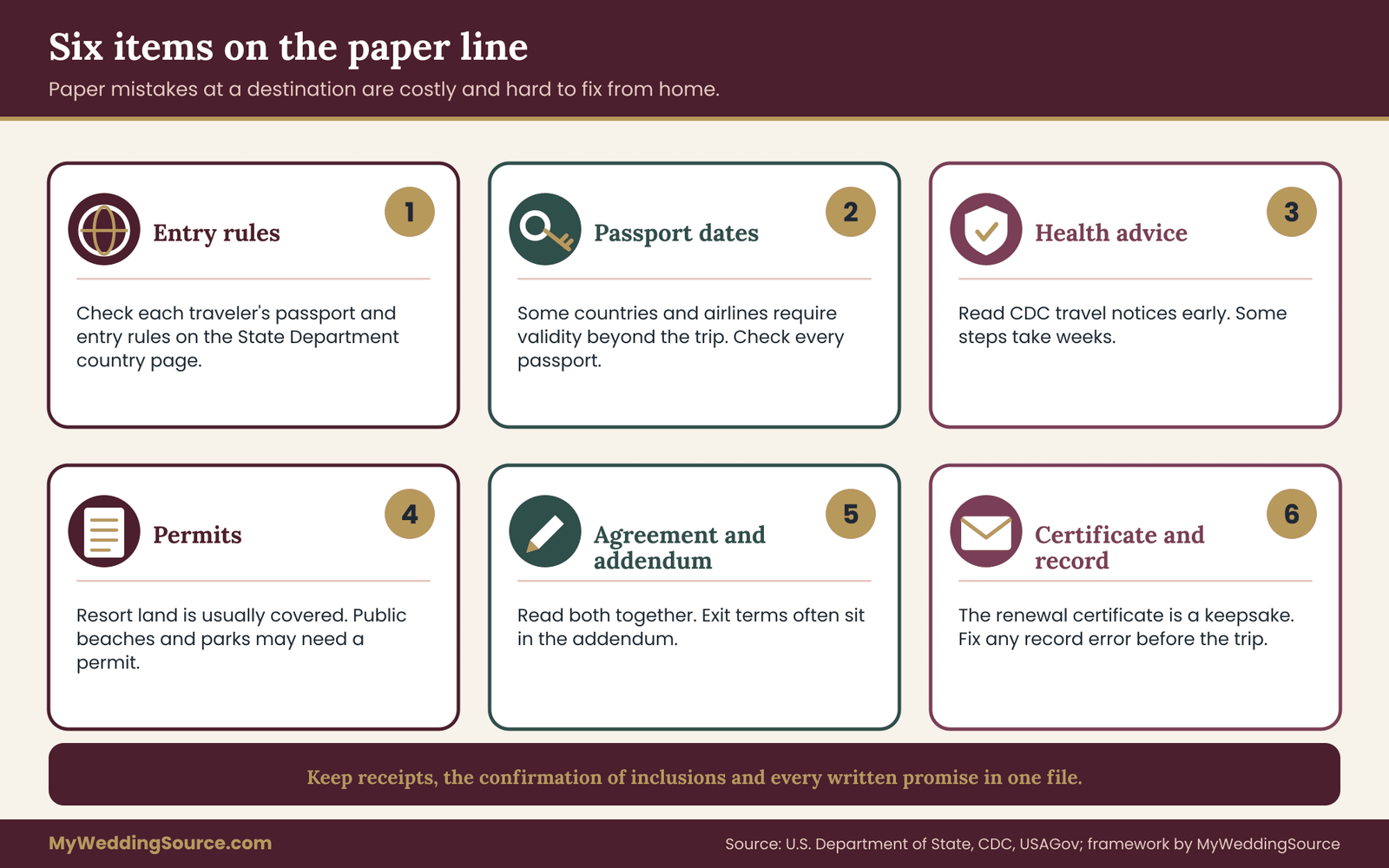
Before anything else, confirm that each traveler can enter the destination. Passport validity rules, visa or entry authorization requirements and health entry conditions vary by country and by the traveler’s citizenship. The U.S. Department of State publishes country-by-country travel information, including entry requirements, and each traveler should read the page for the destination before booking. Do not rely on the resort’s marketing page. A resort wants you to arrive, but it does not control the border.
Check the dates on every passport as well. Some countries require a passport to remain valid for a set period past the date of entry, and some airlines enforce their own rules. If a guest’s passport is close to its expiry date, they need to know now, not three weeks before the flight. For couples with guests from several countries, each traveler should check the rule for their own passport.
Health information is part of this too. The Centers for Disease Control and Prevention publishes travel health notices and recommendations by destination. They are worth reading early, since some recommendations involve timing, such as vaccines that need weeks to be effective. If anyone in your party has a medical condition or is traveling with medication, check the rules on carrying it into the country and ask a clinician for advice.
None of this is a reason to avoid a destination. It is a reason to place travel documents on the paper line instead of treating them as an afterthought.
Permits and venue paperwork
Ask whether the ceremony space needs a permit. A resort’s private beach or garden usually falls under the resort’s own permissions, and the resort handles it. A public beach, a national park, a historic site or a boat can require a permit that someone has to request, often with a fee, a deadline and a limit on group size or equipment. If vow renewal packages say “permit included,” ask which permit, who applies, and what happens if it is refused. If the offer says nothing, ask the resort directly.
Check the venue’s own paperwork too. A resort or a planner will send a booking agreement, an event addendum and sometimes a liability form. Read the three together. The addendum is where the cancellation, change and substitution terms usually live, and the booking agreement may override what the brochure promises. Keep a signed copy of each and a copy of the final confirmation message that lists the date, time, place and inclusions.
The renewal certificate and your existing marriage record
Many vow renewal packages include a certificate. Treat it like the keepsake it is, and decide whether you want it. If you do, ask what it says, who signs it and whether the wording can be adjusted. A good certificate lists your names, the date, the place and the signature of the person who led the ceremony. It does not claim to be legal, and it should not need to.
Some resorts ask to see your existing marriage certificate or a copy before booking a renewal. The reasons vary. They may want to confirm that you are married so a “renewal” is accurate, they may use the information in their own records, or they may be following a policy. Ask why they want it and what they do with it, and share only what is needed.
If you do not have a copy to hand, you can request a certified copy from the office that recorded your marriage, and the USAGov page on marriage certificates explains how to find it. Do that early, since vital records offices can take a while.
If you are not sure your marriage was recorded correctly, or if your record has a spelling error or a missing detail, deal with it before the trip by asking the issuing office about its correction process. A renewal is a bad place to discover that your legal record has a mistake, and the guide to organizing wedding records explains how to check a certificate and keep certified copies where you can find them.
Paper that belongs to the grid, not to the resort
Add three documents to your own file that no seller of vow renewal packages will send you. First, the receipts for every payment, saved as you make them. Second, the booking confirmation with the full list of inclusions, saved as a PDF or a printout. Third, any written promise made by email or chat, copied into one document with the date. These are the papers you will need if something goes wrong, and they are far easier to collect as you go than to rebuild afterward.
The money line: how vow renewal packages move your cash
Price is the line everyone checks in vow renewal packages, and it is still worth a second look, because the headline number in vow renewal packages almost never equals the number you pay. The money line tracks the total, the timing and the protections.
Build the true total
Start with the advertised price of the vow renewal packages and then add what is not in it. Ask each seller for a written total that lists, in separate lines, the package price, taxes, service charges, resort or facility fees, gratuities, transfer or travel fees for vendors, and any currency conversion. Some resorts add a service charge as a percentage on top of food, drink and event services, and some add a daily resort fee to every room. Taxes and fees vary by place, so ask for the figure instead of guessing.
Then add what you will buy because the package left it out: chairs for older guests, a sound system, a rain location, a longer photo block, a dinner if the bundled one is too small or too large. Subtract what you will not use. Vow renewal packages that include a spa credit is worth less to a couple who does not want a spa treatment, and a bundle that includes a dinner for ten is worth less to a couple who planned dinner for four.
Do this for every one of the vow renewal packages, and compare the true totals, not the headline prices.
A useful test is to compare each of the vow renewal packages to the same event assembled from separate pieces: a ceremony space and leader from one source, a photographer from another, a toast or dinner ordered from the restaurant. Often the bundle is cheaper because the seller buys in volume, and sometimes it is more expensive because the extras are priced at a convenience premium.
You will not know until you price the pieces. If the total of the pieces is close to the bundle, choose on convenience and risk. If the pieces are much cheaper, choose lighter vow renewal packages and add only what you need.
Deposits, balances and due dates
Write down three dates for every one of the vow renewal packages: the date the deposit is due, the date the balance is due and the date after which refunds change. They are often not the same date. A common structure is a deposit at booking, a balance weeks before the event and a cancellation schedule that steps down as the date approaches.
If you are also paying for rooms, flights and other bookings, the cash demands overlap, so place the dates on one calendar. The guide to wedding cash-flow planning shows how to sequence deposits and final balances so that none of them arrives on top of another, and the same method works for a trip budget.
Ask what the deposit buys. In some vow renewal packages the deposit holds the date and is fully credited toward the total. In others, part of the deposit is a non-refundable planning fee. Ask whether the deposit is refundable, partly refundable or not refundable, and under what conditions. Get the answer in writing.
Ask how you may pay. Some sellers accept cards, others prefer bank transfer, and some pass a processing charge on to you. A card payment can offer some dispute protection, which is covered in the next part, while a wire transfer can be hard to reverse. The guide to wedding budgeting is written for weddings, but its approach of setting a ceiling first and then assigning every line to it works just as well for a renewal at a destination.
Currency and where the seller is based
Vow renewal packages priced in a foreign currency add a moving number to a fixed plan. Ask in which currency the price is quoted, which currency you will be billed in, and who sets the exchange rate. If a card is charged in the local currency, your card issuer may add a foreign transaction fee, and some terminals offer to convert at the point of sale at a rate that favors the seller.
A calm approach is to ask for the final amount in your home currency in writing, and to ask your card issuer about foreign transaction fees before you pay.
Where the seller is located also affects what you can do if there is a dispute. A resort run by a large international company has a customer service department you can reach from home. A small local business may have only a phone number and an inbox. That is not a reason to avoid a small business, and many local celebrants and planners are wonderful. It is a reason to be more careful about written terms, payment method and what you keep as evidence.
Protections you may already have
Before you pay, learn what protects you. Three sources matter.
The first is your payment method. The Consumer Financial Protection Bureau explains how to dispute a charge on a credit card bill, including the general rule that a billing error should be reported in writing within a set number of days of the statement that shows it. Rules differ by card and by type of problem, so read the issuer’s terms.
A card charge for a service that was never delivered may be disputable. A charge that you agreed to under clear no-refund terms may not be. Pay by the method that gives you the most recourse, and keep every receipt and confirmation.
The second is travel insurance. A policy can reimburse certain prepaid, non-refundable costs if you cancel for a reason the policy lists, such as illness or a covered weather event, but coverage, exclusions and timing vary by policy, and some coverage must be bought within a set period after the first deposit.
Read the policy’s text, not the summary, and ask the insurer or a licensed agent about anything unclear. Insurance may or may not cover the ceremony itself. Many policies treat a ceremony as a prepaid event with its own rules, so ask specifically.
The third is the law of the place where you live and the place where you are going. Consumer protection rules differ and are not something this guide can summarize for you. The Federal Trade Commission publishes consumer guidance on travel purchases and on fees that were not disclosed up front, and it is a good place to learn what questions to ask. If a seller refuses to put the total and the terms in writing, treat that refusal as an answer.
Watch for money patterns that should slow you down
A few patterns on the money line deserve a pause.
Pressure to pay quickly to “lock in” a date, with a discount that expires in a day or two, is a sales tactic more than a scarcity fact. A real date can usually be held for a short time, and a seller who will not hold it long enough for you to read the contract is telling you something.
A request to pay in a way that is hard to reverse, such as cash, a gift card or a transfer to a personal account, should be treated as a red flag for a business that is not set up to take normal payments.
A total that changes between the quote and the contract, with no explanation, needs an explanation before you sign.
A price that is far below every comparable offer for the same inclusions deserves a second look at what has been removed.
None of these proves a problem. Each is a reason to ask one more question before you pay. The guide to the wedding vendor due diligence checklist lists the checks that separate a real business from a convincing page, and a few of them, such as confirming the business exists and reading independent feedback, take only minutes.
The exit line: cancellation, change and failure terms
Now the line that matters most. The exit line asks what happens when plans change, and it should be filled in before you pay a single deposit, because after payment you are no longer comparing, you are bound.
Why it matters so much: vow renewal packages are a promise from the seller, and it is also a promise from you. When you pay, you promise to show up and pay the balance. If you cannot, the contract decides what you lose. Vow renewal packages with beautiful inclusions and strict exit terms are a bet that nothing will go wrong. Vow renewal packages with plain inclusions and generous exit terms are a hedge. Which one is better depends on your situation, and only the exit line lets you see it.
The six exits to price
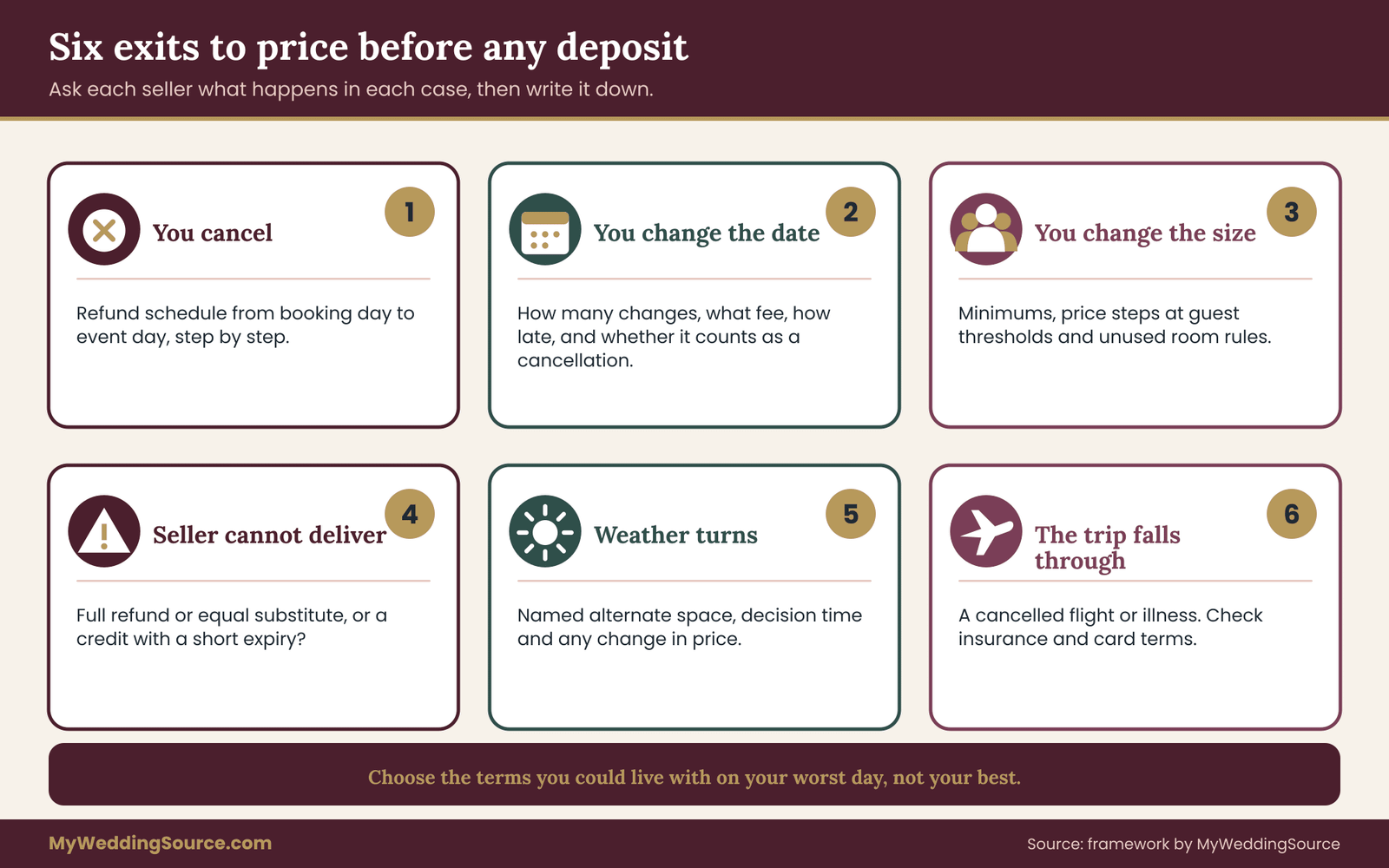
Think of six ways a trip can bend, and ask each seller what it does in each case.
You cancel. Ask for the refund schedule in plain terms, step by step from the day you book until the day of the event. What fraction of the deposit comes back, and when does the refund drop to zero?
You change the date. Ask whether the seller will move the booking, how much notice is needed, how many times it can be done and whether a change fee or a price difference applies. Some sellers treat a date change as a cancellation and rebook, which can lose the deposit. Some allow one free change inside a window.
You change the size. Ask what happens if the guest count drops or rises. Some vow renewal packages have a minimum count below which the price does not change, and some have a step that adds cost at a threshold. A drop in guests may not reduce the total at all.
The seller cancels or cannot deliver. Ask what you get if the resort closes the space, a storm shuts the property or the leader of the ceremony cannot attend. A good answer is a full refund or a substitute of equal value on a date you accept. A weak answer is a credit with a short expiry date.
The weather turns. Ask who decides, by when, and what the alternative is. Some resorts have a clear rain protocol. Others have none.
The trip fails around you. A flight is cancelled, a passport problem keeps a guest at home or a family illness changes the plan. The seller may owe you nothing here, but your own protections might, which is why the exit line also lists your insurance and card terms.
Reading cancellation and change terms in vow renewal packages, clause by clause
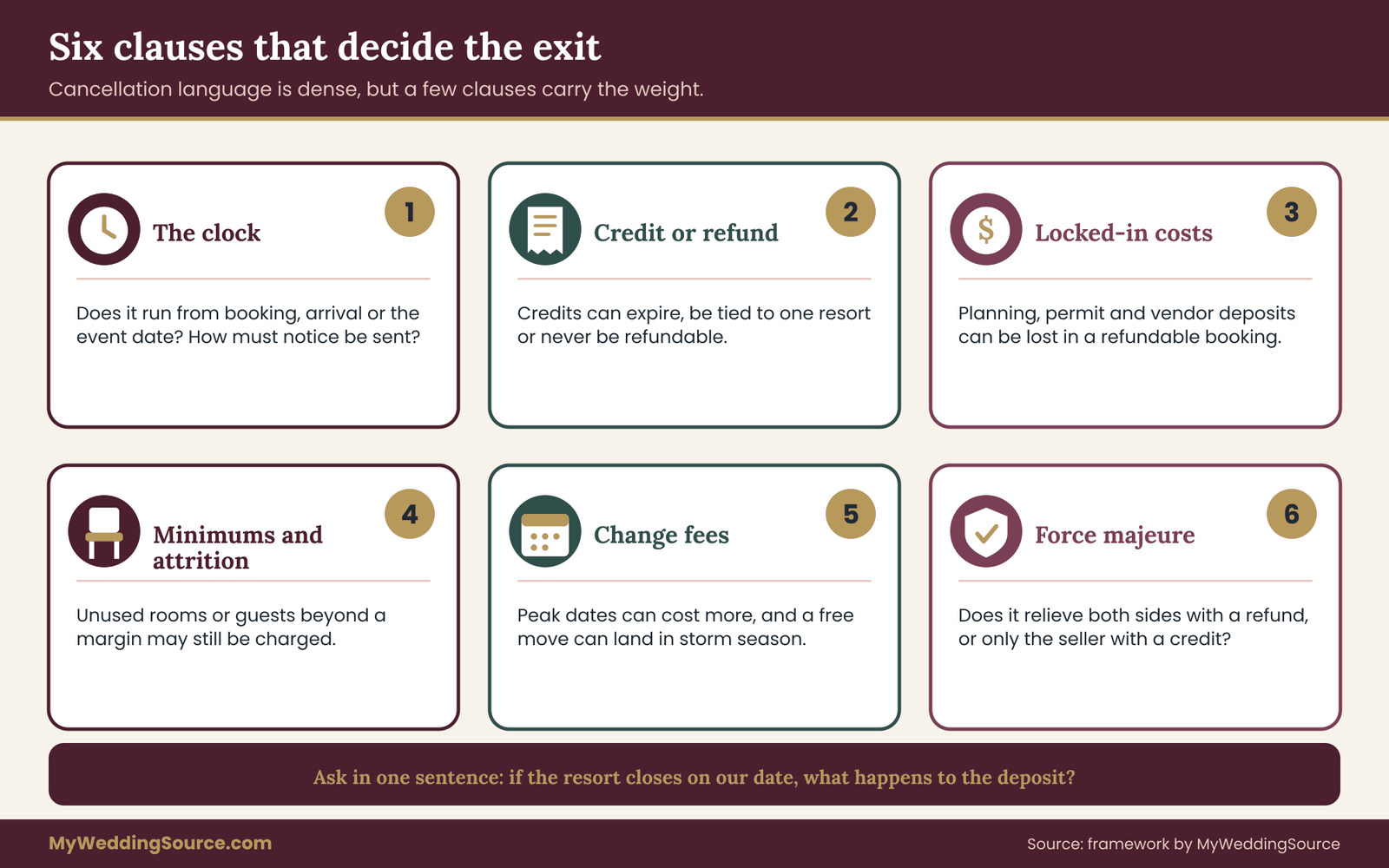
Cancellation language is dense on purpose, but a small set of clauses decides nearly everything. Read vow renewal packages for these, and quote them into your grid.
Refund schedule and what counts as the clock
Find the schedule first. It might say that a deposit is refundable until a stated number of days before the event, then partly refundable, then not at all. Look for the clock: does it run from the date of the event, the date of arrival or the date of the booking? A schedule counted from the booking date can leave you with almost no free window if you book far ahead. A schedule counted from the event date gives you more room.
Look also for how a cancellation must be given. Some contracts require written notice to a specific address, and a phone call does not count. Others set a deadline at a clock time in the seller’s time zone. If you are traveling and the seller is on the other side of the world, a deadline that falls overnight at home may be missed. Write the exact notice method in your grid.
Credits instead of refunds
Many sellers offer a credit when a refund is not owed. A credit can be useful, and a credit can also be a quiet loss. Ask how long it lasts, whether it can be used for a different date, a different person or a different product, and whether it can be refunded if you never use it. A credit that expires within a year and applies only to the same resort is worth far less than its face value to a couple who does not plan to return.
Non-refundable lines inside a refundable booking
Some vow renewal packages are described as refundable but hide non-refundable lines, such as a planning fee, a permit fee, a vendor deposit passed to a photographer or the cost of flowers ordered in advance. Ask for a list of every cost that is not refundable under any scenario. Add those lines to your worst-day cost. If the total of non-refundable lines is significant, you are committing earlier than the headline suggests.
Minimums, attrition and the guest count
If your vow renewal packages or your room block includes a minimum number of guests or rooms, ask what happens if fewer arrive. Hotels that block rooms for events sometimes charge for unused rooms beyond a margin, which is called attrition. For a small ceremony it may not apply, and for a larger group it can.
If you are placing a group in rooms near the venue, the earlier discussion of guest hotels across budgets and mobility needs explains why leaving the room commitment with each guest, rather than with you, can lower your risk.
Change fees and the price of flexibility
A date change is the most common request and the least understood. Ask for three facts in writing: how many changes are allowed, what the fee or price difference is and how late a change can be made. Peak-season dates often cost more than shoulder-season dates, so a move that looks neutral can raise the price. A change that moves your event into a season of storms or a period of heavy resort traffic may not be a good trade even if it is free.
Force majeure and the language of the unforeseen
Contracts often include a clause for events outside anyone’s control, such as natural disasters, government actions and travel bans. The wording decides who bears the cost. Some clauses relieve both sides and require a refund or a rebooking. Others relieve the seller only and leave you with a credit. If you are traveling in a season with a known risk, such as a stormy period or a very hot month, read this clause carefully and ask the seller to explain it in plain language.
When the clause is vague, ask a direct question: “If the resort is closed by a storm warning on our date, what happens to our deposit and our ceremony?” A confident seller can answer in one sentence. If the answer is “it depends,” ask what it depends on and have that written down.
Weather, season and the rain-plan test
Because a destination ceremony is usually outdoors, weather is the single most common reason vow renewal packages fail to deliver. The exit line includes a rain-plan test that works for any location.
Ask four questions. What is the alternative space? How is the decision made, and by whom? At what time is it made, and how far ahead? Does the move change the price, the time slot or the inclusions? A good answer to all four makes vow renewal packages far more valuable than pretty ones with no plan.
Then check the season. Ask the resort, and also ask the destination’s tourism office or the national weather service of that country, about conditions in your month: heat, humidity, rainy periods, storm seasons and daylight hours. The resort has an interest in your booking and will describe the best case.
An independent source describes the typical case. If the ceremony is on a beach or a lawn, ask what the ground is like after rain, whether chairs sink, whether an arch can stand in wind and whether the sound system works in damp air.
Heat is part of the test as well. A midday ceremony in a hot climate is hard on older guests and on a couple in formal clothes. If you choose a sunset slot for the light, plan shade and water for the wait beforehand, and decide in advance how long you will stay outside. A short ceremony with a longer, shaded gathering afterward is kinder than a long ceremony in the sun.
Hurricane and storm seasons
Some popular destinations have a storm season in which resorts discount rooms and vow renewal packages. The lower price can look like a bargain, and it comes with a risk that you should price. Ask what the resort’s policy is for a storm warning or a closure, whether you can rebook without a fee, whether your room and your ceremony are handled under the same policy, and whether your travel insurance covers a named storm and under what conditions.
Insurers often set rules on when a storm must be named or a warning issued for coverage to apply, and buying a policy after a storm is already forecast typically excludes it. This is a subject to read in the policy and to ask the insurer about, not to guess at.
If the exit terms of vow renewal packages are weak and the storm risk is real, shift the date to a safer season, shorten the trip or choose a destination with a milder pattern. That is a decision about how much risk you can carry, and the grid makes it visible.
Questions to send before you pay: a short script
By now you have a long list. Instead of sending it all at once, send a short message that asks for the answers in writing. The wording below is meant to be adapted, and it is the kind of message a coordinator can answer in one reply.
“Thank you for the information. Before we book, could you confirm in writing: the full price with taxes and fees, what is not included, the refund schedule and its dates, the date-change terms, the rain plan, and who leads the ceremony? We are comparing a few options and want to be sure we understand each.”
Send it to every seller on your list. Do not accept a verbal answer. When the replies arrive, paste the key lines into the grid. A seller that answers clearly and quickly is showing you something about how it will behave later. A seller that dodges the exit questions, or answers only the ceremony questions, is showing you something too.
Follow up on the vague answers
Vague answers usually mean one of two things: the seller does not want to commit, or the person replying does not know. Ask for the policy document and for the name of someone who can confirm. If the answer is still vague after two attempts, mark the cell “unclear” and weigh it as a risk. You are not being difficult. You are doing what a careful buyer does before a large prepayment.
Keep a decision log
Record the date of every question, the name of the person who answered and the answer. A short log saves arguments later and lets a partner see what was said. If you change your mind and choose different vow renewal packages, the log also tells you which sellers were clear, in case you want to use them for another occasion.
Once you have filled the grid, the choice usually becomes clearer than you expected. The next part shows it working on a realistic example.
A worked case: two vow renewal packages and one assembled option
The following example is invented for illustration. The couple, the prices and the terms are made up, and they are chosen to be round so the arithmetic is easy to follow. Real figures must come from real quotes.
Dana and Marcus have been married fifteen years. They want a short renewal ceremony on a warm-water island, in the shoulder season, with twelve guests including two older relatives who walk slowly. They have a ceiling for the whole event, set before they asked anyone for a quote, and they treat a lower total as a good result but not the goal.
They collect three options, two of them vow renewal packages, and fill the grid.
The three options on the five lines
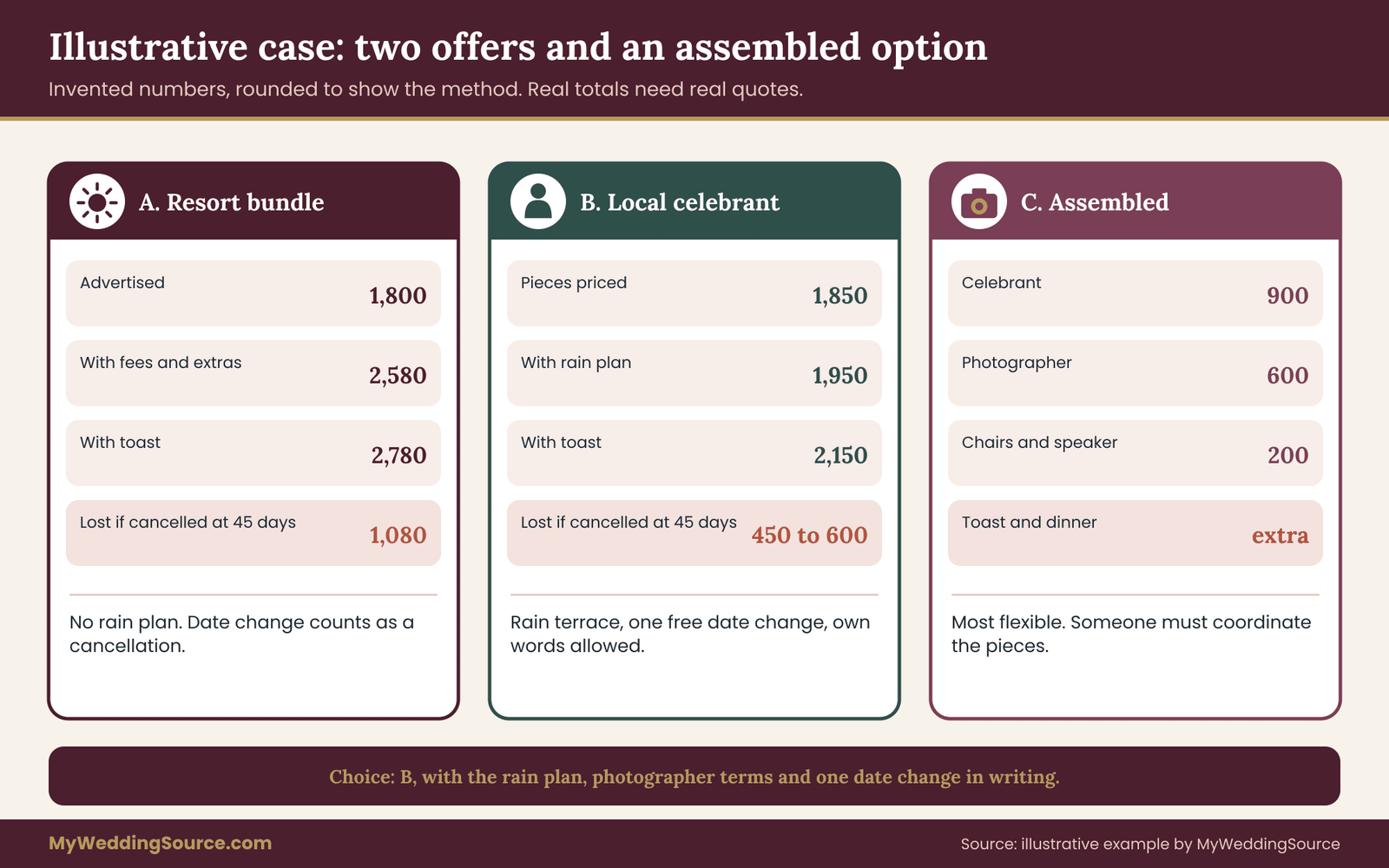
Option A, the resort bundle. A sunset beach ceremony for up to twelve guests on a shared stretch of sand, an assigned celebrant, a thirty-minute photographer block, a bouquet, a toast with sparkling wine and a renewal certificate. The advertised price is 1,800 in the quoted currency. The ceremony line is strong on atmosphere and thin on rain, since the brochure mentions no alternate space. The people line caps guests at twelve and charges a set amount for any extra guest.
The paper line asks for a copy of the couple’s marriage certificate and for passports, and says a permit is not needed because the beach belongs to the resort. The money line shows a service charge on event items. The exit line says the deposit is half the total and is not refundable inside sixty days of the event, and that a date change counts as a cancellation.
Option B, the local celebrant. A celebrant who works across several resorts and public beaches, a ceremony of about twenty minutes written with the couple, the right to bring their own words and readings, a rain plan that moves the ceremony to a covered terrace at a partner hotel if the couple pays a small room fee, and a permit for a public beach that the celebrant applies for.
The photographer is separate. The price is 900 for the celebrant plus a permit fee of 150. The exit line says a deposit of 300 is not refundable, the permit fee is not refundable once filed and the date can be changed once without charge with fourteen days’ notice.
Option C, the assembled event. The couple choose their own beach spot at a quiet, open-access shore, hire the celebrant from Option B, book a photographer for an hour at 600, rent four folding chairs and a small speaker for 200 and book a table at the resort restaurant for a toast and a light dinner after the ceremony. This is Option B with extras the couple choose, and it makes the comparison of vow renewal packages against pieces concrete.
Doing the arithmetic
Dana and Marcus build a true total for each option, using only the quoted numbers.
Option A starts at 1,800. The resort quotes a service charge of 360 on event items, which brings it to 2,160. The photographer block is short, so they price a second thirty minutes from an outside photographer at 250, assuming the resort allows it, bringing the total to 2,410. They also need a sound system, which the offer does not include, and the resort offers one for 120, which makes 2,530. They add chairs for the two older guests at 50, and the total is 2,580.
Option B starts at 900 plus 150 for the permit, which is 1,050. The couple add the photographer at 600, chairs and a speaker at 200 and the covered terrace fee, which they estimate at 100 if needed. That is 1,950 with the rain plan, or 1,850 without it.
A toast at the restaurant is extra, whichever option they choose, and so they add 200 for both options to keep the comparison fair, which makes Option A 2,780 and Option B 2,150, with Option C overlapping Option B because it is the same pieces.
On price alone, Option B costs less. Price is not the question, though, and the exit line is next.
The worst-day test
They apply the same worst-day question to each option: what is lost if we cancel forty-five days before the event?
For Option A, the deposit is half the total, 1,080 on the 2,160 base, and it is not refundable inside sixty days. At forty-five days, they lose it. There is also an event-day cost they cannot recover if they are already in the resort’s room booking, which has its own rules and is outside this calculation.
For Option B, they lose the 300 deposit and the 150 permit if it has been filed. That is 450. The photographer’s deposit is another item, and they ask for it to be refundable until thirty days out, which the photographer accepts in writing.
The difference on the worst day is considerable: roughly 1,080 against 450 to 600. Combined with Option A’s no-change policy, they see a bundle that is cheaper to enjoy than to back out of, while the local celebrant is a little more work and a lot more flexible.
What they choose, and the conditions they set
They choose Option B, and they set three conditions, which show how to use the grid beyond the first pass. They ask for the rain plan in writing, with the decision time and the room fee. They ask the photographer to confirm usage and delivery terms. And they decide in advance that if the storm-season forecast looks poor three weeks out, they will use the one free date change instead of cancelling.
They also keep one open question. The resort bundle included a certificate and a bouquet. Option B does not, so they ask the celebrant to provide a simple certificate and they buy a small bouquet locally. Those are tiny costs, and they are the kind of thing a bundle would have hidden inside the price.
Notice what the example does not claim. It does not say vow renewal packages are bad or that a local celebrant is always better. A different couple, with a larger group, little time to plan and a need for one point of contact, could reasonably pick Option A, since vow renewal packages offer convenience and a single responsible party. The grid does not give you the answer. It gives you the reasons for yours.
Alternatives to vow renewal packages, and when each makes sense
Vow renewal packages are one route. If the grid shows that none of the offers fits your risk and budget, step back and consider the others.
Assemble it yourself
This is Option C above. You book the pieces separately: a ceremony space or open beach, a celebrant, a photographer, flowers, chairs and a restaurant for dinner. It works for couples who are comfortable with a few separate contracts and a bit of coordination, and it often costs less. It does ask more of you. With no bundle, nobody is responsible for the overall event, so the person holding the grid becomes the coordinator.
Hire a local planner
A local planner or coordinator books and manages the pieces for you in exchange for a fee or a percentage. This route suits couples who want the flexibility of an assembled event without doing the legwork, especially across time zones. Apply the grid to the planner too. Ask what is included, who the planner’s vendors are, how fees work and what happens if the planner is unavailable.
Renew vows at home, and celebrate at the destination
Some couples split the two ideas. They hold a short renewal at home with the people who matter most, and they take a trip as a private celebration without an event. This removes most of the exit risk, since the trip is just a trip, and it lets guests who cannot travel take part. The cost is that the destination moment loses the ceremonial frame. The guide on wedding ceremony steps is useful for building a short, personal ceremony wherever you hold it.
Say the words privately
Another option is to renew vows privately, just the two of you, on the trip, with no vendor at all. A walk, a few written lines read aloud and a dinner can be as meaningful as anything bundled. Vow renewal packages have nothing to add if what you want is quiet, and the best price for a quiet moment is nothing.
Choosing among the routes
Use two questions. First, how much of the day’s success depends on a seller that you cannot control? If the answer is a lot, prefer terms that let you leave. Second, how much of the work do you want to do? If the answer is little, a bundle or a planner has value, and you pay for that in money. If the answer is some, an assembled event fits. Neither answer is wrong. The mistake is choosing one without knowing what it costs you.
When vow renewal packages are the wrong choice: failure conditions
The grid helps you choose among offers. It should also help you decide that none of them is right. A decision to walk away is a good outcome of a comparison, not a failure of it, and it is easier to make when the conditions are written down before the sales conversation starts.
Here are the conditions that should make you stop and either renegotiate, switch to another route or wait.
Stop conditions on the seller’s side
No written terms. If a seller will not put the price, the inclusions and the exit terms in writing before you pay, stop. There is no safe way to buy a prepaid event on a verbal promise, and a refusal to write it down tells you the promise may not survive contact with a problem.
A date change treated as a cancellation, with no free window. If the only way to move the date is to lose the deposit, vow renewal packages with such terms are a bet that your plans will not change. Fine for some couples, risky for anyone whose schedule depends on a job, a health situation or the weather.
No rain plan for an outdoor ceremony. If the answer to the weather question is vague and the season is risky, vow renewal packages without one are unfinished. Ask for the plan to be added in writing, or decide that you will carry the weather risk yourselves and price it.
A total that keeps moving. If the quote, the contract and the invoice show three different numbers, ask for a reconciled total before paying. A seller that cannot reconcile its own paper is unlikely to deliver cleanly on the day.
Pressure to decide before you can read. A quick deadline is a sales device. A real date can be held for a short time, and a seller that will not allow you to read the contract is a seller to avoid.
A payment request that cannot be traced or reversed. Gift cards, cash and transfers to a personal account are warning signs. Use a method that creates a record.
Stop conditions on your side
You cannot afford the worst day. Work out what you lose if you cancel at the harshest point of the schedule. If that sum would hurt, vow renewal packages are too expensive for you in the way that matters, even if the headline price fits.
The guests who matter cannot get there. If a parent, a sibling or a close friend cannot manage the trip, the cost, the passport rules or the walking distance, the ceremony may not deliver what you want. The question to ask is not “can they come?” but “is this the event we want if they cannot?” If not, consider the home ceremony route from the earlier section.
You are buying a legal result. If you hope the ceremony will correct a record, create a marriage or change a legal status, vow renewal packages will not do it. Speak to the office that holds your record.
The destination fails the basic check. If entry rules, health advice or travel warnings for the destination are a problem for your group, the best of all vow renewal packages cannot fix it. The State Department’s country pages and the CDC’s travel health notices are the places to look.
One of you is pushing and the other is not. This one is not about the seller. A destination renewal can be a joy for one partner and a burden for the other, and a prepaid contract turns a small disagreement into a financial one. Settle the question, kindly, before you pay a deposit.

What to do when a stop condition appears
A stop condition does not always mean ending the conversation. Often it means a counter-question. If the date change terms are poor, ask whether the seller can add a single free change. If the rain plan is missing, ask for the covered space and the cost. If the deposit is large, ask whether a smaller deposit holds the date. Many sellers can say yes to a reasonable request, and the answer, in writing, is a new line in your grid.
When the answers do not come, or the seller declines, you have a clear reason to take another route. The couple who walks away from vow renewal packages has lost nothing but a few emails, while a couple who pays and regrets loses money and goodwill.
Faith customs, family and who should hear the plan first
A renewal can carry a religious meaning, a cultural one or none at all, and vow renewal packages you choose should match it. Many vow renewal packages offer a nondenominational ceremony, and that is a fit for plenty of couples. If you want specific words, a ritual, a blessing or a leader from your tradition, do not assume the resort can supply it.
Confirm customs one by one
Treat each custom as its own question. If a blessing from your faith matters, ask the person who would give it whether they can do it at a destination, and whether the setting is acceptable under your tradition. If certain days, foods or dress are part of your practice, check them against the date and the package.
Some settings have rules about attire, flowers or the use of religious symbols, and a resort may not know your customs. A conversation with your own community’s leader, before you pay a deposit, saves both embarrassment and money. The best sources for a tradition’s rules are the people who hold it, so ask them directly.
If the leader of the ceremony is not from your tradition, agree beforehand what will and will not be said. Ask to see the script, and ask who will say what. A neutral script with a family member’s reading or a short blessing from a relative can carry a lot of meaning without asking a stranger to perform a rite.
Family expectations
A destination renewal changes who can attend, and that can hurt feelings. Decide whether you want a small group, a family trip or a private moment, and tell the people close to you before you send anything formal. A short, kind message explaining that this is a small celebration, and that you will share photos or hold a gathering at home, does more good than silence. Children are another question: ask the resort whether the ceremony and any dinner are suitable for them, and decide whether you want them there.
Some couples want to include children from the marriage in the ceremony, as readers or as witnesses. Vow renewal packages that allow participation by guests are better for this. If you want a child to say a few words, rehearse it in the days before so that the moment is easy.
Tell the people who pay or travel first
If anyone else is contributing money or flying in, tell them early and give them the grid answers that affect them: the date, the cancellation terms and the cost per person for anything optional. People can plan well when they know what is fixed and what is not. They can also tell you early if the plan does not work for them, and that is better to learn before a deposit than after.
Your next steps
Start with one evening and one sheet of paper. Write the five lines down the side and the names of two or three packages across the top. Send the short written questions to each seller, including the exit questions. When the replies arrive, paste the answers into the grid, mark what is unclear and compare the packages by their worst day as well as their best.
Then check the paper line: passports, entry rules and your marriage record. Price the pieces separately to see whether a bundle is saving you money. Decide your stop conditions in advance, and talk with your partner and the people who will travel before you pay a deposit. Pay by a method that leaves a record, save every confirmation and keep the grid beside you through the planning. Vow renewal packages that survive all of this are ones you can book with a calm mind.
FAQ
Do destination vow renewal packages need a marriage license?
No. A renewal does not create a new marriage, so no license is issued. A resort may still ask to see a copy of your existing marriage certificate for its own records, so ask why it wants it and what it does with the copy. If you want a legal act of any kind, contact the office that holds your marriage record instead of relying on a package.
Is the renewal certificate in a package legally valid?
It is a keepsake, not a legal record. Your legal marriage record is held by the state or local office that recorded your marriage, and a renewal certificate does not change it. If a seller calls the certificate official, ask which office receives or records it. In most cases the honest answer is that none does, and the paper is simply a memento.
What should I ask before paying a deposit for vow renewal packages?
Ask for the full price with taxes and fees, what is not included, the refund schedule with dates, the date-change terms, the rain plan, who leads the ceremony and who owns the photographs. Ask for all of it in writing, and keep the reply. A seller that answers clearly and quickly is usually easier to work with later.
Is a bundled package cheaper than booking the pieces separately?
Sometimes, but not always. Bundles can be cheaper because the seller buys in volume, and they can be pricier when extras carry a convenience premium. Price a ceremony space, a leader, a photographer and a dinner separately, add the fees to both, and compare the true totals along with the exit terms. Then choose on cost, convenience and how much risk you can carry.
Can I use a credit card to protect a destination renewal purchase?
A card can offer dispute rights for a billing error or a service that was not delivered, but the rules differ by issuer and by the type of problem. The Consumer Financial Protection Bureau explains the general process and the time limits. Read your card’s terms, pay by a method that creates a record and keep every receipt and confirmation.
Does travel insurance cover a vow renewal ceremony?
It depends on the policy. Some policies reimburse certain prepaid, non-refundable costs for covered reasons, and some treat a ceremony differently from a room or a flight. Timing, exclusions and storm rules vary. Read the policy text, ask the insurer or a licensed agent about the ceremony specifically, and do not assume coverage because a summary sounds broad.
What happens if it rains on the day of the renewal?
That depends on the package, so ask before you book. A good answer names an alternate space, says who decides and by what time, and states whether the move changes the price or the slot. If a package has no rain plan, write that in your grid as a risk, and either ask for a plan in writing or choose a different seller.
Should we choose a resort bundle, a local celebrant or a private ceremony?
It depends on how much risk you can carry and how much work you want to do. A bundle offers one point of contact and often stricter terms. A local celebrant or planner offers flexibility with more coordination. A private ceremony avoids most exit risk. Fill in the five-line grid for each route and compare their worst days.
Sources
- How to get a copy of a marriage certificate or a marriage license, USAGov
- International travel: country information and entry requirements, U.S. Department of State
- Smart Traveler Enrollment Program, U.S. Department of State
- Travelers’ Health, Centers for Disease Control and Prevention
- How do I dispute a charge on my credit card bill?, Consumer Financial Protection Bureau
- Consumer advice, Federal Trade Commission
- Federal Trade Commission
- Air travel consumer information, U.S. Department of Transportation
- Travel, U.S. Customs and Border Protection
- Passport information, U.S. Department of State