
Vow renewal photography has a quiet trap built into it: the most popular idea is to recreate the pictures from the first wedding, and the recreation can quietly take over the day it was meant to honor. This guide gives you a then-and-now photo brief, a consent checklist and a worked case, so the old images enrich the renewal without crowding out the people standing in front of the camera.
Treat vow renewal photography as two jobs that must not compete. Job one is to document the present: the vows, the faces, the room. Job two is to answer the old photographs, and it comes second. Pick only a few anchor images, give each a recreation level (faithful, echo, contrast or retire), write them into a one-page brief, check consent for every person, place and file involved, and schedule the recreations in a fixed window after the ceremony has been photographed.
Couples who renew their vows after ten, twenty or forty years often own a shelf of evidence from the first time. There is the portrait on the stairs, the cake cut, the first dance, the formal line-up with parents who may no longer be alive. Naturally, the idea arrives: let’s stand in the same places and take the same pictures.
Sometimes that idea is lovely. Sometimes it produces a stiff, tiring hour in which two people try to look like their younger selves and a photographer plays referee between a printed photo and a phone screen.
The difference between those outcomes is rarely talent or budget. It is planning. A recreated photograph is a small production with a source image, a location, clothing, people, light and a purpose, and each of those can fail separately. A good brief decides ahead of time which recreations deserve the effort, which should become something looser, and which should be left in the album where they belong. Treat that planning as part of vow renewal photography itself, not as a chore that comes before it.
A note on scope. This is general planning information, not legal advice, and it does not replace a conversation with your photographer, your officiant or your venue about their own rules. Where a rule matters, the article points to the agency or office that issues it so you can check the current version yourself.
One more framing point before the detail. A renewal does not change your legal status. Your marriage is already recorded, and the ceremony is symbolic unless you are also doing something separate, such as a legal change handled through the proper office. If you need a copy of your existing record for any reason, the guide to officiant requirements explains who handles what, and the USAGov page on marriage certificates in the sources shows where copies come from.
None of that belongs in the photo brief, but it explains why the images carry such a large share of the emotional weight: the paperwork is already done, so the pictures are where the day lives.
What vow renewal photography is really for
Start with purpose, because purpose decides almost every later choice. In a first wedding, photography has a clear job: prove it happened, show who was there, preserve a day that will not repeat. In vow renewal photography the job is different. Everyone already knows the marriage happened. The images have to say something new.
What they can say is usually one of three things. They can say “we are still here,” a plain record of two people who have kept going. They can say “look how long this has been,” a comparison across time that makes the years visible. Or they can say “look who has joined us,” a record of children, grandchildren, friends and the people who now belong to the family but were not at the first wedding.
Recreations serve only the second of those. That is not a reason to skip them. The comparison across time is the most distinctive thing a renewal can offer, and a single well-chosen then-and-now pair can become the most-shared picture of the whole day. But it explains why recreations should be a minority of what you shoot.
If every frame is an echo, the other two messages, the ones about the present and the people, never get said. Good vow renewal photography keeps that comparison as a seasoning, not the main course.
Here is a useful test. Imagine a stranger flipping through your finished gallery a decade from now. Could they tell who these two people are, who loves them, and what the day felt like? Or would they see a set of costume-drama imitations of an older set?
If the second description is closer, the balance was wrong. The fix is not to cancel the recreations. The fix is to put the present first and let the old images answer it. That stranger test is a quick way to audit any vow renewal photography plan.
The three layers of a renewal gallery
It helps to think of the gallery as three layers rather than one stack.
The first layer is the now layer: the ceremony, the room, the guests, the vows being read, the small awkward moments that no one could have scripted. This layer is non-negotiable and it is the one a photographer is hired to protect.
The second layer is the then layer: the scanned or printed originals, the album pages, the framed portrait that hangs in a hallway. Technically this layer is not made on the renewal day at all. It already exists, and the question is how to display it, copy it safely and let it appear inside the day through a slideshow, a table of prints or a framed pair. In vow renewal photography this layer is mostly a matter of care and display, not of shooting anything new.
The third layer is the between layer: the recreations, the then-and-now pairs and the new images that deliberately respond to an old one. This is the only layer that costs extra planning time on the day, and it is the layer this guide spends most of its length on.
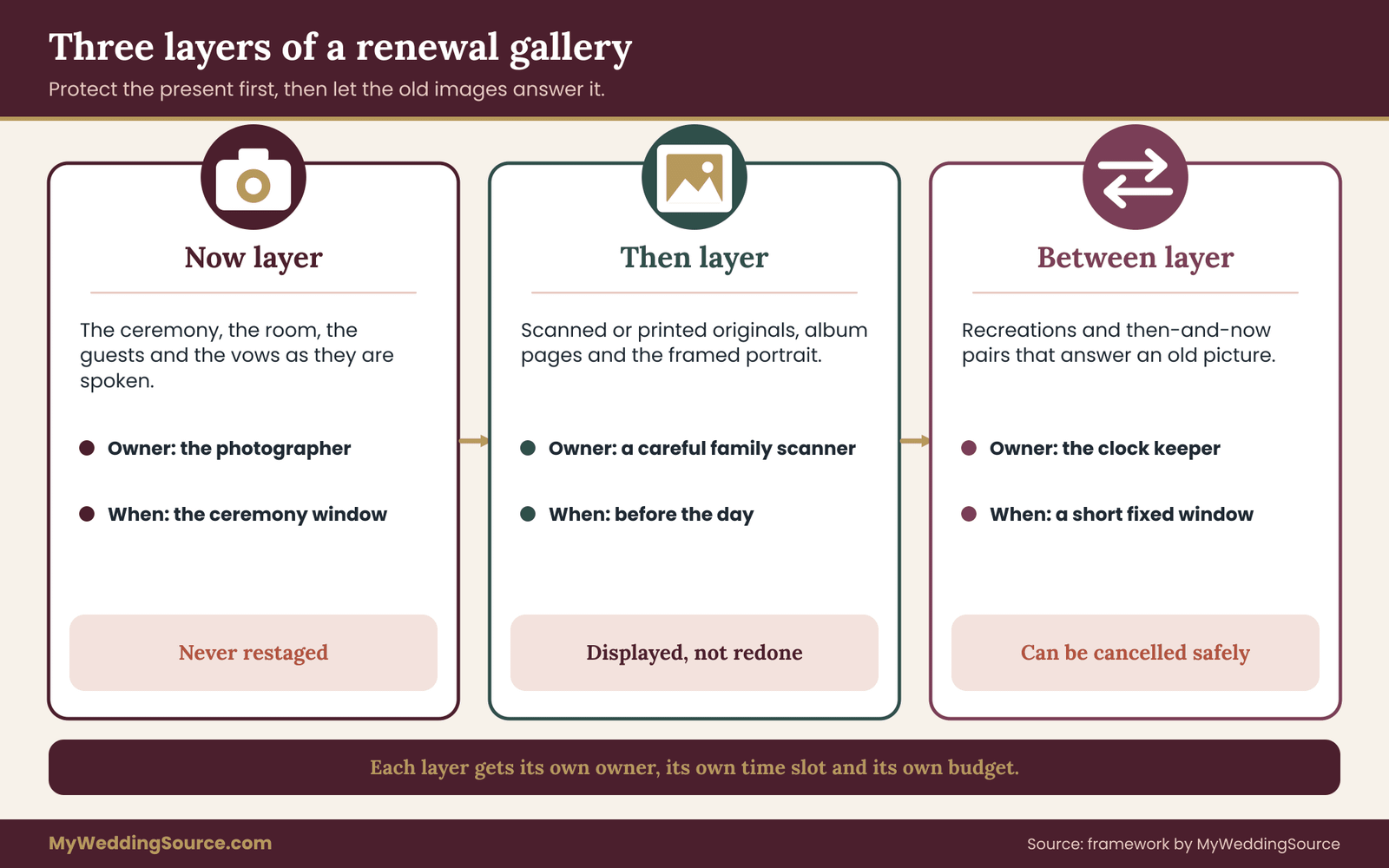
Separating the layers gives you a practical advantage. Each layer can have its own owner, its own time slot and its own budget. The now layer belongs to the photographer’s main coverage. The then layer belongs to whoever in the family is good at scanning and filing. The between layer belongs to a short, scheduled window, and it can be cancelled without ruining the other two. That separation is what keeps vow renewal photography manageable for a small team of relatives and one photographer.
Who is the audience for the recreations
Before you plan a single pairing, decide who the recreations are really for. They may be for the two of you, a private conversation across forty years. They may be for adult children who grew up looking at the original portrait on the wall. They may be for guests, projected during a reception or printed in a keepsake program. Or they may be for social media.
The audience changes the right level of effort. A private pairing for the two of you can be tender and imperfect, shot in ten minutes with a phone leaning on a chair. A pairing meant for a display wall needs consistent framing and a clean print. A pairing meant for strangers online needs the most consent work of all, because other people in the frame did not agree to appear in a comparison.
The consent section later in this guide returns to that point. Each audience points vow renewal photography toward a different finish.
If you cannot decide on an audience, choose the smaller one. It is easier to share a private picture widely later, with permission, than to withdraw a public one.
The present-moment rule
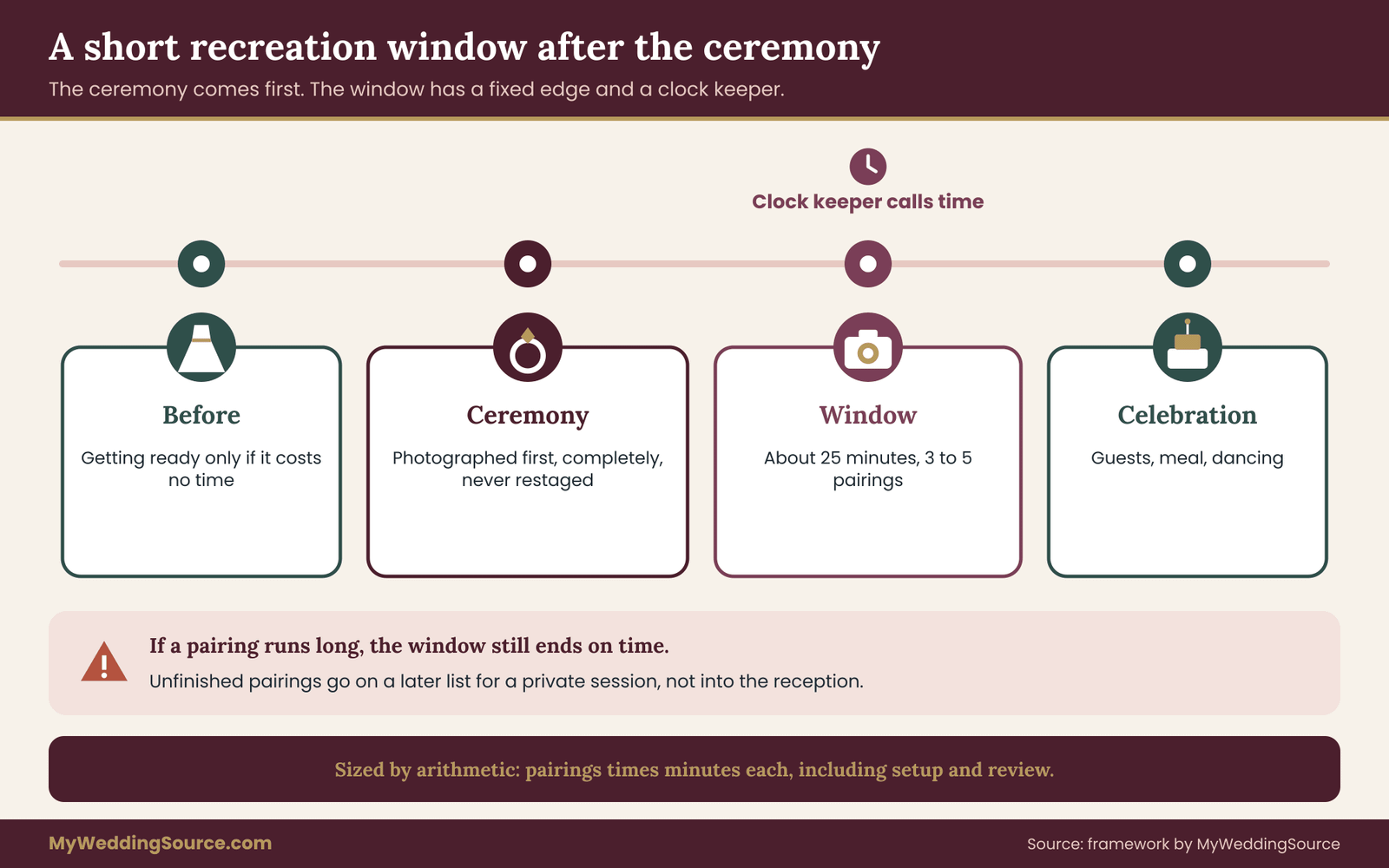
The single most useful rule in this whole subject is short: the ceremony gets photographed first, completely, and recreations never touch the ceremony window. Call it the present-moment rule.
It exists because a renewal is a live event, and the shape of a ceremony, laid out in the wedding ceremony step-by-step guide, leaves very few natural pauses for a camera to interrupt. The words are spoken once. The faces change as they are spoken. A photographer who has been asked to “also grab the stairs shot before the ceremony” is a photographer whose attention is now split, and the moment that cannot be repeated is the one that suffers.
Recreations can be repeated. The vows cannot. Protecting that one-time event is the first duty of any vow renewal photography plan.
In practice the rule has four parts.
Nothing recreated before the ceremony except what the clothing allows. Some couples want to restage a getting-ready picture or a first-look moment. If those can happen without delaying the ceremony and without making anyone tired or anxious, they are fine. If they put the start time at risk, they move to after.
The ceremony itself is not restaged. Do not ask a photographer to reproduce an old angle during the vows if it means standing in a worse spot or interrupting the flow. The old picture was shot where the old photographer happened to stand. Your renewal deserves the best position for this room and this light.
Recreations get a fixed, short window. Decide the window in minutes before the day, write it in the brief and tell everyone involved. When the window closes, it closes, even if one pairing was never attempted. A hard edge protects the guests, who are waiting, and the couple, who will be tired. A hard edge on the window is the cheapest insurance in vow renewal photography.
Someone other than the couple holds the clock. Name a person, ideally the photographer or a coordinator, who calls time. If the two of you are in the frame, you cannot also be watching the clock, and the pull to “just do one more” is strong when the pairings are going well.
Why the clock matters more than the camera
It is tempting to think of recreations as a photography problem. Mostly they are a time and energy problem. Each recreation needs finding the original, matching the position, getting people into place, checking the likeness against the old image, adjusting, shooting a few frames and reviewing them. A simple pairing takes several minutes. A complicated group pairing, with people spread across ages and abilities, can take a quarter of an hour or more. Seeing it as a schedule problem makes vow renewal photography much easier to plan.
Multiply that by the number of old photographs on the wish list and the window disappears. A list of twelve is not a plan. A list of three or four is. Part of what the brief does is force that arithmetic into the open while there is still time to cut.
If you want to see how this window fits inside the larger flow of a ceremony day, the wedding ceremony cue sheet guide shows how to give each segment a start cue and an owner, and the same method works for a three-pairing photo window.
What the present-moment rule does not mean
It does not mean recreations are a lesser part of the day, and it does not mean they must be rushed. The rule protects order, not importance. Many couples find that the recreations go better after the ceremony, because the emotional weight has already been released. People laugh more. The pairing of the awkward prom-era dance pose becomes funny instead of fraught. Done well, vow renewal photography gives the recreations real weight without giving them the whole day.
It also does not mean the photographer should ignore the old images during the ceremony. A photographer who has seen your anchor list can notice when a natural moment echoes one of the originals, such as a hand placed on a shoulder in the same way, and capture it without any staging. Those unplanned echoes are often better than the staged ones, and they cost no time at all. Photographers who understand the story you want from vow renewal photography will find these echoes without being asked.
Choosing which old images deserve a recreation
Open the album, or the folder of scans, and resist the urge to mark everything. A first wedding usually produces dozens or hundreds of keepers, and a renewal has room for a handful of pairings. The job in this step is to cut the field down to an anchor list, the small set of old images that will be answered on the day.
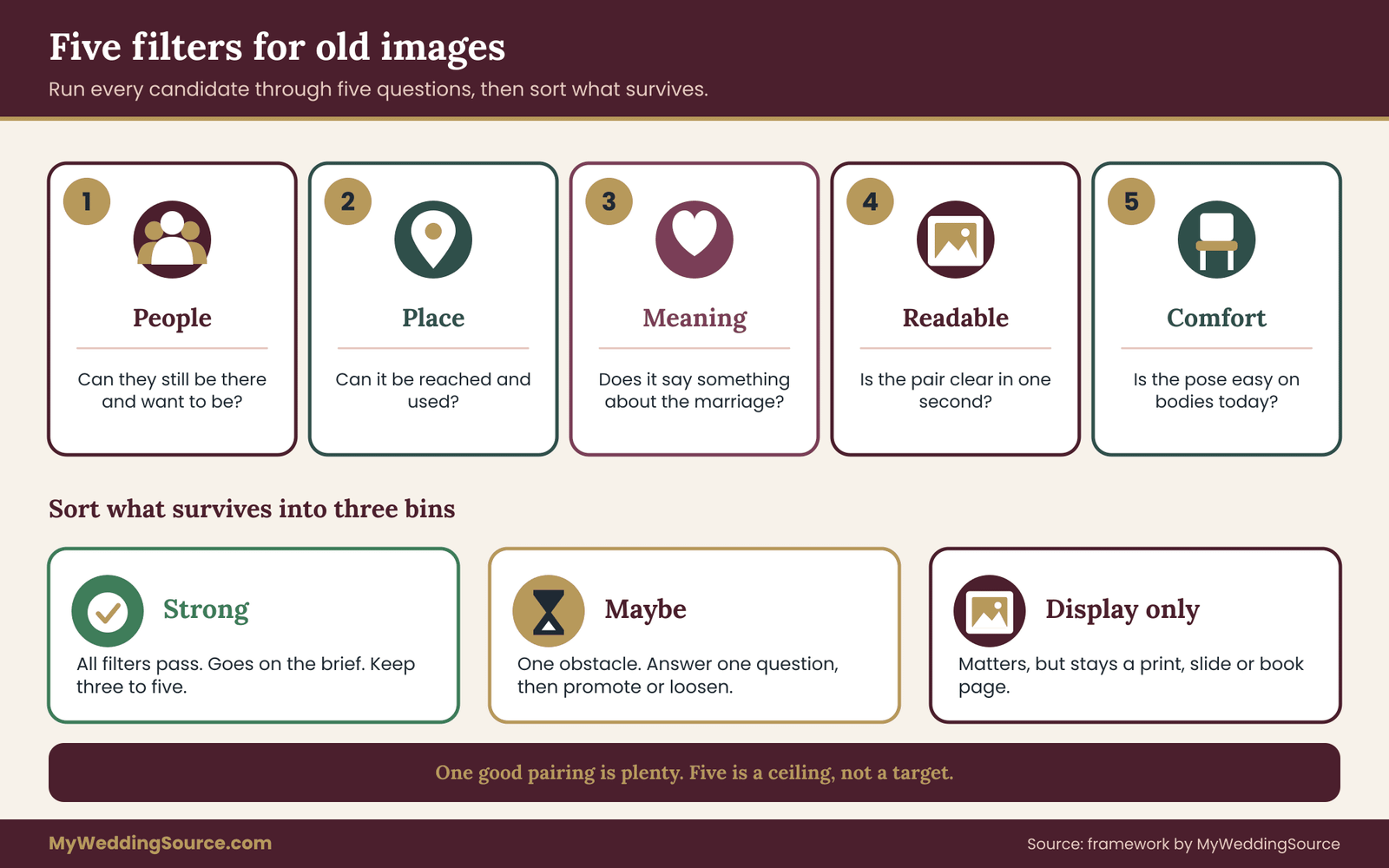
Use five questions to judge each candidate. They are not a score sheet; they are filters, and an image that fails the first two rarely survives. Those filters keep vow renewal photography honest about what the day can hold.
Can the people in it still be there? A recreation needs the people. If the original shows the two of you with a parent, a best friend or a flower girl, ask whether each of them can attend, can stand for the length of a pairing and wants to take part. If someone has died, the picture can still matter, but the answer changes from recreation to remembrance, and the alternatives section covers how.
Can the place be reached and used? Some original settings are gone: the hotel was renovated, the garden is now a parking structure, the church sold. Others still exist but are closed to photography, require a permit or sit three hours from your renewal venue. A pairing that needs a different location is a separate trip, not a quick add-on.
Does it say something that matters to you? Choose pictures with meaning for the marriage, not just attractive compositions. The photograph of the two of you laughing at a ruined cake may matter more than the formal portrait, because it points to the way you actually handle things. Meaning is the filter that most often separates a good vow renewal photography list from a long one.
Would the recreation be easy to read? A good pair is understood in a second. A viewer looks at one image, then the other, and the passage of time registers at once. If the original depends on a moment, a prop or a camera angle that cannot be reproduced, the pair will confuse rather than reveal.
Will it be comfortable to make? Some original poses are physically demanding: a dip, a lift, a carried-across-the-threshold shot, a kneeling position. Bodies change. If a recreation would strain a back, a knee or a sense of dignity, choose a different expression of it.
Sorting the anchor list
After you apply those filters, sort what remains into three bins.
The first bin holds strong candidates: images where people, place and meaning all line up and the recreation would be comfortable. These are the ones that go onto the brief.
The second bin holds maybe candidates: images that are meaningful but have one obstacle, such as an absent person or an unreachable place. Each maybe gets one question to answer. If the answer is yes, it moves to the strong bin. If no, it becomes a candidate for a looser expression, which later sections describe.
The third bin holds display-only images: pictures that matter but should not be recreated at all. These are shown as prints, on a slideshow or in a book. Many of the best pictures from any first wedding belong here, because their value is that they are old.
Aim for three to five items in the strong bin. If you have more, rank them and keep the top five. If you have fewer than two, that is fine; one good pairing is plenty. Short anchor lists are the quiet strength of careful vow renewal photography.
A short example of the filters at work
Suppose a couple has an album with a portrait on a courthouse staircase, a photograph of the groom’s late father adjusting his tie, a candid of the bride’s sister crying with laughter at the reception and a group shot of all grandparents in front of a church door.
The staircase portrait passes every filter if the courthouse allows photography and the couple can manage the stairs: strong. The father adjusting the tie fails the first filter because the father has died, so it becomes a remembrance item, not a recreation. The laughing sister passes on people, place and meaning but needs a question about whether the sister wants to be in a staged version of a spontaneous moment: maybe.
The grandparent group fails on people, since most of those grandparents are gone, and it becomes display-only or a larger tribute.
That is a clear result from four images in a few minutes. The same process, run on a full album, takes an evening and saves hours on the day. That evening of sorting is the highest-value hour in the whole vow renewal photography process.
Do not recreate the image just because it is famous in the family
Every family has one celebrated picture: the one on the piano, the one at every anniversary dinner. Because it is famous, couples feel obliged to answer it. Sometimes that is right. But fame is not the same as fit, and a celebrated image may be exactly the one that carries the most anxiety, or that features someone who is no longer part of the family circle.
If the famous photograph triggers tension, set it aside without apology. The renewal is for the marriage as it is now, and nobody has to recreate an image whose message no longer matches. Letting the famous picture go is sometimes the most useful decision in vow renewal photography.
The then-and-now photo brief for vow renewal photography, field by field
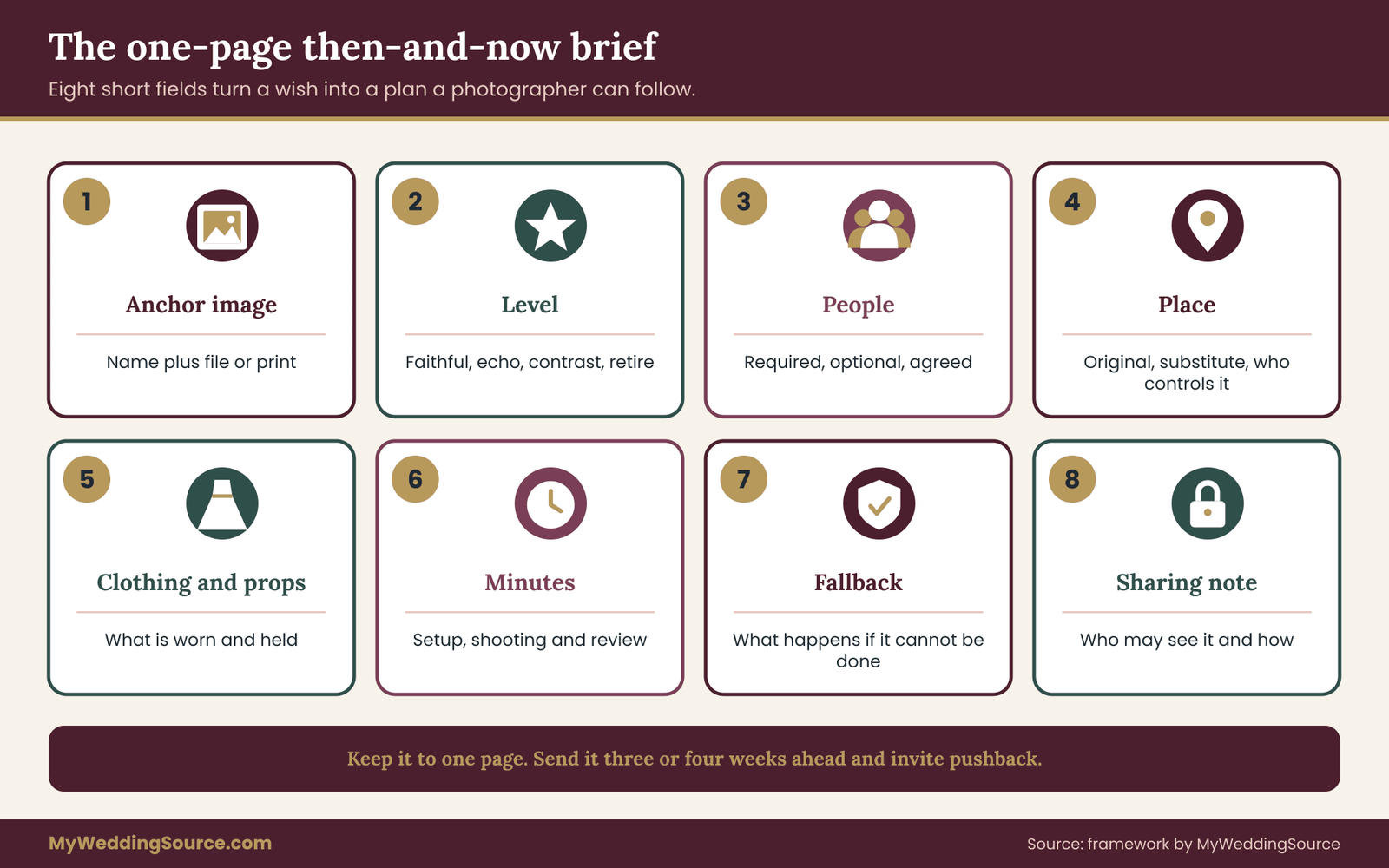
The brief is the central tool of this guide. It is a single page, written before the day, that a photographer can read in two minutes and that a coordinator or relative can follow without the couple present. Here is what goes on it, and why each field earns its place. For vow renewal photography, this brief does the job a shot list does at a first wedding.
Field one: the anchor image. A name for the original and a file or print attached, such as “staircase portrait, courthouse, 1998 scan.” The name should be one the photographer can use out loud on the day without having to describe the picture.
Field two: the recreation level. One of four labels (faithful, echo, contrast or retire), explained in the next section. This field tells the photographer how closely to match the original and prevents the usual mismatch where the couple expects a copy and the photographer delivers a reinterpretation.
Field three: the people. Everyone who must be in the frame, by name, and everyone who is optional. For each person, a note on whether they have agreed. A photographer should never discover on the day that an aunt did not know she was in a pairing.
Field four: the place. Where the original was made, where the recreation will be made, and the reason for any difference. If the place is the same, confirm who controls access. If it differs, describe what you want from the substitute, such as “stone steps, soft shade, similar angle.”
Field five: the clothing and props. What will be worn and carried. If the original used a particular veil, tie or bouquet and you still have it, say so. If you do not, say what stands in for it. Clothing continuity is one of the details that makes a pairing legible.
Field six: the minutes. How long this pairing is allowed to take, including setup and review. This is the field that turns a wish into a plan. Without a number here, vow renewal photography drifts into overtime.
Field seven: the fallback. What happens if the pairing cannot be done as written, whether because of weather, a tired relative or a closed door. A fallback might be “shoot it indoors by the hall window” or “skip and use the display print instead.”
Field eight: the sharing note. Who may see the result, in what form and with what limits. The consent checklist expands this field.
How long the brief should be
One page. If a brief runs to three pages, it has stopped being a brief and become a script, and a script gets ignored. Four or five anchor images at eight short fields each fit comfortably on one side of a sheet if you use short phrases instead of sentences. A short brief is easier to follow, and vow renewal photography depends on being followed on a busy day.
You can add a top block with the date, the venue address, the photographer’s name, the clock owner and the total recreation window. Keep the contact details on a separate sheet so the brief itself carries no more personal data than it needs to.
Writing the brief so it survives a bad day
A brief written for a perfect day fails on a real one. Write each field for the version of the day where it rains, a relative is late and the light is flat. Planning for the worst version of the day is a habit that serves all vow renewal photography.
For every pairing, ask what would make it impossible, then write the fallback in the same field. If an aunt cannot stand for long, the fallback is a seated version. If the stairs are closed, the fallback is a different set of steps. If the light is harsh, the fallback is the shaded side of the building.
This habit also lowers the temperature on the day. When something goes wrong, nobody has to improvise a decision, because the decision was made calmly weeks earlier. The photographer simply reads the fallback line and moves. Calm decisions made early are one of the hidden benefits of vow renewal photography done with a brief.
What a photographer needs from the brief
A professional who shoots weddings will usually welcome a clear brief. Their work depends on knowing the schedule, the key people and the images that matter most. What they cannot do is read minds, and the common failure in recreation requests is a vague “just like the old one” that the photographer must interpret in the moment. Photographers who take on vow renewal photography regularly often have their own templates, and a good brief fits into them.
Give them the original image, the level, the people and the minutes. That is enough to quote the work, to plan an assistant if needed and to arrive with the right lens. For the vendor side of that conversation, the guide to wedding vendor contracts covers what belongs in writing, and a three-line scope note about the recreation window is a reasonable thing to ask your photographer to confirm by email. That is the whole handoff for vow renewal photography at this level of detail.
Does vow renewal photography change the photographer you hire
Sometimes. A photographer with documentary habits, who prefers to stay out of the way and capture real moments, may be superb for the now layer and less comfortable directing a staged pairing. A photographer who loves portraits and posing may handle recreations well but need reminding to protect the unposed ceremony.
Ask directly which they prefer and how they handle the shift between modes. Many experienced photographers do both, and some bring a second shooter so one person can keep documenting while the other runs the pairings. If your day is small and your budget is tight, a single photographer can still handle both, provided the window is short and the roles are clear.
The sections on working with the photographer return to this. Whichever style they favor, vow renewal photography goes better when their strengths are matched to the plan.
Four recreation levels: faithful, echo, contrast and retire
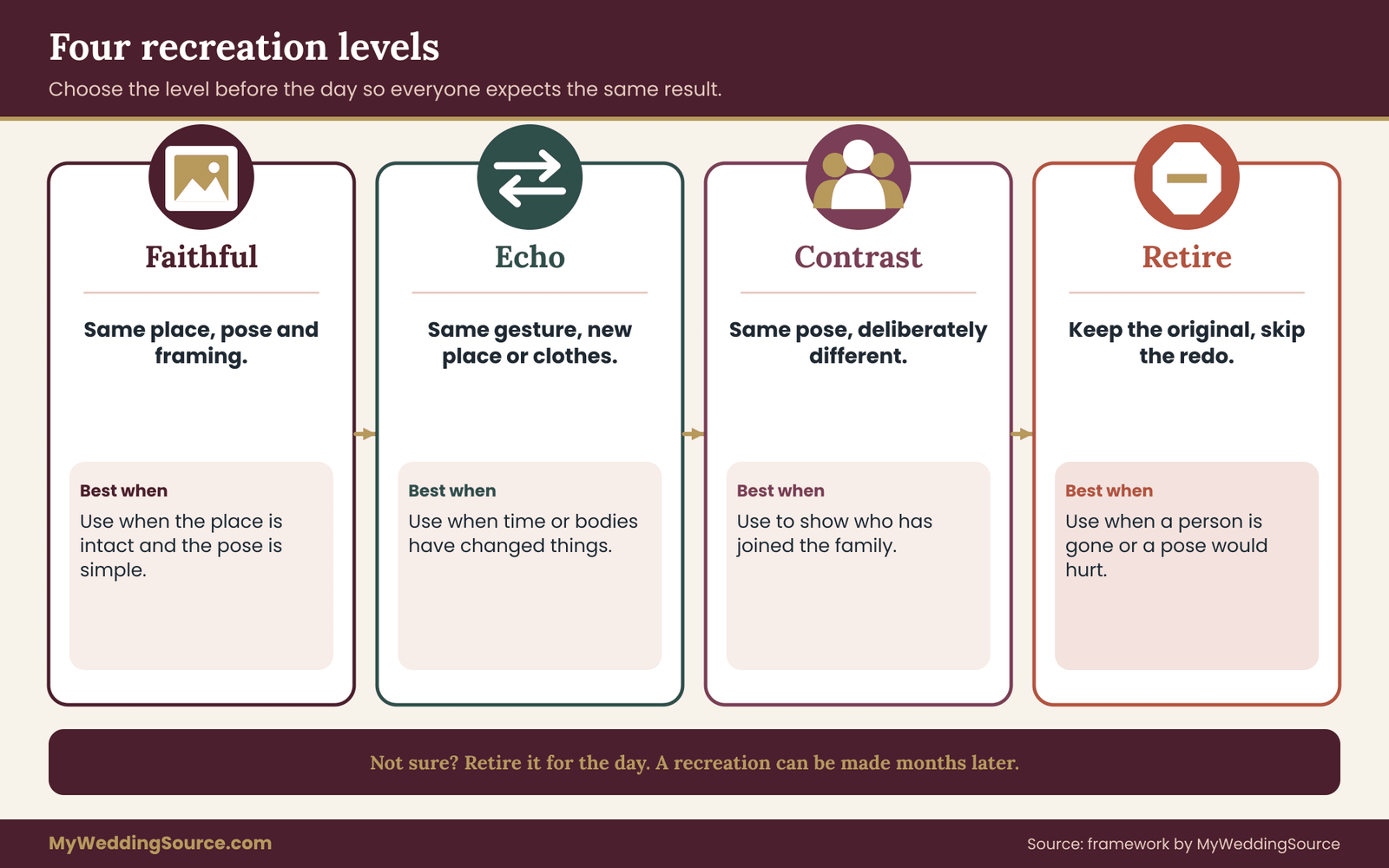
The most common misunderstanding in this kind of project is that “recreate” means one thing. It means at least four, and choosing the wrong one produces most of the disappointment. Give every anchor image one of these labels in the brief. Vow renewal photography uses the word loosely, so the brief has to define it.
Level one: faithful
A faithful recreation matches the original as closely as practical: same place, same pose, same framing, similar clothing. The point is the comparison, and the comparison only works if everything except the people is held constant.
Use this level when the original is simple and the place is intact. A couple on a bench, a pair of hands with rings, two people in a doorway. Faithful pairings are the ones that look best side by side, because the eye can detect the difference in the faces and nothing else.
It demands the most preparation. You need the original at full resolution or a clean print, a photographer willing to match a lens and angle, and a few minutes of careful alignment. A phone held beside the original on a small stand can help the photographer line up the horizon and the edges. Preparation of this kind is why faithful vow renewal photography feels like a craft and not a stunt.
The risk is stiffness. When people try too hard to look exactly the same, they look rehearsed. A good faithful brief asks for the pose and then asks the photographer to shoot a few frames after the pose relaxes.
Level two: echo
An echo keeps the idea of the original but allows the place, the clothing or the framing to change. The staircase portrait becomes a portrait on the steps of the renewal venue. The first-dance picture becomes a slow dance on a patio. The matching element is the gesture, not the setting.
Echo is the most useful level for most couples, because it survives changes that kill a faithful version: a demolished building, a different season, a body that no longer does the original pose. It also tends to look more natural, because the people are responding to the moment rather than matching a template. For most couples, echo is the level where vow renewal photography feels most natural.
For the brief, write down the single element that must carry across. “Forehead touch.” “Walking away from the camera, hand in hand.” “Laughing while holding the cake knife.” The photographer then has one clear target and a lot of freedom.
Level three: contrast
A contrast pairing deliberately differs from the original so that the difference becomes the message. The original shows the two of you alone; the contrast shows the same pose with children and grandchildren filling the frame. The original shows a stiff formal portrait; the contrast shows the same people mid-laugh.
This level suits couples who do not want to pretend that time has not passed. The picture says, openly, that everything changed and the marriage held. It can also be the kindest option when a faithful version would hurt: when a parent in the original has died, a contrast can show the empty space honestly, or fill it with the next generation.
Contrast needs the clearest brief of all, because the photographer must understand what is meant to change and what must stay recognizable. Write one sentence: “Same staircase, same angle, but include all grandchildren on the steps.” Contrast is where vow renewal photography can say the most with the least staging.
Level four: retire
Some images should not be recreated, and “retire” is the label that gives you permission. A retired image stays in the album or on the wall, honored but not answered. It may be retired because the person in it is gone, because the memory is painful, because the pose cannot be done safely or simply because the original is perfect as it stands.
Retiring an image is not a failure of imagination. It is an editorial decision, and it is one of the strongest things a brief can do. The more you retire, the more attention the remaining pairings get. Saying no to a pose is a real skill in vow renewal photography.
If you are unsure about an image, retire it for the day and revisit later. A recreation can be made months after the renewal, in a quiet moment, when the pressure of the event has passed. The original will still be there.
Mixing levels inside one pairing
You can combine levels in a single sequence. For one anchor image, ask for a faithful frame first, then a looser echo frame, then a contrast frame including more people. The three frames take little more time than one, because the setup is shared, and they give you a choice later.
This also manages risk. If the faithful version feels stiff, the echo is probably better. If the contrast surprises everyone in a good way, you have it. Photographers often work this way instinctively; the brief just makes it explicit and allots the minutes. Offering options keeps vow renewal photography flexible when the moment changes.
A decision rule for choosing the level
When you cannot decide between levels, use a quick rule built on two questions. Is the original place available and comfortable? Is every person from the original able and willing to be there?
If both answers are yes, choose faithful, or faithful plus echo. If the place is lost but the people are present, choose echo. If the place is available but someone is missing, choose contrast, and decide whether to fill the gap with new family or leave it visible. If neither is true, retire the image for the day and consider a display or a keepsake instead.
The rule is not a law. It is a way to start a conversation in a calm tone, ahead of time, with a clear default. Use it as a prompt for discussion, because vow renewal photography has few fixed answers.
Consent checklist for vow renewal photography
Recreating an old image brings a set of consent questions that a normal event photograph does not. There are three reasons. The original contains people who agreed to be photographed at a different time, for a different purpose. The recreation may place people in a deliberate pose rather than a candid one.
And the pairing, once made, is easy to share widely because it is such a satisfying image. That is why vow renewal photography needs its own consent step, separate from the ordinary guest-photo rules at a wedding.
For the wider question of guest boundaries and image use at a wedding, the wedding photography consent guide covers the general framework. What follows is the specific checklist for then-and-now work.
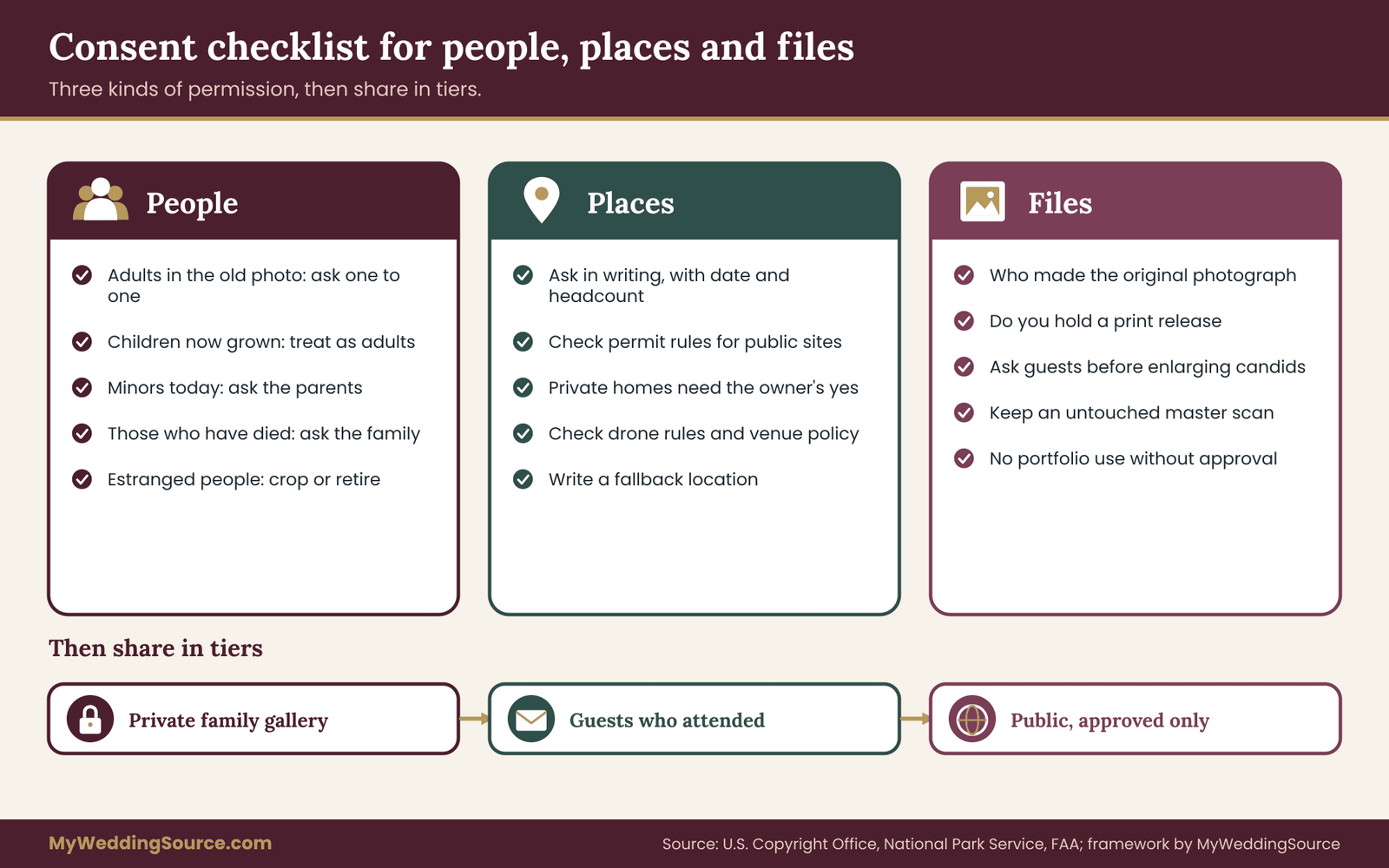
Consent for the people
Run through everyone in each original and each planned recreation.
Living adults in the original. Ask each one personally, before the brief is final, whether they are willing to be in a recreation. Do not rely on a family group message, where silence can look like agreement. A one-to-one question lets a person say no without public pressure. Offer a gentle way out: “No pressure at all. We can do it without you, or use the original.” Asking one person at a time is the polite habit that keeps vow renewal photography friendly.
Children in the original who are now adults. The flower girl from thirty years ago is a grown person with her own views about being photographed and about the old picture. Treat her like any other adult. She may love the idea; she may find the childhood image embarrassing; she may have reasons you do not know.
Children now. If grandchildren or other minors will appear in a contrast pairing, the decision belongs to their parents or guardians. Ask the parents what is acceptable, including where the images will be shown and whether the child’s name appears anywhere. Many parents are happy with a private gallery and uncomfortable with open posting.
People who have died. There is no consent form for the dead, but there is care. Consider how the family feels about including a deceased person’s image in a display or a pairing, and whether a relative should be asked before the original is shown more widely than before.
People who are no longer in your lives. A former friend, an estranged relative or an ex-partner of a parent may appear in an old group photograph. The original is part of your history, but you do not have to reproduce it. Crop, retire or leave it as a private print.
If you plan to publish an old photograph that features such a person, think about whether you would want the same if the roles were reversed. Leaving someone out of a frame is a normal editorial choice in vow renewal photography.
Consent for the places
A recreation in the original location needs permission from whoever controls it now. Churches, courthouses, parks, private gardens and hotels each have rules about photography, and rules change.
Ask in writing. State the date, the number of people, the equipment and the length of time. If the place is a public park or a public building, check whether a permit is needed for a commercial photographer; the National Park Service and many local agencies publish rules for photography and filming, and the sources list points to the right starting place. Do not assume the old friendliness of a caretaker still applies.
If the place is a private home, the owner’s agreement is not only courteous but necessary, and children, pets and neighbors may be affected. If drones are part of the plan, check the Federal Aviation Administration’s current rules for unmanned aircraft and the venue’s own policy before promising anyone an aerial then-and-now. Settling those permissions early is basic housekeeping for vow renewal photography at a real place.
Consent for the files
An original photograph is also a file, a print or a negative, and it has an owner. The next section deals with copyright and the original photographer. For the checklist, it is enough to note that you should know where the original lives, who holds it and whether you have permission to scan, copy or display it. Treat every file as something you borrow carefully when vow renewal photography depends on it.
Rights, scans and the original photographer
Almost no one thinks about copyright when they carry a wedding album to a scanner. In most ordinary family use, that is fine. But a then-and-now project involves copying, enlarging, displaying and often sharing old photographs, so it is worth understanding the basics. Vow renewal photography touches rights more than most family projects do, because it reuses images made years earlier.
In the United States, copyright in a photograph generally begins with the person who made it, the photographer, unless a written agreement says otherwise. The U.S. Copyright Office explains the basic rules and its circular on copyright basics is listed in the sources. That is general background, not a ruling on your situation, and agreements differ. Many wedding photographers include a print release or a license to the couple in their contract, which allows personal printing and sharing, while keeping the copyright themselves.
So the first practical step is to find out who made the original photographs and whether you hold a release. The paperwork is usually in the folder with the original contract. If you cannot find it, the photographer’s studio, if it still exists, can often tell you what the standard terms were.
If the photographer was a relative or a friend, ask them, and ask kindly; a shared photograph from a friend’s camera at the original wedding is a gift, not a license. That small piece of research prevents most rights confusion in vow renewal photography.
When the original was shot by a guest
Many of the best candid pictures from older weddings were taken by guests, not hired photographers. Those images belong, at least initially, to the guest who pressed the shutter. If you want to enlarge one for a display or publish it beside a recreation, a quick message to the guest, or to the family of a guest who has died, avoids misunderstandings.
Usually the answer is an immediate yes, along with a sentence about how glad they are you asked. A request is also a chance to be told that someone else has a better copy, a negative or a second frame from the same moment. A friendly request like that is part of ordinary good manners in vow renewal photography.
Scanning and copying the original with care
Old prints and negatives are fragile, and a then-and-now project often triggers a rush to scan. A few cautions help.
Handle prints by the edges, with clean dry hands, and avoid sticky tape, rubber bands, paper clips or adhesive. The Library of Congress and the National Archives both publish guidance on caring for family photographs and the sources list the pages. Keep the originals in a cool, dry, dark place, away from attics and basements, and do not laminate them.
Scan at a resolution suited to your planned use. For viewing on a screen or in a slideshow, a moderate resolution is enough. For a large print on a wall, scan at a higher resolution and ask a lab what they recommend. Save the scan as an uncompressed or lightly compressed file, keep the filename plain and put a copy somewhere other than the computer that did the scanning.
If the photo is mounted in an album with an adhesive page, do not peel it. A professional photo lab or an archivist can advise on safe removal, or you can photograph the page flat under even light as a substitute. For storing the finished files, the wedding records guide describes a three-copy habit that works well for any family archive, including this one. Careful handling of fragile originals is the unglamorous side of vow renewal photography.
Editing and altering the original
Resist the temptation to restore or retouch the original without keeping an untouched copy. Fading, color casts and scratches may look worth fixing, but a restoration is an interpretation, and once the file is replaced you cannot go back. Keep one master scan exactly as scanned, and make any edited versions as separate files.
For the pairing itself, matching color and contrast can help the two images sit well together, but there is no obligation to make the new image look old. A faded original beside a crisp modern frame is part of the message. A photographer who tries to apply an old-film filter to the new frame may blur the very difference you wanted to show. Honest contrast between old and new is the whole point of vow renewal photography with archival images.
Can the photographer use the pairing in their portfolio
Ask before the day, and put the answer in writing. A then-and-now pairing is attractive material for a studio’s marketing, and it includes an old image that the photographer did not make and that includes people who did not agree to appear in advertising. The safe default is no portfolio use of the pairing unless every person in it agrees, and no use of the original image at all without separate permission from its owner.
A clause that covers this is simple: “Pairings that include archival images are not to be used for marketing without written approval from the couple and from each identifiable person.” The vendor contract guide linked earlier explains where to put such a clause, and many photographers will accept it without argument. Clear wording on marketing keeps vow renewal photography from turning into someone else’s advertising.
Timing, light, clothing and bodies
Even with consent and rights settled, a then-and-now pairing is a practical craft. Four practical areas decide whether it looks good: when it happens, how it is lit, what people wear and what bodies can do. Each of those practical areas can quietly make or break vow renewal photography on the day.
Timing
Place the recreation window after the ceremony and before the main celebration, or after the formal portraits, depending on the shape of your day. The aim is to catch people while they are fresh and the light is still good, without stealing time from guests.
A common arrangement is a short window straight after the ceremony, while everyone is still dressed, the room is still arranged and the emotional peak has passed. Pairings that include older relatives or small children are best placed here, because their energy is limited. If the day is long, ask the photographer whether the pairings should come before a meal rather than after, when people are tired, hungry or wearing a drink.
Write the start time and the length into the brief. A window of twenty minutes with four pairings is workable if every person is already on site and the locations are close together. A window of ten minutes for the same list is not. Timing is the lever that most affects how vow renewal photography feels to guests.
Light
Old photographs were shot in particular light: midday sun on a courthouse step, a flash in a dim church, soft window light in a living room. A faithful recreation needs similar light direction to look right beside the original, and that is not always possible at a different hour or season.
Look at the original and note whether the light came from the left or right, whether it was hard or soft, and whether faces were shaded or lit. Then walk the planned location at the planned hour, ideally in the weeks before, and see where that light will fall. An echo frame is more forgiving: you can choose any good light and keep the gesture.
Do not chase the exact light of the original at the cost of good light now. A flattering, readable pairing is always better than an exact but harsh one. Good light now is worth more than exact light then in vow renewal photography.
Clothing
Clothing continuity makes a pairing legible, but it should not become a project. Some couples wear their original outfits, adapted or tailored. Others wear new outfits that echo the originals, such as a veil in a similar style or a tie in the same color. Some choose a visible contrast, new clothes against old, and let the photograph carry the difference.
For the question of rewearing or replacing a dress, the guide to wedding dress fit and alterations covers how alterations work and how far a garment can be adjusted. Whatever you choose, tell the photographer, because mismatched clothes between a pairing’s two images are one of the most visible gaps.
If an original garment no longer fits or has been damaged, retire the garment, not the pairing. A pairing in which both people wear what they love now often looks better than a forced match. Comfort first is a standing rule in vow renewal photography.
Bodies and ability
The most delicate practical issue is physical. People age, and the poses that were easy at twenty-five can be hard or unsafe at sixty-five. A good brief builds this in without making it awkward.
Choose seated or leaning versions of standing poses. Replace dips and lifts with a held hand or a shoulder lean. Allow people to rest between frames. Place chairs just outside the frame so someone can sit between takes. If a person uses a wheelchair, a cane or a walker, include the aid in the frame without apology if it suits them, or position it out of frame if they prefer.
Ask each person what they are comfortable with, one at a time. The question, “Is there anything about this pose that would be hard for you?”, opens the conversation in a respectful way. Do not guess about what someone can or cannot do. Respect for ability is built into the best vow renewal photography.
Weather and a second location
Outdoor recreations depend on weather, and weather changes. Choose a covered fallback close to the first location, and decide in advance who makes the call and when. A call made at the last minute with everyone assembled is a hard one; a call made at a set time, say ninety minutes before the window, is easy.
If the original location is far away, consider making the recreation on a separate day. A planned visit to the original courthouse or garden, with only the couple, a photographer and perhaps one family member, can produce a better and less stressful pairing than a rushed stop between ceremony and reception. The result can be added to the album or the display later. A separate trip is a legitimate choice in vow renewal photography, not an admission of defeat.
Working with the photographer on vow renewal photography: questions and scripts
A recreation project is a small collaboration with the person holding the camera. Good communication in advance prevents most trouble on the day. Here are the questions worth asking, and simple ways to say them. Treat the photographer as a partner in vow renewal photography, not as a service that receives orders.
Questions to ask before you hire or confirm
How do you handle staged pairings alongside documentary coverage? You want to hear a plan, such as a fixed window, a second shooter or a switch of equipment, not an improvised answer.
Have you worked from archival images before? Familiarity helps. A photographer who has matched an old photograph knows to bring a printed copy, to check lens perspective and to take a few frames at different distances.
How much time do you want for each pairing? Their answer is a reality check for your own estimate. If they say fifteen minutes for a group pairing and you planned five, adjust the list.
Can you work from a printed copy on the day? A photographer who prefers to see the image on a tablet or a screen may need a power plan and a shade plan. A printed copy in a plastic sleeve is simple and robust.
What do you need from us to deliver the pairings as images side by side? Some photographers will assemble the pairs in a layout; others will deliver the new image and leave the assembly to you. Know which you are buying.
A script for sending the brief
You do not need formal language. Something like this is enough:
“Here is a one-page brief for four then-and-now pictures we would like on the day. Each has a level and a time limit, and the whole set fits in twenty minutes after the ceremony. Please tell us if anything looks unrealistic, and what you would change.”
Sending the brief with an invitation to push back is more effective than sending it as a demand. Professionals often have good reasons to adjust a plan, and a conversation four weeks ahead costs nothing. A collaborative tone suits vow renewal photography better than a list of demands.
A script for the day
On the day, the clock owner can use short calls: “Five minutes left in the window.” “One more frame, then we move.” “That’s the last pairing; thank you everyone.” Scripted lines sound abrupt on paper but feel kind in the moment, because they relieve the couple of the burden of ending the session themselves.
Brief the guests who will be in the pairings, too. A message the day before, with the time and place and a reminder to bring anything they want to wear, avoids a scramble. If one person is late, move on and shoot their pairing when they arrive, and if that does not work, use the fallback written in the brief.
Paying for the extra time
Recreations may add time and complexity, and a photographer may adjust a quote. Ask for the cost of the window as a separate line, in writing, and compare it with the value to you. If the price is higher than you want, there are cheaper ways to get the same effect, and the alternatives section describes several.
Do not assume a particular price; photographers set their own, and the figure depends on the region, the length and the work involved. Pricing is the least predictable part of vow renewal photography, so get every figure in writing.
One worked case from first idea to final window
The following case is invented for illustration. It does not describe a real couple or a real event, and no figures in it are measurements. It exists to show how the pieces of the brief fit together when the choices are made under ordinary constraints.
Meet Maya and Daniel Reyes, a fictional couple planning a small renewal for their twenty-fifth anniversary, with about forty guests, one photographer and a half-day schedule. They own a wedding album and a box of loose prints. Maya wants “all the old pictures redone.” Daniel would be happy with two or three. Their grown daughter, Lucia, is helping to organize and has volunteered to hold the clock. Their story is a small model of vow renewal photography under normal constraints.
Step one: the long list
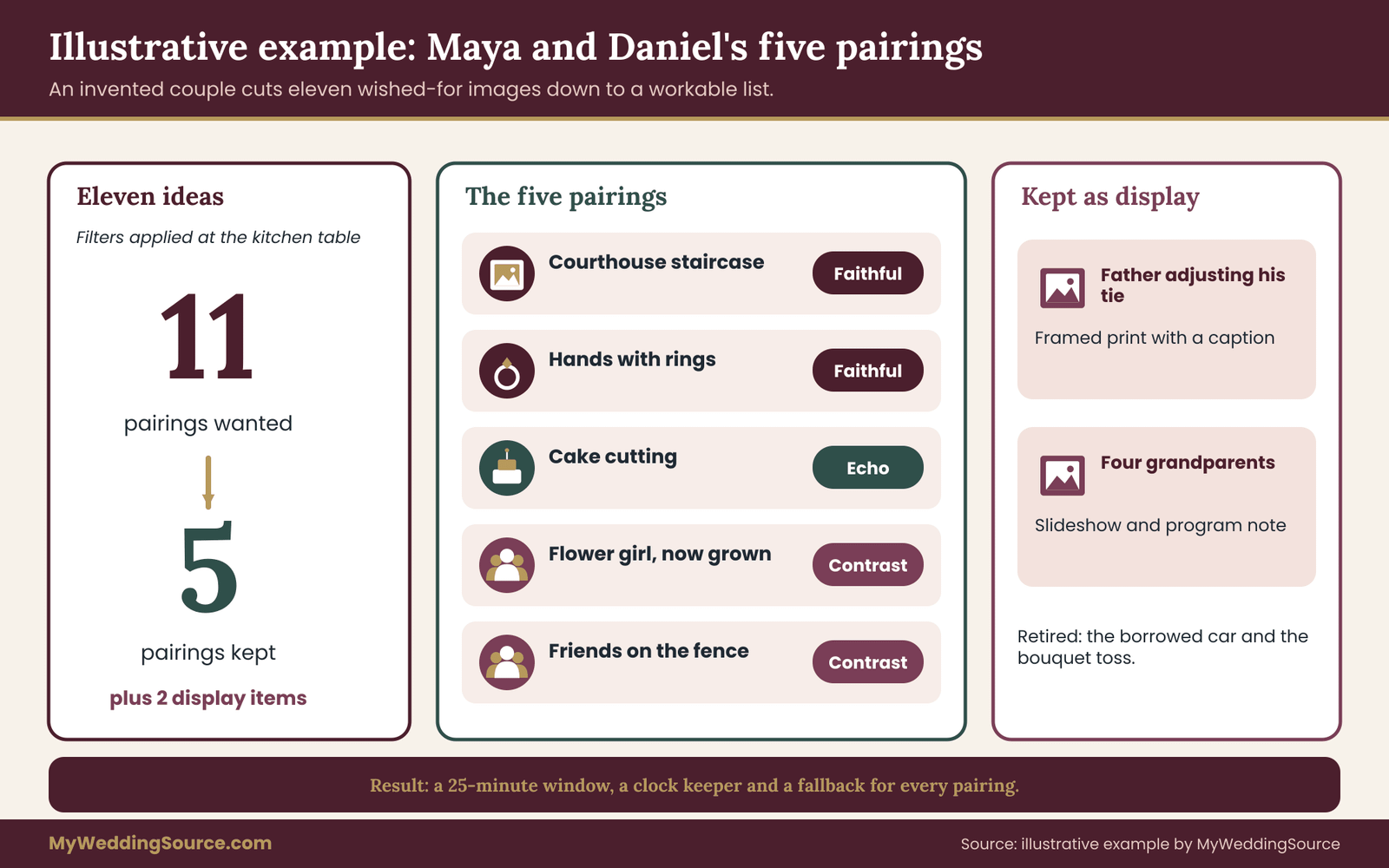
Maya and Lucia go through the album and write down every picture they would like to answer. The list reaches eleven: the courthouse staircase portrait, the cake cutting, the first dance, a group photo with all four grandparents, Daniel’s father adjusting his tie, Maya’s sister laughing, the two of them in a vintage car, a picture of hands with rings, a bouquet toss, the flower girl in a too-big dress and a group of friends leaning on a fence.
Eleven pairings at ten minutes each would be nearly two hours of staged photography at a half-day event. Daniel says it out loud: “That’s the whole afternoon.” The arithmetic is the first useful result of the exercise. That is the sort of arithmetic that vow renewal photography forces into the open.
Step two: the five filters
They apply the filters from earlier. The courthouse staircase is still open to the public and photography on the steps is allowed during certain hours, so it passes. Daniel’s father adjusting his tie fails on people, because his father died years ago, and becomes a remembrance item. The four-grandparent group fails the same way. The cake cutting is hard to recreate because the original cake was a big tiered one and the renewal will have a small cake, but the gesture can be echoed.
The vintage car belongs to a neighbor who moved away, so it is retired. The flower girl, now an adult with a job in another city, has said she would love to come and be photographed, so her pairing is a strong candidate. The bouquet toss is dropped as not meaningful. The hands with rings is simple, personal and quick, so it stays.
The friends on the fence are scattered; three of the five are coming. That one becomes a “maybe” and then a contrast pairing: the same fence at the park near the venue, with whoever is there, including the missing friends’ partners.
Step three: the anchor list and levels
The final list has five pairings. The staircase portrait is faithful, because the place is intact and the pose is simple. The hands-with-rings frame is faithful, shot in two minutes beside a window. The cake cutting is an echo, a laughing cut of a small cake.
The flower girl pairing is a contrast: the same pose of standing between the couple, but now as an adult with her own child on her hip. The fence photo is also a contrast, with the same fence but with the new set of friends.
Daniel’s father and the grandparents get a different treatment: a framed display of the originals on a small table, a short caption for each and a quiet moment in the program. That is not a recreation, and it is not meant to be one.
Step four: the one-page brief
For each pairing, Lucia writes the eight fields in short phrases. For the staircase, the brief reads, in effect: original is the 1999 courthouse scan; level faithful; people are Maya and Daniel; place is the east steps of the courthouse, fallback the venue’s front steps; clothing is the same shade of navy for him, new dress for her but a similar neckline; minutes six; fallback is a soft-shade version at the venue; sharing is gallery only until the daughter reviews the final set.
The flower-girl pairing includes her name, her child’s guardian, which is the flower girl herself, and a sharing limit stating that her child’s image is private to the family gallery. The photographer receives the brief three weeks before the day, replies with two suggestions and the schedule is adjusted. The total window is twenty-five minutes, shaped as: staircase, hands, cake, then the two contrast pairings.
Step five: the day
The ceremony is photographed first and in full. The recreation window begins forty minutes after the ceremony. Lucia keeps time, with short calls at ten and five minutes remaining. The staircase pairing takes seven minutes because Maya’s heel catches on the second step and they stop to adjust, which runs a minute over. The hands frame takes two. The cake pairing takes four, and laughter is real because a nephew drops a spoon. The flower-girl pairing takes six, because the child will not stand still.
By the time the fence pairing arrives, the window is nearly gone. Lucia calls time, and the photographer takes two quick frames and moves on. The fence pairing is a little rough, and the family decides that is fine.
Step six: what the case shows
Several lessons come out of the case without any heroics.
First, cutting the list from eleven to five was the single most important decision, and it happened at a kitchen table, not on the day. Second, the levels did real work: the faithful pairings were easy because they were simple, the echo gave room for a real laugh and the contrasts gave the day a story about time.
Third, the fallbacks and the clock prevented a long wait for the guests. Fourth, the remembrance display handled two images that would have been awkward as recreations. And fifth, the roughest pairing did not matter, because the ceremony had already been captured whole. Those lessons carry over to nearly any vow renewal photography project.
What the case does not claim
It does not claim that every couple will find the same split. A couple with fewer relatives, a larger budget or a more relaxed schedule might do ten pairings. A couple with a short window and a large group might do two. The case is meant to show a method, not a target number.
It also does not claim that the pairings were perfect; the point is that the structure held when things drifted. Treat the numbers as an example of method, since vow renewal photography varies a great deal from couple to couple.
Alternatives to recreating old images
Recreation is one way to answer the past. It is not the only way, and for many couples it is not the best. Here are alternatives, each with a note on when it fits and what it costs in time and attention. Choosing among them is part of the creative side of vow renewal photography.
Display the originals
The simplest alternative is to show the old pictures as they are. A small table of framed prints, a slideshow loop on a quiet screen or a simple book of favorites can all carry the then layer without anyone having to pose. A caption with a name and a year helps guests younger than the marriage to understand what they are looking at.
This alternative suits almost any couple, and it is nearly always worth doing alongside other choices. It also solves the problem of images that cannot be recreated because the people are gone. The display becomes the place where those people are present in a way that feels natural. Display is the lowest-risk move in vow renewal photography.
Photograph the originals in the new setting
Instead of recreating the pose, place the original print in the new scene and photograph it. A framed picture on the mantel with the couple beside it. A print held at arm’s length in front of the real staircase, aligned so the old and new overlap. This device has a long tradition in family photography, and it works well when the people cannot pose but the place is available.
It is quick, it needs no special preparation beyond the print and it makes a charming image. The risk is a glare on glossy paper, so use matte prints or a lightly angled hold.
Answer the spirit, not the pose
A fresh image that responds to the feeling of an old one, without matching the composition, is the freest option. The original shows the two of you laughing at a ruined cake; the answer is simply a picture of you laughing at something that day, caught by a photographer who knows to watch for it.
This takes no staging and costs no window. It does require the photographer to know the anchor list in advance, so that they can recognize the moment when it comes. Give them the images and the feeling, and let them work. Quiet, unposed work like this is often the best vow renewal photography has to offer.
Add the new people
Where recreation points backward, a group portrait of the present family points forward. Many renewals are as much about who has joined the family as who started it. A well-made portrait of children, grandchildren, in-laws and close friends is a strong image on its own terms, and it can be displayed beside the original wedding portrait as a quiet comparison without any matching of poses. The wedding family photo list is a useful starting point for working out which groupings to include and how to sequence them.
Make a short film or audio piece
If the old stills do not translate well, consider moving image or sound. A short slideshow with a recording of the couple talking about each photograph can be stronger than a posed frame, and it respects the memory without reconstructing it. The question of keeping such recordings safely is the same as for any family archive, and the earlier records guide gives a workable approach.
Do it later, privately
A final option is to separate the recreation from the event altogether. Make the pairings on another day, in the original place, in comfortable clothes, with only the people who want to be there. A quiet afternoon at the old courthouse can yield better pictures than a hurried twenty minutes at a party, and it takes pressure off the renewal itself.
Plenty of couples find the later session more satisfying, because it belongs to the two of them. It can be a small anniversary habit, a pairing made every few years, and the series itself becomes a record of time. Slower, private sessions deserve a place in any honest discussion of vow renewal photography.
Failure conditions and what to do when a recreation goes wrong
Every plan should say how it can fail, and the then-and-now brief is no exception. The failure conditions below are the ones that appear again and again when couples try to answer old images. Each has a warning sign, a decision and a repair. Naming the failure points ahead of time is a mark of mature vow renewal photography planning.
Failure one: the window swallows the day
Warning sign. The recreation list keeps growing, or the first pairing runs well past its minutes and the guests begin to look at their phones.
Decision. The clock owner ends the window at the agreed time, no matter how many pairings remain. Unfinished ones go on a “later” list, not into the reception.
Repair. Offer the guests something to do while they wait, such as drinks or the display table, and move the remaining pairings to a private session on another day. A short, firm window always costs less than a long, resented one.
Failure two: someone is in the frame who did not agree
Warning sign. A relative hesitates, says “oh, I suppose,” or looks toward a spouse before answering. Silence in a family chat is not consent.
Decision. Stop and ask in private. If the answer is no, thank the person and rework the pairing without them, or switch it to a contrast or display-only treatment.
Repair. Do not publish any image containing that person until they have seen it and said yes. If the pairing was already shot, remove them from the shared set and keep the version they are in private.
Failure three: the pose hurts
Warning sign. A person winces, holds their breath or says “this is fine” in a flat voice. Photographers and organizers are often too polite to interrupt.
Decision. Change the pose immediately. A seated version, a lean on a wall or a held hand almost always beats a recreated pose that costs someone comfort.
Repair. Keep a chair at hand for every pairing and make the opening line of each pairing the question about comfort. Nothing on the brief outranks a person’s body.
Failure four: the pairing looks like a costume party
Warning sign. People are performing their younger selves, forced smiles appear and the photographer starts asking for exact finger positions.
Decision. Shift from faithful to echo. Relax the pose, let the people talk to each other and shoot the frames after the pose breaks.
Repair. In the final selection, favor the frame where the people look most themselves, even if it matches the original less closely. A pairing succeeds when it shows continuity of the people, not precision of the pose.
Failure five: the location is closed, changed or unavailable
Warning sign. The original place has new rules, new owners or new construction, or the caretaker who said yes has left.
Decision. Use the fallback written in the brief, which was chosen exactly for this. Do not try to talk your way past a closed gate; that puts the photographer, the guests and your day at risk. A written fallback is what separates calm vow renewal photography from improvised vow renewal photography.
Repair. Shoot an echo at the substitute location and, later, return to the original place for a private faithful version if it still matters.
Failure six: the original image is missing or unusable
Warning sign. The scan is low-resolution, the print is damaged or the photographer cannot find the file.
Decision. Without a clear reference, do not attempt a faithful recreation. Choose an echo and describe the key gesture in words.
Repair. After the event, ask relatives for other copies, which often turn up, and back everything up in more than one place using a simple scheme such as the one in the records guide.
Failure seven: the pairing opens an old wound
Warning sign. Someone grows quiet, leaves the group or changes the subject whenever a particular image comes up.
Decision. Retire the image and say nothing further. The brief can be updated at any time, and no picture is worth a hurt.
Repair. Offer a private moment to the person, and do not pressure them to explain. The original stays in the album, and nobody has to look at it.
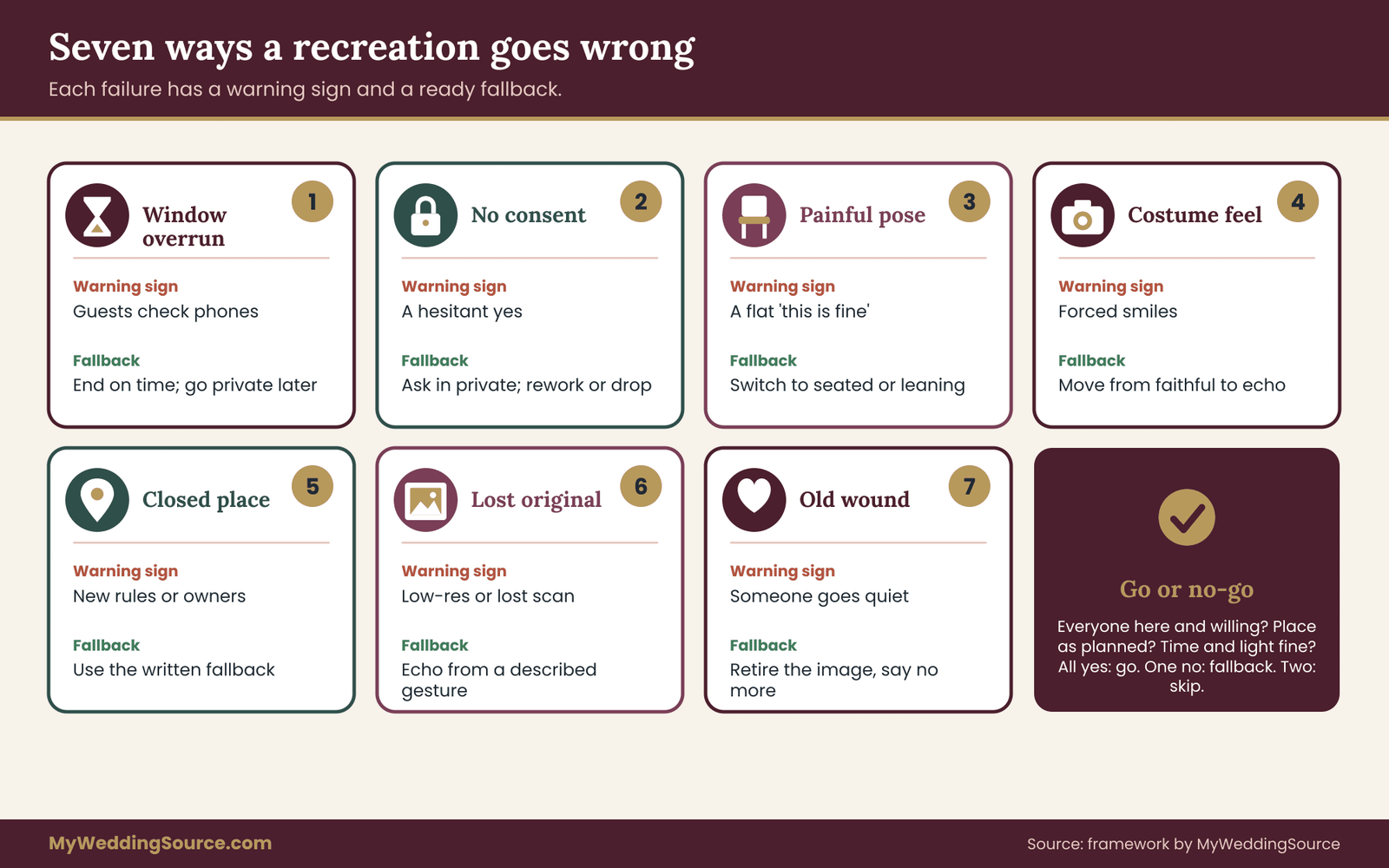
A simple go or no-go check before each pairing
Before each pairing begins, the clock owner or photographer can run a five-second check, out loud if helpful. Is everyone here who agreed to be here? Is anyone uncomfortable? Is the location as planned? Is there time? Is the light acceptable?
If every answer is yes, go. If one answer is no, use the fallback. If two or more are no, skip the pairing and move to the next. That rule sounds severe, but it prevents the compounding mistakes that wreck windows. Two small problems at once usually mean a bad moment for that image, and a different image will do better. That simple rule keeps vow renewal photography on schedule without drama.
Sharing, delivery and storage afterward
The recreation window ends, but the project does not. Three habits make the aftermath smooth. What happens after the shoot is also part of vow renewal photography.
Review before you share. Look at the pairings with the people in them before posting anything. A person who sees themselves in a frame for the first time on a public page will not feel good about it, even if they said yes. The general principles in the guest photo consent planning guide apply here too. A small private preview for those in the pairings takes a few minutes and avoids regret.
Share in tiers. Keep a private gallery for the family, a smaller selection for the guests who attended and a still smaller set for any public use. The sharing field in the brief tells the photographer and the organizer what is allowed. The wedding day digital contingency guide describes ways to handle files, permissions and backups in a way that applies here as well.
Store and label. Save each pairing with a plain filename that includes the subject and the years, keep the original scan beside it and store three copies in two kinds of storage, one off site. The Library of Congress personal archiving guidance is a reliable reference. A caption in a text file, written while memories are fresh, says who was where and why, and the captions are what make the images useful to the next generation.
Special situations
A few circumstances deserve their own note, because the standard plan can feel wrong for them. Those cases show how flexible vow renewal photography has to be.
Renewal after a hard stretch. If the marriage has been through illness, loss, separation or other difficulty, a recreation of the happy original may feel hollow or even painful. Consider skipping faithful pairings altogether and favoring contrast or display. The point is honesty, and a photograph that shows two people who have been through something and are still standing can be more moving than a copy of an earlier smile.
A first wedding that was small or unphotographed. Not every couple has a good album. If the original day produced only a few snapshots, or none, a renewal can be a chance to make the pictures they never had. In that case the then layer might be a single phone photo, a ticket stub or a marriage certificate, and the between layer might be made of new images that quietly answer a missing record.
A remarriage or blended family. If one or both partners have been married before, the old images may include other spouses or children from earlier relationships. Handle those with extra care, ask each person concerned and focus the recreations on the current marriage. The question of including children in a ceremony is its own subject, and the same consent principles apply.
A renewal that is also a milestone for others. Sometimes a renewal doubles as a family reunion or a birthday. In that case, the recreation window should shrink, not expand, because other people’s priorities are in the room.
Couples who dislike being photographed. Some people find the camera tiring. For them, the best brief is the shortest one: one pairing, one fallback, a firm end time and no performance. A single honest picture beats a long, strained session.
What counts as success
It is useful to define success in advance. A successful then-and-now project, judged calmly a year later, usually has these marks. The vows were photographed in full and without interruption. The guests did not wait long. Everyone in a pairing wanted to be there. The couple has two or three pairings they love and a handful of images they would not mind losing.
Nobody was hurt, and the old pictures are safer and better organized than they were before. Judge your vow renewal photography against these marks, not against someone else’s gallery.
Notice that none of these marks involves an exact match to the original. The goal of vow renewal photography is not to prove that time has not passed. It is to look at it together, kindly, and keep a good record.
Your next steps
Set aside one evening this week and do three things. First, go through the album and write the long list of old images you would like to answer, without judging. Second, apply the five filters and sort the list into strong candidates, maybes and display-only images, then cut the strong bin to five or fewer. Third, give each survivor a level, faithful, echo, contrast or retire, and write one short line for each of the eight brief fields.
Then work outward. Ask each person in the pairings one by one, in private, whether they are willing. Confirm access to each location in writing. Send the one-page brief to your photographer with an invitation to push back, and agree the window, the clock owner and the fallbacks. Scan the originals carefully, keep the untouched masters and back them up. On the day, photograph the ceremony first and let the recreations come second.
If the plan feels like too much, cut it again. A renewal with one honest pairing and a table of old prints is a complete and generous use of vow renewal photography, and it leaves the room free for the people in it. For many households, that smaller version is the right amount of vow renewal photography.
FAQ
Should we recreate our original wedding photos at our vow renewal?
Only if it adds something to the day. A few well-chosen pairings can be the most memorable images of a renewal, but a long list tends to crowd out the ceremony and tire everyone. Choose three to five meaningful images, give each a level, and schedule them in a short window after the ceremony has been photographed.
How many then-and-now photos are realistic?
For most renewals, three to five pairings fit comfortably in a window of about twenty to thirty minutes, with all the people already on site. Group pairings with older relatives or small children take longer than a couple alone. Ask your photographer how much time they want per pairing and size the list to their answer.
What if people in the original photo have died?
You do not need to recreate that image. Show the original as a framed print or in a slideshow, add a short caption, and consider a quiet mention in the program. If you want a pairing anyway, a contrast version that includes the next generation can honor the person without trying to fill the gap with a stand-in.
Do we need permission to use our old wedding photos?
For private family use, usually not a formal one, but copyright in a photograph generally starts with the person who took it, so check your photographer’s contract for a print release. Ask guests who took candid shots before enlarging or publishing them. The U.S. Copyright Office explains the basics, and your own agreement may set specific terms.
Can we recreate photos at the original location?
Sometimes. Ask whoever controls the place now, in writing, and check whether a permit or fee applies to photography there. Public parks, courthouses and churches each have their own rules, and those rules may have changed since your first wedding. Always write a fallback location into the brief in case access falls through.
How do we protect the ceremony from the photo plans?
Follow the present-moment rule: photograph the ceremony completely and first, and never restage anything during it. Put recreations in a short, fixed window afterward, and name someone other than the couple to keep time. That person can call the end of the window even if some pairings were never attempted.
What if an older relative cannot do the original pose?
Change the pose, not the person. Offer a seated version, a lean on a wall or a simple held hand, and keep a chair just outside the frame between takes. Ask them privately what feels comfortable instead of guessing. A relaxed echo of the original almost always looks better than a strained faithful copy.
Can we use these photos on social media?
Only with the agreement of everyone in them, and the parents or guardians of any minors. Show the people the final images first, share in tiers from a private family gallery to a small guest set, and keep public use to the images everyone has approved. Photographers should not use the pairings for marketing without written approval.
Sources
- How to get a copy of a marriage certificate or a marriage license, USAGov
- Copyright Basics, Circular 1, U.S. Copyright Office
- Frequently asked questions, U.S. Copyright Office
- Preserving your digital memories: personal archiving, Library of Congress
- Caring for family photographs, Library of Congress Preservation
- Caring for your family archives, National Archives
- Photography and filming in national parks, National Park Service
- Unmanned aircraft systems, Federal Aviation Administration
- Back up business data, Cybersecurity and Infrastructure Security Agency
- Guide to disability rights laws, ADA.gov, U.S. Department of Justice