
A tribute speech at a wedding honors someone who cannot be there without taking over the evening, and the way to do that is to decide four things before you write a word: who has agreed, how the speech should sound, where it sits in the program, and how long it runs. This guide gives you a worksheet for those decisions and one worked case to copy.
Keep a tribute speech short, specific and agreed in advance. Ask the couple and the closest family whether the mention is welcome before drafting. Pick one tone (light, warm or quiet) and hold it. Place the tribute speech inside a longer speech instead of making it the whole speech, usually in the final third and under a minute. Name one real detail of the person, say what they would have loved about today, and hand the room back with a clear closing line. Move anything longer to a card or a later gathering.
Most wedding speeches are forgotten by the next morning. The ones people remember for the wrong reasons are usually the ones that got heavy without warning. A speaker stands up to say something kind, the voice catches, the story turns toward a hospital room, and two hundred guests who came to celebrate are suddenly holding their forks in silence. Nobody did anything cruel. The speaker simply had no plan for how much sorrow the moment could hold.
This is a hard thing to get right because the impulse behind it is good. You want the person who died to be present in some way. The couple may want that too. The goal of this article is narrow: how to write and place a tribute speech so that it honors the loss, respects the people who feel it most, and still lets the reception remain a reception.
A note on scope. This is general information about speech planning, not legal, medical, financial or mental-health advice. Grief is personal, families differ, and a counselor or an officiant who knows your family can see things this article cannot.
What a tribute speech is, and what it is not
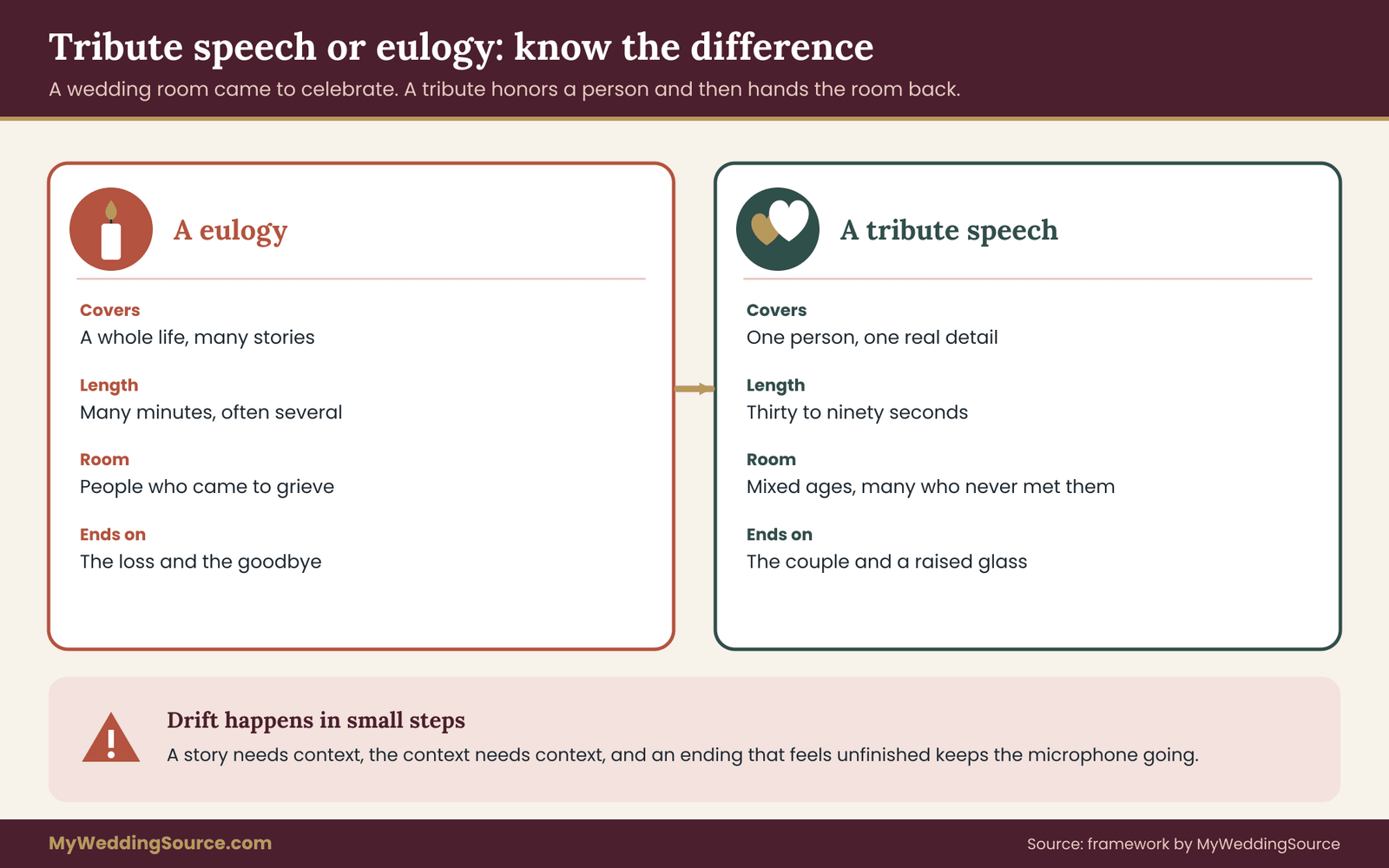
A tribute speech, as this guide uses the term, is a short passage of a wedding speech, or occasionally a brief standalone speech, that names a person who has died and connects them to the couple or to the day. It might be thirty seconds inside a father’s toast. It might be a sibling’s ninety-second remark before the cake. It is a gesture of presence, and its job is to include the absent person in the story of the day.
It is not a eulogy. A eulogy tells the story of a whole life. It is written for a room that came to grieve, and it usually carries the weight of an ending. A wedding crowd arrives with different expectations: a mix of ages, colleagues, friends of friends, children, and a few people who never met the person you are honoring. A full eulogy asks them to switch emotional gears with no warning and no exit.
It is also not a confession, a place to settle old family arguments, or a way to make a point about how a death happened. Those are real needs, but they belong elsewhere. Keeping that line clear is most of the work.
A useful test: who is this for?
Ask one question about any line in the draft: who is this line for? Some lines are for the couple, because they connect the person to the marriage. Some are for the guests, who need a small piece of context to understand the moment. Some are for the speaker, who needs to say them. The third group is the one to handle carefully.
Lines written mainly for the speaker are not wrong, but they may not belong on a microphone. If you need to say something out loud to the person you lost, that is worth doing, and a quiet minute before the ceremony or a letter tucked into a pocket can do it without asking a crowd to carry it with you. Keep on the microphone the lines that serve the couple and the room.
Where this guide fits
The planning of the ceremony itself, including who speaks and in what order, is covered in the wedding ceremony step by step guide. For wider questions about family manners and who is owed what courtesy, the wedding etiquette guide is the place to start. This article stays on one question: the wording, tone and timing of a spoken tribute, wherever it lands in the day. If you are still deciding whether to mention the person at all, or in what form, the options go well beyond a speech, and the later section on alternatives covers that decision.
Why a tribute speech drifts into a eulogy
Drift is the usual failure, and it is rarely a decision. It happens in small steps during writing and again during delivery. Understanding the steps lets you catch them.
The story that keeps growing. The speaker begins with one warm memory and adds context so the guests will understand. Then context needs context. A fishing trip becomes a story about the cabin, which becomes a story about the illness years later. Each addition is reasonable. Together they turn forty seconds into four minutes.
The ending that cannot be left. Sad endings feel unfinished if you stop early. Speakers often keep going to reach some resolution, because ending on the loss feels abrupt. The fix is to decide the closing line before you write the middle, so the speech has somewhere to land.
The emotion that outruns the plan. Even a well-written passage can overwhelm the person delivering it. A shaking voice is human and guests are generally forgiving, but an unplanned stop of thirty seconds in the middle of a toast is a very different experience from a planned pause. Later parts of this guide cover how to build in recovery points.
The microphone that quietly changes owner. Once one person mentions the loss, other guests may feel invited to add their own tributes. At an open-microphone reception, one tribute can start a run of them. That can be lovely or it can derail the evening. The couple should decide in advance whether it is welcome.
The guests who are grieving too
Remember that the room is not neutral. A guest may have lost the same person, or may have lost someone else recently. A mention that feels gentle to the speaker may land hard on someone sitting at table nine. This is not a reason to avoid the subject. It is a reason to keep it brief, avoid graphic detail and give the room a clear signal when the moment is over.
Hospice and bereavement organizations that publish plain-language guidance, such as the Hospice Foundation of America, describe grief as individual, uneven and not on a schedule. The practical lesson for a speaker is modest: do not assume that everyone, including the couple, wants the same amount of acknowledgment.
The cost of getting it wrong
A badly judged tribute speech rarely ruins a wedding. What it tends to do is change what people remember. The couple’s first dance, the toast to their future, the laughter during dinner, all of it sits slightly differently after a long heavy passage. For the family member being honored, an overlong or inaccurate tribute can feel like being used as material. Weighing those two costs is part of the planning, and the worksheet later in this guide turns that weighing into steps.
What a tribute speech can do in under a minute
Short does not mean thin. A good tribute speech has a small number of jobs, and each can be done in a sentence or two. It helps to pick the jobs on purpose, because the speech does best when it tries two of them, not five.
Name the person. Say who they were to the couple in plain words. “Elena’s mother, Rosa” tells guests everything they need. Many guests will not know the connection, and being named is half of what a tribute speech is for.
Offer one specific detail. A single concrete thing is stronger than a list of virtues. The way they hummed while cooking, the terrible puns, the habit of arriving thirty minutes early everywhere. A specific detail lets people who knew them smile and lets people who did not see them for a second.
Say what they would have loved about today. This is the bridge back to the wedding. It turns the memory into something that belongs to the event instead of something interrupting it. “She would have been the first one on the dance floor” is a bridge. A paragraph about her last year is not.
Thank the room. Guests who knew the person are carrying their own feelings, and a short acknowledgment, such as thanking everyone for being the kind of family and friends who make this room feel full, gives them credit for that.
Hand the room back. The last job is the one most often skipped. A closing line returns attention to the couple, the glass, the music or the next part of the program, and it is the speaker’s responsibility, not the guests’.
Later sections show how to combine these jobs, with a recommended length for each combination, in the boundary worksheet. For now, hold on to this idea: a tribute speech earns its place by being specific, brief and clearly finished.
Consent comes before the draft
The most common mistake in planning a tribute speech is writing first and asking later. By the time a polished paragraph exists, the speaker is attached to it, and asking for approval feels like asking for a verdict on their feelings. Reverse the order for a tribute speech. Ask first, with a clear question that is easy to answer no to.
Who needs to be asked, and in what order
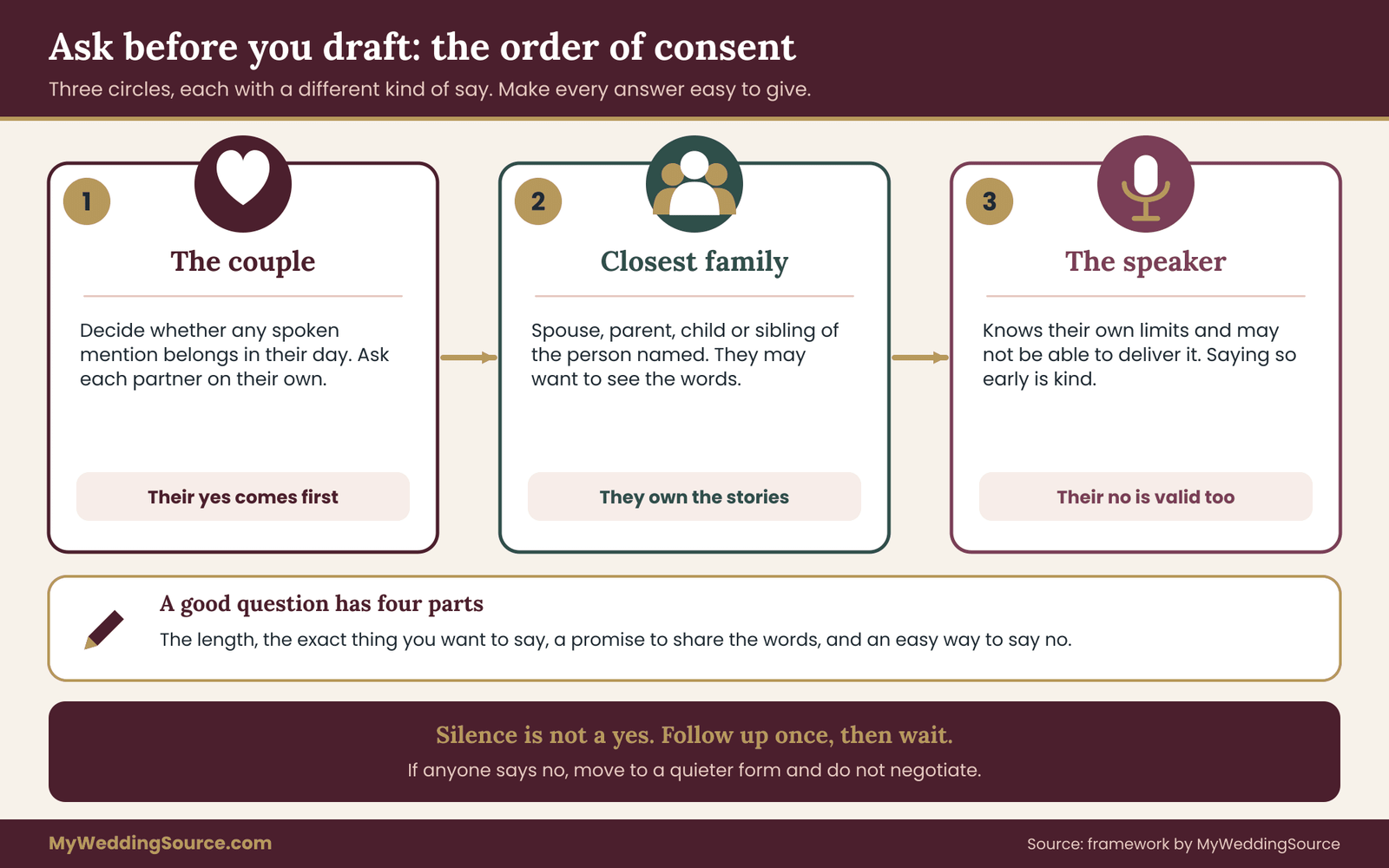
Think of three circles. Each one has a different kind of say.
The couple. It is their wedding, and they decide whether the day includes any spoken acknowledgment of a loss. Some couples want it. Some find that even a gentle mention would unsettle them before they have to walk down an aisle. Neither response is a problem to be fixed. Ask both partners separately if you can, since one may feel differently and may not want to say so in front of the other.
The guide on how couples and families can share decisions lays out how to keep final say with the couple while still hearing family input.
The closest family of the person who died. A spouse, parent, child or sibling of the person being named has the most direct claim to how that person is described. They may want to see the words in advance. They may want a certain story left out, or a certain name used. If they are also the ones who asked for the tribute, then the question changes: they probably want to know who will speak and for how long.
The speaker’s own limits. The person who will hold the microphone also gets a say, and it is the one most often ignored. A speaker who is very close to the loss may not be able to deliver it. Saying so early is a kindness to everyone.
Scripts for asking
The wording of the question matters more than people expect when a tribute speech is involved. A question that is open-ended, such as “What do you think about me saying something about your dad?”, invites a vague answer and leaves the person to guess what you mean. A better question is specific, offers a choice and includes an easy way out.
“I would like to say two or three sentences about your mom in my toast, about thirty seconds. Would you like that, would you rather I skip it, or is there another way you would like her included?”
For the couple, the script can be shorter and more private.
“Would it be welcome if I included a short line about your grandfather in my speech? I can show you the exact words first, and I will cut it if you would rather not.”
For a close relative of the person who died, add an offer to share the draft and an offer to change it.
“I would like to tell the story about the lemon cake. I will send you the exact lines this week, and if anything feels wrong, I will change it or take it out.”
Notice what these have in common. They give a length, name a concrete thing, promise a preview and make a decline easy. The person asking is carrying the work, not the person being asked.
What a no or a maybe means
If the answer is no, accept it without negotiating. The speaker can still honor the person privately, and there are other ways to include them that need no spoken word. If the answer is “maybe, let me see it,” that is a yes with a condition, and the condition is reasonable. If the answer is silence or deflection, do not read it as consent. Follow up once, gently, then wait. Many people need a few days before they can answer a question about someone they miss.
When two family members disagree
Sometimes one relative wants a spoken tribute and another thinks it would be too much. The speaker should not break the tie. Bring it to the couple, with both views stated fairly and without pressure. If the couple cannot decide, a smaller form, such as a written line in the program or a single sentence inside a toast, often satisfies both sides because it asks less of everyone. A written line costs less emotional energy than a microphone, and the listeners can choose whether to look.
Consent for the stories, not just the person
Agreement to mention someone is not the same as agreement to tell any story about them. A tribute speech that includes a private moment, a diagnosis, a family conflict or an embarrassing habit needs the same kind of check. The simplest rule: if the story involves another living person in a way they have not seen, show them. If the story involves the health or the final days of the person you are honoring, leave it out unless the closest family has specifically asked for it. Guests do not need medical detail to feel the loss.
Most families prefer the person to be remembered in health.
Three tone settings for a tribute speech
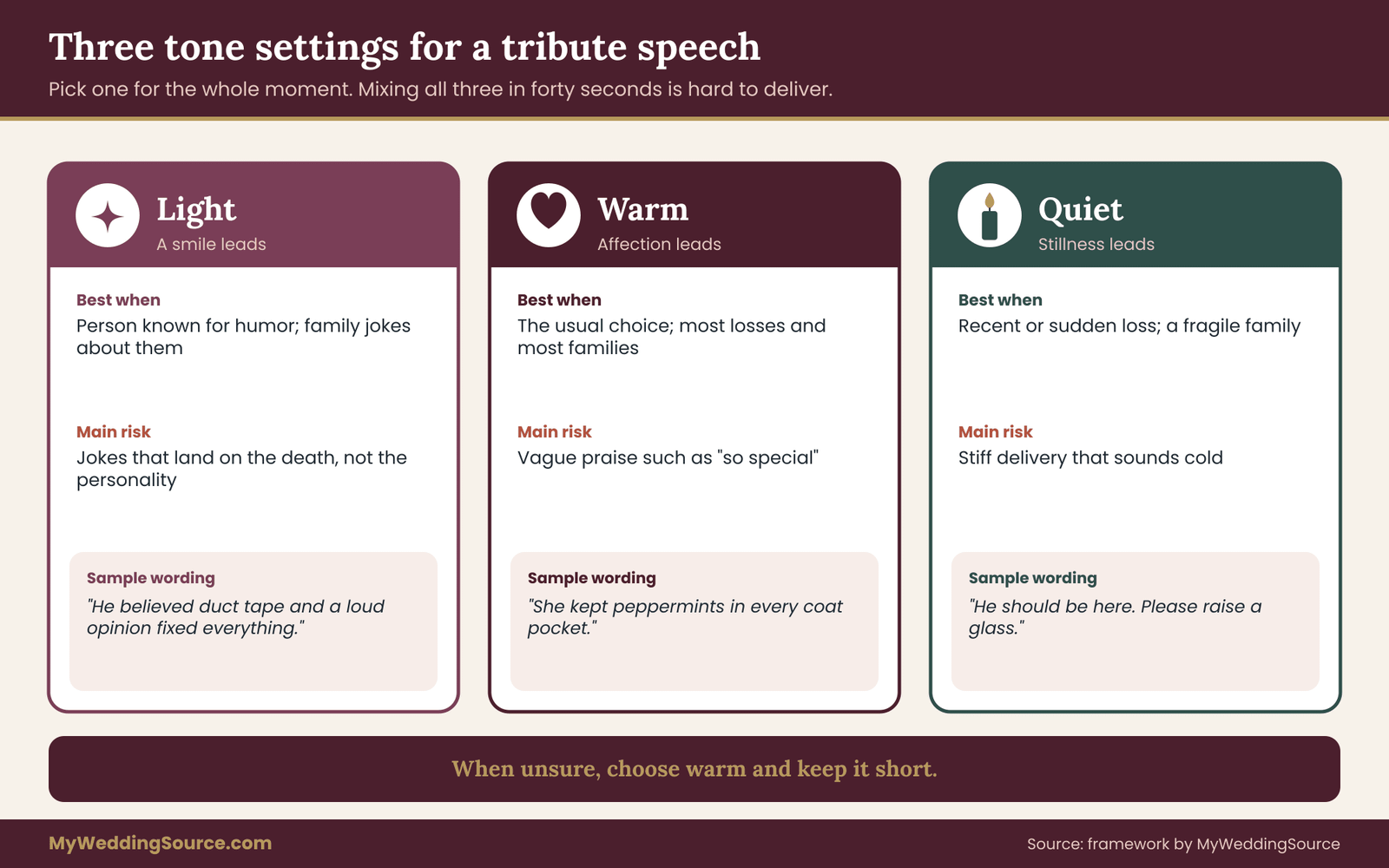
After consent comes tone, and tone is where most of the speech is made or lost. A tribute speech has a mood, and the mood should be chosen, not found by accident while writing. This guide uses three settings: light, warm and quiet. Pick one for the speech as a whole.
Light
The light setting uses a smile as its main instrument. It is built around a funny trait, a favorite saying or a shared habit, and it ends with something close to a toast. The loss is acknowledged, but the room is invited to laugh with affection.
This setting suits a person who was known for humor, a family that handles grief by joking, and a reception that is already informal. It also suits a speaker who is a natural storyteller. The risk is that humor can tip into material that mocks the person, or into jokes that hurt the people who miss them most. A good test is whether the closest relative would laugh at the line, not merely whether strangers would. Humor aimed at the person’s death rather than their personality is almost never right.
An example of the light setting, offered as sample wording only: “My grandfather believed every problem could be fixed with a roll of duct tape and a loud opinion. He would have had a lot to say about the arch behind us, and he would have been right about the level.”
Warm
The warm setting is the usual middle path. It names the person, offers a detail, expresses affection openly and moves gently toward the couple. There is room for feeling and a little humor, but neither leads.
It suits most situations, which is why it is the default recommendation for a first draft. The risk with warm is vagueness. Phrases such as “she was such a special person” are warm without being specific, and they could describe anyone. Replace each general compliment with one concrete observation. “She kept a jar of peppermints in every coat pocket” is warm and specific.
An example of the warm setting: “My mother-in-law would not be silent about how much she loved Jordan, so I will say it for her. She is in this room today, in every laugh from table four.”
Quiet
The quiet setting is plain, brief and almost without ornament. It might be a single sentence and a moment of stillness. The speaker names the person, says that they are missed and invites the room to raise a glass or pause.
It suits situations where the loss is recent, where the family is fragile, where the death was sudden or hard, or where the person’s story is too tender to decorate. It also suits couples who want acknowledgment without display. The risk is that a quiet tribute speech can feel cold if the delivery is stiff, so the speaker still needs to sound human.
An example of the quiet setting: “We want to take a moment to remember Daniel. He should be here. Please raise a glass to him, and to every person who loved him.”
Choosing among the three
Match the setting to three things: how recent the loss is, how the closest family usually talks about the person, and what the rest of the reception sounds like. A very recent loss leans toward quiet. A loss that is several years old, with family who tell funny stories about the person, leans toward light or warm. When in doubt, choose warm and keep it short.
Holding the setting
Having picked a setting, do not mix it. A speech that opens with a joke, drops into a grave memory and then tries to climb back to a toast is hard to deliver and hard to hear. If you want some of each, separate them. Put humor in the earlier part of a longer toast and keep the tribute speech in its own sentence or two, entered and exited cleanly. The same speech can hold two moods, but each needs its own boundary.
A last check on tone is to read the draft aloud and notice where your voice naturally changes pitch. If there is a spot where it drops or tightens, that is where the draft is heaviest, and you can decide whether it belongs on the microphone or on a card.
Timing: where the tribute speech belongs in the day
Once the tone is chosen, decide where the speech goes. Timing does more to control the mood than most writers expect. The same forty seconds can sit comfortably at one point in the day and feel heavy at another, because guests arrive at different moments with different energy, different drinks in hand and different expectations.
The main slots, and how each one feels
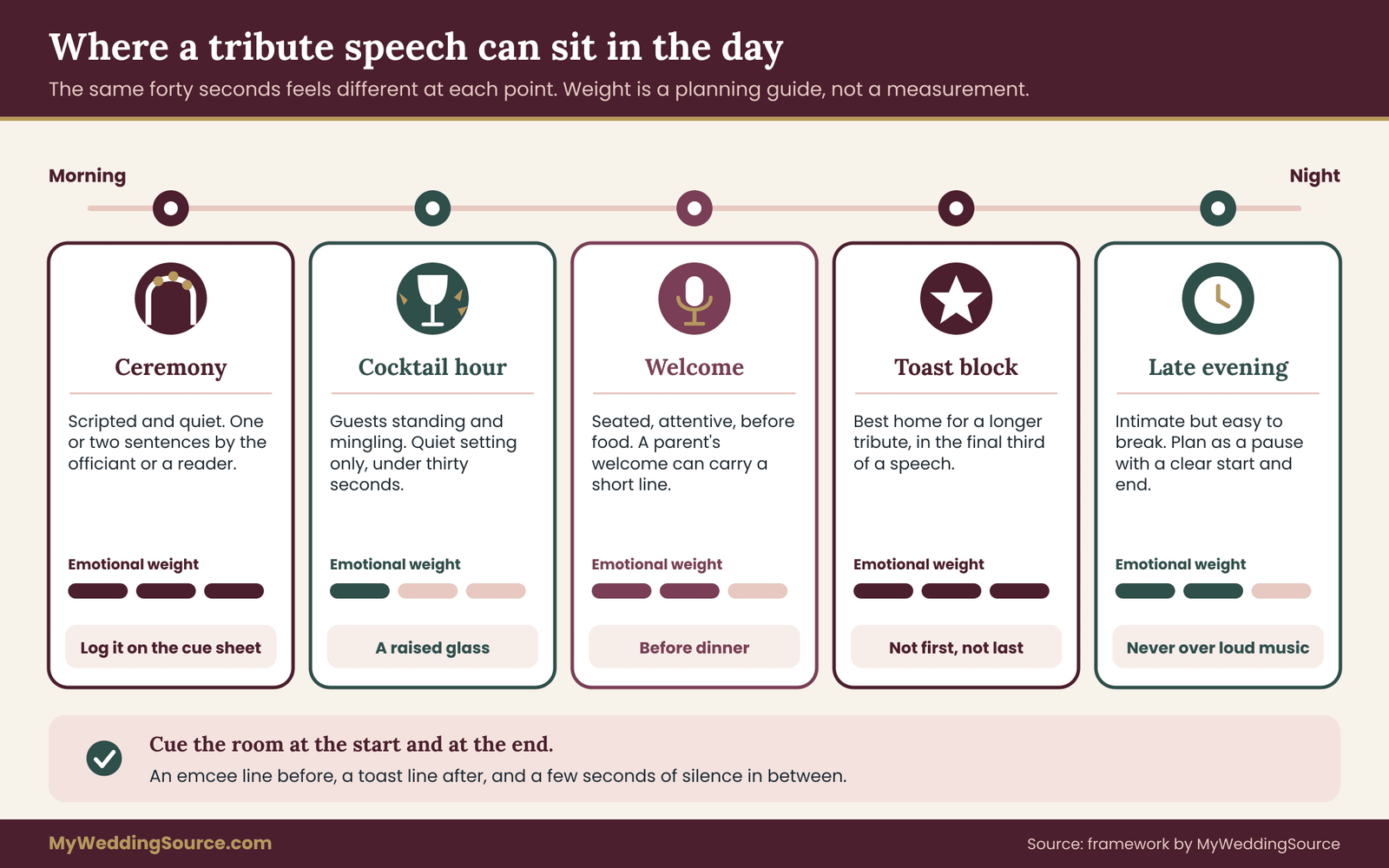
A wedding day offers about five places where a spoken tribute can land. None is universally right. Each has a mood attached.
Inside the ceremony. The ceremony is already a serious, focused space, so a brief tribute sits naturally here. The officiant or a reader can give one or two sentences, often near the opening words or after the vows. Because ceremonies are scripted and short, guests are used to a quiet register. The caution is length and ownership: the officiant and the couple should agree on it, and it should be logged on the cue sheet. The ceremony cue sheet guide explains how to record who speaks, for how long and what happens right after.
Cocktail hour or welcome moment. A short mention at the start of the reception, by a parent or the couple, can set a warm tone early. Guests are standing, mingling and not yet seated, so the moment has to be even shorter than usual. This slot is good for a quiet setting, such as a raised glass, because it asks little of anyone.
Before dinner, as part of the welcome. A welcome speech by a parent or host often includes a line about family members who are absent. The room is seated and attentive, and the meal has not yet started. The speech can be a little longer here, but the moment still comes before food and before the toasts proper, which helps keep the tribute speech from becoming the center of the evening.
During the toasts. The toast block is the most natural home for a longer tribute speech, because the room is in a listening mode and glasses are in hand. The risk is placement within the block. A tribute speech that comes first sets a heavy tone for everyone who follows, and a tribute speech that comes last may leave the room on a downbeat. A middle slot, or the tail of a longer speech by someone close to the couple, usually works better.
Later in the evening. After dinner, during the first dance, the cake cutting or the final song, a tribute speech can feel intimate. It can also feel abrupt if the room has been dancing. If the couple wants a late moment, plan it as a pause with a clear start and end, such as a song dedicated to the person, with a spoken sentence before it. Do not improvise it over a loud room.
The final-third rule
Within any single speech, the tribute speech usually belongs in the final third. Opening with the loss tells the room that this is a sad speech and then asks them to recover from it. Placing it in the middle is more balanced, but the speaker then has to climb out of it mid-speech. Placing it near the end, as the bridge to the toast, lets the speech build toward a lift. The usual pattern is a short welcome, a story about the couple, a turn to the person who is missed, then a toast.
This is a rule of thumb, not a law.
A speech by someone who is mostly there to honor a family member, such as a sibling speaking for both parents, may center on the tribute, and that is fine when it is the agreed purpose and is kept brief.
How long is too long
Length is the second boundary for any tribute speech, and it should be a number. “Short” means different things to different people, and a vague plan produces an overlong speech. A workable set of limits, offered as a planning heuristic and not a measured standard, follows.
A tribute speech inside a longer toast: thirty to sixty seconds, which is roughly eighty to one hundred fifty spoken words. A standalone tribute at the start or middle of the reception: sixty to ninety seconds. A quiet-setting moment with a raised glass: under thirty seconds. Anything longer should be treated as a different event and planned that way, perhaps with the guests informed ahead of time.
To check the number, read the draft aloud at a normal speaking pace, with a timer, and add a few seconds for any pause. People who write for the page tend to underestimate spoken time, and emotion slows delivery further. If the draft reads at fifty seconds in an empty room, expect closer to seventy in front of guests.
The ratio check
A tribute speech sitting inside a longer toast should be a small part of that toast. A rough guide: if the speech runs four minutes, the tribute speech is under a minute. If the tribute speech is more than a quarter of the speech, ask whether the speech is really a tribute speech with a toast attached, and whether the couple knows that. This ratio is again a planning aid, not a rule, but it is a useful alarm.
Reading the room: dinner service, alcohol and energy
Timing also depends on what is happening around the speech. Three practical factors affect how a tribute speech lands.
Food and service. A speech that runs while plates are being delivered competes with noise and movement, and guests will miss lines. Ask the caterer when service starts and ends, and place the tribute speech at a still point. The guide to reception guest flow shows how the evening moves between seated and standing moments, which is useful when you are choosing a still point for a tribute speech.
Alcohol. By the time toasts happen, many guests have had a drink or two. Emotion can rise faster and the room can be looser. A short, clear tribute works better than a long, delicate one at that stage. If the speech depends on subtle phrasing or a sequence of small details, place it earlier, before the bar has been open long.
Energy and age. Older guests may be tired by late evening. Children may be restless. A quiet tribute near the end of a long program may be wasted on a tired room, while the same words at the welcome could land well. If the person being honored was close to older relatives, putting the tribute speech earlier gives them a chance to be present for it.
Cueing the room
A tribute speech should not surprise the room with its start or its end. A simple cue, such as the DJ or emcee saying “Before we eat, a few words in memory of someone we miss,” tells guests to settle and gives them a small bracing moment. The same cue at the end, such as “Please join me in a toast to the couple,” signals the return to celebration.
Without cues, the room tends to react slowly. Some people keep talking, some clap too soon, some cry quietly. With cues, the response becomes calmer and more uniform. Ask the person running the program to learn the exact opening and closing lines, and to have a plan for music, such as a few seconds of silence before the next song.
Music and silence
Music can help or harm. Background music under the speech usually distracts. A short, instrumental piece before or after can help the transition, as long as it is chosen with the closest family. Silence, held for a few seconds after the last line, is often more effective than any sound. If the sound system or the DJ is part of the plan, give them the exact wording and the time they should wait before resuming the next item.
The calendar around the event
Timing also includes the days before. A draft needs time to be shared, revised and rehearsed. Working backward from the wedding date, send the first draft to the couple and closest family at least two to three weeks before, leave a week for changes, and rehearse in the final week. A tribute speech finished the night before has no time for the second thoughts that often make it better.
The tone and timing boundary worksheet
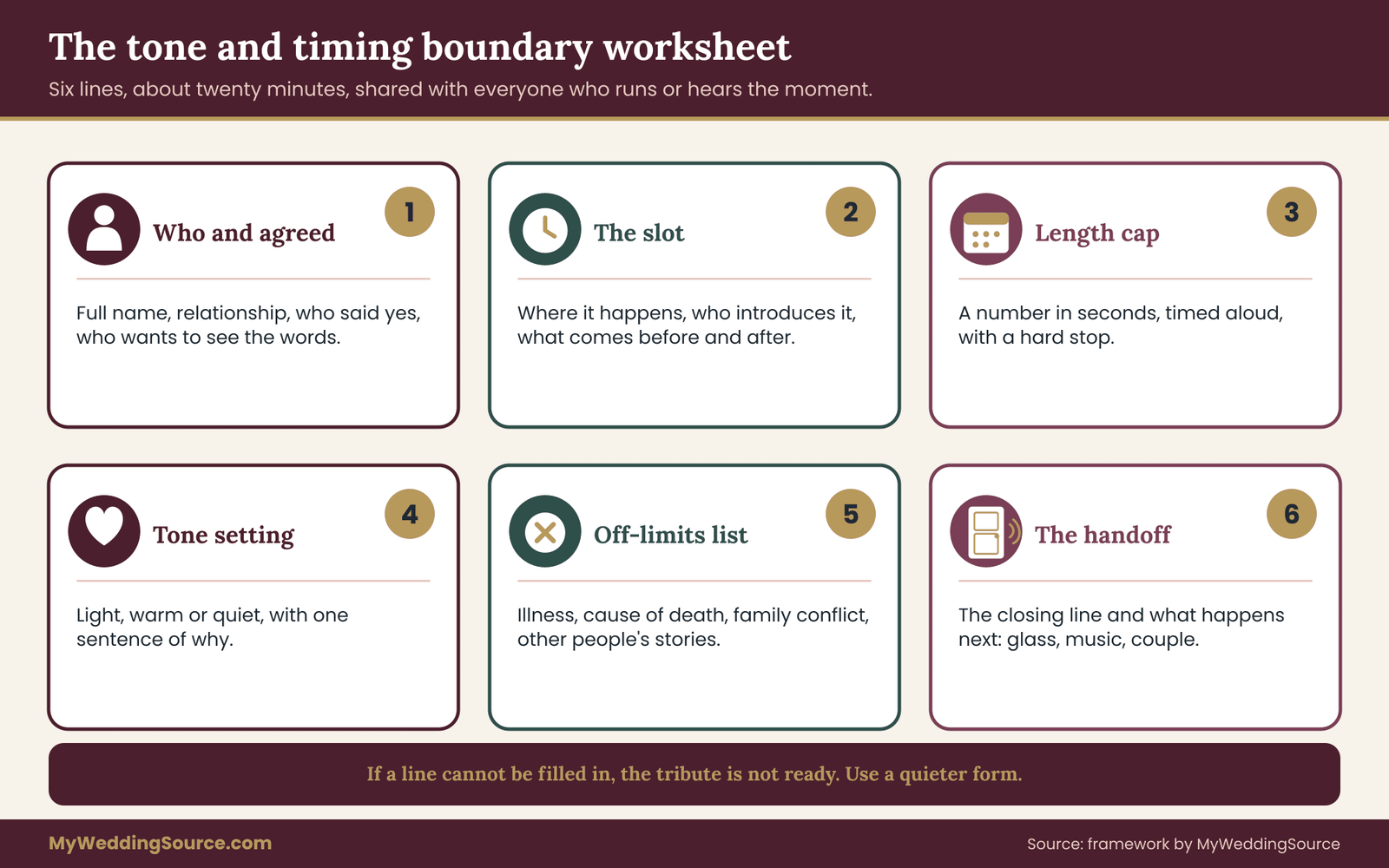
Everything so far can be gathered into one sheet with six lines. Fill it in before you write the tribute speech and share it with the couple, the closest family and whoever runs the program. It takes about twenty minutes, and it replaces many vague conversations with one clear page. Think of it as a short agreement about a tribute speech, written down.
Line one: who is named, and who has agreed
Write the full name the family would want used, the person’s relationship to the couple, and the names of the people who have said yes. Include the date each said yes and whether they asked to see the words. If anyone has said no or maybe, write that too. A line with only one name and no agreement is a warning sign, not a plan.
Line two: the slot
Write exactly where the tribute speech happens: inside the ceremony, at the welcome, in the toast block or later. Add the person who introduces it and the cue line that starts it. Include what is on either side, such as “after the salad plates are cleared, before the best man.” Context matters, because a slot that looks fine on its own can collide with the item next to it.
Line three: the length cap
Write a number in seconds. The cap should be one the speaker has timed aloud, with a margin. If the slot is a toast, write both the total length and the length of the tribute speech inside it. Add a “hard stop” instruction for the person running the program, so the cap does not depend on anyone’s willpower in the moment.
Line four: the tone setting
Write one word: light, warm or quiet. Add one sentence about why, such as “warm, because the loss is three years old and Rosa’s family tells funny stories.” If two people disagree, write both views and let the couple settle it. The point of this line is that every reader, including the speaker, can predict how the moment will sound.
Line five: the off-limits list
Write what the speech will not include. Most lists have the same few items: the cause or circumstances of the death, details of illness, any family conflict, anything that makes another living person the subject, a specific religious claim the family does not share, and comparisons that place one loved one above another. Add anything specific to the family. The off-limits list protects the speaker as much as the guests, because it gives a reason to cut a line that has become precious.
Line six: the handoff
Write the sentence that ends the speech and returns the room to the day. This is the line that does the work of closing. Examples include a toast line, a thank-you, a reference to the next event or a simple “Please join me.” Also note what happens physically: the glass is raised, the music resumes, the couple stands, or the emcee steps in.
How to use the sheet
Share it. A sheet that lives only in the speaker’s head does not protect anyone. Send it to the couple, to the closest family who said yes, and to the officiant, planner or DJ who runs the moment. Ask each reader to answer one question: “Does anything here surprise you?” Surprises found a week early are cheap. Surprises found at the microphone are expensive.
The sheet is also a decision tool. If the six lines cannot be completed, for example because no one agreed, or the slot is unclear, then the tribute speech is not ready. Waiting costs nothing, and a tribute speech that is not ready is better replaced with a quieter form.
What the sheet does not do
The worksheet does not make a speech good. It sets the edges, and the writing still has to do the rest. It also does not replace judgment on the day. If the room is tired, the schedule is behind or the family’s mood has changed, a speaker who has the sheet can make a calm cut because the cut is already described: shorter, quieter, or move to a written form. That is the real value of having it.
A worked case: one family, one speech, six lines
To see the worksheet in use, here is a worked case. It is an invented example, written for illustration, and it does not describe real people.
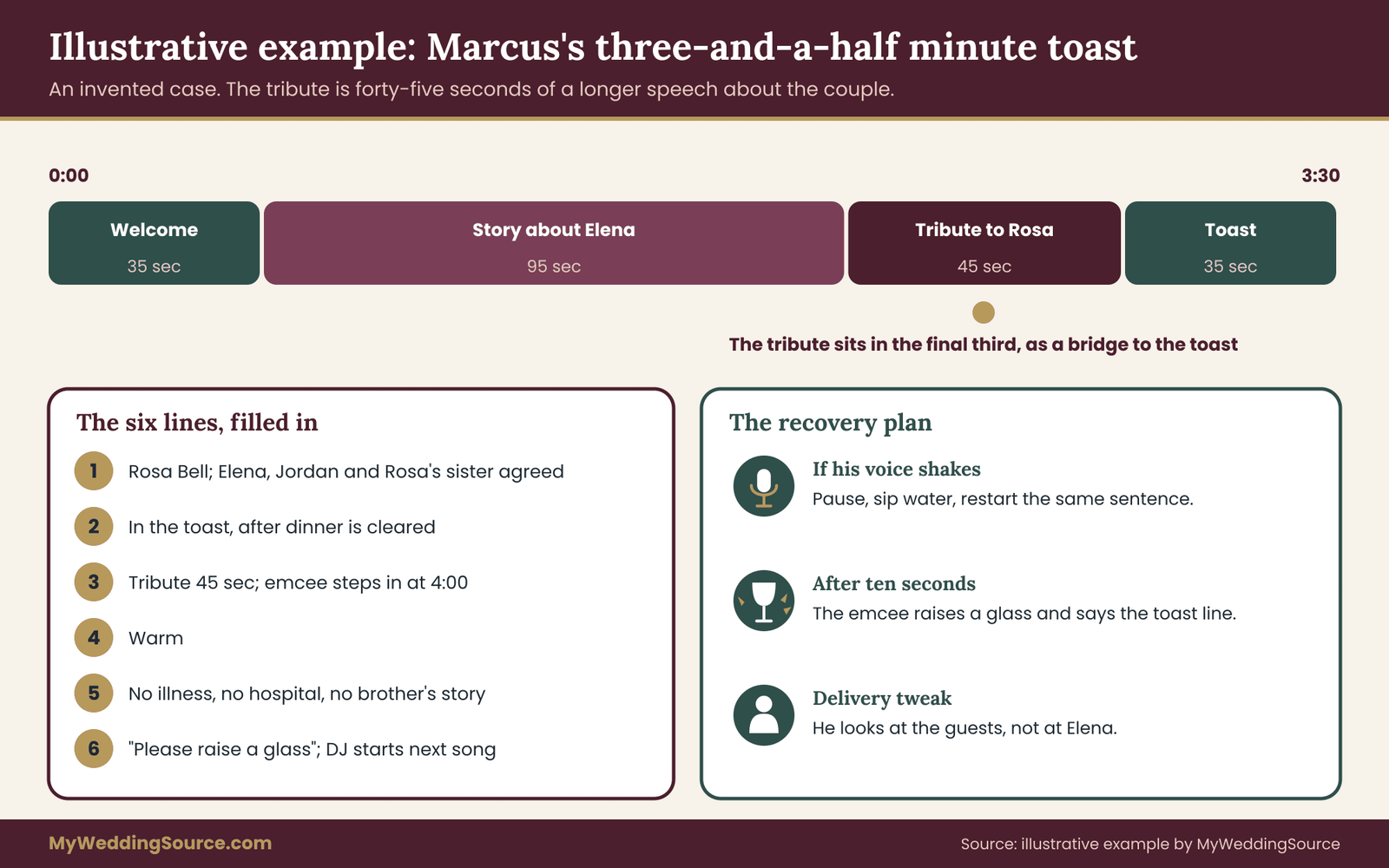
Marcus Bell is the father of the bride, Elena. Elena’s mother, Rosa, died two years before the wedding. Marcus has been asked to give a toast at the reception. He is a quiet man who has never spoken at a wedding. Elena and her fiancé, Jordan, would like Rosa mentioned, but neither wants the day to feel like a memorial. Elena’s aunt, Rosa’s sister, has said she would love to see the words in advance.
Step one: the consent conversation
Marcus asks Elena and Jordan separately. Elena says yes right away. Jordan says yes but asks that it be short, because he worries Elena will be overwhelmed. Marcus then asks Rosa’s sister, who says yes and asks to see the draft. He tells all three the length he has in mind, about forty-five seconds, and offers to cut it entirely if anyone changes their mind.
Step two: the six lines
Line one. Rosa Bell, mother of the bride. Agreed by Elena, Jordan and Rosa’s sister. Rosa’s sister will review the text.
Line two. Inside Marcus’s toast, which runs after dinner is cleared and before the cake. The emcee introduces him with a plain line, and the DJ holds music until the toast ends.
Line three. Toast total: three and a half minutes. Tribute: forty-five seconds. Hard stop: the emcee steps forward at four minutes, by prior agreement.
Line four. Warm. Rosa’s family tells funny stories about her, and the loss is two years old, but Elena has asked for something that does not tip into grief.
Line five. No mention of her illness, her last months or the hospital. No story involving Elena’s brother, who is not comfortable with it. No comparison to Marcus’s own mother.
Line six. “Please raise a glass to Elena and Jordan, and to everyone who made this day.” The glasses go up, the DJ starts the next song, and the room moves on.
Step three: the draft
Marcus uses the speech structure of a short welcome, a story about Elena, the tribute, and the toast. The tribute speech itself follows the five jobs from earlier, in compressed form. This is sample wording to show the shape, not a script to copy.
“Rosa kept a jar of peppermints in every coat she ever owned, and she handed them out like blessings. She is not here to hand one to Jordan today, so I will say what she would have said: welcome home. She would have been the first on the dance floor, and I will try to keep her spot warm.”
The tribute speech is about forty-two seconds when read aloud, with a short pause after “welcome home.” It names Rosa, gives one specific detail, says what she would have loved, and moves to the next beat. It contains no illness and no loss story.
Step four: the review
Rosa’s sister reads the draft and suggests changing “blessings” to “treats,” because Rosa would have teased the grander word. Marcus makes the change. Jordan reads it and says it is the right length. Elena asks that Marcus not look at her during the line, because she will cry, and he agrees to look at the guests instead.
Step five: the rehearsal
Marcus reads it aloud three times, once alone, once to a friend and once at the venue with the microphone on. On the third pass he finds that his voice shakes on “welcome home.” He and the emcee agree on a pause: if he stops, the emcee will say nothing, and Marcus will take a sip of water and start from the same sentence. They agree that if he cannot continue after ten seconds, the emcee will raise a glass and say the toast line for him.
What the case shows
Three things stand out. First, most of the work was asking and agreeing, not writing. Second, the off-limits list removed the lines that would have been hardest to hear, and no one missed them. Third, the recovery plan turned a private fear into a manageable moment. The speech that results is not remarkable as writing. It works because it was bounded, and because everyone who mattered had seen it first.
Alternatives when a speech is the wrong vehicle
Sometimes the worksheet shows that a spoken tribute speech is not the right form. That is a useful result, not a failure. A spoken tribute speech asks a lot of the speaker, the family and a room full of people who cannot opt out. Several quieter options keep the person present without those demands.
A line in the program. A single printed sentence, such as a name and a short phrase, lets guests acknowledge the person on their own terms. It asks no one to perform. It works well when the closest family wants recognition but not attention. The cost is small and the content can be reviewed in advance by everyone who matters.
A pause with a toast. The emcee, officiant or a parent says one sentence and invites a raised glass. No story, no detail. This is the quiet setting reduced to its smallest form, and it takes under twenty seconds. It is a good fit for a recent loss or for a family that does not want anything elaborate.
Someone else speaks. A speaker who is too close to the loss may be better replaced by a person who loved the one who died but is steadier on a microphone, such as a cousin, a family friend or the officiant. The close relative can still write or approve the words. This keeps the content personal while lowering the delivery risk.
A written note read by the emcee. The speaker writes the words, and the emcee reads them. This allows precise phrasing, exact timing and no risk of a breakdown. It can feel a little less personal, though many families prefer it to the alternative of someone being unable to continue.
A private moment. Before the ceremony, the couple and a few relatives can spend a few minutes together with a photo, a candle where the venue allows it, or a few words. It happens outside the program, asks nothing of guests and often means more to the people who needed it. Handling family sensitivities gracefully is the same skill that good etiquette asks for in any hard moment.
A later gathering. If the family needs a space for longer stories, a rehearsal dinner, a farewell brunch or a small gathering the day after gives more room and a smaller circle. A long remembrance fits better there than in a mixed reception.
Choosing among the alternatives
Use a simple filter. If the closest family wants the person named aloud, choose a spoken form, but keep it short. If they want recognition but not attention, choose print or a pause. If the speaker is not steady, choose a different speaker or a written note. If the stories are long, choose a later gathering. None of these is second best. Each is a different match between what people need and what a reception can hold.
When the answer is silence
There is one more option, and it deserves its own paragraph: not mentioning the person at all in public. Some families prefer to keep the memory private. Some couples feel that the day is for the living. Some people find that a spoken mention is more painful than absence. That choice is valid. Honor it without pressing, and do not read silence as forgetting. The person can be present in private ways that never reach the microphone.
Edge cases: more than one loss, difficult deaths and complicated relationships
Not every situation fits the neat shape of one warm person who died peacefully. Several common complications need their own handling.
More than one person to remember
If several people are missed, resist the urge to list them all in a single tribute speech. A list of names read aloud becomes a roll call, and the room tends to lose focus after the third. Two options work better. Name a small group together, such as “our grandparents,” without individual stories. Or choose one person for the spoken moment and place the others in print, with names on a program page or a memory display.
If naming only one will hurt someone, say that plainly in the planning stage. A short line such as “We are thinking of everyone who is not here” can follow the single tribute and covers the rest without further detail. Keep the family informed of the plan so no one is surprised by who was named.
A death that is hard to talk about
When the death was sudden, violent, or involved suicide, the stakes of the tribute speech rise. Guests may be carrying their own reactions. The safest approach is to focus entirely on the person’s life and leave out the way it ended. Do not hint, do not use phrases that raise the question, and do not use euphemisms that draw attention to what is being avoided. The closest family should decide whether the person is mentioned at all.
If anyone in the planning circle seems to be struggling beyond ordinary sadness, encourage them to reach out to a counselor, a doctor or a crisis service. In the United States, the 988 Suicide and Crisis Lifeline is available by call or text for anyone in distress. A speech planning conversation is not the place to manage someone’s crisis, and the person’s wellbeing matters more than the program.
Complicated relationships
Not everyone who has died was easy to love, and not every family agrees on how they should be remembered. A parent who was difficult, an estranged sibling or a relative whose absence feels more like relief than grief can all be present in a family’s mind on a wedding day. The tribute speech is not the place to resolve any of this.
If the family disagrees about whether the person should be mentioned, the usual answer is not to mention them from the microphone. If the couple wants a nod, a printed line with a neutral phrase is gentler. Avoid praise that rings false, and avoid criticism entirely. A short, accurate statement, such as “We remember Uncle Tom today,” is truthful without overreaching.
The person who is not family
Friends, mentors and former colleagues can be as important to a couple as relatives. The planning steps are the same, but the circle of consent shifts. Ask the couple first. Then ask whoever was closest to the person, which may or may not be a relative. If the family of the person who died is not involved in the wedding, think about whether naming them is respectful and whether they might want to know.
A former partner of one of the couple
If the person who died was a former spouse or partner of one of the couple, the situation needs special care. The couple should decide together and early, with kindness for the feelings of both partners and for any children. A spoken tribute speech is rarely the best form here. A private acknowledgment or a quiet line, agreed in advance, usually serves everyone better.
Children in the room
Young guests may not understand why the room has gone quiet. A parent can prepare them with a plain sentence before the toast: “We are going to say a few words about Grandma, and then we will cheer for Elena and Jordan.” Children often handle the moment better than adults expect when they know what is coming. If a child is a grandchild of the person being named, ask the parents whether the child would like to take part, for example by holding a glass, and accept a no.
When the speaker is also grieving
A speaker who is deeply grieving can write a beautiful tribute speech and still be unable to deliver it. This is a common experience, and it has nothing to do with strength. The safest plan gives the speaker an exit: a backup reader, a written version, and a shared understanding that stopping is acceptable. A speaker who knows they can stop is often the one who finishes.
Failure conditions and stop rules for a tribute speech
A plan for a tribute speech is only useful if you also know when it has failed. Decide in advance what would make you shorten, change or cancel a tribute speech. These are the conditions to watch for, in the weeks before the wedding and on the day itself.
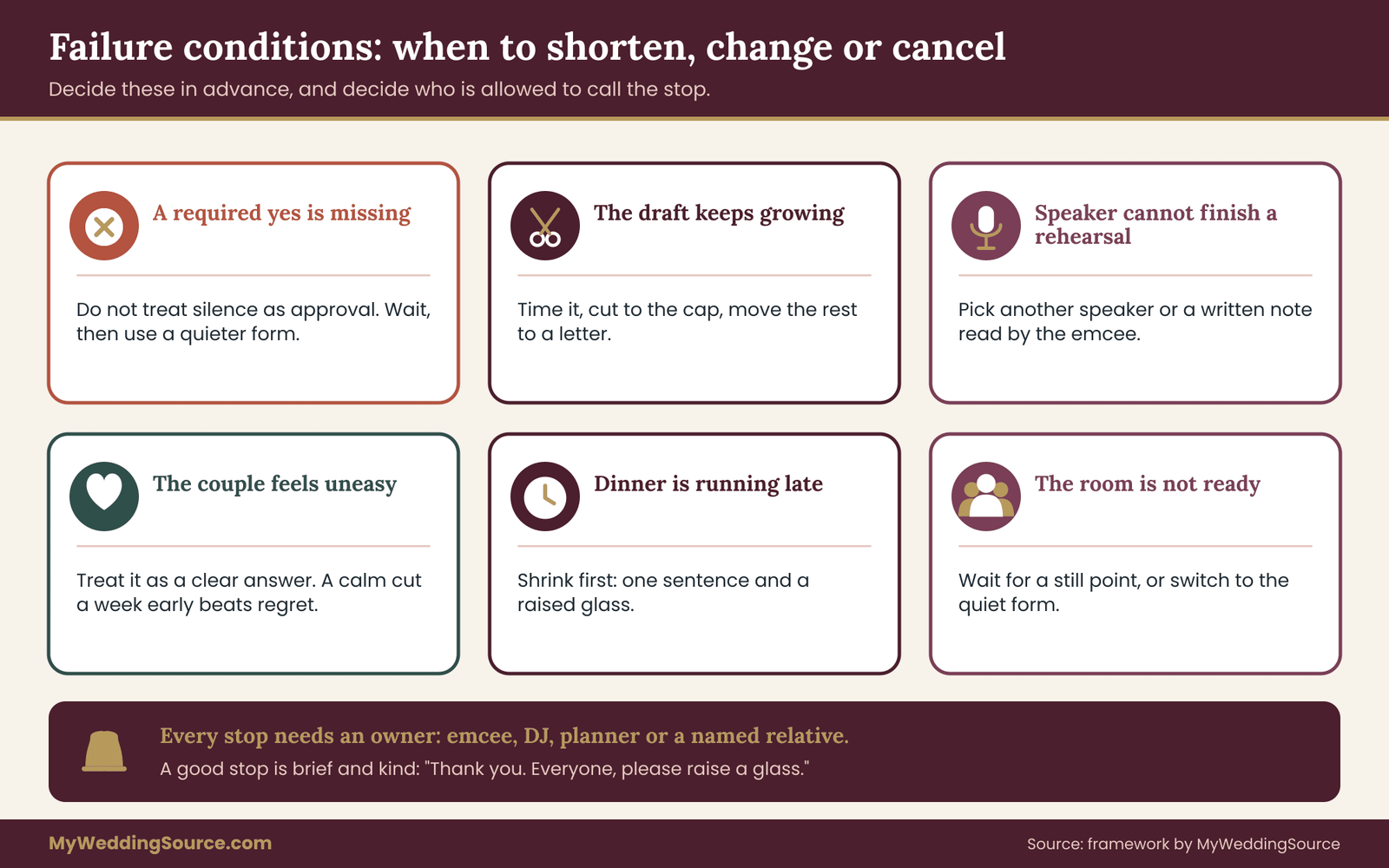
A required person has not agreed. If the couple or the closest family have not said yes, the tribute speech is not ready, no matter how good the draft is. Do not treat silence as approval. Wait, ask again once, and fall back to a quieter form if there is still no answer.
The draft keeps growing. If each revision adds lines, the speech is drifting toward a eulogy. Set the length cap, time the draft, and cut to the cap. If the cuts feel painful, that is a sign that the extra material needs another home, such as a letter or a later gathering.
The draft depends on a shared secret. A tribute speech that works only if guests know an inside story will leave much of the room confused. Either explain in one clause or drop it.
The speaker cannot get through a rehearsal. If the speaker stops, cries or cannot finish at the third read, they may still be able to deliver the speech, but only with a backup plan. If they cannot read it twice in a row without breaking, move to a different speaker, a written note read by the emcee or a pause with a toast.
The couple’s mood has changed. Emotions in the final week of a wedding run high. If either partner now says they are uneasy, treat that as a clear answer. A cut that is made calmly a week early is far better than a mention that is regretted for years.
The schedule is running late. On the day, if dinner has slipped by thirty minutes or more, the tribute speech should shrink first. A shortened form, such as the one-sentence pause with a toast, keeps the gesture without stretching the evening.
The room is not ready. If guests are loud, distracted or visibly tired, a delicate tribute speech will not land. The emcee can wait for a better moment, or shift to the quiet form. Having a person who is allowed to make that call, before the day, is more helpful than hoping the speaker will notice.
Who holds the stop
Every stop rule needs an owner. Without one, nobody moves, because interrupting a tribute speech feels disrespectful. Decide who can call it. In most receptions, the emcee, DJ, planner or a designated family member is the right person. They should know the six lines of the worksheet, the cap and the exact words they will use.
A good stop is gentle and brief. It does not criticize. It looks like a warm hand on the shoulder in audio form. For example: “Thank you, Marcus. Everyone, please raise a glass.” The speaker is given an easy way to finish, and the room is given its cue to respond.
What a stop is not
A stop rule is not an accusation. It exists because emotional moments move faster than people can track, and because the person at the microphone is rarely the best judge of timing. Tell the speaker about the rule in advance, and describe it as a shared safeguard. Most speakers find relief in it.
Rehearsal, delivery and day-of contingencies
A tribute speech is only partly a writing task. The rest is delivery, and it benefits from the same kind of preparation a musician would give a short piece.
Rehearsal in three passes
Pass one: alone, at the real pace. Read the speech aloud with a timer, as if guests were present. Note the places where the voice tightens, where you rush and where you stop. Mark them. Do not edit yet.
Pass two: to one trusted listener. Choose someone who is not too close to the loss, such as a friend or a cousin. Ask for two answers: “Where did your attention drift?” and “Was there a line that surprised you?” Edit based on both. A listener who is not heavily involved can hear the speech the way a guest will.
Pass three: with the microphone and the room. If possible, read it at the venue, with the same microphone, and from the position where the speaker will stand. Many people find that the microphone changes their voice and the empty room changes their pacing. Do this at the rehearsal or at an earlier visit.
Physical aids
Print the speech in a large font, with generous spacing and short lines, on a card or a single page. Mark the planned pauses with a slash or a blank line. Keep the card in a pocket or a hand, not on a phone, where notifications and a dimming screen add risk. Carry water. If the voice is likely to shake, a few slow breaths before stepping up are more useful than any phrase.
Planned pauses
A planned pause is the best defense against an unplanned one. Pick one or two spots where the speech can stop for a beat, such as after the person’s name and after the bridge line. Practice them. On the day, a pause that is planned looks like confidence, even when the speaker is trembling. If emotion arrives in the middle of a sentence, the speaker can drop their eyes to the card, breathe and resume from the start of the sentence, not the middle.
If the speaker stops
Agree on a signal. The simplest is that if the speaker stops for longer than about ten seconds, the emcee, officiant or a nearby family member steps in with the closing toast line. It can be as short as “To Rosa, and to Elena and Jordan.” Practice the handoff once so it feels natural. The guests will almost always react with warmth. The thing they remember is that someone took care of the moment.
If someone else speaks unexpectedly
At receptions with an open microphone, a guest may stand and add a tribute speech of their own after the planned one. The couple should decide beforehand what to do. Options include announcing that toasts are by prior arrangement, having the emcee close the toast block with a clear line, or allowing a short window for other guests. If the couple wants the open option, tell the emcee to set a time limit and a gentle cut-off. Otherwise one tribute can turn into a long chain.
If the room reacts strongly
Tears are a normal and healthy response, and a tribute speech that makes people cry is not a failure. What matters is what happens next. The emcee can leave a few seconds of silence, then resume with a warm, simple line. A short break before the next item, such as a toast to the couple or a change of music, helps the room reset. The same guest-flow thinking helps here: plan the transitions so that no one is left stranded between moods.
Sound and accessibility
A tribute speech is lost if it cannot be heard. Test the microphone at the position of the speaker. If the room is large or noisy, a handheld or a lavalier microphone is better than a stand that traps the speaker in place. For guests who are deaf or hard of hearing, ask whether the venue or the DJ can provide captions or a written copy of the words. The Americans with Disabilities Act pages at ADA.gov describe the general duties of public venues on communication access, and the venue contact can say what is available.
The sentence after
Finally, plan one sentence for the moment right after the tribute. It might be the closing toast, the signal for music, or a thank-you. Without it, the room hovers. With it, the evening resumes, and the speaker can sit down knowing they have finished.
A four-pass edit of the words
Rehearsal tells you how a tribute speech sounds. Editing decides what it says. Do the editing in four short passes, each with one question, and do them on different days if you can. A tribute speech reads differently after a night’s sleep.
Pass one: the purpose. Read the draft and underline the sentence that states what the tribute speech is for. If you cannot find one, the speech has no center yet. A good purpose sentence is plain: “to say that Rosa would have loved today, and to welcome Jordan.” Everything else should serve it.
Pass two: the detail. Circle every general compliment, such as “kind,” “generous” or “one of a kind,” and replace it with something a person could see or hear. A concrete image survives a nervous delivery better than an abstract one, because it gives the speaker something to picture.
Pass three: the cut. Remove anything on the off-limits list. Then remove the sentence you like best if it is not about the couple or the person. This is the cut that hurts, and it is usually the right one. Keep the sentence for a letter or a private moment.
Pass four: the ear. Read it aloud one last time and listen for words that are hard to say, long sentences that run out of breath and phrases that sound like a card. Shorten the sentences. Use the words you would use at a kitchen table. The best tribute speech sounds like the speaker on a good day.
Briefing the person who runs the program
Whoever introduces the tribute speech and closes the moment needs a half-page brief. It should hold the six lines of the worksheet, the exact words for the introduction and the closing, the cap and the stop signal, and a note about what music or silence follows. Give it to the emcee, DJ, planner or officiant at least a few days ahead, and talk it through for five minutes. A brief that is read for the first time at the venue is a brief that will be misread.
If the tribute speech sits inside the ceremony, the officiant should have the final wording and should know who is speaking, for how long and what comes next. The officiant requirements guide explains what officiants typically handle, so you can see which parts of the moment they can own. Remember that an officiant may have their own practices about ceremony content, and the couple should ask early.
Things to avoid in the wording
A few patterns recur in tribute speeches that did not work. Avoid saying that the person “is watching from above” or similar claims about the afterlife unless the family shares that belief and has said so. Avoid phrases that tell people how to feel, such as “do not be sad.” Avoid statements that compare the dead person with the living, such as “she would be prouder of you than anyone.” Avoid asking the couple to speak back or react. And avoid humor that depends on the person being unable to reply.
The kind of language that works is simple and observational. “She would have loved the music” is an observation. “She is dancing with us” is a belief. Observations are safe for everyone. Beliefs are a decision for the family.
Copyright and quoted words
Many tributes include a poem, a song lyric or a short passage. A short quote is usually fine in a spoken toast, but long passages may raise copyright questions if you print or record them. If you plan to print the words in a program or to include them in a video, check the source and the rules with the rights holder or the U.S. Copyright Office. A line you wrote yourself is always the safest and often the most moving.
After the speech
Once the moment has passed, take two small steps. First, thank the speaker and the people who helped, privately and promptly. A speaker who stood up and carried something heavy deserves a plain word of thanks. Second, check in with the closest family a few days later. Ask whether the tribute speech felt right and whether anything should be handled differently for any future gatherings. This is not a request for a review. It is a way of staying close to the people who felt it most.
If the speech was recorded, ask the family before sharing the recording more widely. A moment that felt right in the room can feel different on a screen, and the family may want to decide who sees it.
Your next steps
A tribute speech does not need a long planning process. It needs a short, clear one. In order:
- Ask the couple, the closest family and the speaker, using a specific question with an easy way to say no.
- Pick one tone setting, light, warm or quiet, and write down why.
- Choose the slot and the cue line, and confirm what comes before and after it.
- Set a length cap in seconds and time the draft aloud.
- Write the off-limits list and the handoff line.
- Fill in the six-line worksheet and send it to everyone who needs to see it.
- Rehearse three times, once with the microphone, and agree on a pause and a stop signal.
- Brief the person who runs the program, and prepare a quieter backup form in case the room or the schedule changes.
If any step cannot be completed, treat that as information. A quieter form, a different speaker or a later gathering is often the kinder choice. For broader context on how family sensitivities fit into the whole day, see the wedding etiquette guide, and the wedding ceremony step by step page for where a tribute speech fits in the ceremony itself.
FAQ
How long should a tribute speech be at a wedding?
For a tribute speech inside a longer toast, thirty to sixty seconds is a good range, roughly eighty to one hundred fifty spoken words. A standalone tribute can run sixty to ninety seconds. Time it aloud and add a few seconds for pauses and emotion. If it needs to run longer, the extra material probably belongs in a letter, a printed note or a later gathering.
Should I ask permission before mentioning someone who died?
Yes. Ask the couple first, then the closest family of the person being named. Use a specific question that includes the length, offers to share the words and makes it easy to decline. Silence is not a yes. If the answer is no, accept it, and look at quieter ways to include the person, such as a printed line.
Where in the reception does a tribute speech work best?
Usually in the final third of a longer toast, or at the welcome before dinner. Both come when the room is seated and attentive. Avoid the very start of the toast block, which sets a heavy tone for the speakers who follow, and avoid noisy moments such as plate service or the middle of dancing.
How do I keep a tribute speech from turning into a eulogy?
Set a length cap in seconds, choose one tone, and write an off-limits list that excludes illness, the cause of death and family conflict. Use one specific detail, one line about what the person would have loved today, and a closing line that returns to the couple. Cut any story that needs more than two sentences of background.
Can a tribute speech be funny?
Yes, if the person was funny and the closest family would laugh too. Aim humor at the person’s personality, such as habits and sayings, never at their death or illness. Keep the joke short, and follow it with something warm so the room knows it was affectionate. When unsure, test the line on a close relative before using it.
What if I cry or cannot finish?
It happens often and guests are generally understanding. Plan for it. Mark one or two pauses, practice them, and agree with the emcee or a family member that they will step in with the closing toast if you stop for about ten seconds. Knowing there is a safe exit usually makes it easier to finish.
What if the family does not agree on mentioning the person?
Bring the disagreement to the couple, with both views stated fairly. The speaker should not break the tie. A smaller form, such as a printed line or a one-sentence pause with a toast, often works for both sides. If there is still no agreement, skip the spoken mention and honor the person privately.
Is a spoken tribute required at all?
No. Many couples include no spoken tribute, and that is a valid choice. A printed name, a private moment before the ceremony or a gathering the next day can honor someone just as sincerely. The right form depends on what the family needs and what the reception can hold, and the worksheet in this guide helps you check both.
Sources
- Hospice Foundation of America: plain-language grief and bereavement information
- National Institute on Aging: resources on grief and coping with loss
- 988 Suicide and Crisis Lifeline: free, confidential support by call or text in the United States
- SAMHSA: federal mental health and substance use support resources
- National Institute of Mental Health: information on emotional health and finding help
- American Psychological Association: public information on grief and coping
- ADA.gov: U.S. Department of Justice information on communication access
- U.S. Copyright Office: guidance on quoting and reusing protected works
- National Hospice and Palliative Care Organization: information on end-of-life care and bereavement
- Centers for Disease Control and Prevention: public health information on coping with loss and stress