
A child officiant is a son or daughter who leads, or helps lead, their parents’ vow renewal ceremony: welcoming guests, introducing the vows and closing the moment. This guide shows when that works, which role fits which age, and how to test readiness before anyone is standing at the front of a room with a script.
Yes, a child can lead a parents’ renewal, because a renewal is a ceremony of meaning and not a legal marriage. Whether a child officiant should lead is a separate question. Use a six-rung role ladder, from sitting with the family up to running the whole ceremony. Let the child take the highest rung where four checks all pass: they want it, they can do it aloud, they have approved the exact words, and they can stop at any point at no cost. If one check fails, step down a rung.
The idea usually arrives as a lovely sentence at a family dinner. A daughter says she would love to marry her parents again. A teenage son offers to say a few words. Someone suggests that the oldest grandchild could “run the whole thing.” Everyone smiles, and then the couple is left with a real decision: is this a gift to the child, a gift to the parents, or a risk to both?
This article treats the child officiant as a design problem rather than a sentiment. The parents are renewing vows they already made, so the stakes are emotional, not legal. That freedom is exactly why the role needs structure. Without it, a child can be handed a job that is too big, too exposed or too heavy.
A note on scope. This is general planning information, not legal, tax or financial advice. Rules about marriage licenses, who may solemnize a marriage and what counts as a legal ceremony differ by state, so where a rule matters this guide points you to the agency that issues it.
What a child officiant is, and what the role does not include
The phrase “child officiant” covers a wide range. A seven-year-old reading one printed sentence and a twenty-eight-year-old leading a twelve-minute ceremony are both children of the couple. They are doing very different jobs, and the planning questions are different too.
In this guide, a child officiant is any child of the couple who holds the leading voice in the ceremony. The leading voice is the person who tells the room what is happening next. That can mean a full ceremony, or it can mean a narrower job such as hosting the opening and handing off to someone else.
It helps to separate four things that often get blended together when families talk about this idea.
The leading voice. Someone has to say “Welcome,” introduce the next part and signal the end. In many renewals the couple does this themselves, or a friend does. A child officiant takes this job.
The promises. The parents speak these to each other. A child officiant does not make promises on the parents’ behalf and should not be asked to approve, bless or judge them.
The symbolism. Rings, candles, a shared cup or a handwritten letter. These are objects with meaning, and the child officiant may hand them over, but handling them is not the same as leading.
The authority. In a legal wedding, the officiant’s authority matters because it makes the marriage valid. In a renewal, nobody’s authority makes anything valid. The child officiant leads by invitation, and the parents can retake the lead at any moment.
That last point is the quiet strength of the idea and also its main source of confusion. Because nothing legal rides on the role, a family can be generous and flexible. Because nothing legal rides on it, there is also no external structure to keep the child officiant role sensible. The couple has to supply that.
Why a renewal is different from a wedding
A wedding creates a legal marriage through a license, an authorized officiant and a filing. A renewal repeats promises between two people who are already married. The USAGov marriage certificate page is the place to start for how a marriage record is created and how to request a copy, and the point for this article is simple: a renewal does not replace or repeat any of that.
For the broader picture of how a ceremony is built from start to finish, the guide to wedding ceremony steps lays out the usual sequence. A renewal uses a shorter version of that sequence, and a child officiant fits into the same slots an adult officiant would fill.
Why the idea appeals to families
Families reach for a child officiant for four honest reasons, and it is worth naming them because each one points to a different role.
The first is witness. Children grew up inside this marriage, and they want their parents to know it. A short spoken sentence can do that without anyone leading anything.
The second is pride. A child who has become a confident speaker, a teacher or a student leader may want to use that skill for a milestone. That is a role question: the child has a skill and wants a stage.
The third is closeness. Some families have no friend or clergy member they want at the front. The child is the person the couple trusts most to be warm and brief.
The fourth is cost and convenience. A volunteer is free and available. That reason is real but weak, because it pushes the role toward whoever is cheapest and not toward whoever is ready.
When a child officiant is a poor fit
A child officiant is a poor fit in four situations. If the child has said yes only to please a parent, the first check has already failed. If the ceremony will carry serious emotional weight, such as a renewal after a hard period, a child may not be the right person to hold the room. If the family expects a religious rite that has its own rules about who may lead, the rite decides. And if the parents disagree about the idea, the idea waits until they agree.
None of this is a verdict against the child officiant idea. It is a reminder that the role has to be earned by readiness, not assumed from affection. The sections below turn that into a test.
Before any planning of roles, settle one question that quietly decides everything: is this ceremony a renewal only, or is it also doing something legal?
Most renewals do nothing legal. The couple is already married, the marriage is recorded, and the ceremony repeats and reaffirms promises. In that case no one needs authority to lead, no license is involved and no filing follows. A child officiant, a friend, a grandparent or the couple themselves can lead.
Some families blur this line without noticing. Here are the common ways it gets blurred.
A couple who never had a legal ceremony. Some couples live as married for years without ever signing a license. If the family wants the day to make the marriage legal, the day is a wedding, not a renewal. The rules for who may officiate and how the license is completed apply, and they vary by state. Read what a wedding officiant must meet and then ask the county office that issues licenses what applies in your location.
A couple who married abroad or in a ceremony of uncertain legal status. If anyone in the family is unsure whether the original marriage was recorded, check the record before planning the renewal. The CDC’s vital records directory lists where to write for marriage records in each state, and the USAGov page explains how to request a certified copy. A renewal is not the place to discover that a paperwork gap exists.
A couple who want a religious rite that has its own rules. Some faith traditions treat a renewal, a blessing or a recommitment as a rite that clergy lead. In that case the tradition decides who stands at the front, and the child may take a different role beside it. The guide to interfaith ceremony planning is helpful for sorting out who owns which part of a ritual.
A couple who plan to sign something. A signed keepsake is fine. A signed document that people might later treat as legally meaningful is a different object. If you want a certificate of renewal, label it clearly as a keepsake and keep it separate from the legal marriage record.
A two-question legal screen
Use these two questions, in order, before choosing any role for a child.
First: is the marriage already legally recorded, and has someone confirmed it? If yes, go on. If no or unsure, stop and confirm it.
Second: is the ceremony intended to do anything legal today, such as completing a license or changing a status? If no, a child officiant is legally possible, and the remaining questions are about readiness. If yes, treat the day as a wedding and follow the officiant rules for your state.
This screen takes five minutes. It prevents the one problem that cannot be fixed with a script change on the day.
What “legally possible” does and does not tell you
When a lawyer or clerk says a renewal has no legal requirements for the person who leads it, that is a statement about validity. It says nothing about wisdom. A seven-year-old can legally lead a renewal in the same sense that anyone can lead a toast. Whether it is a good idea belongs to the readiness checks in later sections.
It is also worth saying plainly what this guide cannot decide for you. It cannot tell you what your state, county or faith community requires for any ceremony that has legal or religious force. Ask the issuing office or the faith leader, and write down the answer with the date you asked.
The six-rung ladder of roles, from sitting with the family to leading
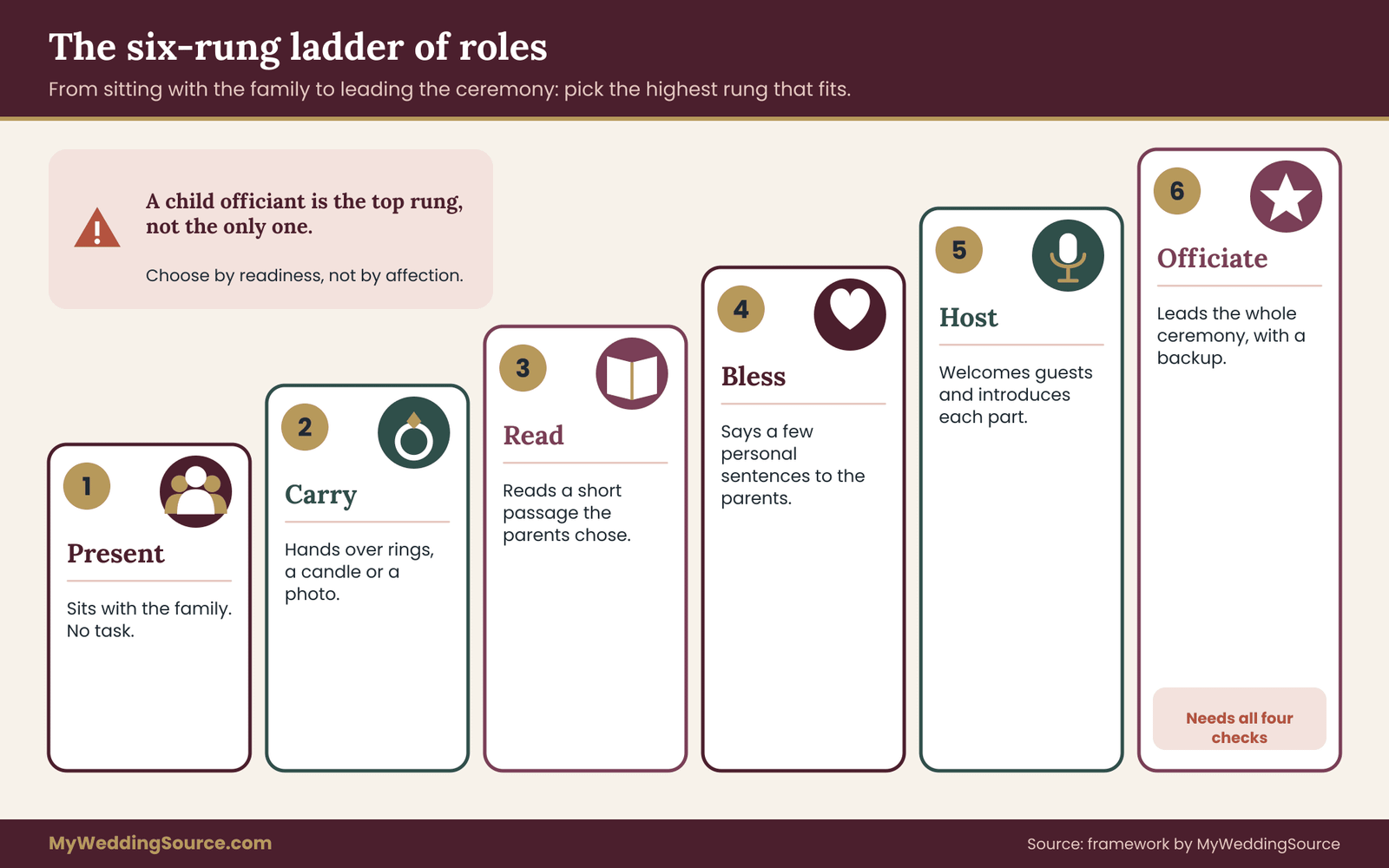
The most useful move in this whole decision is to stop treating “child officiant” as yes or no. It is the top rung of a ladder, and the rungs below it are real roles that many children will enjoy more.
Here are the six rungs, from lightest to heaviest.
Rung one: present. The child sits with the family, is named in the program or the welcome, and has no task. This rung is underrated. For some children, being seen as part of the story is plenty.
Rung two: carry. The child carries or hands over an object: the rings, a photo, a candle, a bouquet, a framed copy of the original invitation. The job is physical and quick, with no words.
Rung three: read. The child reads a short passage the parents chose, or a few lines the child wrote and the parents approved. The words are small, and they are over in under a minute.
Rung four: bless. The child speaks a few sentences of their own to their parents, in front of guests. This rung is more exposed than it looks, because the words are personal and the audience is listening to the parent’s reaction as much as to the child.
Rung five: host. The child welcomes everyone, introduces the next part and hands off to the parents or to another speaker. The child controls the flow but does not hold the ceremony’s emotional center.
Rung six: officiate. The child leads the entire ceremony: opening, story, invitation to the vows, symbol and close. This is the full child officiant role.
Why the middle rungs matter most
Families often picture only rung one and rung six, the silent child and the child in charge. The rungs in the middle give the family better options.
A child who does not want to lead can still read. A child who wants to lead can start by hosting. A shy teenager might carry rings and say nothing, and an eager nine-year-old might read a single sentence with total pride. Each of these is a real contribution, and none of them is a consolation prize.
The ladder also gives a graceful way to change the plan. If a child agrees to host and then feels nervous in rehearsal, moving down one rung is a small edit. If the only roles were “officiant” and “guest,” the same nervousness would feel like a failure.
How the rungs map to a ceremony
A renewal ceremony usually has five short parts: welcome, story, exchange of promises, symbol and close. A child officiant at rung six would lead all five. A host at rung five would lead the welcome and the close and hand the middle to the parents or a story-teller. A reader at rung three might own only the story part, and a carrier at rung two would own only the symbol.
When you plan roles for several children, spread them across parts instead of stacking them. Three children can each own one part of the ceremony without anyone needing to be in charge of everything. The guide to ceremony cue sheets shows how to write down who does what and when, and the same sheet works for a family renewal.
The rung is a ceiling, not a target
A common mistake is to treat the highest possible rung as the goal. The correct way to use the ladder is the opposite. Each child gets the highest rung at which they are genuinely comfortable, and “comfortable” is tested, not assumed. The next section describes the test.
It is also fine for two children to hold different rungs. An older sibling officiating while a younger sibling carries a candle is a natural arrangement. The only thing to avoid is a pattern where the rung is assigned by birth order or gender rather than by the checks, because children notice that quickly.
One child or several
Some families have a single child, and the question is simple. Many have several, and the question gets political. If one child officiates, the others will read that as a ranking, whether or not anyone intended one.
There are three common ways to handle this. The first is rotation by part: each child leads one part of the ceremony, so leadership is shared. The second is a lead and a support: one child officiates, and the others have named roles that are described to guests as equally important. The third is a different structure altogether, such as a family circle in which everyone speaks one sentence and an adult friend holds the frame.
None of these is the right answer for every family. The right test is whether every child can describe their own role without comparing it to a sibling’s. If a child’s first reaction to the plan is “why does she get to do that,” the plan needs another pass.
Four readiness checks for a child officiant
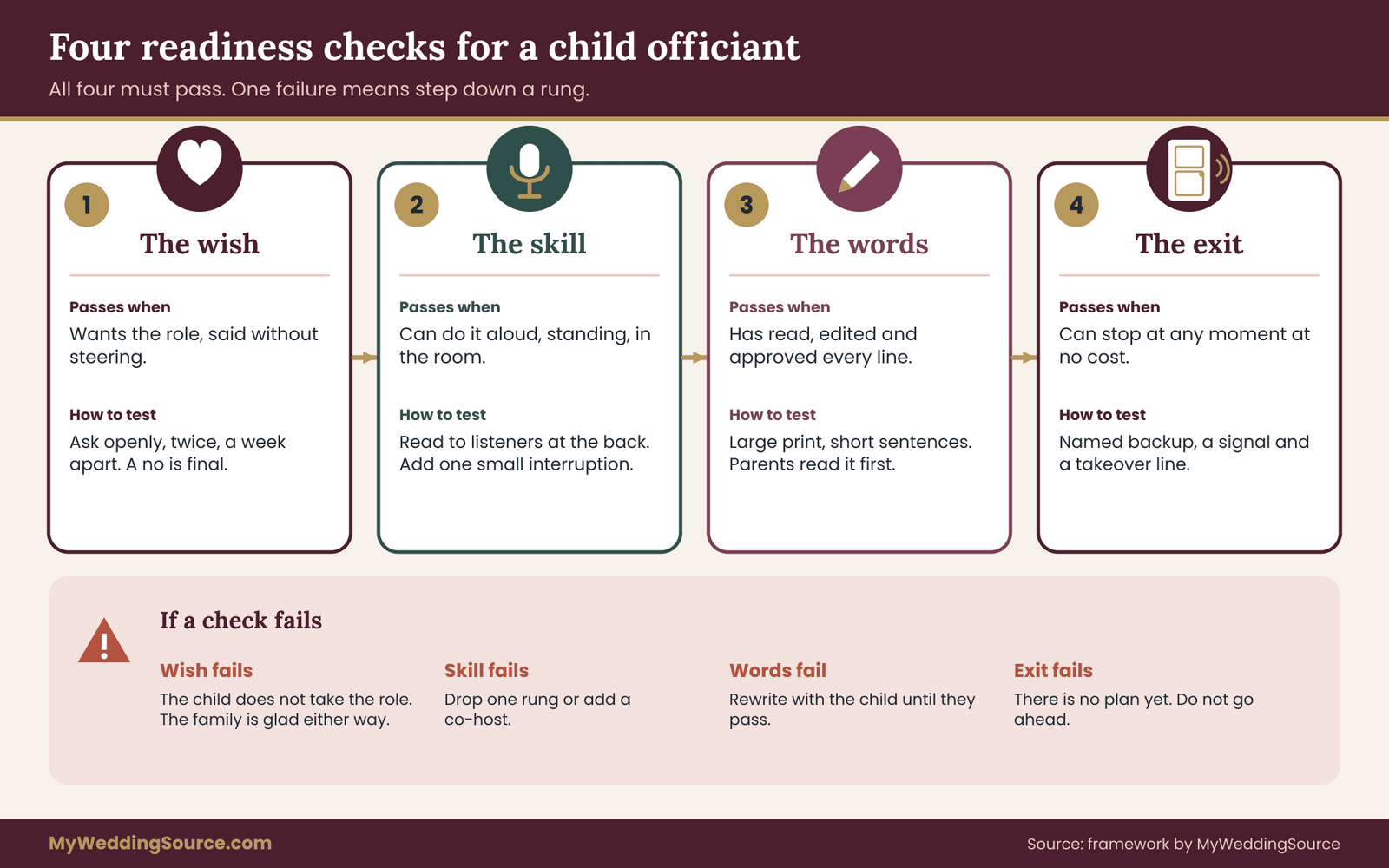
Readiness is not the same as willingness, and it is not the same as age. A child officiant who is ready has usually been tested on four separate things, not one. A confident nine-year-old can be more ready than an anxious twenty-year-old. Instead of guessing from age, run four checks. A child officiant passes only if all four pass.
Check one: the wish. Does the child want this role, and have they said so without being steered? The test is a private conversation in which the question is open: what would you like to do at the ceremony, including nothing? If the child lists the role unprompted, the check passes. If the child says yes after a long pause, or looks at a parent first, the check has not passed.
Check two: the skill. Can the child do the job aloud, standing up, in front of a group they know? This is practical. Ask them to read the script once in the actual room or a similar space. Do they speak loudly enough to be heard at the back? Can they find their place on the page after a pause? Can they keep going if someone coughs?
Check three: the words. Has the child read, edited and approved every word they will say? A child officiant should never learn a line on the day. A line the child would not say to a friend, or that they find embarrassing, should be changed or removed. The script belongs to the child as much as to the parents.
Check four: the exit. Can the child stop at any moment without cost? There must be a named adult, a signal and a plan. If the child freezes, cries or simply wants to sit down, someone steps in smoothly, and no one reacts as if anything went wrong.
How to run the wish check
The wish check is the one most often skipped, so it deserves detail. Parents tend to ask in a way that pushes toward yes: “Wouldn’t it be wonderful if you led our ceremony?” That is a request disguised as a question.
A neutral version sounds like this: “We are planning our renewal. There are some small jobs and one bigger one, which is leading the ceremony. You can pick any of them, or none, and we will be glad either way. Take a few days.” Then actually wait, and actually be glad.
Ask each child separately. A child will often give a different answer when a sibling is not present. Ask once more a week later, because a first yes can fade, and a first no can become a yes once the child has had time to picture it.
If a child says no, treat it as final unless the child reopens it. Do not trade it for another favor, and do not mention it again in front of guests.
How to run the skill check
Skill is mostly about voice, pacing and recovery, and none of those require talent. Run a simple trial at home or in the venue.
Have the child read the opening and one passage aloud, standing, to two or three people seated across a room. Ask the listeners to say only what they could hear and understand. Then ask the child to read it again, slower. Most first readings are too fast, and the second is usually the right pace.
Next, create one small interruption on purpose. Drop a book, or have someone walk in. See what the child does. A child who pauses and continues passes. A child who stops and looks to a parent may need a rung down, or a cue card system, or a co-host.
How to run the words check
Print the script in a large, plain font, with short paragraphs and a line space between sentences. Let the child cross out and rewrite anything. This is not politeness; it is risk control. A child who owns the words will remember them better, and a child who wrote the words will not be surprised by them.
If the script includes anything about the parents’ marriage, such as a story, a memory or a joke, the parents read it first. The child’s job is to speak, not to guess what the parents are comfortable having said in public.
How to run the exit check
Choose the exit before it is needed. A good exit has three parts. A named adult stands within a few steps, usually the other parent’s sibling or a close friend, who knows the script. A signal, such as the child touching the page twice or looking at that adult, means “please take over.” And a line is pre-agreed for the adult to say, such as “Let me take it from here,” so the shift sounds routine.
Say out loud, in rehearsal, that using the exit is fine and expected. The goal is for the child to feel that the exit exists so that they never need to use it.
What to do when one check fails
A failed check does not end the idea. It tells you which rung to drop to.
If the wish fails, the child does not take the role, and the family honors that. If the skill fails, drop one rung or add a co-host. If the words fail, rewrite until they pass. If the exit fails, you do not have a plan yet, and the ceremony does not go ahead with that child in the leading role until you do.
Because the checks are separate, you can also tell a child exactly why a rung is being suggested. “You can absolutely host. For the whole ceremony we would want one more rehearsal in the room” is a very different message from “we don’t think you can do it.”
Age bands for a child officiant: starting points, not rules
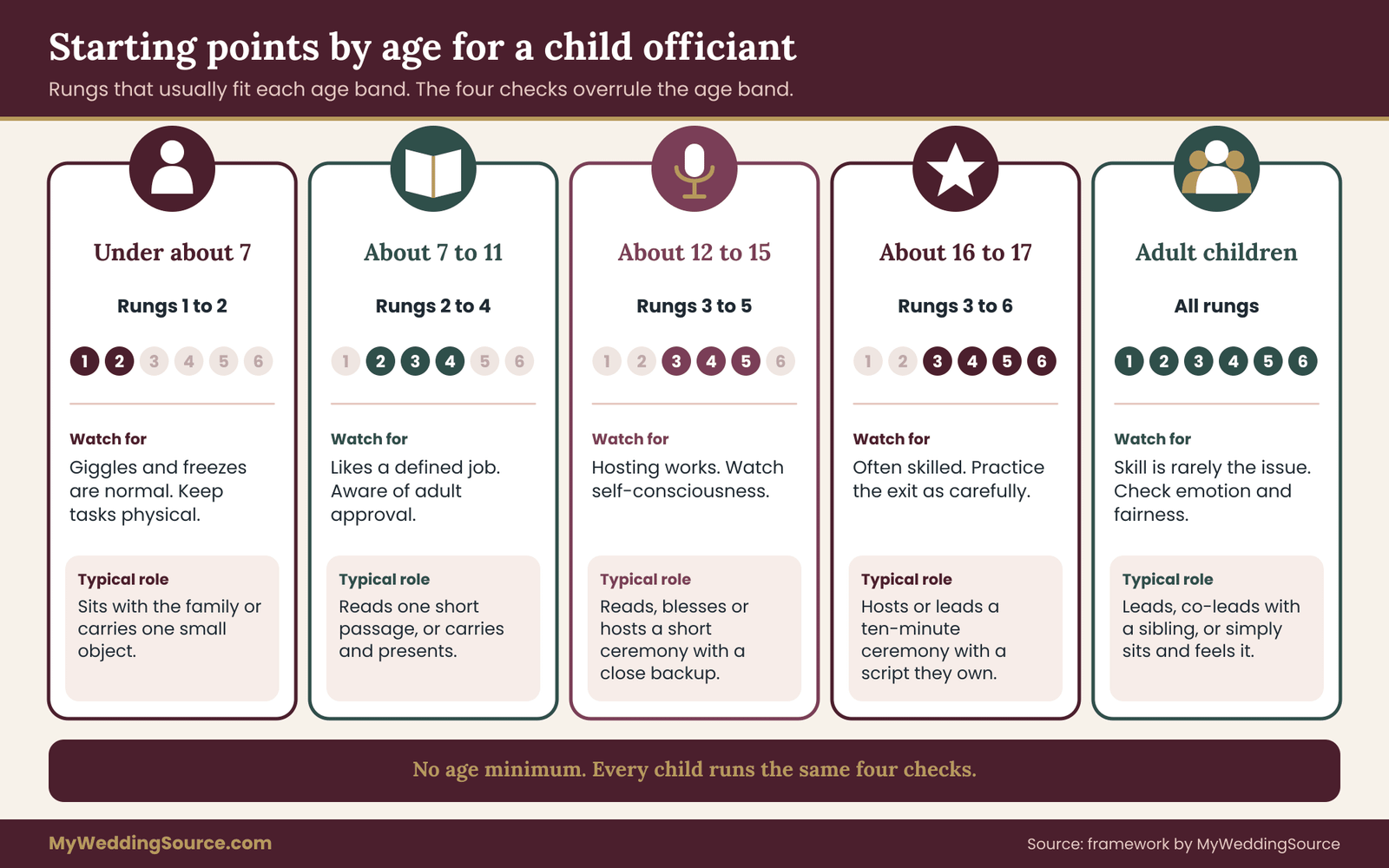
Age does not decide readiness, but it does help you set a first guess for the ladder. The bands below are starting points drawn from ordinary experience with children and speaking. They are not developmental findings, and any individual child can sit above or below them. The four checks overrule the age band every time.
For general information on how children develop and what to expect at different ages, the American Academy of Pediatrics’ parenting site, HealthyChildren.org, is a trustworthy place to read further.
Under about seven. Rungs one and two. Young children can sit with the family, carry something small or stand beside a parent for a photo. Spoken lines are possible but fragile: a child this age may forget, freeze or giggle, and all of those are charming and fine. A child officiant at this age is not realistic, and trying to make it work usually turns the ceremony into a performance about the child.
About seven to eleven. Rungs two and three, and rung four with care. Many children in this range can read a short passage clearly if they have practiced. They enjoy a defined job. They are also very aware of audiences and of adult approval, so make the job small and the praise genuine. Rung five, hosting, is possible for a confident child in a short ceremony with an adult standing close by.
About twelve to fifteen. Rungs three to five. This is the age band where hosting works well and where self-consciousness can be at its peak. A thirteen-year-old may want to lead and may also be mortified by being looked at. The wish check matters most here, and so does privacy about rehearsals. A child officiant in this band can succeed in a short, simple ceremony with a co-lead or a close adult backup.
About sixteen to seventeen. Rungs three to six. Many sixteen-year-olds can lead a ten-minute ceremony if they have a script they trust and a person nearby. The risk for a teenage child officiant is not skill but emotion: a teenager may be more moved than they expected, and the exit plan should be practiced as thoroughly as for any younger child.
Adult children. All rungs, with a different set of cautions covered in the next section.
Why not just set an age minimum
Some families want a clean rule, such as “no one under sixteen leads.” The trouble is that a rule substitutes for a test. It would block a ready twelve-year-old and permit an unready seventeen-year-old. A better rule is a process: every child runs the same four checks, and the ladder placement follows the result.
If the family does want a rule, use one that protects children rather than one that ranks them. For example: “No child leads a part of the ceremony without a written script and a named backup.” That rule applies equally to a nine-year-old reader and a nineteen-year-old officiant.
Special cases that change the age bands
Several circumstances move a child up or down regardless of age.
Disability or a communication difference. A child who communicates in a different way, such as signing, a device or a short prepared phrase, can fill any rung with the right adjustments. The role should be designed around how the child communicates, and the child should help design it. The ADA information site from the U.S. Department of Justice explains obligations that apply to public venues and services; for a private family event the practical point is simply to ask the child and the family what would help.
Anxiety about speaking. A child who finds speaking hard is not disqualified. Often a rung that avoids speaking, such as carrying and presenting, is a better fit, and it is a real role. If the child wants to speak, a pre-recorded reading played during the ceremony is a legitimate alternative.
Strong emotions about the marriage. Children of a couple who separated and reunited, children who lived through a hard stretch of the marriage or children who are still processing a loss may have complicated feelings. A role that asks them to perform warmth in public can be heavy. The wish check should be especially open, and a lower rung is often kinder.
Stepchildren and blended families. A stepchild may or may not want a spotlight in a parent’s marriage. The guide to wedding guest care for babies, children and older relatives covers practical care for the youngest and oldest guests, and the same attention to who is comfortable and who is not applies to the children in the family itself.
Cultural and faith expectations. In some families, who speaks at a ceremony follows age, gender or position by tradition. Ask the elders involved what they expect before offering a role, so that a child is not caught between a family custom and a plan.
When the child officiant is also the main host
Occasionally a child also hosts the party afterward. This pairing is common in small gatherings, and it makes sense when the adult child is the family’s natural organizer. The risk is exhaustion. A person who leads the ceremony, manages vendors and greets guests has no room to feel the moment themselves. If a child officiant is also hosting, hand the practical jobs to someone else for the ceremony hour.
When the child officiant is an adult: the different questions
Many people who ask this question have grown children, not young ones. A parents’ renewal for a thirtieth anniversary may be led by a daughter in her thirties or a son in his forties. The readiness checks still apply, but the risks are different.
For an adult child officiant, skill is rarely the issue. The questions that matter are about family dynamics, emotional load and fairness.
Emotional load. An adult child leading a ceremony for parents they love will often be moved, and may be asked to hold the room while moved. That can be a beautiful thing, and it can also be too much. Ask whether they want to be leading or whether they want to be present. Some adult children say yes to the role and wish later that they had been allowed to simply sit and feel it.
Sibling fairness. In adult families, old patterns return quickly. The sibling who is always asked, the one who is rarely asked, the one who lives far away: each reads the plan against decades of history. Before assigning the leading role, talk with the other adult children, or at least tell them early and warmly, so that the news does not arrive as a decision made without them.
In-laws and partners. Spouses and partners of the adult children have their own place in the ceremony and may have opinions about it. A child officiant’s partner may be asked to help with practical work, and the partner should be asked, not assumed.
Competence and control. An adult child who has run events may take over the ceremony in ways the parents did not intend. The script should still belong to the parents. The child officiant’s task is to deliver the couple’s ceremony, not to improve it.
The adult child’s own checks
Adult children should run the same four checks, adjusted for their situation. The wish check is whether they want to lead or feel obligated. The skill check is whether they are comfortable speaking at length, not whether they can speak at all. The words check is whether the parents have read and approved the script, including any stories about the parents’ history. The exit check is whether another adult, such as an uncle, a friend or a sibling, can step in.
The exit check feels unnecessary for a competent adult, and it is easy to skip. Do not skip it. People who lead calmly for ten minutes can still lose their voice at the one sentence that matters.
A short list of adult-specific pitfalls
A few problems appear often enough to name.
An adult child sometimes tells stories about the parents that the parents have never told in public. A private story about a hard year, a health scare or a past argument does not belong in a public ceremony without the parents’ explicit approval.
An adult child sometimes uses the ceremony to say things to a sibling, a step-relative or a parent that should be said privately. The remedy is a script that is read in advance by both parents.
An adult child may feel pressure to be the “responsible one” again. The best protection is to say plainly, ahead of time, that the role is a gift and that the child can decline it for any reason.
Co-officiating as a middle path
When one adult child is willing and others are hesitant, co-officiating can work well. Two siblings can alternate parts, or one can lead and one can read. The shared structure removes the sense of ranking and halves the load. The principle is the same as with any shared ceremony: write down who speaks when, and rehearse the handoffs until they feel dull.
Who decides: the couple’s veto and the family’s input
A vow renewal belongs to the two people renewing. The children matter enormously to the day, but they are guests of honor and contributors, not owners. That distinction keeps the child officiant idea healthy.
Start with the couple, because the idea often arrives from outside them. A grandparent, an aunt or an enthusiastic sibling may propose the child officiant plan, and the couple feels cornered into saying yes. Before any child is asked, the two partners should talk privately and answer three questions.
Do both of us want a child to lead, or only one of us? Are we comfortable with the particular child, and with what that child might say? And if the plan goes badly, can we both laugh about it afterward?
If the answers differ between partners, the plan does not proceed. A renewal is the wrong ceremony in which to outvote a spouse. The broader guide to how couples and families can share wedding decisions describes decision rights in more detail, and the same logic applies: input is welcome, and the veto belongs to the couple.
A simple decision rule for the couple
Use this rule. A child officiant is approved when both partners say yes without reservation, the child has passed all four readiness checks, and a named adult has agreed to serve as backup. Any one of these three missing means the plan is not yet approved.
The rule is deliberately plain. It makes it easy to say “not yet” without anyone feeling rejected, because the reason is a missing step, not a judgment of the child.
How to say no kindly
Sometimes the couple, after thinking, decides they do not want a child officiant. The conversation with the child is the hard part, especially if the child volunteered.
Be specific and warm. For example: “We have thought about it, and we want to keep the leading part simple. We would love you to read the passage in the middle, because your voice is the one we want in that moment.” The refusal comes with a real alternative and a reason that is about the ceremony, not about the child’s ability.
Avoid vague reassurance, such as “maybe next time.” A renewal rarely has a next time, and a child who hears “maybe” may spend months hoping.
What other family members get to say
Grandparents, aunts, uncles and siblings often have opinions. A few principles keep that manageable.
Listen, and do not promise. “That is a lovely idea, we will think about it” is honest and closes nothing.
Do not let a relative speak to a child on the couple’s behalf. A child who hears “your mother wants you to do this” from an aunt will answer a different question from the one the parents are asking.
Keep the ceremony plan in one place, a one-page outline that the couple controls, so that versions do not multiply. If a relative wants a role, offer one from the ladder, and let the couple decide.
Photographs, recording and sharing
A child officiant will be on camera, and photographs of the ceremony may be shared by guests and relatives. Children have a stake in how images of them are used. The guide to wedding photography consent covers how to set boundaries for guests and for image use, and it applies to a family renewal too.
Practical steps: tell the child ahead of time who will photograph or record, ask whether they are comfortable with images being posted publicly, and agree on what the family will and will not share. A child who is nervous may be much more at ease knowing that the recording is private.
Writing the script a child officiant can actually say
The script is where a child officiant plan succeeds or quietly fails. A script that suits a polished adult officiant will tie a child’s tongue. A script designed for a child’s voice, attention and comfort can be moving for exactly that reason.
Principles for a child-friendly script
Use short sentences. Aim for sentences a child could say in one breath, with a clear subject and verb. Long, nested sentences invite stumbles.
Use words the child uses. If a word is one the child would never say at the dinner table, replace it. “Cherish” can stay if the child uses it. If not, “love” or “look after” is better.
Put the hardest line in the middle, not the start. Opening lines carry nerves. A familiar, easy first sentence lets the child settle.
Keep each part short. For a child officiant, a welcome of three or four sentences is enough. A child officiant who talks for many minutes is not doing the parents a favor.
Leave room to breathe. Mark pauses on the page with a line space or a slash, so the child knows where to stop and look up.
A five-part structure for a child officiant
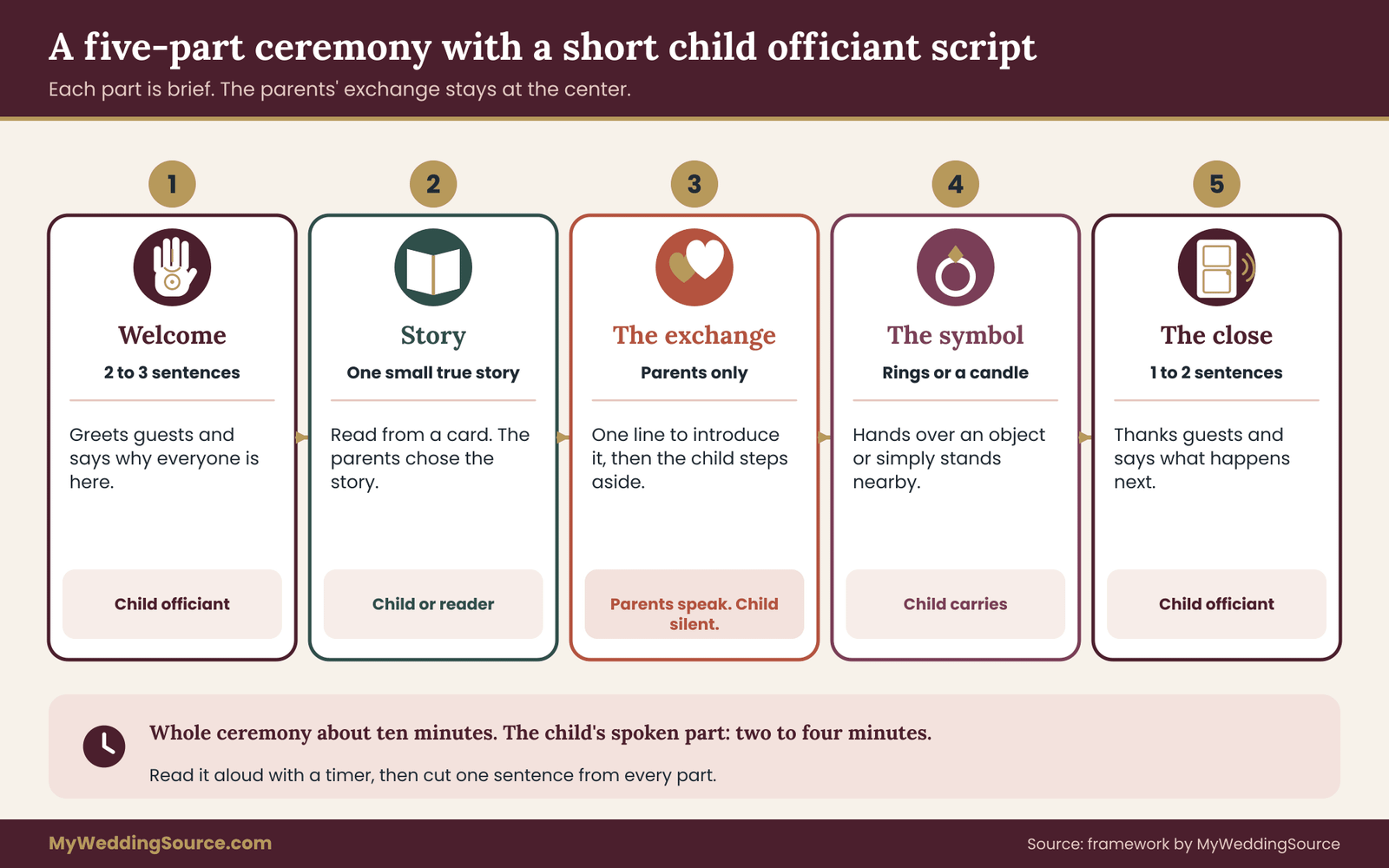
A short renewal can follow five parts. The following outline shows what each part holds and who might speak.
Welcome. Greet the guests, say why everyone is here and thank them. This is a good rung-five job. It can be as short as three sentences.
Story. Tell one small, true story about the marriage, chosen by the parents. This part is easier for a child to read than to invent. One story is plenty.
The exchange. The parents speak to each other. The child officiant introduces this part with a single line, steps aside and does not speak again until it ends. This is the most important part for the child to leave alone.
The symbol. Rings, a candle or a shared drink. The child may hand over an object or simply stand nearby.
The close. Thank everyone and say what happens next. A line such as “Please join us outside” is enough.
Sample wording a family can adapt
These lines are examples to adapt in your own words, not a script to copy. They are written to be said by a young or teenage child, and a child should edit them freely.
For the welcome: “Thank you for coming. My parents have been married for a long time, and today they are going to say their promises again. We are glad you are here.”
For introducing the exchange: “Now my mom and dad will tell each other what they promise.”
For the close: “Thank you for being part of this. There is lunch outside, and my parents would like to see everyone.”
Notice what these lines avoid. They do not ask the child to describe the parents’ love, to evaluate the marriage or to speak for the family. They describe what is happening.
What a child officiant should not be asked to say
A few kinds of lines put too much on a child.
Statements about the parents’ feelings that the child cannot know, such as “My parents have never been happier.” If a child said it aloud and it were not true, it would be an unfair thing to carry.
Promises on behalf of the family, such as “We promise to always support you.” A child should not be asked to make commitments to their parents in front of a crowd. The simpler rule is enough: the adults promise, and the child receives.
Jokes about the parents’ hardships, arguments or finances, unless the parents have approved the exact joke.
References to the parents’ physical affection or private life. A child officiant should not have to be the one to say anything about it.
How long should the child officiant’s part be
Shorter than you expect. A renewal can be complete in about ten minutes, and a child officiant’s spoken part inside that is usually two to four minutes at most. When in doubt, cut.
Read the script aloud with a timer, at the pace the child would actually use. Cut one sentence from every part. Then read it again. Most scripts improve with the second cut.
Rehearsal, cue cards and a backup plan for the child officiant
Children do not need long rehearsals. They need two or three short, calm ones in the right place. The aim is familiarity, not performance, and the child should leave each rehearsal feeling more relaxed than when they arrived.
Three short rehearsals
The table read. A week or more before the day, the child and one parent sit down with the script and read it through. Nothing is staged. The child marks any word that feels awkward. This session is mostly about the words check.
The room rehearsal. In the venue, or in a space of similar size, the child stands where they will stand and reads the script to a few people seated at the back. The goal is volume and pace. If the venue is outdoors, rehearse outdoors, because wind and open air change how a voice carries.
The walk-through. Within a day or two of the ceremony, the whole family walks through the order: who stands where, who hands what to whom, when the child steps back. Keep it under twenty minutes. If a younger child is restless, shorten it.
Resist the urge to hold more rehearsals when a child officiant seems nervous. Extra practice can raise the pressure. A better response is to lower the rung, add a cue card or add a co-host.
Cue cards that help and do not distract
A single printed page is often enough, but a child officiant who is nervous may do better with a few cards, each holding one part. Use large type, short lines and a bold first word for each part, so the child can find their place after a pause.
Number the cards in the corner. A dropped stack is a common small disaster, and numbering turns it into a thirty-second fix.
Put the next action at the bottom of each card, in a different style: “Then step back.” This removes the question “what do I do now,” which is where many small stumbles begin.
If a child prefers not to use paper, a short phrase on the back of the hand or a small card in a pocket can work, but practice with whatever they choose.
The backup adult
Every child officiant needs a backup, and the backup needs a job description.
Choose someone calm, close to the family and comfortable speaking, because the child officiant will look to them first. A relative, a close friend or a trusted vendor such as a photographer who knows the order can work, but family or friend is better, because the backup will be standing near the child.
Give the backup a copy of the script and the cue sheet, and ask them to read it twice. Agree on the signal, the takeover line and where they will stand. A position a few steps behind and to the side usually works, within the child’s line of sight.
The backup’s real work is to be unremarkable. If the child finishes the ceremony without needing help, the backup has nothing to do, and that is the best outcome.
What the takeover sounds like
A takeover should be smooth enough that a guest who did not know the plan would read it as part of the ceremony. A few examples of takeover lines:
“Thank you, Maya. Let me take it from here.”
“That was lovely. Let’s continue together.”
“Thank you for getting us started. Now, a moment for Mom and Dad.”
The child can then sit down or step to the side. Whoever is standing near should offer a hand or a smile, not a pat on the head. Treat the exit as ordinary, and the child will too.
Planning for the weather, the venue and the sound
A child officiant is easily thrown by conditions an adult can handle. Think through three things.
Sound. If the venue is large, noisy or outdoors, ask whether a microphone is available, and let the child practice with it. A handheld microphone can be tricky for small hands, and a clip-on or a stand may be easier. Ask the venue what they provide.
Position. A child standing on grass in dress shoes, or on a step with no railing, has a bigger problem than nerves. Check footing, shade and sun in the child’s eyes.
Weather. If rain or heat forces a change, the child officiant should hear about it from a parent early, not discover it on arrival. A moved ceremony is more likely to rattle the person at the front than anyone else.
The morning of the ceremony
Keep it plain. The child eats, sleeps and dresses without extra attention. A parent or backup runs through the first lines once, if the child wants it, and not otherwise.
Do not ask the child “Are you nervous?” That tends to create nerves. Ask instead, “Do you want to run the first part once, or is it good?” and accept either answer.
Remind the child, in a sentence, that the exit is there and nobody will mind. Then leave it alone.
A worked case: the Hargrove family (an invented example)
The following case is invented to show the ladder and the checks in use. The family and the details are not real, and nothing here is drawn from an actual household.
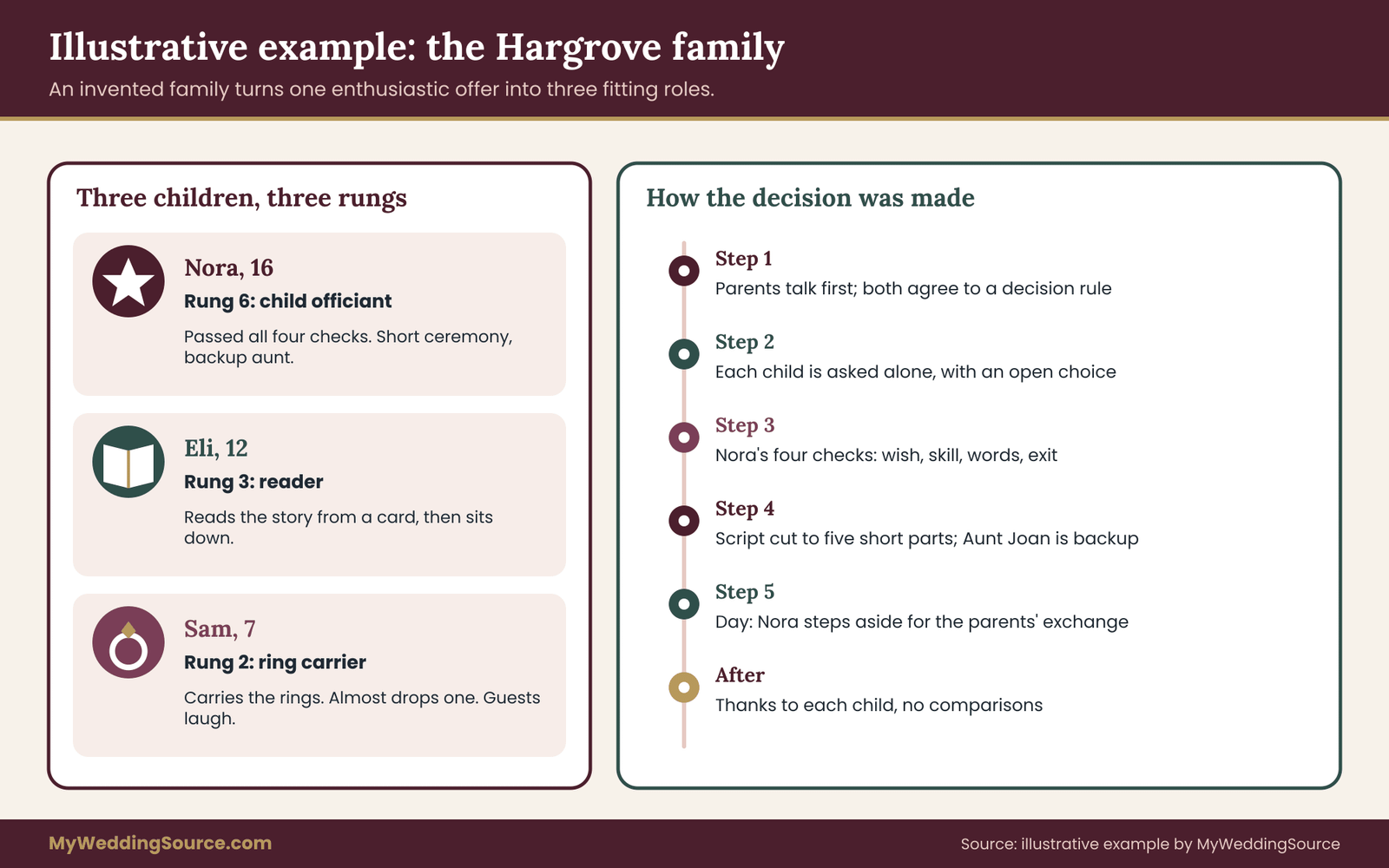
Maureen and Dale Hargrove are planning a renewal for their wedding anniversary. They have three children: Nora, who is sixteen, Eli, who is twelve, and Sam, who is seven. The ceremony will take place in a relative’s garden with about thirty guests, and the couple expect it to last around ten minutes.
At a family dinner, Nora says she would love to officiate. Maureen is delighted. Dale is quiet. Both partners agree to talk privately before saying anything further.
Step one: the couple talks
Maureen and Dale discuss the three couple-level questions. Maureen wants Nora to officiate. Dale likes the idea in principle but worries Nora will be nervous in front of his side of the family, whom she has not met often. They agree on a decision rule: the plan goes ahead only if Nora passes the four checks and an adult backup is chosen. Dale says he feels better knowing there is a test.
Step two: each child is asked separately
Maureen and Dale ask each child privately, using the neutral wording. Nora says she wants to lead. Eli says he would like to read something but not stand in front for long, and he asks what he can read. Sam asks if he can carry the rings, and then asks what rings are for.
Nothing is promised. Each child is told they will hear back after the couple finalizes the order.
Step three: the four checks for Nora
Wish: Nora has said yes unprompted, and when asked a week later she still wants it. Pass.
Skill: In the garden, Nora reads the opening to three relatives seated at the back. She is quiet and fast at first. On the second try she slows down and is easily heard. When a relative drops a glass, Nora pauses, smiles and continues. Pass.
Words: Nora edits the script, replacing “cherish” with “look after” and cutting a joke about her father’s cooking that Dale prefers to keep out of the ceremony. Both parents read and approve the final version. Pass.
Exit: Dale’s sister Joan, who is calm and knows the order, agrees to be the backup. She will stand two steps behind Nora to the left. The signal is a glance and a touch of the page. The takeover line is “Thank you, Nora, let me continue.” Pass.
Step four: the ladder placement
Nora is placed at rung six, with one adjustment. Because she has not led before, the ceremony is kept to five parts of about two minutes each, and Eli is given the “story” part, which is a short passage he reads from a card. Sam carries the rings to his parents during the symbol part.
Nobody is at rung five or six except Nora. Each child can say what their role is in a sentence, and each says it without comparing it to a sibling’s.
Step five: what happens on the day
On the day, Nora opens the ceremony and reads the first lines slowly. During the story part she hands off to Eli, who reads his passage and sits down with visible relief. Nora introduces the exchange of promises with one sentence, steps aside and does not speak while her parents talk to each other.
During the symbol part, Sam carries the rings, almost drops one, and the guests laugh warmly. Nora delivers the close with a thank-you and an invitation to lunch. Joan never uses the takeover line.
What the case shows
The case is deliberately ordinary. Nothing dramatic happens, and that is the point of a good child officiant plan. The checks did not stop Nora from officiating. They shaped how she did it: a short ceremony, a shared structure, a backup and a script she owned.
Had Nora failed the wish check, the family would have moved her to hosting or reading and been just as glad. Had Dale remained uneasy, the plan would not have gone ahead. In both cases the same process would have produced a good decision.
Failure conditions for a child officiant, and what to do about each
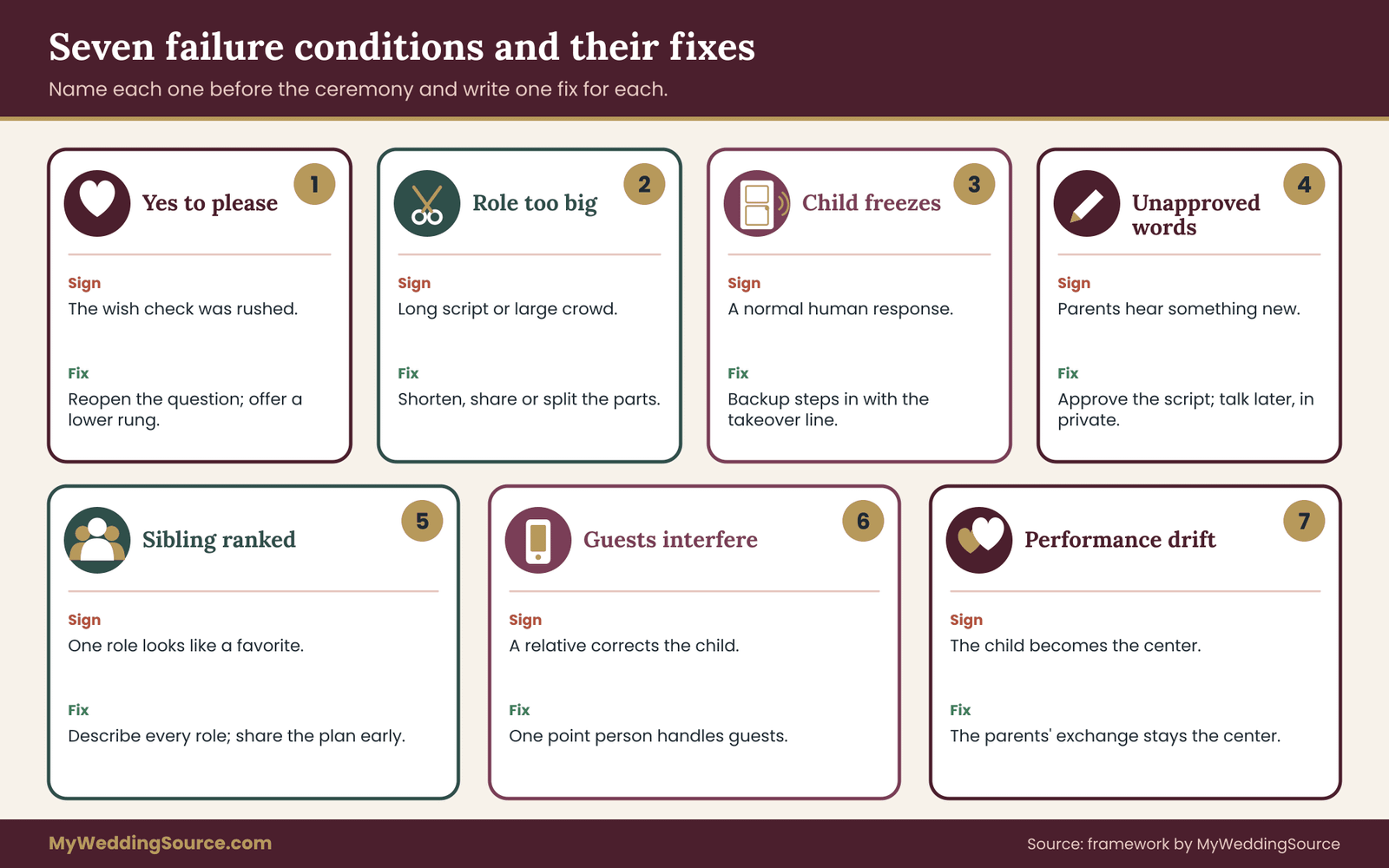
Plans fail in predictable ways. Naming the failure ahead of time and writing one fix for each is the most useful thing a family can do. Here are seven that come up with a child officiant, with a response for each.
The child said yes to please. The wish check was skipped or rushed. Signs: the child agrees quickly, avoids the subject afterward or becomes irritable around rehearsals. The fix is to reopen the question with no pressure and offer a lower rung. A child who steps down in the planning phase has lost nothing. A child who freezes at the front has lost something.
The role is too big for the child. The ceremony is long, the script is dense or the audience is large. The fix for an overloaded child officiant is to shorten, share or split. Cut the child’s part, give the story to another reader or make the child a host and not an officiant.
The child freezes or cries. This is not a failure of the child. It is a normal human response, and the exit plan exists for it. The backup steps in with the takeover line, someone offers the child a seat and the ceremony continues. Do not make a speech about it, and do not offer public reassurance that draws attention.
The parents are uncomfortable with what is said. A child improvises, tells a story that was not approved or says something the parents find awkward. The fix is prevention: the script is read and approved, and the child knows that anything not on the page stays off the microphone. If it happens anyway, the parents respond warmly and move on, and any conversation happens later and in private.
A sibling feels excluded or ranked. The assignment looks like favoritism. The fix is a described role for every child, a plan shared early, and an honest conversation with anyone who is hurt. If a child declines the officiant role and later regrets it, a small additional moment, such as a toast at the meal, can help.
Guests or relatives interfere. A relative speaks over the child, corrects the script or tells the child how to do it. The fix is a clear point person, usually the backup, who handles guests. The couple should also tell close relatives the plan in advance so they are not surprised.
The ceremony drifts into a performance. The child officiant becomes the center, and the parents are in the background of their own renewal. The fix is a rule: the parents’ exchange is the center, and every other part leads toward it and away from it. If the child’s part is growing, cut it back.
A short pre-ceremony test
The day before, ask each of these questions aloud. Does the child still want to do this? Does the child have the final script? Does the backup know the signal and the takeover line? Do the parents know what is on the page? Does every other child know what their role is?
If any answer is no, fix that one thing. If more than one answer is no, move the child down a rung. This is not drama; it is how careful event planners decide.
Four short scenarios and the decision each one points to
Cases help more than rules, so here are four brief, invented situations and the way the ladder and the checks handle them.
The eager nine-year-old. A girl announces she will be the child officiant and has already written a speech. The wish check passes loudly. The skill check needs a room trial, because enthusiasm is not the same as projection. The words check is the interesting one: the speech is long and describes how her parents feel. The family keeps her enthusiasm and trims the speech to a welcome and a single line before the exchange. She lands on rung five with a close adult beside her, which is a good result for a child officiant of that age.
The reluctant teenager. A fifteen-year-old boy was volunteered by a grandparent. He has not said yes. The wish check fails before anything else is tested, so the family does not go further. His parents tell him privately that he has no role unless he wants one. A week later he asks to carry the rings. That is rung two, and it is a perfectly good outcome. Nobody ever needed a child officiant from him.
The adult daughter who lives far away. She would love to lead but can only arrive the night before. The skill and wish checks pass easily. The exit check is the weak spot, because the backup has not met her and there is no time for a rehearsal. The family sends the script a month early, schedules a video call to read it through and arranges a ten-minute walk-through the evening before. The child officiant plan works because the gaps were named.
The two siblings who both want the role. One is twenty-two and one is nineteen, and each assumes the other will step aside. Their parents resist choosing. They split the ceremony: one leads the welcome and the story, the other leads the symbol and the close, and the parents’ exchange sits between them with no one speaking. Each child officiant has a clear part, and neither has the whole.
Each of these cases ended well because the family treated the child officiant role as a series of decisions, not a single yes or no.
When to cancel the child officiant role
Occasionally, the right decision is to withdraw the role close to the day. That happens when a child is unwell, when family circumstances change, when the child’s feelings change or when a parent has a change of heart. It is better to cancel kindly than to push through.
Say it plainly and early: “We have decided to ask Uncle Ray to lead the ceremony, and we would love you to read the passage in the middle. We want you to enjoy the day, not worry about it.” Make sure the child hears this from a parent, not a relative, and make sure it is not framed as a verdict.
What to do afterward
After the ceremony, thank the child personally and specifically. Mention one thing they did that the parents noticed, such as the slow reading or the way they handled the dropped ring. Avoid ranking performances, comparing siblings or retelling the one awkward moment for laughs unless the child joins in.
If the day went badly for the child, say less about it and spend time with them. A hard moment in a family ceremony tends to pass quickly if no one keeps returning to it.
Alternatives to a child officiant that keep children central
If the checks show that a child officiant is not the right choice, or if the family decides against it, there are many ways to keep children central without placing them at the front. Several of these can also sit alongside a child officiant.
A friend or relative as officiant, with children in supporting roles. An adult friend leads, and the children carry, read or bless. This is the most common arrangement, and for good reason. The adult holds the frame, and the children contribute without carrying the whole.
The couple lead themselves. Many renewals have no officiant at all. The couple welcome the guests, speak their promises and close. The children can still read, carry or give a toast. This approach removes the need for a leader and puts attention where it belongs.
A family circle. Everyone stands in a loose circle, and each child and grandchild says one sentence. The structure is flat, with no one in charge, and it removes the competition between siblings. It works best for small gatherings.
Letters read aloud. Each child writes a short letter to their parents, which a friend or a parent reads, or which is read privately after. This suits children who prefer writing to speaking.
A toast at the meal. A child gives a short toast at the dinner after the ceremony. The setting is looser, the audience is warmer and the stakes are lower. For many teenagers, this is the best fit.
A recorded message. A child who cannot attend, or who dislikes speaking live, records a message that plays during the ceremony. Ask the venue about equipment, and test it beforehand.
A symbolic task. A child lights a candle, pours a drink or hands over a keepsake. The task has meaning and no words.
Cost logic: what a child officiant saves and what it does not
A child officiant removes one possible line from the budget, an officiant or celebrant fee. That saving is real if the family would otherwise have hired someone. For many renewals the family would not have hired anyone, and then no money is saved.
Other costs do not change. A microphone, printed programs, a venue, chairs and food are the same whether an adult or a child leads. A child officiant may even add a small cost, such as printing large-type cue cards or renting a clip-on microphone.
If money is the main reason for choosing a child officiant, pause. A volunteer who is a good fit is a gift. A volunteer chosen to save money is a risk, because the choice has been made on cost and not on readiness. If a family wants a professional but cannot afford one, a friend or relative who has led a ceremony before is a better solution than a child who has not.
For consumer guidance on hiring services and understanding what vendors can and cannot promise, the Federal Trade Commission’s consumer site is a sound general reference. If you do hire a celebrant or a venue, the guide to wedding etiquette can also help with the small courtesies, such as how to thank an officiant.
Comparing the main structures in prose
A child officiant gives the ceremony a family voice, and the cost is risk and a heavier planning load. An adult friend gives steadiness and familiarity, and the cost is that the children are less central. The couple leading themselves gives intimacy and control, and the cost is that no one is free to simply watch. A family circle gives equality and warmth, and the cost is that it takes more time and may be hard with a large group.
None of these is better in general. Each is better for a particular family, on a particular day, with particular children.
Your next steps
Work through these in order. Each step is small, and most can be done in an evening.
- Settle the legal line. Confirm the marriage is recorded and that the day is a renewal only. If it also needs to be a legal ceremony, read the officiant rules in what a wedding officiant must meet and ask the county office that issues licenses.
- Talk as a couple. Answer the three questions: do we both want this, are we comfortable with this child, and can we laugh if it goes badly? Agree on the decision rule before anyone else hears about it.
- Ask each child separately. Use the neutral wording, offer the whole ladder and give a few days. Accept a no as final.
- Run the four checks. Wish, skill, words and exit. Place each child on the highest rung where all four pass.
- Write and trim the script. Short sentences, the child’s own words, one story, a single line to introduce the exchange. Read it aloud with a timer and cut one sentence from each part.
- Name the backup. Give them the script, the signal and the takeover line.
- Rehearse three times, briefly. A table read, a room rehearsal and a short walk-through.
- Share the plan. Tell siblings, grandparents and close relatives early and warmly, with a described role for every child.
- Do the pre-ceremony test. Five questions the day before. Fix one thing, or move a rung down.
- Thank the child afterward. Be specific, avoid comparisons and keep it private.
If you do only two things for your child officiant, do the wish check and name the backup. Those two steps prevent most of the problems in this guide.
FAQ
Can a child legally officiate their parents’ vow renewal?
For a renewal that is not doing anything legal, yes. The couple is already married, so no one needs authority to lead. If the day is also meant to create or complete a legal marriage, the rules for who may officiate apply, and they vary by state. Ask the county office that issues marriage licenses before you plan roles.
What is the youngest age for a child officiant?
There is no rule, and age is a poor guide. Many children under about seven are better suited to sitting with the family or carrying something small. Children from about twelve can often host a short ceremony. Run the four checks for each child, and let the result decide the rung, not the birthday.
What if two children both want to lead?
Share the leading voice by part, so that each owns a section, or pick one lead and give the other a described, equal role. Tell both early and warmly. The test is whether each child can describe their role without comparing it to a sibling’s. If either child feels ranked, adjust the plan before the day.
How long should a child officiant speak?
Less than you expect. A whole renewal can take around ten minutes, and a child’s spoken part is usually two to four minutes. Read the script aloud with a timer, then cut one sentence from every part. Shorter scripts are easier to remember, easier to hear and kinder to a nervous voice.
What if the child freezes during the ceremony?
Use the exit plan. A named backup adult stands nearby, the child gives a signal, and the backup says a pre-agreed line such as “Let me take it from here.” Keep the moment ordinary: no speech, no fuss. Rehearse the exit once out loud so the child knows it is fine and expected.
Should the child write the vows for their parents?
No. The parents speak their own promises to each other, and the child has no role in writing them. A child can introduce the exchange with a single line, or read a passage the parents chose. If a child wants to say something personal, give that a separate, short moment that the parents approve in advance.
What if my spouse does not like the idea?
Then the plan waits. A renewal belongs to both partners, and neither should be outvoted. Talk privately about the specific worry: the child’s nerves, the audience, the tone. Often the concern points to a lower rung, a shorter ceremony or a backup. If the answer stays no, offer the child another meaningful role.
What are good alternatives to a child officiant?
A friend or relative can lead while the children read, carry or give a toast. The couple can lead themselves. A family circle, letters read aloud, a recorded message or a toast at the meal all keep children central. Choose the one that fits the family and the day, not the one that sounds most impressive.
Sources
- How to get a copy of a marriage certificate or a marriage license, USAGov
- Where to write for vital records, Centers for Disease Control and Prevention, National Center for Health Statistics
- Child Welfare Information Gateway, U.S. Department of Health and Human Services
- HealthyChildren.org, American Academy of Pediatrics
- Information and technical assistance on the Americans with Disabilities Act, U.S. Department of Justice
- Copyright basics and frequently asked questions, U.S. Copyright Office
- Consumer advice, Federal Trade Commission
- National Institute on Aging, National Institutes of Health
- Marriage and divorce statistics and vital records, National Center for Health Statistics