
Recycled wedding invitations sound like an easy, responsible choice, but the label on the paper rarely tells you what you think it does. This guide gives you a plain evidence check for recycled wedding invitations: what a claim covers, which certifications mean something, what to ask your printer, and how to write an honest line about your own choice.
Treat every green word on a sample sheet as a claim that needs four proofs. Check the exact wording (what is “recycled” and how much), the scope (paper only, or ink, envelope and finish too), the paper evidence (a certification you can look up, or a mill specification sheet), and the chain (whether the printer who handles your order is also covered). If one proof is missing, ask for it in writing or choose a plainer, better documented sheet. Then say only what you can back up.
A stack of sample cards for recycled wedding invitations arrives in the mail. One is cream and slightly speckled. One is pure white and says “eco” on the back. One is a thick, soft cotton sheet with a deckled edge. The designer says they are all “sustainable,” and the prices run from reasonable to startling. You like the speckled one, but you do not know whether it is actually made from recycled fiber, whether the little tree logo means anything, or whether the gold foil you also want undoes the benefit.
That uncertainty is the real subject of this article. Choosing recycled wedding invitations is not hard once you know which questions carry weight. It becomes hard because paper marketing borrows words from three different worlds: recycled content, forest certification and recyclability after use. Each is a separate claim with separate evidence, and sellers often blur them together.
A note on scope. This is general information, not legal, tax or financial advice. Environmental claims, labeling rules and local recycling programs differ by place and change over time, so where a rule matters this guide points you to the agency or organization that publishes it, and you should confirm the current version there.
What recycled wedding invitations sustainability claims actually cover
Start by separating the claim from the product. A claim is a statement a seller makes: “made with recycled paper,” “FSC certified,” “eco-friendly,” “plantable,” “tree-free,” “recyclable.” The product is a physical piece of paper that went through a mill, a converter, a printer and the postal system before it reached your guests. A claim can be true about one step and silent about the rest.
When you read about recycled wedding invitations sustainability, you will meet five kinds of statement. Learning to sort them is the first useful skill.
Content claims describe what the sheet is made of. “Contains recycled fiber” is a content claim. So is “100 percent post-consumer waste.” These can be checked against a mill specification, and they are the claims most closely regulated by general advertising rules.
Sourcing claims describe where the virgin fiber came from. “FSC certified” and “SFI certified” are sourcing claims. They say something about forest management and tracking. They do not, by themselves, say anything about recycled content.
End-of-life claims describe what happens after the party. “Recyclable” and “compostable” belong here. They depend on how the finished piece is made and on what your guests’ local programs accept.
Process claims describe how the sheet was made: “chlorine free,” “made with wind power,” “carbon neutral.” Some come with a third-party standard and some are just a sentence on a website.
Vague claims include “eco-friendly,” “green,” “earth-friendly” and “sustainable.” They sound like all of the above and prove none of it.
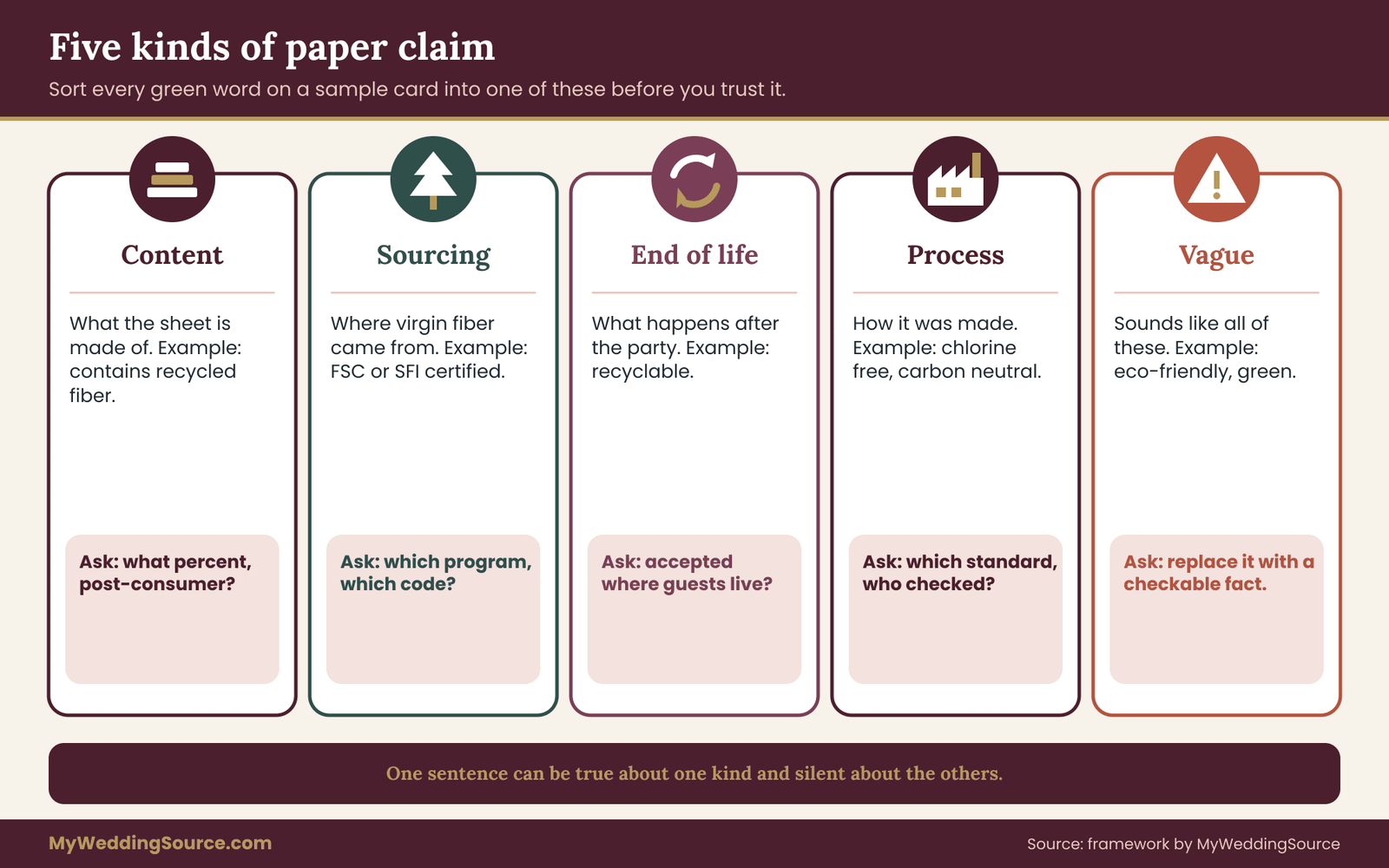
Why does the sorting matter? Because the same sentence can sit in the wrong category without anyone lying. A seller who writes “our paper is FSC certified” is making a sourcing claim, which can be perfectly true for a sheet made entirely from fresh trees. A couple who reads that sentence and concludes the invitations are recycled has drawn a conclusion the seller never stated. Nobody was dishonest. The label did what labels do, which is leave room.
The goal of this guide is to close that room for recycled wedding invitations and every other printed piece in the suite. You will not need to become an expert in pulp mills. You will need a short, repeatable routine, a few official pages to bookmark, and the confidence to say “can you put that in writing?” to a vendor.
Where this decision sits in the larger wedding
Paper is a small share of a wedding’s material footprint. Catering, flowers, rentals, travel and décor usually involve far more material than a suite of cards. That does not make the paper choice pointless. Invitations are visible, personal and made early, so they are often the first place couples practice reading claims.
If you want the bigger picture of where materials and waste come from at a wedding, the wedding waste reduction guide walks through an audit from catering to cleanup. This article stays on one narrow question: how to judge the paper evidence behind recycled wedding invitations and similar printed pieces.
Keeping the scope narrow has a practical benefit. You can finish the whole evidence check for recycled wedding invitations in two or three evenings, before you have committed to a printer, and the result is a short file you can reuse for save-the-dates, programs, menus and thank-you cards.
What “better” can and cannot mean
Be clear with yourself about the outcome you want from recycled wedding invitations. There are at least three different goals, and they point to different choices:
- Less new fiber used. This favors paper with a high recycled share, or fewer printed pieces.
- Responsibly sourced fresh fiber. This favors certified virgin fiber when recycled stock does not suit the design.
- Less waste after the event. This favors simple construction that guests can drop into a recycling bin, or digital substitutes for some pieces.
On recycled wedding invitations, a sheet can excel at one goal and be neutral or poor at another. A heavy cotton card might be made from textile scraps, which is a recovery story, yet it may be thick enough to raise postage questions and hard for a local program to process. A thin recycled card might be easy to recycle and look plain. You do not have to maximize every goal. You do have to know which one you are choosing, so you can read the evidence against it.
Why the words on recycled wedding invitations get blurred
If the labels on recycled wedding invitations are confusing, it is partly because paper has a long supply chain and each link speaks its own dialect. Understanding the chain makes the evidence check feel less like detective work.
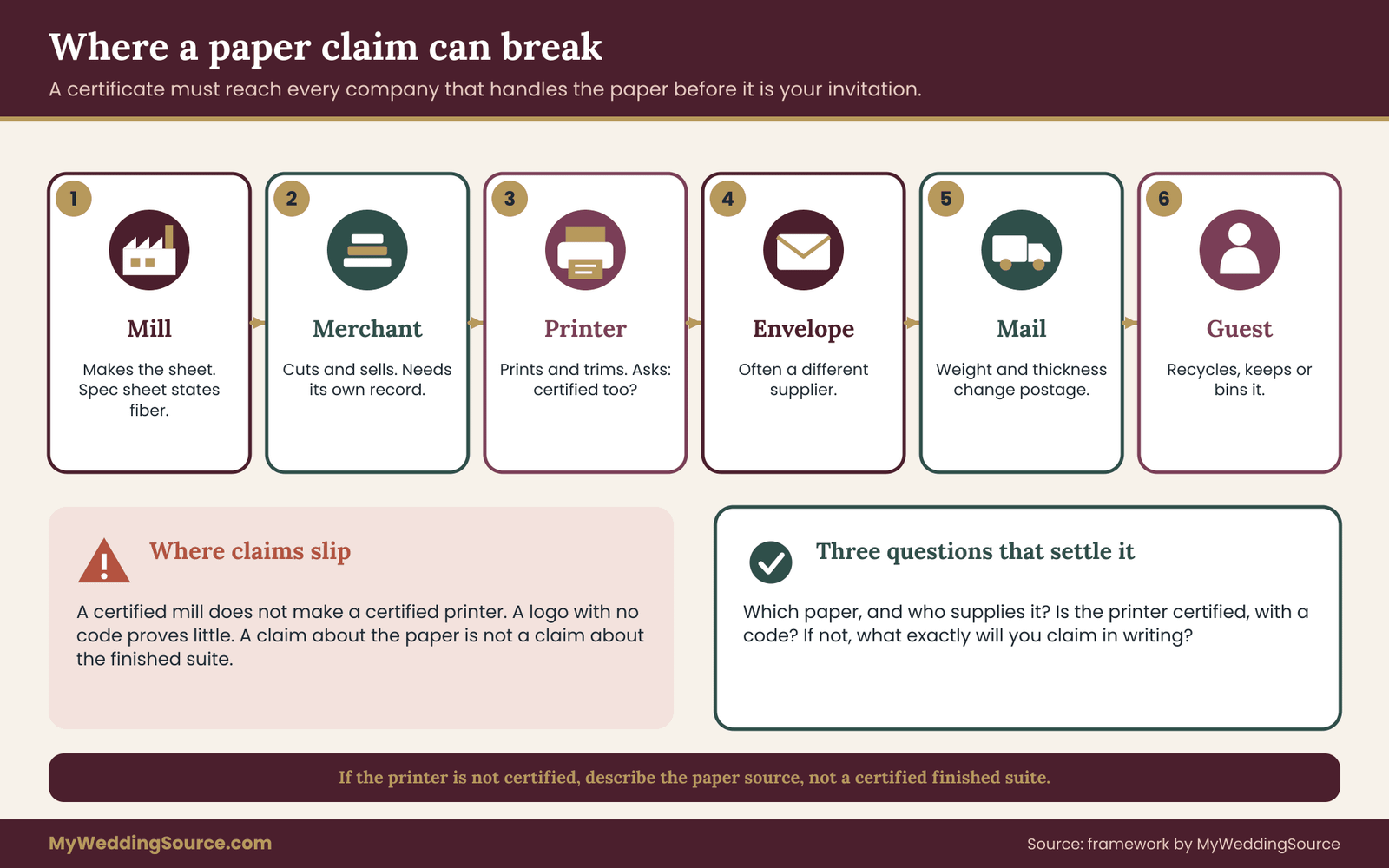
Paper starts as fiber. That fiber can be virgin wood pulp, recovered paper that has been pulped again, cotton or other textile fiber, or non-wood plant fiber such as bagasse (sugarcane residue) or hemp. A mill turns the fiber into rolls or sheets. A converter or merchant cuts, coats or embosses the sheets. A printer prints and trims them. An envelope maker supplies the envelopes. Finally a mail carrier delivers them, and your guests decide what to do with the cards afterward.
At each step, a different company can put a different claim on a different surface. The mill writes a specification sheet. The merchant writes a catalog description. The stationer writes a product page. The designer says something kind and optimistic in an email. By the time the claim reaches you, it has been paraphrased three times, and the careful qualifiers at the start have been dropped.
The telephone game problem
Consider how a precise statement erodes. A mill sheet might say: “30 percent recycled fiber, of which 30 percent is post-consumer, FSC Mixed Credit.” A merchant catalog might shorten it to “30 percent recycled, FSC.” The stationer’s page might say “FSC recycled paper.” A designer might tell you, “It’s recycled and certified.” Every step is a small, reasonable simplification, and the end result is a statement the original sheet does not support. A label reading “FSC Recycled” has a specific meaning that the mill sheet never claimed.
You will see this pattern often enough with recycled wedding invitations that it deserves a rule. Always trace a claim back one step to its source document. If the stationer says “recycled,” ask which mill sheet or specification that comes from. If the stationer cannot name one, you have learned something useful already.
Marketing language is not the same as regulation
In the United States, the Federal Trade Commission publishes the Green Guides, which explain how businesses should make environmental marketing claims. They are written for sellers, not shoppers, but they are the best plain reference for what a careful claim looks like. The FTC’s general position is that broad claims such as “eco-friendly” are difficult to substantiate and should be avoided or clearly qualified, and that claims about recycled content should be specific about what portion of the product is made of recycled material.
The agency’s Green Guides page explains the principles, and a short summary is far easier to read than most people expect.
Two cautions apply. First, the Green Guides are guidance, not a law that tells you whether any specific sheet in your hand is accurate. Second, they govern how sellers advertise. You, as a customer, are not at risk of breaking them, but you can use them as a yardstick: if a claim would be hard to defend under those principles, treat it as unverified.
The cost of getting it wrong
For a couple buying recycled wedding invitations, the downside of a blurred claim is usually small and personal. You pay a premium for a sheet that does not deliver what you assumed, or you print a line on your wedding website that a guest later questions. It is rarely a legal matter. It is more often a quiet disappointment, and sometimes an awkward conversation with a relative who works in the paper industry.
There is also a budget side to recycled wedding invitations. Sheets sold with strong green language can carry higher prices. A few minutes spent confirming what you are paying for is the same discipline as reading any vendor quote. The wedding vendor contract guide covers how to get promises in writing, and the same habit applies here: a stated specification in your order confirmation is worth more than a friendly assurance in a phone call.
What this article will and will not do
You will leave with a four-part evidence check, an understanding of the main certification labels and what each one says, a set of questions and scripts for your stationer or printer, a worked example with an invented couple, decision rules for tradeoffs, and a list of limitations. You will not leave with a verdict on which brand to buy, because that depends on your design, your budget, your guest list and your local recycling rules, and because the supplier landscape changes.
The next section explains what “recycled” really means on recycled wedding invitations, because every other judgment depends on it.
What “recycled” means for recycled wedding invitations
“Recycled” sounds like a single idea, but in paper it splits into several. The split matters because the Green Guides and most buyers’ guides treat recycled content as something that must be stated as a share, and a share is only meaningful once you know what counts.
Pre-consumer and post-consumer fiber
Recycled fiber comes in two broad kinds. Post-consumer material is paper that people used and then put in a recycling bin: office paper, newspapers, cardboard. Pre-consumer material is scrap diverted from the waste stream during manufacturing or printing, such as trimmings from a converting plant, that would otherwise have gone to disposal. Under the FTC’s approach, recycled content claims apply to material recovered or diverted from the solid waste stream. Scrap that a mill simply puts back into the same process that created it is generally not what the term is meant to describe.
For a couple, the practical point is easy to state. A sheet that says “recycled” without a percentage could mean almost any mix. A sheet that says “30 percent post-consumer” tells you how much of the fiber came from paper that people had already used. If the number is not given, the claim is weak, and your first question is simply, “What percentage, and is it post-consumer?”
Why the percentage on recycled wedding invitations is not a score
It is tempting to treat a higher percentage on recycled wedding invitations as a better paper and stop there. A more careful reading adds three considerations.
First, recycled fibers get shorter each time they are processed, so mills often blend them with some virgin fiber to keep the sheet strong. A card that is 100 percent recycled may feel a little different from one that is 30 percent recycled. Neither is wrong. They suit different designs.
Second, the percentage is measured by weight in most specifications, and it describes the paper stock, not the finished invitation. Ink, foil, coatings, ribbons and envelopes are additional materials that the percentage does not cover.
Third, a number tells you about content. It does not tell you about the energy used, the water used or the transport distance. Those matter, but they are much harder for a couple to evaluate, and an honest guide has to say that plainly. When a seller offers a single score or a carbon figure, ask what boundary it covers and who calculated it.
The “recycled look” trap
Some papers are designed to look recycled. Flecked cream sheets, kraft-brown cards and speckled stock are fashionable, and the speckle can be created by adding colored fibers or dots during manufacturing, with no recycled content at all. Kraft paper itself is a type of paper made by a particular pulping process, and it can be made from virgin or recycled fiber. The look tells you nothing. Only a specification sheet, a certification or a written statement from the seller does.
Shopping for recycled wedding invitations is not a trick played on couples so much as a reality of a product that has moved from utility to style. It does mean you cannot decide by touch. Feel the paper to judge whether you like it, and read the paper’s documentation to learn what it is.
Recycled fiber from textiles
For recycled wedding invitations, cotton paper, sometimes called cotton rag or cotton cloth paper, is made from fibers recovered from the cotton textile and garment industry, such as scraps and linters. It is soft and sturdy and popular for letterpress. Whether it counts as “recycled” depends on what the seller means and what the fibers were. Textile offcuts reused in paper are a recovery story, and some sellers describe the paper as recycled cotton.
If the claim matters to you, ask what percent of the fiber is reclaimed textile material and whether the rest is virgin cotton linter or wood pulp. Cotton papers are also commonly heavier, which touches postage and recyclability, both discussed later.
Reading certifications on recycled wedding invitations
Certifications add outside checking to recycled wedding invitations claims; they add outside checking to what would otherwise be the seller’s word. They are useful when you understand what a given label covers, and misleading when you read more into them than they say. The main labels you will meet on paper are forest management and chain-of-custody systems, plus a few other seals.
Forest certification: FSC, SFI and PEFC
Three programs account for most of the tree-and-paper labels in North America. The Forest Stewardship Council (FSC) runs a forest management standard and a chain-of-custody system. The Sustainable Forestry Initiative (SFI) runs its own forest standards and labels. The Programme for the Endorsement of Forest Certification (PEFC) is an international umbrella program that endorses national systems. Their approaches and requirements differ, and each publishes its own rules on its website. This article will not rank them, because the better choice depends on what a given paper offers and which program a couple trusts.
What all three have in common for recycled wedding invitations is that they are mostly about where virgin fiber came from and whether it is tracked. They are not primarily a promise that a sheet is recycled. Some labels include a recycled category, and that is where reading closely pays off.
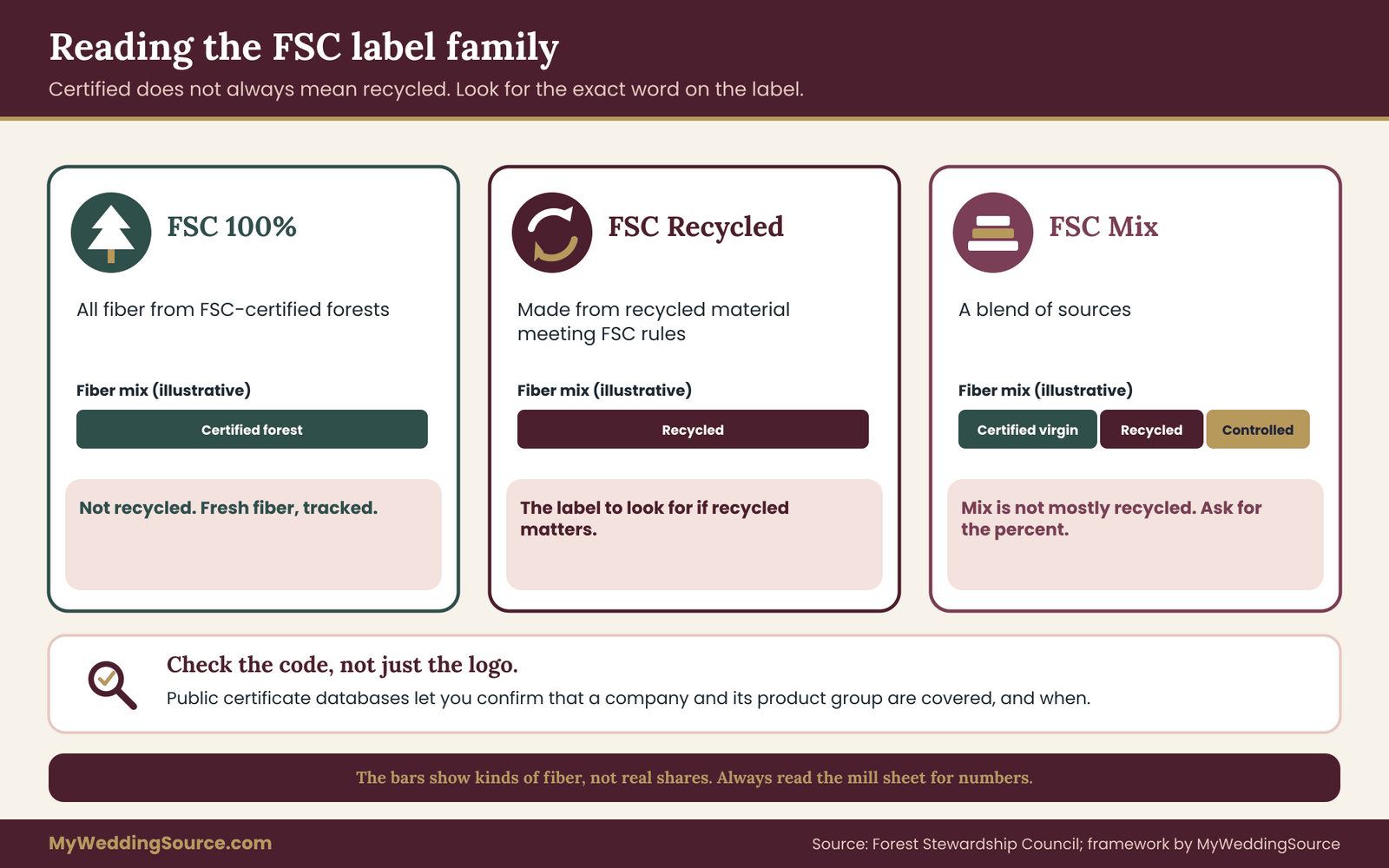
The FSC label family
FSC labels are a useful example because they are common and specific. In broad terms:
- FSC 100% means all the fiber comes from FSC-certified forests.
- FSC Recycled means the product is made from recycled material that meets FSC requirements.
- FSC Mix means the product combines FSC-certified virgin fiber, recycled material and, in some cases, fiber from controlled sources. It does not mean mostly recycled.
The difference between “Recycled” and “Mix” is the one most couples miss. A stationer who says “FSC certified” may be describing a Mix sheet that contains a modest recycled share, or no more than a small one. If you specifically want recycled content, look for the word “Recycled” on the label, or ask for the mill specification that gives the recycled percentage.
A second subtlety is the chain of custody. For the label to appear on a finished product, each company that handles and sells the certified material, including the printer or converter, must itself be covered by chain-of-custody certification. A mill’s certification does not automatically pass to the printer who prints your suite. That is why the question “Is the printer certified, or only the paper mill?” is one of the most valuable questions in this guide.
Looking up a certificate
Real certification systems come with public records. FSC maintains a public certificate database, and certificate holders are issued a license code that is meant to appear next to the label. The code typically begins with the letters FSC and a letter and number sequence. You can enter a company’s name or code in the database and check that the certificate is valid, which products or product groups it covers, and its status. This takes a few minutes and moves a claim from “trust me” to “verified.”
Treat a logo with no code, or a code that does not match the company, as a prompt for a polite question. Honest mistakes happen, such as an old file or a template that carried a logo over from a different product. A vendor who responds quickly and clearly to this question has shown you something valuable about how they work.
Recycled content standards and other seals
Some papers carry other third-party seals about recycled content, energy or chemistry, and some mills voluntarily publish environmental product declarations. Because naming and standards vary, the safe approach is generic: find who runs the seal, find where it publishes its standard, and find where it lists certified products or companies. If you cannot find those three things, the seal is decoration.
What certifications do not tell you
Certification labels leave several questions open, and an honest reading admits them:
- They do not state how far the paper traveled or what energy powered the mill.
- They do not describe the printing process, inks, coatings or adhesives.
- They do not guarantee that a particular card is recyclable where your guests live.
- They are not a measure of how much paper you ordered. Printing twice the quantity you need on certified stock is still waste.
That last point is worth remembering as you shop for recycled wedding invitations. The most effective step for the environmental footprint of any printed suite is often a quantity decision, not a paper decision. The guest list guide helps you work out how many households you are actually inviting, which is the number that should drive your count.
A short rule for reading any label
When you meet a certification on a sample, run it through three questions. Who runs this program, and where do they publish the rules? Does it describe fiber source, recycled content, or something else? Can I look up this seller or this code in a public list? Three clear answers mean the label is doing work. Fewer than three mean you have a question to send.
How the four-proof check works for recycled wedding invitations
Here is the routine for recycled wedding invitations that organizes the rest of this guide. It has four proofs, in order, and each one answers a different weakness in the way paper claims travel. You can run it on a single sample sheet in about ten minutes once you know where to look.
Proof one is the claim itself. Write down the exact words the seller used, not your paraphrase. “Made with recycled paper.” “FSC certified.” “Eco stock.” Exactness matters because the next three proofs test whether the claim is specific enough to be tested.
Proof two is scope. What part of the product does the claim cover? The paper only, or the envelope, ink, foil, liner and packaging as well? Many honest claims cover just the sheet. That is fine, as long as you know it and do not describe the whole suite the same way later.
Proof three is the paper evidence. What document or record supports the claim? A mill specification, a certificate you can look up, a recycled content statement, or a published seal. The evidence should name the paper, not just the company.
Proof four is the chain. Does the evidence reach the finished product that your guests will hold? If the paper is certified but the printer is not, the label cannot appear on your invitations, and any claim about “certified invitations” is a step too far.
The next part walks through each proof for recycled wedding invitations in practical detail, with what to ask for, what a good answer looks like and what to do when you hear a weak one.
Proof one and two for recycled wedding invitations: claim and scope
Most evidence problems with recycled wedding invitations are caught by the first two proofs, long before you read a certificate. They cost nothing and need only a pen and the sample card.
Write the claim down in the seller’s words
Open the product page, the sample packet and any email from the designer. Copy each environmental phrase exactly. Put them in a short list with the source next to each: “product page,” “sample card back,” “designer email, March 3.” This looks fussy, but it solves a real problem. Over weeks of back-and-forth, claims shift without anyone noticing, and a written list lets you see when “recycled” quietly became “100 percent recycled” or “certified” became “sustainably sourced.”
Then classify each phrase using the five types from the first section: content, sourcing, end-of-life, process or vague. A phrase that is vague gets no further work. You simply ask the seller to replace it with a specific statement, or you ignore it and rely on the specific ones.
Ask what the claim covers
Scope is where good intentions and good products part ways. A single invitation suite is a bundle of materials, and each can carry its own claim or none.
Take an ordinary suite: an invitation card, an RSVP card, a details card, an outer envelope, an inner liner and a reply envelope, possibly tied with ribbon or sealed with wax. The card stock may be recycled. The envelope may come from a different supplier, on a different paper. The liner might be a decorative paper with no documentation. The ribbon is textile, and the wax seal is its own material altogether.
When a stationer says the recycled wedding invitations are “made with recycled paper,” the plainest reading is that every paper piece is. The careful reading is that the main card is. Ask directly: “Does that include the envelopes, the liner and the reply card? If not, what are those made of?” A good answer lists each piece. A weaker answer says “yes, everything,” and you then ask for the written specification of each.
Scope as one question per component
Instead of a spreadsheet, think of scope as a question you ask once per component:
- For the invitation card: what is the fiber, and what is the evidence?
- For the envelope: same question, and who supplies it?
- For any liner, insert or belly band: same question.
- For ink and printing: which process, and does it affect recycling?
- For finishes such as foil, embossing, lamination and glitter: what is applied, and to which pieces?
- For packaging and shipping materials: what are they, and are they documented?
You do not need to put a green claim on every line. You need to know which lines have one, which do not, and which you will therefore leave out of your own statements later.
Spotting the quiet scope gap
Watch for sentences that sound complete but leave a gap. “Printed on recycled stock” describes the sheet and says nothing about the ink. “Eco-friendly printing” describes a process the seller may have chosen, with no standard behind it. “Recyclable paper” may describe the base sheet before a coating is applied. “Our paper is FSC certified” may describe a mill, a catalog line or a specific sheet, three very different statements.
Do not read bad faith into these phrases on recycled wedding invitations. Sellers write in shorthand, and the shorthand tends to flatter the product. Your job is to turn the shorthand into a checkable sentence.
Proof three: the paper evidence behind recycled wedding invitations
Evidence for recycled wedding invitations is a document, a record or a lookup. It has a name, a date and an owner. It is not a reassuring tone of voice.
What counts as paper evidence
Some forms of evidence are stronger than others. From strongest to weakest, roughly:
- A public certification record that you can look up yourself, naming the company and the product group, with a status of valid.
- A mill specification or technical data sheet that states fiber composition, recycled percentage and, ideally, whether the recycled share is post-consumer.
- A written statement from the merchant or printer that names the specific paper, cites the mill document it came from and states the percentage.
- A product page description that gives a number and names the paper.
- A general statement such as “we use recycled paper” with no name or number.
Evidence at levels one and two is strong enough to repeat in your own words. Level three is usable if the statement is specific and in writing. Levels four and five are starting points for questions.
How to ask for it
Many couples ordering recycled wedding invitations feel awkward requesting documentation, as though they were auditing a small business. In practice, stationers and printers field this request often, and the good ones have a ready answer. A short, friendly message works:
“Before we place our order, could you tell me the name of the paper used for the invitation and the envelopes, and send the mill’s specification or the certification details for each? We would like to describe the paper accurately on our website.”
Notice what this message does. It asks for names, not adjectives. It ties the request to a reasonable purpose. It does not accuse anyone. If the vendor answers with a data sheet and a link, you are done with proof three for that item. If the vendor says they will check and returns with a precise answer, that is also a good sign.
Reading a specification sheet
You do not need technical knowledge to extract the key lines from a mill sheet. Look for:
- Fiber composition: the percentage of recycled fiber, and any note on post-consumer share.
- Certification references: a chain-of-custody type and the code or number.
- Basis weight and thickness: these matter for postage and feel, covered in a later section.
- Coatings or additives: words such as “sized,” “coated,” “wet strength” or “optical brightener” hint at how the paper behaves in recycling.
If a number is stated, ask whether it applies to every production run or only to a typical run. Some specifications describe a standard range, and a specific batch can differ slightly. For a wedding order, a typical-range statement is usually acceptable, provided it is described that way in your own words.
The certificate lookup, step by step
When the evidence is a certification, the check takes a few minutes. Find the license or certificate code printed with the label. Open the certifying organization’s public search tool. Enter the code or the company name. Confirm that the certificate is valid, that the holder’s name matches the company you are dealing with, and that the scope includes the type of product, such as printed paper products, or the kind of activity, such as printing or trading.
Write down the date you checked the certificate for your recycled wedding invitations. Certificates can be suspended or can lapse, and a note of when you looked is useful if you later describe the paper on your site.
If the lookup returns nothing, do not conclude fraud. Companies sometimes use a parent company’s name, a trade name or an older license. Ask the vendor to explain. If they cannot, treat the claim as unverified and leave it out of your own wording.
Evidence that looks official but is not
A few patterns appear often enough to mention:
- A logo with no code. Most certification schemes expect the license code to accompany the mark.
- A mill’s certification used for the printer’s output. The paper may be covered, but the finished invitation is only covered if the printer is part of the chain.
- A general sustainability statement from a corporate website. It describes goals, not a particular sheet.
- A “recycled” label from a marketplace seller with no name of the paper. Handmade and imported papers can be lovely, but the marketplace listing is a level-five statement until the seller gives you details.
Proof four: the chain from mill to your guests
Proof four is the one couples overlook when buying recycled wedding invitations. A document that proves what the mill made does not prove what the printer delivered, and the gap between them is where mislabeled products sometimes appear.
Why chain of custody exists
Certification systems tracked at the mill have to deal with the fact that paper changes hands. A certified roll can be cut by a merchant, sold to a printer, printed and trimmed, and boxed. If any of those handlers mixes certified and uncertified paper without records, the claim at the end cannot be trusted. Chain-of-custody certification is meant to solve this: each handler follows procedures to keep certified material identifiable, and an auditor checks them.
For recycled wedding invitations, the result is simple. If you want a certification label to appear on your finished recycled wedding invitations, the printer needs to be certified for chain of custody, or must buy pre-printed, pre-labeled stock from someone who is. If the printer is not certified, an honest statement is that the paper stock came from a certified source, not that the invitations are certified.
The questions that settle it
Ask the printer three short questions:
- Which paper will you use for my order, and who supplies it?
- Do you hold chain-of-custody certification, and can you give me the code so I can check it?
- If not, can you give me the paper supplier’s document and describe in writing what you will and will not claim about my finished order?
A printer who is not certified is not necessarily a bad choice for recycled wedding invitations. Many small letterpress and digital print shops use excellent, well-documented paper and simply do not pay for the audit that chain-of-custody certification requires. What matters is that the claim you make later matches what they can substantiate.
When the printer and the stationer are different companies
Online stationers often act as storefronts, with printing handled by a production partner. In that case the company you pay, the company that prints and the company that makes the paper might be three separate entities. Ask who prints the order, and direct your evidence questions to whichever company actually handles the paper. If the stationer will not tell you, ask for the documentation from the production partner through them.
Mailing the finished pieces
There is a fifth link in the chain that has nothing to do with certification: the postal system. Thick, rigid or uneven pieces can require extra postage or a hand cancel, and the Postal Service publishes its mailpiece rules on its Postal Explorer site. A heavy cotton suite, a square envelope or a piece with a bulky embellishment can change your postage.
This does not affect the environmental claim, but it does affect cost, and it is worth testing a fully assembled sample before you commit to the paper. Take the sample to a post office, ask what it will cost to mail, and ask whether a machine can process it.
Chain evidence for a printed suite: what you end up with
When all four proofs are done for a single paper, your file contains a short, tidy set of items: the exact claim wording, a list of the components and which have claims, a certificate lookup or specification sheet for each claimed paper, and a note on the printer’s chain status. That file is the evidence behind your recycled wedding invitations. It takes up one page, and it makes writing about your choices straightforward later.
In the next part, the discussion widens beyond the sheet itself, because ink, finishes and envelopes often matter as much as the paper for what happens after the wedding.
Finishes, ink and envelopes that change recycled wedding invitations
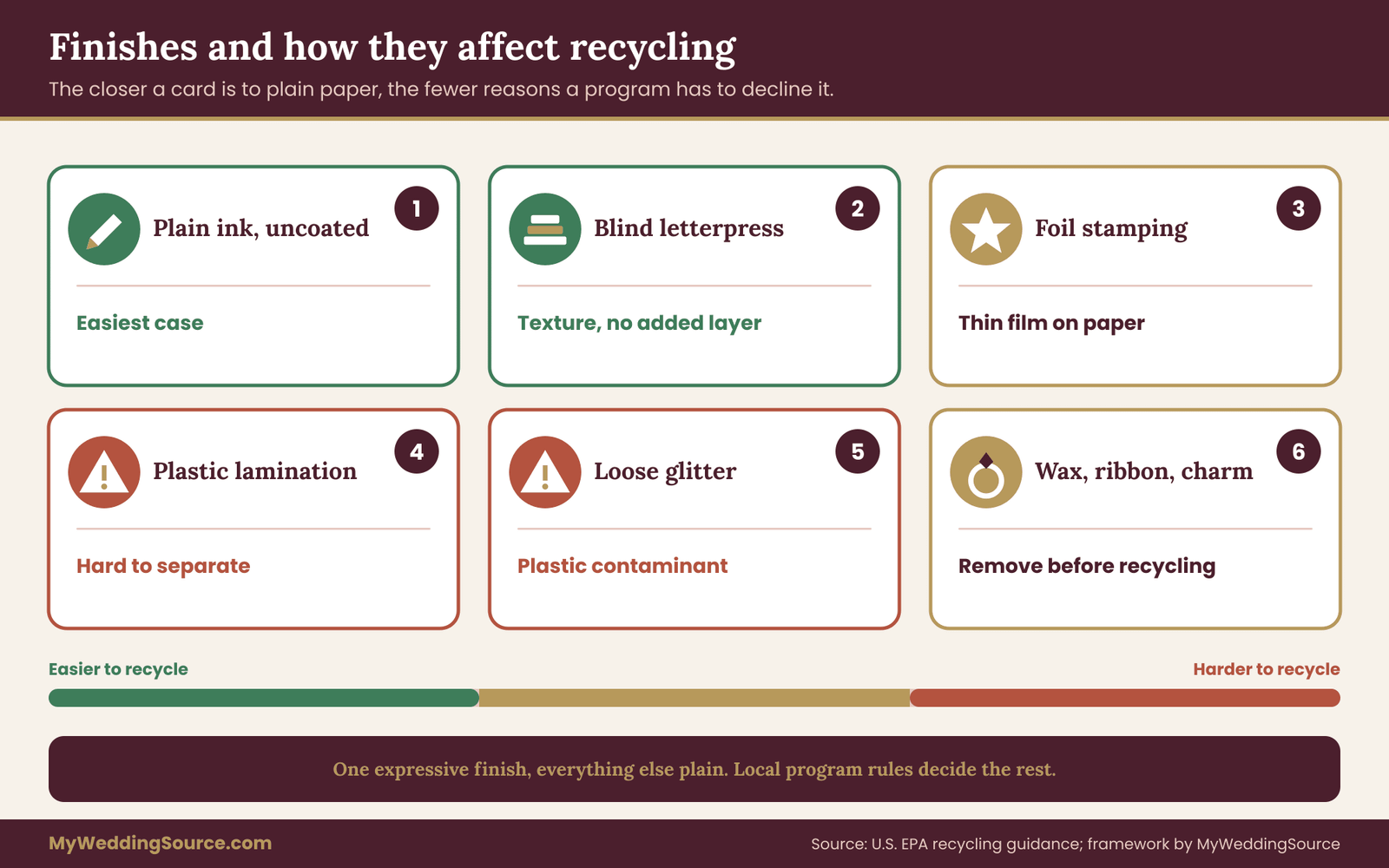
You can choose a well-documented recycled sheet and still end up with a card that is awkward to recycle. The reason is that most of what makes an invitation feel special happens after the paper is made: foil, embossing, lamination, thick layering, metallic ink, glitter, ribbon. These finishes are not wrong. They are tradeoffs, and recycled wedding invitations with a heavy finish deserve a clear-eyed look.
Why finishes matter for recycling
Paper recycling works by breaking paper into fiber in water and removing contaminants. Things that do not dissolve or separate cleanly, such as plastic films, metal foils, glitter and some strong adhesives, can become contaminants. Recycling programs differ in what they accept and how they handle small amounts of non-paper material, and the U.S.
Environmental Protection Agency points consumers to local rules because programs vary from place to place. So the honest statement is not “foil makes a card unrecyclable.” It is “foil and lamination can make a card harder to recycle, and whether it matters depends on the program.”
Use a simple ladder for recycled wedding invitations. The closer a finished piece is to plain paper, the more likely it is accepted without question. Each added layer of non-paper material adds a reason a local program might decline it.
The common finishes, one at a time
Plain ink on uncoated paper. The easiest case. Standard offset or digital printing on uncoated stock is generally handled by paper recycling programs, though this depends on the specific program and ink.
Letterpress and blind embossing. These press an impression into thick paper, with or without ink. Pressing does not add a foreign material, which makes blind letterpress a good fit if you want texture without extra layers. Letterpress ink is applied heavily, so ask the printer what ink they use.
Foil stamping. A thin layer of metallic or pigmented film is transferred to the paper by heat. The layer is very thin, and some programs tolerate small amounts, but foil is a clear example of a non-paper material on a paper sheet. If you love foil on recycled wedding invitations, consider limiting it to one piece, such as the main invitation, and leaving the reply card and details card plain.
Lamination and heavy coatings. A plastic film bonded to paper is hard to separate and is a common reason a card is declined. Matte or gloss coatings differ, and some water-based coatings are less problematic than plastic film. Ask which one is used.
Glitter and shimmer. Loose glitter is typically plastic and is a litter and contamination problem. If sparkle matters to you, ask about alternatives, or accept that the piece will not be a clean recycling candidate and say nothing in your wording that implies otherwise.
Thick layering and mounted pieces. Cards glued to other cards, backed with different papers, or mounted on board mix materials. Keep in mind that thickness also affects postage.
Wax seals, ribbons and charms. These are separate materials attached to the paper. A guest who wants to recycle the card has to remove them first, and a seal or ribbon that comes loose in the mail is a different kind of problem. If you want a closure, a simple belly band of paper in the same family as the card is a clean alternative.
The “one fancy element” rule
A decision rule that helps many couples is to choose one expressive finish and keep everything else plain. A single foil line on the main card, a letterpress impression on the RSVP, or a colored envelope liner can give the suite its character. When every piece carries a heavy finish, the suite becomes costly, harder to mail and harder to recycle, and the paper’s good documentation is overshadowed. This rule is about proportion, not purity.
Ink and printing method
Printing methods differ in how they use ink and paper. Digital printing is efficient for small runs and often uses little setup waste. Offset printing is common for larger runs and uses plates and press setup, which can use some paper for adjustment. Letterpress and engraving are slower, hands-on methods that suit a short run. Ask the printer about setup waste, how they handle misprints, and whether they recycle trimmings. These are legitimate questions, and the answers can tell you more about their practice than a logo can.
On ink, claims such as “soy ink” or “vegetable-based ink” circulate widely. They describe a type of binder, not a complete environmental profile, and they say little about recycling. Treat them as a content claim about the ink, ask what they mean in practice, and do not stretch them into broader statements.
Envelopes deserve their own check
Envelopes are an easy place for claims to go missing. They are often sourced from a different supplier than the cards, are sometimes imported, and may include features that complicate recycling, such as plastic windows, adhesive strips, metallic liners or a padded construction. Ask the same four-proof questions for the envelopes of recycled wedding invitations that you asked for the cards. Many couples find the envelope is the weak link in an otherwise well-documented suite, and this is easy to fix by choosing a plain recycled-content envelope with a standard gummed flap.
Liners are decorative papers glued inside the envelope. They look lovely, and they double the material in the envelope. If sustainability is a priority, consider skipping the liner, or choosing a single, simple liner paper that is documented, not a series of patterned ones.
Seed paper, cotton paper and tree-free options in recycled wedding invitations
Several materials come with their own claims and their own limits. They show up often in searches for recycled wedding invitations sustainability, which is a reason to know how to read them.
Plantable seed paper
Seed paper, a popular form of recycled wedding invitations, is made from recycled paper pulp mixed with seeds. The pitch is appealing: guests plant the card and flowers grow. The practical questions are several, and none of them is about whether the idea is charming.
What seeds are embedded, and are they suited to the region where guests live? A mix that thrives in one climate may not grow in another, and some seed mixes include species that are not native or are considered invasive in certain areas. Ask for the species list. If you are unsure whether a species is appropriate, a local cooperative extension office can often advise.
Is the paper itself recycled, and how is that documented? “Made from recycled paper” has the same evidence requirements as any other claim.
Will guests plant it? A card that ends up in the trash does not deliver the planting benefit and may be harder to recycle because of the seeds. Some couples use seed paper for a small enclosure, such as a favor tag, rather than the whole invitation, which concentrates the benefit where guests are more likely to use it.
Seed paper is a reasonable choice for recycled wedding invitations for the right couple, but the claim “plantable” is an end-of-life claim, and like any end-of-life claim it depends on what guests do.
Cotton paper
As described earlier, cotton paper is made from cotton fiber, often recovered from the textile industry. It is soft, absorbent and takes impressions beautifully, which is why letterpress printers favor it. Questions to ask include what share of the fiber is reclaimed textile material, whether the rest is virgin cotton or wood pulp, and what additives or sizing are used.
Cotton paper is usually thick, which means you should check postage with an assembled sample. It is generally accepted as paper by recycling programs, but program rules vary, and the thicker or more heavily pressed the sheet, the more the finish decisions above apply.
Tree-free and alternative fiber papers
Papers made with bagasse (the fibrous residue from sugarcane processing), hemp, bamboo, flax or other plant fibers are sold as tree-free. A few points are useful for the check:
- “Tree-free” says what the paper does not contain, not what it does contain or how it was made. Ask for the fiber composition.
- Agricultural residue papers can be a recovery story, similar to recycled content, because they use a by-product. Ask for the specification to confirm the fiber and any wood content.
- Fast-growing crops are not automatically better or worse, and the sourcing and processing matter. A claim such as “bamboo paper is sustainable” is a vague claim until someone tells you how the bamboo was grown and processed.
- Imported papers can have long transport routes, which is a trade-off you can weigh without having a number.
None of these papers is a bad choice for recycled wedding invitations. They simply move the question from “is it recycled?” to “what exactly is it, and what is the evidence?” The four proofs apply unchanged.
Digital and hybrid alternatives
Sometimes the most direct way to use less paper than recycled wedding invitations would is to print less of it. Many couples send digital save-the-dates, use a wedding website for details and print only the formal invitation and reply card. Others print invitations for older relatives and send electronic invitations to the rest of the guest list.
This is a legitimate way to reduce paper use, and it pairs with a recycled paper choice for what you do print. A hybrid approach also changes cost: you pay for fewer printed suites, which may leave room in the budget for a better-documented paper.
Two cautions apply. Digital invitations need accurate email addresses and clear instructions for guests who are less comfortable online, and some invitation etiquette conventions still favor printed formal invitations for traditional weddings. The wedding invitation etiquette guide covers wording and timing, and the same guide is helpful when deciding what to print and what to send electronically. The RSVP etiquette guide is useful if you are considering online replies in place of reply cards, which removes a card and an envelope from every household’s suite.
Choosing among the materials
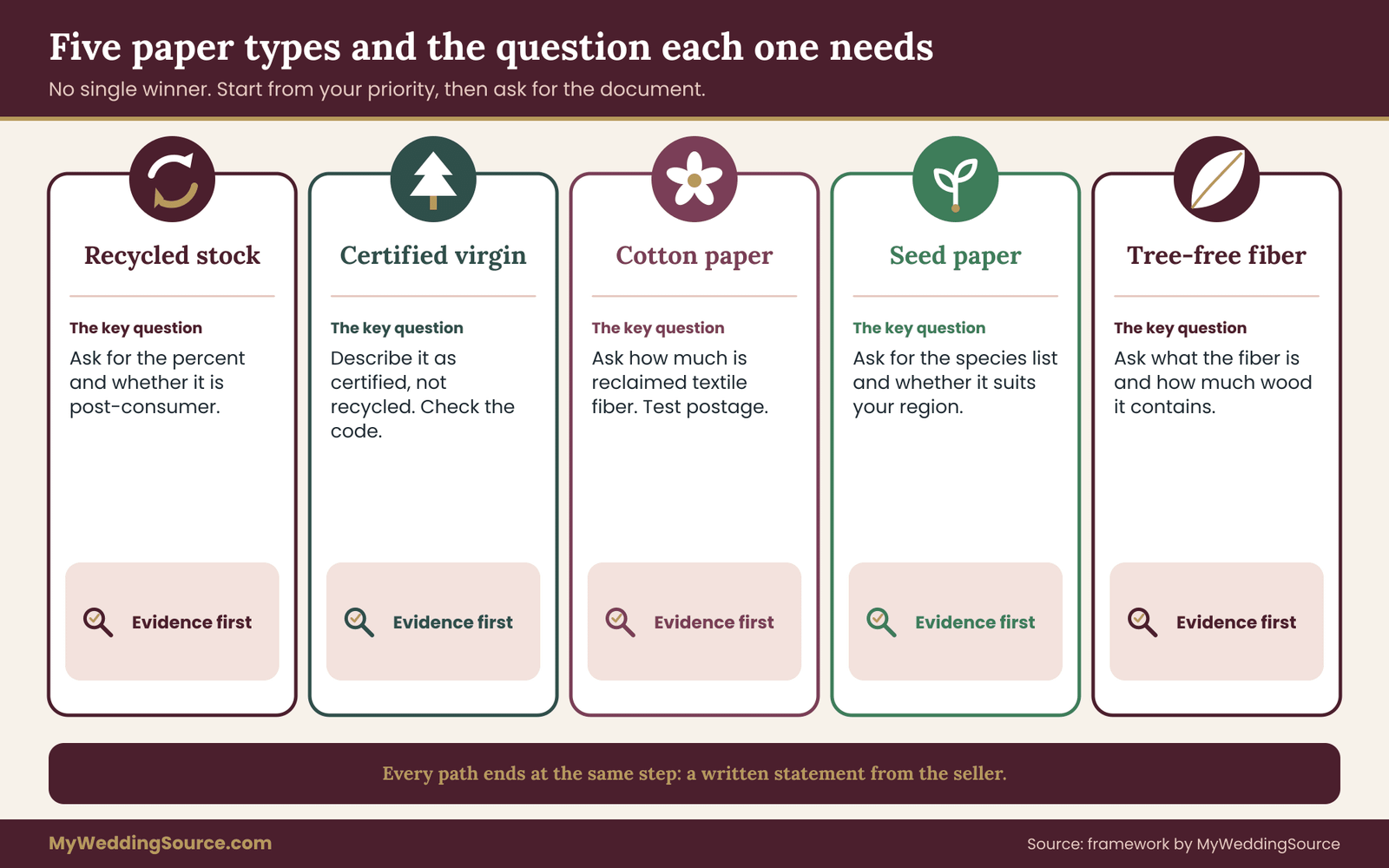
There is no single winner among recycled wedding invitations papers. A practical way to choose is to start from your priority:
- If you want the most direct, documented recycled content, look for a recycled stock with a stated post-consumer percentage and a specification you can read.
- If you want responsibly sourced fresh fiber for a design that needs it, choose a certified virgin or mixed sheet and describe it as certified, not recycled.
- If you want texture and weight, ask about reclaimed cotton content and plan for postage.
- If you want a small plantable element, use seed paper for a tag or a card and get the species list.
- If you want to cut paper use, print fewer pieces and make a hybrid plan with a wedding website.
Each path leads back to the same step: a written statement from the seller about what the material is and what evidence supports that statement.
Questions and scripts to verify recycled wedding invitations with vendors
Knowing what to ask about recycled wedding invitations is half the work. The other half is asking in a way that gets a useful reply without turning a friendly vendor relationship into a cross-examination. This section gives you a sequence, some wording you can adapt, and a way to read the answers.
The order of operations
Do the verification of recycled wedding invitations before you commit to a paper, not after you have paid a deposit. A sample packet is cheap and often free or low cost, and once you have a short list of two or three papers you like, send one message that asks the same questions of each. Comparing like with like is the whole point.
A sensible order looks like this:
- Collect samples and note the exact claims on each, using the written list from the first proof.
- Send one batch of questions to each stationer or printer.
- Run the certificate lookups for any certification code you receive.
- Make an assembled sample and test postage.
- Choose, then confirm the specification in your order in writing.
- File the evidence in a single folder so you can refer to it later.
Starting this early also protects your timeline. The invitation printing guide covers proofs, quantities and handoffs to the printer, and the evidence steps here fit inside that schedule. Squeezing verification into the final week before print is how people end up accepting claims they have not checked.
A message that works
Here is a message you can adapt. It is short because short messages get answered.
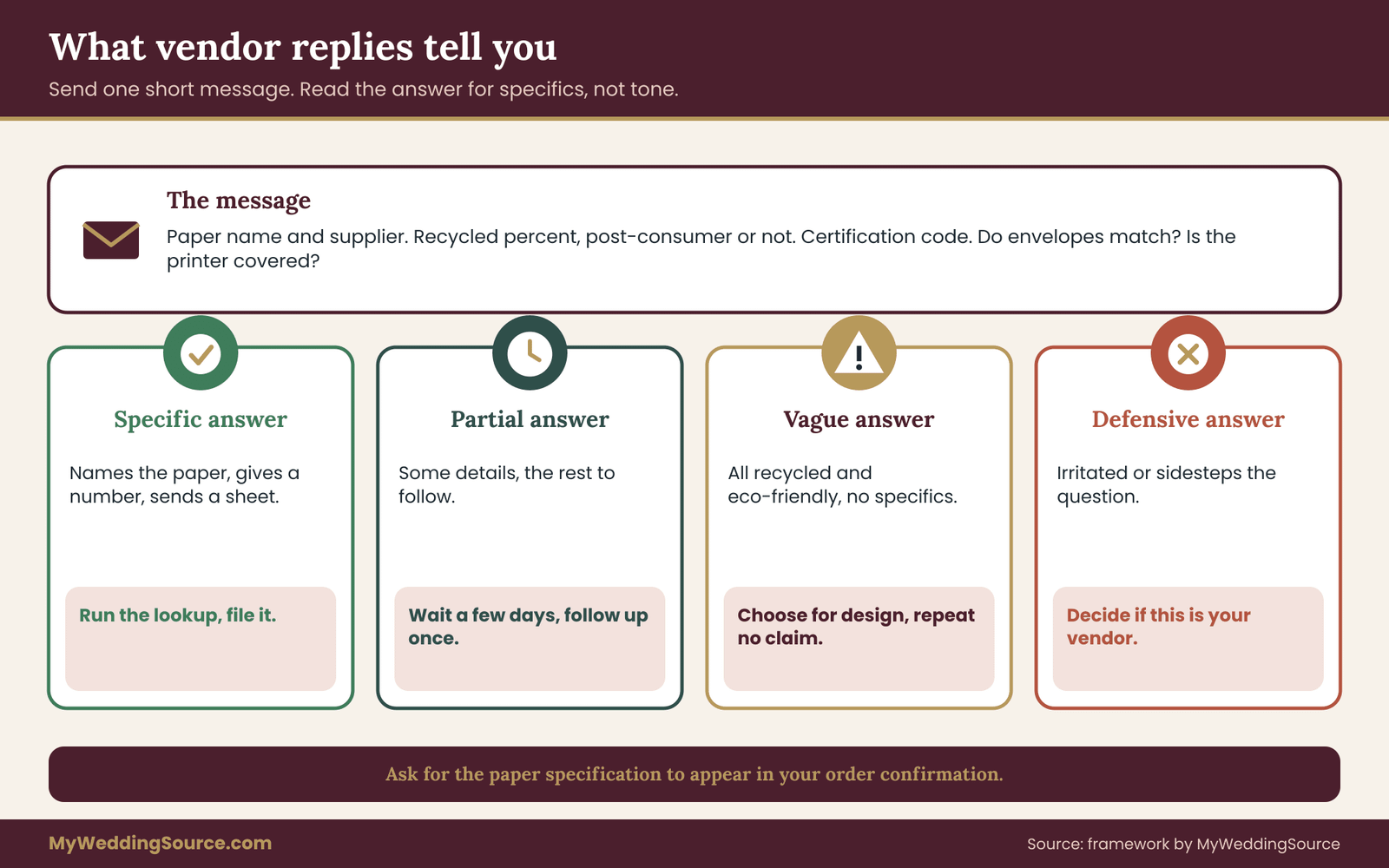
“Hello, we are choosing paper for our wedding invitations and want to describe it accurately on our website. For the paper you suggested, could you tell me: the name of the paper and its supplier; the recycled content as a percentage, and whether it is post-consumer; any certification, with the code so I can look it up; whether the envelopes and any liner are made from the same material; and whether your shop is covered by the same certification if you print it.
If any of those are not available, that is fine, we would just like to know. Thank you.”
Look at what this message about recycled wedding invitations avoids. It does not say “is it eco-friendly,” which invites a yes. It does not ask for a general statement. It asks for facts that either exist or do not, and it explicitly allows the answer “not available,” which makes honesty easy.
Reading the answers
Vendor replies tend to fall into four groups, and each one tells you something.
The specific answer. The vendor names the paper, gives a percentage, sends a data sheet and a code. This is the best case. Run the lookup, file the document and move on.
The partial answer. The vendor gives some details and says they will find the rest. This is normal, particularly with small shops that buy from a distributor. Give them a few days and follow up once.
The vague answer. The vendor says “it’s all recycled and eco-friendly” without specifics. This does not mean the paper is poor. It means the claim is currently unverified, and you can still choose the paper if you like it, as long as you do not repeat the vague claim in your own wording.
The defensive answer. The vendor is irritated by the question or sidesteps it. You do not need to decide the vendor is dishonest. You only need to decide whether this is the vendor to whom you want to entrust a stack of documents with your name on them. The vendor due diligence checklist covers the wider questions of reliability, insurance and references, and paper claims are one small part of that.
Phrases that deserve a second question
A few common phrases are worth a gentle follow-up, because they carry less than they seem to:
- “Eco-friendly” or “green.” Ask what specific attribute the seller means.
- “Recycled” with no number. Ask for the percentage and whether it is post-consumer.
- “Certified.” Ask by whom, which standard, and what the code is.
- “Sustainably sourced.” Ask for the program or the document.
- “Biodegradable” or “compostable” paper. Ask what standard it meets and whether a local facility accepts it; guests will probably throw the card in the trash or the recycling bin, not a composter.
- “Carbon neutral.” Ask what was measured, who verified it and whether the claim relies on offsets.
- “Plantable.” Ask for the species list and the planting instructions.
None of these phrases is automatically wrong. Each one has a plain, checkable meaning behind it, and your question is how to find that meaning.
What recycled wedding invitations cost and how to budget the evidence
Cost is where good intentions for recycled wedding invitations meet a spreadsheet. Because prices vary by region, printer and design, this guide does not give price figures. It gives the logic for thinking about cost, which holds regardless of the numbers on your quote.
Where the money actually goes
A printed suite of recycled wedding invitations has a few cost components, and the paper is often not the largest. Design time, plate or setup charges, printing method, finishing, envelopes, assembly, addressing and postage can each outweigh the paper stock. A premium recycled sheet might raise the paper line modestly but leave the total much the same, while a heavy foil and thick layering might raise the total sharply with no paper change at all.
This matters for choosing where to spend. If the paper is a small share of your quote, the extra cost of a better-documented sheet may be easy to absorb. If the finishing is the large share, the sustainability lever may be simplifying the finish, which also reduces cost. Ask for your quote broken into lines so you can see this.
Quantity is the strongest lever for recycled wedding invitations
Ordering the right number of suites is both a cost decision and a material decision. Every extra suite is paper, ink and postage that could have been avoided. Count by household, not by guest, because couples and families usually receive one invitation. Add a small reserve for errors, address changes and keepsakes, and ask the printer how much spoilage they build into a run.
If you have not finalized your guest list, hold off on the final order, and use the guest list guide on this site to firm up the household count first. A reprint costs more than an accurate first run, and leftover suites that never get mailed are the clearest example of avoidable waste in this whole subject.
The evidence has a price, mostly in time
Checking claims on recycled wedding invitations costs very little money. It costs an hour or two of messages and lookups, and perhaps a paid sample set. Some papers and some printers cost more, and that is a separate decision. It is fair to treat the verification work as free and the paper choice as a normal purchase decision.
If a vendor offers a documented sheet for a higher price, you can ask what part of the difference is paper and what is other cost. Do this politely and as a budgeting question. The wedding budget guide shows how to set categories so a paper decision is weighed against everything else, not in isolation.
Premium for the claim versus premium for the paper
There is a distinction worth keeping in mind. Some higher prices reflect real differences: a mill that uses a higher share of recycled fiber, a printer that pays for certification audits, a smaller production run. Other higher prices reflect branding alone: the same sheet sold under a “green” label at a markup. You cannot always tell which is which, and you do not have to.
What you can do is decide whether the documented attribute is worth the stated difference to you. If a vendor cannot document the attribute, you are paying for a story, and you can decide how much you value the story.
Comparing two quotes honestly
When two quotes use different papers, line up what you can compare without a table of numbers:
- The paper name, fiber composition and evidence for each.
- The components included: cards, envelopes, liners, reply cards.
- The finish and any added costs.
- Setup, proof and rush charges.
- What each vendor will put in writing about the paper.
Write each as a short sentence in your notes. When a difference is only in the language, such as “eco” versus a plain description, note that it is a difference in language and not in the product.
Putting the specification in the order
Once you choose your recycled wedding invitations, ask the vendor to include the paper specification in the order confirmation, for example the paper name, the recycled percentage and any certification code. This is a standard request and costs nothing. It does two useful things. It protects you if the paper is substituted without your knowledge, which can happen when a supplier runs short. And it gives you a document you can cite when you describe your choices later.
If the vendor needs to substitute a paper, ask for notice, a revised specification and the right to decline. Substitutions are not unusual in the paper trade, and a vendor who treats them as a conversation is easy to work with. The vendor contract guide on this site explains how to write promises like these into an agreement.
A caution on rush timelines
Rushed orders of recycled wedding invitations are where documentation gets skipped. A printer who is asked to deliver in a week will use what is in stock, and the stock may not be the paper you checked. If you need a fast turnaround, say so at the start and ask which papers are available within that window and what evidence exists for each. It is better to choose a plain, documented sheet that is in stock than a beautiful sheet that arrives with an unverified claim.
A worked example of checking recycled wedding invitations
Abstract routines for recycled wedding invitations are easier to trust once you see one run on a concrete case. The couple below is invented for illustration. The names, shops and paper details are made up, and nothing here describes a real product or a real vendor.
The situation
Dana and Marcus are planning a wedding for about ninety guests, which works out to roughly fifty-five households. They like a warm, speckled cream look, and they have narrowed the invitation to three sample papers from two stationers. They would like to say something modest on their wedding website about their paper choice, and they would rather not discover later that a claim was wrong.
They run the four-proof check on each sample. Here is how it goes.
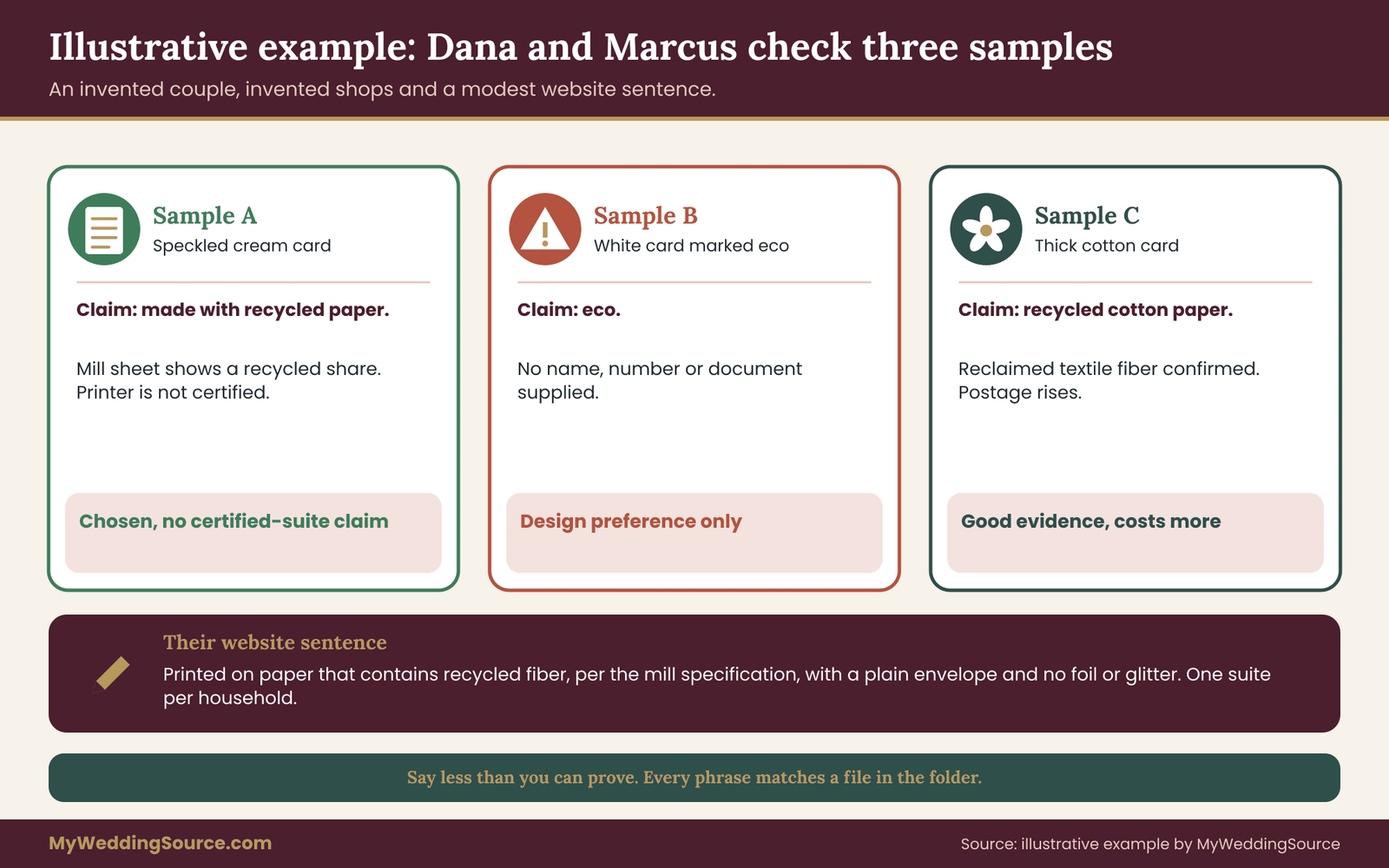
Sample A: the speckled cream card. The product page says “made with recycled paper.” Dana writes that down as the exact claim. It is a content claim with no number. Scope: the page says nothing about envelopes. She sends the batch of questions. The stationer replies within a day, names the paper, and attaches a mill specification showing a recycled share by weight and a note on the post-consumer portion.
The paper is not fully recycled; it blends recycled and virgin fiber. The specification also lists a chain-of-custody reference for the mill. The stationer prints through a partner shop, and says the shop is not chain-of-custody certified.
Sample B: the white card with “eco” on the back. The only claim is the word “eco.” Marcus writes it down and classifies it as vague. He asks what it refers to. The stationer replies that the card is “made from sustainable materials” and does not provide a name, number or document. Marcus decides the claim is unverified. He may still like the card, but he will not repeat the word.
Sample C: the thick cotton card. The seller says “recycled cotton paper.” Dana asks what share is reclaimed textile material. The reply says the fiber is cotton linter from textile processing, with no wood pulp, and attaches a short statement. The card is thick enough that she brings an assembled sample to the post office, where she learns the weight and thickness would raise postage compared with a standard suite. She notes the cost.
Reading the results
Dana and Marcus now have three different situations among their recycled wedding invitations samples, and each requires a different decision.
Sample A has strong paper evidence (proof three) but a chain gap (proof four). The paper is documented, and the finished invitation cannot carry a certification label because the print partner is not certified. The honest description is: “Printed on paper that contains a stated share of recycled fiber, according to the mill’s specification.”
Sample B has no evidence. It stays on the table only as a design preference.
Sample C has good evidence but a cost consequence unrelated to the claim. The couple has to weigh the postage and the finish against their budget.
They also check scope on Sample A. The envelope comes from another supplier. It is a plain gummed envelope with no window, but the stationer’s listing does not state its paper. Dana asks. The answer is a standard envelope with a stated recycled-content percentage on the supplier’s sheet. Good enough.
The decision
They choose Sample A for the invitation and reply card, with the plain recycled-content envelope. They skip foil and liner, using the “one fancy element” rule: a single letterpress impression on the invitation card. They ask the stationer to put the paper name and the stated recycled percentage in the order confirmation. They file the mill sheet, the envelope sheet and the order confirmation in one folder.
For the details, they make a decision about quantity. Fifty-five households plus a small reserve for corrections and keepsakes gives them a modest count, and they ask the stationer how much spoilage is built into the print run. They also decide to put details, accommodation information and the registry on a wedding website, not on a separate printed details card, which removes a piece from every suite.
What they write
On their website, near the bottom of the page, they put one short, factual line about their recycled wedding invitations:
“Our invitations are printed on paper that contains recycled fiber, according to the mill’s specification, with a plain envelope and no foil or glitter. We printed one suite per household.”
Notice what the line does not say. It does not say “eco-friendly,” “100% recycled,” “certified” or “zero waste.” It states the paper content in terms the mill sheet supports, names the finishes they avoided, and gives a quantity decision. Every phrase can be checked against a file in their folder.
What the example shows
Three lessons carry beyond this particular couple.
First, the best-documented paper was not the most expensive or the most heavily marketed. It was the one whose seller could name the paper and send a data sheet.
Second, the chain gap did not force them to abandon the paper. It changed what they said about it. A certification label on the finished suite would have been a step too far, and the plain description was accurate.
Third, the decisions that mattered most for materials were not about paper at all. Skipping the liner, skipping the foil, dropping a separate details card and ordering by household did more to reduce material use than the difference between the three samples.
Decision rules for recycled wedding invitations when evidence is mixed
Real choices about recycled wedding invitations rarely resolve into a clean winner. You may love a paper with partial evidence, or find a well-documented paper that does not match your design. These rules help you decide without pretending the situation is simpler than it is.
Rule one: documented beats described
When two papers are similar in design and price, choose the one with documents you can read. A paper that has a specification sheet and a code you checked gives you something to stand on. This is true even when the other paper has more appealing language.
Rule two: say less than you can prove
Your own statements about recycled wedding invitations should fall slightly short of the evidence, not slightly beyond it. If the mill sheet says a percentage, state the percentage or say “contains recycled fiber.” If you verified a certificate for the mill but not the printer, describe the paper source and not the finished invitation. If you know nothing beyond the seller’s adjective, say nothing about the material.
Rule three: prefer a simpler build when evidence is thin
If you cannot verify the paper but love it, reduce risk by simplifying everything else: no foil, no laminate, plain envelope, fewer pieces. You then have a modest suite whose environmental profile is at least not made worse by added material. Pair this with a quantity decision.
Rule four: do not trade a verified benefit for a vague one
Sometimes a seller offers an upgrade: a “plantable” tag, an “eco” ribbon, a “green” packaging option. If the upgrade comes without evidence and replaces something documented, decline it. A documented plain choice is better than an undocumented fancy one.
Rule five: keep the claim attached to the right object
Describe the paper, the print process and the finished suite as separate things. A mill’s certification belongs to the mill’s paper. A printer’s practice belongs to the printer. A guest’s recycling bin belongs to the guest. When you write about your choice, keep each statement attached to the thing it describes.
Rule six: let the budget decide between close options
If two papers are equally well documented, do not agonize. Choose by design and cost, and spend the remaining effort on quantity and finish. The difference between two well-documented sheets is almost always smaller than the difference between a sensible quantity and an oversized order.
When the printer is not certified
A recurring situation with recycled wedding invitations is a small, trusted local printer who does beautiful work and holds no chain-of-custody certificate. This is common and not a red flag. The practical approach is to ask the printer which paper they will use and from which supplier, obtain the supplier’s documentation, and describe the paper in your own words without a certification claim for the finished suite. If you still want a certified finished product, ask the printer whether a certified print partner could handle the job, and compare the trade-offs in cost and relationship.
When the vendor says the paper is recycled and cannot show it
You have three honest options. You can accept the paper as a design choice and say nothing about recycled content. You can ask the vendor to confirm the source and revisit the decision when they have an answer. Or you can choose another paper whose documentation is available. All three are reasonable. The one thing to avoid is repeating a claim you could not verify.
When someone challenges your claim
Occasionally a guest or relative will ask about your paper, particularly if they work in packaging or printing. If your wording is modest and your file is organized, this conversation is easy. You can say what the mill sheet says, what the printer said and what you could not verify. People generally respond well to a clear account of what you checked and where the limits are. A confident claim that falls apart under a single question is the outcome the whole check is designed to avoid.
Limits of any recycled wedding invitations evidence check
An honest guide to recycled wedding invitations has to say where its own method stops. The four-proof check improves your information, and it does not turn a paper choice into a precise environmental measurement.
What the check cannot measure
The routine in this guide tests whether claims are specific, supported and attached to the right object. It does not measure the energy, water or emissions behind a sheet of paper. Those depend on the mill, the region, the fiber source and the transport, and they are difficult even for specialists to compare.
A recycled sheet is not automatically lower in every impact than a certified virgin sheet, and the reverse is also not automatic. The reasonable reading is that recycled content and responsible sourcing are two different goals, both worthwhile, and that neither is a single score.
Local facilities decide the ending
Whether a finished card is recycled depends on where each guest lives. Programs accept different materials, and the U.S. Environmental Protection Agency’s materials pages emphasize that local rules govern what can go in a bin. The EPA’s sustainable materials management pages also explain the broader approach of using materials in ways that reduce overall impact across their life, which is a helpful frame: reduce and reuse come before recycling.
For recycled wedding invitations this means that the best end-of-life statement you can make is modest, such as “printed on plain paper without foil, so it should be accepted by most paper recycling programs, check yours,” and that you cannot promise any outcome.
Guests keep some invitations
A share of recycled wedding invitations will not be recycled again at all, because guests keep them. Many people save wedding invitations as mementos, and so do couples. That is a perfectly good ending, and it is worth remembering when someone suggests that a recyclable card is automatically better than a keepsake. A card that lives in a drawer for decades has avoided disposal, even if it carries foil.
Recycled paper is not always the right tool
Some designs call for a sheet that recycled wedding invitations stock cannot deliver, such as very bright white, extreme smoothness or a particular surface for fine illustration. In those cases a certified virgin or mixed sheet is a reasonable answer, and honest labeling is the goal. You should not feel obliged to compromise a design you love for a recycled sheet that does not suit it, as long as you describe your actual choice accurately.
The claims landscape changes
Standards are revised, programs update their labels, mills change products and regulators issue new guidance. Something described accurately here may be different when you read it. That is why the guide keeps sending you to the issuing organizations, and why your evidence file should have dates on it. If you reorder or reuse the design later, recheck the paper instead of assuming nothing changed.
Edge cases for recycled wedding invitations
Not every order looks like the standard suite. A few situations come up often enough to deserve a short note.
International weddings and imported paper
If you are printing abroad, or ordering handmade papers from overseas, the certification landscape may differ. Some countries have their own labels and standards, and a mark you do not recognize is a reason to ask who runs it, not a reason to dismiss it. The same three questions apply: who runs the program, what does it cover, and can you look it up? Add one more: what does the paper cost in mailing weight and transport, and how does that compare with a nearer option?
Handmade and artisan papers
For recycled wedding invitations, small studios that make paper from reclaimed materials, such as old documents, fabric or plant matter, can offer wonderful, personal stationery. Their claims often come with a story instead of a certificate. Treat the story as a starting point. Ask what the materials are, where they came from and how much of the sheet they make up. For a small-batch product, a direct, specific answer from the maker is often better evidence than a logo.
Reusing paper you already have
For recycled wedding invitations, reusing existing paper, such as printing on leftover sheets from another project or repurposing old maps or book pages for envelopes, is a legitimate way to reduce new material. The evidence check is simple: you know what the paper is. Be careful with postage and legibility, and test whether a printer or your own printer can handle the sheet.
DIY printing at home
Home printing gives you control over quantity and paper choice, and the evidence is straightforward because you buy the paper yourself and can read its packaging. Check the recycled-content statement on the ream and look for a certification code you can verify. Be realistic about ink use, printer waste and the time needed, and test alignment on scrap before printing the final sheets.
Multiple events and multiple pieces
A weekend wedding with a rehearsal dinner, a welcome event and a brunch can multiply the printed pieces: programs, menus, place cards, signs and thank-you notes. Apply the same check once, and reuse your paper evidence across pieces. Order from one paper family where you can, so a single specification covers the suite, and think about which pieces are needed in print at all. For wedding-day signage, durable or reusable options can replace repeated printing.
Cultural and religious traditions
Some traditions call for specific papers, colors, script styles or printed inserts, and these requirements can limit your options. Honor them first. The evidence check still applies to whichever paper you choose, and it can be easier to pair a required design element with a plain, documented sheet for everything else.
When a relative is paying and has strong views
Family members who fund or design the invitations may have preferences about paper and finish. A shared one-page summary of what you checked and why you chose what you did can turn a disagreement into a conversation about specifics. People are usually more flexible about a “plain finish” when it is presented as a documented choice than when it feels like a lecture.
A timeline for checking recycled wedding invitations
Evidence work for recycled wedding invitations fits comfortably inside the ordinary invitation schedule, as long as you start before you commit. These steps are written in relative terms, so you can adapt them to your own date.
Four to five months before the wedding. Choose the finish level and a rough quantity. Request samples from two or three vendors and note the exact claims. Decide whether any pieces will be digital.
Three to four months before. Send the evidence questions, run certificate lookups, and test an assembled sample for postage. Compare quotes on the same components.
About three months before. Choose the paper. Ask for the specification in the order confirmation. Place the order for any pieces that need long lead times, such as letterpress.
Two to three months before. Review proofs for content errors, and confirm that the paper in the proof matches the paper in the specification.
Six to eight weeks before. Mail the invitations according to your etiquette plan, and write your short website statement, kept within what your file supports.
After the wedding. Keep your evidence file with your other wedding records, and recycle or reuse leftover stock in line with local rules.
Exact dates depend on your wedding, your printer and the type of event, so treat these as a rough order, not a schedule to follow to the week. The wedding planning checklist puts invitations in context alongside the rest of the planning timeline.
Your next steps
Pick one evening this week and do three things for your recycled wedding invitations. First, gather your samples and copy every environmental phrase onto a single list, exactly as written. Second, send the same short message to each vendor asking for the paper name, recycled percentage, any certification code and the printer’s chain-of-custody status. Third, decide your quantity by household and choose one expressive finish for the suite.
When the answers arrive, run the lookups, test a postage sample and choose the paper with documents behind it. Ask for the specification in your order, file the evidence, and write one modest sentence about what you did. For the wider view of materials at your wedding, the wedding waste reduction audit shows where invitations fit among the larger streams. Done this way, recycled wedding invitations become a small, well-supported choice instead of a label you hope is true.
FAQ
Are recycled wedding invitations really better for the environment?
Often they use less new fiber, which is a real benefit, but “better” depends on what you compare and what else is added. Foil, lamination, heavy layering and long shipping can offset gains. A plainly built suite on documented recycled stock, printed in the right quantity, is a reasonable choice. No label proves a complete environmental advantage, so aim for accurate claims.
What does FSC Recycled mean compared with FSC Mix?
FSC Recycled indicates the product is made from recycled material that meets FSC requirements. FSC Mix indicates a blend that can include certified virgin fiber, recycled material and controlled sources, so it does not mean mostly recycled. If recycled content matters to you, look for the word Recycled or ask for the mill specification showing the percentage.
What percentage of recycled content should I look for?
There is no single correct number. A higher post-consumer share means more of the fiber came from paper people already used, but very high shares can change the feel and strength of a sheet. Choose a percentage that suits your design, confirm it in a specification, and describe it in your own words as “contains recycled fiber” or the stated figure.
Can I put a certification logo on my own wedding website or invitations?
Usually not without permission. Certification marks are controlled by the organizations that run them, and use generally requires a license tied to a certified business. You can describe, in plain words, that your paper came from a certified source if you verified it. Check the program’s trademark rules before using any logo, and when in doubt describe instead of displaying.
Is seed paper a good choice for recycled wedding invitations?
It can be, for the right use. Seed paper is usually made from recycled pulp with seeds, but the benefit only appears if guests plant it where the species will grow. Ask for the species list, check suitability for your region and consider using it for a small tag instead of the whole suite so it is more likely to be planted.
Does foil or glitter make an invitation unrecyclable?
Not always, because local programs differ, but foil, lamination and glitter can make recycling harder and are common reasons for rejection. Plain ink on uncoated paper is the easiest case. If you want shimmer, limit it to one piece and avoid loose glitter. Check your own local program’s rules, and do not promise guests the card is recyclable if you are unsure.
How do I verify an eco-friendly claim from a stationer?
Ask for the exact wording, what it covers, the paper name, the specification or certification code, and whether the printer is covered too. Then look up any code in the certifier’s public database and note the date. If the stationer cannot supply evidence, treat the claim as unverified and avoid repeating it in your own statements.
Is it greenwashing to call my wedding invitations eco-friendly?
Broad words like eco-friendly are hard to support and can mislead, so it is safer to be specific. Say what you did and can prove: the paper contains a stated share of recycled fiber, you skipped foil, and you ordered one suite per household. Specific, modest statements are accurate and also more convincing to guests and vendors.
Sources
- Green Guides, Federal Trade Commission
- Sustainable Management of Materials, U.S. Environmental Protection Agency
- Recycling basics and consumer guidance, U.S. Environmental Protection Agency
- Paper and paperboard: material-specific data, U.S. Environmental Protection Agency
- Forest Stewardship Council United States
- FSC public certificate search
- Programme for the Endorsement of Forest Certification
- Sustainable Forestry Initiative
- Postal Explorer, United States Postal Service