

Wedding high chair planning comes down to one question that is easy to skip: how many children will be seated at dinner at the same moment, and what does each of them physically need to sit safely? This guide gives you a counting method, a placement checklist and a one-page confirmation sheet, so the caterer, the rental company, the venue and the parents are all working from the same numbers.
Count children by what they need to sit safely, not by how many were invited. Sort each child into one of four seat types: held or carried, wedding high chair, booster seat, or regular chair. Round the wedding high chair and booster counts up by a small spare, rent or confirm them in writing, place them where a parent can reach them and servers will not brush past them, and check each seat for a working harness and a stable base before guests arrive. Then send every party the same one-page sheet.
A wedding high chair is one of the smallest line items in a wedding budget and one of the easiest to get wrong. Nobody puts it on the first version of the checklist. Then the RSVPs arrive, three couples mention that their toddlers are coming, a cousin asks whether there will be “something for the baby to sit in,” and the planning conversation turns into a scramble two weeks before the date. The caterer assumes the venue has chairs. The venue assumes the caterer brings them. The rental company has never been asked.
The fix is not complicated, but it does need an owner and a method. This article is about the narrow job of seating very young children at a reception: how to count the seats, how to choose between a wedding high chair and a booster seat, where to put them, what to check, and what to put in writing. It is not a guide to hiring childcare, setting up a feeding room or entertaining kids, and it does not try to cover all of guest care for families.
Those topics belong to the broader wedding guest care guide on this site, which covers babies, children and older relatives as a whole. Here the focus stays on the seat itself.
A note on scope. This is general planning information, not legal, safety or medical advice, and the rules and product details that apply to you depend on where you live and what you rent. Where a rule matters, the article points you to the agency or organization that publishes it so you can check the current version.
Why wedding high chair planning needs its own count
Most reception planning counts adults. The seating chart has a seat per adult guest, the caterer has a plate per adult, and the bar plan assumes adult consumption. Children break all three assumptions at once. A two-year-old may need a seat, a plate, a cup with a lid and an adult within arm’s reach, and may eat for twelve minutes before wanting to leave the table. An eight-month-old may need a seat that did not exist on the floor plan at all.
Because children fall between categories, they tend to fall between vendors as well. Consider who normally answers for each part of the problem:
The venue usually controls the room, the tables and the standard chairs. Some venues own a few wedding high chairs; many do not, and some will not allow outside furniture without notice.
The caterer controls the meal and often the service staff. Some caterers stock high chairs for family-style events. Others have never been asked and will say no politely once you ask late.
The rental company can supply a wedding high chair, but only if someone tells them how many, when, and where to deliver them.
The parents know the child. They know whether the toddler sits still, whether the baby has outgrown the harness, and whether they plan to bring their own portable seat.
When each party assumes another one is handling it, the result is usually one of two outcomes: no seat at all, or a seat that is the wrong kind. Neither is a disaster, but both put a parent in an awkward spot at your reception, and the second can be unsafe. A baby balanced on a parent’s lap for a three-course dinner is tiring for everyone. A toddler kneeling on a folding chair at a banquet table is a fall waiting to happen.
Why this is a safety question and a comfort question
Seating a young child at a wedding serves two goals that sometimes pull in different directions. The first is physical safety: a seat the child fits, a restraint that works, a stable footing, and a position away from hot dishes, candles, glassware and traffic. The second is comfort for the whole table: a parent who can eat, a child who can stay for the toast, and neighbors who are not dodging a flying spoon.
Treating the question as only a comfort matter leads to casual answers like “they can sit on a phone book.” Treating it as only a safety matter leads to rigid rules that ignore how families actually manage. The method below keeps both in view by turning vague worries into countable items and written confirmations.
What this guide leaves to other sources
Two limits are worth stating plainly. First, the guide does not prescribe child-to-adult supervision ratios or tell you what childcare staff must do. Those are matters for local law and for qualified providers, and the hiring side of that question is covered in other guides on this site. Second, it does not rate specific products. Models change, recalls happen, and what was fine in one year may not be in the next. The method teaches you what to ask for and where to verify it, which stays useful when the product names change.
The Seat Ledger: five steps for wedding high chair planning
The method used throughout this guide is a simple ledger. It has five steps, and each one ends with something written down. The ledger is a single page, one line per child or per family, and it feeds the confirmation sheet described later. You can keep it in a spreadsheet, in a notes app or on paper. What matters is that it exists before the final guest count is due.
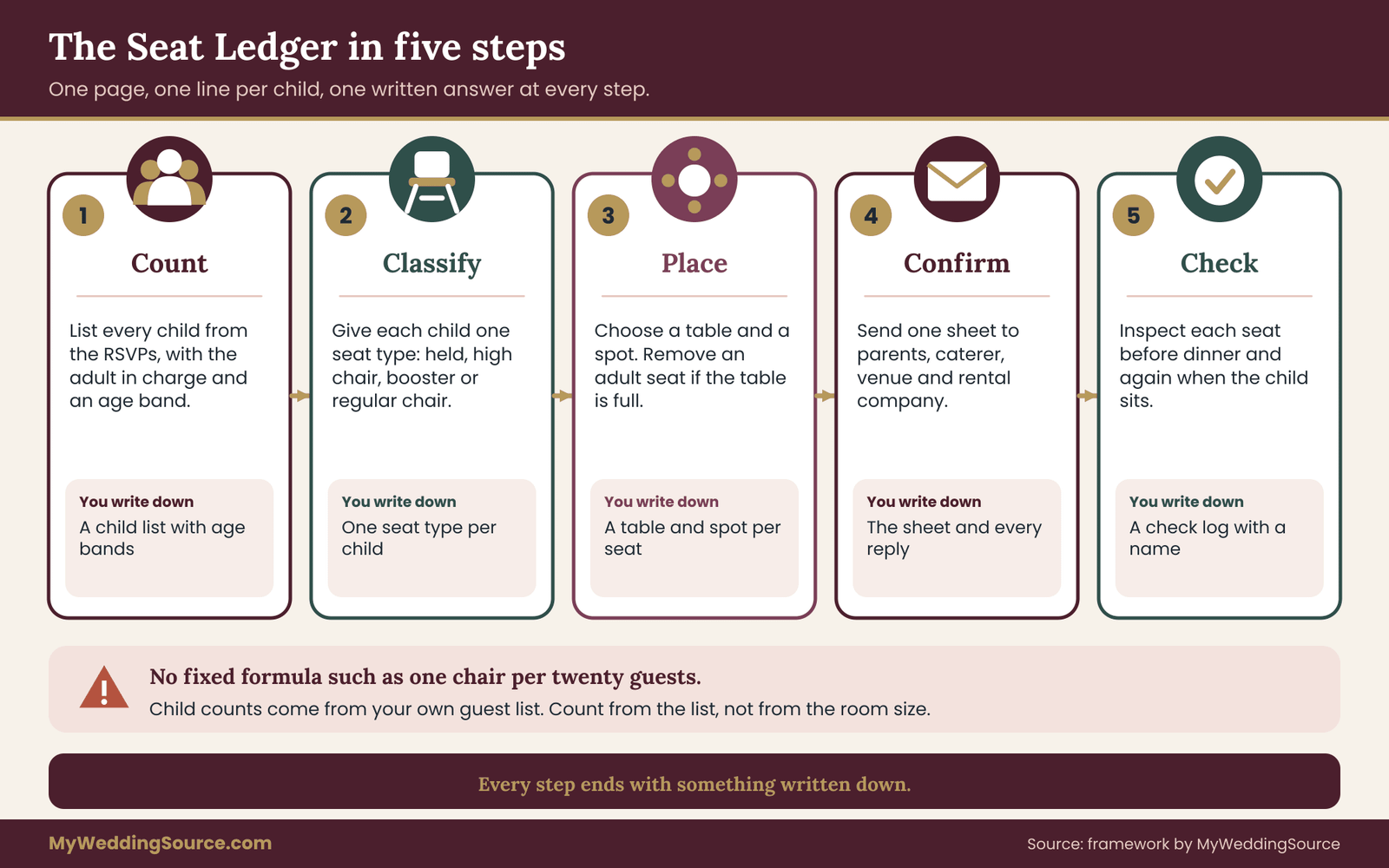
Step one: Count. Start from the RSVP list. Mark every guest who is a child or an infant, including those who were not named on the invitation but appear as a “plus one” or in a note. Write down each child’s first name or initials, the adult responsible for them, and a rough age band. You are not collecting medical details. You need just enough to sort the child into a seat type.
Step two: Classify. For each child, decide which of four seat types applies: held or carried, wedding high chair, booster seat, or regular chair. The next section explains the rules for this decision. The aim is that every child on the list has exactly one answer, even if that answer is “to be confirmed with the parent.”
Step three: Place. Decide where each seat goes. A seat that exists but sits in the wrong spot, such as the service aisle or the edge of the dance floor, creates its own problems. Placement is part of the count because a table that already holds ten adults may not fit a wedding high chair at all.
Step four: Confirm. Send written confirmations to four parties: the parents, the caterer, the rental company or venue supplying the seats, and the day-of coordinator or whoever will set up the room. Each confirmation uses the same numbers. If a number changes, all four get the new number.
Step five: Check. On the day, someone inspects each seat before guests sit down and again when the child is placed in it. The ledger gets a final column for that check.
Notice what the ledger does not include: a fixed formula such as “one wedding high chair per twenty guests.” Child counts depend on your guest list, not on its size. A wedding of 200 adults with no young children needs no high chairs. A wedding of 60 guests built around a large extended family might need six.
Counting from the actual list is the only reliable approach, and the ledger makes that count visible. If you are still building the guest list, the broader wedding guest list guide explains how to decide who is invited and how to record it, which is the starting point for step one.
Counting seats by need, not by headcount
The first mistake most couples make is counting children and stopping there. “Six kids” tells you almost nothing about seating. The seat each child needs depends on whether they can sit up without support, how big they are relative to a standard chair, and what the parents have already decided. Two children of similar age can need different seats, so the classification works from ability and from the product label, not from a birthday.
The four seat types
Held or carried. Very young infants who cannot sit up on their own do not belong in a wedding high chair. They stay in a parent’s arms, in a carrier worn by the parent, or in a stroller or car-seat carrier parked on the floor beside the parent. The point for the ledger is that these children need space, not furniture.
Give the family a spot at the table with a little extra room for a stroller or bag, and keep carriers on the floor rather than on tabletops or on chairs where they can slide. Consumer safety agencies have long warned against putting infant carriers on raised surfaces, and a banquet table is one of them.
High chair. A wedding high chair suits a child who can sit upright unassisted and is still small enough for the chair’s stated limits. Those limits are on the manufacturer’s label and in its instructions, and they are the rule that matters, not a general age. The chair brings the child up to table height, holds them with a restraint and gives them a tray or a pull-up position at the table.
Booster seat. A booster seat is for a child who has outgrown a wedding high chair but is still too small to sit comfortably and safely at a full-size table in a standard chair. It raises the child on an ordinary chair, and many models strap to the chair itself. A booster seat is only as stable as the chair beneath it, which matters at weddings because banquet chairs vary widely. Some are padded, some are slick, some have slatted or open backs that do not suit a strap.
Regular chair. Many children from the preschool years upward are fine in a standard chair, sometimes with a firm cushion. They still need a place at the table, a plate and a parent nearby, but no special equipment. Treat this as an active choice and write it down, so no one assumes the child will “manage.”
Sorting each child: a short decision path
Use the following path for each line in the ledger. It runs from the most restrictive answer to the least:
First, ask whether the child can sit upright without help for the length of a meal. If the answer is no, the seat type is “held or carried,” and the ledger notes the stroller or carrier space. If the answer is yes, ask whether the child is within the size limits printed on a high chair label.
If yes, the child gets a wedding high chair unless the parents want to bring something else. If the child is above those limits but too small for a standard chair, the child gets a booster seat, as long as the chairs in the room can hold one securely. Otherwise, the child gets a regular chair.
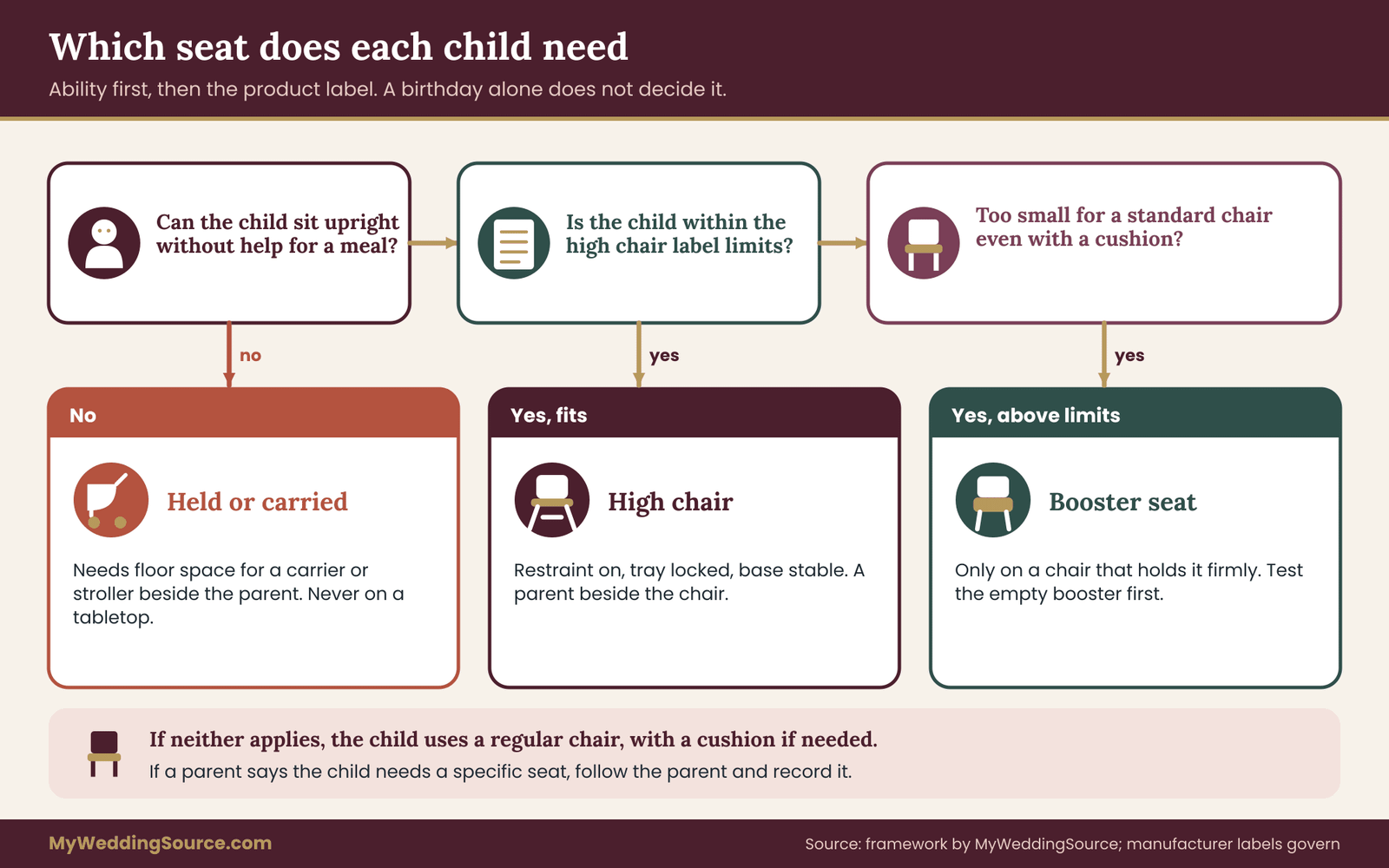
The path has one built-in exception. If a parent tells you that their child needs a specific kind of support seat because of a medical or developmental need, follow the parent. They know what the child uses at home, and a venue chair is rarely a better answer. In that case the ledger records “family supplies own seat” and the venue only needs to confirm there is space and a power or access route if one is needed. Keep that detail minimal. You need to know the seat type and the space, not the reason.
Counting by dinner, not by day
A second counting trap is the difference between children present and children seated. Not every child is at the table at the same time. Some arrive after the ceremony, some leave before the cake, some eat at a separate kids’ table, and some spend the meal being walked around the room by a grandparent. What the rental order needs is the peak number seated at once, and that is almost always the plated or served dinner.
To find it, take each child on the ledger and ask: will this child be in this seat during the main meal? If the answer is yes for six children and maybe for two, the order is six plus a small spare, and the two maybes get a conversation with the parents. If a parent says, “We will probably leave before dinner,” do not delete the seat from the ledger, but mark it as lower priority and ask again at the final count.
A small spare, and what it should cost you
Add a spare of one wedding high chair, or one booster seat, to the rental order when the count is above two or three. The reasoning is practical. Last-minute RSVPs, a guest who decides to bring a baby after all, and a defective seat on delivery are all more likely than a perfect count. A spare costs one extra rental fee, which is small next to the cost of finding a chair on a Saturday afternoon.
The spare does not have to be permanent. If your rental company allows quantity changes up to a stated date, set the spare as a placeholder and release it when the final count is locked. That is a contract question, so ask it directly: “Until what date can we reduce the quantity without paying for it?”
Reading the RSVP list for hidden children
Children rarely appear on the guest list in a tidy way. Watch for these patterns while you build the count:
An invitation addressed to “The Alvarez Family” that returns with four names, two of whom are children, and no age. Ask for ages or age bands in a friendly follow-up message rather than guessing.
A reply that says “plus one” without a name, where the plus one turns out to be a child’s other parent and the child is coming too.
A guest who writes a note on the response card, such as “we will bring the baby,” with no mention of a seat. That is a prompt to ask a short question, not a confirmation that a seat exists.
A family that was invited without children but is bringing them anyway. How to handle that is a matter of your invitation wording and the RSVP etiquette guide explains how to ask respectfully. For the seat count, the point is simply that late additions should flow into the ledger the day they appear, not after the caterer has locked the numbers.
If you are planning a child-free or adults-only reception, none of this applies, and nothing here is meant to pressure you to host children. For the many weddings that welcome a handful of young guests, though, the ledger turns a vague concern into a clear list.
Adults who need seating attention too
The same counting habit applies to adults who need a different seat. A grandparent who needs a chair with arms, a guest who uses a mobility device and needs a clear space at the table, or someone who needs a seat near the exit all belong in the same ledger. They compete with wedding high chairs for the same scarce resource: floor space around the table.
Putting everyone on one list, rather than keeping a “kids” list and an “access” list, helps you see conflicts early. The planning checklist on this site, the wedding planning checklist, is a good place to confirm that seating and access items are on the master timeline, so the ledger does not live in isolation.
Sourcing a wedding high chair: rental, venue, caterer or borrowed
Once the ledger says how many high chairs and booster seats you need, the next question is where they come from. There are five realistic sources, and each has a different mix of cost, control and risk. None is always best. The right choice depends on the count, the venue’s rules and how much you want to manage yourself.
Source one: the venue
Some venues own a small stock of wedding high chairs for events, particularly restaurants, hotels and banquet halls. The advantage is that the chairs are already on the property, the staff know how to set them up, and there is no delivery to coordinate. The disadvantages are that the stock may be small, the chairs may be older, and the venue may not have thought carefully about the model, the harness or recall status.
Ask the venue three things: how many they own, whether those are available on your date or shared with another event, and whether you can see the model information. If the venue says “we have a few,” treat that as a maybe and ask for a number in writing.
Source two: the caterer
Caterers that serve family-style events often keep a few wedding high chairs. A caterer that specializes in formal plated weddings may not. The catering contract is the right place to settle it, because the caterer’s staff will be the ones serving around the chairs. If the caterer provides wedding high chairs, ask whether they come with trays, whether the trays are cleaned between events, and whether servers have a rule about serving children’s plates first.
If the caterer does not supply chairs, ask whether they have a preference about outside seats. Some caterers want to know in advance because chairs affect the service path. Their answer feeds directly into placement later.
Source three: a party or baby-equipment rental company
A rental company is the most flexible source and the one most people think of first. The company can deliver a stated number of wedding high chairs and sometimes booster seats to the venue and pick them up afterward. The risks are timing and communication: the delivery window has to match when the venue allows access, and someone has to be present to receive and place the chairs.
If you are already renting tables, chairs or linens, adding high chairs to the same order is usually simplest, because delivery and pickup travel together. The wedding rental planning checklist covers how to read an equipment order, and the same habits apply to a child-seating line: confirm quantity, delivery window, who receives it, and who is responsible for damage.
Source four: borrowing from family or friends
A relative may have a spare wedding high chair or a travel booster in the garage. Borrowing costs nothing and works well for a single chair. The drawbacks are real, though. A borrowed seat has no rental company to check it, its history is unknown, and its manual may be missing. If you borrow, look at the label for the model name and manufacturing date, check the model on the consumer safety agency’s recall page, and test the harness and the tray lock before the day. If the label is gone or the harness is frayed, skip it.
Source five: guests bring their own
Some parents prefer to bring a portable seat their child already knows. That solves the fit question and removes one item from your list, but it creates a placement question. Clip-on table seats attach to the edge of a table and do not work with every table top, thick cloth or edge style. Fabric travel boosters strap to a chair back and need a chair that suits the strap. Ask parents who are bringing their own seat to describe it, and tell the venue so staff are not surprised to find an unfamiliar seat at table nine.
Whichever sources you use, record them in the ledger by seat: “Seat one, rented, delivered by the rental company; seat two, venue-owned; seat three, family supplies own.” That avoids the common problem where the same chair is counted twice, once from the venue and once from the rental order.
How to choose among the five
A few plain decision rules help when the options compete:
If you need one or two seats and the venue or caterer already owns them in good condition, use them. The convenience is real and the cost is usually small or zero.
If you need three or more seats, or you want control over the model and its condition, rent from a company that can tell you the model names and confirm delivery times.
If a family has a specific seat they trust, accept it, and make sure the placement works.
If you cannot get written confirmation from any single source by the time your final count is due, rent the seats. A paid rental with a delivery slot is more reliable than a verbal “we think we have some.”
What a wedding high chair rental quote should say
A rental quote for a wedding high chair is short, and the details that matter are easy to miss because they look like fine print. Before you pay a deposit, read the quote for the items below. If any are missing, ask for them by email so the answer is in writing.

Model and condition. A good quote names the product, not just “wedding high chair.” Ask for the brand and model so that you can look each one up on the consumer safety agency’s recall list. In the United States that agency is the Consumer Product Safety Commission, and its site lets you search recalls by product type and brand. A rental company that stocks a handful of models should be able to give you the names in a single reply.
Safety features. Ask whether each chair has a working harness, a tray that locks in place, a stable base and a locking mechanism if it folds. You do not need technical language. A short question works: “Do all the chairs have a complete restraint and a tray that locks?” A company that rents these regularly will answer without hesitation.
Quantity and spare. The quote should show the number you asked for, with your spare, and state until when you can lower the quantity without charge. Without that date, you may pay for chairs that you cannot use.
Delivery and pickup. The quote should state a delivery window, a pickup window, the address and the contact on site. Venues often limit when deliveries can arrive and where they can park. They often have their own loading rules, so ask the venue directly: “Where do rental deliveries enter, and what time can they arrive?”
Cleaning. Ask how the chairs and trays are cleaned between events. You are not asking for a lab standard, only whether the company has a routine. Trays are where food ends up, and allergens carry over if cleaning is careless. If a parent has told you about a food allergy, ask the rental company specifically that the trays be freshly cleaned.
Damage and loss terms. Ask what happens if a chair is damaged, stained or missing. Some companies charge a flat fee, some charge replacement cost, and some include normal wear. This is a good place to think about who signs: if your coordinator or a family member will receive the delivery, make sure that person knows they are accepting the chairs and may need to note any damage at drop-off.
Fees. Ask for the full price: unit price, delivery fee, pickup fee, any setup fee, and any deposit. Compare quotes on the total, not the unit price alone, because a low unit price can be paired with a high delivery charge. For a small order, the delivery fee is often the largest part of the bill.
Cost logic without made-up numbers
You can reason about cost without knowing any prices. Write the total cost of the wedding high chair line as: number of chairs times unit price, plus delivery, plus pickup, plus any setup fee, plus any deposit you may not get back if something is damaged. Then compare that figure against a borrowed or venue-owned alternative, which is often zero in cash but has its own hidden costs: your time to inspect, the risk of the wrong model and the awkwardness of asking a relative for a favor.
A simple rule works well here. If renting adds the delivery and pickup fees to a very small order, check whether adding the chairs to an order you are already placing for tables or chairs removes those fees. If it does, the high chair line may be cheaper than it first looked. If the venue provides chairs at no charge, compare only the risk and the convenience, not the price.
Because the line is small, do not let the cost question delay the decision. Whether you choose the cheaper or the more convenient source, a chair that is reserved, confirmed and delivered on time is worth more than a few dollars of savings. Add the line to your budget the week you finalize the count. If you are tracking everything in a budget, the wedding budget guide shows where small rental items fit.
Placing each wedding high chair in the room
Placement is where a good count either holds up or falls apart. A chair in the wrong spot creates risks that no amount of careful sourcing fixes: a child within reach of a candle, a server who has to squeeze past a wedding high chair with a tray of hot plates, a parent stuck at the far end of a table who cannot reach their child. The goal is a position that works for the child, the parent, the neighbors and the staff at the same time.

Start with the table, not the chair
Look at the table first. A round table of ten adults has little spare circumference. Each adult seat takes up room, and a wedding high chair is wider than a standard chair once the tray and legs are counted. Adding a wedding high chair to a full table usually means either removing an adult seat or placing the chair at a gap between seats and pulling the table slightly away from its neighbors.
The tidiest solution is often to seat the family at a table with room built in. When you build the seating chart, mark the family’s table as “one fewer adult seat” for each high chair, or add a small buffer around the table. The wedding seating chart guide explains how to lay out tables and assign guests, and the ledger gives you the exact tables where room is needed.
A rectangular table is easier in one respect: a wedding high chair can sit at the end of the table, with the parents beside it, and the open side faces away from traffic. A round table offers no end, so choose a spot where the wedding high chair has an adult on each side if possible, or one adult and a wall of the table’s own edge.
The five placement rules
Five rules cover most rooms.
Keep the parent within arm’s reach. A parent should be able to touch the child’s tray or shoulder without standing up. A child seated across the table or two seats away is effectively unsupervised for the length of a course. The rule is simple: the adult responsible for the child sits adjacent to the wedding high chair, on the side nearest the child’s strong hand if the parent has said which it is, or simply beside it.
Keep the chair off the service path. Servers carry plates, trays and sometimes hot dishes along predictable routes between the kitchen and the tables. A high chair at the aisle edge of a table is in that route. Ask the caterer or the venue manager where servers walk, and place the chair on the side of the table facing away from it, or toward a table back instead of an aisle.
Keep the chair out of exit and access routes. The venue and the local fire authority set the rules for aisle widths and exits, and those rules apply to your seating layout. A wedding high chair that narrows an aisle or sits near an exit can create a problem, and it can also block a route used by a guest who uses a wheelchair or walker. Under the Americans with Disabilities Act, the venue is responsible for accessible routes in a public accommodation, and you can read the federal guidance on ada.gov.
As the host, the practical step is to keep clear paths clear when you add furniture. If you are unsure whether a layout leaves enough room, ask the venue manager to look at the floor plan, and read the accessible wedding venue red flags guide if access is a particular concern for any guest.
Keep hot, sharp and breakable things out of reach. Candles, glass centerpieces, hot serving dishes and wine glasses all belong beyond a child’s reach, including a child who stretches. A child in a wedding high chair can reach farther than most adults expect, and tablecloths are a hazard because a small hand can pull them. If your table has a floor-length cloth, keep the tray close to the table edge so the cloth cannot be grabbed, or ask the venue about a table without one for that family.
Keep the chair on level, firm ground. High chairs have narrow bases. A chair on a soft lawn, a gravel path or a sloping tent floor can tip. If the reception is outdoors, ask whether the dining area has a floor or a platform, and place the wedding high chairs on the most level, firm area.
Where the chair should not go
A short list of poor locations saves time:
Beside the bar or the dessert table, where adults carry drinks and trays and where traffic is highest.
At the edge of the dance floor, where guests move quickly and the music is loudest.
Near a speaker, a heater or a cooling unit, where noise and temperature are hard on a small child.
In front of a doorway, a fire exit, a stairway or a kitchen pass.
Directly under a window with direct afternoon sun, if the child will sit there for an hour.
None of these is forbidden in an absolute sense, but each is a reason to move the chair.
Placement for the other seat types
A booster seat goes on a chair at the table and needs the same distance from hazards as a high chair, plus a chair that holds the booster firmly. Test it. Sit the empty booster on the actual banquet chair and give it a firm push. If the chair rocks, slides on the floor or has a back that does not take the strap, a different chair or a different booster is needed.
Held or carried infants need floor space, not a seat. Put the stroller or carrier on the floor beside the parent, out of the aisle, and tell the parents where it will go so they can plan their bags. A small bonus: a spot near a wall also gives a parent somewhere to step aside if the baby needs a feeding break, which is a separate topic from seating.
Photo and sightline considerations
The ledger should note whether the family is likely to be in photographs during dinner. Photographers often move around tables during toasts and cake, and a wedding high chair can end up in the background of the head table shots or block a view of the couple. If the family’s table is near the head table, consider a position that keeps the chair out of the main sightlines. This is a minor point, but it avoids moving a chair in the middle of a toast.
Draw it before you place it
For any room with more than two or three wedding high chairs, a rough sketch beats a verbal description. A rough sketch of the floor plan marks each table, each child’s seat and the paths servers walk. You can ask the venue for a floor plan or draw the room from the walkthrough. The point of the drawing is to show a problem before the chairs arrive, such as three wedding high chairs clustered at one side of the room or a seat blocked by a pillar.
The reception guest flow guide covers how guests move through the room, and the same thinking applies here: look at the routes before you place the furniture.
Safety checks before guests sit down
A seat that is correctly counted and well placed still needs a short inspection. The checks below take about a minute per chair and are most useful when done twice: once at setup, before the guests arrive, and once when a child is placed in the chair.
The setup check
Do these before the room opens.
Check the label and the model. Find the manufacturer’s label and note the model. If you have not already checked the recall list, do it now for each model. If a model has been recalled, do not use it. The Consumer Product Safety Commission publishes recalls and a general guide to wedding high chair safety on its site, and the page is searchable by product.
Check the restraint. The harness or strap should be present, intact and able to fasten and unfasten. A frayed strap, a broken buckle or a missing crotch strap is a reason to swap the chair. A restraint that cannot be used is the same as no restraint.
Check the tray. The tray should click or lock into place and stay there under a firm tug. A tray that pops off is a spill at best and a fall at worst.
Check the base. Open the chair fully, and make sure any folding locks are engaged. Give the chair a firm push from several sides. A stable chair does not wobble or slide.
Check the surface. Wipe the seat and tray if they look dirty, even if the company said they were cleaned. Check for sharp edges, cracks or stickiness.
Check the floor. Move the chair to its spot and make sure the floor under all four legs is level and firm.
The placement check
When the child arrives, a parent or a designated adult does the second check. This is not a job for staff. The adult responsible for the child fastens the harness, sets the tray, and confirms the child is seated properly with the restraint on. A child who is not buckled is the single most common avoidable problem with high chairs, and it is the one that costs nothing to fix.
Two practical reminders help here. First, no child should be left alone in a wedding high chair, even for a moment, and no child should be allowed to stand in it or climb in and out unsupervised. Second, do not use the chair as a place to park a child for a long stretch. A young child strapped in for a full reception becomes tired and unhappy, and the parent will want to take the child out sooner than the schedule assumes. The meal is the main use. Plan for the child to be out of the chair between courses and after the cake.
The food and allergy check
Because wedding high chair trays are where food lands, a few simple food checks help. Tell the caterer how many children’s meals are needed and, if a parent has shared an allergy, the plain fact of the allergy and the table, without more medical detail than the kitchen needs. Ask that the child’s plate be marked or delivered to the parent rather than set down in front of the child by staff who do not know the situation.
Parents often bring their own snacks and bottles, and a clear spot at the table for a diaper bag keeps those items off the floor and out of the aisle.
For choking risk, the guidance on food size and preparation for young children comes from pediatric organizations, and the American Academy of Pediatrics publishes plain-language advice on its consumer site, HealthyChildren.org. Your role is not to decide what a child can eat. It is to make sure the caterer knows when a child’s meal is needed and to leave the decision about food with the parent.
Who does the checking
Name a person. If the day-of coordinator is present, the check belongs on their list. If there is no coordinator, ask a reliable family member or the venue’s event captain to take the job, and write the name in the ledger. The reason to name someone is that safety checks that belong to everyone belong to no one. Keep the task short and concrete: arrive thirty minutes before dinner, walk the list, move any chair that fails, and tell the person in charge if a spare is needed.
The confirmation sheet and what to say
The ledger is for you. The confirmation sheet is what you send to everyone else. It takes the numbers from the ledger and turns them into a single page that each party can read in under a minute and act on. The sheet is the reason the method works: it replaces four separate assumptions with one shared set of facts.

What goes on the sheet
Keep it short. A one-page sheet contains these items, in this order:
Event details. The date, the venue name and the room, the time dinner is expected to start, and a contact person for the day with a phone number, written as a phone number and not an email address.
Seat counts by type. The number of wedding high chairs, boosters, regular chairs with cushions, and families who supply their own seat, with the spare shown separately. For example: “High chairs: four, plus one spare. Boosters: two. Family-supplied seats: one.”
Table assignments. A list of tables and the seat type at each one, such as “Table nine: one high chair, one booster.” Use table numbers or names, not the children’s full names.
Source for each seat. Whether each seat comes from the venue, the caterer, the rental company or a family. This is what stops double counting.
Delivery and setup. When the chairs arrive, who receives them, who places them, and where they go until placement.
Children’s meals. The number of children’s meals, the time they should be served, and a plain note about any allergy that the kitchen needs to know, tied to a table number.
Check owner. The name of the person who will do the setup check and the time they will do it.
Change deadline. The date by which counts can still change, and who to tell.
That is the whole sheet. Resist the urge to add more. A longer sheet gets skimmed, and a skimmed sheet is a sheet nobody follows.
Protecting children’s information
Children’s data deserves a little care. The sheet will travel by email or messaging, and it may be forwarded. A few habits keep it safe without making the work harder.
Use first names or initials, not full names. Use age bands such as “toddler” or “preschool” rather than birth dates. Do not put medical conditions on the sheet beyond what the kitchen needs, for example “one child with a nut allergy at table nine.” If a parent has shared something sensitive, ask permission before passing it on, and tell them who will see it.
Share the sheet only with the people who need it, and delete older versions once the event is over. If you use a shared online document, set it so that only people with the link can view it, and remove access after the wedding.
These habits are not complicated, and they respect what parents have trusted you with. They also protect you if a sheet is forwarded to someone you did not intend.
What to say to the parents
Parents are the most important source of accuracy and the people most likely to be unsure what is on offer. A short, friendly message does the job. For example:
“We are planning seating for our reception and want to make sure your family has what it needs. Could you tell us what your child will sit in at dinner? We expect to have wedding high chairs and booster seats available, and you are welcome to bring your own if you prefer. If you do, a quick description helps us make room.”
Follow up with a second message if you do not hear back. Many parents answer a direct question quickly but ignore a general one. Ask for the age band or the stage of the child, the seat they would like, and whether they plan to be at the dinner table for the full meal. Keep the tone easy. A parent who feels judged will not tell you the real situation.
If a parent says they will bring their own seat, ask for a short description and confirm the table. If a parent is unsure, give a decision date: “We need to lock the count by the fifteenth, so please let us know by then.”
What to say to the caterer
The caterer needs the number of children’s meals, the service time, and any seating furniture the caterer will supply. A short message works:
“We have a few young children coming and want to confirm details. Do you provide wedding high chairs, and if so, how many are available on our date? If not, are there any limits on outside seats? We also need children’s meals for a set number of children, to be served early, and one table has a food allergy we will describe. Can you confirm your final count deadline?”
The caterer’s reply goes into the ledger. If the caterer says “we can do that,” ask for the answer in writing with a number. That sentence in an email is worth more than a promise on the phone.
What to say to the venue
The venue needs to know about extra furniture, placement and delivery. Ask:
“We expect to have a small number of wedding high chairs at the reception. Can you confirm where deliveries enter, when they can arrive, and whether there are rules about the placement of extra seating near exits and aisles? Could you also tell us whether you own any high chairs?”
If your venue has a contract that restricts outside rentals or requires notice, check the paragraph. The wedding vendor contract guide explains how to read the clauses that tend to matter, such as access, insurance and outside vendors.
What to say to the rental company
A rental company wants quantities, dates and addresses. Give them those plainly, and ask the questions from the quote section: model names, restraint and tray, quantity change date, delivery and pickup windows, cleaning and damage terms. Ask them to confirm the order by email with a summary of what is included.
Closing the loop
Once all four replies are in, update the ledger and send the sheet to everyone together. Ask each party to reply “confirmed” or to flag a correction. A reply is worth more than silence. If someone does not answer, ask again, and if the issue is critical, call. The final check on the sheet is simple: does every child on the ledger have a seat type, a table and a source? If the answer to all three is yes for every line, the plan is complete.
A last point on tone. These messages should sound like a thoughtful host, not an inspector. Parents are doing you a favor by coming with small children, and vendors want your event to go smoothly. A clear, brief, polite request gets a quick reply almost every time.
When the sheet changes
Changes will happen. A family cancels, a baby is born, a toddler outgrows a seat type. When a number changes, update the ledger first, then the sheet, and send the new version with a short note about what changed: “Table nine now needs a booster instead of a wedding high chair.” Date the sheet in a corner so no one uses an older copy. Make sure the rental company and caterer see the change before their deadlines. If the change comes after a deadline, ask anyway. A vendor may still be able to adjust, and the cost of asking is a few minutes.
A worked example of wedding high chair planning
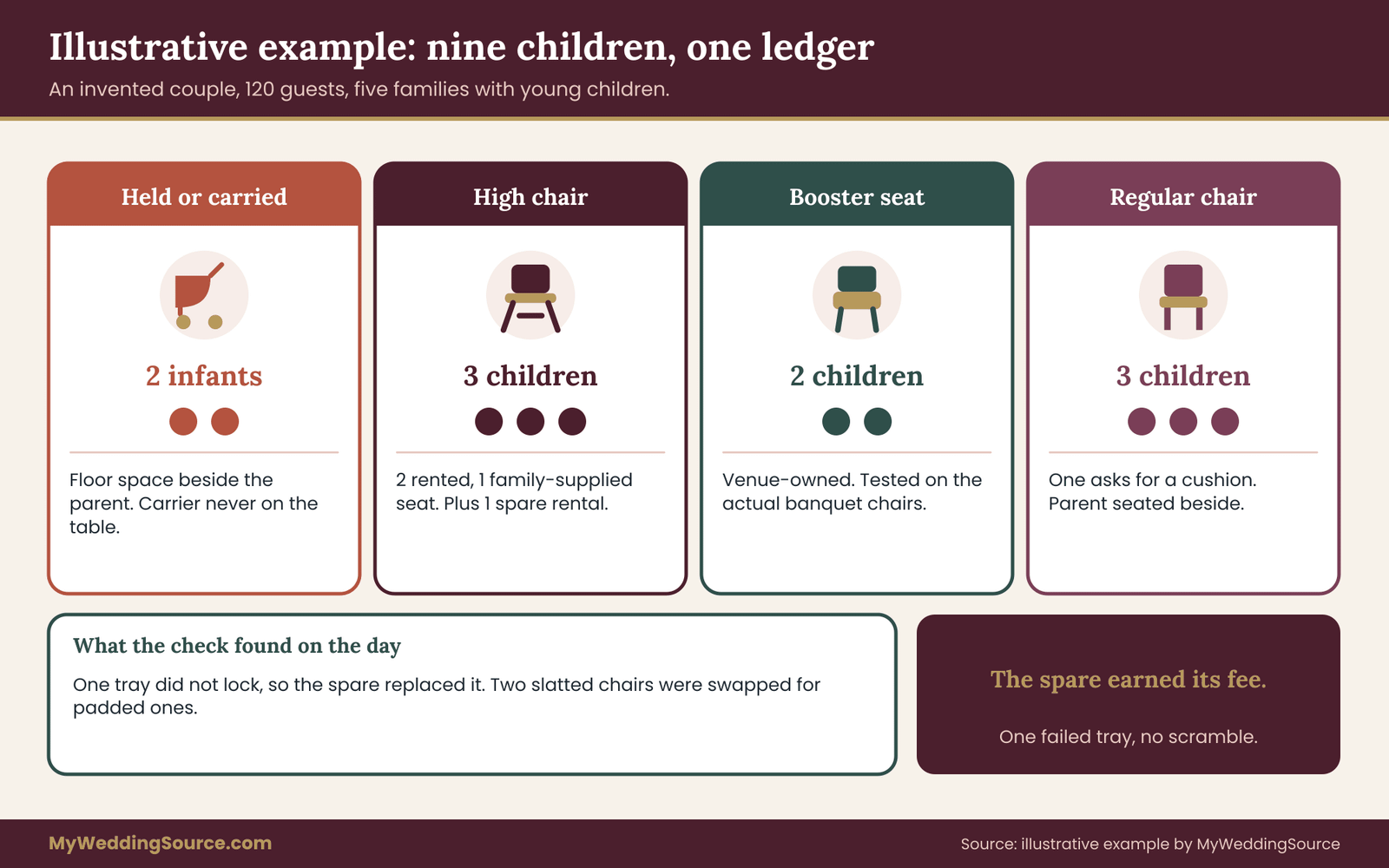
The following example is invented, and the numbers are chosen to show the method, not to suggest what any wedding should contain. Maya and Daniel are planning a reception for 120 guests in a hall with round tables of ten. Their RSVP list shows nine children from five families.
Step one and two: the ledger
Maya builds the ledger from the RSVP list and sends a short follow-up message to each family. Within a week she has the following, written by seat type.
Two babies cannot sit up unassisted. One is four months old and the other is five months old, and both belong to families who plan to hold them or use a carrier. The ledger lists “held or carried” for both, with a note that the families will need floor space beside their chairs.
Two toddlers, nine months and fourteen months, sit up on their own and are small enough for a wedding high chair. One of the families tells Maya they will bring a portable seat that their child uses at home. The ledger lists one wedding high chair needed from the rental and one “family supplies own seat.”
One two-year-old fits a high chair by the manufacturer’s size limits, according to the parents, who check the label on the one they own. That gives a second rental wedding high chair.
Two children, three and four years old, have outgrown wedding high chairs but sit too low in a standard chair. Both get booster seats.
Three children, aged six, eight and ten, are fine in standard chairs, and their parents plan for them to sit with the family. The ledger lists “regular chair” and notes that one parent asked for a cushion.
The tally: two rental wedding high chairs, one family-supplied seat, two boosters, three regular chairs and two held or carried infants. Because there are two rental high chairs and two boosters, Maya adds one spare wedding high chair, for three rental wedding high chairs in total. She keeps the booster count at two, because boosters are easier to find on short notice at the venue.
Step three: placement
Maya looks at the tables. Three families sit together at table four, two at table five, and the rest are scattered. She moves the families who need wedding high chairs to two tables at the side of the room, where there is more space between tables and servers walk the center aisle. At table four, which holds the toddler with the portable seat, the two babies and a booster, she reduces the table from ten adult seats to eight, so that everyone has room. At table five, she places a wedding high chair at the table’s end, with the parents beside it.
She sketches the room and marks each high chair, booster and stroller space. The sketch shows one wedding high chair that would sit directly in the path to the kitchen door, and she moves it to the other side of the table.
Step four: confirmation
Maya sends the confirmation sheet to the parents, the caterer, the venue and the rental company. The sheet lists three wedding high chairs from the rental company, two boosters from the venue, one family-supplied seat, and the table numbers. It asks the caterer for five children’s meals at the start of service, one with a note about a nut allergy at table four. It names Daniel’s cousin as the person who will do the setup check thirty minutes before dinner.
The caterer replies that they cannot provide boosters, so Maya asks the venue, who confirm they own four and will set two aside. The rental company confirms models and a delivery window the afternoon before. Maya looks up each model on the consumer safety agency’s recall page and finds no recall. She writes the confirmations in the ledger.
Step five: the check
On the day, Daniel’s cousin arrives thirty minutes before dinner. One wedding high chair has a tray that does not lock. He swaps it for the spare, which is why the spare existed. A booster does not sit well on the venue’s slatted-back chairs, so the venue’s captain swaps those two chairs for padded ones. The check takes ten minutes, and nobody at the reception notices anything.
What the example shows
The example shows four things. First, the count started from the RSVP list and a short message to parents, not from a rule of thumb. Second, the spare earned its fee. Third, the check found problems before a child was involved. Fourth, the sheet kept five parties aligned with a single page. Nothing in the example was expensive or elaborate.
A timeline from first RSVP to dinner service
The timeline below works backward from the date and should be adjusted to your vendors’ own deadlines. Wedding vendors set different cutoffs for final counts, and those cutoffs, which are in your contracts, take priority over any generic schedule.
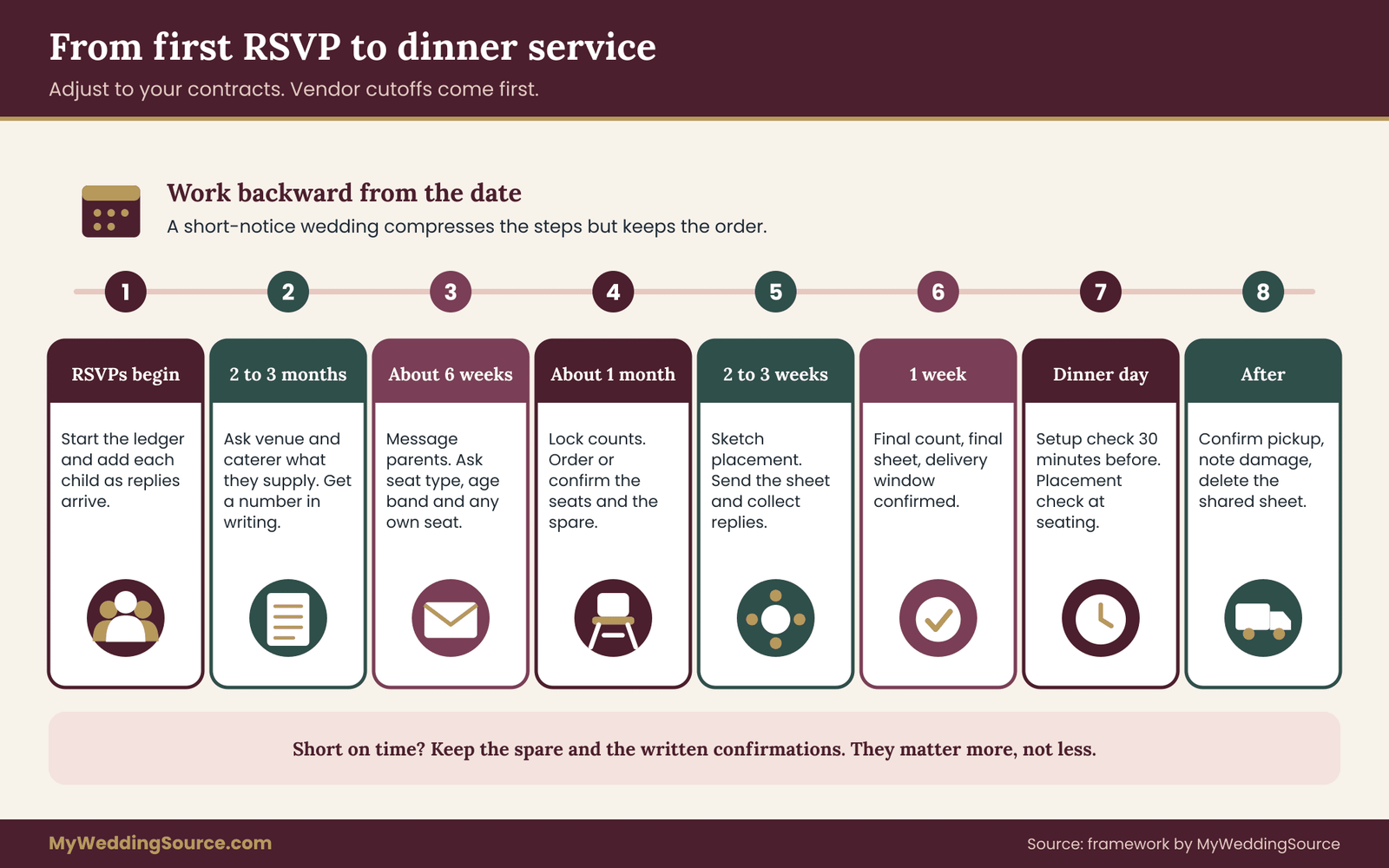
As soon as RSVPs begin arriving. Start the ledger. Add each child as the response comes in. Do not wait until all replies are in, because a little work spread over several weeks is easier than a large batch at the deadline.
Two to three months before. Ask the venue and caterer what they provide and write down the answers. At this stage you are asking questions, not placing orders. If the venue and the caterer both say they have chairs, ask for numbers. If neither does, begin looking at rental companies.
About six weeks before. Send the follow-up message to parents with children on the list. Ask for the seat type, the age band and any plan to bring their own seat. Set a reply date.
Around a month before. Lock the ledger as far as it will lock. Decide the final count of high chairs and boosters with the spare. Place the rental order or confirm the venue and caterer’s stock in writing. This is also the time to check the vendor’s quantity change date.
Two to three weeks before. Build the placement sketch and update the seating chart. Send the first version of the confirmation sheet to all four parties. Ask for “confirmed” replies.
One week before. Look at the final guest count and update the ledger. Send the final sheet. Confirm the delivery window with the rental company and the setup person with the venue.
Two days before. Check that the delivery window and contact are unchanged. Tell the setup person the plan, the table numbers and where to find the sheet.
The day. Setup check thirty minutes before dinner, placement check when each child is seated, and a quick walk during dinner to see that the chairs are still where they should be.
After the event. Confirm pickup, note any damage and return any borrowed seats. Delete the shared sheet, and remove access to any shared document that contained children’s information. That last step is easy to forget and worth doing.
Using the timeline for a short-notice wedding
If your wedding is only a few weeks away, compress rather than skip. Start the ledger on day one, send the parent message in the first week, and place the rental order as soon as you have a first count, then adjust with the spare. The order of the steps still holds. The difference is that you have less room to fix a mistake, so the spare and the written confirmations matter even more.
Edge cases and limits of a wedding high chair plan
Even a well-run ledger meets situations that do not fit the neat categories. These are the ones that come up most often, with a plain way to handle each.
Outdoor and tented receptions
Grass, gravel and sloped ground are hard on a wedding high chair with a narrow base. If the dining area is on a lawn, ask whether the venue or tent company can lay flooring, and put wedding high chairs on the most level patch. Check the weather plan as well. If rain moves the reception indoors or under a tent, the placement sketch needs a second version, and the setup person needs to know both. Sun and wind matter too: a child in direct afternoon sun needs shade, and a tablecloth in the wind becomes a hazard, so weight or fasten it.
Family-style and buffet service
With family-style service, large hot dishes pass across the table, and a child in a wedding high chair is within reach of them. Seat the child at a spot where dishes do not need to pass over the tray, and ask servers to place hot items at the other end. With a buffet, a parent often has to leave the table to fill a plate, and the child is left momentarily with whoever remains.
Ask the family to plan who stays, or ask the caterer whether children’s plates can be brought to the table. The wedding menu planning guide covers how service style changes what guests do at the table, and the same questions apply to seating.
A kids’ table
Some couples set a table for older children. A kids’ table is a reasonable choice for children who are comfortable sitting without a parent, usually school-age and above. It is not a replacement for a high chair or booster seat for a toddler, who still needs an adult close by. If you use one, decide who will be seated nearby, and make sure the children are in standard chairs that fit them. A child who needs a booster sits with the family, not at a table where no adult is close.
A child who refuses the chair
Some children simply will not sit in a wedding high chair. A parent is the right person to decide what to do. Options include a lap, a standing parent for a short while, or a break outside the room. Do not treat this as a failure of planning. The ledger can note a fallback, such as an extra chair beside the parent, which costs nothing and gives the family a choice.
Late changes and surprises
A child appears who was not on the list. First, look for a spare. If none exists, ask the venue or caterer whether they have one, and ask the parent whether they have a portable seat. If neither works, a regular chair with a firm cushion and a parent beside the child may be the best temporary option, for a child old enough to sit in one.
A child too young to sit unaided is held. In no case should you improvise with stacked chairs, a pile of cushions or an unsecured box. A seat that was not designed to hold a child is a seat to avoid.
The wrong chairs arrive, or too few
Delivery problems happen. If the count is wrong, call the rental company at once and ask for a replacement and an estimated time. If the models differ from what was confirmed, check them against the recall list before you use them. If a chair is damaged, photograph it, note it on the delivery receipt and tell the company. Your spare covers one failure; a second failure calls for the venue’s help or a parent’s portable seat.
The venue forbids outside rentals
Some venues require all rentals to come through their approved vendors. Ask early, and read the contract paragraph about outside vendors. If the venue allows only its own chairs, the question becomes how many they hold and whether they will add to the stock. If it will not, a family-supplied seat may be the best answer, and the venue should agree in writing.
Guests with mobility needs at the same table
A table with a wedding high chair, a stroller and a guest who uses a mobility device is a crowded table. Give the table extra room and consider whether the wedding high chair is better at a nearby table. The rule is that an accessible route and a clear space for the guest come first, and furniture adapts. If you are unsure, ask the guest what works for them.
Weddings with many children
A large extended family may bring a dozen or more young children. The method still works, but the ledger needs more care, and the venue needs notice early. Consider a dedicated section of tables for families with young children, near an exit and away from the dance floor. A hired childcare provider, if you use one, may reduce the number of children at dinner, and the hiring side of that choice is covered in the guest care guide for babies, children and older relatives.
What this guide cannot decide for you
The limits are worth listing. The guide cannot tell you what your local fire code requires for aisle widths, because that depends on your jurisdiction and your venue. It cannot tell you whether a particular rental model is safe, because recalls and standards change, and the issuing agency is the right source. It cannot decide what a child can eat or what a family needs for a medical reason, because that belongs to parents and clinicians.
And it cannot set staffing levels for supervising children, which belong to local law and qualified providers. For each of these, ask the venue, the agency or the professional directly, and write down the answer.
Your next steps
Here is a short sequence you can start this week.
- Open a blank page and create the ledger with one line per child on your RSVP list. Add columns for the adult in charge, seat type, table, source and check owner.
- Sort each child by seat type, using the four categories. Mark the lines that need a parent’s answer.
- Send the short parent message and set a reply date.
- Ask the venue and the caterer what they supply, and ask for a number in writing.
- If you need rental seats, request quotes that name the model, the restraint, the delivery window, the quantity change date and the full price.
- Add the placement sketch to your seating chart.
- Build the one-page confirmation sheet and send it to the parents, caterer, venue and rental company.
- Name the person who will do the setup check, and give them the sheet.
If you want to see the wider picture, the wedding guest care guide covers babies, children and older relatives as a whole, and the ledger fits inside it as the seating chapter.
FAQ
How many high chairs do we need for our wedding?
Count the children who can sit up unassisted, are within a high chair’s label limits, and will be at the table during dinner at the same time. That peak number, not total children invited, sets the order. Add one spare when you need more than two or three. Held infants need floor space, not a chair, and older children usually need a booster or a regular chair.
Who is responsible for providing high chairs at a wedding?
It depends on your venue and caterer, which is why you need to ask in writing. Some venues or caterers own a few wedding high chairs, while others expect you to rent them. Whoever agrees to supply them should confirm the number, the model and the delivery time. If nobody will commit, rent them from a company that will.
What is the difference between a high chair and a booster seat?
A wedding high chair is a freestanding seat with a restraint and usually a tray, meant for children who sit up on their own but are small. A booster raises a child on a regular chair, so it suits a child who has outgrown a wedding high chair but is too small for a standard seat. Check each product’s label for its size limits.
Can a baby sit in a high chair at a wedding?
Only a baby who can sit upright without help and fits the chair’s stated limits. Younger babies are held or kept in a carrier on the floor, not on a table or chair. The label and instructions govern, and a parent knows best what the child can do. When unsure, follow the parent and the manufacturer’s guidance.
Where should we put a high chair at the reception?
Put it next to the responsible parent, away from the service path, exits, the bar and the dance floor, and out of reach of candles, hot dishes and tablecloths. Use level, firm ground, and keep aisles and accessible routes clear. A quick sketch of the room shows problems before the chairs arrive.
How do we check that a rented high chair is safe?
Ask the company for the model and look it up on the Consumer Product Safety Commission’s recall list. At setup, confirm the harness is intact, the tray locks, the base is stable and the chair is clean. Buckle the child in every time and never leave a child alone in it. Replace any chair that fails.
What should the confirmation sheet include?
Include the date, venue and dinner time, the number of each seat type with the spare, the table for each seat, the source of each seat, delivery and setup details, the number of children’s meals, the person doing the check and the change deadline. Use first names or initials and share the sheet only with those who need it.
What if a guest brings a baby we did not plan for?
Check for a spare high chair, ask the venue or caterer, and ask the parent whether they have a portable seat. A child who sits up well enough can use a regular chair with a cushion and a parent beside them, and a younger baby is held. Never improvise with stacked chairs or unsecured items.
Sources
- U.S. Consumer Product Safety Commission: product safety information, high chair guidance and recall searches.
- Electronic Code of Federal Regulations: federal rules, including the safety standard for high chairs.
- HealthyChildren.org, American Academy of Pediatrics: plain-language guidance on feeding, safe sleep and child safety.
- ADA.gov, U.S. Department of Justice: federal guidance on accessible routes and public accommodations.
- Juvenile Products Manufacturers Association: information on certification of juvenile products.
- Safe Kids Worldwide: child injury prevention resources.
- National Fire Protection Association: codes and standards that local fire authorities use for exits and aisles.
- Centers for Disease Control and Prevention: child health and food safety resources.
- ASTM International: the standards organization behind consumer product safety standards.