
A bridal tea party is a shower built around a pot of tea, a tiered tray of small food and a table everyone can actually sit at. This guide covers the parts that decide whether it feels easy or strained: who sits where when guests range from grade school to great-grandparents, how to build a three-tier menu with options for every guest, how many pots and cups to plan, how to pace two and a half hours, and what to check so every guest can reach the table, the food and the restroom.
Plan the bridal tea party with a four-lane check: Seat, Serve, Pace and Reach. Seat means every guest has a fitting chair and a neighbor to talk to. Serve means three menu tiers (savory, bread, sweet) where each tier has a version without the common allergens and a clear label. Pace means a two to three hour run with a first pour within fifteen minutes of arrival and a break before the sweets. Reach means a step-free route, a table you can roll under and light pots. Test each lane on paper before you book anything.
A bridal tea party looks effortless in photographs. The reality behind the photographs is a lot of small objects (cups, saucers, plates, pots, stands, napkins) arranged on a surface with a fixed size, in front of people with very different needs. A nine-year-old cousin, a college roommate, an aunt who uses a walker and a grandparent who cannot hear well across a table all have to be comfortable in the same room for the same stretch of time.
Nothing about that is hard. It simply has to be planned on purpose, which is the whole point of bridal tea party planning, because the default arrangement tends to suit the middle of the age range and nobody else.
This article is about that planning. It does not try to cover the whole job of hosting a shower, such as who hosts, what the guest list looks like or how gifts work. For that wider ground, the wedding etiquette guide covers hosting customs, guest lists and gifts for every pre-wedding gathering. What follows is narrower and more practical: the logistics of a seated bridal tea party, from the first sketch to the last cup.
A note on scope. This is general hosting information, not legal, tax or financial advice. Accessibility duties, food safety rules and venue policies differ by place and by situation, so where a rule matters, the article points to the agency or organization that issues it and asks you to confirm the current version.
What a bridal tea party plan has to solve
Before choosing a venue or a tea, it helps to name the problems a bridal tea party creates that a standing cocktail shower or a backyard brunch does not. There are five, and each one shows up later in the article as a lane or a check.
The first is seated duration. A tea service keeps people at a table for two hours or more. A standing party lets guests move when their back or knees complain; a seated one does not. A chair that is fine for thirty minutes can be miserable at ninety.
The second is the table itself. Tea service puts a lot of objects in front of each guest: a cup and saucer, a plate, a napkin, often a shared tiered stand and a pot. Tables that look generous empty can become cramped the moment the first stand arrives. This is a measurement problem, not a taste problem, and the place-setting test later in the article solves it with a ruler.
The third is hot liquid near people who may be small, unsteady or crowded. Kettles and pots are normal, but the route a hot pot takes from the service area to the table, and who is sitting where it lands, are things you can design. A bridal tea party uses hot pots in a room full of people of all sizes, so the route matters.
The fourth is food that arrives in many small pieces. A tiered stand holds eight or ten different bites, and any one of them may contain wheat, dairy, egg, nuts or sesame. A guest with an allergy cannot judge a finger sandwich by looking at it.
The fifth is the mix of ages. In a typical room at a mixed-age bridal tea party, one guest wants to leave at the half-hour mark to catch a nap, another wants to stay for every minute, and a third is nervous about being asked to make conversation with strangers. Seating and pacing are how you give each of them a fair afternoon.
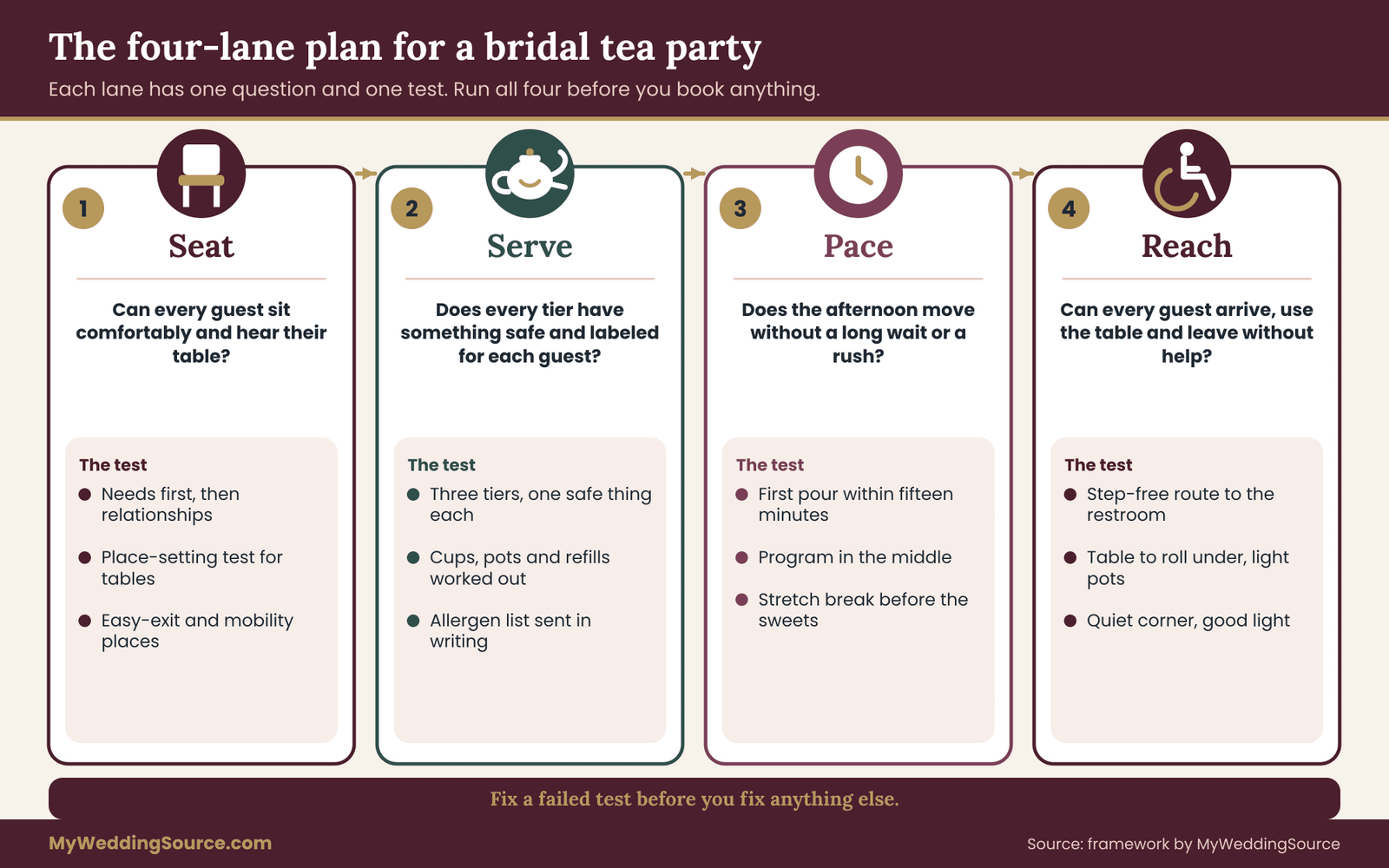
The figure above shows the four lanes that the rest of the guide builds. Each lane has one question and one test. You do not need to master all four at once. If your party is small and informal, a quick pass through the four questions might be all you need. If you are booking a venue and a caterer, the tests become the questions you put in writing.
Choosing the format before you choose the teapots
Every later decision in a bridal tea party depends on the format, so settle it first. There are four common formats, and they differ mostly in how much the guests have to move and how much the host has to carry.
Fully served, seated. Staff or helpers bring pots, stands and plates to each table. Guests stay in their chairs. This format asks the least of guests who have trouble standing, and it asks the most of the kitchen and the servers. It is the easiest to make accessible, and usually the most expensive per head because it needs the most hands.
Stand per table, self-poured. Each table receives a pot or two and a tiered stand, and guests pour and pass among themselves. It looks classic, keeps the labor down and gives tables a natural conversation activity. The risk is that the tiered stand sits in the middle of the table, which can be out of reach for a seated guest with limited arm range or a child, and that someone ends up pouring for the whole table.
Buffet or station with seated tea. Food is set up on a side table, and guests build their own plates while tea is served to the table. This works for larger groups, but it puts a line in the room, and a line is the one thing a mixed-age tea party handles badly. Standing in line with a plate and a cup is hard for many guests, and a station with open food at hip height can be out of reach for others.
Drop-in tea and dessert. A shorter, looser event, often one to two hours, with tea and sweets only. Guests come and go. This suits a small group, a daytime gathering in a home, or a shower where the focus is on the guest of honor rather than the meal.
There is no single right choice. The deciding factors are the size of the room, the number of helpers you can count on, and how many guests will need a chair brought to them rather than walking to a station. A good rule of thumb is that the more guests with limited mobility, young children or older relatives you have, the more the format should lean toward served or per-table service and away from stations. The format sets the tone for the entire bridal tea party.
Here is a short decision rule you can apply before reading further. Count the guests you already know will need extra support, whether that is a walker or a wheelchair, a very young child, a guest who tires easily or a guest with a serious allergy. If that number is more than about a fifth of the invitation list, choose the fully served or per-table format. If it is fewer, you have more choice, and cost and room shape can lead.
The format also changes what you ask a venue about your bridal tea party. A tea room that does fully served seating has its own staff and its own standard menu, so your questions will be about substitutions and pace. A rented hall or a home needs rentals, helpers and a kitchen plan, so your questions will be about equipment, power and who pours. Later sections give the questions for each case.
One more consideration is the time of day. A late-morning start suits young children and older guests, and it fits a menu of savory bites and scones. An afternoon start fits the classic timing but runs into nap time and into the point where many guests are tired. Whichever you choose, keep the total to about two and a half hours unless the guests are all adults who have said they want longer. The pacing section explains why.
Finally, be honest about the room before you fall in love with a format. A tea party for thirty guests that needs six round tables of five needs a room that can hold six round tables with clear aisles between them, not just a room whose posted capacity says thirty.
Capacity numbers are written for standing or theater-style rooms. They rarely account for pots, stands and a wheelchair turning radius. The guide to a wedding seating chart makes the same point about tables and room capacity for receptions, and the principle carries over to a bridal tea party.
Seating a bridal tea party for mixed ages
Seating is where a bridal tea party succeeds or fails, and it fails quietly. Nobody complains about a chair. They simply leave early, or they stay and say little, or they spend the afternoon half-turned to hear the person across the table. A seating plan for mixed ages is not a social puzzle so much as a comfort plan, and it works best when you do it in two passes: needs first, relationships second.
Treat the seating plan as the first real design decision of the whole bridal tea party.
Pass one: needs. Before you think about who gets along with whom, list the physical needs you know about. Do not guess from age alone. Plenty of older guests walk easily and hear well, and plenty of younger guests have a bad knee or a sensory sensitivity. The only reliable way to know is to ask, and a short line on the invitation or the reply card does it without singling anyone out.
Something like: “Tell us anything that would make the afternoon easier for you, such as seating, food or access.” Guests answer or they do not, and either is fine.
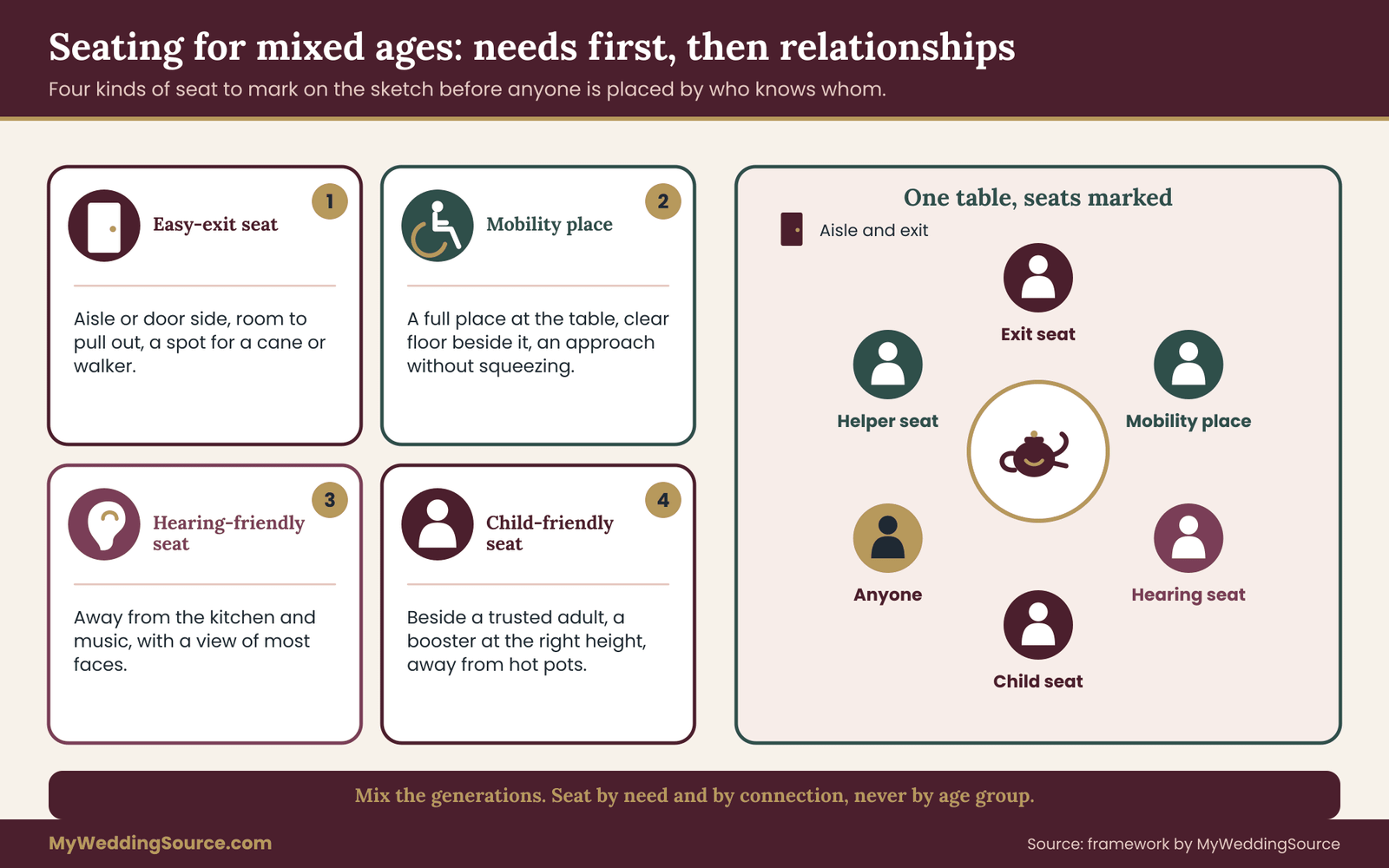
From the replies and from what you already know, mark four kinds of seat on your sketch of the room.
The easy-exit seat. This is a chair near an aisle or a door, with enough room behind it to pull out without bumping the next table. It suits any guest who may need to leave briefly, whether for the restroom, medication, a toddler or a rest. It is also the seat for anyone who uses a cane or walker, because the walker needs a place to wait that is not in the aisle.
The wheelchair or mobility-device place. If a guest uses a wheelchair or scooter, do not remove a chair and leave a gap in the middle of a table. Ask whether they want to transfer to a chair or stay in their own, then leave a full place at the table for either choice. The place needs clear floor on at least one side and an approach that does not require the guest to squeeze past other chairs.
The hearing-friendly seat. In a room full of hard surfaces, such as a tile floor, high ceiling and bare walls, voices blur. Seat guests who hear less well at a table away from the kitchen door, the music and the service station, and put them where they can see most of the table’s faces. Round tables help because everyone faces everyone. Long rectangular tables put the people at the far ends at a disadvantage.
The child-friendly seat. Young children do best beside a trusted adult and within reach of an exit, but not so close to the service path that a hot pot passes behind their chair. A booster or a cushion at the right height matters more than most hosts expect, because a child whose chin is at table level will not enjoy the afternoon.
The site’s guide on guest care for children and older relatives goes deeper on that kind of support. Children are part of most bridal tea party guest lists, so plan for them from the start.
Pass two: relationships. Once the needs seats are placed, build the rest of the room around people. Two simple principles help. First, never seat anyone as the lone representative of a group, whether that is the lone teenager, the lone out-of-town guest or the lone coworker. Put at least two people with something in common at each table. Second, give every table one person who likes to talk. That person is not the host’s job to appoint; you probably already know who it is.
A strong mixed-age table usually has a spread of generations and one shared anchor, often a mutual friend or a family connection. A table of five where a grandparent, a parent, an adult friend and a teenager all know the guest of honor in different ways has plenty to talk about. A table of five strangers of widely different ages and no link is a harder afternoon.
There is a trap here worth naming. Hosts sometimes try to be thoughtful by seating older guests together at a “quiet table” and younger guests together at a “fun table.” It sounds kind. In practice it sorts people by assumption, and many older guests do not want to be placed away from the energy of the room, while many younger guests enjoy the older relatives’ company.
Seat by need and by connection, and let age mix. Sorting a bridal tea party by age may look tidy, but it rarely feels warm.
The guest of honor’s seat. Whoever the party celebrates should sit where they can be seen and can see everyone, but not at the end of a long table where conversation is far away. At a round-table layout, one table near the middle of the room works well. At a single long table, the middle of the long side is better than the head.
That seat also needs a clear path, because the guest of honor will be asked to rise for photographs, greetings and gifts if there are any. At a bridal tea party the honoree is the one person everyone wants to greet, so the seat has to be easy to reach.
Hosts and helpers. If family members or friends are pouring tea or carrying plates, seat them where they can rise without disturbing others. A helper who has to climb past four chairs to refill a pot will either not do it or do it badly. The best helper seat is next to the service route and not wedged in. A bridal tea party runs on a few quiet helpers, and their seats are part of the plan.
When the sketch is done, run a quick check by taking each guest in turn and asking three questions. Can this person reach the table and leave it without help? Can they hear at least three other people at their table? Is there anyone at the table they are likely to enjoy?
A plan in which every guest passes the first two and most pass the third is a good plan. If someone fails the first, change the seat before you change anything else. Do this for every table in the bridal tea party, not only the ones you worry about.
A short script for asking about seating needs
Hosts often hesitate to ask guests about needs because they fear sounding intrusive. A single, warm, optional line removes most of the awkwardness. If a guest replies, you can follow up privately with something like this:
“Thank you for letting me know. I will put you at a table near the door with a chair that has arms, and I will make sure there is room for your walker beside you. Is there anything else that would help?”
Notice what the script does not do. It does not ask for a diagnosis, it does not announce the need to anyone else, and it does not suggest the guest is a problem. It turns the information into a seat and moves on. If a guest does not reply, do not press. Put them at a reasonable easy-exit seat anyway, and keep a couple of spare chairs of different types in the room.
Chairs themselves
Chair choice matters as much as chair position. A low, soft sofa-style seat is hard to rise from. A folding chair with no arms offers nothing to push against. A chair with sturdy arms and a seat at a conventional height is the easiest for the widest range of guests to use. If you are renting chairs, ask for the arm and seat details, and do not assume that the pretty option is the comfortable one.
If you are using a venue’s chairs, go sit in them. Sit for twenty minutes, not two. You will learn more from the twenty minutes. Chairs are the item guests touch the longest at a bridal tea party, so they deserve a real test.
Keep a few extra chairs of different styles near the edge of the room, such as two with arms and one with a firm cushion. They cost little and solve a problem the moment it appears.
The table size and place-setting test
The most common physical mistake at a bridal tea party is a table that is too small for the things on it. The cause is simple. A table seems roomy when it holds only cloth and flowers, and it feels crowded when each guest has a cup, saucer, plate and napkin, and the middle holds a pot, a stand and a vase. The test below replaces guessing with measuring. Measuring is the least glamorous step in bridal tea party planning, and one of the most useful.
Step one: set one place. Use the real cup, saucer and plate you will use, or the closest match you can borrow. Arrange them the way you want guests to see them: plate in front, cup and saucer to the right, napkin to the left, perhaps a small fork. Measure the width and depth that one place takes up. Write down the numbers.
Step two: add the shared items. Set the pot, the stand and any centerpiece you plan on a similar table, and measure the space they take. A tiered stand has a base wider than many people expect, and a teapot needs room beside it to be tipped without hitting a neighbor’s cup. Note the width of both.
Step three: divide. Measure the usable edge of your table. For a round table, the edge is the circumference; for a rectangle, it is the two long sides, minus the corners where chairs cannot sit. Divide that usable edge by the width of one place, then confirm that the center area is big enough for the shared items. The smaller of the two results is your true seating number for that table. The number printed on a rental catalog is an upper bound, not a promise.
If the true number is smaller than the number you hoped for, you have three options. Use more tables, remove an item from the table (for example, move the pot to a side service table), or choose a smaller stand. A stand per two guests is often better than one per table anyway, since each guest then has a tier within arm’s reach. Tables are the usual place where a bridal tea party plan meets the room, so settle the number early.
A rule of reach helps here. Anything a guest must pass should be within what a seated person can reach without standing. If the top tier of a stand is the only place the scones sit, then a child or a guest with limited shoulder movement cannot reach them. Putting the heaviest or most popular items on the middle or bottom tier, and the decorative items on top, fixes this.
The knee test. For guests who use wheelchairs, the table must have room underneath. Pedestal bases, center posts and tablecloths that hide a crossbar can all block a chair’s approach. Ask the venue or the rental company for the clearance under the table, and do a physical test if you can. Federal accessibility standards give dimensions for dining surfaces and knee clearance in public places, and the U.S.
Access Board publishes them, so use those numbers as a starting point when you ask a venue questions. Your party is a private event, but the venue’s duties differ, and a venue that has already met those standards will have tables that work.
The aisle test. Between tables, you need space for a guest to pass behind a seated person and for a server to carry a pot. A quick check is to have two people, one carrying a tray, walk the aisle while chairs are occupied. If they must turn sideways, the aisle is too tight. The federal standards use a general minimum width for an accessible route, and the Access Board page explains it.
Treat that figure as the floor, not the target, because a guest with a walker or a server with a tray needs more than the minimum. A bridal tea party has more traffic than it seems, because pots, plates and guests all move at once.
Round or rectangular
Round tables suit conversation, but they cost more space per guest. A rectangle uses space efficiently, but the people at the ends are far from each other. For mixed ages, a good compromise is a mix: rounds for the main room, and one rectangle near the service area for a family group that wants to sit together.
Do not force a single shape just because it looks tidy in a diagram. For a bridal tea party with a wide age range, the shape matters less than the space around it.
What to do if the room is too small
If the measured seating number falls short, reduce the guest list slightly, add a second seating, or move to a drop-in format. A second seating splits the party into two shorter sessions and can actually help older guests and young children, who may prefer a shorter stay.
The cost is that the guest of honor spends the whole day hosting, so ask them before you pick this option. The site’s guide on wedding guest lists covers how to trim a list without hurting feelings, and the same approaches work for a shower list.
The table test is dull work, and it pays for itself. Almost every complaint about a cramped tea party traces back to a table nobody measured. Spend an hour with a ruler and one place setting and you will avoid most of them.
A classic tea menu comes in three tiers, from savory at the bottom to sweet at the top, and the structure is useful even if you never buy a three-tier stand. The tiers give you an order of service, a way to balance the food and a place to check that every guest has something to eat.
The menu advice below follows the ordering of the tiers, then adds the part most menus skip: a tier-by-tier test for different guests. The menu for a bridal tea party works best when it is planned tier by tier.
Tier one: savory. This is the first thing guests eat, so it should be light and not messy. Finger sandwiches are the standard, and they are easy to adapt. Cucumber and cream cheese, egg salad, chicken salad, smoked salmon, herbed cheese and plain butter are all common.
Small savory tarts, quiche squares and vegetable bites work too. Keep each piece small enough to eat in two bites with a napkin, and avoid fillings that drip. The first tier sets the mood for the rest of the bridal tea party.
Tier two: bread. Scones are the center, usually with jam and cream, though a spread or a lemon curd is just as common. If you serve scones, ask the baker how many halves a scone yields and plan for halves, because most guests take one half at a time. Tea breads, small muffins or biscuits can take the place of scones for hosts who prefer a different shape.
Tier three: sweet. Petit fours, mini tarts, shortbread, small cakes, fruit and chocolate. This tier is the one guests photograph, so it is also the one that is easiest to overbuild. A small number of well-chosen sweets beats a crowded top tray, and fewer items make labeling easier. Keep the top tier of a bridal tea party small, because it is the one most guests photograph and the one most likely to contain nuts.
The structure is helpful, but it hides a problem. A guest who cannot eat wheat, dairy, egg or nuts may find that almost every item on a tier is off limits, with no way to tell which one is safe. They are left to ask about each piece in front of the table or to eat nothing. The next test solves it. At a bridal tea party that problem is easy to miss until a guest points it out.
The one-safe-thing-per-tier rule
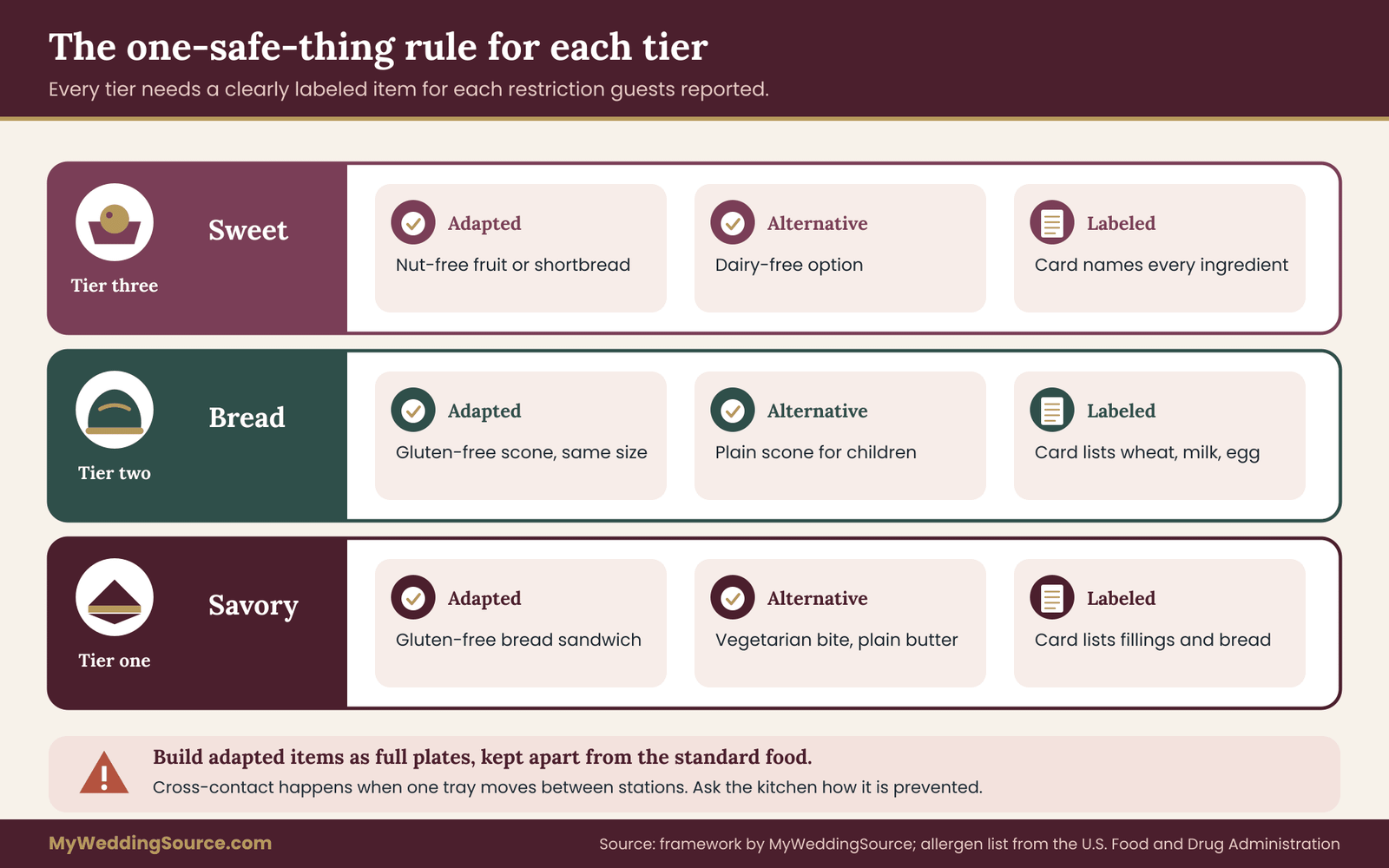
Here is the decision framework this guide recommends for every tiered menu. For each of the three tiers, make sure there is at least one item that works for each of the common restrictions you have been told about, and that it is clearly labeled. You do not need to make every item adaptable. You need to make sure that no guest faces a tier with nothing to eat.
In practice, the rule leads to three versions of the menu:
Standard. The full menu for most guests.
Adapted. The same shapes and the same service, made without the most common allergens or restrictions that guests reported. This may be a set of gluten-free sandwiches, a dairy-free spread, a nut-free sweet and a vegetarian savory bite.
Labeled. Cards or a menu that name each item and list its main ingredients. A small card on the stand or a printed menu at each place does this. Labels help everyone, because a guest without a restriction can still avoid a flavor they dislike.
Plan the adapted items as complete plates, not as the leftover pieces of the standard menu. A guest who gets a single plain slice of bread while others eat from a full stand will feel the difference. If your caterer can prepare a separate plate for each guest with a restriction, with the same number of pieces as everyone else, that is the cleanest answer.
Ask whether the kitchen can keep those plates separate from the standard food, because cross-contact (when an allergen touches an item that should be free of it) is a real risk when a single tray moves between stations. A bridal tea party host who plans adapted plates early rarely has to improvise on the day.
The next section covers allergens and labeling in more depth. For now, treat the one-safe-thing rule as the minimum for each tier, and let the guest replies on your invitation tell you which adapted items you need.
Menu choices that suit a wide age range
Not every menu choice has to cater to a special need. A few general choices make a menu friendlier to a mixed room without extra work.
Include at least one plain option on each tier. A plain butter sandwich, a plain scone with jam and a simple shortbread give children and picky eaters something familiar, and they help guests who are tired or unwell. Every bridal tea party has a few guests who want something familiar, and that is a fine thing to plan for.
Keep sandwich fillings soft. Dry, crusty or chewy items are hard for guests with dental problems or limited chewing, and a soft filling on soft bread is easy for almost everyone. Cut sandwiches small and keep the crusts or remove them consistently, not randomly.
Offer a non-tea drink for each table. Lemonade, still or sparkling water, or juice gives children and guests who avoid caffeine something to drink alongside the pot. If you are serving alcohol, such as a sparkling toast, offer a non-alcoholic equivalent in a matching glass so no one has to explain their choice.
Think about temperature. Scones are best warm, sandwiches are best cool, and sweets are best at room temperature. That mismatch is why pacing matters. Warm scones that sit for an hour dry out, and cold sandwiches that sit in a warm room are a food safety issue as well as a quality issue. The pacing section handles this directly.
The site’s guide on building a menu for different ages and dietary needs goes further on the general principles, and much of it applies at smaller scale to a shower.
Tea service quantities and a worked example
Quantities are the question hosts ask most often and answer worst. They guess a number, order a lot of tea, and either run out of hot water or end up with unused tins. A better approach is to build the quantity from four numbers: how many guests, how many cups each guest drinks, how many cups one pot yields and how many times a pot is refilled. Getting quantities right for a bridal tea party is a matter of arithmetic, not instinct.
Cups per guest. This number varies with the room, the weather and the guests. A guest who drinks one cup and moves on is not unusual; neither is a guest who has four. For planning, pick a working assumption, and be clear that it is an assumption and not a measured average. Many hosts plan for two to three cups per guest over a two-hour service and adjust after talking with the caterer.
If your party is on a hot day or runs late into the afternoon, lean higher. If many guests will drink water or lemonade instead, lean lower. Be honest that this is a guess; the method for a bridal tea party only needs a number you can change.
Cups per pot. Pots are sold by a stated capacity, but the capacity on the label is not always the number of cups you will pour, because teacups differ in size. Ask the supplier how many cups of the size you are using one pot yields. If you are borrowing pots from friends, fill one with water and pour it into the cups you plan to use. The count takes two minutes and removes the guesswork.
Pots per table and refills. A hot pot cools. A pot of tea steeped long becomes bitter. The usual solution is two containers per table: a pot of tea and a pot or pitcher of hot water to top it up. The server or helper replaces them rather than reheating. Plan for a number of full replacements across the party, and make sure the kitchen can keep up.
Varieties. More types of tea does not mean a better party. Three to five choices are plenty for most groups: one black tea, one green or lighter tea, one herbal tea without caffeine, one decaffeinated option and, if the group likes it, a fruit or spiced blend.
Label them and keep the caffeine-free choices obvious. A guest who avoids caffeine for any reason, including pregnancy or a doctor’s advice, should be able to see the choice without asking. A short, clear tea list suits a bridal tea party better than a long one.
Leaf quantity. Suppliers publish steeping ratios for their teas, and they are different for loose leaf and bags. Ask the supplier for a ratio for the pot size you are using instead of trusting a number from a random page. If you are using a caterer or tea room, they will have their own numbers. Your job is to give them an accurate guest count and cup count.
Worked example: thirty-two guests
This example is invented, and the numbers are planning assumptions, not statistics. Use it to see the method, then replace every number with your own.
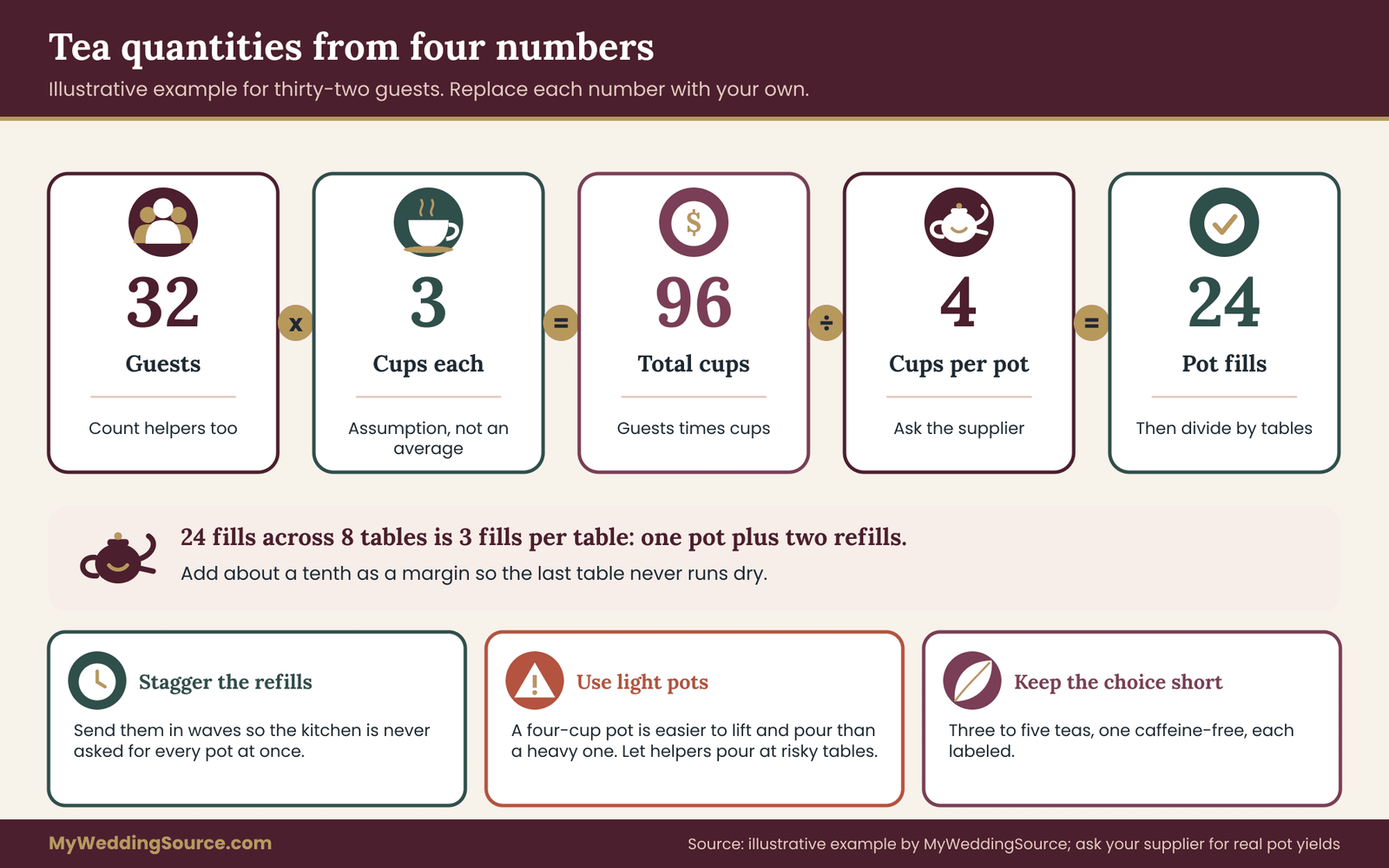
Suppose the guest list is thirty-two, including the guest of honor, seated at eight round tables of four. The host plans for a two-hour tea service and assumes three cups per guest. That gives thirty-two times three, or ninety-six cups in total.
The caterer says a pot yields four cups of the size being used. Ninety-six cups divided by four is twenty-four pot fills. With eight tables, each table’s pot is filled three times over the afternoon, or one pot and two refills.
The host adds a small safety margin so the last table does not run dry: about a tenth more, which rounds the total to roughly ten extra cups, or two or three more pot fills across the room. The result is a number the caterer can work with: eight pots, a refill plan that brings each table three fills, and a few spare fills.
The food follows the same pattern. If the host assumes three savory pieces per guest, that is ninety-six pieces. If scones are served as halves and each guest gets two halves, that is sixty-four halves from thirty-two scones. If each guest gets three sweets, that is ninety-six. The host then adds a margin of about a tenth and sets aside the adapted plates, for example four gluten-free plates and two nut-free plates, as separate items rather than as part of the margin.
Now the useful part. The method does not depend on those assumed numbers. If you change cups per guest to two, the pot count drops. If the caterer says a pot yields six cups, the count drops again. Because the method is written out, anyone who helps you can follow it, check it and change it when the guest count changes. That is the real value of a written method in bridal tea party planning.
Two things the arithmetic leaves out
The first is service rate. A kitchen that can brew twenty-four pots over two hours is not the same as one that can brew them in the right order. If every table needs a refill at the same moment, the kitchen will fall behind. Stagger the tables so refills arrive in waves, and tell the caterer which tables go first.
Tables with young children or older guests, who may want their tea sooner or hotter, can be early waves. A bridal tea party depends on refills arriving in waves.
The second is hot water safety. Pots and kettles carry water that can scald. At a table with a small child or a guest with an unsteady hand, ask the server to pour, rather than leaving a full pot in reach. Use smaller, lighter pots for self-pour tables, because a heavy ceramic pot full of water is hard to lift and tip.
A pot of about four cups is easier to handle than a large one, and you can check by lifting one full of water before you commit.
Dietary needs, labels and food safety at a bridal tea party
A tiered stand puts many small foods in front of every guest, and almost any of them can contain an allergen. That makes labeling and kitchen handling the most important safety work at a bridal tea party, more important than the tea itself. The goal is not to become an allergy expert.
The goal is to find out what your guests need, pass that to the kitchen in writing, and label the food so guests can decide for themselves. Food labeling is a safety task at every bridal tea party, even a small one at home.
Know the common allergens
The U.S. Food and Drug Administration lists nine major food allergens: milk, eggs, fish, shellfish, tree nuts, peanuts, wheat, soybeans and sesame. A tea menu is full of the first three on that list plus wheat. Scones, sandwiches, tarts and cakes all contain wheat, milk and egg by default. Many sweets contain nuts or are made near nuts. Cream cheese, butter, cream and curds are dairy. Sesame can hide in bread and spreads.
A guest with a food allergy may be dealing with a reaction that is serious, and a guest with celiac disease or an intolerance may be dealing with a condition that is uncomfortable and harmful over time. Treat each report as a firm limit. Do not decide for a guest that a small amount is fine. Hosts of a bridal tea party do not need medical training, only attention.
What to ask guests
Your invitation or reply card should invite guests to note any food needs, using plain wording, and it should make clear where the note goes and who reads it. A line such as “Please tell us about any food allergies or dietary needs so we can plan for you” is enough. If a guest reports an allergy, follow up with one or two questions: which foods, and whether trace amounts or cross-contact matter.
Some guests react to tiny amounts; others only need to avoid the food itself. The guest knows best, and the follow-up shows you take it seriously. The reply card for a bridal tea party is the easiest tool you have for this.
Keep the information private. Share each guest’s needs with the kitchen or the helper who prepares the plates, and with no one else. A guest’s health information is theirs to share.
Passing the information to the kitchen
Whether you are working with a caterer, a tea room or a group of friends in a home kitchen, write down a short list: guest name, table number, need and what they can eat. Give it to whoever prepares and serves. A written list beats a verbal message, because verbal messages get lost between the kitchen and the table.
For a venue or caterer, ask these questions in writing:
- Can the kitchen prepare separate plates for guests with allergies, and how do they prevent cross-contact?
- Which items on the standard menu contain each of the nine major allergens?
- Does the kitchen use shared equipment, such as shared fryers, shared mixers or shared surfaces, for allergen-free items?
- Who delivers the adapted plates to the table, and how will the server know whom each plate is for?
- Will the menu cards or labels be printed from the same recipe list the kitchen uses?
The last question matters because labels written from memory are the most common source of errors. If a menu card says “nut-free” and the recipe changed that morning, a guest with a nut allergy is at risk. A label is only as reliable as the recipe it came from, and the person who prepares the food should confirm it.
Labels at the table
Print or write a small card for each item or for each tier, giving the name and the main ingredients. Use plain words: “egg salad (egg, mustard, bread with wheat and sesame).” If you cannot be sure an item is free of an allergen, do not label it as free. Say what you know. “Made in a kitchen that also handles nuts” is honest and lets the guest decide.
Place a card at each adapted plate with the guest’s name or table number. It prevents the common mistake in which the server sets the plate in front of the wrong person. The card does not need to name the restriction. A neutral label such as “Plate for table four, seat two” does the job without announcing a health need to the room.
Label the tea too. Name each tea and note whether it contains caffeine, and mark herbal blends clearly, since some contain ingredients that guests avoid for medical reasons. If you do not know a blend’s ingredients, ask the supplier for the full list. A bridal tea party should never make a guest ask what is in the cup.
Food safety basics
Tea food sits out for a long time. Finger sandwiches with egg, chicken, fish or dairy fillings, cream for scones and many sweets are perishable. The U.S. Department of Agriculture advises that perishable food should not sit at room temperature for more than two hours, and for no more than one hour when the air is above ninety degrees Fahrenheit.
Cold food should stay at forty degrees or below, and hot food at one hundred forty degrees or above, until it is served. The long service time of a bridal tea party makes this the part of the day with the most food risk.
A tea party can follow these rules without much trouble. Keep the sandwiches and cream refrigerated until service, then bring them out in a staged way. Instead of putting every tier on the table at the start, send out the savory tier first, the scones second and the sweets last.
Staging is not just about pacing. It keeps the perishable foods in the cold until they are needed, and it removes the oldest food before it passes the time limit. A bridal tea party handled in stages stays well inside the time limits.
If your kitchen is in a home, use a food thermometer for hot items and a refrigerator thermometer to confirm the fridge is cold enough. If you are using a caterer, ask whether they follow the state or local food code. The FDA publishes a model Food Code that many state and local health departments base their rules on, and a licensed caterer will be familiar with it.
A few additional habits help. Use serving tongs or forks instead of hands. Keep food covered until service. Wash hands before handling and after touching anything not food. And if a platter has sat out past the time limit, discard it, even if it looks fine. It is cheaper to waste a plate than to take a chance with a guest.
When a guest has a serious allergy
For a guest with a serious allergy, ask whether they carry medication and where it is, and let a second person at the party know. Do this only with the guest’s consent. Know the address of the venue in case emergency services are needed. These steps cost nothing and rarely matter, and on the day they do, they matter a great deal.
Pacing a bridal tea party from first pour to last goodbye
Pacing is the least visible part of a bridal tea party plan and the part guests feel most. A well-paced afternoon moves from arrival to conversation to food to a bit of ceremony to a gentle ending, and nobody notices the clock. A badly paced one drags in the middle, leaves guests hungry at the start or ends in a rush. Because guests have different energy, pacing is also an accessibility tool. Good pacing is what makes a bridal tea party feel generous instead of long.
The two-and-a-half-hour run
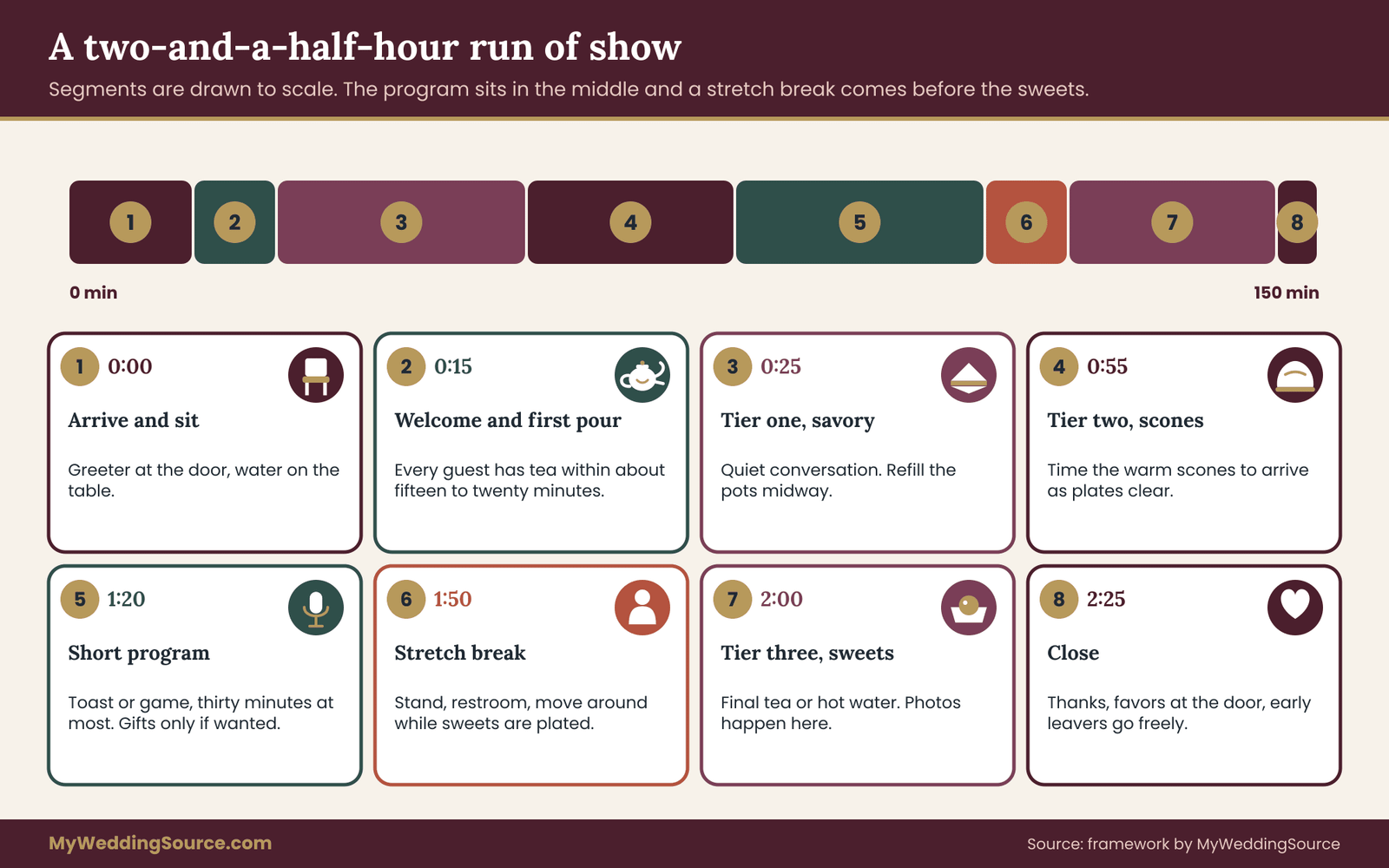
Many seated tea services last about two to three hours, and two and a half is a good planning default. It is long enough for three tiers and a short program, and short enough for older guests and children. Here is a run of show built on that length. Treat the times as a starting point, then adjust to your menu and guests. Two and a half hours is a sensible length for a bridal tea party.
Minutes zero to fifteen: arrival and seating. Guests arrive, find their seats and settle in. Have a greeter near the door, and put water on the table. A guest who arrives to a cup of water and a clear seat starts relaxed. Do not start the program until most guests are seated.
Minutes fifteen to twenty-five: welcome and first pour. The host says a few words of welcome, introduces the guest of honor in a sentence or two and signals the first pour. Aim for the first cup of tea in every guest’s hands within about fifteen to twenty minutes of arrival. A long wait at the beginning is the most common complaint at a tea.
Minutes twenty-five to fifty-five: tier one, savory. The savory course arrives and guests eat and talk. This is the stretch for conversation, so keep the music low and the program quiet. Refill the tea in the middle of the period.
Minutes fifty-five to eighty: tier two, scones. Warm scones arrive. Because they are best warm, plan the timing with the kitchen so they come out of the oven or warmer as the savory plates are cleared. Another pot refill fits here.
Minutes eighty to one hundred ten: a short program. This is the time for a toast, a game, a memory activity or, if the guest of honor wants it, a gift opening. Keep it to thirty minutes at most. It is the longest sit with no food or movement, so make it engaging and short. If the guest of honor does not want gifts opened in public, skip it, and read the guidance in the section on invitations and costs.
Minutes one hundred ten to one hundred twenty: a stretch break. Invite guests to stand, use the restroom and move around while the sweets come out. This ten-minute break is the single most useful pacing choice for mixed ages. It lets guests who need to move do so without feeling singled out, it resets the room and it gives the kitchen time to plate the final tier.
Minutes one hundred twenty to one hundred forty-five: tier three, sweets. Sweets arrive, along with a final refill of tea or hot water. Photographs often happen here, when the table looks its best.
Minutes one hundred forty-five to one hundred fifty: closing. The host thanks guests, the guest of honor says a few words if they want to, and guests leave at their own pace. Have favors, if any, at the door, and let guests who need to leave earlier go without comment.
Three rules for keeping the run on time
Start the pour on a clock, not on a feeling. Tell the kitchen the exact time the first pot should reach each table. If the party starts at one o’clock, the first pour is at one-fifteen. If guests are late, pour anyway. Waiting for stragglers holds everyone else back.
Stage the food so each tier arrives as the last one clears. Ask the kitchen to hold each tier until you or a helper gives a signal. Without a signal, the kitchen will bring everything at once, and the careful pacing disappears.
Put the program in the middle, not the end. Guests are sharpest after the first tier and most tired at the end. A program at the end meets a restless room, and a guest who needs to leave early misses it. A program in the middle meets a full room at its best. A bridal tea party with its toast in the middle keeps the whole room involved.
Pacing for different guests
Some guests will not follow the schedule, and that is fine. A child may be done after an hour. An older guest may need to leave after ninety minutes. A guest with a medical need may need to eat on a different schedule. Build the plan so those guests can leave or eat early without disruption. A bridal tea party should work for guests who stay for every minute and for those who leave early.
For early leavers, offer a small box of sweets to take home so they do not miss the final tier. For guests who need to eat on a schedule, let the kitchen serve their plate early, with the guest’s agreement. For young children, a short activity at the table, such as a coloring sheet, helps with the long middle stretch. Keep those materials quiet and simple, because noisy items disturb the table.
The same logic applies to the guest of honor. They will be greeted, photographed and asked questions for the whole afternoon, so give them time to sit and drink a cup of tea. A helper who brings them a plate during the toast and a cup during the program is doing a kindness that nobody sees.
The accessibility checklist for a bridal tea party
Accessibility is the Reach lane of the plan. It asks one question: can every guest get to the table, use what is on it, hear and see what is going on, and leave when they need to? The checklist below turns that question into checks you can do in an afternoon, ideally on a visit to the room before you book it. A bridal tea party that skips this lane quietly excludes some of the people it invited.
A word on the law first, in plain terms. In the United States, the Americans with Disabilities Act sets duties for many public places, and the U.S. Access Board publishes the technical standards for accessible design. A private party in a private home is generally not covered the way a public venue is, and a rented hall, restaurant or tea room has its own duties.
Rules differ by situation, so treat this section as practical hosting advice and ask the venue or the Department of Justice’s ADA information resources about specific obligations. The checks below go beyond the legal minimum because a good party should. This applies to a bridal tea party held in a rented space more than one held in a home.
Arrival and route
Start outside the building. A guest’s afternoon begins at the curb, not at the door. At a bridal tea party, the curb is where hospitality starts.
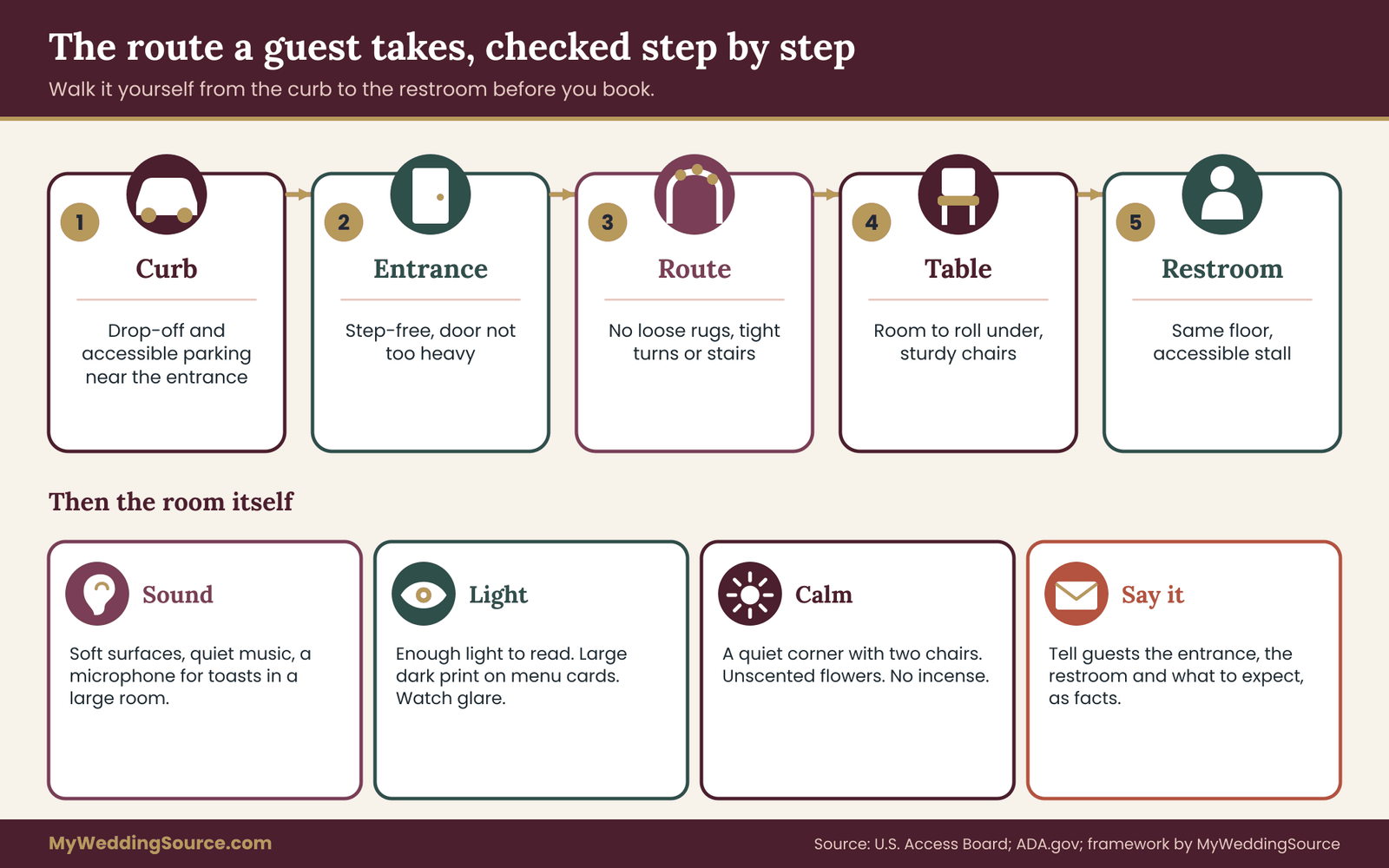
- Drop-off and parking. Is there a place to be dropped off close to the entrance? Are accessible parking spaces close to a step-free entrance, with a clear path? Ask whether the closest entrance is the main one or a side door, and say which on the invitation.
- Entrance. Is the entrance step-free, or is there a ramp that a person can use without help? A single step is a barrier for a wheelchair, a walker and many unsteady walkers. If the only step-free entrance is at the back, tell guests and put a sign at the front.
- Doors. Are the doors wide enough, and can they be opened without strong force? A heavy door is a barrier to many guests even if it is wide. Ask whether there is an automatic opener or whether a helper can stand at the door.
- Interior route. From the entrance to the table, is the route clear of steps, thick rugs and tight corners? A loose rug is a trip hazard for guests with walkers or canes. Tape it down or remove it.
- Elevators and stairs. If the party is on a second floor, check that the elevator works and is big enough, and ask what happens if it breaks down on the day. If the only access is by stairs, the venue is not suitable for guests who cannot climb them.
The site’s guide to red flags in accessible wedding venues lists many of the same problems in a larger setting, and its questions work for a tea room as well.
Restrooms
A long seated party depends on restrooms. Find out where they are and how far from the table. Is there an accessible stall, and is the route to it step-free? Is it on the same floor as the party? Is the door heavy? A guest who must climb a flight of stairs or cross the building will avoid drinking tea, which defeats the purpose of the party.
If the restroom is far, place guests who may need it near the exit and tell the guests where it is. A bridal tea party puts guests at a table for hours, so restroom distance is not a small detail.
Tables, chairs and service
- Table height and knee room. Confirm that tables allow a wheelchair to pull up, as described in the table test. A center-post base or a low crossbar can block it.
- Chair choice. As covered in the seating section, chairs should have firm seats and sturdy arms, at a standard height.
- Pots and cups. Use pots that are light enough to lift when full, with handles that can be gripped easily. Cups with wide, sturdy handles are easier to hold than delicate ones, and a cup with a larger handle or no handle at all helps a guest with a tremor or arthritis. Offer a few such cups at every table, without calling attention to them.
- Straws and lids. Have a few straws or spill-resistant lids available for guests who ask.
- Reaching the stand. As noted, put the items guests are likely to want within seated reach.
- Pouring. Let the server or a helper pour for any table where a guest may have difficulty. Offer, rather than assume.
Sound
Tea parties are meant for conversation, and noise ruins conversation. Check the room’s sound before the day. Clap your hands and listen for echo. A bare room with hard floors and walls is noisy, and adding a few soft items, such as cloth tablecloths, curtains, rugs and fabric chair covers, absorbs sound. Sound is the accessibility issue hosts of a bridal tea party notice last.
Keep background music low, or leave it out during the savory course, and skip live music unless it is soft. If a program includes a toast or a game, use a microphone when the room is large. Many guests with hearing loss follow speech much better through a microphone, and the National Institute on Deafness and Other Communication Disorders (NIDCD) publishes plain-language information on hearing and communication.
Seat guests who hear less well near the front or at tables with the best view of faces, as the seating section described.
Light and vision
A pretty, dim room is hard to read in. Make sure there is enough light for guests to see their food and read the menu cards. Use large print, high-contrast menu cards, with dark text on a light background and a simple typeface. Avoid script fonts for anything a guest must read to be safe, such as allergen labels. If you hang signs or use a program, the site’s guide to wedding signage covers readability in more depth.
Avoid glare. Shiny tablecloths and bright windows behind a guest’s seat cause glare for guests who are sensitive to it, and a window directly behind the guest of honor makes them hard to see.
Sensory comfort
Some guests are sensitive to noise, crowds, smells or flashing light. Ask about it on the invitation and give a simple response: a quiet corner away from the service area with a chair, which any guest can use without needing to explain.
Be cautious with scent. Strong flowers, candles and diffusers cause headaches or breathing trouble for some guests. Unscented or lightly scented flowers on the table are safer than heavily perfumed ones, and scented candles are not a good idea at a table with food. A tea room that burns incense or uses room spray should be asked about it before you book.
Service animals and other support
A guest may bring a service animal. Ask the venue about its policy ahead of time, and tell the guest where there is room for the animal to lie without blocking an aisle. Do not pet or feed a service animal, and ask other guests to do the same.
If a guest brings a caregiver or an assistant, set a place for them, and include them in the headcount and the food plan. Do not make the guest ask.
Communicating what you did
Accessibility only works if guests know about it. On the invitation or a short follow-up, share the practical facts: the entrance to use, where to park, where the restroom is, what the seating is like and whom to contact with questions. Share them as facts, not as favors. “The entrance on the east side is step-free, and the restroom is on the same floor” is more useful than “We have tried to accommodate everyone.” Guests who plan to attend your bridal tea party can only prepare if you tell them.
Invitations, costs and who pays
A bridal tea party can cost a little or a great deal, and the main cost drivers are easy to see once you look for them: the number of guests, the amount of service, the rental items and the venue. This section covers how to talk about money and invitations without assumptions, then how to keep costs under control. Money questions come up early in bridal tea party planning, so settle them early too.
Who hosts and who pays
Customs differ widely. In some families a relative hosts and pays; in others, friends share the work and the cost; in others, the couple hosts their own. Do not assume. If you are planning on behalf of someone else, ask the guest of honor and any co-hosts what they prefer, including whether they want a tea party at all. The guest of honor may love the idea or may feel it is formal and tiring. Ask before booking.
If several people are sharing the cost, agree in writing on the total budget, each person’s share and who handles payment to vendors. Keep a single running list of costs so no one is surprised. The site’s wedding etiquette guide covers common hosting customs and how couples and families handle them.
Wording the invitation
An invitation for a tea party tells guests what to expect, and clear information prevents problems later. Include the date, start time and end time, the place, how to reply and by when. State the format (“a seated tea with a three-course menu”) so guests know to eat lightly beforehand.
Mention that you welcome questions about food or access and say where to send them. If there is a dress suggestion, keep it light and optional, since a requirement can cost a guest money. Clear wording on a bridal tea party invitation saves many follow-up messages.
Say plainly whether gifts are expected. Many hosts say gifts are not necessary, or invite guests to bring a card instead, and a clear line spares guests from guessing. If a gift registry is mentioned, keep it separate from the invitation text, as guidance in the wedding etiquette guide suggests, and never make a gift a condition of attending.
Do not assume the guest list has only one kind of guest. Use inclusive language: “guest of honor,” “couple,” “partner” and “family” cover most situations. Avoid wording that assumes who in the couple will be celebrated or what kind of role each guest holds.
Where the money goes
A tea party budget has five main lines: food, tea and beverages, the venue or rentals, service and labor, and extras such as favors, flowers and printing. Ask each vendor for a quote that lists each line separately, so you can see where the money goes and where you can adjust.
Food is usually the largest line, and it is driven by the number of tiers and the choice of items. A menu with fewer, simpler items costs less than one with many, and it is easier to label. Tea costs less than food in most settings, but a long list of specialty teas adds up. A smaller number of good teas is cheaper and easier to serve than many. Most of the cost of a bridal tea party sits in the food and the staff to serve it.
Venue and rental costs depend on the setting. A home costs less in fees but more in work, since you must provide chairs, tables, pots, cups and a way to keep food cold. A tea room or restaurant costs more per head but includes the equipment and staff. A rented hall sits between the two. Ask whether there is a minimum spend, a room fee, a service charge or gratuity, and whether taxes are added.
These can raise the total considerably, and they are easy to miss in an initial quote. The site’s guide on wedding vendor contracts explains what to look for in an agreement, and the same questions apply to a venue for a shower. Compare the full cost of each option for your bridal tea party, not only the headline price.
Service and labor are the line most hosts forget. A seated tea needs people to pour, carry and clear. If you plan to use volunteers, ask them in advance, give them clear roles and do not rely on the guest of honor’s family to work during their own event. If you are hiring staff, ask how many servers the venue assigns per table or per guest, since service ratios have a large effect on pacing.
Ways to keep the cost reasonable
Cost control should not come at the expense of the four lanes. Here are changes that cut cost and leave the lanes intact. A modest bridal tea party can still pass every lane of the plan.
Shorten the menu, not the seating. Fewer items per tier cuts food cost and labor and makes labeling simpler. Keep the number of seats comfortable and the aisles clear.
Choose a drop-in format for a smaller group. A drop-in tea and dessert gathering costs less than a full seated service and works well for a small group.
Use fewer tea varieties. Three well-chosen teas and one herbal blend are enough.
Ask about off-peak times. A weekday or an unusual hour may cost less, though the savings must be weighed against the guests who can attend.
Borrow or rent in small amounts. A mix of rented and borrowed pots, cups and stands is common, and borrowing from family can lower costs. Make a list of what you borrow and from whom, and plan how and when each item returns.
A planning timeline that includes the tea party as one of several pre-wedding events is useful, and the wedding planning checklist puts shower planning in the order it fits with the rest of the work.
Whatever the budget, avoid financial assumptions about guests. Do not assume everyone can afford a special outfit, a long trip or a gift, and do not ask guests to chip in without making it clearly optional.
Questions to ask a tea room, caterer or rental company
By this point you have a format, a seating logic, a menu structure, quantities, a run of show and an accessibility list. The last step before booking is turning them into written questions. Vendors respond best to specific questions, and written answers protect you if something changes.
Below are the questions to send, grouped by who you are asking. Ask for answers by message or email, and keep them in one folder. Treat the next list as the final check before you commit to a bridal tea party venue.
If you are booking a tea room or restaurant
- Do you host private parties, and what is the minimum guest count or minimum spend for the space?
- How many guests can the room seat comfortably at the table size we need, including aisles for a wheelchair or walker? Can you show me the room layout or let me see the room set up?
- What is the step-free route from the curb to the table to the restroom? Is the restroom on the same floor?
- Which of the nine major food allergens does each item on your tea menu contain, and how do you prevent cross-contact for a guest with an allergy?
- Can you prepare separate plates for guests who report allergies or dietary needs, and how are they delivered to the right person?
- How are pots served: one per table, one per guest or poured by staff? What is the size of a pot and the number of cups it yields?
- What is the service ratio, meaning how many staff per table or per guest? How do you handle refills?
- Is the tea service timed, and can we adjust the timing of each tier?
- What are the room fee, service charge, gratuity and taxes, and what is the cancellation or change policy?
- What is the noise level in the room? Do you play music, and can it be turned down?
If you are hiring a caterer for a hall or a home
- Do you provide staff for pouring and clearing, and how many?
- Do you supply tea equipment such as pots, cups, saucers and stands, or only food?
- What do you need from us: tables, power, a refrigerator, a hot water source, a prep space?
- How do you keep cold food cold and hot food hot during a two-hour service, and what is your food safety plan?
- Can you label each item with its ingredients, from the same recipe list you use in the kitchen?
- What is your policy if a guest count changes close to the date, and by when must we confirm?
- What happens if a dish is not ready or a pot breaks?
A written agreement should cover the same ground that a larger wedding contract does, at a smaller scale.
If you are renting tables, chairs and tea ware
- What are the dimensions of each table and the number of seats it holds with a full place setting, not just the catalog number?
- What is the knee clearance under the table, and does the base block a wheelchair?
- Do the chairs have arms, and what are the seat height and the cushion?
- What cups, saucers, pots and stands are available, and how many cups does each pot yield?
- What are the delivery and pickup windows, who sets up and who cleans, and what are the damage and breakage fees?
- Can I see the items before I commit, or borrow one place setting to test?
If you are hosting at home
A home party has no vendor to ask, but it has the same checks. Walk the route a guest would take, from the street to the door to the seat to the restroom. Move rugs, clear pathways and measure the table. Count the chairs and the cups. Check that the refrigerator can hold the food and that the kitchen can keep up with the refills.
Tell guests plainly if there are stairs. If the home is not accessible for a guest you want to invite, consider a different location for the whole party, rather than asking one guest to manage a barrier. A bridal tea party at home still needs the same checks.
A written confirmation
Once you have answers, write them into a one-page confirmation that you and the vendor both have. It should list the date and time, the guest count, the format, the menu with each tier, the allergy plates and who they are for, the pot and refill plan, the service ratio, the fees and the deadline for the final count.
A short, clear document keeps everyone working from the same facts. It can also be the document you hand to a helper on the day. This one page is the backbone of a bridal tea party that runs smoothly.
A worked example: twenty-eight guests, ages seven to ninety-one
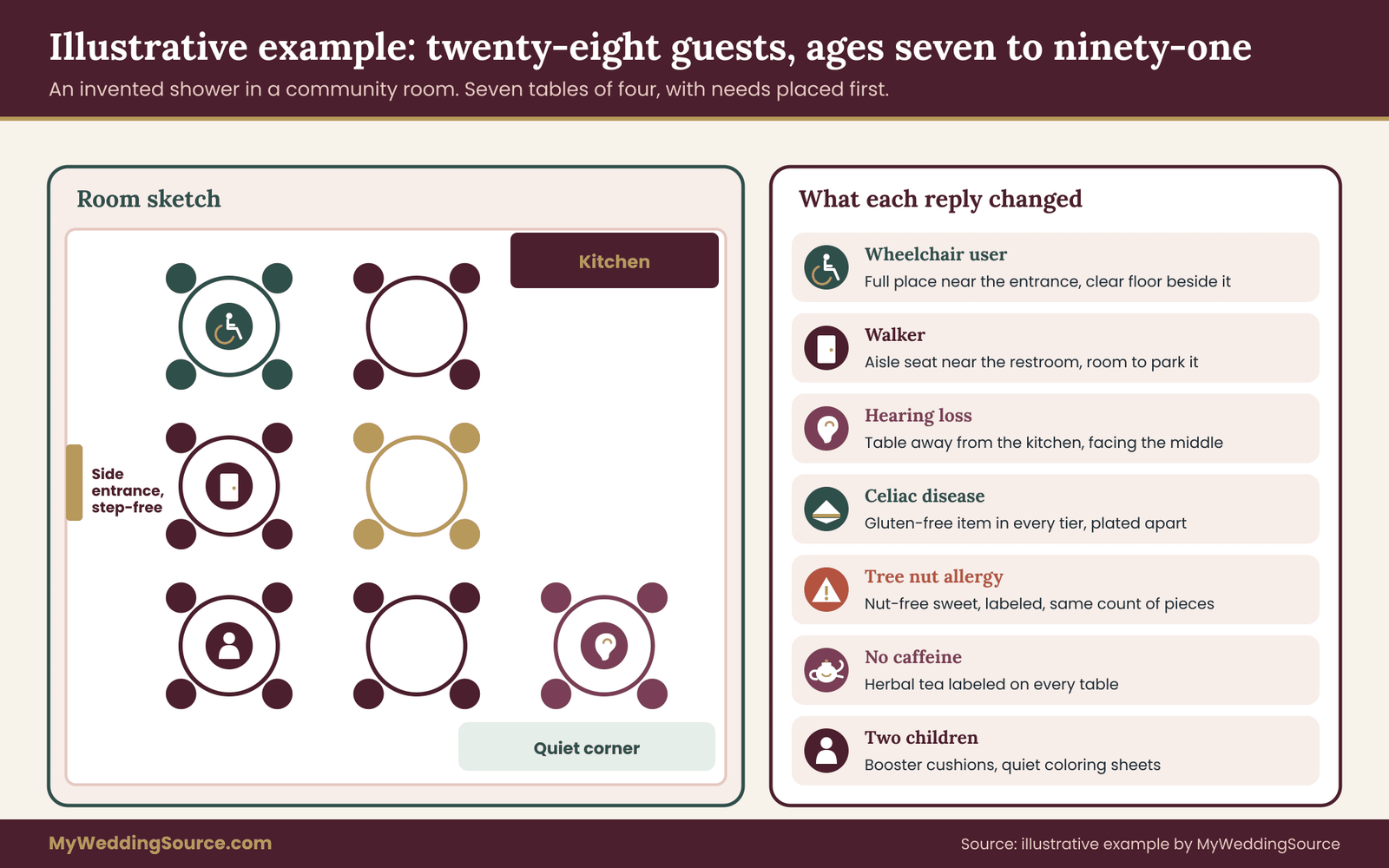
This example is invented. Names and numbers are illustrative and meant to show how the four lanes work together. It follows a fictional host, called Sam here, who is planning the bridal tea party in a community room for a guest of honor named Dana. The guest list has twenty-eight people. Ages run from seven to ninety-one.
Sam has replies on the invitation that mention one wheelchair user, one guest with a walker, one guest with celiac disease, one guest with a tree nut allergy, one guest who avoids caffeine and two children under ten. The example is meant to show a realistic bridal tea party plan, not an ideal one.
Seat
Sam tests the room first. It is a rectangle with a step-free side entrance, a restroom on the same floor and a hard floor. The room’s posted capacity is higher, but a sketch with aisles wide enough for a walker fits seven round tables. Sam sets one place at home with the real cup and plate and measures it.
With a stand in the middle, a table of five is tight, so each table gets four guests. Seven tables of four give twenty-eight seats, with clear aisles between them. The test is the first step of the bridal tea party plan.
Sam places the wheelchair user at a table near the side entrance, with a full place on one side and clear floor around. The guest with the walker sits at an easy-exit seat on the aisle side of a table near the restroom, with a spot beside the chair for the walker. The older guests who reported hearing difficulty sit at tables away from the kitchen door, facing the middle of the table.
The two children sit at different tables, each beside a familiar adult and with a booster cushion. Dana sits at a table near the middle of the room, with a clear path.
Sam avoids “age tables.” Each table has a mix, and each has at least two people who know each other. The room hums, and nobody sits alone among strangers.
Serve
Sam chooses the stand-per-table format for this bridal tea party with a helper pouring at two tables where guests might struggle with a pot. The menu has three tiers. Savory: cucumber and cream cheese, egg salad, plain butter, and a roasted vegetable tart. Bread: scones with jam and cream, with a gluten-free scone as the adapted version. Sweet: shortbread, lemon tarts and fruit, with a nut-free fruit and dairy-free option.
Using the one-safe-thing rule, Sam checks each tier. The guest with celiac disease has a gluten-free option at each tier. The guest with the tree nut allergy has a nut-free sweet and a safe savory choice. The children have plain butter sandwiches and plain scones. A small card on each stand names every item and lists its main ingredients. The two adapted plates go to a table number and a seat, and the caterer, who prepares them separately, has the list in writing.
For tea, Sam plans three cups per guest as an assumption, which means eighty-four cups. The caterer says a pot yields four cups, so that is twenty-one pot fills across seven tables, or three fills per table. Sam adds a small margin. There are four teas: a black tea, a green tea, a caffeine-free herbal blend and a decaffeinated option. The guest who avoids caffeine does not need to ask, because the labels are clear. Water and lemonade are on every table.
Pace
Sam uses the two-and-a-half-hour run. The party begins at one o’clock with seating until one-fifteen, the first pour at one-fifteen, savory at one-twenty-five, scones at one-fifty-five, a short toast and a memory game at two-twenty, a ten-minute stretch break at two-fifty, sweets at three o’clock and a send-off at three-twenty-five.
Sam sets the program in the middle and asks Dana ahead of time whether they would like gifts opened. Dana would rather not, so gifts are skipped and guests bring cards instead. The run follows the pacing described above for a bridal tea party.
Sam tells the kitchen the exact pour time and asks it to hold each tier until a helper gives a signal. A helper, seated near the service route, owns the signal. The older guest who must leave early gets a small box of sweets to take home. The children get a quiet coloring sheet for the long middle stretch.
Reach
Sam visits the community room with a short list. The side entrance is step-free but the door is heavy, so a helper holds it. A strip of loose carpet near the entrance is taped down. The restroom has an accessible stall. The room echoes, so Sam adds tablecloths and a few fabric panels and keeps the music soft.
Menu cards are in large dark print. A quiet corner with two chairs is set up away from the kitchen. Flowers on the tables are unscented. Reach is the lane that most bridal tea party hosts skip.
On the invitation Sam wrote the practical facts: use the side entrance with the step-free door, the restroom is on the same floor, tell us about food or seating needs, and gifts are not expected. The guests who replied got a short, friendly confirmation of their seats and plates.
What the example shows
The example does not describe a perfect party, and it is not a statistical model. It shows how the lanes work together. The place-setting test changed the table count. The reply cards changed the seat plan. The one-safe-thing rule shaped the menu. The run of show moved the program to the middle and added a break.
The accessibility visit found a heavy door and a loose carpet. Each of those changes cost almost nothing, and each would have been a problem if found on the day. Every change made for this bridal tea party cost little.
Replace the invented numbers with yours. The method holds if your room is a living room, your guest count is fifteen or your list includes a different mix of needs.
Edge cases and day-of fixes for a bridal tea party
Plans meet reality on the day. None of the problems below is unusual, and each has a fix you can decide in advance. Write the fixes on a card for the helper who runs the room, so you are not inventing them while a pot is going cold. A bridal tea party has fewer moving parts than a wedding, but they are close together.
The headcount changes at the last minute. Two guests drop out, or three more appear. Ask your vendor in advance for the date after which numbers are fixed, and for what extra seats cost. If more guests arrive than you planned, add chairs at the tables with the most room first, and never squeeze a guest into an aisle.
If fewer arrive, collapse the emptiest table and move guests with their consent, not without asking. Keep the adapted plates separate from the general count so a late change never removes a guest’s safe food.
A guest reports an allergy that no one knew about. This happens even when invitations ask. Stop serving the shared stand at that guest’s table, ask the kitchen which items are safe, and serve a plain alternative, such as fruit or plain bread, if the kitchen cannot confirm anything else. Do not guess. If a guest says they are having a reaction, treat it as an emergency and call emergency services, and then follow the plan you made with the guest earlier, if any.
A pot breaks or spills. Keep a few spare cups and a pot in reserve, and put towels and a small cloth near the service area. A spill of hot tea near a child or a guest with limited mobility needs quick action: move the people first, then clean. Keep a first aid kit within reach, and know where the nearest cold water is for minor burns.
The kitchen runs behind. If tiers arrive late, shorten the program rather than letting the whole afternoon slide. Move the toast to the dessert course, and skip the game. Guests forgive a short program. They do not forgive hunger or a cold pot.
Power trips. Many kettles and warmers on a single circuit can overload it, especially in a home or a hall with older wiring. Before the day, ask the venue how many appliances the circuit supports, and spread the load across outlets. If you rely on electric kettles, test them together, not one at a time.
A toast runs long. Brief the speakers in advance with a time limit, and agree on a gentle signal, such as the host standing near them. The risk is not a long toast but a long toast when the tea is cooling and the next tier is waiting.
Someone feels unwell or overheated. Keep water on every table. Know where the exit, a cooler room and a chair outside are. A helper should be ready to walk with a guest who needs air, and a quiet corner helps. Do not make a guest explain.
A guest is overwhelmed by attention. If the guest of honor becomes tired, give them a break: a seat in the quiet corner, a cup of tea and ten minutes with a friend. Plan it before the day, with a code phrase or a nod, if they would like. Do not call attention to it.
Weather changes the arrival. Rain or heat affects arrival and the route from the car. Have umbrellas by the door, a place to leave wet coats and a clear, dry route. Move the drop-off closer if you can. For a heat wave, keep cold drinks and shade available, and be even stricter about how long perishable food sits out.
A seating disagreement. Two guests who would rather not sit together, or a family that wants to be at one table, can be solved by a small adjustment. Do not discuss it in front of the room. A quiet move before the first pour is easiest, and the host’s decision should be final and gentle.
Another guest needs help you did not plan for. A guest with a new injury or a sudden need for a different chair is not a failure of your plan. Keep spare chairs, and tell a helper to handle the request without fuss. The point of the plan is that you have room to adapt.
Edge cases are easier when one person owns them. Pick a helper who is not the host and not the guest of honor, give them the card and the vendor contacts, and let them decide small matters without asking. Ask one helper to own the bridal tea party day card.
Your next steps
Here is a sequence you can follow, whether the party is a month away or six months.
- Ask the guest of honor what kind of party they want, how long, and whether they want gifts, games or a toast.
- Pick a format: fully served, a stand per table, a buffet-and-seated hybrid or drop-in.
- Draft the guest list and send invitations with a line asking about food, seating and access needs.
- Run the place-setting test with one real cup, plate and napkin, and decide the number of seats per table.
- Sketch the room in two passes, needs first and relationships second, and check each guest with the three seat questions.
- Build the three-tier menu with the one-safe-thing rule, and write the allergy list for the kitchen.
- Calculate cups, pots and refills with your own numbers, and add a small margin.
- Write the two-and-a-half-hour run of show, with the program in the middle and a stretch break before the sweets.
- Walk the route from curb to table to restroom, and fix or report what you find.
- Send the vendor questions in writing and keep a one-page confirmation.
- Share a short message with guests about entrances, seating and what to expect.
- Give a helper the day-of card and a clear job.
If you can only do three things, do these: ask guests about needs, measure one place setting and walk the route a guest would take. Those three steps catch most of the problems that spoil a bridal tea party.
FAQ
How long should a bridal tea party last?
Two to three hours suits most groups, and two and a half is a sound default. That is long enough for three tiers and a short program, and short enough for children and older guests. If the group is all adults who want a longer afternoon, you can extend it, but add a stretch break so no one sits for the whole time. Always give guests a clear end time on the invitation.
How many teapots do I need for a bridal tea party?
Build it from four numbers: guest count, cups per guest, cups per pot and refills. For example, thirty guests drinking three cups each need ninety cups. If a pot yields four cups, that is about twenty-three pot fills spread across the tables. Ask your supplier for the real yield of the cups you will use, and add a small margin of about a tenth for the last table.
How do I seat guests of different ages at a bridal tea party?
Plan needs first, then relationships. Mark easy-exit seats, a place for any mobility device, hearing-friendly seats and child-friendly seats. Then mix generations at each table, with at least two people who know each other. Avoid grouping by age, which sorts people by assumption. Ask guests about seating needs on the invitation instead of guessing from how old someone looks.
What should the menu include for guests with allergies?
Use the one-safe-thing rule: each tier of savory, bread and sweet should have at least one clearly labeled item that works for each restriction guests reported. Ask the kitchen about cross-contact and prepare adapted plates separately. The FDA lists nine major allergens, including wheat, milk, egg, tree nuts and sesame. Label everything from the same recipe list the kitchen uses.
How do I make a bridal tea party accessible?
Check the route from the curb to the table to the restroom for steps, heavy doors and loose rugs. Confirm that tables allow a wheelchair to pull up, choose chairs with sturdy arms and use light pots. Keep the room quiet, the light good and the menu in large print. Tell guests the practical facts on the invitation, and offer a quiet corner.
How long can tea sandwiches and cream sit out?
The U.S. Department of Agriculture advises that perishable food should not sit at room temperature for more than two hours, or one hour when the air is above ninety degrees Fahrenheit. Keep cold items refrigerated until you serve them, and bring out each tier in stages. Discard anything that has sat out past the limit, even if it looks fine.
Who pays for a bridal tea party?
It depends on the family, the friends and the guest of honor, so ask instead of assuming. Some hosts share the cost, some cover it alone and some couples host their own. If several people share the cost, agree on a total budget and each person’s share in writing before booking. Never make guests pay a hidden fee or feel pressure to give a gift.
Should I open gifts at a bridal tea party?
Only if the guest of honor wants to. Some people enjoy it, and some find it uncomfortable or too long for a seated crowd. If you do open gifts, keep it to a short part of the program in the middle of the afternoon, and make sure the guest of honor can sit comfortably. Otherwise ask guests for cards and skip it.
Sources
- U.S. Food and Drug Administration: Food Allergies
- U.S. Food and Drug Administration: FDA Food Code
- U.S. Department of Agriculture, Food Safety and Inspection Service
- Centers for Disease Control and Prevention: Food Safety
- ADA.gov: Americans with Disabilities Act information
- U.S. Access Board: Accessibility standards
- National Institute on Deafness and Other Communication Disorders
- Food Allergy Research and Education (FARE)
- Tea Association of the U.S.A.
- The Knot: wedding and shower planning resources