
Wedding speech alternatives are the ways a couple can keep every moment of a wedding that normally needs a microphone, such as the welcome, the vows, the thank-you and the toast reply, without standing up and talking to a room. This guide compares officiant-led, prerecorded, written and shared formats, shows how to choose one for each moment, and spells out what can go wrong with each.
Choose wedding speech alternatives by splitting the day into its speaking moments and giving each one a lane: officiant-led, prerecorded, written or displayed, or shared with someone else. Name a rescuer who can take over if the first choice fails, and write down the trigger for switching. Settle the legally required words with your officiant and the issuing office first, because those are the one part you cannot simply skip. Then test the whole chain, including sound, captions and timing, in the actual room before the wedding day.
Plenty of couples want a wedding without ever holding a microphone. Some freeze when a room goes quiet and every face turns toward them. Some speak perfectly well in conversation but find that a ballroom, a sound system and a hundred listeners add up to more noise and attention than they can manage. Some stutter, some use a device to speak, some are still learning the language of their guests, and some simply do not want to perform. None of these reasons needs a defense.
The good news is that a wedding is more flexible than it looks, and wedding speech alternatives are well established. Most of what guests remember as “the speeches” is custom rather than requirement. The few moments that carry legal weight are short and can usually be delivered in a quiet, simple way. Everything else can be moved, shared, recorded, printed or dropped without anyone feeling shortchanged, as long as the replacement is planned and not improvised.
This article is built around that idea. Instead of one list of clever speech alternatives, it gives you a way to choose: break the day into speaking moments, match each to a lane, assign a rescuer and write a fallback. Along the way it covers officiant scripts, how to make and play a recording, what to do about captions and sound, how to talk with family who expect a toast, and a worked example with an invented couple.
A note on scope. This is general planning information, not legal advice. Marriage requirements differ by state and country, so confirm the required wording and witnesses with the office that issues your license and with your officiant before you design anything around them.
What wedding speech alternatives actually replace
Before you can replace something, you need a clear list of what is being replaced. Most couples picture “the speech” as a single event, but a typical wedding contains several different speaking moments, and each has a different purpose and a different cost if it is dropped.
The first is the welcome, and the first of the speech alternatives to consider. Someone greets the guests, says why everyone is there and sets the tone. At a ceremony this often happens in the first minute; at a reception it can happen again when guests sit down to eat. The welcome does not need to come from the couple at all.
The second is the declaration and vows. In many places the couple must say something that shows they consent to the marriage, and officiants usually build a short exchange around it. Personal vows are an add-on that families often expect but that the law does not.
The third is the thank-you. Couples are expected to thank parents, helpers and travelers. This can be delivered aloud, but it can equally be a printed note, a sign, a card at each seat or a message sent afterward.
The fourth is the toast response. Toasts from a best man or a parent usually end with a pause that invites the couple to say something back. Many couples dread this moment more than any other because it is unscripted.
The fifth is logistics and farewell: announcing dinner, cake, the first dance, the last song and the send-off. These are not emotional speeches. They are instructions, and instructions are the easiest thing in the world to hand to someone else.
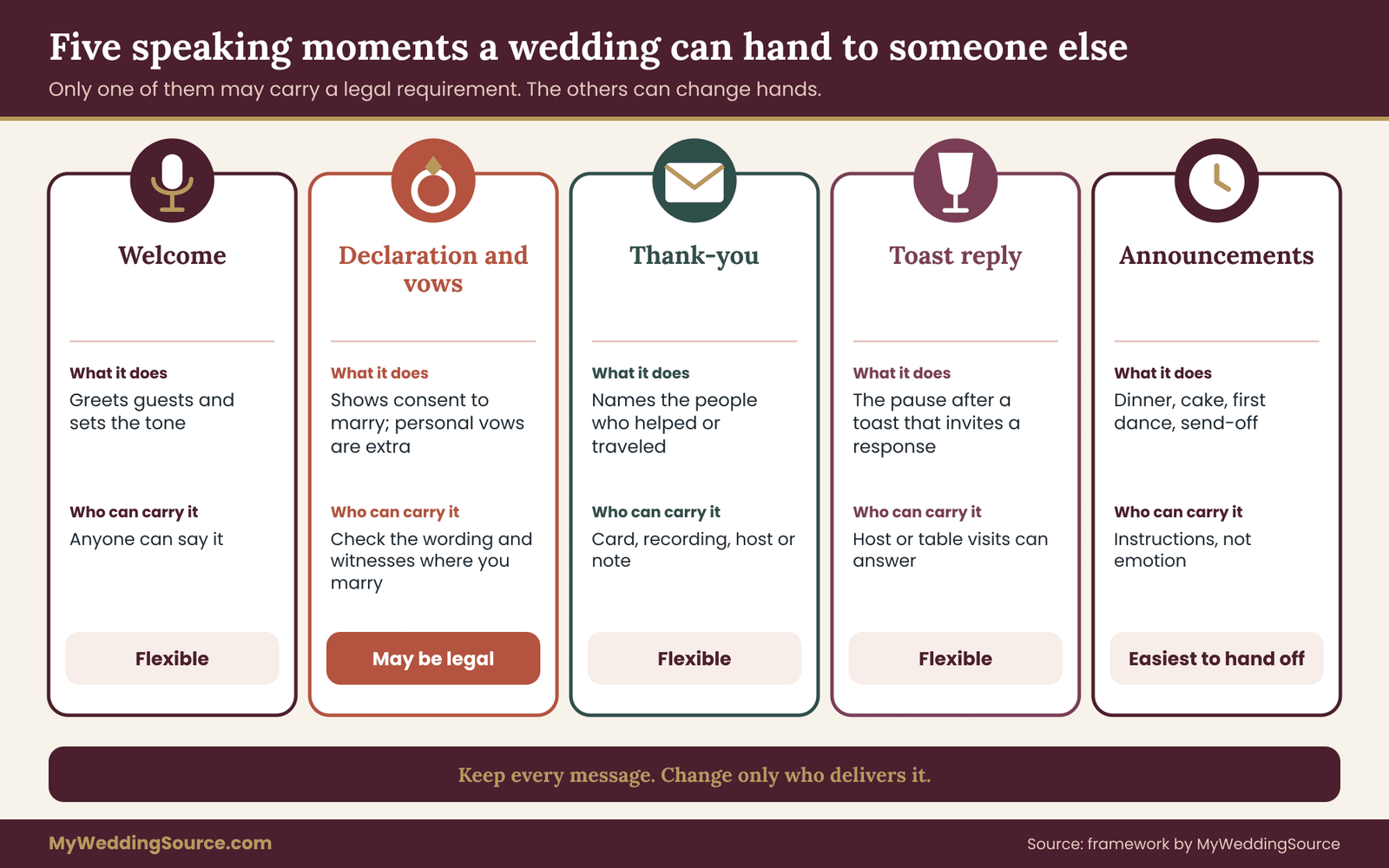
Looking at the list this way shows something useful. Only one of the five moments, the declaration, may carry a legal requirement. Two more, the welcome and logistics, are administrative and can be handled by anyone. The thank-you and the toast reply are emotional but flexible. Wedding speech alternatives therefore do not mean “no words at all.” They mean choosing who carries each set of words and how.
The difference between a speech and a message
It helps to separate what you want guests to receive from how it reaches them. A message is the content: we are glad you came, we love our parents, we are now married. A speech is one delivery method for that message, with the added feature that the couple’s voice and body are in the spotlight.
Once you treat the message and the delivery as separate decisions, the pressure drops, and every one of the speech alternatives becomes a question of delivery only. You can keep every message and change only the delivery. A thank-you that is read by the officiant, printed on a card or played from a recording is still a thank-you. Guests tend to respond to sincerity and clarity, not to whether the sentences came from the couple’s own mouths at that exact minute.
What this guide does not cover
This guide is about the speaking moments themselves and the speech alternatives that replace them. It does not walk through the whole ceremony order, which is covered in the wedding ceremony step by step guide on this site, and it does not explain how officiant licensing works, which the wedding officiant requirements page covers. It also does not attempt to cover every medical or sensory situation. Needs differ widely between people, and a label tells you little about what a particular person finds easy or hard.
Why couples avoid speaking, and why the reason shapes the choice
Two couples can both say “we do not want to give speeches” and need completely different speech alternatives. The reason behind the preference decides which format will actually help, so it is worth naming the reason honestly, at least between the two of you.
Anxiety about being watched. For some people, the problem is the audience, not the words. A prerecorded message removes the live audience but may bring a different worry, which is watching or hearing oneself later. An officiant-led format removes both, because the couple only has to answer short prompts.
Sensory load. A microphone squeal, a reverberating room, bright lights and a crowd can be hard to tolerate even for someone with no fear of speaking. In that case the solution is less about the words and more about the conditions: a quieter setting, a shorter exchange, lower stimulation, or a format that happens away from the main room.
Speech differences. A person who stutters, has a voice condition, uses a speech-generating device or communicates through sign language may be perfectly comfortable communicating and uncomfortable with the pace and pressure of a live ceremony. The right format here is the one the person chooses, not the one that looks most polished. A device-spoken line, a signed vow with an interpreter or a written statement can be completely appropriate.
Language. Couples marrying across languages may want to say something in two languages and feel unable to do either well in front of a crowd. Recorded or written versions with translations can carry the full meaning, and the same options work for guests who are not fluent in the couple’s main language.
Grief and privacy. Some couples have lost someone and fear that a speech will become something else. Others simply value privacy. A quiet, short, private exchange followed by a public statement written by someone else can protect both.
Preference. Plain dislike of public speaking is a sufficient reason. You do not need a diagnosis, a story or a justification to decide that the day will be built without a microphone in your hands.
Avoid guessing at what a guest or partner needs
When you plan speech alternatives, avoid assuming that every person who dislikes speaking needs the same thing. One partner may love recorded messages while the other finds the sound of their own recorded voice unbearable. One may want the officiant to say everything; the other may want a single sentence of their own. Ask each other directly, early, and write the answer down. The same applies to guests who may be affected by your choices, such as someone who cannot hear well or who uses captions.
If your decisions about who gets a say in the wedding feel tangled with family expectations, the wedding decision rights guide explains how couples and families can share input without losing control of the final call.
How to know which reasons apply to you
A quick private test can sort the reason. Imagine saying the same two sentences in three situations: alone into your phone, to your partner in a quiet room, and to forty people at a dinner. Notice where the discomfort begins. If it begins only at the third, the audience is the issue.
If it begins at the first, the issue may be the sound of your voice or the act of recording. If it begins in a loud room but not a quiet one, the environment is the issue. If it begins with the words themselves, the issue may be wording and not speaking.
Write down the result in one line for each of you. That line will drive which of the speech alternatives you choose in the next sections, and it makes the conversation with family and vendors simpler, because you can say what helps without explaining why.
The four lanes: an option matrix for wedding speech alternatives
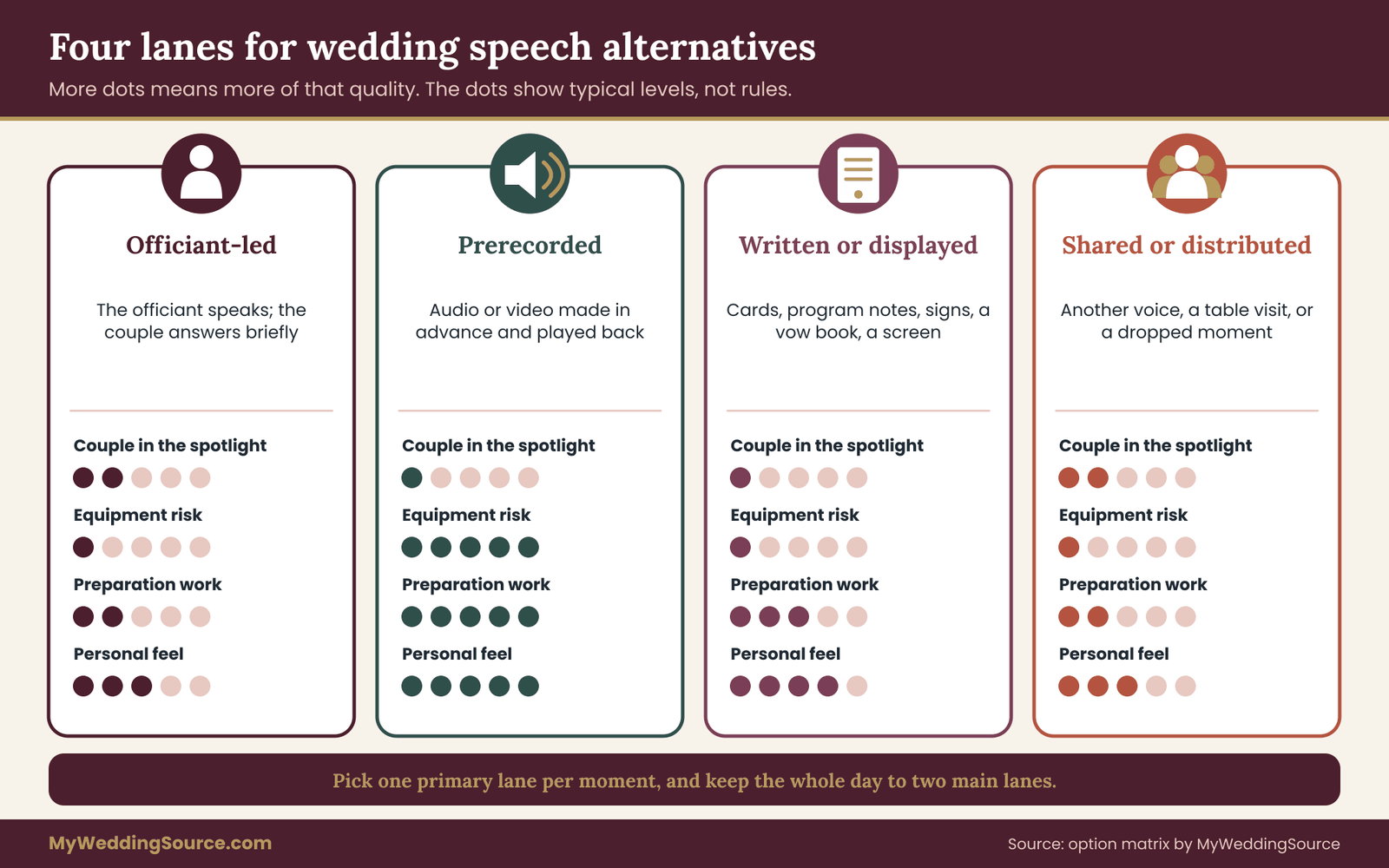
Every one of the speech alternatives in this guide falls into one of four lanes. A lane describes who carries the words and when they are delivered, which is the part that decides most of the risk, effort and feeling of the choice. Thinking in lanes keeps you from collecting random speech alternatives and helps you compare wedding speech alternatives on the same terms.
Lane one: officiant-led. The officiant speaks for the occasion. They welcome guests, explain the meaning of what is happening, ask the couple short questions and announce the marriage. The couple’s part can shrink to a nod, a single phrase or a response they have rehearsed. The officiant is a trained speaker, is already standing in front of the room and carries the microphone anyway.
Lane two: prerecorded. The words are captured in advance, as audio or video, and played at the right moment. The couple, a parent or a friend can record them. The big advantage is control: you can redo a take, edit out a stumble, add captions and approve the final result. The cost is technical dependence, because a recording works only if the playback chain works.
Lane three: written or displayed. The words are on paper or a screen instead of in the air. Think of a printed program note, a sign at the entrance, a card at each place setting, a vow book passed between the couple or a short message projected during dinner. This lane has the lowest technical risk and the quietest atmosphere, and it suits guests who prefer to read.
Lane four: shared or distributed. Someone else carries the moment, or it is spread across several people or several places. A parent welcomes guests. A friend reads the thank-you. The couple visits each table in a calm, informal way instead of addressing the room. Or a moment is simply dropped, which counts as a legitimate lane when you decide it on purpose.
How the speech alternatives compare on five questions
You can compare the speech alternatives without a table by asking the same five questions of each. The answers below describe typical behavior, not rules, and your venue, officiant and guests will adjust them.
How exposed is the couple? Officiant-led is low, because attention stays on the officiant. Prerecorded is very low during the wedding but includes a private recording session beforehand. Written is the lowest, because nobody has to be heard. Shared depends on who carries it, but is usually low for the couple.
What can fail? Officiant-led fails when the officiant forgets the prompt or the couple misses a cue. Prerecorded fails when sound, files or timing fail. Written fails when text is too small, too long or in the wrong place. Shared fails when the person chosen declines, runs long or says something the couple did not want said.
How much preparation does it need? Officiant-led needs a briefing and a short rehearsal. Prerecorded needs the most work: scripts, recording, editing, captioning, testing and a backup. Written needs careful writing and printing time. Shared needs an honest conversation with whoever is carrying the moment and a clear brief.
How personal does it feel? Prerecorded and written can feel the most personal, because the couple writes and controls every word. Officiant-led is personal to the degree that the officiant knows you. Shared is personal when the carrier has a real connection to the moment.
Who can access it? Written works well for guests who read but may exclude children, some older guests and people who do not read the language. Recorded content with captions can reach more people, but only if sound and screen are visible from every seat. Officiant-led depends on the room’s amplification. Shared depends on the carrier’s voice.
The framework: lane, rescuer, fallback
The option matrix of speech alternatives helps you pick. The next step is what turns an idea into something you can run on the day. For every speaking moment, write three short answers.
Lane. Which of the four lanes carries this moment? Choose one primary lane only for each moment. Two lanes for the same moment usually means nobody knows which one is happening.
Rescuer. If the primary lane fails, who steps in? A rescuer is a named person who knows the plan and is already in the room. It might be the officiant, a sibling, a friend running the audio or the planner. A rescuer who learns about the plan at the moment of failure is not a rescuer.
Fallback. What exactly happens instead? The fallback should be simpler than the primary choice and require no equipment. A recording fails, so the officiant reads the written version. A reader is late, so the officiant says the thank-you from a card. A sign is blocked by a crowd, so the officiant mentions it.
Writing the three answers for your speech alternatives takes about a minute per moment. It is also the single habit that separates calm weddings from tense ones, because it turns “what if the sound cuts out” from a worry into a line in a document. Later sections show how to fill this in for each moment and give a worked example.
The one rule: the fallback must be easier than the plan
A fallback that depends on the same system as the primary speech alternative is not a fallback. If your primary lane is a video played through the venue’s projector, a fallback that requires a different video file on the same projector will fail the same way. Choose a fallback that uses a different channel entirely: voice instead of screen, paper instead of audio, a person instead of a device.
This rule produces a natural ladder. The top rung is whatever you most want to happen. The next rung is something a person can do with no equipment. The lowest rung is simply skipping the moment gracefully. A wedding with this ladder written down rarely gets stuck, because every failure has somewhere to land.
How to pick wedding speech alternatives by moment, not by trend
Many couples start with speech alternatives they saw online, such as a video montage or a mystery envelope, and then try to find a place for it. That tends to produce a day full of clever pieces that do not fit together. Starting from the moment instead keeps the choice honest.
Take the welcome. What does it need to do? It needs to greet guests, explain any unusual features such as a silent ceremony, a no-phone request or a quiet room, and set the mood. Which lane carries that best? A parent or the officiant, in a short spoken welcome, is the simplest. A printed note at each seat can do the same job, and works well when the welcome includes instructions that guests may want to re-read.
Take the vows. What does this moment need to do? It needs to be a sincere exchange between the two of you and to satisfy any legal wording. An officiant-led exchange of short promises meets both. A private exchange in a quiet room before the ceremony, followed by a short public declaration, meets the first and leaves the second for the officiant. A written exchange, with each partner reading the other’s words silently, is an option when the couple and officiant agree on the form.
Take the thank-you. What does it need to do? It needs to name the people and say a real sentence about each. A printed note or a card, a short recording played during dinner or a list read by a friend each do that. A spoken thank-you from the couple is the only version that requires them to speak, and it is not the best one for everyone.
Match effort to what is at stake
Not every moment deserves the same effort, and neither does every one of the speech alternatives. A short welcome at a casual reception can be a printed note and a friend’s hello. The declaration at the ceremony deserves a rehearsal and a backup. A farewell can simply be a sign. If you spread your preparation equally across all five moments, you will spend the most time on the moments that matter least.
A useful way to set the effort is to ask what would happen if the moment went missing. If the answer is “the wedding would not be legal,” prepare thoroughly. If the answer is “someone’s parent would feel overlooked,” prepare carefully. If the answer is “dinner would start two minutes later,” prepare lightly.
Do not mix too many lanes
A common trap is using speech alternatives from all four lanes in one day. A recorded welcome, an officiant-led ceremony, printed thank-yous and a shared toast response can each be good on their own. Together, they can leave guests unsure where to look and who is speaking, and they multiply the number of things that can fail. As a rule, keep the day to two lanes for the main structure and use the other two only for single, small moments.
Many couples find that officiant-led speech alternatives for the ceremony and written or shared for the reception covers the whole day. Others combine one recorded message at dinner with an otherwise officiant-led set of speech alternatives. A day with a clear pattern of speech alternatives is easier to rehearse, easier to explain to vendors and easier for guests to follow without instruction.
Officiant-led speech alternatives: what the officiant can carry
Officiant-led formats are the most common wedding speech alternatives, and for good reason. An officiant is already in front of the room, already trained to speak to a crowd and already responsible for the legally important moments. The key is to brief them clearly, because an officiant who does not know your preference will default to the traditional script.
What an officiant can say on your behalf
An officiant can handle nearly every speaking moment that is not a personal vow. They can welcome guests and explain the structure of the ceremony. They can acknowledge parents and special guests by name. They can describe what the couple’s readings, music or rituals mean. They can offer the thank-yous the couple has written. They can announce the marriage, invite the kiss if you want one and introduce the couple to the guests.
For the reception, an officiant is often less available, but a friend can take that role, and a few couples ask the officiant to stay for the first thirty minutes to open the dinner. If you want that, ask early and confirm whether it changes the officiant’s fee or the contract.
Ways to shrink the couple’s spoken part
If you want to say as little as possible, several standard speech alternatives cut the spoken content down without changing the legal effect. The officiant may ask a question and the couple answers with a single phrase. The officiant may read each promise and the couple responds with the same short line. The couple may use a repeated response such as “I will” for every promise. Or the couple may say one sentence each and let the officiant finish the rest.
Here is a script that works for many ceremonies. The officiant says: “Do you take this person as your spouse, to love and support through everything ahead?” The partner answers: “I do.” The officiant says: “Please exchange rings and repeat after me one line.” The couple says one short line. The officiant then announces the marriage. In that structure, each partner speaks perhaps ten words in total, and every other word is the officiant’s.
The legal piece comes first
The wording that makes the marriage valid is set by the jurisdiction, not by tradition. In many places the couple must declare, in front of the officiant and often in front of witnesses, that they take each other as spouses. The exact words, the number of witnesses and whether the declaration must be spoken aloud vary. Because a ceremony that skips a required step may create paperwork problems later, confirm the requirements before you design the rest.
Ask the officiant two questions. First, what is the shortest wording that meets the requirement where we are marrying? Second, can that declaration be delivered in the way we want, such as through sign language, a speech device, a written exchange or a single-word response? A good officiant will either know the answer or contact the issuing office to find out. For general background on how officiants are authorized, see the wedding officiant requirements page, and use the county clerk or equivalent office as the authority for your own location.
Briefing the officiant
An officiant-led set of speech alternatives fails mainly through poor briefing. Give the officiant a one-page note that covers the following, in plain language.
State the preference directly: “We would like to say as little as possible out loud and have you carry the rest.” Name the exact words the couple will say, or the exact prompts they will answer. State what should be avoided, for example jokes at the couple’s expense, questions to the room, calls for a round of applause or any request that a guest speak.
State the sensory conditions that matter, such as a request for a lower microphone volume, a pause after each prompt or a cue, like a hand gesture, that means “give us a moment.” Mention any accessibility needs for guests, such as captions or a signer.
Then ask the officiant to read the note back to you in their own words. If they paraphrase it accurately, they have understood. If they say “I’ll handle it” without repeating any detail, ask again.
Rehearsing the shortened exchange
The couple’s few lines still need practice, because a short script spoken once in a stressful moment is easy to lose. Rehearse the exchange aloud, standing where you will stand, at least twice. Ask the officiant to deliver the prompts at the pace they will use on the day. Choose one anchor, such as a breath after each prompt or a glance at your partner, that tells you it is your turn.
If the ceremony will be held outdoors or in a large room, check the sound too. An officiant’s voice may carry well, while a partner’s quiet answer may not. Decide in advance whether the officiant repeats the answer for the room, or whether the officiant simply says “They have said yes,” which is a common and graceful solution.
For help sequencing all of this alongside music and readers, the wedding ceremony cue sheet guide shows how to write the timing so the officiant, the musicians and the helpers share one document.
When the officiant is a friend or relative
Many couples ask a friend to officiate. This works well for speech alternatives because the friend already knows your preferences. It also adds risks. A friend may be nervous in a way that a professional is not, may improvise and may feel pressure to say something moving that goes beyond your instructions. Give a friend a full written script, ask them to read it as written and agree on one or two places where they can add a personal sentence. Offer the same briefing note and ask the same read-back.
If you want a ceremony that is not religious and has a script you can borrow, the non-religious wedding ceremony script page offers a structure that can be shortened.
Prerecorded speech alternatives: audio, video and the chain behind them
Prerecorded speech alternatives let the couple, or anyone they choose, say important things without a live audience. They suit people who can speak comfortably in a quiet room but not in front of a crowd, or who want to control exactly how a message sounds. They are also the most technical of the wedding speech alternatives, and they fail in specific, predictable ways, so this section treats the whole chain from script to speaker.
What you can record as speech alternatives
You can record a welcome, a thank-you, a message to parents, a message to guests who could not travel, vows read to each other in private or a short story about how you met. You can record in audio only, which is simpler to play and less demanding to make, or in video, which adds a face and captions but requires a screen everyone can see. You can also record a message for a specific moment, such as a toast reply, and play it right after the last toast.
A recording can be made by the couple alone, by the couple with a trusted friend, or by someone else on their behalf. A parent who is nervous about speaking live may find a recording easier, and a couple can ask a friend to read their thank-yous in a recorded voice.
The five stages of a recording
Treat the recording as a small production with five stages.
Script. Write the words and read them aloud with a timer. Aim for a length that fits the moment: under a minute for a welcome, about two minutes for a thank-you. Remove any sentence that is hard to say.
Capture. Record in a quiet room with soft surfaces, such as a bedroom with curtains and a bed, which absorb echo. Hold a phone about a hand’s width from the mouth for audio, or place it at eye level for video. Record several takes and do not judge the first one.
Edit. Trim the start and end, remove long gaps and level the volume. Free editing software and phone apps can do this. Save a master file in a common format and an additional copy in a second format.
Caption. Add captions or a transcript. This helps guests who are deaf or hard of hearing, guests who do not speak the language, and anyone seated far from the speakers. Check the captions against the script for errors, especially names.
Test. Play the file on the exact equipment, at the exact volume, in the exact room. This is the stage most couples skip, and it is the stage that matters most.

The playback chain
Prerecorded speech alternatives are only as reliable as the weakest link in the chain from file to ear. The chain usually includes the file, the device that holds it, the cable or wireless connection, the venue’s sound system or screen, the person who presses play and the cue that tells them when. Each link can fail on its own.
To reduce failure, keep the chain short. Put the file on two devices, such as the playback laptop and a phone. Use a wired connection where the venue allows it, because wireless connections can drop. Give one person full responsibility for playback and name a second person who can take over. Print a one-line cue, such as “Press play when the officiant says ‘Please listen to a message from the couple,’” and tape it to the device.
If the venue has an audio technician, ask them to do a sound check with your file, and ask who is allowed to operate the system on the day. A DJ or band that supplies sound may have a standard way of playing files and may charge for extra work.
Music, rights and permissions
If your recording includes background music, consider where the music comes from. Commercial songs are generally protected by copyright, and rules for use in videos differ from rules for playing music live at an event. If you want music under a message, choose a recording that you have created or have clear permission to use, or leave the message with no music. The U.S. Copyright Office is the authority on how copyright works, and your venue or DJ can tell you what licensing they already hold for live events.
Also consider the people who appear in a recording. If a video includes children or guests, get their agreement before you play it. The wedding photography consent guide on this site covers how couples can set boundaries around images and who may see them.
Recording for nervous speakers
Making a recording can be as stressful as speaking live for some people. A few adjustments help. Record in a room where you feel safe and in a comfortable position, whether sitting, lying down or walking. Record in short pieces and join them later. Ask a trusted person to sit nearby but out of view. Record several versions and choose the one you like best, or choose none and use a written alternative instead. A recording that makes you tense is not one of the speech alternatives worth keeping, and you are free to abandon it.
Written and displayed wedding speech alternatives
Written speech alternatives replace sound with text. They suit couples who think best on paper, guests who like to take their time, and venues where amplification is poor or unwelcome. They are also the easiest wedding speech alternatives to test, because paper does not need batteries.
Where written words can live
The program. A ceremony program can include a welcome note from the couple, a short explanation of each part of the ceremony and a list of thanks. Because guests hold it in their hands, they can read it before the ceremony begins, during a quiet moment or afterward. A few warm sentences in the program often replace the entire spoken welcome.
Signs. A welcome sign at the entrance, a short note at the guest book table and a small card at the bar can each carry a message. The wedding signage system guide explains how to plan size, placement and proofing so that signs are readable from where guests stand.
Place cards and table notes. A card at each seat can carry a personal thank-you, either the same for everyone or different for each table. This format lets the couple say something specific to each person without saying a word aloud, and it often feels more intimate than a group speech.
A vow book or letters. Partners can write vows in a book, exchange sealed letters or read each other’s words silently while the officiant describes what is happening. Some couples read their letters privately before the ceremony and keep them as a keepsake. These formats work best for vows, which are meant to be personal, and less well for group announcements.
Screens. A short message projected on a screen at dinner, with large text and plain colors, can act as a welcome or thank-you. This blends the written and recorded lanes, so treat it as a screen with the failure conditions of a recording.
Writing speech alternatives for the page, not the microphone
Spoken language and written language behave differently. A sentence that sounds fine aloud may read as rambling, and a carefully written sentence may sound stiff when read aloud. For printed wedding speech alternatives, write for a reader.
Use short paragraphs. Put the most important line first. Name people clearly, with the relationship in a few words, such as “our parents, Maria and Daniel.” Avoid inside jokes that need a long explanation. Read the text aloud once and replace any phrase that you would not say. Keep the whole note to what a guest can read in a minute or two, because most guests will glance at it between conversations.
Readability
Printed words are only useful if people can read them. Use a clear typeface at a size that works in dim lighting, with strong contrast between text and background. Avoid thin script fonts for any text that matters, and avoid putting text over a busy pattern. Print a few copies in larger type for guests who need them, and keep a plain version available for guests using screen readers or translation tools.
The Web Accessibility Initiative at the World Wide Web Consortium publishes widely used guidance on readable text, contrast and plain presentation, and the principles apply equally to a printed program and a wedding website. It is worth skimming before you finalize a design.
What written speech alternatives cannot do
A written message cannot reach a guest who does not read the language, a child who cannot yet read or a guest with low vision who has not been given a larger version. It also cannot create a shared moment of attention, which is the thing a spoken welcome does for a room. If silence in the room matters to you, such as at a toast or a first dance, you may need a short spoken cue from someone else to tell guests where to look.
A good compromise is a written message with a spoken pointer. The officiant or a friend says one sentence, such as “There is a note from the couple at your seat, and you are welcome to read it now,” and the rest lives on paper.
The fourth lane of speech alternatives moves the moment to someone else or to somewhere else. It is the lane with the most variety and the one most affected by family dynamics. Used well, these speech alternatives spread attention across the people who love you and removes the couple from the spotlight.
Handing a moment to another person
A parent or family elder. A parent can open the reception with a welcome that includes the couple’s wishes, such as “They asked me to say how glad they are that you came, and to invite you to eat.” This is a traditional role in many families and fits comfortably.
A friend as host. A friend can serve as host for the reception, announcing dinner, cake and the first dance, and handling the toast order. This is useful when no one else wants the job and when a professional emcee is not in the budget.
A professional. A DJ, band leader or coordinator can make announcements and handle logistics as part of their usual work. Ask about the style: some are loud and energetic, which may not suit a couple who prefers a calm tone. Give them a written script and tell them what to avoid, including games or calls for participation.
The toast reply. When a best man or parent finishes, someone else can respond on the couple’s behalf. The host can say “They wanted me to tell you how much this means,” or the toast giver can end by saying “They are happy to talk with each of you individually tonight.” That sentence gives guests a place to put the warmth they feel.
Moving the moment somewhere else
Not every speaking moment needs to happen in front of the whole room. You can move the thank-you into small settings.
Table visits. The couple walks to each table at a calm point in dinner and spends a minute or two saying thank you, in conversation. Many couples who prefer speech alternatives are comfortable one-to-one. Table visits take time, so allow roughly one to two minutes per table and plan the dinner schedule around them.
A receiving line or greeting moment. Standing at the door at the end of the ceremony, or at the start of the reception, gives each guest a few seconds of contact. This replaces the group welcome and the group thank-you at once.
Messages after the event. A thank-you note or short message sent in the weeks after the wedding is entirely traditional and removes the live moment completely. If you want to say something to the room on the day but cannot, tell guests in the program that personal notes will follow.
A private exchange. The couple can exchange vows or letters privately before the ceremony, with only a photographer or officiant present, and then bring a shorter public declaration to the ceremony. Some couples record this exchange for later.
Skipping a moment on purpose
Dropping a moment is one of the legitimate speech alternatives, and it should be chosen on purpose, not by accident. A wedding with no toasts, no couple speech and no formal welcome can be warm and complete, provided guests know what to expect. The risk is not the absence of speeches but the confusion of an unexplained gap. If you skip something that guests expect, tell them through the program, a sign or the host.
Handling guests who want to speak anyway
A couple who chooses speech alternatives may still have a guest who wants to give a toast. Decide ahead of time whether you welcome this. If you do, ask the person to speak with the host and to keep it short. If you do not, say so kindly before the day and offer an alternative, such as a written note, a recorded message or a short toast at the rehearsal dinner.
A quiet statement in the program, such as “We have chosen a day without open toasts and would love to hear your thoughts in person,” often prevents an unplanned microphone moment.
If a relative pushes back on any of this, the plain scripts later in this guide can help you answer calmly.

Matching the carrier to the moment
Not every person suits every one of these speech alternatives. A relative who loves attention may enjoy hosting. A shy cousin may prefer reading a short note. A quiet friend may be a better audio operator than a speaker. Ask each person what they would like to do before assigning anything, and give them a plain way to say no. A volunteer who is relieved to decline is better than a reluctant participant who stumbles in front of your guests.
A decision order for wedding speech alternatives
Choosing speech alternatives across five moments and four lanes can feel like a maze. A fixed order of decisions turns it into a short sequence of small choices. Work through the steps below in order, and write each answer in one line.
Step one: settle the legal words. Ask your officiant and the issuing office what must be said, by whom and in front of whom. Everything else is built around this fixed point. If the required declaration is short and the officiant can lead it, the ceremony is largely solved.
Step two: name your reason. Use the private test from earlier to decide whether the issue is audience, sound, language, speech differences, privacy or plain preference. Write one line for each partner. The reason points to a lane. Audience worries usually point toward officiant-led or written. Sound sensitivity points toward quiet, short, low-volume formats. Speech differences point toward the format the person chooses. Language points toward written or recorded with translation.
Step three: list the moments that exist in your day. Not every wedding has all five. A courthouse wedding may have only a declaration. A backyard wedding may have only a welcome and a toast. List what is actually on your schedule.
Step four: choose a lane for each moment. Pick one primary lane per moment, using the questions from the option matrix. Keep the whole day to two main lanes where possible.
Step five: name a rescuer. For each moment, choose one person who knows the plan and will be in the room.
Step six: write the fallback and the trigger. The fallback should use a different channel than the primary. The trigger is the specific event that starts it, such as “if the file has not started within ten seconds.”
Step seven: tell the people who need to know. The officiant, the rescuer, the host, the audio operator and the venue each need a short note that covers only their part.

A short example of choosing speech alternatives in order
Suppose a couple has a ceremony, a dinner and a first dance. Step one: the officiant says the required declaration is a single question each. Step two: one partner is anxious about audiences, and the other is fine with a quiet room but dislikes loud sound. Step three: moments are welcome, declaration, thank-you and dinner announcement. Step four: welcome and declaration are officiant-led, thank-you is a printed card at each seat, and the dinner announcement goes to the host.
Step five: the officiant’s rescuer is the best friend, who holds a copy of the script. Step six: if the officiant is unwell, the friend reads the script. Step seven: everyone gets a one-page note.
Notice that the result uses two lanes, three people and one printed item. It took about ten minutes to decide and a few more days to prepare, which is the point.
Common speech alternatives patterns that work as starting points
These patterns of speech alternatives are starting points, not templates to copy.
The quiet ceremony. Officiant-led ceremony with short responses. Printed program with a welcome note and thanks. No toasts at the ceremony. The couple greets guests informally afterward.
The recorded welcome. A short audio message from the couple plays as guests are seated, with captions on a screen. The officiant leads the ceremony. A friend hosts the reception.
The written day. Welcome sign, program note, place card thank-yous and a vow book exchange. A single spoken sentence from the officiant points guests to the written pieces.
The table-visit reception. No toasts. The couple visits each table during dinner. The host announces cake and the first dance. A printed note thanks guests who traveled.
The private-then-public day. Private vows exchanged in a quiet room with a photographer or recorder present. A brief, officiant-led public declaration. A recorded excerpt of the private vows shared later with family.
When partners disagree
One partner may want a speech and the other may not. Disagreement about speech alternatives is common, and it does not need a winner. The couple can agree that the partner who wants to speak does so alone, in a short and clearly bounded moment, while the other uses a different lane. A single partner speaking is a normal wedding; neither person is required to match the other. If the disagreement is about whether to speak at all, treat the quieter partner’s comfort as a firm limit, and let the other partner choose any option inside it.
A worked example with wedding speech alternatives
The following example is invented for illustration. It does not describe a real couple, and the details are chosen to show the decision order in action, not to suggest a standard.
Imagine a couple, Noor and Elias, planning a small autumn wedding for about sixty guests in a rented hall. Noor finds crowded rooms and sudden loud sounds tiring but is comfortable speaking one-to-one. Elias stutters, more on some days than others, and prefers not to be timed or watched while speaking. Both want a warm, ordinary-feeling day. Neither wants an open microphone.
Step one: the legal words
They ask their officiant, a family friend who is licensed to officiate, what the declaration requires where they are marrying. The officiant confirms with the issuing office that each partner must state, in front of the officiant and two witnesses, that they take the other as spouse. The office confirms that the wording is flexible and that a short phrase is enough.
The officiant also asks whether Elias may sign, type or use a prepared card instead of speaking if a day is difficult, and is told to confirm that in writing with the office. They do, and keep the answer in their records.
Step two: reasons
Noor writes: “A loud, crowded, echoing room is the problem.” Elias writes: “Being timed and watched is the problem, not the content.” These two lines point toward different adjustments. Noor needs a calm setting and low sound. Elias needs control over pace and an option to switch format.
Steps three and four: moments and lanes
The moments are welcome, declaration, thank-you, dinner announcements and a toast reply. They choose the following lanes.
The welcome goes to the officiant, in a minute at the start of the ceremony, followed by a printed note in the program. The declaration is officiant-led, with each partner answering one short question. Elias has the option to hold up a printed card with the words, which the officiant will read aloud, if speaking feels difficult that day. The thank-you is a card at each seat, with a few lines written by the couple and a handwritten name on top.
The dinner announcement goes to a friend who volunteered as host. The toast reply is dropped. The host explains in the program that the couple has chosen a day without open toasts and will visit tables during dinner.
Steps five and six: rescuers, fallbacks and triggers
For the welcome, the rescuer is the officiant’s co-officiant friend, and the fallback is to read the program note aloud. For the declaration, the rescuer is the officiant, and the fallback is the card. The trigger is a pause of more than a few seconds with no answer, upon which the officiant gently offers the card without comment. For the thank-yous, the rescuer is the host, and the fallback is a verbal “there is a note at your seat.” For the announcements, the rescuer is the venue coordinator, and the fallback is a sign at the buffet.
Step seven: briefings
The officiant gets a one-page note with the exact prompts and the card option. The host gets a script and a short list of things to avoid, including games and calls for guests to speak. The venue coordinator gets the sound plan: one microphone, set at a low volume, used only by the officiant. The witnesses are told that they will not be asked to speak.

What the example shows
The finished set of speech alternatives has two lanes, officiant-led and written, with one small shared moment. It uses no recording and no screen, because neither partner wanted the extra work. Every moment has a rescuer. The most sensitive moment, Elias’s declaration, has a built-in alternative that is not presented as a failure. Compare that with a day in which the same couple simply agreed to “skip the speeches” and then found at the reception that a relative handed Elias a microphone. The plan costs a few conversations and removes the scene.
Another couple might choose the opposite speech alternatives: a recorded welcome and a recorded thank-you, played from a laptop, with captions. That would be equally valid. The decision order for speech alternatives is the same, and the outcome depends on the people, not on any universal best choice.
Failure conditions for wedding speech alternatives
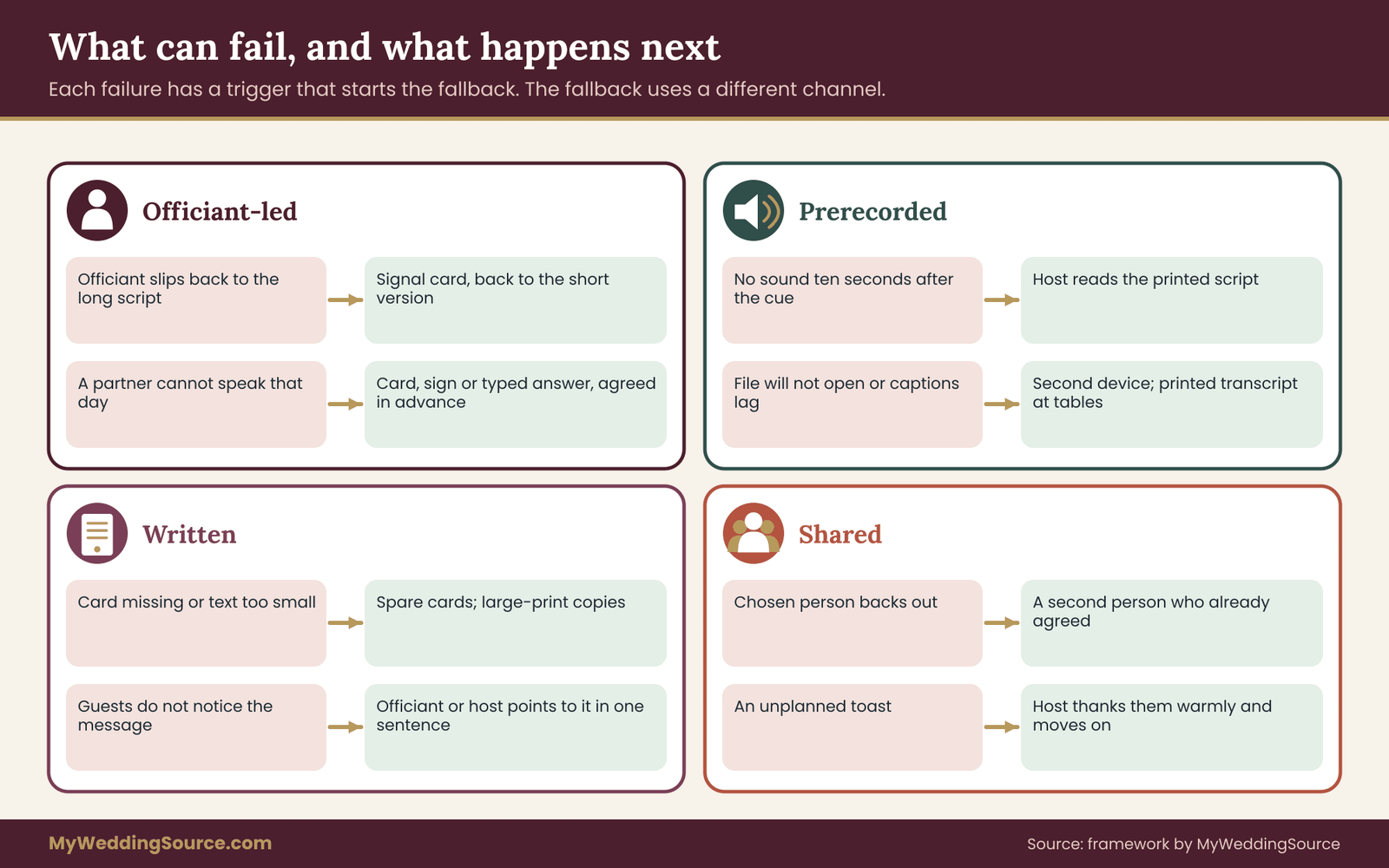
Every one of the wedding speech alternatives fails in its own way, and each failure is easier to handle when you have named it ahead of time. This section lists the realistic failure conditions for each of the speech alternatives, what triggers the fallback and what the fallback looks like. It is the part of a plan that most couples leave out and most wish they had written.
Officiant-led speech alternatives: failures
The officiant forgets the shortened format. They drift back into the traditional script and ask the couple to repeat long lines. The trigger is the first long line. The fallback is a prearranged signal, such as a small card or a nod, and the officiant returns to the short version. Prevention: the one-page note, the read-back and a copy of the script in the officiant’s hand.
The officiant is late or unavailable. The rescuer, named in advance, leads from a printed script. Prevention: confirm arrival time, keep a backup contact, and agree on who will take over. If the officiant is the legal officiant, the rescuer may not be able to complete the legal part, so ask the issuing office what happens when the officiant cannot attend, and settle that before the day.
The couple’s answer is too quiet to hear. The officiant repeats the answer or announces it. Prevention: a rehearsal in the room, and an agreement that the officiant will repeat.
A partner cannot speak on the day. Speech can be harder on some days than others, for reasons that have nothing to do with willingness. The fallback is the card, the signed or typed response or a nod, confirmed in advance with the officiant and the issuing office. Present it as one of the planned options, not as a rescue.
Prerecorded speech alternatives: failures
No sound. The most common failure. Causes include a muted device, a wrong input, a dead battery or a cable that is not plugged in. The trigger is silence for ten seconds after the cue. The fallback is for the officiant or host to read the printed script. Prevention: a sound check in the room, a wired connection and a second device.
Sound plays too loudly or too quietly. Venue systems vary. Test at the volume the room needs, with guests’ bodies absorbing sound, because an empty room is louder than a full one. Assign one person to adjust volume and tell them the target.
Captions are out of sync or unreadable. Captions that lag, flash by or sit behind a bright window are worse than none. Test them on the venue’s screen, from the back row. Add a printed transcript at each table as a backup.
The file will not open. File formats and software versions differ. Save the file in a common format, keep two copies on separate devices and run it on the playback device at least a day before the wedding.
Timing drifts. A recording that plays while guests are still moving, eating or talking will be ignored. Choose a moment when guests are seated and the room is quiet, and have the host ask for attention in one sentence before pressing play.
The recording feels wrong on the day. A partner may hear their recorded voice and feel uncomfortable. Agree beforehand that either person can pull the recording without explanation, and have a written alternative ready.
Written speech alternatives: failures
Text is too small or too long. Guests skim. Use large type, short paragraphs and strong contrast. Check the print in the room’s lighting.
Cards are placed incorrectly. A card missing from a seat means someone does not get the thank-you. Assign one person to check each table before guests arrive and keep a few spare cards.
Guests do not notice the message. Add a spoken pointer from the officiant or host, or place the card on the plate, not beside it.
Shared speech alternatives: failures
The chosen person declines or backs out. Always ask for a firm yes, and name a second person who has agreed to stand in.
The carrier talks too long or goes off script. Give them a time limit and a written outline, and ask the host to stand nearby with a signal for wrapping up.
An unplanned toast. A guest takes a microphone you did not authorize. The host can step in, thank the guest warmly and move on, or offer to let the guest speak briefly, as the couple prefers. Decide the response in advance, and tell the host.
Failures that speech alternatives cannot fully prevent
Some things will go wrong in ways nobody predicts: a power cut, a late train, a guest who arrives mid-ceremony. The goal is not a day with no problems but one in which every moment has a person and a simpler alternative. A host who can say “We will move on and the couple will talk with everyone later” is worth more than any piece of equipment.
For a broader view of backup communication, files and permissions across the whole day, the wedding day digital contingency plan guide covers how to keep copies and who can access them.
Talking with family, vendors and guests about your choices
Choosing wedding speech alternatives is easier than explaining them. Family may expect a toast, a vendor may default to the usual order and guests may not know what the day will look like. A few plain scripts help.
Saying it once, kindly
You do not owe anyone a reason, and you can give a short one if it helps. A sentence like “We would like to keep the day quiet and are going to have the officiant lead the ceremony” is enough. If someone asks why, “It is what feels comfortable for us” is a full answer. If someone persists, repeat the sentence and move to a practical question, such as “Would you like to write us a note to read together afterward?”
Scripts for common conversations
To a parent who expected a toast. “We are keeping the speeches small this time. We would love you to say a few words at the rehearsal dinner, or to write something we can keep. Which would feel better to you?”
To a friend you would like to host. “Would you be willing to introduce dinner, cake and the first dance? We would give you a short script and you would not need to say anything beyond it.”
To an officiant. “We would like to say as little as possible aloud. Could you lead the ceremony using short prompts and shorter answers, and could we send you a one-page note?”
To a DJ or band leader. “Please avoid games, calls for toasts or requests for guests to speak. Announcements should follow the script we send and be kept brief and calm.”
To a venue coordinator. “We will have one microphone, used only by the officiant, and we would like to test a recording in the room the day before. Who can help with that?”
To guests, in the program. “We have chosen a day without open toasts. Please feel free to find us and say hello during dinner. We would love to hear from you.”
What vendors need to see in writing
Spoken agreements about speech alternatives get lost. For each vendor who touches a speaking moment, put the relevant part of your plan in writing and ask them to confirm. A short email is enough. The wedding vendor contract guide explains how to make sure that changes to a standard package, such as removing a DJ’s announcements or adding a sound check, are written down and priced.
Accessibility for guests
Your speech alternatives should work for guests as well as for you. Think about who needs what. Guests who are deaf or hard of hearing benefit from captions, printed transcripts, seating close to the officiant and, where available, a hearing loop or similar assistive listening system. Guests with low vision benefit from large print and strong contrast. Guests who do not read the language benefit from translations. Guests who are sensitive to sound benefit from a heads-up about volume.
The Americans with Disabilities Act covers many places that host public events, and the ADA website explains the idea of effective communication, which means making sure that people with disabilities can understand and take part. The rules that apply to a private wedding differ from those for a public venue, so use the ADA site as general background, and ask the venue what accommodations it already provides.
Ask guests about access needs on the invitation or RSVP in a neutral way, such as “Please tell us anything that would help you enjoy the day, such as captions or seating.” Then act on the answers, and keep the information private.
Not assuming one answer for everyone
Guests with similar conditions may want different things. One guest who is hard of hearing may want captions and another may prefer seating near the front without captions. One guest who is sensitive to sound may want to leave the room during the loudest moments and another may want earplugs. Offering a few options and letting people choose is more respectful and more reliable than guessing.
Rehearsal and run sheet for wedding speech alternatives
A set of speech alternatives on paper is not yet one you can rely on. The last step is to run it once, in the real room if you can, and to turn it into a run sheet that other people can follow without you.
The rehearsal test for speech alternatives
Run a rehearsal that covers only the speaking moments. It does not need to be long. Allow about thirty minutes in the ceremony space and fifteen in the reception room.
For officiant-led moments, stand where you will stand and have the officiant deliver each prompt. Answer aloud, or use your chosen alternative, and note whether the room carries the sound. Practice the signal for “give us a moment.”
For recorded moments, play the file through the venue’s equipment at the volume you want, from the back row and from the front. Check that captions are legible. Time how long the file runs and how long it takes to start after the cue. Switch to the backup device and play it again.
For written moments, put a card on a table and stand where a guest would sit. Read it in the room’s light. Check that signs can be read from the distance guests will pass them.
For shared moments, walk the host through the script. Practice one interruption, such as a guest standing up with a glass, and see how the host responds.
A pass-or-fail check
At the end of the rehearsal, ask three questions about every moment. Can the primary lane run with no one improvising? Does the rescuer know exactly when to step in? Does the fallback use a different channel? If any answer is no, fix it before the wedding day. A moment that fails this check is not ready, even if the idea behind it is good.
The run sheet for speech alternatives
A run sheet is a single page that lists each speaking moment in order, with the time, the lane, the person responsible, the cue, the trigger and the fallback. Give a copy to the officiant, host, audio operator, coordinator and rescuers. Keep it short enough that someone can read it standing up.
Write each line in plain language. For example: “Welcome. Officiant. At start of ceremony. Cue: music ends. If the officiant has not begun in thirty seconds, best friend steps forward with the printed welcome.” The ceremony timing can sit alongside the standard order of a wedding ceremony, and the run sheet can be a short addition to it.
What to say to the helpers
Helpers running speech alternatives do better with one clear instruction than with a long background. Give each one a sentence, such as “You are in charge of pressing play when the host says ‘a message from the couple,’” and a second sentence about what to do if it fails. Avoid giving a helper more than two jobs, and avoid giving them a job that requires them to interrupt something already in progress.
A final week check
In the last week, confirm the officiant’s arrival and the printed copy of the script. Confirm that both playback devices are charged and that the files are on both. Confirm the printed cards are counted and placed. Confirm the host has the script and the time limit. Confirm that the venue coordinator knows the sound plan. Confirm that whoever holds the legal paperwork has it. These checks take about an hour and remove most of the avoidable surprises.
After the wedding: keeping the speech alternatives you made
Wedding speech alternatives often produce better keepsakes than live speeches do. A recording is a clean file, a printed note is a physical object and a vow book is a family item. A few small decisions will keep them useful.
Save the master files. Keep the original recordings, edited versions and caption files in at least two places. If a recording captured a private exchange, label it clearly and decide who may listen to it.
Keep the printed text. Save a copy of the program note, the thank-you card text and the officiant’s script. They are part of the day’s story and cost nothing to keep.
Share with care. Parents, siblings and friends may want a copy of a message. Share a link or a file with the people who were named in it, and ask before sharing widely, especially if a message includes children or private details.
Write the follow-up notes. If you promised personal notes, send them within a few weeks. A short, honest note counts as much as a speech would have.
Record what worked. A few lines in your records about what you would repeat or change are useful if you ever renew your vows or help someone else plan their wedding.
Reviewing the day in the order it happened makes it easier to decide what to save.
Your next steps
You can finish most wedding speech alternatives work in a week of short sessions. Work through the list in order.
- Before choosing speech alternatives, ask your officiant and the issuing office what wording and witnesses your marriage requires, and whether your preferred way of answering is accepted.
- Write one line each naming why speaking publicly is difficult, using the private test.
- List every speaking moment on your actual schedule.
- Choose one of the speech alternatives for each moment, keeping the day to two main lanes.
- Name a rescuer and write a fallback and trigger for each moment.
- Send the officiant, host and any recorded-message helpers a one-page note, and ask for a read-back.
- Make, caption and test any recorded speech alternatives, with a backup on a second device.
- Print what you need, in large type, and count the cards.
- Run the thirty-minute rehearsal test in the real room.
- Give everyone the run sheet and do the final week check.
FAQ
Is it acceptable to have a wedding without any speeches?
Yes. Speeches are a custom, not a requirement, and many couples skip some or all of them. The only moment that may carry a legal requirement is the declaration, and an officiant can usually lead that in a short, quiet way. If you skip something guests might expect, such as a toast, tell them through the program or the host so the gap does not feel like a mistake.
Can an officiant say the vows for us?
An officiant can lead the exchange and read the words, and you can answer with a short phrase. Whether someone else can say your promises on your behalf, or whether you must say a specific declaration yourself, depends on where you marry. Ask your officiant and the office that issues your license what wording is required and whether alternative ways of answering are accepted.
Are recorded messages a good choice for a wedding?
They can be, especially for a welcome or a thank-you. Recorded messages give you control over takes and captions and remove the live audience. They also depend on sound, files and timing, so they need a sound check, a backup device and a printed fallback. If making a recording is stressful, a written or officiant-led format may be easier.
How do I handle a guest who wants to give a toast anyway?
Decide in advance whether you welcome it. If you do, ask the person to tell the host and keep it short. If you do not, tell them kindly before the day and offer another option, such as a note, a recorded message or a toast at a rehearsal dinner. Brief your host to thank an unplanned speaker warmly and move on.
What if one of us feels able to speak on the wedding day and the other does not?
Treat the quieter partner’s comfort as a firm limit. The partner who wants to speak can do so in a short, bounded moment, and the other uses a different lane. Neither needs to match the other. Agree beforehand that either of you can switch formats on the day without explanation, and let the officiant and host know.
Do I need to explain my reasons to family?
No. A short statement such as “We would like a quiet day and will have the officiant lead” is enough. If you want to say more, you can, but you are not required to share health or personal details. Repeat the same sentence calmly if someone pushes, and then move to a practical offer, such as a note or a table visit.
How can I make sure guests who are deaf or hard of hearing can follow?
Provide captions for any recording, printed transcripts at tables and seating near the officiant. Ask the venue whether it offers an assistive listening system. Include a neutral question about access needs on your RSVP, and respond to the answers. Guests with similar conditions may want different things, so offer choices instead of assuming.
How long should I allow to prepare wedding speech alternatives?
A simple officiant-led and written plan can be settled in a few weeks, mostly through conversations and printing. A recorded plan needs more time for scripting, recording, captioning and testing, so start at least a couple of months out if you can. Whatever you choose, leave time for a rehearsal in the real room and a final week check.
Sources
- ADA.gov, U.S. Department of Justice Civil Rights Division
- ADA.gov, effective communication guidance
- W3C Web Accessibility Initiative, guidance on readable and accessible content
- National Institute on Deafness and Other Communication Disorders
- U.S. Copyright Office, copyright basics and permissions
- Federal Communications Commission, captioning and accessibility resources
- Library of Congress, personal digital archiving guidance
- Cybersecurity and Infrastructure Security Agency, data backup guidance
- USA.gov, state government and marriage license office directory
- National Institute of Standards and Technology, accessibility and usability resources