
Passport validity is the one travel detail that can stop a wedding guest at the airline counter, and the couple is rarely the right person to answer it. This guide gives you a calm, repeatable way to tell guests what to check, where to check it, and by when, without guessing at anyone’s immigration outcome.
Do not tell guests what their passport validity “should” be. Tell them four things: check the expiry date on their own passport, check the entry rules of the country they are traveling to on that country’s official site or their own government’s travel pages, check what their airline will accept, and do it all before they book. Give each guest group a short source-check card with links and a deadline. You are pointing to official sources, not predicting anyone’s entry.
Somewhere between the save-the-date and the rehearsal dinner, a guest writes to ask a question that sounds simple. “Is my passport okay for the wedding?” The honest answer is that you do not know, and nobody on your planning team can know either. Passport validity rules depend on the passport the guest holds, the country they are entering, the airline they fly, and any country they pass through on the way.
That does not mean you should stay silent. A short, well-timed message that names the right questions can save a guest from a denied boarding or an expensive rebooking. What matters is the shape of the message. It should be specific about what to check and humble about what happens next.
A note on scope. This is general information, not legal or immigration advice, and entry rules change, so confirm every point with the issuing authority before you rely on it. The article points you to those authorities throughout.
Why passport validity is the guest’s responsibility and your communication task
There is a clean division of labor here, and it is worth stating plainly before anything else. A traveler’s passport belongs to them. The decision to admit them to a country belongs to that country’s border authority. The decision to let them board a plane belongs to the airline, which can face penalties when it carries a passenger who is not admissible. The couple sits outside all three decisions.
What the couple does own is communication. You decide when guests hear about travel documents, how the message is worded, and whether the guest can find the right official source without searching blindly. Done well, that is a real service. Done badly, it becomes either silence or false confidence.
The two failure modes to avoid
Put simply, passport validity is a fact about a document, and the rules that read that fact belong to other people. The couple can raise the subject of passport validity early and kindly. The couple cannot rule on it.
The first failure mode is silence. The couple assumes every adult knows how to travel, sends the invitation, and finds out three weeks before the wedding that a favorite uncle’s passport expires in the same month. By then, a renewal may be hard to schedule and flights may already be paid for.
The second failure mode is false confidence. A well-meaning couple searches online, finds a forum post that says “six months is the rule,” and writes “your passport must be valid for six months” on the wedding website. For some travelers and some destinations that is roughly true. For others it is wrong or incomplete. A guest who reads your sentence about passport validity as official may stop checking.
The fix for both is the same: replace your own statements about rules with a pointer to the person or office that sets the rule.
What you are, and are not, allowed to say
You can say what you know about your own event: dates, the city, the airport nearest the venue, the date you need a final answer from guests. You can say that passport validity and entry requirements vary by nationality and by itinerary. You can say where to look.
You should not say that a guest will or will not be admitted, that a document is “enough,” or that a visa is “easy.” You should not rank countries by difficulty. And you should not collect copies of guest passports unless a vendor or venue truly requires a name list, in which case ask only for the name as printed, not the document itself.
If you are also writing an invitation-support letter for a guest who needs a visa, that is a separate task with its own limits, and it deserves its own careful reading of the issuing government’s guidance. This guide stays with the earlier, simpler step: helping guests check their documents before they book.
Where this fits in the bigger picture
One more way to see it: a guest who asks about passport validity is really asking for permission to start planning. Your reply should give that permission in the form of a task, not a verdict. “Check these four things and tell us what you find” does that. “You will be fine” does not.
International guests add a layer to nearly every part of wedding planning, from the date you pick to the hotel block you hold. If you are still shaping the guest list, the wedding guest list guide covers how to decide who is invited at all. If lodging is your next question, the guide to coordinating wedding guest hotels covers rooms, budgets and arrival logistics for travelers. This article sits in the middle: it handles the document check that has to happen between “we are invited” and “we have booked.”
The source-check method: four sources, one card
Every guest question about passport validity can be answered the same way: by naming the source that decides. That habit is the whole method, and the rest of this guide is a way to make it quick.
The method in this guide is simple enough to explain on a phone call. For every group of international guests, you build a one-page source-check card. The card does not contain rules. It contains four named sources, one for each party that has a say in whether the guest travels, and a deadline for checking them.
Here are the four sources, in the order a guest should check them.
Source one: the passport itself. The guest reads the issue date, the expiry date, the name as printed, the condition of the booklet, and the number of blank pages. These are facts printed in the document, not rules.
Source two: the destination’s entry rules. For a U.S. wedding, that means the U.S. Department of State and U.S. Customs and Border Protection. For a wedding abroad, it means the destination government’s official pages and, for U.S. citizens, the country page on travel.state.gov.
Source three: the airline and booking agent. Airlines publish document requirements for the routes they fly and are the ones who check at the counter. Their requirement can be stricter in practice than the destination’s published rule, because the airline carries the risk.
Source four: any transit country. If the itinerary connects through a third country, that country has its own rules for transit, even if the guest never leaves the airport.

Why four sources and not one
The practical lesson about passport validity is that it never travels alone. It sits beside entry rules, airline checks and transit rules, and a guest who checks only one of the four has checked a quarter of the question.
Each source answers a different question, and each can say no independently. A passport can be technically valid for entry and still be refused by an airline because it is damaged. A visa-free nationality can still be turned back because the traveler did not complete a required electronic authorization. A transit country can have a rule the destination does not.
Most online advice collapses these into a single “do I need a visa?” question, which is why it so often fails the traveler. The card keeps them apart on purpose.
What the card looks like in practice
Each card starts from the same plain question: does the passport validity this guest holds fit the trip they plan, according to the people who decide? You do not answer it. The card tells the guest where to find the answer.
The card has five fields: the guest group, the four sources with links, the deadline, a plain sentence about who decides, and a contact for questions about the wedding itself, not about immigration. The later section on building the card shows each field and the exact wording.
You do not need to produce a different card for every individual guest. You need one for each situation that actually differs. On a typical international guest list that is between two and five cards, covering things like “guests flying in on a passport that normally allows visa-free tourist visits,” “guests who need a visa,” “U.S. citizens traveling abroad for our wedding,” and “guests with dual nationality.”
A decision rule for when a card is not enough
A card is a starting point. If a guest tells you they have a complicated situation, such as a pending immigration application, a recent change of name, a stateless travel document or a refugee travel document, stop writing instructions. Say you are glad they can come if it works out, tell them to contact the relevant government office or a qualified immigration professional, and offer to adjust the plan around their answer. That sentence costs you nothing and protects the guest from relying on a layperson. ## Passport validity explained: the dates, pages and condition that matter
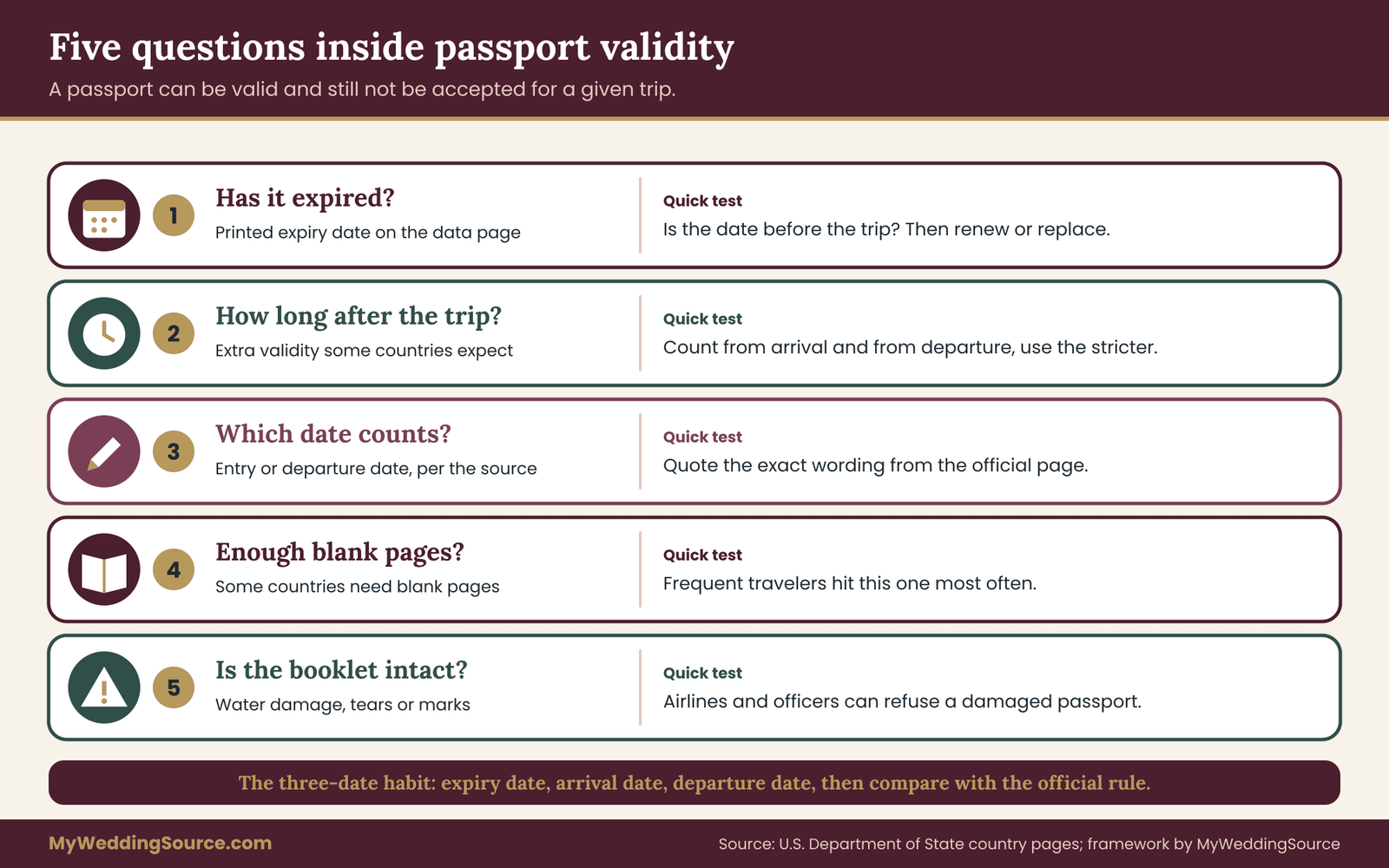
“Valid” is a slippery word. A passport can be valid in the sense that it has not expired, and still be unusable for a particular trip. When a guest asks about passport validity, they are usually asking one of five different questions at once. Separating them makes the advice much clearer.
Question one: has it expired?
The simplest passport validity test is the printed expiry date.
This is the easy one. Every passport carries an expiry date on the data page. If that date is before the planned trip, the guest cannot travel on it, and no source-check will change that. The only path is renewal or replacement, and the time that takes depends on the issuing country, so the guest should check the issuing authority’s current processing times as soon as they notice.
Be a little careful with the idea of “about to expire.” A passport that expires two weeks after the wedding is technically valid on the wedding date. That does not mean it will be accepted, which leads to the next question.
Question two: how long must it remain valid after the trip?
This is the question most people mean when they say passport validity, and it is the one where a single sentence from a friend is most likely to be wrong.
Many countries ask that a visitor’s passport remain valid for some period beyond the date they plan to leave. The period differs by country, and some countries do not ask for any extra time. The United States has its own approach for visitors: U.S. rules generally expect a passport to be valid for six months beyond the intended period of stay, and the State Department publishes a list of countries whose passports are covered by an exception to that expectation. The list changes over time, so the guest should read the current version rather than rely on a friend’s memory.
This is the single most common source of confusion, so it is worth spelling out how it plays out. A guest whose passport expires in four months, traveling for a five-day stay, may be fine or may not be, depending on whether their country of issue is on the exception list. You cannot tell from here. They can tell in about three minutes on the official page.
Question three: does the entry country read validity from the day of arrival or the day of departure?
Rules are worded differently. Some say “valid for six months from the date of entry.” Others say “valid for six months beyond the date of departure.” For a short wedding trip the difference is a few days, but it can be the difference that matters for a passport that expires at the edge.
When a guest is close to the line, the careful move is to treat the stricter reading as the working one, and to look for the exact wording on the issuing source. A guest who renews anyway loses a modest fee. A guest who guesses wrong may lose a plane ticket.
Question four: how many blank pages does it need?
Blank pages are a second, separate part of passport validity.
Some countries ask for one or more blank pages for entry stamps. The State Department’s country pages for U.S. citizens traveling abroad list this requirement where it exists. A passport full of visa stamps from years of travel can fail this test even though it has years left before expiry. Guests who travel often are the ones most likely to hit it, which is a little ironic, since they are also the ones most likely to say “I travel all the time, I am fine.”
Question five: is the booklet in acceptable condition?
Condition is the least discussed part of passport validity, and the one guests assume cannot apply to them.
Border officers and airlines can refuse a passport that is damaged. Water damage, a torn data page, a detached cover, a punched hole that was not made by an authority, or pages that have been written on can all cause trouble. Guests rarely think about this until they are at the counter, because a passport that sat in a coat pocket through a rainstorm often looks “fine.”
The three-date habit
You can give guests a single memorable habit that covers most of this: write down three dates. The passport’s expiry date, the date you plan to arrive, and the date you plan to leave. Then put the entry rule from the official source beside them and see whether the arithmetic works. If it does not, or if the guest cannot tell, the next step is the official page or the airline, not the couple.
This habit is useful because it turns a vague worry into a calculation the guest can do alone. It also gives you a clean sentence for the wedding website that makes no promises: “Please check that your passport validity works for your arrival and departure dates under the rules of the country you are entering.”
What to avoid saying about passport validity
The test for any sentence you write about passport validity is whether it names a source or states a rule. Sentences that name a source are safe. Sentences that state a rule are risky.
Avoid the phrase “six months is the rule.” It is true for some combinations, false for others, and it sounds authoritative. Avoid “as long as it has not expired, you are fine.” Avoid “you can renew at the airport.” And avoid giving any specific number of weeks for renewal, because processing times vary by country and by season and are published by the passport agency itself.
What you can say is that guests with any doubt should check now, because the fix for a passport problem gets harder and costlier the closer the trip gets.
Timing: when passport validity needs to be settled
A passport check is a deadline problem more than a knowledge problem. Most guests can read a page of official rules. What they cannot do is create time. Renewing a passport, applying for a visa or arranging an appointment all depend on lead times set by someone else.
The cost logic of early versus late
A passport validity problem found early is a form and a fee. The same passport validity problem found at the airport is a missed wedding. The facts are identical. Only the timing differs.
Think about it as a simple comparison, using no invented numbers. If a guest finds a passport problem before booking a flight, the cost is the renewal fee and some paperwork. If they find it after booking a nonrefundable fare, the cost includes the fare risk. If they find it at the airport, the cost includes the ticket, the hotel nights they will not use, the wedding they will miss, and the stress of all of it.
The cost curve is steep and it favors speed. This is the argument you can make to a hesitant guest, gently: checking now is nearly free, and checking later is expensive.
A three-checkpoint timeline
You can build the guest message schedule around three checkpoints, each tied to your own event date rather than to a calendar.
Checkpoint one: with the save-the-date or the first travel page update. Tell international guests that you will send a document reminder, and invite them to check their passport expiry now. This is the lightest touch. It asks for nothing except a glance at a document.
Checkpoint two: before the booking window you recommend. If you suggest that guests book flights by a particular date, send the source-check card before that date. Booking is the moment when a passport problem turns from a nuisance into a financial loss.
Checkpoint three: a final gentle reminder well before departure. This one is practical rather than analytical. It asks the guest to confirm they have the passport, any required electronic authorization or visa, and the confirmation printed or saved offline.
The wedding invitation etiquette guide is a good companion for deciding how formal the wording of these messages should be. The timing logic is what matters here.
Matching the timeline to the guest’s likely lead time
Guests with a close passport validity margin should be told first, because they have the most to gain from acting early.
Guests from different places face different lead times. A guest who needs a visa may face an appointment wait that is posted publicly by the issuing government. A guest whose nationality allows visa-free visits may only need to complete an online authorization that is usually quick, though the rules and fees are set by the government and can change. A guest who needs a new passport will face the passport agency’s own timeline.
You do not need to know any of these numbers. You need to know that they exist and that they differ, so you can tell the guest to check the relevant official page for the current figure. A line like “Visa appointment wait times are posted by the issuing government, so please check the current wait before you plan around it” does that job.
When you set your own deadline, set it for a reason
Many couples ask for RSVPs by a date and then add a separate date for “travel confirmed.” That second date is helpful, but only if you explain why. A reason like “our caterer and hotel block both need final numbers by then” is concrete and easy to accept. A vague “please let us know” invites delay.
For international guests specifically, consider offering a soft first deadline for “intending to come” and a firmer second one for “documents confirmed and flights booked.” This two-step approach gives guests with passport questions room to resolve them without forcing them to decline early. It also fits neatly with the advice in the guide to choosing a wedding date, which looks at how travel disruptions and guest availability should shape the schedule.
A worked timing example
Notice that in this example the passport validity question was asked three times in three different ways, and that each time the guest, not the couple, did the checking.
Suppose a wedding is on a Saturday in the fall. The couple sends a save-the-date about nine months ahead with a line that says “international guests, please look at your passport expiry date.” They send the source-check card with the formal invitation about five months ahead, together with the suggested booking window. They send a final reminder about three weeks ahead.
At the save-the-date stage, a cousin notices that her passport expires two months after the wedding. Because she has nine months, she renews without drama and tells the couple only that it is handled. At the invitation stage, a friend checks the official page for the country he is entering, sees that his passport needs to be valid for longer than his planned stay, and compares his expiry date. He decides to renew before he books. At the final reminder stage, one guest realizes he left a required electronic authorization incomplete and finishes it that evening.
None of those problems required the couple to know any rule. They only required the couple to ask the right question at three moments. That is the whole value of the timeline. ## Passport validity and entry requirements for guests coming to a U.S. wedding
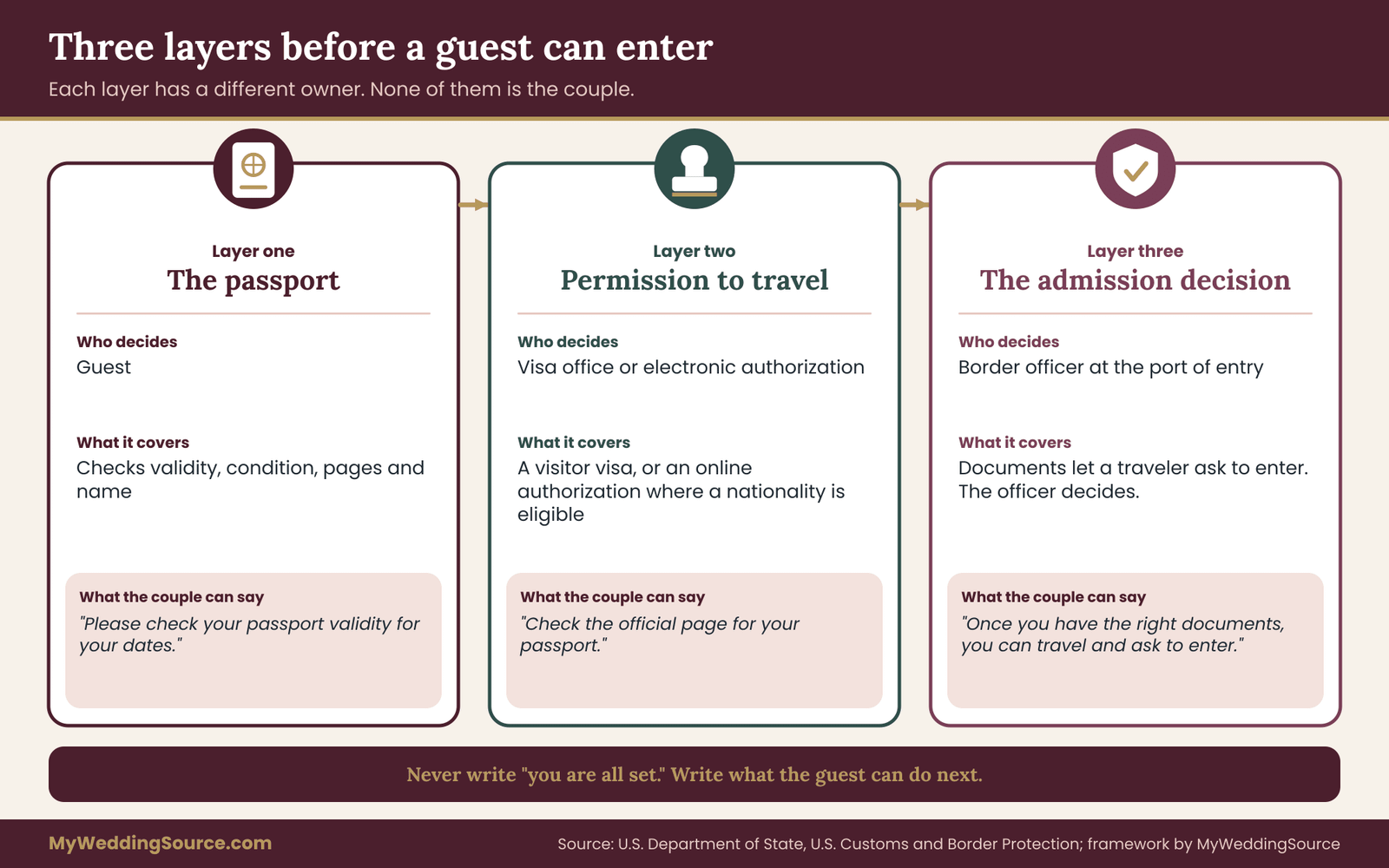
When a wedding takes place in the United States and guests fly in from elsewhere, three ideas are easy to mix up: the passport, the permission to travel, and the decision to admit. Keeping them apart is the core skill. Passport validity is only the first of the three, and it does nothing on its own.
Layer one: the passport
In short, passport validity is the entry ticket to every other check, and a guest who has not looked at it cannot sensibly start the others.
The passport is the identity and nationality document. Its validity, condition and pages are the guest’s business, as the previous section described. For a trip to the United States, the guest should also confirm whether their passport type matters. Travelers from countries covered by the Visa Waiver Program generally need an electronic passport, which carries a small chip and shows a symbol on the cover, in order to use that program. The official pages say exactly how this works.
A guest who cannot tell whether their booklet is electronic can look at the cover or ask the issuing agency. It is a quick check and it affects what options the guest has.
Layer two: permission to travel
Most visitors need one of two things before they board a flight to the United States. Some need a visitor visa, which is issued by a U.S. embassy or consulate after an application and, usually, an interview. Others, if their country participates in the Visa Waiver Program, may apply online for an electronic travel authorization instead. U.S. Customs and Border Protection runs that system, and the State Department runs the visa process.
A few travelers fall outside both categories because of special agreements or specific rules for their nationality. Rather than list those, which would date quickly and invite errors, point guests to the two official starting pages. The State Department’s visa pages explain which path applies and what each involves. The CBP and ESTA pages explain the authorization option.
An important detail for the couple to know: an electronic travel authorization is tied to the passport it was issued on. If a guest renews their passport after getting authorization, they will usually need a new one. That makes the order of operations matter. A guest who is about to renew should generally renew first and apply for authorization afterward, rather than the other way round. Because the specifics can change, the guest should confirm on the official page.
Layer three: the admission decision
So passport validity, a visa and an authorization are all necessary in their own ways, and none of the three is sufficient. That is a hard idea to put on a wedding website, and it is worth finding a gentle way to say it.
Even a traveler with a valid passport and a visa or an approved authorization is still not certain of admission. A U.S. border officer decides who enters at the port of entry. The visa or authorization allows the traveler to ask to be admitted, and the officer makes the decision. This is consistent with how the State Department and CBP describe their own documents.
That fact should shape what the couple says. Never write “you are all set once you have your visa.” Write something closer to “once you have the right documents, you can travel and ask to enter.” It is less cheerful and far more accurate.
The question to ask the guest: what are you coming as?
Most wedding guests enter as tourists or visitors. The purpose of the trip matters in the application, and a wedding guest generally falls under a visitor category. Guests sometimes ask whether attending a wedding is “business.” It is not a good topic for the couple to opine on. The guest should read the official description of the visitor category and answer questions at the visa interview or the port of entry truthfully.
If a guest plans to extend the trip into a vacation, to stay longer than the wedding weekend, or to combine the wedding with work, those plans can change which documents and answers are appropriate. The guest should raise this with the official source, not with you.
How long a guest may stay
Passport validity does not answer this question, and neither does a visa on its own.
Another frequent question is how long the guest can stay. The answer is not on the wedding website. It depends on the permission the guest holds and the decision at the border. Do not repeat a figure you saw online. If you want to help, tell guests that the length of stay is set at entry and that they should plan to leave within the period shown on their records. The point of the source-check card is to make the guest the owner of that information.
Transit through the United States
Passport validity matters at a connection just as it does at the final destination.
Some guests will connect through a U.S. airport on the way to somewhere else, and some will pass through a third country on the way to your wedding. In both cases, transit rules apply, and they can be as demanding as the rules for entry. A traveler who passes through a U.S. airport on the way to another destination may still need an appropriate document for the transit. Likewise, a guest flying to your U.S. wedding by way of another country may need that country’s transit permission.
This is where source four of the card earns its place. If the itinerary includes a connection, the guest should check the transit country’s official pages as carefully as the destination’s.
Passport validity and the airline
Airlines read passport validity at the counter, often earlier through an online check-in step, and they have their own reasons to be cautious. A guest whose passport validity looks borderline should ask the airline before paying for a fare, not after.
The airline’s rule is practical. The carrier checks documents when the guest checks in or boards. If the carrier believes the traveler will not be admitted, it can decline to carry them. Airlines publish document requirements for their routes, and many use shared industry databases to verify them. The guest can often find the airline’s travel documents page by searching the airline’s own site for “travel documents” or “entry requirements.”
Where the airline and the destination differ in a published rule, the guest should follow the stricter one and ask the airline to clarify before booking. Airlines will not always put a promise in writing, but a recent, dated message is better than nothing.
What happens if the check turns up a problem
Most passport validity problems that turn up at this stage can still be solved, and the guest should be encouraged to act at once rather than hope.
Sometimes a guest does the check and discovers the problem is real: the passport is too close to expiry, or the permission cannot be obtained in time. At that point the couple’s role changes from informing to supporting. The final section of this guide covers what you can offer, including alternatives to in-person attendance. For now, the useful move is to make it easy for a guest to tell you, without embarrassment, that they may not make it.
A short line on the card does this well: “If your documents will not be ready in time, please tell us as early as you can. We would rather know than guess, and there are other ways to include you.”
Name on the ticket must match the passport
This is a passport validity issue only in a loose sense, but guests treat it as one, so it belongs on the same card.
One quiet source of trouble is the name. Airline tickets for international travel generally must match the name printed on the passport. Guests who book using a nickname, an old surname or a shortened middle name can run into trouble at check-in. Guests who recently married or changed their name face this more often, and if their passport still shows the old name, their ticket should too.
You can mention it in one sentence on the card: “Book your ticket in the name exactly as it appears on your passport.” It is a courtesy that costs nothing and prevents a real problem. ## Building a passport validity source-check card for each nationality group
This is the working deliverable of the guide: a one-page card, written once per guest group, that sends each guest to the right official sources without making a single prediction. The card replaces the long, risky email in which a couple tries to explain immigration.
Step one: group your guests by situation, not by country
Grouping by situation also keeps your passport validity advice free of country-by-country claims.
It is tempting to build a card for each nationality. That quickly becomes unmanageable, and it invites you to state rules for countries you do not know well. Group by situation instead. On most guest lists, five situations cover nearly everyone.
Group A: visitors from countries that may qualify for visa-free tourist travel. The card sends them to the official authorization page and to their own passport’s chip and expiry details.
Group B: visitors who need a visa. The card sends them to the destination country’s visa pages and to the posted appointment wait times.
Group C: citizens of the destination country who live abroad. For a U.S. wedding, these are U.S. citizens, who enter on a U.S. passport and need their own passport validity for the return trip.
Group D: dual nationals. The card reminds them that the destination country’s own rules about which passport to use may apply.
Group E: your own side, traveling abroad. If you are marrying away from home, your invited guests are the ones who need the destination’s rules.
You may need fewer groups. Some couples need two. The aim is to keep each card short enough that a guest reads it to the end.
Step two: fill in the five fields
Keep the passport validity guidance inside field two, as one line next to the passport itself, so that it never reads like a rule. The line says what to look at, not what the answer is.
Each card has the same five fields. Here is what goes in each, with the reason for it.
Field one, who this card is for. One plain sentence, such as “For guests who will travel on a passport from outside the United States and who may not need a visa.” Avoid naming countries, because you are not the authority on which ones qualify.
Field two, the four sources. Passport, destination, airline, transit. Each gets one line and, where possible, a link to the official page. The links belong on the card, not in the body of the wedding article or invitation.
Field three, the deadline. A date, with a reason. “Please check these before you book, and tell us by the date on your RSVP card whether your documents are in order.”
Field four, who decides. One sentence: “Passport, visa and entry decisions are made by the governments and airlines involved, not by us.” It sets expectations and it protects you.
Field five, who to contact about the wedding. A person and a method, not an email address on a public page if you would rather avoid that. A contact form or a messaging channel on the wedding website works well.

Step three: choose sources by their authority
For passport validity, the authority is the destination government, and the airline comes second.
The sources on the card should be the issuing authority wherever possible. For the destination’s entry rules, that is the government. For U.S. citizens traveling abroad, it is the State Department’s country pages. For passport applications and renewals, it is the passport agency of the guest’s own country. For airline rules, it is the airline.
Avoid linking to blogs, forums and visa-service companies. Some are accurate, but they date quickly and some charge for what a government provides free or at a lower official fee. A guest who lands on a lookalike site may pay for nothing. A simple statement can help: “Use the government website for your country. Be cautious of sites that charge extra to ‘help’ with applications.”
Step four: write the sentence that says what you do not know
This sentence matters most on the topic of passport validity, because that is the question guests most often expect you to answer.
A good card is honest about its limits. Include a sentence such as: “We are not immigration professionals and cannot tell you whether you will be admitted. If your situation is complicated, please ask the relevant government office or a qualified professional.” It is not defensive. It is accurate, and guests tend to respect it.
Step five: test the card on one real reader
A good test is whether your reader can say, in their own words, where they would check their passport validity and who makes the final call.
Before you send it, hand the card to a friend who has not seen it and ask them to find the passport validity question and the nearest official source. If they cannot do it in two minutes, shorten the card. A card that works is short, has links that work, and does not make the reader wonder whether the couple is giving legal advice.
A worked case: three guests, three cards, one calm weekend
The example below is invented, to show how the method runs from start to finish. The couple, the guests and their situations are illustrative. They are not real people or real cases, and no rule is stated here that you should rely on without reading the official source.
The setup
A couple is marrying on a Saturday in a mid-sized U.S. city. They have invited about sixty guests, of whom nine are traveling internationally. Their planning spreadsheet lists each guest’s departure country, and the couple has not asked for anyone’s passport details. They have already published a travel page and sent a save-the-date.
They sort the nine into the situations described above: five who may qualify for visa-free tourist travel, two who will need a visa, one who is a U.S. citizen living abroad, and one dual national.
The cards
Each card has a passport validity line, so guests can find it quickly.
They write four short cards. Each has the five fields. The visa-free card links to the official authorization page and the airline document page. The visa card links to the State Department’s visa pages and the posted appointment wait times. The U.S. citizen card tells that guest to carry a U.S. passport for the entry and to check that it will still be valid for the return flight and any transit. The dual national card says that the destination country may have its own rule about which passport to use, and points to the official page.
Notice what the cards do not contain: any statement that a guest will be admitted, any number of weeks for a visa, any claim about which countries qualify. The couple does not know those things, and the cards never pretend they do.

What the guests do
Every one of these guests handled passport validity on their own. The couple’s only contribution was the card and the date.
The visa-free guests each read their passport’s expiry date and compare it with their arrival and departure dates. Four see no problem. One notices that the booklet expires about two months after the wedding and decides to renew before applying for the electronic authorization, because the authorization is tied to the passport.
The visa guests check the appointment wait time on the official page. One sees a wait that is longer than they would like, and tells the couple early, which gives the couple time to share an alternative: a livestream link and a plan for a small gathering later.
The dual national checks the official rule, finds that the destination expects its citizens to enter on its own passport, and renews that passport since it is close to expiry. The U.S. citizen living abroad checks that the passport will outlast the return flight with room to spare.
What the couple did, and what they did not
The couple read nothing about immigration law. They asked nine people to do a ten-minute check, gave them the right links, and set a date. When one guest could not come, they had a plan. That is what a source-check does: it moves the work to the person who owns the document and keeps the couple out of the position of giving advice.
Failure conditions in the worked case
The method has limits, and the example shows three. First, a guest might skip the card entirely. The couple’s remedy is the final reminder, not a lecture. Second, an official page might be hard to read or might seem to conflict with the airline’s. The couple’s remedy is to tell the guest to follow the stricter source and to ask the airline in writing. Third, a guest might have an unusual situation that the cards do not fit. The couple’s remedy is the sentence on the card that sends complicated cases to the right office.
None of those failures requires the couple to know a rule. They require the couple to know who does. ## When the wedding is abroad: passport validity for guests leaving the United States
Everything so far assumed the wedding is in the United States. Many couples go the other way. They marry in a village, a resort or a city in another country, and the people who need to check their documents are mostly U.S. citizens. The method is the same, but the sources change, and so does the emphasis.
Start with the State Department’s country page
For U.S. citizens, the first stop is the country page on the State Department’s travel site. These pages carry a section on entry, exit and visa requirements, and they typically list the destination’s passport validity requirement, the number of blank pages needed, and whether a visa is required for a tourist stay. They also include health notes, safety information and, where relevant, advisories.
Tell guests to read the page for the destination country and for any country they connect through. The page is maintained by the U.S. government and updated as the destination’s rules change. It is not a substitute for the destination’s own official page, but it is the most convenient single starting point for a U.S. traveler.
The destination’s own government is the final word
If the State Department page and the destination’s official immigration or tourism page differ, the guest should treat the destination’s page as the primary authority and ask the nearest embassy or consulate if it remains unclear. Your card should say so. Rules for tourists can change with little notice, and the guest is the person who will stand at the border.
Passport validity expectations vary more than people think
A short reminder: passport validity is a property of the document, but the expectation attached to it is a property of the destination. Two guests with the same passport validity can face two different answers on two different trips.
Among popular wedding destinations, the passport validity expectation is not uniform. Some countries ask for a passport valid for the length of the stay. Some ask for validity for months beyond departure. Some ask for blank pages. The only safe summary is that you must read the specific page for the specific country, and that the guest should do it before booking.
This is why you should never copy a rule from one destination into a message for another. A couple who married in one country last year and now plans a second celebration in a different one should not assume the same passport validity applies.
The extra step abroad: the return trip
Passport validity for the return flight is the part guests forget.
For U.S. citizens, the return to the United States is usually simple in terms of rules, since a citizen has a right to return, but the airline will still check the passport before boarding. A passport that is nearly expired or damaged can create trouble even if the U.S. is where the traveler is going. Guests should check that the document will be accepted for the whole round trip, and that the name on the return ticket matches.
If the trip involves a connection abroad on the way home, the transit rules again apply. Source four of the card covers that.
Adding children and companions
Passport validity for a child can differ from an adult’s, so check each person’s booklet rather than the family’s best guess.
Couples abroad often invite families. Each traveler, including infants, needs their own passport. A child’s passport validity period and renewal rules can differ from an adult’s, and the State Department explains the differences on its passport pages. Guests with children should check early, because passports for minors can require both parents’ involvement, and the process may take longer than an adult renewal.
You can add one line to the card for families: “Every traveler, including babies, needs their own passport, so please check each one.” That line prevents the most common family surprise.
What the couple can do for guests going abroad
If you are the couple, you may know the destination better than your guests do. You can help without crossing into advice. Give guests the name of the destination’s main airport and the date you suggest arriving. Tell them which currency and which kinds of payment cards your venue uses. Share the link to the State Department country page and ask them to read it.
If the destination is far from home and the group is large, consider asking guests to confirm by a set date that they have checked passport validity and any needed documents. A confirmation line on the RSVP form does the job without collecting any sensitive details.
The wedding guest list guide is useful here when you are deciding how many guests you can realistically support, because a destination wedding often shrinks the list for exactly these reasons.
Edge cases that break a simple passport validity rule
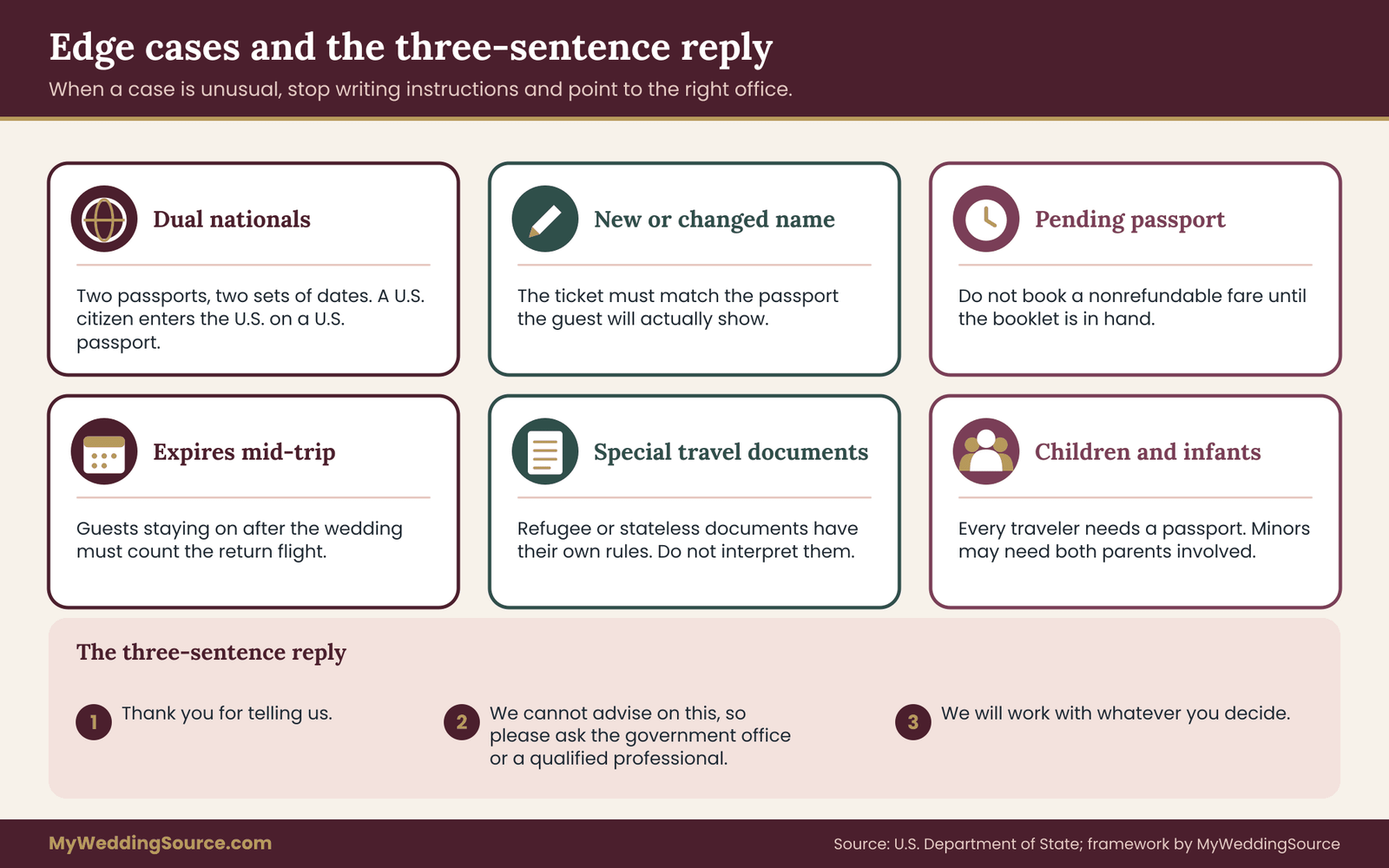
The method handles most guests. A handful of situations deserve their own attention, because the simple advice fails or because the stakes are high. In each case the couple’s job is the same: acknowledge, point to the source, and offer flexibility.
Dual nationals
Dual nationals have two sets of passport validity dates to track.
A person with two nationalities holds two passports, and the rule about which to use can differ by country. The State Department states that U.S. citizens, including dual citizens, are required to enter and leave the United States on a U.S. passport. A dual national traveling to your U.S. wedding from abroad may therefore need to carry a U.S. passport and not the other one. For a wedding abroad, the destination’s own rule applies.
Dual nationals are also the guests most likely to have one passport that is close to expiry and one that is not. Encourage them to check both, to use the one that suits each leg of the trip, and to make sure the ticket matches the passport they will actually present.
Recently renewed or changed names
Renewal fixes a passport validity problem but can create a new one, because any authorization linked to the old booklet may need to be redone.
A guest who renewed a passport recently may have a new number and a new expiry date, which affects any authorization tied to the old booklet. A guest who changed their name may have a passport in one name and bank cards in another. The airline ticket needs to match the passport. A short note on the card will cover it.
Passports that are pending, lost or stolen
A pending application leaves passport validity unknown until the booklet arrives.
If a guest has applied for a passport and is waiting, they should not book a nonrefundable flight until they hold it, unless they are comfortable with the risk. If a passport is lost or stolen, the guest should follow the issuing authority’s instructions for reporting and replacement, which usually include a police report in some countries and a replacement application in all. These are things only the guest and the authority can handle.
Expiry during the trip
This is a passport validity problem that hides until the return leg, so guests who stay on after the wedding should count their dates carefully.
A passport that expires while the guest is abroad creates a problem for the return. A guest who stays on for a longer vacation after the wedding should check that the passport will remain valid for the full duration, including the return flight and any buffer the destination requires.
Travel documents that are not passports
Some guests travel on a refugee travel document, a stateless person’s travel document, or another special document. The rules for these are different and often more demanding. If a guest mentions one, do not try to interpret it. Thank them, tell them you will support whatever plan works, and suggest they contact the relevant government office.
Guests with a recent trip history
Guests who have visited certain countries recently, or who have previous immigration problems such as a past overstay or refusal, may face additional questions. These are personal and sensitive. You should not ask about them, and you should not hint at them. If a guest raises a concern, point them to the appropriate official or professional and move on.
Medical and accessibility needs at the border
A guest who needs assistance, carries medication, or travels with a mobility aid may want to plan their arrival with the airline and the airport. That is not about passports, but it often comes up in the same conversation. The airline’s accessibility team can arrange help at the airport, and the guest can ask the airline about medication and equipment rules in advance.
A short rule for edge cases
No edge case about passport validity needs you to become an expert.
When an edge case appears, use three sentences. “Thank you for telling us. We cannot advise on this, so please check with the relevant government office or a qualified professional. We will work with whatever you decide.” That script is honest, kind and enough. ## What to put on the wedding website, the save-the-date and the invitation about passport validity
Once the card exists, the question becomes where to put it and what words to use. The answer is that the card lives in one place, the wedding website’s travel page, and everything else points to it. This keeps your wording consistent and gives you a single page to update when something changes.
The save-the-date: one sentence, no links
Even in one sentence, the word passport is enough to prompt a first look at passport validity, and that first look is the most valuable part.
A save-the-date has little space and should not carry travel instructions. A single sentence for international guests is enough: “Travel details, including a short document checklist, will follow on our website.” It tells guests that something is coming and it asks nothing yet. If you want to nudge early, add “If you plan to travel from abroad, it is a good time to look at your passport’s expiry date.”
Do not add the rule. The page will carry it. If you have a printed save-the-date, avoid printing links to government pages, which can change.
The invitation: point to the travel page
The invitation should mention passport validity only by pointing to the page where it is explained.
The formal invitation can carry a short line and the address of the wedding website. Most invitations already do this. A phrase such as “Travel and document information for guests from abroad is on our website” suffices. If you use a printed insert, keep it to a short list of what to check and leave the sources to the page.
For deeper guidance on tone and wording of invitation inserts, the wedding invitation etiquette guide covers how formal to be and what belongs on which piece.
The travel page: the card in full
On the page itself, repeat the phrase passport validity in the heading of the passport line so guests can find it at a glance.
The travel page should hold each card, labeled by situation. A guest should be able to find their own situation in a few seconds. Use headings such as “If you may not need a visa,” “If you need a visa,” “If you are a U.S. citizen traveling abroad” and “If you hold more than one nationality.” Under each, place the five fields.
Keep the page short. A wall of text defeats the purpose. Two or three sentences per source, with a link, is enough. Put the deadline at the top, because it is the part the guest is most likely to forget.
If your website already has a travel section for flights and lodging, a clear link between that section and the document card will help. The guide to coordinating guest hotels shows how to place lodging details for travelers so that guests can plan both together.
Sample wording for the top of the travel page
Here is a version you can adapt. It is deliberately plain.
“If you are traveling to our wedding from another country, please check your passport and entry requirements before you book. Passport validity and entry rules differ by country and by traveler, and the people who decide them are the governments and airlines involved, not us. Below you will find a short card for each situation, with links to the official sources. Please check by the date shown, and tell us early if anything looks difficult.”
That paragraph states the task, names who decides, gives guests a path, and invites candor. It does not promise anything.
Sample wording for a direct message to a worried guest
Guests sometimes write privately. A reply that works for most cases is short and kind.
“Thank you for asking. We are not able to say whether your passport will work, because that depends on your country, your trip and the rules of the airline and the country you enter. The best place to check is the official government page linked on our travel page. If it turns out that the timing is tight, tell us, and we will find a way to include you.”
The reply declines to give a rule, gives a next step, and keeps the relationship warm. It also leaves a written record that you did not make a promise.
Sample wording for the final reminder
The final reminder is about completeness, not research. Keep it practical and light.
“A few weeks to go. Before you leave, please make sure you have your passport, any visa or travel authorization you need, and a copy of your flight confirmation saved on your phone. Check that the name on your ticket matches your passport. Safe travels, and thank you for coming so far.”
It does not restate the rules and it does not ask for any document. It reminds guests of what to carry.
The guest message timeline that keeps passport validity checks on schedule
A message sent at the wrong moment does little. A message sent at the right moment does most of the work. The previous section gave sample wording. This section gives the order and the timing logic, organized around milestones rather than dates so that it works for a wedding in any season.
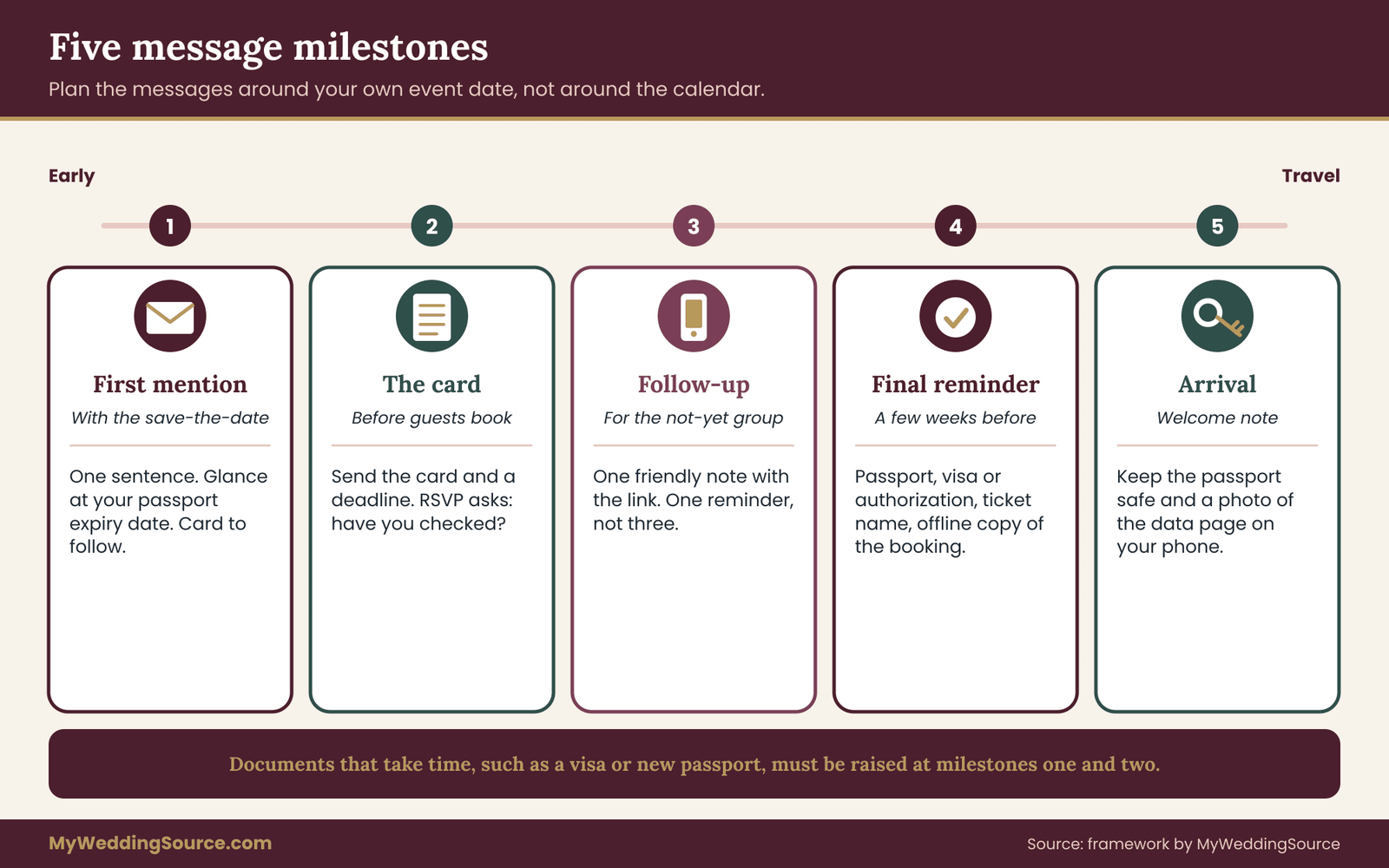
Milestone one: the first mention
The first mention should raise passport validity as a small thing to glance at, not a project.
The first mention comes with the save-the-date or the first travel update. It is soft and short. The goal is to plant the idea that documents matter and that more will follow. At this stage, guests are deciding whether to come at all, and a long list of requirements can scare people off. Keep it light.
Milestone two: the card goes out
The card should go out before guests start booking. If you have suggested a booking window, send the card just ahead of it. If you have not, send it with the formal invitation. The key is that the guest can read it while they still have every option open: renew, apply, change plans, or decline gracefully.
If you use an RSVP form, add a single question for international guests: “Have you checked that your passport validity and entry requirements work for your dates?” with the answers yes, not yet, and not sure. It collects no sensitive data and it tells you who needs a nudge.
Milestone three: the follow-up for the “not yet” group
The follow-up is not about scolding anyone for not checking passport validity. It is a friendly nudge from someone who wants them there.
Guests who answered “not yet” or “not sure” are the ones who benefit most from a second, individual note. A short, friendly message with the link to the card and the deadline is enough. Resist the urge to chase. One reminder is considerate, two is nagging, and three starts to feel like pressure.
Milestone four: the final reminder
The final reminder follows the sample wording above. It should arrive late enough that guests are in travel mode and early enough that a missing item can still be fixed. For documents that take time, such as a visa or a new passport, the final reminder is too late. That is why the earlier milestones exist.
Milestone five: the arrival
By arrival, passport validity is settled, and the only job left is keeping the booklet safe.
When guests arrive, the passport check is over, and your role shifts to welcome. A line on the welcome note such as “Please keep your passport somewhere safe during your stay, and keep a photo of the data page on your phone” is a gentle practical tip. It is not about rules. It is about the small chance of a lost document in a foreign city.
Keeping the tone calm across all five milestones
Calm wording about passport validity is a kindness in itself, since guests who feel judged tend to stop answering.
Every message should sound like a friend who has done some homework and wants you to be able to come. Never use alarming language such as “you will be turned away.” Never threaten. And never imply that a guest who cannot come is letting you down. The goal is a good wedding, not a perfect attendance list.
Tracking who has checked, without collecting documents
You can run this timeline from a simple private list. Use one column for guest name, one for the card they received, and one for their status: not asked, told, checked, or flagged. You do not need passport numbers, scans or expiry dates. In fact, you should not hold them. If a venue or vendor requires a name list, collect only the name as shown on the passport and store it with the same care you would give any guest data.
The twelve-month wedding checklist is a useful place to anchor the milestones, because each one fits naturally beside the invitation, RSVP and final-details steps you already have on your list.
What if a guest asks you to hold their documents or book on their behalf?
Some guests, often older relatives, ask the couple to handle the whole thing: apply, book, collect. Be careful. Handling another person’s passport, application or identity details is a responsibility you may not want. A better approach is to connect the guest with a relative or a trusted travel agent who can help them, and to stay in the supporting role. If you do help, keep it to reading the official page together and making sure the guest enters their own details. ## Failure conditions: when passport validity or entry rules stop a guest, and what to offer instead
Every method has a point at which it stops working. A source-check card helps a guest find the rule. It cannot change the rule, and it cannot make a late discovery early. This section names the situations in which a guest will not be able to attend, and the alternatives the couple can offer. Having these in mind in advance makes you calmer when the message arrives.
The five failure conditions
Most of these start with a passport validity problem that was noticed late, which is why the earlier milestones matter so much.
The passport cannot be renewed in time. The guest discovers the expiry problem too late, and the issuing authority’s timeline does not fit. Some authorities offer faster options for a fee, and some do not. The guest can ask. You cannot promise anything.
The visa cannot be obtained in time. Appointment waits and processing times vary by location and season, and they are published by the issuing government. A guest who starts late may find the timeline impossible.
The authorization is refused. An electronic travel authorization can be denied. The guest will see the result and any next step on the official site. The couple should not ask why. That is a private matter.
The airline refuses to board the guest. Documents that look fine to the guest can look wrong to the airline. A damaged passport, a name mismatch or a missing transit document are typical causes. The guest should ask the airline what fixes are available.
The border officer does not admit the guest. This is the rarest and the hardest. A traveler with the right documents can still be refused entry. If it happens, the guest will deal with the officials and the airline. The couple’s role is to be a kind, quiet support.
What the couple should do first
The first reply to a passport validity problem should be kind. The second can be practical.
When a guest tells you they cannot come because of a document problem, respond with warmth before you respond with logistics. A message such as “We are so sorry, and we are glad you told us. We will miss you. Let’s talk about how to include you” is more useful than any practical offer, because the guest is probably embarrassed and may have spent money.
Then ask a simple question: “Is there anything we can do from our side?” Often the answer is no, and sometimes it is small. A guest might want help with a hotel change, or might want to know whether the couple can share the date of a later celebration.
Alternatives to in-person attendance
A guest stopped by passport validity can still be part of the day in several ways.
A guest who cannot travel can still be part of the day. Four options are worth offering, in rough order of effort.
A livestream or recorded ceremony. A live feed lets the guest watch, and a recording lets them watch later in their own time zone. If you are considering this, the wedding day digital contingency plan covers backup connections and who owns the technology on the day.
A video message. The guest records a short greeting that is played during the reception or added to a keepsake. It lets them take part without a tight schedule.
A later gathering. Some couples plan a small celebration, a dinner or a visit, in the weeks after the wedding. It is not a replacement, but it is real contact.
A proxy gift and a personal note. For guests who simply cannot attend, a sincere note and an open door for a visit can mean as much as any grand gesture.
Offer one or two, not all four. Pick the ones that fit your budget and your relationship with the guest.

Money: who bears the cost
The cost of a passport validity problem falls on the guest, because the documents and tickets are theirs.
This is the question that makes people anxious, so it is worth being direct. Flights, visas, authorization fees and passport renewals are the guest’s own costs. The couple is not responsible for a guest’s travel decisions. The guest might hold travel insurance, but many policies do not cover refusal of entry or a missing document, and the terms differ by policy. The guest should read their own policy rather than assume.
If you have paid for something on the guest’s behalf, such as a hotel room under your block, check the cancellation rules of that booking before the problem arises. The guide to wedding guest hotels explains how blocks, deadlines and attrition work, which helps when a room has to be released.
Do not offer to pay for a guest’s flight changes unless you are able to do so without resentment. A generous gesture that you regret later is worse than a polite refusal.
The couple’s own documents
If you want a simple rule, give your own passport validity the same treatment you give your guests’, with the same card, the same dates and the same early check.
All of this applies to the couple, too. If one of you is a citizen of a different country from the other, or if you are traveling for the wedding or the honeymoon, the same source-check applies to you. Check passport validity early. Check name consistency before you change your name after the wedding, because a passport in one name and tickets in another can cause trouble on the honeymoon. Put your own check on your own timeline.
A final test before you publish
One last pass: search your page for the words passport validity and make sure each one sits next to a source and not next to a promise.
Read your travel page as a guest. Ask whether any sentence states a rule that you did not copy from an official source. Ask whether any sentence promises an outcome. Ask whether a guest with a complicated situation could find the sentence that tells them what to do. If the answers are no, no and yes, you are ready.
Your next steps
Start with the guest list. Mark every guest who will cross a border, and group them by situation: visa-free tourist travel, visa required, citizens of the destination, dual nationals, and your own guests traveling abroad. Two to five groups is typical.
Then write one card per group using the five fields: who it is for, the four sources, the deadline, who decides, and who to contact about the wedding. Test each card on one friend. Post the cards on your travel page, send the first mention with your save-the-date, and plan the follow-ups using the milestones above. If you want a place to hang the whole sequence, the wedding planning checklist is a good anchor.
Finally, set one calm rule for yourself. When a guest asks a question about passport validity or entry that you cannot answer from an official source, do not guess. Point to the source, say that you are glad they are checking, and offer to adjust. That rule alone will carry you through most of what comes up.
FAQ
How early should we tell guests to check their passport validity?
As early as the save-the-date or first travel update. The check itself takes minutes, but fixing a problem can take weeks or months depending on the issuing authority. Send a light first mention early, send the full source-check card before guests start booking, and follow up with a short reminder a few weeks before travel.
Is it true that a passport must be valid for six months?
Not as a universal rule. Some countries ask for validity beyond the stay, some do not, and the United States has its own approach with a list of exceptions published by the State Department. The right answer depends on the traveler’s passport, the country entered and the airline. Guests should read the official page for their own situation before booking.
Can we tell guests they do not need a visa?
No, avoid saying so. Visa requirements depend on the guest’s nationality, the purpose and length of the trip, and the current rules of the destination. Point guests to the official visa pages instead. A guest who may qualify for visa-free travel may still need an electronic travel authorization, and either way the border officer decides on admission.
Do we need to collect copies of guests’ passports?
Generally no, and you should avoid it. A passport copy is sensitive identity data, and holding it creates risk for you and for the guest. If a venue or vendor needs a name list, ask only for the name as printed on the passport. Use a simple status column on your private list instead of storing documents.
What if a guest’s passport expires soon after the wedding?
They should check the destination’s rule on validity beyond the stay, because it may matter even though the passport has not expired. Many guests in this position decide to renew before booking, which is often the cheaper choice. If an electronic travel authorization is involved, they should check whether it is tied to the passport and renew in the right order.
Does an approved visa or travel authorization guarantee entry?
No. A visa or authorization lets a traveler travel to the border and ask to be admitted. The border officer decides at the port of entry, as U.S. government sources explain. For that reason, avoid wording such as “you are all set.” A calmer line says that guests who hold the right documents can travel and ask to enter.
What should we say to a guest who cannot get their documents in time?
Respond warmly first, then ask if there is anything you can do. Offer one or two alternatives, such as a livestream, a video message or a small gathering later. Do not advise on the immigration problem itself, and do not promise to cover costs unless you truly can. The guest’s travel costs and decisions remain their own.
What if our wedding is abroad and our guests are mostly U.S. citizens?
Send them to the State Department’s country page for the destination, which lists entry and passport validity details for U.S. citizens, and to the destination government’s own pages. Ask them to check blank pages, validity beyond the stay and any transit country. Remind families that each traveler, including infants, needs their own passport.
Sources
- International travel, U.S. Department of State, Bureau of Consular Affairs
- U.S. visas, U.S. Department of State
- Passports, U.S. Department of State
- Official ESTA application website, U.S. Customs and Border Protection
- Visa Waiver Program, U.S. Department of Homeland Security
- Travel, U.S. Customs and Border Protection
- Foreign travel advice, GOV.UK
- Travel advice and advisories, Government of Canada
- Travel advice, Smartraveller, Australian Government
- Travel information, Transportation Security Administration