
Driving alternatives are the rides, routes and rules that let wedding guests who are new to U.S. roads get to every event without having to drive a rental car on a highway they have never seen. This guide gives you a one-page road readiness sheet for each guest group, so you can decide who drives, who rides and who stays close, kindly and in writing.
Do not ask whether a guest “can drive here.” Ask four smaller questions for each guest group: is the license legal for the rental and the state, how much road comfort does the person really have, how hard are the routes and the hour, and will alcohol or jet lag be involved. Any red answer on legality or on alcohol means no driving that day. Two amber answers mean the person rides with someone who knows the roads. Then offer driving alternatives by name, with times and a cost line, before anyone books a rental car.
Picture a family flying in from Lisbon, Osaka or Nairobi for a wedding in a mid-sized American city. They land in the afternoon, collect a rental car because a cousin said it was cheaper, and head for a venue forty minutes outside town. The car is an automatic with a push-button start, the signs are in miles per hour, the highway splits twice in the first mile, and the driver has been awake for nineteen hours. Nobody did anything wrong. Nobody planned for it either.
That gap is what this article covers. It does not repeat the broader work of inviting people from abroad, such as entry documents and time zones. It stays with one question: how do people move around once they are here? Where a rule differs by state, the guide tells you who to ask, because the agency that issues a rule is the only reliable source for the current version.
A note on scope. This is general planning information, not legal, insurance or travel-industry advice, and licensing, rental and traffic rules differ by state and change over time. Confirm anything that affects a guest’s legal ability to drive with the issuing agency or the rental company before you rely on it.
Most of the guidance on driving alternatives here is about decisions, not about teaching anyone to drive. You are not the driving instructor for your guests. You are the host who noticed that one part of the weekend, the part between the hotel, the ceremony, the reception and the airport, is easy for locals and surprising for visitors, and who decided to make it less surprising.
Why driving alternatives matter for guests new to U.S. roads
American wedding weekends quietly assume that everybody can drive themselves. Venues sit on the edge of town because land is cheaper. Parking is free and plentiful, so the invitation never mentions how to arrive. The hotel is fifteen minutes away, which locals treat as nothing. For a guest raised in a city with a dense rail network, or in a country where public transport is the normal way to get around, those assumptions can be wrong in ways that are hard to see from the inside.
Offering driving alternatives is not an admission that your guests are incompetent. Many international guests are excellent drivers, and they will still welcome driving alternatives. The point of driving alternatives is that skill at home does not transfer automatically to a new set of conventions, a different vehicle, an unfamiliar map and a night-time drive after a long celebration.
Even experienced local drivers appreciate a ride home after a reception. A guest who is both new to the roads and tired deserves the same courtesy, with a little more thought attached.
What goes wrong when driving alternatives are missing
The failures are usually small, and they stack. A guest misses the ceremony because the navigation app sent them to a service entrance. Another arrives with a rental car that the contract only allows a different named driver to operate. A third decides to drive back to the hotel after the reception because there was never a clear ride option, and the host spends the next morning worried.
A fourth is stopped for a traffic violation that does not exist at home and spends part of the wedding day on a phone call about it.
None of these stories needs a villain. They need an organizer who thought about movement for the people least likely to complain about it. The cost of avoiding them, with sensible driving alternatives, is a few phone calls, a short written sheet and a modest transport budget. The cost of ignoring them is a risk that falls on guests, and sometimes on strangers.
What this guide will and will not do
This guide builds one practical tool, the road readiness sheet, and walks through how to fill it in, how to turn the result into a concrete offer of driving alternatives, and what to do when the offer fails. It names the main legal and practical questions about licenses, permits and rental cars, but it does not replace the rules of your state.
It explains what tends to differ on U.S. roads compared with many other countries, in plain terms, so you can write a short orientation for guests who want to drive.
It does not rank vendors, quote prices or promise that a particular service will exist in your city. Driving alternatives vary enormously between a large metro area and a small town with one taxi company. The sheet works in both places because it starts from the guest and ends with a named ride, not from a vendor list.
If you are still deciding where guests will stay, the guide to coordinating wedding guest hotels across budgets and mobility needs helps with that first. Your choice of hotel often decides how many driving alternatives you need, since a hotel within walking distance of the ceremony removes most of the problem. Read that first if lodging is still open.
Who needs driving alternatives, and who builds them
You may be the couple, a parent, a maid of honor who inherited the logistics, or a planner who has been handed a guest list with thirty relatives from three countries. The advice is the same. Someone has to own the question “how does this person get from here to there?” for guests who cannot answer it alone. That person fills in the sheet.
The approach also helps couples whose guests are not international at all. A guest who has never driven in snow, who uses a mobility aid, who has lost a license or who simply does not drive can use the same ladder of driving alternatives. International guests are simply the clearest case, because every convention on the road is new at once.
The road readiness sheet: a one-page framework for driving alternatives
The framework has four checks and five outcomes. You complete it once per guest group, not once per person: a couple, a family traveling together or a trio of friends sharing a rental is one group. The sheet fits on a single page so a helper can use it without you.
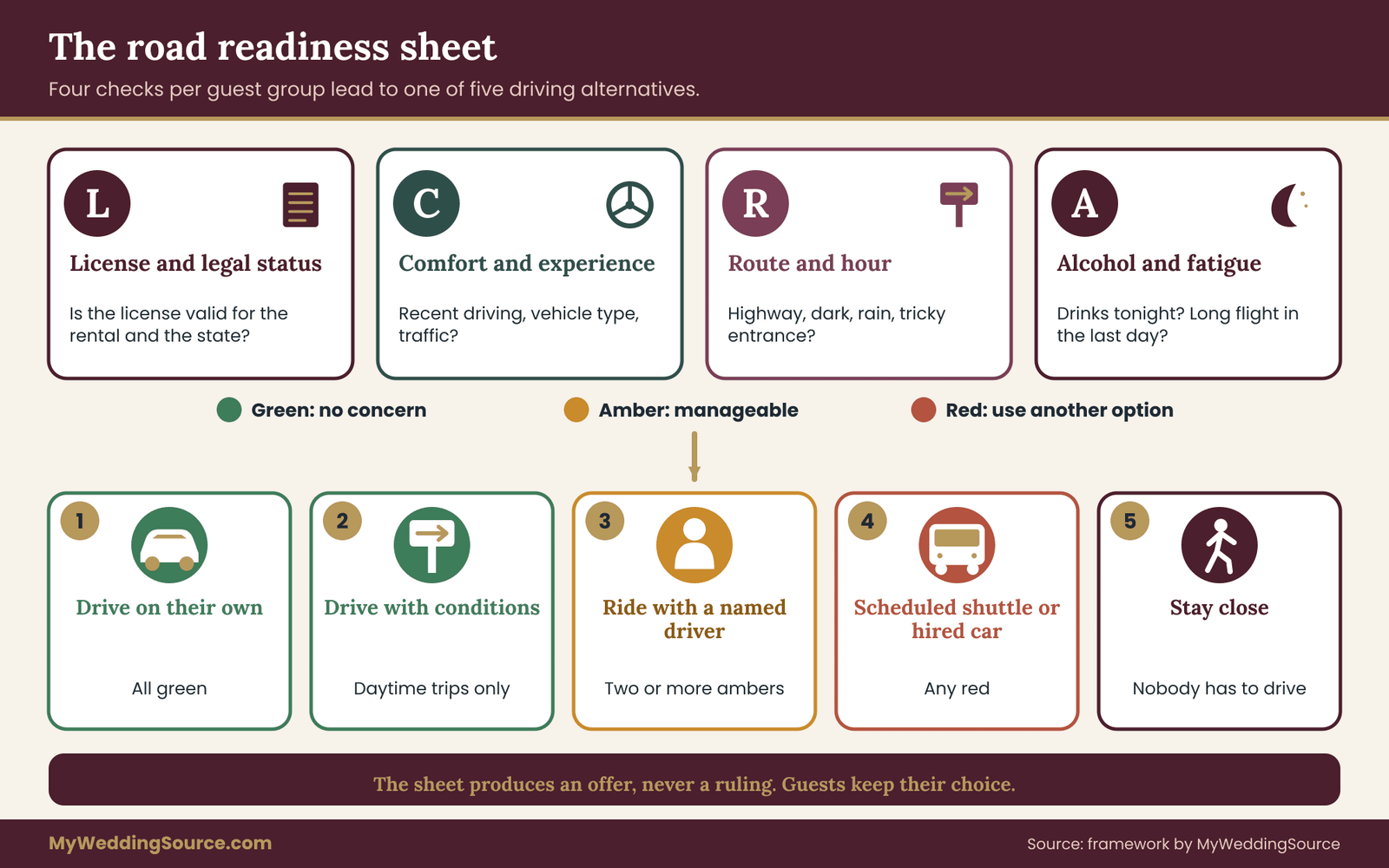
The four checks are letters you can remember: L for license and legal status, C for comfort and experience, R for route and hour, and A for alcohol and fatigue. Each check gets a color: green means no concern, amber means a real but manageable concern, and red means stop and use a different option.
The four checks in one paragraph each
L, license and legal status. Can this person legally drive the vehicle they would use, in the state where they would use it? This covers the license they hold, whether it is in English or in another script, whether a translation or permit is needed, the age rules of the rental company and the insurance the rental carries. It is the only check where the answer comes from an outside party, so a guess is never green.
C, comfort and experience. How much has this person driven recently, in what kind of traffic and in what kind of vehicle? A guest who drives daily at home on the left, in a manual car, in a small town, has a different profile from a guest who commutes on a six-lane expressway in an automatic. Ask them. Most people answer honestly if the question is framed as help, not as a test.
R, route and hour. How complex is the trip you are asking them to make, and at what time of day? A simple daytime drive on a quiet road is green. A first-time drive on a major highway interchange, in the dark, in rain, to a venue with a confusing entrance is amber or red.
A, alcohol and fatigue. Will the person be drinking? Have they flown across many time zones in the past day or two? Either one alone moves this check to amber for any evening drive. Both together make it red.
The five outcomes and your driving alternatives
The checks lead to five outcomes, which are your driving alternatives and the one non-alternative of driving alone, which is why we count only four of them as driving alternatives. They are ordered from the most independence to the least.
- Drive on their own. All four checks are green, or at most one is amber for a short daytime route. The guest rents a car or borrows one, and you send a short orientation note.
- Drive with conditions. One or two ambers, no red. The guest drives, but only for stated trips, such as the daytime trip to the venue, and rides home after dark.
- Ride with a named driver. Two or more ambers, or any amber on the alcohol check in the evening. A friend, relative or local volunteer drives them. The person has a name and a phone number written on the sheet.
- Scheduled shuttle or hired car. Any red, or a group too large for a carpool. A vehicle you or the venue arrange carries them on a printed schedule.
- Stay close. The guest’s lodging, meals and events are within walking distance, or they skip an optional event. Nobody has to drive.
The rest of the guide fills in each of these driving alternatives. A key rule holds throughout the use of driving alternatives: the sheet produces an offer, never a ruling. Guests may still choose to drive. What you control is the quality of the information they have and the ease of the alternative.
Reading each guest group: what unfamiliar really means
“Unfamiliar with U.S. roads” is a loose phrase. Before you can offer useful driving alternatives, you need to know which kind of unfamiliar you are dealing with. Four different guests can all fit the label and need four different answers.
The first guest drives every day at home, holds a valid license, and has visited the United States twice. The second has a license but drives rarely because a city rail network covers their life. The third has never driven on the right side of the road and learned on a manual car.
The fourth does not drive at all and is perfectly content to be driven. Treating all four the same when you offer driving alternatives, either by assuming everyone will manage or by assuming nobody can, wastes goodwill and money.

Questions that get honest answers about driving alternatives
Ask in a way that makes “I would rather not drive” an easy answer. A direct question about skill can feel like a judgment. A question about preference feels like service. Try wording like this in a travel message or a short call:
“We are arranging rides around the weekend. Would you like to rent a car, or would you rather we line up a ride for you? Either is fine. If you plan to drive, could you tell us what kind of license you hold?”
Notice what the wording does. It offers a ride before it asks about driving. It names the license question as a logistics detail. And it makes both answers acceptable. People who plan to drive will say so, and people who dread it will take the exit gladly.
Then fill in the four checks from what you learn. A few follow-up questions are enough for most groups: how recently they have driven abroad, whether they are comfortable in an automatic car, whether they plan to drive in the evening, and who else in the group has a license. Keep the questions short, and ask them once, in one message, so guests do not feel interrogated.
Reading the C check without guessing
The comfort check is where hosts most often guess wrong. It is tempting to assume that a guest from a country that drives on the right is fully prepared, or that a guest from a country that drives on the left is not. Neither assumption is safe. Road layout is only one of many conventions.
Consider what actually changes between countries. Distances are measured in miles. Speed limits appear as plain numbers on a sign, with no unit, and the number may be higher than the guest expects. Highways may have many lanes, and the exits may be on the left as well as the right. Many American cars are large automatics with no clutch, and some have features such as push-button start, which surprise people who have never used them.
Fuel is bought at a pump where the customer pays first or swipes a card. Parking lots are large. Signs rely on route numbers and compass directions, not on town names alone.
A guest can be a careful, skilled driver and still be thrown by three of those at once on the first day. That is why the C check asks about recent experience in similar conditions and not only about general skill. Someone who has driven an automatic on multi-lane roads in another country is green. Someone who has not may be amber for a first drive and green after a day of practice in an empty parking lot.
If you want to help without hovering, offer a short practice window. A quiet drive of twenty minutes around the hotel on the afternoon of arrival, ideally with a local friend in the passenger seat, resolves most amber C checks. Driving alternatives, not practice, resolve a red L or a red A check.
Families, children and older relatives
Groups with children or older relatives bring more variables. Child restraint laws are set by each state, and they differ in age, weight and height rules. A family that rents a car must also arrange appropriate child seats, either through the rental company or by bringing their own, and must install them correctly. The National Highway Traffic Safety Administration publishes general guidance on child passenger safety, and each state’s motor vehicle agency or highway safety office publishes the legal requirements.
For older relatives, think about the whole journey and not only the driving. Getting in and out of a high-set vehicle, walking from a distant parking space to a ceremony lawn, and waiting for a ride after a long evening all matter. The site’s guide to wedding guest care for babies, children and older relatives covers the care side in depth.
For this guide, the practical point is that a group with an infant seat, a walking aid and two tired grandparents is almost always better served by a scheduled shuttle, one of the sturdier driving alternatives, than by a rental car and a map.
Filling in the sheet before you commit to driving alternatives
At this stage you should have one row of information per guest group. A sensible way to keep it is a single shared document with a block for each group. Each block has the group’s name, the number of adults and children, the license answer, the comfort answer, the planned events, the hotel, and a space for the outcome.
Do not ask for more than you need. You do not need a copy of anyone’s license at this stage, and you should not collect one unless a rental company or insurer specifically requires it from the person renting. Share the sheet only with the people helping with rides. Guests’ answers about comfort and preference are personal, and they should be handled with the same discretion as dietary information.
Licenses, permits and rental cars: what to verify first
The L check for driving alternatives is the one place where a guess is never acceptable. It is also the one place where the answer depends on rules set by someone other than you. This section lists the questions to ask, not the answers, because the answers vary by state, by rental company and by the country that issued the license.
The license question
In the United States, driver licensing is handled by each state, not by the federal government. That means the rules for visitors from other countries are set state by state. Many states allow a visitor with a valid license from their home country to drive for a period of time, and some state agencies recommend or require an International Driving Permit or a certified translation when the license is not in English. The details, including how long a visitor may drive and which documents they must carry, differ.
An International Driving Permit is, in general, a translation of a home-country license that is issued by an authorized body in the country that issued the license. It is not a license on its own, and it generally has to be obtained before the trip, in the guest’s own country. A guest cannot usually get one after landing in the United States.
For that reason, the license question must be asked weeks ahead, not the week of the wedding. The U.S. Department of State publishes general information about driving abroad and about international driving permits on its travel site, and the state motor vehicle agency where the wedding takes place is the authority on what it accepts from visitors.
Your practical steps are short. Ask each guest who plans to drive what license they hold and which country issued it. Tell them to check the motor vehicle agency’s page for visitors in the state where they will drive, and to ask the rental company directly. Do not give legal advice yourself. Offer a link or the name of the agency and let the guest confirm.
The rental car question and driving alternatives
Rental companies set their own requirements, and they can be stricter than the state’s. Common areas to check include the minimum age of the renter, extra fees for younger drivers, which licenses and documents the company accepts, whether a second driver must be listed, and what the insurance covers and excludes. Terms can also differ for renters whose license was issued abroad.
Two details cause more trouble than any others. The first is the named-driver rule: most rental agreements permit only the people listed on the contract to drive. If a guest rents a car and then hands the keys to a spouse who is not listed, a coverage problem can follow. The second is payment: many companies require a credit card in the renter’s name and place a hold on it, and a debit card may be treated differently.
Guests who arrive expecting to pay a different way can be turned away at the counter, late at night, with a family waiting.
Because these terms change, the right instruction to guests is the same each time. Read the company’s current terms for international renters before booking, book in advance, list every intended driver, and ask what the insurance covers. If a guest cannot satisfy the terms, that is a red L check and the answer is one of the driving alternatives, not a workaround.
What you should not do when offering driving alternatives
Do not tell a guest that their license “is fine.” You are not the issuer, and you may be wrong. Do not pressure a guest to rent a car because it is convenient for the group. Do not rent a car in your own name for a guest who will be driving it, unless you have read the contract and understand that you carry the responsibility for it. And do not treat a guest’s refusal to drive as a problem to be solved. It is usually a good decision.
Writing the L check on the sheet
For each group, write one of three entries. “Verified” means the guest has told you, and you have confirmed, that the license, any needed permit and the rental terms fit the trip. This should be rare, since you are relying on their report. “Self-reported” means the guest says they have checked and hold what they need. “Unknown” means you have not heard.
Treat only “verified” or a strong “self-reported” as green. Treat “unknown” as red until you hear otherwise, because the cost of unneeded driving alternatives is small and the cost of an illegal or uninsured drive is not. If a self-reported answer is vague, such as “I think it is fine,” ask them to check the agency page and tell you what it says.
A final point on this check. The wedding itself does not change any rule. The state does not care that the trip is for a celebration, and the rental company does not offer wedding exceptions. The rule applies because the person is driving, not because of why. Keep the tone of the conversation friendly and practical, and keep the decision tied to the rule.

What actually differs on U.S. roads
If a guest chooses to drive, a short orientation note is far more useful than a long one. The goal is not to teach the whole traffic code. It is to name the handful of conventions that cause the most surprise, so the driver is not meeting them for the first time at highway speed. This section lists those conventions in plain terms and flags where the rule depends on the state. Treat it as raw material for your note, not as a legal reference.
Not every guest needs this, and good driving alternatives mean fewer guests do. A guest on a shuttle or in a named driver’s car needs none of it, which is one more reason driving alternatives lower the burden on everyone. A guest in the “drive on their own” outcome benefits most.
The basics that rarely change
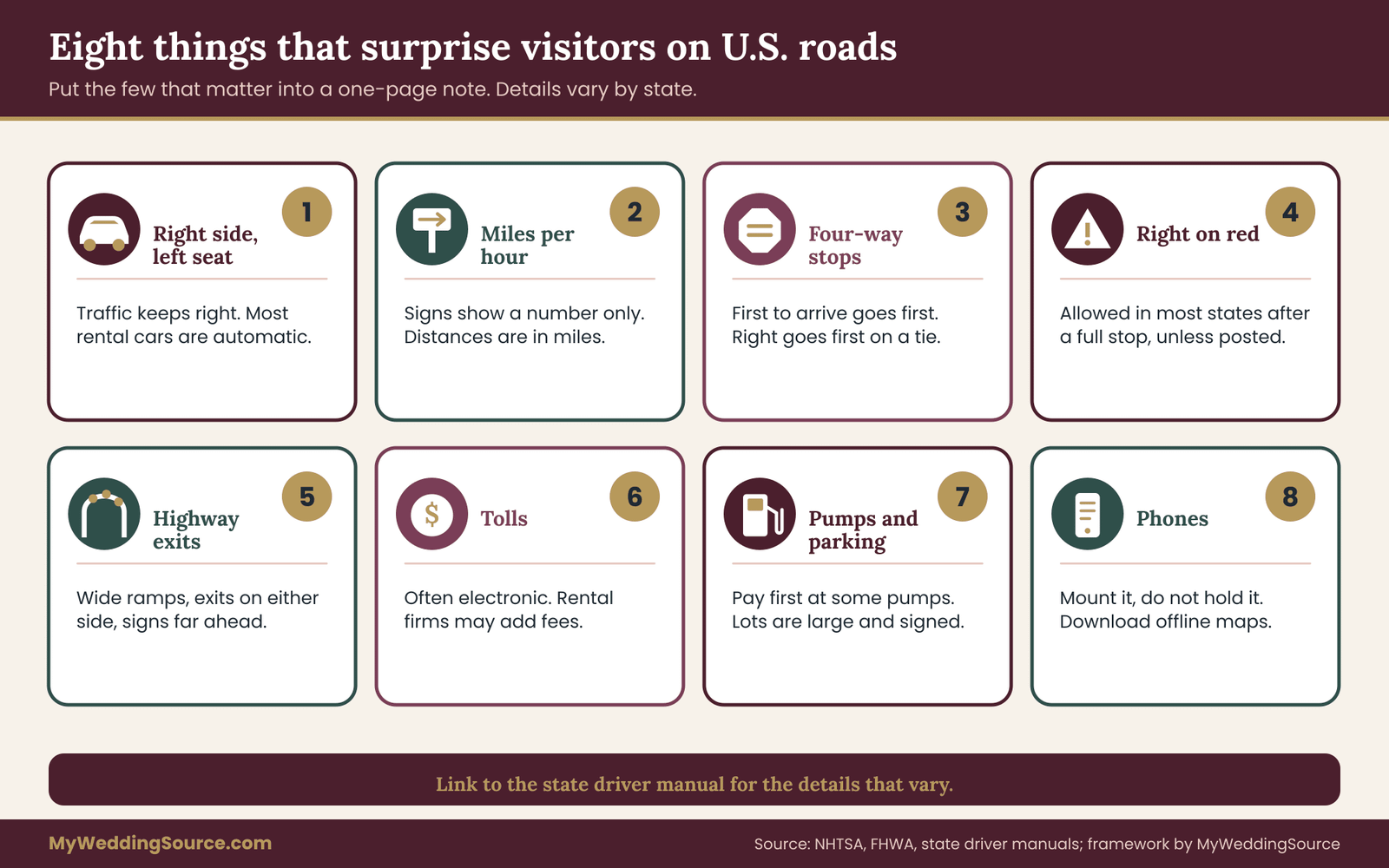
Traffic keeps to the right in the United States, and drivers sit on the left side of the car. Speed limits are posted in miles per hour, and the sign shows only a number. Distances on road signs are in miles. Fuel is sold by the gallon, and a U.S. gallon is not the same size as a gallon in some other countries, which matters only if a guest is comparing prices. Most rental cars have an automatic transmission, and manual cars are uncommon.
Seat belt laws exist in nearly every state, and enforcement and the people covered, such as rear-seat passengers, vary. The safest instruction for any guest is simple: everyone in the car wears a belt, every time, and children ride in an appropriate restraint. The National Highway Traffic Safety Administration publishes general safety information on belts and child restraints.
Intersections and turns
Four-way stops are common in residential and low-traffic areas. Every approach has a stop sign, and the usual courtesy is that the vehicle that arrived first goes first, with the vehicle on the right going first when two arrive together. This is a social convention backed by rules, and it surprises drivers who are used to roundabouts or to priority roads.
Turning right at a red light is permitted in most states after a complete stop, unless a sign prohibits it, and some cities restrict it. A left turn on a red light is allowed in a few places only from one one-way street onto another. A visitor who has never seen the rule may sit patiently at a red light with a line of cars behind them, or may turn when a sign forbids it. Either one is a small stress that a one-line note can remove.
Traffic signals hang over the intersection or on the far side of it, not always on a pole beside the stopped car. A guest used to a stop line with a signal close by should be told to look up and ahead. Pedestrians in a marked crosswalk generally have the right of way, and drivers are expected to stop for them. Rules differ in detail from state to state.
Highways and interchanges
Highways in the United States are often wide, with several lanes in each direction, and they connect through large interchanges with ramps that curve across each other. Exits may be on either side of the road, so a driver should not assume the exit lane is always the right one. Exit numbers may follow the mile marker for that highway, and signs are placed well ahead of the turn, which means a missed exit often requires driving several miles to the next one.
Merging is the moment that worries newcomers most. Entering vehicles are expected to match the speed of traffic on the ramp and merge into a gap. Drivers already on the highway usually move over if they can, but they are not required to in every case. A driver who merges too slowly is a hazard, so a guest who is amber on comfort should not make a first highway drive at rush hour.
Many highways have lanes reserved for carpools or for vehicles with a toll transponder, and the rules for who may use them and when are posted on signs near the lane. A guest who enters a restricted lane by mistake can receive a fine. A guest should be told that if a lane has a diamond marking or a sign they do not understand, they should stay out of it and ask a local.
Tolls, fuel and parking
Many regions use toll roads. Some have cash booths, some accept only electronic payment, and some read the license plate and bill the registered owner. For a rental car, the bill generally goes to the rental company, which may add a service fee. This is why rental terms about tolls matter: a guest who drives through several electronic toll points can return home to a surprising bill weeks later. Ask the rental company how it handles tolls, and consider choosing routes that avoid them.
Fuel is usually bought at a self-service pump. Some pumps ask for a card payment before fueling and some ask for a zip code when a foreign card is used, which can be an obstacle for visitors with non-U.S. cards. The workaround is to pay inside, or to choose a station that accepts the card at the counter. A guest who learns this on a dark road on the way to the venue will be less than amused.
Parking is usually plentiful at venues, but it may be on gravel, grass or a shuttle lot. Signs may restrict parking by time of day or by permit, and fines for violations in cities can be large. If the venue has a specific parking plan, include it in your note, with a map link and the entrance the guest should use. Mention the right entrance in your written directions, so nobody has to guess from a map pin.
Signs, lights and special rules
A few other rules are worth a mention in a note. School buses stop on the road to load children, with flashing lights and an extended stop arm, and drivers in both directions on most roads must stop. A flashing yellow light means proceed with caution, not stop. Emergency vehicles with lights and sirens require drivers to pull to the side. When a police car signals a stop, the driver should pull over safely and stay in the vehicle with their hands visible and follow the officer’s instructions.
That last item deserves a calm, honest sentence in your note, because visitors from some countries have different expectations of what happens in a traffic stop. A short line that says “if you are ever stopped, pull over safely, stay in the car and keep your hands where the officer can see them” is respectful and useful.
Navigation apps and phones
Almost every guest will navigate with a phone. Two practical points help. First, the voice may announce distances in miles and street names that sound unfamiliar, so a guest may prefer to look at the screen. A phone should be mounted, not held, because many states prohibit holding a phone while driving, and rules differ. Second, a data plan that works abroad cannot be taken for granted. A guest who relies on roaming should confirm coverage before arrival, or download offline maps of the area.
Offer your own written directions as a backup, including the last mile, the entrance name and the parking instructions. Navigation apps sometimes send guests to the front gate when the real entrance is on a side road. Your note should say which one is right.
A one-page orientation note for guests who skip the driving alternatives
For guests in the “drive on their own” or “drive with conditions” outcomes, write the note in plain language and keep it under one page. A good structure covers five things: the vehicle (automatic, belts), the road (right side, miles per hour, signs), the turns (right on red, four-way stops), the highway (exits, merging, lanes) and the extras (tolls, fuel, parking, phones). End with the exact driving route you suggest and the one you want them to avoid, and a person to call if they are lost.
When you write the note for those who skip driving alternatives, do not copy long passages from a driver handbook. Link to the state’s official driver manual and tell the guest to skim the sections on right of way and highways. State driver manuals are free, written for new drivers, and available from the state motor vehicle agency. They are the authoritative source for the details that vary.
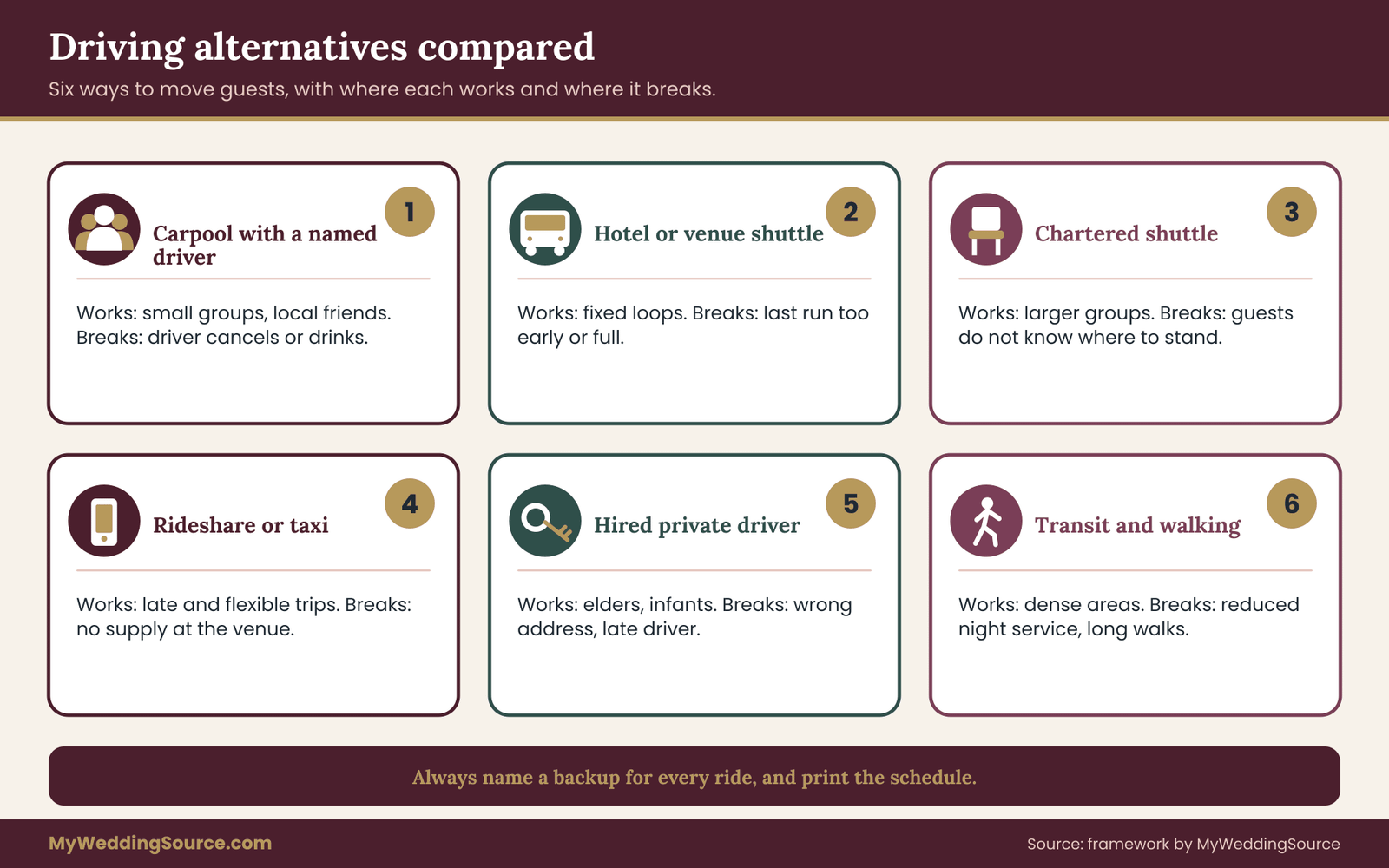
When the sheet says a guest group should not drive, or should not drive all the time, you need driving alternatives that are real, scheduled and easy to find. This section compares the main driving alternatives in terms of when each works, what it needs from you and where each tends to fail. It does not quote prices. Costs depend on your city, your date and the vendor, so use the questions below to get written quotes instead.
Carpool with a named driver, the cheapest of the driving alternatives
A carpool uses the cars and goodwill you already have. A local friend, a cousin who lives nearby or a wedding party member drives guests between the hotel and the venue. It costs little and feels personal. It also depends entirely on the driver’s availability and sobriety, which is the weak point. A driver who plans to celebrate cannot also be the ride home.
Make the arrangement concrete. Write down each driver’s name, vehicle, seat count, phone number and the legs they agreed to drive. Confirm that the driver holds a valid license and that the vehicle is insured for passengers, which is usually true but worth a quiet check. Never assign a ride to someone who has not agreed. And choose a backup for every driver, because the person who offered in March may have a sick child in June.
Hotel or venue shuttle as a driving alternative
Some hotels run a courtesy shuttle to nearby points, and some venues have a shuttle service for guests. Ask what the shuttle covers, which hours it runs, how many people it seats and whether it can accommodate the group’s luggage, wheelchairs or strollers. Courtesy shuttles often run on fixed schedules and may not run late at night, so confirm the last departure from the venue in writing.
Include the shuttle schedule in your guest information, with times at each stop. A shuttle that exists but is not announced does nothing. A guest who has to ask the front desk at midnight whether there is a shuttle will probably call a taxi instead, if one is available.
Chartered shuttle or minibus: the most predictable driving alternatives
For larger groups, a chartered vehicle with a professional driver is the most predictable option. It can run a loop between the hotel and the venue, on a schedule that fits the ceremony and the end of the reception. You will need to decide the number of vehicles and trips, which depends on the headcount, and to ask the company about insurance, driver licensing, vehicle accessibility and cancellation terms.
The Federal Motor Carrier Safety Administration oversees commercial passenger carriers in interstate service, and a reputable company can answer questions about its operating authority and safety record.
Ask the company to put the pickup times, the pickup spot, the wait policy and the extra-hours rate in the quote. Ask what happens if a guest is late, and who the driver calls. The most common problem with a chartered loop is not the vehicle. It is that guests did not know where to stand.
Rideshare and taxis as on-demand driving alternatives
Rideshare apps and taxis give individual guests flexible, on-demand rides. They suit small groups, late departures and guests who change plans. They also have limits: availability varies by city and hour, prices can rise at busy times, a guest needs a working phone, an account and a payment method, and a rural venue may have few drivers nearby. A guest who has not used the app may also struggle to find the correct pickup point.
If you rely on rideshare, treat it as a fallback with a named backup, not as the entire plan. Tell guests exactly where to be picked up. Consider setting up a ride credit or a prepaid arrangement through a business account, and tell guests what is covered. For taxis, give the phone number of a local company and the venue’s address, and consider calling ahead to ask whether they can serve the venue at the hour you need.
Hired driver or private car for guests who need driving alternatives with extra care
A private driver is the right alternative for a guest group that needs a calm, door-to-door ride, such as grandparents or a family with an infant, or for a small group of important guests. It costs more per person than a shuttle, but it puts a professional in charge. Ask for the driver’s name and phone number in advance and arrange meeting points in writing.
Public transit and walking as driving alternatives
In some cities, public transit is a real answer. A venue near a rail or bus line, a hotel across the street and a ceremony within walking distance can reduce the need for any vehicle. Check the transit agency’s schedule for the time of day you need, especially late evening, when service may be reduced.
Check that the route is safe and well lit on foot, accessible for guests with mobility needs and not blocked by construction. The Federal Transit Administration describes local transit agencies and their service requirements, and each local agency publishes its own schedule.
If walking is part of the plan, state the distance in blocks or minutes, the surface, the grade and the lighting. A fifteen-minute walk in dress shoes at night is not the same as a fifteen-minute walk in the afternoon.
Matching outcomes to driving alternatives
The mapping from sheet to driving alternatives is simple. “Drive on their own” needs only your orientation note and a map. “Drive with conditions” needs a stated list of the trips they can drive and a ride for the others. “Ride with a named driver” needs a carpool or hired car. “Scheduled shuttle or hired car” needs a vehicle with a printed schedule. “Stay close” needs a lodging choice that makes the other options unnecessary.
Costs, who pays and what to ask vendors
Money decisions shape which driving alternatives you can offer, and they are easier when made early and stated plainly. There is no single right model. Couples tend to use one of three. In the first, the couple pays for all event rides, so guests never think about cost. In the second, the couple pays for the shuttle loop and guests handle their own airport and sightseeing rides. In the third, guests share the cost of a chartered vehicle, with a clear price and a clear sign-up date.
Whatever you choose, tell guests before they book travel. A line in the travel information such as “a shuttle runs between the hotel and the venue on the wedding day, at no cost to you” removes a worry and prevents duplicate rental cars. If guests are expected to pay, say how much per person or per vehicle and when it is due, and keep records of what was collected and spent, in the same way you would for any other vendor payment.
When you request quotes, ask every company the same questions so that the answers can be compared. The list below covers the points that matter most for guests who are new to the area.
- What exactly is the service: hours, stops, vehicle size, and how many people fit with luggage?
- What is the total price, including taxes, fuel, driver gratuity, extra hours and any minimum?
- What are the terms if a guest is late, a trip runs long or the schedule changes?
- Who is the driver contact on the day, and will that phone be answered at the hours needed?
- Can the vehicle accommodate wheelchairs, strollers and child seats, and what notice is needed?
- What insurance does the company carry, and can it provide proof on request?
- What is the cancellation and refund policy, in writing?
Keep the answers in one document. If two quotes cover different services, you cannot compare them, so go back and ask again. A vendor that cannot give clear written answers to these questions is a risk factor, and you should weigh it. The site’s guide to wedding vendor contracts explains the clauses worth reading before you sign any agreement for transport.
Driving alternatives on a small budget
A tight budget does not mean the guests must drive unprepared. Cheaper driving alternatives exist, and several cost nothing. You can ask the hotel about its shuttle, recruit two or three local drivers and give each a printed card, choose a venue and hotel close enough to walk, hold the rehearsal dinner at the hotel, and set a clear end time for the reception so the last rides are predictable. A short, well-timed shuttle loop for the evening, which is the highest-risk period, often matters more than rides all day.
Set the money for driving alternatives aside in the wedding budget as its own line. The site’s guide to planning a wedding budget shows how to size and track lines like this one. A transport line that is forgotten until the last month is usually the first one cut and the last one anyone notices.
Evening, alcohol and jet lag: the hardest drive of the weekend
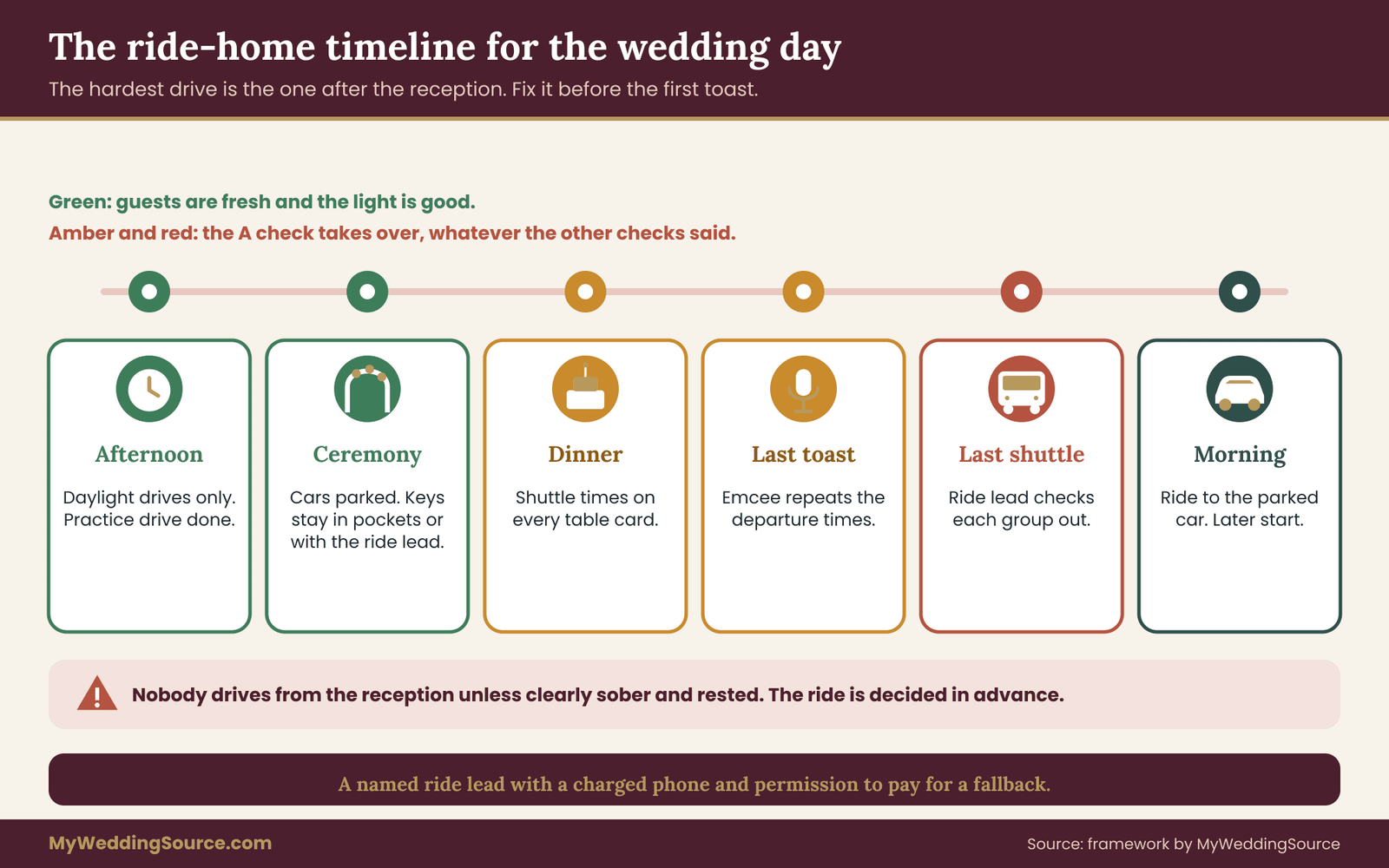
Every set of driving alternatives is tested at the same moment: the end of the reception. The ceremony is in daylight and the guests are fresh. The reception ends in the dark, after a long day, with food, music and, often, alcohol. For international guests, the body clock may say it is breakfast time or the middle of the night. This is the hour at which a ride matters most, and it is the hour at which the sheet’s A check, alcohol and fatigue, does its work.
Why the A check overrides everything else
The A check is different from the other three because it can change within a single day. A guest who is green on license, comfort and route at three in the afternoon can be red on alcohol by ten at night. A guest who flew in the previous day can be amber on fatigue even without a drink. For this reason the sheet treats A as a rule about the evening, not about the person.
The rule is short: no one drives from the reception unless they are clearly sober and clearly rested, and the plan for getting home is made before the first toast. That means the host does not decide at midnight, in a crowded parking lot, who seems fine to drive. The decision was made earlier, in writing, and every guest knows what the ride home is.
Drunk driving laws apply in every state, and the legal limits and penalties vary. The legal limit for most adult drivers is the same in most states, a few states set a lower one, and penalties can include arrest, license suspension, fines and, for visitors, serious consequences with immigration and travel. For exact rules, rely on the state’s motor vehicle and highway safety agencies and the National Highway Traffic Safety Administration, which publishes impaired driving information.
Do not try to summarize the law for your guests. Tell them to treat alcohol and driving as a decision that has already been made: they ride.
Jet lag is a form of impairment
Fatigue after a long flight is a real hazard behind the wheel, and it is easy to underrate because it feels like ordinary tiredness. A guest who has crossed many time zones may be at their lowest alertness at times that look sensible on the clock, such as mid-afternoon or late evening. The principle is simple: the first drive after a long flight, especially a night drive, is one to avoid.
Practical rules help. A guest who landed within the past day should not make a first drive on a highway if it can be avoided. A guest who has been awake for a very long stretch should not drive at all. The better answer is to ride with someone who is rested, to take a shuttle from the airport or to rent the car the next morning after sleep. These driving alternatives cost little and prevent the worst outcomes.
Building the end-of-night ride from your driving alternatives
Plan the last hour of the reception around the driving alternatives you chose. The simplest structure has three parts. First, a published schedule of the final shuttle departures, with the last departure a bit after the reception ends, so no one feels rushed or stranded. Second, a visible, named ride lead at the venue, with a phone, who knows the schedule and who has authority to call a fallback ride. Third, a stated rule that no one drives until the ride lead has checked in with the group.
Announce the driving alternatives, starting with the shuttle, in the program, in a short line at the end of the evening, and on a printed card at each table or on the guest-information sheet. People remember the ride if they have seen it three times. Ask the DJ or emcee to mention the departure times near the end of the night, in a plain sentence.
The site’s guide to wedding reception guest flow covers entry, seating, food and exit as a whole. The only part that matters here is the exit: the last half hour should end with guests in vehicles, not in a parking lot looking for one.
What to do when a guest turns down the driving alternatives
Sometimes a guest says they are fine and wants to drive. Respond by restating the driving alternatives in a calm, low-drama way. Offer a ride to the hotel and a ride back for the car in the morning. Ask a friend to sit with them for a while. If the guest has been drinking and is determined to leave, the hosts and the ride lead should not hand over keys they are holding, should not argue in front of other guests, and should arrange another safe ride quietly.
If someone appears impaired and is about to drive, calling for help is acceptable. This is a rare situation, and the preparation described above exists to prevent it.
Decide in advance who will have this conversation. It should not be the bride or groom, who should be celebrating. A trusted relative or a member of the wedding party, who has been briefed, is a better choice.
The morning after
Two things catch guests out the next day, even with good driving alternatives in place. Cars left at the venue or the restaurant overnight may be subject to parking rules or towing, so tell guests in advance whether it is permitted and where to collect them. And a guest who drinks late may still be over the legal limit in the morning. Offer a ride to the car, or a later start for the farewell brunch, and say so in your plan.
A worked case: three guest groups, three sheets
The following example is invented, and it is here to show the reasoning, not to report a real event. It tests the driving alternatives on a fictional couple, Mara and Tobias, who are marrying on a Saturday at a farm venue about thirty-five minutes by road from the city hotel where most guests stay.
The ceremony starts at 4 p.m. and the reception ends at 10:30 p.m. The roads between the hotel and the venue include a short stretch of highway and then two lanes of country road with no lighting.
They have thirty-one guests traveling from abroad, in nine groups. We will walk through three of them, because they show three different outcomes. The remaining six groups follow the same logic.
Group one: Ines and Paulo
Ines and Paulo are friends of the couple and are flying in from Lisbon. They are in their forties, travel often, and told Mara they would like to rent a car for the long weekend so they can see some of the area on Sunday. Both hold licenses from their home country, and Paulo has driven in the United States once before.
The sheet reads as follows. L is amber: they say their licenses are fine, but they have not checked the state agency’s page or the rental company’s terms for foreign licenses. C is green: Paulo has driven an automatic on U.S. roads before. R is amber for the evening: the return drive after the reception is on an unlit country road. A is amber for the same reason: they plan to enjoy the evening and they will have flown overnight on Thursday.
Reading across, there is no red, so some driving alternatives are optional, but there are three ambers. The rules say two or more ambers lead to a named driver or a shuttle. But the L amber can be turned green with a short task, and the R and A ambers apply only to the evening. So the outcome is “drive with conditions”, with a shuttle as the evening driving alternative: they may rent the car and drive during the day, and they ride the shuttle to and from the reception.
Mara writes them a friendly message that asks them to check the state agency’s page for visitors and the rental terms, and to tell her what they find. She adds the shuttle times and a line saying that the car can stay at the hotel on Saturday. They book the car for Sunday morning, after the wedding, when the A and R checks are green. That solves the whole problem without taking away the plan they wanted.
Group two: the Tanaka family
Five relatives of Tobias are traveling from Osaka: his aunt and uncle, their adult daughter, their teenage grandson and a grandmother in her late seventies who uses a cane. Nobody has driven in the United States. The aunt said she might rent a car because the family wants to stay together.
The sheet gives L as unknown, since no one has checked. C is red: nobody has driven here, and the group is large. R is red: a family unfamiliar with the roads would need to find a venue on an unlit country road. A is amber: they will be jet-lagged on arrival and the uncle enjoys wine at dinner.
Any red means one of the stronger driving alternatives: a shuttle or a hired car. With a grandmother who uses a cane and five people with luggage, a hired car for the airport and the wedding is the more comfortable choice. Tobias asks the hotel about a private driver for Saturday, with a named driver and a phone number, and gets a quote in writing. He also asks whether the hotel’s courtesy shuttle can take the family to the dinner on Friday night, which is across town.
Then he writes the aunt a short note: “We have arranged a driver for the family on Saturday, so nobody has to find the venue in the dark. If you would still like a rental car for Sunday, tell us and we will help you check the rules.” The note solves the problem in three sentences, gives the family a say and leaves room for a later rental.
Group three: Daniel
Daniel is Tobias’s college roommate, flying alone from Nairobi. He is thirty-four, drives daily at home, which means driving on the left in a manual car, and has never driven in the United States. He told Tobias he wants to drive himself everywhere because he does not like to depend on others.
The sheet reads L as self-reported: he holds a valid license and will check. C is amber: he is a confident driver but not used to right-hand traffic or to an automatic. R is amber in the evening. A is amber because he will land late on Friday and the wedding is Saturday.
Daniel’s wish for independence is reasonable, and the sheet gives him a way to keep it. He may drive, with conditions. Tobias arranges for a friend who lives nearby to take Daniel for a twenty-minute practice drive on Friday afternoon, if he lands in time, or on Saturday morning at the latest. If Daniel feels comfortable after the practice, he drives to the ceremony in daylight. After the reception, he rides the shuttle, and his car stays at the venue until Sunday morning, when he collects it, rested.
If the practice does not go well, he does not drive until Sunday. Tobias says this in advance, in a light tone, so that nobody loses face. Daniel finds the arrangement fair and agrees.
What the three sheets add up to for your driving alternatives
The result is not a single policy for all guests, and the driving alternatives differ by group. It is a set of small, fitted decisions. Ines and Paulo keep their car and use the shuttle, one of the driving alternatives, at night. The Tanaka family has a hired driver. Daniel drives by day, with a practice drive, and rides at night. The couple budgets for a shuttle loop, one private car and a few local volunteers, rather than for a fleet.
Notice what did not happen. Nobody was told they were not allowed to drive. Nobody was asked to prove their skill. The couple did not become the license authority for anyone. Each decision was made from the same four checks, written down and explained in friendly language.

How long the work on driving alternatives took
For thirty-one guests in nine groups, the couple’s work was modest. One shared document with a block per group, filled in over two evenings. Three phone calls to the hotel, the shuttle company and the private driver. One short orientation note, adapted for two groups. A ride schedule printed on a card and added to the guest-information page. A short briefing for the ride lead and two local volunteers. The work was front-loaded: almost all of it happened in the six weeks before the wedding.
That is the point of the sheet and of choosing driving alternatives early. It turns a worry that could occupy someone for months into a small, repeatable task. If you also have a lodging question open, the guide to guest hotels across different budgets and mobility needs pairs well with it, because the hotel you choose sets how many guests fall into each outcome. And the site’s wedding planning checklist can host the dates in your overall timeline.
Adjusting the driving alternatives to your wedding
Your wedding is probably not on a farm thirty-five minutes from town. If the ceremony and the hotel are in the same building, most groups land in “stay close,” and your transport budget shrinks to the airport rides and a Sunday plan. If the venue is far from any city, the shuttle loop becomes the center of the weekend, and you may need to book it earlier than the florist.
If the weekend includes a rehearsal dinner, a day trip or a farewell brunch, repeat the sheet for each event that involves a different route.
Do not copy the example’s driving alternatives. Copy its order: guests first, four checks, five outcomes, a named ride for each group, a written note for each decision.
Failure conditions, and messages that explain driving alternatives kindly
Any plan for driving alternatives depends on people and vehicles, so it will fail somewhere. The aim is to know in advance where, and to decide what happens next. This section lists the conditions under which each of the driving alternatives breaks down, gives a fallback for each and then offers wording you can adapt for the messages that explain them. Good wording matters because the most common reason guests ignore a ride offer is that it sounded like a rebuke.
When the sheet for driving alternatives fails
The sheet is only as good as the answers behind it. It fails when a guest group is not asked, when an answer is out of date, or when someone’s circumstances change. A guest who says in May that they will not drive and rents a car in June has changed the outcome without telling you. A guest whose flight was rebooked has a different A check. A storm changes the R check for everyone.
The fix is a short update routine. Send one reminder message about two weeks before the wedding that asks guests to tell you about any change in their plans for rental cars, flights or events. Check the sheet again three days before, and again on the morning of the wedding, with the ride lead. If a group changes to “drive on their own,” do not argue. Confirm the license and rental details again, send the orientation note and add a line about the evening ride.
The site’s guide to wedding-day digital operations and backup communication explains how to keep contact lists and group messages working if a phone dies or a network fails. For this guide, the practical point is that the ride lead needs a charged phone, a printed copy of the sheet and a printed copy of every driver’s number.
When each of the driving alternatives breaks
Each of the driving alternatives has a typical failure, and each has an answer.
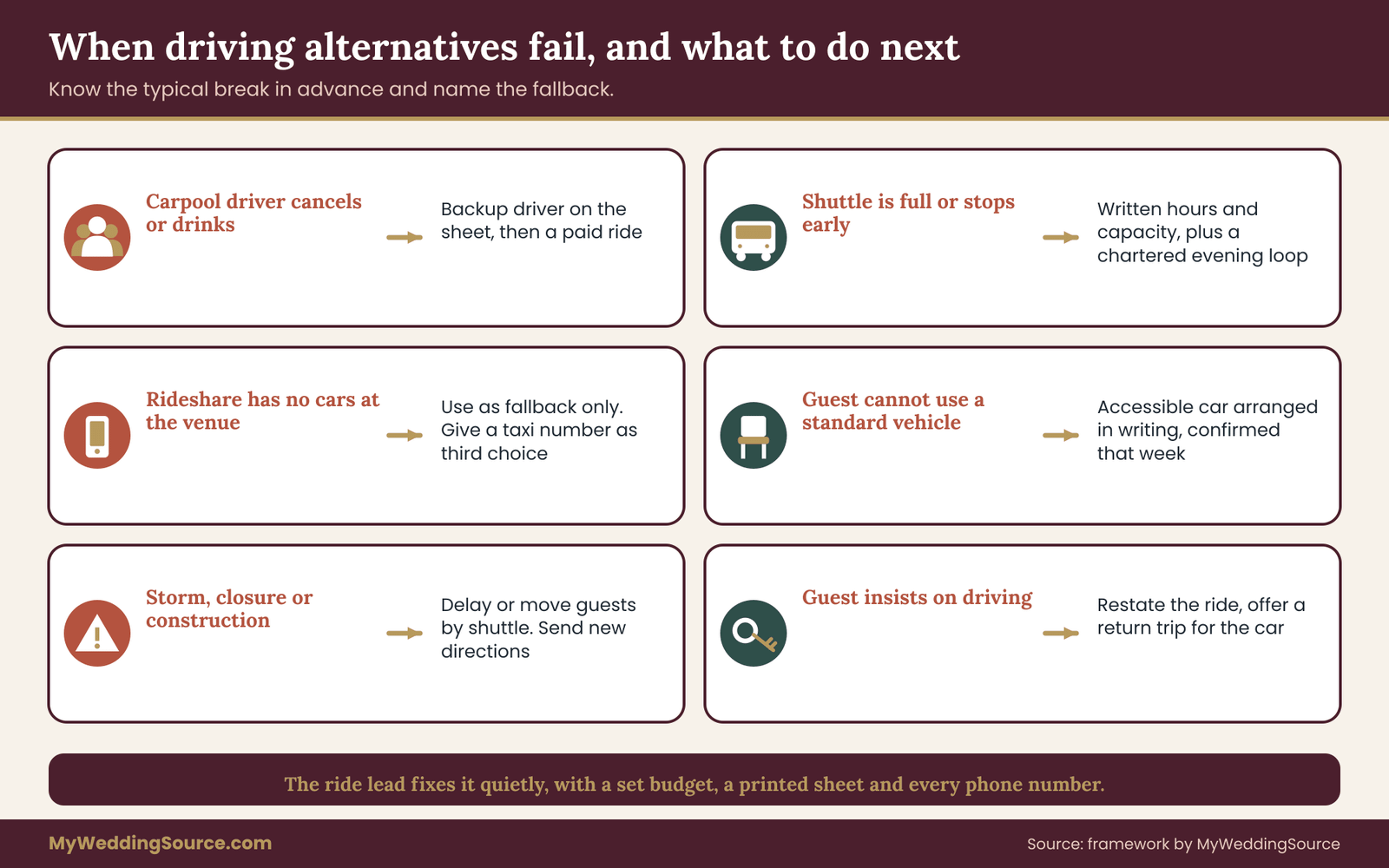
A carpool breaks when the driver cancels, is late or has been drinking. The answer is a backup driver named on the sheet and a paid fallback such as a rideshare or taxi that the ride lead may authorize. Do not rely on goodwill for the last ride of the night.
A hotel shuttle breaks when it has not been confirmed for your hours, when it is full or when it stops running before the reception ends. The answer is to confirm hours and capacity in writing, and to add a chartered vehicle for the evening if the hotel cannot cover it.
A chartered shuttle breaks when the company is late, the vehicle is too small, the driver does not know the entrance or guests do not know where to wait. The answer is a quote that states times and a meeting point, a driver contact, a printed schedule for guests and a second vehicle on call if the headcount is uncertain.
Rideshare breaks when there is no supply at the venue at the hour needed, when the app sends the driver to the wrong entrance or when a guest has no phone battery. The answer is to use it as a fallback only, to give the exact pickup spot and to provide a taxi number as a third option.
A private driver breaks when the driver is unavailable, delayed by traffic or given the wrong address. The answer is a written confirmation with the driver’s name, phone and the meeting spot, and an agreement about what happens if the driver is late.
Public transit breaks when service is reduced, a route is closed or a guest cannot manage the walk. The answer is to check the schedule for the exact day and hour, and to have a paid ride as a backup.
“Stay close” breaks when a guest cannot walk the distance, the weather turns or the plan involves a late return. The answer is a short ride arranged by the ride lead.
Red flags that should change your driving alternatives
A few conditions should change the plan immediately, whatever the sheet said.
- A guest group learns that the license or rental terms do not allow them to drive. Move them to a ride the same day.
- A driver, volunteer or guest has been drinking and the ride lead is unsure. Use the paid fallback, and discuss it later.
- Weather makes the route hazardous: ice, heavy rain, fog or flooding. Delay the schedule or move guests by shuttle, and tell everyone before they set off.
- A road closure or construction changes the route. Check the day before and the morning of, and send updated directions.
- A guest is exhausted after a long flight. Cancel the drive and offer a ride or a rest.
- A guest has a medical or mobility issue that affects the ride. Offer an accessible vehicle, and ask for the guest’s preference in private.
If any of these occur, the ride lead’s job is to fix it quietly, not to wait for the couple’s approval. This is why the lead needs authority to spend a set amount and a list of fallbacks.
Accessibility and driving alternatives
Guests who use wheelchairs, walking aids or other mobility devices need vehicles that can carry them safely. Not every shuttle or rideshare can, and not every company has accessible vehicles on every date. Ask in writing, well ahead, and confirm again the week of the wedding. The site’s notes on care for older relatives and young children at weddings are a useful companion for these conversations. The Americans with Disabilities Act sets obligations for many transportation providers, and the Department of Justice’s ADA information site explains them in plain language.
If an accessible vehicle is not available, tell the guest early and offer another solution, such as a different arrival time or a private car.
Messages that explain driving alternatives kindly
Wording is where driving alternatives succeed or fail. People accept a ride offer when it feels like hospitality and reject it when it feels like supervision. Here are templates you can adapt. Keep them short, warm and specific.
To the whole guest list, in the travel information.
“Getting around: a shuttle runs between the hotel and the venue on Saturday, leaving the hotel at 2:45 and returning after the reception at 10:45 and 11:15. There is no charge. If you plan to rent a car, please read the rental company’s current terms for international drivers before you book, and let us know so we can help with directions.”
To a guest who plans to drive.
“We are glad you will have a car. A few tips for your first drive: cars use automatic transmissions, speed limits are in miles per hour, and turning right at a red light is allowed after a full stop unless a sign says no. We have attached a one-page note and a map with the venue entrance. For the evening, we would love you to ride the shuttle so you can relax.”
To a guest group that should not drive.
“We have lined up a driver for your family on Saturday so you do not have to find the venue in the dark. He will meet you at the hotel at 2:30. Here is his name and number. If you would like a car on Sunday, tell us and we will help you check the rules.”
To a guest who insists on driving after the reception.
“We would feel better if you rode with us tonight. We will bring you back for your car in the morning, and we have a ride for you now. Does that work?”
To a volunteer driver.
“Thank you for helping. You are driving four guests from the hotel at 2:45 and back at 10:45. Please avoid drinking, and let us know if anything changes. Here is the sheet with names, numbers and a backup driver.”
Notice how these messages are built. Each starts with a thank-you or a reassurance. Each gives a time, a place and a name. Each leaves the guest a choice. And none of them uses words such as “should,” “must” or “not allowed,” because the rule you are actually applying belongs to the state or the rental company, not to you.
Etiquette without friction
Hosts sometimes worry that driving alternatives are presumptuous, particularly with older or proud guests. The site’s guide to wedding etiquette can help with the wider questions of tone. The practical rule here is easy: offer, do not insist, and make the driving alternatives better than the risk. A comfortable, well-timed shuttle is easy to accept. A vague “maybe someone can take you” is not.
If a guest declines every offer and drives anyway, you have done your part. Keep your calm, and make sure the ride lead knows. The goal of driving alternatives is not to control anyone. It is to leave nobody without a safe, easy choice.
Keeping records of your driving alternatives
Keep the sheet, the quotes, the schedules and the volunteer list in one place for a few weeks after the wedding. They help you settle invoices, thank the volunteers and remember what worked. If a vendor failed to deliver what was promised, the written quote is your evidence. If a ride went well, a short thank-you note to the driver or the shuttle company is a good use of a few minutes.
Your next steps
Work through the following in order, and you will have driving alternatives in place within a few evenings.
- Decide who owns movement for guests, and name that person as your ride lead, with a backup.
- List every event that involves travel between locations, with the distance, the hour and the road type for each.
- Send one short message to guests who are traveling from abroad, asking whether they would like a rental car or a ride, and what license they hold.
- Build the road readiness sheet, with one block per guest group, and mark L, C, R and A in green, amber or red.
- Ask guests who plan to drive to check the state agency’s visitor page and the rental company’s terms for foreign licenses, and to tell you what they find.
- Choose an outcome for each group, and line up a named driver, a shuttle or a hired car where needed.
- Request written quotes with the same questions from each transport company, and confirm accessibility and hours.
- Write the orientation note, the shuttle schedule and the ride messages, and add them to the guest information page.
- Brief the ride lead and the volunteers, and give each a printed sheet and a phone list.
- Check the sheet again two weeks, three days and one morning before the wedding.
FAQ
Can my guests drive in the U.S. with a license from their home country?
It depends on the state and on the rental company. Many states allow visitors to drive with a valid foreign license for a period, and some ask for an International Driving Permit or a translation if the license is not in English. Ask each guest to check the motor vehicle agency’s visitor page for the state where they will drive, and to read the rental company’s current terms.
Do my guests need an International Driving Permit?
Not always, but some states and some rental companies recommend or require one when a license is not in English. An International Driving Permit is generally issued in the guest’s own country before travel, and it usually accompanies the home license instead of replacing it. Guests should check with the state agency and the rental company well before the trip, because it generally cannot be obtained after arrival.
What are the most important differences on U.S. roads for visitors?
Traffic keeps to the right, speed limits and distances use miles, most rental cars are automatics and right turns on red are allowed in most states after a full stop unless a sign prohibits them. Highways have wide interchanges and exits can appear on either side. Tolls may be electronic, and the rental company may add fees. A one-page note covers these points.
Should I rent a car, or choose other driving alternatives, for guests unfamiliar with U.S. roads?
Usually not. A rental in your name makes you responsible under the contract and may not cover other drivers. Let guests rent their own cars if they choose, after checking the license and rental terms, and offer a shuttle, a named driver or a hired car as the evening option. If you do rent, read the agreement carefully first.
How do I offer driving alternatives without offending proud or independent guests?
Offer the ride first and ask about driving second, and make both answers acceptable. Wording such as “we are lining up rides, would you like one?” feels like hospitality. Give the time, the place and a name, leave the choice with the guest and never suggest the person cannot drive. Most people accept a ride readily for the evening.
How do driving alternatives handle alcohol at the reception?
Decide before the wedding that nobody drives from the reception unless clearly sober and rested, and publish the ride home. Name a ride lead with a charged phone and the authority to pay for a fallback. Tell guests what the ride is, and keep the conversation calm. State and federal agencies publish current impaired driving rules and penalties, and guests should check them.
Who pays for guest shuttles and rides?
There is no fixed rule. Some couples cover all event rides, some cover only the shuttle loop and some ask guests to share the cost of a charter. Whatever you choose, tell guests before they book travel, give the amount and the due date if guests pay, and keep quotes and receipts with your other vendor records.
What if a guest cannot use the shuttle or other standard driving alternatives?
Ask early and in writing whether a guest uses a wheelchair, a walking aid or needs a child seat, and ask each transport company whether it can provide a suitable vehicle on that date and hour. If it cannot, arrange a private accessible car or adjust the schedule. Confirm again in the week of the wedding and keep the answer in writing.
Sources
- U.S. Department of State, Travel
- National Highway Traffic Safety Administration
- Federal Highway Administration
- U.S. Department of Transportation
- Federal Motor Carrier Safety Administration
- Federal Transit Administration
- ADA.gov, U.S. Department of Justice
- USA.gov, Driver’s licenses and vehicle information
- Insurance Institute for Highway Safety