
Bilingual wedding speeches are the toasts that have to reach a room where not everyone shares a language, and they take longer than any speaker expects. This guide gives you a speech timing and translation handoff worksheet: how to choose a delivery format, set a time cap, cut before you translate, brief whoever translates, and keep the whole toast block from swallowing the evening.
Decide the total minutes the toast block can use, then give every speaker a cap that already includes the second language and the handoff. Time each draft aloud, cut the source text first, and only then hand it to a translator. Pick one of six delivery formats per speech, not one for the whole night. Rehearse with two clocks, one for each language, and keep about a fifth of the block in reserve. Plan for bilingual wedding speeches as a time budget before you treat them as a writing task.
Picture a reception where the maid of honor finishes a warm, funny, three-minute toast in English. A cousin stands up to repeat it in Spanish. Four minutes later the cousin is still going, half the English-speaking guests have drifted to their phones, and the grandmother who most needed the translation has lost the thread because the paragraphs were too long to hold in memory. The next speaker is already standing by the microphone, and the kitchen is waiting.
Nobody in that scene did anything wrong, and the same thing happens at many weddings with bilingual wedding speeches. The maid of honor wrote a good speech. The cousin translated faithfully. The problem was arithmetic that nobody did in advance. Bilingual wedding speeches multiply the clock, and a speech that fits a slot in one language rarely fits the same slot in two.
This article is about the arithmetic behind bilingual wedding speeches and the handoff between the person who writes and the person who translates. It does not try to teach you how to write a toast, how to run a plated dinner or how to hire an interpreter for the ceremony. Those topics have their own guides on the site, and the closing sections point you to the ones that apply.
A note on scope. This is general planning information, not legal advice, and nothing here replaces a qualified translator or interpreter for documents or rituals where exact wording matters. For bilingual wedding speeches, where a rule or standard applies, the article names the organization that publishes it so you can read the current version yourself.
What bilingual wedding speeches ask of a room
Start by being precise about who is in the room, because the right approach to bilingual wedding speeches depends on the mix more than on the languages themselves. Every guest falls into one of three groups for any given speech, and the groups are what bilingual wedding speeches are built around. Some understand only the language the speaker is using. Some understand only the other language. Some understand both, at different levels.
The first two groups are the reason you are planning bilingual wedding speeches at all. The third group decides how much repetition you can afford, because guests who understand both languages sit through every translation as a repeat. They are usually the couple’s own generation and the family members who have spent years moving between the two. They will forgive a lot, but not a toast block that doubles in length.
A useful way to describe the room is a simple split. If most guests understand both languages, the translation is a courtesy and can be short. If the room divides roughly evenly into two language groups that cannot follow each other, every speech needs real coverage. If one group is small, for example a handful of grandparents, a targeted solution for those few people may serve better than repeating every word to everyone.
Two different jobs hiding in one phrase
People use the phrase “bilingual toast” for two jobs that behave very differently.
The first job is one speech delivered in both languages. The speaker, or a second person, covers the same content twice. Time doubles in the worst case, and the speech is judged on whether both halves land.
The second job is a program of speeches, some in one language and some in the other, with support so everyone can follow. Here no single speech doubles, but the program as a whole must be balanced, and listeners in each language wait while the other language is used.
Most bilingual wedding speeches end up doing both jobs at once. The father of the bride speaks in his first language, the best man in his, and the couple answer in both. That mix is why a single rule such as “translate everything” breaks down, and why this guide asks you to choose a format per speech.
What the speeches have to do beyond being understood
Bilingual wedding speeches have three jobs: to be understood, to be felt and to end on time. Translation helps with the first, can damage the second and works against the third. A literal repetition that is accurate but flat gives the second language group the information without the warmth. A good approach keeps the emotional beats, the three or four moments that make people laugh or tear up, and lets the connective detail shrink.
That is the point of the worksheet later in this guide for bilingual wedding speeches. It forces a decision about which beats must survive in both languages and which can be shortened, and it does that before the translator starts work, when changing the text is cheap.
Why bilingual wedding speeches run long
Several separate costs stack on top of the original speech in bilingual wedding speeches. Seeing them one by one makes it easier to control each.
The source time. This is how long the speech takes to say aloud in the language it was written in, including pauses. It is almost never what the speaker thinks. People guess from page length or word count and are usually surprised by a stopwatch, because laughs, breaths, glances at the couple and small stumbles add up.
The second-language time. The same content in another language may run shorter or longer, depending on the languages, the translator’s style and whether the translator keeps the speaker’s rhythm. Do not assume a ratio. Measure it with the actual text, which the rehearsal section shows how to do.
The handoff. Every switch between speakers costs time: the speaker passes a microphone or steps aside, the translator moves into position, someone clears their throat and finds the place. Ten seconds is a plausible figure for a smooth handoff, and thirty is common when nobody has rehearsed. It counts twice for a speech that is translated, once going and once returning.
The reaction time. In a room with two language groups a joke lands twice. The first group laughs, then the second group laughs a few seconds later when the translation catches up. Both reactions take real seconds, and the second laugh often arrives after the speaker has started the next sentence, which means the speaker waits.
The reserve. Things go wrong in small ways. A microphone is switched off, a glass is knocked over, a speaker loses their place, a grandmother wants to say a few words. Without a reserve those minutes come out of the dance floor, the cake service or the vendor’s overtime.

The waiting audience
There is a quieter cost in bilingual wedding speeches that does not show on a stopwatch. During a sequential translation, a large part of the room hears nothing it can use. The English listeners wait through the Spanish repeat, and then the Spanish listeners wait through the English original. Attention is limited, and it drops fastest when listeners are idle.
That is why the length of each segment matters more than the total. A short original followed by a short translation can feel lively. A long original followed by a long translation feels like two speeches, and the room reads it that way. If you remember one rule from this guide, make it this one: the unit that a listener must wait through is the thing to keep short.
Why a good speech can still be a bad fit
Imagine two speeches of equal length and quality. One is built from short, self-contained stories. The other is a single long story with a punchline at the end. The first translates well, because the translator can handle each story as a block. The second is fragile. A translator must hold the whole setup in memory, and the punchline may depend on a wordplay that does not exist in the other language.
When you choose speakers for bilingual wedding speeches, you are also choosing how translatable their drafts will be. Gentle guidance early, such as asking speakers to build around two or three short stories rather than one long arc, does more for timing than any editing at the end. The section on writing for translation covers this in detail.
Reading the room before the budget
Before you assign minutes to bilingual wedding speeches, spend a quiet evening listing who will speak, in which language each person is most comfortable, and which guests need each language. It sounds obvious, yet many couples skip it and decide format by habit. The guest list you maintain in your wedding guest list guide workflow is a good place to mark language needs next to each household, so the toast plan and the seating plan agree.
Also note the people who are more than one thing. A bilingual sister may be a speaker, the translator for her father and the person the grandmother turns to for help during dinner. Overloading a single person is a common reason a handoff fails on the day, and the worksheet has a line for it.
Six delivery formats for bilingual wedding speeches
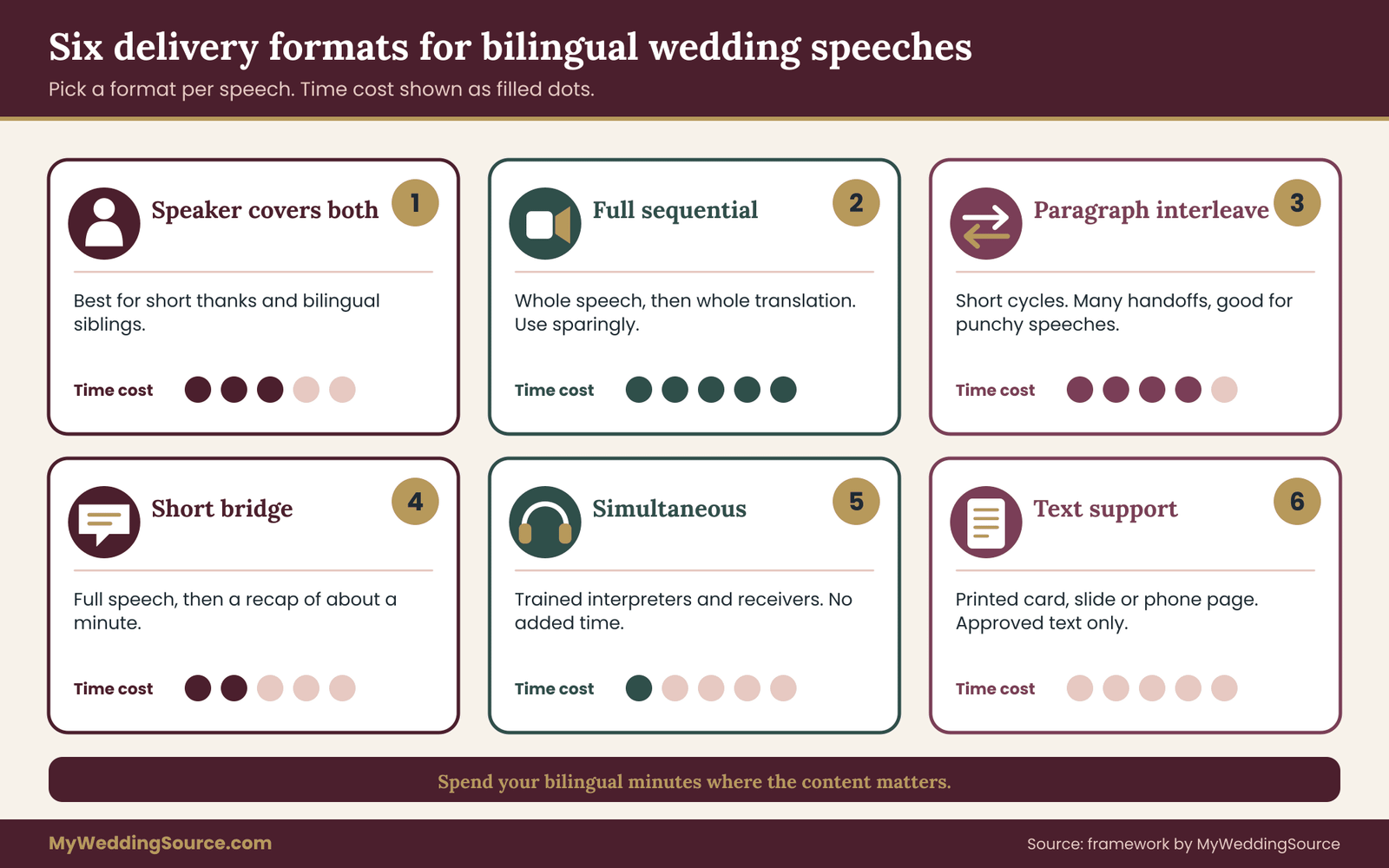
Every speech can be delivered in one of six formats. None is best in general. Each trades time against warmth, cost and risk, and the right choice depends on who is speaking, who needs to follow and what equipment the room has. Read the six, then pick per speech, because bilingual wedding speeches rarely suit a single format.
Format one: the speaker covers both languages
A speaker who is truly comfortable in both languages delivers the speech once, switching as needed, or says each part twice. This is the lightest format for bilingual wedding speeches because there is no handoff. It works best for the couple’s own thank-you and for siblings or friends who grew up between languages.
The risk is that fluent speakers over-trust themselves. Someone who chats easily in both languages may not have the formal vocabulary for a toast, or may translate their own jokes too loosely. A short timed rehearsal in both languages finds this quickly. The time cost is close to double for a full repeat, so use it for short speeches.
Format two: full sequential translation
The speaker finishes, then a translator gives the full content in the other language. It is the most familiar format and the easiest to explain to everyone. It is also the most expensive format for bilingual wedding speeches in time, because the room spends nearly twice as long on each speech and the handoff happens twice.
It earns its place when the content matters to listeners who cannot follow the original, for instance a grandparent’s story about the family’s history, or a speech from a parent that the other side of the family will want to remember. Use it sparingly and cap the source length to leave room for the second pass.
Format three: paragraph interleave
The speaker says two or three sentences, pauses, and the translator repeats them, then the pair continue. The room hears both languages in short cycles, which keeps both groups engaged and makes the translator’s memory task smaller. Jokes land in both languages within seconds of each other.
The cost is rhythm. A speech built for flow gets chopped, and the number of handoffs rises sharply. If each handoff is ten seconds, a speech with twelve cycles adds two minutes before any content is spoken. Interleaving suits short, punchy bilingual wedding speeches and speakers who are comfortable with a partner beside them. It is a poor fit for a long emotional story.
Format four: a short bridge
The speaker delivers the full speech in one language. At the end, the speaker or a partner gives a brief recap in the other language, covering the main points and the emotional beat, not every sentence. A bridge of around half a minute to a minute is typical for a short speech.
The bridge is the workhorse of well-timed bilingual wedding speeches because it carries the feeling and the headline while keeping the time cost small. Its limit is detail. Listeners who rely on the bridge will not get the humor of a long anecdote, and they know it. State the plan in the program or at the microphone so nobody feels left out: “Full toast in English, then a short summary in Spanish.”
Format five: whispered or simultaneous interpretation
A professional interpreter speaks at the same time as the speaker, and the listeners who need it wear a receiver with an earpiece, or sit near the interpreter. The speech takes no extra time. This is the format that solves the clock problem, and it is also the one with the most conditions attached.
It needs a trained interpreter, usually working in a pair for anything beyond a short stretch, plus equipment and a quiet booth or corner. Interpreting associations such as AIIC publish professional guidance on team size and working conditions. Simultaneous work is often not worth it for short bilingual wedding speeches such as a three-minute toast, but it can make sense when the whole reception, the ceremony and the speeches share the same interpreters. If you hire one for the ceremony, ask about the toasts at the same time.
Format six: text support
The speaker speaks in one language and the other language appears as text: a printed card at each place setting, a short projected slide sequence, subtitles, or a page on your wedding website that guests open on their phones. Time cost is close to zero.
This format depends on the room and on the guests. Printed text works well at a seated dinner. Projection needs a screen that everyone can see and lights that allow it. Phone pages assume connectivity, and a venue with weak signal can break the plan. The text must also be an approved translation, not a quick machine draft, a point the translator handoff section returns to.
How the formats combine
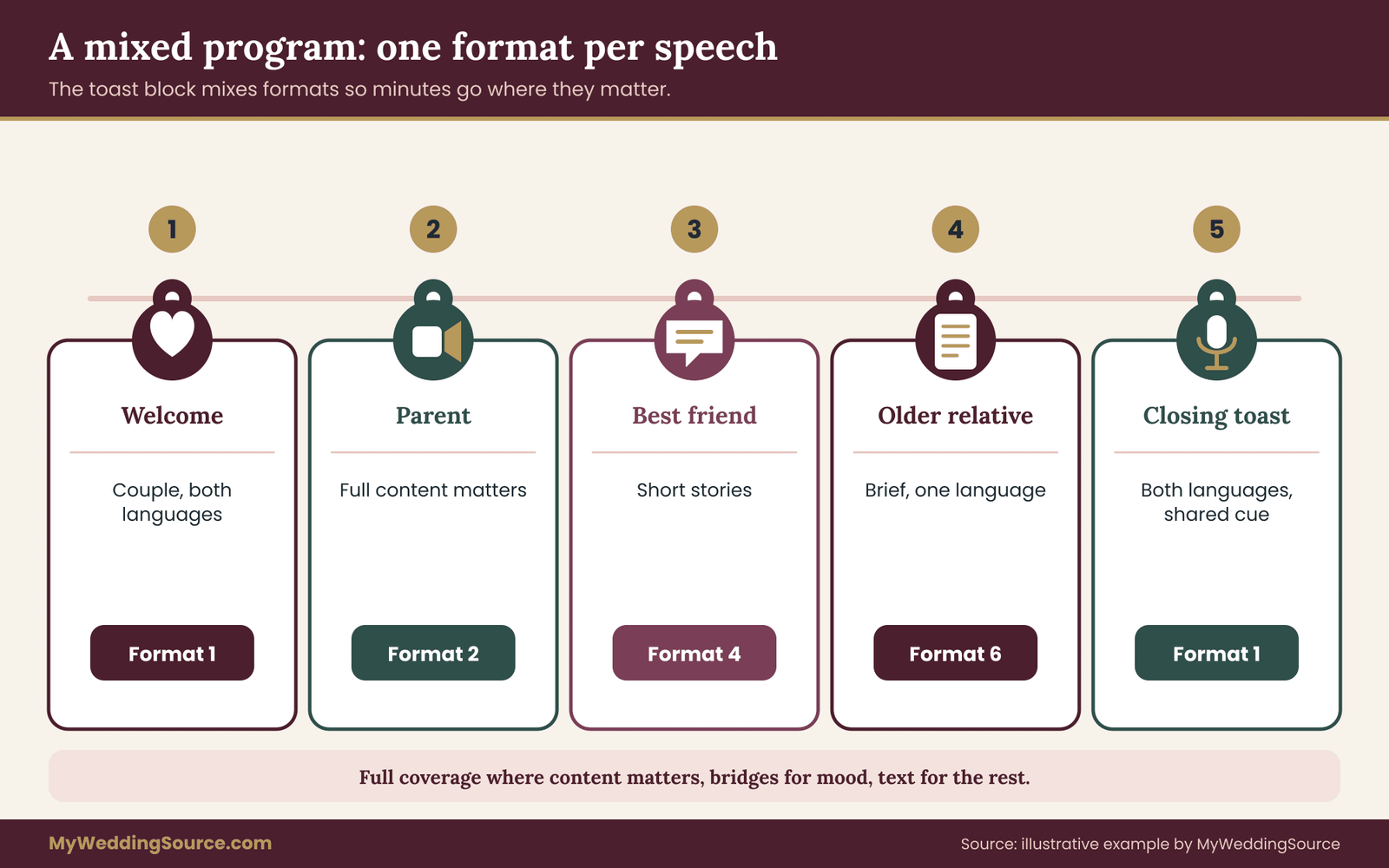
You are not choosing one format for all bilingual wedding speeches across the evening. A common mixed program looks like this: the couple use format one for their own thanks, a parent whose guests need the full content uses format two with a cap, a short-story best man uses format four, and an older relative who speaks only briefly uses format six, with a card on the tables.
The point of the combination is to spend your minutes on bilingual wedding speeches where they matter. Full translation for the speeches that carry content people need. Bridges for the ones that carry mood. Text for the rest. Writing this down per speaker is the core of the worksheet in the next section.
A quick way to choose
Ask four questions for each of your bilingual wedding speeches, in this order.
First, how many listeners cannot follow the original? If it is a handful, support them with text or a person at their table and spare the rest of the room. If it is half the room, you need an audible solution.
Second, does the content matter beyond the feeling? A family story the other side has never heard deserves fuller coverage than a thank-you list.
Third, how long is the source? Over about three minutes, full sequential translation is rarely sustainable. Over four, it almost never is.
Fourth, who is available and prepared? The best format on paper fails if the person asked to translate has never seen the text.
Matching format to the people involved
Format for bilingual wedding speeches also depends on the speaker’s confidence. A nervous first-time speaker will struggle with interleaving, because it breaks their flow, while a confident speaker may enjoy it. A reserved parent may prefer to say everything once and let someone else summarize. Ask the speaker, kindly and directly, which they prefer. People rarely object to being asked, and the answer saves a rehearsal.
Cultural expectations matter too. In some families a parent’s toast is expected to be formal and complete, and a bridge may feel like a slight. In others, brevity is a virtue and long repetition would embarrass the speaker. The couple knows their families better than any guide, and the wedding etiquette guide covers the wider question of who is expected to speak and in what order. Use your own judgment where local custom and your plan disagree.
Why not translate everything by default
It is tempting to treat full translation of every one of the bilingual wedding speeches as the polite default. In practice it often creates the exact problem it tries to solve. A toast block that runs twice as long loses both groups, and the translation that was meant to include people ends up wearing them out.
Inclusion is about understanding and belonging, not about word-for-word coverage. A guest who understands the point of a speech and feels addressed has been included. A guest who sat through six minutes of a language they could not follow, waiting for their turn, has not. Choose the format that delivers the first outcome inside the time you have for bilingual wedding speeches.
The speech timing and translation handoff worksheet
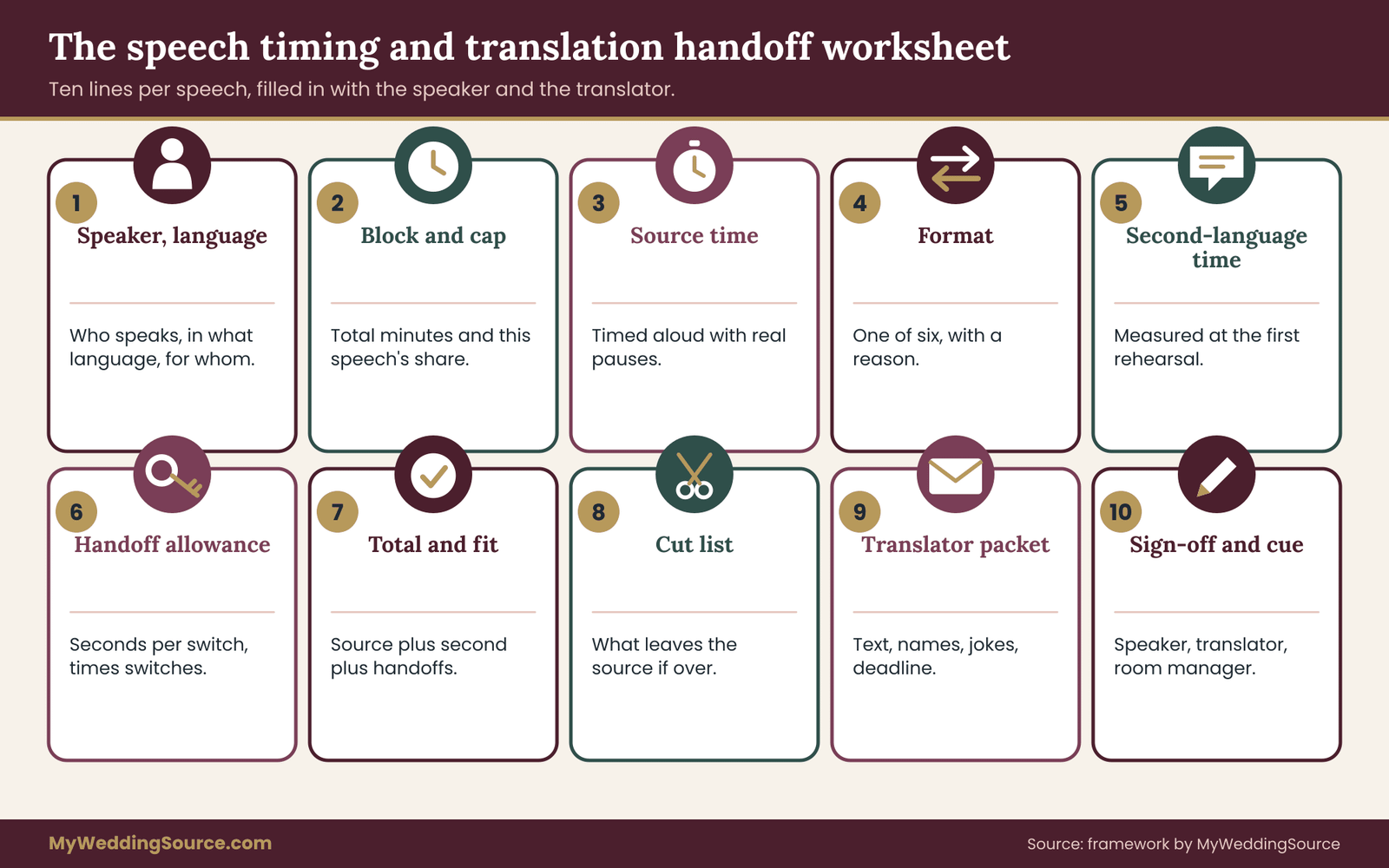
This is the working tool of the guide. It is a short form, one per speech, with ten lines, built for bilingual wedding speeches. Fill it in with the speaker and whoever will translate, ideally together, in one sitting of about fifteen minutes. The worksheet exists because bilingual wedding speeches fail at the handoff, the moment when text, time and responsibility pass from one person to another, and a written line for each decision removes most of the guessing.
You can copy the lines onto a sheet of paper or into a shared document. Nothing about the worksheet for bilingual wedding speeches needs software.
Line 1: Speaker and language. Who speaks, in which language they will draft and speak, and in which language or languages the room needs the content.
Line 2: Block and cap. The total minutes the toast block can use, and the cap for this speech. The next section shows how to set it.
Line 3: Source time. The draft’s spoken length, measured with a stopwatch, read aloud at speaking pace, with the pauses the speaker really takes. Record minutes and seconds, not a guess.
Line 4: Format. One of the six formats from the previous section, with a one-line reason.
Line 5: Second-language time. Left blank until the first rehearsal, then filled with the measured time of the translated version. For a bridge, this is the length of the recap. For text support, write zero and note where the text appears.
Line 6: Handoff allowance. Seconds for each switch, multiplied by the number of switches. Start with ten seconds per switch and raise it if the pair has never practiced.
Line 7: Total and fit. Source plus second-language time plus handoffs. If it exceeds the cap, the next line is not optional.
Line 8: Cut list. What leaves the source text if the total is over. Decide this before translation. The cut order is the same as in any speech: remove side stories, then repeated thanks, then lists of names that guests will not miss, and keep the beats the speech exists to deliver.
Line 9: Translator packet. Who translates, when they receive the final text, what goes in the packet and who approves the finished version. The section on writing for translation spells the packet out.
Line 10: Sign-off and cue. The speaker confirms the translated text says what they meant, the translator confirms they can deliver it in the time, and the person running the room receives the sentence that starts and ends the speech.
Why the lines come in this order
The order of the lines is deliberate. Time comes before format, because once you know the source time and the cap, some formats are impossible. Format comes before translation, because the translator needs to know whether they are rendering a full speech, a recap or a card. And the cut list comes before the translator packet because cutting in the source language is faster, cheaper and safer than cutting after translation.
Cutting after translation is the mistake most couples make with bilingual wedding speeches. A translator who has finished a polished version is reluctant to hack it up, and the speaker cannot judge a shortened text in a language they do not command. Changes made late also create the greatest risk of mismatch between the versions, with the speaker saying something that the printed card no longer reflects.
Filling in the worksheet for the first time
Do not wait for finished drafts. A first pass on lines 1, 2 and 4 can happen before anyone has written a word. It tells the speaker the cap, the format and the language, which shapes how they write. Lines 3, 5 and 7 are filled in after the first timed read. Lines 8 to 10 come after that.
If a speaker has not written anything yet, the worksheet for bilingual wedding speeches still helps. Give them the cap, in minutes, for the source text only, and tell them the format. A father who knows he has two and a half minutes for his own words and that a translator will follow is likely to write something shorter and cleaner than one who is told “say a few words.”
One worksheet, several voices
Share the worksheet for your bilingual wedding speeches with the person who runs the room, whether that is a coordinator, an emcee, the DJ or a friend with a clipboard. They do not need the details of line 8, but they need lines 2, 4, 7 and 10. When the room manager knows the planned total for each speech, they can protect the schedule, and when they know the format, they can set the microphone and the cue.
Vendors also need the outline. The caterer needs the total block length and its position in the service; the reception guide on the site, designing reception guest flow, explains how speeches fit with entry, seating, food and exit. The point here is narrower: whichever slot you choose, hand the caterer the same total you wrote on the worksheet, including the reserve.
Setting a time budget for the toast block
Before any speaker sees a cap, bilingual wedding speeches need a block: how many minutes the toasts can take in total. This is a decision about the evening, not about the speeches.
Start from the schedule. If the toasts happen at a seated dinner, the length depends on the kitchen’s service and the guests’ patience. If they happen at a cocktail hour or after dessert, the constraint is energy and the clock on the venue contract. Ask the venue and caterer what the evening can absorb without creating overtime, and write the answer as a single number.
Then subtract what is not speeches. The welcome, the cue to raise glasses, the pour, the thank-you from the couple and the closing line all take time. Whatever is left is the speech time. A rough habit that works is to remove a minute for each speaker for transitions in a bilingual block, which is more than a monolingual block needs.
The reserve
Hold back a share of the block, about a fifth, as a reserve. This is a planning allowance, not a precise rule. Its purpose is to make sure that a late start, a long laugh or a spontaneous remark does not push the evening beyond its limits. If everything goes smoothly, you end early, and nobody minds that.
The reserve is easy to give away when the list of bilingual wedding speeches grows. A cousin asks if they can say a few words. A grandparent has a poem. A friend wants to read a message from someone who could not come. Each looks small. Together they eat the reserve and the cap. The worksheet makes the trade visible: adding a speaker means shortening others or lengthening the block, and both of those are decisions for the couple.
From block to speech caps
Divide the usable minutes between bilingual wedding speeches by weight, not equally. Weight reflects how much the room needs from each speaker: a parent hosting the event or a best friend giving the main toast may deserve more time than a brief welcome from an aunt. Then divide each cap into the three parts the worksheet tracks: source, second language and handoff.
A simple pattern for a full sequential speech is to split the cap so that the source takes slightly less than half, the translation takes slightly more than half of the remainder, and the handoffs take the rest. This is not a formula to apply blindly. Different languages and styles produce different ratios. It is a starting point, to be corrected by your own rehearsal numbers.
Worked arithmetic in outline
Suppose the cap for a speech is six minutes and it uses full sequential translation. Say the handoffs take twenty seconds in total and, from a rehearsal, the translation runs a fifth longer than the source. Then the source text plus its translation must fit in five minutes and forty seconds. A source of 2:45 becomes a translation of 3:18, and with the handoffs the total is 6:23, which is over. Trim the source to 2:30 and the translation becomes 3:00, so the total is 5:50, with ten seconds to spare.
That sum shows the lesson. The cap in the room is six minutes, but the speaker’s own text must be about two and a half. People find that surprising, and that is why the sum should be done before drafting. A later section carries a complete case from first draft to final plan.
When the block cannot grow
Sometimes the block for bilingual wedding speeches is fixed by the venue’s ending time, the caterer’s staffing or a guest group that needs to leave early. In that case the only levers are the number of speakers, the format and the source lengths. Fewer speakers with cleaner formats usually beat more speakers with squeezed ones.
A practical test is to ask whether each speech would be missed. If the answer is yes, the speech earns a slot. If the answer is “it would be nice,” consider alternatives such as a printed note, a short video message played before dinner, or a toast at an earlier gathering such as a rehearsal dinner or welcome drinks, where the schedule is looser.
Writing bilingual wedding speeches so they survive translation
A speech written for one language and then handed to a translator, the usual route for bilingual wedding speeches, is not the same as a speech written with translation in mind. A few drafting habits change the outcome more than any amount of polish afterward. Share them with every speaker when you give them their cap.
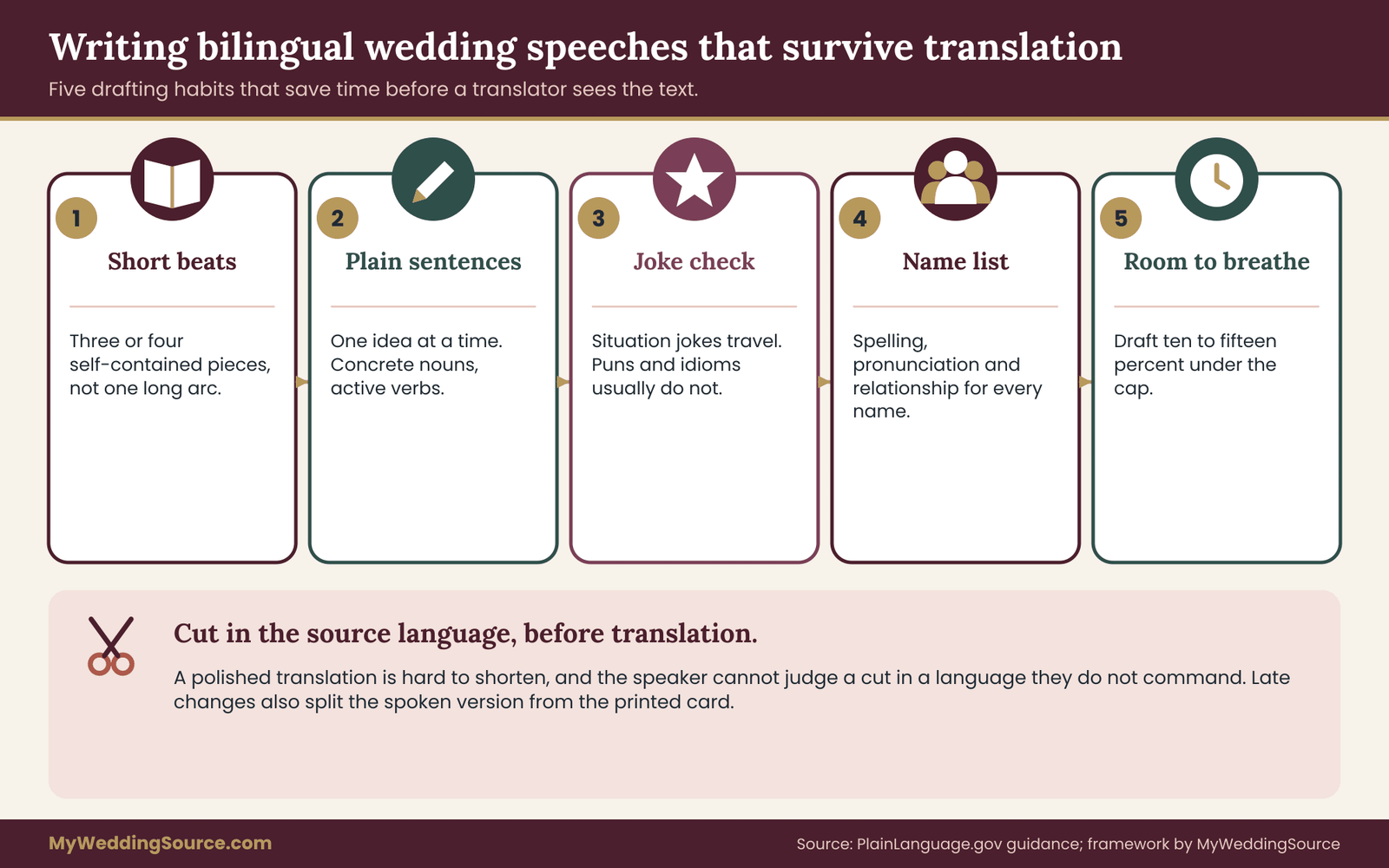
Build around short, self-contained beats
For bilingual wedding speeches, ask speakers to structure the text as three or four short pieces, each of which stands alone: a greeting, a story of one or two minutes, a wish, a toast line. Short beats help a sequential translator, who can handle one block at a time. They help an interleaving pair, who can switch at natural joints. They help a bridge, because the recap can name the beats in order.
A long, single story with one payoff is harder. It also tends to run over the cap, because the speaker keeps adding detail. If a favorite story is long, ask the speaker to pick the single most telling moment in it and tell only that.
Use plain, concrete sentences
Plain sentences make bilingual wedding speeches easier to translate cleanly. Long sentences with several clauses force a translator to choose which part to say first, and the structure of one language may not allow the same order. Concrete nouns and active verbs carry across languages with little loss. Abstract phrases and chains of adjectives give the translator more to decide and more to get wrong.
The Plain Language guidelines published by the United States government are written for public documents, but their advice carries over: short sentences, common words, one idea at a time. A toast is not a government form, so keep your own voice. The aim is to avoid obstacles, not to flatten the speaker.
Be careful with jokes, idioms and references
In bilingual wedding speeches, a joke that depends on a pun, a rhyme or an expression is the one most likely to die in translation. A translator may explain it, which kills it, or replace it with something equivalent, which changes the speech. Ask each speaker to mark every joke and ask themselves whether it depends on the exact words or on the situation. Situation jokes, such as the time the groom drove an hour in the wrong direction, translate well. Wordplay does not.
Idioms are similar. “He’s on cloud nine” may have an equivalent in the other language, or the translator may have to say “he is very happy,” which is flatter. A speaker who knows this in advance can choose a plainer phrase or accept the loss. Cultural references, such as a television show or a school tradition, may need a half sentence of context. Context costs seconds, so decide whether the reference is worth it.
Mind names, titles and relationships
Names are the heart of bilingual wedding speeches and a common point of error. Pronunciation matters to the person being named. Family terms differ between languages, and one language may have separate words for relatives that the other describes with a phrase, such as a mother’s older brother. A translator who is not part of the family may not know that “Tío Beto” is a real uncle and not a title of respect.
Ask the speaker to give the translator a list of every name in the speech, with the relationship, the correct spelling and how to say it. A few minutes of this removes the kind of mistake that guests remember. The same attention applies to the couple’s own names, a topic that gets more room in the guidance on name spelling in your invitations and signage.
Leave room in the text
Bilingual wedding speeches that fill every second of the cap leave no room for laughter, applause or the pause a speaker needs when emotion catches them. Ask for a source draft that comes in below the cap by a visible margin. A good working margin is ten to fifteen percent of the speech time.
Placement matters as well. Put the most important lines early or in a place the translator will treat as a block, so that if time runs short the pair can drop a later section without wrecking the speech. Speakers can mark an optional paragraph in brackets as a pre-agreed cut. If time is tight on the day, the translator and speaker both know what goes.
What to tell speakers when you ask
Many people agree to give one of the bilingual wedding speeches without knowing that the wedding has a language plan. Tell them at the start, in a message or a call, and keep it short. Say who you hope will follow the speech, which format you have in mind, the cap in minutes for their own words and the date you need a draft. Ask what they prefer, and ask whether they have a person in mind to translate.
A message that works: “We would love you to give a toast. Many guests follow only one language, so we are planning short toasts with a translation. We would need about two and a half minutes from you, and a draft by the first of next month. Tell us if a different format would feel better.”
The message is honest, it names the limit and it invites an answer. Speakers who are asked this way rarely resent the cap, because the reason for it is plain. Good bilingual wedding speeches begin with this conversation, long before anyone picks up a pen.
Follow up once. If a draft is late, offer help: a call where the speaker talks through their stories and you take notes, or a shared outline. Many people write better when they talk first. The cap works as a kindness too, because it tells a nervous speaker how much is enough.
Who translates the speech, and what they need to start
The question of who translates tends to be answered by whoever is nearby and willing. That is understandable, and sometimes it is the right answer, but a deliberate choice produces better results. There are four realistic options, and each fits some speeches better than others.
The speaker, translating their own words
When the speaker is fluent in both languages, this gives the closest match to what they mean and removes a handoff. The danger is time. Speakers who translate themselves tend to expand the second version, adding what they did not say the first time. Hold them to the cap by timing a rehearsal in both languages, and ask whether they are comfortable giving a formal speech in the second language, not just chatting in it.
A bilingual relative or friend
Most weddings rely on this option for bilingual wedding speeches. A relative or friend who knows both languages and the people involved can capture warmth and in-jokes that a stranger would miss. They are also free, and they are willing.
The risks are specific. They may be nervous, because they are performing in front of a family audience. They may be a guest who wants to enjoy the evening, not work through it. They may be fluent in conversation but unpracticed at holding a paragraph in memory and repeating it accurately, which is a different skill. The professional associations that represent translators and interpreters, such as the American Translators Association, point out that bilingual ability and translation skill are not the same thing.
If you use a relative, give them the text early, a defined role and a script for the handoff. Tell them in advance that they may stop and ask for a repeat, and tell the speaker to speak in short pieces. Choose someone who has the time and wants the job.
A professional interpreter
A professional interpreter has training in holding and rendering speech, and a professional’s rate and availability are part of your wedding budget. Professional interpreting comes in modes, such as consecutive and simultaneous, and the two require different skills and equipment, a distinction the guide on wedding ceremony cue sheets touches on from the ceremony side, where timing and voice cues are planned with the officiant and music.
For bilingual wedding speeches, a professional is most worth hiring when many guests depend on the translation, when the content is long or sensitive, or when the room is large and the translation must be heard clearly. Ask for a short call before booking. A competent interpreter will ask about the languages and dialects, the number of speakers, the length of the block, the room and the equipment, and will say what they need in advance. If they do not ask, they may not be the right fit.
For sign language, which is its own language and its own profession, ask your venue about their accessibility arrangements and look at the standards from the Registry of Interpreters for the Deaf and the guidance of the National Association of the Deaf. This guide focuses on spoken languages.
Text only, with no live translator
For some bilingual wedding speeches no live translation is needed. A card, a slide or a phone page can carry the translation. This is cheap, quiet and exact, as long as the translation has been checked by someone who can verify it.
Text-only support depends on the room. Guests need light to read, a reason to look down during the toast and, for a phone page, a signal. Older guests may not use their phones at a table, and a printed card is kinder. Where text is the plan for important guests, tell them so, so they do not wait for a voice that will not come.
A decision rule
Use this order of questions to decide who handles your bilingual wedding speeches. If the speaker is comfortable in both languages and the speech is short, let them cover it. If many listeners depend on the content and the speech is long, hire a professional or use a format that needs one. If the content is warm and personal and the stakes of an error are low, a trusted relative is the right choice, provided they are prepared. If the speech is brief and only a few guests need it, use text.
None of these rules overrides your own knowledge of your people. A grandmother who would be hurt by being handed a card may deserve a person at her table whispering the key lines, which costs the room nothing.
The translator packet and the sign-off
Whoever translates bilingual wedding speeches needs more than a text. The packet is a short bundle, sent early, that answers questions before they are asked. It is line 9 of the worksheet, and it turns a favor into a defined job.
The packet contains the final source text, marked with the optional paragraphs in brackets. It contains the name list with pronunciation and relationships. It lists the jokes and references the speaker is worried about, with a note on what matters in each: the laugh, the meaning or the memory. It states the format and the cap, so the translator knows whether they are rendering everything or a recap. And it names the day and time of the first rehearsal.
The translation itself
For text that will be printed or projected, the translator should work from the final source and produce the second-language version in writing. A second person who reads both languages should then compare the two, line by line. This is the same chain that careful bilingual projects use for invitations and programs: one person translates, another checks, and the speaker approves what they can approve. The practice of independent review is standard among professional translators.
Machine translation of bilingual wedding speeches can give a speaker a rough idea of what a text would sound like, and it can help a relative who is writing a first draft. It should not be the approved version of a text that will be printed or spoken at your wedding without a fluent person reading it. Machine output can miss tone, mishandle names, and render a gentle joke as an accusation. Treat it as a draft, never as the authority.
The sign-off
Each of the bilingual wedding speeches has three people who need to agree that it is ready. The speaker confirms that the translation says what they meant, to the degree they can judge, or that a trusted bilingual person they rely on has confirmed it. The translator confirms that they can deliver the text within the time. The room manager confirms they have the cue line and the timing.
The sign-off should be written. A one-line message in a shared thread is enough: “Final text approved, 2:30, bridge 0:45, cue: [sentence].” When someone remembers a change on the day, you will know what the agreed version was.
Version control without a system
Late changes are the quiet danger in bilingual wedding speeches. A speaker adds a line the night before, and the printed card does not have it. A translator works from an old draft. Two simple habits prevent most mismatches. Put the date and a version number in the file name, and send changes to everyone on the thread, not to one person. After the lock date, the only changes allowed are cuts, and cuts are made in the source first.
Rehearsal: the two-clock test
You cannot learn the second-language time of bilingual wedding speeches from a table. You learn it from a stopwatch. The rehearsal needs two clocks, one for each language, and it can be done in about twenty minutes per speech, by phone if the people live apart.

Run one: the source clock
The speaker reads the source text aloud at the pace they will use on the day, standing up if they can, and a helper times it. Record the total and also the times of each beat. If the speaker will have a microphone, ask them to use something in their hand. The result is line 3. Do not accept a measurement made while reading silently, which is always faster.
Run two: the translation clock
The translator delivers the translated version, either from the written text or from memory, depending on the format, and a helper times it. The result is line 5. Divide the translated time by the source time. That ratio is the multiplier, and it belongs to this pair, this text and this translator. It is not a rule about any language. If it is 1.1, the translation runs ten percent longer. If it is 0.95, it runs a little shorter. Use the number you measured, not one you read.
Run three: the handoff run
With both people in position, run the full format at day-of pace, including the handoff. Time the pass from the first word to the last word of the translation, with the actual microphones or a stand-in if you cannot use the real ones. This catches the costs that never show up in the first two runs: the walk, the microphone pass, the look to the other person and the starting pause.
If the total on the handoff run is over the cap, do not push the speakers to talk faster. Speaking faster hurts both comprehension and the translator, who needs the speaker to pause. Cut the source text instead, using the cut list, and run again.
What to listen for
Besides the clock, listen for four things. Does the translator have to ask the speaker to repeat? That means the pieces are too long. Does a joke fall flat in the second language? Decide whether to explain it, replace it or drop it. Does the translator stumble on a name? Fix the pronunciation. And does the second half feel like an afterthought? If it does, the emotional beat may be missing from the translation.
A second rehearsal for the room
If you can, run the handoff once more in the venue, or at the walkthrough where you check sound, sightlines and the microphone. A speech that works in a living room may not work in a hall with an echo, and the translator may not hear the speaker well enough. The venue technical walkthrough guide explains what to measure and whom to ask on a site visit, and a few minutes spent on the microphone setup is cheap compared with a muddled toast.
A worked case with the arithmetic
This is an invented example of bilingual wedding speeches, built to show the worksheet in use. The couple, the guests and the numbers are made up for illustration. Your own measurements will differ, and a translator’s pace is a property of a particular text and a particular person, not a fact about any language.
Marisol and Daniel are marrying in a hall where about half the guests are most comfortable in Spanish and half in English. About a third of the guests understand both. The venue and caterer have said the toasts can take twenty-four minutes in the slot after the entrée is cleared, and the couple decide to keep a fifth in reserve, which is about 4:48.
The first plan
The first plan for the bilingual wedding speeches was the one most couples start with: everything gets full sequential translation. Four speakers each wrote what felt natural. The father of the bride, in Spanish, ran 3:00. The maid of honor, in Spanish, ran 3:30. The best man, in English, ran 3:00. The groom’s mother, in English, ran 2:30. The couple planned a two-minute thanks in both languages.
Source time came to 12:00 for the four speeches. In the first rehearsals the translations ran about a fifth longer than the sources, so the translated versions added 14:24. With eight handoffs at ten seconds each, that was 1:20 more. Add the couple’s two minutes, and the block came to 29:44. The cap was 24:00, and the target with reserve was 19:12. The plan was more than ten minutes over the target and almost six minutes over the cap itself.
The decisions
The couple went through the worksheet line by line and made three decisions.
First, they cut the sources before translating. They asked each speaker to remove roughly fifteen percent, mostly side stories and a list of names. The new sources were 2:30 for the father, 3:00 for the maid of honor, 2:30 for the best man and 2:00 for the mother.
Second, they changed formats by speech. The maid of honor’s speech carried stories about her grandparents that the Spanish-speaking relatives and the English-speaking relatives would each want in full, so it kept full sequential translation. The father, the best man and the groom’s mother switched to a bridge, with a 45-second recap in the other language, because their speeches were more about feeling than information.
Third, they wrote the optional paragraphs in brackets, so each speaker had a pre-agreed cut if the evening ran late.
The new totals
The new plan added up like this. The father’s speech: 2:30 plus a 0:45 bridge plus 0:10 handoff, a total of 3:25. The best man: the same, 3:25. The mother: 2:00 plus 0:45 plus 0:10, which is 2:55. The maid of honor: 3:00 source, a 3:36 translation at the measured ratio and 0:20 for two handoffs, a total of 6:56. The couple’s thanks stayed at 2:00.
The block now totaled 18:41. Adding the 4:48 reserve brought the plan to 23:29, which fits the 24:00 cap with 31 seconds to spare. The couple wrote each line on the worksheet, sent the sheets to the coordinator and the translators, and fixed the lock date for text at two weeks before the wedding.

What the case shows
The case of these bilingual wedding speeches shows three things worth keeping. The cap in the room was never the speaker’s number; the speaker’s number was a small share of it. The biggest saving came from choosing formats, not from squeezing words. And the arithmetic needed only a stopwatch and ten minutes of subtraction, which is why it is worth doing a month before the wedding and not on the afternoon of the reception.
It also shows what the plan gave up. The English-speaking relatives who do not understand Spanish got a bridge for three of the four speeches and not the full content. The couple accepted that and told the guests in the program that most speeches would be followed by a short summary. If that trade-off had been unacceptable to the families, the answer would have been a longer block, a professional interpreter for simultaneous coverage, or fewer speakers, not a faster pace.
Running bilingual wedding speeches on the day
A good worksheet for bilingual wedding speeches still needs someone to run it. On the day, the plan lives in the hands of one person, and the best choice is someone who is not also giving a speech or translating. That might be a coordinator, a venue manager, an emcee, a trusted friend or a family member who likes clipboards.
The one-page run sheet
Give the room manager a single page for the bilingual wedding speeches that lists, for each speech, the speaker, the format, the planned total, the cue sentence to start and the cue sentence to end. Add the translator’s name and where they will stand. Add the list of optional paragraphs. Add the reserve and the hard stop time. The page should fit on one side of paper and be readable in dim light.
The wedding vendor timeline guide explains how to turn a plan like this into a schedule the caterer, DJ, photographer and venue all follow. The toast block should appear in that schedule as a single item with a start time and a number of minutes, plus a line that says what happens if it runs late.
Microphones and positions
Decide how many microphones you need before you decide anything else about the room. Sequential and interleaved formats work with one microphone passed between two people, but a pass takes time and a fumbled pass takes more. Two microphones let the speaker and the translator stand side by side and avoid the pass. A translator who has to hold a microphone, a card and a glass has too many things in hand; give them a stand or a lapel clip.
Position them so the translator can see the speaker’s face and the room can see both. The translator stands slightly behind and to one side of the speaker, ready to start, not in front of them. If a bridge comes from the speaker, they use the same microphone with no handoff at all, which is part of why bridges are cheap.
For a simultaneous format, the interpreter needs a position where they can see and hear the speaker without disturbing the guests, and the receivers need to be tested, with batteries, before the toasts. Ask the vendor how they handle interference and what happens if a receiver fails.
The cue chain
Bilingual wedding speeches run best when everyone hears the same cue at the same time. A good cue for bilingual wedding speeches has four steps. The room manager announces the speaker and the format in both languages, briefly, for example “Our maid of honor will speak in Spanish and then in English.” The speaker begins. At the end, the translator begins. At the end of the translation, the manager announces the toast or the next speaker.
The announcement serves a second purpose. It tells guests what to expect, so those who will wait for a translation do not feel ignored and those who will not need it can settle down. It also gives the room a moment to quiet before the speaker starts. Keep it short and put it on the run sheet, word for word.
Protecting the schedule in the room
Someone has to be willing to enforce the plan. If a speaker runs long, the room manager can signal quietly with a card, a nod or a note passed forward. The signals should be agreed in advance and explained to the speaker at the rehearsal, with a kind tone. A speaker who has agreed to a signal is far more likely to respond to it than one who is surprised by it.
The reserve exists to absorb the first overrun, and the bracketed cuts exist for the second. If both are used up, the room manager can decide to shorten the translation of the next speech to a bridge, a decision made in advance and listed on the run sheet. Because everyone knows the fallback, no one has to improvise.
Words you can adapt for the day
Short scripts save the room manager from improvising. These are starting points, to be changed into your own voice and your own languages.
The opening announcement: “Before we begin the toasts, a word about how they will work. Each speaker will talk for a few minutes, and a translation will follow, so please stay with us. Our first speaker is the maid of honor, who will speak in Spanish and then in English.”
The handoff line from the speaker to the translator, said quietly: “Over to you.” Pick one phrase and use it every time, because a consistent phrase is easy to hear and costs under a second.
The signal conversation with a speaker at rehearsal: “If you see me hold up this card, you have about thirty seconds left. Finish the sentence you are in, say your toast line and sit down. Nobody will mind.” The tone matters more than the wording. Speakers hear the plan as respect when it is said with warmth.
The line for the end of the block: “Thank you to everyone who spoke, and to those who translated. Please raise your glass to the couple.” Thanking the translators publicly is a small courtesy that guests notice, and it costs five seconds.
The final week in plain steps
In the last seven days, treat bilingual wedding speeches as a logistics item, not as a creative one. Confirm the lock on every text. Confirm that each translator holds the final version and has the packet. Confirm the order of speakers, the format for each and the cue sentences with the room manager. Print the run sheet in a readable size and give copies to the manager, the DJ if there is one, and the coordinator.
Two days before, check the equipment: microphones, stands, receivers if used, spare batteries, the card with the signal and the printed text if any. If the plan includes projected text, test it in the room’s lighting. On the day, take five minutes before guests sit down to run the first handoff with the real microphone. That check often finds a broken cable or a muted channel that would have cost a minute in front of everyone.
Alternatives, failure conditions and special cases for bilingual wedding speeches
Alternatives when the arithmetic will not close
Sometimes the arithmetic for bilingual wedding speeches will not close. The block is short, the speakers are many and the languages are far apart. Before you cut something you care about, look at the alternatives. They all change when, how or where the content is delivered, and they all fit with the worksheet.
Move some speeches to another event. A rehearsal dinner, welcome drinks or a farewell brunch often has a looser schedule and a smaller group. Family toasts, long tributes and stories that need translation fit there more comfortably. The toasts at the wedding itself can then be shorter and more focused.
Pre-record or pre-share. Bilingual wedding speeches do not all have to be live. A speaker who cannot be there, or who would rather not speak live, can send a short video with subtitles, or a written message that is printed or shared with the translated text. Check that the file plays on the venue’s equipment and in the room’s lighting.
Split the languages by moment, not by speech. Some couples use one language for the toast itself and the other language for the thank-you at the end, and print the toast in both. This keeps every speech short and still gives each group a moment that is theirs.
Print the speeches. A small booklet or card with each speech in both languages lets guests read at their own pace, then keep it. The text must be approved, the printing needs lead time, and the speakers must not change their words after the print date.
Reduce the number of speakers. The strongest cure is often the plainest. A block with three speakers and full coverage serves the room better than one with six and thin coverage. A couple who feel pressured to give everyone a turn can read the guide to wedding decision-making for ways to manage family expectations without losing control of the schedule.
Failure conditions: when the plan breaks
Any plan for bilingual wedding speeches has conditions under which it does not work. Naming them lets you notice early and respond. These are the ones that matter for bilingual wedding speeches.
The translator is unprepared. If a translator receives the text the day before, or not at all, the handoff will stumble and the time will blow out. The fix is a lock date for the text and a rule that no speech is delivered with a translator who has not seen it.
The multiplier is guessed. If you assume the translated version takes the same time as the source and never measure it, the whole budget is wrong. If you cannot rehearse, add a margin of at least a quarter to the second-language time and plan the bridge as the default.
The speaker overruns. A nervous speaker may speed up, and a confident one may expand. Rehearsal and a visible signal are the tools. If a speaker has overrun in every rehearsal, change their format to a bridge or cut the source again before the day.
The room cannot hear. Poor sound, a noisy room or a missing microphone makes everything slower. Speakers repeat themselves, translators ask for repeats, and guests talk. Test the sound where the speeches will take place.
The text and the card disagree. If the speaker changes a line after the card is printed, guests who read the card will notice. Freeze the text and treat changes after the lock date as cuts only.
A joke dies, or offends. A line that is harmless in one language can be rude, or baffling, in the other. Ask a second fluent person to read the translation for tone, not only for accuracy.
The reserve is spent early. If the first speaker uses the whole reserve, the rest of the program is squeezed. The room manager should know the reserve left at each point and the planned fallback.
Knowing when to change the plan
If three or more of these conditions are present at the one-week point, change the format before the wedding, not at it. Move a full translation to a bridge. Drop a speaker to a printed note. Hire a professional for the one speech that matters most. A change a week out costs little and a change on stage costs everything.
Special cases
A few situations come up often enough in bilingual wedding speeches to deserve a short note each.
Three or more languages. Bilingual wedding speeches become multilingual speeches quickly. If a third language is present, treat it as a separate group on the guest profile and decide whether it needs coverage in speeches or only in text. Covering three languages by speech multiplies the time, so text support, a bridge or a person at the table is usually the realistic choice.
A guest who is deaf or hard of hearing. Sign language interpreting is a separate service from spoken translation, and the Americans with Disabilities Act and the venue’s own policies may apply to the venue. The Department of Justice publishes information at ada.gov, and your venue should be able to say what it provides. Ask early, because qualified interpreters are booked far ahead.
Elderly relatives who speak only one language. A person at their table, text in large print and a clear view of the speaker may serve them better than a long translation to the whole room.
Children as translators. Avoid asking children to translate for the room or for older relatives during emotional speeches. It puts a weight on them that they did not choose, and errors are likely.
A toast that includes a ritual or a legal statement. If a speech includes a religious blessing, a ritual formula or a statement with formal meaning, treat it as ceremonial text and have it translated and checked by a qualified person. A machine translation or an informal rendering is not appropriate for it. The guide to interfaith ceremony planning shows how to give each ritual a clear owner.
Your next steps
Work through these steps for your bilingual wedding speeches in order, and give each a date. The first three can be done in a single evening.
First, write the room profile: for each household or table, which language the guests follow best, and which speeches will matter most to them. Second, set the block, the reserve and a first cap for each speaker, and tell the speakers the cap for their own words in minutes and seconds. Third, choose a format for each speech with the four questions from the format section, and write the choice on a worksheet.
Next, ask each speaker for a draft of their share of the bilingual wedding speeches by a fixed date, time it aloud, and apply the cut list before anything is translated. Choose the translator for each speech and send the packet. Run the two-clock rehearsal, correct the numbers on the worksheet, and lock the text.
In the final week, give the room manager the run sheet, check the microphones and positions, and walk through the cue chain once. If you also need guidance on how the invitation and the wedding website describe the program to guests, the wedding invitation etiquette guide covers wording and the parts of the program that guests need to know before the day.
Bilingual wedding speeches are a small part of a wedding and a large part of what guests remember. A calm time budget, one honest rehearsal and a clear handoff let every guest hear the people who love you, in a language they follow, before the dessert melts.
FAQ
How long should bilingual wedding speeches be?
There is no single right length, because the block depends on your venue, caterer and room. A workable method is to set the total minutes for the toasts, keep about a fifth in reserve, and give each speech a cap that already includes translation and handoffs. The speaker’s own text is usually a little under half of its cap for a full translation, and larger when you use a short bridge or text support.
Do we have to translate every speech word for word?
No. Full translation is one of six formats, and it is the costliest in time. A short recap in the other language, printed text or a person at the table can give guests the meaning and the feeling for much less time. Use full translation for the few speeches where the content matters to listeners who cannot follow the original, and use lighter formats for the rest.
How do we measure how long a translation will take?
Time it. Have the speaker read the final source aloud at day-of pace, then have the translator deliver the translated version while a helper uses a stopwatch. Divide the translated time by the source time to get a multiplier for that pair and that text. Do not use a ratio from an article, because it varies with the text, the languages and the translator.
Can a bilingual friend or relative translate the toasts?
Often yes, and many couples do it. Being bilingual is not the same as being practiced at holding and repeating speech in front of a crowd, so give them the final text early, a role they have agreed to, a rehearsal and permission to ask for a repeat. If many guests depend on the translation, or the content is long or sensitive, consider a professional.
When is a professional interpreter worth hiring for speeches?
It makes sense when many guests rely on the translation, when speeches are long or sensitive, or when the room is large and the voice must be heard clearly. Simultaneous interpreting saves time but needs a trained pair and equipment, while consecutive interpreting takes about as much time as a translation. Ask for a short call and a written quote before booking, and check credentials with the relevant professional association.
Should we use machine translation for printed speeches?
Use it as a rough draft at most. Machine output can mishandle names, tone and jokes, and it is not an approved translation. For anything printed, projected or spoken at your wedding, have a fluent person translate or review it, and have a second person compare it with the source. For rituals or formal statements, ask a qualified translator.
What should we do if a speaker runs long on the day?
Agree on a quiet signal in advance, such as a card or a nod from the room manager, and explain it at rehearsal. Use the reserve first, then the pre-agreed bracketed cuts. If both are spent, switch the next speech to a short bridge, a fallback you wrote on the run sheet. Avoid cutting the translation in the middle of a speech.
How do we include guests who are deaf or hard of hearing?
Sign language interpreting is a separate service from spoken translation, with its own professionals and booking needs. Ask your venue what accessibility arrangements it has and which rules apply to it, and read the information published at ada.gov. Book early, share the speeches with the interpreters ahead of time, and tell guests where the interpreters will stand.
Sources
- Americans with Disabilities Act, U.S. Department of Justice
- Limited English Proficiency, Federal Interagency Website
- Federal plain language guidelines, PlainLanguage.gov
- American Translators Association
- Registry of Interpreters for the Deaf
- National Association of the Deaf
- International Association of Conference Interpreters (AIIC)
- National Association of Judiciary Interpreters and Translators
- Internationalization and language on the web, World Wide Web Consortium
- International Organization for Standardization, standards for translation and interpreting