
A wedding quiet room for the couple is a private, low-stimulation space that the two of you can reach quickly during the day, with a plan for who covers for you while you are gone and how you rejoin the event. This guide gives you a one-page brief, a three-test way to judge a space, a supply list sorted by need, and the failure conditions to plan for.
Treat the wedding quiet room as a small operation, not a decor choice. Write a six-line brief: what usually tips you over, the signal that you need to go, the place, the path and key, the kit inside, and the way back. Test the space for door, sound and light. Tell exactly two or three people how it works, name one person who covers for you, and put the room into the venue and vendor conversations early. Keep a plain fallback for the day the room is not available.
Most advice about quiet rooms at weddings is written for guests: the cousin who gets overwhelmed, the grandparent who needs to sit down, the baby who needs a nap. That is a real job, and other guides on this site handle it. This one is about the two people the day is built around, who often have the least access to a break. Couples are on the schedule from the first hair appointment to the last dance. Everyone wants a minute with them. Nobody offers them a door.
A wedding quiet room for the couple is the answer to that, and it is simpler than it sounds. It does not have to be a decorated suite. It can be a closed office, a bridal room kept unlocked, a parked car with a plan, or a corner of a back hallway behind a screen. What makes it work is not the furniture. It is the brief: a short written plan that says why the room exists, where it is, how you get there, what is inside, and how you come back.
A note on scope. This is general planning information, not medical, legal or accessibility advice, and it does not assume that any two people need the same thing. If you want to confirm what a venue owes you under disability law, the Department of Justice’s ADA site is the place to start, and the Sources list at the end links to it.
If you are still early in your wider plan, the plan a wedding overview lays out the order of decisions, and the wedding planning checklist is where a refuge line item belongs once you have decided you want one.
What a wedding quiet room is, and who it is for
A wedding quiet room is a space set aside for one or both partners to reduce noise, light, people and demands for a short, planned period during the event. It has a purpose (recovering enough to go back), a limit (it is a pause, not a hiding place) and an owner (you decide who can enter).
That definition leaves out several things on purpose. It is not the bridal suite, which usually exists for hair, makeup and dressing and tends to be full of people and activity. It is not the sweetheart table, which is a public seat. It is not a cry room or a place to avoid a family conflict, although it may end up being used that way. It is a deliberately low-demand space, and the way to protect that quality is to decide in advance what it is for.
Who benefits from a wedding quiet room
Plenty of couples benefit, and the reasons differ. Some people are neurodivergent and find crowds, sound and constant social demand draining in a way that builds through the day. Some live with anxiety, migraines, chronic pain, chronic fatigue, a sensory processing difference, or a condition that is managed better with regular rest. Some are simply introverts facing six hours of being looked at. Some have a medical need, such as taking medication privately or checking a device, that is easier somewhere closed. Some are grieving a person who should be there and need a few minutes without being watched.
You do not need a reason that you can name or defend. The planning question is not “do we qualify?” It is “would a predictable place to stop make the day better and the decisions easier?” If the answer is yes for either of you, the rest of this guide applies.
It also helps to separate two different needs that look alike from outside. One is recovery: you are depleted and need low input to get back to baseline. The other is regulation in the moment: something has spiked, and you need to leave a stimulating situation quickly. Recovery rooms can be a short walk away. Regulation spaces need to be seconds away, because the person using them may have little patience for a long corridor or a stranger in the way.
What a wedding quiet room is not
It is worth stating the limits, because they keep the plan honest. A quiet room does not fix a day that is too long, too loud or too crowded. If the whole event is built against your needs, a wedding quiet room will mostly serve as an escape hatch you use constantly. The better outcome is a day with fewer triggers plus a room for what is left. An energy budget and a predictable schedule do that upstream work, and this guide assumes you have done at least some of it.
A room also does not replace consent from the people around you. If a relative follows you in, or a vendor knocks to ask a question, the wedding quiet room has stopped working. Most of the planning below is about preventing that.
Why the couple’s room is a different job from a guest room
It is tempting to treat the couple’s refuge as a guest quiet room with a nicer chair. The design goals are different in at least five ways, and mixing them up causes most of the failures described later.
First, privacy matters more. A guest room can be signed and open to anyone who needs it. A couple’s room has to be known only to a few people, because the point is that nobody can walk in. A sign on the door that says “quiet room” invites guests, and a guest who arrives while you are inside creates an awkward conversation about whose room it is.
Second, timing is tied to the schedule. Guests drift in and out. You are on a run of show. The photographer wants you at 4:15, the officiant wants you at 3:50, and dinner is service-driven. A pause that is two minutes too long cascades. The refuge has to be built into the timeline, with a start, an end and a person who knows both.
Third, you are visible. When a guest leaves the wedding quiet room, nobody notices. When you leave the dance floor, a hundred people notice, and a few will ask. You need a plain way to leave, and a plain answer to the question “where did they go?”
Fourth, the stakes are higher. A guest who has a hard hour is having a hard hour. A couple who cannot recover may miss the part of the day they most wanted to be present for. That does not mean you should plan every minute, but it does mean the wedding quiet room deserves the same care as the music or the cake.
Fifth, you hold the keys, literally. A guest room is usually the venue’s problem. A couple’s room often involves arranging access, privacy, supplies and cover with the venue, the planner and your own family. That is a project, and it should be on a list with an owner and a date.
A simple way to tell whether you need your own room
If you are not sure you need a dedicated space, run this short test. Think of the last long social event you attended that was demanding, such as a family holiday or a work conference. Ask three questions. Did you leave the wedding quiet room at least once to be alone? Did you wish you had somewhere to go that was not a bathroom or a parking lot? Did you pay for it afterward, with a bad evening or a lost day?
If you answered yes to two of the three, plan a wedding quiet room. If you answered yes to one, plan a lighter version: a designated spot and a cover person, without the full supply kit. If you answered no to all three, you may not need a room, and a short walk outside at a planned time may be enough. The point of the test is to scale the plan to the person, not to a standard wedding.
It is also worth asking your partner independently. Couples are often surprised that one of them has been quietly bracing for the day while the other assumed everything was fine. Do the test separately, then compare. If your answers differ, treat the more demanding answer as the plan, because the cost of an unused room is small and the cost of a missing one is not.
Two scenarios that show the difference
Consider a couple whose reception is in a rented hall with a single large room and a kitchen. The guests have a lounge by the coat check, which works well for them. The couple wants something different: a place with a closing door, away from the music, that guests do not know about. They choose the caterer’s office, which is empty during service, and arrange with the venue manager for it to stay unlocked from a certain hour.
Now consider a couple whose ceremony is in a garden and whose reception is in a tent. There is no building. The refuge here is a parked car with the engine off, the windows cracked and a small kit in the back seat, plus a planned five-minute break during photographs. Neither plan resembles the other, yet both answer the same brief. That is the idea behind the rest of this guide: one set of questions, many possible rooms.
The Refuge Brief: six lines that define your wedding quiet room
The framework in this guide is a one-page document called the Refuge Brief. It has six lines, and each line answers one question. If you can fill in all six in plain words, you have a plan. If one line stays blank, that is where the day is most likely to go wrong.
The six lines are: Load, Signal, Place, Path, Kit and Return. Say them out loud a few times, because they become the vocabulary you use with your planner, your venue and the two or three people who need to know.
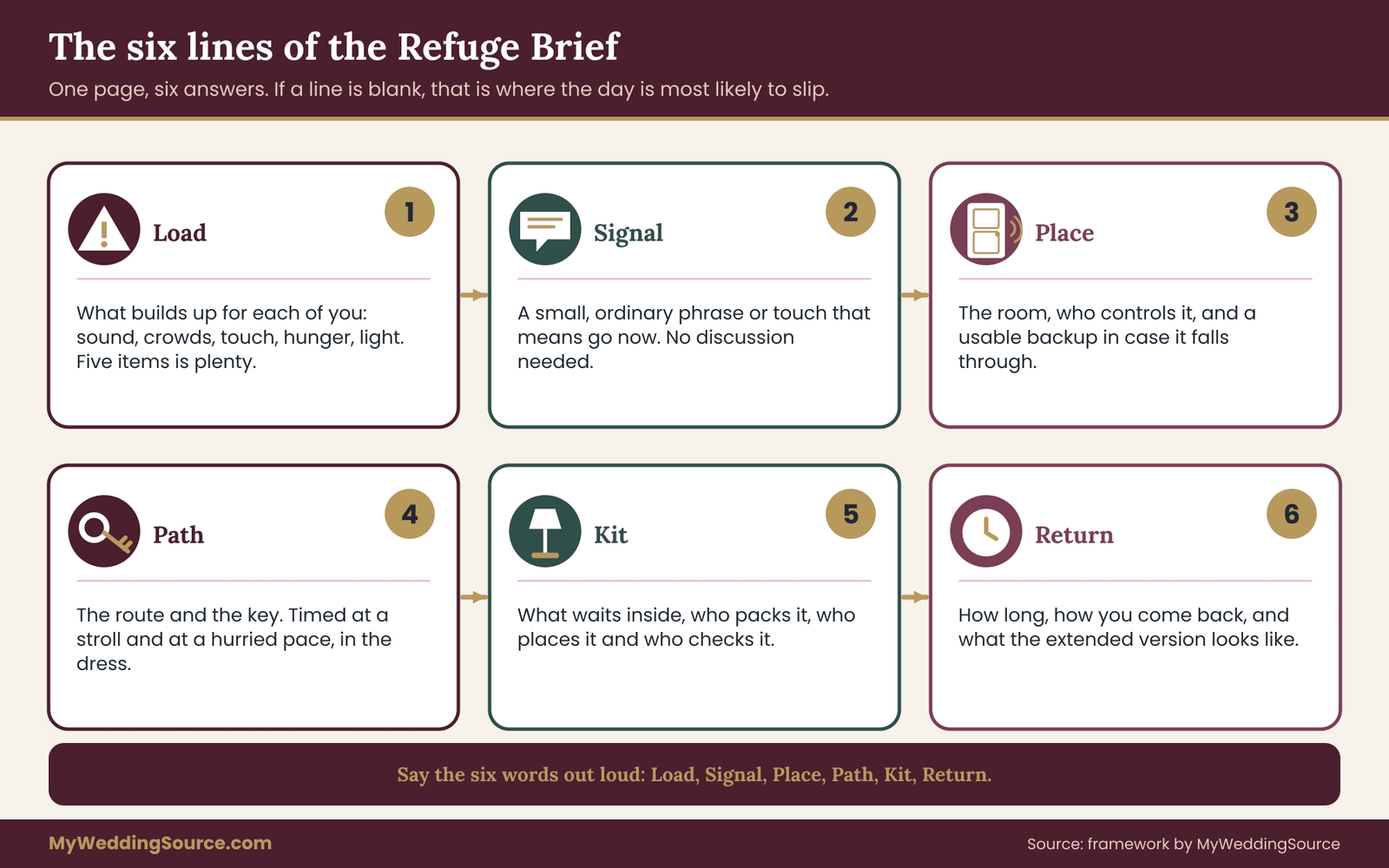
Load names what builds up during the day. Signal is how either of you says “I need the room” without a conversation. Place is the space itself. Path is the route and the key. Kit is what is inside. Return is how you come back and what happens if you do not.
The sections that follow take each line in turn. Writing the brief takes about an hour for two people who sit down together, and it can be done in pieces. It is also worth rereading a few weeks before the wedding, because venue details change.
Line one: Load
Load is the honest list of what tends to tip each of you over. It is not a diagnosis and it does not need clinical language. Write it the way you would explain it to a friend. “Loud rooms with many voices at once.” “Being touched by people I do not know well.” “Going more than three hours without eating.” “Bright flashes.” “Having to talk to someone new while another person waits for me.”
Do the list separately, then merge it. Two things usually happen. The lists overlap more than expected, which tells you where the day should be changed rather than escaped. And the lists differ in ways that matter: one of you needs silence, the other needs low light and a cold drink. A single room can serve both if you know that going in.
Include the slow loads, not just the sharp ones. Many people can handle an hour of noise and cannot handle five hours of it. Add anything that accumulates: standing, smiling for photos, remaining aware of where relatives are, managing other people’s feelings. A wedding quiet room built only for sudden spikes will be too short for these.
Keep the Load list short enough to remember. Five items is plenty. If a trigger can be avoided entirely, move it to the planning conversation instead. For example, if a loud first-dance song is on the Load list, ask the DJ about volume, or choose a different dance format, before you rely on a wedding quiet room to recover from it.
Line two: Signal
Signal is the agreed way to say “now.” It is the most overlooked line, and it is the one that makes the wedding quiet room usable in a crowded moment. If you have to explain to your partner, in public, that you need to go, you have already spent some of the energy you were trying to save.
Pick something small and boring. A phrase that sounds like ordinary conversation works well, such as “I need to check on the flowers.” A touch on the elbow works. A glance and a hand signal across a table works. A text message works if phones are in reach. Choose something that does not involve a decision from the other person beyond “yes, go.”
Agree on three things. Who can use the signal: both of you, always. What the other person does when they see it: cover, follow or stay, depending on what the signaling person wants. And what the signal means for the schedule: a request for a break, not a cancellation of what comes next.
Include a signal for the cover person too, so they know when to step in. A cover person who sees the couple walk off and has no idea whether to follow will usually either hover or lose track. A word such as “taking five” passed to them in advance clears that up.
One more point. A signal is also useful for the reverse case, when a partner sees the other one struggling and has not been asked. Decide ahead whether that is welcome. Some people want to be told gently, and some would rather be left alone until they ask. Neither is wrong. Both are easier to follow once they are written down.
Line three: Place
Place is the space. The next section explains how to test one. For the brief, you only need to record which room, who controls it, and what the backup is. A line like “Caterer’s prep office, second floor, controlled by venue manager, backup is the groom’s car in lot B” is enough.
Name a primary and a backup. Spaces fall through. A room that is booked for a vendor meal, a wedding quiet room that smells of the kitchen, a room that is a long walk from the ballroom, a room that turns out to be locked. A backup does not need to be as good, only usable.
Line four: Path
Path is the route from the places you spend the day to the Place, and the key or access that lets you in. It includes how long the walk takes, whether stairs or doors are in the way, whether the path crosses a public area where you will be stopped, and who holds the key.
Walk it before the wedding. Time it, and then add a margin for being in a dress, shoes and a crowd. A path that takes ninety seconds on an empty weekday can take five minutes during cocktail hour.
Line five: Kit
Kit is what you leave in the wedding quiet room before the day starts. A later section sorts items by need. For the brief, record the list, who packs it, who places it and who checks it. A kit nobody checks is often missing the one thing that matters.
Line six: Return
Return is how you come back. It covers how long you plan to stay, who comes to get you or whether you come on your own, where you rejoin the event, and what you do if you need more time than planned. The Return line is where the schedule and the wedding quiet room meet, and it keeps a break from turning into a missed toast.
Write two versions: the normal return and the extended one. The normal return might be “ten minutes, then back to the cocktail area through the side door.” The extended return might be “twenty to thirty minutes; the cover person tells the planner, who shifts the next block.” Having the extended version written means nobody has to improvise a delay on the spot.
Choosing the space: door, sound and light
Once the brief exists, the question becomes which room. Real venues rarely offer a perfect option, so you need a quick way to compare. The three-test method judges any candidate on door, sound and light. Each test takes a few minutes during a site visit, and all three together take less than a quarter of an hour.

The tests pair naturally with a technical walkthrough. If you are already booking one, the venue technical walkthrough guide explains what to measure and whom to bring, and the refuge check can be added to the same visit.
The door test
A door is what separates a wedding quiet room from a quiet corner. Check four things. Does it close fully, with a latch that works? Can it be closed without a loud slam? Can it be locked from inside, or at least wedged shut politely? Can it be opened from outside by venue staff in an emergency?
The last point matters for safety. A room that locks from inside but cannot be opened by staff is a problem if someone is unwell. Ask the venue how they handle this. A lock with an emergency override, or a door that stays unlocked with a sign, can both be fine. Avoid anything that traps a person inside.
Look at glass too. A door with a glass panel or a window onto a corridor is a door that guests will look through. A curtain, a screen or a sheet of paper can fix that, but it is better to know in advance.
The sound test
Stand in the wedding quiet room during a time when the venue is active, ideally during another event or a rehearsal. Close the door and listen for ten seconds. You are checking for bass from the music, voices through the wall, kitchen noise, and building systems such as air handling and ice machines.
If you cannot visit during an event, ask the venue manager when the loudest hours are and which nearby rooms will be in use. Then check from the wedding quiet room on a quiet day and make a judgment. The goal is not silence. It is a noticeable drop from the main space, with no repeated sharp noises. A steady hum is often easier to tolerate than intermittent clatter.
Bring your own measure if you like: a free sound meter app on a phone gives a rough comparison between the ballroom and the wedding quiet room. It is not a calibrated instrument, so treat the numbers as relative. The question to answer is “is it clearly quieter than where I will be?” For general background on noise and hearing, the Sources list includes federal guidance.
The light test
Light is the third lever. Check the wedding quiet room at the time of day when you will use it. Is there a window that faces west and will be bright at golden hour? Is there overhead lighting that cannot be dimmed? Are the lights fluorescent, which some people find harsh? Is there a lamp, or can you bring one?
A room that is too bright can often be fixed with a dimmer, a lamp and the overhead switched off. A room with no light control at all is harder. Ask whether the venue permits a small battery lamp, because open flames and candles are often prohibited.
Scoring and choosing
For each candidate, give door, sound and light a rating of good, workable or poor, and note what fixes would change the rating. A “workable” room with a cheap fix is often better than a “good” room that is a ten-minute walk away. Distance matters as much as the three tests.
Add one more question outside the three: does the room feel like a place you would choose to be? Some spaces pass every test and still feel institutional or cold. A wedding quiet room does not need to be charming, but it should not make the break harder. If a room fails that gut check, try a backup.
Decide before you commit whether the wedding quiet room is private, shared or hidden. A private room is yours alone. A shared room, such as the planner’s office, is available to you but also used by others, with a schedule. A hidden room is not signed and not known to guests. Most couples want hidden and private, and it is worth asking the venue directly whether that can be arranged.
Access to the wedding quiet room: path, key and timing
A good space that you cannot reach is not a wedding quiet room. Access has three parts: the physical route, the right to enter, and the clock. Each one fails in a different way, so each gets its own check.
The physical route
Walk the route from every place you will be: the getting-ready room, the ceremony site, the photo locations, the cocktail area and the reception. You do not need a different route from each, but you need to know which one is shortest and whether any of them is blocked at certain times.
Look for stairs, steps, narrow doors, heavy doors, elevators with long waits, and gravel or grass. If either of you uses a mobility aid, or wears a gown with a train, the route needs to be step-free and wide enough. The accessible venue checklist in the accessible wedding venue red flags guide is a useful reference for the questions to ask. A refuge that requires a flight of stairs to reach is not an accessible one, however quiet it is at the top.
Check whether the route crosses a public area. A short walk through a lobby during cocktail hour will be interrupted. If the only route does pass through a crowd, plan a staging point: a spot where the cover person or the planner meets you and walks with you, so you can keep moving without being drawn into conversations.
Time the route twice, once at a normal pace and once at a pace you would use if you were upset or in a hurry. Write both numbers into the brief. The second number matters, because a path that is fine at a stroll can feel impossibly long when you need to leave quickly.
The right to enter
Decide who can open the door. The simplest answer is that the couple, the cover person and one venue contact can. Everyone else knocks, or does not enter.
Get the key arrangement in writing, even if it is an email thread. Common arrangements include a physical key held by the couple or the cover person, a code lock where the code is shared with a few people, and a door that stays unlocked with a closed sign. Each has trade-offs. A physical key can be lost. A code can be overheard. An unlocked door can be opened by anyone who is curious, so it works only if the wedding quiet room is not signed and not in a place guests wander.
Confirm that venue staff will not use the wedding quiet room for storage, a vendor break or a last-minute overflow. It is common for a back room to be repurposed at short notice. A short line in the venue agreement or an email confirmation, such as “the second floor office will be held for the couple from 3:00 to 10:00 pm,” protects you. If the venue’s contract language is unfamiliar, the wedding vendor contract guide explains what to look for and what to ask to have added.
The clock
Timing has two layers: when the wedding quiet room is available, and when you plan to use it.
Availability should start before you need it and end after the last time you might. If the room is held from the time you arrive to the time you leave, you do not need to coordinate access around each use. If it is held only for certain windows, write those windows into the timeline and make sure the cover person has the timeline.
Planned use is a separate matter. It is wise to build in at least two scheduled breaks, even if you do not use them. A break after the ceremony and before photos, and a break after the main meal and before dancing, are common. They work because they are predictable and they give the cover person something to anchor to. An unplanned use is then an extra, not the only option.
Keep the breaks short enough to be easy to schedule around. A planner can absorb ten minutes of buffer. A twenty or thirty minute block needs to be visible on the timeline so that vendors who depend on you, such as the photographer and the DJ, can plan their own time. If you work with a coordinator, they can slot the block into the run of show, and the wedding vendor timeline guide is a good reference for how vendors build their own schedules around the main event.
A quick path audit
Before the wedding, run this audit with whoever will be the cover person. Starting from the ceremony site, walk to the Place without talking, and note what slows you. Then start from the reception and do it again. Then try it with someone stopping you halfway, so you can practice the polite exit line. The audit takes twenty minutes, and it tends to turn up one small problem, such as a door that sticks or a corridor with no light, that is easy to fix when found early.
Add a sign, only if the wedding quiet room is meant to be found by you and not guests. A small, plain card at the door of the route, in a place guests do not look, can point to the Place. The card does not need to say what the room is. It can say “Office” or “Staff only.” The sign is for you, and for your cover person on a day when you are not thinking clearly.
Supplies for a wedding quiet room, sorted by need
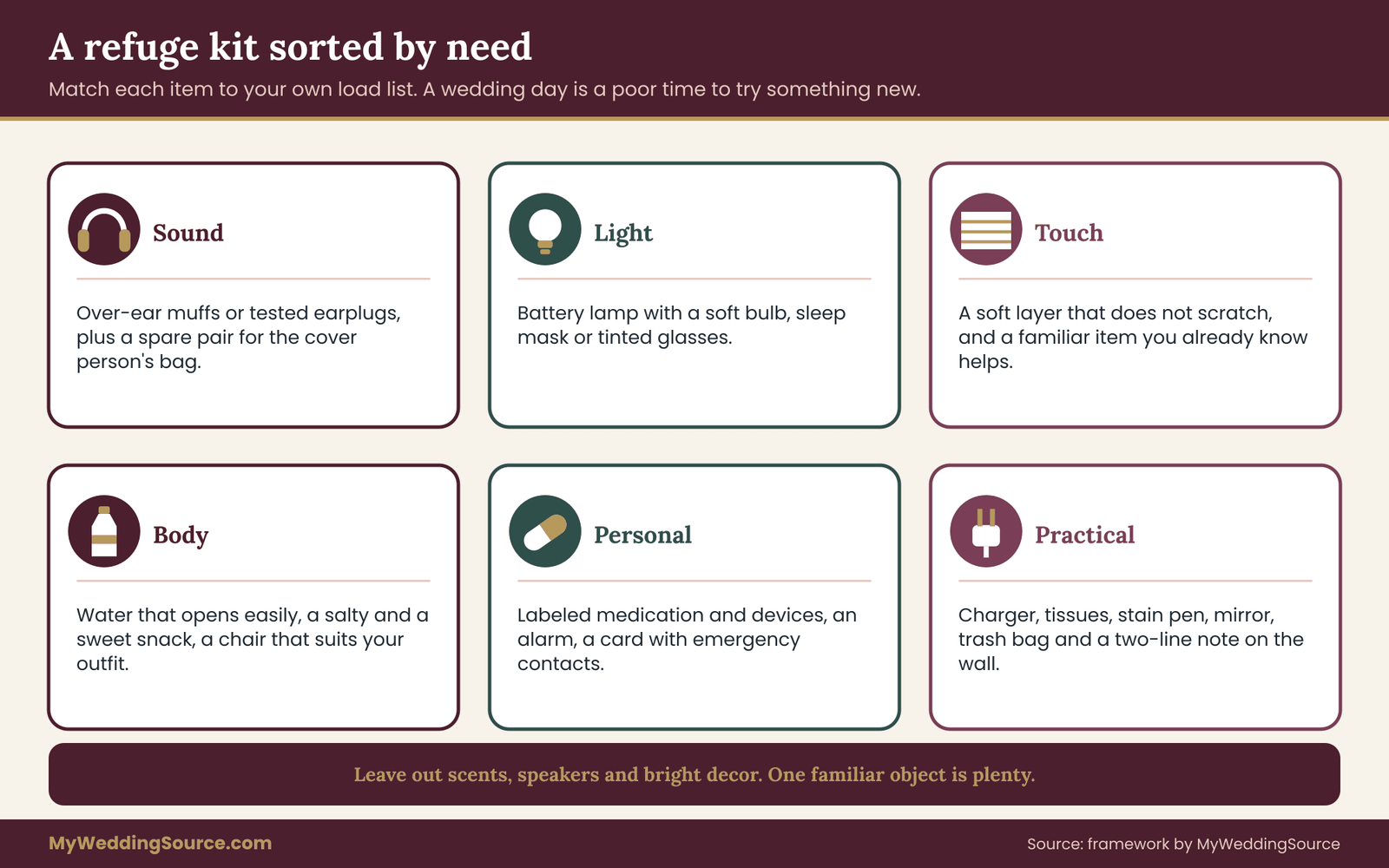
The kit is where most couples overbuild. A wedding quiet room does not need a spa. It needs a few items that match what is on the Load list, and a few that keep the room itself functional. The method is to sort supplies by need rather than by a shopping list, so you buy only what you will use.
Sensory supplies
For people who are sensitive to sound, noise-reducing earmuffs, earplugs or headphones are the main item. Over-ear options are often easier to put on in a hurry than earplugs, and they do not require a clean fit. If either of you uses specific ear protection regularly, bring that, and put a spare in the kit. Foam earplugs vary in how much they reduce, so test them beforehand.
For people sensitive to light, a lamp with a soft bulb, a sleep mask, or a pair of tinted glasses are the usual choices. A battery lamp avoids relying on the wedding quiet room’s own lighting. A throw blanket over a window can make a bright room dim.
For touch and texture needs, bring a soft layer, such as a cardigan or a wrap that does not scratch, and a change of clothing item if the day’s outfit becomes uncomfortable. A small fidget item or a weighted lap pad is something some people use and others do not. Include only what you already know helps, because a wedding day is a poor time to experiment. The same logic applies to attire: a fabric test of your outfit is worth doing in advance, rather than discovering at hour five that a seam itches.
Physical comfort supplies
These are the basics. Water, in a bottle that opens easily. A snack that you actually like and that does not stain, because it will be eaten in a dress or a suit. Something salty and something sweet is a sensible mix. If either of you has dietary needs, pack accordingly rather than relying on the caterer to bring something.
A comfortable chair matters more than most people expect. A venue office chair may be fine, or may be a hard plastic seat. If the wedding quiet room has only a desk chair, a folding chair with a cushion, or a stool, check that it works with your outfit. If either of you needs to lie down, a mat or a couch is a bigger ask, and worth raising early.
Add small repair items: a pack of tissues, a stain pen, safety pins, a small mirror, hair pins and lip balm. A room that is quiet but cannot fix a smudged cheek means another trip out to find a mirror.
Medical and personal supplies
If either of you takes medication, pack it in the original container with a label, along with any device you use, and keep it where a trusted person can find it. Do not rely on memory for timing. If a dose or a check is due during the day, set it as a phone alarm and tell the cover person. This guide does not offer medical advice and does not suggest what anyone should take. Talk to your own clinician about what to plan for a long day with travel, food, alcohol and little sleep.
Pack a short card with emergency contacts and anything a first responder or staff member should know, if you are comfortable with that. Keep it in the kit, not on display. It is easy to forget and easy to use.
If either of you has a service animal or support animal, check with the venue about their policies. The Department of Justice explains how the ADA treats service animals, and the Sources section links to it. Plan water, a place to rest and a relief area for the animal, as part of the same arrangement as the wedding quiet room.
Practical supplies
A phone charger and a spare cable. A clock or a timer, because a phone can be a source of notifications that undo the break. If screens are part of the stress, bring a paper book or a notebook. A small trash bag, because a wedding quiet room that fills with wrappers by the end of the night looks worse than it is.
A short written card for the wedding quiet room itself, kept inside, saying what the room is for and what to do when you are leaving. That card sounds silly, but it helps when someone who is tired or flustered reaches for the next step and cannot recall it. Two lines are enough: “Rest. Drink water. Back out by the side door when ready.”
What to leave out
Leave out anything that adds stimulation: bright decor, scented candles, a speaker, flowers with strong fragrance. Some of these are lovely at other moments. In a refuge, they can undercut the purpose. Also leave out anything you would be upset to lose, such as jewelry or irreplaceable items, unless the door locks and you trust who has access.
If the venue will let you decorate, a single object that is familiar and calming is plenty. A photo, a small plant, a favorite scarf. The room should feel like a break from the event, not a second event.
Who packs and who checks
Assign a person to pack the kit, a person to place it, and a person to check it before the ceremony. These can be the same person, but the check is better done by someone else. A short checklist on a card, kept with the kit, prevents the common problem of arriving to find the water missing or the headphones left at home.
Pack in one bag with a visible label. A tote that says “Refuge” in plain marker, kept with the planner or a bridesmaid, is more likely to arrive in the right room than a collection of loose items.
Who covers for you while you are in the wedding quiet room
A couple who leaves the event needs someone who keeps it running without them. That someone is the cover person, and naming one is the single most useful step after choosing the wedding quiet room. Without a cover person, every absence turns into a search party, a flurry of questions, or a quiet panic in the planner.
The cover person has four jobs: protect the door, answer questions, adjust the schedule, and bring you back if the plan says to. The jobs are small, but they need a person who is calm, trusted by both of you, and not otherwise tied up. A parent who is giving a toast in twenty minutes is a poor choice. A close friend or sibling who is not in the wedding party’s formal duties, or a day-of coordinator, usually works better.

Choosing the cover person
Look for three qualities. They should be someone you can tell the truth to, because they need to know the real reason for the wedding quiet room. They should be able to say no to other people politely and firmly. And they should be physically present for most of the event, not coming and going.
It can help to have a primary and a secondary, with the secondary taking over if the primary is busy. Both need to know the plan, and both need a copy of the one-page brief. If the day is large, a coordinator can serve as primary and a friend as secondary, so that the friend does not have to manage vendors.
Ask them in person and explain what it involves. Many people are glad to be asked and relieved to be given a clear role. A simple request works: “Would you be our cover person? It means if one of us needs a break, you make sure nobody follows us and you help the schedule adjust. Here is what we have written down.”
What the cover person says
Prepare a few short phrases, so that the cover person is not improvising under pressure. For a guest who asks where you are: “They are taking a few minutes and will be back soon.” For a relative who wants to go find you: “Let me check, and I will let them know you asked.” For a vendor with a question: “Ask me, and I will pass it on.” None of these reveals the wedding quiet room or explains why, and none of them is a lie.
The phrases should not suggest an emergency. “They are fine, just stepping out” is clear and calm. A phrase that sounds anxious will make people anxious. It also helps to practice them once with the person, since saying a line aloud makes it easier to use when someone is standing in front of you.
If someone insists, the cover person can offer a time: “They will be back in about ten minutes, and I will tell them you want to say hello.” This is kind and it ends the conversation without confrontation.
Handling relatives and the people who push
The hardest cover scenario is a family member who feels entitled to access. A parent who says “I am her mother, I will just go in” is not an unusual case. The cover person needs permission to say no, in advance, from you, and ideally they need a sentence that comes from you, not from them. Something like: “We asked for a few minutes alone, and they will come find you right after.”
Consider giving those relatives a clear role. A parent who has a task, such as greeting latecomers or helping with the gift table, is less likely to hunt for the couple. People with a job have somewhere to put their energy. It also helps to tell close family beforehand, in a general way, that you may take short breaks. They are less likely to interpret it as a problem if they have heard that it is part of the plan. If family involvement in the day is a point of tension, settle who decides what well before the wedding.
Coordinating with the planner and vendors
The cover person is not the planner, and it is worth keeping the roles separate. The planner or coordinator owns the run of show and the vendors. The cover person owns the couple’s break. They need to speak to each other. A short pre-event call or message, where the planner knows who the cover person is and the cover person knows how to reach the planner, avoids confusion.
Give the planner a clear rule for schedule changes. For example: a break of ten minutes does not change anything. A break of twenty minutes shifts the next block by the same amount. A break longer than thirty minutes means the planner calls the cover person to check.
That way, the planner is not guessing and the vendors are not waiting without information. If you use a coordinator and want a short list of roles that matter on the day, the wedding ceremony cue sheet guide shows how to assign ownership of timed items, and the same logic fits the refuge.
What the cover person should not do
They should not follow you into the wedding quiet room unless you asked them to. They should not narrate your absence to the room. They should not make decisions that are yours, such as whether to skip a part of the schedule. And they should not take the whole burden on themselves. If the cover person is doing eight other things, they will drop one, and it will usually be yours.
Equally, you can make it easier for them. Check in before the day, and say thank you after. Tell them what worked and what did not, since they may be asked again at another wedding.
A word for the partner who is not using the room
When one of you needs the wedding quiet room and the other does not, there is a quiet dynamic worth naming. The partner who stays may feel left alone in a crowd, or obliged to cover for the one who left. They may also feel guilty for not needing it. None of that is a flaw in the plan, but it should be in the plan.
Agree on what the staying partner does: stay with the cover person, step out for their own break, or keep the conversation light. Agree that the staying partner does not have to explain. And agree on whether they are welcome to join the wedding quiet room. Some couples want to share the refuge, and others want to use it alone, and either is fine if you have said so.
Putting the wedding quiet room into venue and vendor conversations
A refuge is more likely to work if the people who control the space know about it early. That means raising it in the first venue conversations, not in the final week. It also means choosing words that describe a need without making it into a medical file or a negotiation.
How to describe it
You do not need to share personal or medical information. The venue needs to know what you are asking for, not why. A clear request is something like: “We would like a private, quiet room, close to the main space, that we can use for short breaks during the event. It should have a door that closes, and ideally be unlisted to guests. Is there a wedding quiet room that could work?”
If you want to share more, you can, and it often helps. A venue manager who understands that the wedding quiet room matters is more likely to protect it. But it is a choice, and you can make it vendor by vendor. A planner and a photographer may need different levels of information. The wedding photography consent guide
Avoid language that invites argument, such as “we need an accessible room by law.” The ADA applies to many venues, and the Sources list points to the Department of Justice’s own guidance on what it covers. But in a planning conversation, a clear and friendly request works better than a legal frame, and you can bring in the legal frame only if the friendly one fails.
Questions to ask the venue
Bring a short list. Which rooms are available during the event, and which are in use? Which of them is quiet, and how far is it from the main space? Can a wedding quiet room be held for us, and can it be unlisted? Who has the key, and who else may enter? Can we place a kit in the room before the event? Is there a policy on lamps, blankets or other items? Is the room accessible, step-free and wide enough? What is the venue’s emergency process for a locked room?
Ask for the answers in an email, so that they are in writing. If the venue is flexible, ask whether the wedding quiet room can be reserved for the whole event rather than by the hour. Some venues will do this at no extra charge, and others will not, so ask early, when you can still compare. The wedding vendor due diligence checklist lists the kind of questions that are worth asking of any vendor before signing, and it makes a good template for this one.
Questions to ask other vendors
Most vendors do not need to know about the wedding quiet room, but a few do. The photographer should know when your breaks are planned and whether they are allowed in the room. The DJ or band should know the timeline, so that a break does not collide with a key song. The caterer should know when you plan to eat, so that a meal is not missed. And the florist or decor team should know not to place anything in the refuge, because it is not part of the display.
For each, a short sentence is usually enough. “We have two planned short breaks, at around this time and this time. Please do not schedule key moments that need us then.” Vendors tend to be glad of the guidance, because a clear timeline helps them too. If the timing is not obvious, ask the vendor how much notice they need for a change.
Costs and contracts
A wedding quiet room often costs nothing beyond the supplies, but there are cases where it does not. A venue might charge for holding an extra room, or ask for a staff member to be present. A hotel might sell a suite. A rental company might charge for a lounge chair or a screen. Treat these as normal line items, and ask for them in writing with a price.
Do not assume a price you have not been quoted. If the cost is meaningful, weigh it against the alternatives in a later section. Sometimes a modest cost for a wedding quiet room is the right trade, and sometimes a portable screen in a corner of the existing space is cheaper and nearly as good. The budget conversation belongs with the rest of your numbers.
Ask whether the wedding quiet room is included in the venue agreement, and if so, ask for the clause. If it is not, ask for an addendum. A refuge that exists only because of a verbal promise is a refuge that may not exist on the day.
A worked case: the Brief for Noor and Devin
The following example is invented to show how the pieces fit. The couple, the venue and the numbers are not real, and your own situation will differ. Use it as a template for the reasoning, not as a pattern to copy.
Noor and Devin are planning a wedding of about ninety guests in a converted mill. The ceremony is in a courtyard, the reception is in a large hall on the ground floor, and the building has a small second floor with offices, a library nook and a bridal suite. Noor finds loud, crowded rooms tiring, and the effect builds through the day. Devin gets migraines, which bright light and long gaps between meals tend to trigger. Neither wants to disappear for the evening. Both want a plan that lets them stay for the parts that matter.

Step one: each writes a Load list
They write their lists separately. Noor’s: many voices at once, loud music with bass, being hugged by many people in a row, and unexpected changes to the schedule. Devin’s: fluorescent or very bright light, flashes from cameras, skipping a meal, and a long stretch standing in sun.
When they compare, two items overlap: loud rooms and long stretches without a break. That tells them something useful. Even if the room works perfectly, they should ask the DJ about volume and ask the photographer about flash, so that the room is used for recovery and not for constant escape. They add those to the vendor conversation list.
Step two: they agree on a Signal
They choose a phrase that sounds like ordinary talk: “Do you want to check the flowers?” Either can say it, and the answer is always “yes, let’s go.” There is no discussion. They also agree that if one of them says “I am fine,” and the other can see they are not, the second can say the phrase for them. Noor is comfortable with that. Devin wants to be asked first. They write both rules down, and each respects the other’s.
They also agree on a text signal for moments when they are apart, a single emoji sent to the other and to the cover person. The text signal is for use only if the verbal one is not possible.
Step three: they test three spaces
On a site visit, they check three candidates against door, sound and light.
The bridal suite has a good door and good light control, but it is a long walk from the hall and it is used all morning by the hair and makeup team. They rate it workable, with a note that it is fine as a backup for the afternoon and poor for the evening.
The library nook is quiet and pleasant, but it has a glass door and no way to cover it. Guests are likely to wander by. They rate it poor for privacy.
The caterer’s office is plain, with a solid door, a lamp, two chairs and a small sofa. It is directly above the kitchen, so there is a steady hum, but not clattering. The overhead lights are fluorescent, but the lamp is dimmable. It is a short flight of stairs from the hall, with a lift available. They rate it good on door, workable on sound and workable on light, with fixes.
They choose the office as the Place and the bridal suite as the backup.
Step four: they plan the Path and the key
The route from the hall to the office is about two minutes at a normal pace. They time it at a hurried pace, with Noor in the gown and wearing shoes, at nearly four minutes, because of the stairs. They decide to request the lift as the default route and to ask the venue to keep it free of other users during the event.
The venue manager agrees to hold the office from 2:00 pm until the end of the evening, unsigned, unlocked, with a closed door. The venue’s staff will not use it. The manager holds a spare key in case of an emergency. The couple confirms this in an email and keeps a copy.
They worry that guests might find the wedding quiet room, so they ask the venue to avoid mentioning it in the tour or the printed material. They also ask the manager to let their coordinator know if anyone else is directed there.
Step five: they pack the Kit
From their Load lists, they make a kit. For Noor: over-ear earmuffs, a soft cardigan, and a printed card with two calming prompts she chooses herself. For Devin: a sleep mask, tinted glasses, a bottle of water, a salty snack, and his own medication, in a labeled pouch. For both: a battery lamp, a phone charger, tissues, a stain pen, a small mirror, a bag for trash, and a note that says “Rest. Water. Back out when ready.”
A bridesmaid packs the tote the night before, and the coordinator places it in the office at 2:00 pm and checks it again before the ceremony. The caterer agrees to leave a plate for each of them in the office fridge, labeled, in case the meal service runs late.
Step six: they choose a cover person and plan two breaks
They choose Devin’s sister, Amara, as the cover person, with the coordinator as the backup. Amara is not in the wedding party, is comfortable saying no to relatives, and knows the family well. They give her the one-page brief and agree on the phrases she uses.
They schedule two breaks. The first is fifteen minutes after the ceremony, while guests move to cocktail hour and before photos. The second is twenty minutes after the main course, before the dancing. They tell the photographer and the DJ, who adjust the timeline by a few minutes.
They also write their Return: after the first break, they come out through the side door and join the cocktail area. After the second, they come out to the dance floor, where the DJ announces the first dance. If they need more time, Amara tells the coordinator, who delays the next block.
What happens on the day
Most of the day goes as planned. They take the first break, and both come out looking steadier. At dinner, Noor notices that the noise is building and uses the signal. They go upstairs for ten minutes, and she puts on the earmuffs. They return and eat.
Then something goes wrong. A late vendor meal is set up in the caterer’s office, because the staff did not get the message. The door is open and four people are eating there when Devin goes up. The coordinator, who sees them go, steps in and moves the vendors out. It takes six minutes. In the meantime, Devin uses the bridal suite, which was the backup, and finds it dim and quiet, because the hair and makeup team has left. The break is shorter, but it is enough.
Afterward, the couple notes the lesson. The email confirmation had been sent to the venue manager, and not to the catering lead. For another event, they would send it to both. They would also place a plain sign on the door, reading “Reserved,” visible only if someone opens it. The brief did its job. It also showed where the venue’s own communication was thin, which they could not have known without writing it down.
What the example shows
Three points are worth taking from this case. First, the wedding quiet room alone is not the plan. The signal, the cover person, the schedule and the backup carried the day. Second, a modest room that is predictable beats a lovely room that is not. Third, the failure that happened was an ordinary one: a message that did not reach the person who needed it. The next section covers what to do when something like that occurs, and how to plan so that it costs a few minutes and not the evening.
Alternatives when a dedicated wedding quiet room is not possible
Some venues have no spare room. Some weddings take place outdoors, in a restaurant, in a family home or at a courthouse, where there is nothing to reserve. A dedicated wedding quiet room is one way to meet the need, and it is not the only one. The Refuge Brief still applies; only the Place line changes.
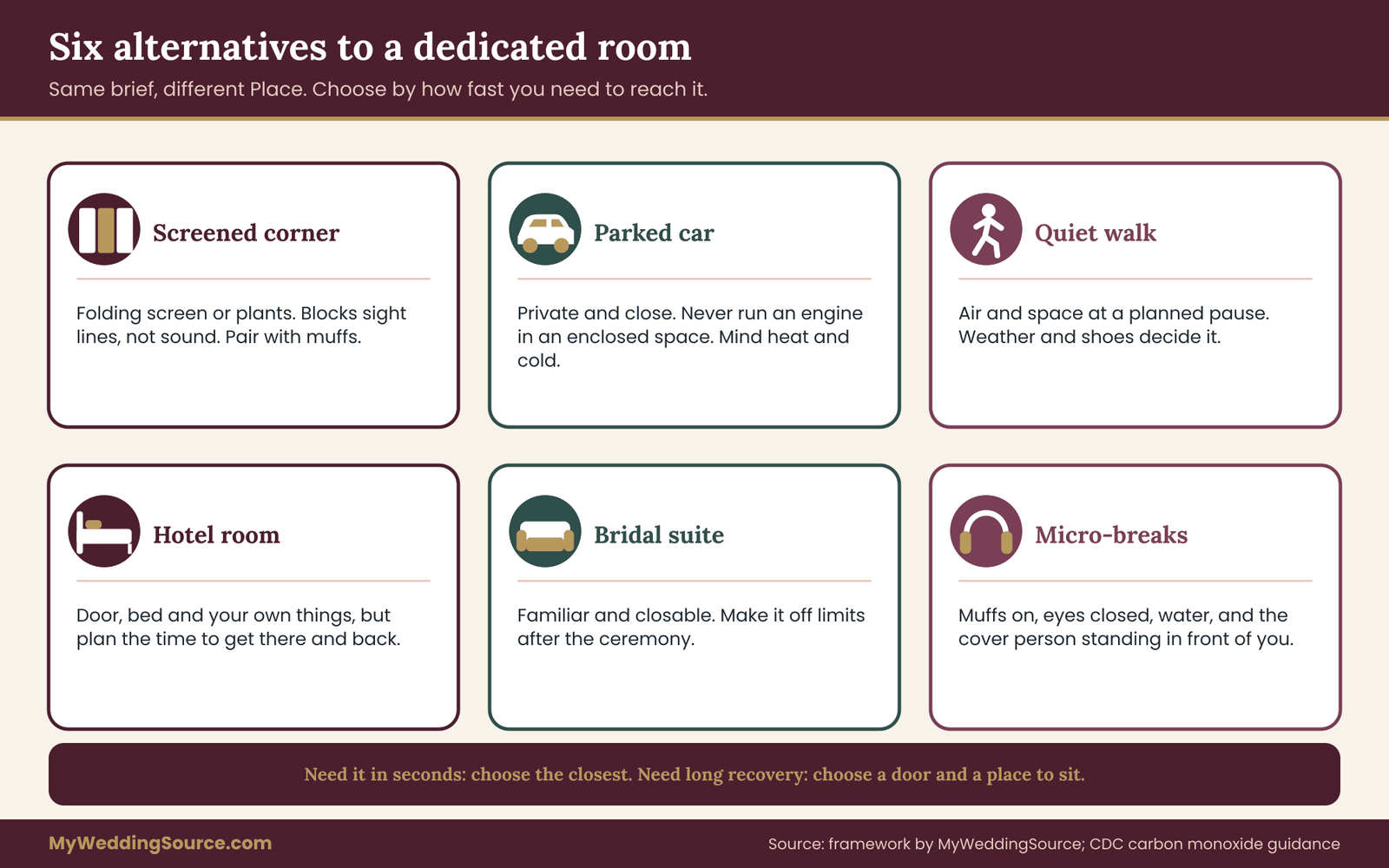
Here are the realistic alternatives, with the trade-offs for each. None of them is better in every case, and the right choice depends on the Load list, the venue and the budget.
A screened corner inside the main space
A folding screen, a pair of tall plants or a drape can make a corner of the existing room into a low-visibility seat. It is cheap and close. It does little for sound, but it blocks sight lines, which helps people who are tired of being looked at. It works best as a short stop for a few minutes, with a chair and water, and the cover person standing nearby.
The risk is that it is visible. Guests will know you are there, and will walk over. A corner placed at the edge of a service area, behind the head table, or near a side door is less likely to be approached. If sound is the main trigger, pair the corner with earmuffs, which carry the noise reduction with you.
A parked car
A car is a surprisingly good refuge. It has a door, it is private, it can be climbed into quickly, and it is usually in a parking lot a short walk from the venue. In mild weather, with the windows cracked, it offers quiet and control of light. In hot weather, it needs engine and air conditioning management, and in a cold one, heat. A car should never be left running in an enclosed space, and a person should not sit in a closed hot car, so use judgment about the weather and the location.
Plan the route and the keys. The cover person should know where the car is and who has the key. Put a small kit in the back seat, and agree on a time limit that a phone alarm can keep. A car is a good backup even when you have a wedding quiet room, because it works when the room does not.
A quiet walk outside
For many people, fresh air, space and a change of scene do as much as a closed room. A short walk around the building or along a path, with a single companion or alone, is a refuge without walls. It works best at a planned time, such as between the ceremony and the reception, when there is a natural pause.
The limits are weather, footwear, light and the possibility of being intercepted. A path that is not visible from the main space is better than one that is. If you have photographs planned in the same area, consider combining them, so that the walk does double duty. Many photographers will appreciate a calm, unhurried session.
A hotel room or suite
If you are staying at a hotel near the venue, your own room can be the refuge. It has a door, a bed, a bathroom and your own belongings, and you can control the light. The cost is the distance and the time. A trip to the hotel and back can easily take twenty minutes or more, which suits a long break between the ceremony and the reception, and does not suit a quick reset.
If the hotel is the venue, ask whether a wedding quiet room can be held for the day. Some hotels will release a room for a small fee, and others will include it with a block. Ask about the check-in time and about whether you can use the room before the official check-in. A room that is not yet ready is not a refuge.
The bridal suite, repurposed
At many venues, the getting-ready room is the obvious fallback. Its door closes, it is typically comfortable, and it already holds your things. The problem is that it is often noisy and busy in the morning, and it can become a place where attendants and relatives gather. If you use it, agree with the wedding party that after the ceremony, it is off limits unless invited.
Put a sign on it, if the venue allows. A plain “Reserved” works. The suite can work well as a second room, used for the longer break, with a different space for the quick one.
A private spot in a restaurant or a home
At a restaurant, ask the manager whether there is a back room, an office, or a corridor with a door. In a family home, designate a bedroom or a study, and tell relatives it is closed. These are small asks, and hosts are often willing, because they want the day to go well. The key point is to say it in advance, rather than hoping nobody opens the door.
When there is truly no space
Sometimes there is none. A courthouse ceremony, a crowded city venue or a small outdoor site may offer only a parking lot or a bathroom. In that case, treat the refuge as a set of actions rather than a place. Wear the earmuffs. Close your eyes for a minute. Drink water. Step to the side of a conversation with a prearranged phrase. Use the cover person to create a bubble around you for a few minutes, simply by standing a little in front of you and chatting with others.
These micro-breaks are not as restorative as a wedding quiet room, but they can be repeated through the day. The brief is the same: signal, path, kit and return, scaled to what the setting allows.
Choosing among the alternatives
Use a short rule. If you need seconds to reach it, choose the closest option, even if it is imperfect. If you need a long recovery, choose the option with a door and a way to lie or sit, even if it is farther. If you need both, plan two: a quick spot and a longer one. Most weddings with a Load list that includes both sudden spikes and slow build need the pair.
Compare cost as a final check. A dedicated room may cost nothing or a modest fee, a screen costs the rental, a hotel room costs a night, and a walk costs nothing. Weigh the price against what each option gives. A modest fee for a wedding quiet room is usually worth it when the Load list is long. If the wedding budget is tight, the free options, and a careful cover person, can do much of the job. For the wider order of decisions, the wedding planning checklist can show where a refuge decision fits among your other tasks.
Failure conditions: when the wedding quiet room does not work
Every plan should say what it does when it fails. A wedding quiet room can fail in predictable ways. Naming them in advance turns them into small problems, rather than surprises.
Failure one: the room is not available
The most common failure is that the wedding quiet room is occupied, locked or repurposed. The cause is usually a message that did not reach the right person. The fix is the backup in the brief and a venue contact who can solve it. If the cover person can reach the venue contact by text, a blocked door becomes a six-minute delay, not a ruined break.
To prevent it, send the wedding quiet room request to more than one person, and confirm it a week before. Ask for a short note on the day, from the venue contact, saying that the room is ready. A coordinator can check it an hour before the ceremony.
Failure two: someone walks in
A relative, a guest or a vendor opens the door. This is a privacy failure more than a physical one. The fix is a script. The person inside says, calmly, “I need a few minutes. I will find you afterward.” The cover person, who is not far, can reinforce it. Neither needs to apologize.
To prevent it, keep the wedding quiet room unsigned and unlisted, give the venue a clear instruction, and tell close family that you may take breaks. A quiet card on the door, such as “Reserved for the couple,” can help if the venue allows it, with the caution that a sign can also attract attention.
Failure three: the break runs long
A ten-minute break becomes forty. The usual causes are real depletion, an emotional moment, or a pleasant quiet that nobody wants to leave. It is not a failure of character. It is information. The extended Return line in the brief covers it: the cover person tells the planner, the planner shifts the next block, and a partner or friend checks in.
Do not rush a person who needs more time. At the same time, look at the schedule. If the break is regularly running long, the day may be too demanding, and a change to the timeline, such as a shorter reception or a skipped event, might be the better fix. A room is not a substitute for a realistic plan.
Failure four: the kit is incomplete
The headphones are at home, the water is missing, the medication is in another bag. The prevention is a checklist and a second person to check it. The fix on the day is a quick message to the cover person, who can find a substitute. Keep a small backup of the critical items, such as a spare pair of earplugs, in a bag that travels with the cover person.
Failure five: the room does not help
Sometimes the wedding quiet room is available, the door is shut and the break does not restore anything. The noise follows, the light is wrong, or the person is too wound up for a still room. That is a sign that a different kind of reset is needed: a walk, a conversation with someone trusted, food, or a longer pause. It is also fine to leave the event early, if that is the real need. The brief should include a line that says what that looks like, and who handles the logistics.
Failure six: the room becomes a source of stress
For some people, having a wedding quiet room creates its own pressure. They feel they must use it, or they feel guilty about leaving, or they worry what others think. If that happens, loosen the plan. The room is an option, not a duty. The cover person’s job includes reassuring you that it is fine to use it or not.
A short fallback ladder
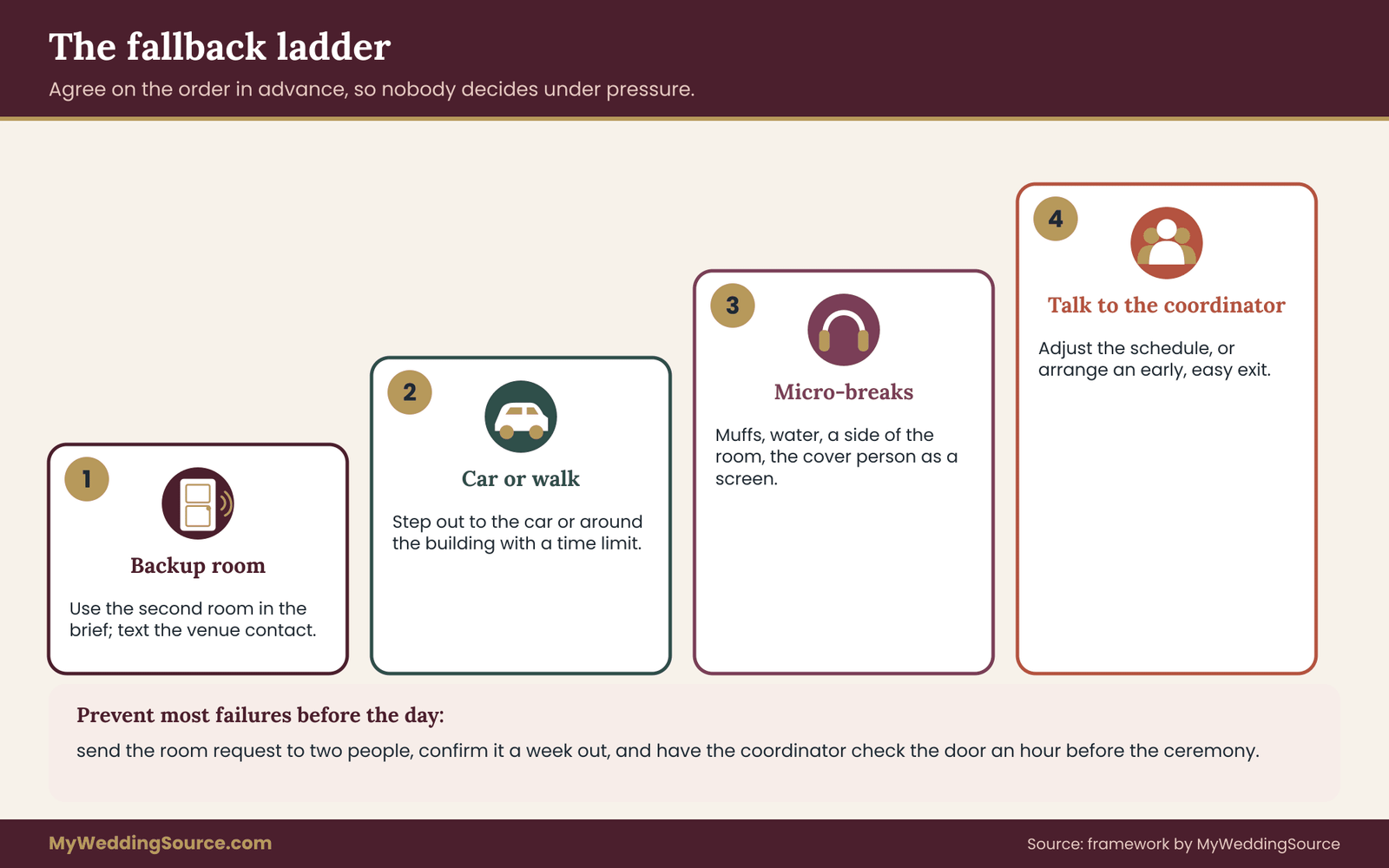
Put the failures into a simple order and agree on it. Step one: use the backup room. Step two: use the car or a walk. Step three: use micro-breaks with the cover person. Step four: if none works, tell the coordinator, who will adjust the schedule or help you leave. Having the ladder written down means nobody has to decide under pressure. Each step is a little less restful than the last, but each is available, and none requires an explanation to the guests.
Running the wedding quiet room on the day
A plan that works on paper still needs to be run. The day-of routine is short, and most of it happens before the ceremony. The goal is for the wedding quiet room to be ready, the cover person to be in place, and the two of you to be free to enjoy the day without carrying the details.
The morning check
Someone other than you confirms three things. The room is open and matches the description. The kit is inside and complete. The cover person has the brief and knows the schedule. That someone is usually the coordinator, a trusted attendant or the cover person themselves. Keep the check to ten minutes and do it before the hair and makeup is finished, so that nothing is discovered late.
Walk the path one more time with the cover person, if there is time. It is easy to skip, and it is the step most likely to turn up a locked door or a blocked corridor. If anything is wrong, use the backup, and tell the planner.
Before the ceremony
If you tend to run low early in the day, take a short break before the ceremony, even if you feel fine. It is easier to start a long event from a steady point than to repair a depleted one. Ten minutes in the wedding quiet room with the lamp on and the door closed can do more than a half hour of last-minute touches. Keep the break on the timeline, as a block, and the planner will protect it.
Eat something. Many problems that look like sensory overload or anxiety are partly hunger and thirst. A snack from the kit, eaten calmly, is a sensible use of the first break.
Between the ceremony and the reception
This is the most natural time for a longer pause. The guests are moving, photographs are being taken, and the event pauses. If you have planned a break here, use it. Go to the wedding quiet room first, then do the photographs, so that you are rested for the camera. Photographers tend to prefer this order, because people relax on their own terms and the photographs show it.
If photographs have to come first, plan a short stop partway through, at a point agreed with the photographer. Many are happy to build in a pause, and the pause often improves the pictures.
During the reception
The reception is long, loud and full of demands. Use your Signal early and often, not only when you are already depleted. A short break before you feel overwhelmed is more effective than a long break after. Most people find that two or three short pauses of ten minutes, spread over the evening, work better than one long one.
Use the planned breaks as anchors, and the unplanned ones as extras. After the main course, before dancing, is a common one. Another is after the toasts, when the wedding quiet room is busy with congratulations. A third is before leaving, to gather yourself for the send-off.
If one of you needs the wedding quiet room while the other wants to stay on the dance floor, it is fine to separate. The cover person can stay with the one who remains, or the coordinator can step in. The point is that the room serves each of you, not that you must always use it together.
Coming back
Return on your own terms and through the planned route. If you want to rejoin quietly, use the side door, and let the cover person or the coordinator know. If you want a moment of entrance, let the DJ announce you. Either is fine.
Ask the cover person for a short update when you return, if you want one: whether anything needs your attention, and whether the schedule has changed. Many people find it easier to hear “everything is on track” than to wonder.
It is also worth noting what the break did. A short mental note, “that helped,” or “I needed longer,” makes the next break better. If you plan another event, such as a farewell brunch the next day, the notes carry over.
Afterward
After the wedding, take ten minutes to write down what worked, what did not and what you would change. If you gave the cover person an extra job, thank them. If the venue held the wedding quiet room, send a short note of thanks, and mention what helped. Venues tend to remember couples who were specific and kind, and the next couple benefits.
If you have friends or relatives planning their own weddings, share the brief. A one-page document is easy to adapt, and many people are glad to see a model. You do not need to share personal details, only the structure.
Your next steps
Start with an hour and a pencil. Sit down together and fill in the six lines of the Refuge Brief: Load, Signal, Place, Path, Kit and Return. Leave blanks where you do not yet know, and circle them. Those blanks are your to-do list.
Then take three actions in the next two weeks. First, ask your venue which room could serve as a wedding quiet room, and get the answer in writing. Second, choose a cover person and give them the brief. Third, decide on two planned breaks and tell your planner or coordinator. If you are still sorting the overall order of work, the plan a wedding guide can help you place these steps among the others.
A month before the wedding, walk the path, test the wedding quiet room for door, sound and light, and pack the kit. A week before, confirm the room with the venue and send the cover person a reminder. The day before, check that the tote is packed and labeled. None of these steps is large, and together they give you something worth having: a place to stop, and a plan for getting back.
FAQ
Do we need a wedding quiet room if neither of us has a diagnosis?
No diagnosis is required. The question is whether a predictable place to take a break would make the day easier for either of you. Many people feel drained by long events, loud rooms or constant attention, and a short pause helps. If you are unsure, plan a lighter version, such as a designated spot and a cover person, and see how it feels during rehearsals and earlier events.
Is a wedding quiet room the same as a guest quiet room?
No. A guest room is usually signed, open to anyone, and run by the venue. A couple’s room is private, known only to a few people, tied to the schedule and protected by a cover person. Some weddings have both. If a guest room is also needed, plan it as a separate space so that guests do not wander into yours.
How long should breaks in the wedding quiet room be?
There is no standard. Many couples plan short breaks of ten to fifteen minutes and one longer pause of twenty to thirty minutes between the ceremony and the reception. The right length depends on your Load list and the schedule. Write a normal return and an extended return in your brief, so that a longer break shifts the schedule without a scramble.
What if the venue has no spare room?
Use an alternative that fits the setting: a screened corner, a parked car, a hotel room, the bridal suite repurposed, or a quiet walk. The brief works with any of them. If nothing is available, plan micro-breaks with a cover person and a kit that travels with you, such as earmuffs, water and a snack, and a signal you both understand.
Who should be the cover person?
Choose someone calm, trusted by both of you, who can say no politely and who will be present for most of the day. A sibling, a close friend or a coordinator often fits. Avoid someone with a heavy role, such as a person giving a toast. Name a backup, give both the one-page brief, and practice a few short phrases they can use with guests.
Do we have to tell the venue or vendors why we want the room?
No. You can describe what you want, a private quiet room with a door that closes, without sharing personal or medical details. Share more only if you want to, and only with those who need it. A clear, friendly request usually works. If a venue says it cannot help, you can ask for the reasoning in writing and check the current ADA guidance.
What should go in the kit?
Start with what matches your Load list: ear protection, a lamp or sleep mask, water, a snack, a soft layer, tissues and any personal medication or devices you use. Add a charger and a short note that says what the wedding quiet room is for. Leave out scents, speakers and decor that adds stimulation. Pack it in one labeled bag and have someone check it.
What if the room is taken on the day?
Use the backup written in your brief, and tell the cover person, who can reach the venue contact. The fallback ladder is: backup room, then a car or walk, then micro-breaks, then a conversation with the coordinator about adjusting the schedule. Prevent it by confirming the room in writing with more than one person and checking it an hour before the ceremony.
Sources
- Americans with Disabilities Act, U.S. Department of Justice
- ADA requirements for businesses open to the public and places of public accommodation, U.S. Department of Justice
- Service animals, U.S. Department of Justice, Civil Rights Division
- 2010 ADA Standards for Accessible Design, U.S. Department of Justice
- U.S. Access Board, accessibility guidelines and standards
- Autism spectrum disorder, Centers for Disease Control and Prevention
- Autism spectrum disorder, National Institute of Mental Health
- Noise-induced hearing loss, National Institute on Deafness and Other Communication Disorders
- Noise and occupational hearing loss, National Institute for Occupational Safety and Health
- Carbon monoxide poisoning, Centers for Disease Control and Prevention