
A backyard wedding parking plan answers one question before anything else: where will every vehicle go, legally and safely, without making the neighbors pay for your day? This guide gives you a parcel-aware worksheet that turns guest counts, driveway space, curb rules and shuttle options into a single decision, with one worked case and clear conditions for when the plan has failed.
Count vehicles, not guests. Measure what your own parcel can safely hold, then count only the legal curb spaces within a short walk. Subtract both from peak demand, and the gap is the number you must solve with a shuttle, an offsite lot, valet or a smaller guest list. Check the street rules and any homeowners association rules with the office that issues them. If the gap is larger than your fallback can move in the arrival window, change the plan before you send invitations.
Backyard wedding parking is the part of a home wedding that nobody pictures. Couples picture the arch, the lights, the long table on the lawn. Then the first guests turn onto the street at ten minutes to four, the second car stops to ask where to go, and a caterer’s van is still blocking the driveway.
By the time the ceremony begins, a dozen cars are on the grass, two are across a neighbor’s mailbox, and the grandmother who was promised a spot near the gate is walking three blocks in dress shoes.
Almost all of that is predictable, and most of it can be calculated in an evening. A backyard wedding parking plan is not a map with a few arrows on it. It is a short piece of arithmetic, a few phone calls to the offices that set the rules, and one honest decision about what to do with the gap between the cars you expect and the spaces you actually have.
This article is built around a seven-line worksheet. Each line produces one number or one yes-or-no answer, and the lines build on each other. You will count vehicles, measure the parcel, count legal curb space, weigh neighbor impact, price the alternatives, and write down the conditions under which you will change course. A worked case near the end runs the whole sheet for an invented couple so you can see how the numbers behave.
A note on scope. This is general planning information, not legal, insurance or engineering advice. Parking, street, noise, fire access and homeowners association rules differ by city, county and neighborhood, and they change, so each section tells you which office to ask and what to ask it.
Why backyard wedding parking fails differently from venue parking
A wedding venue with a lot has already answered most parking questions for you. The lot has a known number of stalls, a surface designed for cars, marked lanes, lighting, drainage and a fire access route that someone approved. An attendant or a manager has seen a wedding of your size before. When something goes wrong, there is a person whose job it is to fix it.
A house has none of that. A residential lot was designed for the household that lives there, usually two to four vehicles, and the street in front of it was designed for the same households plus the occasional delivery truck. Eighty guests arriving within the same forty minutes is a load the street was never built for, and the neighbors who share that street did not agree to carry it.
That difference changes what a good plan looks like. At a venue, the question is usually “is there enough parking?” At a private home, the question splits into four, and each one has a different owner.
Capacity. How many vehicles can your parcel hold without damage, blocked emergency access or a stuck car? This is a physical question about driveways, grass, gravel, slopes, soil and whatever sits underground.
Legality. How many vehicles may park on the street near your home on that date and time? This is a rules question owned by the city, county, a homeowners association or a private road owner.
Neighbor impact. What happens to the people who live nearby when forty extra cars arrive and leave? This is a relationship question, and it is the one that comes back to you the following week.
Throughput. Even if the spaces exist, can guests get in and out of them in an orderly way in the time you have? Cars that arrive in a ten-minute spike need a different plan than cars spread over an hour.
Venue parking answers these questions in advance. Backyard wedding parking asks you to answer them yourself, which is why a worksheet helps more than a general rule of thumb. The same thirty cars can be fine on one street and a problem on another, depending on driveway cuts, hydrants, hills, whether the street is a through road and whether the neighbors are home.
There is a second difference that is easy to miss. Venue parking problems tend to show up as inconvenience. Backyard wedding parking problems can become safety problems, because a crowded residential street is also the route an ambulance or fire engine would take. In a backyard wedding parking plan, a car parked too close to a corner, a driveway or a hydrant is not just rude.
In many places it is a cited violation, and in the worst case it slows an emergency response. That is why the worksheet treats emergency access as a hard limit rather than a courtesy.
If you have not yet decided whether your property can host a wedding at all, the broader venue decision belongs in the wedding venues guide, which covers capacity, cost and the questions to ask before you commit to a site. This article assumes you have decided to hold the event at a private home or yard and need to solve parking specifically.
The seven-line worksheet at a glance
The worksheet is short on purpose. You can fill it in on paper at the kitchen table, and you can hand it to a family member or a coordinator without explaining a whole system. Each line is lettered so you can refer to it in conversation: “line D is short by eleven” is a faster sentence than a paragraph of worry.
Line A: Peak vehicle demand. The number of guest vehicles you expect at the moment the most cars are present, which is usually the ceremony or the start of dinner. It is built from your confirmed guest count, an honest guests-per-vehicle ratio and a small buffer.
Line B: Service vehicles. Caterer, rentals, florist, photographer, band or DJ, officiant, and any helpers. These arrive earlier than guests, some stay all night, and some need to be near the work area. They are counted separately because they compete for the best spaces.
Line C: Parcel capacity. The number of vehicles your property can hold safely: driveway, garage apron, gravel pad, side yard or lawn, minus any area you must keep clear.
Line D: Legal curb capacity. The number of spaces on the surrounding streets that are legal on the date and time of the wedding and within an acceptable walk.
Line E: Neighbor impact. A short rating of how the load falls on the households nearby, and what you have agreed with them.
Line F: The gap. Lines A and B, minus lines C and D. If the number is zero or negative, you may be done. If it is positive, the gap is what a shuttle, offsite lot, valet or guest-list change has to cover.
Line G: Failure conditions. Written triggers that say, in advance, when you will switch to the fallback, and the date by which you must decide.

The order matters. Many couples building a backyard wedding parking plan start at line F, guess that “we’ll need a shuttle,” and then price vans before they know whether the gap is four cars or forty. A shuttle sized for forty cars is expensive and may be unnecessary. A shuttle skipped for a gap of forty is how guests end up on a neighbor’s lawn. Doing lines A through E first turns a vague worry into a number you can buy a solution for.
The sheet also protects you from the opposite mistake. Some couples assume the street will absorb everything because “people always find somewhere to park.” Sometimes that is true, but it is a claim you can test. Walk the block, count the legal spaces and compare the total with line A. A test takes an hour and may save a bad afternoon.
Finally, the backyard wedding parking worksheet is meant to be revisited. Lines A and B change when the guest count changes, line C changes with the weather and the ground, and line D changes when a neighbor mentions a block party or a road crew. Plan to fill it in once early, update it when you have final RSVPs, and check it one more time a few days before the wedding. The remaining sections take the lines one at a time, starting with the number that drives everything else.
Line A and B: count vehicles, not guests
The first number in any backyard wedding parking plan is peak vehicle demand, and the mistake that spoils it is dividing the guest count by a round number. Guests do not arrive in uniform groups. A table of college friends may come in one rideshare. A family of five may fill a minivan. A couple in their eighties may drive alone because one of them left early last time. The right ratio depends on who is coming, and you know your guest list better than any rule of thumb.
Build the ratio from the list, not from a formula
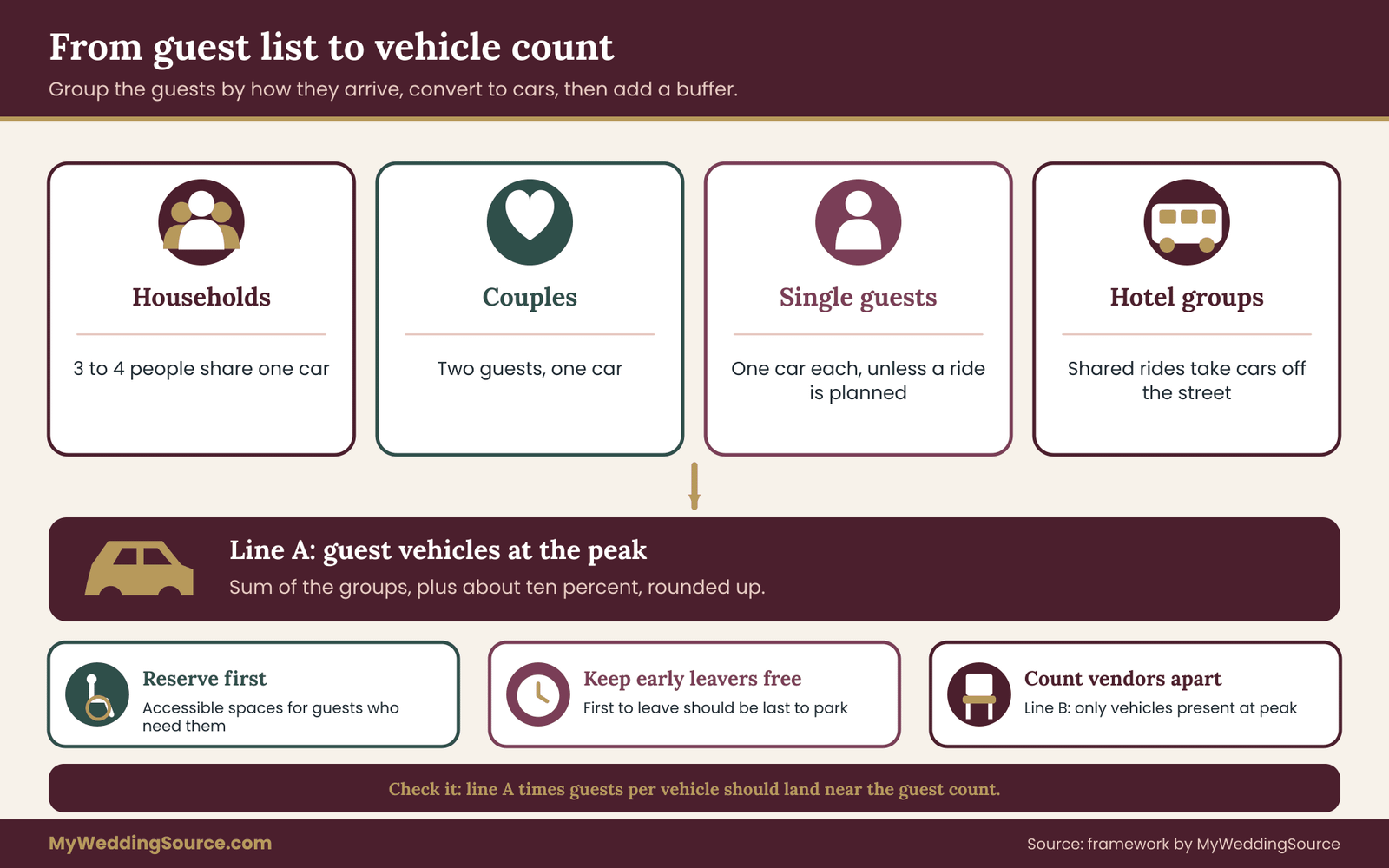
Take your confirmed or likely guest list and sort it into rough arrival groups. You do not need to be exact. Three or four groups are enough.
Households and families. Parents with children, grandparents, and siblings who live together usually share a vehicle. A household of four is one vehicle, not four people looking for a space.
Couples and pairs. Most partnered guests arrive together, so two guests is one vehicle.
Single guests. Friends and coworkers who attend alone will sometimes carpool, but many drive themselves, especially if the wedding is far from where they live. For a first pass, treat single guests as one vehicle each unless you know of a planned carpool.
Out-of-town guests. People staying at a hotel may arrive together in a rental car, in a rideshare, or in a shuttle if you arrange one. If a hotel is nearby, this group is the easiest to take off the street entirely. The guide to coordinating guest hotels covers how to keep that group together, and a shared pickup from the hotel is a natural place to start.
Count the groups, convert each to vehicles, and add them up. The result is a number built from your list, and it usually comes out lower than the lazy estimate of one car for every two guests, because families and carpools compress the count. It may also come out higher if your guests are mostly young adults who drive separately. Either way, you are working from the actual people.
Account for the people who will not carpool
Three kinds of guests need their own vehicle regardless of how the rest of the list sorts out, and each needs a plan rather than a guess.
Guests who must leave early. A parent with a babysitter waiting, someone with an early shift, a guest who gets tired in the evening. These guests need a space that is easy to exit, not one that is blocked in by later arrivals. If you are using tandem driveway spaces or a field with rows, put them in the first position to leave, which usually means the last position to arrive.
Guests with mobility needs. Someone who uses a walker or a wheelchair, or who cannot walk a long block, needs a space close to the entrance and a surface they can cross. Section four returns to this, because it affects how you use the driveway.
Guests who will drink. This is a plain safety point. If alcohol will be served and the nearest legal parking is a long walk from a dark street, some guests will be tempted to drive home when they should not. A backyard wedding parking plan that includes a rideshare pickup area, a last-ride shuttle or a hotel connection is part of a responsible parking plan, not a separate one.
Add a buffer to backyard wedding parking demand, and say why
Add a buffer to the guest vehicle count, and treat the buffer as a deliberate number rather than a vague cushion. Ten percent is a reasonable starting assumption for a list with a firm RSVP count. Use more if the RSVP count is soft, if you expect plus-ones that were not on the list, or if the wedding is open to children whose parents sometimes bring extra relatives. Use less if you have a seated, ticketed-style dinner with a name on every chair.
Round up. If the arithmetic gives you thirty-six and a half vehicles, the number on the sheet is thirty-seven, not thirty-six.
Line B: service vehicles in backyard wedding parking are a different kind of demand
Vendors do not behave like guests, and mixing them into one count hides the problem. They arrive early, often hours before the ceremony. Several of them need to park close to the work area because they carry heavy or fragile equipment. Some leave before the ceremony and some stay until the last song. Their presence is a schedule, not a single number.
List each vendor that will arrive by vehicle and note three things: when it arrives, how long it stays, and whether it needs to be near the house or yard. A typical list for a backyard event might include a catering van or truck, a rental delivery vehicle and its pickup the next day, a florist, a photographer and a videographer, a band or DJ with equipment, an officiant, bartenders or servers, a cake delivery, and a few friends or relatives who are helping.
For many of these, the service vehicle count is lower than it looks because several deliveries are complete and gone before the first guest arrives. The vehicles that matter for the sheet are those still present at peak: usually staff, the band, the photographer and a caterer’s van that stays on site. Count those in line B and keep the early deliveries on a separate arrival list so you can sequence them.
Ask each vendor directly. A caterer can tell you how many vehicles they bring, how large they are, and whether they need access to a kitchen door or a side gate. Rental companies can tell you the truck size, which matters because a long box truck will not turn around in a cul-de-sac or back into a narrow driveway.
The wedding vendor timeline is a good place to line these arrivals up with the rest of the day, and a short written arrival schedule shared with every vendor prevents the most common conflict: two large vehicles trying to use the same gate at the same time.
Reserve the best backyard wedding parking spaces on purpose
Before you count what is left for guests, decide who gets the best spaces. In nearly every backyard setup, the closest spaces are scarce, so reservation is a real decision.
A sensible order of priority is accessible parking for guests who need it, then the caterer’s van if it must stay near the work area, then the couple’s family members who are carrying things or helping, and then everyone else. Put the backyard wedding parking order on paper, because it will be tested at four in the afternoon when someone asks to park “just for a minute” in the best spot.
A short script for confirming the ratio
If you are unsure about the guests-per-vehicle ratio for your backyard wedding parking count, ask. A sentence in an RSVP follow-up or a group message works well and sounds ordinary:
“We are planning parking and want to make sure there is room for everyone. Do you expect to arrive in one car, and will you be staying for the whole evening?”
Guests tend to answer honestly when the question is framed as logistics. A handful of replies from your largest groups is enough to correct the ratio. Nobody needs to be surveyed for a month.
What the vehicle count gives you
At the end of this part, you should have two numbers. Line A is the peak count of guest vehicles with the buffer included. Line B is the count of service vehicles still present at peak, plus a separate arrival schedule for the ones that come and go. Together they tell you how many spaces the rest of the sheet has to find. The figure below shows how the count is built from the guest list.
A last check on your backyard wedding parking numbers before moving on. If line A plus line B is very small, say under ten vehicles, your driveway and a few curb spaces may handle everything and the rest of the worksheet becomes a quick confirmation. If the combined count is large relative to the size of the property, you already know the later lines will matter, and it is better to learn that now than at the ceremony.
Either way, the next step is the same: measure what the parcel can actually hold.
Treat these backyard wedding parking numbers as working figures rather than promises. The guest count will move. People who said yes will cancel, and a few who said no will turn up with a cousin. That is why the buffer exists, and why the worksheet asks you to revisit line A when final RSVPs arrive. A backyard wedding parking plan that was built on a firm number and updated twice is far more reliable than one built on a single early estimate and never touched again.
One more habit helps. Write down how you arrived at each number, in a line or two next to it. When you revisit the sheet three weeks later, “thirty-seven, from twenty-three households and eight singles with a ten percent buffer” tells you exactly what to change when two households cancel. A number with no note beside it forces you to rebuild the work.
Line C: measure what the parcel can safely hold
Parcel capacity is the line couples overestimate most. A driveway looks long when it is empty. A lawn looks generous when you stand on it with a coffee. Neither picture accounts for turning room, gates, soft ground, buried lines or the strip you must leave open for an emergency vehicle. This section replaces the eyeball estimate with a short measuring routine for backyard wedding parking.
Start with the planning stall
For a first pass, use a planning stall of about nine feet wide by eighteen feet long for an ordinary car. That is a common planning figure for a single marked space, and trucks, large SUVs and vans need more. Informal parking, with no painted lines and no one directing, is always less efficient than marked parking, so build in slack.
A practical habit is to count the length of a row in the driveway or yard, divide by the stall length, and then subtract one vehicle from the result to leave room to maneuver.
Do not rely on a tape measure alone. Pace the area, then drive a car through it with a helper watching. You will quickly learn that a driveway that is twenty feet wide at the street narrows at the garage, that a gate swing blocks the second space, and that a slope makes the last position unusable when the ground is damp.
Walk the parcel in five zones before you plan backyard wedding parking
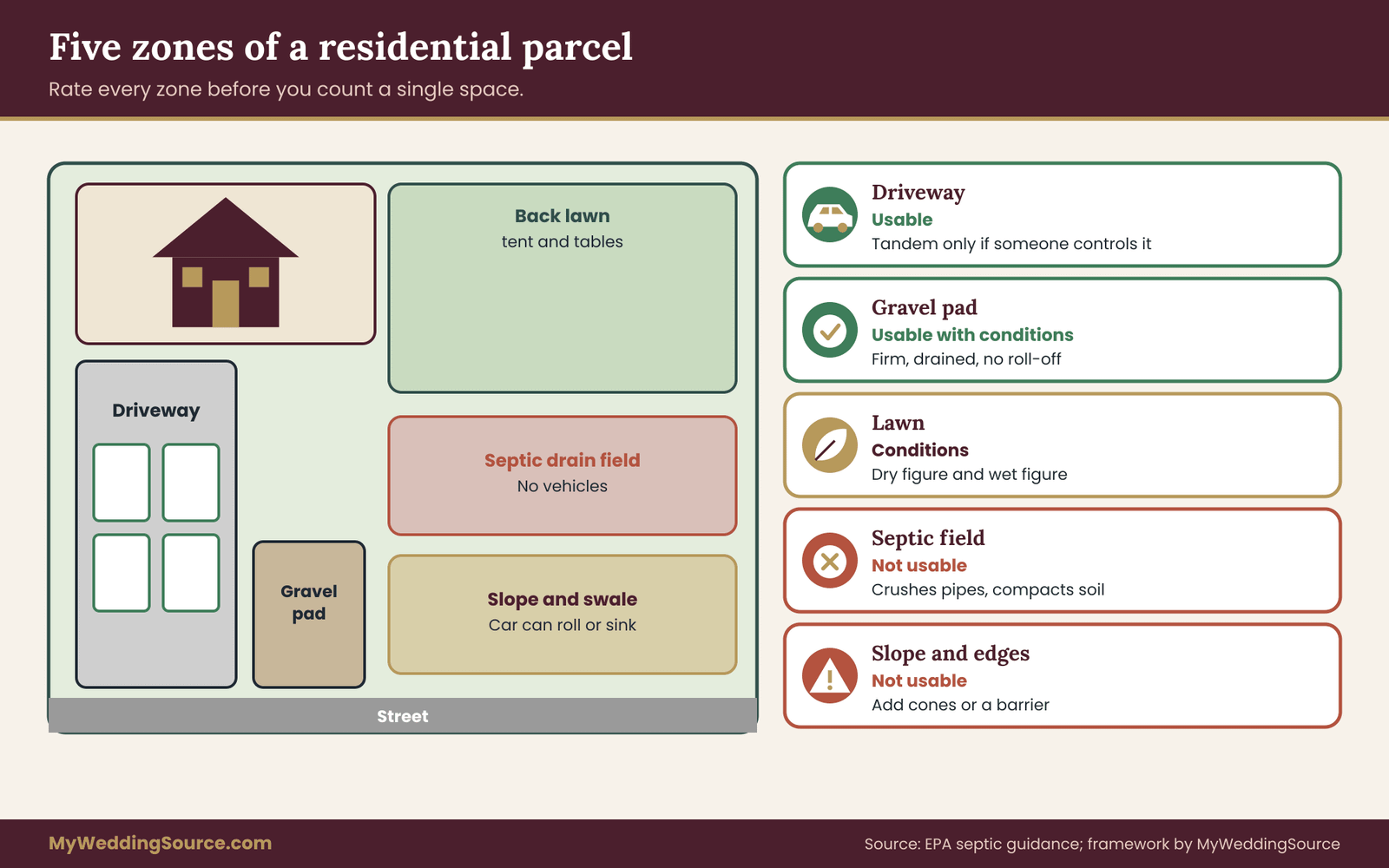
Divide the property into zones and rate each one as usable, usable with conditions, or not usable.
The driveway and garage apron. This is the most reliable surface. Count tandem spaces, meaning one car behind another, only if you can control who parks where, because the car in front is blocked in. Tandem works well for the household’s own vehicles and for vendors who will stay all evening. It works poorly for guests who may want to leave early.
A gravel pad, side yard or secondary drive. If you have a firm surface that is not part of the planting or drainage, it may hold vehicles. Confirm it can bear weight and that cars cannot slide onto an adjacent lot.
The lawn. Grass is the tempting overflow and the riskiest. Turf can hold a car in dry weather and turn to ruts in wet weather. Irrigation heads, shallow lines and soft spots under the surface can be damaged. Cars parked on grass also leave oil and compressed ground that shows for weeks, and many couples find that the lawn they wanted for photos is the lawn they ruined for them.
If you plan to use grass, decide in advance on a wet-weather rule, such as “no lawn parking if the ground gives under a heel,” and name who makes the call.
The area over a septic system or other buried systems. If your property has a septic tank or drain field, do not park or drive over it. Heavy vehicles can crush pipes and compact the soil that treats wastewater, and repairs are costly. The Environmental Protection Agency’s septic guidance says as much, and your county health department can tell you where the components are if you do not already know.
A dedicated discussion of septic limits for large gatherings is a separate topic, but for the parking worksheet the rule is simple: mark it as not usable and tell every vendor.
Slopes, ditches and edges. A steep slope, a drainage swale, a retaining wall or a pond edge is a place where a car can roll or sink. Treat these as not usable for parking, and consider a barrier or cone line so that a guest following a hand signal does not turn into one.
Protect the emergency access lane
Whatever you fit on the property, keep a clear path for emergency vehicles. Fire codes commonly call for an unobstructed access road of around twenty feet wide for fire apparatus on commercial and larger sites, and a private home hosting a crowd is a good time to think the same way even if the formal code does not apply.
Your local fire marshal or fire department can tell you what applies to your address and whether an event of your size triggers any review. Call the non-emergency line and ask a plain question: “We are hosting a wedding at our home with about this many guests. Is there any access or parking requirement we should plan for?”
In practice, the lane rule means three things. Do not park in a way that blocks the street end of the driveway. Keep the route to the house, to the gas and electric meters and to any gate clear. And do not allow a vendor’s truck to become a wall between the street and the party.
Consider the neighbors’ side of the property line
A guest who parks across your boundary is in your neighbor’s driveway or yard. A guest who blocks a mailbox is interfering with a household’s mail. If your property shares a driveway or an easement with a neighbor, check the paperwork before assuming you can use it. Shared access often comes with conditions about blocking, and you do not want your caterer discovering that on the day.
Plan for ground conditions, not just the forecast
Parking surfaces change with weather, so the sheet should carry two capacities: a dry figure and a wet figure. A property that holds twelve vehicles on dry ground may hold six on saturated ground, and the difference is rarely small. Check the forecast several days ahead and again the morning before, using the official forecast from the National Weather Service, and be ready to move the lawn rows to the street or to your alternative if rain has been heavy.
A wet-ground capacity figure in advance is the difference between a calm decision and an emergency one.
A cheap way to build the wet figure is to ask, “Which of these zones would I be willing to drive a loaded car across after two days of rain?” Mark the zones that fail that test and subtract them.
Accessible backyard wedding parking and the route from the space
Guests who use wheelchairs, walkers or canes need a space close to the entry, a firm and level route and, for some, extra room beside the vehicle to deploy a ramp or lift. At a private home, the ADA’s public accommodation rules generally do not apply in the same way as at a commercial venue, but the design guidance from the U.S.
Access Board and the ADA National Network is still a useful model for what works: a firm, stable, slip-resistant route, a level area beside the vehicle, and no steep slope between the space and the gate.
Reserve a small group of spaces for this purpose, label them and keep them for the guests who need them. How many you reserve should come from your RSVPs, not from a formula: ask on the invitation or in a follow-up whether anyone needs accessible parking. The guidance on older and mobility-limited guests covers how to ask without singling anyone out and how to plan drop-off at the gate so that a guest can be dropped near the entry even if the car must park farther away.
A drop-off point is often the most useful accessibility measure in a backyard setting, because it works for every guest who cannot manage a long walk, whether or not they have a placard.
Mark and count what you can actually use
When you have walked the zones, write a single capacity figure for each. A sample might read: driveway, six vehicles including two tandem pairs; gravel pad, two vehicles; lawn, zero, because of irrigation and a slope; side yard, not usable, because it covers the septic field. Add the usable zones, take out the accessible spaces you have reserved for guests, take out any spaces reserved for vendors who must stay, and the remainder is your line C for general guest parking.
A few cautions keep the number honest. Do not count the same space twice, for instance a driveway spot reserved for the caterer and also counted for a guest. Do not count a space that requires a car to move for another to leave unless someone will be there to manage it.
And do not count a space that depends on a gate that will be closed for the ceremony. If you are not sure whether a space qualifies, leave it out and treat it as a bonus if it works on the day.
What else the parcel has to do besides backyard wedding parking
Backyard wedding parking competes with the wedding for space. Every vehicle on the lawn is a square of grass that is not a dance floor, a tent footprint or a food station. If you have a tent, a catering area, a portable restroom delivery and a band, the usable parking area may shrink a great deal because those things need access lanes as well.
The venue technical walkthrough guide explains how to measure access routes and vendor needs, and it is worth using alongside this worksheet: a walkthrough with the caterer and the rental company often reveals that the driveway you counted for guest cars is the only path a delivery truck can use.
What line C tells you
When the parcel is measured honestly, most couples planning backyard wedding parking find that line C is smaller than they hoped and that it is rarely the whole answer. That is not a failure. It is the reason the next lines exist. A parcel that holds six or eight vehicles is a normal outcome for a house on a suburban lot, and a plan that accepts it can turn to the street and the alternatives without disappointment. The figure below summarizes the five zones and how to rate them.
Write the final backyard wedding parking number on the sheet along with the wet-weather figure and the names of anyone who has to approve or manage the use of the ground. Then move to the street, where the rules are set by someone other than you, and where the most common backyard wedding parking mistake happens: assuming the curb in front of the house is free for the taking.
Line D: street rules for backyard wedding parking
Street parking is where most backyard wedding parking plans quietly rest, and it is the part with the least certainty, because the rules belong to someone else. The curb in front of your house is usually public, which means anyone may park there within the posted rules, and you do not control it. That cuts both ways. You cannot reserve it for your guests, and you may not be able to stop a neighbor’s visitor from using it. It also means you cannot assume it is available at all.
Find out who owns the street
Start with a simple question: who is responsible for the road in front of your home? In most towns it is the city or county, and the traffic or public works department posts the rules. In some neighborhoods it is a private road maintained by a homeowners association or a road association, and the association sets its own limits.
In rural areas it may be a state road, a township road or a private lane, each with different owners. A call to the city or county office that handles streets, or a look at your property records, answers this quickly.
The federal government’s main portal, USA.gov, is a good starting point for finding the right local office when you do not know it. From there, look for the city or county transportation, traffic or parking enforcement department, and the police non-emergency line.
Read the backyard wedding parking rules for the date and time
Parking rules vary, and a handful are likely to affect a wedding.
Posted time limits and permit zones. Some residential streets limit parking to residents with permits, or limit visitors to a few hours. A guest who arrives at three and stays until eleven may be over the limit. Ask whether visitor permits or temporary guest passes are available for special events.
Street cleaning and snow rules. Some cities restrict parking on certain days or after a snowfall. Check the calendar for your date.
Overnight restrictions. If your reception runs late, or if you expect guests to leave cars until morning, an overnight parking rule can lead to tickets or towing. Say so in your guest communication.
Restrictions near driveways, corners and hydrants. Many places prohibit parking within a certain distance of a fire hydrant, a crosswalk, an intersection or a driveway. The distances differ by jurisdiction, and the federal Manual on Uniform Traffic Control Devices gives the framework for signs and markings that states and cities adopt in their own versions. Do not assume a distance. Ask the traffic office what applies on your street, and measure it.
Parking on both sides. Some narrow streets allow parking on only one side, or require a minimum clear width. If the street is narrow, parking on both sides may block emergency vehicles even where it is technically allowed.
Event or temporary-use rules. Some jurisdictions have a permit for a private gathering that affects public space, such as temporary no-parking signs, a street closure or a loading zone. Not all do. If you are considering reserving curb space for vendors, ask whether a permit exists and what it costs. Do not post your own “No Parking” signs on a public street: in many places that is not allowed, and a fake-looking sign may lead to a complaint.
Count curb spaces for backyard wedding parking
Counting spaces by eye overestimates the curb. A routine produces a defensible number for line D.
- Walk the streets within the walking distance you consider acceptable. A common comfort limit for a mixed-age guest list is a few hundred yards, and the right number is shorter on a hill, in the dark, in heels or in the cold.
- For each block face, measure or estimate the curb length available for legal parking.
- Subtract the length lost to driveway cuts, hydrants, corners, crosswalks, mailbox clusters, bus stops and signed restrictions, including whatever extra clearance your rules require.
- Divide the remaining length by the length of a parallel parking space, usually around twenty-two feet as a planning figure, and round down.
- Subtract spaces you know the neighbors use regularly, because residents will be parked in front of their own houses.
- Note which spaces fall in front of homes whose owners have not agreed to the extra traffic.
The result, summed for every block face, is your legal curb capacity. For a typical residential frontage, the number is often smaller than the stretch of road suggests, because driveways and hydrants remove more than people expect. On a street with many driveways it may be only a handful of spaces per block.

Check for homeowners association and lease rules
If your home is in a community with a homeowners association, the covenants may limit guest parking, ban parking on lawns, restrict commercial vehicles or require notice to the association for events. If you rent, the lease or the landlord’s rules may do the same. Ask the board or manager in writing, and keep the answer. A short email that asks “Are there any limits on guest parking for a private event on this date?” often settles it. Do not rely on a verbal “I think it’s fine” from someone without authority.
Ask the neighbors before the street does
It is a mistake to count a neighbor’s frontage in line D without asking, even though it is public curb. A household that comes home to a street packed with cars it was not warned about will notice, and it may call enforcement. Walk to the houses that line your count and talk to them.
The conversation should do three things: tell them the date and time, tell them roughly how many cars to expect, and ask whether there are any concerns or any reasons the street will be busy that day, such as a delivery, a family event or a contractor.
Offer something concrete. Give a phone number they can call during the event, promise that cars will be gone by a stated time, and agree on a place where guests will not park, such as in front of their driveway. These are small commitments that cost little and prevent many complaints. If a neighbor says no to a specific stretch, remove it from line D and move on. A refused favor is information, and it is better to have it three weeks ahead than at four o’clock on the day.
If noise and late-night departures also concern the neighbors, treat that as part of the same conversation rather than a separate one. A guest leaving at midnight, a car door slamming and a conversation on the sidewalk reach the neighbors the same way whether or not the party itself is quiet.
Understand the enforcement risk for backyard wedding parking
Residential parking enforcement varies from none to strict. In some places an officer will respond to a complaint, and in others the response is slow. You cannot rely on either. A guest who receives a ticket or finds a car towed will remember it as part of your wedding, and a tow charge is a real cost for a guest who did nothing wrong.
Many couples decide to offer an assurance, such as covering tickets that result from instructions on the invitation, or avoid the risk by directing guests only to spaces the traffic office has confirmed.
If your plan depends on stretches of the street that are legal but tight, tell guests where those are, and tell them where not to park. A map with clear instructions is more useful than a general “park on the street.”
Signs, cones and control of backyard wedding parking
You may want to direct traffic with signs or cones. On private property, you can do so freely. On a public street, you generally cannot create parking restrictions or block lanes by yourself, and placing cones to reserve spaces can draw a citation or a complaint. Use signs for directions, such as “Wedding parking this way” at the driveway, and “Guest parking at the church lot, shuttle every ten minutes,” and keep them on your own property or at a location the owner has approved.
The wedding signage system guide covers readability, placement and permissions, and the same principles apply to parking signs: large letters, simple arrows, and no assumptions that a guest will read small print while driving.
Record what you were told about backyard wedding parking
For each office you contact, write down the name, date, the question and the answer. If the traffic office says that visitor permits are available for a fee, note the fee and the deadline. If the HOA says no lawn parking, note it. A short log protects you if a guest receives a ticket, if a neighbor complains or if a rule turns out to differ from what you assumed. It also lets a family member help without redoing the work.
What line D tells you
By the end of this section on backyard wedding parking you should have a number for legal curb capacity, a list of the rules that apply, and a list of neighbors you have spoken with. The number is often modest. A single block of a residential street may offer a dozen legal spaces, and your guests will not all fit on one block.
That is the signal to consider alternatives, but before you do, there is one more line to complete, because the cost of backyard wedding parking is paid partly by people who are not invited.
Line E: neighbor impact for backyard wedding parking
Neighbor impact is not a courtesy line added at the end of the backyard wedding parking sheet. It is a real constraint on backyard wedding parking, because the people who live near you determine whether the street plan survives the day. A household that has been told, thanked and given a phone number is usually patient. A household that finds out when a stranger’s car blocks its driveway is not.
Rate the load honestly
Line E is a short rating, not a number. For each household that shares the streets you counted in line D, note four things: how many cars you expect in front of or near their home, how long those cars will be there, whether any driveway or mailbox is affected, and whether you have spoken with them. Then give the street an overall rating of low, moderate or high impact.
A low rating means a handful of cars, in front of consenting neighbors, for a few hours in the daytime. A moderate rating means a block of cars, some after dark, with a plan for departure. A high rating means a dense line of cars in front of homes that have not agreed, a narrow street, or late-night departures. A high rating is not a ban. It is a flag that the plan needs a different source of spaces, and that the street is not a good place to put your overflow.
Pay attention to timing, not just count
Neighbors tolerate a lot of backyard wedding parking at three in the afternoon and far fewer at eleven at night. The impact of a car depends on when it arrives and leaves. A guest arriving at four, parking quietly and walking to the gate is nearly invisible. The same guest leaving at midnight, starting an engine and talking on the sidewalk is a different event.
Two timing choices reduce the load. The first is a defined arrival window, so that cars come over an hour rather than ten minutes and the street never fills in a rush. The second is a defined departure plan, with a last-call time, a shuttle or rideshare pickup point away from the quietest homes, and a request that guests lower their voices once they leave the property. If a reception will run late, say so to the neighbors honestly and give the end time.
Write down what you promised on backyard wedding parking
If you agree something with a neighbor, write it down in a short message and send it back. It can be one sentence: “Thanks for talking today. We expect about this many cars between these hours on this date, we will keep your driveway clear, and my number is below if anything comes up.” The point is not formality.
It is that both of you remember the same thing three weeks later, and that a promise to keep a driveway clear is visible to a family member who is directing cars on the day.
Keep the number answered on the day. Name one person who is not the couple and not a vendor who will answer the phone, move a car or walk down the street if a neighbor calls. That person is your parking contact, and the neighbors should have their number.
When a neighbor says no to backyard wedding parking
Sometimes a neighbor will refuse, or will ask that no guest park in front of their home. Accept it plainly, remove those spaces from line D, and thank them. Do not argue the point. A refusal costs you a few spaces. An argument costs you a relationship that outlasts the wedding.
It is also useful to remember that a neighbor who refuses a request is exercising a right they have. You can still invite them to the wedding, deliver a small gift, or send a note afterward. These gestures are not payments for parking. They are acknowledgment that the day imposed on them.
Shuttle alternatives for backyard wedding parking
When the first five lines produce a gap, the gap is what an alternative has to cover. The most common alternative for backyard wedding parking is a shuttle from a parking lot that can hold the cars, and it deserves careful sizing because a shuttle that is too small is nearly as bad as no shuttle.
Find a lot for backyard wedding parking overflow
A shuttle for backyard wedding parking needs a place to park the cars. Possibilities include a church or community hall lot, a school lot on a weekend, a business lot that is closed on the day, a municipal lot, or a large field belonging to a friend or relative.
Each needs permission from the owner, and many need proof of insurance or a written agreement. An empty lot is not an invitation. Ask the owner in writing and ask about conditions: hours, restrictions on overnight parking, any liability requirements, and whether they want a fee or a donation.
Distance matters. A short ride makes a shuttle quick and keeps the number of vehicles low. A long ride ties up the vehicles. For a typical residential event, a lot within a mile or so is manageable, and a lot a few minutes by road is better than a lot that is close on the map but connected by a roundabout route or a busy intersection.
Choose the vehicle type
Options for the shuttle include vans, minibuses, school buses and large passenger vehicles from a charter or shuttle company, and sometimes a volunteer with a large family vehicle for a very small gap. Each has trade-offs.
Charter or shuttle service. A professional company brings licensed drivers, insurance and a vehicle designed for passengers. It costs more than a volunteer but reduces your risk. Ask for proof of commercial insurance and the driver’s licensing. The Federal Motor Carrier Safety Administration publishes information on passenger carrier safety rules, and a reputable operator will be able to explain how they meet applicable state and federal requirements. Ask the company directly what applies to your trip, because the rules depend on the vehicle’s capacity and whether the trip crosses state lines.
Rideshare and taxi coordination. For a small gap or a late-night departure, a coordinated rideshare pickup may be enough. It does not move a crowd in a short window, but it handles the trickle of departures well.
Volunteer drivers. A friend with a van is tempting and cheap, and it creates risks: driver fatigue, alcohol, insurance gaps and no backup if the van does not start. If you use volunteers, choose people who will not be drinking, check their insurance, and have a fallback.
Size the shuttle with a simple loop calculation
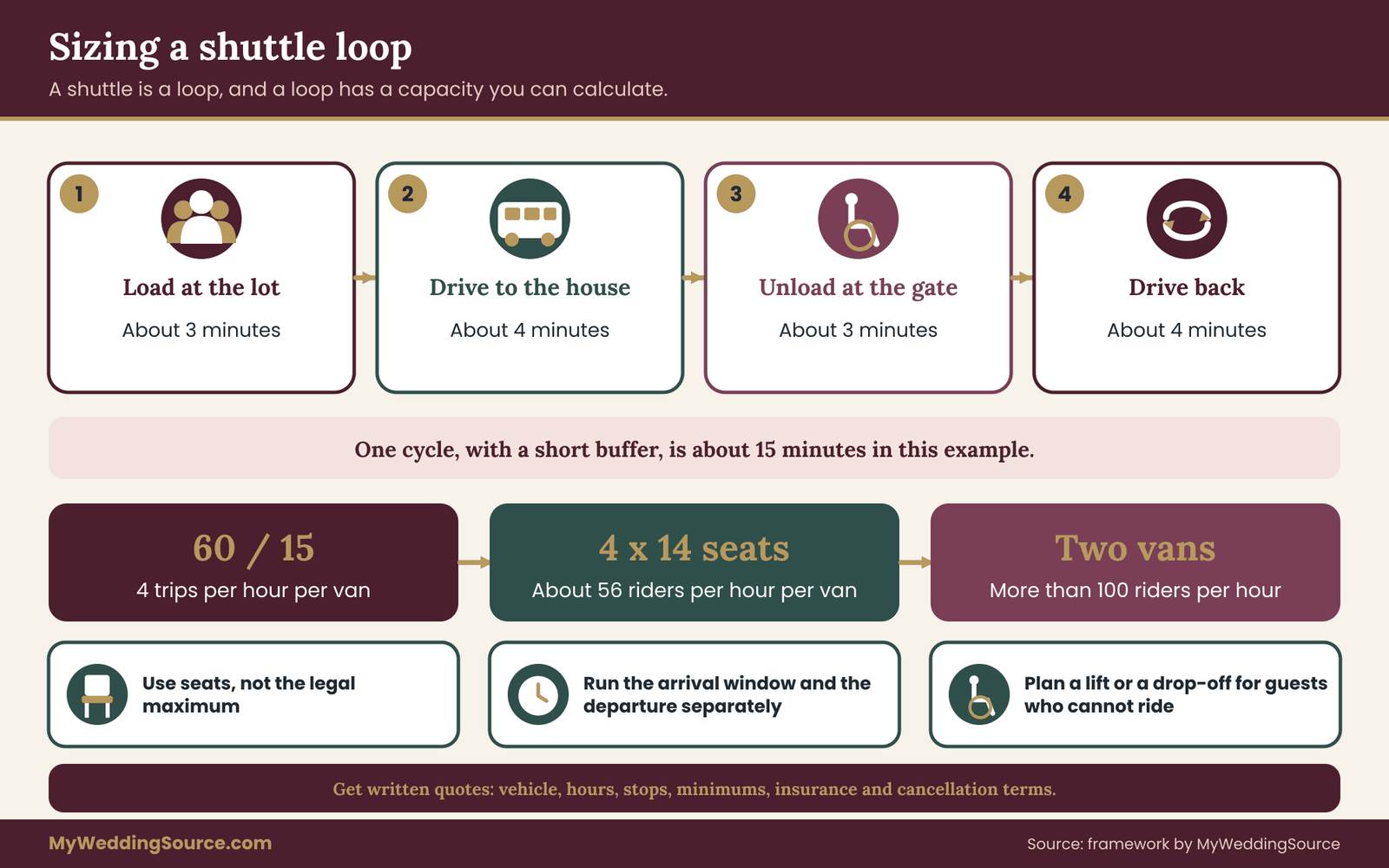
A shuttle is a loop, and a loop has a capacity you can calculate. For one vehicle, estimate the time of one complete cycle: loading at the lot, the drive to the house, unloading, the drive back, and a short buffer. Divide sixty minutes by the cycle time to get trips per hour, and multiply by the seats available to get riders per hour for each vehicle.
For example, a van that seats fourteen passengers and completes a cycle in fifteen minutes can make four trips in an hour and carry about fifty guests an hour. Two vans carry about twice as many. If your gap requires moving seventy guests in forty-five minutes, one van will not do it, and two vans are tight, so you would stagger arrivals, add a third vehicle or move the start time.
Use seats, not the legal maximum. A van full of guests in wedding clothes and a bouquet fills faster than the rated capacity suggests, and the loading time grows when passengers need help with steps or mobility aids.
Match the shuttle to backyard wedding parking timing
Arrival is the harder half, because guests arrive in a rush before the ceremony. Departure is spread out, with a trickle of early leavers and a bulk at the end. Plan for each separately.
For arrival, publish a shuttle schedule that starts well before the ceremony and runs frequently, and tell guests which pickup times fit which arrival target. A common approach is to open the lot an hour before the ceremony and run the shuttle continuously for the first forty-five minutes, with a last departure from the lot a set time before the start. State the cutoff on the invitation page, and ask guests to follow it.
For departure, a shuttle that runs on demand from the house back to the lot is the safest. Staff it until the last guest has left, and make sure someone is at the lot to see that cars start and leave safely. The question of safe rides home for guests who have been drinking belongs in this plan, and the National Highway Traffic Safety Administration’s impaired driving materials are a reasonable reference for the reasoning, even if they are not a wedding guide.
The point is not to lecture guests. It is to make the safe choice the easy one.
Do not forget the accessible route
A shuttle that requires climbing steps may not work for every guest of a backyard wedding parking plan. Ask the company whether the vehicle has a lift or ramp, and make sure the pickup and drop-off points are on a firm, level route. If the main shuttle cannot serve a guest, reserve an accessible space at the house or arrange a separate car. This should be settled with the guest before the day, not worked out at the curb.
Price backyard wedding parking shuttles with a written quote
Get a written quote that states the vehicle type, the number of vehicles, the hours of service, the pickup and drop-off locations, the cost per hour or per trip, any minimum, fuel and driver fees, cancellation terms and the insurance carried. Compare at least two quotes, and ask what happens if the schedule runs long. Do not invent numbers for your budget from memory; ask for real quotes, and use them to see whether the shuttle costs less than the alternative of a smaller guest list or a different location.
The wedding rental planning checklist offers a method for comparing rental quotes line by line that works for vehicles as well as tents and chairs.
Valet, attendants and staggered arrivals for backyard wedding parking
A shuttle is not the only way to close a gap. Three other tools belong in the backyard wedding parking toolkit, and each fits a different kind of gap.
Parking attendants
An attendant is a person who directs cars to spaces without taking the keys. They are a good fit when the spaces exist but the arrival is disorderly: a lawn with rows, a driveway with tandem spaces, a street where cars need to be told which side to use. A helpful attendant can fit a third more cars in the same area than guests parking alone, because they place cars tightly and keep the lanes open.
They can be friends or relatives, but a hired attendant is easier to hold to a schedule and brings insurance. Give each attendant a written map, a reflective vest, a flashlight for dusk and a radio or phone number for the parking contact.
Valet service
Valet means the staff take the keys and park the cars. It is the most expensive option and the most useful when you have a lot, a field or a street space that guests would not otherwise use, because the staff can park cars close together and bring them back in order. It also adds risk: a stranger is driving guests’ cars. Ask any valet company for proof of insurance, how they handle damage claims and how many staff they will bring.
For a small home wedding, valet is often more than the situation needs. For a larger one with a tight lot and a motivated budget, it can be the thing that makes the numbers work. For a fuller comparison, the question of attendants versus valet is usually worth a quote from both.
Staggered arrivals
A smaller-than-expected backyard wedding parking gap may disappear if arrival is spread out. When every guest arrives in the ten minutes before the ceremony, every car is present at the same time. If you invite the family to arrive thirty minutes earlier for photos, ask a group of friends to come for a cocktail hour, and let the rest arrive for the ceremony, peak demand falls because some early cars may leave, and the early cars are the ones that use the driveway.
Staggering does not create spaces. It reduces the number needed at the peak, which is what line A measures.
Ride sharing as a planned choice
You can also reduce the vehicle count by encouraging carpooling. A line on the invitation page that explains parking is limited and invites guests to arrive together has the effect of shrinking line A. Offer a way to coordinate: a shared document where guests can offer or request a ride, or a group message. Guests staying at the same hotel can share a ride more easily, and the host can sometimes arrange a pickup from the hotel for a group.
A smaller guest list as a backyard wedding parking option
The least comfortable alternative is a smaller guest list or a different venue. It deserves to stay on the table. If the gap is large and every other solution is costly or unreliable, the honest answer may be that the property is not right for this number of guests. If backyard wedding parking cannot work, moving to a venue with a lot, which the wedding venues guide covers, or splitting the day into a small ceremony at home and a larger reception elsewhere, may cost less than the shuttle, valet and permits the home would need.
That is a legitimate decision, and the worksheet exists partly to make it before the invitations go out.
A worked case: eighty guests on a suburban lot
To see how the lines interact, here is a fully invented example. The couple, the street and the numbers are illustrative, not real, and your own figures will differ. The case exists to show the arithmetic and the decision, not to suggest a standard.
The setting
A couple plans a late-afternoon ceremony and dinner for eighty guests in the backyard of a family home. The house is on a residential street with a driveway, a small gravel pad beside the garage and a back lawn that holds the tent and tables. The street has driveways on both sides and one hydrant near the corner. A church with a large lot is about six tenths of a mile away.
Lines A and B: demand
The guest list sorts into ten households of three or four people, nine couples and twenty-eight single guests, which adds up to eighty. Households and couples arrive in one vehicle each. Most singles arrive alone, except that eight of them are staying at the same hotel and will share two rides. That gives ten plus nine plus twenty plus two, or forty-one vehicles. A ten percent buffer brings it to just over forty-five, and the couple rounds up to forty-six. Line A is forty-six.
Service vehicles still present at the peak are a catering van, a band vehicle, a photographer and two helpers. Line B is five. Peak demand is fifty-one vehicles.
Line C: the parcel
The driveway holds four vehicles in two tandem pairs, but the couple reserves two spaces for accessible parking and gives the catering van one position near the kitchen door. The gravel pad holds two. The lawn is not used, because of irrigation lines and a slope toward the neighbor’s fence, and the side yard covers the septic drain field and is marked off.
After reservations, the parcel offers three spaces for general guests and the reserved spaces for the van and accessible parking. Counting everything, line C is six vehicles, of which two are for guests with mobility needs and one for the caterer. Line C available for general use: three.
Line D: the curb
The couple walks the block. The frontage on their side is one hundred and forty feet, minus a sixteen-foot driveway cut and thirty feet lost near the corner, which leaves ninety-four feet, or four spaces at twenty-two feet. The opposite side has one hundred feet of usable curb, which gives four spaces.
A neighbor asked that no one park across from her driveway, which removes one. Their local traffic office confirms that visitors may park on the street without a permit, with no overnight limit. Line D is seven legal spaces on the blocks they surveyed.
Line E: neighbor impact
The couple speaks to the five households closest to the house, and four agree. The rating is moderate: a dozen cars in the street in the late afternoon and evening, with a plan for early departure and a named parking contact. They agree to remove cars from a few stretches and to have the street clear by a set time.
Line F: the gap
Demand is fifty-one. Capacity is six on the parcel plus seven at the curb, which is thirteen. The gap is thirty-eight vehicles. At the couple’s ratio of about two guests per car, that is roughly seventy guests who need another way to arrive. The parcel and the curb together serve about a quarter of the demand, which is typical for a house on an ordinary suburban lot.
The decision
The couple considers three options.
One: a church lot with a shuttle. Two fourteen-seat vans on a fifteen-minute loop carry more than a hundred guests an hour, and in a forty-five minute arrival window they can move about eighty-four, which covers the seventy who need a ride. The church agrees to allow the lot on the day, with proof of insurance. The shuttle runs for ninety minutes before the ceremony and for two hours after dinner.
Two: valet from a closer lot. It would cost more and require a larger deposit.
Three: cut the guest list. The couple does not want to.
They choose the shuttle, with an accessible space and a drop-off point at the gate for guests who cannot ride the van, and with a hotel pickup for the eight out-of-town singles. That takes most of the gap off the street, and the legal curb spaces and the driveway handle the cars that remain.

What the backyard wedding parking case shows
The example shows three useful things about backyard wedding parking. First, the guest count matters less than the arrival grouping: recounting households changed line A noticeably. Second, the parcel contributed less than the curb, and neither contributed enough. Third, the shuttle was the cheapest solution that kept the guest list intact, but it was only sized correctly because the couple used the loop calculation instead of guessing.
The couple’s numbers would be wrong for a different house. A larger lot, a quieter street with generous frontage or a long driveway could give a gap of ten rather than forty. A cul-de-sac, a narrow road or a street with permit parking could give a gap larger than the guest list. That is why the worksheet starts with measurement and not with a standard answer.
A useful check on any worksheet is to multiply line A by your guests-per-vehicle ratio and see whether the result lands near the confirmed guest count. In this case, forty-one vehicles at about two guests each is close to eighty. If the result is far off, a group has been counted twice or missed, and it is better to find that on paper than at the curb.
Line G: failure conditions for a backyard wedding parking plan
A backyard wedding parking plan without failure conditions is a hope. Line G is the last line of the sheet, and it is the one that makes the other six useful, because it tells you in advance when to stop adjusting and switch. Write these conditions down while you are calm, ideally with the date by which each must be resolved, so that a decision on the day is a matter of reading the sheet rather than arguing.
Conditions that mean change the plan before invitations go out
The backyard wedding parking gap is larger than any fallback can move. If the shuttle you can afford cannot move the gap in the arrival window, and staggering does not close it, the property cannot host this guest count. Reduce the list or change the site.
The street rules forbid what the plan depends on. If the city says no visitor parking on your street on that date, line D drops to zero and the gap grows. Rebuild the sheet with the real number.
The lot owner will not confirm in writing. A verbal yes for the church or school lot is not a plan. If the owner will not put it in an email or a short agreement by a set date, treat the lot as unavailable and move to the next option.
Neighbors object across a large part of the street. If most of the households you counted refuse, line D shrinks and line E rates high. A high rating with no alternative is a stop signal.
No one can run the day-of operation. A shuttle and a street plan need people. If you cannot name a parking contact, attendants and a shuttle coordinator who are not the couple, the plan is too fragile for the guest count.
Conditions that mean switch on the day
Some failures cannot be known in advance, so the sheet should carry trigger rules for the day.
Wet ground. If rain has saturated the lawn or gravel, drop the parcel from its dry figure to its wet figure, close the lawn and move those cars to the shuttle or the street. Name the person who makes the call and the time by which it must be made, such as noon.
A closed or blocked street. If a road crew, a tree down or a delivery closes the approach, the route changes. Have a second route written on the guest map.
A shuttle that is late or down. A van that breaks down halfway through arrival is a real possibility. Keep the number of a second operator, or a standing agreement with a friend who can fill in for a short time, and hold a fifteen-minute delay as a trigger to start moving the closest guests to the curb.
Unplanned arrivals above the buffer. If the count at the gate exceeds line A by more than the buffer, shift the extra cars to the lot and give the attendants a script for turning cars toward it.
Weather that makes the walk unsafe. Heavy rain, ice or storms can make a half-mile walk unsafe. The National Weather Service is the official source for forecasts, and a plan for a covered pickup point is better than hoping for clear weather.

Set decision dates for the backyard wedding parking plan
Failure conditions need dates. A reasonable pattern is three checkpoints. The first is when you have confirmed the rules, the lot and the neighbor responses, long enough before invitations to change the guest list or the site. The second is when final RSVPs arrive, when you update line A and decide the size of the shuttle. The third is a few days before the wedding, when you check the forecast, the street and the lot, and confirm every vendor and attendant.
Keep a written backyard wedding parking fallback
Write a single-page fallback: if the shuttle fails, do this; if the street is closed, do that; if the ground is wet, close these zones. Give a copy to the parking contact and to each attendant. A fallback that exists only in your head will not help when you are in a dress.
Guest communication and day-of roles
The best backyard wedding parking plan fails if guests do not know it. Communication is the final step in backyard wedding parking, and it is cheap compared with everything above.
Tell guests about backyard wedding parking early and plainly
Put parking information where guests will find it: on the invitation website, in a short note with the invitation or in a message a week before the event. The page should say, in plain language, where to park, what the options are, when the shuttle runs, where not to park, and whom to call. Keep it short.
A clear example reads like this: “Parking at the house is very limited. Please park at the lot named below, where a shuttle runs continuously until a set time before the ceremony. Do not park in front of neighbors’ driveways or on the lawn. If you need accessible parking, tell us by this date.”
Include a small map showing the lot, the route and the house. If the guest has a mobility need, offer a direct line so it can be settled in private. The guide to wedding reception guest flow shows how to think about the path from arrival to seating, and the same thinking applies to the walk from the car.
Say plainly what you ask of guests on leaving: lower voices at the curb, no idling and revving, and use of the shuttle or a rideshare if they have been drinking. State it once, warmly, without scolding.
Name the roles
A backyard wedding parking operation needs a few named roles, and none of them should be the couple.
Parking contact. One person with a phone who answers calls from neighbors, vendors, the shuttle driver and the lot owner. This person has the sheet.
Gate attendant. A person at the driveway entrance who greets guests, tells them where to go and keeps the accessible spaces clear.
Lot attendant. If a lot is used, a person there to direct cars, watch the shuttle and see that the lot is empty and clean at the end.
Street walker. A person who walks the block now and then to see that cars are on the right side, driveways are clear and noise is low.
Closer. A person who stays until the last car has left, checks the street for litter and returns the keys or the lot to its owner.
Give each person a one-page instruction sheet and a phone number, and thank them with something better than leftover cake.
Handle vendors as a separate backyard wedding parking flow
Send each vendor the arrival schedule, the route and the place to park, and tell them where to unload. If a vendor is told to use the side gate and not the front, the front stays clear for guests. A short written confirmation from each vendor is worth the thirty seconds it takes.
After the wedding
When the party ends, walk the street and the lot used for backyard wedding parking. Pick up trash, check the lawn and the driveway, return any borrowed signs or cones, and send short thank-you notes to the neighbors and to the lot owner. Note what worked and what did not, in a few lines on the sheet. If you or a friend plan another event at the same address, those lines are the best planning document you will have.
Your next steps
- Start your backyard wedding parking worksheet: fill in lines A and B this week from your guest list and vendor list, and write how you arrived at each number.
- Walk the property and measure the five zones. Write a dry and a wet figure for line C.
- Contact the city or county traffic office and any homeowners association. Ask the rules questions in this guide and write down the answers.
- Count the legal curb spaces on the nearby blocks, then talk to the neighbors and record what they say.
- Compute the gap in line F. If it is positive, request written quotes for a shuttle and ask a lot owner for written permission.
- Write line G, with failure conditions, decision dates and a one-page fallback.
- Publish the guest parking page and assign the five roles. Update the sheet when final RSVPs arrive.
For the wider decision about site and capacity, the venue technical walkthrough guide and the wedding venues guide are the next stops. For timing the vendors’ arrivals, use the wedding vendor timeline.
FAQ
How many spaces does backyard wedding parking need?
The number needed for backyard wedding parking depends on your guests, not a standard. Convert the guest list into vehicles by grouping households, couples and single guests, then add a buffer of about ten percent and the service vehicles still present at the peak. A list of mostly families and couples needs far fewer vehicles than a list of single friends.
Can backyard wedding parking use the street in front of my house?
Usually yes, if the street is public and the rules allow it, but you cannot reserve the curb. Check time limits, permit zones, overnight rules and the distance required from hydrants, corners and driveways with your city or county traffic office. If a homeowners association governs the street, ask the association in writing.
Do I need a permit for backyard wedding parking?
Sometimes. Some cities offer temporary guest permits, loading zones or event notices, and others do not. Rules vary, so ask the local traffic or parking office what applies to a private event at your address. Do not post your own no-parking signs on a public street without confirming that it is allowed.
Is backyard wedding parking on the lawn safe?
It can be, in dry weather, if the ground is firm and nothing is buried or at risk. Avoid any area over a septic system, irrigation lines, slopes and drainage edges. Set a wet-weather rule in advance, name who decides, and have the shuttle or street ready as a replacement when the ground is soft.
When is a shuttle worth it?
A shuttle is worth it for backyard wedding parking when the gap between demand and legal spaces is larger than the street and the parcel can absorb, and when a lot is available within a short drive. Use the loop calculation to size it, ask for written quotes and compare the cost with a smaller guest list or a different venue.
How do I keep neighbors happy about backyard wedding parking?
For backyard wedding parking, talk to them early, tell them the date, the hours and the number of cars, keep their driveways clear and give them a phone number that someone will answer on the day. Accept a refusal for a particular stretch without argument, and plan an orderly, quiet departure.
What about guests who need accessible parking?
Ask in advance, reserve spaces close to the entry on a firm, level route, and offer a drop-off point at the gate. A guest who cannot ride a shuttle needs a separate arrangement settled before the day. Keep the reserved spaces labeled and monitored so they are not used by other arrivals.
What are the signs that a backyard wedding parking plan has failed?
The gap exceeds what any fallback can move, the street rules forbid what the plan relies on, the lot owner will not confirm in writing, most neighbors object, or nobody can run the operation. Decide these conditions and the dates for them in advance, and switch plans, shrink the list or change the site when one occurs.
Sources
- USA.gov: government portal for finding local city, county and state offices.
- ADA.gov: U.S. Department of Justice information on accessibility and accessible parking guidance.
- NFPA: fire code and life safety standards, including fire apparatus access.
- NHTSA: National Highway Traffic Safety Administration impaired driving and road safety information.
- Manual on Uniform Traffic Control Devices: Federal Highway Administration framework for traffic signs and markings.
- FMCSA: Federal Motor Carrier Safety Administration passenger carrier safety information.
- EPA septic systems: guidance on protecting septic tanks and drain fields.
- National Weather Service: official forecasts and weather safety information.
- Insurance Information Institute: consumer information on event and liability insurance.