
A wedding setup crew is the group of people who carry, install and check everything that has to be in place before guests arrive, and the hardest part of hiring one is that the same word is used for very different jobs. This guide separates carrying, installing and inspecting, shows who can own each one, and gives you a crew scope handoff sheet and a venue approval checklist you can fill in by hand.
Treat load-in as three separate verbs: carry, install and inspect. A load-in crew is usually the right owner for carrying. A decorator is usually the right owner for installing anything design-dependent. Inspection should belong to someone who did not do the installing, ideally a named person from the venue or your coordinator. Write one line per item on a wedding setup crew handoff sheet, name an owner for each verb, and get the venue to approve the route, the hours and the hanging points before the wedding setup crew arrives.
Most couples meet the question of a wedding setup crew through a contract line that sounds harmless. The decorator’s proposal says “setup and teardown included.” The venue’s rules say “vendors are responsible for their own load-in.” The rental company’s quote says “delivery to the curb or loading dock.”
Each sentence is true, and together they leave a stretch of floor, stairs and ceiling that nobody has promised to cover. Somebody has to carry the forty chairs from the dock to the ballroom. Somebody has to hang the greenery. Somebody has to say the result is safe and matches the order. Those are three different tasks, and in a wedding setup crew they rarely land on the same person by accident.
This article is about the decision of who does which of those tasks. It is not a design guide and it is not a full staffing plan for the entire day. If you want the whole picture of who covers guests, service and breakdown as well, the guide to venue technical walkthroughs shows how to measure the space and the access routes first, and this article picks up from the point where you know what has to move and you have to decide who moves it.
A note on scope. This is general information, not legal, tax or labor advice, and rules on worker pay, classification and insurance differ by state and by situation. Where a rule matters, the article points you to the agency that publishes it so you can confirm the current version.
What a wedding setup crew does, and where decorators fit
Start with plain definitions, because the confusion begins with vocabulary.
A wedding setup crew, in this guide, is any group of people whose job on the wedding day is physical preparation of the space: moving, assembling, placing, hanging, plugging in and checking. The group might be employees of the venue, the delivery team of a rental company, hired event laborers from a staffing company, a decorator’s install team, or a mix of volunteers. What matters is the function, not the label.
A decorator, in the same plain sense, is a company that designs the look of the space and is paid for the finished result. Some decorators also supply and install the items. Others design only and hand a plan to someone else. A florist who hangs an installation is acting as a decorator for that item. An event design firm that brings tables, linens, lighting and florals is a decorator with a large crew of its own.
The difference matters because the two are paid and judged on different things. A load-in crew is paid for hours and judged on whether things arrive in the right place without damage. A decorator is paid for a design outcome and judged on whether the room looks like the proposal.
When you ask the decorator to also carry rented furniture across a parking lot, you are asking a design business to act as a moving crew. It might say yes. It might also quietly subcontract the work, bring fewer people than the job needs, or charge a labor fee that was never in the proposal.
Where the confusion costs money
Three patterns come up again and again in wedding planning, and none of them requires anyone to behave badly.
The first is the double-pay. You hire a labor crew for load-in and the decorator also includes setup labor in their price. Both show up, both invoice, and the room is no better for it.
The second is the gap. Each party assumes the other is carrying the rented lounge furniture from the dock. The truck arrives, the driver leaves it at the curb, and the florist is left to move it with whoever is free.
The third is the missing inspector. The people who installed the work are the people who declare it finished. Nobody with fresh eyes walks the room, so a loose ceiling attachment or a blocked exit stays unnoticed until a guest notices it.
A clear wedding setup crew plan avoids all three by naming, in writing, who does each verb for each item. The rest of this guide builds that plan step by step.
What this guide leaves out
A few neighboring topics have their own coverage. Freight elevators and dock access rules are venue-specific and deserve their own reading, and the wedding rental planning checklist covers what to order and how to confirm delivery. The wedding room flip, where a ceremony space becomes a dinner space, is a timing problem more than a crew problem. This article focuses on one decision: who carries, who installs, and who inspects, and how to prove it before the day.
Carry, install, inspect: three jobs that get blurred
Almost every item that arrives at a wedding goes through the same three steps. Naming them separately is the single most useful thing you can do, because it turns a vague “setup” line into three owners.
Carry. Moving the item from where it is delivered to where it will be used. This includes unloading a truck, using a dock or elevator, crossing a lobby, climbing stairs, and staging items in the right zone of the room. Carrying is mostly about strength, routes, equipment such as carts, and care for floors and walls. Skill matters less than numbers and planning.
Install. Turning an item from a delivered object into a working part of the room. Assembling a backdrop frame, hanging a fabric canopy, placing linens, plugging in and aiming lights, setting a floral arch, arranging centerpieces to a design. Installing is about skill, tools, design intent and often safety training, particularly at height or with electricity.
Inspect. Checking that the installed result is complete, correct and safe. Does it match the order? Is it stable? Are exits clear? Do power cords cross walkways? Has the venue accepted it? Inspection is about a checklist and independent eyes. It is the step most often skipped, because by the time the install is finished everyone is tired and the clock is short.

Why a wedding setup crew rarely has one owner for all three verbs
Consider how a wedding setup crew handles a simple item: a round table with a floor-length linen and a centerpiece. A rental crew may carry the table. A venue team may set it at its marked position. A decorator may place the linen and centerpiece. A coordinator may check that the number, spacing and placement match the floor plan. Four people touched one table, and none of them did the same verb. Now multiply by a hundred items and the idea of a single “setup” owner starts to look like wishful thinking.
That does not mean you need a large wedding setup crew. It means each verb has an owner, even when one company holds two of them. A decorator who carries and installs their own florals is fine, as long as someone else checks the result against the venue’s rules.
A rule of thumb for splitting the verbs
When you cannot decide who in the wedding setup crew should do what, use this rule. Assign carrying to whoever is cheapest per hour and sufficiently trained. Assign installing to whoever is accountable for the design result. Assign inspecting to whoever has the most to lose if the room fails and the least stake in saying it is done, which is often the venue contact, the coordinator or a trusted attendant who is not touching the work.
Two exceptions deserve mention. If an item involves open flame, rigging from a structure or electrical work beyond plugging in, the venue or local rules may restrict who is allowed to install it, and the inspector may need to be the venue itself.
And if the item is a rental owned by another company, that company may require its own crew to handle it or may charge for damage regardless of who moved it. The contract wording matters more than the rule of thumb, which is why the wedding vendor contract guide is worth reading before you sign any proposal that says “setup included.”
Who can be your wedding setup crew
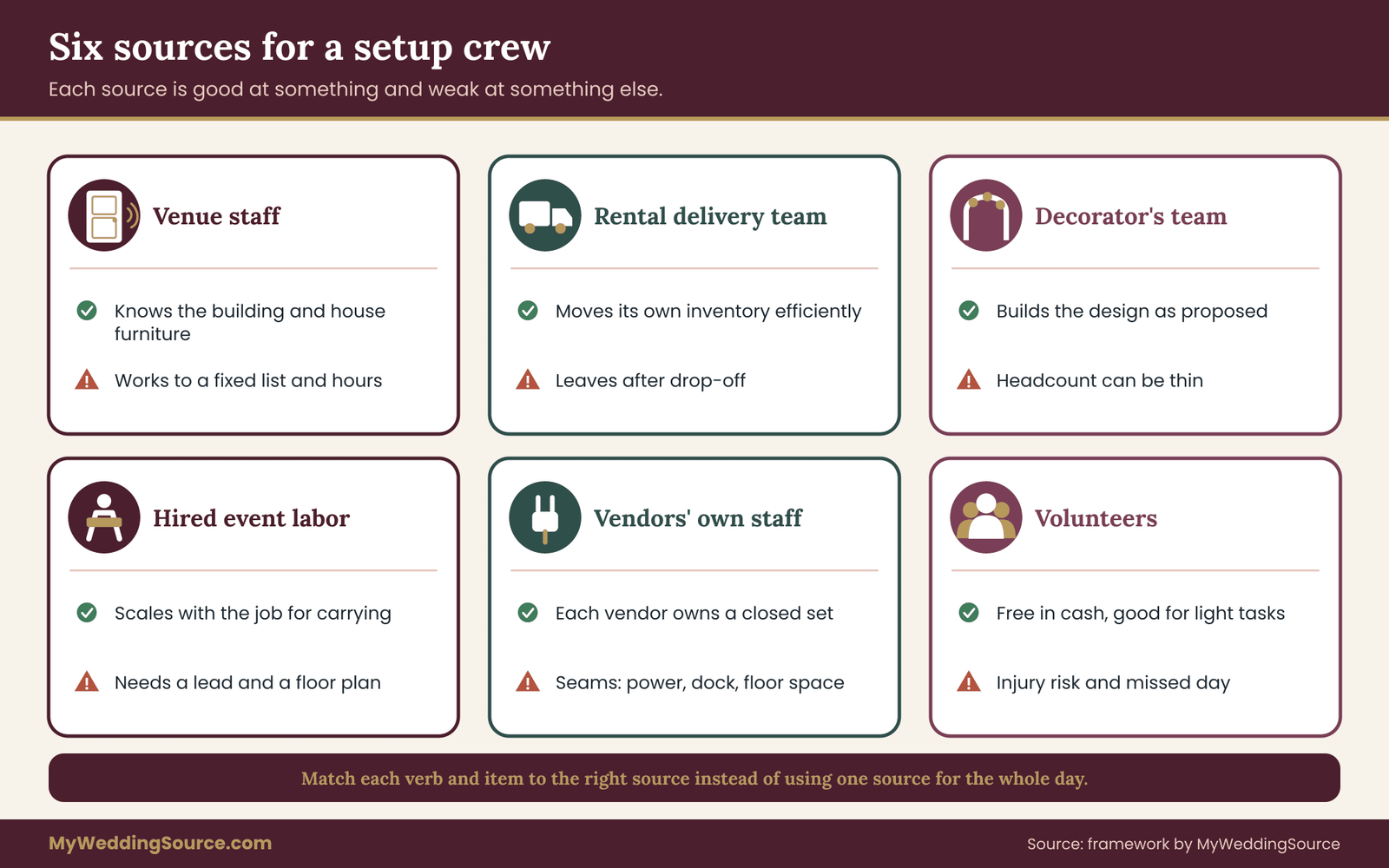
There are six realistic sources of labor for a wedding setup crew. Each has strengths, limits and a different way of failing. Choosing among them is easier once you see them side by side in prose rather than in a sales pitch.
The venue’s own staff as a wedding setup crew
Many venues carry tables, chairs and house linens as part of the rental, and their staff already know the building. They know which door sticks, which floor marks easily and which hallway the fire marshal watches. For that reason venue staff are often the best owner for carrying house-owned furniture and for setting the room to a floor plan.
The limits are scope and hours. Venue staff usually work to the venue’s list: house tables, house chairs, perhaps a dance floor. They may not touch vendor-owned decor, and some venues state that outright. Their hours may end at a fixed time, and overtime may be billed. Ask for the list of what the venue crew will and will not handle, in writing, and ask whether the fee covers setup only or also teardown.
The rental company’s delivery team
When you rent furniture, tableware or lounge pieces, a delivery team brings them. Rental quotes usually say what the delivery level is: curb, dock, “first stop inside the door,” or placed in the room. Those phrases are not interchangeable. Curb delivery means the truck stops outside. Placement in the room is a separate, usually higher, service.
Rental teams make a useful part of a wedding setup crew for carrying their own inventory, but they leave. The driver has a schedule and another stop. If your wedding setup crew plan depends on them being present at three in the afternoon to adjust something, you have planned around a person who is already elsewhere.
The decorator’s install team
A design firm or a larger florist often travels with a team. These are the people who can hang a fabric ceiling, build a floral wall and light a ceremony arch to the proposal. They are the right owner for installing design-dependent items, because they know what the finished piece should look like and have the tools to build it.
Their limits are that they are paid for a design result. If the proposal says “includes install,” confirm that it also includes the carrying from the dock to the room and the cleanup afterward. Ask how many people will be on site, for how long, and whether any are subcontractors. A team of two cannot install a ceremony arch and thirty centerpieces in two hours, however good they are.
Hired event labor from a staffing company
A staffing or event-labor company supplies people by the hour: loaders, runners, stagehands, general setup workers. This is the source built for carrying, and it scales up or down with the size of the job. It is also the source where employment questions are most visible, which a later section covers.
The limits are skill and direction. Event laborers follow instructions; they do not know your design. Without a lead who tells them where things go, they will carry well and place poorly. Budget for a supervisor or for your coordinator’s time, and give them the floor plan.
The vendors’ own staff
Caterers, bands, DJs and photo booth companies carry and install their own gear. This is usually the cleanest arrangement, because each vendor owns a closed set of items. The wedding setup crew in that case is distributed across vendors, and the risk is only at the seams: shared power, shared dock time and shared floor space.
Volunteers: family and friends
Volunteers are the most common source and the most overused. A cousin with a truck and three groomsmen with free afternoons look like a free wedding setup crew. They are free in cash and sometimes expensive in other ways. People who are carrying tables at four o’clock are not eating lunch, getting dressed or greeting arriving family, and a volunteer who is injured while lifting is an awkward problem for the couple and the venue alike. Volunteers are best for light, low-risk, well-defined jobs, such as placing programs or arranging favors, and weakest for heavy carrying, ladders and anything electrical.
Matching each wedding setup crew source to the job
Rather than building the whole wedding setup crew from one source, match each verb and each item class to the most suitable source. The pattern is easy to state.
Heavy furniture and staging. Carrying belongs to the venue crew, the rental team or hired labor. Installing, if it needs any, belongs to whoever owns the item. Volunteers should not be the default.
Linens, tableware, centerpieces. Carrying is light and fits volunteers, venue staff or the decorator’s team. Installing to a design belongs to the decorator or caterer. A single supervisor should hold the floor plan.
Ceremony structures. Carrying belongs to the structure’s owner or hired labor. Installing belongs to the decorator or the rental company’s technician, and inspection belongs to the venue, because the structure affects guests and sightlines.
Lighting and cabling. Carrying and installing belong to the lighting vendor or the DJ. Inspection belongs to the venue contact or a coordinator who checks cord routes against walkways.
Hanging items. Anything hung from a ceiling, beam or truss is an install job for trained people, and the venue’s written approval of the attachment points comes first. In this guide, “approval” always means the venue’s written permission, not a verbal nod in the hallway.
The questions to ask each wedding setup crew source
For each potential source, ask the same four questions. How many people, for how many hours, doing which verbs? Who is the lead, with a phone number that works on the day? What happens if an item is damaged in transit, and who pays? When do they leave, and is anything expected of you or your vendors after that?
A wedding setup crew source that cannot answer those questions in a sentence each has not thought about your job yet. That is useful information before you sign.
Decorator versus crew: a comparison in prose
The honest summary is that a load-in crew sells time and a decorator sells a result. Time is easy to compare: hourly rate, number of people, minimum hours. A result is harder to compare, because the proposal may bundle design, items, labor and travel into one price. When you ask a decorator for an itemized quote, you are not being difficult. You are asking which part of the fee is the people who carry and which part is the people who install, so that you can see whether you are paying twice.
If the decorator will not itemize, you can still ask for the number of people on site and the hours they will be there. Dividing the labor-related part of the price by that headcount and time gives you a rough sense of whether the labor is generous, thin or invisible. That arithmetic is only a sanity check, not a verdict, because the fee also covers design time, insurance and equipment.
When the decorator should not be the wedding setup crew
There are three situations where handing carrying to the decorator is a poor fit. When the dock is far from the room, the walk takes more labor than their team brings. When the rented furniture is not theirs, they carry some risk of damage they never priced. And when the load-in window is tight, because a four-person decorator team cannot both carry and install inside it. In each case, a separate load-in crew for carrying only often costs less than the overruns it prevents.
When a load-in crew should not install
The reverse also holds. A general labor wedding setup crew should not install fragile florals, adjust lighting aimed at a ceremony arch, assemble a structure with specific tolerances or touch the sound system. They can hold, lift and move under direction. They should not be asked to make design decisions. If a carrier is asked to “make it look right,” they will do their best, and their best will not be what the decorator’s proposal showed.
Carrying: routes, lifting and damage for a wedding setup crew
Carrying looks like the simplest of the three verbs, and it is where the most hours disappear. The work is not the lifting itself. It is the distance, the doors, the waiting and the number of trips.
Measure the route before you count the people
The size of your wedding setup crew for carrying depends on the route, not the guest count. A venue with a loading dock beside the ballroom might need a small wedding setup crew for an hour. A venue where every item crosses a parking lot, a lobby and a flight of stairs might need twice the people for twice as long.
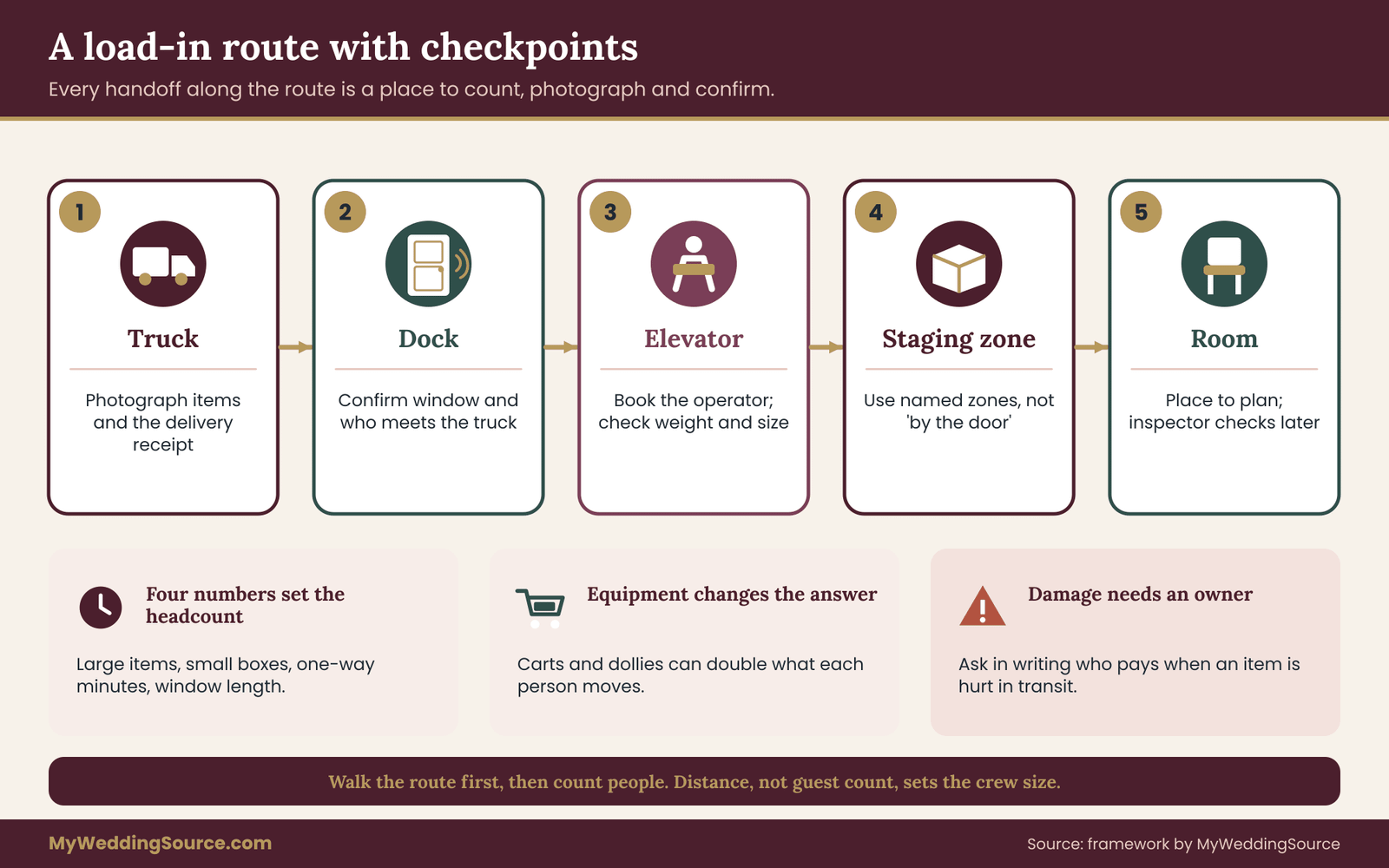
Walk the route with a phone and a notes app, and write down five things: where the vehicle stops, how far it is to the room, how many doors and thresholds are on the way, whether there is an elevator and who controls it, and where items can wait without blocking guests or staff.
If you have already walked the space for measurements, reuse that record. The venue technical walkthrough guide explains how to capture those access details so each vendor sees the same route.
The four numbers that set wedding setup crew size
Four rough numbers tell you most of what you need. The count of large items such as tables, staging, lounge pieces and arches. The count of small boxes, such as centerpieces, linens and signage. The one-way distance in minutes from vehicle to room. And the length of the delivery window the venue allows.
A simple way to use them: estimate how many trips a single carrier can make in an hour on your route, divide the total number of trips by that figure, and you have person-hours. Divide person-hours by the window and you have headcount. You do not need precision. You need to know whether the answer is two people or eight, because that is the difference between a modest labor line and a large one. Round up, because the first and last trips of any window are always slow.
Equipment changes the answer
A cart, a dolly, a flatbed or a hand truck can double what each person in a wedding setup crew moves, and the venue may supply some or all of them. Ask. Ask also whether wheeled equipment is allowed on the floors. Some venues forbid hard wheels on wood or stone, and some require floor protection. A crew that arrives with the wrong wheels is a crew that waits while someone fetches the right ones.
For long routes and heavy items, equipment is often cheaper than headcount. For short routes and light items, extra people are cheaper than renting anything. Neither is universally right, and the route decides.
Staging zones and the order of arrival
Carrying is also a sequencing problem for the wedding setup crew. Heavy, structural and design-critical items should arrive first, while the floor is empty and the paths are clear. Linens and small decor can come later, because they fit between other work. Items that cannot be placed until another vendor finishes, such as chairs that sit around a dance floor still being laid, should wait in a staging area marked on the plan.
Staging zones need names. “By the side door” is not a location. “Zone B, left of the bar” is. Write the zones on the floor plan and use the same names in every vendor message; the wedding signage system guide shows how to label spaces so names stay consistent. That one habit prevents the common situation where three vendors each stack boxes in the same corner and then cannot reach their own.
Load-out is carrying in reverse, with less energy
Everything above applies to teardown, and teardown is harder. People are tired, the room is dim, guests may still be present and every vendor wants to leave at once. Items also look different: a clean arch becomes a pile of loose branches, and a rented chair that was stacked neatly in the morning is now one of two hundred scattered chairs.
Plan load-out with the same three questions. Who carries each item, to which vehicle, and by when? Who confirms that nothing was left behind, and who counts rented items against the delivery receipt? Which items must leave tonight, and which may stay until a morning pickup? Venues often set a firm end time for load-out, and fees for running past it can be steep, so a crew booked only for load-in leaves a gap at the end of the night.
Write the load-out order on the same sheet. Personal items, gifts and cards go first, with a named family member or attendant, because they are the things a couple will regret losing. Rented and borrowed items go next, counted against the receipts. Decor that the couple wants to keep goes into labeled boxes. Trash goes wherever the venue says it goes, not into the nearest dumpster.
A short briefing for the dock lead
The person who meets trucks at the dock is the most useful single role in carrying. This lead does not need to lift. Their job is to know the route, point each delivery at the right zone, keep the dock clear and tell the coordinator when something is late. Give them the floor plan, the zone names, the vendor list with phone numbers and the rule for who may move an item that arrives damaged.
A five-minute briefing before the first truck arrives covers most of what goes wrong. Where do trucks stop, and for how long? Which elevator, and who calls the operator? What do we do with an item that does not match the order? Whom do we call if the room is not ready? Say it out loud and write it on the sheet.
Who owns damage during carrying
Damage while carrying is the point where a wedding setup crew arrangement most often turns into a dispute. A table leg cracks on a stair. A wall is scuffed at a corner. A rented chandelier arrives with a missing crystal. Who pays?
The answer sits in three places. The rental contract usually says that the renter is responsible for damage after delivery, and sometimes from the moment the item leaves the truck. The venue contract often makes the client responsible for damage to the building by anyone the client hired. And the labor company’s agreement may or may not include coverage for damage by its workers.
Ask each party two questions in writing. Who is responsible for damage during unloading and carrying, and does that depend on who moved the item? And does the labor company or decorator carry general liability insurance that covers the work? You are not asking them to take on risk they would not accept. You are asking them to say so before the day, when the answer can still change your plan.
Condition notes at handoff
A practical habit that settles most damage questions is a short condition note at the moment of handoff. When the rental team unloads, a coordinator or attendant photographs the items and the delivery receipt. When the load-in crew places furniture, someone photographs the floors and walls near the route, particularly if the venue has noted existing marks. These photos are not an accusation. They are a shared record, and they protect the crew as much as the couple, because they show what was already there.
Lifting, safety and who should not carry
Lifting injuries are common in the physical work of a wedding setup crew, and the U.S. National Institute for Occupational Safety and Health publishes guidance on safe manual handling. You do not need to quote it at your crew. You do need to avoid putting yourself or your guests in the role of the person carrying things they should not. Heavy staging, large floral arches and anything awkward to hold should go to people trained and equipped for it.
It also means there is a person who should not carry: you. On the wedding day, the couple should not be lifting anything. If a delivery goes wrong, your job is to pick up a phone, not a table. The most common reason a couple ends up moving furniture is that a plan with no named carrier left a gap and they felt responsible.
Edge cases in carrying
Stairs with no elevator change the arithmetic quickly, because time per trip rises and the risk per item rises with it. Long outdoor routes across grass or sand may require different wheels and more rest. Weather means a plan for wet items, including covers and a drying space. Short windows, such as a venue that is available only a few hours before the ceremony, call for a larger crew carrying for less time, since the alternative is a small crew racing the clock.
Each of these edge cases is solved by the same step for any wedding setup crew: put the route, the headcount, the window and the staging zones in writing, then show it to every person who will carry. A route that exists only in your head will be misread by someone.
Installing: skill, tools and what a decorator’s fee covers
Installing is the verb where a decorator earns their fee, and it is the verb that a general crew cannot easily replace. It is also the part of a wedding setup crew’s work with the greatest range of risk, from setting a napkin to rigging a canopy.
Sort items by install difficulty
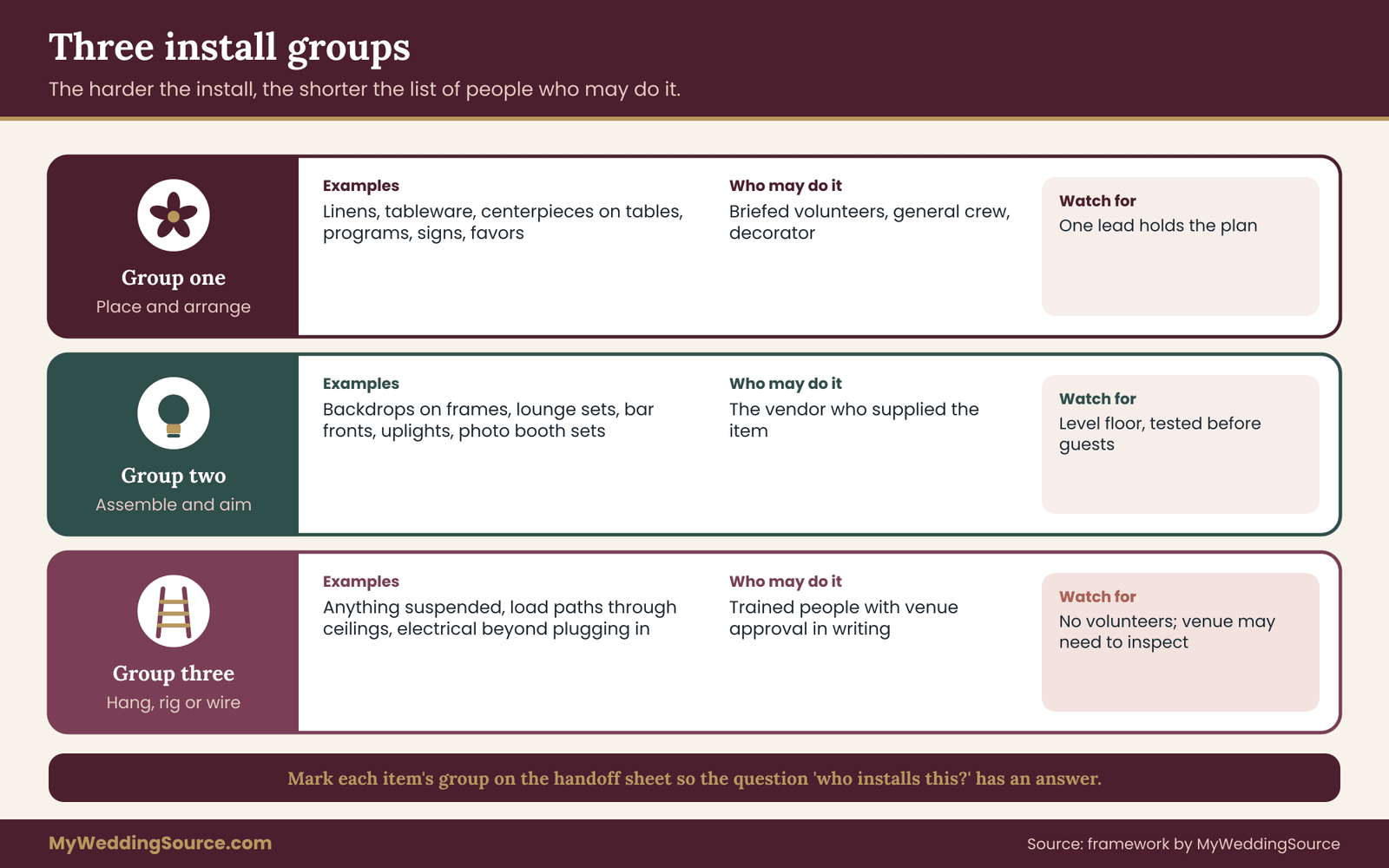
Not every installed item needs a specialist. Sorting items into three groups helps you decide who may touch them.
Group one: place and arrange. Items that need no tools and no training beyond the design: linens, tableware, centerpieces on tables, programs, signs on easels, favors. A volunteer or a general crew member can do this work if someone holds the plan.
Group two: assemble and aim. Items that need assembly, a level surface or adjustment: backdrops on frames, lounge arrangements, bar fronts, uplights, photo booth sets. These need someone who has done the job, usually from the vendor that supplied the item.
Group three: hang, rig or wire. Anything suspended from a structure, anything with a load path through a ceiling or truss, anything that needs electrical work beyond plugging into a labeled outlet. These belong to trained people, and the venue’s rules often restrict them further.
The grouping is a planning aid, not a code. The point is that the question “who installs this?” has a different answer for each group, and your wedding setup crew handoff sheet should say which group each item falls into.
What the decorator’s fee covers
A decorator’s price usually bundles several things: design time, the items themselves (owned or rented), labor to install, labor to remove, delivery, insurance and a margin. When you compare a decorator to a separate wedding setup crew plus rented items, you are comparing bundles. It helps to ask the decorator for a plain-language breakdown, even if not a line-item invoice.
Questions worth asking:
- How many people install, and for how long on the day?
- Is carrying from the dock to the room included, or does it assume the room is a short walk?
- Is removal included, and when does it happen?
- What is billed if the load-in window is shorter than planned, or if the venue adds a fee?
- Who from the decorator’s side is the lead, and will that person be on site for the whole install?
The answers tell you whether the install labor is in the price or whether the proposal assumes someone else carries and cleans up. The wedding vendor contract guide covers how to turn those answers into contract language so that a verbal promise does not vanish.
Tools, ladders and height
Hanging decor means ladders, lifts or scaffolding, and a wedding setup crew working at height has its own safety rules. The Occupational Safety and Health Administration publishes guidance on ladder use and fall hazards, and a competent decorator already follows it. For you, the point is narrower. Ask whether the decorator’s team brings its own ladders and tools, whether the venue allows them in the room, and whether the venue requires proof of insurance for work at height.
A venue may also forbid ladders on certain floors, restrict lifts to a vendor list or require a venue employee to be present for any ceiling work. Those rules are easy to learn in advance and expensive to learn at noon on the wedding day.
Power and cables
Lighting, sound and illuminated decor all depend on power, and install work often includes running cords. Cords are the quiet hazard of a wedding setup crew: they cross aisles, get taped badly and are tripped over by guests, staff and photographers. Decide in advance who plans cord routes, who tapes or covers them, and who checks them at the end. A decorator who runs power to an arch may not be the person who knows which circuit also feeds the kitchen. Ask the venue where outlets are, what each circuit can carry and who may plug in.
Open flame, fog and other special items
Candles, torches, fireworks, smoke or haze effects, confetti cannons and similar items are often restricted by venue rules and local fire codes. The National Fire Protection Association publishes the model codes that many local authorities adopt, but your venue and local fire marshal are the authority for your site. Install of any of these items should wait for the venue’s written permission, and inspection should include whoever the venue designates.
Design intent versus safety
Sometimes the design wants something the room does not allow: a low-hanging installation over an aisle, a heavy piece on a weak ceiling point, a canopy that covers a sprinkler head. When that happens, a decorator who tells you early is far more useful than one who installs and hopes. Ask each decorator what they do when the venue says no, and whether the quote changes. Their answer reveals how they handle the exact situation a wedding setup crew eventually faces.
What a volunteer in your wedding setup crew can install safely
Volunteers in a wedding setup crew can do group one work happily. A simple instruction sheet with a photo of the finished table, the number of tables and the zone is enough. Give them a lead, such as a bridesmaid or a coordinator’s assistant, who holds the sheet and makes decisions so that twelve helpful people do not make twelve different tables.
They should not do group three work, however experienced they say they are. It is a kindness to say so before the day. A line such as “we have a team for anything that hangs or plugs in, and we would love your help with tables and favors” protects both the relationship and the room.
Install order and dependencies for the wedding setup crew
Installing has an order, and the order is a source of delay that a wedding setup crew list alone does not reveal. Floor coverings and dance floor panels go in before chairs and tables. Lighting goes before anything that blocks access to the fixtures. Tall installations go in before the room fills with small items under them. Linens go on after tables are placed but before centerpieces. Write the order as a numbered list on the plan and attach times. If two vendors need the same floor space at the same hour, the order tells you which one waits.
Who is actually on site
Decorators and florists often use freelancers for large installs, and that is normal. It does not change what you are buying, but it changes what you should ask. Who is the lead, and have they run this kind of install before? Are the extra hands employees, freelancers or hired through another company? Will anyone on the team be new to the design? A decorator who answers openly is easier to work with than one who treats the question as intrusive, and the answer tells you how much of the briefing you should expect to give yourself.
It also helps to know who will be present at the end. Installs sometimes finish with only the lead on site, and that person cannot both fix a problem and walk the room as inspector. If the lead is also the sole installer, a second person on your side needs to hold the checklist.
Mockups and test builds
For complex items, ask the decorator whether a small test build or photo mockup is part of the process. A photo of a similar arch from a previous event, with its dimensions, is not a promise, but it tells you what to expect and gives the venue something concrete to approve. Where a venue must sign off on a structure, a drawing or photo with measurements usually moves the conversation faster than a verbal description.
Test builds matter most for items that cannot be changed on the day: a custom backdrop sized to a stage, a canopy cut to a ceiling height, a structure that must clear a door. If the decorator has the dimensions from your walkthrough, they can check them before cutting or building anything.
Estimating install time honestly
Install time is where proposals are most optimistic. A way to test a decorator’s estimate without arguing: ask for the same installations at a previous event of similar size, the number of people used and the time taken, or ask them to walk through the order of work. A decorator who can describe the sequence, the number of hands at each step and where the pauses are is more likely to be accurate than one who says “about two hours.”
Ask also how much slack they hold for surprises. The slack, not the estimate, is what protects your ceremony start time.
Inspecting: acceptance tests and the venue sign-off for a wedding setup crew
Inspection is the verb most weddings skip, and the one that costs the least to add. It does not require expertise. It requires someone who is not the installer and a short list of things to look at.
Why the installer should not be the inspector
People who build something see what they intended, not what is there. A decorator who has spent three hours on an arch cannot easily see that it leans. A crew member who placed forty chairs does not notice that two are blocking an exit sign. Independent eyes catch different things, and the independence matters more than the inspector’s rank.
Good inspectors for a wedding setup crew include the venue contact, the coordinator, a day-of attendant hired for the purpose, or a trusted friend with a clear checklist and no other job. The couple should not inspect on the wedding day. They have enough to do, and a problem found at that stage is better handled by someone who can act on it than by someone who has to dress.
Three kinds of inspection for a wedding setup crew
An inspection has three layers, and it helps to keep them apart.
Order check. Does what is in the room match what was ordered? Count items. Compare the layout to the floor plan. Look at the numbers on the rental receipt. A missing box of centerpieces is easy to fix at two o’clock and impossible at six.
Safety check. Is the room safe for guests and staff? Are exits and aisles clear? Are cords covered or kept out of walkways? Are tall or hanging items stable? Are chairs and tables level? Is anything blocking access for guests who use mobility devices? The Americans with Disabilities Act sets accessibility expectations for many public spaces, and the venue is responsible for its own compliance, but a wedding setup crew can undo a clear route by stacking boxes in it.
Design check. Does the room look as the proposal promised? This is the decorator’s accountability, and it is best done with a photo of the plan beside the real thing. Note anything you would like adjusted, and ask early rather than during the cocktail hour.
The venue sign-off
Many venues have a walk-through before guests arrive. This is the moment the venue accepts, or does not accept, how the room has been set. Ask in advance whether the venue does a sign-off, who performs it, and what it covers. Some venues look only at fire safety and floor damage. Others check anything touching walls, ceilings or outlets.
If the venue does not have a formal sign-off, make one. A short message such as the following is enough:
“Could someone from your team walk the room with our coordinator at four o’clock to confirm exits, cords and hanging items are acceptable?”
A reply that says yes, with a name and a time, is your sign-off. If the venue says no, ask who at the venue has the authority to raise a concern during the event, and put that name on your wedding setup crew handoff sheet.
What an inspector actually does
An inspector’s work on a wedding setup crew job is mostly looking and writing. Walk the route from entry to ceremony to dinner as a guest would. Check each item on the wedding setup crew handoff sheet against the room. Mark anything that fails, photograph it and tell the person who owns that item. Re-check after the fix. Then record who inspected, at what time and what was changed. A page of notes with a time on it is more useful than a general memory that everything was fine.
Acceptance conditions
For each major item, write the condition that counts as accepted. A ceremony arch is accepted when it stands without support, does not move when lightly touched, has clear space around it and has been looked at by the venue. A set of tables is accepted when the count matches, the spacing matches the plan and no table blocks an exit path. A lighting setup is accepted when it works, cords are managed and the venue has agreed the power load.
You are not writing a technical standard. You are writing a sentence per item so that an inspector has something to check against. The sentence also helps the installer, who can see what “finished” means before they begin.
The crew scope handoff sheet for your wedding setup crew
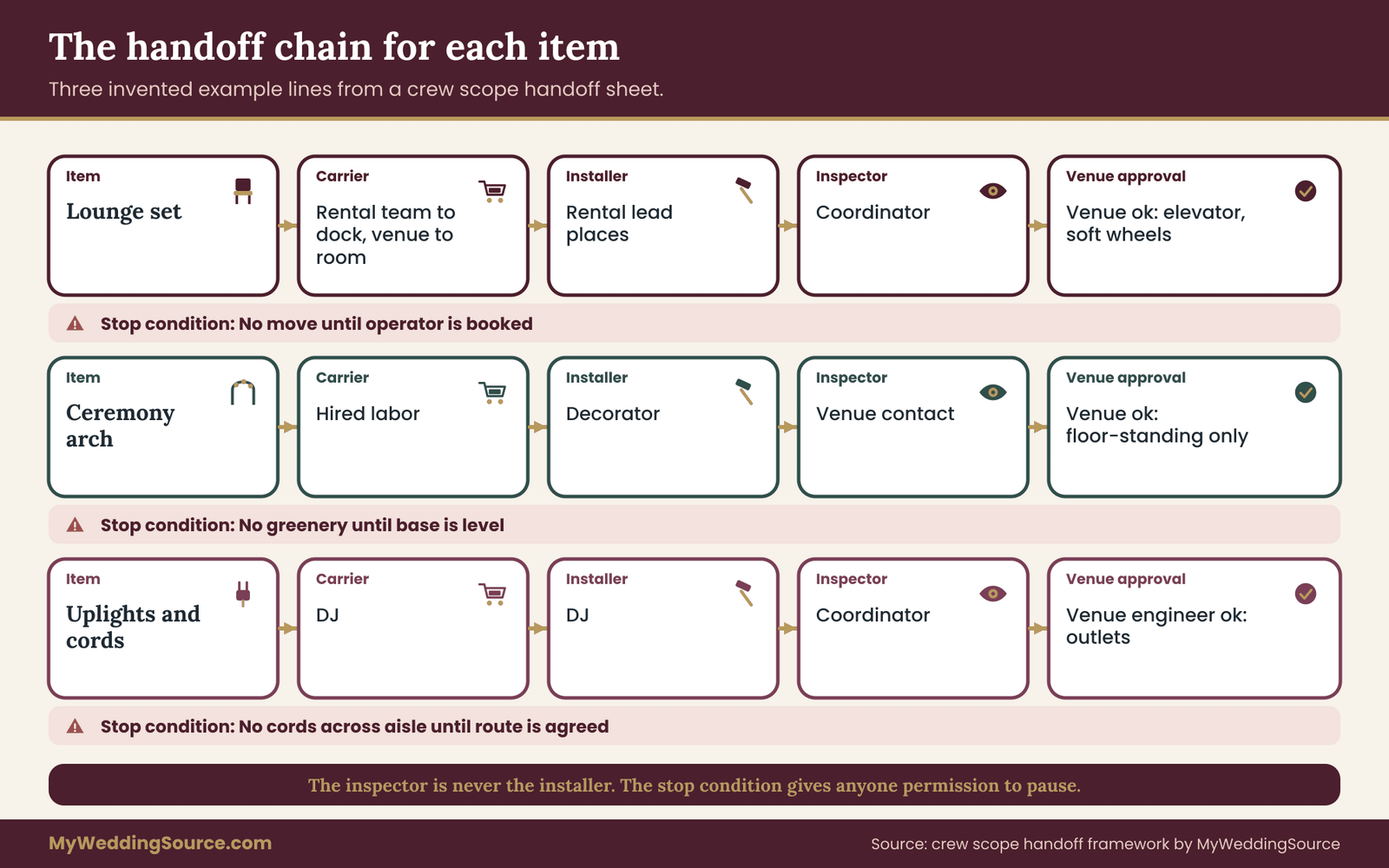
The sheet is the center of this guide. It is a one-page document that answers, for each item in the room, who carries, who installs and who inspects, with a few extra fields that keep the plan honest. You can draw it by hand or in a document. The infographic below shows the idea as chains, and the fields are described in the text so you can copy them.
The seven fields
1. Item. A short name and quantity. “Round tables, 12.” “Ceremony arch, 1.” “Centerpieces, 12.” Group small items together when they move and install together.
2. Carrier. The person or company that moves it from the delivery point to the staging zone or final position. Name a company and a lead, not a department.
3. Installer. The person or company that places, assembles, hangs or wires it. If the item needs no installing, write “place only.”
4. Inspector. The person who checks it afterward. This must not be the installer.
5. Access window. The time the room, dock and elevator are available for this item. Include the latest time the item must be finished.
6. Venue approval. What the venue has agreed in writing for this item: route, location, attachment points, power, flame, ladders. Write the date and who gave it.
7. Stop condition. The one thing that, if true, means the item is not installed until someone decides. “No hanging until venue confirms attachment points.” “No chairs until the dance floor is finished.”
Why the stop condition matters to a wedding setup crew
The seventh field looks like an extra, and it is the one that prevents most day-of mistakes. A stop condition gives each worker permission to pause without asking whether they are being difficult. When a decorator knows that the venue has not yet approved the ceiling points, and the sheet says so, they pause and call. When the sheet says nothing, they decide for themselves, because the clock is running.
How to fill in the sheet
Fill it in from the contracts and the floor plan, not from memory. Start with the largest and riskiest items and work down to the small ones. Where two parties could own the same verb, make the call now and tell both. Send the finished sheet to every vendor and to the venue, ask each to confirm their lines by reply, and keep the confirmations with the sheet. If someone does not reply, the line is not agreed.
The wedding setup crew sheet also reveals gaps. When you finish and find a line with no carrier, you have found the stretch nobody promised to cover, and you can solve it with a labor line in the budget rather than a last-minute argument. A line where the installer and the inspector are the same person is a prompt to name a second pair of eyes.
Keeping the wedding setup crew sheet to one page
A sheet that fills ten pages will not be read. Group similar items. Keep stop conditions to a line. Use the sheet as a map, with detailed instructions in each vendor’s own documents. The wedding vendor timeline is a good place to hold the arrival and departure times that the sheet refers to, so that the two documents agree. If you also run purchase orders with vendors, the vendor purchase order checklist shows how to tie a written order to each item so the quantity on the sheet is the quantity that was ordered.
The venue approval checklist before the wedding setup crew arrives
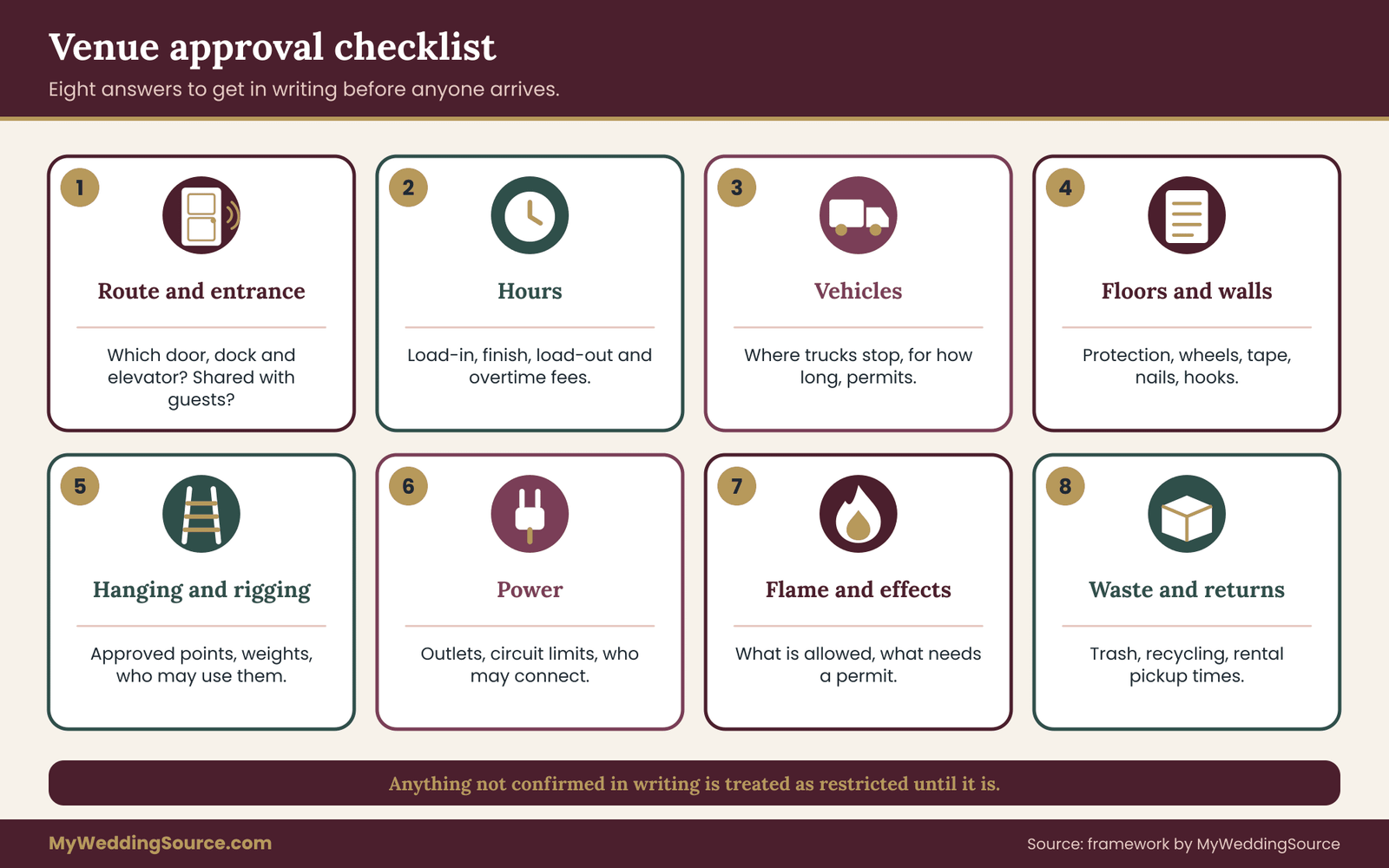
The wedding setup crew sheet describes your plan. The venue approval checklist records what the venue has agreed to. Treat the two as a pair: nothing on the sheet that depends on the venue should be marked ready until the matching line below is confirmed.
Eight things to confirm in writing before the wedding setup crew starts
Route and entrance. Which door, which dock, which elevator, which path. Whether the route is shared with other events or guests. Whether elevator use needs a reservation or an operator.
Hours. When load-in may begin, when it must be finished, when load-out may begin and when it must end. Whether there are fees for early arrival or overtime.
Vehicles and parking. Where trucks stop, how long they may stay and whether permits or marshals are involved. If the venue has a dock, the dock rules may restrict vehicle size or hours.
Floors and walls. Protection required, wheeled equipment allowed or forbidden, and anything that may not touch walls, doors or ceilings. Many venues forbid tape, nails, adhesive hooks and staples.
Hanging and rigging. Whether anything may hang from the ceiling or structure, where the approved points are, what weight they carry and who may use them.
Power. Where outlets are, what each circuit supports and whether the venue must supervise any connection.
Flame and special effects. What is allowed, what needs a permit and what the fire authority or venue forbids.
Waste and returns. Where trash and recycling go, who removes them and what must leave the building by when. Where rented items wait for pickup.
How to get the answers
Send the list to the venue contact and ask for a written reply to each line. Most venue coordinators answer this kind of question every week. If an answer is “it depends,” ask what it depends on. If it depends on a person, ask for the name. Save the reply with the wedding setup crew handoff sheet.
If a line has no confirmation by the time of the final vendor meeting, treat the matching item as restricted. It may still be fine on the day, but it should not be assumed.
Hired, borrowed or bundled: choosing a wedding setup crew
Once the verbs have owners on paper, you have to decide where each owner in the wedding setup crew comes from. There are four arrangements, and most weddings use two of them at once. Compare them by what they cost in money, in attention and in risk.
Option one: a wedding setup crew bundled with the decorator
The decorator’s proposal includes carrying and installing. This is the simplest arrangement for you, because one company answers for the result. It works best when the route is short, the item list is mostly the decorator’s own and the load-in window is generous.
The cost is that the labor is hidden inside the price, so you cannot easily see what you are paying for, and the inspector is likely to be the same company. If you choose this, ask for the headcount and the hours in writing, and name a separate inspector.
Option two: a separate load-in crew plus the decorator
You hire hourly labor for carrying and let the decorator focus on installing. This costs a visible labor line and some coordination, and it often saves money when the route is long or the furniture heavy, because the decorator’s team is not paid design rates to push carts.
The risk is the seam. The crew carries things to the wrong zone, or the decorator waits for items that are still on the truck. A lead on the crew side, a staging plan and one person who speaks to both prevent most of it.
Option three: the venue’s staff as the wedding setup crew for house items
Many venues will set tables, chairs and a dance floor to your plan, and the decorator handles everything else. This is usually the cheapest and least risky arrangement for house-owned items, because the venue knows its inventory and its floors.
The limit is the boundary. The venue crew will not place decor, and the decorator may not touch house furniture. Draw the line on the sheet, item by item, and confirm who moves a table when a centerpiece must go on it.
Option four: volunteers for light work
Friends and family help with small items under instruction. This costs no cash and a lot of goodwill, and it should be limited to group one tasks and to people who want to help rather than people who feel obliged. Offer them a defined job and a defined end time, with food and a place to change afterward.
A ten-minute rule for choosing a wedding setup crew
Answer these four questions, in order.
First: is the route longer than a quick walk, or does it involve stairs? If yes, hire carrying separately, or confirm that the decorator’s quote assumes it.
Second: does anyone have to hang, rig or wire? If yes, those items go to trained people with the venue’s written approval, and volunteers are out.
Third: is the load-in window shorter than the sum of carrying and installing for one small team? If yes, use more people for less time, not fewer people for more.
Fourth: can the person inspecting be someone other than the installer? If not, add one, even if it means asking a coordinator or a venue employee.
Four answers give a recommended shape for the wedding setup crew, and the shape is almost always a mix.
Cost logic without invented numbers
You will see rates quoted for event labor, decorator fees and venue labor charges, and they vary a great deal by region and season. This guide does not quote them, because any figure would be stale or wrong for your area. What you can do instead is compare in a structured way.
Collect three kinds of quote: an hourly rate and minimum hours from a labor source, a bundled install price from the decorator, and the venue’s fee, if any, for its crew or for overtime. Then estimate person-hours using the method in the carrying section, multiply by the hourly rate and add the minimum-hour effect.
Compare that total to the decorator’s labor-related share, which you may need to ask for. If the bundled price is lower than your separate estimate, the bundle may be efficient, or it may be assuming a short route. If it is much higher, you are probably paying for design time and insurance as well, and that may be fine.
The point is not to find the lowest number. It is to see where the money goes so that you are not surprised by a labor fee on the venue’s invoice.
Alternatives when the budget is tight
If cost is the pressure, there are ways to lower it without removing the verbs. Reduce the number of heavy items, for example by choosing house furniture over rented lounge sets. Ask vendors to deliver and place their own items, which removes carrying from your line. Shift the install of group one items to well-briefed volunteers while paying for group three. Choose designs that need fewer hanging elements. And ask the venue whether a longer load-in window lowers the number of people required, because time is sometimes cheaper than headcount.
What you should not cut is the inspector. A named person with a checklist costs a small amount of time and can prevent a large problem.
Pay, status and insurance questions to ask, not answer
Hiring a wedding setup crew raises questions about wages, classification and insurance. This section does not answer them, and nothing in this guide is a legal conclusion. It tells you what to ask and where the rules are published.
Employees and contractors in a wedding setup crew
Whether a worker is an employee or an independent contractor is decided under federal and state rules that look at the real working relationship, not just the label on a contract. The U.S. Department of Labor’s Wage and Hour Division publishes information on this, and state labor departments publish their own. A staffing company that supplies workers usually takes on the employer role for them, which is one reason it is a common source of event labor. If you hire an individual directly, the questions are different, and they may include pay rules and tax reporting.
You do not need to resolve this yourself. You do need to avoid assuming that an informal cash arrangement with a few helpers is simple. Vetting a labor source follows the same steps as vetting any vendor, which the vendor due diligence checklist lays out. Ask the staffing company how its workers are classified and paid, and ask whether it carries workers’ compensation coverage. If you plan to hire individuals directly, speak to the labor department or a qualified adviser in your state before the day.
Wages and overtime
Pay for hourly workers can be affected by minimum wage, overtime and minimum shift rules that vary by location. A wedding setup crew that works a long day or a late-night teardown may trigger overtime pay, which the company bills to you. Ask whether the quoted rate includes overtime after a set number of hours, whether a minimum call applies and whether holiday or night rates exist.
Volunteers
Friends who help for free are generally treated differently from paid staff, but the rules about volunteers can depend on who benefits and whether any compensation is provided. If a volunteer is hurt, the question of who pays is real. Some couples check whether their wedding or event insurance policy covers helpers, and some venues require proof of coverage for anyone working in the building. Ask the venue what it requires, and ask your insurer what is and is not covered.
Insurance and the certificate
Venues often ask vendors for a certificate of insurance naming the venue as an additional party. A decorator, caterer or labor company that works in the building regularly will have one ready, and one that does not may be unprepared for the job. Ask each company whether it carries general liability coverage and whether it can provide a certificate on request. Do not accept “we are covered” as a sufficient answer where the venue requires paper.
Questions to put in writing
Send each paid source a short message with the following questions.
- Are your workers your employees, and do you carry workers’ compensation insurance?
- Do you carry general liability insurance, and can you provide a certificate for the venue?
- What are your minimum hours, overtime rules and cancellation terms?
- Who is responsible for damage caused by your workers?
- Who will lead on the day, and how can they be reached?
Save the replies. If something goes wrong, they are the first documents anyone will ask for. For the current rules in your area, use the agency pages listed under Sources, or ask your state’s labor department, and treat anything you read here as a prompt for questions rather than an answer.
A worked case: one wedding setup crew, one ballroom, three vendors
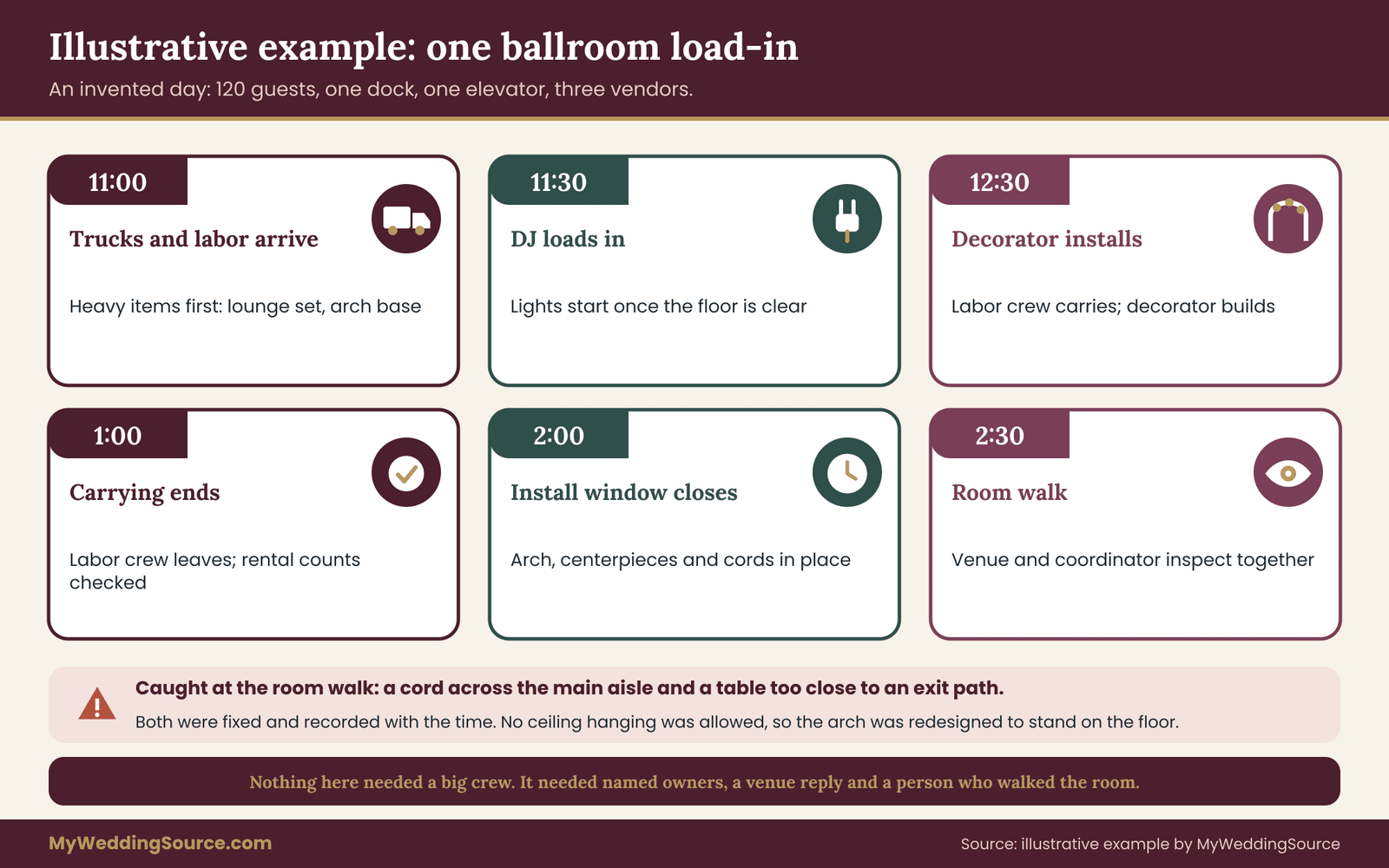
The following example is invented to show the method. The people, the venue and the numbers are made up, and your own situation will differ. What matters is the order of reasoning.
The situation
A couple is planning a ceremony and dinner for about 120 guests in a hotel ballroom on the second floor. The ceremony takes place in the same room, then the room turns for dinner. The venue owns round tables and chairs. A decorator will supply a ceremony arch with greenery and fifteen centerpieces. A rental company will deliver a small lounge set of two sofas and four chairs. The DJ brings uplights and a sound system.
The venue has one freight elevator that needs an operator, a ground-floor dock and a load-in window that opens at eleven in the morning and closes at two.
Step one: list the items and the verbs for the wedding setup crew
The couple’s coordinator writes the item list and fills in the wedding setup crew handoff sheet.
Tables and chairs are house items. The venue’s crew carries and installs them to the floor plan. The inspector is the coordinator.
The lounge set is rented. The rental company carries it to the dock and, because the quote says “curb or dock only,” stops there. Someone has to carry it up in the elevator and into the room. The coordinator asks the venue whether its crew will do this for a fee. The venue says yes for a set charge, so the venue crew carries and places it, and the rental company’s lead confirms placement.
The ceremony arch and greenery are the decorator’s. The decorator’s quote says “setup included,” so the coordinator asks how many people will be there. The answer is two. Carrying fifteen centerpieces, linens and an arch from the dock through the elevator is more than two people can do well in the window while also installing, so the coordinator adds a labor source.
Uplights and sound belong to the DJ, who carries and installs them. Cords are the issue, so cord routing goes on the sheet with the coordinator as inspector.
Step two: decide the crew
The coordinator compares options. The decorator offers to bring two more people for a stated fee. A local event labor company quotes an hourly rate with a four-hour minimum. The couple chooses the labor company for carrying only, with a supervisor on site, because the minimum hours cost less than the decorator’s extra people and the decorator can then focus on installing.
Volunteers are used for two jobs only: setting programs on chairs and arranging favors on tables after the centerpieces are down. No volunteer is asked to carry or to touch anything that hangs.
Step three: the venue approval checklist
The coordinator sends the eight-line checklist to the venue. The reply confirms the dock and freight elevator, the operator’s hours, the load-in window and the use of carts with soft wheels. It also says that nothing may hang from the ceiling, that adhesive hooks are not allowed on walls, that open flame is limited to candles in glass and that the venue’s engineer must approve any new power connection.
Two lines change the plan. The decorator had proposed a hanging greenery piece above the arch. The venue says no, so the decorator redesigns it as a ground-standing arch with a heavier base and says the price is unchanged. The DJ’s uplights will plug into labeled outlets only, and the engineer will check the connections.
Step four: the schedule
The coordinator builds an order of work on one page.
At eleven the labor crew and the rental delivery arrive at the dock. The elevator operator is on hand. Heavy items go up first: the lounge set and the arch base. House tables and chairs are set by the venue crew in a first pass. The DJ loads in at eleven thirty and begins lights as soon as the floor is clear.
At twelve thirty the decorator’s team starts the arch and centerpieces. The labor crew finishes carrying by one and leaves. The decorator finishes installing by two, the end of the window.
At two thirty the coordinator and the venue contact walk the room: counts, exits, cords, arch stability and the lounge set. A cord crossing the main aisle is covered and rerouted. One table is moved six inches off an exit path. The coordinator records both changes and the time.
Step five: what went right, and the stop conditions
Two stop conditions on the wedding setup crew sheet did their work. “No cords across the aisle until the venue confirms the route” meant the DJ paused and asked rather than guessing. “No greenery install until the arch base is level” meant the decorator corrected a slightly uneven floor with shims before building upward.
What the example shows
The couple did not hire a big wedding setup crew. They named an owner for each verb, they found two gaps early (carrying of the rented set and the decorator’s thin headcount), and they got a venue sign-off that caught two small problems. Nothing in the plan required special expertise. It required a one-page sheet, a short list sent to the venue and a person who walked the room.
You can reproduce the pattern at any scale. A backyard wedding with a rental company, a florist and four friends has fewer items and fewer rules, and the sheet is shorter. A large ballroom wedding has more items, a longer sheet and probably a coordinator who holds it. The questions stay the same.
Failure conditions: when a wedding setup crew plan needs a change
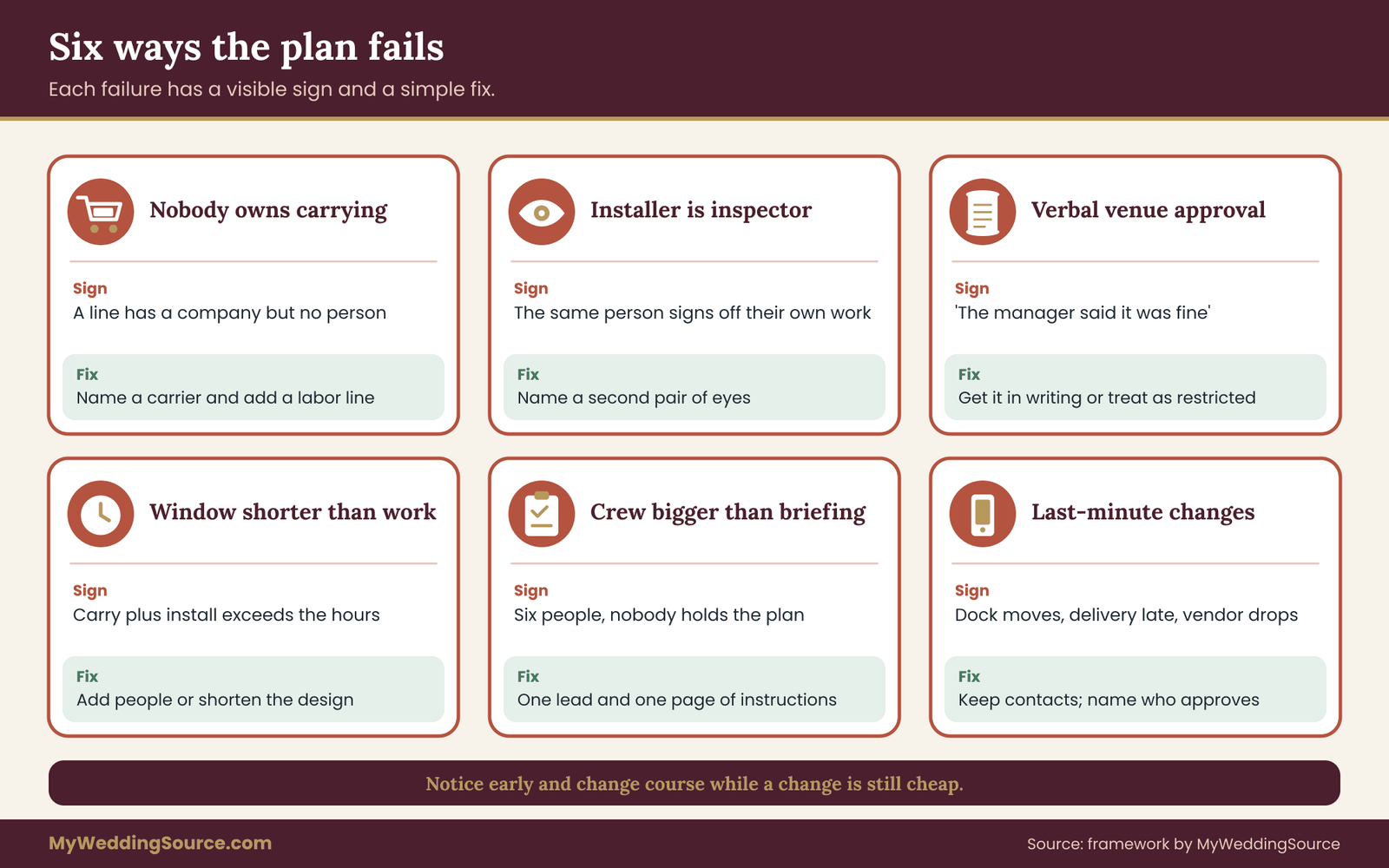
Every plan has ways of failing. Knowing them in advance lets you notice early and change course while a change is still cheap.
Six ways a wedding setup crew plan breaks
Nobody owns the carrying. The decorator assumed the venue, the venue assumed the rental team and the rental team assumed the decorator. Signs: a line on the sheet with a company name but no person, or a quote that says “delivery” without saying where. Fix: assign a named carrier and put a labor line in the budget.
The installer and the inspector are the same person. Signs: the person who finished the work also signs it off. Fix: name a second set of eyes before the day, even if it is a venue employee or a trained friend.
The venue approved something verbally. Signs: a hanging element, a flame or a connection that rests on “the manager said it was fine.” Fix: ask for a written confirmation or treat the item as restricted.
The window is shorter than the work. Signs: the sum of carrying and installing exceeds the hours between access and guest arrival. Fix: add people, shorten the design, or ask the venue about an earlier or longer window. Do not rely on everyone working faster.
The crew is bigger than the briefing. Signs: six people arrive and nobody holds the floor plan. Fix: one lead per crew, one page of instructions and one person who answers questions.
Hours change at the last minute. Signs: the venue moves the dock window, a delivery runs late or a vendor cancels. Fix: keep a contact list with phone numbers for every lead and decide in advance who may approve a schedule change.
Stop and rethink conditions for a wedding setup crew
Some situations mean the plan should change, not just be patched. If the venue will not confirm hanging points and the design depends on them, change the design. If a labor source cannot say how its workers are covered, choose another. If the decorator cannot name the number of people on site, ask for a written headcount or look at a different provider. If the room cannot be accessed for long enough to do the work safely, the problem is the schedule, not the crew.
None of these is a reason to panic. All of them are reasons to act while you still have days, not hours.
What to do when it is already the day
If something has gone wrong on the day itself, the order of action is simple. Stop any unsafe work first. Call the venue contact before anyone improvises. Ask the item’s installer to propose a fix and have the inspector check it. Move the schedule only with the person who owns the ceremony start time. Then write down what changed, because that record will help sort out any later question about cost or damage.
Scripts and written wording for your wedding setup crew
Plain messages avoid most misunderstandings with a wedding setup crew. These can be adapted.
To a decorator: “Your proposal says setup is included. Could you confirm how many people will be on site, for how many hours, and whether carrying from the dock to the room and removal afterward are included?”
To a venue: “Please confirm in writing the load-in route, the hours, whether wheeled carts are allowed, whether anything may hang from the ceiling or walls, and who can approve power connections.”
To a labor company: “We need carrying only, under a supervisor, for a stated window. Please confirm how your workers are classified and covered, your minimum hours and your overtime rules.”
To a volunteer: “We would love your help with programs and favors from two to three. We have a team for anything heavy, high or electrical, so you can relax and enjoy the day.”
To an inspector: “Please walk the room at four with this checklist. If anything fails, tell the item’s owner and the venue contact, and write the time.”
Each message names a verb, a person and a time. Together with the sheet and the checklist, they are the whole system.
Your next steps
Do these in order, and expect the first four to take an evening.
- List every item your wedding setup crew will handle, then split each into carry, install and inspect.
- Walk or review the route from dock to room and note distance, doors, stairs and the elevator.
- Sort items into place, assemble and hang groups, and mark which need venue approval.
- Send the venue’s eight-line checklist and ask for written replies.
- Ask each decorator and crew source the headcount, hours and insurance questions.
- Decide the mix of sources using the four-question rule, then name a lead for each.
- Fill in the wedding setup crew handoff sheet, with a stop condition per line, and send it for written confirmation.
- Name an inspector who is not an installer and give them the checklist.
- Agree a short contact list and the person who can approve a schedule change.
- Re-read the sheet a week before and again the day before.
FAQ
What is the difference between a load-in crew and a decorator?
A load-in crew carries items and is paid mostly for hours of labor. A decorator designs the look of the room and installs items to match, and is paid for a finished result. The two can overlap, since some decorators carry their own items and some crews place simple things, but the verbs and the accountability differ, so it is worth naming both on paper.
Should the decorator carry everything to the room?
Not always. It depends on the route, the window and who owns the items. If the dock is far from the room, the load-in window is short or the furniture belongs to a rental company, a separate carrying crew often costs less than the overruns it prevents. Ask the decorator how many people will be on site and whether carrying and removal are in the price.
Who should inspect the finished room?
Someone who did not install it. A venue contact, a coordinator or a day-of attendant with a checklist are all good choices. The inspector checks the order, the safety of the room and the design against the plan, then tells the item’s owner about anything that fails. The couple should not inspect on the day, because they have other things to do.
Can friends and family be the wedding setup crew?
For light, low-risk jobs such as programs, favors and table arrangements, yes, if they want to and have clear instructions. For heavy carrying, ladders, hanging items and anything electrical, use trained people. Volunteers also raise insurance and injury questions, so ask the venue what it requires and check what your own policy covers.
Do we need to pay a crew overtime or provide insurance?
That depends on how the workers are classified and on the laws where you live, and this guide cannot say. Ask any labor company how its workers are employed and covered, ask for a certificate of insurance if the venue requires one, and check your state labor department and the U.S. Department of Labor for current rules before hiring individuals directly.
What should the venue approve before load-in?
At minimum, the route and entrance, the hours, vehicle and parking arrangements, floor and wall protection, whether anything can hang from the ceiling, power connections, flame and special effects, and waste and returns. Get the answers in writing, with a name and a date. Anything not confirmed should be treated as restricted until it is.
How many people does a wedding setup crew need?
It depends on the route and the window, not the guest count. Count the large items, the small boxes, the one-way distance in minutes and the hours allowed. Estimate trips per person per hour, divide the total trips by that figure, then divide by the window. Round up, and add a lead. A short route needs few people, and a long one needs many.
What if the venue or a vendor says no at the last minute?
Stop the affected install, call the venue contact and ask the item’s owner for an alternative. Common fixes are standing the element on the floor instead of hanging it, moving it to an allowed area or removing it. A stop condition on the sheet makes this easier, because everyone already knows who decides. Record what changed and the time.
Sources
- U.S. Department of Labor
- Fair Labor Standards Act, Wage and Hour Division, U.S. Department of Labor
- Misclassification of employees as independent contractors, U.S. Department of Labor
- State labor offices, U.S. Department of Labor
- Occupational Safety and Health Administration
- Ladder safety, Occupational Safety and Health Administration
- National Institute for Occupational Safety and Health, Centers for Disease Control and Prevention
- Independent contractor (self-employed) or employee?, Internal Revenue Service
- ADA.gov, U.S. Department of Justice
- National Fire Protection Association