
Beach wedding permits decide whether a ceremony on public sand can happen at all, and the tide, the public access rules and your cleanup plan decide whether it goes well. This guide gives you a three-line site check (tide line, access line, trace line), a worked example and clear stop conditions for setting up and cleaning up on a shared beach.
Before you pay a deposit for chairs or an arch, find the agency that manages your exact stretch of sand and ask whether beach wedding permits are required for your group size and gear. Then run the three-line check. On the tide line, confirm that dry sand exists at ceremony time. On the access line, confirm how guests, vendors and wheelchairs reach it. On the trace line, write down everything you bring and exactly how it leaves. Any red answer means you redesign the plan or move the ceremony.
A beach looks like the simplest venue there is. There is no building, no rental fee on the brochure, and the view is already included. That impression is the first thing to distrust. A public beach is a working piece of shared land: it has a tide that moves, a managing agency that may or may not want to hear from you, wildlife that sometimes outranks your schedule, and other people who have every right to be there while you say your vows.
Most trouble with beach wedding permits comes from three misunderstandings. Couples assume that “public” means “no permission needed.” They assume that the ceremony spot they saw on a sunny afternoon will exist at the hour they have chosen. And they assume that cleanup is a matter of a trash bag at the end, when in practice cleanup is a plan that starts with what you decide to bring.
This article is narrower than a general venue search, and it is only about beach wedding permits and the sand they cover. If you are still deciding between a beach, a garden and an indoor room, start with the wedding venues guide, and come back once sand is your choice. Here we deal with what is different at the water’s edge: tide, shifting ground, public access easements, shorebird and turtle closures, and the odd fact that the best photo location is often the least stable one.
A note on scope. This is general planning information, not legal advice, and rules for beaches vary by state, county, city and individual park, so confirm every requirement with the agency that manages your site.
What beach wedding permits actually cover
The phrase “beach wedding permits” is shorthand for several different pieces of permission, and a single office rarely grants all of them. Sorting them out early saves you from a common surprise: one of the beach wedding permits looks complete but leaves out the one item you planned to rely on.
The event or special-use permit. This is the main document. It tells the managing agency who you are, where you will stand, how many people will attend, what time you will be there and what you are bringing. Some agencies issue it for any organized gathering above a certain size. Others only require it when you set up structures, amplify sound or reserve a specific area. The threshold is set locally, so the only reliable answer comes from the office.
Structure and equipment approval. Among beach wedding permits, arches, canopies, tents, flooring, generators and large signs are often handled separately from the event permit, so a rental planning checklist is worth opening before you ask for quotes. A beach that welcomes a small ceremony may still prohibit anything that needs stakes driven into the sand, because stakes can hit buried utilities, nests or protected dune structure.
Amplified sound and music. Even a single speaker may fall under a noise ordinance or a quiet-hours rule. Live acoustic music is sometimes treated differently from a speaker, and sometimes not.
Alcohol and food. Many public beaches prohibit alcohol outright, or allow it only in specific zones or with a separate license. Food is usually less restricted but may be limited to particular areas, and glass is commonly banned.
Parking and vehicle access. Beach wedding permits rarely include parking for your guests. Lots may charge fees, fill early on summer weekends or close at a set hour. Vendor vehicles on the sand are a separate request and are often denied.
Photographer and commercial activity. Some agencies attach conditions to commercial photographers or other vendors to hold their own permit or insurance. The cost and rules here belong in your photographer conversation before you assume they are covered.
Treat the list above as a set of questions about beach wedding permits, not a promise of what every agency does. Your job is to learn which of these pieces your site actually asks for, and to get each answer in writing.
Permission, reservation and beach wedding permits are different things
Offices use these words loosely, and so do couples. A reservation holds a space or a date. Beach wedding permits authorize an activity under conditions. Some beaches offer neither for a small ceremony and simply post rules. In that case you are not asking for permission, but you are still bound by the posted rules, and an officer can ask you to stop if you break them.
If an office says “you don’t need a permit,” ask a follow-up question in the same call: “Is there a group size or equipment limit above which we would?” That single sentence tends to surface the real boundary. Write down the name of the person, the date and the answer, and follow with a short email that restates it so there is a record.
Why small and informal ceremonies still get a check
Couples sometimes reason that eight guests and a ukulele cannot possibly need beach wedding permits. That reasoning is often correct. It is also not a plan, because the boundary is rarely at eight guests. It may be at a number lower than you expect, or it may depend on whether you place anything on the sand. Informal ceremonies that arrive with six folding chairs, a rented arch and a speaker can cross several lines at once without anyone intending it.
The point of the first call about beach wedding permits is not to ask permission for a thing you have already decided. It is not a request for a favor either. It is research, and agencies tend to answer research questions more generously than pleas. It is to learn where the lines are so you can design under them or plan around them.
Who owns the sand: reading public access before you book
“Public beach” is not a single legal category. Two beaches that look identical can be governed by different rules because the land has a different owner, a different history or a different state doctrine behind it. You do not need to become a property lawyer. You do need to identify which kind of land you are standing on.
The usual owners of a public beach
Public sand is commonly managed by one of these:
- a city or town parks department
- a county parks or beaches department
- a state park system or a state land agency
- the National Park Service or another federal agency, as part of a national seashore, lakeshore or recreation area
- a conservation trust or a wildlife refuge, where public access is allowed but the primary purpose is habitat
Each of these has its own process for beach wedding permits, fee structure and tolerance for events. A federal seashore may route you through a special-use permit page on the National Park Service site, while a town beach may have a one-page application at a recreation office. Wildlife refuges often restrict gatherings sharply, because their purpose is habitat.
Where “public” starts and stops on the sand
In many states the public has a right to use the wet part of the beach, and the boundary of private ownership is measured from a tidal line. Other states give the public a broader right that reaches into the dry sand up to a vegetation line or another marker. Some beaches are public in name, but access to them crosses private land at a particular easement, with its own posted hours.
This matters for ceremonies in two ways. First, if your chosen spot is on a stretch where public rights end at the high tide line, you may be standing on private dry sand without realizing it. Second, a beach can be fully public and still have a private-looking name or a hotel next door that acts as though the sand is theirs. If you are unsure, ask the managing agency, not the nearest hotel.
For guidance on how states describe public beach access and coastal management, the NOAA Office for Coastal Management and state coastal agencies publish plain-language resources, and several are listed in the sources at the end of this guide.
Who to call, in what order
Use a short ladder, and stop when you reach a clear answer.
- Search the exact beach name plus “special events” or “permits” and read the official page first. Official pages usually carry the form, the fee, the lead time and the contact.
- If the page is vague, call the parks, recreation or beaches office listed on it and ask who manages the specific stretch where you want to stand.
- If you are told it is another agency’s land, call that agency with the same question. Do not assume the first answer is final.
- If there is a lifeguard or beach patrol, ask the supervisor how they handle small ceremonies. Their daily reality often differs from the written policy, and they will tell you which hours are least crowded.
- Send a recap email with the date, name, answer and any condition. That email is your working record.
The ladder above is usually enough to establish who actually controls your beach, and it costs a few phone calls.
When beach wedding permits point to a different site
Some answers about beach wedding permits close the beach as a ceremony site before you spend any money. A refuge that bans gatherings, a stretch closed for wildlife during your month, a lot that cannot take guests, or a rule that prohibits any setup are all reasons to look at the alternatives section later in this guide, not to argue. The earlier you hear a firm no, the more calmly you can pivot.
{{INFOGRAPHIC:1}} ## The tide line check: will the ceremony site exist?
The first of the three lines is the one most couples never think about until they are standing in wet sand. A beach is not a fixed floor. Water moves the usable area twice in most places, once or twice a day depending on where you are, and the difference between high and low can be a few feet of sand or a few hundred. Beach wedding permits usually name a location and a time, but the permit does not hold back the water.
What the tide actually does to a ceremony
Tides rise and fall on a schedule that is predictable well in advance. The National Oceanic and Atmospheric Administration publishes predicted tide times and heights for many stations along the coast, and the Tides and Currents site is the standard place to look. Predictions are not a guarantee, and beach wedding permits do not bend to them. Wind, storms and unusual pressure can push the actual water higher than the table says, and a calm table can still produce a surprise on a stormy day.
For a ceremony, the tide affects four things at once.
- Space. At high tide the dry sand may shrink to a narrow strip, or disappear at the base of a dune or seawall. Your chairs, your aisle and your guests may not fit.
- Surface. Near the water line the sand is wet, firm and cold. Higher up it is dry, loose and deep. Heels, wheelchairs and strollers behave very differently on each.
- Safety. A rising tide can cut off a narrow point or sandbar. Guests who walk out to a spot at low tide can find the way back covered.
- Light and sound. Waves near your feet are loud and can swallow a vow. Farther from the water the sound drops, but so does the view.
None of these is a reason to give up on the beach. They are reasons to choose the hour deliberately.
Reading a tide table in four steps
You do not need a degree to read a table. You need to answer four plain questions.
- When is high tide and low tide on the day, and how high or low are they?
- Where is your chosen spot relative to the high tide line? Look at the line of seaweed or debris left on the sand by the last high tide. That wrack line is a rough guide to how far the water reaches on a normal day.
- How long before and after the ceremony will you and your guests be on the sand? Include setup, arrival, photos and teardown, not only the twenty minutes of vows.
- What is the water doing during that whole window: rising, falling or sitting at a slack point?
A ceremony held on a falling tide gives you a widening beach as the hour goes on. A ceremony on a rising tide gives you a shrinking one. If your beach wedding permits allow only a narrow time window, the direction of the tide may decide which spot you can use at all.
The red, amber and green test for the tide line
Use the same simple rating each time you check a site.
Green: At the start of setup and the end of cleanup there is still comfortable dry sand for the full seating area, with at least a generous buffer between your last row and the water or the nearest wet sand. The tide is falling or near low during the ceremony. You have a backup spot higher on the beach.
Amber: The seating area is workable but the buffer is thin at one end of the window. You may need to place the aisle in a different direction, shorten the rows or move the whole setup higher up. Write down the exact adjustment and the time you will make it.
Red: The seating area is, or will be, in water, or the only usable sand is the narrow wet strip. Or the water covers access at some point during the window. A red tide line means changing the time or the place, not trying harder.
A word about the buffer. Do not size it by guessing. Look at the actual wrack line on a day close to your date, ask a lifeguard or park staff where the water usually reaches, and then add margin. A tide table says when the water is high. It does not say how far up the sand it will arrive on your beach, and that depends on the slope.
Spring tides, storms and unusual days
Tides are not equal day to day. Around new and full moons the range between high and low is larger, which can mean higher highs and lower lows. A date that looked fine in a general table can have a noticeably higher water line than a neighboring date. Check your specific date, not the week.
Weather adds its own surprise. Onshore wind can stack water against the shore and push the line higher. A storm far out at sea can send swell that raises the wave runup on a sunny afternoon. When the National Weather Service issues a coastal flood advisory, a high surf advisory or a rip current statement for your area, treat it as part of your tide check and decide in advance what you will do.
The National Weather Service explains rip currents and how to respond to them, including the guidance to swim parallel to shore if caught. That matters for ceremonies because guests sometimes wade in for photos. Put one person in charge of keeping guests out of the water during the event, and make sure the photographer knows the boundary.
Choosing the hour: low tide, high tide or in between
There is no single correct tide for a ceremony. Each has a pattern.
Around low tide. The beach is widest, the sand is firmest near the water and the space is generous. Tide pools, exposed rocks, seaweed and mud flats may also appear, which some couples love and others find unwelcome. Footing near the water is slippery.
Around mid tide. Often the easiest to plan, because the beach is neither tiny nor sprawling. The tide is moving, though, so the buffer changes through your window.
Around high tide. The water is close and dramatic, but the dry area is smallest, and access along the shore may be blocked. Unless your beach has a broad, high berm, high tide is the hardest time to hold an event.
If your date is fixed and the tide is unkind at your preferred hour, move the hour before you move the date. Sometimes shifting by an hour or two changes red to green. The next section looks at how the calendar and the light combine with tides, and it is where beach wedding permits time windows can feel like a squeeze.
Beach wedding permits and the calendar: timing around tide, light and crowds
The windows on beach wedding permits, tide windows and daylight rarely line up neatly. The best ceremony hour is the one where all three overlap, and it is worth making the overlap visible before you commit to a time.
Start with the window in your beach wedding permits
Many beach wedding permits allow a specific block, such as a morning or an afternoon slot, or restrict events to certain hours to keep the beach clear at peak times. Some beaches close at dusk or at a posted hour. Others restrict early morning activity near wildlife. Ask the office for the exact hours your beach wedding permits would cover, including whether setup and cleanup count inside the window or outside it.
That last point matters more than it seems. If cleanup must be finished by the end of the permitted block, then a ceremony at the end of the block leaves no time. Count backward: the last guest leaves, the chairs come down, the aisle decor is removed, the sand is walked for litter and your vendors drive away.
Layer the tide and light on top
Write three lines on a piece of paper: the hours on your beach wedding permits, the tide times and the time of sunset. Mark where they overlap.
- A late afternoon ceremony is popular for the light, but sunset can fall near the end of the block that beach wedding permits give you, and the tide may be rising by then.
- A morning ceremony often has quieter sand, softer wind in many places and easier parking. It also may be earlier than your guests expect, so allow for travel time.
- A midday ceremony gives clear access and easier photography in some respects, but can be hot, harsh and crowded.
A useful habit is to plan the ceremony to end at least an hour before the light or the hour on your beach wedding permits gives out. That margin pays for the unexpected: a late vendor, a slow guest or a delayed start.
Crowds are part of the calendar
On a public beach, your ceremony is one event among many. A summer weekend afternoon may bring swimmers, picnic groups, dogs, volleyball games and sunbathers within earshot. None of them is obliged to move for you, and in many places beach wedding permits do not give you exclusive use of the sand. If it does not, plan for people walking through the photograph and across the aisle.
You can reduce the friction without being unfriendly. Choose an end of the beach with fewer facilities, and arrive early to claim the spot if the rules are first come, first served. Place a polite sign, if signs are allowed, asking passers-by to walk behind the seating. Keep the ceremony short enough that the disruption is small. And decide in advance that a curious stranger with a camera is a welcome part of a public place, not an intruder.
For the ceremony itself, the ceremony cue sheet guide is useful, because a tight, well-timed ceremony shortens your time on the sand and your exposure to the tide and the crowd.
Seasons, closures and booking lead time
Most agencies set a lead time for beach wedding permits, and popular beaches often fill their summer weekends early. If you want a particular date, ask when the application window opens and what the processing time is. Processing times differ widely, so ask for the current figure rather than guessing.
Seasons also shape what the beach is. In many places, certain months are closed or restricted for nesting birds or sea turtles. Others are stormy or cold. If your date is flexible, the broader question of how to pick it sits in the guide to choosing a wedding date, and the tide and light check above helps you compare candidates.
A short decision rule for timing
Put the permit hours, tide and light together and apply this rule:
- If the hours on your beach wedding permits and the tide are both green, choose the date and move on.
- If one is amber, ask whether the beach wedding permits allow a shifted window, and write down the alternative.
- If either is red, change the hour first, the spot second and the date last.
Keep the rule in front of you, because it prevents the most common mistake, which is paying for chairs and flowers before checking whether beach wedding permits allow the hour that the tide permits.
{{INFOGRAPHIC:2}} ## The access line: getting people and gear onto the sand
The second line asks a plain question: how does everyone and everything reach the ceremony spot, and can they do it comfortably? A site can have perfect tides and a friendly office for beach wedding permits and still fail here, because the path from the car to the sand is longer, steeper or softer than the photographs suggested.
Map the route from the car to the chair
Walk it, or ask someone who has. Start at the parking area your guests will use and follow the path to the ceremony spot. Note the following:
- the distance, in steps or minutes, at an ordinary pace
- whether there is a boardwalk, a paved path, a dune crossing or only open sand
- any stairs, ramps or steep slopes
- whether the route is shaded, and whether it floods at high tide
- restrooms, drinking water and trash cans along the way
The answers shape everything else. A two-minute walk on a paved ramp is a different event from a ten-minute trudge through soft sand, and the difference falls hardest on older guests, young children, people with limited mobility and anyone carrying a bag.
Guests with limited mobility
Soft sand is difficult for wheelchairs, walkers, canes and strollers, and sometimes for ordinary shoes. If anyone in your guest group will find it hard, the access line is where you solve it. Some beaches provide mobility mats, beach wheelchairs or firm-surface paths, and many do not. Ask the managing agency what is available, whether it can be reserved and whether it is permitted to bring your own.
The Americans with Disabilities Act sets out requirements that public entities must follow for accessibility, and the ADA website explains the basics. It does not guarantee that every beach has a firm path to the water. It does mean that asking the agency about access is a reasonable and ordinary request.
If the ceremony spot truly cannot be reached by every guest, you have options. Move the seating nearer to the boardwalk or the end of the paved path. Hold the ceremony on the firmer sand near the water at a tide that allows it. Provide a seating area at the top of the access route with a clear sightline. Or reconsider the site. The guide to accessible wedding venue red flags lists the warning signs worth checking, and the principles apply to outdoor sites as much as to buildings.
Ask guests privately and early whether they need accommodations, rather than assuming. A short line on the invitation or the wedding website, such as an offer to help with seating or arrival, lets people say what they need without making a scene.
Footwear, heat and the long walk
Tell guests what to expect before they arrive, and mention which beach wedding permits you hold if the agency asks you to display them. A note saying “ceremony on public sand, about a five-minute walk from the lot, shoes optional, shade limited” saves a lot of discomfort. Suggest flat shoes or going barefoot. Mention sun protection and water. If your beach gets windy in the afternoon, say so, because loose hair, veils and programs behave differently in a breeze.
For people in formal clothing, a note about heels is a kindness. Narrow heels sink into dry sand and can break a rhythm in the aisle. Block heels or wedges help a little, flats help more, and bare feet help most. The wedding party can carry a basket of sandals or foot wipes if that suits the style.
Parking, drop-off and shuttles
Parking is where many beach plans quietly collapse. Check:
- how many spaces the lot holds and how early it fills on the day of the week you have chosen
- whether parking is free, metered or paid at a gate
- whether there is a drop-off area close to the path for guests who cannot walk far
- whether the lot or the beach closes at a set hour
- whether the street nearby is residential and restricted
Beach wedding permits rarely reserve parking, and a permit fee is not a parking fee. If you expect a larger group, consider asking guests to carpool, arrive early or use a nearby lot with a shuttle. Even a local group benefits from a one-line plan about where to park, and travelers benefit from a note about rideshare drop-off.
Vendors and the load-in problem
Vendors are the part of access that couples forget. Chairs, an arch, a sound system, a cooler and a photographer’s bag all have to travel from a vehicle to the sand. Many beaches do not allow vehicles beyond the parking lot, and some prohibit rolling carts over dunes. If everything has to be carried by hand, the amount you bring is limited by what a few people can reasonably carry in one trip.
Ask the agency three questions about load-in, since beach wedding permits seldom cover vehicles. Can vendors drop off at a closer point, and for how long? Are wheeled carts allowed on the access path? Does a vendor need its own approval under beach wedding permits, or proof of insurance to work there? Then pass the answers to your vendors in writing before they quote. A florist who prices an arch without knowing it must be carried two hundred yards will be surprised, and so will you at the invoice.
For the planning side of load-in routes and timings, the venue technical walkthrough explains how to measure and record access routes, and the same method works on a beach even though there is no building.
Restrooms, water and shade
Beaches vary a great deal in facilities. Some have restrooms and showers at the lot, others have portable toilets in season, others have nothing. Confirm where the nearest restroom is, whether it is open at your hour, and how far it is from the ceremony. If guests will be on the sand for over an hour, drinking water and shade matter. Provide a cooler of water if the rules allow it, and ask whether you may set up a small shade structure or whether umbrellas are the limit.
Security, belongings and public presence
On a public beach you cannot lock anything. Decide where purses, gifts and the guest book go during the ceremony. Assign a trusted person to watch them, or leave valuables in a car. Keep the wedding rings in a pocket with a zip or a small secure case, not on a loose chair. The same caution applies to a ring bearer’s pillow, a card box and any electronic equipment.
If strangers walk through, assume goodwill and have a calm script ready. Something like “We are in the middle of a small ceremony, would you mind passing behind the chairs?” works better than a raised voice. If someone becomes disruptive, the lifeguard or a park officer can step in, so know where they are before you start.
The red, amber and green test for the access line
Green: Every guest can reach the seating area by a route you have walked, in a time you have told them, with a drop-off or seating solution for anyone who needs it. Vendors can bring in what they quote. Parking and restrooms are confirmed.
Amber: The route works for most people but has one soft spot, such as a long sandy stretch or limited parking. You have a written plan for it: a drop-off, a shuttle, a nearer seating area or a firm path.
Red: A guest who needs to attend cannot reach the spot, the lot cannot take your group, or vendors cannot bring in the items they quoted. Red means redesign: a different spot, a smaller setup or a different site.

Setup rules on sand: chairs, arches, aisles and sound
Setup is where beach wedding permits turn from paperwork into physical objects. Everything you bring has to survive wind, be carried across sand and be removed completely. The more you bring, the more every earlier line of the check is tested.
Start with what you can leave at home
The easiest setup to approve, carry and clean up is the one that is small. Before you compare rental quotes, list everything you imagine on the sand and sort it into three groups.
- Needed: things the ceremony cannot happen without, such as a place for the couple to stand and a way for the officiant to be heard.
- Helpful: things that make people comfortable or the photographs better, such as seating for those who need it and a small sign.
- Decorative only: things that look nice but add weight, wind risk and cleanup, such as an arch, a long aisle runner or scattered petals.
A beach ceremony often looks best with less than a hall ceremony would have. A line drawn in the sand, a pair of footprints and the sea behind you can do the work of an arch. Starting from “needed” also makes every conversation about beach wedding permits shorter. ### Chairs, seating and the aisle
Folding chairs sink on dry sand and tip when guests shift, so rental companies sometimes suggest flat boards under the legs or skip chairs altogether. Many beaches do not allow stakes, boards or anything that changes the surface, so ask before you plan around them. Alternatives that work well on sand include a few chairs reserved for older guests and others who need them, with the rest of the group standing in a loose semicircle, or sitting on blankets or towels they bring.
An aisle is optional. A fabric runner blows away, collects sand and must be shaken out and carried off. A drawn line or a natural path of firm sand is lighter, free and leaves nothing behind. If the agency prohibits drawing in the sand, check what “drawing” means to them. Some forbid digging, others do not mind a stick line that the tide erases.
Arches, canopies and anything that stands up
Anything tall acts as a sail, and beach wedding permits treat it that way. A wedding arch that stands calmly in a showroom can fall in a gentle sea breeze, and the damage falls on whoever is standing under it. If beach wedding permits allow an arch, ask about the wind conditions that would cancel it, and ask your rental company how it anchors the structure without stakes. Weighted bases, sandbags and buried anchors each raise their own questions about the rules and about cleanup.
Ask three direct questions about beach wedding permits before you rent an arch. Is a structure allowed at all? Is there a height or footprint limit? May it be anchored in the sand, and how? If the answer to any is no, you have a decision. A freestanding arch that must be stabilized with heavy objects may not be worth the trouble when the ocean already supplies the backdrop.
Canopies and tents are usually treated more strictly than arches because they catch more wind and cover more area. Some public beaches ban them altogether, and some limit size. If shade matters, ask whether personal umbrellas are allowed and let guests bring their own.
Flowers, petals and loose decoration
Petals look beautiful in photographs and become litter in the water. Loose confetti, rice, sparklers, balloons and glitter are commonly banned or discouraged on public beaches because they harm wildlife and are nearly impossible to collect. Balloons in particular can travel far and end up in the water, and many places have rules against releasing them.
Choose decoration you can pick up in one pass: a bouquet, a small arrangement in a container you carry out, a shell or a piece of driftwood you leave exactly where you found it. Check whether beach wedding permits cover even natural items, such as shells and plants, may be taken or placed. Dune plants hold the sand together and are usually protected, so never pick them or cut them for decoration.
Sound: speakers, music and voices
Wind and waves take a quiet voice and throw it away. The officiant and the couple will need either a closer huddle or some amplification. Many beaches limit amplified sound or prohibit it. A small battery-powered speaker may count as amplification under the local ordinance, and some beaches have a decibel limit or quiet hours.
Ask whether beach wedding permits allow a small speaker and at what level. If it is not, a few practical choices help. Hold the ceremony in a tighter group. Place the guests close and the couple facing them with the wind at the guests’ backs, so the wind carries the voice toward them. Have the officiant speak plainly and slowly. Print the vows, so that anyone who misses a word can read it later in the program or on a card.
For acoustic music, ask whether a guitarist or a violinist is allowed and whether the musician needs one of the beach wedding permits in their own name. Some agencies treat a performer as a commercial vendor.
Alcohol, food and the toast
Alcohol rules on public beaches are strict in many places. Some forbid any alcohol, some allow it only in sealed containers in certain zones, and some require one of the beach wedding permits with additional insurance. Glass is a separate rule and is commonly banned for the safety of bare feet. If you want a toast, ask whether sparkling cider in plastic or reusable cups is acceptable, or move the celebration to a nearby venue after the ceremony.
For food, keep it simple and contained. A small cooler with water and snacks is easier than a catered spread. A larger meal belongs at a restaurant, a pavilion with its own reservation or a private location nearby. Keep an eye on food waste, because dropped crumbs attract gulls and other animals.
The weight test
Before you finalize your setup, apply the weight test. Imagine each item being carried by one person in one trip from the parking lot to the sand, then carried back at the end after a long day, in the dark if need be. Anything that fails the test gets cut, shrunk or replaced. A setup that passes is one that the people helping you will not resent, and that the beach will barely notice.
The trace line: a leave-no-trace cleanup plan
The third line is the one that makes the others honorable. A public beach belongs to everyone who comes after you, and a wedding can leave far more behind than a family picnic. The trace line asks whether the beach is exactly as you found it when you leave, or better.
Principles from leave-no-trace guidance
The Leave No Trace Center for Outdoor Ethics publishes seven principles for outdoor settings, and the National Park Service promotes them across parks. Adapted for a beach ceremony, they translate into simple habits.
- Plan ahead. Check the rules, the tide and the weather, and bring only what you have approved.
- Stay on durable surfaces. Use existing paths and avoid walking through dunes or vegetation.
- Dispose of waste properly. Carry out everything you carry in, including small items that blow away.
- Leave what you find. Do not take shells, plants or animals, and do not move driftwood without permission.
- Minimize fire and heat impacts. No fires or candles with open flame unless clearly allowed.
- Respect wildlife. Keep distance from birds, seals, turtles and nests.
- Be considerate of others. Share the beach and keep noise and crowding low.
You do not need to recite the principles to your guests. You do need to turn them into a practical plan.
The carry-in, carry-out inventory
This is the most useful single tool in this article. Before the day, write a list of every item that will be brought to the beach and who is responsible for taking it away. Include chairs, signs, decor, speakers, bags, cups, bottles, wrappers, programs, towels, cameras and cases. Then add a count where counting is possible, such as the number of chairs and cups, so that nothing is left behind unnoticed.
On the day, hand the list to a named person, not to “the wedding party.” Their job is to walk the area after everyone leaves and compare what remains with the list. A final sweep should include the sand around the seating, the path to the parking lot and the edges of the dune, where wind carries small items.
Trash, recycling and the small stuff
Ask the agency, when you request beach wedding permits, about trash cans and whether they are emptied on a schedule that a wedding could overflow. Many beaches ask event groups to carry their trash out, and some ask you to do so even if cans exist. Bring your own bags, including one for recycling if the beach has a program, and one for items that cannot be recycled. Weigh the bags in your mind: a few bags are easy to carry to a car, but a mountain of cups and wrappers is not.
The small stuff is what escapes. Bobby pins, programs, cut ribbon, bits of floral wire, the plastic ties from a bouquet, tiny pieces of tape and the caps of water bottles are what end up in the surf zone. A lightweight rake, a small magnet or a pair of gloves and a bag can help the cleanup crew find what the eye misses, and a simple rule works: if it fell, someone picks it up.
For a deeper look at reducing what you bring in the first place, the guide to wedding waste reduction planning goes through reuse, rentals and what to skip.
Fire, candles and sparklers
Open flames on a beach are heavily regulated, and wind makes them risky. Candles in lanterns may be allowed in some places and banned in others. Sparklers are commonly prohibited because of fire and injury risk and because the spent wire is hard to collect. If you want light, battery-powered lanterns or LED candles do the job with no flame and no residue. Check whether they are allowed on the sand, because some beaches have rules about equipment, and always carry them back out.
What cleanup looks like in practice
A realistic cleanup timeline for a small ceremony runs in a clear order.
- Guests leave first, and the helpers keep the walkway clear.
- Seating, signs and any decor are taken down and carried to the vehicles in one or two trips.
- A named helper does a slow walk of the whole area, looking at the sand and the dune edge.
- Any trash left by others is, at the helpers’ discretion, picked up too. This is a courtesy, not a requirement, and it earns real goodwill from the agency.
- The group does a last head count of the inventory list, then leaves.
Build in time. Cleanup always takes longer than expected, especially when tired people are doing it. If the hours on your beach wedding permits end when the ceremony ends, you have no cleanup time. Ask for a window that includes it.
Deposits and inspections
Some agencies require a cleanup deposit or a post-event inspection, and some charge a fee if the site is left in poor condition. Ask whether your beach wedding permits come with either, and what the process is for getting a deposit back. Keep a photograph of the area before you begin and after you finish, with a timestamp. Those two images show that you left the beach as you found it.
Even if no one inspects, the effect of a poor cleanup is real. Agencies remember groups that leave a mess, and that affects how they treat the next couple who asks. Treat the cleanup as part of your beach wedding permits, not as an afterthought.
{{INFOGRAPHIC:4}} ### Wildlife, dunes and seasonal closures
A beach is habitat before it is a venue. Dunes, nesting birds and sea turtles shape what any event may do, and these protections can override beach wedding permits that were otherwise approved. Ignoring them is the fastest way to turn a happy day into a citation or a stopped ceremony.
Dunes and vegetation.
Dune plants anchor the sand and protect inland areas from storms. Walking across them, sitting on them or placing equipment against them damages that structure. Most beaches post signs and mark official crossings, and you should treat the marked path as the only way across. Keep seating well away from the dune face, and brief the photographers and vendors, who often wander for a better angle.
Nesting birds and turtles.
Many public beaches seasonally protect areas where shorebirds nest on open sand or where sea turtles lay eggs. The U.S. Fish and Wildlife Service and NOAA Fisheries describe protections for listed species, and states and counties add rules of their own. Typical measures include roped-off areas, restrictions on lights at night, bans on certain equipment and limits on gatherings near nests. Nests can be hard to see, so a patch of sand that looks empty may be a protected area.
For you, the practical effects are these. A beach may be closed in part, or entirely, for part of the year. Evening and night ceremonies may be restricted because artificial light can disturb hatchlings. Holes dug in the sand, including for a chair or a stake, can trap animals and are often forbidden. Ask the agency, in plain words: “Are there any seasonal wildlife restrictions on our date that would limit where we can stand, what time we can be there or what we can bring?”
Keeping distance and keeping animals safe.
If an animal appears, such as a seal resting on the sand or a bird near a nest, leave it alone and keep your distance. Do not approach it for a photograph. Seals and sea lions are protected by federal law in the United States, and guidance from NOAA Fisheries explains the distance to keep. If a marine animal is injured or stranded, call the local stranding network or the agency rather than touching it.
Dogs are another matter. A wedding party with a dog may find a beach that forbids dogs entirely, or only in a certain zone or on a leash. Even where dogs are welcome, they are a hazard to shorebirds. If a dog is part of your ceremony, ask the agency, and give the dog its own handler who is not in the wedding party.
When wildlife changes the plan.
Treat wildlife restrictions as non-negotiable. If the agency says a part of the beach is closed, move to the open part. If the whole beach is closed, move the ceremony. An agency’s reasons are usually grounded in a legal duty to protect a species, and no vendor deposit outranks that.
Putting the three lines together: a simple scoring method
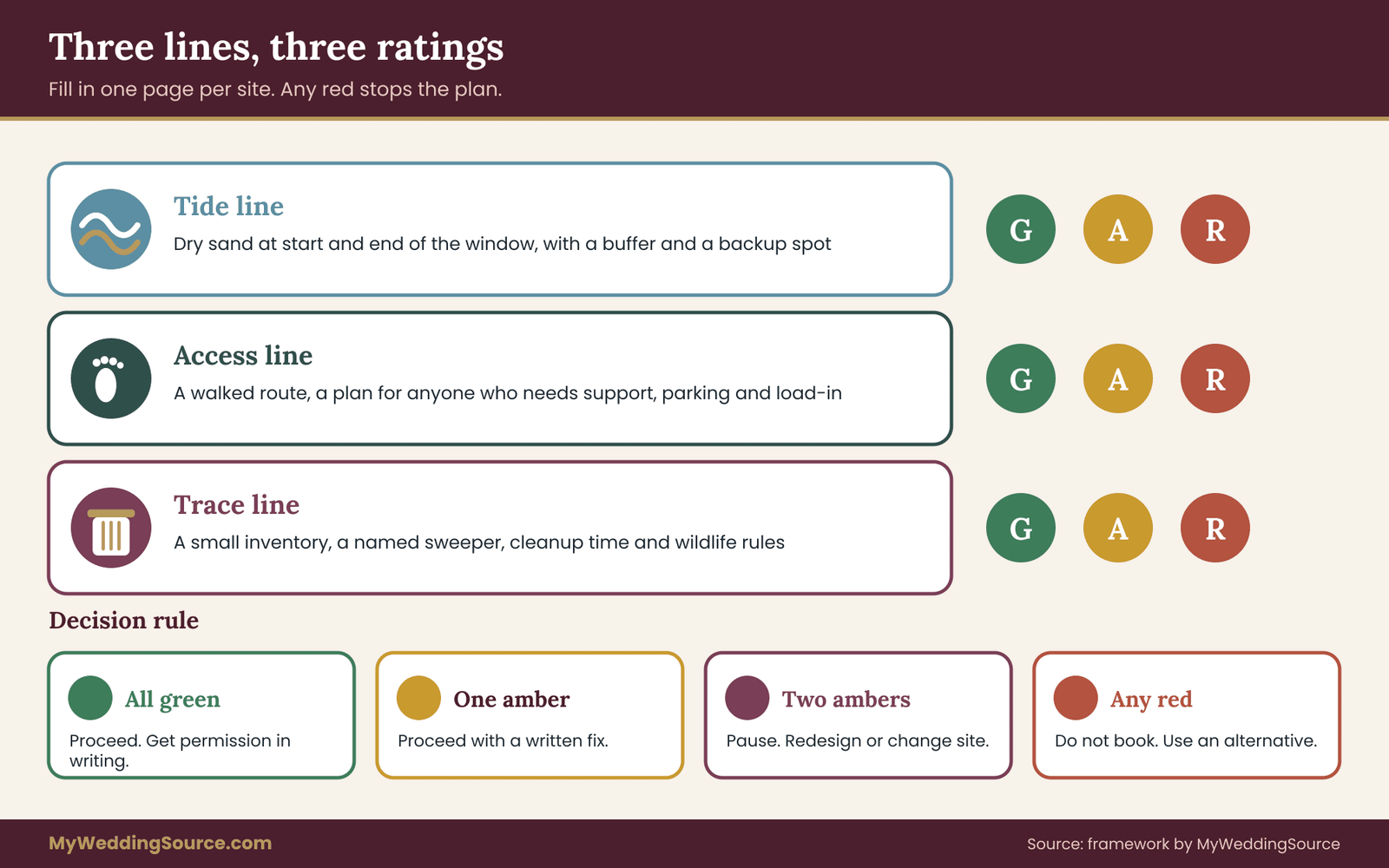
Beach wedding permits are one row on the page, and the three lines work best as a single page you fill out for each candidate beach. The point is not to produce a number but to see, side by side, where each site is strong and where it hides a problem.
How to use the one-page check
For each candidate site, write the name, the date and the hours. Then rate each line.
Tide line. Rate green, amber or red based on the space, the surface, the buffer and the direction of the tide throughout your window. Add a note about where the wrack line is and the backup spot.
Access line. Rate based on the route from the car to the chair, mobility needs, parking and vendor load-in. Add a note about the longest walk and the plan for anyone who cannot do it.
Trace line. Rate based on how small your inventory is, how it leaves and whether cleanup time and deposits are accounted for. Add a note on the named person who will do the final sweep, and on any wildlife restrictions.
Below the ratings, add two more rows: the status of your beach wedding permits and the cost of changing course. Permit status can be “not required,” “requested,” “approved in writing” or “denied.” Cost of changing course is the money and relationships that would be affected if you had to move, such as deposits and guest travel.
The decision rule
Use the same rule each time.
- All green: Proceed. Get the beach wedding permits in writing and book the vendors.
- One amber, no red: Proceed with a written fix for the amber line, such as a different hour or a firm path, and confirm it with the agency.
- Two or more ambers: Pause. Either redesign the plan so at least one amber becomes green, or choose another site. Two weak lines tend to compound each other, for example a narrow beach and a long walk.
- Any red: Do not book. Change the hour, the spot or the site. If you cannot change them, move to an alternative from the next section.
The rule has one deliberate feature. A red on any line stops the plan, even when the other two are green, because each line fails independently and a lovely tide does not help a guest who cannot reach the sand.
What the rule protects you from
It protects you from three common mistakes. The first is falling in love with a photograph and ignoring the access line. The second is paying vendors before your beach wedding permits are confirmed in writing. The third is treating the trace line as an afterthought, which leads to a stressful scramble at the end of the day and a poor relationship with the agency. Because the rule asks for written fixes, it also generates the paper trail that protects you if the answer changes.
A worked case: a Saturday ceremony on a county beach
The following example of beach wedding permits in practice is invented to show the method. The names, the place and the details are illustrative, not a record of a real event, and your agency’s rules will differ.
The situation
Marisol and Dev want an outdoor ceremony for about thirty guests on a county beach near where Dev grew up. The beach is a public county beach with a lifeguard stand, a paved lot and a boardwalk to the sand. They have a Saturday in early autumn in mind. Marisol’s grandmother uses a walker, and Dev’s cousin brings a toddler.
Step one: find the agency and learn which beach wedding permits apply
They search the beach’s name and find a county parks page with a “special events” section. The page says that gatherings of more than a set number of people, or any event that places equipment on the beach, need a special event permit, which is the most common of the beach wedding permits. They call and learn that the lot is county-run, that the sand is county-managed, and that a nearby stretch is a protected nesting area in spring and summer but not in autumn. They confirm the details by email.
Step two: the tide line
They look up predicted tides for their date. High tide falls near the middle of the afternoon, and low tide comes in the early morning and again in the evening. They visit on a day close to the date and look for the wrack line. It sits close to the base of the dune on the north end and farther out on the south end. A ceremony at mid-afternoon on a rising tide would leave a narrow strip on the north end.
They rate the north end red for that hour and the south end amber. They decide to move the ceremony to late morning on a falling tide, using the south end, and plan to be off the sand by early afternoon. With that change the tide line reads green.
Step three: the access line
They walk from the lot to the south end. The boardwalk reaches a viewing platform, then there is about two minutes of soft sand. For the grandmother’s walker, that is too soft. The lifeguard supervisor tells them the county has a roll-out mobility mat, which can be requested with the permit. They ask for it, and for a drop-off space close to the boardwalk.
They place the seating at the end of the mat, so the first three rows are on firmer ground. The toddler’s family sits at the back, near the path. The access line reads amber until the mat is confirmed in writing, and green afterward.
Step four: setup and the trace line
They apply the weight test. The rental company quotes an arch, thirty chairs, an aisle runner and a speaker. The county’s beach wedding permits do not allow an arch or an amplified speaker. Chairs are allowed only for guests who need them. They cut the arch, drop the runner and keep ten chairs, with the rest of the group standing or sitting on their own blankets. They plan a simple line of shells that they will collect again afterward.
Their carry-in inventory lists ten chairs, one small table for the signing, a bouquet, two bags of programs, a cooler, a first-aid kit, a trash bag and a recycling bag. Dev’s sister is named as the cleanup lead. They ask whether the window on the beach wedding permits can be extended by thirty minutes to cover cleanup, and the office agrees.
Step five: the written record
Before they book anything else, they ask the county for the approval in writing, including the hours, the equipment allowed, the mat and the cleanup window. They save the email and a screenshot of the tide table and the signage. They tell their vendors exactly what is allowed. The final plan has all three lines green, one written condition for the mat and a short list of things to stop for.
What the example shows
Three things stand out. The best change was not a purchase but a subtraction. The plan improved when they moved the hour, not when they pushed harder on the original one. And the written confirmations made each answer reliable, because a phone answer can change when a different staff member picks up. The method gave them a calm path through what could have been a confused weekend.
{{INFOGRAPHIC:6}} ## When beach wedding permits are denied, capped or not offered: alternatives
Sometimes the answer is no. The agency may not issue beach wedding permits for ceremonies at all, may cap the group below your guest list, or may allow the ceremony on a day or hour you cannot use. A firm answer on beach wedding permits, even a disappointing one, is useful, because it lets you choose a substitute early, while the options are open.
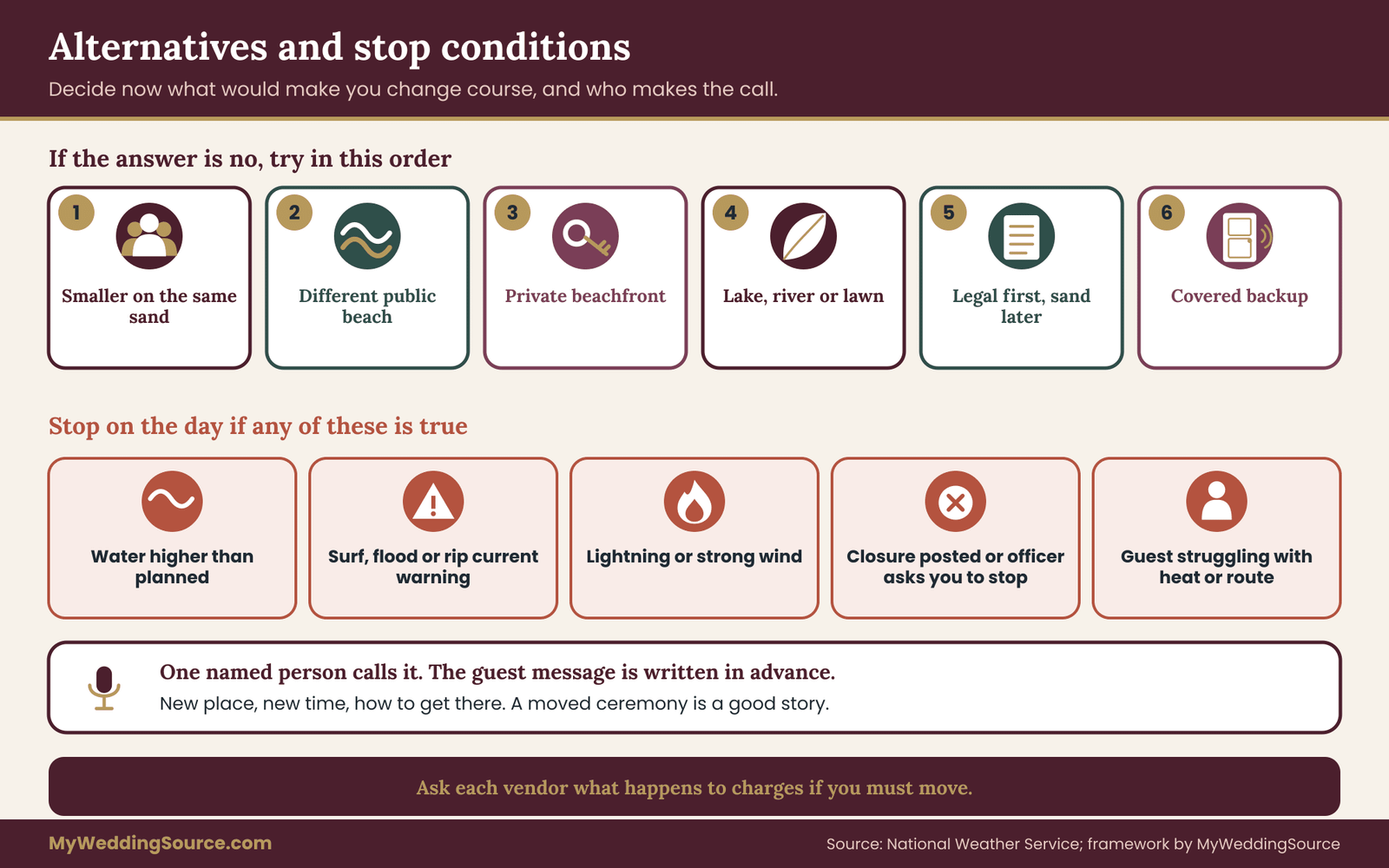
Alternative one: the same beach, smaller and quieter
If the issue is size, consider a small ceremony on the sand followed by a larger celebration elsewhere. Many couples hold the vows with a handful of people at the water and the rest of the guests arrive at a nearby reception. This also reduces the load on every line of the check: a smaller group needs fewer chairs, less parking and less cleanup.
If the issue is equipment, the “needed” list from the setup section is your friend. A ceremony with nothing but the people, a bouquet and a signed paper can often happen without any approval at all, as long as the group stays within the posted rules. Confirm that reading with the office rather than assuming it.
Alternative two: a different public beach with different rules
Neighboring beaches may be run by different agencies with different policies. A town beach may be stricter than a state beach a few miles away, or the reverse. Repeat the ladder from earlier for each. If you do this, begin with the managing agency’s page and ask the same three questions: what is allowed, what is required and what is the lead time.
Alternative three: a private or semi-private beach
Some hotels, resorts, clubs and event venues offer beachfront ceremony space, and these arrangements can include chairs, power, restrooms and a cleanup crew. The cost and the terms vary, and a contract replaces the public beach wedding permits. If you go this way, read the contract carefully and compare it with the questions in the guide to wedding vendor contracts, paying attention to cancellation, weather and liability clauses.
Check also whether the space is truly exclusive. A hotel beach may still be open to other guests and the public during your event, in which case the privacy you are paying for is limited.
Alternative four: a lakeshore, river bank or park lawn
Water and sand are not the same thing. A lakeshore may have no tide, a calmer surface and fewer crowds. A river bank or a park lawn near the water can offer a similar backdrop with easier access and firmer ground. These sites usually have their own systems, separate from beach wedding permits. If you want the general approach to organizing a public park ceremony, the wedding venues guide is the place to compare options before returning to a specific form.
Alternative five: legal ceremony elsewhere, symbolic ceremony on the sand
Another common solution is to separate the legal and the symbolic. Sign the paperwork at a courthouse, a home or a small venue, then hold a ceremony of vows or a blessing on the beach with a few people and no formal setup. That arrangement removes pressure from beach wedding permits, because the beach moment becomes a relaxed gathering. Make sure your officiant and your marriage license are handled where they must be, according to your state’s rules, which the officiant requirements guide can help you sort out.
Alternative six: an indoor or covered backup
Even a very good beach plan benefits from a backup under a roof. Weather, wildlife closures and changes to beach wedding permits can all remove your sand. A restaurant room, a pavilion, a shelter or a nearby venue with a short drive can absorb the ceremony if you have reserved it in advance. A backup you have never contacted is not a backup, so ask for a hold or a simple cancellation window.
Choosing among alternatives
Use a short comparison in your head. Which alternative keeps the thing you care about most, whether that is the water, the light, the guest list or the date? Which costs the least in money and stress? Which has the fewest unknowns? If two seem equal, choose the one with the clearest written permission. Certainty is worth more than a slightly better view.
Failure conditions: when to stop and move the ceremony
A plan is only as good as its stop conditions. Decide now, while you are calm, what would make you change course on the day. Write them down and share them with the officiant, the photographer and the person who will decide if you cannot.
Stop conditions before the day
Reconsider the beach, or at least the hour, if any of these is true about your beach wedding permits or the site:
- The agency has not confirmed beach wedding permits in writing by a date you set, such as three weeks before the ceremony.
- Your beach wedding permits are conditional on something you cannot deliver, such as a certificate of insurance you have not obtained, or a headcount you will exceed.
- A wildlife closure, construction or an event overlaps your date and spot.
- The forecast shows a storm, a high surf advisory or unusual tides for your date and the backup is not ready.
- A guest who must attend cannot reach the spot and no workable solution is in place.
Stop conditions on the day
On the morning of the ceremony, check these in order, and let one person hold the authority to call it.
- Water. Is the water line farther up the beach than the plan assumed? Is there a high surf, coastal flood or rip current warning from the National Weather Service?
- Wind and weather. Is the wind strong enough to topple chairs or an arch, to blow away programs or to make the voice impossible to hear? Is there lightning in the area? Lightning is a firm reason to leave open ground.
- Closures. Has the agency posted a closure, flag or restriction at the entrance?
- Crowds. Is the beach so crowded that the ceremony space cannot be kept?
- People. Is anyone unwell from heat, or struggling with the route?
If any answer is a firm no, move to the backup without debate. A moved ceremony is a good story. A ceremony continued past a clear warning is not.
The decision maker and the message
Pick one person, ideally not the couple, who has the authority to trigger the backup and a plan to tell guests quickly. A group text, a sign at the lot and a helper at the entrance cover most guests. Write the message ahead of time: the new location, the time and how to get there. For more on handling day-of changes and device or network surprises, the wedding day digital contingency plan shows how to prepare the communication side.
Failure in the middle of the ceremony
Sometimes the problem arrives mid-ceremony: a sudden gust, a rising wave, an officer asking you to stop. Agree on a calm signal in advance, such as the officiant lowering the book or a nod to the cleanup lead. The aim is a graceful change, not a scramble. A short version of the vows can be said anywhere, and the signing can happen later.
When the agency stops the event
If an officer tells you to stop, even though you hold beach wedding permits, comply politely. Ask what the problem is and whether there is a way to resolve it quickly. Many issues, such as a speaker or a chair in the wrong spot, can be fixed in a minute. If the officer says your beach wedding permits are not valid or has been withdrawn, ask for the reason and a contact, and move to the backup. Argue the question afterward, not in front of guests.
Insurance, deposits and cancellations
If you have paid deposits to vendors, read their weather and cancellation terms before you book, not after.
A rental company may charge for a late cancellation even if the beach closes. Ask each vendor what happens if the agency withdraws permission, if there is a storm warning or if the tide forces a move. Some will move your event to a covered space at no extra charge, others will not. Written answers prevent disputes. The wedding cash-flow planning guide is a good companion for deciding how much risk you want to carry on deposits. ## Questions to send about beach wedding permits
Most of the work of the three lines, and of getting beach wedding permits, can be done with one well-organized message to the managing agency. A short, specific email gets a better answer than a vague one and leaves a record. Keep it brief, use plain language and number your questions so the reply can follow them.
The first message about beach wedding permits
Here is a simple structure, in your own words. State who you are and what you plan, give the site, date and approximate hours, then ask your questions.
“Hello, we are planning a small wedding ceremony of about thirty people on the south end of the beach on a Saturday in October, between roughly ten and noon. Could you tell us whether beach wedding permits are required, and who to contact to apply?”
Then add the numbered questions below, trimmed to what you actually need.
- Is a permit required for a ceremony of our size, and if so, which one?
- Is there a maximum group size, and does the count include vendors?
- What are the fee, the application deadline and the usual processing time?
- Do the permitted hours include setup and cleanup?
- Which items are allowed on the sand: chairs, an arch, a canopy, a speaker, food, alcohol, flowers?
- Are there seasonal wildlife or dune restrictions on our date or at our spot?
- Is there a mobility mat, a firm path or a beach wheelchair, and can we reserve it?
- Where may guests and vendors park, and can vendors drop off close to the sand?
- Do vendors or photographers need their own permit or proof of insurance?
- Is a cleanup deposit or inspection required?
A reply to each point, even a one-line answer, is the best document you can have. If the answers conflict with the posted rules, quote the page and ask which applies.
A follow-up when the answer is vague
If the reply says “it depends” or “probably fine,” ask for the condition behind it: “What would make it not fine?” A concrete limit is far more useful than reassurance. If a staff member says something that changes your plan, ask whether they can confirm it by email, or write a recap and invite them to correct it.
What to do when no one answers
Agencies can be slow, especially in peak season. Wait a few business days, then follow up once by phone. If you still have no answer and the date is near, ask who else can speak for the beach, such as a lifeguard supervisor or a ranger on duty, and write down the name and the date. If you cannot get an answer at all, treat that as an amber or red on the row for beach wedding permits, and prepare a backup.
The briefing for your helpers and vendors
A beach ceremony runs better when everyone knows the same short rules. Prepare a one-page briefing and send it to each person who will be on the sand.
What the briefing contains.
Include the date, the hours, the meeting spot and the route from the lot. Add the tide times and the plan for the water line. List the items that are allowed and the items that are not. State the cleanup plan, including who is the lead. Add the stop conditions and the person who makes the call, plus phone numbers for the lead and the backup site.
Keep each item to a line. Nobody will read a page of paragraphs on a windy beach. Print a copy for the lead and a copy for the officiant, and keep the file on a phone, because cell service on a beach can be unreliable and a downloaded copy works without it.
Roles on the day.
Four roles keep the day calm, and one person can hold two of them in a small group.
- The lead keeps the schedule, holds a copy of the beach wedding permits and is the point of contact for any officer or staff.
- The access helper meets guests at the path, directs them and helps anyone who needs a hand with the route.
- The cleanup lead owns the inventory and the final sweep.
- The water watcher keeps an eye on the tide line and on guests near the water, especially children.
Assign them by name and tell them in advance. People are glad to help when they know exactly what is asked.
What to carry in a ceremony kit.
A small bag kept by the lead can solve most small problems. Useful items include printed copies of the beach wedding permits and the confirming emails, a tide table printout, a first-aid kit, water, sunscreen, a few bags for trash and recycling, a roll of tape, a small towel, a phone power bank and a card with key phone numbers. These are things you can carry out again, and each earns its place by being needed at least once.
Photographers and beach wedding permits.
If you hire a photographer, tell them the rules about the dunes, the wildlife and the water. Photographers sometimes wander for a better angle and may stand on protected vegetation or step onto roped-off sand. Ask whether beach wedding permits in your area carry extra conditions for commercial photography, such as insurance, and let the photographer confirm that they have it. A short word in advance prevents an awkward moment.
For the ceremony itself, a clear cue sheet shortens time on the sand and keeps everyone aligned, and the wedding ceremony cue sheet guide explains how to build one.
Rentals, delivery and pickup.
If you rent anything, give the rental company the rules before they quote, and ask about delivery and pickup on sand. Some companies will not deliver to a beach, and others charge for carrying. The wedding rental planning checklist covers the questions to ask about what is included, who is liable for damage and when the items must be returned. On a beach, add one more: what happens to the rental if the wind or the agency stops the event?
Your next steps
Choose one weekend to do three things. First, find the managing agency for the exact stretch of sand and send the numbered message above, then wait for a written reply. Second, look up the tide table for your date and visit the beach on a similar day, noting the wrack line, the route from the car and the soft spots. Third, write your carry-in, carry-out inventory, even if it is only five items long, and name the person who will do the final sweep.
Then fill in the one-page check for each candidate site. If every line is green, book your vendors with the written permission in hand. If a line is amber, write the fix. If a line is red, use the alternatives and keep the beach for a photograph session or a relaxed gathering. A plan that respects the tide, the access and the trace, and that has beach wedding permits in writing, is simple to carry out, and the beach is better for it.
FAQ
Do I always need beach wedding permits for a ceremony on public sand?
Not always, but you cannot know without asking. Some agencies make beach wedding permits mandatory for any organized gathering above a set size, or for any equipment, amplified sound or alcohol. Others post rules and ask for nothing from a small group. Contact the agency that manages your exact stretch, ask for the thresholds, and keep the reply in writing.
Who issues permission for a beach ceremony?
It depends on who manages the land. That may be a city or county parks department, a state park system, a federal agency such as the National Park Service, or a conservation organization. Start with the official page for your beach, then call the office it lists. If you are told another agency manages the sand, repeat the question there.
How far ahead should I apply?
As early as the agency allows, and sooner for summer weekends and popular beaches. Lead times and processing times vary, so ask for the current figures rather than relying on an old forum post. Apply before paying nonrefundable deposits to vendors, and ask when the application window opens for your date.
What time of day is best on a tidal beach?
There is no single best time, but a falling tide or low tide usually gives the widest and firmest sand. Check a tide table for your date, find the wrack line on a nearby day and make sure the seating area stays dry for the whole window, including setup and cleanup. If the tide is wrong at your preferred hour, move the hour first.
Can we bring chairs, an arch or a speaker?
Many beaches restrict them. Chairs may be limited to guests who need them, arches and canopies may be banned because of wind and stakes, and amplified sound may be capped or prohibited. Ask about each item by name before renting. A small ceremony with a few chairs, a handheld bouquet and a close huddle needs far less approval.
How do we handle cleanup properly?
Make a carry-in, carry-out list of every item and name one person to walk the area afterward with the list. Bring bags for trash and recycling, avoid petals, confetti, balloons and glitter, and check whether the agency requires a deposit or an inspection. Take photographs before and after. Ask for hours on your beach wedding permits that include cleanup time.
What if wildlife closes part of the beach?
Follow the closure. Nesting birds and sea turtles are protected, and an agency’s restriction can override otherwise approved beach wedding permits. Move your seating to the open area, shift the hour if lighting rules apply, or move the ceremony to a backup site. Ask the agency about seasonal restrictions at the start, not on the day.
What if the weather turns or the permit is withdrawn?
Decide in advance who calls it and what the triggers are, such as a surf or lightning warning, strong wind, a posted closure or an officer’s instruction. Reserve a covered or inland backup and write the guest message ahead of time. Ask each vendor what happens to their charges in those cases before you sign.
Sources
- National Park Service, official site for park rules and special use permits
- NOAA Tides and Currents, tide predictions and water level information
- National Weather Service, rip current safety
- NOAA Office for Coastal Management, coastal and beach access resources
- NOAA Fisheries, protected marine species and viewing guidance
- U.S. Fish and Wildlife Service, shorebird and sea turtle conservation
- Leave No Trace Center for Outdoor Ethics, the seven principles
- ADA.gov, U.S. Department of Justice Americans with Disabilities Act information
- California Coastal Commission, public access to the coast
- Texas General Land Office, Open Beaches Act information