
Wedding suit fabric decides how your suit behaves in sun, wind, damp air and long stretches of standing still, and an outdoor ceremony tests all of those at once. This guide shows how to compare cloth on five axes (weave, weight, breathability, wrinkle and wind), how to read a vendor’s swatches, and how to run simple tests before you order.
For an outdoor ceremony, choose wedding suit fabric by scoring swatches on five axes instead of by fiber name alone. Look at the weave first, because an open or hopsack weave moves air that a dense twill blocks. Check the stated weight and ask for the unit. Run a breath test, a crush test, a light test and a flutter test on a real swatch, in the light you will stand in. Then match the winner to your venue’s exposure, and confirm the wedding suit fabric, finish and lining with the tailor in writing.
Most advice about warm-weather suits stops at “wear linen” or “wear wool.” Both are partial answers. A tropical wool in a plain weave can feel cooler than a heavy linen blend, a lightweight cloth can flap like a flag in a gusty field, and a cloth that photographs beautifully indoors can look flat and shiny in direct noon sun. The fiber is only one of several facts that decide how a suit feels at minute twenty of a ceremony.
This article is about that decision and nothing else. It does not cover whether to wear a suit or a tuxedo, which jacket cut to pick, or how to dress for a single fabric such as velvet, linen or double-breasted construction; the site has separate guides for those. Here the question is narrower: given an outdoor ceremony, how do you choose wedding suit fabric from a set of swatches and a vendor’s promises?
A note on scope. This is general information, not legal, tax or financial advice. Fabric claims, return terms and prices vary by vendor and change often, so the article points you to the questions to ask and the agencies that publish labeling rules, and it leaves current figures for you to confirm with your supplier.
What wedding suit fabric has to do outdoors
Indoors, a suit lives in a narrow band of conditions. The temperature is controlled, the air barely moves, and the light is warm and low. Outdoors, every one of those assumptions breaks. Four forces act on wedding suit fabric during an outdoor ceremony, and each one rewards a different cloth.
Heat and sun. Standing in direct sun adds load that a shaded thermometer reading does not show. The National Weather Service notes that heat index values are calculated for shady conditions and that full sun can raise the effective figure. A dark, dense cloth absorbs that radiation and holds it against your body, while a lighter, more open cloth lets some of it pass and carries sweat vapor away.
Humidity. In damp air, sweat does not evaporate quickly, so breathability stops being a comfort extra and becomes the main event. Fibers that absorb moisture without feeling wet, such as wool, behave differently from fibers that do not, such as polyester, though construction matters as much as fiber.
Wind. Moving air cools you, which helps, but it also lifts lapels, flaps a loose jacket and pulls a trouser leg against the leg in an unflattering way. Light, fluid cloth moves more than a crisp, springy one. In a photograph, wind reads as either life or chaos depending on how the cloth is built.
Stillness and handling. A ceremony involves standing, a hug or two, possibly a kneel, a car ride beforehand and a long afternoon of photos. Cloth that creases when you sit will have the creases baked in by the time you stand for portraits.
Notice what is missing from that list: price, fashion and fiber prestige. A cloth can be expensive and wrong for a field in July. A modest cloth can be exactly right for a garden at four o’clock in May. The goal is fit between the wedding suit fabric and the conditions, which is why the rest of this guide works through a scoring method instead of a ranking of favorites.
Why one fiber name is not enough
“Wool” covers cloth from airy, open-weave summer fabrics to heavy flannel. “Linen” covers loose, textured cloth that creases as soon as you look at it and linen blends that behave quite differently. “Cotton” can mean a crisp poplin-weight cloth or a thick drill. If you shop by fiber name alone, you are comparing categories that overlap heavily. Two swatches with the same fiber label can sit at opposite ends of a comfort scale because one is open and light and the other is tight and heavy.
For that reason, the method in this guide asks you to read four facts about every swatch: the fiber blend, the weave, the weight and the finish. Fiber tells you the baseline behavior. Weave tells you how much air passes through.
Weight tells you how much cloth is on your body. Finish tells you what has been added or done to the surface, which affects shine, hand and wrinkle behavior. You can find most of these on a swatch card or ask for them, and the section on reading swatch books explains how.
What this guide leaves to other pages
Two neighboring decisions come up in every outdoor-suit conversation, and both have their own homes on the site. Whether you should wear a suit or a tuxedo at all is covered in the site’s separate suit versus tuxedo guide. Keeping a suit’s fit sharp is part of the broader wedding dress fit and alterations guide, which walks through fittings, timelines and what a tailor can and cannot change. This article assumes you already know you want a suit and are choosing the wedding suit fabric.
It also assumes the ceremony is outdoors for most or all of its length. Venue rules about tents, shade and ceremony timing sit in the wedding venues guide. If you will be outside only for a short walk between a hall and a car, almost any season-appropriate cloth will do, and you can spend your energy elsewhere. The method pays off when you will stand, sit or move in the open for twenty minutes or more.
The five axes of wedding suit fabric
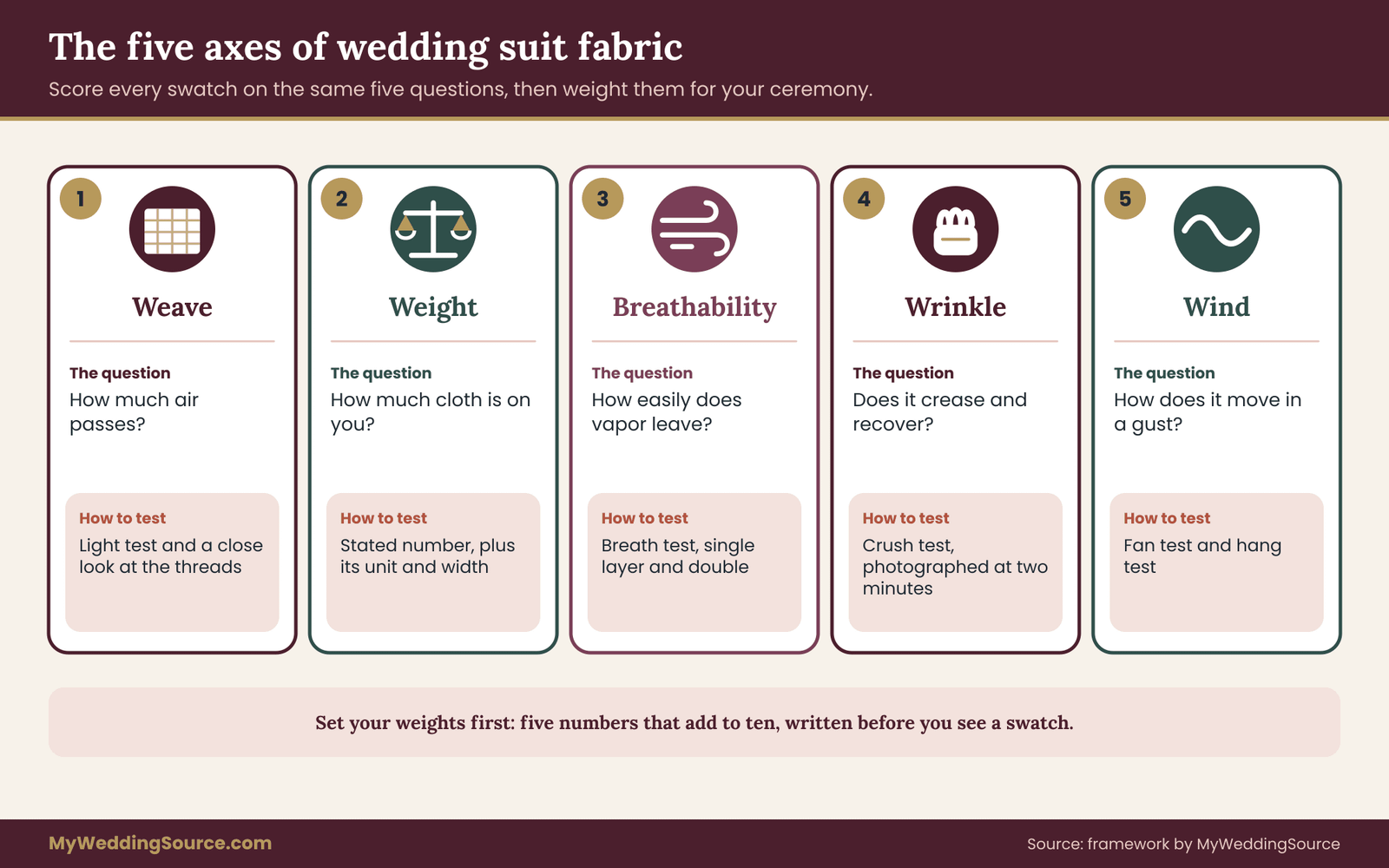
Rather than ranking fabrics, score each swatch on five axes. Each axis answers a plain question about your ceremony, and each has a test you can run without special equipment. The axes are weave, weight, breathability, wrinkle behavior and wind behavior.
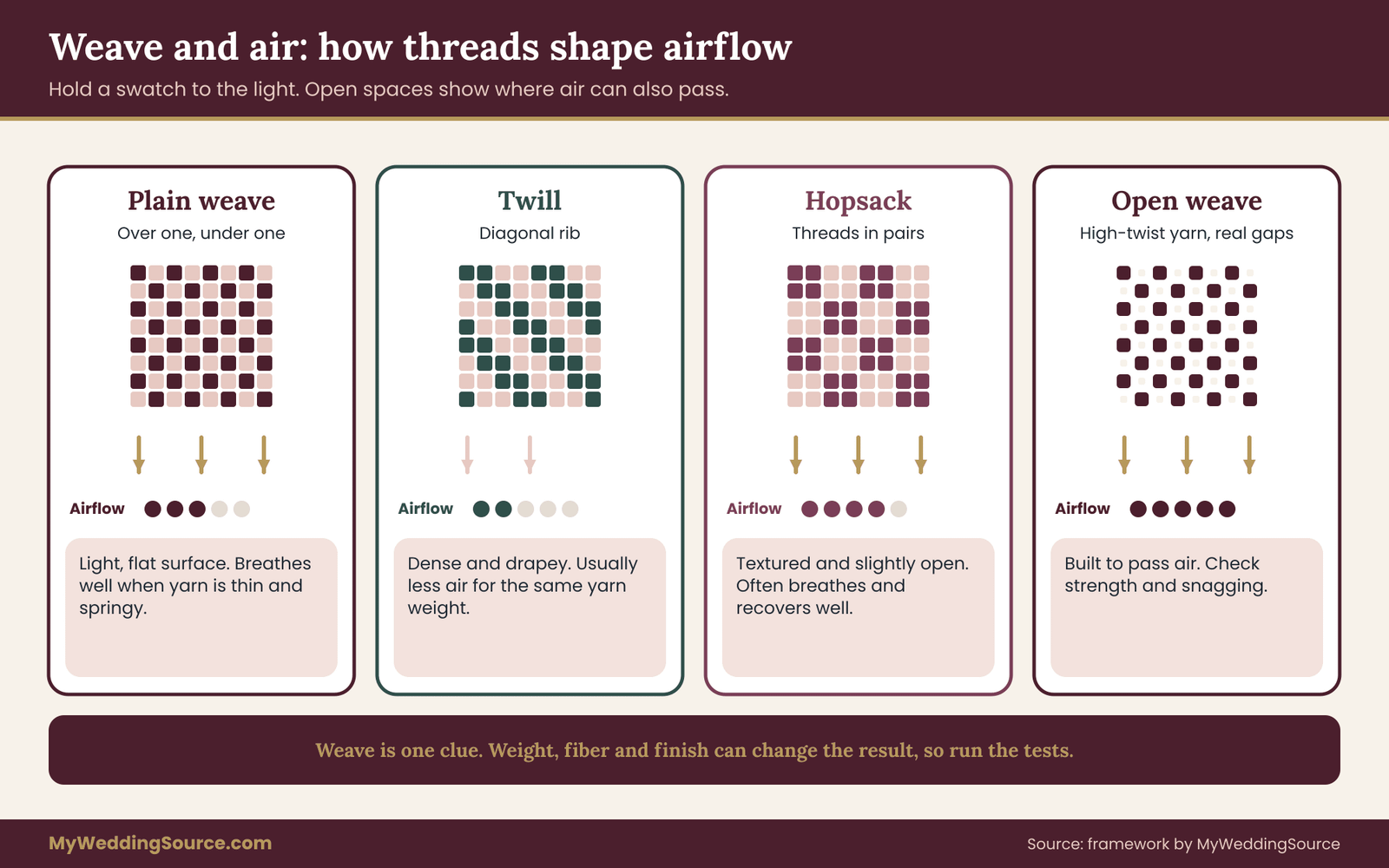
Axis one: weave. The weave is the pattern of threads crossing each other. A plain weave is a simple over-one-under-one grid. A twill has a diagonal rib and is usually denser and more drapey. A hopsack, sometimes called a basketweave, groups threads in pairs or more, creating a slightly open, textured surface that tends to breathe well and recover from creasing. Open-weave cloths made with high-twist yarns are built to let air through. You judge weave by holding the swatch to light and by looking at the surface with a loupe or phone camera.
Axis two: weight. Weight is how much cloth sits on your body. Swatch books state it in grams per square meter, grams per linear meter or ounces per yard, and these are not interchangeable. A cloth that is light by one unit can look heavy by another, so always ask which unit the number uses and which width it assumes. Lighter cloth usually feels cooler and moves more in wind, while heavier cloth hangs better and resists flutter but holds more warmth.
Axis three: breathability. Breathability is how easily air and moisture pass through the finished cloth. It depends on fiber, weave, weight, finish and lining. The home test is simple: hold the swatch to your mouth and blow. You are feeling resistance, not measuring anything, but the comparison between swatches tells you a lot.
Axis four: wrinkle behavior. Two properties matter. Crease resistance is how readily the wedding suit fabric creases when crushed. Recovery is how quickly it relaxes afterward. A cloth can crease easily and recover fast, or resist creasing and still hold a crease it does get. You need to know both.
Axis five: wind behavior. Wind behavior is how the cloth moves, lifts and clings in moving air. It depends on weight, drape and how stiff the wedding suit fabric is. It also depends on cut, but this guide holds cut constant so that the wedding suit fabric is the variable.
Why five axes and not one score
It is tempting to add the five numbers into a single total and pick the highest. Resist that.
A cloth with a perfect breathability score and a terrible wrinkle score is a bad choice for a couple who will sit for an hour in a car after dressing, and a fine one for a couple who will be dressed on site. Each axis carries a different importance in your situation, so the method below includes a weighting step that you do before you look at any swatch. Doing it before is the point: weighting after you have fallen for a color is rationalization, not analysis.
Setting your weights first
Before you collect a single swatch, write down five numbers that add to ten, one per axis. These reflect your ceremony, not your taste. A short, shaded morning garden ceremony in mild weather might split three for wrinkle, two for wind, two for weave, two for weight and one for breathability. A midday ceremony on an open beach might put four on breathability, three on wind, one on weight, one on weave and one on wrinkle.
You can change the numbers, but write them down first and keep the page. When a swatch tempts you, return to the page and ask whether you are following your weights or following the swatch. Partners often disagree about weights, and that is useful. If one of you thinks wrinkle matters most and the other thinks heat does, you have found the real decision to settle before you spend money.
The weighting also gives you a language for the tailor. Instead of saying “we want something light,” you can say “breathability and wind are our top two concerns, wrinkle is third.” A good tailor or fabric sourcing specialist can answer that in specific terms, and a vendor who cannot is telling you something about the vendor.
How to read a vendor’s swatch book for wedding suit fabric
A swatch is a small piece of wedding suit fabric, often with a card or a coded label, that a tailor, mill agent or online maker sends you so you can judge cloth in person. It is the single most useful object in this process, and most people use it badly. They look at color under a shop light and decide. For wedding suit fabric meant for outdoor use, the swatch should be treated as a test specimen, not a color chip.
Start by asking what the swatch actually is. Some swatches are cut from the bolt that the vendor will use to cut your suit. Others are from a mill’s sample book and show a range of colors, with the real cloth arriving later. Others are lookalikes from a different supplier. Ask the vendor in writing which one you are holding, and ask whether the wedding suit fabric you order will be cut from the same mill, the same quality line and the same weight as the swatch.
The facts on a good swatch label
A useful label gives you several pieces of information. Not every vendor provides all of them, and the gaps are worth noticing.
Fiber content. A percentage breakdown such as wool with a smaller share of another fiber. For ready-to-wear clothing sold in the United States, federal labeling rules require fiber content on the garment label, and the Federal Trade Commission publishes guidance on those rules. For made-to-measure cloth, ask for the same information in writing so you are not relying on a verbal description.
Weight and unit. A number with a unit, and ideally the width that the number assumes. If the label only says “lightweight” or “summer weight,” treat that as marketing, not data. Ask for the number.
Weave name. Plain, twill, hopsack, herringbone, open weave and so on. If the vendor does not use weave names, you can still describe what you see: diagonal ribs mean twill, a visible grid of paired threads suggests hopsack, a flat even surface suggests plain.
Finish. Whether the cloth is washed, brushed, milled, treated for stain or crease resistance, or left raw. Finishes change hand and wrinkle behavior, and some wear off. Ask what the finish is and whether it is permanent.
Origin and mill. Not for status, but because a named mill often has published specifications for its cloths that you can compare against what the vendor tells you.
Care instructions. The Care Labeling Rule requires care instructions on most garments, and for suits that usually means dry clean only. Know this before you rely on any pressing or steaming plan.
Questions to put to the vendor in writing
Verbal answers fade. Written answers are evidence if the wedding suit fabric turns out to be different from what you were shown. Put these questions in an email so you have a record, and keep the replies in your vendor folder alongside the contract you signed.
“Is the swatch cut from the same cloth and weight I will receive? Please give fiber content, weight with unit, weave and finish, and tell us whether the finish is permanent.”
“If the delivered cloth differs from the swatch in weight, weave or fiber content, what is your remedy, and by what date must we tell you?”
The second question matters because the remedy for a mismatch is usually defined in the terms you accept at checkout or in the contract. If you have not read those terms, read them before paying, and if anything is unclear, ask. The site’s guide to wedding vendor contracts walks through the clauses that govern delivery, substitution and refunds, and it is worth a pass before you pay a deposit on made-to-measure clothing.
What to do when a vendor has no swatches
Some off-the-rack retailers and rental shops do not offer loose swatches, because the garment is the sample. In that case, the garment is the test specimen and you can apply the same checks to the lining-free area inside a hem, a seam allowance, or an inside pocket bag, with permission. Ask staff if you may hold a fold of the fabric to the light, blow through it, crush a corner and see how it recovers. Most staff will agree if you ask politely and keep it quick.
If a vendor refuses any form of fabric inspection and insists on a fiber description only, that is a data point. It does not mean the wedding suit fabric is bad, but it means you are buying on trust, and you should weigh that against the return terms before you commit.
Keeping a swatch log
Treat each swatch as a row in a log, even if it is only a note on your phone. For each swatch record the vendor, the code or name, the fiber content, the stated weight and unit, the weave, the finish and the date you received it.
Then add your scores on the five axes as you test. A simple log keeps you from comparing a swatch you handled last week to one you handled today by memory. It also helps when you talk to a second tailor, because you can describe the wedding suit fabric you liked by facts instead of by “that blue one.”
Photograph each swatch next to a neutral object in the same light, and label the photo. Phone photos distort color, but they preserve texture and sheen, and they let you compare later without rummaging through envelopes.
Weave, weight and fiber as a wedding suit fabric system
The three structural facts of wedding suit fabric interact, and a good decision looks at them together. This section explains the interactions in plain terms so that the tests in the next sections make sense.
Weave controls how much air gets through
Think of a weave as a screen. A tight, flat weave is like a fine window screen, and a more open weave is like a coarser one.
Plain weave is the simplest, and in a lightweight, high-twist wool it can be very breathable because the yarn itself is springy and the gaps are real. Twill packs threads more densely along a diagonal, which gives a smoother, heavier-feeling drape and usually less air movement for the same yarn weight. Hopsack and open weaves build in a slightly looser structure by grouping threads, which tends to give air a path and gives the surface a visible texture.
A swatch held to the light shows the weave honestly. If you can see through it in many tiny points, air can pass too. If the light is mostly blocked, air will be too. This is a rough test, because a very fine, tight cloth can still pass moisture through the fibers themselves, but as a first sort it is reliable enough to cut a pile of swatches in half.
Weight controls how much cloth is on your body
Weight and weave pull in different directions on comfort. A lighter cloth in a tight weave can feel warmer than a slightly heavier cloth in an open weave. That is why weight should never be read alone. A tailor might say a cloth is light because of its number, but if the weave is tight and the finish is slick, the cloth will not move air, and the number will not help you.
Weight also affects how the wedding suit fabric hangs and how it behaves in wind. Heavier cloths drape downward and resist being blown around. Lighter cloths float. The right answer depends on whether you are more afraid of sweat or flutter, which is exactly what the weights you wrote down in the first step tell you.
Fiber sets the baseline
Fibers each have a character. Wool is a natural fiber that absorbs moisture vapor without feeling wet and resists creasing better than most plant fibers, particularly when the yarn is high-twist. Mohair, from the angora goat, is sometimes blended into suitings and tends to add spring, a dry hand and sheen.
Linen is a plant fiber that conducts heat well and creases readily. Cotton is a plant fiber with a wide range of weights, and in suiting it tends to crease and soften with wear. Polyester and other synthetics resist wrinkling well but generally breathe less than natural fibers, and they can feel clammy in humid heat, though blends and constructions vary.
None of these statements is a rule. A blend of wool and a small share of linen or silk behaves differently from either alone, and finish and weave can swing the result. Use the fiber facts as a starting guess and let the tests correct you.
Blends: what the percentages hint at
Blended cloth is common in suits for good reasons. A small share of one fiber can fix a weakness of another. A wool-linen blend tries to give linen’s airiness with less creasing. A wool-mohair blend tries to give crispness and recovery. A cloth with a synthetic share may recover from wrinkles faster and cost less, at some price in breathability.
When you see a blend, ask two questions. First, which fiber is the majority, since the majority usually dominates feel and behavior. Second, what is the minority fiber doing there, and does the vendor claim a specific benefit? A vendor who can answer both clearly probably understands the wedding suit fabric. A vendor who recites a brand name is not answering either question.
Six measurable checks for wedding suit fabric swatches
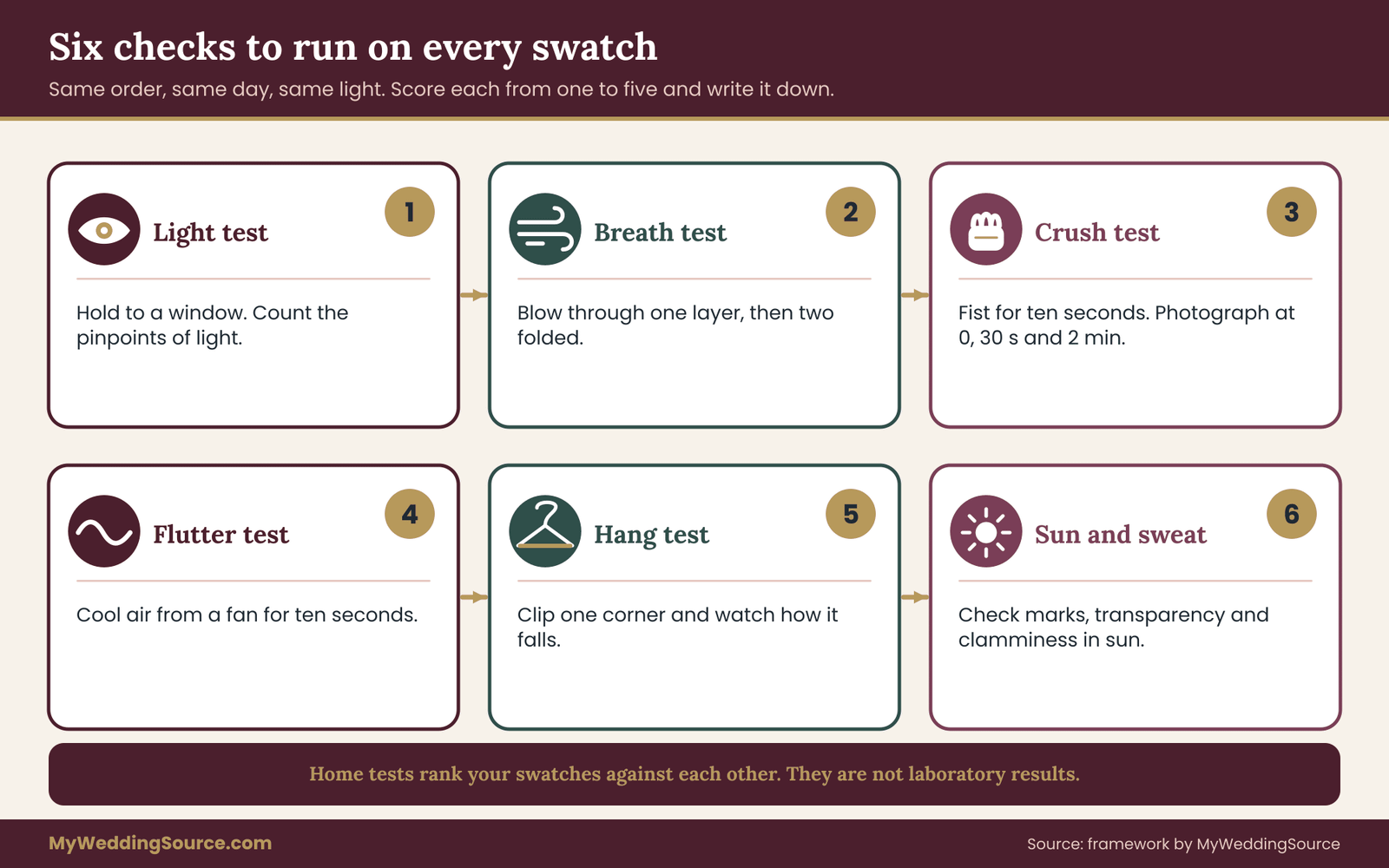
These tests of wedding suit fabric need a swatch large enough to hold, ideally about the size of a hand or larger, plus a window, a phone camera, a kitchen timer and a mirror. They are not laboratory methods.
Textile laboratories use standardized procedures, such as those published by ASTM International and AATCC, to measure air permeability, crease recovery and drape. You are not trying to reproduce those numbers at home. You are trying to rank your own swatches against each other under the same conditions, which is a task a kitchen table can handle well.
Run every test on every wedding suit fabric swatch, in the same order, on the same day, and write down the result straight away. Scores run from one to five, where five is best for outdoor use on that axis. If a swatch is too small for a test, say so on the log and do not guess.
Check one: the light test
Hold the swatch flat against a bright window or a phone flashlight and look through it. Count it as a rough read on weave openness. If you see a fine scatter of light points, give it a four or five for openness. If you see an even, dim glow with no points, give it a two. If it is nearly opaque, give it a one. Dark colors reduce the effect, so compare like with like where you can.
Be careful of one trap. A swatch can look open because the yarn is thin, but thin yarn in an open weave may be fragile or may snag. If you see long floating threads on the surface, note that for the wear question later.
Check two: the breath test
Press the swatch against your lips or the back of your hand and blow through it. You are judging how much air gets through and how much resistance you feel.
A cloth that lets air through easily and feels cool on your skin earns a four or five. A cloth that blocks most of the breath earns a one or two. Do the test twice, once with a single layer and once with two layers folded together, which approximates a jacket with a lining or a canvas panel behind the wedding suit fabric.
The two-layer version matters more than most buyers expect. A jacket is not a single layer of cloth. The front panels often contain interlining, and the back may be fully or half lined. A cloth that breathes well alone can feel much warmer once everything behind it is added. That is why the lining section later in this guide gets its own space.
Check three: the crush test
Take the wedding suit fabric swatch in one fist and squeeze hard for ten seconds, then release it onto the table and start your timer. Photograph it at once, again after thirty seconds and again after two minutes. Score the result on two dimensions. How deep are the creases at the start, and how much have they relaxed after two minutes?
A cloth with shallow creases that vanish within a minute earns a five. A cloth that creases deeply and holds the creases at two minutes earns a one. Note the pattern too. Some cloths show a fine, tight crinkle, which reads as texture. Others show broad, sharp creases that read as damage. In a photograph, the first looks natural and the second looks careless.
Because a crush in the fist is harsher than anything that happens to a suit worn on the day, take the result as a ranking, not a prediction. A swatch that fails the crush test badly will crease in a car seat, while a swatch that passes will cope with most real handling.
Check four: the flutter test
You can approximate wind behavior with a hair dryer on a cool setting or a desk fan. Hold the swatch by one edge, at arm’s length, and direct moving air across it for ten seconds. Watch how it moves. A heavy, springy cloth will lift slightly and return. A light, fluid cloth will ripple and flap. A cloth that clings to your hand will cling to your leg.
Score according to your weights. If wind is a major concern and the ceremony site is open, give a high score to the cloth that moves least. If you want a soft, moving look for photos on a calm day, the flutter may be an advantage. Whichever you prefer, record what the swatch did, not how you felt about it.
Remember that the test uses a small flat piece, and a trouser leg or a jacket skirt behaves differently. The result tells you the direction of the wedding suit fabric’s behavior, not the exact outcome.
Check five: the hang test
Pin or clip the wedding suit fabric by one corner to a curtain or a shelf edge and let it hang for several minutes. Look at how it falls. A cloth with good drape forms soft, even folds when you bunch the lower edge. A stiff cloth stands away. A very limp cloth collapses. This test is mostly about the look of the finished suit, but it also feeds the wind score, since limp cloth tends to catch the wind and stiff cloth tends to resist it.
Check six: the sun and sweat sniff
This one is humble and practical. Wear the swatch tucked into the back of your collar, or hold it against your neck for a couple of minutes while you do something warm, such as climbing stairs. Then smell it, look for dark marks and note how it feels.
You are checking for two things: whether the wedding suit fabric shows moisture marks easily and whether it releases moisture or feels clammy. Do not do this with a swatch you need to return. Ask the vendor whether the swatch is free or must be sent back before you handle it.
For color, test the swatch in the sun as well as under a lamp. A light cloth can turn near-transparent in direct sun, and a mid-tone can show every sweat mark. Standing in full sunlight for a minute with a swatch on your forearm tells you what a camera will see.
A scoring sheet for wedding suit fabric outdoors
Now combine the weights you set at the start with the scores from the six checks. The result is a weighted score for each swatch, and the point of it is to expose trade-offs, not to crown a winner mechanically.
Mapping checks to axes
Not every check maps to one axis. Use this mapping, which keeps the sheet simple.
Weave takes its score from the light test. Weight takes its score from the stated number, the hang test and your own sense of the wedding suit fabric in hand; score lighter cloth higher if heat is your main worry and heavier cloth higher if wind is. Breathability takes the average of the breath test and the sun and sweat sniff. Wrinkle takes the crush test. Wind takes the flutter test and the hang test.
If that feels like a lot of bookkeeping, remember that you are comparing perhaps four swatches on five lines each. It takes less than an hour, and it replaces weeks of vague feelings.
Doing the arithmetic
Multiply each axis score by the weight you assigned, add the five results, and divide by ten. That gives each swatch of wedding suit fabric a score between one and five. Write the total next to the swatch name. Then do the more important step: look at the lowest single axis score for each swatch.
A swatch with a strong total but a one on an axis you gave a weight of three or more has a problem you cannot average away. Set a floor. Any swatch that scores a one or two on an axis weighted three or higher is out unless a specific fix is available, such as a lining change or a different cut.
The tie-breakers
If two swatches finish within a few tenths of each other, use these tie-breakers in order. First, the swatch that scores higher on your most heavily weighted axis wins. Second, the swatch with a clearer vendor paper trail wins, meaning the one with fiber content, weight and finish in writing.
Third, the swatch with a better return or remedy policy wins. Fourth, price. Price comes last on purpose. It is easy to let a small saving override the evidence of five tests, and it is just as easy to regret it when you are standing in a field.
What the sheet cannot capture
The sheet does not capture color, which matters a great deal in sun. It does not capture how the cloth will look on your body, which depends on cut and fit. It does not capture long-term wear, which matters if you plan to wear the suit again. And it does not capture the vendor’s reliability, which you judge separately. Treat the sheet as one input, not a verdict.
A good habit is to put your top two swatches side by side on a table outdoors, at the hour of your ceremony if you can, and look at them one more time. Light changes everything. A cloth that looked rich indoors can look flat or shiny outside, and the reverse can happen too. If you cannot match the hour, match the direction of the light.
Heat and humidity: choosing wedding suit fabric by climate
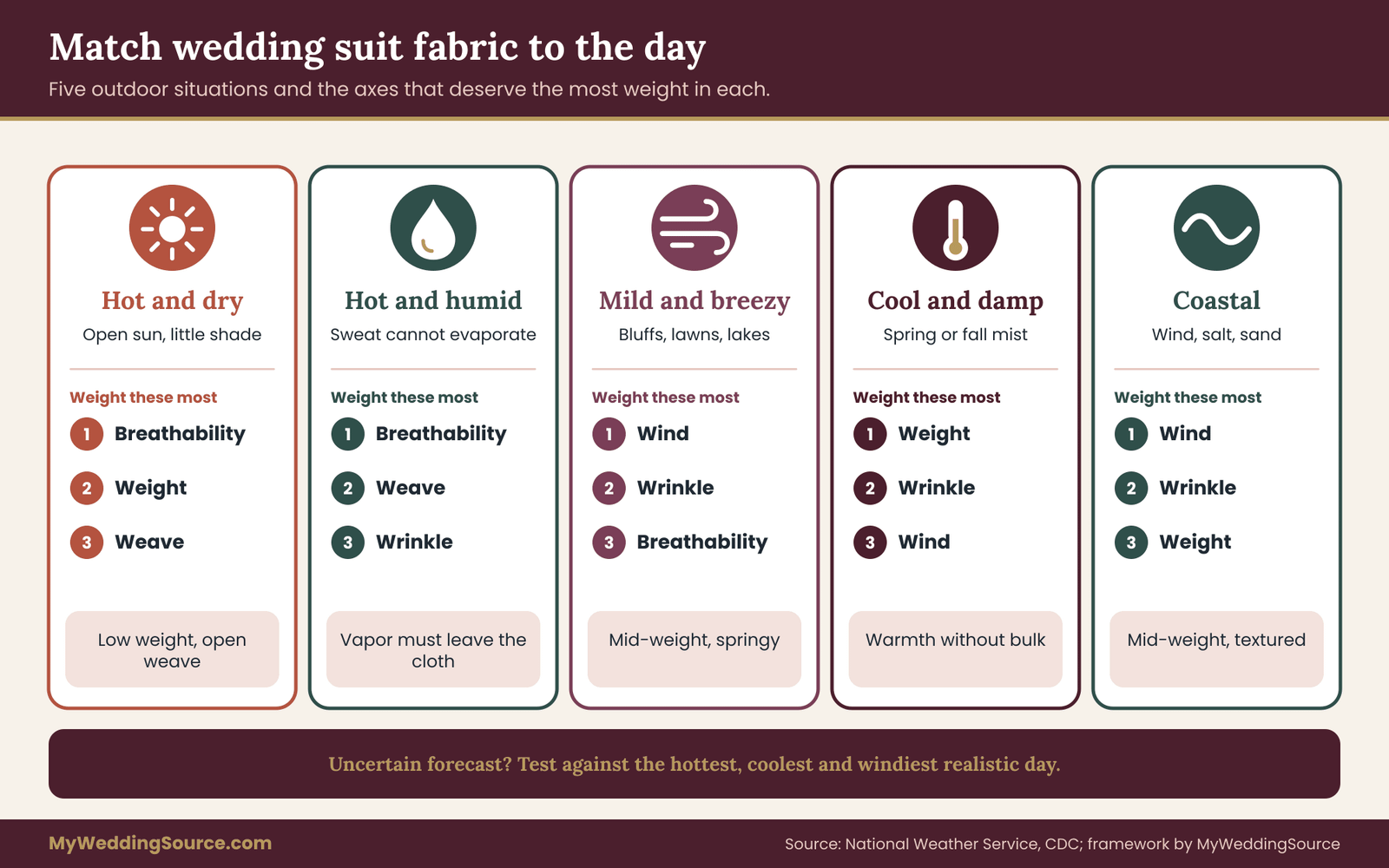
The climate on the day sets your priorities for wedding suit fabric more than any other fact. Five common outdoor situations cover most weddings, and each points to a different weighting. Use these as starting points, then adjust for your own venue.
Hot and dry, open sun
An exposed ceremony in a dry, hot climate rewards low weight and open weave. Sweat evaporates quickly in dry air, so your body can cool itself if the wedding suit fabric does not trap the heat against your skin. Here breathability and weight deserve the top weights, and wrinkle often matters less because dry air relaxes some creases. Light colors reflect more sun, though they show different problems, such as transparency and sweat marks, so test the color in sun before you commit.
The main risk is not feeling hot, since you will. It is the combination of direct sun and a dark, dense cloth that holds radiant heat. If your venue has no shade and the ceremony falls at midday, ask the planner whether the schedule can move toward late afternoon. The site’s guide to choosing a wedding date discusses how timing and season affect everything else, including what people wear.
Hot and humid
Humid heat is the hardest case for most cloth. Sweat sits on the skin, and what matters is how well the cloth moves vapor, not only air. Natural fibers that take up moisture vapor tend to feel more comfortable than fibers that do not, but only if the weave lets that vapor out. A tight, heavy cloth in a good fiber can still feel like a wet towel.
In humid heat, weight the breathability axis highest, then weave, then wrinkle. Humid air also softens crease recovery in many cloths, so a swatch that did well in your dry kitchen may sag outdoors. If you can, test a swatch after leaving it in a bathroom during a hot shower, not to wet it but to expose it to damp air, and then run the crush test again. It is a rough proxy, and it is better than no test.
The Centers for Disease Control and Prevention and the National Weather Service both publish heat safety guidance. Fabric helps with comfort, but it does not replace water, shade, rest and a plan for anyone who feels unwell. Treat the clothing decision as one layer of a larger heat plan.
Mild and breezy
Gardens, bluffs, lakeside lawns and hilltops often bring moderate temperatures and steady wind. Here wind behavior can matter as much as heat. A very light cloth will flap and ride up, and the jacket may pull open when you turn. You may want a bit more weight and a springier cloth that resists movement. Wrinkle matters in photographs because mild weather often means longer outdoor sessions.
Set the weights toward wind and wrinkle, with breathability in third. The best cloths here tend to be mid-weight, slightly textured and resilient.
Cool and damp
Spring and fall ceremonies in cool, damp air change the question. You want warmth that does not become bulk, and you want a cloth that does not hold moisture against you when mist or light rain arrives. Many people forget that damp air also affects cloth: some weaves swell slightly, some finishes weaken, and some colors darken and show water spots.
If rain is possible, ask the tailor whether the wedding suit fabric has a water-resistant finish, and ask whether the finish is permanent and whether a spot test is possible. Do not assume. The coverage and the care instructions on the label tell you what can and cannot be treated afterward. A heavier cloth with good recovery, such as a mid-weight worsted, often suits this scenario better than a summer-weight cloth chosen out of habit.
Coastal and salt air
Coastal ceremonies add steady wind, humidity and sometimes salt spray, and the sun on open sand or water amplifies heat. A mid-weight, recovery-friendly cloth with a slightly textured surface often performs better than a very light one. Salt air can leave a faint film on cloth, so plan for a gentle brush or professional cleaning afterward.
Sand is a separate hazard, and no cloth is immune. If you will stand on sand, think about trouser hems and cuffs. A cuff collects sand, and a plain hem does not. This is a tailoring decision rather than a cloth decision, but it affects which cloth you can live with.
What to do when the forecast is uncertain
For ceremonies planned months ahead, you cannot know the exact conditions. Pick the wedding suit fabric that handles the most likely conditions well and the worst plausible case acceptably. That is a more sensible target than perfect performance in one scenario and failure in another.
A practical rule: write down the hottest realistic day, the coolest realistic day and the windiest realistic day for your date and place. Then check each swatch against all three. A cloth that does well in two of the three and tolerably in the third is a good choice. A cloth that excels in one and fails another is a gamble.
The National Weather Service publishes forecasts and a wind safety page, and its climate data for your area helps with the historical side. Use them to anchor your three days. They are better than guessing from last summer.
Wrinkle and recovery: wedding suit fabric that holds its shape
Wrinkling is the most visible failure of outdoor wedding suit fabric, because it shows in every photograph and cannot be fixed in the middle of a ceremony. Understanding what causes it helps you choose.
Why cloth wrinkles
Wedding suit fabric wrinkles when fibers bend past the point where they spring back. Plant fibers such as linen and cotton have less natural spring than wool, so they crease easily and recover slowly. Wool fibers have a natural crimp and elasticity, which helps them recover, and the effect is stronger in tightly twisted yarns. Synthetic fibers can be engineered to resist creasing but may feel less breathable.
Weave also matters. A tight weave locks creases in, since the threads have nowhere to go. A looser or more textured weave gives threads room to shift and relax. Finish matters too, since some treatments add crease resistance and some soften the wedding suit fabric until it creases more.
The difference between a crease and a rumple
A crease is a sharp, narrow fold line that stays. A rumple is a broader, softer disturbance that relaxes in minutes. Photographs forgive rumples and punish creases. When you run the crush test, look at which kind you got. A swatch with a fine all-over crinkle will usually look acceptable. A swatch with deep, long, sharp folds will look like damage.
Where wrinkles appear on a suit
On the day, wrinkles tend to concentrate in four places. The back of the jacket and the trouser seat crease from sitting in a car or a chair. The elbow and sleeve crease from bending arms. The front of the trouser at the thigh creases from sitting and kneeling. The jacket front creases from a hug or from carrying a jacket over an arm.
You can reduce some of this by logistics, not only by cloth. Dress as late as possible, travel in a way that lets you stand or lean back, and carry the jacket on a hanger instead of on your arm. Wedding suit fabric selection and logistics work together, and a mediocre-recovery cloth with good logistics may outperform a good-recovery cloth with bad logistics.
What steaming can and cannot do
A handheld or garment steamer can relax many creases in wool and some blends. It works best on cloths that recover well and worst on cloths that crease deeply and hold the crease. Steaming also has limits: it does not reverse permanent creases from long storage, it can leave water marks on some cloths and finishes, and it does not suit every lining. Ask your tailor whether your chosen cloth can be steamed and how, and keep a steamer or a plan for steaming on the morning of the wedding.
General garment-steaming cautions apply to suits too, including testing on a hidden area first and checking the care label.
A wrinkle budget
Decide in advance how much wrinkling you will accept. That might sound fussy, but it prevents regret. If you accept some crinkle as part of a relaxed look, a lighter, more natural cloth is on the table. If you want a crisp look through a long day of photographs, you need a cloth that passes the crush test comfortably, and you accept the trade-offs in breathability or weight that come with it.
Say it aloud with your partner and the photographer. If the photographer knows you are comfortable with some texture, they will not worry about it, and you will not either.
Wind and drape: how wedding suit fabric moves in the open
Wind is the factor couples most often forget when they pick wedding suit fabric, and it shapes both comfort and photographs. A steady breeze cools you and can make a hot ceremony bearable. A gusty one lifts lapels, pushes a loose jacket open and presses trouser legs against your calves. The wedding suit fabric you choose determines which of those you get.
Three things that control movement
Weight is the first. Light wedding suit fabric is pushed around more easily, and heavy cloth resists. Stiffness is the second. A springy cloth holds its own shape against moving air, and a limp cloth follows the air. Surface friction is the third. A slick lining or a smooth, tight weave lets the jacket slide against the shirt, while a slightly textured cloth grips and stays put.
Cut changes all of this, and a roomier jacket catches more wind than a closer one. Since this guide holds cut constant, the practical takeaway is simple: if your jacket will be roomy or your venue is exposed, lean toward a mid-weight, slightly springy cloth.
The flutter and the lapel
Lapels are the first thing wind finds. A lapel in a springy, mid-weight cloth stays flat. A lapel in a light, soft cloth lifts and folds. The effect is stronger on peak lapels with a stiff canvas roll and weaker on soft, unstructured jackets. Ask your tailor how the jacket’s canvas and lapel roll interact with the cloth you chose, since the same cloth can behave differently in different constructions.
Photographers know this. If your ceremony is open and breezy, tell the photographer which suit and cloth you chose, so they can anticipate lifted lapels and position you with your back to the wind for portraits. A small adjustment in position often does more than a cloth change.
Trouser behavior
Trousers cling when cloth is light and the wind is steady. A cloth with a bit of weight and a lined front helps, and so does a slightly fuller leg, though that is a tailoring choice.
Cling is more noticeable in light colors and in some synthetics, which can pick up static. If you choose a very light summer cloth for the trousers, ask whether a partial lining, such as a lined front to the knee, is available. It adds a little warmth, and it also settles the wedding suit fabric.
The wind trade-off in plain terms
Heat and wind pull in opposite directions. The lightest cloths cool best and flutter most. The most stable cloths resist wind and run warmer.
There is no cloth that wins on both, and that is why your weights matter. A couple facing a hot, still afternoon in a sheltered garden can go very light. A couple on a bluff in a steady breeze should move toward the middle. If you are unsure, a mid-weight, open-weave cloth is the usual meeting point, because it gives air passage without a lot of loose fabric to catch the wind.
Comparing cloth families for an outdoor wedding suit fabric choice
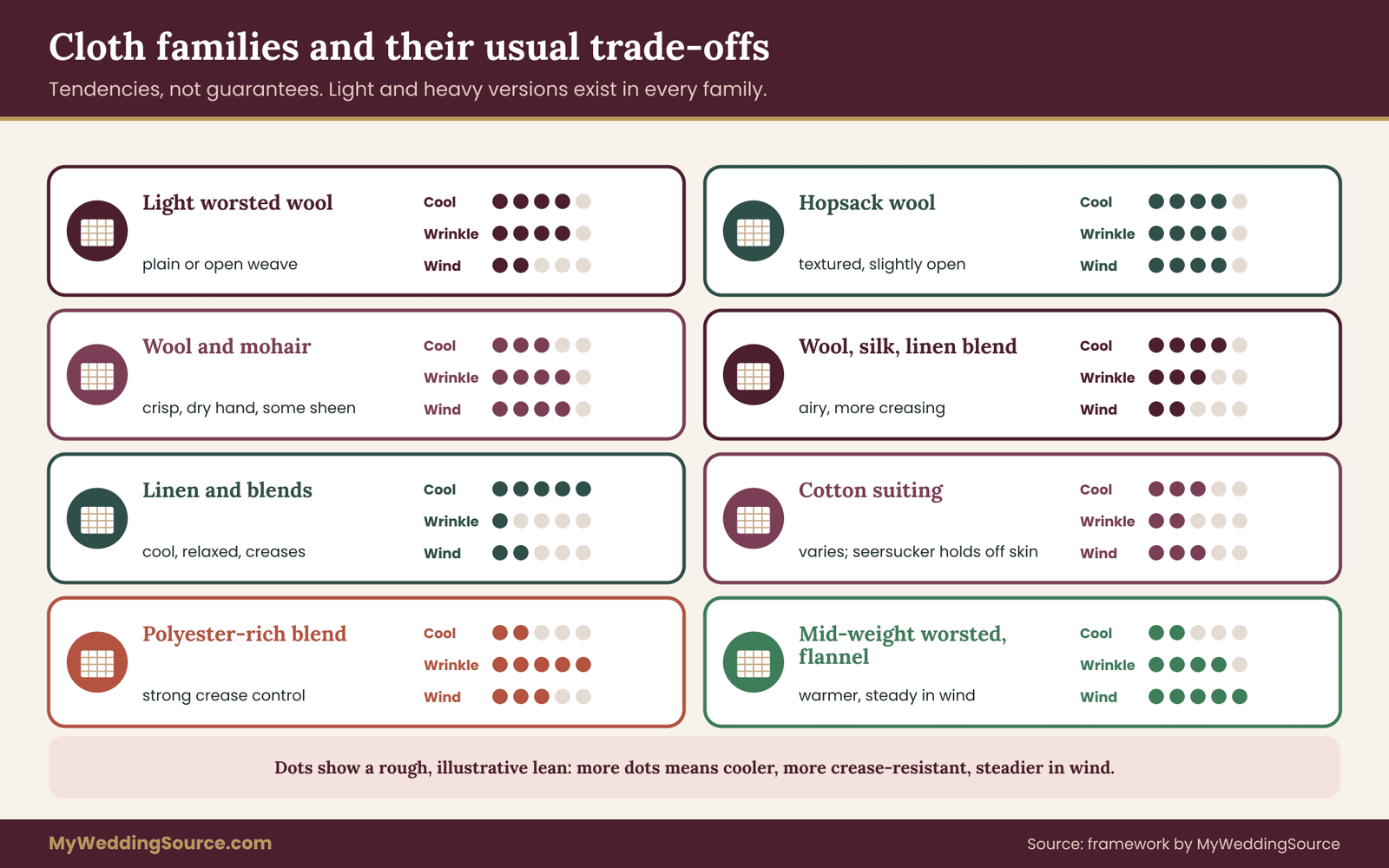
Below are the common families of suiting cloth, with the trade-offs each tends to bring. These are tendencies, not guarantees. Within every family there are light and heavy versions, open and tight weaves, and good and poor quality. Use the list to narrow your swatch requests, then let the tests decide.
Lightweight worsted wool in plain or open weave. Often sold as tropical or summer wool. Usually breathes well, recovers from creases reasonably well and drapes cleanly. It can be a strong all-round choice for a warm outdoor ceremony. Watch for very light versions that flutter in wind.
Hopsack wool. A textured, slightly open weave that tends to breathe and resist creasing, with a matte surface that suits sun and photographs. It often has more body than a plain tropical weave, so it handles wind better. It is a popular answer to the heat-versus-wind trade-off.
Wool and mohair blends. Mohair adds spring, a dry hand and a slight sheen. The blends tend to resist wrinkling and feel crisp in heat. The sheen can read as shiny in direct sun, so test it outdoors. Cost often runs higher.
Wool, silk and linen blends. A familiar mix for summer suiting that tries to combine wool’s recovery, silk’s drape and linen’s airiness. Results vary, and the linen share often brings a textured look and more creasing than all-wool cloth. Check the crush test carefully.
Linen and linen blends. Highly breathable and cool in dry heat, with a relaxed, textured look. Creases readily and recovers slowly. A better choice for a couple who accepts and enjoys a rumpled look, and a risk for anyone who wants a crisp one.
Cotton suiting. Can be crisp or soft, light or heavy. Often creases and holds creases, can feel heavy when damp, and can be comfortable in dry heat. Seersucker and similar puckered cottons hold the wedding suit fabric off the skin, which helps airflow, and they suit casual or garden weddings.
Polyester and polyester-rich blends. Strong wrinkle resistance and often a lower price. Breathability tends to be lower, and the wedding suit fabric can feel clammy in humid heat. Some modern blends are engineered for airflow, so test rather than assume. They can be a sensible choice if wrinkle control is the top priority and the weather is mild.
Mid-weight worsted and flannel. Warmer, better suited to cool, damp spring and fall ceremonies. Handles wind well, though it may be too warm for summer. Flannel’s soft surface can show lint, and its heft may be a drawback if the sun comes out.
How to use this list
Pick two or three families of wedding suit fabric that plausibly fit your weights, and request swatches of each. Do not request twenty swatches. Too many choices make comparison harder and the log longer. Ask the vendor to send two or three options per family, in your color range, with weights stated.
If your top two families are far apart, such as a light tropical wool and a polyester blend, run the tests on both and compare the axis scores. The comparison often surprises people. The cheaper blend may score well on wrinkle and badly on breathability, while the wool does the reverse, and the weights you set at the start settle the matter.
Color and finish as modifiers
Color changes how wedding suit fabric behaves in sun. Dark cloth absorbs more radiant heat, light cloth reflects more but can show sweat marks and transparency, and mid-tones often hide marks best. Texture and pattern, such as subtle weaves or small checks, hide creases better than flat solids. A matte finish reads better in sun than a high sheen.
Finish is the quiet variable. A stain-resistant or water-repellent finish can help in damp conditions, though some finishes reduce breathability. A washed or garment-dyed finish can soften the cloth and reduce stiffness. Ask what has been done to the wedding suit fabric and whether the finish is permanent, and if the vendor claims a performance finish, ask for the specific claim in writing. The Federal Trade Commission’s guidance on advertising claims applies to any vendor’s promises about performance, and you are entitled to ask a vendor to be specific.
A note on sustainability claims
Some vendors market cloth as eco-friendly, recycled or natural. These are marketing claims, and they are not the same as performance. Take them separately: ask what the claim means, whether it is backed by documentation and whether it affects how the wedding suit fabric performs outdoors. A recycled-fiber blend may be a fine choice, but you should judge it on the same five axes as any other cloth.
A worked example of choosing wedding suit fabric
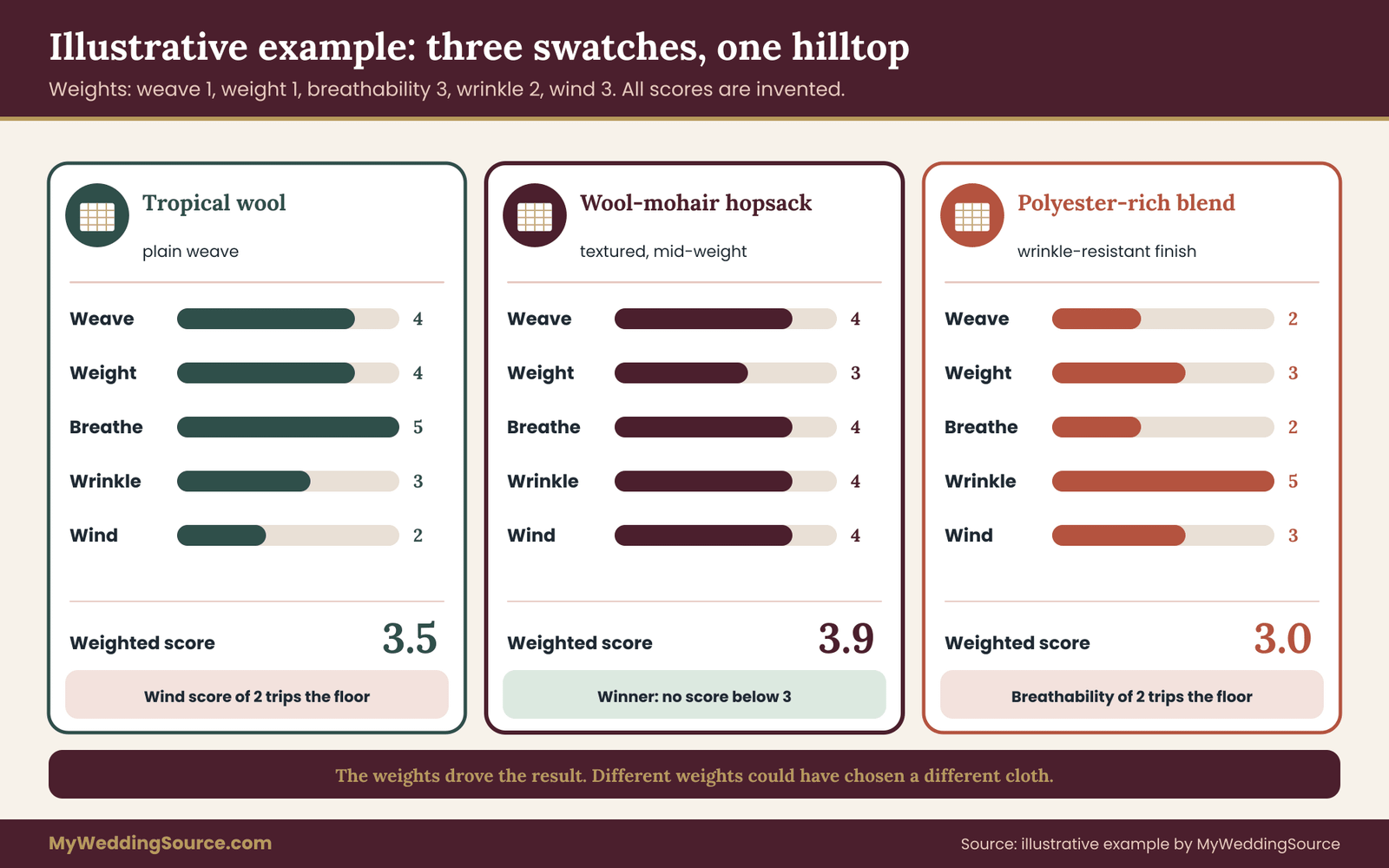
The following is an invented example, written to show the method in motion. The couple, the venue and the scores are illustrative, not data from any real wedding or test, and your own results will differ.
Imagine Marcus and Daniel, who plan a late-afternoon ceremony on a hilltop lawn in late June. The forecast pattern for their area, which they checked against official climate normals, runs warm, with a steady afternoon breeze and little shade near the ceremony spot. The ceremony lasts about twenty-five minutes, followed by an hour of outdoor photographs. Marcus will wear a suit, and he is deciding on cloth.
Step one: weights
Marcus writes his weights for wedding suit fabric before ordering anything. Breathability gets three because of the heat and the lack of shade. Wind gets three because of the hilltop. Wrinkle gets two because he will drive forty minutes in the suit. Weave gets one and weight gets one, since both feed the other axes rather than standing alone. The total is ten.
Step two: three swatches
He requests swatches from a local tailor and an online made-to-measure vendor. He receives three: a lightweight tropical wool in plain weave, a wool-mohair hopsack and a polyester-rich blend sold as travel-friendly. He asks for fiber content, weight with unit and finish in writing. The tailor supplies all three details. The online vendor supplies fiber and weight but no finish, so he asks again and receives a reply that the polyester blend has a wrinkle-resistant finish whose durability the vendor cannot state. He logs that as a gap.
Step three: the checks
On a Saturday morning he runs all six checks. The tropical wool scores high on the light and breath tests and middling on the flutter test, since it moves a lot when he points the fan at it. The hopsack scores a little lower on the light test, nearly as well on the breath test, better on the flutter test and well on the crush test. The polyester-rich blend scores best on the crush test, worst on the breath test and in the middle on flutter.
Here are the illustrative scores on the five axes, from one to five.
The tropical wool scores weave four, weight four, breathability five, wrinkle three and wind two. The hopsack scores weave four, weight three, breathability four, wrinkle four and wind four. The polyester blend scores weave two, weight three, breathability two, wrinkle five and wind three.
Step four: the arithmetic
Using weights of weave one, weight one, breathability three, wrinkle two and wind three, the tropical wool totals four plus four plus fifteen plus six plus six, which is thirty-five, giving a score of three and a half. The hopsack totals four plus three plus twelve plus eight plus twelve, which is thirty-nine, giving three point nine. The polyester blend totals two plus three plus six plus ten plus nine, which is thirty, giving a score of three.
The hopsack wins, and it also has no one on the floor: its lowest axis score is a three on weight, which carries a weight of only one. The tropical wool has a two on wind, an axis weighted three, and that trips Marcus’s floor rule. It would need a fix, such as a half-lined jacket in a slightly springier cut, to stay in the running. The polyester blend fails the floor on breathability.
Step five: the outdoor check and the paper trail
Marcus carries the top two swatches to the hilltop at the planned hour and looks at them in direct sun. The hopsack has a quiet, matte surface. The tropical wool shows slightly more sheen than he expected. He photographs both against the grass. He then writes to the tailor to confirm the hopsack’s weight, fiber content and finish, and asks what happens if the delivered cloth differs from the swatch. He keeps the reply with his contract.
What the example shows
Three points about wedding suit fabric are worth carrying away. First, the weights drove the outcome. With different weights, the tropical wool might have won. Second, the floor rule caught a weakness that the average hid. Third, the paper trail was part of the decision, not a footnote. Marcus chose the swatch he could document.
You can run the same method for any suit, any climate and any budget. The numbers are your own. The steps stay the same.
Lining, construction and color: the supporting cast
Wedding suit fabric does not act alone. Three other choices change how any wedding suit fabric performs outdoors, and they deserve attention before you finalize.
Lining
A fully lined jacket adds a layer across the back and sleeves. That layer often holds heat and moisture against the body, and a slick synthetic lining can feel clammy in humid weather. A half-lined jacket, where the lining covers only the upper back and the sleeves, leaves much of the interior open and lets air move. An unlined or lightly constructed jacket, sometimes called deconstructed, is the coolest option but shows seams and may crease more because it has less structure behind the wedding suit fabric.
Lining fiber matters too. Breathable linings, such as cupro or viscose, tend to feel cooler against the skin than polyester, though they can be less durable. Ask what the lining is and whether it can be changed. Run the breath test on a lining swatch if you can, with the wedding suit fabric swatch behind it, to see the combined effect.
The tradeoff of unlined construction deserves a plain statement. Less lining means more visible interior seams and less shape retention, and it can make a jacket harder to put on and take off. If you will remove the jacket for the reception, check that you are comfortable with how the inside looks.
Canvas and interlining
The structure inside the front of a jacket, often called canvas or interlining, shapes the chest and lapel. A fused interlining is glued to the wedding suit fabric and can restrict airflow and sometimes bubble over time. A floating canvas is stitched in and generally lets the cloth move more naturally.
A fully canvassed jacket tends to cost more. You do not need to master this, but ask whether the jacket is canvassed, half-canvassed or fused, and ask how that affects breathability. A cloth that scored well on the breath test can lose some of that advantage behind a stiff fused front.
Color
Color changes heat, glare and the visibility of marks. Dark navy and charcoal absorb more sun than light gray or tan. Light colors can look washed out in sun, and some turn translucent. Mid-tones are often the safest compromise for outdoor wear, since they hide sweat marks and creases better than very light or very dark shades. Texture helps. A fine hopsack or a small herringbone breaks up the surface and hides creasing.
If you plan a specific color for the wedding party, check how each cloth takes that color. The same shade can look different in wool and in a blend, and the difference shows most in sun.
Buttons, trims and small things
Heavy horn buttons and decorative trims add weight and can drag a light cloth. Pocket construction can affect how the jacket hangs. A boutonniere pin can pucker a very light lapel. These are small points, and none is a reason to change cloth, but they explain why a swatch does not tell the whole story and why your fitting matters.
Fit and cloth together
A tailor adjusts the cut to the wedding suit fabric, and different cloths want different cuts. A fluid cloth hangs best with a slightly closer cut, and a crisp cloth tolerates more ease.
If you have already settled on a cut, tell the tailor so they can advise on which cloths suit it. The site’s guide to fittings and alteration timelines was written around dresses, and the same logic applies to suits: leave room in the schedule for at least one adjustment after the first fitting, because cloth behaves differently on the body than on a table.
Vendor questions and edge cases for wedding suit fabric
By now you have a favorite swatch and a log. Before you pay, put the choice through a short set of vendor questions and edge cases. Most trouble with made-to-measure and rental clothing comes from the gap between what a swatch showed and what arrived.
Questions to ask before ordering
Ask these in writing and keep the replies.
“Please confirm the exact cloth name or code, mill, fiber content, weight with unit and finish for the swatch we chose, and confirm we will receive that cloth.”
“What are the lead time, the fitting schedule and the latest date we can change the wedding suit fabric? What happens if the cloth is delayed or sold out?”
“If the wedding suit fabric arrives different from the swatch, or the suit does not perform as described, what is the remedy and the deadline to report it?”
“Can a swatch or a sample garment be tested outdoors before we commit, and is there a deposit or a return window on the swatch itself?”
Vendors differ in how they answer, and the answers show you how the vendor works. Clear, specific replies with numbers are a good sign. Vague replies, reliance on brand names or a refusal to put anything in writing are warnings. The same delivery, substitution and refund questions that apply to any wedding vendor apply to a clothing vendor.
Advertising claims and what you can ask
Vendors sometimes use words such as breathable, wrinkle-free, cooling or performance. Those are claims, and the Federal Trade Commission expects advertising claims to be truthful and supportable. You are entitled to ask what a claim means and what supports it. If a vendor says a cloth is wrinkle-free, ask what test, what comparison and what conditions. If the answer is a slogan, treat the claim as unproven and rely on your own tests.
You can also ask about commercial relationships. If a reviewer or a recommendation site earns commission from a vendor, that should be disclosed near the recommendation. When you read reviews of cloths or suit makers, look for that disclosure, and weigh claims accordingly.
Edge case: rental and off-the-rack suits
If you rent, you do not choose the wedding suit fabric, but you can still choose among the available suits. Ask the shop for the fiber content and weight of each option, and ask whether any are lighter or more breathable.
Rental suits are often built for durability and may run warm, so ask whether a lighter option exists and whether the jacket is fully lined. Try the suit on, stand in sun by a window or outside the shop if you can, and check the crush behavior in an inside pocket bag or hem allowance with permission.
For an off-the-rack purchase, read the garment label and apply the same checks. The Textile Fiber Products Identification Act and the Care Labeling Rule require labels that state fiber content and care instructions on most garments, so the information is on the tag. Use it.
Edge case: tight timelines
If the wedding is a few weeks away, you may not have time for custom cloth. Narrow your options to what is available, run the checks on whatever swatches or garments you can get, and apply the floor rule. A good ready-made suit in a sensible cloth beats a custom suit that arrives late. Alterations take time, so build the schedule backward from the date and leave room for a second fitting.
Edge case: a mixed party
When the groomsmen or other attendants wear matching suits, the wedding suit fabric question multiplies. People run hot or cool differently, and a cloth that suits one person may not suit another. If the party will be matched, choose a cloth at the comfortable end of your own scores, favor breathability and recovery, and let people dress as late as possible. If the party has a range of body types and ages, a mid-weight, forgiving cloth is more likely to work for everyone than a delicate one.
Edge case: sensitive skin and allergies
Some people react to wool, to certain finishes or to dyes. If you have a known sensitivity, test a swatch against your skin for several hours before choosing, and ask about the finish. Do not rely on a description of the cloth alone.
Edge case: traveling to the wedding
If you fly or drive a long distance, the wedding suit fabric must survive packing. Crush behavior matters more here, and so does the question of steaming on arrival. Carry the suit in a garment bag as hand luggage when you can, and plan for a steamer at the destination. The guide to wedding day accessories planning covers backups and emergency kits for the small items that travel with the suit.
The day itself: a short wedding suit fabric kit
Cloth choice does most of the work, but a few small habits protect it on the day.
Dress late. The longer the suit is on before the ceremony, the more time it has to crease and warm up. Put on the jacket last, and carry it on a hanger.
Keep a small kit. A lint roller, a small garment brush, a few spare pins, a handkerchief and a travel steamer or a plan for one cover most problems. Hand the kit to a trusted person, so that you are not carrying it.
Use shade and water. Stand in shade until the last minute and drink water. The wedding suit fabric helps, but the heat plan is bigger than the wedding suit fabric.
Plan for the jacket to come off. If the ceremony is hot, agree with the officiant and photographer that you may remove the jacket for the reception and for some portraits, and hang it carefully. A jacket on a proper hanger recovers far better than a jacket draped over a chair.
Check the wind before portraits. If gusts are strong, turn so the wind hits your back, button the jacket and ask the photographer to take a few frames that way.
The venue technical walkthrough guide explains how to learn what a space looks like at the planned hour, including sun angle and shade, and a short visit at the right time of day tells you more than a weather app does. If your venue has particular rules for outdoor ceremonies, the questions to ask a venue are a good place to start.
Where fabric fits in the larger plan
Clothing is one line in a long list. The wedding planning checklist places attire in a timeline, and the wedding budget guide helps you decide how much to spend on it relative to other priorities. If cloth is the thing you are most worried about, schedule swatch requests early, leave time for testing and keep the paper trail with your other vendor records.
Your next steps
Work through these in order. Each takes an evening or less.
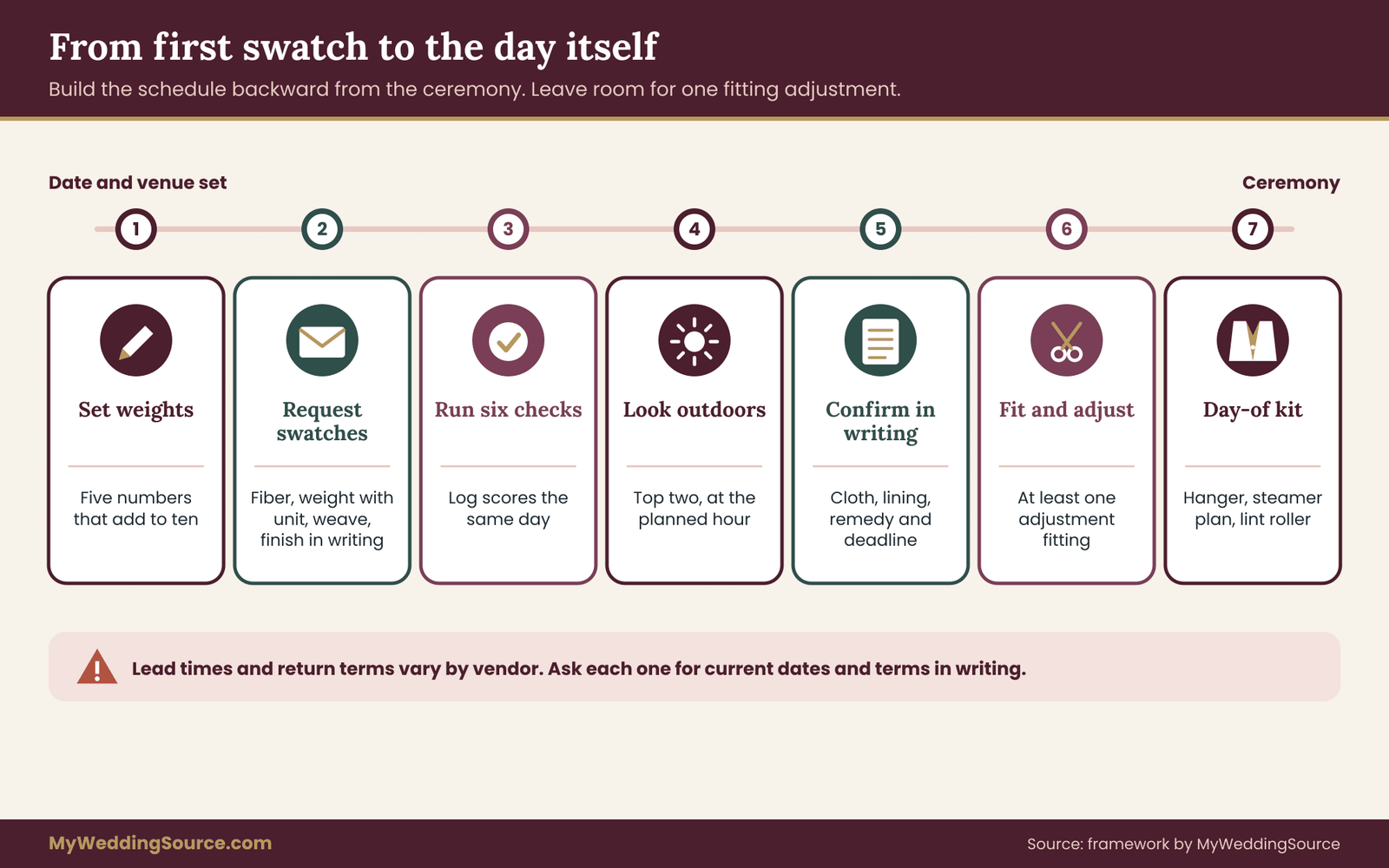
- Write your five weights, adding to ten, before you look at any swatch.
- Write down the hottest, coolest and windiest realistic day for your date and place.
- Pick two or three cloth families that fit your weights and request two or three swatches of each, with fiber, weight with unit, weave and finish in writing.
- Run the six checks on every swatch on the same day, and log the results.
- Score each swatch, apply the floor rule and use the tie-breakers if needed.
- Look at your top two swatches outdoors at the planned hour.
- Send your written questions to the vendor, and keep the replies with your contract.
- Decide on lining, canvas and color with your tailor, and schedule at least one fitting adjustment.
- Plan the day-of kit and a place to hang the jacket.
If you do only one thing, set your weights first. Everything else follows from them.
FAQ
What is the best wedding suit fabric for a hot outdoor ceremony?
There is no single best cloth, but lightweight worsted wool in an open or hopsack weave is a common strong choice, because it breathes and recovers from creases. Linen suits a relaxed look if you accept wrinkles. Test swatches on breathability, wrinkle and wind, and match the result to your venue, shade and ceremony length.
Is linen a good wedding suit fabric outdoors?
Linen breathes well and feels cool in dry heat, but it creases readily and recovers slowly. It suits couples who like a relaxed, textured look. If you want a crisp look in photographs, consider a wool-linen blend or a hopsack wool, and run the crush test on any swatch before you order.
How do I check wedding suit fabric breathability at home?
Hold a swatch to your lips and blow through it, once as a single layer and once folded double to mimic lining. Compare swatches under the same conditions. Add a light test against a window to judge weave openness. These tests rank your swatches against each other; they do not replace laboratory measurements.
What weight should wedding suit fabric be?
It depends on climate and wind, and numbers are not comparable unless the unit matches. Swatch books use grams per square meter, grams per linear meter or ounces per yard. Ask for the number, unit and width in writing, then judge it alongside the weave and your hang and flutter tests.
Which wedding suit fabric wrinkles least?
Wool in tightly twisted yarns and many synthetic blends resist wrinkling better than linen or cotton, and textured weaves hide creases better than flat ones. Run a crush test and watch recovery after two minutes. A cloth that wrinkles little but breathes poorly may still be wrong for a hot, humid ceremony.
Does wind change which wedding suit fabric I should pick?
Yes. Very light cloth flaps, lifts lapels and clings to legs, while mid-weight, springy cloth stays put. If your venue is exposed, lean toward more body and test with a fan. Tell your photographer about your choice, since turning your back to the wind often helps more than changing cloth.
Can I steam a wedding suit before an outdoor ceremony?
Often yes, but check with your tailor first. Steaming relaxes many creases in wool and some blends, and it works poorly on permanent creases or cloths that spot with water. Test a hidden area, keep the care label in mind, and dress as late as possible so you rely on steaming less.
How early should I order swatches and wedding suit fabric?
Request swatches as soon as the date and venue are set, because testing, ordering, delivery and at least one fitting adjustment take time, and made-to-measure lead times vary. Ask each vendor for current lead times and the last date to change cloth, and build your schedule backward from the ceremony.
Sources
- Federal Trade Commission: Threading Your Way Through the Labeling Requirements Under the Textile and Wool Acts
- Federal Trade Commission: Clothes Captioning, Complying with the Care Labeling Rule
- Electronic Code of Federal Regulations: Care Labeling of Textile Wearing Apparel and Certain Piece Goods, 16 CFR Part 423
- Federal Trade Commission: Advertising and Marketing Guidance for Businesses
- Federal Trade Commission: The FTC’s Endorsement Guides, What People Are Asking
- National Weather Service: Heat Index Safety
- National Weather Service: Wind Safety
- Centers for Disease Control and Prevention: Heat and Health
- U.S. Environmental Protection Agency: Sun Safety
- ASTM International: Standards for Textiles