
Wedding dress cleaning is easy to put off and surprisingly easy to time badly, especially when the gown spent hours on grass, gravel, sand or a dewy lawn for outdoor photos. This guide gives you a clock, a stain inventory and a one-page cleaner handoff worksheet, so you can decide how soon to book the cleaning, what to tell the cleaner, and when waiting is actually fine.
For most gowns, plan to hand the dress to a specialist within a few weeks of the wedding, not months, and sooner if you can see or suspect sugar, drink, food, oil, sunscreen or deodorant marks. Before that, do almost nothing: photograph the dress, record every mark on a stain inventory, let it dry, hang it or lay it flat in a breathable cover, and keep it away from heat and plastic. Do not treat stains at home. Use the handoff worksheet to tell the cleaner exactly where the dress went and what touched it.
Outdoor photos, planned around a wedding family photo list and a few portrait spots, are the happiest part of many wedding days and the hardest on a gown. A hem that touched wet grass for ten minutes, a train that was spread on a gravel path, a shoulder that met a cheek covered in sunscreen, a glass of champagne held for a portrait: none of these looks like much in the moment. Days later, some of them look like a map.
The question this article answers about wedding dress cleaning is narrow. It is not about whether to preserve or sell the dress, which is a larger decision covered elsewhere on this site. It is about timing and information. How soon should wedding dress cleaning happen after outdoor photos, and what does a cleaner need to know so the work goes well? Good wedding dress cleaning starts with information, not with solvent.
A note on scope. This is general information, not legal, tax or financial advice, and it is not a textile conservator’s assessment of your gown. Fabric damage, cleaning prices and results vary, so the article gives no price promises and no results promises. Where a rule or a figure matters, it points you to the professional or the agency that can confirm it for your dress.
What wedding dress cleaning has to settle after outdoor photos
Wedding dress cleaning after an outdoor shoot is really four separate decisions that tend to get blended into one worry. Naming them keeps the worry smaller.
When. How many days or weeks can the dress wait before the marks become harder to deal with? This is the question in the title, and the answer depends on what the dress touched, not only on how long ago the wedding was.
Who. A general dry cleaner, a cleaner who specializes in wedding gowns, a textile conservator, or the original designer’s own care service. Each is suited to different fabrics, trims and risks.
What to say. A cleaner can only work with what they can see and what you tell them. A short, accurate account of the day often changes the method they choose.
What to leave alone. Many gowns are harmed less by the original mark than by a well-meant attempt to remove it. Knowing what not to do is half the plan.

If you read nothing else, take this: the order of operations is record, dry, protect, hand off. Record means photographs and a written inventory. Dry means letting the dress air out of any dampness. Protect means a clean, breathable cover and a cool, dry place. Hand off means a specialist with a worksheet in hand. Everything else about wedding dress cleaning in this guide is detail on one of those four verbs.
Why outdoor photos change the timing
Indoor wedding photos usually expose a gown to light food spills, perfume and the general contact of a crowded room. Outdoor photos add exposures that are specific and sometimes unusual. Moisture from dew or damp ground travels up a hem by wicking, a process in which fabric draws liquid upward. Soil and plant matter press into the weave when a train is spread or when the wearer sits or kneels.
Sun and warmth can bake in anything that is already on the fabric. Wind blows grit into beading and lace. Insect repellent and sunscreen, applied to skin that then touches the gown, add oils and chemicals that a cleaner will want to hear about.
None of this means the dress is ruined, and none of it makes wedding dress cleaning urgent in the first hour. It means the exposure list is different, and the right timing depends on that list. A gown that only brushed a dry paved path may be fine for several weeks. A gown that sat on damp ground and then had champagne spilled on the bodice has two different clocks running.
What this article does not cover
Several related questions have their own guides on this site, and this article stays out of them on purpose. The first-aid question of what to do about an individual stain on the day is a different task from planning the cleaning afterward. Choosing between sealed preservation, selling, redesigning or passing on the dress is a separate decision.
Steaming at the venue, transporting the dress in bad weather and altering the fit are separate again. The wedding dress fit and alterations guide is the place to start if the dress needs a change in shape as well as a clean, and it helps to know which job the cleaner and the seamstress each own.
What this article offers instead is an original worksheet pair. The first is the stain inventory, which you fill in at home before anyone touches the dress. The second is the cleaner handoff worksheet, which turns the inventory into a brief the cleaner can use. Later sections include a worked case with an invented couple, a set of alternatives to a full cleaning, and the conditions under which the whole approach fails.
The clock: how soon wedding dress cleaning should happen
Most advice on timing is a single number: “within a week”, “within a month”. A single number is easy to remember and often wrong for a particular dress. A better way to think about it is as three clocks that start at different moments.
The moisture clock starts when the hem or any part of the gown becomes damp. Damp fabric left in a bag or a box can develop a musty smell and mildew in warm, humid conditions. Water marks can also form as the damp area dries, leaving a ring where dissolved dirt collected at the edge. This clock is measured in hours and days, and the action it calls for is simple: let the dress dry in open air, away from direct heat.
The sugar and organic clock starts when a drink, food, makeup or skin product lands on the gown. Sugary drinks and food can dry clear and then darken or yellow with age and heat. Protein and oil based marks can set differently. This clock runs in weeks, and it is the main reason that cleaning conservators and gown cleaners tend to say that sooner is better.
The soil and abrasion clock starts when dirt, grit and plant matter work into the weave and trims. Dirt itself is slow to cause lasting harm, but grit can cut thread and dull beads each time the dress is moved, and soil can hold moisture against the fabric. This clock is gentle at first and speeds up whenever the dress is handled roughly or packed away unclean.
How the three clocks combine
The practical answer to “how soon” comes from asking which clocks are running and how fast. A dress with only soil on the hem has one slow clock. A dress with sticky marks on the bodice and a damp hem has two faster ones. If you cannot tell, treat the dress as if the faster clocks are running.
That is why the stain inventory comes first in any plan for wedding dress cleaning. It is a way of finding out which clocks you actually have, instead of guessing from the general stress of the day. Once you can say “damp hem, one drink mark at the left hip, sunscreen near the neckline”, you can talk to a cleaner in a way that gets a useful answer.
A simple starting rule for timing
If you want a rule of thumb before you read the rest, use this one and adjust it later. Book the wedding dress cleaning consult within the first week. Aim for the actual wedding dress cleaning within the first few weeks if there is any sugar, drink, food, oil, sunscreen, deodorant or makeup on the gown. If the only contact was dry ground and the dress is otherwise clean, the cleaner may be comfortable with a longer gap, but let them decide after seeing photos.
This rule for wedding dress cleaning is deliberately conservative. A cleaner who says “this can wait” has used information you did not have. A cleaner who says “this should have come in sooner” is a worse conversation. When wedding dress cleaning is a few weeks away rather than a few months away, the odds shift toward the better conversation.
Reading the exposure: what outdoor photos do to a gown
Different surfaces and settings leave different marks. A short list of the usual suspects helps you read your own dress.
Grass and plant matter. Green grass can leave green or brown marks at the hem and on the train, and the plant material may carry sap and moisture. Seeds and burrs can catch in tulle, lace and beading. A cleaner will want to know whether the area was dry or wet, and whether the marks were present at the end of the day.
Soil, mud and sand. Dry soil mostly sits on the surface and in the weave. Wet mud presses in and wicks upward. Sand is gritty and works into beads, sequins and lace. Beach and lakeside photos add salt, and salt can leave a stiff, hazy residue as it dries.
Dew and rain. Even a light dampness can raise water rings on certain fabrics. Silk, satin and some blends are known for showing water marks. If the fabric is a sensitive type, the first call to the cleaner should include the fabric content from the label.
Sunscreen, insect repellent and skin products. These transfer from skin to the neckline, shoulders, sleeves and back. Some leave oily marks that can yellow with time. Tell the cleaner which products were used, even if you cannot see a mark yet.
Perspiration and deodorant. Underarms, bodice lining and the waistline absorb sweat on a warm day. These areas are often invisible at first, and they are among the reasons a dress that “looks fine” still benefits from cleaning.
Food and drink. Cake, frosting, champagne, red wine, coffee, sauces and oils reach the gown at the reception, but they also appear during photos when guests hug the couple with glasses in hand. Sugary marks are worth flagging first.
Makeup. Foundation, lipstick and self-tanner can transfer to the neckline, collar and sleeves, especially during hugs and portraits.
Where on the dress to look
Mark locations help the cleaner more than the type of mark does. Work from the bottom up. The hem and the first twelve inches above it take most of the outdoor contact. The train, if any, collects the most dirt. The knees and the seat show where the wearer knelt or sat.
The hips and the sides can carry drink and food, because hands and glasses rest there. The bodice and neckline hold makeup and skin products. The underarms and the inside waistband carry sweat. The back, especially lace and buttons, catches whatever the wearer leaned against.
Check the inside as well as the outside. The inside of the hem, the lining and the corset or boning channels hold surprising amounts of soil and moisture that the outer fabric hides.
The common mistakes before the dress reaches a cleaner
The mistakes that complicate wedding dress cleaning are usually kind ones. Someone dabs a stain with water or club soda and spreads it. Someone rubs a mark with a napkin and roughens the fabric. Someone applies a household stain remover, and it leaves a halo or changes the color. Someone puts the damp dress in a plastic garment bag for the drive home, and the moisture has nowhere to go. Someone hangs a heavy gown by its straps, and the weight stretches the bodice. Someone stuffs the train into a trunk, and the creases set.
The fix for each of these is to do less. A dress that arrives at the cleaner with its marks untouched, dry and loosely covered gives the cleaner the most options. The next sections show how to record the dress so that doing less feels like a plan rather than neglect.
The stain inventory: record the gown before wedding dress cleaning starts
The stain inventory is the first of the two worksheets for wedding dress cleaning. Its job is to turn “the dress got dirty” into a short, ordered list that a stranger can read. It takes about thirty minutes, and it is worth doing the day after the wedding or the first calm evening you have, because memory fades fast and so does the visibility of some marks.
You do not need special equipment. You need daylight, a clean flat surface or a clean hanger, a phone camera, a pen and a copy of the list below. If two people are helping, one should handle the dress and one should write. Wash your hands first and remove rings and bracelets that could snag lace or beading.
Step one: photograph before anything else
Take three sets of photographs, in daylight and without flash.
The whole dress. Front, back and both sides, on a hanger or laid flat, so the cleaner can see the silhouette and the general condition.
The problem areas. For every mark or damp patch you can see, take one photo from about two feet away and one close up. Place a coin, a pen or a ruler beside the mark for scale. If a mark is faint, shift the angle of the light until it shows.
The inside. The lining, the inside hem, the waistband, the underarms and the label. Photograph the care label and the fabric content label flat and readable. Cleaners ask for the label first, and it is the single most useful photo you will take.
Name the files in order, such as “01 front”, “02 back”, “07 hem left close”. The names let you refer to the photos in the worksheet and in messages to the cleaner.
Step two: walk the dress from the bottom up
Use this order every time. It keeps you from missing a zone and from handling the dress more than necessary.
Start with the hem, including the inside of the hem, then move to the train or the back of the skirt. Then check the front of the skirt, the hips and the sides. After that look at the waistband, the bodice, the neckline, the shoulders and sleeves, and the underarms. Finish with the back closure, buttons, zipper or lacing, and any beading, appliqué or trim.
For each zone, ask four questions and write the answers in one line.
What do I see? A color, a ring, a stiff patch, a smell, a loose thread, a missing bead.
What do I think caused it? Grass, mud, drink, cake, sunscreen, sweat, makeup, unknown. “Unknown” is a fine answer.
Is it wet, damp or dry now? Be honest. A hem can feel dry on the surface and damp inside.
Has anyone touched it? Note any dabbing, blotting, wiping, spraying or rubbing, and with what. Cleaners need this more than they need your guess about the cause.
Step three: code each entry
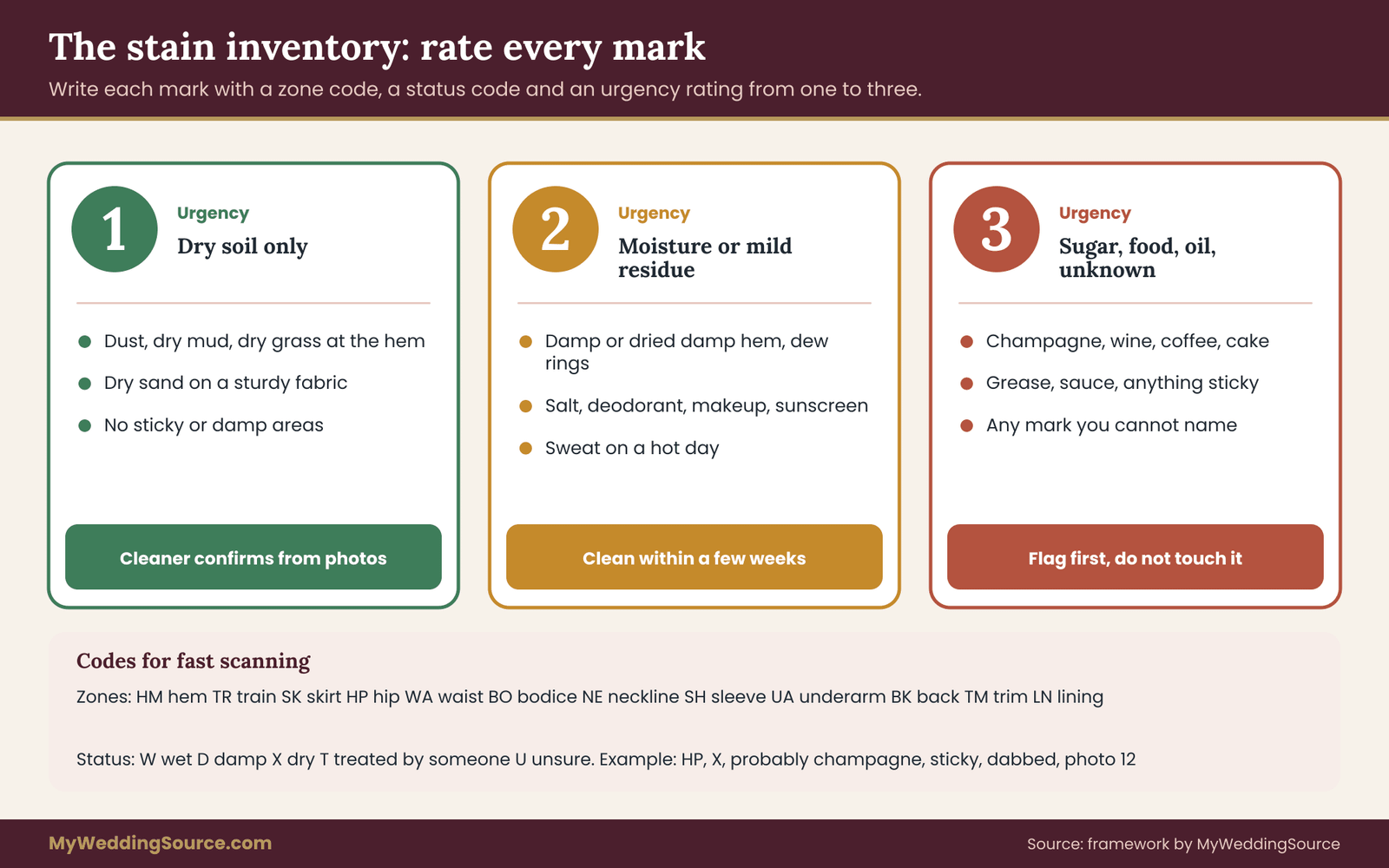
Short codes make the inventory easy to scan. Use two letters for the zone and one letter for the status.
Zones: HM for hem, TR for train, SK for skirt, HP for hip, WA for waist, BO for bodice, NE for neckline, SH for shoulder or sleeve, UA for underarm, BK for back or closure, TM for trim, beads or lace, LN for lining or inside.
Status: W for wet, D for damp, X for dry, T for treated by someone, U for unsure.
An entry then reads something like “HM, D, grass and mud, about six inches, not treated, photo 07” or “HP-left, X, probably champagne, sticky, dabbed with a napkin, photo 12”. Anyone can read that in a few seconds.
Step four: rate each mark for urgency
The last column is the one that decides the timing of wedding dress cleaning. Give each mark an urgency rating of one, two or three.
Rating one: soil or dry dirt only. Dust, dry mud, grass dust, dry sand. Low risk of lasting change in the short term, though still worth cleaning.
Rating two: moisture or mild residue. Damp hem, dew, light water spotting, salt, deodorant, makeup, sunscreen. These benefit from cleaning within a few weeks and from careful drying in the meantime.
Rating three: sugar, food, drink, oil or unknown sticky marks. Champagne, wine, coffee, cake, frosting, sauce, grease, anything sticky or shiny, and anything you cannot name that feels different from the fabric around it. These are the marks to flag first.
The highest rating anywhere on the dress sets the starting point for timing. A dress with ten rating-one marks and one rating-three mark is a rating-three dress for scheduling purposes.
What a finished inventory looks like
A good inventory for wedding dress cleaning is short. For an average outdoor wedding, expect between five and twelve entries. If you have thirty entries, you are probably recording every speck. Group dust and light dirt as one entry per zone, and give each distinct mark its own line.
At the top of the page write the date of the wedding, the date you completed the inventory, the fabric content from the label, the designer and style name, and any trims you know are glued, sewn, painted or beaded. At the bottom write three lines: what the dress looked like before the day, whether it was altered, and whether it has been cleaned or steamed since the final fitting. A cleaner can tell a lot from whether the last professional contact with the gown was a pressing or a full cleaning.
If you want a place to keep the inventory, the wedding records guide describes folders for keepsakes and vendor files, and the inventory belongs in both: the photos with your keepsakes, the printed worksheet with the cleaner’s file.
Two kinds of marks that need a second look
Some marks do not show up on the first pass. Sweat and clear drinks can dry almost invisible and then show as a yellow or brown patch weeks later. Water-based spills on certain fabrics leave a ring only once they dry. The way to find them is a second inspection, a day or two later, in different light.
Do this second look by laying the dress on a clean sheet near a window and moving slowly. Check the underarms, the waistband, the area around the neckline and the zones where hands and glasses rested. Add any new entries with the label “found on second look”. The cleaner will take the note seriously, because it shows that the mark may have been present before the dress dried.
Also check for smell. A faint musty smell at the hem is a moisture clock signal. A sweet smell can mean sugar. A chemical smell can mean a product on the dress. Smell is not a diagnosis, but it is a clue, and it costs nothing to write it down.
Handle the dress as little as possible
Every time the dress is lifted, folded or carried before wedding dress cleaning, there is a small chance of snagging a bead or setting a crease. After the inventory, put the dress in its resting place and leave it. If you need to move it, support the weight from underneath, carry the skirt in your arms and keep the hem off the floor.
When the dress is hung, use a padded hanger with wide shoulders and, if the gown has a heavy skirt, hang it from the waist loops if it has them rather than from the straps. If the dress cannot hang safely, lay it flat on a clean cotton sheet on a bed or a table.
Avoid placing it against a window with direct sun, a radiator, a heater vent or a car’s back window ledge. Heat is the easiest way to turn a sticky mark into a stubborn one, and that is why drying and protecting come right after recording and before wedding dress cleaning.
The first 48 hours: dry, protect and do not treat
The first two days after the photos are the stretch in which the dress needs the least intervention and the most care. Wedding dress cleaning has not started yet, but the choices you make now decide how hard it will be.
Dry it in open air
If any part of the dress is wet or damp, the first job is air. Place the dress in a clean room with good air circulation, away from direct sun and direct heat. A fan across the room, not pointed at the fabric, helps. Do not use a hair dryer, a clothes dryer, a hot iron or a heater on a damp gown. Heat can set marks and shrink or distort some fabrics and trims.
Turn the dress over or move it every several hours so that the underside, the lining and the inner hem also get air. Check the hem lining and any layered tulle, because layered fabrics dry slowly in the middle.
Choose a breathable cover
Once dry, cover the dress loosely with a clean cotton sheet or a breathable garment bag. Cotton or unbleached muslin is a common recommendation from museum conservators for textile storage because it lets air move through. Avoid dry cleaner plastic bags for anything longer than the trip home. Plastic traps moisture and can contribute to yellowing and mildew over time. Do not use sealed plastic bins, and do not use cardboard boxes that are not acid free, since ordinary cardboard can release acids that stain fabric.
The Smithsonian’s conservation specialists and the National Park Service both publish plain-language guidance on textile care and storage that agrees on the main points: clean hands, breathable materials, cool and stable conditions, and no direct sun. Their pages are listed in the sources at the end of this article, and they are worth reading if you plan to keep the gown for a long time.
Keep it cool, dry and out of the car
Choose a place with steady temperature and low humidity. A bedroom closet on an interior wall is usually better than an attic, a basement, a garage or an exterior closet. Do not leave the dress in a hot car, even for a short errand. If you must carry it to a cleaner, make that trip a direct one.
What not to do at home
This short list covers the instincts that most often cause harm.
Do not dab or blot with water, club soda, vinegar, baking soda, dish soap or any household product. Do not apply stain sticks, sprays or bleach, including oxygen bleach. Do not rub or brush a mark, especially on silk, satin, lace and beaded areas. Do not put the dress in a washing machine or dryer. Do not iron it. Do not spray perfume, hair spray or fabric freshener on it.
The reason is that cleaners choose methods by the fiber, the dye, the trims and the type of mark. A home treatment adds an unknown chemical or an unknown amount of moisture to the unknowns they already have. It can set the mark, spread it or lift dye. If the mark is a spill that is still wet and clearly sugary, the least risky action for most gowns is to leave it alone and tell the cleaner what it was and when it happened.
That advice has one exception worth stating plainly: if the designer’s care label or the cleaner gave you specific written first aid instructions before the wedding, follow those. They know the fabric.
The cleaner handoff worksheet for wedding dress cleaning
The second worksheet for wedding dress cleaning turns the inventory into a brief. Where the inventory is a record for you, the handoff worksheet is a message for the cleaner. It should fit on one page and answer the questions a careful cleaner will ask anyway, in the order they usually ask them. Sending it with your first message saves a round of back and forth and signals that you take the work seriously.
The worksheet has ten fields. Copy them into a document or onto paper.
1. Dress identification. Designer, style name or number if you have it, size, color name, and the year it was made. Attach the photo of the care label.
2. Fabric and trims. Fiber content from the label, plus what you can see: lace, beading, sequins, crystals, appliqué, pearls, embroidery, painted details, boning, a corset back, a built-in bra or net layers. Note any trim that looks glued rather than sewn.
3. Wedding date and today’s date. The gap between the two is part of the answer to “how soon”.
4. Where the dress went. A list of the outdoor places in order: lawn, gravel path, garden, beach, dock, woods, vineyard, parking lot. Add whether the ground was wet, dry or muddy.
5. Weather and conditions. Dew, rain, sun, heat, wind, humidity, sand or salt air.
6. What touched it. Drinks, food, cake, makeup, sunscreen, insect repellent, perfume, hair product, deodorant, anything else. Be specific where you can.
7. Inventory summary. Paste the stain inventory with codes, status and urgency ratings, and the photo numbers.
8. Anything done to it. Every attempt at blotting, wiping, treating or steaming, with what was used and when. If nothing was done, write “no treatment”.
9. What you want. Basic wedding dress cleaning for wearing again, wedding dress cleaning before storage, wedding dress cleaning before sale, or cleaning followed by sealed preservation. Say whether you expect to keep, sell, pass on or rework the dress, because the answer changes how the cleaner packs it.
10. Timing and contact. When you need it back, whether a delay is acceptable, and the best way to reach you.

Why each field earns its place
Fields one and two let the cleaner decide whether they can handle the dress at all. A cleaner who does not work with beaded silk should say so, and the label tells them quickly. Fields three through six tell them which clocks are running. Field seven tells them where to look. Field eight protects you and them from nasty surprises, because a chemical someone applied earlier can react with the cleaning solvent.
Field nine of the wedding dress cleaning worksheet is the one that people skip and later regret. A dress that will be stored for twenty years, a dress that will be listed for sale next month and a dress that will be worn again in six months may be handled differently, in what they are cleaned with and how they are finished and packed. Saying it up front avoids the situation in which the dress is cleaned for one purpose and then used for another.
A short example of the wording
Here is the sort of sentence the worksheet encourages. “The dress was photographed outdoors on a lawn that was damp in the morning, and the hem was damp for about two hours. Someone spilled a sparkling drink on the left hip at the reception. We did not treat it. The neckline may have sunscreen and foundation. The label says the outer fabric is silk and the lace is nylon.”
That is three short sentences, and it gives the cleaner the moisture clock, the sugar clock and the contact products. They can decide whether to treat the hip first, whether to test the lace, and how soon to schedule the work.
Send it with photos, not instead of them
Email or message the worksheet with the whole-dress photos, the problem-area photos and the label photo. Keep the originals in your own folder and send copies. Compressing photos for email can hide faint marks, so ask the cleaner whether they prefer a shared folder link. If you do use a link, set it so that only the cleaner can see it, because gown photos sometimes include faces and other personal details.
Choosing who does the wedding dress cleaning
Who should handle wedding dress cleaning is a decision with real consequences, and it is also one where marketing language is thick. The goal here is to describe the types of provider neutrally and to give you questions that expose the differences without relying on any ranking or brand.
Four kinds of provider
A general dry cleaner. Handles everyday garments and may accept wedding gowns. Often the most convenient. The risk is variation: some general cleaners have extensive experience with gowns, and others rarely see one. For beaded, layered or vintage dresses, ask about their experience before handing it over.
A cleaner that specializes in wedding gowns. Works with bridal fabrics regularly and typically offers inspection, spot work, cleaning, pressing and packaging as separate or bundled services. Many offer preservation packaging as an add-on. The questions below help you separate what is cleaning from what is packaging.
A textile conservator. A professional trained in the care of historic and valuable textiles, often used for heirlooms, vintage pieces and damaged items. The American Institute for Conservation lists conservators by specialty and location. A conservator is usually the right call for antique gowns, fragile fabrics or complicated damage, and may be more than a modern gown needs.
The designer or maker. Some designers or boutiques offer care services or can recommend a cleaner who knows their fabrics. This is worth asking about especially for unusual materials and trims.
There is no single best choice. A simple satin gown with a dirty hem and a dry cleaning label may be fine with an experienced local cleaner. A beaded silk gown with a drink stain on a glued bodice trim is a candidate for a specialist or a conservator consult.
Questions to ask before you hand the dress over
Ask these in writing, so you have the answers on file. The point is not to catch the cleaner out. It is to learn how they work and what they will promise.
What cleaning method do you use for this fabric and these trims, and do you test for colorfastness first? Do you inspect and pretreat marks by hand, and will you tell me what you found before wedding dress cleaning starts? Do you clean on site or send the dress elsewhere? What is your process for beads, sequins, glued trims and lace?
How do you handle a mark that does not come out? What do you do if the dress is damaged during wedding dress cleaning? What is your turnaround, and does it change with the season? What does the price include, and what is extra? What do you give me back: the dress, a packing, a written report, photos before and after?
A good cleaner answers plainly. A cleaner who answers every question with the same reassurance, or who will not describe the process, is giving you information too.
Read the guarantee and the damage terms
Preservation and wedding dress cleaning services often come with language about guarantees, such as promises that stains will not reappear or that the gown will stay “like new”. Read exactly what is promised, for how long, who decides if the promise was kept and what you must do to claim. A guarantee that depends on never opening the box, for example, may conflict with your wish to see the dress. A promise that stains will be removed is different from a promise that the cleaner will try.
The Federal Trade Commission’s consumer advice pages explain how to evaluate advertised claims and where to report problems. Treat any broad promise as marketing and any specific written term as the contract. In the contract for wedding dress cleaning, ask what compensation applies if the dress is damaged and how that compares with what the gown cost or is worth.
Your wedding vendor contract guide explains how to read scope, liability and cancellation terms, and the same habits apply to a cleaner’s service agreement, even though the cleaner is a different kind of vendor than the florist or the caterer.
Get an intake record
When you drop off the dress, ask for a written intake form that lists the garment, its condition, the services ordered, the price, the expected date and the terms. Take photos at the counter, with the dress on a hanger or on the counter. If the cleaner will not note existing damage on the form, add your own note and photograph the form. This takes five minutes and can matter a great deal if there is a dispute later.
Pay by a method that gives you a record. If the service is expensive, a credit card gives you more recourse than cash, because card issuers handle billing disputes under federal rules that the Consumer Financial Protection Bureau explains. Ask your issuer about the current time limits, and keep the receipt.
Compare wedding dress cleaning quotes in the same terms
If you ask two or three providers for wedding dress cleaning quotes, ask them to quote the same scope. One may include inspection, spot treatment and pressing. Another may quote basic wedding dress cleaning only. One may include a box and another may not. Write each quote as a short list of included and excluded items, then compare the lists rather than the totals. This is a comparison in prose, not a ranking. It does not tell you who is better. It tells you whether the numbers describe the same job.
When the quote or the advice feels off
If a provider tells you the dress cannot be cleaned without a visible result, ask what they mean and whether a second opinion from a conservator is worth it. If a provider says that the dress must be cleaned and sealed immediately or the stains will return, ask what the specific mechanism is. If a provider cannot or will not explain, call a second one. The choice of who handles wedding dress cleaning is easier to correct before the dress is handed over than after.
A decision rule: how soon wedding dress cleaning should happen
With an inventory and a worksheet in hand, you can set a timing for wedding dress cleaning with a small set of rules. The rules combine the highest urgency rating on the dress with a few modifiers. They are not a scientific schedule, and no one can promise a safe number of days for every gown. They are a way of making a reasonable, explainable decision and of knowing when to ask a professional to override it.
The three timing lanes
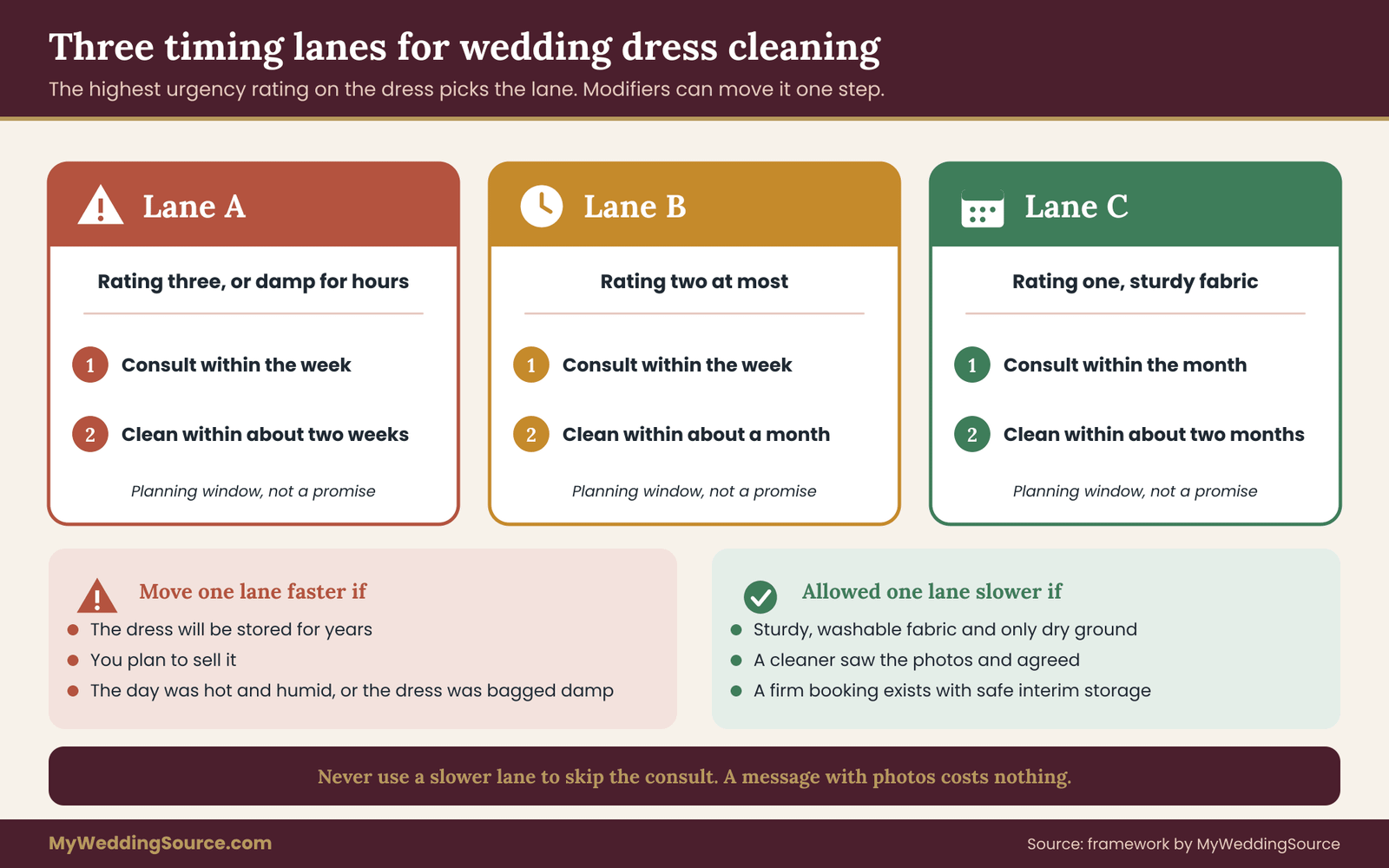
Lane A: consult within the week, clean within about two weeks. Use this lane if the dress has any rating-three mark, meaning sugar, food, drink, oil or an unknown sticky mark, or if any part of the dress stayed wet or damp for more than a few hours and you could not air it properly. Use it also if the fabric is silk, satin or another type known for water marks, and the hem was damp.
Lane B: consult within the week, clean within about a month. Use this lane if the highest rating is two: moisture that has dried, salt, deodorant, makeup, sunscreen or light residue, with no sticky marks. This lane also fits a dress that was dry and clean but carries a lot of perspiration exposure from a hot day.
Lane C: consult within the month, clean within about two months, unless the cleaner advises otherwise. Use this lane only if the highest rating is one: dry dirt, dust and dry grass at the hem, with no sticky or damp areas and a sturdy fabric. Even then, ask the cleaner to confirm from photos.
The time frames are planning windows, not guarantees. They reflect the general view among gown cleaners and conservators that fresh marks are easier to address than aged ones, and that sooner is a reasonable default. Your cleaner’s schedule, the season and the type of work can all change them. Treat Lane A as the lane in which wedding dress cleaning should not wait for a convenient moment.
Modifiers that move a dress toward a faster lane
Some facts push a dress one lane faster, regardless of the highest rating.
If the dress will be stored for years, move one lane faster. Marks that are cleaned before long-term storage are less likely to cause surprises when the dress is next opened.
If you plan to sell the dress, move one lane faster. Buyers, and the photos you will need for a listing, favor a dress that has been cleaned and inspected. Cleaning early gives you the freedom to decide later, and a cleaned, inspected gown removes the awkward question of what the marks are.
If the dress is heavily beaded or has glued trims, move one lane faster only if there is moisture or sugar involved, because those trims respond poorly to repeated handling and may need slower, more careful work from the cleaner.
If the weather was hot and humid and the dress has been in a bag or box since the wedding, move wedding dress cleaning one lane faster and open the bag today.
Modifiers that allow a slower lane
A dress can move one lane slower if the fabric is sturdy and washable by the label, the only exposure was dry ground, a cleaner has seen the photos and agreed, and you have a firm date booked. It can also move slower if the dress is going to a conservator who has a long waiting list, and has told you in writing that interim storage conditions are acceptable.
Never use a slower lane to avoid a consultation. Even if the wedding dress cleaning itself is weeks away, a quick message with photos puts a professional’s eyes on the dress early, and they can tell you if something on the worksheet needs urgent attention.
Why not rush wedding dress cleaning on day one?
It is a fair question. If sooner is better, why not run to the cleaner the day after the wedding? There are a few reasons for a short pause.
First, the dress needs to dry in the open, and bringing it damp to a cleaner is not ideal. Second, the inventory is easier to write when the dress is calm and in daylight, and a cleaner who has your photos and worksheet works better than one who is guessing. Third, you may be traveling for a honeymoon, and a dress dropped off the day before you leave may sit unattended at a shop.
Fourth, there is a good deal of wedding paperwork and returns to handle in the first days, and a rushed cleaner choice is a common regret. A deliberate pace of a few days before wedding dress cleaning, followed by action, is better than either panic or drift.
The honeymoon problem
Many couples leave soon after the wedding, and the dress stays behind with a parent, a friend or in a closet. Settle this before the wedding if you can. Decide who will carry the dress from the venue, who will air it, who will photograph it and who will deliver it to the cleaner. Give them the inventory steps in writing, and tell them what not to do.
If nobody can take it to a cleaner while you are away, a pre-arranged pickup is an option with some cleaners. Ask whether they offer it and what the intake process is when you are not present. If you cannot be there for the intake form, ask a trusted person to do the counter photos and keep the receipt. The wedding vendor timeline page covers how to hand off tasks to people on the day, and the same list can include the dress.
What if wedding dress cleaning has already waited too long?
Perhaps you are reading this several months after the wedding, and the dress is in a bag in a closet. Do not panic and do not treat it at home. Take it out, check for dampness and smell, photograph it as it is, and complete the inventory. Then send the worksheet to a specialist and describe the delay plainly.
Many marks that have aged are still treatable, though the options can narrow and the result may be less predictable. A conservator’s consult may be worth the cost for a dress with aged sugar or oil marks, because they work from a broader set of methods.
Time already lost cannot be recovered, and the useful response is to shorten the next gap. Book the consult this week.
Fabrics and trims that change the schedule
The lanes above for wedding dress cleaning assume a typical modern gown. Fabrics and trims can change the plan, so use this section to adjust.
Silk and silk blends. Silk can show water marks and may be sensitive to certain cleaning agents. If the hem was damp on silk, give it a faster lane and make sure the cleaner knows the fabric. Some silks cannot be wet cleaned, and some can only be spot treated by a skilled person.
Satin and polyester. Polyester satin is more forgiving of moisture, but oil and sugar still matter, and a satin finish can show scuffs and snags. Plain polyester can often tolerate gentler methods, though trims may not.
Lace. Lace, especially delicate or vintage lace, is vulnerable to snags and to being stretched when wet. It also holds soil in its pattern. Tell the cleaner whether the lace is cotton, nylon, silk or a blend, and whether it is sewn or glued.
Tulle and netting. Layers of tulle collect dirt, dew and grass and can dry unevenly. Tulle may also crease and hold the shape of a bag or hanger. The cleaner will likely want to know how many layers there are.
Beading, sequins and crystals. Heavy embellishment adds weight and makes handling risky. Some beads are sewn and secure, others are glued and may lift under moisture or solvent. If you notice loose beads, collect them in a small envelope and give them to the cleaner with the dress, so repairs can be matched.
Velvet, brocade and other heavy fabrics. These show crush marks and water spots, and they can be difficult to clean at home. Cold-weather weddings often use them, and outdoor photos in the snow can leave salt and moisture marks.
Vintage and heirloom fabrics. Older fibers and dyes may behave unpredictably. This is the case for a conservator’s consult before any wedding dress cleaning. If the dress is a family piece, the cleaning decision should wait for a professional view, and the wedding day accessories planning guide is a useful place to review how the day’s wardrobe items were protected.
Colored and ombre gowns
Dresses with color, ombre dyes, painted details or metallic threads carry a risk of color transfer or loss. Mention this on the worksheet, and ask the cleaner about colorfastness testing. If the dress was exposed to moisture, ask for the consult sooner, because damp areas can cause dye to move.
Corsets, boning and built-in structure
The inside of a gown with a corset back or structure can hold sweat and moisture in channels that are hard to reach. If the dress has this kind of structure, note it, and ask the cleaner whether they treat the interior. Interiors are often overlooked, and they are one of the places where a wedding dress cleaning can look finished on the outside while still carrying a smell inside.
Labels that say dry clean only, or nothing at all
The U.S. Federal Trade Commission requires care labels on most clothing, and a label that says “dry clean” generally means that the manufacturer has found at least one dry cleaning process that is safe for the garment. It does not tell you which process, or how the dress will fare with trims, stains or damp conditions. If the label is missing or unreadable, say so on the worksheet and let the cleaner test.
A worked case: one dress, one lawn and one spilled drink
The following example of wedding dress cleaning is invented, and it is here to show the process end to end. The couple, the dress and the dates are made up for illustration, and the timings are one reasonable reading of the rules above, not a record of a real cleaning.
Priya and Daniel were married on a Saturday in early autumn at a garden venue. Priya wore a gown with a silk-blend skirt, a lace bodice with sewn beading and a chapel-length train. Portraits took about ninety minutes in the late afternoon on a lawn, a gravel path and the edge of a pond. The morning had been damp, and the lawn was still soft. At the reception a guest hugged Priya while holding a glass of sparkling wine, and some of it reached the left hip.
Day one: the dress comes home
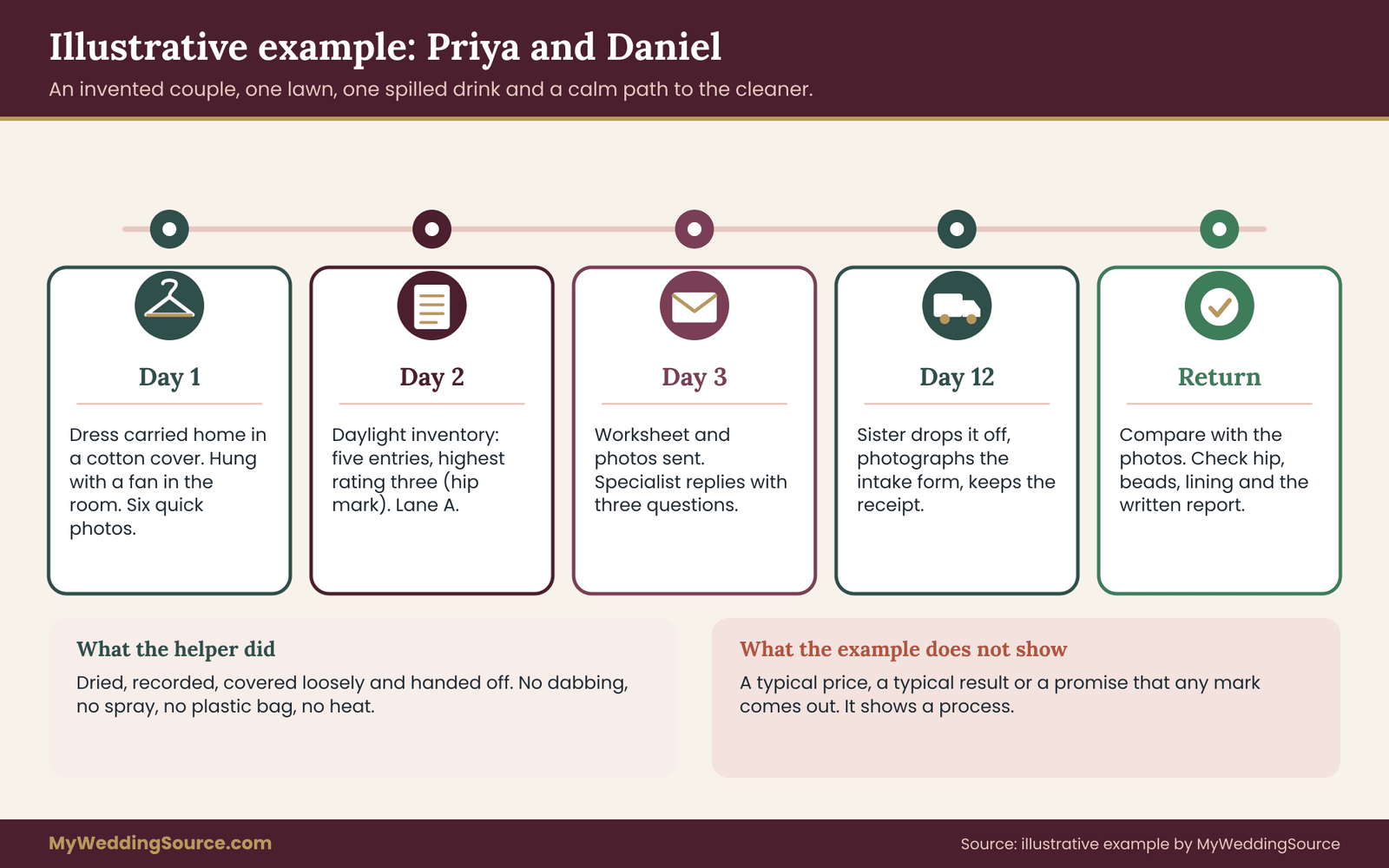
Priya’s sister carried the dress home in a loose cotton cover rather than a plastic bag. At home it was hung on a padded hanger in a spare room with the window open a few inches and a fan running across the room. The sister took six quick photos and wrote down what she remembered: damp hem, sparkling wine on the left hip, no one touched it. Nobody dabbed, nobody sprayed. The couple were leaving on their honeymoon the next day.
Day two: the second look and the inventory
On the second morning, in daylight, the sister completed the stain inventory. She found five entries.
The hem and the first eight inches of the train were dry but stiff, with grass and mud marks at the back. The code was HM and TR, status dry, urgency one for the dry soil. The inside of the hem lining still felt faintly damp, which she coded as LN, damp, urgency two, with a note about a slight musty smell.
The left hip had a faint stiff patch about the size of a coin. She coded it HP, dry, probably sparkling wine, untreated, urgency three. The neckline carried a very faint line of makeup transfer, urgency two. The underarm lining had a mild odor and no visible mark, urgency two for perspiration.
She photographed each mark with a coin for scale and photographed the label, which said silk blend for the skirt and nylon for the lace, and dry clean only.
The highest rating sets the lane
The highest urgency rating was three because of the hip mark. That placed wedding dress cleaning in Lane A: consult within the week, clean within about two weeks. Two modifiers pushed in different directions. The dress would be stored long term, which already points toward a faster lane, and the damp lining pushed the same way. Nothing pointed toward a slower lane, so Lane A stood.
The handoff and the choice of cleaner
Priya and Daniel did not want to choose the cleaner from a list of strangers. They called the boutique that sold the gown, who recommended a specialist. They sent the handoff worksheet and photos by message before they left. The specialist replied within two days with three questions: whether the silk had a water-resistant finish, whether the beading was sewn or glued, and whether the damp lining had been fully dried. They answered from the label, the boutique’s notes and the sister’s observation.
The specialist said they could see the dress in the second week and recommended that it stay hung and open until then. They confirmed that the hip mark should be handled by hand before any full wedding dress cleaning, and that they would test the lace first. The couple asked for a written intake form and a before-and-after photo set, and the specialist agreed.
Dropping it off
The sister delivered the dress on day twelve, with the worksheet printed and the label photo included. At the counter she photographed the dress on the hanger and photographed the intake form, which listed the hip mark, the hem soil and the damp lining note. She kept the receipt in a folder marked for the couple’s records. The shop gave an estimated finish date and agreed to message before any step that was not on the intake form.
What the couple would check afterward
When the dress came back, they planned to open it in front of the cleaner or immediately at home, to compare against the photos. They intended to check four things: whether the hip mark was gone or lighter, whether any beads or lace had shifted, whether the lining smelled clean and whether the written report matched the intake form. They would ask the cleaner to explain any mark that remained, and they would keep the report with the photographs.
What this example shows and what it does not
It shows that the work was mostly about information and restraint. No one at home did anything clever. They dried, recorded, covered and handed off. It also shows how the inventory and the worksheet reduced the number of questions at the counter.
It does not show a typical price, a typical result or a typical timeline, because those vary by cleaner, fabric and mark. The case is not evidence that a hip mark from sparkling wine will always come out, and it should not be read as a promise. It is an illustration of a process that gives the cleaner the best chance to do good work.
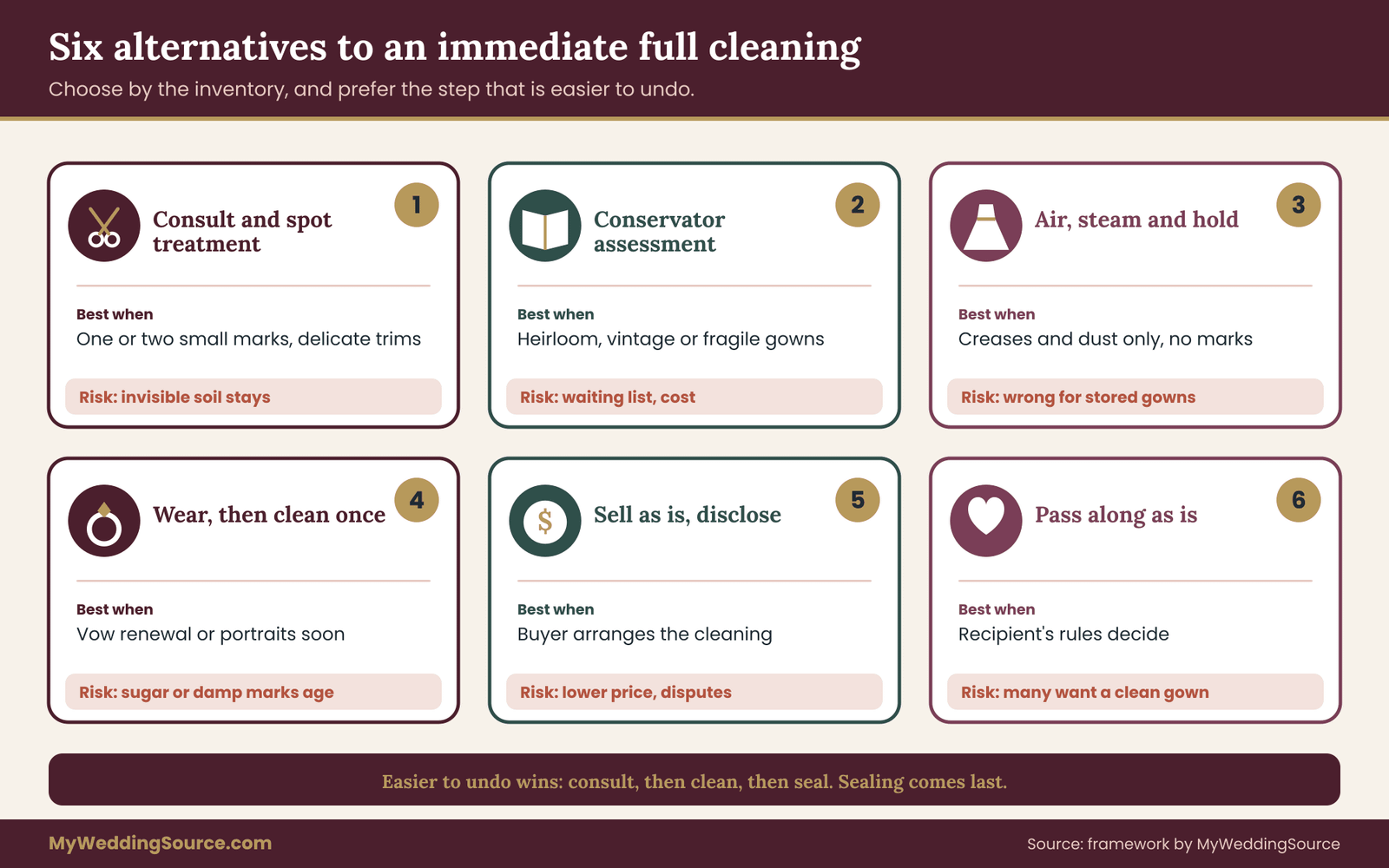
Alternatives to a full wedding dress cleaning right away
For some gowns and some situations, a complete wedding dress cleaning immediately after the wedding is not the right move. Several alternatives are worth knowing, along with the conditions under which each makes sense.
Alternative one: a consult and spot treatment first
If the dress has one or two small marks and is otherwise clean, a cleaner may recommend treating those marks by hand and holding off on full wedding dress cleaning. This keeps handling and moisture to a minimum. It makes sense for a delicate or heavily beaded gown, and it carries the risk of leaving the rest of the dress with invisible soil. Ask the cleaner what they would see in six months if the rest of the dress were left as is.
Alternative two: a conservator’s assessment
For heirloom, vintage or unusually fragile dresses, a conservator can examine the gown and recommend a plan, which may be less invasive than commercial wedding dress cleaning. The American Institute for Conservation maintains a directory for finding a conservator, and the Smithsonian’s conservation pages describe how professionals approach textiles. A consult is usually an assessment, not a commitment to a full treatment.
Alternative three: air, steam and hold
If the dress is clean apart from creases and a little dust, a steam or press may be all it needs for a portrait session or an anniversary. Steam can harm some fabrics and trims, so this is a task for a professional or for someone following the care label. The separate guide to steaming a wedding gown on this site covers fabric labels and handling in more detail. This option only suits a dress with no marks of concern. It does not replace cleaning for a dress that will be stored.
Alternative four: wear it again, then clean once
If you plan to wear the dress again soon, for a vow renewal, a party or a portrait session, it may be sensible to clean once after the last wearing rather than twice. This works only if the dress carries no sugar, oil or damp marks that would age while you wait. Otherwise, a clean now and a light refresh later is the safer path.
Alternative five: leave it to the buyer
Some sellers choose to list a dress as is, with clear photos and a disclosure of marks, and let the buyer arrange cleaning. This is a decision for the sale side, and it brings risks: disclosures can be disputed, and an unclean dress may sell for less or not at all.
It is not a good fit for dress with sugar or oil marks that are aging, since the delay can make the problem worse. If you are weighing this path, the broader question of selling and cleaning decisions has its own coverage, and you should settle the timing question first.
Alternative six: pass it along as is
Some programs and individuals accept gowns for donation, and many ask for a clean dress. Ask what condition they require before you decide, and ask whether they offer cleaning or a partner cleaner. Donating a dress that needs cleaning is a decision for the recipient’s rules, not yours.
How to choose among them
Use the same inventory to decide. If the highest rating is three, favor consult and spot treatment, or full wedding dress cleaning, in Lane A. If the highest rating is two, full wedding dress cleaning in Lane B is reasonable, and a conservator’s consult is optional unless the dress is old or fragile. If the highest rating is one, any of the alternatives can work, and the question becomes what you plan to do with the dress. In every case, the cleaner’s advice based on your photos should be allowed to change the plan.
A related rule: if you have two good alternatives and cannot choose, pick the one that is easier to undo. A consult is easier to undo than a full wedding dress cleaning. A clean is easier to undo than a sealed box. When you do not know the dress’s future, reversible steps keep options open. That is the same principle museum staff apply to objects, and it works for a gown at home.
When this approach to wedding dress cleaning fails: conditions to watch
Every process has limits, and it is better to know them before relying on one. The inventory, the lanes and the handoff worksheet work well when the dress is intact, the marks are visible or findable, and a competent cleaner is available. They fail, or need to be replaced by a professional’s judgment, under the following conditions.
The dress is old, fragile or irreplaceable. A vintage or heirloom gown can be damaged by handling alone. The lanes assume a modern gown that can be moved and cleaned. For an older piece, skip the lanes and contact a conservator for a consult before anything else, and follow their handling instructions in place of the home steps here.
The damage is structural. Torn seams, ripped lace, hanging beads, broken boning and burst zippers are repair jobs, not cleaning problems. Cleaning a gown with active tears can enlarge them. Mention structural damage on the worksheet, and ask who will repair it and in what order. Fit changes belong with the person who does your alterations, and the guide to dress fit and alterations explains how that work is usually sequenced.
The marks are invisible and you cannot find them. Sweat, clear drinks and some oils leave little to see at first. The inventory can only record what you find. If you suspect a mark but cannot see it, say so on the worksheet and treat the dress as at least Lane B.
A home treatment has already been tried. If the dress was dabbed, sprayed or scrubbed with unknown products, your inventory is incomplete and the cleaner must work from partial information. Record everything you or others did, with products, and send the dress to a specialist promptly. A chemical that has reacted with the fabric is not always visible.
The dress is a delicate or unusual material. Some fabrics, such as certain silks, hand-painted pieces, metallic fabrics and plastic-coated trims, may not tolerate standard wedding dress cleaning at all. A cleaner may decline the work. That is a good outcome, since a refusal is better than damage, and it points you toward a specialist.
There is no qualified cleaner nearby. In some areas the nearest experienced gown cleaner is a long drive or a mail-in service. Shipping a gown adds handling, a risk of damage and a delay. If you must ship, ask about packing, insurance and tracking, and photograph the dress before it leaves your hands.
The timeline cannot be met. If you will be abroad for months, the dress may wait longer than the lanes suggest. In that case, aim for the best interim conditions: dry, clean cover, cool and dark. Ask a trusted person to check it, and write down what you want done. Delay is a known cost, and the plan should say so.
The cleaner’s advice conflicts with this guide. If an experienced cleaner who has seen your dress gives specific advice that differs, follow theirs. This article is general. They have the dress in front of them.

Signs that something is wrong after wedding dress cleaning
When the dress returns, inspect it with the photos from the worksheet beside it. Look for new discoloration, rings, color changes, stiffness, lost beads, shrinkage, puckering at seams and any smell. Check the areas that were marked and areas that were not. Check the inside.
If something is wrong, do not wait. Photograph it the same day, in daylight, and contact the cleaner in writing, quoting the intake form. Ask how they want to resolve it and what they need from you. Keep the packaging if there is any. If you cannot reach agreement, ask for the dispute process in their terms, and look at your payment method’s protections. The Consumer Financial Protection Bureau explains card disputes, and the Federal Trade Commission explains where to report a business that does not honor its terms.
Be calm and specific. A written description of the issue, with photos and the intake form, is more persuasive than a long message about how disappointing it is.
Wedding dress cleaning costs, scripts and awkward cases
What wedding dress cleaning costs and how to reason about it
This article gives no prices, because prices vary by region, fabric, trims and service level, and any figure here would date quickly. It is more useful to know how the cost is built so you can ask sensible questions.
Pricing for wedding dress cleaning typically reflects a few things: the size and complexity of the dress, the number of layers and trims, whether pretreatment and spot work are included, whether the cleaner inspects by hand, whether pressing and packaging are included and whether any guarantee is attached. A plain gown with a dirty hem costs the cleaner less time than a beaded gown with several marks.
Cost logic, not cost estimates
Think about the cost in three parts. The first is the wedding dress cleaning itself, which may be quoted as a flat service. The second is anything extra: heavy stain work, repairs, a conservator’s report, special packing or shipping. The third is the cost of waiting, which is hard to quantify and is the reason the timing lanes exist.
A mark that could have been treated by hand in the first weeks might need more intensive work later, or might not come out. You cannot know in advance, which is why a small delay is a gamble with an uncertain price.
Next, consider what the dress is for. If you plan to sell it, a wedding dress cleaning cost belongs on the same sheet as the expected sale price, and the wedding budget guide is useful for tracking post-wedding costs beside what you planned. If the dress is an heirloom, the cleaning cost belongs in a longer horizon, and a better-quality service may be worth the premium. If the dress is just a keepsake, a simple clean and a breathable box may be enough.
Quotes that need a second question
Ask what is included in any quote and what would change the price. If the cleaner says the price will change after inspection, ask for a range and for permission to be contacted before additional work. If the cleaner offers a package that includes preservation, ask what you are paying for each part. A package can be good value or can bundle a service you do not need. The point is to know which.
Do not decide on price alone. A very low quote may reflect a basic service without hand work. A very high quote may reflect a luxury service, or may be padded. A middle quote with a clear scope and good answers to your questions is often the better sign.
Insurance and responsibility
Ask whether the cleaner’s business insurance covers customer garments and what limits apply. Ask whether your own homeowner’s or renter’s policy covers the dress while it is in the cleaner’s care. Neither question needs to be adversarial. If a wedding insurance policy covered the dress on the wedding day, ask the insurer whether coverage ends after the event, since policies differ and the policy wording is the only thing that settles it.
What to say: short scripts for the first contact
A few short messages make the process less awkward. Adapt them to your own voice.
First message about wedding dress cleaning. “We were married recently and the dress was photographed outdoors on grass and a gravel path. The hem was damp for a couple of hours, and there is a possible drink mark on the left hip. We have not treated anything. I have a one-page worksheet and photos. Can I send them, and when could you take a look?”
To the person carrying the dress. “Please keep the dress in the cotton cover, hung or flat, away from heat and plastic. Do not dab or spray anything. If you see a new mark, take a photo and text me. Here is the worksheet and the cleaner’s address.”
At the counter. “Could you note on the form that there is a mark on the left hip and soil at the hem, as in these photos? Could you confirm that you will call before doing anything beyond the wedding dress cleaning we discussed?”
If a result is disappointing. “I’m writing about the dress we dropped off on the date on the intake form. After cleaning there is a mark at the left hip that was not there before. I’ve attached the photos and the form. Could you tell me how you’d like to resolve this?”
Keep a small file
Put the worksheet, the photos, the intake form, the receipt and any messages in one folder. The same habits that apply to vendor files in the wedding records guide apply here, and the file is the thing you will want if a question comes up in a year. When the dress goes to its next stage, whether storage, sale or a new wearer, the file goes with it or is kept alongside.
Special situations: sorting out the awkward cases
Some cases do not fit the lanes neatly. These short notes cover several that come up often.
Two dresses. For wedding dress cleaning, if you wore a ceremony gown and a second reception dress, run the inventory and lanes for each separately. The reception dress may have food and drink exposure and little outdoor contact, and the ceremony dress the reverse.
A rented or borrowed dress. Read the rental agreement before doing anything. Many rental terms say who cleans the gown and what you must not do. Contact the owner or company about stains before anyone treats them. The terms decide your obligations, not this guide.
A dress made by a family member or a custom designer. Ask the maker how it was constructed and what they recommend. Their knowledge of glues, linings and interfacings can be the missing piece on your worksheet.
A gown that will be shipped to a family home abroad. Do the inventory before it leaves, and send the photos by message, so the cleaner or a family member has the record. Ask whether the destination cleaner has experience with the fabric.
A very hot wedding. Sweat exposure is higher in heat, and wedding dress cleaning matters sooner, and a dress that was zipped into a car with the windows closed has had a hard few hours. Move one lane faster and add a line about heat to the worksheet.
Beach or lakeside photos. Salt and sand add stiffness and abrasion. Say whether the dress touched water, and whether the hem was rinsed by anyone. Do not rinse it yourself.
A winter or snow wedding. Melted snow and road salt are moisture and residue at once. Air the dress thoroughly, tell the cleaner about salt and note any color change in dark fabrics.
A dress that was altered recently. Fresh alterations may use threads, glues or interfacings the label does not list. Tell the cleaner, and ask your seamstress what they used.
Common mistakes in wedding dress cleaning timing
A short list of the errors that come up most, each with its remedy.
Waiting for a perfect moment. The gap between “I’ll do it after the honeymoon” and “I’ll do it after the move” can stretch to a year. Book the consult within the week, and the schedule takes care of itself.
Treating the mark yourself to be helpful. The kindest action for the dress is usually to leave the mark alone and write it down.
Bagging a damp dress. Dry first. Then cover loosely.
Choosing on price or convenience alone. Ask the questions in this guide, and compare scopes rather than totals.
Skipping the intake form. Without a record of the dress’s condition at drop-off, a disagreement about damage becomes a matter of memory.
Sending the dress to storage unclean. A dress put away with sugar, oil or sweat on it is a dress that will be opened in a few years to a surprise. If you plan long-term storage, the wedding dress cleaning belongs first.
Forgetting the inside. Linings, waistbands and underarms hold much of the moisture and sweat. Put them on the inventory.
Not telling the cleaner everything. The product you forgot to mention is often the one that matters. Over-share on the worksheet.
Letting the dress ride in a car. A hot, closed car is a poor place for a gown, even for an hour. Carry it directly.
Assuming a promised result. Even careful, skilled wedding dress cleaning cannot promise that every mark will lift. Ask what the cleaner will do if a mark remains, and decide in advance whether that outcome is acceptable.
Your next steps
Do these in order for wedding dress cleaning, and keep each one small. Today, put the dress somewhere cool and dry, open any damp bag and let air reach the hem. Within the next day or two, photograph the whole dress, the marks and the labels in daylight. Complete the stain inventory from the bottom up, and rate each mark one, two or three. Use the highest rating to choose a lane.
Within the week, send the handoff worksheet and photos to one or two cleaners or to a conservator for a consult, and ask the questions about method, guarantee and damage terms. Book the work according to your lane. At drop-off, photograph the dress and the intake form, and keep the receipt in a folder with the rest of your post-wedding records.
When the dress returns, compare it against the photos, ask about any remaining marks, and decide what comes next: storage, sale, reuse or a new wearer. If the day’s other wardrobe pieces need care too, the accessories planning guide covers the other wedding day accessories. Wedding dress cleaning is one step in that longer path, and the sooner it is handled with a clear record, the more options the dress keeps.
FAQ
How soon should a wedding dress be cleaned after outdoor photos?
For most gowns, book a consult within a week and aim for the wedding dress cleaning within a few weeks, sooner if there are sugar, drink, food, oil or damp marks. Dry dirt at the hem alone may allow a longer wait, but a cleaner should confirm from photos. No single number fits every dress, so use your stain inventory to set the lane.
Can I handle wedding dress cleaning myself if it is only grass and mud?
It is better not to. Rubbing or wetting a hem can push soil deeper, spread marks and raise water rings, especially on silk, satin and lace. Let the hem dry, record it, and give the cleaner photos. Cleaners choose methods by fabric and trim, and a home treatment can limit the options they have left.
What if the dress is still damp when I get it home?
Hang it or lay it flat in a clean room with moving air, away from direct heat and sun, and move it every few hours so the lining and inner hem dry. Do not use a hair dryer or an iron. Once it is dry, cover it loosely with cotton or a breathable bag.
Is a champagne or wine mark urgent?
Treat it as the first priority. Sugary drinks can dry clear and then darken or yellow with time and heat, which can make them harder to treat. Do not dab it. Write down what it was and when it happened, photograph it, and tell the cleaner so they can pretreat it by hand before the full cleaning.
Do I need a specialist for wedding dress cleaning, or will a regular dry cleaner do?
It depends on the dress. A simple, sturdy gown may be fine with an experienced local cleaner. Beaded, layered, silk, vintage or glued-trim gowns often call for a specialist or a conservator. Ask each provider about experience with your fabric, the method they use and what they do if a mark remains, and compare the answers in writing.
Is wedding dress cleaning needed before storing or selling the gown?
In most cases, yes. A gown put away with sugar, oil or sweat on it may show new discoloration when it is next opened, and a cleaned gown is easier to photograph and describe for sale. If you cannot decide on the dress’s future yet, a clean followed by simple breathable storage keeps the most options open.
What should a wedding dress cleaning handoff worksheet include?
Include the dress and label details, fabric and trims, the wedding date, where the dress went outdoors, the weather, what touched it, your coded stain inventory with photo numbers, anything done to it, what you plan to do with the dress afterward and your timing. One page with photos is enough for most cleaners.
What if wedding dress cleaning leaves a mark or damages the dress?
Photograph it in daylight the same day, compare it with your before photos and the intake form, and write to the cleaner describing the problem. Ask how they resolve it and read their terms on damage. If you cannot agree, check your payment method’s dispute protections. Keep every message and receipt.
Sources
- Smithsonian Institution
- Museum Conservation Institute, Smithsonian Institution
- Conserve O Gram series, National Park Service Museum Management Program
- Preservation: caring for your collections, Library of Congress
- American Institute for Conservation, Find a Conservator
- Canadian Conservation Institute, Government of Canada
- Consumer advice, Federal Trade Commission
- Federal Trade Commission
- How do I dispute a charge on my credit card bill?, Consumer Financial Protection Bureau
- Dry cleaning, U.S. Environmental Protection Agency