
A pet attendant is the person you put in charge of your animal on the wedding day so that you, your partner and your wedding party can be the couple and not the pet handlers. This guide covers what a pet attendant does hour by hour, how to screen and hire one, which insurance questions to settle, how long the shift can safely run, and which contract points belong in writing.
Hire a pet attendant when your animal will be at the wedding for more than the ceremony or photos, or when nobody in your wedding party can be spared. Write a one-page duty card, screen the person with scenario questions, confirm who pays if the animal injures someone or is injured, and plan relief breaks so the pet attendant is never alone with the animal for the whole day. Put the hours, the handoff schedule, the emergency plan and the cancellation terms in a short written agreement.
Most couples who bring a dog or another animal into the wedding picture the best five minutes of it. The animal walks down the aisle, sits for a photo, and everyone smiles. Very few picture hour six, when the animal has been waiting in a hallway, the music is loud, the dinner smells are strong, and the one person who knows where the water bowl is has gone to dance.
That gap between the five good minutes and the other nine hours is the reason a pet attendant exists. The job is not glamorous. It is a steady, attentive, slightly boring job of watching an animal, keeping it fed, watered, cool, relieved and calm, and getting it to the right place at the right time. Done well, nobody notices. Done badly, the couple spends their reception on the phone, or a guest gets bitten, or the animal is sent home early and everyone feels guilty.
This article is about the hiring decision and the handoff, not about whether the animal should attend at all. Whether the animal is comfortable at a wedding is a welfare question that your veterinarian can help with, and it comes before everything here. If the animal is a good candidate, the next question is who will be responsible for it, for how long, and under what terms. That is where a pet attendant comes in.
A note on scope. This is general information, not legal, insurance, veterinary or tax advice. Insurance policies, worker rules and venue animal rules differ by state, by company and by contract. Where a rule matters, the article points you to the agency or the document that settles it so you can confirm the current version yourself.
What a pet attendant actually does
The phrase can mean three quite different things, and confusion between them causes most of the early problems. Before you ask anyone to be your pet attendant, decide which version of the job you are filling.
The day-long caretaker. This person stays with the animal from the moment it arrives at the venue until it leaves. They handle the leash, the water, the walks, the meals, the breaks, and the transitions between spaces. They are present at the ceremony, take the animal out when needed, and stay with it through the reception or hand it to someone else on a schedule.
The ceremony-and-photo handler. This person is responsible for the animal only for the high-visibility windows: the processional, the ceremony, the family photos and perhaps the first hour of the reception. Between those windows the animal is somewhere quiet, either with another person or with no one at all. This version is cheaper and shorter but leaves gaps, and the gaps are where problems start.
The off-site care provider. This person never comes to the venue’s main spaces. They keep the animal at a home, a boarding facility or a hotel room and bring it in for a scheduled appearance. In practice this is a transport and custody job as much as a care job.
Each version has its own duties, its own risks and its own cost logic. A friend might happily do the first or second. A professional pet sitter might offer all three. The point is to pick one on purpose, and then write down which one you chose.
The six duty zones
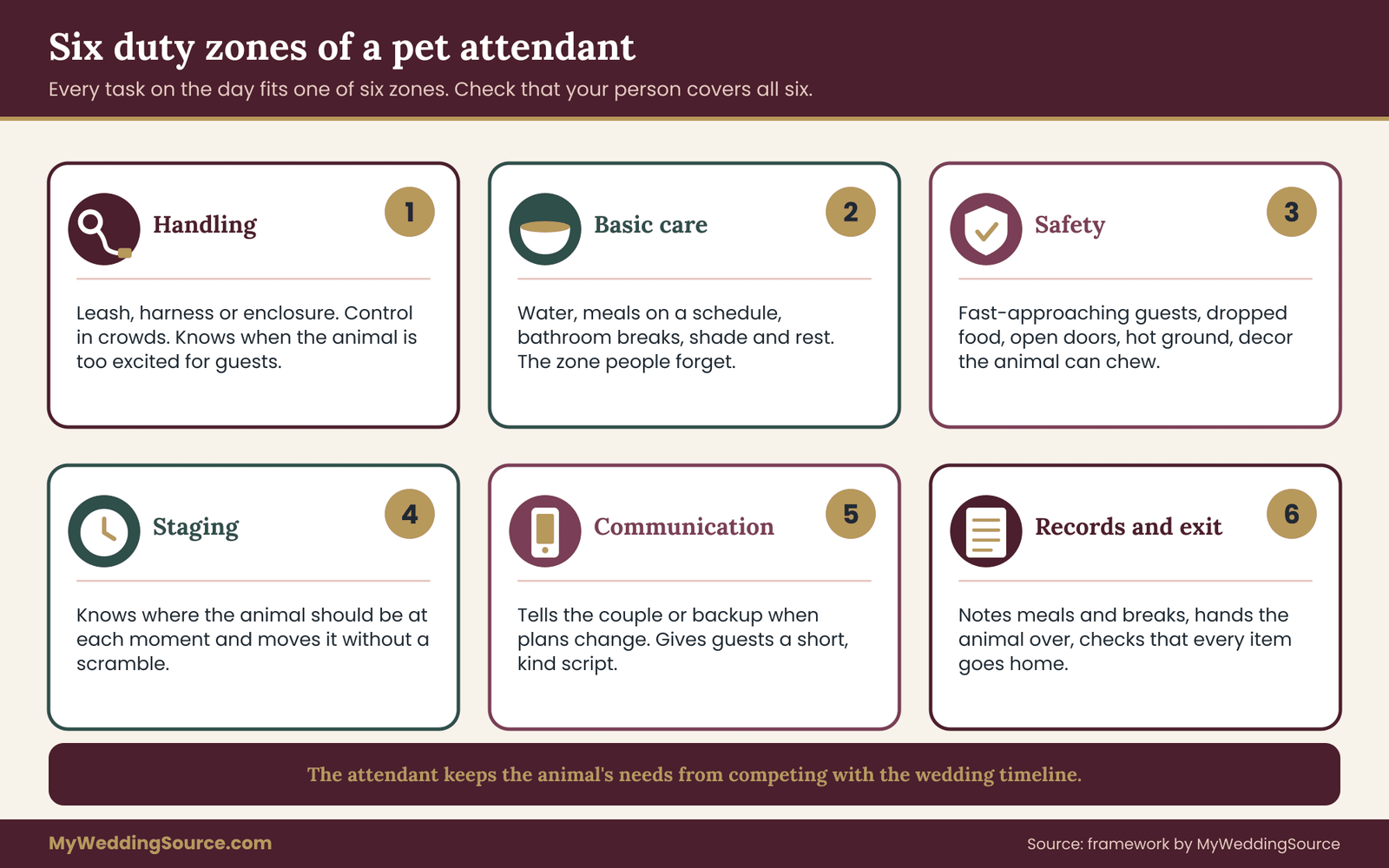
Whatever the version, the work falls into six zones. Naming them helps because a person can be excellent at four and quietly weak at two.
Handling. Leash, harness, carrier or enclosure. Control in crowds. Deciding when the animal is too excited to be near guests.
Basic care. Water, food on a schedule, bathroom breaks, shade, rest. This is the zone people forget to plan, and it is the zone the animal feels first.
Safety. Watching for guests who approach too fast, for dropped food, for open doors, for hot pavement, for decor the animal might chew, for alcohol left at ground level, and for anything else on the floor.
Staging. Knowing where the animal should be at each point in the day, and getting it there without a scramble. This is where the pet attendant works with the photographer, the officiant and the venue coordinator.
Communication. Telling the couple, the planner or the designated backup when something changes. Also telling guests, politely and briefly, what they may and may not do with the animal.
Records and exit. Noting when the animal ate and drank, handing the animal off, collecting its things, and making sure it goes home with the right person.
If you want a single sentence for the job, it is this: the attendant keeps the animal safe and comfortable, and keeps the animal’s needs from competing with the wedding timeline.
What a pet attendant does not do
It also helps to say what is outside the job, because couples sometimes assume the person will fix everything.
A pet attendant is not a trainer. If the animal pulls, jumps or barks at strangers, an attendant can manage the behavior for a day but cannot repair it. Training takes weeks and belongs before the wedding, in the hands of the owner or a qualified trainer.
A pet attendant is not a veterinarian. They can recognize that an animal looks unwell and can follow a written emergency plan, but they do not diagnose, medicate or decide on treatment unless the owner has given clear written instructions for a known condition.
A pet attendant is not a ring custodian, a childcare provider or a general helper. Mixing roles is tempting when a trusted friend says “I’ll just do it all,” and it is the quickest way to leave the animal alone while the person solves some other problem. Keep the job single-purpose.
Finally, a pet attendant is not a substitute for the venue’s rules. If the venue does not allow animals indoors, or limits them to certain areas, the pet attendant works inside those limits. They do not negotiate around them.
When a pet attendant is worth hiring
Not every wedding with an animal needs a dedicated person. Some do fine with a family member who simply keeps an eye out. Others look simple on paper and fall apart in practice. The following decision rule helps you tell the difference before you spend money or ask a favor.
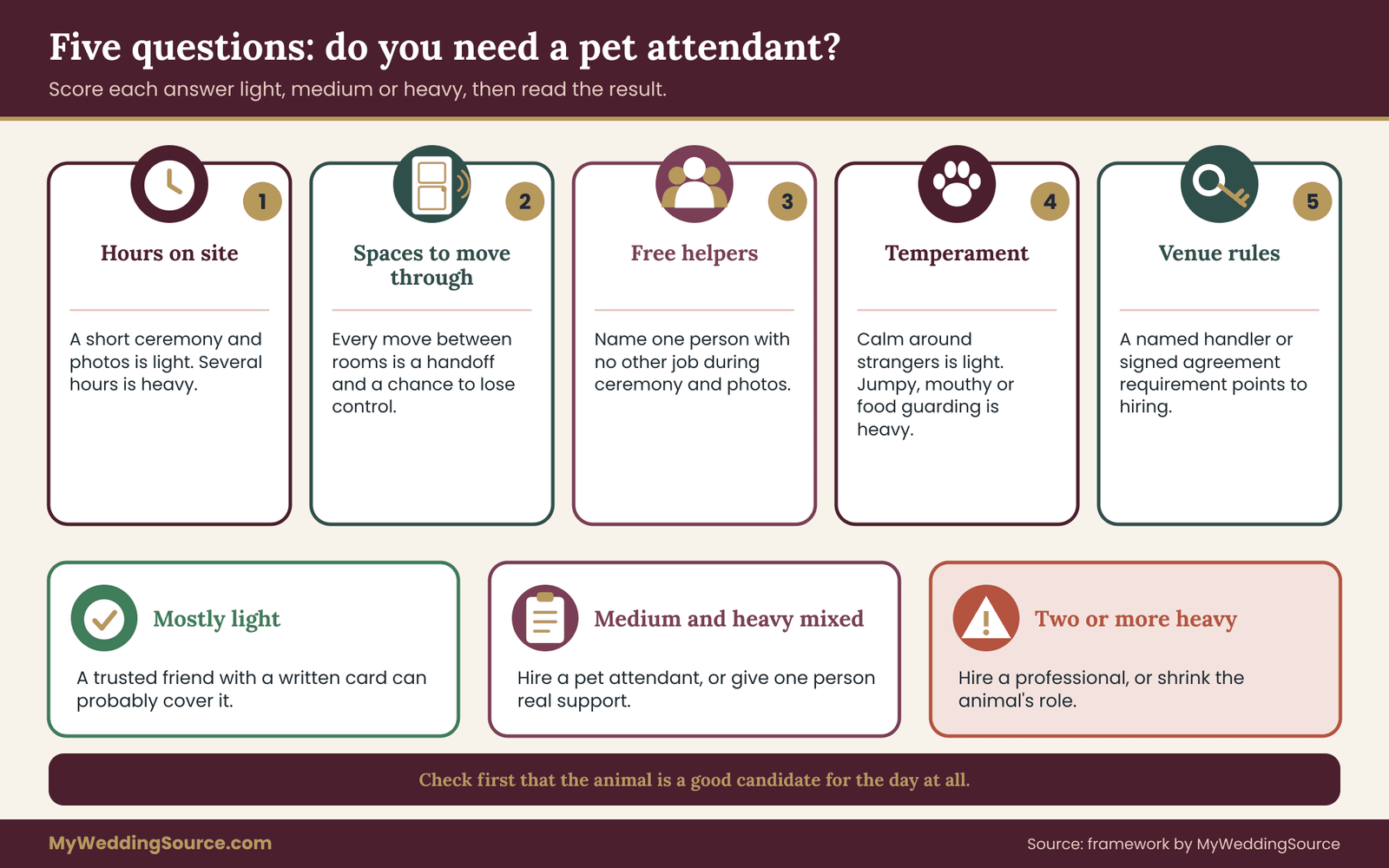
Answer five questions honestly.
One: how long will the animal be on site? If it is only present for a fifteen-minute ceremony and a short photo session, a friend with clear instructions may be enough. Once the total time on site stretches past a few hours, the care tasks multiply and the chance that someone is accidentally “in charge” drops sharply.
Two: how many separate spaces will the animal move through? Ceremony lawn, getting-ready room, photo spot, reception hall, a quiet room, a vehicle. Every move is a handoff, and every handoff is a place where a leash can be dropped or a door left open.
Three: who in the wedding party is free? Be specific. Ask yourself which named person has no other job during the ceremony, the photos and the first hour of the reception. If the answer is nobody, you need someone from outside the party.
Four: how does the animal behave around strangers and noise? An animal that is relaxed and easy to handle needs a lighter touch. An animal that startles, mouths hands or guards food needs someone who is experienced, calm and not emotionally invested in the wedding.
Five: what does the venue require? Some venues require a named handler, a signed agreement or proof of vaccination. A few require that animals are always supervised by an adult who is not part of the wedding party. If the venue’s rules point toward a dedicated person, the question is already answered.
Score each answer as “light,” “medium” or “heavy.” Mostly light means a trusted friend can probably cover it. A mix of medium and heavy answers means you should hire a pet attendant, or at least assign one specific person and give them real support. Two or more heavy answers mean you should seriously consider a professional, or a smaller role for the animal.
The cost of not hiring
Couples sometimes frame this as a luxury. A better frame is to ask what the animal’s presence costs if nobody is truly responsible. The cost may be a bitten guest, an animal that escapes through a propped door, a ruined dress, a missed portion of the ceremony because the bride is calming a nervous dog, or an animal that is sent home early. None of those outcomes is certain. Each is plausible when a living creature sits in the middle of a crowded, noisy, timed event with no named person in charge.
On the other side is the cost of a person for part of a day. The exact price depends on your area, the hours and the person’s experience, and no single number would be honest here. Ask for quotes from local sources and compare them as a total for the hours you need, including any minimum, travel or overtime terms. What matters for the decision is that the cost is known, bounded and small relative to the day it protects. The cost of an unplanned problem is none of those things.
For the wider planning picture, including how animal care fits beside your other vendors and tasks, the wedding planning checklist is a good place to slot the hiring steps into your timeline. Add “pet attendant hired” as its own line rather than folding it into a general entertainment or helpers category, so it does not get lost.
The pet attendant duty card
The most useful thing you can give a pet attendant is a single page they can read in two minutes and fold into a pocket. Call it a duty card. It replaces a dozen text threads and a vague “just keep an eye on him.” It is also the document you will point to if something goes wrong, so write it carefully and date it.
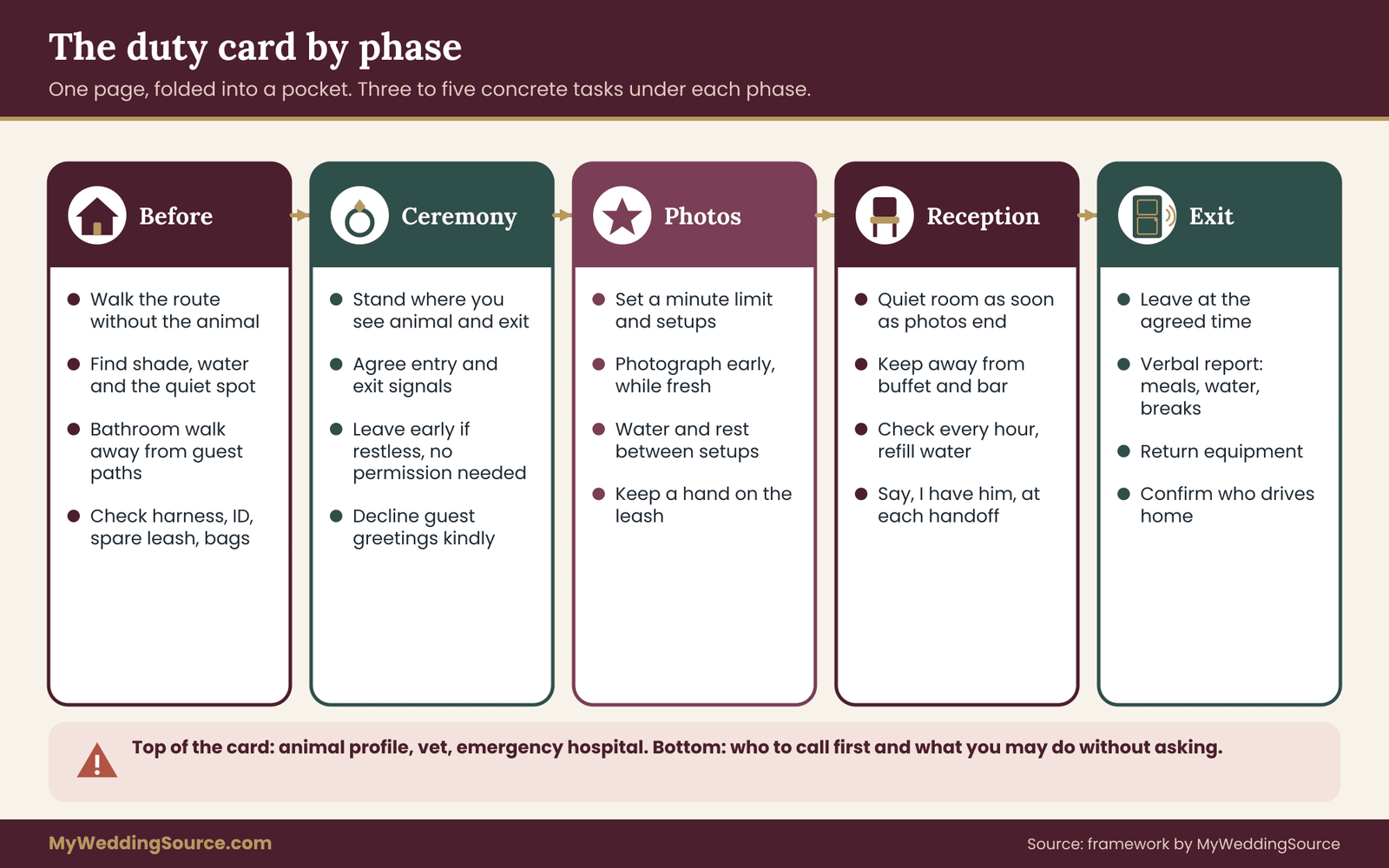
A good duty card has five parts: the animal’s profile, the day’s schedule, the task list by phase, the do-and-do-not list for guests, and the emergency block. The first two take ten minutes to write. The task list is the heart of it, and the sections below walk through it by phase.
The animal’s profile
Start with facts the attendant cannot guess. Name and what the animal answers to. Age, size and weight. Feeding schedule and what the animal eats, including any foods that cause problems. Medications, with dose and time, and whether the pet attendant is authorized to give them. Known fears, such as thunder, hats, men with beards, or balloons.
Known habits, such as pulling, jumping, mouthing hands, eating anything on the floor, or bolting through doors. The animal’s microchip number or the place it is recorded, the veterinarian’s name and phone number, and the nearest emergency animal hospital found in advance.
Add one line on how the animal shows stress. Some animals pant, yawn and lick their lips. Some stiffen or turn away. Some show nothing until they snap. The pet attendant needs to know what your animal’s early signals look like, in your words, because that is the point at which the animal should be taken somewhere quiet.
Before the ceremony
The hour or two before the ceremony is when most of the setup happens and when the animal is most likely to be overstimulated. The pet attendant’s tasks in this phase are practical.
Arrive early enough to see the space without the animal. Walk the route the animal will take. Note the doors that open outward, the stairs, the slippery floors, the plants and decor within reach, and the places where guests will cluster. Find the shade, the water source and the quiet spot. If the venue has a designated animal area, confirm it with the coordinator and not with a passing staff member.
Bring the animal in through the least busy entrance. Let it settle. Offer water. Take it to relieve itself away from guest paths, and carry bags for cleanup. Keep it on a leash or in an enclosure whenever it is not in a calm, controlled situation, and never tie it to a fixed object and walk away.
Check that the equipment is right: a well-fitted harness or collar with identification, a leash that is sturdy and the right length, a spare, a travel bowl, treats the animal already knows, a towel, waste bags, any medication and a copy of the duty card for the backup person. The attendant should not be looking for any of these things at the moment the processional starts.
If the animal is dressed or carrying something, the pet attendant checks the fit, the comfort and the safety of every item before the animal leaves the quiet space. Attire and training are separate topics that deserve their own planning, and a dressed animal is still an animal first.
During the ceremony
At the ceremony the pet attendant has one question in mind: is the animal still comfortable, and is it still easy to remove? The tasks follow from that.
Stand where the attendant can see the animal and also see the exit, which is often not the same place as the best seat. Agree with the officiant and the planner on the signal to bring the animal in and the signal to take it out. Let the animal be present only for the portion the plan calls for. A short appearance at the start, followed by a calm exit, is a better design than a long presence that ends in a scramble.
If the animal becomes restless, the pet attendant leaves early and quietly. That decision should never need the couple’s permission in the moment. Write on the card that the pet attendant has full authority to remove the animal at any time, and tell the couple and the officiant so nobody is surprised. For help building the cue structure around those moments, the wedding ceremony cue sheet guide shows how to give each participant a clear entry and exit signal.
Keep other people out of the handling. Guests will want to pat the animal, give it a treat or hold the leash. The attendant politely declines on the animal’s behalf, using a short, friendly script.
“He’s on duty right now, so we’re keeping greetings for later. Thanks for understanding.”
A script like that gives the pet attendant something to say that sounds warm and not defensive, and it protects the animal without a debate.
During photos
Photo sessions are where animals get tired, because the standing, sitting and waiting go on longer than anyone expects. The pet attendant’s tasks are to protect the animal’s energy and to give the photographer what they need without losing control of the situation.
Agree on a limit in advance: a number of minutes, a number of locations, a number of setups. The pet attendant is the person who calls time. Give the animal water and a rest between setups. Keep treats on hand, but follow the feeding notes on the card, since too many treats on a full day can upset the stomach.
Work with the photographer so the animal is photographed early, when it is fresh, rather than late, when it is tired. If the photo plan places the animal near water, a fountain, a road or an unfenced edge, the attendant decides whether the spot is safe. The photographer can adapt. The animal cannot.
Keep a hand on the leash even when the leash is edited out of the final image. The photographer can remove it later, but nobody can remove an escape.
During the reception
The reception is long, loud and full of food. For many animals this is the point at which a day-long plan should shift toward rest. The pet attendant’s tasks change accordingly.
Move the animal to its quiet space as soon as the main photos are done, unless the plan specifically calls for it to stay. Set up water and a bed or crate. Keep the animal away from the buffet, the bar and the dessert table, since dropped food, alcohol, chocolate, grapes and some sweeteners can harm animals. If a guest offers food, the pet attendant declines.
Check the animal at regular intervals. A short walk, a water refill, a look at body language. If the pet attendant is also eating or taking a break, the backup person takes over, and the handoff is explicit: “You have him now,” with the leash physically passed.
If the animal is staying through dinner, think about where it will lie. Under a table is not a quiet place. It is a tangle of shoes, napkins and dropped forks. A corner of a side room, with a gate or a closed door and a visible sign, is much better.
At the exit
The last task is the one that couples forget. The attendant gets the animal out safely at the end of its shift, not at the end of the night. Decide the departure time in advance, and decide who the animal goes home with, in what vehicle, and who will meet it at the door.
Hand the animal over with a short verbal report: when it last ate, drank and relieved itself, any problems, any change in behavior. Return the equipment. Confirm that everything the animal came with is going home with it.
Turning the phases into a one-page card
Put the profile at the top, with the vet and emergency hospital details beside it. Under it, put the schedule as a short list of times and places. Then list three to five tasks under each phase in plain words. At the bottom, add the emergency block: who to call first, who to call second, where the nearest emergency hospital is, and a sentence that says what the pet attendant may do without asking.
Keep the language concrete. “Offer water at 3:15 and 4:30” is better than “make sure he is hydrated.” “Take him out the side door by the garden” is better than “keep him away from the crowd.” The pet attendant should never have to guess what you meant.
Share the card at least a week ahead, and go through it together on a short call. A card the attendant has never discussed is a card they may not read on the day. If you are also writing contract terms for the role, the card can be attached as a schedule to the agreement, which makes the expectations part of the deal. The wedding vendor contract guide explains why attaching a schedule of services to a contract is often cleaner than writing every detail into the body of the agreement.
A short list of tasks that are easy to forget
A few small items show up on almost every list that has been through a real event.
Waste cleanup, with bags, wipes and a small container for disposal. A towel for wet paws or an accident. A shade plan for outdoor spaces, since pavement and stone can be hot even when the air feels mild. A route for taking the animal outside that does not pass the ceremony space. A sign for the quiet room that tells staff not to open the door.
Name tags or identification on the harness. A photo of the animal on the pet attendant’s phone in case it escapes and needs to be described to strangers. A plan for what to do if the animal vomits or has diarrhea, including who to call and what to clean with.
These tasks are small, but they are the ones that decide whether the day feels calm or frantic.
Who can serve as your pet attendant
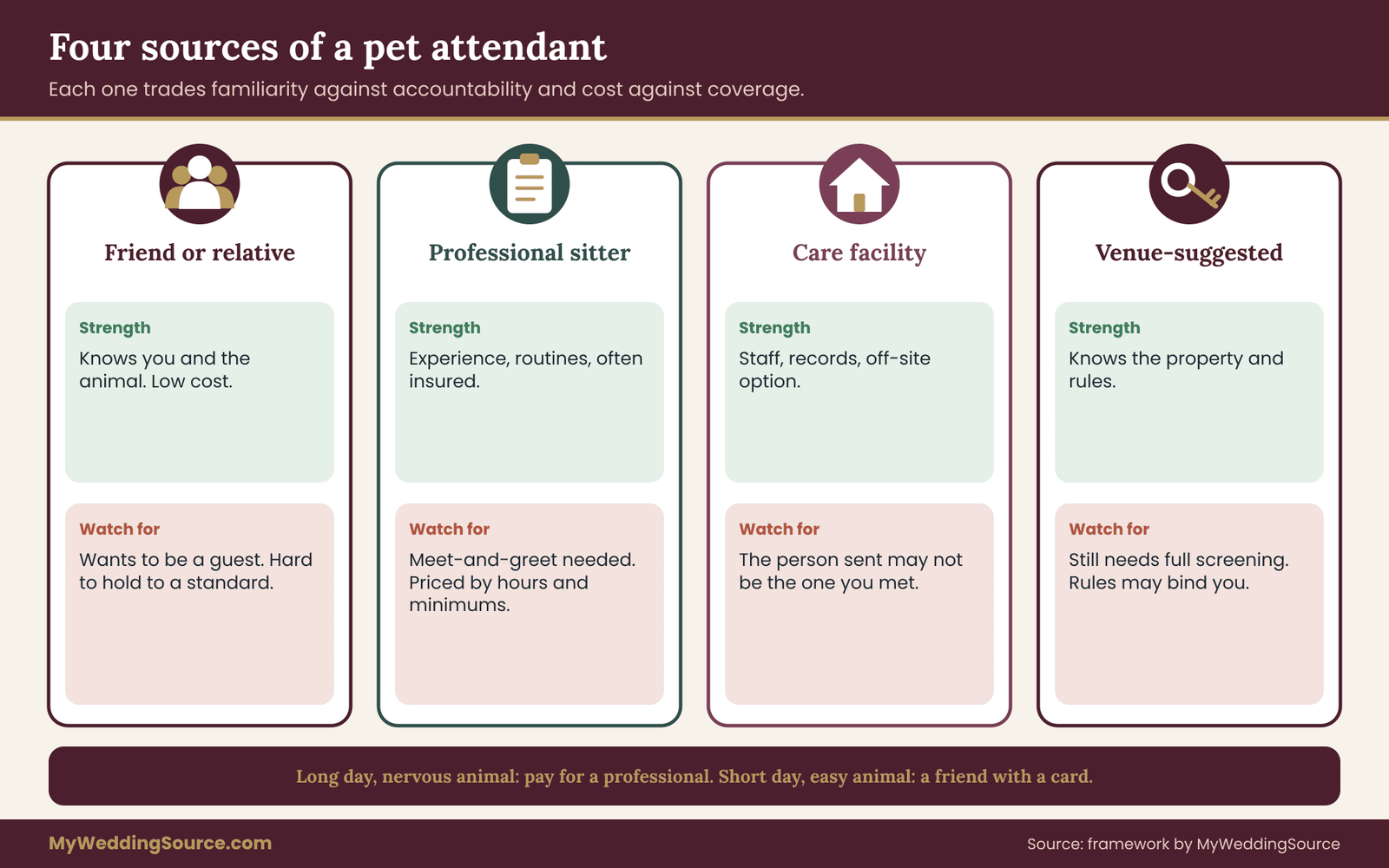
You have four realistic sources for a pet attendant, and each comes with a different mix of cost, familiarity, reliability and accountability. None is automatically best. The right one depends on the animal, the day and the people you have.
A friend or family member
The obvious advantage is that this person already knows you and may already know the animal. The cost is low or nothing, and the person is motivated by affection. The disadvantages are quieter. A friend who is invited as a guest wants to be a guest. They will be pulled into photos, conversations, toasts and the dance floor, and the animal slowly slides down their list. A friend is also less likely to say no to you when the plan is unrealistic, and less likely to push back on a timeline that leaves no breaks.
If you choose a friend, treat them like a professional in the ways that matter. Give them a written duty card, a defined shift, a named backup and permission to leave the celebration to do the job. Ask yourself whether they would still be comfortable saying “I need a break” or “this is not working” on the day. If the honest answer is no, pick someone else.
A friend with a pet-related career, such as a vet technician or a groomer, may be a strong choice, but the same caution applies. Being skilled does not remove the problem of being a guest at a party.
A professional pet sitter or dog walker
A professional brings experience with handling, a routine for emergencies, and usually some form of business insurance or bonding, though you must ask rather than assume. They are used to following instructions, writing notes, and working from a schedule. They are also unfamiliar with your animal, so you need a meet-and-greet before the wedding, preferably more than one.
Their cost is real. Many charge by the hour, with minimums, and weekends in peak wedding season may be priced differently from a weekday walk. Some do not work weddings at all, because the hours are long and the venue is unfamiliar. Ask directly. The ones who say yes will usually have questions of their own, and that is a good sign.
Check how the person is classified. A sole proprietor with their own business, insurance and clients is in a different position from someone you simply pay in cash for the day. The insurance section later in this guide explains why that difference matters.
A person from a pet-care business, daycare or boarding facility
A facility can offer staff, supervision, a place to keep the animal off site, and sometimes transport. The advantage is a business with procedures, records and insurance. The disadvantage is that the person who comes may not be the person you met, and the animal may be handled by someone who has never seen it before.
Ask for a named individual and ask that the same person attend all scheduled sessions. If the facility rotates staff, ask how it handles handoffs and what information passes between shifts.
Venue staff or a venue-recommended provider
Some venues know a local pet sitter or have a policy that every animal on site has a designated handler. Others will refuse to take responsibility for animals at all. Ask the venue coordinator what the rules are and whether staff will do anything beyond pointing out the quiet room.
A venue-recommended provider can be convenient because they already know the property, the loading routes and the rules. They may also be bound by the venue’s insurance requirements. Treat a recommendation as a starting point and run the same screening you would for anyone else. The same habit that applies to any other vendor applies here, and the wedding vendor due diligence checklist lays out how to confirm that a business is real, insured and reachable before you pay a deposit.
Comparing the four in plain language
Think in terms of three trade-offs.
Familiarity versus accountability. The more the person knows you, the more flexible they are and the harder it is to hold them to a standard. The more professional they are, the more formally they answer for mistakes and the less they know your animal.
Cost versus coverage. A friend costs little and may cover only the visible hours. A professional costs more and can cover the full day, including the early arrival and the late departure.
Control versus capacity. A friend does it your way, but may not have the skill for a difficult animal. A professional may do it their way, but they have the skill to handle surprises.
If the animal is easygoing and the day is short, a friend is often right. If the animal is nervous, large, strong, young, or likely to meet crowds, a professional is usually worth the cost. If the day is long, consider combining the two: a professional for the main shift and a friend for the ceremony and photo appearance, with a clear handoff between them.
Screening a pet attendant: questions that reveal how they work
A resume tells you what someone has done. A scenario question tells you how they think. For this role, the best screening questions describe a plausible moment and ask what the person would do. Listen for specifics, calm and a willingness to say “I would call you” or “I would take the animal out.”
Use the questions below in a call or meeting. Ask the same questions of every candidate, take brief notes, and compare afterward. The point is not to catch anyone out. It is to learn how the person handles the kind of problem that will actually come up.
Experience and fit
“Tell me about the last animal like mine that you looked after for a long stretch.” Listen for details: the animal’s behavior, what the person did when it got tired, what they would do differently. Vague answers about “loving all animals” tell you little.
“Have you worked at a crowded event before, and what was hardest?” A candidate who names a concrete difficulty, such as noise, other animals, or guests who ignored instructions, has probably faced it.
“What breeds, sizes or temperaments do you prefer not to handle?” A good pet attendant knows their limits. A person who says they can handle anything deserves a second look.
Scenario questions
“A guest bends down and puts a hand in the animal’s face. What do you do?” A strong answer is to step in between, speak to the guest politely, move the animal, and tell the couple later if it matters. A weak answer is to ignore it or to scold the guest.
“The animal pulls toward the buffet and eats something it should not. What happens next?” The answer should include removing the animal, identifying what and how much it ate, and calling the veterinarian or an animal poison hotline. A candidate who says they would wait and see is not ready.
“It is warm, we are in the sun, and the animal begins to pant heavily. What do you do?” Look for moving to shade or indoors, offering water, cooling gently, and calling the vet if the animal is still distressed. Heat is a serious welfare risk, and the answer should show that the person takes it seriously.
“The door of the quiet room is propped open by a staff member and the animal slips out. What is your first step?” Look for immediate calm action, not panic: calling the animal, alerting the venue, using the photo on the phone, and notifying the couple’s backup contact. A good answer also includes how the person would prevent it from happening again.
“I’m in the middle of my first dance and the animal is stressed. Do you interrupt me?” The honest answer is that the pet attendant should handle it without interrupting unless there is an emergency, and should report afterward. Make your own preference clear in advance.
Logistics and professionalism
“What would you need from me before the day?” A good candidate will ask for the duty card, the vet’s details, the feeding schedule, the venue rules and an emergency contact. If they ask nothing, the preparation will be left to you.
“What is your policy if you are sick or have an emergency the week of the wedding?” A professional should have a backup. A friend should be able to name someone.
“Do you carry insurance, and may I see the document?” Ask for the certificate or a written description of the coverage. Do not accept a verbal “yes.”
“How do you handle breaks during a long shift?” The right answer includes a relief person or a planned time when the animal is safely in a quiet space. A person who says they never take a break either has not worked a long shift or will not tell you when they are tired.
Red flags
A few signs should slow you down.
The person is unwilling to meet the animal before the wedding. Meeting is not optional for a day-long role.
They offer a very low price with no discussion of hours, insurance or terms. A low price may be fine, but a lack of any terms is not.
They speak negatively about previous clients or animals in a way that sounds careless rather than careful.
They promise that nothing will go wrong. No competent person makes that promise.
They ask for full payment far in advance with no written agreement.
They cannot give references or examples, and they dodge questions about what they would do in specific situations.
Using a trial run
If the budget and schedule allow, schedule a trial. A one-hour session at a neighbor’s yard, a park or the person’s own location lets you see how the animal responds to the pet attendant and how the attendant responds to the animal. Pay for the trial, since the person’s time is worth the same on a Tuesday as on a Saturday.
Watch for how the person moves, how they hold the leash, and whether the animal looks at them for guidance. After the trial, ask the animal’s owner to write a brief note on what worked and what did not.
For a day-long role, a second trial at a similar location, with some noise and a few strangers present, gives you a clearer picture than any interview. If you have a family event before the wedding, the pet attendant could attend it for an hour with the animal, as a low-pressure rehearsal.
Checking references without making it awkward
Two references are enough. Ask each one: what kind of animal did this person look after, for how long, and was there a moment when they handled something difficult? Then ask whether the reference would hire them again. People are often generous in reference calls, so the question about handling a difficult moment tends to produce the most honest answer.
If you are relying on a friend and cannot call references, ask the friend to think of a time they looked after someone else’s animal for a day, and what they learned. That conversation is a reference check of its own.
Children and the pet attendant
If young relatives will be near the animal, or if the animal is part of a family group that includes children, the attendant should be told who they are and what rules apply. Children often want to hold the leash, feed the animal or run with it. The pet attendant is not a babysitter and should not be expected to supervise children as a second job.
Plan for a separate adult to manage the children’s interactions, using the same clear-roles thinking found in the wedding guest care planning guide, so that the animal’s attendant is not also the unofficial child minder.
Insurance and liability for a pet attendant
Insurance is the least exciting part of hiring a pet attendant and the part most likely to matter if something goes wrong. You do not need to become an insurance expert. You need to ask four questions and write the answers down. The questions are about who is covered, for what, up to what point, and who pays first.
Policies differ widely. The National Association of Insurance Commissioners and your state insurance department publish consumer guides, and your own agent or broker can read your actual policy. Treat this section as a list of questions to bring to them.
Four layers of protection
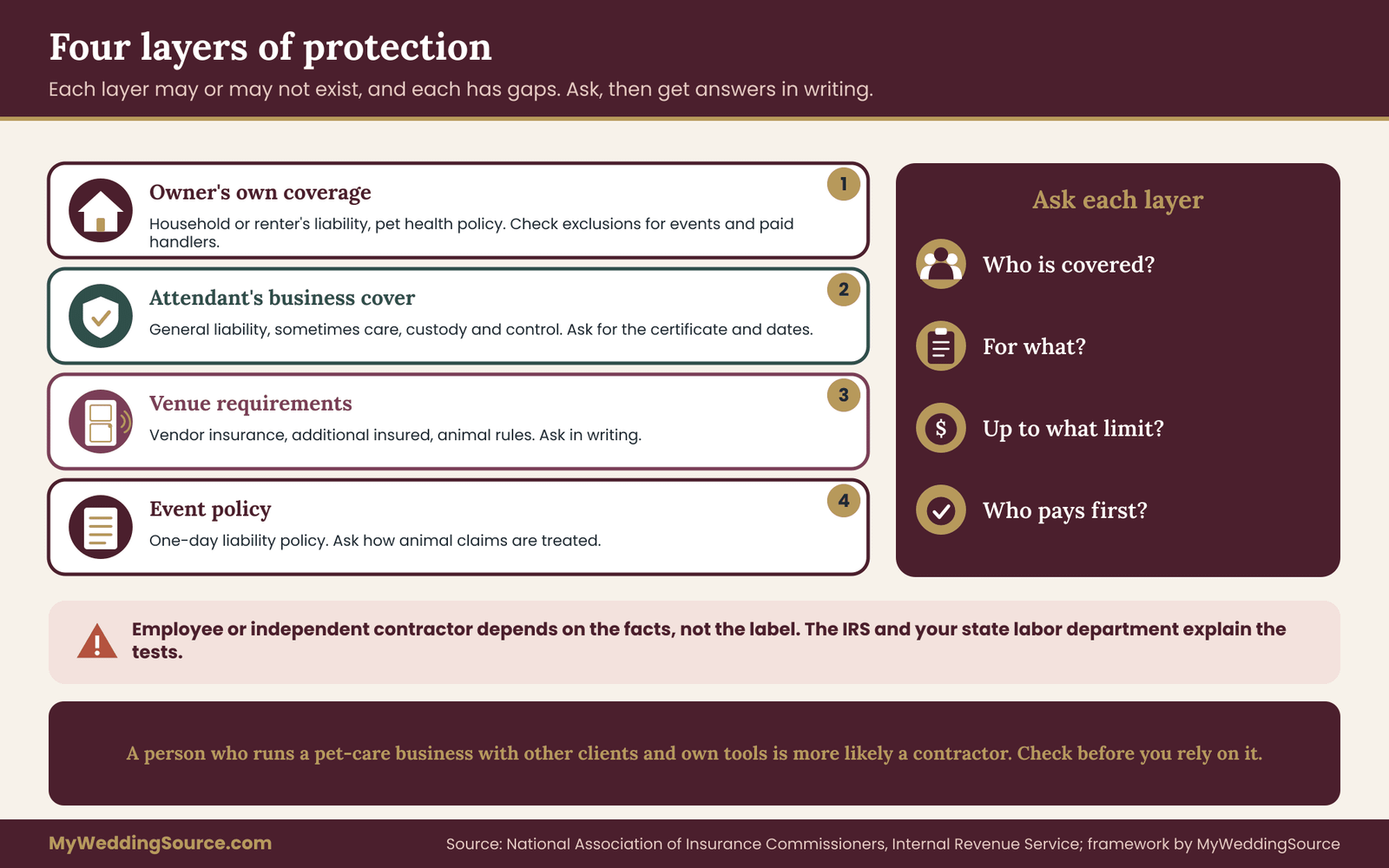
Think of the protection around the animal and the people near it as four layers. Each layer may or may not exist, and each has gaps.
Layer one: the animal owner’s own coverage. If the animal is yours, you may have a homeowner’s or renter’s policy with a personal liability section, and you may have pet health insurance that covers veterinary bills. Liability coverage under a household policy often addresses injury to other people caused by your animal, though some policies exclude certain breeds, exclude events held away from home, or exclude situations where you are paid or where someone else is responsible for the animal.
Read the exclusions. Call the agent and ask in plain terms: “My dog will be at our wedding, supervised by a hired pet attendant. Are we covered if the dog bites a guest, and does hiring someone change that?”
Layer two: the pet attendant’s own business coverage. A professional pet sitter may carry general liability insurance and sometimes a form of coverage for animals in their care, often called care, custody and control. A sole proprietor’s coverage may apply to their own work but not to events that fall outside their usual services.
Ask for the certificate, read what it says about covered activities, and note the dates and limits. If the person says they are covered, ask them to send the document. If they say they are not, that is useful information too, and it affects what you do next.
Layer three: the venue’s requirements and coverage. Venues often require vendors to carry insurance and to name the venue as an additional insured on a certificate. A pet attendant working at the venue may fall under the same expectation, or the venue may exempt an animal handler or treat the animal as the couple’s responsibility under their event insurance. Ask the venue coordinator in writing what is required for animals on the property and for anyone who handles them. Also ask whether the venue’s own coverage excludes animal-related incidents.
Layer four: a special event policy. Some couples buy a one-day event liability policy to cover the wedding. Such policies vary in what they treat as covered. Some address third-party bodily injury and property damage, and some exclude or limit animal-related claims. If you carry or plan to carry one, ask the insurer specifically how animal incidents are handled and whether a hired handler changes the answer. Ask them to put the answer in writing.
What to ask each layer
Whatever the layer, the same four questions apply.
Who is covered? The owner, the pet attendant, the venue, the couple, the guests?
For what? Injury to people, damage to property, harm to the animal, veterinary costs, escape or loss of the animal, cancellation because the animal cannot attend?
Up to what limit? Limits can be lower than people assume, and a single serious injury can exceed a small policy.
Who pays first? When two policies could respond, the order matters, and some policies say they are secondary to other coverage.
Write down the answers, and keep the documents in the same folder as the agreement. The point is not to buy more insurance. It is to avoid the moment when a guest is hurt and everyone is looking at each other to find out whose problem it is.
Employee or independent contractor
A second question sits next to insurance: how is the attendant classified? The answer affects who is responsible for injuries to the pet attendant, for taxes and for certain legal obligations. It is not always obvious.
The Internal Revenue Service describes the difference in terms of behavioral control, financial control and the relationship of the parties. In practice, a person who runs their own pet-care business, uses their own equipment, sets their own methods and serves multiple clients is more likely to be an independent contractor. A person who works only for you, under your direction, using your tools, at set hours, looks more like an employee. The classification depends on the facts, and a label in a contract does not settle it.
For a one-day engagement with a friend, the question may seem silly. It still has a practical edge. If the pet attendant is hurt by the animal, who covers the medical cost? If you are paying a friend in cash, are you comfortable with the arrangement? If you hire a business, does the business carry workers’ compensation for its own staff?
The U.S. Department of Labor and your state labor department publish guidance on worker classification and wages, and the Occupational Safety and Health Administration provides general information about workplace hazards. Check with them or with a qualified professional if you are unsure, rather than guessing.
Many couples avoid the question by hiring a business with its own staff and insurance, which moves the employer role to that business. That can be simpler, and the contract can say so explicitly.
Injury to a guest
The scenario people worry about most is a guest who is bitten, scratched or knocked over. Rules about animal owner liability differ by state, and some states treat bites more strictly than others. The details matter, and this article cannot give them. What you can do is reduce the chance and prepare the response.
Reduce the chance by keeping the animal on a leash or enclosed at all times when guests are close, by posting a simple sign at the quiet room, by briefing the attendant to intervene when someone approaches too quickly, and by choosing a role for the animal that does not rely on perfect behavior.
Prepare the response by having a short incident procedure. The pet attendant removes the animal from the situation and secures it. The designated backup, not the couple, checks on the guest, offers first aid and calls emergency services if needed. Someone writes down what happened, when, who was involved and who saw it, and takes photos if appropriate. The animal’s vaccination records are available. The owner contacts their insurer or agent promptly, and the venue is informed as its rules require.
The Centers for Disease Control and Prevention publishes guidance on safe interaction with animals, wound care and when to seek medical attention for bites, and your veterinarian can advise on vaccination records. Keep a copy of those records in the duty card folder. If the venue or local rules require proof of vaccination, ask for the specifics in advance, and do not assume a verbal assurance will be enough on the day.
Injury to the animal
The reverse is also possible. The animal might be stepped on, might eat something toxic, might overheat or might escape. The cost can be a veterinary bill, and the owner should know in advance who authorizes treatment and up to what amount. A simple line in the duty card can state: “If the animal needs urgent care, take it to the named hospital and call the owner. The owner authorizes treatment up to a stated amount, and the owner will pay on arrival.”
If the pet attendant is a professional, ask how they handle veterinary emergencies in their normal work. Many have a written policy. If the attendant is a friend, make sure they know the plan and are not worried about being blamed for a bill. It is unfair to ask someone to look after your animal and also hold them responsible for an accident that happens despite their best efforts.
Damage to property
Animals can stain carpet, chew a chair, scratch a floor or knock over a display. Check the venue contract for a damage clause and ask how animal damage is handled. Some venues require a refundable deposit, some require a signed pet agreement, and some do not allow animals indoors at all. If the venue will hold you responsible for damage, decide in advance whether the pet attendant’s agreement shifts any of that cost, and say so in writing. Without it, the venue will usually look to the couple.
Keeping the insurance conversation short and useful
None of this requires a long meeting. A practical approach is to put the insurance questions into one email to each party, ask for written answers, and file the replies. Three emails are usually enough: one to your insurance agent, one to the venue, and one to the pet attendant. If an answer is unclear, ask again until it is clear.
If a party cannot or will not answer, treat that as information about how much risk you are carrying, and adjust the plan. A shorter appearance for the animal, a smaller role, or no animal at all are all legitimate responses.
The conversation also becomes part of your vendor paperwork. If you are using a purchase-order style approach for your other vendors, the same method of listing scope, terms and approvals works for animal care, and the wedding vendor purchase orders guide shows how to keep that kind of record tidy.
Breaks, shift length and the handoff schedule
A wedding day is long, and the longest part of it is the stretch nobody plans for: the waiting. A pet attendant who has been on duty since mid-morning, with no meal, no break and no one to pass the leash to, is not at their best by the cocktail hour. Neither is the animal. This section is about building rest into the plan for both of them.
Why the pet attendant needs breaks
There are three reasons, and none of them is about being generous.
First, attention fades. Watching an animal around a crowd is steady, low-level work. After a few hours without a break, people drift. They check a phone, look away, answer a question and lose track of the leash. The moments when attention lapses are the moments when animals escape or eat something they should not.
Second, bodies have needs. The attendant needs food, water, a restroom and a chance to sit. If the schedule has no gaps, they will either skip these things or leave the animal unattended to meet them, and neither is good.
Third, the arrangement should be fair. If you hire a professional, wage and hour rules may apply, and those rules vary by state and by whether the person is an employee or a contractor. The U.S. Department of Labor explains that federal law does not generally require meal or rest breaks for adult workers, though short breaks that an employer offers are usually counted as paid time, and many states set their own rules.
Check your state labor department for the current requirements. If your attendant is a friend, fairness is a matter of respect: do not expect someone to work a full day for free with no meal.
Why the animal needs breaks
Animals tire in ways that are easy to miss. A dog on a lead in a hall full of people is working, even if it is sitting still. It is processing noise, smells, movement and strangers. Its body may be calm while its stress is rising.
Rest does not mean boredom. It means a quiet place, away from crowds, with water, a bed or blanket, and no demands. Ten to twenty minutes in a calm room can reset an animal’s behavior, and an hour away from the celebration can mean the difference between a dog who makes it to the cake and a dog who is sent home at the toast.
The American Veterinary Medical Association and your own vet can tell you more about signs of stress and heat in your particular kind of animal. Build the schedule around what your animal needs, not around what the wedding schedule would like.
The coverage clock
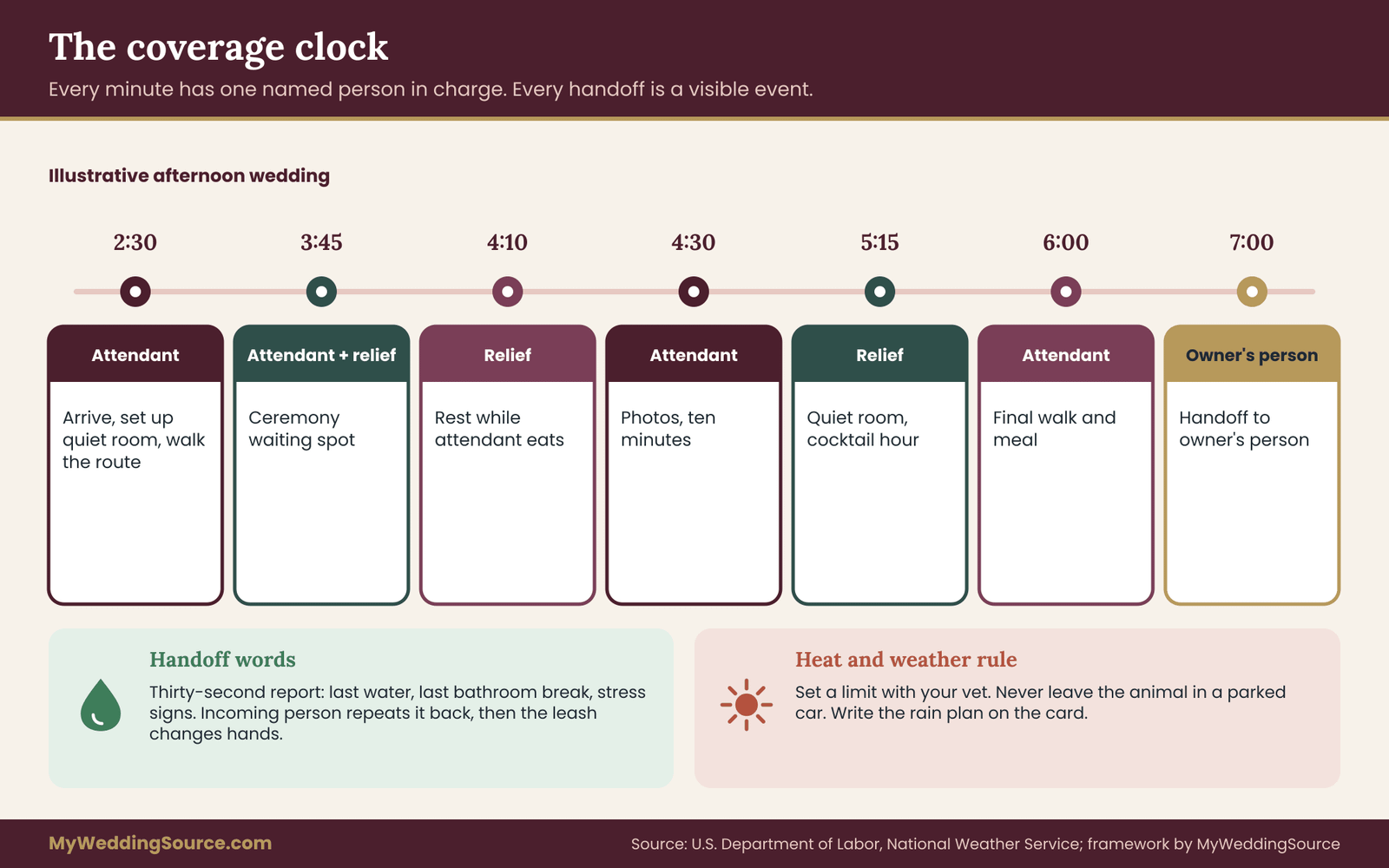
Planners think in timelines. For a pet attendant, it helps to draw a coverage clock: a simple chart of the hours the animal is on site, with a name beside every block of time. The rule is that every minute has exactly one named person in charge, and the handoff between two names is a visible event.
Start by listing the key times. Arrival. Ceremony start and end. Photos. Cocktail hour. Dinner. Dances. Departure. Mark when the animal will be present in each, when it will be resting, and when it will be gone.
Then divide the time into blocks of no more than about two to three hours of continuous duty, with a break between. This is a planning guide and not a rule, because an easygoing animal in a quiet space is a lighter job than a young dog in a crowd. Adjust the blocks to the real situation.
Assign a name to each block. A typical pattern uses two people: the primary attendant and a relief. The relief covers the primary’s breaks, including meals, and takes over for any transition where an extra pair of hands is useful, such as the walk from the ceremony to the photos.
Mark the handoff points. At each one, the outgoing person gives a thirty-second report: last water, last bathroom break, any signs of stress, anything the animal reacted to. The incoming person confirms by repeating the key points back. Then the leash physically changes hands. The words “I have her” are the signal that responsibility has moved.
A sample day, illustrated
The following example is invented to show the logic. Your times will differ.
Imagine a ceremony at 4:00 in the afternoon, photos until 5:15, a cocktail hour, dinner at 6:30 and the animal leaving at 7:30. The primary pet attendant arrives at 2:30 with the animal, sets up the quiet room, and walks the route. At 3:15 the pet attendant offers water and a short bathroom walk. At 3:45 the animal moves to the ceremony waiting spot, where the relief person is already standing by with a spare leash.
At 4:00 the animal appears briefly in the processional or sits near the front, with the pet attendant close. At 4:10 the attendant removes the animal quietly. From 4:10 to 4:30 the animal rests with the relief while the primary attendant takes a break and eats something. At 4:30 the primary resumes and the photo session begins. The photographer works with the animal for ten minutes only, and the pet attendant calls time.
At 5:15 the animal returns to the quiet room, with water and a bed, and the primary attendant hands off to the relief for the cocktail hour. At 6:00 the primary returns, checks the animal, and takes it out for a final bathroom break. At 7:00 the animal gets its evening meal, if the plan includes one, and a quiet half hour. At 7:30 the owner’s designated person arrives, takes the report, and takes the animal home.
In this example, the animal is on site for five hours but is actively in the wedding for under thirty minutes. The rest of the time is rest, care and transition. That ratio is typical, and it is why an attendant is a better frame than a ring bearer or a guest of honor.
Heat, cold and weather
The weather can shorten the shift. Hot pavement, direct sun, humid air and a lack of shade are serious welfare risks for many animals, and the National Weather Service publishes heat safety guidance that includes warnings about leaving animals in vehicles. The pet attendant should never leave an animal in a parked car, even for a few minutes with the windows cracked.
Set a decision rule before the day. For example: if the shaded air temperature is above a limit you and your vet agree on, the animal’s outdoor time is cut to the ceremony only, and the rest of the time is spent indoors. Choose the limit with your veterinarian, since it depends on the species, breed, age, coat and health of the animal. The same applies to cold, wet and windy conditions.
Plan the weather backup. If the outdoor ceremony moves indoors, does the animal still have a place, and is it still allowed there? If the venue’s rain plan puts guests in the space where the animal was supposed to wait, where does the animal go? Write the answer on the card.
The quiet room
The quiet room deserves its own line because it is the heart of the break plan. It should be a space the animal can reach without crossing the crowd, with a door that can be closed, a floor that is safe, and water. A hotel room, a bridal suite, an office, a side hall or a parked, shaded and ventilated vehicle with a person present are all possibilities, depending on the venue. Not all are suitable for all animals.
Test the room before the day if you can. Is it truly quiet, or is it next to the kitchen? Does the door latch? Is there a window the animal could reach? Is it far from the music? Put a sign on the door with the animal’s name, a request not to open it and a phone number. Ask the venue coordinator to tell staff.
Include a bed or blanket the animal knows, a chew or toy it likes if it is safe, and something that smells of home. Keep the lights low if the animal tends to be anxious. If the animal is meant to rest, avoid a space where guests will be passing, chatting or taking photos.
Overnight and next-day care
If the animal stays at the venue or at a hotel overnight, the shift is different. The pet attendant’s job becomes a night job, and the question is who is awake, who is responsible if the animal is sick, and where the couple is. Most couples are better off arranging for the animal to go home with a trusted person at the end of the reception, rather than staying in a hotel room alone.
The next morning also needs a plan. If the animal has traveled and been through a long day, it may be tired, hungry, stressed or upset in its stomach. The owner should arrange a calm, ordinary day and keep an eye out for changes in appetite, energy or behavior. If anything seems off, call the vet. The pet attendant’s report at the end of the shift is the starting point for that conversation.
Writing the schedule into the agreement
The coverage clock belongs in the agreement as a schedule. If the schedule says the attendant works from 2:30 to 7:30 with a break at 4:10, and the relief person is named, then both parties know what to expect. It also makes it easier to adjust. If the timeline shifts by an hour, you update the clock and not the entire plan. The same way of thinking works for every other vendor, and the wedding vendor timeline guide explains how to keep a shared timeline that everyone can see and trust.
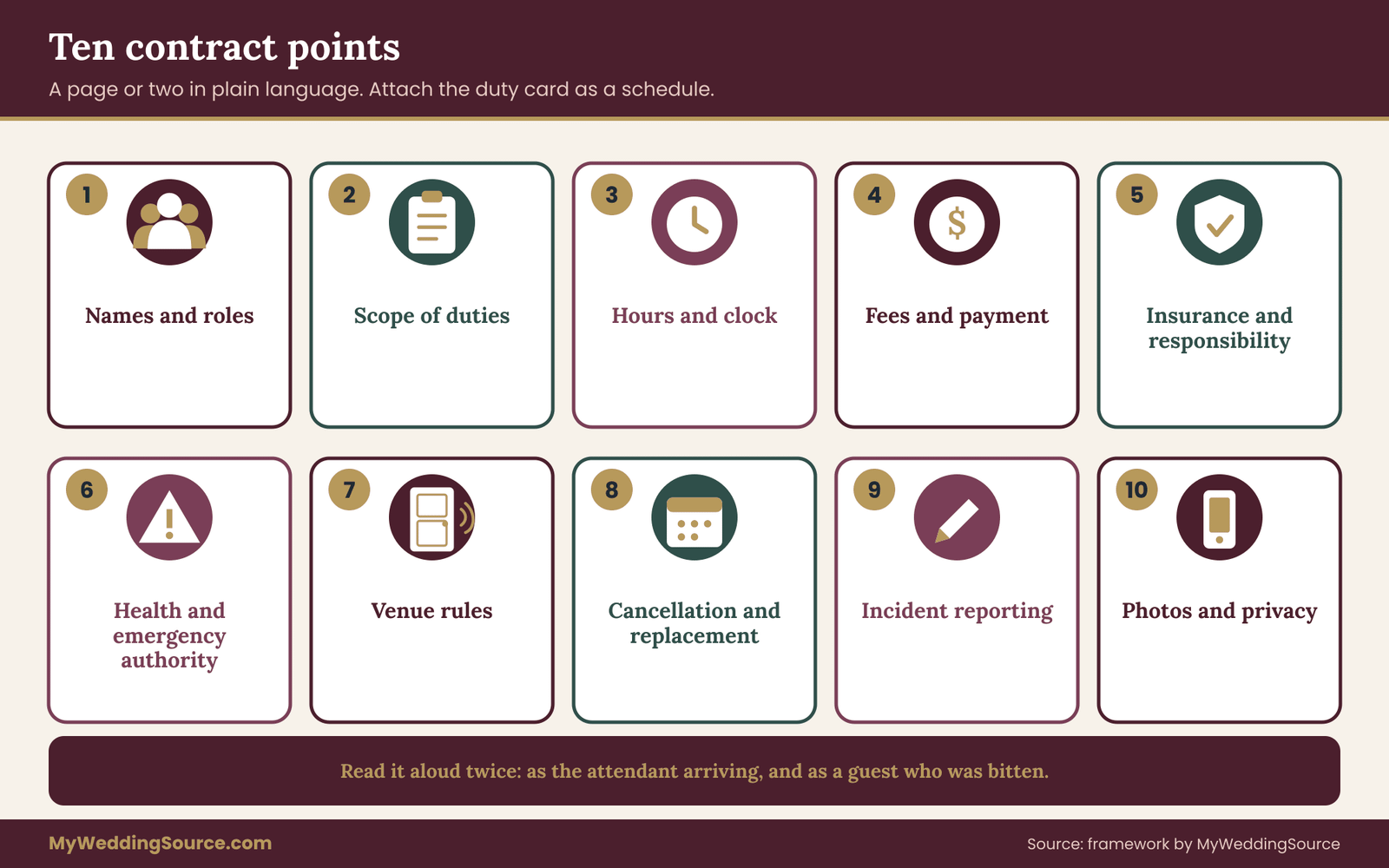
The pet attendant contract: ten points to put in writing
An agreement with a pet attendant does not need to be long, and it does not need to sound legal. A page or two of plain language that both people sign is enough for most weddings. The point is to turn assumptions into shared facts. When a disagreement happens, the written page decides it, and it helps both sides remember what they promised.
A local attorney can adapt any agreement to your state. The general habits of contracting with any wedding vendor apply here too, and the wedding vendor contract guide covers the common clauses and the questions to ask before signing. The ten points below are the ones specific to animal care.
1. Names and roles
State who is hiring, who is the pet attendant, who the backup is, and which animal is covered, with its name, species, breed or description, age and any identifying marks. Name the person who is the owner of record and the person who may make decisions about the animal if the owner is not reachable.
2. Scope of duties
Attach the duty card as a schedule and refer to it in the body. State plainly that the attendant is responsible for supervising, handling and caring for the animal during the stated hours, and list what is outside the role: training, veterinary decisions, childcare, ring custody, or acting as a general helper. Say whether the pet attendant may decline a task that seems unsafe. The answer should be yes.
3. Hours and the coverage clock
State the start and end times, the break times and the relief person. Add what happens if the timeline runs late: whether overtime applies, at what rate, who approves it, and what happens if the pet attendant cannot stay. Make the handoff to the owner’s designated person explicit, with that person’s name and phone number.
4. Fees, deposit and payment timing
State the total fee, what it includes, any deposit, the due dates, and how payment is made. Say whether travel, parking, meals or materials are included. If you pay by card, check the processor’s rules on chargebacks and refunds. Avoid paying in full far ahead of the date, and avoid large cash payments without a written receipt.
5. Insurance and responsibility
State what insurance the attendant carries, with limits and policy dates, and attach the certificate if there is one. State who is responsible for injury to people, damage to property and harm to the animal, and which party’s insurance responds first. Do not try to draft elaborate indemnity language. Plain statements, reviewed by a professional if you wish, are better than borrowed legal phrases you do not understand.
6. Animal health and emergency authority
State the veterinarian, the emergency hospital, the vaccination records and any medications. State who may authorize treatment, up to what amount, and whom to call first. If the pet attendant may give medication, state the dose and time, and have the owner sign that instruction. If the pet attendant may not, say so.
7. Venue rules and compliance
State that the attendant will follow the venue’s animal policy, and attach it. Name who communicates with the venue. State that the pet attendant will not bring additional animals and will not allow other animals to mix with the one in their care unless the owner approves. Include any vaccination, licensing or registration proof the venue or local law requires.
8. Cancellation, illness and replacement
Both sides need a way out. State what happens if the pet attendant becomes ill or cannot attend, including how soon they must notify you, whether they will supply a replacement of equal skill, and whether any deposit is returned. State what happens if you cancel, if the animal becomes ill, if the venue changes its rules, or if the weather makes the plan unsafe. A fair clause shares the risk and does not penalize anyone for a good-faith welfare decision.
9. Incident reporting
Require the attendant to report any injury, escape, ingestion of something harmful, or sign of illness promptly to the named contact, and to write a short note afterward. State that photos and records may be taken. This clause protects the pet attendant too, since a record shows what they did.
10. Records, photos and privacy
Decide whether the pet attendant may take photos of the animal or the event and share them. Many professionals post photos on social media. If you do not want that, say so. Also state how contact details and the home address will be handled, and that the information will be used only for the job. Do not include personal contact details in any shared document beyond what is needed.
Reading a pet attendant’s own agreement
A professional may send you their standard agreement. Read it, and do not be shy about asking for changes. Common clauses include liability waivers, limits on the amount the business will pay for a claim, requirements that you disclose behavior issues, and a no-refund policy on deposits. Some of these are reasonable. Others may conflict with what you need.
Check four things. Does the agreement limit their responsibility for injury to the animal, and by how much? Does it require you to cover the business’s costs if a guest sues? Does it forbid you from changing the timeline without a fee? Does it let them substitute another person without your approval? If the answers surprise you, ask for changes or look for another provider. A good professional will explain the reason for each clause, and many will adjust a clause when asked politely.
If the attendant is a friend, offer the agreement anyway. A page that says who does what, when, and what happens if plans change protects the friendship. Frame it as a way to make their job easier and not as a sign of distrust.
Cost logic without invented numbers
Because rates differ across regions, seasons and experience levels, a single price would mislead you. The more useful skill is to compare quotes on equal terms.
Start with hours. Count from the first moment the pet attendant is needed, which is often an hour or more before the ceremony, to the moment the animal is handed to the owner’s person. Count the relief person’s hours too, if they are paid.
Add the extras. Travel time, mileage, parking, a minimum booking, an after-hours charge, a holiday or weekend rate, and a charge for a meet-and-greet or trial. Ask whether any of these are waived or bundled.
Then compare the quotes as a single total for the same hours and duties. A lower hourly rate may hide a longer minimum. A higher rate may include insurance, a backup and a written report that the cheaper option omits.
Finally, set the number against the alternatives. The alternative to a pet attendant is not zero. It is a friend whose attention is divided, a shorter appearance, a different role for the animal, or leaving the animal at home. Each has a cost in stress, risk or lost photos. Choose the option whose total cost, including risk, you are comfortable with.
A pre-signing check
Before you sign, read the agreement out loud as if you were the pet attendant arriving at the venue. Can you tell what time to show up, where to go, who to call, what to do with the animal at each hour, what to do in an emergency and how to get paid? If you cannot, the agreement is not finished.
Then read it as if you were a guest who was bitten. Can you tell who is responsible, who to contact and what happens next? If that is unclear, the agreement is also unfinished.
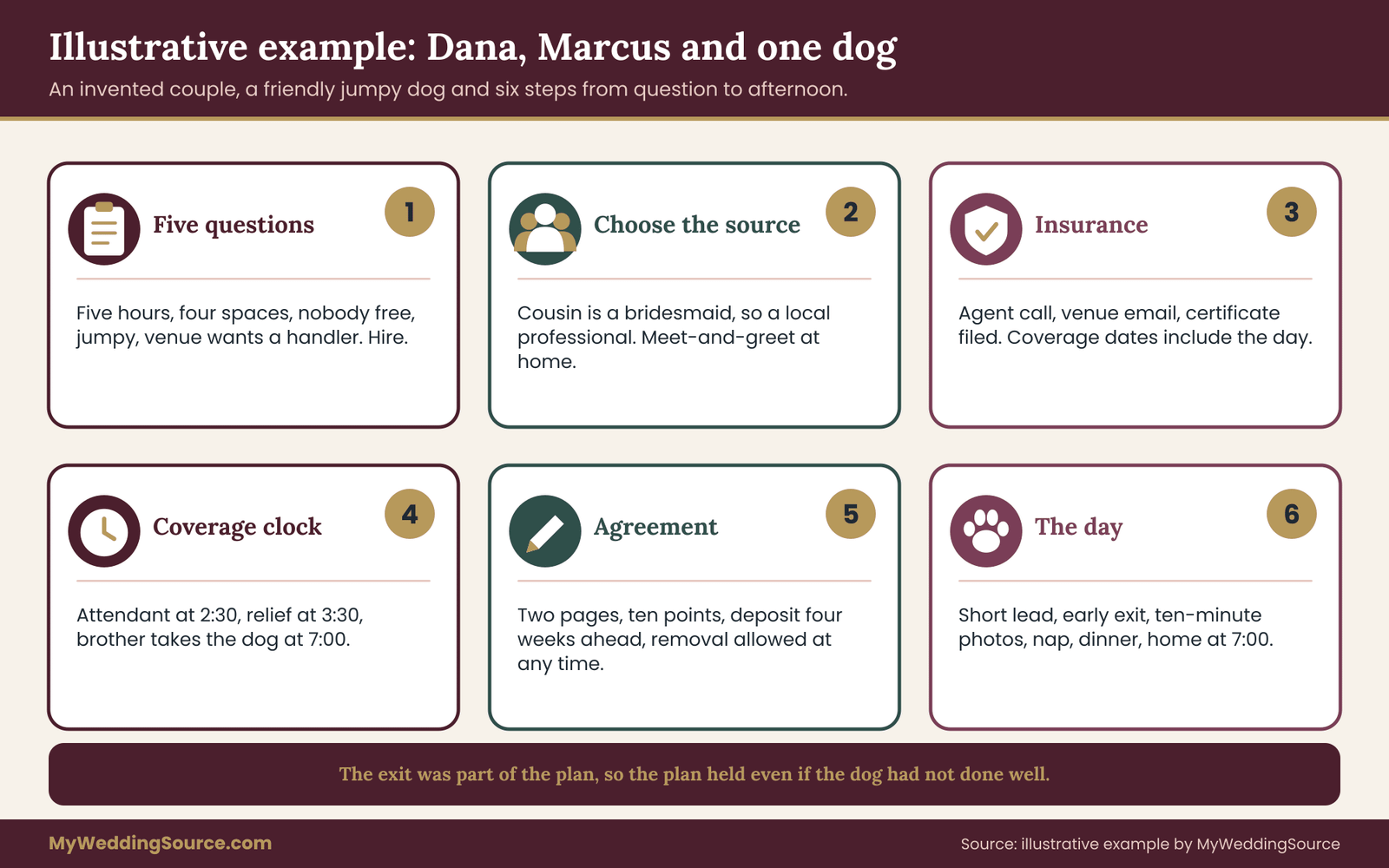
A worked example: one couple, one dog, one long afternoon
The following example is invented and meant only to show how the pieces fit. No real people or businesses are involved.
A couple, whom we will call Dana and Marcus, plan an afternoon wedding at a garden venue. Their dog is a medium-sized, friendly, easily excited mix who loves people and sometimes jumps. They want the dog in the ceremony and in the family photos. The venue allows leashed animals outdoors and in a designated side room.
Step one: the five questions
They answer the five questions. The animal will be on site for about five hours (medium). The dog will move through four spaces: the arrival area, the ceremony lawn, the photo garden and the side room (heavy). Nobody in the wedding party is free, because everyone has a role (heavy). The dog is friendly but jumps (medium). The venue requires a named handler who is not in the wedding party (heavy). The result is clear: hire a pet attendant.
Step two: choose the source
Dana’s cousin offers to help, but she is a bridesmaid and will be in the photos. They decide against her as the main attendant. They ask a local professional with a small pet-care business, and arrange a meet-and-greet at home. The professional watches how the dog responds to a leash, a stranger and a loud noise. She asks for the duty card, the vet’s number and the feeding schedule, and she says she carries general liability insurance and will send the certificate.
Step three: insurance
They call their renter’s insurance agent and ask whether the dog is covered for liability at an event and whether a hired handler changes anything. They email the venue to ask what proof the venue needs. They receive the professional’s certificate and file it with the agreement. They note the limits and the dates and see that the coverage dates include the wedding.
Step four: the coverage clock
They draw a clock. The professional arrives at 2:30 with the dog. A second person from the professional’s business arrives at 3:30 to relieve her for a break, then stays for the ceremony and photos as a second set of hands. The cousin is named as the one person who may take the dog out in an emergency but is not the attendant. The dog leaves at 7:00 with Dana’s brother, who has the report and the keys.
Step five: the agreement
They sign a two-page agreement using the ten points. The agreement states the hours, the fee, a deposit due four weeks ahead and the balance due the week before. It lists the vet and the emergency hospital, the venue’s rules and the cancellation terms. It says the professional may remove the dog at any time without asking, that the couple will not be disturbed unless there is an emergency, and that the professional will send a short written report after the event.
Step six: the day
On the day, the dog arrives calm after a walk. The pet attendant walks the route, finds the shade and sets up the side room with a bed and water. At the ceremony the dog walks in on a short lead, sits at the front, and is quietly led out after the vows when it starts to fidget. The photos are limited to ten minutes. The dog naps in the side room through the cocktail hour, gets dinner at 6:00 and leaves at 7:00.
What worked was not luck. The plan was clear, the roles were named, the breaks were scheduled, and the decision to remove the dog early was agreed in advance. If the dog had not done well, the plan would still have held, because the exit was part of it.
When the pet attendant plan meets real life: edge cases
Even a careful plan meets surprises. The cases below come up often enough to be worth thinking through before the day, so the attendant is not inventing a response at the worst moment.
The animal is a service animal or belongs to a guest
A guest may arrive with a service animal. Under the Americans with Disabilities Act, a service animal is generally a dog individually trained to do work or perform tasks for a person with a disability, and staff may ask limited questions about it. The ADA’s service animal guidance explains the rules and the two questions that may be asked.
Your pet attendant is not responsible for a guest’s service animal and should not handle it, pet it or ask about the guest’s disability. If a guest’s animal and your animal might meet, ask the venue and the guest’s family in advance whether and how to keep the two apart.
Other guests may bring pets without asking. Decide in advance who tells them, and how. A short, kind line in the invitation or on the website avoids the awkward conversation at the door. Do not hand that conversation to the pet attendant, whose job is your animal.
The animal gets sick on the day
Vomiting, diarrhea, limping, heavy panting, collapse or a sudden change in behavior should end the animal’s appearance. The pet attendant follows the emergency block: remove the animal from the crowd, call the owner or the named contact, call the vet or the emergency hospital, and follow their directions. Do not wait for the end of the ceremony. The wedding will survive a missing animal. The animal might not survive a delay.
If the cause might be something the animal ate, tell the vet what and how much, if known. Keep the packaging if there is any. The ASPCA and the Pet Poison Helpline are among the organizations that provide animal poison guidance, and having the number on the card saves time.
The attendant cancels at the last minute
It happens. A friend gets sick, a professional’s car breaks down, a family emergency intervenes. The plan for this is the backup person, named in the agreement and briefed in advance. If you have no backup, the fallback is a smaller role for the animal, or none. Decide now what you will do, and who calls whom.
A couple that learns at noon that the pet attendant is out and has no plan will be tempted to ask a guest, and a guest who has not read the card is the wrong person for the job.
The venue changes its mind
Venue staff change, and so do rules. A coordinator who agreed to a side room may be replaced by someone who has not heard about it. Ask for the animal arrangements in writing, and carry a printed copy. The pet attendant should have the coordinator’s phone number and know who has authority on the day. If the venue withdraws permission at the last minute, the plan should include a way to remove the animal quickly and politely.
If the venue’s own rules are unclear, a technical walk-through is a good moment to settle them. The venue technical walkthrough guide shows how to check access routes, doors and spaces, and the same visit can include the animal’s route, shade and quiet room.
The animal is stressed by the attendant
Sometimes the match is simply wrong. The animal pulls away, refuses food, trembles or growls with the pet attendant it met only once. Trust that signal. If it appears at the trial, find another person or reduce the role. If it appears on the day, bring in the owner or the backup, and do not ask the animal to push through. A person who respects that is the right person for the job, even if the match failed.
The animal is more than one animal
Two dogs, or a dog and a cat, multiply the tasks and the risks. Animals that are calm together at home may behave differently in a new setting. If you plan to bring more than one, think about one attendant per animal, or at least one attendant and one relief for the group. Do not assume that two animals are twice the work, since the interaction between them adds more. Many couples find that one animal in a clear role is easier to do well than two.
Rain, wind, noise and fireworks
Weather and noise are the usual sources of surprise. A thunderstorm, a loud band, a sendoff with sparklers or fireworks can frighten an animal that was fine an hour earlier. Plan the animal’s departure before any loud event. If the plan includes a sparkler exit or fireworks, the animal should not be present, and the pet attendant should be told in advance, with the time.
Late changes to the schedule
A ceremony that starts forty minutes late changes the animal’s day. It may mean extra bathroom breaks, extra water, and a longer wait. The attendant should have authority to adjust the animal’s schedule without asking, and the planner should tell them about delays as soon as they are known. If a delay stretches beyond what the animal can handle, it is time to send the animal home or reduce its role.
After the event: the debrief
Ask for a short written note from the pet attendant after the event. What went well, what did not, any concerns about the animal’s health or behavior, and any suggestions. Keep it in your records. Pay the balance on the agreed date and send a thank-you note. If the person was excellent, say so in a review or a recommendation. It helps the next couple, and it is a small courtesy that matters in a field where much of the work comes from word of mouth.
Your next steps
Start with the decision. Answer the five questions, score them, and decide whether you need a pet attendant, a friend with a clear card, or a smaller role for the animal. Check with your veterinarian that the animal is a good candidate for the day at all.
Then write the duty card. Fill in the profile, the schedule and the tasks by phase. Add the emergency block. Share it with the person you have in mind and go through it together.
Next, screen. Use the scenario questions, meet the animal and the person together, and check references. Ask for proof of insurance. Send the three insurance emails: to your agent, to the venue and to the pet attendant.
Finally, put it in writing. Draw the coverage clock, name the relief person, and use the ten points for a short agreement. File everything in one folder with the rest of your vendor documents, and put the dates for the final briefing and the payment into your full planning timeline. With the attendant in place, the animal is safer, you are freer and the day has a better chance of being the one you imagined.
FAQ
Do we really need a pet attendant if a friend can watch the dog?
Not always. If the animal is on site only for the ceremony and a few photos, and the friend has no other job during those hours, a written duty card may be enough. Once the animal is present for several hours, moves between spaces, or the friend is also a guest with a role, a dedicated pet attendant is safer and fairer to everyone involved.
How many hours should a pet attendant work in one stretch?
There is no single rule, because it depends on the animal, the weather and the setting. As a planning guide, many couples aim for blocks of about two to three hours of continuous duty, followed by a break covered by a named relief person. A calm animal in a quiet room is a lighter job than an excitable one in a crowd, so adjust with your veterinarian’s advice.
Does a pet attendant need insurance?
Ask. A professional may carry general liability coverage and sometimes coverage for animals in their care, and the venue may require proof. A friend usually will not carry any. Whatever the answer, ask to see the document, check what activities and limits it covers, and ask your own insurance agent how a hired handler affects your household or event policy.
What should a pet attendant contract include?
Keep it to a page or two. Include the names and roles, the animal’s details, the duties, the hours and break schedule, fees and payment dates, insurance and responsibility, emergency and veterinary authority, venue rules, cancellation and replacement terms, incident reporting, and photo and privacy terms. Attach the duty card as a schedule so the daily tasks are part of the agreement.
Should I pay a friend who agrees to be our pet attendant?
Offering payment is usually a good idea, even if a modest amount, because it makes the job a commitment and not a favor. It also gives you standing to ask for a duty card, a trial and a backup plan. If the person declines money, give a gift and still put the hours and duties in writing, so the arrangement is clear.
What if the pet attendant cancels at the last minute?
Have a named backup before the day, and put the replacement process in the agreement. If no backup is available, use the fallback you chose in advance: a smaller role for the animal, or no appearance. Avoid handing the animal to a guest who has not seen the duty card, since an unprepared stand-in is the usual way problems begin.
Can the pet attendant also hold the rings or look after children?
It is better not to. A pet attendant who is also a ring custodian or a child minder has competing tasks, and the animal is usually the first to lose attention. Give each job to a different person, with its own named backup. If the animal carries any item, keep the real valuables with another trusted person.
What should the attendant do if a guest is bitten?
Secure the animal first and remove it from the situation. The named backup checks on the guest, offers first aid and calls emergency services if needed. Someone records what happened, who saw it and when. The owner contacts their insurer or agent and informs the venue as its rules require. Public health agencies such as the CDC publish guidance on bite care.
Sources
- Healthy Pets, Centers for Disease Control and Prevention
- American Veterinary Medical Association
- ADA Requirements: Service Animals, U.S. Department of Justice
- Independent Contractor (Self-Employed) or Employee?, Internal Revenue Service
- Wage and Hour Division, U.S. Department of Labor
- Occupational Safety and Health Administration, U.S. Department of Labor
- National Association of Insurance Commissioners, consumer information
- Insurance Information Institute
- Heat Safety, National Weather Service
- ASPCA, pet care and poison guidance