
Bistro lights and string lights both hang in loops over a wedding dinner and both look like a warm yes, but they behave differently once you plug them in. This guide compares bistro lights with ordinary string lights on two measures only, how they look at the table and what they ask of the power supply, and gives you a mockup test and a circuit inventory you can hand to a venue.
Bistro lights usually mean larger, spaced bulbs on a sturdier cord. They give real light at table height and draw more power per strand. Ordinary string lights usually mean smaller, closer bulbs on a lighter cord. They sparkle, give little useful light and draw less. The names are marketing labels, not standards, so compare the strand label instead: bulb size, spacing, watts, voltage, rating and the maximum number of strands you may connect end to end. Hang one strand, test it at dinner brightness, and write a circuit inventory before you order.
Most couples weighing bistro lights start this decision with a picture. Someone has saved a photo of a patio or tent with glowing bulbs swagged overhead, and the question is which product produced it. The honest answer is that the photo does not say. A single image can be bistro lights, string lights, festoon lights, café lights or a dozen products that vendors name differently, and the same strand can look soft in one photo and harsh in another because of camera exposure and the time of day.
The practical problem comes later. A string of bulbs is an electrical load, a mechanical load and a visual layer all at once. Someone has to find an outlet, someone has to carry the weight of the cable and the bulbs across a span, and someone has to decide whether the guests will be able to read a menu. Choosing between bistro lights and string lights is a small decision that touches all three.
This article stays on that one choice. It does not try to design your whole room, and it does not cover ceiling fabric, truss rigging or venue height limits in depth, because other guides on this site handle those. If you want the full room, start with the reception interior design plan and come back here when you reach the overhead lighting decision.
A note on scope. This is general information, not legal, electrical or safety advice. Electrical loads, rigging and flame resistance are questions for the venue and for a qualified electrician or lighting professional, and local rules differ. Where a rule matters, the article points you to the agency or standards body that publishes it so you can confirm the current version.
What bistro lights and string lights actually mean
Start with vocabulary, because the whole comparison depends on it. In ordinary shopping language, “string lights” is the umbrella term. It covers anything that has bulbs spaced along a cord: tiny fairy lights on thin wire, holiday strands, cheap patio sets, and the larger commercial strands that people call bistro lights. “Bistro lights” is a narrower label that usually points to larger bulbs with wider spacing, a thicker cord and sockets that accept replaceable bulbs. Some sellers use “café lights”, “market lights” or “festoon lights” for the same thing.
No standards body defines these words. A seller can call a thin strand with small bulbs bistro lights and nothing happens. So when this article says bistro lights, it means the common pattern: roughly globe-shaped bulbs of a visible size, spaced a generous distance apart, on a heavier cord. When it says string lights, it means the lighter, denser, smaller-bulb pattern. You will meet products that sit between the two, and the point of the exercise is to judge the actual strand, not the name.
The five label facts that replace the name
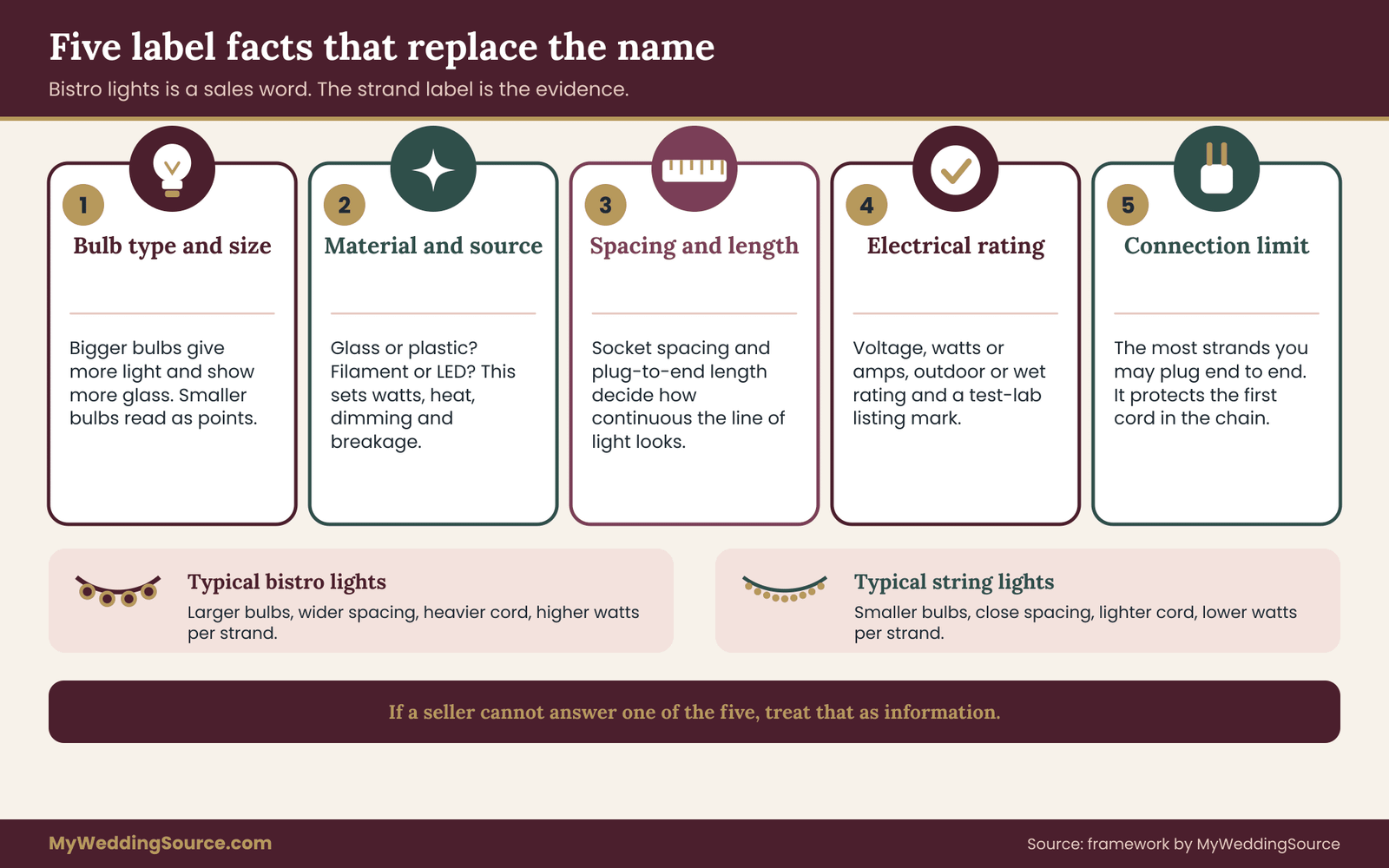
Instead of arguing about names, read five facts on the product page or the box. You can also ask a rental company to read them to you. If a seller cannot answer one of them, that is information too.
Bulb type and size. Larger bulbs, as on bistro lights, put out more light and show more glass. Smaller bulbs read as points. The size is usually printed as a letter and number code on the bulb or in the listing, and the seller should be able to tell you what it means.
Bulb material and light source. Is the bulb glass or plastic, and is the light source an incandescent filament or an LED? This one fact changes the wattage, the heat, the dimming behavior and the breakage risk.
Spacing and total length. How far apart are the sockets, and how long is the strand from plug to end? Spacing decides how many bulbs you get across a span, and therefore how bright and how continuous the line of light looks.
Electrical rating. The strand should state its voltage, its wattage or amperage, and whether it is rated for outdoor or wet locations. A listing mark from a recognized testing laboratory is a good sign. The absence of any marking is a reason to walk away.
Connection limit. Most strands can be plugged end to end up to a maximum number or a maximum total wattage. That limit is printed on the strand or its paperwork, and it is the number that keeps you from overloading the first cord in the chain.
Where the two patterns usually differ
With those five facts you can describe the typical difference without relying on names. Bistro lights usually carry bigger bulbs, wider spacing, a thicker and often black or dark cord and a higher watt rating per strand if the bulbs are incandescent. They are built for repeated outdoor use in commercial settings, which is why rental companies stock them. Ordinary string lights usually carry smaller bulbs, closer spacing, a thinner cord and a lower watt rating. They are built for light decoration and are often sold in lengths that suit a porch rather than a ballroom.
Neither pattern is better in general. Bistro lights give you light you can eat by and a visible, almost graphic line of bulbs. Ordinary string lights give you a soft, glittering ceiling and almost no useful illumination. Which one serves a wedding dinner depends on what else lights the table, how far the strands must span and how much power is available.
There is also a middle category worth naming. Some sellers offer large bulbs on a thin consumer cord, or small bulbs on a heavy cord. Those hybrids can work, but they make it harder to predict what the strand will do, so they deserve a mockup before you commit.
What this comparison leaves out
Candles, lanterns, uplights, pin spots, chandeliers and projected patterns all change how a dinner looks, and a good lighting plan layers several of them. This guide treats the overhead strand as one layer. Because the strand is often the only warm overhead source at an outdoor dinner, though, it carries more of the visual job than it would in a ballroom, and that is why it deserves its own comparison.
One more boundary. The words “wedding dinner” in the title point to a seated meal, usually after dark, with guests reading menus, cutting food and recognizing faces across a table. That use case is different from a cocktail hour or a dance floor, and the choice often changes when the use changes. A strand that flatters a standing crowd can be too dim for a plated course, and a strand bright enough for dinner can be too bright for a slow dance.
How to read bistro lights and string lights as a pair
A useful way to keep the comparison fair is to separate three questions that people tend to mix together. The first is look: what do bistro lights or string lights show a guest when they glance up, and what does the strand do to faces and food? The second is load: how much current does the strand draw, and what does it plug into? The third is logistics: how does it hang, who installs it, and what happens when something fails at seven in the evening?
This guide gives each question its own sections and then joins them in a worked example and a decision rule. You will notice that look and load pull in opposite directions in some cases. Bistro lights look better at a table and cost more in watts. Ordinary string lights are easy on a circuit and easy to overlook. LED versions soften that trade-off but introduce dimming and color questions of their own.
The two tools you will build
The article asks you to make two small documents, and both are easy. The first is a mockup, which is an evening test with real strands at the real height and the real brightness. The second is a circuit inventory, which is a one-page list of every strand, where it hangs, what it draws, what it plugs into and who is responsible for it. Together they turn “I like the look of bistro lights” into something a venue manager, an electrician and a rental company can all read and sign off on.
Neither tool requires special equipment. A phone camera, a tape measure, a notepad and the ability to read a label are enough. A plug-in power meter, which shows the actual watts a device draws, is helpful and inexpensive, but you can also use the numbers printed on the strand.
Who should weigh in before you decide
Three people tend to have the information you lack. The venue manager knows where you may hang things, which outlets and circuits exist and what the building prohibits. The vendor, whether a rental company or a lighting designer, knows the strands they stock and how those strands behave. And a qualified electrician, often the venue’s own, can tell you whether the load you are planning is reasonable for the circuit it will sit on.
You do not need all three on a call at once. You need each of them to see the same one-page document. That is the job of the circuit inventory, and the later sections show how to build it so the answers come back quickly and in writing.
How bistro lights look at a wedding dinner
Look is where most couples start, and it is worth breaking into pieces, because “warm and pretty” hides several separate effects. Four of them matter at a seated dinner: how much light reaches the table, how the bulbs read from a distance, what the light does to skin and food, and what happens when someone looks straight up.
Light on the table versus light in the air
Bistro lights put more light into the room than small-bulb strands do. At dinner, bistro lights can supply a real share of the illumination on the table, especially when the strands hang no more than a few feet above guests’ heads and the spacing is tight enough that the glow overlaps. Smaller string lights, by contrast, read as decoration. They give the eye something to enjoy overhead, but a table under them may still need candles, lanterns or another source to read a menu.
This is the most important visual difference and it is easy to test. Stand at a table at dusk with one strand of each and hold a printed menu at the height a guest would hold it. If you can read the menu under one strand and not the other, you have learned more than a product page can tell you. If you can read it under neither, you know a second light layer is not optional.
Remember that dusk fades. A strand that looks bright against a pale evening sky can look modest once the sky goes dark, and the reverse can also happen: a set of bistro lights that seems dim at five o’clock can feel plenty bright by nine. The mockup section later in this guide covers testing at more than one hour for exactly this reason.
How the bulbs read from across the room
Bulb size and spacing decide whether the line reads as a series of distinct glowing spheres or as a continuous shimmer. With bistro lights, each bulb is visible as an object. The effect is a bit graphic, a rhythm of round shapes along a curve. Photographers often like this because the bulbs make clear, repeating highlights and the curve of the strand adds structure to an otherwise empty ceiling.
Smaller, closer bulbs blend together, which is the opposite of what bistro lights do. From far away the strand looks like a soft, glittering band. This effect suits a more romantic, less structured mood and can hide a slightly uneven hang better than larger bulbs can. It also means individual bulbs are less noticeable if a few fail.
Neither reading is correct. Think about the room. A tent with a high peak and plenty of empty volume can use the rhythm of bistro lights to give the space a scale. A small terrace with low overhead can feel crowded by large bulbs and may suit the smaller kind better.
What the light does to faces and food
Color temperature, measured in kelvins, describes how warm or cool a white light looks. Lower numbers look more amber, and higher numbers look whiter and bluer. Most products sold for dinners lean warm, and many sellers list a figure in the range commonly called warm white. Because sellers are not consistent, treat the number as a hint and judge by eye.
A second property is color rendering, which describes how faithfully a light shows colors. Low-quality light can make skin look gray and food look dull, even if the strand is bright. The listing may give a color rendering index, and you can also judge by looking at a plate of food and a human face under the strand. This matters because your photographs and your guests’ faces are the whole point of the lighting.
Filament-style incandescent bulbs and filament-style LED bulbs both give a warm, slightly orange light. Cheaper LED bulbs sometimes look flatter and whiter. If you are considering LED, which is attractive for power reasons discussed later, test that specific bulb under dinner conditions rather than assuming.
What guests see when they look up
Guests look up more than you think, particularly in a tent or on a patio where the overhead is the main visual feature. Bare bulbs at eye level can glare. A bulb you can see directly, at a height close to the line of sight of a seated guest, produces glare that makes people squint and makes faces harder to see. Bistro lights carry more of this risk because the bulbs are larger and brighter. Smaller bulbs glare less in absolute terms but still can, if the strand hangs low.
Strand height is therefore part of the look decision. The higher a strand hangs, the less it glares and the less light reaches the table. A common solution is to hang strands high enough that guests do not look into the bulbs, then add a lower layer of candlelight to bring warmth to the table surface. You will find the height question again in the guide to venue ceiling height and decor limits, which explains how a building’s clearance can limit what you may hang.
The look side by side: a comparison in prose
It helps to put the two patterns next to each other and describe them in plain sentences, not in a grid, so each trade-off carries its reason.
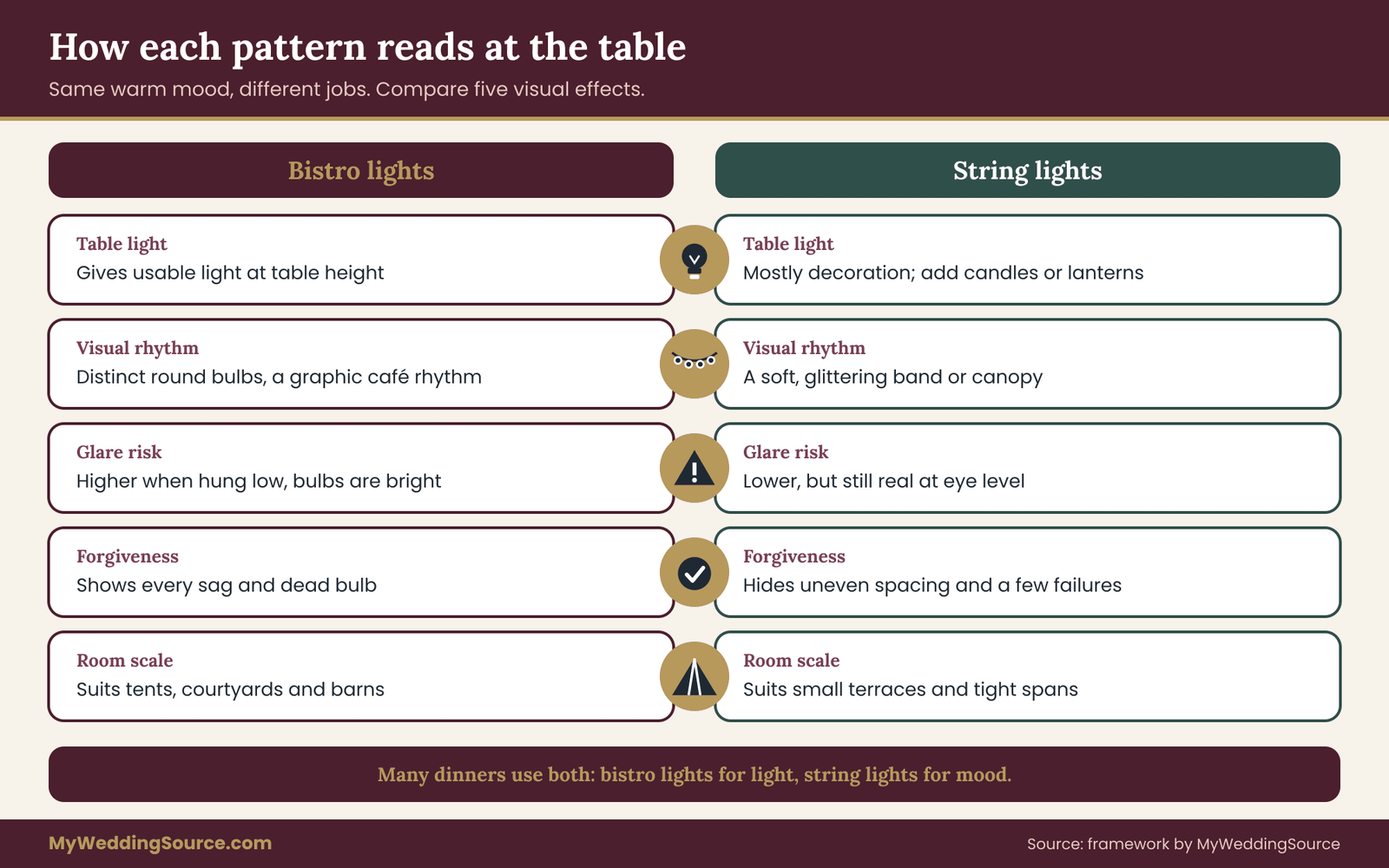
Brightness at the table. Bistro lights usually give more usable light, because each bulb is larger and the strand tends to carry a higher total output. String lights usually give less, so the table relies on other sources. If your dinner is outdoors with no other overhead light, this difference alone may decide the question.
Visual rhythm. Bistro lights read as a row of distinct bulbs with clear shapes, which suits a structured, café or market feeling. String lights read as a soft band or canopy, which suits a dreamier mood. Choose the rhythm that matches the rest of the room, not the rhythm that matches a photo you saw.
Forgiveness. String lights are generally more forgiving. Their density hides uneven spacing, small sags and a few dead bulbs. Bistro lights show each flaw, because each bulb is a single object. A dead bulb in a run of bistro lights leaves a visible gap, and an uneven hang shows up as an uneven curve.
Glare risk. Bistro lights carry more risk of glare when hung low. Smaller bulbs carry less. Hanging height and any shades or diffusing covers change this a lot.
Scale. Bistro lights tend to suit larger spaces, such as a tent, a courtyard or a barn, where they have room to establish rhythm. String lights tend to suit smaller spaces and tighter spans. A mismatch looks awkward: bistro lights on a tiny patio overwhelm it, and tiny bulbs in a large tent can disappear.
Photography. Bistro lights create distinct highlights and sometimes visible starbursts in photographs. Smaller bulbs create a softer, fuzzier background. Ask your photographer which they prefer for the dinner portraits and the reception details, because they may have strong views based on how their camera handles the light.
When the look should win and when it should not
If a vendor argues that bistro lights are simply better, or that string lights are simply cheaper and therefore fine, treat that as a sales position rather than a design rule. The look should win when the rest of the lighting is already solid and you are choosing the overhead mood. It should not win when it forces a power or rigging commitment you cannot support, such as asking for more circuits than the venue has or hanging weight where the venue does not permit it.
A sensible rule is to choose the look you prefer among the options that pass the load and logistics checks, and to reject any option that fails them, however good it looks. The next sections give you the checks.
Run a mockup of bistro lights before you decide
A mockup is a short, real test that answers the look questions with your own eyes. It does not have to be elaborate. It does need to use real strands, real hang height and a real evening, and it needs to be written down so the decision survives the weeks between the test and the wedding.
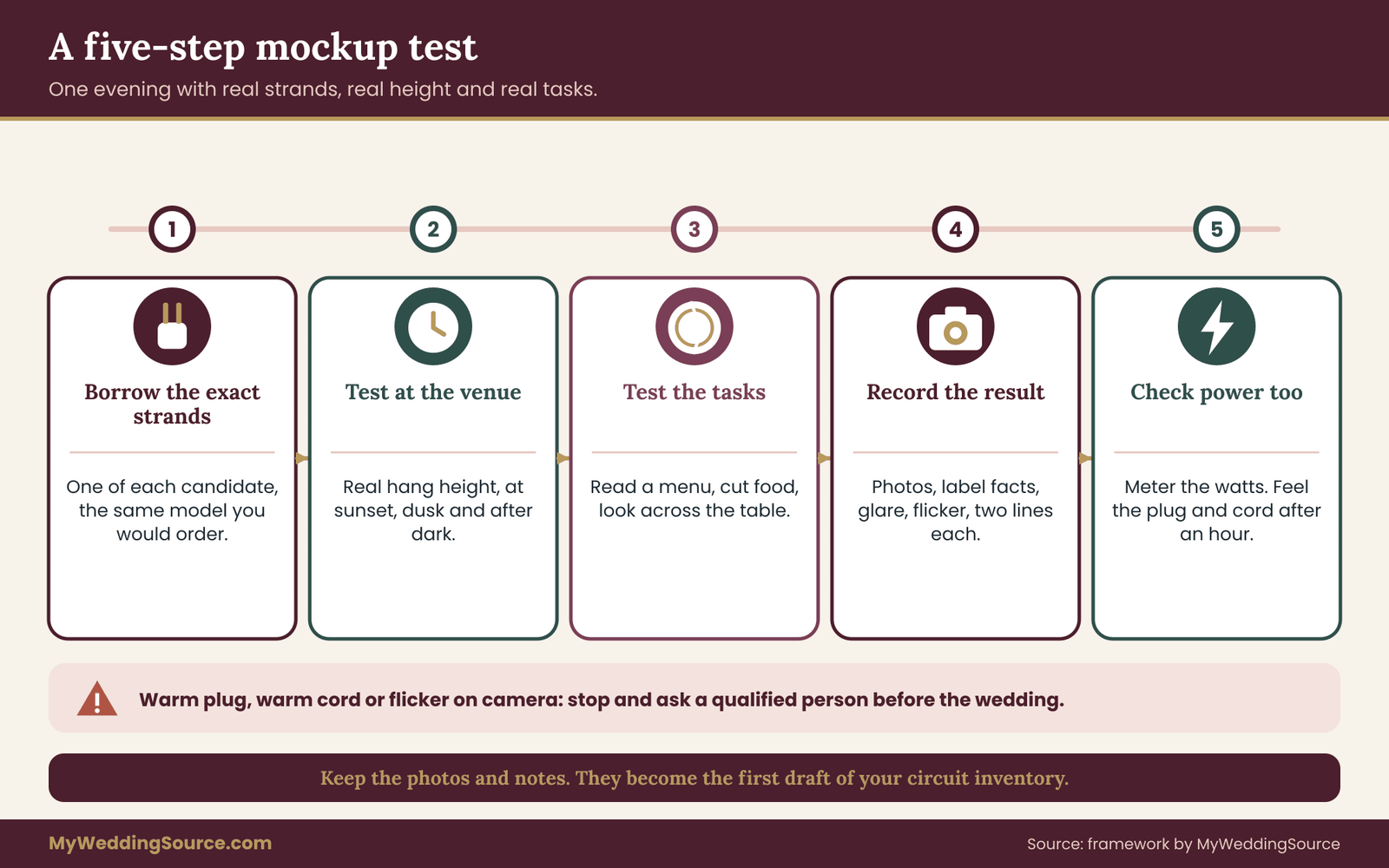
Step one: get one strand of each
Ask the rental company or the lighting vendor whether they can lend or rent a single strand of bistro lights and one of the string lights you are considering for a few hours. Many vendors do this for a small fee, and some will bring samples to a site visit. If you plan to buy rather than rent, buy one strand of each and keep the receipt in case you need to return it. If the vendor will not let you see the product at all, that is a flag worth noting in your records.
Ask for the exact product, not a similar one. A sample from a different batch or a different bulb type defeats the purpose.
Step two: test at the real place or a faithful stand-in
The best test happens at the venue, at the hour of your dinner, with the strands hung at the proposed height. If that is not possible, recreate the conditions as closely as you can: a similar height, a similar ceiling or open sky, a similar level of ambient light. A garage with the door closed is not a stand-in for an open patio at dusk.
Plan to test at two or three times: shortly before sunset, at dusk and after full dark. Take a photograph at each time with the same phone and the same settings, so differences come from the light and not the camera.
Step three: test the tasks, not just the mood
Print a sample menu and a place card. Set a plate and a glass at a table under the strand. Ask two or three people to read the menu, cut a piece of food and look across the table at one another. Then ask what they noticed. You are testing what guests will need to do for ninety minutes, not what looks good in a photograph.
Also stand at the edges, where the strand may be dimmer or farther away, and at the end of the span, where the voltage may be a little lower if several strands are chained. Differences between the first and last bulbs in a long run are one of the problems a mockup can reveal.
Step four: record the result in plain words
Write down, for each candidate: the product name and label facts, the hang height, the time of day, whether you could read the menu, how faces looked, whether glare was a problem and what you would change. Add the photographs. Two sentences per candidate are enough. The point is to give yourself, and anyone who joins the decision later, a record that does not depend on memory.
Step five: test power at the same time
While the strands are up, you can also run the first power checks. Note which outlet you used and whether the strand was plugged in directly or through an extension cord. If you have a plug-in power meter, read the watts. If not, record the figure printed on the strand. Check whether the cord, the plug or the first few sockets feel warm after an hour. Warmth in the cord or plug is a sign to stop and ask a professional before the wedding.
The mockup and the power check are two halves of the same afternoon, and the notes from this afternoon become the first draft of the circuit inventory described later.
Power basics for bistro lights and string lights
Power is the half of this comparison that people skip, and it is where the real surprises happen. A tent full of strands can draw more than a single household circuit can supply, and a venue that said yes to “some lights” may not have agreed to a load you never described. The good news is that the arithmetic is simple and you can do it with a calculator.
Watts, volts and amps in one paragraph
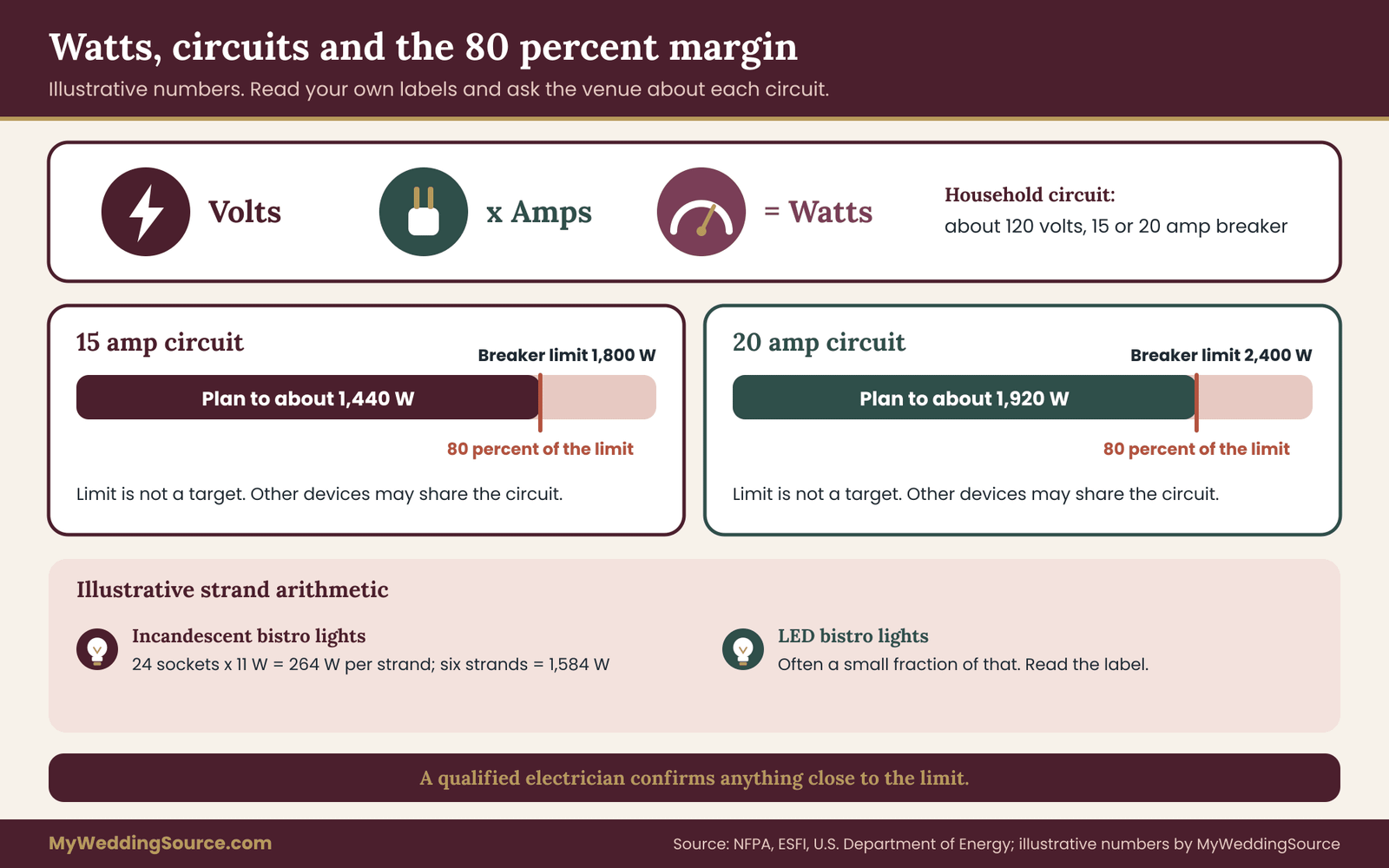
Electrical power in watts equals volts multiplied by amps. A standard household circuit in the United States runs at about 120 volts, and a common circuit breaker is rated for 15 or 20 amps. A 15-amp circuit at 120 volts can supply about 1,800 watts at its limit, and a 20-amp circuit about 2,400 watts. Those are limits, not targets. Electricians commonly aim to keep a continuous load, one that runs for three hours or more, to about 80 percent of the breaker rating. A dinner and dance can easily last that long, so for planning purposes a 15-amp circuit gives you about 1,440 watts and a 20-amp circuit about 1,920 watts.
These numbers are general rules of thumb, not a substitute for a qualified electrician, who knows what else shares the circuit and how the building is wired. The point of the arithmetic is to size your request, so you can ask the right questions.
Reading the load off the strand
Every strand has a load, and you can usually calculate it. If the label gives total watts, use that number. If it gives watts per bulb, multiply by the number of sockets. If it gives amps, multiply by the voltage. Do this for each strand and add the results.
Incandescent bistro lights are the heavy case. A strand with two dozen sockets and a common filament bulb of around ten watts each would draw roughly two hundred and forty watts. That figure is illustrative, so check your own label, but it shows how quickly the total adds up: six such strands would draw about fourteen hundred forty watts, which uses all of a 15-amp circuit’s continuous allowance with nothing left over.
LED versions of bistro lights draw far less, often a small fraction of the incandescent figure. A strand of LED bistro lights might draw a few watts per bulb, and the same six strands might draw a few hundred watts in total. Again, read the label, because wattage varies widely by product. The Department of Energy publishes general information on how LED lighting compares with incandescent lighting, and it is a good place to confirm the principle without leaning on a seller’s claim.
Ordinary string lights are usually the lightest load, lighter than bistro lights. Many small-bulb strands, especially LED ones, draw so little that a dozen strands may be a modest load. This is the real power advantage of ordinary string lights: you can hang a lot of them without worrying about the circuit.
Why the first cord in the chain matters
When you plug strands end to end, all the current for the later strands flows through the first strand’s wiring and plug. The strand’s connection limit exists because that first section of wire is only built to carry so much. If you exceed the limit, the first cord can overheat even if the circuit breaker never trips, because the breaker protects the circuit, not the thin wire in a decorative strand.
Treat the printed limit as a hard limit. If the label says a maximum of three strands end to end, run three, and then start a new chain from a new outlet or a distribution point. Do not defeat a limit by splicing or by plugging an adapter into the last socket. This is one of the standard safety messages from consumer safety agencies, such as the Consumer Product Safety Commission and the Electrical Safety Foundation International.
Extension cords are part of the load path
The strand is rarely plugged straight into a wall outlet. Between the outlet and the first bulb there may be one or more extension cords, and those cords have ratings too. A cord is thinner or thicker according to a gauge number, and a lower gauge number means a thicker wire that can carry more current. A cord used outdoors should be marked for outdoor use, and a long thin cord carrying a heavy load can warm up and lose voltage along its length.
Keep cords as short as the job allows. Keep connections off wet ground, ideally raised or enclosed in a connection cover designed for the purpose. Do not run cords through areas where guests walk unless they are covered by a proper cord cover, and do not tape or staple them in ways that damage the insulation. If the venue or a vendor provides power distribution, ask what they use and who is responsible for it.
Outdoor use, wet locations and ground-fault protection
An outdoor dinner adds moisture, and moisture and electricity need to be handled with care. Strands intended for outdoor use are typically marked for it and are listed by a testing laboratory for damp or wet locations. Indoor-only strands are not safe to use in the rain or on damp grass, even if they seem to work in a test.
Outdoor outlets and temporary power are commonly protected by a ground-fault circuit interrupter, a device that cuts power quickly if current leaks along an unintended path. Many venues require it. Ask whether the outlets you will use are protected, and if you must bring your own, ask the venue whether they permit it and which type.
The National Fire Protection Association publishes the National Electrical Code and related guidance, and the Occupational Safety and Health Administration publishes electrical safety guidance for workers who handle temporary power on site. You do not need to read them cover to cover. You do need a qualified person who has. Your job is to describe the load clearly so they can say yes, no or “change it this way.”
The generator question
If the dinner is somewhere without enough building power, such as a field or a beach, the power source may be a generator. Generators have a rated output in watts, and the same arithmetic applies: your total load must sit comfortably under the rating, with room for other devices such as a caterer’s equipment and a sound system. Ask whether the generator belongs to the venue, a vendor or you, who fuels it, and who is present to monitor it during the event.
Generators produce noise and exhaust. Place them away from guests and away from tent walls, and follow the vendor’s and the venue’s rules. Because lights are only one of several loads that might share the generator, put lighting on a separate circuit from sound equipment if you can, so a hum from one does not affect the other, and a single tripped breaker does not take everything dark.
The shared-power problem also shows up with food service. A guide on this site to power and queue planning for a gelato cart walks through a similar load question for a single appliance, and the same habits apply to strands: add up the watts, find the circuit and write it down.
Why power often decides between bistro lights and string lights
You can now see how the power numbers feed back into the visual decision. Three patterns come up often.
The venue has plenty of power. If the circuits are generous and the strands you want fit comfortably within them, the load is not a constraint and you can choose on look. Incandescent bistro lights are a reasonable choice here if you like the warmth and have the capacity.
The venue has limited power. If the outlets are few or the circuits are shared with the kitchen, a heavy incandescent load of bistro lights may not be possible. The options are LED bistro lights, a lighter set of strands or a smaller span. This is where the LED question for bistro lights becomes practical and not just a matter of taste.
The venue has no power. In a field or on a beach, you are building a power supply as well as a lighting design. A lower-load strand, battery-powered or solar-assisted options where appropriate and a generator sized with room to spare all become candidates. Treat battery and solar bistro lights with caution at a dinner: their brightness is often lower, and their run time may not cover a long evening, so a mockup that runs for the full duration of your event is essential.
Sorting incandescent from LED without hype
LED bulbs use less power for a given amount of light and generate less heat. That helps your circuit, your generator and your guests, who will not feel heat from overhead bulbs in a tent. LED bulbs are also generally more shock-resistant than filament bulbs, and some are made of shatter-resistant plastic, which matters over a dance floor.
Incandescent filament bulbs, the classic choice for bistro lights, have a distinctive warm look and dim smoothly on ordinary dimmers, which is why many designers like them. They draw more power, run hot enough to burn a finger and break more easily. The U.S. Department of Energy and Energy Star publish plain comparisons of lighting types, and you can use them to check the general direction of these claims.
LED bistro lights are not automatically better for a wedding. Some LED bulbs look flatter or flicker on a dimmer not designed for them. The section on dimming and color covers those problems, and the mockup is the way to find out whether a particular LED bulb meets your standard.
What to write down at this stage
Before moving on, write one line for each candidate: the total watts of one strand, the total number of strands you would need for the span, the total load and the circuit or power source you propose. That is the seed of the circuit inventory, which is the subject of the next section.
The circuit inventory for bistro lights
A circuit inventory is a one-page list that describes every light strand in your dinner, where it hangs, what it draws and what feeds it. It is a simple idea borrowed from how electricians and event technicians work, and it replaces the vague promise of “we will plug it in somewhere.” Venues and vendors respond well to it because it lets them check your request against their own knowledge in a few minutes.
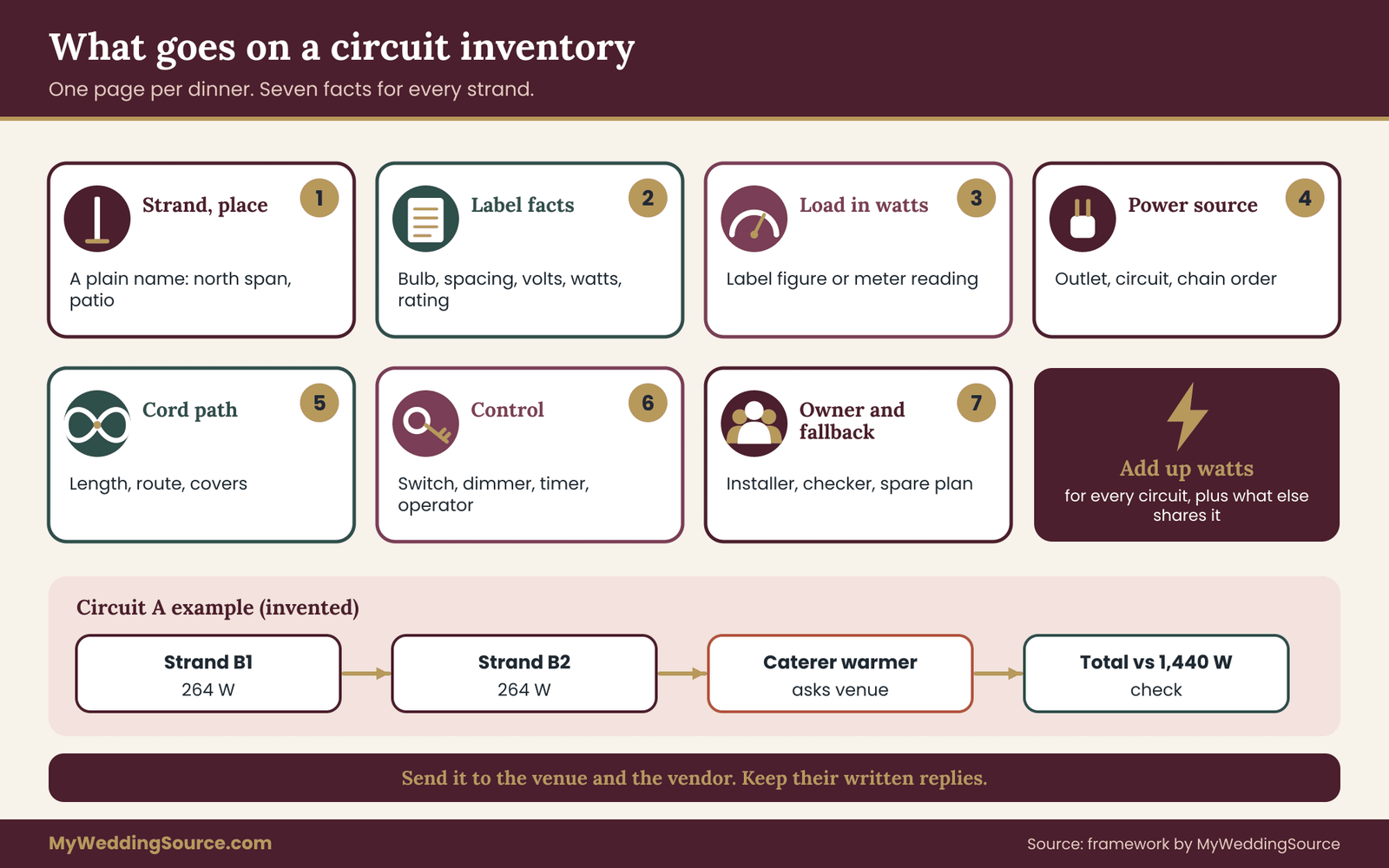
What goes on the inventory
Give each strand its own entry and write the following facts. Keep each entry to a few lines so the whole page stays readable.
Strand name and location. Give it a short label such as “North span, patio” or “Tent ridge, west”. The names are for people to talk about, so use plain ones.
Product and label facts. Bulb type, spacing, length, light source, voltage and rating, taken from the label or from the vendor. If the vendor supplies it, ask for the model name and keep it in the entry.
Load in watts. Write the load of the whole strand, and note whether it comes from the label or from a meter reading. Where you used a figure from a label, say so. This makes it clear which numbers are measured and which are quoted.
Power source. Name the outlet or the distribution point that feeds the strand, and the circuit if the venue can tell you. If the strand is chained to another, note the order and confirm the chain is within the connection limit.
Cord path. Say how power travels from the source to the strand: length of extension cord, route, whether it crosses a walkway and how it is covered or protected.
Control. Say whether the strand is on a wall switch, a timer, a dimmer or a plug-in switch, and who operates it. Include the dimmer model if there is one.
Responsible person. Name who installs it, who checks it before guests arrive, who can reach it during the event and who removes it. Assign roles to named people or named vendor roles, not to “someone”.
Fallback. Write what you will do if the strand fails: a spare strand, a different outlet, candles, or a rule about which loads to drop first.
A short worked entry
Here is what one entry might look like. This is an invented example to show the format, not a recommendation of a product or a load.
“Strand B, patio dinner, north span. Bistro lights, incandescent, forty-eight feet, twenty-four sockets, label reads two hundred sixty-four watts, 120 volts, rated for wet locations. Chained: B1 and B2 end to end, within the label’s maximum of three. Fed from outdoor outlet 2, which the venue says is on the same circuit as outlet 3. Cord path: fifteen feet of outdoor cord along the wall, covered at the door. Control: wall switch inside the kitchen corridor, operated by the venue captain. Installer: lighting vendor. Check: coordinator at five o’clock. Fallback: forty candles from the florist and a warm LED strand in the van.”
Notice how much that entry answers before anyone asks. The venue can see that the outlet is shared and can say whether outlet 3 will host the caterer’s warmers. The electrician can check the load against the circuit. The coordinator knows what to do at five o’clock.
Add up each circuit, not just the whole
The most useful step on the inventory is a column of totals per circuit. List every strand that feeds from a given circuit and add the watts. Compare the sum with that circuit’s continuous allowance, which you estimated in the power section. If the total is above it, or close to it, you have found a problem on paper rather than at seven o’clock on the wedding day.
Then add everything else you know sits on the same circuit. Ask the venue what else will draw from it: sound equipment, a coffee station, a phone charging table, a food warmer, the band’s amplifiers. A circuit that is fine for your strands alone can be overloaded when the band plugs in. The only way to know is to ask, and the inventory gives you the right question: “Here is our load on outlets one through four. What else will be on those?”
Keep a margin
Do not plan to the limit. The continuous-load rule of thumb already leaves a margin, but real events add loads that nobody mentioned. A phone charger, a fan, a vendor’s laptop. Aim to use well under the allowance, and if the arithmetic says you are close, change the plan: use fewer strands, switch to LED, split the chain across a second circuit or ask the venue for a dedicated line.
Who should see the inventory
Send it to the venue manager and to whoever handles the venue’s electrical work. Send it to the lighting or rental vendor, and to your coordinator or day-of lead if you have one. Ask each to reply in writing with a yes, a no or a change. Keep the replies with the inventory. If you are working with a coordinator, the vendor purchase order checklist shows how to turn the answers into a written order that matches what was agreed.
Hanging bistro lights: anchors, sag and approvals
The visual decision and the power decision both assume the strand can be hung where you want it. That is a third question, and it often has the strictest answer, because a venue’s rules about attaching things to a building are usually firm.
Where the weight goes
A run of bistro lights is heavier than it looks. A long span with a dozen glass bulbs pulls on both anchor points, and the pull grows as the strand is stretched flatter. This is why the cord on commercial strands is thicker than on decorative ones, and why long spans are often hung on a separate support cable instead of relying on the strand’s own wire to carry the weight.
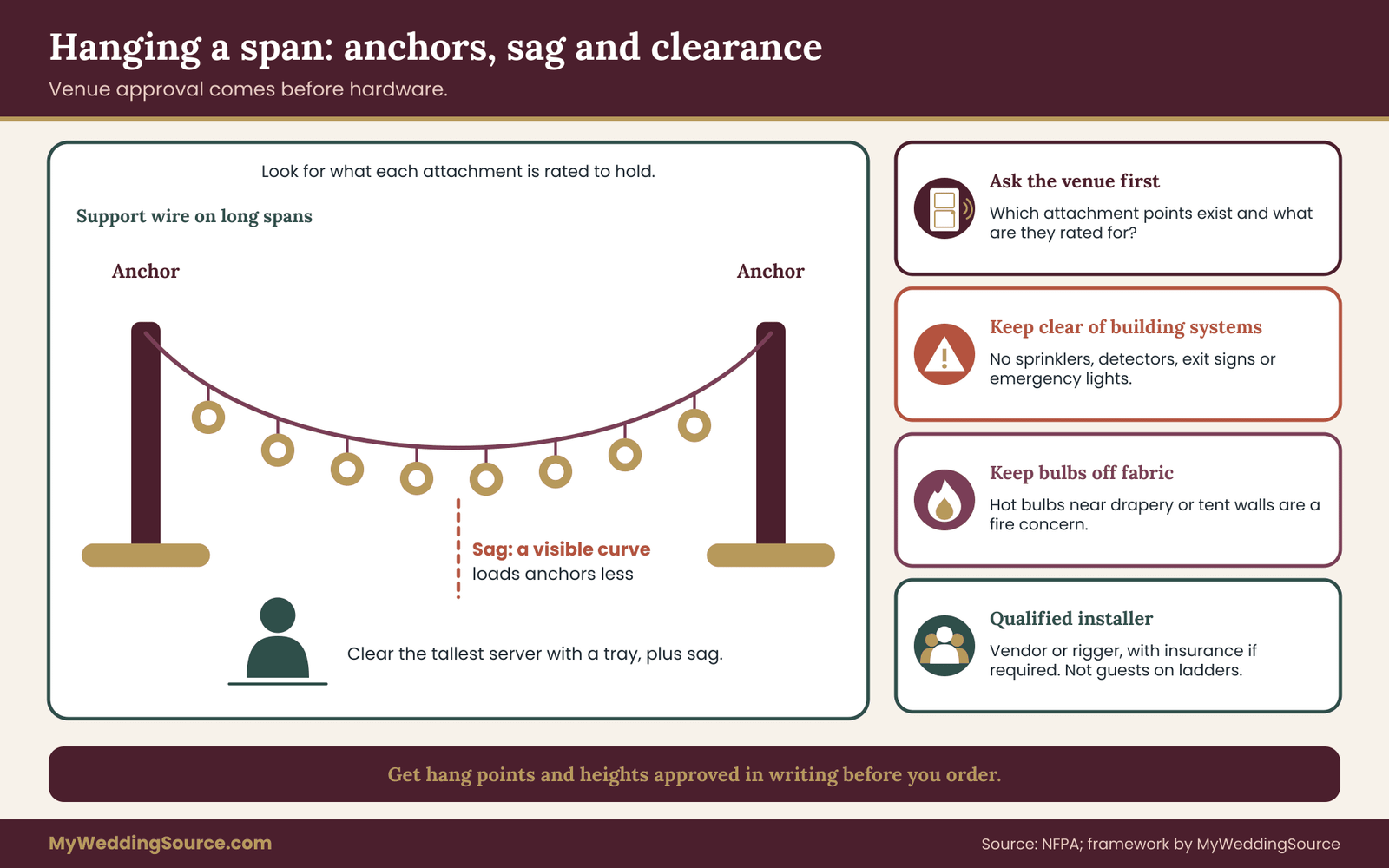
A strand hung between two fixed points forms a curve, called a sag. The deeper the sag, the less tension on the anchors. A flat, tight line looks neat but loads the anchors heavily and can fail at the weakest point. A visible curve is both safer and, for most people, more attractive. When a vendor says a span needs a support wire, that is a sign they are thinking about the load rather than selling you extra hardware.
Anchor options and what each needs
Anchors fall into a handful of families. Poles with a base, such as stands with weights, need no attachment to the building but need space, a stable surface and often a permit-free footprint. Trees may be possible if the venue allows it, but they raise questions about bark, wind and the tree’s health. Building attachment points, such as existing hooks or eyes, are the easiest if the venue has them and says what they can hold. New attachments, such as screws, clamps on rafters or hardware drilled into a wall, nearly always need explicit venue approval. Tent poles and tent structures usually belong to the tent company, which has its own rules about what can load them.
Because of this, ask the venue a question you may not have thought of: “What attachment points exist, and what are they rated for?” Then ask the vendor what they need. If the two answers do not match, the plan needs to change before anything is ordered.
Do not hang strands from sprinkler pipes, fire detection devices, exit signs, emergency lighting or anything that belongs to the building’s life-safety systems. Do not block exits or walkways. These are common rules, and many venues enforce them strictly. The National Fire Protection Association is the standards body behind much of this guidance.
Clearance over people and food
Bistro lights must clear the tallest person who will walk beneath them, plus the tallest object a person may carry. A server with a tray over a head is taller than an adult standing. Aim for a height that works for servers, taller guests and anyone in a hat, then check it with a real measurement during the mockup, not by eye. Leave a margin for sag, because a strand that looks high when taut can dip lower once the bulbs are on and the cord has settled.
Hot bistro lights under a tent roof can also be a concern. Incandescent bulbs get hot, and a bulb that touches fabric or hangs very close to it can be a fire risk. Keep bulbs clear of tent walls, drapery and any decoration, and follow the venue’s and tent company’s rules. If you plan to combine overhead strands with fabric, the guide on ceiling draping approvals explains what the venue may require and why, and it is worth reading before you finalize the hang.
Wind, rain and movement
Outdoors, a strand moves. Wind makes a long span sway, which stresses the anchors and makes bulbs clink together. Rain adds weight and drives water into sockets. If your dinner is outside, ask the vendor how they secure strands in wind and what happens if weather arrives. A fallback, such as lowering strands, switching them off or moving the dinner, should be written into the inventory.
Movement also matters inside. Bistro lights hung above a dance floor can sway when air handling blows, or when someone jumps. Strands near door openings may move with every opening. These are small things, but they affect the look and the wear, and a mockup can show them.
Who is allowed to hang them
Many venues restrict who may do rigging, and some require insurance. Hanging bistro lights above guests is a job for the vendor or for a qualified rigger, and not for a group of enthusiastic friends on stepladders. Ask the venue who is permitted to do it, whether a certificate of insurance is required and what the load-in time window is. If you are not sure what a certificate of insurance involves, the guide on certificate of insurance for wedding vendors explains the basics in plain terms.
Put the installer’s name on the inventory, and put the venue’s written approval of the hang in the file. Approval by text or email is better than a spoken yes, because spoken approvals disappear when staff change shifts.
Dimming, color and control for bistro lights
A dinner has an arc. Guests arrive in daylight or twilight, sit down to eat, and later the room shifts toward dancing. Lighting that cannot change along that arc forces one brightness onto three different moments, and the strand is often the easiest layer to adjust. Whether you can adjust it depends on the bulbs, the dimmer and the wiring, and these are the three places where a plausible plan quietly falls apart.
Why dimming is not automatic
Many people assume bistro lights can be dimmed like a lamp at home. It sometimes can. Incandescent bistro lights generally dim smoothly on a compatible dimmer, and their color shifts toward a deeper amber as they dim, which many people find flattering. LED bistro lights are more complicated. Only bulbs labeled dimmable will dim, and even those depend on the dimmer.
A mismatch between an LED bulb and a dimmer can cause flicker, buzzing, a bulb that will not go below a certain brightness or a bulb that shuts off suddenly. Some dimmers also have a minimum load, below which they misbehave, and a short strand of low-wattage LED bulbs may be under that minimum. It sounds like a technicality, but it is the reason a strand that looked perfect in the shop flickers in the tent.
The practical answer is to test the exact combination. Bring the bulbs, the dimmer and the power source that the event will use, and run the strand at full, half and low. Watch for flicker with your eyes and also with your phone camera, which can show flicker that eyes miss. Photographers and videographers care about this because flicker can appear as bands in video.
Dimmer types in plain language
A dimmer is either built into the wall, plugged in between the outlet and the strand, or part of a larger control system managed by a lighting vendor. Wall dimmers belong to the venue and may be set for certain loads. Plug-in dimmers are portable and common for events, but they have a maximum wattage that the strand must stay below. A control system is the most capable and the most expensive, and usually comes with a technician.
Ask three questions. What is the dimmer rated for, in watts? Is it designed for LED loads? And who operates it? If the answer to the last is “whoever is nearby”, assign someone, because a dimmer without an owner ends up at full brightness during the first dance or at zero during dessert.
Presets instead of improvisation
Instead of trusting someone’s feel for the moment, write a short list of presets for the evening: arrival, dinner, toasts, dancing. For each, note the strand levels you want, as a rough percentage or as a setting. Even a simple list of three entries prevents most arguments on the day. It also lets a venue captain or a lighting vendor carry out your intention without interrupting you.
The reception interior design plan on this site uses the same preset idea across the whole room, and it is a good model if you want to extend the approach beyond the strands. For this article, the point is that your choice between bistro lights and string lights should be judged at each preset, not only at full brightness. A strand that looks lovely at full may be too bright at the toasts. A strand that looks dim at full will look dimmer still when lowered.
Color: warm, warmer and mixed
Color temperature should match across the room. A strand of cool white bulbs next to a warm candle looks wrong, and one that is warmer than the surrounding lights can look orange and dingy in photographs. Many sellers list a color temperature in kelvins, and you can compare strands by that number if the sellers give it. Differences of a few hundred kelvins are visible side by side.
Mixed batches are another trap. Two strands from different production runs can differ slightly in color, and the difference shows when they hang next to each other. Order all bistro lights and spare bulbs for a dinner from one source and one batch, and ask whether replacement bulbs come from the same batch. This sounds fussy, but a few mismatched bulbs in a run of bistro lights are obvious in a way they are not in a dense strand of small bulbs.
Control, timers and the person with the switch
Every strand needs an answer to a plain question: how does it go on and off, and who does it? Options include a wall switch, a plug-in timer, a remote or app-controlled plug and a control system. Each has a failure mode. Timers need the right clock setting and do not adapt to a delayed dinner. Wireless controls depend on batteries or signal and can be affected by other devices. Wall switches may be in a locked room.
For a dinner, a simple manual control with a named operator is often the most reliable choice, and a timer can serve as the backup. Whatever you choose, write it in the circuit inventory and tell the person. A dinner that runs late should not end with the strand shutting off on a schedule nobody remembered to change.
Flicker, hum and heat as quality checks
Three small observations can tell you whether a strand is up to the job. Flicker, visible or on camera, suggests a mismatch with the dimmer or a poor-quality driver. Buzzing or humming suggests the same. Heat in the plug, the cord or the sockets after extended running suggests the load is too high for the wire. Any of these is a reason to pause and ask the vendor. None of them is something to accept on the grounds that it is probably fine.
A worked example: three invented dinners
Examples make the process concrete. These three dinners are invented, with illustrative numbers, to show how the same two products lead to different answers. Do not read the figures as typical. Use your own labels and your own venue.
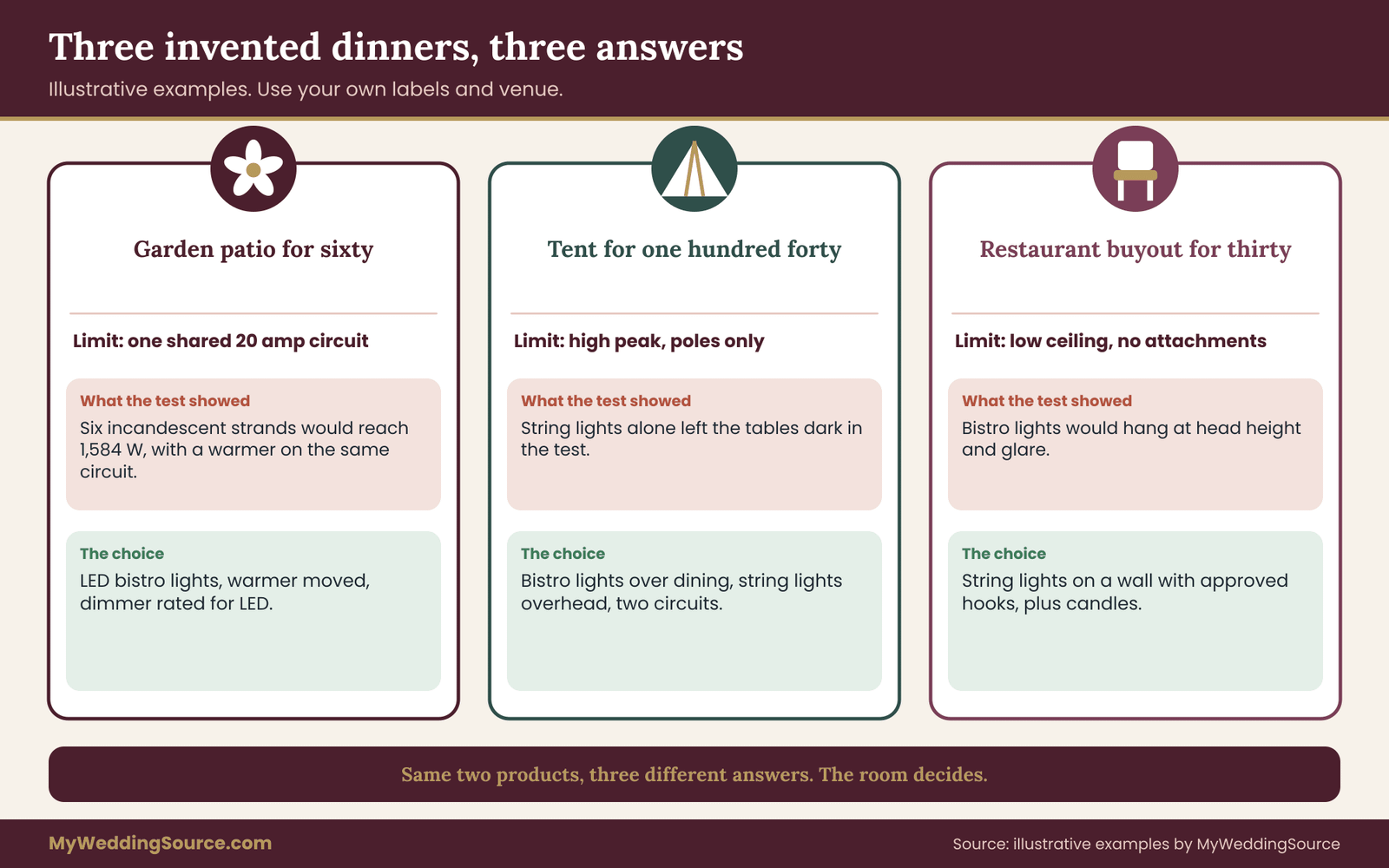
Dinner one: a garden patio for sixty
The couple loves the look of bistro lights. The patio is open to the sky, has no overhead structure and has two outdoor outlets on one circuit, which the venue says is a 20-amp circuit protected by a ground-fault device. The caterer plans to use a warmer near the door, on the same circuit.
The couple’s first idea is six strands of incandescent bistro lights, each labeled at two hundred sixty-four watts, strung between two poles and the building. The arithmetic gives about fifteen hundred eighty-four watts, close to the continuous allowance of a 20-amp circuit before counting the caterer’s warmer. The circuit inventory makes the problem visible.
The solution has two parts. They choose LED bistro lights with similar bulb size, each labeled at a fraction of the incandescent load, and they ask the venue to move the caterer’s warmer to a different circuit. The mockup, run at dusk with one strand of each, shows the LED bulbs look slightly flatter but acceptable once dimmed to dinner level, and the dimmer they planned to use is rated for LED loads. The total load is now small, and the couple has room to add candles without worry.
Dinner two: a tent for one hundred forty
The tent has a high peak and four poles, and the tent company says strands may attach to the pole collars but not to the fabric. The venue provides a generator for the tent. The couple considers ordinary string lights because they want a soft canopy look across the whole ceiling.
The inventory shows many strands with low load each, so power is not the constraint. The mockup shows the problem. At tent height, small bulbs read as faint dots, and the tables below are dark. The couple adds a lower layer: bistro lights on a few runs near the dining area, which supply useful light, with the string lights as an overhead mood layer. Total load is manageable on the generator, and the lighting vendor places the two layers on separate circuits so the dance floor can be dimmed independently.
Notice that the answer was not one or the other. For many dinners, the right answer is a division of jobs: one pattern for light, another for atmosphere. The comparison helps you assign the jobs.
Dinner three: an indoor restaurant buyout for thirty
The room is low-ceilinged with a few overhead fixtures, and the restaurant allows no attachment to the ceiling. The couple wants something overhead for a cozy feel. Bistro lights on a low ceiling would hang near head height and glare. Ordinary string lights, hung along a wall or draped over a shelf, would give a gentle glow without glare.
The venue restricts the load to a single outlet, which the inventory confirms is adequate for a low-wattage LED set. The couple chooses string lights, mounts them along a wall with removable hooks the restaurant approved in writing and uses candles for table light. The main lesson is that bistro lights were the wrong choice for this room, and the mockup showed it before any money was spent.
Questions to ask vendors about bistro lights
Once you know what you want, the work becomes a conversation with a rental company, a lighting designer or a venue. A good conversation uses the circuit inventory as its spine and asks questions that can be answered in a sentence. The questions below are grouped by who is likely to answer them.
Questions for a rental or lighting vendor
Exactly which product is this? Ask for the model, bulb type, bulb size, spacing and length. Ask whether the bistro lights have glass or plastic bulbs, and whether they are incandescent or LED. If the vendor says “bistro lights” and nothing more, ask for the label facts described earlier.
What is the load per strand, and what is the maximum chain? You want watts per strand and the connection limit. If the vendor does not know, ask them to check a strand or a spec sheet.
Are the bistro lights rated for the conditions? Ask whether the strands are rated for outdoor and wet use, and whether they carry a listing mark from a recognized testing laboratory. If the vendor uses them in tents regularly, ask how they handle rain.
What is included with the bistro lights? Strands, spare bulbs, extension cords, power distribution, dimmers, support cable, poles, bases, installation and removal. Ask for each item to be listed on the quote, because a price that looks low often leaves out the cords and hardware.
What happens when a bulb or strand fails? Ask whether spares are included, whether someone will be on site and what the response time is. A vendor who drops off equipment in a van and leaves cannot fix a failure during dinner.
What is the install and strike schedule? Ask when they need access, how long installation takes, whether they need power during installation and when they will remove everything. Check this against the venue’s load-in and curfew windows. The guide to venue curfew and wedding teardown explains how teardown time constraints can quietly rule out a plan.
What are the damage and replacement terms? Ask what you owe if a bulb breaks, a strand is damaged or a pole is bent. Ask for the terms in writing.
Questions for the venue
What power is available, where, and on what circuits? Ask for outlet locations, circuit ratings and what else shares them. Ask whether outdoor outlets are protected by a ground-fault device.
Where may we attach things, and what are the attachment points rated for? Ask for permitted anchor types and any that are prohibited.
Who may install, and what insurance is required? Ask whether the vendor needs a certificate of insurance and whether the venue has an approved vendor list.
What are the rules about open flame, hot lights and fabric? This question matters when strands run near drapery or tent walls.
What are the curfew, sound and lighting rules for the outdoor area? Some venues limit outdoor lighting after a certain hour, or require lights to be dimmed or off, because of neighbors or local rules.
Can we run a test? Ask whether you may come to the venue at dusk with a sample strand. Many will say yes, and the answer tells you something about how the venue treats clients.
Questions for your own team
Who is responsible for turning things on and off? Name a person. Who checks the strands before guests arrive? Name a person and a time. Who has the spare bulbs and the spare strand? Name a place. These are the small, dull questions that prevent a dark dinner.
If you use a coordinator, hand them the circuit inventory and the vendor replies. If you do not, assign the role to a reliable friend or family member who is not also in the wedding party, and give them the same documents. A person who is making a toast at eight o’clock cannot also reset a tripped breaker.
Comparing quotes fairly
When you get quotes for bistro lights from two or more vendors, the totals will not be comparable at first glance, because each vendor includes different items. Rebuild each quote against the same list: strands, bulbs, cords, distribution, dimmers, support, install, strike, spares and damage terms. Mark anything that is missing, and ask the vendor to price it. Only then compare totals.
The broader method for doing this is covered in the guide to comparing vendor quotes through a request for proposal, and the more general vendor due diligence checklist can help you check that the vendor itself is reliable. Both apply here without change.
Rent or buy
Buying bistro lights looks cheaper if you hang them only once, but it brings storage, testing, bulb replacement and disposal. Renting costs more per use and hands those jobs to the vendor. A rental company also carries insurance and usually has experience with the venue. A purchase can make sense if you will reuse the strands, for instance at a home after the wedding, but then you take on the safety checks yourself.
Whichever route you choose, inspect every strand before the event. Look for cracked sockets, frayed insulation, bent plugs and missing bulbs, and test the strand before it is hung. If you rent, do this at pickup and photograph any problems so you are not charged for existing damage. The wedding rental planning checklist covers the pickup and return habits that apply to lighting as much as to chairs and linens.
Edge cases that change the answer
Most dinners fit the patterns above, but several situations do not, and they are worth thinking about early.
A dinner that begins in daylight
If guests sit down while the sky is still bright, the strands do little for the first hour, and the visual effect depends on when it gets dark enough. In that case you may prefer to spend on something that works during the day, such as shade, and treat the strands as an evening layer. Check the sunset time for your date and location with a trusted source, and note it on the inventory, so you know when the lights begin to matter.
A venue that forbids new attachments
Some historic buildings and public parks forbid any attachment to the structure. The options are free-standing poles with bases, a strand mounted on an existing structure the venue has approved, or lights that sit on tables and surfaces rather than overhead. Because overhead hanging is impossible, the choice between bistro lights and string lights may become a choice of tabletop lights. The venue’s technical contact can explain what is allowed, and the venue technical walkthrough guide shows what to measure and ask on the site visit.
Rain, wind and heat
Weather should be a standing item on the inventory. Ask the vendor what the strands are rated for, and ask the venue whether the dinner can move indoors. In heat, incandescent bistro lights make a tent feel warmer, which may argue for LED. In wind, long spans may need extra support, and in rain, exposed sockets may need covers or may need to be switched off.
Long spans and large tents
Long spans of bistro lights multiply every problem. They sag more, they pull harder on anchors and they accumulate voltage drop along chains of strands. If a span is much longer than a single strand, use more than one strand and feed each from its own point, rather than stretching a single long chain. Ask the lighting vendor what span they recommend and how they support it.
Guests with sensitivities
Some guests are sensitive to flicker, glare or strong light, including people with certain neurological or eye conditions. Flicker that is barely visible to you can be unpleasant to them. A steady, adequately dimmed light and a quieter area of the room are kind additions. You do not need to alert every guest. You can simply make sure that a few tables sit away from direct glare.
When the strand and the photographer disagree
Photographers have preferences. Some dislike visible bistro lights in portraits because the bulbs become distracting highlights, and some love them. Video can reveal flicker. Ask your photographer and videographer early, and show them the mockup photographs. Their view should not override a safe plan, but it is useful information about how the evening will be recorded.
Budget pressure
If money is tight, the cost-saving moves that cost least in quality are fewer strands, shorter spans and a lower overhead layer, not skipping the safety items. Do not drop the power distribution, the cord covers, the support cable or the spare bulbs to save a small amount. Those items are small on the invoice and large in their effect if something goes wrong.
A sensible alternative is to spend on a smaller area, such as the dining zone, and use inexpensive candles and lanterns elsewhere. A well-lit dining area under a modest overhead looks more intentional than a large area lit thinly. The same principle applies to the whole-room decisions described in the reception interior design plan, where the money goes to the zones that guests use most.
Choosing between bistro lights and string lights: a decision rule
You now have the pieces: a look test, a load calculation, a hanging check and a set of vendor questions. This section joins them into a rule you can apply in about an hour. It is a sequence of gates, and the order matters, because each gate removes options that the next gate would otherwise have to consider.
Gate one: can the room carry the weight and the load?
Begin with the two hard constraints. First, the venue’s attachment rules: if you cannot hang anything overhead, the whole question changes to tabletop and free-standing options. Second, the power available: write the circuit allowance you can safely use and the total load of your candidate. If an incandescent layout of bistro lights exceeds the allowance, remove it from the list, or move it to LED, or reduce the span. A candidate that fails gate one does not go forward, however good it looks.
This gate is deliberately unromantic. It protects you from falling in love with a design that the building cannot support. It also tends to settle the question quickly in small or restricted venues, where the lighter string pattern or an LED version passes and the heavy one does not.
Gate two: does it give the light the dinner needs?
Of the options that remain, ask what the strand must do. If it is the main light over the dining tables, it needs to give useful light, and bistro lights usually have the advantage. If something else supplies the table light, such as candles, lanterns or a ceiling fixture, the strand can be pure atmosphere, and string lights with smaller bulbs qualify.
Use the mockup result to answer this honestly. If a guest could not read the menu under the candidate in your test, and you have no other light planned, it fails gate two. If it passes only at full brightness, check whether full brightness suits the later parts of the evening.
Gate three: does it suit the room’s scale and your mood?
Now the look decides. Compare the rhythm of bistro lights with the soft band of denser small bulbs. Think about the span, the height, the surrounding décor and the photographs. If two options pass the first two gates, this is where taste properly enters, and no rule beats your preference.
A short test helps. Look at the mockup photographs without reading your notes and ask which one you would want on the wall. Then ask a person who does not know the plan which one they prefer. If both answers agree, you are done.
Gate four: can the plan fail safely?
Finally, test the fallback. If a strand fails, can you keep the dinner going with candles or a second layer? If a breaker trips, which loads drop and who resets it? If rain arrives, what happens to the strands and the guests beneath them? A design that has a fallback and a named person for each failure passes gate four. One that does not should be revised, even if it passed the other gates.
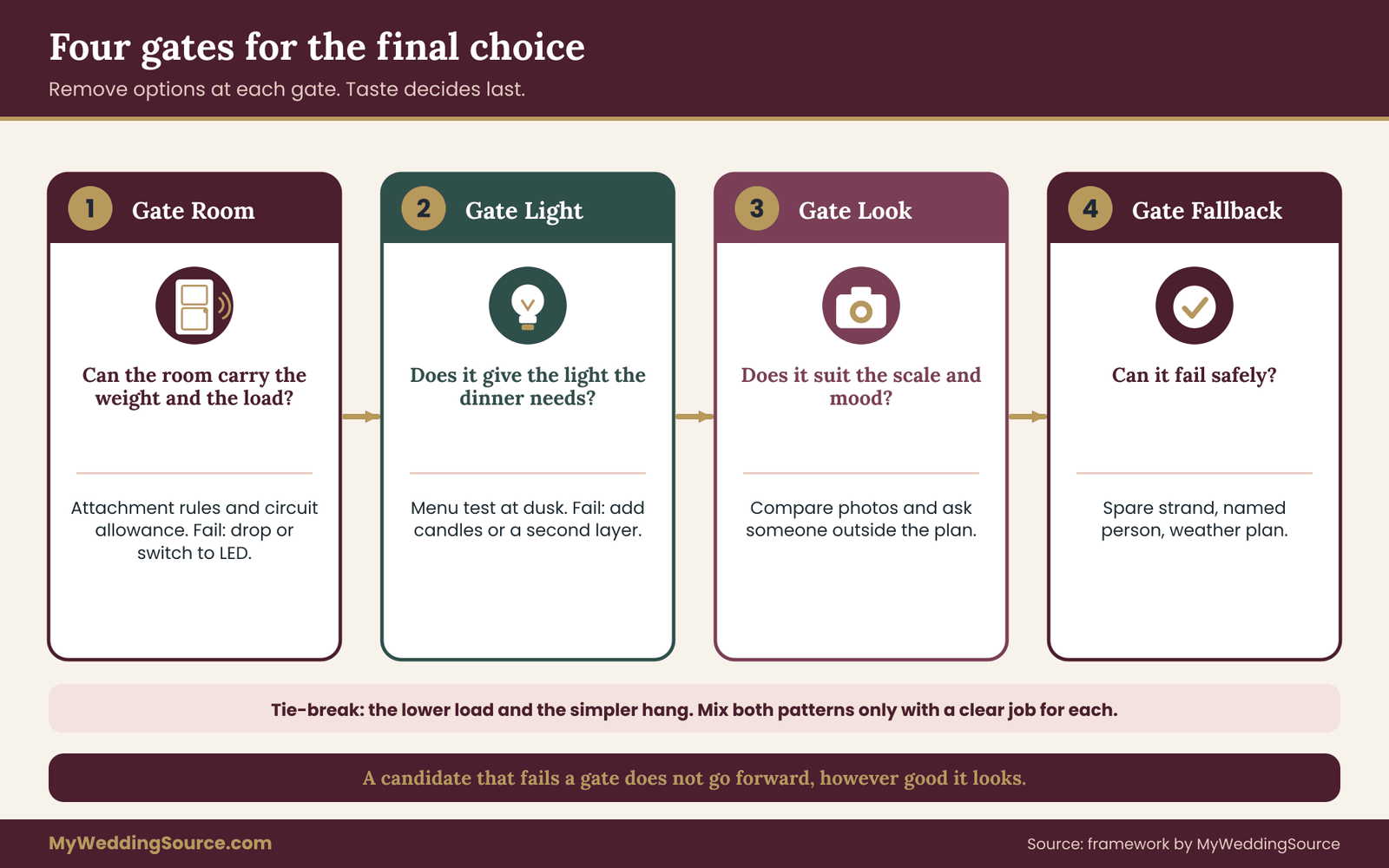
A tie-break for close calls
If the gates leave two good options, prefer the one with the lower load and the simpler hang. Simpler installations of bistro lights tend to have fewer ways to fail. If both are equal in that respect, prefer the one the vendor has used at the venue before, because experience with the building is worth more than a small difference in style.
Using bistro lights and string lights on purpose
Do not feel obliged to choose one pattern. Using bistro lights where you need light and ordinary string lights where you need mood can be better than either alone, provided you assign each a job and put each on the inventory. The risk is mixing them without a reason, which looks accidental. If you mix, make the division obvious: for example, bistro lights over the dining area and smaller ones along the edges or over the lounge.
What to put in writing
When you have decided, write a short specification and share it with the venue and the vendor. It should name the product and label facts, the quantity of strands, the total load, the circuits, the hang points and heights, the control and operator, the presets, the installer and strike times, the fallback and the approvals received. This is the final form of the circuit inventory, with the mockup notes attached. Keep it with your vendor contracts so you can refer to it if a question arises later.
Your next steps
Work through these in order. Each takes less than an hour.
- Collect label facts. Ask each candidate vendor for the five label facts for the exact strands, and write them on a single page.
- Ask the venue two questions. Where may we attach things, and what power is available on which circuits? Ask for the answers in writing.
- Calculate the load. Multiply watts per strand by the number of strands, add the totals per circuit and compare each with the allowance for that circuit. Ask an electrician to check anything close to the limit.
- Run the mockup. Test one strand of each candidate at the proposed height, at dusk and after dark. Read a menu, look at faces, photograph the result and note flicker, heat and glare.
- Choose with the four gates. Apply the decision rule and write the result in two sentences.
- Finish the inventory. Add control, operator, presets, installer, strike time and fallback, and send it to the venue and the vendor for written replies.
- File the approvals. Keep the replies, the mockup photographs and the final specification with your vendor documents.
- Brief the day-of person. Give your coordinator or a trusted helper the inventory, the spare bulbs and the plan for each failure.
FAQ
Are bistro lights and string lights the same thing?
Not exactly. String lights is the broad term for bulbs spaced along a cord. Bistro lights usually means a larger-bulb, wider-spaced, heavier-cord version of it. Sellers use the names loosely, and no standard defines them, so compare the strand’s label facts, such as bulb size, spacing, watts, voltage and weather rating, rather than relying on the name.
Which gives more light at a wedding dinner?
Bistro lights usually give more usable light because the bulbs are larger and the strand’s total output is higher. Smaller string lights tend to read as decoration and leave the tables dim. The only reliable answer for your room is a mockup: hold a printed menu under each strand at dusk and see whether you can read it.
Do bistro lights use a lot of power?
It depends on the bulbs. Incandescent bistro lights can draw a heavy load, so a handful of strands may use most of a standard circuit. LED versions of similar bulbs usually draw far less. Read the label, multiply watts by strands and compare the total with the circuit’s allowance, and ask a qualified electrician to confirm anything close to the limit.
How many strands can I plug together?
Only as many as the label allows. Strands carry a maximum number or total wattage for end-to-end connection, and the first cord in the chain carries the current for all the others. Exceeding the limit can overheat the wire even if the breaker holds. When you reach the limit, start a new chain from another outlet or distribution point.
Can I dim them?
Sometimes. Incandescent bistro bulbs usually dim smoothly on a compatible dimmer. LED bulbs dim only if labeled dimmable, and they also need a dimmer designed for LED loads and a total load above the dimmer’s minimum. Test the exact bulbs, dimmer and power source together, and check for flicker with your phone camera as well as your eyes.
Are they safe to use outdoors in the rain?
Only if the strands are rated for outdoor or wet use, listed by a recognized testing laboratory and connected through proper outdoor-rated cords and ground-fault protection. Indoor-only strands should stay indoors. Ask your vendor and your venue what the strands are rated for, and write a weather fallback into your inventory.
Who is allowed to hang them?
That is the venue’s decision. Many venues limit overhead hanging to their staff, an approved vendor or a qualified rigger, and may require a certificate of insurance. Do not ask guests or friends to hang strands over people from ladders. Get the venue’s approval of the hang points and heights in writing before you order anything.
Can I use both kinds in one dinner?
Yes, and it often works well when each has a clear job: bistro lights where you need usable light, ordinary string lights where you want atmosphere. Put both on your circuit inventory, check the combined load, and keep the color temperature consistent so the two layers look like they belong together.
Sources
- National Fire Protection Association: codes and standards, including the National Electrical Code
- U.S. Consumer Product Safety Commission: decorative lighting and extension cord safety
- Electrical Safety Foundation International: electrical safety guidance
- Occupational Safety and Health Administration: electrical safety
- U.S. Department of Energy: lighting choices and LED information
- ENERGY STAR: lighting and LED bulb guidance
- UL Solutions: product safety marks and certification
- National Electrical Manufacturers Association: standards and electrical products