
A wedding vendor RFP is a short, structured request that asks several vendors to price the same job on the same terms, so the quotes you get back can be compared line by line. This guide shows how to build one: a six-sheet packet, a response form that vendors can fill in quickly, and a set of deviation flags that turn messy replies into numbers you can trust.
A request for proposal works when every vendor answers the same questions about the same event. Write a one-page brief, a scope sheet of numbered line items, a response form with blanks for price, an assumptions sheet, a terms questionnaire and a rules sheet. Send the identical packet to three vendors. When quotes return, mark each difference with a flag (scope, added item, quantity, price structure, terms, or unverified), turn every flag into a dollar figure or a written question, and compare the resulting baseline totals, not the headline prices.
Most couples collect wedding quotes the way people collect restaurant menus: one vendor sends a glossy PDF, another replies with three lines in an email, a third offers a call and a “custom package.” Then comes the awkward part. Somebody has to decide which one is cheaper, and nothing on the table lines up. Hours are counted differently, service charges appear in some quotes and not others, and the word “included” means something slightly different in each.
A wedding vendor RFP fixes this at the source. Instead of reading three different documents and guessing, you hand each vendor the same document and ask for the same kind of answer. The effort is front-loaded: an evening or two of writing. The payoff is that comparison becomes arithmetic instead of interpretation, and surprises show up before you sign rather than after.
A note on scope. This is general information, not legal, tax or financial advice. Contract law, consumer protection rules, sales tax treatment and licensing requirements differ by state and by vendor type, and they change. Where a rule matters, the article points you to the agency that issues it so you can confirm the current version yourself.
Why wedding quotes do not compare, and when a wedding vendor RFP helps
Before building anything, it helps to see exactly how quotes drift apart. Five forces do most of the damage, and each one is something a wedding vendor RFP can control.
Different scopes. One photographer prices eight hours of coverage, another prices six, and a third prices “full-day” without saying how many hours that means. One florist includes delivery and setup, another lists them as separate lines on page three. The headline numbers answer different questions.
Different price structures. Catering may be quoted per person, per hour, per station or as a flat fee. A venue may add a service charge. A rental company may charge delivery by distance. When the unit differs, the total is not comparable until someone converts it, and conversion requires information the quote often leaves out.
Different assumptions. Every vendor quietly assumes something about your event: that load-in is at street level, that the ceremony site has power, that the guest count will not move by more than ten, that you will pick up the cake rather than have it delivered. The assumptions are rarely written down, which means a gap between what you expected and what they priced stays invisible until it costs money.
Different terms. A deposit of thirty percent and a deposit of fifty percent are both normal, but they change your cash flow. A cancellation clause that keeps the whole deposit is different from one that returns part of it. A substitution clause that lets a vendor send a colleague is different from one that names a specific person. None of this shows in the price.
Different effort to answer. A vendor who is busy answers a vague request with a vague quote. The less specific your question, the more room the answer has to avoid the details that matter. A vendor asked for numbers on fourteen numbered lines has far less room.

What a wedding vendor RFP actually is
“Request for proposal” is a term borrowed from procurement, where an organization describes a need in writing and invites several suppliers to respond in a form it can evaluate. Public purchasing rules go further and require evaluation factors to be stated in the solicitation itself; the federal acquisition rules published at acquisition.gov are the standard reference for how large buyers do it.
A couple planning a wedding is not a procurement office and does not need the machinery. What carries over is the principle: describe the need once, in the same words, to everyone; state in advance how you will judge the answers; and make the answers comparable by design.
A wedding vendor RFP therefore has three jobs. It tells vendors precisely what you need. It tells them how to respond. And it tells you how you will decide, which keeps you honest when a charming vendor tries to pull the conversation off course.
It is not a legal contract. It does not obligate you to hire anyone, and it should say so plainly. It is also not a negotiation tactic for squeezing prices. Vendors who receive a clear, organized request tend to respond more carefully, and the same clarity protects them from underquoting a job they did not understand.
When a wedding vendor RFP is worth the effort
Not every purchase deserves one. A simple rule keeps the effort proportionate: send a formal request when the stakes, the variability and the number of candidates all point the same way.
Stakes. Look at the size of the line in your budget. Photography, catering, venue-adjacent rentals, music, florals at scale and transportation for a large group are usually big enough that a one percent difference matters more than the evening you spend writing. A bouquet toss garter does not need a wedding vendor RFP.
Variability. If quotes for the thing tend to differ in structure, not just price, a packet helps. Catering, photography, video, florals, entertainment and décor vary enormously in what they bundle. A cake in a standard size from a bakery with a posted price list varies much less.
Candidates. If you are choosing among three or more serious options, the wedding vendor RFP saves time. If you already know you will hire one specific vendor because of a referral, a venue requirement or a unique skill, a wedding vendor RFP is theater. In that case skip it and go straight to the scope sheet idea described later, which still helps you check what you are buying.
A workable decision rule: use the full packet when a single vendor category is above roughly five percent of your total budget and you have at least three candidates. Use the short version, a brief plus a response form, when the category is smaller or the candidates are fewer. Use neither when the vendor is fixed. Those cut-offs are a starting point, not a law; adjust them to your own budget and patience. The wedding budget guide explains how to set category targets that tell you where the biggest lines are.

When a wedding vendor RFP is the wrong tool
Three situations deserve honesty.
First, vendors who are fully booked or in very high demand for your date may not respond to a multi-page packet at all. They fill their calendar from simple inquiries. If a vendor is your first choice for reasons you cannot replace, ask for their standard quote and use the wedding vendor RFP’s checks afterward, not as a gatekeeper.
Second, very small or solo vendors may find a formal response form heavy. A one-person florist working evenings may answer a short, friendly version better than a six-sheet bundle. The wedding vendor RFP can scale down; the later sections show how.
Third, some venues require you to use their own caterers, rental partners or approved vendors. If your choices are fixed by contract, a wedding vendor RFP has nothing to compare. You can still use the response form to check what the required vendor’s package includes, because a mandatory vendor’s quote is as likely to hide gaps as any other.
What you give up, and what you gain
A wedding vendor RFP takes time and a bit of social courage. You are asking busy people to work in your format. Some will decline, and that is information too: a vendor who cannot tell you in writing what is included is telling you how the contract stage will feel.
What you gain is concrete. You find cost differences before signing, not after. You hear how vendors respond to a detailed request, which previews how they respond to a detailed day. You get a documented reason for your final choice, which helps if you must explain it to a partner, a parent paying part of the bill, or a planner. And when you finally sign, you carry the response form into the contract stage as an attachment, which is exactly what the guide on wedding vendor contracts recommends for aligning promises with paper.
The rest of this guide builds the wedding vendor RFP in order: the six sheets, how to write the brief and scope, how to design the response form, how to send the request, how to flag deviations, how to normalize and score the quotes, a worked example with invented numbers, and how to verify what vendors claim. The last sections cover limits and edge cases, because a method that hides its weak spots is not worth trusting.
The same-scope packet: the core of a wedding vendor RFP template
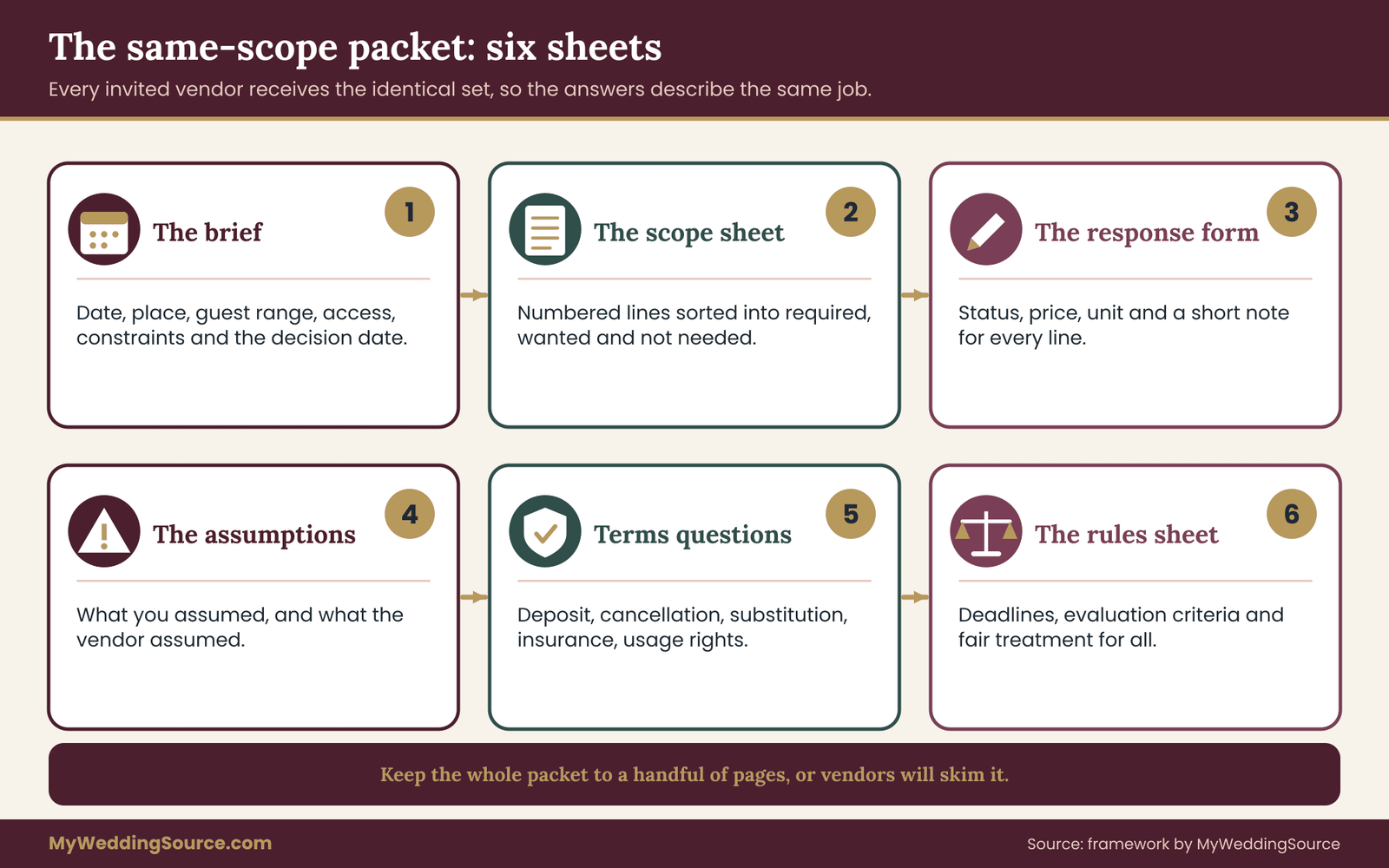
A wedding vendor RFP template does not need to be elaborate. It needs six small sheets, each with one job. Together they form what this guide calls the same-scope packet: the identical set of papers every invited vendor receives, so that the answers describe the same job.
Keep the whole packet to a handful of pages. If it grows long, vendors skim it, and a skimmed packet produces the vague quotes you were trying to avoid. A well-built packet for a mid-size category like photography fits on five or six pages, and a short version for smaller categories fits on two.
Sheet one: the brief
The brief is the event in a paragraph and a half-page list. It states the date and any backup date, the city and venue (or the type of space if the venue is not final), start and end times, expected guest count with a range, the style of the day in plain words, any access constraints, and your budget range for the category if you choose to share it.
Whether to share a budget is a real decision. Sharing it lets vendors propose something that fits and saves a round of mismatched quotes. Withholding it avoids anchoring, and some vendors will price to the ceiling you reveal. A middle path works well: state a range wide enough to be honest, and say that it is a planning range, not an offer. If you do not want to state any figure, ask vendors to quote the scope as written and offer options at two price tiers separately.
The brief also carries a fixed introduction paragraph, which sets expectations. Something like: “We are comparing several vendors for this service. This is a request for quotes only. It does not commit us to hire anyone. We will decide by the date on the rules sheet and tell every vendor the result.”
Sheet two: the scope sheet
The scope sheet lists what you need delivered, as numbered line items. Each line states a deliverable, a quantity or duration, and any specification that matters. It also sorts lines into three groups: required, wanted and not needed. Vendors see this sorting, which tells them where flexibility exists.
For example, a photography scope line might read: “Line 4. Coverage hours: eight consecutive hours, 2:00 pm to 10:00 pm. Required.” And another: “Line 9. Printed album, 30 pages. Wanted, quote as optional.” And: “Line 12. Drone footage. Not needed.”
Numbered lines matter more than any other feature of the wedding vendor RFP. A number lets the vendor answer “Line 4: included, no extra cost” and lets you compare Line 4 across three responses in a glance. Without numbers, you are comparing prose.
Sheet three: the response form of the wedding vendor RFP
The response form is the sheet vendors fill in. Each scope line is repeated, and next to it the vendor supplies four answers: whether the line is included, optional or not offered; the price; the unit the price is based on (flat, per hour, per person, per item); and a short note. A final block asks for the total price as the vendor sees it and for any price that depends on conditions such as a guest count above a threshold.
Design the form so that a blank is a visible gap. If a vendor leaves a line empty, that is a flag. If they answer every line, you have a complete data set. A well-made response form is the single most useful part of the wedding vendor RFP, and the section on it later in this guide goes line by line.
Sheet four: the assumptions sheet
The assumptions sheet has two columns of text, in effect: yours and theirs. On your side you list what you are assuming about the event, such as “the ceremony site has working outlets,” “load-in is through the east door,” “guest count may change by up to ten before the final date.” On the vendor’s side, you give blank space under the heading “Assumptions behind your quote” and ask them to list anything that, if untrue, would change the price.
This sheet surfaces what normally hides. Vendors have habits: a caterer assumes a working kitchen, a DJ assumes a power source within fifty feet, a rental company assumes ground-level delivery. When you ask them to write the assumptions down, they either do, which is useful, or they write “none,” which is also useful, because a quote with no assumptions is a quote with a cost you have not seen yet.
Sheet five: the terms questionnaire
The terms questionnaire is a short list of questions about how the vendor does business, with space for brief answers. It covers the deposit and payment schedule, cancellation and rescheduling, substitution of staff or products, overtime and extra charges, insurance, usage rights where relevant, and how changes are handled. Section four goes through each question and why it earns its place.
The questionnaire exists because terms are the most common place for quotes to differ without anyone noticing. Prices get compared; clauses do not. Putting the terms in front of the vendor in question form gets you answers in writing before you have a contract to negotiate.
Sheet six: the rules sheet
The rules sheet tells vendors how this works. It states the deadline for questions, the deadline for responses, the date you will decide, how you will notify them, how you will evaluate, and what you will do with their information. It states that all vendors get the same information, and that answers to questions from one vendor will be shared with all, without naming who asked.
Evaluation criteria belong here. You do not need a points system, but you should say what you will weigh: whether the vendor meets all required lines, the total cost of the scope as written, the clarity of the terms, and the quality of references or samples. Telling vendors this does two things. It makes them respond to what you will actually use, and it stops you from changing your standard after you have fallen for a particular reply.
How the six sheets fit together
The brief and the scope sheet say what you need. The response form and assumptions sheet collect the vendor’s picture of the same job. The terms questionnaire collects how they operate. The rules sheet keeps the process fair and bounded.
You can build the wedding vendor RFP in a word processor and a spreadsheet, or in one shared document with a table for the response form. If you use a spreadsheet for the response form, lock the scope columns so vendors cannot change them accidentally, and give each vendor their own copy. That prevents one vendor from seeing another’s prices, which matters for fairness and for the confidentiality most vendors expect.
Why a wedding vendor RFP template helps but does not replace judgment
A wedding vendor RFP template saves time, but it can also lull you into sending a packet that does not fit the vendor type. A caterer needs lines about service style, dietary handling, staffing ratios and rentals. A photographer needs lines about hours, deliverables, editing, delivery time and usage rights. A florist needs lines about quantities by piece, delivery windows and container return. The later sections give examples across several categories, but the discipline is the same: adapt the scope lines, and keep the six-sheet structure.
If you want to see how the same scope idea continues after you pick a vendor, read the guide to the wedding vendor purchase order checklist. It covers what happens next: turning the chosen response into a purchase order with acceptance gates and a change log. The wedding vendor RFP in this article is the front half of that story, the part that decides who gets the order.
A quick check of fairness
Before you send anything, test the wedding vendor RFP from the vendor’s side. Would a reasonable vendor know what you need? Could they answer in under an hour? Does anything in the wedding vendor RFP favor a specific vendor, such as a requirement that happens to match one company’s package? If so, fix it. Fair packets produce honest answers, and honest answers are the whole point of building one.
Writing the brief and the scope sheet for a wedding vendor RFP
The brief and the scope sheet decide the quality of everything that follows in a wedding vendor RFP. Vague input gives vague quotes. This section shows how to write both so that a vendor can respond without a phone call, and so that you can later check the answer against your own words.
Start with facts that change price
Not every detail about your wedding belongs in the brief of a wedding vendor RFP. Include the ones that move a vendor’s cost, and leave out the rest. The facts that most often change a quote are these.
Date and time. Give the date, the start and end of the part of the day this vendor covers, and any flexibility. A Saturday evening in peak season costs differently from a Friday morning, and vendors know it. If your date is not final, say so and list the dates still in play. Asking for availability on three dates in one packet is normal.
Place. Name the venue or describe it. Say whether the ceremony and reception are in one location or two, and how far apart. Travel time and setup time often sit behind a vendor’s travel fee or minimum hours.
Guest count. Give your best number and the range you could see. A caterer prices at a number and may have a floor. A rental company counts chairs. A photographer cares about group size for the family formals and about how many people they must move through a room. Say whether the count is firm.
Access. Describe loading, parking, stairs, elevators, ceremony-site distance from the reception and any time windows the venue enforces. Access is the most common hidden cost in rentals, florals, music and catering. Our guide to the venue technical walkthrough covers how to gather these facts at the venue itself.
Constraints. Include dietary or accessibility needs that change the scope, cultural or religious requirements that affect timing, venue rules on open flames, amplified sound, rice or confetti, and any rule that requires proof of insurance. A constraint listed up front is a line item; a constraint discovered later is an argument.
Keep the style section short and concrete
Couples often write long descriptions of mood: romantic, rustic, modern, timeless. These words help a designer and do little for pricing. Put the style in two or three sentences and add one reference the vendor can look at, such as a shared photo board, an example of a past event, or a color palette. Then move on. The brief should be mostly nouns and numbers.
Write wedding vendor RFP scope lines a vendor can answer in one word
The scope sheet is a list of numbered lines. A good line has four parts: what is delivered, how much, to what standard, and whether it is required, wanted or not needed.
Compare two versions of the same line.
Weak: “Great photo coverage of the whole day, with lots of edited photos.”
Strong: “Line 3. Coverage: eight consecutive hours from 2:00 pm to 10:00 pm, two photographers for the ceremony and first hour of the reception. Required.”
The weak line invites a package tour. The strong line invites a yes or a number. Notice that the strong line does not say how many photos or how they are edited, which belongs on other lines. One line, one fact.
Write each scope line so a stranger could verify it afterward. If the line says “enough servers,” nobody can check it. If it says “one server for every twenty-five seated guests during dinner service,” anyone can. Verifiability also helps the later stage, because lines that pass the stranger test become the acceptance checks in your purchase order and the attachments in your contract.
The three groups: required, wanted and not needed
Sort every line into a group. The sorting is the most useful signal you can give a vendor.
Required lines are non-negotiable. A vendor who cannot meet a required line is out unless you decide otherwise. Keep this group small, and be honest. If you call something required and then hire a vendor who skips it, your sheet lost its credibility with yourself.
Wanted lines are priced separately and used for the decision. You would like them and would pay for them if the cost is reasonable. Ask vendors to price them as options, and to say whether the price changes when combined with other lines.
Not needed lines are items you know vendors often offer and you are declining: an album, a rehearsal-dinner add-on, a cake-cutting fee line you have no use for. Listing them keeps vendors from padding the quote with packages you would then have to unpick. It also prevents you from accidentally comparing a quote with a bundled extra to one without it.
Quantities, durations and specifications
In a wedding vendor RFP, convert fuzzy words into units wherever you can. “Plenty of flowers” becomes “centerpieces for fourteen tables.” “Long coverage” becomes “eight hours.” “Good sound” becomes “wireless microphone for the ceremony, a speaker system that covers a room of 150 seated guests and a dance floor of about 300 square feet.”
Where you do not know the unit, ask the vendor to choose and say why. Under a line about food service, you might write: “Service style: you recommend one of plated, family-style or buffet for 140 guests in a room of 2,400 square feet, and state the reason.” That line invites an informed answer and still keeps the structure of the wedding vendor RFP. Use these open lines sparingly. Most of the sheet should be closed lines with a unit.
How to ask for options without breaking comparability
It is tempting to ask for a base quote and for alternatives. Do it, but separate them. The base quote answers the scope as written; every vendor answers the same question. The options are priced on a separate part of the response form, labeled “Alternatives you recommend.” If the vendor offers a better value, you see it clearly, and you can still compare the base answers across vendors.
A common mistake is letting a vendor replace the base with a package that does not match. If the vendor’s standard package happens to bundle seven items and you need five, ask them to price your five and note the bundle separately. If the vendor will not, that is a flag, discussed in a later section.
Category examples
The structure of a wedding vendor RFP adapts across vendor types. A few examples of lines that matter in each category show how the scope sheet changes.
Catering. Menu style and number of courses, guest count with the floor and ceiling the price holds for, service staff ratios, bar service or none, rentals included or separate, cake-cutting and plating, dietary meals and how they are labeled, kitchen needs from the venue, service charge and gratuity treatment, and cleanup and waste handling.
Photography. Coverage hours and start-end times, number of photographers and for which segments, shot list handoff, number or range of edited images and how editing is defined, delivery deadline, online gallery duration, print and sharing rights, backup practice for files, travel, and overtime.
Florals and décor. Quantity by piece (bouquets, boutonnieres, centerpieces, ceremony pieces), flower types or color families with substitution rules, delivery and setup windows, pickup and teardown, container ownership and return, and responsibility for damage.
Music and entertainment. Hours of play and breaks, ceremony, cocktail and reception segments, sound equipment, microphones, lighting, power and space needs, setup time, requests and do-not-play lists, and a policy for emcee duties.
Rentals and transportation. Item counts by type, delivery and pickup windows and fees, setup and breakdown labor, damage and loss responsibility, vehicle capacity and routes, wait times and pickup points.
You do not need every possible line. Pick the ones that change price or create risk, which keeps the sheet short enough that vendors will actually read it.
Test the sheet on someone else
Hand the draft brief and scope sheet of your wedding vendor RFP to one person who is not involved, perhaps a friend or a relative who has hosted events. Ask them to underline anything they cannot answer. Every underline is a spot where a vendor will either guess or call. Fix those, and then send.
A short sample brief
To make this concrete, here is the shape of a brief in prose, written for an invented event.
“Saturday, October 10, ceremony at 4:00 pm in the garden at the venue, reception in the hall 80 feet away, ending at 10:00 pm. About 140 guests, with a possible range of 130 to 150. The venue allows vendor load-in from 11:00 am through the east door, with a ramp. Outdoor power is limited to two outlets at the garden entrance. The day is relaxed and warm, with a green and cream palette. We are comparing three vendors for this service and will decide by the date on the rules sheet. This request does not commit us to hire anyone.”
It is short, specific and checkable. Everything the vendor needs to price the job is in it, and anything missing is something you would then add before sending. A brief like this, plus a scope sheet of ten to fifteen numbered lines, is enough for the first two sheets of a complete wedding vendor RFP.
The response form: line items, assumptions and terms in a wedding vendor RFP template
If the scope sheet is the question, the response form is the answer sheet of the wedding vendor RFP. Its design decides how much work you do later, because every field you make vendors fill in is a field you do not have to chase. This section covers the form itself, the assumptions block and the terms questionnaire.
The four answers for every scope line
Next to each numbered scope line, the vendor gives four things.
Status. One of four short codes: I for included in the base price, O for available as an optional extra, A for offered in an altered form, N for not offered. Four codes are enough. More codes produce more ways to answer vaguely.
Price. The cost of this line if it is not already in the base price. For an included line, “0 (in base)” is a complete answer. For an optional line, a dollar figure. If the price depends on something, the vendor says so in the note field and gives the figure for your stated numbers.
Unit. What the price is based on: flat, per hour, per person, per piece, per mile, per delivery. The unit field exists to catch the conversion problem early. A line priced “per hour” and one priced “flat” can only be compared once the hours are known, and the form makes the hours visible.
Note. One or two sentences. Ask vendors to keep them short and factual. Long notes tend to contain marketing; short ones contain conditions.
Tell vendors that every line of the wedding vendor RFP gets an answer, including N. “We do not offer this” is a perfectly good answer and saves everyone time. A blank is the only wrong answer, because a blank cannot be compared.
The totals block of a wedding vendor RFP
Below the lines, give the vendor a block with four questions that no quote should leave unanswered.
- Total for all required lines, as written, before tax and fees.
- Taxes, service charges, gratuity, travel and any other fees that will appear on the invoice for the scope as written, each stated with its basis (a percentage, a flat amount, or “not applicable”).
- Total as it would appear on the final invoice for the scope as written.
- How long this quote is valid, and what could change the price before then.
The third item is the one you will compare. It asks for the number you would actually pay, not the number that looks best. Most vendors have never been asked this directly, and many will need to think about it. That pause is useful.
On the tax question, do not guess. Whether a service is taxable, and at what rate, depends on the state and sometimes the locality. Ask the vendor how it applies to their line of work, and look to your state revenue or tax department for the rule itself. The point is that the invoice total includes it, not that you learn tax law.
Conditional prices
Some prices are a function of a number you do not control yet. A caterer’s per-person price might hold between 130 and 150 guests and change outside that. A rental company may charge more for deliveries after 6:00 pm. A musician may add a fee beyond the stated hours.
Give the form a short section titled “Prices that depend on a condition.” Ask vendors to list each condition, the threshold and the effect. This block becomes a sensitivity check later: if your guest count moves by fifteen, which quote shifts most?
The assumptions block
The assumptions sheet pairs with the response form. Here is how to word it.
On your side, list the assumptions you are making, as plain statements: the ceremony garden has two outlets; the reception hall has a service kitchen; guests will arrive between 3:30 and 4:00; the venue provides tables and chairs; parking is available for two vendor vehicles. Keep to facts you believe to be true but have not confirmed with the vendor.
On the vendor’s side, ask: “List anything you have assumed about this event that, if different, would change your price or your plan.” Leave generous space. A vendor who leaves it empty may have no assumptions, may not have thought about it, or may not want to commit. You can ask a follow-up if you see an empty block.
When assumptions come back, check two things. First, do any of them contradict your brief? If a caterer assumes a full commercial kitchen and you told them the venue has a prep kitchen only, someone is wrong. Second, do any of them shift risk to you? “Quote assumes client provides all power and extension cords” shifts a cost and a task. It is not necessarily wrong, but it belongs in your comparison.
The terms questionnaire in a wedding vendor RFP
The terms questionnaire is short and specific. Each question matches a point where wedding contracts commonly differ. Ask them as questions, not as demands, and invite brief answers.
Deposit and payment schedule. What is due at signing, when are further payments due, and when is the balance due? This is the cash-flow question. A larger deposit earlier ties up money and increases what you lose if plans change. The guide to wedding cash-flow planning shows how to map these dates against your reserves.
Cancellation by you. What happens to the deposit and later payments if we cancel, and does the answer change as the date approaches? Ask for the schedule in writing, not just “it’s in the contract.” Contracts are not yet signed, and the questionnaire is the cheapest moment to learn the policy.
Cancellation or change by the vendor. What happens if you, the vendor, cannot perform on the date? Ask whether they refund in full, whether they help find a replacement, and who pays any price difference. Ask also whether staff or products can be substituted, and who decides.
Rescheduling. Can we move the date, and under what conditions? Some vendors allow one free move; others treat it as a cancellation. If your date might shift because of a venue issue or a family circumstance, this answer matters.
Overtime and extra charges. What do you charge for extra time, extra staff, extra deliveries or late changes, and how do we approve them? Ask for the rate in numbers.
Insurance and licensing. Do you carry liability insurance, and can you provide a certificate naming the venue if required? Are you licensed where licensing applies to your service? Do not accept “fully insured” as a complete answer; ask for the document. Verification is covered later in this guide.
Usage rights. For creative work: who owns the images, video or designs, what can we do with them, and what can you do with them, including publishing or advertising? Photography has particular issues here, which the guide on wedding photography consent explores from the guest side.
Changes after signing. How do you handle changes to the scope, the guest count or the schedule, and how are price changes communicated and approved? A vendor with a clear answer tends to be a vendor who keeps clear records.
Who does the work. Who will actually be present on the day, and what is their role? If it is a company, who is the named lead? If it is a single person, who is their backup in an emergency?
Referral or commission arrangements. Do you pay or receive any fee, credit or commission for referrals involving this event, including from the venue or any other vendor? Couples sometimes encounter “preferred vendor” lists where listing carries a payment. That is not necessarily wrong, but a material connection between a recommender and a vendor is something you are entitled to know, and the Federal Trade Commission publishes guidance on disclosure of such connections in advertising and endorsements.
Answers you want in writing
Notice what the questionnaire does not ask. It does not ask whether the vendor is “flexible” or “easy to work with.” Those answers cannot be compared. It asks for numbers, dates and named people, which can.
Ask vendors to answer in the document itself, not in a phone call. If they prefer a call, ask for a short written confirmation afterward. The record will matter later if a disagreement arises, and it takes a vendor two minutes.
A short cover message
The wedding vendor RFP travels with a short note. Here is a version that works across categories.
Hello, we are planning a wedding on October 10 and are comparing a few vendors for photography. The attached packet describes the job and has a short form for your answers. Responses are due by September 1, and questions are welcome until August 25. This is a request for quotes only and does not commit us to hire. Thank you for your time.
The note is polite, brief and clear about the deadlines. It does not apologize for the wedding vendor RFP or oversell it. Vendors who are used to inquiries will recognize it as a good one, and many will appreciate being asked to respond in an organized way.
Making the wedding vendor RFP easy to fill in
Fifteen minutes spent making the form tidy returns hours. Number the lines. Pre-fill the unit column with suggestions. Add a note field with a character limit if you use a form tool.
Provide the wedding vendor RFP in an editable format, such as a word-processor file or a spreadsheet, and as a PDF for reading. Give the file a clear name that includes the category and your last name, so it does not get lost in a vendor’s inbox. If a vendor has their own template, ask them to attach it as an addition, not a replacement, and tell them the response form still needs to be filled in.
A well-made form makes the wedding vendor RFP feel like a favor to the vendor: it tells them exactly what you need and how to answer. That is the experience you are aiming for.
Sending the wedding vendor RFP: who to invite, how many and when
A good packet sent to the wrong people, or sent too late, still disappoints. This section covers building the invitation list, choosing a sensible number of vendors, setting the calendar and handling the conversation that follows.
Build a longlist, then screen it
Start with more names than you plan to invite. Sources worth using include personal referrals from people who hired for a similar event, the venue’s list of vendors who have worked there, professional associations and local directories. Treat each source as a source of names, not endorsements. A venue list, in particular, may be a list of vendors who pay for placement or who simply carry the venue’s insurance requirement; the referral question in the terms questionnaire exists for this reason.
Then screen the longlist with five-minute checks before you spend any packet on a name.
Availability. Is the vendor free on your date, or on one of your candidate dates? Many vendors answer this in one email, and a “no” saves everyone effort.
Category fit. Does the vendor do what you need at the scale you need? A small studio that shoots intimate weddings may not be set up for 200 guests; a large catering company may have a minimum that your event does not reach.
Rough range. Does the vendor’s public pricing or their reply to a short inquiry place them anywhere near your range? You are not negotiating yet. You are avoiding packets that were never going to fit.
Basic standing. Can you find a working website, a business address and recent examples of their work? The deeper checks come later; this is just a screen for obvious problems. The wedding vendor due diligence checklist covers those deeper checks in detail.
The result is a shortlist of vendors who plausibly could do the job. Only they receive the wedding vendor RFP.
How many vendors to invite
Three is the number that works for most categories. Two gives you almost no comparison; if one drops out, you are back at one. Four or five is reasonable for large, variable categories such as catering or photography, where one of the responses may come back unusable. Beyond five, the work of reading, flagging and normalizing grows faster than the information gained, and vendors begin to see your request as a mass mailing.
A useful pattern: invite four, expect three useful replies. If all four reply, you have a stronger field. If two reply and you have time, invite a replacement and give them the same deadlines adjusted by a few days, with a note that you are applying the same rules.
The calendar
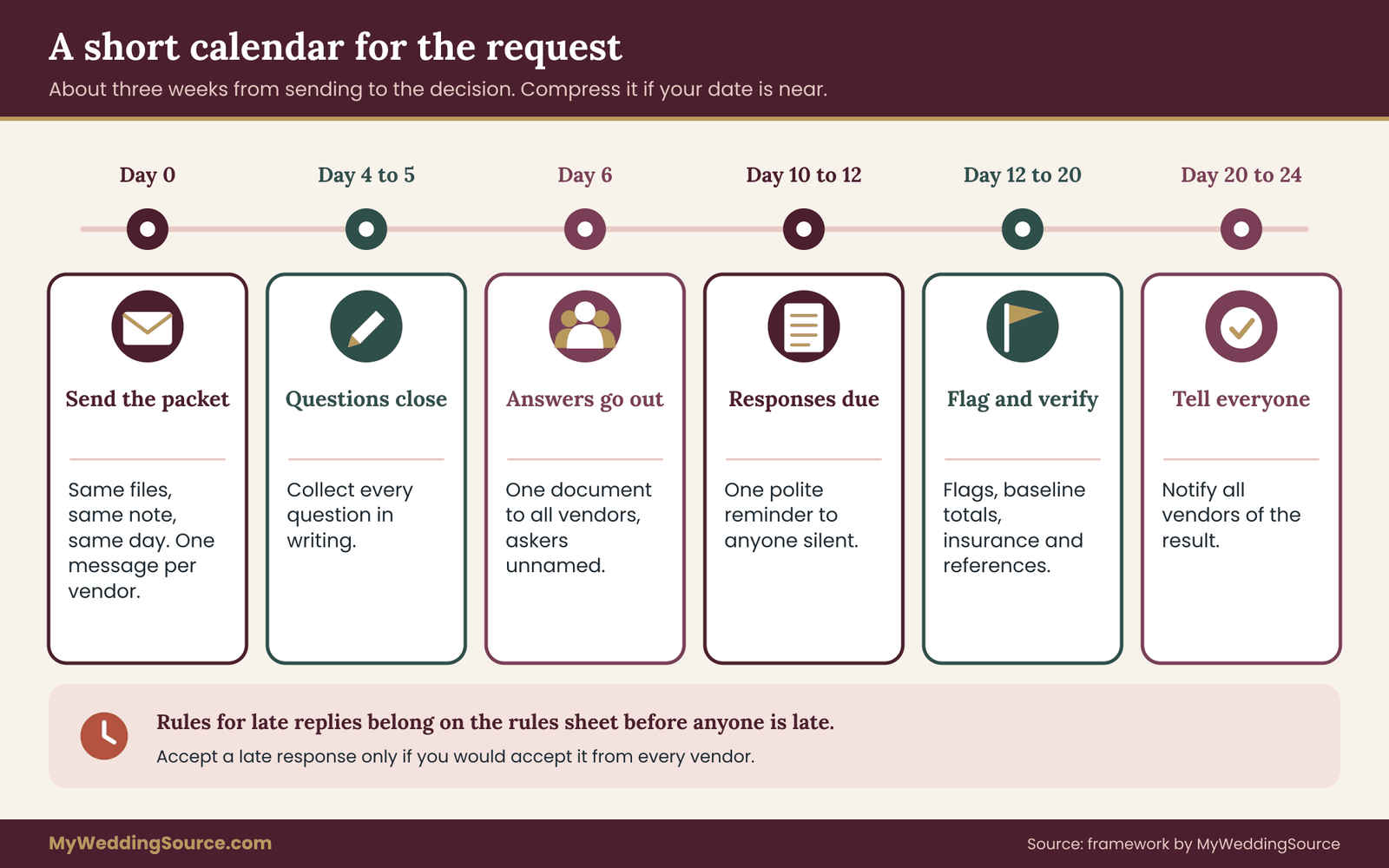
A wedding vendor RFP runs on a short, clear calendar. A common shape is this:
- Day 0: send the wedding vendor RFP.
- Day 4 to 5: deadline for questions.
- Day 6: you send written answers to all vendors.
- Day 10 to 12: deadline for responses.
- Day 12 to 20: you flag, normalize and verify.
- Day 20 to 24: you notify the vendors of the decision.
Those numbers are not fixed. A solo vendor on a small job may need only a week. A caterer preparing a detailed proposal may need two. Choose dates that give vendors a fair chance to answer thoughtfully while leaving enough time before the vendor calendars fill. If your wedding is within a few months, compress, and say so in the rules sheet.
Timing within your overall plan matters too. The wedding vendor timeline guide suggests when each category should be locked down, which tells you when to start the wedding vendor RFP for that category. The principle is simple: begin early enough that a vendor’s decline is not a crisis.
Send the same thing to everyone, at the same time
Send the wedding vendor RFP to all invited vendors on the same day, with the same files, and the same note. Use email and attach the files, or share a link with view access. Put each vendor in a separate message. Do not copy vendors on each other’s emails; they should not see who else is competing unless you decide otherwise, and it protects the confidentiality that most vendors expect.
If you use a shared spreadsheet, give each vendor their own copy. Name the copies so you can track them. If you use email only, name the response files with the vendor’s name so that you can store them without confusion.
Handling questions
Vendors will ask questions. That is good. A question is a sign that someone read the wedding vendor RFP carefully. Handle questions with a simple rule: if the answer changes anyone’s understanding of the job, send it to everyone.
Collect the questions, write answers, remove the asker’s name and send one document to all vendors on the date set in the rules sheet. Keep the log. If a question reveals an error in your packet, such as a wrong time or a missing line, correct it in the answer and note it as an amendment. Do not quietly change the wedding vendor RFP for one vendor.
Sometimes a vendor asks for a call. A call is fine for relationship, but anything that changes the scope belongs in writing. At the end of the call, summarize anything material in an email and ask for confirmation, and if it affects the wedding vendor RFP, share it with the others.
Late responses, silence and partial answers
Not every vendor will follow the schedule. Plan for three situations.
A late response. Decide in advance whether to accept it. If a vendor is a strong candidate and is a day late, you may reasonably accept it; say so in your records, and, if others asked for extensions, offer the same. If you accept one late reply and not another, you have broken your own rules sheet.
Silence. If a vendor does not respond by the deadline, one polite reminder is enough. Silence after a reminder is an answer about how they will communicate after signing.
A partial answer. A vendor who fills half the form and attaches a standard proposal is common. Ask once for a completed form. Say that you need the same format from everyone. Some vendors will complete it; some will not. A vendor who declines to fill it in has told you something, and you can flag it as a verification or scope issue rather than excluding them automatically.
What to say when a vendor resists the wedding vendor RFP
Occasionally a vendor will say that they do not respond to RFPs, that their pricing is only by package, or that they would rather talk by phone. You can answer without friction.
Thank you for being direct. We are comparing a few vendors and need the same information from each, so we can be fair. Would you be willing to fill in the form, even where the answer is “not offered”? If not, we understand, and we will note your standard proposal as-is.
That keeps the door open and keeps your records honest.
Deviation flags: reading what comes back from a wedding vendor RFP
Quotes return in all shapes. The response form makes most of the data uniform, but vendors still add notes, change lines and attach their own documents. Deviation flags are a simple system for noting every place a response departs from the wedding vendor RFP. Every departure gets a flag, and every flag gets a disposition. That turns reading from a vague impression into a checklist.

The six flags
S: Scope gap. The vendor left out a line you asked for, or answered N for something you marked required. Example: the quote covers six hours when you required eight.
A: Added item. The vendor includes something you did not ask for, usually bundled into a package. Example: an album you listed as not needed. Added items may be a gift, a decoy or a cost, depending on whether you want them and whether the price can be lowered if you decline.
Q: Quantity or quality difference. The line is present but different in size or standard. Example: 300 edited images instead of the range you specified, or “assorted seasonal blooms” instead of named flowers.
P: Price structure difference. The price is built differently from what the form asked. Example: a per-person price with a service charge not included, or a flat price with overtime billed separately at a high rate.
T: Terms difference. The deposit, cancellation, substitution, usage rights or change terms differ from what you expected or from other vendors. Example: a 50 percent deposit that is fully non-refundable versus 30 percent with a schedule.
V: Verification pending. The vendor made a claim you have not confirmed. Example: “fully insured,” a license number, a claim about availability, or a reference you have not contacted.
The flags are intentionally few. Six letters fit on a note card, and you can remember them without reading the sheet.
The four dispositions
Every flag ends in one of four outcomes. Marking the outcome is what makes the system useful, because it forces a decision.
Price it. Turn the deviation into a dollar amount and add or subtract it from the baseline. A scope gap becomes the vendor’s own price for the missing line, or an estimate if the vendor will not say.
Ask it. Send a written question. Keep a list of open questions per vendor, and do not compare totals until they are answered, or mark the total as an estimate.
Accept it. Decide the deviation is fine and write why. An added item you want is an acceptance. A difference in terms that does not affect you is too.
Reject it. The deviation is serious enough to disqualify the vendor, or at least to ask for a revised quote before you continue.
Reading a response in order
Read each response in the same order, in a single sitting if you can, so your attention is consistent.
First, check completeness. Did the vendor answer every line, the totals block, the assumptions and the terms? Mark any blank as S or V.
Second, read the status codes. Anything marked A, O or N on a required line is a flag. Anything marked I with a note that sounds conditional is a Q or P.
Third, read the assumptions sheet. Compare each assumption to your brief. Mark contradictions as flags and transfers of cost to you as P.
Fourth, read the terms. Place each answer next to the other vendors’ answers on the same question. Differences get a T.
Fifth, list the claims that require confirmation: insurance, licenses, availability, references. Mark each as V.
Patterns that deserve extra care
Some patterns appear often enough to name.
A quote with many items in the base that you did not request and no way to remove them. That is a bundle used to hide the price of what you do need.
A total that is far lower than the others with several N lines. That is a different job, priced like a bargain.
A reply that rewrites the scope in the vendor’s language and drops your numbers. That is a vendor protecting their format rather than answering your question.
Pressure to sign by a date that is not tied to anything real, such as “this price expires tonight.” Prices can have validity periods, but they should be stated in the quote, not invented in a call. The Federal Trade Commission’s consumer advice pages describe common pressure patterns in scams; a legitimate vendor will not mind you taking a week.
An unwillingness to put anything in writing. This one is simple: do not hire a vendor who will not commit their promises to paper.
Normalizing quotes and scoring the result of a wedding vendor RFP
In a wedding vendor RFP, flags tell you where the quotes differ. Normalizing turns those differences into numbers, so the comparison finally becomes arithmetic. The goal is one figure per vendor, the baseline total, that answers: what would it cost to buy exactly the scope I wrote, from this vendor, on their terms?
Building the baseline total from a wedding vendor RFP
Start with the vendor’s own total for the scope as written, taken from the totals block of the response form. Then work through the flags, one at a time, and adjust.
Step one: price the scope gaps. For each S flag, add the vendor’s own price for the missing line. If they have not given a price, ask. If they refuse, use the average of what the other vendors charge for that line and mark the total as an estimate. Do not leave a gap at zero; a missing line is not free.
Step two: neutralize the added items. For each A flag, decide whether you want the extra. If you do, leave it in, and compare it fairly by asking what other vendors would charge for it. If you do not, ask the vendor what the price would be without it. Be careful: the credit for removing a bundled item is often smaller than the item’s listed value, because the bundle price was set as a whole. Use the credit the vendor actually offers in writing, not the value printed in the brochure.
Step three: adjust quantity and quality. For each Q flag, estimate what it would cost to bring the line up to the written standard. If one vendor offers six hours and you need eight, add two hours at their stated overtime or extra-hour rate. If a florist replaces named flowers with “seasonal,” ask whether the named flowers are possible and at what price.
Step four: convert price structures. For each P flag, restate the price in the form you asked for. Add service charges, taxes, gratuity, travel and delivery. For per-hour or per-person pricing, multiply by your actual numbers. For flat prices with variable extras, estimate the extras using your own schedule. Write down the arithmetic, so you can revise it if your numbers change.
Step five: price what the terms cost. Terms rarely have a clean dollar amount, but some can be priced. A longer gallery hosting period may carry an extension fee. A required insurance certificate may carry an administrative charge. For the rest, translate terms into money at risk. The question is: if I had to cancel at the point I think is most plausible, how much of what I have paid would I lose? Compare that figure across vendors. It is not a prediction; it is a way to see how much each set of terms asks you to gamble.
Step six: mark the confidence. Label each baseline as firm if every number came from the vendor in writing, estimated if you filled in gaps, or open if a major question is unanswered. A firm total of 4,500 and an open total of 4,100 are not the same kind of number.

What to do when you cannot price something
You will not be able to put a number on everything. A vendor’s reputation for calm on the day, the feel of a sample gallery or the confidence of a sample menu does not convert into dollars. Do not force it. Keep non-priced factors in a separate column of thought, which the next part covers. The mistake to avoid is pretending a qualitative judgment is a quantity.
Gate, rank, then break ties after a wedding vendor RFP
Scoring systems tempt couples into false precision when they review a wedding vendor RFP, with weighted points and decimal places that suggest rigor and hide guesswork. A plainer three-step method avoids that.
Gate. First, apply the pass or fail checks. Does the vendor meet every required line? Are they available? Do they have the insurance or licensing your venue and local rules require? Any vendor who fails a gate is out, or pending a fix, before price enters.
Rank. Rank the vendors who pass by baseline total, lowest first, noting the confidence on each.
Break ties on fit. If two vendors are close in baseline total, meaning within the margin of error of your own estimates, choose on fit: the quality of work you saw, the clarity of their answers, the strength of the terms, the quality of references and how they handled the process. Write one sentence for each reason.
The point of the gate is that it prevents a cheap vendor from winning on price while failing a requirement. The point of ranking is that price is a legitimate factor, which most budgets need. The point of the fit step is that after a fair price comparison, the remaining choice is about judgment and should be recognized as judgment.
Sensitivity: what if the numbers move
Before you decide, test the ranking against the changes you think are plausible. What if the guest count rises by fifteen? What if the event runs an hour late? What if the date moves to the backup? Use the conditional prices block to see which vendor’s total moves most. A vendor whose price is steady across your plausible range may be a better choice than one who looks cheaper at the exact number you gave but climbs quickly beyond it.
The decision note
Write a half-page note for your records. It lists the vendors, their baseline totals with confidence, the gate results, the reason for the final choice and any conditions to resolve before signing. This is not bureaucracy. It captures your reasoning while it is fresh, helps a partner or parent follow the decision and gives you something to refer to if a dispute arises later about what you agreed to.
If your choice is not the lowest baseline total, the note should say why. A defensible reason, such as stronger terms, better fit or lower risk, is perfectly legitimate. What the note prevents is a vague memory that you chose a vendor “because they felt right,” when the record might show a significant cost difference you decided to accept.
A worked example: three photographers, one packet
The following example uses invented names and invented numbers. It does not describe any real vendor, and it is not a price guide. Its purpose is to show the method working from packet to decision.
Priya and Marcus are planning an October Saturday wedding with about 140 guests, and they decide a wedding vendor RFP is worth the evening it takes.
The ceremony is outdoors at 4:00 pm, and the reception is in a hall at a second location fifteen minutes away. They want photography coverage from 2:00 pm to 10:00 pm.
They list these required lines on the scope sheet: eight hours of coverage, two photographers for the ceremony and the first hour of the reception, a minimum of 450 edited images, delivery within eight weeks, an online gallery available for at least twelve months, a print release that lets them print and share freely, and travel between the two sites. They list an album as not needed.
They invite three photographers and send the same packet on the same day.

What came back from the wedding vendor RFP
Vendor A quotes 3,900 for eight hours with one photographer. A second photographer is available at 600. The edited image count is “500 or more.” The gallery stays online for twelve months. The print release is included. Travel within thirty miles is included. Overtime is 350 per hour. The deposit is 30 percent, with the balance due 14 days before the wedding, and the deposit is refundable if the couple cancels more than 120 days out. The assumptions block says “none.”
Vendor B quotes 3,300 for six hours with two photographers. Extra hours are 300 each. A print release is a separate 250. The gallery stays online for six months. Travel to a second site is a 150 fee. The deposit is 25 percent. The cancellation clause says the deposit is non-refundable, and balance is due on the wedding day. The terms questionnaire says that substitution of the lead photographer is “possible if needed” without naming a policy.
Vendor C quotes 4,600 for eight hours with two photographers, including a 30-page album and a print release. The gallery stays online for 24 months. Travel is included. The deposit is 50 percent. The deposit is non-refundable, and the balance becomes non-refundable 60 days before the wedding. The note on insurance says “fully insured,” with no certificate attached.
Flags and dispositions
For Vendor A, the missing second photographer is an S flag, priced at 600. There is no other deviation in price. The assumptions block says “none,” which is a V flag: Priya and Marcus ask whether the vendor has any assumptions about outdoor lighting at the ceremony, and the reply is that none are needed. Closed.
For Vendor B, they find several flags. Six hours instead of eight is a Q flag, priced at two hours at 300 each, which is 600. The print release is an S flag at 250. The second-site travel fee is a P flag at 150. The six-month gallery is a Q flag. They ask what it would cost to extend, and the vendor replies that an extension to twelve months is up to 100, depending on storage. The cancellation and substitution clauses are T flags, which they accept as open questions.
For Vendor C, the album is an A flag. Priya and Marcus do not want it. They ask what the price would be without it, and the vendor replies that the credit is 500, not the 800 value listed. The 50 percent non-refundable deposit and strict cancellation window are T flags. The insurance claim is a V flag: they ask for a certificate.
The baseline totals
Vendor A: 3,900 plus 600 for the second photographer makes 4,500, firm.
Vendor B: 3,300, plus 600 for the extra hours, plus 250 for the print release, plus 150 for travel makes 4,300. Adding the estimated 100 for the gallery extension gives up to 4,400, estimated.
Vendor C: 4,600, minus the 500 album credit makes 4,100, open until the insurance certificate arrives.
The ranking by headline price was B, then A, then C. The ranking by baseline total reverses it: C, then B, then A. The cheapest sticker price became the middle option, and the most expensive became the cheapest.
Gates, terms and the decision
Next, Priya and Marcus apply the gates. All three meet the scope once it is corrected. Vendor C is conditional on the insurance certificate, which the venue also requires. Vendor B’s substitution clause is unresolved.
Then they look at the terms as money at risk. Suppose their plausible worry is a date change six months out. With Vendor A, the 30 percent deposit, about 1,350, is refundable beyond 120 days, and the schedule is in writing. With Vendor C, 50 percent of 4,100, about 2,050, would be at risk on signing and non-refundable. With Vendor B, the deposit would be about 25 percent of 4,300, around 1,075, non-refundable, with the whole balance due on the wedding day, a payment structure that makes a day-of dispute awkward.
They ask Vendor C whether a 30 percent deposit and a refundable window of 120 days are possible. Vendor C agrees to 30 percent, with a deposit refundable if the date is rebooked, in writing. Vendor C’s insurance certificate arrives and names the venue. The gates are cleared.
The decision note states: Vendor C, baseline 4,100, firm after the album credit and the terms change, chosen over Vendor A at 4,500, whose terms were equally clear. The reason: a lower total with comparable terms after negotiation, a gallery period of 24 months and a sample gallery they preferred. Vendor A is thanked and told the result. Vendor B is thanked as well.
The example shows two things. A wedding vendor RFP does not guarantee that you pick the cheapest vendor; it makes sure you know what you are paying for. And the terms matter as much as price: without the questionnaire in the wedding vendor RFP, the 50 percent non-refundable deposit would have been found at contract stage, after the other vendors had been dismissed.
Verifying claims, limits and edge cases of a wedding vendor RFP
A wedding vendor RFP collects claims. Verification tests them. Every V flag from the earlier section lands here, along with the honest limits of the method and the situations it handles badly.
Verify with the vendor first when a wedding vendor RFP raises a claim
Many claims can be confirmed with a simple request to the vendor, and a good vendor will answer without fuss.
Insurance. Ask for a certificate of insurance, and ask that it name the venue if the venue requires it. Read it for the dates of coverage, the type of coverage and the named parties. A certificate is a summary issued by an insurer or agent, and the agent listed on it can confirm that the policy is in force. Do not accept “fully insured” as a substitute. The National Association of Insurance Commissioners publishes consumer information, and your state insurance department is the right place to ask about how certificates and coverage work where you live.
Business identity. Ask for the legal business name, address and, where relevant, the registration number. Many states offer a public business search through the secretary of state. The Small Business Administration explains which licenses and permits businesses commonly need, by level of government, which helps you understand what to ask for in a given category.
Specific licenses and permits. Some categories carry licenses with local or state rules: food service permits, alcohol service licenses, vehicle operator requirements and, in some places, rules for amplified sound or open flames. Ask the vendor which apply, and ask for the number or a copy. For food, the local health department sets the rules, and federal food safety guidance is at foodsafety.gov.
Work samples. Ask for something that proves ability at your scale. For photography, request one complete gallery from a single event, not a highlight reel. For catering, ask for a tasting or a sample menu at your price level. For music, ask for a recording of a full set. A highlight shows the best moments; a complete set shows the average one.
References. Ask for two recent clients with events similar to yours. Then call or message them with specific questions: Did the vendor arrive on time? Did the final invoice match the quote? Did anything change after signing? How did they handle a problem? Ask for specifics, not an overall impression.
Availability. Ask the vendor to confirm in writing that they are available on your date and not holding it for another client. Written availability is not a booking, and it does not hold the date, but it records what they said.
Verify with official sources
Some claims are better checked with the issuing agency than with the vendor.
For consumer protection and complaint history, your state attorney general’s office or state consumer protection office is the starting point; the National Association of Attorneys General maintains a directory of offices, and USAGov lists state consumer resources. A complaint history is not a verdict, but patterns are worth noticing.
For fraud patterns, the Federal Trade Commission’s consumer advice site describes common scams and what to do about them. Wedding scams tend to involve deposits to vendors who disappear, fake listings and requests for unusual payment methods. A vendor who insists on a payment method that offers you no recourse deserves a pause.
For payment protection, the Consumer Financial Protection Bureau explains how credit card billing disputes work, including the time limits. Paying a deposit by credit card, where a vendor allows it, gives you a dispute path that a cash or transfer payment may not. Confirm the current rules with your card issuer and the CFPB, since terms vary.
For image and creative rights, the U.S. Copyright Office explains who owns a creative work and what a license allows. If you are buying photography, video or design, it is the neutral explanation of why a “print release” matters.
For procurement concepts, if you want to see how large buyers state evaluation criteria in advance, the federal acquisition regulations at acquisition.gov show the idea in its formal setting. Your wedding does not need that formality, but the principle of disclosing the criteria before the responses arrive carries over.
Do not skip the second look at the contract
When you choose a vendor, the response form becomes part of the agreement only if the contract says so. Many contracts include a clause saying the written contract is the entire agreement and replaces earlier quotes and conversations. That is normal, and it is also how a promised line item disappears. Ask the vendor to attach the response form, or the matched scope lines, as an exhibit, and to write the final price and each condition into the contract itself.
The guide on wedding vendor contracts walks through the clauses worth reading. Contract terms and consumer remedies vary by state, so for a significant contract, a licensed attorney in your state can review it.
After signing, the same scope lines carry forward into the order, the delivery checks and the change log, as described in the guide to purchase orders from scope agreement to final acceptance. The wedding vendor RFP you built for comparison continues to be useful, which is the best argument for building it carefully.
The limits of a wedding vendor RFP
Be honest about what a wedding vendor RFP cannot do.
It cannot measure quality. The wedding vendor RFP compares what vendors promise, not how well they will deliver. Samples, references and a conversation matter, and none of them fit in a spreadsheet.
It cannot prevent price changes. A quote has a validity period. If your guest count, date or scope changes, prices may change. The conditional prices block helps, but it does not eliminate surprises.
It does not make a vendor honest. A packet reveals differences; it does not guarantee that a vendor follows through. Verification, a clear contract and payment practices that protect you do the rest.
It consumes time. If you are late in planning, a shortened version may be all you can afford. A two-page packet beats none.
It is not legal advice. Contract law and consumer remedies differ. Where a decision has legal weight, such as a large deposit or an unusual clause, get a review from a licensed professional.
Edge cases for a wedding vendor RFP
Several situations come up often enough to plan for.
A venue with an exclusive vendor list. If your venue requires you to use its caterer or to choose from a short list, a competitive RFP may not be possible. Use the response form with the required vendor anyway. It gives you the same visibility into what is included and what is extra. If the list has two or three vendors, you can run a normal comparison among them.
An in-demand vendor who will not take part. Ask for their standard quote and answer the wedding vendor RFP’s questions yourself: what is included against each of your lines, what the terms are, what is missing. Mark the gaps as flags and ask. You do not need the vendor to fill in your form to apply your discipline.
A solo vendor on a small job. Send the short version: a half-page brief, six to eight scope lines and five terms questions. Keep the numbering. A friendly message works better than a formal one.
Cultural, religious or community providers. Clergy, community musicians and family-run services often work on donation, custom or trust, not on quotes. A wedding vendor RFP would be out of place. Ask the questions in conversation and keep notes, but do not turn it into a bidding process.
A planner or coordinator. If a planner manages vendor selection, ask how they run comparisons and whether they will share the responses. A planner may use their own format. Ask for a summary that shows what is included and what is extra, using your scope lines.
A change in your own scope. If you change the guest count or the schedule mid-process, send an amendment to everyone. Do not give one vendor the new numbers and leave the rest on the old ones.
A date hold during the process. Some vendors will hold a date for a short time, and some will ask for a deposit to hold it. If you are asked to pay before decision day, weigh the cost against the risk of losing the date, and ask what happens to the money if you choose someone else. A refundable hold fee is different from a non-refundable one.
Closing the loop with vendors you did not choose
Tell every vendor the result, promptly and politely. It takes a minute and builds goodwill in a small industry.
Thank you for the time and care you put into your response. We have chosen another vendor for this wedding. Your answers helped us understand the job better, and we appreciate it.
Do not share another vendor’s prices or details. If a vendor asks for feedback, a short, honest reason is enough, such as terms or total cost.
Your next steps
- Decide which categories justify a wedding vendor RFP, using budget share and candidates.
- Write the brief and the scope sheet for the first category, with numbered lines and three groups.
- Build the response form and the terms questionnaire, and test the wedding vendor RFP on one person outside the process.
- Screen your longlist down to three or four vendors and send the same packet to each on the same day.
- Flag every deviation, give each a disposition, and build the baseline totals with a confidence label.
- Verify the claims that decide the outcome, write a half-page decision note, and attach the chosen response form to the contract.
FAQ
What is a wedding vendor RFP?
A wedding vendor RFP is a written request that asks several vendors to price the same defined job in the same format. It usually includes a brief, numbered scope lines, a response form and a few questions about terms. The aim is quotes you can compare line by line. It does not commit you to hire anyone, and it should say so.
Do I need a wedding vendor RFP for every vendor?
No. It pays off for large, variable categories such as photography, catering or music, when you have at least three candidates. For small purchases, a vendor you have already chosen, or a venue with required vendors, a short brief and a response form is enough. Effort should match the size of the cost and the amount the quotes differ.
How many vendors should I send a wedding vendor RFP to?
Three is a good number for most categories. Invite four for large or variable ones, such as catering or photography, so that one weak reply does not leave you short. More than five tends to add reading work faster than it adds useful information, and vendors may treat it as a mass mailing. Send the identical packet on the same day.
Should I tell vendors my budget?
It is a choice with trade-offs. Sharing a planning range helps vendors propose something that fits, and avoids wasted quotes. Withholding it avoids anchoring, though it may produce quotes that miss. A middle route is to state a wide range and call it a planning range, or ask vendors to quote the scope as written plus options at two price tiers.
What if a vendor refuses to fill in my form?
Ask once, politely, and explain that you need the same format from everyone to be fair. If they still decline, you can take their standard proposal and apply your own checks: map their items to your scope lines, flag the gaps and send written questions. Their reluctance is also information about how they handle detail after signing.
How do I compare quotes with different hours or packages?
Convert each to a baseline total. Take the vendor’s price for your scope as written, add the vendor’s own price for any missing lines, adjust for different hours or quantities, add taxes, service charges and travel, and subtract extras you do not want using the credit the vendor offers in writing. Label each total as firm, estimated or open.
Is the wedding vendor RFP response legally binding?
Generally, no. A quote is usually an offer of price and terms, not a finished contract, and rules about what binds a vendor vary by state and by document. What binds is the signed contract. Ask the vendor to attach the response form as an exhibit and to write final prices into the contract. For significant agreements, consider review by a licensed attorney.
How do I verify that a vendor is insured or licensed?
Ask for a certificate of insurance and, where the venue requires it, for the venue to be named on it. Confirm with the agent listed on the certificate if needed. For licenses, ask for the number and check with the issuing local or state agency. Your state attorney general or consumer protection office can tell you about complaint processes.
Sources
- Consumer advice and scam alerts, Federal Trade Commission
- Advertising and marketing guidance for businesses, including endorsements and disclosures, Federal Trade Commission
- Ask CFPB: credit cards and billing disputes, Consumer Financial Protection Bureau
- State consumer protection offices, USAGov
- Find my attorney general, National Association of Attorneys General
- Apply for licenses and permits, U.S. Small Business Administration
- Consumer information on insurance, National Association of Insurance Commissioners
- Food safety information for consumers, foodsafety.gov
- Copyright basics and FAQs, U.S. Copyright Office
- Federal Acquisition Regulation, acquisition.gov