
A churro station wedding turns fried dough into a live performance, and the performance only works if three things are settled before the contract is signed: the venue has approved the fryer in writing, the oil and the grease have a controlled path from setup to teardown, and the crew can hand guests a warm churro within minutes of frying it. This guide gives you a one-page fryer brief to settle all three.
Treat a churro station as a small outdoor kitchen with a hot-oil fryer at its center. Before you book, get written approval from the venue (and the fire authority, where one is involved) for the exact fryer, fuel and location. Plan the grease: a protected floor, a cooking-oil extinguisher, a closed container for used oil and a named person who takes it away. Then plan the clock: the fewer minutes between the fryer and the guest’s hand, the better the churro. Put it all on one page and have the vendor confirm it.
Churros are easy to love. They smell like cinnamon and sugar, they are fun to watch, and they give guests a reason to wander over and talk. They are also deep-fried food, cooked in a deep pot of very hot oil, handed out in a crowded room or tent while people in formal clothes hold drinks.
A churro station that works looks effortless. One that does not tends to fail in one of three ways: the venue says no on the day, the oil causes a spill or a flare-up, or the line grows faster than the fryer can serve and guests end up with limp, cooled churros.
This article stays on those three problems. It does not debate whether churros belong at your wedding, and it does not compare every possible dessert format. For the wider question of how a menu fits together, the wedding menu planning guide is a better starting place. Here the decision is already close to made, and the question is how to run a churro station safely and well.
A short scope note: this is general planning information, not legal, tax or financial advice, and fire, permit and food-safety rules differ by city, county and venue, so confirm the current ones with the local fire and health authorities and with your venue.
What a churro station wedding really asks of the venue and the vendor
Most dessert vendors arrive with food that is finished somewhere else. A cake is baked, cooled and delivered. A macaron tower is assembled in a kitchen and carried in. A live churro station is different, because the dangerous and messy part of the work, the frying, happens in front of your guests, at your venue, on your date.
That changes who needs to be consulted. For a cake delivery, you mostly deal with the baker and the venue coordinator. For a live fryer, at least five parties have a stake:
The venue. The venue controls its property, its power, its floors and its insurance. Many venues have a rule about open cooking, and some prohibit deep frying altogether, especially inside historic buildings, hotels and any room with a sprinkler system and soft furnishings.
The fire authority. Fire codes decide where cooking can happen, how far a fryer must sit from tent walls or decor, and whether a permit or inspection applies. In most places this is a local fire marshal or fire department, and the venue or the vendor usually knows the contact.
The health authority. Local health departments set rules for mobile food vendors, hand-washing, food handling and sometimes temporary event permits. The vendor normally carries the license, but you should see it.
The insurer. A cooking vendor is a bigger liability than a flower vendor. The venue will likely ask for a certificate of insurance, and your own event insurance may care about open flame or fryers.
The vendor. The vendor owns the equipment, the recipe, the oil and the training of the crew, so the vendor’s answers to your questions are the foundation of everything else.
If any one of these five says no late in the process, you have a problem that is hard to fix in the last week. The point of the brief in the next section is to collect all five answers early, on one page.
Why a churro station is a timing problem as well
Fire and grease get the attention, but guests mostly judge the churro station by something simpler: was it warm and crisp? A fried churro is at its best soon after it leaves the oil. Steam inside the dough softens the crust, sugar draws moisture, and a churro that has waited is chewy rather than crisp. No statistic is needed to see this, because anyone who has eaten a cooling churro at a fair knows it.
So the second question after safety is a numbers question. How many churros can one fryer finish per minute, how many guests will arrive at the same moment, and what happens to the line when those two numbers do not match? A churro station that looks small and charming can still be badly undersized for a busy window. The throughput section later in this guide gives you a way to check the math before you hire anyone.
Why a separate brief helps
A general vendor contract covers price, date, hours and cancellation. It rarely covers where the fryer sits, which fire extinguisher is nearby, who hauls the used oil, or how many minutes the crew will let a finished churro wait. Those details live in the heads of the vendor and the venue manager, and heads do not always agree.
A one-page brief fixes that. It is not a legal document and it does not replace the contract, but it can be attached to the contract, or at least referenced in it. The wedding vendor contract guide explains how scope, deposits and amendments fit together, and the brief gives that contract the operational detail a fryer needs.
The four-block fryer brief for a churro station
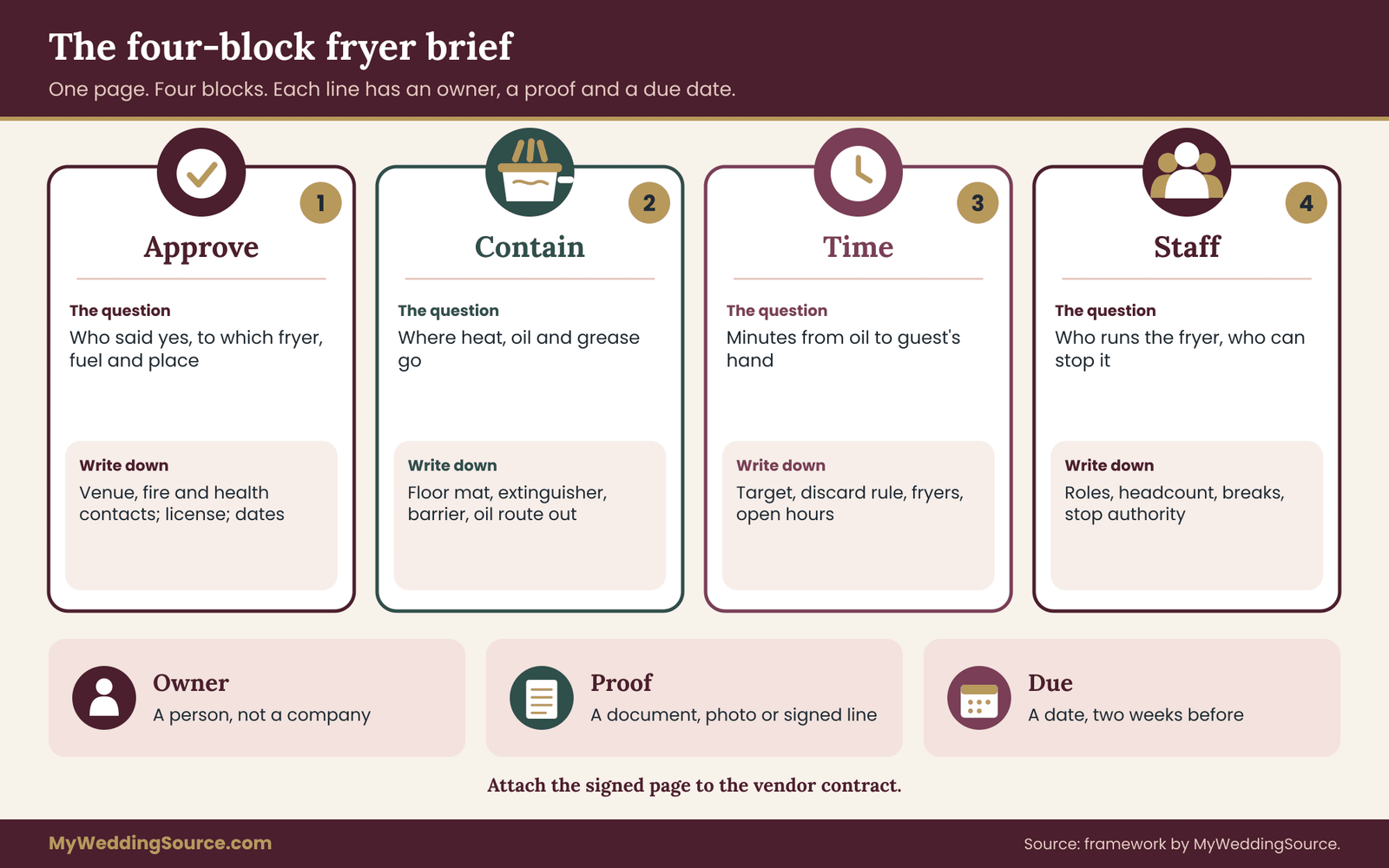
The brief has four blocks, one for each question you need answered: Approve, Contain, Time and Staff. Each block has the same three lines, so nothing gets answered with a vague “we’ll handle it.”
Approve. Who has said yes to this fryer, in what place, using what fuel? The block records the venue contact, the fire authority contact if there is one, the permit or license the vendor holds, and the date each approval was given. If something is not yet approved, the block says so plainly.
Contain. Where does the heat, the oil and the grease go? This block records the fryer type, the floor protection, the extinguisher, the distance to anything that burns, the barrier between the fryer and guests, and the route the used oil takes out of the building.
Time. How long is a churro allowed to live between the oil and the guest? The block records the target fry-to-hand time, the discard rule for anything held too long, the number of fryers, and the hours the churro station is open.
Staff. Who is trained to run the fryer, who is on the line, who finishes and serves, and who has the authority to shut the churro station down? The block records names or roles, the number of people, and the break plan.
Each block then answers three questions: who owns it, what proof exists, and when is it due. The owner is a person, not a company. The proof is a document, a photo, a measurement or a signed line. The due date is a calendar date, ideally at least two weeks before the wedding.
How the brief changes the vendor conversation
Most vendors will respond well to a one-page brief, because it tells them you have thought about their work. A professional operator usually has answers ready: the fryer model, the extinguisher, the insurance certificate, the oil disposal arrangement. Those answers can go straight onto the page.
A vendor who cannot answer, or who gets defensive about being asked, has told you something useful. It does not always mean the vendor is unsafe, but it does mean the plan is not ready. The vendor due diligence checklist covers the wider set of checks you may want for any vendor, and the brief is the specific version for a fryer.
What the brief looks like on paper
Keep it to one side of one page. Put the date, the venue name and the vendor name at the top. Under each of the four blocks write the answer to each of the three lines in one or two plain sentences. Add a short line at the bottom for signatures or, if signatures feel stiff, for an email reply that says “confirmed, as written.” The vendor, the venue contact and one of you should each hold a copy.
Here is an example of how a single line reads in practice. Under Contain, the owner line might say “Vendor lead, name and phone.” The proof line might say “Photo of the extinguisher with its inspection tag, sent by the vendor ten days before the wedding.” The due line might say “Ten days before.” Nothing in that is difficult, but it turns a vague promise into something you can check.
The sections that follow take the four blocks one at a time, starting with the one that can stop the whole plan: approval.
Getting venue approval for a churro station in writing
Approval is the first block because it is the only one that can end the plan outright. You can improve a timing plan or a staffing plan after the contract is signed. You cannot do much if the venue manager says on the morning of the wedding that a fryer is not allowed on the property.
Ask the venue the right questions, in this order
Start with the broad question and narrow it. Many couples ask “Can we have a dessert station?” and hear “Of course.” That answer covers a cake table. It says nothing about a deep fryer. Ask the direct version instead: “We would like a live churro station with a deep fryer run by a licensed vendor. Is open frying allowed at the venue, and where?”
Then follow with five narrower questions. Does the venue have a written policy on cooking by outside vendors? Does the venue require its own caterer to do all cooking, with outside vendors limited to finished food? Are there rooms or areas where frying is allowed and others where it is not? Does the venue require a certificate of insurance from any vendor who cooks, and what coverage does it name? Does the venue need to notify its own insurer, landlord, or the local fire authority?
Write down the answers with the date and the name of the person who gave them. If the venue speaks only by phone, send a short email afterward that says “To confirm what we discussed” and restates the answer. That email is your record.
Exclusive caterers and “no outside cooking” rules
Some venues have an exclusive caterer or a list of approved caterers, and the contract often says that all food and beverage must come from that list. A churro station vendor may count as food service. Sometimes the venue will permit an outside dessert vendor on the condition that the vendor serves only finished items, which rules out frying on site. Sometimes the venue will make an exception if the vendor is licensed, insured and approved in advance, and may charge a fee.
Read the relevant clauses in your venue contract rather than relying on a summary. If the clause is unclear, ask the venue to clarify in writing whether a live fryer is covered. The wedding venues guide explains how to read a venue contract and which restrictions tend to surprise couples, and the cooking clause is one of them.
If the venue’s own caterer offers a churro station, that is a different path. The caterer may own the fryer, the permit and the insurance already. The brief still applies, but the Approve block becomes much shorter.
Indoor, covered and open-air locations
The risk profile changes with the setting.
Inside a building. Indoors, the concerns are smoke, odor, ceiling sprinklers and smoke detectors, floors that may be wood or carpet, and a lack of ventilation. A deep fryer under a smoke detector is a known way to set off an alarm and, in some buildings, call the fire department. Many venues simply do not allow it unless there is a commercial kitchen hood in the space.
Under a tent or awning. Tents are covered by fire codes that often restrict cooking beneath or near the fabric. The tent should have documentation showing its flame-resistance rating, and the fire authority may specify a minimum distance between a fryer and the tent wall. Ask the tent rental company for the document, and ask the fire authority or the venue what distance applies. Do not guess.
Open air. Approval for an outdoor churro station is usually the easiest. Even there, wind, grass, dry vegetation, uneven ground and the closeness of guest tables matter, and the venue may still have a rule about where cooking can happen on the grounds.
A good compromise for many weddings is a churro station set at the edge of a covered patio, a courtyard or a loading area, open to guests on one side and separated from the main room by a clear gap. The venue can often suggest a spot that has been used for similar vendors before.
Permits, licenses and who holds them
A cooking vendor usually needs a food business license or a mobile food permit from the local health authority, and some places require a temporary event permit for each separate event. Which applies depends on the vendor’s operation and on local rules. As the client, you are not the permit holder, but you can ask to see the documents and note the expiry date.
Fire permits are a separate question. Some jurisdictions require a permit for cooking with propane, for operating under a tent, or for using an open flame at a public gathering, and some do not. The fire authority decides, and the answer may differ from the next town over. The vendor should know the local requirement. If the vendor says “we’ve never needed one,” ask whether they have worked in this specific county or venue before.
You do not need to become an expert. You need to ask, write down who said what, and keep the proof in the Approve block.
The approval ladder
It helps to see the approvals as a ladder, from the closest person to the farthest. The venue manager sits on the first rung. The venue’s caterer or event staff sits on the second. The fire authority and health authority sit on the third. The insurers sit on the fourth. If the first rung says no, nothing else matters. If the first says yes and the third is silent, you are not finished.
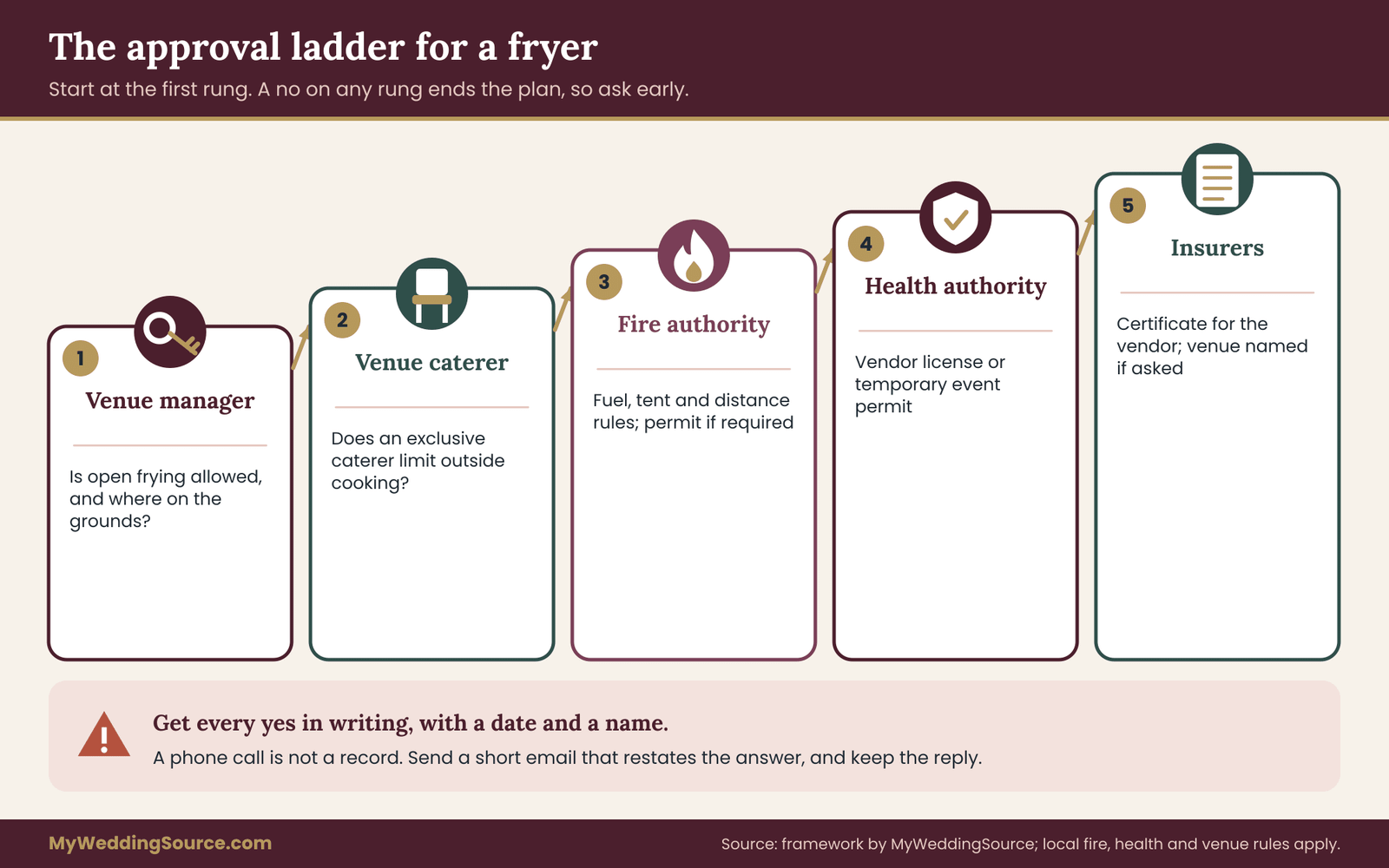
Work up the ladder in order, and ask the vendor to handle the rungs that belong to the vendor, such as the health license and the insurance certificate. Keep your own role simple: you are the person who makes sure each answer exists and lands on the page.
Fuel, power and placement for a churro station
Once the venue says yes in principle, the next question is the practical one: what is the fryer, what does it run on, and exactly where does it stand?
Propane, electric and induction fryers
Mobile churro station vendors usually run one of three kinds of equipment. Ask which one yours uses, and make sure the answer matches what the venue approved.
Propane. Propane fryers are common because they work anywhere. They also bring fuel cylinders, hoses and an open flame. Many venues and fire authorities restrict propane near buildings and tents, and some prohibit it indoors completely. Ask where the cylinders will be stored, who connects them, and how leaks are checked. A propane fryer is often fine outdoors with proper clearance and a trained operator, and a problem almost anywhere else.
Electric. Electric countertop and floor fryers have no flame, which some venues prefer, but they draw a lot of power. A single commercial electric fryer can use more electricity than the circuits in a typical hall are designed to supply to one outlet. They need a dedicated circuit with enough capacity, and extension cords are a hazard here. Ask the vendor for the fryer’s electrical rating and ask the venue which circuit can carry it.
Induction. Induction cooking heats the pot directly with a magnetic field and creates no flame. Some vendors use portable induction units for frying. They still need adequate power and a sturdy base, and they still hold very hot oil, so the contain plan is the same.
None of these is automatically the right choice. The correct one is the type the venue has approved for the spot where it will stand.
Power: a short worksheet
If the fryer is electric or induction, do a simple power check. Ask the vendor for the equipment’s voltage and amperage, found on the nameplate. Ask the venue which outlet or circuit the vendor may use, and what else is on that circuit: lighting, the DJ’s equipment, a coffee station, a gelato cart or a photo booth. Total the load. If the vendor’s fryer and the other items together exceed the circuit’s rating, the breaker will trip, probably during the busiest window.
If you are unsure, ask the venue’s technical contact or a licensed electrician to confirm. Do not run extension cords across guest walkways or through wet grass. A generator is an option for outdoor events, but it adds noise, exhaust and its own fuel, and it needs placement away from guests and tents. The venue technical walkthrough guide describes how to confirm power and access with the venue before the day.
Placement: the five-point check
Where the fryer stands matters as much as what it is, because the churro station depends on its surroundings. Use a five-point check when you walk the space with the vendor and the venue contact.
First, the surface. The fryer needs level, stable, non-combustible ground or a protective base. Grass can be soft and uneven, and wooden decks can be damaged by hot oil. Second, the distance to anything that burns: tent walls, drapery, paper decor, balloons, florals and wooden structures. The fire authority or the venue sets the exact distance, and the vendor should know it.
Third, wind. A breeze can push flame, smoke and sugar dust toward guests. Fourth, the guest path. A fryer should never sit in a main walkway or near the dance floor. Fifth, the exit. Staff must be able to leave the area quickly in an emergency, and a crowd should never block the way.
Keeping flammable decor away
Wedding styling is full of flammable materials. Paper lanterns, dried grasses, ribbon, candles and fabric draping are all common near dessert areas, because couples like the dessert station to look pretty. A churro station needs a clear zone instead, with nothing flammable inside it. Tell your florist and your decorator that the area around the fryer is functional, and agree on where their pieces stop.
Candles on the churro table should be flameless. A small sign or a stripe of tape on the floor can mark where decor ends and the working zone begins.
The Approve and Contain blocks of the brief for your churro station can now be completed with real answers: the fryer type, its fuel, its circuit, its location, and the clear zone around it. The next section deals with what happens inside that zone.
Fire and grease control at a churro station
Hot cooking oil is a different hazard from an ordinary candle or a chafing dish. It can burn skin badly, it can ignite if it overheats, and it reacts violently to water. A churro station is safe when the crew treats those facts as routine, not as exceptions.
Your job as the host is not to supervise the fryer. It is to confirm that the vendor has the equipment and the habits that keep the hazard contained, and to make sure the venue can see the same plan.
The hazards, named plainly
There are five ways a fryer goes wrong at an event, and each has a different defense.
Overheated oil. If the oil gets too hot, it can smoke and eventually ignite. A fryer with a working thermostat and a visible thermometer, watched by a trained operator, is the defense. Ask what temperature the vendor cooks at and how they check it. Many churro recipes call for oil somewhere in the neighborhood of 350 to 375 degrees Fahrenheit, but the vendor’s recipe and equipment set the real number.
Water in hot oil. Water that drops into hot oil turns to steam instantly and throws oil out of the pot. Wet churro dough, ice, a damp utensil, a rain drip from a tent seam or a guest’s spilled drink can all do it. The defense is dry tools, covered storage, and keeping drinks well away from the fryer.
Splatter and spill. Oil can pop out of a pot when churros go in, and a pot can be knocked or tipped. The defense is a sturdy base, a splash guard, a rule that nobody reaches over the pot, and a fryer placed where staff have room to move.
Grease fire. A grease fire spreads fast, and water makes it worse. The defense is a fire extinguisher rated for cooking oils, a lid or fire blanket that the crew knows how to use, and a plan that does not involve a bucket of water.
Burns to guests. Guests, especially children, lean in to watch. The defense is distance: a barrier, a table, a line on the floor, and a rule that finished churros are handed across the barrier and never fetched from the fryer area.
The extinguisher question
Portable fire extinguishers are sorted into classes by the type of fire they handle. Fires involving cooking oils and fats have their own class, commonly called Class K in the United States, and the National Fire Protection Association publishes the standard that governs portable extinguishers. An ordinary all-purpose extinguisher is not necessarily designed for a deep fat fryer fire, so ask the vendor exactly what they carry.
Ask four things. What type and rating is the extinguisher? Is it within easy reach of the fryer without being directly behind it, where the staff member would reach through flames? Does it have a current inspection tag? Does the crew know how to use it?
The vendor should be able to send a photo of the extinguisher and its tag. Some venues also supply extinguishers and will want to know where they sit relative to the churro station, and the fire authority, if involved, will have its own expectations.
A fire blanket, a metal lid sized for the pot and oven gloves are inexpensive extras that a careful vendor tends to carry. They are not a substitute for an extinguisher.
The layout: three zones and a line
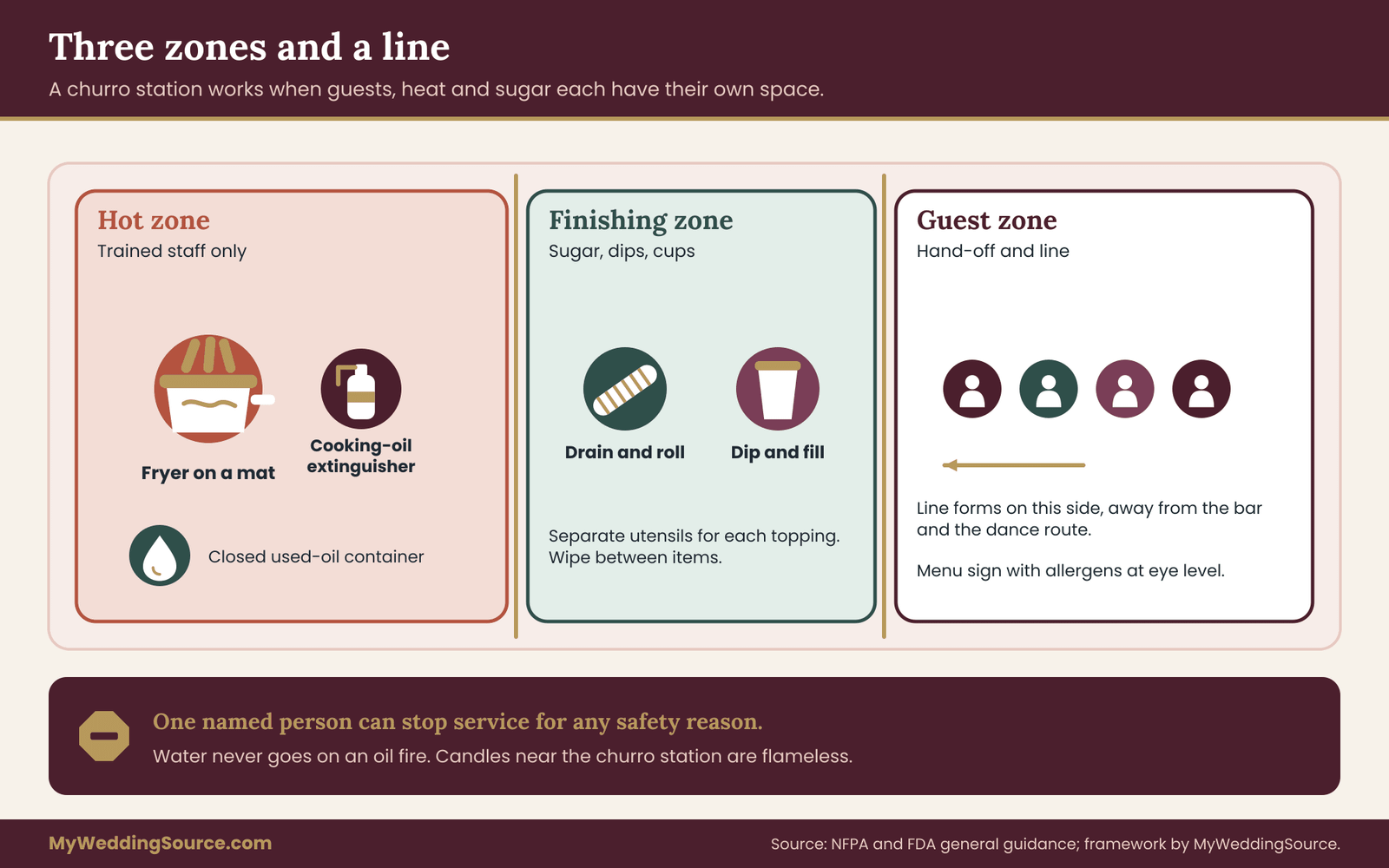
Think of the churro station as three zones with a clear line between the guests and the work. The hot zone holds the fryer and the oil, and only trained staff enter it. The finishing zone is where drained churros are rolled in cinnamon sugar, filled, dipped or boxed, and where the sugar, the sauces and the paper goods live. The guest zone is the table or counter where finished churros are handed over, and where the line forms.
Between the hot zone and the guest zone, put a physical barrier: a table, a counter, a gate or a rope stand with a visible gap. Keep the extinguisher on the hot-zone side but reachable from the finishing zone. Keep the used-oil container low and out of the path of the line. Mark where decor stops and where the working zone starts, as covered earlier.
Floors, mats and slip risk
Grease and sugar on a floor create two hazards: slipping and staining. Ask the vendor how they protect the floor under the fryer. Good answers include a heat-resistant, grease-resistant mat or a fireproof base under the fryer, and a second mat at the finishing counter. On a wood floor or a tile floor, the venue may require a specific protective layer, and on a lawn it may want a ground cover so that the grass is not scorched.
Plan the spills. Staff should have absorbent material, paper towels and a dedicated trash bag for greasy waste within arm’s reach. A crew that can wipe up a drip in ten seconds does not have slick floors. A crew that has to hunt for a rag does.
Also plan for guests’ shoes and dresses. Sugar dust and grease droplets drift, and a long satin hem near a counter is not safe. A line that forms on the far side of the barrier, away from the fryer, keeps both safer.
Used oil, odor and cleanup at a churro station
The fryer is the dramatic part of the evening. The used oil is the part that gets forgotten until the end, when a large volume of hot, greasy liquid has to leave the venue without damaging anything.
The oil lifecycle on the day
A useful way to think about the oil is as a lifecycle with five steps. Fresh oil arrives in sealed containers and is poured into the fryer at setup. During service, the oil is monitored and, depending on the vendor’s practice, skimmed or filtered. At the end of service, the oil cools. Once cool, it is transferred into a closed container. Finally, the container leaves the venue and the vendor disposes of it properly.
Each step has its own risk. At setup, spills. During service, overheating and degraded oil. At the end of service, hot oil transfer is the most dangerous moment of the evening, because the fryer is still hot and the crew is tired. Ask the vendor how long they let the oil cool, what container they use, and whether they transfer the oil on site or take the whole pot away to cool.
A good vendor answers without hesitation and has a standard procedure. A less experienced vendor may say they “just pour it out back.” That is not acceptable.
Where the oil goes
Used cooking oil should not be poured down a sink, a storm drain or onto the ground. Fats and oils clog sewer lines and can harm waterways, and the U.S. Environmental Protection Agency has guidance on fats, oils and grease in sewer systems. Venues care about this because a clogged drain or a stained lawn is their problem afterward.
Ask the vendor how they dispose of used oil: a recycling service, a rendering pickup, a return to their own commercial kitchen. Ask whether the vendor takes the oil with them or leaves it for the venue to handle. The answer must be “the vendor takes it away.” Add that line to the Contain block.
If the venue allows no oil on the premises after the event, that has to be settled in advance, since it affects how the vendor loads the van.
Smoke, smell and sugar
A churro station smells wonderful for about twenty minutes and then lingers. Fryer odor settles into fabric, tent walls and dresses, and it can reach the dining area if the wind turns. The practical defenses are placement, ventilation, and a limited operating window. If your ceremony space shares air with the churro station, consider where the odor goes.
Ask the vendor how they keep smoke down: fresh oil, correct temperature and no overloaded baskets all help, and a well-run fryer smokes much less than a neglected one.
Sugar is its own cleanup issue. Cinnamon sugar looks harmless, but dropped sugar gets sticky underfoot and attracts insects outdoors. Plan a trash can with a liner near the finishing zone, napkins that guests can use, and a small sweeping tool.
Teardown and the last hour
Agree on an order for teardown. The fryer is turned off first, the oil cools, the dry goods are packed, the counters are wiped, and only then is the oil moved. Never rush this to fit a venue curfew. If the venue ends at a fixed hour, the churro station should stop serving early enough that cooling and cleanup fit inside the venue’s window.
A churro station that serves until the last minute leaves the crew hot oil, a van waiting and a venue manager watching the clock.
Build the teardown window into the timeline as a protected block, in the same way you would for any vendor with equipment to remove.
A damage clause worth discussing
Venues often hold a deposit against damage. Grease stains on a patio or burn marks on a lawn would come out of that deposit. It is reasonable to ask the vendor whether their insurance covers property damage at the venue and who pays for a stain.
Put the answer in the brief or the contract. The vendor should have a plan for cleaning grease marks before they set, and a calm conversation in advance is worth much more than an argument at the end of the night.
The fresh-service clock for a churro station
A churro station sells one promise: fried dough, warm, within moments of leaving the oil. Everything the crew does, from the number of fryers to how they hand over a plate, either protects that promise or spends it. The clock is a simple way to see where the minutes go.
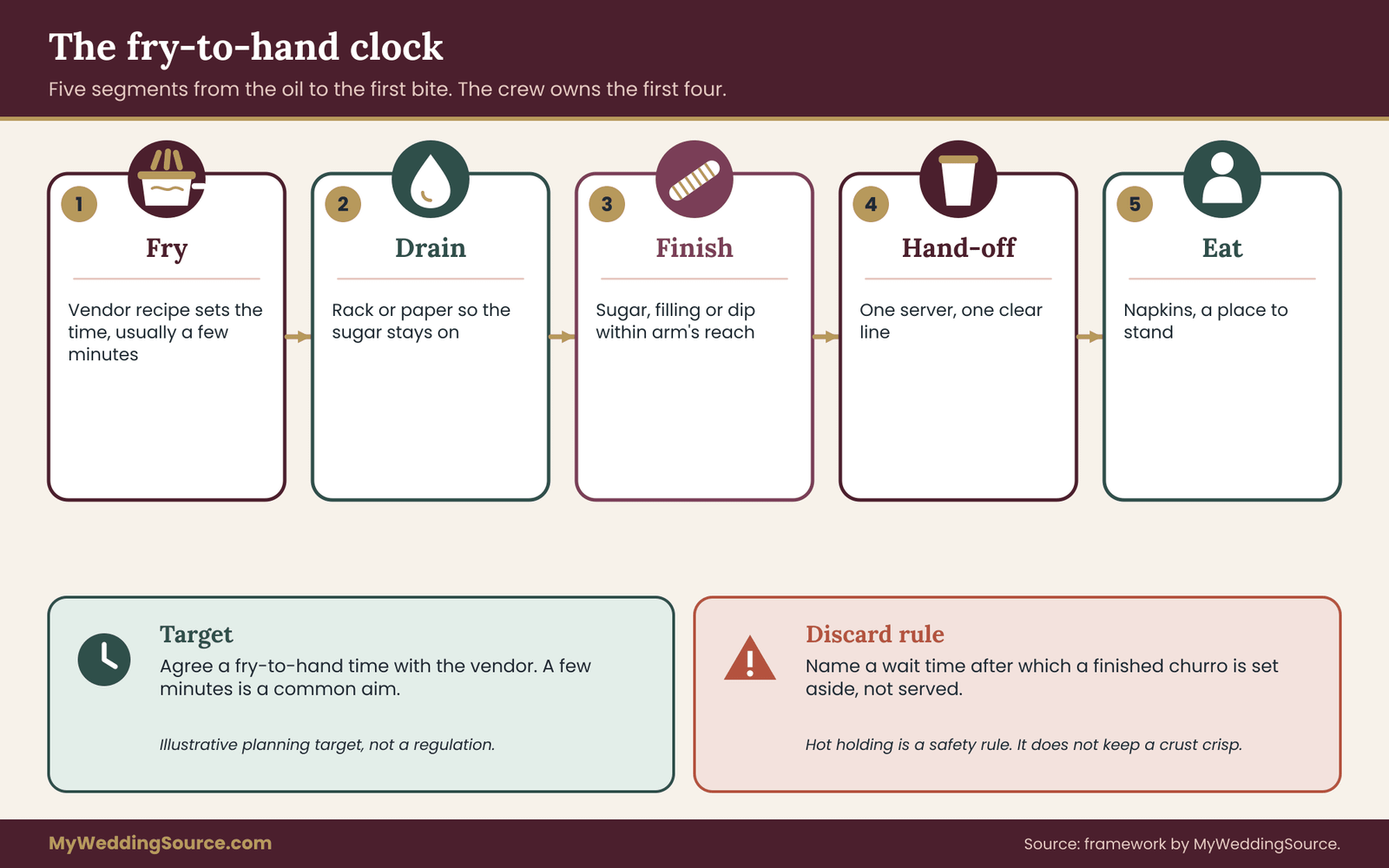
The five segments of fry-to-hand time
Fry-to-hand time is the stretch from the moment a churro leaves the oil to the moment a guest takes a bite. It breaks into five segments.
Fry. The churros cook in the oil. The vendor’s recipe and the thickness of the dough set the time, and it is usually a few minutes. You do not control this segment, but you can ask how long it takes at the vendor’s chosen temperature.
Drain. The churros come out of the oil and rest briefly on a rack or paper so that excess oil runs off. Skipping the drain makes the churro greasy and the sugar slide off.
Finish. The churros are rolled in cinnamon sugar, dusted, filled, drizzled or placed in a cup. Finishing should happen near the fryer, not across the room, and it should be as simple as the menu allows.
Hand-off. A crew member passes the churro to the guest. This is where a line either moves or stalls.
Eat. The guest walks away, finds a spot, maybe gets talked into a photo, and eats. You do not control this segment, but you do control whether the guest has somewhere sensible to stand and a napkin ready.
The first four segments are the crew’s responsibility. A well-run station keeps them short and predictable.
Set a target and a discard rule
Ask the vendor for two numbers and write both in the Time block.
The first is the target: how many minutes from the oil to the guest’s hand does the vendor aim for? A reasonable planning target for a churro station of this kind is a few minutes, and many vendors will say something like “under five.” You are not forcing an exact figure. You are asking the vendor to commit to a number so that you can talk about it.
The second is the discard rule: if a churro has been finished and has not been taken within a stated time, what happens to it? A careful vendor has a rule, such as “anything not served within ten minutes is set aside and not offered to guests.” A vendor who says “we hold them in a warming drawer and serve them as the line allows” is describing a different product, and you should ask how long that drawer holds food and at what temperature.
These numbers belong to the vendor. They are not regulations. They are working agreements that make the quality visible. If a vendor offers different numbers from the examples here, that is fine, so long as the numbers are stated and the crew follows them.
Hot holding is not the same as fresh
Food safety rules for hot food, including the FDA Food Code, set a minimum temperature at which hot food must be kept if it is held rather than served at once. The commonly cited figure in the Food Code is 135 degrees Fahrenheit for hot holding, and local rules may differ, so confirm the current requirement with the health authority. That rule is about safety, not quality. A churro can be held at a safe temperature and still be soft.
This is worth saying plainly to a vendor who proposes to fry in advance and keep churros in a warmer so that service is faster. It can be done, and it can be a reasonable choice for very large crowds. It changes the product. Ask for a tasting of a held churro, not a fresh one, if that is the plan.
Fry to order or fry in batches
There are two common ways to run the fryer.
Fry to order. The crew fries a batch when guests are waiting, so the churros are as fresh as possible. The risk is a long queue if guests arrive all at once.
Fry in rolling batches. The crew keeps the fryer going in a steady rhythm and finishes churros in small groups, so that a few are always ready. This reduces the wait and keeps the freshness high enough if the crew paces it well. Batches should be small, with the oldest churros served first.
Most live stations use some blend. The skilled version is to stagger the fryers so that a fresh batch comes out every couple of minutes rather than all at once. Ask the vendor how they pace the fryers during a rush and what they do in a lull.
Measurable checks you can ask for
A clock is only useful if someone checks it. You can ask for three simple measurements, either during a tasting or from the vendor’s usual practice.
The first is the batch cycle: how many minutes between putting a batch in and having the next batch ready? The second is the portion count per batch: how many serving portions come out of one basket load? The third is the oil temperature before each batch. The vendor should be able to say that they check a thermometer, not guess by eye.
A vendor who answers these three questions with specifics is probably well prepared. A vendor who answers with “it depends” may still be fine, but you should ask for a trial run or a reference from a similar event.
Throughput math for a churro station: a worked example
The clock tells you how long one churro takes. Throughput tells you how many guests the churro station can serve at once. The math is simple, and it is worth doing before the contract, because it tells you how many fryers and how many people you need.
The four numbers
You need four numbers, and you can get all of them with a few questions.
The first is the portion size. A portion may be three pieces, one long churro, or a cup of bites. Decide how the vendor serves and count in portions, not pieces.
The second is the portion rate per fryer. Divide the portions in one batch by the minutes in one batch cycle. If a basket holds enough dough for four portions and the full cycle of loading, frying and unloading takes four minutes, one fryer yields about one portion per minute.
The third is the demand: how many portions you expect over the whole service window, and how many guests will arrive in the first stretch. Not every guest takes a portion, and many take one just after the churro station opens.
The fourth is the window: the minutes the churro station is open.
An illustrative example
The numbers below are assumptions chosen for the example, not measurements and not a prediction for your wedding.
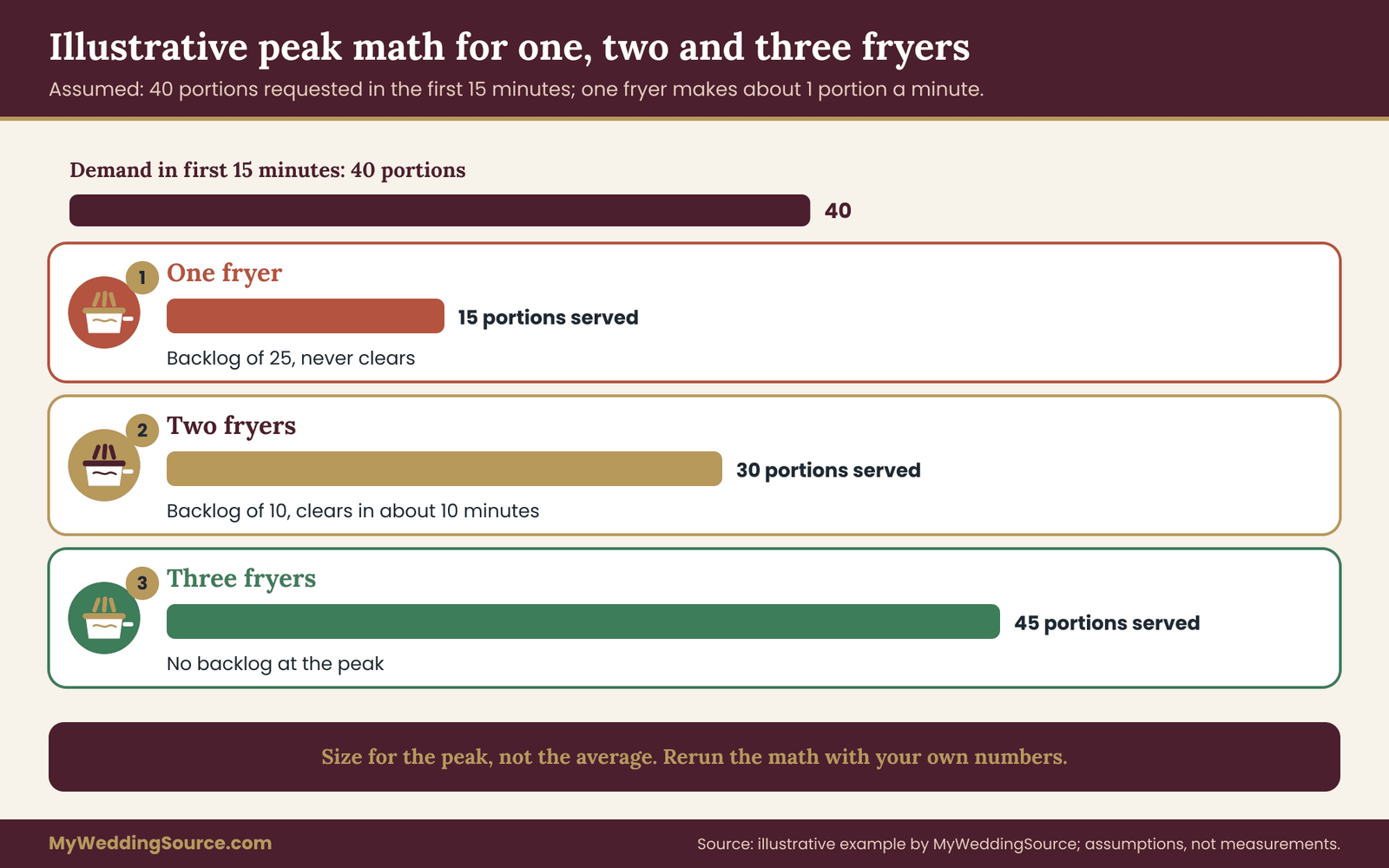
Suppose you have one hundred forty guests. You expect about one hundred portions to be taken over a seventy-five-minute window, because some guests will be full, some will not eat fried food, and some will take seconds. Suppose forty of those portions are requested in the first fifteen minutes after the churro station opens, because people are curious and the line forms early. After that, demand slows to roughly one portion per minute.
Suppose also that one fryer yields one portion per minute, as in the batch above.
With one fryer, the first fifteen minutes can serve about fifteen portions against a demand of forty. A backlog of twenty-five portions builds, and with demand then running at one per minute, a single fryer never catches up. Guests wait a very long time, and the early line turns into a wall. One fryer is clearly not enough.
With two fryers, the first fifteen minutes can serve about thirty portions against forty. A backlog of ten builds. After the peak, the two fryers produce two portions per minute against demand of one per minute, so the backlog clears in about ten minutes. The longest wait is around five minutes at the end of the first peak. That is workable, though guests at the back of the line will notice it.
With three fryers, the first fifteen minutes can serve forty-five portions, which covers the peak. No backlog builds. The third fryer is more equipment, more oil and more staff, and it needs more space and power, so it has a cost.
The correct decision depends on the venue’s limits, the budget and how much waiting you consider acceptable. Many couples will find that two fryers and a clear opening ritual, such as announcing the churro station after the first dance, deliver a good result. The rule underneath is the useful part: size for the peak, not for the average.
Smoothing the peak instead of buying capacity
Equipment is not the only lever. You can flatten the peak with simple choices.
Stagger the opening. If the churro station opens before the cake cutting or the first dance, guests drift over gradually. If it opens as the dance floor starts, guests arrive in a wave. Announce the churro station quietly through the DJ or the emcee rather than as a headline event.
Shrink the menu. Every added dip, filling or topping slows the finishing zone. A churro station with one cinnamon-sugar churro and two dips will serve faster than one with six options. If you want variety, offer it as a second tier after the first rush.
Serve smaller portions. A smaller portion gives each guest a taste and lets more people through. You can invite guests to come back.
Pre-assign pickup times. For a small wedding, a small card at each table naming a window, such as “after toasts,” can spread demand.
Use a ticket or a runner. A runner who takes orders from the line and passes them to the fryer can stop the finishing zone from being overrun with questions.
What the numbers should do for you
At the end of this step you should be able to write one sentence in the Time block: “Two fryers, a portion of three pieces, about one portion per minute per fryer, a seventy-five-minute window.” That sentence is a commitment the vendor can confirm or correct, and it is the best defense against a plan that looks lovely and cannot meet demand.
If your guest count is much larger or smaller than the example, rerun the math with your own numbers. The structure stays the same, and the answer changes.
Placing the churro station in the reception timeline
When a churro station opens, and for how long, shapes how good it feels. Open it too early and guests are still eating dinner, so churros sit. Open it too late and the dance floor has taken over, the line is awkward and half the room is leaving. Timing is a decision about the whole evening, not just the dessert.
Four common slots
Couples tend to choose one of four slots. Each has a different effect on the clock, the line and the crew.
During cocktail hour. Churros as a welcome treat can work for a casual wedding. The upside is that guests have time and are circulating. The downside is that fried food before a full dinner can compete with the meal, and the churro station’s smoke or smell may reach the ceremony area. It also means the vendor works for several hours before the main event.
After dinner, alongside or instead of cake. This is the most traditional slot for a dessert station, and it suits a churro station well. Guests have eaten, they are seated or standing, and they are ready for something sweet. Keep the cake-cutting moment separate. The wedding cake timeline explains how cutting and service fit together, and a churro station can open just after the cutting so that the two do not compete for attention.
During the dance period. A churro station that opens midway through dancing gives guests a reason to take a break. It works well if the churro station is placed near but not in the dance area, so that guests can slip over and come back. Avoid placing it in the path between the floor and the bar.
Late night. A fried snack late in the evening is a popular tradition. It also means the vendor works to the end of the night, and the cleanup comes at the worst possible time. Cooling the oil and packing equipment after midnight is slower, and venues may have noise or curfew rules. If you choose late night, plan the shutdown before you plan the start.
Active service window versus opening hours
Distinguish between the window when the churro station is open and the window when guests are likely to use it. A churro station “open from nine to eleven” is not busy for two full hours. Most of the demand lands in the first twenty or thirty minutes and then trickles. The vendor needs to know this, since it affects staffing, oil quality and the number of fryers.
A practical approach is to define a peak window and a tail. During the peak, all fryers and staff are running. During the tail, one fryer may suffice, and the crew can begin quiet cleanup tasks. Write the two windows into the Time block.
How the churro station affects room flow
A fryer attracts a crowd. Guests will gather near it, watch, and talk. Plan the space so that the line does not collide with the bar line, the restrooms, the photo area or the route to the dance floor. The reception guest flow guide explains how to read a room for choke points, and a churro station should be added to that mental map as a new one.
A line that forms along a wall, away from the main route, is better than a line in the open. A clear sign at the head of the line (“Churros: line starts here”) saves staff from repeating themselves. If the venue is outdoors, the line should not run through wet grass or across an uneven surface, and guests in formal shoes will thank you for a firm path.
Weather and the churro station
Outdoor stations are affected by wind, rain and heat. Wind can blow oil, sugar and smoke, and make a propane flame unstable. Rain can drip into the oil, which, as discussed earlier, is the single most hazardous event for a fryer. Heat makes the work harder for the crew and makes guests less interested in fried food. Cold makes churros popular and makes the oil take longer to recover between batches.
Ask the vendor what the rain and wind plan is. A sensible answer includes a rule that the fryer stops if rain reaches it and a covered area where it can move, if the venue has one. Check the forecast from the National Weather Service in the days before the wedding, and set a decision time with the vendor, such as noon on the day, to confirm or move the churro station. It is better to move the churro station than to improvise.
Dips, fillings and allergens at a churro station
A churro is simple on its own, and a churro station is a menu. Dips, fillings and toppings are where the character comes from and also where the food allergy risks hide. This section treats them together because the same decisions affect taste, speed and safety.
The menu in three layers
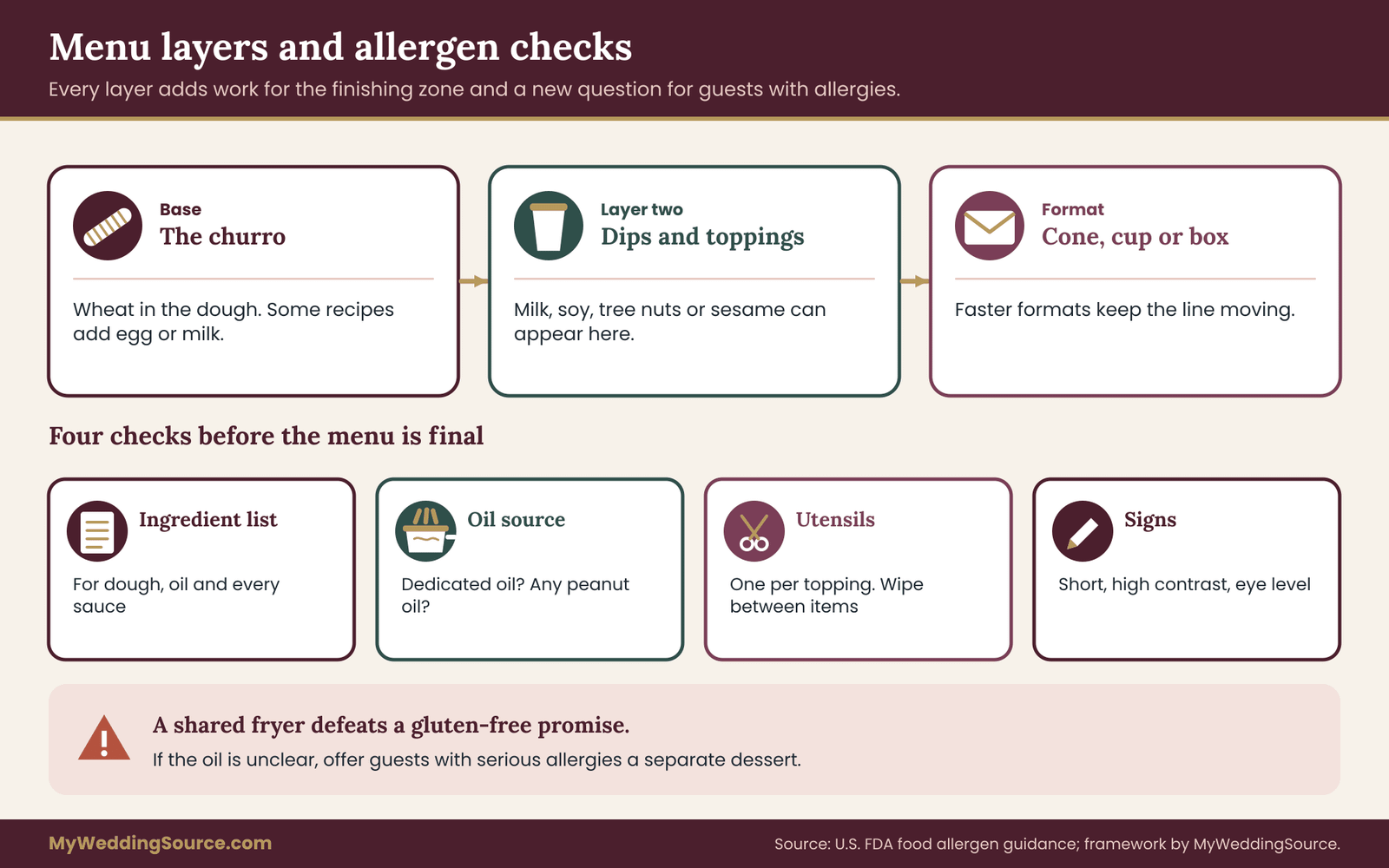
Think of the menu as three layers. The base is the churro itself: the dough, the shape and the coating. The second layer is what goes on or in it: cinnamon sugar, chocolate, caramel, fruit sauce, whipped cream, nuts. The third is the format: loose, in a paper cone, in a cup, split in a box.
Each layer adds work and risk. Fillings need a piping tool and a surface. Dips need a warm holding area or a cold one. Toppings need a clean scoop. The simplest successful menu has a plain cinnamon-sugar churro and two or three dips served in small containers.
Allergens at the churro station
Churro dough typically contains wheat, and some recipes include eggs, milk or butter. Dips often contain milk, soy or tree nuts, and toppings may include nuts or sesame. The U.S. Food and Drug Administration lists the major food allergens, and a guest with a serious allergy needs more than a verbal reassurance. Ask the vendor for a list of ingredients for every item, including the dough, the oil and each sauce, and ask which allergens are present.
The fryer deserves special attention. If the vendor fries other foods in the same oil, such as fish, chicken or other dough, traces can transfer. If your guests include someone who avoids gluten, a shared fryer means a gluten-containing dough cooks in the same oil as any gluten-free item.
Ask whether the vendor uses dedicated oil for the event and whether the fryer was cleaned. If the answer is unclear, treat the churros as not safe for guests with serious allergies, and offer them another dessert.
Ask also about the oil itself. Some oils come from peanuts or other allergens, and the vendor should know which they use.
Cross-contact at the finishing zone
Even with dedicated oil, cross-contact can occur on a counter. A scoop used for a nut topping and then in the plain sugar spreads nuts. A shared pair of tongs between a regular churro and a gluten-free item does the same. Ask the vendor to use separate utensils for each topping and to wipe surfaces between items.
A small card at each dip that names its main allergens helps guests make their own choices, and a staff member who can answer questions is better than a sign alone.
Gather dietary needs from guests before the menu is final, and add the churro station to that list: tell guests it is a fried, wheat-based item, and give the allergy contact to the vendor ahead of time.
Dips, temperature and handling
Warm dips such as chocolate and caramel are usually kept in a small warmer. They should be held hot enough to be safe and not so hot that they burn a guest. A sauce that sits in a pot for hours can scorch or separate, so ask how the vendor refreshes it.
Cold items, such as whipped cream or a milk-based sauce, need to stay cold, which means ice or a refrigerated unit. Ask where cold items are stored and for how long, and remember that the FDA Food Code sets cold holding at or below 41 degrees Fahrenheit, with local rules possibly differing.
Single-serve dip cups reduce double-dipping and speed up service, but they add waste. Open dip pumps or squeeze bottles are faster for the crew and cleaner for guests. Federal food safety agencies publish general handling guidance, and your vendor’s local health authority is the final judge.
Fillings and the pace of the line
Filled churros look impressive and take time. Each filled churro requires the crew to hold the churro, pipe the filling and often drizzle a topping. If you want filled churros, set a lower number per guest or limit them to a second wave. A common compromise is to offer a plain churro as the default and a filled churro as the upgrade for those who ask, so the line does not stall.
Keeping the menu readable
Menu signs should be short and clear. List the item names and the main allergens. If a sign is in a font that is hard to read or sits in dim light, guests will ask staff, which slows the line. Use a plain, high-contrast typeface and put the sign at eye level, lit from the front.
The fryer does not run itself, and a crew that is one person short is the most common reason a good plan turns into a slow line. The Staff block of the brief answers three questions: who does what, how many people that takes, and who can stop the churro station.
The five roles
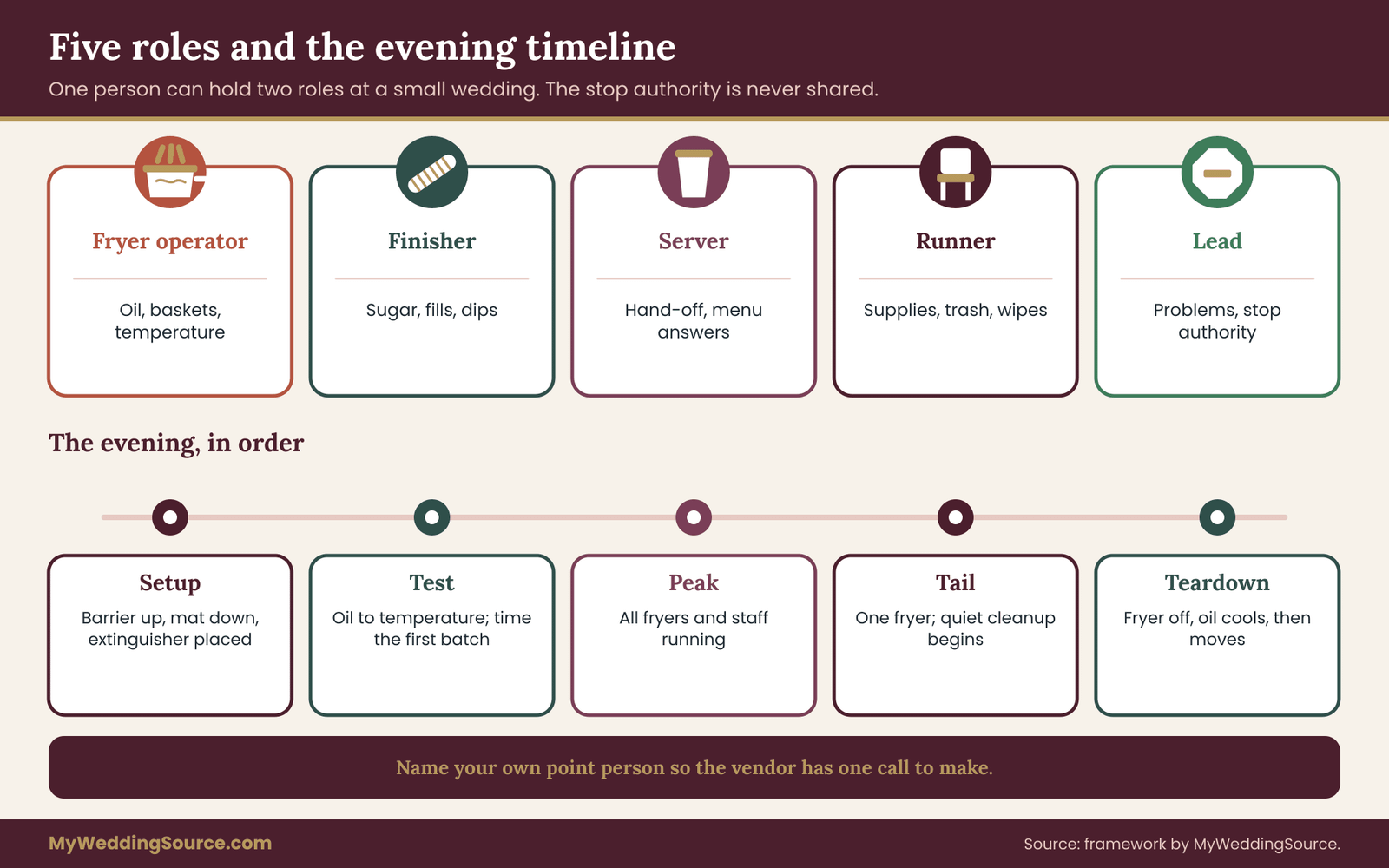
A churro station has five jobs. At a small wedding one person may hold two of them, and at a large one each needs its own person.
Fryer operator. This person controls the oil, loads and unloads baskets, watches the temperature and decides when a batch is done. The operator is the only person in the hot zone during service. This role should be held by someone trained and experienced, not a temporary helper on their first night.
Finisher. The finisher takes drained churros, rolls them in sugar, fills or dips them and places them in cups or paper. The finisher works at the line between the hot zone and the guest zone.
Server. The server hands finished churros to guests, answers menu questions and keeps the line moving. This person is the face of the churro station, and a calm, friendly manner matters.
Runner or support. The runner keeps supplies stocked, takes away trash, wipes the counters and brings fresh oil, sugar or cups. At a churro station of any size, the runner prevents the other three from leaving their posts.
Lead. The lead supervises, handles problems and is the person you and the venue contact if something changes. At a small station the lead is often the operator. At a larger one, the lead should be free to step back and watch the whole scene.
How many people
There is no universal answer, because it depends on the number of fryers, the menu and the guest count. A rough rule is one operator per fryer if the fryers are separated, or one operator per two fryers if they sit side by side and are easy to watch, plus at least one finisher, one server and one runner.
For a churro station with two fryers, a crew of four to five is a plausible plan. For a small, simple station with one fryer, two or three may do.
Ask the vendor for their standard crew size for an event like yours, and ask what happens if a crew member is sick. A well-organized vendor has a backup, and a small one may tell you honestly that they work alone and cannot serve more than a limited count. Both answers are useful, so long as they are stated.
Breaks, heat and hours
Working over a fryer for hours is tiring. A crew that arrives early for setup, works through service and then cools and packs oil can be on its feet for ten hours or more. Fatigue leads to mistakes with hot oil. Ask how the vendor handles breaks, especially at a long wedding. If your churro station runs for several hours, the vendor may need a second operator who can swap in, and that is a fair cost to expect.
Outdoors in summer, the crew also needs shade and water. Offering the crew a shaded area and drinking water is simple courtesy, and it helps keep the work safe.
Hygiene and handling
The vendor’s staff should follow local food handling rules. That includes washing hands, wearing clean aprons, tying back hair, and using gloves or tongs when handling food that will not be cooked again. Ask where hand-washing happens. A portable hand-washing station is the standard answer at an outdoor event.
A crew member who handles money should not also handle food without washing, and the vendor should have a plan. If a guest tips the crew, the tip should be handed to someone who is not at the fryer.
Who can stop the churro station
This is the line that is missing from most plans. Write down the name of the person with authority to stop service immediately if there is a safety problem: a spill, a flare-up, a gust of wind, a sudden rainstorm, or a guest in the hot zone. That person should not need permission from you. Tell the vendor in advance, and tell your coordinator or point person so that they back the decision.
It helps to define what “stop” means. For instance, the fryer is turned off, the lid goes on, the line is paused and the crew explains to the guests. A hurt feeling is better than an injury. A brief, friendly message to the line (“we’re pausing for a few minutes to reset”) is normally accepted.
Your own point person
You should not be managing the churro station on your wedding day. Name one person on your side, such as a planner, a coordinator, a friend or a family member, who knows the brief and who is the contact for the vendor. That person walks the churro station at setup, checks the extinguisher, notes the time the first batch comes out, and watches the line at the peak.
If the vendor needs a decision, the point person makes it. If the vendor needs to reach you, the point person is the first stop.
Give that person a one-page contact sheet with the churro crew’s arrival time, the lead’s phone number and the venue contact.
Quotes, contracts and cost logic for a churro station
The final block of work is to turn the brief into something enforceable and to understand what you are paying for. This section is about contract language and cost logic, and it makes no claim about current prices, which vary widely by region, season and vendor.
How vendors usually price a churro station
Pricing models vary. Some vendors charge a flat fee for a set window with a minimum guest count. Some charge per person or per portion. Some charge an hourly rate, with a minimum number of hours and an extra fee for travel, setup and cleanup. Some combine these. Ask each vendor to break the quote into parts so you can compare.
The parts that usually appear, and the questions to ask about each:
Base service. What does it include: how many hours, how many fryers, how many staff, how many portions?
Menu. Which dips and toppings are included, and what costs extra?
Equipment and supplies. Does the price include the fryer, the barrier, the table, the signs, the paper goods and the hand-washing setup?
Travel and setup. Is there a fee for distance or for an early arrival?
Insurance and permits. Does the vendor carry the coverage the venue requires, and does the fee include any permit costs?
Oil and cleanup. Is oil disposal included, or an add-on?
Overtime. What is the rate if the party runs late, and who decides?
Gratuity or service charge. Is it included, optional or expected?
A low quote that leaves out half of these is not a low quote. Add the missing items before you compare.
Cost logic without invented averages
Because prices differ so much, it is more useful to think in ratios than in numbers. The cost of a churro station per guest depends on how many guests actually use it, how many staff it needs and how many hours the vendor is committed. A short, well-timed window with two fryers often costs less per portion than a long, quiet window with one fryer, because staff time is the larger share of the cost.
If you are comparing a live station with a finished-food alternative, compare the total cost and the total experience, not the headline price. A churro station is partly food and partly entertainment, and the value of the entertainment is personal. The wedding budget guide explains how to set category limits so that a churro station does not quietly consume the dessert and entertainment lines at once.
Ask the vendor for a quote that includes the brief. The vendor will often adjust the price once they see the full scope, and it is better to learn that before booking.
What to put in the contract
Contract language should cover the operational points that the brief defines. The wedding vendor contract guide explains the general structure, so use this as a checklist for the cooking-specific items.
First, the equipment and fuel type, as approved by the venue. Second, the vendor’s responsibility to hold current licenses and permits and to provide copies. Third, the insurance coverage, with the venue named as an additional insured if the venue requires it. Fourth, the staffing level and the right to stop service for safety.
Fifth, the service window and any overtime terms. Sixth, the oil handling, disposal and cleaning responsibilities. Seventh, the cancellation and weather terms, including who decides to move or cancel the churro station and what happens to the deposit. Eighth, the allergen information the vendor will provide.
If the vendor has a standard contract that omits these, ask for an addendum. Attach the signed brief to it.
Deposits, weather and cancellation
A deposit holds your date. Ask what happens if the venue refuses the fryer after you have paid, if the weather prevents service, or if the vendor cancels. A fair contract gives you a refund or a credit when the venue refuses the fryer, and returns your deposit if the vendor cancels. If the vendor offers a finished-food alternative in case of rain, such as a pre-fried churro served from a warmer, put that in writing, including the price difference.
Pay by a method that leaves a record. If something goes wrong, a clear payment record helps, as it does for any vendor.
Reading a reference and a tasting
Ask for references from events of similar size and setting. Ask a reference, in plain words, how the line moved, whether the churros were warm, whether the crew was calm and whether the venue was satisfied. A tasting is a bonus, though a live fryer tasting is not always possible. If the vendor offers a demonstration, watch the clock: time the batch, observe the finish and notice how the crew handles a rush.
Be honest about what a tasting can and cannot show. A tasting for two people tells you about flavor. It tells you little about a line of forty.
Live frying compared with other ways to serve churros
A live fryer is one of several ways to put churros on a wedding menu, and the right choice depends on what your venue allows and what you care about most. The brief works for all of them, but some blocks shrink or grow depending on the format.
Four formats in plain terms
Live frying on site. The vendor fries churros at the venue and serves them within minutes. This gives the best freshness and the most show, and it brings the full set of approvals, grease control and staffing work described above.
Fried on site by the venue’s caterer. The caterer fries inside its own kitchen and sends churros out in small, frequent batches. This usually removes the fire and permit questions from your plate, because the caterer already operates under the venue’s rules. The distance between the kitchen and the table adds a minute or two to the clock, and the show is lost.
Finished on site from a partly cooked product. Some vendors prepare dough elsewhere and finish it on site, for example by baking, air frying or heating a pre-fried churro in an oven. This reduces oil and fire risk, though the texture is different and some guests will notice. It suits venues that prohibit deep fryers.
Fully prepared off site and held warm. The vendor delivers finished churros and keeps them in a warmer. This is the simplest to approve and the weakest in freshness. A held churro is a safe choice for a very large crowd or a strict venue, and it deserves an honest description in the menu, so guests are not led to expect a fresh fry.
A fifth option is to skip churros if the venue cannot support any of the above. That is a legitimate result of the brief, and an early no is far better than a late one.
Choosing by the venue’s answer
You do not need a complicated decision tree. Ask three questions in order. First, does the venue allow a live deep fryer at the place you want, in writing? If yes, live frying is on the table. If no, ask whether the venue’s caterer can fry and serve. If neither is possible, ask whether finishing or reheating on site is allowed. The first yes sets the format.
Then check the clock. If the format adds more than a few minutes between the oil and the hand, tell guests honestly or adjust the menu so that the product still works, for instance by serving shorter churro pieces or bites that eat well warm rather than hot.
Keeping the original idea
Couples who lose the live fryer often keep the idea in other ways. A churro-themed station can offer dips, a build-your-own cup and a sugar-coating counter even if the frying happens elsewhere. The craft remains, and the safety burden is lower. The wedding venues guide covers how to compare venue rules before you book, which is also the best time to learn how the venue treats vendor cooking.
When something goes wrong at a churro station
Plans are tested by small failures, and the ones worth rehearsing are few. Each has a quick response, and the lead should know all of them.
The venue says no on the day
If the venue or a fire authority objects at setup, the first step is to stop and listen. Ask what the objection is and whether a change would satisfy it, such as moving the fryer, adding a barrier or shifting the churro station farther from the tent. If the answer is no, move to the fallback you wrote into the contract: a finished-food version, a different dessert or a credit. This is why the Approve block asks for written confirmation weeks ahead.
Rain or wind begins
Turn off the fryer, put on the lid and move the churro station under cover if possible. Do not try to keep frying in a drizzle. Tell the line the churro station is pausing. If the weather clears, the crew relights and resumes, and if it does not, the fallback applies. The stop authority described in the staffing section covers this decision.
The line outruns the fryer
If the line grows beyond the planned peak, resist the urge to overload the baskets. Overfilled baskets drop the oil temperature, so the churros come out greasy and slow. Instead, reduce the menu to the simple option, ask the runner to tell guests the wait, or run a second fryer if it is available. Let the line wait. A sign that says “freshly fried: about five minutes” turns a wait into part of the experience.
A spill or a flare-up
A small oil spill on the floor needs absorbent material and a mat, with the area blocked off from guests. A flare-up at the fryer needs the lid, the extinguisher and the stop decision, in that order, and the crew should call emergency services if there is any doubt. Guests should be moved back at once. Do not use water. The vendor’s training matters more than any document at this moment.
An allergic reaction or a guest concern
If a guest reports a reaction, the vendor should be able to say exactly what was in the churro, the oil and the dip. Keep the ingredient list at the churro station. Contact emergency services for a serious reaction and do not wait to see whether it passes.
The vendor is late or short-staffed
This is why the point person has the vendor’s lead number and a time at which to act. If the crew has not arrived by an agreed cutoff, the point person calls. If the churro station cannot open, the fallback applies. Decide in advance what counts as late enough to cancel, so that the decision is not made in a panic.
Your next steps
You can complete the brief in a few short sittings. Take the steps in this order, and stop at any step where the answer is no.
First, ask the venue in writing whether a live deep fryer is allowed, where, and with what conditions, and ask whether the venue’s caterer rules limit outside cooking. Second, ask the vendor for the fryer type, fuel, power needs, extinguisher type, license, insurance certificate and oil disposal plan, and copy each answer into the Approve and Contain blocks.
Third, work out the throughput with your own numbers: portion size, portions per fryer per minute, the guest count and the peak. Write one sentence in the Time block. Fourth, settle the crew: the roles, the headcount, the break plan and the name of the person who can stop service. Fifth, put the brief on one page, attach it to the contract, and set a due date for each proof at least two weeks before the wedding.
On the day, have your point person check four things at setup: the extinguisher is in place, the floor is protected, the barrier is up, and the oil is at temperature before service starts. Then time the first batch from oil to hand and note the number. If it is within the target, relax. If it is not, ask the lead to adjust before the line forms.
After the wedding, note what worked. A short message to the vendor and the venue with thanks and any suggestions helps the next couple.
FAQ
Do I need permission from the venue for a churro station?
Yes, in almost every case. A live fryer is cooking equipment with hot oil, fuel or heavy power use, and venues usually have rules about outside cooking. Ask in writing, name the equipment and the location, and keep the reply. If the venue has an exclusive caterer, ask whether outside frying is allowed at all.
Is a churro station safe at an indoor wedding?
It can be, but indoor frying is the hardest case. Smoke detectors, sprinklers, floors, ventilation and fire codes all limit what is allowed, and many venues forbid deep fryers indoors. A venue with a commercial kitchen may handle it through its caterer. Ask the venue and the local fire authority before you plan around an indoor fryer.
What fire extinguisher should a churro station have?
Cooking oil fires call for an extinguisher designed for them, commonly called Class K in the United States, and the standards are published by the National Fire Protection Association. Ask the vendor what they carry, request a photo showing the inspection tag, and confirm the crew has been trained to use it. Never use water on an oil fire.
How fresh does a churro need to be?
Fresher is better, since a churro softens as it cools and steams. There is no universal rule, so ask the vendor to name a target time from the oil to the guest, often a few minutes, and a rule for discarding churros that wait too long. Hot holding is a safety standard and does not guarantee crispness.
How many fryers does a churro station need?
It depends on your guest count, how many take a portion and how many arrive at once. Divide the portions expected in the first fifteen minutes by what one fryer can produce in that time. In a sample of one hundred forty guests, two fryers handled the peak with a short backlog. Always size for the peak, not for the average.
Can a churro station be safe for guests with food allergies?
Only with care. Churros usually contain wheat, and some recipes include egg or milk, while dips and toppings may include milk or nuts. A shared fryer carries traces between foods. Ask for ingredient lists, ask whether the oil is dedicated, and offer a separate dessert to anyone with a serious allergy.
Who disposes of the used oil?
The vendor should take it away, and the contract should say so. Used oil should never go down a drain, a storm sewer or onto the ground, because fats and grease clog pipes and harm waterways. Ask the vendor how they cool, transfer and recycle the oil, and confirm that the venue will not be left with it.
What if it rains on the day?
Rain and hot oil are a dangerous mix, so plan a fallback before the wedding. Ask the vendor for a covered location, a decision time on the day and a finished-food alternative. The fryer should stop if rain reaches the oil. Write the weather terms, including refunds and price changes, into the contract.