
A wedding hotel bar after party is a late-night gathering held in the bar or lounge of a hotel, usually where out-of-town guests are already sleeping. It is easy to book and hard to price, because the real terms sit in three places: the reservation, the minimum spend and the tab rules. This guide gives you a Four-Number Check and a walk-in rule so you can sign with the numbers in front of you.
Before you reserve a hotel bar, fix four numbers: your guest headcount range (low, likely, high), the space you are really getting (reserved zone versus the bar’s posted capacity), the minimum spend and exactly what counts toward it, and the ceiling you will pay on a hosted tab. Then settle the walk-in rule: who else may enter the hotel bar while your group is there. Get the answers in writing, including closing time, service charge and what happens if fewer people come than you planned.
Most couples think of a hotel bar as a free default. Guests are already in the building, the elevator is the only transport, and nobody has to find a ride at midnight. That convenience is real. It is also the reason hotel bars quietly set terms that a stand-alone bar might not bother with: reserved sections tied to a minimum spend, hosted tabs with caps, automatic service charges and a hard closing time set by the hotel’s license and staffing.
The trouble is that these terms arrive piecemeal. A sales manager says a section “comes with” a minimum. A bartender says the bar closes “around one.” A front-desk email says the lounge is also open to the public. None of those statements is a contract, and each one changes what a night costs. Put together, they decide whether twenty friends have a pleasant last hour or whether the couple is arguing with a manager over a bill that no one explained.
A note on scope. This is general planning information, not legal, insurance or financial advice. Alcohol service rules, closing times, occupancy limits and worker rules differ by place and by property, so confirm the ones that apply with the hotel and your local authority.
This article stays narrow on purpose. It does not decide whether you should host a late-night event at all, and it does not design the night’s music or mood. It covers one practical question: if the late-night plan is a hotel bar, how do you reserve it, spend inside it and control who comes through the door? The wedding bar service planning guide covers the main reception bar, and this article picks up where that one stops.
What a wedding hotel bar after party is, and when it fits
A wedding hotel bar after party is an optional gathering, planned in advance, that happens in a hotel’s existing bar or lounge after the formal reception ends. It has a host, a start, an end and a payment arrangement. Guests who wander into the hotel bar on their own are not an after party. A reception that moves a few floors up to a ballroom is a different thing, covered by the hotel’s event team under different terms.
The distinction matters because a hotel bar is a working business, not an event room. It has regular customers, a license, a fixed staff and a menu. When you reserve part of it, you are borrowing space from that business, and the hotel’s priority is to keep serving everyone else. Event rooms exist to serve a group. A hotel bar exists to serve a stream of people, and your group becomes one stream among several.
The situations where a hotel bar tends to fit
A hotel bar tends to fit when several conditions line up. The reception ends at a time when the hotel bar is already open and likely to stay open for a few more hours. A meaningful share of your guests are staying in that hotel, or in one within a short walk. The group you expect is small to medium, so a section or a corner can hold it. And you want the late hours to be casual, with no program, no seated service and no vendors beyond the hotel’s own staff.
It also fits when the reception venue has a firm curfew and you want a place to go that does not require transport. A guest who has had two drinks and walked ten steps to an elevator is in a very different position from a guest who needs a car at one in the morning. For the broader question of where to put out-of-town guests so they can reach a late-night space easily, the guest hotel coordination guide is the better starting point.
Situations where a hotel bar is a poor fit
A hotel bar is a poor fit when your group is large and loud, because the walk-in public and other hotel guests will notice. It is a poor fit when you want to bring your own music, decor or cake, because most hotel bars restrict all three. And it is a poor fit when the closing time is earlier than your guests’ energy, which is more common than couples expect. Many hotel bars stop serving well before the hour a reception ends on a Saturday, because staff are scheduled around ordinary patterns rather than wedding patterns.
None of these is a reason to skip the idea. They are reasons to ask specific questions before the deposit. A reserved hotel bar section with a modest minimum and a clear closing time can be one of the calmest endings to a wedding day. A vague verbal arrangement can be one of the most stressful.
Why the hotel bar attracts wedding groups, and what it asks in return
There are four reasons couples choose a hotel bar, and each comes with a counterpart cost. Knowing both sides helps you decide whether the trade suits your group.
Convenience. Guests do not need rides, directions or a coordinated bus. The counterpart is less control: you cannot dim the lights, change the music or move furniture without the hotel’s permission, and you cannot easily ask a stranger at the next stool to lower their voice.
Familiar service. The hotel bar already has trained bartenders, glassware, a license and a point-of-sale system. The counterpart is that the staff are not yours. They follow the hotel’s rules on identification checks, over-service and closing, and those rules will override a friendly request from the couple.
Predictable cost, on paper. A minimum spend looks simple: spend this much and the section is yours. The counterpart is that the minimum rarely tells the whole story. Fees, taxes, service charges and exclusions determine what the real bill looks like, and the minimum may be a floor you pay even if guests drink less than expected.
Flexibility. A hotel bar can often be reserved a few weeks before the wedding without the long lead time that a stand-alone venue might need. The counterpart is that the best days and sections go early, and a hotel with a convention in town may have no availability or may set a higher minimum.
Where this fits in the wider plan
The after party is the last item on a long list, and it should not overwrite the earlier items. The final cost belongs on the same sheet as your other cash needs, and the wedding cash-flow planning guide shows how to time deposits and final balances so a late deposit for a hotel bar does not collide with a vendor payment. Keep the hotel bar as its own line, separate from the main reception bar, so you can see what the extra hours truly cost.
The Four-Number Check at a glance
The rest of this guide organizes the decision around four numbers and one rule.
The first number is the headcount range: low, likely and high. The second is the space number, meaning how many people the reserved zone holds and how many the bar legally holds. The third is the minimum number, along with the list of what counts toward it. The fourth is the cap, the largest amount you are willing to pay on a hosted tab. The rule is the walk-in rule: a written decision on who else may be in the hotel bar and how the hotel keeps your section yours.
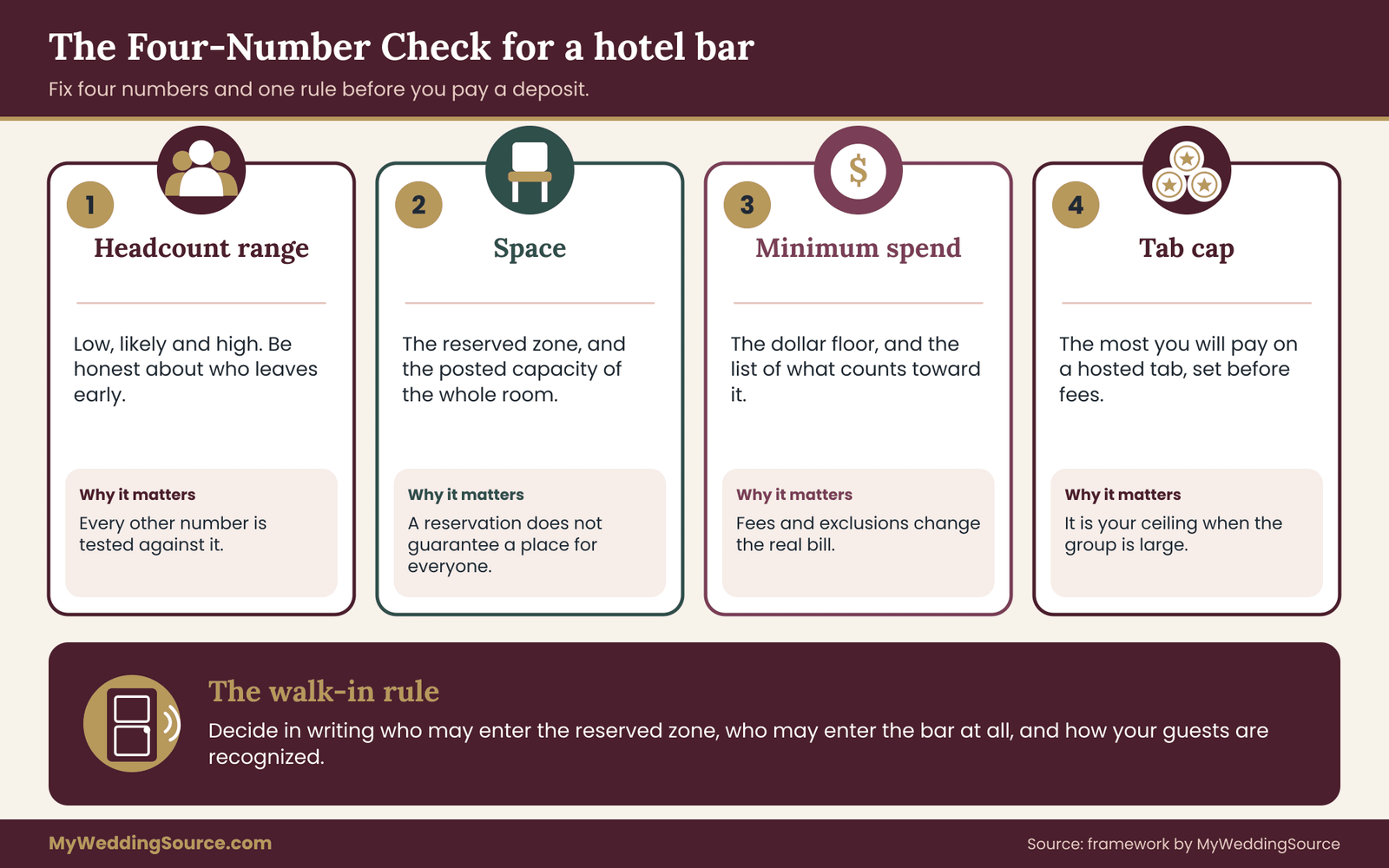
You can complete the check in about an hour once you have the hotel’s written terms. The sections that follow explain how to get each number, how to test it and what to ask when the hotel’s answer is vague.
Hotel bar or another late-night option: a plain comparison
Before you commit to a hotel bar, compare it honestly with the other places a late-night group could go. This is not a ranking. Each option trades control, cost and convenience differently, and the right one depends on which of those matters most to you.
The hotel bar, in plain terms
The hotel bar gives you the easiest movement and the least control. Guests walk in, the hotel runs the service, and you pay according to its rules. It works best for small and medium groups who want a relaxed last drink. It works poorly for groups who want to dance, bring a speaker or invite a crowd.
A private lounge or event room in the same hotel
Some hotels have a small lounge, a library room or a meeting room that can be set up as a private space. This costs more and usually comes with a room fee, a food and beverage minimum, and a separate contract through the events team. In return you get a closed door, which solves the walk-in problem completely. The wedding venues guide explains how room rental and catering minimums are usually structured, and the same logic applies here on a smaller scale.
A nearby bar or restaurant buyout
A neighborhood bar will sometimes agree to a buyout or a reserved section for a group. This can give you more character and more freedom over music. It also asks guests to travel, introduces a transport question and leaves you dealing with a business that may have little experience with wedding groups.
A hospitality suite or room
A suite in the hotel, stocked by the couple or by a friend, avoids a minimum entirely. It also moves the event into a space with no bartender, no license check and no staff. Alcohol service rules, hotel policy on outside drinks and noise limits all apply, and the hotel may not allow it at all. A suite is a social choice, not a service model, and it needs its own safety plan.
Staying in the reception venue
If the reception venue allows it, extending the hours may be simpler than moving anyone. That choice involves overtime for vendors, the venue’s curfew and often a higher bar bill. It belongs in the reception timeline, and the wedding reception guest flow guide covers the practical side of moving people through a space at the end of a night.
A simple way to choose
If you expect fewer than the number a reserved hotel bar section holds, and most expected guests are staying in the building, a hotel bar is often the lowest-effort choice.
If you expect more guests than the section holds, or you want to control the music, look at a private lounge, a buyout or an extension. If cost is the deciding factor, compare the total bill for each option rather than the minimum alone, because a modest-looking minimum with a large service charge can cost more than a higher minimum with fees included.
How a hotel bar reservation works: four levels of hold
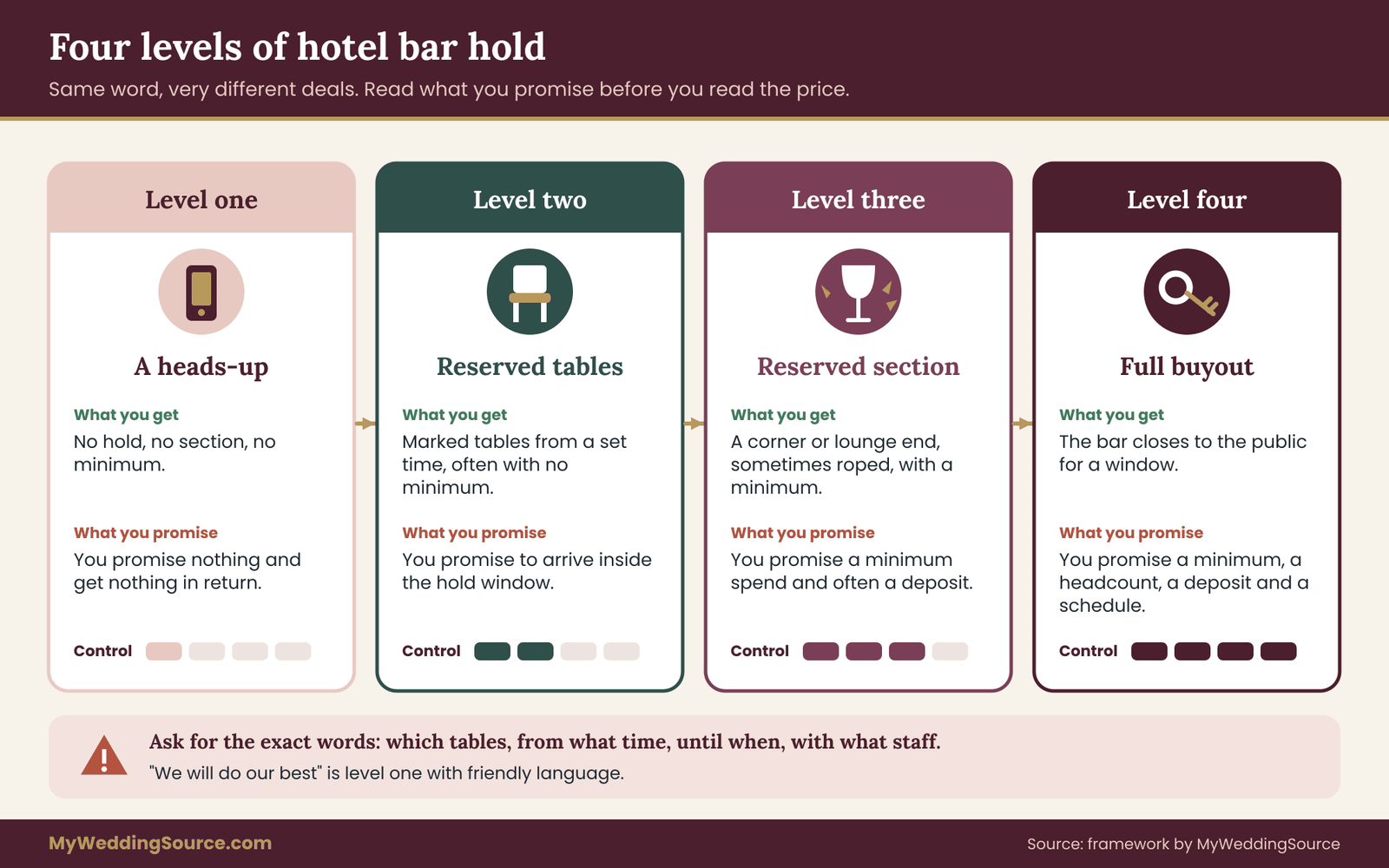
The word “reservation” covers very different arrangements. Two couples can both say they “reserved the hotel bar” and have bought entirely different things. Sorting the offer into one of four levels tells you how much control you have and what you will be asked to guarantee.
Level one: no reservation, a heads-up. You tell the bar manager that a group may arrive after the reception. There is no hold, no section and no minimum. The group takes whatever seats are free. This costs nothing and promises nothing. It works for a small crowd on a quiet night and fails the moment the hotel bar is busy.
Level two: a reserved table or a few tables. The hotel marks specific tables for your group, often with a card, from a stated time. There may be a small minimum or none at all. The hold usually lapses if the group does not appear within a set window, and the tables go back to the public.
Level three: a reserved section or semi-private area. A corner, a lounge end or a patio is set aside for the group, sometimes with a rope or a staff member. This is where a stated minimum spend usually appears. You gain a recognizable home base, and the hotel gains a assured revenue floor.
Level four: a buyout or exclusive use. The entire bar is closed to the public for a window. This almost always comes with a larger minimum, a written event agreement, possibly a room fee and a deposit, and it is usually handled by the events department rather than the bar manager.
What each level asks you to promise
At level one you promise nothing, and the hotel promises nothing in return. At level two you may promise to arrive by a certain time. At level three you promise to spend at least the minimum, and often to pay a deposit. At level four you promise a minimum, a headcount, a deposit and a payment schedule, and you may be bound by a cancellation clause.
Read those promises before you read the price. A lower minimum with a strict arrival window and a no-refund deposit can be riskier than a higher minimum with a flexible hold. The question to ask is not only “how much” but “what do I owe if fewer people come, if the reception runs late or if the plan changes.”
Why the level matters more than the label
A hotel will sometimes describe a level-two table hold as “reserving the bar.” Guests then arrive and find a few tables surrounded by the public. Ask for the exact words: which tables or area, from what time, until what time, with what staff, and whether anyone else may sit there if your group is late. If the answer is “we will do our best,” you have a level-one arrangement with friendly language.
Who you are dealing with
Hotels tend to have two sets of people who can answer these questions. The bar or restaurant manager controls the daily operation: hours, staffing, section layout and the point-of-sale system. The events or catering office controls contracts, deposits, minimums and anything formal. If you want a level-three or level-four arrangement, ask which of the two issues it, because the terms live in different documents and the person you spoke to first may not be the one who can bind the hotel.
The weekday and weekend difference
Hotels price and staff by expected traffic. A Friday or Saturday night usually means more public guests and a higher expectation of revenue. A Thursday or Sunday night may have a quiet bar with lower minimums and fewer walk-ins. If your wedding is on a weekday, or the after party can happen on the night before the main event, ask whether the minimum changes by night. Do not assume a figure carries over, and do not rely on a stated figure from a different season.
Capacity at a hotel bar: the reserved zone, the posted limit and the walk-in rule
The second number in the Four-Number Check is space. It sounds like the easiest number, but it has two parts that people confuse: the size of your reserved zone and the legal capacity of the whole room.
The reserved zone
The reserved zone is the part of the hotel bar the hotel agrees to hold for your group. Ask for it in concrete terms. How many seats does it have? How many people can stand in it comfortably, with drinks in hand? Where are the nearest restrooms, the bar rail and the exit? Does it include the bar itself or only the tables beside it? A zone of twelve seats on a plan may fit twenty guests if people stand, but not if the aisle must stay clear.
Ask to see it, or ask for a photo with the section marked. A walk-through on an ordinary evening shows you how the room really works: where the service bartender stands, where the line forms and whether the lighting suits a conversation.
The posted capacity
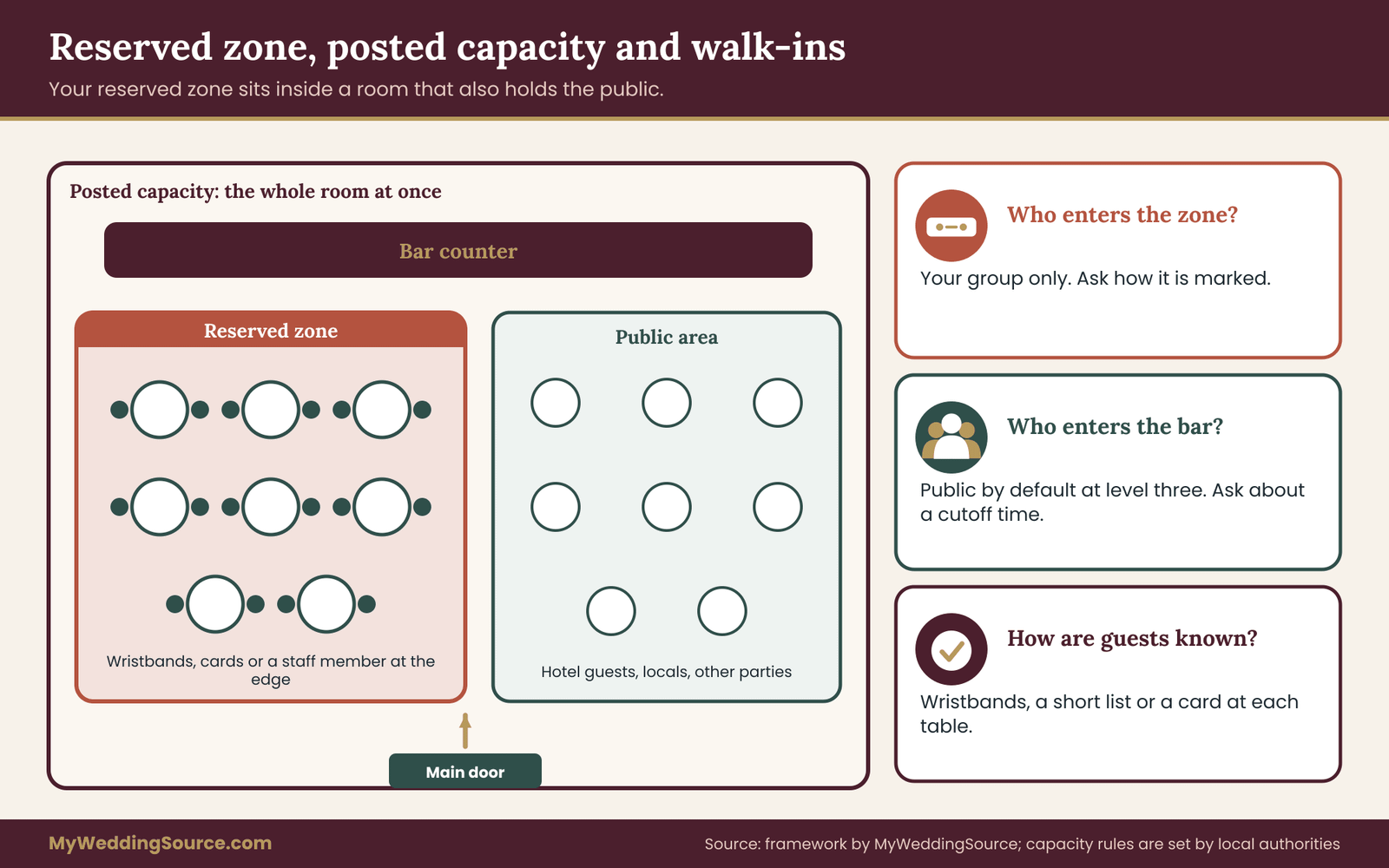
Every public room has a maximum occupancy set under local fire and building codes, and many display it on a sign near the door. The National Fire Protection Association publishes the widely used life safety code, and local authorities adopt and enforce their own versions. The posted capacity applies to the whole room at once: your guests, the public, staff and anyone queuing inside. It does not shrink or grow because you have a reservation.
That has a practical consequence. If your reserved zone fits thirty and the posted limit is ninety, ninety people in total can be in the room, and the hotel decides who fills the remaining sixty. If the room reaches its limit, staff may have to stop admitting anyone, including your late-arriving guests. A reserved zone does not by itself guarantee a place for every person you invite.
Seated, standing and the high-count problem
Capacity numbers are not only legal. Comfort is a separate limit. A group that fits legally can be unpleasantly tight, and a tight room produces long bar lines, spilled drinks and short tempers. Use these rough rules of thumb as questions, not facts: how long is the bar rail, how many bartenders will be on, and how long does a typical round take. A single bartender serving a crowd will move more slowly than three, whatever the room’s legal limit.
The walk-in rule
Walk-ins are anyone who comes through the door without being part of your group: other hotel guests, local patrons, other wedding parties, conference attendees. The walk-in rule is a decision you make in writing before you book. It answers three questions.
Who may enter the reserved zone? Usually only your group. Ask the hotel how it will mark the zone: a rope, a sign, a server posted at the edge, or nothing at all.
Who may enter the hotel bar at all? At level four, no one without a wristband or a name on a list. At level three, the hotel bar stays open to the public by default. Ask whether the hotel will close it to new patrons at a certain time.
How will guests be identified? Wristbands, a short list at the door, a card at each table or a staff member who recognizes faces. Without some method, your guests and strangers are indistinguishable.
Why the walk-in rule changes the cost
Walk-ins matter to the money as well as the mood. Spending by strangers at the bar usually does not count toward your minimum. If a section’s minimum is tracked by the tab linked to your reservation, a stranger’s drink does not help, even if the stranger stands inside your zone. Equally, if a guest of yours sits outside the zone, ask whether the drink counts. A group that scatters across the room can end up with a tab that looks short.
The reverse also happens: your guests may be charged for something you thought was hosted. If your hosted tab applies only to drinks ordered by someone wearing a wristband, a guest without one will pay at the bar like anyone else. Plan the wristband handout when the reception ends, so everyone who might be hosted has one.
Making room for hotel guests who are not part of your group
At a wedding hotel bar after party, other hotel guests are not intruders. They have a right to the hotel and they may be in the bar when you arrive. Treat them with courtesy, and keep your section’s noise and behavior reasonable. If you want more privacy, ask the events team about level four or a private lounge, rather than hoping the public will stay away.
A quick way to test the space number
Take your high headcount and compare it with the reserved zone. If the high number is more than the zone holds standing, you have a space problem.
Take your likely headcount and compare it with the posted capacity minus the number of walk-ins the bar usually has at that hour. If the room is regularly near its limit at that hour, your group may not fit however many seats are reserved. Ask the manager what a typical night looks like at the time you plan to arrive. They know, and most will answer plainly.
Minimum spend at a hotel bar: how the number works
A minimum spend is a promise to the hotel that your group will spend at least a stated amount on food and drink during the reservation. If your group spends less, you pay the difference. If it spends more, you pay the actual total. It is a revenue floor for the hotel and a price of entry for the space, and it is the single figure that most often surprises couples at the end of the night.
Understanding the number means asking five precise questions, because each one changes the real cost.
What exactly counts toward the minimum
Hotels differ on what counts. Some count only food and beverage ordered on your reservation. Some also count tax or service charge. Some exclude certain items, such as bottle service, specialty cocktails or the room fee itself. Some count only drinks, and some count only food. Ask for the list in writing, and ask the question in both directions: what counts, and what explicitly does not.
Whether tax and service charge sit inside or outside the minimum
This is the most common source of a gap between expectation and bill. If the minimum is stated before tax and service charge, then spending the minimum produces a bill larger than the minimum. If it includes them, then the drinks themselves must total less. Neither is wrong. They are different deals, and the guide’s math below works for both once you know which applies.
Whether the shortfall carries fees
If the group falls short, the hotel charges the gap. Ask whether tax and service charge also apply to the gap. Some hotels apply them to the minimum as a whole, which raises the cost of a shortfall. Some apply them only to actual sales. A question phrased as “if we spend less than the minimum, what exactly appears on the final bill” gets a direct answer.
The time window
A minimum typically applies to a fixed window, such as ten until one. Spending outside that window may not count. If your group arrives at eleven because the reception ran long, find out whether the minimum shrinks or the hotel expects the same number in fewer hours.
Whether the minimum varies by night
Weekend nights usually have higher expectations than weekday nights. A stated minimum may also change with a convention, a holiday or a local event. If you have a firm figure, ask for it in writing with the date.
Working out the break-even headcount for a hotel bar
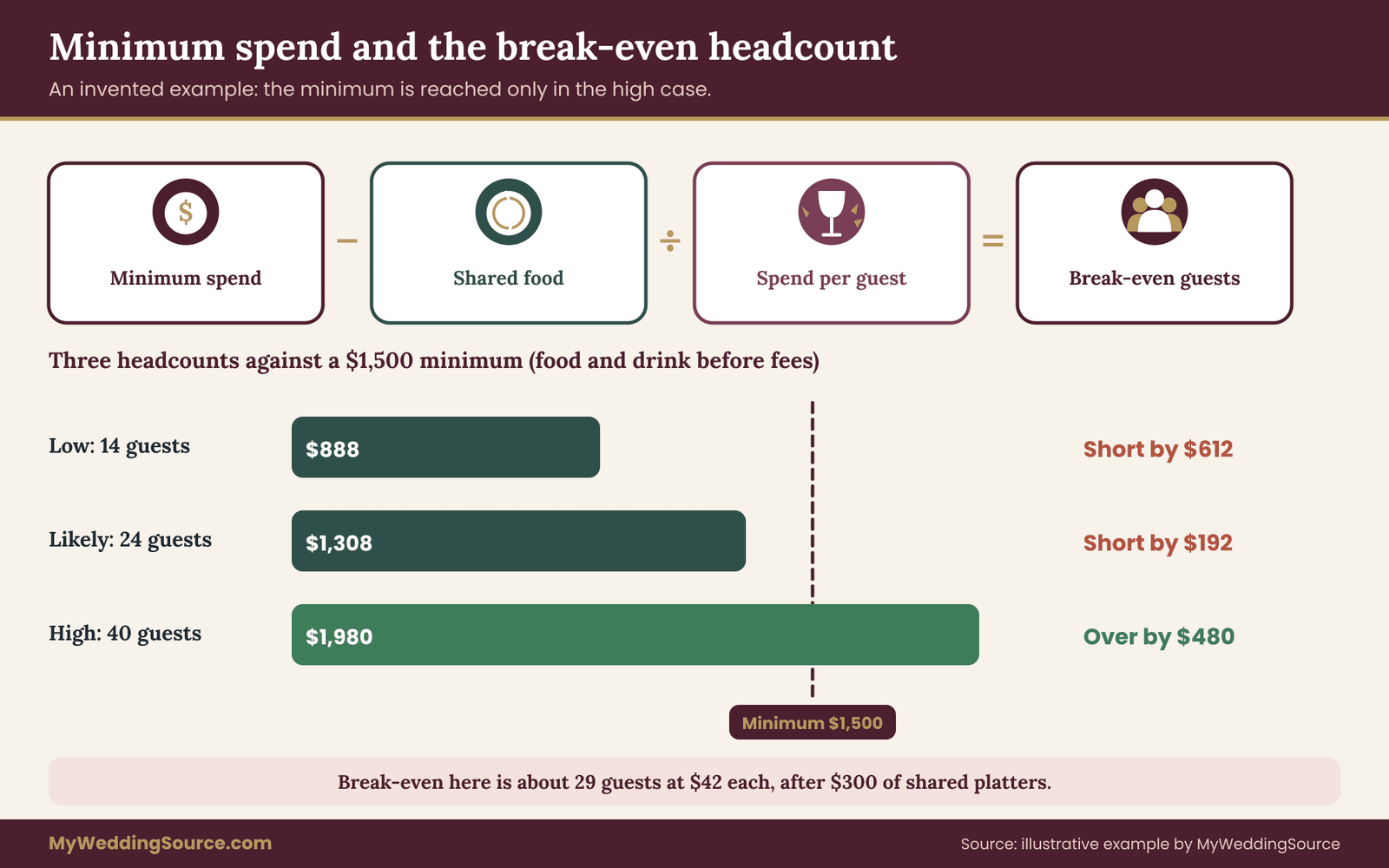
The break-even headcount tells you how many guests must be present, spending an ordinary amount, for the group to reach the minimum without a shortfall. It is the most useful single calculation in this guide, and it needs only three inputs.
The first is the minimum, in dollars, restricted to what counts. The second is the average spend per guest across the window. The third is any shared food you plan to order, such as platters, which counts only if the hotel agrees.
The formula, in words: take the minimum, subtract the shared food you plan to order, and divide the result by the average spend per guest. The answer is the headcount at which the minimum is exactly met.
Estimating the average spend per guest
You cannot know it in advance, and no published average will fit your group. Build your own estimate from the bar’s menu. Look at the price of the drinks your guests are likely to order: beer, wine, a standard cocktail, a premium cocktail. Estimate how many drinks a typical guest will have in the window, being honest about who will stay for an hour and who will stay for three. Multiply the two, and add a margin for the few who will order more.
The estimate will be rough. That is fine. The goal is not precision but a range: a low per-guest figure, a likely one and a high one. If the minimum is reachable across the whole range, the risk is small. If it is reachable only in the high case, the risk is large.
A decision rule for the minimum
Here is a plain rule. If the likely headcount multiplied by the likely per-guest spend is at least the minimum, the minimum is a safe floor and you are unlikely to pay a gap. If it falls between the low and high estimates, the minimum is a gamble and you should negotiate. If it exceeds even the high estimate, the minimum is the real price of the space, and you should decide whether the space is worth that price.
Negotiating the minimum
Hotels often have more room to move than the first quote suggests, especially on slow nights. These are reasonable requests, not demands:
- A lower minimum for a smaller section, in exchange for a smaller guarantee of space.
- A shorter window with the same minimum, so the spend falls into fewer hours.
- Counting food, including late-night snacks, toward the minimum.
- Counting the couple’s own hosted tab toward the minimum, so the number is easy to track.
- A step-down: for example, a lower minimum if the headcount confirmed forty-eight hours earlier falls below an agreed number.
Hotels may decline any of these. Asking costs nothing, and a firm no tells you where the true floor is. The wedding budget guide helps with placing the final figure inside your overall plan so you can see what it displaces.
When the minimum is not worth it
If the break-even headcount is well above your high headcount, you are paying a premium for a space you cannot fill. Options at that point include a smaller reserved area, a level-two table hold with no minimum, a different night, or a different place. A couple who can name that threshold in advance can walk away from a quote calmly, instead of discovering the gap on the night.
The shortfall is a cost, not a penalty
A shortfall is usually described as a penalty, and the word creates unnecessary anxiety. In most arrangements it is simply the unspent part of what you agreed to pay for the space. If you plan for it as a possible cost, you can set the minimum against the value of the section: the seats, the privacy, the staff and the convenience. If the section is worth the minimum to you, a shortfall is a price you accepted. If it is not, the better move is to renegotiate before signing.
What counts as spending at the hotel bar: a ledger you keep
The hotel keeps its own tally of what counts. You should keep a second one. The reason is simple: the hotel’s point-of-sale system may not match your understanding, and errors are easier to fix at the time than weeks later.
Keep a running ledger
A ledger is a short list, kept by a trusted person such as the best man, a sibling or a friend who agreed to help. It does not need to be elaborate. For each hour, note the time, the number of drinks ordered on the hosted tab, any food added and a running subtotal. The aim is to know, at any moment, how close the group is to the minimum and how close it is to the cap.
Ask for a mid-night total
Ask the server or the manager to tell you the running total at a fixed time, such as the halfway point. A mid-night number lets you decide whether to order a platter of food, to slow the hosted tab or to let the minimum run its course. Hotels can usually produce a subtotal from the point-of-sale system in under a minute. Asking is routine and not rude.
Watch the items that do not count
Some items may be charged to the tab but excluded from the minimum, such as a room fee, an automatic service charge or a corkage fee. Seeing them on the running total can make it look as if you are further along than you are. Ask the server to separate them, or keep them out of your ledger.
Tips and service charge are separate questions
If the hotel adds a service charge automatically, ask whether a further tip is expected, and whether the charge goes to the bartenders and servers or is retained by the house. Policies differ. If you plan to tip beyond the charge, decide who hands it over and when, so the staff who work late are paid fairly. The rules on how service charges and tips are treated for workers are set by labor authorities, not by hotels, and the U.S. Department of Labor publishes information on tips and service charges if you want the official view.
Receipts and the final bill
Ask for an itemized final bill, not a single total. The itemized version shows the count of drinks, the food, the fees and the tax. If something looks wrong, raise it before you leave, with the person who ran the night, rather than by email a week later. If the issue is not settled, the Consumer Financial Protection Bureau explains how to dispute a card charge, and billing-dispute windows can be short, so note the date of the charge.
Tab rules at a hotel bar: five ways to pay for the late hours
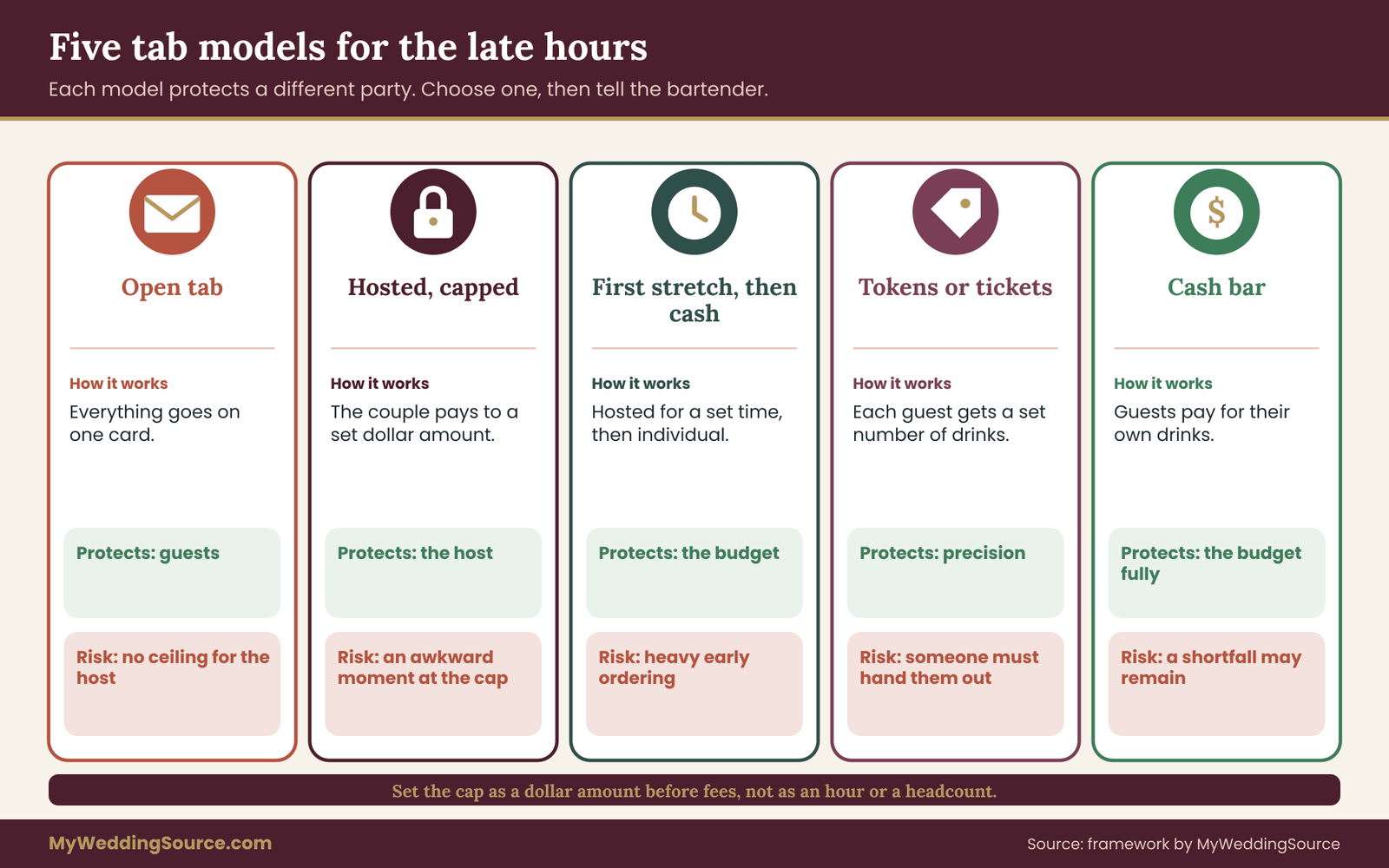
The third piece of the money question is the tab. A tab is how drinks get charged and who is charged. Hotels offer a few standard models, and each protects a different party. Choose the one that fits your budget and your group, and then write down how it will work so the bartender is not improvising at midnight.
Open tab on the couple’s card. Anything ordered by anyone in the group is charged to one card. It is the simplest for guests and the riskiest for the host, because the total has no ceiling. It suits a very small, trusted group.
Hosted tab with a cap. The couple covers drinks up to a stated amount, and the bar stops charging the card at the cap. After that, guests pay for themselves. This gives the host a firm ceiling and guests a clear signal. It is the most common model for groups of moderate size.
A fixed first stretch, then cash. The couple hosts the first hour or two, and the bar converts to individual payment at a stated time. It matches how many groups behave, with the heaviest ordering early.
Tokens, tickets or cards. Each guest receives a set number of drink tokens or a card, and anything beyond is paid by the guest. It controls spending precisely and costs nothing extra to guests who do not use them. It requires someone to hand them out and a bar that accepts them.
Cash or individual bar. Guests pay for themselves, and the couple pays only the minimum shortfall, if any. It protects the couple’s budget entirely and may produce a lower mood, because some guests expected the night to be hosted.
Matching the model to the minimum
The tab model and the minimum interact. If the minimum is high and the group is small, individual payment may not reach it, and you pay a shortfall whatever guests spend. If the minimum is modest and the group is large, a cap prevents the tab from overshooting. A hosted tab with a cap near the minimum is often easier to reason about than any other combination, because the expected spend and the floor are close.
Setting the cap
A cap is the second half of the Four-Number Check. Set it before you reserve, not at the bar. Start with the most you would be comfortable paying in total, including tax, service charge and tip. Work backward to the pre-fee amount the bar will see. If the hotel adds a service charge and tax on top, the cap on the point-of-sale system should be lower than your total comfort figure, or the final bill will exceed it.
State the cap as a dollar amount, not as a headcount or an hour. “Stop the hosted tab at this figure and send guests to pay individually” is a clear instruction. “Keep it reasonable” is not.
What happens at the cap
Decide in advance who will announce it, how and when. A calm approach is to let the bartender tell guests at the bar that the hosted portion has ended, rather than the couple making a speech. A card on each table, saying the hosted drinks have finished and the bar stays open for purchase, takes pressure off the host. The aim is to let the last part of the evening continue without awkwardness.
Authorization holds on the couple’s card
Many hotels place an authorization hold on a card when a tab opens, and the hold can be larger than the final charge. The Consumer Financial Protection Bureau explains how card holds and disputes work in general terms. If the couple’s card is also needed for the honeymoon, check the limit and the date the hold releases, because a large hold can block other purchases for days. Ask the hotel what amount it will hold and when it will release.
Who may order on the host’s tab
Name the rule: anyone with a wristband, anyone on a list, or only the couple and the wedding party. A bartender who is told “the wedding group” will guess. A bartender who is told “wristbands only” can follow a rule. If the host wants certain guests, such as parents or elders, to drink without paying, say so, and give the bartender a way to recognize them.
What the bartender will not do
Hotel staff will follow their own policy on checking identification and refusing service, and it will override any instruction from the host. They will not serve anyone under the legal age, and they may stop serving anyone who appears intoxicated. The National Institute on Alcohol Abuse and Alcoholism publishes plain information on alcohol and health. Treat the bar staff’s decisions as part of the safety plan, not an obstacle to it.
Reading the reservation terms before you sign at the hotel bar
Verbal promises disappear. A short written agreement, even an email thread the hotel confirms, converts them into something you can rely on. The wedding vendor contract guide explains how to read a contract clause by clause, and the same habits apply to a one-page hotel bar confirmation. Here are the clauses that matter most.
Deposit and payment schedule
Ask how much is due now, how much later and on what dates. A deposit may be credited toward the minimum or may be a separate fee. If it is credited, your minimum shrinks accordingly. If not, you are paying twice for the same night. Ask which it is.
Cancellation and changes
Find out how late you can cancel, what you lose and whether the deposit can be moved to another night. Find out whether the headcount can be reduced, and by when, without changing the minimum. A flexible hold is worth more than a small saving.
Hold release time
If the hotel releases the section when your group has not arrived by a stated time, know that time. A reception that runs late or a long photo session can push the group past a thirty-minute window. Ask for a grace period tied to the wedding timeline, and tell the hotel when the reception is scheduled to end.
Closing time and last call
Ask for the actual last-call time and the closing time, not “around one.” Last call is when the bar stops taking orders. Closing is when guests must leave. The two can be an hour apart. Local alcohol rules set the latest permitted hour in many places, so confirm the hours that apply to the hotel and the day, and understand that the hotel may close earlier if the room is quiet.
Outside items
Most hotels do not allow outside alcohol, and many restrict outside food and decor. If you hope to bring a small cake, a box of treats or a sign, ask. A corkage or cake-cutting fee may apply. If the answer is no, plan accordingly rather than arriving with a box and being turned away.
Music, noise and decorations
Ask what music the hotel plays, whether it can be changed and whether a speaker or live musician is allowed. Public performance of music is governed by licensing, and venues generally hold licenses for their own background music. A group bringing a playlist may not be covered, which is one more reason hotels say no. Ask about decor, signs and balloons as well, because many hotels forbid items that could damage surfaces or block exits.
Who signs and who is responsible
Find out who is named on the agreement. A couple may want a parent or friend to sign, but that person becomes the responsible party. Decide in advance who is signing, and give the hotel a single contact who can answer on the night.
Written confirmation
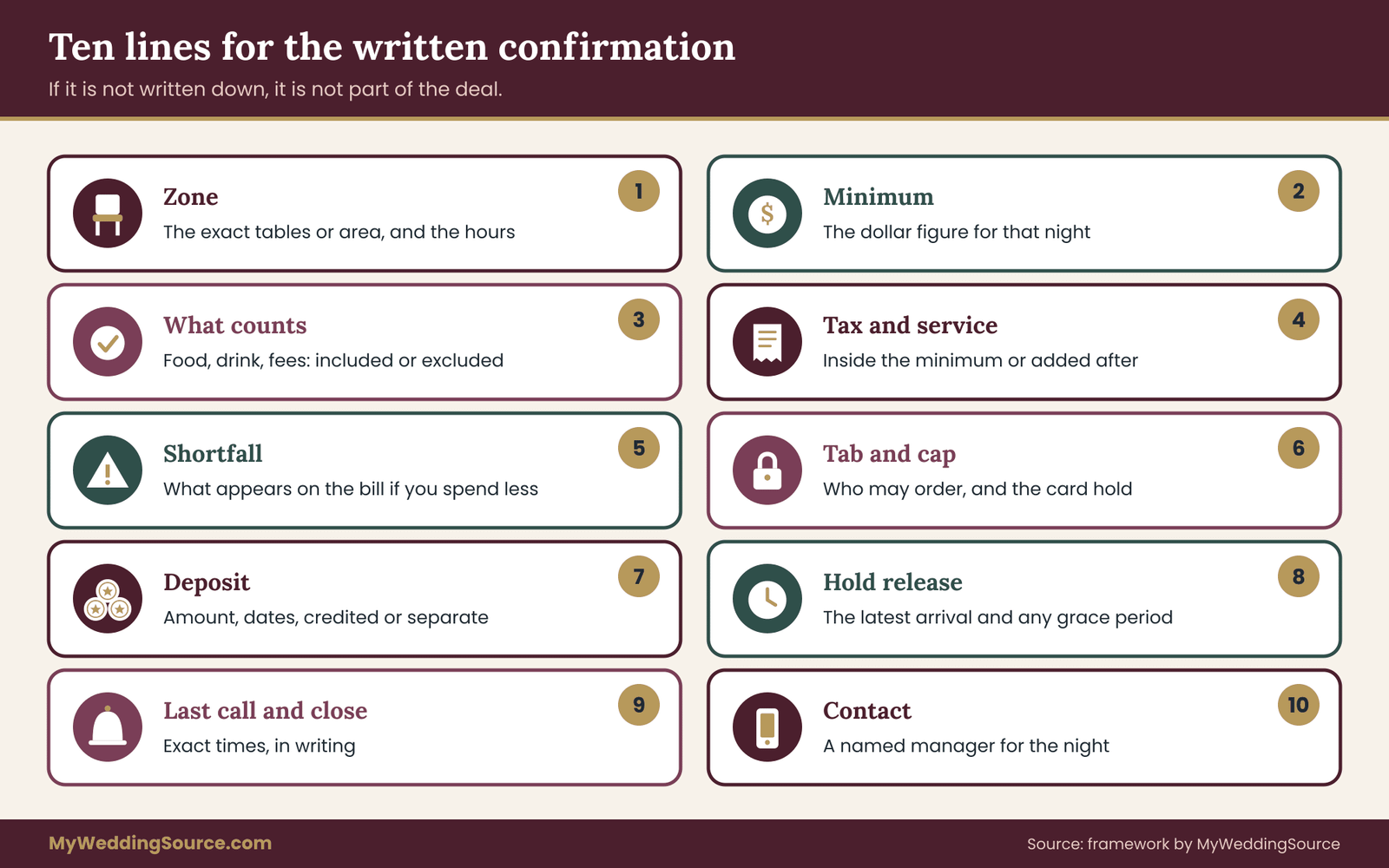
Request a one-page confirmation that states the date, the section, the hours, the minimum and what counts, the tab arrangement, the deposit, the cancellation terms, the closing time and the contact names. If the hotel’s standard form lacks any of these, add them in an email and ask the hotel to reply “confirmed.” That reply is your record.
A short script for the first email
A clear first message saves several rounds of back-and-forth. Something like this works:
“Hello, we are hosting a small gathering after our wedding reception on [date], from about [time] to [time]. We expect between [low] and [high] guests, many staying at your hotel. Could you tell us what reservation options the hotel bar offers, the minimum spend and what counts toward it, whether tax and service charge are included, your last-call and closing times, and how the public is handled while we are there? We would like the terms in writing.”
It names the numbers, asks for the four items in one place and leaves the hotel room to propose a level.
The questions to ask the hotel bar manager, and what a good answer sounds like
Once you know the framework, a phone call or a short meeting with the manager can settle most of it. This section turns the earlier ideas into questions you can ask in order, along with what a good answer looks like and what should make you pause. The wedding bar service planning guide covers the equivalent questions for your main reception bar, and the list below adds the ones specific to a hotel bar late-night plan.
Questions about space
“What is the exact area you would reserve for us, and can I see it?” A good answer names the tables or zone and offers a look. A vague answer such as “we will find room” means level one.
“What is the posted capacity, and how busy is the bar at that hour on that night?” A good answer gives a rough picture: “quiet after eleven,” or “busy until midnight on weekends.” If the manager cannot say, the hotel bar may not track it, which is itself information.
“How will the public be kept out of our section?” Listen for a concrete method. Staff, a rope, a card or a wristband all count. “People respect it” does not.
Questions about money
“What is the minimum, and what counts toward it?” A good answer is a dollar figure and a list. A weak answer is “it depends on what you order.”
“Are tax and service charge included in the minimum or added after?” Either answer is acceptable. A missing answer is not.
“If we fall short, what appears on the final bill?” Ask for a plain description, ideally with an example figure. If the manager can walk through one, the policy is real.
“Does the minimum change if our headcount is smaller or the night changes?” A good answer states a step-down, a deadline for notice or a flat no. Any is fine as long as it is written.
Questions about the tab
“Can you run a hosted tab with a cap, and who can order on it?” A good answer says yes, explains how the cap is set in the system and what the bartender does at the cap.
“What authorization hold will you place on the card, and when does it release?” A good answer gives a number and a date range. A hold you did not expect is a cash-flow problem.
“Is gratuity included, and do we add more?” A good answer states the percentage, who receives it and whether more is customary.
Questions about the night
“What are last call and closing, in writing?” Specific times, with a note on whether they can change. Ask what happens if the group is still there at closing, and whether the hotel needs to clear the room quickly.
“Can we bring a small item, a sign or a speaker?” A good answer gives a firm yes or no and mentions any fee.
“Who is the manager on duty that night, and how do I reach them?” A named person with a phone number the couple’s helper can use is much better than a general desk.
“What happens if someone is too intoxicated, or a guest becomes disruptive?” Listen for a clear policy and a person who decides. You want to know that the hotel has a plan and that the couple will not be put in the middle.
Which answers should make you pause
A few answers deserve a second look. A minimum with no list of what counts. A hold that releases quickly with no grace. A closing time that is “flexible” but not written. A promise that the public “will not be a problem” with no method. A service charge that is described only as “standard.” None of these is a deal breaker alone, and each is a reason to ask for one more line in the confirmation.
When to bring in a second pair of eyes
If the arrangement is level four, or the minimum is large relative to your budget, have a friend who has worked in hospitality or who simply reads closely look at the confirmation. A second reader often finds the missing clause. If a deposit is large, the cancellation terms deserve the same scrutiny you would give any vendor contract. And if anything in the agreement is unclear, ask for the missing detail to be added, rather than trusting that it will be understood.
The hotel bar worked example: three headcounts, one minimum
The following example is invented for illustration. The prices, the minimum and the headcounts are not drawn from any real hotel and should not be used as benchmarks. They show how the four numbers work together, and you can replace them with your own.
The setup
Imagine a couple whose reception ends at ten. Many of their guests are staying at the hotel. The hotel bar offers a reserved lounge section for ten until one, with a minimum of fifteen hundred dollars. The hotel states that tax and service charge are added on top of the minimum and do not count toward it. For the example, assume the service charge is twenty-two percent and tax is eight percent, applied to the final food and beverage total. The reserved section holds about thirty people, and the bar’s posted capacity is ninety.
The couple estimates three headcounts: a low of fourteen, a likely twenty-four and a high of forty. They estimate each guest will have about three drinks over the night at an average price of fourteen dollars, so forty-two dollars per guest in drinks. They also plan to order three hundred dollars of shared late-night platters, which the hotel agrees will count.
The spend in each case
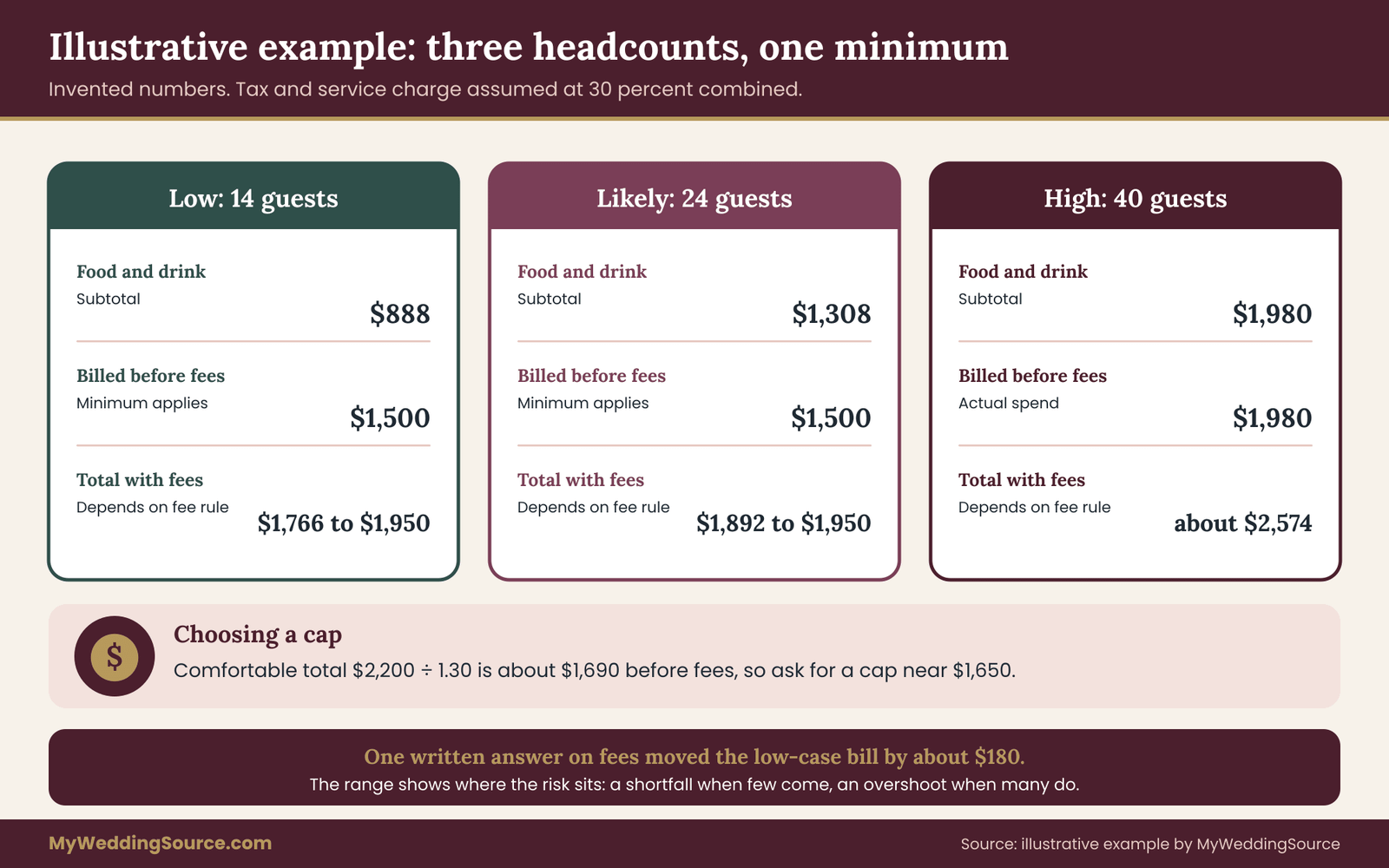
At the low headcount of fourteen, drinks come to five hundred eighty-eight dollars, and with platters the subtotal is eight hundred eighty-eight. That falls short of the minimum by six hundred twelve dollars, so the billed food and beverage figure is the minimum, fifteen hundred.
At the likely headcount of twenty-four, drinks come to one thousand eight dollars, and with platters the subtotal is one thousand three hundred eight. That also falls short, by one hundred ninety-two dollars, so the billed figure is again fifteen hundred.
At the high headcount of forty, drinks come to one thousand six hundred eighty, and with platters the subtotal is one thousand nine hundred eighty. That exceeds the minimum by four hundred eighty dollars, so the billed figure is the actual spend.
What the fees do
With tax and service charge at thirty percent combined, the total bill depends on one question the couple asked: do fees apply to the shortfall? If they do, the low and likely cases both cost nineteen hundred fifty dollars. If they apply only to actual sales, the low case costs about seventeen hundred sixty-six dollars and the likely case about eighteen hundred ninety-two. The high case, with fees on the actual spend, costs about twenty-five hundred seventy-four dollars.
The difference between the two fee treatments is roughly one hundred eighty dollars in the low case. It is modest, and it is a reminder that a single question in writing can move the bill by the price of a dinner.
What the couple decides
The likely case falls under the minimum, and the high case exceeds it by a meaningful amount. By the decision rule in the minimum section, the minimum is a gamble. The break-even headcount, taking out the platters, is about twenty-nine guests at forty-two dollars each. That sits between likely and high, so the couple asks for two changes: a lower minimum of twelve hundred, or counting the cost of a late-night food order toward it more generously.
They also set a cap. They are comfortable paying about twenty-two hundred dollars in total. Dividing by 1.30 gives roughly sixteen hundred ninety before fees, so they ask the hotel to cap the hosted tab at sixteen hundred fifty dollars before tax and service charge, with guests paying individually after that.
What the example shows
Three points stand out. The minimum is not the cost; the headcount and the fee treatment decide the cost. A cap protects the host in the high case, and the minimum protects the hotel in the low case. And the most valuable numbers were not the price of a drink but the break-even headcount and the written answer on fees. Replace the invented figures with your own, and the same steps will tell you where your risk lies.
Edge cases at a hotel bar after party, and how to handle each
Plans meet reality late at night. The cases below are the ones that most often catch a group off guard. For each, the useful question is what you decided in advance and who has the authority to act.
The reception runs long
A reception that ends later than planned squeezes the hold window and the spend window at the same time. If the section releases at a set time, a late group could return to find it given away. Share the reception timeline with the hotel and ask for a grace period tied to it. Assign one person to text the manager when the last dance begins, so the hotel bar can prepare. If the hold cannot be extended, ask whether a second section or a reduced minimum is possible.
The hotel bar is fuller than expected
If a conference, a sports event or another wedding fills the room, your section may be isolated or crowded. Ask the manager on the day whether anything unusual is happening. If the room is full, decide whether the group stays, shortens the visit or moves to the lobby seating or a hospitality suite. Do not let a reserved section stand empty because guests could not reach it through a crowd.
Fewer guests than planned
A small group is not a failure. If twelve people come instead of twenty-four, the shortfall on the minimum is an annoyance and the mood may be better in a smaller space. If the hotel allows a step-down, use it. If not, treat the shortfall as the price of the space and order some food, since food usually counts and feeds guests who skipped dinner.
More guests than the reserved zone holds
If people spill beyond the zone, the hosted tab may not apply to them, and they may be charged at the bar. Tell a helper to watch the edge of the section and to hand out wristbands only up to the number agreed. If the crowd keeps growing, ask the manager whether the zone can be extended, and decide who covers the added cost. It is kinder to set the limit before the night than to turn people away at the door.
A guest who is underage
The legal minimum purchase age for alcohol is twenty-one throughout the United States, and hotel staff will check identification. A guest under that age cannot be served, even on a hosted tab, and may not be allowed in some bars at all after a stated hour. If you have younger guests, such as college-age friends or a young adult sibling, ask whether they may be in the hotel bar and tell them the rule before the night. A lounge with food service may admit minors until a set time, and the policy belongs in the written terms.
A guest who has had too much
Staff may refuse service, and guests should not be pressured to keep up. The National Highway Traffic Safety Administration publishes information on impaired driving and the risks of leaving a bar and getting behind the wheel. The point for a hotel bar is that a bed is steps away, and you can use that to make the ending safer than most. Agree in advance who will check on a guest who looks unwell and how to reach hotel security or the front desk.
Noise complaints from other hotel guests
A reception’s worth of friends can be loud in a lobby bar. The hotel may ask the group to lower volume, and it has the right to do so. Treat the request as a normal part of sharing a building. If the group’s room is on a floor above the bar, the hotel may already have set quiet hours. Ask what they are and tell your helpers to respond politely to staff.
Another wedding or event at the same time
Some hotels host two events on one night. Guests may end up in the same bar, mistake one another’s tabs and confuse the wristbands. Ask whether another event is planned that night and how the hotel will separate the groups. Different colored wristbands or a clear sign at your section can prevent a billing mix-up.
The kitchen is closed
Late-night food is often limited. If food counts toward the minimum, or if you want a platter, ask when the kitchen closes and what is available afterward. A bar snack menu may continue after the kitchen shuts. Do not plan to order a late platter at midnight if the kitchen stops at eleven.
The couple wants to leave early
Many couples want to appear at the hotel bar and leave after an hour. That is a good plan, and it affects the tab. If the hosted tab is under the couple’s card, name a person who can stay as the host’s representative and who knows the cap and the closing procedure. Leave a short note with the manager naming that person.
Hotel bar comfort, access and neighbors
Practical details can make the difference between a smooth night and a tense one. Most of them cost nothing to arrange if you ask early.
Access for guests with mobility needs
The Americans with Disabilities Act sets accessibility standards for public accommodations, and the Department of Justice publishes plain guidance at its ADA site. For a hotel bar, the questions are concrete. Is there a step-free route from the elevator to your section? Is the section on the same level as the main bar? Are there seats with arms and backs for older relatives? Are restrooms accessible and close?
If a guest uses a mobility device or has difficulty standing for long, a reserved table near the entrance may serve better than a corner. The guest hotel coordination guide covers room choices for guests with different needs, and the same guests are the ones who will appreciate a chair.
Quiet corners
Not every guest wants to stay in the loudest part of the room. A small area with seats and lower sound lets older relatives, new parents and introverts join for a short time. Ask the manager if there is a quieter area and whether it could be included in the reservation.
The coat and bag question
Guests leaving a formal reception may carry wraps, shoes in a bag or a gift envelope. Ask where they can leave items. The hotel may offer a coat check or the front desk may hold bags for a short time. Tell guests where to leave valuables, since a lounge is not a secure space.
Lighting, music and seating
Hotel bars usually have a fixed mood, and the point of a reserved section is borrowing it, not rebuilding it. If the lighting is too bright or the music too loud for conversation, ask whether the volume can be lowered, and accept the answer. If the hotel allows a small change, such as a few candles on tables, ask what is permitted.
Phones, photos and privacy
Guests will take photos late in the evening, and others in the bar may not want to appear in them. Ask your photographer, if any, to stop at the hotel bar door, and ask guests to be considerate. The hotel may have its own rules on photography in public areas. If you want a few photos, a single image at the start is enough.
Dress and arrival
A reception outfit may be formal, and a hotel bar may expect smart casual. Few hotels turn away wedding clothes, but a few have a dress code that could matter for the walk-in guests you invite. Check it, and tell guests if they should change shoes or add a layer.
A note on children and families
Many guests bring children to the wedding and then go back to the room. If a babysitter or a relative is watching children upstairs, a hotel bar is a good late spot because parents are close. Tell families which door to use and how to reach the room. For the logistics of room choice and family travel, the same guide on lodging is helpful, and it is worth sharing with parents who are staying overnight.
Staff working late
Hotel bar staff may have worked a long shift when your group arrives. Check in on them, make the hosting simple and thank them. A clear tab plan, a small number of requests and an honest answer to any question make their job easier. Worker safety and fair working hours are the subject of OSHA guidance and labor rules, and the hotel manages those. The couple’s role is to avoid last-minute requests that extend a shift or complicate the close.
Keeping the night from becoming a second reception
The most common mistake is treating the hotel bar as a second reception. A short toast, a few songs on the bar’s own system and a single announcement are plenty. If the couple stands at the door greeting people for an hour, the night becomes a duty. Stay for a stretch, enjoy it and leave when you wish, because the arrangement is built to run without you.
Closing the hotel bar night: last call, rides and rooms
An ending you planned is calmer than one you improvised. The advantage of a hotel bar is that the ending is short: an elevator, a corridor and a bed. Even so, four times and three people should be fixed before the evening begins.
The four times
Last call. When the bar stops taking orders. Ask the bartender to give a ten-minute warning, and agree that the hosted tab closes at last call.
Closing. When guests must leave the bar. Agree on a short wind-down so the hotel can clean and the group can say goodbye without a rush.
Doors closed to new arrivals. If you want to stop the stream of late arrivals, set a time and tell the helper at the door.
Everyone out of the section. The point at which the hotel takes back the space. Share it with your helpers so they can gently move the last group toward the elevators.
The three people
Name a host’s representative who stays until the close and knows the cap and the contacts. Name a sober helper who watches how guests are doing, checks that nobody is left behind and knows which guests are not staying at the hotel. Name a point of contact at the hotel who can resolve a billing question and a safety question.
Rides for guests who are not staying at the hotel
Not every guest sleeps in the building. Some are driving, some are staying nearby and some live in town. Decide how they will get home before the evening starts. Share the number of a local taxi company or a ride service, and agree that a guest who has been drinking will not drive. The National Highway Traffic Safety Administration explains the risks of impaired driving, and the plan is a simple one: ask, then book the ride before the guest asks. If the hotel offers a courtesy car or can call a cab, ask in advance.
A short list for guests who are staying
For guests who are staying, the plan is a matter of reminders: a room key in a pocket, water at the bar and a quiet note at the end of the night about the next morning’s schedule. If you have a farewell brunch or a check-out time, say it clearly once. The wedding vendor timeline is where the final schedule of the next day belongs, so you can mention only the key times at the hotel bar.
Closing the bill
Ask the manager to run the final total at last call, not after the room has emptied. Review the itemized bill with the host’s representative, compare it with the ledger and ask about any line that does not match. Pay the balance, collect the receipt and ask when any authorization hold will release. If you need to dispute a charge later, keep the itemized bill and write the date. The Consumer Financial Protection Bureau explains how card disputes work, and the window to dispute is limited.
Thanking staff
If a tip is separate from the service charge, hand it to the manager with a note naming who should receive it, or leave it as the hotel directs. A short thank-you the next day, passed through the manager, costs nothing and is remembered by people who work late shifts.
The morning after
Check the card for the final charge and confirm the hold released. Save the confirmation, the itemized bill and the ledger together. If you are keeping wedding records, the bill belongs with the rest of your vendor and money files, and it will answer questions about what you spent on the late hours.
A run of show for the hotel bar night
A run of show is a short timeline that says who does what and when. For a late-night hotel bar plan it can fit on one page, and it should reach everyone who has a role.
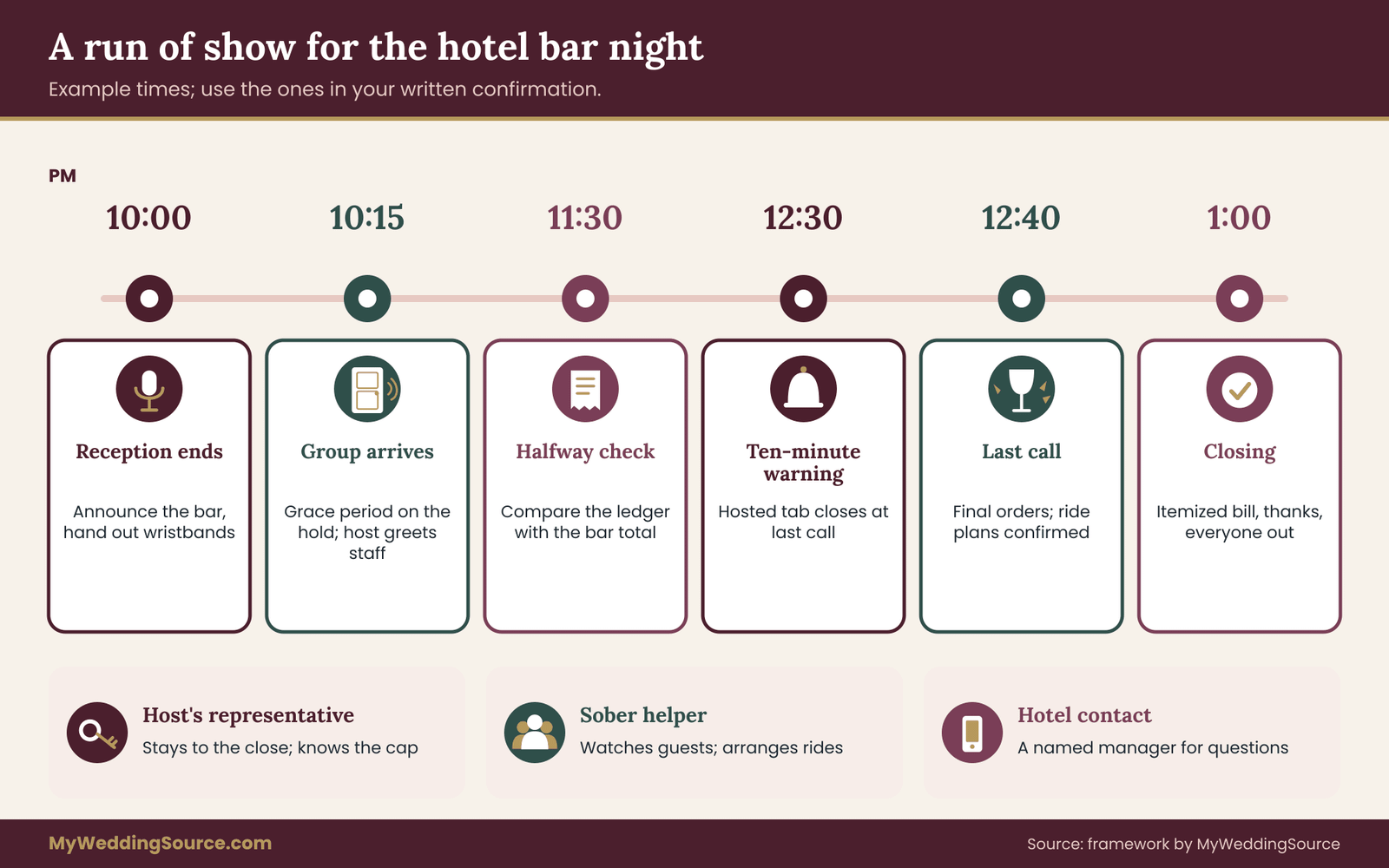
Before the reception ends
Confirm with the hotel bar manager that the section is ready and that the staff know the cap. Give the wristbands, the card for the tables and the list of names to the helper at the door. Tell the best man or another trusted guest the cap and the closing procedure.
As the reception ends
Make a short announcement that the hotel bar is open to everyone who wishes to continue, with the room, the time and the tab arrangement in one sentence. Hand out wristbands as guests leave the room. A card at each table with the same details helps those who missed the announcement.
First hour
The couple appears, greets guests, thanks the staff and has a drink. The host’s representative checks the ledger against the point-of-sale total. A platter arrives if food counts and the kitchen is open.
Middle of the night
The ledger is checked at the halfway point. If the minimum is not yet met, order food. If the cap is close, signal the bartender to switch to individual payment at the right moment. The helper notes who is leaving and who needs a ride.
Last hour
The ten-minute warning comes before last call. The host’s representative closes the hosted tab, checks the bill and confirms that guests have a way home. The helper stays until the section is clear.
What to tell guests, in plain words
Clear wording prevents confusion. Keep it short and place it where guests will see it: a line on the program, a card at the table, a quick spoken announcement, and a sign at the door.
On the program or a card
“After the reception, we are hosting a relaxed gathering in the hotel bar until [time]. Drinks are hosted until [time] or until the tab closes, then the bar stays open for you to purchase your own. Please wear your wristband. We hope to see you there.”
On an invitation to a smaller group
Say it simply and kindly. “We are meeting in the hotel bar after the reception and would love you to join us.” If the list is small, invite in person, and avoid mentioning the arrangement in front of people who are not invited. A short private message is better than a public notice.
For guests who ask why they were not invited
Have an honest, brief answer. “The section is small and we kept it to a handful of people, and we are grateful you were part of the day.” Do not apologize at length. A hotel bar is open to the public, and anyone can go and buy a drink, which can be said kindly if the question comes up.
Warning guests about cost
If you are not hosting, say so plainly. “Drinks at the hotel bar are individually paid” removes confusion and lets guests decide whether to attend. If you are hosting up to a cap, say that the hosted portion ends at a time, so no one is surprised.
Common mistakes at a hotel bar after party, and the limits of this guide
Most problems come from a few repeated errors, and each is avoidable with the checks above.
Treating a verbal promise as a reservation. A friendly phone call is not a hold. Get the terms in writing.
Reading the minimum and ignoring what counts. The number is meaningless without the list of included items and the treatment of tax and service charge.
Skipping the cap. An open tab with no ceiling can end the night with a total that surprises everyone.
Forgetting the walk-in rule. If you do not decide who is in the room, the room decides for you.
Assuming the closing time. “Around one” can mean midnight. Ask for the exact time.
Ignoring the ride home. The easy exit of an elevator can hide the guests who are not staying.
Planning for the best case only. Run the numbers for the low and the high headcount, not just the likely one.
The limits of this guide
This guide offers a framework and examples, not a quote. It cannot tell you what a particular hotel will charge or permit, and it does not replace the hotel’s own terms. Alcohol licensing, closing hours, occupancy limits, service charge rules and worker protections vary by state and locality. Check the current rules with the hotel and the local alcohol authority, and read your own agreement closely. The figures in the worked example were invented to show the method.
Your next steps
Pick one evening this week. First, write your low, likely and high headcounts, and be honest about who will leave early. Second, call the hotel bar manager and ask for the reservation level, the reserved zone, the posted capacity and the walk-in method. Third, ask for the minimum, what counts toward it, how tax and service charge apply and what a shortfall looks like on the final bill. Fourth, choose a tab model and set a cap before fees.
Then request a one-page written confirmation with the closing time, the deposit and cancellation terms and a contact for the night. Compute the break-even headcount, share the run of show with your helpers and fix the four times. If the numbers do not work, a smaller section, a different night or a different place may serve you better, and that is a good outcome.
FAQ
How far ahead should I reserve a hotel bar for a wedding after party?
Reserve as soon as your wedding date and guest hotel are settled, because the best nights and sections go first and the minimum may rise near busy dates. A firm reservation can wait for a few weeks before the wedding if you have a written hold. Confirm your headcount range and the terms in writing before paying a deposit.
Is a minimum spend at a hotel bar negotiable?
Often it is, especially on quiet nights. You can ask for a smaller section, a shorter window, food counting toward the minimum or a step-down if the headcount falls. The hotel may decline, and a firm answer still tells you the real floor. Get any agreed change in writing, and compare the total bill, not only the minimum.
Do tax and service charge count toward the minimum?
It depends on the hotel. Some count them and some add them on top, which makes the bill larger than the stated minimum. Ask for the answer in writing, and ask whether fees also apply to any shortfall. The difference can change the bill by a meaningful amount, so confirm it before you sign.
What if strangers walk into our reserved hotel bar section?
Decide the walk-in rule beforehand. At a section level the hotel bar usually stays open to the public, so ask how the zone will be marked and who watches it. Wristbands, a card on the tables or a staff member at the edge help. For full privacy, ask about a buyout or a private lounge instead.
Who pays if we spend less than the minimum?
You do. Most minimums work as a floor, so the unspent part is charged to the host, and fees may apply depending on the hotel’s terms. Calculate the break-even headcount using the minimum, your shared food and the average spend per guest. If the break-even is above your likely headcount, negotiate or choose another option.
Should I host the whole tab or let guests pay?
Both are common. A hosted tab with a cap gives guests a pleasant start and gives you a firm ceiling. A cash bar protects your budget entirely, and you may still owe a shortfall on the minimum. Choose based on your budget and your group, tell guests plainly, and brief the bartender on the cap and who may order.
What happens if the reception runs late?
A late reception can shorten your hold window and your spend window. Share the reception timeline with the hotel, ask for a grace period before the section is released and have a helper text the manager when the last dance begins. Ask whether the minimum can adjust if the group arrives late, and get any change confirmed in writing.
Can we bring our own music, cake or decor to a hotel bar?
Usually not without permission. Many hotel bars restrict outside speakers, food and decorations, and a fee may apply for a cake or a bottle. Ask early, in writing. If the answer is no, use the hotel’s own music and keep decor to what the hotel allows. A private lounge or a different venue gives more freedom.
Sources
- Occupational Safety and Health Administration, workplace safety standards and guidance
- National Fire Protection Association, codes, standards and safety information
- U.S. Fire Administration, FEMA, fire safety resources
- National Highway Traffic Safety Administration, impaired driving
- National Institute on Alcohol Abuse and Alcoholism, National Institutes of Health
- Centers for Disease Control and Prevention, alcohol and public health
- ADA.gov, Americans with Disabilities Act information and technical assistance
- U.S. Department of Labor, Wage and Hour Division, tips and service charges
- Consumer Financial Protection Bureau, credit card disputes and holds
- Alcohol and Tobacco Tax and Trade Bureau, alcohol regulation