
Bridal flats can look completely at home at a formal wedding, but only if the rest of the outfit is built around them. This guide gives you a simple outfit balance board and an indoor-outdoor fit test, so you can choose bridal flats that look finished in photos and still feel steady after eight hours on your feet.
Treat bridal flats as part of the formal outfit, not as a compromise. Pick a pair with the same level of finish as your dress: real material, a clean shape, and trim that echoes the dress without competing with it. Have the hem set while you stand in the exact pair you will wear. Then run the fit test twice, once on a hard indoor floor and once on the surface outside, before you commit. If the shoes pass both tests and the hem clears the floor by a measured amount, the choice is made.
Plenty of brides decide on bridal flats for plain reasons. They are tired of heels, they have a long day planned, the ceremony is on a lawn, or they simply want to dance without thinking about their feet. Then the second thought arrives: will flat shoes look wrong with a formal gown? The worry is understandable, and it is mostly solved by planning rather than by taste.
A formal wedding sets expectations through the dress, the venue, the lighting and the time of day. Bridal flats can meet all of them. What they cannot do is rescue a hem that was cut for four-inch heels, or a plain canvas sneaker-style shoe next to a satin ballgown. The gap between “elegant” and “afterthought” is usually in the details: the hem length, the toe shape, the material, the way the shoe looks from the side when you walk.
This article stays on one question: how to style and fit bridal flats for a formal wedding without giving up polish or comfort. It does not repeat the full decision about heel shape, dress length and venue surface, which has its own place on this site, and it does not cover grass protection for heels. If you also want the wider picture of what you carry and wear on the day, the guide to wedding day accessories covers compatibility, movement and backups.
A note on scope. This is general information, not legal, tax or financial advice, and it is not medical advice either. Comfort is individual, so test every pair on your own feet, and see a podiatrist or another licensed professional for pain, injury or a foot condition.
Why bridal flats work at a formal wedding
Formality is not measured in inches of heel. It is measured by how deliberate the whole outfit looks. A floor-length gown, a cathedral veil and a pair of well-made satin bridal flats read as formal because every piece looks chosen. The same gown with a beaten-up pair of everyday shoes reads as careless, but that is a problem of quality and fit, not of height.
Three practical facts explain why many people settle on bridal flats for a formal day.
The dress hides the shoe for most of the day. In a long gown, the shoes appear only when you step, sit or lift the skirt to climb stairs. Guests see the silhouette, the fabric and the movement far more than the footwear. That gives bridal flats more room in a formal setting than they have in a short dress, where the shoe is always in view.
Your posture and your gait stay your own. Flat shoes let you walk the way you normally walk. For a processional that has to move at a measured pace, for a first dance, and for the long stretch of greeting guests, a familiar gait is steadier than a borrowed one. That helps in photos too, because people who feel secure tend to stand and move naturally.
The day is long. A typical formal wedding day runs from late morning preparation to the last dance. Many people stand or walk for hours, often on more than one kind of surface. Choosing bridal flats is a way of taking one variable off the list, so that the day’s challenges are about the schedule and not about your feet.
None of that makes bridal flats a free choice. They change the hem, the balance of proportions, the way the train moves and the way you look from the side. Those changes are manageable, and they are the subject of the rest of this guide.
What bridal flats do not fix
It helps to be honest about the limits. Bridal flats do not guarantee comfort. A flat shoe can still be too narrow, too slippery, too stiff or too loose. They do not stop a dress from dragging if it was hemmed for a different height. They do not make a wide skirt look balanced unless the dress has enough volume to carry them. And they do not remove the need to break the shoes in and test them in the conditions of your venue.
A shoe with no heel also changes how weight travels through the foot. Some people find it more comfortable, others find that a shoe with no support under the arch tires them faster than a low heel would. This is why the fit test later in this guide matters more than any rule about style. The American Podiatric Medical Association publishes general guidance on choosing footwear that fits and supports, and it is a sensible place to start if you have questions about your own feet.
What formal means when you wear bridal flats
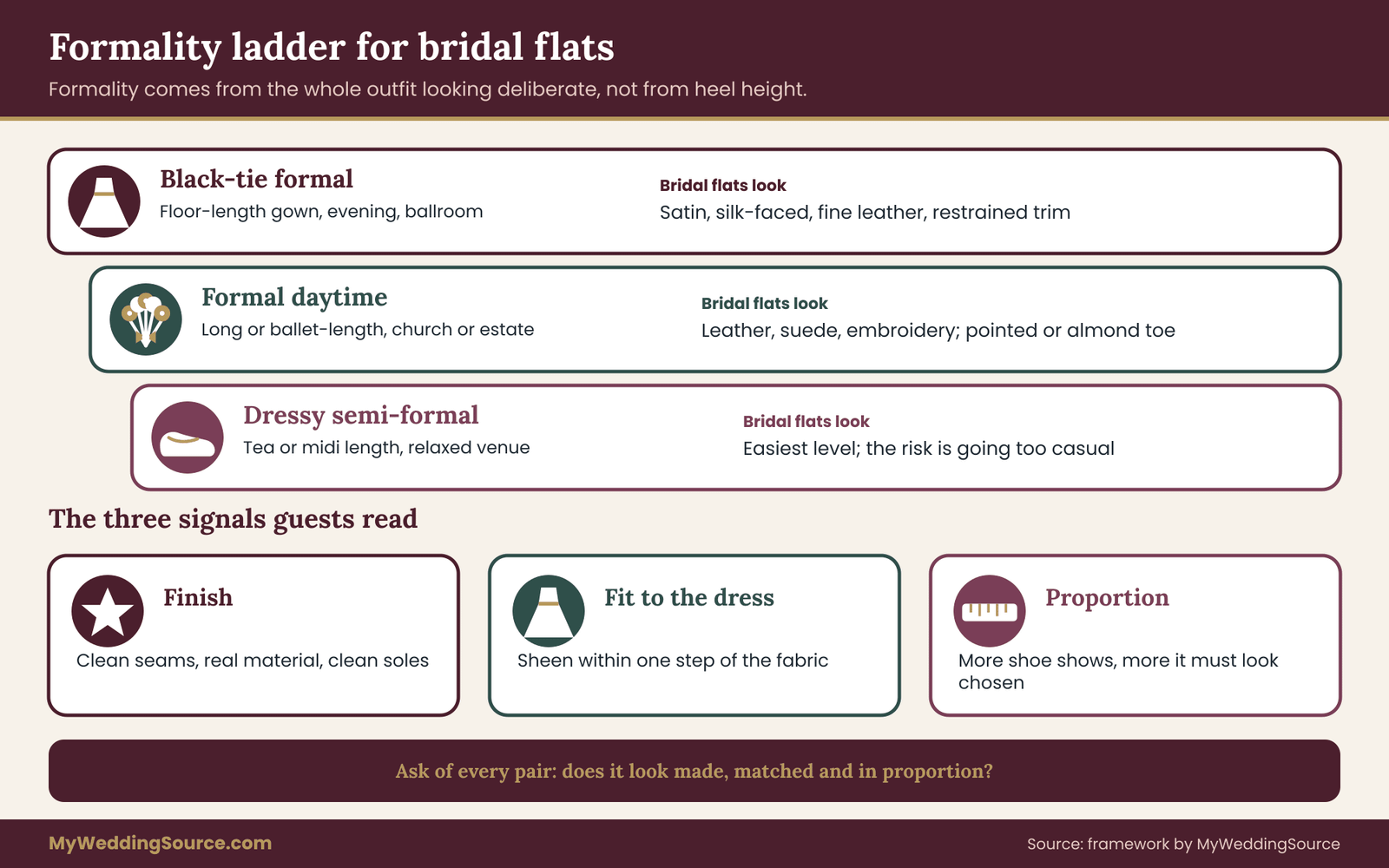
“Formal” is used loosely in wedding invitations. For planning purposes it helps to translate it into a ladder, because the right pair of bridal flats changes at each rung.
At the top is white-tie or black-tie formal: a floor-length gown, often with a train, an evening ceremony or a ballroom reception, and a dress code that says so on the invitation. Here, bridal flats need visible quality. Satin, silk-faced, brocade, fine leather or carefully finished lace look right. Trim should be restrained and deliberate. A shoe that looks like a casual ballet slipper bought for the commute will sit awkwardly against the dress.
One step down is formal daytime: a long or ballet-length dress, a ceremony in a church, a historic hall or a garden estate, and a reception with plated service. Bridal flats have the most freedom at this level. Leather, suede, satin and embroidered fabric all work, and a pointed or almond toe adds length without adding height.
Then comes dressy semi-formal: tea-length or midi dresses, a relaxed venue and a mixed crowd. Bridal flats are easiest here, and the main risk is going too casual.
This ladder is a starting point, not a rule. Cultural and religious traditions bring their own expectations about what the bride wears on her feet, what colors are appropriate, and whether shoes are worn at all during certain rituals. If your ceremony includes a tradition with footwear customs, ask the officiant or the family member who knows the custom before you pick a style.
The three signals guests actually read
When people look at a bridal outfit, they read three signals, usually without being aware of it.
The first is finish. Does the material look made, or mass-produced and creased? A pair of bridal flats with clean seams, even stitching and a sole that is not scuffed on the day reads as finished.
The second is fit to the dress. Does the shoe’s color, sheen and level of ornament sit comfortably beside the fabric? A matte leather flat with a glossy satin gown is a mismatch of sheen, even if the colors are close.
The third is proportion. Does the shoe look right for the length and volume of the skirt? A fitted column dress shows more shoe than a full ballgown, so the shoe has to carry more of the look.
If you keep those three signals in mind while you shop, you will reject most of the wrong pairs quickly, and you will not need to ask whether bridal flats are “allowed” at a formal wedding.
The outfit balance board for bridal flats
The outfit balance board is a one-page planning tool. Instead of choosing shoes alone, you lay out the five things that have to agree with each other, give each one a short note, and look for the lane that is out of balance. Most disappointing bridal flats purchases fail because one lane was never discussed.
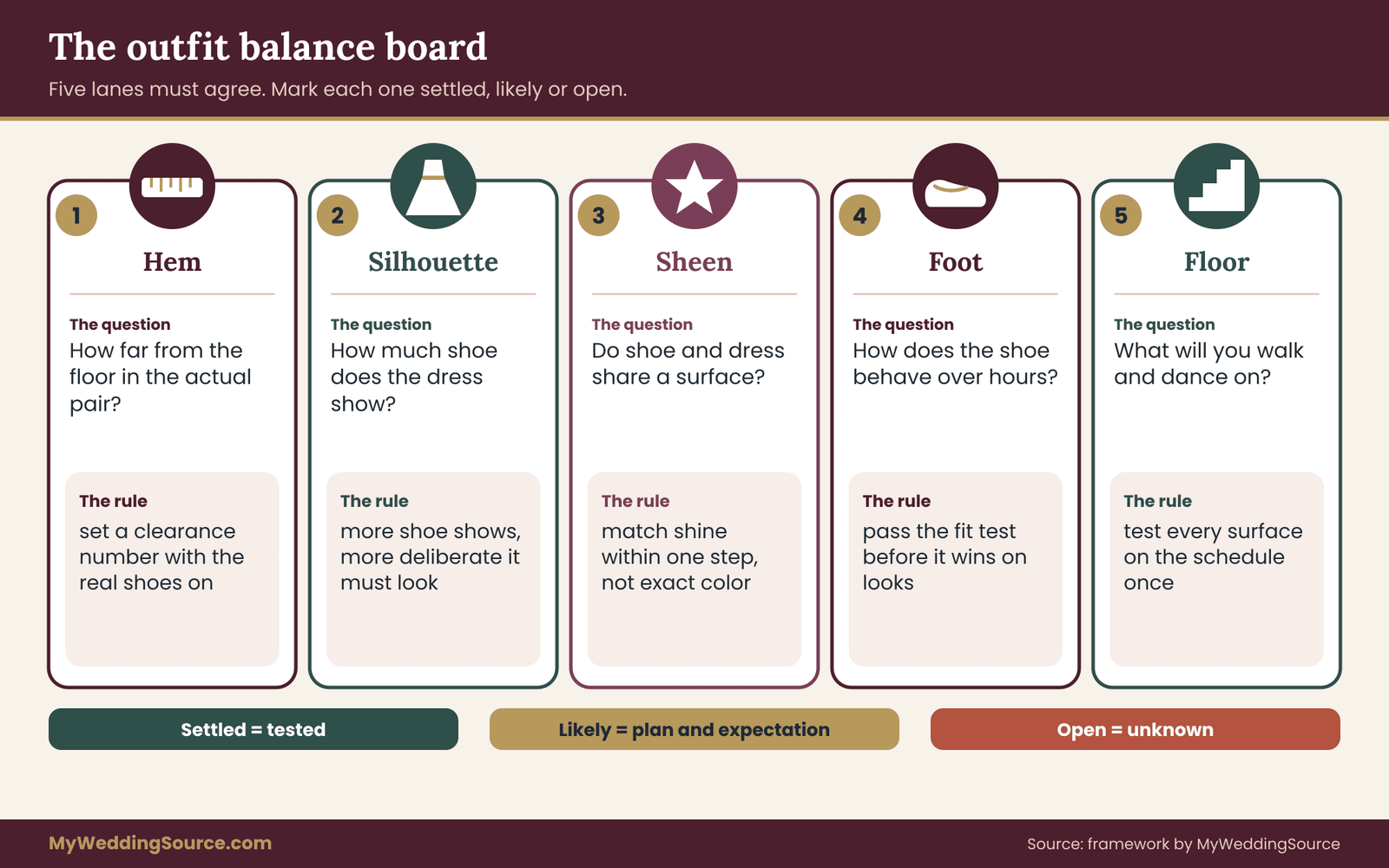
The five lanes are hem, silhouette, sheen, foot and floor. Each lane has one question and one decision rule.
Lane one: hem. The question is how far the dress hangs from the floor when you stand in the shoes you will wear. The rule is to set a target clearance and have the hem altered to that number while you wear the actual pair. With bridal flats the hem usually has to be shorter than a dress fitted for heels, so the alteration is rarely optional.
Lane two: silhouette. The question is how much shoe the dress shows. A ballgown or a full A-line may show only a toe when you walk. A column, mermaid or sheath dress shows the whole shoe from the front and side. The rule is that the more shoe the dress reveals, the more the shoe has to look deliberate.
Lane three: sheen. The question is whether the shoe and the dress share a surface language. Glossy satin, matte crepe, lace, tulle, beaded fabric and metallic thread each pair differently with leather, suede, silk-faced fabric or embroidery. The rule is to match the level of shine within one step, not to match color exactly.
Lane four: foot. The question is how the shoe behaves on your foot over time. This covers width, arch comfort, heel grip, toe room and how your feet change across a long day. The rule is that a shoe has to pass the fit test before it is allowed to win on looks.
Lane five: floor. The question is what you will walk on: polished stone, carpet, wood, a dance floor, a gravel path, a lawn, a church step. The rule is that every surface on the schedule gets tested at least once in the shoes.
How to fill in the board
Take a sheet of paper or a notes file and draw five columns, one per lane. Under each lane write three things: the current fact, the target and the open question.
For the hem lane, the current fact might be “dress hemmed for a two-inch heel at the first fitting”. The target might be “clears the floor by a measured amount in the flats”. The open question is “will the seamstress re-measure with the real shoes?”
For the silhouette lane, the fact is the dress shape and how much shoe it shows. The target is a decision about what the shoe should do: disappear, echo the dress or provide a small point of contrast. The open question might be “how much will the shoe show when I climb the steps?”
For the sheen lane, note the dress fabric and its finish, then the shoe material you are considering, and flag any mismatch. For the foot lane, record your measured foot length and width, past experience with shoes, and anything you want a professional to check. For the floor lane, list the surfaces in order of the day, from getting ready through the last dance.
Once the board is filled in, the lane with the weakest answer is where to spend your time. A bride who has chosen beautiful bridal flats but has no hem number and no floor list has not finished the job.
Scoring the board without false precision
You do not need numbers to use the board, but a simple three-level mark helps. Next to each lane, write “settled”, “likely” or “open”. Settled means you have tested it. Likely means you have a plan and a reasonable expectation. Open means you do not know.
The rule is not to buy, order or have the hem altered while more than one lane is open. A single open lane is normal. Two or more means you are guessing, and guesses about shoes tend to be expensive to reverse, because custom dyeing, special orders and sale-final purchases often cannot be returned.
This is also where the board prevents false confidence. A pair that looks right in the shop mirror settles only the silhouette and sheen lanes, and only under shop lighting. It says nothing about the hem, the foot or the floor.
A short example of the board in use
Imagine a bride choosing bridal flats with a floor-length ivory satin gown with a chapel train, a late-afternoon ceremony in a stone church, and a reception in a hotel ballroom with a garden terrace for photos. She plans on bridal flats because she dances a lot and has had foot pain in the past.
Her board might read like this.
Hem: fitted at the first appointment with a low heel, so the dress is too long by a margin she has not measured; target set after trying the flats; status open.
Silhouette: a fitted bodice and a full skirt, so only the toe shows when she walks; status likely.
Sheen: satin gown, so she wants a silk-faced or satin shoe with a similar glow, not a matte suede; status likely.
Foot: slightly wide at the ball of the foot, so she needs a rounded or almond toe with a flexible upper; status open until she tests.
Floor: stone church floor, carpeted ballroom, a flagstone terrace; status open.
That is three open lanes. The board tells her what to do next without any guesswork: take the dress to the seamstress with the candidate shoes, test the shoes on the three floors, and only then place a final order. She has not spent a cent on shoes she cannot use.
Why the board beats a shoe checklist
Generic shoe checklists tend to say “comfortable, matches the dress, broken in”. They are not wrong, but they do not tell you which problem you are about to hit. The board connects the shoe to the other decisions that depend on it. The hem alteration depends on the shoe. The photo plan depends on how much shoe the dress shows. The venue walk depends on the floors. Because those decisions affect other vendors, the board also helps you share the plan with your seamstress, photographer and planner in one page.
If you work with an alterations professional, bring the board to the fitting. Your seamstress will know which lanes are theirs, and the guide to wedding dress fit and alterations explains the fitting sequence and what a fitter needs to see from you. The hem lane in particular belongs to that conversation.
Hem height and alterations when you wear bridal flats
The hem is where bridal flats most often go wrong. A gown ordered and fitted for heels will drag in flat shoes, collect dirt, trip you on stairs and bunch around your feet in photos. The fix is straightforward, but it has to happen in the right order.
The order is simple. First choose bridal flats that you are close to committing to. Second, bring the actual pair, not a similar pair, to the hemming appointment. Third, stand in them on a flat surface with the posture you will have on the day. Fourth, agree a target clearance with your seamstress. Fifth, check the result by walking, turning and climbing a stair.
Choosing the clearance number
A formal gown is usually hemmed so that the skirt skims the floor at the back and front without being walked on. Some dresses are intentionally hemmed to clear the floor by a small margin; others, particularly with a train, are cut to touch it. The right number depends on the fabric, the volume of the skirt, the layers underneath and what the dress needs to do on the day.
Rather than quoting a universal number, the useful approach is to ask your fitter what clearance they recommend for your fabric and your plan, write it down in inches or centimeters, and recheck it at each fitting. A structured satin ballgown behaves differently from a floaty chiffon overlay. A skirt with a hoop or a crinoline needs different handling again, because the underlayers set where the hem falls.
If you are also planning a second pair of shoes for later, such as a different pair for dancing, mention it at the first fitting. Two pairs with different sole thicknesses mean two different hem heights, and your fitter will need to choose one and plan around the other.
Hem types and what they mean for flat shoes
The type of hem on the dress decides how forgiving bridal flats can be.
A standard hem on a plain skirt is easy to shorten, and bridal flats rarely cause trouble here. The fitter takes up the skirt evenly and the dress hangs as designed.
A lace-edged or scalloped hem is harder, because the lace border is part of the design. Shortening may mean removing the border and reapplying it, which takes more time and costs more. Ask early, and ask before you commit to bridal flats, whether the border can be moved without changing the look.
A layered skirt, such as tulle over satin, has more than one hem to adjust, and the layers must still fall in the right order. A dress with a train has a front hem and a back length that relate to each other. Raising the front by a couple of inches for bridal flats will not automatically shorten the train, so your fitter will decide how the back is handled and whether the bustle points need to move.
Beaded or heavily embellished hems can limit what is possible. If the hem carries structural beading, ask what can be done without damaging it. A fitter who has worked with a similar dress can tell you quickly.
The bustle and the flat shoe
A bustle lifts the train off the floor for the reception. With bridal flats, the bustle matters because a dress hemmed short at the front will have a train that is relatively longer behind you, and the lifted fabric has to sit above the floor without gathering on your shoes or tangling at your heels.
Walk in the bustled dress, in the actual shoes, before the final fitting ends. Turn, step back, sit down, stand up. Look for the moments when the hem catches on the back of the shoe, which is more likely with open-backed or slip-on bridal flats than with a closed shoe with a defined heel counter. If the hem catches, the fix is usually at the bustle or the hem, not the shoe, and it is far easier to fix at the fitting than on the day.
When the shoes arrive late
Shoes ordered through a boutique or a special-order process may arrive after the final fitting. If that happens, do not accept a verbal assurance that the hem is “about right”. Ask the fitter whether they can hem to a measured number and then recheck briefly when the bridal flats arrive. Some studios offer a short final check for this reason. Others will ask you to bring a similar-height shoe to the fitting. Either approach works if the sole thickness and any lift inside the shoe match the final pair.
A related warning: insoles, cushioning pads and arch supports add height inside the shoe. If you plan to wear them on the day, wear them at the fitting. A small difference at the foot changes where the hem lands.
The timeline for all of this fits into the broader sequence of vendor appointments. Keep the shoe decision, the final fitting and the delivery dates on one calendar.
Choosing bridal flats by material, shape and trim
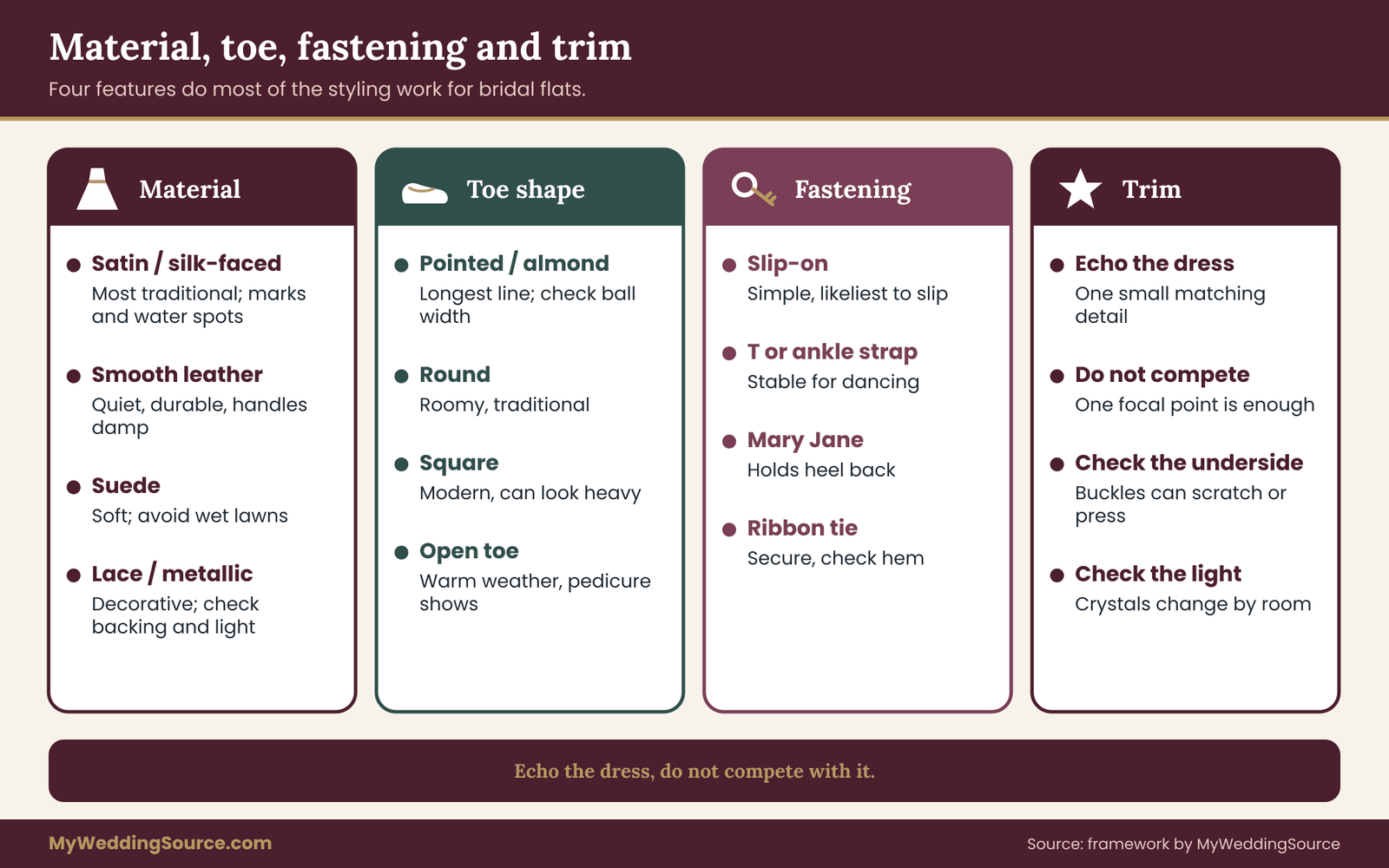
Once the hem plan is clear, you can choose the bridal flats themselves with more confidence. Four features do most of the work: material, toe shape, how bridal flats stay on, and trim.
Material
Satin and silk-faced fabric give the most traditional formal look, especially next to a satin, crepe or silk gown. They mark easily, they show water spots, and they can be slippery on the inside if the lining is smooth. Check the sole, the lining and how the fabric is attached.
Smooth leather is quieter and more durable. It works with matte fabrics such as crepe and with dresses that have restrained detail. Patent or high-gloss leather reads casual or modern, and may not match a traditional silhouette, so test it beside the actual fabric.
Suede looks soft and refined, but it marks in damp conditions and is a poor choice for a wet lawn or a rain forecast.
Lace and embroidered fabric give a decorative effect that suits romantic dresses. Look at how the lace is backed, because a loose edge can snag on the dress hem or on the bustle.
Metallic leather or fabric can add a quiet line of light under a long skirt. It is a clear way to signal “formal” in bridal flats without adding height, and it often photographs well, but check it in daylight and under indoor light, because metallics shift in color.
Keep the sheen lane from the balance board in mind. You are trying to land within one step of the dress, not to copy it.
Toe shape
Toe shape controls how long the leg looks and how the shoe behaves in the skirt.
A pointed or almond toe lengthens the line and gives a more dressed look, which is useful when the dress shows the bridal flats. It can pinch if the shoe is too narrow, so check width at the ball of the foot, not only length.
A round toe is roomier and more traditional for a ballet-style flat. It suits fuller skirts and anyone who wants space for the toes.
A square toe reads as modern and can be very comfortable, but it can look heavy under a delicate gown.
An open toe or peep toe shows the foot, which changes the pedicure, the sock or liner question and the weather risk. It is fine for a summer garden wedding but rarely the first choice for a formal church wedding in cool weather.
How the shoe stays on
Flats with no heel are more likely to slip off the heel when you walk or dance. Four fastening types are common.
A plain slip-on is simple and clean, but it relies on a snug heel fit. It is the most likely to slip, especially on a smooth interior lining.
A T-strap or ankle strap holds the shoe on and keeps the foot stable during dancing. It cuts the line of the ankle, which some prefer and some avoid.
A mary jane strap across the instep keeps the foot back in the shoe, and the strap can be a design feature.
A tie or ribbon ties around the ankle for a ballet-inspired look. It is secure, but make sure the ribbon will not unwind at an awkward moment and will not clash with the hem.
A good test is to walk fast, climb a stair and stand on tiptoe. If the shoe stays put in each case, the fastening is doing its job.
Trim
Trim can make bridal flats look formal, but it can also make them look busy. Three simple rules help.
First, echo, do not compete. If the dress has beading at the neckline, a small beaded detail on the shoe can tie the outfit together. If the dress is plain, the shoe can carry a little interest, but one focal point is usually enough.
Second, think about the underside. Hardware, buckles and stiff embellishments that sit at the sides or back can catch on hems or press into the foot after a few hours.
Third, check the trim in the dress’s lighting. Rhinestones and crystals can look dazzling in a shop and flat in a dimly lit church, or too bright in direct sun. Ask to see a sample outdoors.
A short list of mismatches to avoid
A few combinations come up often enough to flag. Casual canvas or rubber-soled styles beside a satin ballgown rarely look intentional. Very glossy patent leather with a delicate lace dress can feel heavy.
A thick, chunky sole under a column dress raises the visual weight at the ankle.
Heavy buckles under a hem that sits low can scratch the dress. Bright color without a reason is a bold choice that can work, but only if the color shows up somewhere else in the day, such as the bouquet or the bridal party.
The indoor-outdoor fit test for bridal flats
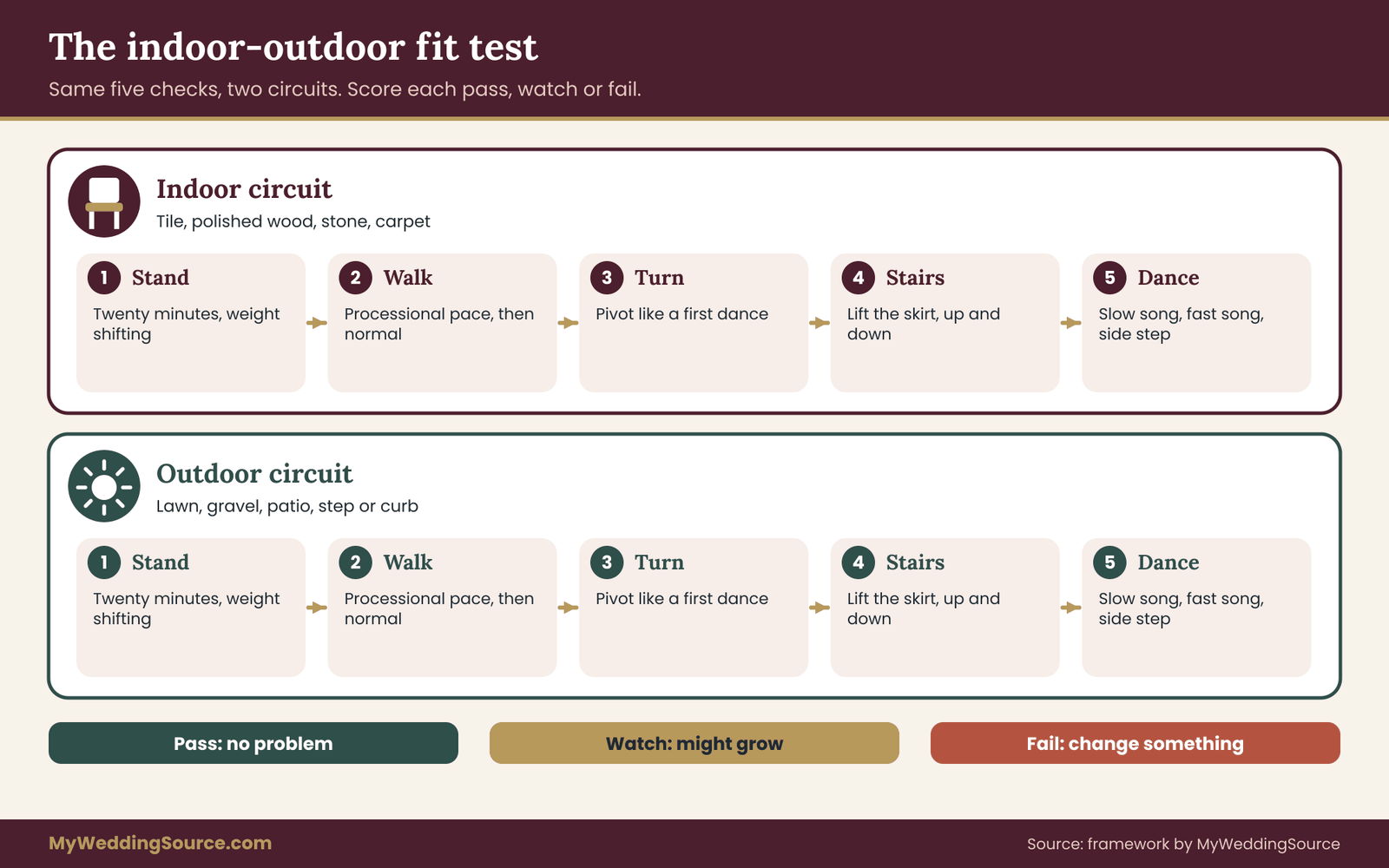
The second original tool in this guide is a fit test. It is a short series of timed checks, done in the order the wedding day will unfold, on the surfaces you will actually meet. It replaces the usual advice to “break them in” with something more specific and more honest about what is being tested.
The test has two circuits, one indoors and one outdoors. Each circuit has the same five checks: stand, walk, turn, stairs and dance. You score each check as pass, watch or fail. Pass means no problem. Watch means you noticed something that might grow. Fail means the bridal flats or the setup have to change.
Before you start
Prepare the conditions as the day will have them. Wear the underlayers you will wear, including any shapewear or petticoat. Wear the same hosiery, liner or no-show sock, or bare feet if that is the plan. Wear the dress if you have it, or a skirt of similar length and weight if you do not. Insoles, cushions or heel grips go in as well, because they change both fit and height.
Test in the afternoon or early evening. Feet commonly feel larger later in the day, and a shoe that fits in the morning may feel tight by evening. The goal is to test your bridal flats at their hardest moment, not their easiest.
Keep a small notes file or a sheet of paper next to you. Record the time, the surface, the bridal flats and what you notice. This turns a vague feeling into something you can compare across pairs.
The indoor circuit
Choose a hard indoor surface first, such as tile, polished wood or stone. It is the most likely surface at a formal venue, and the least forgiving.
Stand. Stand still for twenty minutes, as you might during a receiving line or a ceremony. Shift your weight. Watch for pressure at the ball of the foot, the heel, the sides of the little toe and the top of the foot where straps sit. A hot spot at this stage is a warning sign.
Walk. Walk the length of a long hallway several times at the pace of a processional, then at a normal pace. Listen as well as feel: shoes that slap, squeak or click loudly are noticeable in a quiet ceremony. Check whether the heel slips and whether the toes grip to keep the bridal flats on.
Turn. Pivot and turn as you would for a first dance or a hug. Look for friction on the sole. Smooth leather soles can slide on polished floors. Some rubber or textured soles grip so well that they catch when you turn.
Stairs. Climb and descend a staircase while lifting the skirt of the dress or a similar skirt. Check the front of the foot when you go down, and the heel when you go up. With a long skirt, notice whether the hem catches on the shoe.
Dance. Put on music and move for ten to fifteen minutes. Include a slow dance, a faster song and a quick step to the side. This is where straps, slippery linings and loose heels show their flaws.
The outdoor circuit
Repeat the five checks on the surfaces outside that will be on your day. The point is not to cover every possibility, but to meet each category you will face.
Grass or lawn. Soft ground changes balance, and thin flat soles feel the unevenness. Bridal flats have an advantage here because there is no heel to sink, but a smooth sole can slip on damp grass, and light fabric can pick up moisture. Test on slightly damp grass if the forecast allows for it.
Gravel or a stone path. Thin soles transmit every stone. A bit of structure in the sole matters here. Walk a path for several minutes and see how the foot feels afterward.
Wood decking or a patio. These can be slippery when wet and can have gaps. Check the grip and see whether the sole catches.
Sand. If a beach ceremony is part of the day, think about whether you will wear shoes at all for that part. A separate plan may be better than forcing one pair to do everything.
A step or a curb. Step up and down while carrying something, such as a bouquet. That tests balance in a way that walking on the flat does not.
Weather matters for outdoor surfaces, so check the forecast from the National Weather Service as the date approaches, and plan an indoor alternative for any surface that would be unsafe or damaging when wet. The guide to barn wedding venues is a good example of how mixed indoor and outdoor surfaces can appear in a single venue, with gravel, wood and concrete all in one walk.
Scoring and what to do with the results
Count the checks scored watch or fail on each circuit. A pair with no fails and two or fewer watches across both circuits is a good candidate. A pair with any fail on stand, stairs or dance should be reconsidered, because those are the checks that map directly onto the wedding day.
Different results suggest different fixes.
If the heel slips, try a different fastening, a heel grip or a half size smaller, but do not make the shoe too tight. If the front of the foot hurts, the toe box may be too narrow, or the shoe may lack cushioning.
If the arch aches, the sole may be too flat for your foot, and this is the point at which a conversation with a podiatrist or a qualified fitter is worth having. If straps rub, consider a softer strap or a different position. If the sole slips, ask a cobbler about adding a thin grip pad, or choose a different outsole.
A final rule: do not repeat the test with the same pair until you have changed something. Doing the same walk in the same shoe and hoping for a different result is how people talk themselves into a bad choice.
How long to break shoes in
There is no safe universal number of days. A reasonable approach with bridal flats is to wear them for short periods at home, building up gradually, and stop immediately if you feel pain rather than simple stiffness. Keep the soles clean and dry during home wear, or wear them only on a clean surface, because many retailers will not accept returns on worn or marked shoes. Check the retailer’s return policy before the first walk, a point the next sections cover in more detail.
If the break-in period shows a real problem, the earlier you find it, the more options you have: exchange, return, a different size or a different style. A problem discovered the week of the wedding leaves only expensive options.
Bridal flats on the day: standing, dancing and photographs
A shoe that passes the fit test still has to work through a full wedding day. The day has its own rhythm, and bridal flats do best when the schedule treats them as part of the plan rather than an afterthought.
Before the ceremony
Put the bridal flats on early enough to check them, but not so early that you stand in them for hours before the ceremony. Many people are surprised by how long the getting-ready period is, so keep a more comfortable pair or slippers nearby and change into the wedding pair when it is time for photos.
Check the details just before you step out. Look at the soles, clean any marks, confirm the strap or fastening, and make sure the hem sits where the seamstress set it. If you wear a liner or sock, put it on carefully so it does not bunch.
During the ceremony and receiving line
Ceremonies vary from ten minutes to well over an hour, depending on tradition. A long standing ceremony in bridal flats with thin soles can tire the feet faster than a shorter one. If your ceremony includes extended standing, ask the officiant whether you can sit for part of it, and mention it at the rehearsal. The wedding ceremony step-by-step guide shows where the pauses usually fall.
A receiving line or a long stretch of greeting guests is the point where many people feel the day in their feet. Shift your weight between feet, stand with the weight slightly forward and avoid locking the knees. Those are common-sense habits rather than medical advice, and they cost nothing.
In the photographs
Photographers shoot formal weddings in a fairly predictable pattern: portraits of the couple, family groups, the wedding party and candid movement. Bridal flats affect two things in that pattern: how the skirt falls and how the feet look when they appear.
For posed portraits, ask the photographer how the skirt will be arranged. With bridal flats the skirt may sit closer to the ground, so the photographer may want to lift it slightly for movement shots, which shows the shoe. If you chose your bridal flats carefully, that is an opportunity: the detail shot of the shoes beside the dress, bouquet and invitation is a standard part of getting-ready coverage.
For family groups, the key is stance. A longer list of groups means more time standing still. The wedding family photo list helps you keep that session short, which is as kind to your feet as it is to your relatives.
For dancing and candid shots, bridal flats let you move freely, and this tends to show in the photographs. A bride who is not thinking about her shoes laughs more easily. That is not a promise, only an observation about what comfort tends to make possible.
If your photographer wants the bridal flats for a detail shot, tell them in advance whether you want them wiped, whether any marks are acceptable and whether you want the sole visible. Soles with a name, a date or a small message are a popular detail, but only if they are clean and you are comfortable showing them.
The dance floor
The dance floor is the most demanding test of the day. Floors differ: polished hardwood, laminate panels, stone, carpeted ballrooms and portable floor sections each grip differently. Ask the venue what the floor is and, if possible, test on it during a walkthrough.
On a slippery floor, a smooth leather or satin sole may need some grip. A cobbler can add a thin non-slip pad, or you can use a product designed for that purpose. Avoid improvised fixes the night before, such as sticky tape on the sole, because they can peel or leave residue.
On a very grippy surface, the opposite problem can arise: the sole catches during a turn. If you notice this in the fit test, choose a shoe with a smoother outsole or have it modified.
If you plan to change shoes for the party portion, decide when. A mid-evening change is common, usually after the first dance and the formal photographs. A second pair brings its own hem question, which the earlier section covered.
Feet that change during the day
Feet commonly feel larger later in the day, and heat, long standing and salty food can add to the effect. Some people notice it more than others. The practical response is to choose a fit that has a small margin, not bridal flats that feel snug when new. Straps that adjust give you room to respond. A closed, rigid shoe with no give is less forgiving than a soft, flexible one.
If you have a medical condition that affects circulation, swelling or sensation in the feet, ask your clinician about footwear for a long day. This guide cannot advise on individual health, and the American Podiatric Medical Association is a good starting point for finding professional guidance.
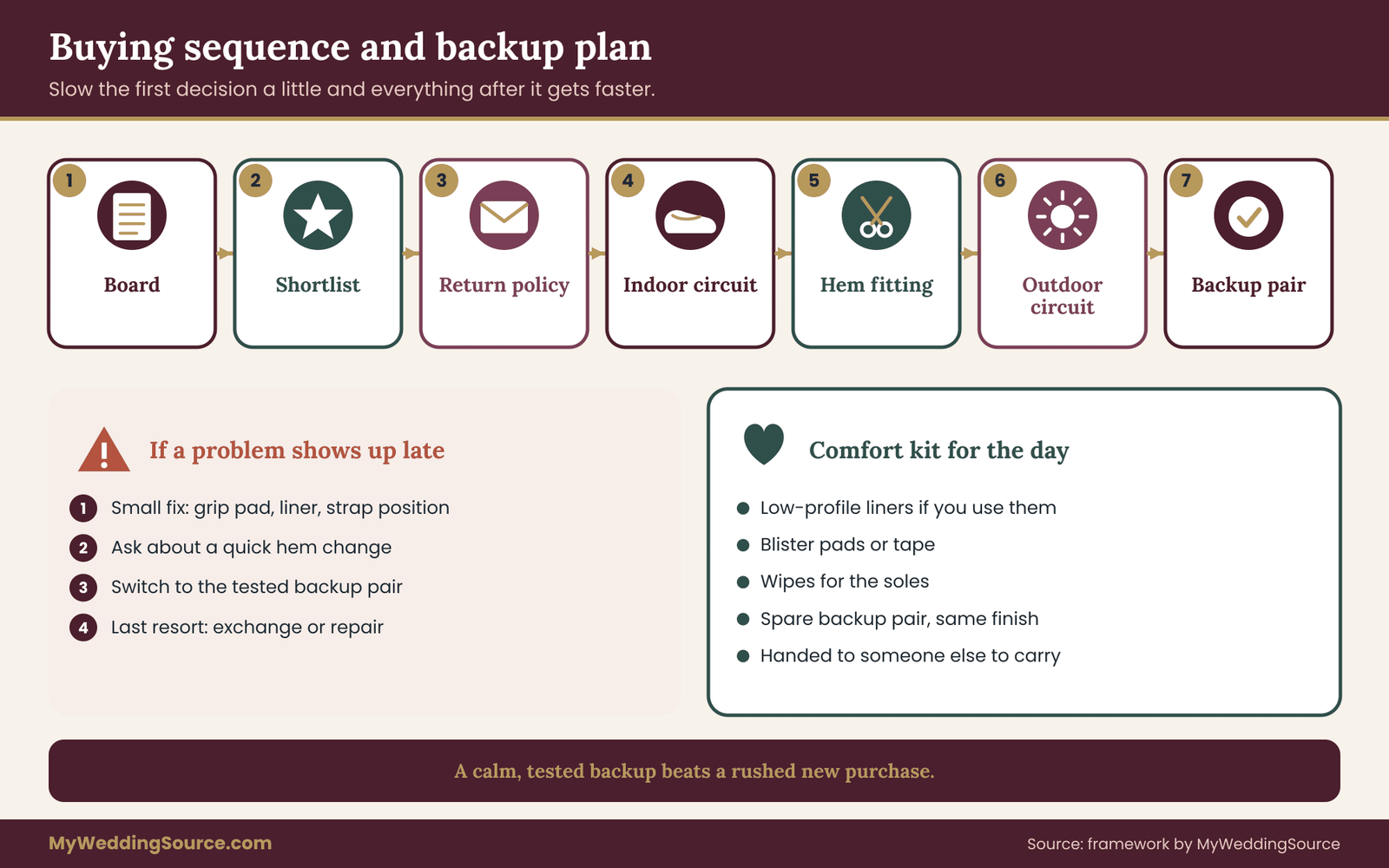
A small comfort kit for the day
A short kit does more than a long one. A few items tend to be useful: a pair of low-profile socks or liners if you will use them, blister pads or tape in your bag, a small towel or wipes for the soles, spare fastenings if your shoes use buckles, and a pair of comfortable shoes for the final hour. Hand the kit to a bridesmaid or a family member so that it is not in your hands while you are in the dress.
Venues, weather and surfaces that affect bridal flats
Formal weddings take place in a surprising range of places, and each changes what bridal flats have to do. The venue walkthrough is the cheapest way to prevent a problem with bridal flats, because it shows you what you will walk on and how far.
Questions to ask the venue
Ask about the actual surfaces and the actual distances, not the general description in the brochure.
What is the ceremony floor, and is it covered or exposed? Is there a lawn, a gravel drive or a stone path between the ceremony and the reception? How far is it from the bridal suite to the ceremony location, and from the ceremony to the photo locations? Are there stairs, ramps or steps with no handrail? Is the dance floor part of the room’s own floor, or a rented section placed on top? What is the plan if it rains, and what surface will you walk on in that plan?
A tour with a planner or a venue coordinator is a good time to ask. The wedding venues guide explains what to ask when you first compare venues, and many of those questions overlap with surfaces, access and weather plans.
Rain and damp
Wet conditions are the main risk for fabric and suede. Satin watermarks, suede stains and light fabrics darken. If rain is possible, keep a spare pair in a different material, such as smooth leather, which handles damp better, and have an umbrella plan for the walk from the car or the suite. Some people apply a protective spray designed for the shoe material, but test it on a hidden spot first, because some sprays change color or texture.
Soles matter as well. Wet marble and polished floors are especially slippery, and a flat shoe with a smooth sole has no heel to give you extra control. A thin grip pad can help, and so can asking the venue to place mats at entrances.
Heat and cold
In hot weather, feet swell and shoes heat up. Breathable materials and adjustable straps are more comfortable, and an open toe may be the better choice if the dress code allows it. In cold weather, a closed shoe is practical, and there may be room for thin hosiery, but check that any added layer does not change the fit enough to matter. If you will wear a shawl, a wrap or a coat, remember that a longer outer layer can hide the shoes during an outdoor ceremony.
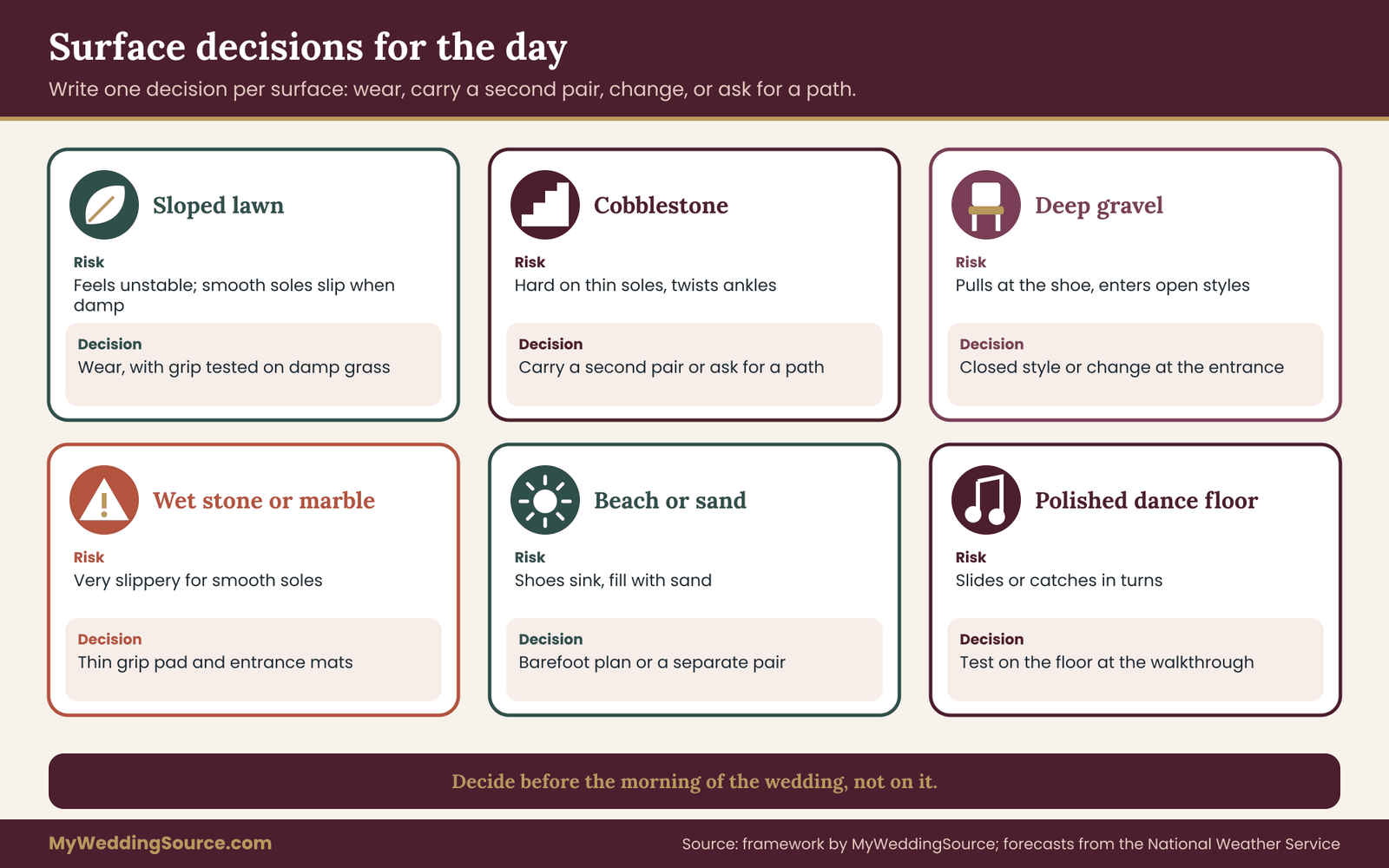
Surfaces that need a decision, not a guess
A few surfaces deserve a decision made in advance.
A sloped lawn can feel unstable, and even a flat shoe can slide. A cobblestone approach, common in historic towns, is hard on thin soles and can twist ankles. Deep gravel pulls at bridal flats and works its way inside open styles. A beach or sand ceremony usually means barefoot or a separate pair. Metal grates and drain covers are narrow, but a flat sole rarely gets caught in them.
For each, write down the decision: wear the bridal flats, carry a second pair, change at the entrance, or ask the venue to lay a path. The decision matters more than the choice itself, because it removes the question from the morning of the wedding.
Common mistakes with bridal flats and how to fix them
Most problems with bridal flats are predictable, which means most are avoidable. These are the ones that come up again and again, with the fix for each.
Buying before the hem plan exists. The shoe arrives, the dress is already hemmed for a heel, and the two do not agree. The fix is to hold the final purchase until the fitter has said what they need, and to treat the first pair as a candidate.
Judging bridal flats only in the shop mirror. A mirror shows the front view under bright light. It does not show the hem from behind, the foot after four hours or the sole on a wet floor. The fix is to run both circuits of the fit test before you commit.
Matching color exactly and ignoring sheen. A shoe that is nearly the same shade as the dress but a different finish can look off in photographs. The fix is to compare the two in daylight and indoor light, and to aim for similar sheen even if the color is a shade different.
Choosing a slip-on with no fastening. Many people find that a pair with nothing holding the heel slips during dancing. The fix is a strap, a tie or a snugger fit, tested on the stairs and the dance floor.
Forgetting the insole. A cushion or insert changes the fit and the hem height. The fix is to wear it at the fitting and in the test.
Leaving the second pair to the last week. A backup bought in a hurry is rarely formal enough for photographs. The fix is to buy it at the same time, with the same standard of finish.
Treating the first outdoor walk as the wedding day. Meeting the lawn, the gravel or the stone for the first time in the dress is a risk with no benefit. The fix is a walkthrough in your bridal flats, with a decision recorded for every surface.
Ignoring the sound. Hard soles can click or slap in a quiet ceremony. The fix is to listen during the indoor walk and ask a friend to stand at the back of a quiet room while you walk.
Fixing a problem you find late
If a problem appears close to the date, work through the options in order of cost. First try a small adjustment: a grip pad, a heel liner, a different strap position or a different insole. Second, ask the seamstress whether a hem change is possible at short notice.
Third, switch to the backup pair, which is why you bought one. Fourth, as a last step, ask a boutique or a local cobbler about a quick exchange or repair. Rushing a new purchase in the last days is the most expensive and riskiest option, and a calm, tested backup is almost always better.
Talking about bridal flats with family, photographers and planners
Some people feel they have to defend a choice of bridal flats to relatives who expect heels. A short, friendly answer is usually enough. You can say that you want to dance all night and enjoy the day, and that the dress has been altered to suit the bridal flats. That is a complete answer, and it leaves no room for a debate. The wedding etiquette guide is a reasonable place to look if the comments keep coming, since it covers polite ways to close a topic.
With the photographer, share three details: the shoe type, whether you want a detail shot and how much of the skirt you expect to lift in movement shots. Ask whether they plan to photograph the shoes before the ceremony and whether they need you to bring the pair to the portrait location.
With the planner or venue coordinator, share the surfaces list from your board, the second pair plan and the time you expect to change shoes. If you have a day-of coordinator, ask them to carry or locate the comfort kit so that you do not have to think about it.
With the seamstress, bring the bridal flats and the board, and ask for the hem number in writing.
With the bridal party, explain the guidance on shoes in a short message that covers dress length, color family and the idea that comfort comes first. Avoid rules that make people buy something they do not want.
The short version is that bridal flats are an ordinary and polished choice, and the conversation gets easier when you show up with a plan rather than an apology.
Buying bridal flats: timing, returns and vendor questions
Buying bridal flats is simple in outline and full of small traps in detail. The traps are mostly about timing and policy, not taste. A shoe you love is no use if it arrives after the final fitting or cannot be returned after you find it does not fit.
When to buy
Work backward from the final dress fitting. The hem has to be set with the actual pair, so bridal flats should be in your hands before that appointment. Special orders, dyed-to-match styles and made-to-measure pairs often have lead times, and the lead time is set by the maker, not by your date. Ask for it in writing, along with the date you must confirm the order.
If the dress is still being altered or the exact fitting date has not been set, buy a candidate pair early enough that you can return it, and settle the final pair only after the hem plan is clear. The wedding vendor timeline shows where fittings and deliveries usually sit in the sequence, and it is worth checking that the shoe deadline is on the same calendar as the dress deadline.
Questions for the retailer or maker
Ask clearly, and ask for the answers in writing, because policies on shoes are often stricter than people expect.
What is the return and exchange policy, and does it apply to shoes that have been tried on indoors? What counts as worn? How long do I have, counted from purchase or from delivery? Is a custom color, a dyed pair or a special-order pair final sale? What are the lead times, and what happens if the shoes arrive late? Are half sizes and widths available? Is there a repair or resole service? Who pays return shipping?
Online sellers and mail-order shops are subject to rules about shipping times and refunds, and the Federal Trade Commission publishes guidance on the rule that covers merchandise ordered by mail, phone or online. If a seller fails to ship by the promised date, that guidance explains what you are generally entitled to ask for. Check the current rule on the agency’s site rather than relying on a summary.
Questions for the seamstress or alterations professional
Your fitter is the person who will use the shoes, so bring them into the choice early.
Can you hem to the shoes I plan to wear, and when should I bring them? How much of the hem can be shortened without affecting the border, the beading or the train? Will the bustle need to be moved? Do you charge separately for a second hem height? Do you offer a short recheck after the final fitting if the shoes arrive late? What do you need to see at the final appointment?
The alterations guide lists fitting stages in more detail. The point here is only that the shoe is part of the fitting, not a purchase that happens separately.
Questions for a footwear fitter
A professional fitter can measure length and width, check how your foot behaves in the shoe and suggest adjustments. Ask about fit across the width of the foot, not only the length. Ask what cushioning or inserts are suitable and whether an insert changes the shoe’s size. If you have had foot problems in the past, say so. The fitter is a retail professional, not your clinician, so if the discussion turns to pain or a medical condition, it is time to see a podiatrist.
Cost logic without invented numbers
Prices for bridal flats vary enormously, from modest to luxury, and no single average is a useful guide. A better way to think about cost is to count what each pair actually involves.
A pair has a purchase price. It may also have an alteration cost, because a hem raised for flat shoes is a small job on some dresses and a larger one on others. There may be a cost for dyeing or color matching, protective treatments, grip pads, inserts and a cobbler’s work. There may be shipping or return costs. If you buy a backup pair, that is a second purchase. A second pair for dancing is a third.
Add those up for your own situation. A moderately priced pair that needs a hem change and a grip pad may cost more in total than a pricier pair that fits as it arrives. Put the total in your budget line for attire, and the wedding budget guide shows how to track categories like this against the real number.
Commercial relationships and recommendations
You will see many lists of “best” bridal flats online, and some of them are driven by commissions or by paid placements. This guide does not rank products or recommend brands, and it does not carry links to any seller. When you read other sources, look for a clear statement of any commercial relationship near the recommendation, and treat lists with no explanation of how the items were chosen with caution. Your own fit test beats any ranking, because your foot is the one that has to wear the shoe.
A short buying sequence
The sequence that tends to work is this. Fill in the balance board with the dress details. Shortlist two or three pairs that suit the sheen and silhouette lanes. Confirm the return policy on each. Order one pair, or buy locally, and run the indoor circuit at home. Take the survivor to the hem fitting. Run the outdoor circuit once the hem is set. Only then buy a backup, if you want one, and break in gently.
This sequence slows the first decision a little and speeds up everything after it, because each purchase is made with real information.
Worked example: a formal evening wedding in bridal flats
An illustrative example makes the board and the fit test concrete. The people here are invented, and the numbers are chosen only to show the logic. They are not typical results.
Dana is planning a black-tie evening wedding in a historic hotel. The ceremony is in a ballroom with a polished wood floor, the cocktail hour is on a stone terrace, and the reception returns to the ballroom. She has a fitted crepe gown with a short sweep train, a good hem allowance and a fondness for dancing. She has also had sore arches after long days in the past.
Step one: fill in the board
Hem: the gown was first fitted with a heel in mind, so it needs shortening. Target: set at the final fitting with the real shoes. Open.
Silhouette: a column dress shows the whole shoe from the side. The shoe must look deliberate. Likely.
Sheen: matte crepe suggests smooth matte leather or a soft silk-faced shoe, not high-gloss satin. Likely.
Foot: sore arches in the past, a slightly narrow heel. She needs a shoe with some structure, a secure fastening and a rounded almond toe. Open.
Floor: polished wood, a stone terrace and a short carpeted corridor. Open.
Step two: shortlist and policy check
Dana shortlists two pairs in smooth leather, one with a thin ankle strap and one slip-on with a small arch support. She reads the return terms. One shop accepts returns of shoes tried on carpet only; the other accepts returns within a set window and requires the original box. She chooses the shop with the longer window.
Step three: the indoor circuit
At home on a hard floor, the slip-on slips at the heel during the walk, and she scores it as a fail on walk. The strap pair passes stand, watch on stairs because the strap presses slightly, and passes turn and dance. She adjusts the strap position and retests. The stairs check improves to a pass.
Step four: the hem fitting
Dana brings the strap pair to the seamstress, stands in them on the fitting platform and agrees a clearance. The seamstress notes that the train needs a small adjustment at the back so that it does not pile at the heel when she turns. The fitter schedules a short recheck, which fits with the shoes already delivered.
Step five: the outdoor circuit and the day
Dana walks the stone terrace at the venue’s walkthrough in the same shoes. The soles slip slightly on the damp stone, so the cobbler adds a thin grip pad. On the day she wears the shoes for the ceremony, the photographs and the first hour of dancing, and has a second flat pair, a little softer, in a bag for the final hours. The bridal flats were picked, tested, hemmed to and adjusted before the day, which is what the process is for.
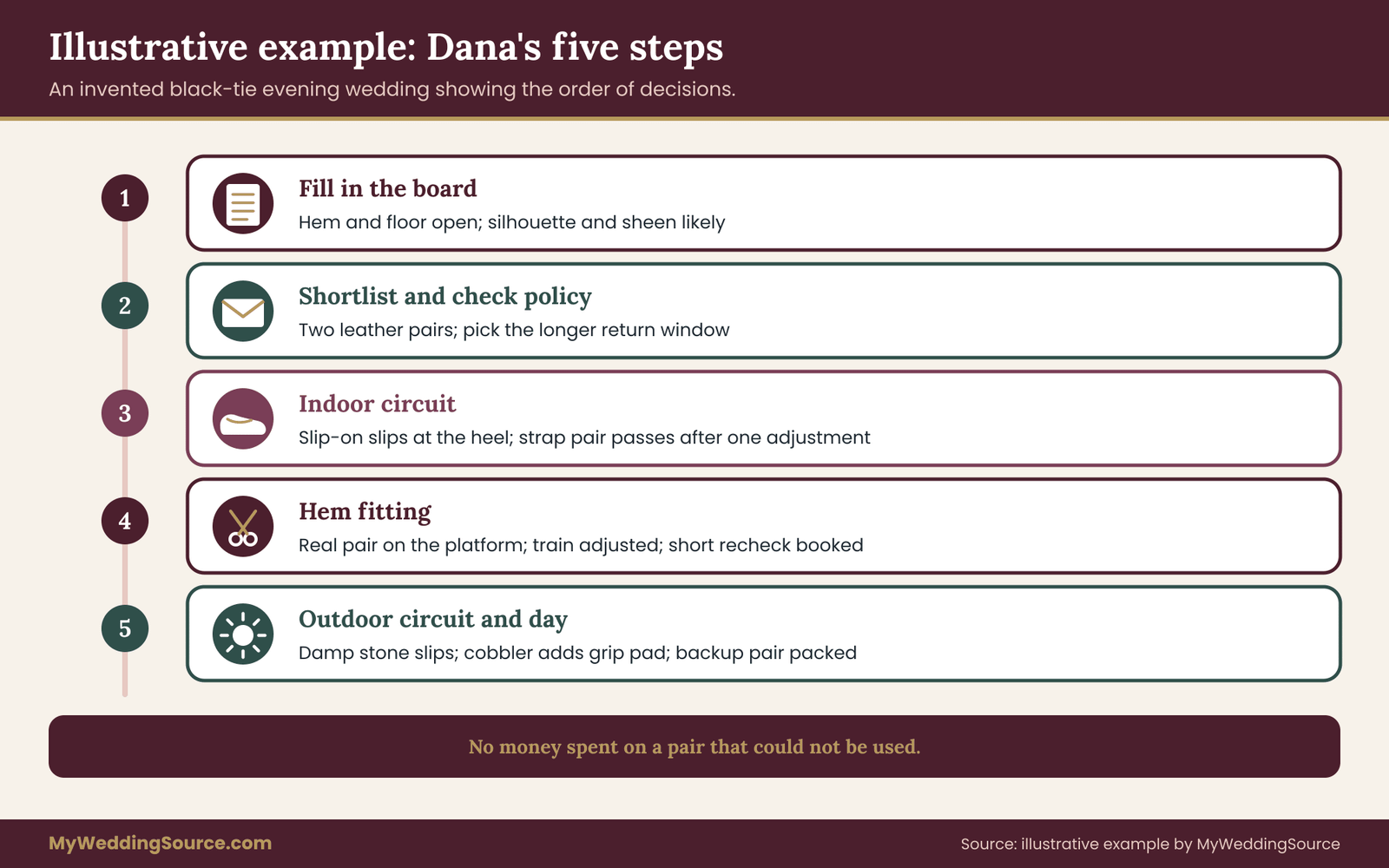
The example does not show that any shoe will work for every person. It shows how the order of decisions prevents the most common failures: a hem set without the shoe, a fit judged only in a shop, and a surface met for the first time on the day.
Edge cases: when bridal flats need a different plan
The framework above covers the common situation. A handful of cases need adjustments, and it helps to know them before you buy.
A very full or heavily structured skirt
A hooped skirt, a crinoline or a ballgown with several layers keeps the hem standing away from the floor. Bridal flats are very forgiving here, because the shoe barely shows. The risk is different: the hoop can lift unevenly on stairs, and you need to see the floor. Practice the stairs in the full skirt and give priority to a secure fastening over decoration.
A fitted dress with a slit or a short front
When the dress shows the foot and ankle, bridal flats become a focal point. For bridal flats in this situation, choose finish and line over trim, and think about the pedicure, the ankle and the hosiery or lack of it. A pointed toe and a clean vamp give the longest line.
A tall partner
Some brides choose heels partly because of height difference in photographs. If that is on your mind, think about what you actually want in the photographs, and discuss it with the photographer. Posing, camera angle and the distance between the two of you change how height looks more than shoes do. If the difference matters to you, a small lift inside bridal flats changes the hem, so it belongs in the first fitting, not the last.
Wide feet, narrow feet or foot conditions
Standard sizes rarely suit every foot. If you have wide or narrow feet, bunions, high arches, flat arches, previous injuries or a condition that affects the foot, a fitter and a podiatrist are better guides than any general rule. Orthotics and custom inserts change the volume inside a shoe, so bring them when you try pairs, and tell the seamstress about any lift they add. The American Podiatric Medical Association offers general information about foot health and finding a podiatrist, and this guide offers no medical advice.
An injury or recovery close to the wedding
If you are recovering from an injury or surgery, discuss footwear with your clinician well ahead, and plan for the possibility that the choice changes. A supportive pair worn for the ceremony and a dedicated recovery shoe for the rest is a valid plan, and a well-fitted formal outfit around it still looks complete.
A tea-length, midi or short formal dress
Shorter hems show your bridal flats all day. Bridal flats here carry the whole look at the feet, and the sheen and trim lanes matter more. Ankle straps cut the leg line, so choose them deliberately, and consider whether you want a nude, metallic or color that echoes the bouquet.
Cultural or religious footwear customs
Some ceremonies involve removing shoes, wearing specific footwear or a specific color, or standing barefoot for part of the ritual. If you are marrying in such a tradition, plan the bridal flats around it, and ask family elders or the officiant what is expected. If you move between a ceremony where shoes are removed and a reception where they are worn, plan for both, including where the shoes will be kept and who carries them.
A bridal party in flats
If you want the whole group in flat shoes, say so early, and make it clear that it is a comfort decision and not a style rule. Bridesmaids and family members have different feet and different needs, so a range of choices tends to be kinder than a single mandated pair. The same fit test helps them, and a short written note about the dress length and the shoe heights keeps the group looking even in photographs.
A destination or travel wedding
Shoes can be lost, delayed or damaged in transit. Carry the wedding pair with you rather than checking it, and pack a backup. At the destination, check the surface at the ceremony site as early as possible. Humid air, heat and different floors change how shoes feel, so repeat a short walk on arrival.
Backup plans that still look formal
A backup pair should be formal enough to appear in photographs if it has to. A second pair in the same color family, with a similar level of finish, keeps the outfit coherent. The backup also protects against the rare mishap: a broken strap, a stained sole, a lost shoe. Keep it with the comfort kit, and tell the person who carries it exactly where it is.
Your next steps
Start with the board. Write the five lanes on a page and mark each one settled, likely or open. If two or more are open, do not order anything yet.
Next, book the right appointment. Ask your seamstress when they want the bridal flats in hand, and put that date on the calendar next to the shoe order deadline. Order or buy a candidate pair of bridal flats with a return policy that gives you time to test.
Then run the indoor circuit at home, adjust anything that fails, and bring the survivor to the hem fitting. After the hem is set, run the outdoor circuit and make a decision for each surface on the day.
In the final week, pack the comfort kit and the backup, clean the soles, and confirm who carries what. By then the question that began this guide, whether bridal flats can look right at a formal wedding, should have a plain answer: yes, because every lane of the board has been checked.
FAQ
Are bridal flats appropriate for a formal wedding?
Yes. Formality comes from the whole outfit being deliberate, not from heel height. Choose a material and finish that match the dress, have the hem set while you wear the exact pair, and make sure the toe shape and trim suit the silhouette. A well-made pair in satin, silk-faced fabric or fine leather can look entirely right in a ballroom or a church.
Do I need to shorten my dress if I switch to flats?
Usually, yes, if the dress was fitted for heels. Flat shoes sit lower, so the hem will drag unless it is altered. Bring the actual pair to the hemming appointment and stand in them while the fitter measures. Ask whether lace borders, beading or a train affect what can be done, and whether the bustle needs to move.
How do I make bridal flats look dressy?
Match the finish to the dress: similar sheen, restrained trim and clean seams. A pointed or almond toe lengthens the line, and metallic or embroidered details add formality without height. Keep the soles clean, check that the hem sits properly and avoid casual materials such as canvas or rubber soles next to a satin or crepe gown.
How long should I break in bridal flats?
There is no universal number of days. Wear them at home for short periods on a clean surface, increase the time gradually and stop if you feel pain. Check the retailer’s return policy before the first wear, since many sellers do not accept worn or marked shoes. Finding a problem early gives you more options than finding it the week of the wedding.
Will bridal flats be comfortable all day?
Not automatically. Fit, arch support, width, fastening and the surfaces you walk on all matter, and comfort is individual. Run the indoor and outdoor fit test, keep a backup pair and a small comfort kit, and see a podiatrist or qualified fitter if you have pain or a foot condition. A test at the same time of day as the wedding is the most useful.
What should I do if it rains on my wedding day?
Have a plan before the day. Satin and suede mark easily when wet, so keep a smooth leather backup pair and think about an umbrella and mats at entrances. Wet marble and polished floors are slippery, and a flat sole has no heel to help, so consider a thin grip pad from a cobbler. Check the forecast from the National Weather Service.
Should my bridesmaids wear flats too?
It is a personal and practical choice. Many wedding parties allow a mix, because feet and comfort needs differ. If you want a consistent look, give clear guidance on color, finish and dress length, and ask everyone to test their shoes. Keep it as a comfort option and not a requirement, and tell the group early.
When should I buy my bridal flats?
Buy a candidate pair well before the final dress fitting, because the hem must be set with the actual shoes. Check lead times for special orders and dyed pairs, and confirm the return policy in writing. If delivery might slip past the fitting, ask your seamstress about a short recheck once the bridal flats arrive.
Sources
- American Podiatric Medical Association, foot health and finding a podiatrist
- American Academy of Orthopaedic Surgeons, OrthoInfo patient education
- National Weather Service, forecasts and weather safety, NOAA
- Federal Trade Commission, consumer protection and mail, internet or phone order rules
- Consumer Financial Protection Bureau, consumer guidance on purchases and disputes
- U.S. Consumer Product Safety Commission, product safety information
- USAGov, consumer protection and shopping guidance
- Centers for Disease Control and Prevention, healthy living and injury prevention
- National Institutes of Health, health information