
A weather delay at a wedding reception is a pause forced by storms, lightning, heavy rain or wind, and the evening that resumes afterward is never the one you scheduled. This guide gives you a recovery priority board for deciding what runs first: guest safety, then information, then food, then sound and power, then the program. It also covers what to verify and what you should not assume.
After a weather delay, restart in this order. First, confirm that the people who own the safety call (the venue and the weather service, not the couple) say it is fine to resume. Second, tell guests what is happening and when the next update will come. Third, protect the food that spoils or sags fastest. Fourth, check that audio, lighting and power are dry and tested. Fifth, rebuild the timeline by shifting, compressing or cutting, and tell every vendor the new times in one message.
Most reception plans assume the weather will behave. They have a rain backup for the ceremony, maybe a tent, and a vague idea that “we will move inside if we have to.” What they rarely have is a plan for the hour after the move, when the cocktail hour has been interrupted, appetizers are sitting on trays, the band cannot get its gear across a wet lawn, and eighty guests are standing in a lobby asking when dinner starts.
That hour is where a weather delay either becomes a story people laugh about or an evening that comes apart. The difference is rarely money. It is order. Someone has to know which decision comes first, who is allowed to make it, and how the rest of the room finds out.
This guide treats a weather delay as an operations problem with a specific shape. It is not a guide to choosing a rain plan or to wedding insurance, and it does not try to replace the reception layout work covered in the guide to wedding reception guest flow. It picks up at the moment something has already gone wrong and asks what you do first, second and third.
A note on scope. This is general information, not legal, safety or financial advice, and it cannot tell you how many people your space holds, which exits to use, or how long a specific dish can sit. Your venue, your caterer and the local authorities own those answers, and each section points to the people to ask.
Why a weather delay needs its own reset
A rain plan answers the question “where will we hold the event if it rains?” A weather delay answers a different one: “what do we do while we wait, and how do we restart?” Couples often confuse the two, and the confusion leaves a gap exactly where the evening is most fragile.
Consider what a rain plan assumes. It assumes someone looked at the forecast early enough to move everything before guests arrived. A weather delay assumes the opposite. The sky changed its mind in the middle of the event. People are already outside, food is already out, speakers are already plugged in, and the one decision nobody wants to make has to be made in the next few minutes.
There are three common kinds of weather delay at a reception, and each one pulls a different lever.
A short hold. A line of storms or a lightning warning passes over in under an hour. Guests step inside, the event pauses, and you resume where you left off. The risk here is drift: a pause that should have cost forty minutes quietly costs two hours because nobody reset anything.
A relocation. The weather will not clear in time, so the outdoor portion moves indoors, to a tent, or to a smaller space. The risk is capacity, flow and equipment, because the new space was never laid out for what is now happening in it.
A shortened evening. The delay eats so much of the schedule that something has to be cut, usually because a venue curfew, a vendor’s contracted hours or guest travel will not move. The risk is making cuts by accident instead of by choice.
Treating all three as the same problem leads to the same mistake each time: improvising the order of decisions under pressure. The recovery priority board in the next section exists to remove that improvisation. It gives you the order in advance, so that on the night you are executing a list instead of inventing one.
What a weather delay is not
It is worth being clear about edges, because a calm reset depends on knowing which situation you are in.
A weather delay is not a decision to cancel. Cancellation, postponement and the money side of both belong in the contract and, where relevant, an insurance policy, and they are covered by other guides on this site. A weather delay is also not an emergency response. If there is a real emergency, such as a structural problem, a fire or an injury, the venue’s own procedures and emergency services take over, and nothing in this article should slow that down.
What remains is the large middle ground: the weather has interrupted the event, nobody is in danger, and the evening still has to go on. That middle ground is where most wedding weather problems live.
Who decides during a weather delay
The most important thing to settle before any weather delay is who makes which call. Without that, the evening runs on whoever speaks loudest, and the loudest person is often the one with the least information.
A useful way to think about it is to separate three kinds of decision.
Safety decisions belong to the venue and, above them, to the weather service and local officials. When to bring people inside, when it is acceptable to go back out, whether a tent is safe in the wind, whether a space is full: none of these should be decided by the couple, the best man or a guest who “checked the radar on his phone.” The venue manager or the on-site safety contact makes them, using official weather information.
Operational decisions belong to the planner, the venue coordinator or whoever runs the day. These cover which room hosts which activity, what the new schedule looks like, which vendor is told what, and when the announcement is made. If you have no planner, appoint a day-of lead in advance and say so in writing to the venue and vendors.
Personal decisions belong to the couple, and only to them. Do they still want the grand entrance? Is the first dance worth keeping at the cost of the cake cutting? Would they rather end the night early than drop the toasts? These are the only calls that should reach the couple, and they should arrive as two or three clear options, not as an open-ended crisis.
Why the couple should not run the recovery
It seems natural that the people whose wedding it is should be in the middle of the response. In practice, the better arrangement is the opposite. A couple in the middle of a weather delay is being hugged, photographed, asked questions and handed drinks. They cannot hold a radio and a conversation at once, and they should not have to.
Name a delegate. This might be the planner, a venue coordinator, or a calm, organized relative with no other job. Give that person a one-page card (the last section of this guide shows how to build it), tell the vendors who they are, and tell the couple that their only job is to answer the personal questions when asked.
The pre-agreed trigger
The single most useful sentence you can write in advance is a trigger: “If the venue pauses the reception for weather, [name] becomes the contact for all vendors until the venue says we can resume.” It is short and unglamorous, and it prevents the situation where the caterer, the DJ and the photographer each ask a different person what is happening and receive three different answers.
Write the trigger into your vendor timeline and read it aloud at the final walkthrough. The wedding vendor timeline guide shows how to share one document with every vendor so the trigger lives in a place they will actually look.
What to do when the decision-maker is unclear
Sometimes the venue has no on-site manager who owns weather calls, or the venue says “we leave that to the client.” That is information worth having before the wedding, not during it. If the venue will not designate someone, ask who can be reached by phone and how quickly, and ask what their written weather or severe-weather policy says. Then confirm, in writing, how a pause is called and how a restart is approved.
If nobody owns the safety call, assume you do not have a plan yet and say so to the venue now. The cost of that conversation is an uncomfortable email. The cost of discovering it during a storm is much larger.
The recovery priority board: what runs first after a weather delay
The recovery priority board is the framework at the center of this guide. It is a single page with five lanes, one for each thing that can go wrong at once during a weather delay, and a fixed order for working through them. You build it before the wedding, you give a copy to the person who runs the day, and you use it on the night to stop the decisions from colliding.
The five lanes are people, information, food, sound and power, and program. They are listed in the order they should be addressed, and the order is the whole point.
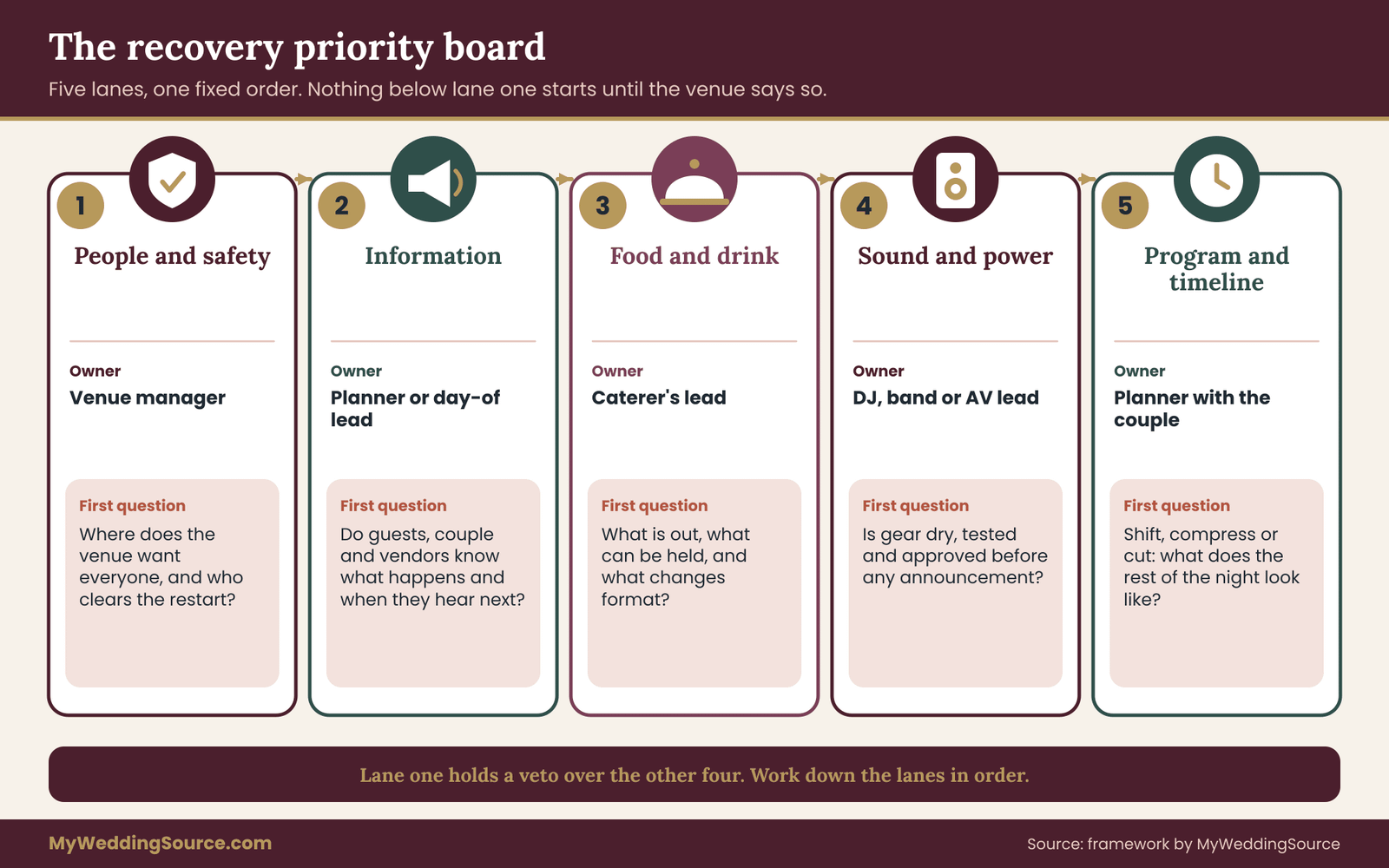
Lane one: people and safety. Are guests, staff and vendors somewhere the venue considers safe, and has the venue said when it is acceptable to resume? Nothing below this line starts until the venue says so. This lane has a veto over everything else.
Lane two: information. Do guests, the couple, the wedding party and every vendor know what is happening and when they will hear next? This lane comes second because silence is what turns a weather delay into a grievance. It costs almost nothing and can start within minutes.
Lane three: food and drink. What is sitting out, what is in the kitchen, and what degrades fastest? A caterer’s decision about holding or re-timing dinner affects every other lane, so it comes before the entertainment decisions.
Lane four: sound, lighting and power. Is the equipment dry, relocated if needed, and tested? Music and microphones carry the toasts and the first dance, so they must be confirmed before the program is rebuilt around them.
Lane five: program and timeline. What gets shifted, compressed or cut, in what order, and who approves it? This lane comes last because it depends on the answers from the other four. Rebuilding a schedule before you know whether dinner can be held is guesswork.
Why the order is fixed
You might ask why not just work on all five at once. In a larger team you can, and the lanes run in parallel once safety is cleared. But the decisions that unlock the others have to happen in sequence.
Safety unlocks everything because no one should be setting up a dance floor in a space that has not been cleared. Information comes next because every other lane needs to tell someone something. Food precedes sound because food has a clock that does not care about the weather, while a band can wait. Sound precedes program because you cannot decide whether to keep the toasts if the microphones are not working.
If you remember only one thing from this guide, make it this: nobody should be rebuilding the schedule while the first lane is still open.
How to read the board during a weather delay
The board is a checklist with three states for each lane: open, in hand and done. At the moment a delay begins, every lane is open. The person running the day marks lane one as in hand as soon as the venue confirms where people should be, and the other lanes start moving to in hand as owners are assigned.
A practical way to hold it is a single sheet of paper in a plastic sleeve, with the five lanes written down the left side and a name beside each one. The name is the owner for that lane, and the owner reports status in one sentence when asked. This is not complicated, but it prevents the most common failure in a weather delay: five capable people each solving a different problem with no shared picture.
Assigning owners in advance
Who owns each lane depends on who is on site, and the right person is usually whoever already controls that area.
The venue manager owns lane one. The planner or day-of lead owns lane two and lane five. The caterer’s lead owns lane three. The DJ, band or AV provider owns lane four. If there is no planner, a relative or friend can hold lanes two and five, but they need the authority to speak for the couple, and the vendors need to know that.
Write the owners into your vendor timeline. If you are building a shared timeline for the day, the wedding vendor timeline guide covers how to give each vendor the same document, which is the simplest way to make sure the owners know their lanes.
What the board deliberately leaves out
The board does not tell you how long a weather delay will last, whether to cancel, or which dishes are safe to hold. Those are judgment calls and contract questions, and they depend on facts the board cannot know. It also does not replace the venue’s own emergency procedures.
What it does is narrow the first fifteen minutes to a sequence you can run without thinking. That is a modest goal and an achievable one.
Guests first: safety and updates during a weather delay
The first two lanes deal with the people in the room. They are the least glamorous part of the response and the part guests remember longest.
Lane one in practice: let the venue and the weather service lead
When a weather delay starts, the correct first move is almost always to get people to the place the venue has designated and wait for official word. The venue knows its own space: which areas count as sheltered, which doors lead where, how many people a given room is approved to hold, and what its procedures require. You do not know those things, and you should not guess.
For the weather itself, the National Weather Service publishes safety guidance at weather.gov/safety, including pages on lightning, severe thunderstorms, high wind and heat. Treat those pages as the baseline for how seriously to take a given weather condition, and treat the venue’s rules as the final word for the building. The service’s lightning guidance, for example, advises waiting a period after the last thunder before going back outside, and you should read the current version of that advice on its site rather than relying on memory or on this article.
A few principles apply in nearly every case.
Do not set your own restart time. The couple’s wish to “get back to the party” is understandable. It is also exactly the pressure that leads to bad decisions. The venue decides when the space is clear to use.
Do not count heads and call it capacity. Moving a hundred guests into a space built for fewer is a safety and comfort problem, and the limit comes from the venue and local rules, not from how full the room feels. If the backup space looks too small, tell the venue manager and let them decide.
Keep paths clear. Rain gear, bags, gift boxes and rental chairs all drift into walkways during a weather delay. Someone should walk the main routes every so often and ask staff to clear them. If the venue has a stated egress procedure, follow it and do not improvise.
Check on people who may need help. Older guests, anyone using a mobility device, parents with young children and people who are pregnant or unwell may need a seat, a quieter corner or help getting indoors. The wedding guest care planning guide covers how to prepare for those needs before the event, and the same list is what you use during a weather delay.
Lane two in practice: the information ladder
Once people are somewhere safe, guests want one thing: to know what is going on. They are not asking for a solution. They are asking whether anyone is in charge.
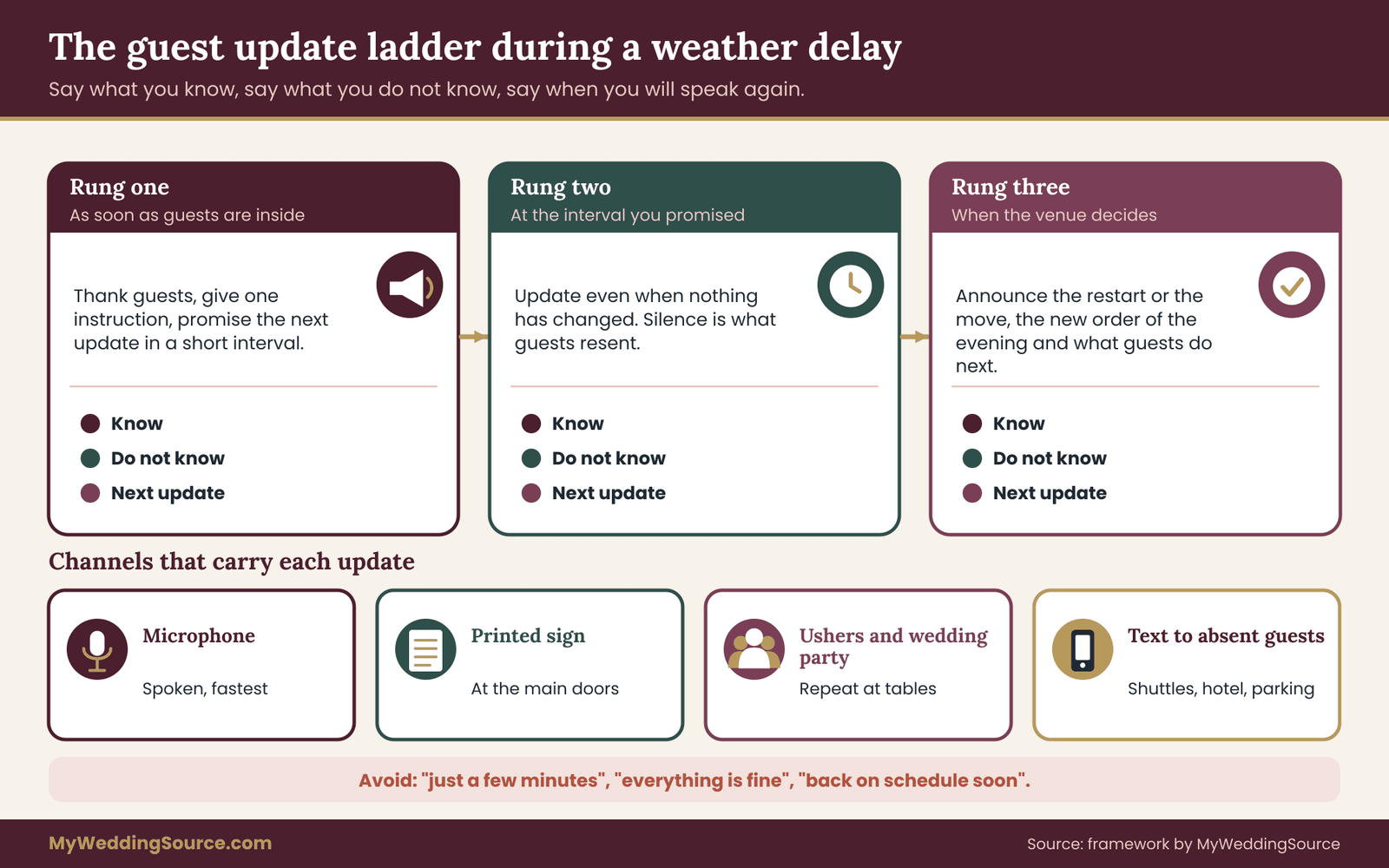
A simple rule keeps the information lane honest: say what you know, say what you do not know, and say when you will speak again. That is the whole script.
An example of a first announcement, spoken by the planner or the venue coordinator, might be:
“Thank you for moving inside so quickly. The venue has paused the outdoor portion because of the weather. We will update you again in fifteen minutes. Drinks and food are available now. Please stay in this room.”
Notice what it leaves out. It does not promise a restart time, it does not guess how long the storm will last, and it does not blame anyone. It gives guests an instruction and a time for the next update. If the update arrives on schedule, even if the news is “no change yet,” guests relax. If it does not, they start inventing their own explanations.
The rhythm of updates
An information ladder has rungs. A workable pattern is an announcement as soon as people are inside, a second one at the interval you promised, and a third as soon as the venue gives a restart or relocation decision. Each message should have the same three parts: what we know, what we do not know, when you will hear next.
Keep the promised interval short at the start. Fifteen minutes feels active; an hour feels abandoned. You can lengthen the interval later once guests have settled and fed.
The channels matter as much as the words. In a single room, a spoken announcement is the fastest and the most reliable, ideally with a microphone that works.
In a larger or split venue, add a printed sign at the main doors and ask the wedding party or ushers to repeat the update to their tables. For guests who are not in the room at all, such as those still in a shuttle, a hotel or the parking area, a short text from the day-of lead helps. The wedding day digital contingency plan covers how to prepare those channels so they still work when the Wi-Fi does not.
What not to say
Three phrases cause trouble in a weather delay. “It should only be a few minutes” turns into a broken promise. “Everything is fine” sounds dismissive to anyone who is wet and cold. And “we will be back on schedule soon” implies a schedule that no longer exists.
Replace them with plain facts. “The venue is checking conditions.” “Food is being brought out now.” “The next update is at the half hour.” These are boring and they work.
Keeping the couple informed without overloading them
The couple should hear updates too, but in a controlled way. A good habit is a quiet two-minute check-in with the planner at each rung of the ladder: what has happened, what is next, and which personal decisions might be coming. This keeps the couple from learning about the weather delay from guests, and it keeps them out of the operational weeds.
Do not ask for decisions in that check-in unless one is needed. If it is, present two options and a recommendation, then let them choose. Open-ended questions during a weather delay produce anxious conversations; options produce answers.
Catering after a weather delay: protect what spoils or sags first
Lane three is where a weather delay costs the most money and creates the most guest frustration, because food has a clock that weather does not respect. A caterer who is told early and clearly can adapt. A caterer who finds out from a guest rarely can.
The goal of this lane is not to rescue every dish. It is to decide, with the caterer, which food is protected, which is re-timed, and which is allowed to be simplified, and to do it before the program is rebuilt.
Start with a conversation, not an instruction
The first move is a direct word with the caterer’s lead, not a message through a third person. Ask three questions and write the answers down.
What is currently out, and what is still in the kitchen? What can be held and for how long, according to your own food safety procedures? And what would you change about the order or the format if the weather delay runs longer?
That last question matters most. Caterers handle weather delays more often than clients realize, and many have a sensible preference for how to adjust: moving to passed appetizers, extending a station, splitting service into waves, or moving dessert earlier. Give them room to propose the plan rather than handing them one.
Who decides how long food can be held
Do not set food timing yourself, and do not accept a promise from anyone who is not responsible for the food. Safe holding times depend on the dish, the equipment, the temperature the food is kept at, and local food safety rules. A caterer is trained and responsible for exactly those judgments, and the venue or local health department may add requirements.
For general background, the U.S. Department of Agriculture’s Food Safety and Inspection Service publishes guidance on keeping hot food hot and cold food cold, and the Food and Drug Administration publishes food safety information for consumers. Both are good starting points for understanding why the caterer may ask for a decision quickly, but neither can tell you how long your menu can wait. Ask the caterer, and if you have a concern about something served, raise it with the caterer or the local health authority.
Triage: what to protect first
Even without exact timings, you can ask the caterer to sort the menu into three groups. The grouping is a conversation tool, not a safety rule, and the caterer owns the answer.
Fragile items. These lose quality or safety first: anything that wilts, goes soggy, melts, separates or depends on a narrow temperature range. Cold appetizers, ice-based displays, fresh salads and delicate pastries often fall here. If these are already out and the weather delay is long, the caterer may swap them or retire them.
Sturdy items. Dishes that hold reasonably well under the caterer’s own equipment: braises, stews, some pasta dishes and many side dishes. These are often the ones the kitchen can protect while the program is reset.
Flexible items. Food that can change format: a plated dinner becomes a buffet, a buffet becomes stations, or a late dessert moves up. Flexibility is often the caterer’s best tool, and it deserves a direct question.

The decision between hold, re-time and simplify
Once the caterer has sorted the menu, you are choosing among three paths.
Hold. The kitchen keeps dinner ready and the evening resumes when conditions allow. This works for short weather delays and for menus that hold well. The risk is quality, and the caterer may decline to hold certain dishes at all.
Re-time. Dinner moves later, and the cocktail hour absorbs the extra time. That means more appetizers or a longer bar service, which has its own cost and its own staffing needs. The wedding cocktail hour guide explains how that part of the evening is built, which helps when you need to stretch it.
Simplify. The caterer changes the service format to something faster and sturdier, such as stations or a buffet in place of a plated course. Simplifying often protects both food and the evening length, but it changes what the couple paid for, so the couple should approve it. It may also affect special meals, so confirm that guests with allergies and dietary needs are still served safely and separately.
Keep special meals in view
A weather delay is the moment special meals are most likely to be forgotten. The caterer’s team may be rebuilding a service line, and the neatly labeled plates for guests with allergies or religious dietary requirements can get lost in the shuffle.
Ask the caterer to confirm, out loud, how special meals will be identified and delivered under the new format. If the original plan used table cards or seat numbers to match plates, and the seating changes because of the move, say so, and give the caterer an updated list. The same applies to children’s meals and to any guest who has a medical reason to eat at a particular time.
Bar service during a weather delay
Drinks usually keep flowing during a weather delay, but the bar needs its own conversation. Ask the bar lead whether the setup has moved, whether ice, glassware and mixers still reach the new space, and whether the staffing plan changes if the evening runs longer than contracted.
A longer bar service can also raise questions about how much alcohol guests have had before dinner. A sensible, non-judgmental approach is to make sure food and water are visible and available throughout the pause, and to follow the bar provider’s own policies on service. The wedding bar service planning guide describes how to arrange those policies before the event.
The cake and dessert
The cake often sits quietly at the edge of the room and is forgotten until it is needed. A weather delay can threaten it in two ways: humidity and heat if it is outdoors or in a tent, and a changed timeline that affects when it is cut and served.
Check where the cake is, whether it has been moved, and whether the baker or caterer has given instructions for conditions like these. If the weather delay will push the cake cutting very late, ask the couple whether they would rather cut it earlier in the evening, for example right after dinner, and let the caterer know the new time so that service staff are ready.
Costs that can appear during a weather delay
A weather delay can create costs the couple did not budget: extra staff hours, additional food, a longer bar service, a change in the service format, or overtime for a kitchen team. The honest approach is to ask for the effect in writing as soon as it is known, rather than discovering it on the final invoice.
Ask the caterer whether the extra time or format change triggers a charge under the contract, and if so, how it will be calculated and when it will be billed. Your contract controls the answer, and the wedding vendor contract guide explains the clauses worth reading before you sign, such as overtime, force majeure and changes in service. If a charge is disputed later, a short message sent that night with the caterer’s reply is far more useful than an argument from memory.
A scripted conversation with the caterer
If you are the person running the day and you have never had this conversation, here is a simple way to open it.
“The venue has paused the event for weather and we expect to hear in about fifteen minutes. What is out right now, what can you hold, and what would you change if we are delayed another hour? Please tell me what needs a decision from the couple.”
That script does three useful things. It gives the caterer the facts you have. It asks for their expertise instead of imposing a plan. And it tells them you will route decisions that belong to the couple. Most caterers respond to that kind of clarity with a short, practical list, and a short, practical list is all you need.
When the weather delay is longer than the caterer expected
Some delays outlast the first estimate. When that happens, repeat the conversation at each update interval. The kitchen’s options narrow with time, and the earlier you hear that a particular dish is no longer holdable, the more options remain for replacing it.
If the weather delay gets long enough that dinner would start much later than guests can reasonably wait, it may be time to serve something simple and sturdy first, so that people are fed, and reserve the remaining courses for when the program can resume. Again, that is the caterer’s call to design and the couple’s call to approve.
Audio, lighting and power when a weather delay ends
Lane four is the one couples forget until the first microphone squeals or does not work at all. Audio gear, lighting and power distribution are the parts of a reception most exposed to moisture, and they are also the parts that carry the emotional moments: the toasts, the first dance, the grand entrance.
The core rule is simple. Wet equipment and electricity are a safety matter first and a schedule matter second. The AV provider, the DJ, the band’s sound engineer and the venue’s electrician decide when equipment is safe to use. The couple and the planner do not.
Who owns this lane
In most receptions the owner is the DJ, the band’s sound lead or a dedicated AV technician, working with the venue’s technical staff. If you do not know who that is, find out now. At a venue with in-house sound and lighting, the venue’s technician may be the only person allowed to touch certain systems, and a vendor may not be permitted to plug into the building’s power at all.
This is the reason a walkthrough matters. The wedding venue technical walkthrough guide explains how to confirm power locations, access routes and load-in limits before the wedding, which are exactly the facts that become critical in a weather delay.
What to ask the audio provider, in order
When the venue clears the space, ask the audio lead four questions, and write the answers on the board.
Is any equipment wet, damp or exposed to the weather, and has it been checked? Is the power source dry and approved, and who confirmed that? Does the setup need to move, and does it need a different location, cable route or power supply? And how long do you need to test before we announce a restart?
The fourth question protects the couple. A provider who is rushed into a restart without a test can fail in front of every guest. A provider who gets ten minutes to check levels, wireless connections and the playlist will almost always deliver a better result.
Wet cables, outdoor power and the role of the professional
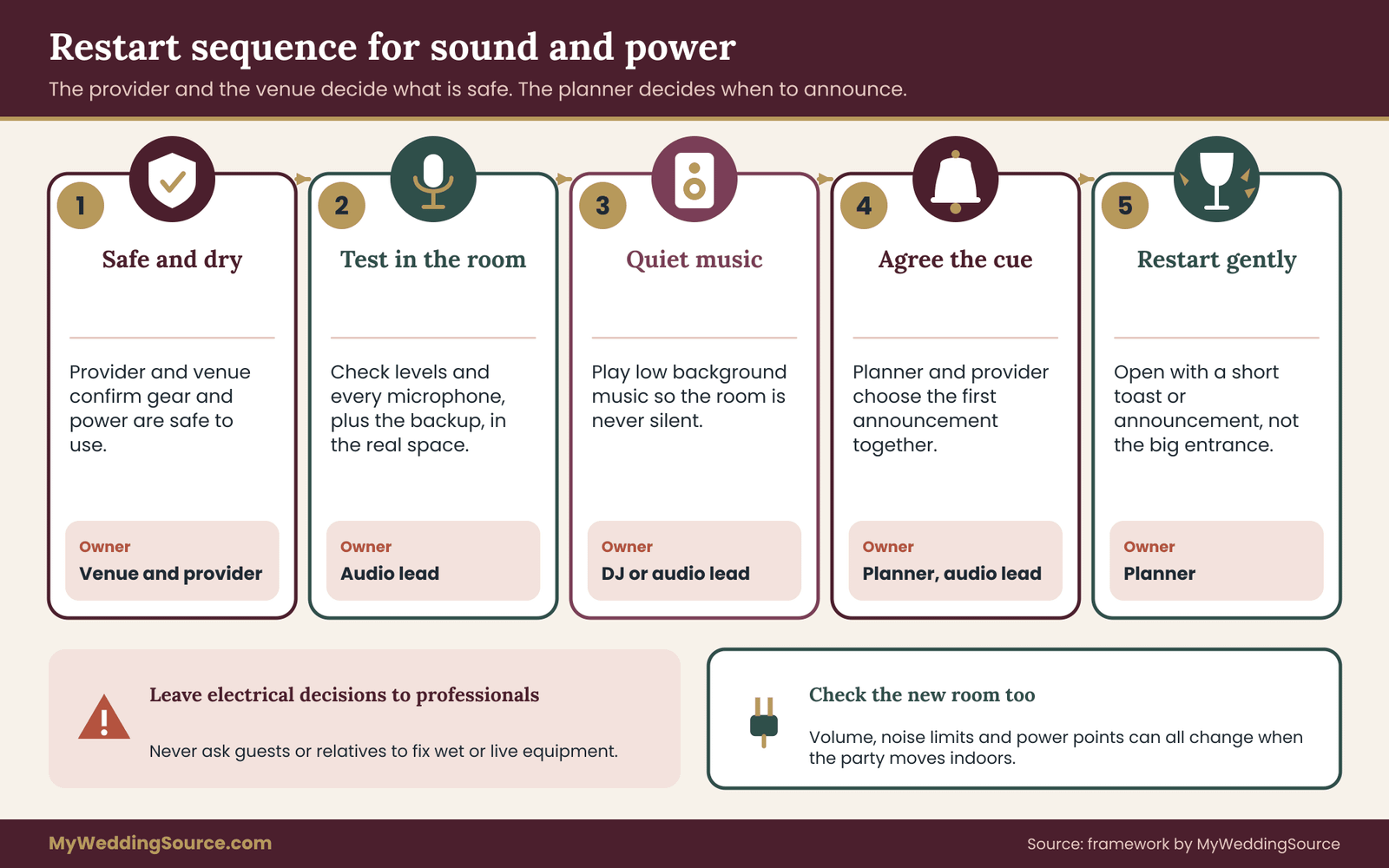
This is an area where a general article should be careful. How to protect cable runs, which power sources are acceptable outdoors, and whether a given connection is safe in damp conditions are matters for qualified technicians and the venue. Do not ask a guest or a relative to fix a power problem, and do not let anyone work around a safety decision made by the provider or the venue.
If you want background on electrical safety in the workplace, the Occupational Safety and Health Administration publishes information on electrical hazards that is worth reading as general context. It is not instructions for your venue. The provider’s judgment and the venue’s rules decide what happens on the night.
Relocating the sound
If the weather has forced the party indoors, the sound setup changes. A system designed for an open lawn may be far too loud in a smaller room, and a system designed for a ballroom may not fit through the new doors.
The AV provider can usually adjust volume, speaker placement and the number of speakers. Let them. The couple should not be asked to choose between speaker positions in the middle of a delay. What the couple can do is tell the provider about any sensitivities: older guests who dislike loud music, a baby asleep in a nearby room, a neighboring event, or a noise limit the venue enforces.
Many venues have a sound limit or a quiet hour, and a relocation can run into it. Ask the venue about the limit in the new space and tell the audio provider before the first song, not after the first complaint.
Microphones and the toasts
Microphones deserve their own check because they are the most likely piece of equipment to be wet, dropped or left in the wrong place during a move. Wireless handheld and lavalier microphones also depend on radio channels. The Federal Communications Commission publishes information about how wireless microphones are licensed and used, which is a reasonable place to start if you want to understand why a provider is cautious about interference in a new location.
Ask the provider to test every microphone that will be used that night: the officiant’s, the toast microphone, the DJ’s and any backup. Then ask them to confirm which microphone is the backup and where it is. If a toast was planned for the lawn and has moved to a corner of a crowded room, check that the person speaking can be heard from the back.
Lighting after a weather delay
Lighting changes with the weather in two ways. The room may be darker than planned, because the sunset the schedule counted on has come and gone, and the space may be lit differently from the original layout.
String lights, candles, lanterns and uplights are all affected. Candles and open flames are a venue-rule question, and many venues restrict them indoors. Battery or LED options are usually the venue’s preferred alternative, and the planner should check the rules rather than assume. Lighting also affects safety: paths, steps, entrances and exits should be lit enough for guests who are moving around in unfamiliar surroundings.
If the photographer was counting on natural light for portraits or a sunset moment, tell them about the change as early as possible so they can plan what they will do instead.
The restart sequence for sound and power
The following sequence is a workable pattern for the audio lane, and the provider can adjust it.
First, the provider and venue confirm the equipment and power are safe. Second, the provider tests levels and microphones in the actual room. Third, the provider plays quiet background music so that guests are not sitting in silence. Fourth, the planner and provider agree on a cue for the first announcement. Fifth, the program restarts with the first item that does not depend on a fresh setup, which is often a toast or a short announcement rather than the grand entrance.
Background music is a recovery tool
Silence is uncomfortable during a weather delay. Low, steady background music tells guests that the evening is still going and that someone is in charge. It does not need to be the party playlist. It needs to be pleasant, at a volume that allows conversation, and free of surprises.
If the main sound system is not available, ask whether a smaller backup speaker or the venue’s house system can play background music while the main gear is tested. A small, working speaker is worth more than a big system that is not ready.
Photographers, officiants and other vendors in a weather delay
Not every vendor is part of the three lanes above, but nearly all of them are affected by a weather delay, and most of the damage comes from a failure to tell them what changed.
Photographers and videographers
The photographer is often the vendor with the most to lose from a changed schedule. Golden hour portraits, a sunset moment or an outdoor group photo may no longer be possible. Their contracted hours may also end before the revised schedule does.
Tell them early, ask what they would suggest, and ask about the effect on their time. A short conversation might cover three points: which photos are still possible indoors, which can move to later in the evening if the weather clears, and whether the contract’s coverage hours need to change. If extra hours are available, ask the price in writing before agreeing.
The wedding vendor contract guide covers overtime and schedule-change language that matters in situations like this.
Officiants, musicians and ceremony vendors
If a weather delay hits before or around the ceremony, the officiant, ceremony musicians and any readers need the same information as everyone else: what is happening, where they should be, and when they will hear next. Some of them may have another booking after yours. Ask early whether the weather delay creates a conflict, and if it does, have a plan for who steps in.
Transportation, rentals and the rest
Shuttle and car services are affected in two directions. A weather delay can push the end of the evening later than the contracted pickup, and weather can slow the roads on the way out. Tell the transportation provider about the revised end time and confirm that vehicles will still be available. If guests depend on a shuttle to reach a hotel, a short update by text before the new end time helps people plan.
Rental companies are affected if rented items, such as tents, chairs and linens, are moved or exposed. Report damage and moves honestly, and ask the rental company about their instructions for wet items. The wedding rental planning checklist describes how to track what was rented, which makes it easier to account for it at the end of the night.
One message to every vendor
The most efficient tool in this part of the response is a single message to all vendors with the same content. It should say what has changed, what the current estimated schedule is, who the point of contact is, and when the next update will come. Send it as soon as the first estimate is available, and send a second one when the schedule is settled.
A message like this helps the vendors do their jobs, and it creates a record that the change was communicated. If a question about overtime or service levels comes up later, the message is the evidence of what was said and when.
Rebuilding the timeline: shift, compress or cut
Lane five is where the couple finally gets involved, because the choices about the program are personal. By the time you reach it, the first four lanes have given you facts: the venue has cleared the space, guests are informed, the caterer has a plan, and the audio is tested. Now you can answer the question that started it all: what does the rest of the night look like?
The method is three verbs, in a fixed order, and it applies to any weather delay.
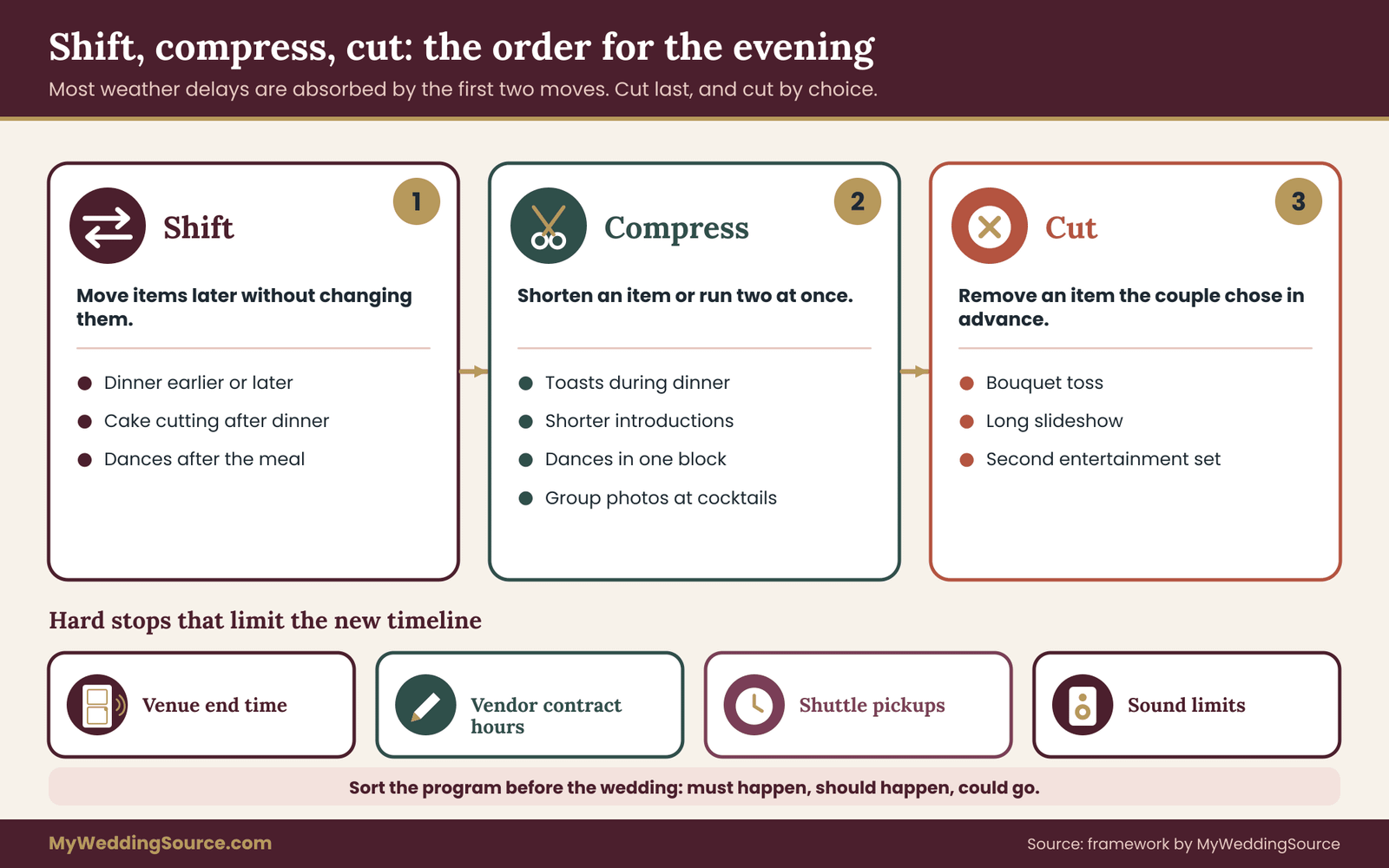
Shift means moving items later without changing them. Compress means shortening an item or running two things at once. Cut means removing an item. The order matters: shift first, compress second, cut last. Most of the time a delay can be absorbed by shifting and compressing, and the evening that results is close to the one the couple planned.
Step one: find the hard stops
Before you move anything, list the hard stops that cannot move. These are the constraints that make shifting impossible past a certain point.
The venue curfew or contracted end time. Vendor contracts with fixed end times. A shuttle or car service that leaves at a set time. A babysitter, a flight, or an elderly guest’s usual evening. A noise ordinance that applies in the neighborhood. Each of these sets a boundary on the revised timeline, and the list tells you how much room you actually have.
If you are not sure what the hard stops are, check the contracts and the venue’s rules before the wedding. The wedding vendor timeline guide describes how to collect them in one place, and the same list is what you need when the schedule changes.
Step two: calculate the available time
Take the new restart time (or the best current estimate) and subtract it from the earliest hard stop. The result is the time you have left. Then add up how long the remaining planned items take. If the second number is smaller than the first, you can shift. If it is larger, you have to compress or cut.
A simple example shows the logic. Suppose the venue requires the room to be cleared by the end of the contracted time, and the reception resumes later than planned. The remaining items, such as dinner service, toasts, cake, dances and the send-off, add up to a certain length. If the length fits in the time that remains, nothing is cut. If it does not, you have a gap to close, and you close it by compressing first.
Step three: compress before cutting
Compression usually costs little and almost never bothers guests. Here are the common ways to do it, roughly in order of how rarely they are noticed.
Overlap activities. Toasts can happen while dinner is being served instead of before it. Background music can continue during speeches that are short. A cake cutting can happen at the same time as the dessert service begins.
Shorten transitions. A grand entrance, a long introduction of the wedding party or a staged photo can be shortened to a simple announcement.
Trim speeches. Ask speakers to keep it short. Most guests appreciate this, and a quiet word from the planner before the toast is usually enough.
Combine dances. The first dance, a parent dance and the wedding party dance can happen in one block, with the music running continuously.
Move formal photos. If group photos were planned for the reception, the photographer may be able to take them during the cocktail hour, at the tables or the next day.
Step four: cut last, and cut by choice
If compressing does not close the gap, you are cutting. The only real mistake here is cutting by accident, where something simply does not happen because time ran out. Cutting by choice means the couple picks the items that matter least, in advance, and the planner executes the decision.
A useful way to prepare is to sort the reception program into three groups before the wedding: must happen, should happen and could go. The must-happen list is short and personal: it might be the first dance, the toast by a parent and the cake cutting. The could-go list holds items the couple would miss least, such as a bouquet toss, a long slideshow or a second set of entertainment.
Having that list means the couple does not have to decide under stress. They have decided in advance, and the planner is carrying out their own wishes.
Protect the order of the evening
When you rebuild, resist the urge to preserve the original order at all costs. A schedule is a tool for the evening, not a promise to anyone. Sometimes the better move is to change the order: for example, serving dinner before the toasts so that guests who have been waiting can eat, or moving the cake cutting earlier so that it is not lost at the end.
Think about which elements depend on daylight, which need guests to be seated and attentive, and which need energy. A weather delay may have drained the room’s energy, and a lively first dance might work better after dinner than as a restart.
For the broader principles behind how a reception flows from entrance to exit, the guide to wedding reception guest flow is the place to look. This guide assumes you already have a plan for the flow and focuses only on what to do when weather changes it.
Communicate the new timeline once
When the revised timeline is decided, send it once, to everyone who needs it, at the same time. That means the vendors, the wedding party, the planner’s team and the venue coordinator. Include the new time for each item, the hard stops that shaped it, and the point of contact.
Avoid sending partial versions as the plan evolves. A single clear message is better than five confusing ones. If you must update, mark the new version clearly and tell people to discard the old one.
A worked example: a ninety-minute weather delay
The following example is invented to illustrate the method. It is not a recommendation and not a real event, and your own numbers, rules and vendors will differ.
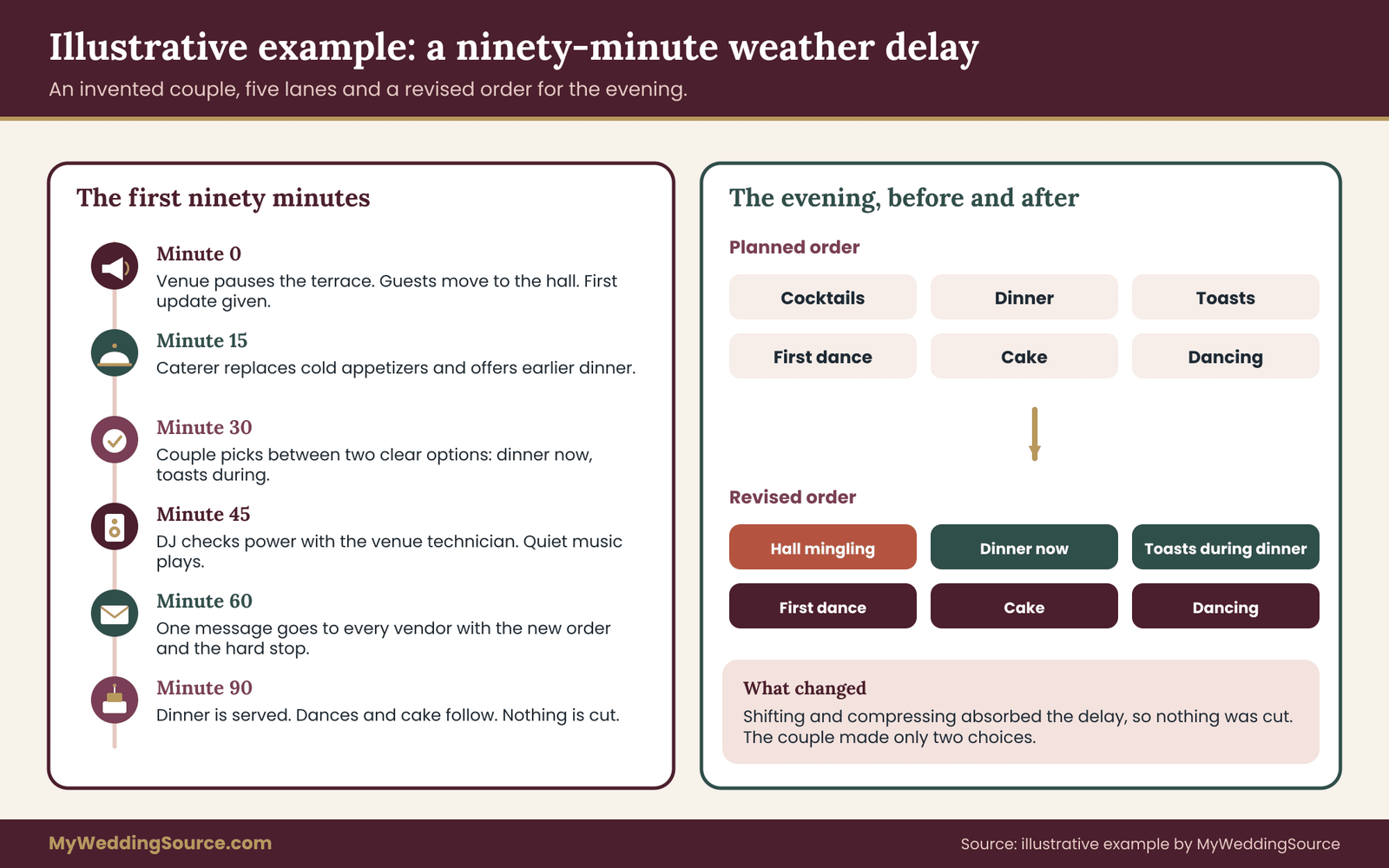
A couple, whom we will call Maya and Daniel, hold an outdoor reception at a venue with a garden terrace and an indoor hall. The schedule has the cocktail hour on the terrace, dinner in the hall, toasts after dinner, a first dance, cake and open dancing. The venue requires everyone to leave by a fixed time, and the DJ is contracted until just before that.
During the cocktail hour, the venue manager pauses the outdoor portion because storms are approaching. Guests move into the hall, which was set for dinner and is smaller than the terrace plus hall combined. The venue manager says they will check conditions and update in fifteen minutes.
Minute zero to fifteen
The day-of lead, a planner named Priya, opens the recovery priority board. Lane one is in the venue manager’s hands. For lane two, she makes the first announcement using the three-part formula, asks the wedding party to repeat it, and tells the couple quietly. She asks the caterer, Samir, what is out and what is in the kitchen.
Minute fifteen to forty-five
The venue says the storm will probably last another hour but offers no promise. Priya announces this honestly, with the next update in twenty minutes. Samir tells her the cold appetizers on the terrace need to be replaced and that the kitchen can hold the main course for a limited time under its own procedures. He proposes serving dinner earlier than planned in the hall, using the hall’s own setup, while the weather clears.
Priya presents the couple with two choices. Option one: serve dinner now, with toasts during the meal, and do the first dance and cake after. Option two: keep the original order and delay dinner. Maya and Daniel choose option one, because guests are already hungry.
Minute forty-five to ninety
The DJ, Keisha, finds that her speaker cables were left in a wet area. She tells Priya she needs fifteen minutes with the venue’s technician to check the power in the hall. Priya asks her to play quiet music from a small speaker meanwhile. The photographer, Omar, learns that sunset portraits are no longer possible and decides to take a few images in the hall instead, with a plan to step outside if the weather clears.
Priya sends one message to every vendor with the new schedule: dinner now, toasts during dinner, first dance and cake after, open dancing for the remaining time. She notes the venue’s end time as the hard stop and asks the DJ and photographer to confirm.
What the example shows
Three things stand out. The order of the lanes held: safety first, information second, food third, audio fourth, program last. The couple made only two choices, both between clear options. And nothing in the evening was cut, because shifting and compressing absorbed the weather delay.
It also shows what the example cannot show. Real venues differ on whether a hall can take that many guests, whether a caterer can hold or serve earlier, and whether a technician is available when needed. Use the example as a model for the sequence, not as a guarantee about any of those answers.
Where the same example could have gone differently
Suppose the venue had said the storm would last two more hours. Then the available time would have shrunk, and compressing would no longer be enough. Priya would have returned to Maya and Daniel with the could-go list they prepared, and they would have cut a section of entertainment by choice. Suppose the hall had been too small. Then the venue would have decided how many people it could hold, and the couple might have moved some activities to another room or ended the evening earlier.
Each variation changes the details, and the board still gives the order in which to decide them.
What is confirmed and what is only assumed in a weather delay plan
Every weather delay plan rests on a pile of assumptions: that the backup room is big enough, that the caterer can hold dinner, that the DJ can set up indoors, that the venue will allow a longer evening. Most of those assumptions are probably right. The trouble is that nobody knows which ones, and the evening of the storm is a poor time to find out.
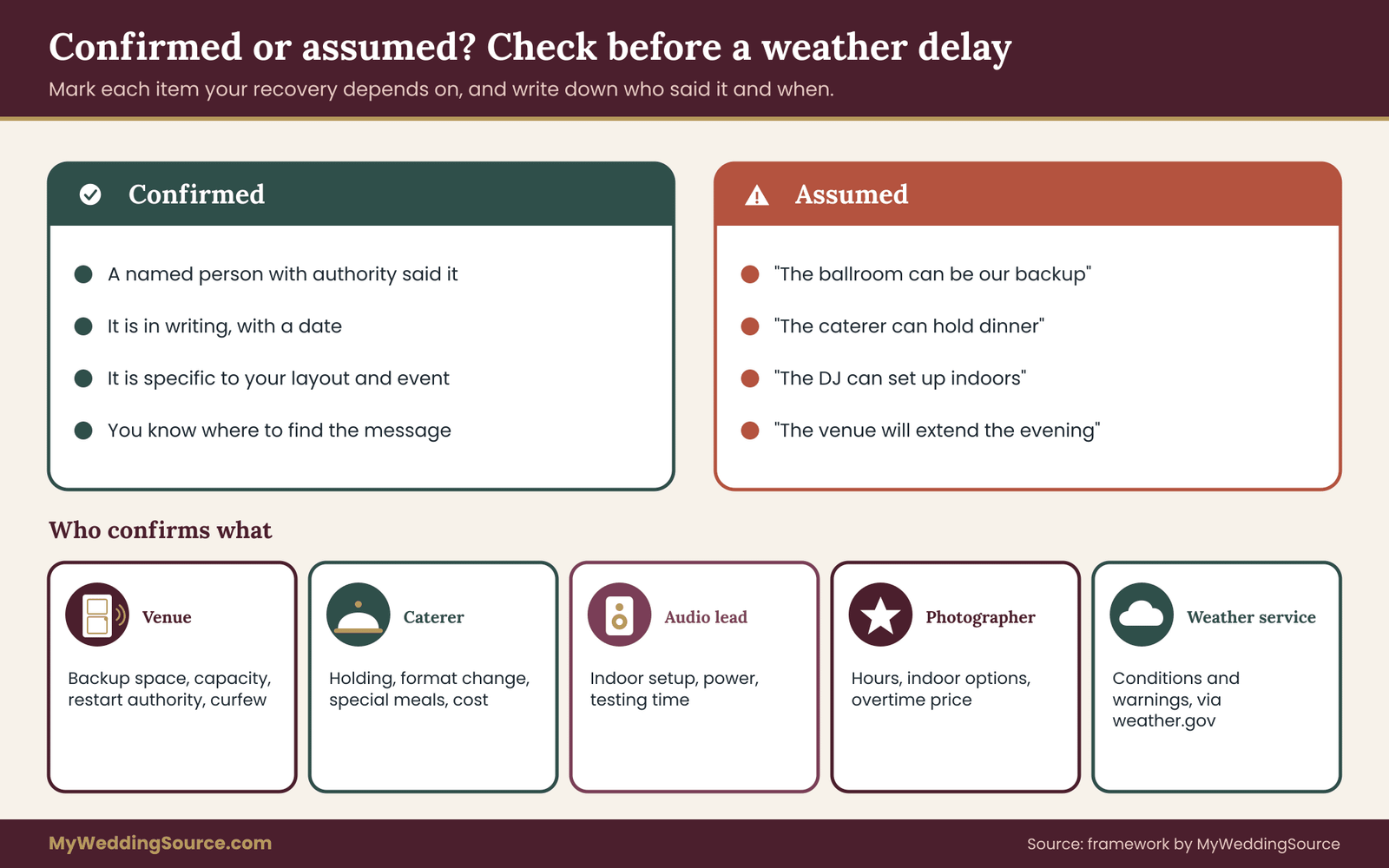
The fix is a verification board, a simple sorting exercise you complete before the wedding. For each item that your weather delay plan depends on, you mark it as confirmed or assumed, and you write down who confirmed it and how.
What counts as confirmed
Confirmed means a person with authority has said it, ideally in writing, and the statement is specific. “The ballroom can be used as a backup” is an assumption. “The venue manager wrote on this date that the ballroom is available as a backup space for the reception, and that its approved capacity for a seated dinner is a number she gave us” is confirmed, provided the number really came from the venue and applies to your layout.
Everything else is an assumption, and that is fine. The point is to know which is which. A plan with ten assumptions you have identified is far stronger than a plan with ten you did not notice.
Who to verify with
Different questions have different owners, and going to the wrong one wastes time.
The venue confirms backup spaces, capacity, shelter locations, access, power, noise limits, curfews, restart authority and any written weather policy. Ask for the answers in an email you can find later.
The caterer confirms holding capability, service format changes, staffing for a longer evening, special meal handling and the cost of any change.
The audio provider confirms indoor setup, power needs, backup equipment and the time needed to test.
The photographer and other vendors confirm how a weather delay affects their hours and what they would do differently.
The weather service and local officials are the source for conditions and warnings. The National Weather Service safety pages at weather.gov/safety are a good place to learn what its warnings mean, and local emergency management offices can point to local procedures. FEMA’s preparedness site, Ready.gov, also publishes general guidance on severe weather. None of these replace your venue’s rules.
The questions to ask before the wedding
Here is a short list of questions that turn assumptions into confirmed facts. You do not need all of them, and your venue may answer some in its standard materials.
What is the venue’s written severe weather policy, and who calls a pause or a restart? Where do guests go if the outdoor portion is paused, and what is the approved capacity of that space for our event layout? Can the caterer, the bar and the audio provider operate in that space, and what do they need? What are the venue’s curfew and sound limits, and can any of them be extended? Who is the on-site contact during the event, and how do we reach them?
For the technical side of those answers, the wedding venue technical walkthrough guide gives a method for measuring, mapping access and confirming vendor needs in advance.
Putting the answers on the board
Take the answers and write them in a single place, the same document as your vendor timeline. Beside each, note the date, the person and whether you have it in writing. When you finish, you will have two short lists: what is confirmed and what is assumed.
Then work on the assumed list in order of importance. A good way to rank is by consequence: which assumption, if wrong, would cause the biggest problem on the night? The backup space’s capacity and the restart authority usually top the list, followed by the caterer’s holding plan and the audio setup.
Limits of any advance verification
It is worth saying plainly what a verification board cannot do. It cannot predict the weather. It cannot guarantee that a venue will behave exactly as it said on a calm afternoon, because staff change and conditions differ. And it cannot give you a number for safe capacity, an evacuation route or a holding time. Only the venue, the caterer and the relevant authorities can.
What it does is reduce surprises. A couple who knows that three assumptions are still open will ask about them again at the final walkthrough, and the odds of a clean recovery go up.
Keep the contract in view
Some of the most important answers sit in the contracts, not in conversations. Read the venue and vendor contracts for language on weather, force majeure, overtime, schedule changes and who decides when an event is paused. If the language is unclear, ask for clarification before signing, and keep the reply with the contract. The wedding vendor contract guide explains these clauses in plain language, and you can use the same checklist for the venue.
Special cases and common mistakes in weather delay recovery
The framework above handles the typical weather delay. A few situations change the picture, and a handful of mistakes show up often enough to name.
Special cases worth thinking about
Older guests and guests with mobility needs. A change of space can mean stairs, longer walks, wet surfaces or a seating arrangement that no longer fits. Ask ushers or the day-of lead to identify who may need help and where to seat them. If a guest uses a wheelchair or walker, confirm that the new space is reachable and that the route is clear.
Children and infants. A long weather delay is hard on children. Parents may want to eat earlier, and some may leave sooner than planned. If you arranged childcare or a kids’ area, check how the weather delay affects it, and let parents know when dinner will be served.
Guests with medical needs. Guests who must eat at a particular time, take medication or avoid crowds may need an early plate or a quiet corner. A quiet word with the caterer and the day-of lead can solve most of these.
Guests who drive or depend on shuttles. A later end time affects them directly. Let people know the revised end time, and confirm that shuttle and rideshare plans still work. The wedding guest care planning guide covers how to anticipate those needs.
Destination and travel weddings. Guests may be strangers to the area, with limited local transport and unfamiliar weather. Give them a clear point of contact and a plain summary of what is happening.
Venues with strict curfews. Some venues cannot extend the evening at all. In that case, the whole recovery is about compressing, and the could-go list matters more.
Multiple spaces. If the reception runs across several rooms or buildings, a pause can scatter guests. Assign ushers to each space and give each of them the same update script.
Tents and temporary structures. Wind and heavy rain can affect tents. Whether a tent is safe to occupy is a decision for the rental company and the venue, and nobody else should override it.
Heat and humidity. Not every weather delay is a storm. Extreme heat can also pause or move an event, and the NWS publishes heat safety guidance. Water, shade and indoor cooling are part of the response, and the venue decides what is feasible.
The most common mistakes
Restarting too early. The urge to restore the party leads to resuming before the venue has cleared the space. Wait for the venue.
Silence. A weather delay with no updates is much worse than one with honest updates. Speak early and keep the interval short.
Letting the couple run the response. The couple’s job is to answer personal questions. Operational decisions belong to the day-of lead.
Skipping the food conversation. Waiting to talk to the caterer until the program is rebuilt wastes time and can leave guests hungry. Talk to them in the first fifteen minutes.
Forgetting special meals. Format changes break the systems that match plates to guests. Ask the caterer how those guests will be served.
Overpromising. “Back in twenty minutes” is a promise you cannot keep. Say what you know and when you will speak again.
Cutting by accident. Items that quietly drop off the schedule are items the couple did not choose to drop. Use the could-go list.
Telling vendors one at a time. Sending different messages to different people produces different schedules. Send one message to all.
Assuming the backup space works. An unverified backup space is the most common hidden assumption. Check it before the wedding.
Ignoring costs. Extra hours, food and staffing can appear on a final invoice. Ask for the effect in writing during the evening.
Keeping perspective
A weather delay is stressful, and guests and couples alike tend to remember how it was handled more than the weather itself. A calm, honest, orderly response is something people notice and appreciate. A weather delay that is handled well can even become part of the story of the day, the part that guests mention fondly years later.
That is not a promise. It is a reason to put in the modest effort of building the board, naming the owners and verifying the assumptions. The work takes a few hours before the wedding and can save a great deal of friction on the night.
A one-page weather delay card for your day-of lead
Everything in this guide is useful only if the person running the day can use it at speed. The simplest way to make that happen is a one-page card, printed and kept in a sleeve, that the day-of lead can read in thirty seconds while someone is asking them a question.
The card has six parts. You can write it by hand or type it, and you should share it with the venue and vendors the week before the wedding.
Part one: the trigger. One sentence that says who becomes the contact for everyone when the venue pauses the event, and until when. For example, the name and phone number of the day-of lead, and a line saying that the venue decides when the event resumes.
Part two: the board. The five lanes in order (people, information, food, sound and power, program), with a name and a phone number beside each. Leave a small box next to each lane to mark open, in hand or done.
Part three: the update script. The three-part formula: what we know, what we do not know, when you will hear next. Add the first announcement written out, so nobody has to compose it under pressure.
Part four: the hard stops. The venue’s end time, each vendor’s end time, any shuttle or car pickup, any noise limit and any other boundary that limits the revised timeline.
Part five: the program list. The couple’s must-happen, should-happen and could-go items, in their own words, signed off before the wedding.
Part six: the vendor message. A short template with blanks for the changes: what has changed, the new estimated schedule, who the contact is, when the next update will come.
Who gets the card
Give a copy to the venue coordinator, the caterer’s lead, the audio provider, the photographer and the couple’s delegate. Keep one for yourself. Mention it at the final walkthrough and read the trigger aloud, so that everyone knows it exists and where it lives.
Do not give the card to every guest or every member of the wedding party. A few trusted people with a clear role are better than a crowd with a half-understood document. If you want the wedding party to help, give them one specific job: repeating the update at their tables, helping an elderly relative, or watching a door.
A short rehearsal
If you have ten minutes at the final walkthrough, run a rehearsal. Ask the group to imagine that the venue has just paused the event, and ask each person to say what they would do in the first five minutes. It sounds a little silly, and it works. People discover that two of them thought they owned the same task, or that nobody owned the announcement.
The rehearsal also surfaces assumptions. When the caterer says “I would move dinner earlier,” and the DJ says “I would need twenty minutes in the hall,” you now have two facts you did not have before.
Keeping the card current
Update the card whenever something material changes: a new vendor, a changed end time, a different backup space or a new contact. If you share a digital copy, label the version and date so nobody works from an old one. If you have a vendor timeline already, the card can live as the first page of that document.
For the wider picture of how a reception is meant to flow from the first guest in to the last guest out, the reception guest flow guide is the companion piece. The card in this section is the emergency page that sits on top of it.
FAQ
What should happen first during a weather delay at a reception?
Guest safety comes first, and the venue decides what that means in its building. Move people where the venue directs, wait for its word before resuming and follow official weather guidance. Once people are safe, tell them what is happening and when you will update them again, then talk to the caterer before rebuilding the schedule.
Who decides when a wedding reception can restart after a weather delay?
The venue decides, using official weather information and its own procedures. The couple, planner, vendors and guests do not override that call. Before the wedding, ask the venue in writing who makes the decision, how a pause and a restart are called, and how you will reach that person during the event. If the venue cannot answer, treat the plan as incomplete.
How often should we update guests during a weather delay?
Often enough that nobody feels forgotten. A short interval, such as fifteen minutes at the start, works well, and you can lengthen it once guests are settled. Each update should say what you know, what you do not know and when the next update will come. Even “no change yet” keeps people calm and prevents rumors.
Can the caterer hold dinner during a weather delay?
That depends on the menu, the equipment and food safety rules, and only the caterer can answer it. Ask what can be held, for how long under their own procedures, and what they would change if the weather delay grows. They may offer to re-time dinner, simplify the service or move dessert earlier. Do not set holding times yourself.
What should we cut first when a weather delay shortens the evening?
Shift and compress before you cut. Move items later, overlap toasts with dinner, shorten transitions and combine dances. If you still need to cut, use a list the couple made in advance of must-happen, should-happen and could-go items, so the choice is theirs and nothing disappears by accident. Respect every hard stop, such as venue curfew and vendor hours.
How do we protect audio equipment during a weather delay?
Leave that to the audio provider and the venue. They decide when equipment and power are safe, whether the setup must move and how long testing takes. Ask them to check every microphone and a backup, and to play quiet background music while testing. Do not ask guests or relatives to fix power problems or work around a safety decision.
Will wedding insurance or a vendor contract cover costs from a weather delay?
It depends on the policy and the contract, and neither can be judged from a general article. Read the venue and vendor contracts for weather, force majeure, overtime and schedule-change language, and ask an insurer or licensed agent what a specific policy covers. During the event, ask vendors to state any extra charges in writing so they are not a surprise.
How can we prepare for a weather delay before the wedding?
Build the recovery priority board, name an owner for each lane and give the day-of lead a one-page card. Verify the backup space, restart authority, caterer holding plan and audio setup with the people who own them, and write down what is confirmed and what is assumed. Agree on the couple’s must-happen and could-go list, and share one timeline with every vendor.
Your next steps
Start with the part that takes the least time and removes the most risk. This week, write the one-sentence trigger and decide who the day-of lead is, then tell the venue and vendors. Next, email the venue and ask for its written weather policy, the name of the person who calls a pause and a restart, and the approved backup space for your event layout.
Then, over the following weeks, sort your assumptions on the verification board and work through the open ones with the venue, caterer and audio provider. Sit down with your partner and sort the program into must-happen, should-happen and could-go. Finally, print the card, share it at the final walkthrough and run the five-minute rehearsal. If the weather behaves, you will never need any of it. If it does not, a weather delay will be an interruption you already know how to handle.
Sources
- Weather safety, National Weather Service, NOAA
- Lightning safety, National Weather Service, NOAA
- Severe weather preparedness, Ready.gov, Federal Emergency Management Agency
- Food safety information for consumers, U.S. Food and Drug Administration
- Food safety and handling guidance, USDA Food Safety and Inspection Service
- Electrical safety, Occupational Safety and Health Administration
- Wireless microphones, Federal Communications Commission
- Safety standards and codes, National Fire Protection Association
- Product safety information, U.S. Consumer Product Safety Commission