
Edible flowers on a wedding cake look effortless in photos, but the safety work behind them starts months earlier. This guide gives you a four-gate check for edible flowers (name, source, handling and guests) plus the exact questions to put to your baker, florist and venue before anything fresh goes near the cake.
Treat edible flowers like any other produce that ends up on a plate. Every bloom needs a correct botanical name, a supplier who grew it for eating and can say how, a handling plan that keeps stems and florist materials out of the frosting, and a guest plan that covers allergies and what the servers do at the cutting. If a flower fails any one of those four gates, swap it for sugar work, a food-safe alternative, or a florist arrangement that never touches the cake.
Most couples meet the idea of fresh flowers on a cake through a photograph. A pale buttercream tier, a cascade of pansies and herb blossoms, a soft light behind it. Nobody captions the photo with where the flowers were grown, how they were washed or who put them there. That missing caption is the whole subject of this article, because a cake is food, and flowers that touch food have to be treated as food.
Here is the practical problem. The word “edible” is doing a lot of work. A flower can be safe to eat in principle and unsafe on your particular cake, because it was grown with chemicals never meant for food, stored beside something it should not touch, or picked by someone who guessed at the species.
A flower can also be technically harmless and still cause trouble for a guest with a pollen allergy. The safety of edible flowers is not a property of the plant alone. It is a property of the plant, the grower, the handling and the person who bites into it.
A note on scope. This is general information, not legal, medical or food-safety advice, and rules differ by state and county. Where a rule matters, this guide points to the agency that issues it so you can confirm the current version, and your baker’s licensed kitchen has the final say on what goes on their cake.
The rest of this guide is organized around decisions rather than botany. You will find out who is responsible for what, how the four gates work, what to ask each vendor, how to compare fresh flowers with the alternatives, and how to run the whole thing as a short checklist in the weeks before the wedding. If you are still sorting out the bigger cake schedule, the guide to planning wedding cake production from final guest count to cutting service covers the order of operations. This article stays on the edible flowers.
What edible flowers on a wedding cake really means
People use the phrase for three quite different things, and mixing them up is the source of most mistakes.
Edible flowers meant to be eaten. These are blooms or petals grown for food, such as pansies, violas, nasturtiums and borage, or the flowers of culinary herbs. They are placed directly on frosting, a guest may eat them, and they are held to a food standard. This is the category the rest of the article is mostly about.
Non-toxic flowers used as decoration only. These are flowers that are not known to be poisonous but were never grown or handled as food. They are fine as a visual detail if a barrier keeps them off the cake itself, and the people cutting and serving know they are not meant to be eaten. Many florist roses fall here. The trouble starts when a flower in this second group quietly drifts into the first.
Flowers that are not safe for food at all. Some popular wedding flowers are toxic if eaten. They can look wonderful on a cake, and some decorators have used them for years. A barrier and a clear removal plan are the minimum if they appear at all, and many bakeries simply refuse them.
When a vendor says “we use edible flowers,” ask which of these three they mean. A good baker will answer in a sentence. A vague answer is information too.
Why the word edible is not enough
Edible describes what a plant is, not how a particular bunch of it was raised. A rose petal from a garden that has never seen a spray bottle is a food. A rose from a flower shop, grown for the vase, can carry residues from products that are approved for ornamental plants and not for crops people eat. The Environmental Protection Agency regulates pesticide use by crop and by label, and ornamental production and food production are not the same category. Edible flowers are therefore defined by their growing history as much as by their species.
That is why this guide keeps pairing two questions. What is it? And where did it come from? Either answer alone is incomplete.
What you are actually deciding
You are not deciding whether flowers are allowed on cakes. They are, every day, in licensed bakeries. You are deciding four smaller things. First, which exact flowers, by botanical name. Second, which supplier, with what documentation. Third, how they are handled between the farm and the cutting table. Fourth, what guests are told and what the servers do. The four-gate check in the next section keeps those decisions in order.
Why edible flowers wedding cake safety is a vendor question
Couples often assume the florist handles anything that looks like a flower. Florists, for their part, often assume the baker handles anything that touches a cake. Neither assumption is safe, and the gap between them is where mistakes live.
The baker works under a food license. That license, issued and inspected through local or state health authorities, covers how food is made, stored and handled. Your baker is the person legally and practically responsible for what goes on the cake, which means the baker should be the person who decides which edible flowers are used and where they come from. If the baker says the edible flowers will come from the florist, the baker is accepting responsibility for a product they did not source, and that deserves a direct conversation.
The florist works under a different set of norms. Floral supply chains are built for appearance and shelf life. Cut flowers are commonly treated for pests and fungus, kept fresh with preservatives in the water, and shipped long distances. None of that is wrong for a bouquet. It is simply not a food chain, and nobody in it is promising that a stem is clean enough to eat.
Three ways flowers reach a cake
There are really only three routes, and each has a different owner.
The first route is the baker sourcing flowers from a food-grade supplier, so the baker owns the product from delivery to the cake. This is the cleanest arrangement, and most bakeries that regularly use fresh flowers already work this way.
The second route is the florist supplying flowers to the baker, which is common and can work if the florist can name a food-grade source and the baker agrees in writing to accept them. Without that, you are dealing with a flower grown for the vase and handed over at the last minute.
The third route is the venue or a family member bringing flowers to place on the cake after delivery. This is the riskiest, because nobody with a food license touched the decision and the flowers often arrive at the worst moment, with the cake already in place and the room filling up.
Pick one route and write it down. The questions that follow only make sense once you know who owns the edible flowers.
The fourth party nobody mentions
The caterer or banquet staff who cut the cake are the last people to touch it. If the cake has fresh flowers on it, they need to know which parts are food and which are decoration, and what to do with each. A short instruction from the baker, delivered before the cake is cut, prevents a stem from landing on a plate. The caterer, the venue coordinator and the baker should all hear the same plan from you. The guide to the wedding vendor timeline is a good place to find the point where that conversation fits.
The four-gate check for edible flowers
Here is the framework the rest of the article uses. Every flower on the proposed design has to pass four gates in order. If a flower fails a gate, it does not move on to the next one, and you decide whether to substitute it, change how it is used, or drop it.
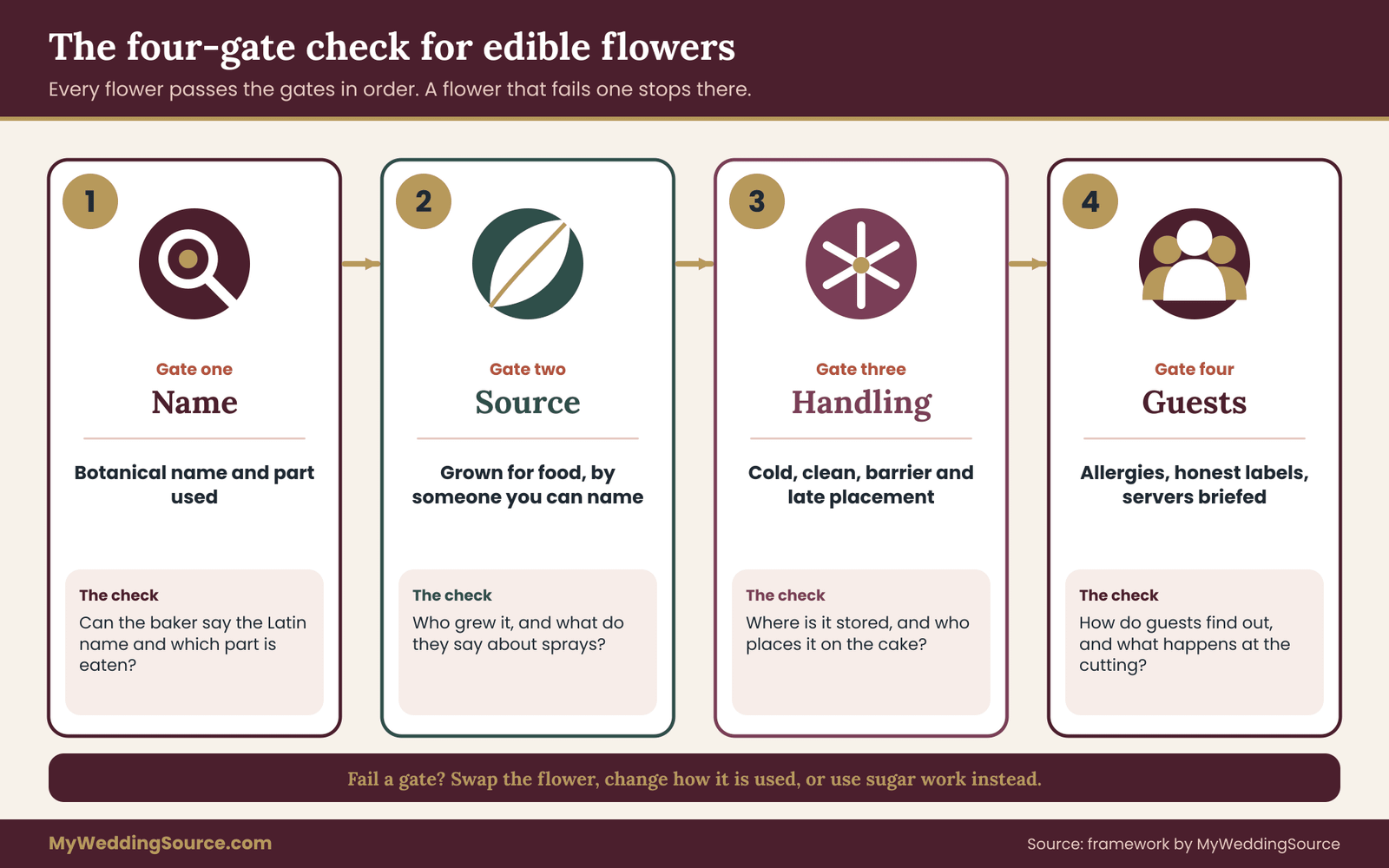
Gate one: name. The flower is identified by its botanical name, and the part used is stated. Common names are unreliable, because the same word can mean different plants in different regions. The check is simple. Can the baker or supplier tell you the Latin name and say which part is eaten?
Gate two: source. The flower was grown for food, by a grower who can say what was used on it, and delivered through a chain that kept it separate from non-food product. The check: who grew it, and what is their answer when you ask about sprays?
Gate three: handling. From delivery to the cutting table, the flower is washed or inspected as needed, kept cold and dry, placed with a barrier where stems are involved, and put on the cake as late as the design allows. The check: where is it stored, and who places it?
Gate four: guests. People who might react are identified, the cake is labeled or described honestly, and the servers know what to remove. The check: how do guests find out, and what happens to the flowers at the cutting?
The order matters. A flower with the wrong name does not deserve a source check, and a perfectly sourced flower that will sit in a warm room for hours does not deserve a place on the cake. The next four sections take each gate in turn. Treat the gates as a conversation with your baker, not as a quiz for them. Most professionals appreciate a client who knows what to ask.
Gate one: identifying edible flowers by botanical name
Start with the name, because everything else depends on it. A flower that cannot be named cannot be checked, sourced or explained to a guest. This gate is short and it filters out more problems than any other.
Why common names fail
Common names are local, poetic and often shared between unrelated plants. “Marigold” can mean the calendula, a pot marigold used in kitchens, or a Tagetes marigold of the garden-bed kind, and these are not interchangeable. “Sweet pea” names an ornamental plant whose seeds and pods are a problem for people, and it has nothing to do with the vegetable. “Lily” covers true lilies, daylilies and the lily of the valley, which belong to different families with very different reputations. “Bachelor’s button,” “cornflower” and “bluet” overlap in confusing ways.
The botanical name removes the argument. Calendula officinalis is one thing. Viola x wittrockiana, the garden pansy, is another. Tropaeolum majus, the common nasturtium, is another. A professional supplier of edible flowers lists these on the invoice or the product sheet without being asked, and a baker who regularly uses edible flowers usually knows the handful they trust by heart.
You do not have to learn botany. You have to ask for the name and write it down. If the answer is “just pansies,” ask whether that is the garden pansy or a viola, and whether the supplier sells them as food. The answer tells you how much homework has been done.
The part of the plant matters
Gate one also asks which part is eaten. For many edible flowers the answer is the petal only. The green base, the sepals, the stem and sometimes the center of the bloom are not part of the intended food use. Dianthus is a common example, because the petals are the edible part and the white base of each petal is bitter and is normally trimmed.
Squash blossoms are eaten whole, usually cooked, which is a very different use from a cake garnish. Lavender buds are used in small amounts and in a culinary variety, and a lavender stem from a flower shop is not a culinary ingredient.
For a cake, this turns into a design question. If only the petals are food, a whole bloom on the cake is partly decoration, and the stem, the calyx and any wire or tape are decoration for certain. A good baker will tell you which pieces will be set on a barrier or trimmed to petals, and which will be eaten without a thought.
Look-alikes and the cost of a wrong guess
Several edible flowers have look-alikes that are not edible, and the safest policy is that identification by sight alone, from a photo or a garden, is not enough for something that will be served at a wedding. Poison-control organizations and university extension programs publish lists of plants that are harmful when eaten, and those lists include many species common in gardens and in wedding floristry. The point is not to frighten anyone. The point is that “it looks like the picture” is a weak standard when the stakes are a guest’s stomach.
This is the single strongest argument against foraging or cutting flowers from a roadside, a field or a neighbor’s yard for a wedding cake. Even an experienced forager would normally identify a plant in person, with several features in hand, and with a known history of the site. A photo sent by a relative who “knows these are fine” is not a verification step. If a family garden is part of your plan, the section on special cases later in the article gives a safer way to include it.
Species that need a closer look
Some flowers that bakers and decorators encounter are edible in one form and a problem in another. A few examples of why careful naming matters.
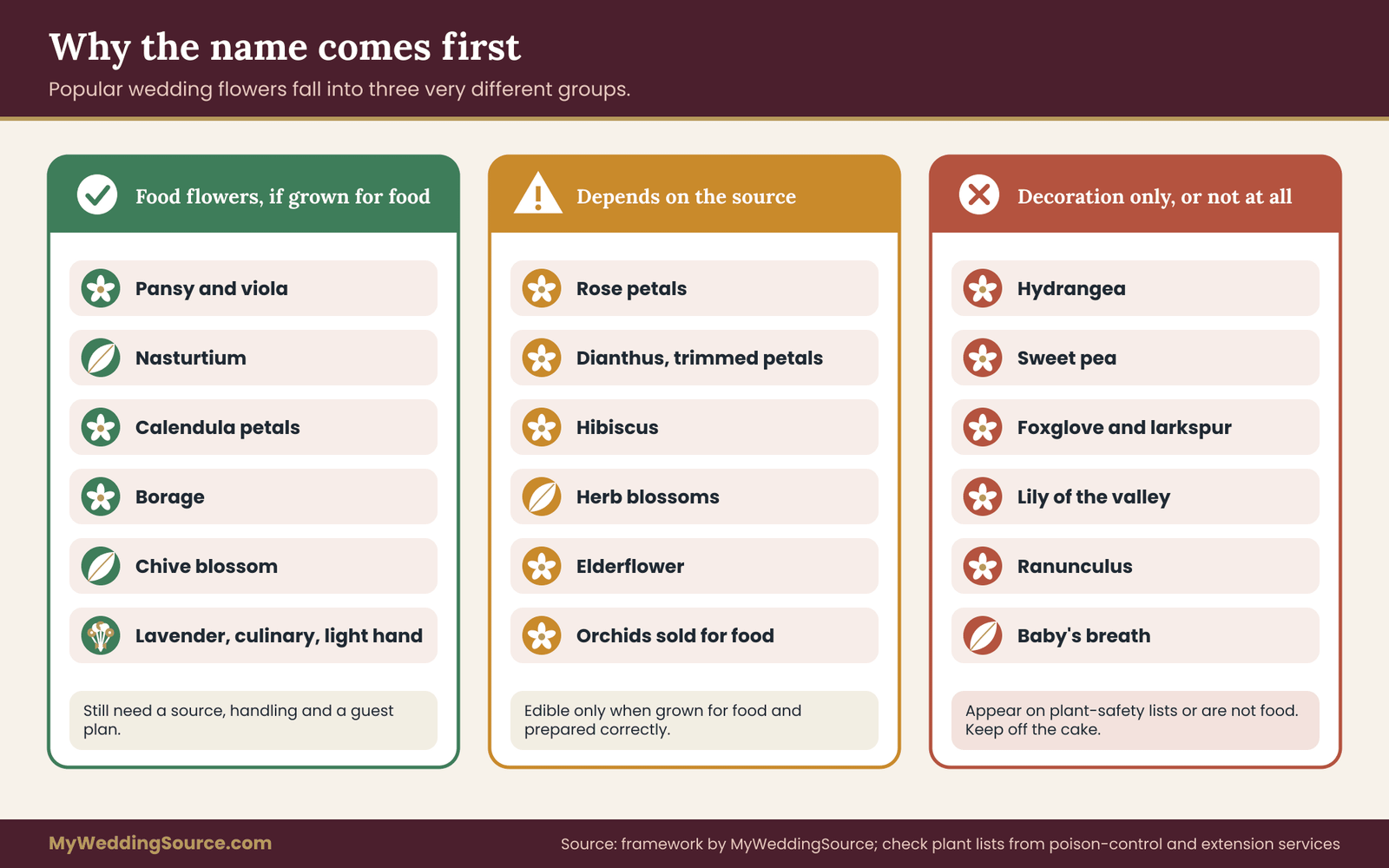
Elderflower is used in drinks and desserts in many countries, but the plant has parts that are not safe raw, and preparation matters. Hydrangea is a favorite for cake design and is generally listed among plants that should not be eaten, because it contains compounds that can release cyanide when digested. Sweet pea, foxglove, lily of the valley, larkspur and delphinium, wisteria and oleander all appear on poison lists and all appear in wedding floristry. Ranunculus is popular and looks edible and is not a food flower. Baby’s breath is used on cakes constantly and is a decoration, not food.
You do not need to memorize any of that. You need to know that a long list of popular wedding flowers is not food, and that the baker’s list of approved edible flowers should be short and specific, not “whatever matches the palette.”
Putting gate one into practice
Ask for the full list of flowers on the proposed design with botanical names and the part used. A baker who sends a short email back with six items has done gate one. If your design uses ten flowers, consider trimming, because a shorter list is easier to source and easier to verify.
Check the names against a reputable reference. University extension services and poison-control organizations publish plant lists, and your local extension office can often answer a question about a particular species. Treat any plant that appears on a toxic list as a decoration at most, never as a garnish that touches food. If the baker disagrees, ask for the reasoning and for a written note.
When two flowers look the same but you cannot be sure they are the same species, choose the one you can name. A single confirmed pansy beats a handful of unlabeled petals every time.
“Could you send the list of fresh flowers you plan to use on our cake, with the botanical name of each and which part is eaten? We would also like to know which ones are decoration only.”
Common edible flowers, in plain terms
To give you a feel for what a good list looks like, here are the edible flowers most often named by culinary and extension sources as food flowers. They are examples to recognize, not a shopping list, and each still has to pass the other three gates.
Pansies and violas have a mild, slightly green flavor and flat faces that sit well on frosting. Nasturtiums have a peppery bite and bold colors, so they are better as an accent than as a mass. Calendula petals are bright and mild. Borage produces small blue star flowers with a cool, cucumber-like taste. Chive blossoms are onion-flavored and not for every dessert.
Lavender is strong and should be used lightly. Rose petals depend entirely on the rose having been grown without sprays. Hibiscus is tart. Dianthus and carnation petals are edible when trimmed and unsprayed. Herb flowers such as thyme, rosemary and basil are small and aromatic.
Notice what happens when flavor enters the picture. A flower that is safe can still taste like onion on a vanilla cake. Gate one also covers whether the flowers match the cake, and your tasting appointment is the right moment to try them together. The guide to building a wedding menu that works across different ages and dietary preferences is useful here, because flowers are part of the overall menu, not an afterthought on top of it.
Edible flowers and the gate-one decision rule
You now have the information to give each flower a first verdict. Use this rule, which is the same on every cake.
If the flower is named by its botanical name, the part used is stated, and it appears on a reputable list of food flowers, it passes gate one and moves to the source check. If the name is missing, the flower is parked until the baker supplies it. If the flower appears on a poison-control or extension list as not suitable for eating, it is decoration only, and the only question is whether the baker will use it at all and how a barrier will keep it away from the cake.
That is the whole gate. It takes ten minutes of email and removes the worst surprises. What is left is the quieter risk that comes from where the edible flowers were grown, which is gate two.
A short note on herbs and garnish flowers
Flowers from culinary herbs deserve a line of their own, because they sit between the plant world and the kitchen. Basil, thyme, rosemary, mint, dill and cilantro all flower, and the flowers are generally used the way the leaves are. Bakers who grow herbs often use these blooms. The same rules apply.
A name, a source, a cold chain and a guest plan. The fact that the plant is a herb does not exempt the flower from the questions, though it does make a good case for asking a baker whether they grow their own herbs in a clean, food-dedicated space.
Keep a one-page flower sheet
Create a single page with one row per flower, written as short sentences. Flower name, botanical name, part used, supplier, status. A shared note works, and so does a printed page in the cake folder. When the baker and the florist both refer to the same page, nobody has to remember a conversation from March. If the number of flowers grows past eight, take a step back and ask whether a calmer design would serve the cake better.
Gate two: verifying the source of edible flowers
A correctly named flower can still be a bad choice if nobody can say where it came from. Gate two is where the vendor questions earn their keep. It is also where the difference between a food flower and a vase flower becomes concrete.
Food-grade versus florist-grade
Flowers for the vase are grown to look perfect for a week. Growers may use products on them that are labeled for ornamental plants and not for food crops, and the supply chain has no reason to keep ornamental and food product apart. Edible flowers are a separate trade. Growers who sell them for eating typically say so, grow them without products that are not allowed on food crops, pack them in containers meant for food, and ship them cold.
The Environmental Protection Agency sets the rules for pesticide use by crop and label, and the Food and Drug Administration oversees residues on food in the market. You do not need to read either set of rules to apply the idea. Ask whether the edible flowers were grown for food and what was used on them. A grower who sells edible flowers has an answer ready. A florist selling roses for bouquets usually does not, and will tell you honestly if you ask.
A common shortcut is to assume that “organic” settles the question. It helps, but it is not the same thing as “grown for food.” Organic certification is a defined program run through the U.S. Department of Agriculture, and it applies to the farm’s practices and records. A certified organic grower of edible flowers is a strong answer. A flower labeled “organic” at a florist, with no mention of food use, is a weaker one. If the supplier claims organic status, ask for the certifier’s name and the farm’s certificate, which an honest supplier can provide.
Who the supplier can be
For a wedding cake, there are four realistic sources for edible flowers, in rough order of how much documentation they offer.
A specialty edible-flower grower or distributor sells products packed for food service. This is the most documented route. Expect a product sheet, a packing date, a lot number and a growing method.
The baker’s own garden or a local farm is a good route if the baker can describe how the plants are grown, which area is used, and how the flowers are harvested and stored. A small farm may not have paperwork, but it can answer plain questions.
A grocery store or farmers’ market sells small clamshells of edible flowers or herb blossoms. These are packed for food and labeled. They are usually a reasonable choice, though selection is limited and the packaging dates matter.
A florist or garden center selling cut flowers or plants is the route to treat with the most caution, unless the supplier can state that a particular product is grown for eating. Garden-center plants are a particular trap, because they are often treated before sale to look good on the shelf.
The paperwork worth requesting
Not every vendor will have a stack of certificates, and you should not insist on documents that are out of proportion to a single cake. Three pieces of information cover most of what matters.
The first is the name of the grower or supplier and a way to reach them, so that if a question comes up after the wedding, there is a trail.
The second is a plain statement, written or in an email, that the edible flowers are grown for food use and what the supplier says about sprays or treatments. A sentence is enough.
The third is the delivery or packing date, so you know how fresh the product is and can plan around its life span.
If the baker is happy to forward the supplier’s product sheet or an invoice line, take it and keep it with your cake records. If the baker says the supplier is a trusted local grower and describes the practice in a few sentences, that is a reasonable answer for a small, carefully run bakery. If the answer is evasive, treat that as a gate-two failure.
A worked example of the source question
Imagine a baker proposes pansies, borage flowers and calendula petals on a three-tier cake for a September wedding. You ask where each comes from. The baker says the pansies and borage come from a regional grower who sells to restaurants, packed in clamshells and delivered cold two days before the wedding, and that the calendula petals are dried from the baker’s own greenhouse. That is a clear chain for two of the three.
For the calendula, you would ask whether the greenhouse is used only for food plants, and whether treatments are used. If the baker says yes to dedicated and no to treatments, the answer is fine. If the answer is that the greenhouse also holds ornamentals sprayed by another tenant, the calendula should be moved to decoration or dropped.
Notice that none of these questions needs special expertise. They are the kind of thing a client asks of any caterer who says “locally sourced.”
What about flowers from the wedding florist
Many couples would like the cake flowers to match the bouquet exactly. That is a design wish, and it can be honored without putting florist flowers on the cake. The florist can order a food-grade version of the same flower from an edible-flower supplier, if one exists, and hand them to the baker as a separate order. Or the baker can use a different edible flower in the same color. Or the matching bloom can sit in a vase beside the cake, which looks intentional and keeps the question out of the frosting.
If the florist insists on using the same flowers as the bouquet, the florist has to be able to say that those flowers are grown for food, and the baker has to accept them in writing. If neither can say so, the matching flower goes next to the cake, not on it. The guide to wedding vendor due diligence lists the broader questions worth asking any vendor, and this one fits the same pattern.
Garden flowers and foraged flowers
A garden is a source with a history. If a family member grows roses or pansies and offers them for the cake, the questions are the same as for any supplier. What was used on these plants, in this season and in the past? Is the garden near a road, a treated lawn or a neighbor’s spray?
Are the plants positively identified? Are pets or wildlife a factor? A garden that has never been treated and sits away from roads can be a perfectly good source for something like pansies or nasturtiums. A garden with a long history of rose spray is not.
Foraging from wild places is a different matter. Without a verified identification and a known site, wild flowers do not belong on a wedding cake. That is not a judgment of anyone’s skill. It is the same reasoning that keeps wild mushrooms out of a restaurant that has not vetted the forager.
Pesticide residue: the plain-language version
It helps to understand why the source question is not fussy. Pesticides used on food crops are evaluated for use on those crops, and the label says where a product is allowed. A product allowed on ornamental plants is not necessarily evaluated for plants that people eat. When an ornamental flower lands on a cake, the residues, if any, are unevaluated for that use.
The risk in a single garnish is not necessarily high, but it is unknown, and unknown is the wrong standard for something you are choosing to put in a guest’s mouth. The fix costs little. Buy edible flowers from someone who sells them as edible flowers.
What to ask a supplier of edible flowers
Whether you speak to the supplier yourself or the baker does it for you, a short set of questions gets you what you need. They are listed here in prose so you can use them in a message.
Ask what the flowers are, by botanical name, and which part is intended for eating. Ask whether they are grown for food and whether any treatments are used on them. Ask how they are harvested and packed, and when they will be delivered. Ask how long they keep and how they should be stored. Ask whether the supplier has any other products packed in the same space, such as non-food floral stems. And ask for a contact, in case something comes up after the event.
“We are ordering edible flowers for a wedding cake. Could you tell us whether these are grown for food, what treatments if any are used, and how they are packed and delivered?”
Most specialty suppliers will answer in a few lines. A florist who is not used to the question may say honestly that they cannot answer, which is itself the answer.
What a passing gate two looks like
Gate two passes when the baker can name the supplier, say the edible flowers are grown for food, describe the treatments or the absence of them, and give a delivery date. It does not require a binder of certificates. It requires a clear, specific and honest answer. If the baker brings a supplier sheet with lot numbers, that is a bonus.
Gate two fails when the answer is “from the florist” with no more detail, when the flowers come from a garden center, when the source is a wild site, or when the baker cannot or will not say. In each case, move the flower to the decoration category, replace it, or switch to a sugar flower. The next section deals with the last two gates: what happens between delivery and the first slice.
Gate three: handling edible flowers from delivery to the cake
A flower with the right name and a clean source can still be mishandled in the last forty-eight hours. Gate three covers storage, washing, barriers and timing. It is mostly the baker’s territory, and your job is to know enough to ask and to notice a plan that sounds thin.
Storage and the cold chain
Fresh edible flowers are delicate produce. They bruise, wilt and brown, and they do best cold, dry and out of crushing weight. Suppliers usually pack them in a rigid clamshell or a lined box and recommend refrigeration. The baker should store them in the cooler used for food, not in a shared space with raw meat, and not loose on a counter. If the cake is assembled at the bakery, the flowers wait in the cooler until the last practical moment. If the cake is assembled at the venue, the edible flowers travel in a cooled, closed container.
Ask the baker where the flowers will be kept in the week of the wedding. A confident answer sounds like “in the walk-in, in their original packaging, until the morning of.” A worrying answer sounds like “in a bucket of water in the back room,” which suits a bouquet and is not how food product is held.
Washing, drying and inspection
Produce safety guidance from agencies such as the Food and Drug Administration and foodsafety.gov emphasizes clean hands, clean surfaces and keeping produce away from raw foods. Many edible flowers are delicate enough that washing damages them, and some suppliers pack them ready to use. Others suggest a gentle rinse and careful drying. There is no single rule that suits every flower, so the useful question is what the baker’s practice is, and whether it comes from the supplier’s instructions.
Inspection matters as much as washing. A baker should look each bloom over for insects, soil, browning and damage, and discard anything doubtful. That is routine for kitchen staff and costs only attention. Ask whether more flowers than needed are ordered so that the best can be chosen, which is a good sign of a baker who plans for rejects.
Keeping stems and materials off the cake
This is the part of gate three that surprises most couples. Many fresh flower arrangements on cakes use stems, and a stem pushed into a cake is a foreign object in the food. Stems are not part of the edible portion, they may carry soil or residues, and florist tape and wire are not food-safe materials. Professional decorators use barriers to solve this.
The common solutions are a food-safe plastic flower pick or a small tube inserted into the cake, with the stem sitting inside it so that nothing touches the cake; a layer of parchment or a food-safe wrap between the stem and the cake; or a floral foam alternative that is made for food-adjacent use, set on a cake board and not in the cake. Edible flowers that are only petals can sit directly on the frosting, with no stem involved.
When you review the design, ask which flowers have stems and how the stems are kept out of the cake. If the baker says the stems go directly into the buttercream, ask whether the stems are food-grade and whether the baker is comfortable with that for a cake that guests will eat. A well-run bakery has an answer. If the answer is vague, ask for a barrier.
Wire, tape and everything else attached
A cascade of flowers across tiers often involves wire, tape and floral adhesives that hold things in position. These are not food and should never touch the cake. Ask whether any wire is used and where it ends. A good design keeps all non-food materials in a layer that can be lifted off in one move.
Related to this, ask what the baker uses to attach flowers to the cake. A dab of frosting is fine. A glue or a pin is not. Edible flowers placed with a tiny dot of buttercream are a perfectly standard method.
Timing: place late, photograph early
Fresh flowers fade, and cake frosting reacts to heat and humidity. The design problem is to have the edible flowers look fresh at the moment of the photos and the cutting, without leaving a cake out for hours in a warm room. The usual answer is to place the flowers as late as possible. The cake arrives at the venue cold and stable, the edible flowers are added on site or at the last stage at the bakery, and the cake goes onto the display table shortly before the room opens.
The guide to wedding cake placement in the production timeline explains how setup, display and cutting fit into the day, and the flower plan should follow the same clock. Ask the baker for a specific time when the flowers go on. If the cake will sit in the room for several hours before cutting, ask how the baker keeps frosting and flowers in good condition, and whether a cool, shaded display spot is available. Outdoor weddings in warm weather need a particular plan, covered in the special cases section.
Who touches the cake on the day
Every extra person touching the cake or its flowers adds risk, both of damage and of contamination. The sensible rule is that the baker or the baker’s delivery staff place everything on the cake and nobody else does. If the florist wants to add a final arrangement around the base of the cake, that arrangement stays outside the cake and on its own stand, and the florist does not reach over the tiers.
If a family member wants to add a last flower, the answer is no, kindly, and the reason is that anything added now has no source and no barrier.
Gate four: guests, allergies and edible flowers at the cutting
The last gate is about people. Even a perfectly sourced and handled flower can be a problem for a guest who has a specific sensitivity or who simply did not expect to be served a flower. Gate four connects the cake to the guest list and the service plan.
Allergies and sensitivities
Allergic reactions to edible flowers are less common than reactions to nuts or dairy, but they are real. People with pollen allergies, particularly to plants in the daisy family such as ragweed, chamomile and chrysanthemum, may react to related edible flowers. Calendula, for instance, belongs to the same plant family as daisies. Some people also experience oral reactions to raw plant foods through what allergists call pollen-food syndrome, which is usually mild but can be unpleasant.
The practical step is simple. When you collect dietary information on your RSVPs or in your meal selection process, include a line about plant and pollen allergies. If a guest reports a pollen allergy or asthma, mention the edible flowers to them directly, or ask the baker to cut that guest’s slice from a part of the cake that has had no flowers. This is not an overreaction. It is the kind of plain courtesy that a good host extends to any guest with a known concern.
A flower is also a source of cross-contact for the usual food allergens if it was handled near them. A baker who works with nuts, sesame or other allergens should be asked about surface cleaning and tool separation as part of the general cake allergen conversation. The general question of how allergen information is shared with guests is covered by the wedding menu planning guide, and the flowers are one more item on that page.
Telling guests honestly
There are two honest ways to present a cake with fresh flowers. One is to say the flowers are edible and decorative, and guests can eat or set them aside. The other is to say the flowers are for decoration and will be removed before serving. The dishonest middle is saying nothing and letting people guess. Guests will assume a flower on a cake is edible, because that is how cakes usually work.
A small card at the cake table, or a line from the servers, covers it. The wording can be plain: “The flowers on this cake are edible and have been supplied for food use,” or “The flowers on this cake are decorative and are removed before serving.” You choose the version that matches what is true for your cake. If some flowers are edible and some are not, the cake does not look the same on every side, and the simplest fix is to make all the flowers on the cake edible and put the rest in a vase nearby.
What servers do at the cutting
The people who cut and plate the cake need three instructions. Which flowers come off before cutting, and who removes them. Where stems or barriers sit, so that nobody slices through a flower pick. And whether any slice is for a guest with a pollen concern.
The baker usually gives this briefing to the caterer or the venue coordinator on the delivery day. If the baker will not be present at the cutting, ask for a short written note and ask that it be handed to whoever will cut. A sentence on a card is more reliable than a conversation at the end of a long day.
“The top tier flowers are on food-safe picks. Please lift them off before slicing and set them aside. Pansies and borage on the sides can stay on the plated slices.”
Children and pets
Children are drawn to bright, pretty things and may pick a flower off a cake without asking. If young guests are present, a clear plan for the edible flowers at the cake table is a courtesy. Remove the arrangement after photos, or place the cake out of reach until the cutting. At home receptions or garden weddings with pets around, keep the cake and any leftover flowers out of reach. Several popular wedding flowers are harmful to animals, and a dog that gets hold of a fallen flower is a separate emergency you do not want.
Keepsake tiers and leftovers
If you plan to freeze the top tier for an anniversary, remove the fresh flowers before it goes into the freezer, and ask the baker how to store it. Flowers do not freeze well, and anything left on the cake wilts and can affect the frosting. If guests take slices home, remove flowers from the slices or tell guests plainly that they are decoration, because someone may eat them at midnight without a thought. The same plain honesty that works at the cake table works here.
A traffic-light verdict for edible flowers, with alternatives and common mistakes
Once a flower has been through the four gates, you need a way to record the result that a busy baker and a distracted couple can both read. A three-color verdict does the job. It is not a scientific classification. It is a decision aid that tells you what to do with each flower on the list.

Green means the flower passed all four gates and can sit directly on the cake. It has a botanical name, a food-grade source, a cold chain and a barrier plan where needed, and a guest plan. Green edible flowers are the ones the baker would be happy to describe to any guest who asks.
Amber means the flower failed one gate but can be fixed. A flower with a verified name but an unclear source is amber until the supplier answers. A flower with a good source but a long wait before display is amber until the timing is changed. Amber is a hold, not a no. Every amber needs a named person and a date to resolve it, and unresolved ambers a week before the wedding turn into reds.
Red means decoration only or not at all. Red flowers are either not safe to eat, have no traceable source, or cannot be kept clean on the cake. A red flower can still appear in the design as a vase arrangement beside the cake, as a sugar copy, or as a pattern in the frosting. It does not touch the cake as food.
Applying the colors to a real list
Suppose the design wants pansies, nasturtiums, hydrangea, roses, baby’s breath and lavender. A sensible result might read like this. Pansies from a food-grade grower are green. Nasturtiums from the same grower are green, with a note that they taste peppery. Hydrangea is red, because it is generally listed among plants that should not be eaten, and the design needs a different filler.
Roses are amber until the baker confirms they are unsprayed and grown for food; the florist’s roses are red for the cake, though they can go on the table. Baby’s breath is red, since it is a decoration and not a food. Lavender is amber until the baker confirms a culinary variety and a light touch.
That small exercise often changes the design from “twelve flowers” to “four flowers and a sugar filler,” which is calmer, safer and easier to execute.
How to record verdicts
Put the colors on your flower sheet beside each flower. Update the page after every conversation. When all flowers on the cake are green, the cake is ready on the flower front. When an amber is still open two weeks out, it needs a decision call. When a red flower is still in the design, someone should be able to explain why and how it stays off the food.
The practical benefit of the traffic light is that it ends circular conversations. Instead of asking whether the flowers are okay, you ask which ones are amber and what it would take to turn them green.
Choosing between fresh edible flowers and the alternatives
Fresh edible flowers are one option among several, and sometimes not the best one. Choosing well is part of cake safety. Here are the main alternatives, compared in plain terms.

Sugar flowers and gum paste
Sugar flowers are made by hand from sugar paste or gum paste and wired or shaped into lifelike blooms. They are food, they last for weeks, they can be made in any color and shape, and they can be made months ahead of the wedding. They also carry a labor cost, because a skilled decorator can spend many hours on a single flower. Wire in a sugar flower is not food, so a baker will usually tell you that the wired parts are removed before serving, or that the flowers are placed on picks.
The upside for safety is clear. There is no pesticide question, no wilting, no pollen, and a long working window. The downside is price, since handwork is paid by the hour, and the fact that some people find sugar flowers less natural than fresh ones. If your wedding is in high summer or outdoors, sugar flowers are often the calmest option.
Dried and freeze-dried flowers
Dried flowers and petals bring color and a rustic look and keep well. Freeze-dried edible flowers are sold for baking and are lighter, brighter and more stable than air-dried. They share the source question with fresh edible flowers. A dried bundle from a craft store is not food, while dried petals sold for culinary use are. Ask for the same name, source and treatment information, and check the package for a food label.
Pressed flowers and edible decals
Pressed flowers are thin, flat blooms dried under pressure, sometimes used on cakes as a delicate decoration. They can be a food product when made from food-grade flowers and handled correctly. Edible paper decals printed with flower images are a different option altogether, giving the look without the plant. A decal can be a clever way to carry a design that would be risky with real petals.
Crystallized or candied flowers
Crystallized flowers are fresh flowers coated in a thin layer of sugar, usually with egg white and sugar, then dried. They last longer than fresh flowers and give a frosted look. The standard method uses raw egg white, which raises a food-safety question of its own, and a careful baker uses pasteurized egg white or meringue powder instead. If a baker offers crystallized edible flowers, ask which egg product is used. The same four gates apply, because the flower underneath is still a flower.
Silk and artificial flowers
Silk and plastic flowers last forever, can be reused as a keepsake and bring no biological risk. They are decoration, not food, and they need a barrier like any other non-edible element. Because everyone knows they are not food, there is no confusion about what to eat. Their drawback is look and feel, which some couples find less warm than fresh.
A florist arrangement beside the cake
The simplest option is to keep the cake itself plain or sugar-decorated and place a fresh floral arrangement on the cake table. It looks full and natural, matches the bouquet exactly, and removes every food-safety question about the flowers. The cost is a slightly different look. For many weddings, a beautiful cake with a florist’s arrangement at its base is the best answer. The wedding planning checklist is a useful place to record who is responsible for the table arrangement.
A simple way to choose
Ask three questions. How warm and how long will the cake sit out? How much hands-on labor does the budget allow? How important is it that guests may eat the edible flowers? If the cake will sit outside for hours, choose sugar flowers or an arrangement beside the cake. If budget is tight and the design is simple, use a few green edible flowers in a small group. If you want the whole cake covered in a cascade, consider sugar or a mix of sugar and a few fresh petals at the last minute.
Mistakes that turn edible flowers into a problem
Most problems with edible flowers on wedding cakes are repeat problems. They show up in the same few forms, and knowing them in advance helps you catch them in time.
The first is the late swap. A flower from the plan is unavailable and the baker substitutes something similar on the morning of the wedding. A late substitution skips every gate. Agree in advance that any swap must be a flower from the green list, and that the baker will tell you before it happens.
The second is the florist hand-off in the parking lot. A bundle of flowers arrives at the venue from the florist, and someone puts them on the cake because they match the bouquet. The fix is a rule: only flowers from the baker’s own supply go on the cake.
The third is the stem in the buttercream. A stem pushed directly into the cake looks natural in photos and is a contamination and a choking risk. The fix is a pick or a barrier.
The fourth is the unlabeled cake. Guests assume edible, and the cake is meant as decoration. The fix is a card or a sentence from the servers.
The fifth is the forgotten allergy. Someone has a pollen allergy, and nobody told the baker. The fix is a line on the RSVP and a note to the baker.
The sixth is the long wait in the heat. A beautiful cake sits in a warm tent for three hours before cutting. The fix is a later placement and a shaded, cool display spot.
The seventh is the unverified garden. A relative cuts flowers from a garden with unknown history. The fix is the garden questions from gate two, or a polite redirect into a vase arrangement.
The pattern behind the mistakes
Every mistake on that list comes from the same root: a flower entered the cake without going through the gates, usually because of time pressure. The cure is not more worry. It is a short, agreed process and a person who owns it. In the vendor section that follows, you will find the questions that put the process in writing. If your date is still some way off, the wedding cake timeline shows where the flower decisions slot in alongside the headcount and the design approval.
Vendor questions about edible flowers, and a worked example
This is the section to keep open on your phone during consultations. The questions are grouped by vendor, written in plain language, and each is followed by what a good answer sounds like and what to do with a weak one. Use them in tastings, in emails and in contract reviews.
Questions for the baker
The baker is the owner of the cake and of the decision, so most of the questions go here.
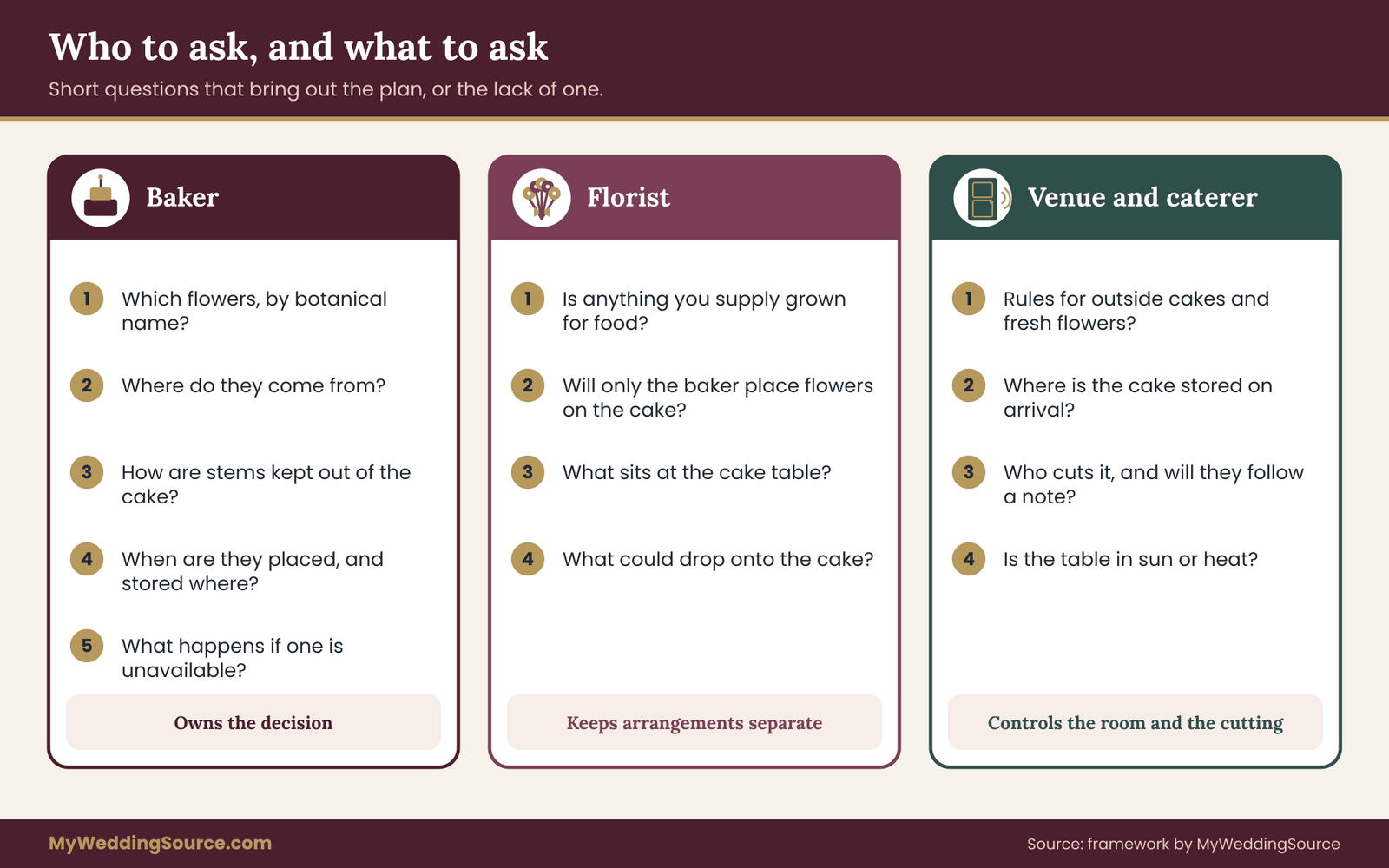
Ask which edible flowers are proposed, with botanical names and the part used. A good answer is a short list sent in writing. A weak answer is “we’ll see what looks best that week,” which means the flowers have not been planned and the gates will be skipped.
Ask where the edible flowers come from. A good answer names a supplier or a garden and says they are grown for food. A weak answer is “the florist” or “a garden center.”
Ask how stems and wire will be kept out of the cake. A good answer names a pick, a tube or a barrier. A weak answer is that the stems go straight into the cake.
Ask when the flowers go on and where they are stored before that. A good answer is a time and a cooler. A weak answer is a vague “morning of” without a storage plan.
Ask what happens if a flower is unavailable. A good answer is that a substitute is chosen from the agreed list and you are told in advance. A weak answer is that the baker will pick something that matches.
Ask whether the bakery is licensed and inspected where the cake is made, and who the food protection contact is. The details vary by state and county, and local health departments are the authority on what is required. A good bakery answers without hesitation.
Ask how allergens are managed in the kitchen and whether the baker can note a guest’s pollen allergy. A good answer includes tool separation and a way to cut a flower-free slice.
Questions for the florist
If the florist is involved at all, the questions are fewer and more specific.
Ask whether any flowers they supply are intended for the cake, and if so whether they are grown for food. A good answer is honest: “We do not supply food-grade flowers, so ours stay off the cake.” That is a perfectly good answer.
Ask whether the florist works with the baker and agrees that only the baker places flowers on the cake. A good answer is yes.
Ask what the florist will place at the cake table, and whether it touches the cake or the cake stand. A good answer keeps arrangements separate from the cake.
Ask what the florist uses in their arrangements that could fall onto the cake, such as petals or glitter. A good florist thinks about what can drop onto a food surface.
Questions for the venue and the caterer
The venue and caterer decide where the cake sits, who cuts it and what is on the table.
Ask whether the venue has rules about outside cakes and fresh flowers, and whether there is a cake-cutting fee or service. Fees and rules differ widely, and you should ask the venue directly for the current terms.
Ask where the cake will be stored on arrival and whether there is refrigeration. A good answer includes a cool, clean spot, not a hot back hall.
Ask who cuts the cake and whether they will follow a written note about the edible flowers. A good answer names a person and accepts the note.
Ask whether the cake table is in direct sun, near a heater or under a drip line. A good venue coordinator knows the room well.
A short message to send the baker
“We love the idea of edible flowers on our cake and want to get the details right. Could you send the flower list with botanical names, the supplier, how stems are kept out of the cake, and the time the flowers will be placed? We would also like a short note for the servers about which flowers to remove.”
Send this early, ideally at the first design consultation and no later than the final design approval. A baker who is used to edible flowers will answer in a day. A baker who is not may take a week, and that is useful information about how much the baker has planned.
Writing it into the contract
Verbal agreements fade. A short clause in the cake contract fixes the plan. It should say which flowers will be used, that all flowers placed on the cake are grown for food use and supplied by the baker, that stems and non-food materials are kept off the cake with a barrier, that substitutions will be from an agreed list and communicated in advance, and that the baker is responsible for placing the flowers. The language does not need to be legal. A clear paragraph is better than none.
If you are reviewing other vendor agreements at the same time, the wedding vendor contract guide covers the general structure of what a vendor agreement should include, and a short flower clause fits comfortably inside a cake contract. Many bakery contracts already include a line that decorations may be inedible. Read that line. If it says that some decorations are not meant for eating, ask which ones, so that it matches your flower sheet.
What if the baker says no
Some bakers decline fresh flowers on cakes altogether, usually for reasons of liability, kitchen policy or experience. That is a legitimate position, and it is worth hearing out. Ask what they offer instead. Many offer sugar flowers, fresh flowers on a stand beside the cake, or a placement of florist flowers by the florist after the cake is set, with a written note that the flowers are decoration. If the baker you love says no to fresh flowers on the cake, you can often keep the look with one of those routes and keep the baker you trust.
What if the florist says no
A florist who declines to supply food-grade flowers is being honest about what their supply chain is. Do not push. Instead, ask whether they would coordinate with the baker on color and size so that a sugar or edible-flower cake and a florist arrangement look related. Matching palettes, not matching stems, is the right target.
A worked example: the four gates on one cake
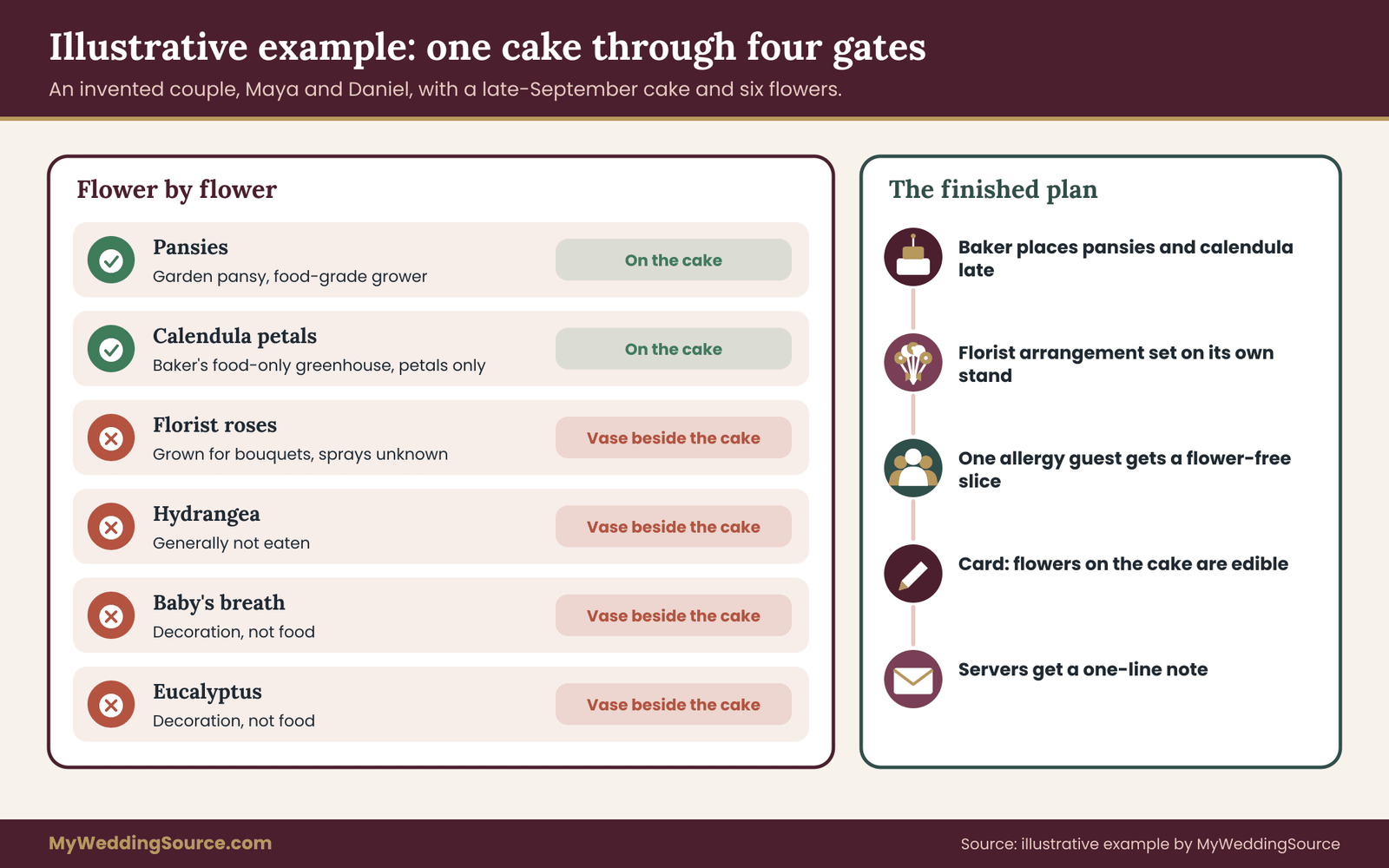
Here is an invented example, clearly illustrative, to show how the process looks in practice. The couple, whom we will call Maya and Daniel, are planning a late-September wedding with a three-tier vanilla and lemon cake and a soft green and yellow palette. They have fallen for a photo of a cake with a cascade of pansies, calendula, hydrangea, baby’s breath and eucalyptus.
Step one: list the flowers
Maya asks the baker for every flower in the design. The baker lists pansies, calendula, hydrangea, baby’s breath and eucalyptus, plus the roses from the florist’s bouquet that Maya would love to echo.
Step two: gate one, the names
The baker confirms botanical names for the pansies (garden pansies) and the calendula (Calendula officinalis, petals). Hydrangea is listed as a decoration by the baker’s own policy. Baby’s breath and eucalyptus are decoration, not food. The roses are a question mark. Verdicts so far: pansies green, calendula green pending source, hydrangea red, baby’s breath red, eucalyptus red, roses amber.
Step three: gate two, the sources
The baker says the pansies come from a restaurant supplier who grows edible flowers, delivered cold two days before the wedding. The calendula petals come from the baker’s own food-only greenhouse. The roses would come from the florist. Maya asks the florist, who says honestly that the roses are grown for bouquets and that she cannot say what was used on them. The roses turn red for the cake. Pansies and calendula turn green.
Step four: gate three, the handling
The baker explains that the pansies stay in their clamshell in the walk-in until the morning of delivery and that the calendula petals go on at the bakery. The hydrangea, baby’s breath and eucalyptus will not touch the cake. Instead, the baker suggests a small floral arrangement from the florist placed on the stand beside the cake. The florist agrees to place it after the cake is set, with no stems near the cake.
Step five: gate four, the guests
Maya checks the RSVP data and finds one guest with a pollen allergy. She tells the baker, who agrees to cut a slice from the back of the bottom tier, away from the flowers. A small card at the cake table says the flowers on the cake are edible and the arrangement beside it is decoration. The caterer receives a note saying pansies and calendula can stay on slices, and the arrangement stays on the stand.
The result
The finished cake has two green edible flowers and a florist arrangement beside it that matches the bouquet. It looks full, it is easy to explain, and nobody had to guess. The conversation took four short emails, one question to the florist and a line on the RSVP. If you would like to see how this example looks as a one-page record, the illustration above sets out the four gates, the verdicts and the final plan.
What the example shows
Notice that the couple did not give up the look they loved. They changed which parts were food and which were decoration, and they put the decorative flowers next to the cake instead of on it. That one change removed three of the four red flowers from the food question entirely. The design is only slightly different, and the safety picture is much clearer. Most successful edible flower cakes follow the same pattern.
Special cases, costs and timing for edible flowers
The four gates cover most weddings. A few situations bend them, and it helps to see how.
Hot weather and outdoor receptions
Heat is the enemy of buttercream and of fresh flowers alike. At an outdoor summer wedding, a cake with fresh edible flowers needs a shaded, cool spot, a late placement and a short display window. Some couples cut the cake soon after arriving at the reception, then use a sheet cake in the kitchen for service, which shortens the time the decorated cake sits out.
Others choose sugar flowers or a florist arrangement beside the cake so the decorated tiers can stay in a cooler until the moment of the cutting. Ask the baker which frosting is used and how it behaves in your expected temperature. The guide on cake production covers the broader heat question, and the flower plan should follow whatever the baker advises.
DIY and family-made cakes
If a friend or relative is baking the cake as a gift, the vendor questions still apply, though the structure differs. There is no license to check, which is a reason to keep the flower plan simple. Choose edible flowers from a grocery or specialty supplier, with a food label, rather than from a yard. Skip stems in the cake. Keep the cake cold until the last hour.
Add a card for guests. If the cake is for a large group, consider whether a licensed bakery should handle the decorated cake, with the family bake reserved for a smaller cake or dessert. Rules on home-baked food served to the public differ by location, and your local health department can say what applies.
Destination and venue-supplied cakes
When a destination venue or resort supplies the cake, the flowers often come from local suppliers you cannot easily check. Ask the venue’s pastry team the same questions, by email, and ask for the flower list. Different countries have different rules on pesticides and food labeling, and the practical approach is to ask for specifics and to prefer a sugar or arrangement-only design if answers are thin. A beautiful local flower you cannot verify is a good candidate for the vase beside the cake.
Cultural and religious designs
Some weddings include flowers that carry meaning, such as jasmine, marigold garlands or lotus. These are often used as decoration around the cake or the table, and the same rule holds. A flower with symbolic weight can sit near the cake on a stand, and the cake can carry its own edible flowers or sugar versions. If a particular flower is important and the baker can verify a food-grade source, it can go on the cake. If not, a sugar copy honors the meaning without the risk.
Vegan, allergy-friendly and special-diet cakes
A cake made for a vegan or allergy-sensitive guest list may have its own limits on ingredients and tools. Edible flowers are plants and are usually fine for vegan diets, but the means of attaching them matters. If frosting uses dairy and a guest avoids dairy, a dot of buttercream under a petal is a dairy exposure. Ask the baker how flowers are attached to a special-diet cake, and keep that cake and its flowers on a separate board.
Tasting and trial cakes
A tasting is the best time to try edible flowers on the real cake. Ask the baker to include the edible flowers in the sample, if the season allows, and taste them with the frosting. Some flowers are lovely and some are bitter, peppery or perfumed. A trial also lets you see how the flowers hold on frosting over a few hours, which is a clue to how they will do at the wedding.
What edible flowers cost and where the money goes
Edible flowers are usually more expensive than florist flowers of the same size, because they are a small specialty crop packed for food. Sugar flowers cost more again in most cases, because of the hours of handwork. Neither price has a fixed value that applies to every baker, and the numbers vary by region, season and design, so ask your baker for a line-item quote and compare it with what you expect.
The cost logic is worth stating plainly. A cascade of fresh edible flowers needs a lot of blooms, and every bloom has a price, a waste factor and a labor cost to place. A handful of well-chosen flowers costs much less than a cascade and often looks cleaner. A florist arrangement beside the cake can be the lowest-cost route if you are already ordering flowers for the room, since it adds a little to an existing order and nothing to the baker’s invoice.
When you compare quotes, compare what each includes. Does the price include the edible flowers, the picks and barriers, the delivery and the placement? Does it include a replacement plan if a flower is unavailable? Is there a separate fee for flowers supplied by the couple or the florist? A lower quote that excludes these items may cost more in the end. The wedding vendor purchase order checklist is a handy way to keep line items and deliverables together for any vendor.
Where not to save money
Do not save money by buying flowers from a florist or garden center and hoping for the best. The savings are small and the uncertainty is large. Do not skip the barrier to save a few minutes. Do not accept a baker’s refusal to name the source. Those three are the places where a small saving can turn into a food-safety problem.
A timeline for the edible flowers decision
The flower decisions fit into the cake schedule at specific points. Here is a plain sequence.
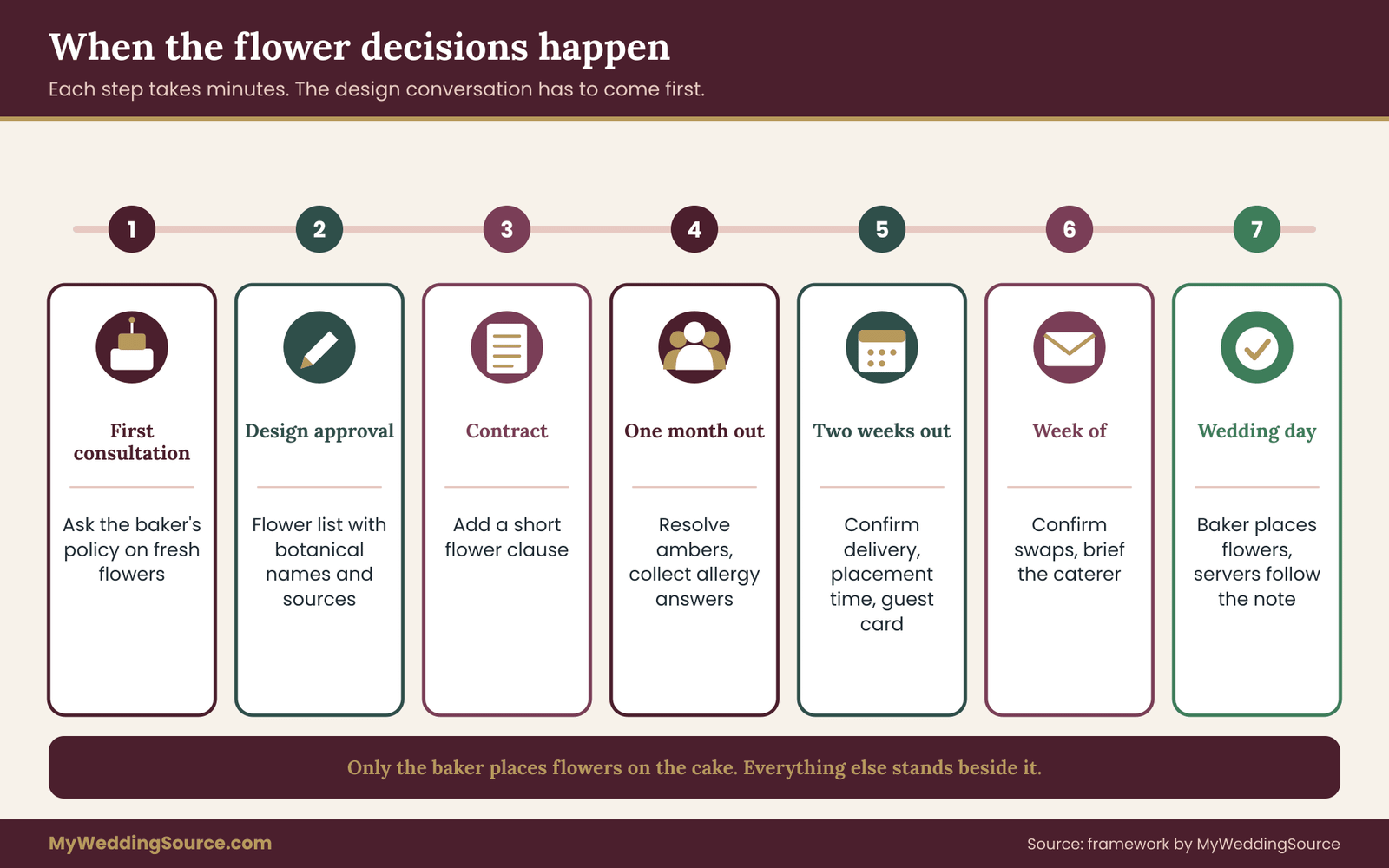
At the first consultation, say that you would like fresh flowers and ask the baker’s policy. Bring a photo and ask what is possible. At design approval, ask for the flower list with botanical names and sources, and agree on verdicts. At contract signing, include the flower clause. A month before the wedding, confirm the supplier and the flower sheet, resolve any amber flowers and collect guest allergy information.
Two weeks before, confirm the delivery and placement times and the guest note. The week of the wedding, confirm substitutions in advance, send the server note to the caterer and agree who will hand the baker the final note. On the day, the baker places the flowers, the cake goes to the display spot and the servers have their instruction.
Each step takes a few minutes. The only step that cannot be compressed is the design conversation, because everything else depends on it. If you are working backward from your date, the wedding cake timeline gives the headcount and approval dates that the flower plan sits inside.
Your next steps
Pick the next three actions and do them this week.
First, write down the edible flowers you want on the cake and look up their botanical names, or ask the baker to. Mark any that appear on a poison-control or extension list as red.
Second, send the baker the message about edible flowers from the vendor section, and ask for the supplier, the barrier plan and the placement time in writing.
Third, add a pollen and plant allergy line to your RSVP or dietary form, and decide whether the flowers on your cake will be labeled as edible or decorative.
After those three, add a flower clause to your cake contract, agree who places the flowers, and keep your one-page flower sheet where the baker, the florist and the caterer can all see it. If you are building your master list of tasks, the wedding planning checklist is a good home for them.
FAQ
Are all edible flowers safe to eat?
No. Edible flowers are safe only when the plant is a known food flower, was grown for eating without unapproved treatments, and was handled cleanly. A flower can be edible by species and still be unsafe because of its growing history. Some people also react to specific flowers, especially those related to ragweed and daisies. Treat each flower individually and ask the baker for its name and source.
Can my florist supply the edible flowers for my cake?
Only if the florist can say the edible flowers were grown for food and the baker agrees to accept them. Most florist flowers are grown for the vase and may have been treated with products not meant for food crops. A safer pattern is for the baker to order food-grade flowers, while the florist keeps a matching arrangement beside the cake.
Are roses safe on a wedding cake?
Rose petals are a traditional food flower, but only when the roses are unsprayed and grown for eating. Roses from a flower shop are grown for bouquets and are normally treated for appearance and shelf life. Use roses on a cake only if the baker names a food-grade source. Otherwise place roses in a vase beside the cake or use sugar roses.
What should I do about flower stems on the cake?
Keep stems out of the cake. A stem is not food, may carry soil or residues, and floral tape and wire are not food-safe. A baker can place stems in a food-safe pick or tube, or use only petals and short blooms on frosting. Ask how the baker handles stems and ask for a barrier if the answer is vague.
Should I tell guests the flowers on the cake are edible?
Yes, plainly and truthfully. Guests will assume a flower on a cake is meant to be eaten. A small card or a line from the servers can say whether the flowers are edible or decorative and removed before serving. If some flowers are decoration only, consider moving them off the cake so everything on the cake is food.
Can edible flowers cause allergic reactions?
They can for some people. Guests with pollen allergies, especially to ragweed, chamomile or chrysanthemum, may react to related flowers such as calendula. Add a plant or pollen question to your RSVP and tell the baker about any guest who reports one. The baker can cut that guest a slice from a flower-free area.
How far ahead should flowers go on the cake?
As late as the design allows. Fresh flowers wilt and frosting softens in heat, so most bakers add flowers at the last practical stage, either at the bakery or at the venue. Ask your baker for a specific placement time and a cool, shaded display spot. In hot weather, sugar flowers or an arrangement beside the cake are calmer choices.
What if my baker refuses to use fresh flowers?
That is a legitimate policy, often based on liability or kitchen rules. Ask what the baker offers instead, such as sugar flowers, edible decals, or a florist arrangement set beside the cake. Many couples keep the look they wanted and the baker they trust. Respect the decision and ask for the plan in writing.
Sources
- U.S. Food and Drug Administration, food safety and produce guidance
- FoodSafety.gov, safe handling of fresh produce
- U.S. Environmental Protection Agency, pesticide regulation
- U.S. Department of Agriculture, National Organic Program
- Centers for Disease Control and Prevention, food safety
- Poison Control, national poison help information
- Food Allergy Research and Education, allergen information
- U.S. Department of Agriculture, food safety and inspection
- Cooperative Extension, university plant and food-safety resources