
Wedding transportation for elderly guests with walking aids is less about the vehicle than about the few feet at each end of the ride, so the useful plan is one that checks every step, curb, slope, and surface between a guest’s door and the dance floor, and names a person who will be there when the guest arrives.
Quick answer
Ask each guest privately what would make the trip comfortable, then plan three things: a vehicle the guest can enter without a high step, a drop-off point with a firm, level surface close to the door, and a named helper at both ends. Walk the route from the pickup door to the dance floor ahead of time with a tape measure and look for level changes, soft ground, steep slopes, and gaps. Use the pass, watch, and fix thresholds later in this guide, which borrow from the federal ADA design standards as a benchmark. Get the operator’s answers in writing. This guide is planning information, not legal, medical, or financial advice.
Why wedding transportation for elderly guests with walking aids needs its own plan
Most transportation advice for a wedding is about numbers: how many seats, how many loops, how many minutes between departures. That math matters, and our guide to wedding guest transportation planning covers it. Wedding transportation for elderly guests with walking aids adds a different question. It asks whether a specific person can get from a door to a seat, across the surfaces in between, without strain, rush, or embarrassment.
The gap between “can walk” and “can walk from the curb”
A guest who uses a cane, a walker, or a rollator may walk well on a flat floor and still struggle with a high vehicle step, a gravel drive, or a threshold that is a little too tall. The gap is easy to miss because the guest is not using a wheelchair, so no one thinks to ask.
Why this group gets overlooked
Wedding transportation for elderly guests with walking aids often falls between two plans. The general shuttle plan assumes everyone can step up and sit down. The wheelchair plan, which our guide to wedding transportation for guests using wheelchairs covers, assumes a lift or ramp. A guest with a walker sits between them: able to ride in an ordinary seat, but in need of a lower step, a steady surface, a place to put the walker, and time. Nobody owns that middle ground unless you assign it.
What a short distance can hide
Distances at weddings look small on a site map and feel long on foot. A drop-off that is a hundred feet from the ceremony may be easy for most guests and tiring for someone who stops to rest. We have no source that measures how far older guests can comfortably walk, because it varies widely from person to person, so we do not offer a number. Ask the guest, and treat the walk as part of the transportation plan rather than as something that begins after it ends.
Who this guide is for and what it leaves out
You may be a couple, a parent hosting, a planner, a coordinator at a venue, or a family member who has been handed the transportation job. The same steps apply to all of you, and the goal is simple: a guest arrives rested, safe, and on time, and is treated as a guest rather than a logistics problem.
Couples, planners, and venue teams
If you are arranging wedding transportation for elderly guests with walking aids, you will write the request, run the surface walk-through, and collect confirmations. If you work at a venue that runs its own shuttle or controls the drop-off, the sections on which rules apply and on loading zones matter to you in particular. If you are a coordinator, the inspection in this guide can be copied into your vendor files and used at every site.
What this guide does not cover
This guide does not give legal, medical, or insurance advice, and it does not tell any guest which device to use or how to use it. It covers ground transportation and the walk at each end, in the United States. It does not cover wheelchair-accessible vehicles in depth, service animals, air travel, or hotel rooms. For the wider picture of a day that works for guests with disabilities, our guide to the accessible wedding guest experience goes further than a transportation article can.
Ask first, assume nothing
The guest is the expert on their own balance, endurance, and device. Plans that start with the vehicle and work backward to the person usually get details wrong. Plans that start with the person usually need only small changes.
A private note, not a public form
Ask each guest directly and early. A short message works: you are arranging rides, you want the day to be comfortable, and you would like to know what would make the trip easier, such as a lower step, a drop-off close to the door, a seat near the exit, or a chance to rest. Offer a phone call as well as a message, because some guests prefer to talk. Do not ask about diagnoses. The ADA guidance on mobility devices says staff may not ask about the nature or extent of a person’s disability, and the same courtesy is a good rule for hosts.
Words to use, and words to avoid
Many people who use a cane or a walker do not describe themselves as elderly, or disabled, or in need of special treatment. Search engines use the word elderly, and so does the title of this guide, but your message to a guest does not need to. Ask about what would make the day comfortable for everyone and mention transportation specifically. Avoid announcing a guest’s needs to the wedding party or on a public sign-up sheet. Share only what a driver or greeter needs to do the job: pickup time, pickup point, device, and a phone number.
Walking aids and what each one asks of a vehicle and a path
A walking aid is not one thing, and wedding transportation for elderly guests with walking aids must allow for that. A cane, a standard walker, a two-wheeled walker, and a rollator each ask different things of a vehicle, a doorway, and a path. Knowing the differences helps you ask better questions and notice problems before the day.
The common aids, in plain terms
The Mayo Clinic’s guide to choosing and using walkers describes several types, and the National Institute on Aging’s guidance on falls mentions canes and walkers as aids that need to be sized and maintained correctly. The descriptions below paraphrase those sources and add planning notes of our own, which we label as such.
Canes and crutches
A cane is the lightest and most portable aid. It travels in a hand or hooks over a seat back, and it asks the least of a vehicle. It also gives the least support, so a cane user may rely more on handrails, a steady arm, and a level surface. The ADA guidance on mobility devices lists canes, crutches, walkers, and braces among manually powered mobility devices that people must be allowed to bring into all areas open to the public. In our planning experience, the most useful question for a cane user is whether a handrail or an arm at the vehicle door would help.
Standard walkers and wheeled walkers
Mayo describes a standard walker as having four rubber-tipped legs and no wheels, which gives the most stability but requires lifting the walker with each step. A two-wheeled walker has wheels on the front legs, suits people who find lifting hard, and allows a more upright posture. For a vehicle, the practical differences are size and fold. A standard walker folds flat in most cases, a wheeled walker may be a bit bulkier, and either needs a place where it will not slide or become a hazard in the aisle. Ask the guest whether the walker folds and how they usually travel with it.
Three- and four-wheeled walkers and rollators
Mayo describes four-wheeled walkers as offering continuous balance support while being less stable than a standard walker, often with a seat for resting, and three-wheeled walkers as lighter and easier to turn in tight spaces. Many people call a four-wheeled walker with a seat and hand brakes a rollator, though the Mayo article does not use that word. These are the aids most likely to be rolled right up to a vehicle door, which makes the surface at the door important: wheels roll on pavement and sink in gravel, grass, and sand. A guest who sits on a rollator seat to rest may also need a spot to do it at the venue.
What the aid changes about getting in and out
Boarding and exiting are the moments of highest effort in wedding transportation for elderly guests with walking aids, because they combine a change in height, a change in surface, and a handoff of the device. Each can be eased with a small change.
The transfer from standing to seated
Getting into a vehicle means lowering the body onto a seat while holding something steady and bringing the device along. A lower step, a firm grab handle, and a seat that is not too low or too high all help. We did not find a source that gives a recommended seat height or step height for older riders, so we do not offer one. The guest can tell you. A short test drive or a photo of the vehicle step next to a familiar object can help the guest judge whether it will work.
Where the device rides
A device that is stowed out of reach can leave a guest unsteady at arrival, while one left in the aisle can be a trip hazard for everyone else. The ADA National Network describes taxi drivers as unable to refuse to help stow mobility devices, and the DOT taxi rule says the same in formal terms. For a chartered or shuttle ride, ask the operator where a walker will go, who will load and unload it, and whether the guest can keep it within reach for short rides. Agree on this with the guest, not for them.
Fit, footwear, and fatigue
The surface inspection later in this guide asks whether the ground works for a walker. A related question is whether the guest is set up to use it well, which is the guest’s business more than yours, but which affects how you plan the day.
Why fit and shoes matter on a wedding day
The National Institute on Aging advises that canes and walkers be sized correctly, that walker wheels roll smoothly, and that people take extra care on unfamiliar routes and uneven walkways. It also advises nonskid, low-heeled, rubber-soled shoes and warns against backless shoes and high heels. Mayo gives similar advice on worn caps and grips. A wedding is a day when people wear unfamiliar shoes and use familiar equipment on unfamiliar ground, so a planning note about surfaces is a courtesy, not a criticism.
How tiredness changes the trip
A wedding day is long, and the ride home may come after hours of standing, sitting, eating, and dancing. The CDC reports that about one in four people age sixty-five and older fall each year, and the NIA lists balance problems, certain medicines, and unsafe footwear among the causes of falls. Fatigue is not on the lists we read, and we do not claim a link. It is reasonable for a host to assume that the return trip may be harder than the arrival, and to plan an easier route home. Our guide to seating for guests who cannot stand for long periods covers rest places inside the venue.
Which rules cover which ride
Rules for wedding transportation for elderly guests with walking aids depend on who provides the vehicle. A charter coach, a hotel shuttle, a taxi, and a cousin’s car are covered differently. This section paraphrases federal sources; it is not legal advice, and state and local rules may add duties.
Charter coaches, hotel shuttles, and venue shuttles
The ADA.gov overview of Title III says it covers privately operated transit, including intercity and charter buses and hotel and airport shuttles. It also says covered businesses must make reasonable modifications to policies and practices so that people with disabilities can use their goods and services, unless the change would fundamentally alter what is offered.
Charter and tour buses
The ADA National Network’s factsheet states that demand-responsive over-the-road bus companies, which includes charter and tour operators, must provide an accessible bus to passengers with disabilities on forty-eight hours’ advance notice. A guest who can walk with a walker may not need a lift-equipped bus, but a guest who cannot climb the steps may. That is a conversation to have with the guest and then with the operator, well before the forty-eight-hour mark, because a wedding Saturday can be busy.
Shuttles run as a side service
Title 28 CFR 36.310 covers businesses that provide transportation but are not primarily in the business of transporting people, such as customer shuttles run by private companies. It requires those businesses to remove transportation barriers in existing vehicles when that is readily achievable, except that it does not require installing a hydraulic or other lift in an existing vehicle. Under 49 CFR 37.105, a provider that does not offer an accessible vehicle may need to show equivalent service, meaning comparable response time, fares, hours, and the most integrated setting appropriate to the person’s needs.
Taxis and other for-hire cars
Taxi providers are covered by a specific DOT rule. We did not verify how the rule applies to every rideshare or limousine product, and we do not make claims about any company’s policies. If you plan to use a for-hire car, ask the provider directly.
What a taxi provider may not do
Under 49 CFR 37.29, private taxi companies may not refuse to serve people with disabilities who are able to use the taxi vehicles, may not refuse to help stow mobility devices in the vehicle, and may not charge higher fares or fees for riders with disabilities or for their equipment. The rule does not require a taxi company to buy accessible cars, and the text does not address limousines or rideshare. For a guest with a folding walker, the stowing provision is the useful part: a driver may not decline to help.
The extra time rule
The ADA National Network factsheet notes that operators must allow adequate time for people with disabilities to board and exit, and that paratransit drivers may need to help beyond the curb in some circumstances. That text describes public paratransit, not a wedding charter, so we use it as a benchmark and not as a promise. In a contract, spell out the dwell time you expect at each stop, and ask the operator to confirm that drivers will not hurry a guest.
When no rule applies
Some rides will not be covered by any of these rules: a family member’s car, a friend’s minivan, a golf cart at a private estate, or a venue that is a private residence. The rules above do not require a thing of a cousin. They also do not stop you from planning well.
Family cars and volunteer drivers
A volunteer driver can be a good choice for a guest who is comfortable with a familiar person and vehicle, but volunteers bring their own limits: a car that sits low, a trunk that is hard to load, or a plan that depends on one person’s schedule. If you use volunteers, give them the same information you would give an operator, and give them a backup. A short written note with the guest’s name, pickup time, device, and a phone number is enough.
Golf carts, estate vehicles, and similar
A golf cart can be a great way to cover a long drive at a large property, but it is not an ordinary car. Seats are often low, steps are narrow, and there is little to hold. Ask the guest before you offer it, and ask the venue about capacity, driver training, and where a walker will go. The ADA guidance on mobility devices lists golf carts among other power-driven mobility devices that facilities may evaluate, which concerns devices guests bring, not vehicles a venue provides. We mention the topic here so that the two are not confused.
Choosing the vehicle for wedding transportation for elderly guests with walking aids
Vehicle choice is where a plan for wedding transportation for elderly guests with walking aids becomes concrete. We did not find a published standard for the best vehicle for walker users, because needs vary, so this section is built from questions and observations, not from rules of thumb that would pretend to be facts.
Step height, seat height, and handholds
The first question about any vehicle used for wedding transportation for elderly guests with walking aids is how a guest will physically get in. This is a matter of three small things that add up: the height of the first step, the height of the seat, and what there is to hold on to.
Look at the vehicle, not the brochure
In wedding transportation for elderly guests with walking aids, a photo of the vehicle’s door with a person standing next to it tells you more than a spec sheet. Ask the operator for one, and ask the guest to look at it. A tall coach step may be fine for one guest and impossible for another, and a low sedan seat can be harder than a high one. If the operator offers a visit to see the vehicle, take it. For a large group, the person who knows the guests best should look at it, not the person who booked it.
Handholds and the first step
Ask where a guest can hold on while entering: a grab handle at the door, a stanchion inside, a seat back. Ask whether the vehicle has a step stool or a lowered entry. We cannot judge a handhold from a distance, and no source we read gives a required grip location for ordinary shuttles, so the check is practical: can someone with one hand on the walker and one hand free reach something firm?
Folding, stowing, and the walker’s ride
The device is part of the guest, so how it travels is part of the plan. A walker that is out of reach can strand a guest at a vehicle door, and a walker in the aisle can trip others.
Where the walker goes during the ride
For a short ride, some guests prefer to keep a folded walker close, with the seat beside them. For a long ride, the trunk or a luggage bay may be better. Ask the guest and ask the operator. Make sure someone else is assigned to unload the walker first at arrival, before the guest stands, so that the guest is not waiting without support.
Labeling and handoffs
Devices look alike, and walkers are easy to swap at a busy drop-off. A small piece of tape with the guest’s name on a frame, a bright ribbon, or a quick photo to the greeter can prevent a mix-up. Ask the guest first, since some people do not want a ribbon on their walker. Brakes, seat height, and handle height are set for one person, and the Mayo guidance notes that a poor fit raises strain, so an exchange is more than an inconvenience.
Sedan, van, shuttle, or coach
Different vehicles solve different problems. The right choice depends on how many guests need help, how far they travel, and how much space the drop-off allows.
Small vehicles for small groups
For wedding transportation for elderly guests with walking aids, a sedan or minivan can offer door-to-door pickup, a driver who knows the guest’s needs, and a drop-off close to the entrance. It also usually means a longer wait if a guest is not ready, and a lower seat. For one or two guests, it may be the most comfortable option. For more, a small-vehicle plan can multiply into several drivers and several timings, which is a point where our guide to shuttle capacity with staggered departures helps.
Large vehicles and shared shuttles
In wedding transportation for elderly guests with walking aids, a shuttle or coach carries many guests at once, and its stop at the venue may be far from the door because a large vehicle needs room to turn. If the shuttle is shared with other guests, a person who needs more time can hold up a loop. A separate smaller vehicle for guests who need more time is often easier than asking a loop to wait. Consider a dedicated short run before the main loop begins, so that guests who need more time can arrive first and settle in.
The door-to-dance-floor surface inspection
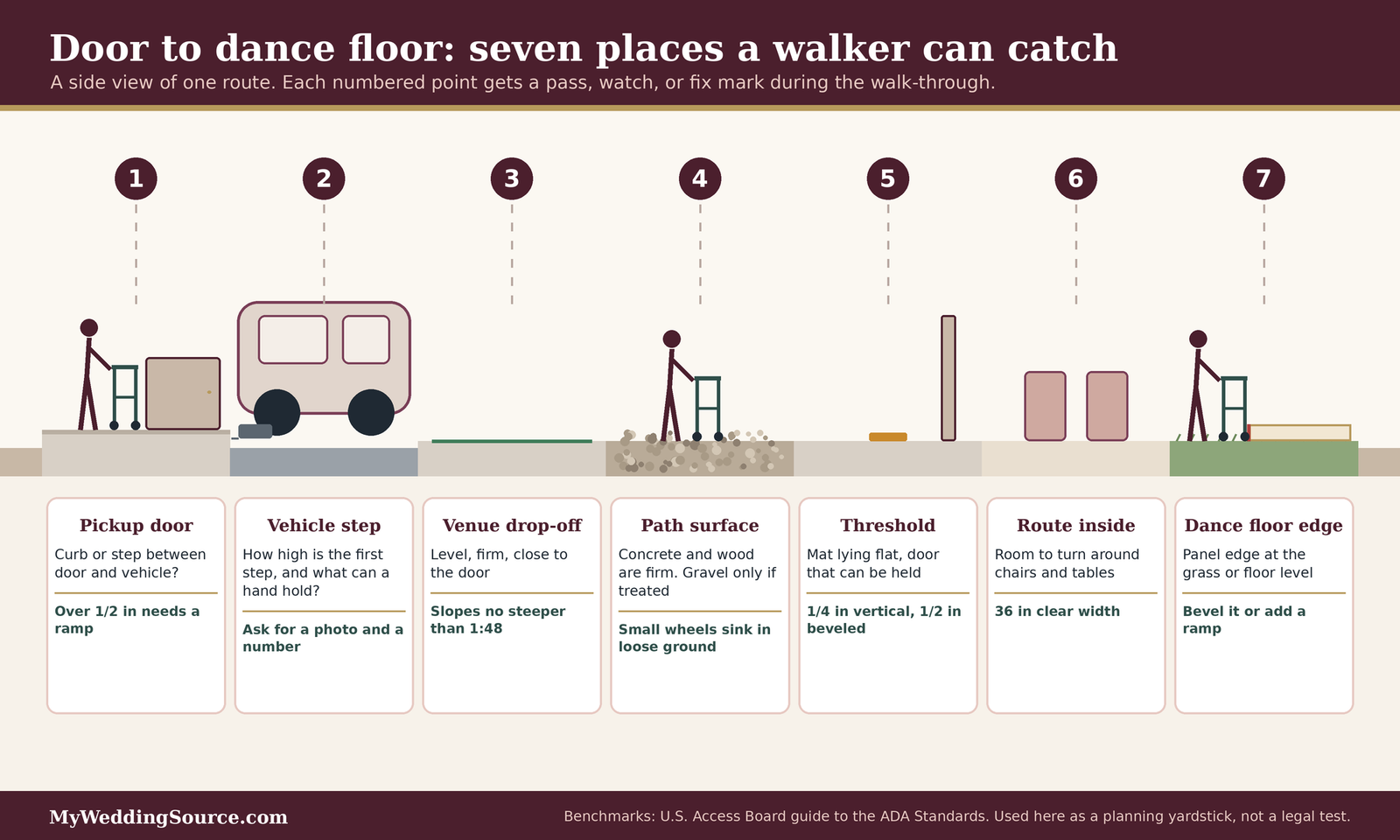
This is the working deliverable of the guide to wedding transportation for elderly guests with walking aids: a walk-through you can do at the hotel, at the drop-off, and at the venue, that turns “will this work for a walker?” into measurements and decisions. It covers seven transition points, from the pickup door to the dance floor, and gives each a pass, watch, or fix result.
How to run the walk-through
You do not need to be an expert to inspect the route for wedding transportation for elderly guests with walking aids. You need about an hour, a tape measure, a small level or a level app on a phone, a friend, and a willingness to walk the route the way a guest would, slowly, and with something in hand to simulate a walker if you can borrow one.
What to bring and who should come
Bring a tape measure, a notebook or a phone for photos, a four-foot level if you have one, and a person who can hold the other end of the tape. If a guest who uses a walker is willing to walk the route with you, that is better than any measurement, but only if the guest wants to and the invitation is easy to decline. Do the walk in the same light and, if you can, the same weather as the event, because wet ground and dusk change what a route feels like.
When to do it, and when to do it again
Do the first walk of your plan for wedding transportation for elderly guests with walking aids when you book the venue and the vehicle, so that problems can still be fixed. Do a second walk close to the wedding, after the rental company has set up tents, floors, and ramps, because the route often changes when equipment is placed. On the day, do a final check with the venue contact before the first guest arrives. Write down the date and the weather of each walk, since a path that passes on a dry day may not pass after rain.
The benchmark we use, and what it is not
The thresholds in this inspection of wedding transportation for elderly guests with walking aids come from the Access Board’s guide to the ADA Standards and from the federal standards for accessible routes. Those standards were written for permanent facilities, and they set the rules for accessible design. A wedding is often a temporary use of a space, and the standards may or may not apply to a given site. Using them as a benchmark is our editorial choice.
The numbers, in plain language
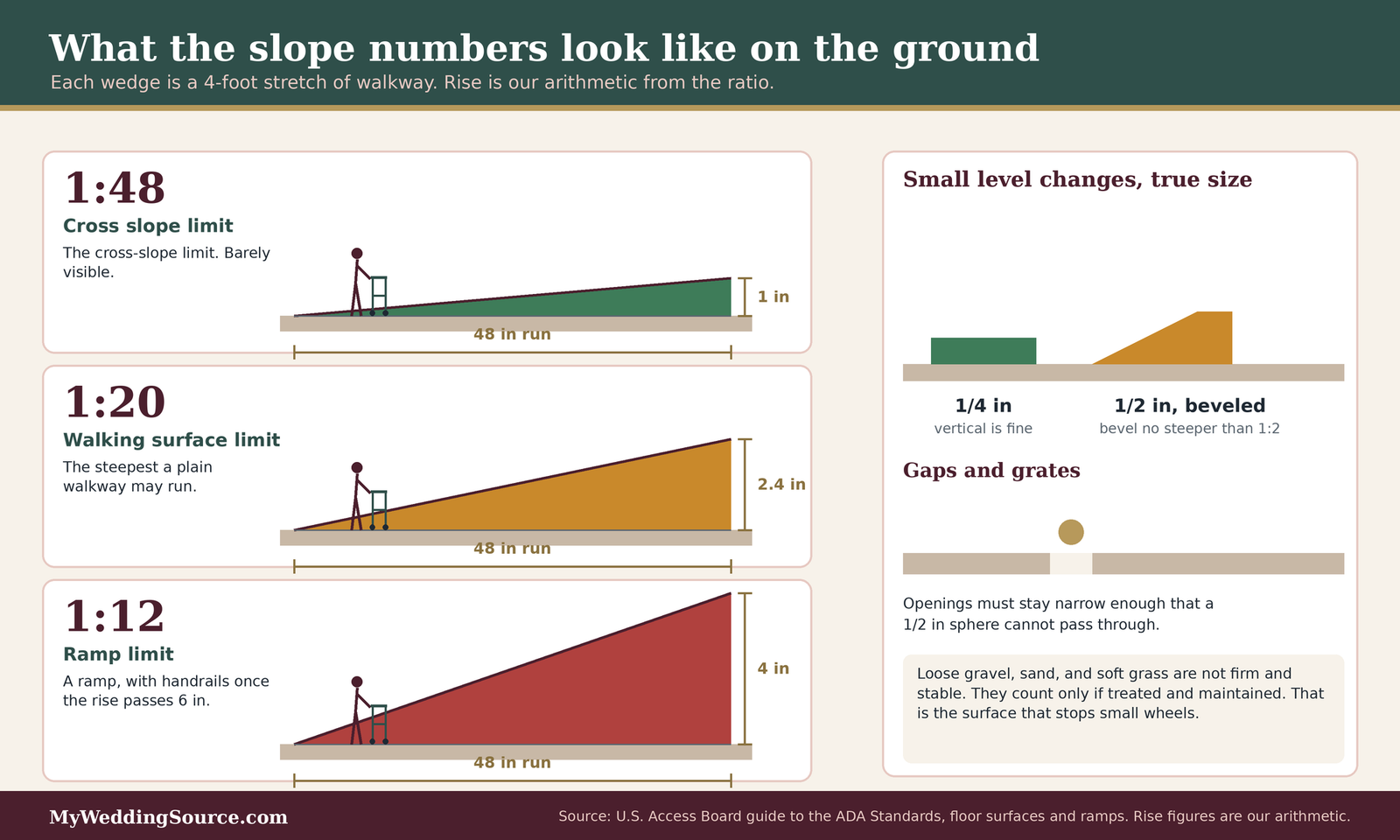
According to the Access Board guide, a change in level of up to one-quarter inch may be vertical, a change of up to one-half inch must be beveled at no steeper than one to two, and anything higher must be treated as a ramp or curb ramp. An accessible walking surface has a running slope no steeper than one to twenty, and a cross slope no steeper than one to forty-eight. Ramps may run up to one to twelve, with handrails when the rise exceeds six inches. Openings in a surface must not allow a half-inch sphere to pass. Accessible routes are at least thirty-six inches wide, with a passing space every two hundred feet.
What the numbers do not tell you
The standards do not give a comfort level, and a surface can meet them and still be hard for a particular guest. They also do not address a rainy lawn, a crowd, or a long walk. They are a floor, not a goal. A route that passes every threshold may still need a bench or a helper, and a route that fails one by a small amount may be fine with a mat or a spotter. The point of the benchmark is to turn a vague worry into a number you can discuss with a venue, not to replace the guest’s own judgment.
The seven transition points
Walk the route for wedding transportation for elderly guests with walking aids in order, from where a guest starts to where they dance. At each point, take the measurements listed, write the result, and mark pass, watch, or fix.
Point one: the pickup door and the first few feet
This is the hotel entrance, the guest’s home, or the place where a vehicle waits. Check for a step or a curb between the door and the vehicle, the surface where the vehicle stops, the slope toward the road, and whether a person can stand safely while the walker is unfolded. A drop-off lane with a high curb or a sloped gutter can add a step the guest did not expect. If the pickup is at the guest’s own home, ask the guest rather than inspecting someone’s front steps.
Point two: the vehicle step and floor
Look at the first step from the ground, the handholds, and the floor of the vehicle. Record the height of the step above the ground at the point where the vehicle will stop, because curb height changes it. If the operator offers a step stool or a lowered entry, ask to see it. If you cannot measure the vehicle in advance, record the questions you asked and the replies, because a vehicle that is different on the day should be reason to call before the guest arrives.
Point three: the venue drop-off
This is the place where the vehicle stops at the venue. Check that it is level, firm, and close to the door, that there is a clear place to unload the walker, and that the vehicle will not block a lane. Look for puddles, gravel, grass, drains, and a slope toward the road. If the real drop-off is far from the door, ask the venue whether a closer accessible drop-off exists. Our guide to parking attendants and valet service covers how a drop-off is staffed.
Point four: the path to the entrance
Measure the width of the path, the cross slope, any slope along its length, and any gaps or changes in level. Note the surface: concrete, asphalt, pavers, boards, gravel, grass, or sand. The Access Board guide says hardened materials such as concrete, asphalt, tile, and wood are generally considered firm and stable, and that loose materials such as gravel qualify only if properly treated and maintained. For a walker with small wheels, a loose surface is often the hardest part of the route. Look for places to rest if the path is long.
Point five: the entrance and any threshold
Doorways bring thresholds, mats, and door weight, which matter for wedding transportation for elderly guests with walking aids. Measure the threshold height, check that a mat lies flat, and see whether the door can be held open. The Access Board guide gives one-half inch as the most a beveled change in level may rise, and notes that carpet must be securely attached, with a maximum pile of one-half inch. A heavy door can be harder than a step, so ask whether a staff member can hold it. Look for floor drains and gratings, where the standard limits openings to a half-inch.
Point six: the route inside
Walk from the entrance to the ceremony seating, the cocktail area, and the dining tables. Look for tight turns around furniture, a passage narrower than thirty-six inches, cords, and rugs. The Access Board guide gives a thirty-six-inch clear width, narrowing to thirty-two inches only briefly at doorways. A walker with a seat is wider than a cane user, and it needs room to turn. If the room will be crowded, imagine the path with guests standing, and ask the venue for a clear lane.
Point seven: the dance floor edge
Portable dance floors sit on top of the ground, which creates an edge. Check the height of the edge, whether it is beveled or has a ramp, whether panels are level with each other, and what is on the surface. If the floor sits over grass, our guide to dance floor rental over grass explains the ground issues, and the guide to accessible wedding dance floors goes further on edges, turning space, and rest areas. A guest need not dance. The point is that the floor is not a barrier to the food, the toasts, or the people.
Pass, watch, fix: how to mark each point
Marking results turns a walk into a list of decisions for wedding transportation for elderly guests with walking aids. Use three categories and write one line of action for each watch or fix item.
The three marks
A pass means the point meets the benchmark and no one needs to do anything but keep it that way. A watch means it is close to the limit, or depends on weather, crowds, or a helper, and needs a plan. A fix means it is beyond the limit and needs a change, such as a ramp, a mat, a different drop-off, a different path, or a different vehicle. If a fix is not possible, say so, and tell the guest what to expect. A guest who knows what is coming can decide.
Slope arithmetic you can do on site
Slopes are hard to judge by eye. Our own arithmetic, labeled as an estimate: a slope of one to twenty drops about 2.4 inches over four feet, one to twelve drops four inches over four feet, and one to forty-eight drops one inch over four feet. A four-foot level laid on the ground with a tape measure at one end lets you check this directly. If the gap under the low end is more than 2.4 inches over four feet, the walking surface is steeper than one to twenty. Treat the result as a field check, not a survey.
Fixes that are usually within reach
Many failed checks in wedding transportation for elderly guests with walking aids have simple fixes, and many can be done by a venue, a rental company, or a handful of volunteers. The best ones are boring.
Mats, ramps, and edge fixes
A rubber or fiber mat can smooth a gravel patch or a gap, if it is wide enough, firm, and anchored so that it does not shift. A short portable ramp can bridge a threshold or a dance floor edge. Rental companies often offer ramps, edging, and path mats, and a question on the quote is the cheapest time to ask. We have not tested products and do not recommend any, so ask for specifications and photos, and check that the surface is firm, not springy.
Changing the route instead of the ground
Sometimes the better fix is a different path. A guest might enter through a side door with no threshold, use a service lane with a smoother surface, or be dropped at a different point. Ask the venue which entrance is best for guests who need a level route, and put the answer on the signs. Our guide to wedding transportation signage covers the wayfinding side, and a clear sign saves a helper from answering the same question twenty times.
Drop-off and pickup points that work
Where a vehicle stops in wedding transportation for elderly guests with walking aids determines how much of the surface inspection a guest has to deal with. A good stop reduces the walk and gives a person room to unload a device. In wedding transportation for elderly guests with walking aids, a good stop is often worth more than a better vehicle.
What the loading zone standard describes
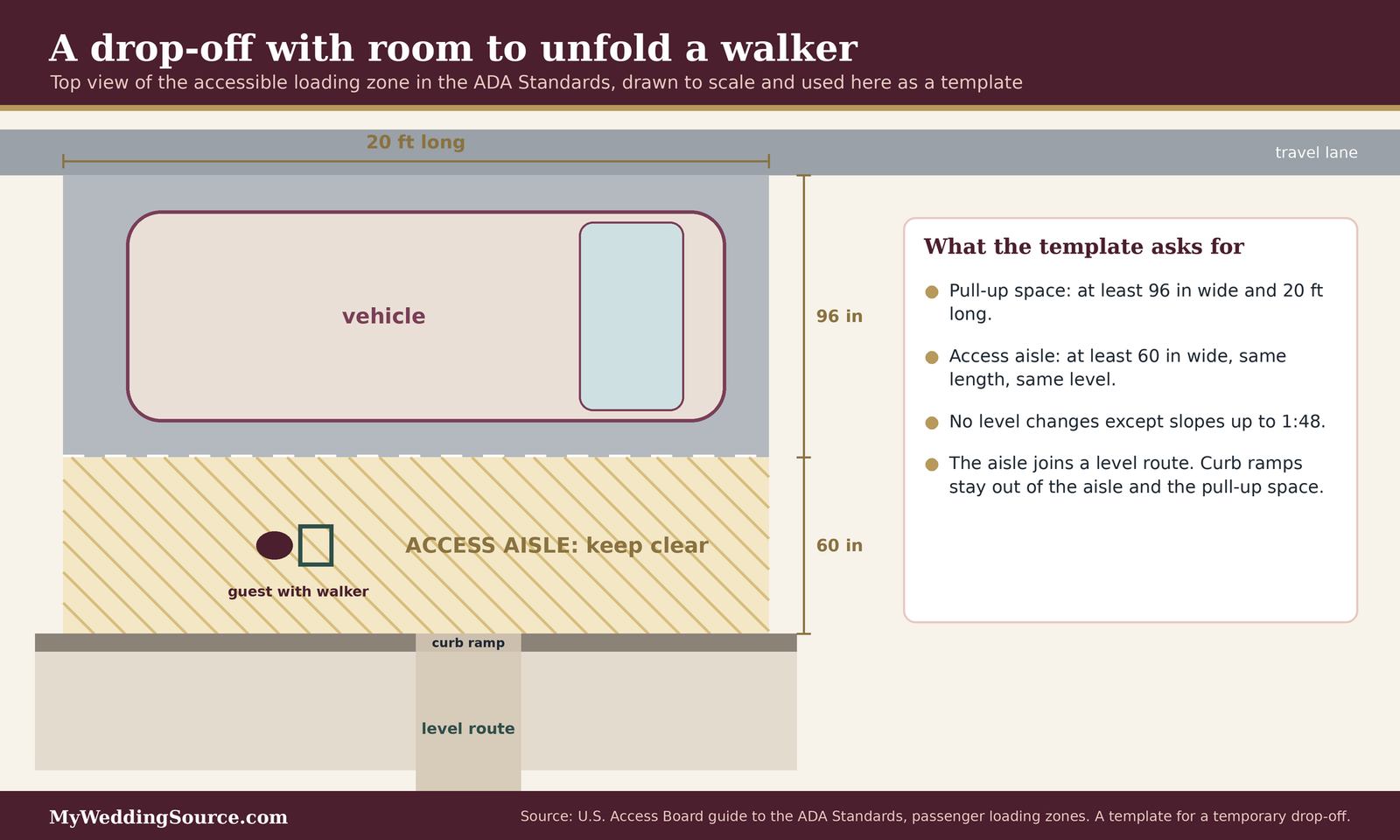
The Access Board’s guide to the ADA Standards describes accessible passenger loading zones, and the numbers are a useful template for a temporary drop-off even where the standard does not apply. The standard is for permanent loading zones, and a wedding drop-off is often a curb, a drive, or a lawn.
The pull-up space and the access aisle
Section 503 of the standards, as the Access Board guide summarizes it, calls for a vehicle pull-up space at least ninety-six inches wide and twenty feet long, with an access aisle at least sixty inches wide that runs the full length of the pull-up space, sits at the same level, and connects to an accessible route. The aisle must not overlap vehicle lanes and should be marked so that it is not used for parking. Pull-up spaces and aisles may not have changes in level except slopes no steeper than one to forty-eight.
Why the aisle matters for a walker
An access aisle is the room where a guest can stand beside the vehicle, unfold a walker, and take a first step without being in a traffic lane. A narrow curb or a lawn leaves less room. If your drop-off has no aisle, create one with cones or a marked area, and keep other vehicles out. A driver who has to leave quickly to clear a lane will rush a guest, so the aisle also protects the time a guest needs.
Curbs, ramps, and the last ten feet
Curbs are often the single worst point on a route for wedding transportation for elderly guests with walking aids. A guest can step off a vehicle at ground level and then face a curb, or step off at the curb and face a gutter. The details matter.
Curb ramps and what to look for
According to the Access Board guide, a curb ramp has a running slope of no more than one to twelve, a cross slope of no more than one to forty-eight, flared sides no steeper than one to ten, and a top landing at least thirty-six inches long. Ramps with a rise greater than six inches need handrails on both sides, with a rail height between thirty-four and thirty-eight inches. If your drop-off has a curb ramp, check for cracks, standing water, and parked cars blocking the foot of the ramp.
Gutters, drains, and gravel at the foot
The foot of a curb ramp is often where a street gutter, a drain, or a patch of loose gravel waits. A wheel catches a drain grate, and a cane tip can slip on a wet metal cover. The Access Board guide limits openings to a half-inch and requires elongated openings to run perpendicular to the direction of travel. If you find a grate, ask the venue to mark it, cover it, or route around it. A simple cone or a strip of tape is better than nothing.
Weather, light, and waiting
A drop-off is a place where guests wait, and in wedding transportation for elderly guests with walking aids a wait in the wrong weather becomes a hazard. Plan for the conditions of the day and the hour.
Wet, icy, and hot conditions
The National Institute on Aging advises caution on icy or wet surfaces and suggests ice melt or sand near doors and walkways. A path that passes on a dry afternoon can fail in rain or frost. Our guides to the summer wedding heat plan and the winter wedding weather plan cover covered waiting areas, shade, and heat. For wedding transportation for elderly guests with walking aids, ask whether the drop-off can be covered, and whether someone can check it before arrival.
Evening light and the ride home
A drop-off that was bright at the afternoon walk-through may be dim when guests leave at night. Check lighting at the pickup point, and bring a flashlight. A poorly lit curb, gutter, or step is easy to miss. Ask the venue whether lights can be turned on early at the pickup area, and place a person there with a light. Guests often leave at the same time as the crowd, so plan a quieter pickup for those who prefer to go early or late.
Timing, pace, and the ride home
Time is the quiet resource in wedding transportation for elderly guests with walking aids. A guest who is hurried at a vehicle door is at more risk than one who is given time, and a schedule that has no slack turns every small delay into pressure.
Dwell time and the first and last loop
In wedding transportation for elderly guests with walking aids, dwell time is the minutes a vehicle spends at a stop. A standard shuttle plan uses a short, fixed dwell, and our guide to shuttle capacity with staggered departures shows how that fixed number drives the whole schedule. A guest who needs more time breaks the pattern unless you plan for it.
Measure it, do not guess it
We did not find a published figure for how long boarding takes for a guest with a walker, because it depends on the guest, the vehicle, and the surface. The best way to get a number is to ask the guest, and if the guest is willing, time a practice boarding on a calm day. Add a margin. A written plan can say that the first stop of the first loop is reserved for guests who need extra time, with no fixed dwell, and that the driver will not leave until the greeter says so.
Early arrival as a kindness
In wedding transportation for elderly guests with walking aids, arriving early is often a gift to a guest who prefers to settle in before the crowd. Offer a first run that gets guests to the venue before the main group, with a seat, a drink of water, and a chance to see the room. The same applies at the end of the night: a last run that leaves before the late-night dancing starts can suit guests who tire early. Make these offers privately, so that no guest is singled out.
The ride home
The ride home is often the least planned part of wedding transportation for elderly guests with walking aids, and it comes at the end of a long day, in the dark, with a crowd. A little planning goes a long way.
A pickup that is not a crowd
For wedding transportation for elderly guests with walking aids, a shuttle that leaves when the music ends can be a crush of guests, and a guest with a walker can be jostled at the vehicle door. Offer a pickup window, a designated waiting seat, and a greeter. Our guide to guest pickup windows for rural wedding venues explains how windows reduce crowding, and the same logic applies in town.
Hand-off at the other end
The ride home does not end at the vehicle. A guest arriving at a hotel late may face a dark entrance, a revolving door, or an elevator that is far away. Ask the hotel whether someone can meet the vehicle, and tell the driver where to stop. If a guest is staying with family, ask the host whether the entrance is lit and the steps are clear. These are small questions that people appreciate.
Who helps, and how to offer help well
A route for wedding transportation for elderly guests with walking aids that passes every check can still go wrong if no one is there. A named helper is part of the plan, and the way help is offered matters as much as that it is offered.
A named greeter at each end
For wedding transportation for elderly guests with walking aids, assign one person to meet the guest at the pickup and one at the venue, and give each a short written brief. It should be a person who knows the guest, or a trained staff member, not whoever happens to be nearby.
What the greeter does
In wedding transportation for elderly guests with walking aids, at pickup the greeter confirms the vehicle, helps with the step if the guest wants help, makes sure the walker is loaded and labeled, and tells the driver the destination. At the venue, the greeter meets the vehicle at the drop-off, brings the walker to the door first, offers an arm only if the guest wants one, and walks the guest to a seat. A greeter should know where the nearest restroom, water, and quiet seat are, and should have a phone number for the host, the coordinator, and the driver.
What the greeter does not do
A greeter does not grab, lift, or push. The ADA guidance on mobility devices says that people may not be asked about the nature or extent of a disability, and the same courtesy applies socially. Offer help with a short question, such as whether the guest would like an arm, and accept the answer. Do not take a walker out of a person’s hands. If the guest says no, step back and stay nearby. Dignity and safety usually point in the same direction.
Communicating the plan
A plan for wedding transportation for elderly guests with walking aids that lives in one person’s head fails when that person is busy. Put the plan in writing, share only what each person needs, and make it easy to reach someone.
The one-page brief
A one-page brief for drivers and greeters can list: the guest’s name, the pickup time and place, the drop-off point, the device and how it folds, a phone number, and the backup plan. Leave out medical details. Our guide to wedding party coordination covers how to hand out tasks without overloading the wedding party, and our guide to wedding signage covers signs that say where to go.
Who the guest can call
Give the guest a number that will be answered, ideally a coordinator or a driver, not a bridesmaid in the middle of a toast. A guest who is running late or is not feeling well should be able to say so without worry. Tell the guest at the time of the invitation, not on the day. This also reduces the number of calls to the couple, which makes the day better for them.
Questions to ask before you book
The inspection collects facts about the route. These questions test the operator’s and the venue’s habits and honesty, and they work well on a short call after you have sent a written request.
Questions worth asking every operator and venue
- Which exact vehicle will carry this guest, how high is the first step, and what are the handholds?
- Where will a folded walker or a rollator ride, and who loads and unloads it?
- How much time do you allow at each stop, and will the driver wait for the greeter before leaving?
- Can the vehicle stop at the door of the venue, or where is the nearest level, firm drop-off?
- What is your backup vehicle if this one is not available, and how long would it take to arrive?
- Is there any charge for extra time or an accessible option that other guests would not pay, and what does each line cover?
- Can the venue provide a path mat, a short ramp, or a covered waiting spot, and what do they cost?
- Who is our contact on the day, and what number will be answered?
About the operator and the vehicle
These questions about wedding transportation for elderly guests with walking aids are for the transportation company. Send them in writing and keep the replies with your contract.
Registration, insurance, and the named vehicle
Ask for the company’s registration and insurance, and ask for the vehicle by name or number. Our guide to wedding vendor due diligence walks through how to check a vendor, and our guide to vendor contracts covers which clauses to read twice. If a quote does not name a vehicle, ask for one. A different vehicle on the day is a reason to call before a guest arrives.
Driver training and habits
Ask whether drivers have helped passengers with walkers before, whether they will stow devices and wait for guests to settle, and who is the driver on the day. The ADA National Network factsheet says operators must train staff to assist riders respectfully. You cannot check training, but you can hear whether the answer is practiced or improvised. A good operator will answer without defensiveness, and will ask questions of their own.
About the venue and the route
The venue controls most of the surfaces in the inspection for wedding transportation for elderly guests with walking aids. Ask questions early, in writing, with photos where you can.
Drop-off, doors, and surfaces
Ask where vehicles can stop, which door is the most level, whether there is a path mat or ramp, and whether the venue has an access statement. Our guide to wedding venue questions covers the wider conversation. If you are choosing an outdoor site, our guide to outdoor wedding venues explains how ground, weather, and utilities affect planning. Ask for photos of the path from the drop-off to the door.
Staff, hours, and the day-of contact
Ask who at the venue will meet guests, who can hold doors and move mats, and when the staff arrive. A venue manager who is on site at the time of pickup can fix problems in minutes, but one who arrives after the first guests cannot. Ask for a mobile number that will be answered, and ask whether the venue will walk the route with you on the day.
Costs, contracts, and fine print
Money is rarely the main risk in wedding transportation for elderly guests with walking aids, but it is where misunderstandings appear.
Cost note
We did not find a reliable, current source for what wedding transportation for elderly guests with walking aids costs, and prices vary by region, vehicle, and season, so we are not publishing a range. What the federal taxi rule does say is that a covered taxi provider may not charge higher fares or fees to a rider with a disability or for the rider’s equipment. A separate vehicle or an extra run may still be priced as its own service, so ask for line items and compare totals for the same itinerary. Get every figure in writing with the date it was quoted.
Reading the quote
A quote for wedding transportation for elderly guests with walking aids that includes extra time, a second vehicle, or a short first run can look very different from a standard quote, even when the trip is the same.
Normalize to one itinerary
Give every operator the same dates, times, and pickup points, and compare totals and line items. A quote with a minimum number of hours, a driver wait fee, or a fuel surcharge may look cheaper per hour and cost more in total. Ask whether any charge is specific to the extra run or to the dwell time, and how it is justified. Our guide to vendor overtime rates explains how waiting time is billed.
Who pays when the plan changes
If a guest cancels, a vehicle is delayed, or the venue moves the drop-off, who pays? Ask for the cancellation policy, the wait-time policy, and the policy on substituting a vehicle. If your venue runs the shuttle, ask whether an accessible option is part of the same fee. Keep the replies with your contract, and ask for changes to be confirmed in writing.
Contract clauses to read twice
A few clauses decide what happens when something goes wrong. This is general planning information, not legal advice, and a lawyer can review a contract if you want a professional opinion.
Substitution and backup
In a contract for wedding transportation for elderly guests with walking aids, a clause that lets the operator substitute any vehicle can undo the careful check you made. Ask to add the vehicle type, the step height or a description, and a backup. If the operator will not agree, ask what they will do if the vehicle named is not available. Their answer tells you how seriously the plan will be taken.
Time and waiting
Look for clauses on how long the driver will wait, when the clock starts, and what happens when a guest is late. Ask for language that allows extra time at the first and last stops without penalty. A driver who is paid to leave on the minute will leave on the minute, and a greeter will not be able to stop that.
Edge cases and judgment calls
Real weddings bring surprises, and some of the most useful planning happens in the exceptions. These cases do not cover everything, and none replaces a conversation with the guest.
When the guest says no
In wedding transportation for elderly guests with walking aids, a guest may decline a pickup, a greeter, or a special arrangement. That is the guest’s choice, and it deserves respect.
A guest who prefers to drive or arrive alone
Some guests will prefer to drive themselves or ride with family. Offer the transportation plan as an option, not a requirement. A guest who drives can still benefit from the surface inspection: tell them where the closest level drop-off or parking is, and where a walker can be unloaded safely. The ADA guidance on mobility devices notes that people may bring their devices into areas open to the public. Your task is to make the route easier, not to take over.
A guest who does not want attention
Some guests will not want a greeter or a labeled walker. Offer an option that does not draw attention, such as an early arrival, a quiet drop-off, or an unmarked greeter who happens to be nearby. Ask the guest to tell you how little or how much help they want, and agree to follow it. If you are unsure, ask again later, because needs change over a day.
Mixed groups and shared rides
Many rides carry guests with different needs, and the plan must serve all of them without making any one guest feel like a problem.
A walker user and a wheelchair user on the same ride
A group may include a guest with a walker and another who uses a wheelchair. These needs are different. Our guide to wedding transportation for guests using wheelchairs covers lifts, ramps, and securement, and a vehicle that serves both may need a ramp or lift, space for a folded walker, and a seat close to the door. Ask both guests before you decide.
A guest with a service animal
A guest who walks with a walker may also travel with a service animal, and the ride and the surfaces matter for the animal too. Our guide to guests with service animals covers what to ask and what not to ask. Do not ask for documentation. Plan for floor space in the vehicle and a quiet place at the venue, and tell the operator in advance.
Weather, rural sites, and last-minute changes
Some risks cannot be removed, only prepared for. Prepare by deciding in advance what you will do.
Rain, ice, and soft ground
If the forecast turns, the surface plan for wedding transportation for elderly guests with walking aids can change overnight. A path that passes on dry ground can fail in the wet, and a lawn that holds a walker in the morning can soften by afternoon. Decide in advance who can call a change to the drop-off, what the backup is, and who will tell guests. The National Institute on Aging advises extra care on unfamiliar routes and uneven walkways, which is a good summary for a rainy lawn.
Rural venues and long drives
For wedding transportation for elderly guests with walking aids, a rural venue may have a long gravel drive, no curb, and a drop-off in a field. Our guide to guest pickup windows for rural venues covers timing, and the surface inspection covers the ground. If the drive is long, ask whether a vehicle can go to the door and whether a firm path exists from the parking area. Consider a vehicle with a higher clearance only if the guest can enter it comfortably, because a higher vehicle trades one problem for another.
FAQ: wedding transportation for elderly guests with walking aids
Planning and rules
How early should I plan wedding transportation for elderly guests with walking aids?
Start when you set the guest list and book the venue, then confirm each guest’s needs when invitations go out. Charter coach companies must supply an accessible bus on forty-eight hours’ notice, according to the ADA National Network, but a busy wedding Saturday can leave few vehicles. A written request months ahead gives you time to fix problems.
Do I have to provide transportation for an older guest?
Most couples offer rides as a courtesy, and whether any duty applies depends on who provides the vehicle, the state, and the facts, so this guide cannot answer it as legal advice. If you do offer transportation, the vendors you hire may have their own duties. Either way, a level drop-off and clear information help every guest.
Vehicles and devices
Is a sedan or a shuttle better for a guest with a walker?
It depends on the guest, the step height, and the route. A sedan can offer a door-to-door pickup and a quiet ride, but may sit low. A shuttle carries more guests but may stop farther from the door. Ask the guest, look at photos of the vehicle step, and choose the option the guest finds easier.
Where does a walker ride in a vehicle?
It depends on the vehicle and the guest. A folded walker may go in a trunk, a luggage bay, or beside the seat. Ask the guest what they prefer, ask the operator who will load it, and have someone unload it first at arrival. Under the federal taxi rule, a driver may not refuse to help stow a mobility device.
Surfaces and the venue
What surfaces are hardest for a walker?
Loose surfaces such as gravel, sand, deep mulch, and soft grass are often the hardest, because small wheels sink and rubber tips can slip. The Access Board guide treats concrete, asphalt, tile, and wood as generally firm and stable, and loose materials as acceptable only if treated and maintained. Ask the venue about the path surface.
How tall a threshold is too tall?
The Access Board guide allows a vertical change in level up to one-quarter inch, a beveled change up to one-half inch, and treats anything higher as a ramp. Those numbers come from permanent building standards, so we use them as a benchmark. A guest may find a lower edge hard, so ask the guest and use a ramp or mat.
Help and dignity
How do I offer help without being patronizing?
Ask a short, open question, such as whether the guest would like an arm or whether they would prefer to go on their own, and accept the answer. Do not take a walker, and do not ask about health. Stay close without hovering. The ADA guidance says staff may not ask about the nature or extent of a disability.
What if a guest does not want any special arrangements?
Respect the answer and keep the plan quiet and ready. Make the route better for everyone, such as a level drop-off, a lit path, and seats near the door, and give the guest a number to call. A guest who declines help at the invitation stage may welcome it on the day, and a plan that is in place costs little.
Your next steps
Ask and look
Send the private note this week
Begin wedding transportation for elderly guests with walking aids by writing a short message to each guest who may want help, asking what would make the ride comfortable, and offer a phone call. Keep the replies in one private file. Our guide to the accessible wedding guest experience can help you think through what else to ask about.
Walk the route once
For wedding transportation for elderly guests with walking aids, use the seven transition points in this guide at the hotel, the drop-off, and the venue, and mark each as pass, watch, or fix. Take photos and measurements. Share the results with the venue, and ask what can change before the wedding.
Lock in the plan
Put the vehicle and the backup in writing
To finish wedding transportation for elderly guests with walking aids, ask each operator for the named vehicle, the step height, the dwell time, and a backup, and compare totals for the same itinerary. Our guide to wedding transportation covers the wider plan, and the wedding week checklist can hold the last confirmations.
Name the people
Assign a greeter at each end, write the one-page brief, and give each person a number to call. Pack a small kit for the day with a flashlight, water, and a spare walker tip if the guest agrees. Our wedding emergency kit guide has ideas for the rest.
Sources & methodology
How we built this guide
What we relied on
This guide combines federal ADA guidance, Department of Transportation and Department of Justice regulation text, the Access Board’s guides to the ADA Standards, fall-prevention information from the CDC and the National Institute on Aging, and the Mayo Clinic’s guidance on walkers. We read each page in November 2026, and the date checked is November 12, 2026. Rules and pages change, so verify before you rely on a figure. Slope and step arithmetic is our own and is labeled as an estimate. Statements about how vehicles, greeters, and venues work in practice are editorial planning judgment, not findings from a study.
What we did not do
We did not test vehicles, walkers, or surfaces, interview guests or operators, or verify any rideshare, limousine, or venue policy. We did not find published figures for how long boarding takes, what accessible wedding transportation costs, or what step height suits older riders, so we do not give them. We did not give legal, medical, or insurance advice. Federal rules are a floor, and state and local rules, venue policies, and contract terms may add to them. Ask a professional if you need a firm answer.
Source list
Government and regulatory sources
- U.S. Department of Justice, ADA Title III overview: https://www.ada.gov/topics/title-iii/
- U.S. Department of Justice, Mobility devices topic page: https://www.ada.gov/topics/mobility-devices/
- U.S. Access Board, Guide to the ADA Standards, floor and ground surfaces: https://www.access-board.gov/ada/guides/chapter-3-floor-and-ground-surfaces/
- U.S. Access Board, Guide to the ADA Standards, accessible routes: https://www.access-board.gov/ada/guides/chapter-4-accessible-routes/
- U.S. Access Board, Guide to the ADA Standards, ramps and curb ramps: https://www.access-board.gov/ada/guides/chapter-4-ramps-and-curb-ramps/
- U.S. Access Board, Guide to the ADA Standards, passenger loading zones: https://www.access-board.gov/ada/guides/chapter-5-passenger-loading-zones/
- U.S. Access Board, Guide to the ADA Standards, parking spaces: https://www.access-board.gov/ada/guides/chapter-5-parking/
- 28 CFR 36.310, Transportation services provided by public accommodations: https://www.law.cornell.edu/cfr/text/28/36.310
- 49 CFR 37.105, Equivalent service standard: https://www.law.cornell.edu/cfr/text/49/37.105
- 49 CFR 37.29, Private entities providing taxi service: https://www.law.cornell.edu/cfr/text/49/37.29
Health, aging, and professional sources
- Centers for Disease Control and Prevention, Older adult falls: https://www.cdc.gov/falls/about/index.html
- Centers for Disease Control and Prevention, STEADI patient resources: https://www.cdc.gov/steadi/patient.html
- National Institute on Aging, Falls and fractures in older adults: causes and prevention: https://www.nia.nih.gov/health/falls-and-falls-prevention/falls-and-fractures-older-adults-causes-and-prevention
- Mayo Clinic, Tips for choosing and using walkers: https://mayoclinic.org/healthy-lifestyle/healthy-aging/in-depth/walker/art-20546805
- ADA National Network, The ADA and Accessible Ground Transportation: https://adata.org/?p=1545