
A venue lodging budget is the full cost of sleeping your guests at the place where the wedding happens, counted from the first night you pay for to the last charge on Sunday. This guide gives you a three-meter method for building one: the all-in stay cost, the minimum-night cost and the checkout cost, with a worked case, alternatives and the conditions that should make you walk away.
Build your venue lodging budget with three meters. Meter one is the all-in cost per person-night: nightly rates plus fees, taxes, linens, cleaning and any resort or admin charge. Meter two is the minimum-night cost: what you pay for nights and beds nobody uses. Meter three is the checkout cost: late-checkout fees, linen rules, Sunday hall holds and deposits that return late. Add the three, divide by the person-nights guests really use, and compare that number with a hotel route that includes transport.
A wedding at a venue with beds on the property feels like it solves several problems at once. Nobody drives home after the toast, the family stays together, and the morning after has a built-in breakfast. The pitch is easy to like. The price is harder to read, because lodging inside a venue package is rarely one number.
It tends to arrive as a venue fee, a nightly rate per cabin or room, a cleaning charge, a tax line, a linen option, a minimum stay and a checkout rule, spread over a proposal, a rate sheet and a contract. Each piece looks modest. Together they can land far from the headline rate printed on the website.
This article is about turning that spread into one honest figure. It does not tell you which venue to pick, and it does not quote prices, because rates, fees and taxes differ by place and change often. It teaches a method you can run on any quote in an evening, with a calculator and the venue’s rate sheet.
A note on scope. This is general planning information, not legal, tax or financial advice, and the venue and your local authorities decide the rules that apply to your booking.
Why a venue lodging budget needs its own line
Most couples build a wedding budget by category: venue, food, flowers, music, photography. Lodging sits awkwardly in that list. If guests book their own hotel rooms, lodging is not your cost at all. If the venue bundles beds into the booking, lodging becomes one of your largest line items and also one of the least visible, because it hides inside the venue category.
That is the reason to give it a separate line. A venue lodging budget pulls the sleeping costs out of the venue total so you can see them, test them and compare them against the alternative of sending guests to nearby hotels. For the wider budget picture, the wedding budget guide on this site explains how to set up categories and track actual spending against plan.
There are three situations where the separate line matters most.
The first is exclusive-use properties such as lodges, retreat centers, ranches, camps and estates, where the whole property is yours for a block of days and the beds are part of the deal. The second is venues that offer rooms or cabins as an add-on, so the choice is yours but the pricing is the venue’s. The third is mixed arrangements, where a few family rooms are on site and everyone else goes elsewhere.
In all three, the same question applies. What does one guest sleeping here for one night really cost you, once everything is counted?
The parts a venue lodging budget has to cover
A complete venue lodging budget has five kinds of cost. Some will be zero for your venue, and that is useful to know.
Room or bed charges are the obvious part: a rate per cabin, room, bed or whole-building block, multiplied by nights. Fees and taxes come next: lodging tax, occupancy tax, resort or admin fees, cleaning fees, linen or towel charges, pet or extra-person fees. Time costs follow: early arrival for setup, late checkout, an extra night that the contract requires.
Service costs include housekeeping, on-site staff after hours, firewood, shuttle golf carts or similar items. Finally come money-in-motion items, mainly deposits and damage holds that do not change the final cost but do change when you pay.
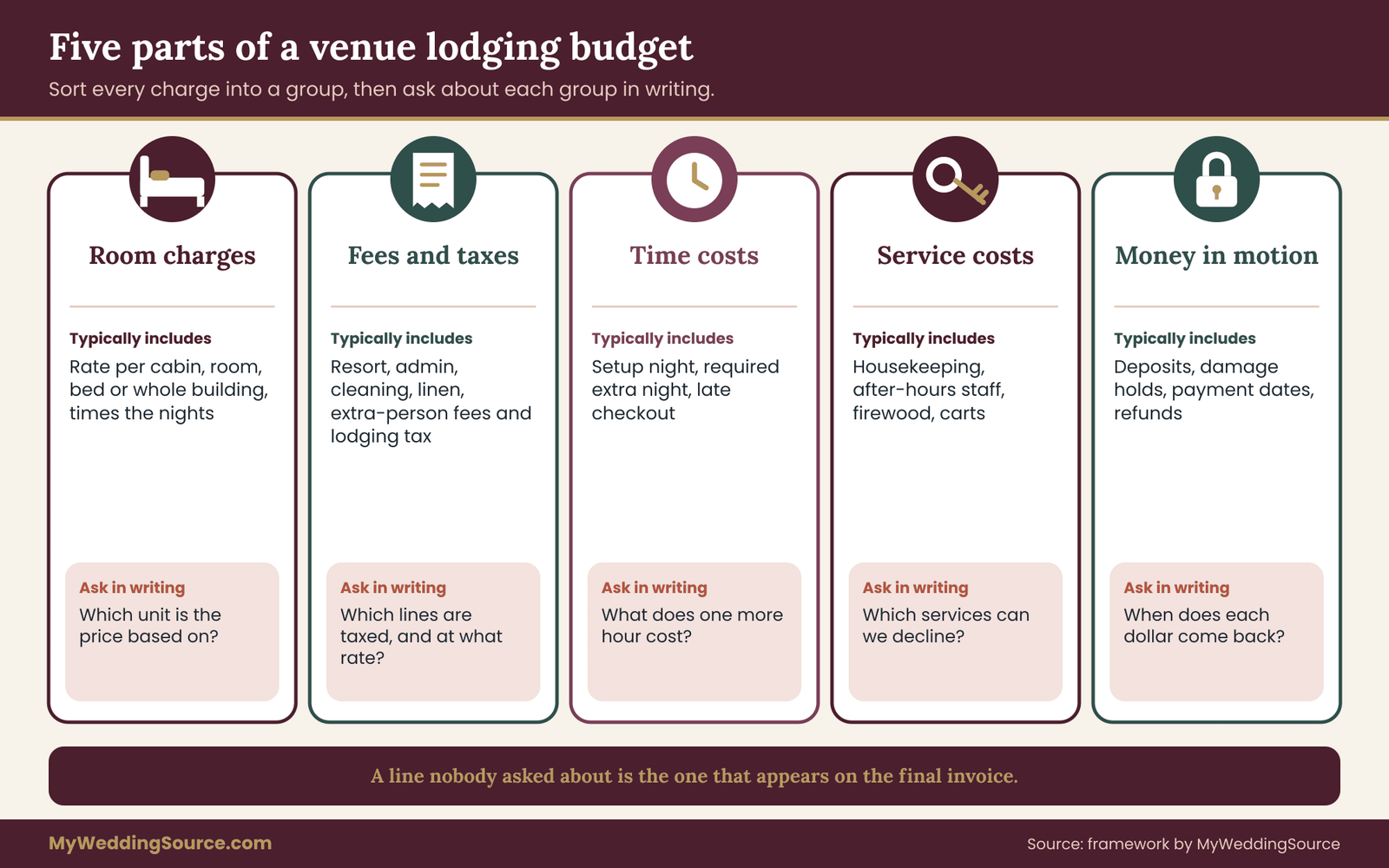
The picture above sorts these into five groups. The point of sorting is to make sure each group gets asked about, in writing, before you sign. A line that nobody asked about is the one that shows up on the final invoice.
Keep the five groups as separate rows in your venue lodging budget, even when a venue folds several of them into a single printed total.
Headline rate versus the figure you actually pay
Venue websites and proposals tend to lead with a headline rate: a per-night price for a cabin or a per-bed price. That is a normal way to advertise, and it is not dishonest. It is simply incomplete for your purposes.
The gap between headline and actual is the thing to measure. If a cabin is listed at one rate and the final per-cabin cost over a weekend is meaningfully higher after fees, tax and linens, the headline understated your cost by that difference. You cannot know the size of the gap until you ask for every line. The three meters in the next section are designed to force that conversation in a fixed order.
One practical note on the word “included.” When a proposal says a fee is included, ask what it is included in. A cleaning fee may be included in the nightly rate but not in the minimum. A tax may be included for the venue fee but not for lodging. Pin each “included” to a named line.
A venue lodging budget built on the headline rate alone will almost always come in low, and the shortfall tends to be discovered in the final month.
Who this method suits, and who can skip it
This method suits couples comparing a venue with lodging on the property against a venue plus outside hotels. It suits couples who are hosting, in whole or in part, the cost of guests’ beds. It also suits couples whose guests pay for their own cabins, because the minimum-night and checkout rules can still make the couple liable for unsold beds.
You can skip most of it if the venue has no beds, if every guest books their own room elsewhere and you owe nothing for lodging. In that case the wedding guest hotels guide is the better starting point, since it covers room blocks, budgets and mobility needs at hotels.
If you fall in the first group, the rest of this guide is the right tool, and the finished venue lodging budget will become a standing line in your overall plan.
The three-meter method for a venue lodging budget
The method rests on one idea: a headline rate is a starting point, and three different effects move it. Each effect has its own meter. Reading the meters in order gives you a number you can trust and a list of questions you can send.
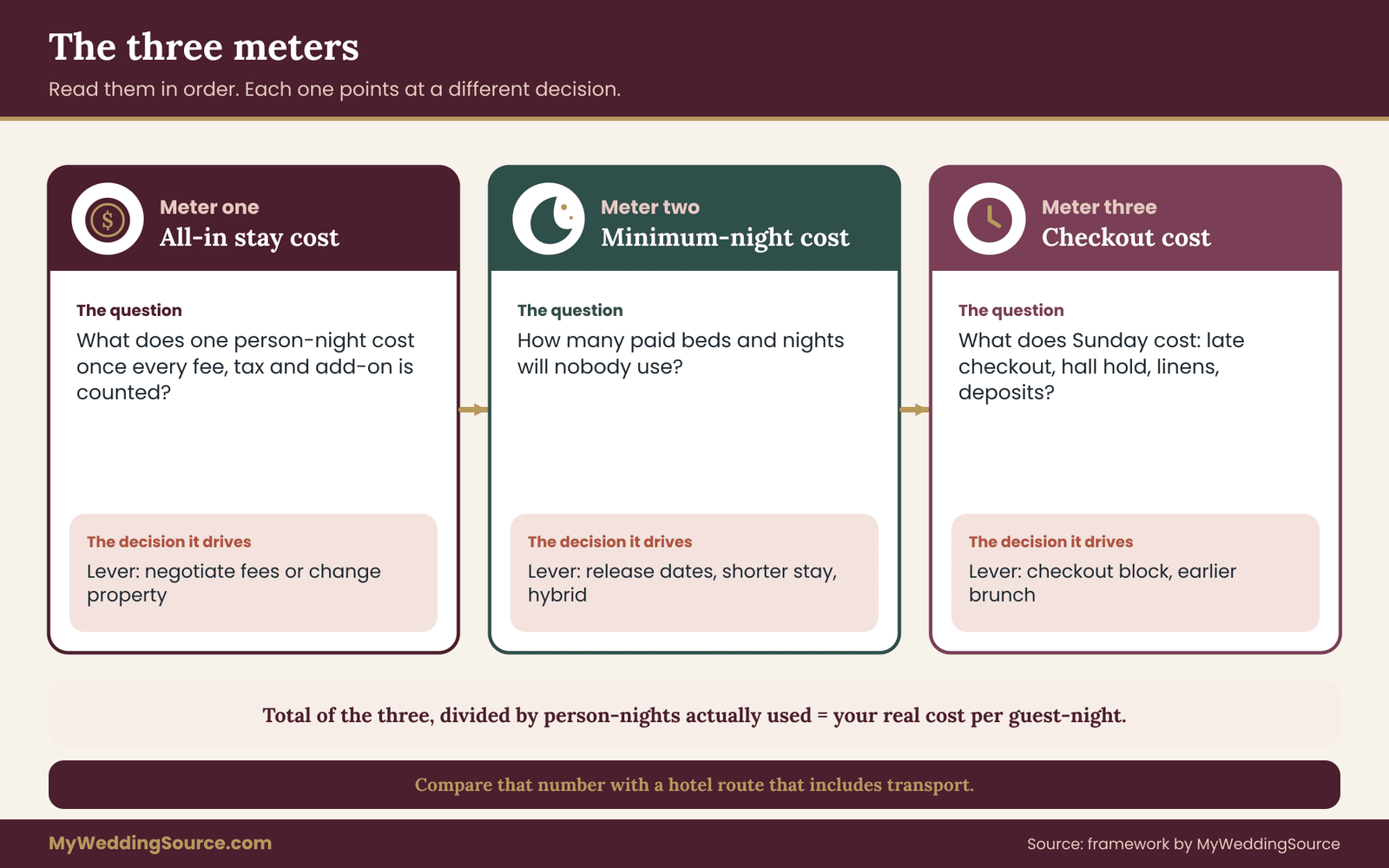
Meter one is the all-in stay cost. It answers: if every bed is used for every night you pay for, what does one person-night cost once all fees, taxes and add-ons are counted? This meter turns the rate sheet into a real unit price.
Meter two is the minimum-night cost. It answers: how many of the nights and beds you pay for will nobody use? A venue that requires a two-night stay, or a full-property booking, makes you responsible for empty beds. This meter measures the waste.
Meter three is the checkout cost. It answers: what does Sunday cost? Late-checkout fees, a hall hold for a farewell brunch, linen-stripping rules and cleaning surcharges all arrive after the party, when attention is low and fatigue is high.
Why three meters and not one total
You could simply add everything up and divide. The reason to read the meters separately is that each one points at a different decision.
If meter one is the problem, the answer is negotiation or a different property, because the unit price is simply high. If meter two is the problem, the answer is structure: fewer paid nights, a release date for unused rooms, or a hybrid with outside hotels. If meter three is the problem, the answer is scheduling: an earlier brunch, a different checkout plan or a negotiated late-checkout block.
A single total hides which lever to pull. Three meters tell you where to push.
Used together, the meters give a venue lodging budget that explains itself: each dollar belongs to a meter, and each meter belongs to a decision.
The unit: a person-night
The method counts in person-nights, which means one guest sleeping one night. A cabin with four beds used by four guests for two nights is eight person-nights. If only two guests use that cabin for one of the nights, the cabin is bought for four beds and two nights, or eight bed-nights, but only six person-nights are used.
The distinction between bed-nights bought and person-nights used is the core of meter two. It also gives you a clean way to compare options. Hotels, cabins, tents and rented houses can all be reduced to a cost per person-night, and the comparison is fair as long as you include the same kinds of cost on both sides, including transport when guests must travel to the venue.
Counting every option in person-nights keeps the venue lodging budget honest, because a cheap bed that sits empty is not cheap.
What you need before you start
Gather four documents or answers before running the meters. You need the venue’s current rate sheet or proposal, including every fee and tax line. You need the sleeping inventory: how many units, how many real beds in each, and who can use which bed. You need the stay rules: minimum nights, arrival and checkout times, and what happens after checkout. And you need your own guest estimate by night, a rough count of who would stay Friday, who would stay Saturday and who would leave early.
If the venue cannot give you a written rate sheet, treat that as information. A property that sells lodging should be able to say, in writing, what each unit costs per night and what is added on top. Hesitation here is a reason to slow down, not to guess.
For the broader sequence of venue decisions that sit around this one, the venues guide covers costs, questions and red flags across venue types. This article stays on the lodging money.
With those four items in hand, a first draft of the venue lodging budget takes an evening, and later quotes take much less.
A note on honest numbers
Everything in this guide that looks like a price is an invented example, used to show arithmetic. Use your own quotes. Rates, taxes and fees differ by venue, region and season, and the only numbers that matter are the ones in your own proposal. Where a rule depends on a local authority, such as occupancy tax or fire capacity, the issuing office is the right source, and the Sources section lists the national agencies that publish the underlying guidance.
Treat the first venue lodging budget you build as a draft, and update it every time the venue changes a rate, a fee or a rule.
Meter one: the all-in stay cost behind a venue lodging budget
Meter one converts a rate sheet into a unit price. The recipe is short. Add every charge that attaches to the lodging, divide by the number of person-nights those charges would cover if every bed were used, and write down the result. That figure is the all-in cost per person-night, and it is the first honest number in your venue lodging budget.
The recipe sounds simple, but rate sheets are written to sell, not to be divided. Three habits make the work easier.
Start with the rate structure
Ask the venue how lodging is priced, because the unit of pricing changes the arithmetic. Common structures are a rate per cabin or room per night, a rate per bed per night, a flat price for a whole building, and a flat price for the whole property for a set number of nights.
A per-unit rate is the easiest to compare once you know the real bed count in each unit. A per-bed rate is the easiest to scale, but it may carry a minimum number of beds. A whole-building or whole-property price is the hardest to compare, because the price does not change as headcount does. For those, divide the flat price by the beds you can honestly fill, not by the maximum the brochure claims.
If rates vary by unit, as they usually do between a family cabin, a smaller room and a bunkhouse, compute a weighted average. Multiply each unit’s rate by the number of units, add them up, and divide by total beds. That gives a headline rate per bed-night that you can carry through the later steps.
The rate structure sets the shape of the whole venue lodging budget, so settle it before you collect any other number.
Count beds the way a guest would
Capacity is not the same as comfortable beds. A cabin that “sleeps eight” may count a pull-out, a loft and two bunk beds. Seniors, couples and parents with toddlers will not treat those as equal beds. If a bed will not be used by an adult guest, it should not be counted as a bed you can sell to one.
Fire and occupancy limits also matter, and they can be lower than the number of mattresses. The venue’s occupancy limit for a given building is set by local authorities and fire codes, not by the venue’s marketing. The U.S. Fire Administration and the National Fire Protection Association publish general fire-safety guidance, but only the local fire marshal or building office can confirm a specific building.
Ask the venue to state the legal sleeping capacity of each unit in writing, and use that number if it is lower than the mattress count.
This matters to your venue lodging budget because a lower real bed count raises the cost per person-night. A property with fewer usable beds than advertised makes every other charge spread over fewer people.
Fewer usable beds mean a higher cost per person, and that effect belongs in the venue lodging budget from the first draft.
Add the charges in a fixed order
Work down the same list for every venue, so quotes can be compared. A reliable order is nightly rate, then any per-night fees, then per-stay fees, then per-person fees, then optional add-ons you will certainly take, then tax.
Per-night fees include resort fees, admin fees, utility surcharges and holiday-weekend surcharges. Per-stay fees include cleaning, linen packages, check-in services and key deposits. Per-person fees include extra-person charges above a base occupancy, and sometimes a charge per child or pet. Add-ons you will certainly take might be linens, firewood, a welcome package or breakfast if it is bundled with the room.
Tax comes last, and it needs its own question: which lines are taxed, and at what rate? Some places tax only the room charge. Others tax fees too. A local or state tax authority sets the rule, and the venue’s tax line should match it. Ask for the rate and the taxable base in writing, then apply it yourself to confirm the venue’s math.
Writing the charges in the same order for every quote also makes a venue lodging budget easy to hand to a parent or partner for a second look.
The formula, in words
Here is meter one written as a sentence you can keep. Take the nightly rates for every unit you will book, multiplied by the nights. Add per-night fees, multiplied by the nights. Add per-stay fees. Add per-person fees. Add the add-ons you will take. Compute tax on the lines that are taxable. The total is the all-in lodging cost. Divide it by the person-nights available, which is real beds multiplied by nights, and you have the all-in cost per person-night.
Keep the headline weighted rate beside it. The ratio between the two, all-in divided by headline, tells you how much of your cost lives outside the nightly rate. If that ratio is only slightly above one, the venue is transparent and priced mostly through rates. If it is well above one, most of the negotiation lives in the fee lines.
Put the formula at the top of your worksheet, and every venue lodging budget you build afterward will follow the same path.
A scenario: two quotes that look alike
Imagine two venues quote similar nightly cabin rates. Venue A has no resort fee, includes linens and charges a modest cleaning fee. Venue B has the same rate, plus a resort fee on every unit-night, a separate linen package and a larger cleaning fee, and applies tax to all of it.
On the website the two look the same. On meter one they are not. The difference does not announce itself; it lives in four small lines that nobody added together. Meter one is the habit of adding them together before comparing.
A venue lodging budget is the place where such differences get added up, and it is the reason to compare quotes by the all-in number.
Hidden lines that quietly inflate a venue lodging budget
Some costs are legitimate and some are only badly labeled. The goal is not to accuse the venue of anything. It is to find every line before the contract fixes it. These are the places where a venue lodging budget most often grows after the first quote.
Fees that scale with units
Resort fees, admin fees and utility charges are often assessed per unit per night, which means they scale with the number of cabins you book. A fee that looks small per unit becomes a real figure across a dozen units and two nights. Ask whether each fee is per unit, per bed, per person or per booking, and multiply accordingly.
A related category is the percentage fee. A service charge or admin fee stated as a percentage of the lodging total grows automatically when you add units. If the percentage applies to the venue fee as well as lodging, say so in the quote and confirm which base it uses.
Fees that scale with units deserve their own row in the venue lodging budget, because they grow every time you add a cabin.
Fees that scale with people
Extra-person charges apply when a unit holds more than its base occupancy. A cabin quoted at a base of two people may add a charge for each additional guest. In a family-heavy wedding where cabins are packed, this line can exceed the nightly rate. Ask what the base occupancy is for each unit, and what the charge is for each person above it, including children.
Pet and service-animal rules belong here too. Service animals have legal protections under the Americans with Disabilities Act, and a venue should not charge a pet fee for a service animal. The Department of Justice ADA site explains the rules. Pets that are not service animals are a venue policy question, and the charge can be per pet per night or a flat cleaning fee.
Group size can change the venue lodging budget quickly when extra-person charges apply, so run the numbers for your real headcount.
Fees that appear at checkout
Cleaning surcharges, extra-linen charges and damage assessments are the lines most likely to appear after the weekend. They are often written into the contract as conditions: “units must be returned in the condition received” or “additional cleaning will be billed at the venue’s rate.” Ask for the amounts and the triggers now. A guest who leaves a cabin messy after a long party is a normal event, and you want to know in advance what it costs.
Carry the highest plausible checkout charge in the venue lodging budget until the venue shows you in writing that it will not apply.
Fees tied to time
Early arrival for setup and late departure for teardown are time costs. A vendor team that needs to be on site Friday morning may need a unit the night before, and the venue may charge for that night. A florist or rental company that cannot load out until Sunday may need a window the venue prices separately. These belong in your venue lodging budget even though they feel like venue logistics. Meter three covers the Sunday side in detail.
Time-based charges are easy to forget in a venue lodging budget because they attach to the schedule rather than to the room.
Required purchases hidden in packages
A package can bundle lodging with catering, activities or “experience” fees. Bundles can be good value or poor value, and you can only tell by pricing each component. If a package requires you to buy breakfast for every overnight guest, the breakfast is part of the lodging cost for your purposes. Ask for the package price and the unbundled price of each component, and keep both.
The all-inclusive wedding venues guide on this site covers how to read bundled venue packages in general. For this article, the rule is narrow: any component you cannot decline belongs in meter one.
Any required purchase tied to a bed belongs in the venue lodging budget even if the venue files it under food or activities.
Questions to send in one message
Rather than ask by phone and hope to remember, send a single written message. A version you can adapt: “To compare quotes, please confirm in writing, for each lodging unit: the legal sleeping capacity, the nightly rate, every per-night, per-stay and per-person fee, which lines are taxed and at what rate, what is included in the base rate, and the cleaning, linen and damage charges with their triggers.”
That one message gets you the raw material for meter one and for the checkout meter. If the answer comes back vague, ask again for the specific line. A venue that sells lodging for a living will have answers. If it does not, you have learned something about how the weekend will run.
The answers become the raw numbers for the venue lodging budget, so save the reply with the quote it belongs to.
Edge cases worth a second look
Some situations bend the arithmetic. If the venue offers a lower rate for a group booking, confirm the threshold and what happens if you fall below it. If the rate is seasonal, confirm which season your dates fall in and whether a holiday weekend changes it. If a unit is accessible, confirm whether its rate or availability differs, and do not accept a higher price for the same room simply because it has an accessible bathroom.
If a guest is staying in a staff or volunteer room at the venue’s suggestion, ask whether that room is a guest-ready unit under the same rules and rate. And if the property sits inside a public land area, such as a park or forest campground, the land agency’s own rules on group use, fire and capacity apply on top of the venue’s. The National Park Service and the U.S. Forest Service publish those rules for their units, and recreation.gov handles reservations for many federal campgrounds.
Meter two: minimum nights and the beds nobody uses in a venue lodging budget
Meter one assumes every bed is used every night. Real weddings do not work that way. Some guests live nearby and drive home. Some arrive Saturday morning and leave after the reception. Some older relatives prefer a hotel with an elevator. Meter two measures the gap between the beds you pay for and the people who sleep in them, and it is where many a venue lodging budget quietly goes wrong.
The gap exists because venues sell nights in blocks. A rule that looks harmless on the rate sheet, such as a two-night minimum on weekend events, turns into a bill for every unit you reserve, whether or not anyone sleeps in it.
The kinds of minimum to look for
Minimums come in several shapes, and each one reaches your budget differently.
A minimum-night rule says the booking must cover a set number of nights, commonly two nights around a Saturday event. A unit minimum says you must reserve a set number of cabins or rooms, or all of them. A full-property rule ties exclusive use of the venue to booking all lodging, which makes lodging a condition of the venue rather than an option.
A bed-count or headcount minimum sets a floor on paid beds or guests. An attrition clause allows you to reduce your block by a small share, then charges for the rest regardless.
Ask which of these apply, and read the exact wording. “Minimum two-night stay” can mean each guest must stay two nights, or it can mean the booking as a whole must cover two nights. The second reading is far more forgiving. Get the venue to say which one it means, in writing.
Each kind of minimum changes the venue lodging budget in a different way, so name the kind before you price it.
Bed-nights bought versus person-nights used
The measurement is plain subtraction. Multiply the beds you will reserve by the nights you must pay for. That gives bed-nights bought. Then estimate how many guests will sleep each night. Add those up for person-nights used. The difference is idle bed-nights.
The estimate is the hard part, so do it in three passes. In the first pass, list the guests who will certainly sleep on site: the couple, the wedding party, immediate family, and anyone who has told you so. In the second, list the guests who very likely will, such as friends flying in who have no other plan.
In the third, list the maybes, such as local friends who might stay for the party. Count the first two passes as your planning number, and treat the third as upside rather than budget.
Do the count for each night separately. Friday and Saturday will rarely match. Friday often has fewer sleepers, because some guests arrive on the day of the wedding. Saturday has the most. If the venue allows a Thursday setup night, do not assume anyone but the couple and vendors will use it.
The planning number from this count is the input that makes the rest of the venue lodging budget meaningful.
What an idle bed-night costs
An idle bed-night costs the all-in rate of the unit it sits in, minus anything the venue does not charge when the unit is unused. Cleaning and linen charges often drop when nobody stays; the nightly rate, resort fee and tax usually do not. Ask which lines apply to an empty unit.
Because units are sold whole, idle cost is usually a whole-unit figure. If eight rooms sit empty on Friday, you pay for eight rooms, not for some number of loose beds. Count idle units, price them at the nightly rate with per-night fees and tax, and you have the meter two figure.
The size of this number varies widely. For a weekend where nearly every guest stays both nights, it can be small. For a weekend where many guests stay one night, it can be a real share of the lodging total. Only your own estimate tells you which weekend you are planning.
Price idle units at the rate the contract states, and carry that figure in the venue lodging budget as its own line.
Who bears the cost depends on who pays for beds
This is where couples most often misjudge exposure. If you pay for every bed, idle bed-nights are your cost directly. If guests pay for their own cabins, you might assume idle nights are not your problem. Often they are.
When the contract commits you to a booking, guests pay the venue or you only if they book. A guest who cancels or never books leaves the unit in your column. Some venues will hold units for guests to book individually until a cutoff date and then release them. Others require you to guarantee the block. The difference is large, and it is a negotiable term. Ask: “If a guest does not book, who owes for the unit, and when does that obligation start?”
For the wider question of how much room-block risk to carry, the wedding cash-flow planning guide explains how deposits, balances and reserves interact over the planning period, which helps you decide how much lodging exposure you can absorb.
Whichever model you pick, write down who owes for an unbooked unit before you finalize the venue lodging budget.
Ways to shrink the idle number
Several levers exist, and the venue’s willingness to move on each varies. The first is a release date: the right to return unused units without charge until a set number of days before arrival. The second is resale credit: if the venue resells a unit you released or never filled, you are credited for it.
The third is a shorter paid window, such as one night instead of two, when the venue allows it for part of the inventory. The fourth is a hybrid plan, where a core group sleeps on site and everyone else goes to nearby hotels.
A fifth lever is unit mix. If the venue has a few large cabins and many small rooms, filling the large ones with families and leaving the small ones as the flexible block reduces idle cost, because large units are easier to fill with parties that arrive together.
A sixth is timing of commitment. A venue that wants a firm unit count twelve months ahead is pushing risk onto you. One that accepts a rooming list sixty days before arrival is sharing it. Ask what the final-count date is and what happens to units after it passes.
Each lever that the venue accepts lowers the venue lodging budget directly, so ask for them in order of how much they save.
Scripts for the conversation
Negotiation is easier with specific language. Here are three that work in plain terms.
To test the minimum: “We expect some guests to stay one night. Can we book two nights for the main group and release unused units forty-five days out without charge?”
To test the resale: “If you resell a unit we released, will you credit us for those nights?”
To test who bears risk: “If a guest does not book by the cutoff date, are we responsible for that unit, and for how many nights?”
Venues will sometimes say no to all three, and that is acceptable information. Write down the answers and carry the worst case into meter two. If the venue says yes, write down the terms and ask for them in the contract.
Record each answer next to the quote, because the answers change the venue lodging budget more than any discount code could.
An edge case: the setup night and the vendor nights
Vendors sometimes need beds too. A planner, a florist, a band or a photographer who travels a long way may need a room Friday night. If the venue’s minimum covers Friday and Saturday, those rooms fit inside it. If you want Thursday for setup, a third night appears.
Decide in advance whether vendor lodging is your cost or theirs. Some contracts include travel and lodging; many do not. If it is yours, add it to meter one and to your venue lodging budget as its own line, and confirm that vendor stays follow the same cleaning and checkout rules as guest stays.
Vendor nights are small, but leaving them out makes the venue lodging budget look better than it is.
The Friday decision rule
A simple rule helps couples decide whether to pay for Friday at all. Compare the idle cost of Friday with the value of the Friday gathering. If the rehearsal dinner, a welcome supper or an early arrival day is something you want, Friday earns its place and the idle cost is the price of that evening. If Friday is only a paid night that few people will use, the rule says to shorten the stay, release the units or move Friday guests to a hotel.
Be honest about which case you are in. A weekend where most guests arrive Friday afternoon, share a meal and sleep on site is a different event from one where most guests arrive Saturday morning. The first justifies two nights; the second probably does not.
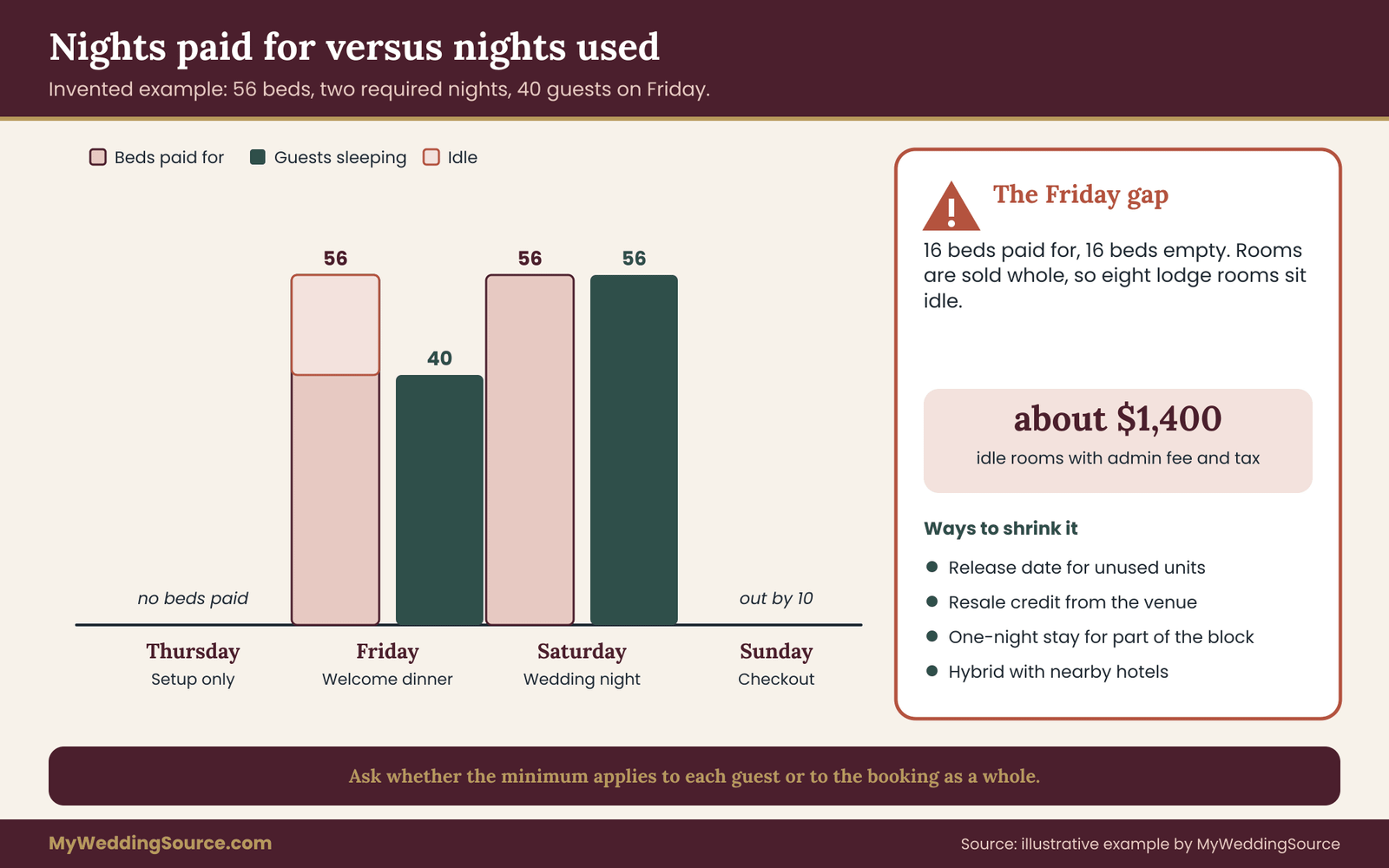
The picture above shows how paid nights and used nights can diverge across a typical Thursday to Sunday window. The paid bar is set by the contract, and the used bar is set by your guests.
The rule keeps the venue lodging budget tied to what you actually want from the weekend, and not to what the contract happens to include.
When the minimum is the whole deal
Occasionally the lodging minimum is not a side term at all. It is the price of getting the venue. A property that will only rent exclusively with all units booked has made lodging a condition. In that case, the useful question is not “how do I reduce idle beds” but “does the full package make sense at my headcount?”
Run meters one, two and three on the full package and compare the result against a venue-only booking with outside hotels. The comparison later in this guide shows how. If the full package costs a modest premium per person-night for something you value, it may be worth it. If it costs a large premium and your headcount does not fill the beds, the minimum is telling you the venue is the wrong size for your guest list.
When the minimum is the deal, the venue lodging budget becomes a test of whether the venue fits your guest list at all.
Meter three: the checkout cost of a venue lodging budget
Checkout is the part of a weekend that nobody budgets, because the party is over and the mind has moved on. Yet the contract rules that govern Sunday morning can add real money to a venue lodging budget, and they arrive when you are tired, hungry and saying goodbye. Meter three prices that morning in advance.
The meter has one purpose: to turn “checkout is at ten” into a list of what happens if it is not. Every rule in a lodging contract exists because something went wrong once for the venue, and each one has a price.
Start with the clock
Write the Saturday night and Sunday morning timeline on one line, with real times. When does the reception end, and when does the venue’s quiet period begin? When does the last shuttle or ride leave? When is checkout, and when does the next group arrive?
A venue with a ten o’clock checkout and a reception that ends near midnight has given your guests about ten hours to sleep, shower, pack and clear a cabin. That is workable for some guests and impossible for others. Families with small children, older relatives and the wedding party, who may be up late, will struggle most. The mismatch between the party’s end and the checkout hour is the origin of most late-checkout fees.
Ask when the next arrival is. If the property has no incoming guests until afternoon, a later checkout may cost the venue little, and it may be willing to move the time. If a second event arrives at noon, the ten o’clock rule is real and the housekeeping crew has a fixed window.
A realistic clock is the quickest way to see which charges will land in the venue lodging budget on Sunday.
Late checkout: per unit, per hour or per block
Late checkout fees come in different shapes. Some venues charge per unit per hour after checkout. Others charge a flat fee per unit for any extension. Some offer a negotiated block, such as noon checkout for all units at a single price.
Do the arithmetic for your own guest list. If a flat fee applies per unit and most units will run late, a block price is better. If only a few units will run late, per-unit pricing may be cheaper. A short survey of the wedding party and family on Saturday afternoon can tell you roughly how many units want extra time, and an extension negotiated before the weekend is nearly always cheaper than a series of fees assessed after it.
Whichever structure applies, put the expected total in the venue lodging budget and mark it as an estimate until the weekend passes.
The farewell brunch and the hall hold
Many couples plan a Sunday brunch or coffee as a send-off. If it happens in a venue hall, the venue may charge for the space, and for staff or catering if the hall hold includes service. This is a legitimate cost, and it belongs in the checkout meter because it exists because of the stay.
The question is whether the brunch is bundled or separate. Ask whether the venue fee already covers Sunday morning use of the hall, whether a hold fee applies, and whether catering is required or you can bring your own. If you are planning a gathering that others will attend, the brunch timing ties to the same checkout rules, so settle both at once.
A cheaper variant is a small gathering outdoors or on a porch, with coffee and pastries brought in. Check that the venue permits outside food on Sunday and that no corkage or service fee applies.
If the brunch happens, its space and service costs belong in the venue lodging budget, even though the invitation lists it as a social event.
Linen, cleaning and the condition rule
Many properties ask guests to strip beds, gather towels and leave units tidy. Others charge a per-unit cleaning fee regardless. A third approach charges a surcharge when units are left beyond a stated condition.
Find out which one applies. If guests must strip beds, tell them in writing, and expect that some will forget. If the venue charges a surcharge for unstripped beds, the fee scales with how well the message lands. A short note in each unit and a line in the weekend schedule usually helps, and it costs nothing.
Ask also what counts as damage and who is responsible. A stained mattress, a burn mark from a candle, a broken screen or a smoking violation can each carry a charge. Identify the amounts, the process for disputing them, and the timeline in which the venue must assess damage.
Cleaning and linen terms are small individually, but together they move the venue lodging budget by a noticeable amount.
The condition report at arrival
A practical protection is a condition report at check-in. Walk through each unit, or at least the ones your family and wedding party use, and photograph anything already worn, stained or broken. Send the photos to the venue’s contact with the date. This protects guests and you from charges for damage that existed before arrival.
It takes a few minutes per unit, and it is easy to delegate to one organized friend. The venue may have its own form. If so, ask that guests receive it at check-in and that you receive a copy.
A good condition report protects the venue lodging budget from charges that have nothing to do with your guests.
Deposits and the cash flow of Sunday
A refundable damage deposit does not change the final cost, but it changes when you pay and when you are repaid. Ask the amount, the inspection window and the return date. A deposit returned in two weeks is a short loan. A deposit returned in sixty days affects your honeymoon spending.
Be sure to ask what the deposit covers. Some deposits cover only damage. Others also cover cleaning, extra hours or fees the venue deems owed. Ask for a written statement of deductions if any are taken. The wedding vendor contract guide explains how to read deposit, cancellation and liability clauses in vendor agreements, and the same habits apply to a lodging contract.
List deposits beside the venue lodging budget but outside its total, with the date each one comes back.
Load-out, rentals and vendors
Sunday is also when rented items are collected, décor is removed and vendors load out. If the contract requires you to remove all decorations by checkout, someone has to do it. If rental pickups are scheduled for Sunday morning, the venue must allow access and perhaps charge for it.
List every item that leaves the property on Sunday and every person who needs access to take it. Then ask what the venue charges for access, trash removal and any items left behind. A haul-away fee for forgotten décor is easy to avoid with an assigned person and a short checklist, and expensive to ignore.
Access and haul-away fees are easy to prevent, and preventing them keeps the venue lodging budget from growing on Sunday.
Checkout lanes
One way to make checkout calmer is to sort guests into lanes. Lane one is early leavers, with flights or long drives, who check out and depart before the brunch. Lane two is the brunch group, who check out on time and gather before leaving. Lane three is the late group, who need extra time and whose units are on a negotiated extension.
Naming the lanes in the weekend schedule lets each guest choose, and it gives you a count for the late-checkout block. It also reduces last-minute scrambling for ride arrangements.
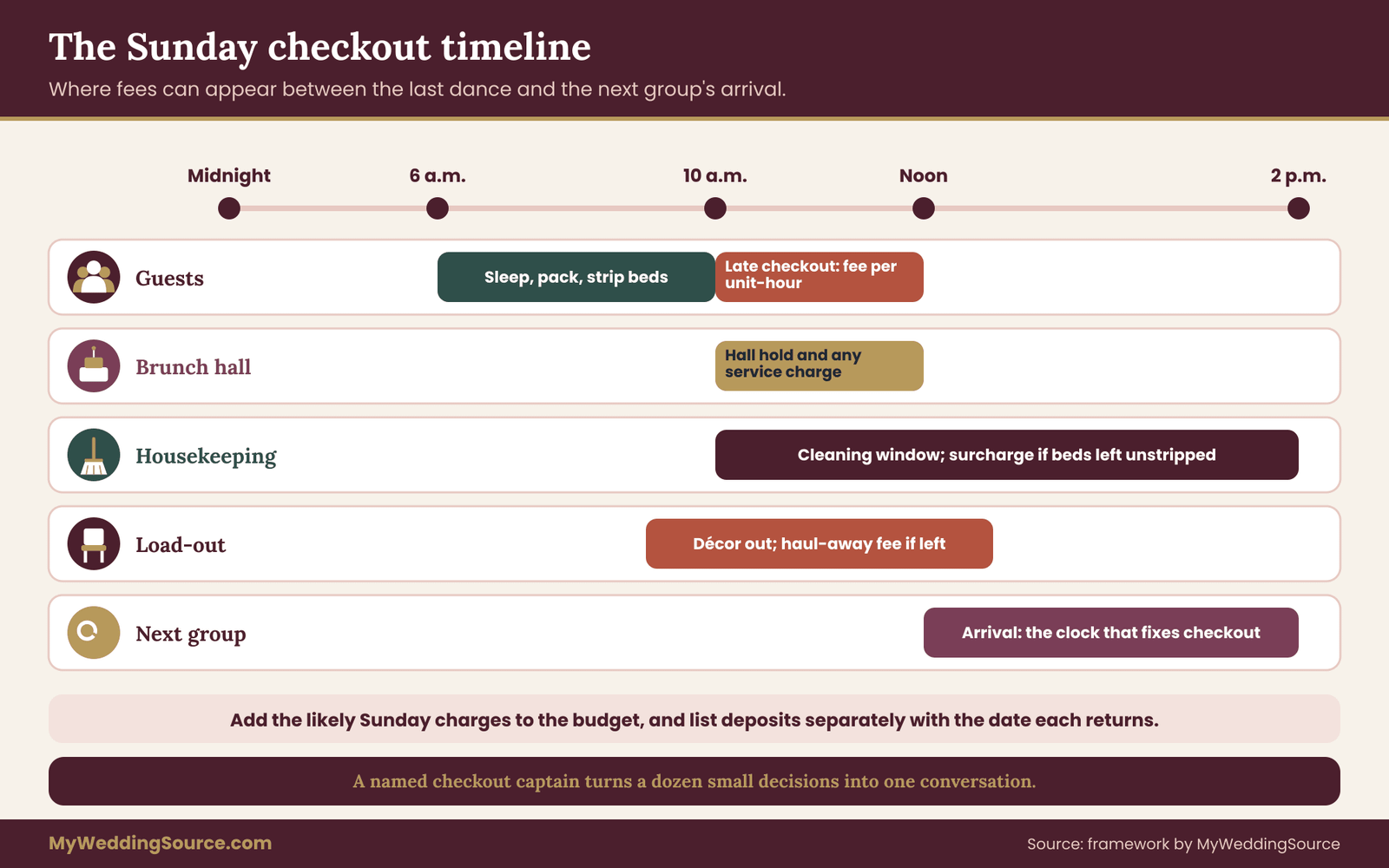
The Sunday timeline above shows how checkout, brunch, cleaning and load-out overlap. The clearest warning on that picture is the stretch where several of them compete for the same two hours.
Lanes give you a head count for the late block, which is the number the venue lodging budget needs from this meter.
Who is the checkout captain
Assign one person on your side to be the checkout contact. That person holds the checklist, walks units with the venue’s staff if asked, collects keys or confirms they are left as required, and speaks to the venue about disputes. It should not be the couple, who will be saying goodbye, and it should not be a parent who is also hosting.
Give the captain written authority in the contract notes or an email to the venue, so staff know whom to deal with. A captain turns a dozen small decisions into one conversation.
With one contact on your side, disputes about the venue lodging budget get settled in a single conversation instead of a dozen.
What the meter produces
When meter three is done, you have a short list with amounts: late-checkout block or expected fees, hall hold for brunch if any, linen or cleaning surcharges you expect, haul-away or access charges, and any deposit with its return date. Add the expected amounts, and note separately the money you pay now but get back later.
Divide the total by the person-nights used, and you have the checkout cost per person-night. In the worked case later, this number is small compared with the nightly rate but not trivial, and it is the one couples most often leave out.
Enter the result as one row in the venue lodging budget, and keep the supporting list in the lodging file.
Edge cases on Sunday
A few situations need extra thought. If the wedding party is staying in a separate house or lodge, confirm that its checkout rules match the guest units. If a guest has mobility needs and requires help with luggage, confirm that staff or volunteers can assist and whether carts are available. If the venue shares grounds with another group, confirm quiet hours and access on Sunday morning, since your brunch may coincide with their arrival.
If severe weather or a road closure delays departure, ask what the venue does. Some will extend checkout without charge; others will not. A written weather clause is easier to rely on than a verbal promise on the day.
Who pays: host-paid, guest-paid and split beds in a venue lodging budget
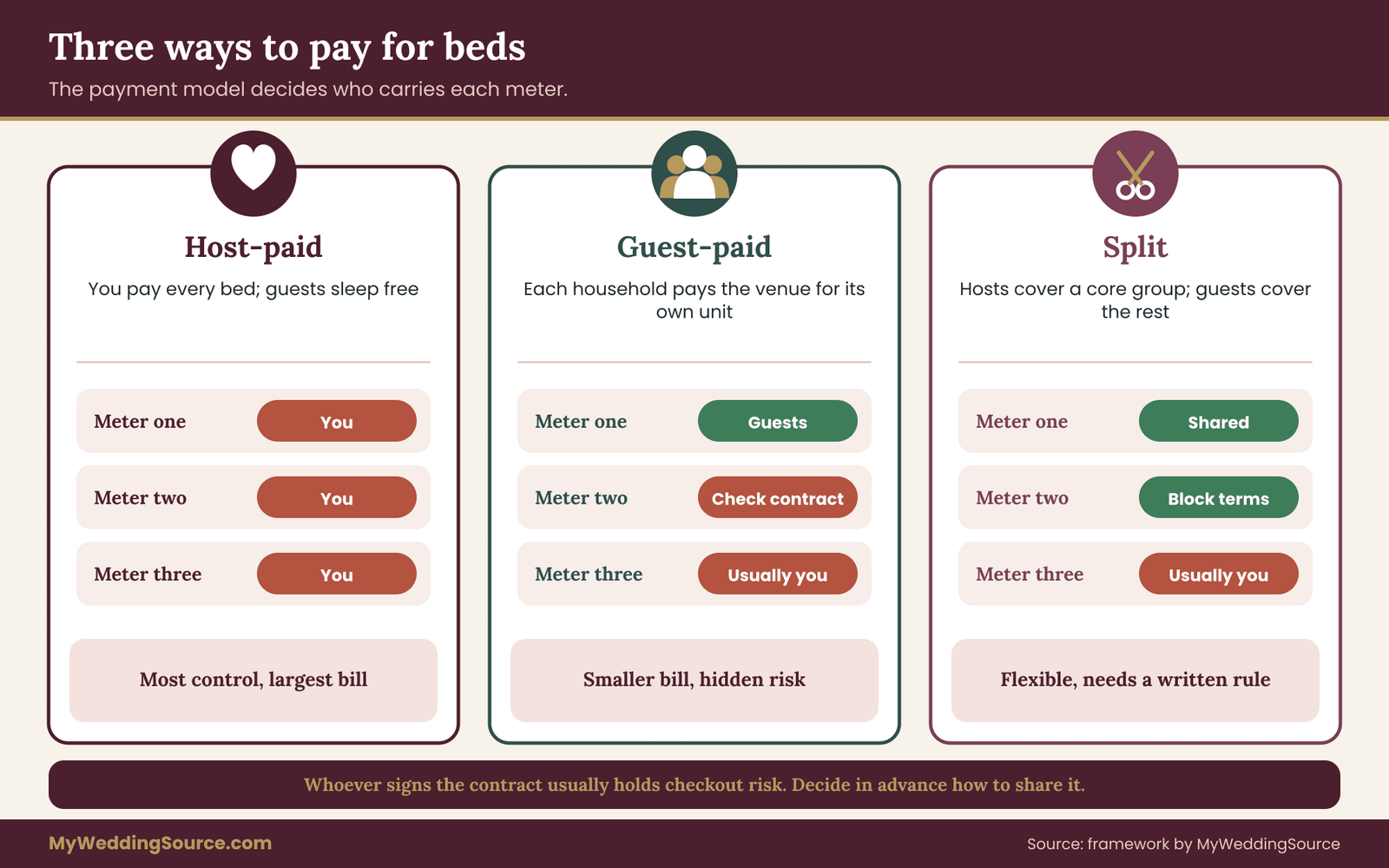
The three meters tell you what lodging costs. A separate question decides who carries it. Couples choose among three models, and each one changes both the money and the relationships around it. The model you pick also changes how much of meter two lands on you.
Host-paid beds
In the host-paid model, the couple, or the couple and their families, pay for every bed. Guests sleep for free. This is the simplest model for guests and the most expensive for hosts. It also gives you the most control: you decide who sleeps where, you know the count and no guest has to pay for a cabin at a wedding.
The risk is size. A host-paid venue lodging budget grows with every guest you add, and meter two is entirely yours. If the minimum-night rule leaves eight units empty on Friday, those units are your cost. Host-paid works best for small guest lists, for weekends where nearly everyone will use both nights, and for couples who consider the weekend itself the gift.
A middle variant is host-paid for the core group. The couple covers the wedding party and immediate family, and everyone else books their own stay, whether on site or at a hotel.
Under host-paid beds, the venue lodging budget is simply the total of the three meters, with no one to share it.
Guest-paid beds
In the guest-paid model, each guest or household pays the venue or a booking agent directly for their cabin or room. The couple pays nothing for beds, at least in theory. This is common for camp and retreat weddings, and it is how many guests expect to travel to a wedding anyway.
The questions are about risk and fairness. Who holds the units until guests book? Who owes if a unit is never booked? Are the rates the same ones you would have paid, or a marked-up group rate? And can every guest afford the offered options?
Because rates in a venue are set by the venue, the couple has little control over price. If the cheapest bed costs more than some guests can spend, they may decline the invitation or skip the overnight. That is a human cost that no budget line captures. Offer at least one lower-cost lane, such as a bunk room, a camp-style bed, a nearby budget hotel or a day-only option, and say so plainly in the invitation materials.
Under guest-paid beds, the venue lodging budget shrinks on paper but carries risk that should be priced as a reserve.
Split beds
The split model divides the cost in a rule everyone understands. For example, hosts cover the wedding party and parents, and guests pay for their own. Or hosts pay for the Saturday night and guests pay for Friday. Or hosts pay a fixed amount per guest and guests cover the rest.
Splits are flexible but need clear communication. A guest who learns at check-in that they owe money will feel the sting more than one who read the rule in a message months earlier. Write the rule down, send it with the lodging information, and make it the same for everyone in a category.
Splits also need a payment path. Decide whether guests pay the venue, the couple or a booking agent, and by when. A direct payment to the venue keeps the couple out of the middle and reduces awkward collections. It also makes it harder for the couple to rebalance idle units, because the venue holds the money.
A split model keeps the venue lodging budget flexible, as long as the rule is written down and applied to everyone alike.
How the model changes meters one to three
The same property gives different results under each model, because the meters fall to different people.
Meter one, the all-in stay cost, is fixed by the property, but whether the couple sees it depends on the model. In the guest-paid model, guests see it directly and may compare it with hotels.
Meter two, the idle-bed cost, lands on the couple unless the contract moves it. In guest-paid and split models it depends entirely on who guarantees the block.
Meter three, the checkout cost, is usually assessed against whoever signed the contract, which is typically the couple, even when guests caused the charge. A contract can allocate it, but many do not. Plan for the couple to hold checkout risk, and decide in advance how to handle guest-caused charges.
Draw a line in the venue lodging budget between costs that are certain and costs that depend on guest behavior.
A note on privacy and sensitivity
Money and sleeping arrangements are sensitive. Avoid publishing who is paying for whom, and avoid asking guests to explain why they chose a particular lane. Collect rooming information in a private form, not in a group thread. The guest hotels guide linked earlier discusses how to offer different price levels and accessibility options without singling anyone out, and the same ideas apply to cabins and rooms.
Comparing on-site lodging with a hotel route using one venue lodging budget
At some point you will want a straight answer: is it worth sleeping everyone here, or should guests stay at hotels and travel in? The question is fair, and the three meters make it answerable, as long as both options are counted the same way.
Count the hotel route fully
The hotel route has its own meters. Meter one for a hotel is the all-in room cost: room rate, taxes, resort fees and parking, divided by guests per room. Meter two is the block risk: any attrition or minimum the hotel imposes, and the rooms that stay unsold. Meter three is the checkout side: late checkout, early flights, luggage storage.
Then add the item the on-site option does not have: transport. Guests must travel from hotel to venue and back. A shuttle, rideshare vouchers, or a set of volunteer drivers all carry a cost or a burden. Include it. A hotel route that looks cheap per room can lose its edge once transport and the late-night return trip are counted.
Counting transport turns the hotel route into a fair partner for the venue lodging budget instead of an easy winner.
Put both on the same unit
Compare the two routes in cost per person-night, using the same guests and the same nights. For each route, add every cost the couple bears, divide by the person-nights actually used, and write the two numbers side by side. The difference is the premium, positive or negative, for sleeping on site.
Then ask what the premium buys. On-site lodging can buy a shared evening that does not end with a ride, a calm morning, time with out-of-town relatives and fewer logistics for elderly guests. Hotels can buy private bathrooms, comfortable beds, in-room air conditioning and a choice of price points. Neither list is universal. A couple who values late-night togetherness will weigh the premium differently from a couple who cares most about guests’ sleep quality.
With both routes on one unit, the venue lodging budget stops being a guess and becomes a comparison.
Mobility and access are part of the comparison
Access can decide the matter. A cabin camp with steep paths, shared bathrooms in a separate building and top bunks may not serve a guest who uses a wheelchair or walker. A hotel with an elevator and an accessible room may. If part of your guest list cannot use the on-site beds, they will need an alternative, and the alternative’s cost belongs in your comparison.
The ADA site from the Department of Justice explains obligations for lodging operators in general, but the venue’s own accessible-unit inventory is the fact to ask about.
The accessible wedding venue red flags article on this site lists what to ask about paths, bathrooms and beds, and it pairs well with the stay-cost comparison here.
If part of the guest list needs another option, add that option to the venue lodging budget instead of treating it as a favor.
The hybrid answer
Many weddings end up hybrid. A core group of family and wedding party sleeps on site, which gives the couple the shared evening they want and fills the units the venue requires. Everyone else is offered nearby hotels at several price levels, with a shuttle or ride plan.
A hybrid has a useful property for meter two: you can size the on-site block to the guests who will certainly use it, so idle bed-nights shrink. It also spreads cost fairly, since the couple covers the on-site group and the rest choose their own price. The cost is complexity. You now manage two lodging systems, two sets of rules and two sets of information for guests.
Decide the hybrid by counting. If the certain-and-likely group fills most of the on-site beds on both nights, the hybrid is cheap to run. If it fills only half the beds, you either shrink the block, renegotiate the minimum or consider a smaller venue.
A hybrid keeps the venue lodging budget smaller and the weekend closer to what you pictured, at the price of extra communication.
What the comparison cannot tell you
Cost per person-night is a number, and a wedding weekend is also an experience. If two routes are close on cost, pick the one that fits the weekend you imagine. If they differ widely, ask whether the premium is something you would happily pay for a specific benefit. A number does not make the decision, but it ensures the decision is not made on a headline rate that was never the real price.
The number frames the choice, and the choice itself stays with you; the venue lodging budget only makes it visible.
A worked case: the Alder Hollow weekend and its venue lodging budget
The case below is invented. Alder Hollow is not a real venue, the couple is not a real couple, and every price is a round number chosen to make the arithmetic easy to follow. Use it as a pattern, and replace each figure with the one in your own quote. Taxes and fees are placeholders, not typical rates.
The setup
A couple is considering a lodge-and-cabin property for a Saturday wedding with a Friday welcome dinner. The property has twenty sleeping units: eight cabins with four beds each and twelve lodge rooms with two beds each, for fifty-six beds in all. The venue fee for exclusive use from Friday to Sunday is nine thousand dollars. That number sits outside the lodging budget and stays the same under both routes below.
The proposal lists cabins at two hundred forty dollars a night and lodge rooms at one hundred fifty dollars a night. It requires a two-night minimum for weekend events. It adds a six percent admin fee on lodging, a thirty-five dollar cleaning fee per unit, a twelve dollar linen charge per bed, and a ten percent lodging tax applied to lodging, admin and cleaning. Checkout is at ten on Sunday. The couple expects forty guests to sleep on site Friday and all fifty-six on Saturday.
Every number here is invented, and the same worksheet will hold your real figures once the venue lodging budget has real quotes behind it.
Meter one: the all-in stay cost
Start with nightly rates. Eight cabins at two hundred forty dollars is nineteen hundred twenty dollars a night. Twelve rooms at one hundred fifty dollars is eighteen hundred dollars a night. Together that is three thousand seven hundred twenty dollars a night, or seventy-four hundred forty dollars for the two required nights.
Add the admin fee, six percent of the lodging, which is about four hundred forty-six dollars. Add cleaning for twenty units, seven hundred dollars. Add linens for fifty-six beds, six hundred seventy-two dollars. Compute tax on lodging, admin and cleaning, a base of eighty-five hundred eighty-six dollars, which comes to about eight hundred fifty-nine dollars. The all-in lodging total is ten thousand one hundred seventeen dollars.
The headline weighted rate is three thousand seven hundred twenty dollars divided by fifty-six beds, or about sixty-six dollars forty-three cents per bed-night. If all fifty-six beds were used for both nights, the all-in cost would be ten thousand one hundred seventeen divided by one hundred twelve bed-nights, or about ninety dollars thirty-three cents per person-night. That is already about thirty-six percent above the headline.
Meter one alone shows why a venue lodging budget should never rest on the headline rate.
Meter two: the idle bed-nights
Forty guests on Friday means sixteen beds are empty, which the couple handles by leaving eight lodge rooms unoccupied. The minimum still charges for them. Eight rooms at one hundred fifty dollars is twelve hundred dollars before fees. With the admin fee and tax, the cost of those empty rooms is about fourteen hundred dollars.
Now divide the same lodging total by the person-nights actually used: forty on Friday plus fifty-six on Saturday, ninety-six. Ten thousand one hundred seventeen divided by ninety-six is about one hundred five dollars thirty-nine cents per person-night. The minimum-night effect has added about fifteen dollars to every used night, and the cost per person-night now sits about fifty-nine percent above the headline.
The minimum-night step is the reason the venue lodging budget grew again after the all-in figure looked settled.
Meter three: the checkout cost
The venue charges twenty-five dollars per unit per hour after ten on Sunday. The couple plans a farewell brunch, and ten units are likely to check out at noon, two hours late, which comes to five hundred dollars. Six units are expected to be left with beds unstripped, and the venue charges twenty dollars each, one hundred twenty dollars.
A Sunday hall hold for brunch is six hundred dollars, and a flat décor haul-away fee applies at two hundred fifty dollars if décor is not cleared by checkout. The couple plans to clear it themselves, but the budget carries the fee as a risk.
The Sunday total is fourteen hundred seventy dollars. The venue also holds a one thousand dollar damage deposit, refundable after inspection. That deposit is cash flow, not cost, so it is noted separately with its return date.
Add the checkout figure to the lodging total, and the stay costs eleven thousand five hundred eighty-seven dollars. Divided by ninety-six person-nights used, that is about one hundred twenty dollars seventy cents per person-night, roughly eighty-two percent above the headline weighted rate.
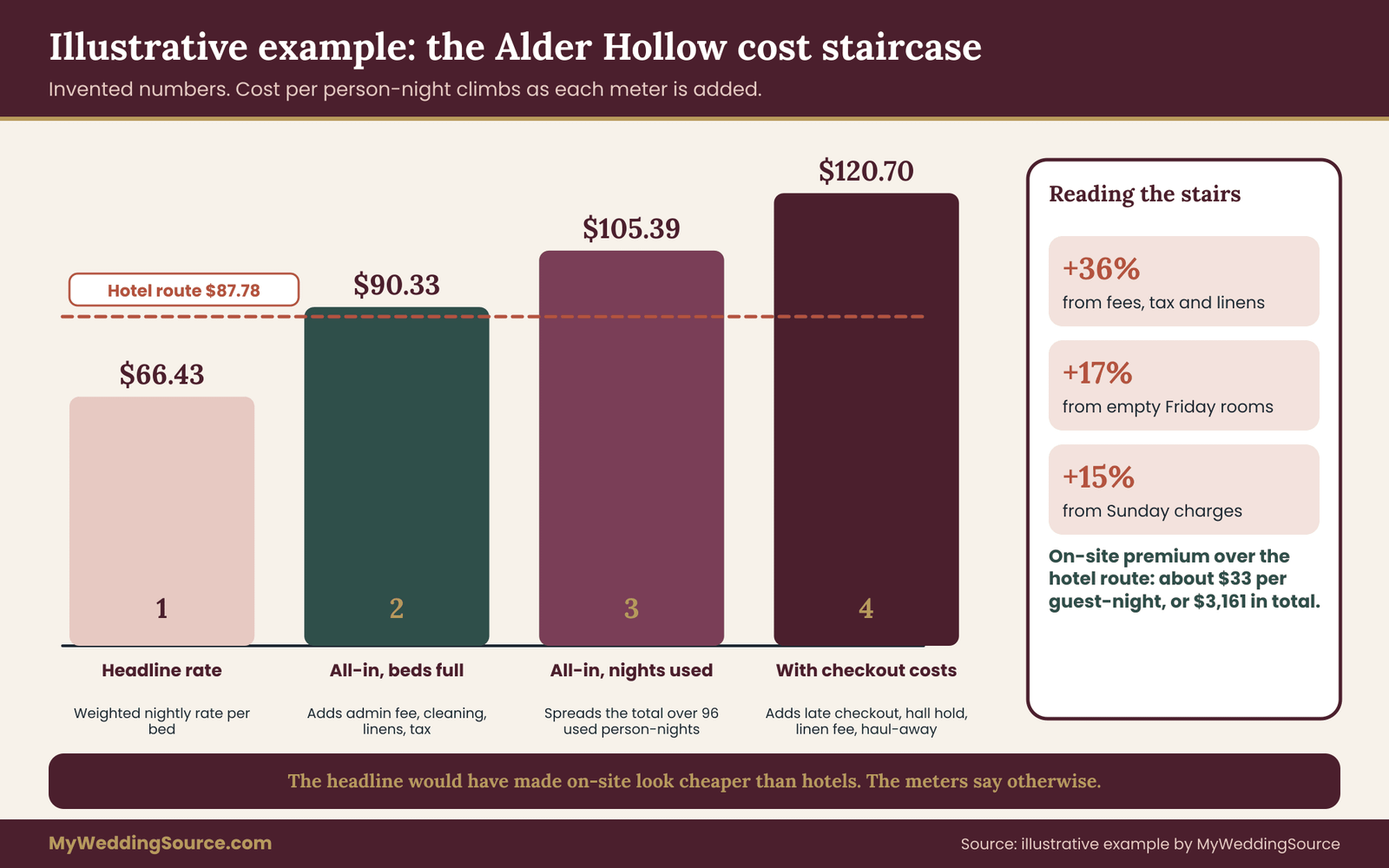
The staircase above shows the climb from the headline rate to the number the couple will actually pay. Each step is a meter, and each meter points to a different conversation.
The checkout step finishes the venue lodging budget, and it also gives the couple a list of conversations to have before the weekend.
The comparison route
Now price a hotel route for the same guests. Assume, again as an invented figure, that nearby hotels offer rooms at one hundred forty dollars a night, with a twelve percent tax, two guests per room. Twenty rooms are needed on Friday and twenty-eight on Saturday, forty-eight room-nights. At one hundred fifty-six dollars eighty cents per room-night including tax, that is about seventy-five hundred twenty-six dollars.
Add nine hundred dollars for a shuttle between hotel and venue over both evenings. The hotel route totals about eighty-four hundred twenty-six dollars, or about eighty-seven dollars seventy-eight cents per person-night.
The difference between the routes is about thirty-one hundred sixty dollars, or about thirty-three dollars per person-night. That is the premium for sleeping on site in this invented case.
This comparison uses the same three-meter logic, so the hotel route and the venue lodging budget are measured in the same unit.
Reading the result
The couple can now ask a precise question: is the shared stay worth about thirty-three dollars per guest-night? If they would pay it happily, they have an informed yes. If not, three levers appear. Meter two suggests negotiating a Friday release for the eight empty rooms, which could remove about fourteen hundred dollars.
Meter three suggests a noon checkout block priced in advance, and a brunch outdoors rather than a hall hold, which could trim several hundred more. And the hybrid answer suggests moving the Friday-only guests to a hotel.
Notice what the headline would have said. At sixty-six dollars per bed-night, the on-site route looked cheaper than the hotel route at the same per-night level. At the all-in, used-nights, checkout-inclusive figure, it is not. The method does not tell the couple what to choose. It tells them what they are choosing between.
The result gives the couple a decision about the venue lodging budget instead of a feeling about it.
What the case leaves out
Every real quote has details this one omits. Some properties include breakfast. Some charge by the bed. Some tax only the room. Some have a house rule that forbids shuttles. A few offer a lower price for a longer stay. Your own numbers will differ, and the right comparison may favor the on-site route comfortably. Run the meters on your own quote and trust the result over the example.
Verification: what to confirm in writing and who can confirm it
Numbers are only as good as their sources. Before you rely on any meter, confirm the facts behind it with the party who is authorized to state them. Some facts belong to the venue, some to a local authority, and some to a land agency.
Facts the venue must put in writing
The venue can state its own rates and fees. Ask for a written rate sheet that names every nightly rate, every per-night, per-stay and per-person fee, the taxable lines, the minimum-stay rule with its exact wording, the checkout and late-checkout terms, the cleaning and damage schedule, the deposit terms and the cancellation and release rules for lodging units.
A written proposal is a better start than a phone call, and a signed contract is better still. If the contract and the proposal differ, the contract controls, so read the contract against the proposal line by line. Vetting a lodging venue the way you would vet any vendor, by checking licenses, insurance and references, is worth an extra hour.
A written rate sheet is the foundation of every number in the venue lodging budget, so ask for it first.
Facts a local authority sets
Occupancy limits, fire rules and lodging taxes come from local and state authorities. A venue can tell you what it believes, but the fire marshal or building department confirms the legal sleeping capacity, and the state or local tax office confirms which lines are taxable. If a number in your venue lodging budget depends on one of these facts, ask the venue to cite the permit, certificate or tax rule it relies on.
Fire restrictions can also change with the season. Burn bans, fire-pit rules and campfire limits may apply on the dates you choose, and they are set by local fire officials or land agencies. A venue can tell you the current rule, but conditions change, so ask what happens to your plan if a ban is in force on the day.
If a local rule changes the bed count, the venue lodging budget changes with it, so confirm before you commit.
Facts a land agency sets
If the venue is inside or adjacent to public land, the land agency may govern group use, capacity, vehicles and fire. The National Park Service, the U.S. Forest Service and state park systems publish their rules, and recreation.gov handles reservations for many federal sites. A private venue on its own land is governed by local rules, while a concession or permit on public land adds agency terms.
Facts about fees and disclosure
The Federal Trade Commission has published rules about unfair or deceptive fees that cover some short-term lodging and live-event pricing. Whether a rule reaches a particular wedding venue’s lodging is a legal question this guide cannot settle, and a lawyer or the agency’s own guidance can say. The practical point stands regardless: a fee you cannot see in the quoted price should be disclosed before you pay, and a missing line is a reason to ask.
Keep a lodging file
Keep one folder with the rate sheet, the proposal, the signed contract, your meter worksheet, every email that changes a term and the photos from check-in. If a dispute arises, a file that shows what was quoted and what was agreed is worth more than memory. Store it where both partners can find it, and keep it until every deposit has been returned and every invoice is settled.
If the numbers come out and you still have doubts, a short call with someone who has run overnight events can help. A retreat operator, an event transportation coordinator or a seasoned planner will know which fees are normal in your region and which are padding. Treat their answer as informed opinion, and confirm facts with the issuing source.
The file also supports the venue lodging budget after the weekend, when you reconcile actual charges against the plan.
Failure conditions: when your venue lodging budget says stop
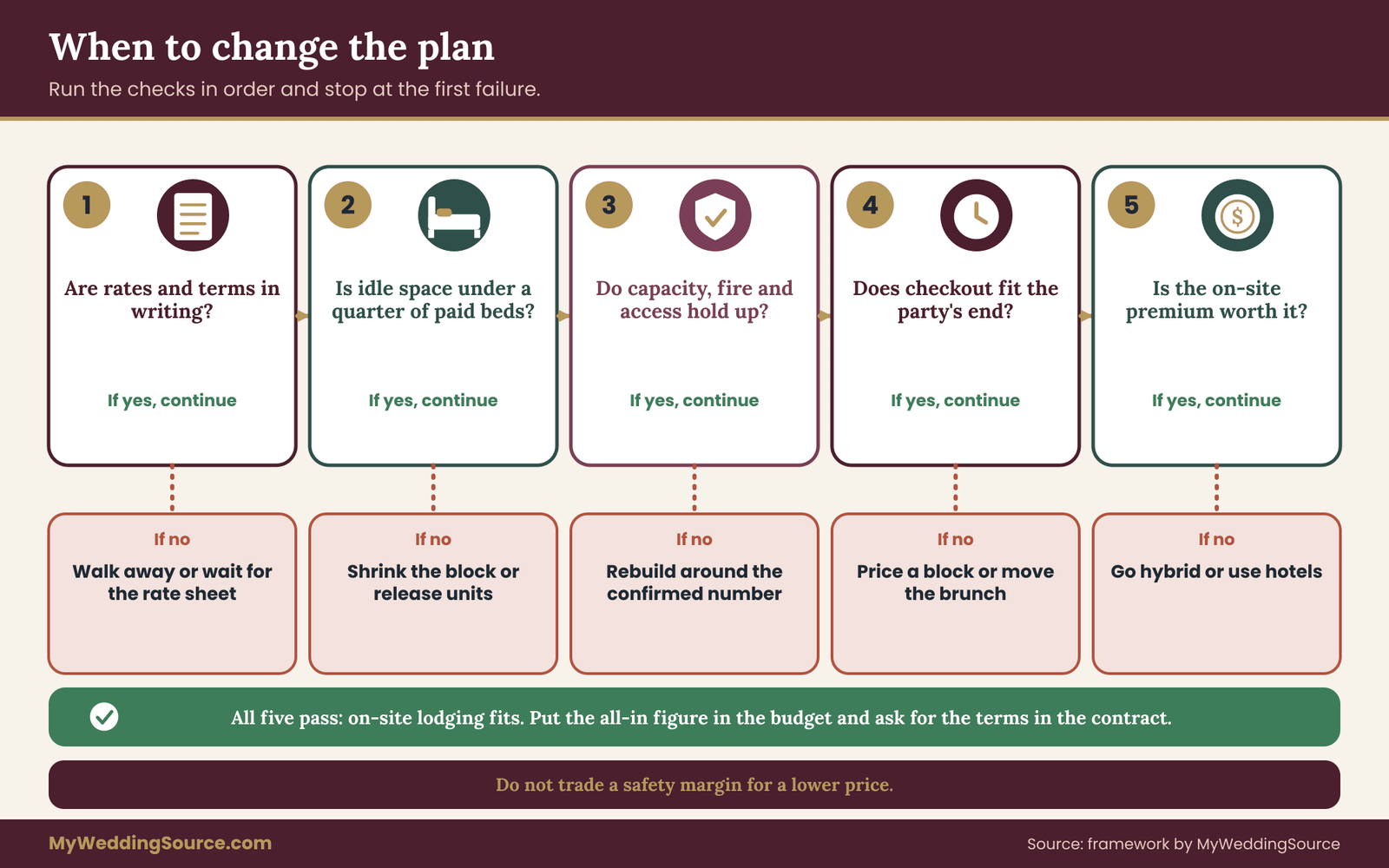
A method is only useful if it can say no. The meters will not decide for you, but they can show you conditions under which the on-site plan should change, shrink or end. These are the failure conditions worth writing down before you sign, so you do not argue with yourself later.
The minimum exceeds your honest headcount
If the venue requires more beds than your certain-and-likely guests can fill, and the venue will not release units or credit resales, meter two will stay high. When idle bed-nights approach a quarter or more of the beds you pay for, the venue is probably sized for a larger event. Either shrink the commitment, find a smaller venue or accept the cost knowingly.
The all-in figure is far above the hotel route and the premium buys nothing you want
If the on-site premium per person-night is large and your reasons for staying on site are weak, say, because most guests will leave after the reception anyway, the premium is paying for beds that do not matter. Move guests to hotels and keep the venue for the day.
The contract will not put lodging terms in writing
If the venue will not state rates, fees, taxes, minimums and checkout rules in writing, you cannot run the meters, and you cannot dispute a charge later. This is the plainest reason to walk away, and it costs nothing to test: ask for the rate sheet and see how long it takes.
Capacity, fire or access rules do not support your plan
If the legal sleeping capacity is lower than the advertised bed count, if a fire restriction can close the fire pit or the cabins on your dates, or if the access paths cannot serve the guests who need them, the plan has a safety problem and not only a money problem. Do not trade a safety margin for a lower price. Ask the local authority or land agency to confirm the rule, and rebuild the plan around the confirmed number.
The checkout rules do not fit the weekend
If checkout falls hours before the party’s end could realistically allow guests to leave, and the venue will not move it or price a block in advance, meter three will punish you. A venue that cannot flex Sunday morning is a poor fit for a late reception, and a shorter reception or a different venue may serve better.
Guests cannot afford the beds
If your guest-paid beds cost more than a meaningful share of your guests can spend, you will either lose attendees or end up covering the gap. Neither is a budgeting failure on its own, but both belong in the plan. Offer a lower-cost lane or reduce the guest list for the overnight portion.
One missing document
If you cannot get any of the following, treat the plan as unconfirmed: the rate sheet, the signed minimum-stay wording, the written legal capacity or the cancellation terms for lodging. Missing paper is the most common root of lodging disputes.
No venue lodging budget is stronger than the documents behind it, and missing paper is the first thing to fix.
Alternatives to a full on-site stay
Failing a condition does not end the weekend. It points to a different shape. Several alternatives keep much of the appeal at a different cost.
Partial on-site lodging
Book only the units you will fill on both nights, usually family and the wedding party, and send others elsewhere. This removes most of meter two and keeps the shared evening. The tradeoff is the second system for the rest of your guests.
A partial block gives you a smaller venue lodging budget and a clearer count, and it keeps the shared evening for the people who matter most to you.
One night instead of two
If the venue allows a single-night stay for part of the inventory, shorten the stay for most guests to Saturday only. The Friday welcome can move to a restaurant or a hotel lounge in town. This only works if the venue’s minimum permits it, so ask early.
Venue for the day, hotels for the night
Use the venue for the ceremony and reception, and arrange hotels with a shuttle. The room-block and hotel planning guide explains how to set up blocks and budget tiers. The cost per person-night often falls, but transport and late-night logistics need real attention.
A nearby second property
If a neighboring inn, cabin rental or campground has beds at a lower price, a hybrid with two properties may fit. Compare it using the same three meters, including a transport figure between the properties.
Rental houses
Large rental houses can sleep a family group for a flat price. They bring their own rules on events, capacity and neighbors, so confirm that the host and the local authority allow wedding-related gatherings. A house is a lodging choice, not a venue, and its meters look different: fewer fees, but cleaning rules and deposits still apply.
Run a rental house through the same meters, and the venue lodging budget will show how it compares with a cabin block.
Your next steps
Work through the steps in order. Each one takes an evening or less.
First, request the written rate sheet and the minimum-stay wording from every venue you are considering, using the single-message template from the second section on hidden fees. Second, count your guests in three passes for each night, and set a planning number. Third, run meter one on every quote and write the all-in cost per person-night beside the headline.
Fourth, run meter two with your planning number and price the idle units. Fifth, run meter three with your Saturday and Sunday timeline and list every Sunday charge. Sixth, price the hotel route with transport and compare it in cost per person-night.
Seventh, decide the payment model, host-paid, guest-paid or split, and write the rule in plain words for guests. Eighth, ask for the release date, the resale credit and the checkout block in the contract. Finally, return to the broader wedding venues overview if you are still choosing between sites, and fold the final lodging figure into your overall budget tracker so it sits beside every other cost.
FAQ
What is a venue lodging budget?
A venue lodging budget is the full cost of sleeping guests at the wedding venue: nightly rates, fees, taxes, linens, cleaning, minimum-night charges and checkout costs. Counting these separately from the venue fee shows what each guest night really costs and lets you compare it with a hotel route that includes transport.
How do I find the real price of a cabin or room?
Add the nightly rate, every per-night, per-stay and per-person fee, optional items you will certainly take, and the taxes on the taxable lines. Divide by the person-nights that would use those beds. Compare the result with the headline rate to see how much sits outside the advertised price.
What is a minimum-night rule, and why does it matter?
A minimum-night rule requires you to book a set number of nights, often two around a Saturday event. It matters because you pay for units that sit empty on nights fewer guests need. Ask whether the rule applies to each guest or the booking as a whole, and whether unused units can be released.
Who pays if a guest does not book a cabin?
It depends on the contract. Some venues hold units for guests to book until a cutoff and then release them. Others make you guarantee the block, which leaves you liable for unbooked units. Ask who owes for an unbooked unit, from what date, and for how many nights, and get the answer in writing.
What checkout costs should I expect?
Common items are late-checkout fees, a hall hold for a Sunday brunch, cleaning or linen surcharges, décor haul-away fees and damage deposits. Amounts vary by venue. Ask for each in advance, assign a checkout contact on your side, and photograph units at arrival so you can dispute charges for existing damage.
Is on-site lodging cheaper than hotels?
Not necessarily. Compare both in cost per person-night using the same guests and nights, and include fees, taxes, idle units, checkout costs and, for hotels, shuttles or rides. The difference is the premium for sleeping on site, and you can then decide whether the shared evening is worth it.
How do I check capacity and fire rules?
Ask the venue to state the legal sleeping capacity for each unit in writing and to name the permit or rule behind it. Local fire and building officials confirm capacity, and land agencies publish their own rules on public land. Ask what happens to your plan if a burn ban applies.
Can I mix on-site lodging and hotels?
Yes, and many couples do. Put the core group on site, size the block to the guests who will certainly use it, and offer nearby hotels at several price levels for everyone else. A hybrid reduces idle bed-nights, but it adds a second system to manage and communicate.
Sources
- National Park Service: group use, camping and fire guidance for park units.
- U.S. Forest Service: campground, cabin and group-use rules on national forests.
- Recreation.gov: federal campground and cabin reservations and policies.
- ADA.gov, U.S. Department of Justice: accessibility obligations for lodging and service-animal rules.
- Federal Trade Commission: consumer guidance on fees and price disclosure.
- Consumer Financial Protection Bureau: consumer guidance on deposits, payments and disputes.
- U.S. Fire Administration: fire safety guidance for lodging and gatherings.
- National Fire Protection Association: fire and life-safety codes and public education.
- National Association of Insurance Commissioners: consumer information on event and liability insurance.