
A due date wedding is a wedding set within a few weeks of the baby’s estimated arrival, on either side. The date you are guarding is not one you can book, and the contracts you signed do not know that. This guide gives you a contract flexibility and rescheduling trigger workbook: five short sheets that turn the conflict into dates, clauses, triggers and a decision order you can follow calmly.
For a due date wedding, do not start by asking whether to move. Start by writing down three dates: the estimated due date, the wedding date, and the dates your clinician gives you for travel and long events. Then audit every contract for its lock date, the day after which money cannot be recovered, and compare it with the day you will know more. Agree on if-then triggers in advance, and follow a fixed ladder: hold, move, shrink, split, or substitute. Decide the cheap steps early, the expensive ones late.
Couples who find themselves in this spot usually describe it the same way. The venue is booked, the invitations are drafted, and then a positive test, a first scan, or a conversation about timing shows that the baby is expected within days or weeks of the wedding. Joy arrives first. Close behind it comes a quieter question: what happens to everything we already signed?
Most advice at this point is either reassurance or alarm. Reassurance says babies are unpredictable and everything will work out, which may be true but gives you nothing to do on Monday. Alarm says to cancel everything, which may be unnecessary and expensive. Neither one helps with a deposit schedule, a lock date and a guest list that includes people with flight tickets. A due date wedding deserves a plan that treats both dates seriously.
This article is narrower than a general guide to planning during pregnancy. It does not tell you how to feel, what to wear or how to pace the day. It deals with one problem: a contract set with a fixed date, and a due date that cannot be fixed. It gives you a method for finding out how much room your due date wedding contracts really leave, where the risk concentrates, and what to decide first. Every sheet here is built for a due date wedding specifically, and not for weddings in general.
A note on scope. This is general planning information, not medical, legal or financial advice. Every medical question, including how far you can travel, how long you can stand, and whether you should attend a long event at a given stage, belongs with your own obstetric clinician or midwife, who knows your history. Contract terms differ by supplier and state, so confirm each one in the document you signed or with the business directly.
What counts as a due date wedding, and what the date really means
For this guide, a due date wedding is any wedding where the estimated due date falls close enough to the wedding date that one could affect the other. There is no official definition, and it would be a mistake to invent a cut-off. In practice it covers three situations: the wedding is scheduled a few weeks before the due date, the wedding is scheduled in the first weeks after the birth, and the wedding is scheduled around the due date itself, within a week or so either way.
The third case is the sharpest, and the first two matter more often.
A wedding scheduled six weeks before the due date still has a contract problem if the clinician later advises against long travel at that stage. A wedding six weeks after the due date still has a problem if recovery or feeding takes more energy than expected. The method in this guide works for all three because it starts with the contract and not with the calendar alone. Any due date wedding that falls in one of these three situations can use the same method.
Why the due date is an estimate, not an appointment
The estimated due date is a calculated date, usually counted forward from the last menstrual period and often refined by an early ultrasound. It marks the middle of a range, not a deadline. The American College of Obstetricians and Gynecologists describes a span of weeks in which a birth is considered early term, full term, late term or post term, and a baby can arrive in any of them. Your clinician may also adjust the date as the pregnancy goes on.
That has a plain consequence for planning. The date on the calendar is a center point, and the real arrival could land weeks before or, less often, a little after. You cannot plan around one day. You plan around a band of days, and you plan for the possibility that the band shifts. In a due date wedding the band of days matters more than the single date.
Nothing in this guide interprets your own medical situation. If your clinician has told you something specific about your pregnancy, such as a higher chance of early delivery, that guidance overrides every general assumption here. Treat the due date wedding workbook as the place where that guidance gets translated into contract decisions.
The three clocks in a due date wedding
Every due date wedding runs on three clocks that do not start or stop together. The first is the medical clock, which belongs to you and your clinician. It produces the due date, the checkup schedule and the advice on travel and activity. You cannot negotiate with it.
The second is the contract clock, which belongs to your suppliers. It produces deposit dates, final headcount dates, rescheduling deadlines and cancellation tiers. It is the only clock you can negotiate with, and it usually runs earliest. Venues and caterers often set their firm dates months before the event, long before anyone can say how a pregnancy will go.
The third is the family clock. It includes guests who must buy tickets, relatives who will help with care, an older child’s school schedule, a parent’s leave from work, and your own leave arrangements. This clock is the easiest to forget and the most visible to guests.
The due date wedding workbook exists because the contract clock tends to commit you while the medical clock still has the most uncertainty. Seeing the two side by side, in actual dates, is the first useful thing you can do. The rest of the guide builds on that picture, and it links to the wider guide on choosing a wedding date around guest availability, vendor capacity and travel disruptions when the conversation shifts from one conflict to the whole calendar.
What this workbook does and does not do
The workbook does five things. It records the key dates. It audits contracts for flexibility. It identifies when you are betting rather than deciding. It sets triggers so that decisions are made in advance rather than in a rush. It defines a ladder of responses so that the first move is the cheapest one.
It does not predict the birth. It does not tell you whether to hold the wedding, and it does not replace the advice of your clinician or a contract review by a qualified person if you have a dispute. What it does is make sure that when the question comes up, you are choosing from options you identified weeks earlier, with the facts already in front of you.
One more point about tone. Many couples in this situation feel pressure to prove that nothing needs to change. Others feel pressure to cancel quickly to protect everyone else. Both are reactions to uncertainty, and neither is a plan. A workbook is useful here because it is boring in the right way: it replaces a feeling with a date and a next action.
Who should fill in the workbook
Fill it in together, and write it where both partners can see it. One partner is usually carrying the pregnancy and the medical conversations; the other often holds the contracts. Both halves need to meet in one document. If one of you is the primary planner, share the file with a trusted third person, such as a parent or a close friend, who can read it and act if you cannot. A due date wedding is a shared project, so the paperwork should be shared too.
A good rule is that the person who is pregnant owns the medical sheet and the trigger decisions that depend on clinical advice, and the other partner owns the supplier conversations until a trigger fires. That split keeps one person from having to negotiate with a venue manager while also managing a pregnancy. It also keeps the conversation with suppliers businesslike, since the person making the calls works from a sheet rather than from worry.
If you work with a planner or day-of coordinator, they should see the due date wedding clause audit and the trigger register. They often know which suppliers bend and which do not, and they can speak to a venue without making it a personal conversation. A planner cannot give medical advice, so keep the clinical dates as inputs you supply, not as questions you ask them to judge.
The due date wedding workbook: five sheets in one evening
The due date wedding workbook is five sheets, and each one answers a single question. You can build it in a shared document, a notes app or on paper. It does not need formulas. It needs honest dates and a clear owner for each line.
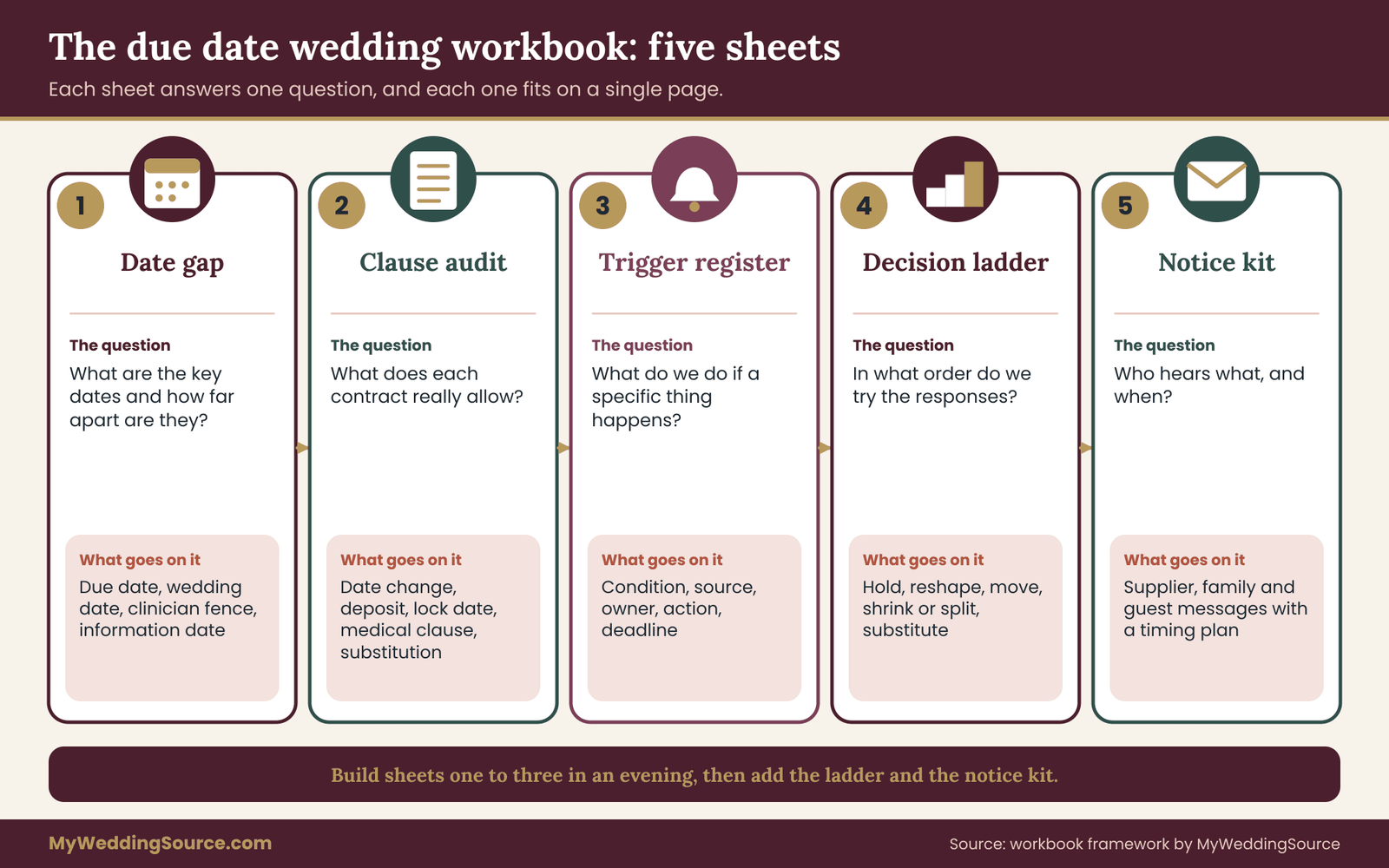
Sheet one, the date gap. What are the key dates, and how far apart are they? This sheet holds the estimated due date, the wedding date, the clinician’s guidance dates, and the gap between them counted in days.
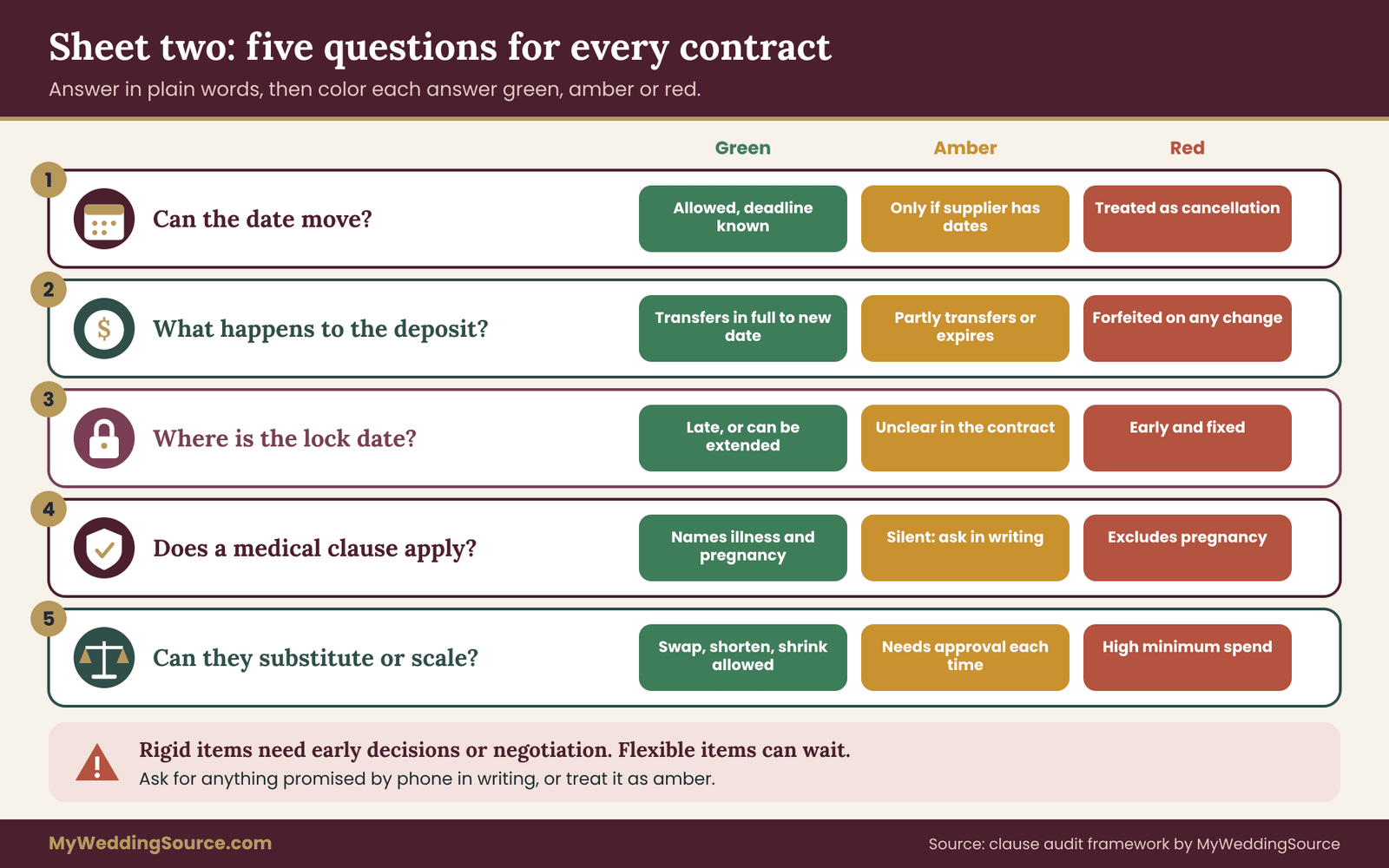
Sheet two, the due date wedding clause audit. What does each contract actually allow? For every supplier you write the same five answers: can the date move, what happens to the deposit, when does the lock date fall, does an illness or medical clause apply, and can the supplier substitute or scale.
Sheet three, the trigger register. What will we do if a specific thing happens? Each line has a condition, a decision owner, an action and a deadline. The point is to decide while you are calm.
Sheet four, the decision ladder. In what order do we try the responses? You list the options from cheapest and most reversible to most expensive, and you commit to trying them in that order.
Sheet five, the notice kit. Who needs to hear what, and when? It holds short scripts for suppliers, a guest message and a timing plan, so that notice goes out on a schedule and not in a panic.
How long it takes and what you need
Plan one evening for sheets one to three and a second short session for sheets four and five. Gather every signed contract, every quote that turned into an order, every invoice and any rider, addendum or email that changed the terms. If a supplier promised something by phone and never wrote it down, put that on a list titled “verbal only,” because verbal promises do not count as flexibility until they are in writing. A first pass at a due date wedding takes less time than most couples expect.
You will also need the date of your next clinician visit and, if possible, a short conversation about what your clinician advises for travel and long events at the relevant weeks. You do not need a diagnosis or a prediction, only the guidance dates. The next section explains exactly what to ask.
The wider routine of tracking supplier dates is covered in the guide to the wedding vendor timeline, and this due date wedding workbook sits on top of it. If you already keep a timeline, add the lock dates from sheet two to it. If you do not, the lock-date list becomes your first timeline.
Sheet one: the date gap and the clinician fence
Sheet one has six lines. It looks simple, and it is, but the act of writing the dates in one place does most of the work. Many couples discover that the date they had in mind as the risk window is much earlier or later than the one the contracts imply. A due date wedding makes exact dates unusually important.
Line one: the estimated due date. Write the date exactly as your clinician gave it, and note when it was set and whether it came from a scan. If the date changes at a later visit, change the line and the date stamp, not the old line. A record of how the date moved is useful when you talk to suppliers.
Line two: the wedding date. Write the ceremony date and, separately, the date of any rehearsal dinner, welcome event or next-day brunch that would also be affected. A wedding weekend is a longer exposure than a single evening.
Line three: the gap. Count the days between the due date and the wedding date. If the wedding is before the due date, call the gap positive. If it falls after, call it negative. A positive gap of fourteen days means the wedding is two weeks before the estimate. A negative gap of twenty-one days means the wedding is three weeks after it.
The clinician fence: two dates to ask for
Lines four and five are the most important ones, and they are the two you cannot fill in yourself. Ask your clinician or midwife for two dates. The first is the date after which they would advise you not to travel for an event, or not to take part in a long one. The second is the earliest date they would expect you to be ready for a long day after the birth.
Call these two dates the clinician fence. The first is the near fence and the second is the far fence. Between them is a stretch of time in which a full wedding day is something your clinician is unlikely to recommend, and you can write the width of that stretch in days.
Here is how to ask. You do not need to ask for a medical opinion on whether you will go into labor. You can say something like: “We have an event on this date and want to plan around your guidance. After what week would you advise us against travel, and after what week would you advise against a long standing event? And how soon after birth do you usually suggest people wait before something like this?”
Notice what the question does. It asks for guidance in weeks, which you can convert into dates. It does not ask for a promise. If your clinician says that it depends, ask what it depends on and when you will know. That answer becomes a trigger later.
If you cannot reach your clinician before you must make a decision, do not substitute a guess from an article, including this one. Write “fence unknown” on the sheet, treat that as the most urgent line, and let it drive the choice of the first cheap steps. A missing fence is itself a reason to pay for flexibility.
Line six: the information date
The last line on sheet one is the information date: the next date on which you will learn something that changes the picture. It might be a scheduled scan, a routine checkup, the date a clinician said they would review the estimate, or a milestone week at which the guidance changes. Choose one real date, and write it down.
The information date is what gives the lock-before-information test in the next part its edge. If your information date falls after the lock date on a contract, you are about to commit money before you can learn anything new. If it falls before, you have time to decide with better facts.
You can have more than one information date. Write the next one and update it as visits pass. Do not make up information dates, and do not count on a clinic visit that has not been scheduled. A date you cannot point to on a calendar is not an information date.
Reading the gap for a wedding before the due date
Suppose the gap is positive and larger than the near fence suggests. The wedding falls comfortably before the clinician’s cut-off, and the main risk is early arrival, not the clinician’s advice. In that case the contracts you worry about are the ones that are hardest to move on short notice, mainly the venue, the caterer and any travel-heavy suppliers. In this version of a due date wedding the risk is mostly about timing and notice.
Your questions on sheet two will concentrate on the notice period and on what each supplier does if you must move the date in the final weeks. The trigger register will need a line for early labor and another for a clinician’s change of advice. The decision ladder will usually begin with holding the date and adjusting the shape of the day, as described in the section on the due date wedding ladder.
Suppose instead the gap is small or the wedding falls after the near fence. Then the date itself conflicts with the guidance, and the real question is whether the date should move. Sheet two then becomes a rescheduling audit, and the lock-before-information test becomes the center of the work. The same sheets apply; the order of attention changes.
Reading the gap for a wedding after the birth
If the wedding falls after the due date, the gap is negative and the far fence matters most. Most contract trouble in this case comes from two things. First, the birth can come early or late, which moves the whole recovery period. Second, the first weeks with a newborn take attention and sleep that no calendar shows. This kind of due date wedding is more about recovery than about travel.
Your sheet two audit should look for flexibility in the final headcount date, in the hair and makeup booking, in the photographer’s hours and in anything fitted to a body that is changing. The trigger register needs a line for “baby arrives earlier or later than expected,” because a shift of a couple of weeks can change which options remain.
A wedding after the birth gives you more information before the lock dates arrive, since the due date will be closer. That can make the lock-before-information test favorable, but only for contracts whose lock dates fall late. Venues and caterers often lock early, so the due date wedding test will usually fail for them.
Common mistakes on sheet one
Three mistakes show up repeatedly. The first is treating the due date as the only date that matters. The clinician fence and the information date are what turn the gap into a decision. The second is rounding: a wedding “about a month before” the due date is not a date, and contract dates are exact. Count real days.
The third is leaving sheet one unfinished because the dates feel uncertain. The workbook is built for uncertainty. A line that says “estimated due date: not yet confirmed; scan on the fourteenth” is a complete line. It tells you what to do next. A blank line tells you nothing.
Sheet two: auditing every contract for a due date wedding
Sheet two is the heart of the due date wedding workbook. For each supplier, you read the actual contract and answer five questions in plain words, quoting the clause number where you can. Then you give each answer a color: green for clear flexibility, amber for flexibility that depends on the supplier’s goodwill or on unknown terms, and red for a hard limit. Reading the contracts closely is the most useful hour you can spend on a due date wedding.
The general habits of reading a supplier agreement are covered in the guide to the wedding vendor contract, including what a good clause looks like. This section does not repeat them. It applies a narrower lens: for a due date wedding, which parts of a contract decide whether you can move, shrink or substitute, and what do they cost?
Question one: can the date move, and on what terms?
Look for the words “reschedule,” “change of date,” “postpone” or “transfer.” Some contracts allow one date change at no charge before a stated deadline. Others allow a change only when the supplier has another open date. Others do not mention it at all, which usually means a date change is treated as a cancellation and a new booking.
Write down three facts: whether a change is allowed, the deadline for requesting it, and the fee or rate difference. If the contract says the supplier will “make reasonable efforts” to offer another date, mark amber. Reasonable efforts is not a right.
A date change clause is only as good as the supplier’s calendar. A venue that books out far ahead may have nothing open in the period you need. For that reason, write the supplier’s earliest open dates in the margin once you ask. Flexibility with no available dates is an empty promise. Ask every supplier for open dates before you plan a due date wedding around a move.
Question two: what happens to the deposit?
Deposits behave in three ways. They can be refundable, in whole or in part, up to a date. They can be transferable, meaning they carry to a new date as a credit. Or they can be forfeited, meaning they are gone if you move or cancel. Many contracts mix these: a retainer that is non-refundable and a second payment that is transferable.
Ask which parts of the money fall into which group, and write the answer next to each payment. A transferable deposit is much more valuable to you than the same amount of refundable cash if you plan to hold the event with the same supplier at a different date. A refundable amount matters more if you might cancel.
Also check for a credit expiry. A deposit credit that must be used within a stated number of months can become useless if the new date is outside that period. Mark the expiry in the margin, and ask for it in writing when you negotiate a change.
Question three: where is the lock date?
The lock date is the day on which your flexibility ends. After it, a change costs more, or a cancellation forfeits the next payment, or the supplier stops holding the original slot. Contracts rarely use the phrase “lock date.” They use final headcount deadlines, final payment dates, cancellation tiers or “no changes within X days.”
Read every dated obligation and find the one after which the economics change. Write it with its consequence: “after this date, ninety percent of the fee is due whatever happens” or “after this date the date cannot move.” A contract can have several lock dates, and sheet two should list each.
Do this carefully for caterers, who often lock the guest count and the menu earlier than people expect, and for any supplier who orders goods for you, such as flowers, a cake or rentals. Those suppliers have costs that become sunk costs on a specific day. You can learn a lot about their flexibility by asking what that day is.
Question four: does a medical or illness clause apply?
Most wedding contracts include a clause about events beyond the parties’ control, often called force majeure. These clauses are usually written around weather, public emergencies, venue damage or the supplier’s inability to perform. Fewer name illness, and fewer still name pregnancy or childbirth. A silent clause matters more in a due date wedding than in an ordinary booking.
Do not assume. Read the clause and note exactly what it lists. If it says “illness of the couple,” ask whether that covers hospitalization or medical advice to avoid an event. If it is silent about pregnancy, mark that clearly. A silent clause is neither a yes nor a no; it is a question to put to the supplier before you rely on it.
It is also worth checking whether any event insurance you hold lists pregnancy or childbirth as an exclusion or limit. Many policies do list them, and the terms vary, so read the policy and ask the issuer in writing. The National Association of Insurance Commissioners publishes consumer resources on how to understand and compare coverage, and your state insurance department can explain your options.
Question five: can the supplier substitute, scale or shorten?
Not every problem needs a new date. A contract that allows a substitute photographer, a shorter booking window, a smaller guest count or a changed start time gives you room to adjust the shape of the day without moving the date. This is the quietest kind of flexibility and often the cheapest.
Look for clauses on replacement personnel, since a photographer or DJ who falls ill is a problem the supplier has probably planned for. Look for minimums: a caterer’s minimum spend or a venue’s minimum guest count can make shrinking costlier than it appears. Look for overtime and early-start charges, since shifting a ceremony earlier or later can trigger them.
A guest count minimum deserves special care. If your contract holds a floor that is higher than the smaller wedding you might need, the saving from shrinking disappears. Write the floor on sheet two and compare it with the smallest version of the day you would accept.
Scoring and the summary line
After the five questions, give each supplier a short summary line. Count the greens, ambers and reds. A supplier with three or more greens, including a clear deposit rule, is a flexible partner for this purpose. A supplier with two or more reds, especially on date change and deposit, is a fixed point around which the rest must bend.
Keep the scoring simple. You are not ranking suppliers; you are finding where the plan is rigid. Rigid items need earlier decisions or negotiation, and flexible items can wait. You will use the summary lines on the next sheets to decide which contract to approach first.
If you are still comparing suppliers, the same five questions make good screening questions. Add them to the checklist in the guide to wedding vendor due diligence and ask them before you sign. A supplier who answers them clearly before you hire is easier to work with later.
Which suppliers usually matter most
Not every contract carries equal weight. In most weddings, four categories decide the outcome. The venue is the largest fixed point, since the date, the space and often the catering all hang on it. The caterer holds the largest variable cost, tied to guest count. The photographer and videographer are single-date, single-person services where substitution is a real issue. And any supplier who travels, such as a band or an officiant from another city, adds a logistics layer.
Smaller items matter in different ways. Attire and alterations depend on timing and fit, and a date change may require a new schedule of fittings. Flowers and cake are perishable and tied to a specific delivery date, so their lock dates fall late but their changes are limited. Rentals often have flexible return dates and tight reservation rules.
Start with the venue and the caterer, because they set the cost of every other decision. If they are flexible, a change of date is a paperwork problem. If they are not, you are deciding how much you are willing to lose or how much you are willing to change the shape of the day. The first call in any due date wedding should go to the venue.
The “verbal only” list
During the due date wedding audit you will find promises that exist only in conversation or in a chat message. A venue coordinator might have said that moving the date “would not be a problem.” A caterer might have offered to hold your slot. These statements are useful signals about attitude and not much else.
Keep a separate list titled “verbal only,” and give each item an action: ask the supplier to confirm in writing, or treat the item as not available. A confirmation can be as short as an email that says, “As we discussed, you will allow one date change at no charge until the date stated, and the deposit transfers in full.” Written clarity protects both sides.
What to do with an unreadable or missing contract
Sometimes you will find that a contract is vague, or that you cannot find the signed copy. Ask the supplier for a copy, and ask them to confirm which version is current if there have been amendments. If a supplier will not provide the contract, note it as red and treat the relationship with care.
If a contract is long and the terms are complex, or if a supplier disputes what you are owed, a lawyer who works with consumer or small-business matters can read it for you. The due date wedding workbook helps you ask good questions; it does not replace a legal review when money or a dispute is at stake.
Putting sheet two together
When the audit is done, you should have one page per supplier and one summary list. The summary list shows, for each supplier, the date-change rule, the deposit rule, the lock dates, the medical clause status, the substitution rights and the color count. It also lists the “verbal only” items.
Read the summary once as a whole. Patterns will appear. You may find that every supplier locks within the same three-week stretch, or that one large contract has no flexibility at all. You may find that the photographer is flexible and the venue is not. Those patterns tell you where the conversation with a supplier should start and what the first trigger lines should be.
The lock-before-information test for a due date wedding
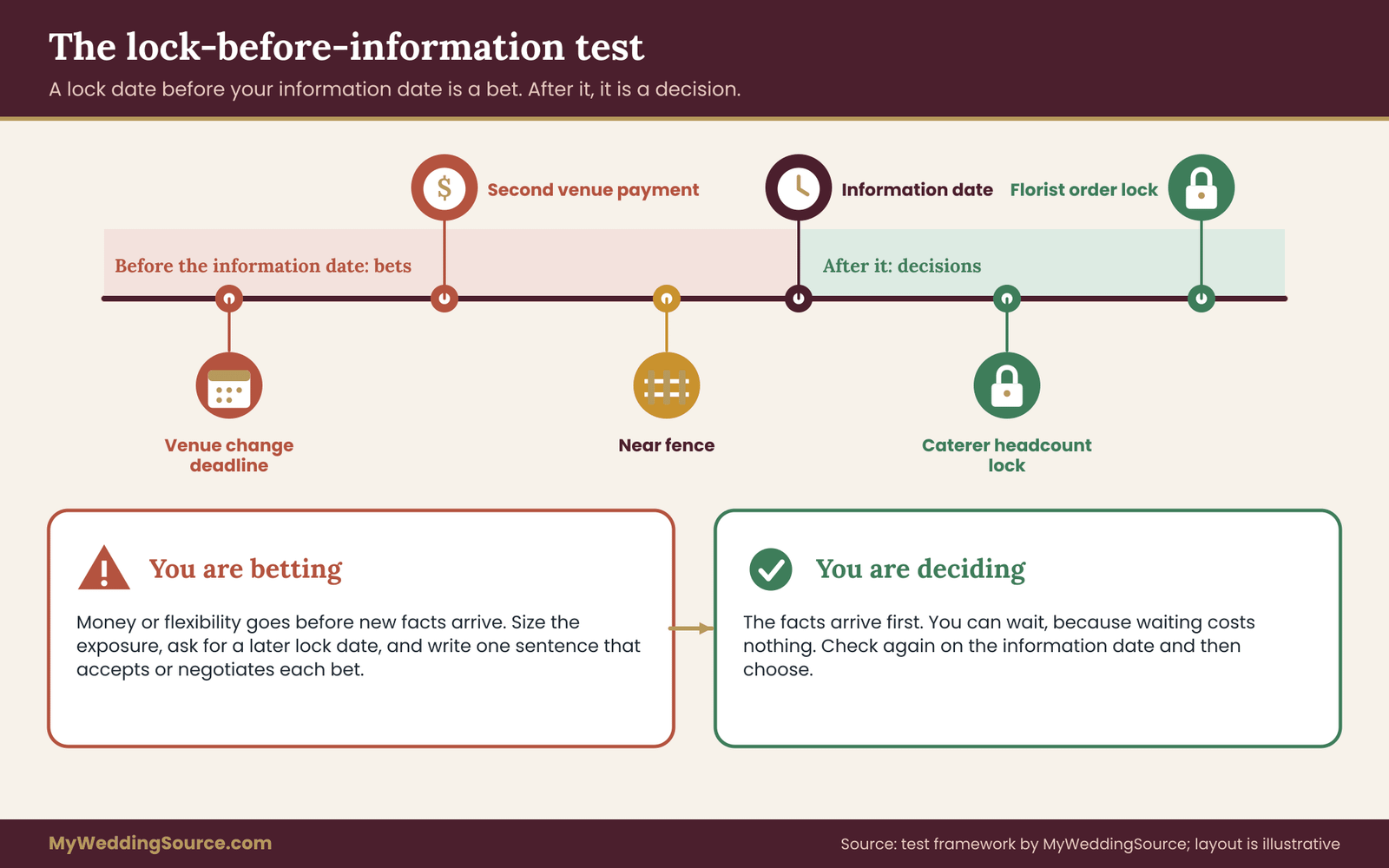
Once sheets one and two are filled in, you can run the one calculation that matters most. For each contract, compare its lock date with your information date. This is the lock-before-information test, and it separates two kinds of decisions that look identical from the outside.
If the lock date falls after you will learn more, you are deciding. You can wait, because waiting costs nothing and the facts may improve. If the lock date falls before you will learn more, you are betting. You must commit money or give up flexibility before the facts arrive, and the only question is how much risk to carry.
How to run the test
Take the list of lock dates from sheet two and sort them from earliest to latest. Mark your information date on the same line. Everything before it is a bet. Everything after it is a decision. Then add a second mark for the near fence, the clinician’s date for ending travel and long events. The same list works for any due date wedding, whatever the size.
Now look at the bets. For each one, ask three questions. How much money is exposed if the plan changes? Can the exposure be reduced by negotiation? And would moving the lock date, or the information date, change the answer? A bet on a small, refundable deposit is minor. A bet on a large, non-transferable payment is not.
Most couples find that a few contracts account for most of the exposure. That is useful, because it means you do not have to negotiate with everyone. You need to negotiate with the two or three contracts where the bet is largest.
Moving the information date forward
The test has a second use. Sometimes you can pull the information date earlier. If an early appointment can give a clearer view of the clinician’s guidance, you can ask for it before a lock date, not after. You cannot invent medical information, but you can sometimes ask whether a scheduled visit could be timed ahead of a deadline, or whether a clinician can give guidance now on a question that would otherwise wait.
Do not push a clinic to give predictions it cannot give. What you can reasonably ask is for the guidance dates on sheet one. That answer, even if it is conditional, converts some of the bet into a decision, since you now know which dates the plan has to respect.
Moving the lock date back
The more common move is the other direction: ask a supplier to push the lock date later. A venue may agree to extend the date by which you must confirm the final count, or to delay the next payment, if you explain that a family circumstance may require a change. A caterer might accept a later headcount deadline with a modest adjustment.
This is a negotiation, and it works best when it is specific. Do not ask for “more flexibility.” Ask for a named change to a named date: “Can the date-change deadline move from sixty days to thirty days before the event?” A supplier can say yes or no to that, and either answer is useful.
When the test shows you are betting
Betting is not wrong. Almost every wedding involves bets, since weather, health and travel all carry some uncertainty. The goal is to know which bets you are making and how large they are. After the due date wedding test, write one sentence for each major bet: “We are committing the second venue payment before the twenty-week scan; the exposure is the amount stated; we accept it or we will negotiate.” That sentence is a decision, even if the decision is to accept the risk.
If a bet is too large to accept and negotiation fails, the due date wedding ladder in the next sections gives you ways to shrink it without cancelling. You might change the date now, while it is cheap, or reduce the commitment, or choose a different supplier whose contract is more flexible.
Money, cash flow and the size of the exposure
The size of a bet depends on your cash flow. A deposit that is easy to lose for one couple may be hard for another. Write the total exposure at each lock date: the sum of everything that would be unrecoverable if you changed course at that date. That number is the cost of waiting, and it grows as lock dates pass.
The guide to wedding cash-flow planning explains how deposit schedules and final balances stack up, and it is worth reading alongside this one. The relevant point here is simple: put the exposure on a timeline, and mark the dates when it jumps. Those jumps are where your triggers should sit.
Sheet three: the trigger register for a due date wedding
A trigger is a condition you agree on in advance, paired with an action and an owner. Without triggers, every new piece of information becomes a family debate at the worst possible time. With triggers, a change in the facts calls for a pre-agreed next step, and the debate is mostly over before it begins. A due date wedding has more moving parts than most couples first assume, so triggers help.
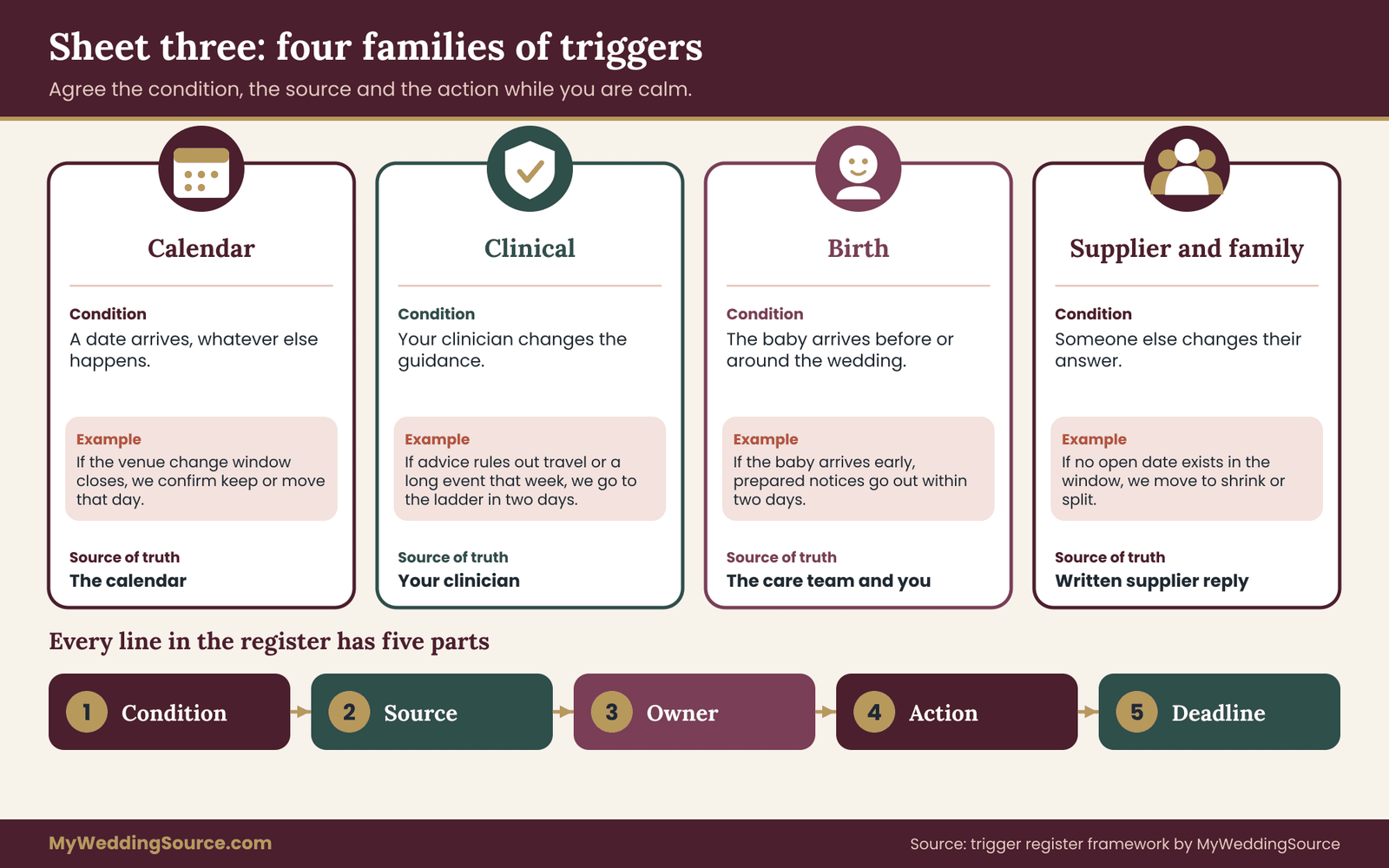
Each line in the due date wedding register has five parts. The condition says what must be true. The source says who tells you, so that you are not acting on rumor. The owner says who decides. The action says what happens. The deadline says how soon the action must be taken. Keep each line to a sentence or two.
Four families of triggers
Triggers fall into four families, and a good register has at least one of each.
Calendar triggers. These fire when a date arrives, whatever else happens. “On the date the venue’s change window closes, we confirm whether we are keeping the date.” They protect you from drifting past a lock date because nobody was watching.
Clinical triggers. These fire when your clinician gives advice that affects the event. “If our clinician advises against travel or a long event for the wedding week, we move to the next rung of the ladder within two days.” The key point is that the clinician decides the medical fact, and you decide the response. You never have to interpret the medical advice yourself; you only have to act on it.
Birth triggers. These cover the baby’s arrival relative to the wedding. “If the baby arrives before the wedding, the partner who holds the supplier contacts sends the prepared notice within forty-eight hours.” Write separate lines for early arrival, arrival in the final week and arrival after the wedding.
Supplier and family triggers. These fire when someone else changes. “If the venue cannot offer an alternate date within the agreed range, we move to the shrink rung.” Or “If the two relatives who are providing care cannot attend, we review the guest list and the program.”
Writing a good trigger
A good trigger has a condition that can be checked, not a feeling. “If things get stressful” is not a trigger. “If our clinician advises against travel after the near fence date” is. A good trigger also has an owner who is not guessing: the person who receives the clinician’s advice is the one who decides the response, with the other partner agreeing as written.
A good trigger has an action that can be done quickly. If the action is “decide what to do,” it has not been prepared. The action should be a step on the due date wedding ladder, with the messages and calls ready to send. This is why the notice kit in sheet five matters.
Finally, a good trigger has a time limit. A trigger that fires and then sits for two weeks is worse than none. Write “within two days” or “by the end of the next working day,” and put it on a calendar.
Sample lines for the register
The sample lines below show the format and do not apply to every couple. Change the conditions to match your due date wedding contracts and your clinician’s guidance.
On the lock date for the venue’s final payment, if the clinician fence has not been confirmed, the partner holding the contracts asks the venue for a written extension and records the answer. If the extension is refused, the couple reviews whether to move the date before the payment.
If the clinician gives a near fence date that falls before the wedding, the couple goes to the decision ladder within two days and starts with the move rung, since the date itself conflicts with the guidance. If the baby arrives before the wedding date, the partner who holds the supplier list sends the prepared notices, and the couple chooses between the shrink rung and the split rung within a week of the birth.
If the caterer’s headcount deadline arrives before the information date, the couple submits the higher count and asks whether a reduction is allowed under any condition. If a guest who is flying in tells you their ticket is not refundable, you tell them the date is under review by the date set on the register, not later.
Who can fire a trigger
Be careful about who is allowed to fire a trigger. A relative who worries about the date is not a source. A friend who says the baby will surely come early is not a source. The source for a clinical trigger is the clinician. The source for a supplier trigger is the supplier’s written response. The source for a calendar trigger is the calendar. In a due date wedding, many people will have opinions, and few of them are sources.
This keeps the due date wedding register from turning into a rumor mill. It also gives both partners a graceful way to answer family members who ask whether the wedding is still on: “We have a plan with set dates, and we will tell everyone when a decision is made.” That sentence is true, and it is calm.
Reviewing the register
Review the register on every information date and every lock date, and after any visit that changes the guidance. Mark triggers that have passed. Add new lines when something new appears. A register that is read once and forgotten becomes a list of old intentions.
Keep a short log of what you changed and why. If a supplier disputes a change later, the log shows that you acted at a defined time on defined information. It also helps you remember, a few months on, why you made a choice that felt obvious then and strange now.
Negotiating flexibility without over-sharing
Many couples hesitate here, because asking a supplier for flexibility seems to require announcing a pregnancy. It does not. How much you tell a supplier is your choice, and you can negotiate on the terms without sharing medical details. What you cannot do is ask for a specific kind of flexibility and give no reason at all, because suppliers respond better to a reason they can understand. Supplier conversations in a due date wedding can stay businesslike.
A calm middle path is to describe a family circumstance that may require a date change, name the date range, and ask for specific terms in writing. “We may need to move our date by a few weeks for a family reason, and we would like to understand your date-change terms.” That is accurate and does not say more than you want to say.
What suppliers care about
A supplier’s willingness to bend comes down to resale. A venue or caterer with an open date to fill later loses little when a date moves; one with no hope of resale loses the whole fee. The earlier you ask, the more time they have to resell the slot, and the more flexible they can afford to be. That is the cost logic behind every date-change clause.
This is why notice is the most valuable thing you can offer. A supplier who hears about a possible change eight months out is in a different position from one who hears eight days out. Early notice often costs nothing to give and can lower what a change costs. Early notice is the cheapest tool in any due date wedding.
Suppliers also care about getting paid on time, about a clean written record and about being treated as partners. A short, respectful email that offers early notice, proposes specific terms and thanks them for their time usually opens a better conversation than a late call with an urgent tone.
Disclosure choices
There are three levels of disclosure, and you can choose per supplier. The first is no disclosure: you ask about date-change terms as a general matter, as you might on any booking. The second is a general reason: “a family circumstance may require flexibility.” The third is a direct explanation: you tell them about the pregnancy and the due date.
Direct explanation is not required, but it can help in two cases. One is when the supplier is a small business owner who may be more flexible once they understand. The other is when you need a clause written for the specific event, such as a pregnancy-related change of date, since a supplier cannot write a clause for a situation they do not know about.
Whatever you choose, be consistent in what you say to each supplier, and be careful about who else the supplier talks to. If you want your guests to hear the news from you first, say so, and ask the supplier to keep it private. Most professionals understand.
Specific requests worth making
You can ask for specific changes that cost the supplier little and help you a great deal. Each request should be short enough to answer yes or no.
A second held date: “Would you be willing to hold a second date for us until the date of the information deadline?” Some suppliers will hold one without charge for a short period, and some will charge a small holding fee. Either is useful, as long as it is in writing.
A transfer clause: “If we change the date, can the deposit transfer in full to the new date?” Ask also for the credit period to be stated. A deposit that transfers but expires in six months may not help.
An extended deadline: “Can the date-change deadline move to the final headcount date?” And a written substitution right: “If our needs change, can we shorten the booking, change the start time or reduce the guest count within a stated range without penalty?”
Putting changes in writing
A verbal agreement is a goodwill agreement. Whenever a supplier agrees to a change, ask for a short addendum or a confirming email that the supplier replies to with agreement. The email should state the clause, the new term, the date it applies and the amounts. Save it with the contract.
If a supplier will not change a written contract but promises flexibility in practice, that is useful information, but mark the item amber on sheet two and treat it as unconfirmed. You may still accept the risk; you should do it knowingly.
When a supplier says no
Some suppliers will say no. A supplier may have a policy that applies to every client and no authority to vary it. Take the answer as information. Write it in the due date wedding register, and ask whether any other option is available, such as a different date within a given window, or a smaller package at a lower commitment.
Do not argue the point or send an angry message, since you may need the supplier’s cooperation later. If the contract is fixed and the exposure is large, that is an input to the due date wedding ladder, not a reason to abandon it. It may mean choosing a rung that avoids the contract altogether.
Sheet four: the decision ladder, from hold to substitute
The decision ladder is the order in which you try your responses. The principle is simple. Begin with the cheapest, most reversible step, and move to a more costly one only when the facts require it. The ladder prevents two common errors: cancelling something that could have been adjusted, and holding on to something that could not be saved.
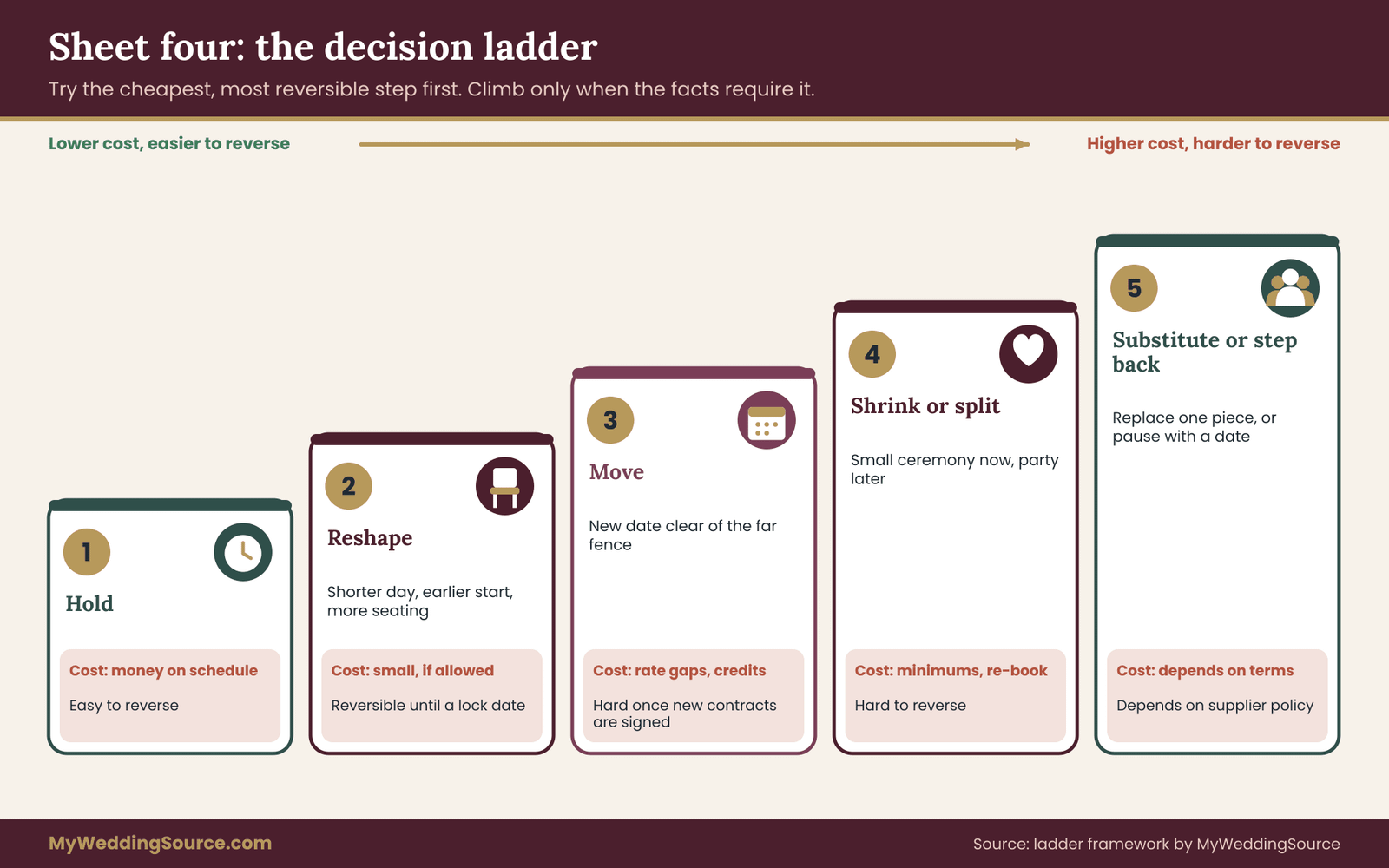
There are five rungs. They are not mandatory, and you may skip one when it does not fit. What matters is that you know the order and the cost of each rung before anything changes.
Rung one: hold the date and watch
Holding is not passive. It means keeping the date, keeping the register current and watching the next information date. It is the right first rung when the gap is comfortable, the contracts are reasonably flexible and the clinician has not advised otherwise.
Holding has a cost: money goes out on schedule, and the exposure at each lock date grows. That is why the due date wedding register needs a calendar trigger at each lock date. At each one, you decide whether to keep holding, and you do it with the exposure number in front of you.
Rung two: change the shape without changing the date
Before moving the date, ask whether a change in the shape of the day would solve the problem. The day can be shortened. The ceremony and reception can be moved earlier. Standing time can be reduced with seating. The program can be pared down. Guests can be asked to arrive later, or the evening can end sooner.
These changes work best when the contract allows substitution, scaling or shorter hours, which is what question five on sheet two checked. They also depend on your clinician’s guidance, which may be about activity levels and not just travel. The related guide on wedding guest care planning covers the care side of babies and older relatives, and it fits well here.
Rung three: move the date
Moving the date is the middle rung, and the right one when the date itself conflicts with the clinician fence. The best time to move is early, while suppliers can still resell the slot, notices to guests are easy and few non-refundable commitments have been made. For a due date wedding, move by enough to clear the far fence.
When you move, move by enough. A move of one week may leave you inside the same window of uncertainty. Use the far fence from sheet one to choose a new date that sits clear of it, and run the lock-before-information test again for the new date. The wider guide on choosing a wedding date explains how guest availability and supplier capacity shape the choice.
Ask each supplier for their open dates in writing, with rates, before you choose. A new date that is open at one supplier and closed at another is not available, and you will need to ask the venue first, since the venue is usually the constraint.
Rung four: shrink or split
When the date cannot move cheaply and the full event no longer fits, two rungs reduce the commitment. Shrinking keeps the date and holds a smaller event: fewer guests, a shorter program, a simpler setting. Splitting separates the marriage from the party. You hold a small ceremony on or near the planned date, and a larger celebration at a later date when recovery and routine allow. Splitting is a common answer to a due date wedding that cannot move.
A split can be a very good answer, and it is not a failure. The legal marriage does not require a large event. The paperwork needs a license, an officiant and witnesses where the state requires them, and the details differ by state, so the issuing office should be your guide. If you already have a license, check how long it stays valid, because a later ceremony may need a new one.
A split changes the money. A smaller first event reduces some costs and raises others. The large event moves, and its contracts must move too. Run sheet two again for the later event, and treat it as a new booking with its own flexibility questions.
Rung five: substitute or step back
The last rung covers cases in which a supplier cannot perform, or a person cannot attend. A substitute photographer, a replacement officiant, a different caterer for a smaller event, or a family member who takes over a task are all examples. Substitution keeps the event going when a single piece fails.
Stepping back is the final option: pausing the plan for a defined period, with a decision date, and releasing what can be released. It is the right choice when the facts require it and the earlier rungs do not fit. It is not a defeat. A wedding that is postponed with notice, clear records and recovered deposits is in a better position than one that is forced through at a cost to health or finances.
Cost and reversibility at each rung
Compare the rungs on two measures: how much money is at risk, and how easy it is to go back. Holding is the most reversible and often costs only time. Changing the shape is reversible until the supplier’s lock date. Moving the date is hard to reverse once new contracts are signed. Splitting is difficult to reverse but may save the most. Substituting depends on supplier policy.
Write the answer for your own contracts on sheet four, with a line for each rung: the cost, the deadline, the reversibility and the trigger that sends you there. Do not use general figures from anyone else’s wedding. The numbers that matter are the ones in your due date wedding contracts.
A worked case: one invented couple through the workbook
This case is invented to show the method. The people, dates and contract terms are made up for illustration, and the clinical guidance is a placeholder, not a medical standard. Your own clinician’s advice and your own contracts replace every number below.
Nadia and Theo are planning a Saturday wedding at a rented garden venue with about eighty guests.
A scan in the spring gives an estimated due date that falls seventeen days after the wedding. They filled in sheet one first. The gap is positive seventeen days. They asked Nadia’s midwife for the two fence dates. In this invented case, the midwife says she would advise against a long event or travel in the final three weeks before the estimated date, and would suggest waiting several weeks after birth before a long day. Their due date wedding is invented, and every figure in it is a placeholder.
Sheet one results
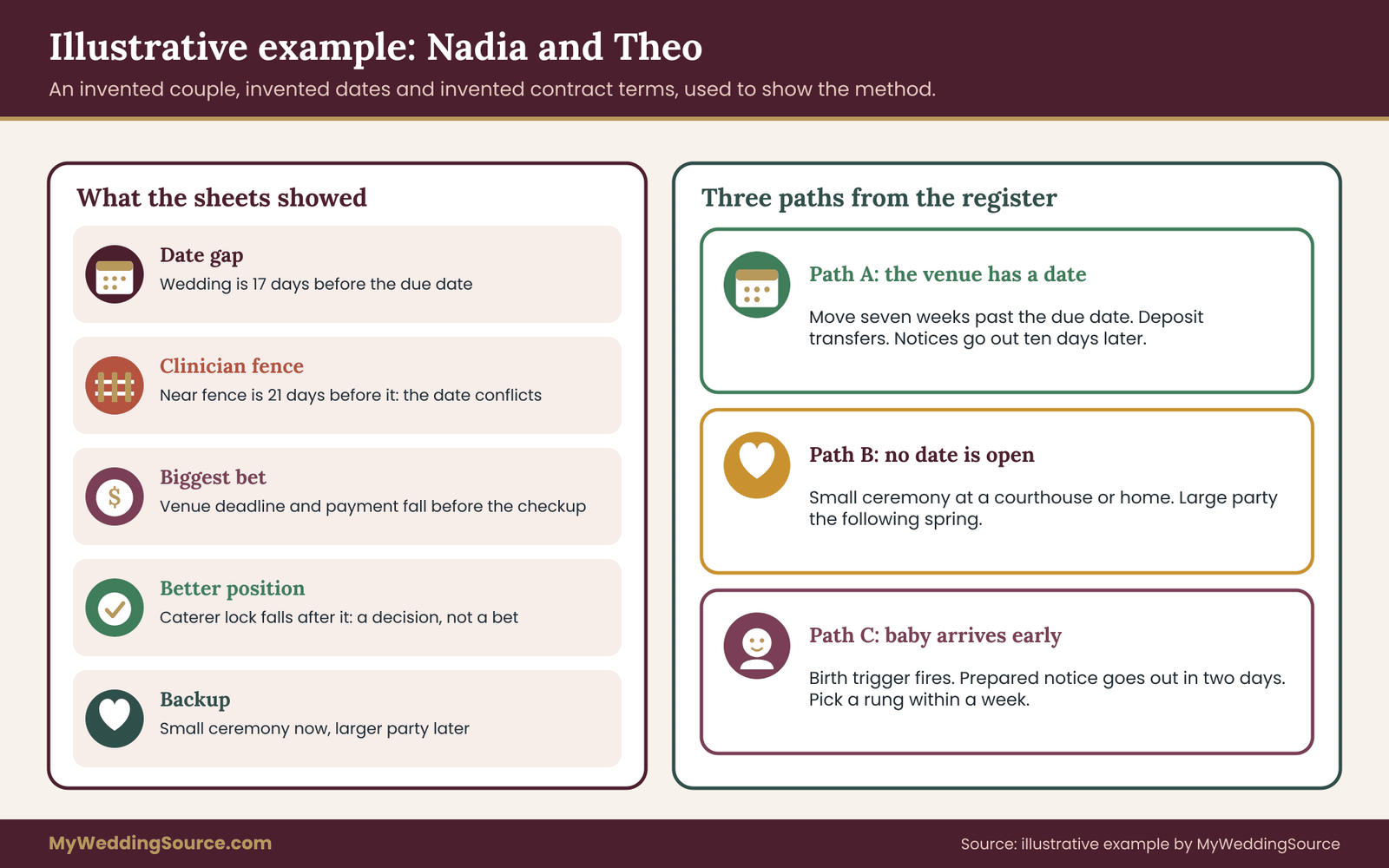
The near fence is twenty-one days before the due date. The wedding is seventeen days before it. The wedding therefore falls four days inside the near fence, which means the date itself conflicts with the guidance, even though the baby may arrive on any day. The far fence, in this case, sits about six weeks after the due date, so a move must clear that line too.
The information date is a routine checkup that falls thirty-five days before the wedding. Until then, Nadia and Theo will not hear any new guidance. They wrote that date on the sheet and moved on to the contracts.
Sheet two results
The venue contract allows one date change if requested at least ninety days before the event, with the deposit transferring in full to the new date for twelve months. The second payment, half of the fee, is due sixty days out and is non-refundable. The force majeure clause lists weather and venue damage, and is silent on illness or pregnancy. Color count: date change green, deposit amber, lock date red, medical clause red, substitution amber.
The caterer locks the guest count twenty-one days before the event and holds a minimum guest count equal to seventy percent of the original headcount. A deposit of twenty-five percent is transferable once. The photographer’s contract has a non-refundable retainer of twenty-five percent, allows a date change when the photographer has the new date open, and names a substitute photographer from the same studio if illness strikes. The florist locks the order fourteen days out.
The test
Running the lock-before-information test, Nadia and Theo see that the venue’s ninety-day date-change deadline falls well before the checkup at thirty-five days out, and so does the venue’s sixty-day payment. Both are bets, and the venue is the largest. The caterer’s twenty-one-day lock falls after the checkup, so it is a decision. The photographer and florist are not major bets.
They also noticed that the near fence puts the wedding inside the zone of conflict already. Waiting for the checkup would not change the date’s relation to the fence unless the midwife changed her guidance, which they could not count on. That moved the venue from “bet” to “probably a move.” The test pushed them to act before the ninety-day deadline, while the move was still cheap.
Trigger register and ladder
Nadia and Theo wrote five triggers. A calendar trigger fires on the ninety-day date to confirm the decision to move or keep. A clinical trigger fires if the midwife confirms the near fence, sending them to rung three. A supplier trigger fires if the venue has no open date in the target window, sending them to rung four. A birth trigger fires if the baby comes before the wedding. A family trigger fires if the two relatives who offered care cannot attend.
They then wrote the due date wedding ladder. Rung one, holding, was ruled out by the four-day conflict. Rung two, changing the shape, would not fix a date inside the fence. Rung three, moving, became the first real option, and they asked the venue for open dates beyond the far fence. Rung four, splitting, was the backup: a small ceremony at the original date, if the midwife agreed, and a larger party later.
Three paths from here
In the first path, the venue has an open Saturday seven weeks after the due date, clear of the far fence. The date-change clause allows the move, the deposit transfers, and the caterer’s transferable deposit carries over once. The photographer has the new date open. Total cost is small: some rate differences and the florist’s re-order. They send notices to guests ten days later, with the new date and a short explanation.
In the second path, the venue has no suitable date. Nadia and Theo take rung four. They ask the venue whether the original date can host a much smaller group, check the caterer’s minimum, and find that seventy percent of eighty guests is too high for a ceremony of twenty. They decide the small ceremony will take place elsewhere, such as at a courthouse or a family home, and plan the large celebration for the following spring.
In the third path, the baby arrives early, before any decision is made. Because the due date wedding register already lists a birth trigger, the partner who holds the contracts sends the prepared notice within two days. The venue extends the date-change window out of goodwill, the caterer accepts the transfer and the couple selects rung three. Nothing was perfect, but nothing had to be invented.
What the case shows
The case is invented, but the pattern is real. The due date wedding workbook found three things quickly: the date conflicted with the guidance, the venue was the largest bet, and the information date came too late to help with that bet. It turned a vague worry into a dated action list. And it showed the value of acting before the deadline, since the cheapest version of every option expired first. The same arithmetic applies to any due date wedding.
Notice what the couple did not do. They did not try to predict the birth. They did not spend a week arguing about whether to cancel. They did not wait for the checkup before talking to the venue. Each choice came from a line on a sheet.
Guests, travel, licenses and paperwork around a due date wedding
Contracts are the largest exposure, but not the only one. Guests, legal paperwork and personal logistics all react to a change of date, and most of the work is easier if you plan it before you need it. This section covers the parts of the due date wedding workbook that touch people and documents, which is sheet five and the legal items you might forget.
Guests and travel
Guests who must travel are the group most affected by uncertainty. They buy tickets, book rooms and take time off work. If you think a date may change, the kindest thing is to tell them early, with a clear note about when you will confirm. Do not send a firm invitation and then rewrite it two weeks later. Guests are the most visible part of a due date wedding.
Consider one of two approaches. You can send a save-the-date that names a date range and says that the final date will be confirmed by a stated day. Or you can send a firm date with a short note that says plans may shift for a family reason and that you will confirm by a stated day before they book non-refundable travel. The wording guidance in the wedding invitation etiquette guide fits either case.
Whichever you choose, give guests a decision date for travel and keep to it. A line such as “please wait until the first of next month before booking flights” saves everyone money and sets the expectation that the date might still move. Keep the message short and warm, and do not give medical detail unless you want to.
Out-of-town and older guests
Guests who travel a long way or who need extra support should hear from you first, and they should hear plainly what you will do if the date changes. Offer to help with change fees only if you can afford to, and say so only if you mean it. Many couples find that a sincere apology and a clear process are enough.
If some guests are older or have mobility needs, check that a changed date does not collide with their own medical schedules or caregivers. A move of a few weeks may help one group and hurt another. Keep a list of guests whose travel is the most expensive or least flexible, and tell them directly before you post anything wider.
The marriage license and the ceremony date
The marriage license is a legal document with its own timing rules, and these differ by state. Some states set a waiting period between issuing a license and holding the ceremony. Many set an expiry date after which the license is no longer valid. If you move the ceremony, a license you obtained for the original date may expire before the new one.
Do not assume. Contact the office that issues licenses in the place where you will marry, and ask three things: how long a license is valid, whether there is a waiting period, and what happens if the ceremony moves. The government portal USAGov points to state vital records offices, and the guide to wedding records after the event explains what to do with the signed license afterward.
If you plan a split, with a small legal ceremony first and a large celebration later, check whether the officiant for the legal ceremony needs particular credentials in your state. The details for officiants vary, and the rules are set by each state, not by a supplier.
Work, leave and health coverage
Pregnancy and a wedding both touch employment and health insurance, and the two overlap. Ask your employer’s human resources team about leave policy and notice, and about how marriage and birth affect benefits. The Department of Labor explains the federal Family and Medical Leave Act, and your employer or state may offer more. Health coverage through a marketplace may allow a special enrollment period after marriage or a birth, with limited windows, so check HealthCare.gov. A due date wedding often overlaps with leave and coverage dates.
None of this is part of the wedding contract, but the dates interact with it. A wedding that moves into a period when you planned to be on leave may collide with other plans. Add the leave dates to sheet one as a fourth reference line, so the full calendar is visible.
Sheet five: the notice kit
The notice kit holds three short messages and a timing plan. The supplier message offers early notice, names the possible change, asks for the date-change terms in writing and gives a response date. The guest message states what is known, what is not yet known and when you will confirm. The family message goes to the few people who must act first, such as parents, the wedding party and anyone providing care.
Write each message in advance, in your own voice, and save it with the register. When a trigger fires, you replace the dates and send. This saves the hardest part, which is finding words under stress. Keep the tone plain. You do not owe anyone a long explanation, and a short, kind message with a clear next date is usually enough.
Plan the order. Suppliers usually hear first, because they hold the constraints, then the wedding party and close family, and then the guests. Do not post publicly until the people who matter most have heard from you directly. Where you can, send each message at a time when you can respond to replies.
When the workbook fails: failure conditions and fallbacks for a due date wedding
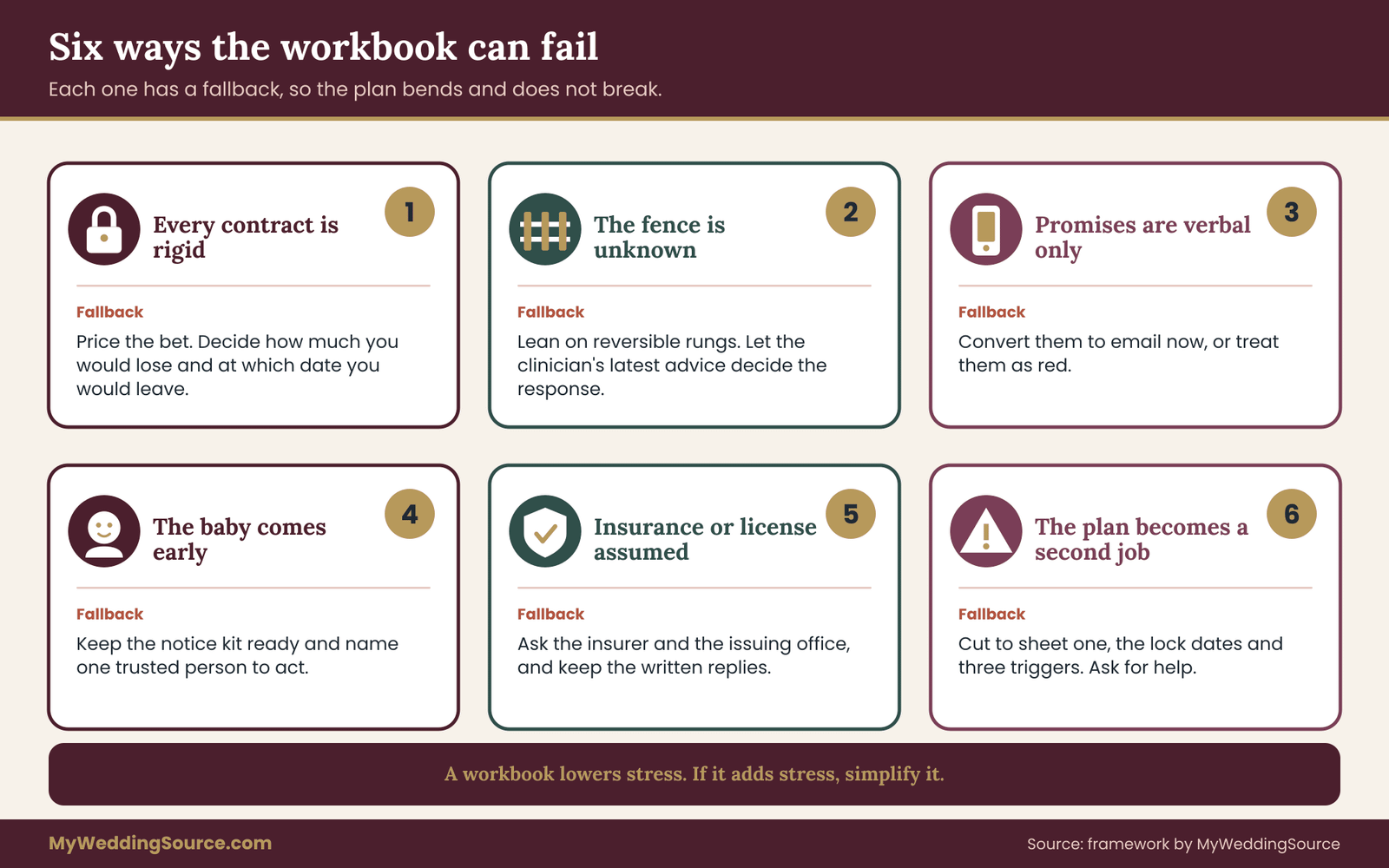
A method is only useful if you know where it breaks. The due date wedding workbook has clear limits, and naming them in advance is part of using it honestly. Below are the conditions under which it fails, and what to do in each. No method makes a due date wedding risk free.
Failure one: every contract is rigid and every lock date is early
If the due date wedding audit turns up red on date change and deposit for the venue, the caterer and the major suppliers, and every lock date falls before your information date, the due date wedding workbook cannot create flexibility that the contracts do not contain. It can only show you the size of the bet.
The fallback is to price the bet. Add up the exposure at each lock date and decide, with both partners, how much you are prepared to lose, and at which date you would pay to leave. Then ask each supplier one clear question about what they would do in a hardship case. Some will offer a credit even where the contract does not require it. Some will not. Either way, you decide with numbers.
Failure two: the clinician fence is unknown or keeps moving
Some pregnancies do not allow firm guidance far ahead. If your clinician cannot give fence dates, or the guidance changes at each visit, the due date wedding register’s clinical triggers will fire late, and the due date wedding ladder will start at rungs you would rather have avoided.
The fallback is to lean on the reversible rungs. Hold the date and change the shape. Negotiate for later lock dates and for a held second date. Keep notices to guests ready to send. And let your clinician’s latest guidance, not the workbook, decide the response whenever the two seem to disagree.
Failure three: relying on verbal promises
A promise that a supplier will “work with you” is a courtesy, and courtesy is not a contract. If the key flexibility lives only in conversation, a change of staff or a bad month can remove it. The workbook shows these items on the “verbal only” list, and failure occurs when they are never converted.
The fallback is to convert them now, in writing, or to treat them as red. A supplier who will not put a simple commitment in an email is telling you something about how reliable the commitment is.
Failure four: the birth comes before any trigger can act
Babies can arrive earlier than anyone expects, and the arrival may come before the first lock date, or between the registered review dates. In that case the due date wedding workbook does not stop the event; it makes the response faster. The birth triggers, the notice kit and the ladder are designed for this case.
The fallback is to keep the notice kit current and to name a trusted person who can act on your behalf for the first few days. That person needs access to the contract list, the due date wedding register and the messages. They do not need medical details. They need to know which supplier to call first, which message to send and which decisions can wait.
Failure five: insurance and legal assumptions that do not hold
A couple may assume that an event insurance policy will cover a change driven by pregnancy or birth, then find it lists those as exclusions. Or a couple may assume that a license stays valid, then find it has lapsed. Both are failures of checking, not of the workbook.
The fallback is to verify early. Ask the insurer, in writing, what is and is not covered, and keep the reply. Ask the issuing office about license validity and waiting periods. Treat any assumption about insurance or law as unverified until you hold an answer from the body that sets it.
Failure six: the plan hurts the people it is meant to protect
A last failure is quieter. The couple builds a thorough plan, follows it exactly and wears themselves out managing it. A workbook is a tool for lowering stress, not for adding a second job. If the sheets are growing and the conversations are getting tense, stop and simplify. A due date wedding should not become a second job.
The fallback is to cut the due date wedding workbook down to its core. Keep sheet one and the lock-date list from sheet two. Write the three most likely triggers. Choose the due date wedding ladder rung you would take first. If even that feels like too much, share the work with a planner or a trusted relative, and let yourself rest.
Alternatives to keeping or moving the date
The ladder lists five rungs, but there are other ways to meet the same goals. A smaller first event at a different venue, such as a family home or a restaurant that does not require a long lead time, can preserve the date and reduce the strain. A weekday or morning event may cost less and be easier on energy than a Saturday evening. A destination change in the opposite direction, to a venue close to home, can shorten travel for you and for the guests who matter most.
Each of these alternatives still counts as a due date wedding plan.
Another option is to separate the legal marriage from the celebration entirely. Many couples marry in a small ceremony, enjoy the first months of parenthood and hold a party when they are ready, sometimes on an anniversary. A later party can be planned with the benefit of everything learned, including the contract lessons from this due date wedding workbook.
A final option is to decide that the original date is the one that matters, and that the shape of the day will bend around it. That is a valid choice. It works best when the clinician supports it, the contracts allow substitution and shortening, and the people who will help have been named and briefed.
Signs that a move is the right call
Some signals suggest that moving or splitting is better than holding. The date conflicts with the clinician’s guidance. The largest contracts are flexible now and will not be later. The family members you most want present cannot attend on the original date. Or the couple, honestly, would rather not spend the first weeks of the baby’s life managing an event.
Other signals suggest holding. The gap is comfortable and the clinician has raised no concern. The suppliers are flexible and the lock dates are late. The shape of the day can be adjusted without much loss. And the couple is calm about the plan and has support in place. The due date wedding workbook does not pick for you, but it lets you see which set of signals describes your case.
Your next steps
Pick one evening this week and do three things. First, write sheet one: the estimated due date, the wedding date, the gap in days, and a note to ask your clinician for the near and far fence dates at your next contact. Second, pull out every contract and list each lock date in order, then mark your next information date on the same line. Third, send one email to the supplier with the largest exposure, asking for its date-change and deposit terms in writing.
Then work through the rest in short sessions. Finish the due date wedding clause audit, write five triggers, choose the first rung and draft your three messages. Return to the register on every information date and every lock date. If a supplier’s terms are unclear or a dispute begins, bring the contract to a lawyer who handles consumer matters. For the broader habits of reading supplier agreements, the guide to reading a wedding contract before you sign is a good place to continue.
FAQ
Should we move the wedding if the due date is close to it?
Not automatically. Compare the wedding date with the dates your clinician gives for travel and long events, then check the lock dates in your due date wedding contracts. If the date conflicts with that guidance, moving early is usually cheapest. If the date sits comfortably outside it, you may hold and adjust the shape of the day. Your clinician, not a general guide, decides what is medically sensible for you.
How far from the due date is a wedding considered too close?
There is no single safe distance, and it would be wrong to name one. Pregnancies differ, and the estimated date is the middle of a range of possible arrival weeks. Ask your obstetric clinician or midwife after which week they advise against travel or long events, and after how many weeks postpartum they suggest waiting. Use those two dates as your limits.
Do we have to tell our vendors we are expecting?
No. You can ask about date-change terms as a general matter, mention that a family circumstance may require flexibility, or share the news directly. Telling a supplier can help when you need a clause written for the situation, but it is your choice. Whatever you say, ask for any agreed change in writing and save the confirmation.
Will wedding insurance cover a change because of pregnancy or birth?
Often it does not, or it covers only part. Many policies list pregnancy and childbirth as exclusions or limits, and terms vary by issuer and by state. Read the policy, ask the insurer in writing what is covered, and keep the reply. Your state insurance department and the National Association of Insurance Commissioners publish consumer information on comparing coverage.
What is a lock date, and why does it matter?
A lock date is the day after which a change costs much more or is no longer possible. It might be a date-change deadline, a final payment, a headcount deadline or a cancellation tier. It matters because it is when your flexibility ends. Compare each lock date with the next day you will learn something new, and you can see which commitments are bets.
Is a small ceremony now and a party later a good alternative?
It can be. The legal marriage does not depend on a large event, and many couples find the split lowers stress and cost at a busy time. Check your state’s rules on licenses, waiting periods and officiants through the issuing office. Treat the later party as a new booking, and run the clause audit again for its contracts.
What should we tell guests who have already bought tickets?
Tell them early, plainly and directly, ideally by phone or a personal message before any wider notice. State what is known, what is not yet known and when you will confirm. Offer to help with change fees only if you truly can. Ask guests who have not yet booked to wait until a stated date before buying anything non-refundable.
What if the baby comes before the wedding?
This is why the due date wedding register has a birth trigger. Name one trusted person who holds the contract list and the prepared notices, and who can send them within a day or two. Then choose a rung: move, shrink or split. Suppliers often respond well to prompt, courteous notice, and your clinician can advise when a long event would be sensible again.
Sources
- American College of Obstetricians and Gynecologists, patient resources on pregnancy and birth
- Eunice Kennedy Shriver National Institute of Child Health and Human Development, pregnancy information
- Centers for Disease Control and Prevention, reproductive health and pregnancy resources
- U.S. Department of Labor, Family and Medical Leave Act
- HealthCare.gov, special enrollment period glossary entry
- USAGov, how to get a copy of a marriage certificate or marriage license
- National Association of Insurance Commissioners, consumer information
- Federal Trade Commission, consumer advice
- Consumer Financial Protection Bureau, consumer tools and complaints
- U.S. Department of State, travel.state.gov