
Change management on a wedding day is a simple agreement about which changes vendors may make on their own, which ones they must tell you about first, and which ones only a named person can approve. This guide builds that agreement step by step, so surprises shrink without turning you into the person who micromanages every vendor.
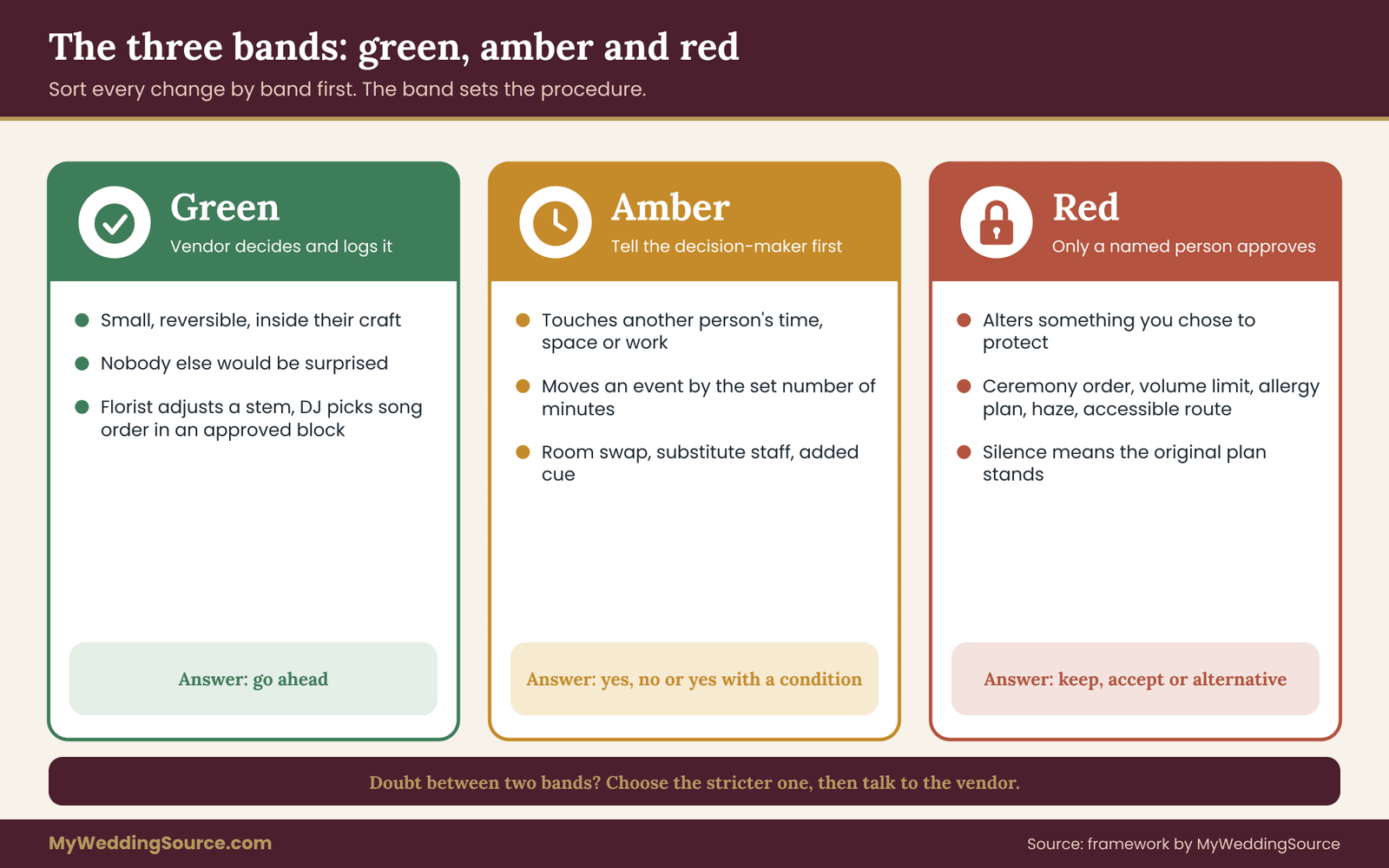
Sort every possible wedding-day change into three bands. Green changes are small and inside the vendor’s craft, so the vendor decides and logs them. Amber changes touch someone else’s timing or space, so the vendor tells your decision-maker before acting. Red changes alter something you listed as non-negotiable, so only a named person can approve them, and silence means the original plan stands. Name one authorized decision-maker and one backup, write the bands on a single page, and share it before the day.
Most couples do not worry about the big failures on a wedding day. They worry about the small, sideways ones. The photographer decides to move family portraits ahead of the ceremony because the light is better. The DJ swaps the order of two announcements. The caterer starts service twenty minutes early because the kitchen is ahead. Each choice may be perfectly sensible from where the vendor stands. The trouble is that nobody told the people the choice lands on.
That gap, between a reasonable decision and the person who has to live with it, is what change management closes. The idea is borrowed from every field that runs live events: decide in advance who may change what, make the rest travel through one channel, and keep a record. You do not need a binder or a software subscription. You need a page of rules and two people who understand them.
This approach is written with unannounced changes in mind, and it suits couples who find sudden shifts costly, including some neurodivergent couples. It does not assume that anyone needs it. Needs differ from person to person, and the point is to ask each of you what a surprise actually costs, then build rules around that answer. If you want the wider picture of planning around sensory and communication needs, a broader neurodivergent-friendly planning guide is a better starting place than this article.
A note on scope. This is general information, not legal, tax or financial advice. Contract terms and disability-access rules differ by state and by vendor, so confirm anything that carries real money or risk with the vendor’s own terms, the agency that issues the rule, or a licensed professional.
What wedding day change management actually covers
Wedding day change management is the set of rules that decides how a change travels from the person who wants it to the person who approves it, and what happens if the approver cannot be reached. It covers the day itself, from the first vendor arrival to the last load-out. It does not cover design revisions made months earlier, which belong in written amendments to the contract.
The word “change” needs a boundary, because without one every small adjustment becomes a conversation. A change, for these purposes, is any departure from what the people affected were told to expect. A florist placing the aisle arrangements two inches to the left is not a change. A florist moving them to the other side of the room is. The test is not size alone. It is whether someone downstream would be surprised.
Three kinds of change come up again and again, and the terms in your vendor agreements rarely address any of them directly.
Vendor-initiated changes. A vendor sees a better way, a problem, or a delay, and acts. Most of these are helpful, and a good share are quietly necessary. The goal is not to stop them. The goal is to sort them so the harmless ones pass without ceremony.
Venue and environment changes. Weather, a double-booked space, a locked door, a power limit, a neighboring event. These are often outside every vendor’s control, which is exactly why the route for deciding must be clear in advance.
Couple-side or family-side changes. A relative asks the DJ for a different song, an aunt asks the photographer for an extra group shot, a parent tells the caterer to hold the toast. These arrive from inside your own circle, and they bypass your rules unless the change management rules name them.

What it is not
Wedding day change management is often mistaken for control. It is not a way to freeze the day. A wedding with no flexibility is brittle, and vendors who sense they are being boxed in tend to stop volunteering useful information. Change management done well actually increases the number of small adjustments vendors make, because it tells them which ones are safe.
It is also not a replacement for a plain, workable timeline. If the schedule itself is vague, no change rule can rescue it. The method in the guide to building a wedding vendor timeline gives every vendor the same times to work from, and this article assumes you have something like that in hand.
The cost of a surprise is personal
Good change management starts with an honest account of what a surprise costs you. Two people can watch the same change and react differently, and neither is wrong. One partner shrugs when dinner starts early. The other loses the thread of the evening and spends an hour recovering. For some people a surprise costs a few seconds of attention. For others it costs energy, appetite and the ability to enjoy the next hour.
So the first piece of work is not about vendors at all. Each of you should answer, in your own words, three questions. Which kinds of change do I hardly notice? Which kinds do I notice but can absorb? Which kinds do I need to hear about before they happen? The answers become the raw material for the three bands in the next sections. Keep them private if you like. Only the resulting rules need to be shared.
Be careful not to guess on behalf of a partner, a parent or a vendor. A rule written from assumptions will be wrong for someone, and it will be wrong in public.
Why unannounced changes weigh more than they look
It helps to understand what a surprise actually does before designing rules against it. The effect is rarely about the change itself. It is about the work of rebuilding a mental picture of the next hour while the day continues around you.
A wedding day is a long sequence of handoffs. Hair and makeup finish, a car arrives, a photographer wants ten minutes, a procession forms, a toast is announced. Each handoff relies on a small prediction: what happens next, who will tell me, how long it lasts. When a vendor changes something without telling anyone, the prediction fails quietly. The person does not learn about it from a message. They learn about it when the next thing does not happen.
Three places surprises land hardest
Transitions. Moving from getting ready to the ceremony, from the ceremony to portraits, from portraits to the reception. Transitions are where a change in order or timing causes the most scrambling, because several people are in motion at once.
Sensory conditions. Lighting, volume, scent, crowding and temperature can shift when a vendor changes something that looks minor. A DJ raising the level for a new section, a florist adding strongly scented blooms, a venue switching to brighter overhead lights for cleanup. For couples who are sensitive to these, an unannounced change may matter more than the same change announced ahead of time.
Social exposure. A sudden request to give an impromptu speech, to pose with a group, or to greet a line of people. These are not vendor changes in the strict sense, but vendors often trigger them, and the same rules can catch them.
What the research can and cannot tell you
You will find general writing about autism, ADHD and other differences in resources such as the Centers for Disease Control and Prevention. Those resources describe patterns across populations, and they can help you find words for your own experience. They cannot tell you what you or your partner need. Treat them as vocabulary, not as a diagnosis, and never as a reason to speak for another person.
Equally, vendors are not required to understand any of this. Many are glad to help once they know what to do. A vendor who is told, in plain terms, “please tell Sam before moving anything on the schedule” will usually say yes. A vendor who is handed a long explanation of why will often be confused, and may feel judged.
The hidden cost to vendors
Vendors benefit from change management too. There is a second reason to build rules. Vendors also pay for unclear change channels. A photographer who is not sure whether to ask the couple, the planner or the venue manager will either interrupt at a bad moment or not ask at all. A caterer who gets conflicting answers from two relatives will sometimes follow the louder one. Rules protect them from guessing wrong.
That is why the approach in this article is built around the vendor’s convenience as much as yours. A single contact, a short list of what is pre-approved, and a promise of a fast answer make the vendor’s job easier. When the change management rules help the person following them, they get followed.
Keep this in mind as you move to the change management framework. Every rule below should answer two questions at once: does it protect the couple from an unwelcome surprise, and does it give the vendor a clear, quick, low-friction way to act?
The three bands of wedding day change management
The core of the method is a sorting rule. Instead of deciding each change as it arrives, you decide the categories now. When a vendor meets a change on the day, they place it in a band and follow the band’s procedure. Nobody has to improvise a policy at four in the afternoon.
There are three bands, and each has a color so they are easy to remember and easy to print.
Green band: the vendor decides and logs it
In wedding day change management, the green band is the widest and the least visible. Green changes are small, reversible, inside the vendor’s own craft, and invisible to everyone else. The vendor does not need to ask. They only need to make a note, a line in their own records or a text to the decision-maker after the fact, so the record is complete.
Examples that usually belong in green: a florist adjusting how an arrangement sits within its own table; a caterer swapping an equivalent garnish; a photographer choosing lenses and angles; a DJ choosing the exact order of songs inside a block you already approved; a hair stylist changing the order of tools. None of these shift anyone else’s time, space or senses.
The green band is where you give vendors room. A long, generous green list is a sign of a healthy plan, not a loose one. If a vendor asks whether something is green, the answer is almost always yes.
Amber band: tell the decision-maker before acting
This is the band where change management earns its keep. Amber changes are the ones that ripple. They are not necessarily bad. They simply touch another person’s time, another vendor’s work, or a shared space, so someone with the full picture should hear about them first.
Examples that usually belong in amber: moving any scheduled event by more than a set number of minutes; changing a room layout that another vendor depends on; changing who stands where in the change management processional; starting food service earlier or later than the run sheet; adding a music cue; replacing a vendor’s staff member with a substitute; running late to arrive.
The amber procedure is short. The vendor messages the decision-maker with one sentence about what they want to do and why, and waits a stated number of minutes for an answer. If the answer comes, they follow it. If it does not, the vendor falls back on the rule in the section on silence and defaults below.
Pick the minute threshold with your timeline in mind. A buffer-heavy day can tolerate a larger green window than a tightly choreographed one.
Red band: only a named person approves it
Think of the red band as the part of your change management plan that belongs only to you. Red changes alter something you have chosen to protect.
This is the shortest list, and it is yours alone. It might include the order of the ceremony, who touches or lifts you, how loud or bright a particular moment is allowed to be, which foods are served to guests with allergies, any use of fog, strobe or confetti, any photograph of a person who has asked not to be photographed, and anything involving your children or relatives that you flagged in advance.
Red changes cannot be approved by a vendor, a relative, or a guest. They also cannot be approved by silence. If the person with authority has not said yes, the original plan stands.
The red list is where you protect what matters most. It should be short enough to remember. If it grows past a dozen items, some of them are probably amber.
How to build your own lists
Building the lists is the most useful hour of any change management effort. Start by writing every change you can imagine on a sticky note: late arrival, moved portraits, new song, extra guests at a table, food running out, a different entrance. Sort them into three piles using one test per note. Would anybody else be surprised? Would it affect a sense, a person or a promise I care about? Could it be undone in a minute?
If a change is invisible to others and easily undone, it is green. If other people or vendors would notice, it is amber. If it touches something you named as protected, it is red. When a note fits two piles, choose the stricter one for now, and revisit it after you have talked to the vendor.
The aim is not a perfect list. It is a draft you can improve in conversation. Vendors have seen far more weddings than you have, and a short question such as “what do you change most often on the day?” will uncover items you would never have thought to list.
The silence rule
A change management plan without a default for silence invites guessing. Every escalation system needs a default for when nobody answers. Without one, vendors freeze or guess. The default is simple and should be stated aloud.
For amber changes, if the vendor does not hear back within the stated window, they may proceed only if the change is needed to protect safety or to keep the schedule from collapsing. Otherwise they keep the original plan. For red changes, the original plan always stands, whatever happens. The only exception is a safety issue, which is covered in the section on safety overrides later.
Write the rule in one sentence on your page: “If we do not answer, the written plan stands.” It protects you, and it also protects the vendor, who cannot be blamed for following a written instruction.
Why three bands and not five
Simplicity is a feature of good wedding day change management. It is tempting to add more levels. Resist it. Three bands can be recalled by a tired vendor holding a tray. Five cannot. The benefit of a framework is not precision but usability, and a framework that people forget on the day does nothing. If you find yourself wanting a fourth band, look first at whether your amber list has grown too long. That is the usual reason.
A set of bands means nothing without a person who can say yes or no. The most common weakness in wedding day change management is not the rules. It is that nobody is clearly authorized to apply them, so every vendor asks a different person and receives a different answer.
The authorized decision-maker, or designee, is the one person vendors contact about amber changes and the one person who may approve a red change on your behalf, within limits you set. Everything flows through them. Their authority is explicit, written down, and known to the people they will deal with.
Who can play the role
Change management on the day needs a person, not just a page. There are four realistic choices, and each has real tradeoffs.
A professional coordinator or planner. They know the vendors, the venue and the typical failures. They hold the timeline and can make an amber call in seconds. The tradeoffs are cost and, for a partial-service package, limited hours. If you hire one, make sure the contract says the coordinator may approve amber changes and which red items they must pass to you.
A venue event manager. Many venues staff someone on the day. Their loyalty is to the venue and its rules, so use them for venue changes and not as your general decision-maker unless they agree to the role in writing.
A trusted friend or relative. This works if the person is calm, organized, willing to say no to others, and not also a member of the wedding party with duties of their own. It does not work if they are in the change management processional, giving a toast, or drinking.
One of the two of you. Fine for a small day and a quiet phone, but it defeats much of the purpose. You become the point of contact on the day you most need to be unreachable.
What the designee needs
A designee can run wedding day change management well only with a few basics in hand. A designee needs four things. The first is a one-page sheet with the bands, the vendor contacts and the red list.
The second is a charged phone and a stated way to be reached, for example one number that vendors know and nobody else has. The third is a short briefing that covers what to do if the unexpected happens. The fourth, and the one most people forget, is permission to say no on your behalf without apologizing.
Give the designee examples of tone. “Thanks for flagging that, we are going to keep the original order” is enough. They do not need to explain your reasons to a vendor or a relative. Explaining invites argument.
Authority limits and the backup
Every change management role needs limits and a second pair of hands. Write down what the designee may approve alone. A sensible default is amber changes up to a set cost, with the cost stated in dollars you are comfortable with, and any red item only after the designee has reached one of you. Say plainly what happens when the designee cannot reach you. Often the answer is the safe default: keep the original plan, and report afterward.
Name a backup. The backup is a second person with the same sheet who steps in if the designee is occupied, ill, or called away. Vendors should have both numbers. A change system with one phone number is one dead battery away from not working.
For the broader logic of who should hold authority on a wedding team, the guide to making wedding decisions together lays out how couples can agree on who decides what before conflict appears.
Making authority visible to vendors
Change management only works if vendors can see who holds authority. Authority only works if vendors know about it. Send a short message to every vendor a week before the wedding naming the designee and the backup. Introduce them by name and role. On the day, the designee should greet each vendor in person, preferably early, and repeat the instruction: “If anything changes, please tell me first.” That one sentence, said face to face, does more than any email.
Also tell the people who might bypass the change management system. A parent who thinks they can tell the caterer what to do is a more common source of confusion than any vendor. Tell family, kindly, that one person handles changes on the day. Give them the designee’s name and ask them to send requests there.
The escalation flow: who is asked, in what order, how fast
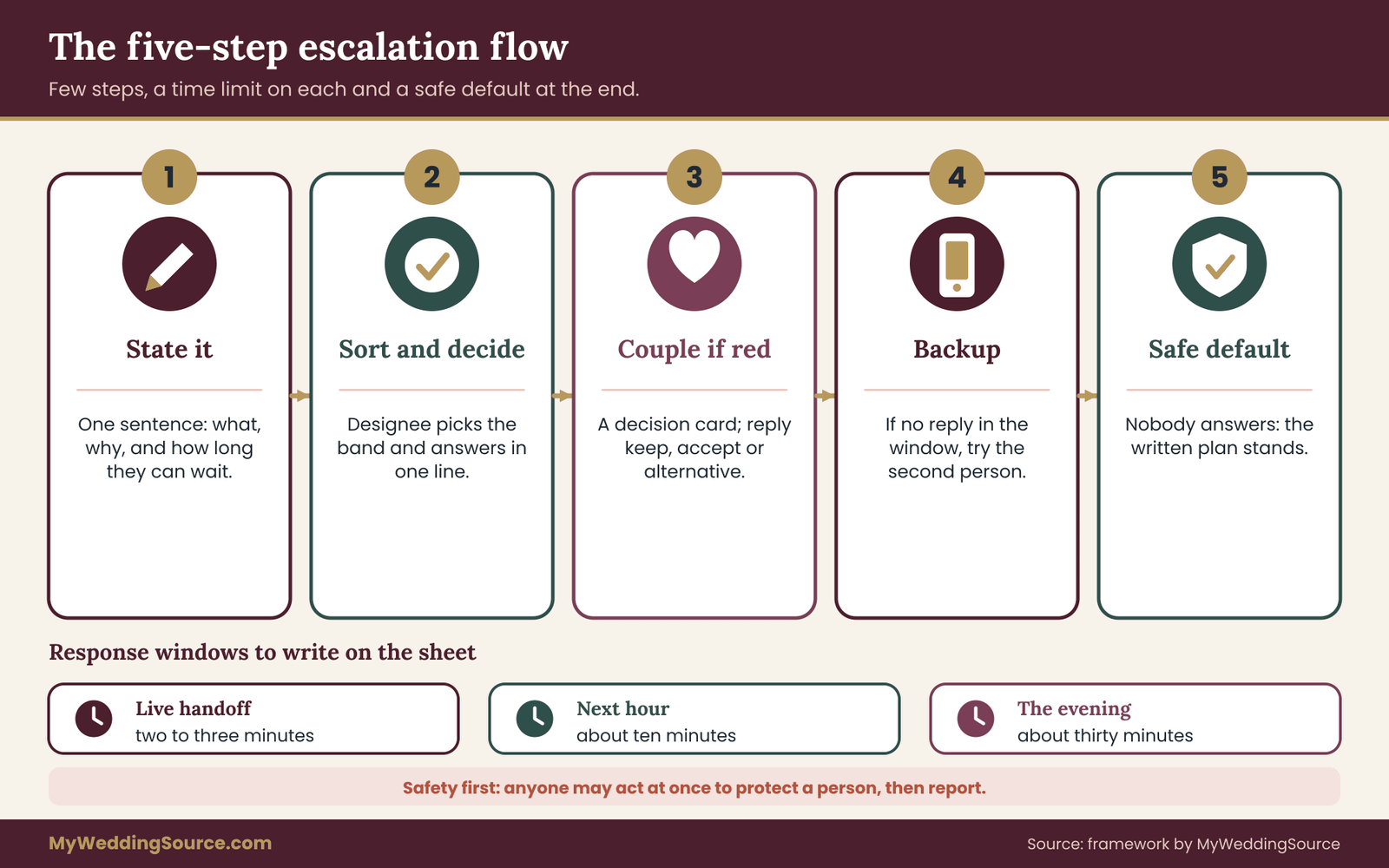
Bands decide what kind of change it is. The escalation flow decides how it travels. A good flow has few steps, a time limit on each, and a safe default at the end. The version below has five steps and fits on a single index card.
Step one: the vendor states the change in one sentence
The first step of the change management flow is the shortest. The vendor, or whoever is making the request, sends one sentence to the designee. Not a paragraph, not a phone call unless it is urgent. The sentence has three parts: what they want to change, why, and how long they can wait. “The kitchen is ahead, we would like to start dinner at six instead of six twenty, can you confirm by five forty?”
A fixed format matters because it saves the designee from digging through context. If vendors find the format awkward, give them a template message in advance that they can copy.
Step two: the designee sorts and decides
The second step of the change management flow is where bands do their work. The designee reads the message and places it in a band. Green changes should not arrive here at all, but if one does, the answer is “go ahead.” Amber changes get a decision. The designee checks three things: who else is affected, whether it breaks anything on the red list, and whether the answer can wait. Then they reply in one line: yes, no, or yes with a condition.
Speed matters more than perfection. A reasonable answer in two minutes beats an ideal answer in twenty. If the designee is unsure, a useful move is “yes, but let me confirm with the venue first,” which buys time without losing the vendor.
Step three: reserved items go to the couple
The third step keeps your part of change management narrow. If the change touches the red list, the designee does not decide. They contact one of you, using the channel you agreed, and present the change using a decision card, described below. You answer with one of three words: keep, accept, or alternative. If you cannot be reached within the window, the original plan stands.
The point of this step is to keep your involvement narrow. You are not asked about napkins. You are asked only about the things you decided in advance that only you can decide.
Step four: the backup takes over when the designee cannot answer
The fourth step makes the change management flow resilient. If the designee does not reply in the stated window, the vendor tries the backup. The backup reads the same sheet and applies the same rules. This is why both people need the same page, and why vendors need both numbers.
If neither answers, the vendor moves to step five.
Step five: the safe default
The last step of wedding day change management is a default, not a decision. When nobody responds, the vendor does the safe default: keep the written plan. The only exceptions are safety problems and anything that would cause the schedule to collapse entirely, such as a delivery that cannot wait. In those cases the vendor makes the minimum change needed and reports it at once.
This closing step is what makes the whole flow trustworthy. Everyone knows what happens if the change management system fails: the plan stands. No one is left guessing about what the unreachable person would have wanted.
The decision card
The decision card is the small paper tool behind change management at step three. Behind the scenes, the designee uses a small card when a change reaches step three. It has six fields, and filling it takes under a minute.
What changed, in one sentence. Why it is being proposed. What it touches, listed as people, time, money and senses. The options, which are always at least keep the original, accept the change, and a third alternative if one exists. The deadline for answering. And a space to write the decision and the time, which becomes the record.
The “senses” field is worth keeping. It asks whether the change affects light, sound, smell, touch, crowding or temperature. A change that looks harmless on a schedule can be significant on this one line.
Response times that fit the moment
Response windows are a quiet but important part of change management. Pick response windows deliberately, and write them on the sheet. A common pattern is two to three minutes for anything during a live handoff, ten minutes for changes that affect the next hour, and thirty minutes for anything that affects the evening. Shorter windows are harder to meet. Longer ones leave vendors waiting.
Shorten the windows around critical moments. While you are getting ready, vendors should expect fast answers from the designee and no contact with you. While you are in the ceremony, no changes should be proposed at all, and the designee should hold anything that arises until the ceremony ends, unless safety is at stake.
Quiet hours
Quiet hours protect the people at the center of wedding day change management. A quiet hour is a stretch of time when changes are held unless they are urgent. Many couples find it helpful to have one before the ceremony and one during the first dance or toasts. During a quiet hour, vendors batch non-urgent questions and send them afterward. This protects the couple’s attention during moments that cannot be interrupted, and it teaches vendors to bundle their requests.
For the sequence of cues that make up the ceremony itself, the guide to a wedding ceremony cue sheet shows how to lay out who does what and when, which is the natural place to mark your quiet hours.
Safety overrides
No wedding day change management plan should ever slow down an emergency response. Everything above gives way to safety. If a vendor sees a risk to a person, such as a fire, a medical emergency, a collapsing structure, a guest in distress or severe weather, they act first and tell the designee as soon as they can. No rule on your page should discourage anyone from acting quickly to protect a person.
Say this out loud when you brief vendors, and ask the venue for its own emergency plan during the venue technical walkthrough. It removes any fear that following your rules could make someone hesitate in an emergency. For weather and emergency planning in more depth, the National Weather Service and the Ready.gov preparedness pages are the standard public references, and the guide to a digital contingency plan covers what to do when phones, power or connectivity fail.
Setting change bands with each vendor without overcontrolling
The change management framework is the easy part. The delicate part is presenting it to vendors in a way that sounds like teamwork. Vendors are professionals, many of them with years of experience handling live events. A page that reads like a list of prohibitions will damage the relationship before the day begins.
Open with trust, then ask for their input
The best change management conversations with vendors begin with respect. Start the conversation by saying what you value about their work. Then explain that you are building a short change plan and want their help making it realistic. Ask which changes they make most often. Ask what they would consider small. Ask what they would flag to a client if they could. Their answers will improve your lists, and they will feel consulted rather than managed.
A sentence that tends to work: “We would love for you to use your judgment on most things. There are a few places where we would like a heads-up first, and we would like to agree on those with you.”
Give vendors something in return
Vendors accept change management more readily when it benefits them. Control feels lighter when it comes with benefits. Offer a single point of contact. Offer fast answers. Offer a generous green list. Offer to tell them early if something on your side changes. Offer a hot meal and a quiet place to take a break. Many vendors will tell you that a clear decision-maker is the thing they most wish clients provided.
How the bands look for different vendors
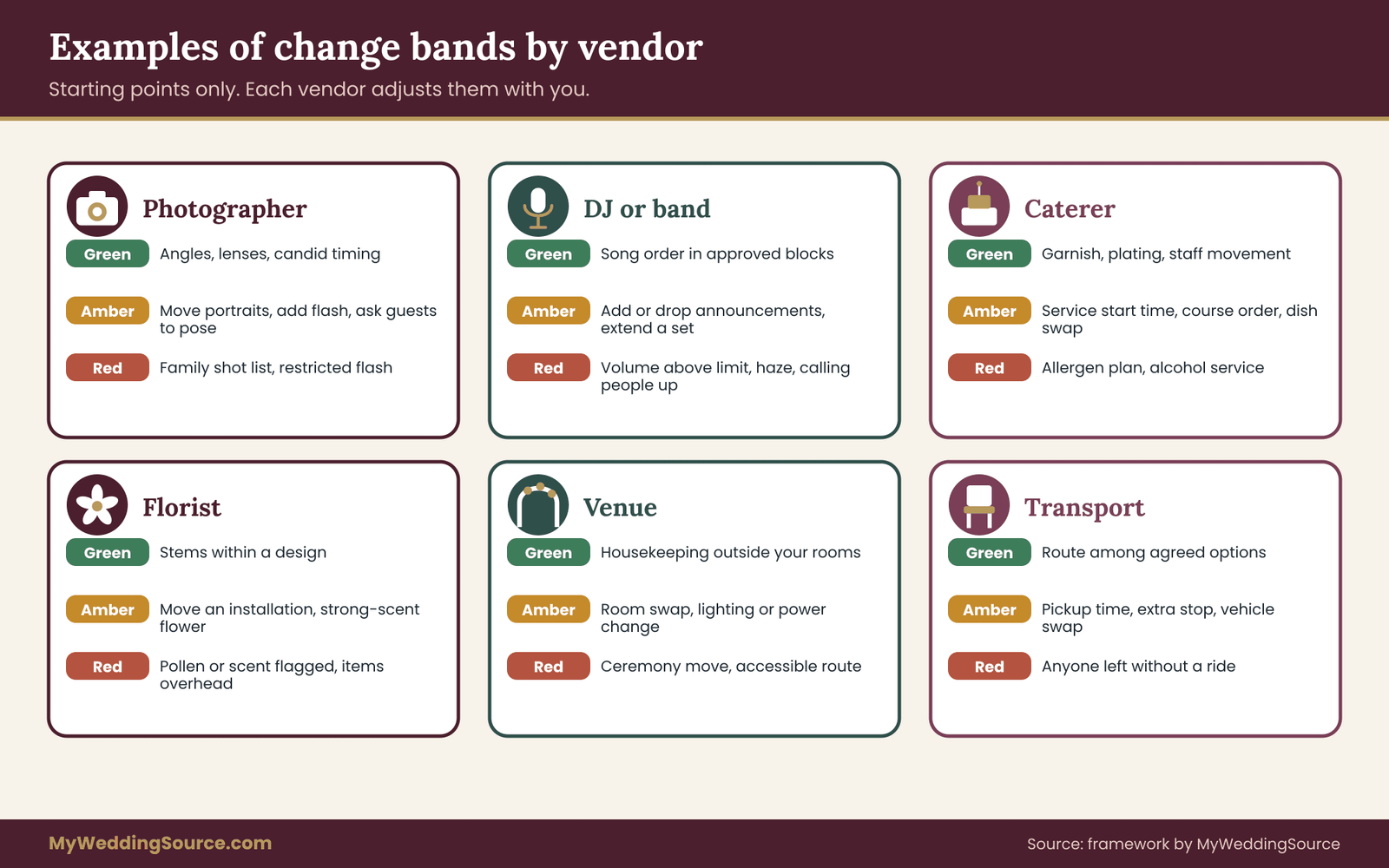
The same three bands apply to everyone, but the contents differ. The examples below are starting points, not rules, and each vendor should adjust them.
Photographer and videographer. Green: choosing angles, lenses, candid timing, and where to stand during the ceremony within the agreed zone. Amber: moving formal portraits, asking guests to pose, using flash in the ceremony, requesting more time from the couple. Red: any change to the family shot list, any use of flash or movement you restricted, any photo of people you flagged.
DJ or band. Green: song order within approved sections, small volume adjustments inside an agreed range, microphone checks. Amber: adding or dropping an announcement, changing the order of major moments, extending or shortening a set, a substitute performer. Red: volume above a limit, strobe or haze, impromptu dedications, calling anyone onto the floor.
Caterer. Green: garnishes, plating details, how staff move behind the scenes. Amber: service start or end time, a change to the order of courses, a station layout that moves guest traffic, substitution of a dish. Red: anything that affects an allergen or dietary plan, and any alcohol service change.
Florist and decor. Green: how stems sit within an arrangement, small material substitutions of equal look. Amber: moving an installation, changing placement near the aisle, substituting a flower with strong scent. Red: scented or pollen-heavy blooms where you listed a sensitivity, hanging items above guests, candles.
Venue. Green: routine staff movements and housekeeping outside your spaces. Amber: room swaps, access changes, power or lighting changes, bar timing. Red: moving the ceremony, changing capacity, any alteration to an accessible route.
Transportation. Green: route choice among the options already agreed. Amber: changing pickup times, adding stops, swapping vehicles. Red: changes to who rides with whom, or any change that leaves a guest without a ride.
Hair, makeup and attire. Green: tool order and technique. Amber: running ahead or behind by more than the agreed margin, changing who is serviced first. Red: products you flagged, any change to touch or contact you asked to avoid.
Officiant. Green: small phrasing within an approved script. Amber: changing the order of ceremony elements. Red: adding anything you did not approve, such as a new reading, ritual or audience participation.
Phrasing a request so it lands
Words matter in change management, because the same request can sound like a partnership or a restriction. Avoid the word “rule” with vendors. Use “heads-up” and “preference.” Compare “You must not change the schedule” with “If you see a reason to move anything, could you send Jordan a quick text first? They can answer in a minute or two.” The second asks for the same behavior and treats the vendor as a partner.
Keep the red list as a short, calm set of requests. State each item with its reason when the reason is simple, and without one when it is private. “Please keep the volume at the level we tested” needs no further explanation. If a vendor asks why, “we are sensitive to sudden loud sound” is plenty.
When a vendor says no
Not every vendor will welcome change management, and that is worth knowing early. Some vendors will not accept a framework. They may feel it adds work, or they may not accept being asked to check in. That is useful information. It is better to learn it a month before the wedding than on the day. Ask what they would be comfortable with. A narrower deal, such as “tell us only about timing changes,” may still do the job.
If a vendor refuses any check-in, consider whether the risk is acceptable for the part they cover. A florist who will not coordinate placement is a smaller risk than a caterer who will not discuss allergens. Weigh each case separately.
Signs you are overcontrolling
Change management can drift into micromanagement, so check for warning signs. Watch for a few warning signs. If your green list is shorter than your amber list, you are likely holding too much. If vendors respond to your page with more questions than answers, it is probably too long.
If you find yourself writing rules about how a vendor does their craft, rather than how they communicate, you have crossed from change management into micromanagement. The test is whether the rule is about coordination or about taste. Coordination rules are fair. Taste rules belong in the design stage, long before the day.
Putting change management into contracts and the run sheet
A verbal agreement is a good start, but weddings run on documents. Vendors work from contracts and run sheets, and those are the documents they will reread in a hurry. If your change rules live only in a conversation, they will fade. Put them where vendors already look.
What belongs in the contract
Change management in a contract can be short and plain. Contracts are the place for rules that carry money or obligation. Three pieces are worth asking for. The first is a named point of contact for changes, so the vendor knows whom to ask and whom to follow. The second is a sentence that says changes to timing, location or personnel require approval from that contact. The third is a sentence that states what happens to cost when a change is made by the vendor without approval.
You do not need legal language. A short clause such as “Changes to the agreed schedule, location or staffing on the event day will be confirmed with the client’s named contact before they take effect, except where needed for safety” is understandable and brief. Ask a licensed attorney in your state if you want it to carry weight, and ask the vendor to propose their own wording if they prefer.
The guide to a wedding vendor contract walks through the clauses worth reading before you sign, including cancellation, substitution and overtime terms, which are the clauses most likely to collide with day-of changes.
Substitution and overtime: where changes cost real money
Two clauses deserve special attention because they turn a change into a bill. A substitution clause lets the vendor send a different person than the one you met. If you care who shows up, say so in writing, and say what happens if the named person cannot come. An overtime clause sets what you pay if the day runs long. Ask how overtime is calculated and who may approve it on the day. If only the decision-maker can approve overtime, vendors cannot quietly extend a booking and invoice you later.
Put a spending limit on the designee’s authority. For example, they may approve extra costs up to a stated amount, and anything above it needs one of you. The limit should reflect your budget and your comfort, not a universal number.
The run sheet as the shared source of truth
The run sheet is the backbone of wedding day change management. A run sheet is the day’s schedule, written for the people who run it. It lists times, locations, people and handoffs. For change management, it plays a second role: it is the document that defines the original plan, which is the default if nobody answers.
Mark the run sheet clearly. Put the version number and the date at the top. Put the designee’s name and the backup’s name in the header. Add a short block called “If something changes” that states the bands, the response windows and the silence rule in four or five lines. Then send the same version to every vendor, and ask each to confirm receipt.
The second point is important. When different vendors hold different versions, a change that one has seen will contradict what another believes. Version control is the least glamorous and most useful part of this change management system. A simple habit is enough: every update gets a new version number, the old version is replaced everywhere, and the designee confirms who has the new one.
Writing the schedule so changes are visible
Visible updates make change management faster for everyone. Format the schedule so changes stand out. Use a consistent layout. Put times in a single column and responsibilities beside them. When something is updated, mark it with the words “updated” and the date at the top of the entry. Avoid recoloring or reorganizing, which makes it harder for vendors to spot what moved.
The method for laying out a shared schedule appears in the guide to a wedding vendor timeline, and the quick rule is to keep one master and derive everything else from it.
Purchase orders and written approvals
Some couples place orders for rentals, flowers or supplies through formal purchase orders. If you do, the same principle applies. A written approval record for each item makes it clear what was agreed and when. The wedding vendor purchase order checklist shows what to include, and a short line saying that changes need the named contact’s approval fits easily on any order.
Things not to put in writing
A few items are better handled out loud. Do not include private health details in vendor-facing documents. You can say “we are sensitive to sudden loud sound” without saying why. Do not share personal information about family relationships. And do not turn the run sheet into a manual of your preferences. A run sheet exists to coordinate the day, not to describe the people on it.
The pre-wedding briefing and the one-page change sheet
With the change management framework chosen and the contract updated, the last preparation is a short briefing. Its goal is not to teach anyone a change management system. It is to make sure every person who may see a problem on the day knows where to send it.
The one-page change sheet
The change sheet is the working tool of wedding day change management. The change sheet is a single page that every vendor and helper receives. It should fit on one side of paper, in readable type. The contents are few.
At the top: the designee’s name and number, and the backup’s name and number. Below that: the three bands, each with a handful of examples in plain words. Below that: the response windows, such as “two minutes in the ceremony, ten minutes in the evening.” Below that: the silence rule, in a single sentence. At the bottom: the safety statement, in a single sentence. That is all. If it wants a second page, something on it belongs somewhere else.
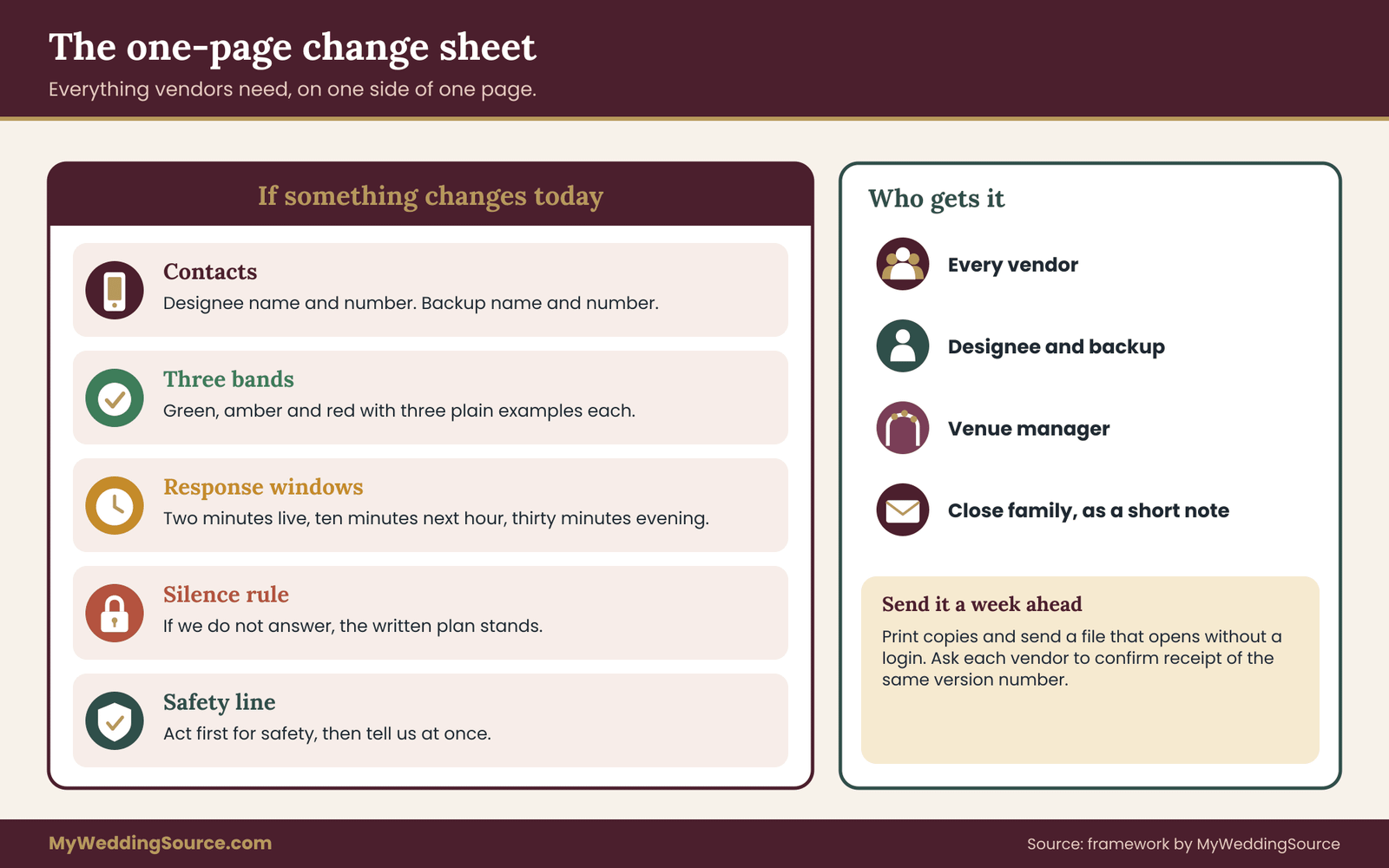
Print copies and also send a digital version. A vendor on the day may need it on a phone or may need to hand it to a staff member. Make the digital file easy to open without logging in or installing anything.
The briefing call
A short call turns written change management into something people can use. Hold a short call or meeting with the designee and backup, around a week before. Walk through the sheet. Ask each of them to read the red list aloud, and ask what they would do in three or four made-up cases.
The questions to ask are simple. What would you say if a vendor asked to start dinner early? What would you say if a relative asked the DJ for a new song? What would you do if you could not reach either of us?
The briefing is also the time to give the designee permission in plain words. Tell them that it is fine to say no, fine to say not now, and fine to ask a vendor to keep the original plan.
Messages to vendors
A week before the wedding, send a short note to each vendor. A sample, in your own words, could read like this.
“Thanks again for being part of our day. To keep things smooth, Alex is our contact for any changes on the day, and Priya is the backup. Please use your judgment on small things. If you want to move anything that affects timing, space or other vendors, a quick text to Alex first is great. Attached is a one-page sheet with the details.”
The note is brief, warm and specific. It does not threaten, and it does not explain more than it needs to. Pair it with an attachment of the change sheet and the final run sheet.
The day-of greeting
On the day, the designee greets each vendor as they arrive, introduces themselves, and repeats the instruction in one sentence. It helps to ask a small question that opens the channel: “Is there anything you already know might change today?” Vendors often have a concern they have not yet mentioned, such as a delivery truck stuck in traffic or a doorway that is narrower than expected. Hearing it at arrival, rather than at the moment it bites, is the real benefit of this change management system.
A short script for common moments
Having words ready makes the designee’s job easier. A few examples are below, each one sentence, each adjustable.
When approving: “That works, thanks for checking. Please go ahead.”
When declining: “Thanks for flagging it. Let’s keep the original plan for now.”
When buying time: “Let me confirm and come back to you in five minutes.”
When a relative asks: “We have one person handling changes today, and I will pass your request along.”
When a vendor goes ahead without asking: “Thanks for getting that done. Next time, please text me first. Here is the number.”
None of these require anger or apology. The tone is calm and matter-of-fact. The aim is to keep the channel open, so that vendors continue to send you information instead of hiding it.
Practising once
Change management is a habit, and one rehearsal builds it. Many couples skip practice because it feels artificial. A five-minute walk through one imaginary change is enough. Pick a plausible case, such as a florist arriving late, and have the designee run it through the five steps aloud. The goal is to notice gaps: Do vendors have the right number? Is the response window realistic? Does the backup know what to do? A single rehearsal reveals most of the weaknesses that would otherwise appear on the day itself.
A worked case of wedding day change management
The case below is invented to show how the pieces fit together. The couple, vendors and times are fictional, and nothing here describes a real event. Treat it as a rehearsal script, not a report.
The setup
This invented case follows wedding day change management from the first message to the last log line. Dana and Marcus are marrying on a Saturday at a garden venue. The ceremony is at four in the afternoon outdoors, followed by cocktail hour, dinner at six twenty and dancing at eight. Dana finds sudden changes to the order of the evening tiring, and Marcus is sensitive to sudden loud sound. They have done the preparation described in this guide.
Their red list has five items: the order of the ceremony, the volume limit during dinner and toasts, any fog, haze or confetti, the allergy plan for two guests, and any change to the accessible route from the parking area to the lawn. Their designee is Marcus’s sister, Priya, who has no other duties. Their backup is a friend, Leon, who is a guest and will carry the sheet in his jacket.
Their amber threshold is a shift of fifteen minutes or more, any room swap, any substitute staff member, and any added cue. Their green list is long and mostly about craft: angles, plating, floral placement within a design, and song order inside approved blocks.
Change one: the forecast
At one in the afternoon the venue manager sees a storm line on the radar and proposes moving the ceremony indoors to the ballroom. Priya sorts it fast. Moving the ceremony is red, because it touches the order of the day and probably the accessible route. She does not decide. She sends Dana a decision card with three lines.
What changed: ceremony moved from lawn to ballroom. Why: storm line expected around four. What it touches: space and sensory, since the ballroom has hard surfaces and echoes, and the accessible route is shorter. Options: keep the lawn with a thirty-minute weather hold, accept the ballroom now, or accept the ballroom only if the sound level can be managed.
Dana answers within four minutes with one word and a condition: accept the ballroom, provided the string player uses the quieter setting. Priya relays the answer to the venue manager and the musician, updates the run sheet to a new version, and sends it to every vendor with a note saying what moved. The change took about ten minutes, and nobody was surprised.
Change two: the early kitchen
At four forty the caterer’s lead tells Priya the kitchen is ahead and proposes starting dinner at six instead of six twenty. This is amber. Priya checks three things. The DJ’s first announcement is scheduled for six fifteen. The toasts are meant to follow dinner. And twenty minutes earlier means guests are still in cocktail hour with photographs being taken.
She does not say yes automatically. She replies: “Can you hold at six ten? We will tell the photographer and DJ.” The caterer agrees. Priya texts the photographer and the DJ one sentence each. Dinner starts at six ten, a compromise that gives the kitchen part of what it wanted and leaves the other vendors time to adjust.
This is the usual outcome of a good amber process. The answer was neither a flat refusal nor a full acceptance. It was a short negotiation that took under three minutes, because everyone had a single person to talk to.
Change three: the photographer’s request
During cocktail hour the photographer asks whether she can take a group photo of all the guests on the terrace at a quarter to six, which was not on the run sheet. This one is amber with a touch of red. The photograph itself is a small matter, but it requires Dana and Marcus to appear at a time when they planned to rest, and it involves gathering guests, which is a social exposure the couple wanted to avoid.
Priya does not approve it. She replies to the photographer: “Thanks, the couple would like to keep that time quiet. Could the group photo happen after dinner, during the toasts break, if they agree?” She then asks Dana by text. Dana says no, with a kind word. The photographer takes a few candid shots of the terrace instead, which she says suits her anyway.
Change four: the relative
A cousin asks the DJ to play a favorite song during dinner, loudly, as a surprise for the couple. The DJ, who was told about the red list, says, “Let me check with Priya.” Priya tells the cousin that all requests go through her, and that dinner volume is fixed at the level tested earlier.
She offers a place on the dance playlist if the song is suitable. The cousin agrees. The change management system worked here because the DJ recognized a request that touched a red item and passed it to the right person.
The record
By the end of the evening, Priya has four lines in her notes: the ceremony moved indoors, dinner started at six ten, the group photo was declined, and the cousin’s request was routed to the dance playlist. She does not need to write more. The next morning, the couple will see the log and know what happened.

What the case shows
The case shows what change management looks like when it works quietly. Several points are worth noticing. Most changes were small and took minutes. Only one reached the couple, and it did so in a structured form they could answer in a sentence. The designee never had to argue; she only had to apply the bands. Vendors were not blocked; they were routed. The green list absorbed dozens of small decisions that never appeared in the log, such as plating details and floral placement.
Most important, the couple’s attention stayed available for the day itself. They did not have to be project managers. They had designed a change management system, handed it to someone they trusted, and let it run.
Where the case could have gone wrong
It is useful to imagine failures too. If the venue manager had moved the ceremony without telling anyone, the string player would not have known to lower the volume, and the accessible route might have been cut off. If the caterer had simply started dinner at six, the photographer would have been caught mid-portraits and the DJ would have been late with the announcement. If the cousin’s song had played at full volume, Marcus would have been startled.
None of those outcomes is disastrous in the abstract. Together, they are the sort of small collisions that can leave a person depleted by the time the first dance arrives. The change management framework does not eliminate collisions. It reduces how many reach you and how fast the rest are resolved.
Adapting the case to your own day
Your own change management plan will look different, and that is expected. To adapt the example, replace each element with your own. Your red list will differ. Your designee may be a coordinator, not a relative. Your amber threshold may be ten minutes or thirty. The numbers are not important. The shape is. A change arrives, someone sorts it by band, a named person answers in minutes, the record is kept, and the plan is updated and shared.
A good test is to write four invented changes for your own wedding and run them through the five steps on paper. If a change has no clear route, you have found a gap. Fix the gap before the day, not during it.
Alternatives to a designee system
The three-band system with a named decision-maker is one approach among several. It suits many couples, but not all of them. Looking at the alternatives honestly will help you decide how much structure your day needs.
Alternative one: a full-service coordinator holds everything
A professional coordinator can carry most of the change management load. If you hire a professional who is on site for the whole day, much of this change management system is built into their job. They know vendors, they hold the timeline, and they make amber decisions routinely. The advantages are experience and speed. The tradeoffs are cost and the need to make sure the coordinator understands your red list and does not override it out of habit.
If you go this route, give the coordinator the one-page sheet anyway. Ask them to confirm which items they will treat as red. A good coordinator will welcome the clarity.
Alternative two: the venue manager acts as the single channel
Some venues run the day closely and prefer to be the one point of contact. This can work well for venue-related changes. It works less well for changes that belong to vendors the venue does not manage, such as a photographer or a band. If you choose this path, ask the venue manager to write down which categories they will handle and which they will pass to you or another contact.
Alternative three: the couple handles changes directly
Some couples prefer to hold the phone themselves, especially for small weddings with few vendors. It can work when the day is simple and when both of you are comfortable fielding questions. The risk is obvious: you are the most interrupted people in the room on the day you most want to be present. If you choose this path, use a quiet-hour rule and a short list of vendors who may contact you, and put the phone away during the ceremony.
Alternative four: a lighter written plan with no designee
A very small wedding with one or two vendors may need only a written run sheet and a message saying, “Please text us before changing anything.” That is change management in its lightest form. It is fine when the stakes are low and the number of people is small. It breaks down as the guest list, the vendor list or the venue’s complexity grows.
Alternative five: no system at all
Some couples choose to trust the day to unfold. This is a legitimate choice, especially for couples who enjoy improvisation and have vendors they know well. The cost is that surprises will arrive, and nothing is in place to catch them. If either of you finds surprises tiring, this option is probably not the right fit.
How to choose
Choosing the right amount of change management is a judgment about your own day. Use three questions. How many people and vendors are involved? How costly is a surprise to each of you? And how much of your day is in a space you do not control? A larger guest list, a costlier surprise and a less controlled space all point toward more structure. A small list, a low cost of surprise and a familiar space point toward less.
It is also reasonable to mix approaches. You might hire a coordinator for the ceremony and reception while handling the getting-ready hours yourselves, with a friend as backup. The bands still apply. They simply have different holders at different times.
Choosing a lighter version without losing the core
If the full system feels heavy, keep three pieces. Name one contact. Write a short red list. State the silence rule. Those three alone catch a surprising share of problems. You can add bands, windows and sheets as the day grows more complex.
Failure conditions in change management and how to repair them
Any system fails in some conditions. Knowing the conditions in advance lets you design around them and recognize them on the day. The most common failure modes are below, with the repair for each.
The designee is unreachable
The most common failure in wedding day change management is a missed message. A dead battery, a noisy room, a long ceremony, a bathroom break. The repair is a backup, a second number, and a rule that vendors try the backup after the stated window. Also give the designee a way to see messages quickly, such as a watch or a dedicated phone, and ask them to check it at set points in the day.
The designee is pulled into other duties
A designee who is also a guest may be hugged, thanked, pulled into photographs, and asked to hold a baby. The repair is to choose someone who has no other role, or to protect their time by telling other people to leave them alone during set windows. If that is impossible, shift to a paid coordinator for at least the busiest hours.
The lists are too long
Over-long lists weaken change management more than almost anything else. A red list with thirty items is a red list nobody remembers. The repair is to cut it to the items that really matter and move the rest to amber. If you cannot cut it, you may have a planning problem that deserves its own conversation, outside the change management framework.
The lists are too short or vague
The opposite failure is a page that says “tell us if anything changes.” Vendors will not know what counts. The repair is to add specific examples, because specific examples travel better than categories. Three concrete cases in each band are more useful than a paragraph of principles.
Vendors treat the change management rules as optional
Some vendors will ignore the sheet. They may not have read it, or they may disagree with it. The repair is to catch them early, at arrival, and to repeat the instruction in person. If a vendor still goes ahead without asking, handle it calmly and without scolding, using the script from the briefing section. Public confrontation on the day rarely improves anything.
Relatives and guests bypass the change management system
A relative who thinks they are helping can undo a carefully built plan in thirty seconds. The repair is to tell family ahead of time that one person handles changes, to give the designee the authority to say no politely, and to let the vendors know that requests from guests go to the designee. A friendly line works: “We have one person handling changes today, so please send your idea to her.”
The silence rule is applied wrongly
Sometimes a vendor will take silence as consent, which is the opposite of what the rule says. The repair is to state the rule in the sheet and say it aloud. For red items, silence means no. For amber items, silence means the original plan stands unless safety or collapse is at stake. If vendors still misread it, the wording on the sheet is probably unclear. Rewrite it in plainer words.
A change arrives during a quiet hour
A request that comes in during the ceremony or the toasts may tempt the designee to answer immediately. The repair is to hold non-urgent changes until the quiet hour ends and to tell the vendor so. A one-line reply is enough: “Noted, will answer after the toasts.”
The couple changes their own mind
You may decide, on the day, that you want a change. That is your right, and the change management system should accommodate it. The repair is to route your own change through the designee, too, so that the run sheet stays accurate and vendors hear one consistent message. A change that lives only in your head cannot be followed by anyone else.
When the change management system breaks down entirely
Even a well-built change management plan can fail, and a fallback is ready. If the day dissolves into confusion despite every effort, drop to the simplest possible rule: the written plan stands, and anything urgent goes to one person. Remember the safe default. It is not a failure to fall back on it. It is what the default is for.

Learning from a failure
Each failure is data for better change management next time. If something went wrong, note it afterward without blame. The aim is to improve the sheet for next time, whether for you or for a friend you share it with. A failure usually points to one of three causes: a missing number, a vague rule or a missing briefing. Each is easy to fix once you can see it.
Changes that start with you, your family and the day after
So far the focus has been on vendors. Two other sources of change deserve their own attention: your own side of the day, and what you do once the day is over. A system that ignores either will leak.
Your own changes
Change management applies to the two of you as well. Couples change their minds on the day. You may decide you are too tired for a planned photograph, want to leave earlier, or want the toast moved. These are allowed. The rule is simply that they travel through the same channel as everyone else’s, so that vendors hear one consistent message.
A short habit helps. When you want something to change, tell the designee in one sentence and let them carry it. Do not walk across the room and tell a vendor directly, however friendly the moment. A direct word from you can sound like a standing instruction, and a vendor may follow it even after you have changed your mind again.
It also helps to agree between the two of you how you will handle disagreement. One partner may want an extra dance, the other may want to sit down. A short private signal, a phrase or a look agreed beforehand, can stop a change from escalating. The point is not to win. It is to avoid making an unplanned decision in public.
Family and guest requests
Wedding day change management needs a polite answer for relatives. Requests from relatives will come, usually with good intentions. The same principle applies: one channel. Give your family a clear, kind message in advance. Something like: “We have asked one person to handle all changes on the day, so please send ideas to her.” Then give the designee the authority to say yes to harmless ideas, such as a song on the dance playlist, and no to the rest.
If a family member insists on speaking to a vendor directly, the vendor needs a script too: “I will check with the person in charge of changes.” A vendor who has been briefed will say this without discomfort. A vendor who has not will often say yes, because it is the easiest word in the room.
For couples with complicated family situations, it is worth deciding in advance which requests are never granted, such as seating changes, toasts by uninvited speakers or photographs involving particular people. Add them to the red list and let the designee cite the list when needed.
Accessibility and accommodations
If either of you has access needs, or if any guest does, the red list should include any change that touches them. A moved ceremony space, a blocked ramp, a darkened room or a changed route can have real consequences. In the United States, businesses open to the public, which include many venues, caterers and other vendors, have obligations under the Americans with Disabilities Act. The ADA.gov site explains what those obligations are in general terms. For your specific situation, a lawyer or the relevant agency can tell you what applies.
In practice, the useful move is to say plainly what you need. “We would like the accessible route to stay open from the lot to the lawn” is a clear request that any venue can follow. Put it in the contract and on the sheet.
The day-after review
A review keeps change management honest after the event. Once the wedding is over, spend twenty minutes with the designee, the log and the sheet. Ask what changes came in, how they were sorted, which ones surprised anyone, and what the sheet missed. Write down two or three adjustments and keep them with your wedding records.
The review has a second use. If you ever plan another event, such as an anniversary party or a vow renewal, you will have a tested page to start from. Friends who are planning a wedding may also benefit from seeing it, with your private details removed.
Thanking the people who held it together
Good change management leaves a trail of people who deserve thanks. A designee who kept the day calm deserves a thank-you note and, if it fits your budget, a small gift. Vendors who followed the sheet deserve a note too, and a good review if their work warrants one. These gestures matter because they reinforce the habit of communicating early. The next couple they work with will benefit.
Keeping the change management system proportionate
Finally, remember the purpose. Wedding day change management exists to protect the day and the people at its center. It is not an exercise in control and it is not a test of whether everything goes to plan. Some things will still go differently than you expected. A late delivery, a missing item, a sudden shower. The aim is that when they do, you hear about it from a person you trust, in a form you can answer, at a moment you can handle.
If that happens even most of the time, the change management system has done its work.
Your next steps
Start with two private lists. Each of you writes the changes you hardly notice, the ones you can absorb, and the ones you need to hear about first. Compare them over a quiet evening and merge them into one green, amber and red page.
Then choose your designee and backup, and ask them if they are willing. Add a change-contact line and a short substitution and overtime clause to each vendor contract that still allows edits. Send the one-page sheet to vendors a week before the wedding, hold a ten-minute briefing with the designee, and rehearse one invented change aloud. After the wedding, review the log and keep it with your records.
FAQ
What is wedding day change management?
It is a short set of agreements about who may change what on the wedding day. Small changes inside a vendor’s craft proceed freely, changes that affect other people go to a named contact first, and a short list of protected items can be approved only by you or your designee. A written record and a safe default, usually keeping the original plan, complete it.
Will this make vendors feel micromanaged?
Not if you present it as teamwork. Ask what they change most often, give them a generous list of things they may simply decide, and offer one contact and fast answers in return. Vendors tend to welcome clarity about who decides. The rules should cover coordination, such as timing and shared space, and leave taste and technique entirely to them.
Who should be the authorized decision-maker?
Choose someone calm, organized and free of other duties on the day. A professional coordinator is the most reliable option if your budget allows. A trusted friend or relative can work if they are not in the wedding party and are comfortable saying no. Name a backup with the same sheet, and make sure vendors have both numbers.
What if nobody answers a vendor’s request?
The written plan stands. State this in one sentence on the sheet and say it aloud. For protected items, silence never counts as approval. For middle-band changes, a vendor may act on their own only to protect safety or to prevent the schedule from collapsing, and must report it immediately afterward. Safety always comes first.
How many items should be on the protected list?
Keep it short enough to remember, ideally under a dozen. Include only what truly matters to you, such as ceremony order, volume limits, allergy plans, effects like haze or confetti, and accessible routes. If the list keeps growing, move some items to the middle band. A long list is one vendors forget, and a forgotten list protects nothing.
Does this only suit neurodivergent couples?
No. Any couple who dislikes surprises, or who wants fewer interruptions on the day, can use it. It is written with unannounced changes in mind, which some neurodivergent people find especially costly, but needs vary between individuals. Ask each partner what a surprise actually costs, and build the change management rules around those answers rather than assumptions.
Should the change management rules go into vendor contracts?
Yes, in brief. Ask for a named point of contact for day-of changes, a sentence requiring that changes to timing, location or staff be confirmed first, and clear terms for substitution and overtime. Wording differs by state and vendor, so consider having an attorney review anything that carries real money or risk, and ask the vendor to propose their own language if they prefer.
What if a vendor refuses the change management framework?
Treat that as useful information, ideally learned weeks ahead. Ask what they would accept, such as a heads-up only for timing changes. If they will not coordinate at all, weigh the risk for their role. A florist who will not coordinate placement is a smaller risk than a caterer who will not discuss allergens. Decide case by case.
Sources
- ADA.gov, U.S. Department of Justice Civil Rights Division
- Introduction to the ADA, U.S. Department of Justice
- Autism spectrum disorder, Centers for Disease Control and Prevention
- Job Accommodation Network, U.S. Department of Labor funded resource
- National Weather Service, National Oceanic and Atmospheric Administration
- Ready.gov, Federal Emergency Management Agency
- National Incident Management System, Federal Emergency Management Agency
- Consumer advice, Federal Trade Commission
- Consumer Financial Protection Bureau
- USAGov, U.S. General Services Administration