
Pregnancy wedding shoes are a different purchase from ordinary bridal shoes, because the feet that try them on in spring may not be the feet that wear them in autumn. This guide gives you a five-question comfort check, a list of referral flags, a three-pair backup plan and a buying timeline, so you can choose a pair, and a fallback, without guessing.
For pregnancy wedding shoes, buy late, test late in the day, and never rely on a single pair. Run every candidate through five questions: does it fit now, will it fit if my feet change, can I stand in it for the length of the ceremony, is the grip safe on this venue’s floor, and can I swap out of it without ruining the hem? Buy a primary pair, a flat or low backup in a matching or neutral finish, and an emergency pair that is already in the venue. Treat sudden swelling, pain or balance changes as clinician questions, not shoe questions.
Most advice about wedding footwear, including most advice on pregnancy wedding shoes, assumes your body is a fixed quantity. You pick a heel height, break the shoes in, and bring blister plasters. Pregnancy removes that assumption. Your feet, your balance, your stamina and your tolerance for standing can all shift over a few weeks, and nobody can tell you in advance exactly how yours will behave.
That does not mean you should give up on a pair you love, or that pregnancy wedding shoes have to be dull. It means the decision needs a different shape. Instead of choosing one perfect shoe, you choose a small set of options and a few checkpoints that tell you which one to wear. Pregnancy wedding shoes work best as a system with a fallback, not as a single bet placed months before the date.
A note on scope. This is general information, not medical, legal, tax or financial advice. Your own clinician knows your pregnancy, and anything about swelling, pain, blood pressure or activity limits belongs in a conversation with them. Where a rule or a policy matters, this guide points you to the agency or the seller that publishes it, so you can confirm the current version.
Why pregnancy wedding shoes are a different decision
A standard bridal shoe decision is mostly about looks and about surviving a long day. You compare heel shapes, match the dress length, and hope the blisters stay minor. If the choice turns out slightly wrong, you change into flats at nine in the evening and carry on.
With pregnancy wedding shoes, three extra variables enter the decision, and they interact. The first is physical change: your feet may swell by the end of a day, and some people find their foot size or shape changes during pregnancy. The second is balance: as your body shifts, the way you stand and walk can feel different from one month to the next. The third is uncertainty: you will not know how you feel on the day until you are close to it.
Together these variables change what a good plan looks like. A good plan has to work across a range of possible feet, not one expected pair of feet. It needs a decision point late enough to use real information. And it needs a graceful way to downgrade, because the moment you most need a backup is the moment you cannot easily go shopping.
What this guide covers and what it leaves out
This article is about the footwear decision for a bride, or any pregnant person in the wedding party, who wants to choose pregnancy wedding shoes with eyes open. It covers fit, support, heel choices, surface safety, timing, returns and backups. It does not cover dress alterations for a changing body, which the wedding dress fit and alterations guide handles in depth, or the broader question of how to schedule a wedding around a due date.
It also does not tell you which pregnancy wedding shoes are medically safe for you. Whether you may wear a heel at all, how long you may stand, and whether you should use compression stockings are decisions for your clinician, who can look at your history. What this guide can do is help you arrive at that conversation with specific questions instead of a vague worry.
The method for choosing pregnancy wedding shoes has four parts. A short list of changes to expect. A five-question check that turns a shoe from “pretty” into “workable”. A set of referral flags that tell you when to stop shopping and call. And a buying timeline built around the wedding date, not around the shop’s schedule.
What can change in your feet, and why it matters for shoes
Swelling in the feet and ankles is common in pregnancy, and it tends to be more noticeable later in the day and in warm weather. Medical sources such as the American College of Obstetricians and Gynecologists describe some swelling as a normal part of pregnancy, and they also describe warning signs that need prompt attention. You will find the details on the ACOG website listed in the sources, and your clinician can tell you which pattern is ordinary for you.
For buying pregnancy wedding shoes, swelling matters in two ways. A shoe that fits at ten in the morning may feel tight at four in the afternoon, and a closed, unstretchable shoe has no room to give. A shoe with an ankle strap that sits comfortably when your feet are rested may cut in once the ankle is fuller. Both problems are about the shoe’s construction, not about your effort.
Some people also notice that their feet feel longer or wider after pregnancy begins. The reasons are discussed in podiatry and obstetric sources, and they include hormonal softening of ligaments and the added load on the arches. You do not need to understand the mechanism to act on it. You only need to leave room in your plan for a different size or width than the one you wore last year.
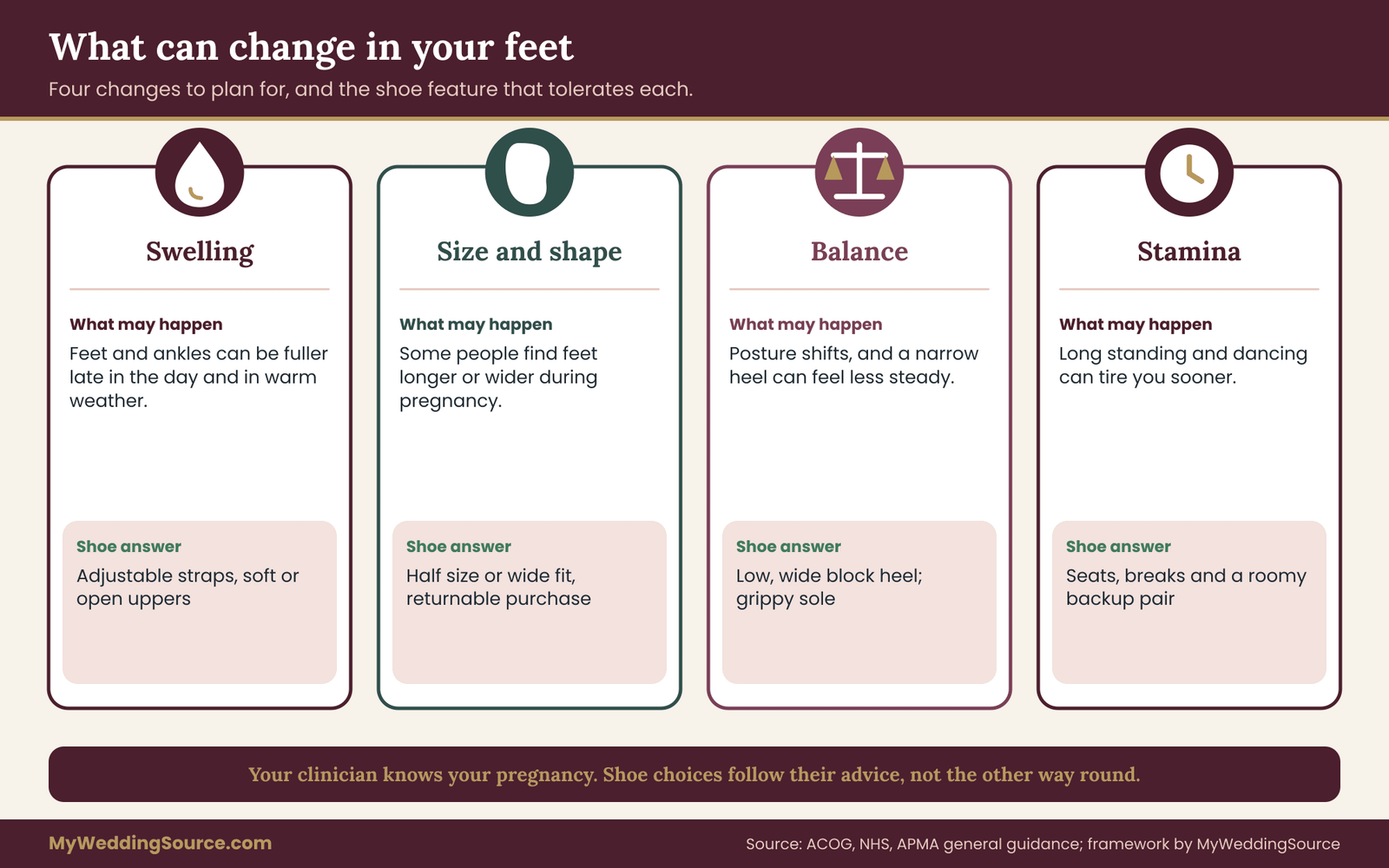
Balance is the third change. As the weight of the body shifts forward, many people stand and walk differently, and a narrow heel that felt stable before can feel less so. This is the reason heel height and heel base come up so often in the five-question check later. A shoe can be comfortable and still be a poor fit for your balance.
Finally, stamina changes, and it matters for pregnancy wedding shoes more than most people expect. Standing in one place for a long ceremony, queuing for photographs and dancing are all different loads on the feet and legs. If you tire more easily, a shoe you could have worn for six hours may become a shoe you can wear for two. The backup plan below is built around that possibility.
Why this is a planning problem and not a shopping problem
It is tempting to treat pregnancy wedding shoes as a question of finding the right brand. In practice, no shop can promise how your feet will behave in the week of the wedding. The reliable answer is to make the decision in stages, keep your options open as long as the seller’s return terms allow, and decide in writing what you will do under each outcome.
That approach also lowers the pressure. If the plan for your pregnancy wedding shoes already says “if my feet are swollen on the morning, I wear the second pair,” then a swollen morning is a scheduled outcome, not a disaster. You can still enjoy the pair you chose, and you can be generous with yourself when the fallback comes out.
The next section sets out the five questions. Treat them as a filter to run on every shoe you are considering, including the ones you already own and love. ## The five-question comfort check for pregnancy wedding shoes
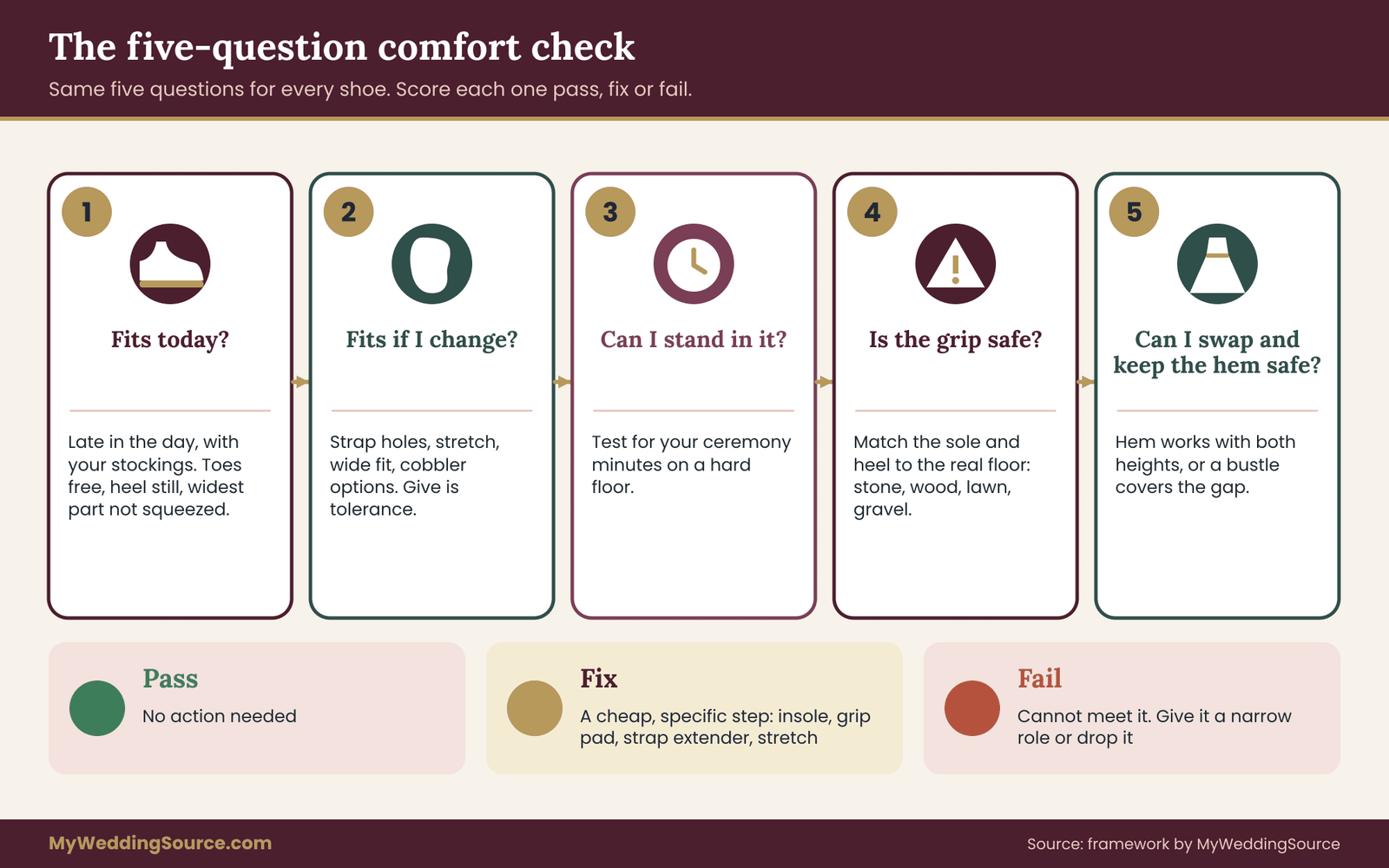
The check for pregnancy wedding shoes is a filter. Every shoe you consider gets the same five questions, in the same order, and a shoe that fails one of them is either rejected or paired with a specific fix. Write the answers down. A pair of pregnancy wedding shoes you remember as “fine” in a shop is not data.
Question one: does it fit my foot today?
Start with the plain fit. Try shoes on late in the day, when feet are at their fullest, and wear the kind of stockings or socks you expect on the day. Stand, walk across the shop and stand again. Check three places: the toes should not touch the end or press against each other, the heel should not slip, and the widest part of your foot should not be squeezed by the shoe’s widest part.
If you are between sizes, do not round down because the smaller size looks neater. Pregnancy wedding shoes that are tight on day one will not improve on day ninety. A shoe that is slightly roomy can be fixed with an insole or a heel grip, while a shoe that is too small cannot be fixed at all.
Question two: will it still fit if my feet change?
This is the question that separates pregnancy wedding shoes from ordinary ones. You are not judging the fit at one moment. You are judging the shoe’s tolerance. A shoe with some give, such as a soft upper, an adjustable strap or an open construction, tolerates change. A rigid closed shoe with a precise last does not.
A practical test is to ask what the shoe does if your foot grows by a small amount in width. Does the strap have another hole? Does the upper stretch? Could a cobbler widen it? If the honest answer is “nothing, it would simply hurt,” then you have found the shoe’s limit, and you should plan around it with a second pair.
Question three: can I stand in it for the length of the ceremony?
Ceremonies vary, but standing is common: during the processional, during vows, for photographs afterward, and while greeting guests. Count the minutes you expect to stand in this pair. Then try the shoe at home for that length of time, on a hard floor, not on carpet. If you cannot talk, smile and stand in them for that period, these pregnancy wedding shoes belong in the second-half-of-the-day group, not the ceremony group.
For the sequence of a typical ceremony and how long each part runs, the wedding ceremony step-by-step guide lays out the stages. Use it to estimate your own standing time, and ask your officiant whether you may sit for any portion. Many do not mind.
Question four: is the grip safe on the actual surface?
A shoe is not safe or unsafe in the abstract. It is safe or unsafe on a particular floor. Polished stone, wet tile, a wooden dance floor, damp grass and a gravel path each behave differently under a smooth sole or a narrow heel. Ask the venue what the floor is made of in each area you will walk across, and test your shoes on something similar.
Many shops will let you walk on their hard floor. A slick leather sole on polished stone is a poor match for anyone, and it is worse when your balance feels different. A thin rubber addition or a scuffed sole can improve the grip considerably, and a cobbler can do it in a day. If the venue floor is grass or gravel, think about heel width instead of grip. The same applies to a ceremony on a lawn, where a narrow heel can sink.
Question five: can I change out of it without ruining the hem?
The final question is about the dress. If you plan to change shoes between the ceremony and the dancing, the dress hem needs to work with both heel heights. A hem hemmed for a three-inch heel will pool on the floor in flats and become a trip hazard. This is not a small issue, and it is the reason the backup pair needs to be chosen alongside the dress, not after it.
The dress guide covers hem decisions, and the practical solutions include a hem with a bustle, a hem measured for the lower of the two heights, or a dress with a tulle layer that can be lifted. If you are still choosing between them, the section on the three-pair plan below treats the question in more depth.
Scoring the check
Score each question as pass, fix or fail. A pass needs no action. A fix means you can solve the issue with a specific, inexpensive step such as an insole, a strap extender, a grip pad or a cobbler’s stretch. A fail means the shoe cannot meet this requirement and you should not plan to rely on it.
A pair of pregnancy wedding shoes with five passes is rare. A shoe with up to two fixes and no fails is a reasonable primary pair. A shoe with one fail is a candidate for a specific role, such as the photographs-only pair, and should not be the one you count on for the full evening. A shoe with two or more fails is a decoration, not a shoe, and it is fine to love it from the shelf.
What the check does not decide
The five questions measure the shoe against your feet and the day. They do not tell you whether you should be wearing a heel at all during pregnancy, or whether you should limit standing, or whether a certain symptom is routine. Those are medical judgments. Leave them to the clinician, and bring them the same shortlist you have built.
A useful message to your clinician or midwife might read: “I am choosing shoes for my wedding on this date. Is there anything about heel height, standing time or footwear you want me to avoid, and what swelling or pain should I call about?” It takes a minute to send, and it replaces a month of guessing.
Referral flags: when a question about pregnancy wedding shoes becomes a clinician one
Most of the time, discomfort in pregnancy wedding shoes is a shoe issue. Some of the time, it is not. The sensible approach is to decide in advance which signs you will treat as shoe problems and which as reasons to contact your clinician, so you are not weighing it in the moment while a hairdresser waits.
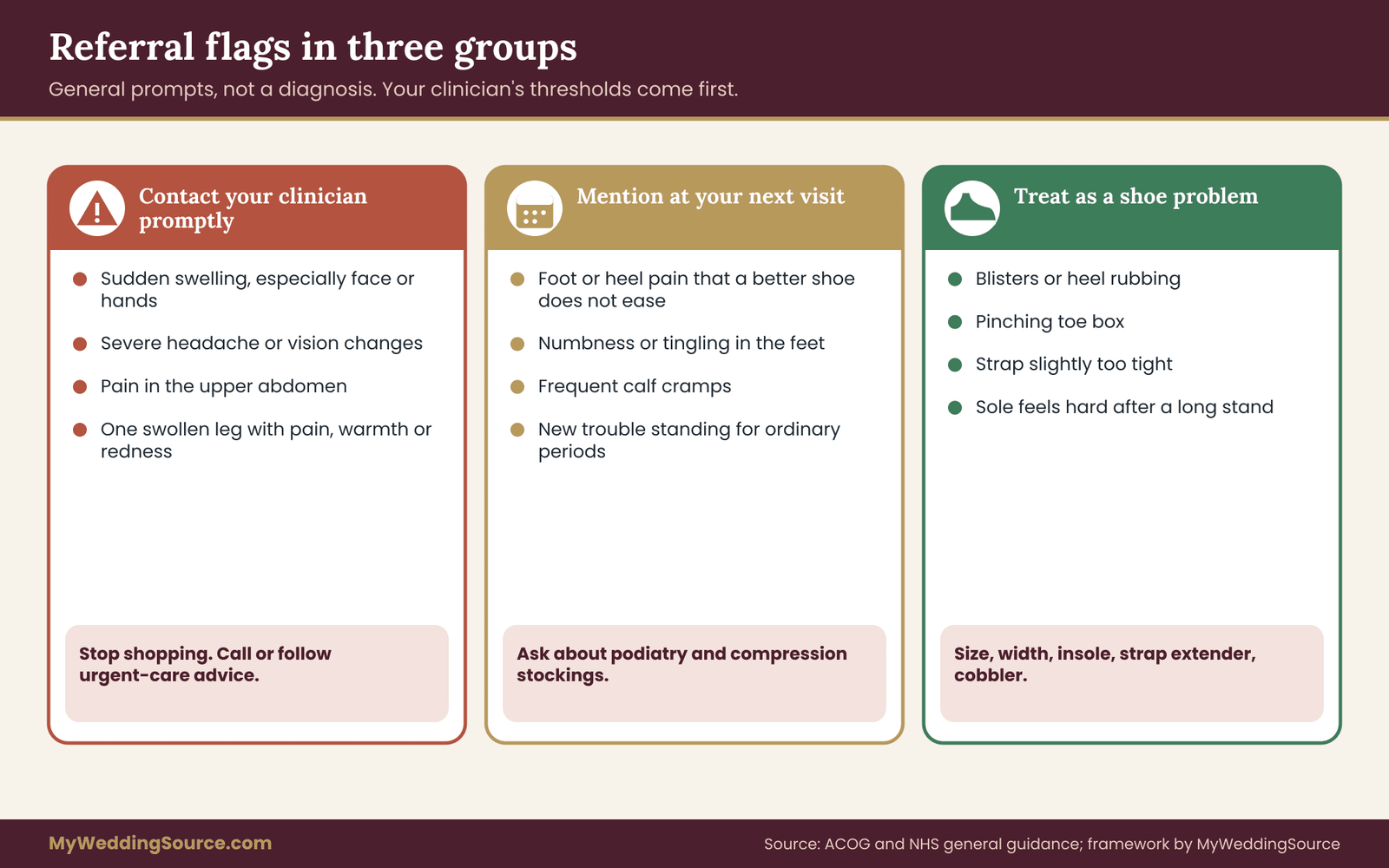
The flags below are general prompts, not a diagnosis. Your clinician may give you different thresholds, and theirs take priority.
Contact your clinician promptly
Sudden swelling, especially in the face or hands, a severe headache, changes in vision, or pain in the upper abdomen are described by medical sources including ACOG as symptoms that need prompt medical attention during pregnancy. If one of these appears while you are shoe shopping, stop shopping. Call your clinician or follow their urgent-care instructions. The shoes can wait.
Swelling in only one leg, with pain, warmth or redness in the calf, is another pattern that medical sources treat as a reason to call at once. It is not a footwear problem. Do not try a different insole or a bigger size.
Mention it at your next visit
Persistent foot, heel or arch pain that does not settle with a better-fitting shoe belongs on the list for your next appointment. So do numbness or tingling in the feet, frequent cramps in the calves, and any new difficulty standing for ordinary periods of time. These are often manageable, and a clinician or a referral to a podiatrist may help.
A clinician may also advise on compression stockings, which are sometimes recommended in pregnancy. Do not buy them on a guess. They affect how pregnancy wedding shoes fit, which is why the question should be answered before you finalize your pair.
Treat as a normal shoe problem
Blisters, rubbing at the heel, a pinching toe box and a strap that is slightly too tight are shoe problems. They are handled with the usual tools: a different size or width, an insole, blister cushions, a strap extender or a cobbler’s stretch. Even then, new foot pain that was not there last week is worth mentioning at your next visit.
How to use the flags in practice
Print the three groups, or copy them into your notes, and put the clinician’s phone number beside the first group. When a symptom appears, you only need to decide which group it belongs to. If you cannot decide, treat it as the higher group. A call to a clinician about something minor costs five minutes. A missed warning sign costs far more.
The flags also help the people around you. A bridesmaid or a parent who knows the plan can notice that you are favoring one foot, and they can say “that goes in the second group, shall I call?” instead of “are you sure you are fine?” Give one trusted person the list, and tell them it is all right to raise it. ## When to buy, fit and adjust pregnancy wedding shoes
The timing problem with pregnancy wedding shoes is simple to state. Shoes take weeks to arrive, adjust and return, but your feet are only fully informative close to the wedding. The way through is to separate the decision into stages, each with a clear purpose, and to use the seller’s return window as a tool instead of an afterthought.

Stage one: shortlist early, buy nothing final
Months out, the job is to learn what you like and what your venue requires. Browse pregnancy wedding shoes, note heel heights, widths and strap styles, and ask the venue about floors and any rules on footwear. This is a good moment to read the return policy of every seller you are considering, because that policy will decide how late you can safely buy. Write down the return window, who pays shipping, and whether worn or tried-on shoes qualify.
At this stage you can also decide what your dress hem needs. If the dress is still being ordered or altered, tell the seamstress that you may wear a lower heel than planned, and ask for the hem to be set for the lower of two heights, with a bustle to handle the rest. The wedding dress fit and alterations guide explains how hem length and fittings fit together.
Stage two: buy the primary and backup pregnancy wedding shoes together
Aim to have the primary pair and the backup pair in your hands a few weeks before the wedding, with enough time left to return or swap them. Buying them together has a side benefit. You can try them with the dress, with the stockings you plan to wear, and with the same posture, and you can compare how each feels at the end of an ordinary day.
For custom or made-to-order pregnancy wedding shoes, production and return rules are far stricter, and some sellers do not accept returns at all. If a pair is custom, treat it as a decoration unless you are sure of your size and have a ready-made alternative. The pregnancy question is not whether custom shoes are wrong, but whether you can afford a pair you cannot return when your feet are the unknown.
Stage three: the late fit check on pregnancy wedding shoes
In the final few weeks, wear each pair at home for an evening, preferably with the dress hem pinned or with a similar length of fabric. Spend at least an hour on a hard floor. Note which pair you reach for when you sit down. Take photographs of both feet at the end of the evening, standing and sitting, so you can see how much the fullness changed.
If the primary pair has become tight, this is the moment to use a cobbler’s stretch or to switch roles, making the backup the primary and the primary the photograph pair. A cobbler needs days, not hours, so leave time. If neither pair works any longer, you still have time to order a third, which is the point of buying early and returning late.
Stage four: the morning check
On the day, make the decision in the morning, not at the venue. Put each pair on, with the stockings, and stand for a few minutes. Ask yourself the five questions, quickly. If your feet or ankles feel noticeably more swollen than at the last fit check, wear the roomier pair first, and keep the other with the emergency kit.
Tell your partner or a bridesmaid what the plan is. If your feet feel wrong and the day is moving fast, nobody should have to guess which shoes come out, or where they are.
Heel of the day versus heel of the evening in pregnancy wedding shoes
The same logic suggests that you do not need to choose a single heel height for the full wedding. Many people wear the more formal pair for the ceremony and photographs, change for the reception, and keep a third pair for the last hour. That approach works well because the highest-stakes standing and walking moments are near the beginning, and the longest dancing and sitting happen later.
If that sounds like a lot of shoes, remember that the second and third pairs do not have to be expensive. They only have to be comfortable, clean and the right height for the hem.
Heel height, shape and support: comparing pregnancy wedding shoes
Comparing pregnancy wedding shoes is mostly about how each construction handles change and load. The categories below are descriptions of how designs behave in general, not product recommendations, and individual shoes differ a great deal. Use them as a vocabulary for what you are looking at.
Flat sandals and flats as pregnancy wedding shoes
Flat shoes remove the heel question, which is why they are a common backup. Their trade-off is support: a thin flat sole can feel hard on the arch after hours of standing, and a flat with no structure can leave your feet working harder than a shoe with a little shaping. Look for a footbed with some contour, a sole that is not paper-thin, and a back that stays on without gripping.
A sandal with adjustable straps gives the most tolerance for swelling. A closed ballet-style flat gives the least, because the upper cannot stretch. If you choose closed flats, choose them a little roomy and add a thin insole only if there is space.
Low block heels
A low, wide heel keeps the formal look of a heel while giving a stable base. Many people treat a block heel of modest height as the compromise choice: the shape looks dressy in photographs, the broad base helps on uneven surfaces, and the lower angle puts less load on the front of the foot.
Watch the toe box. A pointed toe on a block heel can pinch as the foot swells. A rounded or almond toe is usually more forgiving. Also check the stability by standing on one leg for a few seconds. If you wobble, the heel base is too narrow or too high for your current balance.
Wedges and platforms
Wedges give a larger base than a stiletto and keep the foot at a mild angle, which some people find comfortable. Platforms reduce the angle further but add weight and can feel clumsy on stairs. Both are harder to adjust, and both are bulky under a long dress, so the hem question comes back.
The grip is the main caution. A wedge with a smooth sole slips on polished floors. If you like the style, ask for a rubber sole addition or choose one with a textured base.
Slim heels and stilettos
Among pregnancy wedding shoes, slim heels put the most load on the ball of the foot and demand the most balance. Whether they are suitable for you is a clinician conversation, and many people simply choose another style. If you love a slim heel, treat it as a photograph pair: worn for a short period, on a stable surface, with somewhere to sit.
Heel protectors, which cover the tip of a narrow heel, help on grass and gravel and are worth considering if the ceremony is outdoors. They do not fix balance. They only keep the heel from sinking.
Sneakers, slippers and dressy flats
A white or neutral sneaker is a legitimate wedding shoe in the current moment, and many couples treat it as a feature. A soft slipper with a cushioned sole has similar comfort and a more formal look. These are the most reliable emergency pairs because they tolerate swelling, they have grip, and they are easy to get on and off.
Whether you wear one as your primary pair is a style decision, not a safety one. What matters is that you decide it in advance, so it does not feel like failure at nine o’clock.
Support features that matter
Across all styles of pregnancy wedding shoes, a few features make a practical difference. A cushioned footbed absorbs impact. A contoured arch gives the foot a shape to rest in. A secure heel, whether through a strap or a snug back, stops the foot sliding forward. Adjustable closures such as buckles or elastic let the shoe respond to the day. A flexible upper gives under swelling.
Ask yourself whether each feature is present, and whether it can be added. An insole, a heel grip or a strap extender can add some of these to a plain shoe, though they should not be added in the last days without a test. A change you have not walked in is a new variable.
A short note on insoles and stockings
Stockings, compression socks and insoles change how pregnancy wedding shoes fit, sometimes by half a size. If you expect to wear compression stockings, which a clinician may recommend, try every shoe with them. If you plan to add an insole, try with it. Buying the pair first and discovering the effect later is the commonest cause of a late fit failure.
Common mistakes to avoid
A few errors come up again and again, and each is cheap to avoid once you know it. The first is buying on the strength of a morning fitting. Feet are at their smallest early in the day, so a shoe that feels perfect at ten o’clock is the least reliable test. Go late, or go twice.
The second is breaking in the shoes by wearing them around the house for ten minutes. A short test shows almost nothing about a long day. Wear them for an hour or more, on a hard floor, with the stockings, and note what happens in the second hour, not the first.
The third is choosing the backup pair last, after the dress is finished. By then the hem is set and the options are narrow. Decide both heights early, while the seamstress can still adapt the dress to them.
The fourth is trusting a size from memory. Your usual size is a starting point, and the tape measure and the shop’s chart are better. Measure both feet, standing, in the late afternoon, and use the larger one.
The fifth is saving every decision for the day itself. A morning rule, written in advance, is easier to follow than a decision made while a photographer is waiting and your feet are already sore. Write it down, and share it with the person who will hold the spare pair. ## The three-pair plan: primary, backup and emergency pregnancy wedding shoes
The central idea of this guide is that pregnancy wedding shoes should be a set of three, each with a different job. The primary pair is the one you want to wear for the best-photographed hours. The backup pair is the one you can wear all evening. The emergency pair is the one that is already in the venue when something goes wrong, and that costs you nothing in pride to use.

The primary pair
The primary pair of pregnancy wedding shoes is chosen for appearance and meets the five-question check with at most two fixes. Its job is the ceremony and the formal photographs. Plan its time on your feet deliberately: put it on as late as you can, and take it off at a known point, such as after the family portraits.
Do not assume that the primary pair will carry the whole day. Assume it will carry the first hours, and treat any extra time as a bonus. That assumption removes most of the pressure from the choice.
The backup pair
The backup pair of pregnancy wedding shoes is chosen for comfort and meets the five questions with room to spare. It should be low, stable and roomy, and it should work with the dress hem. If your dress is hemmed for the primary heel, test the backup with the dress. A hem that touches the floor in flats must be bustled or pinned, so decide who will do it and when.
Many people pick the backup in a metallic, nude or white finish so it blends under the hem and in photographs. You do not have to match the primary pair. A backup that is slightly different and comfortable is better than a perfect match that hurts.
The emergency pair
The emergency pair is whatever you can put on in thirty seconds when the other two are not working. It might be a soft slipper, a clean sneaker, a pair of sandals with generous straps or even the shoes you wore to get dressed. Put it in the emergency kit, with the stockings you plan to wear, and tell someone where it is.
An emergency pair that is a size up from the others is a good idea if your feet are swelling noticeably. A shoe that is a little large is a nuisance. A shoe that is too small is a reason to leave the dance floor.
Who carries what
A backup that is in a car trunk is not a backup. Decide where each pair lives, and who has the key. A bridesmaid, the planner or the venue coordinator can hold the second and third pairs. The accessories guide on this site, the wedding day accessories planning page, covers the broader emergency kit, including blister plasters, a small sewing kit and the items that tend to be needed at short notice.
Write a one-line note for the person holding the shoes: “If I ask for the shoes, give me the second pair first.” It saves a conversation at the moment you least want one.
How the three pairs of pregnancy wedding shoes map to the schedule
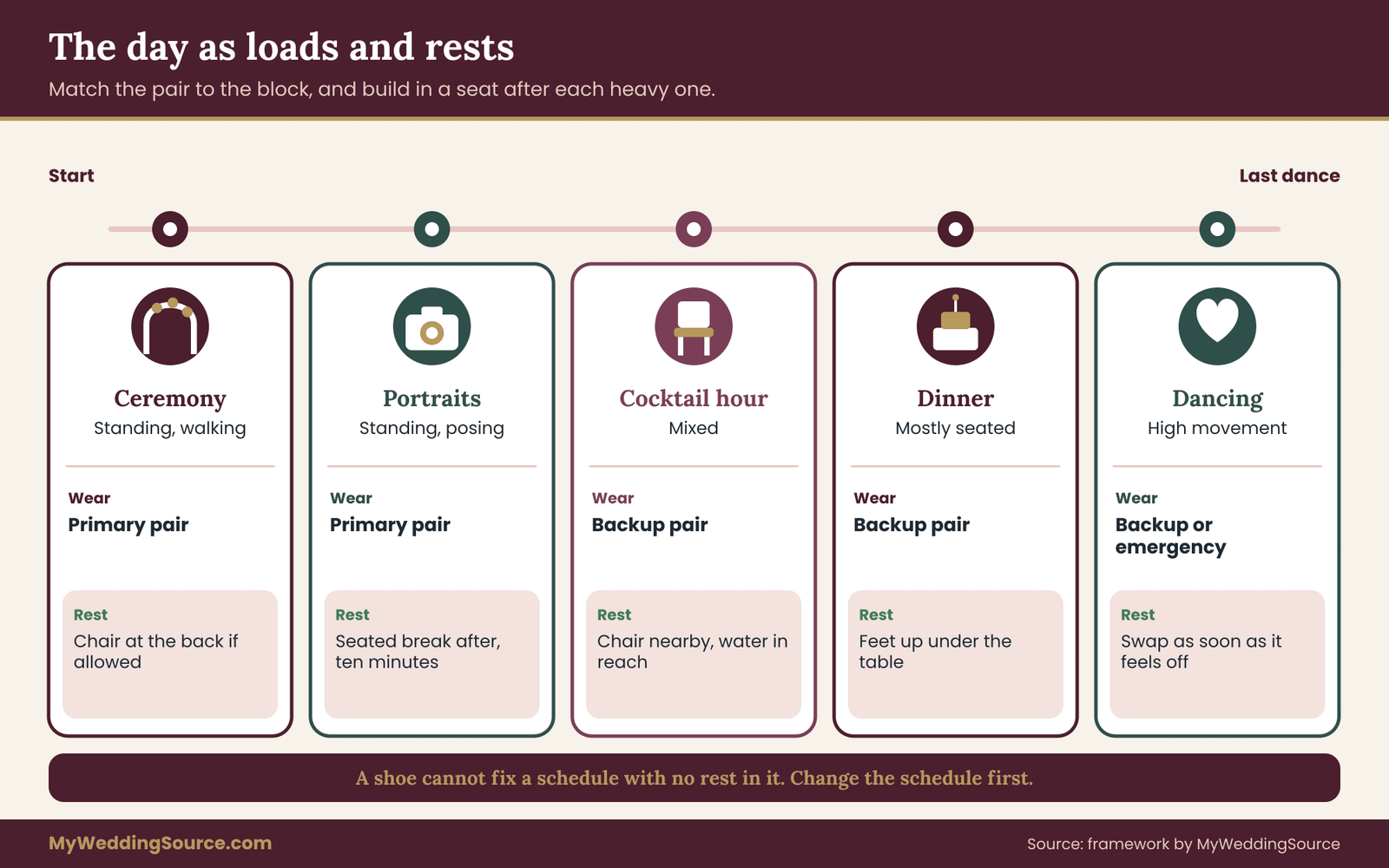
Think of the day in three blocks, with pregnancy wedding shoes assigned to each. The first block, the ceremony and the family photographs, is the highest-stakes standing period. The second, the cocktail hour and dinner, includes more sitting. The third, dancing, is high-movement and the likeliest time for sore feet.
Put the primary pair in block one, the backup in block two or three, and keep the emergency pair near the dance floor. If you feel well, you may stay in the primary pair longer. If you do not, you already know what to do.
Cost logic without the guesswork
Three pairs of pregnancy wedding shoes sound expensive, but the costs are not equal. The primary pair is the pair you would buy anyway. The backup is a comfort purchase and can be modest. The emergency pair may already be in your wardrobe. Your wedding budget can absorb the second pair as a small accessories line item, and returnable purchases lower the risk of paying for a pair you never wear.
If money is tight, spend on the backup. A pair of comfortable shoes you will wear for six hours does more for your wedding than a perfect pair you wear for one.
Venue surfaces, standing time and the day-of rhythm for pregnancy wedding shoes
A good pair of shoes still has to meet a real floor and a real schedule. This section ties the plan to the venue, so that the shoes you choose, and the rest you build in, match the day you will have.
Ask the venue the right questions
Before you finalize your pregnancy wedding shoes, ask the venue what each area is made of: the ceremony space, the walking route, the photograph locations, the dance floor and the restrooms. Ask whether outdoor areas are lawn, gravel, brick or boards, whether there are steps, and whether there is a place for you to sit during photographs. If a ramp or lift is available, ask where it is.
For a wider look at venue questions, the wedding venues guide lists what to ask during site visits. Add footwear-specific questions to the list so you hear the answers early, when they can still change your shoe choice.
Match your pregnancy wedding shoes to the surface
Grass and gravel call for a wide heel or a flat sole, because narrow heels sink and slip. Polished stone, tile and finished wood call for a grippy sole, because they are slippery, particularly when guests spill a drink. Boards with gaps, such as a dock or a deck, can catch a narrow heel. Cobblestones and brick are uneven and tiring to cross in any heel.
If the venue is mixed, which is common, plan for transitions. You may walk the lawn in flats and change before the dance floor, or carry the heels across the grass and put them on at the ceremony space. A short change is easier than a sprained ankle.
Build sitting into the schedule
Standing time is the quiet problem for pregnancy wedding shoes. Photographs, receiving lines and greeting all keep you upright. Ask your photographer to take the formal portraits in a clear order, and schedule a seated break after them. Even ten minutes with your feet up lets swelling settle and your back rest.
A seat at the ceremony is also reasonable. Some couples arrange a chair for the bride during a long reading or at the back during a receiving line. This is a matter of arrangement, not weakness. Ask the officiant and the venue early.
The rhythm of the evening
Plan the day as a series of loads and rests. Ceremony, then portraits, then a break. Cocktail hour with a chair nearby. Dinner, seated. First dance, short. Open dancing, as long as it feels good. If you build rests in, your pregnancy wedding shoes have an easier job.
For the flow of the reception and where people stand and sit, the wedding reception guest flow guide shows how the room works. Use it to place your own chair, the route to the restroom and a spot for a shoe change away from the crowd.
Heat, season and clothing
Heat increases swelling for many people, and it affects pregnancy wedding shoes directly. If the wedding is in warm weather, plan for open shoes and shade, and keep water within reach. In cold weather, stockings and thicker socks change fit, so try the shoes with them. Both cases are reasons to do the late fit check in conditions like the wedding day, not in a cool living room.
Long travel to a destination wedding can also swell feet. If you are flying or driving a long way, pack the shoes in your carry-on, and consider a second pair that is a size up. Ask your clinician about travel and activity before you book.
The venue day-of checklist
On the morning, confirm that your shoes are packed, that the emergency pair is in the venue, and that the person responsible knows where they are. Ask the venue where you can sit, and where the nearest restroom is from each area. Put the clinician’s number on your phone, not in your bag. Small steps like these cost a minute and remove several decisions from the day. ## A worked case: one illustrative bride and her pregnancy wedding shoes
The following example of pregnancy wedding shoes is invented, and it is here to show the method in motion, not to prove anything. The names, dates and details are made up. Real pregnancies differ, and a real decision should rest on your clinician’s advice and your own feet.
Call her Dana. She is planning a wedding on a Saturday in early October. She learns that she is pregnant in the spring, and she expects to be in the later part of the second trimester or the early third by the wedding date, though she knows she cannot be certain. She has fallen for a pointed, closed, satin pump with a mid-height slim heel.
Step one: the check on the first choice
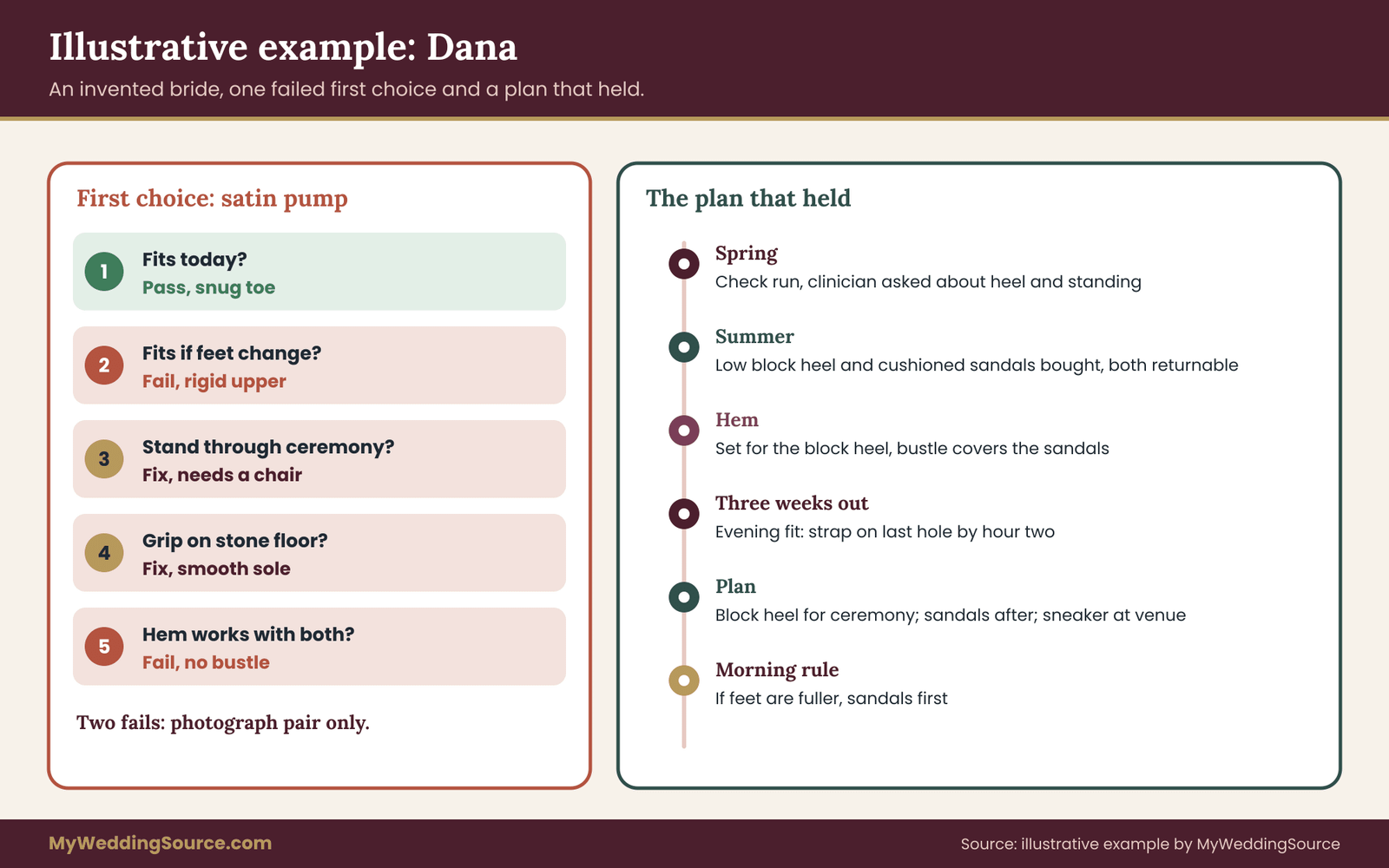
Dana runs the pump through the five questions. Fit today: pass, with a snug toe. Fit if her feet change: fail, because the upper is rigid and the toe is already tight. Standing through the ceremony: fix, possible only if she sits during the readings. Grip on the venue floor: fix, the sole is smooth and the venue has polished stone near the entrance. Hem change: fail, because the dress is hemmed for that heel and has no bustle at the bottom.
Two fails mean the pump is not a primary pair. It could still be a photograph pair, worn briefly. Dana notes this and keeps looking. She also writes a message to her clinician asking about heel height and standing time, and she learns that she should avoid long periods on her feet late in the day. She now has a real constraint.
Step two: a better primary and a backup
She finds a satin shoe with a rounded toe, a low block heel and an ankle strap with several holes. She tries it in the late afternoon, with a stocking like the one she will wear, and it passes four questions with one fix: a grip pad on the sole. For the backup she chooses a pair of flat, cushioned sandals in a champagne tone. Both are returnable for a set period, which she writes in her calendar.
She tells the seamstress that the dress should be hemmed for the block heel, with a bustle that also handles the flat sandals. The seamstress suggests setting the hem a little shorter than first planned, so that it clears the floor in the sandals and shows a bit of the block heel. Dana agrees.
Step three: the late fit
Three weeks before the wedding, Dana spends an evening at home with the dress hem pinned, in the block heel for an hour, then in the sandals. The block heel feels fine for an hour. At the end of the second hour, her feet are fuller and the strap is on its last hole. She notes it, takes photographs of her feet, and keeps the return window in mind.
Her swelling is within what her clinician described as ordinary for her, so there is no referral flag. If she had seen sudden swelling in her face or hands, or had a severe headache, she would have contacted her clinician at once and set the shoes aside.
Step four: the schedule
Dana builds a footwear schedule. Block heel for the ceremony and portraits, with a chair at the back of the ceremony space and a ten-minute seated break afterward. Sandals from cocktail hour to the first dance. Her emergency pair, a soft white sneaker one size up, goes to the venue coordinator with a sticky note. A bridesmaid carries the blister kit and a strap extender.
She also writes down the rule for the morning: if her feet feel noticeably fuller than at the late fit, the sandals come first and the block heel is for photographs only. She tells her partner the rule so it is not a debate on the day.
What the example shows
The example shows the method for choosing pregnancy wedding shoes, not a result. The first choice failed, and the check caught it before money was spent on alterations. The primary pair of pregnancy wedding shoes was chosen for tolerance, not just for looks. The backup was decided early and tied to the hem. And the plan included an explicit morning rule and a carrier for each pair.
It also shows that none of this required a heroic effort. Dana spent a couple of evenings on fit, wrote a short message to her clinician, and arranged who carried what. The remaining work was ordinary wedding planning.
What would have changed the plan
If Dana’s clinician had asked her to limit standing more strictly, she might have used the block heel only for the processional, taken photographs seated, and worn the sandals the rest of the day. If her feet had grown by a full size, she would have returned the block heels and used the backup pair as the primary. If the venue had been a lawn, she would have chosen a wide heel and brought heel protectors. The method is the same. Only the inputs change.
Buying, returns and seller terms for pregnancy wedding shoes
Returns are part of the plan, not an afterthought, because the same uncertainty that makes pregnancy wedding shoes tricky also makes a flexible return policy valuable. Before you buy, you want to know what happens if the shoes do not fit in four weeks.
Read the return terms before you read the reviews
For every seller, find the return window, the condition required for a return, who pays shipping, and the refund method. Some sellers refund to the original payment method, some give store credit, and some charge a restocking fee. Some refuse returns on shoes that show wear on the sole, which matters if you test them on a real floor. Each of these terms changes your risk, and none of them is obvious from the product page.
Take screenshots of the policy on the day you buy, because pages change. Save the order confirmation, and record the delivery date. The consumer agencies publish general guidance on returns and refunds, and the Federal Trade Commission and the Consumer Financial Protection Bureau, both in the sources, explain what rights you have. The seller’s own written policy is what decides your case, so keep a copy.
Test indoors, on a clean surface
Many sellers of pregnancy wedding shoes accept returns on shoes that were tried on indoors but not on shoes that have scuffed soles or visible wear. Do your home fit check on a clean, hard floor, with the sole protected if the policy is strict. A cheap rubber grip pad can be added after you have settled on the pair. Ask the seller whether adding one voids the return, and get the answer in writing.
If a seller will not tell you, assume that adding anything to the sole voids the return, and test grip in the shop or on a mat first.
Sizing, widths and half sizes
If a brand of pregnancy wedding shoes offers half sizes and widths, use them. A half size up is a common choice when swelling is expected. A wide fit is worth trying even if you have never worn one. Order two sizes of the same shoe if the seller allows it and the return terms are fair, and send one back. Keep notes on how each size felt, so you are not guessing later.
Be careful with sizing charts. Brands differ, and a size in one brand is not a size in another. Measure your foot at the end of the day, and compare it with the brand’s chart. For made-to-order styles, ask the seller whether they offer fit exchanges, because the standard rules may not apply.
Alterations and cobblers
A cobbler can widen a shoe, add a grip sole, shorten a strap or add a cushion. These are inexpensive compared with a new pair, and they work best on leather and soft materials. They are less effective on satin, vinyl and structured synthetics, which do not stretch well. Ask the cobbler about the material before you pay.
Plan the cobbler visit early. A few days is typical, but busy seasons make it longer. Never leave a stretch for the last week.
Secondhand and borrowed shoes
A borrowed or secondhand pair of pregnancy wedding shoes can be a sensible backup, particularly if it is already broken in. The warning is that shoes carry the shape of their first owner’s foot, and the shape may not suit yours. Try them on late in the day and walk in them for an hour. If they pass the five questions, they are a good emergency pair. If not, say thank you and return them.
Keep a small shoe file
Keep a note with the order numbers, return deadlines, the cobbler’s number and the sizes you tried. If you are planning other purchases at the same time, such as accessories, a short file helps. The wedding vendor contract guide covers the habit of reading terms before you sign, and the same discipline applies to a shoe order, even a small one.
Reading comfort claims honestly
Product pages are full of comfort language: cushioned, memory foam, all-day wear, maternity friendly. None of these terms has a fixed meaning, and none was written with your pregnancy in mind. Treat them as descriptions of intent. What counts is what you can check yourself: the thickness of the footbed, the shape of the arch, the adjustability of the strap, the width of the heel base and the flexibility of the upper.
Reviews are useful, but read them for specifics. A review that says “ran narrow in the toe, strap had only two holes” tells you something about construction. A review that says “so comfy” tells you very little. Be wary of any listing that promises a particular result for pregnant customers, since the seller cannot know your feet or your clinician’s advice. If a claim cannot be tested, discount it.
What to say to a salesperson
A fitter in a shoe shop or a bridal salon can help if you give them useful information. Say that you are choosing pregnancy wedding shoes, that you may need a roomier fit later, and that you want to know the return and exchange rules before you try anything on. Ask which styles have adjustable closures, which can be stretched, and which cannot.
Ask the fitter to measure both feet, standing, in the afternoon. Feet are often slightly different in size, and the larger foot decides the fit. If the salon offers an in-house cobbler or alterations service, ask about turnaround times, and whether they can add a grip sole or a cushion. A short, direct conversation saves several trips.
Keeping the decision proportionate
It is easy to let a shoe decision grow beyond its size. You are choosing something you will wear for a day, in a season of life that already has plenty to manage. The aim is not perfect shoes. It is a pair you can wear safely and without distraction, and a backup for when your body has other ideas. When you have a primary pair, a backup and an emergency pair, with return windows noted, the decision is finished and you can leave it alone. ## Alternatives and edge cases for pregnancy wedding shoes
The plan for pregnancy wedding shoes above fits a typical case: a bride a few months pregnant on the wedding day, with a seated dinner and a mixed venue. Real weddings vary. This section runs through the cases that change the advice, so you can adjust the method instead of discarding it.
Early pregnancy and a late announcement
If you are early in the pregnancy on the wedding day, or if you have not told guests, your feet may not have changed yet. The temptation is to choose shoes as usual. The better approach is still to include a roomy backup, because the wedding is a long day and you may have less stamina than usual, and because the weeks before the wedding may bring changes you did not expect. Keep your return window open as long as you can.
Tell the person who carries your backup pair what the plan is, even if you have not told everyone else. A simple “I may want to switch to flats early, please keep them close” requires no explanation and protects your privacy.
Late pregnancy
If the wedding falls in the last weeks before the due date, shoes are one part of a larger plan. Your clinician may advise shorter events, more sitting and a plan for leaving early. For many people in this position, the primary pair is a comfortable shoe, and the question of a heel does not arise. Choose pregnancy wedding shoes for ease first, and treat any dressy pair as a short-photograph option.
Also consider the practicalities of getting shoes on and off. Bending is harder, and a shoe with a long strap or lace can be a nuisance. A slip-on or a shoe with a front or side opening, or a helper, makes the job simpler.
A wedding soon after the birth
If the wedding is in the months after the birth, feet may still be different. Many people find that their size has not returned to what it was, and a pair bought months before may not fit. The advice is the same: buy late, keep returns open and carry a roomy backup. A new parent may also be carrying a baby, so hands-free shoes with good grip matter more than usual. The broader question of timing and care for a baby is covered in the wedding guest care planning guide.
Bridesmaids, mothers and other pregnant guests
The same logic about pregnancy wedding shoes helps anyone else in the wedding party who is pregnant. A pregnant bridesmaid should not be asked to wear a particular heel for matching. Offer a choice of heights, or a plain rule such as “any shoe in this color family”. A pregnant mother or guest of honor benefits from a seat, a nearby restroom and the freedom to change shoes without comment.
If your wedding party has coordinated footwear, say early on that comfort trumps matching for anyone who needs it. It spares the person concerned from having to ask.
Existing foot, ankle or balance conditions
If you already have a foot, ankle, knee or balance condition, pregnancy adds to it. Check with your clinician or a podiatrist before you choose anything with a heel. The American Podiatric Medical Association, listed in the sources, offers general information about foot health, and a podiatrist can assess your feet directly. Such a visit can also tell you whether an orthotic would change how any shoe fits.
Barefoot, cultural and religious settings
Some ceremonies are held barefoot, in socks or in special footwear, and some venues, houses of worship or outdoor spaces have their own rules. If your ceremony is barefoot, the surface matters even more: sand, lawn, wood and stone have different hazards, and a barefoot ceremony still needs a place to put shoes on afterward. Ask about the footwear tradition early, and ask who will hold your shoes during the ceremony.
Weddings that need a lot of walking
A wedding with a long walk, such as a beach, a garden with paths, a vineyard or a large estate, raises the demands on the shoes. If the walk is longer than a few minutes, consider arranging transport, or choose a flat or a wedge-free sole for the walk and put on the dressy pair at the spot. A golf cart, a car or a shuttle is a reasonable request, and venues often have one.
The wedding venues guide helps you think about venue layout. Add the footwear questions to those you already ask, and you will learn quickly whether the venue suits your plan.
When the plan fails: failure conditions and what to do
A plan is only trustworthy if you know when it stops working. These are the conditions that mean the shoe plan has failed, with a specific response to each, so you do not improvise under stress.
Failure one: no pair of pregnancy wedding shoes passes the late fit
If neither the primary nor the backup passes the late fit check, you have a few weeks to react. Order another pair, with generous return terms, in a roomier size or an open style. Ask a cobbler about stretching. If time is short, choose the emergency pair as the primary, and let the dress hem and the day be built around it.
Do not try to force pregnancy wedding shoes that failed. The pain will not improve at the wedding, and you will spend the day thinking about your feet.
Failure two: the hem and the heel do not agree
If the primary and backup pregnancy wedding shoes differ so much that the hem cannot cope with both, decide which one you will wear most of the day, and set the hem for that one. Use a bustle or a pin-up for the other. The seamstress can usually add a loop or a button. See the wedding dress fit and alterations guide for how bustles and hems are planned, and ask early.
Failure three: swelling or symptoms on the day
If you notice sudden or unusual swelling while wearing pregnancy wedding shoes, a severe headache, a change in vision or pain, treat it as a medical matter. Contact your clinician or follow their instructions for urgent care. A wedding can be paused. The shoes, the dress and the schedule can all be adjusted, and nothing on the list is worth ignoring a warning sign.
If the swelling is within the normal pattern your clinician described, switch to the roomier pair, sit, put your feet up for a few minutes and drink water. Do not wait for the pain to get worse before you change.
Failure four: the shoes are lost, damaged or forgotten
Pack a spare pair in the emergency kit, and make sure someone other than you knows where it is. If a pair is damaged, such as a broken strap or a snapped heel, the backup comes out, and the broken pair goes to the person holding the kit. A small repair kit with adhesive, a needle and thread, and spare heel tips is cheap. The wedding day accessories planning guide lists the fuller set.
Failure five: the shoe works, but the schedule does not
Sometimes the pregnancy wedding shoes are fine and the day is the problem. A ceremony that runs long, a photograph session that has no seats or a reception line that lasts an hour will overwhelm any shoe. If you notice this during planning, change the schedule: shorten the line, add chairs, order the photographs differently. A shoe cannot fix a schedule that has no rest in it.
What to say when plans change
A few short scripts make the day easier. To the photographer: “I will need to sit for a few minutes after the family portraits; can we do the seated ones first?” To the bridesmaid carrying the shoes: “If I look at you and touch my ankle, please bring the second pair.” To the venue coordinator: “I may want a chair near the entrance; can you keep one free?”
To a relative who insists that you wear the heels in the photographs: “I will wear them for the portraits, and then I am changing.” To anyone who comments: “These are what my feet like today.” No further explanation is needed, and none is owed.
Reviewing your pregnancy wedding shoes after the wedding
Afterward, make a short note about your pregnancy wedding shoes: which pair did you actually wear, for how long, and what would you change? The note is useful if you are planning another event during pregnancy or after a birth, such as a christening or a family wedding. It also settles the question of what to do with the shoes. Some people keep the primary pair, and some sell or donate the extras. ### A one-page fit log for pregnancy wedding shoes
The five-question check for pregnancy wedding shoes is easier to use if you record it. Keep one page, on paper or in your phone, with a line for each shoe you try. On each line write the shoe, the date and time of day, the stockings or socks you wore, your answer to each of the five questions, and the verdict: primary, backup, emergency, photograph only or rejected. Add the return deadline in the margin.
The time of day matters more than it seems. A line that says “ten in the morning, pass” and a line that says “five in the evening, fix” describe the same shoe, and the second is the one to trust. When you reread the log in the final weeks, you will see patterns, such as one brand that always runs narrow or a strap that always becomes tight, that you would not remember otherwise.
The log also keeps the decision calm. When a relative asks why you are not wearing the shoes you showed them in spring, you can say that they failed the second question, and that you chose a pair that passed. It turns an opinion into a record.
Questions to bring to your clinician
Bring a short list about pregnancy wedding shoes to an appointment in the weeks before the wedding. Ask whether there is a limit on heel height or on standing time for you. Ask what degree of swelling is ordinary for you and what should prompt a call. Ask whether compression stockings are advised, and whether there are positions or breaks you should plan on the day. Ask about travel if the wedding is far from home.
Write the answers into the fit log, beside the flags. If your clinician gives a firm limit, it overrides everything in this guide, including the five-question scores. A shoe that passes every question but exceeds your clinician’s limit is not a shoe you wear.
The limits of this method
The method for pregnancy wedding shoes reduces guessing, but it does not remove uncertainty. It cannot predict how your feet will behave in the final weeks, and it does not replace medical advice. It also does not make every shoe suitable: some beautiful shoes are a poor match for this season of your life, and the check is the way to learn that before you buy them.
What the method can do is make the decision visible. You know what you tested, what you decided, and what you will do if the day goes differently. That is usually enough to let you enjoy the day, and the shoes.
Your next steps
Work through these in order. Each takes an evening or less.
- Send your clinician the short list of questions about heel height, standing time, swelling and compression stockings, and write down the answers.
- Ask your venue what each walking surface is made of, where you may sit, and whether a ramp, lift or cart is available.
- Read the return policy of every seller you are considering, and note the window and the condition required.
- Shortlist a few pairs of pregnancy wedding shoes, and run each through the five-question check. Record the answers in your fit log.
- Decide the hem with your seamstress, setting it for the lower heel and adding a bustle if needed.
- Buy a primary and a backup pair a few weeks before the wedding, with returns open, and add an emergency pair to the kit.
- Do the late fit check at home for an evening, and photograph your feet at the end.
- Write the morning rule and the footwear schedule, and tell your partner and the person who carries the shoes.
If you are early in your planning, the wedding planning checklist on this site shows where footwear sits among the other tasks, and the wedding vendor timeline helps you place the seamstress and cobbler visits. Put them in the calendar now, because both fill up near the wedding.
FAQ
Is it safe to wear heels in a pregnancy wedding?
It depends on you, your balance and your clinician’s advice, so ask them directly. Many people choose a low, wide heel or flats because balance can feel different during pregnancy. If your clinician has no restriction, the five-question check helps you judge a specific pair. If you wobble on one leg for a few seconds, treat the heel as too high or too narrow for now.
When should I buy pregnancy wedding shoes?
Buy as late as the seller’s return terms and your calendar allow, usually a few weeks before the wedding. Your feet are most informative close to the date, and returns give you room to switch. Shortlist early, buy the primary and backup together, and leave time for a cobbler. Custom orders need more lead time and often cannot be returned, so treat them with care.
Should I buy a bigger size for pregnancy wedding shoes?
Not automatically. Some people find their feet swell or change size, while others notice little difference. Choose the size that fits when your feet are fullest, at the end of the day, and prefer styles with adjustable straps or soft uppers. If you are between sizes, a half size up, or a wide fit, is usually easier to fix than a pair that is too small.
What are the best backup shoes for a pregnant bride?
The best backup is the one you can wear all evening: low, stable, roomy and grippy. Cushioned sandals, soft slippers and clean sneakers are common choices because they tolerate swelling and are quick to change into. Choose a finish that blends under the hem. Test the backup with your dress, because a flat pair can make the hem touch the floor.
Do I need to change my dress hem for pregnancy wedding shoes?
If you may wear a lower heel than planned, yes, tell your seamstress. A hem set for a tall heel will pool in flats and can cause a trip. Ask for the hem to be set for the lower height, with a bustle or loop to handle the other pair. Your fitting appointments are the time to try both pairs.
When should I call my clinician about swelling?
Call promptly for sudden swelling, especially in the face or hands, a severe headache, changes in vision, or pain in the upper abdomen, and for swelling in one leg with pain, warmth or redness. Medical sources such as ACOG describe these as warning signs. Your clinician may give you different guidance, and theirs takes priority over any article.
How long can I stand during the ceremony?
There is no single answer, because it depends on your pregnancy and your clinician’s advice. Estimate your standing time from the ceremony outline, then test the shoe at home for that long on a hard floor. Ask the officiant about a chair for any long segment, and plan a seated break after portraits so swelling and fatigue can settle.
What if my shoes no longer fit on the wedding day?
Use the plan you wrote. Put on the roomier pair, then the emergency pair if needed, and keep the tight pair for photographs or leave it off. Sit and elevate your feet for a few minutes. If swelling is sudden or comes with other symptoms, contact your clinician. A shoe that no longer fits is an inconvenience, not a verdict on the day.
Sources
- Pregnancy resources and patient information, American College of Obstetricians and Gynecologists
- Pregnancy, MedlinePlus, National Library of Medicine
- Pregnancy, Centers for Disease Control and Prevention
- Pregnancy, Office on Women’s Health, U.S. Department of Health and Human Services
- Pregnancy guide, National Health Service
- Foot health information for patients, American Podiatric Medical Association
- Consumer advice on shopping and returns, Federal Trade Commission
- Consumer tools and complaint guidance, Consumer Financial Protection Bureau
- Product safety information, U.S. Consumer Product Safety Commission