
A dress resale price is the number a real buyer will pay for your gown after fees, shipping and haggling, and it rarely has anything to do with what the dress cost new. This guide gives you a four-line worksheet that builds a wedding dress resale price from sold comparables, an honest condition grade, a demand score and your own net, then turns it into a listing price, an accept price and a floor.
Start with what similar dresses actually sold for, not what they are listed for and not what you paid. Take the middle of three to six comparables. Multiply by a condition factor you can defend with photos, then adjust up or down for demand. Finally subtract fees, shipping and cleaning to see what lands in your pocket. Set a listing price with room to negotiate, an accept price you are happy with, and a floor at which you would rather keep, donate or redesign the dress.
Most advice about pricing a used wedding dress starts with a percentage of the original price. Sell it for half, people say, or a third if it has been worn. The trouble is that the original price is a fact about your shopping trip, not about the market for your dress today. It may include a markup from a salon, a rush fee, alterations, a veil, or a discount you forgot about. Buyers cannot see any of that, and they do not care.
This article takes a different route. It treats the sale like a small valuation job with four inputs you can check: what comparable gowns sold for, what shape yours is in, how much demand there is for that kind of dress right now, and what you keep after the costs of selling. Each input has a method, a way of being wrong and a way of correcting it. The result is a dress resale price range you can explain to a buyer in one sentence.
A note on scope. This is general information, not legal, tax or financial advice, and it does not promise any particular sale price. Values for used gowns swing with fabric condition, designer recognition, size, season and luck, and a dress can sell quickly or sit for months. Where a rule matters, such as fees, shipping options or tax treatment, the article points you to the organization that publishes it so you can read the current version.
Why the original price misleads your dress resale price
The first thing to understand is that a wedding dress is unusual among secondhand goods. It is bought once, worn for a day, and then relisted by a seller who is emotionally attached and often poorly informed about the market. Meanwhile the buyer is usually a stranger who is comparing six other listings, worried about fit, and unable to try the gown on. That mismatch pushes people toward anchors that feel safe, and the original price is the most tempting anchor of all.
There are four reasons the original price misleads.
It bundles things that do not transfer. The number on your receipt may include a veil, a custom length, a rush order, a bustle, steaming, a salon’s service package or sales tax. None of those travel with the dress to a new owner. If you remember paying a round figure, ask yourself how much of it was the gown itself.
It reflects a different market. A salon sells a new dress with a warranty, a try-on and a return policy. A private buyer gets none of that. The discount between those two experiences is the buyer’s compensation for risk, and it is not something a seller can negotiate away by pointing at the tag.
It ignores alterations. Hemming, taking in a bodice or adding a bustle can make a dress perfect for you and harder to sell. Many used-dress buyers worry about whether alterations can be undone. The more custom the fit, the narrower the group of people it will suit. Later sections show how to price that honestly.
It invites a number-matching game. If you start at a fraction of retail, you will tend to defend that fraction. Buyers who are asking for a deeper discount will then feel they are fighting you, and you will feel insulted. A price built from sold comparables is much easier to defend, because it points outward at evidence rather than inward at your feelings.
What the original price is still good for
None of this means you should throw the receipt away. The original price is useful in two narrow ways. It helps you identify the dress: the designer, the style name and the season printed on the label or invoice let you search for exact matches. And it gives you a rough ceiling check. If your price ends up higher than a good fraction of the original, you should stop and ask what you have found that the market has not.
Treat the original price as a search term, not as an anchor. Write down the designer, style number, year and fabric, then put the receipt in a folder. If you have kept the invoice, it is also useful proof for a buyer that the dress is authentic. The wedding records guide explains how to keep that kind of paperwork in one place so you can find it when a buyer asks.
In short, the receipt helps you search, but it does not set the wedding dress resale price.
The cost of getting the number wrong
Pricing too high does not simply mean waiting longer. A listing that sits for weeks looks stale, collects no inquiries and teaches you nothing. Pricing too low has the opposite problem: it sells fast, and you will not know whether you left money behind. Both mistakes are easy to avoid if you decide on three numbers in advance and write them down before the first message arrives.
Those three numbers are the listing price, the accept price and the floor. The worksheet below produces all three. First, though, it helps to be clear about what a dress resale price has to cover.
What a wedding dress resale price has to cover
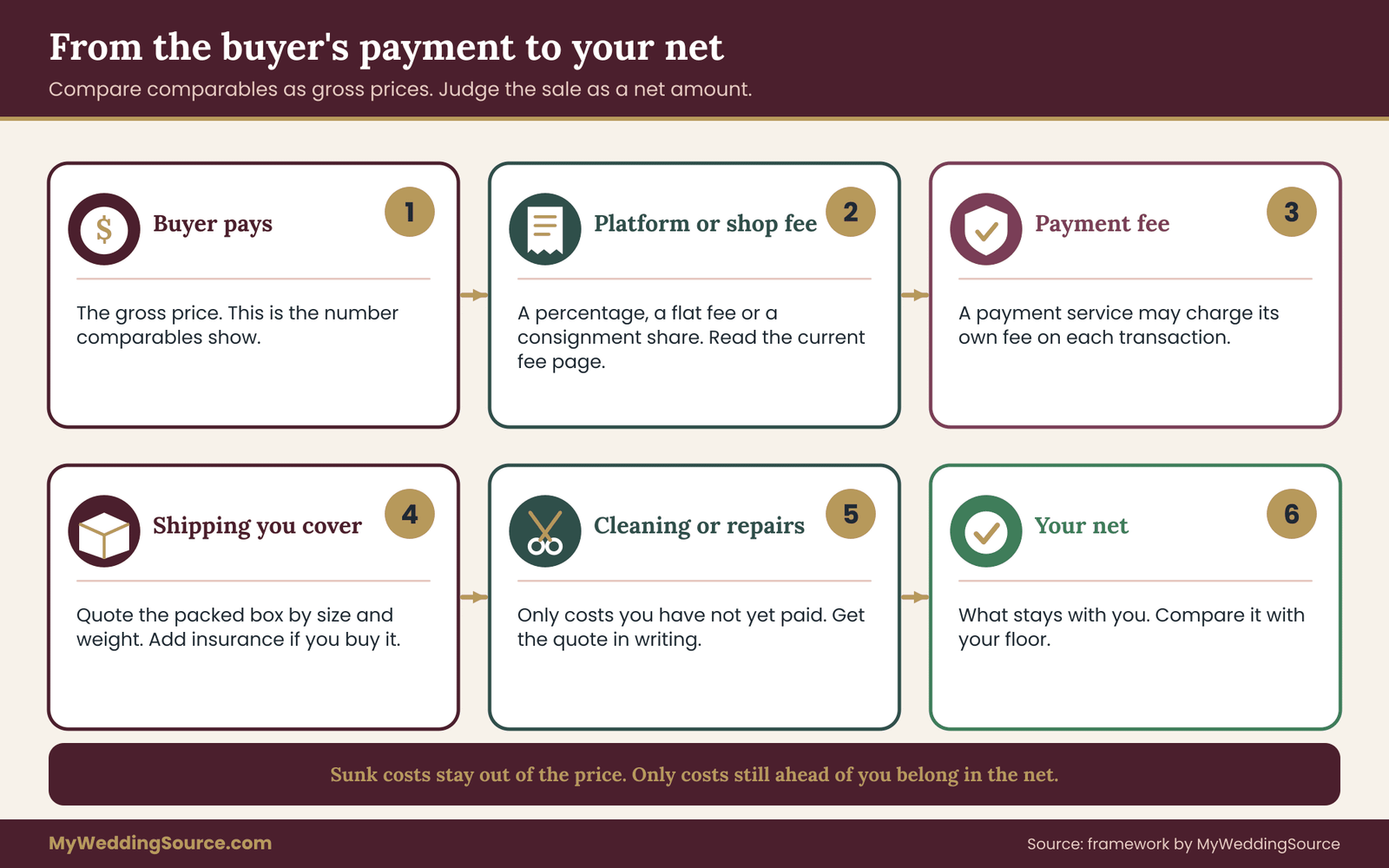
A sale price is not the same as money in your account. Between the buyer’s offer and your bank balance sit several deductions, and some of them depend on choices you make before listing. Sellers who ignore them tend to be surprised at the end, which makes them feel the dress sold for less than it was worth.
Think of the sale as a short list of costs and a single income number.
Platform or consignment fees. Marketplaces and resale sites usually take a percentage, a flat fee, or both. Consignment shops typically keep a share of the sale. The amounts differ by seller, change over time and sometimes depend on the dress resale price band, so read the current fee page of whichever channel you plan to use before you calculate anything. The Federal Trade Commission’s consumer pages are a good general reference for how to read online selling terms.
Payment processing. If you accept payments through a payment service, that service may charge its own fee on each transaction. It is separate from the platform fee. Your buyer may also ask about protection options, so find out in advance which ones your payment service offers.
Shipping and insurance. A wedding dress is bulky. A boxed gown can be large and heavy, and carriers price by size and weight. Whether you or the buyer pays shipping is a pricing decision, not a courtesy. The United States Postal Service publishes its own packaging guidance and service descriptions, and you should check the current options before quoting a number to anyone.
Cleaning and minor repairs. If the dress needs professional cleaning before sale, that is a cost. It is also a way of raising the condition grade. The section on condition shows how to decide whether the cleaning is worth paying for.
Your time. Photographing, answering messages and packing take hours. You do not have to put a dollar value on that, but you should decide how many hours you are willing to spend before you reduce the dress resale price or switch channels.
Gross price, net price and the number that matters
The distinction is simple. The gross price is what the buyer pays. The net price is what remains after fees, shipping you absorb and any cleaning you paid for. Most disappointment in dress resale comes from comparing a gross comparable with a net hope. Someone sees a similar dress listed for a certain amount, imagines receiving that amount, and then discovers that the deductions take a visible slice.
The worksheet fixes this by working in both directions. It builds a gross price from the market, and it then runs the net calculation so you can see whether the sale is worth doing at that price. If the net falls below your floor, the dress is a candidate for one of the alternatives described later, such as donation or a redesign.
So a useful dress resale price is always stated twice, once gross and once net.
Sunk costs belong in a separate column
Many sellers add their cleaning and preservation costs to the dress resale price, as if the buyer owed them. The market does not work that way. If you paid for preservation and the box is sealed, that is a feature a buyer might value or not. It does not create an obligation to repay what you spent.
Keep sunk costs out of the dress resale price formula. Record them separately so you know the total picture, but let the comparables, the condition and the demand set the gross price. The one exception is cleaning you have not yet paid for: if a cleaning would move the dress up a condition grade, it is a forward-looking decision, and the worksheet treats it as one.
The four-line worksheet at a glance
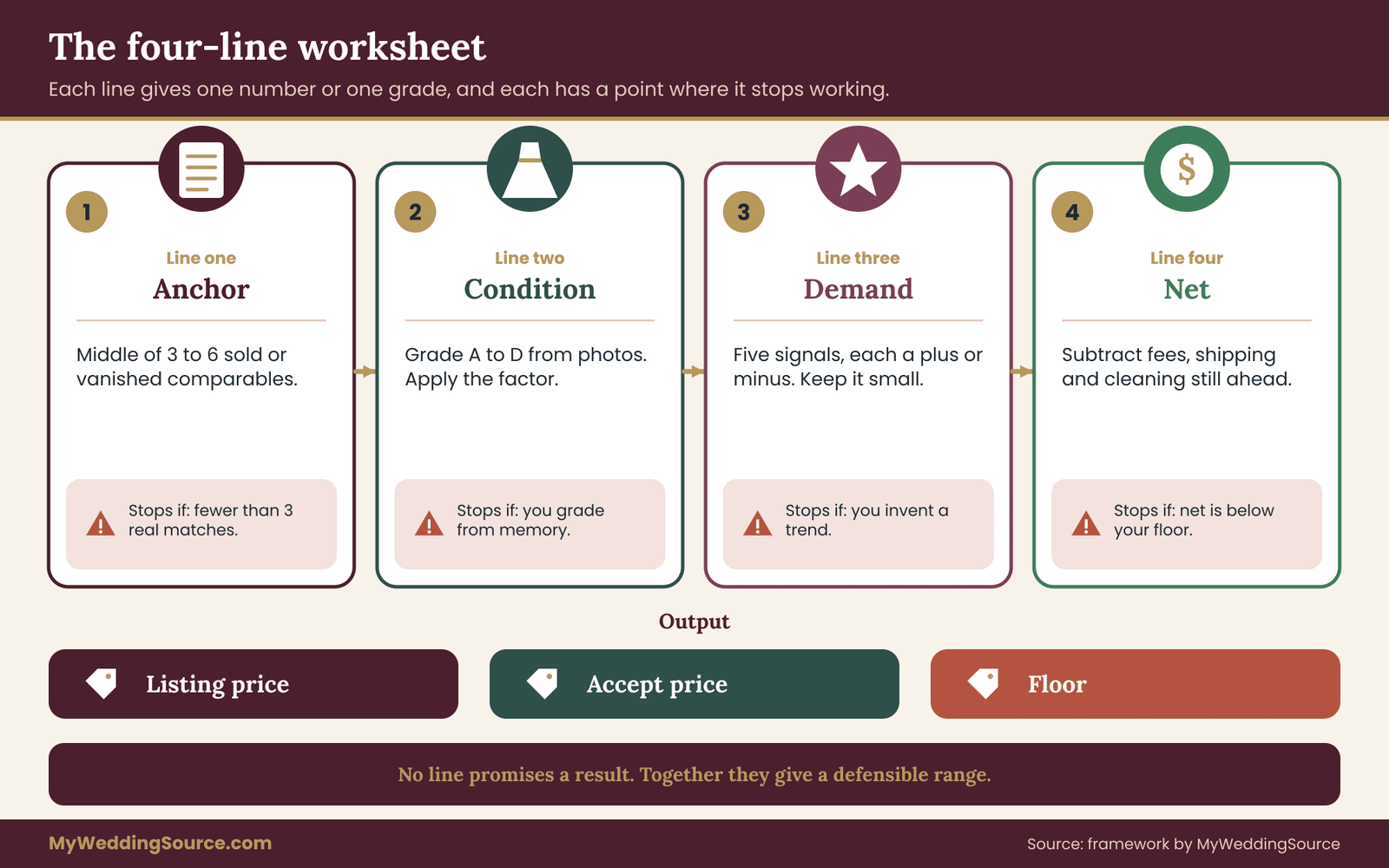
The whole method fits on a card. Each line produces one number or one grade, and each has a failure condition that tells you when to stop and use a different approach.
Line one: the comparable anchor. Find three to six dresses that match yours closely and record what they actually sold for. Use the middle value, not the highest and not the average of everything you see. If you cannot find at least three real comparables, the worksheet tells you to switch to the fallback method in the comps section.
Line two: the condition factor. Grade your dress on a four-step scale from like new to damaged, using photos you could show a buyer. Apply the factor that goes with the grade. Be strict with yourself, because buyers will be.
Line three: the demand adjustment. Score a handful of demand signals, such as how common your size is among listings, how recognizable the designer is and how long comparable dresses stayed listed. Move the number up or down by a small percentage. The point is to keep this step modest.
Line four: the net check. Subtract fees, shipping and any cleaning you will pay for. If what remains is below your floor, the sale does not work at this price in this channel, and you move to an alternative.
From those four lines you get three prices. The listing price leaves room to negotiate. The accept price is what you will say yes to without further thought. The floor is the number below which you keep, donate or redesign the dress. Writing all three down before listing is the habit that makes the rest easier.
Line one: build the dress resale price from sold comparables
The anchor of the whole worksheet is a small set of comparable dresses and what they sold for. This is the step most sellers skip, because it takes an hour or two of looking, and it is also the step that does the most work. A wedding dress resale price built from three honest comparables beats one built from any amount of optimism.
What counts as a comparable
A comparable is a dress a buyer could reasonably choose instead of yours. That means the same designer or a similar tier of designer, a similar silhouette, a similar fabric and a similar condition. It does not have to be identical, but each difference needs an adjustment, and too many differences make the comparable useless.
Use a short checklist when you decide whether a dress qualifies.
- Designer and tier. A dress from the same label is best. If there are none, look for labels with a similar position: independent designer studios, large bridal brands, or bridal lines from department chains. Do not compare a custom couture gown with a mass-produced one.
- Silhouette. A-line, ball gown, sheath, mermaid and fit-and-flare appeal to different buyers. A comparable in the same silhouette family matters more than one from the same season.
- Fabric and embellishment. Lace, beading, silk, crepe and tulle age and clean differently, and buyers know it. Heavy beading raises both appeal and repair risk.
- Age. A gown from the last few seasons and one from fifteen years ago compete for different people, unless the older one reads as vintage.
- Size and length. Similar sizes matter because the buyer pool is similar. Length matters because hemming is a common cost.
- Condition. Compare like with like. A sample gown with marks is not a comparable for a cleaned, worn-once dress.
If a candidate fails more than two items on that list, set it aside as background rather than using it as a data point.
Every comparable you accept makes the dress resale price easier to defend, and every loose one makes it harder.
Sold, not asked
The most common mistake in pricing is using asking prices as if they were selling prices. An asking price tells you what one seller hoped for. A sold price tells you what one buyer agreed to. The two can differ a lot, and a handful of overpriced listings can make a whole category look more valuable than it is.
Where a platform shows sold or completed listings, use them. Where it shows only active listings, you need a workaround, and the next section describes one that takes about three weeks and costs nothing.
Some sellers will tell you privately what a dress went for. Treat private reports as a rough check, not as a data point, because you cannot verify them. The same applies to price statements in forums or comment threads. A comment that says a dress sold for a particular amount might be true, but you cannot confirm the dress, the condition or the final price.
A dress resale price built on asking prices will usually be too high.
The watch-and-vanish method
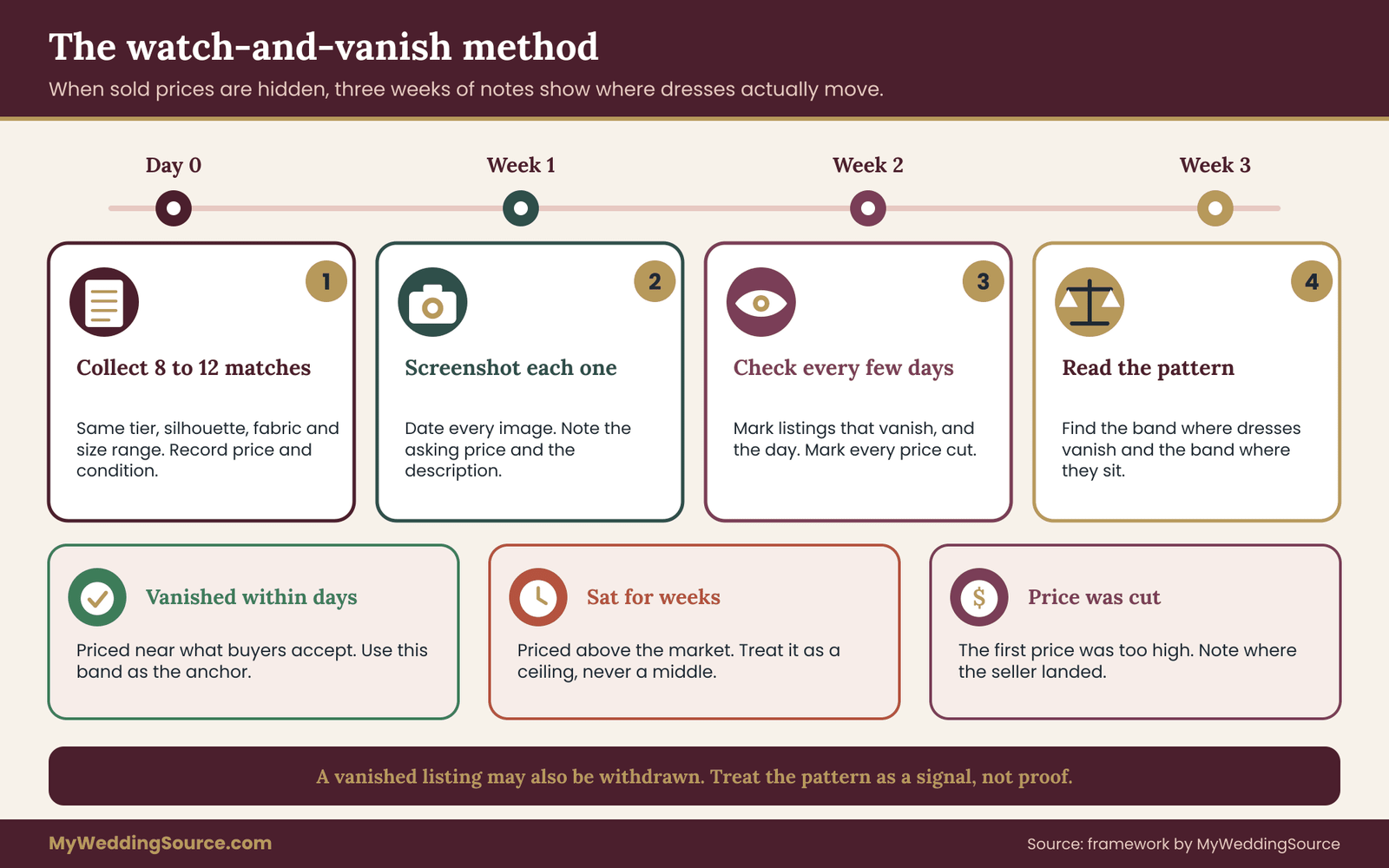
When sold prices are not visible, use disappearance as evidence. The idea is that a listing which vanishes quickly was probably priced where a buyer was ready to act, while a listing that sits for weeks was probably priced above what the market would bear.
Here is how to run it.
- Collect eight to twelve active listings that could qualify as comparables.
- For each, record the date, the asking price, the condition described and the size.
- Take a dated screenshot of each. Check back every few days for about three weeks.
- Note which listings disappear, and on what day. Disappearance can also mean the seller withdrew the dress, so treat it as a signal and not as proof.
- Note which listings have price reductions. A seller who cuts the dress resale price by a visible amount is telling you where the first price was wrong.
After three weeks you will have a rough picture: a band of prices where dresses vanish, a band where they sit, and a handful of listings that dropped. Use the vanishing band as your anchor, and treat the sitting band as a ceiling you should not use.
From a handful of comparables to one number
Once you have three to six comparables with sold or vanishing prices, line them up from lowest to highest and take the middle one. If you have an even number, take the value halfway between the two middle ones. This is the median, and it is the anchor.
Why the median? Because the highest price is usually an outlier: a dress in unusually good condition, a lucky buyer or an unusual designer. The lowest is often a damaged gown or a desperate seller. The average gets pulled toward whichever extreme is larger. The middle value ignores both. A simple rule is that if your highest and lowest comparables differ by more than a factor of two, you probably mixed two different markets, and you should split them and choose the group that actually resembles your dress.
Write the anchor down with a note on how you got it, for example: four comparables, same designer tier, similar silhouette, prices from low to high, anchor is the middle. That note will matter later when you explain your price to a buyer or decide whether to drop it.
That single middle value is the first draft of your dress resale price.
When there are fewer than three comparables
Sometimes a dress is rare or from a small label, and the search returns one or two matches. That is a failure condition for the worksheet’s first line, and you should not pretend otherwise. You have three options.
Widen the net, carefully. Add comparables from adjacent labels with a similar position, and apply a larger adjustment in line three. Mark the anchor as low confidence.
Use a dress resale price range rather than a point. For a dress with no clear comparables, a wide listing price paired with a firm floor works better than a precise-looking number. Tell buyers it is a rare piece and welcome offers above the floor.
Ask a specialist. A bridal consignment shop, a resale specialist or a textile conservator can sometimes tell you whether a label has a collector following. A conservator will not usually price the dress, but a professional body such as the American Institute for Conservation can help you find one if the question is about fabric, age or whether a gown might have historic interest. For old or unusual dresses, a museum’s collections pages, such as those from the Smithsonian Institution, can show you how institutions describe and date comparable garments.
Pitfalls in the comparable step
A few errors show up again and again.
Comparing across countries or currencies. A dress listed overseas may involve import costs, different sizing and slower shipping. Keep your comparables in the market where you will sell.
Counting the same dress twice. Sellers cross-list. The same gown can appear on three sites at different prices. Count it once, using the lowest price you see.
Mistaking a sample sale for a resale. Prices at a salon’s sample sale reflect a salon’s overstock decisions and may include alterations, steaming or a try-on. They are useful context but not direct comparables for a private sale.
Ignoring the date. Prices from two years ago may reflect a different market. If the comparable is old, say so in your notes and weigh it less.
Anchoring on your favorite. If you find one listing with a high price that you like, notice the pull. Ask what would have to be true for your dress to get that price, and check whether it is.
Each of these errors pushes the dress resale price in one direction or another without telling you.
A quick test for your anchor
Before moving on, run a short sanity test. Imagine a buyer who has opened five tabs, with five dresses similar to yours. Would your anchor price put your dress in the middle of that group, or at one end? If it sits at the top, you should be able to name a concrete reason, such as better condition, a rarer label or a size that is hard to find. If you cannot, lower the anchor to the next comparable down.
The other half of the test is the reverse. If your anchor sits at the bottom, ask whether you are being too cautious. A sold price that is clearly below similar dresses might reflect a flaw in that listing, not a flaw in the market. Look at the photos and descriptions again.
If the anchor passes the five-tab test, the dress resale price that grows from it will too.
Recording the anchor so you can use it later
Keep a one-page note with the comparables, their prices, their conditions and the dates you checked. Add the screenshots. This record serves three purposes. It gives you a basis for negotiation. It lets you revisit the anchor after a few weeks without starting over. And it supports the decision to drop the dress resale price, because you can show yourself that the comparables you used have shifted.
If you are keeping a folder of post-wedding paperwork, put the note alongside the dress’s invoice and any cleaning or preservation receipts. It will take five minutes now and save an hour later.
The anchor is not the price
A last reminder before the next line. The anchor is the middle of what similar dresses brought. Your dress is not similar in every way, and the next two lines adjust for that. The anchor alone is a starting point, and if you list at the anchor without adjusting for condition, you are probably listing above what a careful buyer will accept.
The dress resale price comes only after the next three lines have had their say.
Line two: grade the condition before it sets your dress resale price
Condition is where a wedding dress resale price is most often inflated, and where honesty pays back fastest. A buyer cannot touch the fabric. They rely on your photos and your words, and they will assume that anything you left out is worse than it is. Grading your own dress strictly, before you look at a single offer, protects both your price and your reputation.
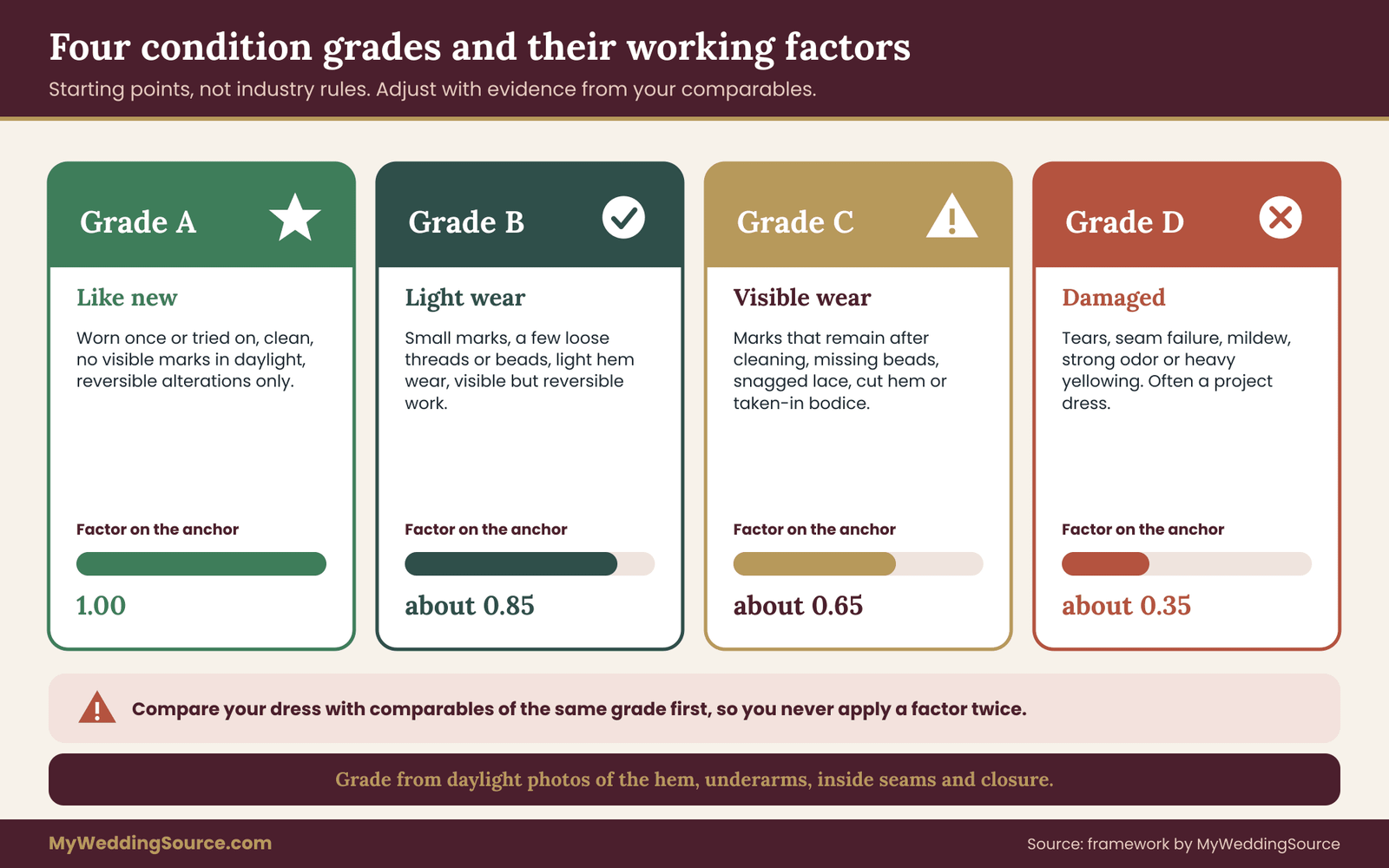
The grades below are working conventions for this worksheet, not an industry standard. Use them as a way of forcing specific questions, and adjust the factors if your comparables clearly show something different.
The four grades
Grade A: like new. Worn once or only tried on, professionally cleaned or never soiled, no visible marks in daylight, no missing beads or lace damage, no odor, original fastenings intact. Alterations are limited to reversible ones, such as a bustle, a hem that can be let down or loops that can be removed. Factor: one, meaning the dress keeps the full anchor when your comparables are also grade A.
Grade B: light wear. Small marks that cleaned partly or sit in places a buyer would not notice, a few loose threads or beads, light hem wear, minor shape change from storage, or alterations that are reversible but visible. Factor: about eighty-five percent of the anchor.
Grade C: visible wear or irreversible changes. Stains that remain after cleaning, noticeable hem dirt, several missing beads, snagged lace, stretched seams, a bodice that has been taken in or a hem that has been cut shorter. These dresses sell, but to buyers who plan to repair or alter them. Factor: about sixty-five percent.
Grade D: damaged. Tears, structural seam failure, mildew, strong odor, heavy yellowing, broken zippers that need replacement, or large areas of damage. Many of these sell as project dresses or for fabric. Factor: about thirty-five percent, or less if repair would cost more than the dress could sell for.
The factors are starting points. If you grade your dress B but the comparables you used were all grade B, you do not apply the factor twice. The point is to bring the anchor in line with your dress, and the cleanest way is to compare each comparable with your own grade before you apply anything.
Grade first, and only then let the grade move the dress resale price.
Normalizing the anchor
Suppose your anchor came from four dresses, and you can tell from their photos that two looked like grade A and two like grade B. Your own dress is a clear B. In that case the anchor is partly built from better dresses than yours, and you apply a smaller correction than you would for an all-A set. The simplest approach is to grade each comparable, then apply the difference between its grade and yours to its price, and take the median of the corrected values.
If that feels like too much arithmetic, use a rough rule: when your set mixes grades, apply half of the factor. When your whole set is better than your dress, apply the full factor. When your set is worse than your dress, apply nothing and consider whether the anchor should rise a little.
This keeps the wedding dress resale price from being penalized twice for the same flaw.
How to grade without fooling yourself
Sellers tend to grade generously, because they remember the dress at its best. Three habits correct for that.
Photograph before you decide. Lay the dress flat or hang it in daylight, and take photographs of the bodice, the hem, the inside seams and the closure. Then grade from the photographs, not from memory. Marks that vanish in a mental picture show up in a close image.
Look at the hem and the underarms first. These are the places that wear and soil most. The hem collects dirt and the underarm area gets perspiration. If either shows discoloration, you are probably not in grade A.
Ask someone else. A friend who has never seen the dress before will notice what you have stopped seeing. Ask them to name the first flaw they notice, then do not argue with it.
For older or vintage gowns, the Smithsonian Institution and the National Park Service both publish guidance on caring for textiles, and the Library of Congress publishes preservation advice for paper and other materials. They are written for museum collections and household heirlooms, but they explain why fibers weaken, why light and humidity matter and why some stains age into permanent marks. If your gown is more than a few decades old, read that kind of guidance before deciding what to clean or repair.
A grade you cannot show in a photograph should not move your dress resale price.
The cleaning decision
A professional cleaning can move a dress up a grade, but it can also fail to, and it can occasionally damage delicate beading or trim. Whether to pay for cleaning before listing depends on three questions.
First, what is the cleaning cost compared with the price difference between grades? If cleaning costs a modest amount and moves the dress from grade B to grade A, the price difference may exceed the cost. If the cleaning cost approaches the difference, it is not worth the risk.
Second, what is the cleaner’s experience with bridal gowns of this fabric? Ask whether they handle beading, lace and silk, and whether they will describe the process in writing. A cleaner who will not discuss risk is a red flag.
Third, can you disclose the dress as is and let the buyer decide? Some buyers prefer to choose their own cleaner and will accept a modest discount for it. A clear disclosure and a fair price can work as well as a cleaning.
If you decide to clean, keep the receipt. A cleaning invoice is a document a buyer can read, and it supports the condition grade. If you have already paid for preservation and sealed the gown in a box, the bridal wardrobe care guide on this site explains the care side, and you should weigh the cost of breaking the seal and resealing against what a buyer would pay for an inspected, boxed dress.
Cleaning is worth it only when it moves the wedding dress resale price by more than it costs.
Alterations: the grade modifier that surprises sellers
Alterations deserve their own attention because they change both fit and resale appeal. The key distinction is reversibility.
Reversible changes. Adding a bustle, sewing in cups that can be removed, adding hooks or buttons without cutting fabric, and taking a hem up with a fold that leaves the original length intact. A buyer can often undo these, and the dress stays close to grade A or B.
Partly reversible changes. Taking in a side seam with extra fabric left inside the seam allowance. A competent seamstress can let it back out, but it may leave stitch marks. Describe it plainly.
Irreversible changes. Cutting a hem, removing a train, reshaping a neckline, or shortening straps by trimming. These move the dress toward grade C unless the changes happen to suit a common buyer.
The dress fit and alterations guide explains how alterations affect fit and cost. For resale, the rule is simple: the more of your body the dress now follows, the smaller the number of buyers it fits. Price accordingly, and describe the work in the listing so that no one feels misled.
Alterations are one of the quietest forces on a wedding dress resale price, so name them in the listing.
Writing a condition statement you can stand behind
Once you have a grade, write two or three sentences that describe the condition in plain terms. Name the grade’s key facts without using the letter. For example: worn once, professionally cleaned, two small marks near the hem visible in the last photo, alterations limited to a bustle and a shortened hem. That sentence tells a buyer what to expect and shows that you have looked at the dress carefully.
Avoid phrases such as perfect condition, like new or flawless unless you would be willing to be photographed holding the dress beside a window. Those words invite disputes. If a buyer receives the dress and disagrees with your description, you want a record that you said what you saw.
A plain statement of condition supports the dress resale price better than any adjective.
Pitfalls in the condition step
Grading by emotion. The dress was the best day of your life, and that colors how you see it. Grade by evidence.
Hiding a flaw in a bad photo. A flaw that only shows in a later photo, or in a photo the buyer asks for, is a flaw you hid. Put it in the first set.
Applying a factor twice. If your anchor already reflects grade B dresses, do not discount again for grade B.
Forgetting odor. Smoke, perfume, storage smells and mustiness are common and hard to photograph. Mention any you notice and decide in advance how much of a discount you would offer for a buyer who wants to have the dress aired or cleaned.
Skipping the inside. The inside seams and lining tell buyers whether the dress has been taken in or repaired. A photo of the inside labeled with the designer name is both a trust signal and a way of confirming authenticity.
After the condition step you hold an adjusted anchor: the middle of what similar dresses brought, corrected for how yours compares. The next line adjusts for the market’s appetite.
Fixing these habits protects the dress resale price and your reputation as a seller.
Line three: score demand before you adjust the dress resale price
Condition tells you how your dress compares with similar ones. Demand tells you how many people are looking for something like it right now. The same gown can be easy to sell in one season and slow in another, and a modest adjustment for demand keeps you from pricing as if the market did not exist.
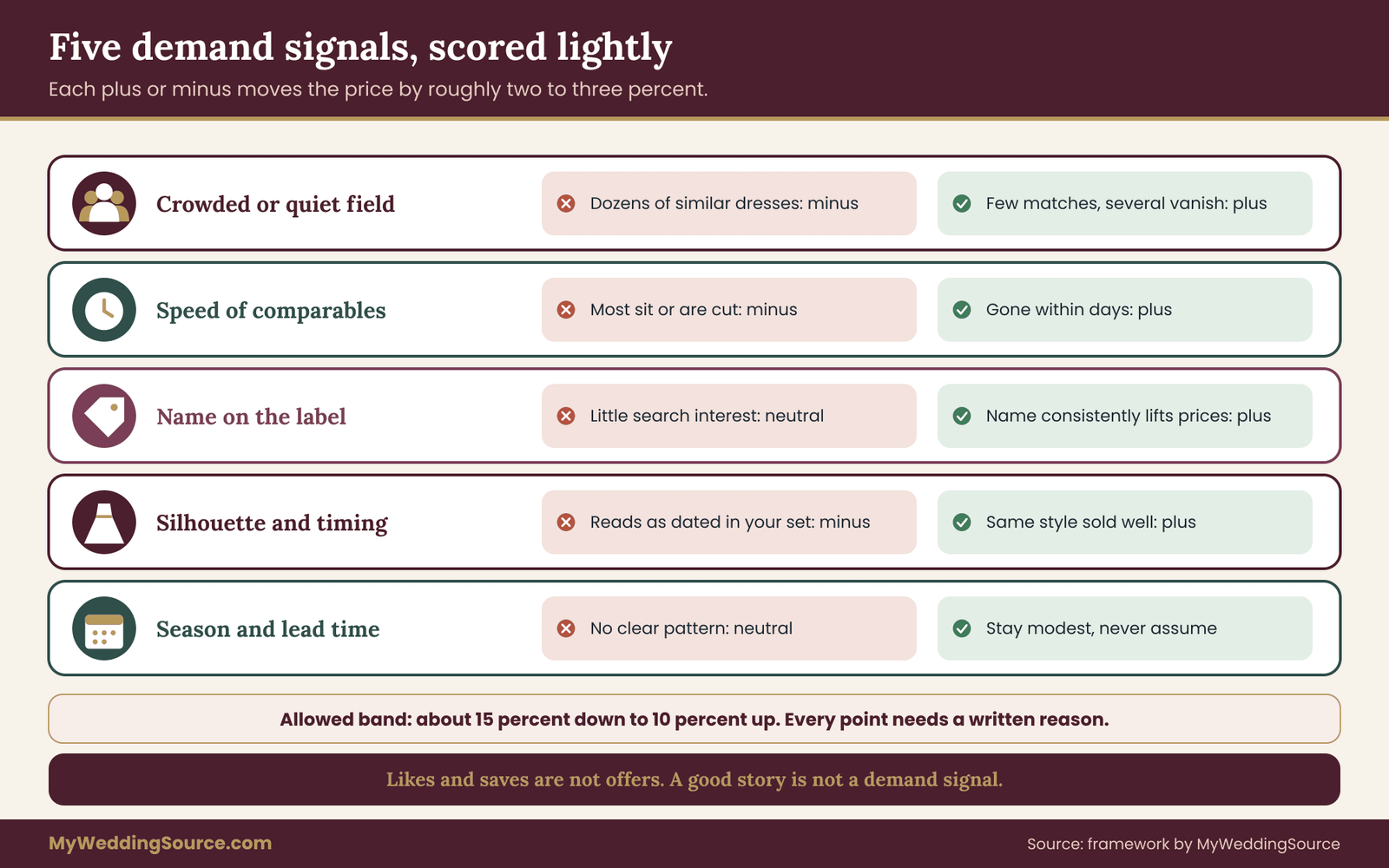
The risk in this line is overreach. Demand is hard to measure, and sellers are tempted to see strong demand wherever it helps them. So the worksheet keeps the adjustment small, usually within a band of about fifteen percent down to ten percent up, and requires a reason for every point you move.
The five demand signals
Score each signal as a plus, a minus or neutral. Each plus or minus moves the dress resale price by roughly two to three percent. You are not looking for precision, only for a consistent habit.
Signal one: how many comparable dresses are listed. If your search turned up dozens of similar dresses, you are competing in a crowded field and a buyer has many choices. That is a minus. If you could find only a few, and several of them vanished quickly, that is a plus. Record the count you saw on the day you searched.
Signal two: how long they take. The watch-and-vanish notes from line one apply again. If comparable dresses disappeared within days, demand is brisk. If most stayed for weeks or were reduced, demand is slow. A dress that is priced at the anchor but sits for a month in a crowded field tells you the anchor was too high.
Signal three: the name on the label. A well-known label draws searches by name. A small or discontinued label draws fewer, but may attract collectors or people who want a particular look. Look at how often the designer’s name appears in listing titles and how the sold or vanished prices compare with similar unnamed dresses. If a name consistently lifts the dress resale price, that is a plus.
Signal four: silhouette and style timing. Buyers often search by silhouette, neckline and sleeve style. If the style looks closely tied to a year, buyers may treat it as dated, or may treat it as vintage if the era is old enough. Do not guess about trends; look at what comparable styles in your set actually did.
Signal five: season and lead time. Many brides buy a used gown within a few months of the date they need it, and some buy early. Wedding dates are not evenly distributed through the year, and a listing posted well before busy periods may attract more attention. Treat timing as a minor factor, and do not hold the dress for a season you cannot verify.
What demand does not include
Several things that sellers believe are demand signals are really emotional or irrelevant.
The dress’s story. That the dress was worn at a lovely wedding does not add to the dress resale price. Some buyers enjoy a story, but few pay for one.
The number of likes or saves. Marketplaces may show how many people saved a listing. A save is not an offer. Use it as a hint at best.
What you would pay. Your own willingness to pay for the dress, or your regret at selling, tells you nothing about a stranger’s.
Celebrity or influencer similarity. Unless you can show that a particular style is widely searched, this is a story and not data.
Applying the adjustment
Add up the plus and minus signs. Two or more pluses and no minuses justify an increase of up to ten percent. A balanced set means no change. Two or more minuses justify a decrease, usually five to fifteen percent depending on how crowded the field is and how slowly similar dresses moved.
Apply the adjustment to the condition-corrected anchor. Write the result on the worksheet next to the reasons. That gives you the gross target price: the amount you expect a typical buyer to pay for a dress like yours in its condition, today.
After this step the wedding dress resale price is a gross target you can defend.
Size is a special case
Size is the signal sellers misjudge most. Some buyers hold a firm belief about which sizes sell fastest, and some sellers repeat it. Do not rely on either. Count how many comparable dresses are listed in your size range and how many of those vanished. A dress in a size that is listed rarely but sells fast carries a plus. A dress in a size that is listed often and sits carries a minus.
Because fit matters so much to buyers, list the measurements as well as the tag size. The garment’s bust, waist and hip measurements, and the length from the top of the bodice to the hem, tell a buyer more than a size label can. Tag sizes in bridal wear vary between labels and often run differently from street sizes. If you have not measured the dress while it is laid flat, do that before listing. The dress fit and alterations guide shows how to take measurements that a buyer’s seamstress can use.
Measurements also affect price in an indirect way. A dress with a generous seam allowance that a seamstress could let out or take in is more flexible and may suit more buyers. Mention it, and mention if the allowance has already been used.
Measurements, more than tag size, keep a wedding dress resale price honest.
A caution about hype
Resale sites and online forums are full of stories about gowns selling at surprising prices. Treat them like lottery stories. For every dress that sold unusually well, many sold at ordinary prices, and a few did not sell. A pricing method that depends on being the exception will not serve you. This is why the worksheet narrows the demand adjustment to a modest band, and why no step in it promises a result.
No resale story should be allowed to raise a dress resale price without evidence.
Line four: work backward from what you keep
Line four is the one that checks the first three. It asks a simple question: after every cost of selling, is the amount left worth the effort, and is it above your floor? If yes, you list. If not, you adjust the dress resale price, switch channels or choose an alternative.
The net formula in words
Take the gross target price. Subtract the platform or consignment fee. Subtract the payment processing fee if there is one. Subtract shipping, if you are covering it, including any insurance. Subtract the cost of any cleaning or repair you will pay for before the sale. What is left is your net.
Each deduction needs a real number from a real source. Read the fee page of the platform. Get a shipping quote from the carrier, using the actual box size and weight of your dress, and include insurance if you plan to buy it. The United States Postal Service publishes its service descriptions and packaging guidance, and carriers quote by dimensions and weight, so measure the packed box before you estimate. Get the cleaning quote in writing. Do not guess.
Every deduction you skip makes the dress resale price look better than it is.
Who pays for shipping
This is a pricing decision. You have three options.
Buyer pays shipping. Your listing price stays lower and the buyer sees the total at checkout. This is common and keeps your net clean, but some buyers hesitate when shipping adds a noticeable amount to a large item.
Seller pays shipping. You build shipping into the dress resale price. Buyers like a single number, but you absorb variation in the cost. If the buyer is far away, you could lose more than expected.
Split or local pickup. Local pickup removes shipping entirely and lets the buyer try the dress on, which is a real advantage for a gown. It narrows the buyer pool to your area, but the buyers who come tend to be serious, and the dress resale price can be firmer.
If you offer local pickup, take sensible precautions: meet in a public place or a store where the buyer can try the dress on with a friend, and avoid payment methods you cannot verify. The Federal Trade Commission publishes consumer guidance on common payment scams, and the Consumer Financial Protection Bureau explains how different payment methods handle disputes. Read both before you accept any payment from a stranger.
The floor
The floor is the net amount below which you would rather not sell. It is not a gross number. If your floor is a certain net amount, you work backward to find the lowest gross price that gets you there after deductions.
How do you choose a floor? Ask what the dress is worth to you in other uses. If you could donate it and claim a deduction, what would that be worth to you? If you could keep it, have it altered into something you would wear or pass down, or use it for a keepsake project, what would that be worth? Your floor should be at least a little higher than the best alternative, because a sale involves effort and risk that the alternatives do not.
Taxes deserve one brief mention. In general, selling personal property at a loss is not treated the same way as selling a business asset, and the rules on gains and losses differ by situation. The Internal Revenue Service publishes guidance on the sale of personal items, and a tax professional can say how it applies to you. Do not guess, and do not assume that a sale price below the original cost has any tax effect.
Net per hour of effort
A final check is to estimate how much time the sale will take: photographing, writing, answering messages, meeting or packing. If you expect to spend ten hours and the net is small, the sale may still be worth doing, but it is worth knowing. Some sellers prefer a consignment shop, which takes a larger share and does most of the work. The worksheet does not choose for you. It only makes the trade visible.
Effort is a quiet cost inside every dress resale price, so count it once.
What to do when the net disappoints
If the net comes out below your floor, you have four moves. Raise the dress resale price only if you have evidence that the comparables support it. Switch to a channel with lower costs, such as local pickup. Wait, if timing is likely to improve and you can store the dress safely. Or move to an alternative, which the later section describes. What you should not do is raise the dress resale price just to make the arithmetic work. A price that the market will not pay is only a number on a screen.
Turning the dress resale price into three numbers
A single price is a weak tool. It leaves you improvising when the first message arrives, and improvised decisions are usually worse than ones made in advance. The worksheet therefore ends with a ladder of three prices, plus a calendar for moving down it.
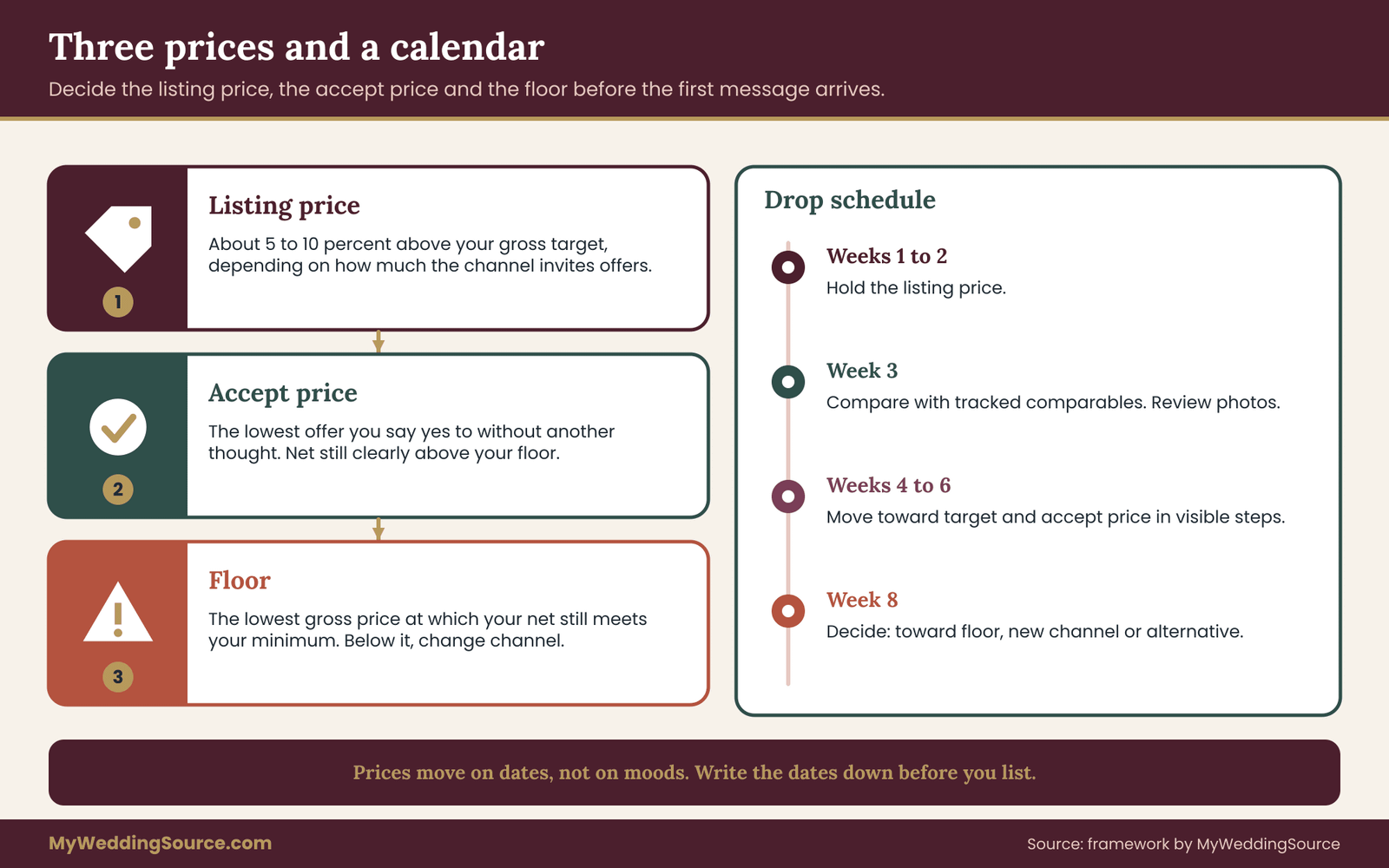
The listing price
The listing price is the number buyers see. It should sit a little above your gross target, enough to leave room for a polite negotiation but not so far above that it looks unserious. A margin of about five to ten percent above the target is a common range, and the right amount depends on how much haggling the channel invites. Marketplaces that feature an offer button tend to produce offers, so build in more room. A fixed-price consignment arrangement leaves less to negotiate, so list nearer the target.
Avoid round-number gimmicks, and avoid pricing a dress in a way that makes it look unusually cheap or unusually special. A clean, specific number that matches the evidence is the most credible. If a buyer asks how you chose it, you should be able to say, in one sentence, that it comes from what similar dresses sold for, adjusted for condition.
The listing price is simply the top rung of your dress resale price ladder.
The accept price
The accept price is the lowest offer you will say yes to without another thought. Set it so that your net at that price is comfortably above your floor, and write it down. Having a number you can say yes to quickly removes one of the biggest sources of stress in selling, which is the offer that arrives at an awkward moment and feels both insulting and tempting.
Think of the accept price as a permission slip. If an offer arrives at or above it, you accept and move on. If an offer arrives below it, you counter, or wait. You do not need to agonize.
Think of it as the middle rung of the wedding dress resale price ladder.
The floor
The floor is the lowest gross price at which the net still meets your minimum. Below the floor, you stop selling through this channel and move to an alternative. The floor protects you from the slow slide that many sellers experience: one reduction after another, each small, until the dress is priced at a level you would never have chosen at the start.
The drop schedule
Prices should move on dates, not on moods. Write a short schedule before you list.
Weeks one and two: hold the listing price. New listings get the most attention at the start, and an early reduction wastes it. If you receive no messages at all in two weeks, treat that as information about the photos, the title or the dress resale price.
Week three: first check. Compare your listing with the comparables you tracked. If similar dresses have vanished while yours has stayed, review the photos and condition description, and consider a small reduction toward the target.
Weeks four to six: move toward the target and the accept price. One or two modest reductions are normal. Make each large enough to be visible, since a reduction a buyer does not notice does nothing.
Week eight: decide. If the dress has not sold at or above the accept price, either lower toward the floor, change the channel, or begin an alternative. A dress that sits for months at a price buyers do not like loses attention and gains only storage risk.
These intervals are a suggestion, not a market rule. Shorten them if your dress is tied to a season, and lengthen them if you are in no hurry. What matters is that the dates exist before you start.
Re-running the worksheet
Revisit the worksheet at each checkpoint. New comparables may have sold. A competing listing may have appeared. A price drop in your own listing may have changed how you rank. A five-minute refresh keeps your decisions grounded in current evidence rather than in the mood of the week.
If your numbers shift a lot between runs, that is a sign of an unstable market for your type of dress. In that case a wider range and a firmer floor are more useful than a precise price.
A fresh run keeps the wedding dress resale price current instead of nostalgic.
A worked case, line by line
The following example uses invented figures. They are not market data and do not describe any real dress, platform or buyer. Their only job is to show the arithmetic so you can substitute your own numbers. Everything in it, from the fee percentages to the cleaning quote, is made up for illustration, and your own figures must come from your own research.
Imagine a seller with a worn-once, A-line lace gown from a mid-tier bridal label. The dress has a bustle and a hem taken up by a reversible fold. Two small marks near the hem remain after a first cleaning.
Line one: the anchor
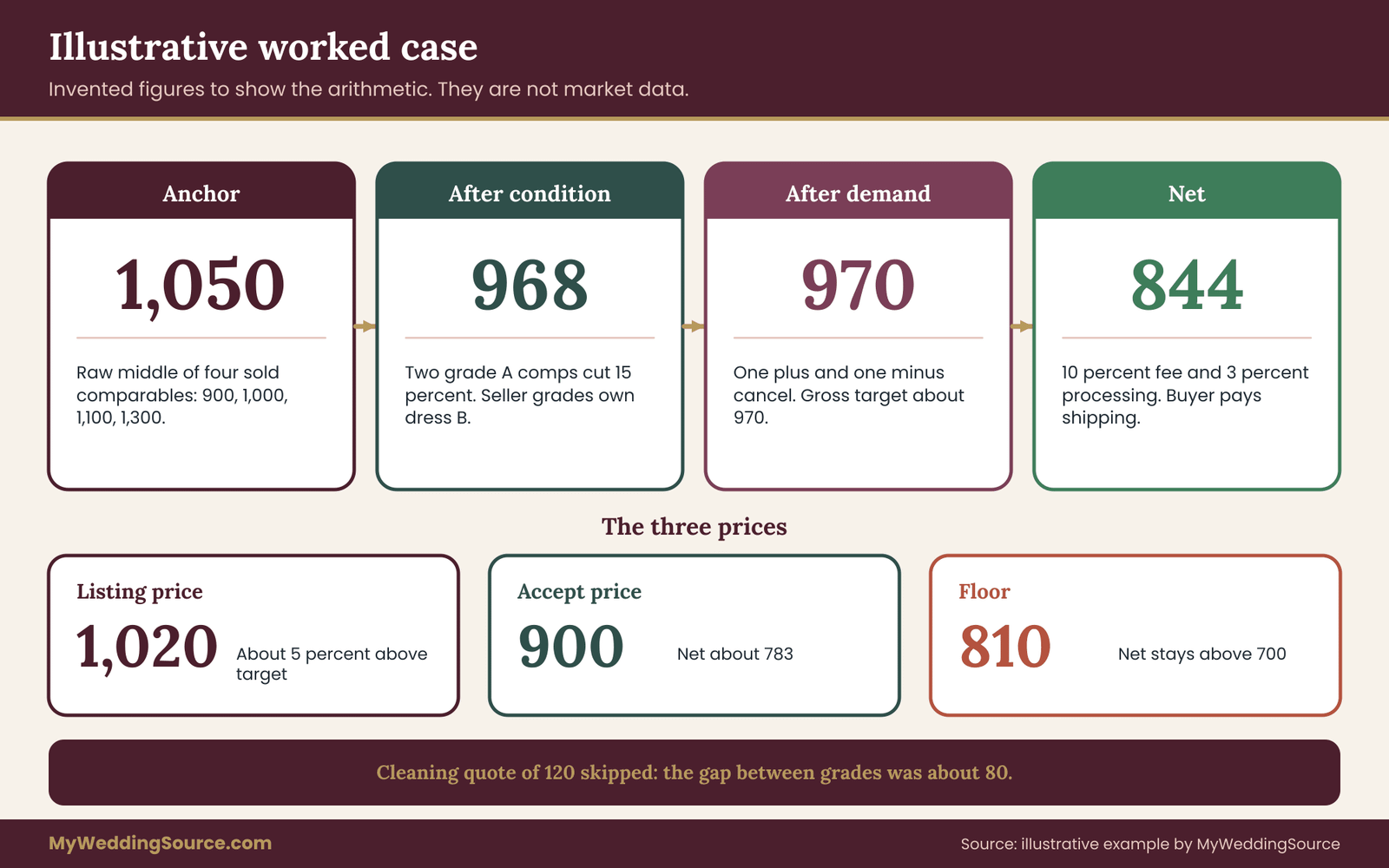
The seller finds four comparables from the same tier, similar silhouette and similar sizes, with sold or vanished prices of 900, 1,000, 1,100 and 1,300 in the illustrative currency. Two of the dresses look like grade A in their photos and two look like grade B.
The raw middle of those four is halfway between 1,000 and 1,100, which is 1,050. That is the number a careless seller would use.
The raw middle of the comparables is where the dress resale price starts, not where it ends.
Line two: the condition correction
The seller grades their own dress as B because of the hem marks. The two grade A comparables, at 1,100 and 1,300, are better than the dress, so each is reduced by fifteen percent, giving about 935 and 1,105. The two grade B comparables stay at 900 and 1,000.
Sorted, the four corrected values are 900, 935, 1,000 and 1,105. The middle is halfway between 935 and 1,000, which is about 968. The anchor has moved from 1,050 down to roughly 968, and that is what the market is likely to say about a grade B dress.
The seller also considers cleaning. A quote of 120 would remove the hem marks and might move the dress to grade A. But the gap between the grade A and grade B targets is only about 80, which is less than the cost of cleaning, and cleaning might not remove the marks. The seller decides not to clean and to describe the marks clearly.
Line three: the demand adjustment
The seller counts comparables. There are many similar dresses listed, which is a minus. The label is well known and its dresses consistently vanished faster than those of unnamed labels, which is a plus. Size and timing look neutral. One plus and one minus cancel, so the adjustment is zero. The gross target stays at about 970.
Line four: the net check
The seller reads the platform’s fee page and uses an illustrative fee of ten percent, plus an illustrative processing fee of three percent. The buyer will pay shipping.
At a gross of 970, the platform fee is 97 and the processing fee is about 29. The net is about 844.
The seller’s floor is a net of 700. Dividing 700 by the share left after fees, which is 0.87, gives a gross floor of about 805, rounded to 810 so the net stays safely above 700.
The three prices
The seller sets the listing price at 1,020, about five percent above the target. A ten percent offer would be about 918 and would still sit above the accept price. The accept price is 900, which yields a net of about 783. The floor is 810.
The drop schedule reads as follows. Hold 1,020 for two weeks. At week three, check comparables and drop to about 980 if needed. At week five, drop to about 940. At week eight, decide between a drop toward 810, a switch to local pickup and a different alternative.
What the example shows
Three things stand out. First, the careless anchor of 1,050 would have produced a listing near 1,100 or more, well above what the corrected evidence supports. Second, the cleaning decision turned on a small comparison, not on a feeling. Third, the floor was set by what the seller would keep, not by hope.
Notice also what the example does not do. It does not promise that the dress will sell for 970, or at all. It produces a defensible range, a set of decisions and a calendar. The market will answer the rest.
The same steps work for any wedding dress resale price, whatever the numbers turn out to be.
Adapting the example
To use the same method, replace each number with your own and keep the order of the lines. If you cannot find four comparables, apply the fallback options from line one. If the net falls below your floor, raise the question of channel before you raise the dress resale price. And if your dress has heavy alterations, apply the irreversible-change logic from line two before anything else.
Alternatives when the dress resale price falls short
Sometimes the worksheet gives you a clear answer: the net is below your floor, or the comparables show that your type of dress barely moves. That is useful information, not a failure of effort. It means a private sale at a market price is not the best use of the dress, and one of the alternatives below may suit you better. Each has its own tradeoffs, and none of them depends on a particular price.
Consignment with a bridal resale shop
A consignment shop lists your dress, handles inquiries and takes a share of the sale. You trade a smaller net for less work and a physical place where buyers can try the dress on, which for a gown is a significant advantage.
Before you sign, ask a handful of direct questions and get the answers in writing.
- What share does the shop keep, and does it change if the price drops?
- How long will the dress be on the floor or listed, and what happens to it afterward?
- Who is responsible if the dress is damaged, stained or lost while in the shop?
- How will you be paid, and how soon after a sale?
- Does the shop set the dress resale price, or do you? Under what conditions can it reduce the dress resale price without asking?
- Does the shop charge any listing, cleaning or hanging fees?
A short written agreement matters here. The vendor due diligence checklist on this site gives a general routine for vetting any business before you hand it something valuable, and much of it applies to a consignment shop: confirm that the business exists, read its terms and keep copies of everything you sign.
Consignment works best when your dress is from a label the shop already moves, in a condition it can display without extra cleaning, and when you value a calm process more than the highest net.
Local selling with try-on
A local sale, through a community group or a regional marketplace, removes shipping and lets the buyer try the dress. The buyer pool is smaller, but the transaction is simpler. Net prices can be higher because platform fees are low or absent, and negotiations tend to be shorter.
Practical precautions matter. Meet at a public place or at a shop that allows fitting. Bring a friend. Take the dress to the meeting in a garment bag and have steaming supplies ready if it gets creased. Accept payment in a way you can verify before the dress leaves your hands, and be wary of any buyer who proposes an unusual payment arrangement or insists on shipping to a different address. The Federal Trade Commission explains common payment scams on its consumer pages, and it is worth reading them before you list.
Selling as a project dress or for materials
A dress in grade D condition, or one with irreversible alterations that few buyers can use, may still have value as fabric, lace, buttons or beading. Crafters, costume makers and people who redesign gowns sometimes look for these. Price such listings low and describe them clearly as project items, with photos of the damage.
If you plan to cut the dress up yourself, the better question is whether you want to. Cutting is irreversible, and some of the most appealing uses of a wedding dress, such as a christening gown, a keepsake pillow or a framed section of lace, are as much about memory as money. If the memory matters more than the cash, the dress resale price question may no longer be the right one.
Donation
Donating a dress to a charity that accepts bridal gowns sends it to someone who may need it, and it removes the pressure of pricing. Some charities resell donated gowns to fund their work, and others lend them to people who could not otherwise afford one. Check the organization’s current donation rules before you drop anything off, since many accept only certain styles, conditions or sizes.
On taxes, the Internal Revenue Service publishes guidance on charitable contributions and the paperwork it expects. A tax professional can tell you whether a deduction makes sense in your situation. Do not assume the value of a donated dress is the dress resale price you hoped to get. The rules for valuing donated clothing differ from the rules for pricing a sale, and they are set by the agency, not by the seller.
Keeping and preserving
If the net is small and the dress means a lot to you, keeping it is a legitimate result. Preservation has its own costs and trade-offs, which the bridal wardrobe care guide and the after-wedding care pages on this site discuss in detail. The Smithsonian Institution and the National Park Service both publish guidance for storing textiles, and the common themes are simple: avoid light, avoid temperature and humidity swings, avoid plastic that traps moisture and avoid hanging heavy gowns by their shoulders.
You can also keep the dress and revisit the question later. Fashion cycles, and a style that is out of favor now may come back. Waiting costs storage and some risk of damage. If you wait, store the dress properly and write yourself a note with the date you plan to revisit it.
Keeping the dress is a valid answer when the dress resale price does not justify the effort.
Lending or renting it out
Some sellers prefer to rent a dress to a series of brides, or lend it to a friend or relative. Renting involves its own work, including cleaning between uses, a damage deposit and a rental agreement. It is generally easier for people who already run a small rental business. If you are considering this, treat it as a different project with its own cost sheet, not as a way to avoid choosing a sale price.
Comparing alternatives without a table
It helps to line up the options by what they ask of you. A private online sale asks for the most work and can return the most. Consignment asks for less work and returns less. Local selling asks for coordination and meeting strangers. A project sale asks for a low price and a clear description. Donation asks for a drop-off and perhaps a receipt. Keeping asks for storage and patience. Seen that way, the decision is less about which option is best and more about which trade you are willing to make.
Write down your top two, and the condition that would make you switch from one to the other. For instance: private sale for eight weeks, then consignment if there are no offers above the floor.
The alternative you choose should match the dress resale price you are willing to accept.
When the worksheet fails: honest limits and failure conditions
Any method has conditions where it stops working. Knowing them in advance saves you from forcing a number out of a process that cannot support it. Here are the main ones.
There are fewer than three real comparables. The anchor is then a guess. Use a wide range, state it as such and rely on the floor rather than the listing price.
The comparables are all asking prices. If you cannot see sold or vanished prices, the anchor is a ceiling, not a middle. Apply the watch-and-vanish method, or lower the anchor.
The dress is vintage, antique or historically significant. The worksheet is built for contemporary gowns that buyers will wear. A garment of historic interest may need an appraisal or a conversation with a textile conservator or a museum. The American Institute for Conservation maintains a directory for finding conservators, and the Smithsonian Institution publishes information on how it studies and describes textiles. Do not price such a gown from retail comparables.
The dress is damaged or contaminated. Mildew, severe discoloration and strong odors change the problem. They may require specialist cleaning that costs more than the dress is worth, and a buyer may not want the risk. Grade D with clear disclosure, or an alternative, is usually the honest course.
The label is uncertain. If you cannot confirm who made the dress, a buyer cannot either. A gown without a label, or one that may be a replica, is hard to price from branded comparables. Say what you know, and do not suggest it is something it is not.
The market is unusual. A very small market, such as a rare religious or cultural style, may have few buyers and no useful comparables. Community groups and specialist shops may do better than general platforms.
You need the money by a date. If time matters more than price, set the floor lower, shorten the drop schedule and consider a consignment shop or a quick local sale. The worksheet will still help you see what you are giving up in return for speed.
Your emotional price is higher than the market’s. This is the most common failure. If the evidence says one number and your heart says another, you have two choices: accept the evidence, or keep the dress. Pricing a dress above the market and waiting is a plan that costs storage and attention.
Signs you are drifting
Watch for these habits as you work. You are adding sunk costs to the dress resale price. You are explaining away a comparable because it feels unfair. You are dropping the dress resale price by small amounts every few days without checking the evidence. You are rewriting the condition grade after a buyer asks a question. You are quoting the original price in your listing as if it supported the current one. Any of these is a cue to go back to the worksheet and rerun it from line one.
What to do with a failed run
If the worksheet cannot give you a number you trust, you still have useful output. You know the evidence is thin, you know your floor and you know which alternatives you would choose. That is enough to proceed with a plain, modest listing and a clear schedule, or to pick an alternative with confidence.
Keep your notes for any later sale, too. If you list a dress again, or help a friend price theirs, the method and the habit of recording comparables transfer. The wedding budget guide treats resale income as a modest offset rather than a planned source of funds, and that attitude fits the worksheet well: whatever the dress brings is a welcome result, not a figure to build a budget on.
Explaining your dress resale price to buyers
A price you can explain is a price you can hold. Buyers of used gowns are cautious, and the way you talk about the number matters almost as much as the number. The goal is calm, specific answers that show you have done the work, without defensiveness and without pressure.
What to put in the listing
Include the facts a buyer needs to judge the dress resale price for themselves. Designer and style name if you know them, the year or season if you can confirm it, the tag size and the flat measurements, the fabric and silhouette, the length, the alterations made and whether they can be undone, and a plain statement of condition with its flaws. Add whether the dress has been cleaned, when and by whom, and whether the receipt is available.
Photographs do much of the pricing work. A buyer who sees the hem, the inside seams, the closure, the label and any flaw in clear daylight is more likely to trust a dress resale price near the target. A buyer who sees only three flattering images will assume problems and offer less. Keep the set consistent, with the same lighting and background, and show the dress both hung and laid flat.
Mention the reasoning for the dress resale price only when it adds something. One sentence such as the price reflects recent sales of similar gowns is enough. Do not list the original price. If a buyer asks what you paid, you may answer, but treat it as context and not as an argument.
Scripts for common moments
The following are examples you can adapt in your own words. They are short on purpose.
When a buyer asks why the dress resale price is not lower. You could say that you based it on what similar dresses in this condition sold for, and that you are open to a reasonable offer. This keeps the conversation on evidence, and the word reasonable invites a number without promising to accept it.
When a buyer sends a low offer. A calm reply might read: thank you for the offer, it is lower than I can accept, but I could do a little below the listing price. If the offer is far below your floor, you may simply say that it is not workable and leave the door open. You do not owe an explanation of your net.
When a buyer asks for a discount because of a flaw you disclosed. You could answer that the dress resale price already reflects the marks shown in the photos. If the flaw is minor, hold. If the buyer raises a point you had not considered, such as a cleaning that would cost more than expected, consider adjusting.
When a buyer asks whether the dress resale price includes shipping. State clearly who pays, and give the quote. If you are building it in, say so. Unclear shipping terms cause more disputes than almost anything else.
When a buyer asks for more photos. Provide them if the request is reasonable. A buyer who asks to see the zipper, the lining or a specific bead is doing due diligence, and a seller who cooperates earns trust. A buyer who asks for many photos in private messages, then disappears, costs you time but no money. Do not rush a decision because of the volume of questions.
When a buyer wants to pay in a way you do not trust. Decline politely. You might say that you only accept payment through the platform’s normal checkout or in person. If the buyer insists, you can walk away. The Federal Trade Commission and the Consumer Financial Protection Bureau both explain how payment scams work, and neither suggests that you owe a stranger an unusual method.
Holding firm without being rigid
Holding the dress resale price does not mean refusing to negotiate. It means negotiating inside the ladder you set. Any offer between the accept price and the listing price is fine, and you can use a counteroffer to find the middle. Any offer below the accept price needs a pause. Any offer below the floor needs a polite no.
Treat each negotiation as separate. A buyer who offers low does not make the market low, and a buyer who accepts quickly does not mean you priced too low. The ladder exists so that a single conversation does not rewrite your plan.
Handling the sale itself
After agreeing on a dress resale price, put the terms in writing: the dress resale price, who pays shipping, the payment method, the packing and insurance, and what happens if the dress arrives damaged or not as described. If you sell through a platform, its buyer protection and dispute process may apply, and you should read them before the sale, since the rules vary. Photograph the dress before packing it, including the label and any flaws, and keep tracking information until the buyer confirms receipt.
Pack the dress with acid-free tissue if you have it, avoid crushing beaded areas and use a box large enough that the dress is not compressed. The United States Postal Service publishes packaging guidance and describes its insurance and tracking options. Carriers set their own claim rules, so ask about them before you ship.
If the buyer lives nearby and prefers to pick the dress up, agree on a time and place in advance. Let them try it on if you can, and have your photos ready if they raise questions.
After the sale
Record the final price, the fees and the net on your worksheet. Note how long the dress took to sell, how many inquiries you received and how the final price compared with your three numbers. Those notes make the next valuation better, whether it is your own or a friend’s. Keep the file with your other post-wedding paperwork. The post-wedding records guide shows a simple way of organizing receipts, statements and photos so that a sale record does not get lost.
Finally, pass along the details a new owner might want, such as care instructions and cleaning receipts, and keep a copy of what you shared. Then let the dress go. A sale is finished when the money has cleared and the dress has arrived.
Next time, a recorded wedding dress resale price makes the whole process faster.
Your next steps
Pick one evening and do three things. First, write down the designer, style, size, fabric and condition of your dress, and photograph the hem, the inside seams and the label in daylight. Second, collect three to six comparables, record their prices and dates and, if sold prices are not visible, start the three-week watch-and-vanish notes. Third, set your floor as a net amount, before you look at any offers.
Then work through the four lines, write the three prices and the drop schedule, and list the dress. Review the worksheet at each checkpoint. If the evidence says the dress will not sell at your floor, choose an alternative without guilt. A clear, honest wedding dress resale price is one you can explain, defend and, when the time comes, let go of.
FAQ
Should I price my used wedding dress as a percentage of the original price?
A percentage of the original price is a weak starting point, because the original price includes things that do not transfer and reflects a different market. Start with what similar dresses actually sold for, correct for condition, and adjust modestly for demand. Use the original price only to identify the dress and as a loose check that your number is not wildly out of line.
How many comparable dresses do I need?
Aim for three to six dresses that match yours in designer tier, silhouette, fabric, age, size range and condition. Fewer than three makes the anchor a guess, so treat it as low confidence and rely on a wide range with a firm floor. More than six rarely helps if they are not truly similar, because mixed comparables blur the picture.
Are asking prices good enough if I cannot see sold prices?
Asking prices are a ceiling, not a middle. If sold prices are hidden, track active listings for about three weeks and note which vanish and which are reduced. The prices at which dresses disappear are weak evidence of what buyers accepted. Withdrawn listings look the same as sold ones, so treat the result as a signal, not proof.
Is it worth cleaning the dress before I sell it?
Compare the cleaning quote with the price gap between the condition grade you have now and the grade cleaning might reach. If the gap is clearly larger, cleaning may pay for itself. If it is close, or the cleaner cannot promise a result, disclose the marks and price accordingly. Ask any cleaner about experience with beading, lace and silk first.
How much should I discount for alterations?
It depends on whether the changes can be undone. Reversible work such as a bustle or a folded hem barely affects the grade. Irreversible work such as cutting the hem, removing a train or reshaping the neckline narrows the buyer pool and can move a dress down a grade. Describe every alteration plainly and price from comparables with similar changes.
What should my floor be?
Choose a net amount, after fees, shipping you cover and cleaning you pay for, below which you would rather keep, donate or redesign the dress. Then divide by the share you keep after percentage fees to get the lowest gross price. Set it slightly above your best alternative, since a sale takes effort and carries risk.
How long should I wait before lowering the price?
Hold the listing price for the first two weeks, since new listings draw the most attention. Check your comparables around week three, make visible reductions in weeks four to six, and decide at week eight whether to approach the floor, change channels or choose an alternative. Shorten the schedule if the dress is tied to a season or a deadline.
Do I have to pay tax on money from selling my wedding dress?
Tax treatment depends on your situation, and the rules differ between personal items and business assets, so ask a qualified tax professional. The Internal Revenue Service publishes general guidance on selling personal property and on charitable donations. Keep the sale record, including the dress resale price, the fees and the date, so that you can answer questions accurately later.
Sources
- Smithsonian Institution, collections and textile research
- Federal Trade Commission, consumer advice on online buying, selling and payment scams
- Consumer Financial Protection Bureau, consumer guidance on payments and disputes
- Internal Revenue Service, guidance on personal property and charitable contributions
- United States Postal Service, packaging and shipping information
- Library of Congress, preservation guidance
- American Institute for Conservation, finding a conservator
- National Park Service, museum collections care guidance
- USAGov, consumer protection information